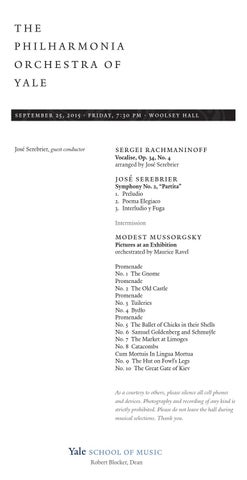
THE PHILHARMONIA ORCHESTRA OF YALE se ptember 2 5 , 2 0 15 · f rid ay, 7:30 pm · wo o ls e y h all
José Serebrier, guest conductor
sergei rachmaninoff Vocalise, Op. 34, No. 4 arranged by José Serebrier
josé serebrier
Symphony No. 2, “Partita” 1. Preludio 2. Poema Elegiaco 3. Interludio y Fuga Intermission
modest mussorgsky Pictures at an Exhibition orchestrated by Maurice Ravel
Promenade No. 1 The Gnome Promenade No. 2 The Old Castle Promenade No. 3 Tuileries No. 4 Bydło Promenade No. 5 The Ballet of Chicks in their Shells No. 6 Samuel Goldenberg and Schmuÿle No. 7 The Market at Limoges No. 8 Catacombs Cum Mortuis In Lingua Mortua No. 9 The Hut on Fowl’s Legs No. 10 The Great Gate of Kiev
As a courtesy to others, please silence all cell phones and devices. Photography and recording of any kind is strictly prohibited. Please do not leave the hall during musical selections. Thank you.
Robert Blocker, Dean
pro g ra m no tes
Sergei Rachmaninoff » 1873–1943 Vocalise, Op. 34, No. 4 Arr. José Serebrier
Rachmaninoff’s Vocalise, Op. 34, No. 4 was the last in a series of songs published in 1914, and together with his early Prelude in C-sharp minor it became one of his most popular compositions. Besides the original version for voice and piano, the wordless, haunting melody, which seems to turn over and over on itself, was easily adaptable for any number of transcriptions for other instruments. Rachmaninoff himself made two versions, for orchestra and for soprano and orchestra. In 1929 he recorded his orchestral version with the Philadelphia Orchestra, but for it to fit on the record he left out the repeats. When the First International Rostropovich Festival in Moscow invited me to conduct their closing concert, they also asked me if I would orchestrate this beloved song for an ensemble size in accordance with the spirit of the music, which I did with great enthusiasm. — José Serebrier
José Serebrier » b. 1938
Symphony No. 2, “Partita” Upon graduating from the Curtis Institute of Music in composition in 1958, I applied for the apprentice conductor position with the Minneapolis Symphony Orchestra, which was given in tandem with the Dorati Fellowship for study in composition at the University of Minnesota. During the two wonderful years in Minneapolis I wrote my most ambitious work, a Partita for large orchestra. The genesis of this large work, later subtitled Symphony No. 2, was a commission from Mrs. Faith Smyth of Chicago. Partita turned out to be a large four-movement work. The opening movement, a Prelude, uses Latin American-sounding rhythms and colors, only the second time I resorted to these, after my Piano Sonata, written the previous year at Curtis. The second movement, Funeral March (Poema Elegiaco), is in a somber Slavic mood, in full contrast to the rather indifferent opening movement. The third is actually a transition, an interlude, leading to a grand finale, an intricate fugue in which the theme of the Funeral March transforms itself little by little into an irreverent conga/candombe. The work ends with a jazz semi-improvisation, based on the same Latin mold.
Mrs. Smyth may have had something to do with the invitation I received from Howard Mitchell, the Music Director of the National Symphony Orchestra, to have this work given its premiere by his orchestra, under my direction. This was in 1960. It was an instant success with the public. The critic of the Washington Post was the notorious Paul Hume, whose first review of Partita was devastating. But in following evenings the concert hall was completely full, and Hume wrote a follow-up review in which he reconsidered his early statements, indicating that the work gained with each hearing, and he now even admired it. — José Serebrier
Modest Mussorgsky » 1839–1881 Pictures at an Exhibiton Arr. Maurice Ravel
Modest Mussorgsky, like many Russian composers of the nineteenth century, was a patriot through and through. He embraced all things Russian, including art, philosophy, folklore, and of course music. He even rejected Western classical music training, devoting himself to a group of composers known as “The Mighty Five,” whose ideologies embraced the creation of distinctly Russian art music. A goal specific to Mussorgsky was to portray the speech and character of Russian people as realistically as possible. He thus focused his compositional efforts on the development of the Russian art song, which he indeed took to unprecedented levels. It is therefore ironic that his two most famous works are not for the voice: Night on Bald Mountain for orchestra and Pictures at an Exhibition for solo piano. Pictures was born out of an inspiring trip to an art gallery in June of 1874. Mussorgsky’s close friend, Russian architect Victor Hartman, had died the previous year, and an exhibit of his work led Mussorgsky to envision a piece portraying himself “roving through the exhibition, now leisurely, now briskly, in order to come close to a picture that had attracted his attention, and at times sadly, thinking of his departed friend.” The work was finished in twenty days in a frenzy of musical inspiration. It is made up of 16 short tableaus, five of which (the Promenades) represent Mussorgsky walking through the gallery and 11 of which depict various paintings he saw along the way. Though the work did not achieve instant fame, it is now highly celebrated for its wonderful,
memorable melodies and vivid portrayals of the characters in the paintings. The work also gained distinction through Ravel’s famous orchestration of it, created in 1922. Promenade: Each presentation of the Promenade differs depending on the mood of Mussorgsky’s gait while walking through the gallery. Its nonsymmetric meter, alternating 5/4 and 6/4, gives it an expansive quality, and its folk-inspired melody transports the listener directly to Russia. This first iteration is direct and upbeat, perhaps conveying the excitement of the eager gallery attendee who has yet to see his first painting. The Gnome: A “fantastic lame figure on crooked little legs” describes the character in this painting. The gnome stumbles, grimaces, cries, and moans, as dramatic gestures in the lower range of the orchestra provide an evil, foreboding mood. Promenade: Mussorgsky continues his walk, this time with the soft, sweet promenade melody in the low register bestowing calmness and stability. The Old Castle: A troubadour sings in front of a medieval castle. His sad song is in strophes, and a constant droning G-sharp creates an ancient, lonely atmosphere. Promenade: A stately presentation of the promenade carries Mussorgsky to the next painting, though it ends almost apologetically. Tuileries: Children play in the garden of the Tuileries with their nurse. Cries and taunts pepper the atmosphere, which is light, owing to the high tessitura. A flirting melody in the middle gives way to a recap of the opening, and with that, the movement ends in a flutter. Bydło: Polish for “cattle,” Bydło depicts the lumbering of an ox cart. Its low, weighty register is reminiscent of Gnomus. “With all force — always heavy,” instructs Mussorgsky in the music. Promenade: A sad, crying walk by Mussorgsky is presented here as he remembers his friend.
The Ballet of Chicks in their Shells: The music chirps lightly in a high register to convey chicks rapping on their shells and shrieking as they emerge. Once they get out, they do a waddling dance. Samuel Goldenberg and Schmuÿle: Two paintings, one of a rich Jewish man and one of a poor one, inspire the dialogue in this movement. The wealthy one, Goldenberg, is assertive and powerful, while the poor one, Schmuÿle, whines in a high voice, his teeth chattering. In the end, Goldenberg gives Schmuÿle nothing but a flea in the ear. The Market at Limoges: Old women quarrel and bustle about at a fair in this scherzo in ternary form. The perpetual motion is punctuated throughout with their shouts and cries. Catacombs (Sepulcrum Romanum): A large cage full of skulls rests on the edge of the painting. Static chords offer a sinister atmosphere rather than a melody. Cum Mortuis In Lingua Mortua: A nostalgic quote of the promenade melody appears with a haunting trill on top. At the end the heavens open up to slow, rising arpeggios. The Hut on Fowl’s Legs (Baba Yaga): Baba Yaga is a character in Russian fairy tales who lives in a hut that can rotate to face each unfortunate passerby. She captures and eats lost children, then covers her tracks with her broomstick. The rhythmic drive of the movement seems to depict her closing in on her next meal. The Great Gate of Kiev: How appropriate for Mussorgsky to save his most majestic writing for the depiction of the gate to the ancient capital, Kiev. Bells ring and hymns play a feeling of homecoming, royal and patriotic. The writing is lavishly grandiose. The promenade melody makes one final appearance, perhaps suggesting Mussorgsky making his final walk, this time away from the gallery. — Laura Usiskin
a rt i st p rofiles
José Serebrier guest conductor Grammy-winner conductor and composer José Serebrier is one of most recorded classical artists in history. He has received thirty-seven Grammy nominations in recent years, and all his recent recordings have received multiple Grammy nominations. When José Serebrier was 21 years old, Leopold Stokowski hailed him as “the greatest master of orchestral balance.” After five years as Stokowski’s Associate Conductor at New York’s Carnegie Hall, Serebrier accepted an invitation from George Szell to become the Composer in Residence of the Cleveland Orchestra for Szell’s last two seasons. Szell discovered Serebrier when he won the Ford Foundation American Conductors Competition (together with James Levine). Serebrier was music director of America’s oldest music festival, in Worcester, Massachusetts, until he organized Festival Miami, and served as its artistic director for many years. In that capacity, Serebrier commissioned many composers, including Elliot Carter, and conducted many American and world premieres. Serebrier has made international tours with the Juilliard Orchestra, Pittsburgh Symphony, Philharmonia Orchestra, Royal Philharmonic Orchestra, Scottish Chamber Orchestra, Toulouse Chamber Orchestra, National Youth Orchestra of Spain, and others. Serebrier’s first recording, the Ives’ Fourth Symphony with the London Philharmonic Orchestra, received a Grammy nomination. His recording of the Mendelssohn symphonies won the UK Music Retailers Association Award for Best Orchestral Recording, and his series of Shostakovich’s Film Suites won the Deutsche Schallplatten Award for Best Orchestral Recording. Soundstage magazine selected Serebrier’s recording of Scheherazade with the LPO as the Best Audiophile Recording. He has recorded with the London Symphony Orchestra, London Philharmonic, Royal Philharmonic, Philharmonia, Bournemouth Symphony, Oslo Philharmonic, Bamberg Symphony, Royal Scottish National Orchestra, Royal Liverpool Philharmonic, Scottish Chamber Orchestra, English Chamber Orchestra, Barcelona Symphony, Czech State Philharmonic Brno, Weimar Staatskapelle, the Sydney, Melbourne, and Adelaide symphony orchestras, and many others. Serebrier Conducts Prokofiev, Beethoven and Tchaikowsky,
filmed at the Sydney Opera, has been shown over 50 times on U.S. television. Serebrier conducted at the 2004 Grammy Awards ceremony in Los Angeles, telecast live to 175 countries. Serebrier presently records for Naxos, BIS, Warner Classics, RPO Records, and Sony/BMG. As a composer, Serebrier has won most of the important awards in the United States, including two Guggenheims (as the youngest in that Foundation’s history, at age 19), Rockefeller Foundation grants, commissions from the National Endowment for the Arts, the Harvard Musical Association, the B.M.I. Award, and Koussevitzky Foundation Award. Born in Uruguay to Russian and Polish parents, Serebrier has composed more than 100 works, published by Peer Music, Universal Edition Vienna, Kalmus, Warner Music, and Peters Corp. His First Symphony was premiered by Leopold Stokowski (who premiered several of his works) when Serebrier was 17, as a lastminute replacement for the then-still-unplayable Ives Fourth Symphony. His music has been recorded by conductors such as John Eliot Gardiner, among others. Serebrier made his U.S. conducting debut at 19 with the National Symphony Orchestra in Washington, performing his Symphony No. 2, “Partita.” His Third Symphony, “Symphonie Mystique,” received a Grammy nomination for Best New Composition of 2004. It was premiered at Carnegie Hall in 2005. His Carmen Symphony CD, with the Barcelona Symphony Orchestra, won the Latin Grammy for Best Classical Album of 2004. The French music critic Michel Faure has written a book about José Serebrier, published in France by L’Harmattan.
a b o ut yale p h ilharmonia
The Philharmonia Orchestra of Yale is one of America’s foremost music school ensembles. The largest performing group at the Yale School of Music, the Philharmonia offers superb training in orchestral playing and repertoire. Performances include an annual series of concerts in Woolsey Hall, as well as Yale Opera productions in the Shubert Performing Arts Center. The Yale Philharmonia has also performed on numerous occasions in Carnegie Hall and Alice Tully Hall in New York City and at the Kennedy Center in Washington, D.C. In 2008, the orchestra undertook its first tour of Asia with acclaimed performances in the Seoul Arts Center, the Forbidden City Concert Hall and National Center for the Performing Arts (Beijing), and the Shanghai Grand Theatre.
peter oundjian Principal Conductor philharmonia staff andrew w. parker Manager roberta senatore Assistant Manager heejung park Assistant Conductor
The Philharmonia Orchestra of Yale violin i Jiazhi Wang Bora Kim Michael Duffett Marianne Di Tomaso Sarah Arnold Hyunjae Bae Julia Ghica Wynton Grant Benjamin Hoffman Suyoun Han Adelya Nartadjieva Elliot Lee Do Hyung Kim Kyung Min Lee violin ii Ethan Hoppe David Kai Yuan Loke Suliman Tekalli Sophia Mockler Jinyou Lee Tzu Ti Chang Yena Lee Linda Lee Moon Joo Kim Jiwon Sun Diomedes Saraza Manaka Matsumoto viola Julia Clancy Emily Brandenburg Rebecca Danielle Wiebe Joshua Newburger Daniel Stone Yang Li Hee-Sun Yang Wei Peng Ryan Davis Ye In Son
cello Chang Pan Pall Kalmansson Jiwon Kang Jenny Kwak Nayeon Kim James Rosamilia Eric Adamshick Yeji Yoo Ji Young Choi Mingyao Zhao bass Luke Stence Kaden Henderson Samuel Suggs Joshua DePoint Will Robbins Erez Meyuhass Levi Jones Lee Starovich flute Evan Fojtik 1 Helen Park 2 Joanna Wu 3 oboe Winona van Alstyne Lydia Consilvio 3 Timothy Feil Ross Garton 2 Ron Cohen Mann 1 Michelle Nguyen clarinet Kenta Akaogi 1 Eric Braley 2 Bixby Kennedy 3 saxophone Vincent Oneppo
bassoon Carl Gardner Matthew Gregoire 1,2 Francisco Joubert Bernard Hanul Park Cornelia Sommer 3 horn Sara Boxmeyer 2 Chuta Chulavalaivong Reese Farnell Sarah Ford Matthew Gray Cody Halquist 3 Joshua Thompson Valerie Sly trumpet Aaron Krumsieg 3 Nozomi Imamura Aaron Plourde Jonathan Shalde Andrew Stadler Daniel Venora 2 trombone Omar Dejesus Richard Liverano 2 Alexander Walden 3 BASS TROMBONE Eliud Garcia tuba John Leibensperger timpani Kramer Milan 2 Yifei Fu 3
percussion Maria Chlebus Yifei Fu Matthew Keown Kramer Milan Jeffrey Stern Se Um harp Noël Wan 3 Shin Young Yu piano/celeste Xiaopei Xu 1 Principal on Rachmaninoff 2 Principal on Serebrier 3 Principal on Mussorgsky philharmonia assistants Andrew Robson Heejung Park music librarians Krists Auznieks Natasha Huang Bora Kim Yefim Romanov Valerie Sly Hanna Yukho Tiange Zhou stage crew Eric Braley Maria Chlebus Lydia Consilvio Julia Ghica Reese Farnel Matthew Keown John Kossler Richard Liverano Noël Wan
up co ming events
» music.yale.edu SEP 29
OCT 1
OCT 2
box office 203 432-4158
Brentano String Quartet Oneppo Chamber Music Series Morse Recital Hall | Tuesday | 7:30 pm Selections from Bach’s The Art of the Fugue and quartets by Britten and Mendelssohn Tickets start at $26 • Students $13 Music for Flute, Viola, and Harp Faculty Artist Series Morse Recital Hall | Thursday | 7:30 pm Ransom Wilson, flute; Ettore Causa, viola; and June Han, harp • Music by Bax, Debussy, Duruflé, Franck, and more Free admission Christian McBride Trio Ellington Jazz Series Morse Recital Hall | Friday | 7:30 pm Christian McBride, bass • With Christian Sands, piano, and Jerome Jennings, drums Tickets start at $25 • Students $14
concert programs & box office Krista Johnson Donna Yoo communications Dana Astmann Monica Ong Reed Austin Kase operations Tara Deming Christopher Melillo piano curators Brian Daley William Harold recording studio Eugene Kimball
Thank you for your support! Become a Yale School of Music patron and support our performance programs. Earn benefits ranging from preferred seating to invitations to special events. To learn more, visit us online or call 203 432-4158. paul hindemith circle $250 to $599 Serena & Robert Blocker Richard H. Dumas Edwin M. & Karen C. Duval Francesco Iachello Patty & Tom Pollard Mary-Jo Worthey Waren Ransom Wilson & Walter Foery Michael Zuber & Zachary Zander horatio parker circle $125 to $249 Joyce Alton Craig Baker Derek & Jennifer Briggs Leo Cristofar & Bernadette DiGiulian Joan K. Dreyfus Paul Gacek Raymond & Jean Gambardella Carolyn Gould Margaret Lord & Arthur Kover Ann Marlowe Susan Matheson & Jerome Pollitt Martha & Vincent Oneppo Arthur T. Rosenfield, M.D. Monika & Fred Volker
samuel simons sanford circle $50 to $124 Nancy Ahlstrom Helen & Blake Bidwell Barbara Blake Harold & Maureen Bornstein Thomas & Judith Foley James V. Freeman Saul & Sonya Goldberg Lawrence Handler James Mansfield Joel Marks Betty Mettler Ron & Sue Miller Barbara & Bill Nordhaus James V. Pocock Fred & Helen Robinson Leonard J. Rutkosky Suzanne Tucker Mr. & Mrs. Peter Uhrynowsky Carl Wies & Margot Hardenbergh Werner & Elizabeth Wolf as of September 25, 2015