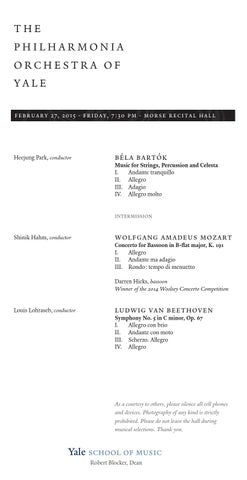
THE PHILHARMONIA ORCHESTRA OF YALE fe b r uary 2 7, 2 0 1 5 路 f rid ay, 7:30 pm 路 mor s e r e ci tal h all
Heejung Park, conductor
b茅la bart贸k
Music for Strings, Percussion and Celesta I. Andante tranquillo II. Allegro III. Adagio IV. Allegro molto intermission Shinik Hahm, conductor
wolfgang amadeus mozart Concerto for Bassoon in B-flat major, K. 191 I. Allegro II. Andante ma adagio III. Rondo: tempo di menuetto
Darren Hicks, bassoon Winner of the 2014 Woolsey Concerto Competition Louis Lohraseb, conductor
ludwig van beethoven Symphony No. 5 in C minor, Op. 67 I. Allegro con brio II. Andante con moto III. Scherzo. Allegro IV. Allegro
As a courtesy to others, please silence all cell phones and devices. Photography of any kind is strictly prohibited. Please do not leave the hall during musical selections. Thank you.
Robert Blocker, Dean
pro g ra m no tes
Béla Bartók » 1881–1945 Music for Strings, Percussion, and Celesta Béla Bartók’s music, full of contradictions and oppositions, reflects his multiple roles as a modernist intellectual and a pioneer of the ethnomusicological movement. A renowned composer and pianist, Bartók wrote Music for Strings, Percussion and Celesta for the Basel Chamber Orchestra in 1936. With this piece he entered his most artistically creative period, which includes such works as Contrasts and the Concerto for Orchestra. Music for Strings, Percussion and Celesta is a landmark piece of music most exemplary for its vigorous summation of Bartok’s unique style. He juxtaposes folk-like modality with strong dissonance, sensuality with intellectual rigor, and soft textures with sharply etched melodies. The orchestra itself represents opposition, with two identical string groups on either side, linked with the centered piano, harp, and percussion. This piece has exceptionally clear form, each line navigating with purpose and direction. The narrow theme that begins the piece pervades all of the movements, and first appears as a densely chromatic subject for contrapuntal invention. The second movement’s melodies build by expanding aspects of the general shape of the theme. The result of this transformation is subjected to extreme development while being passed from one side of the stage to the other with stereophonic abandon. The adagio movement quotes the first theme as an introduction to each of the five sections, two of which feature the expressionist “night music” style that Bartók had explored in his piano piece Out of Doors. The finale, a dance-rondo, reaches its climax when the narrow theme’s tritone gamut is expanded to fill an octave. This important moment reveals the theme’s potential for both chromatic and diatonic treatment. This thematic property is an apt representation of Bartók’s dual citizenship in the chromatic and diatonic worlds, and his role as both a modernist and a folklorist. — Adam B. Silverman Wolfgang Amadeus Mozart » 1756–1791 Concerto for Bassoon in B-flat major, K. 191
posed this concerto in 1774. Jubilant perfume and contrasting moods characterize the mid18th-century Galant style in this work. Scholar Kofi Agawu identifies some of Mozart’s tools in terms of musical “topics” such as lightningquick technical displays known as the “brilliant” style, fluffy elements that anticipate opera buffa, and the shadowy minor-key “ombra” of the second large solo area. Compositional virtuosity in this period balances the variety of these topics (to provide interest) while maintaining a convincing filo, or connecting thread, throughout the architectural features of the concertosonata form (to provide coherence). Formally, the early concertos of Mozart are an expansion of the enduring exposition–development–return sonata form. These early works are like musical lasagna: a pasta layer of orchestral ritornello (roughly an interlude) followed by a rich ricotta layer of solo fireworks, followed by more pasta, and so forth. Note how even in “ricotta” sections, the bassoon will politely step back and allow the violins to elaborate. Owing to its traditional role as a member of the continuo section (much like the baritone saxophone doubling the bass player in the rhythm section of a big band), the principal bassoonist of Mozart’s time would play throughout the solo sections and the ripieno interludes. Although the orchestral roster in Salzburg at the time featured a larger than usual section of violins and double basses (twelve and four respectively, compared to two violas and two cellos), Mozart only had two bassoonists on hand. This tradition of doubling the ripieno has fallen out of modern practice, in which there is often a sharp distinction between the orchestra and the concert artist. Additionally, the four-keyed bassoon of the mid18th century has been retired in favor of the modern instrument (which has nine keys for the thumb alone!), with its extended high range and improved pitch stability. Mozart eventually left Salzburg, dissatisfied because he had been unable to work on opera as frequently as he pleased. Some of his devotion to opera shows here: in the second movement, the soloist leads us on a leisurely walk through the bucolic aria marked Andante ma Adagio. The last movement unfolds as a courtly rondo in the style of a minuet, replete with all the brilliance and humor one might expect of a teenaged Mozart writing for the “clown of the orchestra.” Tonight’s cadenzas are written by Darren Hicks.
An eighteen-year old Mozart had just begun his service in the court of Prince-Archbishop Hieronymus Colloredo of Salzburg when he com-
— Samuel Suggs
art ist p ro f i le s
Ludwig van Beethoven » 1770–1827 Symphony No. 5 in C minor, Op. 67 Many of us assume when we hear the symphony today that it sounds so simple and right that it must have spilled out of Beethoven in one steady gush. But not at all; Beethoven left pages and pages of discarded material…enough to fill a whole book… He sometimes altered passages as much as twenty times. — Leonard Bernstein in 1954 Within Beethoven’s sketchbooks, we can find the creative germs from which this viral symphony propagated. The earliest sketches date back to 1804 — before either the Third or Fourth Symphonies had been performed. The four-year gestation period of this monomaniacal symphony coalesced in a four-hour-long concert which also featured a new Fourth Piano Concerto and Sixth Symphony. The performance in Leipzig, according to playwright and music critic Friedrich Rochlitz, was not a home run, in part, due to the exhausting length of the program and because the orchestral forces were too large to coordinate the Scherzo-Trio. An earlier sketch of the Andante con Moto theme is a simple rising sequence with passionate 4-3 suspensions. Instead of venturing into the variations movement with this nostalgic material, Beethoven instead chose a similar version replacing the repetition with a burst of C major sunshine. The relentless and massive C minor coda of the first movement had denied its sonata burden of this brightness, but the optimistic C major is resilient and shimmers in the Trio before overtaking the finale with eight final hammer blows. In the sketches of the Scherzo-Trio, Beethoven had copied twenty or so bars of the finale of Mozart’s Symphony No. 40 in G minor, corresponding to the undulating arpeggios of the low strings which begin the movement. The thread is further displayed in the first movement of another Symphony in C minor, Brahms’ Op. 68 (compared to Beethoven’s Op. 67). Brahms responds to Beethoven’s scherzo rhetorically by absorbing the “dit-dit-dit dah” theme and by emphasizing the subversive E-flat minor (instead of E-flat major) as the complement to C minor. In the entire first Scherzo section, Beethoven unrelentingly evades releasing the tension of the minor key until the fugato of the Trio. Additionally, there is only one full cadence throughout the Scherzo at the climax of the section. In the analogous
abridged pizzicato recapitulation, the moment of cadence is subverted by the appearance of a new low, droning, pedal point which propels forward into the shining fourth movement. From the sketches, we know that Beethoven conceived of this work not with the fourmovement blueprint of Haydn and Mozart, but in three movements. Although the segue from the Scherzo-Trio into the Finale blurs the line between those two movements, the conceptual synthesis is more convincing when the marching scherzo theme returns as the nadir from which the grand recapitulation explodes. The insertion of this Scherzo material into the Finale is cannibalistic: the symphony eats its own tail in order to complete its organic architecture. — Samuel Suggs conductor Shinik Hahm Shinik Hahm has established himself as a dynamic and exciting conductor. His guestconducting appearances include engagements in Europe, North and South America, and Asia. He has led orchestras in prestigious concert halls such as Carnegie Hall, the Concertgebouw in Amsterdam, the Kennedy Center in Washington D.C, Walt Disney Hall in Los Angeles, Verizon Hall in Philadelphia’s, Benaroya Hall in Seattle, Joseph Meyerhoff Symphony Hall in Baltimore, the Rudolfinum in Prague, Boston Symphony Hall, the Seoul Arts Center, the Tokyo Opera City Hall, and the National Theater of China. As music director and chief conductor of the Korean Broadcasting System (KBS) Symphony Orchestra, Maestro Hahm led the orchestra on tour with concerts at the General Assembly of the United Nations, the Kennedy Center, and Carnegie Hall. Hahm served as music director of the Daejeon Philharmonic Orchestra from 2001 to 2006, during which time the orchestra earned national and international acclaim through concert tours in the U.S. and Japan. Committed to the pedagogy of conducting, Maestro Hahm has been a member of the conducting faculty at the Yale University School of Music since 1995. His students from Yale’s conducting program have won top prizes at the Besançon, Pedrotti, Toscanini, and China National conducting competitions, and are active at the helm of various orchestras in the United States, Europe, and Asia.
Maestro Hahm studied conducting at Rice University, where he received the Shepherd Society Award, and the Eastman School of Music, where he earned the Walter Hagen Conducting Prize. In 1991, Hahm won the prestigious Gregor Fitelberg Competition for Conductors, and in 1995, he was decorated by the Korean government with the Arts and Culture Medal. Heejung Park, assistant conductor
also directed J.S. Bach’s Magnificat and Mozart’s “Jupiter” Symphony. Conducting from the keyboard, Mr. Lohraseb has performed many concertos of Mozart as well as J.S. Bach’s Brandenburg Concerto No. 5, and Bach’s two triple harpsichord concertos. Recent credits include the Mozart two-piano concerto and Rachmaninov’s Second Concerto with the Geneseo Symphony Orchestra. Mr. Lohraseb has participated in a number of chamber music recitals, and his compositions have been performed internationally. His recent musicological work on the sources of Bruckner’s Sixth Symphony was presented at a musicological conference at the University of Oxford and was published in the Bruckner Journal. He graduated summa cum laude from SUNY Geneseo, where he was an Edgar Fellows Honors student and became a member of Phi Beta Kappa.
Originally from South Korea, Heejung Park started studying music in 2004 at the Korea National University of Arts, receiving a Bachelor of Music degree in orchestral conducting and leaving behind his career as a mathematics teacher. He received his Master of Music degree in orchestral conducting at the Sibelius Academy in Helsinki under the tutelage of Maestro Leif Segerstam and Jorma Panula. Currently, he is completing his studies in the Darren Hicks, bassoon Artist Diploma program at the Yale School of Music under the instruction of Shinik Hahm. Darren Hicks is an award-winning Canadian bassoonist involved in both the orchestral world Mr. Park was a semifinalist at the Tokyo Inter- and the chamber music scene. Upcoming pernational Conducting Competition in 2009 and formances include recitals in Toronto at the a quarterfinalist at the Besançon International Glenn Gould School as part of the Rebanks Conducting Competition in 2011. He was in- Family Fellowship and a multi-media perforvited to the 2007 Spring Prague International mance of Stravinsky’s The Soldier’s Tale at the Conducting Competition, the 2008 Pedrotti Alliance Française in Toronto. His orchestral International Conducting Competition, the experiences include participating in the Verbier 2011 Moldova Music Festival, and the 2012 Ha- Festival Orchestra for two years and working mellina Musica Festival. He has worked with the with conductors like Valery Gergiev, GiananKorvat Auki Finnish Modern Festival, the drea Noseda, Daniel Harding, Charles Dutoit, NYKY Ensemble, the Joensuu City Philhar- and Yuri Temirkanov. He has also performed monic Orchestra, the Espoo Tapiola Orchestra, with the Toronto Symphony Orchestra, the the Sibelius Academy Opera Production, the National Arts Centre Orchestra, and conducHamellina City Orchestra, the Kwacheon tors Peter Oundjian, Trevor Pinnock, Pinchas City Orchestra, the KNUA Opera Produc- Zukerman, and Alexander Shelley. Summers tion, and the Suwon City Philharmonic Or- spent at the Banff Centre, Domaine Forget, and chestra. In addition, he established the Dyne the National Youth Orchestra of Canada have Classical Orchestra and Theater in 2007. allowed Darren to work with the bassoonists Whitney Crockett, Gilbert Audin, and Kathleen Louis Lohraseb, assistant conductor McLean, as well as perform chamber music under the guidance of Werner Herbers. AccoAs a conducting fellow at the Yale School of lades include the Dean’s Prize at Yale’s 2014 Music, Louis Lohraseb currently studies Commencement, the Thomas Daniel Nyfenger under Shinik Hahm. Lohraseb studied piano Prize (for excellence in woodwind playing) from with Findlay Cockrell and Amy Stanley, com- the Yale School of Music, and the 2012 National position with Robert Levin, musicology and Arts Centre Orchestra Bursary Prize. A graduate composition with William Carragan, conduct- of the Yale School of Music (’14MM) and the ing and composition with James Walker, and University of Ottawa (’12 BMus), his principal conducting with Gerard Floriano. As a con- teachers are Frank Morelli and Christopher ductor, Mr. Lohraseb was the assistant direc- Millard (bassoon), Joan Panetti (musiciantor of the Geneseo Symphony Orchestra and ship), and David Shifrin (chamber music). the music director of the Friends of Music Orchestra in which is comprised of members of the Rochester Philharmonic Orchestra. He has
ab o u t yale p h ilha rm onia
The Philharmonia Orchestra of Yale is one of America’s foremost music school ensembles. The largest performing group at the Yale School of Music, the Philharmonia offers superb training in orchestral playing and repertoire. Performances include an annual series of concerts in Woolsey Hall, as well as Yale Opera productions in the Shubert Performing Arts Center. The Yale Philharmonia has also performed on numerous occasions in Carnegie Hall and Alice Tully Hall in New York City and at the Kennedy Center in Washington, D.C. In 2008, the orchestra undertook its first tour of Asia with acclaimed performances in the Seoul Arts Center, the Forbidden City Concert Hall and National Center for the Performing Arts (Beijing), and the Shanghai Grand Theatre.
shinik hahm Conductor philharmonia staff andrew w. parker Manager roberta senatore Assistant Manager louis lohraseb Assistant Conductor heejung park Assistant Conductor
The Philharmonia Orchestra of Yale violin i Zou Yu Do Hyung Kim Mélanie Clapiès Jinyou Lee Benjamin Hoffman Barbora Kolarova Yena Lee Xi Liao Avi Nagin
bass Christopher Lettie Samuel Suggs Samuel Bobinski Will Robbins
violin ii Dae Hee Ahn Ruda Lee Inyoung Hwang Sungmi Park Marina Aikawa Yefim Romanov Shuali Du Yuri Mitsuhashi
oboe Ross Garton 1 Kemp Jernigan 2 Fiona Last Sol Jee Park
viola Batmyagmar Erdenebat Daniel Stone David Mason Xinyi Xu Hyeree Yu Yejin Han
bassoon Barbara Bentley 2 Carl Gardner Yen-Chen Wu
cello Pall Kalmansson Nayeon Kim Yoonha Yi Kimberly Miyoung Jeong Bora Kim Alan Ohkubo
flute Christina Hughes Jonathan Slade Joanna Wu 2
clarinet Kenta Akaogi 2 William Kennedy
horn Sarah Boxmeyer 2 Patrick Jankowski 1 trumpet Mikio Sasaki 2 Daniel Venora trombone Richard Liverano Elisabeth Shafer 2 Johnathan Weisgerber
timpani Matthew Keown 1 Kramer Milan 2
student assistants Timothy Gocklin Heejung Park
percussion Yifei Fu Jeffrey Stern Matthew Keown
music librarians Nicholas DiBerardino Allan Hon Natasha Huang Matthew Keown Fiona Last Michael Laurello Richard Liverano David Mason Marie Oka Yefim Romanov
harp Noël Wan piano Xing Zhang celeste Chen Zhang 1 Principal on Mozart 2 Principal on Beethoven
stage crew Samuel Bobinski John Caughman Patrick Durbin Batmyagmar Erdenebat Yifei Fu Julia Ghica Matthew Keown John Kossler Fiona Last Thomas Park Elisabeth Shafer Terrence Sweeney Georgi Videnov Johnathan Weisgerber
up co ming events
» music.yale.edu MAR 6
MAR 31
APR 15
box office 203 432-4158
The American Jazz Century Fri | 7:30 pm | Morse Recital Hall YSM Student Ensembles Featuring Aaron Diehl, piano; Paul Sikivie, bass, and Lawrence Leathers, drums. With Amanda Kemp and Michael Jamanis performing The Chaconne Emancipated Tickets start at $12 • Students $6
concert programs & box office Krista Johnson Donna Yoo
Letters from Argentina Tue | 7:30 pm | Morse Recital Hall Oneppo Chamber Music Series Violinist Cho-Liang Lin performs with clarinetist David Shifrin and leading Argentinian tango musicians Tickets start at $26 • Students $13
operations Tara Deming Christopher Melillo
The Yale Cellos Wed | 7:30 pm | Woolsey Hall YSM Student Ensembles A variety of music for solo cello and for cello ensemble. Aldo Parisot, director Tickets $10–$20 • Students $5
communications Dana Astmann Monica Ong Reed Austin Kase
piano curators Brian Daley William Harold recording studio Eugene Kimball
Thank you for your support! Become a Yale School of Music patron and support our performance programs. Earn benefits ranging from preferred seating to invitations to special events. To learn more, visit us online or call 203 436-4928. charles ives circle $600 and above Ronald & Susan Netter Pamela & David Thompson paul hindemith circle $250 to $599 Roger & Linda Astmann Serena & Robert Blocker Prof. Michael & Mrs. Maryann Bracken Richard H. Dumas Edwin M. & Karen C. Duval Richard & Evelyn Gard Rev. Hugh J. MacDonald Tom & Patty Pollard Mary-Jo Worthey Warren Emily Aber & Robert Wechsler Ransom Wilson & Walter Foery horatio parker circle $125 to $249 William & Joyce Alton Brenda & Sheldon Baker Craig Baker Helen & Blake Bidwell Derek & Jennifer Briggs Bernadette DiGiulian & Leo Cristofar Elizabeth M. Dock Joan K. Dreyfus Paul Gacek Dolores M. Gall Carolyn Gould Francesco Iachello Margaret Lord & Arthur Kover Judy Long Thomas Martin & Harold Spitzer Susan B. Matheson & Jerome J. Pollitt Betty Mettler Tom Pollard
Suzanne Solensky & Jay Rozgonyi Michael Zuber & Zachary Zander samuel simons sanford circle $50 to $124 Cecle & Josef Adler Nancy Ahlstrom Dr. and Mrs. Dwight P. Baker Peter Basel Henry & Joan Binder Ernest Bodenweber Anna Broell Bresnick Mindy & Stan Brownstein Antonio Cavaliere John and Mimi Cole Barbara & Frank Dahm R.R. D’Ambruoso Mr. & Mrs. Bruce Dana Diana and John Doyle Thomas & Judith Foley Charles W. Forman Henry Friedman Saul & Sonya Goldberg Peter & Suzanna Lengyel Judith & Karl-Otto Liebmann Nancy C. Liedlich & William R. Liedlich Carleton & Barbara Loucks Carmen Lund Ms. Martha Maguire James Mansfield Joel Marks Ann Marlowe Ron & Sue Miller Pfizer Foundation James V. Pocock Rocco & Velma Pugliese Fred & Helen Robinson Arthur T. Rosenfield, MD Leonard J. Rutkosky
Patricia & Joseph Rutlin Allan R. Silverstein Wilma R. Stahura Michael & Carol Tessman Mr. & Mrs. Gregory D. Tumminio Gordon & Marlene Turnbull Peter and Dana Uhrynowski Werner & Elizabeth Wolf gustave jacob stoeckel circle $25 to $49 Bill & Barbara Dickerson Mrs. Ken L. Grubbs Ivan Lin Mr. & Mrs. Thomas Patch William Shaw Aaron Shim as of February 24, 2015