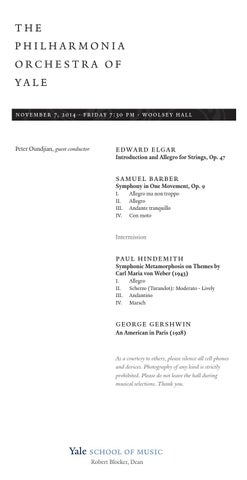
THE PHILHARMONIA ORCHESTRA OF YALE n o v e m ber 7, 2 0 14 路 f rid ay 7:30 pm 路 woo ls e y h all
Peter Oundjian, guest conductor
edward elgar
Introduction and Allegro for Strings, Op. 47
samuel barber
Symphony in One Movement, Op. 9 I. II. III. IV.
Allegro ma non troppo Allegro Andante tranquillo Con moto
Intermission
paul hindemith
Symphonic Metamorphosis on Themes by Carl Maria von Weber (1943) I. II. III. IV.
Allegro Scherzo (Turandot): Moderato - Lively Andantino Marsch
george gershwin An American in Paris (1928)
As a courtesy to others, please silence all cell phones and devices. Photography of any kind is strictly prohibited. Please do not leave the hall during musical selections. Thank you.
Robert Blocker, Dean
pro g ram notes
Edward Elgar » 1857–1934
Introduction and Allegro for Strings Elgar was awarded an honorary doctorate from Yale University in 1905 by Yale music faculty Samuel Simons Sanford. At the graduation ceremony, the audience enjoyed for the first time Elgar’s Pomp and Circumstance March No. 1, instituting a much beloved tradition which continues to this day. Sanford also introduced Elgar’s music to Walter Damrosch, the conductor well-known for having premiered Gershwin’s American in Paris. In return, Elgar dedicated Introduction and Allegro to Professor Sanford. Introduction and Allegro is an unconcealed dialogue with the Baroque era. Elgar includes a self-described “demonic” fugue which is reminiscent of the last great English composer, George Frideric Handel. The form and orchestration is also in the 17th-century tradition of Vivaldi’s concerto grossos. By echoing concertino (soloists) and ripieno (the backup orchestra), Vivaldi showcased the virtuosity of his star pupils at the Venetian orphanage/conservatory. Here, a quartet of Yale School of Music students is pitted against the orchestra, only to be consumed in the finale. At the recommendation of August Jaeger (the dedicatee of the renowned “Nimrod” variation from the Enigma Variations), Elgar composed this virtuosic string serenade in 1905 in order to showcase the string players of the London Symphony Orchestra, which had been recently founded in 1904.
Samuel Barber » 1910–1981
Symphony in One Movement, Op. 9 Describing the aesthetic of his 1935 work, Samuel Barber explains, “The form of my Symphony in One Movement is a synthetic treatment of the four-movement classical symphony. It is based on three themes…which retain throughout the work their fundamental character.” Synthesis is the underlying musical mechanism in Barber’s Symphony No. 1 and can be traced along the natural progression of “organicism” in music. “Organicism” is not a trendy model of healthy dieting; it describes the compositional process which treats musical material as living and growing. Beethoven, a model of the fourmovement classical symphonist, plants bulbs in the opening of the Fifth Symphony which
blossom and propagate throughout the work, bridging the movements. His sketchbooks reveal that the Fifth Symphony was originally conceived in only three movements, in which the third and fourth movements were fused. Great symphonists of the early 20th century followed this trend and turned more and more towards unifying disparate symphonic movements into symphonic amalgamations. In 1924, the 14-year old Barber was studying at the Curtis Institute of Music in Philadelphia while Jean Sibelius wrote his Seventh Symphony (In One Movement), which musicologist Robert Layton, in Makers of Modern Culture, describes as “wholly organic in growth.” Barber continued this organic musical trend. “Together with figures from other themes, the closing theme [of the finale] is woven,” Barber writes, “thus serving as a recapitulation for the entire symphony.” This work’s climax lives in this layering and synthesis of musical memories across the different sections of the composition.
Paul Hindemith » 1895–1963
Symphonic Metamorphosis on Themes of Carl Maria von Weber Paul Hindemith’s association with Yale began in 1920, when his newest work failed to win a competition sponsored by Elizabeth Sprague Coolidge, one of Yale’s important benefactors. Though rebuffed, Hindemith’s String Quartet in C major would soon bring international acclaim to the German composer. Later, Mrs. Coolidge would become an important benefactor for Hindemith, commissioning such works as his ballet Herodiäde and his viola concerto, Der Schwanderer. Hindemith came to America in 1940 as one of Europe’s greatest composers. He had taught composition at the Berlin Musikhochschule and performed internationally on viola, violin, and piano in opera, orchestral, chamber, and solo music, most notably in the première performance of Walton’s Viola Concerto. As late as 1934, Hindemith was enjoying the dubious luxury of being included in the concerts of Nazi-approved composers. His opinion of the Third Reich was not colored by their approval, and as time went on, his free tongue and Jewish associations damaged his career. Although his Symphonie: Mathis der Maler was performed to great acclaim, the opera upon which it was based was not permitted a Berlin première, despite Furtwangler’s attempts to convince Hitler otherwise. Eventually, Hindemith’s
music was banned by decree of Germany’s Kulturgemeinde. After a leave of absence from the Berlin Musikhochschule, Hindemith played a concert tour of the United States and decided to stay. Upon arriving in America, Hindemith was presented with many opportunities. His Violin Concerto was a great success in its Boston première, and he was invited by several universities to join their faculties (he eventually chose Yale, where he found the environment and student body more convivial than those of Cornell or Buffalo). The possibility arose of a commission from Léonide Massine for a ballet based on the music of Carl Maria von Weber*. Upon discussing details with Massine, Hindemith composed an elegant paraphrase on some of Weber’s piano duets. This music turned out to be too complicated for Massine, who wanted nothing more than orchestral arrangements of the original pieces. Artistic differences between the two collaborators led to the demise of their relationship. The Weber project was nonetheless fruitful, since this music eventually found its way into the wildly successful concert piece Symphonic Metamorphosis of Themes by Carl Maria von Weber in 1943. The New York Philharmonic gave the première performance, which was received with great enthusiasm by audiences and critics alike. *For those who would like to hear the original Weber pieces, they include: Movement I: Piano Duet, Op. 60, No. 4 Movement II: Overture to Turandot Movement III: Piano Duet, Op. 3, No.2 Movement IV: Piano Duets, Op. 60, Nos. 2 and 7
George Gershwin » 1898–1937 An American in Paris “My purpose is to portray the impression of an American visitor in Paris, as he strolls about the city and listens to various street noises and absorbs the French atmosphere,” Gershwin remarked in a late summer interview with Musical America in 1928. Gershwin continues, “Our American friend, perhaps after strolling into a café and having a couple of drinks, has succumbed to a spasm of homesickness.” Painting with musical topics—or symbols— Gershwin is able to communicate this indigo nostalgia through contrasts of exciting extroversion and gentle introversion. In the composer’s words, “the opening gay section is followed by a rich blues.”
The blues genre became popular when Gershwin was 14 years old and Hart Wand’s “Dallas Blues” became the first copyrighted blues composition. To Gershwin, the blues evokes a certain thirst for the past, a musical topic which our protagonist guzzles. According to Dr. Susan J. Matt, author of Homesickness and Distinguished Professor of History at Weber State University, during the Civil War, there were 74 deaths from homesickness and over 5,200 cases of death by nostalgia in the Surgeon General’s records. Gershwin’s hero does not succumb to such a fate. He steps outside the cafe for a breath of fresh air and is met by a cacophony of taxi horns and street noise as the spinning atmosphere overtakes his senses. The Yale Book of Quotations traces an appropriate proverb from Atlantic Monthly, February 1932: “If you can’t lick ’em, jine ’em.” — Samuel Suggs
art i st profiles
Peter Oundjian, guest conductor Famed for his orchestra-building skills and audience engagement, Peter Oundjian is celebrating ten years as Music Director of the Toronto Symphony Orchestra. In summer 2014 he led the orchestra on a six-concert tour of Europe—their first European tour for over a decade. Oundjian has been an integral part of the rebirth of the orchestra, creating the annual Mozart Festival and the hugely successful New Creations Festival, which celebrates the best in contemporary orchestral music as well as showcasing and premiering commissioned works. Oundjian is also in his third season as Music Director of the Royal Scottish National Orchestra. He has already led the orchestra on a tour of China, in performances in Europe and at the Edinburgh International Festival and BBC Proms. His previous positions include Principal Guest Conductor and Artistic Advisor of the Detroit Symphony Orchestra. A regular guest conductor, recent and future engagements include concerts with the Royal Stockholm and Israel Philharmonic orchestras, as well as the Orchestre de Paris, Finnish Radio Symphony Orchestra and the RundfunkSinfonieorchester Berlin. Previous and upcoming US highlights include concerts with the Detroit, Cincinnati, Philadelphia, Houston and Baltimore Symphony orchestras. Further afield, he has conducted the Sydney Symphony Orchestra and the NHK Symphony Orchestra in Japan. In 2008, Oundjian and the Toronto Symphony launched tsoLIVE - the orchestra’s own label of live concert recordings. Oundjian has since released six recordings on the label, including Shostakovich’s Symphony No. 11, Vaughan Williams’ Symphonies Nos. 4 & 5 and Holst’s The Planets. Recent releases with the Royal Scottish National Orchestra include Piano Concertos by Gershwin and Adams with Xiayin Wang for Chandos Records. Originally a violinist, Toronto-born Peter Oundjian was educated in England, attending the Royal College of Music in London before studying at the Juilliard School in New York. He was the longest-serving first violinist of the renowned Tokyo String Quartet, a position he held for fourteen years. In May 2009, he received an honorary doctorate from the San Francisco Conservatory.
Peter Oundjian is now in his 33rd year as a visiting professor at the Yale School of Music. In January 2013 he was awarded the Samuel Simons Sanford Medal for distinguished service to music, the highest honour that the School can bestow.
ab o ut yale p h ilharmonia
The Philharmonia Orchestra of Yale is one of America’s foremost music school ensembles. The largest performing group at the Yale School of Music, the Philharmonia offers superb training in orchestral playing and repertoire. Performances include an annual series of concerts in Woolsey Hall, as well as Yale Opera productions in the Shubert Performing Arts Center. The Yale Philharmonia has also performed on numerous occasions in Carnegie Hall and Alice Tully Hall in New York City and at the Kennedy Center in Washington, D.C. In 2008, the orchestra undertook its first tour of Asia with acclaimed performances in the Seoul Arts Center, the Forbidden City Concert Hall and National Center for the Performing Arts (Beijing), and the Shanghai Grand Theatre.
shinik hahm Conductor philharmonia staff andrew w. parker Manager roberta senatore Music Librarian brent laflam Production Assistant louis lohraseb Assistant Conductor heejung park Assistant Conductor
The Philharmonia Orchestra of Yale violin i Adelya Nartadjieva* Ye Hyung Chung Marie Oka Xi Liao Michael Duffett Elly Toyoda Sarah Arnold Nathan Lesser Yuri Mitsuhashi Zou Yu Ryan Truby Yefim Romanov Celia Zhang Yite Xu violin ii Jiazhi Wang* Shuali Du Julia Ghica Jacob Joyce Ethan Hoppe Suliman Tekalli Jing Yang Inyoung Hwang Yena Lee Avi Nagin Bora Kim Ruda Lee viola Hyeree Yu* Danielle Wiebe Yuan Qi Julia Clancy Daniel Stone Yejin Han Hee-Sun Yang Ryan Davis Catherine Gray Batmyagmar Erdenebat David Mason
cello Allan Hon* Chang Pan Alan Ohkubo Jiwon Kang Pall Kalmanssin Kimberly Jeong Sohyang Yoo Nayeon Kim Yoonha Yi Zhilin Wang bass Andrea Beyer Levi Jones Christopher Lettie Samuel Bobinski Samuel Suggs Luke Stence Ha Young Jung flute Christina Hughes 4 Andrew Robson 2 Jonathan Slade 3 Joanna Wu oboe Ron Cohen Mann 4 Ross Garton Timothy Gocklin 2 Kemp Jernigan Sol Jee Park 3 clarinet Kenta Akaogi Joshua Anderson 2 Eric Chi Hang Fung 4 William Kennedy 3 Kevin Schaffter
bassoon Barbara Bentley Bogdan Dumitriu 3, 4 Carl Gardner Marissa Olegario Yen-Chen Wu 2
Jeffrey Stern Terrence Sweeney Georgi Videnov
horn Sarah Boxmeyer 3 Chuta Chulavalaivong Reese Farnell 4 Sarah Ford Cody Halquist Thomas Park 2
* Soloists in Elgar 2 Principal on Barber 3 Principal on Hindemith 4 Principal on Gershwin
trumpet Patrick Durbin 3 Aaron Krumsieg Mikio Sasaki 4 Carl Stanley Timothy Will 2 trombone Curtis Biggs 3 Omar Dejesus 4 Daniel Fears Richard Liverano Elisabeth Shafer 2 Jonathan Weisgerber tuba John Leibensperger timpani Kramer Milan 4 Terrence Sweeney 2 Georgi Videnov 3 percussion Yifei Fu Matthew Keown Milan Kramer
harp Haley Rhodeside 2
student assistants Timothy Gocklin Heejung Park music librarians Nicholas DeBerardino Allan Hon Matthew Keown Fiona Last Michael Laurello Richard Liverano David Mason Marie Oka Yefim Romanov stage crew Samuel Bobinski John Caughman Patrick Durbin Batmyagmar Erdenebat Yifei Fu • Julia Ghica Matthew Keown John Kossler • Fiona Last Christopher Lettie Thomas Park Elisabeth Shafer Terrence Sweeney Georgi Videnov Johnathan Weisgerber
up co ming events
» music.yale.edu NOV 12
NOV 18
DEC 11
box office 203 432-4158
Boris Berman, piano Wed | 7:30 pm | Morse Recital Hall Horowitz Piano Series Beethoven: Variations Op. 34 and Op. 35; Stravinsky: Serenade in A; Prokofiev: Sonata No. 5 in C major and No. 7 in B-flat major Tickets start at $13 • Students $7 Jupiter String Quartet Tue | 7:30 pm | Morse Recital Hall Oneppo Chamber Music Series Quartets by Schubert, Beethoven, and Bartók Tickets start at $26 • Students $14 New Music for Orchestra Fri | 7:30 pm | Woolsey Hall Yale Philharmonia and Yale Camerata New orchestral pieces by School of Music composition students Tickets start at $7 • Students $3 • Staff $5
concert programs & box office Krista Johnson Donna Yoo communications Dana Astmann Monica Ong Reed Austin Kase operations Tara Deming Christopher Melillo piano curators Brian Daley William Harold recording studio Eugene Kimball
Thank you for your support! Become a Yale School of Music patron and support our performance programs. Earn benefits ranging from preferred seating to invitations to special events. To learn more, visit us online or call 203 436-4928. charles ives circle $600 and above Pamela & David Thompson paul hindemith circle $250 to $599 Roger & Linda Astmann Serena & Robert Blocker Prof. Michael & Mrs. Maryann Bracken Richard H. Dumas Edwin M. & Karen C. Duval Richard & Evelyn Gard Rev. Hugh J. MacDonald Tom & Patty Pollard Mary-Jo Worthey Warren Emily Aber & Robert Wechsler Ransom Wilson & Walter Foery horatio parker circle $125 to $249 William & Joyce Alton Brenda & Sheldon Baker Craig Baker Helen & Blake Bidwell Derek & Jennifer Briggs Bernadette DiGiulian & Leo Cristofar Elizabeth M. Dock Joan K. Dreyfus Paul Gacek Dolores M. Gall Carolyn Gould Francesco Iachello Margaret Lord & Arthur Kover Judy Long Thomas Martin & Harold Spitzer Betty Mettler Tom Pollard Suzanne Solensky & Jay Rozgonyi Michael Zuber & Zachary Zander
samuel simons sanford circle $50 to $124 Cecle & Josef Adler Nancy Ahlstrom Dr. and Mrs. Dwight P. Baker Henry & Joan Binder Ernest Bodenweber Anna Broell Bresnick Antonio Cavaliere John & Mimi Cole Barbara & Frank Dahm R.R. D’Ambruoso Mr. & Mrs. Bruce Dana Diana and John Doyle Thomas & Judith Foley Charles W. Forman Saul & Sonya Goldberg Peter & Suzanna Lengyel Judith & Karl-Otto Liebmann Nancy C. Liedlich & William R. Liedlich Carleton & Barbara Loucks Carmen Lund Ms. Martha Maguire James Mansfield Joel Marks Ann Marlowe Ron & Sue Miller Pfizer Foundation James V. Pocock Rocco & Velma Pugliese Fred & Helen Robinson Arthur T. Rosenfield, MD Leonard J. Rutkosky Patricia & Joseph Rutlin Allan R. Silverstein Wilma R. Stahura Michael & Carol Tessman Mr. & Mrs. Gregory D. Tumminio Gordon & Marlene Turnbull Peter and Dana Uhrynowski Werner & Elizabeth Wolf
gustave jacob stoeckel circle $25 to $49 Bill & Barbara Dickerson Mrs. Ken L. Grubbs Ivan Lin Mr. & Mrs. Thomas Patch Aaron Shim
as of November 2, 2014