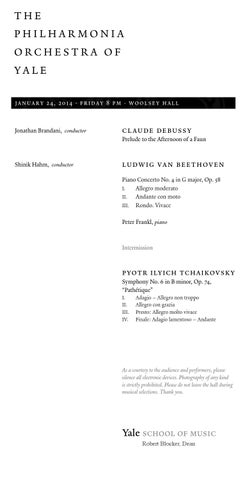
THE PHILHARMONIA ORCHESTRA OF YALE ja n ua r y 2 4, 2 0 1 4 · f rid ay 8 pm · woolse y h all
Jonathan Brandani, conductor
cl aude debussy Prelude to the Afternoon of a Faun
Shinik Hahm, conductor
ludwig van beethoven Piano Concerto No. 4 in G major, Op. 58 I. Allegro moderato II. Andante con moto III. Rondo. Vivace Peter Frankl, piano
Intermission
pyotr ilyich tchaikovsky Symphony No. 6 in B minor, Op. 74, “Pathétique” I. II. III. IV.
Adagio – Allegro non troppo Allegro con grazia Presto: Allegro molto vivace Finale: Adagio lamentoso – Andante
As a courtesy to the audience and performers, please silence all electronic devices. Photography of any kind is strictly prohibited. Please do not leave the hall during musical selections. Thank you.
Robert Blocker, Dean
pro g ra m no tes Claude Debussy » 1862–1918
Prelude to the Afternoon of a Faun
Ludwig van Beethoven » 1770–1827 Pianom Concerto progra noteNo. s 4 in G major, Op. 58
The music of Claude Debussy marks a transition in compositional style from the late romantic to early modernist, reflected in the various influences on Debussy himself. Excursions to Richard Wagner’s theme park in Bayreuth and exposure to Javanese gamelan music in Paris both contributed to the development of his sound world. These peculiar sonorities came to be labeled as “impressionistic” after the movement in visual art—although Debussy himself hated the moniker. Impressionism in music is characterized by colorful representation of sound, and has influenced composers as diverse as Igor Stravinsky, Duke Ellington, and Steve Reich.
Ludwig van Beethoven’s Piano Concerto No. 4 was written in the years 1805 and 1806, during a period of great compositional fertility. At this point in his life, Beethoven was still struggling without a steady income, instead having to rely largely on the generosity of royal patrons. Often, Beethoven would present his music in private concerts held at the houses of noblemen. It was at one such event, in March of 1807 at the home of Prince Franz Joseph von Lobkowitz, that the Fourth Concerto received its premiere. The concerto would not be heard by the general public until December 22, 1808, on an epic, four-hour program that also included the premieres of the Fifth and Sixth Symphonies, along with the Debussy originally intended the Prelude (1894) to Choral Fantasy and sections of the Mass in C. be the first of a three-movement cycle based on “L’après-midi d’un faune” by the contemporary During that infamous program, the orchestra was poet Stéphane Mallarmé. Symbolism, the move- often in shambles and the audience was bitterly cold. ment in poetry, began in part as a reaction to Ger- Beethoven realized almost no financial benefit from manic Romanticism; it emphasized the formal ar- his massive endeavor. After that inauspicious beginchitecture of a poem over pure meaning as a vehicle ning, the concerto was not performed again until toward separation from rational thought. It is after Beethoven’s death, when the young Felix Menpoetry constructed through often ambiguous hints: delssohn resurrected it in Leipzig in 1836. Robert individual words evoke real and metaphysical mean- Schumann said of that concert, “I sat in my place ing and reveal a higher philosophical, religious, or without moving a muscle or even breathing.” aesthetic truth. Perhaps Schumann’s reaction can be attributed to The Prelude opens, appropriately enough to this the fact that where Beethoven’s earlier concertos theme, with a sinuous chromatic passage in a single were brilliant, extroverted works, the Fourth Concerto flute. It takes a few bars to settle into a discernible is primarily a work of great serenity. It begins with meter, when it is joined by the harp, and conjures one of the more striking gestures in the entirety of mythological images of Pan and Hermes’ lyre. The Beethoven’s output. After the solo piano plays a seform is loosely a rondo with variations: the opening ries of simple chords in the tonic key of G major, flute line reappears, is reworked, reorchestrated, the orchestra enters in the distant key of B major. and finally returns in the coda after a short “très This startling harmonic shift becomes a hallmark soutenu” (very sustained) middle section. The of the first movement, which runs a heroic length Prelude is scored for relatively small ensemble, with of twenty minutes. The second movement has often minimal woodwinds, horns, harp, and only antique been compared to Orpheus taming the Furies at the cymbals for percussion. With respect to the tradition gates of Hades, while the rondo finale sparkles with of impressionism, Debussy combines various orches- mischievousness and wit. trational techniques for a mixed sound palette. This is a symbolist approach, wherein sound exists – Jordan Kuspa not just for its own sake, but must coexist within the structure of the theme and variations. The strings are mainly used as a unit for textural effect. They are often muted, or tremolo, or both; only once does the string section play a significant melodic passage, and when it finally comes it is lush and sensuous. The piece ends with a sense of distance, with the tinkling of the antique cymbals and bucolic sounds of muted horns echoing the initial flute phrase. — Elizabeth Adams and Steven Gearhart
art ist p ro f i le s Pyotr Ilyich Tchaikovsky » 1840–1893 Symphony No. 6 in B minor, Op. 74, “Pathétique”
Tchaikovsky’s life was riddled with profound selfdoubt and inner turmoil. He once commented on his Sixth Symphony, then still in its early stages of composition, that it “would be no worse than the earlier ones” (all of which, incidentally, had met with great popular success). He confided to his benefactress, Nadezhda von Meck: “Am I really used up and capable only of repeating myself and imitating my earlier manner? Yesterday I looked through the Fourth Symphony. What a difference, how much loftier and better!” He funneled these feelings into his music, sometimes even writing extra-musical descriptions in his manuscripts. In sketches for this symphony he writes: “First part — all impetuosity, assurance, thirst for activity. Second part love; third disenchantment; fourth ends with dying away.” He originally entitled the work Program Symphony, keeping the precise program a secret. It was, in his words, to “be an enigma for everybody.” From the outset, Tchaikovsky knew that the form of his symphony would be new and different. Tchaikovsky’s brother suggested the title “Pathétique” on the morning after the first performance. In composing this work as well as in others, Tchaikovsky encountered difficulties. At one point he wrote, “Today I sat over two pages—and it still didn’t come out as I wanted it.” In the end, however, he treasured this work. “I emphatically consider it the best and in particular the most sincere of all my things. I love it as I’ve never loved one of my other musical offspring.” Whether he succeeded in the public’s eyes was a different matter. The general reaction to this symphony was mixed. The audience seems to have been perplexed by its somewhat unconventional form and by the rumor of a “secret” program. There are few clues to what the program might be. A musical clue is a brief quotation from the Orthodox Requiem, placed in the brass in the first movement. Another clue might lie in Tchaikovsky’s refusal to set a poem by Apuktin entitled “Requiem” because, in Tchaikovsky’s words, “the general mood of [Apuktin’s Requiem] pervades to a significant extent my last symphony, particularly the last movement.” The first performance of the Symphony No. 6 took place on October 28, 1893. Tchaikovsky died a little over a week later, evidently committing suicide, the specifics of which are unclear to this day. — Philip Ficsor
Peter Frankl, piano Pianist Peter Frankl made his London debut in 1962 and his New York debut with the Cleveland Orchestra under George Szell in 1967. Since then he has performed with many of the world’s finest orchestras, including the Berlin Philharmonic, Concertgebouw, Israel Philharmonic, Orchestre de Paris, all the London orchestras, and the major American orchestras. He has collaborated with such conductors as Abbado, Boulez, Davis, Haitink, Maazel, Masur, Muti, Salonen, and Solti, and his world tours have taken him to Asia, Australia, and South Africa. He has appeared over twenty times at London’s BBC Promenade Concerts and has been a regular participant at the Edinburgh, Cheltenham, Aldeburgh, Verbier, Kumho, and Casals Festivals. Peter Frankl has been a regular guest artist at festivals including Aspen, Norfolk, Marlboro, Chautauqua, Ravinia, Santa Fe, and Yellow Barn. For many years the Frankl-Pauk-Kirshbaum Trio traveled the world. His chamber music partners have included Kyung Wha Chung, Peter Csaba, Ralph Kirshbaum, and the Tokyo, Takács, Guarneri, Bartók, Fine Arts, and Lindsay quartets. He has given master classes all over the world, including the Royal Academy and Royal College in London, the Liszt Academy in Budapest, Van Cliburn Institute in Texas, and in Beijing, Hong Kong, and Seoul. Among his recordings are the complete works for piano by Schumann and Debussy; Bartók and Chopin solo albums; a Hungarian anthology; concertos and four-hand works by Mozart; the Brahms piano concertos, violin and clarinet sonatas, and trios; Bartók pieces for violin and piano; and the piano quintets by Brahms, Schumann, Dvorák, Martinu, and both Dohnányis. In recognition of his artistic achievements, Mr. Frankl was awarded the Officer’s Cross by the Hungarian Republic, and on his seventieth birthday he was given one of the highest civilian awards in Hungary for his lifetime artistic achievement in the world of music. He is an honorary professor of the Liszt Academy and has been on the Yale School of Music faculty since 1987.
art ist pro f i le
Shinik Hahm, conductor
Jonathan Brandani, conducting fellow
Shinik Hahm is a dynamic and exciting conductor. His guest-conducting appearances include engagements in North and South America, Europe, and Asia. He has led orchestras in the world’s most prestigious concert halls, such as Carnegie Hall, the Concertgebouw in Amsterdam, the Kennedy Center in Washington D.C., Walt Disney Hall in Los Angeles, Verizon Hall in Philadelphia, Benaroya Hall in Seattle, Joseph Meyerhoff Symphony Hall in Baltimore, Boston Symphony Hall, Rudolfinum in Prague, the Seoul Arts Center, Tokyo Opera City Hall, and the National Theater of China.
Jonathan Brandani (b. Lucca, Italy 1983) is currently a conducting fellow (’14mm) at the Yale School of Music, where he studies with Shinik Hahm. Jonathan studied orchestral conducting with Mark Stringer at the Universität für Musik und darstellende Kunst in Vienna (Austria), where he obtained his Magister Artium Diploma with full grades and honours in June 2012. At the same University he also studied opera conducting and répétiteur with Konrad Leitner and choral conducting with Erwin Ortner. While studying in Vienna, he also received advice from Daniel Harding and Zubin Mehta.
As music director and chief conductor of the Korean Broadcasting System (KBS) Symphony Orchestra, Maestro Hahm led the orchestra on tour with concerts at the General Assembly of the United Nations, the Kennedy Center, and Carnegie Hall, the last of which was hailed by the New York Times as “warm, sympathetic” and “altogether respectable.” Hahm previously served as music director of the Daejeon Philharmonic Orchestra from 2001 to 2006, during which time the orchestra earned national attention and international acclaim through concert tours in the United States and Japan.
Jonathan has conducted the Wiener Kammerorchester, Russian National Orchestra, Webern Symphonie Orchester, Maribor International Orchestra, Haydn Sinfonietta, and Royal Camerata Bucharest. From 2008 to 2010 he worked as répétiteur at the Festival Oper Klosterneuburg (Austria). He recently conducted several operas at the Opera House at Schönbrunn Castle (Vienna, 2011–2012), Sommertraum Festival am Semmering (Austria, 2012), and Lucca Opera Festival (Italy, 2013).
Committed to the pedagogy of conducting, Maestro Hahm has been a member of the conducting faculty at the Yale University School of Music since 1995. His Yale students have won top prizes at the Besançon, Pedrotti, Toscanini, and China National conducting competitions, and are active at the helm of various orchestras in the United States, Europe, and Asia. Hahm studied conducting at Rice University, where he received the Shepherd Society Award, and the Eastman School of Music, where he earned the Walter Hagen Conducting Prize. In 1991, Hahm won the prestigious Gregor Fitelberg Competition for Conductors, and he was decorated by the Korean government with the Arts and Culture Medal in 1995.
A passionate interpreter and scholar of early music, Jonathan has played continuo with several renowned European early music ensembles, such as Concerto Köln, I Barocchisti, Coro della Radiotelevisione Svizzera Italiana, and ArteMusica, and has recorded for Deutsche Grammophon, VIRGIN Classics, and ORF. Jonathan has also studied piano (graduating with full marks and cum laude from the Instituto Musicale P. Mascagni in Livorno, Italy) as well as harpsichord, organ, composition, and musicology. » www.jonathanbrandani.com
up co ming events
http://music.yale.edu JAN 29
FEB 8
Pascal Rogé, piano Wed | 8 pm | Morse Recital Hall Debussy: Suite Bergamasque and Preludes, Book I; Poulenc: Les Soirées de Nazelles Tickets start at $20 • Students $10 Mozart: Mass in C minor Sat | 8 pm | Morse Recital Hall Yale Philharmonia, Yale Choral Artists, and Yale Baroque Ensemble. Jeffrey Douma conducts. Free Admission
FEB 14, 15 Yale Opera: La Bohème & 16 Fri & Sat, 8 pm | Sun, 2 pm | Shubert Theater Giuseppe Grazioli, conductor; Michael Gieleta, stage director. Tickets $19-50, on sale at www.shubert.com or 203-562-5666.
box office 203 432-4158 concert programs & box office Krista Johnson Carol Jackson communications Dana Astmann Monica Ong Reed Austin Kase operations Tara Deming Christopher Melillo piano curators Brian Daley William Harold recording studio Eugene Kimball
Thank you for your support! Become a Yale School of Music patron and support our performance programs. Earn benefits ranging from preferred seating to invitations to special events. To learn more, visit us online or call 203 432-4397. Paul Hindemith Circle $250 to $599 Serena & Robert Blocker Prof. Michael & Mrs. Maryann Bracken Richard H. Dumas Dr. & Mrs. James Kupiec Rev. Hugh J. MacDonald Tom & Patty Pollard Ransom Wilson & Walter Foery Horatio Parker Circle $125 to $249 Anonymous William & Joyce Alton Roger & Linda Astmann Brenda & Sheldon Baker Ann Bliss Derek & Jennifer Briggs Harold & Maureen Bornstein Mr. Leo Cristofar & Ms. Bernadette DiGiulian Mrs. Joan K. Dreyfus Paul Gacek Richard & Evelyn Gard Carolyn Gould Francesco Iachello Paul Jacobs Judy Long Helen and Doug MacRae Mrs. Susan Matheson & Mr. Jerome J. Pollitt Ms. Suzanne Solensky & Mr. Jay Rozgonyi Mary-Jo Worthey Warren Samuel Simons Sanford Circle $50 to $124 Anonymous (3) Cecle & Josef Adler Nancy Ahlstrom Angelo Alonzo & Nancy Reynolds Craig Baker Dr. & Mrs. Dwight P. Baker Peter Basel Henry & Joan Binder
Peter & Nancy Blomstrom Ernest Bodenweber Michael Hall & Otto Bohlmann Anna Broell Bresnick Mindy & Sam Brownstein Anthony Cavaliere Joel Cogen & Elizabeth Gilson Barbara & Frank Dahm R.R. D’Ambruoso Mr. & Mrs. Dana Elizabeth M. Dock Thomas & Judith Foley Henry Friedman Dolores M. Gall Martin & Katie Gehner Saul & Sonya Goldberg Gloria Hardman Thomas & Sharon Haskell James S. Johnson III & Marion Kloeg Raejeanne Kier Mr. James C. Kloss & Ms. Esther E. Golton Dave Kozma Peter & Suzanna Lengyel Judith & Karl-Otto Liebmann Nancy C. Liedlich & William R. Liedlich Margaret Lord & Arthur Kover Carmen Lund James Mansfield Ann Marlowe Stephen Marsh Thomas Martin & Harold Spitzer Betty Mettler Martha & Vincent Oneppo Dr. E. Anthony Petrelli James V. Pocock Rocco & Velma Pugliese Fred & Helen Robinson Arthur T. Rosenfield, MD Leonard Rutkosky Allan R. Silverstein Rev. Dr. Michael Tessman & Mrs. Carol Tessman Suzanne Tucker Mr. & Mrs. Gregory D. Tumminio
G.M. & M. E.Turnbull Peter & Dana Uhrynowski Monika & Fred Volker Victor Vu Roger & Beth Wardwell Werner & Elizabeth Wolf Gustave Jacob Stoeckel Circle $25 to $49 Natalie Cybriwsky Bill & Barbara Dickerson Mr. Charles W. Forman Mrs. Ken L. Grubbs Henry Harrison & Ruth Lambert Mr. Charles Levene Joel Marks Ron & Sue Miller Joseph & Patricia Rutlin Mr. James N. Trimble David Vecchia Burton & Ellen Zempsky as of 22 January, 2014 philharmonia student staff assistant Timothy Gocklin music librarians Batmyagmar Erdenebat · Darren Hicks Michael Holloway · Allan Hon · Choha Kim Hye Jin Koh · Fiona Last · Michael Laurello David Mason · Nicole Percifield Rachel Perfecto · Elisa Rodriguez Sadaba Matheus Garcia Souza stage crew Jonathan Allen · Garrett Arney Philip Browne · Bogdan Dumitriu Patrick Durbin · Jonathan Hammonds Christopher Hwang · Stephen Ivany Fiona Last · Louis Lohraseb Jacob Mende-Fridkis · Thomas Park Douglas Perry · Zachary Quortrup John Searcy · Elisabeth Shafer Daniel Stone · Terrence Sweeney Gregory Vartian-Foss · Georgi Videnov Mari Yoshinaga
up co ming events http://music.yale.edu
NOV 12
NOV 13
DEC 12
Hagen String Quartet Tue | 8 pm | Morse Recital Hall Beethoven: Quartet in E-flat major, Op. 127; Quartet in A minor, Op. 132. Tickets start at $30 · Students $10
Leon Fleisher, piano Wed | 8 pm | Morse Recital Hall Music by Bach, Schubert, Ravel, Kirchner, and more. With Katherine Jacobson Fleisher, piano. Tickets start at $20 • Students $8 New Music for Orchestra Thu | 8 pm | Woolsey Hall Music by Michael Holloway, James Rubino, Bálint Karosi, Brendon Randall-Meyers, and Benjamin Wallace. Shinik Hahm conducts. Free Admission
box office 203 432-4158 concert programs & box office Krista Johnson Carol Jackson communications Dana Astmann Monica Ong Reed Austin Kase operations Tara Deming Christopher Melillo piano curators Brian Daley William Harold recording studio Eugene Kimball
Thank you for your support! Become a Yale School of Music patron and support our performance programs. Earn benefits ranging from preferred seating to invitations to special events. To learn more, visit us online or call 203 432-4397. Paul Hindemith Circle $250 to $599 Serena & Robert Blocker Prof. Michael & Mrs. Maryann Bracken Richard H. Dumas Dr. & Mrs. James Kupiec Rev. Hugh J. MacDonald Tom & Patty Pollard Ransom Wilson & Walter Foery Horatio Parker Circle $125 to $249 Anonymous William & Joyce Alton Roger & Linda Astmann Brenda & Sheldon Baker Ann Bliss Derek & Jennifer Briggs Harold & Maureen Bornstein Mr. Leo Cristofar & Ms. Bernadette DiGiulian Mrs. Joan K. Dreyfus Paul Gacek Richard & Evelyn Gard Carolyn Gould Francesco Iachello Paul Jacobs Judy Long Mrs. Susan Matheson & Mr. Jerome J. Pollitt Ms. Suzanne Solensky & Mr. Jay Rozgonyi Mary-Jo Worthey Warren Samuel Simons Sanford Circle $50 to $124 Cecle & Josef Adler Nancy Ahlstrom Craig Baker Dr. & Mrs. Dwight P. Baker Peter Basel Henry & Joan Binder
Peter & Nancy Blomstrom Ernest Bodenweber Michael Hall & Otto Bohlmann Anna Broell Bresnick Mindy & Sam Brownstein Anthony Cavaliere Barbara & Frank Dahm R.R. D’Ambruoso Mr. & Mrs. Dana Elizabeth M. Dock Thomas & Judith Foley Henry Friedman Dolores M. Gall Martin & Katie Gehner Saul & Sonya Goldberg Carolyn Gould Gloria Hardman Mr. and Mrs. Thomas M. Haskell James S. Johnson III & Marion Kloeg Raejeanne Kier Mr. James C. Kloss & Ms. Esther E. Golton Dave Kozma Peter & Suzanna Lengyel Judith & Karl-Otto Liebmann Nancy C. Liedlich & William R. Liedlich Margaret Lord & Arthur Kover Carmen Lund James Mansfield Ann Marlowe Stephen Marsh Thomas Martin & Harold Spitzer Betty Mettler Martha & Vincent Oneppo Dr. E. Anthony Petrelli James V. Pocock Rocco & Velma Pugliese Fred & Helen Robinson Arthur T. Rosenfield, MD Leonard Rutkosky Allan R. Silverstein Rev. Dr. Michael Tessman & Mrs. Carol Tessman G.M. & M. E.Turnbull
Peter & Dana Uhrynowski Monika & Fred Volker Victor Vu Werner & Elizabeth Wolf Gustave Jacob Stoeckel Circle $25 to $49 Natalie Cybriwsky Bill & Barbara Dickerson Mr. Charles W. Forman Mrs. Ken L. Grubbs Henry Harrison & Ruth Lambert Joel Marks Ron & Sue Miller Joseph & Patricia Rutlin Mr. James N. Trimble David Vecchia Burton & Ellen Zempsky as of 26 October, 2013 philharmonia student staff assistant Timothy Gocklin music librarians Batmyagmar Erdenebat · Darren Hicks Michael Holloway · Allan Hon · Choha Kim Hye Jin Koh · Fiona Last · Michael Laurello David Mason · Nicole Percifield Rachel Perfecto · Elisa Rodriguez Sadaba Matheus Garcia Souza stage crew Jonathan Allen · Garrett Arney Philip Browne · Bogdan Dumitriu Patrick Durbin · Jonathan Hammonds Christopher Hwang · Stephen Ivany Fiona Last · Louis Lohraseb Jacob Mende-Fridkis · Thomas Park Douglas Perry · Zachary Quortrup John Searcy · Elisabeth Shafer Daniel Stone · Terrence Sweeney Gregory Vartian-Foss · Georgi Videnov Mari Yoshinaga