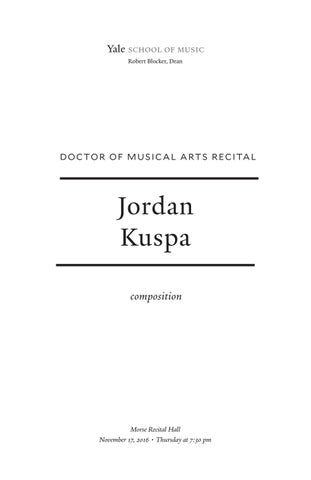
Robert Blocker, Dean
doctor of musical arts recital
Jordan Kuspa composition
Morse Recital Hall November 17, 2016 • Thursday at 7:30 pm
Yale School of Music
Jordan Kuspa, composition November 17, 2016 • Morse Recital Hall
Jordan Kuspa b. 1985
Cats Out of the Bag (2012) sandbox percussion Jonathan Allen Victor Caccese Ian David Rosenbaum Terry Sweeney
Kuspa
Collideoscope (2014) I. Bold, intense II. Both tranquil and frenetic III. Steady, unrelenting Nicholas Leh Baker, violin Chiu-Chen Liu, viola Andrew Janss, cello Jessica Xylina Osborne, piano intermission
As a courtesy to the performers and audience, please silence all electronic devices. Please do not leave the hall during selections. Photography or recording of any kind is prohibited.
Doctor of Musical Arts Recital
Kuspa
Hall of Mirrors (2016) Nicholas Leh Baker, violin Chiu-Chen Liu, viola
Kuspa
String Quartet No. 3 (2014) I. Spinning Gold II. Star Sapphire III. Quicksilver IV. Black Diamond quartet metadata Hajnal Pivnick, Anna Luce, violin Carrie Frey, viola Jisoo Ok, cello
This performance is in partial fulfillment of the requirements for the Doctor of Musical Arts degree.
Artist Profile • Notes on the Program
The New York Times has praised Jordan Kuspa’s music as “animated and melodically opulent” and “consistently alive and inspired.” His compositions have been performed by the Pittsburgh Symphony, Buffalo Philharmonic, and loadbang, in venues such as Weill Recital Hall at Carnegie Hall and the Leipzig Opera. Kuspa’s music has won honors from ASCAP, the League of Composers, and the American Composers Orchestra, and he has been a fellow at the Aspen Music Festival, Atlantic Center, for the Arts, and MusicX. Kuspa holds degrees from Rice University and the Yale School of Music, where he studied with Martin Bresnick, Aaron Jay Kernis, Ezra Laderman, Ingram Marshall, and Christopher Theofanidis. Kuspa teaches at Richland College in Dallas, and serves as composer-in-residence with the Dallas Neo-Classical Ballet, for which he recently composed The Masque of the Red Death, based on the story by Edgar Allan Poe. » www.jordankuspa.com
Cats Out of the Bag (2012) Cats Out of the Bag was premiered at Trinity Wall Street Church in New York, in April 2012. I composed the piece for the Wanmu Percussion Trio, intending to complement the dramatic elements of Mauricio Kagel’s Dressur, which Wanmu was to perform on the same program. While contemplating the new piece, I realized that much of the drama in many percussion works — especially in Dressur — stems from the percussion setup. The audience sees the array of instruments, then watches and waits for all of the instruments to be used at some point in the piece. I thought it could be interesting to remove that expectation by hiding the instruments in bags, infusing the proceedings with surreal whimsy and opportunities for comedy. Collideoscope (2014) I wrote Collideoscope at the request of my friend and frequent collaborator Nicholas Leh Baker. Nicholas had the idea to commission a suite of six paintings from artist Gregory Gummersall, and then to ask six composers to each respond to one of the paintings musically. The commission fee for the composers: we kept the painting. When Nicholas approached me with the idea, I immediately agreed and waited anxiously for the artwork to arrive. When I first saw the painting, I was struck by its three large blotches of primary color. Then my eye was drawn towards the looping, calligraphic lines that occupy the middle ground of the painting. After further examination, I noticed that underlying
Notes on the Program
the entire work was a collage of musical in March 2016 in Weill Recital Hall at scores. Finally, my eye began to travel be- Carnegie Hall. Like Collideoscope, it is tween these layers freely, with each visual dedicated to Nicholas Leh Baker. idea influencing the perception of its adjacent features. I took my cues for the musical form from this process of visual exploration, String Quartet No. 3 (2014) creating a work with three distinctive ideas that form a tenuous coexistence, with each As a cellist myself, I have often remarked idea refracting and distorting the music that I would be happy to write string quararound it. tets all the time, or at least most of it. My Third String Quartet is in many ways my As happened with my Third String Quartet, most ambitious work — one in which I feel after completing the piece, I decided I want- I achieved an emotional openness and vuled to explore this musical material further. nerability to match my consistent desire The second movement begins right where to create music built upon rigorous logic the first ends — with a high E major chord, and structural integrity. Toward the end suspended above increasingly intense piano of my first year at Yale, Chris Theofanidis interjections. I view this fleet-footed scherzo explained to me his idea that most comas a sort of slow movement, vacillating posers have at least two essentially different between sustained string sonorities and creative impulses — a sort of split musical fast, intricate rhythmic interplay. The finale personality — and that each new piece brings back many of the harmonic and mo- represents an attempt to reconcile these funtivic ideas from the first movement, now damental aspects of a composer’s musical with greater rhythmic verve and articula- constitution. In this quartet, I see the two tion. Tonight marks the premiere of the fundamental poles being a sort of incessant, complete work. driving, motoric energy, juxtaposed with an expansive lyricism and metrical fluidity. Hall of Mirrors (2016) Martin Bresnick once told me that the program note should never be longer than the piece itself. With that in mind, let me say only a brief word about Hall of Mirrors. I am most drawn to music that not only packs an emotional wallop, but also is governed by some underlying structural principle. Hall of Mirrors is based on a simple premise that was very difficult to carry out compositionally. I will gladly divulge that premise, but only after the performance. Hall of Mirrors was premiered
The title of the first movement, “Spinning Gold,” comes from an image that came to me as I was writing the piece. I was up against a deadline, writing the climax of this movement at about 3:30 in the morning, and somehow the image of the old fairytale about spinning straw into gold seemed appropriate to the textures of the piece, and seemed directly related to the act of playing a stringed instrument. It was also in this moment that I first realized that the music I was writing would not achieve my goal of a triumphant climax. Rather, the players ascend to the upper register of their
Notes on the Program
instruments with almost manic intensity, but for all of their fervor, the music only seems to strain toward a triumph that is not forthcoming, before lapsing into uncertain ambiguity. This left me with many unanswered questions, and I immediately felt I would need more movements to reckon with the emotional fallout. The second movement, “Star Sapphire,” begins the process, taking motivic and harmonic material from the first movement and refracting it into a variety of slowly unfolding melodic lines and textures. “Quicksilver” sees the driving sixteenth notes return, but now with a jagged rhythmic edge. This short scherzo leads directly into the opening of “Black Diamond,” a dark passacaglia that ultimately develops into a fugue of dizzying instrumental virtuosity. Ultimately, I was surprised when I finished this piece, as I had spent so long working to earn the triumphant climax that eluded me in the first movement. Yet when I followed my deepest musical instincts, the work proceeded along an entirely different path. String Quartet No. 3 was generously commissioned by Astrid and John Baumgardner, to whom I am forever indebted, and is dedicated to my great friend and mentor, Chris Theofanidis. The first movement was premiered in June 2010 by the Tetra String Quartet, in the Sheldon Art Gallery at the University of Nebraska, Lincoln. The third movement was given its premiere by Quartetto Indaco this past August at the HighScore Festival in Pavia, Italy. The work receives its complete premiere tonight.
PETER OUNDJIAN
BRENTANO STRING QUARTET
YALE OPERA
Robert Blocker, Dean
We invite you into Yale’s celebrated concert halls to experience extraordinary solo, chamber, vocal, and orchestral performances of repertoire ranging from early to new music. Come see and hear our distinguished faculty, gifted students and alumni, and acclaimed guest artists in more than 200 performances, many of which are free and streamed live online. COLLECTION OF MUSICAL INSTRUMENTS
ONEPPO CHAMBER MUSIC SERIES
Historically informed performances by early music specialists in an intimate setting
Concert programs featuring the Brentano, Miró, and Jerusalem string quartets and the School’s illustrious faculty
ELLINGTON JAZZ SERIES
YALE OPERA
A series launched with a historic convocation in 1972 that brings such legendary performers as Savion Glover to Yale
Ascendant vocalists present fully staged performances and opera scenes
FACULTY ARTIST SERIES
YALE PHILHARMONIA
Members of the School’s faculty perform solo and chamber music programs
HOROWITZ PIANO SERIES
Recitals by celebrated keyboard virtuosi including Yefim Bronfman, Olga Kern, and Yale’s remarkable faculty
NEW MUSIC NEW HAVEN
Contemporary works by award-winning Yale faculty and students, and esteemed guest composers
NORFOLK CHAMBER MUSIC FESTIVAL
Principal Conductor Peter Oundjian and guest conductors Yongyan Hu and Giancarlo Guerrero lead the School’s magnificent student orchestra
STUDENT PERFORMANCES
Performances of a wide variety of repertoire by the next generation of musical luminaries and cultural leaders
YALE IN NEW YORK
Dynamic collaborations between Yale’s remarkable faculty, students, and alumni at Carnegie Hall
A summerlong series at the picturesque Ellen Battell Stoeckel Estate, in Norfolk, Connecticut
music.yale.edu
Upcoming Events Yongyan Hu, guest conductor
november 18 Yale Philharmonia Yongyan Hu leads a concert that pays tribute to longtime Yale Philharmonia conductor Otto-Werner Mueller; featuring music by Brahms and Bruckner Woolsey Hall | Friday | 7:30 pm Tickets start at $10 • Yale Faculty/Staff $8 Students $5 $3 surcharge for purchases at the door
Yale Voxtet
november 19 ISM Ensembles The Yale Institute of Sacred Music and the Yale School of Music present Salomone Rossi: Baroque Music from Jewish Mantova Nicholas McGegan, conductor and harpsichord Morse Recital Hall | Saturday | 7:30 pm free admission
Brass of Yale Preview Concert
november 29 Yale in New York The Yale School of Music brass faculty, students, and alumni perform music from the German Renaissance and Gunther Schuller’s Magical Trumpets, among other works Preview of a Dec. 4 concert at Carnegie Hall
Morse Recital Hall | Tuesday | 7:30 pm free admission
Lunchtime Chamber Music
november 30 Student Performances YSM students perform a lunchtime chamber music concert; Wendy Sharp, director Morse Recital Hall | Wednesday | 12:30 pm free admission
Vista: Chamber Music
december 1 Student Performances Student ensembles, under the direction of faculty violinist Wendy Sharp, perform and provide insight into the repertoire Morse Recital Hall | Thursday | 7:30 pm free admission
Liederabend
december 6 Yale Opera An enchanting evening of Russian song Morse Recital Hall | Tuesday | 7:30 pm free admission
Yefim Bronfman
december 7 Horowitz Piano Series Acclaimed pianist Yefim Bronfman performs works by Bartók, Schumann, Debussy, and Stravinsky Morse Recital Hall | Wednesday | 7:30 pm Tickets start at $21 • Students $11
concert programs & box office Kate Gonzales, Lauren Schiffer communications Donna Yoo, Katie Dune, David Brensilver operations Tara Deming, Chris Melillo piano curators Barbara Renner, Robert Crowson, Brian Daley, William Harold recording services Matthew LeFevre, Travis Wurges, Eugene Kimball
wshu 91.1 fm is the media sponsor of the Yale School of Music connect with us
facebook.com/yalemusic
P.O. Box 208246, New Haven, CT · 203 432-4158
@yalemusic on Twitter music.yale.edu
If you do not intend to save your program, please recycle it in the baskets at the exit doors. Robert Blocker, Dean