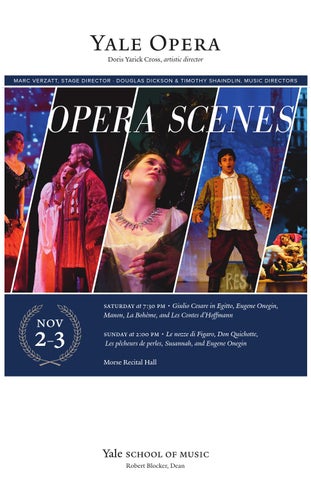
Yale Opera Doris Yarick Cross, artistic director
MARC VERZATT, STAGE DIRECTOR · DOUGLAS DICKSON & TIMOTHY SHAINDLIN, MUSIC DIRECTORS
OPERA SCENES
nov –
23
saturday at 7:30 pm • Giulio Cesare in Egitto, Eugene Onegin, Manon, La Bohème, and Les Contes d’Hoffmann sunday at 2:00 pm • Le nozze di Figaro, Don Quichotte, Les pêcheurs de perles, Susannah, and Eugene Onegin Morse Recital Hall
Robert Blocker, Dean
Yale Opera presents
OPERA
SCENES saturday: Giulio Cesare in Egitto, Eugene Onegin, Manon, La Bohème, and Les Contes d’Hoffmann sunday: Le nozze di Figaro, Don Quichotte, Les pêcheurs de perles, Susannah, and Eugene Onegin
Morse Recital Hall in Sprague Memorial Hall
november 2 & 3, 2013 sat 7:30 pm| sun 2:00 pm
douglas dickson · timothy shaindlin music directors marc verzatt stage director john carver sullivan costume designer william b. warfel lighting designer wendall k. harrington projection design supervisor
Projections designed by students of the Yale School of Drama projection design program
Saturday, November 2
Giulio Cesare in Egitto Excerpt from Act II Music by G. F. Handel
Performed in Italian with projected English translation Musical direction by Douglas Dickson Projection design by Caitlin Smith Rapoport
cast (in order of vocal appearance) Cornelia Sesto Nireno Cleopatra Cesare Curio
leah hawkins, mezzo-soprano evanna chiew, mezzo-soprano samuel hinkle, baritone alison king, soprano aleksandra romano, mezzo-soprano halim shon, tenor
Giulio Cesare in Egitto August, 48 BCE, the royal palace in Egypt Act II, scenes 1 & 2 Julius Caesar has conquered Egypt, and the siblings Cleopatra and Ptolemy are each vying for the regency throne. Ptolemy has failed to win Caesar’s favor, for he sent Caesar the severed head of the enemy general, Pompei, husband of Cornelia and father of Sextus. Ptolemy has imprisoned Cornelia and Sextus, while Cleopatra disguises herself as a serving girl in an attempt to win Caesar’s favor without his knowing her true identity. She has invited him to meet her in her chambers. Ptolemy has tried courting Cornelia, who refuses him, so he swears revenge. Cornelia in distress seeks to kill herself, but her son Sextus stops her. He has been released from prison by Cleopatra’s servant, Nireno. Cleopatra gets ready to seduce Caesar, but they are interrupted as the servant, Curio, warns Caesar that Ptolemy is planning to have him attacked and assassinated. Caesar goes off to defend himself as Cleopatra prays for his safety.
Saturday, November 2
Eugene Onegin Excerpt from Act II Music by P. I. Tchaikovsky
Performed in Russian with projected English translation Musical direction by Timothy Shaindlin Projection design by Joey Moro
cast (in order of vocal appearance) Zaretsky Lensky Onegin Guillot
david leigh, bass nikhil navkal, tenor brian vu, baritone halim shon, tenor
Act II, Scene 2 Russia 1820 Vladimir Lensky is betrothed to his childhood sweetheart, Olga Larin. Her sister, Tatyana, has fallen in love with a cynical neighbor from St. Petersburg, Eugene Onegin. She has written him a long love letter. He has rejected her, telling her that she was living in a childish dream. At Tatyana’s name-day party, Onegin tried to show off his indifference by dancing with Olga. Lensky accused him of dishonorable behavior, and of compromising Olga’s honor. Onegin heatedly denied this, and Lensky challenged him to a duel. The day of the duel dawned several hours ago, but Onegin has not yet arrived. A retired military officer, Zaretsky, is to serve as Lensky’s second and to see that the rules of dueling are followed. Lensky muses on his lost youth and what his death will mean to Olga. Onegin and his servant arrive, and Zaretsky is incensed not only that is he late, but that his second is not of his class. Onegin and Lensky wonder aloud how their friendship has turned them into enemies. Zaretsky orders the duel to take place. Onegin shoots Lensky dead.
Saturday, November 2
Manon Performed in French with projected English translation
Excerpts from Act III Music by Jules Massenet
Musical direction by Timothy Shaindlin Projection design by Caitlin Smith Rapoport
cast (in order of vocal appearance) Chevalier des Grieux Manon
jorge prego, tenor claudia rosenthal, soprano
Act III, Scene 2 Paris, 1731, the church of Saint Sulpice Manon was destined to be sent to a convent by her family, but en route she met the Chevalier des Grieux, who took her to live with him in Paris. His father, the Count des Grieux, opposed the marriage and kidnapped his son, while Manon was taken under the protection of the wealthy De BrĂŠtigny. Many months have passed since Manon left des Grieux, but during a promenade in the Tuileries Gardens Manon overhears the Count des Grieux speaking about his son, who is about to be ordained. At the church, before the ceremony, des Grieux prays that he may turn his mind completely to God and forget Manon. She arrives, however, and begs him to take her back and leave with her.
intermission
Saturday, November 2
La Bohème Excerpt from Act III Music by Giacomo Puccini
Performed in Italian with projected English translation Musical direction by Douglas Dickson Projection design by Shawn Boyle
cast (in order of vocal appearance) Marcello Mimì Rodolfo Musetta
stephen daniel, baritone nicole percifield, soprano esteban cordero, tenor alison king, soprano
Act III Paris, 1830 Mimì and Rodolfo have been living together, but it has been a difficult time for them. She walks from the city to the suburbs of Paris to seek advice from Marcello, Rodolfo’s friend, who is working at an inn with his girlfriend, Musetta. Marcello tells her that Rodolfo arrived the night before, and advises Mimì not to make a scene but to go back home. Rodolfo at first tells Marcello that he wants to break up with Mimì, because she flirts with everyone. Mimì returns to overhear him change his story: Rodolfo tells Marcello that Mimì is extremely ill, and he can’t afford to take care of her. Mimì breaks down at hearing this. Rodolfo tries to deny what he said. Musetta is heard laughing, and Marcello uses this as an excuse to leave them alone. Mimì tells Rodolfo she will move out, but that he can keep a bonnet that he bought her at Christmas. As Musetta and Marcello bring their argument out onto the street, Rodolfo and Mimì agree not to separate until the springtime.
Saturday, November 2
Les Contes d’Hoffmann Excerpt from Act III Music by Jacques Offenbach
Performed in French with projected English translation Musical direction by Timothy Shaindlin Projection design by Kristen Ferguson
cast (in order of vocal appearance) Antonia Crespel Frantz Hoffmann Miracle The voice
emily workman, soprano david leigh, bass jorge prego, tenor halim shon, tenor brad walker, bass-baritone leah hawkins, mezzo-soprano
Act II The home of Councilor Crespel, Munich, early 1800’s E.T.A. Hoffmann (1776–1822) was a German Romantic author of fantasy and horror, a jurist, composer, music critic, draftsman, and caricaturist. His stories form the basis of Jacques Offenbach’s Les Contes d’Hoffman. The second act tells of one of Hoffmann’s several ideal love interests. Antonia is the daughter of an opera singer, who died and seemingly bequeathed Antonia with her gift of a singing voice. Antonia’s father fears that his daughter, too, will be taken from him if he allows her to sing. But, Antonia has been encouraged to sing by her lover, Hoffmann, who composes songs for her. Fearing both Hoffmann and a mysterious Dr. Miracle, who attended his wife as she died, Crespel has moved his household to Munich. Not only has Hoffmann tracked Antonia and her father down, but so has Dr. Miracle, who horrifies Hoffmann and Crespel by summoning Antonia’s spirit and then taking her pulse and asking her to sing. Crespel drives him off. Hoffmann urges Antonia never to sing again and hastily leaves. Antonia resolves to obey her father and her lover. Miracle returns and battles with her will. Antonia invokes her mother to protect her, and Miracle seizes on the moment to cause her to appear. Excited by her vision, Antonia bursts into wild song, encouraged by Miracle. She collapses to the floor, and dies in her father’s arms.
Sunday, November 3
Le nozze di Figaro Excerpt from Act I Music by Wolfgang Amadeus Mozart
Performed in Italian with projected English translation Musical direction by Douglas Dickson Projection design by Kristen Ferguson
cast (in order of vocal appearance) Figaro Susanna Bartolo Marcellina Cherubino Count Almaviva Basilio
brad walker, bass-baritone claudia rosenthal, soprano david leigh, bass leah hawkins, mezzo-soprano aleksandra romano, mezzo-soprano samuel hinkle, baritone jorge prego, tenor
Act I Seville, 1788 Figaro and Susanna, servants to the Count and Countess Almaviva, are preparing for their wedding day. Susanna tells Figaro that the Count has offered to pay to sleep with her. Marcellina, servant to Dr. Bartolo who is the Countess’s former guardian, tells him that she lent Figaro a sum of money, which he agreed in writing to either pay back or he would marry her. Cherubino tells Susanna that the Count has dismissed him because he was found alone with Barbarina, another servant. The Count tries to get Susanna to agree to an assignation, but he hides when Basilio, Susanna’s music teacher, comes to tell her that the whole household knows that Cherubino is secretly in love with the Countess. The Count threatens to throw Cherubino out of the house and then discovers him hiding in the room. Figaro interrupts, to beg the Count to place Susanna’s wedding veil on her head, symbolizing his blessing of their marriage, but the Count makes up an excuse to delay the gesture. Figaro describes the glory and horror of military life to Cherubino.
Sunday, November 3
Don Quichotte Performed in French with projected English translation
Excerpts from Acts IV & V Music by Jules Massenet
Musical direction by Douglas Dickson Projection design by Joey Moro
cast (in order of vocal appearance) Dulcinée Don Quichotte Sancho Ensemble
evanna chiew, mezzo-soprano david leigh, bass stephen daniel, baritone nicole percifield, leah hawkins, esteban cordero, brian vu
Scene from Act IV, Act V complete Spain:1600’s, Dulcinea’s mansion The many adventures of Don Quixote and his squire, Sancho Panza, have included tilting at windmills, believing they are giants, and a flock of sheep, thinking they are friars. In the Massenet opera, these adventures come about because Quixote has idealized a beautiful (and wealthy) courtesan named Dulcinea. She sends him on a “quest” to recover her stolen pearl necklace. Quixote and Sancha were captured by the bandits who stole the necklace, and who intend to kill them both, but Quixote’s simple faith and fervent prayer melted the captors’ hearts, and they gave him the stolen pearls. The scene opens at a party at Dulcinea’s house, during which Quixote returns her pearls and proposes that Dulcinea marry him. At first, she openly laughs at the idea, but seeing his grave disappointment, she sympathizes with him and tells him she is unworthy of his esteem. He forgives her for her honesty. Sancho defends Quixote from the derision of the guests.Quixote knows that he is dying, and thanks Sancho for his devotion. As the voice of his ideal, Dulcinea, seems to be calling for him, he dies transfigured. intermission
Sunday, November 3
Les pêcheurs de perles Excerpts from Act I Music by Georges Bizet
Performed in French with projected English translation Musical direction by Timothy Shaindlin Projection design by Shawn Boyle
cast (in order of vocal appearance) Zurga Nadir Leïla
samuel hinkle, baritone nikhil navkal, tenor alison king, soprano
Scene from Act I The island of Ceylon, 1800’s Zurga, the chief of a village of pearl fishers, and Nadir, an errant mercenary, are reunited after many years’ estrangement. In their youth, they both fell in love with a temple virgin, but parted in friendship. Nadir comes to the village to renew his friendship with Zurga and to settle down. Every year, a temple priestess is chosen and brought to the village. Leïla, the priestess, is to pray for the success of the pearl harvest, but must remain veiled and unknown to everyone. The new priestess arrives, and swears to obey the law. Nadir recognizes her through her veil. He muses on his enduring infatuation with her. Leïla sings to invoke the spirits of water and wind to protect the fishers. Nadir takes advantage of her isolated prayer to reveal his presence to her.
Sunday, November 3
Susannah Excerpt from Act II Music by Carlisle Floyd
Performed in English with projected English translation Musical direction by Douglas Dickson Projection design by Shawn Boyle
cast (in order of vocal appearance) Susannah Blitch
emily workman, soprano brad walker, bass-baritone
Act II, Scene 3 America, Appalachia, 1930’s As families have come to town for the annual summer revival meetings, the Reverend Olin Blitch, an itinerant preacher, has arrived to preside. The town itself is ruled by a group of Elders of the church. Susannah Polk is an orphan who lives in a mountain cabin with her brother. While she is taking a bath in a creek on her property, the Elder men come looking for a baptism creek and see her naked. Word spreads throughout the town, and what was an innocent act on Susannah’s part becomes a scandal which ostracizes her from the community. Her brother has urged her to attend one of the revival meetings, and during a fires-of-hell-and-brimstone sermon, Reverend Blitch invited Susannah to confess her “sin” to the congregation. Susannah runs out of the church. Walking home, she sings a song that her reflects her loneliness. Blitch comes, determined to get her to confess, but Susannah refuses. He then tells her his real reason in coming to see her on this evening.
Sunday, November 3
Eugene Onegin Excerpt from Act III Music by P.I. Tchaikovksy
Performed in Russian with projected English translation Musical direction by Timothy Shaindlin Projection design by Kristen Ferguson
cast (in order of vocal appearance) Tatyana Onegin
nicole percifield, soprano brian vu, baritone
Act III, Scene 2 St. Petersburg, 1821 A year or so after the Act II duel, Onegin has returned to St. Petersburg, haunted by the death of Lensky. He attends a court ball and meets Prince Gremin, who tells him of his love and marriage to Tatyana. Onegin realizes that he now loves her. The next morning, Tatyana is still unsettled after meeting Onegin at the ball. Onegin arrives unannounced, and she reminds him how he once trivialized her feelings for him. She warns him that she knows he merely wants to make a conquest of her that he can boast about to his cynical friends. Onegin protests his love for her, and they admit that happiness together was once possible. For Tatyana, however, the past is irrevocable, and she insists she will remain faithful to her husband. She asks Onegin to leave, but he refuses, telling her that he wants to be with her forever. Tatyana finally tells him that she still loves him, but that his outpouring of devotion only increases her firm decision to remain with her husband.
Biographies
Marc Verzatt stage director A stage director and acting coach, Mr. Verzatt maintains an active career directing opera, operetta, and musical theater, and teaching acting in seminars and private coachings, throughout the United States, South America, and Europe. He made his professional directing debut with a production of Offenbach’s The Tales of Hoffmann with Opera Columbus. He has since directed productions with the Teatro Colón (Buenos Aires), Chicago Lyric Opera, Houston Grand Opera, Florida Grand Opera, and the opera companies of Fort Worth, Lake George, Madison, Arizona, Toledo, Atlanta, Kansas City, Baltimore, Idaho, and Mississippi. For the Austin Shakespeare Festival, he directed Shakespeare’s Much Ado About Nothing. Recent stagings have been Toledo Opera’s Candide and Turandot and concert stagings of Verdi’s Macbeth and Mozart’s Don Giovanni for the Boston Youth Symphony Orchestra. Last season he directed both Il Barbiere di Siviglia and Eugene Onegin for The Academy of Vocal Arts. Mr. Verzatt has taught and directed at Philadelphia’s Academy of Vocal Arts, Indiana University, Ohio State University and Notre Dame University. He has directed many Yale Opera productions, including Britten’s A Midsummer Night’s Dream for Orchestra Verdi in Milan, as well as five one-act operas in Sprague Hall, and Puccini’s Gianni Schicchi and Suor Angelica, Strauss’s Die Fliedermaus, Mozart’s Die Zauberflöte, and Bellini’s I Capuleti e i Montecchi at the Shubert Theater. In 2005, he returned as guest artist to the Metropolitan Opera for an acting role in Strauss’s Ariadne auf Naxos. In 2006, he was named Outstanding Stage Director of the Year by Classical Singer magazine. He is a member of the faculty of the American Institute for Musical Studies in Graz, Austria
and the Mediterranean Opera Studio in Palermo, Sicily. He joined the Yale School of Music faculty in 2002 where he teaches acting and movement. John Carver Sullivan costume designer John Carver Sullivan returns to Yale Opera, where he has designed costumes for I Capuleti e i Montecchi, the 2010 and 2011 opera scenes productions, La Tragédie de Carmen and Le Rossignol. His long association with Colin Graham and Opera Theatre of St. Louis has included designs for world premiere productions of The Woodlanders, The Village Singer, and The Postman Always Rings Twice, among many others. He has also designed the Broadway production of Moose Murders, off-Broadway productions at the York Theatre of The Musical of Musicals – The Musical, Little By Little, and The Jello is Always Red, and multiple productions for the Juilliard School and Manhattan School of Music. His theatrical work includes productions for Goodspeed Opera, the Alley Theatre, Berkeley Rep, and the Folger Library Theatre. Mr. Sullivan currently serves as the Chair of the Theatre Department at Southern Connecticut State University. William B. Warfel lighting designer William B. Warfel has done lighting design and production management for over 30 Yale Opera productions since 1978. He was Co-chair of Design and Professor of Lighting at the Yale School of Drama from 1967 to 1993 and is currently in private practice as a lighting designer and theater consultant in Hamden, CT. A graduate of both Yale College and the School of Drama, Mr. Warfel taught at Dartmouth College and Long Island University and worked in the
Biographies
lighting profession in New York City prior to returning to the New Haven area. He has lectured and taught in Finland, China, Egypt, Iceland and Sweden and has worked on consulting projects in Scotland, Nigeria, and Ecuador. Mr. Warfel is a founding member of the International Association of Lighting Designers. Douglas Dickson musical direction and accompaniment Douglas Dickson received his B.A. degree from Princeton University and his M.M.A. from the Yale School of Music. On various occasions the Washington Post has called him an “intelligent, sensitive” pianist with “super technique,” a “skillful pianist,” and has praised him for his “finely integrated oneness” he achieves as an accompanist. Mr. Dickson has performed in the US, Europe, Asia, South America in venues ranging from Japan’s Expo Hall to the Cincinnati Coliseum. While still in college, he was the accompanist for the American Boychoir. As part of Duodecaphonia, a prize-winning piano duo, he has performed at the Kennedy Center and elsewhere. Mr. Dickson has been music director for productions at Quinnipiac University, the Yale School of Drama, Opera Theater of Connecticut, and Connecticut Experimental Theater. He was music director and conductor for Yale Opera’s production of Britten’s The Rape of Lucretia, and he conducted a concert featuring Yale Opera with the Orchestra Verdi in Milan. He has taught at Quinnipiac University since 1993, and joined the Yale faculty in 1998. He made his Carnegie debut in an all Ives concert at Weill Recital Hall. For Naxos, he recorded more than eighty Charles Ives songs.
Timothy Shaindlin musical direction and accompaniment A native of New York City, Timothy Shaindlin joined the Yale School of Music faculty in 2008. After studies at The Juilliard School and Indiana University, he worked for the Metropolitan Opera, New York City Opera, the Lyric Opera of Chicago, Washington National Opera, San Diego Opera, Wolf Trap Opera and Pittsburgh Opera. He has also coached for Glimmerglass Opera, Sarasota Opera and Hawaii Opera Theatre. In Europe, he worked for Barcelona’s Gran Teatre del Liceu and played master classes for Tito Gobbi. He has played classes and coachings for such artists as Joan Sutherland, Birgit Nilsson, Beverly Sills, Marilyn Horne, Natalie Dessay, Ben Heppner, Luciano Pavarotti, Eleanor Steber, Samuel Ramey, Regine Crespin, Thomas Hampson, Frederica von Stade and Carlo Bergonzi. Mr. Shaindlin’s work on the podium includes conducting engagements with the Wolf Trap Opera Festival, Hawaii Opera Theatre, Pittsburgh Opera, Chicago Opera Theater, Chicago Light Opera Works and Eugene Opera. He has assisted such renowned conductors as Christoph Eschenbach, Sir Andrew Davis, Daniel Barenboim, Valery Gergiev, Richard Bonynge, Bruno Bartoletti, Donato Renzetti, Louis Langrée, Edoardo Müller, Yves Abel, Daniele Gatti, Antonio Pappano, and Paul Gemignani. Next June, he will conduct The Mikado for Hawaii Opera theatre.
Biographies
Wendall K. Harrington projection design supervisor Wendall K. Harrington’s career has embraced diverse disciplines including projection design for theatre, publishing and video production. Broadway designs include: Driving Miss Daisy, Grey Gardens, They’re Playing Our Song, The Elephant Man, My One and Only, The Heidi Chronicles, The Will Rogers Follies, Having Our Say, Company, Racing Demon, Ragtime, John Leguizamo’s Freak, The Capeman, Putting it Together, and The Who’s Tommy. Off Broadway work includes: Angels in America, Hapgood, A Christmas Carol at the Paramount; Merrily We Roll Along (three times!) and the ill-fated Whistle Down the Wind. Opera design: Julie Taymor’s The Magic Flute in Florence, Italy; A View from the Bridge at Chicago Lyric and the Met, Die Gezeichneten at LA Opera, The Photographer at BAM, Transatlantic, Grapes of Wrath, Rusalka, and Wuthering Heights for Minnesota Opera. Ms. Harrington is the recipient of the Drama Desk Award, the Outer Critics Circle Award, the American Theatre Wing Award, the TCI Award for Technical Achievement and the Obie Award for Sustained Excellence of Projections. Ms. Harrington has been lecturing on Projection Design for the Yale School of Drama since the early ‘90s.
Student Profiles
Evanna Chiew mezzo-soprano B.M. University of British Columbia; Young Artist Programs: Opera NUOVA
Nicole Percifield soprano B.M. New England Conservatory, M.M. Manhattan School of Music; Young Artist Programs: Minnesota Opera
Esteban Cordero tenor B.M. Conservatorio de Música de Puerto Rico; Young Artist Programs: Israel Vocal Arts Institute, Martina Arroyo’s Foundation Prelude to Performance
Jorge Prego tenor B.M. Vigo Conservatory (Spain); A.D. Yale University; M.M. Hartt School of Music; Artist Diploma Roosevelt University; Young Artist Programs: Santa Fe Opera, Chicago Opera Theater
Stephen Daniel baritone B.M. Westminster Choir College of Rider University Leah Hawkins mezzo-soprano B.A. Morgan State University; Young Artist Programs: Houston Grand Opera Young Artist Vocal Academy, Martina Arroyo’s Foundation Prelude to Performance
Aleksandra Romano mezzo-soprano B.A. Bard College; Young Artist Programs: Aspen Music Festival, Wolf Trap Opera, Central City Opera Claudia Rosenthal soprano B.A. Yale College; B.M. Hartt School; M.M. Mannes College of Music; Young Artist Programs: Wolf Trap Opera
Samuel Hinkle baritone B.M. Mannes College of Music; Young Artist Programs: Siena Music Festival
Halim Shon tenor B.M. Seoul National University, M.M. Peabody Institute of Music
Alison King soprano B.M. University of Southern California; Young Artist Programs: Music Academy of the West, Chautauqua Opera
Brian Vu baritone B.A. UCLA; Young Artist Programs: Chautauqua Institution Voice Program, Wolf Trap Opera
David Leigh bass B.A. Yale College; M.M. Mannes College of Music; Young Artist Programs: Chautauqua Opera, Music Academy of the West
Brad Walker bass-baritone B.M. Michigan State University; M.M. Kansas University; Young Artist Programs: Chautauqua Opera
Nikhil Navkal tenor B.M. Indiana University; M.M. Mannes College of Music; Young Artist Programs: Central City Opera
Emily Workman soprano B.M. Brigham Young University
Yale Opera Production Staff
marc verzatt Stage Director
erika niemi Manager
john carver sullivan Costume Designer
janie alexander Production Coordinator
william b. warfel Lighting Designer
jeromy hunt Stage Manager
shawn boyle Projection Programmer and Operator
doug harry Master Electrician
craig harlow Properties Master and Designer
catherine mason Wardrobe Assistant
aleksandra romano brad walker brian vu Student Assistants
jill brunelle Surtitle Operator
Special Thanks
Richard Cross John Roach Yale School of Drama Broken Umbrella Theatre Long Wharf Theatre Southern Connecticut State University Wendall K. Harrington and her production design students Michael Trudeau
Yale Opera 2013-14 Season Master Class with Matthew Polenzani december 2 Morse Recital Hall | Mon | 7 pm World-famous tenor and Yale Opera alumnus Matthew Polenzani presents a public master class with the students of Yale Opera Free Admission
Master Class with Alan Held december 9 Morse Recital Hall | Mon | 7 pm The renowned bass-baritone from the Metropolitan Opera works with students in the Yale Opera program Free Admission
La Bohème february 14–16 Shubert Theatre | Fri & Sat 8 pm | Sun 2 pm Yale Opera announces a new production of Puccini’s La Bohème, conducted by Giuseppi Grazioli and directed by Michael Gieleta. Tickets start at $19 • Students $13 Now on sale at www.shubert.com or 203-562-5666
Cenerentola may 2 & 3 Morse Recital Hall | Fri & Sat | 8 pm Yale Opera presents a new production of Rossini’s Cenerentola, with stage direction by Ted Huffman and musical direction by Douglas Dickson and Timothy Shaindlin. Tickets start at $10 • Students $5
LA BOHÈME february 14–16
Yale Opera Tickets are now on sale at www.shubert.com or 203-562-5666. Call and use code “early bird” to get a 10% discount on tickets purchased by January 12. Dont wait: we expect La Bohème to sell out!
Upcoming Events
Finckel-Han-Setzer Trio
Poems for a Sunday Afternoon
november 5 Morse Recital Hall | Tuesday | 8 pm Oneppo Chamber Music Series Beethoven: Trio in G major, Op. 1, No. 2; Shostakovich: Trio in E minor, Op. 67; Dvorák: Trio in E minor, Op. 90, “Dumky” Tickets Start at $30 • Students $12
november 10 Trinity Lutheran Church, 292 Orange Street Sunday | 4 pm Yale Camerata with Yale Band Music of Lutoslawski and Olson Free Admission
Hagen String Quartet Lunchtime Chamber Music november 6 Morse Recital Hall | Wednesday | 12:30 pm Chamber music for a variety of ensembles. Free Admission
november 12 Morse Recital Hall | Tuesday | 8 pm Oneppo Chamber Music Series Beethoven: String Quartets in E-flat major, Op. 127, and A minor, Op. 132 Tickets start at $30 • Students $12
Kyung Yu, violin & Elizabeth Parisot, piano november 6 Morse Recital Hall | Wednesday | 8 pm Faculty Artist Series Beethoven: Sonata No. 8 in G major, Op. 30, No. 3; Brahms: Sonata No. 1 in G major, Op. 78; Tchaikovsky: Sérénade Mélancolique; Bartók: Rhapsody No. 1 Free Admission
Leon Fleisher, piano november 13 Morse Recital Hall |Wednesday | 8 pm Horowitz Piano Series Music by Bach, Takács, Kirchner, Brahms, Ravel, and Schubert. With Katherine Jacobson Fleisher, piano. Tickets start at $20 • Students $10
Concert Programs & Box Office: Krista Johnson, Carol Jackson Communications: Dana Astmann, Monica Ong Reed, Austin Kase Operations: Tara Deming, Chris Melillo Piano Curators: Brian Daley, William Harold Recording Studio: Eugene Kimball WSHU 91.1fm is the media sponsor of the Yale Opera at the Yale School of Music. P.O. Box 208246, New Haven, CT · 203 432-4158
music.yale.edu
Robert Blocker, Dean