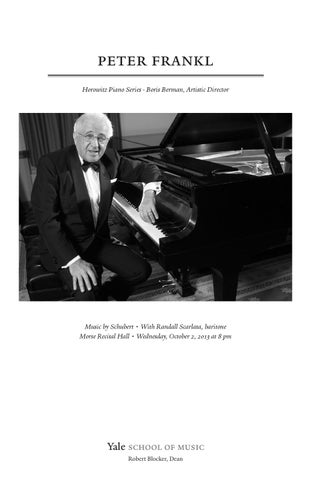
peter frankl Horowitz Piano Series · Boris Berman, Artistic Director
Music by Schubert • With Randall Scarlata, baritone Morse Recital Hall • Wednesday, October 2, 2013 at 8 pm
Robert Blocker, Dean
Horowitz Piano Series
peter frankl October 2, 2013 • Morse Recital Hall in Sprague Hall
Franz Schubert 1797—1828
Drei Klavierstücke, D. 946 No. 1 in E-flat minor – Allegro Assai No. 2 in E-flat major – Allegretto No. 3 in C major – Allegro brief intermission Winterreise, D. 911 Gute Nacht Die Wetterfahne Gefror’ne Tränen Erstarrung Der Lindenbaum Wasserflut Auf dem Flusse Rückblick Irrlicht Rast Frühlingstraum Einsamkeit Die Post Der greise Kopf Die Krähe Letzte Hoffnung Im Dorfe Der stürmische Morgen Täuschung Der Wegweiser Das Wirtshaus Mut Die Nebensonnen Der Leierman Randall Scarlata, baritone
As a courtesy to the performers and audience, turn off cell phones and pagers. Please do not leave the hall during selections. Photography or recording of any kind is prohibited.
Artist Profiles
Pianist Peter Frankl made his London debut in 1962 and his New York debut with the Cleveland Orchestra under George Szell in 1967. Since that time he has performed with many of the world’s finest orchestras, including the Berlin Philharmonic, Israel Philharmonic, Orchestre de Paris, Concertgebouw, all the London orchestras, and the major American orchestras. He has collaborated with such conductors as Abbado, Boulez, Maazel, and Solti. His many chamber music partners have included Kyung Wha Chung, Ralph Kirshbaum, and the Tokyo, Takács, Guarneri, and Fine Arts quartets. Among his recordings are the complete works for piano by Schumann and Debussy, Bartók and Chopin solo albums, a Hungarian anthology, concertos and four-hand works by Mozart, the two Brahms piano concertos, the Brahms violin and clarinet sonatas, Bartók pieces for violin and piano, and the piano quintets of Brahms, Schumann, Dvorák, Martinu, and both Dohnányis. Mr. Frankl was awarded the Officer’s Cross by the Hungarian Republic, and on his seventieth birthday he was given one of the highest civilian awards in Hungary for his lifetime artistic achievement in the world of music.
Hailed for his warm, expressive sound and winning way with the audience, baritone Randall Scarlata enjoys an unusually diverse career. He is equally comfortable in Bach and Handel oratorios, Mozart and Verdi operas, the great song cycles, works from Tin Pan Alley, and the newest new music. He has appeared as soloist with many of the world’s finest orchestras, and at international music festivals on five continents. Mr. Scarlata has given world premieres of works by Ned Rorem, Lori Laitman, George Crumb, Daron Hagen, Samuel Adler, Mohammed Fairouz, Paul Moravec, Christopher Theofanidis, Wolfram Wagner, and Thea Musgrave. He has won many competitions, including the International Schubert Competition in Vienna (das Schubert Lied), the Joy in Singing Competition, the Brahms Competition, the Young Concert Artists Competition, the Naumburg Competition, and the Alice Tully Debut Recital Award. He has recorded for Naxos, Arabesque, Albany, Chandos, CRI, and Gasparo labels. Mr. Scarlata holds degrees from the Eastman School and the Juilliard School, and also attended Vienna’s Hochschule für Musik as a Fulbright Scholar. He is on the faculty of the School of Music of West Chester University as well as SUNY Stony Brook, and regularly gives masterclasses in the U.S. and abroad.
Notes on the Program
franz schubert Drei Klavierstücke, D. 946 Were it not for the intervention of a certain admirer of Schubert’s piano music, it is difficult to say whether the Klavierstücke, a significant contribution to the canon from the final few months of its composer’s life, would have ever entered the repertoire. That admirer, in fact, was Johannes Brahms. Like much of Schubert’s music, these works were unknown for many years after the composer’s death. Though written in 1828, they were not published until four decades later, in 1868, with Brahms as then-anonymous editor. Unknown for decades and still enigmatic, far less is known about these pieces than, for instance, the familiar D. 899 and D. 935 sets of Impromptus, and the Moments musicaux, all stylistically similar to the Klavierstücke. The D. 946 pieces were not conceived as a unified set of merely three, and were probably intended to be part of a larger collection. The three were assembled as such by Brahms, and in this way, the later composer has left his own significant mark on Schubert’s opus. Both composers were among the most important composers of “piano miniatures,” or character pieces for the solo instrument. Unlike, for instance, a sonata, there is no conventional set of guidelines for such compositions, leaving the composers the freedom to create, in a brief temporal span, a unique sound world. The inherent flexibility of the brief piano miniature, of which Schubert was among the first composers, provided room for experimentation, and the Klavierstücke are products from the laboratory of a genius. The first piano piece, a five-part rondo in E-flat minor, meanders fluidly and often unexpectedly from minor to major tonal areas, creating an unsettled sense of ambiguity. This flexibility of modality is a trademark of Schubert’s instrumental
music, and reflects his treatment of texts in his beloved songs, in which the “rules” of tonal composition were frequently bent in order to convey a particular poetic idea. The more gentle, andante episodes, the first of which is in the surprising submediant key of B major, differ greatly from the nervous refrain that opens the movement and returns twice, with its pulsating, insistant undercurrent of running eighth notes. One source of puzzlement involves the second contrasting episode in the piece — heard after the first return of the opening refrain — that was completely crossed out in Schubert’s original manuscript of this movement. This A-flat major section was restored by Brahms in his published edition, and was accepted as fact for much of the work’s performance history. Indeed, we may never know Schubert’s true intention, or why this section was seemingly erased. Perhaps Brahms, that great admirer, thought so highly of Schubert’s music that he sought to preserve even that which was meant to be discarded. The piece ends with the final refrain having been transformed into the major mode, leading to a confident coda. The second piece, another five-part rondo, is in many ways a fitting foil to the first. Gentle and berceuse-like, the three occurrences of its E-flat major refrain are perforated by two darker and more volatile episodes, always returning to the tranquil theme of the refrain. A fittingly exuberant close to the set, the third piece is a dance with exotic traces of the Hungarian and Bohemian styles in its syncopated rhythmic gestures and capricious nature, which were quite in vogue in Schubert’s day. The extroverted dance bookends a far more introspective trio section, and, like the previous pieces in the Drei Klavierstücke, is a study in contrast, and in this sense a fitting reflection of its composer. -Patrick Jankowski
Notes on the Program
Winterreise In early 1827, Schubert discovered twelve poems by Wilhelm Müller in a friend’s library. Müller’s folksong style, previously utilized by Schubert in his 1823 song-cycle Die schöne Müllerin, again proved to be an inspiration. Schubert was preoccupied with the project for the first few months of the year and his concentration is graphically demonstrated by the thorough revision and retouching evident in the manuscript. The songs “Gute Nacht” and “Rückblick” were so extensively worked over that fresh copies needed to be made. Finally, after “Finis” was written and the music sent off to the publisher, Schubert learned that a complete text of Die Winterreise had been published with twelve additional poems scattered throughout. If he had taken the time to realize the cycle in Müller’s final order, it would have delayed the receipt of his much-needed fee. So, the twelfth song, originally rounding off the cycle in the same D minor key of the beginning, was transposed to B minor. The additional twelve poems, headed “Continuation of Winterreise,” were appended more or less in the order they had been inserted by Müller into his final version. That we can listen to these songs in a sequence not intended by the poet points to the very nature of the cycle. Winterreise is an internal drama, essentially with no plot. The fundamental tragedy has taken place before the cycle opens. A girl, who our protagonist believed reciprocated his love, chose a wealthier suitor. Now our hero wanders from place to place and longs for an end. Despite the great variety of emotions, ranging from weariness and reflection to passion and defiance, there is no change of circumstance. From the very opening in “Gute Nacht,” somber strides of the wanderer’s footsteps are introduced — the tempo marking in the autograph score is Mäßig, ingehrnder Bewgung (Moderato, in walking movement) — and they seldom waver
throughout the entire cycle. This perpetual lament was truly unprecedented. Of the twenty-four lieder, sixteen are set in a minor key. However, at the words “Will dich im Traum nicht stören” (I will not disturb your dreams), the last verse of the first song exquisitely demonstrates Schubert’s ability to make the major mode sound even more poignant than the minor. Significantly, the song reverts to the original minor mode at its end. As Part II progresses the main character becomes more remote and isolated, but it is only in the ultimate song that another character is finally introduced. This “last station on the journey of sorrow,” as Dietrich Fischer-Dieskau referred to it, is one of Schubert’s strangest and most unique creations. It sounds so incredibly simple — just bagpipe-like fifths in the left hand, a repeated motif in the right hand, and the monotonous declamation of the voice — but it has a chilling effect on the listener. In this song, a characterization of a man who is no longer is aware of his unfortunate circumstances, the protagonist meets an old organ grinder. He sings, “Strange old man, shall I go with you? Will you grind your hurdy-gurdy to my songs?” Through total alienation from society, the destiny of this consummate Romantic character is made complete. A friend of Schubert’s, Josef von Spaun, recorded in his memoirs what would be the very first time Schubert’s greatest song cycle was performed: “‘Come to Schober’s today, I will sing you a cycle of awe-inspiring songs. I am eager to know what you will say about them. They have affected me more than has been the case with any other songs.’ So, in a voice wrought with emotion, he sang the whole of the Winterreise through to us. We were quite dumbfounded by the gloomy mood of these songs and Schober said he had only liked one song, “Der Lindenbaum.” To
Notes on the Program
which Schubert said, ‘I like these songs more than all the others, and you will get to like them too.’ A year later, the very last work Schubert performed (while actually on his deathbed) was to correct proofs of his Winterreise. Schubert’s confidence in the power of the work was soon confirmed as his friends and the world came to view it as a landmark in the history of song.”
Texts & Translations
Winterreise Text by Wilhelm Müller Translations by Richard Cross 1. Gute Nacht
1. Good Night
Fremd bin ich eingezogen, fremd zieh’ ich wieder aus Der Mai war mir gewogen mit manchem Blumenstrauß
As a stranger I came As a stranger I go May offered me to me Many beautiful flowers
Das Mädchen sprach von Liebe die Mutter gar von Eh’ Nun ist die Welt so trübe der Weg gehüllt in Schnee
The girl talked of love But the mother talked of marriage And now the world is dark and my path is covered in snow
Ich kann zu meiner Reisen Nicht wählen mit der Zeit, Muß selbst den Weg mir weisen In dieser Dunkelheit.
I cannot choose the time To begin my journey, Must find my own way In this darkness.
Es zieht ein Mondenschatten Als mein Gefährte mit, Und auf den weißen Matten Such’ ich des Wildes Tritt.
A shadow of the moon travels With me as my companion, And upon the white fields I seek the deer’s track.
Was soll ich länger weilen, daß man mich trieb hinaus? Laß irre Hunde heulen vor ihres Herren Haus!
Why should I stay here longer Until they drive me away? Let the mad dogs howl Before her father’s house
Die Liebe liebt das Wandern Gott hatt sie so gemacht-Von einem zu dem andern, Gott hatt sie so gemacht.
Love wants to wander God made it so From one to the other God made it so.
Die Liebe liebt das Wandern fein Liebchen, gute Nacht Von einem zu dem andern-fein Liebchen, gute Nacht!
Love wants to wander, Sweetheart, Good Night From one to the other-Sweetheart, Good Night
Texts & Translations
Will dich im Traum nicht stören, wär schad’ um deine Ruh’, Sollst meinen Tritt nicht hören-sacht, sacht die Türe zu!
I’ll not disturb your dreams It would be a shame to disturb your rest, You will not hear my footsteps-Quietly, quietly I’ll close the door!
Schreib im Vorübergehen, Ans Tor dir: gute Nacht, Damit du mögest sehen, An dich hab’ ich gedacht.
I will write, as I go by, Upon the gate for you, Good Night, So that you will see That I thought about you.
2. Die Wetterfahne
2. The Weathervane
Der Wind spielt mit der Wetterfahne Auf meines schönen Liebchens Haus. Da dacht’ ich schon in meinem Wahne, Sie pfiff den armen Flüchtling aus.
The wind plays with the weathervane On my pretty darling’s house. I thought, in my madness, It was mocking the poor refugee.
Er hätt’ es eher bemerken sollen des Hauses aufgestecktes Schild, So hätt’ er nimmer suchen wollen Im Haus ein treues Frauenbild.
He should have noticed sooner, The emblem on the house. He never would have thought to find A faithful girl within.
Der Wind spielt drinnen mit den Herzen, wie auf dem Dach, nur nicht so laut. Was fragen sie nach meinen Schmerzen? Ihr Kind ist eine reiche Braut.
The wind plays inside with hearts, Just like on the roof, but not so loud. What do they care about my pain? Their child is now a rich bride.
3. Gefrorne Tränen
3. Frozen Tears
Gefrorne Tropfen fallen Von meinen Wangen ab Ob es mir denn entgangen, Daß ich geweinet hab’
Frozen droplets are falling from my cheeks For I didn’t notice That I have been weeping
Ei, Tränen, meine Tränen Und seid ihr gar so lau Daß ihr erstarrt zu Eise, Wie kühler Morgentau?
Oh, tears, my tears Are you really just luke warm That you can freeze to ice Like the morning dew
Und dringt doch aus der Quelle Der Brust so glühend heiß Als wolltet ihr zerschmelzen Des ganzen Winters Eis.
And you swell from the fount of my breast, so burning hot, As if you would melt All of winter’s ice.
Texts & Translations
4. Erstarrung
4. Numbness
Ich such’ im Schnee vergebens Nach ihrer Tritte Spur, Wo sie an meinem Arme Durchstrich die grüne Flur,
I search in vain in the snow For the sign of her footsteps Where she, on my arm Walked in the green meadow.
Ich will den Boden küssen, Durchdringen Eis und Schnee Mit meinen heißen Tränen, Bis ich die Erde seh’.
I want to kiss the ground, Press through the ice and snow, With my hot tears Till I see the earth.
Wo find’ ich eine Blüte, Wo find’ ich grünes Gras? Die Blumen sind erstorben, Der Rasen sieht so blaß.
Where will I find a blossom Where will I find green grass? The flowers all have died, The grass all looks so pale.
Soll denn kein Angedenken Ich nehmen mit von hier? Wenn meine Schmerzen schweigen, Wer sagt mir dann von ihr?
Shall I have no keepsake To take with me from here? When my pain is silent, Who then will speak of her?
Mein Herz ist wie erstorben, kalt starrt ihr Bild darin: schmilzt je das Herz mir wieder, fließt auch ihr Bild dahin.
My heart seems dead And her image frozen within If ever my heart should thaw, Her image would flow away.
5. Der Lindenbaum
5. The Lyme Tree (Linden)
Am Brunnen vor dem Tore Da steht ein Lindenbaum: Ich träumt in seinem Schatten So manchen süßen Traum
At the fountain by the gate There stands a Linden tree: I dreamed in its shade So many sweet dreams.
Ich schnitt in seine Rinde So manches liebe Wort Es zog in Freud’ und Leide Zu ihm mich immerfort
I carved in its bark So many loving words I am drawn in joy and sadness, Always to return.
Ich mußt’ auch heute wandern Vorbei in tiefer Nacht, Da hab’ ich noch im Dunkel Die Augen zugemacht.
Today I had to pass it by In the darkest night, And even in the darkness I closed my eyes.
Texts & Translations
Und seine Zweige rauschten, Als riefen sie mir zu: Komm her zu mir Geselle, Hier find’st du deine Ruh’!
And its branches rustled As if they called to me: Come to me, young fellow, Here you will find peace!
Die kalten Winde bliesen Mir grad ins Angesicht, Der Hut flog mir vom Kopfe, Ich wendete mich nicht.
The cold winds blew Straight into my face My hat flew from my head, But I never turned.
Nun bin ich manche Stunde Entfernt von jenem Ort, Und immer hör’ ich’s rauschen: Du fändest Ruhe dort!
Now I am many hours Away from that place, And still I hear the whisper: You would have found peace there!
6. Wasserflut
6. Flood
Manche Trän’ aus meinen Augen Ist gefallen in den Schnee; Seine kalten Flocken saugen Durstig ein das heiße Weh.
Some tears from my eyes have fallen in the snow; The cold snowflakes drink, Thirstily the hot sorrow.
Wenn die Gräser sprossen wollen, Weht daher ein lauer Wind, Und das Eis zerspringt in Schollen Und der weiche Schnee zerrinnt.
When it is time for the grass to sprout The warm wind will blow And the ice will break in chips And the soft snow will disolve.
Schnee, du weißt von meinem Sehnen; Sag’, wohin doch geht dein Lauf? Folge nach nur meinen Tränen, Nimmt dich bald das Bächlein auf,
Snow, you know about my longing; Tell me, where your way will lead. Follow the way with my tears, And the brook will soon take you along.
Wirst mit ihm die Stadt durchziehen, Munt’re Straßen ein und aus: Fühlst du meine Tränen glühen, Da ist meiner Liebsten Haus.
You will flow through the town, Through the streets back and forth: And when you feel my tears burning, Then you are at my sweetheart’s house.
Texts & Translations
7. Auf dem Flusse
7. On the River
Der du so lustig rauschtest Du heller, wilder Fluß, Wie still bist du geworden, Gibst keinen Scheidegruß.
You that so joyfully murmured, You clear and wild stream, How quiet you’ve become, You’ve no “farewell” for me.
Mit harter, starrer Rinde Hast du dich überdeckt, Liegst kalt und unbeweglich Im Sande ausgestreckt.
With hard and frozen crust, You’ve covered over yourself, You lie cold and unmoving, Stretched out upon the sand.
In deine Decke grab’ ich Mit einem spitzen Stein Den Namen meiner Liebsten Und Stund’ und Tag hinein:
In your covering I carve, With a pointed stone, The name of my sweetheart And the hour and day:
Den Tag des ersten Grußes, Den Tag, an dem ich ging; Um Nam’ und Zahlen windet Sich ein zerbroch’ner Ring.
The day of our first meeting The day on which I left; Around the name and numbers Winds a broken ring.
Mein Herz, in diesem Bache Erkennst du nun dein Bild? Ob’s unter seiner Rinde Wohl auch so reißend schwillt?
My heart, in this brook Can you not recognize your image? Even though it’s under the ice The torn heart, raging flows?
8. Rückblick
8. A Look Back
Es brennt mir unter beiden Sohlen Tret’ ich auch schon auf Eis und Schnee Ich möcht’ nicht wieder Atem holen, Bis ich nicht mehr die Türme seh’
It is burning beneath both my feet, Even though I walk on ice and snow; I don’t want to stop for breath, Until the towers are out of sight.
Hab’ mich an jeden Stein gestoßen So eilt’ ich zu der Stadt hinaus; Die Krähen warfen Bäll’ und Schloßen Auf meinen Hut von jedem Haus,
I have stumbled on every stone In my haste to escape the town The ravens threw dirt and sleet Upon my hat from every house.
Wie anders hast du mich empfangen Du Stadt der Unbeständigkeit! An deinen blanken Fenstern sangen Die Lerch’ und Nachtigall im Streit
How differently you received me Oh, you fickle town! Before every shining window dueled The lark and nightingale in song
Texts & Translations
Die runden Lindenbäume blühten, Die klaren Rinnen rauschten hell, Und ach, zwei Mädchenaugen glühten Da war’s gescheh’n um dich, Gesell!
The round Linden trees blossomed The clear streams murmured brightly, And, oh, two maiden’s eyes burned And then you were done for, my boy!
Kommt mir der Tag in die Gedanken, Möcht’ ich noch eimal rückwärts sehn, Möcht’ ich zurücke wieder wanken, Vor ihrem Hause stille steh’n.
When I think about that day, I want to, once again, look back; I want to stagger back again, And stand quietly before her house.
9. Irrlicht
9. Will o’ the Wisp
In die tiefsten Felsengründe Lockte mich ein Irrlicht hin Wie ich einen Ausgang finde, Liegt nicht schwer mir in dem Sinn
Into the deepest mountain ravine A Will o’ the Wisp has guided me. How I will find my way out, Is no problem for me.
Bin gewohnt das Irregehen, ’s führt ja jeder Weg zum Ziel Uns’re Freuden, uns’re Leiden Alles eines Irrlichts Spiel!
I am used to aimless wandering, Every path leads to the goal. All our joys, all our suffering, All is just Will o’ the Wisp’s game!
Durch des Bergstroms trock’ne Rinnen Wind’ ich ruhig mich hinab Jeder Strom wird’s Meer gewinnen, Jedes Leiden auch sein Grab.
Through the mountain streams dry course I wend my way quietly down. Every stream will reach the sea, And each sorrow will reach the grave.
10. Rast
10. Rest
Nun merk’ ich erst, wie müd’ ich bin, Da ich zur Ruh’ mich lege; Das Wandern hielt mich munter hin Auf unwirtbarem Wege
Just now, I notice how weary I am, Now that I lie down to rest; Walking kept me always alert On the unwelcoming road.
Die Füße frugen nicht nach Rast, Es war zu kalt zum Stehen, Der Rücken fühlte keine Last, Der Sturm half fort mich wehen.
My feet did not wish to rest, It was too cold to stand still, My back felt no burden, The storm helped push me along.
Texts & Translations
In eines Köhlers engem Haus Hab’ Obdach ich gefunden; Doch meine Glieder ruh’n nicht aus: So brennen ihre Wunden.
In the tiny house of a charcoal-maker, I found shelter Yet my body cannot rest; My wounds burn so.
Auch du, mein Herz, im Kampf und Sturm So wild und so verwegen, Fühlst in der Still’ erst deinen Wurm Mit heißem Stich sich regen.
You too, my heart, in battle and storm So wild and unafraid, You feel now, in the stillness, the worm Moving burning within.
11. Frühlingstraum
11. Dream of Spring
Ich träumte von bunten Blumen So wie sie wohl blühen im Mai, Ich träumte von grünen Wiesen, Von lustgigem Vogelgeschrei.
I dreamed of colored flowers Just as they blossom in May, I dreamed of green meadows, And of joyous songs of birds.
Und als die Hähen krähten, Da ward mein Auge wach; Da war es kalt und finster, Es schrien die Raben vom Dach.
And when the roosters crowed, And I opened my eyes, It was still cold and dark, The ravens called from the roof.
Doch and den Fensterscheiben Wer malte die Blätter da? Ihr lacht wohl über den Träumer, Der Blumen im Winter sah?
But there on the window-pane; Who painted the leaves there? You laugh about the dreamer Who saw flowers in winter
Ich träumte von Lieb’ um Liebe, Von einer schönen Maid, Von Herzen und von Küssen Von Wonne und Seligkeit.
I dreamed of Love one for the other, Of a beautiful young girl; Of hugging and kissing; Of joy and happiness.
Und als die Hähne krähten, Da ward mein Herze wach; Nun sitz’ ich hier alleine Und denke dem Traume nach.
And when the roosters crowed My heart awakened Now I sit here alone And think about my dream
Die Augen schließ’ ich wieder, Noch schlägt das Herz so warm. Wann grünt ihr Blätter am Fenster? Wann halt’ ich dich, Liebchen im Arm?
I close my eyes once more, My heart still beats so fast. When will the leaves at the window turn green? When will I hold my sweetheart in my arms?
Texts & Translations
12. Einsamkeit
12. Loneliness
Wie eine trübe Wolke Durch heit’re Lüfte geht, Wann in der Tanne Wipfel Ein mattes Lüftchen weht.
Like a dark cloud Passing through the clear air, When the forest tree-tops Wave in a weary breeze
So zieh ich meine Straße Dahin mit trägem Fuß, Durch helles, frohes Leben, Einsam und ohne Gruß.
Thus, I trudge upon my way, Forward with heavy feet; Through happy life about me, Alone and with no one to greet me.
Ach, daß die Luft so ruhig! Ach, daß die Welt so licht! Als noch die Stürme tobten, War ich so elend nicht.
Oh, how quiet is the air! Oh, how bright the world! While the storm still raged, I was not so miserable.
13. Die Post
13. The Post
Von der Straße her ein Posthorn klingt. Was hat es, daß es so hoch aufspringt, Mein Herz?
From the highway a mail horn sounds. Why causes it to leap so high, My heart?
Die Post bringt keinen Brief für dich: Was drängst du denn so wunderlich, Mein Herz?
The post brings no letter for you, Why are you beating so hard, My heart?
Nun, ja, die Post kommt aus der Stadt, Wo ich ein liebes Liebchen hatt’, Mein Herz?
Of course, the mail comes from the town, Where my beloved sweetheart lived, My heart?
Willst wohl einmal hinüberseh’n, Und fragen, wie es dort mag geh’n, Mein Herz?
Would you like to have a look over there, And ask, how things are going there, My heart?
14. Der greise Kopf
14. The Grizzled Head
Der Reif hatt’ einen weißen Schein Mir übers Haar gestreuet. Da meint’ ich schon ein Greis zu sein, Und hab’ mich sehr gefreuet.
The frost has strewn a white glow Over my hair. I thought that I had become an old man, And I rejoiced.
Texts & Translations
Doch bald ist er hinweggetaut, Hab’ wieder schwarze Haare, Daß mir’s vor meiner Jugend graut -Wie weit noch bis zur Bahre!
But soon it melted away, I have black hair again, I shudder at my own youth -How far it is yet to the grave!
Vom Abendrot zum Morgenlicht Ward mancher Kopf zum Greise. Wer glaubt’s? Und meiner ward es nicht Auf dieser ganzen Reise!
Between twilight and dawn Many heads have turned gray. Who can believe it? Mine has not done so On this entire journey!
15. Die Krähe
15. The Crow
Eine Krähe war mit mir Aus der Stadt gezogen, Ist bis heute für und für Um mein Haupt geflogen.
A raven was with me As I left the town, And has still, until this day, Flown round about my head.
Krähe, wunderliches Tier, Willst mich nicht verlassen? Meinst wohl bald als Beute hier Meinen Leib zu fassen?
Raven, wondrous creature, Can you not leave me? Do you think that, as a prize, You will feast upon my dead body?
Nun, es wird nicht weit mehr geh’n An dem Wanderstabe. Krähe, laß mich endlich seh’n Treue bis zum Grabe!
Now, I can go no further With my walking staff. Raven, remain with me to the end, Faithful to my grave.
16. Letzte Hoffnung
16. Last Hope
Hier und da ist an den Bäumen Noch ein buntes Blatt zu seh’n Und ich bleibe vor den Bäumen Oftmals in Gedanken steh’n.
Here and there, on the trees One can still see a colored leaf. And I stand sometimes before the trees, With a thought.
Schaue nach dem einen Blatte, Hänge meine Hoffnung dran; Spielt der Wind mit meinem Blatte, Zitt’r’ ich, was ich zittern kann.
I look at just one leaf, And hang all my hopes on it; If the wind plays with my leaf, I tremble, Oh, how I tremble.
Texts & Translations
Ach, und fällt das Blatt zu Boden, Fällt mit ihm die Hoffnung ab. Fall’ ich selber mit zu Boden, Wein’ auf meiner Hoffnung Grab.
Oh, if my leaf then falls to earth, All my hope falls with it. I myself fall with it to earth, To weep upon my hope’s grave.
17. Im Dorfe
17. In the Village
Es bellen die Hunde, es rasseln die Ketten. Die Menschen schnarchen in ihren Betten, Träumen sich manches, was sie nicht haben Tun sich im Guten und Argen erlaben:
The dogs are barking, the chains are rattling. The people are snoring in their beds, Dreaming of all the things that they want Improving their wealth and their troubles:
Und morgen früh ist alles zerflossen -Je nun, sie haben ihr Teil genossen, Und hoffen, was sie noch übrig ließen, Doch wieder zu finden auf ihren Kissen.
And in the morning it’s all flown away-Oh well, they have enjoyed their portion, And hope to find whatever is missing on their pillows.
Bellt mich nur fort, ihr wachen Hunde, Laßt mich nicht ruh’n in der Schlummerstunde! Ich bin zu Ende mit allen Träumen -Was will ich unter den Schläfern säumen?
So bark me away, you watchful dogs. Don’t let me rest in this time of slumber! I am finished with all dreams-What can I gain among these sleepers?
18. Der Stürmische Morgen
18. The Stormy Morning
Wie hat der Sturm zerrissen Des Himmels graues Kleid Die Wolkenfetzen flattern Umher in matten Streit.
Oh, how the storm has torn The heaven’s grey gown The shreds of clouds flutter About in heavy turmoil
Und rote Feuerflammen Zieh’n zwischen ihnen hin Das nenn’ ich einen Morgen So recht nach meinem Sinn!
And red flames of fire Shoot forth between them That, I call a morning Just to my liking!
Mein Herz sieht an dem Himmel Gemalt sein eig’nes Bild Es ist nichts als der Winter, Der Winter kalt und wild!
My heart sees in the heavens The picture of its own image It’s nothing but the winter The winter cold and wild!
Texts & Translations
19. Täuschung
19. Deception
Ein Licht tanzt freundlich vor mir her, Ich folg’ ihm nach die Kreuz und Quer Ich folg’ ihm gern und seh’s ihm an Daß es verlockt den Wandersmann
A friendly light dances there before me, I follow it back and forth I follow willingly, though I can see That it leads the wanderer astray
Ach! Wer wie ich so elend ist, Gibt gern sich hin der bunten List, Die hinter Eis und Nacht und Graus Ihm weist ein helles, warmes Haus
Oh, anyone as miserable as I, Falls willingly for the colorful trick, That, beyond the ice and night and horror He sees a bright, warm house
Und eine liebe Seele drin-Nur Täuschung ist für mich Gewinn!
And a loving soul within—, Even deceit is a prize for me.
20. Der Wegweiser
20. The Signpost
Was vermeid’ ich denn die Wege, Wo die ander’n Wand’rer geh’n, Suche mir versteckte Stege Durch verschneite Felsenhöh’n?
Why do I avoid the ways, Where the other travelers walk I search for hidden paths Through the snowcapped rocky heights
Habe ja doch nichts begangen, Daß ich Menschen sollte scheu’n, Welch ein törichtes Verlangen Treibt mich in die Wüstenei’n?
I haven’t done anything wrong, That I should avoid other people, What stupid desire Drives me into the wilderness?
Weiser stehen auf den Wegen, Weisen auf die Städte zu, Und ich wand’re sonder Maßen, Ohne Ruh’, und suche Ruh’.
Signs are standing by the paths, They point toward the towns And I stride on without purpose, Restless and seeking rest.
Einen Weiser seh’ ich stehen Unverrückt vor meinem Blick: Eine Straße muß ich gehen, Die noch keiner ging zurück.
I see a signpost standing Unhidden from my view: I must travel a path, From which no one has ever returned.
Texts & Translations
21. Das Wirtshaus
21. The Inn
Auf einem Totenacker Hab’ ich mein Weg gebracht Allhier will ich einkehren, Hab’ ich bei mir gedacht,
To a graveyard I have found my way Right here, I can stop a while I thought to myself.
Ihr grünen Totenkränze Könnt wohl die Zeichen sein Die müde Wand’rer laden Ins kühle Wirtshaus ein.
You green funeral wreaths, Perhaps you are the sign That invite the weary wanderer Into the cool inn.
Sind denn in diesem Hause Die Kammern all’ besetzt? Bin matt zum Niedersinken, Bin tödlich schwer verletzt
But, in this inn, Are all the rooms occupied? I am exhausted and need to rest, I am fatally wounded.
O unbarmherz’ge Schenke, Doch weisest du mich ab? Nun weiter denn, nur weiter Mein treuer Wanderstab.
Oh, pitiless inn, Would you send me away? Then, onward now, yes, onward, My faithful walking stick.
22. Mut
22. Courage
Fliegt der Schnee mir ins Gesicht, Schuttl’ ich ihn herunter, Wenn mein Herz im Busen spricht Sing’ ich hell und munter;
When the snow flies in my face I just shake it off When my heart speaks in my breast I sing loud and joyfully
Höre nicht, was es mir sagt, Habe keine Ohren, Fühle nicht, was es mir klagt, Klagen ist für Toren
I don’t hear what it says to me I have no ears I don’t feel what complaints it has, Complaining is for fools.
Lustig in die Welt hinein Gegen Wind und Wetter! Will kein Gott auf Erden sein, Sind wir selber Götter!
Happy into the world Into the rain and weather! If no God wants to be on earth, Then we’ll all be gods!
Texts & Translations
23. Die Nebensonnen
23. The Parahelions
Drei Sonnen sah ich am Himmel steh’n, Hab’ lang und fest sie angeseh’n; Und sie auch standen da so stier, Als wollten sie nicht weg von mir.
Three suns, I saw in heaven, I stared at them long and hard, And they, too, stood stiff and still, As if they would not leave my side.
Ach, meine Sonnen seid ihr nicht! Schaut Andern doch ins Angesicht! Ja, neulich hatt’ ich auch wohl drei; Nun, sind hinab die besten zwei
Oh, you are not my suns. Go and stare at someone else. Yes, I had three suns, once, Now the best two are gone.
Ging nur die dritt’ erst hinterdrein! Im Dunkeln wird mir wohler sein.
If only they other one would go as well, In the dark I will feel much better.
24. Der Leiermann
24. The Organ-Grinder
Drüben hinterm Dorfe steht ein Leiermann, Und mit starren Fingern dreht er, was er kann. Barfuß auf dem Eise wankt er hin und her, Und sein kleiner Teller bleibt ihm immer leer,
Over, behind the village stands an organ-grinder And with frozen fingers, he turns the handle. Barefoot on the ice, he wobbles back and forth, And his little dish, remains forever empty
Keiner mag ihn hören, keiner sieht ihn an. Und die Hunde knurren um den alten Mann Und er läßt es gehen alles, wie es will, Dreht, und seine Leier steht ihm nimmer still,
No one wants to hear him, no one looks at him. And the dogs growl about the old man, And he lets happen what will, Turns the handle, and his instrument is never quiet.
Wunderlicher Alter, soll ich mit dir geh’n? Willst zu meinen Liedern deine Leier dreh’n?
Wondrous old man, should I go with you? Will you play the music to accompany my poems?
Upcoming Events
Homegrown on Common Ground
Takács String Quartet
october 4
october 15
Morse Recital Hall | Friday | 7 pm Ellington Jazz Series Featuring jazz, blues, and art songs from the James Weldon Johnson collection housed at Yale’s Beinecke Library. In celebration of the Beinecke’s 50th anniversary. Tickets start at $12 • Students $6
Morse Recital Hall | Tuesday | 8 pm Oneppo Chamber Music Series Beethoven: String Quartet in C minor, Op. 18, No. 4; Janácek: String Quartet No. 2, “Intimate Letters”; Smetana: String Quartet No. 1, “From My Life” Tickets start at $30 • Students $12
Farewell to the Good Wine
Robert Blocker, piano
october 6
october 23
Dwight Chapel | Sunday | 8 pm Institute of Sacred Music • Faculty Artist Series Courtly Love and Real Life in Medieval French Song. Featuring James Taylor, Judith Malafronte, Robert Mealy, Drew Minter, and Mark Rimple. Free Admission
Morse Recital Hall | Wednesday | 8 pm Horowitz Piano Series Music by Mozart, Schubert, Brahms, and more. Tickets start at $12 • Students $6
Concert Programs & Box Office: Krista Johnson, Carol Jackson Communications: Dana Astmann, Monica Ong Reed, Austin Kase Operations: Tara Deming, Chris Melillo Piano Curators: Brian Daley, William Harold Recording Studio: Eugene Kimball WSHU 91.1fm is the media sponsor of the Horowitz Piano Series at the Yale School of Music P.O. Box 208246, New Haven, CT · 203 432-4158
music.yale.edu
Robert Blocker, Dean