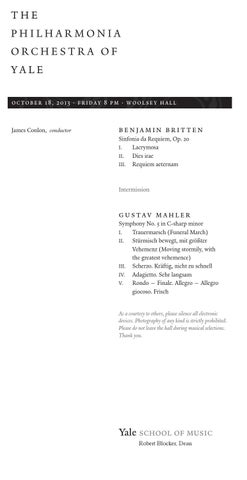
THE PHILHARMONIA ORCHESTRA OF YALE oc to b e r 1 8, 2 0 1 3 · f rid ay 8 pm · woolsey h all
James Conlon, conductor
b e n ja m i n b r i t t e n Sinfonia da Requiem, Op. 20 I. Lacrymosa II. Dies irae III. Requiem aeternam
Intermission
gustav mahler Symphony No. 5 in C-sharp minor I. Trauermarsch (Funeral March) II. Stürmisch bewegt, mit größter Vehemenz (Moving stormily, with the greatest vehemence) III. Scherzo. Kräftig, nicht zu schnell IV. Adagietto. Sehr langsam V. Rondo — Finale. Allegro — Allegro giocoso. Frisch
As a courtesy to others, please silence all electronic devices. Photography of any kind is strictly prohibited. Please do not leave the hall during musical selections. Thank you.
Robert Blocker, Dean
p ro g ram no tes
Benjamin Britten » 1913–1976
with plenty of peace propaganda in it.”
Sinfonia da Requiem, Op. 20
Benjamin Britten was only 26 years old in 1940, and, like so many of his generation, had come of age in a time of great tension, fear, and despair. The past decades had seen the collapse of the world economy, the rise of Stalinism, and the emergence of Nazism from the ashes of a devastated Germany. In the previous year, Germany had invaded Poland, setting off the chain of events that would plunge Europe into the Second World War. Simultaneously, the Empire of Japan was at war with the Republic of China, and unambiguous in its imperialist intent to dominate the Asian continent by force. Britten, along with his partner, the tenor Peter Pears, had fled Great Britain to North America in 1939. An outspoken and at times controversial pacifist, Britten left the European continent on the brink of war, fleeing both the rising tide of fascism on the mainland as well as harsh criticism of his music at home, much of which had in recent years been tied to Leftist, anti-war causes. Given these circumstances, when the composer received a commission in 1940 from the Japanese Empire for a work to commemorate the 2,600th anniversary of its founding, the composer must have felt conflicted. For the event, Japan had also requested works of other prominent European composers, including Richard Strauss, and the significance of this anniversary as propaganda at this bellicose period for the Empire is irrefutable. Britten took the commission, and the result is his Sinfonia da Requiem for orchestra, an enduring masterpiece displaying incredible skill and passion, and which still resonates today. Rather than glorifying imperialism, the composer took the opportunity instead to compose a universal yet deeply personal work, which the composer once noted in a letter “combines ideas on war & a memorial for Mum & Pop.” In choosing the thematic underpinning of the Requiem, a mass for the dead, the composer combines the symphonic form with a program-matic representation of grief and mourning. Two decades later, the composer would expand this idea even further with his powerful War Requiem. The work provides a mechanism for musical commentary on the evils of war, in a piece that is, as the composer put it, “a work
The Japanese rejected the Sinfonia, finding the Christian implications in the titles of the work and the movements to be an insult, and the dark and sombre quality of the work to be inappropriate to the festivity at hand. The Sinfonia da Requiem was instead premiered in the United States, in 1941. Its powerful message of grieving was all too relevant for audiences at the time, and has resonated with audiences ever since. The Sinfonia da Requiem is in three movements, although they are played without pause; Britten threads the movements together seamlessly, a cohesion enhanced by the tonal center of D common to all three movements. The first movement, Lacrymosa (Latin for “weeping”) is a musical representation of lamentation. Present from the outset of the music is an ominous pulsation in the timpani over the bass instruments, fading towards the middle of the movement as the orchestral forces fall into a chamber-like dialogue, and returning at the climax of the movement. This pulsation may symbolize the distant drums of war, or the inevitable, omnipresent ticking of time, as a reminder of the finite quality of life. The syncopation in the funereal theme above this rhythmic backdrop, with its forboding half-step motion, creates a grating sense of tension as it struggles against the insistent pulsation of time. After a thinning of texture towards the middle of the movement, an ominous dialogue among the upper winds emerges with a second theme based upon the wide leap of a seventh, an interval that constantly strives for completion and resolution, further building tension. Following this, the lamenting theme returns once again as it rises in dynamic and range, now doubled in the horns, building to its climax towards the end of the movement. After this shattering climax, there is a glimmer of hope: a major triad subtly sneaks through the texture and rises like a ray of light from a dark cloud. Britten uses the technique of modal mixture, that is, the interplay of the minor and major modes of D, as a compositional theme throughout the piece. Indeed, the arrival of D major in the final movement, after a journey through the darkness of D minor at the outset of the first, traces a narrative of hope emerging from a state of grief. This trajectory of minor to major is present in Mahler’s Fifth Symphony, a suitable companion to the Sinfonia da Requiem. Britten foreshadows his macroscopic programmatic goal with this subtle interplay of minor against major in the first movement. One
might note a similar effect near the end of the second movement of Mahler’s Fifth, where a glorious brass chorale theme emerges from the darkness of the morbid and “stormy” music that surrounds it, and, although it is ultimately suppressed by the surrounding music, which plummets once again into bleak and terrifying darkness, it reveals itself once again, triumphantly, in the final movement of the symphony , symbolizing a triumph of the human spirit over the strain and struggles of existence, a theme that Britten’s work truly shares. The harmony thins out to a solitary, sustained note in the winds, which then bleeds into the second movement of the piece, Dies irae, or “Day of Wrath.” Britten likened this scherzo to a “dance of death,” and it has a macabre, somewhat mechanical quality, with disjunct outbursts from a nervous, frenetic dance meter. The composer uses coloric effects in the orchestra, including fluttertongue in woodwinds, and muted brass fanfares to create an otherworldly, demonic effect. The brass fanfares punctuating the orchestra, including in the secondary theme introduced in the solo trumpet, once again remind the listener of the militaristic signalling fanfares in a time of war. The tension builds throughout the orchestra and the energy grows, until, at the climax of the movement, Britten composes a brilliant musical manifestation of “dancing to death.” The energy gradually slows, and the orchestra shrieks with disjunct, isolated outbursts, like final cries and whimpers before succumbing to exhaustion, or even to death. One could perhaps read into this moment a subtle implication that war depletes, exhausts, and devastates. The battle that is musically depicted in this scherzo has finally finished, and what remains is a broken landscape of destruction and lifelessness. The orchestra sputters away, fading in to the ethereal, placid calm of the final movement of the work, Requiem aeternam, meaning “eternal rest.” The movement evokes a state of calm, and a “plea for peace,” as Britten put it, with its fragile, open timbres of high strings and winds, and the celestial presence of the harp. One should listen for vague traces of the opening theme from the first movement, with its rising chromaticism, now transplanted into a completely new musical setting implying calm acceptance. The major triad, that symbol of hope that was glimpsed in the first movement, emerges once more in the very end of the movement after one final expression of tension and grief in the violins above murmuring, trembling trills in the lower instruments. The beautiful, rich harmony of the D major triad is set in the soft, warm timbre of the clarinets, which fade away to nothing, as though in a sigh of relief, or the transcendence of the spirits of those lost in war. — Patrick Jankowski
Gustav Mahler » 1860–1911 Symphony No. 5 in C-sharp minor At the outset of the twentieth century, Gustav Mahler was director of the Vienna Hofoper and the Vienna Philharmonic. Although these two appointments took nearly all of his time and creative energy, he still found time for composition, mainly in the summers. In April of 1901, he resigned his post with the Philharmonic amid difficult relationships with the players and management. That summer, Mahler returned to his composition hut on the southern shore of the Wörthersee lake in Carinthia. Here he began the series of compositions—three of the Kindertotenlieder, four of the Rückert-Lieder, and part of the Fifth Symphony—that scholars have categorized as the beginning of Mahler’s “middle period.” The changes in his musical style—a greater emphasis on absolute music, new studies of the polyphony of Bach, and less reliance on themes from the Des Knaben Wunderhorn collection of poetry that had informed so many of Mahler’s works up to this point—were accompanied by several notable developments in Mahler’s personal life. The most important of these was his marriage, on March 9, 1902, to Alma Schindler. The union shocked even Mahler’s closest friends, many of whom found out about the engagement from newspaper reports. Despite the controversy, there is no question that Mahler loved his new bride passionately. He claimed to have sent the exquisite Adagietto of the Fifth Symphony to her as a love letter. Whether this is true or not, this “song without words” for strings and harp has since gained independent status as Mahler’s most famous composition. One of the major factors that distinguishes Mahler’s Fifth Symphony from his first four is the lack of an extramusical program to guide the interpretation of the work. Instead, Mahler leaves us to ponder the tumultuous emotional arc of this massive opus on our own. Beginning with a funeral march in C-sharp minor that lurches between depressive angst, wistful remembrance, and violent, passionate grief, Mahler establishes a pattern of extreme contrasts that will continue throughout the work. The second movement marries stormy anger with a powerfully exultant climax before ultimately melting into nothingness. The gigantic Scherzo at the center of the symphony is a clever combination of two dance forms: the
art i st p rofile
Ländler, a rustic country dance, contrasted with the sophisticated city waltz. The aforementioned Adagietto acts as a prelude to the ebullient RondoFinale, which shows the impact of Mahler’s intense study of Bach more clearly than any of his works to this point. After several extended contrapuntal episodes, the music surges to an unbridled choralelike climax in D major, before a wild coda that unleashes the full extent of Mahler’s orchestral virtuosity. – Jordan Kuspa
a rt ist p ro f i le
Symphony Orchestra), and Cincinnati May Festival. He has served as Principal Conductor of the Paris National Opera (1995–2004); General Music Director of the City of Cologne, Germany (1989– 2002), where he was Music Director of both the Gürzenich Orchestra-Cologne Philharmonic and the Cologne Opera; and Music Director of the Rotterdam Philharmonic (1983–1991). He has conducted more than 260 performances at the Metropolitan Opera since his first appearance there in 1976. He has appeared at Teatro alla Scala, Royal Opera at Covent Garden in London, Lyric Opera of Chicago, Maggio Musicale Fiorentino, and Teatro del Opera di Roma.
James Conlon, guest conductor “James Conlon’s career is the story of brilliant promise fulfilled brilliantly. Few artists have consolidated early success with the sustained and enduring excellence Conlon has achieved…When Conlon is leading a performance, music and drama never seem to be at odds….All of it is marked with a joyous sense of urgency that bespeaks the prodigy he once was – and a richly satisfying command that reflects the master he has become.” — Opera News Awards Issue, November 2005 James Conlon is one of today’s most versatile and respected conductors. He has conducted virtually every major American and European symphony orchestra and has led several hundred symphonic and choral works and more than ninety operas. Through worldwide touring, an extensive discography and videography, television appearances, and guest speaking engagements, Conlon is one of classical music’s most recognized interpreters. Conlon is Music Director of Los Angeles Opera, Ravinia Festival (summer home of the Chicago
He recently led a complete cycle of the Mahler symphonies with the Chicago Symphony Orchestra, the first production of Wagner’s Ring Cycle in Los Angeles, and is currently engaged in a three-year project honoring the centenary of the birth of Britten culminating in 2013. Conlon has devoted himself to extensive programming of the lesser-known works of composers silenced by the Nazi regime. In 2007 he received the Crystal Globe Award from the Anti-Defamation League for championing these works. Conlon has recorded for EMI, Erato, Capriccio, Decca and Sony. He has won two Grammy Awards. He was named Commandeur de L’Ordre des Arts et des Lettres by the French Minister of Culture, and in 2002, received France’s highest distinction from then President of the French Republic Jacques Chirac: the Légion d’Honneur. » www.jamesconlon.com
a b o ut yale p h ilharmonia
The Philharmonia Orchestra of Yale is one of America’s foremost music school ensembles. The largest performing group at the Yale School of Music, the Philharmonia offers superb training in orchestral playing and repertoire. Performances include an annual series of concerts in Woolsey Hall, as well as Yale Opera productions in the Shubert Performing Arts Center. The Yale Philharmonia has also performed on numerous occasions in Carnegie Hall and Alice Tully Hall in New York City and at the Kennedy Center in Washington, D.C. The orchestra undertook its first tour of Asia in 2008, with acclaimed performances in the Seoul Arts Center, the Forbidden City Concert Hall and National Center for the Performing Arts (Beijing), and the Shanghai Grand Theatre.
shinik hahm Conductor philharmonia staff andrew w. parker Manager roberta senatore Music Librarian louis lohraseb Assistant Conductor jonathan brandani Assistant Conductor
The Philharmonia Orchestra of Yale violin 1 Heewon Uhm Suliman Tekalli Hye Jin Koh Matheus Garcia Souza Dae Hee Ahn Seul-A Lee Ki Won Kim Ruda Lee Avi Chaim Nagin Julia Ghica Eun-Young Jung Do Hyung Kim Jinyou Lee Nathan Lesser violin 2 Gayoung Cho Jacob Ashworth Tianyun Jia Yena Lee Edouard Maetzener Shuaili Du Ye Hyung Chung Marina Aikawa Inyoung Hwang Xi Liao Melanie Clapies Ryan Truby Zou Yu Jacob Joyce viola Isabella Mensz Hyeree Yu Danielle Rebecca Wiebe Yejin Han Daniel Stone Ksenia Zhuleva Batmyagmar Erdenebat Yuan Qi Benjamin Bartelt Xinyi Xu David Mason 1 - Principal on Britten 2 - Principal on Mahler
cello Allan Hon Bora Kim Yifan Wu Ji Eun Lee Elisa Rodriguez Sadaba Zhilin Wang Chang Pan Christopher Hwang Sohyang Yoo Yoonha Yi bass Gregory Vartian-Foss Andrea Elizabeth Blackert Beyer Noah Cotler Ha Young Jung Samuel Bobinski Samuel Suggs Jonathan Hammonds Christopher Lettie flute Bo Hee Kim 2 Christina Hughes Jacob Mende-Fridkis Isabel Lepanto Gleicher 1 oboe Hsuan-Fong Chen 2 Sol Jee Park Kristin Kall 1 Kemp Jernigan Fiona Last clarinet Chi Hang Eric Fung 1 Tianyu Zhang 2 Joshua Anderson bassoon Marissa Olegario 2 Michael Zuber Bogdan Dumitriu 1 Darren Hicks
saxophone Vincent Oneppo horn Philip Browne 2 Chuta Chulavalaivong Zachary Quortrup Thomas Park Wing Lam Au William Eisenberg John Craig Hubbard Patrick Jankowski 1 trumpet Jean Laurenz 2 Mikio Alan Sasaki Carl Stanley 1 Patrick Durbin Robert Moser trombone Curtis Biggs 2 Elisabeth Shafer Daniel Fears Kevin Dombrowski 1 tuba William Dietz 1 Jens Peterson 2 percussion Georgi Videnov Jonathan Allen Douglas Perry Terrence Sweeney Mari Yoshinaga Garrett Arney harp Antoine Malette-ChĂŠnier 1 Haley Rhodeside 2 piano Lo-An Lin
up co ming events
http://music.yale.edu
box office 203 432-4158
OCT 23
concert programs & box office Krista Johnson Carol Jackson
NOV 1
NOV 2&3
Robert Blocker, piano Wed | 8 pm | Morse Recital Hall Music of Mozart, Schubert, and Brahms. With guest artists including Wei-Yi Yang, piano. Tickets start at $12 · Students $6 Krzysztof Penderecki, guest conductor Fri, 8 pm | Woolsey Hall Penderecki conducts his own Threnody to the Victims of Hiroshima and Symphony No. 2; Toshiyuki Shimada guest conducts Prokofiev’s Piano Concerto No. 2 with soloist Henry Kramer. Fall Opera Scenes Sat, 7:30pm · Sun, 2 pm | Morse Recital Hall The singers of Yale Opera perform scenes from a variety of operas. Different program each night. Tickets start at $10 · Students $5
communications Dana Astmann Monica Ong Reed Austin Kase operations Tara Deming Christopher Melillo piano curators Brian Daley William Harold recording studio Eugene Kimball
Thank you for your support! Become a Yale School of Music patron and support our performance programs. Earn benefits ranging from preferred seating to invitations to special events. To learn more, visit us online or call 203 432-4397. Paul Hindemith Circle $250 to $599 Serena & Robert Blocker Prof. Michael & Mrs. Maryann Bracken Richard H. Dumas Dr. & Mrs. James Kupiec Rev. Hugh J. MacDonald Tom & Patty Pollard Ransom Wilson & Walter Foery Horatio Parker Circle $125 to $249 Anonymous William & Joyce Alton Roger & Linda Astmann Brenda & Sheldon Baker Ann Bliss Derek & Jennifer Briggs Harold & Maureen Bornstein Mr. Leo Cristofar & Ms. Bernadette DiGiulian Mrs. Joan K. Dreyfus Paul Gacek Richard & Evelyn Gard Carolyn Gould Francesco Iachello Paul Jacobs Judy Long Mrs.Susan Matheson & Mr. Jerome J. Pollitt Ms. Suzanne Solensky & Mr. Jay Rozgonyi Mary-Jo Worthey Warren Samuel Simons Sanford Circle $50 to $124 Cecle & Josef Adler Nancy Ahlstrom Craig Baker Dr. & Mrs. Dwight P. Baker Peter Basel Henry & Joan Binder
Peter & Nancy Blomstrom Ernest Bodenweber Michael Hall & Otto Bohlmann Anna Broell Bresnick Mindy & Sam Brownstein Anthony Cavaliere Barbara & Frank Dahm R.R. D’Ambruoso Mr. & Mrs. Dana Elizabeth M. Dock Thomas & Judith Foley Henry Friedman Dolores M. Gall Martin & Katie Gehner Saul & Sonya Goldberg Carolyn Gould Gloria Hardman James S. Johnson III & Marion Kloeg Raejeanne Kier Mr. James C. Kloss & Ms. Esther E. Golton Dave Kozma Peter & Suzanna Lengyel Judith & Karl-Otto Liebmann Nancy C. Liedlich & William R. Liedlich Margaret Lord & Arthur Kover Carmen Lund James Mansfield Ann Marlowe Stephen Marsh Thomas Martin & Harold Spitzer Betty Mettler Martha & Vincent Oneppo Dr. E. Anthony Petrelli James V. Pocock Rocco & Velma Pugliese Fred & Helen Robinson Arthur T. Rosenfield, MD Leonard Rutkosky Allan R. Silverstein Rev. Dr. Michael Tessman & Mrs. Carol Tessman G.M. & M. E.Turnbull Peter & Dana Uhrynowski
Monika & Fred Volker Victor Vu Werner & Elizabeth Wolf Gustave Jacob Stoeckel Circle $25 to $49 Natalie Cybriwsky Bill & Barbara Dickerson Mr. Charles W. Forman Mrs. Ken L. Grubbs Henry Harrison & Ruth Lambert Joel Marks Ron & Sue Miller Joseph & Patricia Rutlin Mr. James N. Trimble David Vecchia Burton & Ellen Zempsky as of 16 October, 2013
philharmonia student staff assistant Timothy Gocklin music librarians Batmyagmar Erdenebat · Darren Hicks Michael Holloway · Allan Hon · Choha Kim Hye Jin Koh · Fiona Last · Michael Laurello David Mason · Alan Ohkubo Nicole Percifield · Rachel Perfecto Elisa Rodriguez Sadaba · Matheus Souza stage crew Jonathan Allen · Garrett Arney Philip Browne · Bogdan Dumitriu Patrick Durbin · Jonathan Hammonds Christopher Hwang · Stephen Ivany Fiona Last · Louis Lohraseb Jacob Mende-Fridkis · Thomas Park Douglas Perry · Zachary Quortrup John Searcy · Elisabeth Shafer Daniel Stone · Terrence Sweeney Gregory Vartian-Foss · Georgi Videnov Mari Yoshinaga