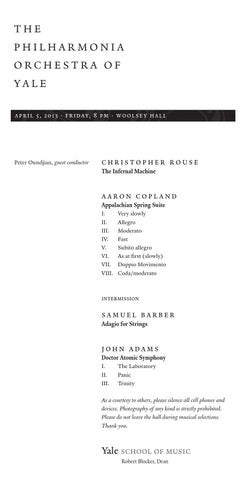
THE PHILHARMONIA ORCHESTRA OF YALE a p r i l 5 , 2 0 1 3 路 frid ay, 8 pm 路 woolsey ha ll
Peter Oundjian, guest conductor
christopher rouse The Infernal Machine
aaron copland Appalachian Spring Suite I. Very slowly II. Allegro III. Moderato IV. Fast V. Subito allegro VI. As at first (slowly) VII. Doppio Movimento VIII. Coda/moderato
intermission
samuel barber Adagio for Strings
john adams Doctor Atomic Symphony I. The Laboratory II. Panic III. Trinity As a courtesy to others, please silence all cell phones and devices. Photography of any kind is strictly prohibited. Please do not leave the hall during musical selections. Thank you.
Robert Blocker, Dean
p ro g ram notes Christopher Rouse » b. 1949
The Infernal Machine The Infernal Machine was composed for the University of Michigan Symphony Orchestra’s European tour performances of 1981 and was completed in Ann Arbor, Michigan on March 21 of that year. Dedicated to my friend Leslie Bassett, it was first performed at the Evian Festival (France) on May 9, 1981 by the above-named orchestra under the direction of Gustav Meier. Since that time it has been programmed by numerous orchestras, including the Berlin, Stockholm, New York, Buffalo, and Rochester Philharmonics, the Minnesota, Cleveland, and Louisville Orchestras, and the Chicago, Boston, Pittsburgh, Saint Louis, Detroit, Baltimore, Houston, Cincinnati, National, and Milwaukee Symphonies. The work takes its title from the eponymous play by Jean Cocteau, though that drama’s retelling of the Oedipus myth had no influence on the piece. Rather it was my intention to compose a brief orchestral showpiece inspired by the vision of a great self-sufficient machine eternally in motion for no particular purpose. But while this machine is not specifically satanic, it is more than a little sinister. The score is a perpetuum mobile wherein the monster sometimes whirs along in mercurially unconcerned fashion, while at others it sputters or throws off slightly hellish sparks, occasionally grinding as it changes gears. At the suggestion of my friend Joseph Schwantner, The Infernal Machine now also functions as the center movement of an orchestral triptych. Commissioned by the Saint Louis Symphony Orchestra and first performed on October 24, 1986, Phantasmata surrounds The Infernal Machine with The Evestrum of Juan de la Cruz in the Sagrada Familia, 3 A.M. and Bump. Both The Infernal Machine and Bump may still be performed separately. –Christopher Rouse
Aaron Copland » 1900–1990 Appalachian Spring Suite
Aaron Copland’s Appalachian Spring falls into the composer’s neoclassical period. Highly influenced by Stravinsky, the Brooklyn-born Copland descended upon New York in the 1920s as a composer of dissonant and jazzinspired works. Famously, the conductor Walter Damrosch said of Copland’s 1925 Symphony for Organ and Orchestra: “If a young man can write a symphony like that, in five years he will be ready to commit murder.” But as Copland grew older, as the medium of radio grew, and as Copland became more and more interested in left-wing politics, he developed a greater interest in communicating with the general public. He decided to simplify his style, embracing clear, open textures over the brash dissonances of his earlier works. When he received a commission for a ballet from the Martha Graham Dance Company (commissioned with funds from Elizabeth Sprague Coolidge—the same patron responsible for the construction of Sprague Memorial Hall at the Yale School of Music), he chose to base his score on a Shaker hymn, “Simple Gifts.” This melody pervades Appalachian Spring, tonight performed in the composer’s 1945 arrangement of the work as an orchestral suite. Each of the ballet’s original fourteen sections corresponds to different parts of Graham’s ballet about 1800s American pioneers building a new farmhouse. The melody is explored in many subtle ways until it is finally presented in full form at the close of the work, radiant and exuberant. –Christopher Cerrone
Samuel Barber » 1910–1981
John Adams » b. 1947
The Adagio for Strings, an arrangement of the second movement of Barber’s String Quartet, is justifiably one of Barber’s most famous compositions. Its broadcast performance by Toscanini and the NBC Symphony Orchestra in 1938 confirmed Barber’s international stature as a composer.
The Doctor Atomic Symphony is based on orchestral music from Adams’s opera in two acts of the same name. The first performance was by the Saint Louis Symphony with David Robertson conducting on March 16, 2007.
Adagio for Strings
Barber’s music is termed neo-Romantic; the style of Romanticism pervades his compositions. His direction was determined in part by the Romantic orientation of his teachers: the composer Sidney Homer, Barber’s uncle and mentor, and Rosario Scalero (himself a student of Eusebius Mandyczewski), with whom Barber studied at the Curtis Institute of Music. Barber combines the Romantic aesthetic with a more contemporary language but never loses sight of it. One thinks of the Nocturne, Op. 33, an homage to John Field, which begins as Field or Chopin might have, then veers away to become more chromatic and dissonant, but never loses its melodic character as a nocturne. The Adagio for Strings contains Barber’s trademark long, expressive melodic writing—the piece varies its opening stepwise melody, which build to a climax, in what is known as an “arch form” in the same way that Wagner creates a climax in the Tristan prelude. The Adagio was played at the funeral of Presidents Roosevelt and Kennedy, and in connection with memorial services at Ground Zero.
Dr. Atomic Symphony
Doctor Atomic is the fifth work for the stage that Adams and Peter Sellars, his longtime collaborator of nearly twenty years, have created. Beginning with Nixon in China (Houston, 1987), Adams and Sellars have created The Death of Klinghoffer (Brussells, 1991), I Was Looking at the Ceiling and Then I Saw the Sky (Berkeley, 1995) and El Niño (Paris, 2000). Doctor Atomic concerns the final hours leading up to the first atomic bomb explosion at the Alamagordo test site in New Mexico in July of 1945. The focal characters are the physicist and Manhattan Project director, Dr. J. Robert Oppenheimer; his wife Kitty; Edward Teller; and General Leslie Groves, the U.S. Army commander of the project. The theme for this opera was suggested to Adams by Pamela Rosenberg, General Director of the San Franciso Opera. The libretto of Doctor Atomic was created by Peter Sellars, drawing on original source material, including personal memoirs, recorded interviews, technical manuals of nuclear physics, declassified government documents, and the poetry of Muriel Rukeyser, an American poet and contemporary of Oppenheimer.
–Susan Hawkshaw – Adapted from www.earbox.com
Your station for news & classical music 800 937-6045 Media Sponsor
wshu 91.1 fm • sacred heart univ. 5151 park ave, fairfield, ct 06825
a rt i st p ro file
Peter Oundjian, guest conductor Toronto-born conductor Peter Oundjian, noted for his probing musicality, collaborative spirit, and engaging personality, has been an instrumental figure in the rebirth of the Toronto Symphony Orchestra since his appointment as music director in 2004. In addition to conducting the orchestra in dynamic performances which have earned artistic acclaim, he has been greatly involved in a variety of new initiatives which have strengthened the ensemble’s presence in the community and attracted a young and diverse audience. Mr. Oundjian has also released four recordings on the orchestra’s self-produced record label, tsoLIVE. The award-winning documentary Five Days In September: The Rebirth of An Orchestra, chronicles Peter Oundjian’s first week as music director of the TSO. Peter Oundjian served as principal guest conductor of the Detroit Symphony Orchestra from 2006 to 2010 and played a major role at the Caramoor International Music Festival between 1997 and 2007. He has served as a visiting professor at the Yale School of Music since 1981. In 2009, Mr. Oundjian received an honorary doctorate from the San Francisco Conservatory. Peter Oundjian was educated in England, where he studied the violin with Manoug Parikian. He then attended the Royal College of Music in London, where he was awarded the Gold Medal for Most Distinguished Student and Stoutzker Prize for excellence in violin playing. He completed his violin training at the Juilliard School in New York, where he studied with Ivan Galamian, Itzhak Perlman, and Dorothy DeLay. Peter Oundjian was the first violinist of the renowned Tokyo String Quartet, a position he held for fourteen years.
a b o u t yale p h ilha rm onia
The Philharmonia Orchestra of Yale is one of America’s foremost music school ensembles. The largest performing group at the Yale School of Music, the Philharmonia offers superb training in orchestral playing and repertoire. Performances include an annual series of concerts in Woolsey Hall, as well as Yale Opera productions in the Schubert Performing Arts Center. The Yale Philharmonia has also performed on numerous occasions in Carnegie Hall and Alice Tully Hall in New York City and at the Kennedy Center in Washington, D.C. The orchestra undertook its first tour of Asia in 2008, with acclaimed performances in the Seoul Arts Center, the Forbidden City Concert Hall and National Center for the Performing Arts (Beijing), and the Shanghai Grand Theatre.
shinik hahm Conductor philharmonia staff andrew w. parker Manager roberta senatore Music Librarian kate gonzales Production Assistant paolo bortolameolli Assistant Conductor jonathan brandani Assistant Conductor
The Philharmonia Orchestra of Yale violin 1 Kayla Moffett Gayoung Cho Go Woon Choi Yuan Ma Barbara Kolarova Corin Lee Matheus Garcia Souza Hye Jin Koh Ji Hyun Kim Jacob Ashworth Christian Sitzmann Heewon Uhm Yoon Won Song Ki Won Kim violin 2 Melanie Clapies Hen-Shuo Chang Shawn Moore Brian Bak Nayeon Kim Minhye Helena Choi Edouard Maetzener Eun Kyung Park Eun-Young Jung Seok Jung Lee Victor Fournelle-Blain viola Colin Brookes Heejin Chang Jane Mitchell Xinyi Xu Dan Zhang Leonard Chiang Jessica Li Hyeree Yu Eleanor Kendra James Dashiel Nesbitt Sara Rossi 1 - Principal on Rouse 2 - Principal on Copland 4 - Principal on Adams
cello Shinae Kim Jurrian Van Der Zanden Bora Kim James Jeonghwan Kim Jinhee Park Andrew Hayhurst Bo Zhang Sohyang Yoo Alan Ohkubo Joonwhan Kim bass Gregory Vartian-Foss Andrew Small Jonathan Hammonds Samuel Suggs Matthew Rosenthal Noah Cotler Jonathan McWilliams NaHee Song Asa Maynard flute Isabel Gleicher 4 Cho-Long Kang 2 Jacob Mende-Fridkis 1 oboe Timothy Gocklin 4 Kristin Kall Ji Hyun Kim 1 Caroline Ross 2 clarinet Igal Levin 1 Gleb Kanasevich 2, 4 Ashley William Smith David Perry bassoon John Searcy Lauren Yu 4 Michael Zuber 1, 2
horn Wing Lam Au Philip Browne 4 William Eisenberg 2 Craig Hubbard Lauren Hunt 1 Patrick Jankowski Zachary Quortrup trumpet John Allen 2 John Ehrenburg 1 Jean Laurenz Gerardo Mata 4 Robby Moser Gerald Villella trombone Hana Beloglavec 1, 4 Timothy Hilgert 2 bass trombone Jeffery Arredondo 4 Christopher Brown 1 tuba Jens Peterson timpani Cristóbal Gajardo-Benitez 1 Mari Yoshinaga 2 percussion Jonathan Allen Garrett Arney Victor Caccese Cristóbal Gajardo-Benitez Doug Perry Mari Yoshinaga harp Antoine Malette-Chénier 1, 4 Yue Guo,2 piano Esther Park
» music.yale.edu APR 7
APR 10 APR 17
box office 203 432-4158
Music of the Russian Thaw 8 pm | Morse Recital Hall | Free Admission “The Thaw” was a period of relative liberalization of Soviet cultural policies in the 1960s. Boris Berman, piano, will discuss his work with Schnittke, Denisov, Pärt, and more, and will perform selections of their music with Yale School of Music students.
Yale Cellos 8 pm | Morse Recital Hall | Tickets $10–20, Students $5 30th Anniversary Concert. Aldo Parisot, conductor. Music by Vivaldi, Ravel, Mussorgsky, Tchaikovsky, Veracini, Laderman, and more.
Yale Philharmonia 8 pm | Woolsey Hall | Free Admission Helmuth Rilling, guest conductor. With the Yale Camerata and Yale Glee Club. Featuring Dvorák’s masterpiece, Stabat Mater.
concert programs Krista Johnson Carol Jackson Julie Blindauer communications Dana Astmann Monica Ong Reed Austin Kase operations Tara Deming Christopher Melillo piano curators Brian Daley William Harold recording studio Eugene Kimball
Thank you for your support! Become a Yale School of Music patron and support our performance programs. Enjoy benefits ranging from preferred seating to invitations to special events. To learn more, visit us online or call 203 432-4397.
paul hindemith circle $250 to $599 Serena & Robert Blocker Prof Michael Bracken & Maryann Bracken Carolyn Gould Dr. & Mrs. James Kupiec Rev. Hugh J. MacDonald Pfizer Foundation Tom & Patty Pollard Richard H. Dumas horatio parker circle $125 to $249 William & Joyce Alton Roger & Linda Astmann Brenda & Sheldon Baker Ann Bliss Derek & Jennifer Briggs Edwin M. & Karen C. Duval Mrs. Joan K. Dreyfus Paul Gacek Richard & Evelyn Gard Francesco Iachello Mrs. Susan Matheson & Mr. Jerome Pollitt Suzanne Solensky & Jay Rozgonyi Mary-Jo Worthey Warren Ransom Wilson & Walter Foery samuel simons sanford circle $50 to $124 Angelo A. Alonzo & Nancy R. Reynolds L.S. Auth Dr. & Mrs. Dwight P. Baker Helen & Blake Bidwell Henry & Joan Binder Peter & Nancy Blomstrom Muriel & Ernest Bodenweber Michael Hall & Otto Bohlmann Mindy & Stan Brownstein Antonio Cavaliere Ms. Rosemarie S. Chaves Dr. Dean & Linda Cloutier Joel Cogen & Elizabeth Gilson Mimi & John Cole
R.R. D’Ambruoso Barbara & Frank Dahm Becky Daymon Leo Cristofar & Bernadette DiGiulian Elizabeth M. Dock Thomas & Judith Foley Jerome Freedman Henry Friedman Dolores M. Gall Martin & Katie Gehner Saul & Sonya Goldberg Gloria Hardman Henry Harrison & Ruth Lambert Thomas & Sharon Haskell Susan Holahan Jim Johnson & Marion Kloeg Charles & Shirley Johnson James C. Kloss & Esther E. Golton Margaret S. Lord & Arthur J. Kover David & Diane Lawrence Stanley A. Leavy Nancy C. Liedlich & William R. Liedlich Carmen Lund James Mansfield Ann Marlowe Stephen Marsh Ed Meaney Betty Mettler Elizabeth S. Miller Ron & Sue Miller Jane & Jack I. Novick Dr. E. Anthony Petrelli Mr. James V. Pocock Rocco & Velma Pugliese Helen & Fred Robinson Arthur T. Rosenfield, MD Leonard J. Rutkosky Patricia & Joseph Rutlin Betsy Schwammberger Allan R. Silverstein Lance & Karen Stronk Rev. Dr. Michael Tessman & Mrs. Carol Tessman Mr. & Mrs. Gregory D. Tumminio
Peter & Dana Uhrynowski Monika & Fred Volker Roger & Beth Wardwell gustave jacob stoeckel circle $25 to $49 Anonymous Natalie Cybriwsky Keita Ebisu Mr. Charles Forman Mrs. Ken L. Grubbs Mary Ann Harback Dr. Rae Jeanne Kier Joel Marks Henry & Doris Rutz Mr. James N. Trimble as of 2 April 2013
philharmonia student staff assistants Timothy Gocklin• Jean Laurenz music librarians Paolo Bortolameolli •Leonard Chiang Cristobal Gajardo-Benitez •Michael Gilbertson Darren Hicks •Timothy Hilgert Michael Holloway • Hye Jin Koh • Qizhen Liu Yuan Ma • Alan Ohkubo • Rachel Perfecto Elisa Rodriguez Sadaba • Matthew Rosenthal Matheus Souza stage crew John Allen • Jonathan Allen Jeffrey Arrendondo • Colin Brookes Jonathan Hammonds • Timothy Hilgert Stephen Ivany • Gerardo Mata Jonathan McWilliams • Shawn Moore David Perry • Doug Perry Matthew Rosenthal • Gerald Villella