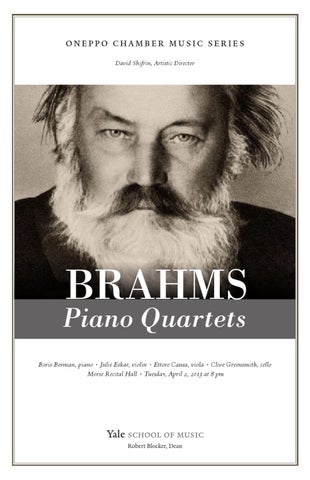
o n ep po c h a mb e r mu s ic s er i es David Shifrin, Artistic Director
BRAHMS
Piano Quartets
Boris Berman, piano • Julie Eskar, violin • Ettore Causa, viola • Clive Greensmith, cello Morse Recital Hall • Tuesday, April 2, 2013 at 8 pm
Robert Blocker, Dean
brahms piano quartets Boris Berman, piano · Julie Eskar, violin Ettore Causa, viola · Clive Greensmith, cello Morse Recital Hall in Sprague Memorial Hall
Johannes Brahms 1833–1897
april 2, 2013 tuesday · 8:00 pm
Piano Quartet No. 2 in A major, Op. 26 I. Allegro non troppo II. Poco Adagio III. Scherzo. Poco allegro IV. Finale. Allegro
intermission
Piano Quartet No. 3 in C minor, Op. 60 I. Allegro non troppo II. Scherzo. Allegro III. Andante IV. Finale. Allegro comodo
Piano Quartet No. 1 in G minor, Op. 25 I. Allegro II. Intermezzo. Allegro III. Andante con moto IV. Rondo alla Zingarese. Presto
As a courtesy to the performers and audience, turn off cell phones and pagers. Please do not leave the hall during selections. Photography or recording of any kind is prohibited.
About the Artists
boris berman, piano Pianist Boris Berman is well known to the audiences of close to fifty countries on six continents. He regularly appears with leading orchestras, on major recital series, and in important festivals. He studied at the Moscow Tchaikovsky Conservatory with the distinguished pianist Lev Oborin. An active recording artist and a Grammy nominee, Mr. Berman was the first pianist to record the complete solo works by Prokofiev (Chandos). Other acclaimed releases include all piano sonatas by Alexander Scriabin (Music and Arts) and a recital of Shostakovich piano works (Ottavo), which received the Edison Classic
Award in Holland, the Dutch equivalent of the Grammy. The recording of three Prokofiev concertos with the Royal Concertgebouw Orchestra, Neeme Jarvi conducting (Chandos), was named the Compact Disc of the Month by CD Review. Other recordings include works by Mozart, Beethoven, Franck, Weber, Debussy, Stravinsky, Schnittke, Shostakovich, Joplin, and Cage. In 1984, Mr. Berman joined the faculty of the Yale School of Music, where he is professor of piano, coordinator of the Piano department, and Music Director of the Horowitz Piano Series. He also gives master classes throughout the world, and in 2005 he was given the title of honorary professor of Shanghai Conservatory of Music. In 2000, Yale University Press published Mr. Berman’s Notes from the Pianist’s Bench; since then, the book has been translated into several languages. In 2008, the same publisher released Mr. Berman’s new book Prokofiev’s Piano Sonatas: A Guide for the Listener and the Performer.
About the Artists
on the Danish chamber music stage and has also enjoyed great success in Germany, Belgium, Luxembourg, France, Portugal, Japan and the Netherlands, where they recently gave their Concertgebouw debut.
julie eskar, violin Julie Eskar is currently first concertmaster of the Danish National Chamber Orchestra and has performed as a soloist with several orchestras in Denmark and abroad, including the Copenhagen Philharmonic, Aalborg Symphony Orchestra, the Belgian Radio Orchestra, the Austrian Chamber Philharmonia, The Danish Radio Sinfonietta and the Copenhagen Chamber Soloists. An avid chamber musician, Ms. Eskar is also a founding member of the Eskar Trio, an internationally award-winning ensemble. The Eskar Trio has established a reputation for itself as one of the leading ensembles
In 2003, the Eskar Trio released a critically acclaimed CD of works by Ravel and Chausson. The Strad magazine, the leading international music periodical, praised the CD lavishly and described it as “outstanding.” The Eskar Trio’s second CD, featuring neverbefore recorded Danish Romantic piano trios, was released in 2005. It too received accolades from The Strad and was also awarded ‘Best Chamber Music Recording’ and ‘Best Classical Recording of the Year’ by the Danish Radio Music Awards. Ms. Eskar studied under Professor Milan Vitek at the Royal Academy of Music in Copenhagen and with Professor Gerhard Schultz at the University of Music and Performing Arts, Vienna. She has also worked under the guidance of Alberto Lysy, Ana Chumachenco, Sylvia Rosenberg, Christian Tetzlaff, and Ivry Gitlis, among others.
About the Artists
Prussia Cove (England), Savonlinna (Finland), Launadire (Canada), and Norfolk (Connecticut). A devoted chamber musician, Mr. Causa is a former member of the Aria Quartet (2004– 2009) and a current member of the Poseidon Quartet, and has collaborated extensively with internationally renowned musicians such as the Tokyo and Elias String Quartets, Pascal Rogé, Boris Berman, Peter Frankl, Thomas Adès, Natalie Clein, Ana Chumachenco, Ani Kavafian, Alberto and Antonio Lysy, Liviu Prunaru, Thomas Demenga, Anthony Marwood, Ulf Wallin, William Bennett, and others.
ettore causa, viola Italian-born violist Ettore Causa is actuve as a viola performers and pedagogue. Awarded both the P. Schidlof Prize and the J. Barbirolli Prize for “the most beautiful sound” at the prestigious Lionel Tertis International Viola Competition in England in 2000, he is praised for his exceptional artistry, passionate intelligence, and complete musicianship. He has made solo and recital appearances in major venues around the world, such as Carnegie Hall, Zurich Tonhalle, Madrid National Auditorium, Salle Cortot (Paris), Tokyo Symphony Hall, Teatro Colon, and others, and has performed at numerous international festivals, such as the Menuhin (Gstaad), Salzburg, Tivoli (Copenhagen),
Having studied at the International Menuhin Music Academy with Alberto Lysy and Johannes Eskar, and later at the Manhattan School of Music with Michael Tree. After teaching both viola and chamber music for many years at the International Menuhin Music Academy, Mr. Causa joined the faculty of the Yale School of Music in 2009. His highly praised recordings include two CDs on the Claves label, one featuring the Brahms viola sonata and the other his transcriptions of Romantic pieces, which was awarded the prestigious “5 Diapasons” by the French magazine. Mr. Causa performs on a viola made for him by Frederic Chaudiere in 2003.
About the Artists
the Royal Northern College of Music, Yehudi Menuhin School, and San Francisco Conservatory of Music and is currently on the faculty of the Manhattan School of Music. Mr. Greensmith’s recording of Brahms sonatas with Boris Berman was released on the Biddulph label. In September, Mr. Greensmith will join the faculty of the Colburn School in Los Angeles.
clive greensmith, cello Cellist Clive Greensmith joined the Tokyo String Quartet in June 1999. A graduate of the Royal Northern College of Music and the Musikhochschule in Cologne, his principal teachers were Donald McCall and Boris Pergamenschikow. He has held the position of principal cellist of London’s Royal Philharmonic Orchestra. As a soloist, he has appeared with the London Symphony Orchestra, the Royal Philharmonic, English Chamber Orchestra, Mostly Mozart Orchestra, Seoul Philharmonic, and the RAI Orchestra of Rome. He has collaborated with distinguished musicians such as András Schiff, Midori, Claude Frank, and Steven Isserlis, and has won several prizes including second place in the inaugural Premio Stradivari held in Cremona, Italy. Mr. Greensmith has served on the faculties of
Notes on the Program
Johannes Brahms began work on what would become his third piano quartet in 1855, and work on the first and second quartets began in the years immediately following. In February of 1854, Brahms’s mentor Robert Schumann had attempted suicide. Between Schumann’s subsequent admittance to a sanatorium and his death in July 1856, Brahms served as the de facto head of the Schumann household. While Schumann’s wife Clara toured Europe as a concert pianist, Brahms managed the Schumanns’ business dealings and helped to care for their children. Additionally, because Schumann’s doctor prohibited Clara from visiting her husband, Brahms served as the principal link between husband and wife. By the time the first two quartets were completed in 1861, Brahms had endured a series of hardships, both emotional (a failed engagement to Agathe von Siebold and an ongoing enigmatic romantic relationship with Clara) and professional (especially the cool critical reception given to his first piano concerto in 1859). Clara Schumann was the pianist for the first performance of Brahms’s Quartet No. 1 in G minor, Op. 25, in Hamburg in 1861. Brahms, however, served as pianist when he took the first two quartets and several other works, including the Handel Variations, Op. 24, to Vienna for his debut there in the fall of 1862. The piano alone begins the first movement, in sonata form, with a straightforward statement of the sinewy first theme. But though the first statement is straightforward, the expansive movement which follows is not—in the course of the exposition, a total of five themes are introduced. The second time the opening statement is heard in the piano, it marks not the repeat of the exposition, but, deceptively, the beginning of the development. The
recapitulation, too, begins deceptively, with the second theme heard before the first theme, and in G major. The second movement, an Intermezzo in C minor, is Brahms’s earliest substitution of this more delicate musical type for the expected scherzo or minuet. The third movement Andante in E-flat major contrasts an expansive and lyrical theme with a rhythmic martial theme. The fiendishly difficult Rondo alla Zingarese verges on the bawdy, with its three-measure phrases and rhythmic pulsations meant to imitate Hungarian gypsy music, and must certainly have had a special appeal for Brahms’s earliest Viennese audiences. The Quartet No. 2 in A major, Op. 26, lacks some of the outward drama of the first quartet, but makes up for it with a superb melodic sense and an extended, seemingly symphonic, conception— it is, in fact, the longest of all of Brahms’s chamber works. In both its melodies and its breadth, it owes something to the music of Franz Schubert—the first movement’s opening measures, played by the piano in triplets and eighth notes, sound like they could be the introduction to a Schubert song, while its extended sonata form recalls Schubert’s formal sensibilities. The second movement, described by Brahms’s friend, the violinist Joseph Joachim, as the “wonderful Poco adagio with its ambiguous passion,” has a series of arpeggiated diminished seventh sonorities which recall Schubert’s late song “Die Stadt.” The third movement, in a touch of compositional bravado, is a scherzo in sonata form, with a canonic trio. The final Allegro is, like the finale of the first quartet, an homage to gypsy music, but, unlike that movement, this finale’s poise matches the general understatement of the movements which precede it.
Notes on the Program
The revision process of the Quartet No. 3 in C minor, Op. 60, took much longer than the revision of the first two quartets. Brahms completed it in 1875, twenty years after its first incarnation, and it must have been a special demon for him, perhaps because it reminded him of Schumann’s death and his own tortured love for Clara. He described the first movement to his friend Hermann Dieters by saying, “Now imagine a man who is just going to shoot himself, because there is no alternative.” He must have been crushed when, after sending Clara an intermediary draft of the quartet, she wrote him a letter which contained her critique: “The last three movements have taken quite a hold of me, but—if I may say so—the first does not seem to me to be on the same level; it does not have the same freshness.” In this quartet’s first, second, and fourth movements, all in the key of C minor, Brahms’s music is exceedingly dramatic, replete with harmonic and textural moments of Sturm-und-Drang. But it is the slow third movement, in the distant key of E major, with its profound and longing melody, that stays in the memory. Of all the love songs Brahms wrote for his beloved Clara, this may well be the most exquisite. –Notes by Kenneth Miller
Oneppo Chamber Music Series 2012–2013 Patrons
Becoming a Yale School of Music Patron is a wonderful way to support our performance programs. We offer benefits to our patrons that range from preferred seating to invitations for the School’s Academic Convocation. To find out more about becoming a Yale School of Music Patron:
» music.yale.edu/giving You can also add a contribution to your ticket purchase to any of the Yale School of Music concerts. Concert Office · 203 432-4158
Charles Ives Circle $600 and above Victoria Keator DePalma Ronald & Susan Netter Bill Tower, in memory of Liz Tower Paul Hindemith Circle $250 to $599 Henry & Joan Binder Carole & Arthur Broadus Mr. & Mrs. Douglas J. Crowley Mark Bauer & Joseph W. Gordon Veronika Grimm & John Matthews Peggy & Ramsay MacMullen March & Margaret Mann Ray Fair & Sharon Oster Patty & Tom Pollard Maggie & Herb Scarf Norman & Mary Shemitz Josephine Shepard Lorraine Siggins & Braxton McKee Abby N. Wells Horatio Parker Circle $125 to $249 Anonymous Laura & Victor Altshul Donald & Susan Anderson Stephen & Janine Anderson Drew Days & Ann Langdon
Anne Reed Dean, in memory of Prof. & Mrs. E.B. Reed Norman S. Hewitt Barbara & Ivan Katz Joseph & Constance LaPalombara Rev. Hugh J. MacDonald Arlette & George Miller Dr. Leonard E. Munstermann Barbara & Bill Nordhaus Sara Ohly Dr. E. Anthony Petrelli Steve Pincus & Mary Jane Minkin Jules Prown Jean & Ronald Rozett Marc A. Rubenstein & Patricia D. Pierce Nathan M. Silverstein Clifford & Carolyn Slayman Emily Aber & Robert Wechsler Elizabeth Womer Samuel Simons Sanford Circle $50 to $124 Anonymous (3) Nina Adams & Moreson Kaplan Susan S. Addiss Henry E. Auer Stephen & Judith August Richard & Nancy Beals David & Carolyn Belt Victor & Susan Bers Jerome Berson Saundra & Donald Bialos Eric & Lou Ann Bohman Marie Borroff Charlotte B. Brenner Robert & Linda Burt Walter Cahn Anne & Guido Calabresi Joe & Phyllis Crowley Sue & Gus Davis Emma Dickey Anne-Marie & William Foltz Ellen Cohen & Steven Fraade Geraldine Frei Kalman L. Watsky & Deborah Fried Clara Genetos Dr. Lauretta E. Grau Paul C. Guida & Patricia La Camera Rosamond G. Hamlin Kenneth R. Hanson Robert & Noel Heimer Walter & Bente Hierholzer Jay & Marjorie Hirshfield Marilyn A. Katz Elise K. Kenney Alan & Joan Kliger Dr. Gary & Hedda Kopf Dr. Fred and Lynn Kudish
Jack & Elaine Lawson Stan Leavy Judith & Karl-Otto Liebmann Rita Lipson Jean & Anne Mauro Colin & Suki McLaren William E. Metcalf William & Irene Miller Peter & Kathryn Patrikis Jo Ann & David Reiss Dr. & Mrs. Herbert S. Sacks Byrna Lasker Scherr Penelope C. Sharp John & Laura Lee Simon Marian & Howard Spiro Joan & Tom Steitz Betty & Martin Sumner Barbara & Michael Susman Alan & Betty Trachtenberg George & Kim Veronis Dr. Nonna D. Wellek Marge & Ken Wiberg Werner & Elizabeth Wolf Dr. & Mrs. Bernard Zuckerman Gustave Jacob Stoeckel Circle $25 to $49 Gusta & Bob Abels Irma & Bob Bachman Judith Colton & Wayne Meeks Peter B. & Diana S. Cooper Bruce H. Dana Kathryn Feidelson Howard & Sylvia Garland Alice. S. Miskimin Willa & Howard Needler Paul & Noemi Pfeffer Joseph & Susan Saccio Ellen & Isaac Sonsino Betsy & Lawrence Stern Sheila & Arthur Taub Antoinette Tyndall Priscilla Waters Norton Marcia & Richard Witten
Upcoming Events
The Classical Style
Music of the Russian Thaw
april 4
april 7
Collection of Musical Instruments Thu | 5:30 pm The Yale Baroque Ensemble performs music by Mozart, Haydn, Dussek, Locatelli, and Paganini. Robert Mealy, director. Free Admission
Morse Recital Hall | Sun | 8 pm Boris Berman, piano, discusses and performs music from “The Thaw,” the 1960s period of relative liberalization of Soviet cultural policies. With Yale School of Music student performers. Free Admission
Yale Philharmonia
Yale Cellos
april 5
april 10
Woolsey Hall | Fri | 8 pm Principal guest conductor Peter Oundjian leads the Yale Philharmonia in four American works by Rouse, Barber, Copland, and Adams. Free Admission
Morse Recital Hall | Wed | 8 pm 30th anniversary performance of the Yale Cellos. Aldo Parisot, director. Featuring music by Bach, Vivaldi, Mussorgsky, Tchaikovsky, Ravel, Laderman, and more. Tickets $10–20, Students $5
Concert Programs & Box Office: Krista Johnson, Carol Jackson, Julie Blindauer Communications: Dana Astmann, Monica Ong Reed, Austin Kase Operations: Tara Deming, Chris Melillo Piano Curators: Brian Daley, William Harold Recording Studio: Eugene Kimball WSHU 91.1 fm is the media sponsor of the Oneppo Chamber Music Series at the Yale School of Music. P.O. Box 208246, New Haven, CT · 203 432-4158
Robert Blocker, Dean
music.yale.edu