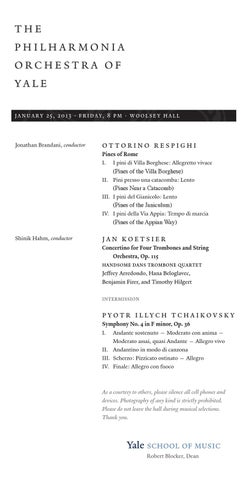
THE PHILHARMONIA ORCHESTRA OF YALE n o v e m ber 1, 2 0 1 2 · t hursd ay, 8 pm · woo ls e y h all ja n ua r y 2 5 , 2 0 1 3 · f rid ay, 8 pm · woolse y h all
Jonathan Brandani, conductor
ottorino respighi Pines of Rome I. I pini di Villa Borghese: Allegretto vivace (Pines of the Villa Borghese) II. Pini presso una catacomba: Lento (Pines Near a Catacomb) III. I pini del Gianicolo: Lento (Pines of the Janiculum) IV. I pini della Via Appia: Tempo di marcia (Pines of the Appian Way)
Shinik Hahm, conductor
jan koetsier Concertino for Four Trombones and String Orchestra, Op. 115 handsome dans trombone quartet Jeffrey Arredondo, Hana Beloglavec, Benjamin Firer, and Timothy Hilgert intermission
pyotr illych tchaikovsky Symphony No. 4 in F minor, Op. 36 I. Andante sostenuto — Moderato con anima — Moderato assai, quasi Andante — Allegro vivo II. Andantino in modo di canzona III. Scherzo: Pizzicato ostinato — Allegro IV. Finale: Allegro con fuoco
As a courtesy to others, please silence all cell phones and devices. Photography of any kind is strictly prohibited. Please do not leave the hall during musical selections. Thank you.
Robert Blocker, Dean
p ro g ram notes Ottorino Respighi» 1879–1936 The Pines of Rome
Throughout the nineteenth century, most of the music written in Italy was opera. By the end of the century, the operas of Verdi and Puccini dominated the Italian concert stage. Though their younger contemporary, Ottorino Respighi, also composed nine operatic works spanning his career, he is known instead as the first Italian composer since the Baroque era to achieve notoriety solely for his orchestral works. The most famous of these still today is Pines of Rome (1924), which is the second in his set of three large orchestral tone poems known as the Roman Trilogy, with Fountains of Rome (1917) and Roman Festivals (1929). In Pines of Rome, Respighi draws from a variety of disparate sources. His use of a colorful and luscious orchestral sound palette undoubtedly stems from his studies with master orchestrator Nikolai RimskyKorsakov. His interest in music before the common practice era instigated references to plainchant melody in the second movement, as well as his call for six buccinae (the medieval precursors of trumpets and trombones) in the fourth movement. He also integrates a recorded nightingale call into the third movement, saying that while modern brass could effectively replace the buccinae, “I simply realized that no combination of wind instruments could quite counterfeit the real bird’s song.” Of course his main source of inspiration is, as the title suggests, the beautiful pine trees in different locations in Rome at different times of day. In each movement, Respighi envisions a specific scene, which he describes in his own words below: I. The Pine Trees of the Villa Borghese (Allegretto vivace): Children are at play in the pine groves of Villa Borghese; they dance round in circles, they play at soldiers, marching and fighting, they are wrought up by their own cries like swallows at evening, they disappear in a swarm. Suddenly the scene changes and… II. The Pines Near a Catacomb (Lento): We see the shadows of pine trees surrounding the entrance to a catacomb. The sound of mournful psalm singing rises from the depths, floating solemnly on the air, gradually and mysteriously dissipating.
III. The Pines of the Janiculum (Lento). A quiver runs through the air: the pine trees of Janiculum Hill stand, distinctly outlined, in the light of a full moon. A nightingale is singing. IV. The Pines of the Appian Way (Tempo di Marcia). Misty dawn on the Appian Way; solitary pine trees guarding the magic landscape; the indistinct, ceaseless rhythm of unending footsteps. The poet has a fantastic vision of bygone glories. At the sound of the trumpets, in the brilliance of the newly risen sun, a consular army bursts forth toward the Sacred Way, triumphantly climbing to the Capitol.
Jan Koetsier » 1911–2006
Concertino for Four Trombones and String Orchestra, Op. 115 Dutch composer Jan Koetsier was quite prolific over his lengthy career, with over 150 chamber, orchestral, and choral works, as well as an opera. At a time when many of Koetsier’s contemporaries were pushing far past tonality, his music remains strongly rooted in the Romantic tradition through his lyrical, soaring melodies and familiar harmonies. In fact, the main indicator that the Concertino for Four Trombones (1998) was written well after the Romantic Era is the instrumentation itself. For much of the work, Koetsier expertly weaves the trombones through the string orchestra to create tutti passages that sound full and lush, or exposes the four soloists in passages of standard brass writing. This only serves to heighten the effect of the two muted sections, which sound delightfully anachronous in the context of the piece. In the second movement, the voicing and harmony of the muted trombones evokes the sentiment of a slow jazz standard, while the subsequent use of straight mutes adds a sharp, new sound world to the third movement.
Pyotr Ilyich Tchaikovsky » 1840–1893 Symphony No. 4 in F minor, Op. 36
Perhaps it was fate that Antonia Milyukova’s letter arrived on Tchaikovsky’s doorstep after his recent reading of Pushkin’s Eugene Onegin. Milyukova, a student from his distant past, had written to him to express her insatiable infatuation with the composer, and to declare her inability to live without him. Had Tchaikovsky not been in search of a story for his upcoming opera, he might not have seen
art ist p ro f i le s
the uncanny resemblance of the letter to the one Tatiana writes to Onegin, and he may not have submitted to her desires. What followed was the most devastating year of Tchaikovsky’s life. In order to quash rumors about his homosexuality, he proposed to Milyukova within a few days of meeting her, and they were married shortly thereafter. In the following weeks, Tchaikovsky panicked and fled the country, feverishly working on both the Fourth Symphony and the opera Eugene Onegin at his sister’s home in Ukraine. Upon his return, his distress led him to stand in the frigid Moscow River one night, hoping he would die from pneumonia. Though he lived, he separated from Milyukova soon afterward. He completed both the Fourth Symphony and Eugene Onegin from Switzerland, where he had retreated with his brother on the suggestion of a psychiatrist. Upon returning to Moscow, he finalized his divorce from Milyukova – their marriage had not lasted three months. When Tchaikovsky’s patron and muse, Nadezhda von Meck (who paid him a handsome stipend on the condition that they never meet, but with whom he exchanged over a thousand letters during the course of her patronage), asked him for a written description of the symphony, he expressed his frustration to composer Sergei Taneyev, saying, “Of course my symphony is programmatic, but this program is such that it cannot be formulated into words.” His tumultuous relationship with Milyukova had left him with no means of verbal expression for his suffering; it was only through his music that he was able to fully express his thoughts and emotions. He does, however, speak of the role of Fate in his symphony, and, it may be inferred, in his life. He points to the harsh brass fanfare that recurs throughout the work, saying, “This is Fate, the power which hinders one in the pursuit of happiness from gaining the goal, which jealousy provides that peace and comfort do not prevail, that the sky is not free from clouds – a might that swings, like the sword of Damocles, constantly over the head, that poisons continually the soul. This might is overpowering and invincible. There is nothing to do but submit…” Program Notes by Reena Esmail
Shinik Hahm, conductor A dynamic and exciting conductor, Shinik Hahm has led the Philharmonia Orchestra of Yale since 2004. He was music director of the Yale Symphony Orchestra from 1995 to 2004. As a guest conductor, he has led orchestras in North and South America, Europe, and Asia. He has conducted in such concert halls as the Concertgebouw, Carnegie Hall, Kennedy Center, Walt Disney Hall, Symphony Hall (Boston), Seoul Arts Center, Tokyo Opera City Hall, and the National Theater of China. Recently, he was immediately re-engaged after debuts with the Robert Schumann Orchestra and Nordwestdeutsche Philharmonie in Germany, Porto Alegre Symphony in Brazil, and Shenzhen Symphony in China. Upcoming engagements include the Prague Radio Symphony, Slovak National Symphony, Northern Czech Symphony, and the Malaga Symphony Orchestra. As the chief conductor of the Korean Broadcasting System Symphony Orchestra, Hahm led the orchestra on tour with concerts at the General Assembly of the United Nations, Carnegie Hall, and the Kennedy Center. As music director of the Abeline Philharmonic and the Tuscaloosa Symphony for ten years, Mr. Hahm cultivated semiprofessional community orchestras into admirable professional ensembles. A committed educator, Shinik Hahm is a faculty member of the Yale School of Music. His conducting students have won top prizes at the Besançon, Pedrotti, Toscanini, and China National competitions. Hahm has won the Gregor Fitelberg Competition, the Walter Hagen Prize (Eastman School of Music), and the Shepherd Society Award (Rice University). He was decorated by the Korean government with the Arts and Culture Medal. Hahm studied conducting at Rice University and the Eastman School of Music. He is an avid soccer player.
a rt i st p ro files (cont.)
Jonathan Brandani, conducting fellow
Handsome Dans Trombone Quartet
Jonathan Brandani (b. Lucca, Italy, 1983) is currently a conducting fellow at the Yale School of Music, where he studies with Shinik Hahm. Jonathan studied orchestra conducting with Mark Stringer at the Universität für Musik und darstellende Kunst (Vienna), where he obtained his Magister Artium Diploma with full grades and honors in 2012. There he also studied opera conducting/répétiteur with Konrad Leitner and choir conducting with Erwin Ortner; he also benefitted from the advice of Daniel Harding and Zubin Mehta. He has conducted the Wiener Kammerorchester, Russian National Orchestra, Webern Symphonie Orchester, Maribor International Orchestra, Haydn Sinfonietta, and Royal Camerata Bucharest. In 2011 he conducted Mozart’s Le Nozze di Figaro at the head of the Webern Symphonie Orchester at the Opera House at Schönbrunn Castle in Vienna; at the same venue he also conducted Handel’s Ariodante (2012) with the Haydn Sinfonietta. In 2012 he conducted Mozart’s Don Giovanni and Entführung aus dem Serail at the Sommertraum Festival am Semmering. From 2008 to 2010 he worked as répétiteur and musical assistant at the Festival Oper Klosterneuburg.
The Handsome Dans Trombone Quartet was founded in the fall of 2011 by Jeffrey Arredondo, Hana Beloglavec, Benjamin Firer, and Timothy Hilgert. After less than three months together, the Handsome Dans Trombone Quartet was given an honorable mention in the International Trombone Association’s (ITA) Trombone Quartet Competition. Shortly after, the quartet went on to become the first chamber group and the first brass instrumentalists to win the Woolsey Hall Concerto Competition, hosted by the Yale School of Music.
A passionate interpreter and scholar of early music, Jonathan has played harpsichord and organ continuo with renowned European early music ensembles such as Concerto Köln, I Barocchisti, Coro della Radiotelevisione Svizzera Italiana, and ArteMusica, and has been recording for Virgin Classics, ORF, Radio4 Netherlands/AVRO, RSI, and Bongiovanni. He received the bursary Theodor Körner Fonds 2010 of the Austrian Republic for his research in the field of baroque and classical music by composers from his native Tuscany. Jonathan has also studied piano (graduating cum laude with full marks from the Istituto Musicale P. Mascagni in Livorno, Italy), harpsichord, organ, and composition.
The members of the Handsome Dans Trombone Quartet have also been successful as solo trombonists, competing and winning various ITA solo competitions, being named first prize winner at the Division Two Susan Slaughter International Solo Competition at the International Women’s Brass Conference, and winning the Yale Chamber Music Society Competition. The Handsome Dans Trombone Quartet is comprised of members from throughout the United States, including Texas, Michigan, New York, and Georgia. They are coached by their teacher, Mr. Scott Hartman.
a b o u t yale p h ilha rm onia
The Philharmonia Orchestra of Yale is one of America’s foremost music school ensembles. The largest performing group at the Yale School of Music, the Philharmonia offers superb training in orchestral playing and repertoire.
shinik hahm Conductor
Performances include an annual series of concerts in Woolsey Hall, as well as Yale Opera productions in the Shubert Performing Arts Center. The Yale Philharmonia has also performed on numerous occasions in Carnegie Hall and Alice Tully Hall in New York City and at the Kennedy Center in Washington, D.C. The orchestra undertook its first tour of Asia in 2008, with acclaimed performances in the Seoul Arts Center, the Forbidden City Concert Hall and National Center for the Performing Arts (Beijing), and the Shanghai Grand Theatre.
roberta senatore Music Librarian
andrew w. parker Manager
kate gonzales Production Assistant paolo bortolameolli Assistant Conductor jonathan brandani Assistant Conductor
The Philharmonia Orchestra of Yale violin 1 Victor Fournelle-Blain Kayla Moffett Alissa Cheung Edouard Maetzener Corin Lee Mann-Wen Lo Heewon Uhm Seok Jung Lee Seul-A Lee Ki Won Kim Cordelia Paw Jacob Ashworth Shawn Moore Go Woon Choi violin 2 Choha Kim Barbara Kolarova Matheus Garcia Souza Ji Hyun Kim Betty Zhou Yuan Ma Eun-young Jung Nayeon Kim Christian Sitzmann Brian Bak Melanie Clapies Hye Jin Koh Benjamin Hoffman Gayoung Cho viola Leonard Chiang Colin Brookes Eleanor Kendra James Sara Rossi Isabella Mensz Jane Mitchell Hyeree Yu Jessica Li Benjamin Bartelt Dan Zhang Xinyi Xu Heejin Chang
cello James Jeonghwan Kim Jinhee Jennifer Park Alan Ohkubo Andrew Hayhurst Bora Kim Qizhen Liu Jurrian Van Der Zanden Jia Cao Joonhwan Kim Shinae Kim bass Samuel Suggs Andrew Small Matthew Rosenthal Noah Cotler Gregory Vartian-Foss Jonathan McWilliams Jonathan Hammonds
horn Philip Browne 1 William Eisenberg Craig Hubbard Patrick Jankowski 3 Sarah Au Wing Lam Zachary Quortrup Lauren Hunt trumpet John Ehrenburg 1 Jean Laurenz Robby Moser Gerald Vilella 3 John Allen trombone Kevin Dombrowski 1 Timothy Hilgert Stephen Ivany
flute Isabel Gleicher Cholong Kang 1 Kyeong Hoon Seung 3
bass trombone Christopher Brown Jeffery Arredondo
oboe Hsuan-Fong Chen 3 Timothy Gocklin Kristin Kall 1 Ji Hyun Kim Caroline Ross
timpani Doug Perry 1 Mari Yoshinaga 3
clarinet Eric Anderson 3 Igal Levin David Perry 1 bassoon Elisabeth Garrett Yuki Katayama 3 Lauren Yu Michael Zuber 1
tuba William Dietz
percussion Jonathan Allen Garrett Arney Cristobal Gajardo-Benitez 1, 3 harp Yue Guo celeste Zhenni Li 1 piano Naomi Wu 1 organ Dexter Kennedy 1 1 Principal on Respighi 2 Principal on Koetsier 3 Principal on Tchaikovsky
up co ming events
» music.yale.edu
box office 203 432-4158
JAN 27
Quicksilver Baroque
FEB 06
Emanuel Ax, piano
FEB 12
Bach: Art of the Fugue
collection of musical instruments 3 pm | 15 Hillhouse Ave. | Tickets $15–20, Students $10 Fantasticus: extravagant and virtuosic chamber music of 17th-century Germany. Quicksilver is led by violinists Robert Mealy and Julie Andrijeski.
horowitz piano series 8 pm | Sprague Hall | Tickets $20–30, Students $10–15 Music of Beethoven, Schoenberg, and Chopin.
oneppo chamber music series 8 pm | Sprague Hall | Tickets $25–35, Students $15 The Orion Quartet and Windscape perform Bach’s Art of the Fugue, arranged by Samuel Baron for string quartet and wind quintet.
concert programs Krista & boxJohnson office Danielle Krista Johnson Heller Carol Jackson public relations Julie Blindauer & media Dana Astmann communications Monica Dana Astmann Ong Reed Austin Kase Monica Ong Reed Austin Kase operations Tara Deming operations Christopher Tara DemingMelillo Christopher Melillo recording studio Eugene Kimball piano curators Brian Daley William Harold recording studio Eugene Kimball
Thank you for your support! Become a Yale School of Music patron and support our performance programs. Earn benefits ranging from preferred seating to invitations to special events. To learn more, visit us online or call 203 432-4397. paul hindemith circle $250 to $599 Serena & Robert Blocker Prof Michael Bracken & Maryann Bracken Carolyn Gould Dr. & Mrs. James Kupiec Rev. Hugh J. MacDonald Pfizer Foundation Tom & Patty Pollard Richard H. Dumas horatio parker circle $125 to $249 William & Joyce Alton Roger & Linda Astmann Brenda & Sheldon Baker Ann Bliss Derek & Jennifer Briggs Edwin M. & Karen C. Duval Mrs. Joan K. Dreyfus Paul Gacek Richard & Evelyn Gard Francesco Iachello Mrs. Susan Matheson & Mr. Jerome Pollitt Suzanne Solensky & Jay Rozgonyi Mary-Jo Worthey Warren Ransom Wilson & Walter Foery samuel simons sanford circle $50 to $124 Angelo A Alonzo & Nancy R Reynolds L.S. Auth Dr. & Mrs. Dwight P. Baker Helen & Blake Bidwell Henry & Joan Binder Peter & Nancy Blomstrom Muriel & Ernest Bodenweber Michael Hall & Otto Bohlmann Mindy & Stan Brownstein Antonio Cavaliere Ms. Rosemarie S. Chaves Dr. Dean & Linda Cloutier Joel Cogen & Elizabeth Gilson Mimi & John Cole
R.R. D’Ambruoso Barbara & Frank Dahm Becky Daymon Leo Cristofar & Bernadette DiGiulian Elizabeth M. Dock Thomas & Judith Foley Jerome Freedman Henry Friedman Dolores M. Gall Martin & Katie Gehner Saul & Sonya Goldberg Gloria Hardman Henry Harrison & Ruth Lambert Thomas & Sharon Haskell Susan Holahan Jim Johnson & Marion Kloeg Charles & Shirley Johnson James C. Kloss & Esther E. Golton Margaret S. Lord & Arthur J. Kover David & Diane Lawrence Stanley A. Leavy Nancy C. Liedlich & William R. Liedlich Carmen Lund James Mansfield Ann Marlowe Stephen Marsh Ed Meaney Betty Mettler Elizabeth S. Miller Ron & Sue Miller Jane & Jack I. Novick Dr. E. Anthony Petrelli Mr. James V. Pocock Rocco & Velma Pugliese Helen & Fred Robinson Arthur T. Rosenfield, MD Leonard J. Rutkosky Patricia & Joseph Rutlin Betsy Schwammberger Allan R. Silverstein Rev. Dr. Michael Tessman & Mrs. Carol Tessman Mr. & Mrs. Gregory D. Tumminio Peter & Dana Uhrynowski
Monika & Fred Volker Roger & Beth Wardwell gustave jacob stoeckel circle $25 to $49 Anonymous Natalie Cybriwsky Keita Ebisu Mr. Charles Forman Mrs. Ken L. Grubbs Mary Ann Harback Dr. Rae Jeanne Kier Joel Marks Henry & Doris Rutz Mr. James N. Trimble as of 16 January 2013
philharmonia student staff assistants Philip Browne • Jean Laurenz music librarians Paolo Bortolameolli •Leonard Chiang Cristobal Gajardo-Benitez •Michael Gilbertson Darren Hicks •Timothy Hilgert Michael Holloway • Hye Jin Koh • Qizhen Liu Yuan Ma • Alan Ohkubo • Rachel Perfecto Elisa Rodriguez Sadaba • Matthew Rosenthal Matheus Souza stage crew John Allen • Jonathan Allen Jeffrey Arrendondo • Colin Brookes Jonathan Hammonds • Timothy Hilgert Stephen Ivany • Gerardo Mata Jonathan McWilliams • Shawn Moore David Perry • Doug Perry Matthew Rosenthal • Gerald Villella
Your station for news & classical music 800 937-6045 Media Sponsor
wshu 91.1 fm • sacred heart univ. 5151 park ave, fairfield, ct 06825