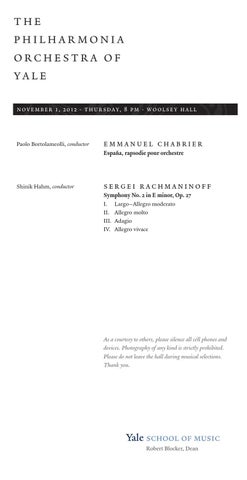
THE PHILHARMONIA ORCHESTRA OF YALE n o v e m ber 1, 2 0 1 2 · t hursd ay, 8 pm · woo ls e y h all
Paolo Bortolameolli, conductor
emmanuel chabrier España, rapsodie pour orchestre
Shinik Hahm, conductor
sergei rachmaninoff Symphony No. 2 in E minor, Op. 27 I. Largo–Allegro moderato II. Allegro molto III. Adagio IV. Allegro vivace
As a courtesy to others, please silence all cell phones and devices. Photography of any kind is strictly prohibited. Please do not leave the hall during musical selections. Thank you.
Robert Blocker, Dean
p ro g ram notes Emmanuel Chabrier » 1841–1894 España, rapsodie pour orchestre
In March of 1880, lawyer and sometime composer Emmanuel Chabrier heard Tristan and Isolde for the first time in Munich. The performance was such an emotional experience for him (according to friends, he began sobbing during the pickup to the Prelude’s first measure) that later that year, he resigned his position with the French Ministry of the Interior to devote himself to music full-time. One would hardly suspect such a story to be true while listening to Chabrier’s most famous orchestral showpiece, España, which no one would ever confuse for Wagner. Two years after his Tristan experience, Chabrier and his wife Alice took an extended vacation across Spain. Chabrier was particularly entranced by Andalusia and its capital city, Seville. In a letter, he confessed, “Since coming to Andalusia I haven’t seen a really ugly woman… I won’t let on what these women display, but they display it beautifully.” When he returned to Paris, he set about writing a piano piece to remember his trip by. Upon hearing sketches of the piece, the conductor Charles Lamoureux insisted that Chabrier orchestrate it. Chabrier’s orchestral version is dedicated to Lamoureux, who conducted its premiere in November 1883. The work is composed in sonata form, and its two primary themes are adaptations of Spanish dances. The rhythmically boisterous first theme is related to the northern jota, and the gently lilting second theme is related to the southern malagueña. Much of España’s joyful spirit is thanks to its charming orchestration, with colorful combinations of instruments and liberal use of percussion. And appropriately for tonight’s concert, the trombones get most of the memorable lines. – Kenneth Miller
Sergei Rachmaninoff » 1873–1943 Symphony No. 2 in E minor, Op. 27
In 1906–07, when he wrote his Second Symphony, Rachmaninoff was experiencing great success as both composer and pianist. He had recently arrived in Dresden from Moscow and was enjoying a happy companionship with his wife. A feeling of triumphant optimism—not necessarily
lighthearted, but exuberant nonetheless— shines throughout. It is in this symphony that we find some of Rachmaninoff’s most beautiful melodies. The first movement is a sonata form, with the first thematic area in the tonic key of E minor and the second subject in G, the relative major. The main theme, introduced in the Largo by the cellos and basses, recurs in some form throughout the four movements of the work. However, referring to this as a cyclical element is perhaps overstating its role; the motive frequently lingers in the background, but it is not the point of genesis from which the whole work blossoms. In the recapitulation of the first movement, Rachmaninoff demonstrates his considerable contrapuntal skill in the presentation of the second subject (now in the parallel major). The second movement, in the style of a Russian dance, proceeds at a fearsome pace. The movement is in A minor; structurally, it is set in a large-scale ABA form, of which both the first and last sections are themselves ternary. After the opening dance-like section, a melodic section follows, only to be enveloped once again in an ensuing dance section. A fugato section represents the large-scale departure. This fugue then returns to the dance-like section which eventually completes the ternary form. The Adagio is in a ternary structure like the second movement, though now in A major instead of minor. The middle section briefly reestablishes the home key of E, but returns to A shortly after, thereby undercutting any true return to E. The Finale is set in sonata allegro form, of which the first thematic group is a robust dance. This theme then gradually arrives at the second thematic group, one of Rachmaninoff ’s most beautiful melodies. During the development, thematic fragments from the previous three movements are recalled. In the recapitulation, the second subject, now in E, is combined with the dance figure to provide a rousing conclusion to a magnificent symphonic statement. The symphony was first performed in 1908 in Moscow, under the baton of the composer. – Philip Ficsor
OPERA
SCENES November 2–3, 2012
Yale Opera presents scenes from
Il barbiere di Siviglia Carmen L’elisir d’amore Manon Werther
La Bohème I Capuleti e i Montecchi Otello Les pêcheurs de perles The Pirates of Penzance
Doris Yarick-Cross, artistic director Friday & Saturday • 7:30 pm • Morse Recital Hall in Sprague Hall Tickets $10–15 • Students $5 • 203 432-4158
Robert Blocker, Dean
Your station for news & classical music 800 937-6045 Media Sponsor
wshu 91.1 fm • sacred heart univ. 5151 park ave, fairfield, ct 06825
a rt i st p ro files
Shinik Hahm, conductor
Paolo Bortolameolli, conducting fellow
A dynamic and exciting conductor, Shinik Hahm has led the Philharmonia Orchestra of Yale since 2004. He was music director of the Yale Symphony Orchestra from 1995 to 2004. As a guest conductor, he has led orchestras in North and South America, Europe, and Asia.
Paolo Bortolameolli is a graduate both of the Arts Faculty of Universidad de Chile, where he studied conducting with David del Pino Klinge, and from Pontificia Universidad Católica, where he studied piano with Frida Conn. He is now in his second year in the Master of Music degree program in orchestral conducting at the Yale School of Music, where he studies with Shinik Hahm.
He has conducted in such concert halls as the Concertgebouw, Carnegie Hall, Kennedy Center, Walt Disney Hall, Symphony Hall (Boston), Seoul Arts Center, Tokyo Opera City Hall, and the National Theater of China. Recently, he was immediately re-engaged after debuts with the Robert Schumann Orchestra and Nordwestdeutsche Philharmonie in Germany, Porto Alegre Symphony in Brazil, and Shenzhen Symphony in China. Upcoming engagements include the Prague Radio Symphony, Slovak National Symphony, Northern Czech Symphony, and the Malaga Symphony Orchestra. As the chief conductor of the Korean Broadcasting System Symphony Orchestra, Hahm led the orchestra on tour with concerts at the General Assembly of the United Nations, Carnegie Hall, and the Kennedy Center. As music director of the Abeline Philharmonic and the Tuscaloosa Symphony for ten years, Mr. Hahm cultivated semiprofessional community orchestras into admirable professional ensembles. A committed educator, Shinik Hahm is a faculty member of the Yale School of Music. His conducting students have won top prizes at the Besançon, Pedrotti, Toscanini, and China National competitions. Hahm has won the Gregor Fitelberg Competition, the Walter Hagen Prize (Eastman School of Music), and the Shepherd Society Award (Rice University). He was decorated by the Korean government with the Arts and Culture Medal. Hahm studied conducting at Rice University and the Eastman School of Music. He is an avid soccer player.
He has participated in master classes with leading conductors, including Neeme Järvi, Pavo Järvi, and Leonid Grin at the Järvi Summer Festival and Academy; with Jorma Panula at El Escorial in Madrid; and with Peter Gülke at the Salzburg Mozarteum. Recently he became the principal conductor of the New Haven Chamber Orchestra. In Chile, he was the principal conductor of a youth orchestra for three years and assistant conductor of the Orquesta USACH. At the Järvi Summer Festival and Academy, he conducted concerts with the Pärnu City Orchestra and Estonian National Youth Orchestra. He has performed with the Orquesta de la Universidad de Concepción and the National Symphonic Orchestra of Perú. As a pianist, Paolo won the first prize of the National Chopin Competition in 2003. In 2005 he won the National Competition for Young Soloists playing Tchaikovsky’s Piano Concerto Nº 1 with the National Symphonic Orchestra of Chile.
a b o u t yale p h ilha rm onia
The Philharmonia Orchestra of Yale is one of America’s foremost music school ensembles. The largest performing group at the Yale School of Music, the Philharmonia offers superb training in orchestral playing and repertoire.
shinik hahm Conductor
Performances include an annual series of concerts in Woolsey Hall, as well as Yale Opera productions in the Shubert Performing Arts Center. The Yale Philharmonia has also performed on numerous occasions in Carnegie Hall and Alice Tully Hall in New York City and at the Kennedy Center in Washington, D.C. The orchestra undertook its first tour of Asia in 2008, with acclaimed performances in the Seoul Arts Center, the Forbidden City Concert Hall and National Center for the Performing Arts (Beijing), and the Shanghai Grand Theatre.
roberta senatore Music Librarian
andrew w. parker Manager
kate gonzales Production Assistant paolo bortolameolli Assistant Conductor jonathan brandani Assistant Conductor
The Philharmonia Orchestra of Yale violin 1 Melanie Clapies Hen-Shuo Chang Ki Won Kim Yuan Ma Eun-young Jung Minhye Helena Choi Yoon Won Song Corin Lee Kayla Moffett Eun Kyung Park Matheus Garcia Souza Victor Fournelle-Blain Betty Zhou Brian Bak violin 2 Cordelia Paw Choha Kim Gayoung Cho Barbara Kolarova Christian Sitzmann Edouard Maetzener Jacob Ashworth Heewon Uhm Seok Jung Lee Benjamin Hoffman Shawn Moore Ji Hyun Kim Sun Kyung Ban Seul-A Lee viola Eleanor Kendra James Jane Mitchell Colin Brookes Dashiel Nasbitt Isabella Mensz Leonard Chiang Sara Rossi Heejin Chang Benjamin Bartlet Xinyi Xu Jessica Li Dan Zhang
cello Shinae Kim Andrew Hayhurst Elisa Rodriguez Sabada Jinhee Park Bo Zhang Alan Ohkubo Jia Cao Sohyang Yoo Christopher Hwang Arnold Choi bass Gregory Vartian-Foss Noah Cotler Samuel Suggs Jonathan McWilliams Andrew Small Jonathan Hammonds NaHee Song Matthew Rosenthal Asa Maynard flute Isabel Gleicher Bo Hee Kim 1, 2 Jacob Mende-Fridkis
horn Sarah Au Wing Lam Philip Browne 1 William Eisenberg John Craig Hubbard 2 Patrick Jankowski Zachary Quortrup trumpet John Allen John Ehrenburg Jean Laurenz Gerado Mata 2 Robert Moser Gerald Villella 1 trombone Matthew Russo 1 Hana Beloglavec 2 Jeffrey Arredondo tuba Jens Peterson timpani Garrett Arney 1 Victor Caccese 2
oboe Timothy Gocklin Kristin Kall 2 Ji Hyun Kim Jeffrey Reinhardt Caroline Ross 1
percussion Jonathan Allen Garrett Arney Victor Caccese Douglas Perry Mari Yoshinaga
clarinet David Perry 1 Ashley Smith 2 Tianyu Zhang
harp Yue Guo 1 Antoine Malette-Chenier
bassoon Elisabeth Garrett 1 Darren Hicks Yuki Katayuma John Searcy Lauren Yu Michael Zuber 2
1 Principal on Chabrier 2 Principal on Rachmaninoff
up co ming events
» music.yale.edu Nov 2 & 3
NOV 3
box office 203 432-4158
Fall Opera Scenes yale opera 7:30 pm | Sprague Hall | Tickets $10–15, Students $5 Featuring excerpts from La Bohème, Carmen, Manon, I Capuleti e i Montecchi, L’elisir d’amore, Werther, The Pirates of Penzance, and more.
Robin Blaze, countertenor Masaaki Suzuki, harpsichord institute of sacred music 5 pm | Marquand Chapel | Free admission Featuring music of Henry Purcell.
NOV 7
Boris Berman horowitz piano series 8 pm | Sprague Hall | Tickets $12–22, Students $6–9 A Hundred Years Back: Music written 19121913 by Scriabin, Prokofiev, and Debussy. With narrator Peter Frances James and projections designed by Shawn Boyle.
concert programs Krista Johnson Carol Jackson Julie Blindauer communications Dana Astmann Monica Ong Reed Austin Kase operations Tara Deming Christopher Melillo piano curators Brian Daley William Harold recording studio Eugene Kimball
Thank you for your support! Become a Yale School of Music patron and support our performance programs. Enjoy benefits ranging from preferred seating to invitations to special events. To learn more, visit us online or call 203 432-4397. paul hindemith circle $250 to $599 Serena & Robert Blocker Richard H. Dumas Dr. & Mrs. James Kupiec Rev. Hugh J. MacDonald Pfizer Foundation Tom & Patty Pollardn horatio parker circle $125 to $249 William & Joyce Alton Roger & Linda Astmann Brenda & Sheldon Baker Ann Bliss Derek & Jennifer Briggs Mrs. Joan K. Dreyfus Edwin M. & Karen C. Duval Ransom Wilson & Walter Foery Paul Gacek Richard & Evelyn Gard Francesco Iachello Mrs. Susan Matheson & Mr. Jerome Pollitt Suzanne Solensky & Jay Rozgonyi samuel simons sanford circle $50 to $124 L.S. Auth Dr. & Mrs. Dwight P. Baker Helen & Blake Bidwell Henry & Joan Binder Peter & Nancy Blomstrom Muriel & Ernest Bodenweber Mindy & Stan Brownstein Ms. Rosemarie S. Chaves Leo Cristofar & Bernadette DiGiulian Joel Cogen & Elizabeth Gilson Mimi & John Cole R.R. D’Ambruoso
Barbara & Frank Dahm Becky Daymon Elizabeth M. Dock Thomas & Judith Foley Jerome Freedman Dolores M. Gall Martin & Katie Gehner Saul & Sonya Goldberg Michael Hall & Otto Bohlmann Susan Holahan Charles & Shirley Johnson Margaret S. Lord & Arthur J. Kover Henry Harrison & Ruth Lambert David & Diane Lawrence Stanley A. Leavy Nancy C. Liedlich & William R. Liedlich James Mansfield Stephen Marsh Ann Marlowe Mr. Ed Meaney Betty Mettler Elizabeth S. Miller Ron & Sue Miller Jane and Jack I. Novick Dr. E. Anthony Petrelli Mr. James V. Pocock Rocco & Velma Pugliese Helen & Fred Robinson Arthur T. Rosenfield, MD Patricia & Joseph Rutlin Leonard J. Rutkosky Henry and Doris Rutz Betsy Schwammberger Allan R. Silverstein Rev. Dr. Michael Tessman & Mrs. Carol Tessman Mr. & Mrs. Gregory D. Tumminio Peter & Dana Uhrynowski Monika & Fred Volker Roger & Beth Wardwell
gustave jacob stoeckel circle $25 to $49 Anonymous Keita Ebisu Mr. Charles Forman Mrs. Ken L. Grubbs Mary Ann Harback Dr. RaeJeanne Kier Joel Marks Mr. James N. Trimble Henry & Doris Rutz as of 26 October 2012
philharmonia student staff assistants Philip Browne • Jean Laurenz music librarians Paolo Bortolameolli •Leonard Chiang Cristobal Gajardo-Benitez •Michael Gilbertson Darren Hicks •Timothy Hilgert Michael Holloway • Hye Jin Koh • Qizhen Liu Yuan Ma • Alan Ohkubo • Rachel Perfecto Elisa Rodriguez Sadaba • Matthew Rosenthal Matheus Souza stage crew John Allen • Jonathan Allen Jeffrey Arrendondo • Colin Brookes Jonathan Hammonds • Timothy Hilgert Stephen Ivany • Gerardo Mata Jonathan McWilliams • Shawn Moore David Perry • Doug Perry Matthew Rosenthal • Gerald Villella