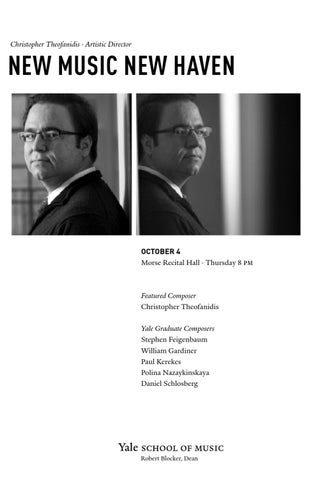
Christopher Theofanidis 路 Artistic Director
NEW MUSIC NEW HAVEN
OCTOBER 4 Morse Recital Hall 路 Thursday 8 pm
Featured Composer Christopher Theofanidis Yale Graduate Composers Stephen Feigenbaum William Gardiner Paul Kerekes Polina Nazaykinskaya Daniel Schlosberg
Robert Blocker, Dean
Christopher Theofanidis 路 Artistic Director
NEW MUSIC NEW HAVEN Christopher Theofanidis Daniel Schlosberg
aperture Daniel Schlosberg, piano Paul Kerekes, piano
Paul Kerekes
Edson Scheid, violin Holly Piccoli, violin Eleanor Kendra James, viola Soojin Chung, cello David Fung, piano
sprocket Paul Kerekes, piano Daniel Schlosberg, piano William Gardiner
Stephen Feigenbaum
Dances 1. Gatekeeper 2. Parachute Dance 3. The Lost Waltz 4. Night Cap
Polina Nazaykinskaya
As a courtesy to the performers and audience, turn off cell phones and pagers. Please do not leave the hall during selections. Photography or recording of any kind is prohibited.
wish 1. 2. 3. Ji Hyun Kim, violin Go Woon Choi, violin Jessica Li, viola Hae Yoon Shin, cello
Hen-Shuo Chang, violin Hye Jin Koh, violin Victor Fournelle-Blain, viola Christopher Hwang, cello
intermission
Allegory of the Cave 1. shadows on the wall 2. prisoner 3. realization 4. for we are free
Haim 1. Introduction 2. Narration 3. Main Part Polina Nazaykinskaya, conductor Peter Rini, narrator Rebecca Jackson, violin Benjamin Hoffman, violin Isabella Mensz, viola Arnold Choi, cello Ashley Smith, E-flat clarinet Melody Quah, piano Scott MacIsaac, piano
PROFILES & NOTES
Allegory of the Cave notes
CHRISTOPHER THEOFANIDIS composer Christhopher Theofanidis (b. 12/18/67 in Dallas, Texas) has had performances by many leading orchestras from around the world, including the London Symphony, New York Philharmonic, Philadelphia Orchestra, Moscow Soloists, the National, Atlanta, Baltimore, St. Louis, Detroit Symphonies, and many others. He also has served as Composer of the Year for the Pittsburgh Symphony during the 2006–2007 season, for which he wrote a violin concerto for Sarah Chang. Mr. Theofanidis holds degrees from Yale, the Eastman School of Music, and the University of Houston, and has been the recipient of the International Masterprize (hosted at the Barbican Centre in London), the Rome Prize, a Guggenheim Fellowship, six ASCAP Gould Prizes, a Fulbright Fellowship to France, a Tanglewood Fellowship, and the American Academy of Arts and Letters’ Charles Ives Fellowship. In 2007 he was nominated for a Grammy Award for best composition for his chorus and orchestra work, The Here and Now, based on the poetry of Rumi. His orchestral concert work Rainbow Body has been one of the most performed new orchestral works of the last ten years, having been performed by over 100 orchestras internationally.
Mr. Theofanidis has recently written a ballet for the American Ballet Theatre and a work for the Orpheus Chamber Orchestra as part of their New Brandenburg series, and he currently has two separate opera commissions for the San Francisco and Houston Grand Opera companies. He has a long-standing relationship with the Atlanta Symphony, and has just had his first symphony premiered and recorded with that orchestra. He has served as a delegate to the U.S.-Japan Foundation’s Leadership Program and is a former faculty member of the Peabody Conservatory and the Juilliard School. He currently teaches at Yale University. » www.theofanidismusic.com
Allegory of the Cave was written for the 2012 United Nations Conference on Sustainable Development in Rio de Janeiro as part of an evening-length cultural celebration featuring the works of ten composers called ‘Dances of Englightenment.’ Although this event unfortunately never ultimately took place, each of the pieces was supposed to pay tribute to a literary contribution from a culture which promoted the ideas of individual and human evolution. The work that I was asked to write on was Plato’s famous Allegory of the Cave from The Republic, in which Plato metaphorically traces humankind’s evolution from a claustrophobic prison of the mind to a freedom and higher awareness of reality based on understanding. ‘Dances of Enlightenment’ was the brainchild of an extraordinary woman, Marilyn Wilhelm, whose Wilhelm Schole Foundation has been at the forefront of progressive early arts learning. Allegory of the Cave is in four miniature movements and is approximately twelve minutes in duration.
PROFILES & NOTES
DANIEL SCHLOSBERG composer
STEPHEN FEIGENBAUM composer
Originally from Philadelphia, composer and pianist Daniel Schlosberg has had works premiered by the Aspen Contemporary Ensemble, Encompass New Opera Theater, counter)induction, the Lorelei Ensemble, and New Triad for Collaborative Arts. He has won awards and honors from Yale, ASCAP, ACO, and NFAA.
Stephen Feigenbaum is an award-winning 23-year-old composer of music for the concert hall and the theater. When he was 19, his Serenade for Strings was recorded by the Cincinnati Pops under Erich Kunzel and released on a CD by Telarc. Stephen is a past winner of the ASCAP Morton Gould Young Composer award and the Left Coast Chamber Ensemble competition. Recently he won the Albany Symphony Orchestra’s Composer to Center Stage competition, which resulted in a reading of his work and mentoring by John Corigliano.
Five Stuck, his first work for large orchestra, was commissioned and premiered by the Yale Symphony Orchestra in October 2010. In February, the re-orchestrated first movement, Grosse Concerto, was read by the Buffalo Philharmonic as part of the American Composers Orchestra’s EarShot series. His chamber opera, A Country Doctor, was premiered in a semistaged version in March 2009. His current projects include a new music-theater piece for the Yale Cabaret and the New Morse Code Ensemble. He will also be writing a new opera for Center City Opera Theater in Philadelphia. Daniel regularly performs as a solo and collaborative pianist, and remains dedicated to performing works of his contemporaries. He has played Barber’s Piano Concerto and Scriabin’s Prometheus with the Yale Symphony Orchestra, as well as numerous solo recitals featuring music from Scarlatti to Ustvolskaya. In addition, he has a passion for music directing and has conducted Hansel and Gretel, Dialogues of the Carmelites, L’enfant et les sortilèges, Carousel, and Sondheim’s Passion. Recently, he was the rehearsal pianist for Sondheim’s
Follies at the Kennedy Center in Washington, D.C. before its transfer to Broadway. Daniel graduated with a B.A. from Yale College in 2010 and is now in his first year at the Yale School of Music. He has worked with Christopher Theofanidis and currently studies composition with Aaron Jay Kernis and piano with Hung-Kuan Chen. His music has been described as “somewhat akin to eating a warm chocolate chip cookie.”
aperture notes The past is necessarily altered by our perception. We can choose how much to let in or make blurry. As the traveler, walking through woods at dusk, becomes conscious of faint music and tiny, fire-lit windows in the outer reaches of imagination…
Stephen’s music has been heard at Lincoln Center and (Le) Poisson Rouge in New York, Jordan Hall and the Hatch Shell in Boston, the Green Room in San Francisco, and several international venues. It has received performances by musicians including the JACK Quartet, TwoSense (Lisa Moore and Ashley Bathgate), and Grammy-nominee violinist Caroline Goulding. Stephen was the 2010 ASCAP Foundation Young Composer Fellow at the Bowdoin International Music Festival and is a past fellow at the Norfolk (Connecticut) Chamber Music Festival. Stephen’s musical Independents played in the New York International Fringe Festival this summer and was briefly transferred to the SoHo Playhouse off-Broadway. A native of Winchester, Massachusetts, Stephen majored in music at Yale College and is pursuing a master’s degree at the Yale School
of Music. He is a student of Martin Bresnick, and has studied with Ezra Laderman, Christopher Theofanidis, Samuel Adler, Claude Baker, and Kathryn Alexander.
Dances notes In my quartet “Dances,” I wanted to paint a bizarre and abstracted picture of a night on the town. In the first movement, one encounters the unbending, unthinking bouncer of the club. In the second movement, one attempts to engage with an undanceable dance whose main musical motive is the exact opposite of a clear downbeat. In the third movement, one reaches for a memorable tune but fails ever to fully recall it. In the last movement, one finally utters a full melody, quietly, before retiring for the night.
PROFILES & NOTES
PAUL KEREKES composer
WILLIAM GARDINER composer
Paul Kerekes was born in Huntington, New York. His music has been described as “striking…ecstatic…dramatic” (WQXR), “highly eloquent” (New Haven Advocate), and able to create “an almost tactile picture” (The New York Times). He has had the privilege of hearing his music performed by TwoSense, New Morse Code, American Composers Orchestra, Second Instrumental Unit, Stonewall Chorale, Mannes Preparatory Division Choir, Norfolk Contemporary Ensemble, cellist Nicholas Photinos, flutist Kelli Kathman, and saxophonist/composer Ed Rosenberg in such venues as Le Poisson Rouge, the Dimenna Center, Symphony Space, Centre de musique Hindemith, Lefrak Hall, and Central Park. He has also attended notable programs such as MusicX, Yale’s New Music Workshop in Norfolk, Connecticut, California Summer Music, the Young Artists Piano Program at Tanglewood, and Stony Brook Summer Music Festival. Additionally, he has participated in master classes as both a composer and a pianist with Lisa Moore, Lisa Kaplan, Joel Hoffman, and Bright Sheng. In June 2012, Paul joined forces with five of New York City’s top pianists to form Grand Band, whose debut was featured on Bang on a Can’s annual marathon. Grand Band has been described by The New York Times as “the Traveling Wilbury’s of the city’s new music piano scene.”
William Gardiner is an Australian composer currently studying at the Yale School of Music in the United States, with Martin Bresnick and David Lang.
Paul is currently pursuing an M.M.A. degree at the Yale School of Music, studying with David Lang. He received his undergraduate degree from Queens College, where he primarily studied with Bruce Saylor. Past teachers include Martin Bresnick, Christopher Theofanidis, Ezra Laderman, David Schober, and Eleanor Cory.
sprocket notes In sprocket, I wanted to experiment with the idea of musical cells propelling each other. The ever-changing groups of notes are staggered and linked together, just as the teeth on sprockets fit into one another to drive a machine.
William Gardiner is the product of a diverse musical pedigree. He was born to a pair of passionate early music enthusiasts, and spent his earliest years immersed in early music. His teenage years were accompanied by the revelation of rock music, leading him to take up the drum set. Next, an interest in composing was provoked by hearing in concert the music of composers such as Astor Piazzolla and Alfred Schnittke. Upon finishing high school, Gardiner’s first compositional efforts, works written in imitation of Bach and Piazzolla, received perfect scores in the matriculation exams, resulting in performance at the Sydney Opera House. Gardiner’s work has taken on the influence of innovative contemporary rock groups such as Animal Collective, the seething, virtuosic compositions of Italy’s Fausto Romitelli, and the meticulous electronic soundscapes of countryman Ben Frost. His work has been credited as “absolutely stunning…a bright beacon of things to come” (Adam Mills, Mess+Noise) and as having “a strong sense of grand sonic movement” (Adam Elmer, Cyclic Defrost). Born in 1987, Gardiner previously attended the University of Sydney, where he received degrees in Arts and Law. In Australia Gardiner
took courses in composition with several of the nation’s leading composers, including Matthew Hindson, Paul Stanhope and Anne Boyd.
wish notes wish is a piece in three movements which evoke for me feelings of wanting, striving and yearning. The first movement seems to have visions of grandeur which it is never quite able to grasp and define; resonant, consonant harmonies of yesteryear become tangled with another kind of resonance: the open strings of the instruments. The second movement consists of tightly interlocking rhythms between the quartet members, and seems active and energetic in pursuit of something. In the third movement the quartet cast ‘the wish’: Will I get there? Will it come together like I imagine? Will it work out like I hope it will?
PROFILES & NOTES
POLINA NAZAYKINSKAYA composer
artistic director Christopher Theofanidis
Polina Nazaykinskaya was born in Togliatti, Russia on January 20, 1987 and has been studying music since the age of four. After graduating with honors from the the Tchaikovsky Conservatory in Russia with concentrations in violin and composition, Polina earned her Master of Music degree from the Yale School of Music. Her professors at Yale included Christopher Theofanidis and Ezra Laderman. Currently Polina is pursuing her Artist Diploma in composition at the Yale School of Music. In the last four years her music has been performed by the Russian National Orchestra, Minnesota Orchestra, Metropolitan Symphony Orchestra, Yale Philharmonia, Youth Symphony Orchestra of Russia, Omsk Philharmonic Orchestra, Boston Metro Opera, and others. Polina’s music has garnered numerous national and international awards and received rave reviews in the press. In 2010, Sony Music Russia label released a CD that featured Polina`s symphonic poem Winter Bells.
NEW MUSIC NEW HAVEN
manager Andrew W. Parker music librarian Roberta Senatore production assistant Kate Gonzales
Haim notes The piece is inspired by and dedicated to David Arben, a former associate concertmaster of the Philadelphia Orchestra and a Holocaust survivor. David’s miraculous survival in the Nazi concentration camps was due to his talent as a violinist. The title of the piece comes from David Arben’s birth name, Haim, which in Hebrew means “life”. The piece is a celebration of triumph of hope over despair, of life over death.
conducting fellows Paolo Bortolameoli Jonathan Brandani assistants Philip Browne Jean Laurenz
In addition to being a composer, Polina is an active violinist and a conductor.
music.yale.edu
music librarians Eric Anderson Paolo Bortolameolli Leonard Chiang Cristobal Gajardo-Benitez Michael Gilbertson Darren Hicks Timothy Hilgert Hye Jin Koh Qizhen Liu Yuan Ma Alan Ohkubo Rachel Perfecto Matthew Rosenthal Matheus Souza stage crew John Allen Jonathan Allen Jeffery Arredondo Colin Brookes Jonathan Hammonds Timothy Hilgert Stephen Ivany Gerardo Mata Jonathan McWilliams Shawn Moore David Perry Doug Perry Matthew Rosenthal Gerald Villella
COMING UP
Lou Donaldson Quartet Yale School of Music 203 432-4158 concerts@yale.edu music.yale.edu
concert programs & box office Krista Johnson Carol Jackson Julie Blindauer public relations Dana Astmann Monica Ong Reed Austin Kase
october 5 Morse Recital Hall | Fri, 8 pm Tickets $20–$30 | Students $10 “My first impulse is always to describe Lou Donaldson as the greatest alto saxophonist in the world.” –Will Friedwald, New York Sun
Wei-Yi Yang, piano october 10 Morse Recital Hall | Wed, 8 pm Tickets $12–$22 | Students $6-$9
operations Tara Deming Christopher Melillo
Featuring Granados’s art-inspired piano suite Goyescas: los majos enamorados, with projections of Goya’s art, alongside music by Debussy and Ravel inspired by Spain.
piano curators Brian Daley William Harold
Yale Philharmonia october 19
recording studio Eugene Kimball
Woolsey Hall | Fri, 8 pm Free Admission Peter Oundjian, guest conductor. Verdi: Overture to La Forza del Destino; Bartók: Piano Concerto No. 3, with Suzana Bartal, piano; Shostakovich: Symphony No. 12 in D minor, “The Year 1917.”