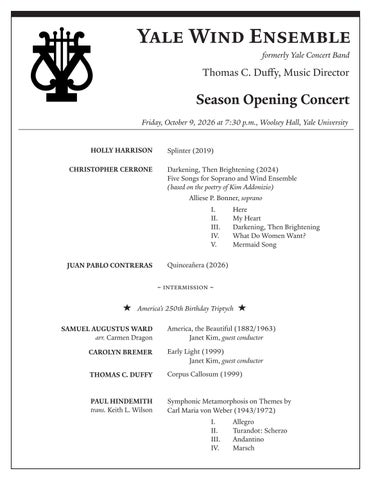
Yale Wind Ensemble formerly Yale Concert Band
Thomas C. Duffy, Music Director
Season Opening Concert Friday, October 9, 2026 at 7:30 p.m., Woolsey Hall, Yale University HOLLY HARRISON CHRISTOPHER CERRONE
Splinter (2019) Darkening, Then Brightening (2024) Five Songs for Soprano and Wind Ensemble (based on the poetry of Kim Addonizio) Alliese P. Bonner, soprano I. II. III. IV. V.
JUAN PABLO CONTRERAS
Here My Heart Darkening, Then Brightening What Do Women Want? Mermaid Song
Quinceañera (2026) ~ intermission ~
America’s 250th Birthday Triptych SAMUEL AUGUSTUS WARD arr. Carmen Dragon
America, the Beautiful (1882/1963) Janet Kim, guest conductor
CAROLYN BREMER
Early Light (1999) Janet Kim, guest conductor
THOMAS C. DUFFY
Corpus Callosum (1999)
PAUL HINDEMITH trans. Keith L. Wilson
Symphonic Metamorphosis on Themes by Carl Maria von Weber (1943/1972) I. II. III. IV.
Allegro Turandot: Scherzo Andantino Marsch
Yale Wind Ensemble Inaugural Concert Since it was established in 1946, the Yale Concert Band has carried the name chosen by its first director, Professor Keith L. Wilson — “concert band” being the name of the premier band at his alma mater, the University of Illinois. At the time, “concert band” accurately described the group’s instrumentation, repertoire, and mission; now, those attributes are best associated with the title “wind ensemble.” To align its public identity with contemporary expectations, as of July 1, 2026, the Yale Concert Band was renamed the Yale Wind Ensemble. With great respect for the ensemble’s distinguished 80-year history, the Yale Wind Ensemble title honors Wilson’s original pioneering Yale wind band by branding the ensemble’s excellence in modern terms.
About Tonight’s Music Splinter (2019) HOLLY HARRISON (b. 1988) The composer write of her work: “In this context, the word ‘splinter’ means to break into small, sharp fragments, and refers to the way in which the piece is structured as a type of mosaic or stylistic patchwork. Many sections of the piece feature instrument sounds breaking or distorting in some way – whether this be in the extremes of register, wild glissandos, or crunchy chords. “The other meaning of ‘splinter’ is as a foreign object within the body. This acts as a metaphor for my experimentation with some lighter, delicate moments, which are not always part of my musical sound world.”
Darkening, Then Brightening: For Wind Ensemble and Soprano (2024) CHRISTOPHER CERRONE (b. 1984) (based on poetry by Kimberly Addonizio) The composer writes of his piece: “Darkening, Then Brightening is my first composition for wind ensemble. When approached about the project, I knew I would be in unfamiliar territory, so I suggested that the work also feature a soprano soloist, a voice type for which I have written regularly. I also suggested the soloist be – in the case of the premiere – Lindsay Kesselman, a long-time collaborator and a dear friend. “It was Lindsay who inspired me to adapt the poems of Kim Addonizio, whose complex, emotionally layered poems of love, loss, and motherhood mirror Lindsay’s own life. Once I suggested the opening poem, Here, Lindsay was instrumental in choosing many of the other poems in the cycle. Her unique and indelible personality inspired me to reach outside of my familiar experience and try to empathize with an author’s life that has been quite different from my own. “Darkening, Then Brightening is structured as a five-part arch form where the first and fifth, and second and fourth, movements mirror one another, all surrounding a gentle ‘night music.’ The godfather of this kind of structure is the great Hungarian composer Béla Bartók, though many composers have used it since.
YALE WIND ENSEMBLE “Compositionally, the outer movements seek to invert the traditional hierarchy of the wind ensemble, where percussion often acts as a punctuation to wind and brass instruments. In these gentle, spacious movements, the winds serve as a kind of unearthly sustain on the struck metal instruments of glockenspiel, vibraphone, crotales, and other bells. “The second and fourth movements reverse the inversion (if you’ll pardon the phrase). The outer movements are all decay, while the inner fast movements are all swell – starting from a single clarinet, each musical surge grows bigger and more intense until the entire ensemble is wailing at top volume – and the soprano sings a high D at the top of her range. “The innermost movement, the eponymous Darkening, Then Brightening, creates imperfect intonation (outof-tuneness) for an imperfect world. The solo flute, clarinet, and saxophones play gentle multiphonics (utilizing the ‘wrong’ fingering to get two notes from an instrument that can normally only play one) that can never truly be in tune, against which the rest of the ensemble, along with the soprano, have to navigate. They have to try, much like the protagonist of the songs, to find beauty in a world that cannot be perfected. “Darkening, Then Brightening is dedicated to Lindsay Kesselman, with enormous thanks to Kevin Geraldi for his generous time and efforts to help shape and craft this work, and with further thanks to Michael Haithcock for organizing this commission.”
Quinceañera (2026) JUAN PABLO CONTRERAS (b. 1987) In Latin American cultures, it is customary to celebrate a girl’s 15th birthday. In Spanish, the girl celebrating her 15th birthday is called a quinceañera; in English, primarily in the United States, quinceañera is used to refer to the celebrations and honors surrounding the special occasion. The Spanish names for the celebration can be literally translated to English as the “celebration of the 15-year-old” (fiesta de quinceañera, fiesta de quince años), “15 years” (quince años, quinceañero) or just “15” (quinces). The piece sonically captures the vibrant energy, emotional weight, and cultural traditions of a traditional Mexican Quinceañera. True to Contreras’s signature style, Quinceañera bridges classical symphonic form with contemporary Mexican soundscapes. The narrative of the piece transitions through key milestones of the celebration – weaving together moments of familial intimacy, religious reverence, and the explosive, dance-heavy energy of the reception party.
America, the Beautiful (1882) SAMUEL AUGUSTUS WARD (1847-1903) arr. Carmen Dragon (1963) The rich musical legacy that Carmen Dragon left the world usually includes his solid reputation as a consummate orchestrator. He is best remembered for the iconic arrangement of America, the Beautiful for both symphony orchestra and symphonic band. Samuel Ward’s familiar tune enjoys a sumptuous feast of harmonic color and instrumental nuance.
Lyrics to Darkening, Then Brightening by Christopher Cerrone Poetry of Kimberly Addonizio
Here
Darkening, Then Brightening
1954 – After it ended badly it got so much better which took a while of course but still he grew so tender & I so grateful which maybe tells you something about how it was I’m trying to tell you I know you have staggered wept spiraled through a long room banging your head against it holding crushed bird skulls in your hands your many hearts unstrung unable to play a note their wood still beautiful & carved so elaborately maybe a collector would want them stupid collectors always preserving & never breaking open the jars so everyone starves while admiring the view you don’t own anyone everything will be taken from you go ahead & eat this poem please it will help
1954 – The sky keeps lying to the farmhouse, lining up its heavy clouds above the blue table umbrella, then launching them over the river. And the day feels hopeless until it notices a few trees dropping delicately their white petals on the grass beside the birdhouse perched on its wooden post, the blinking fledglings stuffed inside like clothes in a tiny suitcase. At first you wandered lonely through the yard and it was no help knowing Wordsworth felt the same, but then Whitman comforted you a little, and you saw the grass as uncut hair, yearning for the product to make it shine. Now you lie on the couch beneath the skylight, the sky starting to come clean, mixing its cocktail of sadness and dazzle, a deluge and then a digging out and then enough time for one more dance or kiss before it starts again, darkening, then brightening. You listen to the tall wooden clock in the kitchen: its pendulum clicks back and forth all day, and it chimes with a pure sound, every hour on the hour, though it always mistakes the hour.
My Heart 1954 – That Mississippi chicken shack. That initial-scarred tabletop, that tiny little dance floor to the left of the band. That kiosk at the mall selling caramels and kitsch. That tollbooth with its white-plastic-gloved worker handing you your change. That phone booth with the receiver ripped out. That dressing room in the fetish boutique, those curtains and mirrors. That funhouse, that horror, that soundtrack of screams. That putti-filled heaven raining gilt from the ceiling. That haven for truckers, that bottomless cup. That biome. That wilderness preserve. That landing strip with no runway lights where you are aiming your plane, imagining a voice in the tower, imagining a tower.
What Do Women Want? 1954 – I want a red dress. I want it flimsy and cheap, I want it too tight, I want to wear it until someone tears it off me. I want it sleeveless and backless, this dress, so no one has to guess what’s underneath. I want to walk down
YALE WIND ENSEMBLE the street past Thrifty’s and the hardware store with all those keys glittering in the window, past Mr. and Mrs. Wong selling day-old donuts in their café, past the Guerra brothers slinging pigs from the truck and onto the dolly, hoisting the slick snouts over their shoulders. I want to walk like I’m the only woman on earth and I can have my pick. I want that red dress bad. I want it to confirm your worst fears about me, to show you how little I care about you or anything except what I want. When I find it, I’ll pull that garment from its hanger like I’m choosing a body to carry me into this world, through the birth-cries and the love-cries too, and I’ll wear it like bones, like skin, it’ll be the goddamned dress they bury me in.
Mermaid Song 1954 – for Aya at fifteen Damp-haired from the bath, you drape yourself upside down across the sofa, reading, one hand idly sunk into a bowl of crackers, goldfish with smiles stamped on. I think they are growing gills, swimming up the sweet air to reach you. Small girl, my slim miracle, they multiply. In the black hours when I lie sleepless, near drowning, dread-heavy, your face is the bright lure I look for, love’s hook piercing me, hauling me cleanly up.
Early Light (1999) CAROLYN BREMER (1957-2018) The late American composer and educator Dr. Carolyn Bremer made one of her most famous and widely performed contributions to the wind band repertoire with Early Light. This piece was commissioned for the Oklahoma City Philharmonic and premiered during its July 1995 Summer Wind Festival of the Arts. Originally conceived for orchestra, Bremer later arranged the work for concert band, where its brilliant colors and infectious energy will be presented before you tonight as the Inaugural Yale Wind Ensemble (formerly the Yale Concert Band) honors America’s 250th birthday—under the baton of guest conductor Janet Kim—with Bremer’s Early Light. Sounding just as bright as its name suggests, Early Light is, in many ways, a musical play on the words “dawn’s early light” from The Star-Spangled Banner. This familiar melody was originally written by John Stafford Smith to the tune To Anacreon in Heaven. You’ll hear fragments of the anthem passed around the ensemble, sometimes blending in, and sometimes impossible to miss. Bremer takes this well-known melody and gives it a completely new personality. So, as you listen, please enjoy the many variations of our very own national anthem woven throughout. Here’s the fun part: The direct inspiration for this piece was not necessarily an excess of patriotic fervor! Because Bremer was a passionate baseball fan from childhood, this was more than just a tribute; it was a love letter to the sport and the feeling of anticipation that comes from hearing the national anthem right before a baseball game. Early Light captures that exact feeling. The excitement of the stadium, the anticipation (via syncopation) of what is about to happen, and the joy of being surrounded by the people we share it with are in every phrase. The piece follows an A–B–C arch form, essentially climbing toward a new musical center before retracing its path back to home. It begins with an energetic and highly syncopated Theme A, built around bright harmonies and rhythmic momentum. Theme B shifts the groove and introduces a 6/8 and 3/4 rotation that gives the music an even more playful, modern edge. At the center of the arch is Theme C, where the atmosphere suddenly becomes
darker and more reflective, taken over by the low brass. This moment provides a striking contrast to the brightness surrounding it. Once Theme C reaches its conclusion, the music begins its journey back through the earlier material, mirroring the first half of the piece. The major arrival—and one of the most exciting moments in the work— comes as the ensemble launches into a cascading, polyphonic canon built from fragments of The Star-Spangled Banner. The melody is continuously passed from one section to another, overlapping and colliding until our familiar anthem becomes something short of a cacophony of sound. Instead of presenting the melody in the traditional, straightforward way, Bremer fractures it and sends it flying across the ensemble. Near the end of the piece, a sudden CRACK! cuts through the music, imitating the infamous sound of a baseball bat hitting a home run. A sound like this serves as the perfect reminder of where Bremer’s very inspiration came from in the first place. Ultimately, Early Light is more than a rehash of The Star-Spangled Banner. This is Bremer’s joyful musical snapshot of America’s game. So listen for the anthem fragments and, of course, listen for the home run... Play Ball! — Program note by Collier Alexander-Sawyer PC ’30 Corpus Callosum (1999) THOMAS C. DUFFY (b. 1955) Duffy writes of his piece: “This piece was written to commemorate the retirement of Colonel Jack Grogan. Col. Grogan had told me that he was of two minds about the military; he held his patriotism and love of country on one side, and more militaristic aspects of service on the other. He was a man who held two possibly conflicting aesthetics in one body. “This piece presents music from the patriotic/love of country aesthetic simultaneously with the music from the military. Simultaneously means that music in three-quarter time (or 15-8 time) is presented at the same time as music in 12 -8 or 4-4 time. The conductor offers one meter in the right hand and another in the left hand, with both meters sharing downbeats. “This bilateral conducting represents a conductor who has had his or her corpus callosum (nerve system that connects the two halves of the brain) severed. Left hand is in one meter; right hand in another. To emphasize the effect, the conductor is visually split down the middle, with one half of the body white and the other black. Musicians are instructed to follow one half or the other.”
Symphonic Metamorphosis on Themes of Carl Maria von Weber (1943) PAUL HINDEMITH arr. Keith L. Wilson (1972) Paul Hindemith’s Symphonic Metamorphosis on Themes by Carl Maria von Weber, now a staple of the wind ensemble as well as orchestral repertoire, began as a series of sketches for a ballet by Léonide Massine. Upon learning that Massine planned to use sets by Salvador Dali, whom Hindemith hated, he ended the collaboration; it was not until years later that he returned to the sketches, developing them into an orchestral piece instead. The themes upon which the four movements of the Metamorphosis are based come from some of Weber’s most obscure works: namely, two pieces for four-hand piano, Op. 10 and 60, and the overture to his incidental music for Schiller’s Turandot. In each movement, Hindemith builds on the German romantic composer’s original melodies, infusing them with 20th-century sensibilities and influences from his own musical encounters. In particular, his experiences in America play a large role: the splashy, boisterous nature of the piece was an immediate success with American audiences, and the syncopated fugue in the third movement especially gestures towards the influence of ragtime and jazz. Hindemith moved to New York in February 1940, having been convinced by several colleagues to flee Europe and accept offers of teaching posts at various universities in the United States. He was reluctant to leave
YALE WIND ENSEMBLE his home in Switzerland where he and his wife, Gertrud, had found “like a miracle one of the few still quiet spots in Europe.” In December 1939, he wrote: “American teaching and concert plans are gradually taking shape for next year…if, as we hope, these plans are realized, I (or perhaps both of us) will miss the growing season in our garden. That is a pity, but it will perhaps be an advantage to witness world events, which are in any case highly unpleasant, from a more remote standpoint.” Separated from his family, friends, and professional network, Hindemith pursued a teaching career in Buffalo, a city for which he had “no very great confidence.” It was not until the beginning of his relationship with Yale that he began to feel hopeful about life in America. In April 1940, he wrote to Getrud: “If Buffalo alone existed, I should be reading your reports in gloomy spirits. But now that Yale, greeted joyfully by you too (rightfully!), is beckoning, I look on the future with significantly more joy.” By 1941, the Hindemiths had settled into New Haven’s Westville neighborhood, which was “pretty and quiet, the streets nice avenues of elms.” While his nostalgia for home did not completely subside—in February, he wrote that “our time in Switzerland was paradise, but it seems one cannot be permitted to live too long in paradises”—his letters begin to suggest a certain comfort in the rhythms of American life. In the same 1941 letter, he refers to New Haveners as “we,” albeit in quotation marks, and in a 1947 letter he calls himself “a harmless New Englander.” Yale and the Elm City, while maybe not as idyllic as the Hindemiths’ house on Lake Geneva, gave them the opportunity to build a sense of belonging in the United States. The Hindemiths became American citizens in 1946, but moved back to Switzerland in 1953, settling again in Blonay. From their old-new home, Hindemith wrote to Keith L. Wilson, director of Yale bands, in 1960, asking him to write a transcription of the Metamorphosis. The following letter exists in his archive today as a testament to Hindemith’s lasting relationship with Yale, New Haven, and America. — Program note by Zoe Frost MY ’27
About Tonight’s Guest Artists Alliese P. Bonner is a senior in Yale College from Nashville, Tennessee. She majors in Music with a focus in Classical Vocal Performance, and studies voice privately under Leah Brzyski. A member of the Yale Glee Club, she has performed as a soloist in the Mozart Requiem and the Garcia Requiem, and toured the Philippines, Alaska, and Puerto Rico. Alliese also regularly performs with the Opera Theater of Yale College, where she serves as Artistic Director. She has also performed with Yale Opera and the Yale Baroque Opera Project; her past roles include Zelemina in Cavalli’s Veremonda and Climene in Cavalli’s L’Egisto. She has also had the opportunity to perform in the art song genre, including Mahler’s Lieder eines fahrenden Gesellen with the Yale Undergraduate Chamber Orchestra. Alliese also plays the flute and piccolo, and was formerly a member of the Yale Concert Band (now the Yale Wind Ensemble). Last summer, Alliese studied abroad in Vienna, Austria, focusing on operatic performance. This summer, she participated in the Middlebury German for Singers program, where she performed as Zerlina in a Mozart pasticcio in Middlebury, Vermont, and in Scharbeutz, Germany. This will be Alliese’s second performance as a vocalist with the Yale Wind Ensemble, having performed as a choral soloist with the Yale Concert Band in Susan Botti’s Vespers this past spring. However, this will be her debut performance as a featured soloist with the ensemble.
Dr. Janet Kim is the Director of Wind Bands and Coordinator of Large Instrumental Ensembles at the University of Connecticut. In this role, they conduct the UConn Symphonic Wind Ensemble and teach courses in Woodwind Techniques, advanced instrumental conducting, instrumental pedagogy, and wind literature. Additionally, they oversee graduate studies in wind conducting. Prior to this position, Dr. Kim served as the Director of Instrumental Activities and Assistant Professor of Music at Nebraska Wesleyan University. They earned a Doctor of Musical Arts degree in Conducting from The Herb Alpert School of Music at the University of California, Los Angeles. Dr. Kim also holds a Master of Arts degree in Instrumental Conducting from Indiana University of Pennsylvania and a Bachelor of Music degree in Music Education and Jazz Studies, magna cum laude, from Montclair State University. Their primary conducting mentors include Dr. Travis J. Cross, Dr. Timothy A. Paul, Dr. Jason Worzbyt, and Dr. Shelley Axelson. Dr. Kim’s career began as a band director and conductor at Northern Valley Demarest High School, later continuing as a band director at several other public schools in New Jersey. They led ensembles that performed at Region and District Band Festivals, earning gold and silver ratings. During their graduate studies at UCLA, Dr. Kim developed a strong interest in audio technology and electronic music. While in Los Angeles, they also served as the Associate Director of the Peninsula Symphonic Winds in San Pedro, CA. An active guest conductor and clinician, Dr. Kim has worked with honor bands, clinics, workshops, and festivals across the United States, Canada, and South Korea. They are a passionate advocate for diversity, equity, inclusion, belonging, and access in music education. Dr. Kim presented on incorporating diversified programming practices at the 2022 Nebraska State Bandmasters Association conference and has written articles on the impact of diversifying music programming for the California Band Directors Association. They have also been interviewed for several podcasts discussing the tokenism of BIPOC composers and the importance of visibility. Dr. Kim’s work in quality programming was presented at The Midwest International Band and Orchestra Clinic. Recently, they joined the team at Carnegie Hall Music Education, where they have lead workshops on the impact of intentional programming for music educators nationwide and the impact of positive and direct language in rehearsal settings.
YALE WIND ENSEMBLE Upcoming Yale Bands Performances 2026-27 s Wednesday, November 4, 2026 at 7:30 p.m. Yale Jazz Ensembles Big Band, Wayne Escoffery, Music Director. Music by Sonny Rollins, Charles Mingus, Chick Corea, Jackie McLean, and more. Morse Recital Hall in Sprague Memorial Hall. Free admission/No tickets or reservations required. s Sunday, November 15, 2026 at 3:00 p.m. Yale Wind Ensemble, Thomas C. Duffy, Music Director. Feat. Eighth Blackbird, guest artists - Vital Sines (Viet Cuong), Wine-Dark Sea (John Mackey), March in F (Ludwig van Beethoven), Symphony Serana: Geschwindmarsch (Paul Hindemith). Woolsey Hall. Free admission/No tickets or reservations required s December 4, 2026 at 7:30 p.m. “Side by Side: Two Nutcracker Suites.” The Yale Wind Ensemble (Thomas C. Duffy, Music Director) and the Yale Jazz Ensembles Big Band, (Wayne Escoffery, Music Director) share the stage, with the YWE performing the traditional classical arrangement (by Mayhew F. Lake) of Tchaikovsky’s Nutcracker Suite, and the YJEBB answering movements with Duke Ellington/Billy Strayhorn’s jazzy interpretation of this holiday classic. Woolsey Hall. Info/Tickets $ TBA. s February 19, 2027 at 7:30 p.m. Yale Wind Ensemble, Thomas C. Duffy, Music Director. Feat. Scott Hartman, trombone - Concerto for Trombone and Orchestral Winds & Percussion (Steve Bryant), Lincolnshire Posy (Percy Grainger), Zig Zag (Julia Wolf ). Woolsey Hall. Free admission/No tickets or reservations required. s March 4, 2027 at 7:30 p.m. Yale Jazz Ensembles Big Band, Wayne Escoffery, Music Director. Program TBA. Morse Recital Hall in Sprague Memorial Hall Free admission/No tickets or reservations required. s April 16, 2027 at 7:30 p.m. Yale Wind Ensemble, Thomas C. Duffy, Music Director. The Thomas C. Duffy Annual Spring Concert. Sinfonía Nómada (Arturo Márquez), Emblems (Aaron Copland), Envoi (Daron Hagen). Woolsey Hall. Free admission/No tickets or reservations required. s April 20, 2027 at 7:00 and 9:00 p.m. at Dizzy’s Club, New York, NY. Yale Jazz Ensembles Big Band. Wayne Escoffery, Music Director. Info/$ Tickets: https://jazz.org/dizzys/ s May 23, 2027 at 7:00 p.m. Yale Wind Ensemble, Thomas C. Duffy, Music Director, Annual Twilight Concert, Celebratory music and Yale songs on Yale’s Commencement eve (chairs provided). Yale’s Old Campus. Free admission/No tickets or reservations required.
Photo: Harold Shapiro
About the Music Director Thomas C. Duffy is Professor in the Practice of Music, Director of University Bands, and Clinical Professor of Nursing at Yale University, where he has worked since 1982. He is known as a composer, a conductor, a teacher, an administrator, and a leader. His interests and research range from non-tonal analysis to jazz, from wind band history to creativity and the brain. Under his direction, the Yale Bands have performed at conferences of the College Band Directors National Association and New England College Band Association; for club audiences at New York City’s Village Vanguard, Birdland, Dizzy’s Club, and Iridium; Ronnie Scott’s (London); the Belmont (Bermuda); as part of the inaugural ceremonies for President George H.W. Bush; and concertized in twenty-three countries in the course of twenty international tours. Duffy produced a two-year lecture/performance series, Music and the Brain, with the Yale School of Medicine; and, with the Yale School of Nursing, developed a musical intervention to train nursing students to better hear and identify body sounds with the stethoscope. He combined his interests in music and science to create a genre of music for the bilateral conductor – in which a “split-brained conductor” must conduct a different meter in each hand, sharing downbeats. His compositions have introduced a generation of school musicians to aleatory, the integration of spoken/ sung words and “body rhythms” with instrumental performance, and the pairing of music with political, social, historical and scientific themes. He has been awarded the Yale Tercentennial Medal for Composition, the Elm/Ivy Award, the Yale School of Music Cultural Leadership Citation and certificates of appreciation by the United States Attorney’s Office for his Yale 4/ Peace: Rap for Justice concerts – music programs designed for social impact by using the power of music to deliver a message of peace and justice to impressionable middle and high school students. Duffy has served as associate, deputy, and acting dean of the Yale School of Music. He has served as a member of the Fulbright National Selection Committee, the Tanglewood II Symposium planning committee, the Grammy Foundation Music Educators Award Screening Committee, and completed the MLE program at the Harvard University Institute for Management and Leadership in Education. He has served as: president of the Connecticut Composers Inc., the New England College Band Directors Association and the College Band Directors National Association (CBDNA); editor of the CBDNA Journal; publicity chair for the World Association of Symphonic Bands and Ensembles; and chair of the Connecticut Music Educators Association’s Professional Affairs and Government Relations committees. He is a member of American Bandmasters Association, American Composers Alliance, the Connecticut Academy of Arts and Sciences, Connecticut Composers Incorporated, the Social Science Club, and BMI. Duffy has conducted ensembles all over the world, including the National Association for Music Education’s National Honor Band in the Kennedy Center, Washington, D.C. (More extensive data is available at www.duffymusic.com, including a high resolution downloadable photo.)
Photos: Harold Shapiro
YALE WIND ENSEMBLE 2026-2027 THOMAS C. DUFFY, Music Director STEPHANIE HUBBARD, Operations and Productions Manager President: Jared Wyetzner | General Managers: Kaustuv Mohanty, William Wakefield Social Chairs: Joshua Chen, Kyle Chen | Publicity Chairs: Zoe Frost, Lizzie Seward Piccolo Zoe Frost MY ’27*† American Studies Diego Lee TC ’29† Undeclared Flutes Zoe Frost MY ’27*† American Studies Noah Watson TD ’28† Molecular, Cellular and Developmental Biology Allan An BR ’28 Molecular, Cellular and Developmental Biology Jasper Chan BK ’30 Undeclared Kaustuv Mohanty MC ’29 Music/Molecular Biophysics and Biochemistry Noelle Smith BK ’28 History Oboes Matthew Dyson DC ’30*† Statistics and Data Science/Computer Science and Mathematics Penelope Emerson MY ’29 Applied Physics Cameron Gray-Lee DC ’27 Mathematics and Physics/Music English Horn Joe Sipper MUS ’28 Music Eb Clarinet Juan Pedro Espinosa Monteros MUS MM ’26/MMA ’27 Music Bb Clarinets Joshua Chen SY ’27, Keith L. Wilson Principal Clarinet Chair†‡ Mechanical Engineering Sammy Feingold MY ’28† Neuroscience Amelia Shaw TC ’28† Architecture and Education Studies Su Min Pyo PC ’29 Molecular, Cellular and Developmental Biology Trevor Strano MC ’28 Earth & Planetary Science Cameron Nye BR ’27 Political Science Ethan Han ES ’30 Electrical Engineering and Computer Science Ana Smith DC ’30 Undeclared Bass Clarinet Evan Chow SY ’30† Undeclared Bassoons Ari Blehert* JE ’28*† Physics Bryce Falkoff TC ’29† Undeclared
Greta Garrison BF ’28 Global Affairs Isaiah Harvey TD ’28 Ethics, Politics, and Economics Sudarshan Krishnan SM ’28 Mathematics August Lee-Kovach MC ’29† Undeclared Anjali Lodh BR ’29 Mechanical Engineering Caden Mather BR ’29† Undeclared William McGlumphy PC ’30 Undeclared French Horns George Sokol BF ’30*† Undeclared Julia Wineger MUS ’28† Music Julia Landres JE ’28† Physics Atticus Chan TC ’29† Mechanical Engineering Zakariya Bouzid GH ’28† Ecology and Evolutionary Biology Trombones Collier Alexander-Sawyer PC ’30*† Psychology Beatrice Beale Tate PC ’28† English Nathan Lange SY ’27† Molecular Biophysics and Biochemistry Collin Good MUS ’28† Music Euphoniums Amrit Hari Madhav TD ’30*† Undeclared Alfred Ma JE ’29† Computer Science and Economics Eric Fan TD ’29 Statistics and Data Science Tubas Benson Wang BK ’27* Economics Harvest Robbins JE ’30 Undeclared Lillian Adey MY ’29 Electrical Engineering String Bass Ziv Shah SM ’29† Undeclared Piano Matthew Li MY ’29† Economics and Mathematics Harp Krissy Teng MUS ’28†§ Music Joshua Fong MC ’30|| Computing and Linguistics
Alto Saxophones Lizzie Seward DC ’27* Physics and Humanities Daniel Guo DC ’29† Undeclared Johnny Aguon BK ’29† Undeclared
Percussion Jacob Leshnower GH ’27*† Statistics and Data Science/Music Tally Vaneman GH ’27*† Astrophysics Silas Dyer TC ’30† Linguistics AJ Eggleston ES ’30† Environmental Studies Gaby Garcia SM ’29† Undeclared Mirabel Solomon BF ’28† Molecular, Cellular and Developmental Biology/Political Science
Tenor Saxophone William Wakefield BF ’29 Undeclared
Music Librarian Allan An BR ’28
Soprano Saxophone Lizzie Seward DC ’27*† Physics and Humanities
Baritone Saxophone Hanson Qin ES ’28 Computer Science and Mathematics Cornets/Trumpets (rotating) Jared Wyetzner PC ’27*† Physics Kyle Chen SY ’27 Molecular, Cellular and Developmental Biology
*=principal †=playing on Darkening, Then Brightening ‡= Friends of Keith L. Wilson (Director of Yale Bands from 1946-1973) honored him by endowing the principal clarinet chair in the Yale Concert Band (now the Yale Wind Ensemble) in his name. If you would like information about naming a Yale Wind Ensemble chair, please contact the Yale Bands Office. §=playing on Quinceañera ||=playing on America, the Beautiful
Yale University Bands P.O. Box 209048 New Haven, CT 06520-9048 ph: 203-432-4111 stephanie.hubbard@yale.edu https://bands.yale.edu