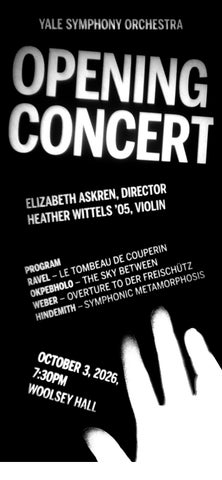
Yale Symphony Orchestra Elizabeth Askren, Director Heather Wittels ’05, Violin
Program
Le Tombeau de Couperin Maurice Ravel Prelude Forlane Menuet Rigaudon
The Sky Between Shawn Okpebholo I. Clockwork II. Continuum III. Chronos
INTERMISSION
Overture to Der Freischütz Carl Maria von Weber
Symphonic Metamorphosis on Themes of Carl Maria von Weber Paul Hindemith Allegro Scherzo (Turandot) Andantino Marsch
The 26/27 Woolsey Series is generously supported by the Daniel Feller ’74 Yale Symphony Endowment Fund in Honor of John Mauceri (Music Director 1968-74).
About the Artists
Elizabeth Askren, Director Praised for “inspiring virtuosic achievements from the pit” (Opera Today) and “palpable happiness” (Le Monde), Elizabeth Askren empowers musicians around the world as a conductor, educator, and advocate for inclusive excellence in the arts. An OPERA America 2024 Opera Grant winner, Askren performs regularly with leading opera houses and orchestras including The Dallas Opera, with which she enjoys a privileged relationship as a guest conductor, master teacher, and creative producer, Chicago Lyric Opera, where she was on the music staff for the 2024-25 season, and Hawai'i Opera Theatre, of which she is the company's first ever Principal Guest Conductor. Since July 2025, Askren is the Director of the Yale Symphony Orchestra, and an Associate Professor Adjunct of Conducting at the Yale School of Music. Askren is the Music Director of composer Paola Prestini and poet Brenda Shaughnessey’s Sensorium Ex, a Ford Foundation-funded multi-modal arts project exploring issues at the intersection of AI, disability, and the human voice. Sensorium Ex is produced by VisionIntoArt and Beth Morrison Projects and enjoys support from presenting partners National Sawdust, The Common Senses festival, The Shed at the Kennedy Center, and The Washington National Opera. Askren is also the Founder and Artistic Director of Transylvanian Opera Academy (TOA), Romania’s first opera studio. Since its creation in 2017, TOA has been featured on national television, radio, and press, while establishing international partnerships with the Paris Opera’s Academy and Opera for Peace.
A master teacher at both The Dallas Opera’s Hart Institute and at the Paris Opera’s Academy, Askren made history by judging the Paris Philharmonic’s inaugural La Maestra Competition for Women Conductors alongside her mentor, Marin Alsop. Deeply committed to sharing classical music with a broader audience, Askren is the creator and host of the children’s edutainment series MaestraMagic!. Season 1 was picked up by The Dallas Opera and was a finalist for SharkTank's Season 15. Her opera comic book, MaestraMagic Presents: The Magic Flute, is available in English and Spanish on amazon.com and select bookstores. Askren is invited regularly to speak about leading and entrepreneurship in the arts, mentoring young artists, and cultivating humanity in the age of AI. Her TEDx talk, Why Classical Music is the Wave of the Future, garnered more than 4,500 views in under 48 hours. For more information: www.elizabethaskren.com
Heather Wittels, Violin Heather Wittels is a member of the Lyric Opera of Chicago Orchestra first violin section where she was the co-Acting Assistant Concertmaster for the 2022 and 2023 seasons. She is the Director of Chamber Music at the University of Chicago, and Artist Faculty at Roosevelt University's Chicago College of Performing Arts. Since 2022 Heather spends her summers serving as Concertmaster of the AIMS Festival Orchestra in Graz, Austria. Prior to that she was the Associate Concertmaster of the Glimmerglass Opera Festival Orchestra in Cooperstown, New York. She performs as a principal player/concertmaster with the Joffrey Ballet in Chicago, the Chicago Philharmonic Orchestra, and the Chicago Opera Theater, and is a regular substitute violinist with both The Cleveland Orchestra and the Chicago Symphony Orchestra.
In February 2026, Heather gave the world premiere performance of a new violin concerto called The Sky Between written by Shawn Okpebholo for her to play with The University of Chicago Symphony Orchestra. She will perform this work again in October with the Yale Symphony Orchestra in New Haven, CT. Heather has performed the Brahms and Tchaikovsky violin concertos and the Beethoven Triple Concerto with orchestras in Chicago, where reviewers praised her “exquisite taste” and “immaculate technique”. As a chamber musician, she has performed on Classical Music Chicago’s Rush Hour Chamber Music Series, Fourth Presbyterian Church’s popular Friday Noonday Concert series, the Dame Myra Hess Memorial Concert Series, Henry Fogel Presents, Wisconsin’s The Midday radio show, and Live from WFMT on the radio in Chicago, as well as at the Illinois Holocaust Museum. During the summers of 2013-2019, while at the Glimmerglass Festival in Cooperstown, NY, Ms. Wittels created, programmed, produced, and performed in an annually sold-out spoken word and music salon series in local venues; themes included a Schubertiade, Stravinsky's A Soldier's Tale, Brahms and the Schumanns, and Music and Letters from Russia. She has taught and mentored young violinists in collaboration with the Chicago Musical Pathways Initiative, a program designed to support talented and motivated students from underrepresented backgrounds in classical music, and she has served on the judging panel of various music competitions and given public masterclasses. Heather graduated cum laude from Yale University with a Bachelor of Science in chemistry, with distinction. Subsequently she earned a Masters in Music and Graduate Diploma in violin performance in the studio of Malcolm Lowe at the New England Conservatory, as beneficiary of the 2007 Tourjée Alumni Award for graduate study. She was a Fellow of the New World Symphony in Miami Beach, Florida and a three time Tanglewood Music Center Fellow. A native of Brookline, MA, Heather began the violin at age three. She lives in Chicago, IL with her husband Brian and cats Quincy and Leonora.
Notes on the Program
Le Tombeau de Couperin Maurice Ravel The YSO has performed this work once before in its history on November 21, 1976, C. William Harwood, conductor
Ravel’s Le Tombeau de Couperin was written during and shortly after World War I. The title refers to François Couperin, a French Baroque composer, and to the French tradition of writing a “tombeau,” or musical tribute, in memory of someone who has died. Ravel dedicated each movement to a friend who had been killed in the war. Despite this, the piece is not mournful. Instead, Ravel looks back to the elegance and clarity of eighteenthcentury French dance music, bringing those forms into his own musical language. The result is music that can feel light and playful one moment, then unexpectedly intimate the next. The work was originally written for solo piano, and Ravel later orchestrated four of its six movements. In the orchestral version, his attention to color becomes especially apparent: individual instruments emerge and disappear from the texture, creating constantly changing combinations of sound. From the quick, playful Prélude to the graceful Menuet and energetic Rigaudon, each movement has its own character. Beneath the brightness of the music, however, is a quiet sense of remembrance. It is Ravel’s way of honoring the people and musical traditions he had lost. — Laurentia Woo ‘29
The Sky Between Shawn Okpebholo This is the first time the YSO has performed this work, and is the East Coast Premiere.
The Sky Between, a concerto for violin and orchestra, is inspired by our experience of time: how it moves steadily forward, shapes our lives, and can feel both rigid and elastic at once. The title points to the sky we all live under: a shared presence that connects us, even though each of us experiences it differently depending on where we are and what we carry with us. The music leans into that tension, treating time as something that can be precise and mechanical, but also personal, flexible, and deeply human. The first movement, Clockwork, takes its drive from the idea of measured time—gears turning, pendulums swinging, systems in motion. The orchestra sets up a persistent, ticking energy, while the solo violin moves between sharp, rhythmic figures and more expressive lines. At times it locks into the mechanism; at others it pushes against it, suggesting a human pulse working inside something relentless and exact. The second movement, Continuum, feels as though time has slowed. The violin enters with a quiet, reflective voice—not sorrowful, but inward-looking—before shifting into a graceful, dance-like lilt, as if the music has found a steadier breath and a bit of light. That change in character is part of the point: we may all live under the same sky, but we don’t experience it the same way. One person’s horizon can feel heavy; another’s can feel open and bright. The orchestra gives the soloist room for both, creating a wide, spacious backdrop where time feels less like a machine and more like a landscape. The final movement, Chronos, is fast, virtuosic, and urgent. Named after the Greek word for sequential time, it is propelled by forward motion, shaped by brief accelerations, moments of easing, and small detours along the way. The rhythms press ahead—sometimes tightening, sometimes bending—but never for long, creating a sense of mounting pressure. At one point, that pressure breaks in a surge of raw orchestral catharsis, as if everything that has been held back finally spills over. Time doesn’t stop there. The violin quickly reasserts the motion and, after a cadenza, drives the
music toward an ending that feels inevitable, carried by momentum rather than resolution. Together, these three movements trace different ways of experiencing time: measured, expansive, and fleeting. The Sky Between isn’t about time as an idea so much as time as something lived—counted, felt, and constantly moving around us. — Shawn Okpebholo
Overture to Der Freischütz Carl Maria von Weber This is the first time the YSO has performed this work.
Written during a time of rising German national consciousness and first performed in 1821, Weber’s Der Freischütz (“the free-shooter”) is widely celebrated as the first great German operatic masterpiece. In a historical moment dominated by the popularity of Italian opera, Weber crafted a piece that brought together motifs from German folklore and literature, described by 19th-century historian Henry Krehbiel as being “intimately bound up” with the feelings, traditions, and culture of the German people. The opera itself follows the story of Max, a young German marksman who must win a shooting competition in order to marry his beloved, Agathe. Frustrated by his recent lack of success in shooting, Max succumbs to a spiral of dark thoughts, lamenting the evils he sees around him and even questions the existence of God. It is in this dark place that he is persuaded by Kaspar, who wants Agathe for himself, to make a deal with the Devil. Disguised as a man named Samiel, the Devil provides Max with bullets that will always hit the desired mark. However, Max must agree to allow Samiel to select the target of at least one bullet, and he is unaware that this bullet is intended for Agathe. Thus, the stage is set for a great struggle between virtue and wickedness as Max navigates the warring forces within his own soul. The overture to Der Freischütz consists entirely of themes from the rest of the opera. It opens with grand orchestral sweeps that foreshadow the coming turmoil of Max’s struggles. The ensuing brass chorale and calm,
pastoral theme mirror the peasants’ chorus in Act I, describing the life of the small hunting community buried deep within the Germanic forests. This is followed by a dark tremolo in the strings that signals the entrance of Samiel, as well as an anguish-ridden allegro that draws heavily from Max’s aria in Act I. The mode changes to major as we hear Agathe’s aria in C major from Act II, which Weber artfully shifts to a call-andresponse section that redoubles the doubt introduced at the overture’s outset. Agathe’s theme is taken up again near the end of the overture, signalling the triumph of good over evil as Max overcomes the Devil’s influence. An instant success upon its premier, Der Freischütz solidified the German operatic tradition and provided a foundation for the later operas of Wagner. — Grace Ort ‘29
Symphonic Metamorphoses on Themes of Carl Maria von Weber Paul Hindemith This is the eighth performance of this work by the YSO. March 1, 1986, Leif Bjaland, conductor March 3, 1986 in Carnegie Hall, Leif Bjaland, conductor February 3, 1990, David Stern, conductor February 22, 2003, Shinik Hahm, conductor April 14, 2007, Toshiyuki Shimada, conductor May 27, 2010 in Aya Irini, Istanbul, Turkey, Toshiyuki Shimada, conductor May 30, 2010 at Bilkent University, Ankara, Turkey, T. Shimada, conductor June 2, 2010 at Saygun Concert Hall, Izmir, Turkey, T. Shimada, conductor
In 1940, Paul Hindemith fled to the United States to escape the violence and fascism overtaking his home country of Germany. German Minister of Propaganda Joseph Goebbels had already described Hindemith as an “atonal noisemaker” in 1934; two years later, Hindemith was classified as a “degenerate” composer and his music was banned in Germany. Upon arriving in the US, however, he immediately found success: he began teaching composition and music theory at the Yale School of Music in spring of 1940, a position he would hold for the next 13 years. Hindemith proposed transforming the music school at Yale into a European-style conservatory, similar to his former school in Berlin. Although many of his more
radical ideas were not considered, the school under his guidance ultimately split into two separate programs— a graduate program that merged with the Department of Music, and a conservatory-like program for music performance and composition. Hindemith’s presence at the school also attracted many other elite musicians and faculty, and admissions gradually became more selective. He also founded the Yale Collegium Musicum, one of the Hindemith (center) on College Street in New Haven, country’s first earoutside of Sprague Hall. Parts of Woolsey Hall, SSS, ly music ensembles and the fence surrounding the Scroll and Key tomb are that still actively pervisible. forms today. By implementing these changes, Hindemith is responsible for transforming Yale’s music school into the worldclass institution it is today. Hindemith’s first sketches for the Symphonic Metamorphoses emerged in March 1940, around the same time he began his teaching position at Yale. Russian choreographer and dancer Léonide Massine encouraged Hindemith to arrange music by Carl Maria von Weber for a ballet, and Hindemith presented him with a piano reduction with material that would eventually be used in the first and third movements. Although this duo later split over artistic disagreements, Hindemith decided to continue working on the piece, reworking the original two movements and completing the rest of the work by August 1943. The first movement, marked Allegro, takes musical material from a set of Weber’s piano duos. Although much of the melodic material is unchanged, Hindemith distorts many of the harmonies and uses innovative orchestrational techniques to create colorful effects throughout the movement (and the rest of the work). One of the most notable moments in this movement comes when the melody, played by clarinets and violas, is echoed in sixths an octave and a half higher in the flute and piccolo to amplify notes in the overtone series. This gives the melody a unique timbral quality akin to a calliope or organ. The second movement, Turandot, Scherzo, derives both its title and musical material from Weber’s incidental music for the play Turandot (the same play that
inspired Puccini’s famous opera). Much like in Weber’s rendition of the piece, Hindemith repeats the theme many times throughout the movement, growing in intensity each time. A winding figure in the violins gives way to a jaunty, peppy fugue in the brass, disrupted by interjections from the timpani. The percussion section later fully takes over, bringing the movement to a peaceful close. The final two movements again draw music from Weber’s piano duets. The calm Andantino third movement opens with a yearning theme played by solo winds with sighing figures in the strings. After a more optimistic middle section marked tranquillo, the first theme returns and a virtuosic solo flute dances atop the orchestra. The final movement, a sprightly Marsch, opens with a bold declamation from the brass before a hushed version of the first theme is stated. Sparkling triplets in the winds open the second theme, a glorious horn call; the strength of the horn call and energy of the triplets return again to propel the work to a triumphant ending (complete with a very brief, unexpected diversion to D major in true Hindemith style). In the context of the YSO’s theme of “Death and Transfiguration” this season, the old themes by Weber that were on the brink of obscurity were transformed and given a new life by Hindemith. At a time when Germany had destroyed so much of its pre-war culture, Hindemith also honors and invokes Weber— who served as a symbol of the ideal German culture by including themes of bravery, humanity, and honor in his works—in hopes of restoring his war-torn, broken home country with those values. The piece became an instant success after its 1944 premiere by the New York Philharmonic; its innovative reworkings of catchy themes helped cement it as one of Hindemith’s most successful and widely performed works. — Ben Graham ‘28
Yale Symphony Orchestra Elizabeth Askren, Director Brian Robinson, Manager Tommaso Bailo and Evan Kessler, Associate Conductors Joshua Jin and Marco Opeña, Assistant Conductors President Emily Zhang Secretary Jacob Leshnower Publicity David Stolyarov Justine Xu Social Mina Chang Parisa Verma Programming Benjamin Graham Community Alex Vakov Leah Wu Mindy Zhao Tour Eric Zhang Librarians Gloria Baek Head Librarian Jasmine Chen Ella Saputra Stage Crew Grady Flinn Eugene Lee Amber Sun Eric Zhang Cover Design Grace Han ART ’27
First Violin Jinan Laurentia Woo ’29 Concertmaster Holly Lacey ’29 Co-Concertmaster Yuuki Donnelly, Asst. Principal Tai Caputo ’29 Mina Chang ’28 Michelle Chen SOM ’28 Ines Choi ’27 Alexander Fu ’30 Nicole Lee ’30 Erica Liu ’30 Marco Opeña ’28 Hiya Ray ’29 Paola Rosas ’30 Elenor Rushall ’30 Ella Saputra ’27 Winslow Solomon ’29 Amber Sun ’28 Second Violin Gloria Baek ’27, Principal Mindy Zhao ’29, Co-Principal Audrey Kim ’30, Asst. Principal Lochlan DaRonco ’30 Sofia Heredia ’29 Toby Huang ’29 Susan Kim ’30 Jacob Lewis ’29 Ian Li ’29 Isabel Li ’29 Zachary Lu ’30 Eileen Maloney Cunningham ’30 Ananya Mettu ’30 Casey Muchirahondo ’30 Parisa Verma ’27 Justine Xu ’27 Jerry Yu ’30
Viola Benjamin Graham ’28, Principal Katherine Song ’30, Asst. Principal Alma Esser ’30 R. Grady Flinn ’29 Henry Goldstein ’30 Elijah Jackson ’30 Elan Jiang ’28 Joe Legutko ’30 Liam Meyers ’30 Lucian Mikush ’29 David Roche ’29 Eric Z. Wang ’30 Amanda Wu ’28 Violoncello Gabriela Berger ’27, Principal Danielle Yoon ’28, Co-Principal Elijah Chen ’30, Asst. Principal Liya Tang ’30, Asst. Principal Josef Bell ’29 Alejandro Quintero Cashore ’30 Benjamin DeSimone ’30 Sara Flexer ’30 Sarah J. Lee ’28 Juliette Mandelbrot ’28 Madeline Margulis-Ohnuma ’30 Jiyu Moon ’30 Emma Tian ’30 Contrabass Eleanor Ohm ’27, Principal Yuvin Kang ’29, Asst. Principal Junjie Bob Hu Kayla Ruano-Lumpris ’28 Jared Yahshua Calderon Tamez ’30 Patrick Xu ’30 Flute Joelle Kim ’28 Eugene Lee ’29 Michael Stoica ’29 Sasha Tarassenko ’27 Oboe Benjamin Hambleton ’28 Eric Reilly ’29 Grace Ort ’29 Alexander Vakov ’29
Clarinet Evan Chow ’30 Mia Gribbon ’29 Daniel Lee ’29 Amelia Shaw ’28 Bassoon Amelia Newman ’29 Leah Wu ’29 Eric Zhang ’27 Linda Zhou ’29 French Horn Jasmine Chen ’27 Julian Kolthammer ’29 Bryce Lowden ’28 Rylan Yang ’27 Trumpet and Cornet Evan Kessler ’28 Jared Wyetzner ’27 Emily Zhang ’27 Trombone Patrick Qiu ’28 Sophie Richardson ’27 Elaina Stuppler ’30 Tuba Benson Wang ’27 Harp Sophia Jho ’28 Valentina Ramos ’30 Timpani and Percussion Jacob Leshnower ’27 Eileen Li ’30 Omisa Shah ’30 David Stolyarov ’28
About the Orchestra The Yale Symphony Orchestra was founded in 1965 by a group of students who saw the growing potential for a large orchestral ensemble to thrive on campus. The YSO provides a means for students to perform orchestral music at the conservatory level while taking advantage of all that Yale, a liberal-arts institution, has to offer. The YSO boasts an impressive number of alumni who have gone on to successful musical careers with: New York Philharmonic (Sharon Yamada, 1st violin), the Boston Symphony Orchestra (Haldan Martinson, principal 2nd violin, and Owen Young, cello), Vancouver Symphony (Henry Shapard, principal cellist), the Los Angeles Philharmonic (David Howard, clarinet), the San Francisco Symphony (the late William Bennett, oboe), Philadelphia Orchestra (Jonathan Beiler, violin), Toronto Symphony (Harry Sargous, oboe, ret.) and the Israel Philharmonic (Miriam Hartman, viola); as well as Marin Alsop; National Public Radio commentator Miles Hoffman; composers Michael Gore, Robert Beaser, Conrad Cummings, Stephen Paul Hartke, Robert Kyr, and more. Throughout its history the YSO has been committed to commissioning and performing new music. Notably, the YSO presented the European premiere of Leonard Bernstein’s Mass in 1973, the world premiere of the definitive restoration of Charles Ives’ Three Places in New England, the U.S. premiere of Debussy’s Khamma, and the East Coast premiere of Benjamin Britten’s The Building of the House. The YSO programs orchestral works written by new and emerging composers, as well as lesserheard works by established and obscure composers. The full list of YSO premieres can be seen at https://yso.yale.edu/concert-history/premieres. The YSO has performed with internationally recog-
nized soloists; including Yo-Yo Ma, Frederica von Stade, Emmanuel Ax, David Shifrin, Thomas Murray, and Idil Biret. Each year the YSO is proud to perform major solo concerti played by the student winners of the William Waite Concerto Competition. The YSO has performed at New York City’s Carnegie Hall, Avery Fisher Hall at Lincoln Center, and St. Patrick’s Cathedral. In the past ten years, the YSO has toured domestically and internationally, including a 2010 tour of Turkey with acclaimed pianist Idil Biret. Ms. Biret rejoined the orchestra for a recording of Paul Hindemith’s piano concerti, which were released in 2013 on the Naxos label. Past tours have brought the orchestra to Portugal, Korea, Central Europe, Italy, Brazil, and Russia. The YSO completed its first tour of Mexico in March of 2023, and just returned from a five concert tour of North Macedonia and Greece. The full list of YSO tours can be seen at https://yso.yale.edu/concert-history/tours. The YSO is famous for its legendary Halloween Show, a student-directed and -produced silent movie, performed around midnight in full costume. Long a Yale tradition, the Halloween Show sells out Woolsey Hall days in advance, and the production details and storyline remain closely guarded secrets until the night of performance. Recent cameo film appearances include James Franco, Woody Allen, Alanis Morisette, Rosa DeLauro, Jodie Foster and Jimmy Kimmel. The YSO music directors include Richmond Browne, John Mauceri, C. William Harwood, Robert Kapilow, Leif Bjaland, Alasdair Neale, David Stern, James Ross, James Sinclair, Shinik Hahm, George Rothman, and Toshiyuki Shimada and William Boughton. This year marks Elizabeth Askren's second year as Director.
The Yale Symphony Orchestra would like to thank the following for their support:
$5,000 or more Anonymous The William Bray Fund for Music Dr. Stephen Y. Chang ’95 Daniel B. Feller, M.D. ’74 Dr. Hyun Jung Ko James R. Meehan, Ph.D. ’71 Robert L. Perkel, M.D. ’72 Prof. John K. Roth GRD ’66 Yale Symphony Orchestra Director’s Resource Fund
$1,000—4,999 Jean Bennett, M.D., Ph.D. ’76, HON ’22 Ms. Jean S. Brenner ’71 Cynthia Redding White Dixon Memorial Fund James M. Ford, M.D. ’ '84, MED '89 Mr. Matt T. Gabbard ’07 Mrs. Jeanie K. Jho ’99 Steven Liu, M.D. ’97 Dr. Steven Nishi Mr. Roger Dean Peng ’99 Dr. Pamela S. Tauchi-Nishi Professor Robert K. Wimpelberg ’68 Hyung J. Won Mrs. Julia A. A. Viazmenski
$500—999 Anonymous Mr. Daniel Meyer Berger ’93 Mr. David A. Burkhart ’76, MUS ’77, WID MUS ’78 Prof. Lori Fisler Damrosch ’74, LAW ’76 Richard H. Dumas Mr. Matthew Dean Griffith ’14 Dr. David H. Jho, M.D., Ph.D. ’98 Mr. Steven M. Kaufman ’81 Drake M. Lamen, M.D. ’73 Mr. Jonathan Lewis Mr. Austin Wang ’25 Jianling Yuan, M.D., Ph.D. ’94, MED ’99, GRD ’02
$100—499 John A. Baron, M.D. ’67 Mr. Benjamin G. Bartolome ’16 Mrs. Brooke Lamell Bartolome ’16 William Blewett David C. Cansler, Ph.D. ’74 Mr. Michael A. Carrier ’91 Ms. Danica Chin ’99 Daniel S. Fierer, M.D. MED ’86 Mr. W. Charles Gibson ART ’76 Richard Nash Gould Architects Ms. Pamela J. Gray ’74 Dr. Michel T. Jackson ’83 Mr. John W. Karrel ’75 Ms. Erika Penzer Kerekes ’88 Mr. Lee P. Kessler Mr. Ji Hoon Kim Mr. Edward M. Kusell-Zigelman SOM ’21 Mr. Steven Lewis ’18 Mr. Philip Henry Lima ’83 Prof. Mary T. Lui HON ’10 Ms. Alexandra Lee Newman ’05 Mr. Ian A. Niederhoffer ’19 Valerie Constance Norton, M.D. ’87 Ms. Isabel Padien O'Meara ’99 Mr. Timothy A. Orr ’09 Ms. Arum Park ’99 Ms. Michelle L. Peters ’17 Shanti Shih-Jutz Serdy, M.D. ’94 Ms. Serena W. Shapard ’20 Mr. Ralph A. Schweinfurth Mr. Charles Michael Sharzer ’12 Mr. Shu-Ping Shen ’01 Jeffrey S. Steinberg, Esq. ’83, LAW ’86 Dr. Mary C. Stoddard ’08 Ms. Patricia Borga Suvari ’83 Ms. Suzanne C. Swift ’90 Mr. Glenn R. Thrope ’08 Ms. Meghan K. Titzer ’06 Mr. Peter Tropper ’73 Ms. Claudia B. Veitch Dr. Nathaniel O. Wallace ’69 Mr. David Adam Weinstein ’10
This donor list reflects giving made over the past two years.
Tax-deductible contributions to the Yale Symphony Orchestra make up a significant part of our total operating budget. Your donations are vital to us, and are very much appreciated. Please consider making a donation to the Yale Symphony Orchestra.
https://yso.yale.edu/why-give-to-the-yso