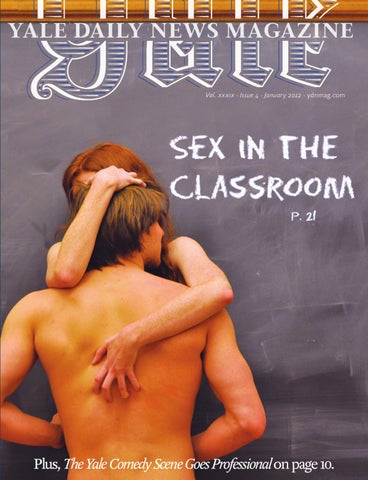
yale daily news magazine Vol. xxxix 路 Issue 4 路 January 2012 路 ydnmag.com
Plus, The Yale Comedy Scene Goes Professional on page 10.
Christopher Buckley ’75. Fareed Zakaria ’86. Samantha Power ’92. YOU? join US: MAG@YALEDAILYNEWS.com visit US: ydnmag.com
table of contents
10
shorts
Around the Colleges Q’s with J.D. McClatchy Top 10 2 small talk
how to succeed in Comedy by Arielle Stambler
22
Arbitrary Artifacts Say What? Saybrew If You Give a Girl a Cookie ... 6 personal essay
Modes of Transportation Kalli Angel
17
glorious, consensual, safe by Zara Kessler
36
observer
Eli in India natasha thondavadi
30
crit
Awkward, United ANisha Suterwala
32
aby William fighting Chance Hall
41
The window seat by Dana Glaser
photo essay
Yale Art, at a New Angle Zoe gorman
34
poetry
Sweepers 13 Listening for... 20 Apology to Sister 44 ydnmag.com | Yale Daily News Magazine | 1
Magazine Executive Editors Eliana Dockterman Molly Hensley-Clancy Nicole Levy
shorts
AROUND THE
COLLEGES
These grads put the rest of us to shame. Which college has the most famous alum?
Deputy Editors Daniel Bethencourt Madeline Buxton Edmund Downie Lauren Oyler Sophia Veltfort
Design Editors
Berkeley
Branford
Calhoun Jodie Foster
Dick Cheney vice president, quail hunter
Rory Gilmore fictional YDN editor
can hear lambs screaming
Davenport
Ezra Stiles
Jonathan Edwards
Raahil Kajani Lindsay Paterson
Design Assistants Raisa Bruner Michael DiScala Ryan Healey Eli Markham Christian Vazquez
Photography Editors Brianne Bowen Zoe Gorman Kamaria Greenfield Victor Kang Zeenat Mansoor
George W. Bush accomplisher of missions
Edward Norton doesn’t talk about Fight Club
John Kerry flip-flopper
Yale Daily News Editor in Chief
Publisher
Max de La Bruyère
Preetha Nandi
Cover Photo by Victor Kang Cover Models: Goksu Bicer & Julia Cortopassi
Morse
Pierson
Joseph Lieberman Democratic (?) senator
Howard Dean byahhhhh!!!
Timothy Dwight
Saybrook
Silliman
David Hyde Pierce the less douchey Dr. Crane
Subscriptions: To subscribe to the Yale Daily News Magazine, please contact us by email at mag@yaledailynews.com. Subscription for 1 year (7 issues): $40.00
2 | Vol. XXXIX, No. 4 | January 2012
Kingman Brewster TD doesn’t have a lot of famous alumni
Maya Lin got a B on an architecture project
Trumbull
Anderson Cooper just because of those piercing blue eyes
shorts
book review tweet Sex for dummies
VOCab•yale•ary
by ruth k. Westheimer
Sway | swa | noun 1) a slow, rhythmic dance movement
often accompanied by the waving of lighter: Everyone at Toad’s started swaying when Lana Del Rey came on 2) acronym for Sex Week at Yale, formerly a biannual week-long romp on Yale’s campus full of sex toys and porn stars: I learned so much at that oral sex seminar during SWAY!
ydnmag need to know how to have safe sex? good sex? good oral? check out dr. ruth’s sex for dummies. your partner will thank you for it #getsome
Birth Control: visualizing the story, p. 22 100 T 89 he Yale Daily News Magazine asked a random sample of female students at Yale what type of birth control they had used in the last six months. Participants were asked to check all options that applied. A total of 240 women responded.
80
85 79
60
40 23
20
15 8 4
0
16
18
? ?
l d ll ce tive er m i o ing ction r pil n h o p r e e Ot nd ol eth stin ly ac t r o ive rote f t m t l C g a out on ep o p Ab xua c n c i N ll se rn tra rth u t o i n P o B M N Co ydnmag.com | Yale Daily News Magazine | 3
shorts
What is the most difficult piece you’ve ever had to write?
Whatever poem I am working on at the moment always seems the most difficult, because I am never sure I know where I should be going to get to the right ending. Right now, I seem halfway through a poem about a collection of hands I have assembled over the years — little reproductions, or things chopped from statues. A few months ago, I held my mother’s hand, a few hours after she had died. I want to link these, and right now that seems difficult.
If you could go to college right now, what would you do differently?
I never had sex while I was in college.
How do you take your coffee? ya
le
un
ive
Every morning I have a double espresso with a dollop of half and half.
rsit
y
for J.D. McClatchy J.D. McClatchy is the author of three collections of essays, six books of poems, and 13 libretti. Winner of the Award in Literature from the American Academy of Arts and Letters, he has served as the institute’s president since 2009. McClatchy has taught at Princeton, Columbia, Johns Hopkins, and Yale, where he is editor of the Yale Review.
You can’t live without ...
Music — though my tastes are rather highbrow. Opera is a passion, and the moment before the Met’s gold curtain parts — well, that moment is my drug of choice. I should add that my favorite singer is Ella Fitzgerald.
Writing today needs more ... Grandeur.
If you could ask President Obama one question, what would it be?
“Why have you made your re-election so difficult?”
The last thing you ate/drank was ...
A stingingly cold martini.
If you could meet one character from a novel, who would it be?
Julien Sorel. (And if I could meet an author, it would be Tolstoy. Better yet, if I could sleep with an author, on the theory that I could thereby learn more about his imagination, it would be John Keats.) 4 | Vol. XXXIX, No. 4 | January 2012
Do you have a Facebook account? Why or why not?
No. There are too many ways already for strangers to contact me about things I have no interest in. Why add another? Finding solitude ... is there an account for that I can sign up for?
The most embarrassing moment of your career was ...
Finalists for the Los Angeles Times Book Award are asked to schlep out to LA and sit in the audience while some stooge announces the winners in various categories. Some years ago, I made the effort because I was certain my book would win. It didn’t, and watching the winner flounce to the stage — the author of a much inferior book, but she was a woman with women judges in the majority — galled me. At least I learned never to show up at such an occasion ever again.
What advice do you have for Yale students?
They already know what’s best — discipline, curiosity, an unrelenting devotion to excellence, and a strong moral conscience.
Most importantly, why is Yale better than Harvard? Harvard has always gloated about the sense of privilege it confers. Yale is proud of the sense of responsibility it instills.
shorts
TOP
Pretentious
Summer internships
1. Rick Santorum’s political campaign The frothy mixture of family values and violating the separation of church and state that is the product of trying to get into politics.
2. CERN: European Organization for Nuclear Research
When you enter the Large Hadron Collider, the fate of the world is in your hands. Please don’t blow us up.
3. The New York Times
202 York is drooling over this one. But it’s not pretentious, it’s making the world a better place!
4. Bain & Company Consulting
8. The State Department The only way to make an EP&E major more pretentious. Just be careful about that background check.
Follow in Mitt’s hallowed footsteps. This internship is yours to lose — like South Carolina.
9. Anything in China
5. Congressional internships
This one gets a nine percent approval rating. For people who enjoy working for douchebags but don’t like finance.
6. Google
Sign away all of your ideas. Especially for Google Doodles.
Like our economy really needs any more sabotaging. Why do you hate Amurrica?
7. Goldman Sachs
Occupy the one percent. No, just kidding, you’re doing it because you’re really interested in investment banking. You don’t even know how much the job pays, honestly.
10. The Yale Farm
Where the hipsters flock like sheep. Ah, the sweet, tantalizing aroma of organic carrots. – Magazine Staff
ydnmag.com | Yale Daily News Magazine | 5
Small Talk arbitrary artifacts D say what? saybrew D if you give a girl a cookie ... I walk into the Beinecke
one bitterly cold morning this winter to see two chairs. Inside, the silence wells up like the inside of a cathedral; the walls glow faintly where the sun seeps through thinly-sliced marble. A glass-walled tower filled with books rises imposingly through the center of the room. Inside are some of the oldest and rarest books on earth, with still more stored in the miles of shelving underground — 500,000 volumes in all, making this one of the largest rare book libraries in the country. A little-known fact about this illustrious place: nestled among the Gutenberg bibles and the collected letters of Ezra Pound are a pair of eyeglasses once owned by Walt Whitman, a pen used by Eugene O’Neill, and a waistcoat worn by T. S. Eliot when he was a young and apparently slender student at Cambridge. A few pencil sketches by Langston Hughes are archived next to original drafts of his poems, and elsewhere is a tiny box containing the key to London’s Kensington Gardens, acquired for the use of J. M. Barrie while he was composing the story that would become “Peter Pan.” The Beinecke’s original editions of Shakespeare’s plays routinely draw scholars from other countries; who visits New Haven in order to find the key to Neverland? The Beinecke has a compulsive tendency to hoard the objects that have strayed in or out of the lives of famous writers and artists. This means not only the letters and marginalia of brilliant minds, yale library
6 | Vol. XXXIX, No. 4 | January 2012
but also their watches, pens, hand-painted cards, death-masks, and, in some cases, locks of hair. These ordinary objects, when they are identified and catalogued, become important by their associations. As Nancy Kuhl, the Beinecke’s curator of poetry for the Yale Collection of American Literature, points out, “A library is always a place where certain things survive by chance. In some ways those chances are meaningful, and in some ways they are arbitrary.” Among the most extraordinary objects in the Beinecke are two Louis XV-style chairs that once sat in the famous salon apartment of the poet and patron Gertrude Stein and her lover, Alice B. Toklas. “There they are,” Nancy says, indicating two surprisingly modest chairs, unguarded and unobtrusive where they sit off to the side on the library’s lower level. The seats and backs were embroidered by Toklas along a pattern by Picasso. In pictures of the room where Stein received luminaries like Modigliani and Hemingway, the chairs are crowded but prominent amongst the clutter of furniture, as though stand-ins for the matched set of Stein and Toklas themselves. The Beinecke possesses 163 boxes in its Stein collection — including annotated drafts, letters and love notes, artwork, even a few dried plants from Stein’s garden — but these chairs are the most concrete artifacts of the literary and artistic collaboration at the heart of the Lost Generation. Without the rest of the collection, they might be merely attractive; here, they are totems of an age. “It’s not always clear how scholars are going to use [an artifact],” Kuhl admits. But in the end, “things become interesting in their context here.” The scraps of a great writer’s small, inglorious personal life can reveal what is left out of the text — like Walt Whitman’s glasses. Of all of the photographs and frontispiece portraits of Whitman, magnificently bearded and hatted, in the Beinecke’s collection, not one shows a picture of the famous “natural man” in glasses. It is one thing to try to imagine Whitman’s published persona for oneself, and a very different thing to be able to look through his own spectacles at the Beinecke. “We know that these objects excite people’s imaginations,” Kuhl says with a smile. “They bring us closer to the physicality, the actuality, the reality of the person.”
small talk Later, at my desk, I take stock of the items that have come to rest around me: a thinning stack of Post-it notes, the top one of which lists in illegibly tiny handwriting some “words to think about & enjoy” (pentimento, sylph, poryphyry), a few meeting agendas on which I have drawn many small, unblinking eyes, a postcard copy of a painting of Virginia Woolf by her sister, and some old receipts for coffee I don’t remember buying. And though the Beinecke certainly won’t be clamoring for my pencil jar anytime soon, it is reassuring to know that in this constellation of familiar objects, there is some intimation of a whole. – Amelia Urry
I don’t really like beer.
I remember one of the first times I ever tried it, at an Easter gathering. I was about 12, and I heard that telltale hiss of a beer cap popping off. A moment later, I felt a damp glass bottle pressed into my hand. Above me, my dad was grinning in a suspiciously encouraging manner. “Go ahead and try some. Nonalcoholic beer!” He chuckled. It was an inauspicious start to my relationship with beer. Two years of college parties with Keystone haven’t improved that relationship, so I decide it might be time to try a different side of the beer world — brewing. Enter the Saybrook Brewery, known more commonly as the “Saybrew,” where juniors and seniors have been making beer for over six years. We’re talking here about the real stuff — germ, hops, (alcohol), the whole nine yards. They’ve brewed some duds, like the one batch that, in the words of current club president Casey Blue James ’12, “tasted like teriyaki sauce.” But they’ve also produced some smashing successes. Saybrew Stout, a strong, dark beer that featured at the Saybrook wine-tasting event during graduation weekend last year, won plaudits from none other than Yale College Dean Mary Miller. “She was extremely complimentary of it — both its taste and potency,” says Rachel Wolf ’11, former president of the club. Critical acclaim from the sharp tongue of Mary Miller? Not too shabby. These brewers must really be experts in the field, right? Well, not quite. The three most recent presidents of Saybrew — James, Wolf, and Austin Anderson ’10 — all joined the club without any brewing experience. But, as Wolf puts it, “anyone with the right ingredients and a kitchen can brew beer.” It’s simply a matter of following a recipe. Saybrew makes beer out of the Saybrook kitchen, where they store their brewing and bottling
It’s like mix and match, right? Maybe with a little chocolate and caramel flavoring and a little less fermenting, I’ll brew up a batch that tastes like Snickers. equipment — massive glass jugs, a fermentation lock, Ziplocs filled with bottle caps, and more. The batches usually start from “brew kits” with prepackaged ingredients — certain grains, bitter, dried flowers called hops, and flavorings — that they stir together in a pot of boiling water. After the mixture reaches a certain temperature, the brewers quickly ice down the liquid, put it into a big glass jar, add yeast, affix the fermentation lock, and set it aside to ferment for several weeks. At the end of this period, they add priming sugars to ensure proper carbonation. Then comes the fun part — bottling time — which involves a siphon (the coolest piece of equipment, according to Wolf, and the use of which is practically a rite of passage) and a capping contraption. Once all of this is done, you still need to wait about two weeks for final aging and the fermentation of the sugar, though the time varies for each type of beer. There are plenty of ways that this process can go wrong. Some batches just taste bad, while others are completely undrinkable. Without intense layers of sanitization applied consistently throughout the entire process, bacteria can corrupt the beer. So far, this year’s only batch was ruined due to a faulty yeast reaction and a popped fermentation lock. These days, the club generally brews ales, sweet, full-bodied beers made using warm fermentation. Under Anderson, however, it tried its hand at lagers, which require much lower temperatures for fermentation. “Austin turned his heater off and left his window open,” says James. “The only type of person to do that would be one who would move to Alaska.” Anderson did. Now in New York City, the alum confirms that he slept with his window open the entire year in order to keep the temperature next to his bed 60 degrees. “If it’s too warm, you risk the yeast dying,” he explains. Saybrew has also branched out from the prepackaged brew kits to try picking and choosing their own ingredients. “After you do a couple batches it gets familiar enough that you want to experiment a little,” says Anderson. “There’s definitely a lot to play around with.” ydnmag.com | Yale Daily News Magazine | 7
small talk If Wolf says anyone can brew, that must include me, right? The Northern Brewer’s Basic Starter Kit ($79.99), which provides rudimentary equipment (siphon, lock, etc.) and an instructional DVD, seems a good place to start. Or maybe I play it safe with the $9.99 Big and Easy Bottle Brew Beer Kit — Homebrew in a Bottle! On the other hand, I like to think I’m more the creative type, so I may want to skip the prepackaged stuff. At Home Brew Mart, I can buy some toasted oak chips and sparkolloid powder (for fining), a little Belgian candi sugar, and sarsparilla extract for my Belgian pale malt. It’s like mix and match, right? Maybe with a little chocolate and caramel flavoring and a little less fermenting, I’ll brew up a batch that tastes kind of like Snickers. Looks like I’ll just have to give beer another chance. – Tao Tao Holmes
8 | Vol. XXXIX, No. 4 | January 2012
Every cookie has a story.
This is the story of the peanut butter cookie I ate in the early morning hours last Wednesday: In 2003, a University of Pennsylvania student launched a late-night cookie-delivery enterprise to satisfy college students’ sweet teeth while indulging their preferences for minimal exertion and maximum intake of midnight calories. “When I was in school, [late night food options were] pretty limited to pizza, subs, and Chinese food. And I had a sweet tooth,” explains Seth Berkowitz, the UPenn student who founded — and continues to run — Insomnia Cookies. The cookie company was served up to fill that empty, hungry niche, which Berkowitz classifies as “pretty big.” The cookies baked by his business, which operated out of his dorm room and delivered to students’ rooms across campus, were the forefathers of the peanut butter delicacy that I would later consume. Now headquartered in New York City with 20 branches operating in college towns across the country, Berkowitz’s simple cookie recipe has been tested, expanded, and refined into an efficient corporation under the name Insomnia Cookies. These are not your average pastry shop goods — this is a baking operation with an appetite for growth. New Haven’s branch of Insomnia is the latest addition to the burgeoning franchise, and since it opened on January 10, Yalies have flocked to Berkowitz’s late-night business. Between Claire’s, FroyoWorld, Flavors, and Chocopologie, not to mention the cupcake shops and bakeries that abound a few blocks off campus, New Haven is not exactly lacking when it comes to desserts. But Insomnia Cookies has held its own in the sugary landscape, and Berkowitz calls it “one of the best openings we’ve ever had.” The cookie I ate on Wednesday traces its culinary heritage to the Insomnia shops in New York City and the dorm rooms in Philadelphia, but the ingredients that brought it to life were stored in a regional warehouse, where they awaited their time in the oven. Then those raw elements, the flour and sugar and peanut butter and sweetness that are the building blocks of cookie existence, were delivered to Insomnia’s small store on Chapel Street. The store’s space is minimalist: dark brown paint on the walls (evoking the essence of rich chocolate), pale hardwood floors, a total of eight bar stools set at high counters. Bright lights. Peppy music. The scent of freshly-baked cookies hits you as soon as you push open the glass door and enter the shop. As Berkowitz explains, the store was “developed to look like a cookie.
Joyce xi/contributing photographer
We want it to feel warm, like a homemade place.” A homemade place where you can pick up a not-quitehomemade treat that still gives you all the warm, nostalgic satisfaction of homemade cookies, complete with a glass of milk. Yum. It’s a fabricated, modular “yum,” though. A cookie with a melted chocolate center conjures up memories of baking at home, of cookies that were too chocolatey or not chocolatey enough, blackened on the edges or underdone,
In the shadowy darkness across from the Skull and Bones tomb, I approached him. He passed the box into my open arms and I carried it across Old Campus and up four flights of stairs to my suite, hugging it to my chest to preserve the warmth. When I finally opened the delivery, a dozen cookies of various flavors greeted me, their aromas appealing enough to rouse my sleeping suitemates. “The cookies are here! They’re here!” they called out
At Insomnia, the cookie is the same every time: same size, same temperature, same taste. It’s a perfection that turns the attempt to appear homemade into an elaborate performance. oversized or too small. But at Insomnia, the cookie is the same every time: same size, same temperature, same taste. It’s a perfection that turns the attempt to appear homemade into an elaborate performance. In its careful engineering to appeal to an emotional connection to home, it undermines its own image and becomes just another eatery. When I clicked “Purchase” to place my order online, an employee sitting at a computer in the fluorescent-lit back room received my request, heated up my cookie and its companions in a small oven, and plopped them — expertly melted and piping hot — into a pizza box. A delivery man loaded the gooey cargo into an unmarked sedan before driving three blocks over to High Street.
as they began to congregate on our futon. Then we dug in. My choice was an easy one: I grabbed the cookie oozing with peanut butter. Within ten minutes they were all gone — except for the hardened remains of an over-baked double chocolate chunk, which was stuck forlornly to the wax paper that lined the cardboard box. In the morning, the only evidence that my peanut butter cookie had ever existed as anything more than a memory in my stomach was the greasy stain left on the empty box. In the end, it was late-night fast food, packaged beneath a homemade façade. But for this insomniac, an imitation is better than nothing at all. – Raisa Bruner
ydnmag.com | Yale Daily News Magazine | 9
†feature
How to succeed in comedy (without the lampoon) D by Arielle Stambler D
M
y first reaction was that it looked much bigger on TV. Through slightly dimmed house lights, 200 audience members were filing into tightly-packed blue and yellow plastic bleachers that were better suited to a baseball stadium than a studio. Illustrations by Madeleine Witt
10 |  Vol. XXXIX, No. 4 | January 2012
feature
I
found my seat in the balcony, about four rows back, and watched as swarms of crew members clad in black raced around with cameras and cue cards before the clock struck 11:29. The band was already set up and entertaining the buzzing crowd with smooth jazz to pass the pre-show minutes. And then, after one final roll of a drum, the stage went black, the crew backed away from the eyes of the cameras, and the audience fell silent. “The following is an address by the President of the United States,” the announcer’s voice boomed. Applause signs flickered above my head and the audience responded automatically, clapping and howling. Our episode of “Saturday Night Live” had begun. Fred Armisen (or rather, Barack Obama) — sporting a short, graying crop of hair meant to highlight how far his ears stuck out from his head — updated the audience on his accomplishments in office thus far, the running joke being that there were none. At last, he said the seven words we had all been hanging on for: “Live from New York … it’s Saturday night!” Being chosen from NBC’s annual ticket lottery to see “Saturday Night Live” my senior year of high school was one of those once-in-a-lifetime strokes of luck, and I have nurtured an intense curiosity about the lives of comedy writers and their paths into the business ever since. And so, naturally, I was intrigued to discover that so many of those paths begin in one place: the iconic castle of The Harvard Lampoon. Some of comedy’s greatest names got their start beneath its copper ibis-crested dome — Conan O’Brien, George Meyer, and B.J. Novak, to name a few. Tina Fey identified the connection between Harvard-educated comedians and nationally-syndicated humor in her recent autobiography “Bossypants:” “The staff of ‘Saturday Night Live’ has always been a blend of hyper-intelligent Harvard boys and gifted, visceral, fun performers. Lorne [Michels] somehow knew that too
many of one or the other would knock the show out of balance.” The connection between Harvard and humor solidified in 1970 when three Harvard graduates published the first issue of The National Lampoon as a spinoff of The Harvard Lampoon. During its almost 30 years of existence, The National Lampoon became one of America’s best-known brands of humor and endowed the Harvard name
the magazine as a direct funnel into comedy jobs after graduation. Rather, he says, it’s a conduit through which funny people who enjoy writing can come together and practice a skill that may one day turn into a career. “It’s definitely not a pre-professional thing,” Adler says. “When we’re there, it’s just us trying to make each other laugh and put out a magazine.” But almost every year around three to
Almost every year, about three to five Lampoon seniors interested in pursuing comedy writing professionally move to Los Angeles together after graduation. with even more prestige. In the mid1970s, “SNL” was created with Harvard Lampoon alumni Al Franken and James Downey in the writers’ room. Soon, Harvard graduates could be found writing for almost every funny show on air, from “The Simpsons” to “Late Night with David Letterman” to “The Office.” In the 1992 Harvard Magazine article “Comic Sutra,” Downey says that about ten percent of the 400 people who were making a living as television comedy writers that year were Harvard graduates. In that same article, Rob Hoffman, one of the three National Lampoon founders, said, “Harvard and The Lampoon have directly transformed American humor over the last 25 years. The Harvard impact on television, movies, and magazines is unbelievable. There’s practically a Harvard mafia out there.” Being a Yalie, I can’t help but wonder why the same is not true for Yale. How has The Harvard Lampoon created a “mafia” in the comedy world where Yale hasn’t? D Jonathan Adler, a senior at Harvard and the current head writer of The Harvard Lampoon, does not see
five Lampoon seniors interested in pursuing professional comedy writing move to Los Angeles together after graduation. Adler jokes that “they will be unemployed for several years before calling it quits and going to law school” — but some of them certainly make it beyond that. For Rob Ulin, a 1984 graduate of Harvard College and a Harvard Lampoon alumnus, meeting former Lampoon writers who had gone into comedy was a powerful experience; he got to know people who were once in his shoes and had ultimately found success in the industry. Since his Harvard days, Ulin has worked on several highly acclaimed sitcoms, including The Middle, Roseanne, and Whitney, but he has never gotten a job through a Harvard connection. “To be honest, I don’t think an Ivy League diploma gets you all that far in the field of comedy writing,” he says. “Comedy writing is a relatively meritocratic field.” Bob Stevens ’76, who has taught the Yale residential college seminar “Writing Half-Hour Television Comedy” and is best known as a former writer for “Malcolm in the Middle” and
ydnmag.com | Yale Daily News Magazine | 11
feature “The Wonder Years,” believes that the creation of The National Lampoon brand by Harvard graduates is the best explanation for Harvard’s visibility in the comedy world. “Somehow, because The Harvard Lampoon turned into The National Lampoon and that whole franchise, the Harvard network has evolved,” he says. Yale alumni in comedy are “out there and are talented and very open to something like [a formalized network], but it just happened more naturally with The Harvard Lampoon brand.” Yale’s own humor magazine, The Yale Record, has made efforts to establish such a network. It has a certain
which contains somewhat different content than the print magazine and which has served as a way to keep alumni in contact with the publication. Alumni also write their own December Alumni Issue. The biggest roadblock to a strong alumni network is that most Record graduates these days do not pursue comedy after Yale. “I’d be really sad to give up humor writing entirely, but I don’t see myself doing it professionally after I graduate,” Zhu says. She appreciates that Yale has given her the opportunity to explore humor writing, something she had never even tried before her sophomore year of college.
“Sometimes I’m kind of jealous of the Lampoon,” Clegg said. “Since so much of comedy writing has to do with getting to know and befriend people — along with working on your craft— the Lampoon network must have a lot to offer.” innate prestige in that it is America’s oldest college humor magazine, founded in 1872. According to current editor-in-chief Dana Zhu ’12, it reached its peak in the 1940s and 50s, when it was common for Record graduates to go straight into jobs as New Yorker cartoonists. At one point, The Record had such a good relationship with The New Yorker that New Yorker designers were consultants on The Record’s layout. That trend fizzled out after difficult economic times in the 1970s and 80s. Recently, however, “there has been a push to set up the alumni network so that people can use it to get jobs after college,” Zhu says. Now, The Record’s alumni board writes regularly for the online version of The Record, 12 | Vol. XXXIX, No. 4 | January 2012
“I didn’t have any experience in high school, but I like writing and wanted to write for a publication,” she says. “I like that The Record doesn’t take itself too seriously.” D When it comes to The Record, then, River Clegg ’11 is the outlier. At almost six feet tall, Clegg initially looks a little intimidating, but it’s soon clear that he’s more teddy bear than grizzly. He constantly finds ways to poke fun at himself, especially when he talks about his comedy career since graduation. This past summer, he interned in the graphics department of the satirical newspaper The Onion in New York City, and now, he works as a freelance
writer at Comedy Central, showing up everyday at 12:30 p.m. to write jokes. He spends a lot of his time writing daily “liberal agenda” and “conservative marching order” text messages to subscribers. Clegg wrote for The Record all throughout college, becoming a managing editor his junior year, and he was actively involved in The Cucumber, The Record-sponsored forum for stand-up comedy. The summer after his junior year, he became serious about his passion for comedy and obtained an internship at a small production company through the Yale in Hollywood alumni club, which organized more than 50 panel discussions, mixers, and other opportunities for Yalies interested in the entertainment industry last year and probably bears the closest resemblance to the alumni network of The Harvard Lampoon. Clegg admits that comedy is not the easiest business to break into alone (and in his typical self-deprecating fashion, he fiercely denies that he has broken into it at all). “Sometimes I’m kind of jealous of The Lampoon,” he says. “Since so much of comedy writing has to do with getting to know and befriend people, along with working on your craft, the Lampoon network [has] a lot to offer.” At the same time, he says that it is possible to break into comedy by forging your own connections and by “being nice and reaching out to people and doing what you can for yourself in that way.” D But perhaps The Record is the wrong place to look for Yale’s Lampoon. Nell Klugman ’12 believes that the network of comedy writers from Yale comes out of improv and sketch groups. Klugman performs improv with The Viola Question and sketch comedy with The Fifth Humour and sees a small network of Yale improv and sketch graduates assembling in major cities across the country. Although she tried out for
feature improv groups on a whim her freshman year and was persuaded by friends to try out for sketch comedy her sophomore year, Klugman says, “Yale made me think about doing this stuff professionally. I didn’t realize that improv was all the stuff I loved about acting in high school and none of what I didn’t like — the rehearsals. I would have been surprised knowing back then that this would become my niche in college.” That network of improv performers may be growing year by year, but since improv at Yale is only a little over 20 years old, its influence is not yet as far-reaching as that of an organization like The Harvard Lampoon. The Ex!t Players improv troupe brought improv to Yale for the first time in 1985. It was founded by Steve Florsheim ’87 after he took classes at the famed improv training ground The Second City, a Chicago comedy institution where comedy writers like Tina Fey, Amy Poehler, and Steve Carrell got their starts. Soon after the creation of The Ex!t Players, The Purple Crayon and The Viola Question were born, and, in the spring of 1987, those who had not been tapped for The Purple Crayon that year formed an improv troupe of their own, Just Add Water. While most colleges now have improv, the sheer number of groups on campus makes Yale unique. On Parents’ Weekend this year, every campus bulletin board was jam-packed with fliers for comedy shows. That Saturday, Just Add Water was performing in the Saybrook dining hall, and when I arrived five minutes before the show was to start, every seat was occupied, so I had to toast my bottom on the radiator in the back. I almost fell off of it several times from laughing, especially when three male JAW-ers played an
improv game in which they had to woo a girl from the audience while assuming three different personalities and singing in three different genres of music (gospel, country, and heavy metal, to be exact). Nelson Madubuonwu ’13 belted out gospel while sliding down the aisle in the audience on his knees, doing everything in his power to win the game and “get the girl.” Alas, she chose the country singer. Justin Noble ’07 is a member of the evolving improv alumni network of which Klugman spoke. He now lives in Los Angeles now and, when he is not writing comedy, works part time as an assistant for a Beverly Hills jeweler. He talked to me over the phone one Wednesday afternoon
beforedashing out the door to take a tour of the set of the ABC comedy “Modern Family.” While at Yale, he was involved in just about every outlet for comedy available, from his tenure with both The Viola Question and The Fifth Humour, to his efforts to create the first Yale Show, a now-annual musical comedy about Yale produced by seniors, to his participation in many of Yale’s TV-writing seminars. “I was doing comedy as much as I was doing classwork,” Noble says. As a second-year senior — he toured with The Whiffenpoofs — Noble traveled to New York City two nights a week to take improv and sketch comedy-writing classes with the famed Upright Citizens Brigade, an improv and sketch training ground similar to Second City;
Sweepers Her majesty the Windy City looms above the slabs of black and worn out brooms, whose bristles brush over the bric a brac strewn carelessly across the pavement’s cracks. The men who guide them tip their caps at you, A sly request to join their lonesome crew. Your eyes avoid the beseeching glances, focused instead on the dust that dances. It skips and bounds across the trodden streets, then rests in layers on the worn concrete. The hazy dusk suspended overhead is interrupted by the spikes of lead, thorns of the Sears that ensnare the soft clouds and draw in from the streets all of the crowds. The men with the brooms clean up their remains as droplets of rain start to drip down drains. Clangs of noise as they hit the pipes below, an infernal maze where mold starts to grow. Colors not seen by the old street sweepers, who only greet the urban world’s reaper. – Madeline Buxton ydnmag.com | Yale Daily News Magazine | 13
feature he continued to move through their ranks and eventually performed with them after college. He has since made the move to Los Angeles to set himself up for a TV writing job, which means he must write a speculative script of an already existing show (Noble has chosen “Modern Family,” hence the set tour), as well as the pilot of his own show. These, surprisingly enough, are the only two requirements for getting work on any TV show — the scripts, though, have to be close to perfect. Although Noble attributes his love of comedy to his family growing up, Yale helped him realize that he could be funny professionally. “I come from one of those families where there are a lot of crazy people, where your parents have a dinner party and there’s that woman over who does an invisible baton routine,” Noble says. For him, coming to Yale meant developing lasting friendships with fellow comedylovers and comedians alike through his extracurriculars, and it was those kinds of connections that spurred him to pursue comedy as a living. “In the comedy world, there is nothing more important than finding someone who understands you and you understand them. That’s where Yale gives a leg up,” he says. “No writer is ever going to get hired based solely off a connection.” In this sense, Ulin was right when he said that comedy is just about the most meritocratic field out there. If you are good at it, you are likely to get a job, but it takes a lot of personal
initiative and motivation — in Noble’s case, many hours of watching Modern Family DVDs and writing and rewriting scripts. If this is true, shouldn’t Yalies, some of the most motivated students in the country, be primed to succeed in comedy? “Yale has a very diffuse comedy scene,” Clegg says. “There’s no historically established epicenter to it, the way The Lampoon seems to be at Harvard.” The closest Yale comes to having an epicenter of comedy is its young improv culture. But improv is a skill that does not directly translate into a financially profitable living. Ned Fulmer ’09, a Purple Crayon alum, is using the intensive improv experience of Second City as a stepping stone to a job writing for TV in Los Angeles. He has been working at a renewable fuels company and moonlighting as an improv performer four to five nights a week since graduating. “I’ve been here for two years, and I’ve absolutely fallen in love with this place,” he says. Doing improv helps immensely with writing comedy and understanding how sketches and characters are created, but Fulmer says that no one is an improv performer forever. For actual comedy writing experience, Yalies have to look beyond improv, and many use classes to do it. Clegg, Noble, and Fulmer took multiple TV-writing seminars as undergraduates, including Bob Stevens’ “Writing HalfHour TV Comedy” and author and screenwriter Suzanne O’Malley’s
The path to success in comedy is more about passion than connections. It looks different for everyone because most comedians do not pursue humor for the fame or the TV ratings or the number of hits on their YouTube channel. 14 | Vol. XXXIX, No. 4 | January 2012
comedy and drama-writing seminars. According to O’Malley, “Yale creates opportunities for students interested in writing comedy by seeking out and hiring professional faculty who help students fine-tune their personal comedic or dramatic passions.” The combination of faculty with experience in entertainment and the opportunity to practice for a career in that industry through improv can give Yale comedy writers an edge. D TV-writing seminars and improv groups didn’t exist when Bob Stevens was a Yale undergraduate interested in the entertainment industry. Stevens is a perfect example of the kind of willful perseverance that is the final and most important ingredient to success in comedy. When Stevens was an undergraduate, he pursued an independent major in which he took acting classes, made his own films, and took advantage of the Yale School of Drama and the community of budding actors performing at the Yale Repertory Theater (which included Meryl Streep). “Those resources are available to anyone who wants to partake of them,” Stevens says. After tailoring his education at Yale to his career interests, he felt well-prepared to take on Hollywood. “I got in my car and drove out to Hollywood after graduating and I felt like, by virtue of having the opportunity to be so selfdirected at Yale, I was ready,” he says. After a period of working as a reader on a TV show, an associate producer, and a freelance writer, he was able to get an agent and become a staff writer for “Night Court,” an NBC comedy from the 1980s, where he worked for three years. The connections he made at “Night Court” served him for much longer than the show’s run. One of his writer friends from that show had a horde of funny stories from his childhood, and Stevens encouraged him to write them down. That ultimately became the show “Malcolm
feature in the Middle,” and Stevens was hired to run its writers’ room. Working on the sitcom was grueling work because it was an instant hit and there was immediate pressure to produce new episodes. “I had to oversee the development of 27 episodes that season instead of the regular 22,” Stevens says. Each episode took about six to eight weeks to complete from the original conception of the idea to its airing on TV, and Stevens juggled about six episodes at a time. Despite the stress of the writers’ room, though, Stevens admits that working on a TV show could be a lot of fun. “People let their guard down and don’t censor themselves,” he says. “These are people who are funny, so they are constantly playing practical jokes on each other.” Looking back, he sees success in the comedy world as a kind of paradox. “You need a thick skin and a thin skin,” he says. “You have to be able to push through all of the roadblocks and the criticism and yet still stay attuned creatively.” Yale’s most famous professional comedian knows exactly what pushing through roadblocks means. When Demetri Martin ’95, who is best known for his stand-up comedy and his Comedy Central show “Important Things with Demetri Martin,” told his family that he was dropping out of New York University Law School after two years to pursue comedy, everyone tried to tell him he was making a mistake. But Martin knew that standup was what he wanted to do with his life, and that there was no point in wasting any more time. The Yale community was everything to Martin while he was an undergraduate here; the packed Calhoun dining hall last spring, his Record-sponsored Master’s Tea, shows just how much he means to the Yale community today. Although he did not write or perform comedy in college and he spent his summers back home working at his family’s diner, he exercised his comedic muscles
constantly during his time as a Yale student. “I spent a lot of time in the dining hall talking to my friends,” he says. “I think when I made people laugh during dinner, I felt more valuable.” He is now famous for his deadpan oneliners (“the worst time to have a heart attack is during a game of charades”) and his use of visual aids to make points during his stand-up routines. He has found success in comedy not because
of any background, experience, or formal training, but because he knew what he wanted to do and was not afraid to pursue it. Ultimately, comedy is all about that independent perseverance, whether you are a Lampoon graduate fresh out of college or an unknown talent who just has an innate ability to make people laugh. The path to success in comedy is more about passion than connections.
ydnmag.com | Yale Daily News Magazine | 15
feature It looks different for everyone because most comedians do not pursue humor for the fame or the TV ratings or the number of hits on their YouTube channel. They do it because they love to do it — because they love the sound of laughter, because they love the moment when a witty idea dances through their minds, because they love working with other funny people. “I think if you write something you think is good or get the validation of making people laugh, it’s great,” Clegg says. “It’s fun work. It’s nice to think
16 | Vol. XXXIX, No. 4 | January 2012
you’re making people happy.” D After seeing “SNL” that night two years ago, I waited in a massive throng of eager fans outside 30 Rockefeller Plaza to see the performers leave the studio. The cast trickled out one by one, signing autographs and politely taking pictures with people before getting into limos parked by the curb and heading home. When Fred Armisen walked out of those goldenedged doors, the crowd went wild. My
dad took my hand and pulled me to the front, shouting “Barack Obama!” He turned and saw us, and I thrust out my ticket for him to sign. “She wants to write for ‘SNL’ now,” my dad said. “How did you do it?” I smiled sheepishly as Fred Armisen searched in his pocket for a pen. His eyes crinkled into a grin behind his thick-rimmed black Ray Bans. “My job is easy,” he said. “You’ll get here someday.” D D D
personal essay
Personal Essay
Modes of transportation D by Kalli angel D
tao tao holmes / staff illustrator
J
ake and I were standing on the northbound platform. It was a raw October evening, six months into our biweekly New Haven-Princeton commutes, and as he waited with me for my train back to Connecticut, an Acela wooshed by on the inner set of tracks, whipping my hair against both of our faces and making me burrow my nose deeper into his shoulder against the cold. In his bed last night, I had mouthed the words to myself as he snored, trying to decide if I needed to say them because they were true or because I wanted to hear them said, and knowing that I could say them only if it was the former. The large clock hanging over the platform advanced another six degrees, counting down the minutes until my own NJ Transit train would rush in. I shivered in my thin purple pea coat and stared down the parallel rails to their vanishing point.
With two minutes to go, I pulled away from his body and looked into his blue eyes. He asked what was wrong, and I said I needed to tell him something, but then I lipped at him like a fish, unable to get the first small word past my larynx. It was only when the engine headlight appeared in the distance and a soft horn crescendoed quickly toward us that I took a deep breath and let the words pour out before they could be drowned by the roar of the approaching train: “I love you,” followed quickly by, “You don’t have to say it back.” I felt the water in my eyes immediately, not because I knew in that instant that he wouldn’t lie for me, but because when I finally heard the words out loud, I knew for the first time that they were true. All of them. He took my jawbone in his palms, and from five ydnmag.com | Yale Daily News Magazine | 17
personal essay
He wrote me a few days later and said in his thick handwriting that he had cried all the way home, knowing that he couldn’t yet give back what I had offered so freely and imagining how sad I must have been. inches away, he stared straight into me. “Babe. That means so much to me.” Over the pneumatic hiss of the brakes and the deep rumble of the engine, he had to shout, but for the few seconds that he spoke, it was just the two of us there on the platform. The rattle of the opening doors and the bottleneck of Princetonians detraining and boarding faded away. And then in an instant it all came flooding back. “Get to school safe,” he urged, “and we’ll talk about it soon, okay?” He wrote me a few days later and said in his thick handwriting that he had cried all the way home, knowing that he couldn’t yet give back what I had offered so freely and imagining how sad I must have been on the ride back to Yale. He told me never to forget that I make him so happy. He signed the letter, Yours in everything. I kept using the words, but sparingly, mostly when we said goodbye.
Cars
Every Friday afternoon, the Yale Skeet and Trap team caravans to the practice fields in East Lyme. Last year as a freshman, I would hurdle into the far back of our coach’s old Chevrolet suburban. Jake, a senior, usually sat by a window in the middle row. We took I-95 to and from the fields, weaving weekly through the hillsides of Middlesex County as hot September dragged into late autumn. Jake and I grew closer on these relaxed Friday drives, making quiet conversation to the smell of residual gunpowder and the tunes of soft country radio. One winter evening on the way back to campus — long after the oak leaves had darkened, dropped, and been buried under snow — I asked him about his summer in Baden-Württemberg studying German. We spent the entire 40 minute drive talking about language and travel and communication, I leaning forward against my seatbelt with my elbows propped on the middle
18 | Vol. XXXIX, No. 4 | January 2012
bench, and he craning his neck back at me. He told me much later that that was when he first thought, “I could really like this girl.”
We kissed for the first time just a few weeks before his graduation, so we agreed to take it slow over the summer and see what happened. We wrote letters and sent emails, and he took an Amtrak from Jersey to visit me at the apartment I was subletting in New Haven. By Fourth of July weekend, we were experimenting with labels, tasting the words boyfriend and girlfriend between sips of I.P.A. The next day we took an early Metro North into New York, armed only with my dying BlackBerry and a printed Google map to the Botanical Gardens in Brooklyn. Late in the afternoon, just as we were about to board the Downtown 6 at the Union Square subway station, Jake asked if my phone had died yet. When I reached into the side pocket of my bag to check, I realized that it had disappeared. An hour later, after retracing our steps and then filing a theft report at the underground police station, Jake took my hand and said cautiously, “Well, what now?” I told him we were going back to the 6 train, and we would see the Brooklyn Bridge as planned. At his bewildered expression, I explained that my phone was almost dead anyway, and that I had insurance to get it replaced, and that yeah, it was a pain in the butt, but my thousand-dollar Nikon D90 with all the pictures from the Gardens was also tucked into my purse and had not been stolen, and that things could have been a lot worse. A few minutes past midnight, we finally boarded our return train to New Haven. We settled in on an empty leather bench, and before I fell asleep in his lap, I felt him reach with his foot to slide my purse closer.
Planes
I used to love flying. When I was young, airline tickets always meant vacation — new mountains to hike or warm sand to sift through my pedicured toes. I coveted window seats, where I would curl one leg underneath me and press my foot against the plastic interior of the fuselage until circulation slowed to a deadened tingle. Staring down at the quilted Midwestern plains, I imagined that I would never walk again and could instead remain far from the reaches of Wi-Fi or cell phone reception, suspended in the stratosphere. Turbulence was an added bonus, a free rollercoaster ride through the clouds. I would giggle at the sinking of my stomach while other passengers screamed or prayed. And I was rarely disappointed: returning to a home in the Windy City usually made for a bumpy reentry.
Jake was still living with his parents in Moorestown, NJ when I went to visit him for the first time. We both would have preferred my large bedroom on Crown Street, where we could drink and screw and fall asleep side by side, but he was starting his job at a consulting firm the following Monday, and his mother wanted him home so she could finish nursing him through a bad summer cold. I asked if he was ready for me to meet his parents, and he said sure, why not. I boarded my first Amtrak that Thursday afternoon. Not 10 minutes after pulling away from Union Station, I tucked my bare legs underneath me to protect them from the refrigerated air in the coach car, regretting the sundress I had carefully chosen. When the conductor came by, he pointed out that I hadn’t authorized my ticket and showed me the signature line. I spent most of the three-hour ride checking my hair in the reflection on the window and worrying at my cuticles. I texted Jake as we were platforming in Trenton. He told me to turn to the right when I walked into the station and to look for him outside in his new Elantra Touring. I waited for 10 minutes on the curb with my suitcase before I called him, flustered, but he insisted that he had already arrived. It took a few seconds of dead air before I realized what had happened: I was so nervous that I had turned left.
personal essay
Boats
When we spent three days on the New Hampshire coast in August, Jake surprised me with a 7 a.m. alarm and tickets to go whale watching on the Gulf of Maine. After boarding the boat, we climbed to the upper deck and bundled ourselves against the morning chill and sea spray. As the captain steered us away from the shore, I leaned over the railing and snapped a picture of the white surf we left in our wake. The motor rumbled so loudly we had to shout to be heard, so we settled for smiles and pointed fingers and gentle squeezes when a right whale’s dark fluke broke the surface. Four hours later, we turned back to find the land that we had left far behind, and Jake lay down on one of the metal benches, resting his head in my lap. I stroked his hair absentmindedly while he snoozed, and I grinned out at the blue horizon, bits of salt water clinging to my aviators.
In early October, when Jake and I met halfway for a day in New York, my mother had already been ignoring my phone calls for three weeks. Our last conversation had ended after she yelled at me for half an hour and accused me of always running away from my problems. Then she had hung up. It was the most recent jolt in a relationship that left me afraid to come home to her in the fifth grade, distraught at age 13 when she told me never to have children, and indignant and ungrateful the summer before I finally left for college. Now I was realizing that no matter how old I grew or how far I
tao tao holmes / staff illustrator
ydnmag.com | Yale Daily News Magazine | 19
personal essay
listening for summer’s hot, dry karaoke Giggles germinate and grow like goose grass in between my synaptic gaps, neurons now a hunk of handicapped hash brown yap. Inside, I can’t think. Inside, the smell of juniper vibrates within my joints until July joins June in a kiss; trapped until the cicadas kreek!kreek! summer’s hot, dry karaoke. When I finally lie with my legs in the light, the loudest sound the sound of my mind melting over lime stone to mix with rusty mud. Outside, nestled beneath mesquite, napping near palo verde, nose in the ocotillo: outside open sky open lungs open: I can’t breathe out. — Sofia Nicholson
fled, it wouldn’t be any simpler to hate or to love her. One Saturday morning, after it had become clear that I was not going to get her on the phone, I had called Jake sobbing, and it took three tries before he could understand that I was saying, “I miss my mom.” I waited for him at a Starbucks on 43rd Street. When he knocked on the window in front of my latte and grinned at me through the glass, some hidden tight muscle in my chest instantly eased. On the subway to Greenwich Village, I stood behind him with my left hand grasping the greasy metal pole and my right arm wrapped around his waist, my cheek resting on his shoulder as he watched for our stop. That night we walked in Central Park, our joined hands still sticky from Ethiopian injera and the taste of fenugreek lingering on our tongues. It was cold and windy and we warmed up by making out on a secluded bench. Around eleven, we finally left the park, and he took a detour with me to Grand Central before riding the rest of the way back to Penn Station. When we parted deep underground, I tried so hard not to cry, but I couldn’t fight the tight heat in my cheeks when I thought about falling asleep that night alone. We hugged there in front of the turnstile, and the only reason I let him go was that he had a train to catch.
Wooden Tracks
One of my favorite toys growing up was my Brio train set. I could stay entertained
20 | Vol. XXXIX, No. 4 | January 2012
for hours crouched over a maze of track, building and deconstructing and tinkering, perfecting my fantasy world on the hardwood floor of my mother’s bedroom. My designs wound effortlessly over coursing rivers and through imaginary forests, splitting off in different directions and meeting up again miles later, following elaborate loops and traversing hills as high as I could stack the Brio support blocks before they tumbled over.
These days I am overflowing with tickets. I buy them round trip from the automatic vendors when I visit Jake for the weekend: a two-way, light blue Metro North and a pair of rosy purple NJ Transits. I store the second of each for the return journey safely behind my driver’s license. By now I have at least three MetroCards to get me from Grand Central to Pennsylvania Station, the newer ones purchased in moments of panic with a growing line of Manhattanites behind me as I try to remember in which wallet I left the first card and try to keep track of my suitcase all at the same time. Stapled to a bulletin board in my dorm room, next to the construction-paper whale-watching ticket, there are perforated Amtrak receipts that display their varied prices. These I buy online and print out at a kiosk when I get to the station. If I plan ahead, I can get them for as little as $36, about what it costs to take the two commuter trains. But I’ve splurged before too, spending close to seventy when I’m just too lazy and tired to haul my baggage all over New York. Jake splits the cost with me. I used to protest, but he argued that when I visited, it was valuable to him too, and ultimately what it came down to is that he has a job and I don’t, so I take his money, and I always do the dishes after dinner. But when he tried to give me cash once for a cab back to campus, I shook it away. “You’re my boyfriend, not my parent,” I told him. “Yeah,” he said, “but a lot of the time you don’t really have parents.”
Spaceships
Over my winter break, we drove to the nearest Blockbuster and rented all three of the classic Star Wars movies. Tequila made me giggly, and I teased Jake and his roommate John as they reminisced about old-school videogames where you could pod race on Tatooine or destroy enemy Tie Fighters in celestial battles. The ship I had loved most growing up was the Millennium Falcon, a YT-1300f light freighter piloted by the roguish smuggler, Han Solo. When the gray ship jumped into hyperdrive, pinpoint stars would streak into long white lines, and in seconds the great Falcon would rocket forward into a
hidden fold of space-time, leaving her pursuers in the galactic dust. It was late when we started the last film, Return of the Jedi, but I drunkenly insisted that we watch it in its entirety. I thought I had the whole movie memorized, but there was one scene I had forgotten: as Han Solo and Princess Leia are caught in a firefight outside the locked door of the shield generator on Endor, Han turns to Leia and, for the first time, shouts, “I love you!” “I know!” she shouts back at him. Then she aims into the redwood forest and shoots down another Storm Trooper.
Jake picked me up at Newark International Airport on the 29th of December. The night before, he had waited up to listen to my tears over the phone after a sushi dinner in Chicago with my mother had ended, predictably, in silence. I told him how she had responded to my, “I love you. We’ll talk soon,” with a despondent, “I don’t think so,” and that she hadn’t returned my hug. In the morning he held me twice as long outside Terminal A. For New Year’s Eve, we went to a Drive By Truckers show in Midtown West, tumbling exhausted onto his bed back in Princeton just as the sun came up, after a tipsy subway ride, an overcrowded NJ Transit train back to Hamilton station, and a 15 minute drive screaming “All I Do Is Win” with T-Pain at the tops of our lungs to keep awake in the car. Since Jake had to go back to work that Monday, I spent long hours alone in his apartment planning my schedule for the coming semester. I pored over course descriptions in the Yale Blue Book, making useless contingency plans and promising myself that I didn’t need my mother. But I still couldn’t sleep that Saturday night, convinced in the dark that I should just take a semester off, worried that I needed Jake beyond what he could give me through cellular words and 120 miles of railroad, more worried that I would pretend that I didn’t need him when I actually did, and scared that I cared about him for what he could give me, not for who he was. As I lay awake in his bed through the early morning hours, I kept hearing my mother’s words in my head — you always run away from your problems — and I wanted so bad not to run this time, but I didn’t know anymore which direction was running away and which direction was just moving forward.
Trains
Every time I visit him, I travel a slightly different permutation of the route. Sometimes I grab a bagel on campus, and other times I get a
personal essay sausage, egg, and cheese at the Dunkin’ Donuts on my way to the platform — I always order a medium coffee now, because the lids that come with the smalls don’t keep the hot liquid in the cup when the train bounces. If it’s nice out, I walk the mile to Union Station, navigating the tricky intersection where State Street hits Frontage, but otherwise I’ll call the Yale Transit for a ride, or if I’m really lazy, I’ll pay seven dollars for a cab. Though I promise myself every time that I’m going to get work done, I usually keep my eyes open just long enough to pass the conductor my ticket. Then I slip easily into a halfawake consciousness, the motions of the train transmitted to me through a synesthesia of mumbled groans and track vibrations that well up under my feet. I still love window seats. Once I settle in, I rest my head against the cool glass, and my temple quivers to the rhythm of the passing railroad ties as we pick up speed. We sway around curves, and the forces of inertia rock my body gently in time to the braking and acceleration. Through my lashes, I catch glimpses of factories or a trailer park between the long stretches of red elms and reservoirs, and a few cemeteries, so old that ground creep has tilted and fractured the headstones, emerge from the trees. Hushed gossip echoes from the seats around me, and as I drift in and out of sleep, I piece together strange stories about cruel professors, coworkers with bad hygiene, and near-encounters with the NHPD. And then I’m out, white ear buds dangling toward my iPod, a playlist of our favorite songs on repeat. On the evening of Sunday, January 9, I gathered my things from around Jake’s room, and we headed to the Trenton Transit Center. As he turned onto South Clinton Avenue, I told him he could just drop me at the curb, it was silly to pay to park. So he pulled into the drop-off area and got out to help me with my bags, and we stood by the trunk of his car, putting off the goodbyes. Then I said that I loved him, and that I couldn’t imagine another person I would have rather spent this time with, and that I would call when I got back safe. He responded with four small words, grinning wide at my gaping eyes half a second later when I realized what had just come out of his mouth. The first thing I said was “Fuck,” through the tears that started to flow, and I punched him in the shoulder as I wiped at my eyes. I had been so determined not to cry this time when we parted. Then we held each other, until I finally pulled back and stared into his blue eyes again. With one hand still at the nape of his neck and the other pressed against his chest, I managed to whisper, “I know.” D D D ydnmag.com | Yale Daily News Magazine | 21
kamaria greenfield / staff photographer
BY ZARA KESSLER PHOTOS BY VICTOR KANG
I
could count on one hand my memories of people at Yale talking to me about sex. By “talking” I don’t mean flirting and by “people” I don’t mean raucous acquaintances or adviceseeking friends. Those conversations have been far too numerous to calculate. By “about sex” I don’t mean about curvaceous figures in Renaissance art or gender identity in modernist literature or evolution among great apes. I’ve forgotten most of those instances. I mean knowledgeable people telling my peers and me about the birds and the bees and the various devices they use and tests they take to assure that they’re healthy, consensual, and safe birds and bees. The most recent of these memories dates from February 2010 during the event formerly known as “Sex Week at Yale.” I was seated in one of the back rows of the balcony in SSS 114. Every seat around me was occupied. Every seat on the ground level was occupied. Every inch of floor in the aisles was occupied, and there were a few heads poking through the doorways. The speaker had been so kind as to invite some of the overflowing students
onto the stage to sit behind her as she spoke, and whole sports teams took her up on the offer. The lecture was the now-infamous “Babeland’s Lip Tricks: Blowjobs and Going Down,” presented by Babeland, a female-friendly sex toy company with stores in New York and Seattle. We watched the speaker, Darlinda, demonstrate tongue actions by sticking her mouth under the same projector that David Blight uses to lecture about the Civil War and saw a male Yale student walk onstage and proudly “deep-throat” a banana. The Babeland lecture has gone down in Yale history. This is in part through the tales of the many students who eagerly attended or unwittingly tagged along with a friend, myself being in the latter category. And it is in part due to a set of mock lecture notes that quickly went viral in the aftermath of the event. But this fall, the Babeland lecture has resurfaced as a talking point in the larger debate about whether Sex Week, a biannual event started in 2002, deserves a place on Yale’s campus. Last April, in the wake of the Title IX complaint, University President Richard Levin asked a committee of
Yale graduates to examine the campus sexual climate, especially the ways in which sexual misconduct can be better disciplined and, ideally, averted. The Marshall Committee report, published in November 2011, recommended that Sex Week not be allowed to use the Yale name or Yale’s facilities. So too, this fall, a group of students who call themselves Undergraduates for a Better Yale College (UBYC) circulated a petition calling for Yale to withdraw its support from Sex Week. “[UBYC] was started this summer. We had been thinking about Sex Week at Yale and the way it had been presented in previous years,” explains Isabel Marin ’12, one of the group’s founders. With events that brought porn stars to campus, “it had really gone too far in terms of the kind of sexual experience it was marketing. We decided we wanted to take a stand against that kind of unhealthy education, especially given the recent Title IX issues.” Marin says that the petition garnered over 200 signatures, but that the group has not heard back from the administration since submitting it. The Sex Week organizers also
ydnmag.com | Yale Daily News Magazine | 23
cover approached the administration to work on this year’s series of events in the shadow of Title IX. “As we continued our discussions with the administration,” says Connie Cho ’13, one of the executive directors of Sex Week, “it was clear that there was something else on the table that we didn’t know about: that was the Marshall Committee Report and the fact that they were going to ask for a proposal.” Spurred by Yale College Dean Mary Miller, President Levin resolved to give Sex Week student organizers a chance to revise the vision of their event. “I think it encouraged everyone to give a lot of thought to what this would be,” says Miller of Levin’s decision not to heed the Marshall Committee’s recommendation but to instead leave the door open for a new proposal. On December 2, 2011, Sex Week organizers submitted a proposal to the administration; notable changes in the structure and content of the week’s events included the removal of the words “at Yale” from the title and the absence of corporate sponsorship. On December 20, they had their answer. Sex Week will happen this year. It will happen at Yale, not in name but at least in location. Among the several topics that it will focus on is sexual health. There will be an event discussing the benefits and complications of longterm contraceptive methods, sexual education instructor workshops, and a partnership with Bedsider, operated by the National Campaign to Prevent Teen and Unplanned Pregnancy and the Ad Council, to provide fliers with information about contraceptives and STI prevention. Sex Week will also be the platform for the annual “Get Tested!” STI campaign. Beyond a handful of presentations offered by Yale Health, Sex Week is the closest many students come to a sex ed class in college. As buzzwords like “rape culture” are thrown around and freshmen await mandatory workshops led by undergraduates 24 | Vol. XXXIX, No. 4 | January 2012
trained as “Communication and Consent Educators,” issues of pure sexual health have seemed to fall by the bedside. It’s easy to think of sex education as a topic that was beaten over our heads in high school. But the truth is that it wasn’t beaten over all of our heads. Many students come to Yale without any comprehensive sex education. A study by L.D. Lindberg, published in Perspectives on Sexual and Reproductive Health, found that in 2002 a smaller fraction of teenagers were taught about birth control methods than in 1995. The New York Times reported that according to research done by the Guttmacher Institute, 25 percent of US teenagers between 2006 and 2008 were taught abstinence-only curricula without any mention of contraceptives. And even for the group that arrives on campus having memorized the symptoms and treatments for STIs, sexual education takes on new relevance in a college setting, where many students have sex for the first time. The Sex Week proposal notes that 41 percent of sexually active students have not been tested for STIs, despite the fact that half of the sexually active adult population has contracted one.
The controversy over Sex Week raises the question: what should sex education look like in a college setting? What, if any, responsibility does Yale have to teach its students about sexuality? And can an increased understanding of sexual health help to ameliorate the hostile sexual campus culture of which the Title IX complaint speaks?
M
y first experience of someone at Yale talking to me about sex did not involve bananas or pronouncements like, “It’s like cooking. If you don’t make a mess, you aren’t doing it well.” It did not occur in SSS 114 but rather in a dark theater somewhere on campus — at that time, all of Yale seemed one big labyrinth to which only my freshman counselor had a map. It was freshman orientation weekend, and the program was called “Sex Signals.” Sex Signals is a theater production about dating, rape, and sex that mixes comedy, education, and audience participation. It’s been taught at over 400 colleges and universities, and, for those of us in the class of 2012, it was an official grand welcome to our college sex lives. We were supposed to wave little red stop signs in the air
cover when the scene onstage went “too far” or made us feel uncomfortable. One presentation explained that, in the state of Connecticut, a person is not able to give consent when inebriated. During the Q&A session, a boy asked, “So, if you’re both drunk, are you raping each other?” No one seemed to be able to adequately answer that boy’s riddle, and “Sex Signals” left Yale’s campus after 2008, to be replaced by studentmade films on issues of harassment and consent. What has remained is the freshman orientation event run by Yale students trained as Peer Health Educators: the Connections workshop. Peer Health Educators are a subset of the Student Wellness Office, which coordinates educationbased programming on health topics for students. “We provide pamphlets and written materials on many wellness topics, as well as have safer sex supplies, including male condoms (latex & non-latex), female condoms, dental dams, and lubrication available for free to all students,” explains Haley McCarthy, Assistant Health Educator at the Student Wellness Office. It is Peer Health Educators who stock the colleges with free condoms. In those early days of freshman year, they are simply trying to offer freshman information on Yale-specific resources. “‘If you have a problem at Yale, here’s how you can deal with it,’” says Caroline Jaffe ’13, a Peer Health Educator. Jaffe explains that the length of the Connections Workshop, on stress, STIs, and sexual assault, was cut down this year to be only about an hour because in the past students seemed to get bored. Emily Suran ’12, who became a PHE last spring, says that she felt this fall students really did pay attention: “I was happily surprised by the level of engagement I saw while conducting the workshops.” This engagement likely stems from the fact that some freshmen are actually learning this information for the first time. “That workshop was basic stuff.
‘Don’t go get STDs,’” says Bijan Stephen ’13. “Anyways, it was fun. And by fun I mean helpful.” Stephen attended a Catholic school in East Texas and had minimal sex education through the Texas-based non-profit education organization “Aim for Success” that leads sexual abstinence programs. “In seventh grade, they had some people come by: a man and a woman. They had a PowerPoint. They showed us some slides of inflamed penises and vaginas. And they were like ‘If you have sex, this will happen to you and you’ll die.’” jokes Stephen, who remembers repeating a similar workshop in eighth grade. “And that’s literally all I can recall of sex education. Luckily, I had the Internet to catch up a bit.” When sex came up in the classroom, he remembers students being told that condoms weren’t that effective and birth control always failed. There’s been much talk in the news recently about sex education in primary and secondary schools. In November, the New York Times Magazine published a cover story by Laurie Abraham, entitled “Teaching Good Sex,” that looked at an elective course on “Sexuality and Society” taught in Philadelphia by Al Vernacchio. In arguing how rarefied and unique Vernacchio’s course is, the article quotes Leslie Kantor, vice president of education for Planned Parenthood Federation America: “There is abstinence-only sex education, and
there’s abstinence-based sex ed. There’s almost nothing else left in public schools.” The Times article also quotes a 2006 study by Michelle Fine and Sara McClelland in the Harvard Educational Review: “The campaign for abstinence in the schools and communities may seem trivial, an ideological nuisance, but at its core it is … a betrayal of our next generation, which is desperately in need of knowledge, conversation, and resources to negotiate the delicious and treacherous terrain of sexuality in the 21st century.” Indeed, a 2004 Congressional report prepared for Representative Henry Waxman of California found that 80 percent of federally-funded abstinence-only curricula studied included information about sexual health that was false, misleading, or distorted. The delicious and treacherous terrain of sexuality often begins with college. Stephen is not alone in feeling that he did not come to that terrain prepared. “We all come from different parts of the country with different levels of sexual education,” says Cho, who is from Missouri and also had abstinence-only education. “Honestly, high school sexual education is speaking to a totally different crowd; people live under their parents’ roofs. It’s just a totally different scenario.” Cho was only required to take a health class online — “where they told me to be nice to others, don’t smoke, and don’t drink and drive” — but sat in on some
“In seventh grade, they had some people come by: a man and a woman. They had a PowerPoint. They showed us some slides of inflamed penises and vaginas. And they were like ‘If you have sex, this will happen to you and you’ll die.’” ydnmag.com | Yale Daily News Magazine | 25
cover of the abstinence-only sex lectures at her school: “They showed us pictures of diseased genitalia. And then told us that they could not tell us how to put on a condom to prevent such diseases.” Allie Bauer ’12 had abstinence-only education in Texas. The speaker who visited her school asked the students what the best way was to protect yourself from pregnancy and STIs. “And someone said ‘Condoms,’” Bauer remembers. “And she stared him down.” Bauer has immersed herself in issues of sexual health at Yale as co-president of the Sexual Literacy Coalition, the umbrella group which is organizing Sex Week; as an executive director of Sex Week; and as a Group Head and Steering Committee Member on Community Health Educators, an undergraduate organization that teaches sex education in New Haven’s middle and high schools. Cho jokes that there’s a reason that she joined the Sex Week board: if Yale had offered optional sex education to freshmen, she thinks she would have done it. Stephen says he too would have happily attended optional workshops: “Because most kids who come to Yale are pretty well-versed in sexual health. But I think for someone like me back in freshman year — it would just [have been] nice to have the option … Maybe a week-long seminar during Camp Yale.” Or maybe a twice-weekly lecture for a few months, like the one that Yale had for 25 years.
I
met Dr. Philip Sarrel and his wife, Lorna, in the corridor outside of the Yale Law School auditorium. The husband and wife, aged 74 and 73 respectively, are auditing Laurie Santos’ lecture course “Sex, Evolution, and Human Nature,” whose nickname among Yale students is “Sexy Psych.” I walked in a few minutes late on the first day of shopping period to Santos proclaiming, “This is not a class about sex,” to an audibly amused — and likely disappointed — group assembled in the Yale University Art Gallery lecture hall. Apparently, such a statement still didn’t scare quite enough students away, and the lecture course has had to be moved to the law school. The Sarrels are not strangers to overcapacity lectures. When Yale became co-educational in September of 1969, the University hired the couple to work in the Department of Mental Hygiene and provide sex education and sex hygiene for students. Philip is a trained gynecologist, who taught at the Medical School from 1963 to 2002, including a class on human sexuality from 1967 to 1982. Lorna is a trained psychiatric social worker. Both were also trained in sex therapy by famed sex therapists, Dr. William Masters and Virginia Johnson. The 1970s were a pioneering era in the realm of sex education. Abraham writes in the New York Times Magazine article, “It wasn’t until the 1960s and 1970s that the pill, feminism, and generational rebellion smashed the cultural consensus that sex should be confined to marriage.” Dr. Sarrel
“What it took for 25-plus years: it really took a delicate balance of administration, of student health, and also, in our case, of two people totally immersed in the issues who the administration and students could depend on.” 26 | Vol. XXXIX, No. 4 | January 2012
estimates that in 1969 only two or three college campuses nationwide had any form of sex counseling. High schools weren’t doing much better. According to a 1998 article by Patricia Donovan in the journal Family Planning Perspectives, by the early 1970s 20 state legislatures had voted to restrict sexual education, and, by the end of the 1970s, only Kentucky, Maryland, New Jersey, and Washington, D.C. required sex education in schools. “In that sense, Yale was pioneering. What we did in 1969 was to start a program from a sex education point of view that had more than one component.” The first of those components was a lecture called “Topics in Human Sexuality,” which was presented for the first time in the spring semester of 1970. Dr. Sarrel estimates about 1,200 students attended: “The first year, there were so many students that wanted to take the course that we had to use Battell Chapel. And we filled Battell downstairs and upstairs.” “Topics” was a series of twice-weekly evening lectures that ran from about the end of January to spring break. The series not only was not for credit, but students actually had to pay $5 to enroll. The Sarrels’ best calculations suggest that about 80 percent of Yale students took “Topics” during the period from 1970-1982; in its later years, the course saw about 300 students each year. Many students enrolled more than once. Prior to the beginning of the course, the Sarrels would ask students to complete an anonymous questionnaire that would allow them to use the class’ own data in lectures: “Here is a class for you, about you,” says Dr. Sarrel of the theory. When the Sarrels learned that students wanted to meet with their peers to discuss lecture topics, they arranged such groups, facilitated at first by medical students and then by underclassmen who had already gone through the course. Such lecture topics included masturbation, contraception, sex in an intimate relationship, and pregnancy
cover and delivery. As other colleges around the county heard of the success of “Topics,” they sought to copy it. Thirty schools ended up with courses like “Topics.” Dr. Sarrel would typically go to the school one year to present the lecture series and then local faculty would take over: “I was sort of the Johnny Appleseed transplanting the Yale seed everywhere.” The Sarrels also allowed students to come see them privately, founding the Yale Sex Counseling Service. “In the beginning we saw almost everyone,” says Dr. Sarrel, highlighting that 214 of 223 women in the first Yale class came to see them. “When we would send people off to other colleges following the model of offering the course ‘Topics,’ we would always tell them, ‘See if you can possibly at this college have counseling available.’ Because the education would almost always stir up ‘I have problems. I better go talk to someone.’” The third prong of the Sarrels’ sex education program brought me to the hallway outside the Law School Auditorium: a 52-page pamphlet called “Sex and the Yale Student,” the cover of which boasts an image of Brancusi’s “The Kiss.” The edition that Dr. Sarrel hands me is from 1983; the pamphlet went through five editions in the 70s and 80s, as the sex scene on campus changed. Between 8,000 and 10,000 copies of each edition were printed and distributed free to Yale students. It has a section devoted to “Questions Students Ask,” as well as chapters on “Anatomy,” “Heterosexual Experience,” “Gay, Lesbian, and Bisexual Experience,” “Sexually Transmitted Diseases,” and “Yale Health Services.” The Yale University Press printed the pamphlets at cost, and they were paid for using the course fees from “Topics.” Freshman counselors would distribute the pamphlets to the freshmen as they arrived in New Haven: “So every Yale student for 25 years or more got a copy of ‘Sex and the Yale Student,’” says Dr. Sarrel, who also recalls University
President Kingman Brewster keeping 100 copies of Sex and the Yale Student on a stand in the entryway of the President’s house so that he could give them to people visiting campus. By 1995, the Sarrels were beginning to hear from students that their parents had taken “Topics.” A course appeared in the Psychology department dealing with human sexuality for credit and Dr. Sarrel says, “We felt that that was good. Let that take our place.” After retiring from the Medical School in 2002, Dr. Sarrel continued working at the Health Plan in the Mental Hygiene department until 2009. In 1999, Dr. Carole Goldberg was hired to replace a retiring Lorna Sarrel as a clinical psychologist in the Department of Mental Hygiene and Health Education. Goldberg is a licensed clinical psychologist who now runs the SHARE center, founded in 2006 to provide students with counseling and information in the wake of sexual violence. The psychology course was short-lived, and Sarrel notes that the sex education program has gradually been replaced by Sex Week, with which
he was not involved, but Dr. Goldberg was. “The takeaway message is that trying to present good, helpful sex information that can be used by people all of their lives is not such an easy thing to accomplish,” says Dr. Sarrel. “What it took for 25-plus years: it really took a delicate balance of administration, of student health, and also, in our case, of two people totally immersed in the issues who the administration and students could depend on.”
‘S
ex, Evolution, and Human Nature” is not a lecture about sex. But from 2005 to 2009, another lecture course at Yale, “The Biology of Gender and Human Sexuality,” was, in a way. Taught by Professor William Summers, the course, nicknamed “Porn in the Morn,” saw over 550 students enrolled a semester: “It was to explain human sexuality and what you could say scientifically about complicated issues about sexuality and gender,” says Summers. Summers became a standin sexual educator; he says students used to email him questions about
ydnmag.com | Yale Daily News Magazine | 27
cover sexual health issues — likely they were comfortable talking with him because he was so frank in class — and that he would steer them in the correct direction. “A few students dropped the course right away because they thought that these frank discussions made them feel uncomfortable. Most students were pretty open-minded about it. I suspect some students were surprised about one fact or another.” There was always a careful line to toe between being too timid — as some students accused him of being — and too explicit. For several years, Northwestern University had a similar course on human sexuality — everything from sexual orientation and health to fetishes — taught by Professor John Michael Bailey. Like “Porn in the Morn,” it was a huge lecture: In the winter of 2011 about 600 students were enrolled in the class. Claire Kennedy, then a sophomore, was sitting in the front row during a lecture on sexual arousal. After class, Bailey had organized an optional
supplementary event for students, as he often did, a panel on “networking for kinky people.” “It was completely optional,” says Kennedy who stayed for the additional event. “We weren’t even strongly encouraged to be there. If you didn’t want to that was fine too.” During a subsequent discussion of whether female ejaculation was possible, one of the invited guests, Jim Marcus, used a motorized sex toy, to stimulate his fiancée, Faith Kroll. Kennedy says the whole presentation was consensual: “The girl [Kroll] — one of her fetishes was sexual acts in front of large groups of people. She got off to it, and we learned something.” Kennedy adds that most people she’s talked to at Northwestern who saw the presentation were not offended: “It’s like deciding whether or not to go see one of the ‘Saw’ movies. If something is going to happen that you don’t think you can handle, that’s on you.” Nevertheless, news of the incident exploded in the national press.
“I would ask Yale to apply its academic philosophy to the subject of sex and sexuality and sexual health.”
28 | Vol. XXXIX, No. 4 | January 2012
University President Morton Schapiro denounced the incident. Bailey issued a statement clarifying his decision to let the guests do the demonstration. The course is not being offered this year. Summers’ course is also no longer offered, but for very different reasons, none of which relate to public controversies. In 2009 the Yale College Science Council removed the science credit from the course: “They didn’t think it had enough biological content.” Summers agreed with the Science Council that the course had grown far too big. There was never any question of shutting the course down, though, and Summers says he would consider offering it again but “under somewhat of a different context.” Still, he admits it’s hard to determine whether Yale has a responsibility to provide curricular education about sexual health; he says it’s a slippery slope toward determining what courses are “good” for students: “We don’t have compulsory religious education; these are things one is supposed to make his/her own choices about.”
O
ne’s “own” choices in the arena of sexual health can have far-reaching consequences. There are the obvious dangers of not
cover understanding the risks of certain sexual behaviors or of not getting tested and unknowingly perpetuating the spread of STIs on campus. Yale has many good resources to offer. The Trojan Sexual Health Report Card, released annually, is funded by Trojan brand condoms and fielded by Bert Sperling of Sperling’s BestPlaces; the survey measures not sexual health on campus but rather the type of information services and resources at students’ disposal. Researchers send a two-page survey to student health centers across the country; if universities refuse to fill it out they seek information about things like the availability of contraceptives and testing and the hours of the student health center. “Yale has gone up and down, but it has consistently been near the top,” says Sperling. In 2006, the first year that the survey was done, Yale came in the number one position. By 2011, Yale had fallen to 14th place out of the 141 schools surveyed. Sperling highlights that Yale’s offerings haven’t gotten worse; the university gets A’s for its free condoms, sexual assault programs, HIV and STD testing, and its special programs and initiatives. Other schools have simply gotten better. Yale’s lowest grades are a C for the ease with which students can drop in for sexual health issues without an appointment and a D for “Anonymous advice via email/column.” An anonymous advice column is one of many proposals for ways to increase the presence of sexual education on campus. Summers thinks that informal small group sessions — something along the lines of fireside chats — for freshmen with individuals slightly more knowledgeable and experienced than PHEs might be useful. Cho says that if she were given the task to redesign Yale’s sexual education program: “I would ask Yale to apply its academic philosophy to the subject of sex and sexuality and sexual health. Yale promotes small classes because it’s easier to have discussions or raise questions when you are in a smaller
The delicious and treacherous terrain of sexuality often begins with college. “We all come from different parts of the country with different levels of sexual education.” class setting. Classes don’t meet once every four years.” Learning to talk about sexual issues openly is like learning a new vocabulary: “Our language classes meet every day.” With that new vocabulary can come increased respect for sexual partners. In the New York Times Magazine article, Abraham recounts a story of two boys who had been masturbating to Internet porn since middle school, whose understanding of female subversion changed in Vernacchio’s class. One of them told her that pornography “givwes boys the impression that the girl is there to do any position you want, or to please you, or to, you know, role-play to your liking. But yesterday, when Mr. V said there is no romanticism or intimacy in porn, porn is strictly sexual — I’d never thought about that.” And so it seems that an increased understanding of sexuality and sexual health can only help to ameliorate the campus sexual environment that the Title IX complainants deem “hostile.” Of the connection between sexual health and the sexual climate on campus, Marichal Gentry, Dean of Student Affairs, says, “It’s related. Our job is to educate students and create a climate where everyone feels safe and respected and everyone is aware.” Melanie Boyd ’90, Assistant Dean of Student Affairs, who runs the CCE program says: “The relationship between promoting sexual health and preventing sexual assault is a complex one. Sexual well-being of all kinds is helped by self-reflection and agency, by a willingness to engage in clear communication, and by having respect
for your partner(s). But empowerment alone cannot always protect someone from assault; even the strongest of us can be vulnerable to coercion and violence.” Four Title IX Complainants published an op-ed in the News in September denouncing Undergraduates for a Better Yale College’s attempt to silence Sex Week. The op-ed suggests, “The only way to challenge that culture is to talk about it in class, in Sex Week, and most importantly, in bed. Silence encourages rape and allows it to go unremarked and unpunished.” There will surely be a lot of talking this February. On February 4, just days after the CCEs will finish their first set of programs for freshmen, Sex Week 2012 will again launch on Yale’s campus and in its classrooms. On February 5, Love Week, UBYC’s Sex Week alternative, will begin. And on February 8, Babeland will return to campus as part of Sex Week. Claire Cavanah, one of the company’s founders will discuss female sexuality: “We’re putting the how-to workshop in more context because honestly it’s a practical workshop,” says Cho noting that the common practice of discussing sex in abstract terms is “like taking classes for theory and not ever discussing its practical application.” Joseph Breen ’12 signed the Title IX complaint. Of the correlation between better sexual education and an improved sexual culture, he says, “Knowledge is power. The more you know about it, the more you can protect yourself.” DDD
ydnmag.com | Yale Daily News Magazine | 29
Observer
Eli in india D by Natasha Thondavadi D
F
ort St. George stands at the center of the promenade reining in Marina Beach, a spectacular expanse of sand constituting the Indian coast in downtown my mother’s hometown of Chennai. Colonial rule over the city may have ended over half a century ago, but the old East India Company buildings within the fort’s walls are still the heart of the city. As I walk down York Street towards the fort’s museum, I pass scores of security guards stationed on the path to protect Tamil Nadu’s chief minister, Jayaram Jayalalitha. She occupies the same office that once housed the governor of the East India Company, an office that, three and a half centuries ago, was Elihu Yale’s. Such reminders of Yale’s historic connection to India pop up everywhere in Chennai, the city that played host to Elihu Yale during his tenure as governor with the East India Company from 1687 to 1692. Today, the university’s relationship with India extends far beyond the borders of this city. The Yale-India Initiative at the MacMillan Center has expanded the university’s historically Eurocentric
30 | Vol. XXXIX, No. 4 | January 2012
curriculum to include a broader range of courses in South Asian studies and languages, as well as a solid roster of study abroad opportunities in India. Since the initiative started in 2008, Yale’s South Asian Studies program has become the largest at any American university. President Levin takes a trip to India every year, and Yale’s art galleries have organized several exhibitions of Indian art. But beneath today’s flourishing partnership lies a much more complex and controversial history for which our university has just begun to make amends, a history that begins with the governorship of Elihu Yale. A Welshman born in Boston in 1649, Yale came to India in 1672 to work for the East India Company, the most powerful British trading outfit on the Indian subcontinent. He rose through the ranks to assume the position of governor for the Madras division in 1687, taking control of all operations in southeastern India and the company’s fort. (Madras was the British name for Chennai.) That same year, the Mughal emperor Aurangzeb annexed the region. The Mughal official put in charge of the area
observer began to demand that English corporations recognize his royal prerogative. The British government responded angrily to his demands by increasing the power allotted to the major players in colonial industries. Eli was asked to set up the Corporation of Madras, a charter that lent his division of the company a greater degree of protection under the British state. Yale put this newfound power towards a host of bad ends. He began to use company funds for private investments, while the unreasonably high taxes he imposed on his subjects made him increasingly unpopular. He treated the local population with the brutality of a slave master, demanding long hours of labor of his employees and threatening harsh punishments for those who went against his will: when Yale heard that a young boy he employed had stolen a horse from the fort’s stables, Yale ordered him to be hanged — without any semblance of a trial. Yale’s spell as governor left him quite wealthy, but it wouldn’t last; after just five years, the East India Company charged him with embezzlement and dumped him from office. But Yale experienced much greater loss during his time in Chennai. Drive several miles south from the fort along Marina Beach and you come across a beautiful, white cathedral, a little out of place in the fast-paced streets of Mylapore, Chennai’s historic center. The Gothic building is most famous for the tomb it covers, that of the apostle St. Thomas, who came to the city around 52 AD and later died in Mylapore. But Santhome Cathedral is also home to another tomb — that of David, Elihu’s son, who died at the age of three. Elihu Yale relocated to London in 1699, where he maintained his wealth by entering the diamond trade. His affluence drew the attention of Jeremy Drummer, who was soliciting donations from well-off Londoners on behalf of the Collegiate School, founded in Saybrook, Connecticut, in 1701. Yale made his first donation to the school in 1713 and followed up on it with an even larger gift five years later. In gratitude, the Collegiate School took on his name and became Yale College. D Depicted in dramatic brushstrokes, Elihu sits in a decadent coat, gazing haughtily at the Yale trustees each time they gather in the Corporation Room at Woodbridge Hall. Around him, the accoutrements of his study — a red velveteen tablecloth, a lavishly carved chair — give him the air of royalty. Even the sea, seen in the window behind him, seems touched by Yale’s aura. But one part of the picture is usually overlooked: obscured by the darkness in the bottom-left corner, a dark-skinned man stands with a metal collar around his neck, a historic way of marking property.
When Eli Yale heard that a young boy he employed had stolen a horse from the fort’s stables, Yale ordered him to be hanged — without any semblance of a trial. We know that Yale treated his Indian subjects like property, but did the man who gave our university its name also own slaves? From what sort of money did our campus and beginnings of an endowment originate? And most importantly, with the past set in stone, what can we do to make reparations for our history? In late 2006 and early 2007, university administrators began to take seriously chronic complaints about the painting’s uncomfortable imagery. As many of the university’s Ivy League peers (most notably Brown) began to face scrutiny for their historic ties to slavery, students began to demand that people notice the slave sitting next to Yale. During the 2007 spring semester, the painting was replaced with another portrait of Yale, this time standing alone. University Secretary Linda Lorimer told the Yale Daily News that the university chose to remove the canvas because “the portrait is confusing without the explanation [that Elihu Yale did not own slaves].” Administrators defended Elihu along with a number of art historians, who explained that the slave was included only as a common symbol of the owner’s wealth and prestige. Removing the painting didn’t entirely solve the problem. Lorimer’s statement feels more like a technical loophole when set against Elihu’s behavior in India. Perhaps he wasn’t a slave owner, but he still presided over Chennai at a time when Indian children were exported as slaves. His unjust punishments and association with colonial exploitation suggest injustices as wrong as owning slaves in America. His deeds may have occurred on foreign soil, but that makes them only easier to forget, not worthier of forgiveness. It would be ludicrous to remove the mark Elihu Yale left on the Collegiate School. But perhaps by recognizing the real justifications for taking down the painting, we can understand the necessity of making amends for the past. Yale’s creation of a mutually beneficial relationship with India has been crucial, but in order for it to continue, we must see this not as a gift to India but as an act of atonement. DDD ydnmag.com | Yale Daily News Magazine | 31
Crit
Awkward, united D by Anisha suterwala D
I
don’t want to do work. I just want a MOJITO. FML. The statement was true at the time. I did not want to do work, and I wanted a mojito. I also happened to be reading Yale FML in my efforts to procrastinate while completing course readings. You might compare my one and only Yale FML post, late one night in March, to those found on the original fmylife.com site — funny (or so I like to think), and irrelevant. But Yale FML, its collegiate counterpart, has morphed into something far more complex than a forum for sharing awkwardly entertaining moments. My girlfriend, a high school senior, has decided to apply to Harvard instead. FML. In early 2009, a group of Harvard undergrads began the first college FML site, presumably to bemoan the tragic lives that Harvard students lead. The site expanded to Yale on November 28, 2009, when Roy Lee ’13, a friend of one of the creators of Harvard FML, agreed to moderate a Yale version. At its conception, Yale FML was intended to mimic fmylife.com: user-created content in the form of pithy one-liners about the woes of life at Yale. “While I am stuck in the stacks working on a paper, there’s a couple hooking up three shelves over. FML.” “I hit the snooze button for 32 | Vol. XXXIX, No. 4 | January 2012
six hours this morning. FML.” And, of course, the everubiquitous: “Orgo. FML.” My girlfriend said she had a “crazy idea” and suggested we go to the Sterling stacks. It turns out her crazy idea was to sneak into the geography room … and look at rare maps. FML. I discovered Yale FML last winter, midway through freshman year, when an acquaintance showed me the site during a dull lecture. Beyond laughing at the toprated FML, “The girl I was just Facebook stalking and have never met just walked behind my computer and saw my screen. FML,” I didn’t give it much thought. Nevertheless, a short time later I found myself on the site, procrastinating away. I’m somewhat embarrassed to admit that I’ve read it obsessively since. Yale FML now receives 1o to 20 posts a day, all of which Lee approves before posting. His standards are not particularly stringent: FMLs must be somewhat interesting, not repetitive, and about things to which Yale students can relate. Lee says that the highest concentration of posts this semester was during reading and finals weeks, and on Sunday nights, when people are most frequently looking for distractions. Page views pick up when school starts and peak around exam time. When I began to read the site, most posts fell into the
crit bizarrely amusing category. “I tried to ford the Elm/York intersection but my oxen died. FML.” “I have unattractive kneecaps. FML.” “Girl who came to class late is chewing granola INCREDIBLY LOUDLY. FYL.” Posts were clever, but probably unacceptable if said aloud — they worked better in an Internet forum. Intermixed with these gems (and downright-TMI FMLs about people’s sex lives), there are posts about genuine life problems. Grades, the future, insecurities, inadequacies, relationships, hookups — all manner of Yale problems pepper the site. As the year progressed, I noticed that the site became less focused on creating funny, lighthearted FMLs mocking trivial annoyances and instead turned to personal problems. “I think the project of Yale FML has changed since it first started,” says Lee. “When it started, it strongly emphasized humor and cleverness. Over time, a lot of the FMLs started moving away from funny remarks to just brutally honest personal comments.” That sudden disconcerting feeling that you’re not doing anything worthwhile. FML. The anonymity on which YaleFML is predicated spurs personal disclosures. “It’s interesting to see how everyone has similar problems,” says Patrick Verdier ’14, a casual reader of Yale FML. “We all feel like we’re not as smart as we’re supposed to be; we all feel like, ‘why did I get into Yale;’ we all feel like, ‘oh, I’m going to fail this midterm;’ we all feel like, ‘oh, this person could never like me.’” Adela Jaffe ’13, who wrote a paper on Yale FML for her Performance Studies class, thinks that the shift to posting about personal problems occurred because of the site’s sense of community. “Yale is a place where people are often uncomfortable talking about their shortcomings or what’s making them unhappy in person,” she says. “People are really happy to talk about what’s stressing them out, but when you get into things like insecurities, I think people don’t even confide in some of their very close friends.” On the occasions when someone posts a legitimate FML, like ones about mental illnesses or deepseated insecurities, commenters often rush to comfort, advise, or cheer up the poster, unlike on fmylife.com. The original site is focused on garnering up-votes, and comments are usually jokes rather than messages of support. Yale FML’s comments create a self-perpetuating system. The kind responses lead to more disclosures. “Are you me?” In terms of mental health, sometimes Yalies are like floating ducks: serene on the surface, but furiously kicking underneath. Yale FML seems to fill a void where people can see that maybe they aren’t the only ones struggling to stay afloat — they can identify with others, sometimes to an extreme degree. Many responses to FMLs, especially
ones about romance, fall along the lines of “are you me?” or “this is me.” Jaffe thinks most Yale FML posts are created to solicit specific responses. The posts could then be considered a performance. Posters want to be interpreted in a certain way and know observers of the site will react in a certain way. One post from December reads: “The guy I’ve been crushing on lately finally held my hand! … in order to slap his guy friend’s ass. MLIYale.” A commenter notes that the guy will now know about the crush. The original poster responded: “Why do you think I posted this?” On Yale FML, it seems, people want simultaneously to be anonymous and found out. “It relates back to a desire for connection,” Jaffe says. “Even though the site is predicated on anonymity, people post things where you wonder if they hope that someone guesses it was them.” Despite her theories on the performative aspects of Yale FML, Jaffe maintains that at the core, people who use the site are looking for something necessary. “It definitely relates to the mental health problems that we talk about at Yale all the time, but this site is clearly something happening within our community that we should make an effort to understand,” she says. But maybe it’s a problem that students use Yale FML as a substitute for real counseling and conversation. Reading Yale FML. FML. There are Yale students like Jaffe and Verdier who read Yale FML obsessively but never post. There are those who post but don’t want to be identified, presumably because of the stigma that surrounds using a site like Yale FML to deal with problems that are otherwise too uncomfortable to bring up. And there are those who won’t even admit to reading the site, let alone posting. I’m not sure what this says about Yalies, or Ivy Leaguers more broadly (Harvard and Princeton have their own FML sites that they frequent just as often as Yale FML). It would be easy to chalk the site’s popularity up to symptoms of our generation’s Internet culture. It would also be easy to call it a website full of whiners who don’t want to deal with their problems. Both justifications, though, oversimplify what seems like a more complicated issue. The site is a chameleon. As one commenter called Dreamer put it, “That’s the beauty of this website — you can always convince yourself the posts are about you. Ah, if only ….” Yale FML becomes whatever the user wants it to be, whether procrastination or schadenfreude or therapy or lovelorn dreaming. This is the only conclusion I can come to. This, and that I spend way too much time on Yale FML. FML. DDD ydnmag.com | Yale Daily News Magazine | 33
photo essay
34 | Vol. XXXIX, No. 4 | January 2012
photo essay
yale art, at a new angle by Zoe Gorman
ydnmag.com | Yale Daily News Magazine | 35
selen uman / staff photographer
36 |  Vol. XXXIX, No. 4 | January 2012
profile
A FIGHTING CHANCE By William Hall Photos by Sarah Eickenger
1.
Four bags hang from silver metal chains. They are evenly spaced in the dimly lit room, and it is cold and dark because construction isn’t yet finished. There is no flooring. On one wall, an old speed bag, almost deflated, hangs from its platform. The walls are mostly white, and columns support the huge black beams that span the ceiling. There is a mirror on the ground, waiting to be installed. It will cover one wall, so the boys and girls who practice here will see themselves, correct their form. Someone has knocked out panes from the leaded glass windows — the building was abandoned for 27 years. (It was a gas station.) Through every window, you can see the barbed wire fence covered with dead ivy. Devonne Canady has been working to build this gym, called Elephant in the Room, for over two years. She puts out her hand to lean against a bag. “If you want to steal one of these,” she says, “you’re going to have to carry them out over barbed wire. And if you can, that’s the kind of guy I want in the gym.” She laughs. Within a few weeks, the room will be a boxing gym for underprivileged
youth in Dixwell. The toughest delinquent will make the best fighter, but he will also need the discipline of boxing the most. That is the reason for the gym’s existence, its best justification, and the basic truth of Devonne’s joke.
2.
The New England Nightmare — that is the name of Devonne’s women’s football team. Like boxing, it is full-contact. “We all have jobs,” she tells me, “so we only practice a couple of times per week.” Defensive tackle is a tough position, but it keeps her in shape. One game, she got three sacks. “Rip move, spin move.” Philosophers have long written about sports as training for war. As sports go, boxing and football both seem to me like especially good preparation. Philosophers and psychologists also wonder whether violent sports make us more or less aggressive. (There is no clear answer.) These questions about the nature of sport do nothing to illuminate the life of Devonne “Da Bomb” Canady, the women’s heavyweight boxing champion, but they will be essential to how one evaluates her work, to get kids off the streets. Will her program attract
the kinds of people who might commit crimes? If so, will it keep them from violence? This past year, there were 34 murders in New Haven. Devonne explains: “This is a problem that, if we’re being honest, is primarily to do with young black men.” The new gym is called Elephant in the Room, because Devonne believes violent crime is one issue in the black community that no one seems to be talking about.
3.
The boxing gym is on Orchard Street in Dixwell, three blocks east of Ingalls Rink. Although murders happen just about everywhere in New Haven, a lot of killing happens in Dixwell — just this past year, four people were shot to death within about a block of the gym. Two days before I meet with Devonne, a man in his mid-20s, Dallas Boomer, was killed less than a mile away. Boomer — a Hamden resident — was visiting his aunt when 15 or 20 bullets were fired at his back. Police found him in his car, his head resting against the steering wheel. Devonne stops to remind me: “This is not a middle class neighborhood.”
ydnmag.com | Yale Daily News Magazine | 37
profile
Devonne grew up in Westville, but attended Hillhouse High, about a block away from the gym. Her dad worked for the housing authority, and her mother raised four children. (Devonne was the oldest.) Devonne’s dad is her step-dad. She has never met her biological father and has never felt like seeking him out. She shrugs. “His loss.” Although her home life was stable, Devonne dealt with the same challenges that young women in Dixwell still face. “I was in that area of teen pregnancy,” she tells me. (She was 15 when she became pregnant.) After graduating high school, Devonne went on to Quinnipiac University, where she learned to become a respiratory therapist. She has had her job at Yale-New Haven Hospital for 17 years. Her daughter, who has since moved to New York, is 26. Devonne’s trainer, and her partner in the new gym, is Gary Smikle. He is Jamaican, and he went to the Olympics for boxing in 1988. In her late 20s, Devonne was walking home from work, when she stopped in to visit an existing boxing gym, a few blocks south of Yale38 | Vol. XXXIX, No. 4 | January 2012
New Haven, called Ring 1. She thought it was a good idea to lose some weight. Under Gary’s supervision, she began training. Deltoids and biceps and triceps and obliques. Soon, she went to her first tournament in Augusta and won first place — Devonne found out that she was good at boxing. In 2001, Devonne, who by then had gained her nickname, “Da Bomb,” won the inaugural AIBA (International Amateur Boxing Association) women’s world boxing championship in Scranton, PA. Women’s boxing is now an Olympic sport, but Devonne won’t fight anymore. (“I’m a little too old.”) Does she think she could win? “Look at this bicep. Is that a normal person’s bicep?” No. Which is to say, Devonne thinks so.
4.
I meet Devonne outside of the new gym. “We are gonna be moving along very quickly this week, Will,” she tells me. The plumber is there. He needs to do a lot of work, he says, and Devonne is reluctant to believe that his work is necessary. After some argument, she is convinced but still
not happy: “$375, really? Damn. That’s steep.” (Money, much of which has been given by Lowe’s, some donated by local residents, and more still from Devonne’s own savings, needs to be reserved for the ring.) The plumber pauses for a moment, and then says that he can charge her less. “You’re doing a great thing,” she tells him. Devonne wears tinted sunglasses and carries a Louis Vuitton bag. She is big, bigger than me, and wears Puma athletic gear over a white V-neck T-shirt. Around her neck there is a necklace with two charms — one is a pair of boxing gloves, the other is the Egyptian ankh, a cross with a loop on the top that Devonne tells me represents life and fertility. To me it looks like the Venus symbol — maybe because she wants to train a girl. Before now, Devonne has only ever trained one young man. He was the kind of guy that she hopes to get in to her gym — someone who needs ways to occupy their time, someone who might otherwise commit crimes. After training with Devonne, he won his first fight, took the prize money. Then, that young man told Devonne it was all too much for
profile him, and he disappeared with his prize money. “He had a kid,” Devonne says. “He was going be what he was going to be.” It was too late for the discipline of sport to have any impact on his life. She doesn’t know where he is now, and she is not optimistic. Now, aside from the boys she hopes to train (to get them off the streets, she says), Devonne wants to train a girl, to go to the Olympics. “I’m okay with not going myself,” she says. “To be alongside a young girl is good enough for me.” It is clear that Devonne’s desire to train young women is not only to train a winner, but also to empower and counsel young women. For young men, the goal is still guidance, but it is also keep them busy and tired — too tired to fight on the streets, too tired to join gangs, and too tired to do drugs. “I’ve been so tired after workouts,” she says, “That I can’t even lift my hands to the steering wheel driving home.” Idle hands are the devil’s tools. (Tired, jabbing, slugging, and punching ones are Devonne’s.)
5.
Training a boxer requires total investment: the coach must always be there, telling the boxer which punch to throw, when to shuffle back, instructing the fighter what choices he or she should make. Without this guidance, without the discipline of training and the benefit of technique, the fighter’s ambition will turn into frustration and arbitrary punches and basically indiscriminate acts of violence. I think that, with these demands, Devonne might get spread thin between all her students, but she doesn’t worry about it. “I want kids to be independent,” she says. “Here’s what I say. ‘Okay, you keep throwing that jab 200 times for five rounds.’ You see someone doing something incorrect and then you correct it. They go out, practice.” Devonne envisions a list of rules on the wall: One: Dress properly. Two: No running in the gym. Three: No swearing.
Four: ‘Respect each other.’ After the first few, which are primarily disciplinary, I imagine that eventually there’ll be a rule, “respect the boys from the Hill and from Westville and from Fair Haven.” This, after all, is one of Devonne’s biggest goals — to get boys from Dixwell to go to tournaments at the boxing gyms in other parts of the city. Still, I wonder if competition between local boxing gyms will build trust between different areas, or serve to reinforce dangerous rivalries.
6.
Devonne’s message: “This is your weapon.” She shows me her fist. She pauses, then proceeds, “You cannot hit people with these.” (Not on the streets, at least.) Still, Devonne seems to think that fist fighting would be a better alternative to shooting people. “We used to have backyard fights. Now, if somebody has what they call beef, they shoot them … Nobody fights fair.”
7.
I am with Devonne and we are in the car, driving south on Dixwell Avenue. She points out to me the place across the street from the gym, where men congregate every morning and wait for the liquor store to open. Down the road, the Dixwell Community House, known as the Q House, remains closed for now. Devonne tells me that it was bankrupt for years. “Adults misuse money,” she says. “And you see what happens.” Nearby, young men are sitting on a porch. A few of them are arguing — I can’t tell how seriously. There are some old men hanging around, but they are alone with their bottles. Devonne points to the young men. “They could go either way,” she says. True or not, this is one
facet of what Devonne and seemingly everyone else believes to be a fact about young men in bad areas — that, unoccupied after school, they will join gangs to fill the minutes.
8.
At the Metropolitan Business Academy, just past State Street, the Elephant in the Room program has been running all year. (Devonne, along with her trainer, Gary, began working in public schools as soon as she had the idea to start a gym.) A boy comes up behind one of his friends, grabbing him, as if he has a knife at his throat. They’re just pretending. To me, it adds to a sense of unease at a school where students enter through a metal detector. Part of the unease is that of any high school — the boys here are growing up, they compete to impress girls, and they avoid boys from other areas. One boy tickles a girl, and she falls back onto a table, away from him. She screams. “You just went a little too far.” The main cafeteria of the Metropolitan’s new postmodern building has big windows that look out on the highway. Nearby, there is industrial space. Metro is a magnet school, meaning it draws bright students from across New Haven. It’s mostly girls who show up to the program. Here, the goal has to be in that category of empowering young girls, keeping them fit. (Prospective gang members don’t do after school programs.) Gary is running the program on this particular Tuesday. He wears athletic gear, is very muscular, and has some white stubble on his chin. When I offer my hand, he slaps it several times, as if creating our own personal handshake the moment we meet. He begins to instruct the one boy and
The new gym is called Elephant in the Room, because violent crime is one issue in the black community that Devonne thinks nobody seems to be talking about. ydnmag.com | Yale Daily News Magazine | 39
profile three girls who show up. They do some stretching. “If you’re brave, I cannot coach you,” he says. “If you’re afraid, I can coach you.” This criterion, combined with Devonne’s profile for a good fighter, suggests something strange about who they want to get in the gym: they must be tough, and the kind of teenager, who, I imagine, commits crime from a place of fear. Gary explains: “I need people who are afraid to get hit.” One of the girls is wearing pink boxing gloves, and all four are wearing skate shoes. Gary stops and calls out: “Feel comfortable. Look stupid. Get an attitude.” One of the girls is named Kaylee. She is an eigth grader from East Haven and wants to go into a criminal justice program. She comes to the program because she thought boxing looked cool. The boy is named Rico. He boxes because he wanted to try something new instead of karate lessons. One of the girls, a senior, the one in the pink gloves, loves the program and comes every week. “It’s a good way to stay in shape,” she says. She explains something about the program to me: “The people who stay after school are from smart, intelligent backgrounds.” She also explains why the program doesn’t attract the kids who are likely to join gangs. “A lot of those kids like basketball.” The after-school training is supported by Boost!, a group that works in several of New Haven’s public schools to strengthen programs according to the school’s needs. All three of the girls told me they would train with Devonne to become serious boxers. They seem already to have a sense of direction for their lives.
9.
“Boxing gyms are usually not this beautiful,” Devonne tells me. “Usually, they’re a kind of refuge.” If boxing gyms are a refuge, they are a very strange kind of refuge — they protect fighters from fear of trouble in the streets by creating another kind of fear, within the ring. This is one defining aspect of sport, that it is a distraction from everyday conflict. Still, boxing is a 40 | Vol. XXXIX, No. 4 | January 2012
violent distraction — it is a kind of war that you can choose to enter into. As Gary reminds me, you can choose to be a boxer. Having the choice, I think, is what you might call empowerment. Devonne relishes creating fear. “They used to fight until they were dead,” she says, “I think we still have some of that in us.” It is true — I think the success of “The Fighter” serves to confirm that gladiatorial impulse. Devonne demonstrates to me how, before fights, she gets in a wide stance, swaggering back and forth. She jumps around and waves at her opponent to come forward. Then, she scrapes one foot, leaning forward, like a bull ready to charge. “I’m sure people are afraid of me. They’re like, ‘I’m going to die. I’m going to die right here.’”
10.
As of our last meeting, construction of the gym is going well. John DeStefano came for the groundbreaking ceremony. Devonne’s mom couldn’t come, but she promised she would be at the grand opening. Devonne is saving up for a boxing ring, the “meat and potatoes” of the gym. Most rings come without the wooden flooring, but the one she’s looking at — a used one from Kansas — already has the wood, as well as the turnbuckles and corner poles
and ropes. It’s 20 by 20 feet, and it’s a competition size, so they can have shows and events. Lowe’s and Home Depot have donated materials for construction (insulation, new windows, the mirror). A police officer has donated $1200. In the middle of the room, hanging from the ceiling, there is a bag called the Teddy Atlas, named after the boxing trainer who put a .38-caliber handgun to the head of Mike Tyson — then 15 — for touching the behind of Atlas’s 12-year-old niece. There are numbers on the bag as targets: 1 and 2 are jabs. Below them, on either side, are 3 and 4 — Devonne tells me you have to move your whole body for the hook. 5 and 6 are upper cuts, and on the top, there is 7. (“Powerful, maybe a haymaker.”) Devonne calls out to me while I punch. “1-2 … 1-2 ... 1-2 ... 2, 2, 2 … 3-4.” I move my whole body for the hooks. “3-4.” Shuffle forward, shuffle back. “When you get hit, it’s only because you realize their hits aren’t effective,” she says. “This is your weapon.” She shows her fist. DDD
online y more http://tinyurl.com/7h52rrv
The Window Seat
By Dana Glaser Illustrations by Aube Rey Lescure
ydnmag.com | Yale Daily News Magazine |  41
fiction
I
was wearing my sky blue sweater, with an open weave like twine. It’s not actually what I’m wearing, but it’s what I should be wearing. Not out of any disgust with the sweater I have on now, which I know to be absolutely fine, but just because the sky blue feels like it has some obscure rightness. I’d always rather be wearing blue, something about it matching my eyes makes me feel like my existence is all of a sudden much more sincere and meaningful. Probably based on all that crap about eyes being windows to the soul. There’s also the window seat and the window itself, which is unusually brimful of blue. Planes are usually so weather-less. I didn’t know it could be sunny on a plane, but it is. Sunny in the way it would be if we were sitting in a park. There are dust whorls blooming in what I assumed to be an artificially purified environment, and I think what’s odd is that it’s not just bright, it’s dappled — where dappling comes from on a plane I don’t know, but the sun makes scattered triangles on the page and on my lap like cut up construction paper. I have to squint at the impossible whiteness of the page. Sunglasses would help except I’d look like a total asshole.
42 | Vol. XXXIX, No. 4 | January 2012
I lean my head against the window, which is warm from the sun, closing my eyes momentarily as if in deep concentration, because I feel his eyes on me. One of the few things in life that is cliché because it’s true. You can look at the back of anyone’s head and make them turn around as predictably as if you stroked your thumb across the nape of their neck. A stewardess had walked him to his seat. Flight attendant, whatever. I noticed this treatment at first because I think people who can’t figure out the whole numbered seats system — any numbered seats system, especially in theaters and stadiums — are a special brand of idiot. But I only started to wonder if he would be gestured into the empty seat next to me when I saw his face because I realized that he was much younger than I had thought. I noted him, the way all people my age do, a nod in a wide world of other ages that don’t mind interacting with each other indiscriminately. Not actually a nod but a sort of look with recognition. It was one of those things where as soon as I saw him, I knew he would have the aisle seat. A lot of times when you know something will happen it actually doesn’t, so when it did I couldn’t help feeling the reward of my own sense of premonition, like I had run my fingers along some invisible rudder underneath life and felt its angle. I was pretty sure he had seen me looking though so I kept my glance down, looking away, or not away because that would be too strong, but in a calculatedly oblique direction, for the inverse amount of time I had looked at him. Below the tray table I could see him shove a torso-sized backpack — his torso, not mine — into the wedge between the seats. He is wearing camouflage fatigues, which he had tucked into the boots, and it was all just official enough for me to know he was in the army. Or the Marines or the Navy or whatever. The stewardess made her departing pleasantries, and he responded in a low voice, quiet with no trace of an accent even though we’re headed south. He must be from there, I thought, going home from training. I thought there was training anyway but I don’t know how long it is because at home I don’t know the kinds of people who go into the army. I felt him bend down to untie his laces next to me, sensed the concave emptiness created by his hunch and looked through to the people in the center aisle, to young mother wrestling with a stroller and the stow away shelf. It had probably been long enough — he looked sufficiently transformed. I could tell without knowing what he looked like before — whatever that was like he was now more clipped and tucked in. He unlatched what I imagined he called his civilian shoes from the back of his ridiculous bag with a smack of Velcro. I wondered if they made you wear the boots until
fiction you were all the way out of the camp and if the boys complained about it. I can tell he’s trying to see what I’m reading without looking like he’s looking. I don’t chat on planes but I do that too, so I move my hand over onto the tray table. It’s Kant’s “Critique of Pure Reason,” but Joyce would be better. He’s probably never read Joyce, let alone Kant, but I guess most people haven’t. I can’t remember if we read it in high school but even then. He probably thinks I’m a prep school cunt or something like that. I tuck my hair behind my ear and make a note in the margin. I probably am. I mean, I definitely am. But it still seems like someone has to think about whether we even should be or if it’s enough that we just are. I could turn my head. Catch his eye I guess. I don’t do it though, and I wonder if now I’m too still. Sometimes when you’re consciously thinking about things you overcompensate, like thinking about swinging your arms when you walk, and then all of a sudden you don’t know how to do it any more. I wonder how long it’s been since he’s been with a girl. He’s obviously the kind of guy who gets with girls. Or who did it often enough when they were still around, although there must be girls — women, whatever — in the army however few. God that’s the last place I would ever be. I can literally put the thumb and pinky of one hand around the wrist of the other. And I have this thing about my profile, so I can never wear my hair away from my face. Even if I did smile or some shit, what — we’d end up entwined in the bathroom? Him pushing me up against the door, one hand on the cold plastic wall if you can call it that and the other gripping just under the skirt I’m not actually wearing. He breathes warmly into my neck and just the crown of my head grazes the wall. Or we’re giggly against the sounds of various passengers tapping the door and rattling it, and we take turns pressing our palms against the other’s mouth. No, that’s too intimate. He’s more serious. Fervent but hurried, doesn’t look at me, and after a stillness the length of an exhale we untangle and leave in minutely timed sequence. I’m not that kind of girl though. Since I’m pretty much absolutely certain about it I’m fine with it. I don’t mean I wouldn’t do it. I definitely would. I can see myself in the bathroom. I can even see all the steps laid out. Some other girl would put her hand on those camouflage fatigues, on his inner thigh. He’s been looking, so why not? She’d whisper “follow me in two minutes,” and she’d know saying it makes it true. Their knees would touch as she brushed past him. I can’t decide if she’d face him or face away from him as she exited the row. They’d have to look at each other the whole time, and I don’t know if the line could last that long. Seems like somewhere between seats A and B it would start to
I think maybe there is poetry in his simplicity. I think that I could lean my whole cheek against his chest and maybe you can make a life on that when the time comes. sound hackneyed. I gently rest my elbow on the corner of the arm rest and immediately realize how uncomfortable it is, but I can’t take it away because his arm is there too. I’m not sure if I’m afraid he’ll think I am avoiding him or afraid he’ll think I put it there on purpose to get closer to him. And then I realize how close we are. I mean really realize that he is right there. It’s something about his skin — I would have said he was Mexican or Cuban or at least Asian, except it’s washed out, like I’m looking at his tan from behind frosted glass. But I can see every hair on his forearm, the way his freckles are darker on the outside and become translucent towards the middle. I could smell his soap. I don’t, but I could. I could flinch and our fingers would touch. The distance is the space of an impulse. And he would feel it, it would be real and somehow he would respond. “Do you two want anything?” You two? It’s a different stewardess, and I realize she thinks we’re together. He is smiling into his lap — he thinks she does too. I catch his eye so we’re both smiling and think about shrugging to say I get the joke, we both get the joke but it’s enough. He asks for water and says please and thank you softly, like it’s grade school. She is overly gracious with him, her whole being effusive with gratitude for his service and pride in our great country etc. etc. “Nothing for me.” I take the mini bag of pretzels though, it fits in my palm. I hate pretzels but in a minute, when she leaves, when is quiet again, I’ll ask if he wants them. He puts his headphones back in though, closes his eyes and tilts his head back. I watch him tap his fingers lightly against his thigh and wonder if he ever played an instrument as a child. His fingernails are clean and round, and I look again at his straight nose, his cropped dark hair so unlike the straggly curls of most boys I know, or don’t know but see, and his crew cut white t-shirt, and I think maybe there is poetry in his simplicity. I think that I could always lean my whole cheek ydnmag.com | Yale Daily News Magazine | 43
fiction against his chest and maybe you can make a life on that when the time comes. I’m still straining to hear the low bass of whatever music he’s listening to, trying to guess the song without looking at his lap. The plane lurches and his eyes fly open for a moment. I’m not startled but his whole body jerks like he stepped off a cliff in a dream and our hands touch. He’s gripping the arm rest and three of my fingers and he looks down before he shuts his eyes with relief and shifts his arm over. He mutters he’s sorry, and the length of our forearms are still touching. It’s ok, I say too quietly, and I don’t move mine. I look at him and he doesn’t meet my eye. His head is turned away too intently, and I leave my eyes where his bristled hair meets his neck. The pilot makes some announcement about landing that I don’t listen to, but I cap my pen because I feel us descending. I’ll talk to him at baggage claim, if he doesn’t talk to me first. I’ll try to stay close behind him on the walk there, and we’ll notice where the other is
standing. Maybe he’ll offer to help me with my bag. I hate asking for help, not just asking but implying by public demonstration of incompetence, but he’s the type that will insist. Or I’ll say yes just to talk to him — some people do that. I shove my book and sweater into my bag with undue focus, knowing he’s stalling, bending down next to me, except when I look up and brush the hair out of my eyes he is not there. He already has one foot in the aisle. I sit on the very edge of his seat, my backpack taking up most of it as I watch him stay the mother with the stroller and let her pass and then begin to follow her. I ask myself why he looks off, and I notice his leg without noticing, his fatigue curves outward in an unnatural arch, and still it takes me a moment to realize that it isn’t really a leg. And he walks away without looking back on that fucking leg that isn’t a leg, coming home from God knows where and to God knows who. D D D
Apology to Sister Props are used in rituals and jokes. Hers was a mango. Each time she peeled us one, she’d say the only messless place to eat the fruit was sitting naked in the bathtub.
I’ve taken all our mangoes & locked myself in the bathroom. Don’t bother me, I’m not proper till I’ve finished them. Be patient, I’m peeling careful not to waste the fruit.
Naked but we didn’t know it, two peeled mangos bathing in the park’s summer-heated fountain. That day our clothes walked off with some stranger, we got home okay, but realized in the elevator, too blushed to fight over the button up.
I’m sorry I’m not taking visitors. I’m running the tub with mango juice thicker than water. I need something to cover up my shoulders.
We shared the mango but fought for the pit, who could shave the last or most meat off with their teeth. When we split sodas the one who took the last sip was accused of drinking the whole thing.
I’m ridiculous? You forgot the story of grandma’s favorite joke! This ritual is about memory, going back over it and placing you where you belong.
I’m sorry, I thought I found a new way to sit shiva but I can’t import the ritual or the memories as fruit. 44 | Vol. XXXIX, No. 4 | January 2012
– Sophia Weissmann
Christopher Buckley ’75. Fareed Zakaria ’86. Samantha Power ’92. YOU? join US: MAG@YALEDAILYNEWS.com visit US: ydnmag.com
SUBMIT TO THE 2012
WALLACE PRIZE Yale’s Most Prestigious Independently Awarded Prize in Fiction and Creative Nonfiction Entries due February 27th at 4 p.m. at 202 York St.
Winning pieces are selected by a panel of professional judges and will be published in the Yale Daily News Magazine. Applications are available in the YDN building (202 York St.) and the English department office, or email wallaceprize@gmail.com.