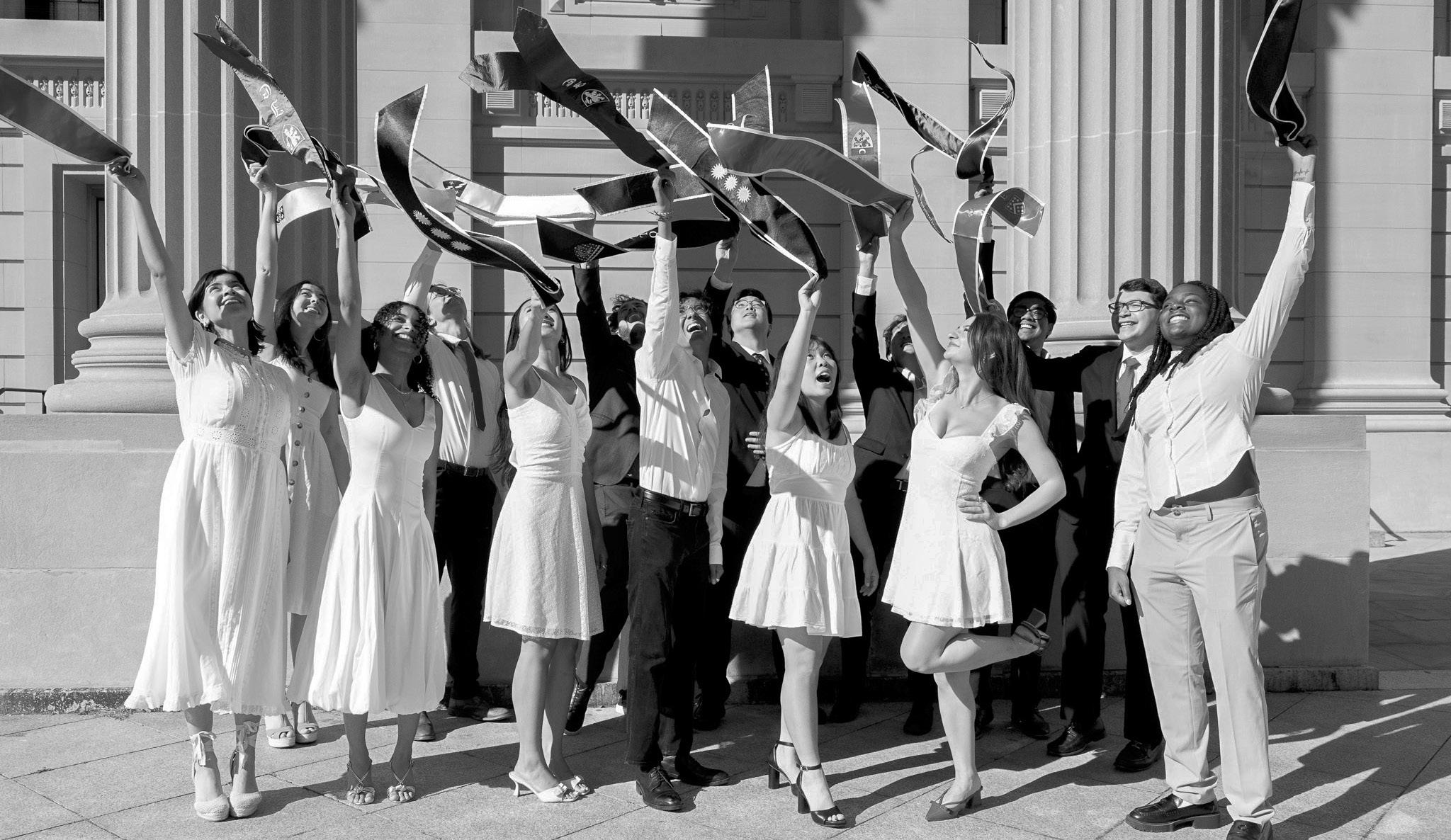
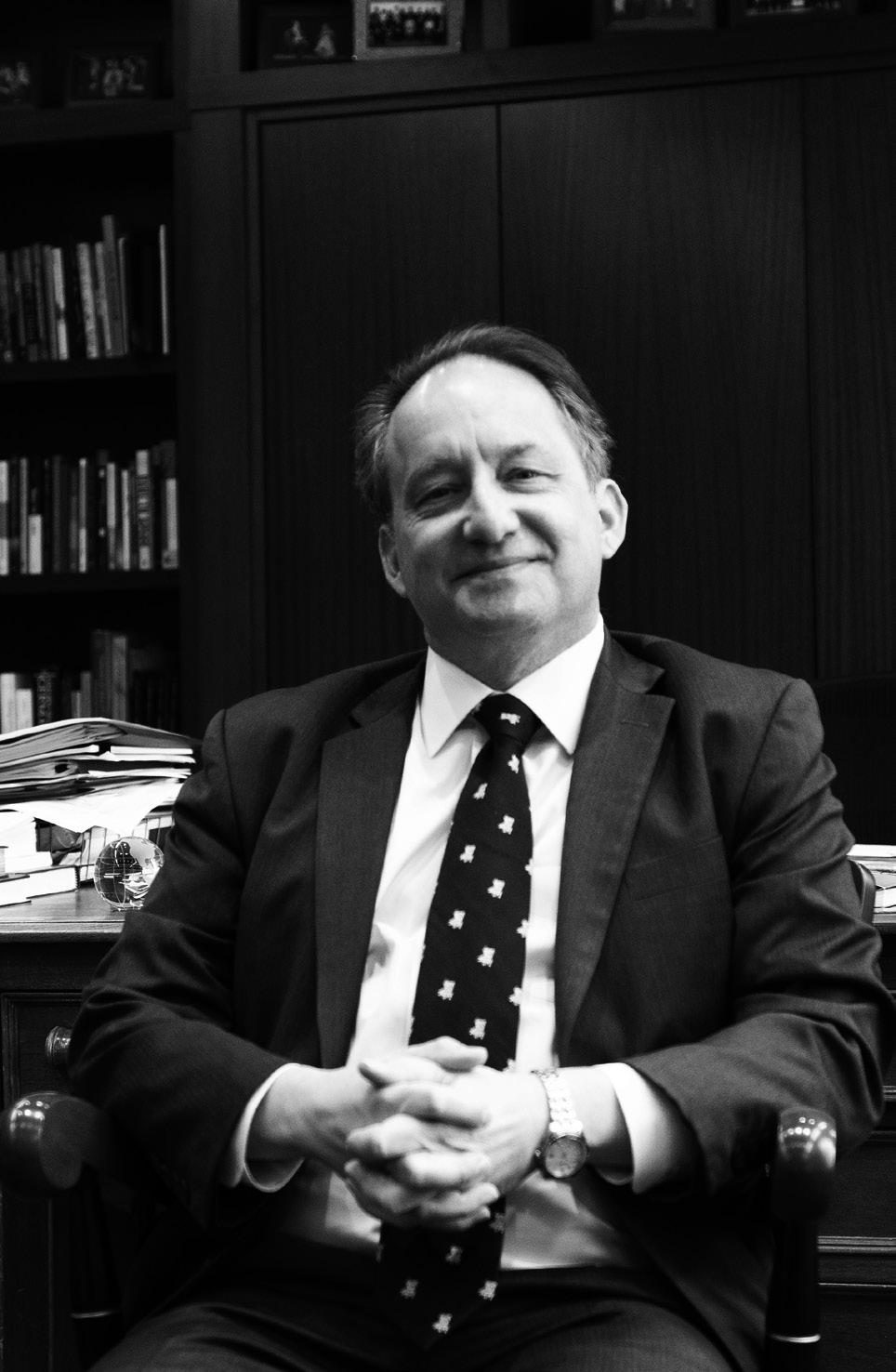
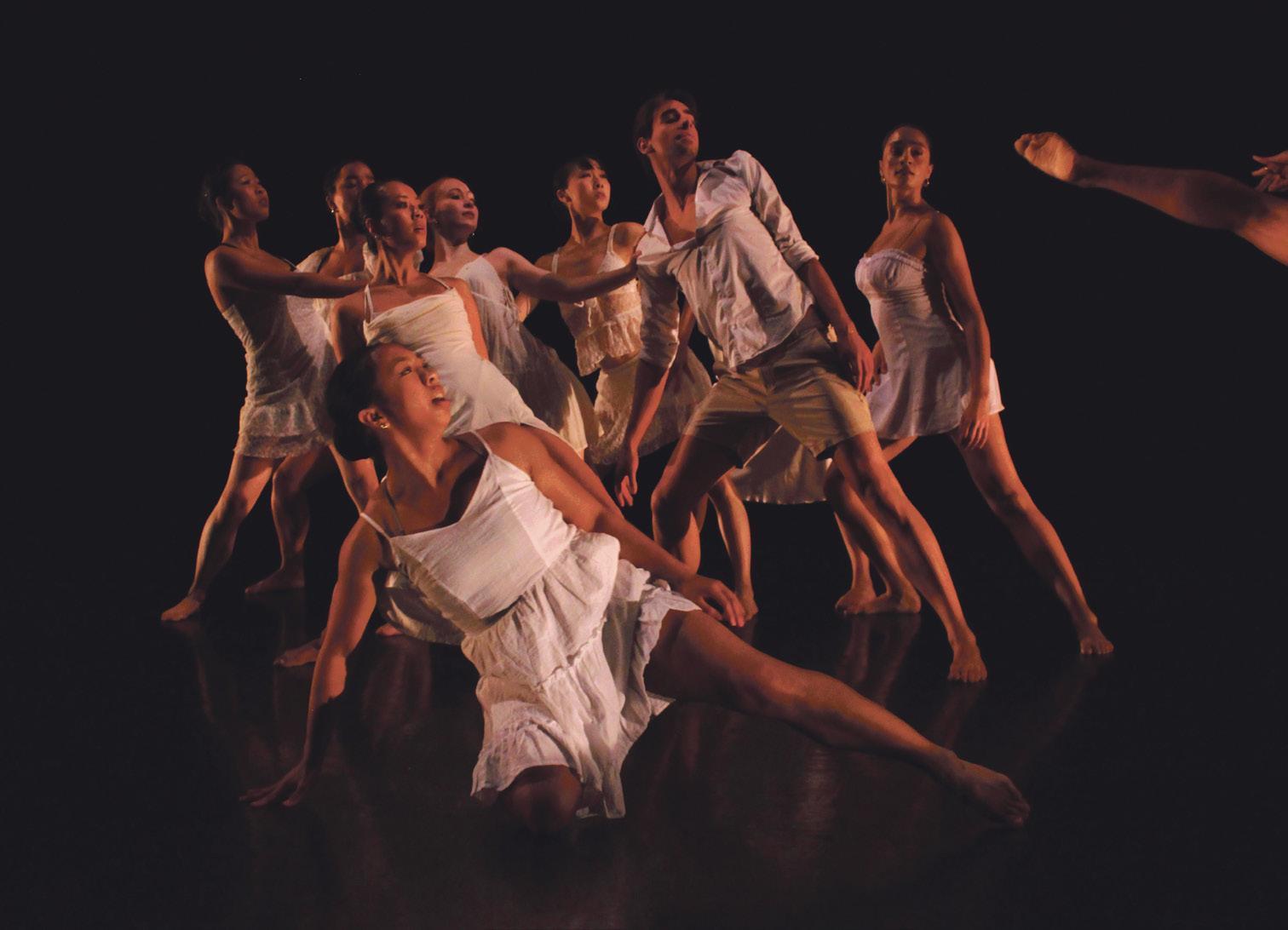
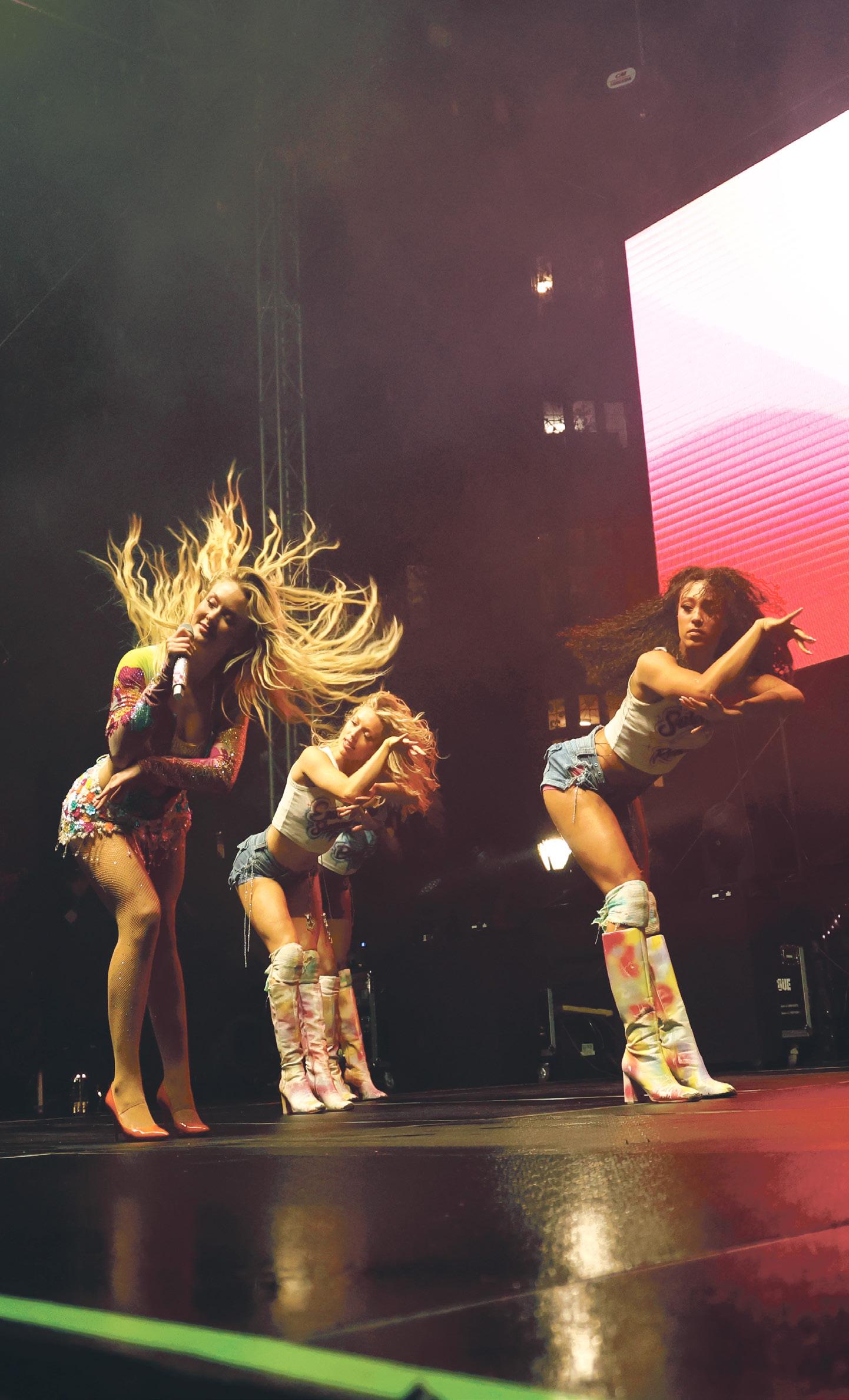
: This onehour ceremony features an address by President Maurie McInnis, as well as remarks by the dean of Yale College, Pericles Lewis.
10:30 a.m. — University Church Worship Service: Marquand Chapel, Yale Divinity School.
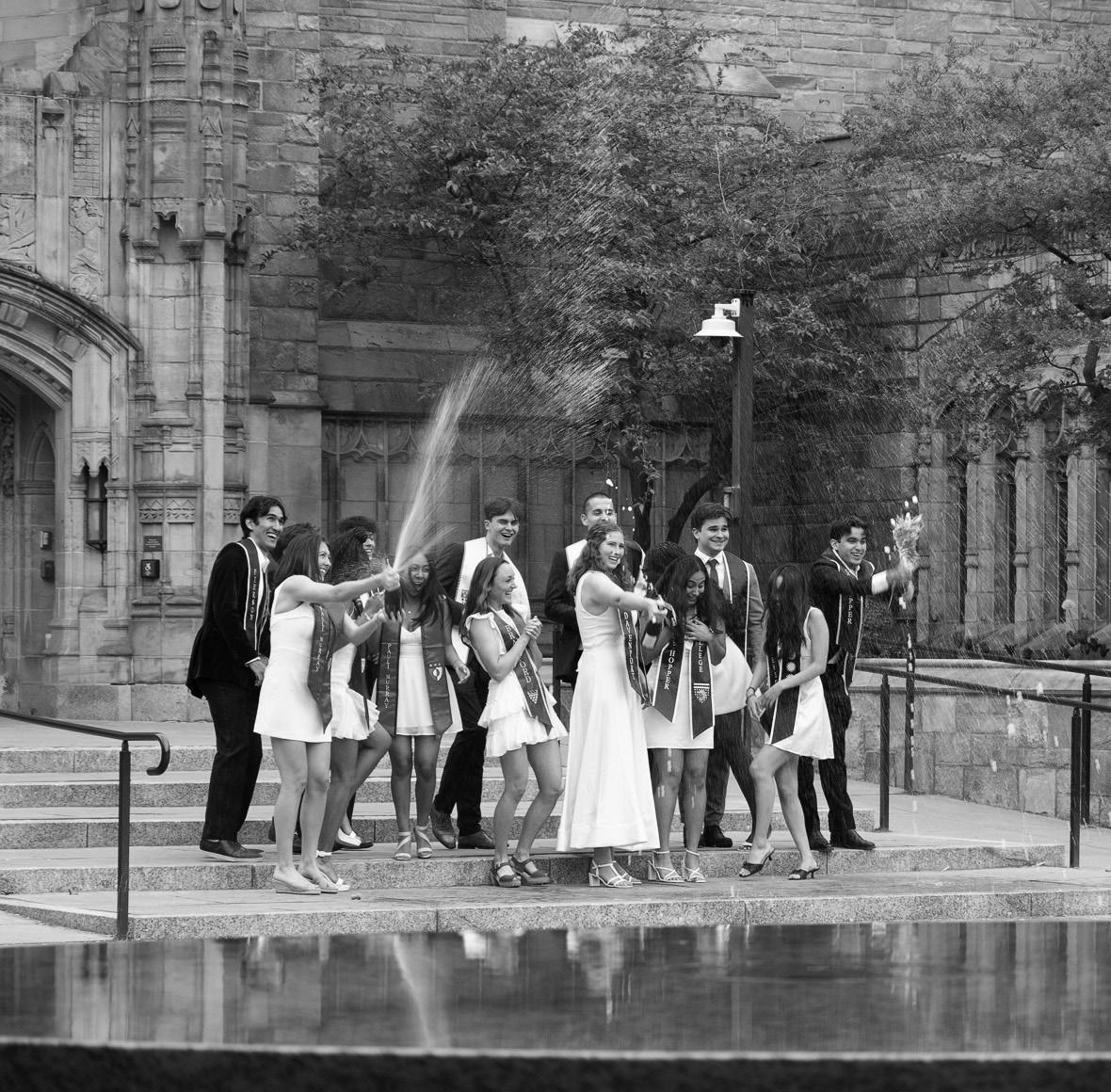
2:00 p.m. — Class Day: Old Campus, 344 College St. Class Day, a Yale College tradition to celebrate the undergraduates, includes the awarding of academic, artistic and athletic prizes as well as an address by a notable speaker.
3:45 p.m. — Receptions in the residential colleges: Receptions are held after Class Day in the residential colleges for Yale College seniors.
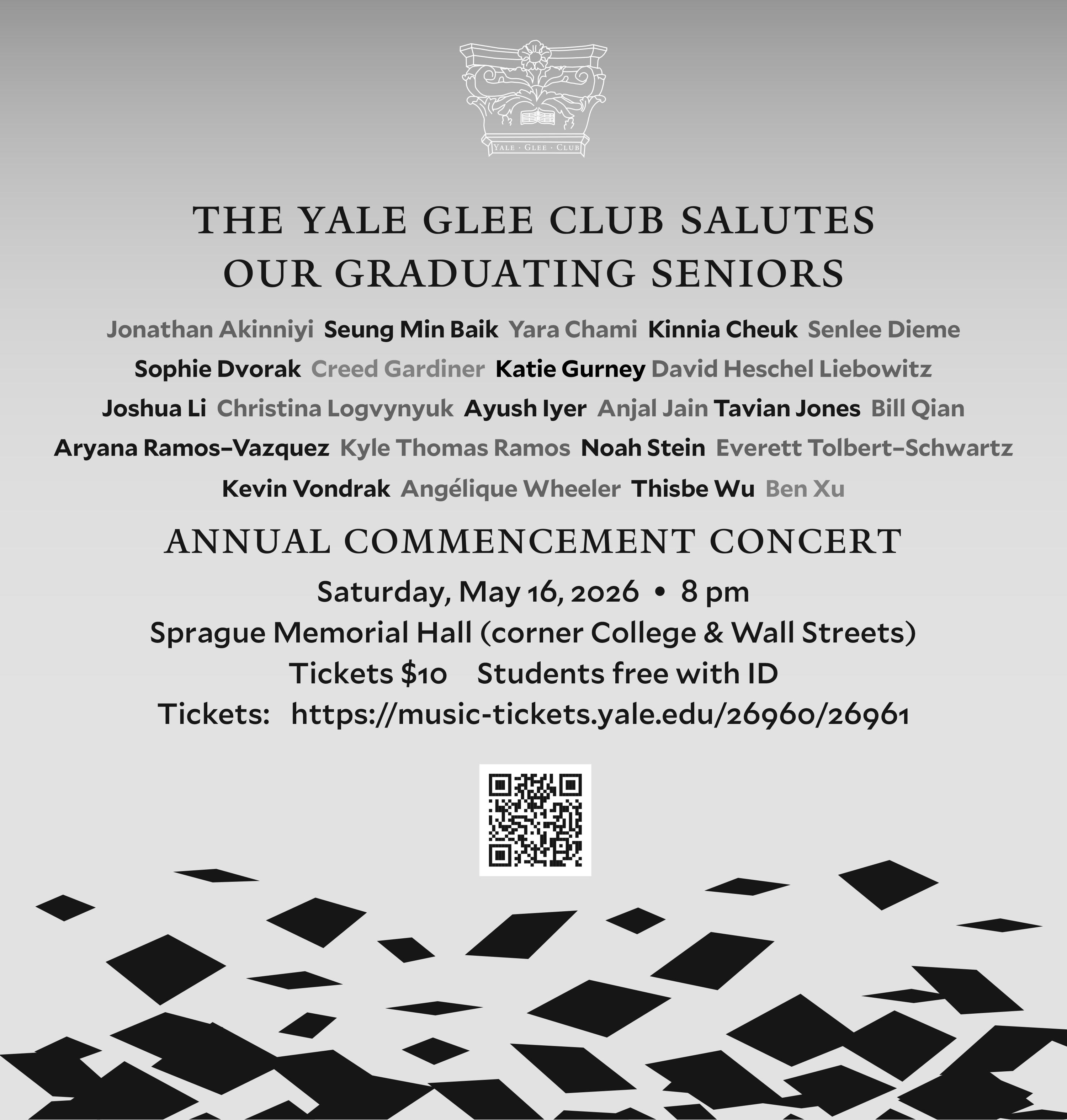
7:00 p.m. — Yale Concert Band Twilight Concert: Old Campus, 344 College St. 8:00 p.m. — The Whiffenpoofs and Whim ’n Rhythm Commencement Concert:
Consider our legacy
We made it. After four years of essays, problem sets and a million choices to make about extracurriculars and internships and social groups, all that’s left is to design quirky hats and enjoy the momentous occasion of our commencement with our friends and family. But in the midst of all this joy, I think we should make one final commitment. We need to grapple with the fact that we are the beneficiaries of a deeply broken and unequal system. And as the class of 2026, we must use the privileges of our education to do something about it. It needs to be said: Yale has a wealth problem, uncomfortable as it may be to acknowledge.
According to the New York Times, Yale accepts more students from the top one percent of the United States’ income distribution than the entire bottom sixty percent combined. Daniel Markovits ’91 LAW ’00 says it well in his 2019 book, The Meritocracy Trap: The wealth-based admissions system we have concentrates wealth and power in the hands of a small few, at the expense of political unity, upward social mobility for most Americans and the life satisfaction of even the most successful among us. But, to me, the deeper risk is that the disproportionate wealth at Yale denigrates the very idea of the liberal arts education. There are many reasons to choose a liberal arts education, but probably the main value of the liberal arts, especially in this moment, is that they can, allegedly, prepare citizens to be critical thinkers. In her 1963 book, Eichmann in Jerusalem, philosopher Hannah Arendt describes evil as banal, that most people who do evil things are not evil people but just people following orders. Critical thinkers, in my view, are the ones who say no to banal orders to do evil things. Or at the very least, stand up for what is right, even when it is easy to stay silent. For a school that claims a devotion to the liberal arts, I am concerned by our acceptance of the banal orders we are confronted with. Yale sends a disproportionate number of its students into fields that bring wealth and prestige to their workers, often at the expense of the common good. Places where it is someone’s job to cut costs in United States detention centers, turbocharge opioid sales and invest in fossil fuels. Is this how we want to be remembered?
I think things would be different if we reimagined who a Yale education was for. For middle and working class students, a college education, much less an elite college education, is not inevitable. Paying for a school like Yale as a middle class family usually means pinching every penny for years, often to end up in serious debt. And coming to Yale from an underfunded public school often means being the only person from your high school at Yale, which can be an incredibly lonely and daunting experience. Taken together, the opportunity cost to attend Yale for non-wealthy students is quite high.
As such, the very choice to attend a fancy school where life is put on hold for four years, just to think and grow, is grounded in the critical thought that the liberal arts are meant to cultivate. For these students, a Yale education is a service to something much larger than themselves, an undertaking on behalf of the community that sacrificed much to make the dream possible. If we had more students for whom this education carried a strong sense of community responsibility, maybe more people would dedicate themselves to the many problems in our world that need solving.
We, as a generation of Yalies, have the power to change the definition of a Yale student, to utterly transform our admissions system into one that prioritizes the public good over wealth. But in order to do that, we need to acknowledge that regardless of how we all arrived at Yale, we leave with far more to personally gain from the status quo than we ever will from a reformed system. All of us will have access to opportunities that very few are afforded, simply because of our Yale diploma. All of us who choose to have children will be the parents of Yale legacies who will have an explicit advantage in the Yale admissions process. And even if legacy preference goes away, our kids will have disproportionate access to fancy private schools, music and sports lessons, test prep and all sorts of other things that will look good on college applications. If we change the system, we directly jeopardize our own children’s chances of following in our footsteps at Yale.
So, to my peers in the class of 2026, what do we want our legacy to be? Though it will involve personal sacrifice, I think we ought to lead a transformation of Yale’s culture to prioritize the public over the self. We can do better than agnostically educating a disproportionately wealthy student body to develop skills used for personal benefit instead of the public good. In a country with increasing distrust in elites, it is our duty to do better.
As my parting contribution to the News, I ask the class of 2026 to do one thing: Pull the ladder up behind you. Reject the structures that we will soon benefit from and call for something better, even though it may cost your future children the opportunity to study at Yale. Commit to organizing against legacy admissions at our university, reinvest the thousands of dollars you might have spent on private school tuition into your local community, surround yourself with people who did not receive an Ivy League education and demand that Yale serve the public good over its own interests. If we succeed, we will be remembered for something much more than clever hats on Class Day.
EMILY HETTINGER is a senior in Pierson College studying Psychology and Education and a staff columnist for the News. Contact her at emily.hettinger@yale.edu.
GUEST COLUMNIST MANU ANPALAGAN
The view from Yale isn’t the view from America
When I arrived at Yale, something was missing. There was no Republican group at one of the most prestigious and influential universities in the country. At an institution that trains future leaders of government, business and culture, there was no organized home for students who believed in the principles of the America First movement. So I started one.
Serving as the founding president of Yale College Republicans for the last two-and-a-half years has been one of the most meaningful experiences of my time here. But our group’s very existence raises an uncomfortable question: How did Yale go so long without a Republican organization in the first place? The answer points to a deeper concern. Too many students and faculty at Yale live in a bubble — one that is intellectually insulated and socially detached from the realities facing the 340 million Americans living outside of our campus boundaries. Conversations here often assume that the dominant ideological viewpoints at Yale are representative of the country at large. They are not. And when our nation’s future leaders forget that, the consequences are real.
For decades, elite institutions like Yale helped produce the architects of policies that devastated American communities. The bipartisan consensus around free trade hollowed out American manufacturing and shipped
jobs overseas. The architects of the Iraq and Afghanistan wars, many of them attendees of elite universities, committed our nation to two decades of costly conflict with nothing to show for it. These decisions were shaped by a worldview that prioritized abstract global theories over the lived realities of working Americans.
When I looked around Yale, I saw no home for a different kind of conservatism — one that put the American people first. Instead, what existed were organizations that echoed the same outdated, failed neoconservative ideas that had already led the country astray. They championed globalism, catered to elite interests and aligned themselves with Wall Street over Main Street. That is why I founded Yale College Republicans. I wanted to build a space for students who believe that conservatism should serve the American people — not multinational corporations, not foreign policy abstractions and not elite consensus. A space for what is known as America First conservatism. The future of the Republican Party will not be defined by figures like Nikki Haley or Mitch McConnell, who represent an outof-touch establishment. It will be shaped by visionary leaders like Vice President JD Vance LAW ’13 and Senator Josh Hawley LAW ’06, who are willing to challenge both parties’
GUEST COLUMNIST
orthodoxies and fight for American workers, families and communities.
At Yale, this divide is especially clear. There exists not just liberal elitism, but also a conservative elitism — an unholy union of a bipartisan establishment that advances policies disconnected from the needs of ordinary Americans. We must reject that. As students at Yale, we have a responsibility that goes beyond our own success. We are being prepared to lead institutions that will shape the future of this country. That means we must think beyond the narrow confines of campus life and consider the well being of all Americans, not just those who share our classrooms or our zip codes. Yale College Republicans, at its core, is an attempt to bridge that gap. It is a community rooted in the belief that conservatism should reflect the views, concerns and aspirations of everyday Americans.
Lastly, to my fellow students, regardless of political affiliation: Step outside the Yale bubble. Engage with the country you are preparing to lead. Listen to people whose lives look nothing like yours. Because the strength of our nation depends on our ability to see, and serve, all of it.
MANU ANPALAGAN served as the founding president of the Yale College Republicans. He is a senior in Branford College studying Economics and Political Science. He can be reached at manuneethy. anpalagan@yale.edu.
On Rights and Responsibilities
Later this month, on Old Campus, the University’s president will stand before the graduating class for the 325th time and admit them, by tradition, to “all the rights and responsibilities of their degrees.” Some version of those words will be spoken at thousands of commencements across the country, but Yale’s carries particular weight. Where 133 miles north, Harvard will welcome its graduates into “the fellowship of educated men and women,” Yale’s conferral reflects a distinction once made to elevate the obligations of learning and has since diffused into the shared ceremonial language of American commencements. It is a small but telling example of how Yale has long set the terms for American higher education.
This April, in another attempt to shape the landscape of higher learning, Yale released a 58-page report on why public trust in universities has collapsed. It identifies real failures in costs that have made elite education a luxury and admissions processes that perform meritocracy while, in reality, rewarding wealth. To its credit, the committee that wrote the report confronts the crisis of higher education with unusual candor. But what it cannot bring itself to examine is the role Yale played in spreading those failures everywhere else. Nor can it reckon with what has become of the graduates it sends into the world.
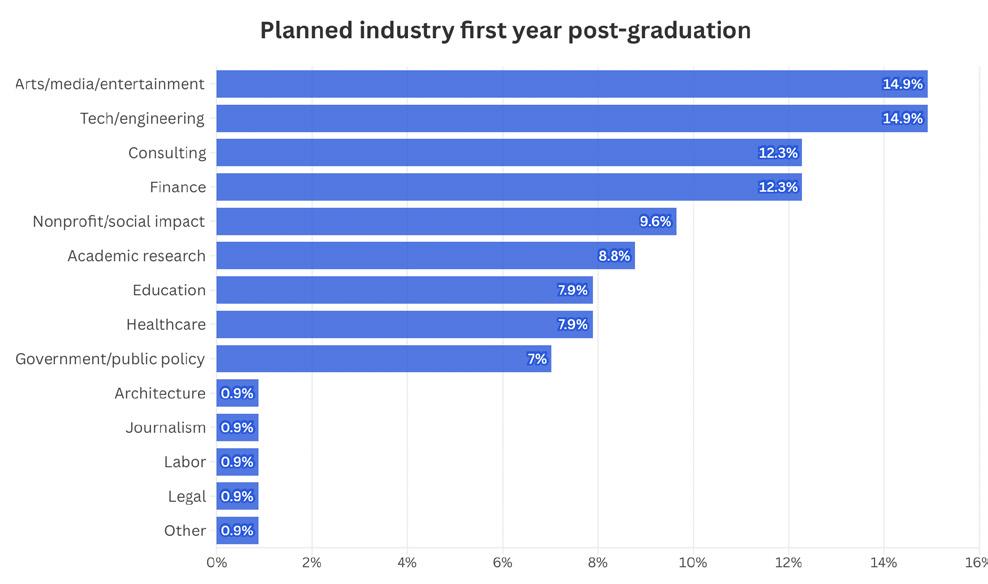
Yale’s career infrastructure delivers 46% of its workbound graduates into finance, consulting and technology. That pipeline concentrates them in five cities across four coastal states. They work in industries that have done more than almost any other to narrow the geography of American opportunity, to hollow out the places they came from and to make the kind of upward mobility Yale claims to represent harder for everyone else. For the rural
or first-generation student whose family sacrificed for the degree, that pipeline is not a promise kept. For the country that subsidizes Yale’s tax exemption, it is a negative return on its investment. For the faculty who came to contribute to something larger than credential production, it is a quiet embarrassment. And the trust report does not mention any of this.
Yale’s report was still circulating when emails obtained from San Francisco’s mayor’s office revealed that the University’s engineering dean had been developing a business plan for a satellite campus in the Bay Area. Yale’s spokesperson says there are no current plans. The emails suggest the conversation is further along than that. The move would follow Vanderbilt’s recent acquisition of the financially insolvent California College of the Arts, in what one Atlantic writer called the nationalchain model of undergraduate education. The schools with the resources to expand are doing so toward the cities where talent and capital have already concentrated. While Yale measures its national impact on a state-by-state map, counting clinical trials and patents, its expansion strategy points in the same direction as its graduates.
Just days after the trust report’s release, Yale quietly revised its mission statement, excising its commitment to improving the world and educating aspiring leaders. What remains is the preservation and dissemination of “knowledge,” in a narrowed ambition that happens to position the University perfectly to become a national leader in artificial intelligence. Researchers writing in this year’s Business and Society journal warned that generative AI threatens to degrade our collective knowledge ecosystem through what they call “epistemic pollution” or the dissemination of low-quality, misleading and fabricated information at scale.
And the University that just committed itself to preserving knowledge is racing toward the industry most likely to corrupt it. The report identifies Yale’s predicament as a trust problem, but it is more precisely a resentment problem. Americans increasingly see elite universities and their graduates as participants in a system designed to concentrate wealth and opportunity for a small class of people who already possess most of both at their expense. A university that has revised its mission to withdraw its vision from the world beyond its walls, tracks its impact in patents while half its graduates funnel into extractive industries and is considering expanding toward the same coastal cities those graduates already cluster in is not answering that resentment; it is confirming it. Most of us will leave Old Campus for the last time after commencement with some sadness. There will be tears for the end of our shortest, gladdest years of life. But the conferral of our rights and responsibilities is not a farewell. It is a beginning. Gone are the days of the University for God and for country. But a University that exists only for Yale is not much use to the country that sustains it. So if the institution no longer takes the obligations embedded in the words of our commencement ceremony seriously, then we must. We know the rights: Yale clubs, library access, reunions, The Game and others. The responsibilities are real, too, and they are ours now as well.
MICHAEL NDUBISI is a former editor of the Yale Daily News’ Opinion desk and writer of the fortnightly column “A More Perfect Union.” He is a senior in Saybrook College majoring in History and Political Science. He can be reached at michael.ndubisi@yale.edu
MICHAEL NDUBISI
GUEST COLUMNIST
DEJA
DUNLAP
Revisiting the race issue in the Engineering department
Two years ago, I wrote an article about the race issue in the School of Engineering and Applied Sciences, or SEAS.
Much has happened since then: the first freshman class at Yale following the end of affirmative action, Yale’s creation of an institutional voice policy and the Trump administration’s attacks against DEI, to name a few. On the precipice of my graduation, I wanted to revisit the issue that I spent so much of my Yale tenure considering.
I want to start this article with a few facts that I recently learned. In 2015, former Yale President Peter Salovey GRD ’83 ’84 ’86 committed $50 million to increasing faculty diversity across all of Yale. In 2020, the commitment was upped by an additional $85 million and the launch of the five-year “Belonging at Yale” initiative. Now that we are one year out from this effort, I think it’s important to ask: Did Yale increase diversity in its faculty population?
On the surface, the answer is yes. The publicly available
database Yale shares about its faculty demographics shows, from 2013 to 2025, the number of Black, Hispanic, Indigenous and Pacific Islander tenured or tenured-track professors nearly tripled across departments. But how much of this increase was concentrated in the SEAS department?
Four.
Not 4 percent, four people. SEAS went from five underrepresented minority — or URM — faculty members in 2013 to nine in 2024. While the overall faculty in the SEAS department increased 44 percent, only four of them were from URM backgrounds. With this foregrounding, I still hold many of the opinions I expressed in my original article. The SEAS department has continued to not seriously consider the racial disparities in the same manner that they have other disparities like gender. Engineering continues to lack representational diversity in the workforce, a fact that has been exacerbated by the Trump administration’s attacks on DEI.
GUEST COLUMNIST
PERICLES LEWIS
On conversation
Graduating seniors: four years ago — before move-in, before shopping period, before the first blue book or lab report — I welcomed many of you during Bulldog Days and framed this place as more than somewhere you would attend. I asked you to think of Yale as a community you would have to practice: a community based on conversation. I invited you to learn with humility, to assume good intentions and to value complexity and nuance over self-assurance and stereotype. I opened those remarks with a question from Confucius: “Is it not a pleasure to learn…? Is it not a joy to have friends coming from afar?”
Four years later, you can answer for yourselves. I hope that learning has been a pleasure — sometimes thrilling, sometimes difficult, maybe sometimes both — and that friendship has arrived from farther away than geography can measure. As you leave Yale College, I hope you take with you not only what you studied but also how you learned: in dialogue, across difference, with humility. I also hope that you do the same in the conversations ahead, wherever you land next.
Commencement speeches usually urge you to go out and change the world. Maybe you will. But here is a more tangible and, in many ways, more urgent charge: to use conversation as a practice, and as a public good. The habits I named four years ago — openness to challenge, resistance to stereotype, generosity in interpretation — are not just campus niceties; they are civic equipment. In workplaces, communities, families and public life, you will enter conversations already underway, many of them fragile. The question is whether your contribution will narrow or widen them, whether you will flatten someone into a category or make room for the full complexity of their story.
That charge matters because it is the antidote to what Chimamanda Ngozi Adichie calls “the danger of a single story.” In those Bulldog Days remarks, I shared her reminder that stereotypes are not always false; they are usually just incomplete. And if that is true of places and people, it is also true of a graduating class. The class of 2026 will be remembered, inevitably, through a few stories we repeat: the breakthroughs we celebrate, the conflicts we debate, the moments that made news. But you also carry thousands of narratives that rarely make headlines: the late shifts at a campus job followed by rehearsal, the times you cared for a friend in crisis, the decision to change majors or plans, the discipline of showing up week after week for people who depended on you.
I also borrowed an image from Tennyson’s “Ulysses,” where “all experience is an arch wherethro’ / Gleams that untravell’d world” — an image for how education expands the horizon. Many of you have felt that expansion in obvious ways: new fields of study, research methods, languages, archives, data sets, artistic forms. But maybe you have also felt it in quieter, more human ways: the first time you ate with someone whose life story upended your assumptions, the first time you realized you had been casually repeating a stereotype, the first time you learned to ask a better question rather than deliver a faster answer. The horizon does not expand because Yale is magical; it expands because you do the work of moving toward the unfamiliar.
You have also lived through four years of polarized, often bleak public dialogue. You have watched debates harden into slogans, and you have seen how quickly misunderstanding can become moral certainty. Yale is not immune to dogma — no university is — but I still believe we can aspire to a higher kind of conversation: one where arguments are tested rather than traded, where listening is not a concession but a skill and where the goal is not to win but to learn. That work is hard. It asks for patience when impatience feels righteous, for generosity when cynicism feels safer and for the courage to say, sometimes publicly and sometimes only to yourself, “I might be wrong.”
So as you prepare for graduation, I come back to that original invitation — not to grade yourselves against it, but to use it as a bookend. Commencement tempts us to summarize four years into a single story: the headline accomplishment, the defining crisis, the proudest milestone, the hardest setback. But if Yale has taught you anything, I hope it is that your lives — and this class — are bigger than their easiest summaries. As you leave, keep practicing conversation, especially when it is hard. Assume good intentions. Value complexity and nuance over stereotype and certainty. Keep moving your horizons outward. And help one another, wherever you go, to build communities worthy of the people in them.
Congratulations, class of 2026.
PERICLES LEWIS is the Dean of Yale College. He is the Douglas Tracy Smith Professor of Comparative Literature and a professor of English, and formerly served as vice president for global strategy and vice provost for academic initiatives. Contact him at pericles.lewis@yale.edu.
And, for the rest of my time at Yale, I continued to be one of the only Black students in my math and engineering courses.
Where I differ is in my relationship to this disparity. More specifically, I no longer feel an inclination to prove my worth. Perhaps this is a natural symptom of maturing, but I’ve come to believe that my talents speak for themselves.
What I’ve come to realize is that, no matter if I were to graduate with a perfect GPA and the most prestigious postgraduate job, it wouldn’t be enough to change the culture. Whether my professors remember me by my name or as “the Black girl in the class” — personally offensive as it is — it won’t fix the systemic injustices minorities face in the field.
One person’s exceptionalism doesn’t change a culture built on centuries of systematic exclusion and erasure.
What, however, does change it is to address that such a culture even exists. While SEAS and Yale more broadly have made significant progress in terms of
diversity, it is not enough. In an environment where all things DEI are heavily scrutinized, it may seem reckless to openly address something like this. But, as the recently published report from the Committee on Trust in Higher Education states, an emphasis on intellectual diversity is critical to nurturing an academically productive environment. While the report focused on political diversity, I would argue for the extension to all axes, including race. Besides the multiple documented benefits of diversity, it’s just the right thing to do. As Yale is one of the most televised universities in the world, what Yale chooses to do in this critical moment in history could have widespread effects on Black engineers everywhere.
I’ll end the article urging for the same things I did before. Yale should publish racial student demographic information by major. SEAS should invest more in SEAS-affiliated affinityoriented student organizations. SEAS should build and expand partnerships with Historically
GUEST COLUMNIST
RYAN
WANG
Black Colleges and Universities and Hispanic Serving Institutions to build diverse graduate student and faculty populations. And SEAS should invest in programs that improve minorities’ retention.
By proactively addressing the race issue, hopefully Black engineering students in the class of 2036 will look back at this article in disbelief at the covert and overt instances of racism described, shocked that this is what SEAS was like in 2026. But if we do nothing, I promise future students will read this article and feel as though they could have written it themselves, how eerily similar their own experiences will have been. It’s time Yale addresses the race issue in the engineering department.
DEJA DUNLAP is a senior Applied Mathematics major in Pauli Murray College and served in the National Society of Black Engineers, or NSBE, at Yale for two years and the Regional Executive Board of NSBE for one year. Contact her at deja@berkeley.edu.
The death of college exploration
If you read my application to Yale, you would probably guess that I spent my bright college years flitting between economic research seminars, physics labs and a political campaign office. Instead, I spent my first week of classes grinding through applications for the Yale Student Investment Group or the Yale Undergraduate Consulting Group. By the end of sophomore year, I had climbed the ranks of the consulting group and was running its client acquisition team. Academically, I dropped my physics major and rarely strayed outside of economics and mathematics classes. Sometimes, I mourn for the kid who eagerly submitted his Yale application. I suspect I am not alone.
In his 1852 treatise “The Idea of a University,” the English theologian John Henry Newman argued that a college education should cultivate the intellect broadly, not provide vocational training. Newman was not alone in his position. Yale’s own 1828 report on academic instruction declared:
Our object is not to teach that which is peculiar to any one of the professions; but to lay the foundation which is common to them all.
Yet for many of us Yalies, this vision has not materialized. Somewhere between 1828 and today, the dream of spending our college years exploring our passions and career interests remains only that — a dream. Exploration is dead. The question is: who killed it?
My first suspect is one familiar to most Yalies: our future employers and graduate schools. In the past two decades, the college internship has devolved from an act of exploration into a prerequisite for entry. During my time at Yale, top consultancies have steadily moved recruiting timelines earlier. The proliferation of sophomore summer internships and preprofessional clubs pressures new students to dedicate their underclassmen years to breaking into the industry. My friends in other fields tell the same story. The aspiring investment banker needs a boutique stint before junior year, the software engineer needs a project portfolio to
capture the attention of tech companies, the mechanical engineer needs lab experience before finishing their core requirements and the future policymaker needs a D.C. internship before their first political theory seminar.
Yalies interested in further academic study face the same curse. Matriculant GPAs at top medical and law schools have crept up consistently, while aspiring doctors now spend thousands of undergraduate hours on clinical experience and research to remain competitive.
Students drawn to doctoral studies face National Science Foundation and National Institutes of Health fellowship applications demanding research experience dating to freshman year.
Career preparation has superseded exploration across campus. Yet, can our future employers and schools be fully to blame? I have a second suspect for the murder of exploration: us. When younger Yalies seek career advice over dining hall meals, I first ask if they have found their guiding purpose. The conversation usually plays out like this:
“What is your north star?”
“Right now, I’m locked in on securing that McKinsey internship.”
“Yes, but what’s your end goal? Your own guiding mission?”
“...I’m not sure yet. Maybe law school?”
The ambition that carried us to New Haven is easily hijacked by arbitrary measures of success established by the student community. Within weeks of arriving, first-years are exposed to what “success” looks like in each realm of campus:
“You should apply to YSIG if you’re interested in finance. They have a ton of alumni at Goldman Sachs.”
“If you want a shot at a T14 school, you should have a 4.0 and a law journal publication.”
Rather than charting their own paths, Yalies often co-opt a communal definition of success and work tirelessly to achieve it. First-semester me — the kid that raved about particle physics and economic policy in his Yale application
— sleepwalked my way up the ranks of a consulting club without ever asking if that was what I had really wanted. So, who killed college exploration? Both suspects are culpable. Employers and schools impose aggressive recruitment timelines and stringent requirements, and ambitious students eagerly rise to the challenge. This hyper-competitive applicant pool encourages firms to raise their standards again, fueling an arms race. Consequently, higher education produces a generation of over-prepared, under-explored graduates. Students determined to succeed within a single field never discover what they truly want, arriving at 22 in a job they chose at 19 for reasons that were never really their own.
Is there a way to break the cycle? Employers and graduate schools should ask which of their requirements still measure genuine ability, and reckon with what they lose by screening out candidates who spent college actually exploring. Absent institutional change, I find it naive to tell Yalies they should simply ignore postgraduate pressures. Instead, I recommend “strategic exploration:” invest seriously in at least two fields you actually care about, fulfill your distributional requirements early to explore the whole range of classes Yale has to offer, and ask whether your ambitions are genuinely yours or inherited from the students around you.
I broke out of autopilot at the end of junior year. I rediscovered my love for economics, reneging on a fulltime consulting offer to pursue academic research. The world today rewards the straightest path, yet there is a quiet tragedy in arriving at a destination you never chose for yourself. The kid you described in your Yale application is still in there — go find them.
RYAN WANG is a senior in Jonathan Edwards College studying Economics and Mathematics. After Yale, Ryan will be working at the MIT Economics Department as a research fellow. Contact him at ryan.wang@yale.edu.
OPINION
GUEST COLUMNIST
YURII STASIUK
GUEST COLUMNIST
TRISTAN HERNANDEZ
Home address: 68 High Street Getting it right
I received my Yale acceptance letter weeks after Russia started bombing Ukraine.
I had just turned 19 when the war started — one year past the threshold that determined, at the time, which Ukrainian men could leave the country during wartime. I was already studying abroad at the time. And so, for four years, I kept choosing not to go home — with a brief exception this year, when a change in law temporarily allowed me to visit Ukraine twice without being unable to leave — so I could continue attending Yale, so I could later use this privilege to help my country. So I told myself.
For four years, Yale has been my literal home, the only constant I have had.
I wrote 68 High St. on every form asking for my home address. Every winter break, when Yale closed its dorms, I found another friend to crash with, usually in a basement room. Since I couldn’t go home, every summer I got to live in another country — Poland, Georgia, Belgium and yes, one New York summer — and always worried I’d hit a visa-free stay limit, or that a temporary rental would end before I found another one. I always looked forward to returning home to New Haven.
Yale gave me a bed to cry on at 5 a.m. when I learned someone I knew had been killed or when my city appeared once more in war headlines. Yale kept my water and electricity running when another Russian air strike left my family without them. Sometimes I had to pretend to be fine; it felt obscene to grieve on Yale’s campus while people at home were actually dying. I was not the victim, I told myself, and wouldn’t behave like one, at least not in public. Over time, my expressions of joy became increasingly sincere. For better or worse, Yale and its people had also provided me the luxury to forget about war, if only for brief moments.
I started writing in a language I barely knew just a few years ago, and soon found reporting on New Haven’s budget and student protests more meaningful than writing papers on Said or Spinoza. 202 York St., the
building of the very paper you are reading, became my second home. Junior year, I worked Goldman Sachs hours for free, editing stories through the year when Yale and the United States both got new presidents.
I have met wonderful people who challenged and supported me through war news and 20-page papers, partied and pulled allnighters with me. I got high on High Street; stayed past midnight to talk about religion, ice cream flavors, Iran, love; grabbed coffee at Koffee; swore a blood oath to my secret society. Not all late nights were spent crying.
My four years in the safety of New Haven — yes, war at home really puts its purported danger into perspective — had helped me become who I needed to be. I never stopped questioning whether I should be here at all, staring at the leave-of-absence form every semester. But I stayed, and whatever I owe to that choice I intend to pay back.
BUT I STAYED, AND WHATEVER I OWE TO THAT CHOICE I INTEND TO PAY BACK.
Soon, I will no longer be able to write 68 High St. as my address on official paperwork. My country is still at war. I don’t yet know what my next permanent address will be or how much constancy my future holds. I choose to believe that Yale will still remain a constant to a degree — I will call my college friends, maybe watch the Bulldogs crush The Game, or once again go to March Madness. Every once in a while, I will open the News to read about another student service getting cut. And I will cherish the four years when my Jonathan Edwards dorm felt like home, even as my rooms kept changing.
YURII STASIUK is a senior in Jonathan Edwards College and a former managing editor of the News. He can be reached at yurii.v.stasiuk@gmail.com.
The first day I was the editor in chief of the Yale Daily News, I felt completely unprepared. All I knew was my own experience from my sophomore year: interviews with Dean Lewis, copy editing shifts every Tuesday, reports on sorority disaffiliation and Coke-Pepsi wars in the dining hall. Suddenly, I was sitting in the Berkeley College common room with the managing editors while protesters set up an encampment on Cross Campus. My new reality was answering calls and factchecking updates, all while I still had to learn how to simply upload onto our website. I was out of my league, but people depended on me to do my job. Even though I was not sure if I was making the right calls, decisions had to be made, and the News still had to publish.
FOR THE FIRST TIME, I FELT LIKE I WAS EXPERIENCING YALE, THE ONE ADVERTISED TO ME IN ADMISSIONS BROCHURES, EVEN AS I MISSED THE NEWSPAPER WORK THAT HAD DEFINED MY FIRST THREE YEARS.
In time, I learned what the job would require of me. I would give up my junior year to dedicate myself to the paper, writing class assignments ten minutes before the deadline and completing problem sets at 4:00 a.m. after the News’ print production finished. I knew more about McInnis’ administration and Yale’s racial demographic data than I did about my own
STAFF COLUMNIST
MILAN SINGH
classes. It was the year of a presidential election, federal attacks on university funding and international students, new policies on institutional neutrality and the aftermath of mass student protests. It was the closest I ever got to understanding this place. But while I experienced Yale from 202 York St., life went on without me. In retirement from the News this year, I nod along as my Pierson College friends recount stories from junior year and I pretend to understand. I lived off campus with a nocturnal schedule while they threw suite parties I could never make it to; my job asked me to be present for everyone else’s experience while I was absent from my own. I also reflect on the News itself in my tenure’s post-mortem — whether I did enough or if I made the correct choices. I find myself wondering what it meant to be a Latino editor in chief at a paper where you could count the non-white editors on one hand, what it meant to be a queer person given massive responsibility to shape narratives around our community. I don’t know if I did it right, and I doubt I ever will. As I reintegrated into campus life, the News kept going. I was happy to retire, leaving the work to a set of incoming editors who had new ideas and energy. I came into my senior year hoping to cram every Yale experience into the 40 weeks I had left in New Haven. I attended Feb Club every night, went back to my favorite carrel in the stacks, and spent more time in Pierson’s Lower Court than my own suite. For the first time, I felt like I was experiencing Yale, the one advertised to me in admissions brochures, even as I missed the newspaper work that had defined my first three years. Leaving Yale now, I don’t know what comes next. For four years, I went through college with a set of benchmarks I needed to meet—the News, FroCo, society. I knew what classes I wanted to take since I got admitted. But the best parts of Yale were the unplanned moments: New York trips made two hours
So long, and thank you for reading
before we left, impromptu hour-long conversations in the newsroom, showing up in the Pierson dining hall and finding someone to eat with. At the end of this year, I was talking to some of the first years I counseled as a FroCo. They’re younger and use slang I have never heard of and freak out when there’s a mouse in Vanderbilt Hall. The news I covered as a reporter happened when they were in high school. They make changes to their Yale plans constantly. On some level, I feel unqualified to give them advice because I had all these plans yet never knew what was the right decision. Now that I’m done, I find that I no longer worry about the right choice. My path was made, and maybe that’s enough.
NOW THAT I’M DONE, I FIND THAT I NO LONGER WORRY ABOUT THE RIGHT CHOICE. MY PATH WAS MADE, AND MAYBE THAT’S ENOUGH.
Yale is 325 years old, and we’re only here for four of them. People will fill the gaps when we leave, and this place will keep going when we’re gone. Someone will be sitting in the News building covering what comes next. They will feel unprepared. They won’t know if they’re getting it right either. The News will still have to publish. I spent four years planning Yale. When I leave, I’ll only remember the parts I didn’t.
TRISTAN HERNANDEZ was the 147th editor in chief and president of the News. He is a graduating senior in Pierson College studying political science. He can be reached at tristan.hernandez@yale.edu.
When I came to Yale, I had no idea what I would do after graduation. I thought I might go into management consulting. Four years later, I’m taking a fellowship as a journalist; we’ll see how long that lasts. In a way, this is a bit of a fullcircle moment for me: the first extracurricular I joined in college was the Opinion section of the Yale Daily News. I suppose now, as a graduating senior, is my time to dispense a little bit of advice to the class of 2030. I’ll try to keep things brief. Take your coursework seriously. There is an instrumental reason to do so: A high GPA is often a necessary but not sufficient condition for future employment or educational opportunities. But no less importantly, there is an intrinsic reason. College is one of the few times you will have in your life to focus solely on absorbing knowledge and learning things, particularly difficult things. Self-driven study and independent reading are valuable, but nothing will motivate you to drill a fact, equation or theory into your head like studying for an exam. You’re surrounded by topnotch teachers and brilliant
classmates; you ought to try to soak up as much as you can from them. Really engage intellectually with your peers. Not just in the seminar or in the dining hall, but in public — in reading groups, or debating societies, or in one of the many campus publications, though preferably in the pages of the News.
When I’ve asked classmates whether they’d be interested in writing an op-ed, the most common response I get is some version of “I want to, but I’m worried about potential backlash.” I think this particular fear is overblown, and it deprives the university of fruitful conversations.
Take, for example, the last piece I wrote for the News. In response to a classmate’s article, I contended that the relative lack of conservative students and faculty at elite universities could, at least in part, be chalked up to conservatives having slightly lower IQs than liberals on average. That piece was probably my most provocative column for the News, and it was intentionally somewhat snarky. I received some emails from readers who did not agree with my argument, and
a couple of my right-leaning classmates wrote op-eds responding to me.
But that was pretty much it. I wrote down an opinion. Some people disagreed with it. I enjoyed reading their responses, and after a few weeks, everybody moved on.
One thing I learned when I edited this section was that Opinion pieces receive by far the most views of anything that the News publishes. Publishing an op-ed lets you, in whatever small way, influence discussions over how this university is run. The recent report of the Committee on Trust in Higher Education includes citations to eleven articles published in the Opinion section of the News, including one of my own.
After exams finished, I rewatched Sir David Attenborough’s masterpiece documentary series “The Life of Birds” in honor of his 100th birthday.
“Now, we have taken over the Earth, the sea and the sky. But with skill and care and knowledge, we can ensure that there is still a place on Earth for birds, in all their beauty and variety. If we want to — and surely, we should,” Sir David says at the end of the final episode.
I first watched the series
when I was in kindergarten. It has probably influenced my life more than any other piece of literature or film. I wrote my college essay on the question of what makes a species “invasive” or not. And while these days I mostly write about politics, my interest in the subject came about as a result of reading National Audubon Society emails comparing Mitt Romney and Barack Obama’s environmental platforms in the lead-up to the third-grade straw poll. There is a moral undertone in Attenborough’s closing monologue: With great power comes great responsibility. As Yalies, we have a similar obligation. Fairly or not, attending this small college endows us with outsized economic, political and cultural clout. Contrary to the University’s newly pared-down mission statement, I believe that “improving the world” is and should be a part of our core mission. We are extraordinarily lucky people. On average, Yale graduates tend to hail from wealthy families. Most of us have the enormous privilege of having grown up in the richest nation in the history of our species. We get to learn from the best scholars in the world for four years. And then we enter the labor market,
and we face a choice. Take it from an economics major: Capital allocation is an important and socially valuable undertaking. It is also a very lucrative line of work. But the marginal Yale graduate who goes to work in investment banking or management consulting or at a pod shop isn’t making capital allocation that much more efficient. Our educations and upbringings have given us the skills and the knowledge to improve our country and our world, provided that we care enough to want to. And surely, we should. I will close out this last column with some thank yous. Thank you to James Prud’homme ’26 and Luca Girodon ’26, my two closest friends from my graduating class. Thank you to Josh Kalla ’14 GRD ’14 and Akhil Amar ’80 LAW ’84 for being such excellent teachers.
Finally, thank you for reading. I hope I had something interesting to say.
MILAN SINGH is a senior in Pierson College studying Economics and a former Opinion editor for the News. Contact him at milan.singh@yale.edu.
Min Jin Lee’s Yale experience was shaped by classroom racial reckoning
BY HAILEY YOUNG AND ANAYAH ACCILIEN STAFF REPORTERS
When acclaimed author Min Jin Lee ’90 returns to Yale as this year’s Class Day speaker, she will do so as a former student activist who once found herself at the center of a contentious debate over the place of race in the classroom.
In 1986, Lee recalled, she stepped onto a campus that was ideologically “fairly middleto-left” and politically active, with shantytowns erected on Beinecke Plaza in opposition to South African apartheid. At the time, she said, there were “very, very few Asian Americans” and even fewer Korean Americans on campus. Yale was the only Ivy League at the time that did not offer instruction in the Korean language, and its department for East Asian studies lacked courses on Korean history.
“We didn’t have anything about Korea, which I kind of thought was a little nuts,” Lee said in a phone interview with the News. “And I thought, well, how do you study American history without understanding the Korean War, for example, or how do you understand communism or the Cold War without understanding Koreans?”
In a March 1989 News article, then-chairman of the East Asian languages and literatures department Edwin McClellan said that Yale had only been emphasizing studies of China and Japan — “two of the three major powers in East Asia” — in its course studies because those were the subjects that could be taught “well and in depth.” Lee said she noticed this disparity more after taking a Davenport College seminar on Korea, which “wasn’t a department course.”
“That’s what sort of emboldened me to say, I really think there’s a lack here,” Lee said. “Why don’t we have a history class or one literature class or a language class? It wasn’t like I was asking for like 50 courses or a major.”
Dissatisfied with the absence of Korean academic programming for Yale undergraduates, especially given that the Korean language was taught at every other Ivy League school, Lee was inspired to found the Korean Studies Task Force in her sophomore year. The task force represented Yale’s
roughly 150 Korean American students and put pressure on the University to make a financial commitment to future Korean language courses.
Lee said she worked on coordinating a mass mailing campaign to unite student and parent voices, building and distributing packets containing stamps, envelopes and explanatory letters in English and Korean. Students mailed these packets home to their parents, who were urged to write to then-University President Benno Schmidt ’63 LAW ’66 and Yale College Dean Sidney Altman.
Lee said she revisited the Archives at Yale, where all of these letters are documented, and remembers being stunned by the scale of engagement the campaign received.
“I don’t think I knew how many parents actually wrote,” Lee shared. “It was definitely thousands.”
Her efforts ultimately succeeded, with one family donating $100,000 after hearing about the task force’s efforts — enough to fund three years of language instruction. A couple years later, Lee said, the Korea Foundation contributed half a million dollars to support the program, which launched in fall 1990, just after Lee graduated.
The 1989 effort to establish Korean language studies at Yale coincided with Lee’s experience of classroom treatment she characterized as discriminatory. She enrolled in “Korea: A History,” which she said was one of the only Korean history courses offered at the time, and left the class “heartbroken” and “devastated” by her professor’s conduct toward Korean students in the classroom.
After giving her a failing grade on a midterm exam, Lee said the course’s professor returned her work with a comment reading,
“Ah me, what’s to say?”
“It was so insulting,” Lee said. “I don’t know if he knew that I had created the Korean Studies Task Force, and that I had done all these meetings with different professors and gone to all the committees and tried to raise money. I don’t know if he realized how much skin I had in the game.”
Noticing that other friends in the course were also upset with feedback they had received, Lee
said she questioned the grading distribution of the course, and requested a racial breakdown of grades from her professor. She said the data showed that most of the students who failed were Asian American, specifically, Korean American.
Lee said that her professor attributed these failing grades to an assumption that Asian American students were “Group IV” students, referring to the distributional category for math and science majors, which Lee felt was not only dismissive, but deeply racist.
“It just crushed me, because I couldn’t believe that a professor could think that because I’m Asian, I was automatically a math and science major, or that he also believed that math and science majors didn’t know how to write history papers. It really hurt me,” she said.
Soon afterwards, Lee published an essay in the Yale Herald called “Student disillusioned by Korean history course,” in which she alleged that she had faced academic abuse and intellectual discrimination on the basis of race.
“How many professors does it take, how many abuses? How many subtle and insidious comments does it take to quash
a young dream? To what and to whom do we defer these dreams?” Lee wrote in the article.
Talk of the controversy spread quickly. Lee recalled that she “became kind of like a social pariah,” and an April 1989 News editorial grouped her among the “politically correct terrorists” it condemned for setting the campus “ablaze.”
“What was even more devastating was to have other Asian Americans defend him and say that I was just complaining about a grade because that was the last of my concerns,” Lee said, referring to the professor.
In a piece titled “A Question of Intellectual Abuse” in the now-defunct Yale Observer, Lee published the grade breakdown provided by her professor. The data suggested that in a class made up of 55 percent Korean American students, nine out of 12 who received a D or below were Korean American.
Still, Lee said that she was able to forge strong relationships with campus affinity groups while at Yale.
“Even though it was bumpy, I still felt the support of so many people at the University,” she said. “I found a lot of community with women of color at Yale,
with other feminist groups and with the ethnic houses.”
In addition to the Korean Studies Task Force, Lee was also a member of the Asian American Students Association, Korean American Students at Yale and Yale Women of Color. She said she wrote for a multitude of campus journals and graduated with top prizes awarded by the English Department for writing.
As an undergraduate, Lee attended a college tea at Trumbull College that would inspire her to write her seminal novel, Pachinko, which was a finalist for the 2017 National Book Award for Fiction. The tea’s invitee was an American missionary who had engaged with the Korean diaspora in Japan, a group whose history is explored in Pachinko.
“Yale was my first-choice dream school,” Lee said. “Although my four years were really difficult on a personal and academic level, Yale gave me a world-class education, which continues to nourish me today.” Lee will address the class of 2026 on May 17.
Contact HAILEY YOUNG at hailey.young@yale.edu and ANAYAH ACCILIEN at anayah.accilien@yale.edu.
Student performers to seek light and truth in the ordinary on Class Day
BY HANNAH LIU STAFF REPORTER
This year’s student orator and eight Class Day performers — composed of five musicians and a comedy trio — will combine an array of cultures, mediums and thoughts to reflect on the class of 2026’s time at Yale.
Class Day is Yale’s annual student-led ceremony, held on Old Campus on the Sunday before Commencement. This year, the event will take place on May 17, and is set to feature keynote speaker Min Jin Lee ’90 alongside student performances and a prize ceremony. Seniors in attendance traditionally don headgear of their choice along with their graduation gowns.
“Our whole focus has been, ‘How do we celebrate this warmth and excitement about the world that our class has been showing?’” Maya Moseley ’26, one of this year’s four Class Day co-chairs, said in a phone interview with the News. “There’s an aspect of joy in all the pieces that they’ll be able to see and an enthusiasm for what’s next. We’re looking up and looking ahead, and I think that’s a really cool aspect of it.”
Auditions for this year’s student performances consisted of an online application and a live performance, a process run by this year’s four Class Day co-chairs. According to Moseley, this year’s Class Day performance order will allow for a larger, more cohesive block of student section performances rather than the previously more interspersed performances throughout the ceremony.
Here is a quick look into the three Class Day performances.
The Ivy Ode: “The Light We Take Forward”
Inspired by Yale’s “Lux et Veritas” motto, this year’s Class Day musicians have composed an intercultural musical experience exploring what it means to carry forward light and truth.
“Even though we’re leaving all of the people and places at Yale behind, the light of friendship and love and familiarity and the way that Yale has taught us to think and grow as intellectuals are the things we will carry with us,” Grace Halak ’26, who will be playing guitar, said in a phone interview with the News.
The seniors’ performance weaves together spoken word with music from various styles into one cohesive piece, inspired by the western pop tradition, Indian Classical music and Arabic melodies.
“Each segment of our story is a different musical form,” Ayush Iyer ’26, who will play piano for the set, said in a phone interview. “I grew up with one culture in the house and one culture outside the house. When I came to Yale, it was the first time I actually got to combine those things. It’s beautiful to me because it’s sort of a culmination of a lot of things I’ve done throughout my life in one.”
Iyer and Anjal Jain ’26 are members of the Indian Classical group Yale Dhvani and were inspired by the recent Muziko concert they played in collaboration with the Yale Undergraduate Jazz Collective and Yale Undergraduate Chamber Orchestra.
The two, along with Yara Chami ’25+1, are also members
of the Yale Glee Club and have performed in previous Class Days ceremonies in the choir. This year, Jain and Chami will perform as vocalists in their set.
“I’m really excited because throughout my time at Yale, whenever people ask me what I’m doing, I’ll be at rehearsal through the different musical groups I’ve been able to engage in,” Jain said in a phone interview. “So I think it means a lot for my friends and my classmates to see what types of things we’ve been doing at rehearsal and to see my musical side.”
For Chami, who was originally part of the class of 2025 but took a gap year to perform with the Yale Whiffenpoofs, being a Class Day performer for this year’s class is particularly meaningful.
“I truly do feel like a member of both the class of ’25 and the class of ’26,” Chami said in a phone interview. “It’s very much an honor to graduate with this group of people who I’ve come to get to know very well,” she said, referring to the class of 2026.
Halak said that one of her original songs will be featured in the Class Day performance.
“I feel like it’ll be a really special and symbolic way to end my time here, especially since music has been such a big part of my time here, and it’s probably the biggest thing I do outside of the classroom.”
Naomi-Jeanne Main ’26 will also be performing on violin.
Comedic Reflection: “Yale is Magical”
Following the Ivy Ode, three students will take the stage to perform a comedic piece called
“Yale is Magical,” which centers around a hectic group project at Yale that goes awry.
“We’ll be tripping over each other and making a bunch of jokes about Yale along the way, which is sort of what it feels like to put together a sketch comedy show sometimes,” Josh Bock ’25+1 said in a phone interview. “Yale is a space where you can run into challenges, disagree and work with people that you don’t expect to, and make it through despite how tough it is.”
Bock, Prentiss Patrick-Carter ’26 and Amara Neal ’26 make up the comedy trio that will perform on Sunday. The three are all members of Yale’s Red Hot Poker sketch comedy group, and Bock said their time collaborating in the group allowed them to learn how to write and make jokes together.
According to Patrick-Carter, the group has been excited about the prospect of performing in a setting like Class Day since their first year at Yale. They came together this February to write a script for their audition to perform at Class Day and, after finding out they were selected, have been honing their exhibition ever since.
“Comedy is a valid means of connection with people,” Neal said in a phone interview with the News. “You can laugh and also be sad at the same time.”
The group hopes to connect with people through comedy and laughter, both at Class Day and post-graduation.
Class Oration: “Tuesday”
To close out the student portion of Sunday’s ceremony, Shubh Gupta ’26’s oration will
highlight the everyday moments that make Yale special.
Focused on the idea of “Tuesdays,” which is intended to symbolize the smaller, mundane parts of the Yale experience, Gupta hopes his audience will realize that it is not always the grand milestones that shape a student’s time at Yale.
“We all look forward to these big moments, these highlight reel grand moments like Harvard-Yale and Spring Fling and the senior thesis, and the senior society,” Gupta said in a phone interview with the News.
“But the moments that change us don’t really feel important while they’re happening, they feel super ordinary.”
When Gupta found out that another student from his high school in Kentucky had given the graduation speech a few years ago, he was inspired to apply. His experience starting the speech and debate club at his high school helped him develop his love for speaking, he added.
“It’s such an honor and so humbling to know that I’m going to have this opportunity,” Gupta said. “There is definitely some weight I felt in, ‘How do I do this class justice?’ Class day and graduation feels so much bigger than one person. The real challenge is how to say something that feels true to everyone, and that everyone can relate to and carry something out of for the rest of their lives.”
The Yale Glee Club was founded in 1861.
Contact HANNAH LIU at hannah.liu@yale.edu.
COURTESY OF MIN JIN LEE
Min Jin Lee ’90, this year’s Class Day speaker, in her Trumbull dorm room.
THROUGH THE LENS FAREWELL FESTIVITIES
Photos by William Qian, Kalina Sabala Montes and Tajrian Khan
A YEAR OF BUDGET CUTS
JUNE HIRING FREEZE
A month after the House of Representatives passes a budget reconciliation package that would increase taxes on university endowment returns on a tiered basis, Yale announces that it will freeze hiring for 90 days, reduce nonsalary expenses by 5 percent and delay several construction projects. University President Maurie McInnis wrote in May that the bill represents “a greater threat to Yale than any other bill in memory.”
SEPTEMBER RETIREMENT INCENTIVE
Administrators announce a one-time retirement incentive program to “support cost-saving measures” in the face of the endowment tax hike, which they estimate will cost Yale $300 million annually. The program applies to Yale’s managerial and professional staff, such as librarians, nurses and research associates, and includes a healthcare subsidy and two weeks of pay for every year of work.
NOVEMBER SUMMER FUNDING
Yale College Dean Pericles Lewis announces that the two non-competitive summer grants for students on financial aid, the International Study Award and the Summer Experience Award, will be replaced with one. The decision to halve guaranteed summer opportunities, which Lewis says is necessary in order to avoid reducing term-time financial aid due to budget cuts, prompts widespread student protest.
FEBRUARY
YALE COLLEGE STAFF
Yale College staff will shrink by approximately 20 people, Lewis says, calling the move the “only way” to reduce the College’s budget by a target 7.5 percent in anticipation of the tax hike. Lewis adds that “a very small handful” of those staff reductions have been realized through layoffs and that the retirement incentive encouraged some to leave their positions voluntarily.
APRIL
ENGLISH COURSE OFFERINGS
The English department nearly halves the fall section offerings for its flagship introductory writing course. The department’s director of undergraduate studies tells the News that the administration “imposed” this reduction, along with an increase in class size from 14 to 15. Wilkinson tells the News that his office made this decision “to meet teaching needs in a very constrained budget environment.”
JANUARY
GRADUATE ENROLLMENT
The Graduate School of Arts and Sciences announces a three-year plan to cut enrollment by around 13 percent in the humanities and social sciences and by 5 percent in STEM fields. Steven Wilkinson, the dean of the faculty of arts and sciences, tells the News that the reductions are necessary because the GSAS is “heavily dependent on endowment income, and the endowment is now subject to an increased tax.”
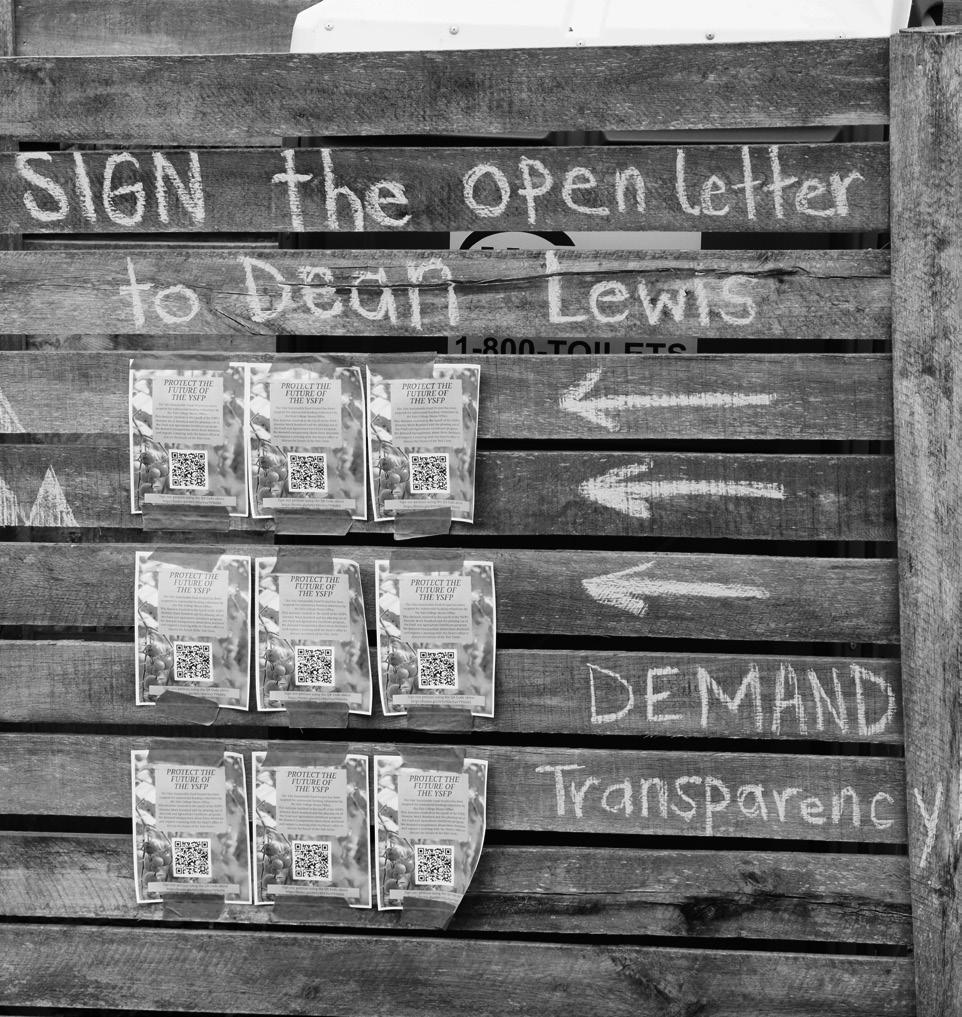
The staff of the Yale Sustainable Food Program, which oversees the Yale Farm, is reduced from four to three people. Students sign a petition alleging that the program’s executive director has been let go and that the Food, Agriculture and Climate Change certificate is ending, demanding transparency from Lewis. The dean confirms plans to continue the certificate for at least two more years.
MARCH THE YALE REVIEW
A month after The Yale Review canceled its annual literary festival, it announces plans to reduce its online publishing operations, citing budget tightening due to the endowment tax hike in both cases. The executive editor of The Yale Review, which is the oldest literary journal in the nation, tells the News that she expects to see a “substantial reduction” in readership.
Several instructional faculty members are informed that Yale has not renewed their contracts. Wilkinson tells the News that “unprecedented budget challenges” in anticipation of the endowment tax hike impacted these hiring decisions. Hundreds of students and alumni protest the decisions in two letters to administrators, each praising a departing lecturer’s academic impact and demanding that they be rehired.
JULY TAX HIKE PASSAGE
Garrett Curtis, Photograpy Editor
Braden Mathis, Staff Photographer
Ximena Solorzano, Staff Photographer
Tim Tai
Ximena Solorzano, Staff Photographer
Braden Mathis, Staff Photographer
Martin Peralta, Head Photography Editor
Braden Mathis, Staff Photographer
— Jaeha Jang and Olivia Woo, Staff Reporters
Year of budget cuts puts Lewis in the crosshairs of student criticism
BY OLIVIA WOO STAFF REPORTER
After hearing Yale College Dean Pericles Lewis make his opening address to the first-year class last August, Siena Grouf ’29 recalled that she had a “relatively positive” impression of the dean.
But “over the course of the year, that’s really changed,” she said last month. “It’s really, really hard for me to be supportive of this person as a leader in education and for students, and I think that this past year has proved that.”
Lewis has received mounting criticism from undergraduates since November, when he announced the replacement of two non-competitive summer grants for low-income students with one. He explained the change, which will substitute a Summer Experience Grant for the International Study Award and the Summer Experience Award, as a result of budgetary pressures created by the endowment tax hike coming this July.
Lewis said last month that the College has been trying to confine its decisions about budget tightening to this academic year “so that we don’t have multiple years like this one where we’re dealing with possible cuts.”
“So we think that we’re basically on target for our budget going forward,” he added. “Overall, you know, we’re managing to keep costs down by 5, 6, 7 percent without, I think, reducing the quality of the educational experience too much.”
In March, Lewis confirmed in an interview with the News that Yale College funding for low-income students to store their belongings over the summer would be discontinued permanently, concluding a phase-out process unrelated to the endowment tax increase.
In an email to undergraduates sent hours after the News reported that the aid had been phased out, Yale College Council leaders wrote that the decision represented “another negative instance of the continued degradation of undergraduate support at Yale.” Student leaders from the council and Dwight Hall at Yale responded swiftly with two programs intended to alleviate the costs of storing belongings over the summer.
Grouf said she has not been persuaded that these aid cuts “have to happen.”
She said that “increased transparency” from Lewis about his decision-making could improve her perception of his leadership, and that her “primary problem” with the cuts was that “they really disproportionately impacted FGLI students,” referring to firstgeneration, low-income students.
Grouf criticized both the changes to summer funding and storage aid for low-income students, as well as to the recent decision by the dean’s office to reduce the staff of the Yale Sustainable Food Program from four to three. The latter change has left the future of the Food, Agriculture and Climate Change certificate beyond 2028 uncertain.
She said that she entered Yale under the understanding that the administration would create “at least a relatively equal experience for all the students, and it’s become clear that that’s just not a priority.”
Lewis said that it is “a very high priority for me to make Yale a welcoming place for first-generation, low-income students.”
“I realize that whenever there’s a change, probably the people who, you know, people might be most impacted at the moment of a change might be the ones with fewer resources,” he added. “I’m sorry that some people may not have a chance to hear me talk about these issues, but I care a lot about the students, and that’s why I like doing the job.”
During this year’s Yale College Council elections, criticism of aid reductions for low-income students sat at the center of every active presidential campaign.
Incoming Yale College Council
President Alex William Chen ’28 said low-income students have taken the fall for the College’s budgettightening measures.
“Obviously, those decisions are being prompted by other headwinds, but at the end of the day the YCDO has chosen to place the burden of budgetary cuts on the core aspects of what an education at Yale looks like, and the most financially vulnerable students at Yale,” Chen said, referring to Lewis’ office. “Students are, pretty justifiably, extremely mad.”
Students are not Lewis’ only critics.
In April, professor emerita of history Glenda Gilmore wrote in a letter to the News that Lewis “seemed arrogant” when he recommended that students not “buy too much stuff” after confirming the summer storage aid phase-out. A week before Gilmore’s letter, the dean apologized
“for any perception” that he “might not recognize the effects” of the aid changes on students.
It was not the first time that Lewis had apologized for a statement that garnered backlash. Two years ago, Lewis apologized in a statement to the News for having written in a separate email to colleagues that nonYale pro-Palestinian demonstrators had “a known history of violent confrontation with police.”
Lewis acknowledged that student-administrator relations during the pro-Palestinian protests were difficult. He characterized this school year as “much easier” than the previous two with regard to conversations he has had with undergraduates “because we had a lot of tension around, you know, political matters in the previous two years that were much more stressful.”
“Now that isn’t to say that the challenges now aren’t real challenges, but I think everybody in Yale College wants an excellent Yale College,” Lewis said.
Abdel Abounabet ’27 said that though there was frustration among undergraduates regarding Lewis’ approach to the proPalestinian protests, the discontent this year is different.
“Back then,” he said, students would have been unhappy with Lewis “if you’re invested in terms of your advocacy or, or just your personal identity, in the Palestinian cause, which a lot of the student body was.”
“Now, I feel like the hits are just, like, broadening,” he continued. “And there’s a larger group of people whose pockets are getting hit and they’re starting to feel it.”
Abounabet acknowledged, however, that his perception of Lewis is “not black and white,” saying that the dean is trying to “manage our budget and see how
best the money’s allocated.” Lewis told the News that he values conversations with students who don’t agree with “every single decision” that he has made.
“Sometimes we’re making decisions that do have unfortunate impacts, but it’s not out of a lack of care for students, and we’re always very eager to hear from students and talk with them,” Lewis said. “Although nobody likes cutting things, we’re doing pretty well compared to how our peers are doing.”
At times, Lewis has cited the actions of Yale’s peer institutions in his own decisions behind budget reductions.
At the end of January, when discussing the combination of the two non-competitive summer grants, he noted that Yale College was “still guaranteeing one summer, which most of our peers don’t do.” Princeton and Harvard, he said, do not guarantee summer funding.
The merging of those grants also allowed for Yale to raise the income thresholds for a full tuition guarantee and a full cost of attendance guarantee, which the University announced in January. Harvard announced the adoption of similar income thresholds last March in a change that took effect for the current academic year, and Princeton adopted an even more generous financial aid policy last August.
Lewis said in January that he “would hate to see us under our peers in terms of our ability to help people during the year.”
Weeks later, Lewis said that the size of the Yale College staff would decrease by roughly 7.5 percent, and added that some of those reductions had been realized through layoffs.
Staff salaries, he said at the time, comprise his office’s “biggest
expense” outside of its $275 million financial aid budget.
The dean said in April that the size of the staff reduction ultimately eliminated between 5 and 7.5 percent of the Yale College workforce.
“But that’s not a large reduction compared to peers, where you see like a 25 percent reduction or a 15 percent reduction or something like that,” Lewis added. “I don’t want to say that it’s insignificant — obviously for anybody affecting the layoff or something that’s very significant — but it’s not like it’s a massive change in the staffing levels.”
When asked how his office approaches the trade-off between funding administrator salaries and funding direct payments to students — such as through summer storage support — Lewis said that he decides staffing levels based on how peer institutions “handle the same challenges that we do.”
When discerning “the best way to support first-generation, lowincome students,” Lewis added, his office looks “around at peers. What’s the best way to coordinate those kinds of services? So just trying to take a look at our peers and find the best way to make the best use of our resources that we can.”
Chen said that this way of thinking sets a “dangerous precedent.”
“I think part of the calculus is understanding what it is that actually makes Yale unique in comparison to these other institutions,” Chen said. “It should be a model for what Yale can do better. I don’t think it should be a model for what Yale can afford to give up.” Lewis will enter the final year of his first five-year term as Yale College dean this fall.
Contact OLIVIA WOO at olivia.woo@yale.edu.
With $40 million gift, School of Architecture eyes end to student debt
BY JONAS LOESEL CONTRIBUTING REPORTER
The Yale School of Architecture hopes to eliminate future student debt, thanks to a $40 million matching
commitment from billionaire donor Ed Bass ’67 and his wife Sasha Bass. According to Deborah Berke, the Architecture School’s dean, the Basses’ commitment will be announced to the school’s
alumni this month as the Bass Challenge: For each dollar donated to the school’s financial aid endowment, the Basses will donate two dollars, up to $40 million dollars. If other donors contribute $20 million, the
$60 million total will allow the School to eliminate student loans from its financial aid packages, Berke said in a Zoom interview in April.
“The goal is to get to a place where the School of Architecture is debt-free,” Berke said, adding that the school is “actively and enthusiastically working” to raise funds for the Basses to match.
The Basses’ commitment, which Yale has not yet publicly announced, would be the largest donation in the School’s history, Berke also said. Bass did not respond to a request for comment.
Bass has previously donated to the School of Architecture, endowing a summer program in Rome and a professorship, though Berke said the $40 million commitment would be his first donation to the school’s financial aid program.
In a Zoom interview last October, former University President Richard Levin GRD ’72 ’74 said Bass provided “more philanthropy than any living Yale donor.” According to a News analysis,
Bass has donated at least $300 million to Yale since the 1990s, supporting the construction of Pauli Murray and Benjamin Franklin Colleges, the renovation of the President’s House and the University’s Science Hill development. In 2018, Bass made his largest Yale donation of $160 million dollars for the renovation of the Yale Peabody Museum, which reopened in 2024.
Levin also said that Bass also wants to do a major building renovation in the future, but Levin declined to offer specifics. After graduating from Yale College, Bass entered the Yale School of Architecture in 1970 but left before completing his degree. Since leaving New Haven, he has become a philanthropist for a number of building projects in his hometown of Fort Worth, Texas. Bass also served on Yale’s Board of Trustees from 2001 to 2013. Forbes estimates Bass’s net worth at $3 billion.
Contact JONAS LOESEL at jonas.loesel@yale.edu.
Witnessing ICE arrests and nonprofit cuts, locals decry Trump policies
BY NELLIE KENNEY STAFF REPORTER
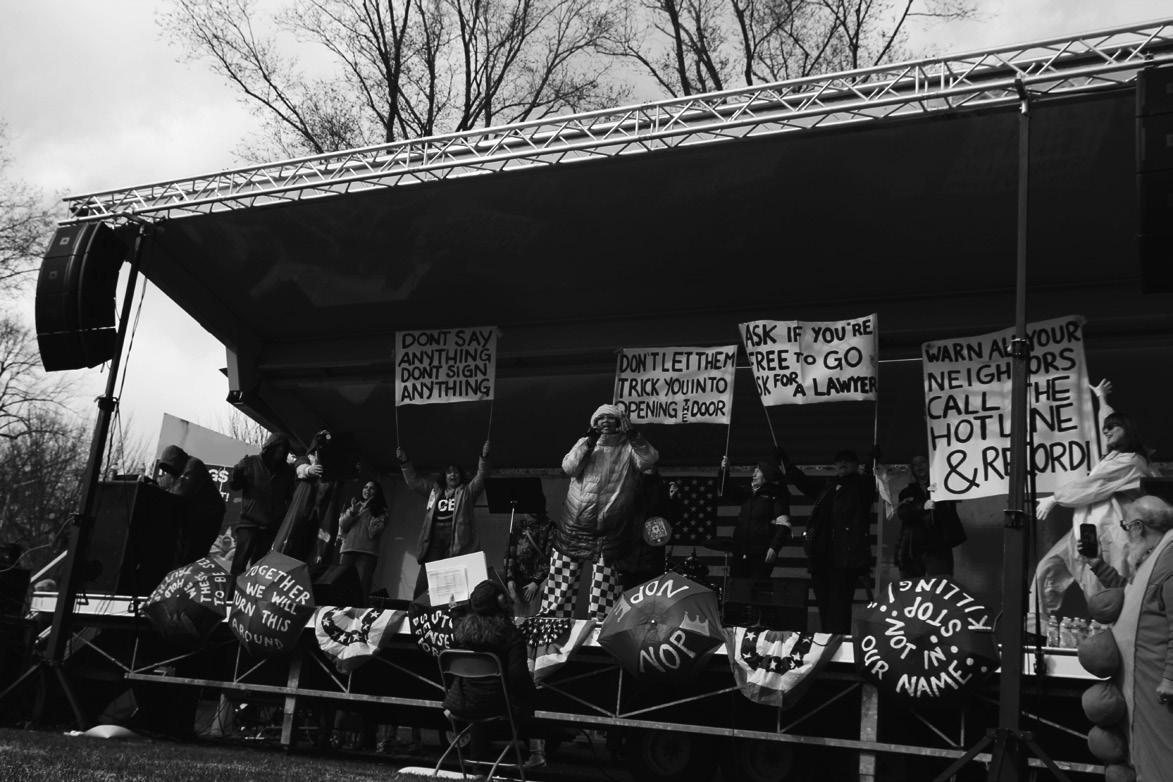
A group of New Haveners, clad in bright colors and carrying paper cranes, sang out advice for resisting Immigration and Customs Enforcement officers at a recent May Day rally on the New Haven Green: “Don’t say anything, don’t sign anything. Don’t let them trick you into opening the door.”
Local activists — like these members of Singing Resistance New Haven, a chapter of the national organization — have mobilized in response to sweeping federal policy changes and their local effects since the beginning of Donald Trump’s second presidential term. New Haven advocates described an atmosphere of anxiety amid both the Trump administration’s immigration crackdown and federal cuts to social services, which have jeopardized local access to food.
The “biggest thing, both for
attorneys and for non-citizens living in the U.S.” is the “uncertainty and how quickly things are changing,”
Maureen Abell, an immigration attorney at the New Haven Legal Assistance Association, said in a phone interview last Friday.
Federal immigration officers have arrested at least five people in New Haven this year as part of the president’s ongoing mass deportation operation. ICE arrests increased by around 300 percent in New England in the first seven months of Trump’s presidency, according to data from the Immigration Research Initiative. Abell pointed to cases of federal immigration officers arresting people while leaving court or at green-card interviews. Although these arrests comprised “a small percentage of cases,” she said, the practice is “still having a huge effect through how afraid it is making people to engage with the system.”
ICE detained a woman from the Hill neighborhood last June and a
Immigration and Customs Enforcement and slashed funding for and access to social services. Local activists and nonprofit leaders continue to protest.
Wilbur Cross High School student the following month. The student, Esdrás Zabaleta-Ramirez, was later released following a ruling by a federal immigration judge. In January 2026, ICE arrested three people in downtown New Haven and another person in a New Haven courthouse. In March, federal agents arrested a nursing student at Southern Connecticut State University, Keyla Vasquez-Zuniga, who was granted bond last week.
Those arrests have sparked an array of local protests. In July 2025, over a hundred people gathered at Wilbur Cross to protest ZabaletaRamirez’ detention. Teachers at the school led a letter-writing campaign attesting to the student’s schoolwork and character. Last month, students and activists rallied at Southern Connecticut State University, calling for Vasquez-Zuniga’s release.
New Haven has also been the site of protests against ICE activity at the national level. In response to the deaths of Renée Good and Alex Pretti this January during the Trump administration’s crackdown in Minneapolis, locals formed the New Haven chapter of Singing Resistance and organized four demonstrations, each with at least a hundred attendees, in January and February.
As organizers gather to protest immigration enforcement actions, nearby city organizations continue to grapple with federal funding cuts and locals describe increased food insecurity due to Trump-era policy.
Integrated Refugee and Immigrant Services, a local nonprofit that aids refugee resettlement, closed its New Haven office in April 2025 after its funding was slashed by the federal government. The organization was also forced to lay off 30 percent of its staff, Maggie Mitchell Salem, the nonprofit’s executive director, told the News in February.
In 2024, Integrated Refugee and Immigrant Services had a budget of over $20 million, most of which was provided by the federal government, Mitchell Salem said in a phone interview last Friday. In 2025, following federal funding cuts, its budget dropped to around $11 million, and this year, it hovers around $7 million, Mitchell Salem said — a number which will continue to decrease as funding to support Afghan arrivals “sunsets” in September. Mitchell Salem called the fallout of federal cuts “painful,” adding that for many immigrants, the organization’s New Haven location was one of the “first places they went to receive support and services” in the United States.
“We’re having to make some very tough choices, and we have to figure out what the people we serve need most,” she said. “What, reasonably, can IRIS do through our food pantry, through our array of program services? And then what do others do, perhaps better than us? And how can we all work together to de-duplicate, to make sure that the most essential services remain available while having to cut back on others?”
The Trump administration’s policy has altered the nonprofit’s partnerships as well as its funding, Mitchell Salem said.
In October, the nonprofit announced that it would not receive refugees from the United States Refugee Admissions Program after the Trump administration moved to prioritize the resettlement of Afrikaners, a white minority group in South Africa.
“We have never really questioned who the federal government was sending. And now we are,” Mitchell Salem said.
Other local nonprofits have felt the impacts of federal actions through
their effects on the populations that these organizations seek to help.
Steve Werlin, the executive director of New Haven’s Downtown Evening Soup Kitchen, wrote in an email to the News that the greatest effects of federal policy “on the food assistance side” have been changes brought on by the One Big Beautiful Bill Act.
The act, which Trump signed last July, tightened the work requirements around eligibility for the Supplemental Nutrition Assistance Program, restricted eligibility for non-citizens, made changes to benefit calculations and shifted payment responsibilities onto states, according to the National Conference of State Legislatures.
“Many of the people we serve have lost eligibility completely, or have seen their monthly allocations through SNAP decreased,” Werlin wrote. He also noted blocked funding to the Emergency Food and Shelter Program, which had been “pumping millions of dollars of food assistance funding directly to community providers across the country.”
Werlin hypothesized that the “atmosphere of fear” created by immigration crackdowns has “made it more difficult for people to access food.”
Kimberly Hart, a member of the board of directors for the Loaves and Fishes Food Pantry, has seen a “drop in migrants coming to the pantry,” she said. Hart said that changes to the SNAP program “disrupt” the lives of “have-nots.” SNAP was “working very well” before the changes, she said.
6,626 New Haveners — about 17.4 percent of the city’s total voters — voted for Trump in 2024, according to the News’ coverage at the time.
Contact NELLIE KENNEY at nellie.kenney@yale.edu.
New Haven fights back against an antagonistic Trump administration
BY EVELYN RONAN STAFF REPORTER
Since the beginning of President
Donald Trump’s second term, New Haven has been targeted by the federal government as part of its crackdown against progressive and sanctuary cities.
The city has responded with a series of coalition lawsuits and amicus briefs opposing the federal government, with local and state officials seeking to distance their political priorities with those of the Trump administration. In March, the federal government sued New Haven back, alleging that the city’s policies impede cooperation between local authorities and federal immigration enforcement.
New Haven has joined five lawsuits and 24 amicus briefs since Trump took office, challenging policies related to immigration enforcement, federal funding, municipal authority and cuts to social welfare programs.
In January 2025, the federal government released a memo which froze roughly $3 trillion in nonprofit and local government funds that provide the essential short-term cash flow allowing cities like New Haven to maintain regular operations. The motion was rescinded just as Mayor Justin Elicker was condemning the action at a Hartford press conference.
A month later, the city signed an amicus brief alleging that the National Institutes of Health’s research funding cuts would destabilize the scientific research ecosystem and pose threats to early-career researchers, lamenting the “slash-andburn philosophy” of the Trump administration regarding crucial funding, according to previous interviews with the News.
Mayor Justin Elicker offered his first major commentary on the federal blows last February at his annual State of the City address, where he briefly alluded to the federal targeting of sanctuary cities like New Haven and disapproved of the Trump administration’s aims to defund diversity, equity and inclusion initiatives.
Soon after, New Haven joined several Democrat-led municipalities in a lawsuit arguing that Trump’s crackdown on illegal immigration violated several clauses that protect municipal
autonomy and unjustly targeted cities like New Haven for their “sanctuary” status.
Last March, when announcing his proposed budget for fiscal year 2026, Elicker emphasized the difference between New Haven’s political posture and that of the Trump administration. Elicker also criticized the unpredictability of the Trump administration’s financial cutbacks, which he said makes it difficult for municipalities to draw up spending plans. He noted that New Haven is exercising “fiscal caution,” and that public entities like New Haven Public Schools rely on funding from the federal government.
A month later, New Haven signed on to another lawsuit, which alleged that recent funding freezes to environment-related initiatives — including the termination of $20 billion in grant funding, $30 million of which was designated for New Haven — were illegal. That March, Elicker lamented the federal government “turning its back on cities” despite binding agreements in an interview with the News.
Later that year, in October, New Haven joined another lawsuit which challenged the Department of Homeland Security’s updated terms and conditions for grant recipients. New regulations required recipients to agree not to “operate any programs that advance or promote DEI, DEIA, or discriminatory equity ideology.”
The lawsuit coincided with last year’s New Haven mayoral race. Facing a Republican challenger, Elicker continued to emphasize New Haven’s “progressive values.”
In a debate, he called the city the “most welcoming” in the world, alluding again to its sanctuary status.
Allie Jacobs, the city’s primary legal counsel, said that New Haven weighs the benefits of joining the legal fight against the federal government against the fact that doing so could invite more scrutiny from Trump.
“We assess whether the city, its interest, or its residents would be significantly adversely impacted by a particular law, policy, or judicial decision,” Jacobs wrote in an email to the News. “Sometimes that takes the form of joining a lawsuit if we have standing, sometimes that takes the form of an amicus brief,
and sometimes that takes the form of other advocacy approaches.”
When announcing New Haven’s participation in the lawsuit against the DHS, Elicker said that he was not concerned with drawing extra attention to New Haven.
“I hear from some of my mayoral colleagues out there that they don’t want to make their cities a target,” Elicker said at a press conference at the time. “Now is a time that we should not be hiding. Now is a time that we should be standing up and fighting for the values of our community, both because at some point we’re all going to be a target anyway, but more importantly, because this is the right thing to do.”
Days after New Haven joined the lawsuit against the DHS, Elicker contrasted the city’s balanced budget with the financial gridlock at the federal level that had resulted in a shutdown.
“We in New Haven are continuing to do things differently by providing transparent, reliable, and stable budgeting,” he said at a press conference on the city’s fiscal outlook. “It’s what our residents deserve.”
Two weeks later, New Haven joined a lawsuit filed by a coalition of municipalities, charities, religious organizations, business and unions against the Trump administration’s decision not to fund Supplemental Nutrition Assistance Program, or SNAP, benefits in the wake of the government shutdown.
In response to the federal government’s cuts to SNAP funding — which Elicker condemned as “cruelty” that “blocked food from the table of 30,000 New Haveners” in a November interview with the News — Connecticut set aside $500 million for an emergency relief fund that subsidized food stamps during the government shutdown.
In December 2025, New Haven joined a fifth lawsuit against the federal government, led by the Public Rights Project, over the federal government’s attempt to claw back over $12 billion in local funding designated for transit and public healthcare programs. The federal government declared that states would need to change policies on DEI initiatives, immigration, and abortion to obtain frozen funds.
Aside from the slew of lawsuits, New Haven has joined in the national effort against the federal deputization of municipal governments and a national crackdown on immigration.
This January, New Haven signed onto an amicus brief backing Minnesota in its lawsuit against the officials who authorized the federal government’s mass deportations.
Elicker doubled down on his effort to distance New Haven ideologically from the Trump administration at the swearing-in ceremony for city officials this year, emphasizing New Haven’s values of “tolerance,” “respect for diversity” and “compassion for our most vulnerable.” He said that the Trump administration’s haphazard funding cuts force city officials to remain vigilant.
Now, a year and a half since his first major action against the federal government, Elicker has continued to define his own ideological posture, as well as New Haven’s, as antithetical to Trump’s.
In his State of the City address this February, the mayor doubled down on his previous criticism of the Trump administration, calling it an “endless dumpster fire of chaos and cruelty.”
Following the dispatch of federal agents to carry out Operation Broken Trust, an Immigration and Customs Enforcement roundup that resulted in the arrest of 65 immigrants across Connecticut, the Trump administration last month filed its own lawsuit against New Haven.
The Department of Justice complaint argued that New Haven’s policies illegally restrict local authorities’ collaboration with federal immigration enforcement, disregard federal law and threaten public safety. The suit, which also named Elicker, Connecticut Gov. Ned Lamont SOM ’80 and Attorney General William Tong as defendants, criticized New Haven’s enforcement of the Trust Act, which prevents the “deputization of local and state law enforcement for immigration enforcement.”
A 2025 “Year in Review” message from Tong criticized the Trump administration’s “cruel, dangerous, and hurtful agenda,” adding that his office would not relent in its protection of Connecticut families.
Rep. Rosa DeLauro, who represents New Haven in Congress, blasted
Trump for “pursuing politically motivated lawsuits targeting our state for not carrying out ICE’s extreme enforcement agenda.”
“President Trump’s actions are hurting working families, making it harder for them to afford basic necessities,” DeLauro said in a statement sent to the News by a spokesperson. “We must fight back, and New Haven and Connecticut are leading the way by challenging the Trump administration’s actions in court. Many of these cases have already been successful and restored funding to our communities.”
In a phone interview with the News, Elicker said the city had been “prepared all along for a possible lawsuit” but emphasized New Haven’s compliance with federal law. “We can see that similar Trump lawsuits across the nation have already been thrown out,” the mayor said.
“Trump is trying to force us to settle and carry out immigration policy, but that is not our job,” Elicker added.
Several of the city’s legal challenges have already produced major rulings. One federal judge blocked the Trump administration from withholding federal funding from sanctuary jurisdictions, siding with New Haven, and another ordered the restoration of roughly $31 million in frozen environmental grants owed to the city, though the Trump administration has appealed portions of that ruling.
Some legal disputes remain unresolved, including the litigation over DHS grant conditions and broader fights surrounding immigration enforcement. Elicker seems to have no intentions of backing down. He said that his approach differs from those of his colleagues across Connecticut.
“Some have spoken out, but some have remained under the radar, and I don’t think that’s the right thing to do at this moment,” Elicker said. “We have to fight for what we believe in.”
The Department of Justice does not currently have a permanent attorney general.
Elijah Hurewitz-Ravitch contributed reporting.
Contact EVELYN RONAN at evelyn.ronan@yale.edu.
Donald Trump’s second presidential term has jolted New Haven with arrests by
“Not much longer shall we have time for reading lessons of the past. An
After deportation flight controversy, an uncertain future for Avelo
BY QAMAR AL-TAMEEMI CONTRIBUTING REPORTER
2025 was a tumultuous year for New Haven’s leading airline.
After Avelo Airlines announced last April that it would begin chartering deportation flights for the Department of Homeland Security, activists in New Haven and across the country organized a boycott and put up billboards publicly decrying the company’s decision. Local organizations suspended their partnerships with the company.
After nine months of pushback, Avelo announced in January that it would pause the charter flights. Avelo representatives and community activists presented different claims about why the company ultimately ended its contract with DHS — and what the episode means for Avelo’s future in New Haven.
“They’ve got a lot of work ahead of them to earn back the trust of this state, and I hope that they can,” Connecticut Attorney General William Tong wrote in a statement after Avelo announced it would end its partnership with DHS in January. The Connecticut attorney general’s office declined to comment for this article, directing the News to the earlier statement.
Avelo’s leadership initially described its partnership with DHS as a means of boosting revenue amid poor performance at Tweed-New Haven Airport, where the airline dominates traffic. In an email to Avelo employees announcing the contract, CEO Andrew Levy cited his company’s poor performance and noted that the first quarter of 2025 yielded its worst quarterly results since 2023, the News reported at the time.
A petition created by the New Haven Immigrants Coalition entitled, “We Won’t fly Avelo until they stop ICE flights!”
received over 40,000 signatures.
Several protests occurred against the airline at Tweed Airport, with an April protest drawing a crowd of about 200, including Sen. Richard Blumenthal LAW ’73, three New Haven alders and state Rep. Juan Candelaria.
Avelo announced in January that it would pause charter flights for DHS. In an internal email to Avelo staff obtained by the News, Levy said the partnership “provided short-term benefits” but acknowledged that the revenue was not high enough to “overcome its operational complexity and costs.”
Courtney Goff, an Avelo spokesperson, wrote in an email to the News that the company’s partnership with DHS did not impact the number of customers that chose to fly Avelo, citing increased customers on commercial service in 2025 compared to 2024.
“We stopped DHS flying because it was too infrequent to produce the anticipated revenue,” Goff wrote in an email to the News. “We chose to utilize the planes elsewhere and recapitalize our network and fleet.”
But local activists said it was the local community’s pressure campaign that ended Avelo’s collaboration with the DHS.
“They say it was about cost and complexity, but community pressure told the real story,” CT Students For A Dream, a local organization involved in protesting against the airline, wrote in a social media post in January.
In a case study by the Coalition to Stop Avelo, a national activist group organized in light of the company’s contract with DHS, organizers attributed Avelo’s decision to a “sustained pressure campaign that Avelo could no longer ignore” and acknowledged the alliance of various activists involved in protesting against Avelo.
“Even though we were the ones who started with the campaign, at the end, there was this national pressure that really changed everything around what happened with this company,”
John Lugo, the community organizing director of the local immigrant activism group Unidad Latina en Accion, said in a phone interview.
Protests against the airline occurred at several other airports across the country, including Wilmington Airport in Delaware and Mesa Gateway Airport in Arizona. New Hampshire state Rep. Seth Miller created several billboards that urged, “Don’t Fly Avelo.” Anne Watkins, an organizer with the New Haven Immigrants Coalition, highlighted the diverse alliance of community members and organizations that committed to the Avelo boycott, including groups like the New Haven Federation of Teachers and community organizing
group New Haven Rising.
Regarding perceptions of Avelo now, Watkins said she thinks “people have a lot of different opinions about it.”
“Some people feel like, ‘Okay, they stopped the contract. We should fly them again.’
Some people feel, ‘Yeah, they stopped the contract, but they never apologized. They never acknowledged the harm that they caused.’” Watkins said.
Several local organizations, including Faxon Law New Haven Road Race and Puerto Ricans United Inc. severed ties with Avelo in light of their decision to partner with DHS. The road race terminated their existing sponsorship agreement with the airline in July. Puerto Ricans United Inc., which had previously received support from the airline, preemptively cut ties with the airline ahead of its 2025 Puerto Rican Festival.
In July 2025, Mayor Elicker prohibited the use of public funds to fly Avelo in a memo sent to city employees, as reported by NBC CT. In a phone interview on Tuesday, Elicker said the city had since lifted the policy.
Puerto Ricans United Inc. board president Joe Rodriguez wrote in an email to the News that since first announcing it would not again partner with Avelo, the airline had not approached the organization for a new sponsorship, and that the non-profit did not “plan to proactively reach out.” According to data from the United States Department of Transportation, Avelo’s parent company, TEM Enterprises, carried out 88.35% of flights at Tweed Airport from March 2025 to February 2026.
Contact QAMAR AL-TAMEEMI at qamar.altameemi@yale.edu.
Even after monthslong scandal, ex-chief remembered for community ties
BY EVELYN RONAN STAFF REPORTER
It hasn’t been a career-high year for Karl Jacobson. In January, Jacobson, then the chief of the New Haven Police Department, abruptly resigned from his post as chief and later turned himself in on an arrest warrant for two charges of larceny. He allegedly embezzled a combined $85,500 from two city funds, one intended for paying confidential informants in the narcotics unit and the other for the city’s Police Activity League. According to an affidavit, Jacobson bet more than $4 million on online gambling platforms during the time he was allegedly embezzling the funds. In April, the chief pleaded not guilty to the two larceny charges against him.
But even as his department moves on from him — on May 5, the city swore in David Zannelli, who was among the three assistant
chiefs who confronted Jacobson with allegations of embezzlement — New Haveners remembered his tenure as an era of progressive strides on community engagement.
“He had the closest relationship to affected communities of any chief I’ve seen,” Paul Bass ’82, the founder of the New Haven Independent and longtime reporter on local policing, said in a phone interview. “I’ve been shocked at how little I’ve seen of that personal scandal reverberating at a larger scale.” Bass elaborated that the grievances about Jacobson allegedly stealing funds were limited to him and did not taint the department at large.
In a phone interview with the News, Mayor Justin Elicker said he didn’t doubt that Jacobson “cared about New Haven.” But he struck a colder tone, emphasizing that the transparency-focused approach that Jacobson championed also extended to his removal.
“It’s important to understand
REETI MALHOTRA / CONTRIBUTING PHOTOGRAPHER
Karl Jacobson resigned from his post as the chief of the New Haven Police Department in January after being confronted with allegations of larceny. But locals still remember him for his “comforting” leadership and focus on community engagement.
the fact that holding Jacobson accountable builds more trust in the community,” Elicker said. “When we talk about accountability, this is what we mean.” According to Bass, it wasn’t policy shifts that marked Jacobson’s term, but his overall “de-emphasization of arrest” and a focus on community ties.
“A good policy doesn’t work if you don’t have trust of the community, if you haven’t been in people’s kitchens and living rooms during tough times and helped them navigate crisis,” Bass said.
Zannelli, an 18-year veteran of the NHPD, has suggested he wants to continue Jacobson’s legacy of strengthening collaboration between the police and local community.
Jacobson’s people-first approach took center stage in the wake of Randy Cox’s arrest. New Haven police arrested Cox on June 19, 2022. He was handcuffed and placed in a police car without a seatbelt.
The officer driving the car, Oscar Diaz, made a hard stop, which caused Cox to slam into the front of the vehicle. In body cam footage released promptly after the incident, Cox could be heard saying that his neck felt broken.
Diaz called for medical assistance but continued driving instead of waiting for paramedics to arrive and attend to Cox, who was then dragged face down into a holding cell, according to the police report. He could not move and repeatedly tried to get the officers to stop moving him.
Officers in the footage can be heard saying Cox was “faking it” and doing “extra s—” before they dragged him out of the vehicle. The officers’ “reckless” treatment of Cox, a New Haven Police Department Internal Affairs report found, led to his ultimate paralysis. Cox is now in a long-term care facility.
Jacobson moved to release bodycam footage of the incident and address the officers’ violation of conventional policy immediately after the incident. In March 2023, after the release of the Internal Affairs report, Jacobson called for the dismissal of the
involved officers, who were fired in August of that year.
“I think the community has asked us to be transparent and swift,” Jacobson said while announcing his choice to call for the officers’ dismissal, according to News coverage from the time.
“We have put a lot of thought and investigation into this decision. We want to make sure that everything is done right, so that through this hearing, justice can be done.” Bass speculated that if Jacobson had handled the incident differently, “we would have the potential for riots.”
“He had such a great connection with the people who were understandably upset,” Bass said.
“He and the mayor got so much good information right away, rather than being defensive, which another chief would’ve been.”
Michael Lawlor, a former state representative and a professor at the University of New Haven’s Henry C. Lee College of Criminal Justice and Forensic Sciences, said that Jacobson reached out to Cox’s family immediately after the incident.
“That instinct to do something very uncomfortable immediately is a significant attribute of Karl,” Lawlor said.
Jacobson later instituted a new policy in reaction to the Cox incident dubbed “medical Miranda,” where officers transporting prisoners are required to ask if they need medical attention. Jacobson also co-signed a judge’s decision not to expunge the records of the officers involved in Cox’s arrest. Diaz, the officer driving the police car during the arrest, was later reinstated under Jacobson’s leadership.
“He was big on procedural justice,” Lawlor said, describing it as a central aspect of Jacobson’s policing philosophy.
“If you’re a cop and you’re dealing with a citizen, it’s extremely important to explain what you’re doing. He really instilled among the rank-andfile cops the importance of this.”
Lawlor said Jacobson also emphasized policing strategies that acquainted officers with particular neighborhoods — such
as walking beats, in which officers patrol neighborhoods on foot rather than in a car.
“When I came to New Haven, I became a better cop and a better person because I walked a beat,” Jacobson said in a WNHH Community Radio interview six months into his term as chief. 15 years on, he still maintained community ties from that time, Jacobson said in the interview.
Lawlor said he considers Jacobson’s community-focused approach to be the crux of his term as police chief.
“If you’re gonna be a police chief anywhere, you have to be sort of a politician,” Lawlor said.“A lot of cops have a tunnel vision approach to their job, but as a chief, you have to deal with the community, you have to explain things, and you have to be comforting. Karl really had that skillset.”
Bass, the longtime reporter on local policing, contrasted Jacobson’s controversy to a 2007 NHPD scandal in which a group of top cops stole thousands of dollars of reserved police department funds, prompting the departure of then-chief Francisco Ortiz.
The NHPD appointed James Lewis soon after in 2008, a chief who had never before worked in New Haven and took an “aggressive” approach to policing reminiscent of NHPD’s militaristic crackdown in the 1980s. Lewis was responsible for 20 arrests in his first week as chief.
Bass said the fact that the city hired Zannelli “from within,” instead of hiring an outsider, “means this is so different from 2008,” adding that Zannelli maintained his predecessor’s community-focused approach to policing.
“Zannelli has really good relationships with people from working in different neighborhoods,” Bass said. “He’s built up an extraordinary level of goodwill and trust in the community.”
Karl Jacobson was sworn in as police chief on July 7, 2022.
Contact EVELYN RONAN at evelyn.ronan@yale.edu.
ZOE BERG
“My advice to you is not to inquire why or whither, but just enjoy your ice cream while it is on your plate.” THORNTON WILDER 20 AMERICAN WRITER
Seniors reflect on their experience within Yale’s music scene
BY GEMARD GUERY STAFF REPORTER
Every fall, many first years at Yale weigh how they’ll take part in one of the University’s largest selling points, the music scene, through everything from a capella rush to Yale Symphony Orchestra auditions. Now on their way out, four seniors spoke to the News about their participation in Yale’s music scene, its impact on their Yale experience and what’s next for them.
held through Yale’s Schwarzman Center and opened for celebrities such as Cécile McLorin Salvant and John Legend.
Originally, Joseph came to Yale planning to double-major in both global affairs and music. Instead, she tested out classes across many different fields and departments until she landed on Ethics, Politics and Economics. She said her interdisciplinary major, alongside her music experience, opened her eyes to the nature of Yale’s liberal arts education.
The bassist
For Thara Joseph ’26, music has always been an important part of her identity. A bassist from Jacksonville, Florida, in Grace Hopper College, Joseph began playing the piano regularly in elementary school.
“Every day, I knew I had at last ninety minutes of playing per day,” said Joseph in an interview.
“That really started in sixth grade, and it stayed consistently until I graduated, so it was very intensive in that way.”
Joseph attended a magnet arts program for both middle school and high school, where her passion for music intensified. She was a part of her city symphony orchestra and youth symphony orchestra, where she played the French horn, and in her senior year of high school, she was accepted into a jazz combo through the Jazz Education Network, which connects young musicians with professionals in the field.
But as Joseph was preparing to come to Yale, she anticipated putting music on the back burner, focusing on academics instead and seeing where Yale would take her.
“I didn’t know if I was going to be able to play and practice at the same frequencies that I had been for many, many years,” Joseph said.
But when Joseph found herself unable to practice playing music every day during the First-Year Scholars program, she said she realized how little she enjoyed that experience. In fact, during the program, Joseph went to a local pawn shop and bought a bass bundled with an amp so she could practice.
“Looking back, even that moment should have clued me into how important music was as a core part of my daily routine and how hard it would have been to just drop it,” Joseph said.
Joseph has been a bassist for the Yale Jazz Ensemble during the entirety of her undergraduate experience, playing in musical productions like “The Wiz” and “For Colored Girls.”
She got to gig professionally with graduate students at the Yale School of Music on a regular basis, and she has performed for events
songwriters club at her high school, and Polanco would perform at open mics as early as third grade alongside high school aged students. By the time she entered Yale, Polanco had already released an album with 10 songs.
Polanco was drawn to Yale’s theater and acting scene when she first arrived at Yale but knew she wanted to continue singing and songwriting.
“I just knew I wanted to keep going, no matter where I ended up,” said Polanco. “I just got lucky I was able to go to a school that had a student record label that had a bunch of people willing to help bring this music to life.”
Polanco was a member of the Shades of Yale for her first three years at Yale and a frequent participant in theater on campus. She was also an active part of 17o1 Records, the student record label that helped Polanco release many of her own projects.
For a while, Polanco was reluctant to pursue a career as an artist, but her time at Yale showed her that it is possible.
“I’ve met people that turned this pipe dream of going into this career as an artist into something that could actually happen,” Polanco said. “I love the fact that I can hear my best friends performing at Chi Psi from my bedroom window. There are not many places you can do that, be able to have that experience where you’re literally living in a small little bubble of performing artists. I’ll miss that a lot.”
While she enjoyed her experience as an environmental studies major, it is not what she hopes to pursue professionally. Following commencement, Zaida plans to pursue music in Los Angeles while working in marketing with a company that has a creative entry point. She also hopes to continue auditioning for theater and film.
The Whiffenpoof
“I realized I don’t have to choose one path here. I feel like I’m the type of person where I want to have my hands in many different pockets,” Joseph said.
“Because of all that time I was able to still invest in my craft, it really had me making that shift into considering pursuing music in a more serious and intentional way.”
Joseph says she will miss Yale’s vibrant community the most from her music experience as she leaves Yale.
“You get to meet so many different people, and a lot of people, I don’t think I would have ever crossed paths otherwise,” said Joseph. “There’s such an emphasis on collaboration here when it comes to the arts, where it’s music that feels good, it sounds good, and it’s enjoyable.
I’ll miss that a lot.” Joseph hopes to someday work in the more executive side of the music industry.
“There’s a need for more artists as industry leaders, so that we can increase artist advocacy and bridge what can sometimes be misunderstandings between creatives and executives,” Joseph said.
Following graduation, Joseph will be staying in New Haven as a Chauncey Fellow, where she will be developing a servicebased arts project. She plans to continue gigging throughout her time as a fellow.
The singer-songwriter Zaida Rio Polanco ’26 has been passionate about music for as long as she can remember. An environmental studies major from White Plains, New York, Polanco grew up with a dad and brother who were both singersongwriters, contributing to Polanco’s decision to do the same.
Polanco grew up watching her dad play for weddings and her brother, who is 11 years older than her, play drums for her dad’s band.
“There was always music playing in the house, and they let me find my own genre that I liked,” Polanco said in an interview with the News.
Polanco was writing songs when she was as young as three years old. Her dad ran the
He also became a member of the Whiffenpoof class of 2025, where Yale seniors take gap years to perform worldwide, something he said he had no intention of being a part of originally.
It wasn’t until a friend from TUIB encouraged Colbert to audition after sharing her own experience that Colbert considered becoming a Whiffenpoof.
“The idea of being a professional amateur musician or an amateur professional was kind of appealing to me,” Colbert said. “I spent so much time doing music stuff here that I was like, I really wouldn’t mind doing essentially just that for a whole year.”
Colbert enjoyed his time as a Whiffenpoof, which allowed him not only to have a fun experience but also gave him the opportunity to reflect on what he wanted his life after Yale to look like.
For Colbert, music was also a means of finding his community at Yale.
“Being involved in music here was a wonderful way to be engaged with campus life,” he said. “I think playing music together is a really interesting and unique way to form bonds with people and it means a lot to me.”
For John Colbert ’26, the Yale journey was unlike what he originally anticipated. A humanities major, he originally matriculated in fall 2020, as a member of the class of 2024, but took a gap year due to the pandemic to get more out of his Yale experience.
Colbert played the drums often in his hometown of Montclair, New Jersey, gigging with jazz bands through his time in middle school and high school. He also participated in an after school and summer program where local musicians help youth create their own ensembles.
Colbert’s older sister attended Yale and recommended that he try out for Yale’s Tangled Up in Blue — or TUIB — a folk music group. While Colbert’s sister was not a part of the group, he said she always enjoyed watching them perform.
“It was a big event for her and her friends to go to every year. She was like, ‘You should do this.’ Colbert said in an interview with the News. “So then I auditioned, and that’s been a big part of my time at Yale. That’s really what made me take singing more seriously as something that I did here.”
Colbert eventually served as the musical director of TUIB during his junior year, in addition to participating in bands and theater on campus.
As Colbert prepares to leave Yale, he said he already feels nostalgic about his time in the music scene and how it became a serious endeavor.
“In some ways, the things that I’ll miss about playing music here are the things that I’ll miss about not being as young as I am now,” he said. “I’ll miss the strange, infinite possibility of college that is so, so alluring when you’re here.”
Following commencement, Colbert hopes to move to New York and continue playing with his band, Dog Boy, which he began during his time at Yale. There, he hopes to engage in the city’s art scene while he continues searching for a job separate from his creative endeavors that he finds fulfilling on a personal level.
The concert pianist
Paul Ji ’26 has been a well known and distinguished musician for years. A philosophy and music double major from France, Ji has been playing the piano since he was 4 years old.
Ji participated in many international competitions when he was younger, winning almost all of them, which further fueled his passion for music, specifically the piano.
“I did the Steinway competition for seven years, consecutively, and fortunately, I won all of them and that motivated me to continue,” he
said in an interview. “But at one point, I decided that music was much more than competitions, and there was so much joy to be found in connecting with people through music.”
When Ji was 15, he recorded his first album after winning a national competition in France. Ji’s second album, the one he recorded while at Yale, will be coming out in early 2027.
Much of Ji’s Yale experience was finding the perfect balance between his professional piano career and his academic interests.
“I very much appreciate the liberal arts, and I really wanted to delve deep into philosophy,” he said. “I also felt that it would help my music, that it would give me more insights and more intellectual experience.”
The majority of his sophomore year was devoted to learning the work of Polish composer Frédéric Chopin. Ji’s next album, recorded in Sprague Hall, consists of the full 24 preludes by Chopin, accompanied by other pieces.
This year, Ji had the opportunity to perform with the Yale Symphony Orchestra as the winner of the William Waite competition, where he played Chopin’s second concerto, a romantic piece he performed on Valentine’s Day.
Ji’s talents have brought him all over the world throughout his time at Yale. During his sophomore year, he performed his debut recital in Paris at the Théâtre des Champs-Élysées. Since then, he’s played in Vienna in spaces where famous musicians such as Beethoven have performed.
While Ji wasn’t a consistent part of any music group, his experience continuously demonstrated to him how strong the musical community at Yale is. He often participated in graduate piano classes in Sprague Hall and would play alongside experts in the field.
“Meeting musicians who are also very intellectually driven and invested in many, many different fields has been a gift,” Ji said.
Ji hopes to continue to build his career as a concert pianist while simultaneously finding solutions and strategies to make classical music more accessible.
“It’s really such a great art that can help people transcend, and I think more people deserve to know it,” he said.
Following graduation, Ji will be pursuing his master’s of music in piano at the Juilliard School.
Contact GEMARD GUERY at gemard.guery@yale.edu.
COURTESY OF THARA JOSEPH Yale has an incredibly vast music scene, from student bands to a cappella to orchestra. Here’s how four graduating seniors took advantage of it.
COURTESY OF PAUL JI
RACHEL MAK / PHOTOGRAPHY EDITOR
ARTS
“Any
Under Bundy, drama school went tuition-free and saw a cultural shift
BY KIVA BANK STAFF REPORTER
The office of James Bundy DRA ’95, who is retiring from his posts at the David Geffen School of Drama and the Yale Repertory Theatre, is set to be cleared out by the end of June.
But for now, the room’s blue walls are still covered with framed posters from student thesis productions Bundy has seen throughout his 24-yearlong tenure — the longest of any Drama School dean to date.
“The theater is filled with mementos,” Bundy, who has served in his role as dean and as the Yale Rep’s artistic director since 2002, said in an interview with the News. His office is laden with keepsakes, each object hinting at a piece of his life and work at Yale. Beneath his coffee table sits a “Shakespeare Lexicon and Quotation Dictionary,” a nod to the “Acting Shakespeare” undergraduate course he will continue to teach after stepping down this summer.
Nearby is a gold-painted leg signed by an Estonian clown who performed at the Yale Rep this past season, and on Bundy’s desk sits a Funko Pop gifted to him by Nancy Yao, the assistant dean of student life at the drama school.
The figurine is styled in his likeness — bald, wearing clearframed glasses — and the diploma it holds echoes Bundy himself, who earned his MFA in directing from the School of Drama in 1995.
“The school completely changed the direction of my career, and opened up a world of opportunities,” he said. Prior to his appointment to the Drama
his final year as a student. She said she can still recall his 1995 thesis production of “Three Sisters.”
“He created these images that were really strong,” Sheehy said.
“I can still see Protopopov in his white suit, sitting and smoking.”
She said that Bundy’s training as an actor enabled him to understand players better as a director, and that in her mind, “he was always sort of an old soul.”
Sheehy recalled that Bundy balanced his studies at the drama school with his responsibilities as a husband and a young father.
“I remember him wheeling around his kids at the time,” she said.
Bundy said that his time as a student at the Drama School aided him when he took his place at its helm, helping inform his understanding of the school’s potential.
When he stepped into the deanship, Bundy said that both the search committee that had appointed him and then-University president Richard Levin ’72 ’74 were clear in communicating their priorities for the school. He said there was a general agreement to rank financial aid as the top priority, followed by faculty compensation and new facilities.
“24 years later, we still haven’t broken ground on that building, but we’re close,” Bundy joked, referring to the Dramatic Arts building set to be completed in 2029.
The seven-floor structure will house the Yale Repertory Theater, the David Geffen School of Drama and the undergraduate Theater, Dance and Performance Studies department in one space.
“James willed this building into being,” Sheehy said. “James has had to have extraordinary persistence. The administration has changed. The
school’s priorities during the first five years of his tenure, the desire to increase financial aid for students was unanimous amongst faculty.
“He pursued that goal assiduously, and it took the better part of nearly 20 years,” Diamond said. She described Bundy’s skills as those of “remarkable systems analyst,” which enabled him to establish a plan to go tuition-free.
In 2021, nearly twenty years into Bundy’s deanship, entertainment mogul David Geffen donated $150 million to the Drama School. The
School, Bundy served as the artistic director of Great Lakes Theater Festival, as well as the associate producing director of the Acting Company in New York City and as managing director of Cornerstone Theater Company.
Posters for two different student productions of “Hedda Gabler” — the last play that Bundy himself directed at the Yale Rep while serving as its artistic director — hang in his office. During his tenure at the Rep, he also directed productions of Shakespeare’s “Hamlet” and “All’s Well That Ends Well.”
Liz Diamond, the chair of the directing program at the David Geffen School of Drama, told the News she is “a little bit in denial” about the change in leadership at the school. She said was glad to see Bundy “pour his heart and soul” into the Yale Rep’s production of “Hedda Gabler.”
“I was really moved by the work,” she said in a phone interview with the News. “I’m sure that was partly because I knew it was his last production as dean and artistic director.”
Diamond said she first met Bundy in fall 1992, when he was one of four students in her directing seminar.
She described him as “surpassingly conscientious,” an “indefatigable researcher” and a “wonderful thinker.”
Catherine Sheehy DRA ’92 ’99, who is currently the chair of dramaturgy and dramatic criticism at the Drama School and a dramaturg at the Yale Rep, was a first-year faculty member when Bundy was in
president has changed, the provost has changed more than once.”
At the same time, Bundy has been driven by his desire to decrease student indebtedness, which he said was a major problem when he first began his tenure.
According to Bundy, debt for School of Drama students in 1982 averaged $10,000, or roughly $34,000 in today’s dollars, and the average debt for the class of 2005 was around $45,000, or $75,000 today. The average student today graduates from the school with about $16,000 in debt — around a 50 percent net reduction from 1982 and an 80 percent net reduction from 2005.
Sheehy said that when she graduated from the drama school in 1992, her student loan payment was $575 per month, which she characterized as “enormous.”
She said that the financial aid program did not offer much grant aid at the time, but that when Bundy arrived as dean, he immediately started working to increase financial aid. Diamond said that the first full faculty meeting under Bundy’s leadership marked a change from the previous dean’s style.
“We really didn’t have very lively faculty meetings under the previous dean,” Diamond said, but under Bundy, “we began with a physical warm-up led by the acting teacher who taught movement.”
“For the first time in history, faculty and staff of the drama school were jumping up and down together and sweating,” Diamond said.
She said that when Bundy led a discussion to determine the
gift allowed the school to become tuition-free for all full-time students in perpetuity, and the school was renamed in Geffen’s honor.
Before the donation, Bundy oversaw a need-based student aid program, according to Sheehy, and also played a key role in establishing 70 of the school’s 91 named scholarships.
In 2008, Bundy helped facilitate funding for living stipends and summer support for playwriting students through a bequest from playwright Eugene O’Neill and Carlotta Monterey, which he said made Yale’s playwriting program
competitive with other fully-funded MFA programs. As a result, all students in the playwriting program — of which there are three per year — receive stipends to cover their living expenses during both the academic year and summer months, in addition to full-tuition scholarships.
Chantal Rodriguez, associate dean of the Drama School, said in a phone interview with the News that Bundy’s dedication “to decreasing the overall indebtedness of alumni” has formed part of his legacy.
During the first year of the pandemic, the Drama School saved roughly $3 million in production costs because it did not put on any plays. The school then used the excess funds toward tuition and living stipends to offer a fourth year for students in the classes of 2021, 2022 and 2023 free of charge, Bundy said.
Diamond also praised Bundy for his dedication to establishing a shared leadership model among the associate and assistant deans, which promotes collective decision-making.
“You cannot make theater if you are a person who insists on flying solo,” Diamond said. “It’s a form of practicing for civilization, and I think that the fact that James, in his own practice as a leader of our school and theater, strove to lead collaboratively, was remarkable.”
Bundy also brought about a cultural shift at the school, according to Sheehy.
For years, the acting program followed a longstanding tradition of admitting 10 men and six women each year, based on the belief that classical repertory, particularly Shakespeare, required more male actors, Sheehy said. But students argued that the policy was both discriminatory and no longer beneficial to their training, and Bundy removed the quota.
Evan Yionoulis ’82 DRA ’85 was recently announced as Bundy’s successor. The outgoing dean characterized Yionoulis as his former mentor, as he worked as her teaching assistant during the summers of 1993 and 1995 when she taught acting for a Yale program.
“She asked me, to the effect of, ‘How would you want people to describe your leadership style?’” he said, recalling the time when Yionoulis was involved in his selection. “I said that I would want to lead with my heart.”
Diamond said Bundy is known to read the application of every single incoming student as well as memorize their names and proper pronunciation before orientation. As of last fall, the school enrolled 240 students, according to the Office of Institutional Research.
“That is just an example of his deep commitment to this community, and it makes everybody step up,” Diamond said. Bundy also hosts an annual barbecue in the backyard of his house in Westville, a tradition he said started when he moved into the home with his family around the time his deanship began. He said he recalled thinking, “Oh, the whole school could fit in this backyard.”
1“It’s a nice way for people to be together at the outset,” he said. “We’ve had 10,000 guests at our house over the course of the decades, and that’s felt like a really meaningful experience.”
In April, Diamond said, the school was able to return the favor and host a farewell party in celebration of Bundy with all students, faculty and staff.
“There were a gazillion balloons that were shaped like hearts, which has extra meaning for a dean who had at least two open heart surgeries during his tenure,” she said.
Sheehy said that Bundy’s “openheartedness” and “open door” policy as a dean will be hardest to replace.
“I always think that it’s a sign of good character if you’re willing to be a fool for love,” Sheehy said. “James is willing to be a fool for his love of this institution, and he’s willing to be humble in that way and enjoy a joke and see the funny side.” Bundy graduated from Harvard College in 1981.
Yionoulis, who previously served as the chair of acting at the drama school, also served on the search committee when Bundy was hired, he said.
Contact KIVA BANK at kiva.bank@yale.edu.
DAVID GEFFEN SCHOOL OF DRAMA
James Bundy DRA ’95, the longest-serving dean of the David Geffen School of Drama, oversaw the historic change to the school’s financial aid policy that eliminated tuition costs. Bundy’s colleagues described his leadership as “remarkable.”
ELLIE PARK / SENIOR PHOTOGRAPHER
“I would rather be governed by the first 2000 people in the Manhattan phone book than the entire faculty of Harvard.”
With high hopes, Yale continues to invest on Upper Science Hill
BY SARA AGRAWAL STAFF REPORTER
One corner on campus has experienced a particularly expensive transformation over the past four years.
The University had poured hundreds of millions into the development of Upper Science Hill, with the aim of setting Yale apart in the fields of physics, the applied sciences and engineering. University leaders have consistently emphasized their hopes to place Yale at the forefront of cutting-edge scientific fields like quantum computing.
“The USHD reflects a long-term commitment to securing Yale’s leadership in scientific discovery and innovation in order to contribute meaningfully to addressing the world’s present and future challenges,” Michael Crair, Yale’s vice provost for research, wrote in an email to the News, referring to the Upper Science Hill Development project.
In a February interview with the News, Yale President Maurie McInnis identified investing in the physical sciences and engineering as the “top priority” of the University, and in her end-of-year message to the Yale community, she singled out the University’s “strides in reimagining Science Hill.” When Linda McMahon, the United States’ secretary of education, toured Yale in April, she called the construction on Upper Science Hill Construction “incredible.”
Yale’s 2023–24 financial report stated that out of the University’s $614 million in capital spending, which includes “renovations” and “acquisitions and new construction,” 12 percent — around $75 million — went into biological and physical sciences. That figure rose to over $190 million — 29 percent of $661 million — in the 2025 fiscal year.
When asked why he thought Yale was investing so heavily in
engineering and physical sciences, physics professor Karsten Heeger emphasized the importance of Yale’s frontier scholarship in those fields as well as the humanities.
“Yale has always been leading in various fields, including the humanities, for example,” Heeger, who is also the director of the Yale Wright Laboratory for experimental nuclear physics, particle physics and astrophysics, said. “Science and engineering and technology is absolutely essential for society and our modern world. If we want to be a leading research university, we have to be cutting-edge in those fields.”
The development of Upper Science Hill is a decade-long project that has been planned in two phases.
According to Heeger, the first phase, which began in 2022 and broke ground in 2024, is set to be completed this fall.
This phase involves the construction of a new Advanced Instrumentation Development Center and replacing an old part of the Wright Lab.
Heeger said that the renovation will bolster the Wright Lab with “state-ofthe-art laboratories that will give us the vibration isolation, the environmental control, all of the things that we need, the infrastructure for cutting-edge research.” That transformation will provide new research opportunities for both undergraduate and graduate students, Heeger added.
The second phase of the Upper Science Hill development project will see the completion of a new Physical Sciences and Engineering Building, or PSEB, Heeger said.
“The idea was to build a building complex that brings together research groups from physics, physical sciences, and the engineering departments and mainly with the focus on quantum science and material science,” he said.
Crair wrote that the building complex will foster “cross-
disciplinary collaboration.”
In total, the building will house around 50 research groups, according to Heeger. Heeger also said that the physics department has made new appointments in quantum science and atomic, molecular and optical physics, but that exact final number “remains to be seen.”
The development of Upper Science Hill follows a 2018 report of the University Science Strategy Committee, or USSC, which states that “tomorrow’s leaders need a solid grounding in STEM so they can understand the world and shape its future” and outlines investments the University might make to improve STEM at Yale. The report suggested that the University invest in graduate students, advance instrumentation, update core facilities and promote diversity in the STEM pipeline.
The report also emphasized that the School of Engineering and Applied Sciences, or SEAS, would play a vital role in the future of science at Yale and “must be fully integrated into the fabric of the University.”
In 2022, following another report from a SEAS strategic planning committee in 2021, the University announced major investments in applied sciences and engineering and the separation of SEAS faculty from the Faculty of Arts and Science.
A focus on quantum Quantum science has been one of the focuses of Yale’s investments in engineering and applied science. The field, which studies the smallest units within atoms that act both as particles and as waves, is used both in physics and in computing and was one of the “five ideas of priority investment” highlighted in the 2018 USSC report.
Speaking about the research in Wright Lab, Heeger said that “quantum science is intrinsic to all what we do.”
Shaun Pexton ’26, the co-president of Yale Undergraduate Quantum Computing, called quantum the “shining beacon of Yale engineering” in an interview with the News. Pexton said that he’s noticed growing attention around quantum during his time at Yale as the “race” of quantum technology has made its way into “political conversations” and as Yale has gained recognition as a place where “a lot of cool stuff is happening.”
In her end-of-year message, President McInnis said that the new facilities on Science Hill will “supercharge quantum science at Yale.” The Yale Quantum Institute will be relocated from Hillhouse Avenue to the PSEB, according to its website.
In the message, President McInnis also mentioned professor Michel Devoret, who won a Nobel Prize in 2025 for his work in quantum physics, and QuantumCT, a nonprofit
launched in 2022 by Crair and Pamir Alpay, the interim provost of the University of Connecticut.
McInnis’ wrote in the end-ofyear message that through quantum technology, “we will make our home state more attractive to start-ups” and “create a talented workforce in this area.” When asked why he thought the University was heavily investing in and promoting quantum, Pexton said that technological development, especially in AI and quantum, have become indicators of a university’s advancement.
“Yale wants to be at the forefront, and they are at the forefront,” Pexton said.
The construction on Upper Science Hill is located at 268 to 280 Whitney Ave.
Contact SARA AGRAWAL at sara.agrawal@yale.edu.
Departing seniors praise community within Yale’s religious groups
BY HANNAH LIU STAFF REPORTER
Just after his last Directed Studies final exam his first year, Sammy Rosenberg ’26 walked into the lobby of the Joseph Slifka Center for Jewish Life and sat down in a barber chair.
A senior friend of his at the center thought it would be funny to finally cut Rosenberg’s hair in the middle of the empty building that night, as a nearby security guard watched and laughed.
“Throughout the year, we had kind of always made comments and jokingly said he was gonna give me a haircut in Slifka,” Rosenberg said in a phone interview with the News. “We were like, ‘No, that was never gonna happen.’ Then a few days before finals were over — he was a senior graduate — he was like, “No, Sammy, we’re gonna do this.’ It was kind of just a ridiculous thing that happened.”
Now a graduating senior, Rosenberg’s memories of the impromptu haircut and the role faith communities have played in fostering fellowship and community over the last four years remain.
While Yale is a largely secular campus, faith plays an important role in many students’ lives. Overseen by the Chaplain’s Office, Yale’s various independent religious groups — from the Yale Buddhist Student Community to Yale Students for Christ — encompass a wide spectrum of both student-led community and staff-facilitated programming.
“I think their role is to provide that place to be with people of a similar background or belief,” Harry Gold ’26, another graduating Jewish student at Yale, said in a phone interview about religious organizations on campus.
“For me, Slifka has been a place to hang out in a variety of different ways, whether it be religious or otherwise.”
The News spoke with eight seniors involved in religious groups about how spaces ranging from the Slifka Center and Christian Union Lux’s ministry house to Buddhist shrine rooms and Hindu prayer rooms have offered welcoming spaces free from preprofessional or competitive mindsets. A community free from competition
Graduating seniors from these groups overwhelmingly highlighted their communities as safe spaces of genuine connection rather than competition or academic maneuvering.
Phoenix Boggs ’26, president of the
Yale Buddhist Student Community, found that the organization provided an inclusive space to become spiritually connected to her peers in a way distinctly different from some other extracurricular groups at Yale.
“I think that because the Yale Buddhist Student Community is obviously the farthest thing from a pre-professional organization, there’s a sense of really ready connection there that has nothing to do with networking,” Boggs said in a phone interview with the News.
Sophia Davis ’26, a member of Yale Students for Christ, also emphasized that Yale’s Christian community has provided for her a sense of home.
“When you’re connected on such a deep level of something as all these core beliefs, all these central parts of yourself such as faith, it’s very unifying — rather than audition or performance based sort of things,” Davis said in a phone interview.
Christian life at Yale consists of various ministries and groups, including Christian Union Lux, Yale Students for Christ, United in Christ’s Walk, Chi Alpha, Athletes in Action and Saint Thomas More — Yale’s Catholic center and chapel. Despite the different spaces, these groups also host interministry events including worship nights and meals.
“I had never felt a love like that before from people who didn’t even know me at the time,” Stella Choi ’26, said when asked over the phone about her first experience with United in Christ’s Walk. “They were so excited to welcome me into their community, and I think that really stood out about campus ministries that I didn’t really feel from other non-religious organizations.”
Spaces for non-religious students to participate
Many of Yale’s religious organizations are open to all students who are interested in learning or exploring the faith.
“The Buddhist community is a little bit interesting because different from the other religious communities, a lot of people are going just to learn meditation and might not actually identify with the religion,” Emily Cheung ’26, a former president of the Yale Buddhist Student Community, said over the phone. “Probably less than a quarter of people actually identify as Buddhists. It’s nice to meet people who are very different from me who are going through some sort of struggle and are just trying to look for ways to help themselves.”
Dinesh Bojja ’26, co-president of the Yale Hindu Students Organization, highlighted Diwali and Holi celebrations as examples of large events where many non-spiritual students engage in and experience Hindu cultural and religious practices. Bojja recalled hundreds of students present at the Omni Hotel this past year for Diwali, the Hindu festival of lights.
“The celebration that we do on campus is truly a reflection of that light and kind of community that we’re building on campus,” Bojja said in a phone interview. “We make it open to any student who’s interested, so often, there are people who aren’t part of the Hindu community who are there to support their friends or just because they’re interested.”
A place to slow down
Besides the supportive peers, seniors said Yale’s religious groups have also provided them with spaces to slow down and focus on the faith that matters to them.
“Being part of the HSO feels like a second home to me because I think it offers a lot of comfort,” Bojja said, referring to the Hindu Students Organization. “The Hindu prayer room is a place I go whenever I need a moment of respite, and I’m glad that space is open for everyone on campus.”
In addition to the Hindu prayer room, other religious spaces on campus include the Buddhist shrine, Saint Thomas More’s chapel, Christian Union Lux’s ministry house, the Slifka Center and the Musalla Muslim prayer room on Old Campus.
“Campus is really busy, and it’s very chaotic here. Everyone’s always hustling and bustling, trying to move on to the next thing and things can be kind of superficial or vain at times,” Cheung said. “There’s something very slow paced about Buddhism itself and about the people who try to practice Buddhism.”
Nabil Rahman ’26, who was the president of the Muslim Students Association, wrote in a text message to the News that having access to resources and Muslim communities at Yale has strengthened his faith.
Rahman highlighted Ramadan celebrations at Yale as a time of community and reflection that has been particularly meaningful to him. During the month, residential colleges and many student groups host various Iftar meals around campus. Yale also provides Suhoor packs for students to take home and eat before dawn.
“If you ask any Muslim at Yale,
they will tell you Ramadan is their favorite time of the school year, because aside from the fasting and worship, Ramadan is a time of community,” Rahman wrote. “It’s hard to find this level of community anywhere else, the way everyone comes together on campus and contributes to the festivities.”
Gold and Rosenberg, as students who spend a lot of time at the Slifka Center, also said Slifka’s ability to bring together students of all different Jewish sects and backgrounds.
In addition to its kosher dining hall, which accepts dining hall meal swipes and is open to all students, the Slifka Center offers daily prayer services, Orthodox, Conservative and Reform Shabbat services, as well as collective Shabbat dinner on Friday evenings. The center is also frequently used by students as a place to study, rest or hang out with friends.
Rosenberg, an Orthodox Jewish senior, recalled fond memories singing Shabbat songs with friends after Shabbat dinner and playing board games in friends’ suites.
“It’s a place where you really get Jews interested and invested in building and supporting Jewish life at a time in their life when there’s a lot of latitude to kind of do whatever you want,” Rosenberg said. “Choosing to be there is a very active decision, that this is a place they want to be and something they want to be investing their time in.”
Religious growth, staff support and resources
Seniors said that faith communities are essential in informing and shaping their daily religious wellbeing and knowledge. Between guest speakers, events and religious services, seniors described Yale’s groups as places of intentionality and spiritual formation.
From Slifka’s Shabbat services to Muslim Iftar meals during Ramadan and Buddhist meditation sessions, students learn more about their religion and are supported by various religious staff as well.
Joshua Zhang ’26, a student in Yale Students for Christ and the Christian a capella group Living Water at Yale, mentioned retreats as a way to escape Yale’s busy lifestyle and consider important questions about his life.
“I think both of the groups I’m in have been really formative in many ways,” Zhang said in a phone interview. “They’ve allowed me to understand more deeply what it means to be a Christian, and when I call myself that, what that really
entails and how I can align my life more fully with those values in the worldview that I believe in.”
Zhang will be a campus ministry intern next year for Yale Students for Christ, giving back to the community that helped shape his faith at Yale. He will work closely with the ministry’s staff members, who act as mentors and help facilitate spaces for spiritual growth on campus.
Other students pointed to their religious organization’s chaplains and staff as well as people instrumental in students’ lives. Rahman, for example, mentioned Yale’s Muslim Chaplain as someone who has played an instrumental role in his life.
“I immediately felt at home on campus because of the Muslim community,” Rahman said in a phone interview. “I think a lot of that is attributed to the environment, atmosphere and community that has been created by our chaplain, who’s been at Yale for over 18 years. He’s just really cultivated an environment where anyone regardless of your level of religiosity can go in, feel welcome, and explore who you are as a Muslim.”
Cheung also praised her Buddhist chaplain, who coordinates a lot of the meditation teachings and Buddhist programming.
“I think that the most important factor in strengthening my relationship with my faith has been the wonderful Sumi Kim, our Buddhist chaplain, who is a really stellar part of the faith network that people have available to them at Yale,” Cheung said.
Rosenberg said he thinks connections with religious groups in college carry meaning beyond graduation.
“You’re there because of the sort of thing you want to create in that place, like a certain sort of meaning and substance,” Rosenberg said. “And you will carry that on and build some sort of community along these lines after you leave Yale as well.” Catholicism was the most represented religion at Yale between the classes of 2023 and 2026, according to a Chaplain’s Office webpage. .
Contact HANNAH LIU at hannah.liu@yale.edu.
THROUGH THE LENS
YEAR IN PHOTOS
Photos by Kiva Bank, Logan Dinkins, Alex Hong, Liza Kaufman, Kalina Sabala Montes and YuLin Zhen
BY ADRIANA PETRIZZO DATA EDITOR
YALE AND THE WORLD
LOOKING IN
“In America, you have the right to be stupid.”
As mission statement turns to old focus, McInnis
BY LEO NYBERG AND ARIA LYNN-SKOV STAFF REPORTERS
Days after Yale narrowed its mission statement to focus on teaching and learning, University President Maurie McInnis said the updated language reaffirms a “core mission” that has long been in the faculty handbook and denied that the statement had been changed.
The revision, which heeded a recent recommendation by the Committee on Trust in Higher Education, altered the language of Yale’s mission statement for the first time since 2016, when it was changed under then-president Peter Salovey GRD ’83 ’84 ’86 and committed Yale to “improving the world today and for future generations.”
The updated mission statement, which omits that commitment, was linked in McInnis’ end-of-year message to the Yale community on April 30, but she did not explicitly address the revision. When asked in a Wednesday interview with the News why she did not announce the change to the statement, McInnis replied, “it’s not a change.”
“That core mission has been in our faculty handbook for more decades than any of us can figure out,” she said. “We don’t know when it first entered the faculty handbook, but it’s always been there, and it’s never gone away. So it’s not a change.”
The new mission statement also excludes charges in the 2016 statement to educate “aspiring leaders worldwide” and promote “the free exchange of ideas in an ethical, interdependent, and diverse community of faculty, staff, students, and alumni.” It now reads: “Yale’s core mission is to create, disseminate, and preserve knowledge through research and teaching.”
In the current version of the faculty handbook, the section “Faculty Standards of Conduct” begins: “Yale University’s mission is to create, disseminate, and preserve knowledge through research and teaching.” This language, which matches almost verbatim the newlyrefocused mission statement, appeared in the handbook dating back to at least 2014.
Yale’s “Mission Statement” webpage now states that Yale pursues its mission “through the Faculty of Arts and Sciences, Yale College, and its graduate and professional schools, each with its own distinct contributions,” and displays the individual mission statements of the College, the Faculty of Arts and Sciences and 12 graduate and professional schools in a drop-down list.
“I also discussed it with the trustees,” McInnis said, referring to the revision of the University-wide statement, “and we thought it was actually really clarifying to have the core mission and then the individual missions of all the schools. Because, of course, we are a large university with schools that live out the core mission in many different ways, and we thought it was very useful for that to be fully expressed.”
When asked whether the decision required the Yale Corporation’s approval, McInnis again dismissed the notion of a change.
“There was no change. It is a webpage,” McInnis said. “The trustees do not govern our webpages, and it was not a change, because this statement has been in our faculty handbook for decades.”
The Corporation endorsed a formal mission statement for the University in 1992, but expressions of mission have existed in various forms since Yale’s founding in 1701.
That year, the Collegiate School — which became Yale University — was established so that “Youth may be instructed in the Arts & Sciences who thorough the blessing of Almighty God may be fitted for Publick employment both in Church & Civil State.”
Nearly three centuries later, in 1992, a search for the next University president prompted discussion about whether Yale should adopt a formal statement proclaiming its mission. Trustees at the time emphasized the centrality of such a statement to their decisions regarding presidential candidates, the News reported.
That year, the Yale Corporation approved a University-wide mission statement, which was intended to be reviewed every 10 years, according to a 1999 report by a committee chaired by then-Yale College Dean Richard Brodhead ’68 GRD ’70 ’72.
“Yale’s primary mission is to attract, educate and motivate a diverse group of the most highly talented men and women in order to advance and disseminate knowledge and to promote the scholarship, high character, values, and leadership which can be directed towards sustaining and improving society,” the 1992 Yale Corporation-endorsed statement read.
Over the course of the following decades, the mission statement underwent alterations. In 2015, it read simply: “Like all great research universities, Yale has a tripartite mission: to create, preserve, and disseminate knowledge.”
That sentence — which bears close resemblance to the recentlyadopted language drawn from the
faculty handbook — appeared on Yale’s “Mission Statement” page above smaller text, which stated that Yale “seeks to attract a diverse group of exceptionally talented men and women from across the nation and around the world and to educate them for leadership in scholarship, the professions, and society.”
In 2016, that statement changed under Salovey, whose tenure as president had begun in 2013.
“Yale is committed to improving the world today and for future generations through outstanding research and scholarship, education, preservation, and practice,” the 2016 statement read. “Yale educates aspiring leaders worldwide who serve all sectors of society. We carry out this mission through the free exchange of ideas in an ethical, interdependent, and diverse community of faculty, staff, students, and alumni.”
In its April report, the Trust Committee criticized the decision to adopt this statement.
“In 2016, departing from its traditional emphasis on the creation and dissemination of knowledge, Yale expanded its mission statement to include ‘improving the world today,’ educating ‘aspiring leaders worldwide,’ and fostering ‘an ethical, interdependent, and diverse community,’” the report reads. “These are all worthy goals. But they are not what makes a university a university.”
When asked on Wednesday whether the University was wrong to have expanded its mission statement in 2016, McInnis said, “No, I do not think — mission statements are a complicated thing, and what we have done is lifted up the core mission statement that has always been there and did not go away in 2016.”
Political science professor Steven Smith said the 2016 mission statement adopted under Salovey included “code” for social justice activism and protests.
“I think things began to change under his administration, and a lot of it was connected to things like George Floyd and COVID, these things, the coalescence of these things really did bring about a change in the campus environment,” Smith said, referring to Salovey. “It went way too far, it was allowed to go way too far, so I think we are resetting things.”
Salovey declined to comment on both the old and the new mission statements.
In 2019, Yale’s first general counsel and former trustee José Cabranes LAW ’65 wrote an op-ed in the Wall Street Journal criticizing the new mission statement for focusing too
says “it’s not a change”
much on social issues and not enough on knowledge.
“American colleges and universities have been overwhelmed by a dangerous alliance of academic bureaucrats and student activists committed to imposing the latest social-justice diktats,” Cabranes wrote.
Salovey responded to the op-ed in a letter published days later, arguing that centurieslong precedent ties a university’s mission to its impact on the world.
The president referenced the 1701 document that established Yale’s founding as a school that prepares its students for public service.
“Universities have always married scholarship with a hunger to see it applied to the world outside,” Salovey wrote. “As our mission statement makes clear, these goods stem from the free exchange of ideas, a profound commitment to scholarship and an interdependent, diverse community.”
Sociology professor Nicholas Christakis ’84 said he worked with other faculty to persuade members of the Faculty of Arts and Sciences in January 2020 to revert the mission statement’s focus back to knowledge.
In an email to the News, Christakis wrote that he and the group “tried very hard, against stiff opposition, to get yale to commit to its mission — which, in my view, should have been, and now apparently is once again, the preservation, production and dissemination of knowledge.”
In his notes from a presentation to the Faculty of Arts and Sciences Senate in 2020 obtained by the News, Christakis references Cabranes’ article and notes that many faculty did not know the mission statement had been changed.
According to his notes, Christakis thought that the period marked “a particular moment of anti-elitism and distrust of institutions in our society.”
“Universities have an important core mission,” he wrote. “I am worried that a number of actions we are taking, and not just this mission statement, may jeopardize some of the privileges that universities have historically rightly enjoyed.”
Since April 30, when the mission statement was changed from the language Christakis critiqued, current and former professors have had mixed reactions to the revision.
Former American Studies professor James Berger said he views the change as a rebuke of the Salovey-era statement.
Berger wrote in an email to the News that cutting phrases like “improving the world” from the mission statement “seems
to me a defensive gesture, a capitulation to the powerful forces that now are attacking the university, and the liberal arts/ Humanities in particular.”
He said that Yale should aim for future generations “not just to know more” but to “live in a better, more just, more sustainable, more happy world.”
“We are not moving in that direction, and the timid tacticality of the revised mission statement moves us another step toward dissolution of all a university really should stand for,” Berger wrote, adding that he hopes a university dedicated to “real research, thinking, learning, and teaching will somehow come to improve the world in spite of itself.”
Smith, however, said that he thought the revision refocused the University’s mission statement appropriately.
The change, he said, was “obviously signalling to students and future applicants that ‘don’t tell us about what a protest leader you are, we are interested in your academics and what you have to contribute to the life of the mind,’ which is basically what the University is and should be about.” In its April report, the Trust Committee emphasized the importance of clarity in an institutional mission, especially during a moment of increased political attention on and federal attacks against higher education.
“At a moment when higher education is being buffeted from all sides, it is imperative to understand what we are here for and what universities do best. That requires clarity, not diffusion, of purpose,” the report reads.
While the committee wrote that the refocused mission statement was the basis for their other proposals to help rebuild trust, Smith questioned how much attention the language receives.
“I’m not sure any people really know what the statement is, but they have come to acquire this symbolic significance,” Smith said.
Four of seven students who spoke to the News the day the statement was revised said they had neither read nor paid much attention to the new mission statement.
McInnis will enter her third year as Yale President this fall.
The Office of Career Strategy is located at 55 Whitney Ave.
Contact LEO NYBERG at leo.nyberg@yale.edu and ARIA LYNN-SKOV at aria.lynn-skov@yale.edu
Seniors decry new mission statement as ‘directionless,’ ‘risk-averse’
BY SARA AGRAWAL STAFF REPORTER
As members of the class of 2026 were submitting their theses and studying for their last exams, Yale changed the mission statement that it had maintained throughout their college years.
On April 30, in accordance with recommendations from the Committee on Trust in Higher Education’s report, Yale removed from its mission statement the language of “improving the world today,” educating “aspiring leaders worldwide” and fostering “an ethical, interdependent, and diverse community.”
The new mission statement, narrowed down to focus on knowledge, now reads that “Yale’s core mission is to create, disseminate, and preserve knowledge through research and teaching.”
As they prepare to leave the University, six seniors who spoke with the News largely expressed disappointment in the change, although they recognized that it reflects the reality of a university they have found aversive of risk-taking.
“The new mission statement is very much intellectualism for intellectualism’s sake. I think it’s directionless, basically,” Jenny Jiang ’26 said in an interview with the News. “Yale has not necessarily accomplished what I think it should be doing as a university, and I think that the change in the mission statement reflects that.”
Sahana Kaur ’26, a political science and environmental studies
major, said in a phone interview that she was “disappointed” by the change in the mission statement.
The old statement “encompassed the new version and went beyond,” she said, “and I think it reflected why many Yalies past and present, including myself, chose to attend the University.” Cleber Redondo ’26 said in an interview with the News that he was “kind of happy” to hear that the mission statement had changed. He appreciated that the new statement was “more succinct,” while the old statement felt “less measurable.” Redondo, however, added that Yale, for its own benefit, should “expect a little bit more of its students” than the new mission statement does.
“Having Yale people do public office and get into these positions where they can actually preserve the institution is in Yale’s best interest,” he said. Redondo added that he did not know the old mission statement, but it was “subconsciously there.” Yale characterized itself according to the old statement in the admissions process, he said, and its interest in improving the world reflected what distinguishes Yale from other Ivy League universities.
‘The functions of the University’ In its report, the Committee on Trust wrote that the goals articulated in the old statement of “improving the world today,” educating “aspiring leaders worldwide,” and fostering “an ethical, interdependent, and diverse community” were “worthy,” but that “they are not what makes a university a university.”
But the interviewed seniors said that public impact is inextricable from the purpose of the University.
Redondo said that the new mission statement provides the “barebones” of a university’s function and “could work for any university.” But he said that Yale’s new statement lacks a “greater purpose.”
Kaur said that while she understands that “knowledge is and sort of should be central to the functions of the University,” Yale stood out to her because it focused on “using knowledge for public benefits.” Kaur said that the old statement encompassed both knowledge creation and impact.
Kaur said “the way Yale’s mission was embodied in initiatives across the university was definitely one of the biggest reasons why I chose Yale,” citing initiatives like the Yale Sustainable Food Program that “made Yale the sort of holistic and distinctive institution.”
However, she said that she was disappointed that these programs have been stripped back during her time here. In April, the director of the Yale Sustainable Food Program was laid off due to the tightening of Yale’s budget, prompting outrage among students.
Other seniors also said the new mission statement reflected what they found to be a risk-averse culture at Yale.
Charlie Karner ’26.5 said that he had observed a change in the priorities of the University over his four years at Yale, citing Yale’s cuts to summer funding and the University’s “giving non-answers to student activism.”
Karner added that he thinks the change to the mission statement was a “sidestep in order to keep silently removing things that benefit students and benefit the world while saying, this is not what we do here.”
Jiang, a humanities major, said that many of her friends and professors care about positively impacting the world. She said that her professors encouraged her to apply the texts she read to current events. At the same time, she said that she was surprised to find that Yale felt largely “pre-professional.”
“I think as a whole university there wasn’t quite as much of that encouragement to participate as a member of the world,” Jiang said.
In a phone interview with the News, Anna Kaloustian ’26, a global affairs major, expressed “disillusion” with the service opportunities at Yale. Kaloustian worked with nongovernmental organizations in Lebanon before coming to Yale but struggled to find a “niche” within Dwight Hall.
“There are all these opportunities for impact, but I feel like they’re all kind of diluted” and not welladvertised, she said.
Kaloustian, who hopes to work at the United Nations one day, called the fellowships available to students “amazing.”
At the same time, she pointed to a “peer-pressure effect” that might contribute to her observation that “a lot of people come in being like, I want to change the world, and then just end up working in consulting.”
According to Kaur, part of the University’s impact on the world should come from “nurturing
talented young leaders and encouraging them to go into fields that they may not have otherwise considered.”
“But I think that coming to Yale has ironically made me more risk-averse,” Kaur said. “I now have this incredible opportunity to learn from and with some of the most brilliant minds in the world, but it could be so difficult to enter careers in social impact fields that I’m terrified of wasting this degree,” she said.
Nathaneo Johnson ’26, who co-founded the startup Series, said in a phone interview that “diversity of impact essentially comes from people pursuing unique paths and unique careers, which takes a lot of risk,” he said. But, he said, Yale is a “very riskaverse Ivy.”
Kaloustian said about the mission statement, “I don’t think it has much power” to change students’ goals. She said that the change in the mission statement must reflect a change that has already occurred in the University.
“But I do think it’s also, like, forward facing. And from now on, this is what the university is going to do,” she said. Jiang said that she thought it was “ironic” that this change was designed to build public trust in the University.
“I think it might be doing the opposite in this case,” she said.
The report of the Committee on Trust in Higher Education was released on April 15.
Contact SARA AGRAWAL at sara.agrawal@yale.edu
“I have developed a very strong partiality for the dead: they don’t talk back, they don’t sue, and they don’t have angry relatives.”
RON CHERNOW ’70 AMERICAN WRITER
REACHING OUT Report draws national attention, with some critics doubting incentives
BY ARIA LYNN-SKOV AND LEO NYBERG STAFF REPORTERS
Within minutes after University President Maurie McInnis shared the Committee on Trust in Higher Education’s sprawling report last month, it hit the headlines of national news outlets like The New York Times and the Wall Street Journal.
While the University’s robust media campaign promoting the report and its recommendation that Yale narrow its mission to focus on knowledge drew criticism from some academics, who characterized the report as a political gesture designed to improve public perception, other critics have praised the report’s content as an essential reckoning for higher education.
“Here is what I am pleased about. Higher education needs to have a conversation broadly about the reasons why higher education has lost the confidence of the American public,” McInnis said in an interview when asked whether she was pleased about the media coverage. “And I think one of the great things that this report has generated is a broader conversation. Some will be positive about things, some will be negative. That’s what debate and conversation and intellectual engagement looks like.”
The report’s recommendations, ranging from free speech to collaborative governance, covered nearly every facet of life at Yale. Few of the recommendations have been fully implemented so far, with McInnis sending many issues, including admissions reform and grade inflation, to additional committees for review. Even without a clear timeline for when and how specific policies may be implemented, the report sparked debate in major newspapers and across higher education.
Daniel HoSang, the president of Yale’s chapter of the American Association of University Professors, said in a phone interview that he suspects the report was “as much a kind of public relations undertaking as it was about a serious engagement with the underlying questions of trust,” pointing to a contrast between the report’s recommendation to focus on the classroom and Yale’s cuts to instructional faculty amid budget pressure in anticipation of the federal endowment tax hike.
HoSang said that the fact that the report seems to have been shared with the media before it was circulated on campus fuels that suspicion.
“The New York Times ran a full story on it complete with interviews just as the report was leaked out,” he said, adding that this “shows that the administration has been very, very concerned about public perception. And that’s what makes a lot of this, I think, to many people feel disingenuous.”
When asked about the report’s early release to outlets, University spokesperson Karen Peart wrote in an email to the News that “major reports are released through the standard institutional practice of embargoed, coordinated distribution to the campus and to the press.”
She added that this practice allows the reports’ contents to “reach all audiences simultaneously and are available for review by those within the Yale community and for public review broadly.” Per Peart, the Trust Committee’s report “followed that process,” offering embargoes to “interested outlets, including the Yale Daily News.”
Yale promoted the report in a multi-slide Instagram post on the day of its release, writing, “Trust matters. American higher education must earn it every day. And for Yale, it’s a priority.”
While many opinion columns in national outlets supported the committee’s recommendations and praised Yale’s leadership on confronting declining trust in universities, other commentators, like Wesleyan University President Michael Roth, have called parts of the report a defensive measure against the Trump administration, which has clashed with universities during its first 18 months in power.
The Trump administration has cut funding to Harvard and other elite universities for allegedly failing to prevent antisemitism on campus and a lack of “viewpoint diversity.” Yale and Dartmouth are the only Ivy League schools that have avoided direct punitive cuts from the Trump administration, though some federal cuts have impacted research and fellowships at Yale.
“Amid the Trump administration’s ongoing attack on higher education,
the message is clear: Don’t worry, it says, we are staying in our narrow lane. That’s not a mission; it’s a defense strategy,” Roth wrote in a guest essay for The New York Times a week after the report’s release. “And the retreat from public purpose will not enhance trust; it will further erode it.”
When asked to respond to Roth’s criticism, McInnis said, “I do not comment on comments made by others.”
She did, however, say that her colleagues at an April meeting she attended with the Association of American Universities were “pleased to see the report.” The Association of American Universities is composed of 71 research universities in North America, and McInnis is on the organization’s board.
“I’ve recently returned from that meeting, and my colleagues at the meeting were really enormously impressed with the report, thought it was just fabulous that it was launching a national conversation, and for them, they said, also a great conversation on their campuses,” McInnis said.
Two weeks after the report’s release, the editorial board of the Harvard Crimson lauded what it described as a “detailed” report and echoed the committee’s claim that the purpose of the university lies in academic excellence.
“It’s time for Harvard to copy Yale,” the editorial reads. “Harvard, too, is due for a reckoning — its walk should match its talk.”
Some proponents of the report framed it as a step away from what they described as Yale’s social justice and diversity initiatives and lauded the report for guiding the University’s focus back to knowledge.
The report recommended a narrowed mission statement drawn from the faculty handbook that focuses on knowledge. On April 30, two weeks after the report’s release, Yale revised its mission statement to match nearly verbatim the committee’s recommendation, and the statement no longer includes language about improving the world, educating future leaders or fostering the free exchange of ideas in a diverse community.
Four days after the report’s release, the Wall Street
Journal’s editorial board praised the report for not ducking conservative critiques of higher education.
“The authors don’t indulge in the dodge of blaming Donald Trump,” the Wall Street Journal’s editorial board wrote. “They essentially agree with the criticism about rising costs, admissions that lack transparency, and the failure to support free speech on campus and genuine academic freedom.”
HoSang, however, said he thinks the report still caters to the perceptions of the “elite.”
“I think it was an effort to manage public perceptions of the University not from any perspective of everyday people, but in elite quarters, in the pages of the Wall Street Journal and New York Times,” HoSang said, adding that he thinks “it’s about a kind of image management.”
McInnis commissioned the Committee on Trust in Higher Education in April 2025.
Contact ARIA LYNN-SKOV at aria.lynn-skov@yale.edu and LEO NYBERG at leo.nyberg@yale.edu.
$7 billion campaign ‘For Humanity’ nears end amid new mission statement
statement to focus on knowledge.
BY SARA AGRAWAL STAFF REPORTER
In 2021, Yale launched “For Humanity,” its largest capital campaign ever, with a goal of $7 billion and a “mission to improve the world now and for future generations.”
Last month, Yale revised its mission statement to exclude “improving the world” and educating “aspiring leaders worldwide,” narrowing down to a mission “to create, disseminate, and preserve knowledge through research and teaching.” But proponents of the campaign said that its priorities — and their alignment with Yale’s broader mission — remain intact as it draws near its end date of June 30, 2026. “The university’s mission and the priorities of the campaign remain closely aligned,”
the benefits of investing in the university’s core mission for prospective donors.”
Joan O’Neill, the University’s vice president for alumni affairs and development, wrote in an email to the News. “The campaign language highlights
University President Maurie McInnis’ end-of-year message to the Yale community last month included a link to, but did not address, the University’s newly revised mission statement. The changes in the statement follow suit of the Committee on Trust in Higher Education’s recently released report, which recommended that Yale revise its mission
While O’Neill refrained from releasing details on the financial finals and distributions until the end of the campaign, the campaign had raised over $6.4 billion by the end of the 2025 fiscal year last September, according to its annual report. The campaign had raised $3.5 billion during its silent phase between 2018 and 2021, when University leaders solicited large gifts from a small number of wealthy donors.
Randy Mastro ’78, a two-time deputy mayor of New York City and a donor to the For Humanity campaign, dismissed the change in mission statement’s impact on the campaign, reflecting that he found his own commitment to public service from his time at Yale.
“Those of us who are alumni have to step up and do even more to make sure that Yale can continue to advance the values that have always been an essential part of the university, whether or not certain words are in a mission statement or not,” he said in a phone interview.
Mastro said Yale’s values have remained its “cherished culture” for “many, many decades,” attributing the change in Yale’s mission statement to “the political reality of a federal administration that is hostile to the traditional mission of certain revered institutions like Yale.”
The success of the campaign is “a reflection of the alumni rising to the occasion and supporting the institution at a time when so many of the world’s great universities that are here in the United States are under siege,” Mastro added.
The For Humanity campaign began during Peter Salovey’s GRD
’83 ’84 ’86 tenure as Yale’s president. Since McInnis succeeded him in 2024, she has appeared at a series of events called “For Humanity Illuminated,” which have promoted the campaign in cities across the country.
On its website, the campaign is organized into four umbrellas: “Arts & Humanities for Insight,” “Science for Breakthroughs,” “Collaborating for Impact” and “Leaders for a Better World.”
The science priorities listed on the For Humanity website — data and computer science, quantum science, neuroscience, inflammation science and planetary solutions — align with the “top priority ideas” outlined in a 2018 report by the University Science Strategy Committee. The University’s particular focus on the sciences has also been reflected in the decade-long development process currently underway in Upper Science Hill, which was a response to the report by the University Science Strategy Committee.
The umbrella entitled “Leaders for a Better World” includes financial aid. For Humanity has set a goal of raising $1.2 billion for financial aid in Yale College and in Yale’s graduate and professional schools. According to the campaign’s website, donors to the campaign can choose the school and initiative to which their donation will be allocated. Donors of $100,000 or more can create an endowed fund, according to the campaign’s gift policies. As of June 30, 2025, Yale’s endowment totaled $44.2 billion, according to the 2025 fiscal report.
Contact SARA AGRAWAL at sara.agrawal@yale.edu.
YULIN ZHEN / PHOTOGRAPHY EDITOR
While the Committee on Trust in Higher Education’s recent report garnered substantial praise on national media outlets, some critics characterized it as a disingenuous political gesture in the face of a hostile federal government.
TIM TAI After Yale revised its mission statement to exclude “improving the world” and educating “aspiring leaders worldwide,” proponents of the“For Humanity” campaign said its priorities remain intact. The fundraising push is set to end next month.
REPORT ON TRUST
“Censorship is to art as lynching is to justice.”
LOUIS GATES JR. ’73 AMERICAN LITERARY CRITIC
HENRY
Yale needs major reforms to rebuild public trust, faculty committee says
BY ASHER BOISKIN, ARIA LYNN-SKOV AND LEO NYBERG STAFF REPORTERS
A faculty committee assembled by Yale President Maurie McInnis released a report on Apr. 15 examining a vast range of campus issues to identify causes of and potential solutions to public wariness of higher education, prompting McInnis to say the University must accept some fault for declining trust.
McInnis formed the 10-member Committee on Trust in Higher Education last April, during her second semester as University president — and three months after President Donald Trump took office, having promised an aggressive approach to overhauling American universities.
In its sprawling 58-page report, the committee criticized certain University policies and listed 20 recommendations for reform. It suggested that for Yale to restore public trust, it should rethink its approach to financial aid, clarify and change admissions policies, promote more intellectual diversity, restrict technological devices in classrooms and address grade inflation, floating that Yale College should have around a 3.0 mean grade-point-average.
In its report, the committee calls on Yale to reflect on and take responsibility for our role in the erosion of public trust. I accept this judgment fully,” McInnis wrote in a University-wide email. “This decline did not come out of nowhere, nor did it happen overnight. And we were certainly more than mere bystanders. We must acknowledge how we have fallen short.”
In a brief Zoom interview with the News, McInnis said that she “can’t say that I have any disagreements” with the committee’s report.
The Trump administration has wielded its power to pressure universities into complying with its education agenda, slashing funding for universities it says have refused to cut diversity programs or address alleged campus antisemitism and lacking ideological diversity. While Yale has avoided targeted funding cuts, it has felt the wide-reaching effects of the administration’s policies, including its endowment tax hike that has set off cutbacks across the University budget.
“We undertook this task at a difficult moment for higher education in the United States,” the report’s introduction, addressed to McInnis, reads. “You encouraged us to take the long view. As you noted, the problem of declining trust did not emerge out of nowhere over the past
few months or years.”
The committee, co-chaired by sociology professor Julia Adams and history professor Beverly Gage ’94, gathered research over the summer before kicking off a series of listening sessions open to Yale community members. The committee also hosted a speaker series focused on the future of higher education.
The committee’s report recommends that Yale change its mission statement to say, in line with the current Faculty Handbook, that the University’s “mission is to create, disseminate, and preserve knowledge through research and teaching.” That would remove the current mission statement’s commitment to “improving the world today,” its call to educate “aspiring leaders” and its mention of “an ethical, interdependent, and diverse community.”
“These are all worthy goals. But they are not what makes a university a university,” the report reads.
The report asks the University to bolster academic life by adopting a “device-free policy—no phones, laptops, or tablets—as the default in classroom settings” and by changing its approach to grading.
The committee wrote that “decades of inflation and compression have rendered the college grading system almost meaningless.” In addition to suggesting a “college-wide standard,” such as the 3.0 mean grade-point-average, the report suggests that the registrar’s office “compute course percentiles” — which would show “where a student stands relative” to classmates — to include on transcripts.
McInnis wrote in her email that “grade inflation is another area which requires our focus” and that “raising the bar for ourselves will also raise trust in our university.”
She has directed the Committee on Teaching, Learning and Advising to “confront grade inflation” in Yale College, an effort that the College’s dean, Pericles Lewis, has already discussed.
The committee also wants Yale to shake up its undergraduate admissions processes, which has long been the subject of intense intrigue and debate. In the recently completed admissions cycle, the regular decision acceptance rate calculated by the News sat below 3 percent.
The report lauds Yale’s current undergraduate admissions system for “yielding a class of talented students” but refers to the system as “subjective and hard to explain.”
The committee recommended that the University be more transparent about “how undergraduate admissions actually works,” reducing “preferences for special classes of applicants” — listing varsity athletes and the children of alumni, donors, faculty and staff — and creating “a minimum standard of academic achievement necessary for consideration.”
To establish that “minimum standard,” the committee advised that Yale College require an “a minimum SAT score or a Yalespecific entrance exam,” which it suggests would “spare a meaningful number of applicants time and emotional investment in an application that will not succeed.”
In her email to the Yale community, McInnis did not specifically indicate whether she would accept the committee’s recommendations on reforming the admissions process, but added that she referred the committee’s recommendations on admissions to the Presidential Council on Yale College Admissions, which she wrote “will consider them as it prepares to finalize its recommendations.”
The report also looks at concerns related to the cost of a Yale education. The total sticker price of undergraduate tuition and fees next year will be $94,100 per student, a 3.92 percent increase from this year’s term bill.
“On this issue, there is little divide between Republicans and Democrats, conservatives and liberals, those attending public and private universities,” the report reads. “Nearly everyone agrees that the cost of higher education is too high. Rising tuition rates bear out this complaint.”
The committee recommended that the University “substantially raise the income limit on the ‘no tuition’ guarantee for undergraduate students” and “do everything possible to make the financial aid system more comprehensible, predictable, and fair.”
Yale College recently announced that it will cover the cost of tuition for families earning under $200,000 and all costs for families earning below $100,000. The committee’s report finds, however, that the process of applying for Yale’s financial aid is “laborious, frustrating, and unpredictable.”
The report suggests that “many families do not believe such aid exists,” and cites a study that finds many believe “colleges and universities, like other businesses, are primarily out to make a profit,” despite being non-profit organizations.
The report says that a “high tuition-high aid model” has “had a disastrous impact on public trust. By its nature, the system is complicated, unpredictable, secretive, and highly variable. These factors tend to reduce trust rather than increase it.”
The committee wrote that it stands with the view of the influential 1974 Woodward Report which recommended that the University “treat free speech as a first principle.”
“We share that view,” the report reads, recommending the University work to expand campus ideological diversity and encourage faculty and students to “resist self-censorship.”
“The campus has not been immune from pressures toward conformity, intimidation, and social shaming that have affected the rest of higher education and, indeed, the rest of American society,” the report reads.
The report describes some students as feeling uncomfortable sharing their political views in the classroom or in research. It cites a survey from the Buckley Institute — a Yale-adjacent organization that describes itself as “a home for enlightened conservative thought” — that found that a majority of students across the country feel intimidated in expressing their
opinions or beliefs in class.
Departments and schools should “self-study” the breadth of their “intellectual and methodological commitments” and identify the “diversity of perspectives” among curricula, according to the report.
Gage said that “lots of people have made the case” that conservative voices are “underrepresented” at Yale. In addition to co-chairs Adams and Gage, the committee’s members were School of Medicine professor Anton Bennett, Slavic languages and women’s, gender and sexuality studies professor Marijeta Bozovic, Sterling professor of English David Bromwich ’73 GRD ’77, finance and economics professor Judith Chevalier ’89, public health professor Jason Hockenberry, environment professor Anthony Leiserowitz, astronomy and physics professor Priyamvada Natarajan and law professor Sarath Sanga LAW ’14.
Contact ASHER BOISKIN at asher.boiskin@yale.edu, ARIA LYNN-SKOV at aria.lynn-skov@yale.edu and LEO NYBERG at leo.nyberg@yale.edu.
Professors praise report on public trust as students raise questions
BY JAEHA JANG AND OLIVIA WOO STAFF REPORTERS
In the hours after University President Maurie McInnis shared the Committee on Trust in Higher Education’s report, faculty members praised its purpose and frankness, while students questioned whether it sufficiently dealt with the pressures faced by undergraduates.
The report, which was written by a committee of 10 professors, examines a wide range of campus issues, including the cost of attendance, the admissions process, a lack of political diversity and grade inflation. It lists 20 recommendations, including reforming financial aid policies, setting public standards for admissions, streamlining bureaucracy and setting a 3.0 mean grade-point average for Yale College.
“This is a serious and admirably honest report, one that the administration and the broader university community need to engage carefully and searchingly,” English professor Jonathan Kramnick wrote in a text message to the News. “Its core insight strikes me as exactly right: that restoring public trust depends above all on recommitting to what universities do best, which is to create and share knowledge through rigorous teaching, scholarship, and open intellectual exchange.”
Mór Szepesi ’27, the president of the Yale Political Union, said in a phone interview that he has been “following President McInnis’ initiatives around ensuring free expression and free speech.” He said that he was “overall pleased” with the committee’s report.
Other faculty members generally praised what they described as the report’s honest and thoughtful nature.
Political science professor Dan Mattingly ’04 GRD ’08 called the report “thoughtful and well-considered” and described its conclusions on the decline in public trust as “sobering.”
“I think the recommendations should all be taken seriously, and I’m glad that President McInnis is doing so,” he wrote in an email to the News.
History professor John Lewis Gaddis also praised the report’s candor.
“I’m impressed,” Gaddis wrote in an email to the News. “This report speaks straightforwardly in a worthy cause, a tone too rarely heard in the recent past.”
Kramnick added that the report’s prioritization of Yale’s academic mission should be taken seriously at “a moment when so many forces are pulling the university in competing directions.”
Some faculty and students drew attention to the report’s references to academics.
“There is arguably no greater threat to higher education than the devaluing of teaching and learning,” the committee’s report reads.
English professor Lloyd Sy wrote in a text message to the News that he hopes to see a classroom where “students are fully present and ideas can be tested openly.”
In order to improve engagement in the classroom, the report recommends a default “device-free policy” from which faculty may deviate for “compelling pedagogical, research, or practical reasons,” while accommodating “students with documented needs.”
Before the report was released, Yale College Dean Pericles Lewis said in an interview that at a faculty meeting, professors had unanimously agreed to endorse a more lenient policy than the report’s on regulating device usage, which is that professors should have the choice to enforce a “technology-free space.”
The report from the Committee on Trust in Higher Education also charges faculty members to “create classrooms where open inquiry and intellectual debate thrive,” recommending that they establish principles to “ensure that a Yale education does not come with a political litmus test.”
Lewis wrote in an email to the News after the report’s release that he thought the committee had released “a very thoughtful report with a lot of good analysis and important recommendations.”
Szepesi said that he does not think the report sufficiently addresses the fact that “a lot of the censorship that happens happens because students try to police one another.”
Guidelines such as the ones suggested in the committee report, Szepesi said, are helpful in “setting out the parameters of a discussion” but cannot promote “cultural rewiring” in the same way that encouraging disagreement through debate can.
“That would be a disservice to Yale, if we reduced the issue to something that can just be solved through a series of guidelines that we outlined,” he continued.
“I don’t think we can reasonably assume that there are a series of words that every professor can say that will, for some reason, solve the
issue of trust in higher education.”
Global Affairs lecturer Ted Wittenstein ’04 LAW ’12 wrote in an email to the News that he was “very pleased” about the report and McInnis’s support, especially the recommendations on increasing intellectual diversity on campus.
“Regardless of one’s own personal political views, everyone benefits from a university community where free, open, respectful, and rigorous debate is a hallmark of the Yale experience, both inside and outside the classroom,” Wittenstein wrote.
“Trust is earned over time when communities across the country gain confidence that their views and values are represented among our students and scholars.”
The committee’s recommendation regarding grade inflation — “a 3.0 mean, or some other college-wide standard” — sparked mixed reactions.
Lewis said before the report was released that the Yale College faculty has not “had any voting on anything” like grade caps, which he said he was considering in February after a Harvard committee released a report recommending a 20 percent cap on A grades.
“McInnis has urged the 2026-27 Yale College Committee on Teaching, Learning, and Advising to explore grading issues in Yale College, and I will charge it to do so,” Lewis wrote.
Physics professor A. Douglas Stone wrote that he is “delighted” that the committee “took a strong stand” on grades.
“Setting a 3.0 grade pt average is a way of signaling seriousness but I suspect that won’t end up being what our new system will be, and I don’t think students
should panic due to that headline,” Stone wrote.
Ali Otuzoglu ’27 said that he did not feel strongly about what the average GPA among undergraduates should be, but he emphasized that faculty should “address discrepancies between majors and departments” in grading standards. Earth and Planetary Sciences professor Michael Oristaglio ’74 GRD ’74 criticized the recommendation that Yale enforce a mean GPA.
“Would any Yale department be content if an outside visiting committee reviewed the faculty and gave the department a solid ‘B’ grade? Probably not,” he wrote in an email to the News. “If Yale’s select and truly exceptional faculty would not be happy being rated ‘B’, why would they imagine that Yale’s select and truly exceptional students would be happy with that rating.”
William Zhu ’29 said in an interview that he thought the implementation of a mean 3.0 GPA would be “counterintuitive.”
Because Yale’s rigorous admissions process “filters for the best of the best students,” Zhu said, he thought it made sense that the average Yale undergraduate GPA would be high. He added that the “job market’s already very competitive,” and posited that “grade inflation definitely can be fought, or at least thought about in a more constructive way.” Sociology professor Julia Adams and history professor Beverly Gage ’94 co-chaired the Committee on Trust in Higher Education.
Contact JAEHA JANG at jaeha.jang@yale.edu and OLIVIA WOO at olivia.woo@yale.edu.
BRADEN MATHIS / STAFF PHOTOGRAPHER
The Committee on Trust in Higher Education released a report proposing that Yale change its mission statement and its approaches to grading, admissions and more. President Maurie McInnis said Yale deserves some blame for public skepticism.
CAREERS
“Productivity
In uncertain job market, Yale students turn to new career pipelines
BY MICHAEL NBUDISI CONTRIBUTING REPORTER
When Will Barbee ’26 arrived at Yale, he didn’t come for politics. He said he came for theater and music. His freshman fall, he rushed five a cappella groups, a dramatic society and some of the campus comedy troupes, navigating the high-stakes audition culture that serves as a brutal rite of passage for Yale first years.
Like most students, he met rejection. Within two weeks, he filled out an application to become a fellow of the William F. Buckley Jr. Program, a campus organization founded to promote conservative thought and open debate, and was accepted. The application, he said, took about 15 minutes.
“I was immediately accepted into the community,” Barbee said.
What followed surprised him. There were speaker events open to anyone, followed by smaller, invitation-only dinners at New Haven restaurants. He said it was a level of intellectual access he found that Yale’s formal classrooms rarely matched, so he kept going back. By his junior year, he was president of the program. By his senior year, a Buckley mentor was writing his recommendations for journalism fellowships.
Barbee’s path is not unique.
As the class of 2026 navigates a job market that has rarely looked more uncertain, job postings have proliferated while actual offers have declined, producing a market that appears abundant from the outside but functions like a brick wall for most applicants.
The Trump administration’s cuts to the federal workforce and military education have closed off categories of public interest employment that schools like Yale have long relied on as graduate destinations. And finance and consulting, long the reliable fallback for elite graduates, are now slowing hiring and announcing layoffs of their own.
Over several months, the News spoke with more than a dozen students, alumni and program directors across the Buckley Program, the David Network and Dwight Hall. At Yale, perhaps the most durable professional pipelines now belong not to the University but to organized programs that have moved into the space it left open, and the students who are finding their footing there.
Mixed signals
Johns Hopkins sociologist Amy Binder finds that at elite universities, the path from credential to career is largely unstructured. At large public universities, career prep programs and employer pipelines are often built into the curriculum. At highly selective institutions like Yale, students navigate that path themselves. In a 2025 white paper, Binder described the process as less a formal pipeline than a gravitational pull from peer culture, on-campus recruitment and institutional signals that steer students, often without their full awareness, toward a narrow set of outcomes she calls “career funneling.”
Across Ivy-Plus schools — the Ivy League and several other top universities — roughly half of all work-bound graduates end up in finance, consulting or tech, according to a 2016 study published in the journal Sociology of Education. At Harvard, more than half of the class of 2025 ended up in those same three fields according to The Harvard Crimson’s annual senior survey. At Yale, finance and consulting alone accounted for more than a third of the class of 2025’s first destinations according to a University report on graduates’ first jobs.
But a growing number of students in the class of 2026 are realizing there may be no light at the end of the funnel.
The Office of Career Strategy has moved to meet record-breaking demand. According to its annual report for 2024–25, the office conducted 7,391 total advising interactions, a 9 percent increase over the previous year. The office’s deputy director, Robyn Acampora, wrote in an email to the News that 87 percent of the class of 2025 reported using the office’s resources.
Even as students increasingly turn to those official channels for guidance, Yale administrators under budget pressure have narrowed some financial resources available to them.
In the fall, Yale College Dean Pericles Lewis announced that the Summer Experience Award and the International Study Award — two non-competitive funding
opportunities for financial aid recipients — would be subsumed into a single Summer Experience Grant beginning in 2027, citing the upcoming increase in the federal tax on university endowment returns, which raised Yale’s rate on investment gains from 1.4 to 8 percent.
Allie Ruiz ’28, a Dwight Hall Student Executive Committee coordinator, said students “might have limited opportunities to engage in public service because of the cuts to the ISA, SEA.”
For students already navigating what Binder describes as an unstructured path from credential to career, the loss of summer funding shifts an already outsized burden further. For years, students have had to construct, through an architecture of clubs and social maneuvering, the kind of career infrastructure that many state schools provide as standard programming.
Several student organizations have spent years building exactly that, increasingly becoming the places students believe can actually turn a credential into a career. Each has a different theory of what a Yale career can look like and different tools for getting there.
A think tank in New Haven?
Founded in 2010 by a handful of undergraduates who felt the campus had no serious home for conservative thought, the William F. Buckley Jr. Program today has over 800 student fellows — more than one in 10 Yale undergraduates — and a multimillion-dollar budget. Its summer internship program places students in Washington, D.C., and New York on a $5,000 stipend that is sponsored by the program and administered directly through the Office of Career Strategy.
When asked publicly why Yale has avoided the targeted funding cuts that have hit most of its Ivy League peers, University President Maurie McInnis said there was “no obvious answer,” but cited the Buckley Institute — the professional, off-campus parent of the student-led program — and a broader campus tradition of “open debate” as potential reasons.
No matter Buckley’s significance for the institution, Isaac Oberman ’26, who comes from Wisconsin, came to the program the same way Barbee did — almost by accident.
After hearing from a friend that becoming a fellow was the easiest way to get priority tickets to a speaker event, he filled out the form. Before Buckley, his only internship had been at a dairy company back home. When asked if he had joined looking for professional direction, Oberman didn’t hesitate: “Definitely not.”
He kept showing up anyway.
He attended winter-break seminars and met people, including someone who had interned at the Calvin Coolidge Presidential Foundation, a small conservative organization based in Washington and Vermont, through a Buckley-sponsored internship. Oberman applied,
went through several rounds of interviews and got it.
That summer, he was in Washington transcribing presidential speeches, traveling to Vermont to run debate programs for high school students and writing book reviews for the foundation’s journal.
“It was an experiment, really,” he said. “By taking this internship in a field I wasn’t used to, I discovered skills in writing and peopleinteraction that I wouldn’t have known I had otherwise.” The Buckley stipend had bought him something harder to quantify than a summer salary.
Trevor MacKay ’25, a former Buckley program president now working at McKinsey in Washington, was measured in his assessment of the program’s preprofessional element. The 800 fellows are not all conservatives, he said, and internal surveys show an even ideological split. People join, he said, because they want to hear arguments the rest of campus treats as not worth having.
“I’m not sure that people are joining Buckley because they’re thinking, ‘Oh, they’re going to get me a job,’” he said. “But it certainly doesn’t hurt.” What makes it work, he added, is that “it does create these connections organically. It’s not really artificial.”
What makes any of it possible is a carefully engineered funding structure built over its 14-year history. The Buckley Institute works with partner organizations such as the Manhattan Institute, National Review and the Coolidge Presidential Foundation to offset the cost of bringing on an additional intern.
That money flows from an interconnected ecosystem of conservative alumni and philanthropies, including the Bradley Foundation and DonorsTrust, which allows donors to give anonymously while guaranteeing their contributions reach only conservative causes. Many of the foundations in that network also fund the partner organizations where Buckley places its interns. The Institute brought in just over $2 million in 2023. In 2024, that figure surged to nearly $3.8 million according to Buckley Institute tax filings.
“The institute model was implemented to accommodate the massive interest we had on campus,” Barbee told the News, “and the big ideas we wanted to accomplish. It’s allowed us to grow into something bordering on a think tank, right here in New Haven.”
Dinner at Villa Lulu
To Buckley’s political right sits an organization that operates under a different set of assumptions. The David Network was founded in 2020 and has since grown to 3,000 students and 4,000 alumni and professionals across 10 elite universities, including Yale. Where Buckley accepts almost anyone who fills out a form, the David Network explicitly vets for conservatives.
“Ideological alignment is our first priority,” Annie Rogers, the organization’s director of development and external affairs, said in a phone interview. “That comes first, always.”
The network’s primary vehicle for translating that vetting into professional access is the private dinner, Rodgers said, adding that the setting is deliberately far removed from the sterile anxiety of a campus career fair and designed to make the professional outcome feel like a byproduct of the conversation.
“It’s not really about bypassing traditional application portals,” Rogers said. “It’s about working with students to help them build their networks.” But some of the roles the network helps fill, she said, are specialized enough that they would never appear on a public portal in the first place.
At a recent David Network event at Villa Lulu, an upscale Italian restaurant just off campus, a senior executive from Palantir spent the evening dining with a small group of undergraduates, one student present told the News on the condition of anonymity, citing professional repercussions. Before the night was over, the executive had instructed the students at the table to send him their resumes so they could be “plugged in,” according to the student.
Rogers confirmed that Palantir has a “unique recruitment and vetting system” and that the network works to accommodate it when the company comes to campus.
But not everyone navigating this job market gets access to that kind of evening.
Playing catch-up
For students considering publicinterest careers — which include working in the government or at nonprofits — the alternatives to Buckley and the David Network look very different. Dwight Hall, founded in 1886 as a center for voluntary service at Yale, was never designed to be a career office. But it increasingly resembles one.
In April, roughly 60 students filed into Dwight Hall’s common room to hear the Dutch historian Rutger Bregman describe consulting, banking and corporate law as a “Bermuda Triangle” of wasted talent. Bregman’s core message to the room of undergraduates was a rejection of the standard prestige track in favor of what he calls “moral ambition,” combining the operational drive of the private sector with the idealism of an activist to tackle neglected problems.
He was there representing the School for Moral Ambition — a nonprofit, expanding on his latest book by the same name, that pairs students with public-interest internships and stipends in a model designed to make a summer of service financially competitive with a corporate internship. Bregman closed his pitch with a bleak concession about the reality awaiting the student attendees after graduation.
“Let’s be honest: Today, a lot of people get burnout while they do jobs they don’t really like all that much or that don’t really contribute all that much to the welfare of the world,” Bregman told the crowd. “So if we’re going to get a burnout anyway, we might as well do something useful.”
Still, the Office of Career Strategy has maintained its own programming for those on the public-interest track. Through its Common Good and Creative Careers initiative, the office hosted over 85 employer events in the last academic year and funds up to 12 students annually through a competitive fellowship for nonprofit internships carrying a $5,500 stipend, according to Jorimel Zaldivar, the senior associate director for common good careers.
But institutional scale is not the same as career advancement. “For people interested in public service careers like myself,” Ruiz, the Dwight Hall coordinator, who attended the event where Bregman spoke, “the resource gap is difficult to ignore.”
The finance and consulting tracks include formal recruitment pipelines, employer relationships and alumni networks that begin working with students before they declare a major. Dwight Hall has partially closed that distance by paying students directly through its Urban Fellows and summer fellowship programs, so the nonprofits hosting them don’t have to absorb the cost.
According to Ruiz, Dwight Hall is now in conversations with the School for Moral Ambition. The organization launched its first fellowship program based in the United States at Harvard, where 8 percent of the junior class applied for 12 spots, and has since established chapters at Brown, Stanford, Princeton, Vanderbilt and several universities in Europe. Yale does not yet have one.
Laura Clancy, a senior program manager for the fellowship, wrote in an email to the News that the School for Moral Ambition was “actively evaluating a range of universities, including Yale, as potential sites for the future,” adding, “we know what an incredible source of talent Yale already is to high-impact nonprofits.”
That interest arrives as Yale constrains its own support. Acampora, the deputy director of the Office of Career Services, wrote to the News that the combination of two summer grants into a single award will require students on financial aid to plan their summers “more intentionally” across their four years at Yale.
The median post-graduation starting salary for the Yale College class of 2025 was $90,000, according to the Office of Career Strategy.
Jane Park and Olivia Woo contributed reporting.
Contact MICHAEL NBUDISI at michael.ndubisi@yale.edu.
WILLIAM QIAN / STAFF PHOTOGRAPHER
Organizations such as the Buckley Institute, the David Network and Dwight Hall are providing new professional opportunities as undergraduates confront a tough post-graduation landscape and Yale pulls back some resources.
BEYOND YALE
“When
Now in Toronto, former Yale professors continue to counter Trump
BY SASHA HUROWITZ STAFF REPORTER
Last spring, three Yale professors — history professors Marci Shore and Timothy Snyder and philosophy professor Jason Stanley — left New Haven for the University of Toronto’s Munk School of Global Affairs and Public Policy.
A year later, Shore and Stanley spoke to the News about the public-facing scholarship they have been working on in Toronto in the face of what they described as an authoritarian rise in the United States, as well as their motivations for leaving and the chilling effect across American academia.
While the three professors departed after the same year, they described decisions made based on varied timelines and distinct philosophical rationales.
Stanley said in a phone interview that his departure “didn’t have much to do with Yale.” Instead, he said, he executed his departure to send a deliberate political message to the world that the United States is in severe crisis.
Stanley told The Guardian in March 2025 that his final decision to leave was catalyzed by watching Columbia University “completely capitulate” to political pressure.
After the Trump administration announced the cancellation of $400 million in Columbia’s research funding, the university agreed to overhaul its protest policies and place its Middle Eastern, South Asian and African studies department and Center for Palestine Studies under an administrator’s purview. Stanley told The Guardian that he “just became very worried” when he “didn’t see a strong enough reaction in other universities to side with Columbia.”
Over a year later, Stanley noted that he is still uncertain if leaving was the correct decision.
“Whether or not it was the right decision depends on all kinds of factors,” Stanley said, explaining that his decision’s merit will ultimately depend on what he and his colleagues can build in Canada to support American democracy.
Stanley said at the Munk School, he is working to establish a center
that gathers global experts to combat authoritarianism and facism. By operating out of Toronto, he said that scholars can bypass what he refers to as the “antiwokeness” funding restrictions spreading across American universities. He added that the freedom of speech in Canada allows him to organize and speak candidly about American politics without risking institutional backlash.
Shore also wrote in an email to the News that the Munk School is designed precisely to support “interdisciplinary, engagé, both academic- and publicfacing scholarship.” While she acknowledged the historical debate over scholars’ politically neutral, Shore asserted that she cannot maintain academic detachment.
She wrote that her background as a historian of Eastern Europe allowed her to recognize “postmodern forms of fascism emerging” in American politics as early as 2015, comparing the climate to 1930s Europe.
Combined with the ongoing slaughter of her friends and colleagues in Ukraine, Shore stated that neutrality is no longer a moral option.
Shore added that her departure was a “very gradual, complex family decision” that originated long before the 2024 election. Shore emphasized that her choice was not exclusively political but that it was heavily influenced by anxieties about American gun violence.
Pointing to New Haven’s proximity to the 2012 Sandy Hook Elementary School shooting, which took place in Newtown, Conn., Shore noted her desire to raise her children in a country where per-capita gun ownership is lower.
Drawing on her academic background, Shore wrote, “I’m a Slavicist, and I always have in mind what Anton Chekhov said about guns: once the gun is on the stage, it has to go off by the end of the last act. I fear that’s true in life as well as in theater.”
In a video posted last June on Substack, the online newsletter platform, Snyder rejected public framings that he and his partner, Shore, were fleeing the Trump administration or acting out of cowardice. To his more than 400,000 subscribers, Snyder noted that his relocation was
a family decision made during the Biden administration and argued that leaving an elite private institution for a public university like Toronto is a progressive action.
“I can teach more diverse students, including students from more diverse economic backgrounds,” he said, adding that he hopes to be worthy of them.
Addressing broader progressive strategies, Snyder argued on his Substack that international mobility and cross-border institutions have historically been crucial to democratization.
He warned his audience against equating physical presence with political action, stating that “staying is not the same thing as fighting.”
Addressing broader political strategies, Snyder cautioned those who consider themselves “progressive or being somehow in the resistance” against turning their energy inward to critique imperfect allies.
“Dismissiveness is essential to Trumpism,” he said, warning that looking for excuses to dismiss others is a habit that draws people away from tangible political action.
Snyder declined to comment for this article.
A chilling effect on American academia, but sparks of hope from Yale Shore and Stnanley also pointed to a concerning shift in the climate of American higher education, observing an increasing atmosphere of fear and self-censorship among both faculty and students. These warnings arrive as the second Trump administration places unprecedented financial and ideological pressure on higher education.
In July, Trump signed the One Big Beautiful Bill Act, which raised the top tax rate on private university endowments from 1.4 percent to 8 percent.
Beyond financial penalties, the executive branch has leveraged federal funding to enforce ideological conformity.
Last April, Trump signed an executive order overhauling the college accreditation system to explicitly eliminate diversity, equity and inclusion standards in favor of what he described as intellectual diversity.
Shore told the News that her “apocalyptic nightmares” have
begun playing out in the real world, noting that her American colleagues “no longer speak openly or directly about politics in public forums.”
Shore pointed to an incident in January 2025 when Vice President JD Vance LAW ’13 tweeted that her husband, Snyder, was an “embarrassment to Yale.” Her fear, she noted, did not stem from Vance’s comments but from the fact that no Yale colleagues publicly defended him.
Drawing on her expertise as a historian of 20th-century totalitarianism, Shore warned that in situations of encroaching tyranny, “people most often lower their heads and get in line.”
Stanley said that American universities are facing immense pressure from donors and the federal government to implement “affirmative action for conservatives” and lean into “Trumpist anti-wokeness.” He further warned that this is a “voluntary” and “pointless effort” to placate what he described as an authoritarian regime.
Stanley also expressed sympathy for students navigating an “atmosphere of fear,” arguing that mainstream publications — such as The New York Times and The Atlantic — have systematically vilified student protestors over the last decade. He noted that this media framing historically positioned leftist students as a primary threat to democracy, which helped fuel right-wing political backlashes.
“It must seem, as a student at Yale, like the whole society is poised to attack you if you say anything political,” Stanley said.
Despite their stark warnings regarding the state of American democracy, Shore and Stanley highlighted persistent sources of hope within university communities, including Yale’s. Stanley praised the ongoing resistance organized by American university faculty, specifically commending Yale’s chapter of the American Association of University Professors. He described the faculty organization efforts as “really admirable and impressive,” adding that Yale’s administration has generally shown an inclination to defend faculty free speech.
Shore noted that she maintains close ties with Yale, returning to New Haven “from time to time” to meet with and advise students. She wrote that engaging with students — whether at Yale, in Toronto or elsewhere — remains her primary source of optimism.
“I love seeing the sparks in their eyes when they put ideas together, start to ask new questions,” Shore wrote. “We’re all counting on this generation to save the world.”
The Yale chapter of the American American Association of University Professors was revived in November 2024.
Contact SASHA HUROWITZ at sasha.hurowitz@yale.edu
In a job market reshaped by AI, seniors confront new demands
BY JOLYNDA WANG STAFF REPORTER
This year’s graduates who chose to enter the job market face a workforce inextricably altered by the proliferation of artificial intelligence technology.
Over 54 percent of the class of 2026 will enter into the workforce following graduation, per a survey conducted by the News. For these seniors, artificial intelligence is impacting their job search process and the skillsets employers are looking for.
“We have seen AI as a skill show up in many more job descriptions,” Yale Office of Career Strategy Director Jeanine Dames said in a Zoom
interview with the News, adding that the “biggest change” in the job market is the regularity with which employers ask about AI.
Based on her office’s annual survey on post-graduate plans, though, it appears that employment outcomes have remained relatively steady compared to past years, Dames said. She added that 62 percent of the class of 2026 has responded so far.
“We’re not seeing it as a threat to the job market,” Dames said of AI.
“It’s certainly become a skill that employers want students to have or to be willing to learn.”
Dames cited a May report from the National Association of Colleges and Employers, which found that demand for AI skills has more than
doubled in the last six months for entry level jobs. Ultimately, she said the rise of AI has reinforced the value of a liberal arts education.
“Because AI is a tool, now everybody has access to all the same information,” she said.
“Everyone has access to all the same reports, all the same data. So now the tool becomes,
‘Who’s thinking about this? Who’s thinking about the right prompts and the right efficiency?’”
She noted that this kind of resurgence of critical-thinking abilities among employers’ demands aligns well with the skills emphasized in a liberal arts education.
“The liberal arts education is really shining in this moment,” Dames said.
In April, the News distributed an independent survey to members of the class of 2026 and received 171 responses: 54.4 percent of respondents reported entering the workforce immediately after graduation, while 23.4 percent said they would pursue continuing education.
Another 8.2 percent reported plans to both work and continue their education. Some seniors also reported plans to travel, participate in volunteer or service programs or remained undecided about their post-graduation plans.
Seniors expressed mixed views on the potential of AI in the job market they’re entering.
Ethan Chiu ’26, who secured a position with the Council on Foreign Relations while pursuing a master’s degree in public policy at the Jackson School of Global Affairs, said he believes AI technology will significantly alter the labor market in the years ahead.
“There’s going to be pretty significant job shifts. Exactly how is to be determined, but I do think there are going to be changes in what people do and what opportunities there might be,” Chiu said in a phone interview with the News. “In terms of enabling people to multiply their productivity, I think there’s just tremendous potential.”
However, Zane Glick ’26, who said he will work in creative consulting, social media management and filmmaking industries in New York City, said he opposes using AI even in preparing resumes and cover letters. Other students see AI as opening entirely new professional opportunities. Glick also described the difficulties that he experienced when searching for internships as “disheartening” in a phone interview with the News and noted his skepticism of the “job
application process in general — sending resumes and cover letters into the void.”
“I kind of just thought that the fact that I went to Yale would just put a job right in my lap,” Glick said.
But Andy Gu ’26 noted that he thinks that Yale “uniquely positions” its students in the job market, thanks to “the connections that you can find.”
“I do think that the endowment tax for research and academia have made searching for jobs a little bit more difficult, but I wouldn’t say there’s a restriction of opportunity. I recognize that going to this institution I’m privileged enough to not face some of the difficulties,” Gu wrote in a text message in the News.
“The job market is tough, and it always has been tough.”
Gu wrote that he plans to balance medical school applications with a healthcare services research position with a Yale emergency medicine professor.
During economic downturns, universities often see an increase in students pursuing graduate school immediately after college, particularly among students who may not have secured their preferred job opportunities, according to Dames. So far, Yale has not seen a substantial shift in that direction, Dames said.
“I would not say we are in a challenging economy. At least for our data right now, it looks pretty much on track,” Dames said. “That’s also, I think, an indication of still a good hiring market — that students are getting the opportunities that they want and are going right to work.”
The Office of Career Strategy is located at 55 Whitney Ave. Contact JOLYNDA WANG at jolynda.wang@yale.edu
KIMBERLY ANGELES / STAFF PHOTOGRAPHER
Professors Marci Shore and Jason Stanley, who both left Yale for the University of Toronto last spring, said Canada has provided a more open academic climate for them to resist what they described as an authoritarian rise at home.
A QUIET BEINECKE
Two years after encampment, campus dissent quieted by Trump
BY NORA MOSES STAFF REPORTER
Just over two years ago, 44 Yale students were arrested for trespassing on Beinecke Plaza.
Three days before that, the students erected tents to form an encampment on the plaza, protesting Yale’s investments in weapons manufacturers, which they tied to Israel’s war in Gaza. They draped Palestinian flags off surfaces and pasted posters with messages such as “liberated zone,” “Yale is complicit” and “welcome to Gaza Plaza” on the ground and walls. During the early evenings, the crowd on the plaza could swell to as many as 500 people, according to the News’ estimate.
In the two years since the encampment, Israel and Hamas have reached a ceasefire, but Gaza’s future remains uncertain. In February, Israel and the United States attacked Iran, starting a new war that has also spread into Lebanon.
Yale has not divested from weapons manufacturers, nor have administrators made any public indication that they intend to do so. Yet the coalition that emerged as the encampment’s leaders — the Sumud Coalition, which includes Yalies4Palestine, Jews for Collective Liberation in Palestine and the Endowment Justice Collective — has not since organized any protests that matched the levels of energy and disruption that appeared on Beinecke Plaza in spring 2024.
Pro-Palestinian sentiment has continued to influence student politics. Last fall, the Sumud Coalition pushed for a Yale College Council referendum on the question of whether Yale should divest from military weapons manufacturers.
On the first anniversary of the encampment, students protesting the visit of a far-right Israeli minister set up tents on Beinecke Plaza once again. But that time, the encampment lasted less than three hours before students dispersed and Yale police dismantled the tents. In February this year, 100 students gathered outside University President Maurie McInnis’ office to present letters urging divestment from companies with ties to ICE.
Student protesters say the Trump administration’s targeting of universities and student activists — and Yale’s changes to enforcement of public gathering policies — have prompted protesters to change tactics. Some protesters have moved their advocacy from Yale’s campus to New Haven’s public spaces.
Meeting the moment
The campus encampments in the spring of 2024 arrived around the sixth month of Israel’s war in Gaza, which was launched after Hamas’ Oct. 7 terrorist attack against Israel which killed over 1,200 people. At that time, the Gaza Health Ministry reported that more than 33,700 Palestinians were killed in the war.
Students at Columbia, who had protested the war in Gaza since it began, were first to set up an encampment in mid-April. The New York Police Department arrested over 100 protesters for their participation in this encampment, making national headlines. After that, Craig Birckhead-Morton ’24 recalled, Yale activists felt the time was right to escalate their movement.
Pro-Palestinian Yale students had already started a daytime presence on Beinecke Plaza. On April 15, pro-Palestinian protesters erected wooden bookshelves on the plaza, which were dismantled that day by Yale workers. On April 19, the day after the Columbia students were arrested, Yale activists set up tents and began staying the night. After three nights of overnight encampment, Yale police arrested 44 students early in the morning. Those students were charged with criminal trespassing.
Within a month after the arrests, most Yale students had left campus for summer recess. The encampment did not resume when they returned.
Daniel Karell, a Yale sociology professor who studies social movements, culture and technology, said that social movements have had a tendency to wax and wane in accordance with national trends.
“There is research that has noticed, over generations, that a lot of protests happen in kind of waves or cycles because there is this dynamic
of observing other people, observing from them, learning their strategy,” Karell said, adding that the activity may then “dissipate” over time.
A referendum — and a brief response The next semester, the day after President Donald Trump was elected to a second term, about 200 students gathered on Beinecke Plaza for a rally organized by the Sumud Coalition, which was announcing its upcoming referendum.
Organized through the Yale College Council, the referendum asked the undergraduate student body to vote on whether the University should disclose and divest its investments in military weapons manufacturers and invest in Palestinian scholarship.
Despite the election of Trump, who told donors to his campaign that he planned to deport student protesters, the feeling at the rally was far from dire, Karsten Rynearson ’26, who attended, recalled. To some protesters, the referendum felt like a chance to take action.
“It was nice to remember democracy doesn’t end with an election. It’s something you practice,” Rynearson said.
Rynearson said that the rally and the referendum campaign that followed had “a certain energy” that was characteristic of the days of the Beinecke encampment. The mobilization felt ripe with potential for a real impact, he added.
Just under half of undergraduates voted in the referendum. 76.6 percent of those who voted said “yes” on the question of whether Yale should divest from military weapons manufacturers.
When accounting for the entire undergraduate student body — including students who did not vote — 37.9 percent of students voted in favor of divestment. To members of the Sumud Coalition, the success of the referendum was confirmation of what they already felt was true: Their views were popular on campus.
Despite the energy of the campaign, the results did not sway the University. In a fivesentence reply to the referendum, Yale President Maurie McInnis pointed to Yale’s existing policies and procedures for presenting divestment requests to the Advisory Committee on Investor Responsibility, which makes recommendations to the Yale Corporation. McInnis said that she did not see the referendum results as representative of campus opinion.
Yale’s new rules
In April 2025, pro-Palestinian protests seemed, momentarily, to resurge. Tents appeared briefly on Beinecke Plaza on April 22, 2025 — exactly a year after the wave of arrests — in anticipation of the farright Israeli minister Itamar BenGvir’s visit to the Yale-adjacent Jewish society Shabtai.
But students said in interviews this school year that in 2025 it was hard to maintain the type of momentum they achieved the spring before because of Yale’s stricter enforcement of disciplinary measures for student protesters.
During the protest, organizers assembled eight tents and announced at the time that they planned to stay the night on the plaza. Two administrators distributed cards with QR codes linking to Yale’s free expression policies. They also informed students that they were in violation of the policies and could potentially face arrest or disciplinary action from the University if they did not leave.
About two hours after the tents went up, the protest disbanded, with organizers “citing threats of ‘retribution’ from administrators’” in an announcement to the crowd.
The next day, Layla Hedroug ’25 and at least three other students were referred to the Yale College Executive Committee by Assistant Vice President for University Life Pilar Montalvo, Hedroug said. Yalies4Palestine, a group that had posted about the protest on social media, lost its official Yale club status.
According to Hedroug, the University’s reaction to the protest went beyond their reactions to earlier student activism. Before, activists did not expect the University to discipline a student for participation in a protest of that caliber, Hedroug said. Hedroug added that the protest was “not nearly as disruptive as the previous year.” Hedroug said that she felt she was being used to “set an example” and discourage future student activism.
“Their ability to arbitrarily pick and pinpoint students for their involvement,” Hedroug said, “it’s demotivating, honestly.” She added that she suspects she was singled out because an administrator knew her identity from other contexts. Hedroug said that she had worked with Montalvo on the Belonging at Yale and Muslim Life at Yale student committees.
To questions about why Hedroug specifically was referred to the executive committee, Montalvo wrote that she “cannot discuss individual student matters.”
After the protest in April 2025, Harmeet Dhillon, the assistant attorney general for the Justice Department’s civil rights division, reposted a video of the protesters on Beinecke on X and wrote that her department was “tracking the concerning activities at Yale.”
A day later, in a news release entitled “Yale maintains calm campus and takes disciplinary action,” the University announced its response to the protest, which included taking disciplinary action against students.
The Justice Department’s Task Force to Combat Anti-Semitism then released a statement which wrote that “we are cautiously encouraged by Yale’s actions” in its response to the protest.
“Honestly, I think it’s primarily rooted in fear from the pushback of Trump’s administration,” Hedroug said about how Yale handled that encampment.
University Spokesperson Karen Peart declined to answer a question about whether the University response to the 2025 protest was motivated out of fear of a reaction from the Trump administration. She wrote in a statement that Yale “maintains clear free expression and peaceable assembly policies and guidelines” and that Yale security and free expression facilitators “are present at on-campus demonstrations” to give guidance and “prioritize the safety of all involved.”
Free expression facilitators are administrators “who work collaboratively to manage and support free expression on campus following university policies and guidelines,” Montalvo wrote.
Free expression facilitators were present at the encampment in April 2025 and have been present at many protests since their creation in midAugust 2024.
Hedroug said that the presence of the free expression facilitators can actually be “threatening” to activists, who believe the facilitators’say that it seems like their job is to write down the names of students present at the events and threaten them with arrest and disciplinary action.
A change to the ‘playbook’
The University’s crackdown on campus gatherings was only one reason why activism began to falter, protesters said. Soon after Trump took office, the executive branch began to fixate on the campus encampments of 2024, withdrawing federal funding from various universities including Columbia and Harvard on the grounds of uncontrolled antisemitism. So far, Yale has avoided Trump’s targeted funding revocations.
In March 2025, Mahmoud Khalil, a graduate student affiliated with pro-Palestinian campus activism at Columbia, was arrested while
Yale students were on spring break. Some of Yale’s pro-divestment activists said that upon returning to campus, they realized that the Trump administration — and its ability to target international students and withhold federal funding — had to factor into their organizing strategies.
“The playbook for a very long time had been that publicity in any way, shape or form, is the solution. If you can get the University in the news, you’re doing a good thing, because you’re putting attention on the issue,” Rynearson said. “And then after the Columbia situation, it doesn’t completely invert the equation, but it really changes everything.”
Diego Loustaunau ’27, an organizer for the Endowment Justice Collective, agreed, saying that the detainments of Khalil and Rümeysa Öztürk, a Turkish graduate student at Tufts University, made the federal government seem “kind of hell-bent on repression and on suppressing dissent,” which affected activists’ senses of safety.
Norah Laughter ’26, who was involved with labor activism in New Haven and ran to represent Downtown on the Board of Alders, said that as someone who frequently organizes protests, she hears from people who tell her they are scared to participate in protests due to concerns about the new stakes of participating in activism.
“It’s gotten way riskier to be a student activist, especially if you’re a student activist who isn’t white, especially if you aren’t a citizen or you’re on a visa here. I think that that also has made it really hard for activism groups on campus to kind of build a lot of momentum, which is really frustrating,” Laughter said.
Yale College Council senator Joseph Elsayyid ’26, who has authored several bills related to Yale’s policies towards student protests, agreed that Trump’s crackdown on student protesters has chilled campus speech. Senators have also brought up concerns about keeping Yale out of the national spotlight in their debates, Elsayyid said, and senators and student participants have at times argued that controversial actions and statements, if publicized, could invite retaliation from the Trump administration.
“It’s preemptive censorship,” Elsayyid said.
A ‘chilling effect’ and a move off campus
Jameel Jaffer, the executive director of the Knight First Amendment Institute, a First Amendment policy group at Columbia, said there has been a “chilling effect” on free speech at universities across the country.
“Students and faculty too are much more reluctant today to participate in protests or to speak out publicly on controversial political issues,” Jaffer said. “Not just because of the policy that targeted pro-Palestinian foreign students for their pro-Palestinian advocacy, but because, more broadly, there is a sense or a recognition that the official and unofficial consequences of speaking out can be severe, and even life-altering.”
Laura Beltz, who works with colleges to reform free expression policies at the Foundation for Individual Rights and Expression, a national organization focused on
defending free speech rights, said she’s seen a tightening of restrictions at universities across the country.
Now aware of the risks of holding demonstrations on campus, some Yale activists are moving their protests off University grounds.
Two weeks ago, Arjun Warrior ’26 said he helped organize a rally urging Yale Hospitality to commit to sourcing from suppliers that adhere to fair labor standards. Warrior said that the rally was initially planned to take place on Cross Campus, but that organizers received an email from administrators saying the event “couldn’t be held there since we hadn’t registered the event,” which they couldn’t do because they aren’t registered as an official student group. Peart confirmed that the group couldn’t use University space for the event because it isn’t an official student group.
The event moved to the New Haven Green, where 70 people attended. The cause caught the attention of Democratic Sen. Cory Booker of New Jersey, who sent the University a letter urging it to support the initiative.
Still, the fact that it was easier to host a protest on the New Haven Green rather than on campus was “jarring” to Warrior.
“Every time that speech is restricted, that protests are repressed, that students are prevented from sharing their ideas and beliefs with one another, Yale becomes less of a university,” Warrior said. “And I think that’s a real tragedy.”
Jaffer and Beltz both said that private institutions have no legal obligation to the First Amendment in the way that public state universities do. Still, both said universities should be accountable to their own stated commitments to free expression.
“All these private and public universities that have cracked down on protests are very publicly committed to free speech and to allowing the broadest possible range of voices in their public discourse,” Jaffer said, adding that he believes most universities are “sincere” in their commitment to free expression.
In a recently released report, the University’s Committee on Trust in Higher Education, which was assembled by McInnis in April 2025, emphasized Yale’s public commitment to free speech and open discourse.
“Protect free speech,” the report says in its “recommendations” section before reaffirming the centrality of the 1974 Woodward Report, which “recommended that Yale treat free speech as a first principle.”
The report praised what it described as Yale’s recent progress in enforcing those standards.
“We applaud Yale’s recent progress in enforcing these rights, and in clarifying sanctions for those who attempt to curtail free speech on campus,” the report says.
The report makes sweeping recommendations to other University policies, including proposals to change Yale’s mission statement and establish a 3.0 mean grade-point average.
Contact NORA MOSES at nora.moses@yale.edu.
KALINA SABALA MONTES / STAFF PHOTOGRAPHER
In April 2024, students slept on Beinecke Plaza to protest Yale’s investment in weapons manufacturers. Now, a government crackdown on student protesters and Yale’s strict campus gathering policies have led some activists to change tack.
TAKING A STANCE
After admin banner ban, YSE grads don anti-ICE t-shirts in class photo
BY MICHELLE SO SCI-TECH EDITOR
When Yassin MuSince the school’s founding in 1900, graduates of the Yale School of the Environment have taken an annual class photo behind Marsh Hall, where the original Yale Forest School was located. For over a century, these photos have captured the school through class size increases, the emergence of color photography and shifts in student body demographics.
In recent years, the class photos have become a platform for School of the Environment students to make broader political statements. Members of the class of 2024 posed with pro-Palestinian protest materials, according to members of class of 2026, before the school updated its class photo protocol to prohibit signs and banners. This year, some members of the class of 2026 organized an unofficial class photo in which students donned t-shirts that depicted melting ice cubes.
“The shirts were meant to be symbolic and hold two meanings: climate change is melting ice, and abolish ICE,” Riki Bertoldi ENV ’26, one of the photo’s organizers, wrote in a text to the News.
On April 29, after the graduating students lined up for their official photo, nearly all of them stayed behind to change into the shirts and pose for a new photo, according to Bertoldi. She said that the idea for the unofficial photo had been conceived “months before.”
Emily Kaufman ENV ’26 wrote in an email to the News that past students have presented more “explicit mes -
sages” in their class photos.
“I really loved the class of 2024 photo when we saw a lot of protest signs, and I believe there was a big banner that said, ‘War is an environmental issue,’” Adrian Huq ENV ’26 said in a Zoom interview. “That really resonated with me as a peace advocate and anti-militarist sort of climate activist.”
Huq said that administrators discouraged protest-related photoshoots after the 2024 display. Paige Stein, the school’s chief communications and marketing officer, wrote in an email to the News that in order to “emphasize the collective, inclusive nature of our school community,” the School of the Environment updated its “class photo protocol.”
“Official photos are now taken without banners or signs,” Stein added. “The School of the Environment adheres to the university’s wider policy on freedom of expression.”
According to the website of the office of the secretary and vice president for university life, the University prohibits large “banners held by multiple individuals” at outdoor events, but does not specify a policy prohibiting signs or banners in official photos.
This year, as the annual class photo neared, Huq and Bertoldi said they worked to navigate around this updated policy change.
“We decided to get creative and use textiles instead as a medium to express a collective statement in a way that still felt visible and meaningful to our community,” Bertoldi said.
According to Bertoldi, Kaufman
led much of the planning and coordination, while Brandon Hoak ENV ’26 created the initial design, produced the stencil and led the screen-printing process.
“We made sure to communicate our plans with both international students and the broader class and asked whether people would feel comfortable with the shirts being worn during the official class photo,” Bertoldi wrote in an email.
“Some students expressed discomfort, so we decided to take the shirt photo separately after
the official class photo.” Bertoldi said she and other organizers invited other students to join the unofficial photoshoot through a WhatsApp group chat called “YSE Class of 2026,” which included every member of the graduating class. Students who wished to opt out were given the option to.
According to Kaufman, the photo’s organizers “felt it was important to continue the tradition in a more subtle yet still powerful way” after they had elected not to wear the shirts during the
official photo.
“Through the drawing of melting ice, we wanted to show that environmentalism cannot be separated from the injustices currently facing immigrant communities and that YSE will continue our longstanding tradition of speaking out despite administrative pushback,” Kaufman said.
Marsh Hall is located at 360 Prospect St.
Contact MICHELLE SO at michelle.so@yale.edu.
BRANDON HOAK
In a student-organized unofficial class photo, members of the Yale School of the Environment’s class of 2026 wore shirts depicting melting ice, a double entendre intended to highlight both the changing political and global climates.
YALE AND NEW HAVEN
After increased pledge, seniors split on whether Yale pays city enough
BY CHANTAL EULENSTEIN STAFF REPORTER
Beginning next fiscal year, Yale will boost its annual payment to New Haven. Graduating seniors differ on whether they think the increased contribution is appropriate.
Two months ago, University President Maurie McInnis and New Haven Mayor Justin Elicker announced an updated towngown agreement that will see the University give its home city more than $230 million over the next seven years. A survey conducted by the News found that a plurality of graduating seniors — just under 50 percent of 147 respondents — feels that Yale’s new voluntary contribution is either “too little” or “somewhat little.”
Elicker said in March that the deal “represents the largest voluntary payment” from any American university to a municipality. Yale will pay New Haven $29.9 million in the next fiscal year, and contributions will increase to $33.6 million by 2033. These sums represent a substantial increase from the previous agreement, under which Yale paid some $23 or $24 million annually.
The new payment schedule followed months of negotiations between Yale and New Haven, and the agreement was announced as the class of 2026 looked ahead to graduation. Just over 44 percent of senior respondents said that the new commitment is “appropriate,” and nearly 11 percent said it was “too much” or “somewhat much.”
“I think it’s important for Yale to give back to the city it is built in,” Estelle Balsirow ’26 wrote in an email to the News, adding that the survey results suggest that “a lot of seniors agree with that sentiment.”
Other seniors were taken aback by the proportion of their classmates who felt that Yale’s contribution to New Haven was excessive.
“I found it surprising that nearly 11 percent of people thought that Yale was giving too much money to New Haven,” Colin Kim ’26 wrote in a text to the News. “Yale as an academic institution siphons so many resources like land from the
surrounding area, so I personally feel like the school should give more to rehabilitate the structural harms that it has caused to the city.”
Yale owns over 850 acres in New Haven, according to CT Insider. Thanks to its status as a nonprofit, the University does not pay property taxes on any buildings that are used for academic purposes. That exemption is protected by an 1834 agreement between Yale and Connecticut. Efforts to push Yale to increase its payment ramped up in the months before the new deal was announced.
In January, leaders of Yale’s Local 33, 34 and 35 unions joined city leaders and activists to demand
that Yale up its annual contribution to $110 million. And in early March, nearly 500 people attended an online “solidarity summit” organized by New Haven Rising in which speakers denounced Yale for not contributing more.
The University is New Haven’s second-largest taxpayer. The new town-gown agreement preserves an existing arrangement in which Yale makes payments equivalent to full property taxes for three years after purchasing a property for academic use, before reducing those payments by 10 percent each year.
New initiatives announced alongside the updated agreement in March include a
fund to support local nonprofits and a commitment to exploring the possibility of using vacant University land to address Connecticut’s affordable housing crisis.
Some seniors believe that Yale’s volunteer contribution to New Haven could increase further.
“I’m wondering what determines whether Yale is giving ‘too much,’” Kim wrote, “since I personally think that the quality of education that Yale provides would not suffer at all from the school giving more money to New Haven. In the end, isn’t that all that matters for answering the question of whether Yale pays New Haven ‘too much’ or ‘too little’?”
For some seniors, attending Yale meant becoming a New Haven resident — which means that their alma mater needs to give back.
“I hope that a stronger relationship from this agreement will form for both Yalies who call New Haven a temporary home and residents who will live here with their families for years to come,” Balsirow wrote. In the University’s first voluntary contribution agreement, signed in 1990, Yale pledged to give around $1.5 million to the city each year.
Contact CHANTAL EULENSTEIN at chantal.eulenstein@yale.edu.
Wooster Square and walkability encourage seniors to stay in New Haven
BY TAJRIAN KHAN STAFF REPORTER
As seniors prepare to leave Yale’s campus and enter the workforce, a handful of them are choosing to remain in the Elm City next year.
In a survey sent out to the class of 2026 by the News, 13 out of 115 respondents who said they will remain in the United States — or 11.3 percent — said they plan to live in Connecticut.
According to data published by Yale’s Office of Career Strategy, around 12 percent of the class of 2025 stayed in Connecticut, compared to an average of 14 percent in the years since 2016.
Rory Bricca ’26 says he hopes to stay in New Haven next year to teach music lessons at the Neighborhood Music School, as well as audition for choirs at the Yale Institute of Sacred Music and work on his own compositions.
Bricca was born at the Yale New Haven Hospital and lived in Hamden until he was 10 years old, when his family moved to Tucson, Arizona. But he has “fond memories” of New Haven, he said, “especially East Rock and Wooster Square.”
About a month ago, Bricca said he had a “gut feeling” that he wanted to stay in New Haven.
“I’m hoping to just have a year where I can stay in this area and stay connected to the rela -
tionships I’ve built,” he said.
Bricca is also excited by New Haven’s performing arts scene.
“Nowhere else in the world could I be going to a friend’s musical or theater performance every week,” he said. “That’s just super fun.”
Victor Nguyen ’26 plans to stay in New Haven next year to continue his research at a Yale School of Medicine neuroscience lab.
“My current lab aligns with my research goals, and I didn’t want to have to start back at square one in a new location,” Nguyen said. At the same time, he thinks New Haven offers a “nice contrast” to his hometown of Fort Smith, Arkansas. When applying to colleges, he said he
wanted to move to a city with a “fast living pace” he is excited to spend at least one more year in New Haven after four years at Yale.
Jae-Hee Bae ’26 grew up in Dayton, Ohio, and first came to the east coast as a Yale student four years ago. But now that New Haven feels “comfortable and familiar,” she said, she is not ready to leave.
“I think there’s a consensus that people want to leave New Haven after graduation,” Bae said. “But when you’re graduating, there’s a lot of change that happens and having some constant really relieves the pressure of all that change.” She loves that New Haven is “more pedestrian-friendly”
than suburban Ohio and that residents are engaged in their communities.
“I like that there are a lot of protests that happen on the Green, and there are a lot of events like the 5Ks and the Cherry Blossom Festival,” Bae said. “It shows that organizers really care about making it feel like home.”
Like Nguyen, Bae is staying next year to work on mRNA research at the Yale School of Medicine’s Neugebauer Lab and apply to medical schools in the meantime. Many Yale students take a “gap year” before applying to medical school, and for those interested, research opportunities at Yale are “straightforward,” Bae said.
“I feel comfortable knowing a handful of my friends are staying here,” Bae added. “I’m super excited to stay involved with a community that I’ve developed a relationship with.”
Gia Cook ’26 will be working as a Woodbridge Fellow at Yale’s Office of Public Affairs and Communications.
“I’m super-duper excited to be in New Haven,” Cook said.
Originally from a suburb of Detroit, Cook said she lived in the “same little yellow house in the same street” her entire life until she came to Yale.
“It’s been incredible living here, I don’t really have any dislikes,” Cook said, adding that she appreciated being “somewhere walkable” and having “access to such vibrant nightlife.”
Yale University has been the largest employer of graduating students every year since 2016, when the Office of Career Strategy started publishing data on postgraduate plans.
Contact TAJRIAN KHAN at tajrian.khan@yale.edu.
JODIE FOSTER ’85 AMERICAN ACTRESS
MARTIN PERALTA / HEAD PHOTOGRAPHY EDITOR
The University announced that it would boost its yearly payments to New Haven in March. Some surveyed members of the class of 2026 said the contribution was too much, while others emphasized the importance of supporting the city they came to call home.
DANIEL ZHAO Enticed by everything from fond memories to unique opportunities for research and music, seniors hailing from hometowns across the country say they will pursue career and educational opportunities in Yale’s home city.
SPORTS
“Education
Seniors led first playoff run in history, four victories over Harvard
FOOTBALL
BY BRODY GILKISON STAFF REPORTER
The bar for making a splash in Yale’s football history is high.
The Bulldogs have 18 college football national championships, the most in the history of the sport. Walter Camp, class of 1880, known colloquially as the father of football, headlines a deep list of accomplished Yale alumni in the sport’s chronology.
But the seniors still managed to leave their mark on the program throughout a career that ended with Yale’s first playoff run in history.
After joining a team that had gone 5–5 in its previous season and ended its year with a heartbreaking loss to Harvard, the now-seniors saw a stark contrast during their rookie season.
Although Team 149 dropped its first game of the season to Holy Cross, it went on to win eight of its final nine games, including a 19-14 victory over Harvard, and became the Ivy League champions.
Among the only members of the class of 2026 to get meaningful playing time on Team 149 were Josh Pitsenberger ’26 and Inumidun Ayo-Durojaiye ’26, both of whom would become foundational pieces on future Yale teams.
In the now-seniors’ sophomore season, Yale’s 150th football team took the field looking to defend their conference title.
The Bulldogs got off to a slow start, losing their first two games to Holy Cross and Cornell. But from there, the Bulldogs won six of their next seven games, entering the week of The Game with a 6–3 record.
At The Game, Yale took down the rival Harvard Crimson to win the Ivy League Championship for the second year in a row. With the win, the class of 2026 were now two for two in conference championships — and against the team from the North.
The 2024 season brought adversity, with two early conference losses handicapping Team 151’s chances of winning its third straight Ivy League championship. However, the Bulldogs persevered, fighting all sixty minutes of every game that season.
This time around, Team 151 entered the week of The Game with one goal and one goal only. Yale, with a record of 6–3 overall and 3–3 in conference play, was mathematically eliminated from winning the conference title. The only thing
left to do in the 2024 season was to take down the Crimson for the third year in a row.
In an absolute barn burner that Yale led the entire game, the Bulldogs upset the Football Championship Subdivision No. 17 Harvard, winning 34-29.
Among the top moments of the game was Pitsenberger’s unforgettable 39-yard touchdown catch and score, where he seemingly juked out half of Harvard’s defense en route to the end zone. It was the class of 2026’s third straight victory over the Crimson.
The following offseason was unlike anything Ivy League football had ever seen before.
In a shocking announcement, the Ivy League adopted a rule change allowing its teams to play in the postseason. This meant that, for the first time ever, the conference champion would receive an automatic berth in the Football Championships Subdivision playoffs following the end of the regular season.
Yale, a program that has long held the record for most national championships, was given a chance to compete for their first title since 1944, when the Ivy Group Agreement was created.
With the stakes now as high as
they had ever been before, Team 152 entered the 2025 season led by team captain Josh Pitsenberger.
The Bulldogs started strong, with two straight wins to kick off the season. Then, Yale fell 31-13 to Lehigh University, led by then-coach Kevin Cahill. The following week, Yale’s defense surrendered a lastsecond game-winning field goal to Dartmouth to fall to 2–2 for the season.
The Bulldogs bounced back a week later with a 40-point win over Stonehill College to right the ship. From there on, it was smooth sailing for Team 152 as they rattled off four consecutive victories over Ivy League opponents to set the stage for the 141st playing of The Game.
No. 8 Harvard entered the final week of the regular season with a perfect 9–0 record, the heavy favorite to be the inaugural Ivy League automatic qualifier.
But Yale, with just one conference loss up to this point in the season, still had good reason to keep its Ivy title hopes alive. A win over Harvard would have put both teams at 6–1 in conference play, with the head-to-head tiebreaker then favoring Yale.
Yale stripped Harvard on
the first play from scrimmage, deep in Crimson territory, and never looked back. A quick score and another field goal put the Bulldogs up 10-0 nine minutes into the first quarter.
A few drives later, Pitsenberger punched the ball in for the first of his three touchdowns on the day to put the Elis up 17-0.
While Harvard finally managed to put points on the board, in the following drive, wideout Nico Brown ’26 hauled in a 64-yard touchdown pass, sending the Bowl into pandemonium.
Yale maintained its lead throughout the game, and the Bulldogs secured their third Ivy title in four years. In addition to their fourth-straight win over the Crimson, Yale had also punched their ticket to their first-ever Football Championship Subdivision playoff appearance.
The first-round playoff matchup saw Team 152 traveling to take on Youngstown State University.
Down 42-14 halfway through the third quarter, the Bulldogs pulled off the unthinkable. Overcoming a 0.2 percent win probability, Yale came all the way back to knock off the Penguins 43-42. In an instant classic, the Bulldogs won their first playoff
game in school history. The following week, Yale’s Cinderella story came to a close with a close road loss to the eventual champions, Montana State University.
Many of the Team 152 seniors have since found new homes. Pitsenberger recently signed as a priority undrafted free agent with the Houston Texans, while Ayo-Durojaiye signed with the Hamilton Tiger-Cats of the Canadian Football League.
With eligibility still remaining, many other seniors found new homes with highmajor FBS programs as well.
Michael Bennett ’26 recently departed to join the Oregon Ducks, while Brown, Ezekiel Larry ’27 and Wilhelm Daal ’26 all left to join ACC programs in Stanford University, the University of Virginia and Duke University, respectively. Center Leo Bluhm ’26 is headed to Rice University, defensive lineman Ejiroghene Egodogbare ’26 committed to the University of Houston and safety Josh Tarver ’26 transferred to Tarleton State University to round out the Texas crew.
Contact BRODY GILKISON at brody.gilkison@yale.edu.
LIZA KAUFMAN / PHOTOGRAPHY EDITOR
This season, the class of 2026 led the Bulldogs in claiming the Ivy title, which, under a new Ivy League rule, allowed them to reach the Football Championship Subdivision playoffs for the first time in history. The seniors also leave behind an undefeated record against Harvard.
LIZA KAUFMAN / PHOTOGRAPHY EDITOR
“You
boring.”
With passion and proficiency, seniors played to postseason highs
WOMEN’S LACROSSE
BY LIZA KAUFMAN SPORTS EDITOR
Before the Yale women’s lacrosse class of 2026 arrived in New Haven, the Bulldogs had never won an outright Ivy League regular season title. Four years later, the team has won two.
During the six graduating seniors’ four years with the program, Yale won two Ivy League championships, earned two conference tournament titles and made three consecutive NCAA tournament appearances, including backto-back quarterfinal runs in 2024 and 2025.
Head coach Erica Bamford wrote in a text to the News that the seniors “helped to solidify the standard of excellence and success for Yale Women’s Lacrosse.”
Before the current seniors’ sophomore year, Yale had only won regular season titles in 1980 and 2003, and both were shared with a different team in the
Ivy conference. The Bulldogs’ championships in 2024 and 2026 marked the first outright titles in program history.
The team’s three straight NCAA tournament runs in 2024, 2025 and 2026 also transformed Yale’s postseason resume. From the program’s inception as a club sport in 1975 until 2024, the Bulldogs had only made three NCAA appearances — in 1984, 2003 and 2007.
The recent success of the program is the only latest stretch in a period of growth that began when Yale hired Bamford in July 2015.
Bamford, a four-year starter at North Carolina who won gold during her time on the U.S. Women’s National Team, made an immediate impact on the program.
In her second season at the helm, the team not only broke records for goals, points and draw controls but also beat its first ranked opponent in seven years.
Across her eleven seasons coaching, Bamford has guided the program to unparalleled success: two Ivy titles in three
years, back-to-back conference tournament championships and three consecutive NCAA tournament runs.
Following the team’s recordbreaking 2024 season, Bamford was unanimously voted Ivy League Coach of the Year. Bamford credits the sustained success of the program to the student-athletes.
“Our women are passionate about lacrosse, fiercely competitive, and are grateful for the opportunity to represent Yale,” Bamford wrote.
In 2022, during Yale’s first season back after COVID-19, the Bulldogs finished second in conference play with a 6–1 record and reached the conference tournament title game, signaling a program on the upswing.
Then, in 2023, when the current seniors joined the team, Yale rebounded from the previous season’s loss to Princeton at the Ivy League tournament, edging the Tigers 11-10 to advance to the trophy game. There, they fell to the
University of Pennsylvania 14-15 in overtime.
During the 2024 season, the team mounted a major comeback. After leaving 2023 with a 4-3 record in conference play, the Bulldogs concluded 2024 with a 17–3 overall record and a perfect 7–0 showing in the Ivy League.
The Elis opened that year’s season, during which the current seniors were sophomores, with a 13-12 victory over Stanford that kick-started a nine-game win streak. The team went undefeated in Ivy League play to clinch Yale’s first-ever outright Ivy League regular season title. In the semifinals, the Bulldogs knocked off No. 4 seed Harvard 14-10 and then triumphed over No. 3 seed Penn 10-9 in the finals to win the program’s first conference tournament championship and secure the Ivy League’s automatic NCAA berth.
No. 6 seed Yale then cruised to a 17-4 victory over unseeded Binghamton University and defeated Johns Hopkins University 9-7 in the second round to advance to the quarterfinals. Yale’s season ended in the NCAA quarterfinals with a loss to Syracuse University.
Yale again emerged as one of the nation’s top teams in 2025. No. 8 Yale opened the season with a bang, upsetting No. 4 Michigan University 12-6 at home. The victory extended to a seven-game win streak that was ultimately snapped at Stanford University. Although the team struggled in early Ivy play, they flipped the script in April with a 13-10 victory over No. 6 Syracuse. Four consecutive conference victories later, the Bulldogs entered the Ivy League tournament as the No. 2 seed.
The team then went on to beat the No. 3 seed Quakers 11-10 in the semifinals before destroying the No. 1 seed Tigers 17-6 in the title game to win the tournament. The back-toback 2024 and 2025 conference tournament titles made history for Yale women’s lacrosse.
That year, No. 7 Yale made its second straight NCAA run, defeating the University of Albany and No. 19 Syracuse, before the postseason campaign ended with a loss to No. 2 Boston College.
After graduating 16 seniors following the 2025 season, Yale entered 2026 with no
returning starters in the midfield or attack. The senior class stepped up to support their team — one of the youngest in the Ivy League.
“Our senior class did an exceptional job leading a young team,” Bamford wrote. “They embraced the challenge of a young team and the results followed.”
Senior defender and captain Emmy Pascal ’26 showed consistency throughout the season. Aside from missing one game, Pascal has started every contest for the Bulldogs since her first season and won multiple All-American and All-Ivy honors. Defender Bella Saviano ’26 established her position as a cornerstone of Yale’s defense from her rookie season and has started every game for the past two seasons, while attacker Ashley Newman ’26 had a breakout senior season, emerging as an offensive leader with 30 goals and 15 assists.
This season, the class of 2026 helped secure the team’s ticket to the national stage. The Bulldogs started the season with seven wins, highlighted by an 11-6 upset over No. 5 Michigan, before dropping a narrow 5-6 battle to No. 9 Syracuse. However, the Elis quickly regained momentum, and a 7-4 win over Penn punched Yale’s ticket to the Ivy League tournament as the No. 1 seed.
Senior Day proved to be more than just a celebration of the six seniors’ contributions to the program, as a 14-13 victory against Harvard clinched Yale’s second outright Ivy League regular season title in three years.
Yale beat Brown 11-6 in the tournament semifinals before falling to Princeton after the Tigers’ six-goal fourth quarter explosion. Despite the loss, Yale earned an at-large bid to the NCAA tournament, where their season ended against Boston College.
The seniors now leave behind one of the most successful stretches in program history.
“The legacy that this team leaves behind is their steadfast belief, trust, and confidence in themselves and each other,” Bamford said.
During their four years, the team held a 57–18 overall record and went 22–6 in conference play.
Contact LIZA KAUFMAN at liza.kaufman@yale.edu.
Following after big stars, seniors leave court as most decorated class
MEN’S BASKETBALL
BY WALTER ROYAL SPORTS EDITOR
The Yale men’s basketball team has won a record 85 games over the past four years. This spring, the three seniors graduate following a pair of NCAA tournament appearances and a thrilling sophomore season win over No. 4 seed Auburn.
The members of the class of 2026 stepped onto the collegiate court with team expectations already sky-high. The men’s basketball program was coming off its second NCAA Tournament appearance in three years and teemed with talent.
Though pressure abounded, the friendships forged among the now-senior class helped ease the players’ transitions as first years.
“It was just a shell shock for me just to be at Yale, coming from California and moving out here,” Devon Arlington ’26 said in a phone interview. “But Nick and Danny, those are my boys from day one,” he added, referring to Nick Townsend ’26 and Danny Wolf.
The 2022–23 Ivy Conference season placed the first-year crew in the midst of a title race, in which both Yale and Princeton finished 10–4 in league play. Yale handled the Tigers in both of their regular season matchups, winning both by double-digit margins.
The Ivy League Tournament final featured a third edition of the rivalry that season. A heroic effort on the glass, coupled with a few costly Yale turnovers, however, lost Yale the opportunity to go on to the NCAA Tournament as the Ivy representative. The Bulldogs lost to
Vanderbilt in the first round of the National Invitation Tournament to end their season.
Following the end-of-year heartbreak, Casey Simmons ’26 transferred to the team from Northwestern. The team immediately embraced Simmons, according to Townsend, who is the outgoing captain and reigning Ivy League Player of the Year.
“I feel really grateful for the people that I’ve played with, no matter the year, but especially my class. I think Casey really made our group whole when he came in,” Townsend said in a phone interview.
While the entire class of 2026 saw improvement as sophomores, it was Danny Wolf that took the spotlight for the Elis during the 2023–24 season. Wolf, who is currently a power forward for the NBA’s Brooklyn Nets, was a member of the class of 2026 before he transferred to the University of Michigan and was subsequently selected for the NBA draft. As a sophomore, Wolf led Yale in scoring en route to a chaotic 2024 Ivy League tournament. Princeton, the 12–2 Ivy No. 1 seed and presumptive favorite following a Sweet Sixteen run the prior year, dropped its first-round match in a shocking upset by Brown, the No. 4 seed who went 8–6 in conference play. With the door wide open, the Bulldogs stepped up to fill the void. Yale, led by Wolf as well as the NBAbound duo of John Poulakidas ’25 and Bez Mbeng ’25, snagged the Ancient Eight’s automatic bid to the big dance, where a juggernaut Auburn squad awaited them. The Tigers jumped out to a 41-34 halftime lead before the Elis came roaring back, outscor-
ing Auburn 44-35 in the second half. As the buzzer sounded, the team swarmed the court, Townsend said, adding that his role model and close friend Jack Molloy ’25 hoisted Townsend in the air.
“I don’t think I’ve been picked up very many times in my life,” Townsend said. He characterized the moment as one of “pure elation.”
An NCAA second-round loss did little to dampen the team’s mood, as the Bulldogs entered the 2024–25 season primed for their best season yet. Though Wolf had transferred to Michigan, both Townsend and Simmons stepped up to the plate. Townsend led the Ivy League in rebounds and averaged 15.4 points per game, while Simmons’ 103.6 defensive rating placed him in the top 10 players in the conference. All of this culminated in a 13–1 conference record, and following wins over Princeton and Cornell, the Bulldogs were back in March Madness for the second year in a row.
A loss to Texas A&M University in the first round did not dilute the impact of the historic 2024–25 season. Yale had never before made back-to-back NCAA tournament appearances, and Mbeng became the first player in conference history to be designated both Player of the Year and Defensive Player of the Year.
The class of 2026, rather than rest on their laurels, took another leap forward in their senior seasons. Arlington emerged as a critical piece, becoming the team’s second point guard and steering the second unit. Simmons took home the Ivy League Defensive Player of the Year award, continuing to show
his prowess on both sides of the ball. Townsend, the captain, was a unanimous first-team All-Ivy selection and the Ivy League Player of the Year.
The 2025–26 season got off to a hot start, with the Elis sneaking into the top 50 in the Kenpom rankings. The season ended earlier than many hoped, however, with a shocking University of Pennsylvania Ivy League tournament upset dampening the thrill of a second consecutive Ivy regular season title.
Still, the accomplishments of the class of 2026 are unprecedented in the history of Yale men’s basketball.
Arlington, when asked the secret to the senior’s success,
gave a simple answer.
“We’ve always just stuck together. We try to lead by example every year and learn from our upperclassmen and pass the torch, keep the culture going for our team. I think that’s why our team has had so much success in the past years, and I think that’s why it’ll continue,” Arlington said.
Townsend and Simmons both plan to play professionally this upcoming season, while Arlington will join Stonehill College as a grad transfer.
Contact WALTER ROYAL at walter.royal@yale.edu.
LIZA KAUFMAN / PHOTOGRAPHY EDITOR
The graduating seniors saw the women’s lacrosse program through years of unprecedented success, including the team’s first-ever outright Ivy League championship win and three consecutive appearances on the national stage.
LIZA KAUFMAN / PHOTOGRAPHY EDITOR
This year’s seniors bonded amidst player turnover and found unprecedented success, setting the men’s basketball program record for most wins as a class.
SPORTS
“We decide, on issues large and small, whether we will be bystanders or upstanders.”
SAMANTHA POWER '92 AMERICAN DIPLOMAT
VOLLEYBALL
BY RACHEL MAK CONTRIBUTING REPORTER
The five-member Yale volleyball senior class leaves the program after a historic run. Gigi Barr ’26, Chidera Chukwumerije ’26, Lauren Kellen ’26, Isabella Mendoza ’26 and captain Halle Sherlock ’26 witnessed their team capture three straight Ivy League regular season titles in 2022, 2023 and 2024.
In the class of 2026’s senior campaign, the team finished second in the Ivy League with a 10–4 conference record. A trip out west early in the season tested the Bulldogs with some tough competition, but the Bulldogs
triumphed, coming away with two wins and only falling to the University of San Diego, a team ranked first in its conference.
Over the course of the season, Yale built upon this momentum, especially at home. The Bulldogs won all of their home games this year except one, avenging their road losses to Ivy League opponents. In the tournament semifinals, the team won a backand-forth battle against Cornell before falling to Princeton in the title match. The five seniors leave New Haven having accumulated a 49–7 Ivy League record, three consecutive Ivy League regular season and Ivy League tournament titles and three straight NCAA tournament appearances.
GOLF
BY LIBERTY ADAMS CONTRIBUTING REPORTER
The seniors of the men’s and women’s golf teams leave behind a strong impact both on and off the course.
On the men’s side, the seniors broke personal bests in their final season. Captain Will Lodge ’26 shot six under at the Schenkel Invitational, his lowest career round to par, while Sam Davis ’26 recorded his single round career low at the Rutherford Intercollegiate, his final regular season tournament. Lodge earned All-Ivy First Team honors, marking his second year-end honor.
For the women, Mia Sessa ’26 opened the fall season shooting five under par to claim first place at the Nittany Lion Invitational and earn the Ivy League Golfer of the Month honor. In the spring, Sessa recorded a 54-hole career low before finishing second at the Valspar Augusta Invitational in her hometown. The season concluded
with her third consecutive All-Ivy First Team honor. Captain Ashley Yen ’26 also won the Molly Meyer Humanitarian Award, which honors seniors who have demonstrated extraordinary devotion to their team and the greater Yale community. Yen and Davis additionally received the Academic All-Ivy honor for their commitment to excellence both in competition and in the classroom. The teams’ underclassmen also emphasized the seniors’ contributions to team spirit. “We are all cheering for each other more than anyone,” Preston Howe ’29 wrote in a text message to the News, adding that Lodge has been a “phenomenal leader.” Matthew Lin ’28 stressed the team’s “amazing” culture.
“Whether it be hyping each other up, laughing during dinners, blasting music in the car, strategizing for the upcoming tournament, or anything in between, I am grateful to be a part of this family,” Lin wrote in a text message to the News.
WOMEN'S SOCCER BY WALTER ROYAL SPORTS EDITOR
The five members of the class of 2026 made an immediate impact for Yale women’s soccer.
In the now-seniors’ first season, the team jumped five spots in the standings to finish third in the Ivy League. The rejuvenated team boasted a 7–0–1 home record in 2022, with a season-opening 0-0 draw with Hofstra University being the only blemish to their undefeated defense of Reese Stadium. 2023 represented a step back.
While their nonconference season showed promise, with the team’s offense displaying further
improvement, the hot boots went cold in conference play, finishing the Ivy slate 0–5–2. However, the Bulldogs bounced back in the class’s junior year, posting a winning overall record and picking up a pair of conference victories. This season started out bright, with a 4-0 win over Hofstra University in the home opener. Things went south from there, but the Yale squad showed promise, rallying for a stunning 1-0 midseason upset over the eventual Ivy-champion Princeton Tigers on the road. Though the team missed the postseason once more, the Princeton win provided a crowning achievement for the team’s senior class that graduates after persevering through adversity.
MEN'S SOCCER
BY LIZA KAUFMAN SPORTS EDITOR
The 10 graduating seniors on the Yale men’s soccer team “left the jersey in a better place than they found it,” according to Andrew Myerson ’27, a junior on the team.
“Their leadership and professionalism consistently raised the standard for everyone around them,” Myerson wrote in a text to the News.
During the 2022 season, Alex Umana ’26 scored his first two collegiate goals in back-to-back games and Aydin Jay ’26 played in 13 matches. That year, Yale finished 7–4–5 overall.
The defining season of Yale soccer’s last four years came in 2023, when Yale improved to 11–6–3 overall and captured the inaugural Ivy League title the first year the tournament was held. The win followed a 4-0 clean sheet victory over Harvard in the semifinals, in
which the Bulldogs avenged an earlier regular season loss, before the team topped Brown 2-1 in the finals to secure the conference’s automatic NCAA bid. On the national stage, Yale earned a 1-0 shutout victory over Bryant University before falling to Hofstra University in the second round.
Although the team struggled to replicate that success in the following two seasons, the seniors were a consistently strong presence. Jay scored his first collegiate goal against Sacred Heart University in 2024, and in the class’s senior season, captain Diego Zaffanella ’26 delivered a game-winning penalty kick goal against Brown — scoring his first collegiate goal in his final game. Goalkeeper Conrad Lee ’26 closed out his career with two shutouts this season and finished first in the Ivy League in saves per game.
“Zaffanella especially set the tone as captain through his empowering servant leadership, always putting the team first,” Myerson wrote. “That group will definitely be missed.”
FIELD HOCKEY BY ELI RATNER STAFF REPORTER
The four seniors of Yale field hockey — Captain Poppy Beales ’26, Lauren Venter ’26, CC Wolf ’26 and Maddy Zavalick ’26 — brought the program to new heights.
The class of 2026 arrived in 2022 alongside a new head coach, Melissa Gonzalez, and played its way into a new era for Yale field hockey. Since their freshman season, the Elis have steadily progressed, moving up from a 7–9 record in 2023 to 10–6 in 2024, before their most successful 12–6 campaign in 2025. This fall, the Bulldogs advanced to the NCAA tournament for the first time ever. The Elis went 12–4 in the regular season, earning a 4–3 record in a competitive Ivy League before falling short against Princeton in the Ivy League tournament. The Bulldogs finished the season 12th in the NCAA Division I rankings. The excellence of the class of 2026 began before their senior season. Early in her career, Beales emerged as one of the team’s most accomplished players, starting every game she has played since her sophomore year and earning All-Mideast Region and All-Ivy First Team honors in each of the past three years. Following her successful senior campaign, she was dubbed a second-team AllAmerican. Zavalick also played a key role on the team throughout her career, starting 12 of 15 games her sophomore year, before returning to start all games as a senior.
YALE ATHLETICS
YALE ATHLETICS
LIZA KAUFMAN / PHOTOGRAPHY EDITOR
LIZA KAUFMAN / PHOTOGRAPHY EDITOR
YALE ATHLETICS
SWIMMING AND DIVING
BY WALTER ROYAL SPORTS EDITOR
Members of Yale swimming and diving’s class of 2026 enjoyed remarkable success over their college career, with record-setting races, NCAA tournament appearances and a historic Ivy finish.
That success was highlighted by the men’s historic Ivy finish this spring — the team’s best in over 50 years. Having not won the Ivy title since 1972, the Bulldogs’ second-place mark was especially significant following a heartbreaking third-place finish at the Harvard-Yale-Princeton meet.
At Ivies, a plethora of Bulldogs qualified for the NCAA tournament, including captain Alex Hazlett ’26 and Noah Millard ’26. Millard finished 10th nationally in the 500 yard freestyle, 16th in the mile and earned All-American honors to cap off his standout career. As a whole, the team finished 20th, becoming the sole midmajor program to finish within the top 25.
On the women’s side, captain Jessey Li ’26 finished her Yale career with a gold in the 100-yard breaststroke at the Ivy League championship, while her team finished the season fifth in the conference. Caroline Riggs ’27 qualified for the NCAA Championship in the mile, where she finished 28th.
WOMEN’S BASKETBALL
BY AZARA MASON STAFF REPORTER
Ahead of the 2022–23 season, three members of the class of 2026 — Kiley Capstraw ’26, Lilah Grubman ’26 and Lola Lesmond ’26 — joined the Yale women’s basketball team as rookies. Four years later, captain Capstraw is the lone graduating senior on the team. That year, the team also welcomed Dalila Eshe as head coach in 2022
CROSS COUNTRY
BY WALTER ROYAL SPORTS EDITOR
The class of 2026’s final season was one to remember for Yale’s cross country team.
Last fall, the team finished fifth place in regionals, the highest in recent memory, for the second straight year.
Owen Karas ’26 and Kenan Pala ’26 also qualified for NCAAs, becoming the first Bulldog men to do so since 2023.
Captain Braden King ’26 recalled the team’s collective excitement after the regionals race in an interview with the News.
“It’s such a weird mix of feelings and emotions when
you just finished the hardest race ever in the 10K,” King said. “You find out your two best friends qualified for nationals, and it’s just super overwhelming. A lot of people hugging each other, a lot of tears.”
Entering New Haven as a particularly highly recruited class, expectations for the class of 2026 were elevated. King said he is proud of what the class has achieved together.
“When I look back at our time and how we’ve all developed, I’m super proud of what we built here and what we’ve continued,” he said. “We’ve really helped push this program further, and I couldn’t have asked for a better group of fellow seniors to do that with.”
following Allison Guth’s departure. In their first season together, Eshe and the Bulldogs finished 13–14.
Both Grubman and Lesmond faced significant injuries during their first year, with Grubman sidelined for the entire season and Lesmond appearing in just one game. Meanwhile, Capstraw’s debut season featured three 20-plus point performances and five Ivy Rookie of the Week honors.
During their sophomore and junior seasons, Capstraw started every game, leading the Bulldogs
WOMEN’SSQUASH BY TANNER BATTLE STAFF REPORTER
in assists in the 2024–25 season. Meanwhile, Lesmond returned from injury and made 35 appearances across the seasons. Yale notched eight and four wins, respectively. By the 2025–26 season, Capstraw was the only remaining Bulldog in her class. She continued to play a major role on both ends of the court, once again leading the team in assists while averaging 8.7 points and 6.5 rebounds per game. The Bulldogs finished the 2025–26 season with seven wins.
Whitney Taylor ’26 is the only senior on the 10-player women’s squash team. As the only remaining member of her three-player recruiting class, Taylor has made steady contributions on and off the court, leading the Bulldogs through several constructive seasons. Taylor made an immediate impact when she arrived at Yale in 2022. In her rookie season, she competed at the No. 5 spot and boasted a 6–4 record in the regular season, while the team struggled with a 5–8 record. In her junior and senior campaigns, Taylor played at the No. 7 spot, recording a strong 9–5 record her junior season before closing out her collegiate career this winter. While the Elis went 4–9 in Taylor’s final season, they posted multiple wins against Ivy League opponents, Dartmouth (7–10, 1–5) and Columbia (4–11, 0–6). Taylor has also excelled academically throughout her time at Yale. During her final two seasons, Taylor earned the College Squash Association Scholar Athlete Award, which honored her outstanding commitment to both the Yale team and her studies.
MEN’SSQUASH
BY
TOMMY GANNON STAFF REPORTER
The Yale men’s squash class of 2026 hit the ground running four years ago and has not looked back since.
During their collegiate debuts in 2022, Tad Carney ’26 and Arav Bhagwati ’26 both swept top-ranked University of Virginia opponents, and Shreyas Mehta ’26 similarly cruised to victory in his first NCAA match a year later.
As juniors, Carney and Bhagwati sat in the one and two spots, respectively, and helped power the team forward. The Bulldogs reached their first national
title match since 2016 when they defeated Princeton in the College Squash Association semifinals in March 2025.
This past season, Carney, who has earned CSA AllAmerican First Team honors twice, captained the squad. Mehta and Bhagwati supplemented his leadership, and all three played critical roles both in maintaining the team’s winning culture and cultivating kinship off the field.
“These three guys lie at the foundation of our team’s grit and dedication on the court, but they will be missed most for the friendship they brought to each and every member of the team,” Lachlan Sutton ’27, who will serve as next year’s captain, said.
SAM RUBIN
YALE ATHLETICS
YALE ATHLETICS
“My actions will speak louder than words.”
RON DESANTIS ’01 AMERICAN POLITICIAN
GYMNASTICS
BY LIZA KAUFMAN SPORTS EDITOR
From their first time on the mats, the five members of the gymnastics team’s class of 2026 made an impact.
In her debut collegiate meet, Hana Strause ’26 shined on floor and beam, while Gigi Sabatini ’26 posted the second-highest score among all vault competitors in her second meet. After Yale finished second at the 2023 GEC Championships, the team saw continued success. In 2024, Sabatini was one of
Yale’s most reliable all-around competitors, regularly leading the Bulldogs on vault and beam, while Megan Brueck ’26, Meredith Donovan ’26, Lauren Holt ’26 and Strause consistently contributed across events. The class of 2026 started off their junior campaign strong. In the season’s opening meet, Holt emerged as Yale’s top performer on bars, Strause and Sabatini led Yale on beam and Brueck was the top finisher for Yale on floor. The team ended the season with its highest score at the Ivy League Championship.
The most recent season proved no different as the five seniors continued to raise the bar. The team made history in its opening meet at Pennsylvania State University, finishing with 193.850 points — the program’s highest-ever overall score. Led by Sabatini, the squad continued to redefine success, closing out the season with a score of 194 points or more in nine meets. At the seniors’ final collegiate meet, Holt earned the competition’s third-highest score on beam to contribute to the program’s fourth consecutive runner-up finish at the GEC Championships.
Throughout four seasons of steady growth, Yale fencing’s class of 2026 has built a nationally competitive record in both the women’s and men’s programs.
The women, led by Amanda O’Donnell ’26 and Olivia Ren ’26, improved from an 18-13 finish in the class’s first season to a 23-6 record last winter. The Bulldogs opened the 2025–26 season with a 6-1 performance at the Vassar Open Invitational before sweeping the Tri-
State Shark Showcase, Sacred Heart Tradition Meet and Yale Invitational en route to an eighth place finish at the NCAA Championships, the program’s strongest result during the seniors’ four years. O’Donnell’s impact extended beyond the piste. The captain earned the Amanda D. Walton Award after persevering through injuries following a car accident three days before the Ivy League Championships in her first year. She also received the Delaney Kiphuth Student-Athlete Distinction Award, which honors student-athletes with the highest cumulative GPA during their four
years at Yale. Ren made an early impact as a first year, placing fifth at the Garret Penn State Open, and she also earned the Kiphuth distinction this year.
On the men’s side, Jack Pan ’26 established himself as one of the nation’s top sabre fencers, capturing bronze at the NCAA Championships and earning First Team All-American honors his first-year season. Meanwhile, Tony Whelan ’26 finished 16th at the NCAA Championships his junior year, while Vinni Yu ’26 closed his collegiate career with an 18th-place finish in foil this season.
WOMEN’S ICE
HOCKEY BY AUDREY KIM STAFF REPORTER
The eight seniors on the Yale women’s hockey team leave their program after cementing it as one of the top in the ECAC.
The class of 2026 capped off their Yale career with a historic senior season, securing the program’s second ECAC regular season title ever and advancing to the quarterfinals of the NCAA tournament.
The first time the program won the ECAC title was during the 2022–23 season, the seniors’ first year, which was also the year they last appeared in the NCAA playoffs. This year’s success gave the class of 2026 a full-circle moment on both the regional and national stages.
“The senior class was crucial to our success this year,”
HEAVYWEIGHT CREW
BY AUDREY KIM STAFF REPORTER
Heavyweight crew’s eight seniors have left their mark on one of Yale’s oldest athletic programs.
“The Class of 2026 has been a tremendous asset to our team over the past four years,” head coach Mike Gennaro wrote in a text message to the News, adding that the seniors “will always be remembered for their loyalty, their perseverance, and their selflessness.”
The Bulldogs opened the 2026 season at the IRA Sarasota Invitational, where they defeated Brown to win the Albert Cup and propelled their IRA ranking to No. 6. Since then, Yale has continued racing the best boats in the nation and retained a top 10 rank in the IRA polls.
The graduating Elis were also part of the highly successful 2023 crew, which claimed the Albert Cup over Brown, the Olympic Axe against Dartmouth, the Carnegie Cup at Princeton, the Snider
Sophia Levering ’28 wrote in a text message to the News.
“While some players played statistically large roles, the class as a whole set a culture rooted in dedication and commitment. They leave big shoes to fill but have also given us a great example of how to lead.”
This year, the seniors led the team through a remarkable midseason turnaround. The Bulldogs struggled with early losses and fell in the national poll and conference standings. However, in December, the Elis began a 14-game win streak that helped clinch the ECAC regular season title.
Yale’s national ranking secured the team an at-large bid as the eighth seed in the NCAA tournament. The Elis defeated ninth seed University of Minnesota Duluth before falling to first seed Ohio State University in the quarterfinals.
Cup from Harvard and the Blackwell Cup versus Columbia and the University of Pennsylvania. The 2023 crew was named the Ivy League Champion and Eastern Sprints Champion crew, capturing Yale’s seventh consecutive Eastern Sprints title.
Gennaro also emphasized that the seniors follow a tradition of sportsmanship, writing that his time with the class of 2026 has been an “absolute pleasure.”
“Yale Heavyweight Crew has been around for over 150 years and each graduating class of seniors have written a chapter in the proud history of our program,” he wrote. “Over time, those stories become less about results and more about the commitments, sacrifices, and companionship of the individuals that came through our program.”
After a competitive spring season, the team, led by its eight seniors, now prepare to race the top crew teams in the country at the Eastern Sprints on May 17 and IRA National Championships from May 29 to May 31.
MEN’S ICE HOCKEY
BY LIZA KAUFMAN SPORTS EDITOR
The six seniors of Yale men’s hockey have much to celebrate. They are the first in recent program history to defeat every ECAC opponent at least once during their four years. In the 2025–26 season alone, the team earned its first win over Quinnipiac University in seven years and first victory over Harvard since 2018. From their first season, the class of 2026 made an immediate impact on the ice. Captain David Chen ’26 played in all 32 games in the 2022–23 season, finishing with the second most goals on the team, while Bayard Hall ’26 and Kalen Szeto ’26 each scored their first two collegiate goals in back-to-back games. In the 2023–24 season, Jojo Tanaka-Campbell ’26 scored his first collegiate goal in a game-winning shot against Sacred Heart University, and Elan Bar-Lev-Wise ’26 potted his first, a shorthander, against Colgate University.
The two senior defensemen excelled in their junior year. Hall blocked a seasonhigh three shots against Quinnipiac, while Tucker Hartmann ’26 blocked four against Rensselaer Polytechnic Institute before netting his first collegiate goal the next night against Union College. This season, the team had its strongest start since 2010, upsetting Quinnipiac and Princeton, with Chen netting the game-winning goal in the War on Whitney. In his final career game on Senior Day, Bar-Lev-Wise recorded his first collegiate goal. For Bar-Lev-Wise, belonging to the team extends beyond the ice — and beyond graduation. “We are more than just friends, we genuinely have a brotherhood,” Bar-LevWise wrote in a text message to the News.
“I truly believe they will all be my best friends for life.”
The seniors’ team spirit, in turn, has proved to be inspiring for underclassmen.
“Their work ethic and passion for the game pushes our team every day,” Hudson Miller ’29 wrote in a text message to the News. “They bring out the best in everyone and set the standard for what it means to play for Yale.”
FENCING BY LIZA KAUFMAN SPORTS EDITOR
YALE ATHLETICS
YALE ATHLETICS
YALE ATHLETICS
LIZA KAUFMAN
YALE ATHLETICS
LIZA KAUFMAN / PHOTOGRAPHY EDITOR
SPORTS
“I’m not sure what I want to do - business, law, something else.”
JACK SCHLOSSBERG ’15 AMERICAN POLITICIAN
LIGHTWEIGHT CREW
BY VINCENT HUANG CONTRIBUTING REPORTER
Yale lightweight crew’s class of 2026 joined a program at the peak of its powers.
In the 2021-22 season, their team had won Eastern Spirits, the Wright Cup, the Jope Cup — and the Ivy League title. Head coach Andrew Card was honored as the Coach of the Year for both the Ivy League and the EARC that year, while Y150’s varsity eight reigned as the EARC Crew of the Year.
In the 2022-23 season, the then-first-year class of 2026 immediately built on the team’s success, picking up the Eads Johnson and Van Amringe Cups. In the following spring, too, Yale left the HYP regatta as champions, securing the Vogel Cup for most points at HYPs.
Y150’s class of 2026 snagged a third consecutive Van Amringe Cup in 2025, along with another Vogel Cup. At IRA Nationals, the team delivered a top-10 finish.
In their final season at Yale, the seniors reclaimed the Johnson Cup while holding on to the Van Amringe Cup.
On May 17, they will race at the Eastern Sprints, a final championship that may define their Yale legacies, in Worcester, Massachusetts.
MEN’S TENNIS BY BRODY GILKISON STAFF REPORTER
The 2025-26 Yale men’s tennis season was one to remember. This year, the No. 44-ranked Bulldogs broke a nearly 50-year NCAA tournament drought when they received an at-large bid to the tournament.
Before this April, the Yale men’s tennis team had not qualified for the NCAA Tournament since 1977. But driven forward by the senior performance of All-American Vignesh Gogineni ’26, the Bulldogs finished their campaign with their best record in a decade.
The Bulldogs’ star duo of Gogineni and Edward Liao ’28, which posted a 15–5 doubles record, helped lead the team
WOMEN’S CREW
BY LIZA KAUFMAN SPORTS EDITOR
to a 16–9 record, including victories against high-major opponents Purdue, Oklahoma State and Arkansas. Both Gogineni and Liao earned First Team AllIvy recognition.
“It was a historic season for the guys. Everyone worked hard throughout the year, and chemistry was great,” Gogineni wrote in a text message to the News. “This showed in big wins like Cornell, MTSU, Oklahoma State, and Arkansas, capped off by making NCAAs and pushing a very good Illinois team. I’m super grateful to the guys for making my last season so memorable.”
Yale matched up with the No. 14-ranked Illinois in the first round of the NCAA tournament, losing a tight match to bring their historic season to a close.
WOMEN’S TENNIS
BY BRODY GILKISON STAFF REPORTER
The Yale women’s tennis team entered this season with no seniors. However, the 2025-26 season was the Bulldogs’ best in recent memory.
Yale started off the year with their dynamic duo of Orly Ogilvy ’27 and Leena Friedman ’29 garnering AllAmerican honors following the NCAA Doubles Championship, where they reached the quarterfinals.
The squad got hot this spring, unleashing an eight-match winning streak. Even after losing to Penn State, Yale won 11 of their last 12 matches, including going 6–1 in conference play, and claimed the Ivy title for the
first time since 2013. “This year was truly one for the books,” captain Erin Ha ’27 wrote in a text message to the News. “It was a privilege to play with such an amazing group of people both on and off the tennis court. I can’t wait to see what next year holds.”
By winning the conference championship, the No. 36 Bulldogs qualified for the NCAA Tournament. On the national stage, No. 28 Texas Tech narrowly edged out Yale, ending their historic season.
Yale’s coaching staff was named Ivy League Coaching Staff of the Year. The Bulldogs had four first- and secondteam All-Ivy honorees, including Ivy League Rookie of the Year Leena Friedman ’29.
Throughout their four years in New Haven, the 14 seniors on women’s crew cemented their team as one of the nation’s top programs.
From their first season, the seniors left their mark. At the Ivy League Championship, three boats took home gold, including the varsity four boat, stroked by Imogen Cabot ’26 and coxed by Hope Galusha ’26, and the third varsity four crew of Maeve Heneghan ’26, Mackenzie Ealson ’26 and Claire Cummings ’26. Yale finished fifth at the NCAA Championships, with all crews placing in the top six for the first time since 2009.
The following seasons brought even greater success. In 2024, Yale retained the Case Cup against Harvard-Radcliffe, as well as the Cayuga Cup against Cornell and Syracuse University, and every crew medaled at the Ivy League Championship.
Last year, Yale swept Princeton to reclaim the Eisenberg Cup for the first time since 2009 before capturing the Ivy League title and an NCAA varsity eight national championship in one of the most successful stretches in recent program history.
This spring, the seniors have led Yale to victories over Rutgers University, Northeastern University, the University of Pennsylvania, Syracuse, Cornell, Dartmouth and Harvard-Radcliffe, returning to Gilder Boathouse with the Doc Hosea, Connell, Cayuga, Class of ’85 and Case Cups.
YALE ATHLETICS
LIZA KAUFMAN / PHOTOGRAPHY EDITOR YALE ATHLETICS
“I remember being a little kid walking down the grocery aisle seeing athletes on these cereal boxes.”
SOFTBALL BY JULIA
ROSENBLATT
CONTRIBUTING REPORTER
The four graduating Yale softball players have seen their team through a period of growth. After finishing third in the conference their first-year season, the Bulldogs rebounded in 2024. Their sophomore season began with a three-game series win over Harvard, after which the team continued to dominate. That year, the softball program picked up statement victories over Brown and Columbia and swept Cornell and the University of Pennsylvania en route to earning a share of the Ivy League regular season title. Pitcher Emma Taylor ’26 was named to the All-Ivy Second Team at the conclusion of the season. Though the Bulldogs picked up identical 7-14 records in 2025 and 2026,
the four current seniors put up strong performances in both seasons. Taylor received All-Ivy Honorable Mention in 2026 and finished her career with 304 strikeouts, while Libby Peoples ’26 showcased perseverance after overcoming a mid-career injury. Peoples came back stronger this past year to be named first-team All-Ivy, an honor she also received in her rookie season. Ava Kang ’26 went six-for-six on stolen bases in 2025 and batted three straight multi-hit games against Dartmouth in 2026. Rounding out the senior roster, Mariah Niday ’26 notched her first career hit against the University of New Haven this past season. Off the field, the class of 2026 has fostered a sense of camaraderie within the team. In a phone interview, Ava Kainrath ’29 said the seniors made her feel welcome before she had even set foot on campus, offering dorm videos, packing lists and advice to the first years to ease their transition.
TRACK&FIELD
BY WALTER ROYAL SPORTS EDITOR
As Yale’s track and field teams prepare for the upcoming Ivy Championships, the class of 2026’s journey stands out as a testament to resilience.
The now-graduating seniors joined a program that had finished seventh in the women’s and eighth in the men’s divisions at the outdoor Ivies in 2022. Both teams struggled to bounce back, finishing last in the conference championships in both 2023 and 2024.
But in an interview with the News, captain Andrew Farr ’26 emphasized the importance of perseverance during such discouraging times.
“It’s really easy to get discouraged when things aren’t going your way,
when you are doing the right things, when you’re sleeping right and eating right,” Farr said. “But I think inevitably, if you trust the process and work hard, at some point you will be successful.”
The teams’ hard work began to bear fruit in 2025, when the women’s team notched a fifth-place finish at the Ivy Championships. The following winter, they repeated that finish, and the men’s team also moved up from the bottom rung. Now in uncharted territory, the class of 2026 looks to improve on these marks at the 2026 Ivy League Heptagonal Outdoor Track & Field Championships.
Captain Makayla White ’26 said he’s proud of the team’s progress.
“I’ve seen us from the very beginning, when we were at the bottom, and now leaving us in a better spot than I found it is something I’m going to be really proud of,” White said in an interview with the News.
LACROSSE BY LIZA KAUFMAN SPORTS EDITOR
In a full-circle final year, the nine seniors of men’s lacrosse led their program’s return to the NCAA tournament for the first time since 2023. During the seniors’ first season, the team posted a 9-6 record, steamrolling Cornell 22-15 in the Ivy League tournament semifinals and earning an at-large bid to the NCAA tournament.
The following season, the Bulldogs improved to 11-4 behind a seven-game win streak, including a 17-15 Ivy opener victory over Harvard. David Anderson ’26 started in all 15 games and finished the season with 36 goals, the team’s second-most. Patrick Pisano ’26 anchored the defense with 53 ground balls and led the team with 21 caused turnovers.
After a challenging 2025 season, the seniors led one of the nation’s strongest bounce-back campaigns during their final year.
This season, William Sheehan ’26 recorded 17 goals, including a four-goal game against Dartmouth. Captain Pisano finished third in the conference in caused turnovers per game. He posted 41 ground balls and 22 caused turnovers, also notching his first collegiate goal against Dartmouth on the way. Meanwhile, Konrad Miklaszewski ’26 and Eric Platten ’26 provided depth to the defensive unit.
Yale finished this season ranked 11th nationally with a 9-6 record. After a strong season marked by upsets over Boston University, Harvard and defending national champion Cornell, the team earned an at-large bid to the NCAA tournament, marking a full-circle moment for the seniors.
The Elis twice pushed Princeton, the No. 1 seed in the NCAA tournament, to the wire, and Syracuse barely survived the Yale squad in a 16-15 NCAA tournament thriller.
Luke Michalik ’27 wrote in a text message to the News that the seniors “have shown us the way and created a unique culture that will last beyond their time here.”
BASEBALL
BY JUSTIN LEAHY STAFF REPORTER
Captain Davis Hanson ’26 watched Yale’s 2025 opening series from his phone, with his knee strapped into a brace. A week prior, he had torn his ACL in a fluke play at practice. All he could think about at the moment were his teammates and the effect his injury could have on their season, he said in a phone interview.
As the first incoming class of head coach Brian Hamm’s tenure, the class of 2026 had their work cut out for them. They had 23 losses across their first two years. But in 2025, while Hanson was undergoing rehab, the Bulldogs won 31 games and their first Ivy regular season title in eight years behind a rejuvenated pitching staff. They now leave Yale bound for
the Ivy Tournament for the second straight year.
This season, with starting pitchers Tate Evans ’26 and Daniel Cohen ’26, Hamm and Hanson transformed the Bulldogs into an Ivy powerhouse. Evans hadn’t made a collegiate start until this spring and now leads the team in ERA. Cohen, the soft-tossing righty, has had a stellar season in his own right, winning 6 games and throwing a Maddux — a shutout in fewer than 100 pitches — against Ivy-favorite Penn. Hanson’s team now has sights set on Omaha, the site of the College Baseball World Series. To get there, they will need to win the Ivy Tournament, a bid to which they have already clinched. The Ivy League Baseball Tournament will be held May 15 through May 18 at the site of the No. 1 seed.
SAILING
BY WALTER ROYAL SPORTS EDITOR
The Yale sailing program has enjoyed perhaps the most success of any of Yale’s athletic teams, having won 27 national championships and boasting eight College Sailor of the Year awards. Both the women’s and coed teams have triumphed during their four years in New Haven. Immediately after the senior class arrived, the women won the 2023 Team Race National Championship, with Sarah Moeder ’26 crewing in the title regatta. Skipper Stephan Baker ’26 drove a boat in the coed team’s 4th-place finish at the coed version of the event. These early successes set the groundwork for the class of 2026’s continued contributions over the next three seasons.
The coed squad reached the No. 1 position in the Sail1Design rankings during the spring 2024 season, while the women’s team reclaimed the No. 1 spot that they had lost during fall 2023. The teams placed third and second in team racing, respectively. The 2025 title once again narrowly eluded the Bulldogs. Both teams finished second in the nation for team racing.
While the coed team pushed through adversity in spring 2026, the class of 2026 got one last ride on the women’s side. Moeder, Julia Miller ’26 and Carmen Berg ’26 played instrumental roles in a run from the No. 4 rank at the season’s outset to the title regatta. The Elis fell one race short, however, taking second in the team race championship.
COLLEEN MURPHY
SAM RUBIN
LIZA KAUFMAN / PHOTOGRAPHY EDITOR
LIZA KAUFMAN / PHOTOGRAPHY EDITOR
YALE ATHLETICS
WEEKEND
PERSONAL ESSAY
The end of the beginning: April’s blooms and graduation
// BY ALEXANDRA HELFGOTT
I have a theory that the vibrancy of a spring is proportional to the severity of the preceding winter. This winter was an interminable test of patience and endurance, an effort in resilience and commitment to follow through.
Though the days were short, cold and bleak, winter felt like a slog. It rendered one week identical to the next, even as the drumbeat of homework and assignments continued and quickened, pushing us toward the promised spring. For me, this promised spring doubled as a finish line: graduation.
Winter endured well into March, with snowflakes and icy rain taunting us just before spring break and snow piles stubbornly persisting on the streets.
We returned from break to find the snow melted, giving way to sparse but vibrant patches of green grass and mounds of leaves — remnants of last year’s fall and promises of the coming summer that had been buried under this year’s record snowfall. The chirping of birds resumed, a welcome soundtrack after months of quiet skies. If winter was a blur of days and weeks, spring is the opposite. Each day is evidence of the passage of time, marked by blooms that weren’t there the night before. For all the progress made, however, the tree branches remained bare, the wind sharp and biting. It was early April, yet spring felt distant.
And then, things — as they are prone to do — changed. Shoots
of green emerged from the soil, buds populated the otherwise bare tree branches and the longer days promised that spring was indeed on the way. The shoots grew taller and taller. Eventually, bursting daffodil, tulip and crocus blooms — vibrant yellow, burnt orange and deep purple — came up across yards.
In August, the trees that had offered us relief and shade during the hottest days seemed identical.
In the spring, they reveal their uniqueness, with different flowers adorning their branches.
The Bradford pear trees, with their pungently scented flowers, frame the streets of East Rock like bangs. The cherry blossoms offer delicate white, sometimes pink, flowers, while the weeping cherry trees are somehow even more majestic, bending to let their blossoms billow in the spring breeze. The flowers on the tulip magnolias look like magenta and cream-colored teacups poised on the branches of a tree.
Walking from the Humanities Quadrangle toward Beinecke Plaza, with Harkness Tower and Cross Campus to my right and the Yale Law School to my left, I hear seagulls squawking — a reminder that we’re mere miles from the beach. Beinecke is filled with undergrads soaking up the sun in their best spring outfits, laughter and chatter echoing across the marble promenade that just weeks ago was vacant. And then, just as flowers arrived overnight, so they depart.
Spring showers knock the delicate
petals from the branches. They swirl in the air before landing on the streets and sidewalks, as they do in the wake of a flower girl during a bridal procession.
Spring blooms are nature’s hourglass, reminding us with each passing day that we’re one day closer to the end, one day closer to the finish line. A near-constant thumping and pulsing in my brain keeps time: This ends, this ends, you are one day closer to the end. It’s difficult to be fully present in this transitory phase, when the administrative burdens and logistical requirements of the future beckon. Despite our best efforts to stay grounded in the present, we must somehow finish the tasks that loom, tasks that in three weeks won’t even be a blip on the radar. Ignoring them feels irresponsible, but it’s the only way I can calm myself down about the imminence of the end. These projects, exams and essays have become all-consuming. In a matter of weeks, their deadlines will have passed, and in their place will be distant memories and the hint of the question: Was it really that difficult? Was winter actually that cold?
I eagerly awaited longer and warmer days, and I happily watched the flowers bloom. And yet the falling petals that make way for green leaves are a reminder that time is indeed marching forward. This chapter of life, like the blooming of the cherry blossoms, was always ephemeral. It can’t be stretched beyond the time confines of my
program of study, no matter how
often I think I’d enjoy another six months or list all I’d be willing to give to pause time.
I’m on a never-ending merrygo-round, cycling between profound nostalgia for a moment I’m still living in, daydreaming about the future and fixating on whatever is due tomorrow. The present keeps falling off the trees around me, a confetti of petals at my feet.
The spring blooms reward us for surviving a long and hard winter. They fall to remind us that time is passing, that the things we most love about the present must give way to a new future. The full, verdant, vibrant trees of the summer can’t exist without the falling of the petals in the spring.
I can’t stop the petals from falling. But I can appreciate the flowers while they’re still on the branches. In the rush to class, I can stop, slow down, see the flowers. I can smell them. I can take a picture. I can remind myself of the magic and beauty of spring. But I can’t stop the flowers from falling. In just a few weeks, the trees will be in their full glory, loaded with green leaves that, long after we’re gone, will turn to the beautiful red and orange of New England fall. We might not be here to see them this year, but how lucky we were to have seen them at all.
Contact ALEXANDRA HELFGOTT at alexandra.helfgott@yale.edu.
Looking Up and Slowing Down
// BY MICHAEL WILLEN
Looking up
I have a knack for noticing shoes. They hold space in my mind as a representation and understanding of my friends. I see how they compliment or clash with their personalities and how their choices change with the seasons. I notice when they switch it up, and I know instinctively when they’re debuting a new pair.
A scarily good memory is partly to blame. But, in full, it’s a defense mechanism. Instead of focusing on a face, I would find some background fixation: like a baby’s game of peek-aboo, looking down meant that no one could study me too closely or perceive too much.
I spent a lot of my time at Yale afraid of that perception. The school can feel nauseatingly small sometimes: No one is more
than one degree of connection away, and if you haven’t met someone, you’ve heard of them. We talk and compare so incessantly. Opinions spread like wildfire, which doesn’t inspire confidence for a people pleaser.
In dining halls, I’d stress when conversations got too loud or clam up when neighboring groups got too quiet. Walking through crowded spaces had me on high alert. Overthinking my own racial identity often kept me away from events at the Afro-American Cultural Center. In general, I tried to let any moment of possible judgment pass as quickly as possible. We’re our own harshest critics, in this way. We notice every quirk in a photo and contemplate our actions until every facet has been scrutinized and regretted.
Beyond that selfish veil, everyone is living far too much of their own lives to spend more than the briefest moments on you. Across my four bright college years, I’ve come to realize that more and more.
And looking back, the moments I’ve enjoyed the most are the moments when I stopped caring. So own the space you take up and stay confident in your ability to make mistakes. Spill your chai latte everywhere in the Elm? Clean it up with a laugh and a smile. Be ready to fall on your ice skates and don’t care who might see — it’ll make you a better skater. Mess up a dance move on stage, or many — shoutout to Danceworks — and no one will notice. Accept that an
interview or a date might go badly — the bad ones are the only way you’ll get practice for the good ones. Don’t look back in regret because you’ve let your fear of failure or embarrassment keep you from living Yale to the fullest. If things go wrong? Bounce back. Care about what people think to the extent that it helps you be a better person, but not so much that you live solely for that perception. I still notice shoes. But now I notice faces, too — the eyes, smiles and everything behind them. I let people truly see me, and in doing so I start to truly see them.
Slowing down I’m a fast walker. Across two New York summers, I perfected the New Yorker stride that would get me from point A to point B as efficiently as possible without ever showing effort. It’s great when I’m making the crosstown trek from Grand Central Terminal to Penn Station on my way home to Philly or when I’m running embarrassingly late to a class. At Yale, our brains seem trained to work like that, too. We’re a school full of overachievers, overcommitters and overextenders. It’s what got us here in the first place, and here, it only gets worse: Seemingly infinite clubs, classes and events provide never-ending options to fill space in our lives — worsened by an embedded peer pressure to do so. So fill space I did. Each semester, I’d populate my life with every sign-up and every yes. But we have limits. Every new activity removed hours of sleep and added late nights spent in the library. Every new commitment meant less and less blank space in my Google Calendar.
I took too long to realize the importance of that blank space. In finding more time for scheduled things, I found less time for myself. I rue the times I said no to friends’ side quests and the times I missed nights of hourslong chatter in our suite’s common room. I spent too many moments with some part of my attention stuck on the next task or deadline instead of what was happening directly in front of my eyes. Always on the lookout for the next thing that needed to be done, I never gave my brain the benefit of a pause.
Sometimes, the velocity of keeping up caused me to speed past people. If some adjacent worry took over, I’d accidentally walk faster and leave a friend behind, or I’d space out on important parts of a deep conversation over dinner. I’d forget names or miss important moments.
With graduation approaching, I look forward to finally getting a bit of that pause. But taking on so much isn’t in Yale’s graduation requirements. I wish I’d reflected sooner on the intentionality of my commitments, and I wish I’d given myself the grace to question what’s worth it and to drop what wasn’t.
Don’t forget the value of slowing down. Have blank space in your schedule — it’s more important than whatever might take its place. It’s okay to say no when you know something is too much, and it’s okay to do less than what it seems like everyone else is doing. It’s okay to take a little bit longer to get from point A to point B. And don’t leave your friends or yourself behind on the way there.
Contact MICHAEL WILLEN at michael.willen@yale.edu.
ILLUSTRATION BY VIRGINIA PENG
BUCKET LIST
26 Yale experiences for the class of 2026
When people ask what I do for fun at Yale, I say I explore. I let my curiosity lead me, driven by my obsession with knowing what is inside every room and trying every door. There is no other time in your life when you have this kind of access: to a whole city, to buildings full of beautiful and unexpected things, to places that can start to feel entirely your own. That is how all of these experiences reached me, and how I hope for them to reach you.
1. Sit by the hidden koi pond at the Marsh Botanical Garden—Behind the greenhouses, there’s a little path that leads to a hidden koi pond. There are benches where you can sit, watch the fish and listen to the water. In the springtime, elegant camellia flowers and roses also grow there.
2. Visit the sunroom at the top of Marsh Hall—Marsh Hall is a unique building with a beautiful staircase inside. If you go up to the very top, there’s a little sunroom that’s perfect for watching sunsets.
3. Go to the Leitner Observatory—They have public viewings on Tuesday nights. It’s also just a lovely place to walk up to.
4. Walk through the Yale Divinity School garden—Behind the Divinity School there’s a peaceful garden with a little fireplace, plants and nice seating.
5. Visit the chapel in the Divinity School library—This is one of the most beautiful libraries on campus. It has a gorgeous reading room and several other rooms to explore. Downstairs, there’s a hidden chapel with a really old organ. Also, keep your eyes open; there’s a box full of Jesus puppets somewhere in there.
6. Check out the fish tank in the basement of the Yale Law School library Hidden in the basement of the law library, there’s a large fish tank.
7. Visit the small libraries around campus—Some of my favorite Yale spaces are the tiny libraries tucked inside random buildings. On the third floor of Mason Lab, there’s a small Chemical Engineering Library worth visiting. The Institution for Social and Policy Studies on Prospect Street houses another of my favorite little libraries, with a quiet room, books and a couch, plus a small room above with a window. The Linguistics Library in Dow Hall is a small room full of books and an espresso machine. I also love the Classics Library in Phelps because it has a great view of Old Campus and is filled with old books that look like they might fall apart if you touch them.
8. Visit the Harvey Cushing Medical Library—In the basement of the medical school library, you’ll find the Cushing Center, where you can look at brain specimens and learn about anatomical history.
9. Explore the Senior Fellows Office at the Jackson School of Global Affairs—All things considered, it’s really just a small room, but as it’s filled with dark wood and a ton of books, I see it as a hidden gem of a library.
10. The spiral staircase in the Jonathan Edwards College library This is the best library on campus— though admittedly, I am biased. It has multiple reading rooms, including the Curtis Curtiss reading room and the Taft reading room, and if you take a little spiral staircase up from the Taft room, you reach the upper floor—a beautiful, Hogwarts-style space. You can access the JE library through the college itself or through the art gallery.
11. Walk through the Jonathan Edwards Sculpture Garden —This garden connects the Jonathan Edwards courtyard to the Yale University Art Gallery. It is a beautiful and oftoverlooked in-between space.
12. Find the sunroom in Steinbach Hall—Steinbach Hall is a pinkish building that is now part of the Jackson School. Go upstairs, and you’ll find a little sunroom full of light with chairs—a lovely, quiet spot.
13. Explore the hidden garden behind 46 Hillhouse Ave.—Behind 46 Hillhouse Ave., which is also part of the Jackson School, there’s a small secret garden with a little bush maze you can walk through.
14. Visit Edgerton Park—This isn’t on Yale’s campus, but it’s close by. In September, the park’s community garden is in full bloom with stunning dahlias. In June, there are masses of blue hydrangea bushes. They also have chickens, which is a bonus.
15. Use the printing presses at JE or Pierson College—JE has a printing press you can use. You can take a class or sign up for a printmaking workshop. Pierson boasts similar workshops.
16. Grab food from the food trucks Near the medical school and near Science Hill, there are great food trucks that I’ve been dragged to dozens of times over the past years. My favorites include arepas and Thai food.
17. Do bookbinding in Silliman’s basement—Silliman has a bookbinding setup in the basement. You can sign up to join the Guild of Bookmakers via their mailing list and learn the craft.
18. Try pottery in Branford, Davenport, Grace Hopper, Pauli Murray or Trumbull colleges—Multiple residential colleges have pottery wheels and kilns in their basements. They are a fun creative outlet tucked right into the college system.
19. Explore the staircase inside the Loria Center—Inside the Loria Center, there’s a really cool staircase decorated with Egyptian statues, murals and architectural models. It is worth a slow walk through just to take it all in.
20. Visit Slifka for the best cookies Aside from being Yale’s Jewish life center, Slifka is my Crumbl. The cookies are exceptional, especially the chocolate chip and red velvet, all of which are dairy-free. They also have a community fridge stocked with snacks.
21. Visit St. Thomas More—St. Thomas More is Yale’s Catholic center and has one of the most handsome libraries on campus. The building also has snacks and tea in the Golden Center as well as a meditation room.
22. Play ping-pong at the Sloane Physics Lab student lounge—Sloane has a small student lounge tucked behind a door, with couches and a cozy place to sit. There is also a ping-pong table on the third floor of the lab.
23. Climb to the top of Harkness Tower —In early September, you can audition for the Guild of Carillonneurs, which plays the bells at the top of Harkness Tower. It’s a competitive process, but if you don’t make it, you can also join Hand Bells, and either way, you get to play music from the top of the tower.
24. Visit the Breathing Room
The Breathing Room has a ton of free crafts: origami, drawing, paper projects or whatever you’re in the mood for. There’s also a meditation space inside with cushions and a wall fountain. The sound of the running water alone makes it worth the visit.
25. Stop by the Chaplain’s Office in the basement of Bingham Hall—The Chaplain’s Office has free ice cream bars and lip balm, in case you’re in need.
26. Visit the Cultural Centers—Even if you’re not a member, you’re welcome. The Asian American Cultural Center, the Native American Cultural Center, La Casa Cultural and the Middle Eastern and North African Cultural Community spaces are mostly located along Crown Street, and each has its own library, a great kitchen and fun events with free food. Also check out the Women’s Center, which is open every day, and the LGBTQ+ Center in Watson Hall on Prospect Street.
Contact MADISON BUTCHKO at maddie.butchko@yale.edu.
Commencement horoscopes
You said it was over, but the stars are calling you back like a toxic ex after they’ve had two vodka crans and an unknown number of tequila shots. Of course, you always pick up because you’re curious to hear what new bullshit they will say to try to win you back. Maybe, somehow, they’ll have the answers to your future.
For now, the only upcoming certainty is that Commencement is near. You’ll finally be free to do whatever you want — except you’re graduating in worse economic conditions than your broke ex, so your options are severely limited. Without further ado, here’s said starspangled bullshit, brought to you straight from the cosmos:
Aries
You’re sad you never completed your “Yookup” bucket list—a.k.a. the entire first page of your first-year fall journal. You didn’t get a chance to fornicate in the stacks or go to that orgy. Luckily, your foray into corporate life will bring new opportunities for scandal: heavy petting in an office cubicle or playing footsie during company dinners.
Taurus You earned your computer science degree after spending hundreds of hours completing tortuous p-sets and sucking up to your TAs in office hours. Unfortunately, those days you went without showering were all for nothing. Newsflash: A.I. is going to take your job. You’re now regretting your major, especially because it seems like your peers are doing great—but don’t worry. A humanities degree is also worthless, since critical thinking is becoming automated, too!
Gemini
You’re glad to graduate and leave the Ivy League behind. You had a hard time fitting in these past four years because you feel like no one understands you as a bisexual woman that only dates men who are “in touch with their feminine side.” Oh wait. That’s the vast majority of Yale! Maybe just nobody liked you in particular. It looks like you’re going to have to rebrand your personality post-grad—and probably your wardrobe, too.
Cancer When you daydreamed longingly about graduation this past year—and you did, frequently—you always expected that you’d miss your friends, and perhaps your favorite study spots in Sterling. Surprisingly, though, what you’ll really miss the most is the ice cream cake from Ashley’s (not sponsored, unfortunately). How are you to be expected to work a 9 to 5 without a sweet treat?
Leo You’ve been so worried about securing a job post-grad that you haven’t had the time to enjoy the Commencement festivities. You’re especially frustrated because you feel like you shouldn’t be struggling to make it to the interview round of the application process. That’s why you went to Yale—not to get rejected but to be a shoo-in for any position. But you’ve got it all wrong. This is Yale. You should be using your network and connections, not applying through the front door. The back door is a much better route.
Virgo
You wanted to enjoy the last few days with just your senior friends, but unfortunately,
some random juniors crashed the Myrtle Beach trip. Sigh. You can’t have anything these days. At least the experience prepared you for your new position as an intern. You won’t have any time to do what you want while appeasing the whims of your Miranda Priestly-like boss. Good luck!
Libra
Put your money where your mouth is. And no, that doesn’t mean buying more Zyns. You keep saying that it’s not alcoholism until after college, but your days before being reported to AA are numbered. You need to start investing in things that are less damaging to your organs. Try stocks instead.
Scorpio
You’re worried about having to move far away from Yale and make new friends, so you’re desperately looking for possible hangout spots that can be your “third place.” Unfortunately, in your search process, you’ll likely end up doomscrolling on Substack and instead find community among moon landing conspiracy theorists. In the end, you’ll convince yourself it’s just lonely at the top.
Sagittarius
You can’t believe the price of gas—and, more importantly, alcohol—these days. The lack of liberally flowing liquor at LEO is the real recession indicator. You’re unsure how you are expected to “adult” in these economic conditions when you can’t even drink for free at the frats anymore. You’re leaving the frats behind anyway as you graduate, but you’re still woefully unprepared for life outside of it. Welcome to the real world of paying for club cover charges and $20 for a subpar martini.
Capricorn
You’re contemplating going on a hike with your friends to celebrate graduation because you didn’t get to spend enough time in nature touching grass. You were busy completing your double major in chemistry and biomedical engineering on the pre-med track with a certificate in ed-studies. You think you can prepare for the hike with enough water jugs, granola and first aid supplies in your pack, but it’ll only take one accidental faceplant before you decide to drive up East Rock instead. Save the hardcore backpacking for your eventual midlife crisis.
Aquarius
You’re not ready to lose your revered status as a thespian once you leave the Yale bubble. You’ve been spoiled during your four years here, beloved on and off the stage, but it’s time for a reality check. Everyone hates theater kids, especially ones like you who once had a “Hamilton” phase and now sing showtunes obnoxiously loudly, and no one will care about you again until you make it big on Broadway.
Pisces Someone in your society confessed they have a crush on you, and it’s not even the cute guy you’ve been eyeing ever since tap night last year. You’re disappointed that your final chance of experiencing Yale romance is slipping away, but hey, at least keeping things platonic will prevent reunions from getting a whole lot more awkward.
Contact KIVA BANK at kiva.bank@yale.edu.
// BY MADISON BUTCHKO
We’ve all been there: your brain turned off at a 9 a.m. lecture, tired from a late night at Bass, the dining hall coffee suspiciously uncaffeinated. Across the room, someone accidentally blasts an Instagram reel with what can only be described as a brainrot audio, and everyone laughs. You groggily pull out your phone to check the time and — is that an email about your late paper? A text about dinner plans? A grade posted on Canvas for that quiz you know you flunked? You gradually get absorbed into the lunch menu at Berkeley, your long-distance best friend’s Instagram story and now Connections. When you look up, everything in lecture is foreign — since when did you start taking Astrophysics 8000?! Technology is bittersweet, and we all know it. Sure, now we can conveniently take notes on an iPad, record and photograph important concepts and subtly stalk our friends on Find My — but our attention spans have suffered as a consequence. In my own biology lectures, I look over the shoulders of those in front of me and see TikTok, not Goodnotes. And as far as notes go, ChatGPT seems to be putting plenty of legwork in. I notice that I can’t even make it through a full lecture without checking my email.
History professor Carlos Eire ’79 attended Yale as a graduate student around 50 years ago when typewriters reigned, and he has watched Yale change along with its technology. Back when he first attended in the 70s, Ashley’s Ice Cream was Whitlock’s Typewriter Shop, which Eire says “was essential for everyone’s survival.”
“Sometime around 1975 a fellow graduate student in computer science told me that someday ‘soon’ we would all be able to type text onto a TV monitor and produce error-free documents that could be endlessly edited and polished to perfection, and then — best of all — produce the final version on a printing machine,” Eire wrote in an email. “I said something like ‘sure, yeah, and we'll soon be driving flying cars too . . .’ A couple of years later, boom!”
Computers were too expensive for common use at that time, but they were becoming more widespread in the collegiate sphere and would spread across Yale over the next few decades. Even in 1996, when Eire returned to Yale to teach, office work was still done on typewriters and paper, and books had to be located in the stacks manually and checked out using cardboard forms.
“The printing on those forms was very elegant,” Eire wrote about the check-out forms. “And the libraries were kind enough to provide stubby little pencils to help us all complete this laborious task.”
Eire wrote that Yale “fully embraced” computer technology and the Internet around the turn of the millennium. According to him, Yale’s computerized renaissance was fairly rapid: the library and its catalogue became digital, rendering the card catalog shelves in Sterling obsolete, a “reminder of days gone by.” The era of Microsoft Word had dawned, though paper copies of assignments were usually required until about 2010.
“And Yale started to provide professors with personal computers,” Eire wrote.
We all know the impact of the COVID-19 pandemic on digital learning technology, which further cemented remote meetings and virtual education technology as hallmarks of collegiate education. In the words of Eire, we now reside in the “AI Apocalypse,” where nothing can be assumed to be original anymore. Artificial intelligence chatbots can write a paper, create a practice exam, take notes and generate resumes. It takes grit — and time — to ignore its siren song.
Technology only continues to change more and more rapidly: The jump from the proliferation of online assignments to the introduction of AI took only a fraction of time compared to the transition from the typewriter to the computer. It’s hard not to wonder what’s next and how quickly it will change education — and our attention spans.
This year’s graduating seniors watched educational technology from the pandemic era become the status quo and AI develop from irrelevant to ubiquitous, but remaining students will witness how it continues to shape Yale over the years to come. Will we scroll through the semester or learn to recover our focus? Personally, I’m hoping for the latter.
Contact MADISON BUTCHKO at maddie.butchko@yale.edu.
The ultimate Yucket list: 100 things to do before you graduate
The list that follows is semi-ordered: 1. Trauma-dumped in a pre-orientation “hometown” 2. Grabbed coffee at the Jitterbus 3. Read “The Opposite of Loneliness” 4. Snuck into your friend’s duty night 5. Strolled through the Yale University Art Gallery 6. Explored the Peabody Museum
Toured the Yale Center for British Art 8. Attended a recital at the School of Music 9. Explored the “Brain Museum” at the Cushing Center
10. Created a masterpiece in one of the college art studios
11. Peered out of the Observatory telescope
12. Requested texts from the Sterling or Beinecke archives
13. Hissed at a Yale Political Union debate
14. Caught a Dramat theater performance
15. Attended — or sang in — an a capella concert
16. Supported a friend at — or performed in — a dance show
17. Wore a last-minute costume to the Yale Symphony Orchestra Halloween concert
18. Published in — or been quoted in — the YDN
19. Cheered at any Yale sporting event besides The Game
20. Played for an intramural team
21. Visited every residential college library
22. Eaten in every dining hall — yes, that includes Pierson
23. Snacked at a buttery other than your college’s
24. Played ping-pong in a buttery
25. Cooked in a student kitchen
26. Grabbed a bite from a food truck behind Murray
27. Visited the Yale Farm or Wooster Square Farmers’ Market
28. Been to Pepe’s
29. Been to Sally's
30. Been to Modern
31. Argue about which of the above is the best pizza spot
32. Been to Patricia’s
33. Ordered a late-night Wenzel at Alpha Delta
34. Ordered an omelette at JE — if you know, you know
35. Gone to an event just for the free food
36. Said you’ll grab a meal with someone
37. Actually grabbed a meal with someone
38. Used GCal to schedule a meal with someone
39. Answered a tourist’s question
40. Yelled “happy birthday!” at a tour guide
41. Grabbed burgers at the Well
42. Said you “go to school in Connecticut”
43. Pet Handsome Dan
44. Taken the Yuttle
45. Stayed up past midnight talking about religion 46. Hiked East Rock at sunrise or sunset 47. Hiked West Rock
48. Ice skated at “The Whale”
// BY SETH GOLDIN
49. Biked the Farmington Canal Heritage Trail
50. Worked out at Payne Whitney
51. Blown giant bubbles on Cross Campus
52. Napped in the Good Life Center
53. Run in the annual Faxon Law New Haven Road Race
54. Gone on a long walk to the Yale Divinity School at night
55. Had a deep, meaningful conversation in Murray’s secret courtyard
56. Retreated with a club
57. Visited a town in Connecticut other than New Haven
58. Rode the Metro North to New York City
59. Visited the Yale Club in New York City
60. Sledded down Science Hill
61. Studied at the Lillian Goldman Law Library
62. Picked a class because of a crush
63. Pulled an all-nighter
64. Fallen asleep in a class
65. Slept through a class
66. Credit/D/Failed a class
67. Cried in front of your dean
68. Requested a dean’s extension
69. Studied in the stacks
70. Changed the aux at Timothy Dwight’s dining hall
71. Split up a suite
72. Slept in a Bass cubicle
73. Eaten at Pasta E Basta
74. Attended a suite party
75. Did everything except drink tea at a college tea
76. Danced in the God Quad
77. Attended first-year Holiday “Dinner”
78. Tailgated at the Yale-Harvard game
79. Crashed the first-year snowball fight
80. Waited in line at the Pierson Inferno
81. Mingled at Senior Masquerade
82. Been to Woads, Soads, Hallowoads, Mistletoads or Valenwoads — bonus: “Woads Scholar”
83. Meditated with the Buddhist group at Harkness Tower
84. Heard the Whiffenpoofs sing at Mory’s
85. Sipped from a Mory’s cup
86. Caught the “Yague”
87. Been to GHeav after 2 a.m.
88. “The Tang” or “Caps”
89. Made fun of a friend at a Mellon forum
90. “All Star”-ed Feb Club
91. Polar plunged at Lighthouse Point
92. Attended “Battle of the Bands”
93. Dartied at Spring Fling
94. Picnicked on Cross Campus
95. Done the “Yorkside Challenge”
96. Stumbled upon the third Good Life Center
97. Infiltrated — or joined — a secret society
98. Witnessed — or streaked in — the Bass naked run
99. Attended a party hosted by the Pundits
100. Graduated…
Contact SETH GOLDIN at seth.goldin@yale.edu.
PERSONAL ESSAY
Light and truth
// BY MADISON BUTCHKO
On Ivy Day, I put on my lucky purple jacket, a soft lilac almost identical to my bedroom walls, which I had stared at for the 17 years of my life in Michigan. All day, I reassured myself that whatever verdict graced my laptop, I would be okay — though my body knew I was lying. Sitting at my desk, I knotted my fingers together. Before opening my Yale decision, I whispered a series of small prayers.
I clicked, and the screen went black briefly before the bulldog appeared, singing, “Bow wow wow.” Tears streamed down my cheeks before I could process a single thought. My hand covered my mouth, muffling a series of “Oh my God, oh my God,” as I sobbed at my desk before running to tell my parents.
For a long time, Yale existed in my mind as a lighthouse: distant, bright and almost impossible to reach. I believed education could move me toward a larger life, so I pushed harder into the current — I woke up early, stayed late, studied, worked jobs, joined clubs and sports and kept going, even when no direct sign of progress encouraged me. Somewhere ahead was a fixed point of light. I didn’t know if I would reach it, but it gave me direction when the water was dark and I could not feel the bottom.
The following August, the light became a destination. Arriving at the entrance of Jonathan Edwards College with my parents and walking through the doors of Sterling Memorial Library for the first time, I thought I had reached my dream. The cathedral of books enchanted me: the vaulted ceilings, the stone archways, the light falling through tall windows in pale columns. I took photographs of the carved faces in the walls, the floral designs, the small details I wanted to savor in memory.
For a long time, I wanted Yale to remain that place in my mind, that place I had dreamed
for: all the libraries and courtyards, late nights in the buttery and bright laboratory windows, the stone-bound beauty. I wish I could write about those things as if they belonged to one life — without accepting any connection to his abuse, the court cases, my years of silence and suffering and the irreparable damage I will never have enough words to encapsulate. I still do not know how to separate my experience of Yale from the insurmountable pain I endured here. Lives do not divide themselves that neatly. When I think about graduation, I think about the people around me crying because they will miss this place. I am crying for what I missed — for the version of college I imagined before I knew how much these years would hold. There is no ceremony for that kind of shattering loss.
At Yale, achievement is easily recognizable. It has titles, fellowships, publications, neat lines on a resume. Emotional growth doesn’t lend itself to such memorabilia. In high school, my “best” looked obvious: discipline, early mornings, good grades, awards, medals, things other people could see and measure. In college, my “best” became harder to specify. Sometimes, it looked like simply getting out of bed. Sometimes, it looked like answering one email, eating something without feeling sick immediately after, doing far less than the old version of me would have done and trying not to berate myself for it.
I don’t want to call what I have been through strengthening. I never wanted to be stronger in this way. Surviving does not mean you are grateful for its so-called lessons, and endurance is not the same as growth. Healing has not felt like rising from the ashes, not like a fire catching again — dramatic and bright. Most of the time, I’ve felt like the embers after a fire: small, hot, exhausted,
glowing in places but no longer able to burn the way they once did, with my soul broken into pieces too small to gather once more. I did not choose to keep fighting. I felt caught between my will and my body, between the part of me that wanted to stop and the body that kept moving anyway. Because bodies do that. They fall asleep. They wake again. The sun sets. The sun rises. Seconds pass into minutes, hours, and days, and somehow I remained imprisoned inside time, even when I felt left behind by it. Life moves forward with both cruelty and mercy. The cruelty is that everything continues while you are the one who carries the damage, even though you were not the one who caused it. The mercy is that time carries you too, even when you cannot carry yourself, moving you into another morning, another chance to keep living before you feel ready.
Even the small things bring comfort — waking up a little earlier, sleeping without nightmares, meeting friends again after months of absence, walking across campus despite feeling unsafe, writing my truth despite the fear. Healing does not bring peace unilaterally. My friendships, my writing and the small ordinary things that accumulate into a life do not erase the years I’ve lost. They remind me that the harm I suffered can belong to my life without becoming the entirety of it.
Healing has become the slow growth of life around the wound. A tree does not heal its wounds. Its trunk thickens around them, laying down new rings over what cannot be undone, with the wound preserved at the center of everything that follows. What happened to me is fixed at the center of these years in the same way: unchangeable, present in everything I have become — the core around which the rest of my life has had to grow.
People carry far more than they show.
We move beside people whose lives we may never fully understand. Pain has blanketed the world with loneliness, but it has also made me more tender toward the hidden lives of others. If there is anything I will carry beyond Yale, it is that tenderness: a deeper kindness, a greater compassion, a soft heart that reaches toward anyone who has been hurting.
I mourn the girl who was seventeen, sitting at a desk in Michigan in a lilac bedroom, crying from pure joy because she was about to attend Yale. She believed the world was beautiful, that all people were good, that her dreams were infinite. I wish I could hold her tightly. I wish I could have protected her. She will go through things she cannot yet imagine, not cleanly, not without cost, but through.
I think of “Lux et Veritas” and understand it differently. I came to Yale believing light was a destination, a reward for all that swimming toward the lighthouse. But light is what you learn to see after your eyes have adjusted to the dark. Truth is not a given, either. I used to think truth would be recognized simply because it was real — because it is what happened. I learned that truth can be denied, buried, silenced and made costly to speak. For the past four years, I prayed so desperately to return to my 17-yearold self, to the innocence and possibility she carried in her heart. I cannot. Instead, I protect what remains of her in me: a hope that has changed shape, the way light does, bending around whatever stands in its way and continuing on.
Contact MADISON BUTCHKO at maddie.butchko@yale.edu.
ILLUSTRATION BY MADISON BUTCHKO
ARCHITECTURE
Complexity and contradiction in Yale’s campus architecture
“What is your least favorite building on campus?” attendees were asked at this year’s first meeting of Ink & Vellum, the undergraduate architecture society. One sophomore offered up Arthur K. Watson Hall, the home of the Computer Science Department — which the student had just left to major in architecture. A professor said that his least favorite building was the newly-built 87 Trumbull Street, because of how oddly it sits between the two Victorian Gothic mansions that house Yale’s Economics Department.
By a decisively large margin, however, students at the Ink & Vellum meeting said their least favorite buildings on campus were Morse and Ezra Stiles colleges, designed by the visionary modernist architect Eero Saarinen, Yale School of Architecture class of 1934. Many students elect to come to Yale, especially over other elite schools such as Harvard or Brown, partially due to the unified, collegiate Gothic style that gives our central campus its quintessentially “Yale” look. But Morse and Stiles were built in 1961, at a time when a “less is more” International Style of modern architecture had taken hold across continents and butted heads with the anachronistic designs of collegiate Gothic colleges.
The seasoned architecture critic might deem Saarinen’s design nothing short of masterful for the way he preserved the fundamental principles of a Yale residential college while adapting to more modern, technological ways of construction. Still, the places that show up most frequently in Google search results for “Yale University” do not include Morse and Stiles. Those buildings are concentrated near the center of campus: Old Campus halls; Branford, Saybrook, Berkeley and Jonathan Edwards colleges; Sterling Memorial Library and the Sterling Law Building. Morse and Stiles never appear once. Except for those on Old Campus, all of these buildings were designed by James Gamble Rogers and built during the two interwar decades.
There is perhaps no university in America as architecturally dynamic
as Yale, which will soon hold both the engineering buildings being constructed on upper Science Hill and the still-standing Connecticut Hall from 1750. But it is also true that the average student, parent or visitor — the people for whom, ostensibly, architects design spaces — does not feel nearly as drawn to Ezra Stiles or Morse colleges as they do to the more picturesque Branford or Saybrook. And when considering some of the other additions to Yale’s campus during the latter half of the twentieth century, one might get the impression that well-intentioned modern architects’ hopes of making the world anew must have gone awry.
Modern architecture arrived at Yale in the form of Louis Kahn’s extension of the Yale University Art Gallery in 1953, which was both the first major postwar building on campus and Kahn’s first major commission. The Chapel Street building embodies a giant box with a sheer, unadorned wall of small glazed bricks.
One cannot imagine a more striking contrast to the rest of the gallery, which constitutes a complex Italian Gothic facade with large windows framed by compound stone arches. Egerton Swartwout, class of 1891, designed the building — but because only the first phase of his design was built before his death in 1943, the YUAG’s Romanesque facade is abruptly cut off by Kahn’s design. The latter addition was a nod to the new, pure, unornamented and unquestionably modern forms of Le Corbusier on one side and Mies van der Rohe on the other, with a glass-and-steel facade along York Street.
The newer gallery design is not easy to love. Upon closer inspection, one can admire the honesty and simplicity in the way Kahn’s sheer blank wall along Chapel Street expresses the building floor lines with its four string courses, unlike the original construction, which hides its structure behind a bombastic facade. The contrast between the two flips along the back of the gallery, where Swartwout’s original hides its plain wall from the public eye and Kahn’s addition opens up to the sculpture garden with its panoramic glass facade.
A love letter to Yale
// BY MAYA ASHABOGLU
It was the December of my sophomore year, and I was homesick. I was overwhelmed with finals and papers, but I couldn’t wait to be back home with my friends and family. That’s how I ended up writing “A Love Letter to Istanbul,” one of my favorite WKND pieces from my time at Yale.
It is now the May of my senior year, and I have to fight back tears when I’m reminded that I can count down the days until I move out. As graduation nears, I’m nostalgic for something that hasn’t yet ended. I am homesick for a home I have not yet moved out of. That’s why I wanted to express my gratitude to the people and places who have defined these four years in my “Love Letter to Yale.”
To my room in Bingham Hall, which became my first home at Yale. Even though we had to carry our wardrobes out the common room to fit into our double, the blue curtains matching me and my roommate’s bedding, along with the plants my mom bought and my suitemates’ seemingly infinite snack supply made it feel like home. With the common rooms where we celebrated birthdays, the floor that gave me my first group of friends at Yale and the round windows with the best view of campus, Bingham C9 will always hold a special place in my heart.
To my parents, without whom I would not be here. They’ve been by my side each step of the way, from giving logistical instructions over FaceTime on how to rearrange my sophomore year single to building furniture for my offcampus apartment. They were always there to pick me up at the airport and to wave goodbye at passport control until I disappeared from sight. They supported me through every stage of these four years, even across an eight hour time difference. They believed in me when I did not, for which I will always be grateful.
To my sister Mina, who was upset because I was “leaving her” four years ago. I turned out to be lucky enough to have her join me here two years later. I feel beyond grateful to have been able to share my home away from home with her and to have seen her adjust so much here that she now has things to teach me. I might have been too parental at times, most of which eventually led to my “I told you so”s. But I mostly loved being her best friend throughout the simplest moments: calling each other about anything and everything from course selection to friendship drama. I loved taking a class with her, having her over for Turkish tea, hosting occasional sleepovers, meeting up
All these redeeming factors go out the window when you look past SheffieldSterling-Strathcona Hall at the dull, concrete behemoth that is the Becton Center. Its face rises like a fortress along Prospect Street, and its length is populated with a monotonous line of protrusions. The effect is a structure that takes its monumentality so seriously that it sticks out, as if in defiance of its neighbors.
“Less is a bore,” Robert Venturi wrote in 1966, denouncing the puritanical forms of glass-box modernism. In “Complexity and Contradiction in Architecture,” he argued that by stripping away all historical or contemporary references to culture, modern architecture had removed nuance and meaning from buildings. With his wife and partner Denise Scott Brown, Venturi taught an architecture studio at Yale where students studied the urban form of the Las Vegas Strip, which critics once deemed kitschy.
Venturi and Scott Brown wrote about the “vitality that may be achieved by an architecture of inclusion” and “the deadness that results from too great a preoccupation with tastefulness and total design,” and the pair helped usher in a new postmodern movement. It is this movement that emboldened a
// BY TAJRIAN KHAN
generation of architects to borrow from classical architectural forms in their design, like Robert A.M. Stern ARC ’65, who designed Benjamin Franklin and Pauli Murray colleges in a Gothic style to match James Gamble Rogers’ Memorial Quadrangle from 1921, which itself borrowed heavily from the collegiate gothic style of Cambridge University. It is due to this profound shift in architecture after the ’60s that the Gothic design of Franklin and Murray today was possible, something that would be unthinkable in the architecture establishment in which Saarinen designed his colleges.
“The curious thing about human life is we get used to anything in time,” legendary art historian Vincent Scully ’40 GRD ’47 ’49 said in a 2008 interview with the News. So even as we might think some buildings to be out of place on Yale’s campus, a graduating senior might be looking at the long, crescent masonry facade of Morse and Stiles just a bit more fondly as she walks by the Payne Whitney Gymnasium for the last time. And if she is able to stop at the right time, she might just get a glimpse of Harkness Tower peeking out from the center.
Contact TAJRIAN KHAN at tajrian.khan@yale.edu.
for study dates where everything except studying was done.
To our apartment, which turned out to be an even cozier home than Trumbull. Moving in two years ago felt unmanageable: How would we combine three different ways of living, from the way we put cutlery in the dishwasher to the measurements we use to cook rice? There was so much we had to determine. Yet somehow, we ended up building ourselves a home, finding new routines and starting new traditions. We exchanged late night buttery runs with homemade cookies in our kitchen. I don’t know if it was the orange couch that hosted many of our closest friends or the sunset view from my bedroom, but our apartment always radiated warmth. More likely it was the endless laughter in the hallway as we all got ready for bed, the sweet chaos of shared hair tools and the outfits preparing us to go out, the smell of Turkish food in our kitchen and the hours of conversation that followed every meal. It was not only the space but also the people I shared the space with that made it feel so much like home. I will cherish our perfectly synchronized “good morning”s and “good night”s. And to my dearest friends, who made Yale as special as it is. I’ve made friends from all around the world, who introduced me to brand new cuisines and brand new ways of saying good night. Through sleepovers at our place and trips to different destinations, we got to know each other so well, so quickly. They taught me how to continue dancing even when rain was pouring, how to see the positive in everything and that we can have fun as long as we’re together. I know that distance won’t keep us from having hours-long conversations, whether they are forms of therapy, intellectual debates or deciding which jungle animal each one of us would be.
Lastly, to Yale, which turned out to be even better than what my 16-year-old self could have imagined. I’m grateful for the hours spent in libraries — often accompanied by anxious tears — and at parties that just as often ended in a little too much fun. For the humanities classes that ended up teaching me the most, the walks I took simply to admire the campus architecture, the international community which gave me the best friends I could have asked for. For the Yale Symphony Orchestra concerts we scrambled to find last-minute Halloween costumes for, all four Harvard-Yale games we won, the snow days that made me feel like a child and the Spring Flings that tested how many hours we could dance.
I’m not sure when the “August 18” response to the “When are you moving to the U.S.?” question became “I leave on May 20.” I’m also not sure when the aforementioned May 20 became just a few days away. Apparently, everyone was right when they said it’ll be over before I know it. Flying in for the Office of International Students & Scholars’ orientation program, I thought they were exaggerating. Four years seemed like a lifetime. Well, now I’m not sure where the time went. This realization has motivated me to be more present, to say “yes” more, to worry less — or at least try to — because as it turns out, time really does fly when you’re having fun.
I don’t know if I’m ready to graduate, but I don’t know if anyone ever is. I know that even though this change feels hard right now, I will look back to this moment in my life and think it went by all too quickly. And I know, from the bottom of my heart, that I will forever hold on to the dearest memories I made throughout my four years here at Yale — at my home away from home.
Contact MAYA ASHABOGLU at maya.ashaboglu@yale.edu.