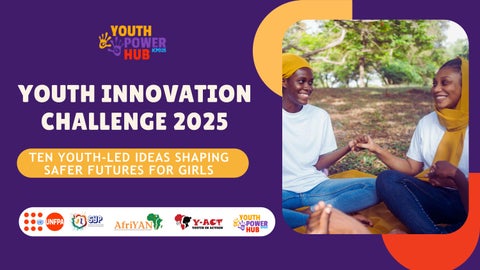
YOUTH INNOVATION CHALLENGE 2025 TEN YOUTH-LED IDEAS SHAPING SAFER FUTURES FOR GIRLS
INTRODUCTION Across Africa, adolescent girls face layered social and structural challenges that restrict their safety, learning and autonomy. Unintended pregnancy, child marriage and female genital mutilation are not only violations of rights. They shape life expectancy, limit access to education and reduce long-term economic participation. More than half of African girls aged fifteen to nineteen are out of school, married or already mothers. The financial cost of lost opportunity is significant. The World Bank estimates that investing in adolescent girls could unlock US$2.4 trillion in economic returns across the continent by 2040. Progress has been made, yet unevenly. In Kenya, FGM prevalence fell from 27 percent in 2014 to 15 percent in 2022, though the practice remains concentrated in rural areas where health services and enforcement are limited. Child marriage follows similar trends, with nearly half of all child brides globally expected to live in Africa by 2050. Early unions increase the risk of violence and maternal complications while driving school dropout among girls. Evidence from Burkina Faso and Tanzania shows that locally led interventions anchored in dialogue have reduced child marriage and improved school retention. Change is possible when solutions are shaped by communities and owned by girls. As the world marks thirty years since the Beijing Platform for Action and moves closer to the 2030 SDG deadline, we are reminded that girls are not beneficiaries of development. They are leaders of it when space and support are present. This campaign was created to strengthen that space.
MESSAGE FROM THE YOUTH POWER HUB In 2020, Y ACT partnered with UNFPA ESARO and AfriYan ESA to establish the Youth Power Hub. The Hub is a regional platform that amplifies youth voice across 21 African countries. Its work is anchored in three pillars: Education, Engagement and Mobilization. The Youth Power Hub empowers young leaders to influence policy processes, challenge harmful norms, and accelerate progress under ICPD and the SDG agenda. YPH also addresses a persistent gap. Youth-led organizations often have the strongest ideas but lack the resources and visibility needed to sustain their efforts. The Hub supports young leaders as implementers and innovators whose solutions are valuable for communities and systems.Young people across Africa continue to imagine and build solutions that speak to the realities of their communities. Their ideas are creative, grounded and courageous, yet they often remain unseen because opportunities and resources rarely flow to youth-led spaces. The Youth Power Hub was created to help shift that balance by backing young leaders with trust, visibility and practical support. This challenge reflects what happens when young people are given room to lead. Over a short period, each team designed an idea, tested it with their community and produced a resource that can live far beyond this campaign. Their work shows that change does not begin with large budgets or long timelines. It starts with voice, intention and the commitment to act. As we share this scrapbook, we celebrate the imagination and resilience of the ten innovators who stepped forward. Their toolkits, performances and creative products are more than outputs. They are evidence that youth-led action can spark dialogue, shift norms and protect the futures of girls. YPH remains committed to strengthening young people's leadership and influence across the region. When youth have space to create and when their ideas are taken seriously, communities benefit, and systems grow stronger.
ABOUT THE YOUTH INNOVATION CHALLENGE The Youth Innovation Challenge was launched during the Day of the Girl Child and continued through the 16 Days of Activism to support youth-led action that addresses FGM and child marriage through creativity and community-rooted problem-solving. Across nine countries, 10 young innovators stepped forward with courage, creativity and a deep commitment to protecting girls from harmful practices. They opened conversations that families often avoid. They brought new tools into classrooms, markets and faith spaces. They used art, dialogue and shared storytelling to help communities see that change is possible. Young leaders often hold the most relevant solutions yet face barriers that limit how far their ideas can reach. Through a simple model of trust, mentorship and small awards, we witnessed what happens when young people are supported to lead. They created safe spaces for girls to speak, helped elders reflect on long-held beliefs and brought communities together around hope rather than fear. As we honour their work in this scrapbook, we also affirm what the Youth Power Hub stands for: giving young leaders the resources and platforms they need to influence policy, challenge harmful norms and strengthen the rights and wellbeing of girls across Africa. Their innovations remind us that progress begins when communities listen to their young people. It grows when we invest in their vision. The Youth Innovation Challenge is one milestone along this journey. The courage and care shown by this cohort prove that youth-led solutions are not just inspiring; they are transformative. They are essential for building futures where every girl can learn, decide and thrive.
MEET THE INNOVATORS AMAKARITA (Rwanda): Berwa Jean Marie is a youth innovator, researcher and community advocate who uses culturally grounded solutions to address harmful practices. He has led projects in community health, youth empowerment, and creative education, and he focuses on bridging generations through dialogue and participatory design. As the creator of Amakarita y’Umuco, he brings together Rwanda's storytelling heritage and modern engagement tools to spark reflection and protect girls' rights. He collaborates with youth groups, schools and local leaders to promote positive cultural values that support the well-being of girls. Jean Marie believes that communities learn best when solutions feel familiar, playful and empowering.
Innovation Approach Amakarita y’Umuco used culturally rooted storytelling, guided questions and action prompts to create a safe and engaging space for intergenerational dialogue. The card game encouraged youth and elders to share perspectives openly while anchoring discussions in core Rwandan values such as unity, dignity and mutual respect. The structure of the cards supported conversations about harmful practices, including child marriage and FGM, and helped participants consider how cultural principles can evolve to protect girls. Across all sessions, the tool proved easy to use and effective in promoting meaningful dialogue.
MEET THE INNOVATORS LETTERS ACROSS GENERATIONS (South Africa): Cwayita Jemsana is a youth leader, HIV prevention advocate and digital education innovator from South Africa. She holds a BA in Psychology and Political Studies from Nelson Mandela University. She serves as Production Lead at Odin Education, where she supports digital learning solutions for under-resourced schools. Cwayita is also a Champion of Choice with Advocates for the Prevention of HIV and is an active voice in youth-driven SRHR, HIV prevention and consent advocacy. She is the founder of Be Safe, a faith-rooted youth initiative, and Chairperson of the Anglican Youth Fellowship, where she leads with empathy and a strong commitment to community wellbeing. Her work has been recognised through platforms such as Youth Power Hub and the Amref Youth Innovation for the Girl Child Challenge. As a GBV survivor and host of Becoming Bold, she uses storytelling, digital empowerment and lived experience to inspire healing, courage and leadership among young women and girls across Africa.
Innovation Approach Letters Across Generations is a bilingual storytelling toolkit that uses letter writing to safely explore culture, gender expectations, child marriage, and pressures girls face. Instead of debates or workshops, it employs written letters, reflection prompts, and guided conversations to foster connection. The approach respects culture, faith, and lived experience while promoting empathy across ages. It incorporates isiXhosa proverbs, storytelling, and faith-based language to honor tradition and challenge harmful norms. Bringing together teens, young adults, mothers, elders, and faith leaders, it creates an inclusive space in churches, schools, and communities. Its strength lies in emotional depth, accessibility, and fostering honest communication.
MEET THE INNOVATORS DURU YA MABADILIKO (Kenya): Kyamoneka Mpey Benjamin is a human rights activist committed to advancing human rights education and youth empowerment across Africa. He is the Founder and Executive Director of The Growth Sphere. This youth-led organisation works to close the gap between potential and opportunity by equipping young people with the skills and competencies they need to access global platforms and drive change in their communities. Benjamin also serves as a Research Lead at Amnesty International Kenya, where he supports the Jua Terms Campaign and coordinates the AITruth Campaign under the Global Rights Alliance. He is an alumnus of the Oxford GYCTP, the Aspire Institute, the International Anti-Corruption Academy and the United Nations University of Tokyo Global Youth MIDORI Platform. His work is guided by a belief that young people can influence systems and protect rights when they are empowered with knowledge, tools and confidence.
Innovation Approach The Duru ya Mabadiliko Initiative transformed a sensitive cultural issue into an accessible and engaging learning experience by reshaping traditional dialogue spaces into circles of storytelling and reflection across Kenya. The activity used Duru Cards, a creative conversation tool designed to prompt critical thinking about culture, protection and safer rites of passage. Through the cards, participants explored the realities linked to FGM and considered education-centred alternatives that protect girls. The method encouraged participation across generations and genders and supported open discussion without fear or judgment. It helped shift mindsets from passive acceptance of harmful norms toward a sense of collective responsibility for change. Through this approach, the initiative turned advocacy into a practical community-driven dialogue that encouraged personal commitments and strengthened awareness.
MEET THE INNOVATORS NIKO INFORMED (Kenya): Nelly Awino is a youth champion from Kisumu County in Kenya with a strong background in community work, peacebuilding and young women's leadership. She is committed to advancing gender equality and driving meaningful social change, particularly in addressing SGBV and harmful cultural practices affecting women and girls. Nelly leads Niko Informed, an innovation that empowers adolescents and youth through accurate information, evidence-building, advocacy, and peer-led capacity strengthening. Her work also focuses on educating communities about the legal frameworks related to SGBV and harmful practices, their rights, and the justice mechanisms available to them. As a young leader engaged in peacebuilding, women's and girls' leadership and community mobilisation, Nelly is dedicated to building a safer and more just society for all.
Innovation Approach The Niko Informed Intergenerational Dialogue Toolkit served as the main guide for the activity, providing a clear, step-by-step structure to help participants address sensitive topics like child marriage and FGM. It featured interactive elements such as prompts, culturally relevant discussion cues, role-plays, reflection spaces, secret ballots, and question pathways to encourage expression across generations. Its accessible design, with straightforward language and adaptable activities, enabled everyone, survivors and elders alike, to participate fully. Role-plays examined real-life scenarios, while the Q&A and anonymous ballots fostered open and honest discussion. This method created a participatory, non-judgmental environment where harmful norms could be scrutinized and community solutions considered.
MEET THE INNOVATORS ECHOES OF TOMORROW (Zimbabwe): Cathrine Mashonganyika is a young feminist advocate from Zimbabwe and the Founder and Vice Board Chairperson of Youth Health Network Africa. She has more than seven years of experience leading community-based work on SRHR, GBV prevention and youth empowerment. Cathrine is a Goal NextGen Youth Program alumna and a peer mentor supporting young people living with HIV. Through her programmes, she has reached more than 5,000 adolescents with health promotion, business skills, climate education, and gender advocacy. Her work centres on amplifying girls' voices, strengthening schoolcommunity collaboration, and creating safe spaces where young people can engage in honest dialogue. Cathrine is passionate about digital literacy and human rights and is committed to shaping equitable futures for girls. She led the Echoes of Tomorrow initiative in Glenview, designed to spark conversation on child marriage and the importance of keeping girls in school. She believes that meaningful change begins when communities make time to listen to girls.
Innovation Approach The Echoes of Tomorrow initiative used an intergenerational conversation toolkit to start open dialogue between teachers, youth champions and students on the risks linked to child marriage. Through story-based learning, conversation cards, and a Dream Wall activity, participants explored real challenges girls face in their school and proposed practical solutions. The toolkit created a safe environment where young people could speak freely and where teachers could publicly commit to protecting girls. This lowcost, straightforward model strengthened awareness, shifted attitudes, and empowered students to advocate for safer pathways to learning and opportunity.
MEET THE INNOVATORS EMPOWER HER (Tanzania): Adelaide Jachi is a Tanzanian creative producer, writer and 2D animator who uses storytelling to address GBV, child marriage and climate-related challenges. She is the co-founder of the Kisura Pepea Initiative, an organisation focused on advancing gender equality and strengthening local community resilience. Adelaide blends advocacy with digital creativity, translating complex issues into narratives that young people and policymakers can understand and act on. Her portfolio includes animated stories, facilitated dialogues and arts-based empowerment sessions across rural communities. Adelaide works with a human-centred design approach that prioritises listening, lived experience and community-led problem-solving. She has consulted for the World Bank, ILO, Plan International and ForumCC and is an alumna of several creative residencies and leadership programmes. Through her work, she aims to connect affected communities with decision makers by positioning storytelling as a tool for understanding and change. Adelaide believes innovation grows where culture, creativity and community voice meet.
Innovation Approach The initiative EMPOWER HER combined community dialogue with practical skills training to address GBV and child marriage in Bagamoyo. Women participated in safe circles where they could reflect on harmful norms and share personal experiences. In partnership with the Blue Roots Project, participants learned how to convert local seaweed into soap, demonstrating a low-cost income alternative that can reduce economic dependence on abusive settings. By pairing storytelling with hands-on skills training, the project strengthened agency, confidence, and collective awareness. Women left with knowledge, tools, and a practical pathway that supports safety and financial independence.
MEET THE INNOVATORS PAINTING FUTURES (Uganda): Wesesa Diana is a development practitioner, community advocate, and emerging leader dedicated to empowering women, promoting education, and supporting sustainable development in Uganda. She has experience in community engagement, capacity building, and youth leadership. Currently volunteering with the Building Tomorrow Fellowship in Iganga, she supports literacy and numeracy in four underserved primary schools. Diana is the Secretary of the Rotaract Club of Iganga, leading initiatives in education, environmental protection, and community service, and has represented the club regionally. Her advocacy includes women’s rights, GBV prevention, and financial literacy, with community engagements like Women’s Day in Namutumba. She is also part of the Sustainwell Network, focusing on climate action, menstrual hygiene, disability inclusion, and women’s economic empowerment. Guided by integrity, service, and lifelong learning, she aims to inspire change among young women and underserved communities, striving for an educated, sustainable, and equitable society.
Innovation Approach The project used art-based advocacy as a creative and inclusive approach to address child marriage in Iganga. Instead of relying on conventional awareness campaigns, the activity brought community members together through visual art, theatre and spoken word to explore the drivers of child marriage and encourage collective reflection. The approach blended creativity with evidence-based messaging to make the issue more relatable and emotionally resonant for different age groups. A human-centred co-design process guided the work from the beginning. Girls, boys, parents, teachers, survivors of child marriage and local leaders participated as co-creators. Their lived experiences shaped the themes represented across painted canvases, a community mural, a theatre skit, and spoken-word performances. Because the content was grounded in real stories and cultural context, it felt authentic and meaningful to the community. This co-design approach built ownership and ensured that the advocacy tools reflected local realities and values.
MEET THE INNOVATORS STREET VOICES FOR CHANGE (Zimbabwe): Kudzaishe is a young woman from Zimbabwe who grew up in Tshovani in Chiredzi. She is an SRH champion committed to improving the health and well-being of young people. She is also a writer and uses her love for the arts to strengthen advocacy on gender equality, sexual and reproductive health, HIV response and youth wellbeing. Her work blends creativity with community engagement, providing young people with accessible ways to understand and challenge harmful practices.
Innovation Approach Kudzaishe organized a street theatre in Tshovani to reach a diverse audience using drama, Shona and Shangani narration, a street quiz, and traditional music. It depicted Tsakani, a 13-year-old girl in a child-headed household, whose parents worked in South Africa. Without adult supervision, she faced manipulation, increasing her risk of early pregnancy and child marriage. The performance highlighted how parental absence and economic hardship threaten girls, aligning with the initiative's goal to raise awareness of harmful practices through art. It showed how street theatre can culturally communicate sensitive issues and educate communities about risk factors for girls.
MEET THE INNOVATORS ECHOES OF OUR MOTHER (Kenya): Winrose Nyongesa is a Kenyan innovator and community advocate committed to ending Female Genital Mutilation and cutting. She works with girls, parents, youth groups and village leaders to promote safe alternative rites of passage rooted in education and dignity. Her work brings together storytelling, digital awareness tools and community dialogue to challenge harmful norms and expand space for girls' rights. Winrose leads grassroots projects that equip girls with knowledge, leadership skills, and economic opportunities, thereby reducing their vulnerability to cultural pressure. She collaborates with regional anti-FGM networks to strengthen prevention efforts and support survivors during healing and reintegration. Her creative approaches have earned recognition for youth-driven impact, and she is often invited to speak at schools, community forums and development workshops on gender rights and social innovation. Winrose believes that change begins with voice and visibility. Her mission is to help build communities where girls grow with confidence, choice and safety.
Innovation Approach The innovation combined community dialogue, creative arts, and intergenerational storytelling as a culturally grounded approach to addressing FGM. Elders, youth, women, and local creatives participated through reflection cards, theatre scenes and open-market gatherings where lived experience and tradition could be shared without judgment. These activities opened conversations that are often difficult to begin, helped communities question the practice, and strengthened cultural pride by co-creating content with those most affected. The initiative built trust, ownership, and long-term commitment to protecting girls. The approach raised awareness and encouraged families and leaders to support safer alternative rites of passage that honour culture without harm.
MEET THE INNOVATORS YOUNG AT HEART (Ghana): Najat Seidu is a youth leader and SRHR activist from Ghana with strong experience advancing sexual and reproductive health rights, particularly in the areas of child marriage, SGBV and unpaid care work. She works to dismantle systemic barriers and empower marginalised women and girls in Northern Ghana. Najat founded the Young at Heart initiative, a youth-led effort to end harmful practices and promote safer futures for girls in her community. She currently serves on the Youth Advisory Board of the Ghana SRHR Alliance for Young People and previously represented young people on the Global Management Team for PowerToYou(th). In these roles, she helps ensure that youth perspectives influence programme decisions and implementation. Najat is committed to strengthening feminist movements across the Global South and contributes governance, advocacy and strategic insight to advance SRHR goals.
Innovation Approach Under the Chorus of Change activity, Najat led a workshop in Choggu in Tamale focused on ending child marriage as a form and driver of gender based violence. The session brought together adolescent girls, young women, adolescent boys, young men and community leaders. Participants explored how child marriage affects education, health and opportunity for girls in their community and examined the social factors that sustain the practice. As part of the workshop, Najat facilitated the creation of a poem authored by adolescent girls. The poem highlighted the harm caused by child marriage and served as a creative tool to draw the attention of youth leaders, community leaders and their peers. The activity aligned with the challenge track by using participatory methods and creative expression to support dialogue on harmful norms and amplify girls' voices in a public, accessible format.
LESSONS LEARNED BY THE COHORT Across all ten innovations, a consistent set of insights emerged about what it takes to shift harmful norms and protect girls. Youth innovators reached schools, churches, villages, markets and public spaces and showed that community change grows when dialogue feels safe, familiar and inclusive.
Safe spaces make difficult conversations possible. Across all countries, participants became more open when the environment was respectful and non-judgmental. Activities like storytelling, writing letters and cards, and role-playing fostered emotional safety, enabling youth, elders, and parents to discuss child marriage and FGM for the first time honestly. These safe spaces encouraged communities to break the silence, share personal experiences, and develop understanding across different generations. Culture is a catalyst for change when approached with respect. Communities engage more effectively when conversations are framed in cultural language, proverbs, and traditions. Incorporating familiar stories and values made sensitive issues more approachable and helped change the view that protecting girls opposes cultural identity. Respecting tradition while rethinking it created opportunities for meaningful dialogue and greater acceptance. Youth leadership is effective when supported with simple tools. Simple toolkits, games, and creative formats helped guide conversations with adults more easily. Youth champions could mobilize peers, facilitate discussions, and connect with elders using approaches that felt accessible and relevant. This showed that young people can lead community change when given practical, adaptable resources. Creative expression builds confidence and community connection. Art, theatre, poetry, and storytelling enabled participants to express emotions and realities that are often concealed. Girls and boys built confidence by sharing poems or acting out skits, while communities bonded through music, drama, and collective reflection. These creative approaches transformed awareness into emotional involvement and encouraged a shared sense of responsibility to safeguard girls. Sustainable change requires time, support and community ownership. Communities desire to continue these conversations but require additional time, emotional backing, and greater engagement from parents, teachers, and local leaders. Many expressed interest in repeating or expanding activities. This experience underscored that sustainable change depends on collaboration, improved coordination, and continuous investment in youth-led initiatives.
From Elders and Parents
QUOTES WORTH REMEMBERING “Today I understood that my life has value and I have the right to choose my own future.” “I am sad about the fact that almost all the kids I grew up with are married now. I am left with no one to play with.” “I did not know elders could listen to us like this. It felt safe to speak. When I heard stories from others, I realised I am not alone, and I have a voice.” “Our culture can grow with us. We do not need to keep what harms girls.”
Nam ndiyiqondile intombi yam namhlanje. Iintlungu ezithwele ndizive okokuqala.”- Umama Omkhulu (I also understood my daughter today. I felt the pain she was carrying for the first time.) “Kama mama, ni mimi nafaa kulinda Watoto wangu waschana but mila yetu inasema wamama hawafai kuongea kuhusu vitu kama hizo. Sasa kuact hapa inafanya ni rahisi kwa sababu tukiongelela hao watu kwa stori haitaonyesha ni kama tunawadharau na tunaongea kinyume na mila.” (As a mother, I am the one who should protect my daughters, but our culture says women should not speak about such things. Now, acting it out here makes it easier because when we talk about those people in the story, it doesn’t look like we are disrespecting anyone or going against our traditions.) “We did these things because they were done to us, but today I see why we must do better. Our traditions should protect, not harm. I’m proud that our daughters are speaking up while still honoring where we come from.” “Education can be a rite of passage. It shapes a whole future. When girls speak about their experiences, we must listen with care.”
From Teachers, Leaders and Facilitators “This was the first time students spoke openly about child marriage in our school. This dialogue model should be used again. It brings out truth without fear.”
CLOSING MESSAGE Across the ten innovations, young leaders reached over 500 people through conversations, performances, workshops and storytelling circles that brought generations together. The impact was felt in classrooms, churches, markets and community halls where girls spoke about their fears, elders reflected on long-held beliefs, and families questioned practices that once felt normal. What each activity proved is that when young people lead with empathy and courage, they create spaces where honesty replaces silence and where communities can imagine safer futures for their daughters. This scrapbook is a record of those moments and of the determination it took to make them possible. It is a reminder that change often starts with simple acts of listening and learning from one another.
NEXT STEPS All toolkits, artworks and community resources produced through this challenge are available on the Youth Power Hub website. We encourage schools, youth groups and community organisations to explore the materials and adapt them to their local contexts. These tools are open for use and designed to support ongoing conversations about girls’ rights and wellbeing. As the work continues, we hope the ideas tested by this cohort will inspire new dialogue, strengthen intergenerational understanding and help more communities create protective environments for girls. We invite partners to engage with these resources, share them widely and support young innovators who are shaping the next generation of solutions. This challenge confirms that young people have the insight, creativity and lived experience needed to drive meaningful change at the community level. Their solutions are practical, culturally grounded, and shaped by the realities they navigate every day. Sustained investment in youth leadership strengthens local systems, accelerates progress and ensures that efforts to protect girls are rooted in the voices of those closest to the issues. Supporting youth innovators is not only the right thing to do; it is an essential and strategic pathway to lasting impact.
YOUTH POWER HUB