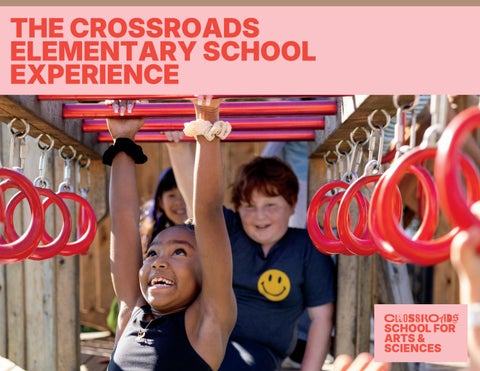
THE CROSSROADS ELEMENTARY SCHOOL EXPERIENCE
GRADES K-5: WHERE CURIOSITY,COMMUNITY & CREATIVITY THRIVE At Crossroads School for Arts & Sciences, the K-5 Elementary division is designed to do more than educate: It’s built to inspire. We believe that a truly excellent education begins with deep human connection, is fueled by curiosity and creativity, and is sustained by a strong sense of purpose and belonging.
VISION
To ignite the joy of learning and foster the mystery of becoming.
MISSION
Crossroads challenges students to expand their minds, cultivate a whole sense of self, create fearlessly, question boldly and lead with purpose and courage to shape a more just and vibrant world.
Our vision and mission take inspiration from the five founding commitments established in the School’s original 1971 Statement of Philosophy:
to academic excellence
to the greater community
to the arts
to the development of a student population of social, economic and racial diversity
to the development of each student’s physical wellbeing and full human potential
We are a community of THINKERS and FEELERS, ARTISTS and BUILDERS, QUESTIONERS and COLLABORATORS. At Crossroads you’ll find students who are deeply engaged: sketching ideas, debating ethics, planting seeds, building robots, writing stories and looking inward to understand themselves and one another. The curriculum is dynamic, responsive and joyfully rigorous. Our approach honors the whole child—intellectually, socially, emotionally and physically—and is grounded in the belief that children thrive when they are seen, heard and challenged in meaningful ways.
Every classroom is a vibrant learning community where students explore big ideas, ask thoughtful questions, take creative risks and grow in confidence and compassion.
Teachers know their students intimately and design learning experiences that stretch minds, center identity and make space for joy.
With two lead teachers in every classroom, supported by an associate teacher, we offer a rare kind of personalization that values the whole child and honors each learner’s pace, passion and perspective. Our teachers design experiential, inquiry-driven lessons that connect classroom learning to the wider world, encouraging students to see themselves as thinkers, creators, collaborators and changemakers. Our curriculum integrates academics, creative expression, social-emotional development and real-world relevance. Whether exploring what it means to be part of a community, unpacking media bias or even snorkeling off Catalina Island, students build the skills and values they’ll carry for life: critical thinking, empathy, courage, collaboration, curiosity and a commitment to social justice. Families who choose Crossroads join a community that deeply values progressive education, diverse perspectives and the cultivation of both academic strength and personal integrity. We don’t just prepare students for middle school, we prepare them to thrive and lead with passion and purpose. Our students don’t just learn facts—they learn to wonder, connect, imagine boldly and care deeply.
6progressive steps
toward
education
At Crossroads Elementary School, our approach to teaching and learning is grounded in six core values that shape every classroom experience. These principles are more than educational ideals, they’re daily practices that define who we are and how we support every child.
1 BELONGING Relationships First, Always We believe children learn best when they feel safe, known and valued. That’s why we prioritize strong, trusting relationships between students, teachers and families. From morning greetings and classroom rituals to our schoolwide Council program, we cultivate a culture where every child feels seen, heard and celebrated.
2
3
JOYFUL LEARNING
WHOLE-CHILD FOCUS
Curiosity Is Our Compass Walk into a Crossroads classroom and you’ll hear the hum of discovery, the buzz of collaboration and the spark of imagination. We design hands-on, playfilled and purposeful learning experiences that make students eager to come to school each day, and excited to learn outside of the classroom.
Academic Rigor Meets Emotional Intelligence We’re just as invested in each child’s emotional wellbeing as we are in their academic progress. Our curriculum nurtures intellectual growth alongside self-awareness, empathy and resilience. Children develop the skills to think critically, express themselves clearly and collaborate with compassion.
4
5
6
REAL-WORLD CONNECTIONS
DEPTH OVER BREADTH
DIFFERENTIATION
Learning That Matters Beyond the Classroom
Thinking Deeply, Not Just Widely
From studying food access in kindergarten to examining media bias in fifth grade, our students connect classroom concepts to the world around them. Fieldwork, service learning and inquiry-driven projects invite children to become curious, active participants in their communities and beyond.
Rather than rushing through content, we give students time to dig in—to question, explore and create meaning. Our teachers design rich, open-ended investigations that foster deep understanding, rather than surface-level memorization. We value quality over quantity and process over perfection.
Meeting Every Learner, Every Day No two learners are the same, and we embrace that. With two lead teachers in every classroom, flexible groupings and a low student-to-teacher ratio, we tailor instruction to meet each child where they are. Whether a student needs support, extension or a fresh challenge, our approach ensures that every learner is engaged, empowered and growing.
LANGUAGE ARTS Our literacy program empowers students to read, write, speak and listen with confidence and purpose. Our approach integrates phonics, comprehension and writing craft. Through personalized conferences and joyful workshops, students explore diverse texts, compose across genres and engage in purposeful publishing experiences.
K
1st
2nd
Develop early reading skills through daily instruction in phonemic awareness and phonics
Transition from learning to read to reading to learn
Strengthen reading fluency, phrasing and expression
Continue systematic instruction in phonics, decoding and fluency
Analyze character, structure and theme through literature
Strengthen vocabulary, literature analysis and comprehension through shared and guided reading Begin writing with a focus on storytelling, sequencing and descriptive detail Express ideas through illustrations, labeling and constructing simple sentences with joy and growing independence
Curriculum: Mossflower Phonics, Handwriting Without Tears, Fundations
Deepen comprehension and vocabulary through guided reading and texts
Engage in the full writing process: planning, drafting, revising and publishing
Write “small moment” narratives, opinion pieces and simple nonfiction
Write narrative, opinion and informational texts with increasing organization and detail
Explore the power of words through discussions about kindness, truth and necessity
Build vocabulary, discover language patterns and meanings
Curriculum: Mossflower Phonics, Handwriting Without Tears, Fundations
Curriculum: Mossflower Phonics, Handwriting Without Tears, Fundations
3rd
4th
5th
Deepen skills in interpretation, analysis and reflection
Read a range of fiction, nonfiction and poetry texts that foster empathy and critical thought
Prepare for middle school through rigorous reading and writing experiences
Read complex texts and discuss character traits, themes and author’s craft Use reading notebooks to record ideas, connections and insights Strengthen writing through focus on organization, paragraphing and descriptive language Participate in collaborative discussions that support evidence-based thinking
Curriculum: Mossflower, Handwriting Without Tears
Respond to texts through literary discussions, reflections and written analyses Refine writing with attention to structure, grammar and punctuation Embrace revision and creativity while exploring the balance between truth and imagination Deepen comprehension and analytical thinking
Curriculum: Mossflower, Handwriting Without Tears, Classical Roots
Analyze theme, character development and author’s purpose in complex texts Develop strong narrative, opinion and research writing skills with attention to grammar and syntax Expand academic vocabulary and etymology Engage in literary discussions that encourage multiple perspectives and evidence-based reasoning Emerge as confident, empathetic communicators ready to use language with care and purpose
Curriculum: Mossflower, Handwriting Without Tears, Classical Roots
MATHEMATICS We teach math as a language of logic, problem solving and collaboration. Instruction emphasizes conceptual understanding, strategic thinking and real-world application. Students engage in hands-on modeling, discussion and independent practice, with differentiation embedded at every grade level. Across K-5, students are expected to model their thinking, persevere through challenges and communicate mathematical reasoning clearly.
K-2nd Number Sense & Place Value Count, read, write, compare and represent numbers from 0-100 Understand place value within two- and threedigit numbers Decompose numbers using multiple strategies Operations & Algebraic Thinking Add and subtract within 20 Add and subtract within 100 using grouping and regrouping Understand multiplication and division as equal groups Develop fluency with basic addition, subtraction and early multiplication facts Fractions Understand basic fractions as equal parts of a whole Work with halves and fourths to see how equal parts make a whole Measurement, Geometry, Money & Time Compare length, height, weight and capacity Recognize and classify 2D and 3D shapes Measure using standard units Count money and tell time to the half hour Mathematical Practices Use models and representations strategically Solve multi-step problems with accuracy and perseverance Communicate reasoning and analyze the thinking of others Curriculum: Dimensions (Singapore Math Program)
3rd-5th Number Sense & Place Value Compare, represent and round whole numbers up to one billion Understand and operate with decimals to the thousandths place Operations & Algebraic Thinking Add, subtract, multiply and divide multi-digit numbers using efficient strategies and standard algorithms Develop fluency with multiplication and division facts Evaluate numerical expressions using parentheses, brackets and braces Fractions & Decimals Compare, simplify and operate with fractions and mixed numbers Multiply and divide fractions Add, subtract, multiply and divide decimals Measurement & Geometry Classify two-dimensional figures by properties Find the area and perimeter of 2D figures Measure and convert units of length, weight and capacity Measure angles and analyze geometric relationships Mathematical Practices Use models and representations strategically Solve multi-step problems with accuracy and perseverance Communicate reasoning and analyze the thinking of others Curriculum: Dimensions (Singapore Math Program)
SOCIAL STUDIES Social Studies instruction centers identity, community and social justice through age-appropriate, inquiry-based learning and civic engagement. Students explore who they are, how communities function and how individuals can contribute to a more just and inclusive world. Learning progresses from personal and local connections in the early grades to historical analysis, civic responsibility and global awareness in upper elementary. Across K-5, students build empathy, critical thinking and respectful dialogue while learning to recognize multiple perspectives and take meaningful action. By the end of elementary Social Studies, students are able to: Understand identity as personal, social and historical Analyze communities and historical events from multiple perspectives Recognize fairness, injustice and systems of power Engage respectfully in dialogue and collaboration See themselves as informed, empathetic and responsible citizens
K SELF, COMMUNITY AND FAIRNESS Kindergarten students begin their Social Studies journey by exploring identity, family structure and classroom community. Learning emphasizes kindness, gratitude and early understandings of fairness and care for others. Inquiry Themes Exploring Identity: Who Am I? Gratitude, Needs and Wants Families and Celebrations Community and Justice in Action
1st BELONGING, RIGHTS AND VOICE First graders deepen their understanding of identity and community while learning about fairness, responsibility and advocacy. Students explore how people create change and how their voices matter within groups. Inquiry Themes Identity, Traditions and Belonging Equality, Equity and Justice Rights and Responsibilities Gender and Identity
2nd EMPATHY, RESILIENCE AND CITIZENSHIP Second graders examine how identity connects to relationships, community life and the wider world. Students build empathy, perseverance and an emerging understanding of citizenship and shared responsibility. Inquiry Themes Identity and Belonging Empathy, Compassion and Gratitude Resilience and Growth Community, Citizenship and Justice Curiosity and Global Awareness
3rd
4th
5th
PLACE, HISTORY AND PERSPECTIVE
CALIFORNIA HISTORY, POWER AND CIVIC ACTION
U.S. HISTORY, JUSTICE AND RESPONSIBILITY
Third graders study geography and history through a place-based exploration of Los Angeles. Students examine Indigenous histories, migration, cultural diversity and change over time while strengthening research and perspective-taking skills.
Fourth graders investigate California’s history through multiple perspectives, examining migration, labor, representation and civic participation. Students learn to question narratives and connect history to contemporary issues.
Fifth graders analyze early American history through the lenses of identity, power and inclusion. Students examine colonization, revolution and foundational civic documents while learning to recognize bias and connect past struggles to present-day civic life.
Inquiry Themes Place and Identity: Where Do We Live? Indigenous Peoples and Early Los Angeles Migration and the Making of Communities How Los Angeles Has Changed Identity, Diversity and Respect
Inquiry Themes Identity and Belonging: Building Community Indigenous Perspectives and Early California Migration, Immigration and Labor Civics, Elections and Civic Action Contributions Across Cultures
Inquiry Themes Identity and Perspective: Who Writes History? Exploration, Encounter and Colonization Native American Histories and Resilience Colonization and the Road to Revolution Revolution, Rights and Responsibilities
LIFE SKILLS From kindergarten through fifth grade, students develop the socialemotional skills to communicate thoughtfully, resolve conflicts and build positive relationships. Through Council, guided discussion, reflection and collaborative activities, students practice empathy, active listening, self-advocacy and teamwork. They explore their own identity, understand others’ perspectives, and strengthen resilience, kindness and responsibility.
K
1st
2nd
INQUIRY THEMES: Courtesy and classroom norms
INQUIRY THEMES: Setting norms and expectations
INQUIRY THEMES: Identity, empathy and compassion
Friendships and belonging
Feelings, empathy and perspective taking
Conflict resolution and steps to respect
Gratitude and resilience
Gratitude and resilience
Boundaries, consent and safe touch
Growth mindset and SMART goal setting
Bullying, bystander and upstander behavior
Family and community connections
Conflict resolution and fairness Boundaries, consent and safe touch Growth mindset and character Understanding emotions and identity
KEY LIFE SKILLS: Active listening and expressing thoughts clearly Following classroom rules and shared codes of conduct Welcoming and cooperating with peers Resolving conflicts respectfully Practicing empathy and care for others Recognizing and expressing needs constructively
Celebrating diversity and belonging
KEY LIFE SKILLS: Recognizing and respecting others’ feelings and perspectives Demonstrating empathy and gratitude Following classroom rules and codes of conduct Taking responsibility for actions Communicating needs constructively Working cooperatively and resolving conflicts peacefully
KEY LIFE SKILLS: Respecting differences and others’ perspectives Following classroom rules and codes of conduct Working cooperatively and managing conflicts respectfully Demonstrating empathy, compassion and responsibility Expressing needs appropriately and constructively
3rd
4th
INQUIRY THEMES: Identity, diversity and inclusion
INQUIRY THEMES: Community building and teamwork
Conflict resolution and respectful communication
Respectful communication and active listening
Recognizing stereotypes and social differences
Personal values and decision making
Current events and social awareness
Physical and emotional health, puberty, body image
Roles of bystanders, targets and upstanders
Gender identity, neurodivergence and inclusion
KEY LIFE SKILLS: Respecting differences and demonstrating empathy Communicating needs clearly and constructively Working cooperatively and following classroom norms Resolving conflicts respectfully Resilience when facing challenges
KEY LIFE SKILLS: Respecting differences and others’ perspectives Communicating needs effectively and responsibly Working collaboratively and cooperatively Resolving conflicts respectfully Resilience and self-awareness
5th INQUIRY THEMES: Belonging, identity and self expression Growth mindset, risk-taking and reflection Friendships, communication and kindness Gratitude, empathy and valuing differences Puberty, wellness, boundaries and consent KEY LIFE SKILLS: Respecting differences and celebrating diversity Communicating needs clearly and responsibly Working collaboratively and cooperatively Resolving conflicts respectfully Resilience, self-awareness and empathy
SPECIALIST COURSES
Throughout the week, students engage in specialist courses that nurture creativity, collaboration and curiosity across disciplines.
ART
DANCE/DRAMA
INNOVATION LAB
Expression, critique and cultural exploration through diverse media.
Movement, performance and storytelling that builds confidence and community.
Design thinking, engineering, coding and creativity in our dynamic makerspace.
A treasure trove of books and media for research and personal enrichment.
MUSIC
PE
SCIENCE
SPANISH
Orff Schulwerk-based program integrating voice, rhythm and ensemble collaboration.
Physical literacy, teamwork and healthy habits through play and structured activities.
Inquiry-based, handson discovery across biology, physics, chemistry and Earth science.
Immersive language learning through songs, games, storytelling and conversation.
LIBRARY & RESEARCH
INSTRUMENTAL MUSIC PROGRAM (GRADES 1-5) Beginning in second grade, students have the opportunity to participate in the Instrumental Music Program, structured as a fee-based, afterschool enrichment class to learn violin, viola or cello. Third through fifth graders in the program can also take clarinet, flute, saxophone, trombone or trumpet. We also offer a band option to incorporate keyboard, bass and guitar in the after-school program. Practices are held both before and after school.
EXPERIENTIAL AND OUTDOOR EDUCATION Learning at Crossroads extends far beyond the classroom walls. In addition to field trips in all grade levels, fourth and fifth graders participate in multi-day Experiential and Outdoor Education trips. Grade 4: AstroCamp – Fourth graders enjoy a three-day, two-night outdoor education trip to AstroCamp, a mountain adventure and science camp. Set among the gorgeous pine forests of California’s San Jacinto Mountains, students explore science and space in state-of-the-art facilities and participate in mountain adventure activities. Grade 5: Catalina Island Marine Institute – For five days, fifth graders study marine environments at Catalina Island Marine Institute at Toyon Bay, participating in marine life labs and activities including snorkeling, ocean kayaking, hiking and rock-wall climbing.
CO-TEACHING, DIFFERENTIATION & STUDENT SUPPORT At Crossroads, differentiation is not an add-on. It is the foundation of how we teach. We meet students where they are, honor who they are becoming and ensure that every learner grows with confidence, curiosity and purpose. With two lead teachers in every classroom, supported by a dedicated grade-level associate teacher, our low student-to-teacher ratio allows us to know each child academically, socially and emotionally. Our collaborative co-teaching model enables educators to plan together and respond in real time to student needs, making small-group instruction, targeted support and meaningful extension a seamless part of the school day.
PERSONALIZED LEARNING APPROACH Using ongoing assessment, observation and one-on-one conferences, teachers continuously adjust instruction. Whether a student is strengthening foundational skills or ready for enrichment, they receive the right level of challenge and support at the right time.
FLEXIBLE GROUPINGS Students work in dynamic groupings that shift based on readiness, interest and learning goals. This approach encourages collaboration without comparison and fosters peer-to-peer learning in ways that feel empowering and inclusive.
STUDENT SUPPORT Our learning specialists, behavior support specialist and counselor work closely with teachers and families to support students with specific needs—academic, emotional or behavioral— ensuring all students feel seen and successful.
AT CROSSROADS ELEMENTARY SCHOOL, WE CULTIVATE CURIOUS THINKERS, KIND COLLABORATORS AND COURAGEOUS LEARNERS, READY NOT ONLY FOR MIDDLE SCHOOL, BUT FOR LIFE.