Talento moçambicano na ciência global Mozambican talent in global science
HEARTSEED
Um trabalho feito de presença, cuidado e amor
A work built on presence, care and love
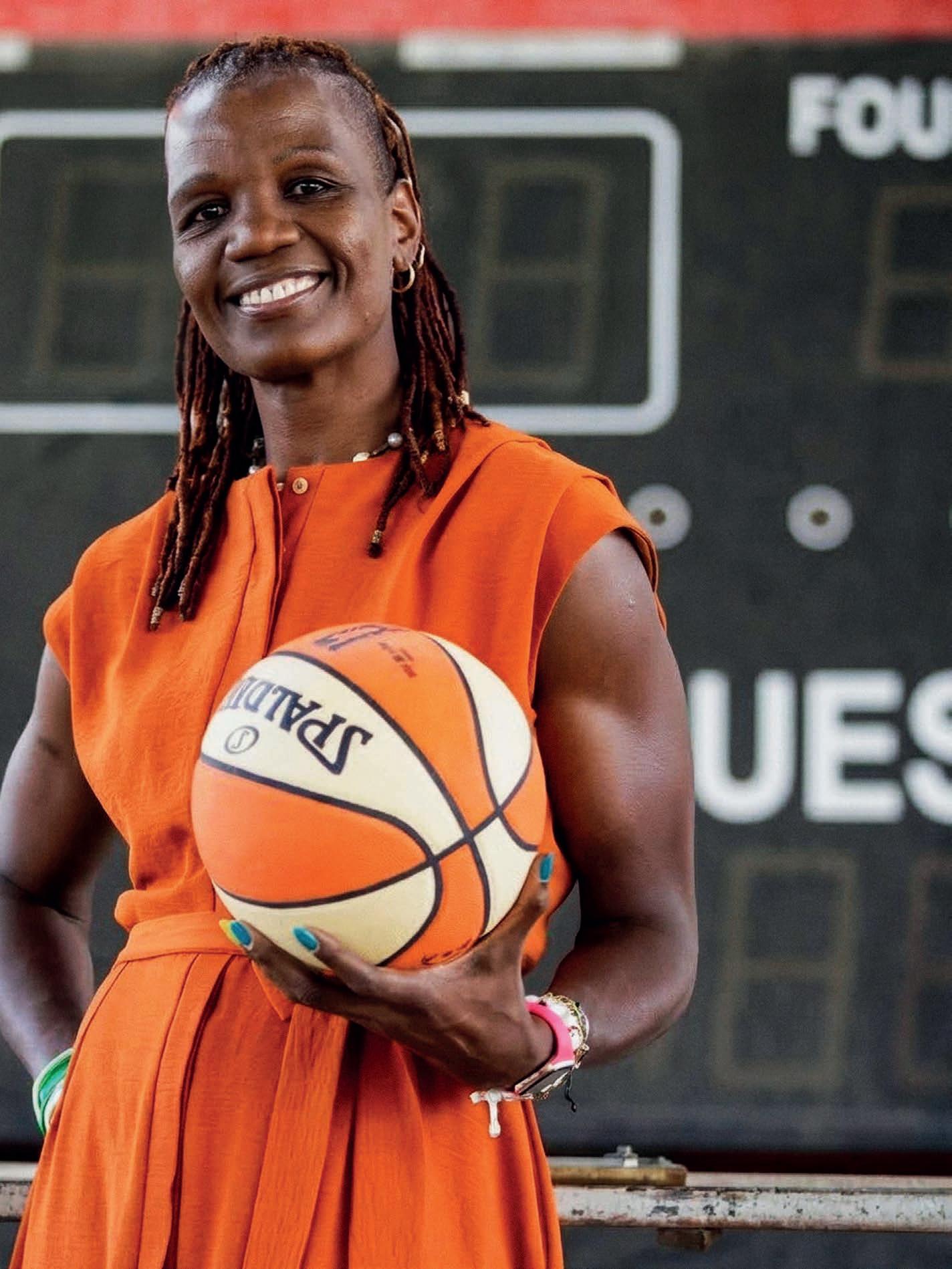
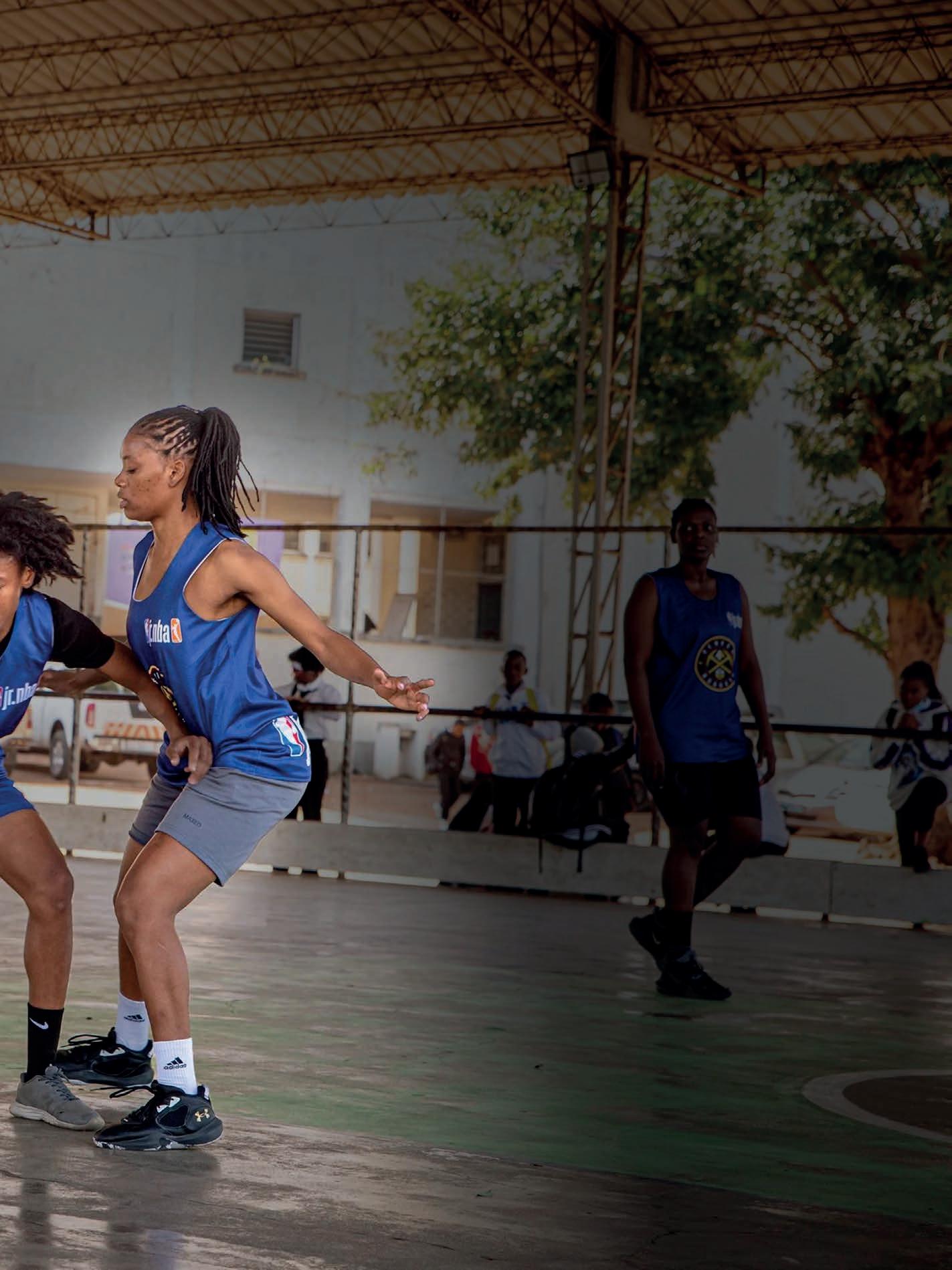
Clarisse Machanguana
A escolha de permanecer e construir depois do último apito
Cresci em Maputo numa época em que as oportunidades para raparigas como eu não eram muitas, mas sempre fui uma criança que observava o mundo à sua volta e fazia perguntas.
Há nomes que ultrapassam o feito e se tornam referência. Mas há pessoas que, quando o aplauso termina, escolhem continuar. Escolhem trabalhar, muitas vezes longe do ruído. Clarisse Machanguana poderia viver apenas da memória de uma carreira que abriu portas e inspirou gerações. Esteve fora e preferiu regressar. Preferiu construir. Hoje, o seu campo é outro: são as comunidades, as jovens que procuram horizonte, as estruturas que precisam de mudança. Entre a visibilidade e a responsabilidade, entre a expectativa pública e a mulher que existe para além dela, há uma história que continua a escrever-se. Falámos com ela sobre missão, decisões difíceis, liderança, juventude e legado. Sem nostalgia. Com consciência.
Que parte da sua infância continua a conduzir silenciosamente a mulher que é hoje?
A curiosidade. Cresci em Maputo numa época em que as oportunidades para raparigas como eu não eram muitas, mas sempre fui uma criança que observava o mundo à sua volta e fazia perguntas. O basquetebol entrou na minha vida quando tinha seis anos, e desde cedo percebi que o desporto não era apenas um jogo — era uma linguagem, uma forma de aprender disciplina, de me superar, de pertencer. Essa criança que "batia bola" no Costa do Sol, e que mais tarde se revelou no mundo para além da realidade moçambicana, ainda está cá dentro. É ela que me lembra, nos dias mais difíceis, de onde vim e porque faço o que faço.
A Fundação que criou – e que tem o seu nome – foi um passo natural do caminho que vinha a trilhar ou uma
inquietação que deixou de caber dentro de si?
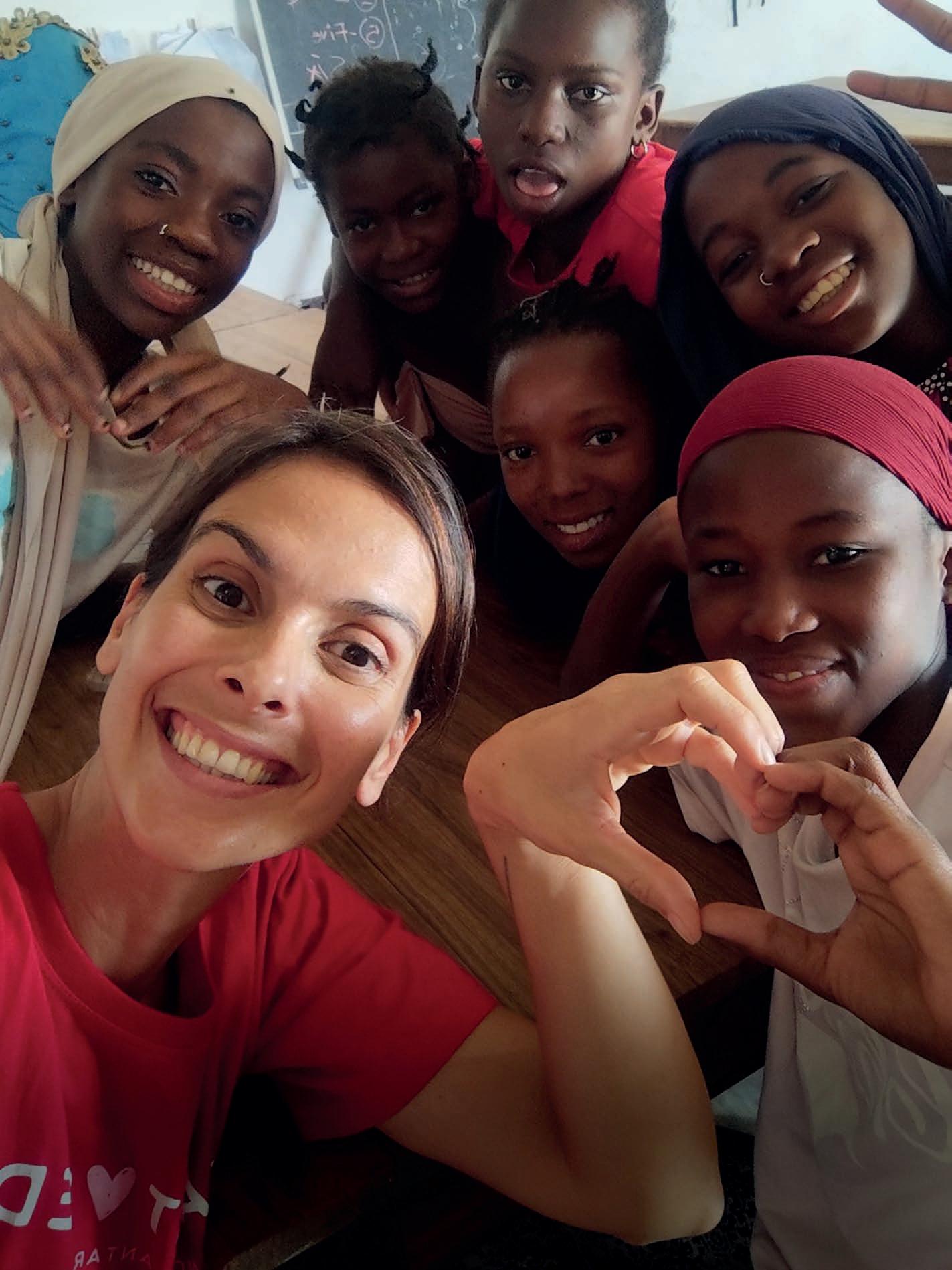
Foi as duas coisas, honestamente. Quando regressei a Moçambique, depois de mais de duas décadas a jogar pelo mundo fora, as pessoas e as organizações locais começaram a pedir-me que as representasse — pela visibilidade que o meu nome tinha. E ao fazer esse trabalho, fui descobrindo realidades que não conhecia a fundo: o impacto do HIV, as barreiras que a rapariga enfrenta para simplesmente ficar na escola... Havia uma inquietação que crescia dentro de mim. Mas o que me convenceu mesmo a criar a Fundação foi quando percebi que as raparigas me perguntavam, em voz baixa, qual era o "feitiço" que eu tinha usado para ter sucesso. Percebi que o maior obstáculo não era a falta de talento — era a falta de acesso e a falta de ousadia para sonhar. A Fundação nasceu para ajudar a desfazer essa prisão mental.
“Essa criança que 'batia bola' no Costa do Sol, e que mais tarde se revelou no mundo para além da realidade moçambicana, ainda está cá dentro.”
Há decisões que nos atravessam para sempre. Tomou alguma com medo nas mãos e, ainda assim, escolheu avançar?
Sim. Voltar a Moçambique. Quando terminei a carreira, tinha opções.
Podia ter ficado na Europa ou nos Estados Unidos, construir uma vida confortável, longe dos desafios do dia-a-dia em casa. Mas não conseguia ignorar o que via quando regressava. Voltar com tudo o que aprendi e construí, sem rede de segurança financeira, para montar uma organização do zero num contexto tão exigente — isso exigiu uma fé que nem sempre se sente, mas que se escolhe. Não me arrependo nenhum dia.
Depois dos aplausos e das luzes, que silêncio ficou consigo?
A consciência de que o percurso que tive não foi para mim apenas. Cada vez que saía de um campo depois de uma vitória, olhava para o lugar onde estava — Barcelona, Los Angeles, Seul — e pensava nas raparigas de Marracuene, de Maputo, que nunca teriam aquela oportunidade se ninguém lhes abrisse uma porta. Esse silêncio transformou-se numa responsabilidade. Não num peso, mas numa missão.
Já recusou algum apoio ou parceria por não querer comprometer princípios?
Sim. Há parcerias que trazem dinheiro, mas que cobram algo que não está nos contractos: a tua voz, a tua agenda, a tua autonomia. Deixei muito claro, desde o início da Fundação, que a angariação de fundos nunca seria a peça central do nosso trabalho. O que guia a Fundação são os princípios, a visão, a coerência com as comunidades que servimos. Quando sinto que uma par-
ceria nos afastaria disso, a resposta é não. Não é fácil, porque os recursos são sempre escassos. Mas prefiro fazer menos com integridade do que muito sem ela.
Quando precisa de tomar decisões difíceis, sabendo que nem todos as vão compreender, como encontra o equilíbrio entre firmeza e escuta?
Ouço muito antes de decidir. Tenho aprendido ao longo dos anos que firmeza não é teimosia — é clareza de valores. Por isso, consigo a ser firme depois de ouvir: porque sei o que está em causa e porquê. O que me ajuda é separar a decisão da necessidade de aprovação. Nem sempre as pessoas vão compreender na hora. Às vezes compreendem anos depois. E há decisões em que nunca haverá consenso — e ainda assim têm de ser tomadas.
Quando olha para a juventude moçambicana, o que a enche de esperança e o que lhe tira o sono? O que me enche de esperança é a energia que existe. Os jovens moçambicanos têm uma criatividade e uma resiliência que me surpreendem constantemente. Quando vejo as raparigas que passaram pela Fundação e hoje estudam no estrangeiro, ou estão a liderar projectos nas suas comunidades, sinto que o po-
tencial existe — sempre existiu. O que me tira o sono é o sistema. A qualidade do ensino, o acesso à saúde, a falta de estruturas que convertam esse potencial em oportunidade real. Mais de vinte anos depois de termos falado sobre estas questões (ainda em pequena falava-se destas matérias), ainda estamos a lutar pelas mesmas batalhas básicas. Isso preocupa-me muito.
Há palavras que se repetem no debate sobre juventude e desenvolvimento. Alguma delas a inquieta por soar vazia? "Capacitação". É uma palavra que ouço em todos os relatórios, em todos os eventos, em todas as parcerias. Mas quando pergunto o que ficou — o que mudou concretamente na vida das pessoas — a resposta, muitas vezes, é vaga. Capacitação sem continuidade, sem acompanhamento, sem estrutura que sustente o que foi aprendido, é um workshop. E um workshop não muda uma vida. O que muda vidas é consistência.
O conceito de empoderamento feminino ainda a inspira como no início ou sente que perdeu força quando começou a ser usado sem compromisso real?
O conceito em si nunca perdeu força para mim — o que perdeu força foi o uso superficial que se faz dele. Quando "empoderamento feminino" se torna apenas branding, quando aparece em campanhas sem estar ligado a nenhuma mudança estrutural, a nenhuma política concreta, a nenhum acesso real — aí esvazia-se. Mas quando vejo uma rapariga que nunca teve espaço para falar ganhar voz, quando vejo uma jovem que acreditava que não merecia estudar, ir para a universidade — aí o conceito está vivo. Para mim, ele só existe no concreto.
Voltar com tudo o que aprendi e construí, sem rede de segurança financeira, para montar uma organização do zero num contexto tão exigente, exigiu uma fé que nem sempre se sente, mas que se escolhe.
Nos espaços internacionais por onde tem passado, o que viu funcionar que ainda sente faltar estruturar em Moçambique?
A ligação entre o desporto e a educação como política nacional. Em muitos países, o desporto é reconhecido formalmente como um veículo de desenvolvimento social — há investimento, há estrutura, há avaliação. Em Moçambique ainda tratamos o desporto como entretenimento, não como ferramenta. O modelo existe. Nós já o aplicamos na nossa escala na Fundação. O que falta é a vontade e o investimento para o escalar a nível nacional. Também vejo uma diferença grande na cultura filantrópica e de responsabilidade social empresarial. Há muito espaço para crescer nessa área.
Num país onde muitos sentem que a conhecem, como protege a parte da sua vida que não quer transformar em palco?
Sendo muito intencional com o que partilho. Há uma Clarisse pública — a atleta, a fundadora, a activista — e há uma Clarisse que é mãe, que é filha, que tem dias difíceis e dúvidas reais. Essa segunda pessoa não precisa de estar em todas as entrevistas, ou vida social para ser real. Aprendi que posso ser autêntica sem ser exaustiva. Nem tudo o que é verdadeiro precisa de ser público.
Há batalhas que se travam em silêncio. Qual tem sido a mais exigente para si nesta fase da vida? No início deste ano perdi a minha casa nas cheias que afectaram Moçambique. Foi um golpe muito duro — material, mas sobretudo emocio -
nal. Estar do lado de fora, a olhar para o que o esforço de tantos anos tinha construído, com a água pela cintura, foi uma das coisas mais difíceis que já vivi. Mas também me ensinou algo que já sabia, mas que precisava de sentir de novo: nada do que acumulamos nos define. O que somos é o que fica depois de tudo isso ir embora. E a minha família está bem. Era o que importava.
Haverá algo que ainda queira construir e que eventualmente ninguém esteja à espera de ver nascer das suas mãos?
Sim. Tenho pensado muito num espaço físico permanente — um centro que junte desporto, saúde e educação num só lugar, que sirva comunidades de forma contínua e não apenas por projectos. Um lugar que exista independentemente de mim, que sobreviva e cresça por si. Também tenho vontade de escrever mais — não apenas sobre o meu percurso, mas sobre o que aprendi sobre liderança feminina em contextos africanos. Há histórias que precisam de ser contadas na nossa língua, com a nossa voz.
Entre feitos e afectos, o que gostaria que daqui a, digamos, trinta anos, resistisse ao tempo?
Que as pessoas que cruzaram o caminho da Fundação — as raparigas, as famílias, as comunidades — tivessem vidas diferentes por isso. Não por mim. Por elas. E que os meus filhos, Ester e Luca, olhassem para o que a mãe fez e sentissem orgulho — não do nome, mas da coerência. Que o que eu disse e o que eu fiz fossem a mesma coisa. É o legado mais honesto que posso imaginar.
There are names that transcend achievement and become reference points. But there are people who, when the applause fades, choose to continue. They choose to work, often far from the noise. Clarisse Machanguana could live solely on the memory of a career that opened doors and inspired generations. She went abroad and chose to return. She chose to build. Today, her court is another one: communities, young girls searching for horizons, structures in need of change. Between visibility and responsibility, between public expectation and the woman who exists beyond it, there is a story still being written. We spoke with her about mission, difficult decisions, leadership, youth and legacy. Without nostalgia. With awareness.
Which part of your childhood still quietly guides the woman you are today?
Curiosity. I grew up in Maputo at a time when opportunities for girls like me were limited, but I was always a child who observed the world around her and asked questions. Basketball entered my life when I was six years old, and early on I realised that sport was not just a game — it was a language, a way to learn discipline, to push myself, to belong. That child who dribbled a ball at Costa do Sol and later revealed herself to the world beyond the Mozambican reality is still inside me. She is the one who reminds me, on the hardest days, where I came from and why I do what I do.
The Foundation you created — which car-
ries your name — was it a natural step in the path you were already following, or a restlessness that no longer fit inside you?
It was both, honestly. When I returned to Mozambique, after more than two decades playing around the world, people and local organisations began asking me to represent them — because of the visibility my name had.
And in doing that work, I began discovering realities I did not fully know: the impact of HIV, the barriers girls face just to remain in school… There was a restlessness growing inside me. But what truly convinced me to create the Foundation was when I realised that girls would ask me, in a low voice, what “magic” I had used to succeed. I realised the biggest obstacle was not lack of talent — it was lack of access and lack of
boldness to dream. The Foundation was born to help dismantle that mental prison.
Are there decisions that mark us forever? Did you ever move forward with fear in your hands?
Yes. Returning to Mozambique. When I ended my career, I had options. I could have stayed in Europe or the United States, built a comfortable life, far from the daily challenges at home. But I could not ignore what I saw whenever I returned. Coming back with everything I had learned and built, without a financial safety net, to create an organisation from scratch in such a demanding context — that required a faith you do not always feel, but one you choose. I do not regret it for a single day.
After the applause and the lights, what silence stayed with you?
The awareness that the journey I had was not only for me. Every time I left a court after a victory, I would look at where I was — Barcelona, Los Angeles, Seoul — and think about the girls from Marracuene, from Maputo, who would never have that opportunity if no one opened a door for them. That silence turned into responsibility. Not a burden, but a mission.
Have you ever refused support or a partnership to avoid compromising your principles?
Yes. There are partnerships that bring money, but demand something not written in contracts: your voice, your agenda, your autonomy. From the beginning of the Foundation, I made it very clear that fundraising would never be the central piece of our work. What guides the Foundation are principles, vision, and coherence with the communities we serve. When I feel a partnership would take us away from that, the answer is no. It is not easy, because resources are always scarce. But I prefer doing less with integrity than a lot without it.
When you need to make difficult decisions, knowing not everyone will understand, how do you find the balance between firmness and listening?
I listen a lot before deciding. Over the years I have learned that firmness is not stubbornness — it is clarity of values. That is why I can be firm after listening: because I know what is at stake and why. What helps me is separating the decision from the need for approval. People will not always understand immediately. Sometimes they understand years later. And there are decisions where there will never be consensus — and still they must be made.
When you look at Mozambican youth, what fills you with hope and what keeps you awake at night? What fills me with hope is the energy that exists. Mozambican youth have a creativity and resilience
that constantly surprise me. When I see girls who passed through the Foundation and are now studying abroad, or leading projects in their communities, I feel the potential exists — it always has. What keeps me awake at night is the system. The quality of education, access to health care, the lack of structures that convert potential into real opportunity. More than twenty years after we first spoke about these issues (even as a child these matters were already discussed), we are still fighting the same basic battles. That worries me deeply.
There are words that repeat in the debate about youth and development. Is there any that troubles you for sounding empty?
“Capacity building.” It is a word I hear in every report, every event, every partnership. But when I ask what remained — what concretely changed in people’s lives — the answer is often vague. Capacity building without continuity, without follow-up, without structure to sustain what was learned, is a workshop. And a workshop does not change a life. What changes lives is consistency.
Does the concept of women’s empowerment still inspire you as it did at the beginning, or do you feel it has lost strength when used without real commitment?
The concept itself never lost strength for me — what lost strength was the superficial way it is sometimes used. When “women’s empowerment” becomes only branding, when it appears in campaigns without structural change, without
concrete policies, without real access — then it becomes empty. But when I see a girl who never had space to speak gain a voice, when I see a young woman who believed she did not deserve to study go to university — then the concept is alive. For me, it only exists in the concrete.
In the international spaces you have been part of, what have you seen working that you still feel needs structuring in Mozambique?
The connection between sport and education as a national policy. In many countries, sport is formally recognised as a vehicle for social development — there is investment, structure, evaluation. In Mozambique, we still treat sport as entertainment, not as a tool. The model exists. We already apply it at our scale in the Foundation. What is missing is the will and investment to scale it nationally. I also see a big difference in philanthropic culture and corporate social responsibility. There is a lot of room to grow in that area.
In a country where many feel they know you, how do you protect the part of your life you do not want to turn into a stage?
By being very intentional about what I share. There is a public Clarisse — the athlete, the founder, the activist — and there is a Clarisse who is a mother, a daughter, who has difficult days and real doubts. That second person does not need to be in every interview or social setting to be real. I learned that I can be authentic without being exhaustive. Not everything that is true needs to be public. There are battles fought in silence. Which has been the most demanding for you at this stage of life?
At the beginning of this year, I lost my house in the floods that affected Mozambique. It was a very hard blow — materially, but above all emotionally. Standing outside, looking at what years of effort had built, with water up to my waist, was one of the hardest things I have ever lived through. But it also taught me something I already knew, but needed to feel again: nothing we accumulate defines us. What we are is what remains after all of that goes away. And my family is safe. That was what mattered.
Is there something you still want to build that perhaps no one expects to see coming from your hands?
Yes. I have been thinking a lot about a permanent physical space — a centre that brings together sport, health and education in one place, serving communities continuously and not only through projects. A place that exists independently of me, that survives and grows on its own. I also want to write more — not only about my journey, but about what I have learned regarding female leadership in African contexts. There are stories that need to be told in our language, with our voice.
Between achievements and affections, what would you like, say thirty years from now, to withstand time? That the people who crossed the Foundation’s path — the girls, families, communities — would have different lives because of it. Not because of me. Because of them. And that my children, Ester and Luca, would look at what their mother did and feel proud — not of the name, but of the consistency. That what I said and what I did were the same thing. That is the most honest legacy I can imagine.
4 Clarisse Machanguana
A escolha de permanecer e construir depois do último apito The choice to stay and build after the final whistle
FICHA TÉCNICA/BIOS
Propriedade/Property:
Veludo & Mentol, Sociedade Unipessoal Lda
Conselho de Administração/Administrative Council: Omar Diogo, Nuno Soares
20 Heartseed Um trabalho feito de presença, cuidado e amor A work shaped by presence, care and love
80 Oficina do futuro
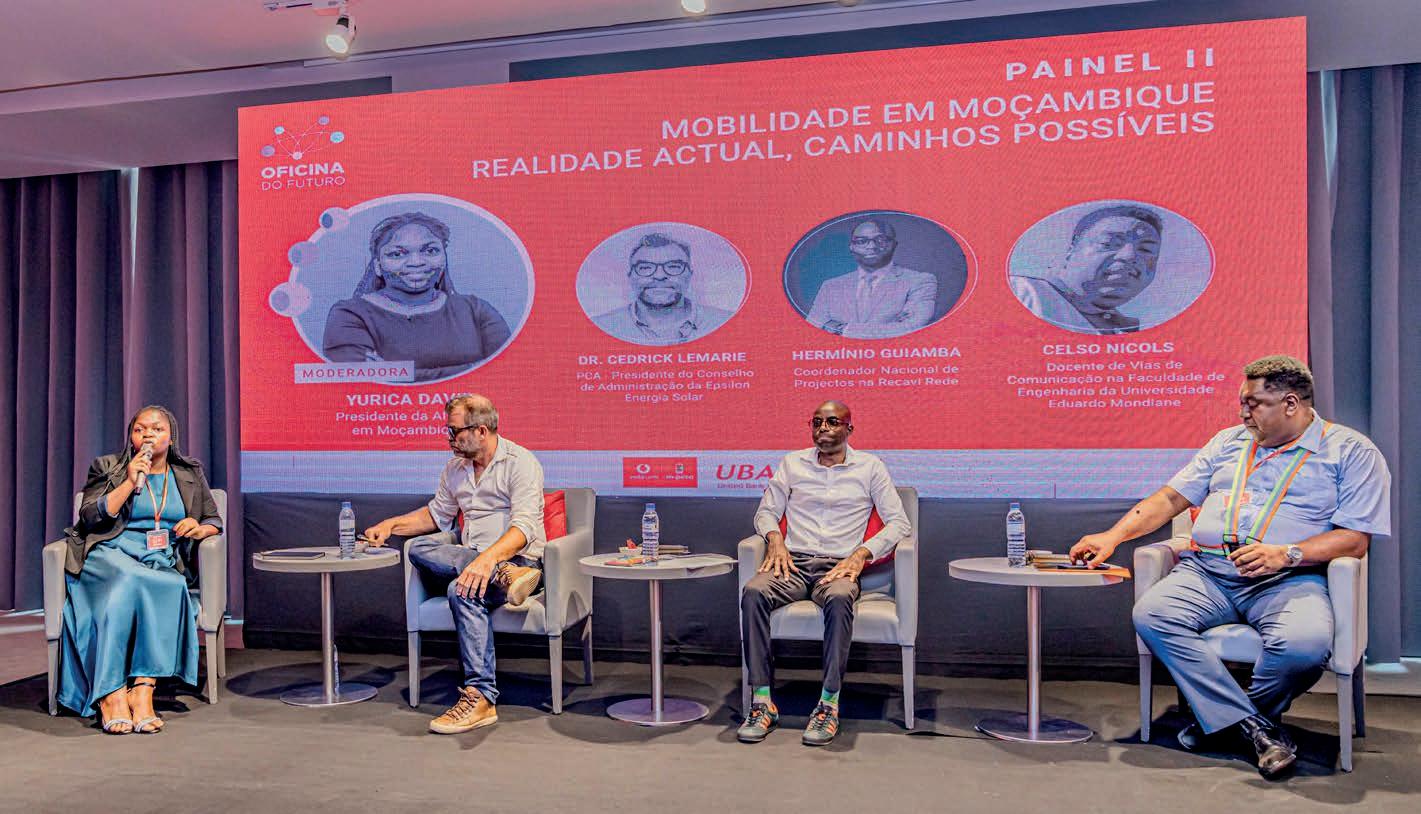
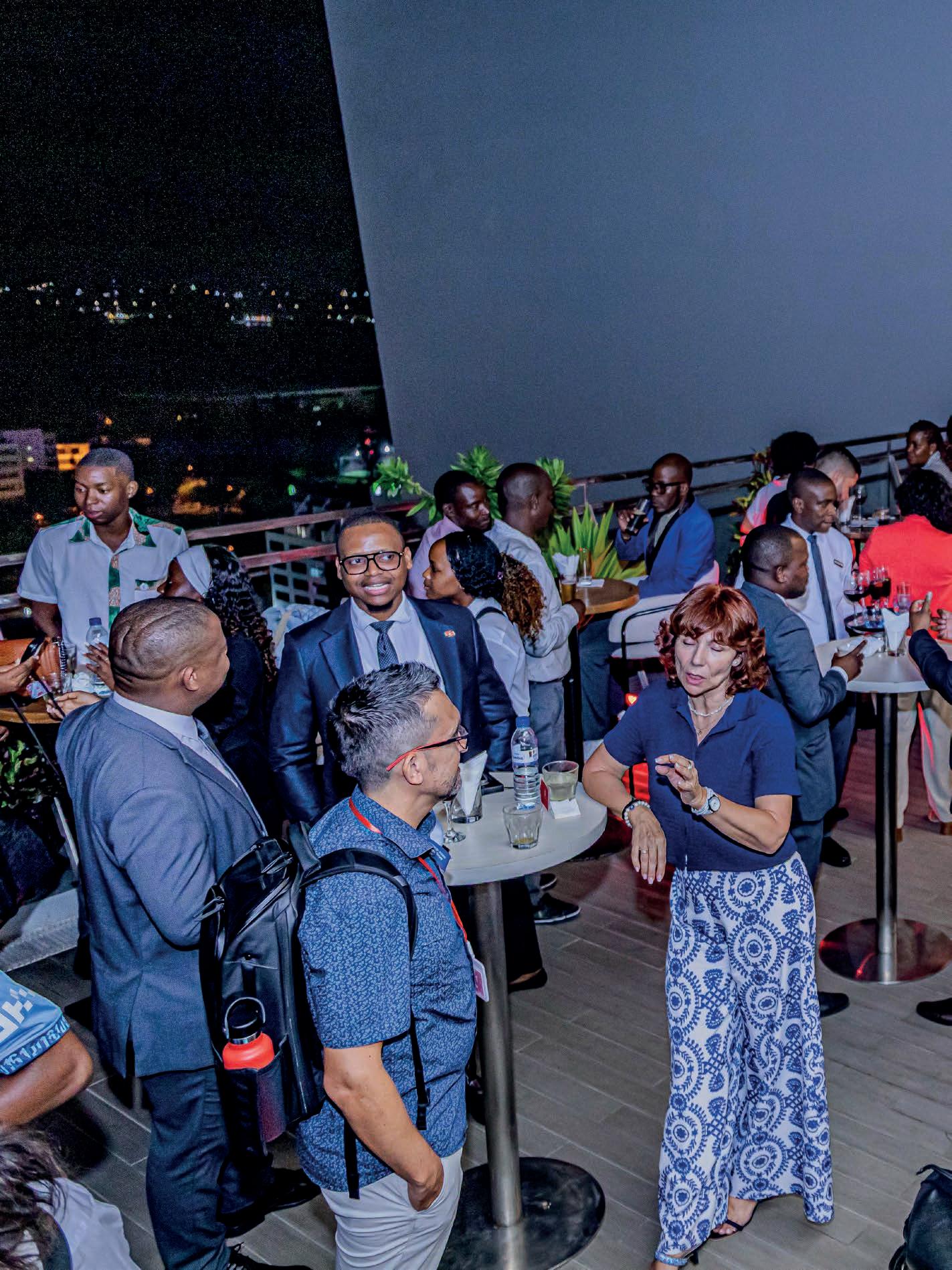
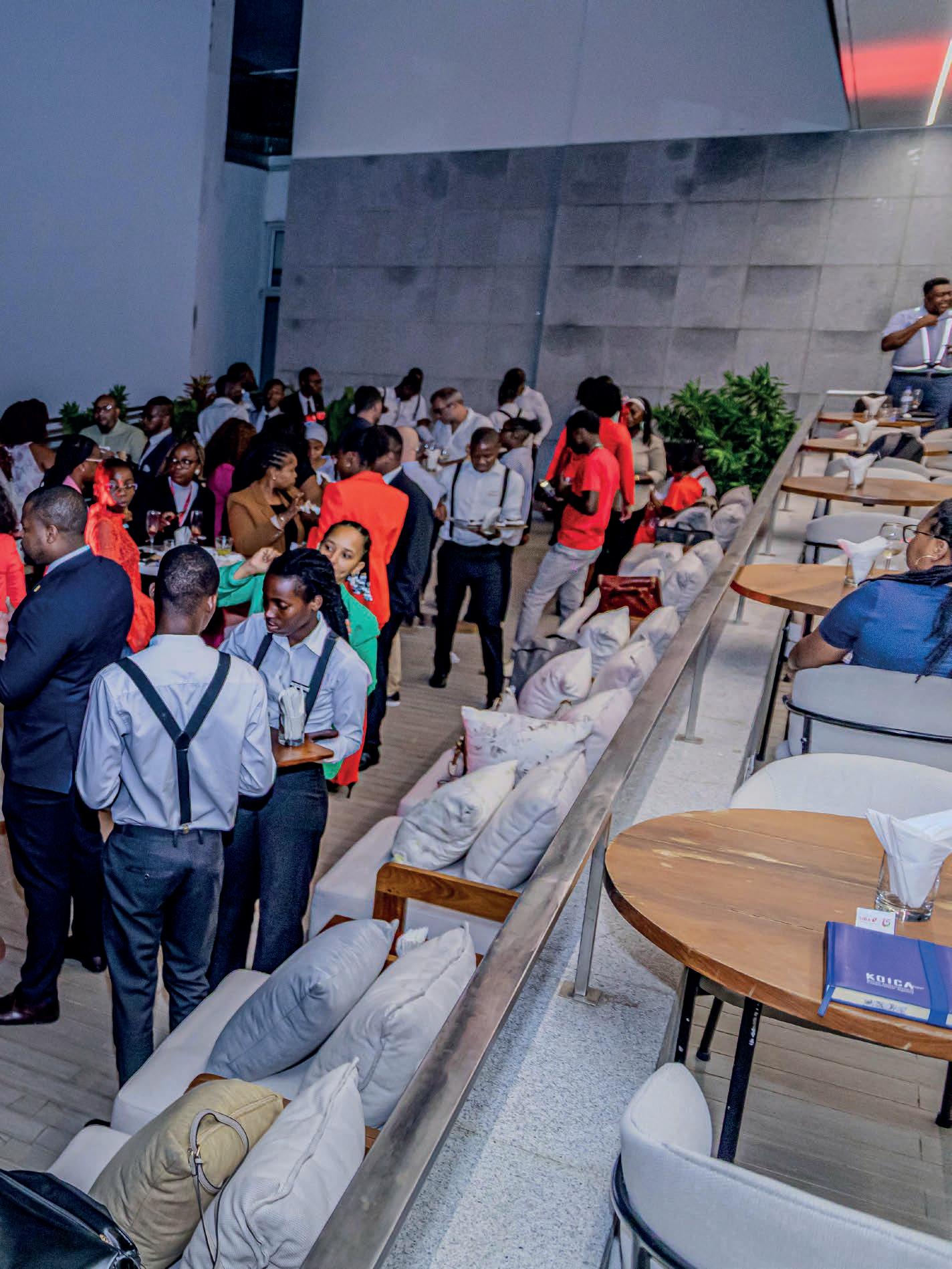
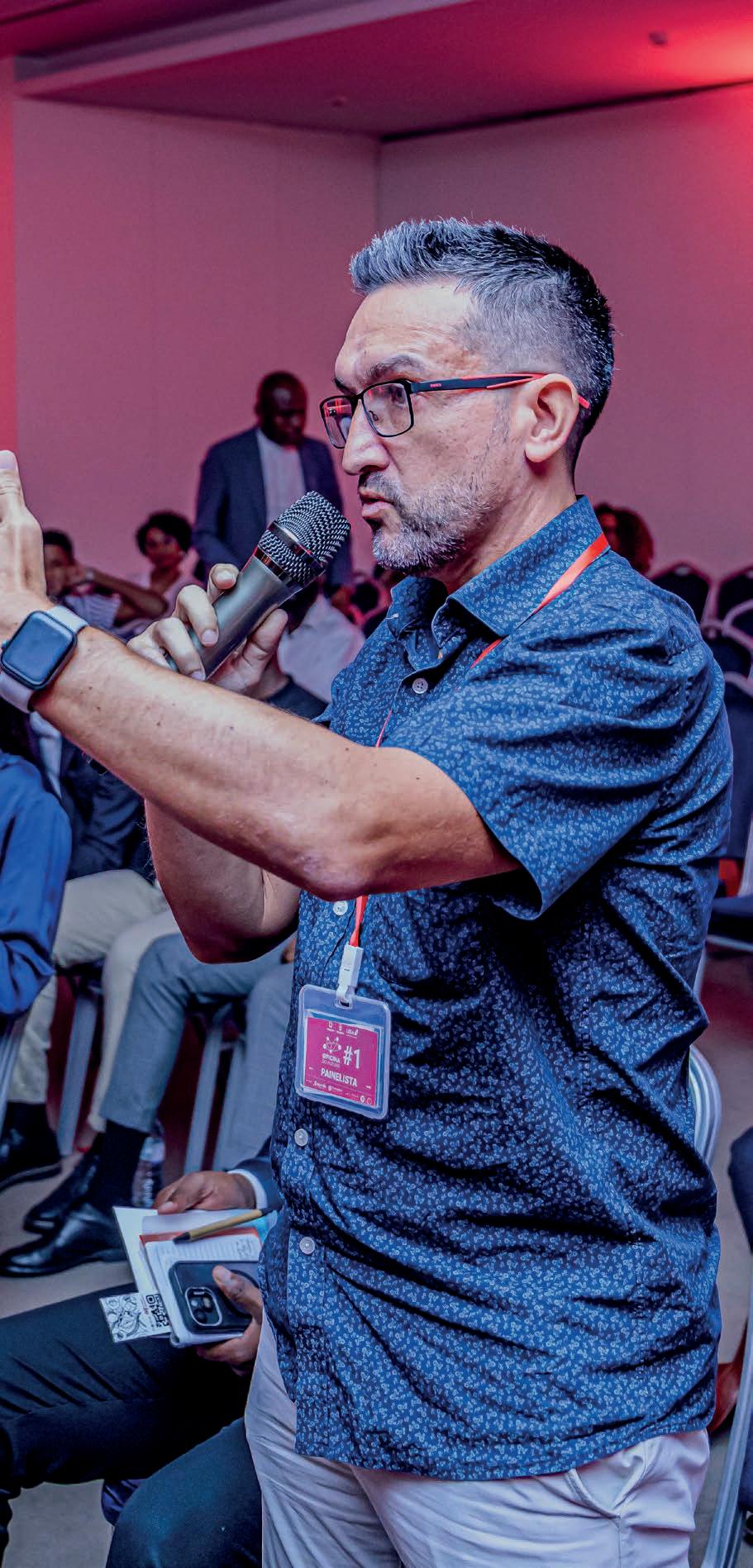
Diálogo sobre inovação no país
Dialogue on innovation in the country
34 MiIllennio Bim
Eleito melhor banco pela Global Finance Awarded Best Bank by Global Finance
54 BCI e Município de Maputo Juntos no apoio à agricultura Join forces to support agriculture
64 Desce numa boa
Caricas que geraram oportunidades
Bottle caps that created opportunities
72 Fundação Tony Elumelu Foco no empreendedorismo moçambicano Focus on Mozambican entrepreneurship
90 Estratégia, cultura e criatividade Talento e criatividade ao serviço de Moçambique Talent and creativity serving Mozambique
110 Teatro
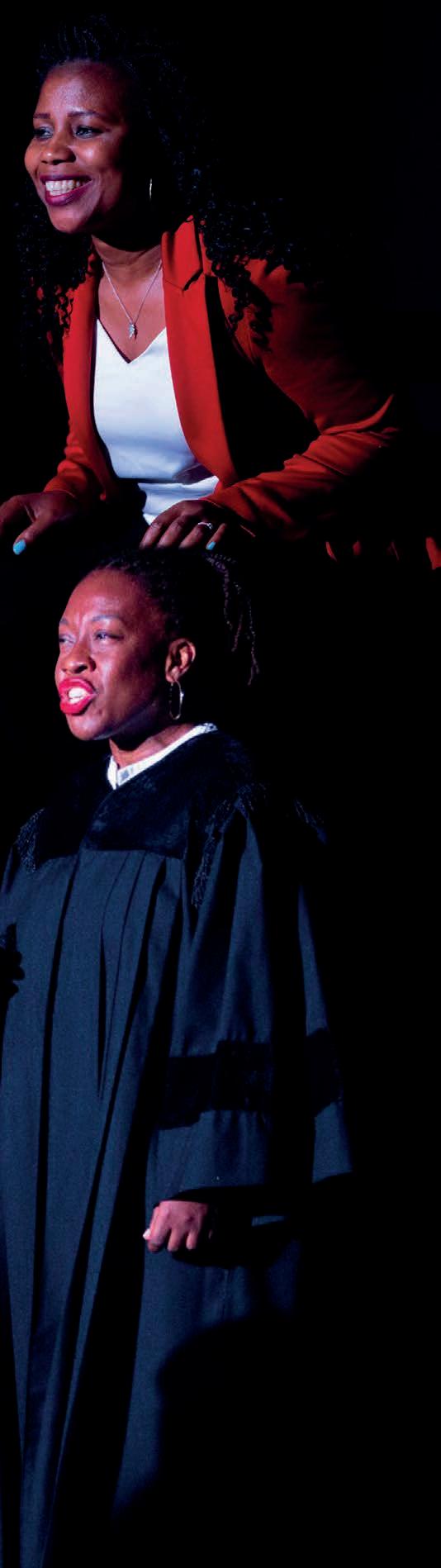
Reflexão sobre género e justiça em Maputo Reflection on gender and justice in Maputo
42 Amade Sambo
Talento moçambicano na ciência global Mozambican talent in global science
Estimado leitor,
Do Director / From the Director
Oito anos atrás lançámos a primeira edição da Xonguila, com uma ideia clara e um propósito firme: contar um Moçambique inspirador, esforçando-nos por alcançar qualidade e melhorar continuamente. Hoje, ao chegarmos ao número 89, esse compromisso mantém-se firme e mais consciente do seu papel.
Nesta edição, destacamos talento moçambicano além-fronteiras. No Japão, para onde levou curiosidade e ambição científica, Amade Sambo desenvolve investigação de ponta: uma vacina experimental contra o cancro do pâncreas, uma das neoplasias com maior taxa de mortalidade. Já Clarisse Machanguana mostra o valor de regressar ao país e aqui permanecer, assumindo um trabalho consistente junto de jovens e comunidades.
Entramos também em realidades onde o impacto se dá no terreno – com a Heartseed revelando, na Ilha de Moçambique, um projecto feito de presença, cuidado e continuidade – e olhamos para temas que marcam o presente: a soberania digital num mundo cada vez mais concentrado, o teatro como espaço de reflexão sobre justiça e género, em Maputo, e a Oficina do Futuro, que reúne diferentes vozes para pensar soluções concretas para o país em diversos domínios.
Estes são apenas pontos de partida, pois mais histórias e ideias há por descobrir nas páginas que se seguem.
Um abraço moçambicanamente fraterno.
Dear reader,
Eight years ago, we launched the first edition of Xonguila with a clear idea and a firm purpose: to tell an inspiring Mozambique, striving to achieve quality and to improve continuously. Today, as we reach issue 89, that commitment remains firm and more aware of its role.
In this edition, we highlight Mozambican talent beyond borders. In Japan, where curiosity and scientific ambition have taken him, Amade Sambo is developing cutting-edge research: an experimental vaccine against pancreatic cancer, one of the neoplasms with the highest mortality rate. Clarisse Machanguana, meanwhile, shows the value of returning to the country and remaining here, undertaking consistent work with young people and communities.
We also step into realities where impact happens on the ground — with Heartseed revealing, on the Island of Mozambique, a project built on presence, care and continuity — and we look at themes shaping the present: digital sovereignty in an increasingly concentrated world, theatre as a space for reflection on justice and gender in Maputo, and Oficina do Futuro, which brings together different voices to think about concrete solutions for the country across various fields.
These are only starting points, as there are more stories and ideas to discover in the pages that follow.
A Mozambican fraternal embrace.
Nuno Soares Director
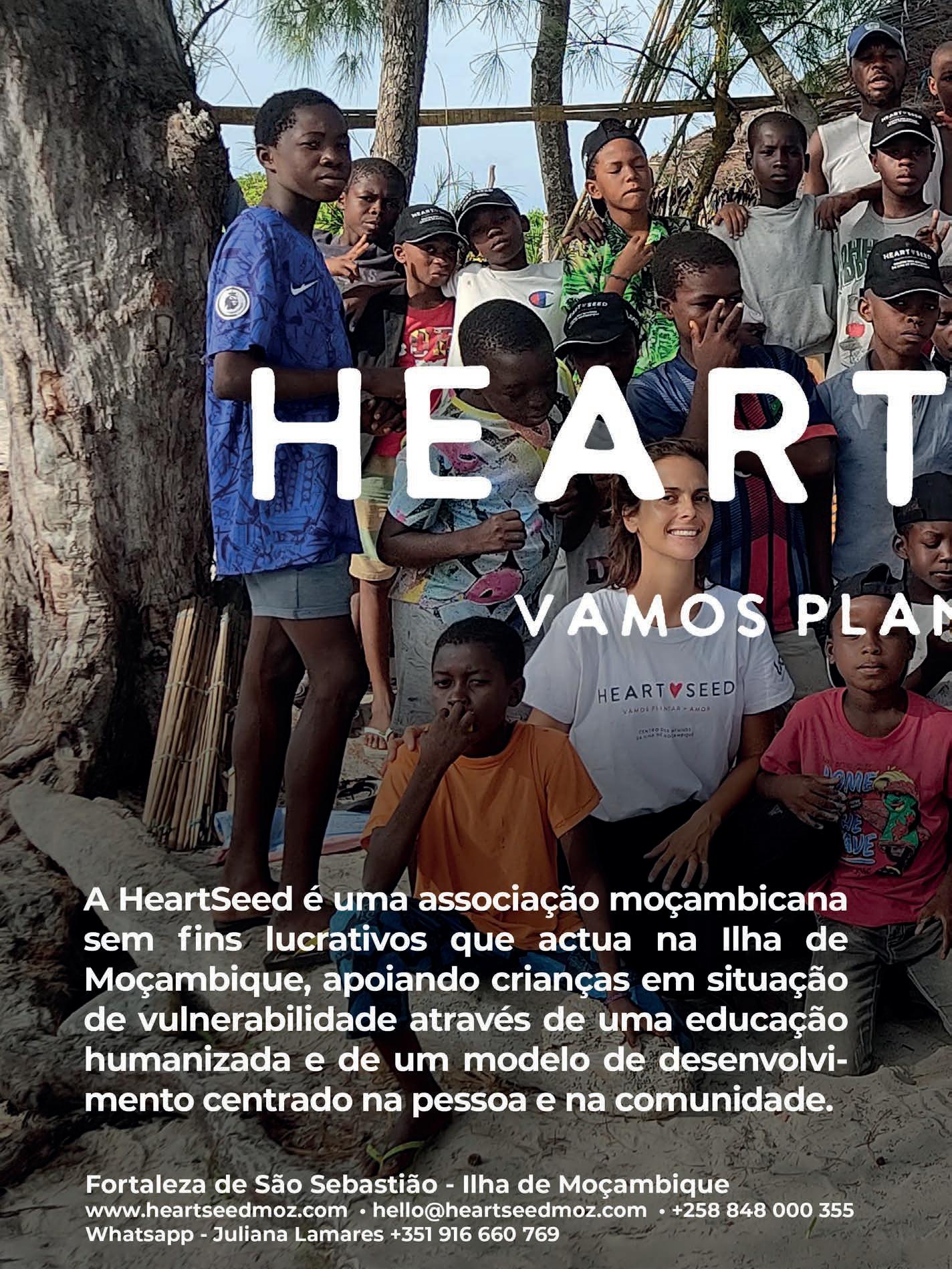
Um trabalho feito de presença, cuidado e amor
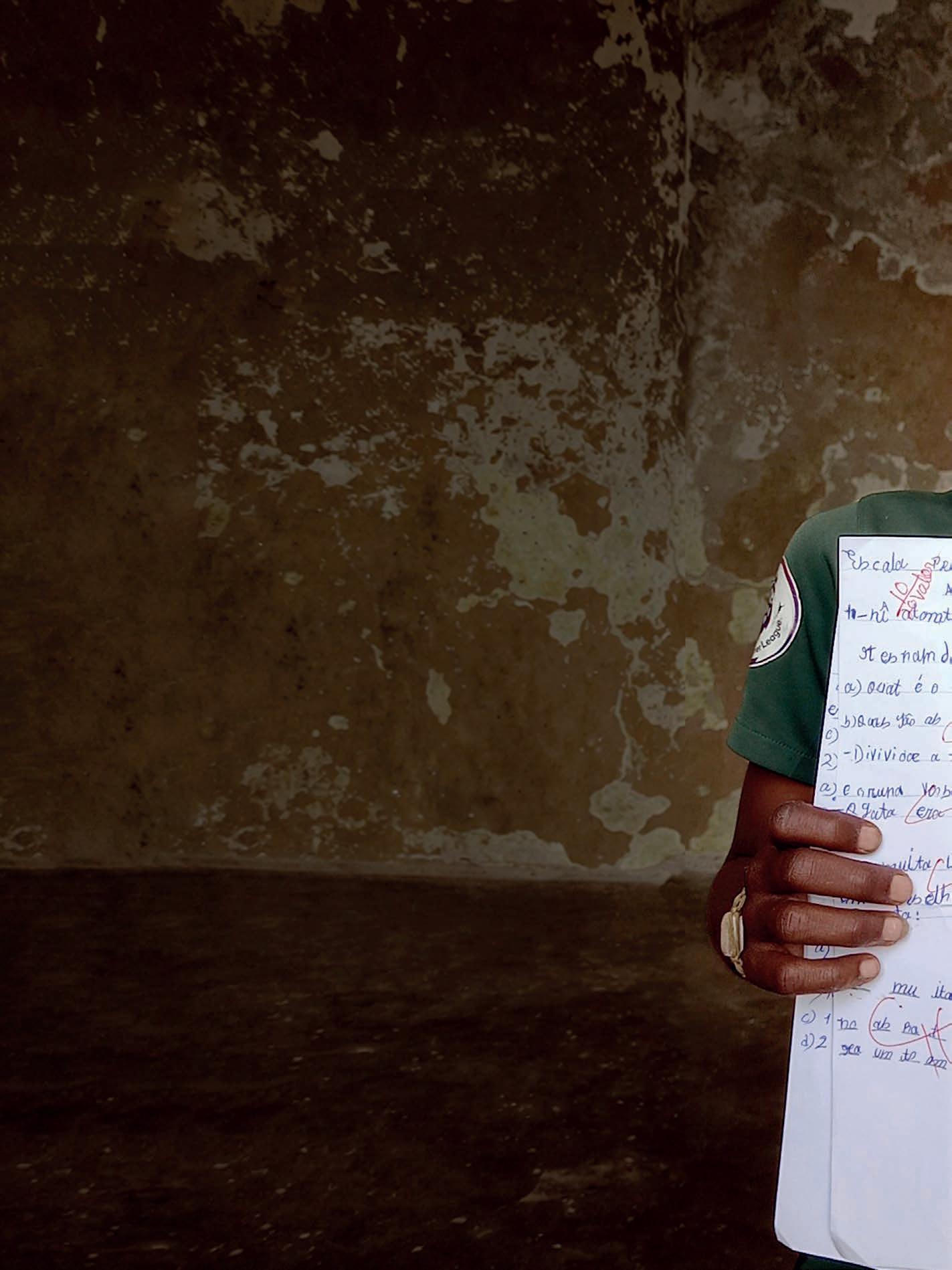
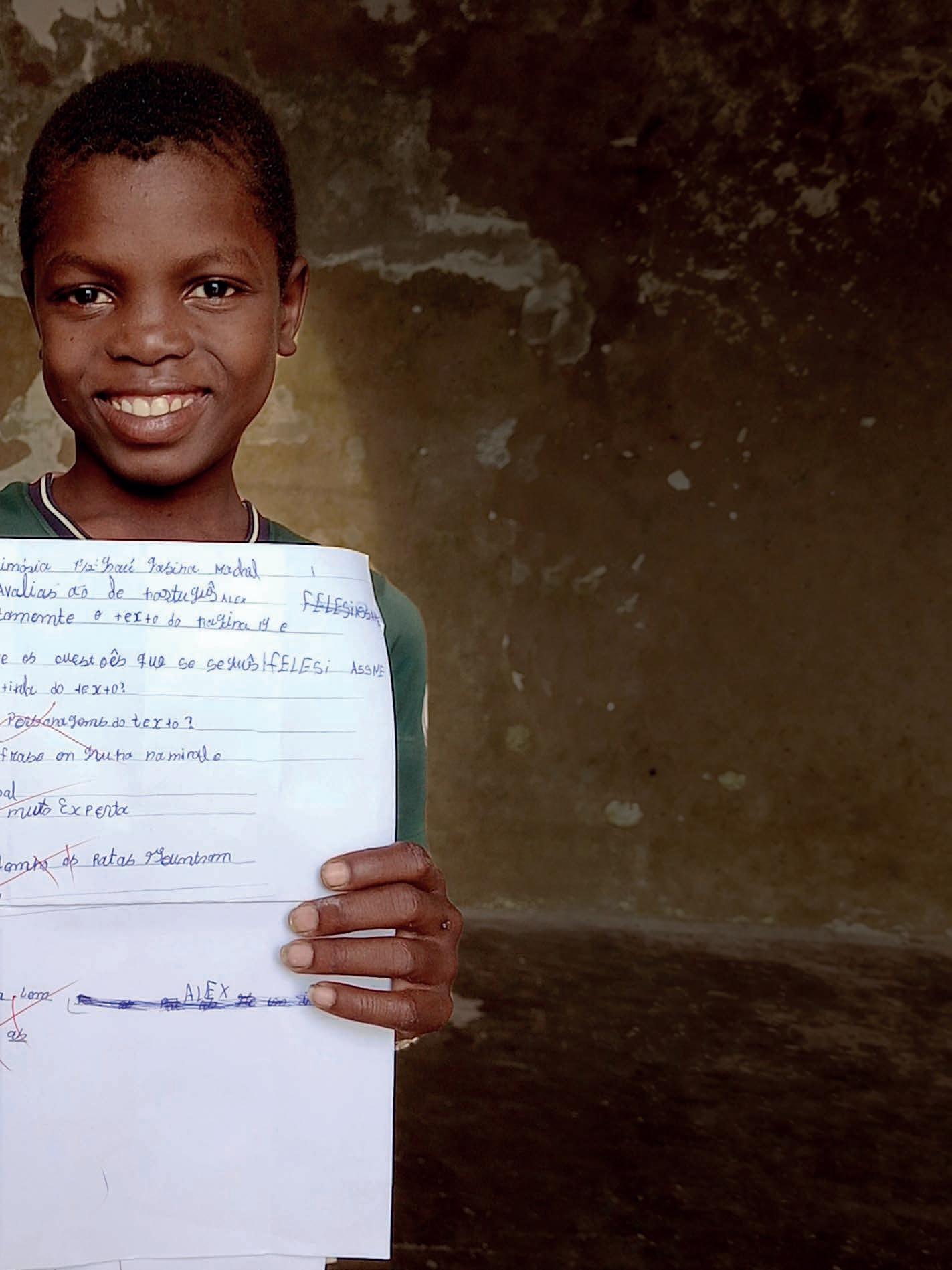
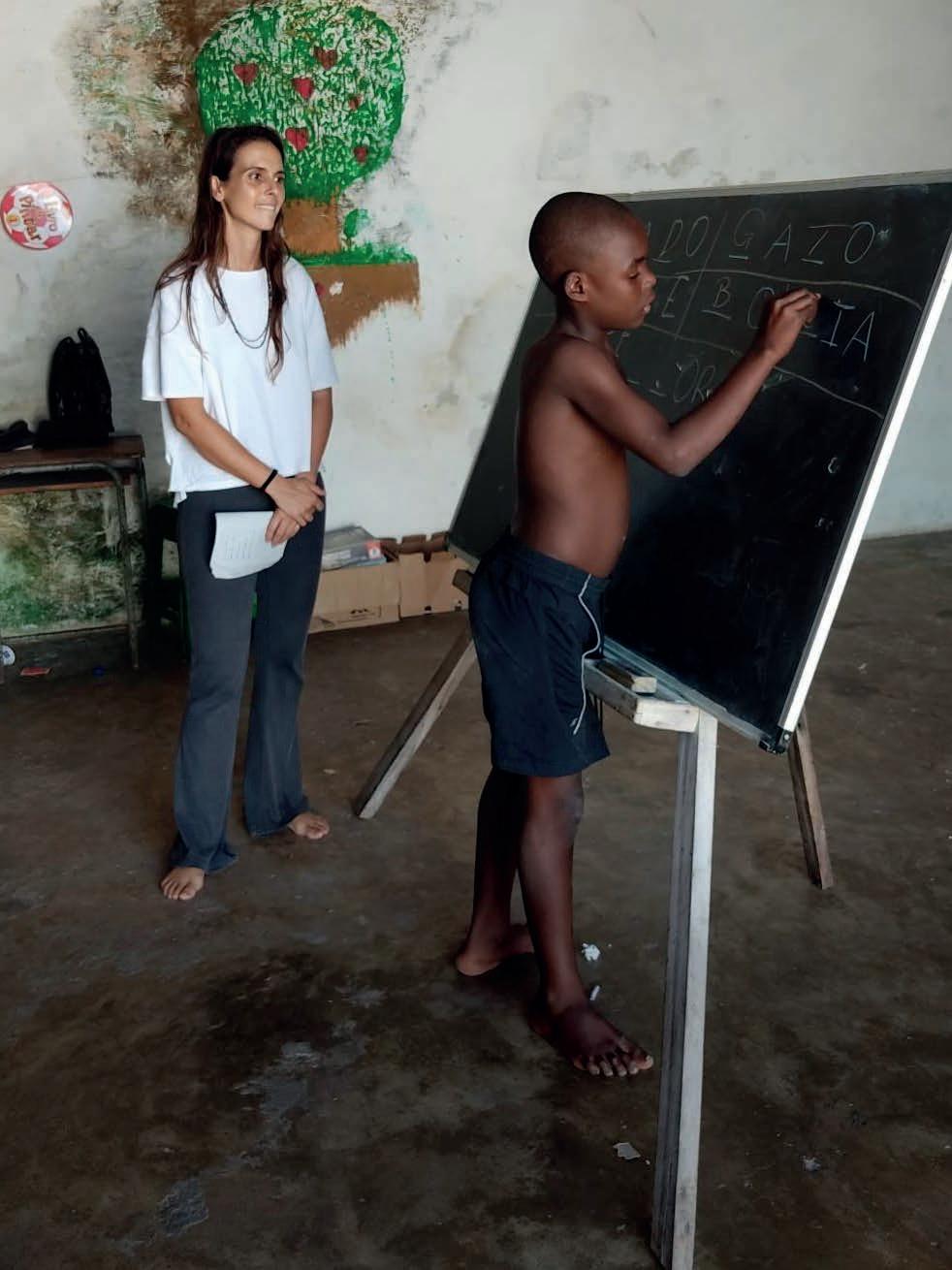
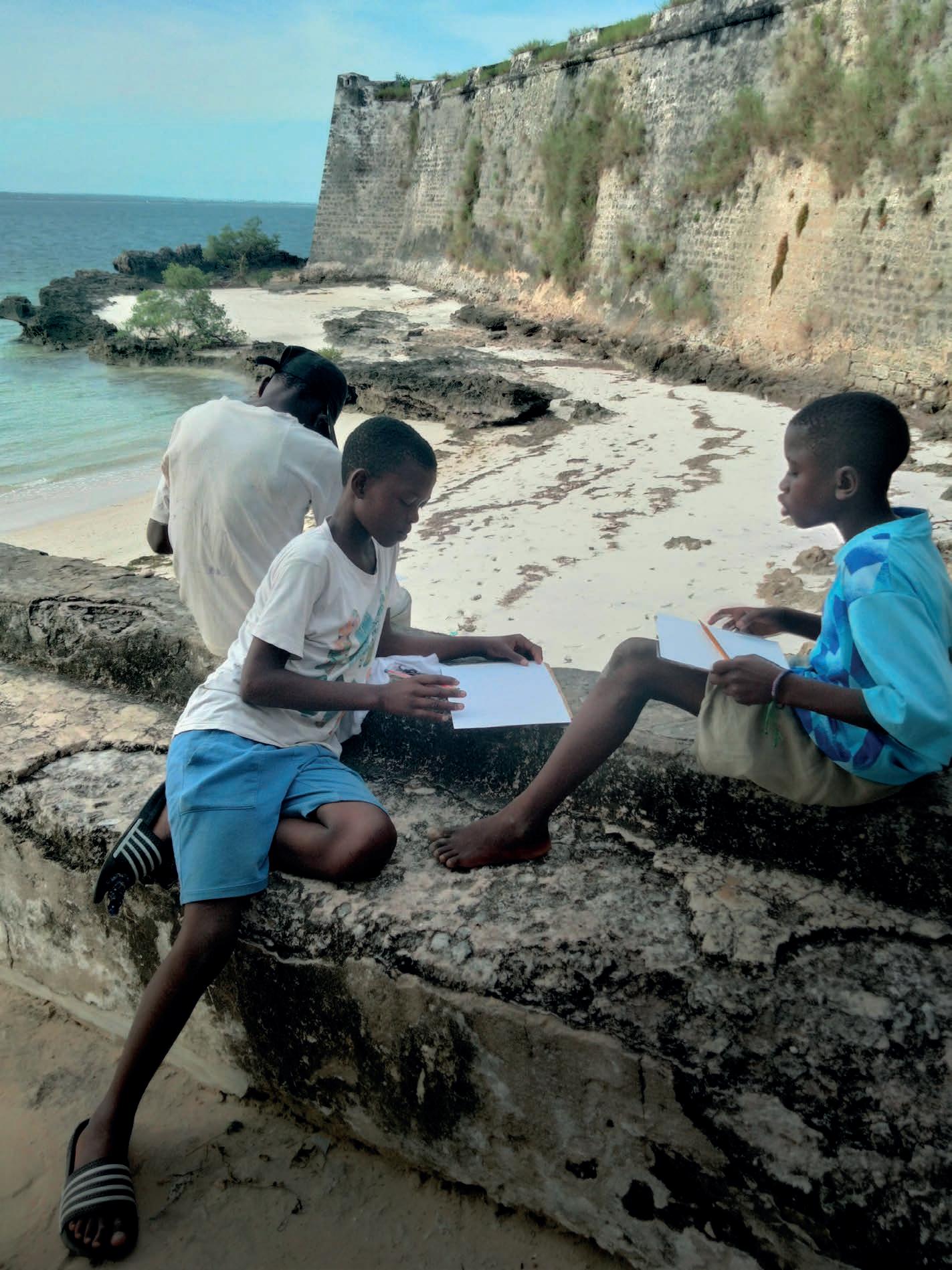
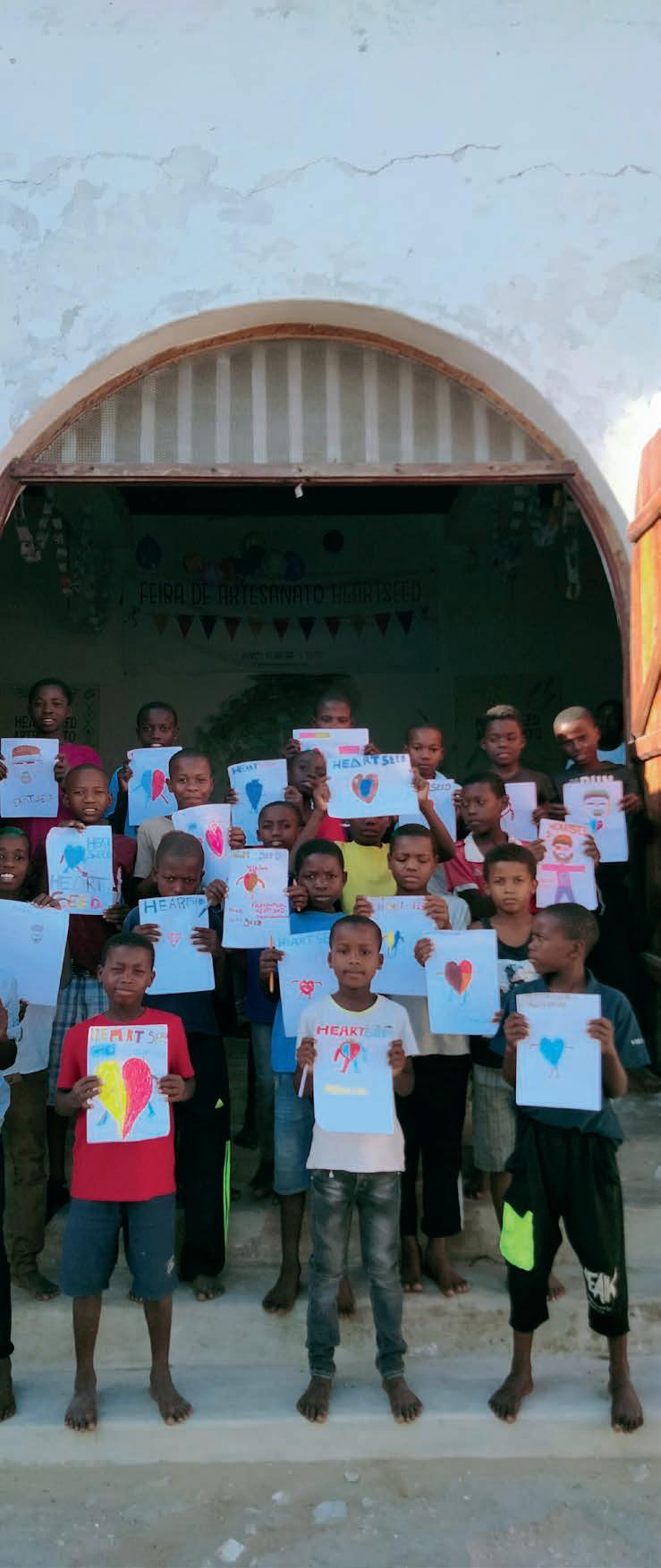
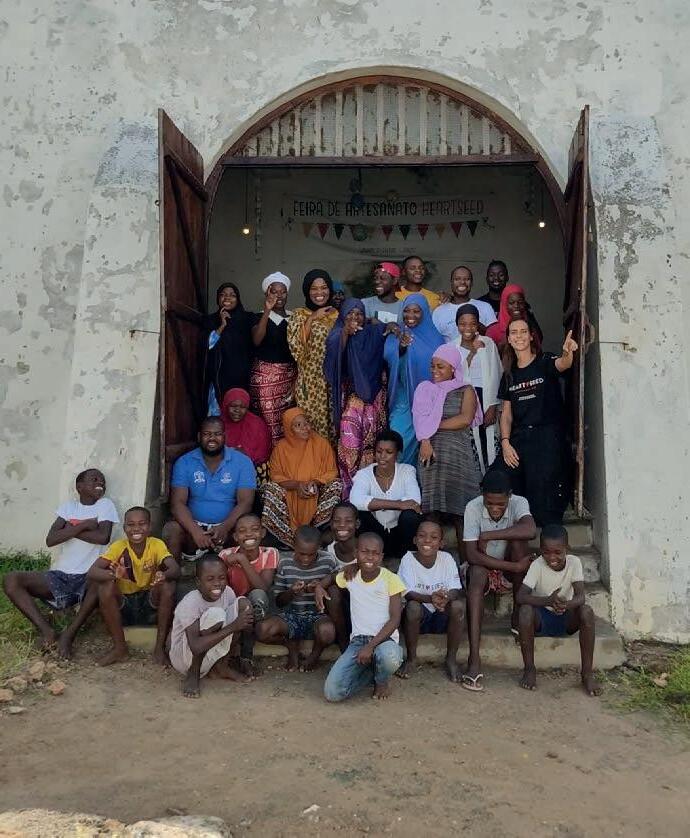
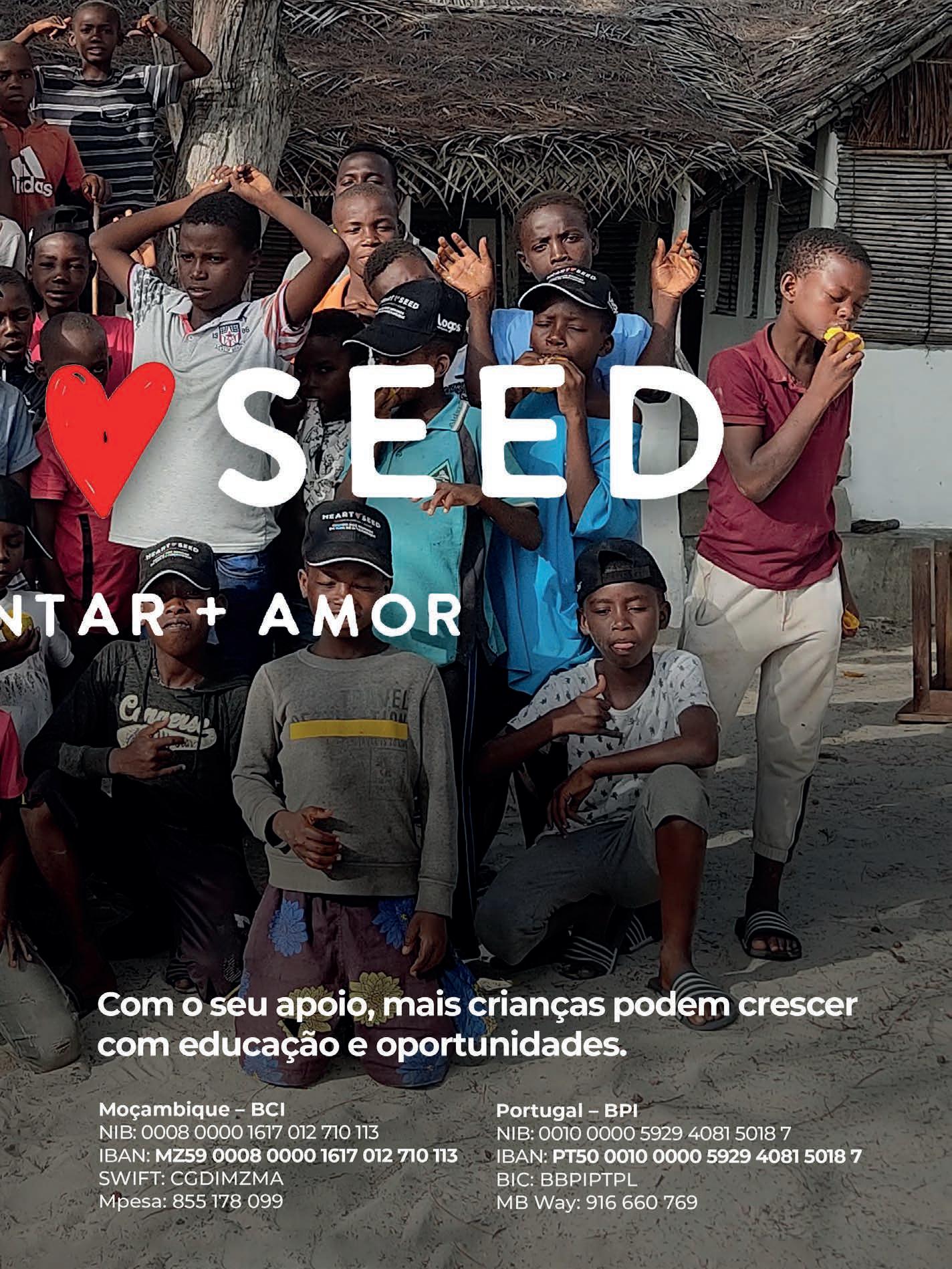
Há lugares onde a infância não tem margem para distracções, cresce depressa e aprende cedo o peso do mundo. Na Ilha de Moçambique, entre rotinas frágeis e afectos construídos no dia-a-dia, nasceu a Heartseed, não como resposta pronta, mas como tentativa persistente de estar. Nesta conversa, Juliana Lamares, fundadora do projecto, fala do que não cabe nos relatórios, do momento em que uma ideia deixa de bastar, do instante em que ficar passa a ser uma escolha, e da responsabilidade que ganha rosto, nome e tempo.
A Heartseed nasce de uma ideia, mas ideias não chegam longe sozinhas. Em que momento sentiste que isto tinha de passar do sonho à responsabilidade?
No início, a Heartseed era apenas uma inquietação dentro de mim. Uma sensação constante de que eu não podia passar por aquelas crianças todos os dias e fingir que não via. Eu vinha de um mundo onde tudo parecia organizado, com planos, horários, segurança, e, de repente, estava num lugar onde a infância acontecia na rua, exposta a tudo. O momento de viragem surgiu quando deixei de ver apenas crianças a pedir na rua e passei a conhecer as suas histórias, os seus nomes, as suas rotinas.
Quando percebi que muitas delas não estavam ali por escolha, mas por abandono, pobreza, falta de protecção, e pela influência de um sistema que, sem querer, as empurra para a mendicidade. Quando uma criança confia em ti, quando te olha como um porto seguro, quando começa a preferir estar num espaço protegido em vez da rua, já não é possível tratar isso como um projecto pontual. Nesse momento, percebi que não era mais um sonho bonito. Era uma responsabilidade diária, emocional e humana. Foi aí que entendi que não podia simplesmente ir embora quando ficasse difícil. Que já não era sobre mim, mas sobre elas.
Para Juliana, não houve um dia exacto nem um instante isolado que marcasse a viragem. Houve vários momentos pequenos, quase silenciosos, a acumularem-se. Um deles ficou gravado quando, num dia em que não apareceu, um grupo de crianças lhe bateu à porta à procura de respostas. Nesse gesto simples, percebeu que já não ia conseguir ir embora de verdade. Foi dessa permanência inesperada que a Heartseed ganhou forma. Um projecto feito de cuidado e paciência, mas também de uma dureza que raramente se conta. Porque o amor não resolve tudo depressa. Há crianças que chegam fechadas, marcadas por abandono, violência ou negligência, e dias em que se dá tudo e nada parece mudar. Plantar sementes é ficar quando empurram para longe. É aceitar que a transformação é lenta e que há feridas que não se curam apenas com comida ou escola. Há cansaço, dúvidas e frustrações. Mas há também pequenos milagres silenciosos. E são esses, quase invisíveis, que fazem tudo valer a pena.
“No
início, a Heartseed era apenas uma inquietação dentro de mim, uma sensação constante de que eu não podia passar por aquelas crianças todos os dias e fingir que não via.”
- Juliana Lamares, Fundadora do Projecto
O que te trouxe à Ilha de Moçambique e o que te fez ficar, mesmo quando teria sido mais fácil ir embora?
Cheguei a Moçambique quase por acaso, através de uma grande amiga moçambicana, sem saber muito sobre o país. A ideia era ficar apenas um mês e viajar de Maputo até ao norte. Quando cheguei à Ilha, à noite, senti uma ligação imediata e muito forte, uma sensação de casa. Cresci em Trás-os-Montes, com muita li-
berdade, a brincar na rua, descalça, com famílias sempre próximas. A Ilha trouxe-me essa mesma energia de comunidade e simplicidade. Mas o que me fez ficar foram as pessoas, especialmente as crianças, e a percepção de que ali podia construir algo com impacto real. Percebi que podia ir embora e continuar a minha vida confortável, mas também percebi que nunca mais seria a mesma pessoa se o fizesse. Ficar tornou-se uma escolha consciente.
Antes de começar este projecto, Juliana achava que a vulnerabilidade tinha fome, frio e falta de escola. Com o tempo, percebeu que a ferida maior é invisível: a ausência de amor, de segurança, de alguém que fique. Aprendeu que, antes de ensinar a ler, é preciso ensinar a confiar, e que nenhuma regra vale se o amor desaparecer quando se erra.
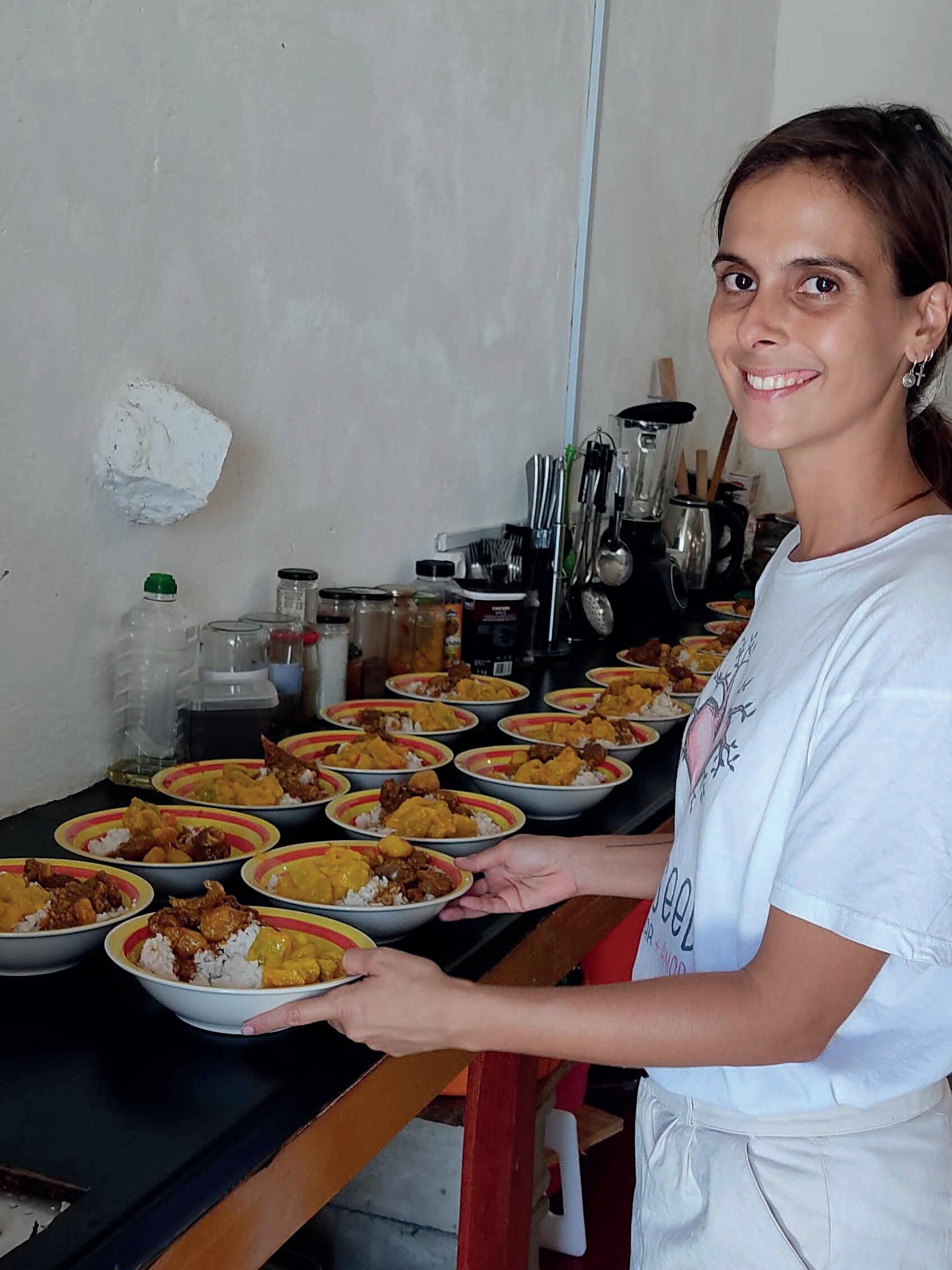
Há uma maneira própria de estar, de cuidar e de educar que foi nascendo com a Heartseed. Como descreverias essa forma de estar no dia-a-dia? A Heartseed não é apenas um centro, é uma casa emocional, e é por isso que nos temos focado em desenvolver uma metodologia educativa perfeitamente adaptada às necessidades da criança e à realidade local. Aqui, as crianças encontram rotina, mas também colo.
Encontram regras, mas também compreensão. As crianças têm rotinas, refeições, higiene, educação e actividades. Mas, acima de tudo, têm adultos constantes nas suas vidas. Aqui misturamos disciplina com muito afecto, estrutura com espaço para brincar e criar. Cada criança é vista como um indivíduo único, com talentos e necessidades próprias, e não como um número.
Houve crianças que a obrigaram a rever tudo em que acreditava sobre educação, limites e amor. Chegaram duras, agressivas, incapazes de confiar. Com elas, Juliana percebeu que o amor verdadeiro não é só carinho, é constância, limite e presença quando é mais difícil ficar. Algumas crianças testam antes de acreditar, porque já foram deixadas vezes demais. E amar, ali, é permanecer mesmo quando há rejeição. Esse mesmo exercício repete-se na gestão diária do projecto. Querer fazer mais com recursos limitados exige resiliência. Há momentos de preocupação, quando não é claro como garantir tudo o que é necessário. Ainda assim, a escassez transforma-se em criatividade, parcerias e metas claras. Não como um bloqueio, mas como desafios a ultrapassar por um bem maior.
Que tipo de ajuda faz realmente a diferença no vosso dia-a-dia, aquela que quase nunca se vê de fora?
A ajuda que realmente transforma é aquela que vai além do impulso do momento. Durante muito tempo acreditámos, e muitas pessoas continuam a acreditar, que dar dinheiro, comida ou uma bola a uma criança na rua é um gesto de amor. A intenção vem da compaixão e da vontade de aliviar o sofrimento imediato. Mas, na maioria das vezes, isso não ajuda, perpetua o problema. Cada moeda dada na rua mantém
a criança presa naquele lugar, longe da escola, da brincadeira, da infância. A mendicidade infantil não existe por escolha. Existe porque nós, adultos e sociedade, não as estamos a proteger. Muitas são empurradas para a rua por falta de cuidado ou por famílias que também vivem em grande vulnerabilidade. E, uma vez dentro desse ciclo, sair torna-se extremamente difícil. Ajudar de verdade dá mais trabalho. Exige tempo, envolvimento, conhecer a criança, a família, o contexto, e empoderar os adultos para que possam cuidar e proteger. É um processo longo, muitas vezes invisível, mas é o único que gera mudança real. Na Heartseed, isso traduz-se em retirar as crianças da rua e oferecer um espaço seguro, rotina, alimentação, educação, actividades e acompanhamento familiar, tratando não apenas o sintoma, mas a raiz do problema. Para que tudo isto seja possível, a ajuda mais importante é a contínua. Não são apenas grandes doações pontuais que fazem a diferença, mas o compromisso regular, os apadrinhamentos, as parcerias que ficam. É essa constância que garante que uma criança coma todos os dias, esteja na escola e tenha adultos presentes.
“Aqui misturamos disciplina com afecto, estrutura com espaço para brincar e criar, porque cada criança é vista como um indivíduo único.”
Quando alguém decide apoiar a Heartseed, o que é que está, na prática, a sustentar, mais do que a financiar?
Está a sustentar protecção, educação e cuidado diário. Quando alguém apoia a Heartseed, não está apenas a financiar um projecto, está a sustentar vidas no dia-a-dia. Está a tornar possível que existam rotinas estáveis onde antes havia rua, protecção onde antes havia abandono, cuidado onde antes havia ausência. Está a garantir
que uma criança saiba que vai comer, aprender, brincar e ser cuidada todos os dias. Apoiar a Heartseed é devolver algo que nunca deveria ter sido retirado: o direito a uma infância segura. Mais do que apoiar uma estrutura, é criar escolhas reais, a escolha de ir à escola em vez de ir pedir na rua, de sonhar em vez de apenas sobreviver, de construir um futuro com oportunidades. E essa transformação não impacta só a criança, mas também a família e toda a comunidade.
Na Heartseed, a horta, a cozinha, a carpintaria ou o teatro são mais do que actividades. São educação e preparação para a vida. Em cada experiência, aprende-se mais do que uma técnica. Cultivam-se valores, confiança e autonomia. São sementes plantadas no presente para que, no futuro, cada criança possa escolher o seu caminho com dignidade e liberdade.
Onde sentem que ainda falham, mesmo com as melhores intenções?
Ainda sentimos que falhamos muitas vezes onde a mudança é mais urgente. Nem sempre conseguimos fazer com que visitantes e turistas compreendam que dar na rua não ajuda uma criança, e que a verdadeira responsabilidade é nossa, como adultos, no proteger e garantir a infância. Nem sempre conseguimos chegar a todas as crianças que precisam de nós, nem oferecer o apoio psicológico que seria fundamental para algumas delas. Sabemos que poderíamos fazer muito mais, transformar ainda mais vidas, se tivéssemos recursos, infra-estrutura e meios suficientes. Mas, mesmo nessa limitação, cada dia é uma oportunidade de aprender, ajustar, crescer e fazer a diferença onde podemos.
Que futuro imaginam para estas crianças quando deixarem o cen-
tro, e que medos carregam em relação a esse futuro?
Sonhamos com jovens que cresçam com educação, auto-estima, valores sólidos e oportunidades reais, capazes de se tornarem exemplos de integridade, bondade e carácter para as suas famílias e para toda a comunidade. Sonhamos que possam viver uma vida estruturada e organizada, na qual tenham a liberdade de escolher, sonhar e construir o seu próprio caminho. Carregamos o medo constante do contexto difícil que os rodeia: a pobreza, a escassez de oportunidades, as influências negativas que podem tentar desviá-los. Por isso, todo o nosso trabalho foca-se no desenvolvimento emocional e na transmissão de valores, para que cada criança tenha força, consciência e coragem para tomar decisões diferentes, romper ciclos e criar um futuro que possa realmente escolher.
A work shaped by presence, care and love
There are places where childhood has no room for distraction—where it grows up quickly and learns early the weight of the world. On the Island of Mozambique, between fragile routines and affection built day by day, Heartseed was born—not as a ready-made solution, but as a persistent attempt to remain. In this conversation, Juliana Lamares, founder of the project, speaks about what does not fit into reports, the moment when an idea is no longer enough, when staying becomes a choice, and when responsibility takes on a face, a name and time.
Heartseed is born from an idea, but ideas do not travel far on their own. At what moment did you feel this had to move from dream to responsibility? At the beginning, Heartseed was just a restlessness inside me. A constant feeling that I could not walk past those children every day and pretend I did not see them. I came from a world where everything seemed organised, with plans, schedules, security, and suddenly I was in a place where childhood happened on the street, exposed to everything. The turning point came when I stopped seeing only children asking on the street and started to know their stories, their names, their rou-
tines. When I realised that many of them were not there by choice, but because of abandonment, poverty, lack of protection, and the influence of a system that, unintentionally, pushes them into begging. When a child trusts you, when they look at you as a safe harbour, when they begin to prefer being in a protected space rather than on the street, it is no longer possible to treat that as a temporary project. In that moment, I understood that it was no longer just a beautiful dream. It was a daily, emotional and human responsibility. That was when I realised I could not simply leave when things became difficult. That it was no longer about me, but about them.
For Juliana, there was no exact day nor a single isolated moment that marked the shift. There were several small moments, almost silent, accumulating over time. One of them stayed with her when, on a day she did not show up, a group of children knocked on her door looking for answers. In that simple gesture, she understood that she would no longer be able to truly leave. It was from that unexpected permanence that Heartseed took shape. A project made of care and patience, but also of a harshness that is rarely spoken about. Because love does not solve everything quickly. There are children who arrive closed off, marked by abandonment, violence or neglect, and days when everything is given and nothing seems to change. To plant seeds is to stay when you are pushed away. It is to accept that transformation is slow and that there are wounds that cannot be healed only with food or school. There is exhaustion, doubt and frustration. But there are also small, silent miracles. And it is those, almost invisible, that make everything worth it.
“We know we could transform even more lives if we had more resources and infrastructure.”
- Juliana Lamares, Project Founder
“We want every child to have the strength, awareness and courage to break cycles and create a future they can truly choose.”
What brought you to the Island of Mozambique, and what made you stay—even when it would have been easier to leave?
I arrived in Mozambique almost by chance, through a close Mozambican friend, without knowing much about the country. The plan was to stay for a month and travel from Maputo to the north. When I reached the Island, at night, I felt an immediate and powerful sense of belonging—of home. I grew up in Trás-os-Mon -
tes with great freedom, playing in the street, barefoot, surrounded by close-knit families. The Island carried that same energy of community and simplicity. But what made me stay were the people—especially the children—and the realisation that I could build something with genuine impact there. I understood I could leave and return to a comfortable life, but I also knew I would never be the same if I did. Staying became a conscious choice.
Before starting the project, Juliana believed vulnerability meant hunger, cold and lack of schooling. Over time, she came to understand that the deepest wound is invisible: the absence of love, of safety, of someone who stays. She learned that before teaching a child to read, one must teach them to trust—and that no rule holds if love disappears when mistakes are made.
There is a distinct way of caring, educating and being that has grown within Heartseed. How would you describe it?
Heartseed is not just a centre—it is an emotional home. That is why we have focused on developing an educational approach fully adapted to each child’s needs and the local reality. Here, children find routine, but also af -
fection. They find rules, but also understanding. They have structure—meals, hygiene, education, activities—but above all, they have consistent adults in their lives. We combine discipline with deep care, structure with space to play and create. Every child is seen as an individual, with their own talents and needs—not as a number.
Some children forced her to rethink everything she believed about education, boundaries and love. They arrived guarded, aggressive, unable to trust. Through them, Juliana understood that true love is not only tenderness—it is consistency, limits, and staying when it is hardest to do so. Some children test before they believe, because they have been left too many times. And there, love means remaining even in the face of rejection. This same tension exists in the daily running of the project. The desire to do more with limited resources demands resilience. There are moments of uncertainty, when it is unclear how to provide everything that is needed. Yet scarcity often becomes creativity, partnerships and clarity of purpose—not a barrier, but a challenge in service of something greater.
What kind of help truly makes a difference in your day-to-day—help that is rarely visible from the outside? The help that truly transforms goes beyond impulse. For a long time, we believed—and many still do—that giving money, food or a ball to a child on the street is an act of love. The intention is compassionate, a desire to ease immediate suffering.
But most of the time, it perpetuates the problem. Every coin given keeps a child there—away from school, from play, from childhood. Child begging does not exist by choice. It exists because we, as adults and as a society, are failing to protect them. Real help is harder. It requires time, involvement, understanding the child, the family, the context— and empowering adults to care and protect. It is a long, often invisible process, but it is the only one that creates real change. At Heartseed, this means removing children from the streets and offering a safe space, routine, food, education, activities and family support—addressing not only the symptom, but the root. To make this possible, the most impor -
tant help is continuous support. Not just one-off donations, but sustained commitment—sponsorships, partnerships that remain. That consistency ensures a child eats every day, attends school and has adults present.
When someone supports Heartseed, what are they truly sustaining— beyond funding?
They are sustaining protection, education and daily care. Supporting Heartseed is not simply financing a project—it is sustaining lives, every single day. It means making stable routines possible where there was once only the street. Protection where there was abandonment. Care where there was absence. It ensures a child knows they will eat, learn, play and be cared for every day. It is about restoring something that should never have been taken away: the right to a safe childhood. More than supporting a structure, it creates real choices—the choice to go to school instead of begging, to dream instead of merely survive, to build a future with opportunity. And that transformation extends beyond the child to their family and the wider community.
At Heartseed, the garden, the kitchen, carpentry and theatre are more than activities. They are education and preparation for life. In each experience, more than technique is learned—values, confidence and autonomy are cultivated. Seeds planted in the present, so that in the future each child can choose their own path with dignity and freedom.
Where do you feel you still fall short, even with the best intentions?
We still fall short where change is most urgent. We are not always able to help visitors and tourists understand that giving on the street does not help a child—and that the real responsibility lies with us as adults, to protect childhood. We cannot reach every
child who needs us, nor provide the psychological support some of them require. We know we could do much more—transform more lives—if we had greater resources, infrastructure and means. But even within these limitations, each day is an opportunity to learn, adjust, grow and make a difference where we can.
What future do you imagine for these children when they leave the centre—and what fears do you carry about that future?
We dream of young people who grow up with education, self-worth, strong values and real opportunities—capable of becoming examples of integrity, kindness and character within their families and communities. We hope they can live structured, stable lives, where they are free to choose, to dream, to build their own paths. But we carry the constant fear of the difficult context around them: poverty, lack of opportunity, negative influences that may try to pull them away. That is why our work is so focused on emotional development and values—so that each child has the strength, awareness and courage to make different choices, to break cycles, and to build a future they can truly call their own.
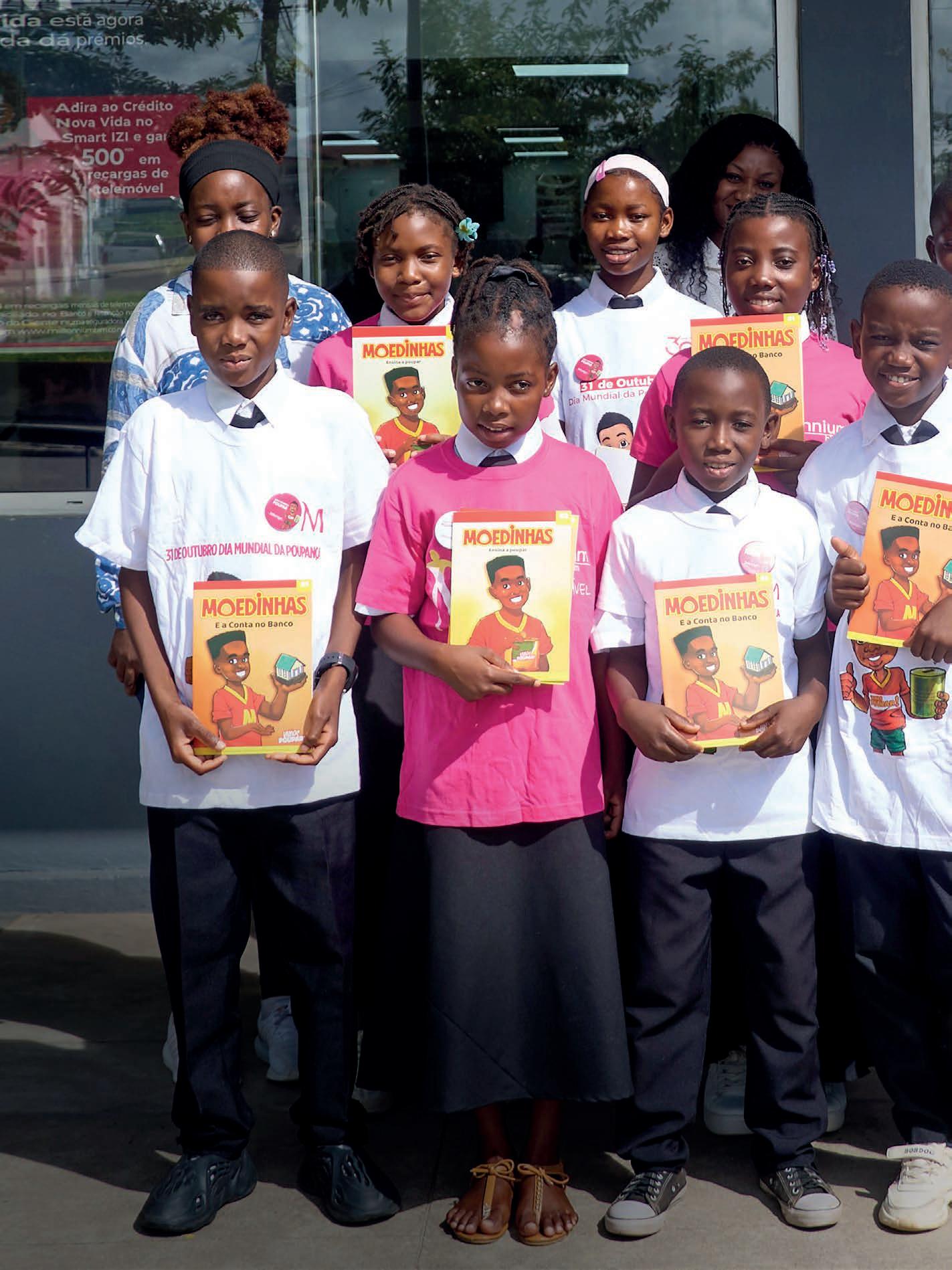
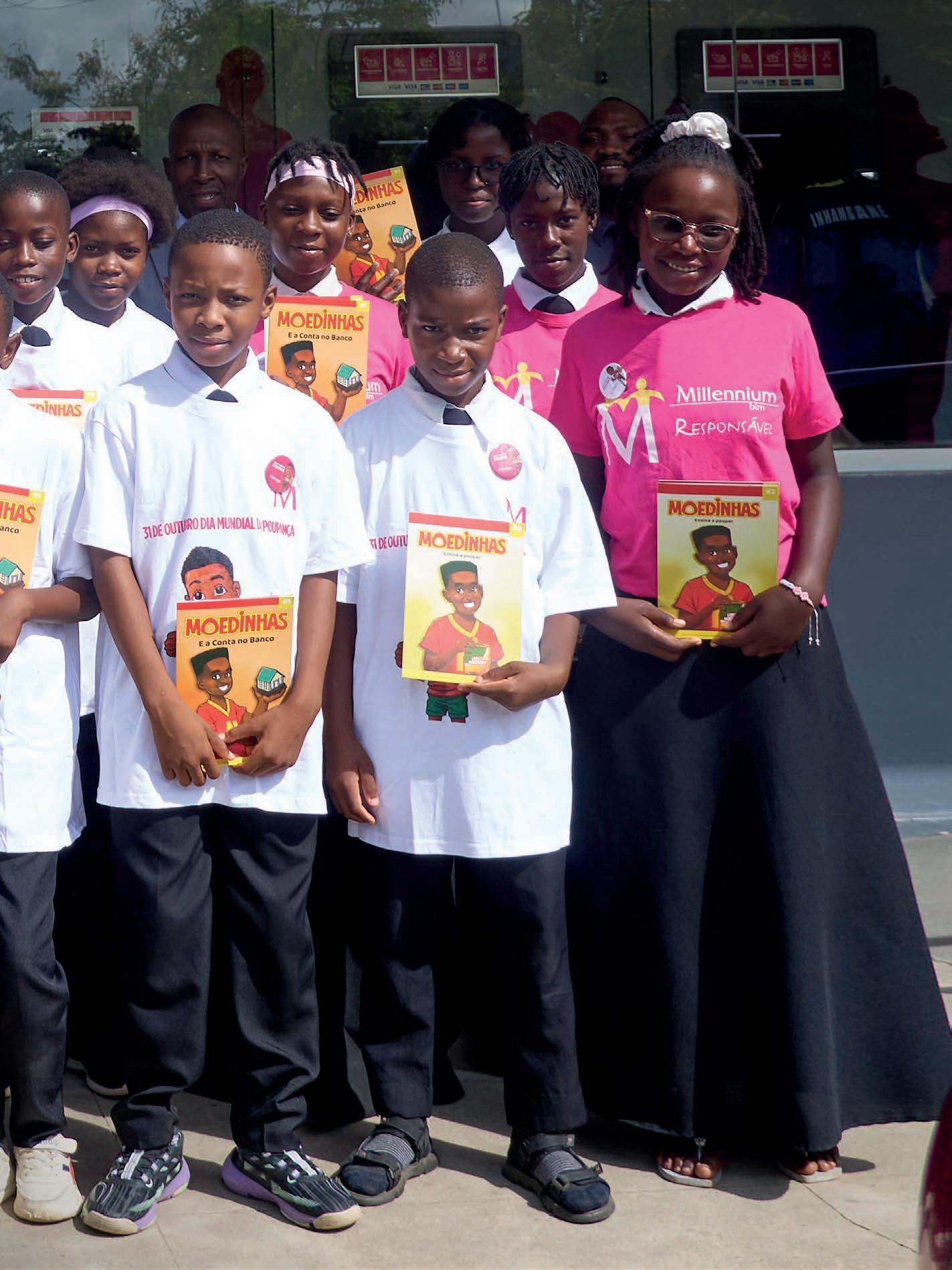
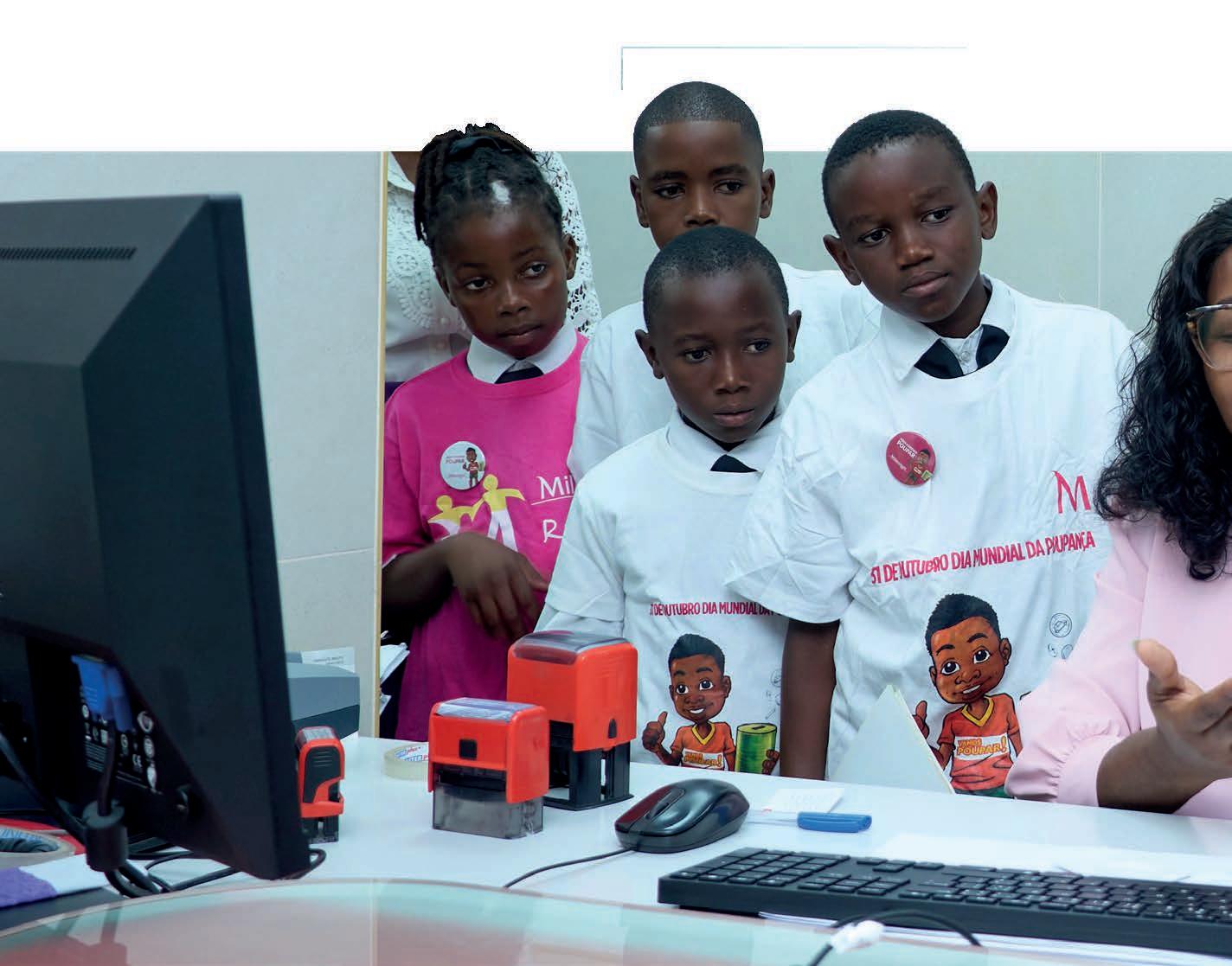
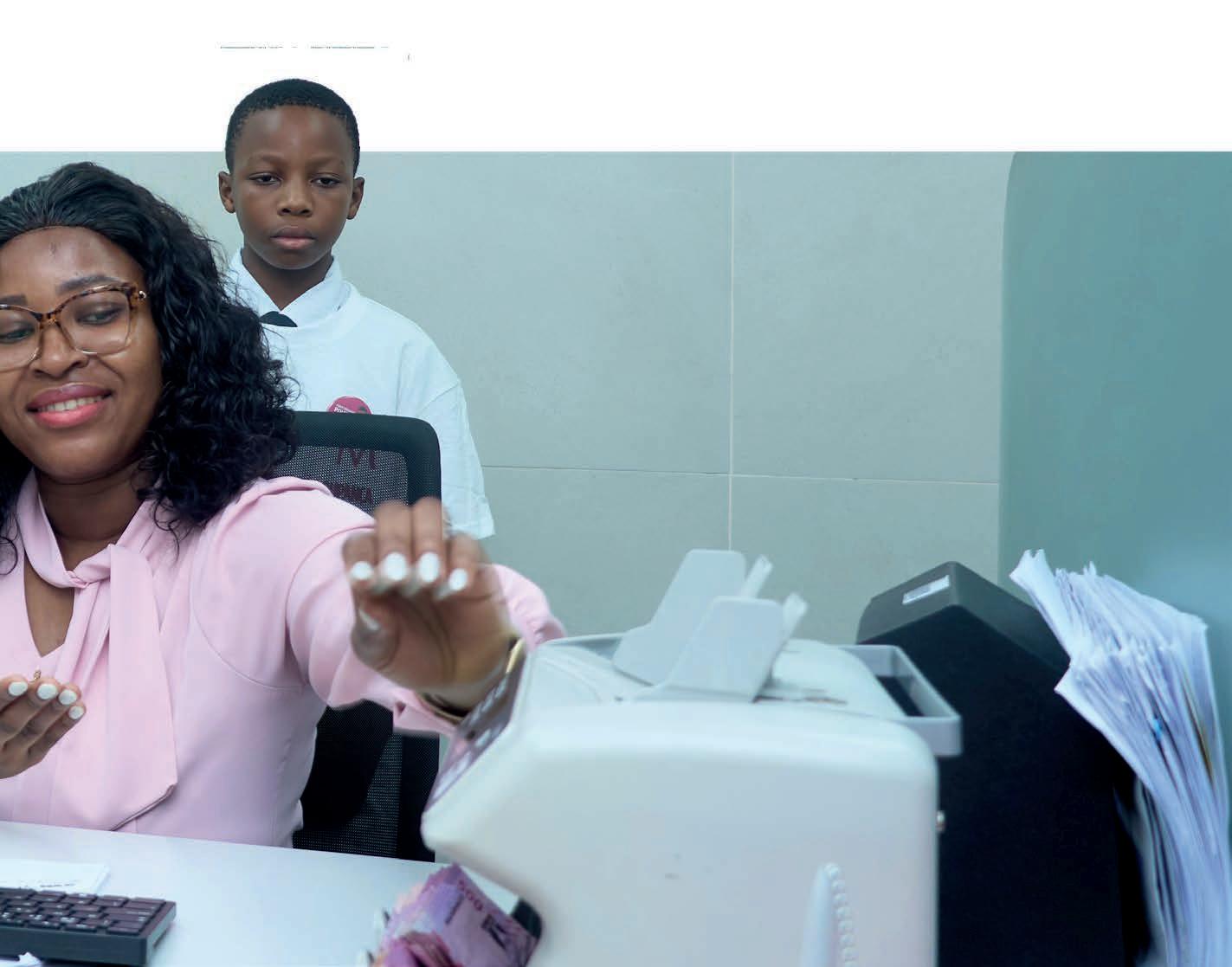
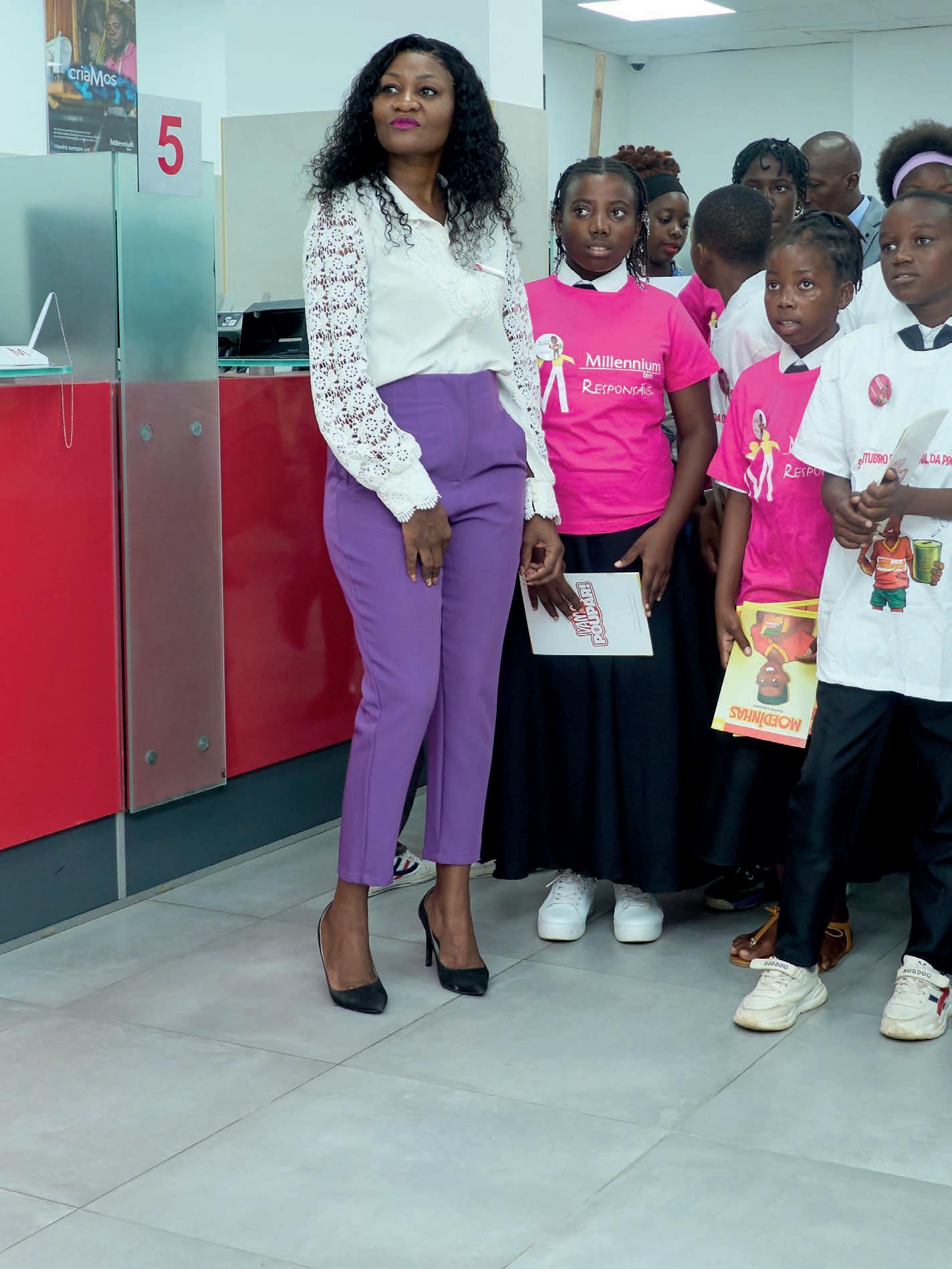
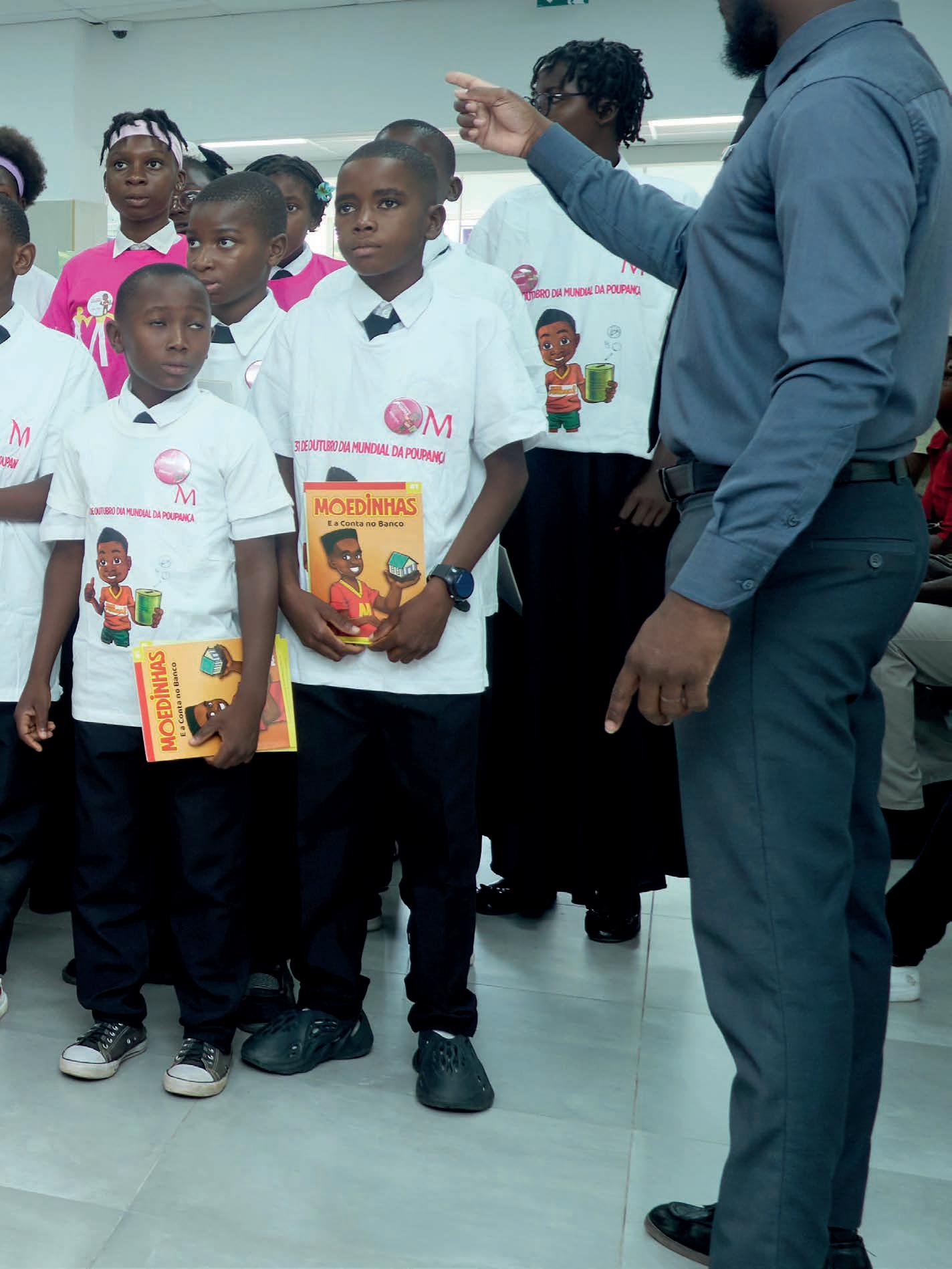
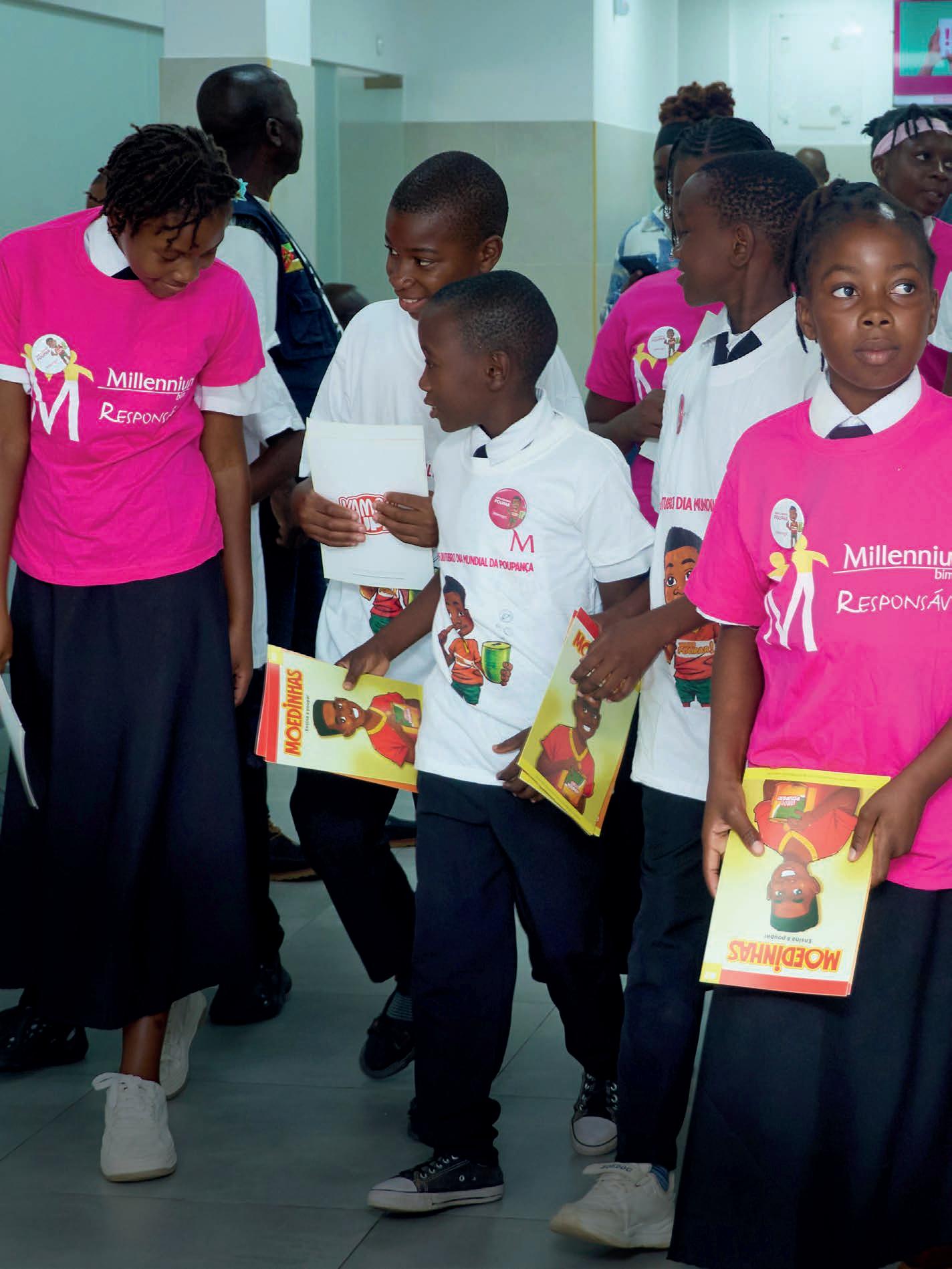
Millennium bim promove educação financeira junto de alunos do ensino secundário em Inhambane
No âmbito da 14.ª edição da Global Money Week, que decorreu de 16 a 22 de Março de 2026, sob o lema “Smart Money Talks”, o Millennium bim assinalou a efeméride com a realização de uma iniciativa de educação financeira dirigida a alunos do ensino secundário, na cidade de Inhambane.
Aactividade consistiu numa visita de estudo
alunos da Escola Secundária 4 de Outubro, com idades compreendidas os estudantes tiveram a oportunidade de conhecer, de forma prática, o
numa sessão interactiva dedicada à importância da poupança, da gestão responsável do dinheiro e da tomada de decisões financeiras conscientes.
A iniciativa foi dinamizada por Colaboradores do Banco, que promoveram momentos de partilha e esclarecimento, aproximando os jovens do sistema financeiro e incentivando uma relação mais informada e responsável com o dinheiro.
Segundo Humberto Nhamucho, Director Comercial do Millennium bim
na Província de Inhambane, “A promoção da literacia financeira junto dos jovens constitui um pilar essencial para a construção de uma sociedade mais informada e preparada para os desafios económicos do futuro. Iniciativas como esta permitem aproximar o Banco das comunidades e contribuir activamente para o desenvolvimento de competências financeiras desde cedo.”
Promovida internacionalmente pela Child & Youth Finance International, a Global Money Week mobiliza anualmente insti -
tuições públicas, privadas e organizações da sociedade civil em diversos países, com o objectivo de incentivar crianças e jovens a desenvolver conhecimentos, competências e atitudes que lhes permitam construir um futuro financeiro mais consciente e responsável.
Promover a literacia financeira junto dos jovens é uma das formas através das quais o Millennium bim contribui para capacitar as novas gerações com ferramentas e conhecimentos essenciais para uma gestão financeira mais informada ao longo da vida.
A iniciativa foi dinamizada por colaboradores do Banco, que promoveram momentos de partilha e esclarecimento ao longo da visita.
“Iniciativas como esta permitem aproximar o Banco das comunidades e contribuir activamente para o desenvolvimento de competências financeiras desde cedo.”
— Humberto Nhamucho (Director Comercial do Millennium bim)
Empowering young people with financial knowledge is central to building a more resilient economy.
As part of the 14th edition of Global Money Week, which took place from 16 to 22 March 2026 under the theme “Smart Money Talks”, Millennium bim marked the occasion by organising a financial education initiative aimed at secondary school students in the city of Inhambane.
The activity consisted of a study visit to a Millennium bim branch, with the participation of students from Escola Secundária 4 de Outubro, aged between 12 and 17.
During the visit, students had the opportunity to learn, in a practical way, how a banking institution operates, as well as to take part in an interactive session focused on the importance of saving, responsible money management and making informed financial decisions.
The initiative was led by Bank employees, who promoted moments of discus -
sion and clarification, bringing young people closer to the financial system and encouraging a more informed and responsible relationship with money.
According to Humberto Nhamucho, Commercial Director of Millennium bim in Inhambane Province, “Promoting financial literacy among young people is an essential pillar for building a more informed society that is better prepared for the economic challenges of the future. Initiatives such as this help bring the Bank closer to communities and actively contribute to developing financial skills from an early age.”
Promoted internationally by Child & Youth Finance International, Global Money Week annually mobilises public and private institutions, as well as civil society organisations, across various countries, with the aim of encouraging children and young people to develop knowledge, skills and attitudes that enable them to build a more informed and responsible financial future.
Promoting financial literacy among young people is one of the ways in which Millennium bim contributes to equipping new generations with essential tools and knowledge for more informed financial management throughout their lives.
Descubra o
trabalho
de Amade Sambo
Talento moçambicano na ciência global
“Crescer em Moçambique ensinou-me desde cedo que a ciência não depende apenas de equipamentos sofisticados, mas sobretudo de pensamento crítico e dedicação.”
Descubra o trabalho de Amade Sambo
Talento moçambicano na ciência global
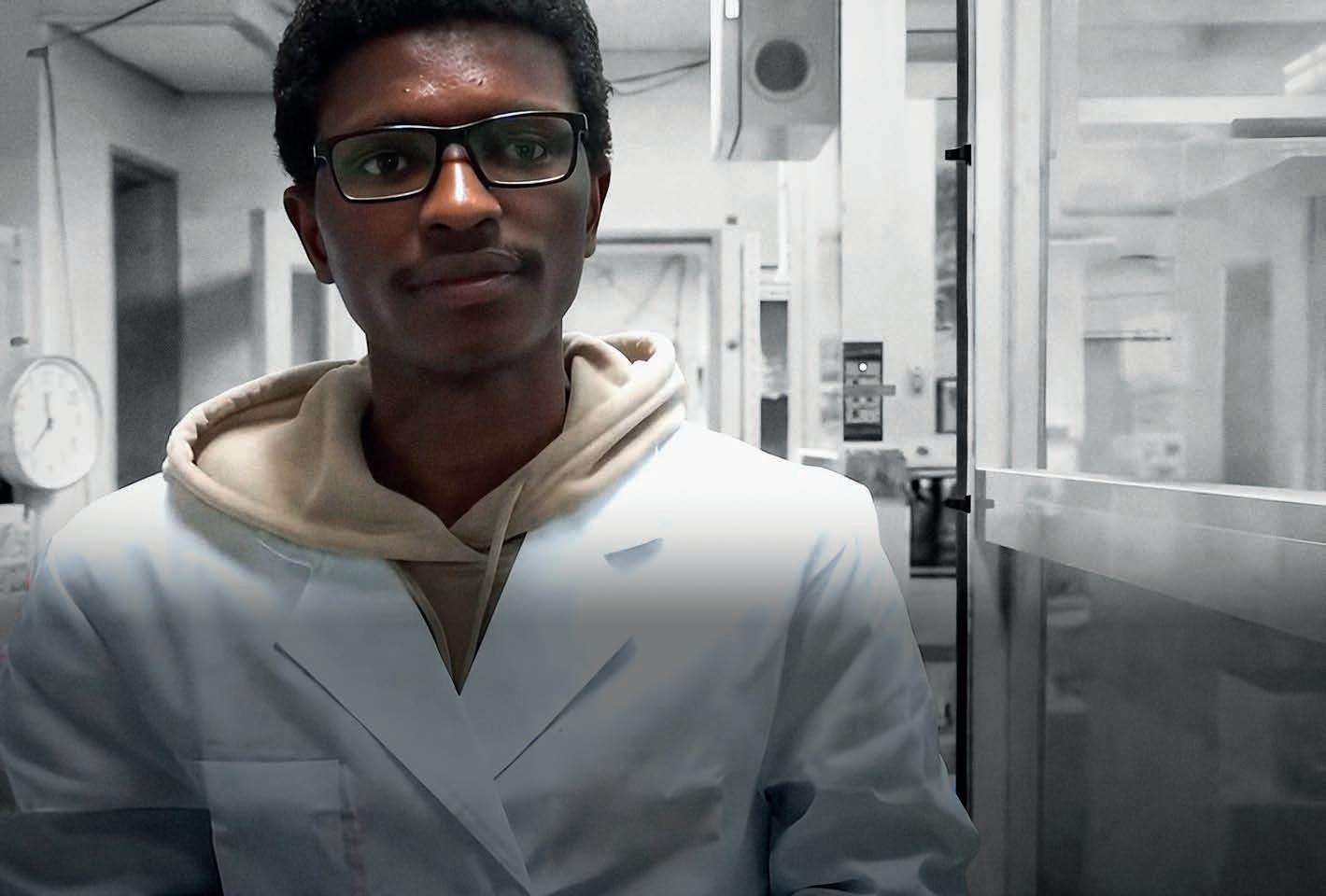
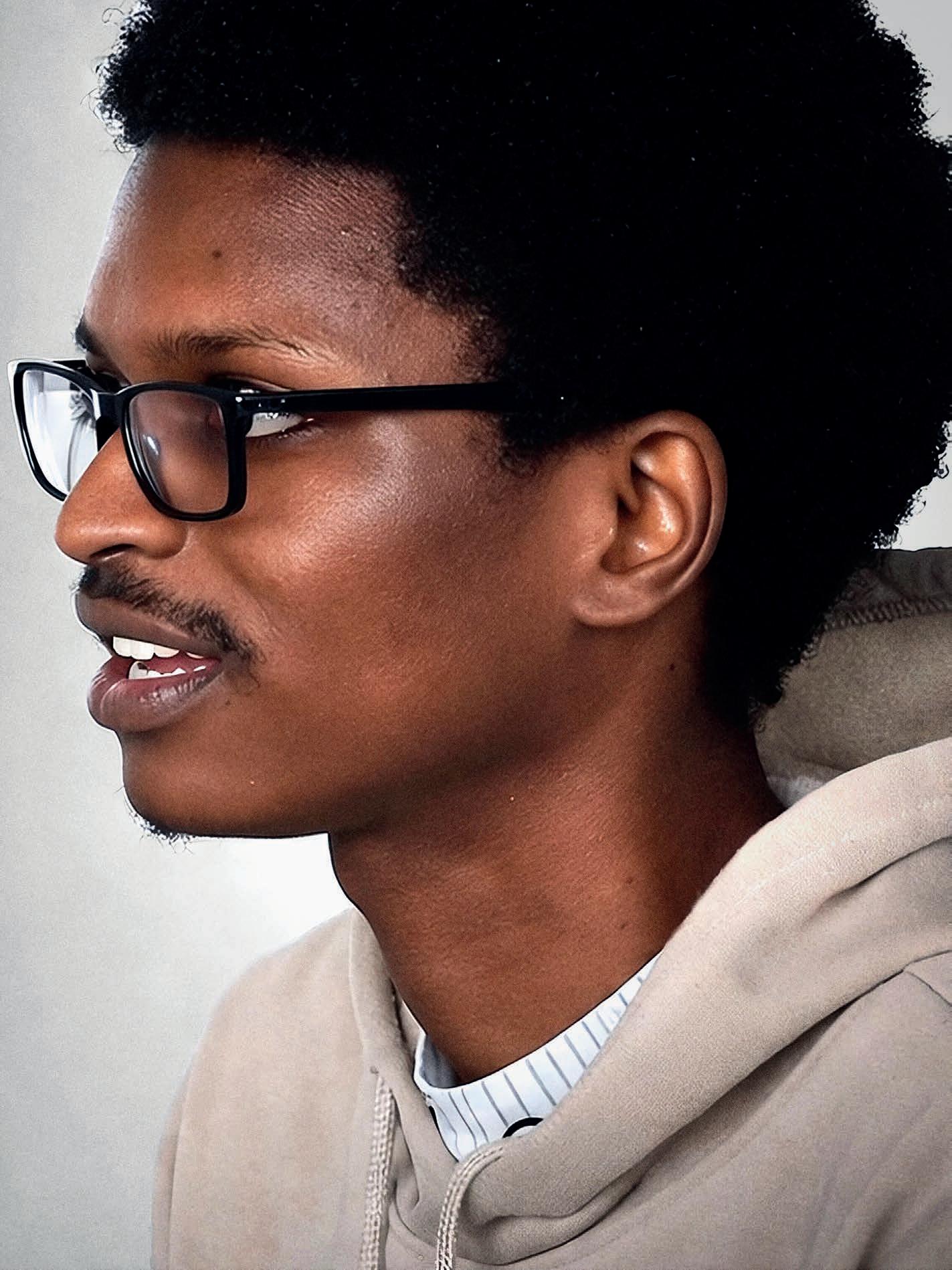
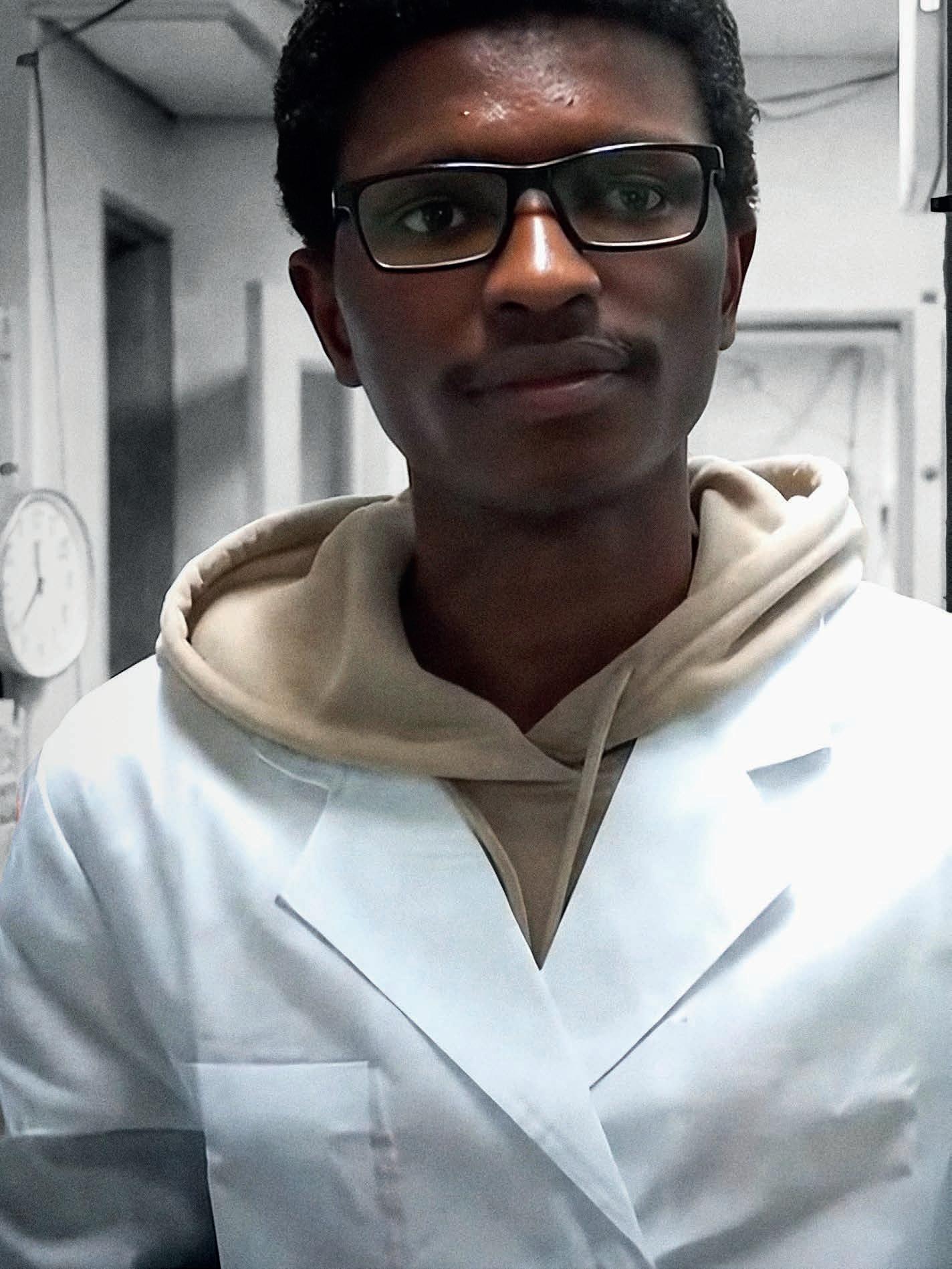
Da Universidade Eduardo Mondlane para os laboratórios de investigação no Japão, Amade Sambo é um exemplo da nova geração de moçambicanos que leva talento, curiosidade e ambição científica além-fronteiras. Na Universidade de Osaka desenvolveu investigação ligada a uma vacina experimental contra o cancro do pâncreas, um trabalho que reforça o potencial da ciência feita por jovens investigadores do país. Nesta conversa com a Xonguila, partilha o seu percurso, os desafios da investigação e a forma como Moçambique continua presente no seu caminho.
Cresceu em Moçambique e hoje desenvolve investigação de ponta no Japão. Que memórias ou referências do seu percurso inicial continuam presentes no laboratório?
Crescer em Moçambique ensinou-me, desde cedo, o valor da curiosidade e da persistência. Nem sempre tínhamos acesso a todos os recursos laboratoriais que encontro no Japão, mas isso acabou por desenvolver em mim uma mentalidade de resolver problemas com criatividade. No laboratório ainda carrego essa memória: a ideia de que a ciência não depende apenas de equipamentos sofisticados, mas sobretudo de pensamento crítico e dedicação.
Muitas vezes lembro-me das aulas e dos laboratórios na Universidade Eduardo Mondlane, que foram fundamentais para despertar o meu interesse profundo pela química.
Antes de falarmos da vacina que é objecto do seu trabalho, queria perceber o homem por detrás do
cientista. Quem é Amade Sambo fora da bancada de investigação? Fora da bancada de investigação, sou uma pessoa bastante curiosa sobre a vida. Gosto muito de caminhar e explorar novos lugares. Também gosto de conversar com pessoas de culturas diferentes, ouvir as suas histórias e aprender como vêem o mundo.
O que o fascinou na química ao ponto de a transformar no seu campo de vida? Houve um momento de descoberta que o marcou?
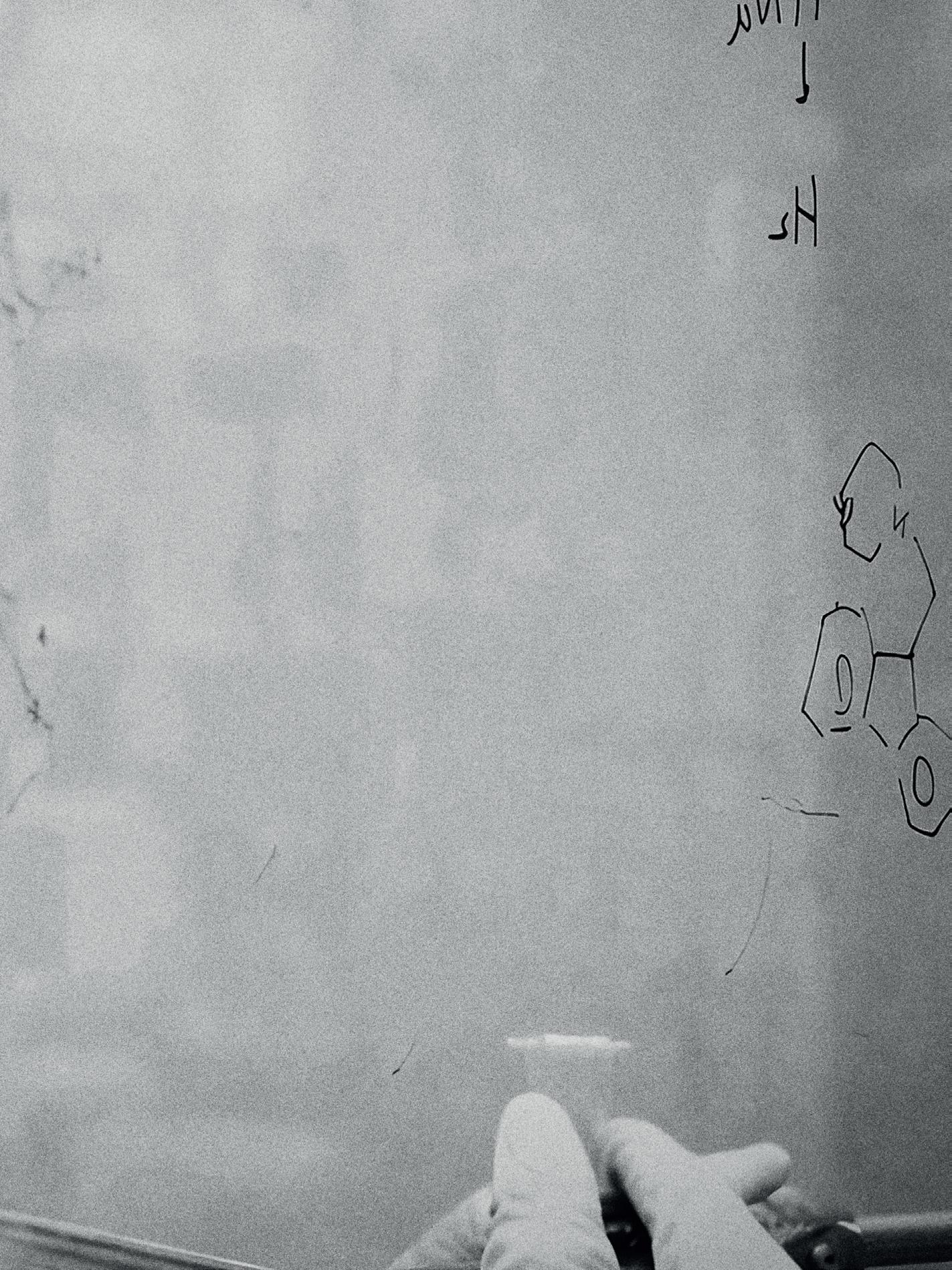
A química fascinou-me porque é a ciência que explica como o mundo funciona a nível molecular. A ideia de que pequenas estruturas invisíveis podem determinar propriedades da matéria ou até processos biológicos complexos sempre me impressionou. Um momento marcante foi quando comecei a trabalhar com síntese orgânica e percebi que era possível construir moléculas específicas com um propósito científico ou médico.
Desenvolver uma vacina experimental contra o cancro do pâncreas durante o mestrado é um feito raro. Como nasceu essa linha de investigação?
Essa linha de investigação surgiu dentro de um projecto académico focado na síntese de moléculas com potencial aplicação imunológica. Durante o mestrado tive a oportunidade de trabalhar com síntese de peptídeos e glicanos, que são componentes importantes na engenharia de antigénios. A partir daí, juntamente com os meus Professores, começou a desenvolver-se a ideia de construir uma molécula capaz de estimular o sistema imunitário a reconhecer células cancerígenas específicas.
Para quem não é da área científica, como explicaria a lógica da sua vacina e o que a torna inovadora? De forma simples, a ideia da vacina é ensinar o sistema imunitário a reconhecer células cancerígenas. Isto é, sintetizar moléculas que imitam certas estruturas presentes nas células tumorais. Quando o sistema imunitário entra em contacto com essas moléculas numa formulação controlada, ele aprende a identificá-las como algo que deve ser combatido. A inovação está na forma como estas moléculas são desenhadas quimicamente e apresentadas
ao sistema imunitário, utilizando estratégias de química sintética e engenharia de nanopartículas.
Trabalhar com uma doença tão agressiva traz também um peso emocional. Como lida com a consciência de que o seu trabalho pode significar esperança para milhares de pessoas?
É uma responsabilidade grande, mas também é uma motivação enorme. A ciência é um processo longo e muitas vezes incerto. Tento manter sempre uma perspectiva equilibrada, focar-me em fazer o melhor trabalho científico possível e respeitar cada pequeno avanço.
A excelência académica que alcançou na Universidade de Osaka não acontece por acaso. Que disciplina pessoal sustenta esse nível de desempenho?
Acredito muito em consistência. A ciência exige paciência, atenção ao detalhe e capacidade de aprender continuamente. Procuro organizar bem o meu tempo, manter uma rotina de estudo e laboratório disciplinada e, sobretudo, cultivar curiosidade científica. Também considero muito importante colaborar e aprender com colegas e orientadores, porque a investigação raramente é um esforço individual.
“Gostaria de ver Moçambique com universidades fortes e uma geração de jovens cientistas capazes de contribuir para soluções locais e globais.”
Que diferenças encontrou entre o ambiente científico japonês e o contexto académico moçambicano? O que poderíamos aprender dessa experiência?
O Japão tem uma infra-estrutura científica muito forte e um grande investimento em investigação. Os laboratórios estão bem equipados e há uma cultura muito forte de precisão, planeamento e rigor experimental. Em Moçambique, apesar de existirem menos recursos, encontrei também um grande potencial humano e muita vontade de aprender. Acredito que um dos caminhos importantes para o futuro é fortalecer o investimento em investigação e criar mais oportunidades para jovens cientistas.
Já sentiu o conflito entre construir carreira fora e o desejo de contribuir directamente para o desenvolvimento científico de Moçambique? Como equaciona esse equilíbrio?
Aprender em ambientes científicos avançados permite adquirir conhecimentos, redes de colaboração e competências que podem ser muito úteis para apoiar o desenvolvimento científico de Moçambique mais tarde. O ideal é encontrar formas de manter essa ligação e contribuir para o crescimento da ciência no país.
A ciência exige tempo, financiamento e paciência. Num mundo que pede resultados imediatos, como se mantém fiel ao ritmo longo da investigação?
Sendo sincero, ainda estou a aprender a lidar com este ritmo. Acabei de começar o meu percurso mais profundo na investigação e vou descobrindo com o tempo como ela realmente funciona. No início, é natural querer
resultados rápidos, mas, à medida que se trabalha no laboratório, percebe-se que a investigação é um processo gradual, feito de muitas tentativas, erros e pequenas descobertas.
Para além da oncologia, que outras áreas científicas despertam interesse em si neste momento? Há novos projectos em gestação?
Tenho interesse crescente em áreas como nanomedicina e engenharia molecular aplicada à medicina. Também me interessa muito a interface entre química e biologia, especialmente no desenho de moléculas capazes de interagir com sistemas biológicos de forma precisa.
Se pudesse imaginar Moçambique daqui a vinte anos no campo da ciência e inovação, como gostaria que o país estivesse posicionado, e que papel ambiciona ter nesse futuro?
Gostaria de ver Moçambique com universidades fortes, centros de investigação bem equipados e uma geração de jovens cientistas capazes de contribuir para soluções locais e globais. Pessoalmente, gostaria de contribuir para esse futuro através da investigação, da formação de novos cientistas e da criação de pontes científicas entre Moçambique e o resto do mundo.
A ciência começa muitas vezes com uma pergunta simples e a coragem de a seguir até ao fim. Nos laboratórios onde trabalha hoje, Amade Sambo continua a fazer exactamente isso: procurar respostas que ainda não existem. E, nessa busca silenciosa, vive também a promessa de um futuro em que mais jovens moçambicanos possam transformar curiosidade em descoberta.
Discover the work of Amade Sambo
Mozambican talent in global science
From Eduardo Mondlane University to research laboratories in Osaka, Amade Sambo is an example of the new generation of Mozambicans who carry talent, curiosity and scientific ambition beyond borders. At Osaka University he developed research linked to an experimental vaccine against pancreatic cancer, work that reinforces the potential of science conducted by young researchers from the country. In this conversation with Xonguila, he shares his journey, the challenges of research and the way Mozambique continues to be present in his path.
You grew up in Mozambique and today you conduct cutting-edge research in Japan. What memories or references from your early journey remain present in the laboratory? Growing up in Mozambique taught me, from an early age, the value of curiosity and persistence. We did not always have access to all the laboratory resources that I find in Japan, but that ended up developing in me a mindset of solving problems creatively. In the laboratory I still carry that memory: the idea that science does not depend only on sophisticated equipment, but above all on critical thinking and dedication. I often remember the classes and laboratories at Eduardo Mondlane University, which were fundamental in awakening my deep interest in chemistry.
Before we talk about the vaccine that is the subject of your work, I would like to understand the man behind the scientist. Who is Amade Sambo outside the research bench? Outside the research bench, I am a person who is very curious about life. I enjoy walking and exploring new places. I also like talking with people from different
cultures, hearing their stories and learning how they see the world.
What fascinated you about chemistry to the point of turning it into your life’s field? Was there a moment of discovery that marked you? Chemistry fascinated me because it is the science that explains how the world works at a molecular level. The idea that small invisible structures can determine the properties of matter or even complex biological processes has always impressed me. A defining moment was when I started working with organic synthesis and realised that it was possible to build specific molecules with a scientific or medical purpose.
Developing an experimental vaccine against pancreatic cancer during your master’s degree is a rare achievement. How did this line of research emerge? This line of research emerged within an academic project focused on the synthesis of molecules with potential immunological application. During my master’s degree I had the opportunity to work with peptide and glycan synthesis, which are important components in antigen
engineering. From there, together with my Professors, the idea began to develop of building a molecule capable of stimulating the immune system to recognise specific cancer cells.
For those outside the scientific field, how would you explain the logic of your vaccine and what makes it innovative? Simply put, the idea of the vaccine is to teach the immune system to recognise cancer cells. In other words, synthesising molecules that mimic certain structures present in tumour cells. When the immune system comes into contact with these molecules in a controlled formulation, it learns to identify them as something that must be fought. The innovation lies in the way these molecules are chemically designed and presented to the immune system, using strategies from synthetic chemistry and nanoparticle engineering.
Working with such an aggressive disease also brings emotional weight. How do you deal with the awareness that your work may represent hope for thousands of people?
It is a great responsibility, but also an enormous motivation. Science is a long and often uncertain process. I always try to maintain a balanced perspective, focus
on doing the best scientific work possible and respect every small advance.
The academic excellence you achieved at Osaka University does not happen by chance. What personal discipline sustains that level of performance? I strongly believe in consistency. Science requires patience, attention to detail and the ability to learn continuously. I try to organise my time well, maintain a disciplined study and laboratory routine and, above all, cultivate scientific curiosity. I also consider it very important to collaborate and learn from colleagues and supervisors, because research is rarely an individual effort.
What differences did you find between the Japanese scientific environment and the Mozambican academic context? What could we learn from that experience? Japan has very strong scientific infrastructure and significant investment in research. Laboratories are well equipped and there is a strong culture of precision, planning and experimental rigour. In Mozambique, despite fewer resources, I also found great human potential and a strong willingness to learn. I believe one of the important paths for the future is to strengthen investment in research and create more opportunities for young scientists.
Have you felt the conflict between building a career abroad and the desire to contribute directly to Mozambique’s scientific development? How do you balance that?
Learning in advanced scientific environments makes it possible to acquire knowledge, collaboration networks and skills that can be very useful to support Mozambique’s scientific development later. The ideal is to find ways to maintain that connection and contribute to the growth of science in the country.
Science requires time, funding and patience. In a world that demands immediate results, how do you remain faithful to the long rhythm of research?
To be honest, I am still learning to deal with this rhythm. I have only just begun my deeper journey in research and I am discovering over time how it really works. At the beginning, it is natural to want quick results, but as one works in the laboratory, it becomes clear that research is a gradual process, made up of many attempts, errors and small discoveries.
Beyond oncology, what other scientific areas currently interest you? Are there new projects in development?
I have a growing interest in areas such as nanomedicine and molecular engineering applied to medicine. I am also very interested in the interface between chemistry and biology, especially in designing molecules capable of interacting with biological systems in a precise way.
If you could imagine Mozambique twenty years from now in the field of science and innovation, how would you like the country to be positioned, and what role do you hope to play in that future?
I would like to see Mozambique with
strong universities, well-equipped research centres and a generation of young scientists capable of contributing to local and global solutions. Personally, I would like to contribute to that future through research, training new scientists and creating scientific bridges between Mozambique and the rest of the world.
Science often begins with a simple question and the courage to follow it to the end. In the laboratories where he works today, Amade Sambo continues to do exactly that: searching for answers that do not yet exist. And in that quiet pursuit lives the promise of a future in which more young Mozambicans can transform curiosity into discovery.
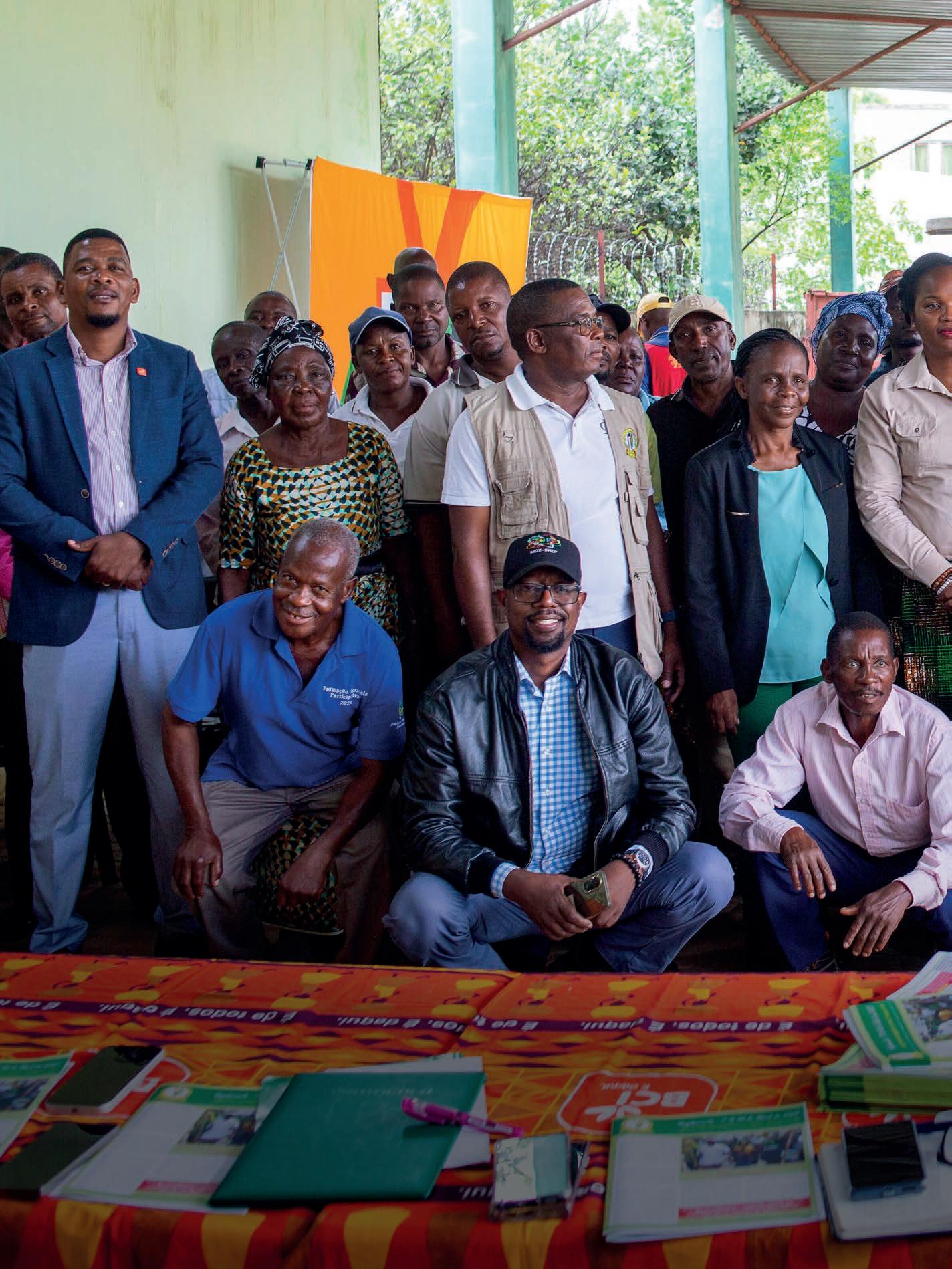
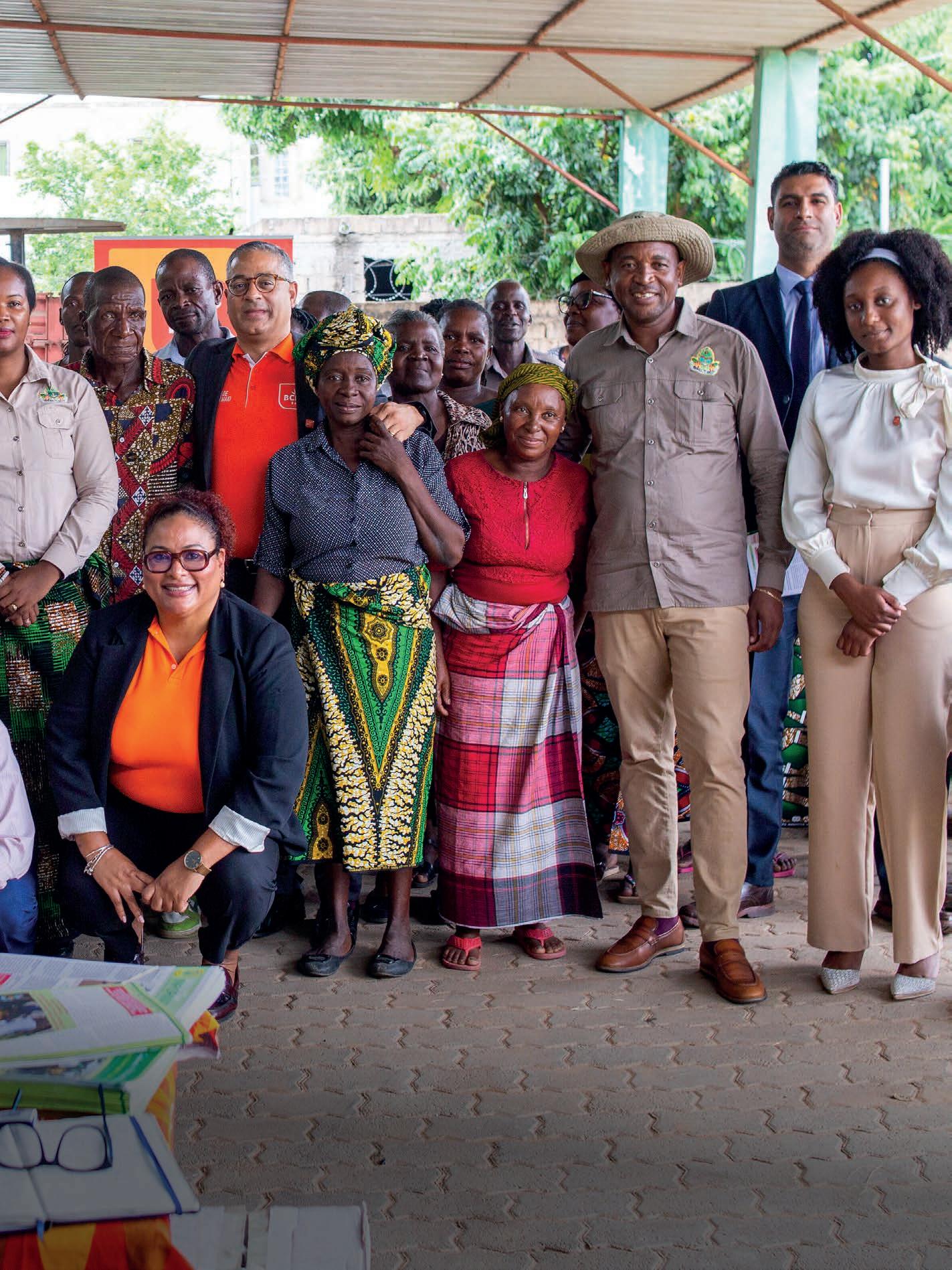
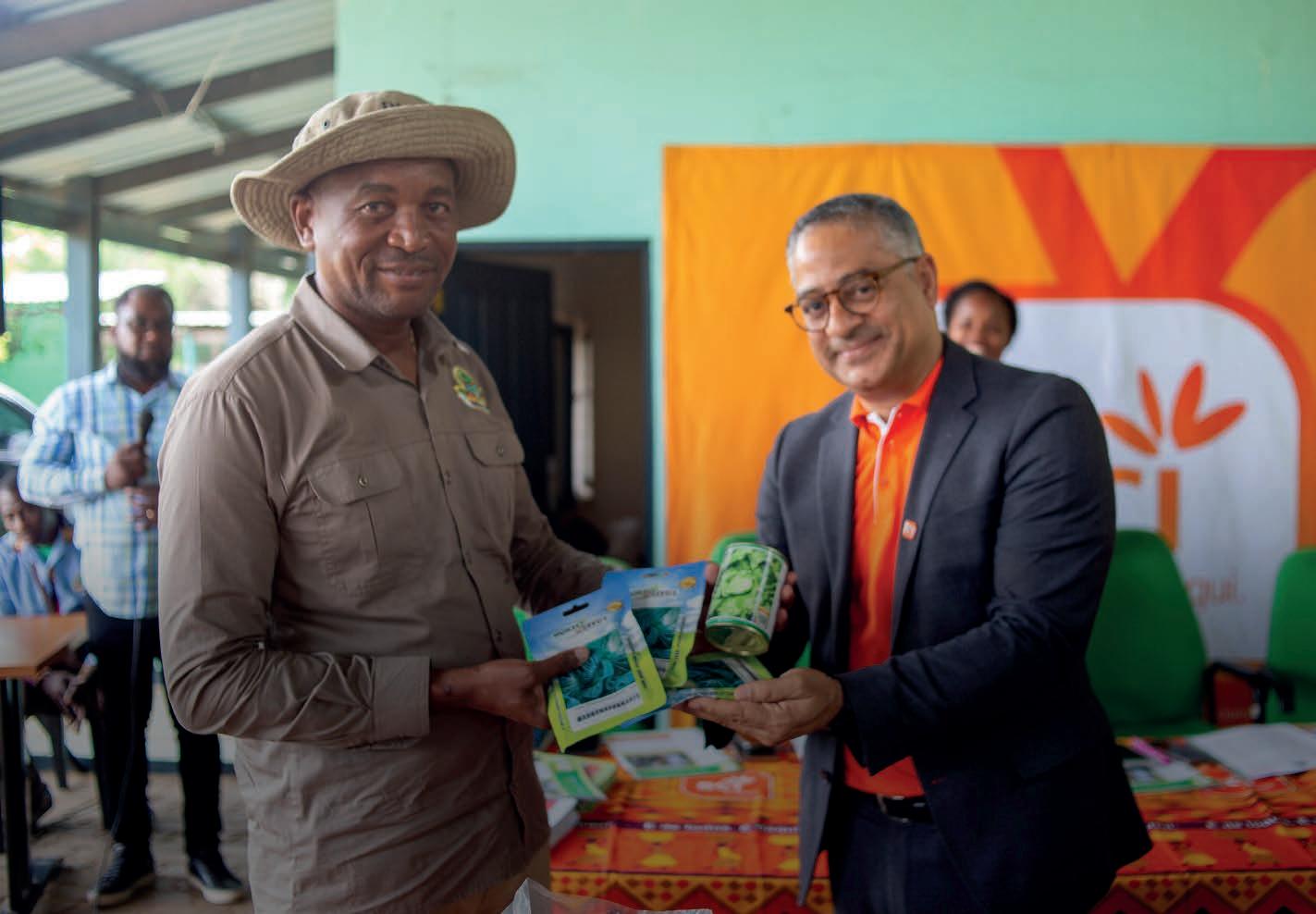
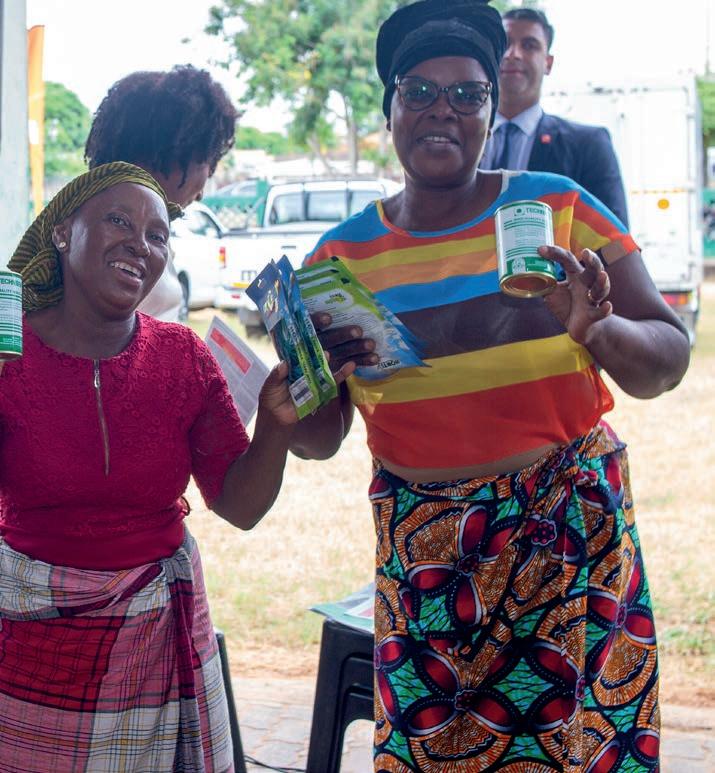
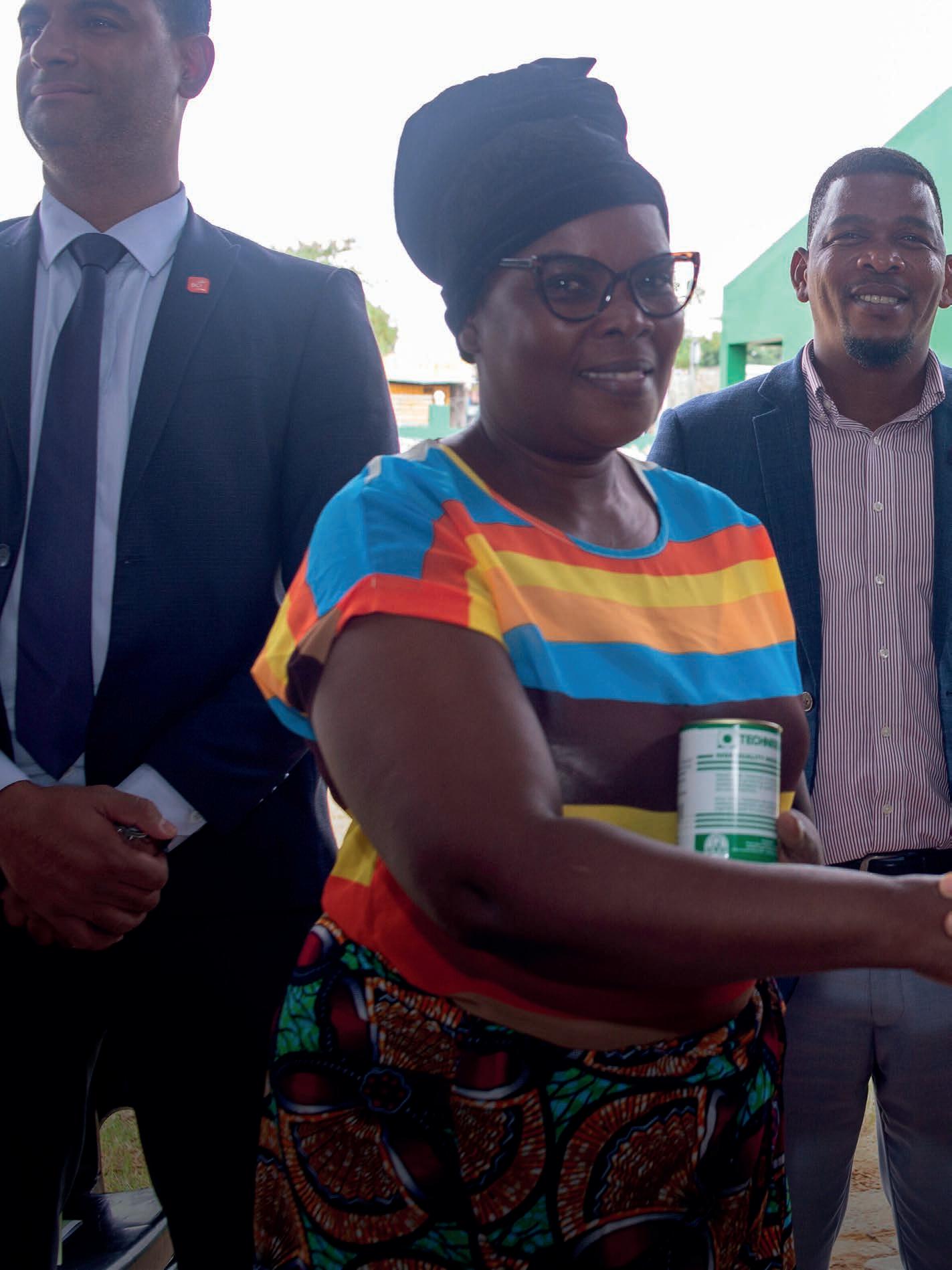
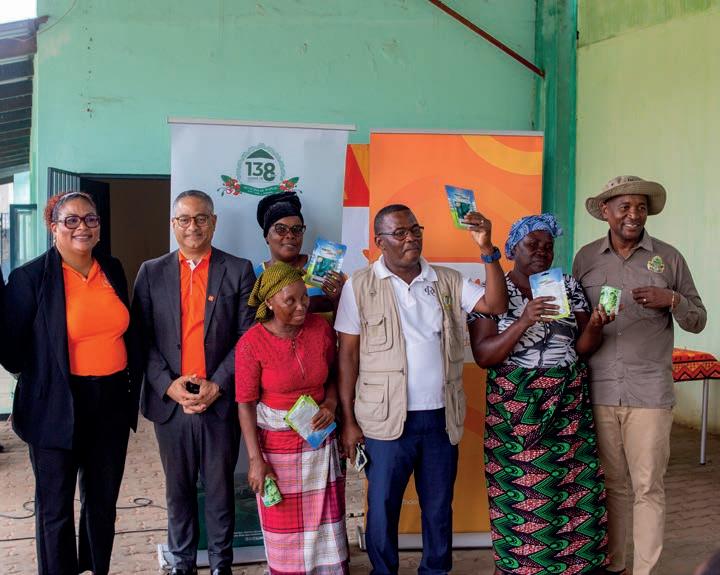
Num gesto que reforça o compromisso com o desenvolvimento sustentável e o bem-estar das comunidades, o Banco Comercial e de Investimentos (BCI), em parceria com o Município de Maputo, procedeu à entrega de sementes agrícolas a produtores da chamada Cintura Verde da cidade. A iniciativa teve lugar na Casa Agrária das Mahotas, inserindo-se no programa de responsabilidade social do Banco e nas celebrações dos seus 30 anos de existência.
Aacção contemplou a doação de sementes hortícolas, com destaque para variedades como Alface Eden e Couve Tronchuda, destinadas a produtores organizados em associações agrícolas que operam nos diferentes distritos municipais de Maputo. Este apoio visa reforçar a capacidade produtiva local, contribuindo para a segurança alimentar e para o sustento de centenas de famílias que dependem da agricultura como principal fonte de rendimento.
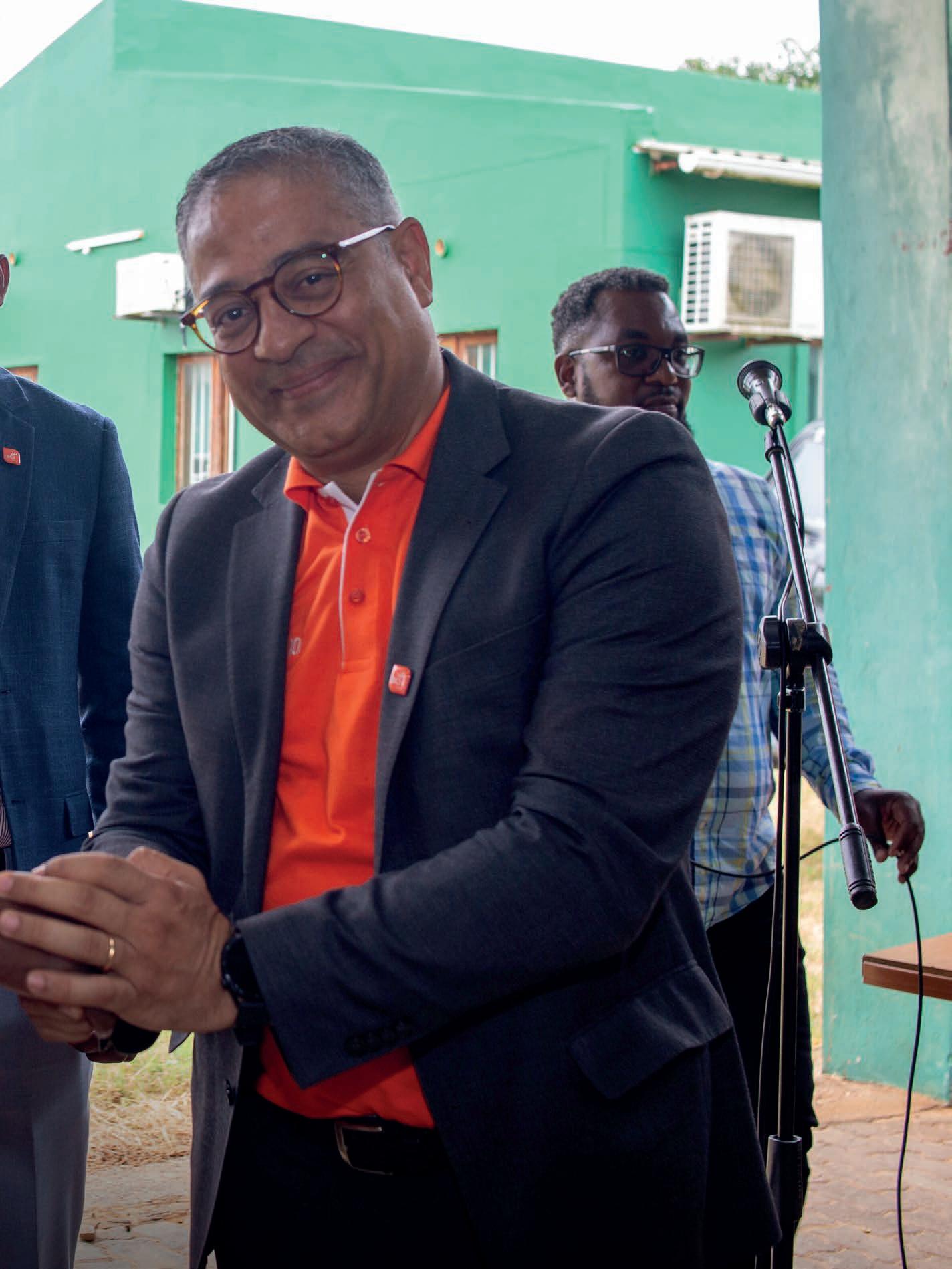
Na ocasião, o Director de Sustentabilidade do BCI, José Gamito, sublinhou que o compromisso do Banco com Moçambique transcende a actividade financeira, abrangendo igualmente iniciativas que promovem o desenvolvimento humano e social. Segundo afirmou, a parceria com o Conselho Municipal de Maputo reflecte uma visão partilhada de apoio às comunidades, especialmente em contextos desafiantes.
O responsável sublinhou ainda a resiliência dos produtores da Cintura Verde, frequentemente confrontados com fenómenos climáticos adversos, como cheias e inundações, que comprometem a produtividade agrícola. Neste contexto, o BCI posiciona-se como um parceiro solidário, empenhado em contribuir com soluções concretas que permitam mitigar os impactos dessas adversidades.
Por sua vez, o Vereador de Actividades Económicas e Turismo do Município de Maputo, Alexandre Muianga, enquadrou a iniciativa no Plano de Desenvolvimento Municipal 2024–2028, salientando o papel estratégico das parcerias na dinamização do sector agrário. Muianga explicou que a distribuição das sementes será conduzida pela equipa municipal, com base
em cinco pilares essenciais: acesso a sementes de qualidade, diversidade de culturas, preços justos, assistência técnica e um sistema de distribuição eficiente.
“Com instrumentos adequados e apoio técnico consistente, é possível aumentar a produção e garantir o abastecimento não só da cidade de Maputo, mas também de outras províncias”, afirmou.
Em representação dos beneficiários, o Presidente da União das Associações Agro-Pecuárias da Cidade de Maputo, Tomás Guirrugo, manifestou gratidão pelo apoio recebido. Referiu que, durante a época chuvosa, muitos campos ficam inundados, afectando seriamente a produção. Assim, iniciativas como esta revelam-se determinantes para a retoma das actividades agrícolas e para a continuidade do trabalho no campo.
A cerimónia foi igualmente marcada pela referência à sólida relação institucional entre o BCI e o Município de Maputo, construída ao longo dos anos através de diversas iniciativas conjuntas. Entre estas, destacam-se o apoio à Feira do Livro de Maputo, projectos voltados para a juventude e acções nas áreas da cidadania, saúde, bem-estar e sustentabilidade ambiental.
Mais do que uma simples entrega de insumos, esta acção simboliza a força das parcerias estratégicas na promoção do desenvolvimento local, evidenciando que, quando instituições públicas e privadas caminham juntas, os resultados traduzem-se em benefícios concretos para as comunidades.
Num gesto que reforça o compromisso com o desenvolvimento sustentável, o BCI, em parceria com o Município de Maputo, entregou sementes agrícolas a produtores da Cintura Verde da cidade
BCI and Maputo Municipality join forces to support agriculture
In a gesture reinforcing its commitment to sustainable development and community well-being, Banco Comercial e de Investimentos (BCI), in partnership with the Maputo Municipality, delivered agricultural seeds to producers from the city’s so-called Green Belt. The initiative took place at the Mahotas Agrarian Centre and formed part of the Bank’s social responsibility programme, as well as the celebrations marking its 30th anniversary.
The initiative included the donation of horticultural seeds, with particular emphasis on varieties such as Eden lettuce and Tronchuda cabbage, intended for producers organised into agricultural associations operating across Maputo’s municipal districts. This support aims to strengthen local production capacity, contributing to food security and the livelihoods of hundreds of families who depend on agriculture as their main source of income.
On the occasion, BCI’s Director of Sustainability, José Gamito, stressed that the Bank’s commitment to Mozambique goes beyond financial activity, also encompassing initiatives that promote human and social development. According to him, the partnership with the Maputo Municipal Council reflects a shared vision of supporting communities, particularly in challenging contexts.
He also highlighted the resilience of Green Belt producers, who are frequently confronted with adverse climatic phenomena such as floods and inundations that compromise agricultural productivity. In this context, BCI positions itself as a supportive partner, committed to contributing concrete solutions to help mitigate the im-
pacts of such adversities.
For his part, the Councillor for Economic Activities and Tourism at the Maputo Municipality, Alexandre Muianga, framed the initiative within the 2024–2028 Municipal Development Plan, emphasising the strategic role of partnerships in energising the agricultural sector. Muianga explained that seed distribution will be conducted by the municipal team, based on five essential pillars: access to quality seeds, crop diversity, fair pricing, technical assistance, and an efficient distribution system.
“With adequate tools and consistent technical support, it is possible to increase production and ensure supply not only to the city of Maputo, but also to other provinces,” he stated.
Representing the beneficiaries, the President of the Union of Agro-Livestock Associations of the City of Maputo, Tomás Guirrugo, expressed gratitude for the support received. He noted that during the rainy season many fields become flooded, seriously affecting production. As such, initiatives like this are crucial for resuming agricultural activities and ensuring the continuity of work in the fields.
The ceremony also highlighted the
strong institutional relationship between BCI and the Maputo Municipality, built over the years through various joint initiatives. These include support for the Maputo Book Fair, youth-focused projects, and actions in the areas of citizenship, health, well-being and environmental sustainability.
More than a simple delivery of inputs, this initiative symbolises the strength of strategic partnerships in promoting local development, demonstrating that when public and private institutions work together, the results translate into tangible benefits for communities.
“This support comes at a crucial time, as many producers continue to recover from the impact of floods and adverse weather conditions
Desce numa boa A campanha que transformou caricas em oportunidades reais
Num mercado cada vez mais competitivo, onde captar a atenção do consumidor exige criatividade e consistência, a Txilar encontrou uma fórmula simples, mas eficaz: transformar algo tão quotidiano como uma carica numa porta de entrada para prémios reais. Foi assim que nasceu a campanha “Desce Numa Boa”, lançada nos últimos meses de 2025 e rapidamente expandida ao longo de 2026, consolidando-se como uma das acções promocionais mais marcantes do sector.
Mais do que uma campanha, trata-se de uma experiência
pensada para da cerveja Txilar, o participante pode encontrar prémios imediatos ou entrar no processo que o coloca na corrida por recompensas maiores, incluindo viaturas novas.
A força desta iniciativa está precisamente nessa combinação entre simplicidade e ambição. Por um lado, há prémios instantâneos que mantêm o entusiasmo constante. Por outro, existe a possibilidade concreta de mudar de vida com um sorteio de maior escala. Esta dualidade cria uma relação contínua com o público, mantendo a expectativa viva a cada nova garrafa aberta.
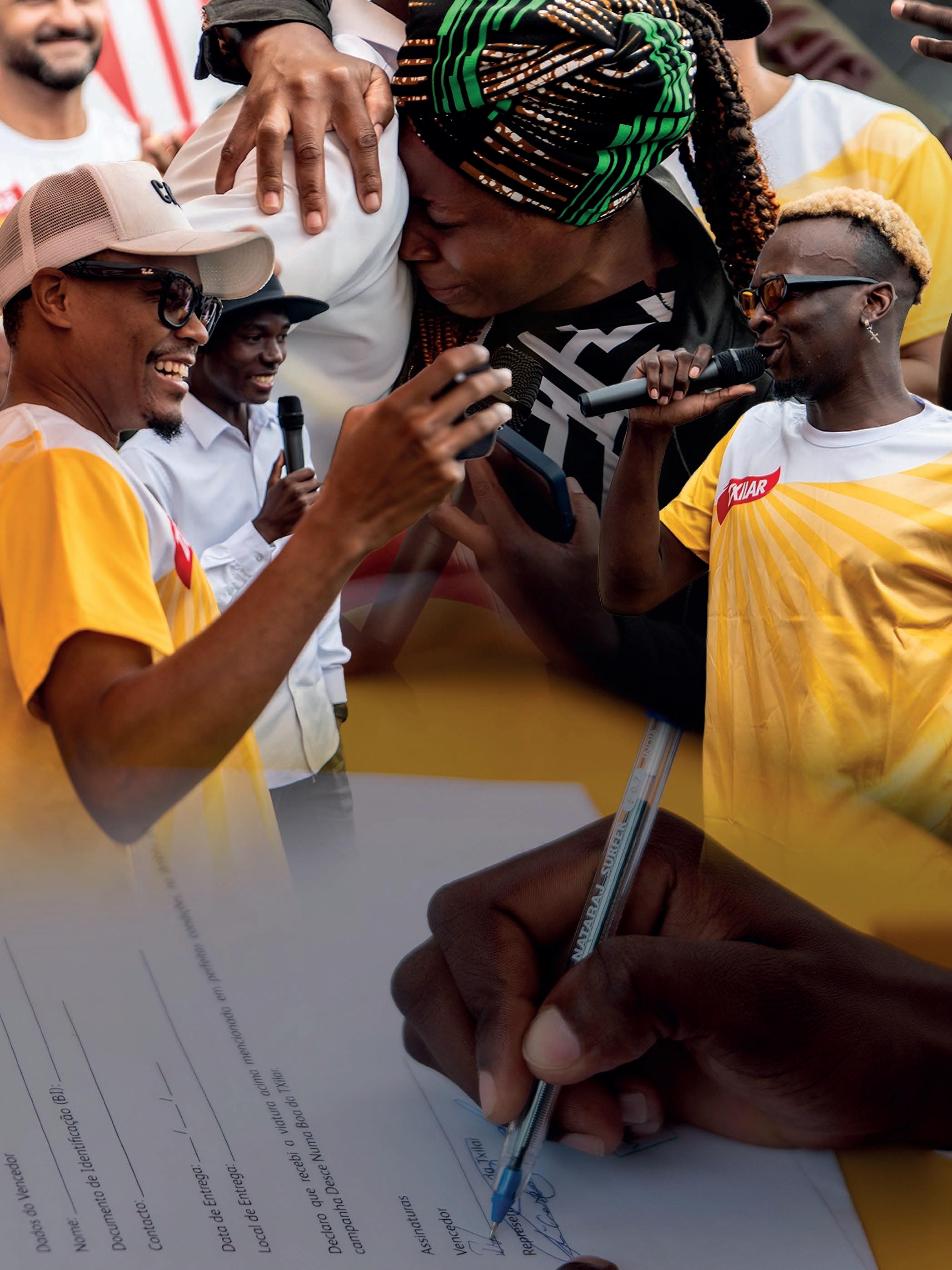
E essa promessa já começou a materializar-se. O primeiro grande prémio, uma viatura Mahindra XUV 3XO zero quilómetros, já foi entregue.
Pedro A. Machava tornou-
-se no primeiro vencedor da campanha das caricas, num momento de celebração que reuniu entusiasmo, emoção e forte adesão do público, assinalando a entrega do prémio como um verdadeiro acontecimento festivo.
Num contexto onde muitas campanhas enfrentam cepticismo natural do público, a existência de um vencedor concreto tem um peso simbólico importante: mostra que participar vale a pena e que as oportunidades são reais.
Ao mesmo tempo, a campanha continua activa e mantém o seu dinamismo. Longe de ser um episódio pontual, “Desce Numa Boa” evoluiu ao longo dos meses, ajustando-se, expandindo a sua presença e reforçando o envolvimento com os consumidores em várias províncias do país.
Este tipo de iniciativa revela também uma leitura inteligente do comportamento do
consumidor moçambicano. A proximidade, o contacto directo e a recompensa tangível continuam a ser factores determinantes na forma como as marcas constroem confiança. Aqui, não há complexidade desnecessária. Há uma proposta clara: participar, tentar a sorte e ganhar.
Com o calendário a avançar, a expectativa volta a crescer. O próximo sorteio está marcado para o dia 30 de Abril, mantendo aberta a possibilidade para novos vencedores e novas histórias.
Importa ainda referir que, apesar da promoção terminar no dia 31 de Abril, os prémios instantâneos poderão ser levantados até ao final do mês de Maio, garantindo que todos os participantes tenham tempo para usufruir das recompensas conquistadas.
Até lá, a mensagem mantém-se simples e directa: ainda estás a tempo de te tornar o próximo vencedor sorteado.
Uma viatura Mahindra XUV 3XO zero quilómetros abriu a lista de prémios
“Desce Numa Boa” became one of the most impactful promotional campaigns in the sector.
Desce numa boa
The campaign that turned bottle caps into real opportunities
In an increasingly competitive market, where capturing consumer attention requires creativity and consistency, Txilar found a simple yet effective formula: transforming something as everyday as a bottle cap into a gateway to real prizes. This is how the “Desce Numa Boa” campaign was born, launched in the final months of 2025 and rapidly expanded throughout 2026, establishing itself as one of the most notable promotional actions in the sector.
More than just a campaign, it is an experience designed for consumers. When opening a bottle of Txilar beer, participants may find instant prizes or enter a process that places them in the running for larger rewards, including brand-new vehicles.
The strength of this initiative lies precisely in that combination of simplicity and ambition. On the one hand, there are instant prizes that keep enthusiasm constant. On the other, there is the genuine possibility of changing one’s life through a larger-scale draw. This duality creates an ongoing relationship with the public, keeping expectations alive with every new bottle opened.
And that promise has already begun to materialise. The first major prize, a zero-kilometre Mahindra XUV 3XO, has already been
delivered. Pedro A. Machava became the first winner of the bottle-cap campaign, in a celebratory moment marked by enthusiasm, emotion and strong public participation, turning the prize handover into a truly festive occasion.
In a context where many campaigns face natural public scepticism, the existence of a concrete winner carries significant symbolic weight: it shows that participating is worthwhile and that the opportunities are real.
At the same time, the campaign remains active and continues to maintain its momentum. Far from being a one-off episode, “Desce Numa Boa” has evolved over the months, adapting, expanding its presence and strengthening engagement with consumers across various provinces of the country. This type of initiative also reflects a smart reading
of Mozambican consumer behaviour. Proximity, direct contact and tangible rewards remain decisive factors in how brands build trust. Here, there is no unnecessary complexity. There is a clear proposition: participate, try your luck and win.
As the calendar moves forward, expectations are rising again. The next draw is scheduled for 30 April, keeping the door open for new winners and new stories.
It is also worth noting that, although the promotion ends on 31 April, instant prizes may be collected until the end of May, ensuring that all participants have time to enjoy the rewards they have earned.
Until then, the message remains simple and direct: you are still in time to become the next winner drawn.
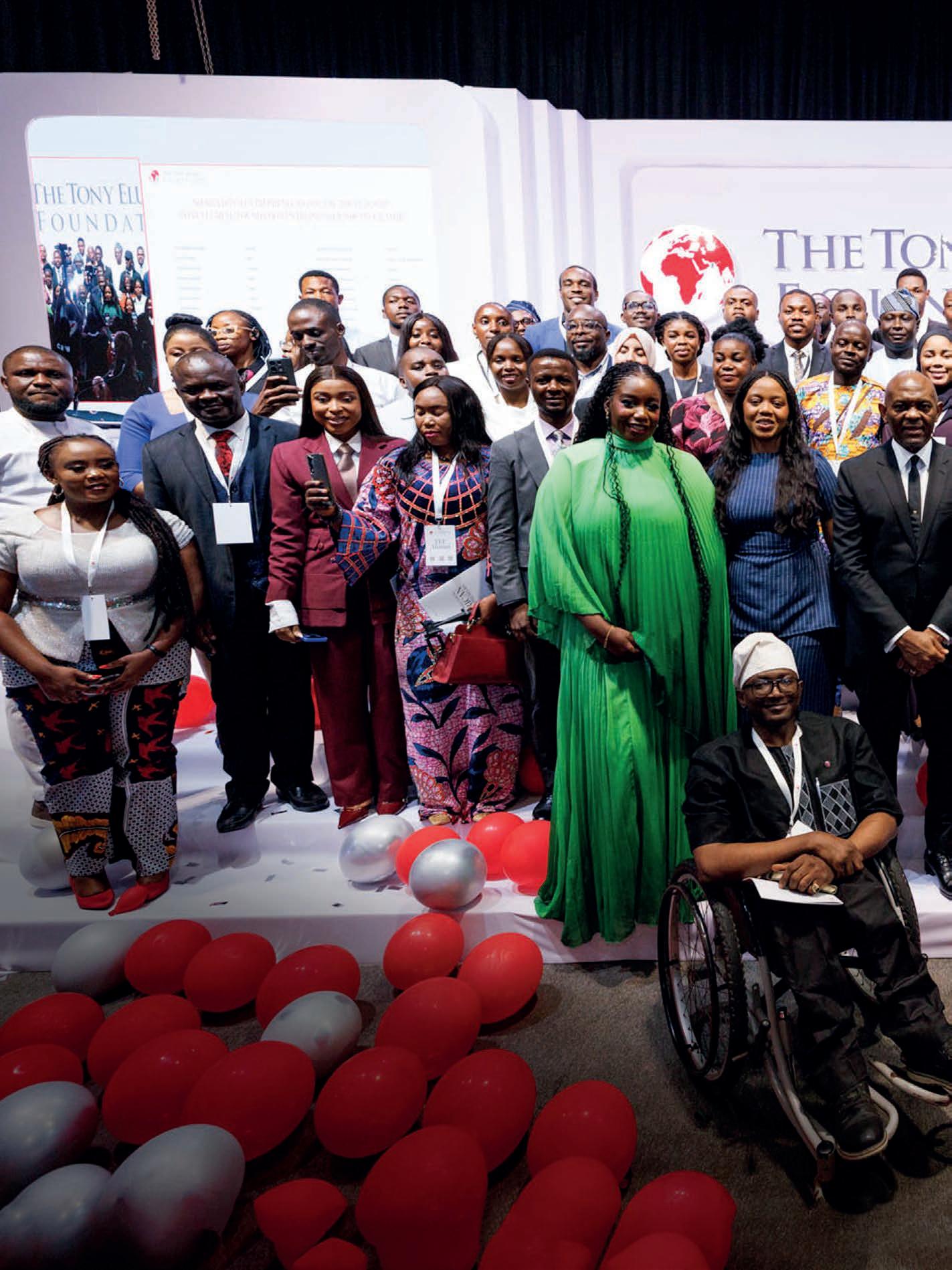
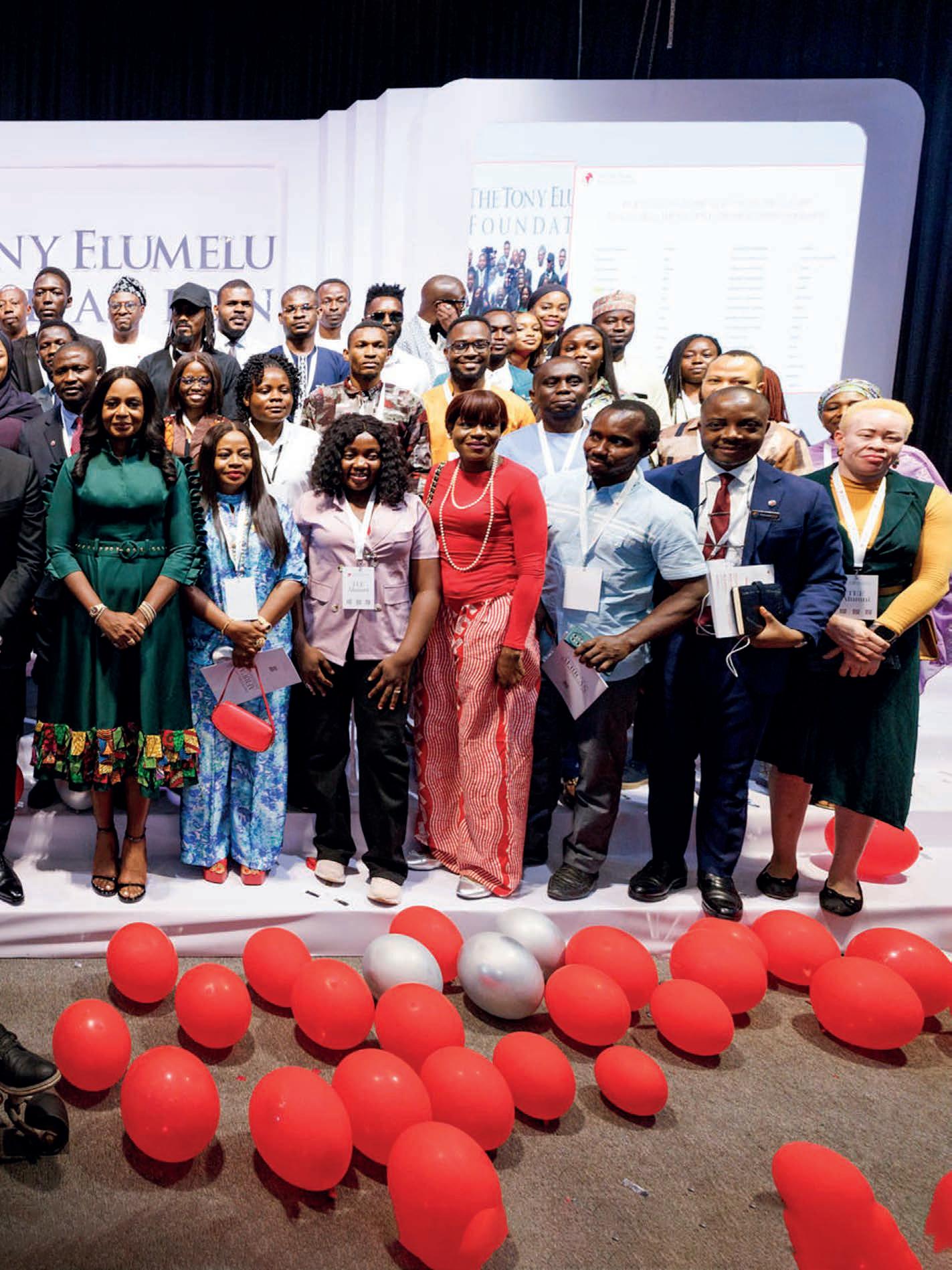
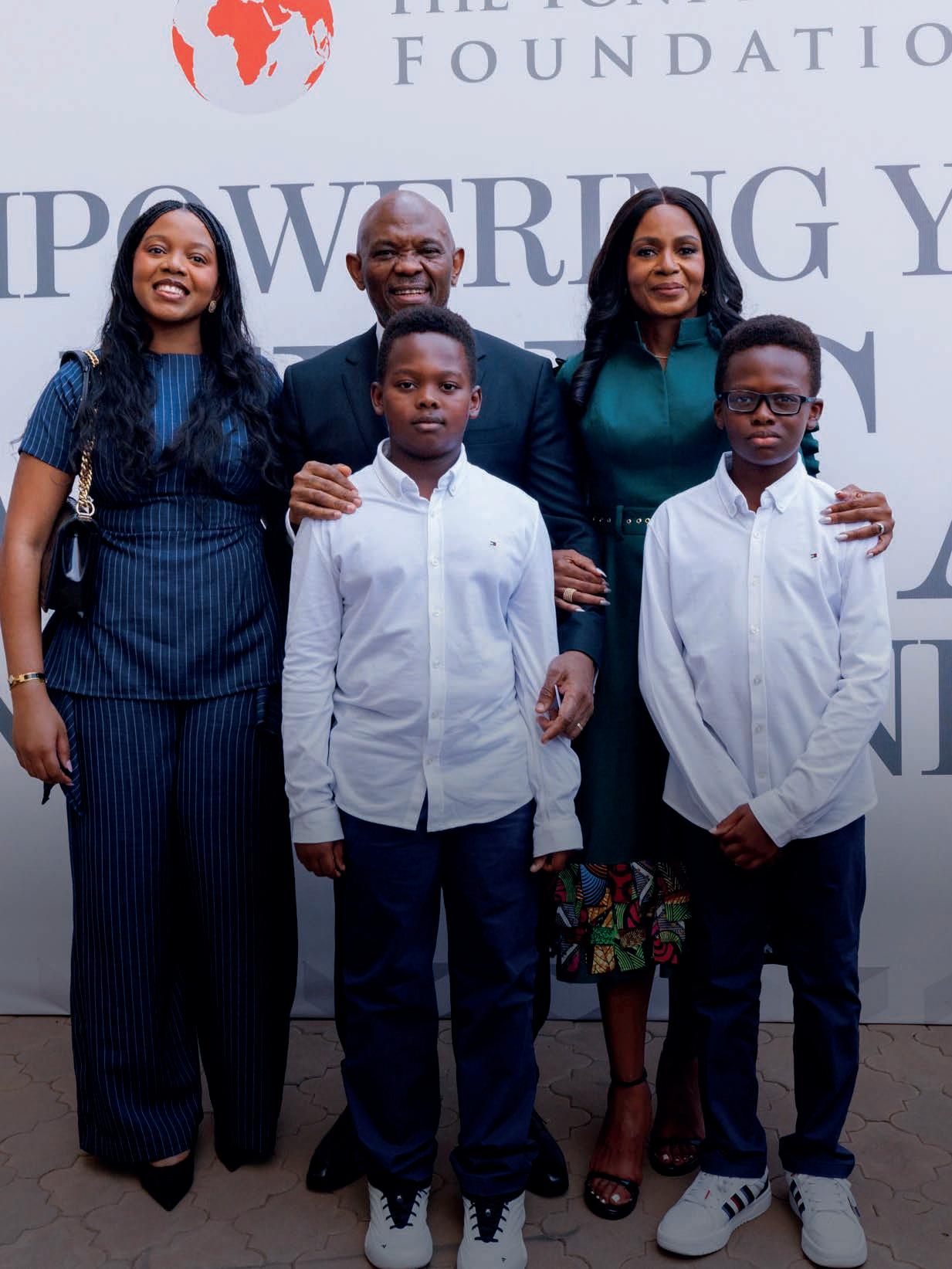
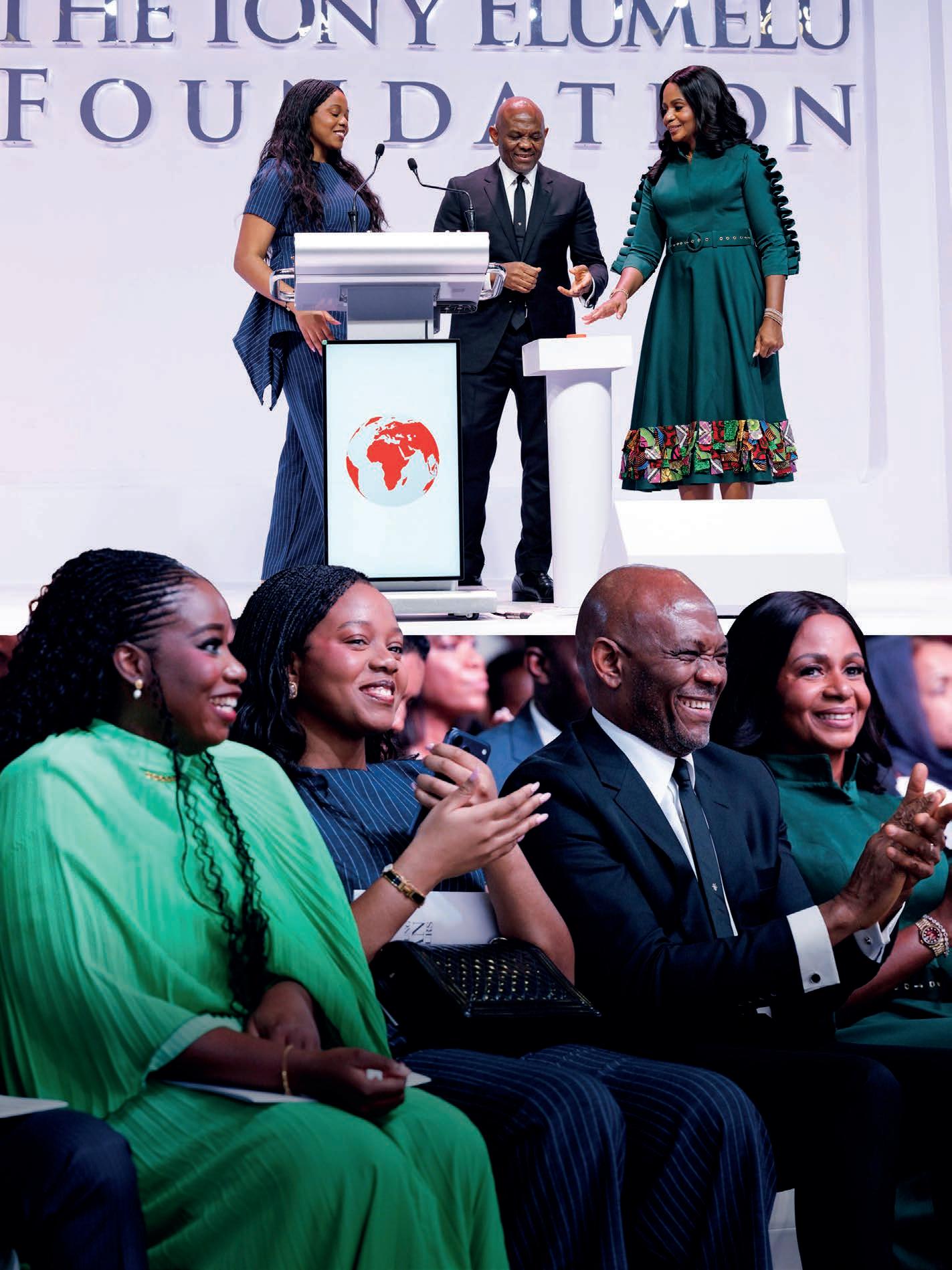
O United Bank for Africa (UBA) e a Tony Elumelu Foundation (TEF) anunciaram oficialmente a selecção de 3.200 jovens empreendedores provenientes dos 54 países africanos, no âmbito da 12.ª edição do seu Programa de Empreendedorismo. Marcando mais um passo significativo no compromisso contínuo da Fundação com a transformação económica do continente africano através do empreendedorismo.
Desde a sua criação, em 2010, a TEF tem investido no potencial dos jovens africanos, defendendo que o maior recurso de África são as suas pessoas. Com base nesta visão, o programa foi inicialmente concebido para apoiar 10.000 empreendedores com capital inicial de 5.000 dólares não reembolsáveis para cada empreendedor, formações técnicas profissionais, mentoria com especialistas de cada área, e acesso a uma rede global de empreendedores. No total, são 80 jovens empreendedores moçambicanos que garantiram acesso a financiamento e outros benefícios do programa para realizarem os seus sonhos.
Até à data, o Programa de Empreendedorismo da TEF já desembolsou mais de 100 milhões de dólares em financiamento para
mais de 24.000 empreendedores africanos, con-
tribuindo para resultados concretos e mensuráveis:
• Mais de 4 milhões de famílias impactadas positivamente
• 2,1 milhões de africanos retirados da pobreza
• 4,2 mil milhões de dólares em receitas geradas
• 1,5 milhão de empregos criados
• Mais de 2,5 milhões de africanos com acesso a formação
De acordo com a Fundação, 80% dos negócios apoiados ultrapassam a fase inicial, um desempenho significativamente superior à média global. O programa baseia-se no
conceito de Africapitalism, que defende que o sector privado africano – especialmente os empreendedores – deve liderar o desenvolvimento económico e social do continente.
Programa de Empreendedorismo da TEF
Empreendedores seleccionados
Empreendedores selecionados para o programa
Empreendedores moçambicanos
Empreendedores moçambicanos seleccionados
3.200 jovens empreendedores africanos foram seleccionados na 12.ª edição do Programa de Empreendedorismo da Tony Elumelu Foundation.
51% dos empreendedores seleccionados são mulheres, reforçando o protagonismo feminino no empreendedorismo africano.
Destaque para o empoderamento feminino
Uma das grandes marcas desta edição é o forte protagonismo feminino. 51% dos empreendedores seleccionados são mulheres, reflectindo a qualidade, inovação e liderança das mulheres afri -
canas no ecossistema empreendedor. A selecção foi baseada exclusivamente no mérito, demonstrando que, quando têm acesso a oportunidades, as mulheres não apenas participam, como lideram processos de transformação económica.
Mais do que financiamento, os empreendedores seleccionados terão acesso a:
• Capital inicial não reembolsável
• Programas de formação intensiva
• Mentoria especializada
• Acesso à plataforma digital TEFConnect
Compromisso com o futuro de África
A TEF continua a desempenhar um papel central na redefinição da narrativa de desenvolvimento africano, passando de um modelo baseado na dependência da ajuda externa para um
modelo baseado em parcerias e capacitação interna. Segundo a liderança da Fundação, o investimento no empreendedorismo é um investimento directo no recurso mais sustentável de África: o seu povo.
The United Bank for Africa (UBA) and the Tony Elumelu Foundation (TEF) have officially announced the selection of 3,200 young entrepreneurs from 54 African countries, as part of the 12th edition of their Entrepreneurship Programme, marking another significant step in the Foundation’s ongoing commitment to Africa’s economic transformation through entrepreneurship.
Since its establishment in 2010, TEF has invested in the potential of young Africans, advocating that Africa’s greatest resource is its people. Based on this vision, the programme was initially designed to support 10,000 entrepreneurs with non-repaya -
ble seed capital of 5,000 dollars for each entrepreneur, professional technical training, mentorship from specialists in each field, and access to a global network of entrepreneurs. In total, 80 young Mozambican entrepreneurs secured access to funding and other
programme benefits to pursue their dreams.
To date, the TEF Entrepreneurship Programme has disbursed more than 100 million dollars in funding to over 24,000 African entrepreneurs, contributing to concrete and measurable results:
• More than 4 million families positively impacted
• 2.1 million Africans lifted out of poverty
• 4.2 billion dollars in revenue generated
• 1.5 million jobs created
• More than 2.5 million Africans with access to training
According to the Foundation, 80% of supported businesses move beyond the start-up phase, a performance significantly higher than the global average. The programme is based on the concept of Africapitalism, which advocates that the African private sector — particularly entrepreneurs
— should lead the continent’s economic and social development.
Focus on women’s empowerment
One of the defining features of this edition is the strong female representation. 51% of the selected entrepreneurs are women, reflecting
the quality, innovation and leadership of African women within the entrepreneurial ecosystem. The selection was based exclusively on merit, demonstrating that when given access to opportunities, women not only participate but lead processes of economic transformation.
More than funding, selected entrepreneurs will have access to:
• Non-repayable seed capital
• Intensive training programmes
• Specialised mentorship
• Access to the TEFConnect digital platform
Commitment to Africa’s future
TEF continues to play a central role in redefining Africa’s development narrative, shifting from a model based on dependence on external aid to one based on partnerships and internal capacity building. According to the Foundation’s leadership, investment in entrepreneurship is a direct investment in Africa’s most sustainable resource: its people.
Oficina do Futuro abre diálogo sobre inovação no país
Num tempo em que os desafios tecnológicos e urbanos se tornam cada vez mais presentes no quotidiano das sociedades, Maputo acolheu uma nova plataforma de reflexão orientada para soluções práticas. A primeira edição da Oficina do Futuro realizou-se a 26 de Fevereiro, no Hotel Meliã Maputo Sky, reunindo especialistas, decisores, empreendedores e estudantes em torno de uma pergunta central: como poderá ser Moçambique em 2030 se as ideias começarem hoje a transformar-se em acções práticas?
Ainiciativa surgiu com o propósito de aproximar o pensamento estratégico da execução. Na sessão de abertura, Nuno Soares, director da revista Xonguila e do Connoisseur Prestige Club (CPC), entidades responsáveis pela organiza -
ção do encontro, sublinhou a necessidade de se criarem espaços em que o debate ultrapasse o plano teórico e conduza a soluções aplicáveis à realidade nacional.
Sob o tema “Mobilidade, digital e soluções reais”, o encontro estruturou-se em dois painéis principais, centrados em áreas consideradas determinantes para o futuro do país.
O primeiro debate incidiu sobre o desafio digital de Moçambique. Moderado por Sheila Victor Muianga, da Girl Move Academy, contou com intervenções de Luís
Enoque, da BCX, Carlos Jorge Araújo, da Bravantic, e Rui Lousã, da Vodacom. Ao longo da conversa, foram abordadas as oportunidades da tecnologia aplicada à economia e os caminhos possíveis para ampliar a inclusão digital, num contexto em que o acesso à informação e às ferramentas tecnológicas continua a ser desigual.
O segundo painel dedicou-se à mobilidade urbana, tema cada vez mais central nas cidades moçambicanas. A moderação esteve a cargo de Yurica David, da AIESEC Moçambique. Participaram o Dr. Cedrick Lemarie, da Epsilon Energia Solar, Hermínio Guiamba, da Recavi, e Celso Nicols, da Faculdade de Engenharia da Universidade Eduardo Mondlane. Os intervenientes analisaram constrangimentos existentes no transporte e na organização das cidades, apontando também possíveis soluções que combinem inovação tecnológica, planeamento urbano e sustentabilidade.
Para além dos painéis de discussão, o evento reservou espaço a pro -
jectos concretos no segmento “Iniciativas em foco”, onde diferentes actores apresentaram experiências orientadas para impacto social. Entre os exemplos partilhados estiveram a Girafa Solar, apresen -
A primeira edição da Oficina do Futuro reuniu diferentes sectores da sociedade para
pensar soluções
práticas para desafios que já fazem parte do presente de Moçambique.
tada por Ruben Morgado, da Fundação Carlos Morgado, projectos de educação tecnológica explicados por Tim Vieira, da Brave Generation Academy, a plataforma MAKOBO, descrita por Ruy Santos, e a solução digital LEO, apresentada
por Cirilo Macanze, do Banco UBA.
A primeira edição da Oficina do Futuro contou com o patrocínio do Banco UBA e da Vodacom, bem como com o apoio do Baía Mall e do Hotel Meliã Maputo Sky. No mesmo contexto foi também lançado o Roteiro de Alfabetização Digital, uma exposição aberta ao público até 4 de Março, pensada para aproximar os temas tecnológicos do cidadão comum.
O projecto prevê continuidade ao longo do ano. Uma segunda edição está prevista para Maio, dedicada à informação, influência e transformação na comunicação contemporânea. Em Outubro deverá realizar-se um terceiro encontro, centrado em educação, recursos humanos e tecnologia.
Com esta abordagem sequencial, a Oficina do Futuro afirma-se como uma plataforma de reflexão aplicada, procurando reunir diferentes sectores da sociedade na construção de respostas para os desafios que Moçambique enfrenta nas próximas décadas.
Das ideias às conexões: um momento descontraído de networking, unindo talento, visão e oportunidade
Oficina do Futuro opens dialogue on innovation in the country
At a time when technological and urban challenges are becoming increasingly present in everyday life, Maputo hosted a new platform for reflection focused on practical solutions. The first edition of Oficina do Futuro took place on 26 February at the Meliã Maputo Sky Hotel, bringing together specialists, decision-makers, entrepreneurs and students around a central question: what could Mozambique look like in 2030 if ideas begin today to turn into concrete actions?
The initiative was created with the aim of bringing strategic thinking closer to execution. During the opening session, Nuno Soares, director of Xonguila magazine and the Connoisseur Prestige Club (CPC), the organisations responsible for the event, emphasised the need to create spaces where debate goes beyond theory and leads to solutions applicable to the national reality.
Under the theme “Mobility, digital and real solutions”, the meeting was structured around two main panels focused on areas considered decisive for the country’s future.
The first discussion addressed Mozambique’s digital challenge. Moderated by Sheila Victor
Muianga of Girl Move Academy, the panel featured contributions from Luís Enoque of BCX, Carlos Jorge Araújo of Bravantic, and Rui Lousã of Vodacom. Throughout the conversation, participants explored opportunities for technology applied to the economy and possible pathways to expand digital inclusion, in a context where access to information and technological tools remains uneven.
The second panel focused on urban mobility, an increasingly central issue in Mozambican cities. The session was moderated by Yurica David of AIESEC Mozambique, and included Dr Cedrick Lemarie of Epsilon Energia Solar, Hermínio Guiamba of Recavi, and Celso Nicols of the Faculty of
Engineering at Eduardo Mondlane University. Speakers analysed existing constraints in transport and urban organisation, while also pointing to potential solutions combining technological innovation, urban planning and sustainability.
In addition to the discussion panels, the event also featured concrete projects in the “Initiatives in focus” segment, where different stakeholders presented experiences aimed at social impact. Among the examples shared were Girafa Solar, presented by Ruben Morgado of the Carlos Morgado Foundation; technology education projects explained by Tim Vieira of Brave Generation Academy; the MAKOBO platform, presented by Ruy Santos; and the
digital solution LEO, introduced by Cirilo Macanze of UBA Bank.
The first edition of Oficina do Futuro was sponsored by UBA Bank and Vodacom, with additional support from Baía Mall and the Meliã Maputo Sky Hotel. Within the same context, the Digital Literacy Roadmap was also launched — an exhibition open to the public until 4 March, designed to bring technological themes closer to everyday citizens.
The project is expected to continue throughout the year. A second edition is scheduled for May, dedicated to information, influence and transformation in contemporary communication. A third meeting is planned for October, focusing on education, human resources and technology.
With this sequential approach, Oficina do Futuro positions itself as a platform for applied reflection, seeking to bring together different sectors of society in building responses to the challenges Mozambique will face in the coming decades.
Estratégia, cultura e criatividade com impacto em Moçambique
Há projectos que nascem de briefings. Outros começam em conversas, na escuta atenta e na vontade de fazer diferente. O Grupo Moonshot Ventures e a MAAT, em Moçambique, posicionam-se claramente neste segundo caminho.
Mais do que apresentar soluções fechadas, trabalham processos, relações e contextos, onde a transformação acontece com as pessoas e não apenas para as pessoas. A história do grupo co -
meça em 2018, em Portugal, com a criação da Chain Reaction, uma consultora de inovação orientada para a transformação estratégica e cultural das organizações. Dois anos depois surge a Mesh Agency, uma boutique criativa
que traduz essa transformação em identidade, narrativa e experiência.
Em 2022, o ecossistema chega a Moçambique com a MAAT, um hub que integra estratégia, cultura e criatividade, adaptando o conhecimento do grupo à realidade local. A presença no continente consolida-se com a Moonshot Ventures Africa, focada na identificação e desenvolvimento de iniciativas com impacto. Hoje, o grupo funciona como um sistema integrado onde estratégia, cultura e criatividade não são áreas isoladas, mas partes de uma mesma abordagem orientada para impacto estrutural.
Desporto como ferramenta de transformação
Um dos projectos mais estruturantes em curso é a parceria entre a MAAT e a Fundação Chanaya Pinto. A iniciativa nasce da experiência internacional da própria Chanaya Pinto no basquetebol universitário nos Estados Unidos e da constatação de que talento moçambicano existe, mas carece de estrutura, acompanhamento e oportunidades. Apesar de Moçambique ocupar posições relevantes no basquetebol feminino, 32.º lugar a nível mundial e 4.º em África, persistem desafios na formação e na identificação de atletas fora dos grandes centros urbanos. A Fundação surge para responder a esse vazio, apostando na criação de oportunidades reais através do desporto, da educação e do desenvolvimento pessoal. Com apoio estratégico da MAAT, o projecto está a ser estruturado desde a base, incluindo a criação de um Centro de Alto Rendimento e, numa fase posterior, de uma agência de acompanhamento de atletas. O objectivo é claro, formar jovens entre os 12 e os 18 anos, preparando-as não apenas para a competição, mas para percursos académi-
cos e profissionais sustentáveis. Numa primeira fase, a Fundação prevê acompanhar directamente pelo menos dez atletas, com impacto esperado ao nível do desenvolvimento desportivo, acesso a bolsas de estudo, reforço da participação feminina no desporto e contribuição para futuras selecções nacionais.
A médio prazo, a ambição é posicionar o basquetebol como uma via concreta de mobilidade social para jovens moçambicanas. O caminho não está isento de desafios. A confiança das famílias, a identificação de talento fora da capital, a limitação de infra-estruturas e a necessidade de financiamento sustentável são factores críticos. Ain-
da assim, o projecto avança com uma visão clara e com a convicção de que o desporto pode abrir portas reais. Como resume Chanaya Pinto: “Não deixes que os outros definam aquilo que és capaz de fazer. Somos do tamanho da nossa vontade.”
Pensar antes de agir: o caso
Mozambikes
Se na Fundação o impacto se mede em oportunidades criadas, no trabalho desenvolvido com a Mozambikes o foco esteve na mudança interna. A colaboração desta com a Mesh Agency não procurou respostas imediatas, mas criou espaço para algo mais raro, parar para pensar.
Segundo Rui, responsável pelo projecto, o maior impacto não foi uma solução concreta, mas a introdução de perguntas que não faziam parte do dia-a-dia. Questões sobre futuro, ambição e o papel de cada elemento da equipa. Esse exercício trouxe uma nova consciência interna, maior clareza sobre falhas e prioridades. A Mesh não surge aqui como executora, mas como catalisadora. Ao expor fragilidades e provocar desconforto, gerou alinhamento e responsabilidade. Uma das mudanças mais visíveis foi ao nível da liderança. Rui optou por reduzir o controlo directo e testar a autonomia da equipa, criando espaço para decisão e responsabilização.
Também a composição
da equipa evoluiu, com uma estrutura mais leve, motivada e alinhada com o propósito do projecto. Em paralelo, houve um regresso à essência da Mozambikes, simplificar a mensagem e recentrar o discurso na ideia central, usar a mobilidade como ferramenta de mudança. Essa clareza reflectiu-se igualmente na abordagem ao financiamento e à comunicação. O fundraising passou a ser assumido como parte central da estratégia, enquanto a comunicação se tornou mais directa, emocional e focada em captar atenção antes de explicar. No conjunto, o impacto não se traduz numa viragem imediata, mas numa mudança de consciência. Um processo que não resolve todos os problemas, mas redefine a forma como a organização se vê e se posiciona.
Cultura, educação e posicionamento institucional
A intervenção da MAAT estende-se também ao sector cultural, com a colaboração com a Fun -
dação MUSIARTE e o projecto internacional Música para Todos, activo em Moçambique e Angola. Aqui, o desafio era claro, modernizar a comunicação, reforçar a visibilidade e alinhar a imagem institucional com o impacto real das iniciativas. A resposta passou pelo rebranding da MUSIARTE, melhoria da experiência digital e criação de uma identidade própria para o projecto Música para Todos, incluindo website e presença nas redes sociais.
O resultado foi um posicionamento mais coerente e credível, permitindo que o trabalho desenvolvido junto de crianças, jovens e comunidades vulneráveis seja reconhecido de forma mais justa. Mais do que um exercício visual, o processo foi também um momento de reflexão interna. Como destaca a direcção da MUSIARTE, tratou-se de uma oportunidade para reafirmar a missão da instituição e projectar o futuro com uma linguagem mais contemporânea e inspiradora. A capacidade da MAAT para escutar e traduzir essa essência revelou-se determinante para o resultado final.
Parcerias que constroem transformação
Os diferentes projectos mostram uma linha comum. O impacto não surge de soluções padronizadas, mas de processos construídos em parceria, com escuta, questionamento e adaptação ao contexto. No caso da Fundação Chanaya Pinto, trata-se de criar oportunidades concretas para jovens atletas. Na Mozambikes, de redefinir uma organização a partir de dentro. Na MUSIARTE, de dar visibilidade e consistência a um trabalho já existente, mas pouco comunicado.
A abordagem do Grupo
Moonshot Ventures e da MAAT não procura protagonismo, mas relevância. Trabalha menos na superfície e mais na estrutura, menos na resposta imediata e mais na construção de capacidade. Num contexto como o moçambicano, onde coexistem potencial e limitações, este tipo de intervenção ganha particular significado. Não resolve tudo, mas ajuda a criar condições para que mais projectos possam crescer com intenção, clareza e impacto real.
lated areas, but parts of a single approach oriented towards structural impact.
Sport as a tool for transformation
Some projects are born from briefings. Others begin in conversations, attentive listening and the desire to do things differently. The Moonshot Ventures Group and MAAT in Mozambique clearly position themselves in the latter path. Rather than presenting closed solutions, they work on processes, relationships and contexts, where transformation happens with people, not merely for people.
The group’s story began in 2018, in Portugal, with the creation of Chain Reaction, an innovation consultancy focused on the strategic and cultural transformation of organisations. Two years later, Mesh Agency emerged, a creative boutique translating that transformation into identity, narrative and experience. In 2022, the ecosystem arrived in
Mozambique with MAAT, a hub integrating strategy, culture and creativity, adapting the group’s knowledge to the local reality. The presence on the continent was consolidated with Moonshot Ventures Africa, focused on identifying and developing initiatives with impact. Today, the group operates as an integrated system where strategy, culture and creativity are not iso-
One Of the mOst structuring projects currently underway is the partnership between MAAT and the Chanaya Pinto Foundation. The initiative stems from Chanaya Pinto’s own international experience in university basketball in the United States and the recognition that Mozambican talent exists but lacks structure, guidance and opportunities. Despite Mozambique holding relevant positions in women’s basketball — 32nd worldwide and 4th in Africa — challenges remain in training and identifying athletes outside major urban centres.
The Foundation was created to address this gap, focusing on the creation of real opportunities through sport, education and personal development. With strategic support from MAAT, the project is being built from the ground up, including the creation of a High Performance Centre and, at a later stage, an athlete support agency. The objective is clear: to train young athletes aged between 12 and 18, preparing them not only for competition but for sustainable academic and professional paths.
In an initial phase, the Foundation plans to directly support at least ten athletes, with expected impact in sports development, access to scholarships, increased female participation in sport and contribution to future national teams. In the medium term, the ambition is to position basketball as a concrete pathway for social mobility for young Mozambican women.
The journey is not without challenges. Family trust, identifying talent beyond the capital, limited infrastructure and the need for sustainable funding are critical factors. Even so, the project moves forward with a clear vision and the conviction that sport can open real doors. As Chanaya Pinto summarises: “Do not let others define what you are capable of doing. We are the size of our ambition.”
Thinking before acting: the Mozambikes case
If, in the Foundation, impact is measured through opportunities created, in the work developed with Mozambikes the focus was internal change. The collaboration with Mesh Agency did not seek immediate answers but created space for something
rarer: stopping to think.
According to Rui, responsible for the project, the greatest impact was not a concrete solution but the introduction of questions that were not part of everyday operations. Questions about the future, ambition and the role of each team member. This exercise brought new internal awareness and greater clarity around gaps and priorities.
Mesh did not appear here as an executor but as a catalyst. By exposing fragilities and provoking discomfort, it generated alignment and accountability. One of the most visible changes occurred at leadership level.
Rui chose to reduce direct control and test team auton
also evolved, with a lighter structure that was more motivated and aligned with the project’s purpose.
At the same time, there was a return to the essence of Mozambikes — simplifying the message and refocusing the narrative on the central idea: using mobility as a tool for change. This clarity was also reflected in the approach to funding and communication. Fundraising became a central part of the strategy, while communication became more direct, emotional and focused on capturing attention before explaining.
Overall, the impact is not reflected in an immediate turning point, but in a shift in awareness. A process that does not solve every problem, but redefines how the
Education and institutional positioning
MAAT’s intervention also extends to the cultural sector, through collaboration with the MUSIARTE Foundation and the international project Music for All, active in Mozambique and Angola. Here, the challenge was clear: modernise communication, strengthen visibility and align institutional image with the real impact of the initiatives.
The response included the rebranding of MUSIARTE, improvements to the digital experience and the creation of a dedicated identity for the Music for All project, including a website and social media presence. The result was a more coherent and credible positioning, allowing the work carried out with children,
young people and vulnerable communities to be recognised more fairly.
More than a visual exercise, the process was also a moment of internal reflection. As MUSIARTE’s leadership highlights, it represented an opportunity to reaffirm the institution’s mission and project the future using a more contemporary and inspiring language. MAAT’s ability to listen and translate this essence proved decisive for the final outcome.
Partnerships that build transformation
The different projects reveal a common thread. Impact does not emerge from standardised solutions but from processes built in partnership, through listening, questioning and adapting to context. In the case of the Chanaya Pinto
Foundation, the aim is to create concrete opportunities for young athletes. At Mozambikes, it is about redefining an organisation from within. At MUSIARTE, it is about giving visibility and consistency to work that already exists but has been insufficiently communicated.
The approach of the Moonshot Ventures Group and MAAT does not seek protagonism, but relevance. It works less on the surface and more on structure, less on immediate response and more on building capacity. In a context such as Mozambique, where potential and limitations coexist, this type of intervention gains particular significance. It does not solve everything, but it helps create conditions for more projects to grow with intention, clarity and real impact.
Moçambique tem-me oferecido oportunidades que dificilmente encontraria em qualquer outro lugar do mundo. São experiências tão intensas, tão humanas, que não se perdem facilmente nos recantos infinitos da memória.
Algumas dessas memórias não são, à primeira vista, particularmente marcantes do ponto de vista visual. Mas a memória tem caminhos curiosos. Às vezes é apenas um som ou uma voz distante, que abre uma porta no tempo. É então que volto à escola de Mussapa, ali mesmo na orla do Parque Nacional de Chimanimani.
Mais do que a melodia, é o peso das palavras que fica suspenso no ar. Há nelas uma verdade tão crua e tão profunda que, para quem escuta com atenção, é difícil permanecer indiferente.
Qual é o maior desafio da educação? É reter a rapariga na escola. Avante! Avante com os campos de leitura. Abaixo o casamento prematuro.
Fotografia e texto por: Mariano Silva
Memories of a Dream Fisherman
Mozambique has offered me opportunities that I would be unlikely to find anywhere else in the world. They are experiences so intense, so deeply human, that they do not easily fade into the infinite corners of memory.
Some of these memories are not, at first glance, particularly striking from a visual perspective. But memory follows curious paths. Sometimes it is only a sound or a distant voice that opens a door in time. And suddenly I am back at the school in Mussapa, right on the edge of Chimanimani National Park.
More than the melody, it is the weight of the words that hangs in the air. There is a truth in them so raw and so profound that, for anyone who listens carefully, it is difficult to remain indifferent.
I can hear those children again — mostly girls — singing: What is the greatest challenge in education? Keeping girls in school. Forward. Forward with reading programmes. Down with early marriage.
Photograph and text by: Mariano Silva
Atendimento de excelência
Entre o automático e o humano
por: Mirza Jamal
Nos últimos anos, tenho trabalhado directamente com empreendedores e empresas privadas nas áreas de Atendimento de Excelência, Relacionamento com o Cliente e Atendimento com Inteligência Emocional. O que começou como uma missão de capacitação técnica transformou-se, rapidamente, num mergulho profundo no comportamento humano dentro das organizações.
Os dados mais recentes dos diagnósticos realizados em diferentes sectores apontam para um cenário preocupante: uma parte significativa dos profissionais encontra-se em modo automático. Executam tarefas, seguem scripts, cumprem horários, mas não se conectam. Outra parte, ainda mais sensível, demonstra ausência de paixão pela profissão.
Estão presentes fisicamente, mas emocionalmente distantes do acto de servir. E quando o atendimento se torna mecânico, o cliente sente.
O atendimento não é apenas um conjunto de procedimentos. É uma experiência. É o momento em que uma marca ganha voz,
expressão e emoção. Cada interacção carrega o potencial de fidelizar ou afastar. Quando um colaborador actua apenas “porque é suposto”, o resultado é um serviço correcto, mas frio. E hoje, num mercado altamente competitivo, correcto já não é suficiente. É necessário ser memorável.
Mas por que chegámos aqui?
Uma das causas está na ausência de desenvolvimento emocional dentro das empresas. Treina-se produto, processo e metas. Pouco se trabalha o interior do profissional. Pouco se fala sobre frustração, insegurança, medo de errar, desmotivação ou desgaste emocional. Esses bloqueios, quando ignorados, reflectem-se directamente na forma como
o colaborador se relaciona com o cliente. Não é possível oferecer empatia
Escrito
A Inteligência Emocional surge, neste contexto, não como tendência, mas como necessidade estratégica. Profissionais emocionalmente conscientes conseguem gerir melhor conflitos, ouvir activamente, interpretar necessidades não verbalizadas e responder com equilíbrio. Desenvolvem autocontrolo, resiliência e, acima de tudo, presença genuína.
Outro ponto crítico identificado nos diagnósticos é a falta de propósito. Muitos profissionais não compreendem o impacto do seu papel dentro da organização. Não percebem que, muitas vezes, são o primeiro e o último contacto do cliente com a empresa. Quando não há significado no que se faz, a motivação torna-se frágil e facilmente substituída pela rotina.
Empresas que desejam elevar o seu padrão de atendimento precisam ir além da formação técnica. Precisam criar culturas que valorizem pessoas, que promovam escuta interna, reconhecimento e desenvolvimento comportamental contínuo. O atendimento de excelência começa dentro: na forma como líderes se relacionam com as suas equipas e na forma como as equipas se sentem vistas e valorizadas.
porativa. É maturidade organizacional. Significa admitir que somos humanos antes de sermos profissionais. Significa entender que servir pessoas exige equilíbrio emocional, clareza de propósito e conexão genuína. Atender é mais do que vender. É construir pontes. É transformar um contacto simples numa experiência significativa. É compreender que por trás de cada cliente existe uma história, uma expectativa e uma necessidade que vai além do produto ou serviço.
O futuro do atendimento não será definido pela tecnologia, embora ela seja uma aliada poderosa, mas pela capacidade humana de criar relações autênticas. Num mundo cada vez mais digital, o diferencial competitivo será, paradoxalmente, o calor humano. Talvez o grande desafio das organizações não seja ensinar o que dizer ao cliente, mas ajudar os seus profissionais a redescobrir por que escolheram servir pessoas. Quando há consciência emocional, propósito e valorização interna, o atendimento deixa de ser uma obrigação e passa a ser uma expressão de excelência.
E excelência, no atendimento, nunca foi sobre fazer mais. Sempre foi sobre fazer com intenção, presença e humanidade.
Service excellence
Between the automatic and the human
Written by: Mirza Jamal
In recent years, I have worked directly with entrepreneurs and private companies in the areas of service excellence, customer relationship and emotionally intelligent service. What began as a mission of technical training quickly transformed into a deep dive into human behaviour within organisations.
The most recent data from diagnostics carried out across different sectors point to a worrying scenario: a significant proportion of professionals are operating on automatic mode. They execute tasks, follow scripts, meet schedules, but do not connect. Another group, even more concerning, demonstrates a lack of passion for the profession.
They are physically present, but emotionally distant from the act of serving. And when service becomes mechanical, the customer feels it.
Service is not merely a
set of procedures. It is an experience. It is the moment when a brand gains voice, expression and emotion. Each interaction carries the potential to build loyalty or drive customers away. When an employee acts only “because they are supposed to”, the result is a service that is correct, but cold. And today, in a highly competitive market, correct is no longer enough. It is necessary to be memorable.
But how did we get here?
One of the causes lies in the absence of emotional development within companies. Product, processes and targets are trained. Little attention is given to the professional’s inner world.
There is little discussion about frustration, insecurity, fear of making mistakes, demotivation or emotional exhaustion. These blockages, when ignored, are directly reflected in how employees relate to customers. It is not possible to offer empathy when we are emotionally disconnected from ourselves.
Emotional intelligence emerges, in this context, not as a trend but as a strategic necessity. Emotionally aware professionals are better able to manage conflicts, listen actively, interpret unspoken needs and respond with balance. They develop self-control, resilience and, above all, genuine presence.
Another critical point identified in the diagnostics is the lack of purpose. Many professionals do not understand the impact of their role within the organisation. They do not realise that they are often the first and the last point of contact a customer has with the company. When there is no meaning in what one does, motivation becomes fragile and easily replaced by routine.
Companies that wish to raise their service standards must go beyond technical training. They need to create cultures that value people, promote internal listening, recognition and continuous behavioural development. Service excellence begins internally: in the way leaders relate to their teams and in how teams feel seen and valued.
Working through emotional blockages is not corporate fragility. It is organisational maturity. It means acknowledging that we are human before we are professionals. It means understanding that serving people requires emotional balance, clarity of purpose and genu -
ine connection. Service is more than selling. It is building bridges. It is transforming a simple interaction into a meaningful experience. It is understanding that behind every customer there is a story, an expectation and a need that goes beyond the product or service.
The future of service will not be defined by technology, although it is a powerful ally, but by the human capacity to create authentic relationships. In an increasingly digital world, the competitive differentiator will, paradoxically, be human warmth. Perhaps the greatest challenge for organisations is not teaching what to say to customers, but helping their professionals rediscover why they chose to serve people. When there is emotional awareness, purpose and internal recognition, service ceases to be an obligation and becomes an expression of excellence.
And excellence in service has never been about doing more. It has always been about acting with intention, presence and humanity.
A cidade de Maputo recebeu, no início de Março, um espectáculo teatral que colocou no centro do debate temas sensíveis como a violência de género, a equidade no sistema judicial e os direitos das mulheres. A peça Prima Facie, da dramaturga australiana Suzie Miller, com direcção de Expedito Araújo, regressou ao auditório Vinícius de Moraes, no Instituto Guimarães Rosa, entre os dias 5 e 8 e, novamente, a 10 de Março, integrada nas actividades da Semana da Mulher promovidas pelo programa ÍNTEGRA.
Areposição da obra aconteceu depois de uma primeira apresentação com lotação esgotada em Dezembro de 2025. Na ocasião, o espectáculo integrou a Semana de Combate à Corrupção e reuniu magistrados, advogados, estudantes e representantes da sociedade civil, abrindo espaço para uma reflexão pública sobre integridade, justiça e igualdade de género.
No palco, a narrativa acompanha Tessa, uma advogada de sucesso habituada a defender acusados em casos de violência sexual. A aparente solidez da sua carreira e das convicções jurídicas que a sustentam começa, porém, a ruir quando enfrenta uma experiência pessoal que a leva a ques-
tionar o funcionamento do sistema judicial, as relações de poder e a própria condição feminina. O texto expõe, de forma directa, as fragilidades de um modelo jurídico que, muitas vezes, não consegue responder de forma adequada às vítimas.
A encenação apresentada em Maputo trouxe uma abordagem inédita. A personagem central foi interpretada por onze actrizes, de quatro nacionalidades, numa sucessão de presenças em palco que reforçou a dimensão universal da história. O elenco reuniu artistas de Moçambique, Portugal, Itália e Espanha: Ana Fernandes, Ana Mesquita, Carmen Alcobio, Catarina Caetano, Gina Montserrat, Giselda de Castro, Inês Santos, Mar Correia, Neira Gafur, Tâ-
nia Nobre e Tina Lorizzo.
A direcção ficou a cargo do actor, encenador e pedagogo teatral brasileiro Expedito Araújo, cuja carreira completou três décadas.
A tradução do texto para esta montagem foi realizada por Ana Mesquita.
A obra que deu origem à produção tem vindo a ganhar destaque no panorama internacional. Escrita por Suzie Miller, que antes de se dedicar à dramaturgia exerceu advocacia, Prima Facie foi traduzida para mais de trinta idiomas e apresentada em mais de quarenta países. O texto também ganhou adaptação literária em vários mercados. Entre as produções mais reconhecidas, destaca-se a versão protagonizada por Jodie Comer e dirigida
por Justin Martin, distinguida com prémios como o Tony Award de Melhor Actriz e os Olivier Awards de Melhor Peça Nova e Melhor Actriz.
Em Maputo, a reapresentação do espectáculo integrou a campanha da Semana da Mulher promovida pelo programa ÍNTEGRA, iniciativa financiada pela União Europeia e co-financiada pela Agência Espanhola de Cooperação Internacional para o Desenvolvimento (AECID). O projecto procura fortalecer a integridade no sector judicial e incentivar uma abordagem mais sensível às questões de género.
A experiência anterior demonstrou o interesse do público por este tipo de propostas. Em Dezembro de 2025, as sessões reuniram mais de 480 espectadores em apenas quatro dias, evidenciando a capacidade do teatro para estimular debate e consciência social.
Devido ao sucesso da série de apresentações, a peça regressará aos palcos em Abril, com novas datas a anunciar.
A programação de Março ganhou ainda um momento institucional relevante. No dia 10 foi lançado
o Guião de Boas Práticas para o Processamento e Julgamento com Perspectiva de Género no Judiciário Moçambicano, elaborado pelo Centro de Formação
Jurídica e Judiciária. A data coincidiu com o Dia Internacional da Juíza e sublinhou o papel das magistradas na promoção da igualdade dentro do sistema judicial.
O documento apresenta orientações práticas destinadas a apoiar decisões judiciais mais sensíveis às desigualdades de género, propondo recomendações que procuram tornar os processos mais equitativos. O seu lançamento reforçou o compromisso de diferentes actores institucionais com uma justiça mais consciente das assimetrias presentes na sociedade.
Entre teatro e debate público, Prima Facie voltou assim a ocupar o palco em Maputo como um espaço de reflexão colectiva. A encenação mostrou que a arte pode ultrapassar o campo da representação e tornar-se instrumento de questionamento, convocando o público a olhar de forma crítica para o funcionamento da justiça e para os desafios que persistem na defesa dos direitos das mulheres.
The city of Maputo hosted, at the beginning of March, a theatrical production that placed sensitive issues such as gender-based violence, equity within the judicial system and women’s rights at the centre of debate. Prima Facie, by Australian playwright Suzie Miller and directed by Expedito Araújo, returned to the Vinícius de Moraes auditorium at the Guimarães Rosa Institute from 5 to 8 March and again on 10 March, as part of the Women’s Week activities promoted by the ÍNTEGRA programme.
The revival followed an initial sold-out performance in December 2025. On that occasion, the production formed part of Anti-Corruption Week and brought together magistrates, lawyers, students and representatives of civil society, opening space for public reflection on integrity, justice and gender equality.
On stage, the narrative follows Tessa, a successful barrister accustomed to defending the accused in cases of sexual violence. The apparent solidity of her career and the legal convictions underpinning it begin, however, to unravel when she faces a personal experience that leads her to question the functioning of the judicial system, power dynamics and her own condition as
a woman. The text directly exposes the fragilities of a legal model that often fails to respond adequately to victims.
The staging presented in Maputo introduced an unprecedented approach. The central character was portrayed by eleven actresses from four nationalities, in a succession of stage appearances that reinforced
the universal dimension of the story. The cast brought together artists from Mozambique, Portugal, Italy and Spain: Ana Fernandes, Ana Mesquita, Carmen Alcobio, Catarina Caetano, Gina Montserrat, Giselda de Castro, Inês Santos, Mar Correia, Neira Gafur, Tânia Nobre and Tina Lorizzo.
Direction was led by Brazilian actor, director and theatre educator Expedito Araújo, whose career has now spanned three decades. The translation of the text for this production was carried out by Ana Mesquita.
The work behind the production has gained increasing prominence internationally. Written by Suzie Miller, who practised as a lawyer before turning to playwrit-
ing, Prima Facie has been translated into more than thirty languages and staged in over forty countries. The text has also received literary adaptations in several markets. Among the most recognised productions is the version starring Jodie Comer and directed by Justin Martin, which received awards including the Tony Award for Best Actress and the Olivier Awards for Best New Play and Best Actress.
In Maputo, the revival of the production formed part of the Women’s Week campaign promoted by the ÍNTEGRA programme, an initiative funded by the European Union and co-funded by the Spanish Agency for International Development Cooperation (AECID). The project seeks to strengthen integrity within the judicial sector and encourage a more gender-sensitive approach.
The previous run demonstrated strong public interest in this type of initiative. In December 2025, performances attracted more than 480 spectators in just four days, highlighting theatre’s capacity to stimulate debate and social awareness.
Following the success of the series of performances, the play will return to the stage in April, with new dates to
be announced.
March’s programme also included a significant institutional milestone. On 10 March, the Guide to Good Practices for Gender-Sensitive Processing and Adjudication in the Mozambican Judiciary, prepared by the Centre for Legal and Judicial Training, was launched. The date coincided with the International Day of Women Judges and underscored the role of women magistrates in promoting equality within the judicial system.
The document presents practical guidelines designed to support judicial decisions that are more sensitive to gender inequalities, offering recommendations aimed at making legal proceedings more equitable. Its launch reinforced the commitment of different institutional actors to a justice system more aware of the asymmetries present in society.
Between theatre and public debate, Prima Facie once again took to the stage in Maputo as a space for collective reflection. The production demonstrated that art can move beyond representation to become a tool for questioning, inviting audiences to take a critical look at the functioning of justice and the ongoing challenges in defending women’s rights.
Suspense do Dia a Dia – Thrillers de Pura Realidade
De Hélder Libelela
No silêncio das rotinas mais comuns, escondem-se histórias capazes de perturbar qualquer consciência. Em Suspense do Dia a Dia, Hélder Libelela mergulha nas profundezas da realidade humana para revelar acontecimentos que parecem ficção, mas que nascem do quotidiano que todos conhecemos.
Cada narrativa apresenta personagens confrontadas com decisões difíceis, segredos inesperados e situações que transformam vidas em poucos instantes. Entre mistério, tensão psicológica e re-
Suspense of everyday life – thrillers of pure reality
By Hélder Muteia
In the silence of the most ordinary routines, stories capable of unsettling any conscience are hidden. In Suspense of everyday life, Hélder Libelela dives into the depths of human reality to reveal events that seem like fiction but are born from the everyday life we all know.
Each narrative presents characters confronted with difficult decisions, unexpected secrets and situations that transform lives in a matter of moments. Between mystery, psychological tension and reflections on human nature, the reader is guided along paths where the line between the ordinary and the extraordinary becomes increasingly blurred.
In this first volume, reality takes centre stage: intense stories inspired by the real world, showing how suspense can emerge in the most
flexões sobre a natureza humana, o leitor é conduzido por caminhos onde a linha entre o normal e o extraordinário se torna cada vez mais ténue.
Neste primeiro volume, a realidade assume o papel principal: histórias intensas, inspiradas no mundo real, que mostram como o suspense pode surgir nos lugares mais improváveis, nas ruas, nas famílias, nas escolhas e nos silêncios do dia-a-dia.
Um livro que prova que, por vezes, a vida real pode ser o mais intrigante dos thrillers.
unlikely places — in streets, families, choices and the silences of everyday life.
A book that proves that, at times, real life can be the most intriguing of thrillers.