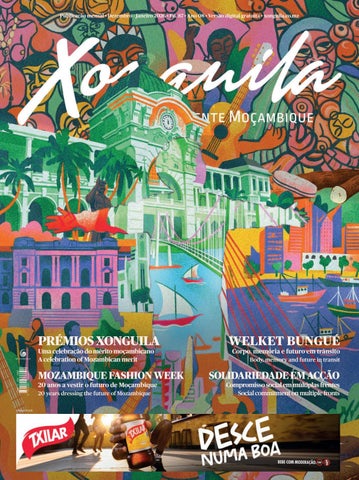
Publicação mensal • Dezembro - Janeiro 2026 • Ed. 87 • Ano 08 • Versão digital gratuita • xonguila.co.mz
PRÉMIOS XONGUILA
666826 77 0261 9
I SSN 0
261- 6661
Uma celebração do mérito moçambicano A celebration of Mozambican merit
PUBLICIDADE
MOZAMBIQUE FASHION WEEK
20 anos a vestir o futuro de Moçambique 20 years dressing the future of Mozambique
WELKET BUNGUÉ
Corpo, memória e futuro em trânsito Body, memory and future in transit
SOLIDARIEDADE EM ACÇÃO
Compromisso social em múltiplas frentes Social commitment on multiple fronts
2 | Revista Xonguila © Ed. 87 • Dezembro - Janeiro 2026
Dezembro - Janeiro 2026 • Ed. 87 © Revista Xonguila |
3
O olhar de Vasco Rocha, fundador do MFW, sobre vinte anos de percurso.
A moda ultrapassa a estética e afirma-se como força cultural, social e económica. 4 | Revista Xonguila © Ed. 87 • Dezembro - Janeiro 2026
Fotografia: Cortesia de MFW Dezembro - Janeiro 2026 • Ed. 87 © Revista Xonguila |
5
Há projectos que nascem como eventos e acabam por se transformar em movimentos. O Mozambique Fashion Week, que em 2025 celebrou vinte anos de existência, é um desses casos raros em que a moda ultrapassa a estética e se afirma como força cultural, social e económica. Fundado em 2005 por Vasco Rocha, o MFW ajudou a revelar talentos, a criar oportunidades e a lançar as bases de um sector praticamente inexistente no país.
Q
uando Vasco Rocha recorda a primeira edição, a imagem que lhe surge continua a ser marcante. “Vejo uma espécie de silêncio cheio de possibilidades”, afirma, descrevendo um país
“sem escolas de moda, sem indústria têxtil moderna, sem materiais adequados, mas com um talento cru quase impossível de ignorar”. Tudo era improvisado, da luz ao som, dos figurinos à passarela, mas existia uma
6 | Revista Xonguila © Ed. 87 • Dezembro - Janeiro 2026
convicção absoluta de que algo irreversível estava a começar. “Estávamos a abrir uma porta que nunca mais se fecharia.” Esse início, marcado pela ausência de apoios institucionais e pela incerteza do
“Quando um evento cultural resiste a tempestades que abalam o país inteiro, percebemos que ele não é apenas um espectáculo, é uma necessidade colectiva”, sublinha Vasco. Ao longo destas duas décadas, a visão de moda do fundador alterou-se profundamente. Aquilo que começou como expressão criativa revelou-se um ecossistema complexo. “No início, achava que trabalhávamos com beleza e criatividade. Hoje sei que estávamos a construir um sector económico, social e cultural inteiro”, afirma. A moda passou a ser entendida como agricultura, desde o algodão, como indústria, como espaço de afirmação da juventude, como identidade e como ferramenta de desenvolvimento. Num país como Moçambique, tornou-se sinónimo de inclusão, educação cívica, sustentabilidade e economia criativa.
ces transformaram a passarela em manifesto social, denúncia e celebração. “Foram momentos em que o contexto se encontrou com a coragem”, recorda Vasco Rocha. “Provaram que a moda moçambicana tem alma própria, resistente, criativa e disruptiva.” A nova geração de designers, modelos e criativos cresceu praticamente no vazio, sem escolas formais, sem centros de formação, sem agências estruturadas ou bibliografia especializada. Ainda assim, floresceu. “Eles cresceram no vazio e, mesmo assim, sobreviveram”, afirma, descrevendo esta geração como um “milagre silencioso”. Ao longo dos anos, o MFW procurou colmatar lacunas através de bootcamps, sessões de treino, residências criativas e parcerias internacionais com instituições como a CNA Federmoda e a South Africa Fashion Week.
A história do MFW é também feita de momentos de viragem inesperados. Criadores que trabalharam em contextos de escassez extrema apresentaram colecções de impacto internacional. Performan-
Desde cedo, o evento assumiu uma dimensão social clara. A passarela tornou-se reflexo do país e, muitas vezes, motor de avanço. O MFW foi pioneiro ao dar visibilidade à comunidade LGBTQ+
Dezembro - Janeiro 2026 • Ed. 87 © Revista Xonguila |
7
Fotografia: Cortesia de MFW
resultado, tornou-se o alicerce de uma plataforma que viria a transformar vidas. Vasco Rocha percebeu que o MFW deixara de ser apenas um evento quando começaram a surgir histórias concretas de mudança. Jovens sem rumo encontraram ali a primeira oportunidade profissional, estilistas adquiriram os seus primeiros equipamentos com os rendimentos obtidos no evento, modelos construíram identidade, auto-estima e autonomia num país onde esse percurso simplesmente não existia.
8 | Revista Xonguila © Ed. 87 • Dezembro - Janeiro 2026
Manter este percurso não foi simples. A coerência artística num ambiente sem recursos, a instabilidade operacional sem financiamento garantido e a ausência de instituições nacionais capazes de assegurar continuidade foram desafios constantes. Ainda assim, o projecto resistiu a crises económicas, instabilidade política e até à pandemia. Em 2020, quando muitos eventos internacionais foram cancelados, o MFW realizou uma edição presencial em segurança. “Foi um acto de resistência cultural”, sublinha o fundador. Entre os momentos que melhor simbolizam o espírito do Mozambique Fashion Week, Vasco Rocha destaca dois. A Estação Central de Maputo, onde a história se transformou em palco, e o Aeroporto Internacional de Maputo, cenário de um desfile único, em que a pista de aviação se tornou metáfora de um país pronto para levantar voo. “O MFW não é apenas criatividade, é ousadia, visão e capacidade de transformar o improvável em algo icónico.”
Fórum e o Mozambique Fashion Awards. Mais do que uma celebração, foi a afirmação de um projecto que olha para o futuro com ambição. Vasco Rocha imagina os próximos anos com o MFW a afirmar-se como instituição, ligada à cadeia de valor do algodão, com formação contínua, intercâmbios académicos, presença em feiras internacionais e uma forte aposta em têxteis sustentáveis. Um verdadeiro acelerador da economia criativa, capaz de criar empregos, exportar talento e reforçar a identidade cultural moçambicana. Depois de vinte anos, o que continua a surpreendê-lo é a capacidade do país de criar apesar da escassez. “Surpreende-me que jovens sem formação formal apresentem trabalhos de nível internacional”, afirma. “A capacidade do povo moçambicano de criar beleza em meio à adversidade é uma das coisas mais emocionantes que testemunhei.” Quanto ao legado, Vasco Rocha é claro. Quer que o público compreenda que a moda é muito mais do que um desfile de dez minutos. É uma cadeia inteira em movimento, feita de agricultores, costureiras, criadores, artistas e jovens que encontraram ali a primeira oportunidade. “A moda em Moçambique não é apenas um espectáculo. É um movimento. É resistência. É futuro.”
Vinte anos depois, o Mozambique A edição comemorativa de 2025, que de- Fashion Week afirma-se como uma correu de 1 a 6 de Dezembro no Centro obra colectiva, construída contra toCultural Moçambique–China, assinalou das as probabilidades. Uma história este percurso com uma programação que prova que, mesmo em contextos especial que integrou o Mozambique adversos, a criatividade pode tornar-se Fashion Week, o Mozambique Fashion estrutura, identidade e horizonte. Dezembro - Janeiro 2026 • Ed. 87 © Revista Xonguila |
9
Fotografia: Cortesia de MFW
com dignidade, ao abordar temas como violência doméstica, casamento prematuro, cancro da mama e igualdade de género, num contexto onde quase não existiam plataformas para esse debate. A moda transformou-se, assim, numa linguagem acessível de educação cívica e afirmação contemporânea.
Mozambique Fashion Week 20 years dressing the future of Mozambique Some projects begin as events and evolve into movements. Mozambique Fashion Week (MFW), which in 2025 marked its twentieth anniversary, is one of those rare cases where fashion transcends aesthetics and affirms itself as a cultural, social and economic force. Founded in 2005 by Vasco Rocha, MFW helped to unveil talent, create opportunities and lay the foundations for a sector that was virtually non-existent in the country.
W
Fotografia: Cortesia de MFW
hen Vasco Rocha looks back on that first edition, the image that comes to mind remains vivid. “I see a kind of silence full of possibilities,” he recalls, describing a country “with no fashion schools, no modern textile industry, no proper materials— but with a raw talent that was almost impossible to ignore.” Everything was improvised—from lighting to sound, from costumes to the runway—but there was a deep conviction that something irreversible was beginning. “We were opening a door that would never close again.” That beginning, marked by a lack of institutional support and uncertainty about the outcome, became the foundation of a platform that would go on to change lives. Vasco Rocha realised MFW had ceased to be merely an event when tangible stories of change began to emerge. Young
people with no direction found their first professional opportunity there; designers bought their first equipment with earnings from the event; models developed identity, self-esteem and independence in a country where that path simply didn’t exist. “When a cultural event survives storms that shake the entire country, we understand it’s not just a show—it’s a collective need,” Vasco affirms. Over these two decades, his vision of fashion has changed profoundly. What began as a form of creative expression revealed itself to be a complex ecosystem. “At first, I thought we were working with beauty and creativity. Today I know we were building an entire economic, social and cultural sector,” he says. Fashion came to be understood as agriculture, starting with cotton; as industry; as a space for youth empowerment; as identity; and as a development tool. In a country like Mozambique,
10 | Revista Xonguila © Ed. 87 • Dezembro - Janeiro 2026
it became synonymous with inclusion, civic education, sustainability and the creative economy. MFW’s history is also punctuated by pivotal moments. Designers working in contexts of extreme scarcity presented collections that made an international impact. Performances turned the runway into a platform for social commentary, protest and celebration. “These were moments when context met courage,” says Vasco Rocha. “They proved that Mozambican fashion has a soul of its own—resilient, creative and disruptive.” A new generation of designers, models and creatives emerged practically out of nothing—without formal schools, training centres, structured agencies or specialist literature. And yet, they flourished. “They grew in a vacuum and still survived,” he says, describing this generation as a
“silent miracle”. Over the years, MFW has sought to bridge gaps through bootcamps, training sessions, creative residencies and international partnerships with institutions such as CNA Federmoda and South Africa Fashion Week. From the outset, the event embraced a clear social dimension. The runway became a mirror of the country—and often a driver of progress. MFW was a pioneer in giving visibility to the LGBTQ+ community with dignity, in addressing themes such as domestic violence, child marriage, breast cancer and gender equality, in a context where there were almost no platforms for such dialogue. Fashion became an accessible language for civic education and contemporary expression. Maintaining this journey has never been simple. Artistic coherence in a resource-scarce environment, operational instability without guaranteed funding, and the absence of national institutions able to ensure continuity have all been constant challenges. Yet the project endured economic crises, political instability and even the pandemic. In 2020, while many interna-
tional events were cancelled, MFW went ahead with a safe, in-person edition. “It was a cultural act of resistance,” the founder notes. Two moments stand out to Vasco Rocha as emblematic of the spirit of Mozambique Fashion Week: the Central Railway Station of Maputo, where history became a stage, and Maputo International Airport, which hosted a unique runway show where the airstrip became a metaphor for a country ready to take flight. “MFW isn’t just creativity—it’s boldness, vision, and the ability to turn the unlikely into the iconic.” The commemorative 2025 edition, held from 1 to 6 December at the Mozambique–China Cultural Centre, marked this journey with a special programme combining the Mozambique Fashion Week, the Mozambique Fashion Forum and the Mozambique Fashion Awards. More than a celebration, it was a reaffirmation of a project that looks to the future with ambition. Vasco Rocha envisions the coming years with MFW evolving into a formal institution, connected to the cotton value chain, offering ongoing training, academic exchanges, presence at international fairs
and a strong focus on sustainable textiles. A true accelerator of the creative economy, capable of generating jobs, exporting talent and strengthening Mozambique’s cultural identity. What still surprises him, even after twenty years, is the country’s capacity to create in the face of scarcity. “It amazes me that young people with no formal training are producing work of international standard,” he says. “The Mozambican people’s ability to create beauty amidst adversity is one of the most moving things I’ve ever witnessed.” As for the legacy, Vasco Rocha is clear: he wants the public to understand that fashion is much more than a ten-minute runway show. It’s an entire chain in motion, made up of farmers, seamstresses, designers, artists and young people who found their first opportunity there. “Fashion in Mozambique is not just a show. It’s a movement. It’s resistance. It’s the future.” Twenty years on, Mozambique Fashion Week stands as a collective achievement, built against all odds. A story that proves creativity can become structure, identity and a future—even in the most adverse contexts.
Dezembro - Janeiro 2026 • Ed. 87 © Revista Xonguila |
11
Sumário
16 Prémios xonguila
Uma celebração do mérito moçambicano A celebration of Mozambican merit FICHA TÉCNICA/BIOS
Propriedade/Property: Veludo & Mentol, Sociedade Unipessoal Lda
Conselho de Administração/Administrative Council: Omar Diogo, Nuno Soares Director: Nuno Soares Gestão de Conteúdos Editoriais/Editorial Content Management: Nuno Soares, Omar Diogo, Fátima Ribeiro Copy-desk (português): Fátima Ribeiro Colunistas/Writers: Dércio Parker, Sany Weng, Emilia Gimo Tradução (Português-Inglês)/Translation (Portuguese-English): Pedro Sargaço Fotografia/Photography: Helton Perengue Design de Capa/Cover Design: Nuno Azevedo Infografia e Paginação/ Infographics and Pagination: Omar Diogo Produtores Audiovisuais/Audiovisual Producers: Omar Diogo, Nuno Lopes, Ana Piedade Gestão de Redes Sociais/ Social Media Management: Nuno Soares Conteúdos de Marketing e Comunicação/ Marketing and Communication Contents: Omar Diogo, Nuno Azevedo Gestão de Homepage e Edição Online/ Homepage Management and Online Editing: Omar Diogo, Jorge Oliveira Departamento Comercial/Commercial Department: Nuno Soares -comercial@xonguila.co.mz Registo de Propriedade Industrial/ Industrial Property Registration: 35065/2017 - 35066/2017 (15/01/2018) ISSN / Registo/Register: ISSN-0261-661 / 02/Gabinfo-dec/2018 Impressão/Printing: Txelene LDA
66 João Timane O mundo nos olhos antes de o levar para a tela The world in his eyes before taking it to the canvas
12 | Revista Xonguila © Ed. 87 • Dezembro - Janeiro 2026
Sumário
38 Millennium bim
Forte impacto social em 2025 Strong social impact in 2025
48 Baía Mall
Solidariedade ambiental na Macaneta Environmental solidarity in Macaneta
58 BCI
leva alegria a crianças hospitalizadas brings joy to hospitalised children
110 O valor da presença
Um olhar sobre as crianças dos orfanatos A look at children in orphanages
118 KUTIVA
4 MFW 2025
inovação jovem ao serviço do ensino youth-led innovation in the service of education
20 anos a vestir o futuro de Moçambique 20 years dressing the future of Mozambique
122 Seeds of Change
Arte, jovens talentos e impacto comunitário Art, young talents and community impact
26 Welket Bungué
Criador em trânsito, entre memórias, corpos e futuros possíveis Creator in transit, between memories, bodies and possible futures Dezembro - Janeiro 2026 • Ed. 87 © Revista Xonguila | 13
Editorial
Do Director / From the Director Caro leitor,
Dear reader,
Nestas páginas, celebramos projectos, pessoas e instituições que ajudaram e ajudam a moldar o país, dando destaque aos Prémios de Excelência Xonguila, claro gesto de reconhecimento em vida de quem vai construindo Moçambique todos os dias. Exemplo desses projectos é o Mozambique Fashion Week, que assinala vinte anos de um percurso que ultrapassou a moda e se afirmou como movimento cultural e económico. Olhamos para iniciativas que cruzam cultura, impacto e responsabilidade, do Bantumen Powerlist 100 ao impacto do trabalho social do Millennium bim, passando pela arte como ferramenta de mudança em Seeds of Change, e dedicamos espaço a entrevistas exclusivas com criadores que pensam o mundo a partir da memória e da identidade, como Welket Bungué, num trajecto internacional marcado pelo corpo e pelo cinema, e João Timane, cuja pintura continua a regressar às origens mesmo vivendo longe.
In these pages, we celebrate projects, people and institutions that have helped — and continue to help — shape the country, with a special focus on the Xonguila Excellence Awards, a clear gesture of recognising, in their lifetime, those who are building Mozambique day by day. One such example is Mozambique Fashion Week, which this year marks two decades of a journey that has gone far beyond fashion to establish itself as a cultural and economic movement. We take a closer look at initiatives that intertwine culture, impact and responsibility — from the Bantumen Powerlist 100 to the social outreach work of Millennium bim, as well as Seeds of Change, where art becomes a tool for transformation. We also share exclusive interviews with creators who reflect on the world through the lenses of memory and identity — such as Welket Bungué, whose international career has been shaped by cinema and the body, and João Timane, whose painting continues to return to its roots, even from afar.
Chamamos ainda a sua atenção para um artigo de Ximena Caleno sobre o valor da presença nos orfanatos, para experiências surpreendentes na Gelarte, para acções de protecção ambiental e até para pequenas curiosidades que nos ligam à terra. E muito mais fica por descobrir ao virar das nossas páginas.
We’d also like to draw your attention to an article by Ximena Caleno on the value of presence in orphanages, to surprising experiences at Gelarte, to environmental protection initiatives, and even to small curiosities that connect us to the land. And there is so much more waiting to be discovered as you turn the pages.
Desejo-lhe uma excelente leitura, festas fe- Wishing you a wonderful read, joyful festive lizes e um próspero 2026. season, and a prosperous 2026. Nuno Soares Director
14 | Revista Xonguila © Ed. 87 • Dezembro - Janeiro 2026
Dezembro - Janeiro 2026 • Ed. 87 © Revista Xonguila |
15
Millennium bim
Os Prémios de Excelência Xonguila celebraram o mérito de quem contribui activamente para o desenvolvimento de Moçambique. 16 | Revista Xonguila © Ed. 87 • Dezembro - Janeiro 2026
Millennium bim
Dezembro - Janeiro 2026 • Ed. 87 © Revista Xonguila |
17
Prémios de Excelência Xonguila Reconhecer hoje quem constrói o amanhã
Moçambique precisa de referências reais, pessoas que provem, pelo exemplo, que é possível criar, liderar, inovar e transformar. Precisa de role models próximos, vivos, activos, capazes de inspirar as gerações mais novas não apenas pelo que já fizeram, mas pelo que continuam a fazer. Foi a partir desta convicção que a Revista Xonguila realizou, no dia 15 de Dezembro, no Hotel Cardoso, em Maputo, a primeira edição dos Prémios de Excelência Xonguila, uma cerimónia pensada como espaço de celebração, reconhecimento e projecção do futuro.
N
um ambiente marcado pela presença de convidados de diferentes áreas e por momentos culturais que deram identidade e sensibilidade à tarde, a cerimónia afirmou-se como um gesto consciente de valorização do mérito moçambicano. Como foi sublinhado desde a abertura, reconhecer em vida não é um acto simbólico, é um compromisso com o presente e com o país que se quer construir. Ao longo da tarde, a Xonguila distinguiu pessoas e projectos que, em áreas tão diversas como ciência, cultura, desporto, empreendedorismo, educação, comunicação e impacto social, têm contribuído de forma consistente para o desenvolvimento de Moçambique. Entre os prémios individuais, destacou-se a diversidade de percursos e gerações: Amade Sambo, jovem investigador na diáspora que projecta o país através da ciência; Melchior
18 | Revista Xonguila © Ed. 87 • Dezembro - Janeiro 2026
Ferreira, revelação do audiovisual com reconhecimento internacional; Paulo Chibanga, empreendedor que cruza indústria, inovação e cultura; Carlos Serra, mobilizador de causas sociais e ambientais; Sebastião Coana, artista que transforma a arte num instrumento de intervenção comunitária; Nuno Lima, referência estratégica na comunicação e media; Alcinda Panguana, atleta que leva o nome de Moçambique ao boxe internacional; Severino Ngoenha, pensador incontornável da academia e do debate público; Alice Parsotamo, expressão de uma liderança feminina contemporânea e consciente; e Paulina Chiziane, homenageada pelo seu percurso e legado literário, vivo e profundamente transformador. Na vertente colectiva, foram igualmente reconhecidos projectos que actuam directamente na sociedade moçambicana. A Girl Move Aca-
Dezembro - Janeiro 2026 • Ed. 87 © Revista Xonguila |
19
Fotografia: Helton Perengue
A cerimónia afirmou-se como um gesto consciente de valorização do mérito moçambicano.
20 | Revista Xonguila © Ed. 87 • Dezembro - Janeiro 2026
demy destacou-se pelo trabalho na capacitação de jovens mulheres; o Mozambique Fashion Week – 20 Anos pelo papel estruturante na economia criativa; a Plataforma Makobo pela sua abordagem integrada à sustentabilidade e impacto social; o Parque Nacional da Gorongosa como modelo de conservação,
ta a expansão desta distinção a nível nacional em 2026. Durante a cerimónia, foi também anunciada oficialmente a Gala Xonguila 2026, um evento de maior escala, previsto para Novembro de 2026, que irá integrar artistas nacionais e internacionais, moda,
jantar e expeAo longo da riências cultuafirmando tarde, a Xonguila rais, um novo patamar na forma de celedistinguiu brar a excelência e a criatividade pessoas e moçambicanas. projectos que O encerramento ficou marcado têm contribuído Um dos momenpor palavras de tos centrais da agradecimento de forma cerimónia foi a aos parceiros e entrega dos Sepatro c inadore s, consistente los de Excelência cujo apoio torXonguila 2025, nou possível a para o dedicados às realização desáreas da Restauta primeira edidesenvolvimento ração e Hotelaria, ção, reforçando distinguindo esa ideia de que repaços que se des- de Moçambique. conhecer o méritacam pela qualidade, consistência e experiência oferecida. Nesta primeira edição, os selos contemplaram exclusivamente a cidade de Maputo, reconhecendo restaurantes e hotéis que elevam o padrão do sector e contribuem para a imagem da capital como destino gastronómico e turístico, estando já previs-
to é um esforço colectivo. Com os Prémios de Excelência Xonguila, a revista reafirma o seu compromisso com a valorização de exemplos positivos, com a celebração do trabalho bem feito e com a projecção de referências que inspiram o presente e ajudam a desenhar o futuro de Moçambique.
Dezembro - Janeiro 2026 • Ed. 87 © Revista Xonguila |
21
Fotografia: Helton Perengue
ecoturismo e desenvolvimento comunitário; e a Plataforma Tabater pela inovação tecnológica e contributo para a modernização da gestão de eventos no país.
Fotografia: Helton Perengue
22 | Revista Xonguila © Ed. 87 • Dezembro - Janeiro 2026
Reconhecendo restaurantes e hotéis que elevam o padrão do sector e contribuem para a imagem da capital como destino gastronómico e turístico. Dezembro - Janeiro 2026 • Ed. 87 © Revista Xonguila |
23
Xonguila Excellence Awards Recognising today those who are building tomorrow Mozambique needs real references — people who prove, by example, that it is possible to create, lead, innovate and transform. It needs close, living, active role models, capable of inspiring younger generations not only through what they have already done, but through what they continue to do. It was from this conviction that Revista Xonguila held, on 15 December, at the Hotel Cardoso in Maputo, the first edition of the Xonguila Excellence Awards, a ceremony designed as a space for celebration, recognition and projection of the future.
I
n an atmosphere marked by the presence of guests from different fields and by cultural moments that brought identity and sensitivity to the afternoon, the ceremony stood out as a conscious gesture of valuing Mozambican merit. As was emphasised from the outset, recognising people in their lifetime is not a symbolic act — it is a commitment to the present and to the country we want to build. Throughout the afternoon, Xonguila distinguished individuals and projects that, in areas as diverse as science, culture, sport, entrepreneurship, education, communication and social impact, have consistently contributed to the development of Mozambique. Among the individual awards, the diversity of backgrounds and generations stood out:
Amade Sambo, a young researcher in the diaspora who projects the country through science; Melchior Ferreira, an audiovisual rising talent with international recognition; Paulo Chibanga, an entrepreneur who bridges industry, innovation and culture; Carlos Serra, a driver of social and environmental causes; Sebastião Coana, an artist who transforms art into a tool for community intervention; Nuno Lima, a strategic reference in communication and media; Alcinda Panguana, an athlete who carries Mozambique’s name into international boxing; Severino Ngoenha, a key thinker in academia and public debate; Alice Parsotamo, an expression of contemporary and conscious female leadership; and Paulina Chiziane, honoured for her career and literary legacy — alive and deeply transformative.
24 | Revista Xonguila © Ed. 87 • Dezembro - Janeiro 2026
In the collective category, projects that act directly in Mozambican society were also recognised. Girl Move Academy stood out for its work in empowering young women; Mozambique Fashion Week – 20 Years for its structuring role in the creative economy; Plataforma Makobo for its integrated approach to sustainability and social impact; Gorongosa National Park as a model of conservation, ecotourism and community development; and Plataforma Tabater for its technological innovation and contribution to the modernisation of event management in the country. One of the central moments of the ceremony was the awarding of the Xonguila Seals of Excellence 2025, dedicated to the areas of Restaurants and Hospitality, distinguishing establishments
that stand out for their quality, consistency, and the experience they offer. In this first edition, the seals covered exclusively the city of Maputo, recognising restaurants and hotels that raise the standard of the sector and contribute to the image of the capital as a gastronomic and tourist destination. The expansion of this distinction nationwide is already planned for 2026.
include national and international artists, fash-
new level in the way Mozambican excellence and creativity are celebrated.
Recognising The closing was marked people in their by words of thanks to the partners and sponsors lifetime is not whose support made the realisation of this first a symbolic edition possible, reinforcing the idea that recognisact — it is a ing merit is a collective commitment effort. With the Xonguila Excellence Awards, the to the present magazine reaffirms its commitment to valuing and to the positive examples, celeDuring the ceremony, brating well-executed country we the Xonguila Gala 2026 work, and promoting was also officially an- want to build. references that inspire ion, dinner, and cultural experiences, setting a
the present and help shape the future of Mozambique.
Fotografia: Helton Perengue
nounced — a larger-scale event scheduled for November 2026, which will
Dezembro - Janeiro 2026 • Ed. 87 © Revista Xonguila |
25
Tourism
Um criador em trânsito, entre memórias, corpos e futuros possíveis
Para mim, fazer cinema ou expressar-me através da arte é um gesto de afecto e de identidade. 26 | Revista Xonguila © Ed. 87 • Dezembro - Janeiro 2026
Fotografia: Cortesia de Nikos Nikolopoulos
Tourism
Dezembro - Janeiro 2026 • Ed. 87 © Revista Xonguila |
27
Welket Bungué Criador em trânsito, entre memórias, corpos e futuros possíveis
Actor, realizador e artista transdisciplinar, Welket Bungué traça um percurso internacional onde o cinema, a performance e o pensamento se entrelaçam. Entre a Guiné-Bissau, Portugal, Brasil e Berlim, a sua obra nasce da simultaneidade identitária e da força do corpo enquanto linguagem. Entre memórias, deslocamentos e gestos que antecedem a palavra, revela uma criação que é cura, intervenção e reinvenção. Nesta entrevista, abre-nos a porta desse território sensível onde o cinema se torna encontro, rito e transformação. Ao revisitar a origem, Welket regressa à aldeia balanta de Xitoli, no sul da Guiné-Bissau, onde nasceu e de onde saiu muito novo. Só em 2023 voltou a passar por lá, numa travessia entre Bissau e Quebo, experiência registada em Contemplação Impasse Tentativa. Desse regresso emergem sobretudo memórias sensoriais, o cheiro da terra, os sons de Bissau, o sabor das frutas, as conversas à sombra das mangueiras, fragmentos de um tempo distante que confirmam que a memória é também uma construção. Ainda assim, a memória que mais ilumina o seu percurso situa-se em Portugal, nos anos de infância vividos na Ramada, na Serra da Amoreira. Filho de uma família migrante, cresceu entre brincadeiras num eucaliptal e um imaginário alimentado pela televisão dos anos 90 e pelos filmes de acção. A viragem acontece em 1998, na primeira ida ao cinema São Jorge para ver Perigo Público, com Will Smith. Ver um homem negro ocupar o ecrã em escala monumental confirma-lhe que o cinema podia ser esse lugar de impacto. A partir daí, seguem-se o teatro, Hamlet, o documentário Caravelas e Naus – Um Choque Tecnológico nos séculos XV e XVI e a formação académica, num percurso onde a memória continua a orientar o gesto criativo. Carregaste uma infância marcada por deslocações e silêncios que te foram moldando por dentro. Como é que essa história, que podia ter ficado na sombra, acabou por se transformar numa raiz que te sustém e te devolve ao teu centro? Eu não diria necessariamente que a minha trajectória foi pautada por silêncios, mas por alguma invisibilidade, isto é, a falta de referências vivas de artistas não brancos, não hegemónicos, que pudessem servir de referência para mim, sendo eu um afrodescendente, filho de migrantes em Portugal. Isso fez com que a trajectória, já enquanto actor amador e depois actor de teatro académico e profissional, tivesse sido mais dificultada, porque não havia um embasamento de convivência com outros pares que pudessem partilhar experiências semelhan-
28 | Revista Xonguila © Ed. 87 • Dezembro - Janeiro 2026
tes. Esse é um elemento que fortalece o indivíduo na sua caminhada enquanto artista, e eu só venho a adquirir isso quando chego ao Brasil, ao ver outros artistas negros e negras a participar em produções com condições mais dignas. Apesar de muitas narrativas ainda serem previsíveis ou estigmatizadas, havia uma auto-estima e uma autonomia na produção de pensamento e de narrativas divergentes das hegemónicas. A minha trajectória não poderia ficar à sombra, apesar da escassez de referências e do facto de os artistas afrodescendentes, em Portugal, terem durante muito tempo disputado oportunidades ínfimas, quando existe uma grande diversidade de artistas não hegemónicos. Quando digo não hegemónicos, refiro-me a artistas que não correspondem a um perfil privilegiado pela sua etnicidade. Isso é hege-
monia. Não hegemónico é todo o indivíduo ou comunidade que não pertence a esse grupo privilegiado. Em grande medida, esta autonomia e subjectividade alimentadas por este trânsito correspondem ao conceito de corpo periférico que desenvolvo no meu livro. Tudo isto acontece também por ter tido uma educação privilegiada no
seio familiar e no internato, e por essa confluência de visões do mundo consegui singrar e adaptar-me às várias vicissitudes de quem procura oportunidades fora da sua zona de conforto. Daí a importância da simultaneidade, de nos entendermos como o confluir de várias coisas que compõem a nossa identidade.
O teu cinema nasce de gestos pequenos, de inquietações que não se explicam de imediato. Quando começas um projecto, segues a emoção, o corpo ou aquela sensação subtil que insiste em chamar-te e que te pede para a transformares em imagem? O que me leva a fazer filmes é o desejo de poder comunicar, primeiro que tudo, e de querer proporcionar um espaço para o diálogo, para a melhor compreensão de um tema, mas também para nos compreendermos de outra forma enquanto agentes do espaço e do tempo, enquanto seres humanos, criaturas e criadores. A criação parte muito dessa sensação que me atravessa e que vê na imagem, no audiovisual, uma plataforma, um medium para arquitectar, construir, combinar e editar materiais que resultam de uma reflexão em curso. Esse fazer filme parte de gestos muitas vezes incompletos, com intenção de comunicar, mas que não constituem necessariamente uma linguagem determinada. O meu cinema muitas vezes ganha forma na ilha de edição. A maior parte dos filmes que fiz não tinha um guião inicialmente. Tinha uma câmara na mão, uma ideia na cabeça e esse desejo inconsolável de comunicar, de criar. Dezembro - Janeiro 2026 • Ed. 87 © Revista Xonguila |
29
Fotografia: Cortesia de Frederic Batier
A ideia de casa, para Welket Bungué, deixou de ser um ponto fixo para se tornar um movimento contínuo. Viver em trânsito ensinou-lhe que, para quem migra, preservar a sanidade emocional passa por se desenraizar de uma noção rígida de pertença e aprender a habitar a simultaneidade. O pertencimento constrói-se por dentro, nos atravessamentos afectivos, filosóficos e culturais que validam a integridade do indivíduo. Casa pode ser um lugar físico, disperso por geografias onde existem relações e reconhecimento, mas também um território emocional e mental que activa segurança e sentido de realização. É dessa consciência que emerge a noção de corpo periférico, um corpo politizado e simultâneo, que se move entre culturas e desloca centros ancorados em visões nacionalistas. Entre a Guiné-Bissau, Portugal, Brasil e Berlim, Welket carrega essas camadas como continuidade de uma trajectória ancestral. Nesse trânsito, leva consigo saberes e deixa-se transformar pelos lugares, num processo orgânico onde cada passagem desperta memórias e conhecimentos que pareciam adormecidos.
O que está na origem do fazer filme é essa necessidade inconsolável de comunicar, aliada a uma certa clarividência quando estou diante de um tema que sinto ser potencialmente impactante ou necessário e que, por isso, deve ser mostrado ao público, ao mundo. Aí entra a minha função enquanto interveniente e canal entre aquilo que o mundo oferece como possibilidade e aquilo que posso transcrever através do meu ofício artístico. A memória, para Welket Bungué, não é fixa, é movimento e revisitação. Enraizada nas culturas de génese africana, aproxima-se da tradição dos griôs e da oralitura, onde a palavra viva antecede a escrita e a memória se constrói na transmissão. A memória que mais o interpela é a da Guiné-Bissau antes da chegada dos portugueses, um tempo anterior à assimilação colonial. Esse desejo atravessa já Buôn (2015) e reaparece na vontade de trabalhar a batalha de Kansalá, em Gabú, momento de forte resistência à islamização forçada, marcado pela hecatombe das mulheres mandingas, gesto de coragem e auto-afirmação. É esse tempo ido que deseja filmar de forma experimental, cruzando-o com imagens de uma Guiné que já foi mais livre. Para Welket, o cinema pode também forjar memórias futuras e imaginar utopias onde os povos originários possam coexistir e ser reconhecidos na sua pluralidade. Entre tudo o que fazes, há momentos em que parece que o corpo vai à frente e a mente apenas acompanha. Como encontras o teu próprio centro criativo no meio dessas identidades que se cruzam dentro de ti? O corpo surge como centro absoluto do processo criativo. Não apenas como instrumento de trabalho, mas como lugar de existência e de conhecimento. Entre o mental, o emocional, o físico e o eté-
30 | Revista Xonguila © Ed. 87 • Dezembro - Janeiro 2026
Lusofonia
rico, há um saber que antecede a linguagem e que não se submete ao controlo da mente racional. É a partir dessa escuta que Welket foi deslocando a sua prática, de uma performance inicialmente mais técnica para um trabalho cada vez mais ancorado nas sensações internas e na relação com o meio. Essa mudança conduziu-o a pensar o corpo como fragmento de um corpo maior, o planeta, e a desenvolver um cinema onde o gesto não nasce da construção mental, mas de uma inteligência corporal e ancestral. O corpo passa a ser matéria de estudo, medium e arquivo vivo, permitindo que dança, performance, teatro e cinema se tornem espaços de investigação do
movimento e do sentido. No audiovisual, a performance ganha novas camadas. O registo transforma o acontecimento e abre possibilidades de leitura onde som, luz, cor e texto resignificam aquilo que se vê e se sente. É nesse território que se inscrevem os seus filmes mais recentes, obras que procuram levar o entendimento para além da imagem imediata e questionar verdades estabelecidas. Mais do que oferecer respostas, este cinema convoca o espectador para um espaço de reflexão activa. Um lugar onde a desconstrução, o diálogo e a possibilidade de transformação se tornam ferramentas para pensar o mundo e a forma como nele habitamos.
Há uma ternura firme no modo como filmas, como se dissesses que a sensibilidade também resiste. Para ti, a delicadeza pode ser uma forma de luta, e que lugar ocupa essa luta no criador que és agora, à procura de fronteiras ou de um território onde possas finalmente pousar? Para mim, fazer cinema ou expressar-me através da arte é um gesto de afecto e de identidade. É um gesto que afirma aquilo que é a minha mundividência, a forma como vejo e sinto o mundo. Quando faço filmes, o meu objectivo principal é criar uma possibilidade de diálogo com quem está interessado em compreender melhor as várias dimensões do existir e do comunicar. Tratando-se de temas delicados, o meu cinema trabalha muitas vezes com uma certa ambiguidade de discurso, tentando isentar-se de leituras moralistas ou julgativas. Essa pluridimensionalidade liga-se à minha ideia de corpo periférico, esse corpo que transita pelo mundo e comunica com várias culturas e atravessamentos identitários. O meu cinema, enquanto cinema da auto-representa-
ção, parte de uma subjectividade fluída, que habita a simultaneidade identitária. Não me entendo apenas como guineense ou português, mas como africano, europeu, balanta, guineense, português, alentejano, brasileiro. Esse entendimento do mundo orienta o olhar que trago para a produção fílmica. Os aspectos de resistência, de resiliência e de denúncia da injustiça devem também comunicar um desejo de concertação e de agregação de pontos de vista. O diálogo que procuro não é separatista nem reducionista, mas construtivo. Essa dissidência no meu fazer fílmico encontra no cinema uma possibilidade de reinventar o possível, subvertendo limites sem os desmantelar de forma destrutiva. Fazer arte implica uma resignificação constante do corpo e do gesto do fazer fílmico, sobretudo para quem vive em trânsito e precisa de uma reconciliação contínua com a história dos lugares por onde passa. Em última instância, o diálogo que procuro através do cinema é, em si, um gesto de cura. Dezembro - Janeiro 2026 • Ed. 87 © Revista Xonguila |
31
Fotografia: Cortesia de Lucas Fonseca
O percurso de Welket Bungué constrói-se numa simultaneidade constante, identitária e perceptiva. Entre Portugal, Brasil e Guiné-Bissau, territórios distintos mas ligados por um eixo comum, reconhece marcas que atravessam o seu trabalho: a presença da negritude e a língua portuguesa. Para Welket, a língua não se limita à palavra falada. Antes dela existe a linguagem corporal, a intenção de comunicar que antecede o discurso e permite atravessar fronteiras linguísticas e culturais. Essa consciência foi-se aprofundando com o trânsito entre geografias e contextos, tornando-se central no seu modo de criar. A herança étnico-cultural guineense e balanta, a ligação afectiva à língua portuguesa e a musicalidade descoberta no Brasil formam um tecido contínuo. É nesse cruzamento de territórios e linguagens que reconhece a matéria que molda a sua personalidade e o seu gesto artístico.
Fotografia: Cortesia de Frederic Batier
32 | Revista Xonguila © Ed. 87 • Dezembro - Janeiro 2026
Ver um homem negro ocupar o ecrã em escala monumental confirma que o cinema podia ser esse lugar de impacto. Dezembro - Janeiro 2026 • Ed. 87 © Revista Xonguila |
33
Welket Bungué A creator in motion, between memories, bodies and possible futures
Actor, director and transdisciplinary artist, Welket Bungué traces an international path where cinema, performance and thought intertwine. Between Guinea-Bissau, Portugal, Brazil and Berlin, his work is born from identity simultaneity and from the strength of the body as language. Between memories, displacements and gestures that precede the word, he reveals a creation that is healing, intervention and reinvention. In this interview, he opens the door to that sensitive territory where cinema becomes encounter, rite and transformation. In revisiting his origin, Welket returns to the Balanta village of Xitoli, in the south of Guinea-Bissau, where he was born and from where he left very young. It was only in 2023 that he went back, in a journey between Bissau and Quebo, an experience recorded in Contemplação Impasse Tentativa. From this return emerge above all sensory memories: the smell of the earth, the sounds of Bissau, the taste of the fruit, the conversations in the shade of mango trees — fragments of a distant time that confirm that memory is also a construction. Still, the memory that most illuminates his path is located in Portugal, in the childhood years lived in Ramada, in Serra da Amoreira. The son of a migrant family, he grew up between games in a eucalyptus grove and an imaginary nourished by 1990s television and action films. The turning point comes in 1998, in his first visit to cinema São Jorge to see Enemy of the State, with Will Smith. Seeing a Black man occupy the screen on a monumental scale confirmed to him that cinema could be that place of impact. From then on came theatre, Hamlet, the documentary Caravelas e Naus – Um Choque Tecnológico nos séculos XV e XVI, and academic training — a journey where memory continues to guide the creative gesture. You carried a childhood marked by displacements and silences that shaped you from within. How did that story, which could have remained in the shadows, end up becoming a root that sustains you and returns you to your centre? I wouldn’t necessarily say that my trajectory was marked by silences, but by some invisibility — that is, the lack of living references of non-white, non-hegemonic artists who could serve as reference points for me, being an Afro-descendant, son of migrants in Portugal. This meant that the trajectory, already as an amateur actor and later as an academic and professional theatre actor, was more difficult, because there was no basis of coexistence with other peers who could
34 | Revista Xonguila © Ed. 87 • Dezembro - Janeiro 2026
share similar experiences. That’s an element that strengthens the individual in their path as an artist, and I only came to acquire that when I arrived in Brazil, in seeing other Black artists participate in productions with more dignified conditions. Although many narratives were still predictable or stigmatised, there was self-esteem and autonomy in the production of thought and narratives diverging from the hegemonic ones. My trajectory could not remain in the shadows, despite the scarcity of references and the fact that Afro-descendant artists in Portugal, for a long time, have competed
for minimal opportunities, when there is great diversity of non-hegemonic artists. When I say non-hegemonic, I’m referring to artists who do not match a profile privileged by their ethnicity. That is hegemony. Non-hegemonic is every individual or community that does not belong to that privileged group. To a large extent, this autonomy and subjectivity fed by this transit correspond to the concept of peripheral body that I
develop in my book. All of this also happens because I had a privileged education within my family and in boarding school, and because of this confluence of worldviews I managed to succeed and adapt to the various vicissitudes of those who seek opportunities outside their comfort zone. Hence the importance of simultaneity, of understanding ourselves as the confluence of various things that compose our identity.
Your cinema is born from small gestures, from restlessness that cannot be explained immediately. When you begin a project, do you follow emotion, the body, or that subtle sensation that insists on calling you and asking to be transformed into image? What leads me to make films is the desire to communicate, first of all, and to want to provide a space for dialogue, for better understanding of a theme, but also to understand ourselves differently as agents of space and time, as human beings, creatures and creators. Creation comes very much from that sensation that runs through me and that sees in the image, in the audiovisual, a platform, a medium to architect, build, combine and edit materials that result from an ongoing reflection. That film-making
comes from gestures that are often incomplete, with the intention to communicate, but that do not necessarily constitute a defined language. My cinema often takes shape in the editing suite. Most of the films I’ve made didn’t have a script at the start. I had a camera in hand, an idea in my head, and that inconsolable desire to communicate, to create. What lies at the origin of film-making is this inconsolable need to communicate, allied to a certain clarity when I’m faced with a theme I feel to be potentially impactful or necessary and which, therefore, should be shown to the public, to the world. That’s where my function comes in, as an intervenor and channel between what the world offers as possibility and what I can transcribe through my artistic craft.
Dezembro - Janeiro 2026 • Ed. 87 © Revista Xonguila |
35
Fotografia: Cortesia de António Velez
The idea of home, for Welket Bungué, ceased to be a fixed point and became a continuous movement. Living in transit taught him that, for those who migrate, preserving emotional sanity involves uprooting from a rigid notion of belonging and learning to inhabit simultaneity. Belonging is built from within, in affective, philosophical and cultural crossings that validate the individual’s integrity. Home can be a physical place, scattered across geographies where relationships and recognition exist, but also an emotional and mental territory that activates safety and a sense of fulfilment. It is from this awareness that the notion of peripheral body emerges — a politicised and simultaneous body that moves between cultures and displaces centres anchored in nationalist visions. Between Guinea-Bissau, Portugal, Brazil and Berlin, Welket carries these layers as continuity of an ancestral trajectory. In this transit, he carries knowledge and lets himself be transformed by the places, in an organic process where each passage awakens memories and knowledge that seemed dormant.
Lusophony
Memory, for Welket Bungué, is not fixed — it is movement and revisitation. Rooted in African-origin cultures, it approaches the tradition of griots and oraliture, where the living word precedes writing and memory is built in transmission. The memory that most calls to him is that of Guinea-Bissau before the arrival of the Portuguese, a time prior to colonial assimilation. This desire already crosses Buôn (2015) and reappears in the will to work on the battle of Kansalá, in Gabú — a moment of strong resistance to forced Islamisation, marked by the cataclysm of the Mandinga women, a gesture of courage and self-assertion. It is this past time that he wishes to film experimentally, crossing it with images of a Guinea that was once freer. For Welket, cinema can also forge future memories and imagine utopias where Indigenous peoples can coexist and be recognised in their plurality. tion, but from a bodily and ancestral intelligence. The body becomes subject of study, medium and living archive, allowing dance, performance, theatre and cinema to become spaces for investigating movement and meaning. In the audiovisual, performance gains new layers. Recording transforms the event and opens possibilities for interpretation where sound, light, colour and text re-signify what is seen and felt. It is in this territory that his most recent films are inscribed — works that seek to take understanding beyond the immediate image and to question established truths. More than offering answers, this cinema invites the viewer into a space of active reflection — a place where deconstruction, dialogue and the possibility of transformation become tools to think the world and the way we inhabit it.
Welket Bungué’s journey is built on constant simultaneity, both identity-based and perceptive. Between Portugal, Brazil and Guinea-Bissau — distinct territories but connected by a common axis — he recognises recurring traits throughout his work: the presence of Blackness and the Portuguese language. For Welket, language is not limited to the spoken word. Before it exists bodily language, the intention to communicate that precedes speech and allows one to cross linguistic and cultural borders. This awareness deepened with movement between geographies and contexts, becoming central to his way of creating. The Guinean and Balanta ethno-cultural heritage, the affective connection to the Portuguese language, and the musicality discovered in Brazil form a continuous fabric. It is in this crossing of territories and languages that he recognises the matter that shapes his personality and his artistic gesture.
36 | Revista Xonguila © Ed. 87 • Dezembro - Janeiro 2026
Fotografia: Cortesia de Inês Subtil
Among everything you do, there are moments when it seems the body goes ahead and the mind only follows. How do you find your own creative centre amidst those identities that cross within you? The body arises as the absolute centre of the creative process. Not only as an instrument of work, but as a place of existence and knowledge. Between the mental, emotional, physical and etheric, there is a knowledge that precedes language and that does not submit to the control of the rational mind. It is from that listening that Welket began shifting his practice — from a more technical performance to work increasingly anchored in internal sensations and the relationship with the environment. This change led him to think of the body as a fragment of a larger body — the planet — and to develop a cinema where gesture is not born from mental construc-
Lusophony
“More than offering answers, this cinema invites the viewer into a space of active reflection.”
There is a firm tenderness in the way you film, as if saying that sensitivity also resists. For you, can delicacy be a form of struggle? And what place does that struggle occupy in the creator you are now, in search of borders or a territory where you can finally rest? For me, making cinema or expressing myself through art is a gesture of affection and identity. It is a gesture that affirms what my worldview is, the way I see and feel the world. When I make films, my main objective is to create the possibility of dialogue with those who are interested in better understanding the various dimensions of existence and communication. In dealing with delicate subjects, my cinema often works with a certain ambiguity of discourse, trying to avoid moralistic or judgmental readings. This multidimensionality is connected to my idea of peripheral body, that body that moves through the world and communicates with various cultures and identity crossings. My cinema, as cinema of self-representation, comes from a fluid subjectivity that inhabits identity simultaneity. I don’t understand myself only as Guinean or Portuguese, but as African, European, Balanta, Guinean, Portuguese, Alentejano, Brazilian. This understanding of the world guides the perspective I bring to film production. Aspects of resistance, resilience and the denunciation of injustice must also communicate a desire for reconciliation and bringing together different points of view. The dialogue I seek is not separatist or reductionist, but constructive. This dissidence in my film-making is a way of reinventing the possible, subverting limits without dismantling them destructively. Making art implies a constant re-signification of the body and of the gesture of film-making, especially for those who live in transit and need continuous reconciliation with the history of the places they pass through. Ultimately, the dialogue I seek through cinema is, in itself, a gesture of healing. Dezembro - Janeiro 2026 • Ed. 87 © Revista Xonguila |
37
Heineken
38 | Revista Xonguila © Ed. 87 • Dezembro - Janeiro 2026
Millennium bim Forte impacto social em 2025
Trinta anos depois, o Millennium bim mantém o seu compromisso inabalável: colocar Moçambique sempre em primeiro lugar.
Millennium bim
Millennium bim Forte impacto social em 2025
Em 2025, ano em que celebrou 30 anos de presença em Moçambique, o Millennium bim percorreu o país de norte a sul para estar onde os Moçambicanos mais precisam. Através do programa de Responsabilidade Social Corporativa “Mais Moçambique pra Mim”, a instituição promoveu iniciativas que levaram educação, saúde, ambiente, cultura, desporto e apoio humanitário a milhares de pessoas, reforçando um compromisso que é tão antigo como a própria história do Banco: apoiar o desenvolvimento humano e comunitário.
Educação: onde o futuro ganha espaço Na Matola, foi iniciada a construção de três novas salas de aula, com o intuito de contribuir para a melhoria das condições de ensino para cerca de 2.500 alunos da Escola Primária Completa da Matola-Sede. Com este investimento, melhoraram-se as condições do dia-a-dia escolar das crianças, contribuindo para uma educação de maior qualidade. Em Maputo, a reabilitação da Biblioteca Municipal do Zimpeto devolveu à comunidade um espaço de estudo, investigação e descoberta, tornando-o mais inclusivo, funcional e preparado para acolher novas gerações de leitores e estudantes. No Niassa, aproximadamente 800 estudantes do ensino secundário participaram em acções de literacia financeira, adquirindo ferramentas para decisões mais conscientes e sustentáveis.
40 | Revista Xonguila © Ed. 87 • Dezembro - Janeiro 2026
Millennium bim
Saúde: cuidar de quem cuida No Hospital Central de Maputo, a Unidade de Cuidados Intensivos Pediátricos foi reabilitada, proporcionando melhores condições para o tratamento de crianças em situações críticas. Em Nampula, a maternidade do Centro de Saúde 25 de Setembro recebeu colchões e outros bens essenciais, reforçando a dignidade e o conforto no momento mais delicado da vida das mães e recém-nascidos. Quando o Ciclone Chido atingiu as províncias de Cabo Delgado e Nampula, o Millennium bim esteve ao lado das comunidades mais vulneráveis, distribuindo cerca de 70 toneladas de bens essenciais, em coordenação com o INGD, para apoiar as famílias afectadas.
Fotografia: Cortesia de Millennium bim
Ambiente: regenerar, proteger, devolver Em 2025, foram plantadas 4.800 mudas de mangal em Inhambane, Sofala e Nampula. Com este gesto, foi reforçado o contributo para a regeneração dos ecossistemas costeiros e para a mitigação dos efeitos das alterações climáticas. O Banco estabeleceu também parcerias com o Parque Nacional da Gorongosa e o Parque Nacional de Maputo, reforçando o compromisso com a preservação da biodiversidade, a protecção ambiental e o desenvolvimento comunitário sustentável.
Dezembro - Janeiro 2026 • Ed. 87 © Revista Xonguila |
41
Millennium bim
Cultura: celebrar talento e fortalecer parcerias Na área cultural, o Millennium bim reforçou as suas parcerias com o Camões – Centro Cultural Português e com o Centro Cultural Franco-Moçambicano, dois pilares de dinamização artística em Moçambique. Ao longo do ano, foram apoiadas exposições de artistas que elevam a identidade cultural do país, entre eles Sebastião Coana, Nuno Silas, Reinata Sadimba, Funcho e Gonçalo Mabunda. As celebrações dos 30 anos integraram também a mostra fotográfica “Sempre que houver um M, haverá um Moçambique”, um tributo visual às histórias, rostos e paisagens que inspiram a actuação social do Banco.
Desporto:
formar
valores,
Desporto: formar valores, unidade e espírito de equipa No desporto formativo, o Torneio Minibasquete Millennium bim mobilizou milhares de crianças em várias províncias, muitas delas a viver a sua primeira experiência competitiva. Mais do que um torneio, a iniciativa afirma-se como um espaço onde se aprende disciplina, inclusão, amizade e espírito de equipa, contribuindo para comunidades mais fortes e coesas.
42 | Revista Xonguila © Ed. 87 • Dezembro - Janeiro 2026
Millennium bim
Fotografia: Cortesia de Millennium bim
Natal Solidário: quando o país abraça o país O ano encerrou com o Natal Solidário, que levou alimentos, produtos de higiene e bens essenciais a mais de 30 instituições que acolhem crianças, idosos e doentes, alcançando cerca de 1.000 Moçambicanos. Como sempre, esta iniciativa contou com a dedicação e o voluntariado de Colaboradores de todas as províncias. “Este ano reforçámos o nosso compromisso comunitário com projectos que têm impacto directo e mensurável na vida das pessoas. O Millennium bim continuará a trabalhar com responsabilidade e proximidade, colocando o bem-estar das comunidades no centro da sua actuação. Nada disso seria possível sem o empenho e a dedicação dos nossos Colaboradores, cujo voluntariado tem sido decisivo para levar estas iniciativas a todo o país.” — Rui Pedro, Presidente da Comissão Executiva.
Trinta anos depois, o compromisso permanece intacto:
Moçambique em primeiro lugar Com estas iniciativas, o Millennium bim consolida a sua posição como um dos principais agentes de impacto social em Moçambique, promovendo desenvolvimento humano através do voluntariado, das parcerias estratégicas e de um investimento contínuo em áreas essenciais para o progresso do país. Dezembro - Janeiro 2026 • Ed. 87 © Revista Xonguila |
43
Millennium bim
Millennium bim A profound social impact in 2025
In 2025, the year in which Millennium bim celebrated 30 years of presence in Mozambique, the bank travelled the length and breadth of the country to be where Mozambicans need it most. Through its Corporate Social Responsibility programme, Mais Moçambique pra Mim (“More Mozambique for Me”), the institution led initiatives that brought education, healthcare, environmental regeneration, culture, sport, and humanitarian support to thousands of people—strengthening a commitment as longstanding as the Bank itself: to support human and community development.
Education: where the future Healthcare: caring for the carers takes root At Maputo Central Hospital, the PaediatIn Matola, the construction of three new classrooms began, aimed at improving learning conditions for around 2,500 pupils at the Matola-Sede Primary School. This investment has enhanced children’s daily learning experience, helping to promote higher-quality education. In Maputo, the refurbishment of the Zimpeto Municipal Library returned to the community a vital space for study, research and discovery, making it more inclusive, functional and better equipped to welcome new generations of readers and students. In Niassa, around 800 secondary school students took part in financial literacy sessions, gaining valuable tools to help them make more informed and sustainable decisions.
44 | Revista Xonguila © Ed. 87 • Dezembro - Janeiro 2026
ric Intensive Care Unit was rehabilitated, offering improved conditions for the treatment of critically ill children. In Nampula, the maternity ward at the 25 de Setembro Health Centre received new mattresses and other essential items, restoring dignity and comfort at one of the most delicate moments in the lives of mothers and newborns. When Cyclone Chido struck the provinces of Cabo Delgado and Nampula, Millennium bim stood alongside the most vulnerable communities, distributing around 70 tonnes of essential goods in coordination with INGD (National Institute for Disaster Management), to support affected families.
Millennium bim
Sport: building values, unity and teamwork In grassroots sport, the Millennium bim Mini Basketball Tournament brought together thousands of children from various provinces—many of them experiencing competition for the first time. More than just a tournament, the initiative is a space where discipline, inclusion, friendship and team spirit are nurtured, helping to foster stronger, more cohesive communities.
Environment: restoring, protect- A season of giving: when the naing, giving back tion embraces itself In 2025, 4,800 mangrove saplings were planted across Inhambane, Sofala and Nampula. This act helped contribute to the regeneration of coastal ecosystems and the mitigation of climate change impacts. The Bank also strengthened partnerships with Gorongosa National Park and Maputo National Park, reinforcing its commitment to biodiversity preservation, environmental protection, and sustainable community development.
Fotografia: Cortesia de Millennium bim
Culture: celebrating talent and strengthening partnerships In the cultural sphere, Millennium bim deepened its partnerships with Camões – Portuguese Cultural Centre and the Franco-Mozambican Cultural Centre, two key institutions in Mozambique’s artistic life. Throughout the year, the Bank supported exhibitions by artists who elevate the country’s cultural identity, including Sebastião Coana, Nuno Silas, Reinata Sadimba, Funcho and Gonçalo Mabunda. The 30th anniversary celebrations also featured the photo exhibition Sempre que houver um M, haverá um Moçambique (“Whenever there’s an M, there’ll be a Mozambique”)—a visual tribute to the stories, faces and landscapes that inspire the Bank’s social engagement.
The year ended with the Natal Solidário (“Solidarity Christmas”) initiative, which delivered food, hygiene products and other essentials to over 30 institutions caring for children, the elderly and the ill—reaching around 1,000 Mozambicans. As always, this initiative was made possible by the dedication and volunteer spirit of staff across all provinces. “This year, we’ve strengthened our community commitment through projects that have a direct and measurable impact on people’s lives. Millennium bim will continue to act with responsibility and closeness, placing community wellbeing at the heart of everything we do. None of this would be possible without the dedication of our employees, whose volunteer efforts have been vital in taking these initiatives across the country.” — Rui Pedro, Chair of the Executive Committee.
Thirty years on, the commitment remains unwavering: Mozambique first Through these initiatives, Millennium bim continues to solidify its role as one of the country’s leading drivers of social impact— promoting human development through volunteering, strategic partnerships, and sustained investment in the areas most essential to Mozambique’s progress. Dezembro - Janeiro 2026 • Ed. 87 © Revista Xonguila |
45
Esta é uma história de esperança O que a torna tão especial não são os palcos onde brilha, nem os aplausos que recebe, mas a forma como transforma vidas com o poder da música. Temos orgulho em fazer parte da brilhante carreira musical do Estêvão, nascida nas salas de ensaio do Xiquitsi, um projecto parceiro que coloca a música clássica ao serviço da inclusão social. Todos os dias, celebramos histórias como esta que mostram o melhor de Moçambique.
Qual é a sua? Venha escrevê-la connosco. Conheça esta e outras histórias.
absa.co.mz Absa Bank Moçambique, SA (registado sob o número 101220982) é regulado pelo Banco de Moçambique.
46 | Revista Xonguila © Ed. 87 • Dezembro - Janeiro 2026
A sua história conta Dezembro - Janeiro 2026 • Ed. 87 © Revista Xonguila |
47
Fotografia: Cortesia de Helton Perengue
48 | Revista Xonguila © Ed. 87 • Dezembro - Janeiro 2026
Dezembro - Janeiro 2026 • Ed. 87 © Revista Xonguila |
49
A solidariedade ganha verdadeira dimensão quando se traduz em acções concretas, próximas das pessoas e com impacto duradouro no território. Foi com essa convicção que o Baía Mall realizou a VII edição do projecto “Um Natal Cheio de Vida”, a sua campanha solidária de Natal, que em 2025 voltou a unir comunidade, parceiros e instituições públicas em torno de dois pilares fundamentais, o apoio social e a protecção do meio ambiente.
Um dos momentos mais simbólicos desta edição foi o plantio de 120 árvores na Escola Primária Completa da Macaneta e zonas envolventes. A acção simbolizou vida, renovação e compromisso
com o futuro. Este gesto dá continuidade a uma preocupação ambiental assumida pelo Baía Mall ao longo dos anos, que já em 2021 promoveu a plantação de 200 casuarinas e 20 amendoeiras em frente ao centro comercial, contribuindo para a valorização paisagística e ambiental da zona envolvente ao shopping. A primeira árvore foi plantada por Lisié Champier, responsável pelo marketing do Baía Mall e coordenadora do projecto “Um Natal Cheio de Vida”, acompanhada por Jonace, aluno da escola local e filho de dona Marta, pescadora da Macaneta. O gesto foi seguido por alunos, professores e membros da comunidade, num envolvimento colectivo que reforçou a importância da educação ambiental e da preservação da praia, do património natural e da cultura local. Mais do que um acto isolado, o plantio assumiu-se como um momento de reflexão e aprendizagem, per-
50 | Revista Xonguila © Ed. 87 • Dezembro - Janeiro 2026
mitindo um contacto mais directo com a natureza e com a história do país, e despertando consciências para a necessidade de proteger Moçambique e os seus recursos naturais, em particular as zonas costeiras, tão sensíveis e essenciais para a subsistência das comunidades. Após esta acção, a celebração prosseguiu com um almoço de Natal no restaurante Lugar do Mar, preparado especialmente para 130 pessoas da comunidade da Macaneta. Para muitos dos presentes, esta foi uma experiência inédita, vivida com emoção, dignidade e reconhecimento. Tornou-se evidente a satisfação de participar num momento pensado exclusivamente para as famílias locais, casais e crianças, num ambiente acolhedor e respeitoso. As intervenções do Baía Mall centraram-se na preservação da natureza, nos cuidados ambientais e na importância de cultivar
Fotografia: Cortesia de Helton Perengue
N
o dia 17 de Dezembro, a equipa do Baía Mall deslocou-se à Praia da Macaneta para uma jornada marcada pela partilha, pelo convívio e pela consciencialização ambiental. A iniciativa reuniu cerca de 130 membros da comunidade local, maioritariamente pescadores e agricultores, bem como representantes do Governo, parceiros do centro comercial e colaboradores do Baía Mall. Num ambiente de proximidade e respeito mútuo, foram promovidos valores como a união, a paz, o cuidado com a natureza e a valorização da família, elementos centrais do espírito natalício que o projecto procura preservar.
relações de proximidade, respeito e amor ao próximo. O momento do corte do bolo contou com a presença de Ana Paula Gonçalves, gestora do Baía Mall, Manuel Langa, director financeiro, e do Governador da Província de Maputo, reforçando o carácter institucional e simbólico da iniciativa.
Mais do que um acto isolado, o plantio de árvores assumiu-se como um momento de reflexão e aprendizagem.
A campanha “Um Natal Cheio de Vida” foi possível graças ao apoio e à confiança dos parceiros envolvidos. O Baía Mall agradece aos seus clientes, que contribuíram com donativos, bem como ao Lugar do Mar, Exército da Salvação, Governo da Província de Maputo, Município de Marracuene e Praia da Macaneta, TVCABO, Cota Câmbios, Dino Bambino, Broll e restantes entidades parceiras. O contributo de cada um foi determinante para tornar este Natal mais iluminado, acolhedor e solidário. O encerramento da campanha decorreu no dia 20 de Dezembro, no Baía Mall, entre as 11h e as 13h, com a entrega das doações arrecadadas ao longo do mês. Foram distribuídos aproximadamente uma tonelada de alimentos e produtos não perecíveis, vestuário e calçado às famílias mais carenciadas da Macaneta, as mesmas que participaram no almoço e na acção de plantio, assegurando coerência, continuidade e impacto social à iniciativa.
Dezembro - Janeiro 2026 • Ed. 87 © Revista Xonguila |
51
Desde a sua abertura ao público, em Novembro de 2017, o Baía Mall tem assumido um papel activo na promoção de campanhas de cariz social e solidário. Ao longo dos anos, destacou-se pelo apoio às vítimas dos ciclones Idai e Kenneth, pelo auxílio a refugiados de Cabo Delgado, por acções junto de
unidades hospitalares, campanhas de regresso às aulas, iniciativas ambientais e actividades dedicadas a orfanatos, lares, parques nacionais e comunidades vulneráveis. A edição de 2025, com o almoço de Natal na Macaneta, o plantio de 120 árvores e a entrega de donativos, reforça esse percurso consistente de compromisso com a sociedade moçambicana. Aproveitando a presença no terreno dos principais intervenientes desta edição, a Xonguila esteve à conversa com Ana Paula Gonçalves, gestora do Baía Mall, que fez uma retrospectiva do ano de 2025 e do percurso do centro comercial. Para
esta responsável, o Baía Mall consolidou-se como uma referência no panorama comercial de Moçambique, não apenas pela sua dimensão, mas sobretudo pela qualidade dos lojistas, pela diversidade da oferta e pela relação próxima que mantém com as comunidades locais. Segundo Ana Paula Gonçalves, o desempenho do centro é avaliado através de vários indicadores complementares, entre os quais o número de visitas mensais, que já ultrapassa as 370 mil, a saúde financeira dos lojistas, a segurança, a limpeza, a organização do espaço e a eficácia das campanhas desenvolvidas. A estes juntam-se critérios técnicos ligados à manutenção e às normas de qualidade e segurança, fundamentais para garantir um ambiente confortável e fiável para quem visita o Baía Mall. Ana Paula sublinha ainda que o equilíbrio entre gestão, lojistas e visitantes é um desafio permanente, que exige proximidade, escuta activa e conhecimento profundo do contexto urbano e social em que o centro se insere. Foi esse trabalho contínuo que permitiu ao Baía Mall tornar-se cada vez mais acessível e popular, sem perder a coerência da sua oferta nem o seu posicionamento enquanto espaço de referência
52 | Revista Xonguila © Ed. 87 • Dezembro - Janeiro 2026
na capital. Olhando para o futuro, Ana Paula Gonçalves refere que o Baía Mall se encontra numa fase de consolidação, com pouca margem para expansão física, mas com grande potencial ao nível da marca, da qualidade da oferta e da dinamização social e cultural. Para 2026, estão previstas novas campanhas promocionais, eventos culturais e artísticos, acções de responsabilidade social e ambiental, iniciativas dedicadas às crianças, à saúde e ao bem-estar, bem como uma decoração de Natal inspirada em África e na sua fauna. Num ano marcado por desafios, mas também por conquistas, “Um Natal Cheio de Vida” afirma-se como muito mais do que uma celebração natalícia. É a expressão de um compromisso contínuo do Baía Mall com as pessoas, com o ambiente e com Moçambique, demonstrando que a solidariedade, quando vivida de forma consciente e partilhada, deixa marcas reais e duradouras no presente e no futuro do país.
Baía Mall brings solidarity and environmental awareness to Macaneta Solidarity takes on true meaning when it is expressed through concrete actions, close to the people and with lasting impact on the territory. It was with this conviction that Baía Mall carried out the 7th edition of the “A Christmas Full of Life” project—its annual festive solidarity campaign—which, in 2025, once again brought together the community, partners and public institutions around two key pillars: social support and environmental protection.
O
n 17 December, the Baía Mall team travelled to Macaneta Beach for a day marked by sharing, community spirit and environmental awareness. The initiative brought together around 130 members of the local community, mostly fishermen and farmers, alongside government representatives, shopping centre partners and Baía Mall staff. In a spirit of closeness and mutual respect, values such as unity, peace, care for nature and the importance of family were promoted—central elements of the Christmas spirit that the project seeks to preserve. One of the most symbolic moments of this year’s edition was the planting of 120 trees at Macaneta's Primary School and in the surrounding area. This act represented life, renewal and a commitment to the future. It follows Baía Mall’s ongoing environmental con-
cern, which in 2021 had already led to the planting of 200 casuarina trees and 20 almond trees in front of the shopping centre, helping to enhance the landscape and environmental quality of the surrounding area. The first tree was planted by Lisié Champier, Baía Mall’s marketing manager and coordinator of the “A Christmas Full of Life” project, accompanied by Jonace, a local pupil and the son of Marta, a Macaneta fisherwoman. Their gesture was followed by students, teachers and community members in a collective action that reinforced the importance of environmental education and the preservation of the beach, natural heritage and local culture. More than a symbolic act, the planting became a moment of reflection and learning, offering a direct connection with nature and the country’s history, and raising awareness about the urgent need to protect Mozambique’s nat-
54 | Revista Xonguila © Ed. 87 • Dezembro - Janeiro 2026
ural resources—particularly coastal areas, which are so vital to the livelihoods of local communities. Following the planting, the celebration continued with a Christmas lunch at Lugar do Mar restaurant, specially prepared for 130 members of the Macaneta community. For many of those present, it was a unique experience, lived with emotion, dignity and appreciation. The event was clearly designed for local families, couples and children, in a warm and respectful atmosphere. Baía Mall’s interventions focused on nature preservation, environmental care, and the importance of nurturing relationships based on empathy, respect and community spirit. The cutting of the Christmas cake was attended by Ana Paula Gonçalves, Baía Mall’s manager; Manuel Langa, financial director; and the Governor of Maputo Province, underlining the institutional and symbolic
Fotografia: Cortesia de Helton Perengue
The day was marked by sharing, community spirit and environmental awareness. Dezembro - Janeiro 2026 • Ed. 87 © Revista Xonguila |
55
nature of the event. The “A Christmas Full of Life” campaign was made possible thanks to the support and trust of the partners involved. Baía Mall extends its gratitude to its customers, who contributed with donations, as well as to Lugar do Mar, the Salvation Army, the Government of Maputo Province, the Municipality of Marracuene and Macaneta Beach, TVCABO, Cota Câmbios, Dino Bambino, Broll and other partner entities. Each contribution was vital to making this Christmas brighter, warmer and more compassionate. The campaign concluded on 20 December at Baía Mall, between 11am and
1pm, with the distribution of the donations collected over the month. Around one tonne of food and non-perishable items, clothing and footwear was distributed to the most vulnerable families in Macaneta—the same ones who had taken part in the lunch and tree-planting—ensuring consistency, continuity and social impact for the initiative.
hospitals, back-to-school campaigns, environmental initiatives and activities for orphanages, retirement homes, national parks and vulnerable communities. The 2025 edition, featuring the Christmas lunch in Macaneta, the planting of 120 trees and the donation drive, further consolidates its consistent commitment to Mozambican society.
Since its opening to the public in November 2017, Baía Mall has played an active role in promoting socially-focused campaigns. Over the years, it has stood out for its support to the victims of cyclones Idai and Kenneth, aid to refugees from Cabo Delgado, support to
Taking advantage of the presence of key participants in this year’s campaign, Xonguila spoke with Ana Paula Gonçalves, Baía Mall’s manager, who reflected on the year 2025 and the shopping centre’s trajectory. According to her, Baía Mall has established itself as a
56 | Revista Xonguila © Ed. 87 • Dezembro - Janeiro 2026
Fotografia: Cortesia de Helton Perengue
reference point in Mozambique’s commercial landscape—not only due to its scale, but above all because of the quality of its tenants, the diversity of its offering, and the close relationship it maintains with local communities. Ana Paula Gonçalves explained that the centre’s performance is evaluated using a range of complementary indicators, including monthly footfall, which now exceeds 370,000 visitors, as well as the financial health of tenants, safety, cleanliness, spatial organisation and the effectiveness of campaigns. These are complemented by technical criteria linked to maintenance and compliance with quality and safety standards, which are essential to ensuring a
comfortable and reliable environment for visitors. She also highlighted the ongoing challenge of balancing the needs of management, tenants and visitors—something that requires proximity, active listening and a deep understanding of the urban and social context in which the centre operates. This ongoing work has allowed Baía Mall to become increasingly accessible and popular, without compromising the consistency of its offering or its positioning as a key destination in the capital. Looking ahead, Ana Paula Gonçalves noted that Baía Mall is now in a consolidation phase, with limited room for physical expansion, but great potential in terms of brand strength, quality of offering and so-
cial and cultural engagement. For 2026, the centre plans new promotional campaigns, cultural and artistic events, social and environmental responsibility actions, initiatives dedicated to children, health and well-being, as well as a Christmas decoration concept inspired by Africa and its wildlife. In a year marked by challenges but also achievements, “A Christmas Full of Life” stands out as far more than a festive celebration. It embodies Baía Mall’s ongoing commitment to people, the environment and Mozambique, demonstrating that solidarity, when lived consciously and collectively, leaves a lasting and meaningful imprint on the present and future of the country.
Dezembro - Janeiro 2026 • Ed. 87 © Revista Xonguila |
57
58 | Revista Xonguila © Ed. 87 • Dezembro - Janeiro 2026
Dezembro - Janeiro 2026 • Ed. 87 © Revista Xonguila |
Fotografia: Cortesia de BCI
59
BCI
No 13 de Dezembro, sábado, a cidade e província de Maputo foi palco de um gesto de generosidade e solidariedade protagonizado pelo Banco Comercial e de Investimentos (BCI). Colaboradores da instituição espalharam sorrisos, brincadeiras e afecto nas pediatrias dos Hospitais Gerais de Mavalane e da Machava, no Hospital José Macamo e no Hospital Provincial de Maputo, levando luz a quem, por motivos de saúde, se viu privado do conforto do lar.
E
stas acções inserem-se no Programa de Responsabilidade Social do BCI e reflectem uma tradição já consolidada, particularmente acentuada na quadra festiva. Em todo o país, a instituição levou conforto, alegria e esperança a milhares de crianças internadas em unidades hospitalares públicas, estendendo carinho também aos acompanhantes que, ao seu lado, enfrentam longos dias de espera e ansiedade. O gesto do BCI ultrapassa a simples entrega de bens materiais. Cabazes solidários e presentes foram acompanhados de atenção personalizada e
momentos de partilha, protagonizados por colaboradores voluntários que se deslocaram às unidades hospitalares. Ali, entre gestos simples e palavras afectuosas, devolveu-se às crianças a alegria e a leveza que a doença e a hospitalização muitas vezes não permitem. As acções tiveram início a 29 de Novembro e percorreram hospitais de todas as províncias do país, incluindo os Hospitais Provinciais de Xai-Xai, Inhambane, Chimoio, Nampula, Pemba e Tete, assim como os Hospitais Centrais da Beira, Quelimane, Nampula, Lichinga, e o Distrital de Nacala Porto. Um percurso que traduziu a vontade
60 | Revista Xonguila © Ed. 87 • Dezembro - Janeiro 2026
Para o Presidente da Comissão Executiva do BCI, Francisco Costa, “mais do que os cabazes ou os brindes, o que desejamos oferecer é um momento de alegria genuína. Que este gesto leve um sorriso e uma memória feliz a cada criança. Nestas visitas, recebemos muito mais do que damos. A coragem destas crianças inspira-nos. O nosso desejo é que este momento de carinho e brincadeira leve alívio, mude o ritmo do dia e lembre a todos, crianças e acompanhantes, que a comunidade está com eles, torcendo pela sua plena recuperação.” Em cada unidade hospitalar, a presença do BCI foi recebida com palavras de gratidão das direcções e equipas de saúde, surpreendidas ano após ano pela criatividade, energia renovada e dedicação humana que caracterizam estas acções. Mais do que um acto de solidariedade, trata-se de uma expressão viva de humanismo e proximidade, que transforma, ainda que por ins-
Fotografia: Cortesia de BCI
do BCI de estar presente em cada canto de Moçambique, reafirmando o seu compromisso com o bem-estar social e a cidadania corporativa.
BCI
tantes, a rotina hospitalar e devolve esperança a quem mais precisa. Com esta iniciativa, o BCI demonstra, de Norte a Sul do país, que a responsabilidade social é parte intrínseca da sua cultura institucional, reafirmando o compromisso com as comunidades mais vulneráveis, em particular com as crianças, e promovendo valores de cidadania, afecto e empatia que ecoam muito além dos corredores hospitalares.
Dezembro - Janeiro 2026 • Ed. 87 © Revista Xonguila |
61
Colaboradores da instituição espalharam sorrisos, brincadeiras e afecto nas pediatrias dos Hospitais Gerais de Mavalane e da Machava, no Hospital José Macamo e no Hospital Provincial de Maputo. 62 | Revista Xonguila © Ed. 87 • Dezembro - Janeiro 2026
Dezembro - Janeiro 2026 • Ed. 87 © Revista Xonguila |
Fotografia: Cortesia de BCI
63
BCI
T
hese actions form part of BCI’s Social Re sp o n s i b i l i t y Programme and reflect a well-established tradition, particularly meaningful during the festive season. Across the country, the bank brought comfort, joy and hope to thousands of children admitted to public hospitals, also extending care and kindness to the family members who remain by their side through long days of waiting and uncertainty. BCI’s gesture went beyond the simple donation of material goods. Hampers and gifts were accompanied by per-
sonal attention and moments of connection, shared by volunteers from within the bank who visited the hospitals in person. Through small gestures and kind words, they helped return to these children a sense of joy and lightness often lost amidst illness and hospital stays. The initiative began on 29 November and reached hospitals in every province, including the Provincial Hospitals of Xai-Xai, Inhambane, Chimoio, Nampula, Pemba and Tete, as well as the Central Hospitals in Beira, Quelimane, Nampula and Lichinga, and the District Hospital of Nacala Porto. This
64 | Revista Xonguila © Ed. 87 • Dezembro - Janeiro 2026
Fotografia: Cortesia de BCI
On Saturday, 13 December, the city and province of Maputo witnessed a moving act of generosity and solidarity led by Banco Comercial e de Investimentos (BCI). Staff from the bank brought smiles, laughter and affection to the children’s wards at Mavalane and Machava General Hospitals, José Macamo Hospital and the Maputo Provincial Hospital, offering a ray of light to those who, due to illness, have been deprived of the comfort of home.
BCI
wide-reaching effort reflected BCI’s commitment to being present in every corner of Mozambique, reinforcing its dedication to social wellbeing and corporate citizenship. According to BCI’s Chief Executive Officer, Francisco Costa, “More than the hampers or gifts, what we truly wish to offer is a moment of genuine happiness. May this gesture bring a smile and a joyful memory to every child. During these visits, we receive far more than we give. The courage of these children
inspires us. Our hope is that these moments of warmth and playfulness bring relief, shift the rhythm of the day, and remind both children and their families that the community stands with them, cheering on their full recovery.” At every hospital, BCI’s presence was met with words of gratitude from management and healthcare teams, year after year touched by the creativity, renewed energy and human dedication that define these visits. More than a charitable act, it is a living expression of human connection and compassion, briefly transforming the hospital routine and restoring hope to those who need it most. Through this initiative, BCI demonstrates— across the length and breadth of the country— that social responsibility is an integral part of its institutional culture, reaffirming its commitment to the most vulnerable communities, especially children, and promoting the values of citizenship, compassion and empathy that resonate far beyond hospital corridors.
Dezembro - Janeiro 2026 • Ed. 87 © Revista Xonguila |
65
Fotografia: Cortesia de João Timane
66 | Revista Xonguila © Ed. 87 • Dezembro - Janeiro 2026
O mundo nos olhos antes de o levar para a tela
O bairro ensinou-me que olhar pelo outro é tão natural quanto olhar para dentro de nós próprios. Dezembro - Janeiro 2026 • Ed. 87 © Revista Xonguila |
67
Arte Daqui
João Timane O mundo nos olhos antes de o levar para a tela
Há artistas que chegam ao mundo devagar, como quem primeiro escuta. João Timane é desses. Antes de pintar, observa. Antes de escolher a cor, procura o que ficou por dizer. Cresceu no Bairro do Aeroporto, num lugar onde a pressa convive com a ternura, e hoje o homem carrega ainda a criança que levava o mundo nos olhos antes de o levar para a tela. Talvez por isso a sua obra tenha essa mistura rara de energia e delicadeza. As figuras que cria guardam memórias, as ruas voltam a aparecer nos contornos, e há sempre um traço que parece saudade. Agora vive na Alemanha, rodeado de outras paisagens e outros silêncios, mas continua a pintar como quem regressa a casa. Cada tela é um gesto íntimo, quase confissão, onde tenta preservar o que se perde no caminho e o que ainda o move por dentro. Aqui, abre-nos essa porta.
Há artistas que entram na arte por inquietação e, outros, por necessidade de expressão. No teu caso, o que foi primeiro: a urgência de dizer algo ou a descoberta de que tinhas um idioma pró-prio no desenho? A arte não começou com inquietação nem com urgência, começou com convivência, ambiente e herança, posso assim dizer. Nasci num meio artístico, rodeado de nomes que se tornaram gran-des mestres: Malangatana, Netto, Chissano, Mbique, Makazako, Mavec, etc. Não eram apenas
68 | Revista Xonguila © Ed. 87 • Dezembro - Janeiro 2026
artistas consagrados, eram meus vizinhos. Crescer ali deu-me uma vantagem silenciosa porque percebi cedo que a arte não era um luxo, era um idioma natural, tão quotidiano quanto respirar. Sinto que vivi num lugar onde a arte sempre fez parte do quotidiano. Posso dizer que fui privile-giado. Pintaste crianças, vizinhos, ruas e momentos que parecem pequenos fragmentos de um quoti-diano visto com ternura e atenção. O que te ensinou o bairro sobre humanidade que nenhuma escola ensina? O bairro ensinou-me lições que nenhuma escola consegue ensinar. Aprendi que, quando um vizinho tem sal, partilha com os outros; que quem tem arroz não deve esquecer quem não tem. Que, se uma casa arde, os filhos do vizinho afectado dormem na casa de quem ficou com tudo intacto. Aprendi que a solidariedade não é opção, é necessidade. Que a união salva, que a aten-ção ao outro transforma o quotidiano e que a humanidade se revela nos gestos mais simples. O bairro ensinou-me que olhar pelo outro é tão natural quanto olhar para dentro de nós próprios, e é esse olhar que tento trazer para cada quadro que pinto.
Fotografia: Cortesia de João Timane
Cresceste no Bairro do Aeroporto, um lugar onde a vida raramente abranda. Quem olha hoje para a tua obra percebe que carregas muitas dessas memórias nos gestos, nas cores e nos rostos que pintas. Que imagens da infância continuam a sussurrar-te quando te sentas diante da tela? Quando me sento diante da tela, o Bairro do Aeroporto não fica no passado, senta-se ali comigo. Vejo as mulheres da minha família a caminhar com passo firme. A minha irmã mais velha, já fale-cida, com o lenço amarrado à cabeça, a resolver problemas difíceis. As mulheres do meu bairro, humildes, mas ricas de alegria.
Quando pinto mulheres, vejo-as como fortes e centrais, quase como monumentos.
A arte não é apenas técnica ou beleza, é uma forma de existir, resistir e transmitir o que sentimos e vivemos. 70 | Revista Xonguila © Ed. 87 • Dezembro - Janeiro 2026
Arte Daqui
Quando fala dos mestres que o marcaram, João Timane descreve um caminho feito de encon-tros decisivos. Em Malangatana, descobriu que a arte pode ser memória e identidade, que um desenho carrega histórias inteiras. Em Chichorro, encontrou a força da cor, aquele brilho que ilumina uma sala e transforma tudo à volta. De Naguib Elias, recebeu a visão e a presença de um líder, alguém muito à frente do seu tempo, que lhe mostrou que a força de um artista também vive na forma como enfrenta a vida. E, embora admire Picasso, foi em Makazako que encontrou o seu verdadeiro guia, o mestre que acreditou nele, que lhe deu o impulso e o gesto certo. A ausência de Makazako ainda o visita em sonhos, um silêncio que dói e conforta ao mesmo tem-po. No fim, cada mestre deixou-lhe uma parte importante, mas todos lhe ensinaram a mesma coisa: a coragem de encontrar a sua própria voz.
Fotografia: Cortesia de João Timane
Há dois anos decidiste afastar-te fisicamente do teu país para te aproximares ainda mais da tua arte. A Alemanha deu-te silêncio, distância e novas referências. O que mudou na tua forma de ver, pintar e sentir desde que chegaste? A Alemanha é um país com uma cultura completamente diferente da minha. A maior lição que tenho aprendido é a disciplina. Afastei-me um pouco e silenciei-me durante dois anos porque pre-cisava de me integrar e absorver o que este país tem para oferecer. A maior dificuldade tem sido a língua, mas tudo indica que, dentro de seis meses, estarei novamente 100% activo. Estou ansioso por esse momento, com muita sede de colorir as minhas telas. Desde que cheguei, sinto que de-senvolvi o meu intelecto. Já não pinto apenas Moçambique, pinto o mundo. Estou rodeado de diversidade e isso ensinou-me a respeitar e a compreender culturas diferentes. Cada pessoa, cada cenário e cada experiência acrescentam uma nova dimensão ao meu trabalho e à forma como vejo a arte. Estudar fora é descobrir onde realmente pertencemos. O que a Alemanha te ofereceu que Moçambique não podia dar naquele momento — e o que Moçambique continua a oferecer-te que lado nenhum consegue substituir? A Alemanha oferece-me estabilidade financeira, segurança e contacto constante com a cultura no dia-a-dia, coisas que, na-
quele momento da minha vida, Moçambique não podia garantir. Por ou-tro lado, Moçambique continua a oferecer-me algo que nenhum outro lugar substitui: o calor das pessoas, a alegria mesmo diante das dificuldades e a temperatura agradável que me faz sentir vivo. É essa energia que me inspira e que alimenta a minha arte. Gostaria de conseguir visitar Moçambi-que pelo menos duas vezes por ano. Sinto que isso me faria muito bem porque é ali que recarrego a minha força e a minha criatividade. Muitos olham para as tuas cores como energia pura. Outros vêem nelas cicatrizes antigas e afec-tos guardados. Quando escolhes um vermelho ou um azul saturado, estás a pensar no que sen-tes ou no que queres que os outros sintam? Quando pinto, na maior parte das vezes não penso em nada. Tudo flui naturalmente. Às vezes posso planear usar, por exemplo, o vermelho, mas no momento acabo a usar laranja. Não consigo explicar exactamente porquê. Sei apenas que pinto para colorir a minha alma. A obra tem de me encantar, a mim, primeiro. É uma terapia sem igual. Sinto-me incrivelmente bem quando termino uma pintura exactamente como desejava. As cores são uma extensão do que sinto, mas também do que preciso de libertar. Não pinto para que os outros sintam algo específico, pinto para me sentir inteiro, pleno e em paz com aquilo que criei. Dezembro - Janeiro 2026 • Ed. 87 © Revista Xonguila |
71
Arte Daqui
Os teus retratos femininos têm uma força que atravessa o observador. São mulheres centrais, sólidas, quase monumentos. Que histórias lhes dás quando as pintas? E que histórias delas te chegam de volta? Quando pinto mulheres, vejo-as como fortes e centrais, quase como monumentos. É assim que sempre as vi na minha vida, na família, no bairro, na rua. Cada traço e cada cor tenta mostrar essa força e presença. As histórias que lhes dou vêm do que vivi: coragem, sacrifício, liderança silencio-sa, alegria mesmo nos momentos difíceis. Mas quando as pinto sinto que elas também me contam coisas, olhares que guardam memórias, sorrisos que mostram resistência, gestos que revelam cuidado e poder. É uma troca silenciosa. Cada retrato que termino faz-me respeitar e admirar ainda mais as mulheres, e perceber que, ao pintar, recebo muito mais do que coloco na tela. Há movimento, textura e quase uma cadência musical nas tuas composições. Quando pintas, estás a ouvir alguma coisa por dentro? Sou uma pessoa forte por fora, mas muito sentimental por dentro. Um pouco como um poeta que ainda não se libertou. Sempre pinto ouvindo música, adoro música. Para além da pintura, é a única arte que me consegue transportar para outra dimensão e faz-me sentir de uma forma que nada mais consegue. Escuto quase tudo, dependendo do momento e do que sinto. Às vezes uma músi-ca calma guia o ritmo da minha pincelada, outras vezes um som mais intenso dá energia e força à obra.
72 | Revista Xonguila © Ed. 87 • Dezembro - Janeiro 2026
As tuas capas de livros viajaram entre Moçambique, Brasil e Portugal. Há escritores que pintam com palavras e artistas que escrevem com cor. O que descobriste ao ver o teu trabalho pousar sobre livros que contam outras vidas? Primeiro, fez-me chegar a outro público. Permitiu-me ter contacto com a literatura, mesmo fazen-do parte de uma geração que quase não consegue abrir um romance ou um livro de poesia, mas que passa horas a ler milhares de publicações nas redes sociais. E isso não é crítica porque eu pró-prio não sou muito diferente. É apenas a realidade da nossa geração, uma luta silenciosa que cada um enfrenta à sua maneira. Ver o meu trabalho sobre livros que contam outras vidas ensinou-me que a arte pode cruzar caminhos e experiências, e que uma pintura pode conversar com palavras, histórias e emoções de formas que eu nem imaginava. Já disseste que pintas o que observas, mas também o que te inquieta. Que inquietação ainda te move quando achas que já disseste quase tudo? Mesmo quando sinto que já disse muito, a inquietação continua presente. Há sempre algo que me perturba, algo que não consigo ignorar, seja uma injustiça, uma memória que insiste em voltar ou a simples curiosidade de entender melhor o mundo à minha volta. Essa inquietação faz-me conti-nuar a olhar, a observar, a sentir. Leva-me a explorar novas cores, novas formas e novas expres-sões. Cada pintura é uma tentativa de dar forma a emoções e pensamentos que não se calam. No
Arte Daqui
guiste dizer. Se um dia a tua arte te pedisse uma última resposta, sem tela nem cores, apenas verdade, que luz deixarias ali para quem vier depois de ti? No fim de cada obra há sempre um Esta pergunta é incrível. Na verdade, resto de silêncio, uma pequena mar- não é uma pergunta para mim, mas gem onde fica aquilo que não conse- para grandes mestres como Silvério Sitoe, Chocate, João Paulo Quehá, Gemuce, entre outros. Mas, se tiver de respon-der, diria o seguinte. Se a minha arte me pedisse uma última resposta, sem tela nem cores, apenas verdade, deixaria ali uma luz sobre a coragem, a força e a humanidade. Deixaria que quem viesse depois visse que a arte não é apenas técnica ou beleza, é uma forma de existir, resistir e transmitir o que sentimos e vivemos. Que cada traço ou cor possa inspirar os outros a serem fiéis a si pró-prios e a respeitarem o mundo à sua volta. Precisamos uns dos outros.
Fotografia: Cortesia de João Timane
fundo, essa inquietação mantém a minha arte viva porque há sempre algo para dizer, algo para mostrar, algo para sentir.
Dezembro - Janeiro 2026 • Ed. 87 © Revista Xonguila |
73
Art from here
João Timane
There are artists who arrive in the world slowly, as if listening first. João Timane is one of them. Before he paints, he observes. Before choosing a colour, he looks for what remains unsaid. He grew up in Bairro do Aeroporto, a place where urgency lives alongside tenderness, and today, the man still carries the child who once held the world in his eyes before putting it on canvas. Perhaps that is why his work holds such a rare blend of energy and delicacy. The figures he creates are filled with memory; streets reappear in the lines, and there’s always a brushstroke that feels like longing. Now living in Germany, surrounded by new landscapes and unfamiliar silences, he continues to paint as though returning home. Each canvas is an intimate act, almost a confession, an attempt to preserve what’s lost along the way and what still moves him from within. Here, he opens that door for us. You grew up in Bairro do Aeroporto, a place where life rarely slows down. When we look at your work today, we can feel many of those memories in your gestures, colours, and the faces you paint. What images from your childhood still whisper to you when you sit in front of the canvas? When I sit in front of the canvas, Bairro do Aeroporto isn’t a thing of the past—it sits there with me. I see the women in my family walking with determination. My eldest sister, now passed away, with her scarf tied around her head, solving difficult problems. The women of my neighbourhood— humble, yet rich with joy. Some artists come to art through restlessness, others through the need to express. In your case, what came first: the urgency to say something, or the discovery that you had a language of your own through drawing? Art didn’t begin with restlessness or urgency; it began with environment, coexistence, and inheritance, I would say. I was born into an artistic setting, surrounded
74 | Revista Xonguila © Ed. 87 • Dezembro - Janeiro 2026
by names that became great masters—Malangatana, Netto, Chissano, Mbique, Makazako, Mavec, and others. They weren’t just renowned artists; they were my neighbours. Growing up there gave me a quiet advantage because I realised early on that art wasn’t a luxury, it was a natural language—part of daily life, like breathing. I feel I lived in a place where art was part of the everyday. I can honestly say I was privileged. You’ve painted children, neighbours, streets, and moments that feel like tender, attentive fragments of everyday life. What did your neighbourhood teach you about humanity that no school ever could? The neighbourhood taught me lessons that no school can teach. I learned that when a neighbour has salt, they share it; when someone has rice, they don’t forget those who have none. That if a house burns down, the neighbour’s children sleep in the home that’s still standing. I learned that solidarity isn’t an option—it’s a necessity. That unity saves, that caring for others
Art from here
transforms the everyday, and that humanity reveals itself in the simplest gestures. My neighbourhood taught me that looking out
for others is as natural as looking within ourselves—and it’s that gaze I try to bring to every painting I create.
When speaking about the masters who shaped him, João Timane describes a path marked by decisive encounters. In Malangatana, he discovered that art could be memory and identity—that a single drawing could hold entire stories. In Chichorro, he found the power of colour, that light that brightens a room and transforms everything around it. From Naguib Elias, he gained the vision and presence of a leader—someone ahead of his time who showed him that the strength of an artist lies also in how they face life. And though he admires Picasso, it was in Makazako that he found his true guide—the master who believed in him, gave him a push, the right gesture. Makazako’s absence still visits him in dreams, a silence that both hurts and comforts. In the end, each master gave him something important, but they all taught him the same thing: the courage to find his own voice. two years because I needed to integrate and absorb what this country had to offer. The biggest challenge has been the language, but everything points to me being fully active again in about six months. I’m eager for that moment—I’m thirsty to bring colour back to my canvases. Since arriving, I feel I’ve developed intellectually. I no longer paint only Mozambique—I paint the world. I’m surrounded by diversity, and
Fotografia: Cortesia de João Timane
Two years ago, you chose to physically distance yourself from your country to come closer to your art. Germany has given you silence, distance, and new references. What has changed in the way you see, paint, and feel since you arrived? Germany is a country with a culture completely different from mine. The biggest lesson I’ve learned here is discipline. I took some time off and stayed silent for
Dezembro - Janeiro 2026 • Ed. 87 © Revista Xonguila |
75
Art from here
that’s taught me to respect and understand different cultures. Every person, every setting, every experience adds a new dimension to my work and to how I view art. Studying abroad is often a way to discover where we truly belong. What has Germany given you that Mozambique couldn’t at the time—and what does Mozambique still give you that no place ever could? Germany gives me financial stability, safety, and everyday contact with culture— things Mozambique couldn’t guarantee at that point in my life. On the other hand, Mozambique still offers something irreplaceable: the warmth of the people, the joy even in the face of hardship, and the pleasant climate that makes me feel alive. That’s the energy that inspires me and fuels my art. I’d love to visit Mozambique at least twice a year. I feel that would do me a lot of good, because it’s there that I recharge my strength and creativity. Many see your colours as pure energy. Others see in them old scars and heldback emotions. When you choose a saturated red or blue, are you thinking about what you feel or about what you want others to feel? Most of the time, when I paint, I’m not thinking about anything—it all flows naturally. Sometimes I plan to use red, for instance, but end up using orange instead. I can’t quite explain why. I only know that I paint to colour my soul. The work has to enchant me first. It’s an unparalleled therapy. I feel incredibly good when I finish a painting exactly as I wanted. The colours are an extension of what I feel—but also of what I need to release. I don’t paint so that others feel
76 | Revista Xonguila © Ed. 87 • Dezembro - Janeiro 2026
something specific; I paint to feel whole, fulfilled, and at peace with what I’ve created. Your portraits of women carry a force that moves the viewer. These are central, solid women—almost like monuments. What stories do you give them when you paint, and what stories do they give back to you? When I paint women, I see them as strong and central—almost monumental. That’s how I’ve always seen them in my life, in my family, in my neighbourhood, on the street. Every line and colour tries to convey that strength and presence. The stories I give them come from what I’ve lived: courage, sacrifice, quiet leadership, joy even in hard times. But when I paint them, I also feel they tell me things—looks that carry memory, smiles that show resilience, gestures that reveal care and power. It’s a silent exchange. Every portrait I finish makes me
Art from here
There’s movement, texture, almost a musical rhythm in your compositions. When you paint, are you listening to something inside? I’m someone who appears strong on the outside, but is very sentimental inside. A bit like a poet who hasn’t yet been freed. I always paint while listening to music—I love music. Besides painting, it’s the only art form that can transport me to another dimension and make me feel things nothing else can. I listen to almost everything, depending on the moment and what I’m feeling. Sometimes a calm song guides the rhythm of my brush, other times an intense sound gives energy and strength to the work. Your book covers have travelled from Mozambique to Brazil and Portugal. Some writers paint with words, and some artists write with colour. What have you discovered by seeing your work land on books that tell other lives? First, it helped me reach a different audience. It brought me closer to literature, even though I’m part of a generation that struggles to open a novel or a poetry book— but can spend hours reading thousands of posts on social media. And that’s not a criticism—I’m not that different myself. It’s just the reality of our generation, a silent struggle that each of us faces in our own way. Seeing my work on books that tell other lives taught me that art can cross paths and experiences—that a painting can speak to words, stories, and emotions in ways I never imagined.
You’ve said you paint what you observe— but also what unsettles you. What restlessness still moves you, even when it feels like you’ve already said so much? Even when I feel I’ve said a lot, the restlessness is still there. There’s always something that disturbs me, something I can’t ignore— be it an injustice, a returning memory, or simply the curiosity to better understand the world around me. That restlessness keeps me looking, observing, feeling. It drives me to explore new colours, new forms, new expressions. Every painting is an attempt to give shape to emotions and thoughts that won’t stay quiet. Deep down, that restlessness keeps my art alive—because there’s always something left to say, to show, to feel. At the end of each piece, there’s always a bit of silence left—a small margin where what couldn’t be said still lingers. If one day your art asked you for a final answer—with no canvas, no colours, only truth—what light would you leave behind for those who come after you? This is an incredible question. In truth, it’s one that should be posed to great masters like Silvério Sitoe, Chocate, João Paulo Quehá, Gemuce, and others. But if I had to answer, I’d say this: if my art asked me for one final answer—with no canvas or colours, only truth—I would leave a light that speaks of courage, strength, and humanity. I’d want those who come after to see that art is not just technique or beauty—it’s a way of existing, resisting, and expressing what we feel and live. That each stroke or colour might inspire others to stay true to themselves and to respect the world around them. We need each other.
Dezembro - Janeiro 2026 • Ed. 87 © Revista Xonguila |
77
Fotografia: Cortesia de João Timane
admire and respect women even more, and I realise that, in painting them, I receive far more than I put on the canvas.
UBA
Onde o dia aprendia a terminar A Praia de Fernão Veloso, em Nacala-Porto, ocupa sem dúvida um lugar de destaque nas minhas memórias. Cheguei àquele lugar temendo o desconhecido, era a minha primeira experiência fora de Maputo, da qual pouco mais conhecia do que o nome. De todos os cenários fantásticos que por ali havia disponíveis, o pontão, quase em ruína, era o lugar que mais destaque tinha. Era sobretudo o ponto de encontro de muitos jovens que mediam coragens ao mergulhar nas águas cristalinas da baía ao final do dia. Invariavelmente, era também o meu ponto de encontro ao entardecer, um trio que raramente falhava a hora marcada, eu, a câmara e o pôr-do-sol.
Fotografia e texto por: 78 | Revista Xonguila © Ed. 87 • Dezembro - Janeiro 2026 Mariano Silva
UBA
Dezembro - Janeiro 2026 • Ed. 87 © Revista Xonguila |
79
80 | Revista Xonguila © Ed. 87 • Dezembro - Janeiro 2026
Dezembro - Janeiro 2026 • Ed. 87 © Revista Xonguila |
81
Heineken
Há marcas que fazem parte da rotina e outras que conseguem transformar gestos simples em momentos especiais. A Txilar tem vindo a afirmar-se nesse lugar de proximidade, onde cada brinde é também uma forma de celebração partilhada. É neste espírito que a marca lança uma promoção que tem vindo a marcar o quotidiano de milhares de consumidores, juntando surpresa, recompensa e emoção.
D
esde o seu lançamento, a campanha tem registado uma adesão expressiva, com mais de 500 consumidores já premiados, reforçando a ligação directa entre a marca e quem a escolhe no dia-a-dia. A resposta do público confirma o impacto de uma iniciativa pensada para estar próxima das pessoas e dos seus momentos de convívio.
neiro, cujo prémio maior promete marcar uma vida: um dos dois carros zero quilómetros. Este momento alto da campanha simboliza a ambição da marca de ir mais longe na forma como reconhece e valoriza a preferência dos seus consumidores.
No total, serão distribuídos mais de 80 mil prémios nas regiões sul e centro do país, tornando esta uma das maiores promoções já realizadas pela marca. A Entre os prémios já entregues destacam- participação é simples e directa, basta -se seis packs de Txilar, smartphones, estar atento às caricas da Txilar 500 ml, t-shirts e colunas JBL, ofertas alinhadas onde a sorte pode surgir a cada abertucom o universo da música, da partilha e ra. da celebração que define o ADN da marca. Cada prémio representa mais do que um Com esta campanha, a marca reforça o ganho material, é um prolongamento dos seu compromisso de transformar o quomomentos descontraídos que acompa- tidiano numa experiência de celebração contínua, convidando todos os consunham o consumo da cerveja. midores a fazerem parte desta onda de A emoção, no entanto, não fica por aqui. prémios, entusiasmo e partilha. Porque Todos os vencedores passam automati- com a Txilar, cada garrafa pode ser o inícamente a integrar o grande sorteio de Ja- cio de uma grande conquista.
82 | Revista Xonguila © Ed. 87 • Dezembro - Janeiro 2026
Heineken
Com esta campanha, a Txilar reforçou a sua presença no dia-a-dia dos moçambicanos, com prémios reais e momentos inesquecíveis.
Dezembro - Janeiro 2026 • Ed. 87 © Revista Xonguila |
83
Uma campanha que transforma gestos simples em momentos inesquecíveis. 84 | Revista Xonguila © Ed. 87 • Dezembro - Janeiro 2026
Dezembro - Janeiro 2026 • Ed. 87 © Revista Xonguila |
85
Heineken
Over 80,000 prizes up for grabs, your next bottle can change everything.
86 | Revista Xonguila © Ed. 87 • Dezembro - Janeiro 2026
Heineken
There are brands that are part of our routine, and others that manage to turn simple gestures into special moments. Txilar has been establishing itself in that space of closeness, where every toast is also a form of shared celebration. It is in this spirit that the brand is launching a promotion that has been marking the daily lives of thousands of consumers, bringing together surprise, reward and emotion.
S
ince its launch, the campaign has seen significant uptake, with more than 500 consumers already rewarded, reinforcing the direct link between the brand and those who choose it on a daily basis. The public’s response confirms the impact of an initiative designed to be close to people and their social moments.
draw, whose top prize promises to be life-changing: one of two brand-new cars. This highlight of the campaign symbolises the brand’s ambition to go further in recognising and valuing the loyalty of its consumers.
In total, over 80,000 prizes will be distributed across the south and centre of the country, making this one of the biggest promotions Among the prizes already ever run by the brand. Taking part awarded are six-packs of Txi- is simple and straightforward — lar, smartphones, t-shirts and just check under the caps of 500 JBL speakers — gifts that align ml Txilar bottles, where luck may with the world of music, sharing be waiting with every opening. and celebration that defines the brand’s DNA. Each prize repre- With this campaign, the brand sents more than just a material strengthens its commitment gain; it’s an extension of the re- to turning everyday life into a laxed moments that go hand in continuous celebration, inviting hand with enjoying a beer. all consumers to be part of this wave of prizes, excitement and The excitement, however, doesn’t sharing. Because with Txilar, stop there. All winners automati- every bottle could be the begincally qualify for the big January ning of something great. Dezembro - Janeiro 2026 • Ed. 87 © Revista Xonguila |
87
88 | Revista Xonguila © Ed. 87 • Dezembro - Janeiro 2026
Dezembro - Janeiro 2026 • Ed. 87 © Revista Xonguila |
89
UBA
BANCO DO ANO DISTINGUIDO PELA THE BANKER
“É com grande honra que o UBA Moçambique recebe o prémio Banco do Ano em Moçambique, atribuído pela The Banker.” - Pedro Maranguene, Administrador Delegado do UBA Moçambique
90 | Revista Xonguila © Ed. 87 • Dezembro - Janeiro 2026
UBA
Dezembro - Janeiro 2026 • Ed. 87 © Revista Xonguila |
91
UBA
Banco do Ano distinguido pela The Banker
E
ste reconhecimento insere-se num momento de forte afirmação do Grupo United Bank for Africa (UBA), que, pela terceira vez em cinco anos, foi eleito Banco Africano do Ano 2025 pela The Banker, uma publicação do Financial Times, com sede em Londres. Na edição deste ano dos Bank of the Year Awards, o UBA arrecadou um total de dez prémios, incluindo distinções nacionais atribuídas a nove das suas subsidiárias africanas, entre as quais o UBA Moçambique, ao lado do UBA Benim, Chade, República do Congo (Congo-Brazzaville), Libéria, Mali, Senegal, Serra Leoa e Zâmbia.
A cerimónia oficial de entrega dos prémios teve lugar no The Peninsula Hotel, em Londres, numa gala que reuniu líderes do sector financeiro global. Falando após a recepção do prémio, o Administrador Delegado do UBA Moçambique, Pedro Maranguene, sublinhou o significado desta distinção para o banco e para o país: “É com grande honra que o UBA Moçambique recebe o prémio Banco do Ano em Moçambique, atribuído pela The Banker. Este reconhecimento reflecte o esforço, a dedicação e a excelência de toda a nossa equipa, bem como a confiança dos nossos clientes e parceiros.”
O responsável destacou ainda que 2025 tem sido um ano extraordinário para o UBA Moçambique, marcado por várias distinções nacionais e internacionais, nomeadamente: • PMR – Golden Arrow 2025 • COMARP – Melhor Acção de Responsabilidade Social e Corporativa • Superbrand Moçambique 2025/26 • Elite Employer, atribuído pela Tempus Global
92 | Revista Xonguila © Ed. 87 • Dezembro - Janeiro 2026
Fotografia: Cortesia de UBA
O UBA Moçambique foi distinguido com o prémio Banco do Ano em Moçambique, atribuído pela prestigiada revista internacional The Banker, numa distinção que reforça o posicionamento do banco como uma das instituições financeiras mais sólidas, inovadoras e confiáveis do país.
UBA
“Estes prémios demonstram que estamos a construir um banco forte, inovador e profundamente comprometido com o desenvolvimento de Moçambique e com o bem-estar das comunidades onde operamos. Agradeço aos nossos colaboradores, clientes, reguladores e parceiros. Este reconhecimento é de todos nós. Continuaremos a trabalhar com foco, transparência e inovação para servir cada vez melhor”, concluiu.
Dezembro - Janeiro 2026 • Ed. 87 © Revista Xonguila |
93
UBA
O prémio Banco do Ano em Moçambique, atribuído pela The Banker, reforça o posicionamento do UBA como uma das instituições financeiras mais sólidas do país. 94 | Revista Xonguila © Ed. 87 • Dezembro - Janeiro 2026
UBA
Reconhecimento internacional e desempenho do Grupo Os prémios da The Banker são amplamente reconhecidos como os mais rigorosos e respeitados do sector bancário mundial, distinguindo instituições que demonstram desempenho excepcional, inovação e execução estratégica consistente.
trada no cliente: “Esta honra reflecte a força da nossa rede pan-africana, a confiança dos nossos clientes e a dedicação do nosso pessoal. Os prémios conquistados em diferentes regiões de África demonstram que o UBA cresce com impacto, promovendo inclusão financeira e desenvolvimento económico sustentável.”
Ao comentar as vitórias do UBA, o portal banker.com destacou: “Pela terceira vez em cinco anos, o Grupo UBA conquistou o cobiçado prémio de Banco do Ano para África. O grupo supera repetidamente os seus maiores rivais continentais, arrecadando este ano nove prémios nacionais — mais do que qualquer outro banco africano.” A publicação sublinhou ainda que as vitórias abrangeram uma ampla área geográfica, incluindo países da CEDEAO, CEMAC e SADC, salientando que as distinções em Moçambique e no Benim foram particularmente notáveis, dadas as categorias altamente competitivas.
Com mais de 25.000 colaboradores, 45 milhões de clientes e operações em 20 países africanos, além do Reino Unido, Estados Unidos, França e Emirados Árabes Unidos, o United Bank for Africa continua a afirmar-se como um banco global africano de referência. Em Moçambique, o UBA Moçambique consolida-se como um parceiro estratégico para famílias, empresas e instituições, contribuindo activamente para o crescimento económico, a inclusão financeira e o desenvolvimento sustentável do país.
A revista The Banker destacou igualmente o forte desempenho financeiro do Grupo UBA, que registou, em 2024, um crescimento de 46,8% nos activos, e um aumento de 6,1% nos lucros antes de impostos, em moeda local, mantendo investimentos significativos em talento e tecnologia. A liderança digital do banco foi também reconhecida, com destaque para o Leo, o primeiro chatbot bancário africano a permitir pagamentos transfronteiriços através do Sistema Pan-Africano de Pagamentos e Liquidações (PAPSS). O Director-Geral do Grupo UBA, Oliver Alawuba, afirmou que o reconhecimento confirma a estratégia de longo prazo do banco e a sua abordagem cenDezembro - Janeiro 2026 • Ed. 87 © Revista Xonguila |
95
UBA
Bank of the Year awarded by The Banker UBA Mozambique has been awarded the Bank of the Year in Mozambique prize by the prestigious international magazine The Banker — a distinction that reinforces the bank’s position as one of the most solid, innovative, and reliable financial institutions in the country.
T
his recognition comes at a time of strong affirmation for the United Bank for Africa (UBA) Group, which, for the third time in five years, has been named African Bank of the Year 2025 by The Banker, a Financial Times publication based in London. In this year’s edition of the Bank of the Year Awards, UBA won a total of ten prizes, including national awards granted to nine of its African subsidiaries: UBA Mozambique, as well as UBA Benin, Chad, Republic of the Congo (Congo-Brazzaville), Liberia, Mali, Senegal, Sierra Leone, and Zambia.
The official awards ceremony took place at The Peninsula Hotel in London, during a gala that brought together leaders from the global financial sector. Speaking after receiving the award, UBA Mozambique’s Managing Director, Pedro Maranguene, emphasised the significance of the distinction for both the bank and the country: “It is with great honour that UBA Mozambique receives the Bank of the Year in Mozambique award from The Banker. This recognition reflects the effort, dedication, and excellence of our entire team, as well as the trust placed in us by our clients and partners.”
He also highlighted that 2025 has been an outstanding year for UBA Mozambique, marked by several national and international accolades, including: PMR – Golden Arrow 2025 COMARP – Best Corporate Social Responsibility Initiative Superbrand Mozambique 2025/26 Elite Employer, awarded by Tempus Global
96 | Revista Xonguila © Ed. 87 • Dezembro - Janeiro 2026
UBA
“These awards show that we are building a strong, innovative bank that is deeply committed to Mozambique’s development and to the wellbeing of the communities we serve. I thank our staff, clients, regulators, and partners. This recognition belongs to all of us. We will continue to work with focus, transparency, and innovation to serve even better,” he concluded.
Commenting on UBA’s wins, the banker. com portal stated: “For the third time in five years, UBA Group has secured the coveted Bank of the Year for Africa award. The group consistently outperforms its major continental rivals, earning nine national awards this year — more than any other African bank.” The publication further noted that the victories spanned a wide geographical area, including ECOWAS, CEMAC, and SADC countries, and pointed out that the awards for Mozambique and Benin were particularly notable due to the highly competitive categories. The Banker also highlighted UBA Group’s strong financial performance in 2024, which saw a 46.8% increase in assets and a 6.1% rise in pre-tax profits (in local currency), while continuing to invest significantly in talent and technology. The bank’s digital leadership was also acknowledged, with a special mention of Leo, the first African banking chatbot to enable cross-border payments via the Pan-African Payment and Settlement System (PAPSS).
pan-African network, the trust of our customers, and the dedication of our people. The awards received across different African regions demonstrate that UBA is growing with impact, driving financial inclusion and sustainable economic development.” With over 25,000 employees, 45 million customers, and operations in 20 African countries — in addition to the UK, the United States, France, and the United Arab Emirates — United Bank for Africa continues to position itself as a leading pan-African global bank. In Mozambique, UBA Mozambique is consolidating its role as a strategic partner for families, businesses, and institutions, actively contributing to economic growth, financial inclusion, and sustainable development across the country.
Fotografia: Cortesia de UBA
International recognition and group performance The Banker’s awards are widely regarded as the most rigorous and respected in the global banking sector, recognising institutions that demonstrate outstanding performance, innovation, and consistent strategic execution.
UBA Group’s CEO, Oliver Alawuba, said the recognition affirms the bank’s long-term strategy and customer-centric approach: “This honour reflects the strength of our Dezembro - Janeiro 2026 • Ed. 87 © Revista Xonguila |
97
98 | Revista Xonguila © Ed. 87 • Dezembro - Janeiro 2026
Fotografia: Cortesia de Bantumen
O Bantumen Powerlist 100 voltou a reunir vozes influentes da cultura negra contemporânea. Dezembro - Janeiro 2026 • Ed. 87 © Revista Xonguila |
99
Bantumen 2025 celebra cultura, identidade e impacto
Realizado a 6 de Dezembro, no Pátio da Galé, na Praça do Comércio, em Lisboa, o Bantumen Powerlist 100 voltou a reunir vozes influentes da cultura negra contemporânea, afirmando-se como um espaço de reconhecimento, reflexão e construção de narrativas no contexto africano e da diáspora.
A
edição de 2025 reforçou a dimensão do Bantumen enquanto plataforma de pensamento crítico, onde a cultura surge como território simbólico, criativo e político. O programa foi marcado pela presença de convidados de destaque, momentos de conversa e actuações artísticas, que ajudaram a criar um ambiente de celebração consciente, onde a expressão cultural e o pensamento caminharam lado a lado.
mento, estética e discurso. A diversidade dos perfis homenageados evidencia uma cultura em movimento, que cruza tradição e contemporaneidade, local e global, memória e futuro.
Num contexto global, Moçambique destacou-se de forma clara. A homenagem a um conjunto alargado de personalidades moçambicanas reflectiu a vitalidade de um ecossistema cultural plural, feito de diferentes gerações, linguagens e formas de intervenção. Foram reconhecidos Alice Banze, Álvaro Fausto Taruma, Américo Bill, Annette Cassy, Cecília Rodjola, Eliana Nzualo, Fidélia Chemane Panguane, Gil Cambule, Guyzelh, Helena Buque, Katia Taela, Marco Mendonça, Melchior Ferreira, Nuno Maulide, Nuno Remane, Octávio Pudivir, Osca Monteiro, Pandi Jandena, Paula Cardoso, Plutónio, Reinata Sadimba, Ruben Barros e Twenty Fingers, nomes que, a partir de percursos distintos, têm contribuído para a afirmação da cultura moçambicana dentro e fora do país.
Ao afirmar a cultura negra como campo de criação, reflexão e influência, o Bantumen Powerlist 100 confirma-se como um espaço relevante no panorama cultural contemporâneo. Um lugar onde o reconhecimento serve de ponto de partida para novas conversas, colaborações e possibilidades.
Fotografia: Cortesia de Bantumen
Mais do que distinções individuais, este reconhecimento sublinhou a presença de Moçambique num diálogo cultural mais amplo, onde o país surge como produtor activo de pensa-
A cerimónia incluiu ainda a distinção de personalidades de outros países do espaço lusófono, reforçando a vocação transnacional do encontro e a sua aposta na criação de pontes entre geografias ligadas por histórias comuns e desafios partilhados.
100 | Revista Xonguila © Ed. 87 • Dezembro - Janeiro 2026
A edição de 2025 reforçou a dimensão do Bantumen enquanto plataforma de pensamento crítico. Dezembro - Janeiro 2026 • Ed. 87 © Revista Xonguila |
101
102 | Revista Xonguila © Ed. 87 • Dezembro - Janeiro 2026
Fotografia: Cortesia de Bantumen Dezembro - Janeiro 2026 • Ed. 87 © Revista Xonguila |
103
The range of honourees’ profiles revealed a living, evolving culture, where tradition and modernity, the local and the global, memory and future intersect. 104 | Revista Xonguila © Ed. 87 • Dezembro - Janeiro 2026
Held on 6 December at the Pátio da Galé in Lisbon’s Praça do Comércio, the Bantumen Powerlist 100 once again brought together influential voices from contemporary Black culture, affirming its role as a space for recognition, reflection and the shaping of narratives within the African and diasporic context.
T
Fotografia: Cortesia de Bantumen
he 2025 edition further cemented Bantumen’s position as a platform for critical thought, where culture is approached as a symbolic, creative and political arena. The programme featured high-profile guests, in-depth conversations and artistic performances, cultivating an atmosphere of conscious celebration where cultural expression and critical thinking went hand in hand. On a global stage, Mozambique stood out prominently. A tribute to a wide array of Mozambican personalities highlighted the vitality of a diverse cultural ecosystem, shaped by different generations, languages and forms of engagement. Honourees included Alice Banze, Álvaro Fausto Taruma, Américo Bill, Annette Cassy, Cecília Rodjola, Eliana Nzualo, Fidélia Chemane Panguane, Gil Cambule, Guyzelh, Helena Buque, Katia Taela, Marco Mendonça, Melchior Ferreira, Nuno Maulide, Nuno Remane, Octávio Pudivir, Osca Monteiro, Pandi Jandena, Paula Cardoso, Plutónio, Reinata Sadimba, Ruben Barros and Twenty Fingers – individuals whose var-
ied paths have contributed to the affirmation of Mozambican culture both at home and abroad. More than individual accolades, this recognition underscored Mozambique’s presence in a broader cultural dialogue, positioning the country as an active producer of thought, aesthetics and discourse. The range of honourees’ profiles revealed a living, evolving culture, where tradition and modernity, the local and the global, memory and future intersect. The ceremony also paid tribute to figures from other Portuguese-speaking countries, reinforcing the event’s transnational focus and its commitment to building bridges between geographies united by shared histories and common challenges. By affirming Black culture as a field of creativity, reflection and influence, the Bantumen Powerlist 100 continues to stand out as a key platform within the contemporary cultural landscape – a space where recognition serves as a springboard for new conversations, collaborations and possibilities.
Dezembro - Janeiro 2026 • Ed. 87 © Revista Xonguila |
105
Na cidade de Maputo, na Feima, a Gelarte afirma-se como um espaço dedicado ao gelado artesanal, à criatividade e ao convívio. Mais do que um ponto de venda, esta geladaria foi pensada como um lugar de permanência, onde a experiência ganha centralidade. O cuidado com os sabores, o ambiente acolhedor e a atenção às famílias fazem parte de uma proposta que cruza gastronomia, bem-estar e identidade.
O
conceito assenta na valorização do produto artesanal e no respeito pelos ingredientes naturais. Os gelados e sorvetes são produzidos com fruta fresca e matérias-primas seleccionadas, seguindo técnicas profissionais da geladaria italiana. A carta conjuga referências clássicas com criações inspiradas em ingredientes locais, construindo uma linguagem própria no panorama gastronómico da cidade. Instalada num espaço aberto e seguro, a Gelarte foi desenhada para receber famílias e crianças, oferecendo um ambiente tranquilo onde é possível desfrutar do momento com conforto. A escolha do local responde a essa visão, permitindo que a geladaria funcione também como ponto de encontro e de partilha, para lá do simples acto de consumir. A criação do projecto implicou um trabalho exigente, desde a adaptação do espaço até à importação de equipamentos profissionais de Itália e à organização da cadeia de abastecimento. A abertura, em Dezem-
bro do ano passado, ocorreu num contexto económico sensível para o país e para o sector, exigindo rigor, planeamento e atenção permanente à qualidade do serviço e do produto. Esse percurso contribuiu para o amadurecimento do projecto e para a consolidação da sua identidade. A identidade da Gelarte constrói-se a partir da diversidade de sabores. Aos clássicos italianos juntam-se propostas que exploram ingredientes moçambicanos, como maracujá, malambe, hibisco, massala ou tindziwa. A criatividade estende-se à utilização de ervas aromáticas cultivadas na horta do próprio espaço, que dão origem a combinações sazonais e inesperadas. Um exemplo recente foi o sorvete de ananás com pepino e hortelã, desenvolvido a partir da produção local. A versatilidade da proposta permite trabalhar com uma ampla gama de ingredientes, incluindo frutas, legumes, ervas aromáticas, queijos e especiarias, abrindo caminho a criações menos convencionais.
106 | Revista Xonguila © Ed. 87 • Dezembro - Janeiro 2026
Fotografia: Cortesia de Gelarte
Um desses casos foi o desenvolvimento de um sorvete de wasabi, inicialmente criado para um jantar japonês a pedido de um restaurante. O resultado foi tão bem recebido que passou a integrar a oferta regular da Gelarte. A participação em eventos também tem servido de palco à experimentação. Na Beer Expo, a Gelarte apresentou quatro sorvetes desenvolvidos a partir de cervejas locais, incluindo Bazaruto e Laurentina Preta. O creme de Laurentina destacou-se como uma das criações mais apreciadas, reforçando a capacidade do projecto em dialogar com outros universos gastronómicos. Para além dos gelados, a Gelarte ganhou reconhecimento pela focaccia com porchetta, um clássico do street food italiano. A carne de porco é preparada com cuidado, passando por um processo de cura prolongado antes de ser cozinhada lentamente. O resultado é servido numa focaccia feita no próprio espaço, acompanhada por vegetais, tornando-se um dos produtos mais procurados pelos clientes. A recepção do público tem sido marcada por comentários positivos sobre a qualidade, a autenticidade dos sabores e a experiência proporcionada pelo espaço. Muitos clientes destacam o carácter natural dos produtos e a originalidade das combinações. Entre os mo-
mentos mais significativos, surgem reacções de visitantes italianos, surpreendidos por encontrar em Maputo um gelado com um nível técnico comparável ao das geladarias do seu país. Há também um reconhecimento silencioso, visível na expressão de quem prova o gelado pela primeira vez. “Basta observar o rosto do cliente a transformar-se, com os olhos a expressarem surpresa, alegria e prazer”, descreve Alberto. Nesta fase, o sucesso da Gelarte mede-se sobretudo pela satisfação dos clientes e pela fidelização crescente. O regresso frequente do público e o interesse demonstrado por restaurantes confirmam a relevância da proposta e o seu potencial de crescimento sustentado. O crescimento das vendas surge como um objectivo natural, acompanhado pela ambição de afirmar o espaço como referência. Por detrás do projecto está Alberto Giani, fundador, director e sorveteiro da Gelarte. Nascido em Torino, Itália, em 1962, vive em Maputo desde Junho de 2021. Com formação especializada em gelataria italiana e experiência profissional ligada à cooperação internacional e ao desenvolvimento rural, trouxe para Moçambique um saber técnico rigoroso e uma abordagem criativa que se reflectem em cada detalhe do produto e do espaço.
A Gelarte distingue-se pela fidelidade às técnicas artesanais, pelo investimento contínuo em formação e pelo uso de equipamentos de referência mundial, como as máquinas Carpigiani e Cattabriga. Alberto continua a sua formação e exploração de novas áreas da sorveteria moderna, como sorvetes sem derivados do leite ou sorvetes com álcool, graças à colaboração com a Carpigiani Gelato University, participando nos seus cursos de formação online. Muitos dos ingredientes utilizados chegam directamente de Itália, articulados com produtos locais, reforçando uma identidade que cruza tradição e território. A inovação está presente no quotidiano do projecto, tanto na criação constante de novos sabores como na dinâmica do espaço. A Gelarte acolhe eventos, experiências culturais e iniciativas ligadas à alimentação saudável e à produção local, como feiras de produtores moçambicanos, reforçando a sua ligação à comunidade. Os planos para o futuro passam por consolidar a presença em Maputo, desenvolver parcerias com restaurantes, cafés e eventos, e continuar a crescer de forma sustentada. A longo prazo, Alberto Giani ambiciona afirmar a Gelarte como uma referência na cidade, mantendo o compromisso com a qualidade, a criatividade e a valorização do gelado artesanal em Moçambique.
Dezembro - Janeiro 2026 • Ed. 87 © Revista Xonguila |
107
In the heart of Maputo, within the FEIMA craft and flower market, Gelarte has established itself as more than just a gelato shop—it’s a place devoted to artisanal ice cream, creativity and conviviality. More than a point of sale, this gelateria was conceived as a space to linger, where experience takes centre stage. A careful curation of flavours, a welcoming atmosphere, and a focus on families are central to a vision that blends gastronomy, wellbeing and identity.
Bringing the project to life involved a demanding process—from adapting the space and importing pro-
fessional equipment from Italy, to organising a supply chain. Its opening in December last year came during a challenging economic climate, both for the country and the sector, requiring careful planning, discipline, and a constant commitment to quality in both product and service. This journey has shaped the maturity of the project and helped solidify its identity. At the heart of Gelarte’s identity is the diversity of its flavours. Alongside Italian classics are original creations featuring Mozambican ingredients such as passion fruit, baobab (malambe), hibiscus, massala and tindziwa. Creativity also extends to the use of aromatic herbs grown on-site in the garden, resulting in seasonal and unexpected combinations. A recent example is a pineapple, cucumber and mint sorbet made entirely from local produce. This versatile approach allows for a
108 | Revista Xonguila © Ed. 87 • Dezembro - Janeiro 2026
wide range of ingredients, including fruits, vegetables, herbs, cheeses and spices— paving the way for less conventional creations. One such case was the development of a wasabi sorbet, originally created for a Japanese-themed dinner at the request of a local restaurant. The result was so well received that it has since become a regular feature on the menu. Participation in events has also served as a platform for experimentation. At the Beer Expo, Gelarte presented four sorbets made from local beers, including Bazaruto and Laurentina Preta. The Laurentina cream was one of the most popular creations, reinforcing the project’s ability to engage with other culinary universes. Beyond ice cream, Gelarte has also gained recognition for its focaccia con porchetta, a classic of Italian street food. The pork is carefully
Fotografia: Cortesia de Gelarte
T
he concept is rooted in the celebration of artisanal methods and respect for natural ingredients. The gelato and sorbets are made using fresh fruit and selected raw materials, crafted according to professional Italian gelato-making techniques. The menu merges classic Italian references with creations inspired by local ingredients, establishing a distinctive culinary language within the city. Set in an open, safe space, Gelarte was designed with families and children in mind, offering a peaceful environment where visitors can savour the moment in comfort. The choice of location reflects this ethos, allowing the gelateria to function not only as a place to enjoy ice cream, but as a meeting point and space for sharing.
fered by the space. Many visitors praise the naturalness of the products and the originality of the combinations. Particularly notable are the reactions from Italian visitors, surprised to find gelato in Maputo with technical quality on par with that of gelaterias in Italy. There’s also a quiet recognition visible in the expressions of those tasting the gelato for the first time. “You just have to look at a customer's face change—eyes lighting up with surprise, joy and pleasure,” says Alberto. At this stage, Gelarte’s success is measured largely by customer satisfaction and growing loyalty. The increasing number of returning visitors and the interest shown by local restaurants confirm the relevance of the concept and its potential for sustainable growth. A rise in sales is seen as a natural next step, alongside the ambition to establish Gelarte as a culinary reference point.
prepared, undergoing a slow curing process before being slow-cooked. It is served in house-made focaccia with vegetables and has become one of the gelateria’s most sought-after offerings. Customer feedback has consistently highlighted the quality, authenticity of flavours and the experience of-
Behind the project is Alberto Giani, founder, director and gelato-maker at Gelarte. Born in Turin, Italy, in 1962, he has been living in Maputo since June 2021. With specialist training in Italian gelato-making and a professional background in international cooperation and rural development, he brings a precise technical knowledge and creative approach that is reflected in every detail of the product and the space.
Gelarte stands out for its fidelity to traditional techniques, continuous investment in training, and use of world-class equipment, including machines by Carpigiani and Cattabriga. Alberto continues to develop his expertise in modern gelato-making, including dairy-free and alcohol-based sorbets, through ongoing collaboration with Carpigiani Gelato University, where he takes part in online courses. Many of the ingredients are sourced directly from Italy and combined with local products, reinforcing an identity that bridges tradition and territory. Innovation is part of the daily rhythm of the project— not only in the constant creation of new flavours but also in the dynamic nature of the space. Gelarte hosts events, cultural experiences and initiatives promoting healthy eating and local production, including Mozambican producers’ markets, strengthening its bond with the community. Looking ahead, the plan is to consolidate Gelarte’s presence in Maputo, develop partnerships with restaurants, cafés and events, and continue growing sustainably. In the long term, Alberto Giani aims to establish Gelarte as a city landmark, maintaining a firm commitment to quality, creativity and the promotion of artisanal gelato in Mozambique.
Dezembro - Janeiro 2026 • Ed. 87 © Revista Xonguila |
109
110 | Revista Xonguila © Ed. 87 • Dezembro - Janeiro 2026
111
Fotografia: Cortesia de Ximena Calero
Dezembro - Janeiro 2026 • Ed. 87 © Revista Xonguila |
O valor da presença Um olhar sobre as crianças dos orfanatos
Escrito por:
Ximena Calero Em Moçambique, falar de orfanatos é falar de vidas que, muitas vezes, começam marcadas pela ausência: ausência de família, de afecto, de cuidados consistentes. Mas existe outra ausência que raramente discutimos com honestidade, a ausência da sociedade. A ausência de nós.
Por isso, este artigo não é sobre doações materiais. É sobre presença. É sobre humanidade. É sobre olhar para as crianças que vivem nos orfanatos e reconhecer que elas precisam, antes de tudo, de tempo, de atenção, de alguém que lhes chame pelo nome e lhes pergunte como foi o dia. O sorriso que não se compra Quem já visitou um orfanato sabe: o sorriso de uma criança ao receber um abraço ou ao ver alguém disposto a brincar com ela não é um sorriso comum. É um sorriso puro, sincero, urgente. Um sorriso que diz: “Hoje, alguém se lembrou de mim.”
112 | Revista Xonguila © Ed. 87 • Dezembro - Janeiro 2026
A verdade é que essas crianças já carregam, desde cedo, o peso de uma exclusão social silenciosa. Muitas foram abandonadas, outras perderam os pais, outras simplesmente não tiveram quem cuidasse delas. Crescem à margem de uma sociedade que, apesar de se orgulhar da sua solidariedade, ainda tem dificuldade em olhar para estas crianças como parte integral da comunidade. E, no entanto, o que elas mais desejam não é só um saco de arroz ou uma pilha de roupas usadas. O que elas querem é o que todas as crianças querem: sentir-se queridas. Sentir que pertencem a algum lugar. Saber que existe alguém, mesmo fora das paredes do orfanato, que se importa com elas. O poder de um dia Passar um dia ou algumas horas num orfanato pode transformar mais do que imaginamos. Uma conversa. Um jogo de futebol. Um desenho feito em conjunto. Uma história lida antes de dormir.
Fotografia: Cortesia de Ximena Calero
D
urante anos, a narrativa dominante em torno dos orfanatos tem sido a das doações. Acredita-se que ajudar significa levar roupas, alimentos, brinquedos ou dinheiro. Mas a realidade das instituições no nosso país mostra que, demasiadas vezes, parte dessas contribuições não chega às mãos das crianças. Perdem-se em burocracias, desvios, má gestão ou simplesmente desaparecem.
Esses gestos simples podem tornar-se memórias preciosas para quem muitas vezes não tem memória nenhuma de carinho.
isto que não pode ser comprado.
As crianças dos orfanatos não precisam de pessoas perfeitas. Precisam de pessoas presentes. Pessoas que cheguem com paciência, com alegria, com o coração aberto. Pessoas que compreendam que cinco minutos de atenção podem significar mais do que cinquenta quilos de donativos.
É fácil culpar as instituições, os sistemas, as políticas. Mais difícil é assumir que também nós, como comunidade, temos parte da responsabilidade. Uma sociedade inclusiva não é apenas aquela que regista números ou cria leis. É aquela que se faz presente onde há solidão.
O que realmente faz diferença A mudança profunda não acontece apenas pelo que damos, mas pelo que oferecemos de nós mesmos.
As crianças dos orfanatos são as mais esquecidas e, ironicamente, são as que mais têm para oferecer: alegria, pureza, espontaneidade, sonhos que ainda cabem inteiros dentro do peito.
As crianças crescem mais confiantes quando sabem que são vistas, que são valorizadas, que não são apenas um número dentro de uma instituição. A presença humana: • Fortalece a auto-estima; • Reduz a sensação de abandono; • Quebra o ciclo da exclusão afectiva; • Mostra-lhes que existem pessoas que acreditam no seu futuro. É isto que muda vidas. É
Uma sociedade que inclui é uma sociedade que cresce
Por isso, este é um apelo simples: não as excluamos também dos nossos corações. Não as deixemos crescer pensando que o mundo não tem lugar para elas. Se cada pessoa dedicasse apenas um dia por ano a visitar um orfanato, Moçambique seria um país infinitamente mais terno, mais humano, mais unido. Porque, no fim, o que uma criança precisa não é daquilo que cabe numa sacola, é de alguém que lhe diga:
“Tu importas. E eu estou aqui.” Dezembro - Janeiro 2026 • Ed. 87 © Revista Xonguila |
113
Written by:
Ximena Calero In Mozambique, to speak of orphanages is to speak of lives often shaped by absence: absence of family, of affection, of consistent care. But there is another kind of absence we seldom discuss with honesty—the absence of society. The absence of us.
That’s why this article is not about material donations. It’s about presence. It’s about humanity. It’s about looking at the children in orphanages and recognising that, above all, they need time, attention—someone who calls them by name and asks how their day has been. The smile you can’t buy Anyone who’s ever visited an orphanage knows it: the smile of a child receiving a hug or seeing someone willing to play with them is no ordinary smile. It is pure, sincere, urgent. A smile that says:
114 | Revista Xonguila © Ed. 87 • Dezembro - Janeiro 2026
“Today, someone remembered me.” The truth is, these children already carry the weight of silent social exclusion from a young age. Some have been abandoned, others lost their parents, others simply had no one to care for them. They grow up on the margins of a society that, though proud of its solidarity, still struggles to see these children as a true part of the community. And yet, what they long for most isn’t just a bag of rice or a pile of second-hand clothes. What they want is what all children want: to feel loved. To feel they belong somewhere. To know that someone—beyond the walls of the orphanage—cares about them. The power of a single day Spending a day or even a few hours in an orphanage can change more than we realise. A conversation. A football match. A drawing made together. A bedtime story.
Fotografia: Cortesia de Ximena Calero
F
or years, the dominant narrative around orphanages has been one of donations. The idea persists that helping means bringing clothes, food, toys or money. But the reality of institutions in our country shows that, far too often, these contributions never reach the hands of the children. They get lost in bureaucracy, diverted, mismanaged— or simply vanish.
Dezembro - Janeiro 2026 • Ed. 87 © Revista Xonguila |
115
These small gestures can become precious memories for children who often have no memory of tenderness at all. Orphaned children don’t need perfect people. They need present people. People who arrive with patience, joy, and an open heart. People who understand that five minutes of genuine attention can mean more than fifty kilos of supplies.
Children grow up more confident when they know they are seen, valued, and not just a number in an institution. Human presence: • Strengthens self-esteem • Reduces feelings of abandonment • Breaks the cycle of emotional exclusion • Shows them that someone believes in their future That’s what changes lives. That’s what can’t be bought. A society that includes is a society that grows It’s easy to blame institutions, systems or policies. It’s much harder to accept that we too, as a community, share part of the responsibility. An inclusive society is not only one that tracks statistics or passes laws. It is one that shows up where there is loneliness. Children in orphanages are among the most forgotten—and, ironically, they are the ones with the most to offer: joy, purity, spontane-
Fotografia: Cortesia de Ximena Calero
What truly makes a difference Real change doesn’t come only from what we give, but from what we offer of ourselves.
ity, dreams still whole and unbroken in their hearts. So here is a simple appeal: let us not exclude them from our hearts as well. Let us not allow them to grow up thinking there is no place for them in the world. If every person gave just one day a year to visiting an orphanage, Mozambique would be a far kinder, more human, more united country. Because, in the end, what a child needs is not what fits in a bag—it’s someone who will say:
“You matter. And I’m here.” 116 | Revista Xonguila © Ed. 87 • Dezembro - Janeiro 2026
Dezembro - Janeiro 2026 • Ed. 87 © Revista Xonguila |
117
KUTIVA, inovação jovem ao serviço do ensino Num país onde o acesso ao material didáctico continua a ser um dos principais desafios do sistema de ensino, sobretudo no sector público, a inovação surge, de forma surpreendente e inspiradora, a partir das próprias salas de aula. A KUTIVA, primeira biblioteca digital moçambicana criada por estudantes para estudantes, é hoje um dos exemplos mais claros de como a capacitação tecnológica pode gerar soluções locais com impacto real, imediato e sustentável.
A
plataforma nasce no seio do Projecto DiGi, uma iniciativa educacional conduzida pela Associação Machel Fidus, orientada para o desenvolvimento de competências digitais em escolas públicas através de capacitação online. Foi neste contexto que, em 2023, a Escola Secundária de Inhamissa, na província de Gaza, se tornou um espaço fértil para a inovação jovem. Após receber forma-
ção prática em tecnologias digitais e metodologias de aprendizagem assistida por tecnologia, um grupo inicial de quatro estudantes, dois rapazes e duas raparigas, mais tarde alargado a cinco membros, identificou um problema comum a milhares de alunos em todo o país: a dificuldade de acesso a materiais de estudo fiáveis, organizados e facilmente consultáveis. A resposta a esse desafio deu
118 | Revista Xonguila © Ed. 87 • Dezembro - Janeiro 2026
origem à ideia de criar uma biblioteca digital gratuita, liderada pelos próprios alunos, com o apoio do professor de Tecnologias de Informação e Comunicação. Sem qualquer financiamento inicial, recorrendo apenas às competências adquiridas no Projecto DiGi, o grupo desenvolveu o primeiro protótipo da KUTIVA, uma plataforma simples, intuitiva e funcional, concebida para disponibilizar livros, fichas, testes, exames e outros re-
cursos do sistema nacional de educação.
Fotografia: Cortesia de Associação Machel Fidus
A adesão foi imediata. Em pouco tempo, a comunidade académica da Escola Secundária de Inhamissa passou a utilizar regularmente a plataforma, que rapidamente se afirmou como um recurso essencial no quotidiano escolar. O que começou como uma solução local ganhou dimensão e relevância, revelando um potencial de crescimento que ultrapassava os limites da escola e da própria província. Hoje, a KUTIVA regista mais de 10.000 visitantes e conta com diversos utilizadores activos, oferecendo acesso remoto e ilimitado a conteúdos educativos actualizados em tempo real. O impacto é claro: estudantes passaram a consultar diariamente materiais que antes eram escassos ou inacessíveis, reduzindo-se barreiras geográficas e financeiras e promovendo-se uma maior equidade no acesso ao conhecimento. Perante este crescimento orgânico e o impacto demonstrado, a Associação Machel Fidus assumiu o compro-
misso de apoiar o desenvolvimento tecnológico da plataforma, garantir condições de escalabilidade e sustentabilidade e integrar a KUTIVA numa visão mais ampla de modernização do ensino em Moçambique. A iniciativa deixou assim de ser apenas um projecto estudantil para se afirmar como uma solução nacional com capacidade para reduzir desigualdades educativas, modernizar métodos de estudo e ensino, criar oportunidades para jovens criadores de tecnologia e contribuir para a transformação digital do sector da educação.
ecossistema educativo, social, económico e criativo.
O lançamento oficial da KUTIVA, realizado no dia 11 de Dezembro, no Parque de Ciência e Tecnologia de Maluana, marcou uma etapa estruturante deste percurso. Mais do que um acto simbólico, o momento representou a consolidação de um conceito orientado para impacto, colaboração e geração de valor a médio e longo prazo. A plataforma afirma-se agora como um instrumento estratégico capaz de fomentar parcerias institucionais e criar pontes entre diferentes actores do
A biblioteca digital está acessível em dispositivos electrónicos e móveis onde pode ser consultada através do Google Play e endereço www.bibliotecakutiva. co.mz, convidando estudantes, professores e instituições a fazerem parte de uma verdadeira revolução digital da educação. A KUTIVA não é apenas uma plataforma, é um símbolo de como o conhecimento, quando colocado nas mãos certas, pode transformar realidades e abrir caminhos para um futuro mais justo e inclusivo.
Actualmente, a KUTIVA é reconhecida como uma plataforma digital educativa com potencial de alcance nacional, uma referência de inovação jovem no sector da educação e um pilar emergente e evolutivo no futuro da escola pública moçambicana. O seu percurso demonstra, de forma inequívoca, o impacto concreto do Projecto DiGi nas escolas públicas e reforça a importância de investir na capacitação tecnológica dos jovens como motor de desenvolvimento.
In a country where access to learning materials remains one of the major challenges facing the education system—particularly in the public sector—innovation has emerged in a surprising and inspiring way, straight from the classroom. KUTIVA, Mozambique’s first digital library created by students for students, stands today as one of the clearest examples of how digital empowerment can generate local solutions with real, immediate and sustainable impact.
T
he platform was born out of the DiGi Project, an educational initiative led by the Machel Fidus Association, aimed at developing digital skills in public schools through online training. It was in this context that, in 2023, Inhamissa Secondary School in Gaza Province became fertile ground for youth-led innovation. After receiving hands-on training in digital technologies and tech-assisted learning methods, an initial group of four students—two girls and two boys, later expanded to five—identified a problem shared by thousands of students across the country: the lack of reliable, well-organised and easily accessible study materials.
ding and drawing solely on the skills developed through the DiGi Project, the group built the first prototype of KUTIVA—a simple, intuitive and functional platform designed to provide access to textbooks, worksheets, mock tests, national exams and other resources aligned with the national education system.
Their response to this challenge was to create a free digital library, led by the students themselves and supported by their ICT teacher. With no initial fun-
Today, KUTIVA records over 10,000 visits and has a growing base of active users, offering remote and unlimited access to educational content updated
The response was immediate. Within a short period, the academic community at Inhamissa Secondary School began using the platform regularly, and it quickly became an essential tool in day-to-day school life. What began as a local solution gained scale and significance, revealing a growth potential that extended well beyond the school and the province.
120 | Revista Xonguila © Ed. 87 • Dezembro - Janeiro 2026
in real time. The impact is clear: students now consult materials daily that were previously scarce or out of reach, removing geographic and financial barriers and promoting greater equity in access to knowledge. Faced with this organic growth and proven impact, the Machel Fidus Association has committed to supporting the platform’s further technological development, ensuring conditions for scalability and long-term sustainability, and integrating KUTIVA into a broader vision for the modernisation of education in Mozambique. What began as a student project has thus evolved into a national solution with the potential to reduce educational inequalities, modernise learning and teaching methods, create opportunities for young tech creators, and contribute to the digital transformation of the education sector.
Fotografia: Cortesia de Associação Machel Fidus
The official launch of KUTIVA, held on 11 December at the Maluana Science and Technology Park, marked a major milestone in this journey. More than just a symbolic gesture, the event signalled the consolidation of a concept geared towards impact, collaboration and long-term value creation. The platform is now positioned as a strategic tool capable of fostering institutional partnerships and building bridges between key players in the educational, social, economic and creative ecosystems. KUTIVA is now recognised as a digital educational platform with national reach, a reference point for youth-led innovation in the education sector, and an
emerging pillar in the future of public schooling in Mozambique. Its journey offers undeniable proof of the tangible impact of the DiGi Project in public schools and underlines the importance of investing in youth digital training as a driver of development. The digital library is accessible via mobile and electronic devices, available on Google Play and at www. bibliotec akutiva.co.mz , inviting students, teachers and institutions to take part in a genuine digital revolution in education. KUTIVA is more than just a platform—it is a symbol of how knowledge, when placed in the right hands, can transform realities and open pathways to a fairer, more inclusive future.
Dezembro - Janeiro 2026 • Ed. 87 © Revista Xonguila |
121
Seeds of Change
une arte, jovens talentos e impacto comunitário A Aga Khan Academy Maputo acolheu, no passado dia 5 de Dezembro, a exposição de arte e leilão solidário Seeds of Change, uma iniciativa que reuniu estudantes, artistas e membros da comunidade num exercício colectivo de criatividade, reflexão e compromisso social. O evento contou com a participação de oito estudantes e doze artistas profissionais e emergentes da região, num encontro que destacou o poder transformador da arte quando colocada ao serviço da comunidade.
O conjunto apresentado evidenciou a riqueza da expressão cultural moçambicana e a forma como diferentes criadores exploram temas como identidade, vivência pessoal e construção de significado através da arte. Mais do que uma mostra estética, Seeds of Change afirmou-se como um espaço de diálogo e partilha entre gerações, experiências e sensibilidades distintas. A curadoria esteve a cargo de Sara Carneiro, responsável pelo Departamento de Artes da Academia, que orientou estudantes e artistas convidados na construção de uma exposição dinâmica, pensada para estimular a reflexão e a troca de ideias. Os estudantes assumiram um papel central em todo o processo, do planeamento à montagem, passando pelo acompanhamento dos visitantes, o que reforçou a dimensão pedagógica e participativa da iniciativa. Os artistas convidados contribuíram com
obras de nível profissional e envolveram-se activamente com os estudantes e o público, criando oportunidades de aprendizagem, inspiração e conversa em torno da prática artística e do seu impacto social. Esta colaboração resultou numa experiência rica e envolvente, que marcou todos os que passaram pelo espaço. A noite incluiu ainda um leilão solidário, de que parte da receita reverteu a favor do Boane Project, uma iniciativa liderada por estudantes da Academia. O projecto tem como objectivo a construção de uma biblioteca para a Escola Primária de Vunguine, promovendo o acesso a livros, conhecimento e novas oportunidades de aprendizagem para crianças da comunidade local. A realização de Seeds of Change contou com o apoio dos parceiros Canadian Chamber of Commerce, Rotary Club Maputo e Moreira Chonguiça Foundation, bem como dos patrocinadores Talho Versalhes, Recheio Cash and Carry e Spectrum Graphics Limitada, cujo contributo foi determinante para o alcance e sucesso da iniciativa. Para Roy White, Director da Aga Khan Academy Maputo, o evento reflecte a visão da instituição: “Seeds of Change traduz o compromisso da Aga Khan Academy Maputo com a promoção da criatividade, da colaboração e da liderança, aliadas a um impacto positivo na comunidade. Ao juntar estudantes, artistas e membros da sociedade, de-
122 | Revista Xonguila © Ed. 87 • Dezembro - Janeiro 2026
Fotografia: Cortesia de Aga Khan Academy
A
ssente no tema Seeds of Change, a exposição partiu da ideia de que pequenos gestos e ideias, quando cuidados com intenção, podem gerar mudanças profundas e duradouras. Ao longo do percurso expositivo, os visitantes foram aentre escultura, fotografia, pintura e desenho. As propostas variaram entre criações de carácter lúdico e vibrante e trabalhos de natureza mais introspectiva e emocional, revelando múltiplas linguagens visuais e abordagens conceptuais.
monstrámos como a arte pode inspirar, unir e gerar mudanças com verdadeiro significado”. Com esta iniciativa, a Aga Khan Academy Maputo reafirma o seu papel enquanto espaço de formação integral, onde a educação artística, o envolvimento cívico e a responsabilidade social caminham lado a lado, lançando sementes que prometem florescer muito para além das paredes da Academia. Dezembro - Janeiro 2026 • Ed. 87 © Revista Xonguila |
123
Millennium bim
On 5 December, the Aga Khan Academy Maputo hosted Seeds of Change, an art exhibition and charity auction that brought together students, artists and members of the community in a collective exercise of creativity, reflection and social commitment. The event featured eight students and twelve professional and emerging artists from the region, in a gathering that showcased the transformative power of art when placed in service of the community.
The exhibition highlighted the richness of Mozambican cultural expression and the ways in which different creators explore themes such as identity, personal experience and the search
for meaning through art. More than an aesthetic display, Seeds of Change became a space for dialogue and exchange between generations, experiences and perspectives. Curated by Sara Carneiro, head of the Academy’s Arts Department, the exhibition was developed in collaboration with both students and guest artists to create a dynamic space designed to inspire reflection and dialogue. Students played a central role throughout the entire process—from planning to installation to guiding visitors—reinforcing the initiative’s educational and participatory dimension. The invited artists contributed professional-level works and en-
124 | Revista Xonguila © Ed. 87 • Dezembro - Janeiro 2026
gaged actively with students and the public, creating opportunities for learning, inspiration and conversation around artistic practice and its social impact. This collaboration resulted in a rich and immersive experience that left a lasting impression on all who visited. The evening also included a charity auction, with part of the proceeds going to the Boane Project—a student-led initiative at the Academy. The project aims to build a library for the Vunguine Primary School, promoting access to books, knowledge and new learning opportunities for children in the local community. Seeds of Change was made possible thanks to the support of partners
Fotografia: Cortesia de Aga Khan Academy
C
entred around the theme Seeds of Change, the exhibition was rooted in the idea that small gestures and ideas, when nurtured with intention, can lead to profound and lasting change. Visitors were invited to explore a diverse collection of works, including sculpture, photography, painting and drawing. The pieces ranged from playful and vibrant creations to more introspective and emotional works, revealing a variety of visual languages and conceptual approaches.
Millennium bim
Dezembro - Janeiro 2026 • Ed. 87 © Revista Xonguila |
125
including the Canadian Chamber of Commerce, Rotary Club Maputo and the Moreira Chonguiça Foundation, as well as sponsors Talho Versalhes, Recheio Cash and Carry, and Spectrum Graphics Limitada— whose contributions were vital to the reach and success of the initiative. For Roy White, Director of the Aga Khan Academy Maputo, the event reflects the institution’s vision: “Seeds of Change expresses the Aga Khan Academy Maputo’s commitment to promoting creativity, collaboration and leadership, alongside making a positive impact in the community. By bringing together students, artists and members of society, we’ve shown how art can inspire, unite and create change with real meaning.” Fotografia: Cortesia de Aga Khan Academy
With this initiative, the Aga Khan Academy Maputo reaffirms its role as a space for holistic education, where artistic learning, civic engagement and social responsibility go hand in hand—planting seeds that promise to flourish well beyond the Academy’s walls.
126 | Revista Xonguila © Ed. 87 • Dezembro - Janeiro 2026
128 | Revista Xonguila © Ed. 87 • Dezembro - Janeiro 2026