Autodesk AI P46
Digital MFG platforms P52 Q&A: Xometry P56
TECHNOLOGY FOR THE PRODUCT LIFECYCLE
OCTOBER / NOVEMBER 2026 | DEVELOP3D.COM
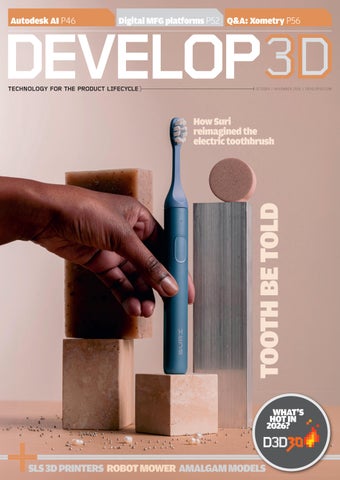
TOOTH BE TOLD
How Suri reimagined the electric toothbrush
WHAT’S HOT IN 2026?
SLS 3D PRINTERS ROBOT MOWER AMALGAM MODELS p01_D3D_OCTNOV26_cover.indd 1
27/10/2026 10:58
WELCOME EDITORIAL Editor Stephen Holmes stephen@x3dmedia.com +44 (0)20 3384 5297 Managing Editor Greg Corke greg@x3dmedia.com +44 (0)20 3355 7312 Consulting Editor Jessica Twentyman jtwentyman@gmail.com Consulting Editor Martyn Day martyn@x3dmedia.com +44 (0)7525 701 542 Staff Writer Gabrielle Brown gabrielle@x3dmedia.com
DESIGN/PRODUCTION Design/Production Greg Corke greg@x3dmedia.com +44 (0)20 3355 7312
ADVERTISING Group Media Director Tony Baksh tony@x3dmedia.com +44 (0)20 3355 7313 Deputy Advertising Manager Steve King steve@x3dmedia.com +44 (0)20 3355 7314 US Sales Director Denise Greaves denise@x3dmedia.com +1 857 400 7713
SUBSCRIPTIONS Circulation Manager Alan Cleveland alan@x3dmedia.com +44 (0)20 3355 7311
`
ACCOUNTS Accounts Manager Charlotte Taibi charlotte@x3dmedia.com Financial Controller Samantha Todescato-Rutland sam@chalfen.com
F
rom an idea on a screen to a physical object you can touch, every product passes numerous milestones on its design-tomanufacture journey. In this issue, we’ve tried to cover as many of the stages along that route as we can. Our cover story, for example, looks at a very polished example of final, mass-produced item: the Suri toothbrush. To my mind, it’s one of the most successful British products to have launched in the last five years, primarily because of the thought that has gone into its aesthetics, CMF and user experience. But it’s not just a pretty shell. There’s a lot of technology packed into that device that no compelling visual will ever be able to convey, because so much of its appeal to customers derives from expert engineering. We also consider a number of manufacturing advancements and newer fabrication methods, along with advice on what would-be users need to know before forging ahead. For example, we look at the evolution of digital manufacturing platforms for ordering custom parts and components – a model that’s growing fast and spreading globally – and the decreasing cost and increasing ease associated with bringing SLS (or PBF) 3D printing in-house. We bring you articles on how post-consumer waste is being used to create covetable, stylish Italian homeware at Guzzini and how technologies and techniques used in the oil and gas industry are seeping into other sectors. Prototyping is up for discussion, too. At a time when design teams are increasingly able to produce their prototypes in-house, thanks to some of those new fabrication methods, Gabby paid a visit to Amalgam Modelmaking in Bristol to see for herself what the role of the professional modelmaker really looks like in 2026. It’s reassuring to see that the skills and craftsmanship of modelmaking endure – and how, when put to work, they can make a big impact. Finally, there’s this year’s D3D 30, our list of new and emerging technologies that merit attention from all corners of the product design and engineering community. As ever, there’s a lot happening. As ever, our aim is to ensure that you stay ahead of the game.
ABOUT DEVELOP3D is published by
X3DMedia 19 Leyden Street London E1 7LE, UK T. +44 (0)20 3355 7310 F. +44 (0)20 3355 7319 © 2026 X3DMedia Ltd All rights reserved. Reproduction in whole or part without prior permission from the publisher is prohibited. All trademarks acknowledged Opinions expressed in articles are those of the author and not of X3DMedia. X3DMedia cannot accept responsibility for errors in articles or advertisements within the magazine
Stephen Holmes Editor, DEVELOP3D Magazine, @swearstoomuch
Join our online community DEVELOP3D.com
facebook.com/DEVELOP3D
@DEVELOP3D
groups/DEVELOP3D
DEVELOP3D.COM OCTOBER / NOVEMBER 2026 3
p03_D3D_OCTNOV26_EditorLetter.indd 3
26/10/2026 11:23
2024
View FREE on-demand
Watch all the presentations from DEVELOP3D LIVE 2026
videos.develop3dlive.com
D3DLIVE OCT NOV.indd 2
27/10/2026 11:19
2027
The future of product development technology 24 March 2027 Warwick Arts Centre, UK
develop3dlive.com
D3DLIVE OCT NOV.indd 3
27/10/2026 11:19
ay -d 30 ee fr a tri Automatically create order-specific SOLIDWORKS® parts, assemblies, and drawings.
Start automating SOLIDWORKS for free now Get instant access to DriveWorks Solo for 30 days. No credit card required. www.driveworks.co.uk
l
Save time. Eliminate errors.
CONTENTS OCTOBER / NOVEMBER 2026 ISSUE NO. 160
8 NEWS PTC acquired by Schneider Electric, Nvidia opens up USD BRep’s cad kernel to developers, Stratasys launches new large-format FDM machine, plus more
re tu rn s
s
to
D3
w D he L *f re IV oll ow in it E g £2 al 5m ls re no ta va tio r n
te d*
FEATURES 10 Comment: Nathan Partington on why not all AI is helpful 12 Comment: SJ on AI replicating human mistakes 14 Visual Design Guide: DJI Osmo Pocket 4P 16 COVER STORY TOOTH BE TOLD 26 The D3D 30: the hottest tech for product design 36 Pitch perfect: Stiga’s new automated robot mower 38 SLS scales down to build: HP + Sinterit + Formlabs 40 Performance pressure: Swindon Powertrain 42 Roughneck revolution: valve trim manufacture 44 Top model: inside Amalgam Modelmaking’s workshop 46 Autodesk’s most ambitious AI play yet 51 Block rockin’ feats: AM for engine blocks 2023 platform round up 52 Making it: digital manufacturing 56 Q&A: Vaidy Raghavan, Xometry CTO 58 Close to the bone: 3D printed dinosaurs 60 Recycled, refined & ready: Guzzini designer homeware 62 Hu Wei to Hull: rethinking marine propulsion 64 Siemens’ big AM build-up ceramic vases 65 On display: artistic 20 September 2023
Save the date
Warwick Arts Centre, UK THE LAST WORD 66 The sharp shock of AI could mean designers finally get the tools they need, writes Stephen Holmes
2027
24 March 2027 www.develop3dlive.com
The wood used to produce this magazine comes from Forest Stewardship Council certified well-managed forests, controlled sources and/or recycled material
DEVELOP3D.COM OCTOBER / NOVEMBER 2026 7
p07_D3D_OCTNOV26_Contents.indd 7
Accelerating product development to manufacture develop3dlive.com
27/10/2026 15:54
NEWS
PTC ACQUIRED BY ENERGY GIANT SCHNEIDER ELECTRIC
AMD snaps up World Labs
C
hipmaker AMD has agreed to acquire World Labs, the spatial AI company founded by a team led by Stanford researcher Fei-Fei Li. Founded in 2024, World Labs develops AI models designed to understand, generate and simulate 3D environments, with applications in areas including design, gaming and robotics. The two companies began a technical partnership back in 2025, which saw them collaborate on various areas of research, including model training and inference optimisation on AMD GPUs. The deal is expected to close by the end of 2026. www.amd.com
F
rench energy group Schneider Electric has agreed to acquire PTC. The all-cash acquisition is set at $205 per share for 100% of the share capital of PTC, valuing PTC’s equity at approximately $22.6 billion, according to the Financial Times. The deal is Schneider Electric’s largest takeover to date. It is France’s thirdlargest listed company, with a value of around $196 billion, and has acquired other technology companies in recent years, including industrial software company Aveva in 2023 and AI software specialist Cognite in mid-2026. For PTC, the acquisition comes after a rumoured takeover bid by Autodesk in July 2025, which never progressed to a formal offer, and the sale of its Thingworx IoT and Kepware units in November of last year.
The Schneider/PTC deal has been unanimously approved by the boards of directors of both companies, and is expected to close by Q3 2027. On LinkedIn, PTC CEO Neil Barua reassured audiences that the company will continue to “develop the most modern, advanced software tools for our customers to design, build, and maintain great products that impact the world.” On behalf of Schneider Electric, meanwhile, CEO Oliver Blum said: “The acquisition of PTC represents an important step forward in our ambition to lead the new era of energy and industrial intelligence. Together, we are creating the industry’s most complete software and AI powerhouse and highest-quality portfolio for bridging the physical and digital worlds.” www.ptc.com
Acquisition by Schneider Electric concludes a turbulent period for parametric CAD pioneer PTC
S
The Stratasys F870 is designed to produce large, strong and accurate tooling, fixtures, jigs and manufacturing aids
From Stratasys’ FDM materials range, users have the choice of nine materials at launch, including Nylon 12CF, ASA, ABS and a new FDM ABS Draft (Grey). The F870 FDM shares the same high-capacity 4,100 cubic centimetre material spools as the Stratasys F3300 FDM machine. www.stratasys.com
H
ololight has announced its enterprise XR streaming integration for Snap’s latest product, Specs, so that the smart glasses can display complex, high-fidelity 3D content without heavy onboard processing. The application runs and renders on a workstation, on-premise server or in the cloud. Rendered images are encoded, encrypted and transmitted, and the Specs device decodes and displays them at up to 90fps with sub-50ms latency, dependent on network conditions, scene complexity and server hardware. www.hololight.com
Stratasys launches new large-format machine tratasys has announced the launch of the F870 FDM, a new, large-format addition to its Fortus range of industrialgrade fused deposition modeling (FDM) machines. Designed with industrial manufacturers, automotive OEMs, and aerospace and defence production lines in mind, the system looks to offer a solution for those companies wanting to scale production. Fast, tool-free print head replacement aims to minimise downtime, while offering three different options: fine-resolution tooling, carbon-fibre composite parts, and high-speed fixture production. Users have the flexibility to swap between these options as needed on the same machine, utilising the F870’s build volume of 1000 x 610 x 610 mm with a fully heated chamber.
Hololight gives Specs a boost
Artec unveils Neo 3D scanner
A
rtec has unveiled Neo, which it claims is the first ‘tolerance-driven’ 3D scanner. Instead of treating every surface it encounters as being equally critical, Neo instead reserves metrological accuracy for functional features and gives users flexibility in how they apply targets. Artec’s blue-light optical system and single hybrid tracking technology combine to ensure that Neo uses targets only as metrology anchors and is able to deliver 0.025 mm accuracy where tolerances are critical. Meanwhile, AI algorithms are deployed to maintain tracking across the remainder of a scan by means of geometry, texture and colour. www.artec3d.com
8 OCTOBER / NOVEMBER 2026 DEVELOP3D.COM
p08_09_D3D_OCTNOV26_NEWS copy.indd 8
27/10/2026 11:47
NVIDIA OPENS UP USD BREP'S CAD KERNEL TO DEVELOPERS
ROUND UP DMG Mori has announced updates to its entrylevel Lasertec 30 SLM 3D printer, the Gen 3. The 300 x 300 x 300mm build chamber and programmable 1200w laser (upgradable to 1500w) aim to deliver better parts, easier handling and safer use www.dmgmori.com
N
vidia has launched USD BRep, an open source geometric modelling library for NURBS-based boundary representation (b-rep) solid modelling, sparking a rush among developers to create open source CAD modelling software that can take directions from AI agents. Despite steps made in recent months, AI-to-CAD has encountered significant challenges when it comes to training machine learning (ML) algorithms on traditional CAD data, with its abundant metadata and its multi-step feature trees. Since the USD BRep kernel exposes NURBS and BRep geometry directly to Python and C++ structures, developers can now feed exact geometric boundaries into neural networks or programme generative models (such as large language models and diffusion nets) and, in the process, create mathematically sound, manufacturable 3D models. The origins of this kernel are interesting. SMLib (Solid Modeling Library) was developed originally by Solid Modeling Solutions, a software company that specialised in 3D geometry software and was acquired by Nvidia in May 2022. In traditional CAD, b-rep is the mathematical standard used to define exact 3D solids by mapping out their boundaries (in other words, their vertices, edges and faces). Surfaces, meanwhile, are described using NURBS (non-uniform rational B-splines), allowing for perfectly smooth mathematical curves (such as cylinders or organic surfaces), rather than jagged polygon meshes.
So what makes this new kernel so different? Backed by Nvidia’s Omniverse platform and the capabilities of its structural framework for handling realworld industrial digital twins natively, the possibility begins to emerge that future engineers could manipulate heavy industrial CAD assets in real time and potentially even with photorealism. However, it is unlikely that executives at Siemens, developer of the most widely utilised 3D CAD kernel Parasolid, will be panicking just yet. With over 30 years of development, troubleshooting and resolving mathematical edge cases, Parasolid's hold on the CAD industry – it runs not only in Siemens' own software, but also in Solidworks, Onshape and many other products – will likely be around for many more years to come. www.nvidia.com
Nvidia's USD BRep geometric modelling library is built around its SMLib solid modeling kernel
Bambu Lab has announced the launch of the R1, a 55W CO2 laser cutter and engraver. Designed for the desktop, the R1 is capable of cutting and engraving card, wood, clear acrylic and leather, and engraving glass, stone and coated metals. Pricing starts at €2,499 (incl. tax/excl. shipping) www.bambulab.com
AMCM, the large-format metals 3D printing subsidiary of EOS, has integrated into its EOSPrint software a product called PanOptimization Pan X, used for the physics-based simulation of large-scale metal 3D printing, with potential benefits for all EOS users www.eos.info
New low-cost resin printer from Formlabs
F
ormlabs has introduced its cheapest resin printer to date, the Form Studio 1. Starting at $699, this new desktop model is claimed by the company to offer professionalgrade quality, speed and reliability. Executives at Formlabs position the Form Studio 1 as a ‘bridge’ between the hobbyist and professional markets. It is offered in a choice of colourful translucent cases with more than a hint of a 1990s Apple Mac. It also boasts an all-new print engine based on Formlabs’ Low Force Display (LFD) and uses a custom lens array and 28 LEDs to deliver a uniform, highly collimated 6 milliwatts per square centimeter light field that cures resin quickly and evenly. Other features include 35 micrometre pixel resolution and finely tuned anti-aliasing to capture sub-pixel
detail. Cleaner surfaces and easier postprocessing is delivered by lower peel forces and light-touch supports. With a print build volume of 200 x 125 x 235 mm (5.875 litres), the Form Studio 1 weighs in at just over 14 kg and takes up 342 x 315 x 502 mm of space. www.formlabs.com
ClassCAD.ai has been launched as an AI-driven embeddable CAD; in effect, a self-contained MCP capable of building CAD in your Claude/Codex and useful as a collaborative automation layer, a quick conversational prototyping sandbox or a custom internal tool www.classcad.ai
Formlabs promises 'razor-sharp' minis, models and props in under 2 hours with the Form Studio 1
Migrations from Adam uses AI agents to rebuild a CAD model’s parametric history in another CAD system, by verifying each step geometrically and transferring a model’s data with it, so that the CAD model remains editable and with its full history intact www.adam.new
DEVELOP3D.COM OCTOBER / NOVEMBER 2026 9
p08_09_D3D_OCTNOV26_NEWS copy.indd 9
27/10/2026 11:47
COMMENT
AI is generating a lot of buzz in product design, but not all of it is helpful, writes Nathan Partington of design agency npd. AI never calls out a client’s bad idea, but it’s certainly responsible for a bunch of unrealistic expectations
I
sat at my desk a few weeks ago, trying to figure out how an industry that I had known for 20 years had started to evolve into something completely unrecognisable. Almost every new business enquiry received from a product start-up has already been ‘designed’ by the customer, using AI. Our role, in their view, is simply to make it real. I remember speaking with one prospective client, and suggesting that we would have charged them around £20k for the amount of conceptual work that they were displaying in front of us. But our work would likely have resulted in a better end product and simplified the development process. Importantly, their work represented money that would no longer be in our pipeline. Yes, the money that a start-up saves makes their life easier, allowing that start-up to bootstrap a new idea. And an increased volume of potential new clients, on paper at least, looks like a steady stream of new work for design agencies. But the reality is that this arrangement drops us into a project at a later stage, unable to guide and shape an idea. That goes against the basic principle of design for manufacture, which relies on getting the fundamentals right from the start. Then there’s AI-calculated pricing, which often creates unrealistic expectations of what development actually costs. The irony is that money spent with a specialist early on usually saves far more money later on, in tooling, redesigns and in getting to market.
INBOUND ENQUIRIES Npd is a data-driven business, so we started to collect more information around our inbound enquiries: how they found us, why we rejected them, and what we thought the average project value might be, given the AI briefs we were receiving.
Now, with several months’ worth of data, the analysis is really interesting. The average estimated project value would be in the region of £15k, well below our target project value of £50k. We rejected almost all of them, or tried to discourage the customer from taking their idea further, because we deemed the ideas to be too weak or not in line with our company ethos. Rejections jumped to 89%, but the ideas weren’t validated, qualified or suitable for us. They were just white noise, a distraction. With the AI tools available now, anyone can visualise their idea, no matter how complex or crazy it might appear to be. The issue here is that AI never says no. A frontier AI model doesn’t work a 9-5 job, get tired or get hung up on design details, CMF or user experience. It simply does what it is asked, when it is asked, without complaint. This can prove misleading to the person with the idea, though rarely, if ever, does it challenge that person’s thinking or do anything to highlight their product’s lack of suitability in today’s market. AI cannot make a bad idea into a good product that people will want to buy.
ENCOURAGING SIGNS There are some encouraging signs though and all is not lost. We find that our regular clients are not turning to AI and requests for proposals from established companies are not formulated by agents. In fact, there seems to be a resistance to adopt AI among those people with actual experience of what it takes to build a physical product and successfully bring it to market. I’ve spoken with several senior design managers whilst I’ve been on my factfinding mission, and so far, they tell me they have not been allowed to bring AI into their companies. In most cases, this is due to worries around IP ownership and adherence to cybersecurity legislation. For most of them, adoption will be slow and limited, it seems.
The issue here is that AI never says no. But the truth is that AI cannot make a bad idea into a good product that people will want to buy
As for us, we haven’t stopped using Onshape, our preferred CAD software. We still use Keyshot to visualise our ideas and, in that regard, our process hasn’t really changed. Problems are still solved around the whiteboard and through discussion and observation with real people, with genuine experience of the real world of product development. We do, however, try to automate some of our admin tasks around project planning, note-taking, data analysis and reporting. Yet the concept work that we show to clients is created by us, not by AI. Frontier models are yet to understand user experience, ergonomics, that ‘new product’ smell and the emotional response we have as humans when we use a product for the first time. These are uniquely human aspects associated with products and I can’t see how a computer would ever be able to replicate them. As designers and engineers, our roles need to evolve to focus on what makes us human. In my view, it’s OK to use AI to make that role more efficient, but not to lead it. Given the pace of progress with AI, I’m well aware that this article may not age well – but at least I wrote it myself.
ABOUT THE AUTHOR: Nathan Partington is Founder and CEO of npd Studio, a product design and engineering consultancy based in Lancashire that works across a wide range of industry sectors. He has spent two decades in product design and started npd in 2014 with one rule: only work on products that deserve to exist www.npd.studio
10 OCTOBER / NOVEMBER 2026 DEVELOP3D.COM
p10_D3D_OCTNOV26-CommentNPD.indd 10
26/10/2026 11:52
Celebrating 3 Years in Business Thank you to our customers and partners for being part of our journey
Is it time to speak to SOLIDX? Over 450 customers trust us
www.solidx.co.uk
More than 125 Start Ups supported
5 stars on Trustpilot
Over 60 training courses delivered
COMMENT
Humans often make mistakes when defining engineering drawings. While we may want AI to fix this problem, writes our columnist SJ, doesn’t learning from humans mean that AI will just dish out the same mistakes?
A
s the old saying goes, ‘Those who can, do. Those who can’t, teach.’ Whether you agree with the adage or not, it certainly tracks when it comes to a recent conference appearance I made. Except this time, it was more of a case of, ‘Those who can’t be presenters (because they can’t get approval through their company’s comms department), moderate panel discussions instead.’ At this particular advanced manufacturing conference, yours truly was left doing precisely that. And, when it came to skimming topics for the panel to cover, the summary read as if my LinkedIn feed had just regurgitated six months’ worth of buzzwords all over the page. Somewhat inevitably, AI was front and centre. In Gen Z terms, this preamble was ‘giving me the ick’. And if it was giving me the ick, there was a high likelihood that my panellists felt it as well. Each seemed nervous, and when I spoke to them ahead of the session, their eyes widened like a deer in the headlights each time I brought up AI-assisted workflows. I saw the panic spread across each of their faces. One man, brave enough to speak, whispered in a tense voice: “But, SJ, we’re not really using AI-assisted workflows! I mean, we’d like to, but we just haven’t figured it out yet.” I beamed a 1,000-watt smile back at him, before responding: “Exactly!”
REALMS OF POSSIBILITY That panel discussion taught me so much about all of the topics we covered, from cloud-based collaboration to the adoption of topology optimisation in the ancient behemoth that is the military-industrial complex. Finally, I arrived at the dreaded question: “How are AI-assisted CAD workflows reshaping engineering roles, particularly when it comes to tasks like feature creation,
optimisation and automated constraint management?” The room paused and an uncomfortable silence fell. I’ll spare you the details, but as my panellists began to hem and haw around the topic, a hand shot up from the audience. An audience member with a question about AI drawing generation. Fortunately, my quietest panellist shyly picked up the microphone and responded firmly: “We’re not there yet.” But why aren’t we there yet? I think that’s the question we should be asking. And I specifically mean that it’s a question we should be asking each other, not a bunch of AI chatbots. In my humble opinion, we aren’t at the point of AI drawing generation workflows yet because we still haven’t truly figured out our current engineering workflows. How do we currently communicate design intent in a drawing? And is that methodology synthesised enough that we could build heuristics for an AI to learn from? Many engineers – myself included – also struggle with certain aspects of GD&T. I know this is true, because suppliers are still raging about every drawing that appears on their doorstep. ‘The drawing is king’ is a saying that I grew up hearing over and over on the manufacturing shop floor – the source of absolute truth when it comes to fabricating parts. I’m a big fan of holding a large paper drawing with all my dimensions laid out for me, the notes cascading from the top left corner of the page. However, in recent years, I’ve noticed we’re moving away from physical paper drawings in favour of model based definitions (MBDs). So, if your source of truth is constantly changing and being updated, which source do you feed your AI to help it learn? I imagine that AI will one day advise me on GD&T tolerances, but in its current state, where it’s still learning from our databases filled with our human biases and mistakes, wouldn’t an AI drafter just offer copy-and-
In my humble opinion, we aren’t at the point of AI drawing generation workflows yet, because we still haven’t truly figured out our current engineering workflows
paste engineering? And how might that impact supply chains?
TRUST BUT VERIFY I believe that AI has a place in engineering and a very bright future in design workflows. However, at this stage in its infancy, it is critically important that we should ‘trust but verify’. Put simply, I can’t trust that AI is going to give me a perfect part or a perfect drawing, but I can trust that it will do the best that it can, based on who it is learning from. I also think that when we discuss how AI will change engineering roles, a large part of our future responsibilities may include verifying AI model creations, changes, updates and so on. So what I take away from that is that my job in 10 years’ time may be entirely focused on double-checking drawings created by an AI, rather than having my drawings double-checked by another engineer. Or, conversely, maybe I’ll be creating the drawings myself and AI will be used to verify my work. Maybe the future engineering role isn’t that AI does all the work, but that it’s simply a tool we use to verify our own work? Either way, it’s giving serious vibes of ‘Those who can’t, use AI.’
ABOUT THE AUTHOR: SJ is a metal additive engineer aka THEE Hottie of Metal Printing. SJ’s work involves providing additive manufacturing solutions and 3D printing of metal parts to help create a decarbonised world
12 OCTOBER / NOVEMBER 2026 DEVELOP3D.COM
p13_D3D_OCTNOV26_SJ.indd 12
26/10/2026 11:56
Designcenter. Your AI strategy should start with engineering. I was made possible by Designcenter.
See how Designcenter brings AI-powered intelligence to multi-discipline design workflows.
Explore AI-powered engineering www.siemens.com/designcenter-ai
VISUAL DESIGN GUIDE DJI OSMO POCKET 4P » Weighing in at just 230g and with up to 210 mins of battery life, this dual-lens pocket gimbal camera is the perfect travel companion for cinematic shots on the go
SMOOTH SLOW-MO MED-TELE LENS The high-resolution and large-aperture 60mm med-tele lens delivers the classic focal length for standout portraits. It supports 3x optical zoom and up to 12x zoom capabilities. The f/1.8 large aperture (f/6.3 equivalent depth of field) compresses the background, pulling it closer to the subject for a blurred effect
WIDE-ANGLE LENS The DJI Osmo Pocket 4P’s wideangle lens is equipped to handle high-contrast scenes with a 1-inch CMOS, a 20mm format equivalent and an f/2.0 aperture. An additional magnetic clip-on lens is available to expand the field of vision to 108°
For high-speed action, the 4P can capture up to 8x ultra-HD, slow-motion footage at 4K/240 fps
CENTRE STAGE ActiveTrack 8.0 capabilities keep subjects centred in the frame, even at 12x zoom, using auto framing to intuitively prioritise a registered subject or centre multiple subjects at any focal length
DYNAMIC RANGE Powered by LOFIC technology, the 4P delivers 17 stops of dynamic range for capturing everything from the darkest shadows to the brightest sunspots
14 OCTOBER / NOVEMBER 2026 DEVELOP3D.COM
p14_15_D3D_OCTNOV26_VDG.indd 14
26/10/2026 11:57
AVAILABILITY SHINING SELFIES
Available now for £529 www.dji.com
A fill light attaches magnetically to the gimbal to deliver a soft, natural light in low lighting conditions and back-lit scenes
HOLD STEADY The 3-axis mechanical gimbal of the DJI Osmo Pocket 4P ensures that footage stays smooth and steady
TOUCH SCREEN The camera’s OLED 556x314 pixel screen delivers managed zoom and fine-tune skin smoothness, brightness and tone directly for quick editing
ON-BOARD STORAGE With 103GB of storage built in, users can start shooting without a memory card and then easily export their footage using the included USB-C cable
DEVELOP3D.COM OCTOBER / NOVEMBER 2026 15
p14_15_D3D_OCTNOV26_VDG.indd 15
26/10/2026 11:58
TOOTH BE TOLD » Electric toothbrush brand Suri is leading the charge against tooth decay, bland bathroom kit and toothbrush-head waste with a design that simplifies the form as well as the daily brushing ritual. Stephen Holmes speaks to the team behind Suri’s latest Pro 2.0 model about how its members focused on sustainability, performance and DfM
W
hile electric toothbrushes have been proven better for oral hygiene, their dark secret is the waste they produce and their resistance to recycling once they reach the end of their useful life. As with many products that come at a low initial purchase price, but remain hungry for consumables throughout their lifetime – think printer ink cartridges or razor blades – sustainability is limited when waste is maximised. The manufacture and materials of disposable electric toothbrushes and replaceable brush heads are no boon to the planet. Around 141 million electric toothbrush heads are thrown away each year in the UK alone – not to mention some 4 billion globally – and with nylon a key material, will take hundreds of years to break down. This is the issue that mobilised Suri’s founders, Gyve Safavi and Mark Rushmore. They had both worked at consumer goods giant Procter & Gamble and, on observing the stagnation of oral hygiene brands, saw a market ripe for disruption. They were entirely correct. By making smart, sustainable design and material choices early on in the design of their product, Suri has become one of the leading BCorp brands in the personal care segment. Not only does the London-based company use PLA – a plantbased bioplastic derived from renewable sources like corn starch and sugarcane – to create its products, but it also operates a ‘takeback scheme’, where it recycles its toothbrush heads for free in the UK and US. Researching the market, Suri’s founders also uncovered some other winning ideas. While high-end, Bluetoothconnected toothbrushes often came with smartphone apps, these were simply not being used in many cases.
The apps didn’t offer ‘sticky’ experiences, observes Suri innovation director Seb Wetherall. “So by actually reappraising and bringing back the basics of a lifestyle-led ritual and doing something very elegantly, brushing your teeth effortlessly [becomes] a joy.” Many people don’t necessarily follow great oral hygiene practice, he continues, but if they enjoy interacting with a toothbrush, that opens the door to improvements, and “then obviously, we’re doing something good and better, not just environmentally, but also for oral healthcare.”
DIFFICULT SECOND PRODUCT Having launched its first model in 2022, Suri wanted to build on its initial success with a second generation of products. Wetherall jokingly compares that process to a band launching “the difficult second album”. The process began with user feedback. Suri’s heavy presence on social media and review platforms like Trustpilot (which alone offered up some 20,000 user reviews), meant the team had plenty of information that could be harvested to help optimise its next design. “We used AI to analyse sentiment to understand what our users and consumers are saying about us,” he says. The word that most frequently appeared, he says, was ‘love – an encouraging start. Users love the product, the experience and the thoughtful accessories, such as the mirror mount, so the toothbrush doesn’t leave a gunky mess on a countertop. Practical elements like USB-C charging and a travel case with a UVC light to sterilise the brush head are also popular. The overwhelming positivity, says Wetherall, meant Suri had a great platform on which to build and that introducing its second generation wouldn’t necessitate a complete overhaul of this winning formula.
16 OCTOBER / NOVEMBER 2026 DEVELOP3D.COM
p16_17_18_19_20_D3D_OCTNOV26_Cover.indd 16
26/10/2026 12:21
COVER STORY
The Suri Pro 2.0 electric toothbrush and Restore refillable toothpaste pump
DEVELOP3D.COM OCTOBER / NOVEMBER 2026 17
p16_17_18_19_20_D3D_OCTNOV26_Cover.indd 17
26/10/2026 12:21
COVER STORY
1 1 “We didn’t want to revolutionise the proposition straight away, so we knew it was a great product market fit in the UK,” he says. In this way, the next step became clear, he says: “Let’s take that to the US without changing the core industrial design.”
1 Development Shanghai, China, the firm was perfectly placed to liaise ● with Suri’s UK headquartered team and have boots on the of Suri’s secondgeneration product ground in China to interrogate suppliers and parts. preserved the form
TOOTHBRUSH TROUBLESHOOTING
Here, IDC managing director Stephen Knowles takes up the story. Minor problems with the Suri secondgeneration product prototypes still needed to be tackled, With the styling of a new product already dialled in he says. The more powerful motor generated more around the existing model, the challenge for the design vibration and noise than was desirable, while battery life team quickly became identifying areas for improvement still needed extending. that wouldn’t involve changing the tooling involved What was required was not simply design work, but in its manufacture. “We knew there was a little bit of extra support around the technical specifications of the performance left on the table to extract,” says Wetherall. toothbrush and improved testing to demonstrate it could The body casing of the Suri toothbrush is made from aluminium, making it long-lasting, durable and endlessly meet expectations for the launch. In China, IDC senior design engineer Xiaoya Bao recyclable, but also light for users to handle and easier for oversaw much of the project in that region and her logistics companies to deliver. expertise proved a big advantage, Knowles explains. “Our “Aluminium is also corrosion-resistant, making it team in China are engineers. They’re designing products, perfect for its sink-side setting. We also believe the aluminium finish adds a touch of elegance and feels great they understand what needs to be done, exactly the same way as the UK team – but they’re on the ground, they in the hand,” adds Wetherall. speak the language, and they can go into the factories and Developed predominantly in Rhino and Keyshot, the resolve any issues.” team at Suri also used Vizcom to rapidly ideate on the In the UK, IDC offers electronics design capabilities, initial handle form. Since that would be carried over into alongside mechanical and industrial design. In China, the second generation of products, the focus shifted to factors such as extending battery life, as well as achieving it doesn’t have that capability in-house. So with the better economies of scale and supply-chain robustness in search for improvements focused on electromechanical interactions, a lot of work had to switch physically back preparation for the company’s growth in the US market. and forth between IDC’s UK and Chinese sites. Working alongside its production partner based in Numerous battery and motor samples were tested, with China, the Suri design team had already reached the the electronics team analysing the signals that were being Engineering Validation Test stage and the factory was beginning to produce prototypes. However, it was still felt sent to the motors, the current and the waveforms. “We realised that the electronics [originally chosen by the that the engineering could be honed further. Design and engineering consultancy IDC was enlisted to help further factory] were driving the toothbrush fairly inefficiently,” says Knowles. “And, at the same time, Xiaoya was visiting develop the technical elements of the toothbrush. the factories, testing lots of different motors, seeing which IDC is based on London’s outskirts in Datchet, ones had the right kind of response and vibration.” Berkshire, but with a longstanding 10-person office in
and user experience of the original Suri toothbrush
IN SEARCH OF IMPROVEMENTS
18 OCTOBER / NOVEMBER 2026 DEVELOP3D.COM
p16_17_18_19_20_D3D_OCTNOV26_Cover.indd 18
26/10/2026 12:21
‘‘ Our team in
China are engineers – but they are on the ground, they speak the language and they can go into factories and resolve problems Stephen Knowles, IDC managing director
’’
Bao also made visits to other supplier factory sites, as well as Suri’s manufacturing partners, in order to assess parts – from the electronics to the injection moulding – to verify that they followed the design requirement. “The suppliers are relatively quite close,” she says. “In one day, you can travel to three different suppliers to look at their OEM parts or customised parts and make sure that all the electronics or mechanical parts are following the right standards and fulfilling the right requirements.” But in addition to better battery life and improved performance, the product also had to feel right in the hand. “There’s a certain sort of intuitive feeling [for these devices],” says Knowles. “And so, the balance between it feeling like it was doing the job and having the right level of noise, plus not having too much vibration in the hand, so it feels harsh – yeah, it was tricky!”
FOCUS ON USER EXPERIENCE A focus on user experience has been a critical success factor for Suri. That presented IDC with the challenge of defining the measures of a good product experience in analytical terms, so that it can be tested repeatedly. Much of this testing focused on decibel readings relating to motor noise, but other methods needed to be developed. To test and quantify the tiny sonic movements of the toothbrush, for example, the team placed a mirror on the back of the toothbrush head and then shone a laser at it, in order to record how far it deflected the beam onto the wall. Those movements are very fast, notes Knowles,
2
3
4 3
“but by using this laser technique, we could amplify them and see quite a big difference between different settings and motors – almost visualising the vibration.” With access to the Solidworks CAD file of the original design from Suri, the IDC team set about helping to reengineer the model so that new electrical and mechanical elements could be mounted and connected. Changes to the power meant that the design had to be correctly dampened internally, so that power transfers to the head and not the handle, which could negatively impact user experience. Using in-house SLA 3D printing, the IDC team was able to produce mock-ups and test several alternatives out at the same time. With its architecture and electronics optimised, today’s Suri Pro 2.0 delivers up to 33,000 sonic vibrations per minute, yet still operates quietly at 50 decibels and sits comfortably in the user’s hand.
GROWTH AND CIRCULARITY The team at Suri designs with both company growth and circularity in mind, according to Seb Wetherall. “Obviously you’re thinking about the future territories you want to go into and future-proofing the product architecture, design and the engineering,” he says. Each market into which the company expands brings it the challenge of navigating a potential minefield of new and unfamiliar regulations. For example, an electric toothbrush is classified as a Class I medical device in the US and must pass the fundamentals set out by the US Food and Drug Administration (FDA). However, it is still 510(k) exempt in the eyes of the FDA, meaning that Suri doesn’t need to submit a pre-market notification before commercial distribution. And in many jurisdictions, the company needs to satisfy Good Manufacturing Practice (GMP) standards, as well as the ISO 13 485 standard for medical devices. Says Wetherall: “Building all of those best principles, quality management systems, you name it, they’re all going to be built into our development framework.” This level of foresight also applies to the toothbrush’s design for disassembly at end of life. Using nonpermanent adhesives in the assembly process allows toothbrush components to be recovered and recycled (and possibly even repaired or replaced in the future), but balance is key – the humble toothbrush faces a tough life. Drops tend to be onto hard, tiled bathroom floors. Then there’s the tribulations of water ingress, abrasive toothpaste and internal heat to consider, “so, material choice and inspection is really, really key,” Wetherall stresses. “Even though it’s a toothbrush, there’s a lot in a small package to make sure it doesn’t go wrong. If you think about our DFMEAs [Design Failure Mode and Effects Analysis], they’re huge in terms of how we go through it.”
2 ● 3 ● 4 The team at ● IDC helped Suri achieve improved power – and critically with less noise, vibration and battery drain – through iterative physical testing and design work in Solidworks
DEVELOP3D.COM OCTOBER / NOVEMBER 2026 19
p16_17_18_19_20_D3D_OCTNOV26_Cover.indd 19
26/10/2026 12:21
COVER STORY
POST-CONSUMER WASTE With an electric toothbrush, reusing post-consumer waste remains tricky, both for certification purposes and in the minds of consumers. While Suri plans to use more recycled aluminium in the body unit in future models, using recycled PLA from the toothbrush heads proves a tougher sell in the minds of consumers. Putting a stranger’s toothbrush in your mouth is such a strong image that it’s hard to shake – even after it has been ground down to base materials, remoulded and remade. This has meant exploring new avenues, and 2026 saw the first products built from Suri recycled materials come to market, including a soap dish manufactured using reused polymer from 18 toothbrush heads. Further new products in the Suri line also look to make good use of post-consumer plastic. A new refillable toothpaste system has an elegant countertop body built from 50% recycled plastic. Using an airless pump creates a great user experience, according to Wetherall, while expelling as much toothpaste as possible from the consumable refill so that there’s little waste. The refill cartridge itself is fully biodegradable and home compostable, rather than going back into the recycling stream or landfill. Suri worked on this directly with Shellworks, developers of the material Vivomer, a PHA-based biopolymer that can break down cleanly into water and CO2 over a period of six months. IDC once again stepped in to help develop the product, engineering the pump to achieve the right dispense force and consistency for a perfect, repeatable pea-sized amount of toothpaste. Running a cycle of iteration from digital Solidworks models and from physical 3D printed prototypes, the IDC team strove to build the perfect pump action. While Keyshot is used by both the Suri and IDC teams during the design process, Suri still relies on traditional photography more than rendering when it takes its products to market. This is despite the huge number of social media and digital campaigns that the company runs, a pressure that often sees other brands turn to a mix of rendered visuals blended with AI-generated output. This marketing approach was decided on mainly because the product requires a human to hold it naturally, which AI still struggles with, but it also lends itself well to Suri’s brand identity. The desire is to take its users behind the scenes, create more meaningful content and take people on a journey with the products, says Wetherall. Interestingly, he adds, it’s also to show that they’re not using AI too extensively or rashly in a marketplace awash with the medium. “It’s about the brand trust, the brand authenticity,” he explains. “We sweat the details when it comes to our product. We want that to then be communicated through touchpoints with our audiences.” So, when you brush your teeth tonight, try to think of how much waste there is as part of your routine, and maybe consider that there might be a better option out there – both for your teeth and for the environment.
5
6 5 By redesigning its ● toothbrush head using PLA and operating a take-back scheme, Suri contributes to waste reduction 6 Testing a prototype ● toothbrush for volume with a decibel reader and a mirror and laser set-up helps visualise vibrations
‘‘
We sweat the details when it comes to our product. We want that to then be communicated through touchpoints with our audiences Seb Wetherall, innovation director at Suri
www.trysuri.com
20 OCTOBER / NOVEMBER 2026 DEVELOP3D.COM
p16_17_18_19_20_D3D_OCTNOV26_Cover.indd 20
26/10/2026 12:21
17 – 20.11.2026 FRANKFURT / GERMANY
Where Additive Manufacturing Advances Your Production Discover how Additive Manufacturing enables more efficient, flexible, and sustainable industrial processes while making your production more independent and cost-effective. Gain clear guidance for investment and strategic decisions through direct exchange with leading providers and users. At Formnext, international market leaders showcase the latest developments across the entire AM process chain – from materials and manufacturing systems to automated post-processing, as well as software and quality assurance solutions. Secure your ticket now!
formnext.com/tickets
Honorary sponsor
Messe Frankfurt Group
Sponsored content
Which workstation is right for your PD&M workflow? No single workstation configuration suits every product design and manufacturing task. Intel-based HP Z Workstations offer the flexibility to balance CPU speed, core count, and memory, helping teams get the best performance from their software without overspending.
P
roduct design and manufacturing (PD&M) covers workloads of vastly different complexity. A designer modeling a consumer product in Dassault Systèmes SOLIDWORKS® and an engineer simulating a jet engine in ANSYS® Fluent® might work in the same industry, yet their computing demands are worlds apart. The wrong workstation can cost both time and money. Too little computing power can hamper productivity; too much can tie up budget in capabilities that may never get used. The goal is simple: match the hardware to the software and the complexity of the product under development.
with NVIDIA RTX graphics, while the HP ZBook Fury G1i offers more graphics power and GPU memory for complex scenes. For product designers in general, the priority is responsive modeling. Start with a highfrequency processor, then scale memory and other capabilities to match the complexity of the work and its deliverables.
The mechanical engineer Mechanical engineers use many of the same CAD applications as product designers, alongside others such as PTC Creo®, Autodesk Inventor®, Siemens NX™ and CATIA®. But the scale of the work can be dramatically different: a kitchen The product designer appliance may comprise a few dozen parts, while Product designers spend much of their time in a vehicle powertrain can contain thousands of CAD applications such as SOLIDWORKS, Autodesk interconnected components. Fusion® and Rhino®, turning ideas into detailed 3D As assemblies grow, memory demands rise. models. Because many modeling operations rely When RAM runs short, the workstation must fetch heavily on single-threaded performance, a highmore data from storage, slowing performance and frequency Intel® Core™ Ultra processor helps keep interrupting the design process. interactions responsive as designs evolve. For consumer products and relatively The HP Z2 Mini G1i and HP Z2 Tower G1i are both straightforward mechanical assemblies, the HP Z2 strong options for designers, whether desk space Mini G1i and Z2 Tower G1i offer capable Intel Core is at a premium or expansion matters. For work on Ultra-based platforms. Both support up to 128 the move, the HP ZBook 8 G2i brings workstation GB of memory, while the Z2 Tower provides more performance to 14-inch and 16-inch laptops. room for expansion. A discrete GPU isn’t essential for every CAD task. As complexity increases, the HP Z4 G6i becomes Recent performance improvements and expanded a stronger choice. With Intel® Xeon® 6 processors, ISV certifications have made integrated graphics support for up to 512 GB of memory, and greater more capable. Found in select HP ZBook mobile expansion capacity, it is built to handle larger workstations, Intel Core Ultra Series 3 processors engineering datasets and heavier workloads. can handle many CAD workflows, particularly CAD-integrated simulation is one of those those involving smaller assemblies. workloads. While interactive modeling typically Visualization can raise the bar. Applications favors strong individual core performance, some such as KeyShot® and SOLIDWORKS® Visualize simulations benefit from more CPU cores and can benefit from a discrete GPU when generating higher memory bandwidth. The right balance detailed images and animations. The HP ZBook X depends on the solver, model size, type of analysis, G2i combines Intel Core Ultra Series 3 processors and number of cores supported by the software.
Creo® Ansys Simulation, for example, is limited to four CPU cores per solver run. For lighter CAD work on the move, the HP ZBook 8 G2i is a solid choice. For larger assemblies and heavier computing tasks, the HP ZBook Fury G1i steps up the performance, with 16-inch and 18-inch models offering Intel Core Ultra 9 HX processor options and up to 192 GB of memory. The key is to size the workstation for the largest and most demanding datasets the engineer regularly handles, not just the typical part or model. The simulation engineer For simulation specialists, hardware requirements can increase substantially. Finite element analysis (FEA) and computational fluid dynamics (CFD) applications, including Ansys® Mechanical™, Ansys Fluent and Dassault Systèmes SIMULIA®, demand considerable processing power and memory, particularly as models grow and analyses become more complex. However, not all simulation workloads are the same. Performance depends on the solver, numerical method, model and mesh size, and how effectively the workload uses multiple CPU cores. Memory bandwidth matters too: large CFD models can scale across dozens of cores, provided the solver and memory subsystem can keep them supplied with data. For mainstream simulation, the HP Z4 G6i balances CPU performance, memory capacity, and bandwidth. With support for up to 48 CPU cores and 512 GB of eight-channel memory, it can tackle many different workloads. For the most demanding simulations, including whole-system models that couple thermal, structural, and fluid behavior, the HP Z8 Fury G6i takes performance further. Intel Xeon 6 processor options offer up to 86 cores, with support for up to 2 TB of memory. It can also accommodate up
Sponsored content
to four high-performance graphics cards for GPU acceleration in compatible solvers. More CPU cores don’t automatically mean faster simulations. Some solvers scale well across many cores; others deliver diminishing returns or even run more slowly. Software licensing matters too: when costs are tied to the number of cores used, a high-core-count workstation can quickly become more expensive to run. In short, choose the configuration according to the solver, model, memory requirements, and licensing costs — not core count alone. AI is opening up new possibilities in simulation. Surrogate models trained on conventional simulation data can predict how products will perform across design variations, reducing the need to run a full simulation for every iteration. Intel® Advanced Matrix Extensions (AMX), available on supported Intel® Xeon® 6 processors, can accelerate matrix operations in compatible AI training and inference workloads — potentially speeding up predictions when the software is optimized to use them. Meanwhile, for engineers running demanding analyses away from the desk, the HP ZBook Fury G1i is a solid choice, with Intel Core Ultra HX processor options and up to 192 GB of memory. Under sustained heavy workloads, the 18-inch model’s higher processor power envelope can help maintain higher multi-threaded performance than the 16-inch version. The manufacturing engineer Manufacturing engineers tackle a diverse mix of workloads, from generating CAM toolpaths and preparing parts for additive manufacturing to scanning and inspecting finished components. Each places different demands on CPU performance, core count, and memory. CAM and toolpath generation: CAM applications such as hyperMILL®, Siemens NX™ CAM,
Mastercam®, SolidCAM® and Autodesk PowerMill® turn 3D designs into machining instructions. Many toolpath calculations favor strong per-core CPU performance, with limited gains from additional cores in individual operations. PowerMill, for example, uses no more than four CPU cores for the relevant calculations. The Intel Core Ultra-based HP Z2 Tower G1i is a sensible starting point, while the Intel Xeon 6-based HP Z4 G6i offers more CPU cores and memory for larger datasets or multiple calculations running in parallel. Additive Manufacturing brings together both lightly threaded and highly parallel workloads. In Materialise® Magics®, for example, additional CPU cores can accelerate mesh preparation, but gains depend on the dataset. Beyond 16 cores, the benefits are most apparent when processing parts with very large numbers of triangles. Autodesk Netfabb® Local Simulation predicts how metal-printed parts may deform during manufacturing and places greater demands on parallel processing. With a recommended minimum of 14 cores, and 24 or more for larger, more intricate projects, the Intel Xeon 6-based HP Z4 G6i is a strong fit. 3D scanning and inspection: Software such as Geomagic® Control X® compares scanned parts with their original CAD models to identify deviations. These workflows benefit from strong single-threaded CPU performance, making the HP Z2 Mini G1i with Intel Core Ultra processors a capable option. However, large scanning datasets can demand substantial memory, making the HP Z4 G6i a better fit for desktop workflows or the HP ZBook Fury G1i when a laptop is essential. Finding the right balance The right workstation starts with the workload. Highfrequency CPUs keep modeling responsive, larger
assemblies demand more memory, and complex simulations can benefit from additional cores and bandwidth. The challenge is finding the right balance for each application, dataset, and workflow. Intel-based HP Z Workstations offer options ranging from compact desktops to powerful towers and mobile systems, helping PD&M professionals get the performance they need today, with room to take on more demanding projects tomorrow — without paying for capacity they won’t use.
The wrong workstation can cost both time and money. Too little computing power can hamper productivity; too much can tie up budget in capabilities that may never get used
Learn more
Sponsored content
The modern workstation: from standalone tool to central hub How Intel-based HP Z Workstations, shared compute resources and cloud services can create a connected, flexible engineering environment for modern product development.
P
roduct development rarely happens in one place these days. An engineer might spend the morning refining a 3D CAD model, the afternoon running a complex simulation, then turn to an AI agent to explore new design possibilities. Each task brings different computing demands, and a desktop workstation may not always be the best way to handle them all. That’s why more organizations are looking at how to connect desktop workstations, shared compute infrastructure and cloud services into one joined-up engineering environment. Intel-based HP Z Workstations provide a range of options, from compact systems to expandable towers. By locating these workstations in a datacenter rather than on engineers’ desks, firms can centralize hardware management and bring workstations closer to shared storage, servers and other compute resources. Cloud services can extend this environment when additional capacity or specialist tools are required. Network connectivity is fundamental Bringing these resources together is only part of the picture. Engineers also need to move data between applications, storage and compute resources quickly and reliably. CAD parts and assemblies need to synchronize with product lifecycle management (PLM) systems, while simulation models may be sent to external compute resources, with results returned for analysis and visualization. AI tools add another layer, linking desktop CAD applications with cloud services to accelerate design iterations and automate repetitive tasks. When workstations, storage and compute resources are spread across different locations, those data transfers can quickly become a bottleneck. A workstation might have plenty of processing power, but that performance is less useful if engineers are left waiting for files to load or results to arrive. That makes network performance an important part of workstation planning. The latest Intel-based HP Z Workstations offer 2.5 GbE connectivity, with up to 10 GbE available on selected models and configurations. However, faster workstation networking is only part of the
solution. Switches, storage systems and network uplinks all need enough capacity to handle the traffic, particularly when multiple engineers are working with large datasets at the same time.
density, the HP Z2 Mini G1i offers a compact option, supporting up to six units in a 5U rack configuration. Built around Intel Core Ultra processors, it is well suited to CAD-centric workflows, including simulation-led and generative Bringing engineering compute design, and other engineering applications that together in the datacenter benefit from high single-core performance. One way to simplify this is to bring workstations and For more demanding applications such as their supporting infrastructure together in an oncomputational fluid dynamics (CFD) and finite premise datacenter or hosted private environment. element analysis (FEA), which can benefit from With workstations located alongside servers, more CPU cores, greater memory capacity and shared storage, PLM systems and highbandwidth, or multiple high-end GPUs, particularly performance computing (HPC) clusters, engineers for running larger AI models locally, the Intel Xeoncan access the data and resources they need based HP Z4 G6i and HP Z8 Fury G6i workstations without routinely having to move large datasets provide higher-end alternatives. across office networks. It also gives IT teams a The right choice depends on the applications more centralized way to manage the hardware being used, the complexity of the datasets and supporting product development. where the performance bottlenecks occur. A Importantly, centralizing the hardware doesn’t designer working mainly with individual parts and need to change the experience. Each engineer assemblies will have very different requirements can have a dedicated physical workstation to an engineer running large simulations configured for their applications, with remote or developing AI applications. Matching the access provided through HP Z Remote Graphics workstation to the workload helps deliver the Software (RGS). Rather than routinely transferring performance required without paying for capacity entire datasets to a local machine, the designer that may rarely be used. or engineer receives a stream of pixels from the Learn more in the article on the previous page. workstation, allowing them to interact with their applications remotely. Extending the environment to the cloud This approach means working files can be Centralizing engineering resources doesn’t mean kept within managed infrastructure while giving everything must stay on premise. Local AI can handle engineers the flexibility to work from different many everyday tasks, but cloud services provide locations. It can also simplify access to the access to larger, more capable frontier models, servers, storage and other compute resources that add capacity when workloads outgrow available support their day-to-day work. resources, or when teams need specialist tools. However, moving large engineering datasets to Choosing workstations for the datacenter and from the cloud can take time and consume Moving workstations into a datacenter doesn’t network capacity. Performance depends not only on mean switching to a different class of hardware. the cloud service itself, but also on the amount of The same Intel-based HP Z Workstations that data being transferred and the available bandwidth. engineers would typically use at their desks can This is where a hosted private environment be deployed in a datacenter or hosted private can offer an advantage. By locating workstations environment. When configured with the HP Remote in a well-connected datacenter, organizations System Controller, they also provide server-grade can access high-capacity connections to public out-of-band management, so IT teams can monitor cloud services, potentially offering much greater and manage entire fleets of workstations remotely. bandwidth than a typical business internet HP Z Workstations cover a range of engineering connection. This can make it easier to combine requirements, with rack deployment options dedicated workstation resources with clouddepending on the model and mounting solution. based AI, simulation and other compute-intensive For organizations looking to maximize rack workloads.
Sponsored content
Moving workstations into a datacenter doesn’t mean switching to a different class of hardware. The same Intel-based HP Z Workstations that engineers would typically use at their desks can be deployed in a datacenter or hosted private environment.
Ultimately, the right balance depends on the demands of each workload, with performance, cost, scalability and control all influencing where it runs.
consider intellectual property, customer confidentiality and regulatory obligations when deciding where workloads run and how engineers access them. Centralizing workstations and Making better use of GPU resources engineering data can help IT teams GPUs are another consideration, apply consistent management and particularly as engineering teams expand security policies, provided the supporting visualization and AI work. infrastructure is configured appropriately. Some engineering and AI workloads Cloud services can add capacity and require substantial GPU power, but not specialist capabilities, while on-premise every engineer needs dedicated access to systems continue to support established it all the time. Running AI models locally workflows and requirements for is a good example, as larger models data control. can demand significant GPU memory. Ultimately, the modern workstation Equipping every workstation with a highis about more than the machine on an end GPU can be expensive, while the engineer’s desk. It’s part of a wider larger Intel Xeon-based towers needed environment that brings together to accommodate powerful graphics dedicated workstations, shared storage, configurations can reduce rack density PLM systems, servers and HPC clusters, compared with compact systems such as with local AI and shared GPU resources the HP Z2 Mini G1i. close to the data, and cloud services Sharing GPU resources can offer another providing access to frontier models and way forward. HP Z Boost allows compatible extra capacity when needed. client systems to access GPUs in other HP When these elements work together, Z Workstations across a network. Designed organizations can give engineers for low-latency LAN connections, it is responsive performance for interactive particularly well suited to workstations tasks, more efficient access to data racked together in a datacenter. and the computing capacity to tackle The HP Z8 Fury G6i is particularly well demanding workloads. At the same time, suited to this role, as it can accommodate IT teams can manage resources more up to four high-end GPUs. Through HP Z centrally and maintain greater control Boost, this capacity can give engineers over the infrastructure supporting access to additional GPU resources for product development. supported local AI inference, rendering The result is a connected engineering and other accelerated workloads, without environment that can adapt as requiring every workstation to have its own workloads change, helping teams work maximum GPU configuration. more efficiently without losing sight of For organizations with varied workloads, performance, scalability or control. that flexibility can help make better use of available hardware. Instead of equipping every user for occasional peak demand, IT teams can provide access to additional resources where and when they’re needed. A connected foundation for engineering Performance matters, but it’s only part of the picture. Product design and manufacturing firms also need to
Learn more
THE D3D 30
» Welcome to The D3D 30, our round-up of 30 new technologies from around the world that we firmly believe could deliver a major boost to your product development work
26 OCTOBER / NOVEMBER 2025 DEVELOP3D.COM
p26_27_28_29_30_31_32_33_D3D_OCTNOV26_The_D3D_30.indd 26
27/10/2026 15:59
W
riting the D3D 30 continues to be a highlight of our year, with the team delving into new and exciting technologies that look likely to impact the workflows of product designers and engineers. Compiling the 2026 list has seen us speak with companies from around the world – at small tech meetups, within the halls of giant tradeshows, via video calls at all hours and in the dark corners of LinkedIn. The pace of development has been relentless, with this year being the busiest any of us can remember – the D3D 30 could easily have been double that number. The aim remains the same - to help you, our readers, keep ahead of the competition and find the tools that fill the gaps in your workflow. AI remains a constant, but its influence is expanding as it continues to evolve and infiltrate other realms. Visualisation and CAM optimisation software are now awash with AI automation, while the emerging
chatbots in CAD software have evolved into much more powerful tools. We’re also seeing the knock-on effect of AI as it impacts other technologies. Specialist hardware is available purely to compute AI; increasingly affordable and powerful 3D scanning hardware to feed the AI software data for reverse engineering, and 3D printers ready for lights-out manufacturing all feature on this year’s list. The D3D 30 isn’t all AI, however. There’s also exciting hardware to explore, updates to existing tools and some niche selections that might open up an entirely different pathway for your business. As ever, we want to remind you that, unlike many other awards and rankings, the companies and technologies on our list are chosen entirely on merit. There’s no entry fee to pay and no flashy black-tie ceremony to fund. The goal is simple - to help you, our readers, identify the tools to help design and build the products of the future.
ARTEC 3D NEO
BAMBU LAB
CAD ROOMS CAD ROOMS PLATFORM
Laser detail
Organised fun
While its grasp on the desktop FDM 3D Printer market is unrelenting, Bambu Lab is expanding into other workshop hardware. The R1 laser cutter and engraver has a 600 × 300 mm working area that can extend up to 3m with the Conveyor accessory, while a 55W CO2 laser will slice through card, wood, clear acrylic and leather, and engraving glass, stone and coated metals. Like its 3D printers, it has bypassed flaws found in incumbents. Its toolhead algorithms allow for even movement, meaning smoother cutting, while direction change and speed are synced to laser power to avoid burns over slow sections. www.bambulab.com
Cloud-based PDM (Product Data Management) and Workflow management form CAD Rooms’ platform. PDM brings a lightweight PLM platform for engineering and hardware teams, with some added bonuses for easy collaboration. Maintaining a single, authoritative version of every design file, its check-in/check-out system means team are prevented from overwriting each other’s work with files locked during edits, putting an end to endless duplicate file names. Workflow offers a long list of integrations and APIs to manage changes, reviews and releases across a long list of software from CAD to MS Office. It does the simple things well while enterprise-grade security (with regional hosting an option) keeps everything safe. www.cadrooms.com
Swiss Army Scanner Neo marks a new breed of wireless 3D scanners – equipped with both the target-led laser detail capture and the speed of blue light handheld units in one system. Neo uses targets as for its 0.025 mm accuracy where tolerances are critical; AI algorithms maintain tracking across the rest of the scan through geometry, texture, and colour. Costing roughly £30,000, it’s a heavy investment, but the versatility it offers – full colour, 0.05 mm resolution to document surface condition at its fastest setting, and QA ready 0.025mm detaile in the places it matters – means it’s well ahead of the handheld alternatives out there. www.artec3d.com
AUTODESK
AUTOTIMELINE + R1 LASER CUTTER AUTOASSEMBLE IN FUSION Automate this Autodesk’s AI abilities within Fusion are being added thick and fast as it looks to automate more processes and free up users to be more creative. Building on the existing AutoConstrain tool, Autodesk has added AutoTimeline, which converts imported geometry into editable parametric parts, and AutoAssemble, which brings those parts together into assemblies. For users moving data from other CAD systems into Fusion, AutoTimeline speeds up interoperability with the AI outlining and adding the modelling operations to the lower Timeline bar after import. AutoAssemble defines assembly relationships for components greatly reducing the amount of manual effort needed to build workable assemblies. www.autodesk.com
DEVELOP3D.COM OCTOBER / NOVEMBER 2025 27
p26_27_28_29_30_31_32_33_D3D_OCTNOV26_The_D3D_30.indd 27
27/10/2026 15:59
THE D3D 30
HESTUS AI AUTOCOMPLETE A step ahead What if your existing CAD package was more intuitive, faster and used AI to help you to work through your workflow as you sketch, rather than ask for clunky prompts? Hestus has built its Autocomplete to do just that, with nothing new to learn, export or deal with. Available for Autodesk Fusion and with a release for Dassault Systèmes Solidworks coming up, Hestus watches the sketch while you draw it, and offers suggestions – the most logical next step being first – dramatically reducing the amount of mouse travel and clicks around the screen.. www.hestus.co
DASSAULT SYSTÈMES LEO The Da Vinci Effect Dassault’s family of ‘virtual companions’ grew this year, and the brightest spark of the bunch might just be Leo. Working with Solidworks, Delmia and Catia, recent updates have seen it take advantage of Nvidia’s physical AI libraries. Developed for co-creation with the user still firmly in the loop, examples such as building an entire validated water tower in Solidworks from a few simple requirements and adjusting the entire construction on the fly, proved its impressive practical reach. Its uses extend beyond generating designs, but often it’s the ability to quickly work through the chores of the workflow - generating BOMs or translating 2D drawings into 3D CAD – that makes it a potential workhorse for designers.
DELL ULTRASHARP 52 TB HUB MONITOR Screen time Serious monitor envy kicks in with this massive 52-inch 6K display. The curved IPS Black panel is designed to replace a multi-monitor setup, so you get more screen with less clutter. At 129 PPI, fine lines, dimensions and text stay crisp, which helps when you’re zoomed out on a large assembly. The 120Hz refresh rate makes navigating models feel smoother, a boon for 3D work. You can connect up to four PCs at once, split the screen picture-by-picture, and control them with a single keyboard and mouse. A single Thunderbolt 4 cable delivers up to 140W to charge your laptop. www.dell.com
www.3ds.com
DELL [AND NVIDIA] PRO PRECISION 7 16
FIBRESEEK FIBRESEEKER 3
Back for good
Strong lines
This 16-inch mobile workstation is one of a handful of models marking the return of Dell’s long-standing Precision brand. Powered by Intel Core Ultra 9 Series 3 processors, it delivers the high clock speeds CAD users love, backed by 64 GB of memory for mainstream assemblies. The Nvidia RTX Pro 3000 Blackwell GPU steps up from the RTX Pro 2000 in the Dell Pro Precision 5 16, bringing extra visual firepower for GPU rendering in tools such as KeyShot, albeit in a slightly thicker, heavier chassis. Premium touches include a haptic trackpad, aluminium palm rest, 8MP camera and gorgeous 120 Hz Tandem OLED display.
Even in the packed FDM desktop 3D printer market, an open material, continuous composite fibre (CCF) 3D printer for sub $5,000 is capable of grabbing the headlines. Single-thread continuous composites routed through a part dramatically increase its strength, putting polymer parts on a par with machined metals and, at this price, letting studios test and iterate rapidly from the desktop. A dual nozzle setup – one for the main material, another for the CCF – prints via a modular 350°C printhead onto a 300 × 300 × 245mm build area. An oversubscribed, $4M Kickstarter campaign has set the scene for the brand’s ambitions with more industrial products in the pipeline.
www.dell.com
www.fibreseek3d.com
28 OCTOBER / NOVEMBER 2026 DEVELOP3D.COM
p26_27_28_29_30_31_32_33_D3D_OCTNOV26_The_D3D_30.indd 28
27/10/2026 15:59
regardless of the headset’s own processing limits. Paired with Hololight Hub, users can collaborate in XR from any device where engineers can load models, configure scenes and prepare sessions from a laptop or tablet.
Pixel perfect
Working with any head mounted display, Hololight Stream is designed to be a better user experience, setting the performance standard for enterprise XR streaming. With endto-end latency that stays under 50ms, Stream delivers ultra-high
display resolution to each headset, with refresh rates of up to 90 fps. Ray tracing, realistic lighting and reflections run on external Nvidia RTX hardware and stream to the headset in real time, meaning photorealistic scenes reach the device exactly as rendered,
FORMLABS FUSE X1
LENOVO THINKSTATION P4
MAXON NOVINEER CINEMA 4D MCP SERVER NOVINEER SUITE
Packing a punch
All bases covered
Visual process
Quick smart
When industrial SLS and PBF 3D Printers typically start at $250,000, Formlabs pricing its first industrial machine at $85,000 was already likely to cause waves in the industry. Despite the low price, the Fuse X1 is packed with ability, targeting higher throughput and larger parts than incumbent machines. The 330 × 330 × 565mm build volume can manage 30%+ part packing per build and is overseen by Formlabs’ new Adaptive Thermal Control for SLS that runs 13 independent thermal zones to provide stable temperatures from the first layer to the last. Compact, it can fit through a standard door, run on singlephase power and operate without need for specialised HVAC.
Lenovo was first with Threadripper Pro, and now it’s beaten its workstation rivals again with Ryzen Pro in this new desktop tower. Core counts run from 6 to 16, but it’s the Ryzen Pro X3D variants that really stand out, with far more cache than other chips in their class. That extra cache should pay off in workloads like engineering simulation, where fast data access matters. The top-end models add liquid cooling to keep the machine running cool and quiet. The P4 also keeps life simple for IT managers as they can cover a broad spread of work from CAD and CAM to simulation and rendering with a single machine.
Built to offload chores, automate routine tasks and streamline workflows, so that users can focus on the creative work, Cinema 4D MCP Server allows AI assistants to securely operate in its workflow. Letting the user leverage their AI assistant of choice, including Claude and ChatGPT, users can choose which groups of Cinema 4D tools their assistant is permitted to use. Users can also control Python execution, providing an additional safeguard for workflows where code execution is not required. Access tokens, configurable permissions and audit logging give the visibility and oversight for teams to run AI without fears of it breaking studio and client security requirements.
An AI-powered suite of tools, it’s a powerful option for reverse engineering polymer AM parts – with even more up its sleeve. NoviVision quickly generates an editable CAD model from a few smartphone photographs, replacing specialist 3D scanning hardware and manual reconstruction. NoviPath simulates polymer AM parts to check the design’s strength and failure spots before printing, and NoviDesign completes the suite with generative design tools. Unlike many AI tools, it has a real focus on its key users – contract manufacturers – and the challenges they face.
HOLOLIGHT STREAM
www.lenovo.com
www.formlabs.com
www.hololight.com
www.novineer.com
www.maxon.net DEVELOP3D.COM OCTOBER / NOVEMBER 2026 29
p26_27_28_29_30_31_32_33_D3D_OCTNOV26_The_D3D_30.indd 29
27/10/2026 15:59
THE D3D 30
HP ZBOOK ULTRA G3A 16 Local AI This 16-inch mobile workstation is so sleek, you’d assume it was light on performance. Think again. Its AMD Ryzen AI Max Pro processor delivers the goods for mainstream CAD and visualisation, but the real party trick is its ability to allocate up to 160 GB of memory to the integrated GPU. That allows it to run large open-weight AI models right on the machine. Add a Model Context Protocol (MCP) server software and you can chat with your CAD tool to automate workflows. And your sensitive data stays on device rather than drifting off to the cloud. No pay-per-use cloud fees means predictable costs, too. www.hp.com
PANOPTIMIZATION PANX FOR EOSPRINT
PTC ONSHAPE FEATURESCRIPT MCP
SAMSUNG P9 SSD
SHINING 3D EINSCAN TRAK SYSTEM
Hot stuff
Build your own
Every second counts
Multitasker
PanX can be used as a standalone thermo-mechanical simulation tool alongside any metal 3D printing system, but its EOSPrint integration brings its abilities directly into the build prep workflow of a key industry player. Build setup data plus some extra details from the EOSprint API are brought into PanX. Once the simulation is complete factors like optimised dwell times, laser powers and compensated geometries are automatically written back into an .openjz file that can be used on EOS and AMCM 3D printers. Cutting turnaround from days to hours and making it accessible to more than just dedicated simulation experts, thermal management is optimised and more builds are successful. www.panoptimization.com
The FeatureScript MCP Server capability allows users to create custom CAD features by describing them to AI agents as text prompts. AI helps build, test, debug and refine the custom feature in FeatureScript until it works as intended autonomously on its own. Users can then quickly automate repetitive design tasks, create custom design tools tailored to their existing workflows and capture the engineering knowledge through the process. The Onshape Labs initiative has continued to push out some interesting features, over the year, but this latest ability is both a democratising and powerful step for the CAD software. www.onshape.com
If you wrangle massive datasets, from simulation results and 3D scans to AI models, this portable SSD could save you from staring at progress bars. Rather than dragging files across the network, the Samsung P9 transfers them in a fraction of the time. Powered by USB4, it delivers sequential read speeds of up to 4,000 MB/s and writes of up to 3,800 MB/s, roughly double those of its predecessor, with capacities up to 8 TB. You’ll need a 40 Gbps USB4 or Thunderbolt port to hit those speeds: a good excuse to upgrade your laptop! AES 256-bit hardware encryption secures confidential data.
Designed to simplify large-scale 3D scanning workflows, the Trak System is a versatile featurepacked dual set-up system for less than £8,000. With its optical tracking system engaged, a wireless, spherical housing coated in targets allows the crossed 19+19 blue laser lines to capture large parts without need to apply markers to the part. The handheld unit can also be released from the housing for more focussed capture using 7 parallel laser lines, or a single high detail laser for holes with a 1:4 diameterdepth ratio. The tracker is also equipped with 5MP cameras that can add extra spatial capture. www.shining3d.com
www.samsung.com/ssd
www.onshape.com
30 OCTOBER / NOVEMBER 2026 DEVELOP3D.COM
p26_27_28_29_30_31_32_33_D3D_OCTNOV26_The_D3D_30.indd 30
27/10/2026 15:59
SIEMENS SIMSCALE INTELLIGENCE CENTER X ENGINEERING AI AGENT
INFINITFORM INFINITFORM PLATFORM
Low code hero
The equaliser
Made good
Rather than experimental R&D efforts using disparate parts to try and bring AI into a company, Siemens Intelligence Center X allows users to build AI tools with real purpose that can be used alongside their current tech stack. It connects enterprise data, workflows, and machine learning models into a single governed system without creating extra data silos. Key to this is the low-code Mendix platform that lets companies build their own AI agents in-house that are natively integrated across the Siemens CAD, simulation and PLM portfolio – letting AI access intelligence and work with it cleanly, precisely and securely, with institutional insight, guardrails and security. www.siemens.com
The goal has long been to make simulation so autonomous that any designer can use it routinely, and SimScale’s Engineering AI Agent looks to have closed that gap. Through natural language prompts the agent can configure complete simulations without the user having to navigate the UI. Critically, it works from intent and not rigid scripts – with the AI inspecting the CAD model and flagging anything out of place before it starts. With the agent and solver both running in the cloud, users can start another project or a second agent without slowing down their own computer. www.simscale.com
InfinitForm looks to break the traditional design loop with a foundational AI model that unifies design, simulation, manufacturing, procurement and supply chain. It’s a heady task, but instead of handing work from one step to the next, it weighs project requirements, structural physics and production constraints to automatically generate designs in minutes optimized for both performance and manufacturability. Set project constraints and priorities and InfinitForm returns ranked, production-ready designs for your available manufacturing technologies - CNC machining, die casting, injection moulding, extrusion or additive manufacturing. Teams can then evaluate options side by side and choose their best option with confidence before committing to production. www.infinitform.com
DEVELOP3D.COM OCTOBER / NOVEMBER 2026 31
p26_27_28_29_30_31_32_33_D3D_OCTNOV26_The_D3D_30.indd 31
27/10/2026 15:59
THE D3D 30
NVIDIA DGX SPARK GB10
SNOWX SNOWPOD
SPHERENE SPHERENENXT
Your local force
A metals MakerBot?
Filled in
This tiny desktop computer has big ambitions. Powered by the Nvidia GB10 Grace Blackwell Superchip, 128 GB of unified memory, and Nvidia’s AI software stack, it runs AI models locally. The aim is to reduce reliance on the cloud, making costs more predictable and keeping sensitive data in-house. It supports all sorts of AI workflows, including running autonomous agents and letting users interact with CAD software through natural language via MCP servers, while the CAD application runs on a connected Windows workstation. Up to DGX Spark systems can be clustered together to handle larger AI models. Dell, HP and Lenovo also DGX offer systems based on the same platform, giving engineering teams more choice for local AI deployment.
A subsidiary of Chinese WAAM 3D printing company Rongsu – SnowX has developed a 200W fibre laser SLM system, capable of building 316L Stainless Steel parts on your desktop. The design has been optimised for the small form factor. Sealed material cartridges load directly into the 80 x 80 x 100mm build chamber, meaning no loose powder handling, and a transfer box keeps the part enclosed during retrieval. The separate plug-in NitroPod generates nitrogen on demand, while monitored air filtration runs continuously. The full system is expected to cost sub-$10,000 – while its Kickstarter is offering earlybird pricing at half that amount.
Building on its Adaptive Density Minimal Surfaces (ADMS) infill technology for 3D printing, Spherene has launched its software platform to optimise AM parts with complex internal designs and metamaterials. Using its own spherical ADMS infills, or a catalogue of other gyroid and lattice types, peak performance (thermal, energy recovery, flexibility), weight optimisation and production efficiency can be achieved. Available as a browser-based platform or as a CAD plugin for Fusion, nTop and Rhino3D, models are validated for printability, with an advanced meshing algorithm producing small files for export as optimized STL or 3MF files straight into your chosen 3D print slicer.
www.nvidia.com
www.snowx.com
www.spherene.io 32 OCTOBER / NOVEMBER 2026 DEVELOP3D.COM
p26_27_28_29_30_31_32_33_D3D_OCTNOV26_The_D3D_30.indd 32
27/10/2026 15:59
PTC CREO AI ASSISTANTS Triple A
STRATASYS F870 Lights out While every FDM 3D printing company has mastered big parts, the new goal is automated repeatability and is shows with the F870. Storing four giant material spools in its humiditycontrolled bays (each capable of printing 4,100 cm³) an automated changeover system, the latest machine in the Fortus family can manage up to two weeks of nonstop printing. Stratasys expects its fully heated 1,000 x 610 x 610mm build chamber to build giant polymer tooling, jigs and fixtures and end use parts, while it’s 95°C environment helps avoid warping. With MTConnect compatibility and built-in mobile monitoring, Stratasys’ engineers have made every effort to make the F870 ready for lights-out manufacturing. www.stratasys.com
to ask it questions to optimise their model – for flow, heat or acoustics for example. AI changes take place in a sandbox environment protecting the original design, maintaining user control.
Advise, Assist and Automate form Creo’s ‘Triple A’ of AI tools rolling out this year. Advise is a chatbot, drawing on knowledge and best practices, plus open standards, rules and legislations, it guides users through the day-to-day work.
Assist, understands the model you’re working on and able to extract information from it to then offer assistance or input based on that data. Automate takes this even further. Expected to reach users before 2027, users will be able
www.ptc.com
TOFFEEX
UPTOOL AI QUOTING
VOXSHELL CHOPMESH
Side hustle
Monster mesh
Designed to bring small- and medium-scale manufacturing ‘shop operations into the modern era, Uptool’s AI quoting software can be implemented in an hour with no upfront costs. Users can cut the time spent quoting jobs down from hours to minutes, resulting in winning more business and increasing productivity. AI automatically extracts and organises emails, CAD, engineering drawings, BOMs while material and operations calculators provide estimates. With design and engineering companies bringing more manufacturing hardware inhouse, Uptool might be the solution to build it out as an external offering and profit from any downtime.
ChopMesh is a standalone meshing software built for tackling implicits – making them applicable for downstream CAD, 3D printing and simulation. A spinout from Cranfield University, it uses implicit signed-distance methods to ingest complex 3D and lattice geometries without requiring hours of manual fixing, defeaturing or error repair. ChopMesh automatically identifies and repairs invalid mesh elements without triggering cascading errors, keeping complex internal structures intact. High-fidelity simulation meshes can be generated in as little as five minutes per part using minimal user parameters, with exports ready for the most standard simulation formats, including VTK, CGNS, OpenFOAM and .inp for Abaqus. A connector that works within the nTop UI is available. www.voxshell.com
GENERATIVE DESIGN FOR THERMAL MANAGEMENT Cool stuff With more industries needing to dump heat quickly, creating custom heat exchangers can result in lengthy workflows. ToffeeX is combining physics simulation and topology optimisation to build optimal thermal management designs. A streamlined workflow, users set their goals and constraints, and the physics designs the parts – often resulting in novel forms that no human would have envisaged. Typically, this has meant organic forms unmanufacturable except for advanced 3D printing technologies. ToffeeX steps round this, adapting to the users manufacturing constraints and budget – producing designs that can be built with traditional machining, stamping and chemical etching. www.toffeex.com
www.uptool.com
DEVELOP3D.COM OCTOBER / NOVEMBER 2026 33
p26_27_28_29_30_31_32_33_D3D_OCTNOV26_The_D3D_30.indd 33
27/10/2026 15:59
Sponsored content
Japanese startup KG Motors develops ultra-compact mibot EV
M
any everyday car journeys in Japan are short and made alone. According to Japan’s Ministry of Land, Infrastructure, Transport and Tourism, around 70% of local journeys by car cover 10km or less, while nearly 80% of weekday trips have a single occupant. In Japan’s regional cities, declining populations, the closure of local shops and reduced public transport have increased reliance on private cars. Founded in 2022, Japanese startup KG Motors is developing mibot, an ultra-compact, single-seat EV for everyday short-distance mobility. Classified
as a moped-class mini-car, it has a range of 100km (62 miles) and a top speed of 60km/h (37.3mph). Charging options include a standard 100V household outlet and J1772-standard AC charging at 100V and 200V. “It all started because Kure City in Hiroshima Prefecture (the hometown of KG Motors’ president, Mr. Kusunoki) is a place with narrow roads and many steep hills where even kei cars struggle,” says Masayuki Kubo, manager of the Vehicle Development Team in mibot’s Development Department. “We wanted a vehicle that could be used freely there.”
Designing around a compact package “We focused on single-seaters, eliminating unnecessary features and keeping the price as low as possible to make them accessible to everyone,” Kubo continues. “We decided that simply modifying the exterior of parts sourced from overseas wouldn’t meet our standards for quality or flexibility, so we decided to manufacture everything in-house.” Nearly 80% of mibot’s hundreds of parts have been designed in-house. Apart from a small number of outsourced components and the frame, almost all were designed using Autodesk Fusion. “We decided from the outset to go with a symmetrical design,” says Takashi Okamoto, a designer at KG Motors. “Given the need to create such a unique package and the cost considerations, we chose to build it from scratch. Since the dimensions and intended use were already set, we adopted an attractive design for this new form of mobility while taking into account factors such as the vehicle’s proportions, ease of driving, and ease of getting in and out.” A different pace of development KG Motors currently has a team of several dozen members. Fusion is used across departments by people including designers, manufacturing staff, and manual authors. The team works across the company’s Hiroshima headquarters, its development centre in Hamamatsu, and employees’ homes.
pXX_D3D_OCTNOV26_Autodesk.indd 2
26/10/2026 19:47
Sponsored content
“Normally, the process is divided into stages such as planning, design, engineering, prototyping, and production, but here, everything is happening simultaneously,” says Okamoto. “Since everything, including marketing, is truly being carried out in parallel, requirements can change from one day to the next. There’s never a moment when we can just ‘lock things down.’” For example, one design change involved raising the angle of the instrument panel by 15 degrees, which required significant modifications. “We’re constantly making updates as we go, keeping an eye on various factors and being flexible,” Kubo says. “This is a pace of development that would be impossible in a typical production line setting. I feel it’s something unique to a startup.” Fusion’s cloud-based collaboration supports the team’s work across these locations, while the software is also used for assembly work and static stress analysis as well as component design. Fusion’s interoperability also makes it easier for the team to collaborate with third party suppliers. “If they’re using different software, we import the data into Fusion,” Kubo says. “Since overseas
pXX_D3D_OCTNOV26_Autodesk.indd 3
suppliers often handle tasks like mould manufacturing, we create the part geometries in Fusion and send them over. Sharing 3D data speeds up the process, keeps costs down, and ensures a high level of technical expertise.” Once mibot’s design was complete, the team leveraged Fusion’s rendering tools to create website ready visuals. “Personally, I started using Fusion with its rendering features,” Okamoto says. “Fusion’s rendering produces very realistic results. We use it on the KG Motors website, and I think it’s more than sufficient for internal presentations as well. As long as you set up the HDR background images and lighting, I believe you can achieve quite impressive results.” Moving into production mibot has entered production and market introduction. Pre-orders opened in August 2024, exceeding 1,000 units in the first month, with cumulative reservations later passing 2,200. New online reservations are currently suspended as the company focuses primarily on deployment with companies and organisations. “Our first goal is to establish a strong presence in Japan and effectively address the challenges faced by regional cities,” Kubo says. “Once we have established a successful track record here, we plan to expand overseas.”
We’re constantly making updates as we go, keeping an eye on various factors and being flexible. This is a pace of development that would be impossible in a typical production line setting. I feel it’s something unique to a startup. Masayuki Kubo, manager of the Vehicle Development Team in mibot’s Development Department
26/10/2026 19:47
PROFILE
PITCH PERFECT » Whether for rugby, cricket or horse-racing, personnel at sporting venues across the UK face the constant challenge of maintaining top-quality turf. Gabrielle Brown reports on how Stiga’s new automated robot mower is fast becoming a powerful secret weapon for many groundskeepers
A
s official groundskeeping partners of England Rugby, garden and lawn equipment company Stiga knows the importance of delivering on consistently short, healthy turf and clean lines, especially when hundreds of players’ studded boots are hitting the ground each week. Founded in 1934 in Sweden, and now headquartered in Italy, Stiga describes its team as green-fingered engineers who create smart machines, from mowers to leaf blowers, that make gardening a delight. The company sells over one million such machines every year, through the collaboration of its own internal engineering and product design professionals with external industrial designers. One example of this kind of teamwork is the company’s work with the team at Lamb Industries, an industrial design consultancy based in Bath, UK, which has designed and engineered for brands including Dyson, Whyte Bikes and Hyva over the past 15 years. Given this impressive roster, it’s no surprise that Lamb Industries was called in to help progress designs for Stiga’s new professional range. Lamb Industries has a small, two-person design team supported by sector-specific freelancers and had already worked with Stiga before, but the relationship has gone deeper with a new robotic mower concept.
NEW BLADES Since first working with Lamb Industries, Stiga has developed Vista, an AI-driven, on-board camera system that endows autonomous robotic lawn mowers with visual awareness of their surroundings. Vista is capable of recognising all lawn colours, textures and shapes in real time, so that it doesn’t stray beyond the lawn and can avoid any obstacles it might encounter there. Integration of this system, along with the demands of increased range and other capabilities for consistent professional use, meant that Stiga’s A140v model would require a completely new design.
For example, a new camera array needed to be added to contend with the hardpoints of the design, placing the camera module much higher on the A140v than it appears on Stiga’s original range of autonomous mowers. A more powerful blade motor was also required, along with increased ground clearance for uneven terrain, in order to cope with the challenge of being capable of mowing over 14,000 square metres, managing up to 30 allocated zones, and traversing slopes with gradients of up to 50%. At the same time – and as Stiga briefed Lamb Industries – the new design would need to complement other mowers in the company’s existing range. Working closely with Stiga’s design team based in Veneto, Italy, who had previously designed the brand’s smaller domestic robotic mower, Lamb Industries used this existing design along with its design guidelines as their starting point. “They’re effectively little brother and big brother,” explains director James Lamb from his studio in Bath. Once provided with a CAD model identifying the little
Sketches played a key role in designing a ‘big brother’ to complement Stiga’s existing domestic robotic mowers
The design for the professional-level A140v needed to comply with Stiga’s established design guidelines
36 OCTOBER / NOVEMBER 2026 DEVELOP3D.COM
p36_37_D3D_OCTNOV26_Stiga2indd.indd 36
26/10/2026 12:02
brother’s design hardpoints, the engineering work began. “A typical workflow is to look at opportunities to rearrange certain hardpoints in CAD, if that can result in a better design or user experience. Invariably, we then switch to working in 2D – still pen and paper mostly,” says Lamb. The team added in elevation and perspective using printouts from the Dassault Systèmes Solidworks model as underlays, so that scale and proportion could be maintained. Promising ideas were drafted back into Solidworks to assess the changes in 3D form. “The process is iterative, so once in CAD, we don’t stay there. We will go back to hand drawing and modelling until we start coalescing on promising directions,” Lamb explains.
A CUT ABOVE Most of the prototyping for the Vista mower could be produced using Lamb’s in-house FDM 3D printers, while cannibalising and adapting existing machines and models from previous Stiga projects. Using 3D-printed prototypes, the team repurposed components and produced bespoke machined parts, dicing and slicing to work out the functionality physically before managing the aesthetics. “Prototyping and quick-and-dirty modelmaking is central to what we do,” says Lamb. For the surfaces, sketch models were created in foam, cardboard or quick 3D prints throughout the process,
Stiga is taking robotic while surface modelling was performed in Solidworks. lawn mowing to the This proved important, not only for any changes to next level with its the initial hardpoints to be accommodated, but also A140v professional model for sports venues to pinpoint where surfaces needed to be manipulated in situations where they interacted with each other. Aluminum was chosen as a key material, for its ability to shield the mower’s body from the elements and help with heat dissipation over long periods of use. “We always deliver shelled solid models as the final deliverable, with all external manufacturing details such as shut lines, draft and other details,” says Lamb. “It is important to deliver a solid body, as it verifies internal clash detection and ensures the manufacturing partner receives a manifold model as the basis of their internal detailing.” Refining the 3D form proved a challenge. “Trying to maintain a flowing design in keeping with the house design while looking purposeful was an aim. The camera array was quite bulky and had to be positioned in a difficult area, high and at the front of the machine. It was also in development at the same time as [our design], so it exercised the parametric muscles with late changes,” grins Lamb. The resulting design was handed back to Stiga, which manufactures in-house all of the hardware and software in-house for its robots. The mower’s software and mobile app for groundskeepers is proprietary, patented and has already attracted several awards. www.stiga.com
DEVELOP3D.COM OCTOBER / NOVEMBER 2026 37
p36_37_D3D_OCTNOV26_Stiga2indd.indd 37
26/10/2026 12:02
3D PRINTING
SLS SCALES DOWN TO BUILD » Suppliers of selective laser sintering (SLS) 3D printers hope to broaden their appeal among entry-level buyers – but is your company ready for this technology?
S
elective laser sintering (SLS) 3D printing – also known as powder bed fusion (PBF) where chemical binders replace lasers – is targeting new market opportunities as key vendors increasingly look to sell machines to entry-level buyers. With industrial-class SLS 3D printers typically costing upwards of £200,000 and requiring total investments often in excess of £500,000, the launch of models from established brands for under £100,000 may offer smaller customers a viable alternative to outsourcing this work to third-party suppliers.
Workshop-friendly units at more attainable prices mean robust nylon prototypes for design verification and even low-volume production can be brought in-house. But would-be buyers should be aware that while the hardware itself might be easier than ever to access and use, peripherals, maintenance, post-processing and getting to grips with build software will all play an important part in getting the most from your investment. To give you extra insight, we’ve enlisted experts from 3DPRINTUK, a company that has been running industrial PBF machinery around the clock for over 15 years, to offer points that you may need to consider.
FORMLABS FUSE X1
HP MJF 1200
Materials: Nylon 12, Nylon 11, Nylon 12 GF, TPU 90A (Open Material Mode allows any 1064 nm powder)
Materials: EVONIK HP 3D HR PA 12 at launch, with more to follow Software: Magics Print for HP by Materialise + HP 3D Center for fleet management
Software: Formlabs PreForm and Formlabs Dashboard for fleet management Build chamber: 330 × 330 × 565 mm (Total: 61.5 litres) Machine dimensions & weight: 1,570 × 830 × 1,930 mm, 570 kg Build speed & layer thickness: ~1.5 to 2.2 L/hr, 110 µm Price: Starts at $84,999 (approx. £63,499) www.formlabs.com
Build chamber: 320 × 165 × 230 mm (Total: 12 Litres) Formlabs is a brand familiar to many from its desktop SLA 3D printers and 2021 move into SLS with the benchtop Fuse models. With software and a user interface with which many studios are already familiar, the Fuse X1 offers a comfortable route for those looking to increase throughput when compared to learning another software. Yet the brand has more to offer than mere approachability, with Formlabs going after more established industrial PBF machines that are priced way beyond its own price bracket. The company claims production-quality parts in under 24 hours with up to 50% lower costs per part and three times the throughput of comparable industrial powder bed fusion systems. The Fuse X1 is, however, the largest system here, and once you factor in accommodation for the Sift X1 unpacking station, automated cleaning and polishing in the Fuse Blast unit, and any other postprocessing devices, the overall footprint is likely to be substantial.
Machine dimensions & weight: Not disclosed, although freestanding and benchtop options are available Build speed & layer thickness: >1 L/hr, 80 µm Price: Starts at sub$60,000 (approx. £44,000) www.hp.com
HP’s MultiJet Fusion technology has demonstrated its chops at handling volume for over a decade and its original MJF machines are giant units built with service bureaux and contract manufacturers in mind. By scaling down its footprint to create the comparatively dinky MJF 1200, HP gives product design teams the chance to prove designs in-house and even run low volumes before outsourcing production to fleet providers or suppliers of traditional manufacturing services. While HP’s industrial clout in this area is undeniable, the MJF 1200 package as a whole is still appealing to those unfamiliar with the technology. The software, developed for the MJF process by experts at Materialise, is easy to learn and comes bundled with the printer. Unpacking takes place in an add-on MMS station, which uses vibration to clean off excess powder and automatically recover it, ready for reuse. While no machine dimensions are available at the time of writing, much of the marketing around the MJF 1200 envisions it in design studio environments, but as with all the kit featured in this article, buyers should plan for a full set-up to occupy significantly more space than the 3D printer alone.
38 OCTOBER / NOVEMBER 2026 DEVELOP3D.COM
p38_39_D3D_OCTNOV26_SLS.indd 38
26/10/2026 12:03
ADVICE FROM A PBF EXPERT Nick Allen is CEO at 3DPRINTUK, a London-based industrial 3D printing service bureau that specialises in rapid prototyping and lowto-medium volume batch production. Founded in 2011, the company is home to the UK’s largest capacity for polymer powder-bed fusion (PBF) 3D printing. He says: “We’ve been an industry leader in PBF since 2011, producing over 1.5 million 3D-printed parts each year. This has given us the opportunity to extensively evaluate the PBF systems available today, including the growing number of entry-level machines that have recently launched or are due to launch in the near future. Much like the wider 3D printing industry, navigating the range of PBF technologies can be a minefield. When researching, it is important to fully understand what you are purchasing and how its capabilities align with your
requirements. First, it’s important to understand that not all PBF technologies produce comparable results. The best advice we can give is to fully understand what you are purchasing and which parts of the process it actually covers, with post-processing being particularly important. For example, do you want to manually remove trapped powder, dye parts or improve their surface finish? What may initially appear to be a relatively simple investment can quickly grow once additional equipment and processes are factored in, sometimes significantly increasing the overall cost. Without fully understanding these requirements, the process and final results may not be quite what you expect. There are always more purchases to think of when getting started, and a handful of our customers have certainly found this to be the case when
attempting this themselves. That said, some customers who have brought the tech in-house have remained amongst our best customers. They generally use their own machines for prototyping and smaller, less-critical batches that require little to no surface enhancements. We don’t see these entry-level machines as a threat to our services. If anything, we believe they will create more gateways towards partnering with us for larger production orders, where even lower unit costs can often be achieved. They are a great way for businesses to get started with additive manufacturing, but are less suited to those looking to scale up and operate as a competitive manufacturing service. With our experienced team, unique RAMP calibrations, ISOcontrolled processes, rigorous maintenance and quality assurance, additional postprocessing services, bespoke
SINTERIT BIANCO2 Materials: Full Open Parameters
Build chamber: 130 × 180 × 330 mm (Total: 7.7 Litres) Machine dimensions & weight: 650 × 594 × 1330 mm, 150 kg
Price: Starts at €47,000 (approx. £40,000) www.sinterit.com
While Formlabs has scaled up and HP has scaled down, Sinterit has continued doing what it does best – small-format, open-material platform SLS machines for application flexibility, performance and good part quality. The company’s Lisa model has proven itself since its 2015 launch. Sinterit’s new 2026 model, the Bianco2, builds on that reputation. With access to 137 process parameters, users can fine-tune details and control the 30W RF CO2 laser at the heart of the machine, along with the four-zone heating capability that comes from 19 independent heating elements. All this helps manage temperatures and build packing density. The Sinterit Studio software is free for setting up builds and nesting parts, but to unlock the full capabilities of the Bianco2 requires Studio Ultimate, adding €12,900 to the bill. Post-processing is a similarly open choice: Sinterit offers its own Multi PHS capable of depowdering and powder refresh, but the company also suggests other third-party partner options on its website.
to keep the end goal in mind. Whether that is SLS, PBF, or ultimately injection moulding, choosing a technology that aligns as closely as possible with the next stage of production can help minimise redesign work and provide a more natural route towards higher volume manufacturing.” www.3dprint-uk.co.uk
IN-HOUSE CONSIDERATIONS Support-free geometry: Unlike FDM or SLA 3D printing, unfused powder in the build chamber acts as a natural support material in SLS, letting you nest and stack multiple parts into the chamber and maximise build-volume packing and efficiency. These benefits largely come down to the software coupled with the hardware’s ability to manage situations like heat build-up.
Software: Sinterit Studio
Build speed & layer thickness: ~1.5 L/hr, 125 µm
software and the scale at which we operate, we provide a level of manufacturing efficiency and consistency that is difficult to replicate internally, while remaining competitively priced against the cost of operating these machines in-house. If you are considering investing in one of these entrylevel machines, it is important
Support and staff: Having local support is huge if you want to maximise uptime and machine value. However, some industrial SLS machine support contracts cost between 10% and 15% of the machine’s purchase price annually – and that’s before callout fees and spare parts. Be sure to ask the right questions from your vendor about what they offer for machines at this smaller scale, and consider carefully the amount of automation you rely on. More labour-intensive processes mean more hours operating the machine and doing post-processing work, while fancy automation features might require more complex maintenance plans. Environment and ventilation: While these models are designed for studio or workshop
placement, proper adherence to powder safety equipment, PPE and guidelines are necessary to protect you and others. Clean-up: SLS printers require a system to remove unfused powder and clean off the surface of parts, as well as clearing any blocked channels or holes. Companion systems can be purchased from each vendor, but also consider third-party options that might offer better value. Finishing: SLS parts can undergo additional processes to improve surface finish, seal its surface and add greater part strength, either via a vibratory polishing process or chemical smoothing. The Dyemansion VX1 and AMT PostPro SFX are both compact chemical smoothing units designed for smaller build volume machines. Colour: Depending on the 3D printer, users can opt to use coloured powders, but more accurate finishes can be attained by dyeing parts once printed. The Dyemansion DM60 is an automated colouring system capable of 170 standard colours via preformulated cartridges and can even use your own formulations.
DEVELOP3D.COM OCTOBER / NOVEMBER 2026 39
p38_39_D3D_OCTNOV26_SLS.indd 39
26/10/2026 12:03
PROFILE
PERFORMANCE » In the ultra-competitive BTCC motorsport series, engineers constantly look for ways to gain a competitive edge. At Swindon Powertrain, adopting 3D printing for a touring car engine plenum chamber enabled the team there to rethink its design, literally from the inside out
T
he bespoke cars seen in today’s British Touring Car Championship (BTCC) are a far cry from those seen back in 1958 when the racing series started. Then, competitors would drive their vehicles to the circuit and back home again afterwards – barring any mid-race accidents, of course. With tightly written rules in place to ensure a level playing field for all competitors, it’s up to engineers to explore every opportunity to give their vehicle and its driver a competitive edge. That search most often involves engine developers, including multiple championship winner Swindon Powertain, the name behind the highly successful engines found in Excelr8 Motorsport’s Hyundai i30N race cars. In a bid to almost double the power that can be squeezed from a stock i30N engine to between 400 and 500bhp, Swindon Powertrain’s engineers regularly upgrade or modify around 50% of its parts. That includes the plenum chamber – part of the intake manifold where air is collected and directed to the combustion chambers. While perhaps not the most obvious point of focus, the team at Swindon Powertrain understands that a welldesigned plenum can lead to improved combustion and power. But in order to deliver, it needs not only to be able to withstand 2 bar of pressure, but also be produced as a single, robust component, despite featuring complex internal trumpets for channeling air. Most mass-produced inlet systems found on more conventional vehicles are made from injection-moulded plastic. For low-volume race projects, by contrast, an aluminium casting machined to exact tolerances is the go-to option, while the rules of some race series allow composites such as carbon fibre to be used. Both materials have their drawbacks. Aluminium is unnecessarily heavy for an inlet system and has high thermal conductivity that can restrict engine performance by increasing the air-charge temperatures. Composite systems are light, but create design complexity limitations and can require significant tooling investment. Injection-moulding tooling is also prohibitively costly when only a small batch of parts is needed for a race project. What Swindon Powertrain needed to identify was an alternative that satisfies weight and heat restrictions while allowing design freedom within the BTCC guidelines. Additive manufacturing seemed to provide the best way of achieving these goals, according to the company’s technical director Sylvain Rubio.
DESIGN CONSIDERATIONS One of the main advantages of 3D printing is that design complexity and topology have very little impact on component cost, provided a few minimum design considerations are observed. It also hits a particular sweet spot in motorsports, where changes are made every year to parts, set-ups and rules, which might otherwise lead to expensive tooling costs. Prototype parts can be produced in a few days, rather than the few months typically needed for a casting. When the final product is intended to be 3D-printed, too, a prototype is effectively the same as the production part, offering a valuable shortcut in the validation process. That said, 3D-printed parts come with their own issues, including material weaknesses, porosity, and powder residue left inside chambers. “We had tried additive manufacturing [in the past], but struggled with reliability. Developments [in the technology] and having a partner who understood our needs made it a compelling choice this time around,” says Rubio. To date, when designing a 3D-printed inlet system, the key technical challenge is restrictions when it comes to the size of a part that can be produced in a single piece. “Whilst there are many large FDM machines, these aren’t ideal for components with intricate internal shapes,” explains Rubio. “SLS and similar machines tend to have limited print volumes, which would lead to us designing components and subcomponents right on the limit of the machine’s capabilities.”
‘‘ We’ve come a long way since the time I first looked at 3D printing technology for this application some 20 years ago
’’
NEW FREEDOMS The biggest advantage of using 3D printing to produce the part is the freedom it gives designers. In the case of Swindon Powertrain, they were free to focus on airflow and packaging tolerances, without the burden of tooling or manufacturing limitations. The team’s plenum design was developed in Dassault Systèmes Catia V5, allowing them to create the required topology, which unlocked gains in engine performance, packaging size, overall dimensions and weight overcast aluminium. They were also able to deliver a part that offers thermal conductivity up to 1,000 times lower than that offered by a typical aluminium alloy plenum. From Catia, the design was exported to Swindon Powertrain’s partner Graphite AM, where it underwent final checks and was produced. Graphite AM offers a large range of AM technologies, from FDM and HP’s MJF through to SLA and SLS. In this case, SLS was
40 OCTOBER / NOVEMBER 2026 DEVELOP3D.COM
p40_41_D3DOCTNOV26_Powertrain.indd 40
26/10/2026 12:03
CE PRESSURE
chosen, using a 3D Systems sPro 60 HD-HS printer with a build volume of 381 x 330 x 437mm. That allowed the full plenum to be built as a single piece, using Graphite AM’s own graphite-reinforced material, SinterWorx G4. Lighter than comparable glass-filled nylon materials, SinterWorx G4 is temperature-resistant up to 175C, allowing the finished plenum to withstand the pressure and heat it would experience on race days. The part was post-processed using vapour smoothing, sealing any surface porosity and leaving it pressure-tight, internally smoother for better airflow and resistant to oils and automotive fluids.
FINAL RESULTS The inlet system developed by Swindon Powertrain for the BTCC has a large plenum chamber volume to help distribute air evenly across the engine cylinders and minimise pressure oscillations. These changes to airflow are not unusual in a race engine, but are a focus of BTCC regulations, with penalties handed out should teams be suspected of ‘overboosting’. That large volume might initially seem incompatible with a plastic, 3D-printed plenum, because of obvious structural integrity concerns. The large volume means large surface areas, and those can generate significant
mechanical stresses, even from a modest pressure differential. For Excelr8 Motorsport’s engine, absolute pressure in the plenum can vary between around 200 mbar when off-throttle (0.8 bar below atmosphere) to 2.2 bar or more at maximum boost. Those numbers might sound moderate, but across a large area, they create substantial forces and structural challenges, even before vibrations from the engine (rigidly mounted in place to contribute to overall chassis stiffness) are taken into account. “We found that recent developments in 3D printing processes and material options have opened the door to eliminating impractical wall thicknesses. Carbonfilled nylon and other reinforced plastics offer us the mechanical properties needed for this kind of application,” says Rubio. “We’ve come a long way since the time I first looked at this technology for this application some 20 years ago. But it’s only now that making a large plenum chamber has become technically and financially feasible.” On the Hyundai i30N, these plenums have performed faultlessly, contributing to Excelr8 Motorsport’s championship wins in the tough world of touring car racing.
Swindon Powertrain and Graphite AM’s single-piece inlet plenum with complex internal trumpets, designed for the BTCC
www.swindonpowertrain.com | www.graphite-am.co.uk
DEVELOP3D.COM OCTOBER / NOVEMBER 2026 41
p40_41_D3DOCTNOV26_Powertrain.indd 41
26/10/2026 12:03
ROUGHNECK REVOLUTION
1
» Designs intended to disrupt complex valve trim manufacture in the oil and gas industry face more verification than most additive manufacturing use cases. Stephen Holmes learns how Kent Introl ticked all the boxes and expanded its business as a result
V
alves in the oil and gas industry operate under severe, high-pressure conditions. The consequences of failure can be catastrophic, not only for the system of which they form a part, but also for the safety of personnel and the wider environment. The resulting list of strict global regulations pertaining to valves destined for these environments is extensive and the pressure is on tier-one suppliers including Kent Introl to amply demonstrate the robustness of their products.
Part of the global industrial solutions company Koso Group, Kent Introl has been operating for nearly 60 years from the UK’s ‘valve valley’ in West Yorkshire. The company manufactures and supplies valves all over the world and these are used in all kinds of applications – some of them subsea, some ‘topside’ – as well as all kinds of operating conditions. It’s these conditions that drive the use of hightemperature, high-corrosion-resistant materials, along with a relentless product testing and validation regime.
42 OCTOBER / NOVEMBER 2026 DEVELOP3D.COM
p42_43_D3D_OCTNOV26_Kent.indd 42
26/10/2026 12:04
PROFILE When it comes the valve ‘trim’ – the removable internal parts of a valve that come into direct contact with fluid while controlling its flow – tough materials and fine details must coexist in challenging juxtaposition. Fine fluid channels, for example, form a labyrinth designed to reduce the velocity of fluid by staging pressure drops and gradually increasing flow areas – but the standard manufacturing method, while time-tested and verified, is layered with pitfalls for short lead times or fast replacement. Between the top and bottom plate of a trim, multiple discs are sandwiched in order to contain flow paths of varying complexity. When this stack is assembled, the required flow coefficient is achieved. The manufacturing method associated with this kind of structure is time-consuming and complicated. Just like the rest of the valve, each disc must also be manufactured from high-temperature, high-corrosion-resistant materials, but these can be subject to availability and supply challenges, as well as rules around traceability and quality control. Once sourced, each plate is electrochemically machined to produce the required labyrinth, with each plate’s design constantly changing in geometry and direction. Following an inspection, the resulting stack of plates is vacuum-brazed together and machined to size. Each and every completed part involves hundreds of operations and each operation provides an opportunity for errors to creep in. Individual plates can be remade, but once the vacuum-brazing and final machining are underway, any error means starting again from scratch. In short, lead times for material supply, initial machining, brazing, final machining, inspection and testing all combine to make these complex and costly assemblies a serious potential bottleneck in the production of any valve. Seeking a way to streamline the process – and make it faster, more efficient, less wasteful and less energyhungry, Kent Introl determined to try a new approach using additive manufacturing.
CLOSING THE GAP Kent Introl’s key goal for 3D printing was to build all the individual plates in a valve trim as a single component, with the required internal labyrinth running throughout its interior. “We didn’t jump into this blind,” says James Ashby, additive business development manager at Kent Introl. “Our R&D department spent a long time assessing various additive machinery and metal powder suppliers with the same rigour as [they would for] any other part of our valve manufacture.” The team also investigated the technical support available from suppliers, along with their willingness to help assist in the development of processes and parameters vital to making safety-critical parts for the oil and gas industry. As a result of its search, a Renishaw RenAM 500Q Flex was installed. Its laser powder bed fusion system uses four 500W lasers to build the necessary intricate structures of the valve trims, while an automated materials set-up added flexibility of choice. “We’ve qualified S316, Inconel 625 and Inconel 718 for use in the oil and gas valve components that we make for ourselves,” states Ashby. “The machine is also capable of processing titanium, Scalmalloy, tool steels, cobalt chrome and more.”
Training provided by Renishaw means that five members of the Kent Introl team are now qualified to run the machine on site. Changes to the material supply chain have also been beneficial, although specific accreditation means that the company uses a single specific provider for the metal powders. The team’s guiding principle here is ‘TRAV’ – Traceability, Repeatability, Accuracy and Verification. This ensures that 3D printing is subject to the same engineering discipline as any other critical production process. The traceability element of the acronym demands full material and process parameter logging, alongside the creation of comprehensive build histories. Likewise, testing (both digitally and physically) is a rigorous process. In this case, the Kent Introl engineering team is able to validate physical flow rates within 1% of its CFD predictions.
1 As an industrial ●
valve supplier to the oil and gas sector, Kent Introl follows a rigourous product testing regime 2 The company ●
is investing in AM technologies to diversify production and improve sustainability
PROCESS PAYOFF Kent Introl’s Renishaw machine and materials have now been in use for over three years. Having confirmed that its print parameters, materials know-how and traceability requirements are up to scratch, the company is opening these services to companies from sectors outside of oil and gas. In particular, its AddLab division assists designers and engineers facing similarly complex engineering challenges, producing parts to the same exacting standards as its core valve business. “It’s not just because we have the machinery – that’s the easy part,” laughs Ashby. “It’s because we have a whole ecosystem of experienced, trained people behind it. People who have solved real-world problems in one of the most highly regulated industries on the planet.” Having completed the hard yards of qualifying and verifying metals 3D printing for oil and gas, Kent Introl offers its customers the opportunity to sidestep the long lead times and significant costs associated with conventional manufacturing methods. Meanwhile, the design freedom afforded by additive manufacturing, when combined with real-world in-house experience, means that Kent Introl’s engineers are able to experiment with innovative designs at a faster pace than competitors. Finally, with AddLab, it’s built an additional revenue channel – one that will hopefully provide an optimum rate of flow. www.kentintrol.com/addlab
2 DEVELOP3D.COM OCTOBER / NOVEMBER 2026 43
p42_43_D3D_OCTNOV26_Kent.indd 43
26/10/2026 12:04
PROFILE
TOP MODEL
» Amalgam Modelmaking knows how to take a client concept from paper to prototype, whether the deliverable involves precision small-scale model making or oversize exhibition sculpting, as Gabrielle Brown discovers on a visit to the company’s Bristol, UK-based workshop.
N
estled in an industrial park on the edge of Bristol city centre are the premises of Amalgam Modelmaking, the masterminds behind numerous iconic products, prototypes and props. With roots in making scale models for architects and designers, the company now works on a diverse range of bespoke, one-off and small-run, highend commissions, including props for TV and film and public art installations. Examples include a lifesize Wallace, built to promote the science-themed TV series ‘Wallace and Gromit’s World of Invention’ from Aardman Animations; and a replica of the Autosub Long Range (ALR), the bright yellow, long-range autonomous underwater vehicle developed by the UK’s National Oceanography Centre and nicknamed ‘Boaty McBoatface’ by the British public. For many years, outsourcing modelmaking was standard practice in product design, bridging the visualisation gap and developing prototypes at many stages of the workflow. In the last decade or so, however, the evolution of desktop 3D printers has made prototype creation an easier and more accessible business, as well as radically driving down costs. In response, Amalgam has had to evolve.
make it look like it was cast in metal or carved from wood – but critically, it’ll still be light enough to transport to the exhibition space or TV/film set. The Amalgam team has a fleet of additive machines at its disposal. This includes two Formlab Form 3 printers; one Form 3L SLA 3D printer; five FDM Creality desktop printers; and a 3-axis CNC machine. It also has the contacts and capability to outsource SLS and extra SLA printing, should the need arise.
SCALING UP Design and account manager Lewis Jefferies has been with the company for ten years. “At the beginning, it was a lot of 3D prints, a lot of development prototypes produced for design and product companies,” he says. But times have changed, and other sectors have found a need for Amalgam’s skills. “Our inquiries from design companies have dropped quite a lot, but we’ve found that our intake of trade show models has increased massively,” he explains. That’s driven by the need to give trade-show attendees a compelling reason to visit a particular stand in an exhibition hall, according to Amalgam director Joe Peston. A blown-up version of a product, complete with internal mechanisms, lights and moving parts usually do the trick. In other words, when a brand needs to make a striking impression, it may well be looking for a complex, supersized model, the creation of which surpasses its in-house capabilities. Here, Amalgam’s skilled craftspeople and impressive machine capacity really shine, along with the company’s experience in working with materials and fine finishing. This team can take a model off one of its printers and
At Amalgam’s Bristolbased workshop, a wide variety of models are built to world-class standards
44 OCTOBER / NOVEMBER 2026 DEVELOP3D.COM
p44_45_D3D_OCTNOV26_Amalgam.indd 44
26/10/2026 12:05
ROLL WITH THE CHANGES Today, modelmakers work in partnership with the sales team, rather than the prototyping and design team, in a world where trade show exhibits that previously would have been prohibitively expensive can now be created faster and more cost-effectively with new techniques. Another change is that, compared to 10 years ago, every modelmaker at Amalgam now has a workstation capable of running Rhino and Solidworks, explains Jefferies. Technology skills are now an important part of the job, but ideas remain king in a company charged with consistently coming up with unique, one-off pieces. “Every project is unique, but when similar projects come in, they’re trying to solve a problem that we might have already solved or have got an idea of how to solve it in a very efficient way,” says Jefferies. “That can save them money, time and effort in the long run.” While many companies now outsource 3D printing to factories in China, that doesn’t always make a project cheaper in the long run. The distance can create a struggle around redesign and development. With Amalgam, initial prototyping is done and redone until a customer is happy. Only then will the product be mass produced elsewhere. Plus, clients can sit down in person with the Amalgam
team to discuss concepts and even make in-person visits to give their feedback. “Having that human interaction is paramount, because a lot of the things that we’re producing are handheld, feeling, touching type things,” says Preston. The accessibility of AI means that clients are often coming in with a more formed idea, he adds, highlighting its use as a communication tool to better understand client ideas. “Some of them are generating ideas themselves, rather than the old cliché of an idea on the back of a fag packet,” he says. “You’ve still got to do all the design elements and understand if it works for a human – but as a kick-off, it’s very useful.” All visual concepts go through CAD and visualisation work. Depending on the project, the team uses a range of software from Solidworks and Rhino to build CAD models, with Ansys SpaceClaim used to repair, manipulate and scale 3D scan data. KeyShot is used to produce renders of concepts that help the design move forward and allow clients to quickly assess and sign off on projects. While modelmaking has changed and technologies have become more democratised, Amalgam still offers experience and skills not available elsewhere. For brands that are serious about their products, outsourcing model making to real experts still makes a lot of sense.
‘‘ Having
human interaction is paramount, because a lot of the things we’re producing are handheld, feeling, touching type things
’’
www.amalgam-models.co.uk
DEVELOP3D.COM OCTOBER / NOVEMBER 2026 45
p44_45_D3D_OCTNOV26_Amalgam.indd 45
26/10/2026 12:05
EVENT REPORT
AUTODESK’S MOST AMBITIOUS AI PLAY YET » At Autodesk University Autodesk presented an AI ambition that goes beyond faster tools: a connected Assistant that decides how to solve tasks on your behalf. But as Greg Corke found on the Expo floor, there’s also a growing appetite for local AI, keeping data and costs firmly under control
A
utodesk no longer just wants to sell you better software; it wants to do a lot of your work for you. At Autodesk University 2026, that ambition was presented as ‘Project Intelligence’, described by Autodesk CEO Andrew Anagnost during his keynote as a “connected brain at the centre that brings every data point, every decision, every discipline together – a brain that grows smarter as a project advances.” Naturally, AI dominated the agenda. Almost every major announcement came wrapped in talk of agents, models and context. What set this AU apart from the previous two, however, was a shift from talk of time-saving features in individual CAD tools to a more ambitious AI proposition: an intelligent AI intended to turn a user’s stated intent into work they can review, refine, and use, without them having to navigate products, workflows, data and complex UIs. In other words, users state what they want, and Autodesk becomes the orchestrator calling on the relevant tools from its broad software ecosystem.
AUTODESK ASSISTANT GOES AGENT-FIRST
what it was until it got its first AI injection last year. What was shown at AU 2026 is closer to an AI-powered operating environment that can spawn agents, reach across products, disciplines, datasets and organisations, and even generate its own user interface. That sounds less like an assistant and more like the beating heart of a platform — in Autodesk’s case, its industry clouds: Forma, Fusion and Flow.
WHO IS STANDALONE ASSISTANT FOR? The core users of the Standalone Assistant, according to Bunszel, will be those following what Autodesk internally calls critical user journeys, “Things our customers are trying to do across products and across projects,” she said. These users will likely span both ends of the skill curve, from experienced operators to laypeople. From a technology standpoint it’s an access layer over a mesh of components “Some of it is MCPs [Model Context Protocol], some of it is agents that we’re building, agents customers are bringing, cloud services we have on APS,” said Bunszel.
PROJECT-AWARE, NOT PROMPT-DRIVEN
The headline announcement was that Autodesk Assistant In recent months, it’s been hard to ignore the remarkable is going solo. Anagnost explained that it will be available 3D-modelling experiments people are sharing with as a “standalone agent-first experience, one that reaches OpenAI’s GPT-6 Astra, driving tools like Blender and Rhino. Autodesk’s argument against the frontier across products.” labs is that generic chat is the wrong approach Mike Haley, SVP research gave the rationale in the pre-event press briefing stating that it for design and that AI models powering is “for work that doesn’t fit neatly inside a Autodesk’s neural CAD directly reason in product like Revit or AutoCAD or Fusion.” geometry, rather than speaking to an API about geometry. The software is still in development and expected to launch next year. “You can’t just rely on the large language models to solve problems,” said Haley. Standalone Assistant is not a replacement “You’ve got to go much deeper,” for the Assistants already found inside because the context of design Revit, AutoCAD, Fusion and others. In work is “not just a pile of text. fact, Amy Bunszel, executive VP, AEC It’s geometry. It’s engineering solutions, confirmed that Autodesk intent. It’s the project history. will keep expanding the in-product It’s the relationships behind versions. the work. The name doesn’t match the That capability now has a ambition. Autodesk Assistant sounds Autodesk CTO name: Autodesk Context, like a help pane, which is mostly Raji Arasu 46 OCTOBER / NOVEMBER 2026 DEVELOP3D.COM
p46_47_48_49_50_D3D_OCTNOV26_Autodesk.indd 46
27/10/2026 11:23
introduced on stage by CTO Raji Arasu as something “not pulled from a prompt or a siloed data source” but built from the thousands of decisions a company makes. Critically, she said, “It’s not just about tracking what happened. It is why it happened.” She described a familiar problem: six months after the project finishes, nobody can say why the wall moved. “The system may know what has changed, but why was that decision made? And too often that context is gone, locked in someone’s head.” Context also captures the ‘when’. It’s not just a timestamp said Arasu, but “the state of the workflow at the moment that decision was made — the constraints, the data points, the people that led to making that decision. “It’s a map of how information, people, decisions, and activities in the project relate to one another,” she said. Arasu acknowledged that projects don’t live in a single system, so Autodesk has developed Assistant Builder (currently in preview) which extends the reach of Autodesk’s AI by letting organisations connect their own AI systems (and those of their partners) to Autodesk Assistant. Another key layer in the stack is Autodesk AI Orchestrator, which as Arasu explained, is based on the premise that no single AI model is best for every job. It sits beneath Assistant and, according to Haley, determines “which AI model is best suited to the task based on accuracy, speed, security, and cost.” It constantly tests Autodesk’s own models, such as neural CAD, alongside frontier models, and routes work accordingly, “sometimes one model, sometimes several,” said Arasu. Design work “is not just words. It’s geometry, schedules, materials, simulation,” said Arasu, needing specialised models “optimised for speed, precision, cost, and deterministic understanding. “[Customers] should not have to evaluate every model or benchmark every workflow,” she said. “That is our job.” The pool currently spans Autodesk-built models, Claude, OpenAI and open-weight models.
SMALL IS THE POINT Anagnost expanded on the Autodesk vs frontier model argument in his press Q&A. Large horizontal models
“trained on billions and billions of parameters are a very expensive way to solve certain specific problems, especially when the specific problem has to be described in a highly constrained way. The models just burn through tokens like you can’t believe,” he said. Autodesk’s own models “used to be called large,” he said. “They’re called medium to small now.” The orchestration layer in Autodesk Assistant is designed to take advantage of that. “These are very cheap to execute, you know, pennies relative to dollars,” he said. Small is also better for speed and accuracy, he added. “Because it’s trained for a narrower problem, it generates at a higher level of accuracy probabilistically.” Anagnost also explained that Autodesk is bringing in an open-weight model because it found the performance is just as good at certain problems as the best model coming from Claude.
Autodesk’s Richard Stubley introduces AutoAssemble for Autodesk Fusion
TOWARDS A SINGLE MODEL Neural CAD is Autodesk’s in-house AI design technology, designed to reason directly about 3D geometry and physics. It’s not a single model, as Tonya Custis, senior director of AI research, explained, “Neural CAD is just the term that we use to talk about all of our generative models — primarily for geometry, design and manufacturing, and AEC.” Individual models are already being used in Fusion, Revit, and Forma, typically as “one neural CAD model surrounded by other models.” The longer-term goal is consolidation: “Eventually we’re working on how do we train one big model for all those things,” she said. “When you build a model that learns all the tasks at once, it’s better at all the tasks.”
VOICE, SKETCH, AND A SIMPLIFIED UI Autodesk is exploring new ways to interact with its products. Its R&D team showed Project Quill, combining sketching, speech and AI: “Some things are very easy to sketch but hard to describe; some things are easy to describe but hard to sketch,” said an Autodesk spokesperson. “Combining those together lets people get to what they’re trying to express more quickly and easily.” Users start from a rough napkin sketch, then circle something and say ‘make the door bigger’ or ‘add some DEVELOP3D.COM OCTOBER / NOVEMBER 2026 47
p46_47_48_49_50_D3D_OCTNOV26_Autodesk.indd 47
27/10/2026 11:23
PROFILE
solar panels here,’ before the design becomes a 3D object. Crucially it’s not a one-shot system – the user could iterate on it dozens of times. Autodesk is also exploring ways to make existing tools easier to use and, in the future, Assistant may be able to generate UIs on the fly, suggesting there could be a shift from fixed software interfaces to ones that are task specific. “If you wanted a user interface to control Revit to make something very easy to do, you can ask for it, and it’ll generate that,” said Michelangelo Capraro, distinguished experience architect at Autodesk.
THE STANDALONE ASSISTANT DEMO On stage Autodesk demonstrated how Standalone Assistant might operate in the future. It opened with a project manager “already behind” on emails, RFIs and issues, before Assistant surfaced the critical items across multiple projects “intelligently assembled by agents.” On one residential project, a client requested more rentable area by moving a wall three feet. Rather than type, the project manager asked: “How will this change impact the schedule, and what are the downstream impacts?” Assistant responded with a Gantt chart that identified schedule hotspots. The architect then asked it to “generate an LoD 300 apartment with walls and doors.” Assistant invoked an “industry foundation model trained specifically to understand and generate building geometry” using Building Layout Explorer to stream a 3D model in real time. It then fitted room layouts into every different shaped and sized unit across the building. This was presented as “minutes of work” instead of a day. Next came an “agentic workflow” in Assistant Builder: “Run the slatted facade workflow using dimensions from this attached image.” Assistant extracted dimensions from a sketch and generated some metal brackets for the wooden slats. The workflow then crossed products and industries. A design engineer in Fusion received the specification, Assistant found a similar bracket in the archive, updated it automatically, generated more than a thousand fascia options from images and then packaged everything back to the architect. Anagnost’s summary got to the heart of Autodesk’s vision for Assistant: people should focus on the outcome, the problems they are trying to solve, rather than searching for the tools and capabilities needed to solve them.
with charges reserved for things “highly valuable, expensive to run.”
BEYOND ASSISTANT Through Model Context Protocol (MCP), an emerging standard that lets external large language models (LLMs) interact with a range of software, the plumbing into Autodesk products is open. Autodesk has developed its own MCP Servers for Revit, Fusion and others. There are also many others from third parties and, as Nvidia’s Sean Young pointed out in his AU presentation, there’s also the DIY route via AI coding, “As long as there’s an API, you can write your own,” he said. And he has done it repeatedly, “I’ve made MCP servers for a dozen different applications this way… anybody could do it.” The significance is control: with your own MCPs you can build the workflow you want, and you can also move the expensive part onto your own hardware.
TAKING THE PROCESSING LOCAL
‘‘ Autodesk
Assistant is shaping up to be the thing that decides, on your behalf, how to solve a task — not just a faster way to use Revit, Fusion or AutoCAD Civil 3D
’’
In the age of AI, design and engineering firms are paying close attention to the economics. Agentic workloads can break cloud pricing, said Young, “The agent can consume tokens a lot more quickly because the agent is spawning subagents. “ At a certain point the cost of tokens on the cloud exceeds what your IT budgets are,” he said. Symetri’s Kevin Philips told DEVELOP3D that it is starting to become very attractive for AEC firms to buy hardware. He explained that the top 5% of developers could be spending as much as $10k a month on tokens, while other practices are not allowed to use frontier models, full stop. In public Autodesk appears relaxed about that prospect. When DEVELOP3D talked to Bunszel about firms running open-weight models locally, with no cloud costs, she replied. “That’s great.” She agreed that firms may end up handling parts of a workflow themselves, while relying on Autodesk for others. Running open-weight models on-premise, on servers is one approach, but at AU, all three major workstation vendors were demoing truly local alternatives.
REVIT, MCP AND LLM – ALL ON ONE PC
HP’s partnership with Perplexity, announced alongside the new ZBook Ultra G3a mobile workstation, was the most accessible example of local AI we saw at AU. The key is a combination of pre-installed software and 192 GB of system memory, of which a massive 160 GB can be allocated to the integrated GPU thanks to the systemTHE TRANSPARENCY CHALLENGE on-chip design of the AMD Ryzen AI Max Pro processor. Every firm that has experimented with frontier models knows the feeling: an impressive result, and no idea what it That’s enough GPU memory to run the entire CAD and cost. To give customers more predictability, Anagnost says AI software stack on a single machine, something that typically can’t be done on any other mobile workstation. the plan is to amortise, “Some customers will overpay for Perplexity acts as the orchestrator, with the demo something simple and underpay for something complex, showing Perplexity’s own LLM, a post-trained version of and the average will work out to something that we can Qwen, driving the official Revit 2027 MCP server, all on deploy at a reasonable margin,” he said in his press Q&A. one machine — and, as Perplexity’s Daniela MirandaOf course, just because something is predictable does Smith explained, “if you’re using local models, the cost is not mean it’s visible. Users of Adobe Creative Cloud, for example, know immediately how much a generative image really just electricity.” At the other end of the spectrum, Greg Schleusner, will cost. Put to Bunszel if Autodesk might adopt a similar former director of design technology at HOK and regular model, her answer was that it’s “very realistic”. Pushed presenter at AEC Magazine’s NXT BLD, has been on Autodesk giving customers reports that are granular experimenting with the HP ZBook Ultra G3a. enough to show who spent tokens and where, she said, Moving beyond a single MCP connection into Revit, “For the expensive features, there’ll probably be a rate table, so that people will know what happens when I push Schleusner has been running “very large models or smaller models working together on the device” to handle the button on these things.” Routine AI, she said, should be included in subscription, real production workflows. This includes an LLM to set up 48 OCTOBER / NOVEMBER 2026 DEVELOP3D.COM
p46_47_48_49_50_D3D_OCTNOV26_Autodesk.indd 48
27/10/2026 11:23
PROFILE
EVENT REPORT
WHAT NEW AI CAPABILITIES ARE COMING TO FUSION? Autodesk announced several new AI capabilities coming to Fusion to help automate repetitive work, from rebuilding geometry and assembling components, to configuring products and preparing manufacturing processes. AutoTimeline is a feature recognition tool that converts imported geometry into editable parametric parts, or, as Autodesk’s Richard Stubley put it, “rebuilding the parametric DNA of a model”. In short, it reverse engineers the recipe for the geometry, to give users far greater control over edits. It should appeal to teams working with suppliers and contractors or migrating from other CAD systems. AutoAssemble is designed to make it easier to move from imported components to workable assemblies. It uses AI to recognise components, predict where they belong, and then automatically
create the appropriate assembly relationships. Autodesk Assistant will be able to help users create hundreds of Fusion product configurations through conversational input. Users describe product requirements in natural language, and Assistant builds the configuration logic needed to generate valid variants. Assistant will also help teams find and reuse existing engineering data rather than recreate it. It searches company design libraries using geometry and metadata, identifies released alternatives, surfaces active change orders, and helps replace components when reuse is the better path. Find Similar introduces AIpowered part discovery and reuse in Fusion. Industry foundation models identify similar components beyond part-number searches or basic geometry comparison, helping users find
AutoAssemble alternatives that may already exist within available design data. AI-generated CAM programming is also coming to Fusion, helping teams automate machine setup, toolpath generation, and production preparation
workflows. Rather than manually repeating the same processes for every job, the idea is that teams can create reusable manufacturing automations. Inventor meanwhile becomes the first Fusion Connected
Client, helping to better connect engineering and data, making it easier for teams to connect desktop engineering workflows in Inventor with cloud-based data and processes in Fusion that support the broader product lifecycle.
Revit projects, machine-learning-driven real-time clash detection, and an image model that checks room contents against requirements. “If your concern is protecting your data from going to the outside world, then looking to a local piece of hardware, a local device is important,” he said.
2) A CAD subagent equipped with purpose-built engineering skills creates the model in Fusion’s Design workspace, organising components and applying initial materials and properties. The geometry created is verified against the design requirements, checking dimensions before handing it off to the visualisation subagent.
AUTONOMOUS MODELLING
3) A visualisation subagent sets camera position, lighting, and render properties, then compares the resulting render against the original concept images. It automatically adjusts materials, properties, and scene settings in a continuous loop to match the concept images as closely as possible. Once approved, the model is then passed off to the drawing subagent.
On the Dell stand, Nvidia showed autonomous modelling for Revit and Fusion, using a Dell Precision laptop connected via Ethernet to a Dell Pro Max with GB10 – a tiny desktop device powered by the Nvidia GB10 Grace Blackwell ‘superchip’, which combines Nvidia’s Arm-based Grace CPU and Blackwell GPU on one piece of silicon. Revit and Fusion, along with custom MCP servers, ran on the laptop, while Qwen3.6-27B, an open weight LLM, ran on the GB10. The Revit demo showed how a third-party MCP could be used to model a basic building from a prompt. It was more proof of concept than practical solution, but an important point was made: firms can fine-tune open-weight models using their own Revit data to get better results, something you can’t do with a frontier model. In contrast, the Fusion demo was one of the most striking things we saw all week, using multiple agents to model and refine. The agents were orchestrated through the Hermes harness from Nous Research, which supports MCP, and unlike Claude Desktop, can connect to any model, in this case the local LLM on the GB10. The thing that stood out was the use of multiple agents and feedback loops:
ACCESSIBLE AI
1) The user first provides a prompt with a product design brief and two concept images. A project manager agent reads the brief, analyses the concept images, and breaks the project into individual tasks, assigning each stage to a specialist subagent.
Lenovo’s demo was the simplest, but arguably the most relevant to the average firm as it does not require investment in hardware. It showed a custom agentic front end to AutoCAD Civil 3D making cut and fill volume calculations far faster and simpler. The remarkable part is that it ran on current hardware — a Lenovo ThinkStation
4) A drawing subagent produces 2D engineering drawings and a parts list derived from the modelled assembly, checking views, dimensions, annotations, and list completeness. 5) The project-manager agent reviews the outputs. This was just a demo, but consistent with Young’s account of recursive agent work. In his AU presentation he described how an agent could read the design requirements for a product, model the geometry, then run two different types of FEA simulations at the same time. If there’s a problem with one of the simulations the agent loops back to correct the geometry until it gets it right.
DEVELOP3D.COM OCTOBER / NOVEMBER 2026 49
p46_47_48_49_50_D3D_OCTNOV26_Autodesk.indd 49
27/10/2026 11:23
EVENT REPORT
P3 Ultra with a 16 GB Intel Arc Pro B50, a class of GPU many firms already have in their workstation. Lenovo explained that different agents could reside on different workstations across the network and be called upon by individual users as required.
workflows today, but that does not mean they will necessarily do so in the future. If agentic AI begins to significantly reduce the number of seats required or bypass usage-based services, Autodesk could have a strong commercial incentive to revisit those terms.
LICENSING: THE ELEPHANT IN THE ROOM
CONCLUSION
Running AI locally raises real questions about licensing and business models. If a firm builds agentic workflows around workstations or on-premise servers, with no process touching Autodesk’s cloud services, how might this impact Autodesk’s revenue? For example, Autodesk offers the Revit Automation API through Autodesk Platform Services (APS), allowing the Revit engine to run in the cloud and create, extract and modify Revit data without a local installation. If an agent handles all of this locally instead, Autodesk could potentially miss out on that usage-based cloud revenue stream entirely. There could also be an impact on licensed-seats sold. If agents end up taking over bulk modelling, querying, and documentation work that previously required people at seats, a firm may simply need fewer Revit licences to do the same volume of work. Agentic AI workflows could even extend beyond a single application. In his AU presentation Young described agents running “an unlimited number of applications concurrently” via subagents, each driving an application through MCP with no UI interaction at all — the agent “doesn’t need to see the viewport.” It’s effectively a headless API call. When asked about licensing and MCP, Autodesk told DEVELOP3D that customers are able to run multiple Revit instances on a single workstation, but the Revit instance must be properly licensed, and the users must be signed in. It also confirmed that its public MCP enables customers to create agent workflows for their own internal business purposes, but developers looking to build commercial applications can use APS. That should be reassuring for firms looking to use Autodesk’s official MCP to automate internal workflows, although the position may be less clear when thirdparty MCPs are involved. And with agentic technology developing so rapidly, firms should nevertheless build local AI workflows with their eyes open. Autodesk’s licensing terms may appear to accommodate these
If there’s one takeaway from AU 2026, it’s that Autodesk is shifting its value proposition from tools to outcomes. Assistant is shaping up to be the thing that decides, on your behalf, how to solve a task — not just a faster way to use Revit, Fusion or AutoCAD Civil 3D. But Autodesk is chasing that ambition against a moving target. As we’ve seen recently with OpenAI’s GPT-6 Astra, frontier models have overnight become very proficient at modelling, and that will only get better. And, as Nvidia demonstrated on the Expo floor, modelling can also go fully local, with the added appeal that firms can train open-weight models on their own data while retaining full control over their IP and costs. Modelling, though, is an isolated process. Autodesk’s real bet is on context — knowing where to pull data from across project decisions, disciplines and history, and stitching that into something coherent. That’s harder to replicate than generating geometry, and it’s where Autodesk is trying to make itself indispensable. The big question is whether customers actually want that from Autodesk, especially when they don’t really know how much it will cost now and especially in the future. As we have already seen, some firms may prefer to build their own in-house stack — their own workflows, their own design automation, their own connections between applications — keeping data and costs firmly under their own control. But even that route isn’t free of uncertainty. If your new workflows aren’t properly formed, how can you predict how many GPUs you might need, or even if current licensing costs will remain? The good news is that, for now, Autodesk has only shared its vision. The next-generation Assistant isn’t expected until sometime next year, which gives design and engineering firms time to work out the best approach. However, with AI changing on a weekly basis, it may be the hardest time yet to be in charge of technology strategy at a design or engineering firm.
Nvidia’s Autodesk Fusion Agentic Demo
www.autodesk.com
50 OCTOBER / NOVEMBER 2026 DEVELOP3D.COM
p46_47_48_49_50_D3D_OCTNOV26_Autodesk.indd 50
27/10/2026 11:23
PROFILE
BLOCK ROCKIN’ FEATS » This V8 engine isn’t built like other V8 engines. Gabrielle Brown learns how two German companies partnered to put additive manufacturing to work on producing a complete, one-piece V8 engine block in aluminium alloy
F
or additive manufacturing (AM) to expand beyond its mainstays of prototyping and R&D in the automotive sector, it cannot remain confined within the development centres of the world’s OEMs. That’s the thinking behind a recent collaboration between the Bosch Additive Solution Center, based in Nuremberg, Germany, and 3D printing specialist Nikon SLM Solutions of Lubeck in Germany. Together, they have printed a complete, one-piece V8 engine block in AlSi10Mg aluminium alloy, using Nikon SLM Solutions’ NXG XII 600, a large-format, multi-laser powder bed fusion system.
LIFTING WEIGHTS
An immediate benefit of using AM to build an automotive engine is weight reduction. Material can be placed precisely where it is needed and removed where it is not, making for lighter components with no compromise on performance. In motorsports, where seconds count, that kind of weight saving isn’t just a marginal gain – it’s a real source of competitive edge. This V8 engine block is a powerful example of what current additive manufacturing technology can achieve, but its real significance lies in the kind of future it points toward, rather than what it represents in isolation. And the collaboration between Nikon and Bosch is a good showcase of how both brands see AM scaling into real production environments, although it is clearly not as COMPLEX GEOMETRIES simple as just putting a machine on the factory floor. Conventionally, a cylinder block is produced through An entirely new approach to building engines requires casting, involving weeks, if not months, of tooling to close collaboration on materials, process parameters, design develop and validate before a part can be made. The geometry of the part, meanwhile, is highly constrained by for AM, software integration, and ongoing application development. It is through Bosch’s automotive experience what the casting process can reliably produce. With AM, by contrast, complex geometries are produced and Nikon SLM’s expertise in additive technologies that the directly from a digital file, without the lengthy lead times two partners were able to pull off this feat. As a result, the question is no longer whether AM associated with tooling and casting. This means that can take on such challenges, but rather, how it can be novel and previously out-of-reach design features – such shifted into automotive production environments to as integrated cooling channels, topology-optimised structures and consolidated multi-component assemblies tackle projects that come with geometric complexity, strict performance requirements and sizable production – suddenly become achievable. volumes. The technology is ready. In the process, entirely new approaches to engine design, development and manufacture are opened up. www.nikon-slm-solutions.com | www.bosch.com
A full V8 engine block, printed as a single piece in AlSi10Mg on the NXG XII 600
DEVELOP3D.COM OCTOBER / NOVEMBER 2026 51
p51_D3D_OCTNOV26_Nikon.indd 51
27/10/2026 11:11
MANUFACTURING
MAKING IT T
» Digital platforms are revolutionising the way that product companies procure custom parts. Here’s DEVELOP3D’s guide to the names to know in this sector he internet is now a portal to getting parts produced. Digital manufacturing platforms make it possible for pretty much anyone to identify a suitable supplier of manufacturing services, based on parameters that include processes, materials, quality and standards guarantees, and often
providing delivery times that would put your local pizza delivery service to shame. We consulted with a range of designers and engineers from around the world in order to build a list of their manufacturing platforms of choice, from global behemoths that can help scale production to superstar short-notice lifesavers.
GLOBAL NETWORK ORCHESTRATORS Variable scale, material variety, international tariff optimisation and instant quotes mean these platforms offer options for almost every eventuality, but buyers should be aware that flexibility when it comes to options can come at a premium.
1
FACTUREE
Operating as a single point of contact for the customer across a network of over 2,000 certified partners, the majority of which are located in Europe, Facturee offers a wide choice of additive and traditional manufacturing processes. A single optimised quote is tailored to each individual job, rather than using price/geo tiers.
2
FICTIV
3
MAKERSTAGE
Fictiv’s extensive process list leans on over 250 partner manufacturing centres in the US, Mexico, India and China. The company’s ‘Inspected by Fictiv’ guarantee emphasises its focus on ‘human-in-the-loop’ DfM feedback, as well as quality assurance performed by Fictivtrained staff, for greater peace of mind in using suppliers based in more cost-efficient geographies.
Makerstage’s 2026 relaunch has seen over 200 vetted suppliers – mainly based in the US and China – added to the platform. One significant change is that it takes the user fewer manual steps to move from CAD upload to confirmed purchase order. Repeatorder history stays connected, too, with information on workholding, finish expectations, inspection history and packaging notes.
www.fictiv.com
www.makerstage.com
www.facturee.de
4
MAKERVERSE
Backed by Siemens Energy and Zeiss, there’s a heavy focus at Makerverse on European industrial sourcing and quality standards designed to keep pace with German engineering expectations. A standard supplier network located entirely within Europe is paired with a smaller, vetted network of international suppliers elsewhere that make up Makerverse’s ‘economy’ tier for lower price options. www.makerverse.com
5
XOMETRY
Xometry owns some of the key manufacturing sites offered through its AI-driven platform. In total, over 5,000 vetted global partners offer industrial 3D printing (all major plastic and metal tech), CNC machining, sheet metal fabrication, injection moulding and urethane casting and user-assigned region control is an option for buyers. Integration with Siemens Designcenter, meanwhile, offers designers instant quotes while they are still developing a part in CAD. www.xometry.com
52 OCTOBER / NOVEMBER 2026 DEVELOP3D.COM
p52_53_54_55_D3D_OCTNOV26_onlinePlatforms.indd 52
27/10/2026 11:13
Xometry promises to handle “any volume, process or material”
HYBRID PRODUCTION PLATFORMS Combining global in-house manufacturing facilities and machinery with a vetted network of external partner manufacturers,
1
ARRK EUROPE
Product development and lowvolume manufacturing partner ARRK goes beyond AM and CNC, with vacuum casting (polyurethane), complex finishing, custom paint matching and low-volume tooling. Parts are rarely sent to third parties; instead, the company’s global reach can be used if needed, with two UK sites, multiple European sites and ARRK Group global sites for scaling production.
2
MATERIALISE
AM-only Materialise offers huge metal and polymer 3D printing facilities at its HQ in Leuven, Belgium, as well as in Poland, Germany and Troy, Michigan in the US. Its inherent expertise also extends to industrial AM software, Magics, which is relied on by many of the other companies on this list. In recent years, Materialise has formed strategic partnerships and codevelopment networks for specialised or scaled components, including aftermarket aerospace parts.
3
PROTOLABS
Protolabs owns and operates a substantial amount of its own equipment over 10 manufacturing facilities across the US, Europe and Japan. The company’s 2021 acquisition of marketplace platform Hubs (now Protolabs Network) allows it to direct highly finished or high-volume orders to a vetted global supply chain of more than 250 external manufacturing partners. www.protolabs.com
www.arrk.com www.materialise.com
4
QUICKPARTS
One of the original digital manufacturing platforms, its foundations as part of 3D Systems has evolved since adding CNC Machining in 2011 closely followed by metals AM in 2013, and many other traditional manufacturing technologies since – predominantly through its supply chain partners. 3D Systems divested from the business in 2021, but it continues as a leader in SLA and SLS parts. www.quickparts.com
DEVELOP3D.COM OCTOBER / NOVEMBER 2026 53
p52_53_54_55_D3D_OCTNOV26_onlinePlatforms.indd 53
27/10/2026 11:13
SPECIALISED REGIONAL PLATFORMS These platforms offer expert external support for design prototypes, batch parts and up to low-volume production. Faster local shipping and reduced customs friction makes them key players in their own regions, but many will ship to wherever the buyer requires.
1
3D PROD / SCULPTEO (FRANCE)
Having acquired Sculpteo from BASF, 3D Prod is now a key AM provider in Western Europe, with two production facilities in France – one near the German border, the other in Paris – packed with industrial polymer and metal 3D printers.
2
3DPRINTUK (UK)
Specialising in SLS and PBF technologies, the company’s facility near London produces over 1.5 million 3D-printed parts each year using HP, EOS and Stratasys machines. www.3dprint-uk.co.uk
www.3dprod.com
3
FIT AG (GERMANY)
With facilities developed over 30 years and dedicated to metal and polymer 3D printing, FIT has built its own custom software and advanced post-processing techniques for additively manufactured parts. Over 15 technologies on-site make it a good option for serial industrial production rather than prototyping. www.fit.technology
4
MAKELAB (USA)
Operating out of Brooklyn, New York, Makelab caters to agile product design prototyping within the city and beyond. Large format SLA and FDM capabilities mean big parts aren’t an issue.
5
RYSE 3D (UK)
Ryse 3D may have a strong focus on automotive, but that doesn’t detract from the versatility on offer. The company offers large-format FDM 3D printing up to 500 x 500 x 900mm in one piece, while also operating highvolume MJF, SLS and SLA machines.
www.makelab.com www.ryse3d.com
6
SHAPEWAYS (NETHERLANDS)
Resurrected after the original company’s bankruptcy, Shapeways operates from its revived Eindhoven, Netherlands facility, offering professional SLS, MJF and SLA polymer printing, alongside some metal options. Reviving its US operations is still a goal for the company’s management. www.shapeways.com
7
STRATASYS DIRECT MANUFACTURING (US)
Three dedicated facilities across the US help satisfy aerospace and defence clients with ITAR requirements. As the name suggests, all of the various Stratasys AM technologies are available, as well as SLS and HP MJF, with a fleet totalling over 200 machines.
8
WEERG (ITALY)
Initially founded around CNC machined parts, Weerg’s offering has grown to include laser cutting and a huge MJF facility, although it offers other AM technologies, too. www.weerg.com
www.stratasys.com
54 OCTOBER / NOVEMBER 2026 DEVELOP3D.COM
p52_53_54_55_D3D_OCTNOV26_onlinePlatforms.indd 54
27/10/2026 11:13
MANUFACTURING
MASTERS OF METALS These platforms offer a range of metals processes, including ultra-fast custom sheet metal, CNC options and more, and often on a global basis.
1
GEOMIQ (GLOBAL)
2
With AM and other technologies under its belt, UK-based Geomiq continues to scale at pace, but its rapid turnaround CNC machining abilities remain the company’s standout process, with 3-, 4- & 5-axis milling, turning and EDM available from over 350 vetted manufacturing partners.
GETITMADE (GLOBAL)
A dedicated UK-based engineering team manages front-end communication, quoting and quality control, while manufacturing is outsourced to its long-term network of factory partners, including a primary factory in China. www.get-it-made.co.uk
www.geomiq.com
3
JLCCNC (GLOBAL)
Hong Kong-based, JLCCNC’s Chinese factories run over 1,000 automated CNC machines. As a direct manufacturer, its prices remove the costs associated with intermediates, but it’s best if your design is bulletproof, because communication and time differences can make modifying an order midstream pretty tricky. www.jlccnc.com
4
MEVIY BY MISUMI (GLOBAL)
This AI-driven online manufacturing platform was built by industrial components giant Misumi and offers quotes for CNC milling, CNC turning and sheet metal parts across Europe, the US, Asia.
5
SENDCUTSEND (USA)
6
SENDCUTBEND (UK)
While sheet metal fabrication specialist SendCutSend may be limited to 2D flat or bent sheet parts, it does this work well, providing one of the fastest turnarounds in the industry with low pricing and no minimum order requirements.
This online platform built by specialists Creative WaterJet offers no-minimum-order, large-format waterjet cutting for aluminium alloys, copper, brass, stainless steel and some engineering plastics, as well as a multitude of post-processing options.
www.sendcutsend.com
www.sendcutbend.co.uk
www.meviy.com
Xometry execs claim its AI-powered quoting and platform intelligence move clients’ ideas to production faster
DEVELOP3D.COM OCTOBER / NOVEMBER 2026 55
p52_53_54_55_D3D_OCTNOV26_onlinePlatforms.indd 55
27/10/2026 11:13
INTERVIEW
Q&A: VAIDY RAGHA » Xometry has evolved to become a global digital manufacturing platform, connecting product designers and engineers with thousands of manufacturing partners worldwide. DEVELOP3D spoke to CTO Vaidy Raghavan about the company’s roadmap and its AI plans
Xometry offers custom manufacturing on demand to some 90,000 buyers worldwide through a network of more than 5,000 suppliers
Q: How is Xometry continuing to evolve and stand out to customers in what is a fiercely competitive sector? A: In the last year and a half, as I’ve been part of this journey, three main things have happened. One is that we’re more integrated into different areas and channels of purchasing, and we’ve built a slew of tools for customers and have tapped into customer bases that are looking for large programmes and enterprise engagements. The second thing that we have invested in is our models – they’ve grown dramatically. One of our strengths is our data, and it’s not just the data that is given to us. Yes, we get millions of parts uploaded every year, and that enables us to learn rapidly, but we’re also able to understand intent better. Recently, we launched an LLM-based model for recommending processes. We always had one, but we’ve evolved it using the power of AI to do additional extractions. Our DFM logic has increased dramatically and is more accurate. With that comes the ability to tell the person who uploads their part where the risks are in the part and give them a trustworthy price point and lead time options. A disproportionate number of our customers now select what we recommend because there is that degree of trust that comes with it.
Q: In May 2026, Xometry announced a partnership with Siemens. What can you tell us about the Designcenter integration? A: Our partnership with Siemens is crucial, because what we see in the industry is a ‘shift left’ mentality. How can you bring manufacturability considerations – including lead time and cost considerations – further forward in the design process? Faster cycles mean the expectation from our customers is ‘tell me sooner’. And so we have to show up sooner [in the workflow]. The Siemens’ partnership with Xometry is precisely that: we want to add in our capability when you’re in the process of designing a part, not after you have locked in on a design iteration and then have to figure it out. That way, customers don’t just see risk. They can also play around, because our entire menu – our 2,000 plus materials and finishes – is going to be available in Siemens Designcenter. It’s not like we’re only giving them a subset. They can trial a material, see the price and they can keep mucking around until they find the spot where they want to be. Q: Where do you see this partnership with Designcenter leading – and are there plans for similar partnerships with the other CAD platforms?
56 OCTOBER / NOVEMBER 2026 DEVELOP3D.COM
p56_57_D3D_OCTNOV26_Xometry.indd 56
27/10/2026 11:13
HAVAN, XOMETRY A: Historically, for several years now, we’ve had a plugin version of Xometry for a few different [packages], Autodesk Fusion being one. Right now, our focus is Siemens Designcenter. The partnership is not just about making it available. We’re introducing new habits with the tool. And so, for us, landing the product and landing the right capability set well – so that a user today of Designcenter is operating with a certain set of parameters – is priority number one. Q: Is linking to a cloud-based ecosystem a priority for Xometry? A: We’re going to be focusing on all angles. The cloud offers us one way of delivering this capability, and then [Siemens] has a substantial number of their customers that are on-prem that have been on-prem for a while. So we’re targeting both, and we’re sequencing in a way that we can start rapidly doing testing. Q: Where have you seen the biggest growth areas across the manufacturing technologies Xometry offers? A: Overall, all our trends are upwards, and we’re not seeing one manufacturing process get all the boom. As a consequence, this keeps us on our toes, because we must expand our partner base for manufacturing as demand grows. We’re bringing on manufacturers across all sectors, but also we are seeing a growth in demand for specialised certificates, ITAR and things like that. Q: What issues and challenges are presented by Xometry being a global platform and working with manufacturing partners all over the world? A: When you’re playing the global game, you need to be able to decide where you’re going to standardise and where you are going to create customisations by geography. For example, our manufacturing partners in European countries expect drawings and CAD files to be given in a very specific way. You come to the US and the standards are completely different. When we take a partner ecosystem that has proven itself locally, and we grow it into a global player, we’re very conscious that it can’t happen overnight. We have to graduate slowly. We have to work with them. So I think it’s a challenge, but by and large, it’s a lot of fun and it’s very satisfying for us, because each of the geos have grown. We’re not taking a geo from zero and immediately pushing them into a boss fight to play a global game. They’ve already established themselves as a strong local ecosystem, and then we gradually pull them into a global ecosystem. Q: How does Xometry view the current conversation around AI platforms being able to suggest part costings? A: We frequently do what’s called a ‘cold-start assessment’ of a frontier model’s ability to gauge DFM risk and to gauge price. What we have seen over the last year and a half
is that they are able to offer more relevant information. However, what we’ve also seen is the relevance drops dramatically as part complexity goes up even one notch. We continue to pay attention to it, because we like what’s happening in the frontier models, and we also want to be able to take advantage of it when we see maturity. The hallucination factors, however, are dangerously wild, and so we have to be very conscious of that. Q: Where else do you see AI as being beneficial to Xometry, its partners and customers? A: We’re seeing frontier models being used for like-for-like matching: I have an image of the part, who can make it for me? [There are] search engines that can pull the product catalogue of all manufacturers and try to do a like-forlike match. We’re seeing some experimenters and early adopters in that phase. Where Xometry has adapted is in tech that has already achieved high accuracy, related to quality and documentation that can be delivered with the power of LLMs and VLMs. We’re tapping into LLMs and object character recognition to do handwriting detection to assist our auto-generated inspection reports, for example. Where we’re also going, and it’s fascinating, is how do we adopt image processing for quality management and use images as the part is manufactured to do defect analysis live? Some of our partners are at the bleeding edge: they break their whole manufacturing process into chunks rather than as one sweep. And in between those chunks, they take screenshots to do an instant quality check so that they can pull [faulty parts] out of cycle. For us, it’s interesting, because we have thousands of suppliers and we get a chance to engage with the early adopters and the mid-pack and perhaps the folks that are coming in a little late, and we are able to impedance match which capability works best and with who.
‘‘ AI is pushing
manufacturing into a softwarefirst era, where competitive advantages come when you can quickly process data and leverage its power to make better decisions in real time
’’
Q: How do you see AI impacting manufacturing in the next few years? A: For decades, manufacturing was very hardware-first, with physical plants, manual labour and spreadsheets. What we’re seeing is AI pushing it into a software-first era, where competitive advantages come when you can quickly process data and leverage the power of data and ML models to make better decisions in real time. This is us watching our own hypothesis validate [itself ] and seeing where we need to refine it. We continue to observe the power of an AI-powered marketplace being able to define the future of industrial procurement, not as tools layered onto a legacy system, but as a living system that continuously learns from the real world and gives a feedback system and a feed-forward system. That’s what’s super exciting about the journey that Xometry is on. www.xometry.com
DEVELOP3D.COM AUGUST / SEPTEMBER 2026 57
p56_57_D3D_OCTNOV26_Xometry.indd 57
27/10/2026 11:13
CLOSE TO THE B » The ‘Dinosaurs are Forever’ exhibition, held at Blenheim Palace this year and curated by artist Jay Jay Burridge, has been a showcase for smart use of 3D printing, as well as the power of combining art and engineering, as Gabrielle Brown reports
I
n February 1824, English geologist and theologian William Buckland officially described and named the Megalosaurus (meaning ‘great lizard’) at a meeting of the Geological Society of London, using jaw and limb fossils unearthed in a limestone quarry near the village of Stonesfield in Oxfordshire. While the word ‘dinosaur’ did not yet exist, and other Megalosaurus bones had previously been discovered in the same area around a century and half earlier, Buckland’s presentation is widely recognised as the first scientific naming of a dinosaur. More than two centuries on, Oxfordshire’s Blenheim Palace has this year played host to no fewer than five lifesize, 9-metre Megalosaurus skeletons in its ‘Dinosaurs are Forever’ exhibition, which celebrated its home county as the birthplace of dinosaur science. The exhibition was curated by British artist Jay Jay Burridge, former presenter of beloved children’s art TV programme ‘SMart’ and a man known for his inventive use of materials to create art. Combining art, science, engineering and storytelling, Dinosaurs Are Forever has reimagined what dinosaurs might have been like if shaped by today’s technologies.
1 One of five 9m-long ● word ‘dinosaurs’ in its subject line is generally a good Megalosaurus ‘door-opener’, he jokes. sculptures on display With introductions made, a number of challenges at Blenheim Palace soon came to light, according to Shields. “Jay had a list of ● 2 3D-printed ‘fossils’ problems – like mechanical problems. How are we going await final assembly for the ‘Dinosaurs are to get this [part] to fix to this? How are we going to have Forever’ exhibition this to behave the way we wanted to? How are we going to 3 Rows of 3D-printed ● have the detail and get the spinal column to flex and bend vertebrae produced when these parts are in their final positions?” for the Megalosaurus stars of the show The original 3D model needed to be adapted to make it suitable for 3D printing. Shields made modifications to create flat surfaces and avoid the need for supports during the printing process. “We used 3D printing at that stage just as much as for the final version. This was still an R&D project at that point,” he says. Scale models were developed to give Shields and Burridge a chance to play with different materials and mechanisms, exploring not only how the dinosaurs would look visually, but also experimenting with methods for stringing the ‘bones’ together. In the end, bungee cords were used to provide the tension between each bone, mimicking the way that ligaments would have held Megalosaurus bones together 166 million years ago.
PREHISTORIC PRINTS
DINOSAURS ARE FOREVER
During Burridge’s many years of creativity, 3D printers have become as accessible to artists as the best paints, he says, “so, for me as an artist, it feels like I’ve been reborn again and I have a whole new way of looking at making art.” In the case of the five Megalosaurus skeletons at Blenheim Palace, created by Burridge’s Future Fossils studio, the ‘bones’ were printed in just over seven weeks at Gerard Shields at Printpool Additive Manufacturing in Oxford. Another key contributor to the project was Dr Matt Demsey, a musculoskeletal biologist, vertebrate palaeontologist and scientific illustrator/modeller who worked alongside Burridge as he developed a new, scientifically informed reconstruction of the Megalosaurus using visualisation software Blender. The 3D model was based on original fossil material, combined with evidence from its closest known relatives – something that had never been done before. “I stylised them to make them look very modern and futuristic, so I said to myself, ‘Really, we should be making them out of the most modern and the most upto-date materials and making methods possible’, and so I knew that I had to use 3D printing,” explains Burridge. That realisation prompted him to set up a meeting with Gerard Shields at Printpool. An email containing the
Once the plan for producing the five dinosaur sculptures had been formulated, Gerard Shields turned to 3D printer company Bambu Labs in order to increase Printpool’s capacity to 14 machines, which ran around the clock for seven weeks. Each sculpture is built around a lightweight articulated framework, with every bone individually designed and either 3D-printed using ABS-GF filament, or carved by hand using foam, ensuring that each skeleton could balance on two legs. At the time of writing, Dinosaurs Are Forever has just a few weeks left to run, with the exhibition set to close on 1 November 2026. Since it opened in early August, the sculptures have had to contend with the hottest summer on record, as well as the more typical wind and rain of a UK autumn. That they have stood up to these environmental conditions, while continuing to delight Blenheim Palace visitors, is a real tribute to the work and planning done by Burridge and Shields. It’s also a great showcase for the beauty and innovation that can occur when engineers and artists work together. www.futurefossils.art | www.printpool.co.uk
58 OCTOBER / NOVEMBER 2026 DEVELOP3D.COM
p58_59_D3D_OCTNOV26_Dino.indd 58
27/10/2026 11:15
PROFILE
E BONE
1
2
3 DEVELOP3D.COM OCTOBER / NOVEMBER 2026 59
p58_59_D3D_OCTNOV26_Dino.indd 59
27/10/2026 11:15
PROFILE
RECYCLED, REFINED AND R » From bowls to cutlery and inspired by ceramics, Guzzini has developed a new range of designer homewares. Gabrielle Brown learns how post-consumer plastic can coexist with high-quality design
I
n 1912, Enrico Guzzini founded a company that would go on to become a household name, an eponymous homeware brand defining midcentury modern and Space Age Italian design. Experimenting with materials is a staple of Guzzini. Back in 1938, it pioneered the use of Plexiglas and acrylics for home goods and, in the post-war period, it successfully repositioned plastic as a vibrant, durable and stylish medium for everyday household goods. Almost a century on, materials innovation continues at Guzzini, which uses injection-moulded, post-consumer plastic in its Tierra collection. Tierra, meaning ‘earth’, is the creation of brothers Pio and Tito Toso, who designed the collection as part of the Guzzini Circle programme, a sustainable manufacturing initiative introduced by the company in 2019. At the heart of this programme is the idea that sustainability should not be considered an additional feature of a product, but rather, one of the parameters that should guide its design from the start. “Tierra was designed not simply as an environmentally responsible product, but as a collection in which material, form, texture and colour communicate the same idea of sustainability,” explains Riccardo Ricci, head of sales for Guzzini in Italy and the UK.
‘‘ Through
language became completely integrated, transforming sustainability from a technical characteristic into a visible part of the product’s identity,” explains Ricci.
design, technology and manufacturing know-how, a product can acquire completely new value, both functional and aesthetic
’’
POST-CONSUMER PLASTICS
With the design approved, mould trials and preproduction samples became an essential part of the development process. “These samples allowed the team to test the actual recycled material, evaluate surface finish and colour, check dimensional stability and refine injection parameters,” Ricci explains. One of the main challenges was working with postSPINNING PLATES consumer recycled plastic while maintaining the Inspired by handmade ceramics shaped on a potter’s aesthetic and functional standards associated with the wheel, the intentionally irregular circular patterns that run across the surface of products in the Tierra range give Guzzini brand, he says. “Recycled materials present greater variability than virgin raw materials, particularly each piece a handcrafted feel, in a juxtaposition of the in terms of processing behaviour, colour consistency and traditional image of hard plastics. surface appearance.” The project began with two connected objectives: to Simulation software was used to assess material flow, create a strong and recognisable design language; and to demonstrate that post-consumer recycled plastic could be mould filling, pressure, cooling behaviour, shrinkage and potential deformation. used to manufacture high-quality products. Disposable PET water bottles were transformed into the The first concepts of Tierra produced by the Toso new raw material for the Tierra, and given a second life as brothers are sketches that explore soft, organic volumes durable products. and the irregular concentric surface texture inspired by Prototyping using the recycled plastic was needed to test handmade pottery. mould filling, cooling, dimensional stability and surface This made defining the surfacing of the product a quality before mass production. challenge; it had to convey the spontaneity of an object According to Ricci, Tierra demonstrates that recycled shaped by hand, while also being precisely engineered, so plastic does not have to look like a compromise or a that it could be reproduced consistently using injection second-choice material. “Through design, technology and moulding. manufacturing know-how, it can acquire a completely new The process involved surface modelling to perfect the value, both functional and aesthetic,” says Ricci. organic surfaces. With proportions and wall thicknesses After much trial, the process was perfected, enabling honed, and surface details refined, 3D modelling shifted into Dassault Systèmes Catia, in order to ready the design Guzzini to introduce a full range of kitchenware including sculpted bowls (which take 15.6 water bottles to for tooling. The team at Guzzini also used designcreate) and a neat ladle rest (just 5.6 water bottles). for-manufacturing techniques specifically related to The resulting collection achieved its goals, proving that injection-moulding recycled plastic. aesthetics that harmonise with a brand’s identity can also “The challenge was not merely to substitute one be environmentally friendly. material for another. It was to create a product in which recycled material, industrial technology and design www.guzzini.com
Guzzini’s Tierra collection shows how recycled plastic can be a durable and stylish choice for the home
60 OCTOBER / NOVEMBER 2026 DEVELOP3D.COM
p60_61_D3D_OCTNOV26_Guzzini.indd 60
27/10/2026 11:15
D READY FOR DINING
DEVELOP3D.COM OCTOBER / NOVEMBER 2026 61
p60_61_D3D_OCTNOV26_Guzzini.indd 61
27/10/2026 11:15
PROFILE
HU WEI TO HULL
» By rethinking marine propulsion systems, Chinese boatbuilder Hu Wei is developing an exciting new rudderless yacht capable of travelling thousands of miles on its catamaran hull
A
long the banks of the Qiantang River in Hangzhou, the capital city of China’s Zhejiang province, an unconventional catamaran is quietly taking shape. The vision of veteran sailor and engineer, Hu Wei, a man who has spent his career in marine engineering and project management, HighWei 66 is both a striking aluminium vessel and a sailboat designed for the future. Traditional diesel-powered sailboats typically bring with them handling challenges, significant maintenance demands, excessive noise and fuel pollution. In response, Hu looked to China’s capabilities in new-energy technology and supply chain logistics. The design of HighWei 66, he says, is one that fundamentally rethinks marine propulsion and abandons altogether the centuries-old concept of a rudder system. Over 10 million yuan (almost $1.5 billion) has been invested in the project to build this catamaran, which is based on the latest electric propulsion technologies. The vessel combines sails, a variable-pitch electric propulsion system, solar power generation and regenerative energy-recovery technologies. Because it does not rely on diesel fuel, it is capable of sailing thousands of nautical miles and, in theory, even undertaking polar expeditions. Most importantly, the HighWei 66 eliminates both the traditional rudder and diesel main engine. Instead, directional control is achieved through dual electric motors, variable-pitch propellers and intelligent control algorithms.
ALL HANDS ON DESK With this bold engineering philosophy, Hu Wei and his team hope to redefine the future of new-energy sailing vessels. To meet the demands of long-range ocean travel, the HighWei 66 adopts a lightweight yet high-strength aluminium-alloy hull structure. However, aluminium alloy is particularly susceptible to thermal deformation during welding and fabrication, making dimensional control extremely challenging for large marine structures. Traditional shipbuilding inspection methods rely heavily on manual tools such as tape measures and callipers. While suitable for local measurements, these methods cannot capture complete fullscale 3D geometry, nor can they accurately quantify overall hull deformation.
To address the challenge, the team turned to 3D scanning, using a FreeScan Trak series scanner from Shining 3D to capture the complete hull geometry. Designed specifically for large-scale industrial measurement, the wireless 3D scanner benefits from dynamic tracking over large areas, high accuracy and fast scanning efficiency. The entire geometry was captured without need for markers, noting critical dimensions such as the length, width and perimeter of catamaran waterline cross-sections. Captured scan data was imported into Hu’s inspection software and compared directly with the original 3D CAD design. Colour deviation maps clearly visualised dimensional differences between the manufactured hull and the theoretical geometry. Using these insights, the engineering team optimised the structural designs and conducted further CFD simulations to better understand how any hull deformation might impact the craft’s hydrodynamic resistance. This data-driven workflow helped the engineering team control manufacturing deviations at the source and shortened the development cycle from prototype to production-ready vessel. As sea trials approach, HighWei 66 will soon face real-world wind and wave conditions,providing critical validation for its structural integrity and performance. For Hu Wei, this project goes beyond the creation of a single experimental boat. His broader ambition is to establish a standardised design, manufacturing and inspection workflow for the next generation of electric sailboats. From the shores of the Qiantang River to other maritime hubs around the world, a new adventure in sustainable marine design and manufacturing may be about to launch.
(Above) The design of HighWei 66 fundamentally rethinks marine propulsion (Below) The hull geometry was captured using a FreeScan Trak scanner from Shining 3D
www.shining3d.com
62 OCTOBER / NOVEMBER 2026 DEVELOP3D.COM
p62_D3D_OCTNOV26_Shining.indd 62
27/10/2026 11:16
EinScan Trak
Wireless, Markerless 3D Scanner Tracking globe Handheld mode 38+7+1 laser lines Mono & full colour scanning For both small & large objects CDG: 3D TECHTM
www.cdg.uk.com
D3D magzine adverts.indd 10
Tel: 01420 556755
CD
27/10/2026 11:15
Make an impact Promote your brand in DEVELOP3D
Print. Digital. Content. Web.
p63_D3D_OCTNOV26_ads.indd 1
Media pack
27/10/2026 11:52
TECHNOLOGY
SIEMENS’ BIG AM BUILD-UP » Software specialists have dominated the AM realm since its inception, but now Siemens is bringing its considerable manufacturing know-how to increase its own platform’s impact on end-to-end processes, reports Stephen Holmes
A
way from the noise and chatter of Siemens Digital Industries Software’s grand Realize Live user event, I’m invited to a small, quiet room to talk about the most understated weapon in the company’s manufacturing arsenal. Siemens has always looked to narrow the gap between what is built on screen and how it is manufactured in reality. From Solid Edge’s sheet metal nous to NX’s CAM abilities, the goal is to plug directly into the veins of fabrication with underlying knowledge garnered from Siemens’ Sinumerik software running on many factory-floor machines. Although a relative newcomer, 3D printing is a sector where Siemens is fast extending its reach. The latest updates come through Designcenter, which increasingly looks to make early decisions around using additive processes and Design for Additive Manufacturing (DfAM) as effortless as choosing any traditional process to build a part. From an initial CAD design to the simulation and design validation stages, build simulation, build preparation and OEM integration, building an end-toend process flow within a single application has seen considerable development on Siemens’ part. Existing relationships and integrations with key players have also expanded, explains Mike Vasi, the product manager for NX AM. Not only does NX AM cover all the machines and parameters for metals 3D printing from hardware vendors EOS, Trumpf, Renishaw and Nikon SLM Solutions, but it can also orchestrate the necessary post-processing work – CNC machining through NX X Manufacturing – and thus keep all work and decisions on a single platform.
ENHANCING ADDITIVE Much of this effort is being enhanced by AI engineering tools specifically developed for AM. For example, the buildtime prediction capability within NX eschews running a job runtime estimation in the traditional manner; namely, by sending a build job to the machine, and the machine coming back with its stock OEM -generated calculations. Instead, NX AM uses AI tools to generate a prediction for the specific job, material and machine the user chooses. This matters in AM, where even machines costing close to six figures can produce results that differ minutely from the next machine to follow it on the production line. When dealing with micron accuracy and complex laser systems, knowing your own machine and dialling down its settings – as well as learning from every successful and failed build – is a key skill. Here, AI excels. “Based on that information, we can apply that knowledge through the language models to get a time estimation for new setups,” explains Vasi. “Once we have a realistic time estimation, then we can quite easily compute, for example, the energy consumption, depending on when the manufacturing process would take place, and also the cost estimation for coating purposes, so customers working as service
providers can [move] very fast, starting from initial design, automatically doing the build operation and simulation, get into the time prediction and get back to quoting in terms of cost estimation within one or two minutes.” All process steps are linked together within a digital process flow that is associative, meaning that once a design change is implemented within the NX CAD model, that change automatically propagates downstream, without the user needing to leave the environment. A good example, Vasi explains, can be found in NX manufacturing, where AI is applied to automatically recognise the features and function of parts, meaning supports can be identified and removal can happen automatically during post-processing work. This intuitive flow into post-processing – often a quietly costly and time-consuming aspect of AM process – also extends to being able to automate drilling, milling and surface finishing. With Designcenter’s new software-as-a-service offering, all these abilities can be switched on and off at will with Siemens’ token-based approach.
Siemens is bringing together CAD, AM software and CAM capabilities via a single user interface
WIDESPREAD APPEAL It’s an interesting user proposition: a CAD platform, plus specialist additive software, plus CAM functionality, all working via the same familiar user interface. It will likely appeal to businesses where not everyone requires ‘always on’ access to DfAM, but can contribute when necessary, knowing that up-to-date production capabilities are already dialled into the system at any given time. With a token pool available across Designcenter licences – Siemens sells these as token packages in 50-pack or 100-pack bundles as an annual floating subscription – NX AM Fixed-Plane (Basic & Advanced) would require 18 to 22 tokens, allowing users to run build prep on SLS/PBF systems among other abilities. NX AM Multi-Axis for LFAM robotic-arm systems requires 25 tokens. Advanced Simcenter 3D AM Build Simulation can also be brought into the workflow. This requires a different Simcenter license, but provides multiphysics simulation for thermal distortion, shrinkage analysis and print-failure mitigation. For those running metals 3D printing in their workshops, the ability to scale more easily and tap into the power of cloud processing will generate further interest. With more design and simulation features promised for 3D printing on the horizon, thanks to the ongoing integration of Siemens’ Altair acquisition, Vasi concludes that there’s a lot to come across all stages of the AM workflow. In that small room at Realize Live, Siemens has quietly announced big changes for the additive workflow. And it looks like the established model of longrunning annual licences for solely AM software may be set for a loud wake-up call. www.siemens.com
64 OCTOBER / NOVEMBER 2026 DEVELOP3D.COM
p64_D3D_OCTNOV26_SiemensAM.indd 64
27/10/2026 11:16
PROFILE
ON DISPLAY » Artist Sullivan Owen pairs new technology with time-honoured techniques to create ceramic vases that enable beautiful, bold flower arrangements to rest naturally in position, as Gabrielle Brown reports
A
professional florist since 2009, Sullivan Owen certainly knows her way around a flower arrangement. She has frequently been listed among the top florists globally, has supplied arrangements for gilded events across the US, and her work has been featured in Vogue magazine and in a number of coffee-table books. Owen’s journey in ceramics and slip-casting came later, however. When clients began to postpone events due to the Covid pandemic back in 2020, Owen found herself at home, watching a video of a potter throwing clay. She might try to make a vase to hold one of her arrangements, she thought. That simple idea launched four years of intense learning in mould-making, clay chemistry, the development of casting slip recipes, 3D scanning and modelling software. Owen even built her own 3D printer. “Ceramics and slip casting are an inherently analogue process, and that’s where technology entered the picture, almost by necessity,” she says. “I needed a way to scale up my original hand-sculpted forms to account for clay shrinkage during firing. That practical problem sent me down a twoyear path of learning digital modelling and 3D printing.” Today, each Sullivan Owen vase begins as a physical prototype that has been sculpted by hand, but it doesn’t go into production until it’s been digitally scanned. “The unexpected bonus of that detour is that it changed my whole design process. I can now print a prototype, actually arrange flowers in it, and refine the form until it’s right for testing function, not just appearance, before a single mould is ever made,” says Owen.
The resulting designs are not only visually striking in themselves, but also offer folds and ridges that in addition to providing decorative flourishes also give the vases structural routings where flower stems can rest and be held in position.
THE BABY TWIST The Baby Twist vase began as a sculpture made from wax clay and was then scanned using Kiri Engine and Polycam directly from Owen’s smartphone to capture the physical sculptures. From there, it was brought into Blender for digital refinement. A challenge for Owen was that most slip-cast work using Blender involves a round or symmetrical object with a profile or texture applied to it. While this is efficient, the results tend to look digitally moulded, not sculpted. When exploring the sculpting side, by contrast, Blender is often used to create creatures or characters that become game assets or figurines. “I couldn’t find anyone doing truly sculptural, asymmetrical work meant for slip casting, so I had to develop my own techniques from scratch [to accommodate] my own approach to fixing scanned geometry and building cutting lines on forms that were never meant to be uniform,” she says. The goal has always been for a final piece to feel handsculpted, not 3D-modelled, even with technology doing the behind-the-scenes work. Each design is prototyped as a watertight and full-size version, so that it can be tested with real flowers. It is then 3D printed in PLA, using a combination of a dual extrusion BCN3D Epsilon W50, an Elegoo Neptune 4 Max, an Elegoo Neptune 4 Pro for large-format FDM, and a Phrozen 8K resin printer. Owen has had to modify these printers herself in order to print a vase in one full piece. She has added linear rails to the Neptune 4 Max, for example, to support the creation of prototype vases at full size or larger with clean surfaces on curved forms. “The Max has a large bed that rides on wheels and, at fast speeds, it develops a noticeable wobble. That’s a problem when the goal is a clean surface on a large, curved form,” she explains. “The machine I dream about is a super large format printer, a meter or larger.”
VARIATIONS ON A THEME Baby Twist went through several printed variations, she says. “Each round told me something that the previous one hadn’t. A form can look resolved and still fail completely at holding stems, so this testing loop is where most of the real design work happens.” Once Owen is happy with a version, she engineers a custom slip well that ensures the casting achieves uniform wall thickness, accounting for shrinkage during firing. Most of her work is white, black or grey, and she describes her natural next step as creating outdoor planters, which will likely involve printing models for fibreglass moulds and then casting in concrete. By pairing new technology with timehonoured techniques, Owen’s sculptures demonstrate how perfect positioning can be made to look effortless and organic. www.sullivanowen.com
DEVELOP3D.COM DEVELOP3D.COM OCTOBER /NOVEMBER JUNE / JULY 2026 65
p65_D3D_OCTNOV26_Vase.indd 65
26/10/2026 12:18
LAST WORD
Change is afoot in the CAD industry, and the sharp shock of AI could mean designers and engineers finally get the tools they need, writes Stephen Holmes. But there’s no reason to believe an immediate revolution is in the air
T
his has been a breathless period in the CAD software space. Longstanding incumbents have been bought and sold. New faces have begun to emerge. But nothing has highlighted the recent turbulence as well as the October announcements that Schneider Electric is to buy PTC and Nvidia is open-sourcing its BRep software kernel. PTC is a gargantuan engineering software company spanning many brands with which I’m sure readers are more than familiar: Creo and Onshape in CAD, Windchill in PLM, and many others that play complementary roles in the overarching product lifecycle. And Schneider Electric is more than just a business. It’s a vital part of France’s economy and a leading contributor to the data centre boom in Western Europe. At another time, this acquisition might be seen as signifying great progress – a huge company that will invest in the tools we use, finally banishing longstanding inefficiencies and leading us into a brave new future. Instead, all it has raised are questions and doubts.
kernel to work hand-in-hand with AI was responsible for a clamour that felt rather like the ‘Brep Bastille’ had been stormed, and with the world’s highest valued company booting the door in, no less. With this kernel, there may be hope for new CAD products that sing and dance alongside AI, rather than demanding AI drag its feet and fall in line with the product roadmap. Within hours, USD BRep’s abilities were being simultaneously lauded and shat on. Hope for USD BRep persists among many pro developers and growing legions of vibe coders, but it’s unlikely that the Big Four will lose much sleep over it. Should Nvidia’s offering become the CAD kernel of choice, then Siemens would be the most impacted. Its Parasolid kernel runs much of the software that the industry relies on; not only its own products, but also Solidworks and Onshape, as well as AEC tech like Bentley Systems, AM software like Materialise Magics and CAE platforms like Luminary. But with so much of the industry propped up by Parasolid, it would take something of exceptional merit to unseat it.
SHAKY GROUND?
What all this commotion highlights is the determination of the sector to break free from legacy software tools. The adoption of AI has merely added to the pressure. For years, the issues facing the Big Four have derived mainly from them competing against one another and from the demands and complaints of users. Since AI has shot to prominence, they’re now under pressure to shake off the constraints they impose and chase the AI gains deemed most critical by users. The interesting part about this Nvidia kernel is that it’s shown how many people are willing to code their own tools – not necessarily new challenger software companies, but designers themselves, who use them on a day-to-day basis. I don’t expect DIY AI tools will become
For the first time in my memory, it feels like the CAD sector rests on shaky ground. Executives at the ‘Big Four’ – Autodesk, Dassault Systèmes, PTC and Siemens – have made some noises and fuelled some rumours that suggest I’m not far off the mark. Much of this unease comes from the growing role of AI in CAD – something they all vocally support, but also something that many bet will one day replace them. Hence the noise around Nvidia’s USD BRep launch. There was no big launch or press announcement. Someone simply spotted USD BRep in GitHub, shared their discovery on social media, and soon countless voices were chattering excitedly and heralding a revolution. In particular, the potential for this
YEARNING TO BREATHE FREE
What all this commotion highlights is the determination of the sector to break free from legacy software tools. AI is merely adding to the pressure
the norm in the long term but, in this Wild West of AI-driven coding, the possibility of having a custom tool do what you want it to today – and not having to wait on CAD developers to solve your niche needs – makes it a task worth undertaking. So, has Schneider Electric waded into the pub after last orders have been called? Far from it; the company has bought PTC for business reasons that go way deeper than simply wanting a CAD tool. Buried among the software it has acquired lies something of great interest. Onshape’s FeatureScript ability lets users create their own custom CAD features and buttons in the UI to quickly automate repetitive tasks and create custom tools tailored to their workflows. This offers an intriguing glimpse of a future where a low-cost CAD product can be bestowed with a custom toolbox for each individual user, running on a kernel with a file format that is universally applicable along the entire pipeline. I don’t doubt that a new kernel will come along one day and be seized upon enthusiastically – but until then, the industry will continue to grind onwards, with the masses using big commercial tools and the outliers experimenting as always. I’m under no illusion that an immediate revolution is in the air.
GET IN TOUCH: Stephen feels deep sympathy for every software dev who has had to dial down explanations over recent weeks when discussing the above events (like using salt and pepper pots to explain the offside rule). On Twitter, he’s @swearstoomuch
66 OCTOBER / NOVEMBER 2026 DEVELOP3D.COM
p66_D3D_OCTNOV26_LastWord.indd 66
27/10/2026 16:05
Technology for the product lifecycle
Subscribe now
FREE Print* or digital
register.develop3d.com *Free for UK readers ($49 per annum ROW)
Mag subs inside D3D.indd 1
11/06/2024 10:00
Powering your workflows: Anywhere, Any Time.
See why Scan’s remote workstations are trusted to render, design, simulate and visualise from start to finish.
Scan the QR code to find out more
NVIDIA GeForce RTX Cloud Workstations
NVIDIA RTX PRO Cloud Workstations
scan.co.uk/cloud-solutions • 01204 47 47 47
NVIDIA DGX Spark Cloud Workstations