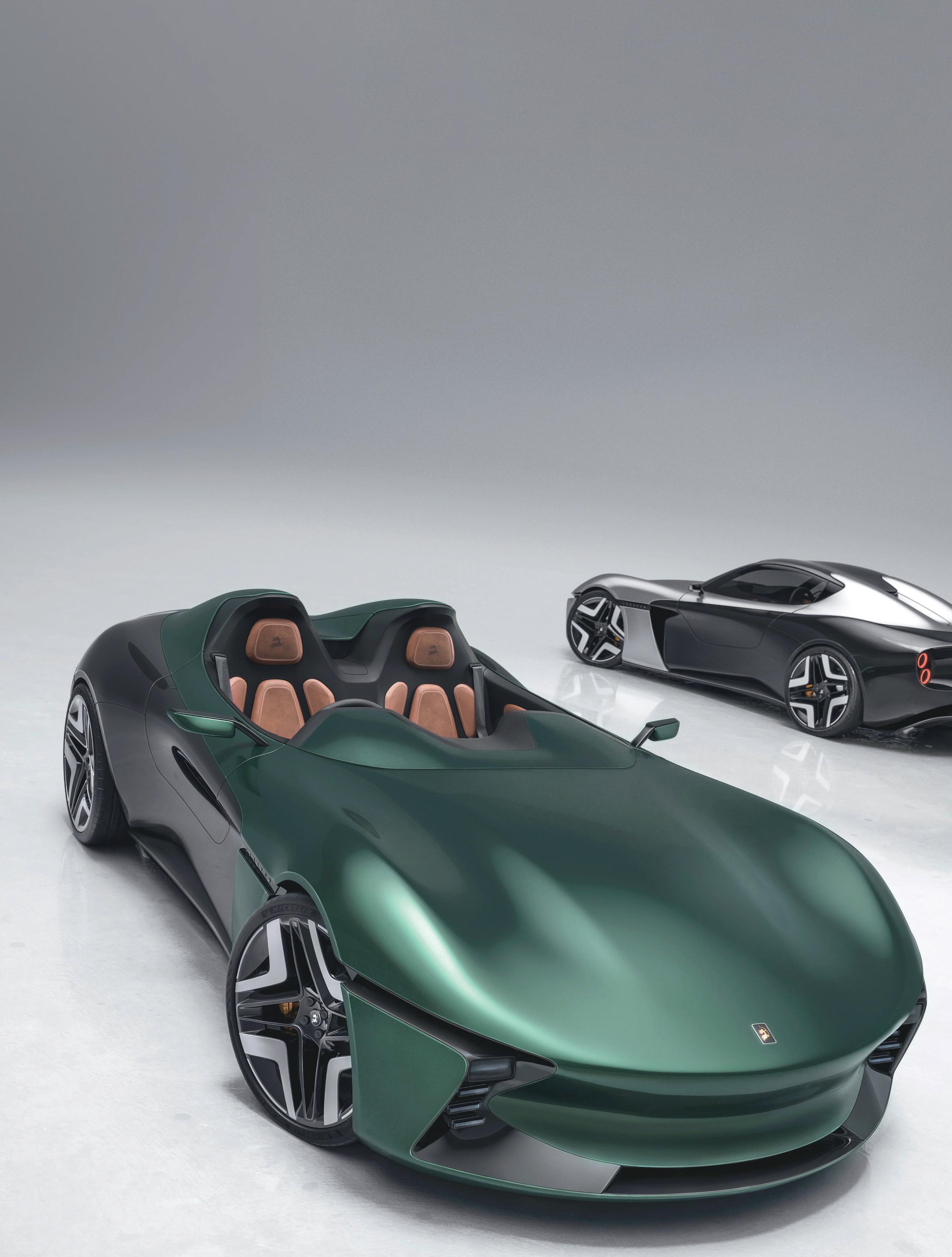
DRIVING DISRUPTION
Under the hood of Avant Design’s bold use of VR



If you have an old SOLIDWORKS license, bring it up to date with the latest version of SOLIDWORKS 2026 with a 50% discount on a new Rental License for the next 3 years.

Get in touch and learn more about the new SOLIDWORKS value upgrade offers.
www.solidx.co.uk/pricing /trade-in-prices

EDITORIAL
Editor
Stephen Holmes
stephen@x3dmedia.com
+44 (0)20 3384 5297
Managing Editor
Greg Corke
greg@x3dmedia.com
+44 (0)20 3355 7312
Consulting Editor Jessica Twentyman jtwentyman@gmail.com
Consulting Editor
Martyn Day martyn@x3dmedia.com
+44 (0)7525 701 542
Staff Writer
Gabrielle Brown gabrielle@x3dmedia.com
DESIGN/PRODUCTION
Design/Production
Greg Corke
greg@x3dmedia.com
+44 (0)20 3355 7312
ADVERTISING
Group Media Director
Tony Baksh tony@x3dmedia.com
+44 (0)20 3355 7313
Deputy Advertising Manager
Steve King steve@x3dmedia.com
+44 (0)20 3355 7314
US Sales Director
Denise Greaves denise@x3dmedia.com
+1 857 400 7713
SUBSCRIPTIONS
Circulation Manager
Alan Cleveland alan@x3dmedia.com
+44 (0)20 3355 7311
ACCOUNTS
Accounts Manager Charlotte Taibi charlotte@x3dmedia.com
Financial Controller Samantha Todescato-Rutland sam@chalfen.com
ABOUT

Now that we’re deep into springtime, it’s a great time to consider all things fresh and new. I don’t necessarily mean all the leaping lambs and cute little chicks, but instead, companies attempting something new in product design and engineering – something radical, even.
In this issue’s cover story, we pay a visit to Avant Design, the team behind the design of the Longbow electric sportscar, which continues to draw an admiring crowd wherever it goes. Given that Avant’s youthful seven-person team could fit inside an only slightly larger vehicle, the Longbow is an incredible testament to what can be achieved with raw talent and the latest technologies. By adopting technologies early, and substituting expensive legacy kit for modern digital alternatives, Avant Design has embraced a fast, agile and coste ective approach that other companies might do well to consider.
Equally dynamic is Kaikaku, a robotics company looking to automate restaurants with proven, economical and e cient solutions. Developed at a rapid pace and in real time, thanks to the company’s working London test restaurant/ laboratory – itself a success by London lunchtime standards – Kaikaku’s crack team and ability to move fast using a ordable, commodity kit that others might dismiss as ‘hobbyist’ makes this a standout story.
What connects a lot of these young companies in 2026 is a startling level of maturity when it comes to eschewing gimmickry for real results that they know will stand them in better stead for the long term.
At a time when big brands seem persistently inclined to throw big budgets at established, superstar designers – perhaps viewing them as a safe pair of hands to steer them through transitional periods and technological change – might these companies in fact be better served by giving more opportunity to new talent?
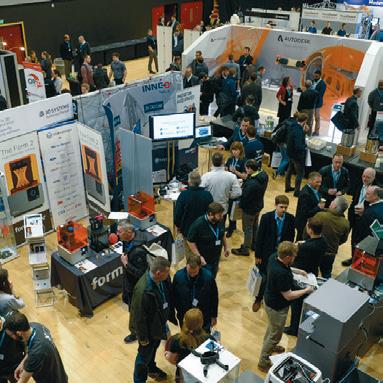
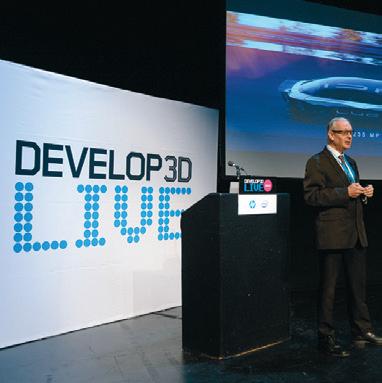
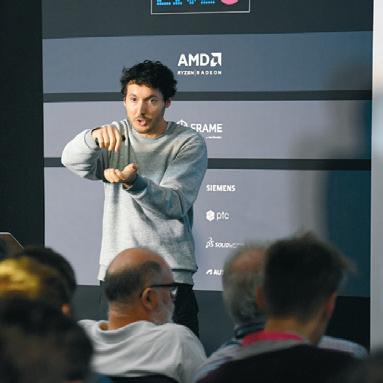
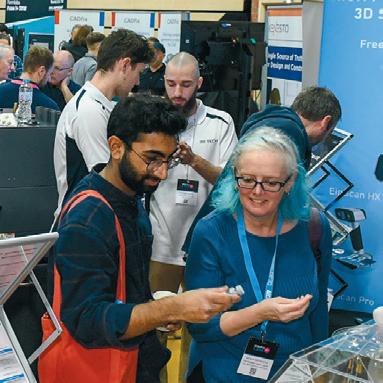
Both Avant and Kaikaku will be presenting at DEVELOP3D LIVE on 25 March, alongside a host of other talents and technologies. I recommend you check them out when you join us at the Warwick Arts Centre. On page 22 of this issue, there’s more information available on who else you can see at our event. Believe me, you don’t want to miss out.
After all, it’s Spring. It’s a good time for product designers and engineers to freshen up their ways of working and, trust me, there are few better places for you to get inspired than at DEVELOP3D LIVE.

DEVELOP3D is published by X3DMedia 19 Leyden Street London E1 7LE, UK
T. +44 (0)20 3355 7310
F. +44 (0)20 3355 7319

Stephen Holmes Editor, DEVELOP3D Magazine, @swearstoomuch

Speaker




Chris
Angel
Ashley
Spencer
Oliver
Jim
Gian Paolo Bassi - SOLIDWORKS
Oliver Duncan - Siemens
Longbow / Avant Design
Chris Gould - Longbow / Avant Design





Design Automation for SOLIDWORKS®
Automatically create order-specific SOLIDWORKS parts, assemblies, and drawings, so you can focus on the engineering work that matters most.
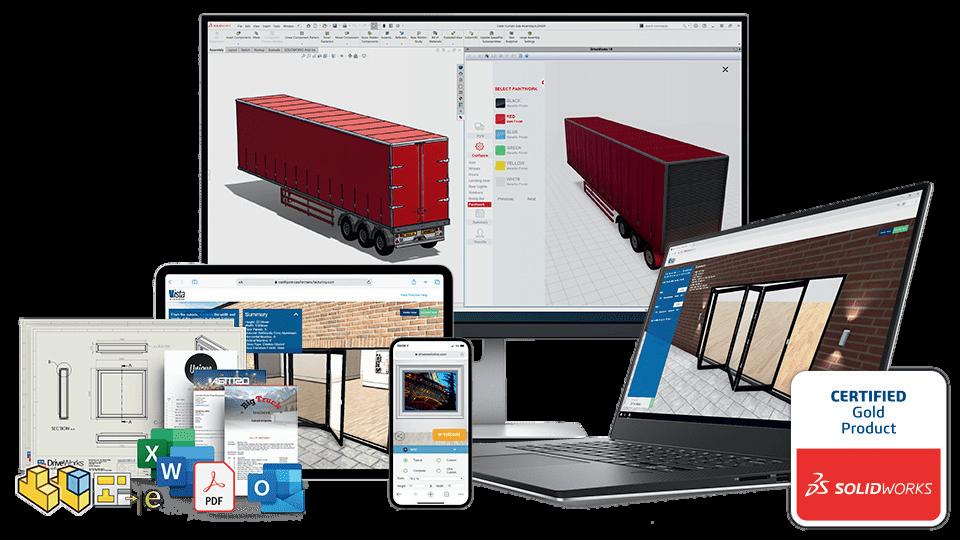
Start your 30-day FREE trial at www.driveworks.co.uk. No credit card required.

Powerful features, simple setup and maintenance
DriveWorks Solo is the powerful rulesbased SOLIDWORKS automation add-in that enables engineers to quickly configure and generate variations of models inside SOLIDWORKS.
Setting up DriveWorks is simple. Capture the parameters you change manually in SOLIDWORKS, then create a user interface and build rules to control how the captured parameters are updated.
Once DriveWorks is set up, you can run it over and over again to automatically create custom SOLIDWORKS parts, assemblies, and drawings.


Reduce engineering time
Customers using DriveWorks have cut their design engineering time for custom products by up to 95%.
Simple no-code setup

Forget expensive implementation and maintenance. Set up, maintain, and use DriveWorks in-house.
Flexible and scalable

Trade-in DriveWorks Solo and upgrade to DriveWorks Pro for enterprise-wide design automation and CPQ.

NEWS
Intel launches Xeon 600 workstation processors, MBD goes live in Onshape, Autodesk bets on physical AI with World Labs investment, and more
FEATURES
Comment: SJ gets inspired by historic architecture
Comment: Chad Knight on 3D’s language barrier
Visual Design Guide: Citroën ELO concept car
COVER STORY AVANT DESIGN SPEEDS AHEAD
Event preview: DEVELOP3D LIVE 2026
Event report: 3DExperience World 2026
Alpine beauty: Designing the Alpenglow Hy6
Robot-run restaurant: Behind the scenes at Kaikaku
Blades of glory: Sparx delivers on sharper skating skills
K2 takes ski design out of the studio, onto the slopes
King Cobra: 3D printing for a better round of golf
REVIEW
Huion Kamvas 22 Plus
THE LAST WORD
Disappointment over the new Ferrari Luce has longterm supercar fan Stephen Holmes questioning the logic of bringing in industry outsiders to design cars that fail to spark the same passion as their forerunners
20 September 2023
INTEL LAUNCHES XEON 600 WORKSTATION PROCESSORS
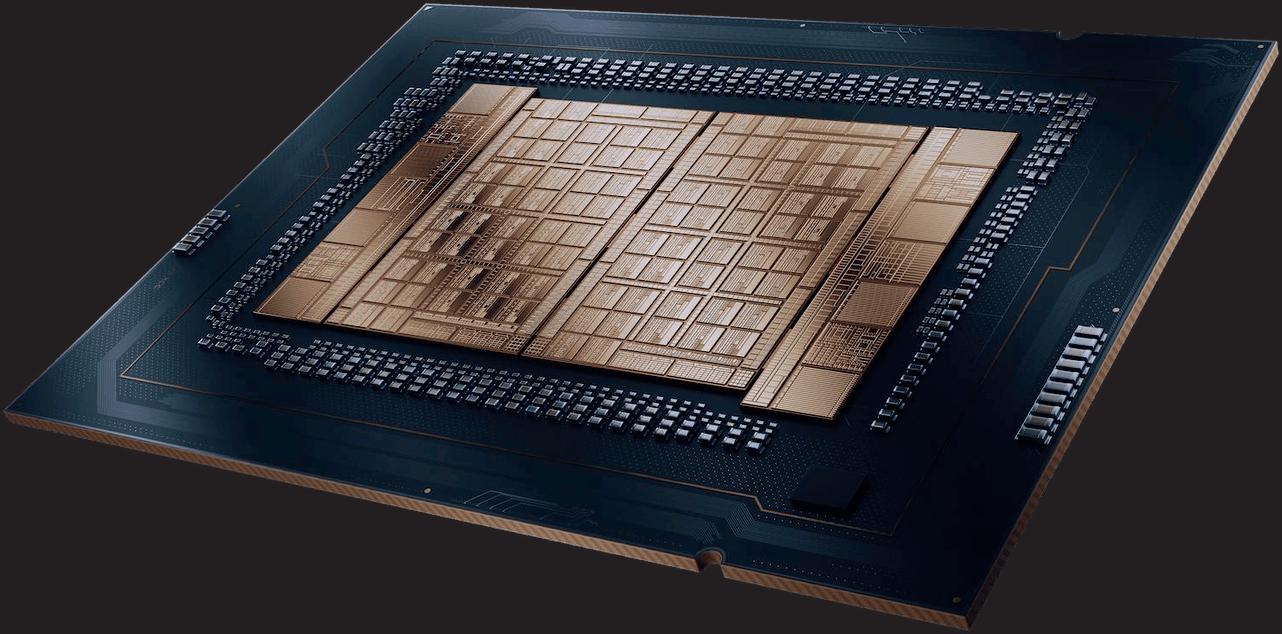
Intel has launched its Xeon 600 Series processors for workstations, bringing the Granite Rapids architecture to desktops designed for heavy compute workloads such as simulation, rendering and AI development.
The new chip family will replace the existing Sapphire Rapids-based Xeon W-2500 and W-3500 Series workstation chips and will go up against AMD’s highend workstation equivalent, the Ryzen Threadripper Pro 9000 Series.
Intel Xeon 600 features up to 86 Redwood Cove cores, up to 4.9GHz Turbo frequency and boasts more L3 cache per core, as well as more memory bandwidth than Sapphire Rapids. Meanwhile, Intel’s new chips have a maximum base Thermal Design Power (TDP) of 350W, down a little from 385W with Sapphire Rapids.
Memory is central, with Xeon 600 supporting up to 4TB of RAM via eight channels on most processor models, with some cost-optimised chips retaining four channels to hit mainstream price points.
A notable new ingredient is Intel’s Multiplexed Rank DIMM (MRDIMM) technology, which pushes data rates up to 8,000MT/s, compared with 6,400MT/s for standard RDIMMs. Capacity is lower, and an MRDIMM-equipped system cannot be configured all the way to 4TB, but Intel sees this as an attractive option for bandwidth-bound workloads, such as engineering simulation, when paired with SKUs with 28 cores or more.
Looking ahead, Intel has also teased its Series 3 Intel Core Ultra Panther Lake processors for mobile workstations, with more information to follow soon. www.intel.com
Model-based definition goes live in Onshape
PTC has formally unveiled new model-based definition (MBD) capabilities in Onshape, the first to be found within a cloud-native CAD/PDM solution, according to company executives.
These will enable teams to create a complete digital definition of a product by embedding product manufacturing information (PMI) directly into a 3D CAD model, including dimensions, tolerances, annotations, surface finishes and material specifications.
Announced by Onshape in June 2025 as an 'early visibility programme' with select customers, the full launch has now been rolled out to all Onshape customers.
MBD capabilities eliminate the need for users to interpret 2D drawings by embedding PMI directly into 3D models.
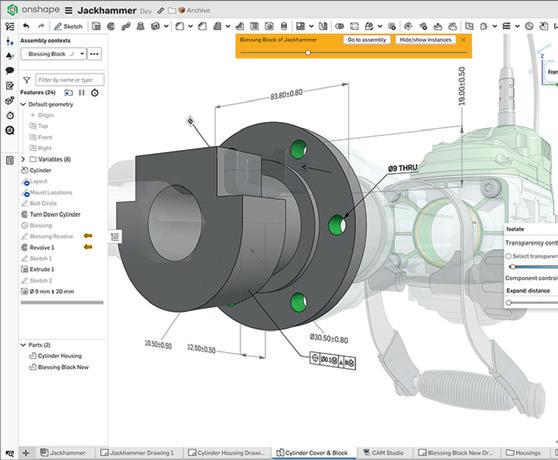
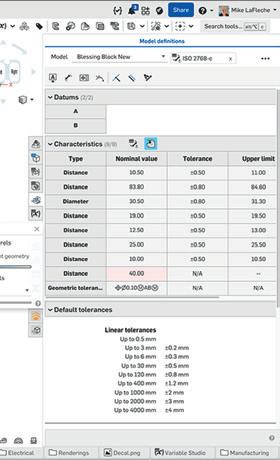
“This will enable teams to work faster, with greater clarity and fewer errors, while allowing a fully digital end-to-end process,” said Onshape and Arena general manager David Katzman. He continued: “It’s a major step forward in making MBD practical and scalable for real-world use.” www.onshape.com
Artec 3D partners with InnovMetric A
rtec 3D has partnered with InnovMetric to integrate the latter’s PolyWorks Inspector solution with its own technology and thus offer a broader toolset to Artec 3D scanner users.
InnovMetric is a specialist in metrology software that enables users to carry out complete dimensional analyses by comparing scans to CAD models and identifying deviations. This enables them to diagnose and resolve manufacturing issues, by uncovering design flaws, monitoring wear, and ensuring products comply with strict standards. www.artec3d.com
Stratasys enrolls new partner
Sratasys has named PostProcess Technologies as the first company to join its new post-processing partnership programme, which aims to improve customer experience and simplify additive workflows in 3D printing.
The commercial agreement with PostProcess Technologies will see its technology sold through Stratasys’ global sales channels. Other companies are expected to join a bank of third-party postprocessing solutions guaranteed to work with Stratasys systems. www.stratasys.com
Alstom explores Stilfold metal tech
RThe goal of MBD is to deliver precise, standards-based manufacturing data directly from a 3D model
ail transportation company Alstom is deepening its collaboration with Swedish sheet metal forming startup Stilfold, evaluating how to use its technology for more train components and structural railway elements following a successful pilot. Stilfold’s system is based on bending and folding steel sheets in a controlled, origami-like process using robots. The technology opens up new ways of designing steel components, with the potential to both reduce climate impact and lower manufacturing costs. These methods require less processing and can contribute to material strength and reduced material weight and usage. www.alstom.com
Intel's Xeon 600 series processors aim to deliver breakthrough performance in demanding workflows
AUTODESK BETS ON PHYSICAL AI WITH WORLD LABS INVESTMENT
Autodesk has invested $200 million in World Labs, an artificial intelligence (AI) research company best-known for spatial visualisation model Marble.
Marble is predominantly used in VFX and games development, but is also applicable to product visualisation, due to its ability to create scalable, physically accurate 3D scenes for simulation and data collection.
It can create 3D worlds from a wide variety of input types and enables users to iteratively edit or expand these worlds.
Founded in early 2024 by renowned AI researcher Professor Fei-Fei Li – who has been called ‘the godmother of AI’ –World Labs has seen a flurry of recent investment totalling $1 billion, from companies including Autodesk, AMD and Nvidia, among others.
According to Autodesk executives, this strategic investment is in line with their view that while large language models (LLMs) have made remarkable progress and will continue to do so, real impact for Autodesk users demands AI that accurately understands space, structure, materials, physics and time.
The thinking here is that designing a bridge, a complex part or an immersive experience demands intelligence that can reason in 3D and support iterative, humandriven ideas.
“There is no shortage of investment flowing into AI today, much of it focused on ever-larger models, centralised platforms and hyperscale infrastructure. That path will undoubtedly produce important breakthroughs,” said Autodesk CEO Andrew Anagnost.
“Our investment in World Labs represents a different path, focused on solving the hardest problems in designing, building and operating the physical world, guided by human needs and domain expertise, rather than scale alone.”
In other words, physical AI is seen by Autodesk as the next big frontier for AI and it is determined to capitalise on it. As Anagnost puts it, when AI is capable of understanding physical reality, it can be a partner in how the physical world around us is designed and built.
“Autodesk has long helped people think spatially and solve real-world problems and, together, we share a clear purpose: to build physical AI that augments human creativity and puts more powerful tools in the hands of designers, builders and creators,” said Anagnost.
www.autodesk.com
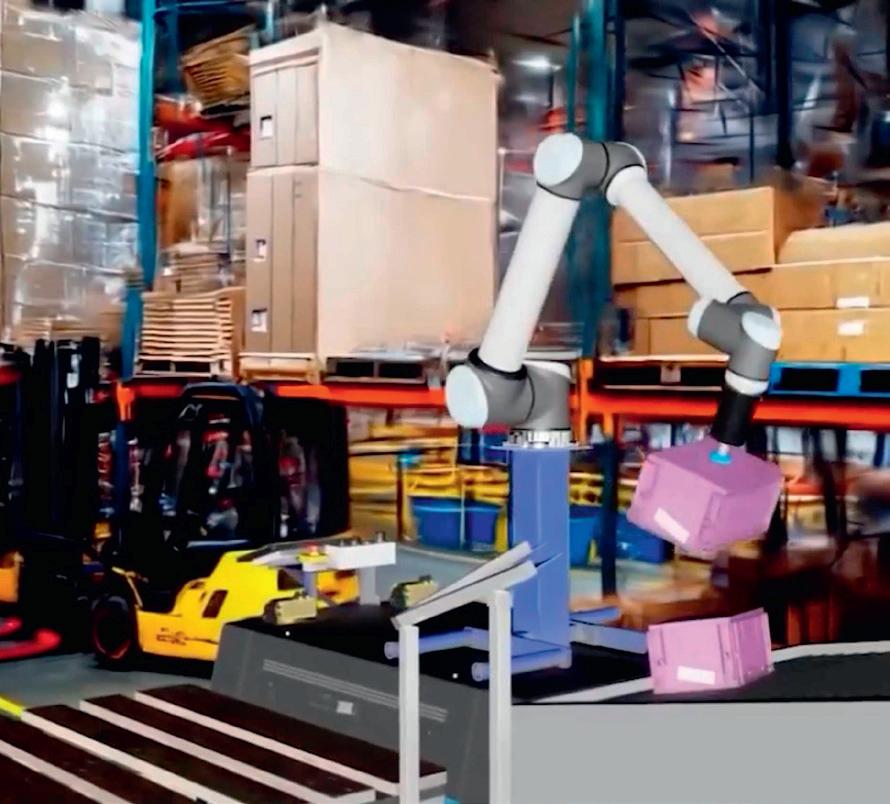
Warehouses and distribution hubs are physical facilities that might benefit from AI
ROUND UP
The UK has been announced as the partner country for Formnext 2026 in Frankfurt, which will showcase the UK’s leading role in global AM and its strengths in R&D, materials, machine development, software and high-value industrial applications www.formnext.mesago.com
Toray Industries has launched Toraypearl PA12, a new spherical nylon powder designed to be widely compatible with powder bed fusion (PBF) 3D printers. The material delivers increased surface smoothness and high-impact strength in 3D-printed parts www.toray.eu
Siemens Energy has announced that spent nickel alloy powder from its additive manufacturing facilities will be recycled by 6K Additive using the latter's proprietary UniMelt microwave plasma production system, which will convert it into virgin, AM-ready metal powder www.siemens-energy.com
HD Hyundai plans digital shipbuilding platform
HD Hyundai, the world’s largest shipbuilding group, has partnered with Siemens Digital Industries to build an integrated platform for managing the entire shipbuilding process as a single data flow across all of its global shipyard facilities.
The platform will use Siemens Xcelerator as its foundation and support HD Hyundai’s ‘Future of Shipyard’ initiative, scheduled for completion in 2030.
By using an integrated platform, it’s HD Hyundai’s aim to strengthen collaboration between its engineering and manufacturing functions and support the execution of increasingly complex shipbuilding projects.
Additionally, the company is working on building photorealistic digital representations of ships and shipyard
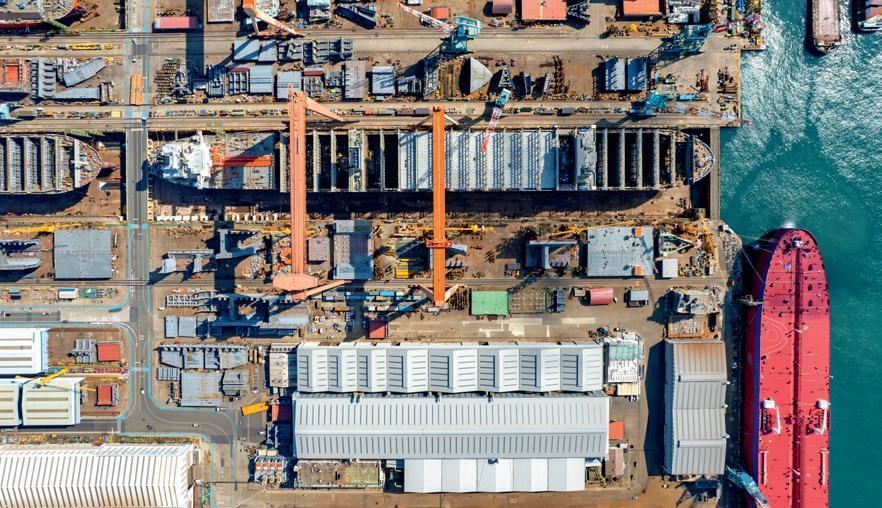
sites using digital twin technology from Siemens. This involves the use of AI, trained in a virtual learning environment using synthetic and industrial data, in order to present users with interactive digital versions of complex, real-world production environments. www.siemens.com
AM Solutions has launched a new compact M1 system for automated surface finishing of 3D-printed parts in metal and polymer, with post-processing abilities that include smoothing, grinding, polishing and deburring in a single vibratory finishing platform www.solutions-for-am.com
The Additive Manufacturing Users Group (AMUG) has announced that Steve Fournier of General Atomics Aeronautical Systems and Scott Sawyer of Divergent will jointly present a keynote at AMUG 2026 that shares their story of cross-industry collaboration and success www.amug.com
A bird's eye view of HD Hyundai's shipyard in Ulsan, South Korea




Large-format 3D printing brings with it some tough engineering challenges.

To overcome these, maybe we should take our inspiration from the architects of historic buildings that have stood the test of time, writes our columnist SJ
It is 2026. Choose your battles wisely. It’s advice I frequently hear, but am still terrible at applying. I find it hard to back down from a fight, especially when a challenge is thrown down by a mediocre white man in corporate America whose conservative design inclinations lead him to 3D print only rectangular bricks that he believes to be the ‘pinnacle of innovation’.
But what if this particular part or assembly didn’t have to be a brick? What if we gave art and creativity a chance in this highly conservative, risk-averse aerospace world? But what would that look like? Where would we even begin?
I like to bring to these conversations what I refer to as ‘big print energy’. It’s an ethos I take seriously.
Ever since I started out in large-format metal printing – and for the sake of clarity, we’ll define ‘large’ as anything bigger than the standard 400mm cubed build volume –what I’ve noticed is that the physics of the process have changed.
That change is slight in most cases: a few adjustments to angles, a change in my preferred hole diameter size, a slightly greater emphasis on channel width and an avoidance of large overhangs.
But as I began to adapt support structures for these bigger pieces, I struggled to find ways to get rid of all the bulky mass.
Some of you may be thinking that topology optimisation or latticing might provide answers – but features such as these are generally not strong enough to withstand the physics of large-format printing. So, what else can?
LESSONS FROM HISTORY
Since moving to Baltimore, I’ve been inspired by the rich history of the city, especially its architecture. I live on a street lined with historic buildings and my walks through the city’s neighbourhoods have led to a fascination with its churches.
In particular, I was drawn to the arches and window arrangements of churches, because to my eyes, they represent the epitome of design for self-supporting powder escape channels.
Bingo! I had my inspiration. Now I just needed answers on how to execute these designs and bring to them my own personal style of ‘big print energy’.
It’s important not to forget that the Gothic master masons were not just engineers. They were artists, too.
More specifically, they were artists obsessed with proportions. They used the Golden Ratio, root rectangles and ratios found in musical harmonies to design key architectural elements. They adapted arches and vaulted ceilings from Roman architecture to create rib vaults and flying buttresses.
(Yes, of course I did everything I could to try and include a ‘flying butt-ress’ in a professional engineering presentation, just for shits and giggles, because a ‘butt’ is always funny to American ears. And no, of course my manager didn’t approve it. But that’s OK, because it wasn’t compatible with the physics anyway.)
I spent weeks researching the ways in which some of the oldest, longest standing churches were built and found out they were made by hundreds of guys without so much as a digital calculator. Their work involved a lot of protractors, and it’s work made far simpler for modern-day me, thanks to some clever work with constraints and sketches in Siemens NX.
ART AND CREATIVITY
Before long, those architectural shapes and sketches began to make their way into my own designs for work. And, to my surprise, I found I wasn’t the only architecture revivalist in the building.
Several senior engineers would come and hang out near the lab to see what geometries I had tested out that week and to offer their comments. It turns out that








It’s time to bring art back to engineering and to bring beauty back to manufacturing. In 2026, it’s time to build something new
while they may be terrified of a lattice, the are absolutely thrilled by a vaulted ceiling. (Insert millennial eyeroll here.)
The master masons of historic buildings strongly believed in the idea of creating something that outlives you. That makes sense, given that it took multiple generations of engineers to complete many churches, and that these projects sometimes took more than 100 years from start to finish.
After my own personal successes, I think it’s time we bring back art to engineering. We stand at the ‘pinnacle of innovation’, right? So who says manufacturing can’t be beautiful? Who says it can’t be wondrous, not only in its execution, but also its aesthetic? Are you seriously going to try and convince me that all this ‘design freedom’ isn’t actually free?
Put simply, if it’s my name going on a drawing, or a model, or a work instruction, then I want it to incorporate every ounce of my own personal charisma, uniqueness, nerve and talent.
This is a hill on which I’m prepared to die. It’s time to bring art back to engineering, to bring beauty back to manufacturing. It’s time to leave your clunky, conservative bricks back in 2025. In 2026, it’s time to build something new.
ABOUT THE AUTHOR: SJ is a metal additive engineer, aka THEE Hottie of Metal Printing. SJ’s work involves providing additive manufacturing solutions and 3D printing of metal parts to help create a decarbonised world






What kind of 3D are we talking about, anyway? Chad Knight argues the case for a cross-industry framework of his own creation, intended to tackle the language barriers that exist between engineers from different disciplines

Over the past several years, I’ve been building a taxonomy and ontology of digital geometry. My goal is to develop this into a framework that the industry can use. At its foundation is something I call ‘the 3D paradigms’, in recognition of the fact that 3D is not one technology, but three.
Entertainment invented one kind to make things look real on screens. Engineering invented a different kind to make machines cut materials precisely. Medicine invented a third kind to capture what’s inside physical bodies. Each industry developed tools, file formats and vocabulary around their own versions and had no reason to align them. But designing and manufacturing footwear requires aspects of all three. It demands visualisation for marketing and design review, precision surfaces for tooling and manufacturing, and volumetric data for lattices, cushioning simulation and fit analysis. In one product category, we observe three technological traditions that evolved completely separately.
With this in mind, the taxonomy I’ve built provides neutral terminology that spans all three paradigms. It enables people from different backgrounds to talk about geometry without accidentally using words that mean different things in their respective industries.
OVERCOMING CONFUSION
Here’s what paradigm confusion looks like in practice: A design team builds a shoe model using entertainment software. It’s polygon-based, built to look right on screen, with topology optimised for rendering. Leadership greenlights samples and the file is sent to engineering, which opens it to find geometry that no machine can interpret, just a shell of approximated facets.
Days are spent rebuilding the entire sole from scratch in NURBS. Everyone asks why. The answer is often framed as a tech issue
or a skill gap – but in fact, it’s neither. The two teams were working in fundamentally different geometric paradigms, and nobody had the vocabulary to see the boundary, let alone manage it.
The framework I’ve built gives organisations and practitioners that vocabulary. It classifies geometry by how it’s defined mathematically, not by what software created it or what industry uses it.
The taxonomy starts at the lowest level of geometry: points, curves, surfaces, volumes. It traces how those elements combine into larger constructs, and how different mathematical definitions – explicit, parametric, implicit – encode shape in fundamentally different ways, each with its own strengths and costs.
It also maps the spectrum of creation methods, from manual modelling, through parametric and procedural approaches, to simulation and fully generative systems. Each step delegates more decisions to software and demands different skills to control.
Critically, the taxonomy doesn’t invent classifications from scratch. Instead, it maps against existing industry standards like ISO/STEP for engineering, USD for entertainment, and DICOM and Houdini for medical and volumetrics. That grounding is what allows it to function as neutral territory where those existing structures can finally reference each other.
The goal isn’t to replace anyone’s existing vocabulary. It’s to provide a translation layer where a designer and a manufacturing engineer can identify where their workflows connect and where they don’t.
WHY THIS MATTERS
A shared vocabulary to describe paradigm boundaries doesn’t exist. That’s the core problem and it’s why so many 3D investments underperform.
Organisations experiencing friction in their 3D workflows often can’t diagnose it because they don’t have the language.
A shared vocabulary to describe paradigm boundaries doesn’t exist and that’s why so many 3D investments underperform
Problems at the boundaries look like communication issues, skill gaps or platform failures. They’re none of those things. They’re translation problems, and you can’t solve a translation problem without a dictionary.
This is becoming increasingly important, especially as generative AI models enter the picture, because they don’t naturally output clean polygon topology or NURBS surfaces. They operate in volumetric representations: neural radiance fields, Gaussian splats, implicit functions.
To solve the translation problem, my framework makes visible what’s currently invisible. When a hand-off failure between design and engineering isn’t a people problem but a geometric translation problem, the framework exposes the actual boundary so that it can be addressed.
It changes how organisations evaluate investments and it creates a foundation for cross-functional fluency.
The framework is developed, but to span three paradigms, my vision is to build a council for 3D leaders with genuine depth in entertainment pipelines, CAD engineering and volumetric workflows.
If that sounds like your world and this work interests you, I’d welcome the conversation.
ABOUT THE AUTHOR: Chad Knight is former head of 3D design at Nike and now CEO of Super Digital. For over 15 years, he has worked as a 3D practitioner at major footwear brands, integrating 3D workflows into traditional footwear manufacturing for faster prototyping and complex digital modelling www.linkedin.com/in/chadknight
VISUAL DESIGN GUIDE CITROËN ELO CONCEPT CAR
» The Citroën ELO concept car is a small vehicle with big ideas about the role that transportation should play in supporting modern schedules crammed with opportunities for work, rest and play
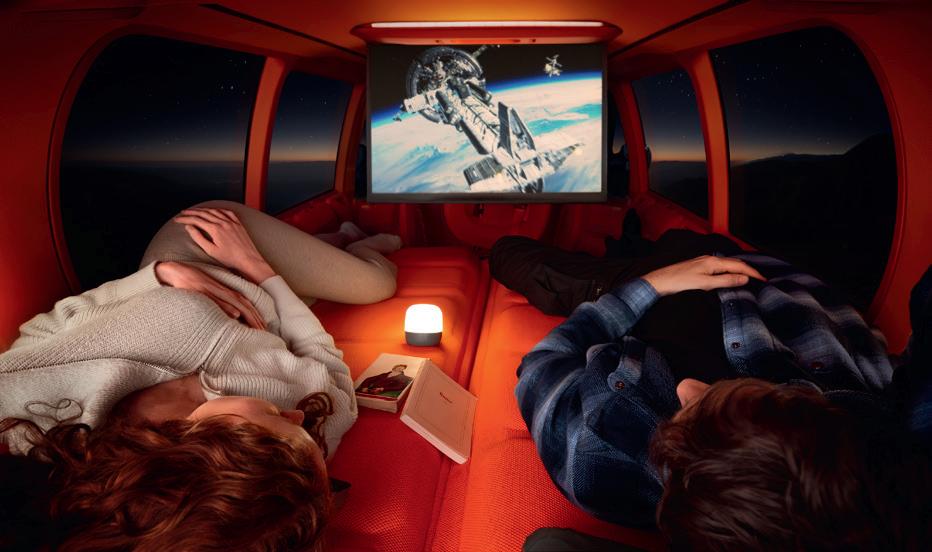
LEISURE VEHICLE
Three rear passenger seats are removable and can be used outside for extra seating. For a cinema-like experience inside the vehicle, there are two inflatable mattresses, as well as a built-in projector and screen. Relaxing ambient lighting turns the ELO into a cool chill-out zone
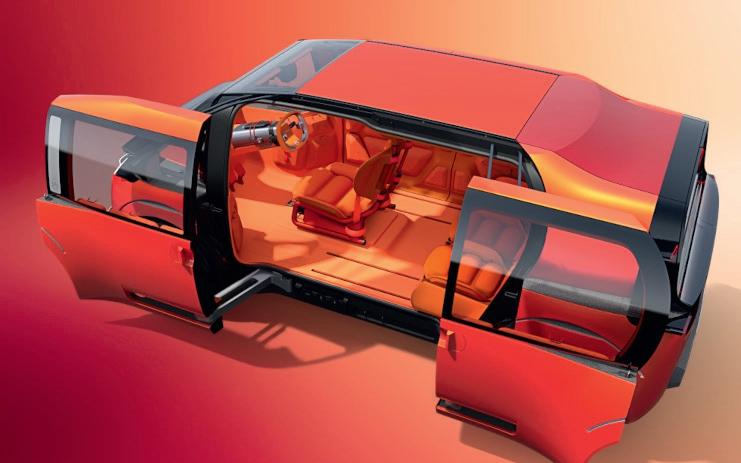
EASILY ACCESSIBLE
The ELO’s four doors open in opposite directions, while the absence of a centre pillar creates a 1.92m-wide, unobstructed access point to the cabin. The flat floor, meanwhile, enables easy movement inside and flexible configuration
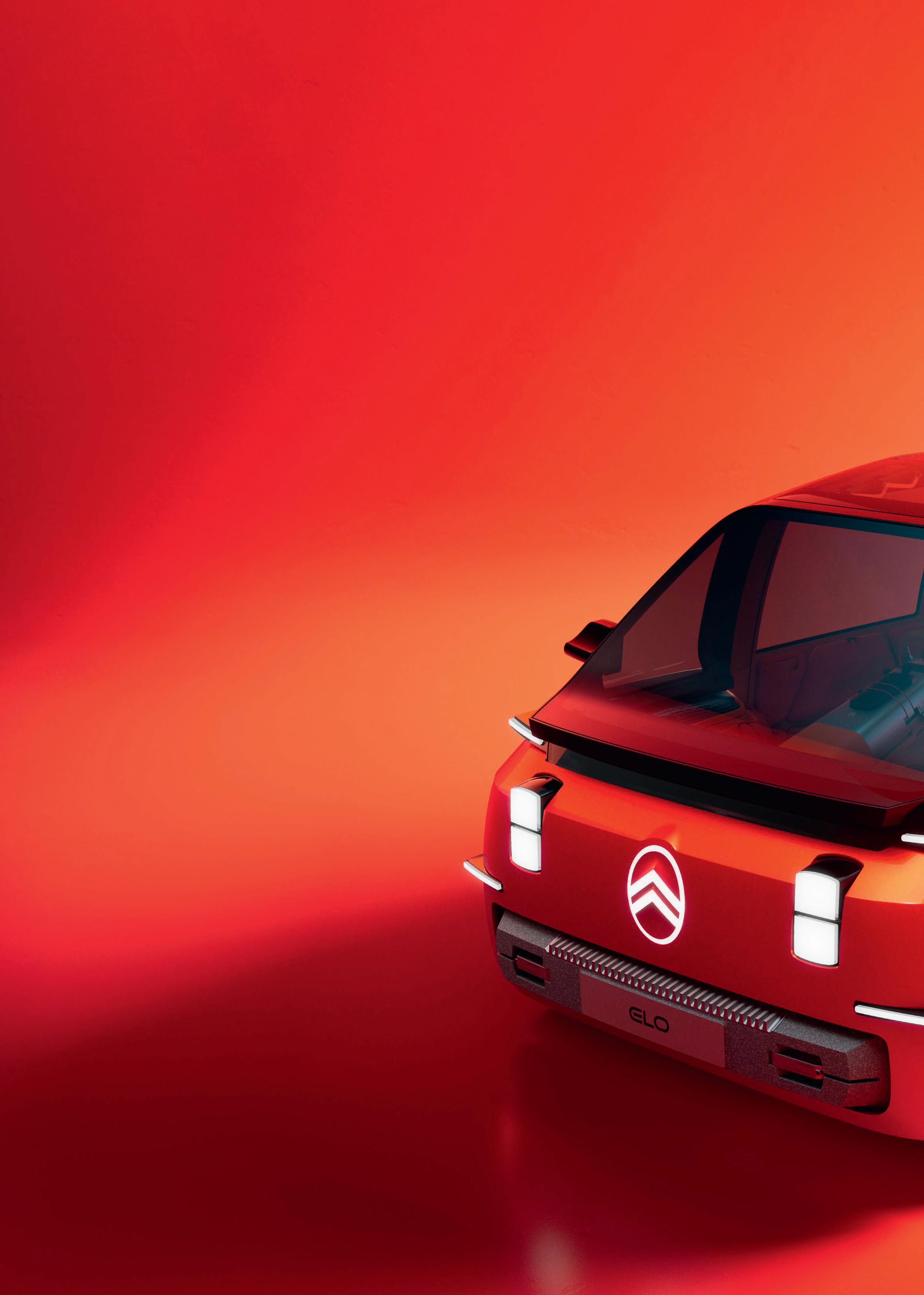
IMPACT PROTECTION
The bumpers of the Citroën ELO concept car are made of expanded polypropylene to offer lightweight and effective protection from minor impacts. The front and back bumpers are identical, so fewer parts need to be made
TAKE CONTROL
In the ELO, the driver is seated centrally, offering 180-degree visibility and eliminating the need for Citroën to create left-hand/right-hand drive variants. Instead of a dashboard, drivers are provided with a transparent user interface built directly into the steering column and windscreen
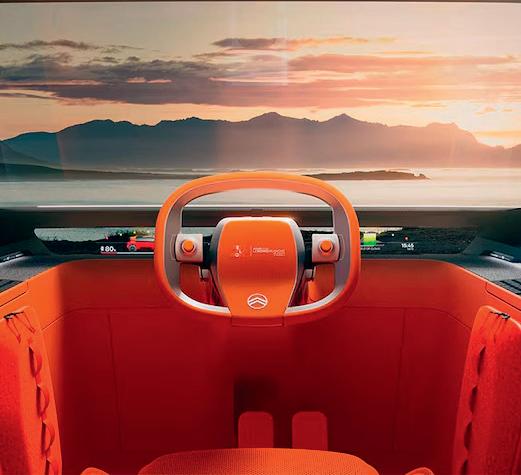
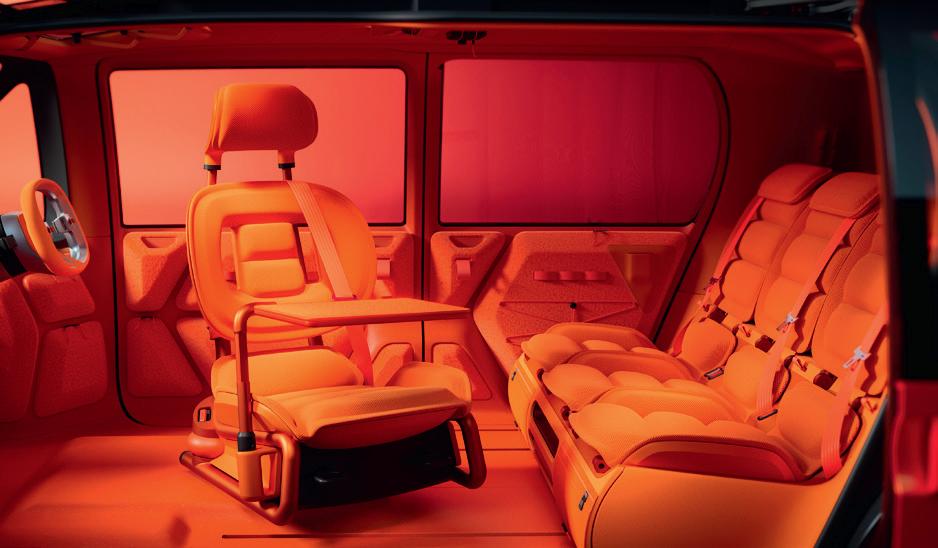
Capable of accommodating up to six passengers, the ELO’s interior is entirely modular, so that the car can be variously configured as a sleeping space, a basecamp for outdoor pursuits or a mobile office ENVIRONMENTAL
Not only is the ELO fully electric, but also its driver seat upholstery uses surplus fabric left over from Citroën’s 2022 OLI concept car. In fact, 30% of the materials used in the ELO are recycled and the vehicle itself is 100% recyclable
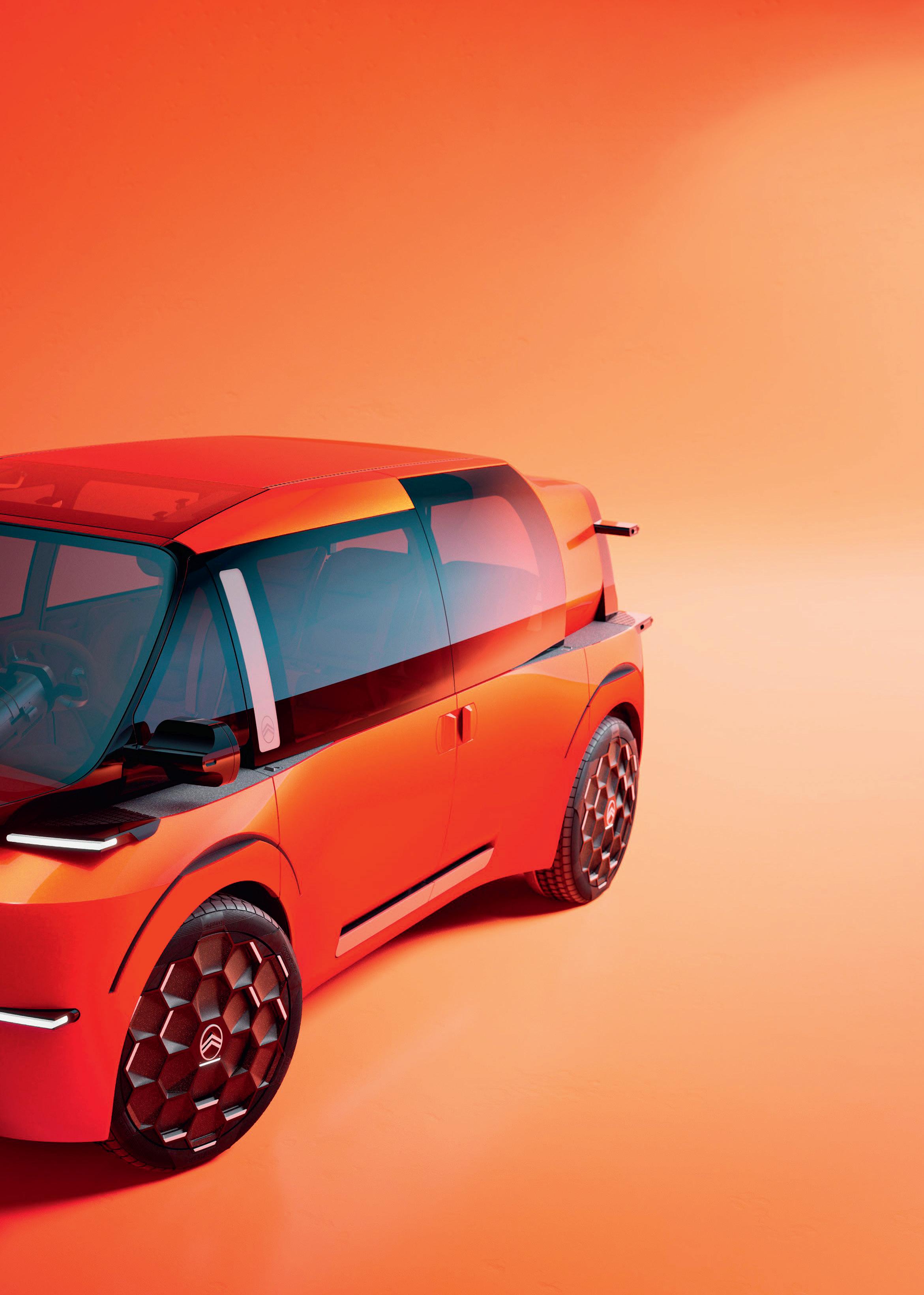
The ELO features smart, sustainable Eagle Xplore tyres from Goodyear. These come with Goodyear SightLine technology to monitor pressure and wear in real time, delivering that information not only to the cockpit and an app, but also an LED on the wheel rim itself, indicating optimal (green) or low (red) pressure
As a concept car, the
ELO is a ‘blue-sky ideas laboratory’ that signposts possible future directions for the brand www.citroen.co.uk

DRIVING DISRUPTION
» A showstopping design that grabs the world’s attention rarely originates from such a small and hands-on team, but with the Longbow sports car, Avant Design is proving that skill and hard work, when combined with the very latest tech, can be a recipe for success

Longbow is a lightweight, electric sports car stripped of all distractions and designed to rekindle the spirit and excitement of an authentic British sports car
Competing against the big boys of automotive design is a brave game to play. Any company considering it must factor in that they’ll be taking on global OEMs that spend more on sandwiches each year than all their annual overheads combined. Yet some people wake up each morning determined to accept that challenge and win.
Avant Design director Chris Gould has been exposed to this lifestyle from an early age. The foundations of Avant were built on another consultancy’s closure – a company operated by his father Jonathan.
That’s It Design ran for a decade, having been spun out from Arup’s automotive division in 2007, with highprofile work on the design for a new London taxi cab being one of many high points.
When the taxi’s owners, Chinese automotive giant Geely, subsequently bought Lotus, Gould senior was made an offer to move to an in-house role there.
The consequent shuttering of his father’s business led to a crossroads for Chris, who decided at that point to make his own way in life. He chose to start his own consultancy, rather than find a position at an OEM.
“I always joke about the fact that I made the worst decision of my life doing that,” he laughs, before continuing. “No, I love doing what I do. But the stress is high and I always think maybe my life would be easier if I’d just got a job at JLR!”
The business side of consultancy is “ruthless”, he says, and causes the most pressure. His role since 2018 has seen him build Avant’s brand via word of mouth, deal with the polar extremes of bootstrapped start-ups and multimillionaires, and expand Avant’s capabilities to encompass not just cars and other forms of transportation, but also marine vessels and more general products.
In a turbulent world, to survive is one thing. To grab attention and have the world’s eyes fall on you is a far greater achievement. Avant’s hard work paid off, with the launch of the Longbow EV at CES in January 2026
putting its design credentials in the spotlight for all the right reasons.
A British electric sportscar concept designed to be powered by solid-state batteries and wheel hub motors, the styling manages to reimagine the golden age of lightweight sports cars for the twenty-first century.
A marriage of purposeful aerodynamics and classic lines, Avant has helped create a driver-focused machine, with a ‘featherweight’ design that contrasts with the common perception of modern bulky EVs.
The original brief was driven by the client’s love of classic 1960s muscular curves, such as those found on the Shelby Daytona and Ferrari 250 GTO, while Gould and his team injected the design with more contemporary facets.
This theme of duality was loved by the client. Avant captures this contrast in classic lines around the rear of the car, while the front has more modern darts and slashes. The contrast is highlighted further when the vehicle is kitted out in its split colourway.
The Avant team was introduced to the project early on, via a feasibility study on what could be built around the EV underpinnings. “There was a brief study into that, which then gave us certain hard points to work around and a platform to be clothed into something pretty,” says Gould.
DEFEAT OF CLAY
Gould confesses that his love for sculptural forms comes directly from his father, who took a role leading the clay studio at Lotus. “Realistically, I’m less from the CAD side. I’m more from the physical,” he says. “There’s something in front of me – let’s shape it and make it something that’s really beautiful’.”
However, the hard world of consultancy means that while the human touch involved in creating a clay model is effective, it is fading fast from workflows in the world outside big-budget OEMS. A lot of the time, consultancies need to do everything at as little cost as possible, so eliminating any expensive and time-consuming stages is an unfortunate necessity.
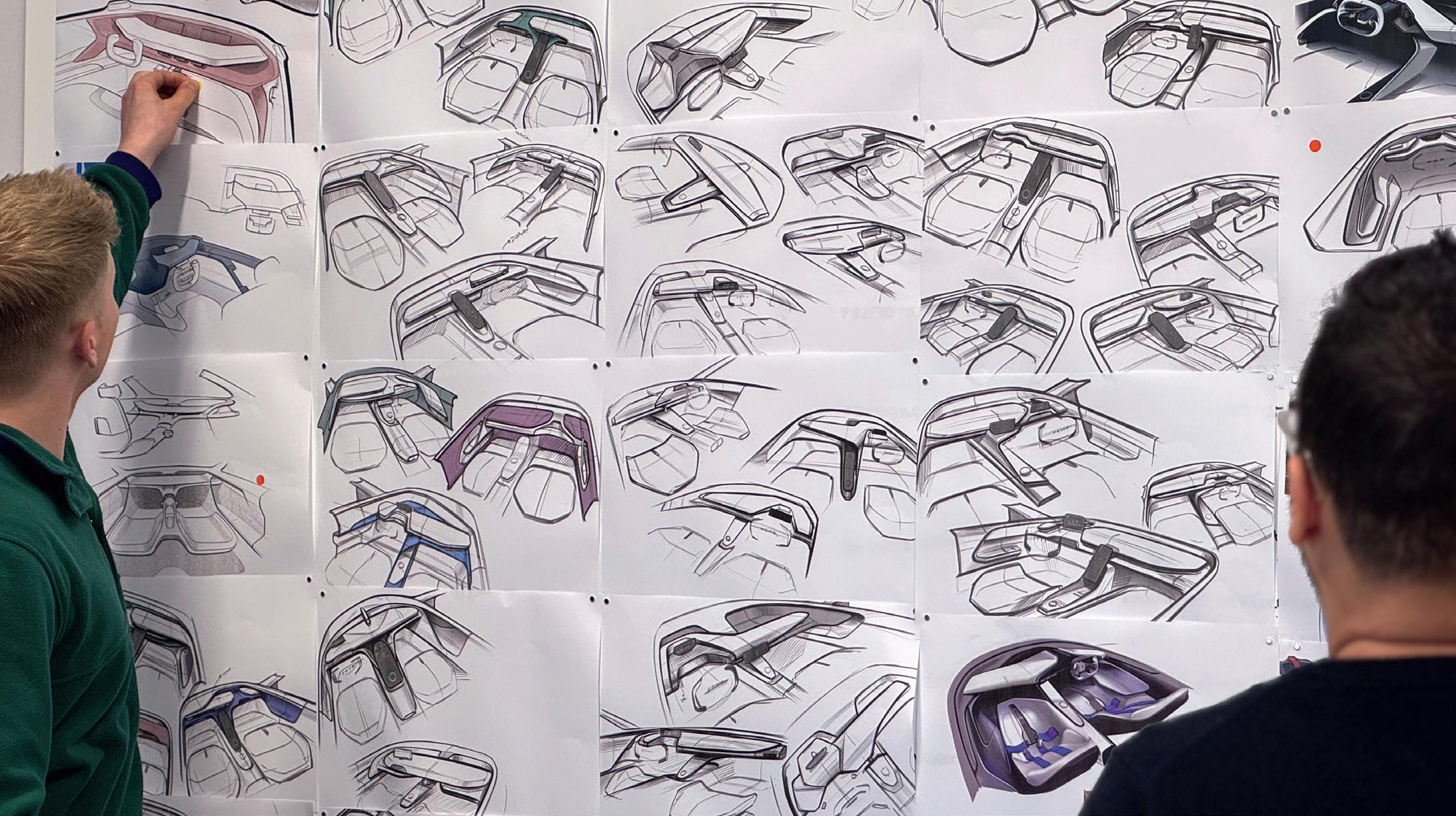
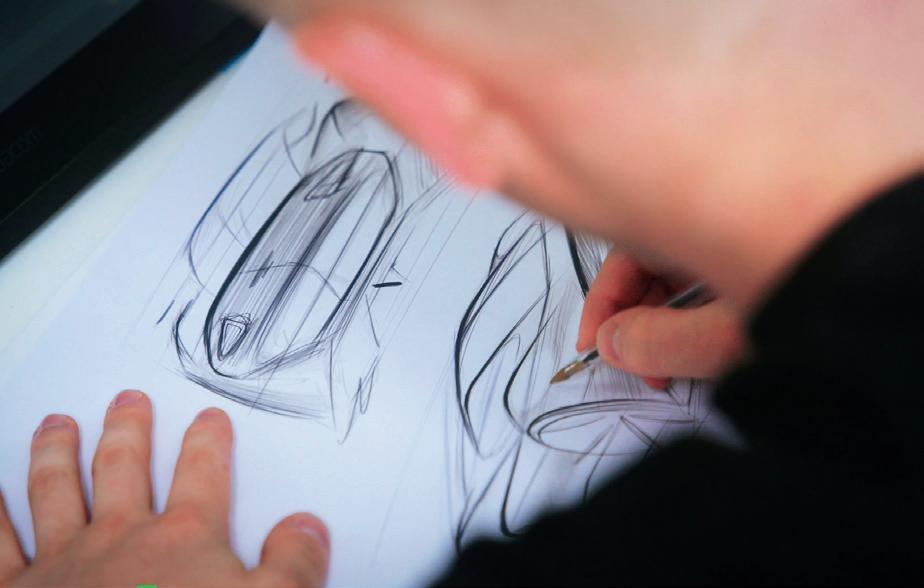
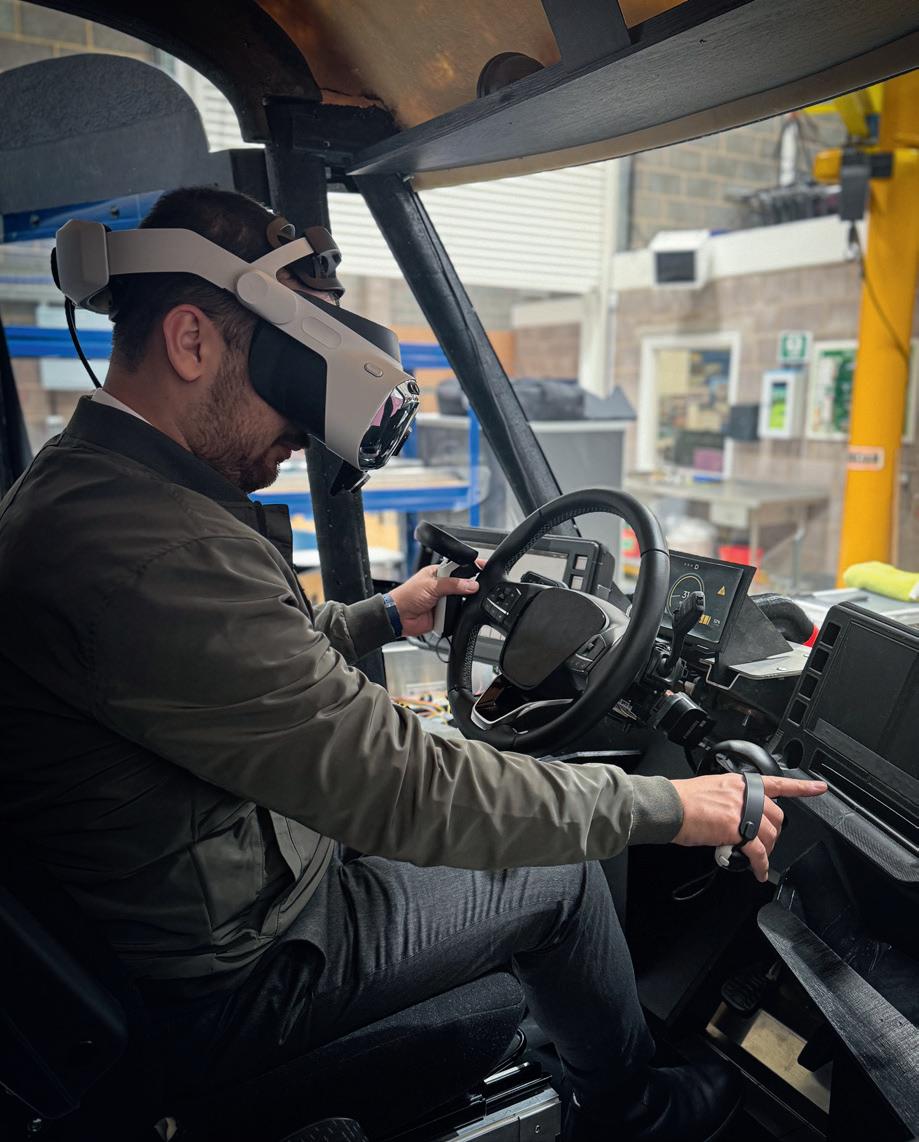
● 1 Designs that begin life as a numerous sketches quickly move into virtual reality at Avant Design
‘‘ To produce a car, you need a clay model that then gets scanned into CAD. And this is why we use virtual reality, because it essentially just eliminates that step
Chris Gould, Avant Design
“Since 2018, I don’t think we’ve had one clay model enquiry. We still vocalise and make it clear that we can offer clay models, but nobody’s interested. The appetite is not there,” Gould says.
“Fundamentally, to produce a car you need a clay model that then gets scanned into CAD. And this is why we use virtual reality, because it essentially just eliminates that step.”
The adoption of virtual reality (VR) came very early, brought into the studio by Avant’s employee number two, Matthew Lincoln, who is now its lead creative designer.
Having set job applicants a test project, Gould was drawn to Lincoln’s design, which was developed using Gravity Sketch’s VR tools. With little knowledge of VR and a perception of it as being a bit of a gimmick, he was blown away by Lincoln’s work. “So I ended up employing him, and he introduced me to what was possible with VR.”
From that point onwards, VR has been a key tool in Avant’s creative arsenal. “Every single day when we run a project now, we bring data in, review it, critique it and whatnot. And we’ve sort of developed it now to the point where we use it in three key areas of our process.”
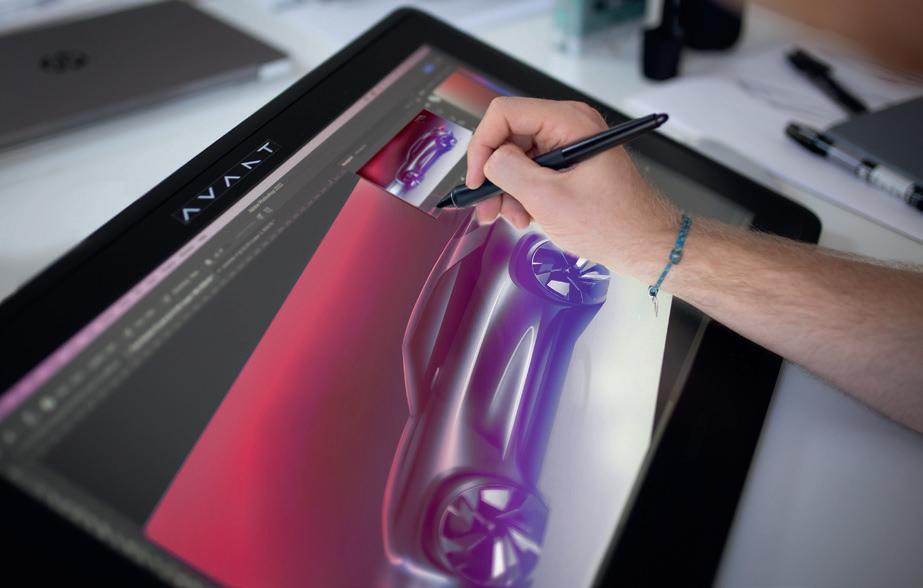
The first area is the concept phase. Avant’s team of 7 designers develop their 2D concepts into a more mature 3D form in Gravity Sketch, which Gould says helps avoid design intent being lost in the transition from the designer to the Autodesk Alias CAD model.
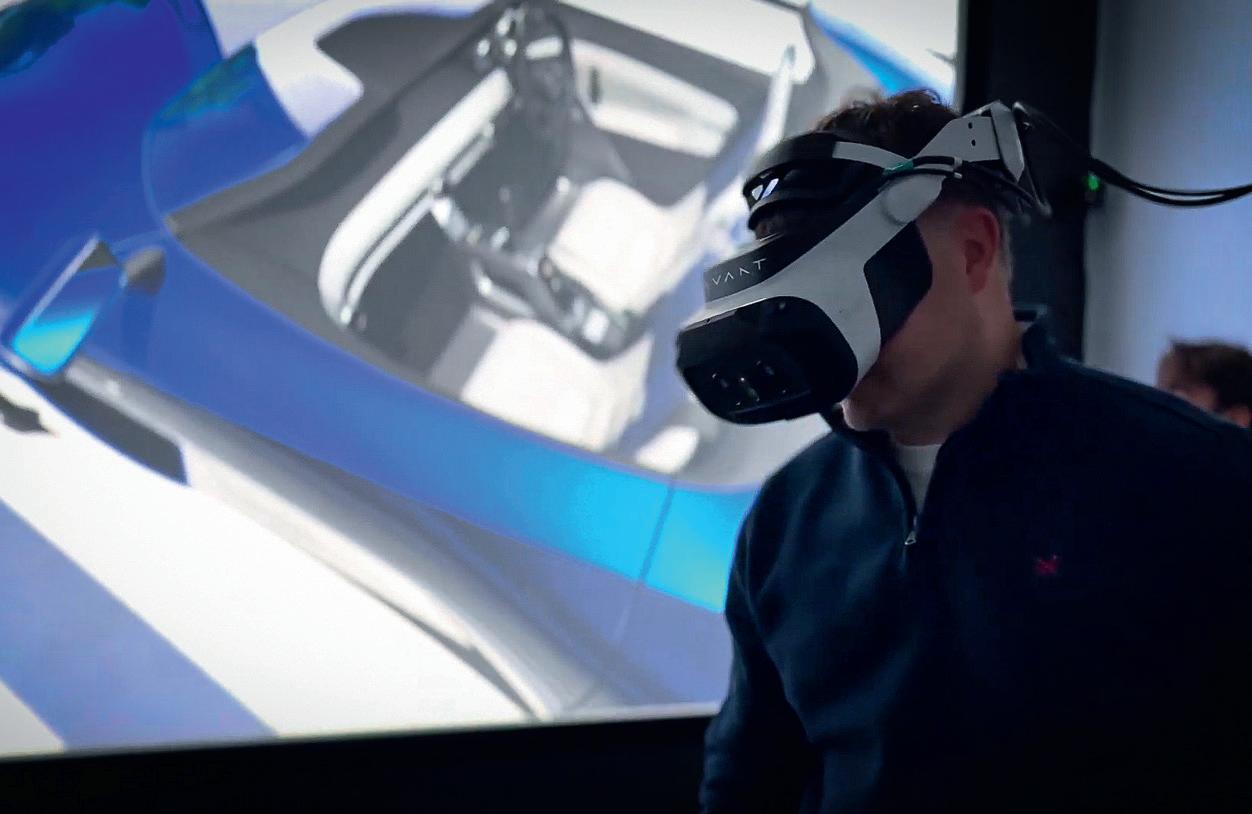
“Essentially, you’re treating it like a clay model at that point. We have our virtual reality suite, and we stand in there. It’s big enough to have a car at full scale, so we’ll zoom in with AR or VR, and we’re able to walk around it and just pull at it and manipulate the surfaces – just as if it were a clay model in front of us.”
The second area where VR is used involves bringing a design from Alias into Autodesk VRED. At this point, the design team has fully dressed the model. In this way, it’s ready for assessment by the team itself or a client, in order to identify what needs to be developed further.
The third and final area where Avant team members lean on the functionality of VR is in introducing full configurators and different lighting effects, building big, bespoke scenes that they tailor to each project and its stakeholders. The aim is to create an experience designed to get them the green light.
SHOW FLOOR
Gould says that virtual reality gives Avant 80% of the feedback its team can get from a physical clay model, but with additional benefits. Surfaces can be manipulated instantly without waiting for skilled clay modellers to arrive. Colours, lighting and location can be switched straight away. Multiple concepts and variations can be displayed in the same line-up, building the confidence of a client to push on to the next stage.
Gould says that the most models they’ve shown at one time in a single scene is 15. “I always say to clients that you’ve basically got £15 million worth of prototypes right in front of you, all showing different things. When you add those kinds of [savings] considerations into it, it’s not only an effective replacement for more of the traditional OEM process, but also better in some ways. And that’s only going to get more effective as technology gets better.”
The team at Avant relies on some serious hardware to get the best from its VR tools, building their own workstations, some kitted with Nvidia RTX A6000 GPUs. Varjo XR4 headsets provide the high fidelity necessary for this set-up to work at its best, but despite the costs, Gould is aware that this hardware is often better than the devices that many of his peers working at major OEMs have to hand.
“One of the USPs of what we do is we’re able to be agile, move fast and adopt technologies quicker than a lot of others,” he explains. “I like to think that we’re uniquely positioned by the fact that we’re a consultancy run by a lot of people who are still quite early in their careers.”
Many many consultancies, he points out, are established by people with decades in industry who want to escape and do their own thing. “So I think, in that sense, we’re able to adapt to new technologies and move much quicker than people who’ve got used to one programme for 20 to 25 years.”
MOVING AHEAD
The acceleration in technologies is further highlighted by the use of AI within Avant’s workflow. Gould accepts that, whether we like it or not, AI is here to stay. Designers should use it, he believes, but they still need that grounding in what good design and good output looks like, in order to be able to extract the most from AI.
A great example is how Avant uses AI image generation in art direction for visuals. A recent project, still under wraps, saw a single designer create some 200 different images, showing various positionings, lighting and surroundings all produced in under two days.
These AI renders are not yet of such a quality that Avant would feel comfortable putting them out into the world, or even in front of a client.
However, their purpose internally as guidance means the team can better assess the right path with less guesswork, before rendering out a final concept properly and using the saved time to make edits or explore new directions with the client.
For Avant, projects don’t end abruptly with a bundle of shiny renders and a bundle of CAD models being transferred over to the customer. Instead, the consultancy prides itself on seeing the undertaking through as far as it can, working alongside other stakeholders to produce the very best results.
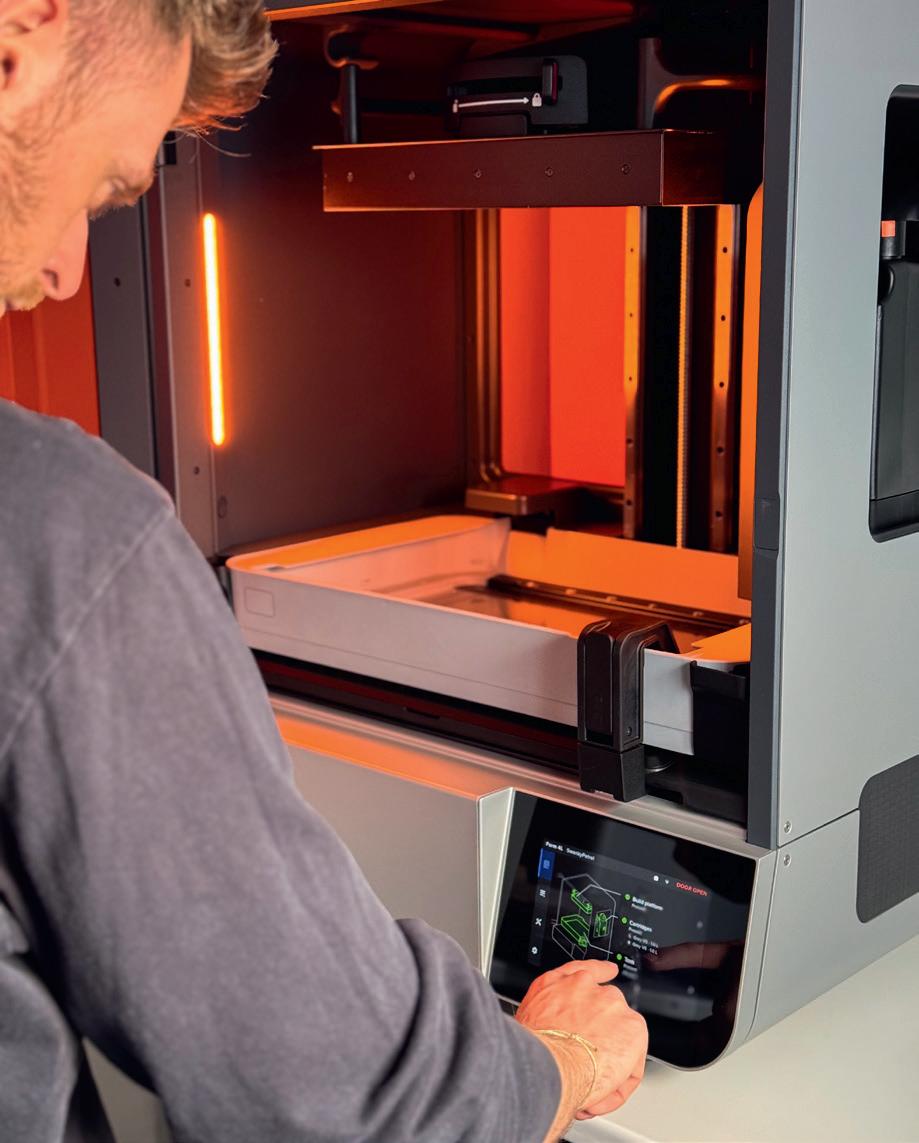
The prototype model for Longbow saw the team venture beyond providing digital designs. In addition, it also produced a great deal of the vehicle’s small components in-house, such as the car badges, while also helping to sort and assemble other pieces as the physical prototype took shape.
“Our reputation is entirely based on our portfolio work and the quality of that work. So it’s in our interest to make sure that it is delivered in a way that we’re happy with,” says Gould.
“If that means we have to go above and beyond to support that and make sure that the quality of the end product is something we’re pleased to put our name to then we do that.”
The team at Avant Design is still assisting its counterparts at Longbow as they move into the verification prototype stage, where production-intent components are assembled ready for further engineering validation to begin.
Gould promises that Longbow won’t be the only showstopper to emerge from the Avant Design studio in 2026. The consultancy’s powers when it comes to putting the latest technology to work, he believes, will continue to give its featherweight team the knockout punch of a true heavyweight.
www.avant.design














●
3D printing was used to create small components for the Longbow, including its badges
The team at Avant Design works on a range of projects across the transportation sector, from sports cars to trucks
Visit DEVELOP3D LIVE on 25 March to see Avant Design’s Chris Gould present on the main stage. Gould will reflect on the relationship









































Unlocking the Power of CAD Data in AI
AI tools are touching every industry, including engineering, with large language models, image-trained tools, and custom AI agents, finding their way into applications across markets. But one frontier remains largely hidden: CAD-informed machine learning models for use in engineering applications.
The potential value is intriguing; tools that could recognize the relevant context of your specific CAD data, incorporating assemblies and geometry, metadata, tolerances, and more to provide holistic insights that inform every stage of engineering workflows. Making practical use of this data in AI tools is both difficult and immensely valuable.
The same richness of data that makes this such an enticing prospect makes it uniquely challenging to utilize in machine learning tools. New tools are breaking down these barriers, providing developers with the fastest path from CAD data to working machine learning models.
Why is CAD Data Such a Challenge to Use in AI Tools?
Engineering CAD data poses unique obstacles for AI developers. Unlike images or text, CAD files are:
• Highly structured, hierarchical, and interdependent. Assemblies reference parts, which reference features, which may encode tolerances, PMI, and design intent.
• Continuous and precise. Small differences in dimensions can have outsized effects on predictions (e.g., predicting an extrusion of 100.002 mm vs 100.000 mm).
• Multi-format. There are dozens of CAD systems, each with their own native file formats and quirks. Training on one may or may not carry over to another.
Bluntly, training machine learning models directly on CAD data is a vastly different process from training on natural images or text. Models must handle assembly structure, topology, features, metadata , and geometric precision simultaneously. A small oversight in preprocessing or encoding can propagate errors through the workflow.
Why Do Companies Want CAD-Trained Machine Learning Tools?
Despite the difficulty, companies continue to invest in CAD-informed AI because the potential payoff is huge. Engineering organizations hold decades of detailed design data, much of which is locked inside files that are difficult to analyze at scale. CAD-trained machine learning models offer a way to extract value from that information without reducing it to oversimplified representations.
Improving team efficiency is a clear benefit of these tools. Engineering teams spend large amounts of time reviewing models, validating intent, and checking relationships already encoded in CAD. AI tools trained on CAD data can interpret surface features, tolerances, and structural relationships far faster than manual review, allowing engineers to focus on design decisions rather than inspections.
By identifying inconsistencies earlier, CADtrained machine learning tools can also reduce downstream manufacturing defects and rework. Once trained, these models can also extend their utility to simulation, manufacturing, quality assurance, and other engineering systems, turning accumulated design knowledge into insight that compounds over time , rather than remaining siloed in individual tools.
The specific use cases are significant, from increased automation in robotics, manufacturing, CAE, scan data, and design workflows.
How are Developers Integrating CAD into AI Models
As with any machine learning process, data selection and optimization are key to the process . CAD data is often sensitive intellectual property. Datasets are rarely public, standardized, or immediately ready to start training a model, unlike image or text datasets. Internal archives that most organizations have were rarely created with machine learning in mind. Files span multiple CAD systems, modeling conventions, and levels of quality. Before a single model can be trained, developers must first decide what “usable” CAD data even means for their application.
Once data is collected, it must be transformed into a form Machine Learning algorithms can consume, and this is where many efforts stall. CAD files are not flat objects. They encode relationships between faces, edges, features, and assemblies. Choosing how to represent and encode that information for Machine Learning is a hard decision; some teams experiment with mesh-based approaches, others with boundary representation (B-Rep) graphs, and many discover that preserving engineering intent requires hybrid strategies. Each choice affects ML model performance, memory usage, and training time. Training the model introduces another layer of complexity. Processing CAD-based datasets is far more computationally intensive than training with text or image data. Geometry-heavy representations increase memory requirements, while batch sizes must be carefully managed to avoid overfitting to specific design patterns. As AI algorithms evolve, ML models must evolve alongside them. For developers, this turns model training into an ongoing engineering effort rather than a one-time task.
Finally, there is the question of generalization and usage. A CAD-informed machine learning model must extrapolate beyond the specific
AsAIbecomesmore pervasiveacrossengineering workflows,theabilityto trainmodelsdirectlyonCAD datawillincreasinglydefine whatispossible,separating surface-levelautomation fromsystemsthatgenuinely understanddesignintent

geometry it was trained on. This is where approaches such as graph-based learning become critical, allowing models to infer relationships with unseen assemblies rather than memorize shapes. Even so, validation remains difficult. Developers must test against real-world designs, often discovering edge cases that force them back to earlier stages of the pipeline.
Taken together, this workflow explains why CAD-informed AI remains in its infancy. It demands fluency across CAD systems, machine learning theory, and software infrastructure. Perhaps most limiting, it takes a special set of data and computer science skills to execute efficiently.
Naturally, this leads to the question: how can companies meaningfully reduce the resource cost of CAD-based machine learning to take advantage of the huge potential the technology offers?
From Challenge to Capability: Enter HOOPS AI
With over 30 years of experience providing engineering-focused toolkits to developers for CAD data access, visualization, CAE applications, Tech Soft 3D has handled more CAD data than just about anyone out there. These toolkits accelerate application development by licensing core features instead of building them in-house. With this experience, Tech Soft 3D has launched a new toolkit to help developers address the challenges of leveraging their CAD data for machine learning.
HOOPS AI is a framework designed to help machine learning engineers and data scientists accelerate the process of creating machine learning models with CAD data. It is not an AI program or pre-built system for handling your CAD data and will not replace your engineers.
The toolkit addresses the underlying obstacles that make CAD-informed AI difficult in the first place. Its purpose is to give developers the building blocks needed to train and deploy models on their own CAD data, without forcing them to reinvent the
entire pipeline. From CAD data access to ingestion, versioning, lineage, and reproducible runs, HOOPS AI empowers a few engineers to do the work of many, offering 20-40% lower experiment time. Combined with its visualization and interpretability tools, these features make HOOPS AI the factory that supercharges the CAD-informed machine learning training and experimentation process.
What does HOOPS AI Do?
The first step is streamlining data access, addressing the fragmented nature of CAD ecosystems and poor success rates of other data access tools. HOOPS AI builds on HOOPS Exchange to ingest a wide range of CAD formats through a consistent application interface (API) , allowing developers to focus on learning rather than file compatibility.
The richness of the data in CAD files is both what makes it challenging and enticing to work with, and preserving engineering intent requires more than geometry alone. HOOPS AI supports boundary representation and hybrid encodings, graph-based assembly structures, and the integration of manufacturing annotations , enabling models to learn from topology and relationships rather than simplified shapes. Rather than locking users into a single approach, HOOPS AI provides architectures and tooling that accelerate experimentation , supporting both CPU and GPU workflows across different dataset sizes and model configurations. This flexibility is critical in a domain where no single representation or training strategy fits every use case. These models are designed for common CAD use cases, including classifying parts, recognizing features, and auto-completing part geometry.
These samples typically reach around 80% accuracy out of the box, ready to be fine-tuned for specific application needs.
Perhaps most important as a benefit and
caveat, control remains with the developer. HOOPS AI is designed to be extensible, allowing teams to integrate their own encoders, customize preprocessing steps, and deploy within private or cloud environments. Data ownership and privacy remain intact.
HOOPS AI does not eliminate all the challenges of creating machine learning models with CAD. High-quality, curated datasets are still required , and no framework can substitute for domain knowledge embedded in proprietary design archives.
HOOPS AI does not deliver pre-built answers to industry problems, but enables teams to build systems that reflect their data, their constraints, and their goals. Most industrial applications demand fine-tuning or entirely custom training, shaped by the specific geometry, standards, and workflows of the organization using them.
Looking Forward
CAD-informed AI represents a frontier that is only beginning to take shape. As AI becomes more pervasive across engineering workflows, the ability to train models directly on CAD data will increasingly define what is possible , separating surface-level automation from systems that genuinely understand design intent.
HOOPS AI is one part of that emerging landscape, making the problems of training machine learning models more approachable without pretending they’re solved. At the same time, the field itself continues to evolve. Both the tooling and the underlying techniques are still in motion, shaped by developers, researchers, and companies willing to invest early.
The organizations engaging with CAD-informed AI today are helping define how engineering knowledge is captured, reused, and amplified in the years ahead.
DEVELOP3D LIVE 2026 PREVIEW
» As we gear up for DEVELOP3D LIVE 2026 at Warwick Arts Centre on 25 March, Stephen Holmes takes a look at some of the highlights planned for the bumper one-day event, packed with design and engineering technology and know-how
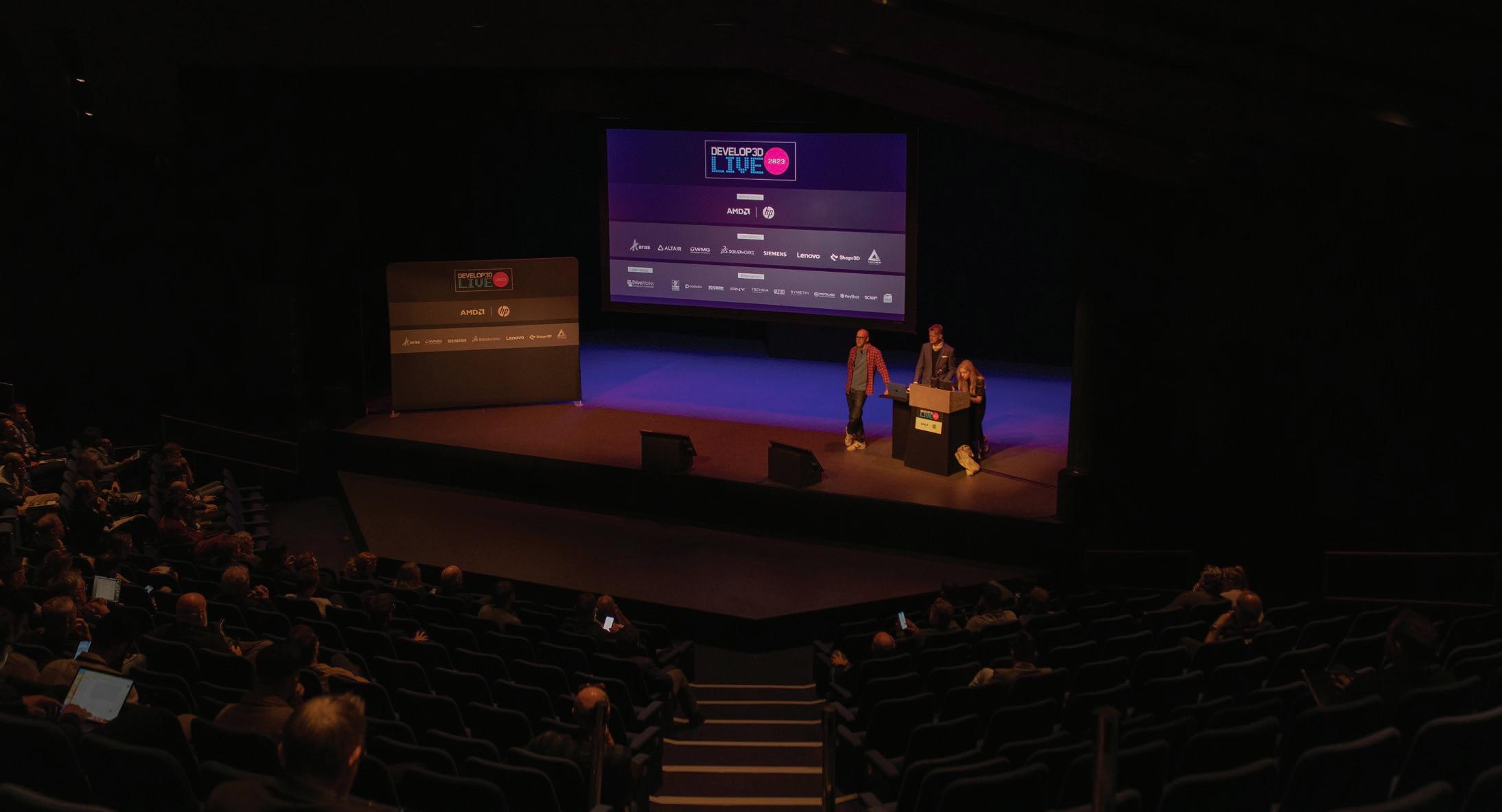
It seems crazy to think that we’re right in the middle of a technological and industrial revolution, and that once again designers and engineers are going to be on the front lines of huge change.
AI technology is updating and improving day-by-day, with new companies and fresh opportunities launching every week. In the past year we’ve seen software vendors go from talking up the potential of AI in their toolsets to launching real-world applications, assistants and standalone tools that are already transforming traditional product development workflows.
DEVELOP3D LIVE 2026 looks to help guide you into the water before the big waves of change begin. We’ve expanded our talks on AI to reflect this, with a dedicated track from some of the companies we’ve identified as ones to follow. They’ll touch upon how CAD, simulation, visualisation and generative design is powering ahead today, and what lies in wait just around the corner.
Couple this with talks from companies creating new tech at the bleeding edge of what’s possible on our Startups stage, and the chance to kick the tyres of the software
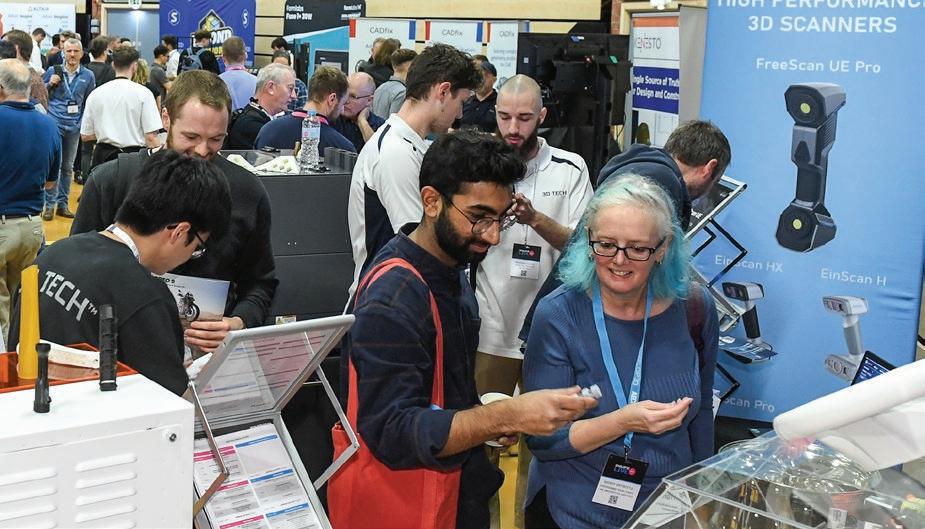
and ask further questions in the exhibition zone, and you’ve an amazing opportunity to take away the latest knowledge and perhaps a competitive edge.
But simply learning a handful of new names and marvelling at AI is not enough, hence DEVELOP3D LIVE presents the holistic view – from concept to manufacture. We know that any knowledge gained is useless without context, so we’ve packed the schedule with incredible designers and engineers that are racing to bring new products to market faster than ever before.
‘Agile’ has always been a buzzword, but now the software and hardware powering workflows is making this an attainable reality – allowing small agencies to punch well above their weight, and giant OEMs to finally shake off some of the constraints.
DEVELOP3D LIVE 2026 is going to be an event that not only introduces your design and engineering teams to new technologies, but it will showcase where this can all fit into your existing processes and systems. Huge change is happening, and it’s a lot to take in, so let this event be the one to help you to see what is possible.
Keynote
Text-to-Spaceship:
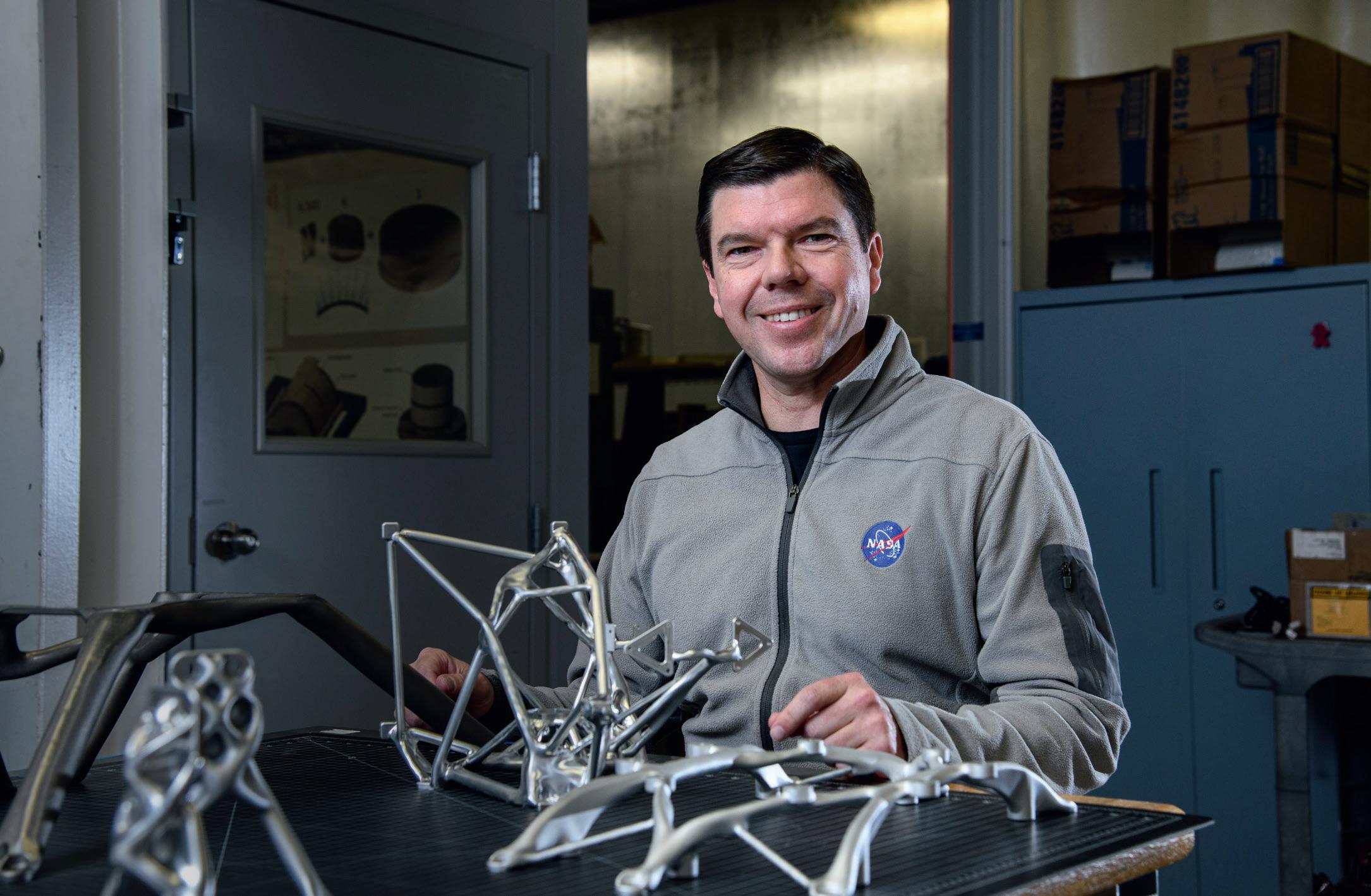
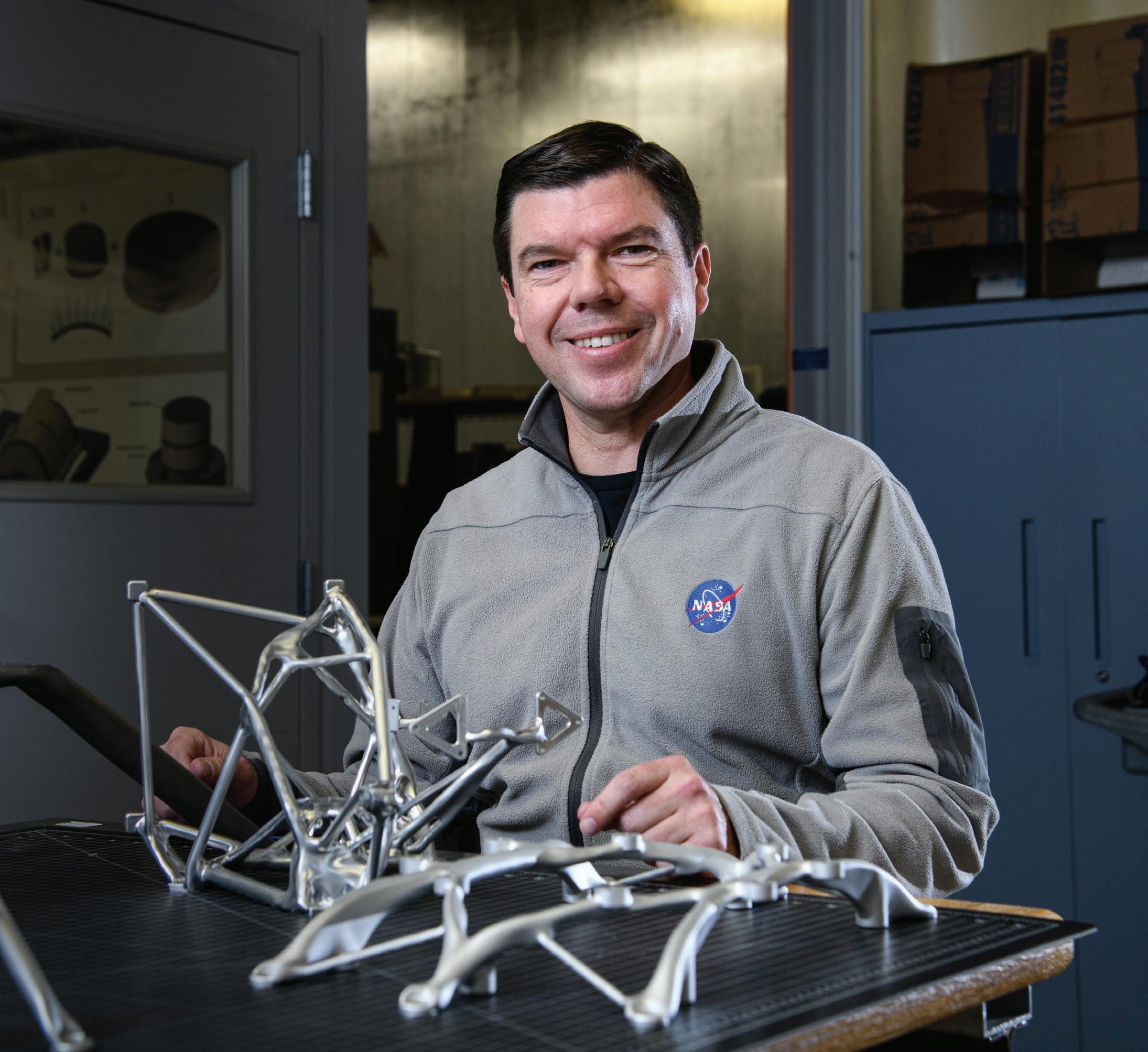
TEXT-TO-SPACESHIP WITH NASA
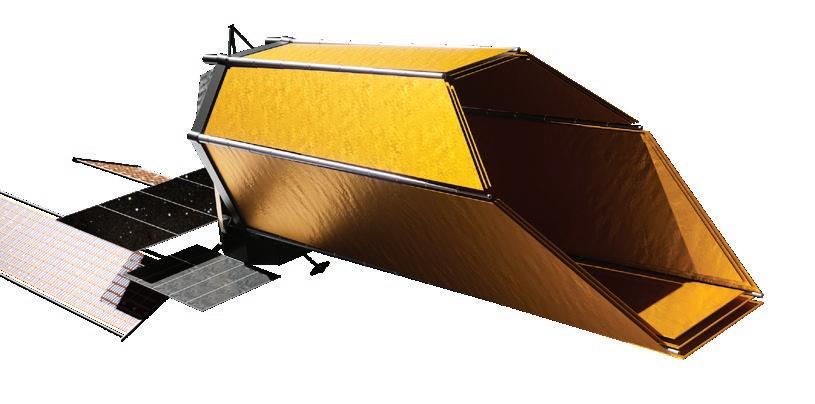
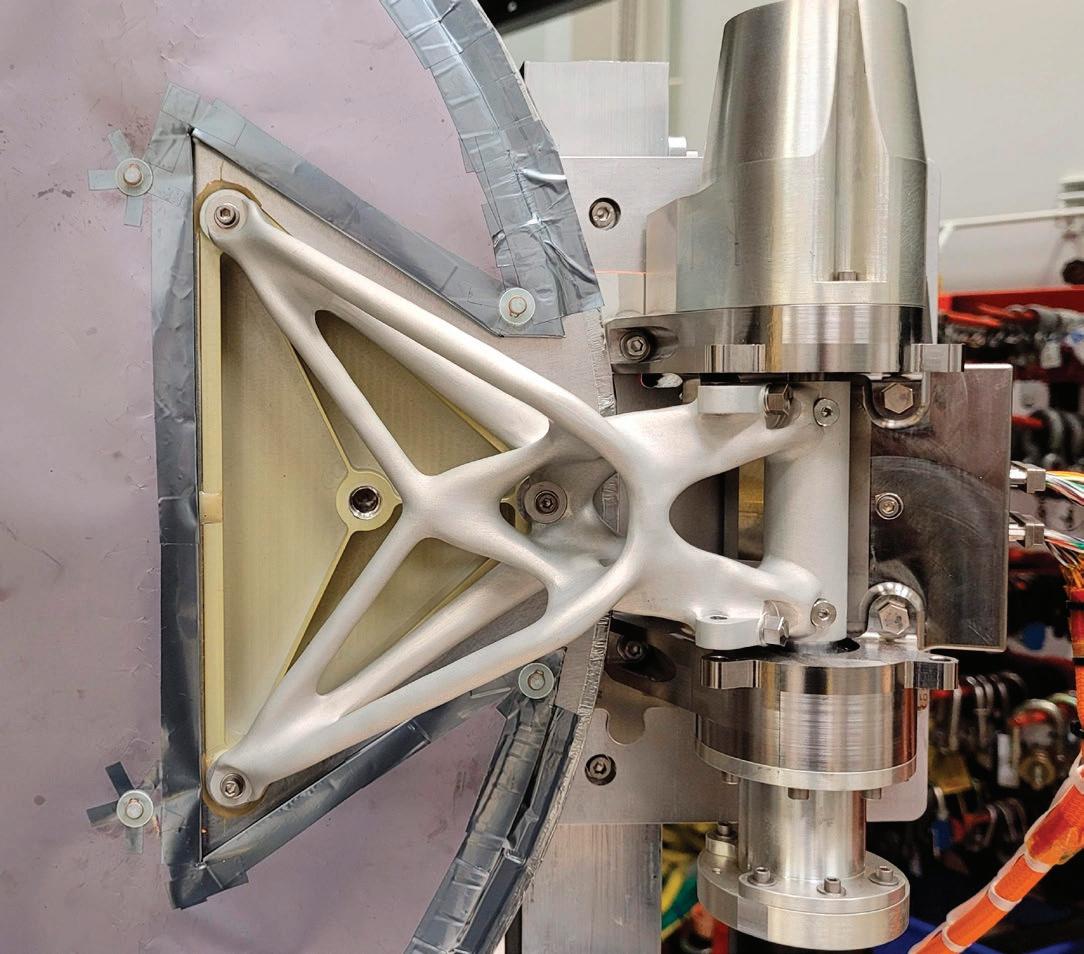
NASA is already invested in how AI can take design requirements and generate optimised structures that are lighter, stronger and delivered in days instead of months. Ryan McClelland, deputy chief AI officer at NASA Goddard Space Flight Center, will present its Text-to-Spaceship vision, and how language-defined needs flow through these automated systems, accelerating mission development by an order of magnitude. He’ll give an idea as to how this has scaled through a secure, cloud-deployed ecosystem of AI-accessible design, analysis, and manufacturing tools — some elements of which you might already be using today. From initial brackets to full payload designs, Text-to-Spaceship is a near-term reality for the next generation of spacecraft that will redefine how we explore the universe.

TECHNOLOGY FUTURES
Some of the biggest, most recognisable and mission critical technologies again head to DEVELOP3D LIVE to provide updates and give a glimpse into what the future holds.
Expect to hear the latest updates, customer insights from real world use, plus some tantalising glimpses of how the software you use today is evolving.
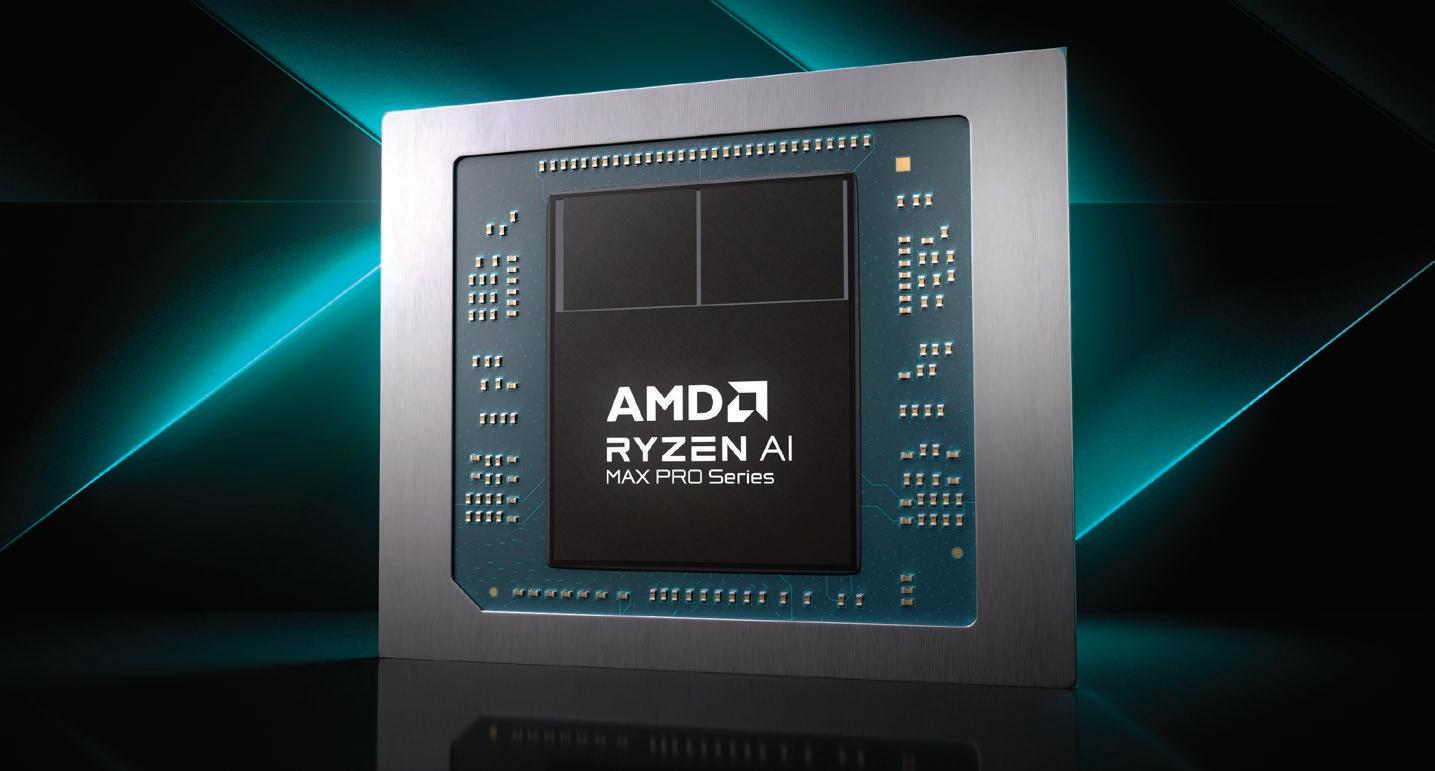
Get the very latest news from the likes of Solidworks, Siemens, Onshape, Autodesk and HCL Software as their executives appear in back-to-back sessions on our main stage. HP will also showcase the latest developments in hardware, with its AMD-based HP ZBook Ultra G1a and Z2 Mini G1a.
AVANT DESIGN
Avant Design, the design studio behind the Longbow EV sportscar, will give an insight into its fast-paced digital workflow.
Having developed a wide swathe of transport projects, this talk will highlight how elements like VR and visualisation are key to their practice. Learn how spatial design tools can be integrated into your own workflows and better maintain design intent and transform stakeholder engagement. (see cover story on page 14)
ANGEL GUERRA
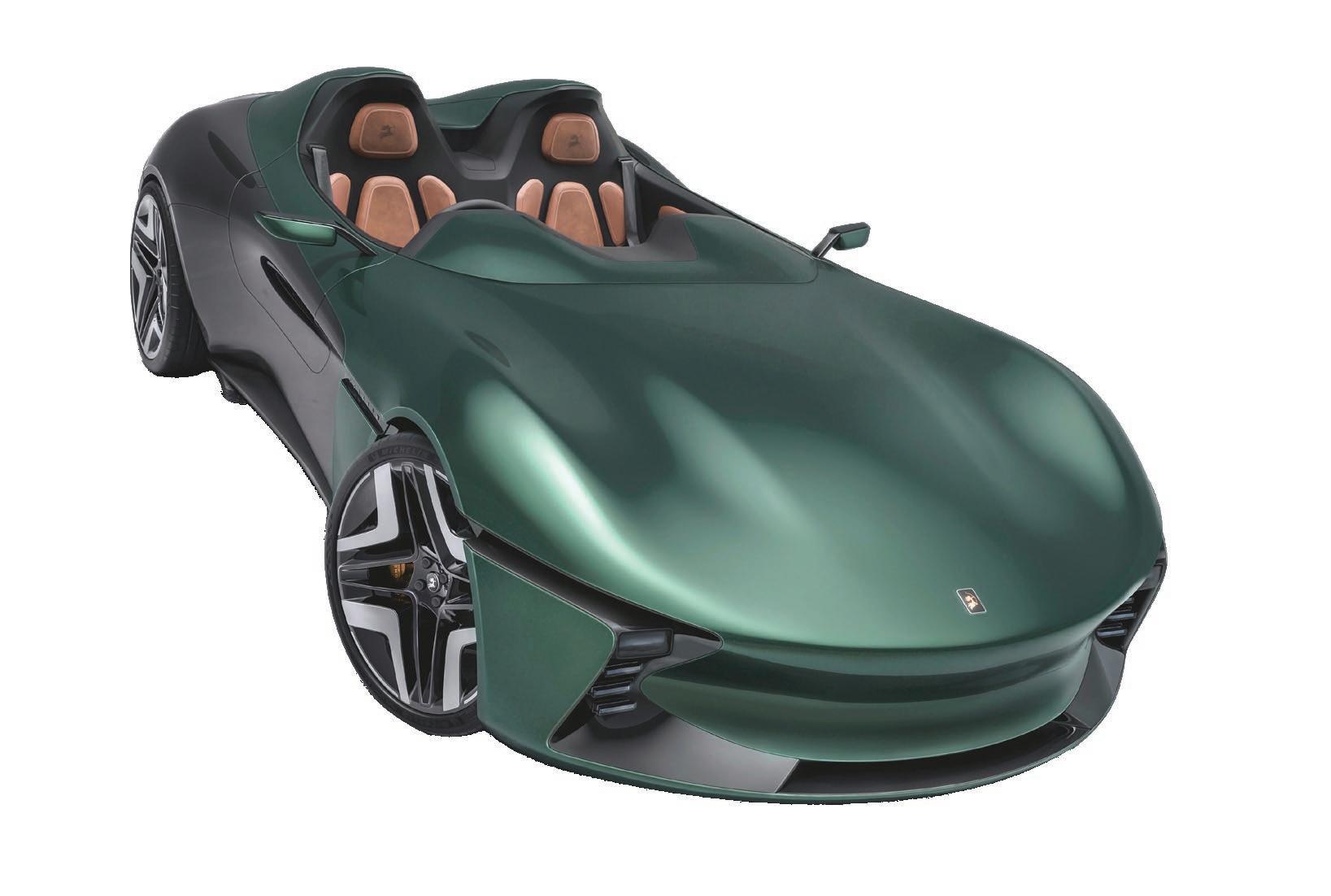
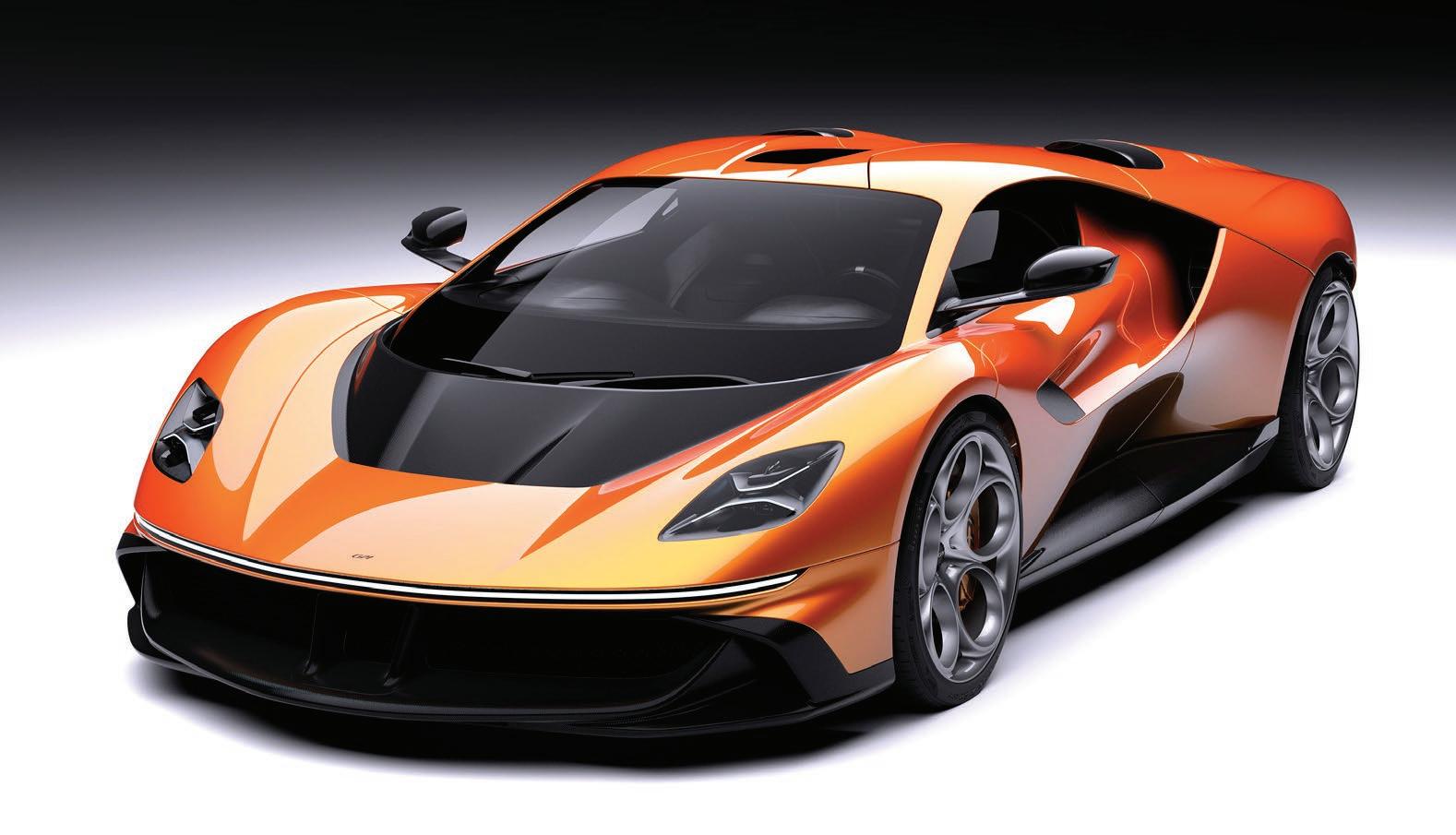
Angel Guerra, an automotive design consultant who collaborates with luxury and hypercar brands, heads to DEVELOP3D LIVE following the unveiling of his latest creation, the Garagisti & Co GP1.
Guerra will explore how real-time visualisation and VR have transformed his design workflow, with projects like the Rimac Nevera and Bugatti Mistral to call upon. He’ll also give some insight on how the strategic use of demo projects and social media positioning can help designers attract high-end clients and stay relevant.
Viz Product design
Virtual Reality Product design
3D printing Product design
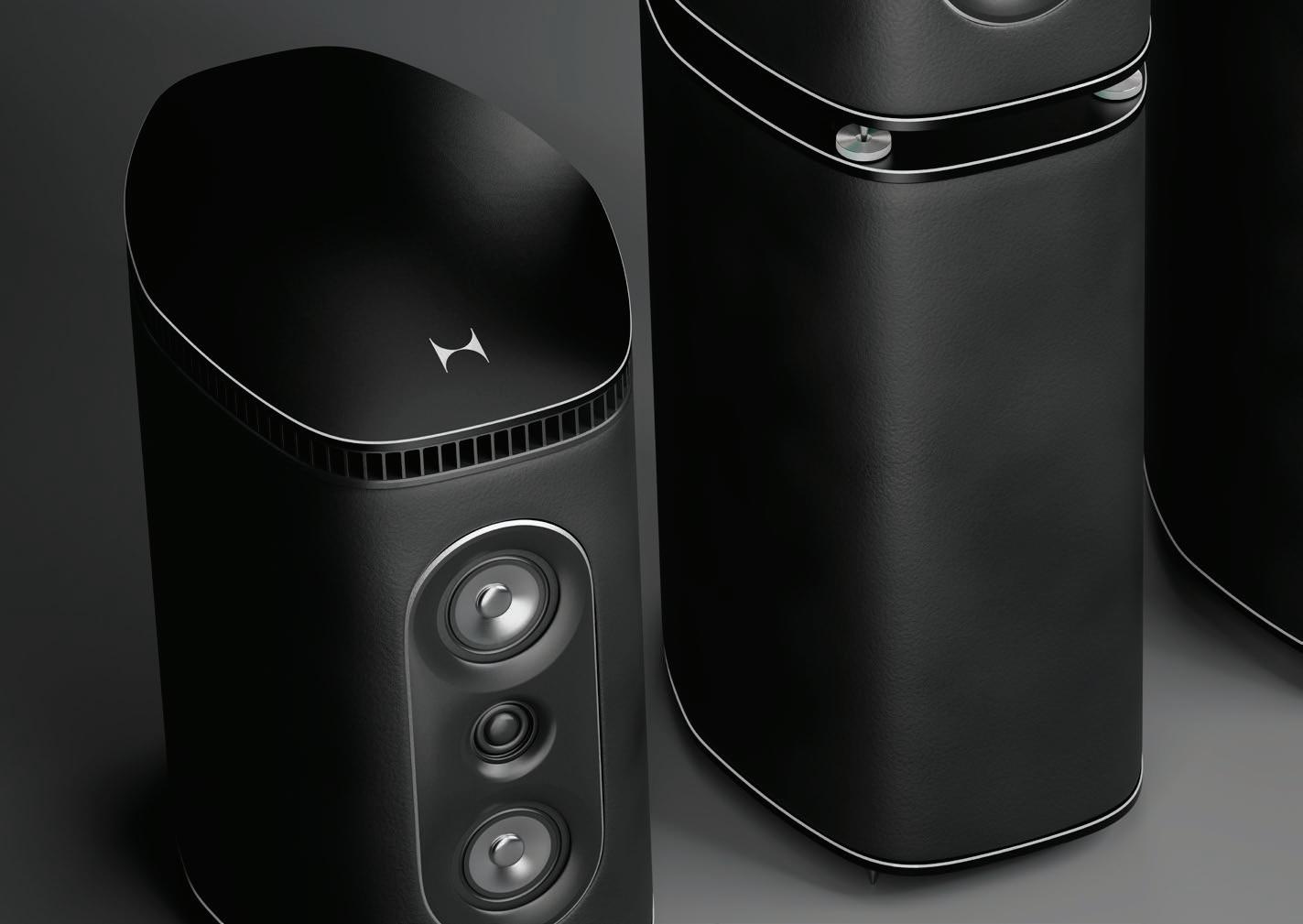
NODE AUDIO
Luxury audio has for too long relied on dated materials and processes. This is where Node Audio has stepped in and ripped up the rulebook.
Using additive manufacturing the company has created internal forms that allow the sound to travel unimpeded, creating rich bass levels in far more compact cabinets. Meanwhile, the use of 3D printed gyroid infills has allowed the team to replace traditional wadding materials, while adding further functionalities to the product.
Learn how this team of product designers are transforming what’s possible with an agile approach and willingness to trial the latest tech.
THE AI STAGE
For the hot topic of the moment, we’ve put together an overview of CAD, generative design, simulation and visualisation to give you an idea of what AI can offer in these fields, and where it is likely to head next.
With speakers from Tech Soft 3D, CDS, SimScale and a special overview of AI tools for visualisation and rendering by Jesper Mosegaard of Figurement, there’s a tonne of knowledge to be shared.


DEPIX - AI RENDERING
With products now expected to be launched in months rather than years, the ability to get into the meat of the design process faster is one area where AI has made incredible progress. Depix is one of the best examples, offering not only quick-fire generative AI renderings that maintain the integrity of your initial design, but the ability to use its powers to enhance and accelerate multiple elements of the design workflow based on the designer’s intent.
Learn more in this DEVELOP3D article - www.tinyurl.com/Depix-D3D
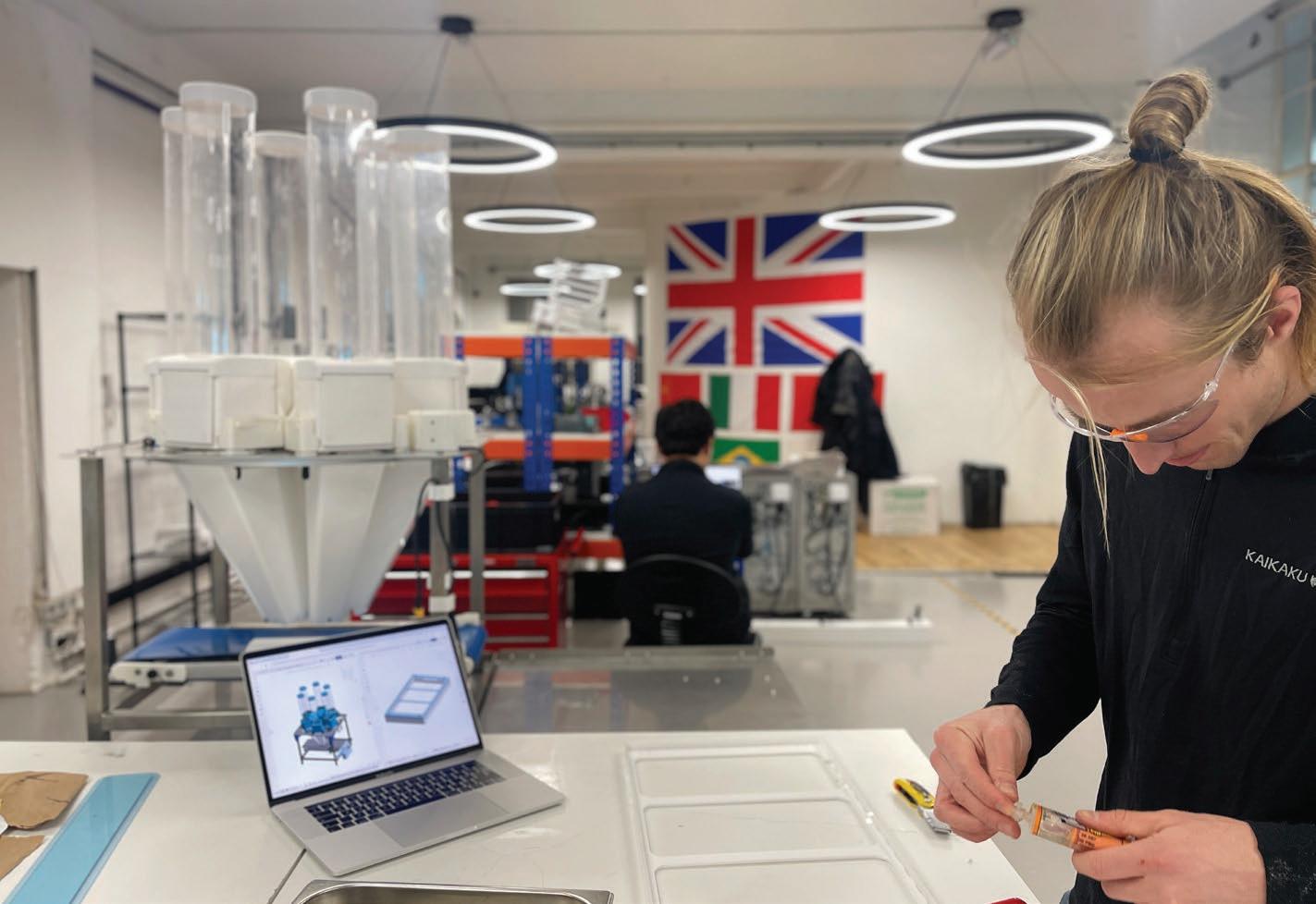
THE FABRICATION STAGE
With the latest iterative prototyping and manufacturing methods key to working out the details and speeding up time to production, it’s exciting that we have several companies speaking about just that on our Future Fabrication stage.
Kaikaku will delve into the development of its restaurant automation technology, a robotic system including many desktop FDM 3D printed parts. Conflux will showcase how F1-grade, super thinwalled metals 3D printing technology is being harnessed to build heat exchangers for automotive and beyond.
THE STARTUP STAGE
With so many exciting new companies in the product development space, we joined forces with Threaded! to bring you a two-hour showcase featuring ten of the most highly-rated startups with products capable of boosting your workflow in 2026
From Compute Maritime transforming how ship designs can be generated, to Authentise’s end-to-end automation for additive manufacturing, and Productive Machines’ AI-driven CNC machining optimisation software – there’s something new here for the entire product development workflow.
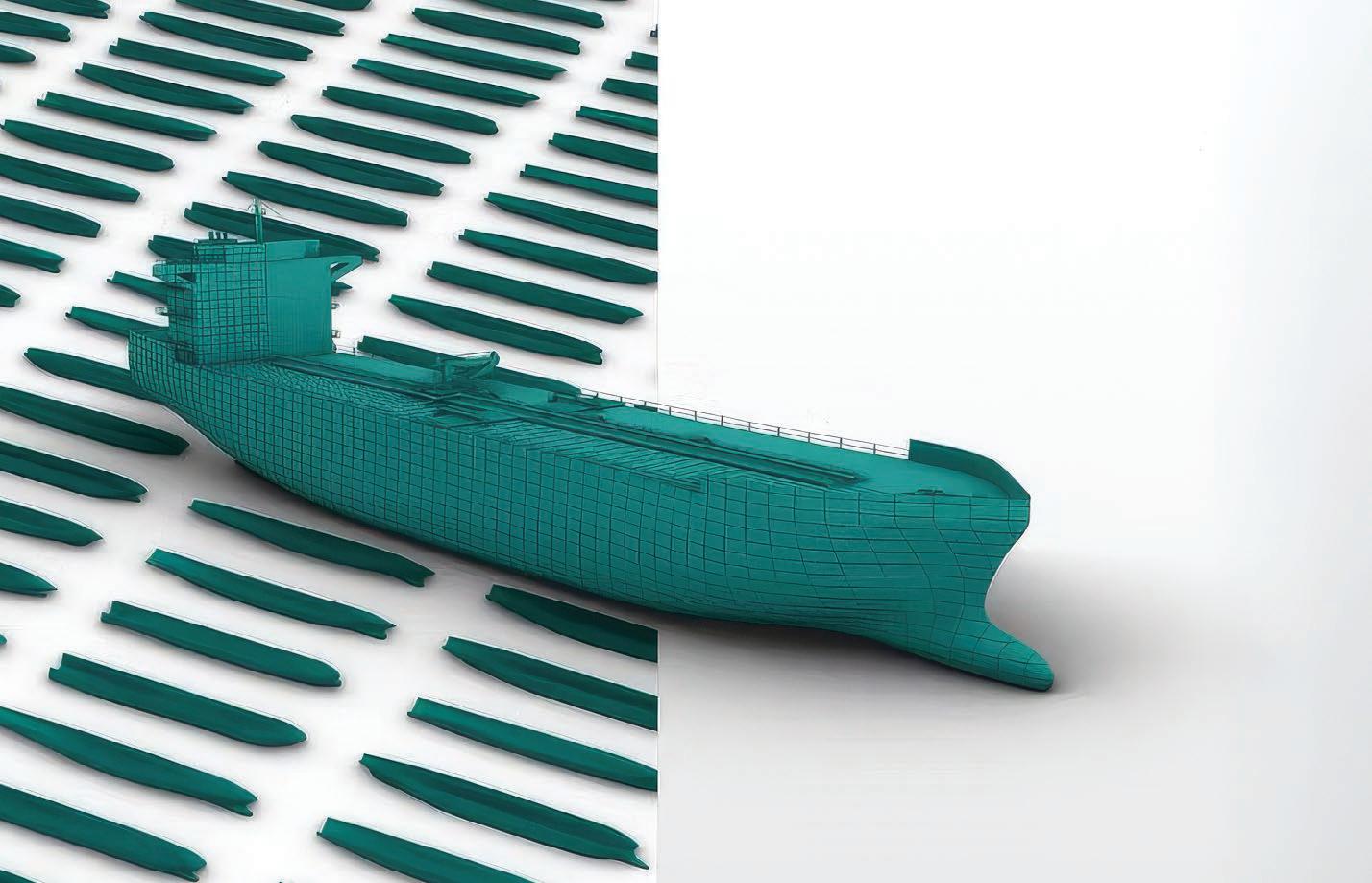

The future of product development technology
THE VIZ STAGE
As an industry sector that has been shaken up by generative AI, we look at whether prompts will ever undo real human skills, or will the human eye win out?
This track features excellent presentations from the likes of Presume, a viz agency that crafts incredibly lifelike product renders that imbue an astonishing level of tactility and material realness. We also have technology focussed talks that will delve into where AI can come into play while maintaining traditional skills.
THE ENGINEER OF 2030
AI is dissolving engineering software complexity, believes Rhushik Matroja, CEO of CDS, whose talk explores what happens when AI handles the mundane and enables superhuman design space exploration.
Drawing on CDS’ deployments across aerospace, defence, and automotive, it presents the engineer of 2030: a data-driven analyst whose value lies in asking the right questions, not clicking the right buttons. With glimpses of recent R&D advances it will show what engineering practice looks like when the procedural layer disappears entirely.
3DPRINTUK STAND A31
3DPRINTUK, a specialist in polymer additive manufacturing, helps organisations bridge the gap between prototype and injection moulding with “robust, scalable additive manufacturing solutions” tailored to high-volume production.
According to the company, it offers the largest MJF, SLS, and SAF 3D printing capacity in the country and produces over two million parts each year, supporting industries ranging from aerospace and marine to defence, cycling, creative sectors, and medical.
The firm’s London based facility houses an advanced powder bed fusion production suite, featuring HP Multi Jet Fusion, EOS SLS and the Stratasys SAF H350. www.3dprint-uk.co.uk
AMD STAND A27-A30
For more than 50 years AMD has driven innovation in high-performance computing, graphics and visualisation technologies. Billions of people, leading Fortune 500 businesses and cutting-edge scientific research institutions around the world rely on AMD technology daily to improve how they live, work and play. AMD employees are focused on building leadership highperformance and adaptive products that push the boundaries of what is possible. www.amd.com
ADDITIVE-X STAND A35
Additive-X is an expert in additive, offering 3D printers and a 3D printing service including units, supplies, support, repairs, hire, and training.
According to the company, its team can help to find the right technology and material for your 3D printing application, so you get the results you need.
Additive-X is an authorised reseller and partner of leading brands including Formlabs, Bambu Lab, Markforged, Lynxter, Polymaker and AMT.
Customers can order up to 4.45pm for next day delivery. www.additive-x.com
PRINCIPAL SPONSOR
AUTHENTISE STAND A6
Authentise provides data-driven workflow software for advanced manufacturing, helping organisations move from experimentation to scalable, traceable production. Its modular platform enables manufacturers to manage additive and hybrid manufacturing operations with ‘greater control, visibility, and accountability’. Focused on workflow orchestration, Authentise integrates with systems such as PLM, ERP, MES, and quality tools to help ensure engineering intent flows from design to shop floor. By digitising and structuring manufacturing data, Authentise enables real-time production tracking, automated documentation, and full traceability at part level.
www.authentise.com
BENCH STAND A1
Bench AI is an engineering automation platform designed to take the manual, repetitive work out of CAD and CAE workflows. From defeaturing complex geometry to converting STL files into parametric BREP models and running automated optimisation loops, Bench handles the time-intensive preparation work that sits between design and simulation. Bench integrates directly with existing environments including Catia, NX, Ansys, and Solidworks. The platform uses AI to understand and manipulate complex engineering geometry, but the focus is always on practical outcomes: faster turnaround, fewer manual steps, and more consistent simulation-ready models. www.getbench.ai
BILD STAND A23
Bild is a cloud-based PDM platform for modern hardware teams. It helps engineers manage versions, track design changes, and collaborate without overwriting work.
According to the company, Bild integrates with existing CAD workflows, and streamlines version control, BOM management, and supplier collaboration so teams can move faster with confidence. www.getbild.com
COGNITIVE DESIGN SYSTEMS STAND A22
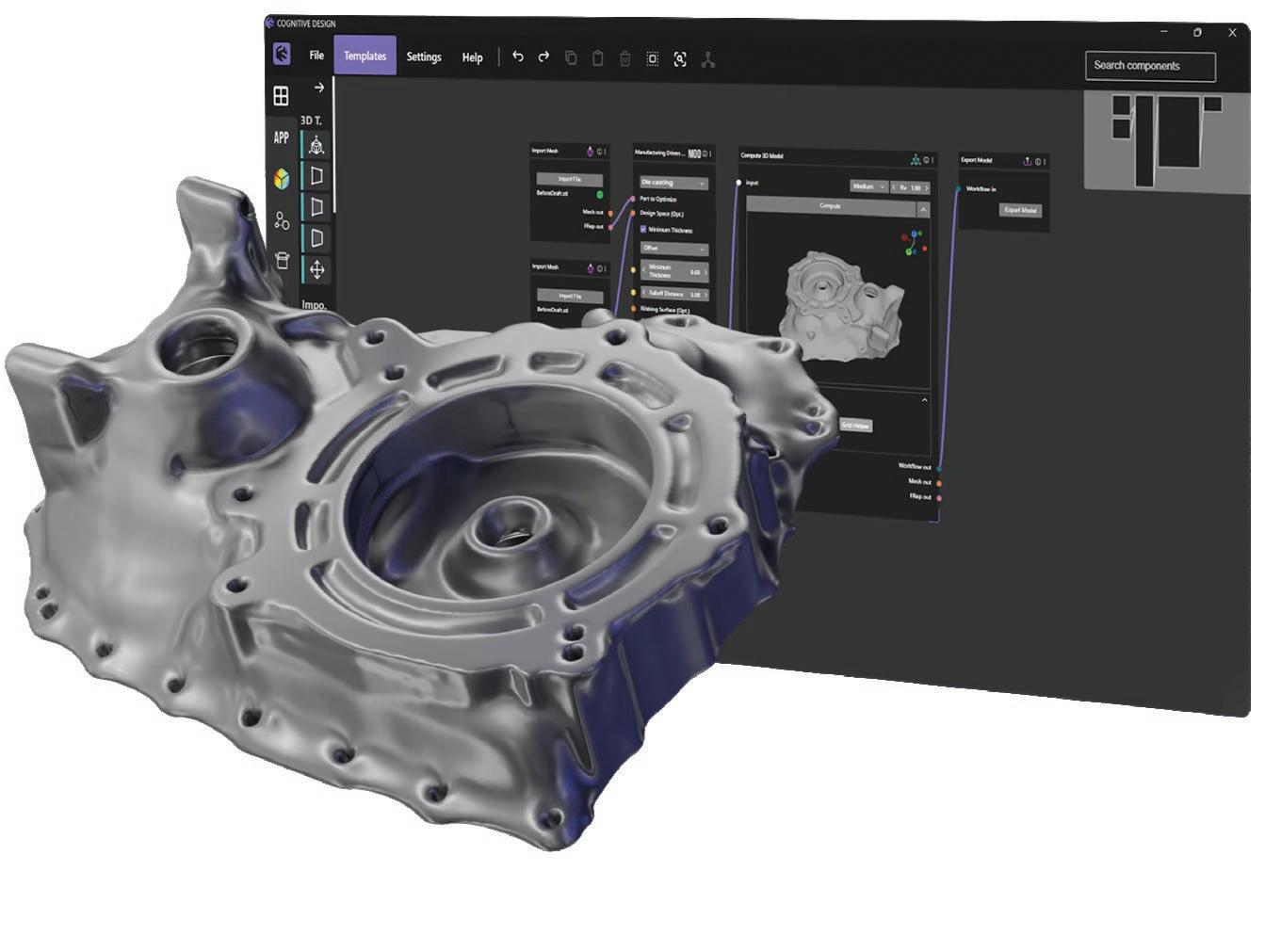
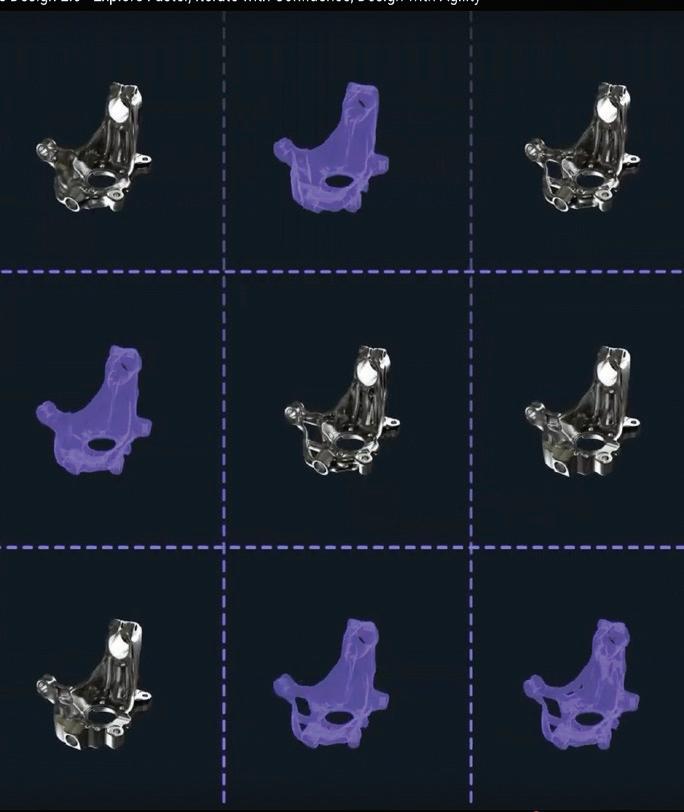
Cognitive Design Systems (CDS) is an engineering software company that helps OEMs and Tier-1 suppliers accelerate the concept exploration of high-performance mechanical and thermo-mechanical components. The company’s 'Cognitive Design' software is said to help engineers design with greater agility, explore more concepts, enable intelligent decisionmaking, and automate repeatable workflows. The software uses generative design, manufacturing-driven design, simulationdriven design, an implicit-geometry engine and AI-driven tools.
CDS serves aerospace, automotive and defence firms in the US, Japan and Europe. www.cognitive-design-systems.com
FIGUREMENT STAND A21
Figurement is a browser based collaborative 3D visualisation platform built for product design teams working across design, CMF, and marketing. It provides a shared real time workspace where teams create, review, and align on product visuals together instead of passing files back and forth.
Figurement requires no installation and runs directly in the browser, allowing anyone in the organisation to participate in reviews and exploration without specialised hardware or software. According to the company, this lowers the barrier for collaboration and makes high quality 3D accessible beyond expert users. www.figurement.com
HP STAND A27-A30
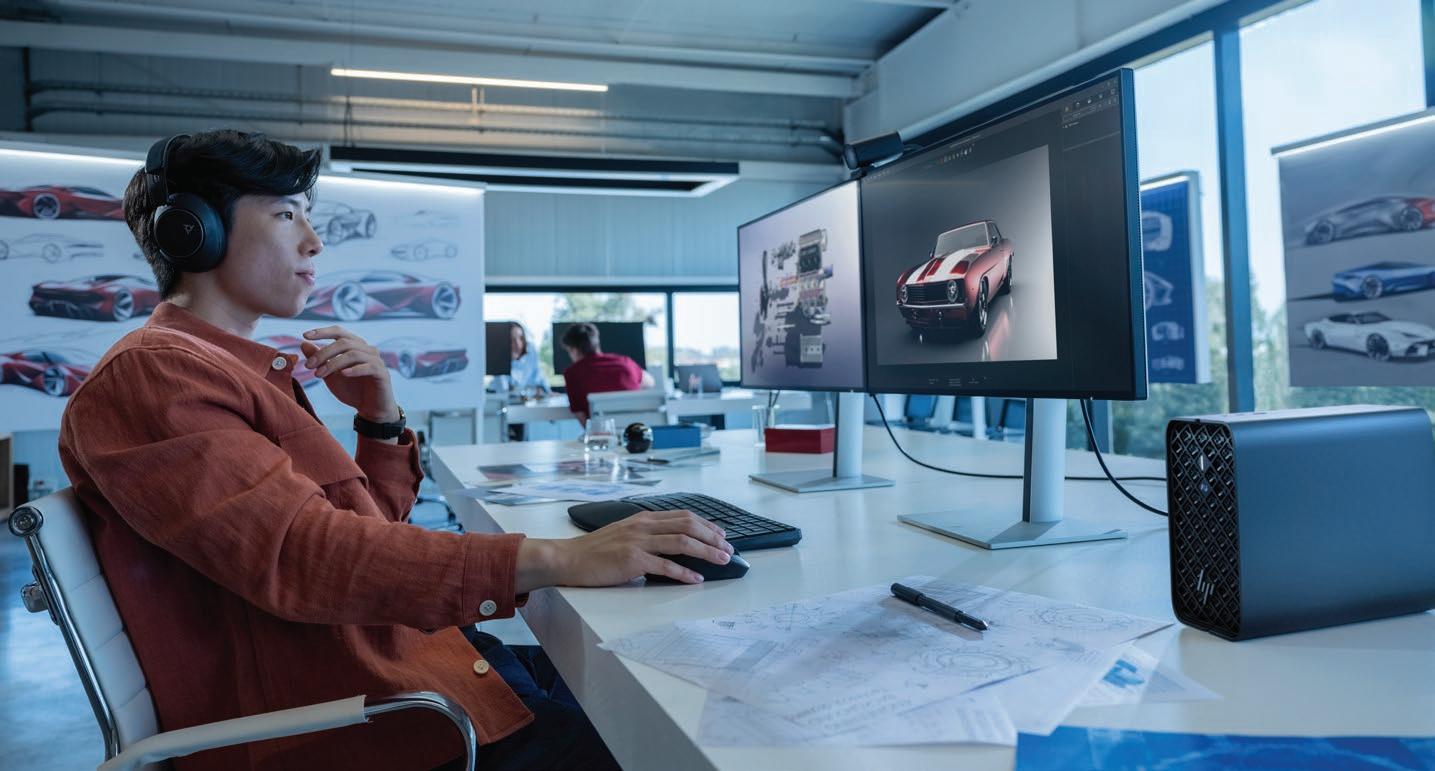
For decades, HP has been a trusted hardware partner for designers and engineers around the world. The HP Z Workstation portfolio offers high performance laptops, desktops, and solutions engineered to drive the most demanding professional workflows. From conceptualisation and 3D modelling to real-time rendering and simulation— Z Workstations are tested, optimised, certified and engineered to outperform standard PCs. The devices are highly reliable and undergo up to 360,000 hours of rigorous testing, maximising productivity with solutions built to last. www.hp.com/z
HCL TECHNOLOGIES STAND A24
HCL DFMPro is a CAD-integrated Design for Manufacturability and Assembly (DfMA) software that helps engineers identify and resolve potential manufacturing issues early in the design process, enabling them to design right first time and avoid costly late-stage changes. DFMPro integrates ‘seamlessly’ into a range of CAD environments, including Solidworks, Creo, 3DExperience, Catia, and NX. The software validates designs against a ‘comprehensive' Engineering Knowledge Database of over 15+ critical manufacturing processes — such as machining, casting, injection moulding, sheet metal, and assembly.
www.dfmpro.com
BRONZE SPONSOR
KEYSHOT STAND A11
KeyShot is billed as a product design-tomarket suite, built around a powerful real-time rendering technology.
According to the company, KeyShot helps businesses of all sizes design with precision, align processes with clarity, manage workflows with efficiency, and deliver impactful products.
KeyShot explains that its 3D rendering technology, which brings designs to life with photorealistic accuracy, is the culmination of decades of innovation and collaboration with product industry leaders. It is designed for those who demand lightning-fast rendering, intuitive workflows, and "unmatched realism" – all in one platform. www.keyshot.com
LENOVO STAND A19-A20
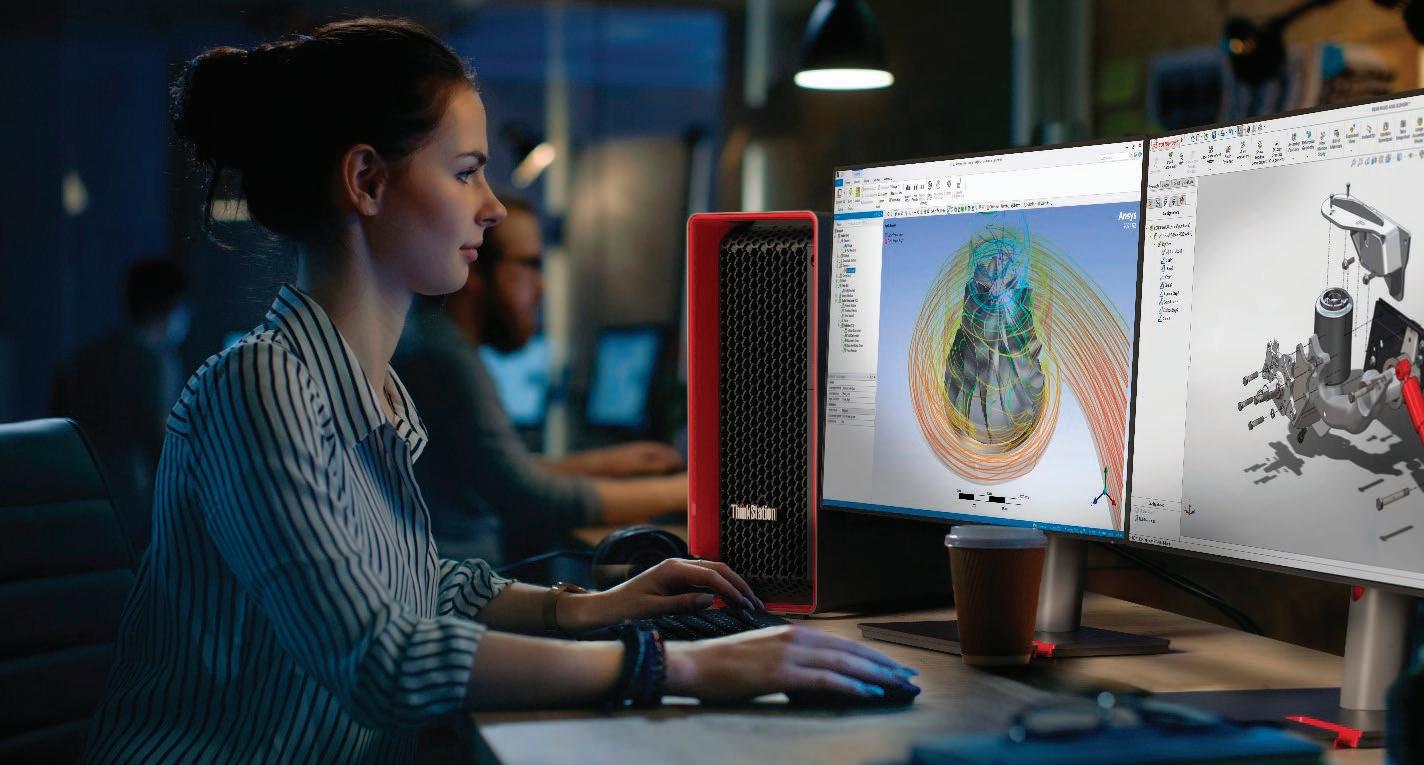
According to Lenovo, its workstations, powered by AMD, are the most trusted and reliable products in the industry. With a wide range of options, Lenovo Workstations give designers, engineers and manufacturers the flexibility to power through any demanding product function – from CAD, CAM and Computer Aided Engineering to rendering, FEA and Simulation.
Teamed with the Lenovo ThinkVision 27 3D monitor, designers can bring 3D content to life without glasses. The monitor’s 2D and 3D compatibility, combined with real-time eye tracking are said to enable designers to experience seamless productivity and create the most colour-accurate content in 3D. www.lenovo.com/workstations
INFINITIVE STAND A5
Infinitive's platform is designed to transform the slow, manual process of creating custom quotes, validating designs, and generating production data for complex, configurable products, into an ‘intuitive, real-time sales experience’. The software integrates directly with your CAD models, enabling sales teams and end-customers to visually assemble unique products from a pre-approved kit of parts. An ‘intelligent configurator’ provides instant 3D visualisation, dynamic pricing, and an accurate bill of materials with ‘every click’. The software is said to understand your design rules, ensuring that every configuration is 100% valid and manufacturable before an order is placed. www.infinitive.io
ITI, WIPRO ENGINEERING STAND A18
International TechneGroup, Inc. (ITI, a Wipro Company) is a specialist in advanced engineering software solutions and services that enable data interoperability and model integrity across the digital engineering enterprise.
For more than three decades, ITI has partnered with leading manufacturers, engineering software vendors, and government agencies to solve geometry and interoperability challenges in design, simulation, and manufacturing. The company's flagship solution, CADfix, streamlines the process of translating, repairing, simplifying, and optimising complex CAD models for multi-CAD, CAE, and visualisation workflows. www.iti-global.com/CADfix
SILVER SPONSOR
GOLD SPONSOR
MEASUREMENT SOLUTIONS LIMITED (MSL) STAND A22
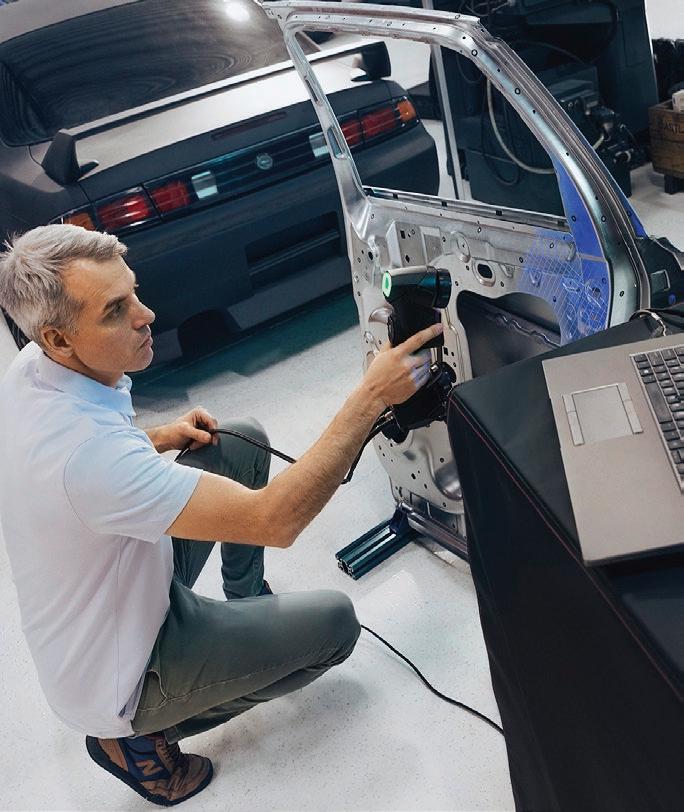
MSL is a specialist in ‘end-to-end’ design, manufacture and inspection solutions and provides products and services to the UK’s leading automotive, aerospace, manufacturing and educational organisations.
The company offers a range of solutions built around Creaform handheld 3D Scanners, Virtek Vision laser projection and quality inspection systems, and a broad metrology portfolio, consisting of traditional co-ordinate measuring machines (CMMs), metrology software and Laser Trackers.
The company’s software portfolio extends to design and additive applications, including mesh editing, Nurb surface creation, parametric feature extraction, topology optimisation and generative design. www.measurement-solutions.co.uk
OR3D STAND A12
OR3D helps firms capture the real world in 3D, check that things are made correctly, and make better decisions with reliable data.
The company's CT (Computed Tomography) service is described as being like an X-ray for parts, showing both the outside and the inside without cutting anything open, to help spot defects, check dimensions, and verify assemblies. It aids quality control in sectors such as aerospace, automotive, medical, and additive manufacturing.
OR3D partners with a range of brands including Geomagic for reverse engineering and inspection, and Hexagon (Volume Graphics) for CT reconstruction and analysis.
www.or3d.co.uk
SIEMENS STAND A15-A16
Siemens Digital Industries Software and Siemens Xcelerator are helping organisations navigate growing design complexity with greater agility, flexibility and speed. As AI moves from experimentation to practical application, Siemens continues to embed intelligence directly into the tools engineers use every day — turning insight into action across the product lifecycle.
At D3D Live, discover Designcenter, Siemens’ AI-enhanced portfolio for modern product development, which brings together Designcenter NX and Designcenter Solid Edge in a scalable software suite that supports engineers from browser to desktop. www.siemens.com
PNY STAND A17
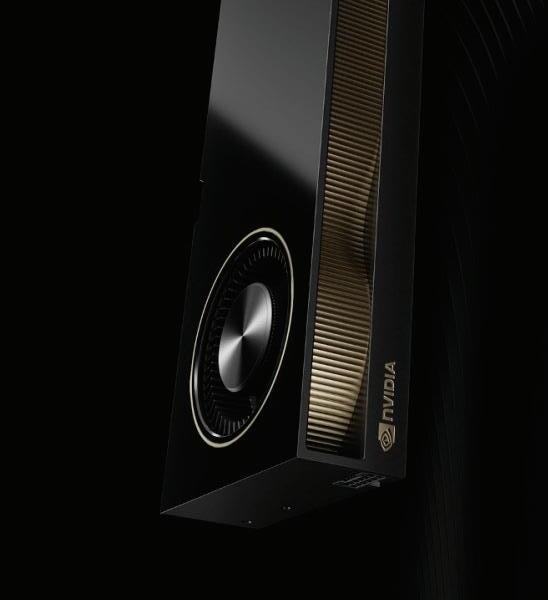
For over 20 years, PNY has fostered a special partnership with Nvidia and supplies the latest GPU technologies for professional applications, including Nvidia Professional Visualisation, as well as the embedded and gaming markets, which gives PNY a unique position in the market as the supplier of choice for all components.
PNY proposes a full spectrum of high value-added solutions in HPC and Artificial Intelligence environments. www.pny.com/en-eu
NEXCAD.AI STAND A13
NexCAD is billed as an 'AI-powered drawing Quality Gate' that automatically reviews engineering drawings prior to release, detecting missing dimensions, incorrect specifications, standards noncompliance, incomplete notes, and BOM inconsistencies.
By preventing errors at the source, NexCAD aims to cut rework, avoid supplier disputes, protect delivery schedules, and strengthen governance while accelerating release cycles. According to the company, standardising drawing review across teams and providing visibility into quality risk at scale, results in measurable cost savings, faster approvals, and higher confidence in every drawing issued.
www.nexcad.ai
SILVER SPONSOR
GOLD SPONSOR
BRONZE SPONSOR
TECH SOFT 3D STAND A9-A10
Tech Soft 3D is a leading provider of engineering software development toolkits (SDKs) and end-user applications for CAD/CAE data conversion, visualisation, and data publishing.
For developers, Tech Soft 3D's HOOPS SDKs (Exchange, Visualize, Envision, Mesh, Solve, and Access) cover CAD data translation, visualisation, 3D PDF publishing, CAE data, meshing and solver support, and CAE read /write needs.
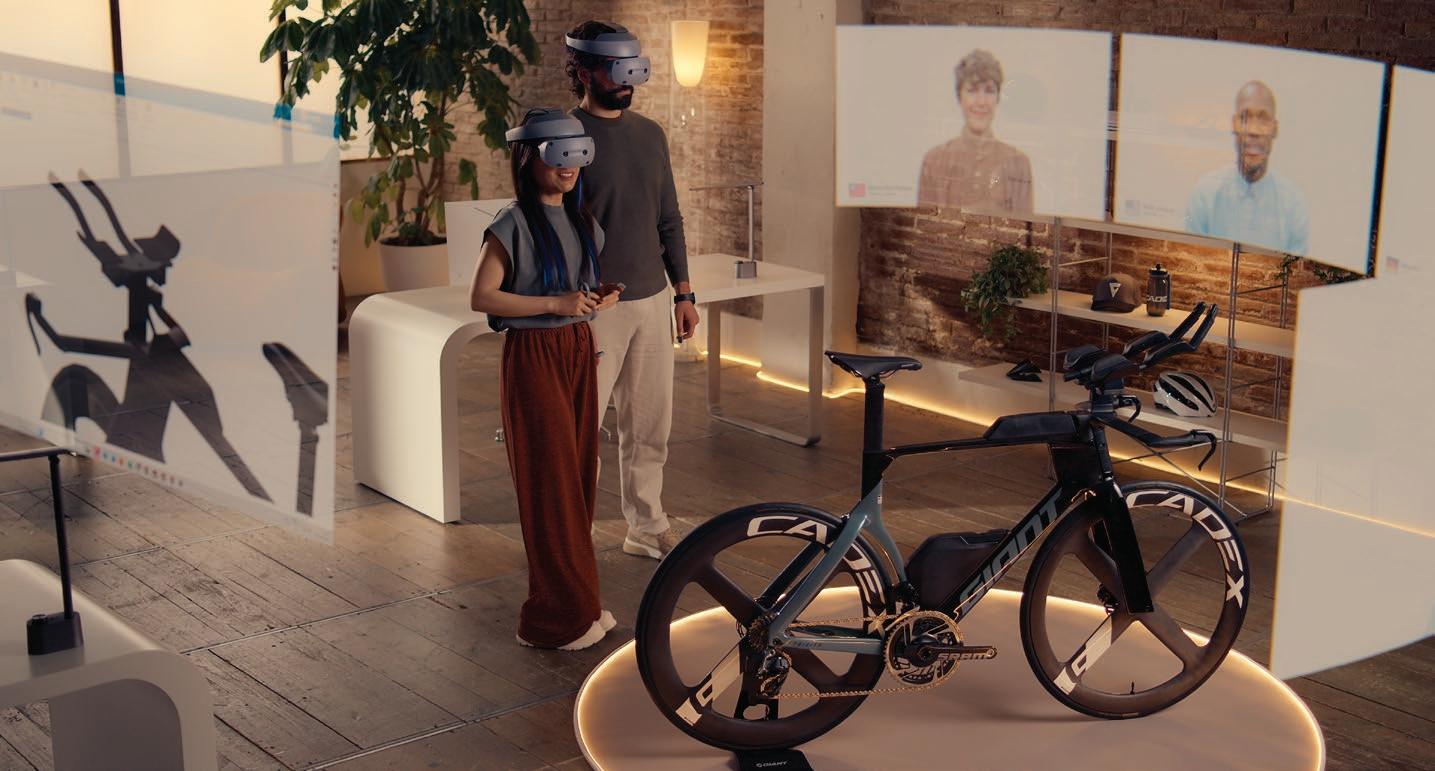
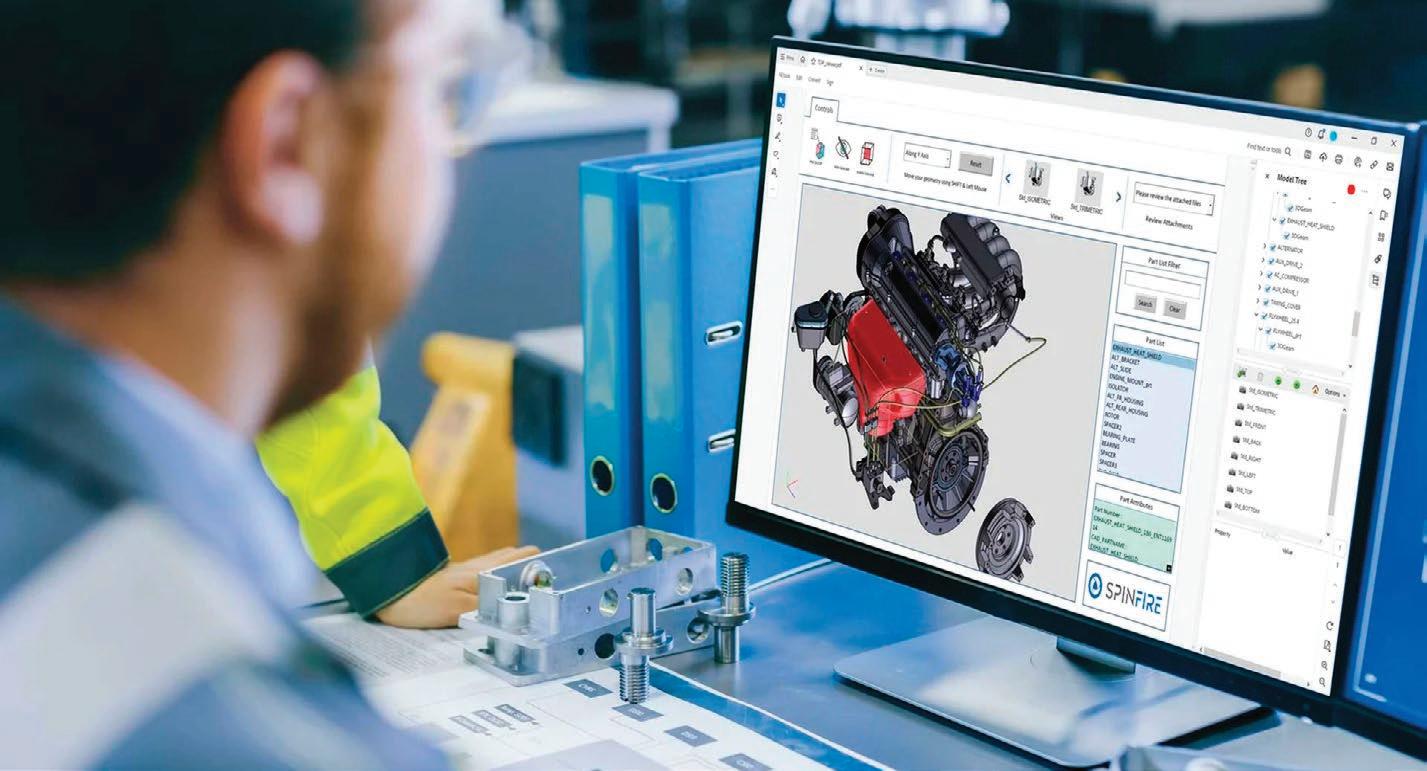
For end-users, Tech Soft 3D's SpinFire portfolio (Convert, Insight, and XR) helps make engineering data accessible across the enterprise, improving collaboration, accelerating decision-making, and minimising reliance on costly CAD licences. www.techsoft3d.com
THREADED STAND A2-A3
Threaded believes the fastest way to advance the digital thread and engineering AI is to bring innovators into the same room — builders, practitioners, and capital — so ideas become solutions and solutions become adoption.
Threaded is designed to connect startups with PLM practitioners, engineering leaders, digital transformation teams, product strategists, and AI & data innovators. It’s also a launch point into the broader Engineering community, helping the next generation of companies connect to real customer problems and accelerate their path to market. www.threaded.live
TOFFEEX STAND A7
ToffeeX is a London-based engineering software company specialising in the design of high-performance thermofluid components. The company's physics-driven generative design software enables engineers to design, simulate, and optimise complex multiphysics components such as heat exchangers.
The fully managed, cloud-native SaaS platform integrates into existing CAD and CAE environments. It combines advanced multiphysics simulation with generative design algorithms such as topology optimisation, allowing engineers to explore a significantly wider design space while maintaining control over engineering intent and manufacturing considerations. www.toffeex.com
GoBe From Car Ride Idea to Target Shelves
Consumer products company GoBe began with an all too familiar (and typically frustrating) experience on a family car ride.
Co-founders Joseph Blanch and Solanda Moran-Blanch were driving with their toddler, who was ready for some snacks. Solanda had cut up fresh strawberries, but she couldn’t just give their daughter the whole bowl since it would inevitably get spilled. Contorting her arm and handing each individual strawberry slice to her in the backseat was difficult—not to mention it disrupted an interesting conversation they were having. Then came an a-ha moment for Joseph, who is a mechanical engineer.
For quite a while, Solanda had been asking Joseph to design a snack tray with compartments. This one car ride connected all the dots and the need for a cover. “I spent an afternoon mocking up a concept in Autodesk Fusion, animating how it could move,” he recalls. When he showed it to Solonda, her excited reaction confirmed they were onto something big.
Creating an entirely new business
GoBe’s first product—the Snack Spinner—is a covered snack tray with a push button in the centre to release the opening for a certain compartment. The product took off and is now available
worldwide, both digitally and in brick-and-mortar stores, including Target and Walmart. With the success of the Snack Spinner, GoBe has continued innovating with a new take on a sippy cup and a lunch box that is proving to be incredibly popular.
Unlike traditional lunch boxes, the GoBe Lunchbox is complete with a carrying handle, a bento compartment, and a secure holding area for a Snack Spinner. But the lunch box didn’t start out the way it’s available today. It was reimagined after extensive customer feedback. Initially designed as a stackable container with a Snack Spinner on top, the first concept, called the “Lunch Stack,” received praise but just wasn’t quite hitting the mark.
“Parents loved it—but they wouldn’t send it to school with their kids because it didn’t fit in their backpacks,” Joseph says. “So we went back to the drawing board.”
Months of iterations led to the GoBe Lunchbox, which has been a massive success both online and with major brick-and-mortar retail. Last year alone, Target signed up for a back-to-school program with an order for 75,000 lunch boxes.
Using Autodesk Fusion to fuel success
A key factor in GoBe’s rapid growth and success is its use of Autodesk Fusion. Joseph used Solidworks for years but switched to Fusion when he started the company. “I didn’t have $10,000 a year to


spend on Solidworks,” he says. “Fusion made sense financially, but once I started using it, I realized how much more it could do.”
The cloud-based platform allowed seamless collaboration between Joseph and Ryan Krause, industrial designer and co-founder of Sample Studio, with Tyler Anderson. Since the beginning, Ryan has worked closely with GoBe for industrial design.
“Joseph was one of the first founders I worked with who really embraced engineering and industrial design working in parallel,” Ryan says. “With Fusion’s cloud workflow, we’re not passing files back and forth, we’re shaping the product together in real time, which lets us move through concept and refinement stages much more intentionally.”
“What’s great is we can all open up the file together and look at it at the same time with the same level of fidelity—or we can each look at different parts at the same time,” he continues.
“Joseph can edit and make a new version, and then I’ll go in. With Fusion, the way we can collaborate is seamless. Plus, they are in North Carolina, and I’m in California. It’s been awesome to see how easy working in CAD can be with Fusion in that way.”
Fusion’s CAM features were valuable in prototyping, especially at the very beginning when Joseph started out with the Snack Spinner. “I had access to CNC machines, and Fusion made
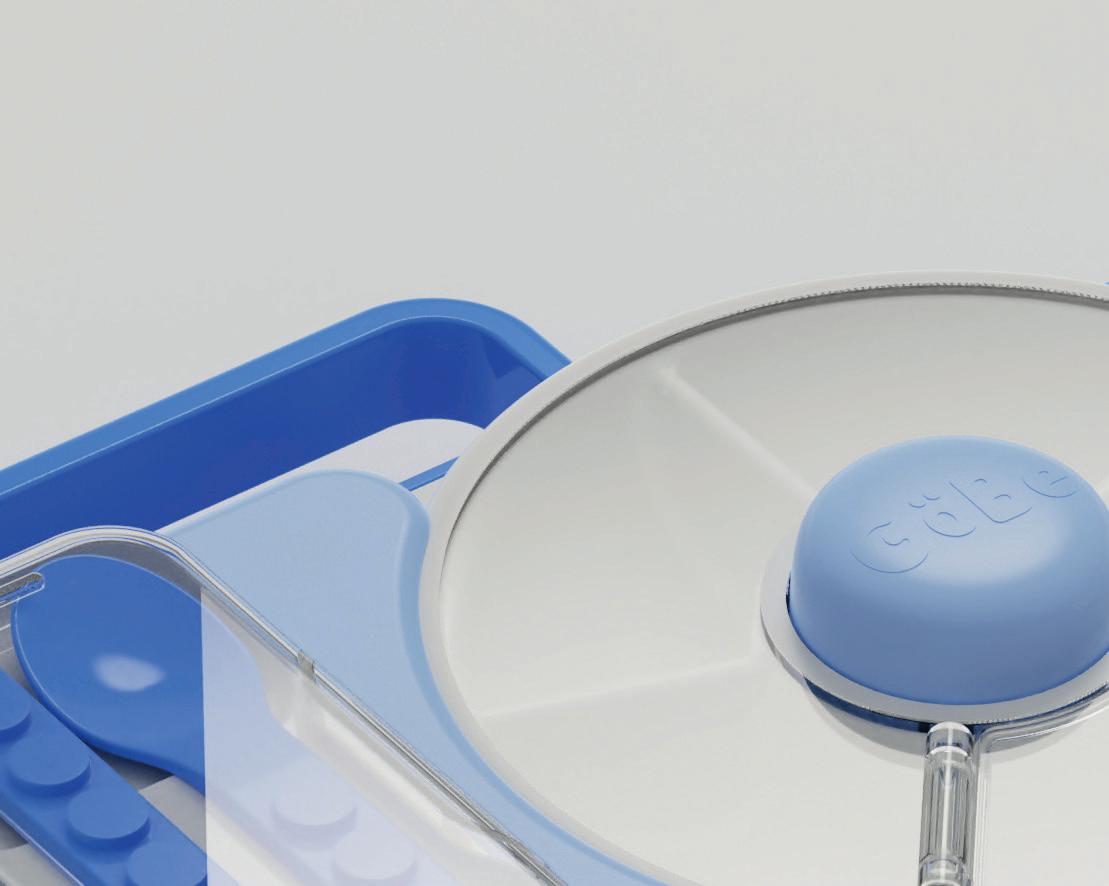
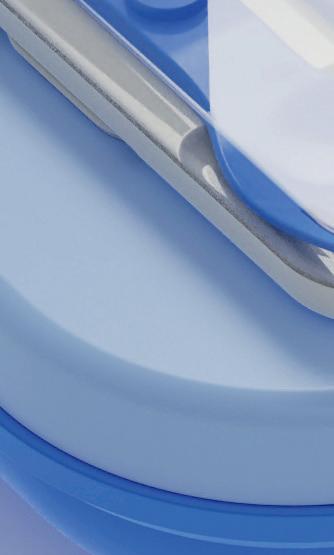
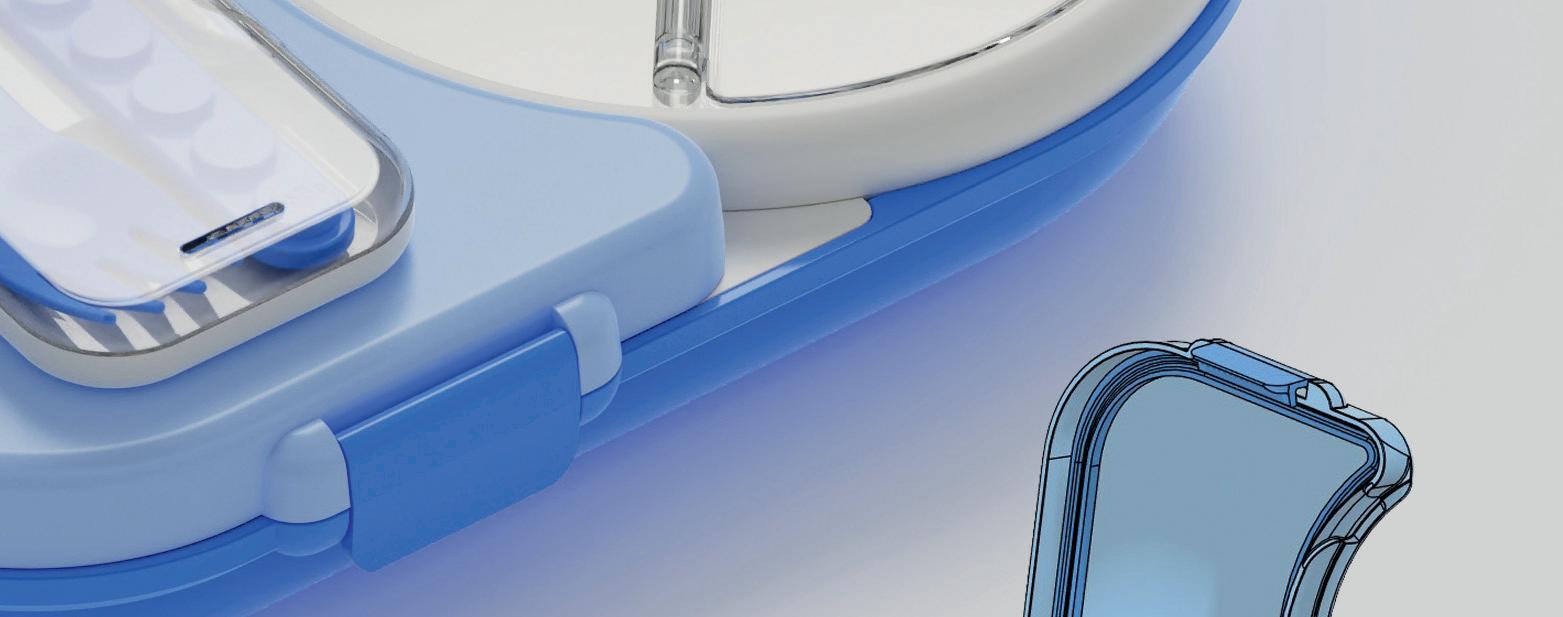
it easy to program tool paths and create precise prototypes,” he says.

Another advantage of Fusion is its intuitive interface and flexibility. “The form tool is incredibly powerful, and the way Fusion structures part trees and history just makes sense,” Joseph says. “Being cloud-based also means that our entire team can collaborate from anywhere, whether it’s with Sample Studio here in the U.S. or working with manufacturers overseas.”
Enjoying new success together
The collaboration between GoBe and Sample Studio has produced mutual success. “Working with Joseph and GoBe has been a defining partnership in my career,” Ryan says. “It’s rare to shepherd a product from early concept through prototyping, tooling, and onto major retail shelves, and that full journey is what makes being a designer so rewarding.”
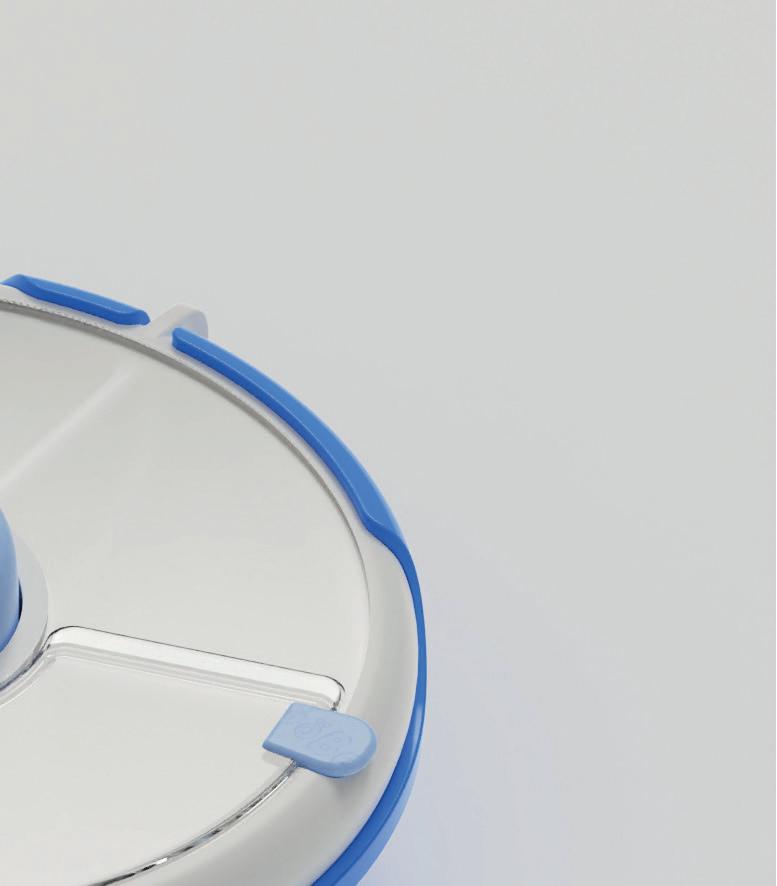

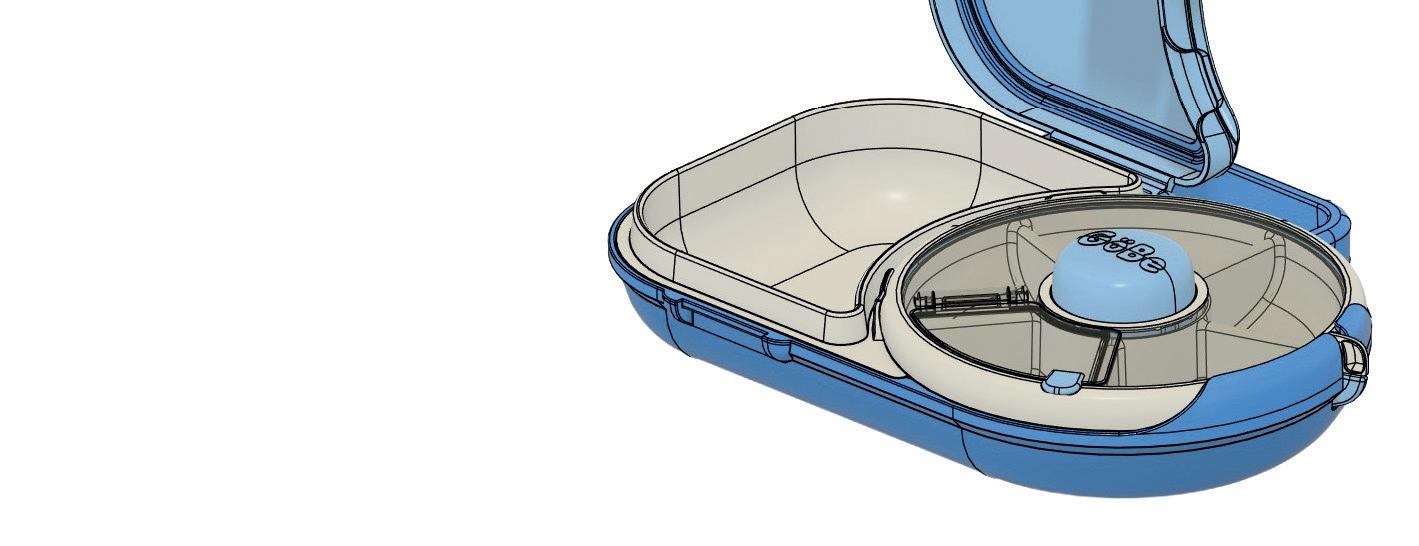
With the recent launch of the GoBe Wonder Cup for toddlers moving from sippy cups to open cups and more products in development, the company continues to push new boundaries.
“It’s incredible to think all of this just started with a car ride,” Joseph says. “But here we are with global sales and distribution—and making parents’ and caregivers’ lives a little bit easier. That’s the real reward.”
I’vetriedmanyothersoftwaretoolsovertheyears. Fusionquicklybecamemyfavourite,andit’sbeen instrumentalinbuildingthebusinessfromthebeginning JosephBlanch,Co-founderandCEO,GoBe
3DEXPERIENCE
» Dassault Systèmes impressed the crowds at its February user event in Houston, Texas, with the addition to its 3DExperience platform of two further AI agents. As Stephen Holmes reports, it was exciting to see the company hard at work on its AI strategy
3DExperience World might be a Dassault Systèmes event, but the signature red of Solidworks was more prevalent than ever this year, as dedicated users flocked to connect with their peers. This may be one of the most vibrant communities ever built around a CAD product.
Held for the second year running in Houston, Texas, familiarity with the surroundings of the George R Brown Convention Centre meant the mood among attendees was less frantic than usual.
Addressing a packed opening session, Dassault Systèmes Solidworks CEO Manish Kumar unveiled further Virtual Companions – AI agents built specifically to assist designers and engineers in their work.
Aura – a copilot assistant first launched at this event back in 2025 – got an upgrade as a knowledge-focused idea generator. But it is now joined by two newcomers: Marie, for materials, chemistry and science; and Leo, for engineering, mechanics, simulation and taking products to manufacture.
Asked the same question, each of these three AI agents will give a different answer in line with their specialisms – much like a designer, engineer and materials scientist would.
At present, the three tools for ‘Industrial AI’ are built on the Mistral AI foundational model on Dassault Systèmes’ Outscale cloud, which offers high-performing models coupled with confidentiality and security standards.
STRIKING STAGECRAFT
Joined on stage by Dassault Systèmes CEO Pascal Daloz, Manish Kumar performed a live demo showcasing Leo. Running in Solidworks 3DExperience XDesign, initial drawings were transformed into sketches with adjustable measurements and parameters.
Next, Sketch-to-3D turned these sketches into a 3D parametric model. Surrogate modelling, meanwhile, enables Leo to conduct performance analysis on models, running an FEA study on a part, on the basis of nothing more than a simple prompt in a fast, computationally cheap mathematical approximation.
“AI is just the multiplier. You are the value,” Kumar told attendees. Other Dassault speakers were equally keen to reassure a room packed full of several thousand designers and engineers that the company’s plan isn’t to replace them, but to help them, and that more AI technologies built along these helpful lines are set to join its arsenal.
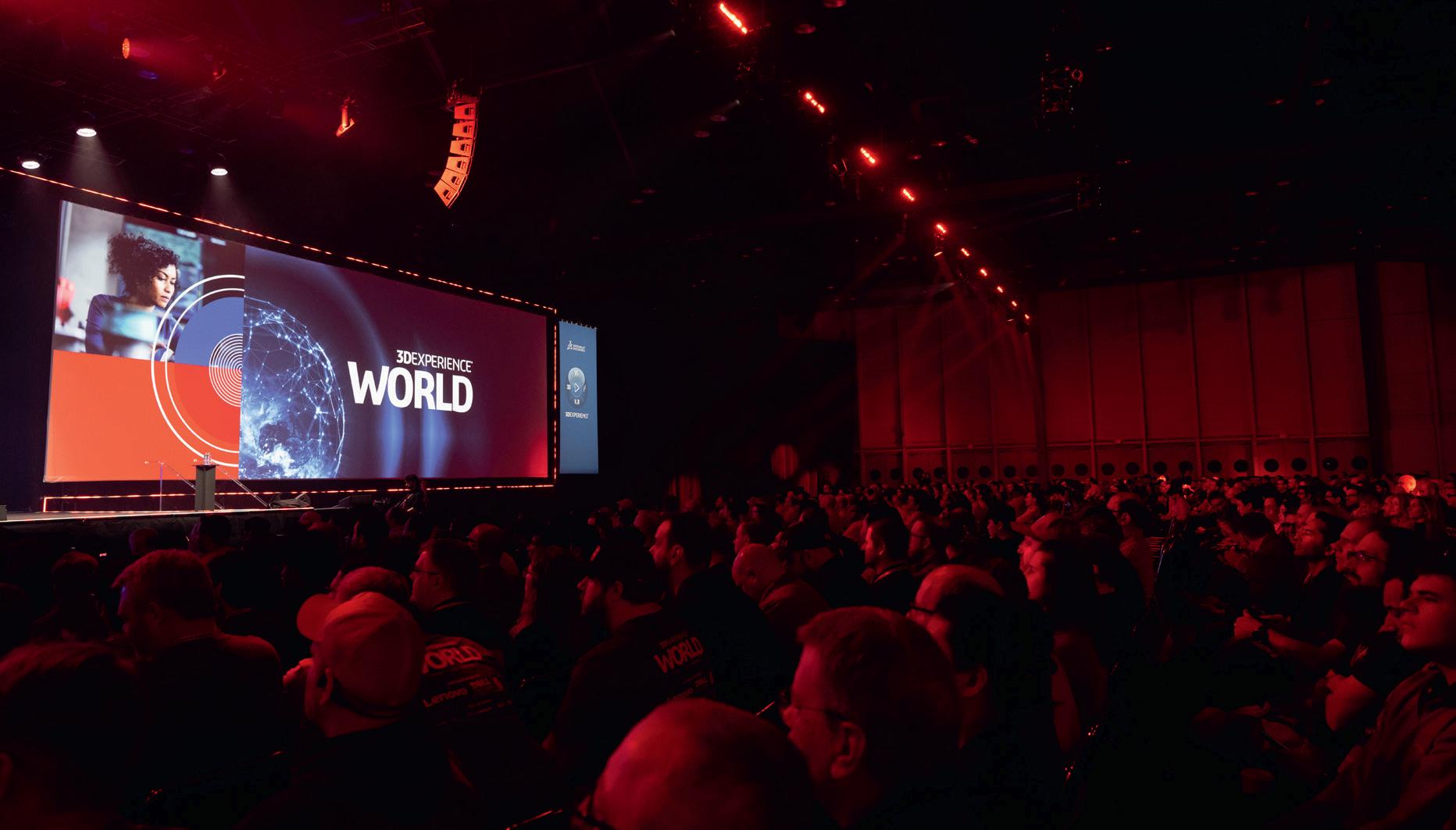

(Left) 3DExperience World 2026 took place at the George R Brown Convention Centre in Houston, Texas (Above) Solidworks CEO Manish Kumar welcomes
WORLD 2026

‘‘ I should be able to validate a design, so that when it goes into production, it shouldn’t fail, the water tank shouldn’t collapse. That is my value ’’
The demonstrations of the Virtual Companions were impressive, but Leo is the one that really stood out.
Kumar later unveiled a design for an industrial water storage butt held on a purpose-built gantry. This was designed, weldments and all, by Leo from a series of specifications entered by Kumar, including the tank’s volume and the location, in order that its design should comply with environmental and local legislation.
Leo determined the weight of the tank when full, the forces at work, and therefore the trusses and structure required to support it. Kumar himself showed genuine excitement at this demo and spoke of how it will enable users to make better use of their value.
“I should be able to validate the design so that when I go into production, it shouldn’t fail, the water tank shouldn’t collapse. That is my value – not to create a sketch, one line at a time. That is not my value,” he said. “My value is the idea. How can I get that idea converted into reality as fast as possible, so that I can focus on the value, not on all these mundane things?”
He declared himself “extremely excited about Leo, its capabilities, the way I see it evolving. In fact, the pace at which things are evolving is amazing.”
MORE SKILLS
Kumar revealed that the three Virtual Companions will in future gain additional ‘competencies’. Leo will have, for example, competencies called mechanical engineer competency, system engineer competency, electrical engineer competency, with many more to follow.
This signals a shift to an era in which designers no longer draw out geometry in CAD, but define what they want to create with a Virtual Companion by their side to figure it out and output the right CAD data.
The cost of Leo and the other agents is yet to be announced, but it will come down to consumption-based pricing, Kumar stated.
“The amount of compute that is going to be used [for a simple table] is less than a steel car. So, depending on the amount of work that is created, the cost will be different,” he said.
Until this point, Dassault’s AI has been built upon a partnership with Mistral, but this is all changing. The first stage of this transition involves Dassault’s announcement with Nvidia, which Kumar bullishly said will put “the full AI library of Nvidia at our disposal now.” The results, he added, will be seen “very fast, very soon”.
He was also keen to highlight Dassault’s R&D spend, which fell somewhere in the region of $1.2 billion last year. “The closest competitor spends a quarter of that. So when you ask me, do we invest? We do invest! That is why we are the first ones who are able to claim that you give me a specification, and I’m going to give you a water tank, just because we are able to collect all the knowledge and knowhow. It doesn’t happen by accident.”
If AI is like the invention of the steam engine, he said, we are currently in the pumping engine phase. “We have not found the turning engine yet, [but] once we find the turning engine, that’s when the steam ships, the locomotives, the mechanical revolution is going to happen, and that room of engineers and designers and makers that is going to make that work.”
WHERE NEXT?
The pathway for Dassault’s AI strategy is now much clearer – but even with the astonishing speed of AI development, it still felt as though there will be a few more 3DExperience World events before the entire crowd is on the same page.
While AI continued to be the key focus for keynote presentations, the breakout sessions perhaps more accurately reflected audience priorities, with only 5% of 355 sessions covering AI.
Dassault Systèmes boasts the largest installed base of all the 3D CAD vendors, but from conversations we had, it
will take time and education to persuade users to accept increases to license fee and take up cloud apps like xDesign, necessary to use the Virtual Companions at their fullest.
Nobody can doubt Solidworks’ (and especially Kumar’s) support for its loyal users, but perhaps the solution lies elsewhere. Thirty years ago, Solidworks had a dream of putting CAD on every engineer’s desktop. “Now,” said Kumar, “we go one level down and we put CAD on everyone’s desktop.”
Uploading images to achieve manufacturable models and defining designs by talking to Virtual Companions will all happen in the next couple of years, Kumar promised. “And the reason I’m saying that is because everyone in the world is starting to use Gemini chat or some kind of large language model, which means everyone is starting to become a prompt explorer.”
If everyone can be a designer, then economies of scale come into play, and you would expect adoption to flourish. And when big companies start to adopt virtual seats for their own AI agents, a future to which Nvidia CEO Jensen Huang alluded, then Dassault looks to be in a good position to capitalise.
What that means for attendees wandering the halls of 3DExperience World is another question, however. With next year’s event set to take place in Nashville, Tennessee, it will be gripping to see how this all maps out. www.solidworks.com
NVIDIA CEO: AI WILL GIVE DESIGNERS ‘SUPERPOWERS’
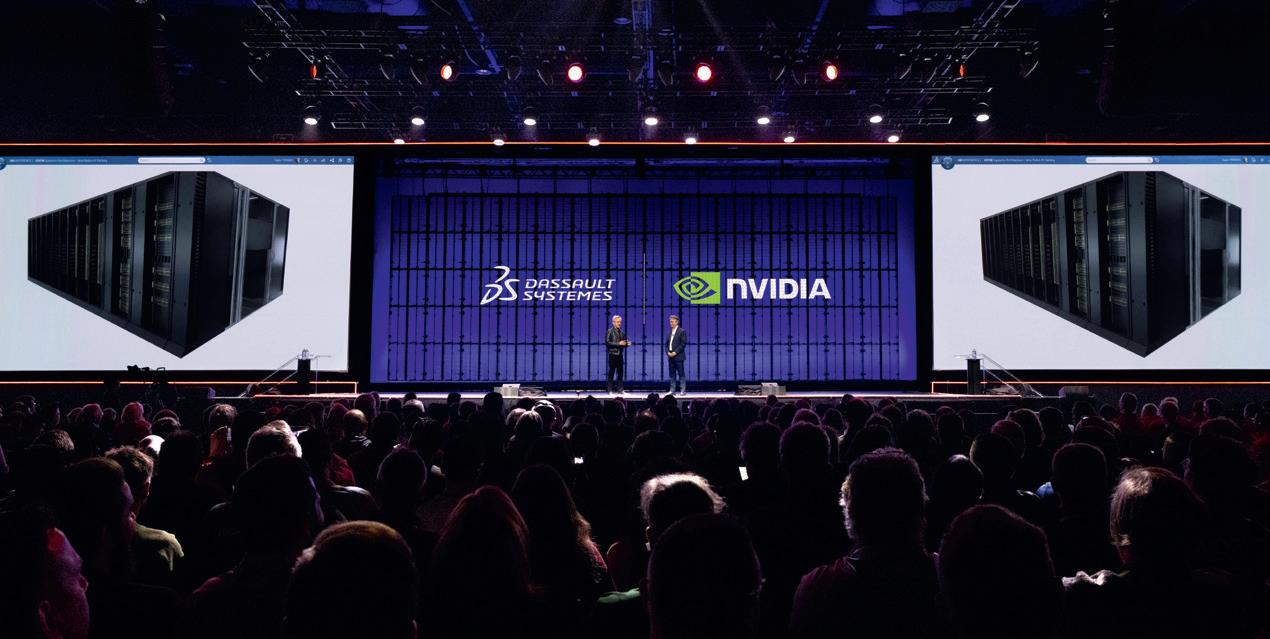
A star appearance by Nvidia CEO Jensen Huang drew a huge crowd at 3DExperience World 2026. His headline prediction?
We are seeing the emergence of a world in which AI agents use more CAD than humans do.
Unsurprisingly, Huang was adamant that AI would not lead to the demise of product design and engineering roles for humans. Instead, he foresees a new, supercharged age of manufacturing in which AI agents assist with workflows and SME manufacturers increasingly rely on implicitly trained robotics.
Speaking on Day Two of 3DExperience World alongside Dassault Systèmes CEO Pascal
Daloz, Huang addressed head-on the fear that new, intelligent AI companions and software will reduce the need for humans in the profession.
“If AI were to replace jobs, the number of engineers, the number of software programmers, the number of designers will reduce. If the number of engineers and designers will be reduced, the amount of software they use is going to reduce. It’s exactly the opposite,” said Huang.
“What’s going to happen is this: every engineer will have companions and the systems announced yesterday. These agentic companions that help designers. And so

engineers and web browsers and Excel spreadsheets will “skyrocket”, he said, “because AI agents are going to use them.”
Inside Nvidia, he said, AI already works this way. And while this scenario sounds more positive for software developers than for software customers, Huang returned to the designer’s position, saying:

every designer, every software engineer, every creator, will have companions that help them.”
into the Nvidia Omniverse DSX Blueprint for large-scale AI factory deployment.
“Physical AI is the next frontier of artificial intelligence, grounded in the laws of the physical world,” said Huang.
“Together with Dassault Systèmes, we’re uniting decades of industrial leadership with Nvidia’s AI and Omniverse platforms to transform how millions of researchers, designers and engineers build the world’s largest industries.”

more virtual seats you will going to use Solidworks. These use Catia. They’re going to

tools used is going to grow
The more AI companions you have, he continued, the more virtual seats you will have. “These companions are going to use Solidworks. These companions are going to use Catia. They’re going to use Simulia. So, the number of agents, AI designers, AI engineers, are going to grow exponentially. The amount of tools used is going to grow exponentially. They don’t have to have seats, you know? Engineers need to have seats, and our seats are going to be fine. We’re going to need them.”
“Powered by AI, augmented by AI, your capabilities are lifted. And so, one of the things that’s really fantastic about the companion products that Dassault Systèmes created is that almost any engineer can now have the superpowers of Solidworks. Almost any engineer can have the superpowers of Catia, because you have a companion to help interpret your intentions.”


the companion products that Dassault Systèmes created is that almost any engineer can any can have the superpowers companion to help interpret your presents opportunity to bridge the gap between human intention and design outcomes.

AI, he said, presents an opportunity to bridge the gap between human intention and design outcomes.











The number of virtual
Nvidia’s 25-year relationship with Dassault Systèmes is set to continue, with Nvidia adopting Dassault Systèmes model-based systems engineering (MBSE) to design its latest AI factories’ starting with the Nvidia Rubin platform and integrating
relationship with Dassault Systèmes with Nvidia adopting model-based systems to design its latest AI Rubin platform and integrating











BOLT FROM THE BLUE
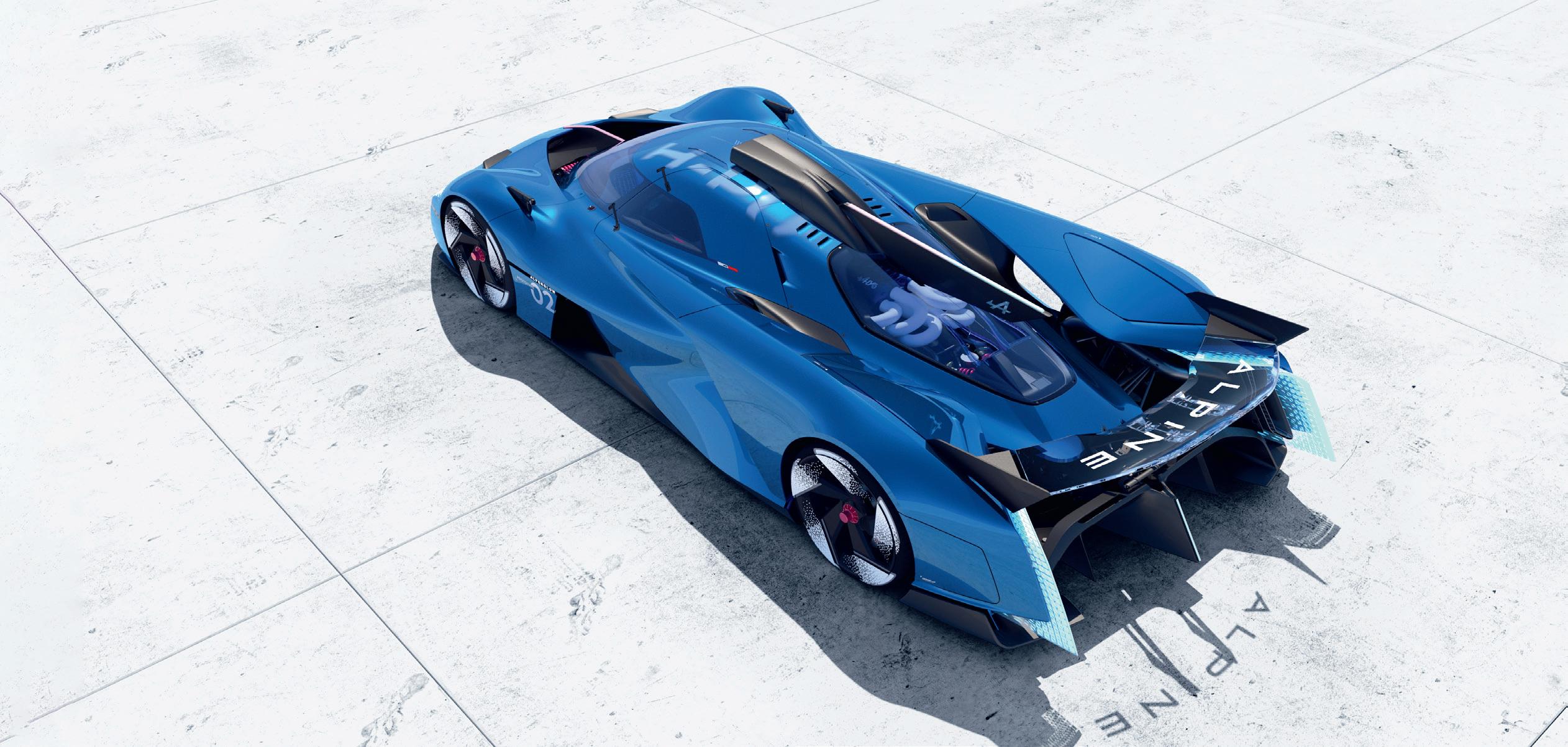
»
A collaboration between French automaker Alpine and Italian industrial group CRP is powering a new chapter in motorsports,
writes Gabrielle Brown
Back in 2022, the hydrogen-powered Alpine Alpenglow concept car stunned crowds at the Paris Motor Show with its smooth curves and striking blue finish.
But it wasn’t just the futuristic exterior of the car that impressed attendees. The technology that lay beneath struck many as equally forward-looking: a hydrogen powertrain that can be refuelled in minutes and emits only water vapour, drastically reducing emissions while still delivering power.
That technology reappeared in 2024 in the Alpenglow Hy4, a vehicle capable of producing 340 bhp (brake horsepower) from its 2-litre, turbocharged, four-cylinder hydrogen engine.
At the launch of the Alpenglow Hy4, Alpine CEO Philippe Krief did not hold back: “The Alpine Alpenglow Hy4 is not just a standalone prototype. It’s our brand manifesto, a statement of our commitment to sustainable innovation and a testament to our belief that we can create thrilling driving experiences that reconcile environmental innovation and performance,” he said.
“This vehicle combines the thrill of the sound of an internal combustion engine with the promise of a sustainable future.”
Cut to the present, and Alpine’s hydrogen innovations can again be found inside the Alpenglow Hy6, which the company showcased at the 2025 Paris Motor Show in October.
Once again, show attendees got the chance to admire Alpine’s fusion of mechanics and aesthetics, as well as that signature rich blue colour scheme.

Just as eye-catching for observers is the Hy6’s transparent rear bonnet, which keeps the underlying technology firmly on display.
The latest engine from Alpine, meanwhile, is a 3.5-litre, bi-turbo V6 engine capable of producing 740 hp (horsepower) at 7,600 rpm.
This approach comes with some design challenges, however: the hydrogen that fuels the engine must be compressed and stored in extremely strong tanks that add cost and weight to the vehicle.
In the case of the Hy6, 2.1kg of hydrogen gas is stored at high pressure across three tanks positioned in the sidepods and behind the cockpit. This must be housed in ventilated, sealed compartments separate from the passenger area.
DESIGN CHALLENGES
Initial designs for the combustion chamber and air loop were created using digital simulation, but Alpine’s engineers ran into some challenges. The 3D-printed polymer parts were bonded with aluminium flanges, but this caused sealing issues during bench testing, due to thermal expansion differences, vibration and high thermal loads.
For help tackling these issues, Alpine turned to CRP, an Italian industrial group specialising in additive manufacturing (AM), rapid prototyping and highprecision machining. The company has been involved in automotive manufacturing since the 1970s.
Engineers at CRP’s 3D printing and AM arm, CRP Technology, proposed a fully monolithic 3D-printed architecture, to be produced using SLS (selective laser sintering) technology and Windform SP, a carbon fibrereinforced thermoplastic.
Following some tweaks, the final system consists of three monolithic components: one intake plenum and two intake manifolds. By integrating the flanges, designers were able to eliminate the need for aluminium parts and ensure uniform material behaviour under turbocharged operation.
Alpine also got help from CRP Meccanica, the arm of CRP that offers high-precision CNC machining and advanced manufacturing for motorsports, aerospace and defence.
CRP Meccanica’s team provided the post-processing roadmap from CNC machining to vapour smoothing of internal surfaces, in order to ensure an accurate fit and tight sealing, using a hybrid additive/subtractive workflow developed in-house at CRP.
The Alpenglow Hy6 may not have hit the racetrack yet, but it represents yet another step closer to hydrogen-powered motorsports, as well as providing a striking showcase of Alpine’s commitment to both mechanics and aesthetics. www.alpinecars.com

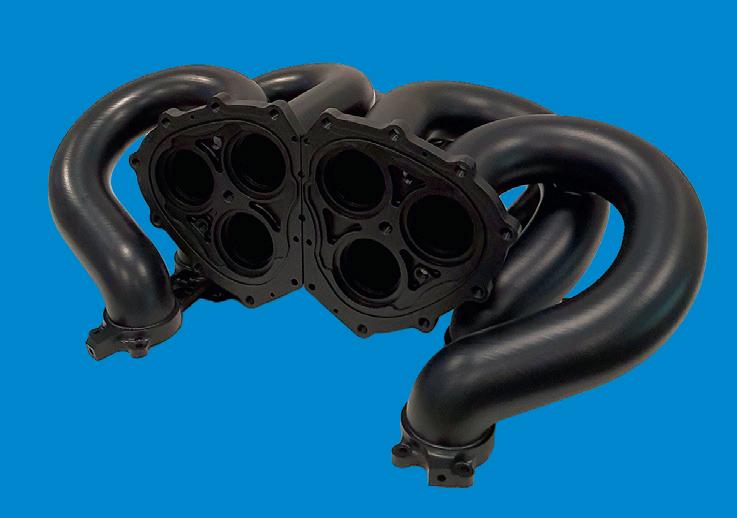
● 1 The Alpenglow Hy6, as showcased at the 2025 Paris Motor Show Credit: Alpine Cars
Intake plenum and manifold system for the Hy6, 3D-printed in Windform SP Credit: CRP Technology
DISHING UP
» Kaikaku is trialling its catering robots in the heat of a real-life restaurant kitchen, where the quality of each and every dish matters. Stephen Holmes visits the start-up on a mission to rescue the hospitality industry
While many engineers will be familiar with the values of Kaizen, the Japanese manufacturing strategy based on of incremental improvement embraced by Toyota among others, far fewer may be aware of its close cousin Kaikaku and its call for bold, radical reform.
Automotive production lines might be a world away from the place where you grab lunch, but the deployment of new optimised and automated systems may be the only way to save our means of eating out. Few industries, after all, have been as seriously disrupted as the hospitality sector, where changing consumer demands, time constraints and spiralling costs are causing widespread closures.
Kaikaku is a fitting name, then, for a robotics startup looking to rejuvenate the industry by automating kitchens, enabling those who run them to slash costs and reduce waste. Its promise is that, through automation, restaurants may not just survive, but prosper.
That’s the message from Ivan Tregear, chief technology officer of Kaikaku, from the company’s home in a bright warehouse space in the trendy east London area of Shoreditch. It’s extremely hard, he says, to make money out of restaurants in the modern world.
“Not only are restaurants really expensive to make and really hard to run, but they have huge maturity periods, sometimes six months to a year, before they actually keep a steady state. We want to cut that down and incentivise people to open a restaurant.”
He runs us through the maths. He and his team believe that restaurant owners can extract maybe 10% or so extra profit margin or revenue margin from automating labour, maybe another 3% to 5% from cutting food waste, and then a few extra percent in increased revenue from consistency. It all adds up. Through robotics, the burden on training is significantly reduced and the expertise required of a store manager is also slightly lower. And, at the same time, some of these savings can be redirected into areas such as marketing, in order to further establish the business.
HUMAN/MACHINE INTERACTION
Adding robots to kitchens is nothing new. In Asia, some automated kitchens are thriving, but Tregear believes that’s symptomatic of a culture more receptive to automated serving and where solitary eating is accepted as a social norm.
The team at Kaikaku is adamant that in Western hospitality, human interaction is an integral part of the dining experience, so the goal is to design robots that can work alongside human colleagues, rather than replace them. As an example, Tregear points to website chatbots. Instead of being regarded as positive, he says, users are inclined to rush through the questions they ask, in order to get to speak to an ‘actual human’.
With Kaikaku’s first system, Fusion, the intended market is quick-service restaurants (or QSRs). These are establishments that focus on speed, affordability and convenience. They typically offer limited, standardised menus and little to no table service.
This is where Fusion thrives, with its fast throughput and strict portion control (an area in which humans are notoriously inconsistent). The back-of-house automation platform drops an empty bowl into the machine, which travels its length via a conveyer belt. As it does so, the requested ingredients are deposited into the bowl, any requested sauce is added, and the finished dish is ready for a quick check and final garnish by a human server.
A configurable set-up, each ‘drop’ unit can dispense six ingredients, kept topped up by kitchen staff from above. Along the way, bowls are kept hot, cold or at room temperature. The movement of the bowl along the conveyor belt is monitored by a proprietary positioning system.
Kaikaku’s first fully functional kitchen automation system was built in just 94 days, but with no business willing to accommodate a large prototype robot on their premises, the start-up’s team decided that the only way it could learn was to open its own restaurant.
The result is Common Room, Kaikaku’s Bloomsburybased restaurant that also functions as a live laboratory. A one-way mirror in the establishment enables engineers to operate, watch, document and adjust Fusion in real time. Diners here are not just customers, but also test subjects, providing data in a full-stack experiment that focuses on ordering flows, robotic behaviours, user interface design and failure thresholds.
Few hardware start-up projects appear on Google Maps in their first months, let alone achieve a rating of 4.7 stars and a devoted following. Common Room quickly achieved both.
“We focused on making Fusion really fast and really accurate, because obviously then it means consistency and customer satisfaction is better, food waste is less. And as cheap as physically possible, which might be slightly evident when looking at it,” Tregear laughs.
Trade kitchen equipment is expensive and costs could be prohibitive for a tiny start-up. At Common Room, aside from the single-piece, stainless steel modular chassis of Fusion (it’s “super cleanable”, Tregear explains), the Kaikaku team has focused heavily on FDM 3D printing to lower the barrier to entry.
A printer farm of 9 Bambu Lab printers – a mix of H2S and X1Carbon machines – has its own dedicated workshop and is in constant operation, producing parts for the latest version of Fusion, which offers even greater modularity.
“If we can’t be perfect, we have to be modular, and we’re definitely not perfect,” says Tregear. Each ingredient dispenser – a shaft fitted with a simple paddle that pops into place – can be thrown into a dishwasher at the end of service.
‘‘ With every single dispense, we know how much food comes out, how much is wasted, how often food needs to be prepared and where the bottlenecks are Ivan Tregear, CTO at Kaikaku ’’
There’s no cross-contamination or visible electronics. Instead, the controllers and motors are stored in the dispenser base.
All the electronics deployed are inexpensive hobbyistgrade components as far as possible, or custom PCBs (printed circuit boards) where that has proved cheap and reasonable. This is partly for cost reasons and because using them is faster than trying to integrate expensive PLCs (programmable logic controllers). The brains behind all this kit are Raspberry Pi devices, with ESP 32s and the Arduino toolchain used for programming.
“It’s a bit of an unconventional approach, but that’s how we keep it cheap,” says Tregear.
Modularity has also helped when testing, allowing new designs and features to be added to the real-world set-up and trialled.
Version 3 of Fusion came out in April 2024 and served over 3,000 bowls to customers at Common Room in just one month. Version 4 followed in August 2025. Today, Version 5 is in place, capable of dispensing 360 meals per hour, and taking just under one hour to set up.
As a result of blisteringly fast iteration cycles and lowcost solutions developed in-house, Tregear says that the bill of materials on the latest version of Fusion came in at under £15,000. He estimates that a comparative system currently installed in a QSR chain in the US today would cost upwards of $600k to install. “That’s the kind of order of magnitude that we want to shift.”
VERSION CONTROL
To date, Kaikaku has modelled, tested and assembled more than 20,000 components and rendered 50,000 robotic movements and tolerances in 3D CAD. All of this has been conducted in Onshape, which was chosen by Tregear following a placement at another Onshape customer, Ocado Technology.
“The version control is ridiculously good. How no one else has done that baffles me,” he states. “We’re not necessarily all software engineers here, but a lot of us like software and code for fun and are aware of Git, and yet why mechanical engineering has not caught up with Git is baffling.”
With some 200 unique components across such a small company, Tregear explains that elements like Onshape’s CAD configurations have supported more streamlined management of multiple design options within a model, removing the need for separate files for each variation.
While most components – right down to the conveyor belts – are designed and fabricated in-house at this point, something that the team at Kaikaku would love is an Accu standard component library in Onshape, enabling users to simply drag a STEP file from Accu’s parts catalogue into an assembly.
Where he finds Onshape lacking is in BOM, Tregear says, where it’s not easy to bulk edit or track a lot of components, something that nudges users towards considering PLM like PTC Arena quite quickly.
“The second we’re going to make more than one [of the same version] – which we reckon is going to be quite soon, definitely in the next six months – we’re going to need to do something. So, either we invest more time into our own crappy PLM – but probably not – or use Arena,” the CTO says.
SMALL TEAM, BIG IDEAS
What’s noticeable about the small team at Kaikaku –aside from its youth and caffeine-high energy levels – is its ability to push on and to make things work, with a long-term goal clearly defined.
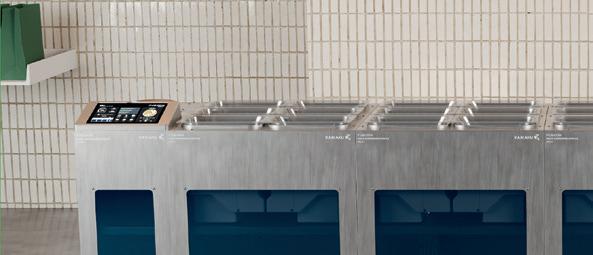
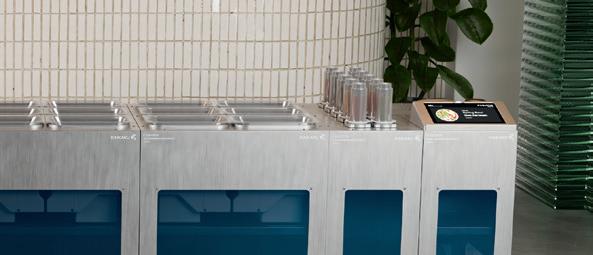
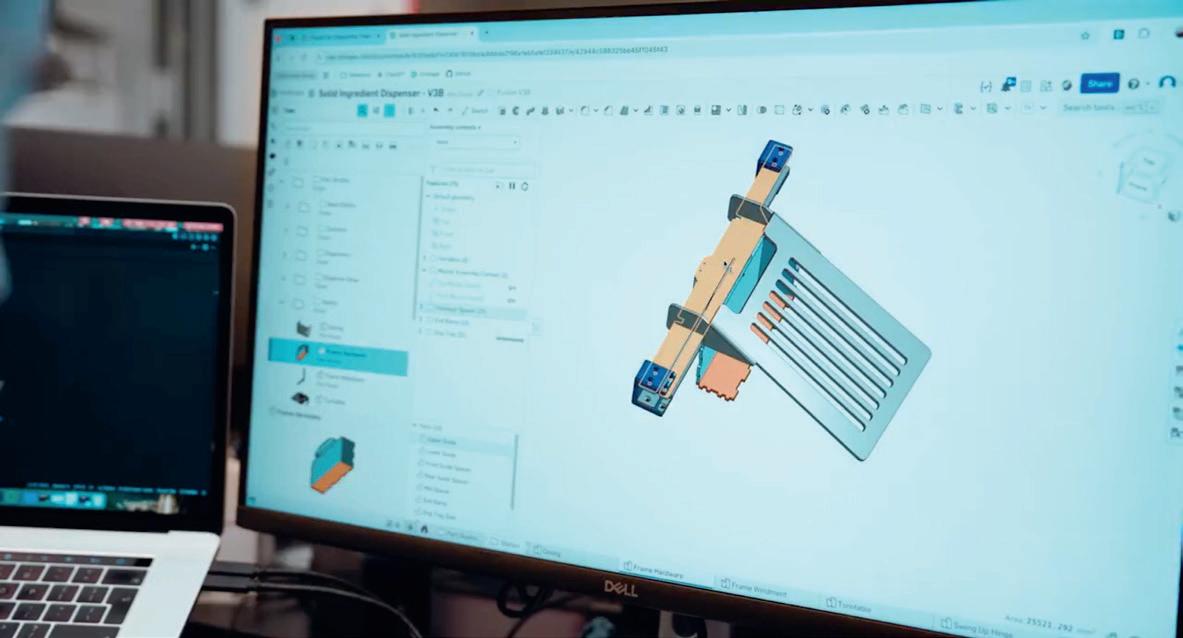
“We’re very bullish on the idea that, for this to work, the tech stack needs to be full stack in the restaurant,” says Tregear.
While automation is one element, Kaikaku has its own ordering kiosks, order ticker and computer-vision cameras to track occupancy rates and dwell times.
The goal is to collect masses of data that no other restaurant on earth has. In this way, food vendors can optimise their operations. Today, the best that most can manage is digging into sales data.
“The bigger power that we see is that Fusion is actually a sensor that nobody else has. With every single dispense that occurs in each of these [robots], we know how much food is wasted, how much came out at the end of the day, how often food needs to be prepared and replaced and where the bottlenecks are,” says Tregear.
It’s a bold vision, but one that fits with the original Kaikaku production philosophy – a radical change to transform the fortunes of restaurants, one bowl at a time. www.kaikaku.ai
Kaikaku’s Fusion system handles food preparation to make restaurant kitchens more e cient and cost-e ective
Fusion uses a series of chutes and tubes to dispense ingredients into bowls on a conveyer belt
2026
CTO of Kaikaku Ivan Tregear will be speaking at DEVELOP3D Live on 25 March 2026
CUTTING EDGE
» A tabletop skate sharpener promises skaters pro-level blades for every trip to the rink. Stephen Holmes hears how Sparx has not only developed a
market-changing piece of kit, but also the technology to transform sports performance at the highest level
Whether a veteran hockey player or a junior figure skater, anyone who steps out onto ice must rely on two slim blades. It’s the honing of these blades that gives skaters speed and precision of movement – not to mention confidence that their bolder manoeuvres will unfold as planned. Typically, those blades don’t wear down, but it takes relatively little to dull and damage skating blades. To tackle the issue, skaters get the blades sharpened by a specialist. As a general rule of thumb, most skaters are advised to sharpen their skates for every 20 to 30 hours they spend on the ice. But competitive skaters
may need to up that rate to every 10 to 15 hours of use.
we’re completely changing this landscape.”
Sparx’s fully integrated sharpening system is a compact, automated design that can be installed at ice rinks, sports stores, clubhouses and even at home. The user places their skate blade into the slot and pre-set precision alignments take care of everything else. The only consumables are the system’s grinding rings, which can be swapped to support different hollow grinding profiles.
Layton explains that Sparx users are now sharpening every time or every other time they head onto the ice. “It’s like giving a runner fantastic running shoes. They feel like the only thing holding them back is their training and their cardio. So, by giving every hockey player and figure skater a really nice foundation with sharp skates, it’s up to them now to perform at their highest level. There’s no limitation,” says
‘‘ Using Solidworks to optimise the design digitally means that I never have to waste time building stu
It depends a lot on the materials that make up a skate blade. In ice hockey, for example, newer blades that blend carbon and steel are more lightweight, but what’s sacrificed is their ability to stay sharp. And in a sport where toplevel players earning upwards of $15 million a season, they might change blades as much as four times per game.

“If you had the technology to sharpen your skates easily, you would do it every single time you touch the ice,” says Sparx CEO Russell Layton. It’s like a chef sharpening their knives, he says.
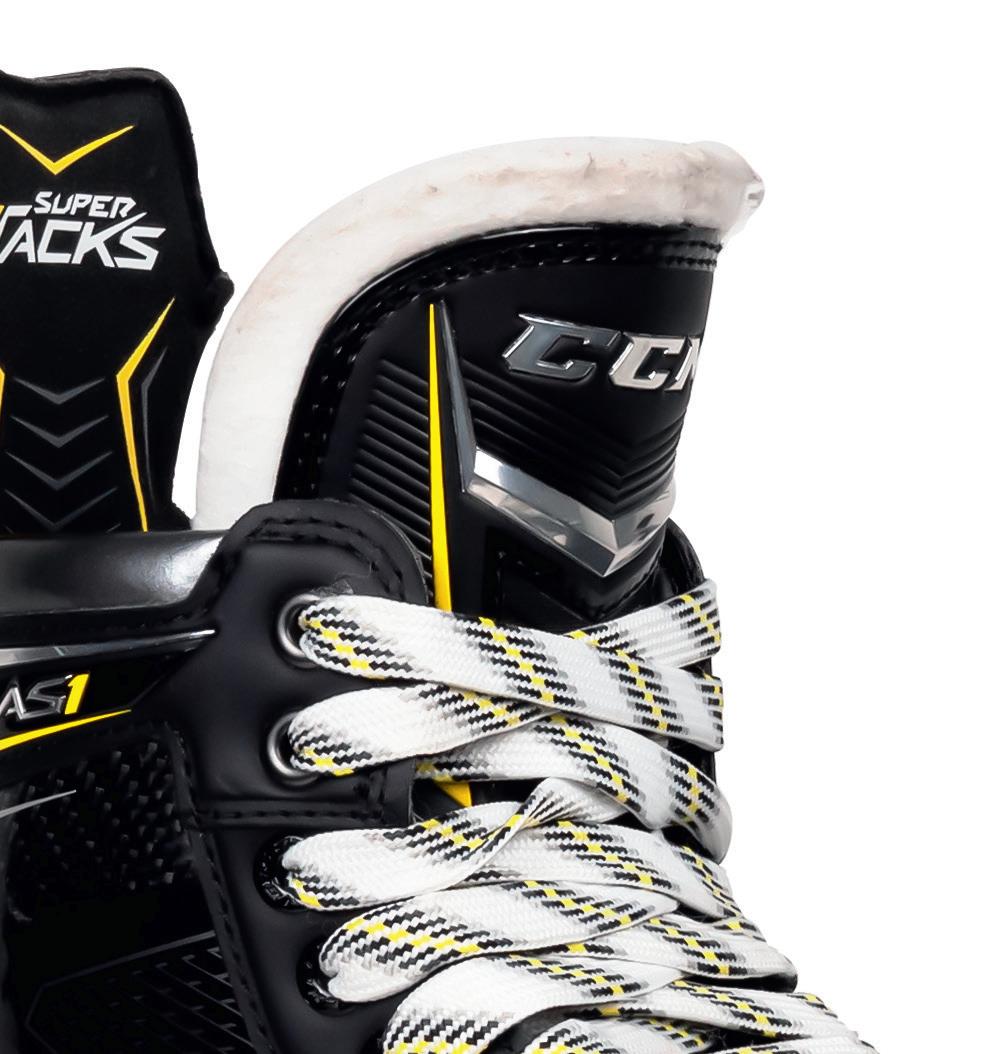

“We’ve all got used to skating on skates that were dull or had a lost edge,” he says. “With our product,



that’s not optimised

There’s no limitation,” says Layton.

BLADES OF GLORY
Previously a medical devices designer, Layton says that an entrepreneurial side to his personality meant that he always wanted to build a business of his own. That led him to consider areas of his own life that could benefit from improvement.
areas of his own life that could improvement.
Having grown up skating, he knew the frustration and cost associated with weekly trips to ‘sharpener shops’.
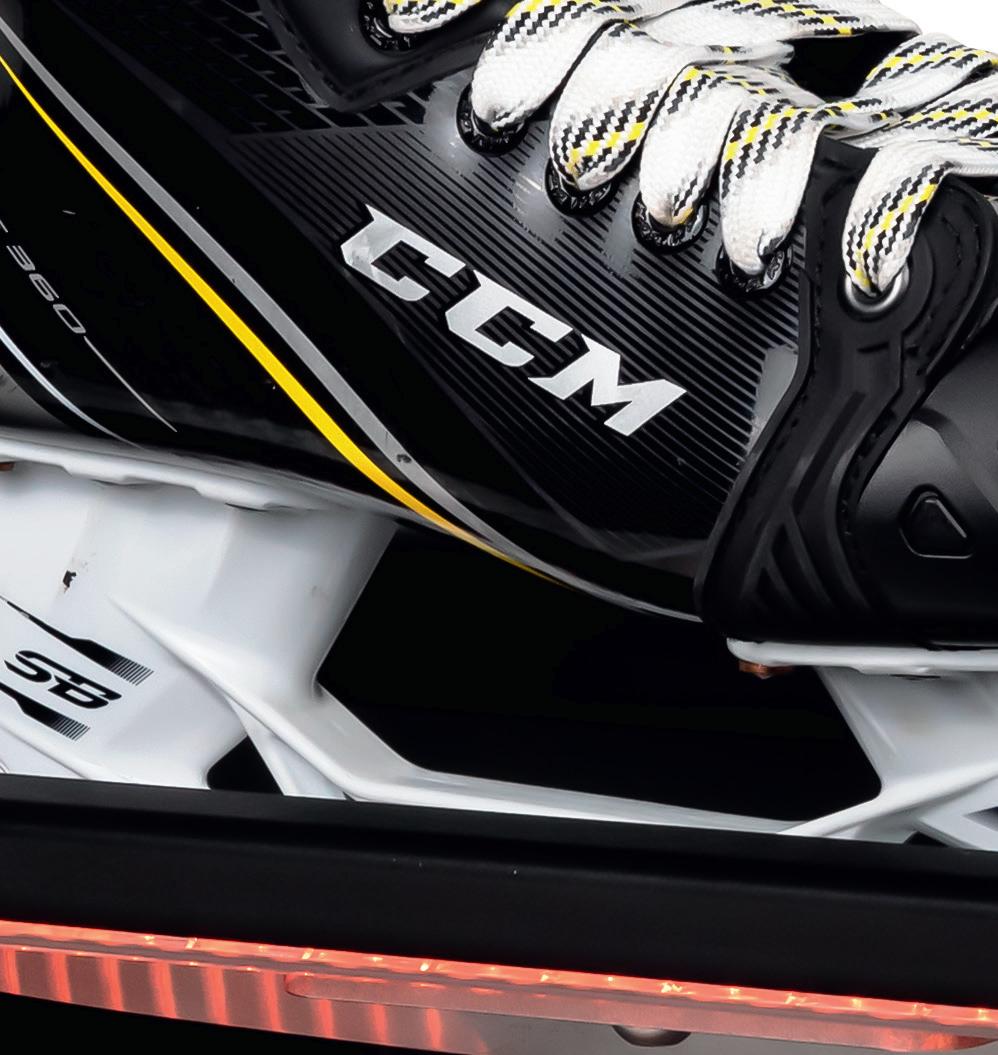



Layton, CEO of Sparx

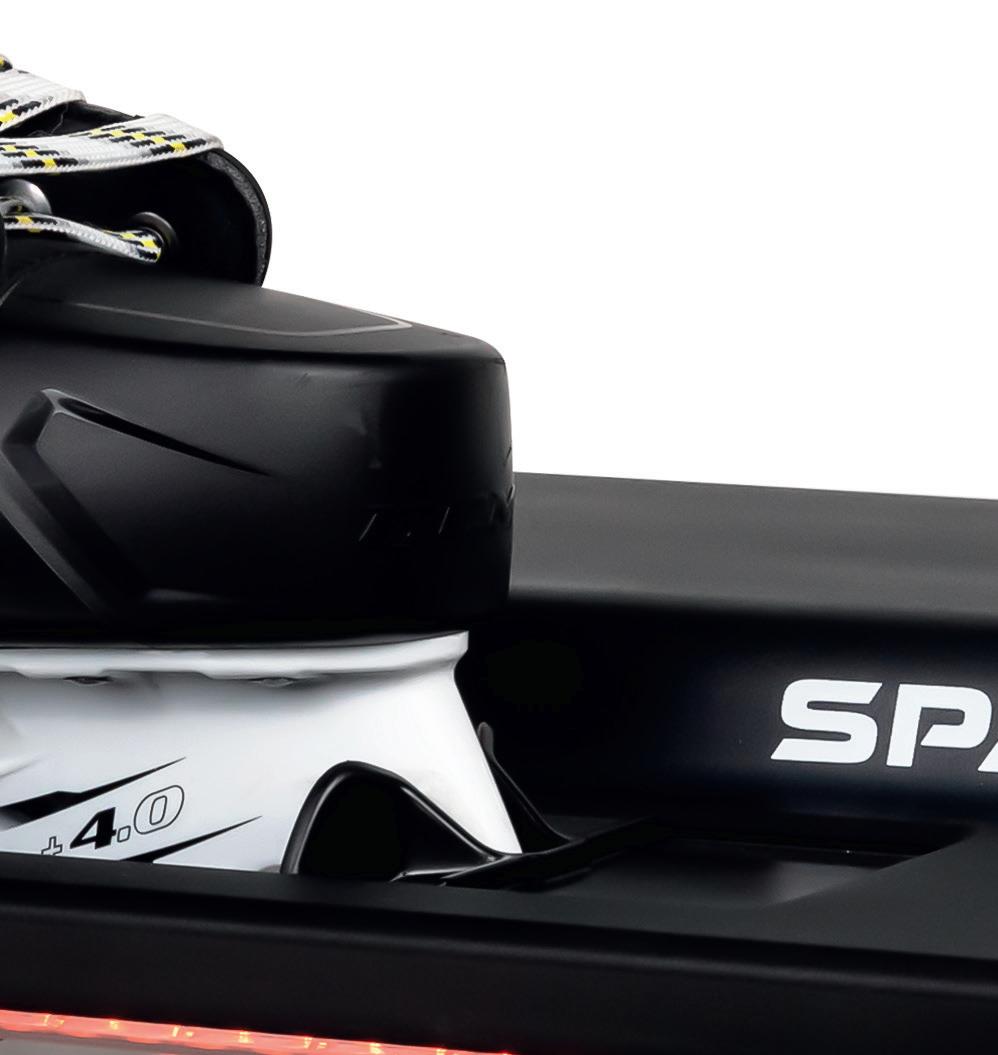
Layton established Sparx Hockey in 2013 with the goal of building and selling an automated, at-home sharpener. He began by buying a manual tabletop skate sharpener, teaching himself the process. He quickly found that the technical aspects of sharpening came down to a series of constants – constant pressure, constant rotational speed, constant shape. An automated product, he felt, was achievable.
Next, he built out a design team, enlisting two engineers who were still in college at that point, designing various concepts as CAD models in Solidworks, and building prototypes. Solidworks, he says, was the obvious choice for Sparx, since he had used it extensively in his medical-device work: “The last thing I was going to do was take a risk on CAD.”
To figure out the product footprint, the team took the defined range of human foot sizes as its indicator of likely length. The width of the product, meanwhile, is defined purely by the widest foot size, plus room for the device’s mechanisms on either side. Over the last decade or so, Sparx has done much to reduce the height and depth of the Sparx Sharpener, with the goal of making each new version more compact and as close to the skate plate as possible.

into the Sparx Sharpener. Using the Solidworks’ thermal
Both the sharpening and the holding mechanisms have been iterated from many different angles. The 10,000 RPM grinder wheel is a thin, super-abrasive disc that removes steel from the bottom of the blade to create the concave ‘hollow’ profile that allows a skater to grip the ice and is essential for accelerating, turning and stopping precisely. With no mass to dissipate the build up of heat caused during the sharpening, the team used SolidWorks to add a spinning heat sink – an impeller that pulls cool air into the Sparx Sharpener. Using the Solidworks’ thermal simulation package, the team started from a baseline design and iterated on the design of the impeller fins to
optimise drawing heat out and cool air in.
To sharpen the skate blade precisely through its full
To sharpen the skate blade precisely through its full arcing length, the machine needs to apply constant pressure. Using Solidworks, the designers adjusted the spring locations to try to even out the force profile –something that would take forever to do manually. This gave the designers the smoothest force profile as this

grinding ring moves across the skate blade.
“Using Solidworks for all these different examples to
“Using Solidworks for all these different examples to optimise the design digitally meant that I never have to waste time building stuff that’s not optimised,” says Layton.
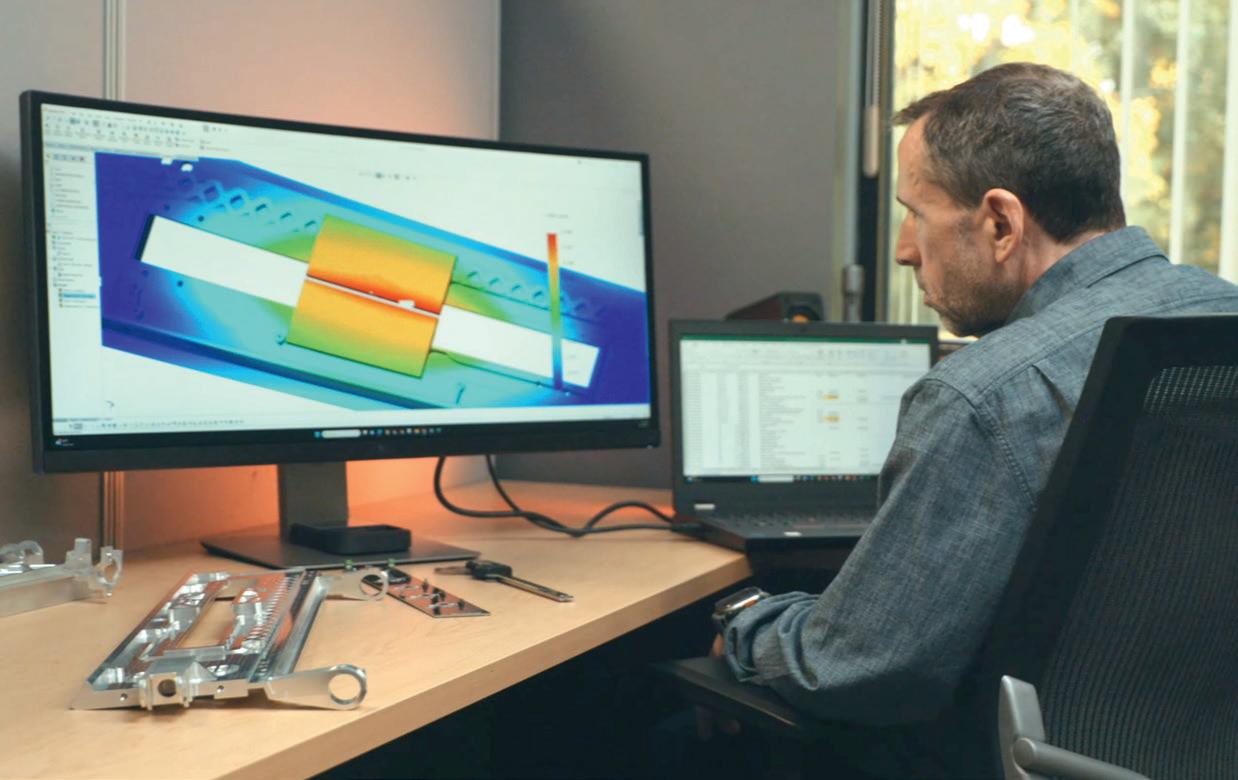
team’s propensity to prototype parts early and often and its commitment to iterating on ideas. “I looked around and there was like, tens of thousands of dollars’ worth of machined aluminium parts, and we had a little skeleton skate sharpener. It was almost like I couldn’t turn away from it,” says Lawton.
The next stage saw him become even further embedded in the entrepreneur lifecycle, when he launched the sharpener on crowdfunding site Kickstarter. Some $200,000 worth of skate sharpeners were funded, but the campaign proved to be more about exposure than investment. Sparx wound up losing money on every single product sold via the crowdfunding, but newspapers picked up on the product, interested NHL teams got in touch, and
the product took off.

Over time, the Sparx Sharpener has become digitally connected. In 2022, the company acquired an optics company, allowing it to develop Sparx Beam, an accessory that contains a laser and a camera to measure the accuracy and precision of skate sharpening and report its results to an app on the user’s phone.
This data connection is proving valuable. It enables Sparx to communicate with end users, sending them pop-up reminders to sharpen their skates before the weekend, for example – and it also allows the company to collect a lot of data on the performance and usage of its devices.
for testing new ideas. The majority of components can
The Sparx team utilises physical prototyping heavily for testing new ideas. The majority of components can fi t easily on the print bed of a Bambu Lab 3D printer. The company operates a farm of these for building polymer parts. It also has a Tormach milling machine and an Epilog fi bre laser cutter in its well-stocked workshop, so that the team can quickly produce metal components and housings.
From its original bootstrapped beginnings, Sparx was
From its original bootstrapped beginnings, Sparx was soon a full-time business. In part, that was due to the




That means Sparx can track the operational health of its machines, adjust components for greater product longevity and improve the user experience. It can also spot trends occurring in sharpening profile choices and forecast consumable sales.
Eventually, Layton hopes that Sparx will be able to suggest different grind profiles to maximise the performance of individual players, by combining AI with its data and other data from player performance monitoring and tracking sensors.



Finally, the data enables Sparx to ensure that its products all perform in the same way and at the same level, whether it’s a user’s first or 100th time using the product. The goal is to get the same exact sharpening, each and every time, whether the user is a young kid or an NHL player, says Layton.
With new levels of performance unlocked – and a whole lot of time freed up when a skater isn’t waiting for their blades to be sharpened – Sparx is giving a new generation of skaters the confidence to glide boldly into the future.
of skaters the confidence to glide boldly into the future.
● 1
The Sparx Sharpener gives skaters of all kinds a competitive edge on the ice
● 2 Solidworks has been used since the beginning and today still helps evolve and improve the design with elements like Solidworks Simulation



















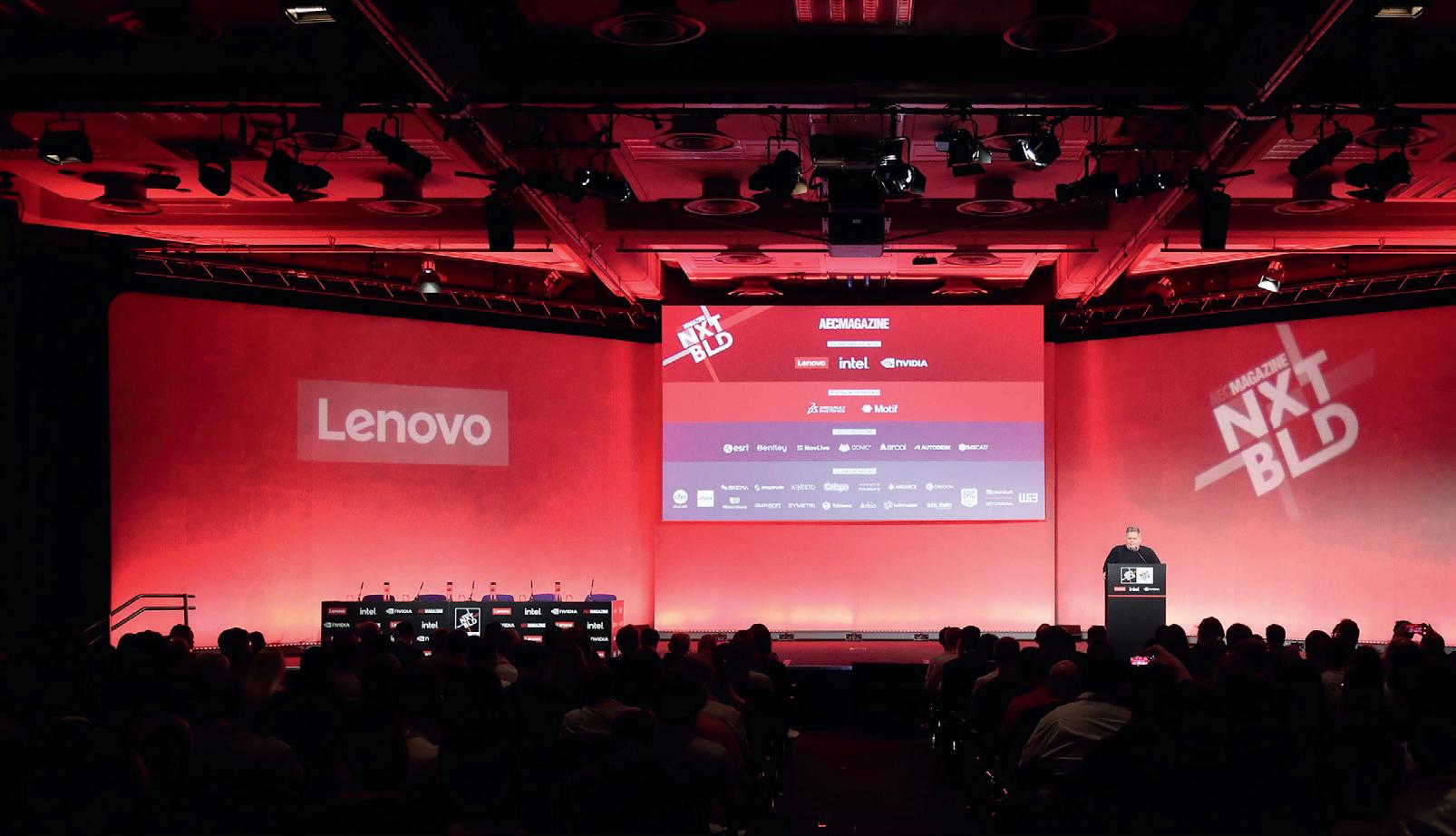







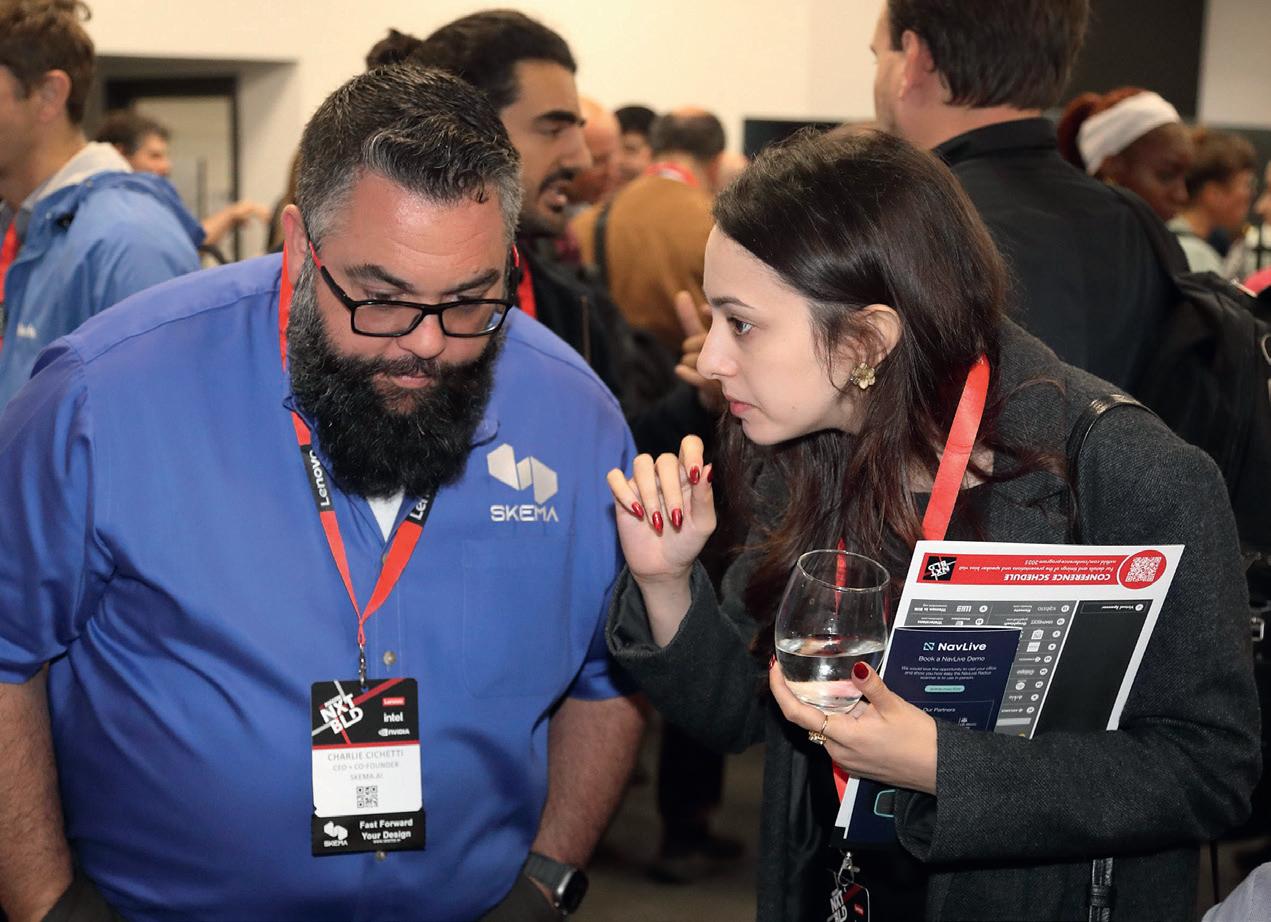
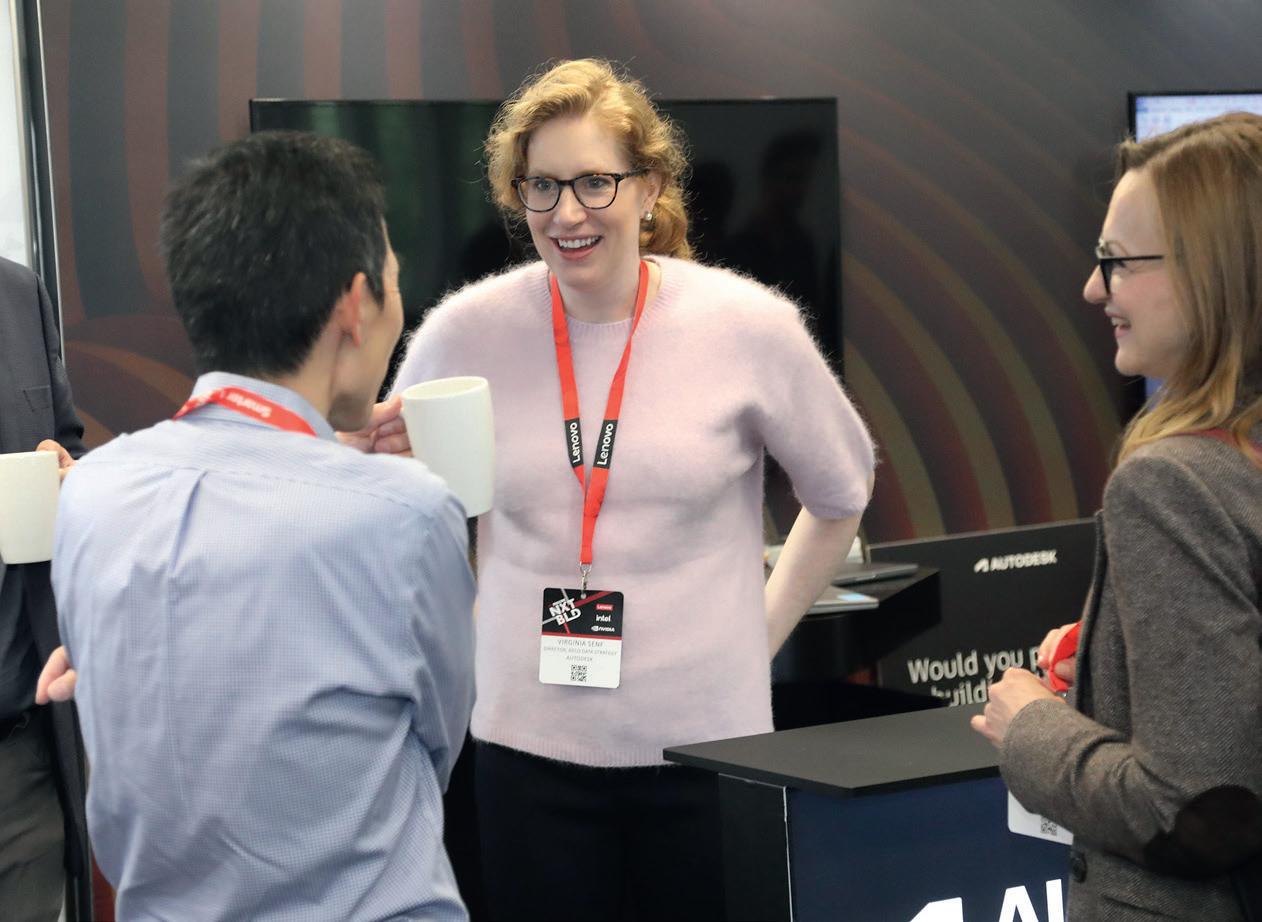

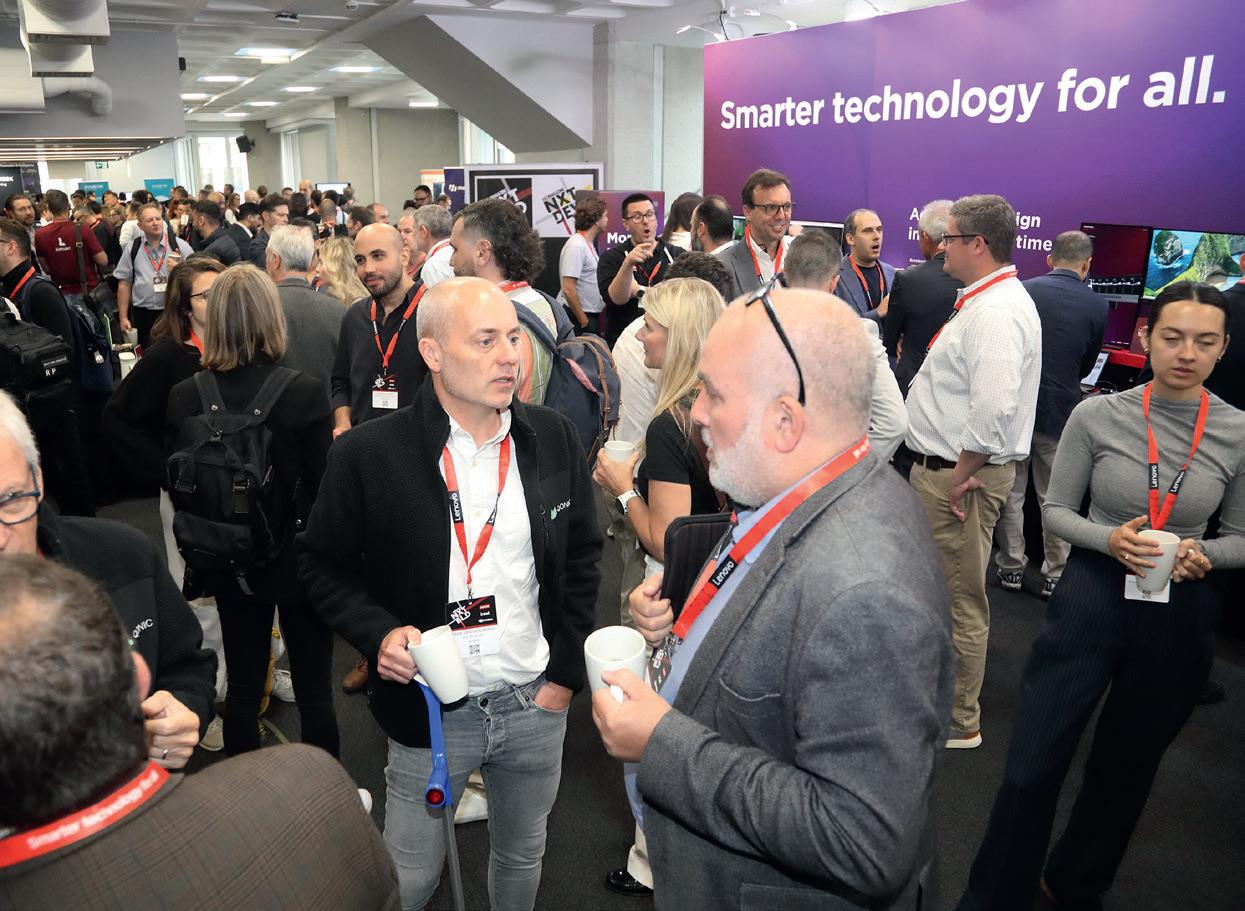





SILVER SPONSORS
BRONZE SPONSORS
CARVING A NEW PATH
» Snow sports giant K2 used Onshape to design its latest collection. Gabrielle Brown discovers how the company’s designers take CAD out of the studio and onto the slopes
As a leader in snow sports equipment, K2 was challenged to create a new range of speedy, yet stable skis, but quickly ran into issues –not on the slopes, but back in the studio. Founded in 1962 and known for pioneering the practice of ditching traditional wood and metal skis in favour of lightweight fibreglass, K2 Snow has always put function at the forefront of its designs. On mountain slopes, the brand has something to offer everyone, from first timers to Olympic gold medallists.
With its Blur XT range, a ski designed for versatility, the company aimed to deliver its most advanced design yet – but its design team initially struggled to bring the idea to fruition, hampered by traditional desktop CAD and disconnected product data management (PDM) capabilities.
Design work was time consuming, communication with global manufacturing partners was inefficient and manual file management led to confusion and delays.
“We needed a better solution and a faster way to iterate. Our previous set-up just wasn’t keeping pace with how quickly we wanted to move,” says K2 Skis R&D engineer Jed Yeiser.
SKI CHALLENGE
In a competitive market where trends and consumer demand evolve rapidly, K2’s design team was in search of an accelerator for its designs. On top of that, work on K2 skis doesn’t begin and end in the studio. The design team frequently needs to bring CAD out onto the slopes when it tests its designs, in order to make changes in real time.
Onshape’s cloud-native platform enables K2 to move CAD closer to the action, says the company’s design engineer Kyle Evers. “I can pull up designs on different devices like my phone, so when we’re out ski testing on the hill at the ski area, I can check what my designs are and make sure we’re crystal-clear about the decisions we’re making in testing,” he says.
By moving to Onshape, Jed Yeiser forecast time savings in the region of 20%. In fact, the team now feels it’s closer to 25%. Since that team is spread across the US, China and Europe, built-in commenting and version control are a necessity that Onshape delivers.
The team has also incorporated FeatureScript into its workflow. “With a few lines of code, we were able to drastically reduce the amount of time it takes us to import designs from our analysis tool, streamline creating QC documentation for parts, since the FeatureScript analyses a body and spits out a table of QC points, and automate
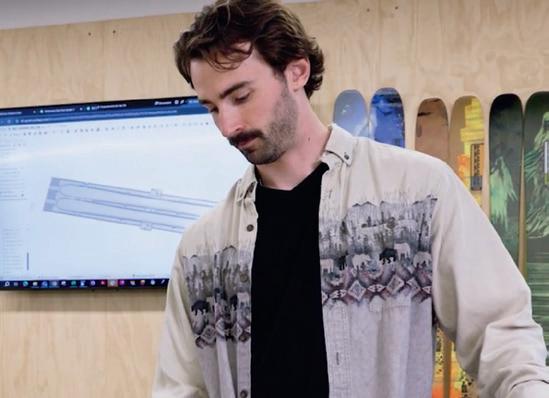
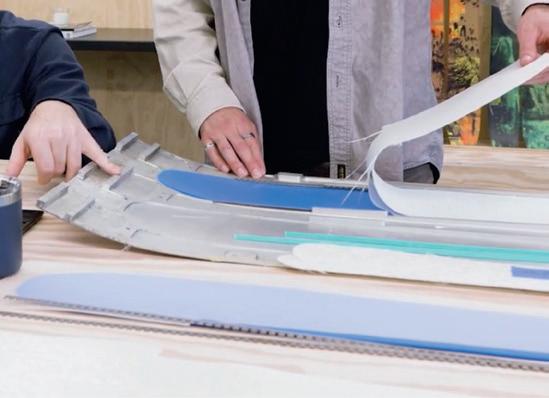
many of our standard processes,” explains Yeiser.
The shift in PDM to Onshape didn’t just eliminate technical barriers; it changed how the team thinks about design collaboration. “In file-based systems, you’re always cautious,” he says.
“You’re waiting for someone to check something in or worrying if the version you’re looking at is the right one. That friction slows everyone down,” he says.
K2’s key partner BOA, a manufacturer of dial-based fasteners, also uses Onshape to design its innovative Fit System ratcheting mechanism for athletic footwear without laces.
Ultimately, time spent in the studio and out on the slopes has paid off for the design team. K2’s Blur XT skis offer an edge-to-edge aluminium alloy H-beam for improved edge contact and control, providing stability at speed and razor-sharp edge hold and smooth, low-effort turn initiation. Unidirectional dampening, thanks to a technology K2 calls Flax Shield, adds suspension and composure, giving a stable ride without feeling sluggish.
So, whether you’re arcing precise carves or navigating variable snow, these skis have got your back. www.k2snow.com


● 1 Designers at K2 are no longer hampered by desktop CAD and disconnected PDM
K2 blends modern tech with versatile design for power, precision and stability
A PUTT ABOVE THE REST

» Cobra’s innovative 3DP Tour putter brings 3D printing to the fore. Gabrielle Brown learns how traditional casting and forging are getting left behind as new additive processes and composites take to the green
The hollow ‘clunk’ as a golf ball drops into a hole is the sound every golfer chases. Their chances of hearing it before their competitors do tends to depend on their performance not 300 yards away from that hole, but just one foot away.
With 40% of shots in a typical game made on the green, the putter is arguably the most important club in a player’s bag. With this in mind, Cobra Golf has delivered its most stable, forgiving and technologically advanced putters to date, in the form of the 3D-printed 3DP Tour range.
Each model in that range features a 3D-printed nylon cartridge, a carbon fibre crown, a 304 stainless steel MIM body and a tungsten sole weight. Together, these materials form a structure that maximises moment of inertia (MOI), while precisely controlling the centre of gravity to improve launch, roll and stability.
Another key feature is the integration of partner LA Golf’s Descending Loft Technology (DLT) with putter faces, in order to provide consistent launch and spin rates on every shot.
“3D printing gives us total freedom to design for performance first,” says Cobra Golf senior product manager Chad DeHart.
SHIFTING MASS
Designed in Siemens NX, the 3DP Tour putter family includes a KBS CT Tour shaft, SuperStroke Pistol 1.0
grip or 17-inch SuperStroke 3.0 grip on counterbalanced models, and a headcover.
“By shifting mass out of the centre of the putter, we pushed MOI higher than ever while engineering CG placement for exceptional stability,” says DeHart.
“Pairing that with a fully milled 304 stainless steel face delivers the precise, tour-validated feel players love. This is the kind of innovation that defines Cobra.”
3D printing allows Cobra’s engineers to design complex internal geometries. A lightweight carbon fibre crown and 3D-printed nylon cartridge form the upper and midsections of the putter, allowing mass to be repositioned lower and further away from the club face. While previous models have been produced with the help of HP 3D printing, Cobra is keeping the exact technologies secret for this release.
Retailing for $379, the putter is priced at the top end of Cobra’s range, but its abilities on the greens should still see it perform well in terms of sales.
“Cobra Golf has always been driven by innovation.
The putter’s stainless steel face provides players with a solid, responsive feel
The fact that we are the first OEM to offer a full range of 3D-printed irons that exceed the performance of comparable, traditionally made irons clearly shows our level of dedication to making the very best performing gear in golf,” says Cobra Golf president Dan Ladd.
To complement the high-MOI chassis, the putter features a milled 304 stainless steel face to provide a solid, responsive feel, ensuring golfers benefit from the same face technology trusted at the highest level of the game.

With such a range of technologies proudly on display, the 3DP Tour putter could be a valuable secret weapon for golfers who long to hear that soft ‘clunk’ of a ball dropping into the hole more regularly.








www.cobragolf.com

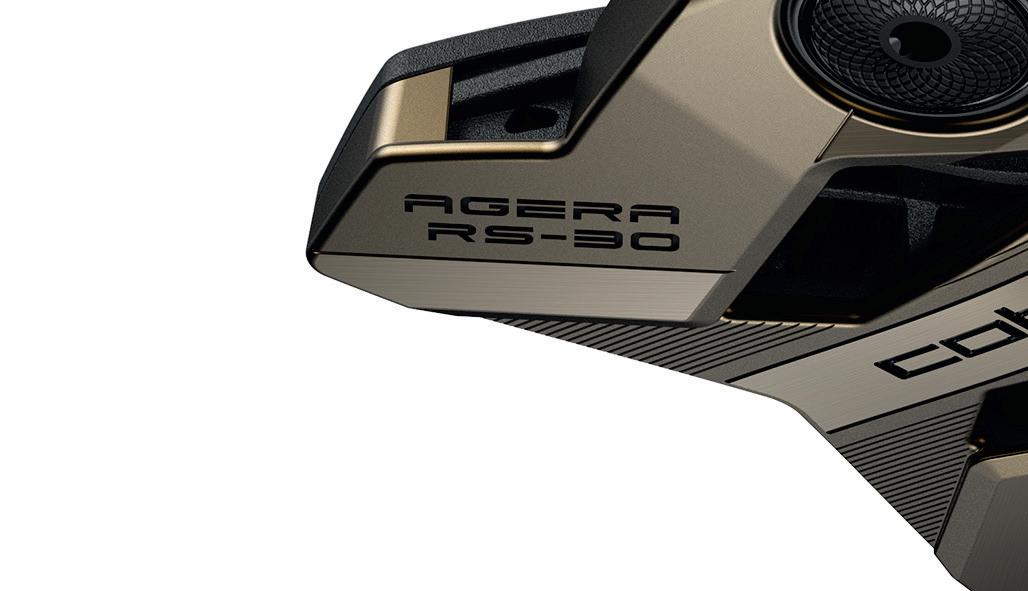
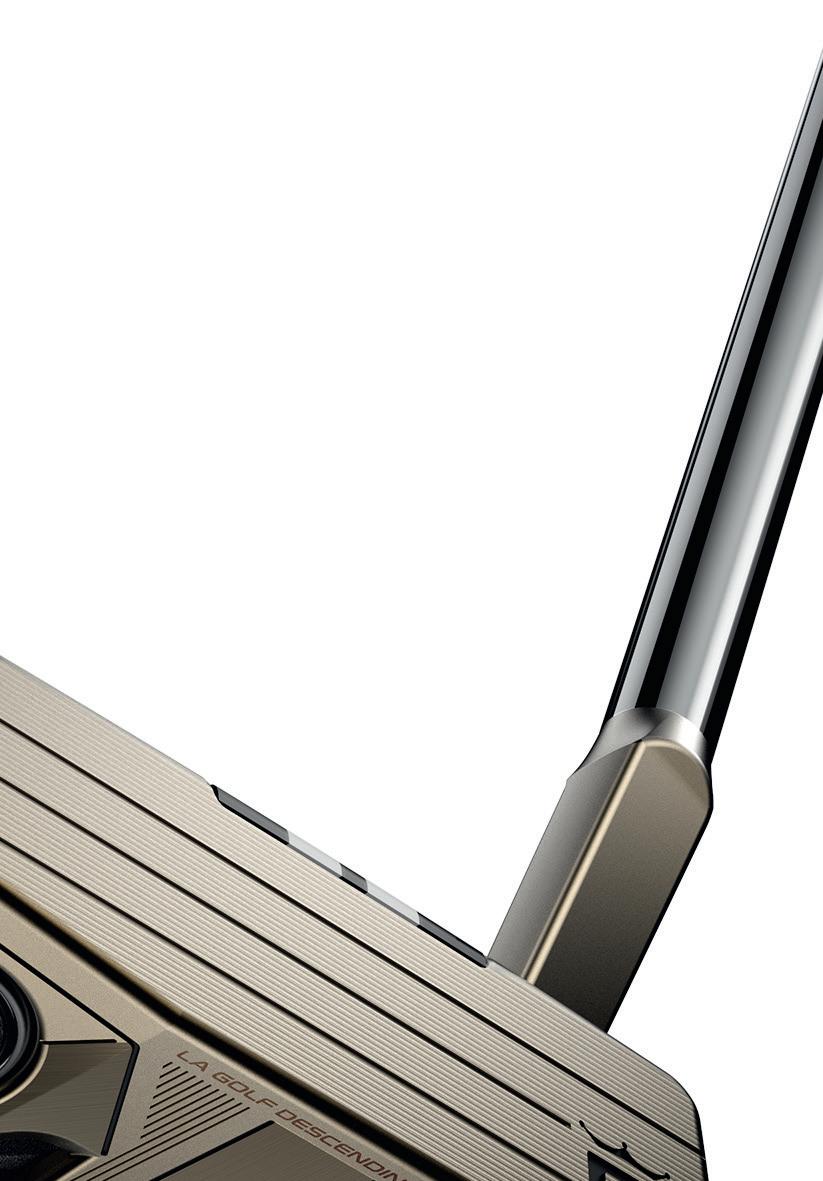
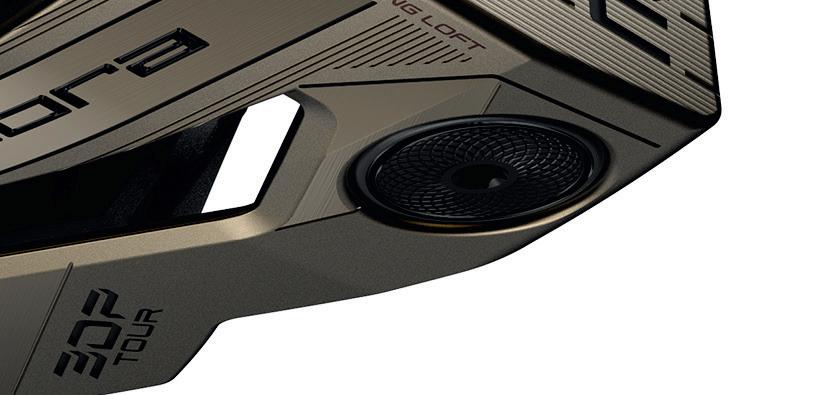
● 1 The Cobra 3DP Tour putter was designed by in Siemens NX
Huion Kamvas 22 Plus
» What does £500 buy you in the pricey world of pen displays?
An outdated bargain-basement brick or a surprise hit?
Stephen Holmes put the Huion Kamvas 22 Plus through its paces, and found an underpowered piece of hardware that might still supercharge your workflow
When we heard that Huion had souped up its Pro range in order to go toeto-toe with professional tablet makers Wacom and Xencelabs, we wanted to know more. The company’s product team suggested we take a look at its updated lower-spec model, the Kamvas 22 Plus – but with no ‘Pro’ included in that moniker, we were sceptical.
On further research, we discovered that, on paper, the Kamvas 22 Plus stands professional-sounding sibling, the Kamvas Pro 24. For example, it o ers almost half the resolution, pressure levels and viewing
sensed ‘dark-horse potential’ in the 22 Plus, given that it comes at almost a third of the price and boasts updated QLED technology.
Founded in 2011, Huion launched its Kamvas line in 2018, o ering a wide range of screen sizes. Today, a 22-inch screen is something of an oddity. Smaller, pick-upand-use-anywhere tablets typically measure around 16 inches.
smaller desk footprint models tend to weigh in at 24 inches, while those aimed at professional power users top out at 27 inches (but only since Wacom discontinued its mammoth Cintiq Pro 32).
However, the workspace on o er with the Kamvas Plus 22 is not hugely di erent from a 24-inch pen display to really cramp you style and buying this device will certainly keep costs down – but don’t expect a piece of mobile kit that can be casually tossed in your rucksack (more on this topic later).
the end of the world, and in true flat pack furniture tradition, a rogue Allen key is included, for which I’ve still to find a use.
Once installed, the stand can be adjusted from a 20-degree to an 80-degree angle, with the bottom of the screen sitting on grippy rubber feet. It’s easy to find a drawing position that suits you, although a built-in stand would have been a nice option.
The first thing you notice is that the curvy matte black Kamvas 22 Plus is a chunky unit. At nearly 2cm thick, and a smidge under 4kg, this is not a pen display that you’re going to pick up regularly and
Huion Kamvas 22 Plus arrives in a solid, if rather plain, cardboard box. Unlike competitors, there’s no real ‘unboxing experience’. The packaging extends to stock polystyrene and plastic baggies, as opposed to more sustainable, modern alternatives. Yet everything is clearly marked and a narrow brown card box contains all power cables, as well as a pen stand and a pen, itself stored in an unflashy little unbranded cardboard canister.

Further up the




The back has 75x75mm VESA mounting holes for an existing stand set-up. Five physical buttons are situated in an indent at the top of the screen for power on, menus, up and down and selection. Its two USB-C ports will be quickly taken up by the power and lead-out cables, leaving a
Once connected, you have the option to use the Kamvas 22 Plus as your main display, as an extension of your display, or just to mirror what’s already on your screen
3 Once installed, the stand can be adjusted from a 20-degree to an 80-degree angle stands at a distinct disadvantage to its more Kamvas angle of the Pro 24. However, we also scale,
It’s not an ostentatious start and neither is having to attach the included stand. The screws are included, but you’ll need a Phillips screwdriver to complete the task. Given that you’ve opted for a budget choice, a bit of self-assembly is




While overall, set-up was quick, I had to consult the guide to understand how to connect the three separate elements that make up the power cable. The resulting line leaves you with a lot of wire.
Once connected, you have the option to use the Kamvas 22 Plus as your main display, as an extension of your display, or just to mirror what’s already on your screen. There’s also all the usual colour profile options you can choose to best suit your workflow.

SMOOTH TOUCH
While the base model Kamvas 22 has an anti-glare matte film stuck over the screen, the Plus model that we’re reviewing has etched anti-glare glass. This makes for a smooth hand pass over the screen, eschews any greasy marks and gives a very slight resistance to


1 The
●
●
2 With a weighted, rubber-grip front end and a slight cutaway at the rear, the PenTech 3.0 should suit all hand sizes
●
Kamvas 22 Plus is a chunky unit, nearly 2cm thick and weighing just under 4kg
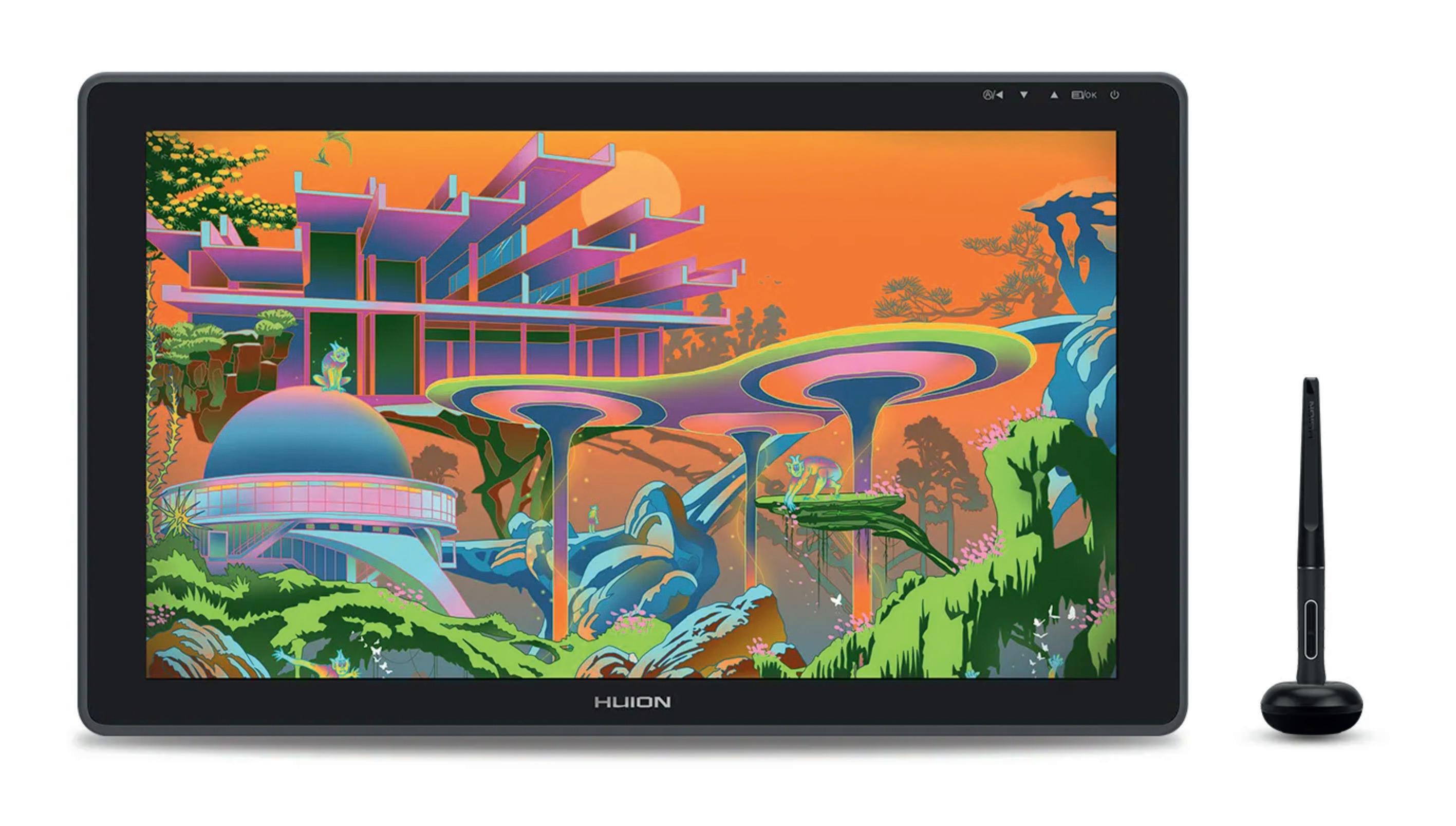
the stylus. Being etched directly into the surface means this won’t peel or crack, extending product life nicely.
The stylus itself is a battery-less, twobutton o ering created in-house by Huion, the PenTech 3.0. Huion promises users better stability with a lower positioned pen nib for a lifelike drawing experience. We can’t disagree with this. The pen glides nicely, is of a comfortable medium build, supports 60-degree tilt and 8,192 levels of pressure sensitivity. A reported 14ms response time is barely noticeable.
With a weighted, rubber-grip front end and a slight cutaway at the rear, it should suit all hand sizes. The doughnut-shaped pen holder – in which you can stand the pen vertically or rest it horizontally across - doubles as storage for the included 10 spare nibs, as well as a clip to help remove used nibs from the stylus.
Aside from giving out a few initial squeaks while bedding in – akin to the sound of a marker scribbling on a whiteboard – the included nibs are pretty robust and manage the pressure sensing well. Fibre options are also available from Huion online.
Reliant on passive cooling, the Kamvas 22 Plus has no internal fan, so the occasional nib squeak was the only disturbance during our lengthy road tests. The vents along the top of the screen made us concerned that heat might become a concern at some point, but the display behaved itself throughout and never reached an uncomfortable temperature.
GETTING CONNECTED
With the Kamvas 22 Plus, connectivity is instant – no driver downloads required. Colours are bright at 250 nits, which seems the standard for 22-inch displays, with 24-inch tablets typically o ering upwards of 300 nits.
The newer Quantum Dot Technology allows the Kamvas 22 Plus to achieve more realistic colours, with a 140% sRGB colour gamut, while the 1200:1 contrast ratio ensures deep blacks.
secondary screen that can transition to an accurate pen display for occasional work. Your chief stylist is not going to compromise on work space, resolution or top-level colour calibration – but your everyday designer might, if it brings the benefi t of having an extra monitor and the ability to make quick sketches when necessary (another bonus of the battery-



less pen technology).



However, the main sticking point will be the 1920 x 1080px resolution of its IPS display, especially when working with fine lines and small details in CAD. While IPS (In-Plane Switching) o ers better colour accuracy, contrast and wider viewing angles than older TN (Twisted Nematic) technology, in a world where 4k OLED monitors are now the standard, this is simply not in the same league when it comes to sharpness, especially when you’re hovering close to the screen.











Pen displays have always been pricey. When Wacom launched the Cintiq 15X for the pro market back in 2001, it cost the equivalent of over £3,000 in today’s money. Since then, of course, prices have dropped across the board and accessibility to these devices has greatly improved. I So it strikes us that, if this is what you can get today for just £500, then there’s little reason why anyone who wants one shouldn’t have a pen display at hand on their desks. www.huion.com






Compared with competitors, it’s also a spartan o ering. You can certainly buy add-ons, such as a Keydial shortcut key pack ((£59 extra) to help you switch between your favourite tools and settings, or the Slim Pen option (£42 extra), but these are not included in the box. That said, adding these options at checkout hardly dents the price-competitiveness of the Kamvas 22 Plus, which still comes in comfortably below the ticket price of other pen displays.
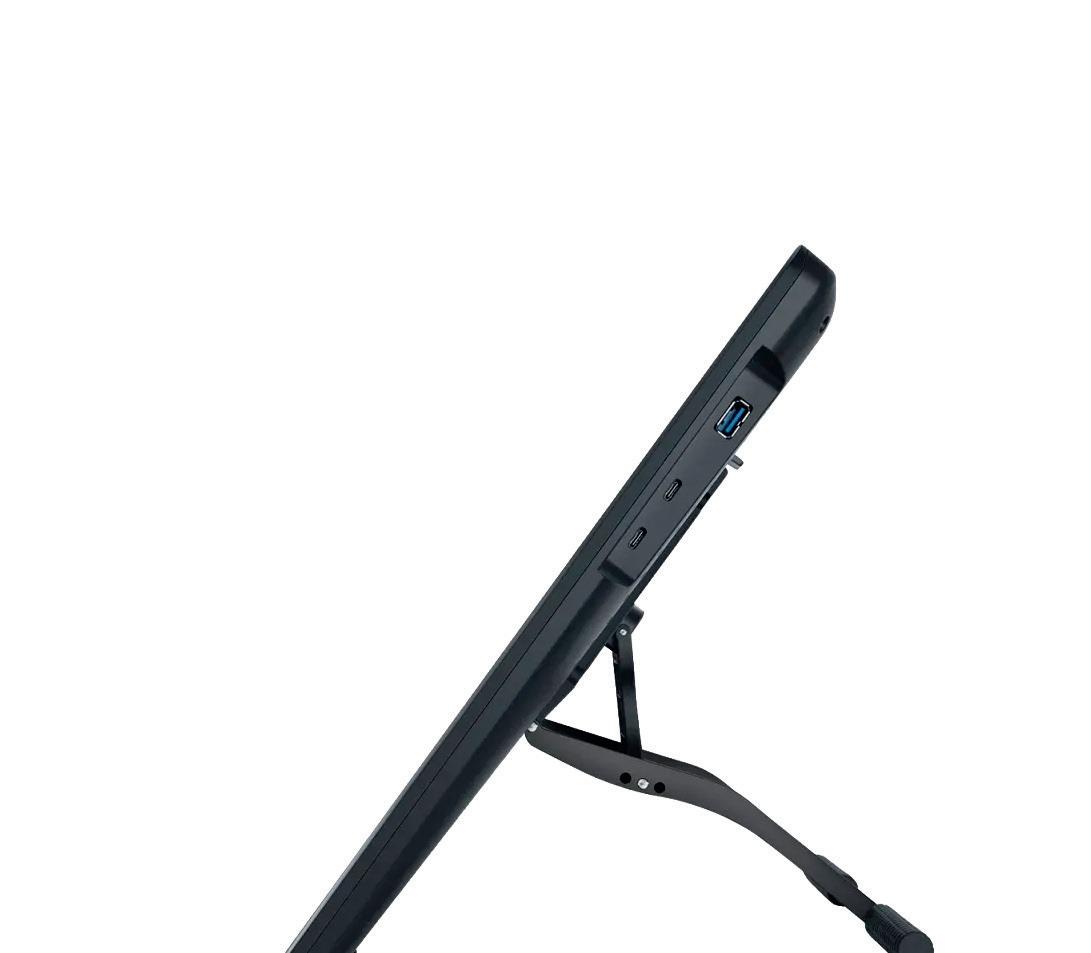
And herein lies its strength: the Kamvas 22 Plus is remarkably good value as a


Disappointment over what he’s seen so far of the Ferrari Luce leads supercar fan Stephen Holmes to question the logic of bringing in industry outsiders to design






cars that fail to spark the same passion as their forerunners
Climbing up into my bunk bed as a little kid, I’d often sit and look at the smattering of posters and cutouts I had carefully positioned on the wall next to me.
Mostly these depicted cars, and more specifically, the big beasts of the early 1990s supercar era. In other words, they were light years away from the shoeboxlike proportions, pig iron and cheap plastic of the Nissan Bluebird in which me and my siblings were routinely ferried around.
For me and my school mates, it was all about the ‘Big Three’, as we referred to them: the Bugatti EB110, Jaguar XJ220 and Ferrari F40.
We could reel o their vital statistics on command. We’d do our best to sketch them on the back pages of our exercise books. We’d dream of a time when we might actually catch a glimpse of one these beasts in the flesh. In short, these cars were the subject of a sizable chunk of our playground chatter.
Over the years, I’ve since accomplished the dream of spotting each of these cars. And every time, I have been transported back to being that tiny lad.
To this day, I still have the uncanny ability to recognise all three cars from just a glimpse of a section and from minor details, their styling being so distinctive.
The Ferrari F40, in particular, fascinated me with its sharp angles and its wide stance as it hunkered down low to the road on those unforgettable five-pointed star wheels.
So it seems pretty strange that, despite my long-running obsession with the F40 and my ability to recognise it when photographed from any one of a million different angles, I have no idea for the life of me what its interior or driver’s console looks like.
At no point have I ever even cared. For me, all that really mattered was its ferocious engineering and incredible, exciting styling.
DREAM MACHINE?
With this in mind, it came as a surprise when a first look at the upcoming Ferrari Luce started appearing all over my social media and the pages of newspapers. What was captured in the accompanying images were not the Luce’s exterior, but instead, a series of limited views of its interior: a glimpse of steering wheel, a peek at an instrument cluster, a glance at the central console and display – and don’t forget the cup holders.
The Luce is Ferrari’s first fully electric vehicle and e ectively has its own teaser trailer, just like a summer blockbuster movie coming to a cinema near you.
Of course, the huge spike in attention that the Luce is attracting is largely down to the people behind the wheel of its design. This comes from studio LoveFrom, headed by Jony Ive and Marc Newson – but you probably knew that already.
In other words, we’re talking about superstar designers from another generation. The Luce’s stylings seem like an exercise drawn from this pair’s greatest hits collection and, in particular, their work at Apple: machined aluminium, anodised finishes, slabs of glass, ‘squircles’ and the meticulous placement of circular elements within them. There’s a subtle hint of manufacturing process and assembly, too. It’s all there. And it’s all very 2007.
That’s the surprising thing about the Ferrari Luce – how familiar it seems, because we’ve all been carrying around a product rather like it in our pockets for nearly 20 years. It’s already dated and it hasn’t even reached prototype stage yet.
So is this familiarity a flex – or is this really a product in which every element has been, in Ferrari’s words, “meticulously designed and engineered to be functional, intuitive and thrilling to drive”?
If this were indeed the brief, then surely the specialist interiors team at Ferrari’s HQ might be justified in feeling that it could have cooked something up in-house, and maybe something better?





For me, the Ferrari Luce fails to convey sporting triumph, ineffable luxury or boundless excitement. In fact, it draws little to no emotion at all
The involvement of LoveFrom might be viewed as a manifestation of the way that car design is moving relentlessly in the direction of consumer electronics. Or, we might deduce that, even at Ferrari, executives recognise that the driving experience needs transformation so badly that it might be best to let outsiders have a crack at it.
But it’s Ferrari, after all. A new model still draws interest from all corners of the design world, and that’s largely down to its potential to influence the entire automotive industry for a generation or more to come.
Yet despite the undeniable design pedigree of its creators and lure of the ultra-exclusive prancing horse logo, I hope this isn’t the case. For me, the Ferrari Luce fails to convey sporting triumph, ine able luxury, or boundless excitement. In fact, it draws little to no emotion at all. Our emotional connection to a car begins with its exterior. Trying to build a connection starting with the interior misses the point.
For me, the entire exercise highlights why automotive design should remain its own specialist field, separate from other kinds of products.
After all, no chunky renders of matte aluminium and glass are likely to take pride of place on bedroom walls or capture youthful imaginations in the way that the posters on my bedroom wall once did.
GET IN TOUCH: The Ferrari Luce launch also included a dedicated prancing horse start-up ‘key’ (a small brick), reminding Stephen of the old quip that the company makes more profit from keyring sales than from car sales. On Twitter, he’s @swearstoomuch
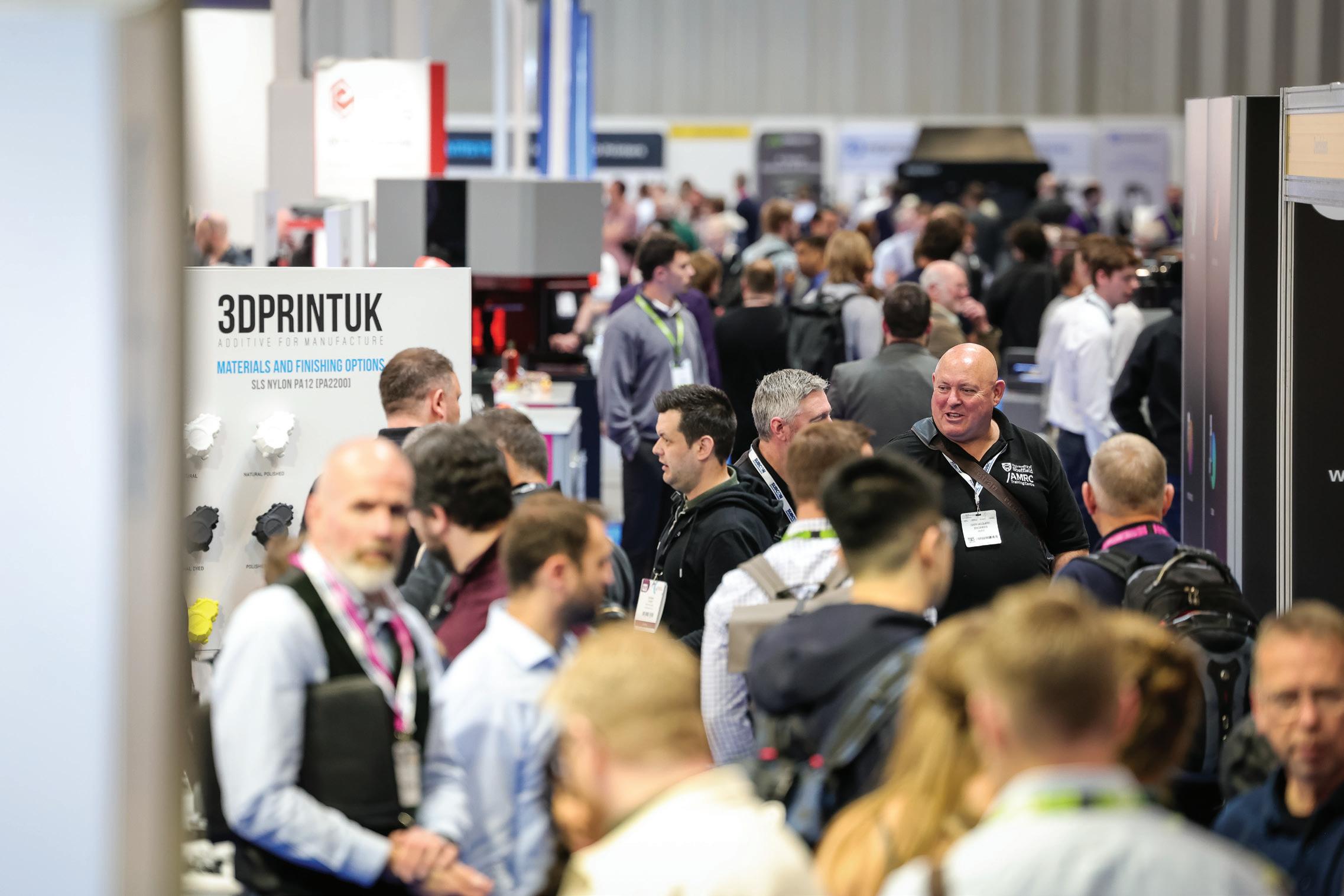
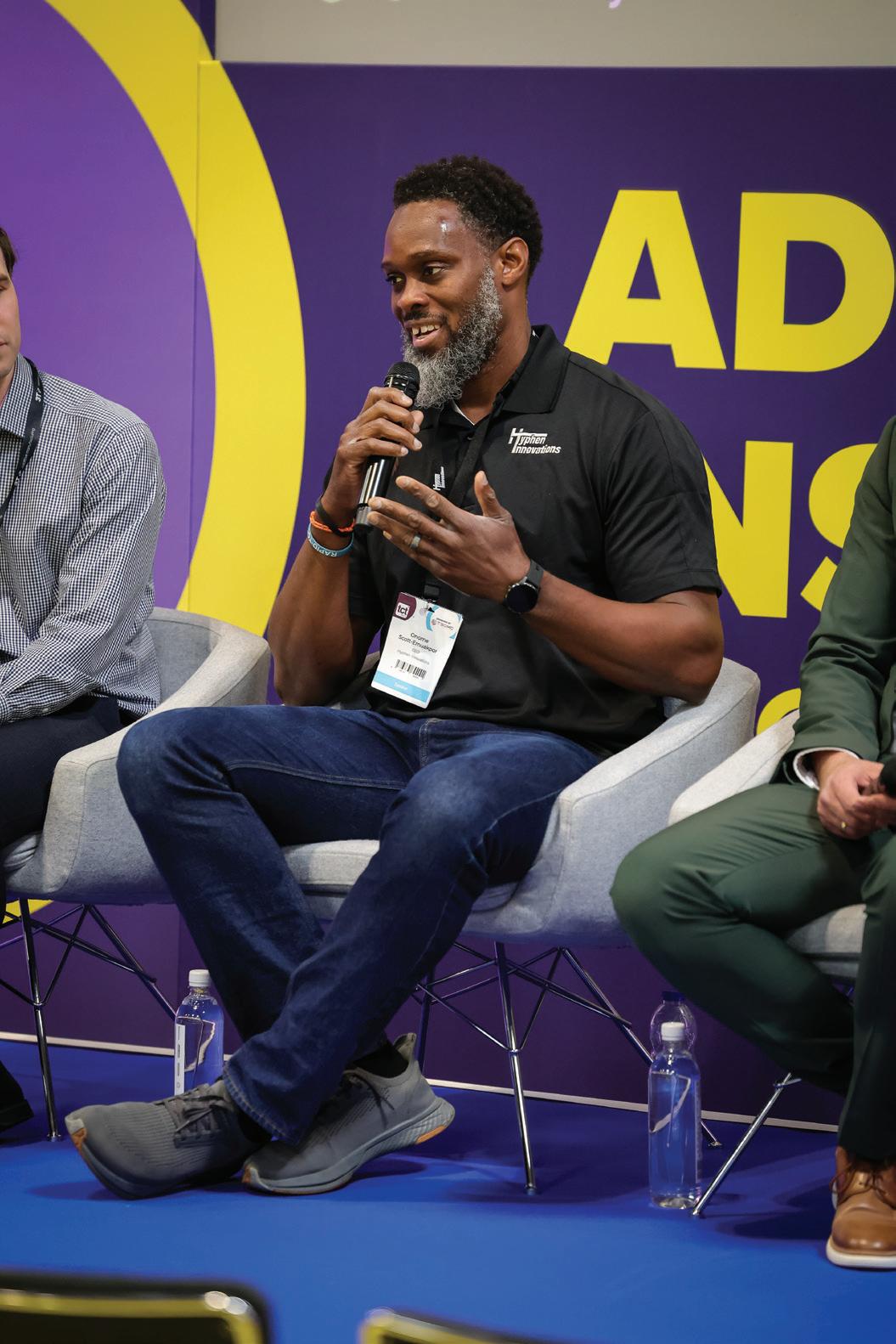

Build Bigger, Render Faster