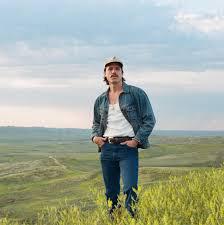
Josh Dorr is a Nashville-based singer-songwriter originally from the coal mining town of Gillette, Wyoming. Josh co-wrote Blake Shelton’s No. 1 hit radio single “Texas,” which was named one of the 10 Songs I Wish I’d Written by the Nashville Songwriters Association International, and nominated for Song of the Year at the 2025 CMA Awards. He also co-wrote Lana Del Rey & Quavo’s recordbreaking song “Tough,” which debuted at #1 on the Spotify US Global Chart, Top 40 on US Billboard Hot 100 and Billboard Global 200 charts, and played on Top 40 and Rhythmic radio. Josh has recently been working alongside teen sensation Maddox Batson. He co-wrote Maddox’s viral releases, “Tears In the River,” “Southbound,” and “X’s,” among others. In addition to these, he has had cuts with artists such as Jordan Davis, Ella Langley, Walker Hayes, Jon Pardi, Dustin Lynch, Corey Kent, Tyler Rich, Alana Springsteen, Dylan Schneider, Matt Schuster, The Castellows, Brandon Wisham, Mat Kearney,
Saturday, August 1st, 2026 | 8-10 pm
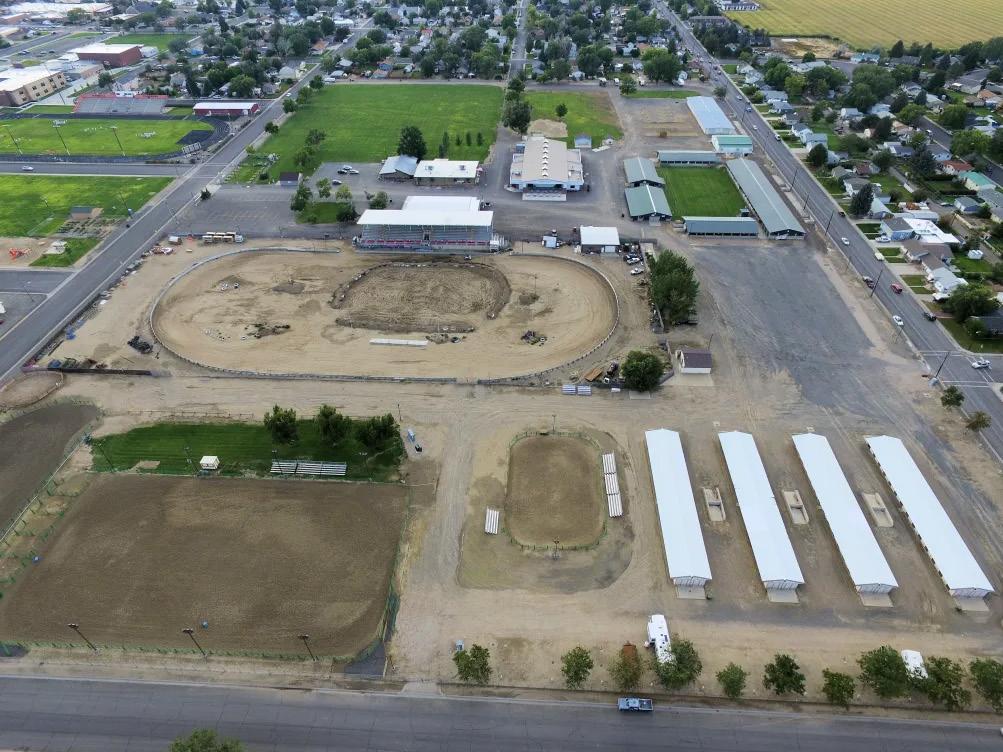
Heart Mountain Hall, County Fairgrounds
Free, no ticket required
Historic Trails in Park County
The Wyoming Wool Growers is currently working to organize a historic sheep trails map of Park County in order to preserve the long history of sheep grazing in this region of the state.
Want to learn about the Spring Creek Raid/Massacre?
Scan the QR code below:
Learn more about the history of the pioneers and homesteaders in Park County by visiting:
Meeteetse Museum
1947 State Street
Meeteetse, WY 82433
Homesteader Museum
324 East 1st Street
Powell, WY 82435
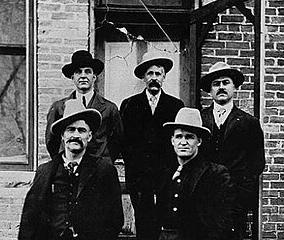
Defendants in the Spring Creek Raid Case; from top left, Herbert Brink, Ed Eaton, George Saban, Tommy Dixon, and Milton Alexander. April , 1909, Tensleep, WY
Local History:
During World War II, Wyoming was also home to the Heart Mountain Relocation Center, an internment camp located between Cody and Powell. The camp was one of ten in the United States mandated by Executive Order 9066 issued by President Franklin Roosevelt and the War Relocation Authority in February 1942. Japanese Americans, both citizens and non-citizens of the United States, who were living on the West Coast were ordered to leave their homes, their jobs and their possessions behind them and to report to assembly centers and eventually to internment camps in
All the Facts: History & Terms of the Wyoming Sheep Industry
excerpts from Tales of the Trails, by Sue & Patty Myers; Park County, WY by Lynn Houze; More Facts & Terms by Cat Urbigkit
A little bit of local history
By 1869 there were four Wyoming counties stretching from south to north: Laramie, Albany, Carbon and Carter, with an unorganized strip along the western border that the Territorial Legislature soon formed into Uinta County. Carter was first named for Judge W. A. Carter, the sutler at Fort Bridger, but the Legislature soon changed its name to Sweetwater. The Bighorn Basin, in the northwestern part of the territory, was located in Sweetwater County.
The basin had long been lived in or hunted in by various mountain and plains people, including Crow, Shoshone, Arapaho, Cheyenne, Lakota Sioux, Blackfeet and other tribes. The Fort Laramie Treaty of 1851 placed the area at the heart of country designated as Crow land. The Fort Laramie Treaty of 1868 left the basin bordered by a new Crow Reservation to the north and a new Shoshone Reservation to the south, while prohibiting non-Indians from coming onto the new reservations and settling there. That still left most of the land in the Bighorn Basin open to white settlement, but it was not until the late 1870s that ranchers and others gradually began moving in. The land remained very sparsely populated for another 20 years or so. During the years of open range, the movement of cattle and sheep across
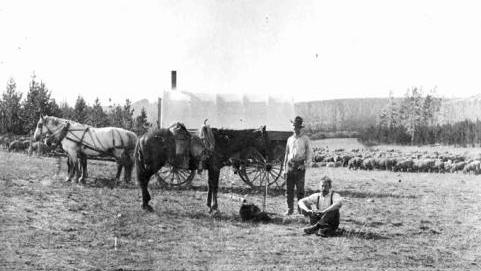
Sheep and camp at the Pitchfork Ranch (Park County; date unknown). Source: pitchforkranch.com.
hundreds of miles was common. Cattlemen based in southern Wyoming had free range north to Canada. Sheepmen, like Patsy Healy in 1880, ranged across Utah, Nevada and Idaho before moving into Wyoming. The Frewens of the 76 Ranch used what is now called the Mayoworth Stock Trail.
In 1884, a growing white population led to the organization of Fremont County in what had been the northern end of Sweetwater County. This area included the Bighorn Basin. Six years later, the basin became part of Big Horn County when, just prior to Wyoming’s becoming a state, that county was authorized by the Eleventh Territorial Legislature. Big Horn County was finally organized in 1896, and Basin City became its county seat. Park County would eventually be created in 1909
out of the western half of Big Horn County. Small settlements throughout what is now Park County began to appear in the 1880s, however.
Early Towns
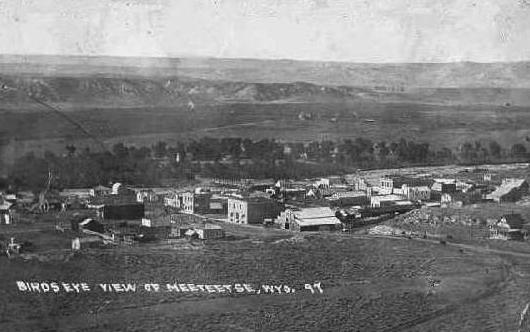
Meeteetse, a Shoshone word meaning “meeting place,” is located in the southern part of what’s now Park County and is home to the Pitchfork Ranch, one of the oldest cattle and sheep ranches in the basin, which was founded in 1879 by Count Otto Franc von Lichtenstein. At one time, the ranch covered 250,000 acres, but today it totals about 80,000. Residents first began to settle in the area near Meeteetse as early as 1887, although the town was not officially platted until 1896.
The town of Cody was founded in 1896 on what’s now called the Shoshone River, 53 miles east of Yellowstone National Park. The town’s seven founders made up the Shoshone Land and Irrigation Company, and the town was named for one of them, Col. William F. “Buffalo Bill” Cody. He promoted the town and the Bighorn Basin wherever he went, calling it a paradise with land suitable for farming and ranching, touting its proximity to Yellowstone, and the abundance of hunting and fishing opportunities.
Powell began in 1906 as a U.S. Bureau of Reclamation camp, first known as Camp Colter, for men working on the Garland Division of the Shoshone Project–the irrigation system that was so important to the survival and the success of the arid area. Four years later, the town was founded on that site and named for the “Father of Reclamation,” John Wesley Powell.
Other Enterprises
In 1917, the Pitchfork Ranch near Meeteetse acquired Timber Creek Ranch and made it the headquarters for dude ranching operations, which lasted until the late 1940s with a brief break during
World War II. In 1926, the Dude Ranchers Association was started and the first president was Irving H. “Larry” Larom of Valley Ranch located in the upper Southfork, valley about 45 miles southwest of Cody.
Meeteetse, 1897. WY State Archives.
Northwest College, a community college in Powell, was founded in 1953 and opened at its current site in 1956. The college now claims an enrollment of around 2,100 students.
The Wapiti area, west of Cody, is located on the road to the east entrance of Yellowstone National Park, and the Sunlight-Crandall area of ranches, dude ranches and summer homes lies in Sunlight Basin, northwest of Cody on the road to the northeast entrance to Yellowstone Park.
Irrigation
in Park County
The irrigation of the Bighorn Basin has enabled farming and ranching to thrive. Cattle and sheep operations are scattered throughout the county while farming—particularly sugar beet, bean and barley production—is most predominant in the Powell area. The growing season in most of the county roughly May through September, but a little longer in the eastern side of the county.
More FACts
Transhumance
Wyoming’s range sheep production system is a system called transhumance. It involves sheepherders moving with their flocks into higher elevations for summer grazing as winter snows recede, and trailing back down into lower elevation winter ranges. It’s a system that has long been practiced in Old World regions by Spanish, French, and Basque herders, and has been adapated for western rangelands.
Our canine companions
Sheep producers use two types of working dogs with distinct jobs. Herding dogs (Border Collies, Australian shepherds, etc.) are trained to move the sheep flock as directed by the herder, while the larger livestock protection dogs (Great Pyrenees, Akbash, etc.) help to keep the sheep safe from predators.
what’s a bellwether?
A bellwether is a sheep that leads the flock, often with a bell hanging from its neck. Traditionally, a sheep leading the flock is a wether (a neutered male sheep), but sometimes it’s actually a friendly ewe that leads the flock.
why do some sheep wear bells?
Bells help the herder know where the sheep are located at any given time. The ability to hear the bells helps to locate the sheep in low-visibility situations (like during snowstorms or when the sheep are in thick brush or timber), or when the flock is spread out to graze on rugged rangelands. Any sudden change in the sound of the bell, such as fast rattling, can alarm the shepherd or a livestock protection dog that a predator has spooked the sheep.
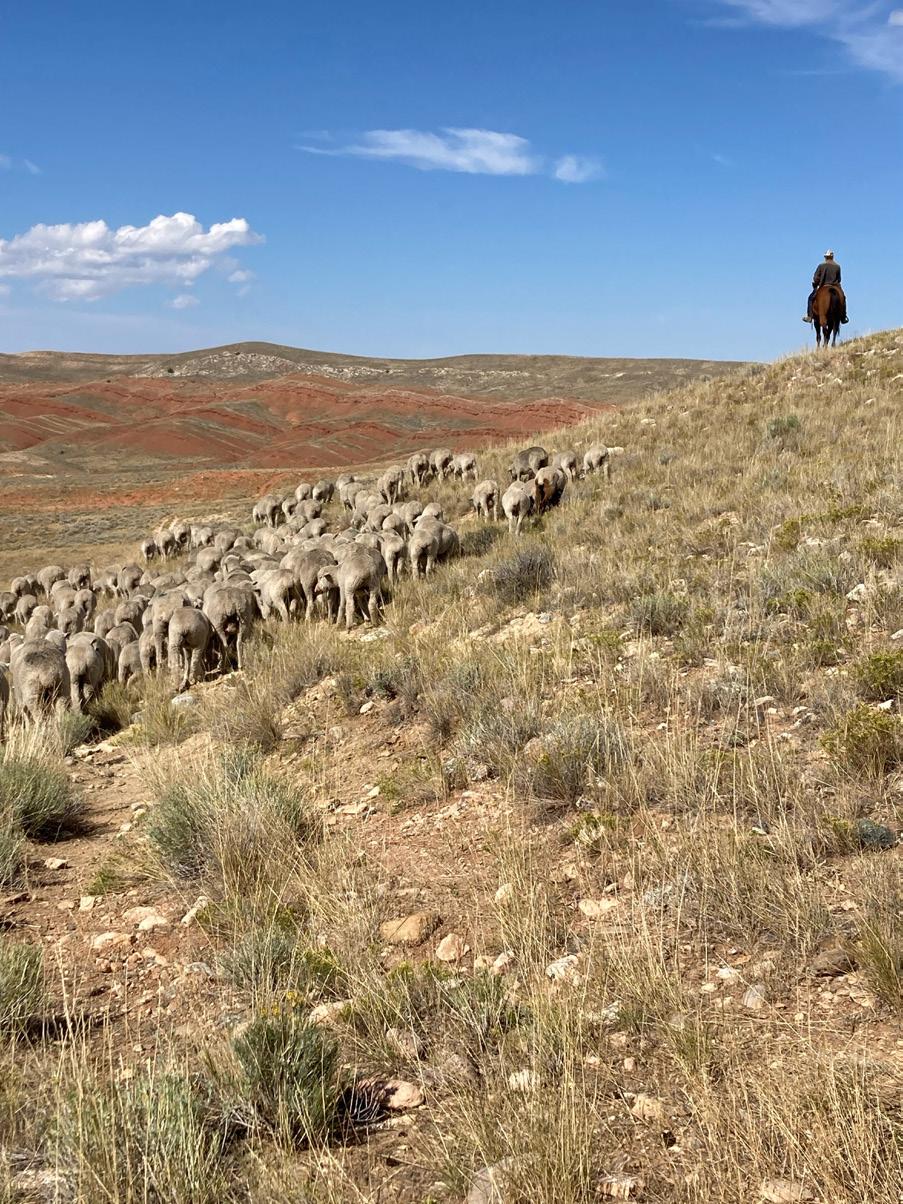
Trailing Sheep, Heather Jones, Thermopolis, WY.
what’s a marker sheep?
Herders use black sheep or “marker” sheep with bright dye painted on their bodies to keep track of the number of sheep in a flock. Most flocks have 1 marker sheep per 100 white sheep. So, if a sheepherder only counts 3 marker sheep in a flock of 400, that means there are sheep missing.
what’s a camp tender?
A camp tender comes from the main ranch to check on the sheepherders, deliver groceries and supplies, and move the sheep wagons as
what’s a sheep wagon?
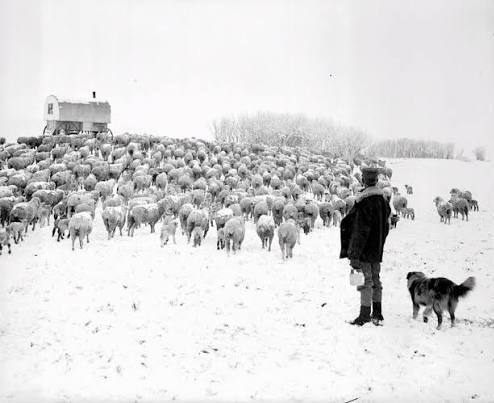
Sheepherders live in sheep wagons, their homes on wheels! The sheep wagon was invented in Wyoming in 1884. James Candlish of Rawlins and Frank George of Douglas are often credited with the invention, while Marshall Buxton of Casper is thought to have improved on the initial design.
wool or hair?
Some breeds of sheep are specialized for wool production and are shorn yearly.
Sheepherders in the BIghorn Mountains, no date. Johnson County Jim Gatchell Memorial Museum.
Most Wyoming range sheep are of these wool breeds such as Rambouillet, Targhee, Columbia, etc.
In contrast, hair sheep breeds naturally shed their wool and are generally used for meat and milk production. Hair sheep breeds include Katahdin, Dorper, etc., and are very popular in farm flocks.
Shear facts
Shearing (cutting off the sheep’s wool) is much like getting a haircut and does not harm the sheep. Sheep in this region are shorn once a year and their soft, fine wool is used to make high-quality clothing and outdoor apparel.
why shear sheep?
Shearing helps to prevent the sheep from overheating in the hot summer months and keeping the wool trimmed away from the eyes prevents wool blindness. Shearing a ewe prior to lambing helps the lambs find the nipples for nursing much more easily. Shearing is a good animal health practice.
Shearers
Most shearers in the west make their living shearing sheep. Working on a crew is typically seasonal, meaning, the shearers work on a crew for the spring. Some will continue shearing throughout the year in lamb feedlots.
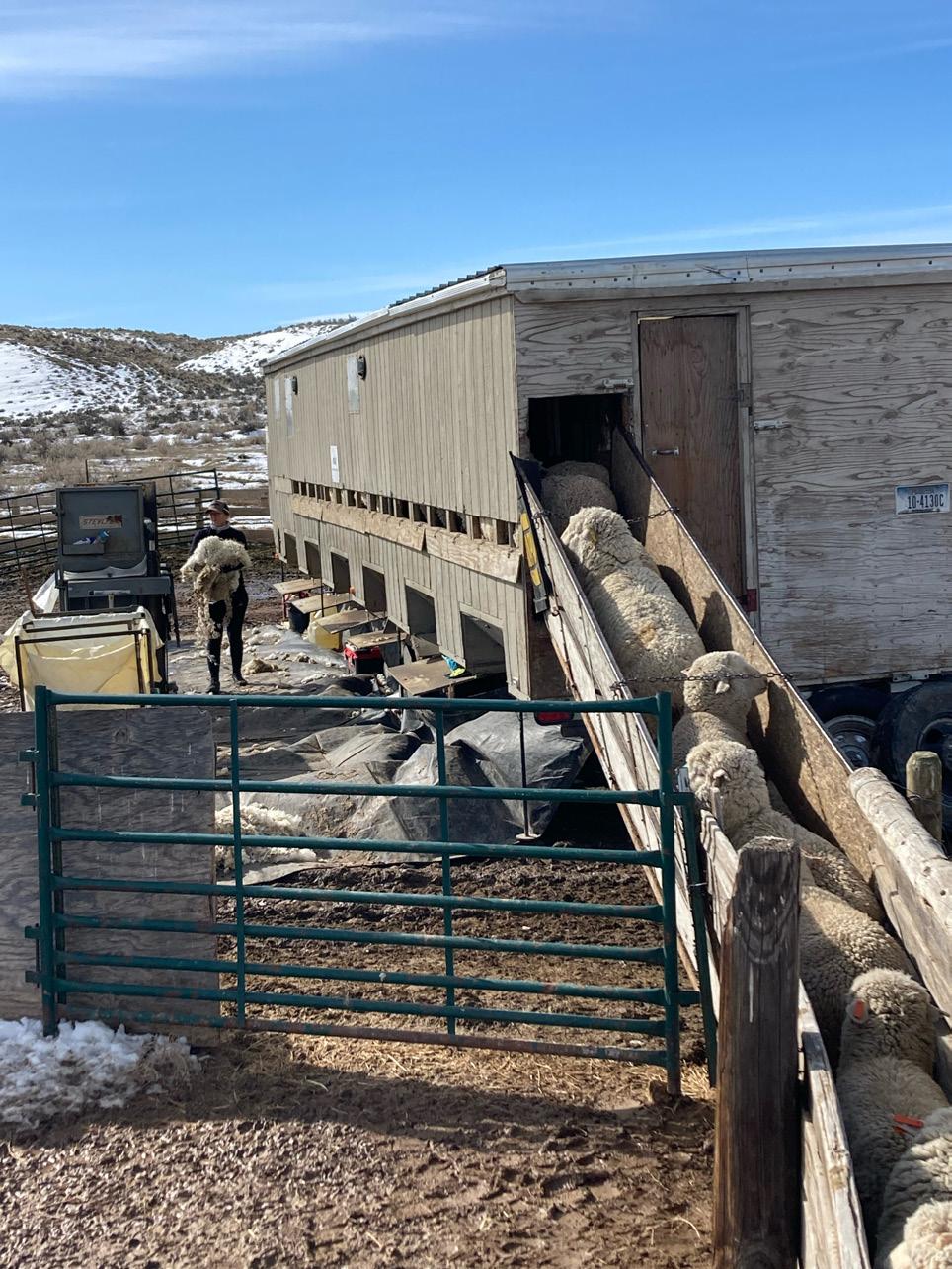
Shearing Day, Heather Jones, Thermopolis, WY.
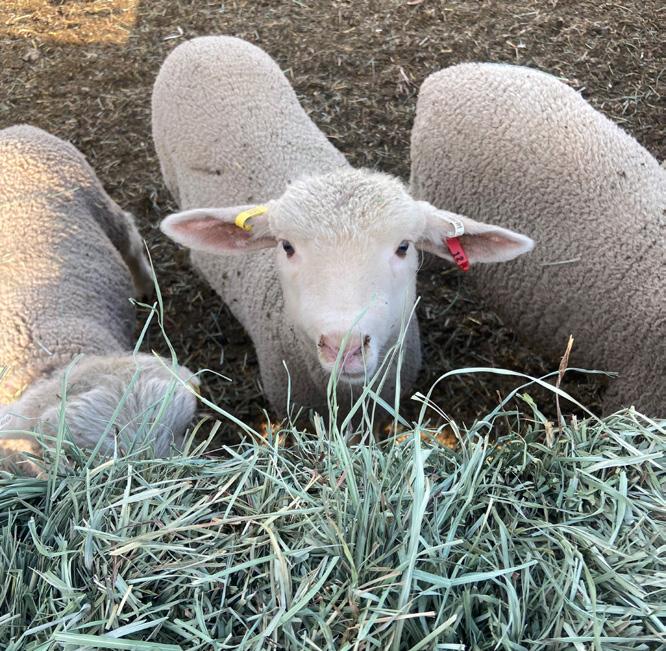
Lambs eating hay, Alison Crane, Powell, WY.
do sheep get branded?
Yes, sheep are branded to identify the flock owner, but brands are applied with a special wool paint rather than a hot iron. Sheep owners on the western range use both brands and earmarks to identify members of their flocks (as well as ear tags).
wool country
The University of Wyoming was the first institution in the country to offer a Ph.D. in wool. In 1907, the university established a wool department and wool lab under the direction of longstanding Wyoming Agricultural Experiment Station Director, John Hill. The program received international recognition for improving wool scouring, coring, and sheep culling techniques. While the wool lab no longer exists, Wyoming’s sheep program has been revitalized in recent years under the direction of Dr. Whit Stewart.
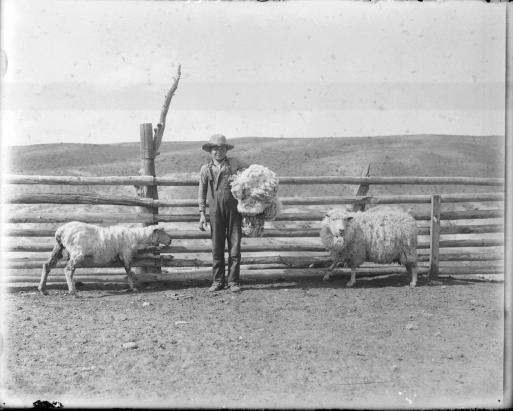
A boy with his fleece and sheep, Charles J. Belden, University of Wyoming, American Heritage Center.
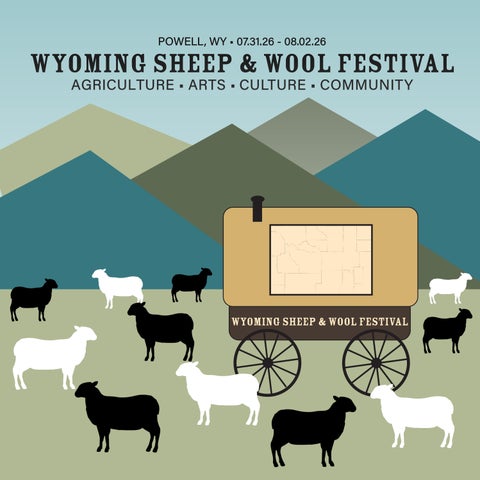
The Wyoming Sheep & Wool Festival is a project of the Wyoming Wool Growers Association and the Wyoming SHEEP Foundation. The festival is supported in part by the grants from the Wyoming Arts Council, with support from the National Endowment for the Arts and the Wyoming Legislature, and from the Wyoming Cultural Trust Fund, a program of the Department of State Parks and Cultural Resources. The 2026 Wyoming Sheep & Wool Festival is made possible with the partial funding by the Wyoming Humanities Council.
Support for the festival provided by:
Park County Travel Council
Carrie Bennet
The Festival Committee
Bitter Creek Land & Livestock
The Smith Family
McCormick Ranch
Join us in Southern Wyoming, surrounded by mountains and our only state 4-year University, for the 5th Annual Wyoming Sheep & Wool Festival.