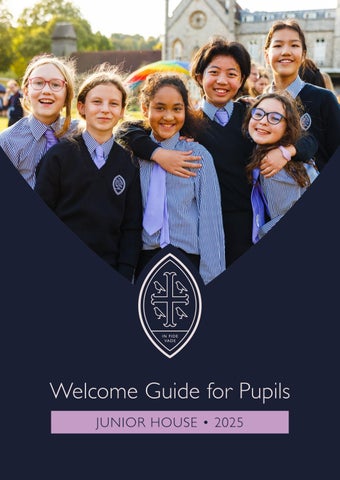
Welcome Guide for Pupils JUNIOR HOUSE • 2025
9 Shelburne 10 Wendover 11 Clarence
4 Butler 5 Campbell
6 Cloister
4 Rupert Lodge Gate 5 Dove/Crispin Way Gates
6
3 Green Gate
2 Airlie 3 Barry
7 Pitt 8 Rubens
1 Junior House
5
2 Clarence Gate
6
1 Main Entrance
10
Boarding Houses
1
Entrances/Exits
5
A404 - Marlow Hill
Daws Hill Lane
13
4
9
8
14
3
1
5
11
2
9
10
4
3
14
13 Daws Hill Houses
10 Carrington Building 11 Cookery
8 Walpole Wing 9 T-Block
2
6 Main School Dining Room 7 Health Centre
2
12 Performing Arts Centre
4
4
5 Courtyard Cafe
4 Chapel
2 Libraries 3 Big School and Ante Room
1 Main Abbey (Reception)
School Venues
7
3
3
5 8
3
2
7
1
6
A4 Fr
11
0ce
12
an
sD
ov
eW ay
5 Daws Hill Tennis Courts
4 Davies Sports Centre
3 Sports Pitches (Lacrosse, Athletics, Cricket)
1 Upper Courts (Tennis, Netball) 2 AstroTurf (Multi-Purpose)
Sports Areas
6
1
Headmistress’ Welcome
Dear Pupils, A very warm welcome to Wycombe Abbey; we are delighted that you are joining our happy, supportive community. The staff here will make sure you have every opportunity to develop your academic interests in the classroom as well as to explore new possibilities beyond it. I hope you are feeling excited about joining us, even if you are a little nervous. I have no doubt that you will settle quickly into the Wycombe Abbey way of life, making new friends and discovering the School, the wonderful grounds and facilities. This guide introduces you to your new Boarding House and will also give you information on Wycombe Abbey more generally. Your teachers and House Staff are looking forward to meeting you and to supporting and encouraging you through every aspect of your life here.
I am also looking forward to welcoming you in September 2025 and getting to know you throughout your time at Wycombe Abbey. With best wishes,
Mrs Jo Duncan MA (St Andrews), PGCE (Cantab) Headmistress
3
HOUSEMISTRESS Welcome
My name is Mrs Monteil and I am extremely proud to be the Housemistress of Junior House as well as Head of Psychology. I am so looking forward to supporting you through your school journey, and I am excited to watch you flourish in your favourite subjects, co-curricular activities and hobbies throughout your time at Wycombe Abbey. UIII have a stand alone House towards the top of Marlow Hill, a short walk from the main Abbey. We have our own dining room, library, recreation room and other communal living areas, as well as an outdoor play area. Junior House is home to approximately 85 Boarders and Day Boarders, with dorms generally of between four and eight girls. Our aim is that at the end of the day, when you walk up the hill from School, you feel like you are coming home and are part of a friendly and caring community. Junior House has an excellent team of staff to make sure that you settle in and get the most out of your time at Wycombe Abbey. Whether you are a Boarder or Day Boarder, we all look forward to getting to know you and we are here to answer your questions, run House activities, take you on trips and look after you if you are feeling poorly or homesick. We all live either in the House or close by, so one of us is never going to be too far away if you need us. Staff oversee the running of the House, making sure your laundry is done, monitoring plans for the weekend, sorting the post and booking appointments for you. The Junior House Resident Tutors are attached to an academic department as well as assisting with wakeup and bedtime routines and escorting you on trips, so there are lots of different people to talk to.
Home is where memories are made. You will get to know your year group really well, as we spend a lot of time together through evening and weekend activities, meal times and staying in different combinations of dorms - you will swap rooms three times during the year. This means that you will make friendships that will stay with you throughout your time at Wycombe Abbey I met most of you at our Welcome Morning, which we hope gave you a real sense of what to expect. This booklet contains all the information you need before we welcome you to Junior House in September. As part of your Wycombe Abbey ‘family’, I am excited about the year ahead, and I hope you are too! With best wishes Mrs Monteil and The Junior House team
4
Vision
To be at the forefront of girls’ boarding education and recognised globally as a world class school.
Values
• Trust • Encouragement • Mutual Respect • Dynamism • Excellence • Innovation • Service • Balance
5
CONTENTS
6
WYCOMBE WORDS
8
School Boarding Year Groups
START OF TERM
10
What to Expect Tips from Recent Starters Beginning of Term Arrangements
LIFE AT SCHOOL
14
DAY BOARDING
28
Mobile Phones Email ICT Online Safety Social Media Platforms
ACADEMIC
Houses LVI in House Junior House Senior Houses Clarence Daily Routines Registration Evening Routines Weekends at Wycombe Going into High Wycombe Food Chapel Charity Health and Wellbeing Pupil Voice and Where Do I Turn? Libraries and Hubs Contacting Staff Leaves Travel to and from School
Arrival Returning Home School Events Illness Additional Information for Junior House Day Boarders
COMMUNICATIONS AND DIGITAL TECHNOLOGY
30
Overview by Year Group Tutor Achievement, Projection and Effort Grades Recognition
CO-CURRICULAR ACTIVITIES
34
Physical Education Music Speech and Drama Societies
UNIFORM
38
Dress Code Other Kit Required Packing List
MISCELLANEOUS
26
46
Birthdays Tuck Pocket Money Post Lost Property Seniors Electrical Items
SITE SECURITY
48
Visitors
COMMUNITY RULES
50
AND FINALLY...
54
7
WYCOMBE WORDS Every school has its own vocabulary and Wycombe Abbey is no different. These lists should come in handy as a dictionary during your first few weeks at the School! SCHOOL AMS – meeting room located on the first floor of Walpole Wing in Main School. Big School – Main School hall where we host Friday morning assembly, called ‘School Meeting’ and events. Clarence – House for all UVI pupils. Clarence Common Room – social space in Clarence House where functions and meetings occur. Closed Weekend – these are on the first and last weekend of each term. We arrange whole School community events and everyone in the School participates.
Hub – year group areas in the Abbey with desk and social space to use during your daytime study periods and in the evenings. Hall Library – located next to Fisher Library. Kit Slip – if you have a busy timetable where it is not possible to change in or out of PE kit before an Extra, you can ask your Tutor or PE staff for permission to change at an earlier Break/Lunch. Long Leave – one or two weeks holiday midway through each term, often known as Half Term. Mark Reading – end of term assembly in Big School. Midget Pitch – area of grass at the front of the Abbey which is often used for sports practices.
Commendation – award for good work, performance or contribution. Points go towards the House Commendation Shield at the end of each term.
MSDR – Main School Dining Room.
Courtyard Café - our café area where pupils can purchase snacks and drinks. Pupils can use this space to meet friends and teachers.
My Wycombe – the School intranet with useful information about the School, Houses and subjects.
CR1, CR2, CR3 – computer rooms in the Abbey.
Microsoft Teams and OneNote – the online platforms used in some lessons. Each subject has an MS Team and this is where homework and assignments are set. Some clubs and societies also use MS Teams. MS OneNote is the equivalent of a digital exercise book and is where some work is completed, and collaborative projects done. Teams and OneNote link directly to each other. There is digital training on how to use these for all new pupils at the start of the term.
Custodians – staff who are based at the Lodge by the main gates. They welcome visitors. Davies Sports Centre (DSC) – Sports Centre with indoor facilities. Dove Day – Named after our founder, Dame Frances Dove, this is our end of year celebration. Evensong – All pupils (with the exception of Day Boarders) are expected to attend Evensong in Chapel on a Sunday evening at 8:00pm. First Morning – assembly in Big School at the start of each term. Fisher Library – fiction library off the main Abbey corridor where many societies meet and events take place. Highlights – annual dance show at the end of the Spring Term.
8
Mufti – non-school uniform.
Open Weekend – once Saturday School commitments are finished, pupils are free to be off-site until 7:00pm on Sunday. You may like to go out for Saturday evening or just for the day on Sunday. PAC – The Performing Arts Centre - containing Music and Drama situated next to the lake. Drama has a theatre space in the Lancaster Arts Centre (LAC) and Music has a performance space in the Archer Recital Hall (ARH). Paid Extras – co-curricular activities you sign up for, eg fencing, music lessons.
Prep – homework.
House Funals – end of term House Games finals.
Seniors – alumnae, pupils who have left the School. They are often invited back for events.
House Games – Monday afternoon Inter-House sport for LIV–LVI which has recreational and competitive rounds.
Short Leave – weekend break either side of Long Leave which is Friday–Sunday or Saturday–Monday, where everyone goes home or to their educational guardian.
House Mother – LIV to LV pupils will be introduced to a pupil in the year above when you join your Senior House who will guide you as you settle into Wycombe Abbey and share your room for your first term.
T Block – main Teaching Block next to the Chapel. Tracking – achievement, projection and effort grades given at varying points of the year which you will discuss with your Tutor. Your parents will receive these too. Tuck – snacks you can have in School with you. Upper Level – netball and tennis courts located above the grass pitches. Walpole – teaching area in Main School (Humanities and Language areas). Dove and Whitelaw Library – library off the main Abbey corridor.
House Order – meeting in your House where notices are given out by staff. House Outing/Inning – celebratory event at the end of Spring and Summer Terms which could be going on a trip somewhere (eg dinner, bowling, theatre) or staying on-site and doing something special (eg BBQ, inflatable assault course). Junior House – House for UIII pupils during their first year. Mons – abbreviation for ‘Monitors’, LVI pupils in the Senior Houses who have their own Common Room and House responsibilities. Outhouses – Barry and Butler House make up one Outhouse and Airlie and Campbell the other. These buildings line Marlow Hill.
BOARDING
Senior House – Houses for LIV–LVI pupils.
Big Laundry – the main wash once a week done by the Matrons for your bedding, towels, PE kit and School shirts. You will put your items in certain areas in the House and these will be washed and returned to your named shelf. Net bags, sports kit, shirts and other items are washed on specific days.
Trunking – moving in and out of your Boarding House at the start and end of term.
Buddy (LIV upwards) – a pupil in your House and in your year who will help you get where you need to during your first few weeks as they should be in similar lessons to you. Daws Hill – an old hunting lodge which now consists of Wendover, Shelburne and Cloister Houses, complete with dining and living areas at the top of the site (path leads up from the Abbey). Daily Wash – done by your Matron, laundry option each day for uniform, PE kit, underwear (in net bags) and mufti. Dispensary/Surgery – office where staff are based in the Boarding House for you to have a chat, get some medication or register. Early Beds – activities in House once you have showered and put your pyjamas on just before bedtime.
Year groups Lower School UIII (Upper Three) = Year 7 LIV (Lower Four) = Year 8 Upper School UIV (Upper Fourth) = Year 9 LV (Lower Fifth) = Year 10 UV (Upper Fifth) = Year 11 (GCSE/IGCSE year) Sixth Form LVI (Lower Sixth) = Year 12 UVI (Upper Sixth) = Year 13 (A level year) Staff are addressed as Mr/Mrs/Miss/Ms/Dr and Surname at Wycombe Abbey.
9
START OF TERM The day you arrive will no doubt be daunting but everyone knows that it takes a while to work out what to do, where to go and how to get there, so make sure you ask staff and other pupils as we have all been new to the School at one stage!
10
WHAT TO EXPECT You will have plenty of time to settle in with your family and meet some of your year before your induction activities begin. You will meet your Tutor and find out about email addresses, timetables and musical instrument hire amongst other admin. You will notice posters all over the place to tell you what is happening, when and where, so that you can sign up for co-curricular activity trials and taster sessions. The uniform list is fairly self-explanatory but we suggest learning how to tie your tie before you arrive to save some time each morning!
What advice would you give yourself if you were starting Wycombe Abbey again as a new girl? Try not to worry and don’t be shy, just go for it! You can make lots of new friends through getting involved in co-curricular and House activities which are always great fun. Ask plenty of questions so that you can get yourself organised early on. Did you find you missed home as much as you thought you would? It is normal to miss home no matter how old you are but I found that as soon as I made some friends, I was completely distracted. I definitely thought I would miss my family and home friends more than I do but it is easy to speak to them in my free time and I still see them fairly regularly.
TIPS FROM RECENT STARTERS We asked some of the pupils who joined Wycombe Abbey in September about their first impressions of the School, how they have settled in and what they would do differently if they had the chance to start again. It will always take some time to make friends and get used to new surroundings but they have done it and it was far easier than they ever imagined.
Is there anything you brought with you that in hindsight you didn’t need? Too many clothes! Is there anything that you brought with you that wasn’t suggested but you would recommend? Battery operated fairy lights, a throw, cushions, plenty of photos and a set of earplugs. A good supply of tuck is important too!
Sum up Wycombe Abbey in three words: Supportive, friendly, welcoming. Sum up boarding in three words: Fun, relaxed, family. Has anything surprised you about Wycombe Abbey? How quickly the term passes! I wasn’t expecting to feel settled so quickly but the staff and other pupils are so welcoming and friendly.
11
START OF TERM ARRANGEMENTS You will be guided through your induction at Wycombe Abbey by your Form Tutor, Housemistress, Head of Section and other key staff. This will cover: • Boarding House introduction; • Academic expectations relating to lessons and prep; • Pupil wellbeing and support; • Co-curricular inductions for extra activities, including arrangements for musical instrument hire; • Site orientation and day-to-day logistics; • Use of digital devices, including device distribution. Final arrangements and exact timings will be sent at the end of the Summer Term prior to your daughter joining. UIII Start of Term Arrangements 2025 Monday 1 September Boarders arrive in mufti (non-uniform). Your arrival time will be staggered by dorm. Mrs Monteil will contact parents during the summer to share details of when to arrive within this window. Parents to drop pupils off in Junior House, then head to Archer Recital Hall (TBC) for the Headmistress’ Welcome talk. Boarders begin to unpack in Junior House. UIII Day Boarders arrive in mufti (non-uniform); parents and girls to Fisher Library for refreshments and chat with Head of Section and Deputy Heads of Section. Girls move to Junior House for activities, escor ted by Deputy Heads of Section. Tuesday 2 September The day begins with Breakfast in Junior House. (Day Boarders welcome to join followed by registration in Tutor Rooms and continuation of UIII Induction Programme.)
Wednesday 3 September
12
8:20am
Registration in Tutor groups
8:30am
Chapel
9:00am
Tutor Group
9:30am
First Morning in Big School
10:30am
Morning Break
11:05am
Lessons begin as timetabled
13
Life at School You will discover that there are lots of different elements to day‑to‑day Wycombe Abbey life but this should give you an overview of the weekly routine.
14
Pupils eat some meals in House, and lunch in the Main School Dining Room (MSDR).
HOUSES Although every House is different and has its own character, it doesn’t really matter which you belong to because everyone always thinks that their House is the best! The UIII live in Junior House before moving into LIV, when pupils live in one of nine Senior Houses, each with about 50-70 pupils. For the final year (UVI), pupils move into Clarence where their boarding experience is more like living as a student at university. Cloister, Wendover and Shelburne are at Daws Hill. Airlie, Barry, Butler and Campbell are the Outhouses which line the main road up Marlow Hill. Pitt and Rubens are in the middle of the site. You can tell which House a pupil is in by the colour of their tie. You don’t need to learn the colours because you’ll pick them up when you get here, but it helps to have a general idea before you come. Junior Airlie Barry Butler Campbell Clarence Cloister Pitt Rubens Shelburne Wendover
Lilac Brown Pale blue Orange Purple Dark navy Green Yellow Pink Royal blue Red
LVI in House The LVI play a big part in running the Senior Houses – they are all Mons (House Monitors). LVI take a lead on organising House competitions, charity, Chapel and other social events. ‘Mons’ wear striped ties and School Prefects wear ‘dove’ ties so you can spot them. The Head of House is a School Prefect, representing the House within the Main School on a variety of committees to voice your opinions.
The Junior House team will talk to your parents about access to your phones, especially in the first few weeks after you join us. Pupils will be allocated to one of the nine Senior Houses before joining the School. Pupils will have the opportunity to meet staff and pupils in their Senior Houses as their year progresses. Senior Houses (LIV–LVI) LIV-LV or UV shared mixed-age dorms, moving each term, and developing friendships across the years with older pupils who encourage and support their younger housemates. LVI pupils have individual rooms or share twin rooms with their year group. Pupils have ‘House Mothers’ who mentor them through their time at the School. This tradition means that every pupil in a Senior House is part of a ‘family tree’ of pupils who feel connected, look out for each other, and offer advice and a listening ear. In LVI, pupils take on leadership roles in House as House Mons and as School Prefects, School Officers and Heads of Societies. In UVI, pupils take on leadership roles in wider School life. LVI pupils choose from around 26 A level courses and start our Sixth Form enrichment programme, the Carrington Award, which develops skills in creativity, intellectual curiosity, leadership, global thinking and self-reliance. The theory of the Carrington Award is taught in two double periods per week, with the skills tested in immersive educational experiences throughout the year. University application guidance for the UK, US and further afield is provided through introductory talks, individual meetings, personal statement and essay workshops, admissions test preparation and mock interviews.
Junior House (UIII) Pupils are allocated dormitories and you will have up to three different combinations of roommates and dorms during the year so you will be able to make lots of different friends. There is a bespoke programme of evening and weekend activities such as arts and crafts, cookery, woodland picnics and outward bound trips, to name just a few.
15
Clarence (UVI) Pupils move into the standalone Clarence House in individual study bedrooms (Boarders), or desks (Day Boarders) where they are able to enjoy more freedom and independence in preparation for university. Pupils are responsible for preparing their breakfast and supper each day and for ordering supplies (on a budget!) through an online account. Pupils wear mufti rather than a uniform, similar to student life.
Saturday
Throughout the UVI year there is a series of talks and presentations – from self-defence to budgeting – which mark the transition from School to the ‘real world’. A leavers’ ceremony, Clarence Leavers, is held to celebrate the end of the pupils’ time at Wycombe Abbey.
DAILY ROUTINES
8:00am
Breakfast
9:00am
Period 1
9:40am
Period 2
10:15am
Break
10:35am
Period 3
11:15am
Period 4
11:50am
Lunch
12:30pm
Spor ts Fixtures
6:10pm
Supper
Sunday 9:00am
Breakfast
10:30am
Chapel (Closed Weekends)
12:00noon
Lunch
6:10pm
Supper
8:00pm
Evensong (Open Weekends)
A Typical Weekday 7:15am
Breakfast
8:20am
Registration
8:30am
Chapel or Tutor Meeting (Mon-Thu), School Meeting (Fri)
8:45am
Period 1
9:25am
Period 2
10:00am
Break
10:25am
Period 3
11:05am
Period 4
11:45am
Period 5 / Lunch*
12:25pm
Period 6 / Lunch*
1:00pm
Period 7 / Lunch*
1:40pm
Period 8 / Lunch*
2:20pm
Period 9
3:00pm
Period 10
3:35pm
Tea
4:00pm
Period 11
4:40pm
Period 12
5:20pm
Supervised prep session
6:00pm
Supper
*Pupils are timetabled a single or double period lunch break between 11:45am – 2:20pm On Wednesdays, lessons finish at 4:15pm to allow for spor ts fixtures/music rehearsals and other co-curricular activities.
16
Registration (Please also see the Day Boarding section on page 26 for fur ther information) Morning Weekdays: You will register with your Tutor before Chapel or School Meeting. This is an oppor tunity for Tutors to pick up any areas of concern with you regarding lessons, prep or subject choices, as well as discussing current affairs or a given theme for the week as a Tutor group. At weekends you will register in your Boarding House. Afternoon Weekdays: You will be registered in your lessons or if you have a free period, you are required to register at the School Office. Weekends: You will register in your Boarding House. Evening You will register in your Boarding House. If you have to leave the site for an appointment (or return from one) during the School day you should sign in at the School Office so that registration can be updated.
17
Evening
Senior Houses, LIV–UV
Junior House
18
6:10pm – 7:15pm
Supper.
7:00pm – 8:15pm
Phones available for half an hour.
7:10pm
Tuck, tea and toast or hot chocolate depending on the evening.
8:30pm
House Order (every evening) to share news and give out notices.
8:45pm
Big lights off and little lights on, reading and getting ready for bed.
9:00pm
Lights out.
5:45pm – 7:40pm
Supper.
5:45pm onwards
Return to House or involvement in an evening activity/work in year group Hub/library areas.
8:00pm
House Order (once a week) to share news, give out notices and celebrate birthdays for the week.
8:30pm
House activities (varying weeknights) such as smoothie making, reading group, themed events, baking, etc.
8:00pm – 9:00pm
LIV and UIV phone time.
9:00pm
LIV to UV hand in electronic devices.
9:15pm
Big lights off and little lights on to prepare for bed.
9:30pm
Shower.
10:00pm
Lights out and time for sleep.
LVI Pupils follow the same evening pattern as the younger years in the Senior Houses (LIV–UV) but they keep their electronic devices and do not have a set bedtime. Pupils wake themselves up each morning and have a separate Common Room. They take more ownership over their morning and evening routines in order to prepare for individual study bedrooms in Clarence (UVI).
GOING INTO HIGH WYCOMBE The older you get, the more frequently you are allowed into town. It is nice to have a change of scenery from time to time and we are lucky that the town centre is only a five-minute walk away. The Eden Centre in High Wycombe has plenty of shops, restaurants and cafés, as well as a cinema and bowling alley. At weekends with Housemistress permission (except LVI)
Midweek (eg cinema, meals out) with Housemistress permission
LVI
Saturday and Sunday: 9:00am – 4:00pm
Weekdays: 8:50am – 3:30pm Evenings (special circumstances): returning by 9:00pm (groups)
UV
Saturday after lessons Weekdays (special or Sunday: until 4:00pm circumstances): 12:25pm – 2:20pm (pairs or more)
LV
Saturday after lessons or Sunday: until 3:00pm (pairs or more)
UIII-UIV
Saturday after lessons, supervised in groups as part of the Weekend Activity programme.
WEEKENDS AT WYCOMBE As Wycombe Abbey is a full boarding school, we have plenty going on at weekends for you to get involved in both on and off-site. Sign ups take place in House on Monday evenings unless you plan to go home or to your educational guardians if it’s an Open Weekend. The weekends are when you will make some of your best School memories! Saturday afternoons are always busy with scheduled sports fixtures which your parents and educational guardians are welcome to come and watch, along with concerts, dance shows, drama productions and Chapel services over the rest of the weekend. The first and last weekends of term are ‘Closed Weekends’ when all Boarders stay at School and special events are organised for the whole community. These have ranged from a funfair and a rock concert to an ice skating rink and a circus! We hope Day Boarders will get involved in the events too. Every weekend is packed with fun events to help you relax and enjoy life with your friends. Weekend activities include Laser Tag, spa days, trips to Thorpe Park, the Harry Potter Studio Tour, shopping trips to London, punting in Oxford or orienteering in the countryside. Socials with local boys’ schools are an integral part of weekend life and we have strong links with Eton, Harrow, and the Royal Grammar School, High Wycombe. Dinner parties, discos and informal ceilidhs are regular events. All pupils attend Evensong on Sunday evening at 8:00pm. At Closed Weekends, chapel services usually take place in the morning and the whole school attend. Day Boarders are also welcome to attend weekend Chapel services.
19
FOOD Enjoying food with friends and staff is a big part of daily life at Wycombe Abbey and there is always plenty to choose from. Menus and Nutrition: we offer a wide range of options throughout the day, and those with special dietary requirements are catered for at every meal. Pupils learn about healthy eating habits in the Wellbeing curriculum, and the PE Department and Health and Wellbeing Centre advise on sports nutrition. Our Food Committee provides an opportunity for pupils to discuss catering arrangements and to feed back on the most or least popular dishes. Facilities: main meals, Break and Tea are served in the Main School Dining Room, whilst the Courtyard Café is open throughout the day as a space where pupils can eat, work and socialise. In UVI, pupils can choose whether they wish to cook for themselves in their House kitchens or eat at the Courtyard Café or the Main School Dining Room.
Confirmation Classes are arranged bi-annually for our Anglican and Roman Catholic pupils. The classes are open to UIV pupils and above. Roman Catholic pupils have the opportunity to attend morning Mass on Sundays at the local Roman Catholic Church but are still expected to attend the short Evensong Service on Sunday at 8:00pm. Our pupils represent a wide variety of religious backgrounds and are encouraged to continue to practise their faith. If any particular support or instruction is needed, our Chaplain will make every effort to try to accommodate this. There are regular drop-in sessions for support and advice. Societies such as the Christian Society support faith development and fellowship of our pupils. Termly, each House choose a topic and leads a service where pupils sing an anthem, play instruments and read and say prayers.
Houses located further away from the Main School have dedicated facilities. At Daws Hill, Cloister, Shelburne and Wendover pupils have their own dining room where they eat breakfast and supper.
SCHOOL TRIPS
Junior House has some meals in their own dining room. The rest of their meals are eaten in the Main School Dining Room.
Trips (academic/sport/music/drama/other co-curricular) vary from day excursions to longer residential trips and tours both in the UK and abroad.
Sharing Meals: every day at Break and Tea time, pupils gather in their Houses or in the Main School Dining Room for homebaked treats. Staff share meal times with the pupils and Tutors often arrange to have Tea with their Tutees. Older pupils regularly participate in formal meals with visiting speakers.
Some trips take place during term time and others during the holidays.
We are a nut free site, so girls are not permitted to bring any items containing nuts.
CHAPEL Wycombe Abbey has a Christian ethos, and Chapel plays a central part in our community life. We meet two mornings a week for a short service which is pleasant, peaceful start to a busy day ahead. These can be led by a House, our Chaplin or a member of academic staff. All girls attend a Sunday Evensong Service often with visiting speakers. Parents are welcome to join these services. Regular services of Holy Communion are held for both pupils and staff. 20
Certain trips and excursions are compulsory components of academic courses or important and enjoyable features of co-curricular activities. Parents will be contacted regarding all trips which incur a cost greater than £50. Parents will be given as much advance notice as possible of the scheduled trips on offer to various year groups.
21
CHARITY
PUPIL VOICE AND WHERE DO I TURN?
Charitable work is an integral part of our community life and last year we raised almost £24,000! We have a culture of ‘giving back’ through charity fundraising throughout the School and in Clarence you can be involved in community placements which are hugely rewarding.
The School wants to hear your thoughts on what we do well or what we can do better so there are many forums for you to feed back. Alongside your House Staff, there are plenty of other people to turn to if you have any worries – everyone wants to help. Your House Staff and Tutor are always ready to listen at any time.
Our fundraising supports the Wycombe Abbey foundation charities set up by founder Dame Frances Dove. Pupils also select two charities (one local and one national/international charity) to be supported for two years, as well as reacting to emergency appeals. Pupils have the opportunity to embrace their leadership qualities as a House Charity Representative or School Prefect, serving on the Charity Committee with the Chaplain and other members of staff.
HEALTH AND WELLBEING All staff are here to make sure you are happy and healthy. Our Health and Wellbeing Centre is the place to go if you are feeling unwell during the day and there are beds for overnight stays if you are particularly poorly. The nurses will make sure you are comfortable and have everything you need. Three Doctors visit School during the week and private appointments can be made. The nurses also care for your psychological well-being as well as your physical health and health information advice is provided when needed. House Staff will look after you if you are feeling unwell in the morning or evening, as well as during the night to treat headaches, colds, etc. We will arrange for external appointments for physiotherapy, chiropody and dental treatments. Wellbeing is part of the School curriculum where you will discuss common issues faced during the process of adolescence and growing up. Houses sell necessities such as toothpaste, toothbrushes, hairbands, sanitary items and tights in the House dispensary.
22
We have two School Counsellors and a well being dog, you are welcome to arrange to chat to them about any worries you have or to make a phone call to an Independent Listener. The School also operates a Peer Listening service supported by MIND. There are also other external organisations you can contact, such as: Childline, Kidscape, The Samaritans, Cruse Bereavement Care, Beat Eating Disorders and DrugFam. You can find contact details for these on My Wycombe. Listening@Wycombe is a service where you can express your ideas and ask questions about School life at any time. House Mothers and older pupils are good sources of knowledge and reassurance over any School worries as they have often been in a similar position before. If you have any concerns about a pupil’s wellbeing or any safeguarding issues, please contact a member of the School’s safeguarding team. Their names and email addresses are on posters throughout School and available on our intranet My Wycombe.
23
HUBS AND LIBRARIES The Main Abbey building is central to the School, providing Hub areas for work and social space and a library for Junior House pupils. The School Libraries provide quiet places for pupils to work. There are also Hubs for Lower and Upper School, and Common Rooms for the Sixth Form. Pupils have lockers to keep their belongings safe and desk space to enable them to work during daytime free periods and in the evening.
CONTACTING STAFF Due to the boarding nature of the School, we are lucky to have staff who are often contactable outside lesson times to offer support or advice regarding your academic or pastoral wellbeing. You will see your House Staff in the morning and evening who can help with most things but if you need help during the day, it’s best to go to the Lower School Hub where Mrs Monteil (Housemistress of Junior House) and Mrs Harbour (Head of Lower School) have their office and are never far away! Email is another good way of communicating with staff as messages are checked regularly. Please use: surnameinitial@ wycombeabbey.com to make contact. Please always cc in your Housemistress when contacting members of staff.
LEAVES The term is structured around Long Leaves, Short Leaves, ‘Open’ and ‘Closed’ Weekends, which ultimately means there is a lot of flexibility around going out at weekends, whether that’s home if you don’t live too far away, to your educational guardian’s house or simply into High Wycombe for a few hours with friends. Long Leaves, half term breaks of 7 to 14 days, and Short Leave weekends are scheduled each half term. The School closes during these periods and all pupils take these holidays. You will be asked by your Boarding House Staff to provide your weekend/holiday plans at least three days in advance.
24
Closed Weekends: all Boarders are required to stay in School to take part in House and School activities. Closed Weekends take place on the first and last weekends of each term. Day Boarders are encouraged to join in with the events. Open Weekends: these provide all pupils with the opportunity to go home after their School commitments and return on Sunday in time for Evensong at 8:00pm.
TRAVEL TO AND FROM SCHOOL We arrange a coach to central London (Prince Consort Road) at Short and Long Leaves as well as a coach to London Heathrow at the start of Long Leave and end of term. Public Transport: UIII, LIV and UIV pupils are not permitted to use public transport for Leaves unless accompanied by an adult. LV pupils must travel in pairs. Specific written parental permission must be given for each occasion. If you need a taxi booking, your House Staff can arrange this for you and it will be added to your end of term bill.
25
Day Boarding As a Day Boarder, you can get involved in everything that Boarders do. The more time you spend in the Boarding House and doing weekend activities, the sooner you will settle in at School.
26
ARRIVAL
SCHOOL EVENTS
You need to be at the Main School by 8:10am, ready for Registration at 8:20am. You can have breakfast with your friends before this in Junior House at 7:15am.
There will be some compulsory commitments after lessons or at weekends, such as inter-House competitions and Friday evening lectures, so have a look on the online School Calendar to spot these. Your Housemistress will be in touch with further details.
You will register with your Tutor each weekday morning. If you arrive after registration, you must go straight to your next lesson to be registered. Out of School Office hours, you must sign in with the Custodians. Saturday: register either in the School Office or your boarding house before your first lesson. Girls wear smart mufti rather than uniform on Saturdays.
ILLNESS If you are too unwell to attend School, your parents must notify the School Office by 8:15am by phoning (+44) (0)1494 520381 or please email: dept-office@wycombeabbey.com, copying in your Housemistress and/or Tutor for each day you are away.
Sunday: sign in with your House.
Additional information for Junior House Day Boarders
RETURNING HOME
Weekends All of our Day Boarders are actively encouraged to take part in weekend activities. These activities take place after lessons finish on Saturday and on Sundays and are available to all pupils on a sign-up basis. On the first Closed Weekend of the Autumn Term, it is particularly important that Day Boarders take part in the activities as this is important for building friendships and settling into Wycombe Abbey. If you would like to take part in a particular activity, please make sure that you sign up and let your parents know the time that you need to be dropped off and collected.
Day Boarders are welcome to join in with evening activities within School and Junior House. Between Monday and Friday, all Junior House Day Boarders should be collected between 6:00pm and 8:00pm. You must make sure that you sign out when you are leaving the School site. This can be done with the Custodians if you are leaving from the Main School Car Park or with a member of Junior House Staff if you are leaving directly from Junior House. On Saturdays, Day Boarders are permitted to leave when they have completed all of their commitments. This could be at the end of formal lessons at 12:00noon, after sporting commitments or after weekend activities. As with the rest of the working week, you must make sure that you sign out either with the Custodians or with Junior House Staff when you leave the School site.
Mobile Phones Pupils in the UIII are not permitted to have their mobile phones during the School day, but we appreciate that our Day Boarders will need to get in touch with parents to discuss collection arrangements. Therefore, Junior House Day Boarders are required to leave their mobile phones either in Junior House (if they are dropped off to Junior House) or in School Office during the day, and collected from there at the end of the School day. If you are leaving School from the Main School Car Park after 6:00pm, your mobile phone will be taken to the Custodians Lodge and you can collect it from there when you sign out.
27
COMMUNICATIONS AND DIGITAL TECHNOLOGY In order to run an effective School community, strong communication between you, your Tutor and Housemistress is key.
28
MOBILE PHONES The School recognises that most pupils will have a mobile phone but we ask that phones are used appropriately and responsibly within School. Phones may be confiscated if used incorrectly. • UIII to LV do not have phones in School and must leave them in the Boarding House during the day; • Mrs Monteil will send an email to parents on the Friday before a Closed or Open Weekend letting them know the arrangements for phone times (which often vary due to the activities taking place); • Phones are not to be used in corridors, libraries and dining areas, or at any time without permission;
Staff communicate frequently with pupils through email/Teams so you will be expected to check these regularly.
ICT UIII upwards must sign up to the Wycombe Digital Devices scheme and you will be given your device as part of your induction. The School’s ICT Department will be able to provide guidance and assistance for any computer or network issues. Please look after your device; ensure it has a protective cover and take care when carrying it around School.
• Pupils should have only one phone in School; • All electronic devices (UVI - UV) must be handed in to House Staff at night; • UV to UVI can have phones in School but on a ‘never seen, used or heard’ basis. There are specific places where they can use their phones privately.
Online SAFETY We will teach you how to enjoy the advantages of the internet within safe boundaries.
SOCIAL media platforms EMAIL You will be given your email address and login details during the first few days of term. All pupils have access to email and Wi-Fi across the site.
We allow the use of social media for LIV–UVI pupils as long as they are used appropriately and conform to age recommendations. Junior House pupils should not be given access to social media platforms that are specified as appropriate only for those aged 13 years and older.
You will be given a copy of the School’s Responsible Digital Device Use Policy to read and sign during your first week of term. Pupils should act accordingly when using phones and all internet-enabled devices.
29
ACADEMIC Wycombe Abbey will encourage you to open your mind and develop your personal passions for your subjects. You will find that you are challenged in lessons, and beyond, in an exciting way, and you will also find that you receive great support from your teachers and your fellow pupils. This is a place where we all love to learn!
30
OVERVIEW BY YEAR GROUP
TUTOR
UIII–UIV (Years 7–9) • A comprehensive introduction to a wide range of academic, creative and technical disciplines;
You will be part of a Tutor group consisting of the pupils from your House who are in your year group. This tends to be about 8 to 12 pupils and you will see your Tutor every weekday morning.
• English; Mathematics; Sciences: Biology, Chemistry, Physics and Computer Science; Languages: (two from French, Spanish and German or Chinese), Latin and Greek; Humanities: Geography, History and Religious Studies; Art; Cookery; Design and Technology (in Year 9); Drama; Music; PE and Wellbeing; • Class sizes of 18–22; • Setting: pupils are taught in divisions for Mathematics and French (from Autumn Term in UIII). From LIV, Classics and Spanish are also taught in divisions. These are reviewed regularly; • Supervised (UIII) homework/prep: usually two or three subjects for 35-minutes of prep per day. LV–UV (Years 10–11) • I/GCSE syllabus; • Compulsory subjects: English, English Literature, Mathematics, and at least two from: Biology, Chemistry and Physics; • Pupils also select four to six other subjects from a range of 15; • At least one of those choices must be a Modern Language and another must be a Humanities subject; • Class sizes of 10–20; • Setting: pupils are taught in divisions for Mathematics, French and Spanish;
Tutors are teaching staff who play an important part in supporting and guiding you through your academic studies, monitoring your progress. You will have a longer Tutor Period on a Tuesday and Wednesday where you can flag up any concerns you have regarding lessons, homework or subject choices, as well as set targets for the term. Tutors are linked to your Boarding House so you will often see them in the evenings and at events. Your Tutor may arrange to meet your group for breakfast or perhaps take you out for a hot chocolate in High Wycombe.
LEARNING ENHANCEMENT Pupils with additional needs in their learning will be supported by their teachers. This work is coordinated by the Learning Enhancement Department. Pupils may also have some additional support from teachers in the Learning Enhancement Department. Pupils can also be supported with aspects of their work such a spelling, handwriting, and organisation.
• Homework/prep: 70 minutes per subject per week.
ENGLISH AS AN ADDITIONAL LANGUAGE (EAL)
LVI–UVI (Years 12–13) • The timetable is devised around a pupil’s individual subject choices where possible;
The School supports pupils for whom English is an Additional Language (EAL) in both their academic studies and pastoral life at School.
• A level syllabus; • Four A level subjects are chosen from 26 options; • Pupils may also choose the Extended Project Qualification; • Carrington Programme – a unique programme of enrichment, designed to develop critical thinking; leadership, research and presentation skills; university applications; health and wellbeing; and careers; • Class sizes up to 15; • Homework/prep: four to six hours of private study per subject per week.
The School keeps a Multilingual Register which idenifies all pupils who are either bilingual or EAL. This include categories of ‘Very good – occasional misunderstandings and unknown vocabulary’, ‘Excellent – very occasional misunderstandings and occasional unknown vocabulary’, and ‘Perfect fluency – as though English was my first language’. Teachers and House Staff will work with pupils to ensure they are understanding key information and are settling into life and study here at Wycombe Abbey. Pupils may also have additional specialist support from the Learning Enhancement Department.
31
Life in the Lower School Academic life at Wycombe Abbey is split into three sections: Lower School – UIII and LIV, Upper School - UIV to UV and Sixth Form. The Lower School is led by Mrs Harbour, Head of Lower School. She organises many aspects of your daily life in School. She will arrange your tutor programme as well as year group competitions and events such as ‘Activities Days’. Mrs Harbour works closely with your tutors and the Junior House team. They are also there for you if you want to talk or if you ever want any advice and guidance.
RECOGNITION Emphasis is placed on you achieving your full potential, recognising both progress and attainment. Achievement is celebrated both in House and in School, congratulating everyone on their personal strengths. Commendations: awarded for an excellent piece of work or a consistently high standard of performance and effort. These are totalled each term and contribute to the highly sought after House Commendation Shield. House: public celebration in twice weekly House Orders of commendations, awards and certificates. School and external prizes: awarded at the end of each term to pupils who have excelled in their studies or other areas of School life. Other achievements including musical, sporting, and creative awards are recognised in Big School on Friday mornings when the whole School community comes together. Head’s Commendations are awarded by the Headmistress, following recommendations from academic staff, for outstanding work. Pupils are invited to sign the Head’s Commendations book in her study, and a letter is sent home to parents to mark the occasion.
32
Achievement Grades, Projection Grades and Approach to Learning You will periodically be given a grade for the quality of your work and another for the effort you are showing in class and prep. These, alongside School reports, will be shared with your parents. Upper III to Upper IV Achievement Grades Achievement is graded by the following descriptors Outstanding Excellent Good Satisfactory Some Concerns Fifth Form Project Grades Projection grades are linked to GCSE/IGCSE grades, but they are not a prediction. The grade awarded is a projected GCSE/IGCSE grades based on current performance if a girl continues to work at this sort of level, she is likely to achieve the grade in her final exams. 9 8/9 8 7/8 7 6/7 6 5 or lower Sixth Form Projection Grades Projection grades are linked to A Level grades, but they are not a prediction. The grade awarded is a projected A Level grade based on current performance if a girl continues to work at this sort of level, she is likely to achieve the grade in her final exams. A* A/A* A B/A B/C C D E or lower
33
CO-CURRICULAR ACTIVITIES You will never be bored here! From beekeeping to Science Society, there is a tremendous variety of co-curricular activities offered after School and at the weekends. The co-curricular programme will allow you to pursue your passions, develop new skills and quickly make new friends. Your tutor will help you to manage your timetable and to balance your studies with other commitments. New pupils often find they sign up for too much rather than too little!
34
PHYSICAL EDUCATION You will have Physical Education lessons as part of the curriculum and can choose to be involved in training squads, fixtures and recreational clubs on top of this for the following sports. You will sign up for these once you start term. Athletics
Lacrosse
Badminton
Netball
Climbing
Squash
Cricket
Swimming
Dance
Tennis
Football
Volleyball
Gymnastics
Cross Country
Specialised coaching (Paid Extras) is provided for all levels of experience and incurs a charge. This is available for the following activities. You must speak to your parents if you would like to sign up for any of these via the online link they have been sent. Athletics
Rowing
Ballet
Squash
Fencing
Swimming
Golf
Tap
Kickboxing
Tennis
Modern
Trampolining
Pointe
Riding
MUSIC There is an array of ensembles, orchestras and bands to perform with, concerts to take part in or qualifications to work towards (Grades including Grade 5 Theory of Music). Whether music is an area you are already accomplished in or you would like to learn a new instrument, the Music Department will provide you with countless opportunities to improve your skills. You can sign up for the below groups once you arrive.
Bands • Junior Concert Band – for woodwind and brass players plus rhythm section, approx. Grade 3–5 and principally UIII–UIV; • Concert Band – for woodwind and brass players plus rhythm section, approx. Grade 5+ and principally LV-UV; • Jazz Ensemble – for advanced woodwind and brass players plus rhythm section, by invitation. Choirs • UIII Singing – all UIII sing together for one period per week; • Chancel Choir (Junior Choir) – for UIII–UIV; singing lessons not essential and instrumentalists are strongly encouraged to sing in Chancel Choir, as are all those who aspire to join Chapel Choir in later years; • Chapel Choir – for LV–UVI, by audition; singing lessons are not essential and older instrumentalists are strongly encouraged to sing in Chapel Choir or Choral Group; • Holst Singers (Chamber Choir) – for advanced members of Chapel Choir, by invitation; • Choral Group (joint with Eton College Music Society) – for LV (sometimes UIV-UVI) pupils interested in singing large-scale choral works such as Handel’s Messiah; • Phire (pupil-led) – Gospel Choir, open to all by audition. Chamber Ensembles (sign up at the start of term) • A diverse range of chamber ensembles is formed each year and these include: string quartets, piano trios, woodwind trios/ quartets, flute ensembles and brass group; • Chamber Ensembles perform at concerts throughout the year, as well as in Chapel, and the best groups compete in the South East Schools’ Chamber Music Festival which Wycombe Abbey runs jointly with Harrow and North London Collegiate School.
Orchestras • Sinfonia – All Junior pupils play in Sinfonia for their first year before moving to Symphony Orchestra; • Symphony Orchestra – for orchestral instrumentalists in LIV-UVI, approx. Grade 8–8+; • Chamber Orchestra – for string players in LIV-UVI, Grade 8+.
35
SPEECH AND DRAMA In addition to curriculum Drama, clubs and productions which you may sign up for once term starts, you have the opportunity to pursue LAMDA Speech and Drama lessons. In UIII, these lessons will be carried out in small groups, working towards LAMDA group examinations. The Drama department feel that these group exams are an excellent way to forge friendships, develop team and leadership skills and build confidence. Paired lessons are available to pupils in LIV and UIV (pupils may still opt to continue with group lessons in these years). Individual and paired lessons will be available to pupils in LV and above. No previous experience is required to sign up for LAMDA.
Societies and Clubs: (this list may be subject to change) On the first Sunday of term, you will attend a Societies Fair where you can talk to society members to see which interest you and find out about their activities.
African Society Amnesty International Art Society Bee Society Bioethics Society British Sign Language Business Society Caledonian Society Catholic Society Chess Society Classics Society Computer Science Society Debating & Public Speaking Society Drama Society Duke of Edinburgh Economics Society Engineering Society Film Society Genetics Society Geography Society Golf Society
36
Racing Academy History of Art Society History Society Identity Society Literary Society Maths Society Medical Society Model United Nations (MUN) Modern Linguists Society Music Society Neurodivergent Society Neuroscience Society Oriental Society Philosophy and Theology Society Politics Society Psychology Society Rock Music Society Science Society The Publication (pupil magazine) Young Scientists’ Journal
37
UNIFORM and Packing list School uniform is another element which strengthens our cohesive community. Our uniform is practical, ensuring all pupils are comfortable day to day and able to carry out their activities.
38
dress code An important life skill is the ability to judge appropriate dress for a given situation. The School gives clear guidance as to appropriate dress and staff will also help guide pupils if they do not make a reasonable judgement for themselves. When pupils are permitted to wear smart mufti, for example when attending certain events or meeting prospective families, they are still expected to look well-presented and to be dressed in a manner that is appropriate to the occasion. All pupils are permitted to wear their own clothes (mufti), including jeans, for Saturday morning lessons. Uniform can be purchased online via Schoolblazer. PE Kit is also purchased online through Serious Stuff. Please refer to the Uniform Brochure for direct links to order online. We understand that pupils may want to have their ears pierced and we ask that this occurs during the summer holiday so that by September, pupils are able to remove earrings for activities as necessary. Pupils will not be able to participate in PE lessons with earrings, even if taped.
Pupils should not: • Wear make-up or nail varnish with uniform • Wear PE kit unless they have a Kit Slip • Wear additional jewellery (eg anklets or multiple earrings) The following garments are inappropriate for smart mufti: • Ripped, torn or frayed garments • Clothes with any inappropriate wording • Skirts that are excessively short • Shorts (unless they are smart and of decent length) • Low cut, strappy or strapless tops • Tops which reveal the midriff (garments must meet even when the pupil is sitting down) • Hats and caps (except outside in cold weather) • Flipflops, mules, platforms or excessively high heels • Tracksuit bottoms or similar trousers • PE kit
school shop Situated in its new location next to the School Office, all additional extras can be purchased here such as Spor ts bags, along with additional day to day items for pupils (stationery, tuck, toiletries). Additionally, the School Shop will continue to sell some bespoke items that are not offered through the Schoolblazer (uniform) or Serious Stuff (Spor ts kit) ranges including some branded items such as spor ts kit bag, swimming cap, boot bags and swimming bags. If you have any queries about what your daughter will need for the new academic year, please contact the School Shop directly by email at: shop@wycombeabbey.com or by phone (+44) (0)1494 897042)
39
SENIOR UNIFORM COMPULSORY
OPTIONAL
Navy crested fitted jacket with coloured House pocket insert to match House tie. Designed and developed in the UK, this jacket has zipped internal pockets and is stitched using AscoliteR thread for durability. Exclusively woven for Schoolblazer and finished with a stain resistant coating to ensure that it repels dirt and stays looking smarter for longer.
Navy crested v-neck jumper This traditional cable knit v-neck jumper has the School crest for distinction.
Long or short-sleeved blouse for Autumn and Spring Terms. This fitted blouse features a darted back and twin needle detailing on the front. Summer Term blouse This fitted shirt features a darted back and twin needle detailing on the front. House Tie Navy opaque tights Navy ankle socks Shoes should be plain, black, robust and well fitting and appropriate for School with low or flat heels.
Navy crested v-neck sleeveless jumper This traditional cable knit v-neck jumper has been exclusively developed by Schoolblazer. Navy classic or relaxed fit trouser These classic trousers feature a waist adjuster to allow for growth. Navy relaxed fit trouser These classic trousers feature an elasticated waistband for optimal fit and comfort. (Either trousers or skirt can be worn) Navy Kilt (Tanjana) This classic skirt has permanent pleats and an internal waist adjuster to allow for growth. (Either trousers or skirt can be worn)
Unnatural colours of hair are not acceptable at any time and the style and colour of hair should, like clothing, be uncontroversial.
Buy now from Schoolblazer
40
SENIOR SPORTS KIT Unless otherwise indicated, the kit below is compulsory: Navy performance t-shirts UIII – LIV x 2 UIV – UV x 2 LVI x 1
Base Layer top UIII – LIV x 2 UIV – UV x 2 LVI x 1
Mesh lined jacket UIII – LIV x 1 UIV – UV x 1 LVI x 1
Polar fleece or Polar hoodie UIII – LIV x 2 UIV – UV x 2 LVI x 1
Athletic shorts UIII – LIV x 1 UIV – UV x 1 LVI optional
Match socks UIII – LIV x 2 pairs UIV – UV x 2 pairs Not required
Tracksuit trousers UIII – LIV x 1 UIV – UV x 1 LVI x 1
Skort UIII – LIV x 2 UIV – UV x 1 LVI optional
Gilet UIII – LIV optional UIV – UV optional LVI – optional
Base layer leggings or gym leggings UIII – LIV x 1 UIV – UV x 1 LVI x 1
White match/tennis top UIII – LIV x 1 UIV – UV x 1 LVI x 1
Puffa Jacket UIII – LIV optional UIV – UV optional LVI – optional
Senior House top UIII – LIV x 1 UIV – UV x 1 LVI x 1
Bench coat UIII – LIV optional UIV – UV optional LVI – optional
Buy now from Serious Stuff Ltd Use Password WA2024
41
OTHER KIT REQUIRED Optional Extras Kit (not provided by School Shop) Ballet Ballet shoes Pointe Pointe shoes Tap Dance Tap shoes; preferably black, full sole, low heel, jazz taps Modern Dance Split sole black jazz shoes Fencing Under-plastron, glove and breeches Tennis Tennis racket Squash Squash racket Horse Riding Body protector, Riding helmet, suitable footwear Polo Polo helmet, suitable footwear
CLOTHING Sports Bras: A well fitted sports bra can make a big difference to your daughter’s comfort, confidence and performance in PE and Games and is therefore highly recommended. We suggest purchasing a sports bra from an external supplier that will carry out a fitting, however our School Shop to have a limited stock of generic sizes. Footwear for PE: one pair of football boots with moulded or screw in studs (for grass pitches); two pairs of trainers – one pair with good grip suitable for use outside – one pair for inside use (not fashion trainers); optional; one pair of Astroturf boots (winter); one pair of athletic spikes (summer). Footwear to wear in House: one pair of mufti trainers: one pair of bedroom slippers or other shoes suitable for indoor use only – not flip flops (a pair of flip-flops, crocs or sliders may be useful for bathroom use only). These should preferably be rubber soled and suitable for fire drills at night. During the winter months the site can be wet and muddy so suitable shoes are required. Casual wear and personal items: these items are to be named with small name tapes on the inside: a smart outfit suitable for concerts, lectures, theatre visits, etc; long or three-quarter length sleeved tops in winter; short sleeved in summer; six changes of underwear (minimum); three pairs of pyjamas or nightdresses; one dressing gown; sponge bag; hairbrush; coat hangers; umbrella; flat music case/folder; sewing kit (optional); net wash bags; school bag; sports bag; tuck box (optional) and a padlock. Most of these items are available from the School Shop. Please remember that storage space in your daughter’s dormitory is limited.
42
Boarding House Bedding (single bed size): duvet; two duvet covers; (the School provides the bottom sheet); pillow and two pillow cases; throw or blanket optional. Towels: two medium sized bath towels – not larger than 80cm x 140cm; a swimming towel Alarm Clock Suitcases: should be lightweight and foldable or the jumbo zip-up bags (available from the School Shop). Trunks are not suitable. Cases must not exceed 15kg in weight once full. Water bottle: water fountains are situated around the site for your daughter to re-fill her reusable bottle. Bottles can be purchased in the School Shop.
School Classroom accessories: exercise books and file paper are provided by the School. Many pupils choose to supplement these with their own files. Pupils should bring fully equipped pencil cases with an ink pen. Geometrical instruments: pupils will require a set of geometrical instruments (available from the School Shop). Calculators: each pupil entering the UIII-LV year groups will need a calculator that has various functions, including fractions, exponential and trigonometrical. We would suggest the Casio FX-991CW scientific calculator, which is available through the School Shop. This has all the functions necessary for both IGCSE and A level Mathematics. However, many other scientific calculators would also be suitable provided they meet the requirements for the new Mathematics A level; your daughter may use her own calculator if she already owns one. A level calculators: we would recommend the Casio FX-CG100 colour graphical calculator. This has numerous facilities, which enable pupils to check their work and can be used in all A level papers and in both GCSE/IGCSE examinations. These calculators are available through the School Shop.
43
PACKING LIST Lessons • School bag (such as a rucksack) • Pencil case (fully equipped including ink pen) • Geometrical instruments • Casio FX-991CW or Casio FX-CG100 Calculator (see note on calculators)
Home Clothes/Mufti Girls only need a small number due to limited wardrobe space. We recommend 2-3 non-uniform outfits, comprising items that can be interchanged as below. • 1 x smart-casual outfit (no ripped jeans/cropped t-shirts, short shorts)
• Notebook
• 2-3 Mufti outfits (jeans/leggings/skirt/long and short-sleeved tops/jumper/sweater etc.)
• Water bottle (one for School/one for House)
• Trainers and casual shoes
In House
Please ensure you have one mufti outfit that would be suitable for sports or outdoor activites – i.e not jeans!
• Single duvet • 1 or 2 pillows plus 4 x pillowcases • 2 x single duvet covers (School provides fitted sheet) • Throw/blanket (optional) • 2 x large bath towels plus 2 x hand towels • Flannel/facecloth • Wash bag • Toiletries (shampoo, conditioner, shower gel, toothbrush and toothpaste, sanitary products*) • Hairbrush* • Hair ties (navy blue, long hair must be tied up during the School day)
Additional • Mobile Phone (stored away at night and can be charged at this time) • Phone charger cable • Reading book (Kindles may be used, however Kindle Fires are not permitted as girls should not be able to open a web browser on the device) • Music case/folder • Tuck Box (filled with favourite foods and treats to enjoy! ) *
• Flip-flops/shower shoes
• Photos of family, friends, pets and decorations for room. Battery-operated fairy lights are permitted, and teddies are welcome!
• Underwear (enough for 1 week)
• Water bottle (one for School/one for House) *
• 2 x washing net bags
• Jewellery (only plain stud earrings, religious symbol necklaces and a watch are permitted with uniform. Please do not bring expensive or sentimental jewellery to School)
• Socks • 2 x nightwear (Pyjamas) • Dressing gown (optional) • Slippers • Coat hangers • Waterproof coat • Umbrella (optional)
• Watch (no smart watches allowed in Junior House) • Medication/vitamins/supplements (please name and hand to Staff on arrival. All should have instructions or dosage in English. • Pocket money (please hand larger amounts of cash to House Staff on arrival. ParentPay can be used for purchases in School) Please note: Pupils will receive their School device at the start of term. This is not an exhaustive list, and therefore if you have any queries, please contact your daughters’ Housemistress who will be able to advise further. All items marked with a * can be purchased in the House or School Shop. All belongings must be clearly named. Sewn-in labels are recommended for clothing.
44
45
MISCELLANEOUS Some housekeeping!
BIRTHDAYS
TUCK
Celebrating your birthday at School can be a lot of fun. Junior House celebrates birthdays on the day of the birthday with a card, decorated plate, and a cupcake for breakfast. Day Boarders are invited to an evening celebration which is chosen to fit in with individual birthday plans. It is not necessary to send in cakes. Tuck is allowed at the discretion of staff but is not available every night. After school commitments, Boarders are allowed to be taken out for supper by a parent or educational guardian on the evening of their birthday to celebrate.
A supply of snacks is always a good idea – sweets, crisps and instant noodles are popular, along with fruit and other healthy options of course! Strictly no nuts or foods containing nuts including hazelnut spread, nut cakes and chocolates, cereals and cereal bars containing nuts and nut based milks/shakes.
46
You can buy tuck and snacks in the School Shop and the Courtyard Café. Junior House pupils are allowed tuck at the discretion of House Staff.
POCKET MONEY
POST
You do not generally need to bring cash into School as most costs are covered, but if you want some money for trips and one-off events, we would recommend that you have no more than £50 in cash at any given time and no £50 notes.
Letters and parcels can be delivered to the School. These will be delivered to your Boarding House. Please use the address below:
For Junior House pupils, pocket money is kept in a House bank and given out to pupils as necessary. We recommend that pupils have a debit card. The School operates a cashless system and there should be no need for cash. The School Shop has an account system whereby your parents can designate a set amount you can spend. In Sixth Form, you are required to have a bank account in order to learn to manage your finances before beginning university or having a gap year.
ELECTRICAL ITEMS It is important that any electrical items brought to School are safe and it is the responsibility of your parents to ensure the safety of any private electrical equipment. • Only bring equipment that is designed to be used with the British 240-volt system; • Do not use any room heaters, kettles, cooking appliances or cup heaters in your dorm; • Be careful when using hair dryers or straighteners and make sure that you always unplug them after use, and take care where you leave them when still warm; • Do not use multi-point adapters. Ask your House Staff for a trailing lead extension instead; • Bring battery operated fairy lights. All electrical equipment will be tested by the School Electrician before use. Any item that fails the test will be removed and pupils asked to take home at next leave.
Full Name Boarding House Wycombe Abbey Frances Dove Way High Wycombe Buckinghamshire HP11 1PE
LOST PROPERTY The best way to make sure your belongings do not go missing is to make sure they are named. You will have a locker in School and in House, so please use them. You also have a sports locker. If things are left around School, they will be moved to the School Office where you can then collect them. Each Boarding House has a lost property area should items be misplaced around the House.
SENIORS When you leave Wycombe Abbey, you are invited to join the alumnae network of over 4000 members called Wycombe Abbey Seniors. As a pioneer of women’s education, Dame Frances Dove began the network to provide an advantageous resource for Wycombe Abbey pupils once they leave School. The community is an international and dynamic network of successful and diverse women that will be valuable whilst you are at School and after in your careers. The Seniors’ Office works closely with the Careers Department to help connect you with alumnae for advice on university choices and future careers via a mentoring programme and special speaker events. Notable Seniors include: Elsie Bowerman - First female barrister at the Old Bailey, suffragette and Titanic survivor; Jackie Forster – Early LGBTQ+ rights icon and activist; Baroness Elizabeth Butler-Sloss GBE – Judge and first female Lady Justice of Appeal; Professor Sarah Springman CBE – Engineer and sportswoman who competed in the 1990 Commonwealth Games (Triathlon) and fellow of the Royal Academy of Engineering; The Rt Hon The Baroness Carr of Walton-on-the-Hill DBE – first female Lady Chief Justice of England and Wales; Natalie Simpson – Actress in the Royal Shakespeare Company. 47
SITE SECURITY Your friends and family are welcome to visit at certain times but you will understand that we have policies to ensure, as far as we can, the safety of everyone at Wycombe Abbey.
48
VISITORS One way in which we ensure the safety of the School site is through issuing coloured lanyards to all adults and guests: • Blue lanyard – staff employed by the School; • Green lanyard – residents, volunteers and visiting staff who have passed regulatory checks; • Red lanyard – visitors and those without regulatory checks, must be accompanied at all times.
When you arrive, you will be given a wristband that gives you access to School buildings, the pedestrian gate and your House. Please take care of your wristband and wear it at all times when on the School site. If you accidentally lose it, you must let your Housemistress know immediately. House areas: Guests can sit and have a cup of tea, etc, with you in the communal House areas. Only parents may go into dorms or study bedrooms, but this is only at certain times and in line with House guidelines. Staff must be informed and guests should show sensitivity towards other pupils’ privacy. Male visitors should not go alone into dorms or study bedrooms except by arrangement with House Staff.
49
COMMUNITY RULES Wycombe Abbey’s approach to the rules that govern the life of the community are set out in full in our ‘Community Rules’ document which can be found in the Welcome Guide for Parents or in your School Diary. We are obliged to follow these in both spirit and letter.
50
The following is a summary of the key aspects of these community rules:
• Completing work set;
We must always act with consideration and respect for the health, safety, physical and emotional wellbeing of everyone within our community.
• Following House guidelines on bedtimes and daily routines;
We should engage only in positive, caring and nurturing behaviours and exercise self-discipline to ensure that we do not impact negatively on any individuals or the community. Our conduct and demeanour should always be polite and well mannered. We should treat everyone with respect and kindness. As part of a School community it is important to understand that there are guidelines, processes and systems that are essential for the better operation of the School. These cover aspects of School life such as: • Attending all commitments; • Signing in and out from Houses and School; • Wearing School uniform correctly;
• Abiding by the School ICT guidelines;
• Avoiding any involvement with smoking, vaping or the use of drugs; • Consuming alcohol only within guidelines set out by the School and only on occasions sanctioned by the School; • Conducting our personal relationships in an appropriate manner whilst at School. As a community and as individuals we show respect for the property of others and the School, and use our own property in an appropriate manner. As a community and as individuals we adhere to the highest standards regarding our academic life in School. Our behaviour, and our approach to lessons and to work should enable us to learn and allow others to do so. Prompt and punctual attendance is an important commitment. All academic work should be completed with honesty and integrity. Work submitted must, at all times, be our own.
Our actions and behaviour should be based upon our core values of:
Trust, Encouragement, Mutual Respect, Dynamism, Excellence, Innovation, Service and Balance.
51
Principles of Boarding
• To develop an atmosphere of trust and mutual respect which encourages service to the community and to others;
Boarding is central to the life of Wycombe Abbey. Our ethos is one of full boarding and we seek to offer the advantages this provides to our day boarding pupils. It is this which enables us to provide an outstanding education in its broadest sense. Boarding underpins the School’s policies, organisation and development; it is the essence of the school and the key to its ongoing success.
• To provide conditions for study in an atmosphere which seeks both excellence and balance;
Our boarding principles are based on our core Christian beliefs. Each member of the community is treated as an individual, and with respect, by other pupils and by staff. Although living together, staff and pupils acknowledge the right of each other to privacy. All pupils should be able to develop physically, spiritually, morally and socially and be able to work, play and relax free from bullying. There is equality of opportunity and respect for all. Each pupil has the right to grow intellectually in an atmosphere of encouragement, challenge and fun. Strong partnerships with parents are seen as an indispensable part of the support and development of the pupils. As we are an all-girls boarding School, pupils can learn free from the added pressures of the immediate presence of boys, although we welcome their inclusion into wider School life. Our principles of boarding are designed to support our School aims and values:
52
• To provide a range of activities and opportunities that will assist in the personal, social and cultural development of each Boarder, allowing each individual to develop their individual talents and skills; • To provide accommodation that is comfortable and suited to the needs of Boarders, and which provides adequate levels of privacy within a supportive community; • To develop Boarders’ responsibility for self, for others and for the environment allowing them to contribute to the needs and welfare of their House, School and wider community with dynamism and innovation; • For Boarders to feel able to turn to members of staff to share the good things in their lives, as well as seeking advice, counsel and support during times of difficulty; • To create an atmosphere of trust in which positive relationships thrive and where bullying and disharmony would struggle to develop through the creation of a tolerant and open community; • To safeguard and promote the welfare of all, by providing an environment that is, as far as possible, free from unacceptable hazards and dangers; • To communicate frequently with parents: success as well as failure, good news as well as bad.
53
AND FINALLY... We hope this has helped you to gain an insight into what Wycombe Abbey life is all about. Things will soon make sense once you arrive but of course, ask anyone around you if you are unsure of anything as we have all been stuck at some point and often there is a simple solution. See you in September!
54
NOTES
wycombeabbey.com Registered Charity No. 310638