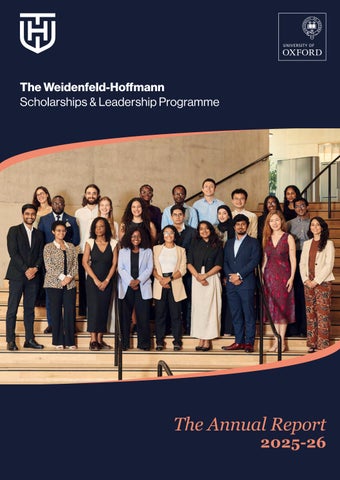
The Weidenfeld-Hoffmann Scholarships & Leadership Programme
The Annual Report 2025-26
1
2
“The vision of George Weidenfeld was understanding that we needed to really change things. So what did we do? We changed things, we innovated, we did things which hadn’t been done before. And one of these ways of innovating was to bring people to Oxford who would not otherwise be able to come. I think it’s important to understand that we need their collective energy, their collective capacity for solving problems, and their collective courage to make a difference.”
André Hoffmann Co-founder and Chairman of the Trustees, Weidenfeld-Hoffmann Trust
3
Chief Executive’s
Overview I
write the introduction to the 2025-26 Annual Report as I approach the end of my first year in post as Chief Executive of the Weidenfeld-Hoffmann Trust. It has been a huge pleasure to experience WHT from the inside, having previously admired its work through the wonderful WHT scholars I encountered in my previous role as President of Trinity College. It has been a great privilege to support the current cohort of scholars and to witness the dedication of WHT’s small staff and committed trustees during the past year. The 29 scholars in the 2025-26 cohort represented 25 countries and 14 Masters’ degree subjects, encompassing health, sustainability, energy, water, biodiversity, governance, diplomacy, the internet, public policy, law, finance and business. The list of eligible courses is specifically curated to support scholars to make a material contribution to the public life of their countries or regions of origin. It has been exciting to witness this talented group from all over the world progress from initial trepidation to feeling very much at home in Oxford and seeking to maximise every possible opportunity. Some of the memorable
4
comments from scholars across the year include: Is this the coldest Oxford will be? (September); Why do UK houses have laundry machines in the kitchen? (November); My life has been irreversibly changed! (May); I’m working 12-hour days and I still can’t fit everything in! (June). Such is the Oxford year…. In parallel with their degree programme, each scholar participates in the WHT Leadership Programme. During 2025-26 this was, as is now familiar, structured around three key themes: Moral Philosophy, the Enterprise Challenge, and Skills Training including media skills, negotiating and mock job interviews, but with an additional emphasis this year on aspects and challenges of leadership itself. Scholars were introduced to different styles and behaviours of leadership. Throughout the year they also met some extraordinary individuals who shared their leadership experiences with great generosity.
J
udge Theodor Meron, a survivor of the Holocaust in Nazi-occupied Poland, described his work as a Judge at the International Criminal Court at The Hague where, as President of three United Nations tribunals, he delivered
landmark decisions on genocide and war crimes. Baroness Sharon White shared her experience in senior leadership positions including at the UK Government’s Treasury Department, the No. 10 Policy Unit under Tony Blair’s government, and the World Bank. Sirin Phathanothai described her extraordinary life after she was sent as an 8-year old ‘diplomatic gift’ by the Thai government to Chairman Mao’s China, and how she survived the tumultuous years of the Cultural Revolution, developing resilience and being thrown entirely onto her own resources in her determination to survive.
A
nother inspirational leader who took time to visit us is WHT alumna, Shabana Basij-Rasikh (MPP 201920). Shabana gave a memorable talk about her work to provide access to education for Afghan girls. Afghanistan remains the only country in the world in which it is illegal for girls and women to attend school and university. At the age of 18, Shabana co-founded SOLA, the School of Leadership Afghanistan - a boarding school for Afghan girls - which she courageously relocated to Rwanda when the Taliban re-took Kabul.
1
E
ach year we provide small annual grants to enable WHT scholars to take part in professional development activities associated with their area of study. The Max Weidenfeld Travel Grants Fund was generously endowed in 2009 by the Eranda Rothschild Foundation in honour of the father of Lord Weidenfeld of Chelsea. Thanks to the fund, scholars are able to participate in leading international conferences, including COP summits, UN forums and global convenings across Europe, Africa, Asia, and Latin America. Several reflections on these experiences are contained elsewhere in this Report, offering insight into the considerable impact of these opportunities. For some scholars these can be life-changing experiences, none more so than for 2025-26 scholar, Laurel Kivuyo from Tanzania (MSc Nature, Society & Environmental Governance). Laurel writes: “Attending COP wasn’t just a professional milestone; it fundamentally reshaped how I see my role in the world. Being
1. Dame Hilary Boulding introducing the Weidenfeld-Hoffmann Trust Scholarships & Leadership Programme 2. Judge Theodor Meron addressing WHT scholars.
2
5
in rooms where global decisions are negotiated made me realise that behind every policy, every percentage point of emissions reduction, there are real lives and futures hanging in the balance. My journey from Oxford to COP and back has strengthened my resolve to be part of the solution, and to ensure that the voices of those most affected are not only heard but acted upon.” On behalf of all our scholars, I extend my appreciation to the Eranda Rothschild Foundation for its generosity and foresight in establishing the Max Weidenfeld endowment fund.
T
he WHT House at 70 Walton Street provides both a headquarters and a valued resource for scholars: a place to drop in for reassurance during the early weeks in Oxford; somewhere to celebrate birthdays, host movie nights,
or cook together; the venue for our Moral Philosophy seminars and more. It’s also our ‘home base’ where we’re delighted to welcome our (now almost 500) global alumni and it has been a hugely enjoyable part of my role this year to meet scholars from different year groups who have dropped by during visits to the city. It is truly inspiring to hear about their career and life journeys and to learn of the impact of their work in their home countries and regions. We encourage alumni to stay in touch with us and with each other and I couldn’t be more grateful to those who have responded to approaches from this year’s scholars who have sought advice, information, or simply an opportunity to connect. Almost 100 WHT alumni contributed to a fund to honour my longstanding predecessor as Chief Executive, Alexandra Henderson, when she stood
down from the role in 2025. This fund was designated to support the wellbeing of scholars and our first grant was made in December 2025, to enable a visit by those scholars remaining in Oxford over Christmas to visit the spectacular festive lighting at Blenheim Palace. Thank you to all who contributed to the fund. We are giving a good deal of thought as to how we might mark the 20th anniversary of the WHT Scholarships and Leadership Programme in 2027-28. The Trust is currently funded to support 30 scholars a year: scholars receive full academic fees, a stipend, pre-travel costs and a fully funded leadership development programme. We have identified a suite of opportunities that gives us the confidence that we can increase the number of scholars over time. This will involve extending the current partnership with Oxford University at an institutional level and engaging additional philanthropic
3
3. WHT Scholars with Sirin Phathanothai (front row, fifth from left)
6
and Dame Hilary Boulding (front row, second from left)
4
5
A
partners to help us to build the scholarship endowment. The Trust is committed to using the platform of the programme’s 20th anniversary to achieve this goal. We envisage increasing the number of scholars incrementally each year and are on course to support an additional eight scholars in the 2026-27 academic year, welcoming St. John’s College into our suite of College partners.
t the end of the year in the calm surroundings of Cumberland Lodge in Windsor Great Park, the 2025-26 cohort of WHT scholars prepared to go their separate ways, committed to making their own individual mark on the world. They leave with the support of our whole alumni community, located across so many countries but united by their shared experience of Oxford and the Weidenfeld-Hoffmann ‘family’.
In the midst of recruiting the next cohort of WHT scholars, we were deeply disappointed by the UK Government’s decision to impose a ban on student visas to the UK for nationals of Afghanistan, Sudan, Cameroon and Myanmar. Since its inception, the Weidenfeld-Hoffmann Trust has supported many brilliant scholars from war-torn corners of the world, who have come to the UK lawfully to study and contributed their own valuable experience and perspectives to their peer group’s education. Their absence from next year’s cohort represents a loss to us all.
None of this would be possible without the generosity of many individuals, trusts and well-wishers. They are acknowledged on pages 62 and 63 of this Report and we couldn’t be more grateful to them. I also offer my thanks to our committed Board of Trustees and to our Chair, André Hoffmann whose belief in our work is a guiding force. And to my colleagues – Jane Baldwin, Nikita Arora, Stephen Wright, Eman Hamdan and Oonmona Das – thank you for your warm welcome, collegiality, creativity and commitment to all we deliver.
Dame Hilary Boulding, Chief Executive, Weidenfeld-Hoffmann Trust
4. WHT Scholars with Shabana Basij-Rasikh (front row, fourth from left). 5. Sharon White in conversation with WHT Scholar Juliana Santos Oliveira
7
A GLOBAL NETWORK OF
8
CHANGE MAKERS
9
A UNIQUE GLOBAL SCHOLARSHIP SINCE 2007
From maternal health to climate diplomacy, from water law to halls of parliament, from AI to ministerial justice – WHT alumni carry their Oxford experience into every sector and every continent.Two-thirds of our alumni are directly engaged in tackling the world’s most pressing challenges: climate action, sustainable development, education, health, and justice. Alumni are also seeking each other out. Over the past year they have organised gatherings in India, Georgia, Paris, New York and London, with more to come next year.
Professional Areas of WHT Alumni 9% 28%
11%
Education
12%
Law & Human rights Health Innovation & Business Good governance & Policy Sustainability & Development 10
23%
17%
North America
31 Scholars Latin America
70 Scholars 474 Scholars
Supported
Europe
78 Scholars
Asia
191 Scholars
Africa
104 Scholars 99 Countries
80+ Degrees Awarded
Represented
Alumni Locations
83% Leading change in their communities, countries, and regions of origin including multilaterally Leading in their fields elsewhere
17%
11
FROM
Malaysia PROGRAMME
MSc International Health & Tropical Medicine COLLEGE
Giri Rajahram 12
Keble SCHOLARSHIP
GRoW @ Annenberg, Annenberg, Oxford-Hoffmann 2021
LEADERSHIP IN ACTION: Alumni impact
Reshaping Public Health in Malaysia Giri Rajahram (MSc International Health and Tropical Medicine, 2020) has spent two decades working at the intersection of clinical medicine, research, and public health advocacy in Sabah, Malaysia. As Head of the Department of Medicine at Queen Elizabeth II Hospital, his research on zoonotic malaria has shaped international health policy – and his Oxford MSc sharpened the tools he uses to translate that science into systemic change. Growing up in Kuala Lumpur, Giri was “city-proud and trend-sensitive,” as he puts it. He had no particular plan to spend his life in Sabah, Borneo. But arriving there as a young doctor, what he encountered made it impossible to look away. In those first few months, Giri saw problems that compounded each other – infectious diseases layered over social and economic determinants of health. But what made it even more prescient was that he was facing the same fundamental issue over and over again. “I realised I was treating the same recurrent, preventable infections in children from impoverished villages,” he says. It was this that sparked his curiosity “to explore the philosophy, ethics, and economics of ill health more broadly and to consider how I could contribute to improving outcomes.” Twenty years on, Giri is now Head of the Department of Medicine at Queen
Elizabeth II Hospital in Sabah, leading the department with what he calls the 3 Es: empathy, empowerment, and enabling support for others.
public administration. A well-executed policy is as impactful a clinical tool as a potent antibiotic for treating a severe infection.”
As it happens, his work there is also part of the research that changed how the world understands malaria.
The challenges facing Malaysia’s health system are significant – a triple epidemic of non-communicable diseases, an ageing population, and growing pressure on healthcare funding. His measure of success in the face of all this is blunt, paraphrasing Gandhi: “The true measure of our clinical excellence is not how well we treat the affluent, but how effectively we protect the most vulnerable and marginalised.”
Faced with managing clinical cases of malaria, Giri started researching Plasmodium knowlesi – a parasite passed from macaques to humans, long dismissed as a footnote. This clinical observation in Sabah, rigorously investigated, challenged the global malaria eradication timeline by demonstrating significant zoonotic malaria transmission and clinical cases in Borneo. It has since shaped guidance at the World Health Organisation. “It taught me,” Giri says, “that tropical medicine cannot be separated from planetary health and land-use policy.” But researching infectious diseases has taught him something else too – they are a “humbling teacher.” They force you, he says, to confront what health systems cannot fix on their own – and what policy and effective leadership have to. This is where his Oxford MSc and the Weidenfeld-Hoffmann Trust’s Leadership Programme came in. “My time at Oxford was transformative,” he says, “reinforcing for me that scientific data is meaningless if it cannot be effectively translated into the language of political economy and
What keeps him going, he says, is the people around him – colleagues and people who show up every day despite the odds. His concern now is the workforce itself – the nurses and doctors holding the system together, often at personal cost. “COVID-19 has highlighted that the most vital asset of any health system is its workforce. As leaders, it is our duty to foster a culture that is respectful, supportive, and equitable for healthcare professionals. We must take concrete action to be agents of change.” In Sabah, twenty years on, he is still following the same instinct that brought him there – staying close to the communities others overlook and insisting that what happens in a corner of Borneo can change what happens everywhere.
13
FROM
Ukraine PROGRAMME
Master of Public Policy (MPP)
Oksana Matiiash 14
COLLEGE
Worcester SCHOLARSHIP
Chevening, Lewis, WeidenfeldHoffmann 2019
LEADERSHIP IN ACTION: Alumni impact
Reimagining Education in Ukraine Oksana Matiiash (Master of Public Policy, 2019-20) led Teach For Ukraine through a pandemic and a full-scale war, scaling the organisation tenfold and mobilising millions of dollars for emergency education. She is now CEO of the WINWIN EdTech Centre of Excellence, a national initiative shaping the future of education through technology and AI in Ukraine. Oksana ended up in education by accident. “I never planned to work in education,” she remarks. Her background was in law, and when she came to Oxford to study public policy, she was trying to understand something else, something much bigger — what it takes to create lasting system change in Ukraine. The answer she found at Oxford, and through the WHT Leadership Programme was much simpler and more fundamental than she expected. “I realised that the most important ingredient of a country’s success is its people.” That realisation, combined with a timely email about a leadership vacancy at Teach For Ukraine, set the course for the next five years. “It felt like the right opportunity had found me at the right time.” What followed was not what anyone could have prepared for — leading an organisation through COVID-19 and then through a full-scale invasion. When the Russian large-scale invasion started in February 2022, many expected organisations like Teach For Ukraine to pivot away from education entirely and focus on humanitarian
relief. It made perfect sense, but Oksana disagreed. “When schools closed again, this time because of war, children in Ukraine lost not only access to learning, but also the routines, relationships, and sense of belonging,” she insisted. “A child who feels isolated, anxious, or unsafe is not going to learn effectively. Unlike adults, who can choose how to maintain their relationships and routines, children depend on schools and teachers to provide that stability. That insight shaped our emergency response.” Within days, Teach for Ukraine had shifted to emergency education, using technology to keep children learning and teachers connected with their students. The decision proved transformative — reaching tens of thousands of teachers and children, and mobilising millions of dollars for emergency education across Ukraine. “Leadership under pressure isn’t about abandoning your mission when circumstances change. It’s about adapting how you achieve it,” says Oksana. The war also showed her what resilience truly means. In the first weeks of the invasion, she told her team they were free to step away and would still receive their salaries. They all came back. “That reminded me that resilience grows from community and a shared sense of purpose. When people know they can rely on one another, they are capable of overcoming extraordinary challenges.” What kept the organisation moving forward, she says, was clarity. “We focused on doing one thing
exceptionally well, which was helping children to keep learning. As we consistently delivered, partners started coming to us because they knew we would execute with quality and integrity.” That insight now drives her current work. As CEO of the WINWIN EdTech Centre of Excellence — a national initiative launched by Ukraine’s Ministries of Digital Transformation and Education — she is asking how technology and AI can help every child reach their full potential, despite the war. “What makes Ukraine unique is that we never really had the luxury of debating whether AI belonged in education. Our teachers were already using it out of necessity.” Her role, she says, is to ensure that “the innovations born out of the crisis don’t disappear with the crisis, but become part of Ukraine’s postwar recovery.” On what sustains her, she is clear-eyed. “Inspiration and motivation are finite, especially when your work is regularly interrupted by air raid sirens and you find yourself continuing meetings from a bomb shelter. Since the full-scale invasion began, people in Kyiv have spent the equivalent of more than 110 days under air raid alerts.” What keeps her going instead is purpose. “What sustains me is knowing why the work matters.” If Ukraine is one day known as the country that turned one of the greatest disruptions to education into a catalyst for innovation, she says, she would be proud to have played a small part in that story. For Oksana, that is not ambition. It is simply what the work demands. 15
FROM
Bangladesh PROGRAMME
Zahid Shashoto 16
MSc Environmental Change & Management COLLEGE
Hertford SCHOLARSHIP
Oxford-Hoffmann 2021
LEADERSHIP IN ACTION: Alumni impact
Turning the Tide on Water Poverty in Bangladesh Early on in his life growing up on Bangladesh’s coast, Zahid witnessed a stark injustice in access to safe drinking water. Urban residents benefited from governmentsubsidised piped water, whereas rural communities were left to rely on increasingly saline groundwater, often walking long distances every day to collect safe water. Determined to address this inequality, he began experimenting with a simple but practical solution in 2019 through a market-based water facility. But it was in 2021, when he arrived at Oxford as a WHT Scholar (MSc Environmental Change & Management) that the idea took on new dimensions. Through the WHT Leadership
Programme, he and fellow scholars developed The Drop, an investment model for water-focused social enterprises. The project received a small seed grant, but more importantly, it validated a locally rooted Bangladeshi solution on a global stage. Returning home, that vision evolved into Uttaran Paani, the water programme he now leads at Uttaran — an organisation working in southwest Bangladesh since 1985 on communityled climate resilience. With support from BSRM (Bangladesh Steel ReRolling Mills Ltd.), Aqua for All, and 1001fontaines, it now operates three water treatment plants, providing safe drinking water to nearly 20,000 people, most of them from marginalised
communities where salinity and arsenic contamination make access to safe water a daily challenge. What started with a few thousand dollars in seed funding has grown into a social enterprise valued at nearly one million dollars, and it continues to expand. This year, Zahid also took Bangladesh’s case for climate finance to the House of Commons, giving evidence at the UK Parliament’s International Climate Finance session, and he sits on the governing board of the Climate Justice Resilience Fund. “Looking back,” he says, “it’s remarkable to see how that initial support from the Trust helped catalyse something with such lasting impact.”
17
Alfredo Ortega Franco UN Human Rights Committee Member Alfredo Ortega Franco (MPP, 2018) has been elected to the United Nations Human Rights Committee for the 2027–2030 term - the first Guatemalan to serve on this body in its fifty-year history. As one of eighteen members, he will oversee how 175 states comply with the International Covenant on Civil and Political Rights, one of the foundational treaties of the international human rights system. Alfredo came to Oxford from a career defending victims
Aristide Kambale Climate Resilience, Red Cross Red Crescent Climate Centre Aristide Kambale (MSc Environmental Change and Management, 2023) supports Red Cross National Societies, governments and humanitarian organisations across Africa and beyond to integrate climate science into disaster risk reduction, anticipatory action and adaptation. He also works with the International Institute of Tropical Agriculture on climate-smart agriculture, ecosystem restoration and forest conservation across Central Africa. Earlier this year he was in Juba, co-facilitating a simulation exercise for South Sudan’s Simplified Early Action Protocol on floods, bringing government institutions, technical agencies and humanitarian actors together to test how flooding can be met before it becomes a catastrophe. South Sudan faces some of the most complex climate challenges in the region: recurrent flooding and drought, compounded by conflict and constrained resources.
18
But what Aristide also found in Juba was a commitment to resilience, learning and collaboration. “Countries, communities, and people are always more complex than the headlines about them,” he notes. Since leaving Oxford, where he joined the University delegation to COP15 in Montreal, Aristide has worked with UNDP, the Global Resilience Partnership and the United Nations in Geneva as a Graduate Fellow representing DR Congo. His work is driven by a simple belief: that climate resilience is not only about responding to disasters, but about enabling people, institutions and ecosystems to thrive in an increasingly uncertain world.
of human rights abuses throughout Latin America. By then, he had worked for the Inter-American Court of Human Rights and the Centre for Justice and International Law, focusing on cases related to judicial independence and freedom of expression. He describes his commitment as rooted in his family history: the grandson of rural schoolteachers, the son of a doctor who worked with underprivileged patients and an educator devoted to literacy.
LEADERSHIP IN ACTION: Alumni impact Sagar Dhakal Member of Parliament, Nepal In September 2025, as Nepal’s Gen Z uprising toppled the sitting government, young people across the country turned to social media to decide who should lead them next. On a Discord server called “Youth Against Corruption,” with over 145,000 members, Sagar Dhakal was shortlisted as one of a handful of candidates for interim Prime Minister — chosen by a generation. He declined the nomination and proposed Sushila Karki instead, paving the way for her to become Nepal’s first female Prime Minister. This was not Sagar’s first attempt to shift the country’s political trajectory. In 2022, he contested against five-time sitting Prime Minister Sher Bahadur Deuba in Dadeldhura-1, campaigning in part on the idea of a youngest-ever Prime Minister — a proposition that represented a generational shift in Nepali politics. At the time, it seemed a distant prospect. Yet by 2025, Nepal’s youth turned out in force, voting the Rastriya Swatantra Party (RSP) into power with a near two-thirds majority. Nepal now has the youngest sitting Prime Minister in the world, and Sagar himself won a decisive victory to become MP for Gulmi 1. At the party’s general convention, he also secured one of the top four positions by vote, reflecting the growing
responsibility he now carries in shaping the country’s leadership. Born in the rural hills of Gulmi, Sagar ranked fifth out of 12,000 candidates in Nepal’s national engineering entrance examination. He studied mechanical engineering at Pulchowk Campus and worked as a project engineer before coming to Oxford in 2018 as a WHT Scholar to pursue an MSc in Water Science, Policy and Management. He has since published several leading research papers in the fields of water, energy, and the environment, and has worked across the private, public, and international sectors — including with IOM–UN Migration and Médecins Sans Frontières Switzerland — in wider contexts across Europe, Africa, and Asia. In 2025, Sagar returned to WHT House to meet current scholars and share where his journey was taking him next. A year later, in 2026, he became an MP. Looking ahead, his ambition is to scale up Nepal’s industrial base, establishing many billion-dollar industries at home. Ultimately, he hopes to champion peace, prosperity, and a spirit of shared humanity that extends beyond Nepal’s borders.
19
Julia Dias Carneiro Independent Journalist & AAAS Kavli Award Winner Julia Dias Carneiro (MSc Latin American Studies, 2020) is a Brazilian journalist based in Rio de Janeiro with bylines on NPR, BBC News, The Guardian and NatGeo. Earlier this year, she won the AAAS Kavli Science Journalism Award – silver in the Children’s Science News category – for “Amazon Adventure,” published in National Geographic Kids, sharing the award with editor Allyson Shaw. The piece, written as the imagined journal entries of four scientists conserving species along the Amazon
River, brought the stories of Andean bears, pink river dolphins and local communities to young readers across the world. Julia dedicated the award to the scientists and communities who protect the Amazon, often at great personal risk. For her, the piece was also a homecoming of sorts – a Brazilian journalist using her platform to shed positive light on the extraordinary conservation work happening in her own backyard.
GIVING BACK Alumni return to WHT House for all sorts of reasons – to reconnect, to tell us where life has taken them, to see Oxford again. Increasingly, they come for the scholars. Over the past two years we have built a programme of alumni-led coaching and mentoring, drawing on the one thing that only they can offer: the experience of having been in their seat. Alumni have run sessions on social innovation and entrepreneurship, careers in policy and development, and navigating the years immediately after Oxford. Alumni also sit on our assessment and interview panels, helping to select the scholars who follow them. It is a significant commitment of time, and one of the clearest expressions of what this community is for. 20
Shabana (front row, centre)
Shabana Basij-Rasikh (Afghanistan, 2019) visited WHT house earlier this year and shared her experience of founding SOLA, Afghanistan’s first boarding school for girls which she established at the age of 19. When the Taliban regained power in 2021, Shabana led the safe evacuation of 250 SOLA students and staff and re-established the school in Rwanda. She launched SOLAx in 2024 to deliver an online secondary school curriculum for Afghans: it currently has 40,000+ learners of whom 85% are in Afghanistan, and 70% are women and girls
Bhanu Prasad (India, 2019) visited WHT House earlier this year and shared his work coaching early-stage social entrepreneurs at Digital Impact Square, a TCS Foundation initiative in India. He also sits across the Advisory Boards of several social enterprise and impact organisations in India.
Bhanu (centre)
21
22
23
MORAL
Philosophy
24
I say at the start of every year that the point of the Moral Philosophy Seminar (MPS) isn’t to turn the scholars into moral philosophers. The world doesn’t need them to be moral philosophers – it needs more lawyers, water engineers, and medical professionals.
Stephen Wright, WHT Academic Fellow
This year, it’s occurred to me that maybe I’m understating the case for the philosophers. A recurring theme of this year’s MPS has been “complexity” – trying to help scholars see the moral depth of the issues in ways that look suspiciously like what philosophers do.
There are morally interesting questions here (What outcomes count as good ones? Does equality matter more than democracy?) and we talked about those a lot at the start of the year. But they aren’t the only important questions to ask.
One way to approach every MPS is by thinking about how we can use whatever it is to make the world a better place. How can we use AI/business/universities/whatever to generate the most good in the world?
Moving beyond these, we’ve looked at more subject-specific issues. These have included how AI forces us to choose between protecting the welfare of the majority and respecting the rights of those for whom technology creates new threats.
That reduces (or as we like to say “deflates”) moral questions into non-moral ones. What will the effects of this policy be? How will these people respond to that approach? Can we realistically expect these things to bring about those outcomes?
All of our scholars want to make the world the best place they can – that’s why they’re here – but the MPS aims to help them see what that means to them. And this year, that’s felt a bit more like turning them into moral philosophers than usual – in the best way possible.
“Being a WHT scholar meant that I had the opportunity to be part of a community recognized for their capacity for leadership and for envisioning a better future for the world. I am humbled to have met those as passionate as I am. It becomes a bit easier to work towards a better world when you know that many people share the same hope across all corners of the world.”
Rehan Meemaduna, MSc International Health & Tropical Medicine, Sri Lanka 25 25
ENTERPRISE
Challenge
This year marked my fourth and final time leading the Enterprise Challenge, and it has been the most remarkable yet. It was a year defined by the creativity, resilience and ambition our scholars bring time and again, and a reminder of just how far this programme, and the people who pass through it, can go. From the beginning of Michaelmas Term, our focus was on the fundamentals: building teams from the ground up. Every cohort arrives with a different level of interest and experience in venture building, so we spent the early weeks helping scholars find teammates, generate ideas together, and begin testing and validating those ideas ahead of pitching to a panel of judges later in the year. One standout moment came through Khishigjargal Enkhbayar, who introduced a traditional method, passed down through generations, of turning waste oil into soap. Together with her team, she transformed this practice into a genuine business venture. What made the project
26
so special was not just the idea itself, but watching her and her teammates take a technique rooted in family and community knowledge and develop it into something with real potential to scale, both locally and internationally. It was a powerful reminder that some of the best entrepreneurial ideas are not invented from scratch; they are recognised, refined and given the opportunity to grow. I also had the opportunity to watch Max Beleziakou’s enthusiasm for entrepreneurship translate directly into practice. He applied the validation frameworks we teach on the programme to rigorously test and challenge his idea. Seeing a scholar take concepts from a workshop and apply them meaningfully to their own venture is one of the most rewarding aspects of leading this challenge.
Eman Hamdan, Enterprise Challenge Lead
By the end of the year, the ventures had evolved into some truly exciting projects. Highlights included:
• ReSoap
• AIgriculture
Khishigjargal’s venture closes the loop on cooking oil waste by transforming it into branded hotel products through local community production, creating both environmental and economic value.
An AI-powered agronomic advisory platform providing site-specific, plain-language farming guidance on planting, weather risks and input timing to smallholder farmers across Sub-Saharan Africa and South Asia via SMS and mobile applications. By combining satellite weather and soil data with forward-looking, explainable recommendations, the platform helps the world’s 475 million smallholder farmers make better decisions, while creating a valuable data layer for lenders, insurers and agricultural cooperatives.
• BiteBack
• SourceWise
A venture tackling food waste by enabling restaurants to sell surplus ready-to-eat meals and share excess high-quality ingredients with other businesses and individuals.
An AI-powered platform that helps young people identify misinformation and access verified, trustworthy news. Through transparent fact-checking and credible sources delivered in real time, it empowers the next generation to make more informed decisions.
Building an AI-First Insurance Broker Maksim Beleziakou (MSc, Social Science of the Internet, 2025) and Max Zhurilo (MPP, 2022), connected through the WHT community this year — and are now building a company together. Their venture, Translabour, builds AI agents that automate the routine, high-volume work inside insurance brokerages: its pipeline is already live at one of the top five aviation brokers in the world. It is, by their own description, the first stage of something bigger: Bindary, an AI-first insurance broker built from scratch.
What made this year genuinely remarkable, however, was seeing the wider network function exactly as it was intended to: connecting people. Maksim from this year’s cohort and Max Zhurilo from the 2022 cohort connected through the programme’s network and are now building a business together. This year’s winning venture, Bora STEM, was another highlight. Created during the Enterprise Challenge by scholars from Latin America and Africa, the venture focuses on expanding access to STEM education in Kenya. Their success demonstrated not only the strength of their idea, but also the power of bringing together talented individuals from different backgrounds and regions to tackle real-world challenges. Following their win, the team is now applying for seed funding from the Trust to help turn their vision into a sustainable venture. These are not outcomes that can be engineered directly; they happen because the community we have built creates the conditions for meaningful collaboration, innovation and long-term impact. As this is my final year leading the Enterprise Challenge, it feels fitting to reflect on what previous scholars have gone on to achieve with the foundations they built here:
• Julian Romuald Żelaznowski, from the 2022 cohort, founded Agentica, a company that helps mid-sized organisations reduce operational costs and execution risk through bespoke, production-ready AI agents and workflow automation solutions.
• Dmytro Lopushanskyy, from the 2023 cohort, co-founded Harmix to solve a specific operational challenge. The company recently announced that it had raised $1 million to tackle an even bigger one. The team is now developing Harmix Proactive AI Manager (PAM), an AI agent designed to handle the operational tasks that are often overlooked, from chasing follow-ups and identifying missed deadlines to maintaining context across multiple tools, allowing people to focus on higher-value work.
Maksim (left) with Max (right)
Watching scholars transform ideas first explored through this programme into real, funded and growing businesses is exactly why the Enterprise Challenge exists. Four years on, what I will remember most is not any single pitch, venture or competition outcome. It is watching people build the skills, networks and confidence to continue creating long after the challenge itself has ended. As I close this chapter, I am grateful to every scholar who brought their whole self to the process, to the mentors and judges who generously shared their time and expertise, and to a programme that continues to grow and evolve alongside the people it serves. Looking back on four years of the Enterprise Challenge, I am more convinced than ever that its greatest value lies not in the ventures it creates, but in the people it develops. The ideas may evolve, pivot or even disappear, but the confidence, relationships and entrepreneurial mindset scholars gain endure far beyond the programme. It has been a privilege to witness that journey unfold, and I look forward to seeing what this community continues to achieve in the years ahead.
27
TAKING THE LEAD
at Oxford
In the middle of a demanding academic year, this year’s cohort has been building companies, negotiating at climate summits, launching political ventures, and shaping conversations far beyond Oxford’s walls.
BCG Africa Case Competition CHAMPIONS Earlier this year, Delina Yemane Dawit and Quinter Otieno, both WHT scholars 2025-26, teamed up for the inaugural Oxford-BCG Case Competition — the first collaboration between Boston Consulting Group (BCG) and the Oxford University Africa Society — and won. The case competition entailed a real, live business problem: developing a strategy for South African fintech Sourcefin to triple its annual disbursements from R1 billion to R3 billion by 2030, presented directly to BCG consultants and Sourcefin’s own Chief Strategy Officer. They nearly didn’t apply. “Signing up for a case competition in a field I knew little about felt like one commitment too many,” Delina says. She talked herself out of it, then applied anyway, “in a moment of defiance.” Getting to work with Quinter,” Delina says, “was a very pleasant surprise. The applications were individual, and BCG was in charge of allocating the teams, so we didn’t know who we’d get to work with — I was happy to discover Quinter was on mine. Coincidentally, we were also teammates in the WHT Enterprise Challenge, so we already knew how to work with one another. But more than that, we were good friends, thanks to the many occasions throughout the year where we socialised and formed a community as WHT scholars. I think that helped build a sense of trust that contributed to the win.” Quinter also says: “I applied to participate in the case competition precisely because it provided an opportunity to get into an unfamiliar territory as I had no consulting or fintech background. To find out that I was teammates with Delina was an absolute icing on the cake. We were able to not only draw from the skills we had learned so far as teammates in the WHT Enterprise Challenge but also during the WHT media training day which contributed to our success”
28
Quinter (left)
Khishi Enkhbayar & Laurel Kivuyo: LEADING AT LONDON CLIMATE ACTION WEEK As part of London Climate Action Week 2026, Europe’s largest climate conference, WHT scholars Khishigjargal Enkhbayar (Diplomatic Studies, Mongolia) and Laurel Kivuyo (Nature, Society and Environmental Governance, Tanzania) co-organised the panel discussion Engaging Global Youth in Climate Governance – Democratisation or Virtue Signalling? in partnership with the Oxford Net Zero Institute. The event brought together around 30 participants from more than 80 registrants, creating a valuable platform for dialogue on the role of young people in shaping climate governance at local, national and international levels. The session showcased the leadership and expertise of Laurel and Khishi, who opened the event by introducing the Weidenfeld-Hoffmann Trust before sharing their experiences of advancing climate action and engaging young people in policymaking and governance within their countries. They were joined by Seruni Salsabila and Genaro Godoy, leaders of youth organisations working to strengthen youth participation in climate policy and advocacy. Together, the panellists brought diverse regional perspectives and practical insights into the opportunities and challenges of meaningful youth engagement. The discussion was moderated by Alexis McGivern of Oxford Net Zero, who also introduced the Institute’s Global Youth Leadership Programme. The keynote address was delivered by Veena Balakrishnan, Co-Founder and Director of Institutional Relations at the Youth Negotiators Academy, who drew on her experience leading a youthled organisation to highlight the growing influence of young people in international climate negotiations. The discussion explored whether Khishi (first from right) and Laurel (second from right) current approaches to youth engagement represent genuine democratisation or risk becoming symbolic gestures. Panellists emphasised that meaningful participation must be rooted in local action and capacity building while recognising the active role young people already play in national and multilateral climate processes. They also highlighted the need to strengthen youth leadership narratives and reposition youth climate movements within a rapidly changing geopolitical landscape, where climate action is increasingly competing with hard security priorities. The event demonstrated the Weidenfeld-Hoffmann Trust’s commitment to supporting scholars as global leaders and convening conversations that amplify diverse voices shaping the future of climate governance.
29
30
31
The Courage to Start Alone, The Wisdom to Lead Together Alevtyna Prykhodko FROM
Ukraine
Lately, across social media, a phrase has been echoing - Do it alone. Wrapped in ideas of discipline, independence, and relentless ambition, it says: start alone, act alone, don’t wait for permission, and don’t wait for others to believe in you before you believe in yourself.
PROGRAMME
MSc Energy Systems COLLEGE
Lincoln, Sloane Robinson Foundation Scholarship SCHOLARSHIP
Weidenfeld-Hoffmann
I grew up in Ukraine in the 2000s, during a period of national transition with daily life still marked by economic hardship and political uncertainty. Coming from one of the most polluted regions, I became aware early of industrial pollution. In school, I realized that if I wanted to contribute to a cleaner world, I first needed to understand how industrial systems function from the inside. That led me to chemical engineering, to oil refining - work that could
32
actually shift things. However, I quickly learnt that this path came with its own challenges. It was a male-dominated field. Ambition and boldness in a young woman were not always welcomed. So I learned what “doing it alone” really means: facing resistance, isolation, and even betrayal all by yourself though I did have the unwavering support of my family, which reminded me that no one else defines my future. It means standing your ground when all support disappears. Yet, when I came to Oxford, I had a fear inside me. I used to think needing support was a weakness. Instead, as a Weidenfeld-Hoffmann Scholar, I encountered something
The right mentors open doors. They challenge you to think bigger, and to question yourself. Sharon White spoke about this in a Women in Leadership session: choose a few mentors, be open with them, ask for advice. As she said, no one knows how to do everything perfectly, and perhaps that’s the point. I realized something that changed everything: no one builds the future alone. Oxford gave me the feeling of being heard, seen, and being taken seriously. I still have to show up, to be bold. But I don’t have to stay alone. Recently, at the Climate Neutrality Forum in Brussels, I saw this lesson in action. I sat in a room with scientists, policymakers, industry representatives — people who understand the climate transition in completely different ways. The biggest obstacle to real progress, I realized, wasn’t lack of solutions. It was fragmentation. Different parts of the energy ecosystem working hard, but not always together. And I understood, sitting there as a Ukrainian energy engineer, that I could contribute something none of them could alone: I could translate between them. Hold the complexity. Bridge the silos. That’s only possible because Oxford taught me that
the strongest thinking comes from genuine dialogue across differences. Without the Trust’s support, I’d follow the expected path: brilliant technical work, published papers, perhaps an academic position. Important. But what’s happening now is different. I’m learning to bridge sectors, to speak both the language of engineering and the language of human systems. And that changes everything — both what I can do, and who I can bring along. The strength and unity I’ve seen from Ukraine, the support from people across the world — it taught me that true leadership isn’t about standing alone. It’s about standing together. We really, really need each other. So instead of Do It Alone, I would say: Start alone if you must. Don’t wait for validation. But trust that, at the right time, the right people will appear. And when they do, stay open. Because that’s where the work that actually matters gets built — not in isolation, but in the spaces between us where we learn to think differently together. This is what I’m becoming. This is what the Trust made possible.
Scholar VOICES
entirely different: genuine openness to collaboration. Seminars where my views were sharpened through dialogue. The Enterprise Challenge, where I learned how easily misunderstanding can arise in teamwork. We were warned that every team eventually reaches a stage of frustration and irritation, though I was sceptical at first. But I realized that tension often emerges when we expect others to think as we do. The real challenge is not disagreement itself but accepting it as a natural part of working together that requires a shared commitment to move forward.
33
COP30: An Adventure in Climate Diplomacy Laurel Kivuyo FROM
Tanzania PROGRAMME
MSc Nature, Society and Environmental Governance COLLEGE
Worcester College SCHOLARSHIP
Oxford-Hoffmann
Standing in the negotiation halls at COP30, I carried with me not just my Oxford notes and the support of the Weidenfeld-Hoffmann Trust, but also the weight of Africa’s climate aspirations. As a junior negotiator with the African Group of Negotiators (AGN), I witnessed firsthand how the future of our planet is being shaped one clause, one commitment, one heated debate at a time. I did not arrive at COP as a newcomer. As the Founder and Executive Director of Climate Hub Tanzania — a youth- and womenled organisation advancing climate justice and resilience — I have spent years working on the ground in Tanzania and across the region. As National Youth Environment Ambassador for Tanzania and a former SADC Climate Youth Envoy, I have attended multiple COPs. But attending as a negotiator, with Oxford behind me and the African Group around me, was something different. The UN climate conferences you read about in textbooks take on an entirely different dimension when you’re in the room where it happens. COP30 was intense, exhausting, and profoundly eye-opening. I watched seasoned diplomats negotiate late into the night over language that might seem minor but carries enormous implications
34
for vulnerable communities. Behind every percentage point of emissions reduction, every dollar of climate finance, there are real lives and real futures hanging in the balance. What struck me most was the gap — not just between developed and developing nations, but between the urgency scientists are communicating and the pace at which political will moves. Africa contributes minimally to global emissions yet faces some of the harshest climate impacts. Representing the AGN meant advocating for climate justice, ensuring that adaptation finance reaches those who need it most, and pushing for loss and damage mechanisms that actually work. Climate diplomacy, I have learned, is as much about relationships as it is about policy. The informal conversations in corridors, the coalition-building over coffee, the trust built between delegates — this is what moves negotiations forward when formal sessions stall. Africa’s negotiating position is powerful when united. When African nations stand together, we cannot be ignored. On returning from COP, I had the privilege of presenting to my class at Oxford, bridging the gap between academic study and real-world climate action. My classmates asked thoughtful questions about how
The answer is yes — but it’s a different kind of hope now. It’s a hope tempered by realism, fuelled by urgency, and grounded in the understanding that change requires both pressure from below and commitment from above. I hope for a world where climate finance flows as freely as climate impacts do. A COP where Africa isn’t just asking for justice but celebrating its leadership in renewable energy and nature-based solutions. Most importantly, I hope that my peers — at Oxford, across Africa, and around the world — will see climate diplomacy not as an abstract career path but as an urgent calling.
Scholar VOICES
international law translates into practice, about the role of non-state actors, and about whether I still have hope after witnessing the slow grind of multilateral negotiations.
35
Unconventional champions of multilateralism: young people Khishigjargal Enkhbayar FROM
Mongolia PROGRAMME
MSt Diplomatic Studies COLLEGE
Keble, Sloane Robinson Foundation Scholarship SCHOLARSHIP
Weidenfeld-Hoffmann/ Chevening
What if the future of multilateralism depends not on world leaders, but on young people? In 2021, I co-founded the UN Association of Mongolia, a non-profit organisation aimed at reducing the opportunity gap for young Mongolians through innovative projects for sustainable development. What began as an effort to create greater access to education, leadership, and civic engagement opportunities has since grown into initiatives that have engaged more than 8,000 women and young people across the country. Our work focuses on helping communities participate more effectively in climate action and peace and security discussions — from grassroots initiatives to national and global decision-making spaces. That work eventually led me to engage with international peacebuilding and youth advocacy networks, including the United Network of Young Peacebuilders (UNOY) based in The Hague. But one opportunity had remained out of reach for years: attending the ECOSOC Youth Forum (EFY) at the United Nations headquarters in New York. Since I began my youth activism journey in 2014, EFY has been one of the events I always hoped to attend. Being based in Ulaanbaatar, which is literally on the other side of the world from most global policy spaces, made this difficult largely because of the costs of travel. This year, however, as
36
a postgraduate student reading for Diplomatic Studies at Oxford, and with WHT’s support, I finally made my way to New York for the Forum held on April 14–16. The Forum came at a time when multilateralism, the system through which countries cooperate and make collective decisions such as international institutions like the United Nations, is facing growing strain. Geopolitical tensions, conflicts, and distrust between states have raised questions about whether existing international systems are still capable of addressing global challenges effectively. As the largest annual youth forum organised by the United Nations, EFY provides opportunities for young people, alongside member states, to call for action on the Sustainable Development Goals (SDGs). These discussions feed into the annual HighLevel Political Forum in July, as well as other upcoming global dialogues. From the opening session, it was clear that the world is in a very different place than it was even a year ago. Multilateralism felt at its most vulnerable as the United Nations is struggling to maintain its relevance. At several moments throughout the Forum, young people were thanked for “making time to care for the UN” and encouraged to stand up for multilateralism.
At the same time, the Forum also revealed some of the limitations of youth participation in multilateral spaces. There were relatively few high-level representatives from member states present to engage with these discussions. At times, plenary sessions felt more performative than substantive, with many participants eager to speak but constrained by the format and by limited opportunities to develop experience in these spaces. The side events offered a different experience. Smaller and more focused, they created opportunities for deeper engagement on issues such as AI governance, climate change, and youth, peace, and security. Through my involvement with UNOY, I contributed to discussions surrounding the Second Progress Study on the
Youth, Peace, and Security (YPS) agenda. I emphasised the need for greater research into the interlinkages between youth, climate, peace, and security, and raised questions about how stronger synergies could be built between the women, peace and security and the YPS agendas. These conversations not only contributed to the ongoing progress study, but also shaped how I think about my own work in Mongolia. They reinforced the importance of connecting local peacebuilding initiatives with global policy frameworks and highlighted how youth-led organisations can bridge that gap in practical ways. One facilitator remarked during the Forum that multilateralism may be in crisis, but crises also create openings for transformation, in which young people can fill the gap left by weakening international cooperation. As discussions begin around the post2030 development agenda, young people have a unique opportunity to shape global governance conversations in ways previous generations could not. In this moment of uncertainty, they are becoming some of the most unconventional champions of multilateralism — pushing global institutions to be more inclusive, accountable, and fit for the future.
Scholar VOICES
While this is a heavy burden to place on young people, the sentiment is not entirely misplaced. Throughout the Forum, youth delegates consistently advocated for those not in the room: refugees, Indigenous youth, children in conflict situations, non-English speakers, and many others. They highlighted the work millions of young people are already doing on sustainability and pushed strongly for greater resources and agency for the Global Majority aka the Global South.
37
Standing Before the International Court of Justice: What The Hague Meant to Me Rakibul Islam Bhuiyan FROM
Bangladesh PROGRAMME
Bachelor of Civil Law (BCL) COLLEGE
Trinity, Crosthwaite Scholarship SCHOLARSHIP
Oxford-Weidenfeld and Hoffmann
Almost a decade ago, when I began law school as an undergraduate, I fell for an idea I did not yet fully understand: Public International Law. Coming from the familiar world of domestic law where individuals sue one another, the notion of sovereign States taking each other to court felt almost impossible to picture. But the more I read, the more I was drawn in. Here was a legal system with no central legislature, no strict hierarchy of courts, and no straightforward enforcement mechanism. And presiding over all of it stood the International Court of Justice (ICJ) in The Hague, an institution that, from where I sat in Bangladesh, seemed almost mythical. For years, though, that fascination could only be lived at a distance. I argued case after case in moot court competitions, standing before a simulated ICJ and pretending the stakes were real. But in Bangladesh, there is virtually no chance to see the World Court actually at work. The courtroom I knew so intimately existed only in my head. That distance is exactly what makes the next part still feel a little unreal to me. Following that same passion led me to Oxford, where I read for the Bachelor of Civil Law as a Weidenfeld-Hoffmann Scholar, and as part of my course in International Dispute Settlement - and thanks to the Max Weidenfeld Grant -
38
I finally got to visit The Hague. Sitting in the Great Hall of Justice of the ICJ for the closing arguments in the Arbitral Award of 3 October 1899 (Guyana v Venezuela), I watched counsel for both States do, with real consequences, the very thing I had only ever rehearsed. Something I had carried as an abstraction for a decade was suddenly unfolding a few metres in front of me, and I was in the room for it. Meeting Judges Dire Tladi and Hilary Charlesworth, along with judicial fellows and legal officers, turned the Court from an idea into a community of real people. Hearing them speak so candidly about the craft of judging gave a surprising humanity to an institution I had known only through its judgments. I also spoke with counsel from both Guyana and Venezuela, who shared, out of decades of experience, how you actually sharpen the art of advocacy: how to read a room, how to adapt your arguments to the bench’s reactions, and, above all, how integrity is the thread that holds every other skill together. I had a long conversation with Professor Christian J. Tams, whose scholarship shaped so much of my own understanding of international law, and who listened generously and offered advice on building a career in the field. Talking with Judges Tladi and
None of it would have been possible without the Weidenfeld-Hoffmann Trust, whose generous travel grant took me to The Hague. I am sincerely grateful, as this experience has changed how I see my work, my future, and what I hope to one day give back to my country.
Scholar VOICES
Charlesworth also planted ambition in me: to see Bangladesh properly represented at the ICJ one day. I know that might take years, maybe decades. But sitting in that Hall, I began to believe this visit could be where it starts, and that people from countries like mine belong in that room too.
39
When Media Defends Democracy, Who Defends the Media? Max Beleziakou FROM
Belarus PROGRAMME
MSc Social Science of the Internet COLLEGE
Mansfield, Kofi Annan Scholar SCHOLARSHIP
Weidenfeld-HoffmannRausing /HOPE
I grew up in Belarus. I know what it looks like when information becomes a weapon — when state media controls the narrative and social media becomes the only space where something closer to truth can circulate. I also know how quickly that space can be closed, surveilled, or flooded with noise. That experience is what sent me to Oxford to study the Social Science of the Internet, and it is what I am trying to build a solution to with Logos, an AI-powered application that analyses news across platforms, filtering out bias to provide clear, factual insights. So when the Weidenfeld-Hoffmann Trust nominated me to attend the Ditchley Conference on media and democratic resilience, the questions on the agenda were not new to me. They were the questions I have been living with. There is something clarifying about discussing the future of journalism in an eighteenth-century mansion where Churchill held wartime meetings. Ditchley has hosted these conversations for seventy years — closed doors, no attribution, ideas tested before they harden into policy. Over three days, I watched what happened when people who shape media policy said what they actually think rather than performing for cameras. What emerged was not a set of separate problems. Democracy requires information people can trust.
40
That requires media organisations that survive long enough to produce it. Survival means solving the attention economy. And the attention economy is being rewritten by AI as we speak. These questions are nested inside each other — like those Russian dolls my grandmother kept. You open one and find another staring back. The advertising model is finished. Chasing attention corrodes journalism at its root. Fact-checking is slow while misinformation is fast. And trust, it turns out, is extraordinarily hard to monetise. Clicks are measurable. Whether a source is reliable remains fuzzy. What struck me most was the gap between the scale of the problem and the tools available to address it. The room included researchers, fact-checkers, and editors who have spent careers on exactly this. And yet the mood wasn’t triumphant. Manual verification works for flagship investigations, but it cannot cover the thousands of articles, posts, and headlines an average person encounters each week. What is missing is infrastructure — a way to make trustworthiness visible and valuable at scale. That is precisely what I am trying to build. There was also a moment that clarified something for me about format and candour. The closed sessions produced genuine dialogue. Once the conference opened to the public, contributions drifted toward the
speaker rather than the subject. Less dialogue, more monologue. The room felt the difference. Being outside the established institutional frameworks gave me an advantage: fewer assumptions to defend, more freedom to listen for what people actually meant beneath what they said.
Maksim was nominated by the Weidenfeld-Hoffmann Trust to attend the Ditchley Conference.
Scholar VOICES
I came away with one question I cannot stop pressing: if traditional media can no longer sustain itself, what performs the function of the fourth estate? And if new structures emerge to fill the gap, who builds them, who owns them, and whose interests do they actually serve?
The conference didn’t answer these questions. I doubt any gathering can, regardless of how much history saturates the walls. But they remain the right questions. For me, from Belarus, they always have been.
Ditchley Foundation
41
On Truth, Technology and Leading from Home Ivan Ramiro Lozano Ballesteros FROM
Colombia PROGRAMME
Master of Public Policy COLLEGE
Mansfield, Kofi Annan Scholar SCHOLARSHIP
Oxford-Hoffmann
I grew up in Valledupar, a small city on Colombia’s Caribbean coast. It is not a place that features much in global conversations about political technology or digital democracy. But it is exactly the kind of place those conversations need to be about — cities where leaders are trying to reach people, build trust, and make change with limited resources and enormous complexity. That is the lens I brought to the Political Tech Summit, and it sharpened everything I heard there. The Political Tech Summit aims to create a dual marketplace for products and ideas that connects political tech providers with decision-makers. The 2026 Political Tech Summit focused on artificial intelligence, political campaigns, and citizen participation – all burning issues for political tech today. The central idea that stayed with me is one I have felt instinctively in my own work: technology alone is not enough. I have worked at the Bogotá City Council, led campaigns, and spent years trying to get citizens — especially young people — genuinely engaged in public life. In all of that, I have never seen a tool replace a leader who truly understands people’s problems and has something real to say. Going viral matters. Communicating simply matters. But these are instruments, not a vision.
42
A message has to be thoughtful, connected to reality, and honest about the complexity of what people are actually facing. One of the discussions that struck me most was about private messaging platforms — WhatsApp, in particular. A vast amount of political communication now flows through these channels, and we do not fully understand its reach or its impact. For someone who has spent years trying to build genuine civic participation, that is a serious problem. Influence that cannot be seen cannot be held accountable. And accountability is the foundation of trust. I also recognise the challenge the summit named around attention and engagement. In Colombia, as everywhere, campaigns and civic movements are competing for the same limited space. The organisations that succeed are not necessarily the loudest — they are the ones that find ways to keep people involved over time, to make participation feel meaningful rather than performative. Technology can help with this, but only if the people using it know what they are doing and why. This is where I think the real leadership question lies. Campaigns that do not understand digital tools
I am pursuing my MPP at Oxford because I want to go home better equipped — to Valledupar, eventually
to run for office, and one day perhaps to serve as mayor. The questions I heard at the summit are not abstract for me. They are the questions I will have to answer in practice, in a city that deserves leaders who use every tool available with clarity, honesty, and a genuine understanding of what change actually requires.
Scholar VOICES
become vulnerable — dependent on consultants selling services rather than offering honest solutions. Critical thinking matters as much as any platform. You have to be able to evaluate what the technology is actually doing, what it cannot do, and whether it is serving the people you are trying to reach or just optimising for its own metrics.
Ivan received support from the Max Weidenfeld Travel Grant to attend the Political Tech Summit 2026.
43
From Access to Belonging: Learning from the WHT Community Juliana Santos Oliveira FROM
Brazil PROGRAMME
MSc Sustainability, Enterprise & the Environment COLLEGE
Worcester SCHOLARSHIP
Oxford-Hoffmann
“You are so brave.” I lost count of how many times I heard this after being admitted to Oxford as a Weidenfeld-Hoffmann Scholar. And in a way, they were right. Moving to another country is never trivial. It means leaving behind relationships built over decades, as well as the certainties that once grounded you. Access to higher education remains a privilege in many parts of the world. Financial barriers are usually identified as the main obstacle, and rightly so. Yet, when this challenge is overcome, another one quietly emerges: loneliness. And at this stage, community becomes the decisive factor between merely surviving and truly thriving. I know this not just from lived experience, but from my professional one. As a consultant in strategic philanthropy, I advised major corporations and philanthropists on strategic giving and social transformation. I have helped organisations design solutions to create meaningful change. And one of the main takeaways from my job was that money alone does not solve inequality. Financial support addresses one dimension of exclusion. But emotional needs, social belonging, and mental wellbeing are also structural barriers - especially for people who cross borders, cultures, and
44
class boundaries to access elite institutions. Coming to Oxford confirmed this technical knowledge through personal experience. The WHT community became my home. More than a network, it became a family, a space of care and belonging. I remember the first person I hugged at WHT House, on my second day in Oxford. I can hardly put into words how much that hug meant to me that day. In 2025, I celebrated Christmas for the first time away from home. While most people I knew in Oxford travelled home, my WHT family became my place of warmth. We were people from all over the world, sharing food from different cultures, playing games we each learned differently, exchanging gifts in a Secret Santa. In that moment, I felt at home. Suddenly the 1°C felt less cold for my Latino body. Against the backdrop of a global mental health crisis, loneliness can no longer be treated as a secondary issue or an individual weakness. It is a systemic challenge. Isolation often helps explain low engagement in programmes widely described as “lifechanging”. Initiatives that on paper offer exceptional opportunities, but overlook the fact that people do not engage, persist, or thrive in isolation.
This is what my work in philanthropy taught me, and what Oxford has reinforced: scholarship programmes must care as deeply about social integration as they care about financial support. Access opens doors. Community makes us stay.
Scholar VOICES
Celebrating Christmas 2025 at the WHT House amongst friends.
My call to action is simple. To those who design these programmes: build belonging in from the start. And to scholars navigating this journey: may we continue to find the courage to ask for hugs, conversations, and help.
45
From Eritrea to Oxford: Finding Ground Delina Yemane Dawit FROM
Eritrea PROGRAMME
MSc International Health and Tropical Medicine COLLEGE
Trinity, Bernays Scholarship SCHOLARSHIP
Oxford-Hoffmann-HOPE
I found out I’d been awarded a WHT scholarship — and was officially going to Oxford — in the least dignified way possible: in the shower. Someone close to me, whom I had entrusted to make sure I didn’t miss any important messages, saw the offer before I did and called, ecstatic with the news. Several months earlier, I had taken a massive leap of faith, one that led me into a period of serious apprehension. I am a public health practitioner from Eritrea. For four years, I worked at the Ministry of Health Central Region co-managing the Noncommunicable disease programme, expanding screening access, training healthcare professionals, and mobilising 125 health workers for a trachoma initiative that screened over 100,000 residents and provided surgical treatment to more than 300. I also founded a national awareness campaign against colourism and skin bleaching, partnering with the National Union of Eritrean Women to reach 300 college students and 200 community representatives in person. My interview on national television on the subject, which aired three times due to audience demand, later extended the conversation to a far wider public. I found myself suspended mid-air: one foot lifted from the ground, the other still searching for where to
46
land. Education gave me that landing ground. Celebrations and preparations ensued, and before I knew it, I was finally at Oxford — at WHT’s Welcome Weekend. By this point, we had seen each other’s online profiles, and I was looking forward to the community we would create together. Still, I couldn’t help feeling anxious. Would I fit in? Did I belong? Did I really deserve to be there alongside them all? Those questions kept poking their ugly heads up, and I kept trying to whack them down one by one. After the welcome speeches and introductions on our first day, we went straight to Moral Philosophy sessions. It’s funny, getting to know people’s values and worldviews before you’ve properly learned all their names. But it turned out to be just what I needed: no small talk, no pleasantries — tell me your thoughts on power! And so began our intensive four-day leadership programme, which proved to be just as fun as it was educational. We shared more than just vague thoughts and ideas; we shared lived experiences and alternative ways of seeing the world. The Enterprise Challenge exposed me to frameworks I had never encountered before. Every occasion seemed to be teaching me something
The Welcome Weekend ended with a dinner at Worcester College — an evening that was both humbling and energising. I was honoured to share a few words that night, standing before a room of people whose hard work and generosity had made this opportunity possible. I felt warmth, and a sense that everyone there believed in us, in our ideas, and in what we might go on to do. For my MSc research placement, I was based in Lusaka, Zambia, with Healthy Learners, a Skoll Award-
winning organisation working at the intersection of health and education. My research examines male engagement in menstrual health management in Zambian schools, drawing on the perspectives of adolescent boys and girls, as well as mothers and fathers from the community. Using reflexive thematic analysis, I explore how boys and men and their involvement is seen within this space - this will provide insight that will help Healthy Learners design their menstrual health programmes in schools as they prepare to expand from serving one million adolescents to three million. As the Welcome Weekend came to an end, I realised that the uncertainty I’d felt on day one had quietly faded away. In its place was something comforting — a community that already felt like home away from home. Oxford was just beginning, but I no longer felt like I was stepping into it alone.
Scholar VOICES
new. And beyond the learning material, our facilitators served as excellent examples of how to teach: with curiosity, patience, and openness. Conversations with fellow scholars flowed easily between meals, and I learned as much from them as from the programme itself. The initial awkwardness faded, and within those four days, everyone felt less like a group of strangers and more like old friends.
47
World Bank Youth Summit: Surrounded by Hope Ding!
Blessing Abeng FROM
Nigeria PROGRAMME
Master of Business Administration (MBA) COLLEGE
St Antony’s, DAC Scholarship SCHOLARSHIP
Oxford-Weidenfeld and Hoffmann
48
That was the sound my phone made when I got an email notification on a quiet, beautiful evening saying I had been selected to represent the Saïd Business School as a delegate at the 13th World Bank Group Youth Summit in Washington DC, all expenses paid by the International Finance Corporation.
Day 1 opened with World Bank Group President, Ajay Banga, and he set the tone in more ways than one. He shared his story and how every experience, including his failures, brought him here. He talked about seizing opportunities. He recommended taking risks, betting on yourself, and limiting how much time you spend on regret. Reflect, learn, and move forward.
The Youth Summit brings together young leaders, innovators, and changemakers to tackle the most pressing development challenges facing our generation. This year’s theme was FutureWorks: Designing Jobs for the Digital Age, centred on education and skills, entrepreneurship, and agriculture. So, I jumped on a flight, and showed up!
The sessions that followed dug into the future of work from every angle: the 1.2 billion young people entering the labour force, why the quality of jobs matters as much as the quantity, the global skills gap, and the reminder that technical skills alone are not enough. Human skills, judgement, and the ability to keep learning are what endure. Listening to this
re-echoed so much we have talked about in the WHT Moral Philosophy Seminars, what the future looks like with a growing youth population and the AI advancements, how would it affect equality, equity, globalisation, and power dynamics of countries and people? I went home thinking about these questions.
Amid all the talk of jobs, skills, and digital futures, the session that stayed with me most was about something deeper: taking care of yourself. Make mental health the easy thing to do, it said, not a thing you are fighting against. Design your life so that rest, boundaries, and support are the default, not the emergency response. Wellbeing is built on solidarity, a sense of purpose, and service, on
As someone who builds, and organises, this was the reminder I did not know I needed. Leadership is not only about what you can carry. It is also about what you consciously put down. In all, I left the summit feeling hopeful being around young minds who are passionate about seeing the world become a better place and are courageous enough to be part of designing that world. It reminded me so much of my WHT cohort and it renewed a sense of hope in me. We ended the summit dancing to music from around the world, with strangers who had become friends, laughing, and basking in the beautiful atrium, which in the end might be the point. The information was invaluable, but the relationships were the real currency. Information tells you what is possible, relationships make it happen.
Scholar VOICES
On Day 2, I was paired with a group of complete strangers to take on the Innovation Lab Challenge: design financial solutions for a female farmer excluded from formal financial systems. How does her small business access loans, and how do we solve the visibility problem businesses like hers face? We worked for three hours, presented, and were selected as finalists. But the real prize was watching strangers become a team and feeling how much sharper ideas become when they pass through genuinely different perspectives.
being there for others and letting others be there for you. Two lines felt written for young leaders everywhere. First, sometimes the biggest wins come when you say no and demand better. Second, a framework for when burnout arrives, it is important to reset for resilience. Recover, Redesign what is not working, and Realign with yourself and your stakeholders.
49
From Herat to Oxford: An Afghan’s journey Rosita Sekandari FROM
Afghanistan PROGRAMME
MSc Global Governance & Diplomacy COLLEGE
St Edmund Hall, Shuaib Chaudhary Scholarship SCHOLARSHIP
HOPE, WeidenfeldHoffmann
In 2017, after the final round of a debate competition in my city, Herat, a few of us sat around a table talking about what we wanted to do with our lives. One of my teammates said his dream was to study at Oxford. I whistled. Mine too but is that possible?
In 2023, I left Afghanistan after the Taliban banned women from working for NGOs – and later from education and employment altogether. I left to pursue my master’s in Human Rights in Italy with a scholarship but I also left to pursue an education that millions of Afghan girls are now denied. No access to formal education, to school or university, no means and no opportunity. And so once I was there, I knew I had to apply to Oxford, for them as well as me.
While I had applied to Oxford for its education, what I’ve now found is that the community you build here can be just as powerful and life-changing. During the WHT Welcome Weekend, when I met people from every part of the world, from backgrounds nothing like mine, I felt I had arrived exactly where I needed to be. Afghans are often asked if they have read Khaled Hosseini’s books, and of course, early on, a fellow scholar asked me if I had read 50
any. To me it’s interesting and sad at once: as an Afghan, you live what the author puts in words. Though to be in the know, I did read A Thousand Splendid Suns, throughout my Oxford year, and it brought back every hardship Afghans carry. Now, I can say yes, we have read and have lived the books!
Over the course of the year, Oxford challenged me in many ways, with its courses, people, politics and history. In how I understood the world, what I believed education could do, and where I thought things might be headed. I remember being stopped at a border once and asked what I study. “Human rights and politics,” I said. They replied, “but you have none of that in your country.” I agreed. That is exactly why I study it. Oxford has given me the platform to think and rethink how I can work for a greater purpose and make use of every opportunity possible.
At the beginning of the year, I was sitting beside St Edmund Hall’s, my college’s Director of Development at the WHT welcome dinner. He asked if I would give a speech. WHT Scholars often stand up at these dinners to tell their stories, about their origins and how far they have come. “Next time,” I told him. And then I did. At the End of
Later, thinking back to that evening in Herat years ago, I thought about my dream, the one I have lived now, and what I will do with it: building the platform Afghan women and girls deserve, and making sure the door I walk through does not close behind me. Because it was never just about me.
Scholar VOICES
Year dinner in the majestic Divinity Schools, I spoke about the ban on Afghan students in the UK, about visa restrictions, about my own nine months of leaving and arriving, the people I met, the connections I had made, the historical places here that had oddly enough become part of who I am.
51
From the forests of Gujarat to the city of spires: Expanding the Horizons of Conservation Vivek Chovatiya FROM
India PROGRAMME
MSc Biodiversity, Conservation & Nature Recovery COLLEGE
Mansfield, Kofi Annan Scholar SCHOLARSHIP
Oxford-Hoffmann
There was a time I believed my career had ended before it had even begun. Like many students in India, I had grown up with a clear idea of success: securing a place in medical school. I was raised in Ahmedabad, but my family roots lie in the Saurashtra region of Gujarat. Much of my childhood was spent exploring the landscapes of the Kathiawar peninsula during school holidays. Surrounded by open grasslands, forests, and the iconic lion habitats of western India, I developed an early fascination with wildlife and the natural world. But what I didn’t know then, and wouldn’t, until the day I found out that I hadn’t been able to obtain a government medical seat, was that forests were something you could study. It was in those lost and dismayed days that I discovered the possibility of studying forestry. I enrolled in the only institution in Gujarat offering a forestry degree and immersed myself in the study of forests, biodiversity, and conservation. Even as a first-year student, I was increasingly aware of the mounting pressures facing nature in a rapidly developing world. India is both one of the world’s fastestgrowing economies and one of its most biodiverse countries. Balancing development with environmental protection is therefore not simply a policy challenge - it is one of the defining questions of our time. My undergraduate years provided
52
extensive field experience and a strong foundation in forest ecology and conservation practice. Following graduation, I joined a long-term ecological monitoring project investigating the impacts of climate change on tropical dry forests, cleaning messy large datasets and running filters and pivots in Excel for hours. I also worked with communities living in and around protected areas, talking with them and experiencing forest management through the dual lens of government and local communities. While my ecological training had taught me how forests function, these experiences of research and fieldwork revealed that lasting conservation outcomes depend on understanding the people, institutions, and economic systems that shape landscapes. This intellectual shift ultimately motivated me to apply to Oxford’s School of Geography and the Environment for the MSc in Biodiversity, Conservation and Nature Recovery (BCNR), where I hoped to explore conservation through interdisciplinary perspectives that bridge ecological science with policy, economics, and the social sciences. Questions that increasingly occupied my thinking included: What do we truly mean by biodiversity? How have historical and colonial legacies shaped modern conservation practices? And how can conservation be made more
equitable and effective on a global scale? Looking back on my time at Oxford, I left not with all the answers, but with the ability to ask better questions. What will stay with me are the conversations I had with people in my department kitchen on a wide range of topics, learning field ecology, and being exposed to a multidisciplinary way of thinking during field trips to Tenerife and across the UK. One area that has particularly captured my interest is the relationship between business and biodiversity. Conservation faces a significant funding gap, and many of the activities driving biodiversity loss are deeply connected to economic systems. Weekly talks at my department (BCNR Friday talks) and events at the Oxford Martin School helped me gain more understanding of the topic. I understood the morals and ethics of doing business through the WHT Enterprise challenge, and this further gave me motivation to research what big businesses can do for nature and the ecosystems we all depend on. The Weidenfeld-Hoffmann Trust made my Oxford experience possible, but more importantly, it broadened my perspective. Alongside an inspiring community of scholars, I learned to approach conservation through ecological, ethical, political, and philosophical lenses, recognising that
A snapshot from the residential field course undertaken by the BCNR degree cohort during the Easter vacation in Tenerife, Spain. Pictured is the protected area of Malpaís de Güímar. Photo credit: BCNR Cohort 2025–26.
effective leadership requires engaging with complex and often competing perspectives supplemented by none other than our Moral Philosophy reading lists and seminars. Equally, working alongside fellow scholars to develop, refine, and pitch a business concept of tackling food waste in developing countries required teamwork, communication, adaptability, and resilience - all while balancing the demands of Oxford life. Our idea of “BiteBack” demonstrated the power of collaboration and reinforced the importance of diverse perspectives in solving complex problems. Looking ahead, I hope to continue working at the intersection of business and biodiversity while maintaining my engagement with tropical ecology research. My long-term interest lies in understanding how biodiversity-rich developing economies, particularly in South and Southeast Asia, can pursue sustainable development pathways. What began as a perceived setback after school ultimately led me to forests, communities, research, and Oxford. Looking back, I no longer see that moment as a failure. Instead, it was the beginning of a journey that continues to broaden my understanding of conservation, leadership, and the role each of us can play in shaping a more sustainable future.
Scholar VOICES
Looking for rare species from the genus Sterculia in the Dangs district, Gujarat, during my undergraduate days with Dr. Bimal S Desai. Photo credits: Kinjal Rathod”
53
Partner Colleges Our partnership with seven Oxford colleges has been transformational — clustering small groups of WHT scholars together into our partner colleges which provide a supportive community and giving the scholars the chance to contribute to their college community. We look forward to welcoming St. John’s as our eighth partner college from 2026-27. We acknowledge with gratitude the support directed through colleges, including from: the Sloane Robinson Foundation (Keble and Lincoln); Mr Jan Fischer in the name of Kofi Annan (Mansfield), Rosamund Bernays, Richard Bernays, and Perry Crosthwaite (Trinity); Mrs. Brown and Shuaib Chaudhary (St. Edmund Hall); the Talbot Scholarship (Keble); St. Antony’s College DAC Scholarships; Worcester College Scholarships.
Keble College
Lincoln College
St Edmund Hall
54
Mansfield College
Trinity College
St Antony’s College
Worcester College
Partner colleges
Keble College
From left to right: Long Phan, Vietnam, MSc Energy Systems Lisa Mishima, Japan, MSc Water Science, Policy & Management Makda Delelegne, Ethiopia, MSc Social Science of the Internet Khishigjargal Enkhbayar, Mongolia, MSt Diplomatic Studies Linus Murage Njogu, Kenya, MSc Water Science, Policy & Management 55
Partner colleges
Lincoln College
From left to right front row: Alli Roshni, India, MSc Global Health Science & Epidemiology Aathma Sudhir Kumar, India, Master of Public Policy Andrea Verdeja, Dominican Republic, Master of Public Policy From left to right back row: Rehan Devanjith Meemaduma, Sri Lanka, MSc International Health & Tropical Medicine Alevtyna Prykhodko, Ukraine, Master of Public Policy 56
Partner colleges
Mansfield College
From left to right front row: Yongjian Zhou, China, Magister Juris Kelefilwe Galaletsang Kungwane, South Africa, Master of Business Administration Malak Jabarin, Palestinian Territories, Master of Public Policy Tekle Zedelashvili, Georgia, Master of Public Policy Ivan Ramiro Lozano Ballesteros, Colombia, Master of Public Policy From left to right back row: Martin Iuvaro, Argentina, MSc Sustainability, Enterprise & the Environment Max Beleziakou, Belarus, MSc Social Science of the Internet Vivek Chovatiya, India, MSc Biodiversity, Conservation & Nature Recovery 57
Partner colleges
St Antony’s College
From left to right: Quinter Achieng Otieno, Kenya, MSc Law & Finance Blessing Abeng, Nigeria, Master of Business Administration Miodrag Andrijevic, Serbia, Master of Public Policy 58
Partner colleges
St Edmund Hall
From left to right: Bryan Mier Arce, Bolivia, MSc Global Governance & Diplomacy Rosita Sekandari, Afghanistan, MSc Global Governance & Diplomacy 59
Partner colleges
Trinity College
From left to right: Rose-Arlette Marcelus, Haiti, MSc International Health & Tropical Medicine Rakibul Islam Bhuiyan, Bangladesh, Bachelor of Civil Law Delina Yemane Dawit, Eritrea, MSc International Health & Tropical Medicine 60
Partner colleges
Worcester College
From left to right: Juliana Santos Oliveira, Brazil, MSc Sustainability, Enterprise & the Environment Ayodeji Andrew Oladoyin, Nigeria, Master of Business Administration Laurel Kivuyo, Tanzania, MSc Nature, Society & Environmental Governance 61
Funding the Weidenfeld-Hoffmann Scholarships and Leadership Programme Endowed Scholarships
Departmental Partnerships
The Oxford-Weidenfeld and Hoffmann & Oxford-Hoffmann Scholarships are one of the largest philanthropic scholarship programmes supported by the University of Oxford. Since 2015 the endowment has enabled 232 scholars from mainly low and middle-income countries to pursue postgraduate study at the University of Oxford.
This year we launched a new partnership with key Oxford departments which contributed £145,881 to support 7 departmental scholarships through a match-funding initiative (50% course fees).
The capital is held in the Oxford Endowment Fund (OEF), a unitised investment vehicle managed by Oxford University Endowment Management (OUEM). The OEF total return is distributed to support all tuition and living expenses for these scholarships each year and the balance is retained.
We are grateful to: • Oxford Department of International Development • Oxford Department of Population Health • Oxford Engineering Department • Oxford Internet Institute • Oxford Law Faculty • Oxford Smith School of Enterprise and the Environment
In 2025-26, £1,771,000 supported 29 Oxford-Weidenfeld and Oxford-Hoffmann Scholars across a range of courses.
Direct Donors The Trust is grateful for the support it has received from all its direct donors who together have supported 252 fully-funded graduate scholarships since 2007. The Trust is committed to developing and strengthening partnerships with institutional and individual donors and supporters. Thanks to our longstanding partnership with Chevening UK, we were able to support three Chevening/WHT Scholars in 2025-26 - from Mongolia, Serbia and India.
Leadership Programme Partnerships In addition, the generosity of our institutional and individual donors enables the Leadership Programme to grow. We are grateful for our longterm partnerships with Saïd Business School and the Blavatnik School of Government who contribute to the support of 3 MBA Scholars and 4 MPP scholars each year and in total 33 MBA Scholars since 2016 and 43 MPP Scholars since 2017.
62
Max Weidenfeld Travel Fund Generously endowed by the Eranda Rothschild Foundation in the name of George Weidenfeld’s father, the Fund income provides small grants anually to support professional development.
College Partnerships The WHT Scholarships and Leadership Programme is greatly enhanced through its relationship with seven partner Colleges and their individual College donors and supporters. These deepen the relationships that scholars enjoy with their colleges and contribute generously to the financial cost of the overall programme.
During 2025-26 the fund supported a range of activity including visits to COP30 in Brazil, the Political Tech Conference in Berlin, the United Nations ECOSOC Youth Forum in New York, London India Week, the International Court of Justice at The Hague and London Climate Action Week.
Keble College
St Edmund Hall
Lincoln College
Trinity College
Mansfield College
Worcester College
St Antony’s College
HOPE SCHOLARSHIPS Since 2022 WHT has raised £550k to support 25 scholars who have experienced displacement through conflict, violence, or human rights abuses. In 2025-26, thanks to the Sigrid Rausing Trust and Worcester and Mansfield Colleges and their donors we have supported a further 4 outstanding Scholars from Afghanistan, Belarus, Eritrea and Nigeria.
“It has been an amazing experience, and I am immensely grateful to WHT for the opportunity and for believing in my potential. The scholarship has been transformative, providing not only financial support but also access to a remarkable community, learning opportunities, and experiences that have contributed significantly to my personal and professional growth. I truly appreciate the trust WHT placed in me and the impact this opportunity has had on my journey.” Ayodeji Andrew Oladoyin MBA, Nigeria 63
CONTRIBUTORS to WHT SCHOLARSHIP SELECTION PANELS Mr Rafat Ali Al-Akhali Fellow of Practice, Blavatnik School of Government & WHT alumnus Professor Walter Armbrust Senior Tutor, St Antony’s College Dame Hilary Boulding Chief Executive, WHT Dr Rebecca Bullard Senior Tutor/Tutor for Graduates, Trinity College
Professor Deirdre Hollingsworth St Edmund Hall
Dr Robert Smith Tutor for Graduates, Worcester College
Associate Professor Hubert Lam Nuffield Department of Population Health
Professor David Wallom Department of Engineering Science
Professor Loren Landau Oxford Department of International Development
Professor Zbigniew Wojnowski Senior Tutor, St Antony’s College Dr Stephen Wright WHT Academic Fellow
Dr Lydia Matthews Senior Tutor, Lincoln College
Dr Quentin Coutellier Course Director, MSc Sustainability, Enterprise and the Environment Smith School of Sustainability and the Environment
Lady Elizabeth Roberts WHT Advisory Board
Ms Alexandra Henderson WHT Trustee
Dr Chris Salamone Tutor for Graduates, Mansfield College
Dr Alisdair Rogers Senior Tutor, Keble College
SCHOLARSHIP ALUMNI ASSESSORS Yawar Abbas Pakistan, MSt Diplomatic Studies (2021-22) Fatima Airan Afghanistan, MSc Evidence-Based Social Intervention & Policy Evaluation (2022-23) Jing Wei Ang Singapore, MSc Global Governance & Diplomacy (2022-23) Danilo Angulo Molina Colombia, MSc Global Governance & Diplomacy (2022-23)
Suta Kavari Namibia, MPP (2019-20) Bhanu Prasad Mellachervu Naga India, MSc Evidence-based Social Intervention & Policy Evaluation (2019-2020) Giri Rajahram Malaysia, International Health & Tropical Medicine (2021-22) Varun Goel India, MBA (2021-22) Pablo Marzocca Argentina, MPP (2019-20)
WE ARE GRATEFUL TO THE FOLLOWING FOR THEIR Samia Mehraj Irina Fedorenko India, MPP (2022-23) SUPPORT FOR THE WORK OF THE TRUST Russia, DPhil Geography (2013-2017)
64
Grace Mzumara Malawi, International Health & Tropical Medicine (2018-19) Maya Sherman Israel, Social Science of the Internet (2021-22) Simant Verma India, MSc Environment Change & Management (2020-21)
The Weidenfeld-Hoffmann Trust is grateful for the generous support of all our donors since 2007, including: ORGANISATIONS Arcadia Foundation Blavatnik Family Foundation Chevening UK Clore Duffield Foundation Eranda Rothschild Foundation
Fondation Hoffmann Hualan Education Group GRoW @ Annenberg Louis Dreyfus Fondation d‘Entreprise
McCall MacBain Foundation Sigrid Rausing Trust Stanley and Zea Lewis Family Foundation Younger Family Fund
Mrs Robin Hambro Mr André Hoffmann Dr Pierre Keller Mr Michael Lewis Hans-Adam II Prince of Liechtenstein
Mr Jaqui Safra Mr Lawrence & Mrs Carol Saper Mrs Barbara Walters
PEOPLE Mr Eric Abraham & Dr Sigrid Rausing Mr Ben Barnett Prof Roland Berger Mrs Angelika Diekmann
TRUSTEES Dr Alina Barnett Ms Alexandra Henderson Mr André Hoffmann (Chairman)
Mr James Lieber Professor Francisca Mutapi Mr George Robinson
ADVISORY BOARD Mr Ben Barnett Mr Enrique Cadenas Mrs Nina Coad
Dr Precious Lunga Mr Atherton Mutombwera (Alumni Representative)
Lady Elizabeth Roberts Mr Giles Strachan Dr Rasha Saïd
“Being a WHT Scholar has been one of the most rewarding parts of my Oxford year. From the introduction days at the start to the leadership training at the end, the Trust gave us real chances to know one another, not just as scholars but as friends. I leave with sharper questions, wider horizons, and a community I know I can return to.” Yongjian Zhou MJur, China 65
Scholar Cohort 2025-26
Aathma Sudhir Kumar Master of Public Policy, India. Chevening, Oxford-Weidenfeld and Hoffmann (Lincoln College, Sloane Robinson Foundation Scholarship) Alevtyna Prykhodko Master of Public Policy, Ukraine. HOPE, Oxford-Weidenfeld and Hoffmann (Lincoln College, Sloane Robinson Foundation Scholarship) Alli Roshni MSc Global Health Science & Epidemiology, India. Oxford-Hoffmann (Lincoln College, Sloane Robinson Foundation Scholarship) Andrea Verdeja Master of Public Policy, Dominican Republic. Oxford-Weidenfeld and Hoffmann (Lincoln College, Sloane Robinson Foundation Scholarship) Ayodeji Andrew Oladoyin Master of Business Administration, Nigeria. HOPE, Oxford-Hoffmann (Worcester College Scholarship) Blessing Abeng Master of Business Administration, Nigeria. Oxford-Weidenfeld and Hoffmann (St Antony’s College DAC Scholarship) Bryan Mier Arce MSc Global Governance & Diplomacy, Bolivia. Oxford-Weidenfeld and Hoffmann (St. Edmund Hall Brown Scholarship) Delina Yemane Dawit MSc International Health & Tropical Medicine, Eritrea. HOPE, Oxford-Hoffmann (Trinity College Bernays Scholarship) Ivan Ramiro Lozano Ballesteros Master of Public Policy, Colombia. OxfordHoffmann (Mansfield College, Kofi Annan Scholarship) Juliana Santos Oliveira MSc Sustainability, Enterprise & the Environment, Brazil. Oxford-Hoffmann (Worcester College Scholarship) 66
Kelefilwe Galaletsang Kungwane Master of Business Administration, South Africa. Oxford-Weidenfeld and Hoffmann (Mansfield College, Kofi Annan Scholarship)
Miodrag Andrijevic Master of Public Policy, Serbia. Chevening, Oxford-Weidenfeld and Hoffmann, (St Antony’s College DAC Scholarship)
Khishigjargal Enkhbayar MSt Diplomatic Studies, Mongolia. Chevening, Oxford-Weidenfeld and Hoffmann (Keble College, Sloane Robinson Foundation Scholarship)
Quinter Achieng Otieno MSc Law & Finance, Kenya. Lewis, Oxford-Weidenfeld and Hoffmann, Saïd, (St Antony’s College DAC Scholarship)
Laurel Kivuyo MSc Nature, Society & Environmental Governance, Tanzania. Oxford-Hoffmann, (Worcester College Scholarship)
Rakibul Islam Bhuiyan Bachelor of Civil Law, Bangladesh. OxfordWeidenfeld and Hoffmann, (Trinity College Crosthwaite Scholarship)
Linus Murage Njogu MSc Water Science, Policy & Management, Kenya. Oxford-Hoffmann, (Keble College, Sloane Robinson Foundation Scholarship)
Rehan Devanjith Meemaduma MSc International Health & Tropical Medicine, Sri Lanka. Oxford-Hoffmann, (Lincoln College, Sloane Robinson Foundation Scholarship)
Lisa Mishima MSc Water Science, Policy & Management, Japan. Oxford-Hoffmann, (Keble College, Talbot Scholarship)
Rose-Arlette Marcelus MSc International Health & Tropical Medicine, Haiti. Oxford-Hoffmann, (Trinity College Bernays Scholarship)
Long Phan MSc Energy Systems, Vietnam. OxfordHoffmann, (Keble College Sloane Robinson Foundation Scholarship)
Rosita Sekandari MSc Global Governance & Diplomacy, Afghanistan. HOPE, Weidenfeld-Hoffmann, (St Edmund Hall Shuaib Chaudhary, Shuaib Chaudhary Scholarship)
Makda Delelegne MSc Social Science of the Internet, Ethiopia. Oxford-Hoffmann, (Keble College, Talbot Scholarship) Malak Jabarin Master of Public Policy, Palestinian Territories. Oxford-Weidenfeld and Hoffmann, (Mansfield College, Kofi Annan Scholarship) Martin Iuvaro MSc Sustainability, Enterprise & the Environment, Argentina. Oxford-Weidenfeld and Hoffmann, (Mansfield College, Kofi Annan Scholarship) Max Beleziakou MSc Social Science of the Internet, Belarus. HOPE, Oxford-Weidenfeld and Hoffmann, Sigrid Rausing Trust, (Mansfield College, Kofi Annan Scholarship)
Tekle Zedelashvili Master of Public Policy, Georgia. OxfordWeidenfeld and Hoffmann, (Mansfield College, Kofi Annan Scholarship) Vivek Chovatiya MSc Biodiversity, Conservation & Nature Recovery, India. Oxford-Hoffmann, (Mansfield College, Kofi Annan Scholarship) Yongjian Zhou Magister Juris, China. Oxford-Hoffmann, (Mansfield College, Kofi Annan Scholarship)
67
info@whtrust.org
68
whtrust
The Weidenfeld-Hoffmann Trust