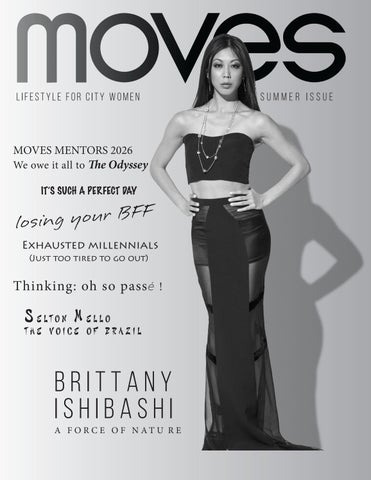
LIFESTYLE FOR CITY WOMEN
MOVES MENTORS 2026
We owe it all to The Odyssey IT’S SUCH A PERFECT DAY
F F B r u o y g losin Exhausted millennials (Just too tired to go out)
Thinking: oh so pass é !
S ELTON M ELLO THE VOICE OF BRAZIL
BRITTaNY ISHIBASHI A F O R C E O F N AT U R E
SUMMER ISSUE
21ST CENTURY WOMEN
Moves
‘21st Century Women’... in progress ... an insight into twenty years of the Moves Power Women Awards and the women who made it possible...
POWER WOMEN 2003-2023
From the pages of Moves Magazine
... coming soon to a bookstore near you!
018 cheers white lightenin’ 022 feature bitch 026 dish backsliding 030 feature nyc reinvention 034 profile jalyn hall 038 feature we can do it! 040 cover story ali wentworth 048 feature education 052 power women 2022 096 dermot mulroney 104 moves climate forum 110 feature divorce
cover
BRITTANY ISHIBASHI [WHO KNEW?]
By Moonah Ellison images: The Riker Brothers Brittany Ishibashi no longer believes in work-life balance. Not in the neat, evenly divided version of it, anyway—the version in which ambition, marriage, motherhood and creative work coexist without inconvenience, resentment or the occasional three-in-the-morning spiral. “I don’t think that’s possible,” she says. “Something always has to give.” The admission is less defeatist than practical. Ishibashi has three children, a career in front of the camera, a production company and several projects developing behind it. Her family life and creative life do not sit in separate compartments so much as spill continually into one another. The adjustment, she says, has been learning to extend herself some grace when the proportions shift. “If we do refer to it as some kind of balance, it’s not always going to be equal.” Some days belong to the work. Others belong to the children. On more difficult nights, they follow her into bed and wake her before dawn, when the house is quiet but her mind is not. She describes the familiar experience of opening her eyes at three in the morning and watching the machinery start up: the unanswered question, the unfinished task, the detail that seemed manageable at midnight and urgent by sunrise. By five, she says, it is time to get up anyway. This summer, however, there is a brief opening. Her children are away at camp, and Ishibashi is back in Los Angeles after spending much of the previous year in Austin, Texas, where she filmed Brothers, the Apple TV+ comedy starring Matthew McConaughey and Woody Harrelson as heightened versions of themselves. Ishibashi plays Joy Harrelson, whose daughter’s marriage begins to fall apart. The family responds by retreating to Matthew’s ranch, where open space, enforced closeness and good intentions produce the opposite of peace. the series premieres late September “It just breeds utter chaos,” Ishibashi says. The series leans into the decades-long friendship between McConaughey and Harrelson, borrowing from their real histories while exaggerating the mythology that has formed around them. For Ishibashi, the appeal was not simply joining two of the most recognizable actors of their generation. It was discovering how deliberately they made the rest of the ensemble forget that fact. She had been asked recently whether the two men were everything she hoped they would be. The answer came easily. “Yes, and then some.” What impressed her most was not charisma, which she expected, or comic timing, which hardly needed proving.
It was the amount of work required to make a large production feel loose. McConaughey and Harrelson arrived with the authority to control the room and used it instead to make the room less guarded. They encouraged experimentation. They allowed people to miss. They built enough trust for the actors around them to risk looking foolish, which is often where comedy begins. “It’s a very intentional thing,” Ishibashi says. The set began to feel less like a star-driven television production than a repertory company. Ideas moved around. Scenes opened up. The hierarchy remained, but it did not dominate the atmosphere. Then, occasionally, the illusion would break. Ishibashi would be midway through a scene and suddenly become aware of whose face was across from hers. “I’m doing a scene with Matthew McConaughey,” she remembers thinking. “Then I’m doing a scene with Woody Harrelson.” The realization would arrive and then pass. There was still a scene to finish. Comedy has always interested Ishibashi, though her filmography has not often made that obvious. She has spent much of her career in dramas, action projects and genre productions, including the Marvel series Runaways and films such as Teenage Mutant Ninja Turtles: Out of the Shadows. The work established a certain image: controlled, capable, serious. “I love comedy,” she says. “I just very rarely get cast in it.” Brothers gave her room to disturb that image. The pleasure was partly in the material and partly in the freedom surrounding it. With its stars playing unruly variations of themselves, the series operated in a space between fiction and inside joke. Stories that sounded invented were often true; the stranger they became, the more likely they were to have originated somewhere in Harrelson and McConaughey’s actual friendship. There was mischief in that uncertainty. Ishibashi could enter a scene without entirely knowing which part belonged to the script and which part had escaped from somebody’s memory. The experience arrived at a moment when she had been thinking more seriously about permission—who gives it, who waits for it and how much time artists lose by assuming it must come from somewhere else. In Ishibashi’s family, making art was never treated as a rebellion. Her parents were artists. Her sisters became artists. Creativity was not positioned as the impractical alternative to a respectable life; it was simply the language spoken at home. She and her sisters made up stories, staged performances and put on shows for the neighbors. Art was play before it was profession, and because nobody taught them to regard it as frivolous, the transition from one to the other did not feel especially radical.
“It was something I never questioned not doing,” she says. That certainty was unusual for a Japanese-American child growing up in Orange County in the 1980s, when creative careers were not always encouraged within Asian-American families. Ishibashi understands the general expectation. She simply did not experience it inside her own house.
used her voice to sustain people inside a place designed to diminish them.
Her parents saw art as a way of connecting people. It could be joyful, serious, communal and worthwhile at once. That belief remained with all three daughters, even as their individual work moved in different directions.
Those ideas do not feel distant from the projects she wants to produce now. Ishibashi has spent years helping realize other people’s stories. Producing gives her the ability to decide which stories enter the room in the first place, particularly the ones rooted in lives that rarely arrive onscreen without being simplified.
Now, the sisters are developing a project inspired by their childhood as three Japanese-American performing artists growing up backstage, where the world adults built for entertainment occasionally exposed them to more than children were meant to understand. The project is still taking shape, but its foundation is familiar: family history, performance and the peculiar intimacy of sisters who have spent their lives sharing both. Ishibashi calls the family “very codependent,” then laughs. The word sounds more affectionate than clinical. They are closely involved in one another’s work, constantly exchanging ideas and relying on a shorthand that developed long before any of them knew they were building creative careers. The production company belongs to Ishibashi, but the work around it remains porous. One sister is also developing a project about their grandmother, who was incarcerated at Manzanar during World War II and became known as the “Songbird of Manzanar.” The story centers on music, confinement and survival— not resistance as spectacle, but resistance practiced quietly enough to be overlooked. Their grandmother
That history complicates the idea that change must arrive through enormous gestures. Sometimes it begins with a song. Sometimes with a room of people who hear it. “Art as resistance,” she says. “The power of hope.”
It is not a rejection of acting. She still loves being handed a role she did not imagine for herself, especially one that breaks a pattern the industry has become comfortable repeating. But she is less willing than she once was to let casting determine the limits of her creative identity. “This business can pigeonhole you,” she says. “You have permission to be whatever it is that you want to be.” For Ishibashi, that permission has become less abstract with age. It looks like comedy after years of dramatic roles. It looks like developing work with her sisters. It looks like allowing family history to become artistic material without reducing it to heritage or obligation. It also looks like accepting that none of it will be balanced. The work and the family will continue competing for time. The children will grow. Productions will move. Some nights will still end at three in the morning with Ishibashi awake, arranging responsibilities in the dark. The goal is no longer to force every part of her life into equal portions. It is to remain present inside whichever part needs her most.
contents
006 cover story brittany Ishibashi 018 opinion humanity 022 bitch american dream 026 feature thinking 030 dish bf not so forever 034 rant millennial malaise 036 profile logan browning 044 cheers margaritas all round 048 profile selton mello 055 feature mentors 2026 064 rave a perfect day 067 event sustainability awards 074 profile hitch 078 profile sarah bolger
brittany ishibashi image by the riker brothers
mamoonah ellison PUBLISHER
richard ellison
EDITOR IN CHIEF
nicky black
ART DIRECTOR
phil rowe, assoc. editor pete barrett, sarah joan production editors elle brockett event content editor marie butler asst. editor sarah joan roston editorial asst. emmy best graphics editorial chesley turner, bill smyth, ashley walsh, zoë stagg, annabelle jacoban, features liz watson, dora oliver, elsie cleveland art department carolina alzate, richard peters camila cardona, sarah jeffries web & tech support amman a marketing, pr & events ashley walsh, evelyn galarza, monty reynolds social media annabelle jacoban, sydney champagne office managers susan north, jessica mcginley office assistants anna johns, jo bell, jen parke video & production fabienne riccoboni, cristian pena photography tony gale, pablo andres monsalve, khan hassan sales & analytics marty ann robertson YES Sales Consultants, L.L.C. contributors: Tony Gale, Randall Slavin, Spencer Heyfron, Sean Gleason, William Ferchichi, Dennys iLic, James Weber, Francis Hills, Louis Tinsley, Alison Dyer.Anne Marie Green, CBS, Spencer Heyfron, Carlotta Moye, Amanda Mae, Kelly Balch, David Tenniswood, Petros KoyAija Mayrock, Sri Garber, Platform PR, Rachel Margoli, Hundred Stories PR, Gertie Lowe, Public Eye PR, Cannon, Cannon Mediea Group, Karrie Porter, Evan Duning, Chelsea Claydon, Emily Assiran, Bo Poulsen, Anna Shagalov, Kristin Herrera, Ryan Hall, Brooklin Rosenstock, David Edwards, Stewart, Chris Shanahan, Shanna Fisher, Dean Burnett, Paul Bloom, , Emily Barnes, Orlando Behar, Paster, Ejaz, Callan Stokes, , Chesley Turner, Zoe Stagg, Nathan Heyward, Sophia Fox-Sowell, Kyle Valenta, Melissa Farley,, Cristian Pena, Pablo Monsalve, Gustavo Ortiz, Tony Moore, Pietro Birindelli, Alvaro Nieto, William Casper. special thanks: Mike Bundlie, poetsroad.com Brendan Cannon, Ava Cella, Julia Cook, Sydney Lynch, Khaleah Phillips, Kelly Cody, Marielle Berrian, Lexi Rosenstein, Izzy Herbert. Brooke Lorenz, April Andrews, Cat Trzaskowski, Jess Herman, Travis Keyes, Toranj Kayvon, Duck Feeney. Buffy Saint-Marie, Mariana Jimènez, Yoli-Ann Cotray, Anita Sweet, Patricia Hurtado, Mark Williamson, Amanda Robinson, Jennifer M Scarcella, Christine Tirado, Arend Jackson, Denis Boyd, Trevis Lester, Marco Santini, Aja Allen, Li Murillo, Silvana Avignoni, Camille Thompson, Franz Munoz, Rebecca Hampson, Sarah Whiteside, Rebecca Velez, Daisy Curbeon, Romano Lai, David De Leon, Diana Manzanares, Marco Santini, Mary Wiles, Antonio Velotta Hannah Morelli Kasey Kitchen, Jen LeeMarla Farrell, Jessica Sze, Charlotte Dick-Godfrey, Buffy Saint-Marie, Mariana Jimènez, Yoli-Ann Cotray, Anita Sweet, Patricia Hurtado, Mark Williamson, Amanda Robinson, Jennifer M Scarcella, Christine Tirado, Arend Jackson, Denis Boyd, Trevis Lester, Marco Santini, Aja Allen, Li Murillo, Silvana Avignoni, Camille Thompson, Franz Munoz, Rebecca Hampson, Sarah Whiteside, Rebecca Velez, Daisy Curbeon, Romano Lai, David De Leon, Diana Manzanares, Marco Santini, Mary Wiles, Antonio Velotta. Ashton Lunceford, Gina Hoffman, Tina Kennedy, sisley, monika borja, US Army, US Air Force, Mary Kay Vrba, Sarah Lee, Halstead, Arnold Robinson, Megan Mattson, Netflix, Aflac, Brian Meier, Corcoran, Rogers and Cowan, Paula Bissonette, Discovery Channel, Kasey Kitchen, David Dormann, Marla Farrell, Maria Candida, Danielle Dinten, Fiskars, Michelle Caspers, Landsend, Think Dutchess, D’Arcy Brito, Sophie Taleghani, Michelle Richards, Katie Feldman, Turner Networks, Audrey Adlam, Discovery Networks, Stan Rosenfield, WW Norton, Harper Collins, Eve Sadof The Wall Group, Giant Artists, David Stanwell, Solo Artists, The Rex Agency, Bective, Magnet Agency, Exclusive Artists, Artmix Beauty, Starworks Artists,Stephanie Gonzalez, Warner Bros Pictures, Next Models Paris, , WWRD, Crabtree & Evelyn, Sunset Marquis Kiki Heitkotter, Diane Da Silva, Ariel Tunnell Splashlight Studios, New York; 108 Leonard Street; 565 Broome Street, Penthouse; Loft 2 Studio; Solar Studios; Five Park Miami Beach; Electric Pony Studios; 1 Grosvenor Square, Hudson Yards Loft, Malibu Modern Studio
New York Moves Magazine p.o. box 4097 lexington ave., new york, ny, 10163 ph: 212.396.2394 fax: 212.202.7615 all contents © 2012 New York Moves Magazine reproduction without permission is prohibited. ISSN 1553-8710
www.newyorkmoves.com Application to mail Periodicals postage rates is pending at New York, N.Y. and additional mailing offices. Send address changes to New York Moves, P.O. Box 4097 Lexington Ave., New York, N.Y. 10163. New York Moves assumes no responsibility for content, text or artwork of advertisements other than those promoting New York Moves, placed in the magazine. The opinions and viewpoints of the contributors do not necessarily represent the opinions and viewpoints of New York Moves, L.L.C.
opinion
CORP We began as frightened figures beside a fire, surrounded by darkness. Now our lights can be seen from space. That may be humanity’s most beautiful achievement—and its most unsettling image. There was a time—not so very long ago in the overall history of the planet—when human beings understood their place. We were nervous creatures at the edge of the firelight, listening for wolves, watching the sky, praying for rain and hoping winter would pass without taking too many of us with it. Nature was not scenery. It was judge, landlord, executioner and god. Today, the arrangement has been almost entirely reversed. Humanity has become the planet’s dominant force: clearing forests, redirecting rivers, breeding animals to specification, altering the climate and deciding, often casually, which species will survive and which will disappear. It is an astonishing promotion for an animal with no claws, no armor and a body that can be defeated by a few days without water. Our authority comes from the mind. Humans imagine what does not yet exist, then organize themselves to create it. We turn stones into tools, sand into computer chips and ancient sunlight trapped underground into fuel for cities. We pass knowledge from one generation to the next, meaning that every child is born into an inheritance of accumulated ideas. A wolf must learn again how to hunt; a human can open a book and consult the dead. This ability to preserve and expand knowledge has allowed us to escape many of the limits imposed on other animals. Agriculture was the first great act of possession. Once humans learned to cultivate crops and domesticate animals, the world ceased to be merely a place through which we travelled. It became property. Forests were cut down, wetlands drained, rivers controlled and animals redesigned through selective breeding. Wheat, cattle and chickens spread across continents because they were useful to us. Predators were driven away because they threatened what we had claimed. Villages became cities, cities became empires, and the landscape increasingly reflected human appetite rather than natural evolution.
OREALITY We have illuminated the world, but we have also made it impossible to overlook the damage. Our intelligence gave us dominance. Only wisdom will determine whether we deserved it.
The question facing humanity is no longer whether we possess the power to shape the future. The question is whether we will use that power with foresight, restraint, and responsibility.
Then came industry, and dominance became something close to conquest. Coal, steam, oil and electricity gave humanity power on a scale no muscle could provide. Mountains were opened for minerals. Railways crossed wilderness. Ships moved goods between continents, and cities rose with such speed that nature appeared to retreat before them. Night itself was defeated by electric light. Distance was conquered by engines, telephones and aircraft. The planet, once impossibly vast, began to feel small enough to manage.
soil, insects, oceans and a relatively stable climate. Supermarkets conceal the complexity of food production. Air-conditioning disguises extreme heat. Modern life places comfortable walls between us and the systems keeping us alive. But if pollinators collapse, crops fail. If oceans warm, food chains change. If rainfall patterns shift, borders and bank accounts offer little protection.
We now interfere not only with landscapes but with life itself. Medicine has eliminated diseases that once terrorized entire populations. Scientists transplant organs, create vaccines, alter genes and develop crops capable of surviving drought. We can preserve a premature baby weighing less than a bag of sugar while maintaining seed banks in preparation for future catastrophe. Yet the same species capable of rescuing a rare animal can destroy its habitat for profit. We appoint ourselves guardians of nature after first becoming its greatest threat. The evidence of our presence is everywhere. Plastic has reached the deepest parts of the ocean. Chemical traces settle in remote ice. Satellites circle above us while discarded machinery travels through space. Human activity changes the temperature of the atmosphere, the chemistry of the seas and the movement of species across the globe. We have become so influential that scientists debate whether humanity has created an entirely new geological age. Future civilizations, if there are any, may identify our era in layers of concrete, radioactive particles, chicken bones and plastic. Dominance, however, has encouraged a dangerous illusion: that control is the same as independence. We behave as though technology has released us from nature, when every city remains dependent on water,
There is also the uncomfortable question of what human dominance has meant for humans themselves. Power has never been distributed equally. The wealth created by industry sits beside extraordinary poverty. Some people consume resources at an astonishing rate while others struggle for clean water. Technology connects billions, yet it also watches, manipulates and divides them. Artificial intelligence may become another expression of human brilliance, but it could just as easily expose our familiar inability to control the consequences of our inventions. This is the contradiction at the center of our supremacy: human beings are clever enough to transform the world but not always wise enough to understand what the transformation will cost. We celebrate progress after measuring its benefits immediately and postponing its consequences. Fossil fuels built modern economies before their atmospheric price became impossible to ignore. Industrial farming feeds billions while exhausting soil and reducing biodiversity. Convenience arrives today; the invoice goes to tomorrow. Human dominance is therefore not a victory completed but a test still underway. The question is no longer whether we can control the planet. Clearly, we can alter nearly every part of it. The more urgent question is whether we can control ourselves. True supremacy may not be demonstrated by building the tallest tower, extracting the final resource or forcing nature into submission. It may lie in restraint: knowing when not to build, cut, burn or consume.
O
contributors
t r i b tO rs
THE RIKER BROTHERS Growing up in a small town west of Chicago, twin brothers Derek and Drew Riker were introduced to photography by their father who was always taking pictures. Their first assignment was shooting with Bruce Weber for L’Uomo Vogue and and lucky enough to learn from some of their idols, including Arthur Elgort, Patrick Demarchelier, and their close friend and mentor Herb Ritts. FRANK ROCCO is a photographer shooting professionally for over twenty years. His specialities include beauty, portraits and figure photography. Frank served as the president of the New York Chapter of the American Society of Media Photographers for over five years before serving two terms on the national board of directors. He currently curates the Weekend Reading for ASMP and is one of three artist in a collaboration known as Terminal Art Works.
ASHLEY NGUYEN is a handson creative based in Los Angeles, with over a decade of experience across the creative spectrum. With a foundation in art direction and photography, she has evolved into a leadership role and now owns a studio in Koreatown. When she is not at her desk or behind the camera, Ashley can be found in the wild molding clay, practicing martial arts, planting seeds, and exploring the world.
RODRIGO MARQUES is a professional São Paulo-born fashion and portrait photographer with nearly two decades of experience. He has photographed major fashion and lifestyle editorials featured in prominent publications like Glamour Brasil and Claudia Magazine.
CHLOE HORSEMAN is a photographer and director currently based in New York. From a small town Georgia, Chloe has a self published book, Outtakes, and shoots for many fashion brands around the world.
WILLIAM FERCHICHI was born in Milan, where he initially studied fashion textiles-design before turning his focus to photography, seeking to bridge the two worlds. His creative journey took him to China for an extended adventure, where he conceived the idea for a portrait book. Later, he moved to London, where he received a solid education that nurtured his creativity both in fashion and photography, redefining his artistic voice.
THE BEAUTY OF PINOT
© 2021 COPPER CANE LLC, ST. HELENA, CA
bitch
LEVEL PLAYING FIELD....
If I had to sum up the biggest frustration my generation has, it would be this: we were sold a dream that no longer exists. Growing up, I was told that if I worked hard, earned a degree, found a good job, and played by the rules, everything would eventually fall into place. I believed that success was something I could achieve through determination and persistence. I wasn’t expecting life to be easy, but I did expect it to be fair. Then reality arrived. I graduated into a world where house prices had skyrocketed, wages had barely moved, and secure jobs had become increasingly rare. Instead of climbing a career ladder, I found myself jumping from opportunity to opportunity, constantly adapting to industries that seemed to reinvent themselves every few years. Stability became something other people talked about rather than something I experienced.
Buying a home feels like one of the biggest examples of how the rules changed. Every month I pay rent that could easily cover a mortgage, yet somehow saving enough for a deposit feels impossible. By the time I’ve paid rent, utilities, groceries, insurance, and student loans, there isn’t much left to build the future I was promised. Work itself has changed too. I don’t simply go to work anymore—I carry work everywhere. My phone never stops buzzing, emails arrive late into the evening, and social media constantly reminds me of everyone else’s promotions, holidays, businesses, and seemingly perfect lives. It’s exhausting trying to keep up with a version of success that often isn’t even real. What surprises me most is how often my generation is described as entitled. From where I stand, we aren’t asking for luxury. We’re asking for the same opportunities that previous generations often took for granted: the chance to afford a home, build financial security, raise a family if we choose, and enjoy some balance between earning a living and actually living.
... OR CRASH SITE ? The conversation around mental health is another area where we’ve had to lead. I don’t think we’re more fragile than previous generations. I think we’re simply more honest. We talk about anxiety, burnout, depression, and stress because pretending those things don’t exist doesn’t make them disappear. For many of us, success is no longer measured solely by salary or job title but by whether we can build a life that feels healthy and meaningful. Despite everything, I’m optimistic. My generation has become incredibly adaptable because we’ve had no choice. We’ve lived through financial crises, technological revolutions, political uncertainty, and a global pandemic. We’ve learned to pivot, reinvent ourselves, and keep moving forward even when the finish line keeps shifting.
So I keep working, keep adapting, and keep believing that success is still possible. It just doesn’t look the way I was told it would.!
My biggest complaint isn’t that life is difficult. Every generation faces challenges. It’s that I was taught to believe there was a clear path forward, only to discover that the map had changed before I even started the journey.
A
EA M R D N A MERIC email: bitch@newyorkmoves.com snailmail: Moves: PO BOX 4097 Lex. Ave New York, NY 10163
feature
Are You Finished In There Yet? By Richard Henry Rodin’s “Le Penseur — The Thinker” Part of the problem is speed. Modern culture moves too quickly for deep thinking. Social media, twenty-four-hour news cycles, algorithmic content, and constant digital stimulation reward immediacy rather than reflection. Thoughtfulness is slow by nature. Serious thinking requires uncertainty, patience, reading, contemplation, and the willingness to examine complexity without instantly reducing it into emotionally satisfying conclusions. But modern systems are built for reaction. Fast opinions spread more easily than nuanced analysis. Certainty performs better online than careful doubt. As a result, intellectual depth increasingly struggles to survive within environments designed around attention rather than understanding. There is also growing suspicion toward complexity itself. Many people now associate intellectualism with elitism, detachment, or arrogance. Public discourse has become highly emotionalized, and thinkers who attempt to introduce nuance into polarized debates are often treated as obstacles rather than contributors. In highly tribal environments, independent thinkers become particularly inconvenient because they rarely align perfectly with ideological groups. They ask difficult questions even of the side they may broadly support. This independence can easily provoke hostility. Modern culture often rewards loyalty over inquiry. People increasingly expect public figures to confirm existing beliefs rather than challenge them. Thinkers, however, complicate certainty. They introduce contradictions, historical context, uncomfortable truths, and moral ambiguity. In societies shaped by emotional polarization, complexity itself can feel threatening because it destabilizes simple narratives people emotionally depend upon. Technology has intensified this dynamic dramatically. Social media platforms reduce communication
There was once a time when thinkers occupied a visible and respected place within public life. Philosophers, writers, journalists, historians, and intellectuals were not expected to entertain audiences in fragments or compete for attention against endless streams of digital distraction.
Their role was to question, interpret, challenge, and clarify. Thought itself carried cultural value. Today, however, serious thinkers often exist in a strangely uncomfortable position within modern society— admired in theory, yet frequently dismissed, distrusted, mocked, or ignored in practice.
into compressed formats that favor emotional clarity over intellectual complexity. Outrage spreads faster than thoughtfulness because outrage is immediate. Deep analysis requires attention spans modern systems actively erode. The result is a culture where visibility increasingly belongs not to the most rigorous thinkers, but to the loudest personalities.
tion, stimulation, speed, and emotional impulse. Deep thinking slows consumption because reflective individuals question systems rather than move passively through them. Thoughtful people are harder to manipulate because they examine language carefully, recognize contradictions, and resist simplistic persuasion.
At the same time, public trust in institutions has weakened significantly over recent decades. Universities, media organizations, governments, and traditional centers of expertise are now viewed with suspicion by large portions of society. While some skepticism is healthy, the broader cultural consequence has been the erosion of respect for expertise itself. In many cases, intellectual authority is now treated not as something earned through study and discipline, but as something inherently suspect.
In many ways, modern society rewards performance more than contemplation. Public visibility now depends heavily on personality, branding, relatability, and emotional immediacy. Serious thinkers often struggle within this environment because genuine intellectual life is rarely performative. It involves solitude, uncertainty, revision, and sustained concentration—qualities difficult to package within fast-moving digital culture.
This creates an environment where opinions become flattened. Expertise and impulse begin carrying similar weight within public conversation. Someone who has spent decades studying history, philosophy, medicine, or political systems may now compete equally with viral personalities whose influence derives primarily from visibility rather than knowledge. Popularity increasingly substitutes for credibility. There is also a deeper psychological reason thinkers are often scorned: genuine thinking can be profoundly uncomfortable. Serious thinkers force societies to confront contradictions people would rather avoid. They question myths, challenge comforting assumptions, and expose weaknesses within cultural systems. This process rarely feels pleasant. It disrupts emotional certainty and demands self-examination. People naturally resist ideas that threaten identity, ideology, or worldview. The clearer the thinker, the more destabilizing their observations may become.
Yet despite this tension, societies continue to need thinkers desperately. Civilizations become intellectually fragile when they lose respect for deep thought. Without independent thinkers, public discourse collapses into reaction, propaganda, tribalism, and emotional spectacle. Democracies in particular depend upon citizens capable of critical thinking, historical awareness, and intellectual discipline. Without those capacities, populations become increasingly vulnerable to manipulation by ideology, misinformation, and emotional extremism. The irony is that even societies which scorn thinkers often quietly depend upon them. Every meaningful advancement—scientific, philosophical, political, artistic, or moral—begins with individuals willing to think beyond accepted assumptions. Progress itself depends upon people capable of questioning prevailing systems rather than merely adapting to them.
History repeatedly demonstrates this pattern. Societies often celebrate thinkers retrospectively while resisting them intensely in real time. Independent intellectuals are frequently accused of negativity, arrogance, disloyalty, or pessimism simply because they refuse to conform completely to prevailing narratives. The problem is not necessarily intelligence itself, but intellectual independence.
Perhaps the deeper issue is that modern culture struggles to distinguish intelligence from performance. True thinkers are rarely the loudest voices in the room. They are often cautious, nuanced, skeptical, and resistant to certainty. Their value lies not in offering instant emotional satisfaction, but in helping society think more clearly about itself.
Modern consumer culture also contributes to this hostility toward thoughtfulness. Consumer systems thrive on distrac-
And in a world increasingly overwhelmed by noise, clarity may be one of the most threatening—and necessary—qualities of all.
dish
The Quie
That’s what makes it feel ra No explanation. No real No one really prepares you
By Brough Breakups, at least, have a script. There’s language for it— heartbreak, closure, moving on. People expect it. They ask about it. They let you be dramatic, let you fall apart a little. But when a friendship ends, especially one that mattered, it happens in a quieter, more disorienting way. There’s no clean explanation, no defined moment where you can point and say, that’s when it ended. Sometimes it’s a slow shift. A tone that changes. A conversation that feels slightly off. A distance that builds so gradually you almost convince yourself it isn’t happening—until one day, it is. And the worst part is, you don’t always get a reason that feels solid enough to hold onto. Friendship fallouts hurt differently because they’re built on a different kind of intimacy. It’s not just romantic vulnerability—it’s daily life. It’s the person who knew your routines, your habits, your unfiltered thoughts. The one you didn’t have to perform for. When that disappears, it’s not just losing the person, it’s losing a version of yourself that existed with them. And there’s something especially painful about the lack of acknowledgement. You don’t get the same permission to grieve it out loud. You can’t always explain why it hurts so much without feeling like you’re overreacting.
et Break
aw. It’s unfinished. It lingers. goodbye. Just absence. u for the end of a friendship.
hton Evers So you carry it quietly, even though it sits just as heavy—sometimes heavier—than a breakup ever could. Because at least when a romance ends, there’s often a clear incompatibility. With friendships, it’s murkier. You wonder if it could’ve been fixed. If one conversation would’ve changed everything. If you missed something, or if they did. Or worst of all—you realize it wasn’t a sudden break at all, just a slow unraveling that one of you noticed before the other. There’s a specific kind of sting in realizing someone you once felt so aligned with can now so easily move through life without you But eventually, you start to understand that not all relationships are meant to last forever, even the ones that felt like they would. People grow, or shift, or choose different directions, and sometimes that change doesn’t include you. It doesn’t make what you had any less real. It just means it ended without the kind of closure we’re taught to expect. And maybe that’s the hardest part—learning how to let something matter deeply...
rant
The Rise of the Socially Exhausted
...
There was once a time — historians estimate somewhere around 2007 — when young people would willingly leave the house after 9:00 p.m. for reasons other than buying oat milk. They dressed up. They flirted in person. They attended parties where no one photographed the appetizer before eating it. Human beings once made eye contact without first checking how they looked in the front- facing camera. By Byreon James III Today, however, America’s twenty- and thirty-somethings have evolved into a fascinating new species: the Socially Exhausted Digital Introvert. They are easy to identify. They own expensive sneakers they never wear because “there’s nowhere to go anymore.” They cancel plans with phrases like “I simply don’t have the bandwidth.” They spend six hours scrolling through other people socializing while declining invitations to socialize themselves. They claim they “love staying in,” yet remain deeply offended nobody invited them out. Welcome to modern adulthood. The contemporary wallflower no longer stands awkwardly beside the cheese plate at a party pretending to examine the hummus. No — today’s wallflower is at home in sweatpants, lying horizontally in bed, watching TikToks about “protecting your energy” while simultaneously wondering why they feel lonely. Social media, naturally, insists this is empowerment. And perhaps it is. For introverts, the internet has been nothing short of revolutionary. Quiet people no longer need to survive networking events by clutching sparkling water and praying someone mentions a podcast. Now they can build entire identities online without ever enduring the horror of small talk. A shy person can become wildly influential simply by whispering into a ring light about “healing,” iced coffee, or the emotional symbolism of mushrooms. The internet has democratized visibility. In previous decades, the loudest person in the room dominated the conversation. Today, the loudest person is often muted online because everyone finds them exhausting. The quiet observer has finally had their moment. Unfortunately, the observer now never leaves the house.
Somewhere along the line, convenience became a lifestyle. Why endure the emotional stress of meeting friends when you can send them a meme that says: “We should totally catch up soon 😂” This message, experts confirm, is the modern equivalent of a Victorian engagement announcement. It signals deep affection while guaranteeing absolutely no future plans. Entire friendships now operate exclusively through reactions to Instagram stories. “OMG obsessed.” “Dead.” “Need.” Three flame emojis. Relationship maintained. And dating? Dating has become less of a romantic journey and more of a psychological obstacle course designed by emotionally unavailable software engineers. Young adults now reject each other based on highly sophisticated criteria: • too many gym selfies, • suspicious use of semicolons, • owns a podcast microphone, • “energy feels chaotic,” • replied “haha” instead of “lol.” People once fell in love after surviving wars together. Today someone gets ghosted because they used the wrong GIF. Social media has transformed everyone into tiny unpaid publicists managing personal brands no corporation asked for. Every dinner is content. Every vacation is content. Every emotional breakdown is content accompanied by soft piano music and captions about “growth.” Even exhaustion has become performative. Nobody is merely tired anymore. They are: “recharging,” “protecting boundaries,” “honoring stillness,” or “entering a softer season.”
0r How an Entire Generation Became “Too Tired to Go Out”
Translation: they watched three seasons of a murder documentary and accidentally ate shredded cheese over the sink at midnight. The strangest part is that this generation genuinely craves connection. Desperately. Underneath the irony, the memes, the curated identities, and the “do not perceive me” hoodies lies a profound hunger for real human closeness. Which explains why people spend entire evenings staring into tiny glowing rectangles searching for evidence that someone somewhere understands them. And occasionally, wonderfully, they find it. A lonely teenager in Ohio discovers thousands of people who share her love of obscure Japanese animation and vintage teacups. A shy young man afraid to speak publicly becomes a brilliant essayist online. Someone battling anxiety realizes they are not broken, merely human. Social media can be ridiculous, narcissistic, addictive, and emotionally catastrophic. It can also be oddly beautiful. It has allowed introverts, outsiders, creatives, and awkward dreamers to find each other across impossible distances. The problem is that digital intimacy often creates the illusion of emotional fulfillment without fully satisfying it. A “like” activates the brain. A real conversation nourishes the soul. Unfortunately, one requires emotional vulnerability and possibly wearing real pants. Modern young adults now live in a bizarre contradiction: they are hyper-visible yet emotionally hidden. Everyone shares everything online except the things they actually feel. People post: “My Roman Empire.” “My toxic trait.” “POV: mentally unstable but funny.” Meanwhile their actual emotional state resembles a Victorian orphan staring out a rainy window clutching existential dread and an iced latte.
And yet, despite all this, something fascinating is happening. Quietness is no longer social failure. For decades, culture rewarded charisma above all else. Loud people dominated offices, classrooms, media, politics, and dinner parties. Introverts were often treated like unfinished extroverts — people expected to “come out of their shell” as though personality were a defective kitchen appliance. But younger generations increasingly admire something different: authenticity, depth, humor, thoughtfulness, self-awareness. The person commanding attention is no longer automatically the most impressive person in the room. Sometimes the most magnetic figure is the calm one silently observing everyone else unravel during brunch. The modern introvert has become culturally powerful. Of course, they would prefer not to attend the meeting where this is officially announced. Perhaps the real issue is not that social media created more wallflowers. Perhaps it simply revealed how many were always there. The difference is that today they can find one another instantly. Millions of people sitting alone together. Quietly posting. Quietly scrolling. Quietly searching for connection while insisting they “need space.” It is absurd. It is hilarious. It is occasionally heartbreaking. And it may also be one of the most honest portraits of modern life. Because beneath all the filters, algorithms, therapy language, dating fatigue, and emotional support water bottles, this generation is still asking the same ancient question humans have always asked: “Does anyone else feel like this?” The answer, endlessly refreshing on the screen, appears to be yes.
profile
Log “As millennials, we’ve been the guinea pigs.”
gan
loga n brow ning By Brinlee Edger Images by Ashley Nguyen Logan Browning has spent much of her career portraying women who live in the gray areas between certainty and contradiction. From Dear White People to Harlem, her characters rarely offer easy answers. Her latest role continues that tradition. In Netflix’s limited series I Will Find You, adapted from Harlan Coben’s bestselling novel, Browning stars alongside Sam Worthington, Britt Lower, and Milo Ventimiglia in a thriller about David Burroughs, a father imprisoned for the murder of his son before evidence suggests the child may still be alive. Browning plays Sarah Greer, a key figure in a story built on grief, suspicion, and the fragility of certainty. Yet I Will Find You also arrives during a period of transformation for Browning herself. While continuing her acting career, she is completing a degree in Film and Media Studies, deepening an interest that extends beyond performance to how stories are created, distributed, and experienced. “I’m fascinated by television,” she says. “I’m fascinated by this thing that came into the home and became part of our intimate lives.” That perspective shapes how she views her work. Rather than focusing on celebrity, Browning sees television as a uniquely personal medium. “It’s why I love being on television,” she explains. “You become part of the family.”
After being discovered at a competition attended by talent agents, Browning faced an extraordinary question from her parents: was she ready to move to Los Angeles? “I felt like I had to say yes for every child on the planet,” she recalls. Within months, auditions and production schedules replaced a conventional teenage life. Throughout it all, her parents remained deeply involved, ensuring work never came at the expense of stability or education. That foundation became even more meaningful after her father’s death twelve years ago. “You hold memories of your loved one that’s passed,” she says. “You can see and hear your loved one in your siblings and in your parent that is still living.” Family and community remain central to Browning’s outlook, both personally and professionally. Even after building a résumé many actors would envy, she continues approaching each project with the mindset of a student. That curiosity now extends behind the camera. Browning hopes to direct, viewing filmmaking as the natural next step after years spent observing every aspect of production. She has already directed the short film Hey Boo in 2023 through Kevin Hart’s Heartbeat Productions’ Women Write Now initiative and plans to pursue graduate studies in directing and filmmaking. “The goal is to study directing and filmmaking,” she says.
Her role in I Will Find You began with a traditional audition, something she still enjoys after years in the industry. She appreciated meeting producers over video, which restored some of the collaboration lost through self-taped auditions. Before production, Browning immersed herself in Harlan Coben’s work, quickly discovering the devoted audience surrounding his thrillers before relocating to Toronto for filming. Learning has become the defining thread throughout her career. Raised in Atlanta, Browning grew up immersed in the arts. She studied ballet from an early age, attended theatre programs at the Alliance Theatre with her brother, and regularly experienced live performances with her family. Church introduced another form of storytelling through music and performance. Professional acting arrived unexpectedly when her mother enrolled her in Barbizon at fourteen to build confidence.
Her interest lies in collaboration rather than control. She speaks of filmmaking as a collective effort where every contribution matters. That philosophy became especially important during Dear White People, the Netflix series that transformed her career. As the show’s lead actor, Browning viewed leadership not as authority but as responsibility. She made a point of welcoming guest actors, rehearsing scenes when needed, and ensuring newcomers felt supported from their first day on set. “I wanted everyone to know that they had an advocate in me,” she says. The series also changed her relationship with public life. Interviews increasingly shifted away from acting toward discussions of race, identity, and representation.
“It thrust me into this world of, ‘Who am I as Logan?’” “It thrust me into this world of, ‘Who am I as Logan?’” That question continues to shape how she approaches both her work and the rapidly changing media landscape. Artificial intelligence, she believes, deserves thoughtful engagement rather than unquestioning optimism or outright rejection. “As millennials, we’ve been the guinea pigs,” she says, reflecting on a generation that witnessed personal computers, smartphones, social media, streaming, and now AI fundamentally reshape daily life. She acknowledges AI’s practical benefits and has experimented with tools introduced through her university coursework. But she also worries about unintended consequences. “If I can build my own website,” she asks, “am I taking someone else’s job?” She points to research showing that while AI-assisted users became better at identifying misinformation, their own critical thinking declined once the technology was removed. “Our overuse of these things, while they are helpful in the short term, are taking our mental tools away from us,” she says.
As both an actor and a media studies student, Browning also finds social media fascinating as an evolving cultural phenomenon. She studies not only how platforms change but how audiences and storytelling evolve alongside them. Throughout the conversation, one idea surfaces repeatedly: agency. Whether discussing education, directing, AI, family, or social media, Browning believes people retain the ability to choose how they engage with the world. She recalls being asked as a teenager what fame meant to her. Her answer has not changed. “I wanted to make a name for myself so I could change the world.” Today, she adds, “I don’t want it to just be because it’s me. That seems so pointless.” For Browning, visibility matters only if it creates something beyond self-promotion. Success is measured less by recognition than by whether the work leaves audiences thinking differently. That perspective makes I Will Find You feel like more than another credit in an accomplished career. It represents another opportunity to tell stories that connect with people and invite reflection.
Rather than rejecting technology, Browning believes creatives must learn to work alongside it while preserving independent thought. The same philosophy informs her relationship with social media. Several years ago, she disabled nearly every notification on her phone. “I choose when I go on,” she says.
After more than fifteen years in the entertainment industry, Browning’s defining quality is not simply longevity or versatility, but curiosity. The questions that brought a fourteen-year-old from Atlanta to Los Angeles remain unchanged. She still wants to understand how stories work, challenge herself creatively, and continue learning.
She still catches herself instinctively opening Instagram, but the habit only reinforces her awareness of how technology shapes attention. Meditation, often through the Insight Timer app, has become one way of creating intentional space away from constant digital stimulation.
In an industry that often rewards certainty over authenticity, Logan Browning remains remarkably comfortable with curiosity—and that willingness to keep learning may be what makes her one of Hollywood’s most compelling storytellers.
cheers
The Margarita: The Cocktail That Conquered the World When it comes to cocktails, few drinks have achieved the universal appeal of the Margarita. Simple yet sophisticated, refreshing yet bold, the Margarita has become the world’s most popular cocktail, appearing on bar menus from beach resorts in Mexico to luxury hotels in London, rooftop lounges in New York, and neighborhood restaurants in Sydney. Its perfect balance of tequila, fresh lime juice, and orange liqueur has made it a timeless favorite for generations of cocktail lovers. Like many legendary drinks, the Margarita’s origins remain something of a mystery. Several bartenders and socialites have claimed to have invented it during the 1930s and 1940s, with stories stretching from Tijuana to Acapulco and Texas. One popular tale credits a Mexican bartender who created the drink for a dancer allergic to every spirit except tequila. Another attributes it to a wealthy hostess entertaining American guests. While historians continue to debate the true story, most agree that the Margarita emerged during a period when tequila was beginning to gain international recognition. The classic recipe is remarkably simple: tequila, freshly squeezed lime juice, and orange liqueur, shaken with ice and traditionally served in a salt-rimmed glass. That simplicity is part of its genius. Every ingredient plays a role. The tequila provides earthy character, the lime delivers bright acidity, the orange liqueur adds sweetness, and the salt enhances every sip by balancing the flavors. Over the decades, the Margarita has inspired countless variations. Frozen Margaritas became enormously popular in the 1970s, particularly in warmer climates where their icy texture offered instant refreshment. Fruit versions featuring strawberry, mango, watermelon, peach, or passionfruit now appear on menus around the world. Bartenders have also embraced premium tequilas, smoky mezcal, spicy jalapeño infusions, and fresh herbs such as basil or cilantro, creating modern interpretations while preserving the drink’s unmistakable identity. The Margarita’s popularity mirrors the rise of tequila itself. Once considered a regional Mexican spirit, tequila has evolved into one of the fastest-growing premium spirits worldwide. Consumers have developed a greater appreciation for handcrafted production methods, high-quality agave, and aged expressions that rival the complexity of fine whisky or cognac. As tequila’s reputation has grown, so has the Margarita’s status as a sophisticated cocktail rather than simply a party drink. Food has also played an important role in the Margarita’s success. Few cocktails pair as naturally with cuisine. Whether served alongside tacos, grilled seafood, spicy Mexican dishes, fresh ceviche, or even modern fusion menus, its citrus-forward profile complements bold flavors while cleansing the palate between bites. This versatility has made it a staple in restaurants as well as cocktail bars. Social media has given the Margarita yet another boost. Colorful presentations, oversized glasses, dramatic garnishes, and creative flavor combinations have made it one of the most photographed cocktails in the world. Yet despite endless reinvention, the classic version continues to outsell many trendy newcomers, proving that great recipes rarely go out of style. Ultimately, the Margarita’s enduring appeal lies in its remarkable balance. It feels equally at home at a casual backyard barbecue, a beachside sunset, a festive celebration, or an elegant dinner party. Few cocktails have crossed cultures and generations so effortlessly. More than just a blend of tequila, lime, and orange liqueur, the Margarita has become a global symbol of relaxation, celebration, and the simple pleasure of raising a perfectly crafted glass with good company.
profile
SELTON MELLO
The Voice of Brazil
S E LTOn’s still here
e
!
By Moonah Ellison & Brinlee Edger Images by Rodrigo Marques
“I’ll get into a taxi,” he says with a smile. “I’ll say one sentence. Just one. The driver turns around and says, ‘Selton Mello.’”
There is a particular kind of fame that arrives all at once. One film catches. An awards campaign follows. Suddenly the interviews multiply, the invitations arrive, Hollywood calls, and the rest of the world begins speaking about an actor as though they have just appeared.
For nearly a decade, Mello dubbed American films into Portuguese, becoming the Brazilian voice behind Ralph Macchio, River Phoenix, Tom Hanks, and countless other familiar characters. Millions knew him long before they knew his name. His career began almost by accident. Although his parents weren’t artists, they recognized his enthusiasm and supported his dream. Acting opportunities came one after another until Mello was already working professionally.
Selton Mello understands why people think that’s what happened. His film I’m Still Here was named one of the Top 5 International Films of 2024 by the National Board of Review and at the Golden Globe Awards, his co-star Feranda Torres won the Best Actress in a Motion Picture – Drama award while the film was nominated for Best Foreign Language Film, a category in which it was also nominated at the Critics’ Choice Movie Awards and the BAFTA. At the 97th Academy Awards, Torres was nominated for Best Actress (Torres) and the film, Best Picture, while winning the Oscar for Best International Feature Film—the first-ever Brazilian-produced film to win an Academy Award. Mello’s calendar changed almost overnight. There were Q&As in New York and Los Angeles, meetings with filmmakers he’d admired for decades, and a role opposite Jack Black and Paul Rudd in Sony’s Anaconda in December 2025. For the first time, conversations about his career stretched far beyond Brazil. It would be easy to call it a breakthrough. Mello doesn’t. “I’ve been an actor since I was a kid,” he says. For more than forty years, Brazilian audiences have watched him grow up in public. They met him as a child actor in the early 1980s, welcomed him back after adolescence, followed him into directing, and watched him become one of Brazil’s most respected actors and filmmakers. Long before international audiences knew his face, Brazil already knew his voice.
“It was like dominoes,” he says. “One thing led to another.” Then, at 12, everything stopped. His voice changed. His appearance changed. He was no longer the child producers wanted, yet too young for adult roles at the time. Brazil’s television industry in the 1980s offered few opportunities to disappear and grow into yourself. “It was a kind of trauma.” For the first time, he questioned the talent that had defined his identity. Looking back, however, he doesn’t describe those years with bitterness. “I’m grateful.” Not because they were easy, but because failure arrived before success convinced him it would last forever. “I saw the best and the worst very early,” he says. “It made me grounded.” When work returned, so did perspective. Fame could disappear just as quickly as it arrived. “Tomorrow,” he says, “there will be another guy.” That humility continues to define him. Success matters, but curiosity matters more. Ask Mello about acting and he talks about directing. Ask him about directing and he talks about actors. His career has never followed a straight line. Instead, it has expanded naturally—from television to film, from acting to directing, from Brazilian productions to projects in English and Spanish.
“It’s magic again,” he says. Working in new languages, with new collaborators and cultures, has rekindled the excitement he felt as a young actor discovering filmmaking for the first time. “There are people watching I’m Still Here,” he says, “and then they look me up and realize, ‘This guy has thirty films.’” He laughs, not because they missed them, but because they’re finally finding them. Despite his growing international profile, Mello insists very little has changed about the work itself. “I learned when I was a boy that this world,” he says of filmmaking, “is a world of imagination. A world full of creativity. When I’m using my creativity, I’m happy.” That philosophy extends behind the camera. Mello has directed three feature films, including The Clown, a critical and commercial success in Brazil. Yet he sees directing and acting as complementary disciplines rather than separate careers. “When I’m directing,” he says, “I’m learning as an actor.” Every production becomes another classroom. “They don’t know it,” he says of his collaborators, “but they’re teaching me.” This past spring, in a major international moment, Mello was seen in the drama La Perra directed by Dominga Sotomayor, based upon the 2017 novel of the same name by Pilar Quintana. The movie premiered at Cannes Film Festival where it won the Palm Dog Award. To Mello, Hollywood feel less intimidating than many might imagine. While filming Anaconda, Mello found himself sharing scenes with Jack Black and Paul Rudd—actors whose work he had admired for years. Yet what surprised him most wasn’t the scale of a major studio production.
“The problems are the same,” he says. Different countries. Different languages. Same camera. Actors still worry about performances. Directors still search for the right take. Creativity remains a universal language. Between takes, Mello even found himself encouraging Jack Black to make a smaller, more personal film simply for the joy of it. “I’ve loved Jack Black forever,” he says, laughing. “Then suddenly I’m giving him advice.” The 2024 Academy Award campaign for I’m Still Here undoubtedly expanded his world. New scripts arrived. International collaborations followed. Audiences beyond Brazil began discovering a body of work that had existed for decades. But Mello is less interested in defining this moment as an arrival than as another chapter. His thoughts return to theatre, where actors and audiences still share the same physical space. “It’s real.” No filters. No algorithms. Just people telling stories together. “Maybe we went too far,” he reflects. “To come back again.” That observation feels characteristic of Mello’s broader outlook. He embraces new technology, new languages, and new opportunities, yet never loses sight of what drew him to filmmaking in the first place: imagination, curiosity, and human connection. By the end of the conversation, it becomes clear that Selton Mello isn’t chasing the idea of an international breakthrough. Those labels belong to headlines. He is looking ahead—to new collaborators, new languages, and new stories. For many actors, an Academy Award campaign represents the culmination of a long and storied career. For Selton Mello, it feels like another beginning.
Investing in Our Communities
We identify and actively invest in opportunities to help people thrive in an evolving world. At T. Rowe Price, we support positive change that can lead to better outcomes for individuals and communities. We are committed to finding innovative, equitable approaches that drive social good.
©2024 T. Rowe Price. All Rights Reserved. T. ROWE PRICE, INVEST WITH CONFIDENCE, and the Bighorn Sheep design are, collectively and/or apart, trademarks of T. Rowe Price Group, Inc.
CCON0187047 202406-3595026
congratulations
audra jenkins chief equity officer
Against the backdrop of a changing world of work, Randstad has a vision to be the world’s most equitable and specialized talent company, underpinned by two clear principles. need for specialization
importance of equity
Our specialization approach ensures that all talent and clients receive the focused expertise they are looking for. By understanding their industries, markets and skills needs, Randstad is uniquely positioned to transform their workforce to meet current and future business imperatives and ambitions.
We are committed to be an inclusive workplace where everyone can thrive while bringing their best selves to work, along with authentic perspectives and experiences. Equitable employee attraction and selection also enable us to build an agile, productive, and innovative workforce that reflects our talent and client base, as well as the markets in which we work.
partner for talent.
MOVES MENTORS AWARDS The New York Moves Mentor Awards brings together accomplished executives, entrepreneurs, innovators, and industry leaders with the next generation of changemakers. Designed to encourage meaningful conversations rather than formal presentations, the event aims to create an intimate environment where students and emerging professionals can gain first-hand insight into leadership, resilience, and the realities of building a successful career. Through open discussions and personal storytelling, mentors share the lessons, challenges, and defining moments that shaped their journeys while offering practical advice for those beginning their own. The annual event reflects New York Moves’ long-standing commitment to celebrating achievement while investing in future talent through education, mentorship, and opportunity.
The origin of mentoring comes from Homer’s Odyssey when, during the Trojan War, the King of Ithaca entrusts the care of his household to Mentor, the teacher and overseer of his son.
SABRIN CHOWDHURY PIMCO Global Head of Inclusion and Diversity
“It’s become less about big, flashy initiatives and more about steady, continuous effort.”
Sabrin Chowdhury believes inclusion is most powerful when it becomes inseparable from business strategy rather than a standalone initiative. As Executive Vice President and Global Head of Inclusion and Diversity at PIMCO, she champions the idea that diverse perspectives lead to stronger decisions, greater innovation, and better business outcomes. For Chowdhury, true inclusion happens when every voice is genuinely considered in decision-making and when organizations intentionally create opportunities for people to feel heard, connected, and valued. A defining moment early in her career came when a senior mentor recognized her leadership potential during a period of self-doubt. That simple act of encouragement transformed her confidence and reinforced her belief that
small moments of inclusion can have lifechanging effects. Today, she encourages leaders to practice “micro-inclusion” through everyday actions such as inviting quieter voices into conversations, speaking last in meetings, and challenging personal assumptions. Chowdhury views inclusion as a shared responsibility rather than the sole responsibility of leadership. She believes organizations succeed when inclusive behaviors become daily habits modeled by everyone. Guided by her father’s advice never to become complacent and inspired by the resilience and optimism of her children, she hopes to leave a legacy where inclusion leadership is recognized as essential to organizational success. For her, lasting change is built through consistent, intentional actions that help everyone belong.
JYOTI CHOPRA
HERTZ Executive Vice President, Chief Human Resources Officer
Jyoti Chopra believes the most effective leaders measure success by the people they help grow. As Executive Vice President and Chief Human Resources Officer at Hertz, she has witnessed the workplace transform dramatically in recent years, particularly following the COVID-19 pandemic. Today’s leaders, she says, must balance evolving employee expectations, hybrid work environments, technological change, and the enduring importance of human connection. While digital tools have expanded access to mentorship, Chopra believes there is still no substitute for authentic, face-to-face relationships. Throughout her career, mentorship and sponsorship have shaped her leadership philosophy. She distinguishes mentors, who provide guidance and coaching, from sponsors, who actively advocate for career advancement and open doors to new opportunities. She believes organizations should intentionally create mentorship programs that encourage reciprocal learning, where both mentors and mentees benefit from shared perspectives and experiences. Chopra’s guiding principle—”Invest in the success of others”—has influenced every stage of her career. Looking back, she wishes she had understood earlier the power of building meaningful professional relationships and networks. Inspired by humanitarian Audrey Hepburn’s selflessness and service, Chopra leads with a people-first mindset centered on developing talent, creating opportunities, and helping others realize their full potential. For her, leadership is ultimately about empowering people to succeed together.
“There is strong evidence that mentorship and sponsorship help accelerate career growth and advancement.”
RAYMONE JACKSON
T. ROWE PRICE FOUNDATION Head of Community Affairs and President
Raymone Jackson believes leadership is measured not only by personal success, but by the opportunities created for others. As Head of Community Affairs and President at T. Rowe Price, his career has evolved from DEI leadership into broader responsibilities spanning community investment, corporate sustainability, philanthropy, and communications. Throughout that journey, mentorship has remained a defining influence. He views the strongest mentors as those who balance honesty with encouragement, challenge assumptions, and invest in someone’s growth without expecting anything in return. Jackson believes today’s workplace benefits from looking beyond generational labels and instead understanding people’s different life stages and experiences. He sees mentorship as a powerful tool
for building trust, strengthening collaboration, and fostering meaningful connections across teams. His guiding career advice—”Don’t just do your job; understand the business your job sits within”—shaped his belief that meaningful work comes from understanding how individual contributions connect to a larger mission. Grounded by lessons from his mother and inspired by a childhood program that broadened his opportunities, Jackson leads with humility, accountability, and purpose. His personal philosophy is simple: honor your commitments, maximize every opportunity, and leave every role having made a meaningful impact. For him, true leadership is about creating pathways for others while never wasting the privilege of the seat you’ve been given.
“Mentorship helps build adaptability, encourages new ways of thinking, and replaces assumptions with understanding.”
JULISSA GUTIERREZ
NEW YORK STATE EXECUTIVE CHAMBER Chief Diversity Officer
“I’m inspired by young people who bring authenticity, curiosity, and confidence into the workplace.” Julissa Gutierrez believes true inclusion happens when equity is no longer treated as an afterthought, but becomes part of an organization’s policies, culture, infrastructure, and decision-making. Through her work in New York State government, she has seen inclusion create meaningful change for communities, small businesses, and employees across the workforce. From supporting minority- and women-owned business certification to empowering chief diversity officers across state agencies, Gutierrez views inclusion as both a practical tool and a deeply human-centered responsibility. For Gutierrez, inclusive leadership is rooted in stewardship, accountability, and collaboration. She believes this work cannot be done in silos or reduced to a checklist. Instead, it requires listening, community input, and a willingness to build systems where people can thrive. In moments of pressure or uncertainty, she believes leaders must lean into their communities and trusted networks rather than pull away. Guided by the advice not to take things personally, Gutierrez encourages active participation, resilience, and engagement. As the child of immigrants, she sees system navigation, advocacy, and public service as central to her life’s work. Inspired by her sister, Justice Sonia Sotomayor, and Michelle Obama, she remains hopeful about the next generation and the future of inclusive leadership.
AUDRA JENKINS RANDSTAD Global Chief Equity Officer
Audra Jenkins believes that great leadership begins with trust, transparency, and the courage to create spaces where everyone feels they belong. As an advocate for inclusive leadership and mentorship, she emphasizes that organizations thrive when people feel psychologically safe enough to ask questions, share ideas, and challenge decisions without fear. For Jenkins, inclusion isn’t simply about representation—it’s about creating environments built on honesty, respect, and shared humanity. Throughout her career, mentorship has played a defining role, both as a mentor and a mentee. She believes the most valuable lessons often come from those who have already walked the path before us, and that formal mentorship programs create opportunities for individuals to learn, grow, and confidently navigate their careers. Her favorite piece of advice—”Don’t beg for a seat at the table. Walk in and sit at the table because you belong there. And if there’s no chair, bring your own.”—has shaped the way she approaches leadership and self-confidence. Jenkins hopes her legacy will be one of making the world more welcoming, compassionate, and inclusive. Guided by the belief that “the world only has one border—it’s called humanity,” she encourages leaders to focus on what unites people rather than what divides them. Through empathy, resilience, and authentic leadership, she continues to inspire others to lead with confidence while creating opportunities for those around them.
“Sometimes the most valuable lessons don’t come from a classroom or training session—they come from someone who has already walked the path you’re trying to navigate.”
TANYA MARTINEZ-GALLINUCCI NEW YORK CITY BAR ASSOCIATION Executive Director of the Office for Diversity, Equity, Inclusion, and Belonging
“Leadership sets the tone. A strong leader doesn’t simply talk about culture— they model it.” Tania Martinez-Gallinucci believes true inclusion begins with honoring every person’s human dignity. As Executive Director of the Office for Diversity, Equity, Inclusion and Belonging at the New York City Bar Association, she works to create systems where people are not only invited into spaces, but supported once they arrive. For her, inclusion means reimagining outdated workplace structures and building environments rooted in flexibility, psychological safety, accountability, and community. A defining moment in her career came in 2020, when she wrote an honest letter at her law firm about feeling unseen amid the pandemic and racial reckoning. Rather than creating backlash, Photographers: William Ferchichi, Frank Rocco Stylist: Alaye Alleyne Hair & makeup: Marina Noronha Videographers: Fabienne Riccoboni, Ryan Morris Camera BTS: Cris Pena, Julia Smironova
the letter opened the door to deeper conversations, mentoring circles, and a stronger sense of belonging for others. That experience reinforced her belief that vulnerability can become a catalyst for collective change. Martinez-Gallinucci sees mentorship as essential to inclusion, especially for those navigating systems without built-in access. She believes people should seek many mentors, each offering different wisdom and perspective. Guided by the advice to “water yourself first,” she leads with the understanding that service must come from abundance, not depletion. Her desired legacy is simple and powerful: everyone belongs, and our institutions should reflect that truth.
rave
GREAT EXPECTATIONS ... by mary anne watson
There is a peculiar myth we’ve all agreed to believe: that the days which define our lives arrive with fanfare. We imagine orchestras swelling in the background, impossible coincidences falling neatly into place, a dramatic phone call or a life-altering introduction over cocktails. We are taught to recognize transformation only when it announces itself loudly. Reality, of course, has always been considerably better dressed. The days that matter most tend to arrive wearing comfortable shoes. They slip quietly into the calendar disguised as Tuesdays. Emma didn’t know any of this when she woke that morning. She was running seven minutes behind schedule, her coffee machine had developed an attitude overnight, and the weather seemed incapable of making a firm decision. New York performed its usual choreography—construction workers shouting over jackhammers, cyclists threading impossible gaps in traffic, coffee cups moving through the city like tiny passports into another workday. Nothing suggested history. Nothing suggested reinvention. If anyone had stopped her outside the subway and asked whether this Friday would become memorable, she would have laughed. People reserve those questions for weddings, elections, and birthdays ending in zero. The first indication arrived in the form of a stranger balancing an alarming number of grocery bags. One orange escaped, bounced across the sidewalk, and rolled toward Emma’s shoes. She caught it, helped gather the groceries, and held the building door open. “You’ve no idea,” the woman said. “Today needed one decent human.” It was an unusually elegant compliment. Not “thank you.” Not “you’re kind.” Simply the suggestion that decency itself had become a rare luxury. By the time she reached the office, the conference room had settled into the familiar mood of modern professional life—a gathering of intelligent adults attempting to solve increasingly complicated problems while pretending everyone had slept well. Laptops glowed. Coffee cooled. The meeting drifted toward identifying everything that couldn’t be done. Emma interrupted with a question instead of an objection. “What if we’re solving the wrong problem?” Silence. The kind that appears when someone accidentally opens a window in a room everyone assumed had no ventilation. Within minutes, the conversation shifted. Ideas that had spent weeks hiding behind caution suddenly became reasonable. People who had arrived prepared to defend territory found themselves collaborating instead. It was less a breakthrough than a collective exhale. Leadership, Emma would later think, rarely looks the way motivational speakers insist it does. More often, it resembles permission.
... when you least expect them ! She escaped at lunchtime, choosing fresh air over fluorescent lighting. In the park a guitarist played to an audience consisting primarily of pigeons, toddlers, and office workers pretending not to listen. Emma stopped, dropped a few dollars into the guitar case, and smiled. “Careful,” he said. “You’re investing in good luck.” Hours later, an email arrived carrying the subject line people secretly hope for every time their inbox refreshes. Approved. Months earlier, almost on impulse, Emma had proposed a project connecting established local businesses with first-time entrepreneurs. She remembered pressing send and assuming it would disappear into the corporate equivalent of the Bermuda Triangle. Instead, someone had been paying attention. Funding secured. Green light granted. Proceed immediately. Success, she realized, is rarely accompanied by fireworks. More often it arrives as a dozen unremarkable words in an email written by someone you’ve never met. Walking home, she noticed details she usually edited out of her day. A florist arranging peonies with the concentration of a museum curator. A father jogging beside a child determined to master two wheels. Teenagers laughing with the confidence adults spend decades trying to recover. Outside her apartment, an elderly neighbor wrestled with dusty storage boxes. Inside were photographs spanning six decades. Wedding receptions. Holidays. Newborn babies. Bad haircuts. Tiny celebrations no historian would ever record. “My wife believed happiness required rehearsal,” he said while turning another page. “People wait for joy the way they wait for perfect weather. Meanwhile, life has already started.” Years from now Emma wouldn’t remember every email she answered or every deadline she met. She would remember an orange rolling across a sidewalk. A stranger’s unexpected compliment. Music drifting through a city park. A room full of colleagues choosing possibility over pessimism. An old man preserving love inside cardboard boxes. Perhaps we misunderstand extraordinary because we’ve insisted on making it so expensive. The finest days rarely arrive demanding applause. They simply ask whether we’re paying attention. And if we’re fortunate enough to answer yes, they leave us ever so slightly different than they found us.
DUMONDE 2026 GLOBAL SUSTAINABILITY AWARDS
DUMONDE SUSTAINABILITY AWARDS The New York Moves 2026 Sustainability Event brought together visionary leaders, innovators, entrepreneurs, and changemakers from all sectors who are redefining what it means to build a more sustainable future. Through inspiring keynote conversations, thoughtprovoking panel discussions, and the New York Moves prestigious sustainability awards presentation, the event celebrates individuals and organizations making measurable contributions to environmental stewardship, responsible business, social impact, and innovation. Hosted by CBS’s Lonnie Quinn, the event provided a unique platform for cross-industry collaboration, connecting business, fashion, technology, science, education, and the arts to explore practical solutions for today’s most pressing global challenges. Special guests included actors Abbott Elementary star Lisa Walter, Erich Bergen (Love Story) and singer Olivia Valli (Wicked, Pretty Woman). More than an awards ceremony, The Moves event is a call to action—highlighting the importance of leadership, accountability, and forward-thinking initiatives that create lasting change. By recognizing those leading with purpose, the 2026 Sustainability Event aimed to inspire new partnerships, encourage bold ideas, and demonstrate that sustainable progress is achieved when vision, innovation, and collective responsibility come together to protect and strengthen the future for generations to come.
W
2026 Dumonde Award recipients Dr. Angela Oberg — Rutgers University, Rebecca Lysenko — The Refillery Storehouse Erica Brinker — At The Brink, Fate Saghir — Mackenzie Investments Debbie Friedel — Delaware North, Belissa Rojas — Fondaction Felipe Rayo — Johnson & Johnson, Pamela Alabaster — Columbia|CU Todd Kletter — Realm Water, Erik Wohlgemuth — Future 500 Dr. Janice Lao — Helen of Troy, Raquel Moses — Caribbean Robin Mack — Think Dutchess IDA , Jamie Hammel — The Hudson Company Tiya Gordon — It’s Electric
New York Moves would like to thank the following companies for participating in the DuMonde Awards as well as offering their continued support: Columbia University, Realm Water, Helen of Troy, Future 500, Mackenzie Investments, Johnson & Johnson, Delaware North, At the Brink, Rutgers University Office of Climate Action, L’Oreal Groupe, The Hudson Company Photos and video by Fabienne Riccoboni, Cris Peña, André Hemmitt Jr.
feature
HITCH
There are certain writers who inform public conversation, and then there are those rare figures who fundamentally alter the atmosphere of debate itself. Christopher Hitchens belonged unmistakably to the latter category. Long before the age of viral commentary, algorithmic outrage, and performative opinion, Hitchens occupied a space that now feels almost extinct: the intellectual willing to offend, provoke, challenge, and dismantle ideas publicly with absolute fearlessness, while remaining astonishingly articulate in the process. To encounter Hitchens at his peak was to witness clarity elevated into performance art. His sentences did not wander. They marched. There was precision in the rhythm of his speech, a sharpness in his logic, and an unmistakable confidence in his ability to confront nearly anyone on nearly any subject. Whether debating religion, politics, literature, war, censorship, or authoritarianism, Hitchens possessed an almost theatrical command of language that made even his harshest critiques impossible to ignore. What made him compelling was not simply intelligence, though he possessed that in intimidating quantities. It was the combination of intellect with conviction, style, historical depth, and an unapologetic devotion to argument itself. Hitchens seemed to believe, almost romantically, in the importance of public
by Pete Barratt
disagreement. He approached debate not as spectacle, but as necessity. Ideas, in his view, deserved testing. Sacred institutions deserved scrutiny. Power deserved challenge. In today’s climate, where many public figures carefully calibrate every opinion against social reaction, Hitchens appears almost startlingly unfiltered in retrospect. He spoke with a level of directness that would likely make modern media consultants deeply uncomfortable. And yet that directness was precisely what drew audiences toward him. Even people who profoundly disagreed with his conclusions often admitted admiration for the force and clarity with which he defended them. His criticism of organized religion became perhaps the defining public chapter of his career. Books like God Is Not Great transformed him into one of the most recognizable atheist intellectuals of the modern era. Yet reducing Hitchens merely to anti-religious commentary misses the broader scope of his appeal. At the heart of his work was a larger argument about intellectual freedom — the idea that no ideology, institution, doctrine, or authority should ever be immune from questioning. For Hitchens, skepticism was not cynicism. It was moral responsibility. That distinction mattered enormously. He did not reject belief systems simply to provoke reaction. He rejected certainty imposed without examination. His writing repeatedly returned to the dangers of authoritarian thinking, whether political, religious, or cultural. He distrusted dogma in all forms because he believed dogma weakened independent thought.
There was also humor—dark, biting, highly literate humor. Hitchens understood that wit sharpens argument. His debates often contained devastating one-liners delivered with surgical calm. He possessed the rare ability to sound simultaneously elegant and combative, refined and ruthless. Watching him debate was less like observing conventional political discussion and more like witnessing an intellectual fencing match conducted at extraordinary speed. Yet beneath the bravado existed something more serious: a profound belief in the importance of language itself. Hitchens understood how words shape reality. He distrusted euphemism, political manipulation, and rhetorical dishonesty because he believed corrupted language eventually corrupts thought. In this sense, his admiration for Orwell was deeply revealing. Both men viewed clarity not merely as stylistic preference, but as ethical obligation. This commitment to linguistic precision feels especially significant now. Modern discourse often rewards speed over depth, reaction over reflection, and emotional intensity over intellectual rigor. Public debate has become fragmented by algorithms that favor outrage, tribal loyalty, and simplified narratives. Hitchens, by contrast, belonged to an older tradition of argumentative journalism where mastery of language mattered profoundly. Even his critics frequently acknowledged his extraordinary command of prose. His essays carried rhythm, structure, and confidence rarely found in contemporary opinion writing. He wrote as though ideas mattered enough to deserve craftsmanship.
What separated Hitchens from many contemporary commentators was his extraordinary literary foundation. He wrote and spoke with the memory of someone who had genuinely absorbed history, philosophy, poetry, and political theory at immense depth. References flowed effortlessly through his arguments—George Orwell, Thomas Paine, Oscar Wilde, Thomas Jefferson, and countless others appeared naturally within conversation rather than as decorative intellectual accessories. This literary fluency gave his journalism unusual weight. Hitchens did not merely react to events; he contextualized them historically and morally. Even readers who disagreed with him often came away feeling intellectually challenged rather than merely politically antagonized. And disagreement with Hitchens was inevitable, because he remained deeply controversial throughout much of his career. His support for the Iraq War alienated many former allies on the political left who had once viewed him as a heroic dissenter. Critics accused him of intellectual arrogance, ideological inconsistency, or excessive provocation. Yet even these criticisms reflected the unusual intensity of engagement he inspired. Hitchens was rarely ignored. He occupied the increasingly rare category of public intellectual who demanded response. Part of his magnetism lay in the fact that he genuinely appeared willing to risk reputation in defense of belief. In an age increasingly shaped by branding, Hitchens seemed oddly indifferent to personal image management. He valued argument more than popularity. That quality, whether admired or criticized, created an authenticity many audiences found compelling.
Perhaps the most unexpectedly moving chapter of Hitchens’ public life arrived near its end. After being diagnosed with esophageal cancer, he documented his illness with remarkable honesty and composure. The essays later collected in Mortality revealed a quieter dimension of the man many associated primarily with confrontation and certainty. Facing death, Hitchens retained his intellectual sharpness, but also exposed vulnerability without sentimentality. There was something deeply human in the way he approached suffering — observant, unsparing, occasionally humorous, but never dishonest. Even in physical decline, he resisted self-pity. He continued writing because writing itself appeared inseparable from his identity. In retrospect, what makes Hitchens endure is not merely his opinions, many of which remain debated, but his intellectual fearlessness. He represented a form of public discourse increasingly difficult to sustain in a culture of accelerated reaction and ideological sorting. He believed arguments should be confronted directly, not avoided. He believed language should clarify rather than obscure. And he believed individuals had a responsibility to think independently even when doing so carried personal or social cost. That kind of clarity feels rare now. In a world saturated with carefully managed personas, strategic ambiguity, and endless digital noise, Christopher Hitchens still stands out because he seemed incapable of intellectual half-measures. He argued completely. He wrote completely. He believed completely. And whether one admired him, opposed him, or occasionally both at once, it was impossible not to recognize the force of a mind operating at full voltage.
profile
SA R BO A LG E 522
000
200
11.j p
AH ER
pg
“ ... Storytelling is such a
fundamental part of Irish culture. I grew up singing, reciting poetry. Whether it’s literature, theatre, music, or just conversation, we’re raised around people who know how to tell a story ...” With The Westies, what originally drew you to the role of Bridget and the crime drama genre? Would love to know of your experiences on set. What drew me to Bridget was how difficult she is to pin down. She can be incredibly loyal and incredibly hardened, but underneath that toughness is someone carrying a great deal of guilt and grief. Those contradictions are always exciting as an actor because they feel true to life. Crime dramas are full of people making choices they can justify to themselves, and I think that’s what all these wonderful characters struggle with. As for the experience on set, every day was a joy. The cast and crew were deeply invested in the world and the history behind it, which raises the standard for everyone. It’s always a gift when you’re surrounded by people who make you want to do and be better. How did you get the role of Bridget Walsh? I read the script and immediately wanted to know more about Bridget. She’s one of those characters who reveals herself slowly, and I found that really intriguing. The deeper I dug into the material, the more invested I became in being part of the project. I auditioned for it and thankfully they chose me. The Westies explores a fascinating chapter of New York’s criminal history. What do you find most compelling about Bridget’s place within this story? Oh the most fascinating chapter! It was one I wanted to fully dissolve into as an actress. What I find most compelling about Bridget is that she’s constantly caught between who she was and who she’s trying to become. She arrives in New York hoping for a fresh start, but very quickly realizes you can’t outrun yourself. The choices she’s faced with are different, but the moral compromises aren’t. That’s what I loved exploring—that tension between redemption and survival.
Images by Chloé Horseman
“ ... some of my favorite performances are from actors who can make you laugh and break your heart in the same scene ... “ As someone who was born and raised in Dublin, did your Irish background give you a unique connection to The Westies and the story of an Irish-American gang in New York, or did it challenge any assumptions you had about that history?
You’ve played in many genres including horror with The Lazarus Effect, fantasy with Once Upon A Time, and historical drama with The Tudors. What has been your favorite so far and what would you like to try?
I actually think In America was my first exposure to the IrishAmerican story. I was ten when we made that movie, and it was set in Hell’s Kitchen, so there’s something quite funny about finding myself back in that neighborhood years later through The Westies. They’re obviously very different stories, but both are exploring questions of identity, belonging, and what people do to build a life for themselves in New York.
The truth is I love bouncing between genres. It’s one of the joys of being an actor. And I love period pieces. Historical dramas do satisfy the part of me that loves research, horror is great because it can be so physical, and fantasy asks you to fully commit to your imagination. But some of my favorite performances are from actors who can make you laugh and break your heart in the same scene.
You’ve played memorable characters ranging from Princess Aurora in Once Upon a Time to Emily Thomas in Mayans M.C. How does Bridget compare to some of the roles that have defined your career?
You’ve spent most of your life telling stories through different characters and eras. When you look at where you are today, what continues to excite you most about being an actor, and what stories do you still feel compelled to tell?
I’ve been so lucky to play the most amazing characters. Bridget feels incredibly grounded to me. She doesn’t have the luxury of seeing the bigger picture. She’s making decisions moment to moment, based on the information she has and the people she loves. I tend to be drawn to characters who are trying to navigate impossible situations rather than characters who have all the answers.
Every project introduces me to a world, a profession, or a perspective I knew very little about beforehand. The stories I respond to most are the ones that force us to look at people we think we understand and discover we were wrong. I’m increasingly interested in stories that sit in moral grey areas. Characters who are contradictory, who make mistakes, and who are trying to figure things out just like the rest of us.
Having started acting at a young age in films like In America, how has your relationship with the craft evolved over the years?
Irish actors have had a remarkable impact on film and television globally. Why do you think Ireland continues to produce so many great storytellers?
I think when you’re younger, you’re often focused on getting things right. As I’ve been lucky enough to continue in the industry, I’ve become more interested in understanding why people do what they do. Right or wrong. That’s where the interesting work tends to live for me now. I’ve also learned to trust that preparation and spontaneity can coexist. I still obsess over the script, but it used to live in my hands. Now it lives in my imagination.
Storytelling is such a fundamental part of Irish culture. I grew up singing, reciting poetry. Whether it’s literature, theatre, music, or just conversation, we’re raised around people who know how to tell a story. I also think Irish people are naturally curious about human behavior. We love observing people. We love talking about people. Acting is really just an extension of that curiosity.
70 4522000
003.jpg
Alisyn Camerota by Spencer Heyfron