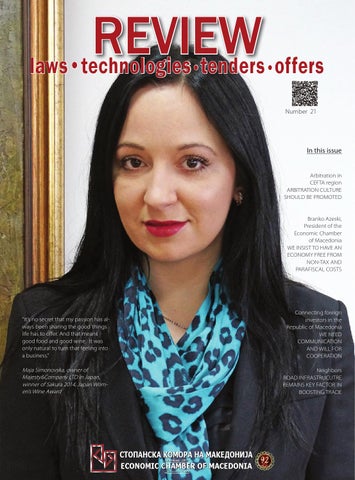
REVIEW laws•technologies tenders offers •
•
Number 21
In this issue Arbitration in CEFTA region ARBITRATION CULTURE SHOULD BE PROMOTED Branko Azeski, President of the Economic Chamber of Macedonia WE INSIST TO HAVE AN ECONOMY FREE FROM NON-TAX AND PARAFISCAL COSTS
Connecting foreign investors in the Republic of Macedonia WE NEED COMMUNICATION AND WILL FOR COOPERATION
“It’s no secret that my passion has always been sharing the good things life has to offer. And that means good food and good wine. It was only natural to turn that feeling into a business.”
Maja Simonovska, owner of Majesty&Company LTD in Japan, winner of Sakura 2014, Japan Women’s Wine Award
Neighbors ROAD INFRASTRUCUTRE REMAINS KEY FACTOR IN BOOSTING TRADE
bsi.
ISO 9001
Quality Management
СТОПАНСКА КОМОРА НА МАКЕДОНИЈА Osnovana 1922 ECONOMIC CHAMBER OF MACEDONIA Founded 1922 FS 549642
СТОПАНСКА КОМОРА НА МАКЕДОНИЈА ECONOMIC CHAMBER OF MACEDONIA
goodini
192
2 - 2014
СТОПАНСКА КОМОРА НА МАКЕДОНИЈА ECONOMIC CHAMBER OF MACEDONIA
PATRON MEMBERS OF ECONOMIC CHAMBER OF MACEDONIA
BRILLIANT Patron Member
PREMIUM Patron Member INDUSTRIES
STANDARD Patron Member
SILVER Patron Member
Available ever y where ...
Visit us on: www.mchamber.mk Expecting You! http://www.facebook.com/chamber.mk http://www.twitter.com/Chamber_MK http://www.youtube.com/user/MKChamber
СТОПАНСКА КОМОРА НА МАКЕДОНИЈА ECONOMIC CHAMBER OF MACEDONIA
Juan Pedro Jimenez Navarro, President of the Foreign Investors Council and Chief Executive Officer of ArcelorMittal-Skopje MACEDONIA SHOWS POTENTIAL FOR INNOVATIVE TECHNOLOGY
42. Standards: ISO 50001 OVERCOME THE ENERGY CHALLENGE!
Publisher: Economic Chamber of Macedonia Dimitrie Cupovski 13 1000 Skopje Editor in Chief: Savo Pejcinovski Translator: Elena Volkanovska Graphic design and editing: Stevo Serafimov Director of International cooperation, Promoting and Informing of Members Directorate: Sofce Jovanovska E-mail: ic@mchamber.mk Web: www.mchamber.mk
36. Sasa Mine in Makedonska Kamenica and Bucim Mine in Radovis
CONTENT
14.
MINES ARE DOING AN EXCELLENT JOB EVEN IN TIMES OF CRISIS
39.
Vinica-based company Makprogres launches a new line of products under ‘NATURA’ THREE MILLION EURO INVESTED IN PRODUCING HEALTHY FOOD!
REVIEW laws•technologies•tenders•offers СТОПАНСКА КОМОРА НА МАКЕДОНИЈА Osnovana 1922 ECONOMIC CHAMBER OF MACEDONIA
goodini
192
2 - 2014
Founded 1922
Print: „NAPREDOK“ DOOEL Tetovo ISSN 1857- 792X Holder of substantive rights is the publisher. Prohibited reprint, copying and reproduction of articles or parts thereof without the prior consent of the publisher.
REVIEW
laws•technologies•tenders•offers
3
CONFERENCES
СТОПАНСКА КОМОРА НА МАКЕДОНИЈА ECONOMIC CHAMBER OF MACEDONIA
FORUM
“Arbitration in CEFTA region for promoting economic development”
BENEFITS TO DISPUTE RESOLUTION OBVIOUS: ARBITRATION CULTURE SHOULD BE PROMOTED
The Permanent Court of Arbitration attached to the Economic Chamber of Macedonia, financially supported by the Federal Ministry of Economic Cooperation and Development of Germany, organized an international conference “Arbitration in CEFTA region for promoting economic development” on 18 February 2014. The conference took place in Aleksandar Palace Hotel in Skopje. Over 200 lawyers, economists, representatives of the business sector, judges and foreign and domestic experts in arbitration law attended the
4
REVIEW
laws•technologies•tenders•offers
conference. Bearing in mind that CEFTA promotes the creation of a new free trade zone, the functioning of the arbitration is of extreme importance for quick, efficient, simple and cost-effective resolution of trade disputes among companies from CEFTA member states. “In 2011, the Permanent Court of Arbitration attached to the Economic Chamber of Macedonia went through certain organizational and normative changes, which were followed by intensive
activities aimed at increasing the visibility of its work. A new set of normative acts was adopted, intended to strengthen arbitration and help it gain greater autonomy. The number of cases brought before the Permanent Court of Arbitration attached to the Economic Chamber of Macedonia is on the constant rise; moreover, procedures are conducted in a swift and efficient manner, and the rate of voluntary execution of adopted awards is quite high, which does serve as a proof of the quality of the procedures, the
CONFERENCES
СТОПАНСКА КОМОРА НА МАКЕДОНИЈА
FORUM
ECONOMIC CHAMBER OF MACEDONIA
expertise and unbiased approach of arbiters, and the convenience of having disputes resolved via arbitration,” underscored Mr. Arsen Janevski, Ph.D., President of the Permanent Court of Arbitration attached to the Economic Chamber of Macedonia. The Permanent Court of Arbitration attached to the Economic Chamber of Macedonia is competent to resolve disputes only if the parties have previously agreed on its competence by inserting an arbitration clause in their main contract, by concluding a separate submission agreement, and even by increased frequency of exchange of statements of claim and defense in which the existence of an agreement is alleged by one party and not denied by the other. Disputes whose value does not exceed 30,000 euro shall be resolved by a sole arbitrator, while disputes whose value exceeds 30,000 euro shall be resolved by an Arbitration panel, unless the parties explicitly
agree otherwise within 15 days of the delivery of the statement of claim to the defendant. “All awards delivered by the Permanent Court of Arbitration in the Republic of Macedonia have been executed so far. Last year we had 5 or 6 cases, and we even managed to settle a trade dispute of 9 million euro in less than a year. This efficiency equals time-saving and cost-effective treatment of disputes, especially if we bear in mind that in a traditional court such a dispute would take 5 to 6 years, and, what is even more important - arbitration costs are considerably lower,” underscored Professor Janevski. Dr. Mihajlo Dika, President of the Permanent Court of Arbitration attached to the Croatian Chamber of Economy, said arbitration had to be promoted in this region as its degree of use was still quite low. “More specifically, this is organizing a private trial where parties choose by themselves the per-
son that will be in charge of the dispute. On average we have 30 to 110 disputes per year, with a median dispute value of 40 to 130 million euro. For the sake of comparison, let me tell you that disputes amounting to 10 billion euro have hit a stalemate in Croatian courts. This situation would be completely different if parties used arbitration,” pointed out Dr. Mihajlo Dika, one of the most eminent arbitration experts. “Arbitration in this region will become competitive to courts only if we manage to enhance cooperation and place the emphasis on knowledge,” he added. The Croatian guest said arbitrability should be increased where possible - for example, in property ownership issues, labor, and consumer disputes. He pointed out the example of the Croatian government, which recommended all institutions connected to the state use the services of the Arbitration or of the Mediation Centre
REVIEW
laws•technologies•tenders•offers
5
CONFERENCES
СТОПАНСКА КОМОРА НА МАКЕДОНИЈА
FORUM
ECONOMIC CHAMBER OF MACEDONIA
attached to the Croatian Chamber of Economy. “It would be an excellent move to create the possibility for fast dispute resolution - fast arbitration for disputes of low value,” said Dika. Ahmet Kasumi, M.A., President of the Permanent Tribunal of Arbitration attached to Kosovo Chamber of Commerce, believes media coverage of arbitration activities in the region was low, a matter that had to be improved in the coming period. “This has direct impact on inflow of foreign direct investments.
Not a single foreign company would decide to invest if it is not convinced of the existence of a fully-functional arbitration. In other words, they prefer discretion in dispute resolution,” said Kasumi. According to the Montenegrin representatives, as much as 90% of the disputes the Montenegrin Arbitration worked on had a foreign element. This means that one in ten cases involved domestic legal entities. Vesko Bozovic, President of the Foreign Trade Arbitration and the Permanent Arbitration Court within the Chamber of Economy of Montenegro said ef-
forts should be put in new regulations to harmonize arbitration with international experiences, coupled with dedication to constant education, promotion and extensive marketing. This could be one way of increasing the number of entities who use arbitration services. Dr. Ales Galic, Memeber of the Presidency of the Permanent Arbitration Court at the Chamber of Commerce and Industry of Slovenia mentioned some of the new global trends in arbitration: further strengthening of arbitration institutions’ activities, increased efficiency, emphasis on difficult cases etc. “It is important to refrain from copying binding rules. Putting too much emphasis on details could easily approximate arbitration to traditional courts,” said Dr. Ales Galic. Savo Pejcinovski
6
REVIEW
laws•technologies•tenders•offers
INTERVIEW
СТОПАНСКА КОМОРА НА МАКЕДОНИЈА ECONOMIC CHAMBER OF MACEDONIA
Branko Azeski, President of the Economic Chamber of Macedonia
WE INSIST TO HAVE AN ECONOMY FREE FROM NON-TAX AND PARAFISCAL COSTS * The construction industry saved the economy in 2013. What will be this year’s engine for economic growth? Over the past two to three years, the construction industry’s share in the GDP went up from 5.6% in 2010 to 6.5% in 2011 and 6.8% in 2012. According to some estimations, in 2013 the construction industry’s share reached 7.0%. This tendency will most likely continue throughout 2014. Moreover, we believe foreign direct investments give a very strong impulse for increasing economic activities, as we have witnessed important shifts in our economy’s production and export offer. Macedonia’s economic growth model should be focused on export, which has been one of the Economic Chamber of Macedonia’s top priorities since 2010. More specifically, our focus is on expanding and diversifying the export base, which is necessary for realizing the desired investments; this, in turn, will lead to sustainable economic growth by gradual reduction of the discrepancy between production and consumption, export and import, employed and financially dependent population, and mostly by gradually freeing up more room in the economy for the private rather than the public sector. Resuscitating industrial production is the economic platform’s core and economic goals must be set regionally.
* Is there optimism after the first one and a half month of the new year? What are the expectations? In line with our members’ projections, we expect the positive trends to continue in 2014. This optimism is founded on several key factors: First of all, we expect foreign demand to pick up gradually. According to the International Monetary Fund’s October 2013 projections, we expect 2014 to see a 3.6% global growth in economic activities The EU is expected to see 1.3% growth, and the Eurozone 1.0%. Regarding the countries that are our main trading partners, the projected economic growth is: Germany 1.4%, Greece 0.6%, Serbia 2.0%, Italy 0.7%, Bulgaria 1.6%, Turkey 3.5% and Croatia 1.5%. It is also extremely important that the state investment stimulus, which amounts to 22.4 billion denar in the
2014 budget, is by 20% higher than in 2013. This growth, mostly aimed at infrastructure development, is in fact a positive response to our 2010 request to have more capital investments allocated to modernizing the country’s infrastructure. We believe the projected economic growth of 3.2% is realistic, as are the projections for industrial growth ranging between 3.8 and 5%, construction growth of 7%, agriculture of 3% and the service sector’s expected average growth of 3.4% in 2014. The export of goods and services is expected to rise by 6.5%. We believe all this will result in an increased employment rate, which we expect to stand at 42.8%, and to have the unemployment rate go down to 26.5%. We also hope the inflation remains at a low level of 3.3%.
REVIEW
laws•technologies•tenders•offers
7
INTERVIEW
СТОПАНСКА КОМОРА НА МАКЕДОНИЈА ECONOMIC CHAMBER OF MACEDONIA
* We will soon enter the preelection period. Are you going to use this period to address some of the requests voiced by businesspeople? We do not expect the pre-election activities for the presidential elections to influence negatively the intensity of our requests’ realization, as we expect the government to function as usual. The Chamber is going to use this period to establish even more intensive contacts with our members in order to learn more about current problems that businesses face. More attention will be paid to analyses and preparation of specific suggestions regarding system regulations. In fact, elections will not influence our work. One issue for us is the long pre-election campaigning where everything is discussed except the economy. And, of course, we want a system in which the government will be able to function properly right after the elections.
vest in industrial zones in units of the local self-government. We have been informed that there are such zones in many local self-government units. We need the local self-government to show readiness and provide incentives within its scope of operations for such investments to ensue. My view is that there is a general social consensus on this matter and I am convinced that we will see tangible solutions in the first half of 2014.
to sectorial laws, bylaws, local decisions, decisions made by management boards of agencies or boards of public enterprises to introduce a number of fees, and this is difficult to control.
* Businesspeople are satisfied with low taxes, but react against the number of hidden costs that pose a significant burden. Has the analysis on parafiscal fees been completed?
The initial analysis of the collected data led us to the following conclusions regarding the non-tax and parafiscal fees paid by companies i.e. the most frequent fees: environmental protection fee – industrial non-hazardous waste management, water use fee, street lighting utility fee, broadcasting fee, utility fee for placing a company/business entity sign, a range of utility, judicial and administrative fees etc.
In order to adopt a more comprehensive approach in analyzing financial burdens business entities face in Macedonia related to the so-
After we finalize the analyses, which are currently performed, the Chamber’s set of proposed measures will be intended to reduce or to ban such
called non-tax and parafiscal fees, the Economic Chamber of Macedonia conducted a poll among a number of companies from different sectors and municipalities in the beginning of 2014. The reason for this poll was the setup of the Macedonian tax system, which gives unlimited room
fees in cases where the Chamber believes the fees are not justified or are too high, which should improve the doing business conditions. Our main objective is to help establish an adequate register of non-tax and parafiscal fees.
* One of the main priorities of the Chamber this year is to achieve equal treatment of both domestic and foreign investors when they invest in free economic zones. How is this going, bearing in mind that the government has announced that it is to provide specific solutions for this matter? It is correct that we do have specific proposals for equal treatment of domestic and foreign investors in the country. The government has been informed about our proposals. Investments in the free economic zones is of special interest to the state and in the light of this the possible inclusion of domestic investors should be encouraged and developed. However, it is also extremely important to start preparing other systemic measures for domestic investors as an incentive for them to in-
8
REVIEW
laws•technologies•tenders•offers
INTERVIEW * The Law on Financial Discipline will be applied as of June. How, in your opinion, will this reflect on the economy? Are businesses prepared? The Chamber has been promoting the need for improving the regulations on strengthening financial discipline for several years now. The government has accepted our requests and incorporated some of them into the Law on Financial Discipline. Over the past period the Chamber has held several meetings with its member companies in order to explain the concept of the legal solution on improving the financial discipline. This is why I believe our members are prepared to implement this legal solution. During the implementation stage, we do expect constructive cooperation with the Ministry of Finance and the Public Revenue Office. * A number of investments in infrastructure have been announced for 2014. To what degree are these going to activate Macedonian companies, bearing in mind that they will only function as indirect participants? Do you think the announced investments will be realized if we take into account the upcoming elections? The need for investments in infrastructure is an issue the Economic Chamber of Macedonia has been prioritizing for a long time. We strongly support and salute each planned investment in infrastructure, as all global researches result in one big conclusion: hard infrastructure (roads, railroads, ports, airplanes, energy) has the biggest influence on trade development. This means that trade growth, exports, and attracting investments depend directly on the degree of infrastructural development. The government has announced the realization of three major infrastruc-
СТОПАНСКА КОМОРА НА МАКЕДОНИЈА ECONOMIC CHAMBER OF MACEDONIA
ture projects in the country i.e. the construction of motorways between Demir Kapija and Smokvica, Miladinovci - Sveti Nikole – Stip, and Kicevo – Ohrid, a total of 132 kilometers. The sooner these motorways are constructed, the faster we will be able to see improvements in the economy and the importance of our central position in the Balkans, as these motorways are part of the Pan-European corridors VIII and X. Hiring Macedonian companies to work on infrastructural projects will most certainly have positive effects, bearing in mind that the construction industry almost always uses domestic
resources i.e. building materials, but also the domestic companies’ staff, mechanization and equipment. In spite of the upcoming elections, the business community’s expectations are that planned infrastructural activities continue with the same dynamics. This is also an obligation towards the creditor and is in line with the EU’s communication strategy. * You were one of the initiators for having this region participate in the privatization of the Thessaloniki port. How is this idea developing?
Ninety-two years with Macedonian businesses
CHAMBER OF THE MOST SUCCESSFUL COMPANIES The Economic Chamber of Macedonia marked its 92nd anniversary. The public likes to call us a ‘Chamber of the big companies.’ That’s correct. We do have the biggest, most successful and most profitable companies with both domestic and foreign capital as our members. Members that are the pride of our export, 70% of which is to the European Union, a market seen as one of the most selective in the world. These are, in fact, companies that function as the pillars of the Macedonian economy. They include all foreign investors in the Republic of Macedonia. My message to our member companies is: Be proud and honored to be members of the oldest and most important business community in the country with the largest body of members! Our strategy stems from establishing partnerships with all significant stakeholders in economic policies, adhering to a high level of professionalism and perseverance in the realization of our requests. At the same time, we want to show our respect to all companies, their managerial teams, and their employees, regardless of their size and membership status. We choose this approach because we believe that all our needs, problems and successes are one and the same thing i.e. are joint and intertwined. We are aware that chamber pluralism in Macedonia has become a reality, which is why we always need to stay focused on upgrading. Chambers are a natural partner of the public sector, and partnership is the only way of achieving one’s fundamental objective. We are aware that dialogue and perseverance are our only tools, which is why we plan to make utmost use of them in the future, to remain as dedicated and as persistent as we have been so far. Of course, all this is in the interest of our member companies and for the purpose of reaching social consensus on issues fundamental for our future!
Branko Azeski President of the Economic Chamber of Macedonia
REVIEW
laws•technologies•tenders•offers
9
INTERVIEW
СТОПАНСКА КОМОРА НА МАКЕДОНИЈА ECONOMIC CHAMBER OF MACEDONIA
2014 in London, organized by the European Bank for Reconstruction and Development, is an excellent opportunity to make a change in existing policies. * The oldest and most numerous business association in the country has been announcing for some time that it plans to introduce lobbying as one form of action. How is the process of creating lobby groups going?
The privatization of the Thessaloniki port is a “test” and the first attempt of businesses from Macedonia and other states in the area act at a regional level. When the Economic Chamber of Macedonia presented this initiative, it was met with a degree of disbelief and surprise. However, that did not discourage us because the initiative is supported with figures. As much as 43.80% of the conventional transport and 11.38 of container transport in the region participates in the total transport operations in the Port. Figures tell us that 1,528,305 tons of conventional transport and 25,008 container units have passed the region in 10 months in 2013. Aren’t these figures sufficiently convincing for some sort of participation in the management of this regional transport center? We will continue to stimulate and inform our companies and companies from the region that gravitate around the port for the whole process. Currently 25% of its shares are offered on the Athens Stock Exchange. We expect the two new packages of 23.1% and 23.3% to be issued in the second half of this year.
10
REVIEW
laws•technologies•tenders•offers
* What conclusions can we draw from the current developments in Bosnia and Herzegovina? The Balkans’ slow transition is causing a severe economic stalemate. The deindustrialization, high unemployment rates, public debt, and the grey economy are some of the underlying causes of instability in the region. The foreign exchange inflow in Balkan countries on the basis of foreign direct investments remains less than the profits companies outflow to their mother companies in other countries. In some countries, like Bosnia and Herzegovina, the public administration’s salaries take up as much as 15% of the GDP. Over the past period the Balkan countries did not manage to create a joint competitive product, to find new markets and thus increase the living standard of its citizens. It is important to underscore that regional approach is the basic condition for our EU integration . We failed on the first obstacle – we did not dare overcome it for fear of possible consequences. The Balkan countries prime ministers’ meeting on 24 February
Keeping away from politics is essential for us so that we are able to perform our chamber activities in the most efficient manner. But what happens with “lobbying” as a powerful tool? Our society still sees “lobbying” as something forbidden, corrupt, as a crime. We want to put an end to this interpretation. A number of MPs sitting in the Parliament, which adopts laws that concern us, were, are or will be businesspeople, although in the Parliament they stand for different political parties. Why shouldn’t they function as a lobby group for businesses in the Republic of Macedonia? Our interests are the same – making higher profits. Take for example our business partners in the world. Is there a bigger lobbyist than the one who has had successful business cooperation with our companies? We should not forget the media, which is our biggest lobby group! I am yet to hear of an editorial staff that did not support a successful company or a successful business idea. It is high time to introduce some sort of system and put this in the function of developing our economy. Soon, the Economic Chamber of Macedonia will present these ideas publicly. (S.P.)
BUSINESS MEETINGS
СТОПАНСКА КОМОРА НА МАКЕДОНИЈА ECONOMIC CHAMBER OF MACEDONIA
WE NEED COMMUNICATION AND WILL FOR COOPERATION
Aleksandar Palace Hotel in Skopje hosted a business meeting titled “Establishing business links between foreign investors in the Republic of Macedonia and domestic companies that have the potential to become their suppliers” initiated by the government of RM and the three chambers of commerce. The meeting took place on 17 February 2014. The government’s team, headed by PM Nikola Gruevski, who was accompanied by Vice PM and Finance Minister Zoran Stavreski, Vice PM in charge of economic affairs Vladimir Pesevski and Minister of Economy Valon Saracin, addressed the hall packed with representatives of foreign investors and domestic companies in-
terested in cooperation. - Due to our policies aimed at intensive improvements of the business conditions, the number of foreign direct investments and companies has started to grow. However, the level of cooperation between foreign investors and domestic companies is not satisfactory and there is obviously room for improvement. In order to make this come true, we need good communication and will for cooperation. The key benefit from such cooperation would be both mutual and farfetching: it would lead to lower production, transportation and import costs, it would save time, introduce exchange of technologies, knowledge and skills,
OPPORTUNITIES
The first step for connecting foreign investors in the Republic of Macedonia with domestic companies which have potential to become the foreign investors’ suppliers has been made
it would boost competitiveness, conquer new markets, result in reinvestments etc.” said PM Nikola Gruevski before the business community. “This is why Macedonian companies should put all their efforts into intensifying their cooperation with foreign companies working in the country,” added the PM. The government representatives pointed out a myriad of reasons why foreign investors and domestic companies should establish closer relations and business partnerships. - The first step is establishing communication, learning about the needs and the requests of foreign companies and presenting the opportunities do-
REVIEW
laws•technologies•tenders•offers
11
BUSINESS MEETINGS
СТОПАНСКА КОМОРА НА МАКЕДОНИЈА
OPPORTUNITIES
ECONOMIC CHAMBER OF MACEDONIA
12
mestic suppliers offer. Macedonia will be a host and supporter of such a process. We remain dedicated to our commitment for remaining open before the business community. Our mission remains the same - turning doing business in Macedonia into an easy, fast-growing and profitable process. In such circumstances, each company that works and thrives in Macedonia will experience progress and development,” highlighted the Prime Minister, adding that a foreign consulting company was hired to help with the achievement of this goal. Finance Minister Zoran Stavreski said the purpose of attracting foreign direct investments was connected to achieving certain macroeconomic results, which in time could be transferred on a micro-plan. Foreign and domestic companies should be complementary for each other rather than competitive. - We’ve seen some positive developments in that direction. Belgian company Van
REVIEW
laws•technologies•tenders•offers
Hool uses parts and materials produced in Macedonia for the interior of the buses it produces. “This is an example other foreign investors should follow. Last year Macedonian companies provided a total of 50-million-euro worth of services to foreign investors, which is a significant and encouraging figure,” he stated. Banks and financial institutions should be included in this communication as they would make money placements safer. The meaning of this synergy is also reflected in the projection according to which by
2015 the number of workers in foreign companies in free trade zones should increase from the present 6,500 to approximately 13,000. Vladimir Pesevski, M.Econ, pointed out that the cooperation between domestic companies and foreign investments could be seen as export replacement. ”This is why domestic companies should adopt a more assertive approach before foreign companies working in Macedonia. Together they can generate technological development and introduce
СТОПАНСКА КОМОРА НА МАКЕДОНИЈА ECONOMIC CHAMBER OF MACEDONIA
OPPORTUNITIES
BUSINESS MEETINGS
modern managerial skills. Once you become a supplier to a foreign company, your way to foreign markets is paved. - It is natural to allow this process to develop in the next 20 years, but it is a road we must take, and it begins with establishing cooperation with a foreign company,” Pesevski highlighted. Economy Minister Saracini pointed out that economic growth does not mean a lot if common people do not feel its benefits, which is the main goal of the government. Current Minister without portfolio for attracting foreign investments Vele Samak and head of Directorate for Technological and Industrial Development Zones Viktor Mizo presented the needs of some of the foreign companies working in Macedonia. After the end of the official part of the meeting, representatives of foreign and domestic companies held bilateral meetings where they discussed possibilities for future business cooperation. Savo Pejcinovski
REVIEW
laws•technologies•tenders•offers
13
INTERVIEW
СТОПАНСКА КОМОРА НА МАКЕДОНИЈА ECONOMIC CHAMBER OF MACEDONIA
Juan Pedro Jimenez Navarro, President of the Foreign Investors Council and Chief Executive Officer of ArcelorMittal-Skopje
Exporto, ergo sum!
MACEDONIA SHOWS POTENTIAL FOR INNOVATIVE TECHNOLOGY * You were recently elected for a new President of the Foreign Investors Council within the Economic Chamber of Macedonia. You are assuming the position that was previously held by the former CEO of Makedonski Telekom, Mr. Daniel Sas. What are your priorities for the coming period? First of all, I would like to thank Mr. Sas for his efforts and the successes during his presidency. Regarding the priorities for the upcoming period, I would like to underscore the completion of the White Paper, that will be available to all stakeholders. We also plan to continue to hold regular meetings with members of the Foreign Investors Council in towns across Macedonia in order to learn more about the perspectives of different sectors of the Macedonian economy we represent. * As a multinational company, how did you adjust to and how are you overcoming the difficulties posed by the economic crisis in the U.S.A. and Europe? Did the markets of emerging economies in the Far East help you mitigate the impact of the crisis? The metallurgical industry is facing one of the biggest crisis in history. This crisis, in fact, is the reason why the industry must adjust to globalization and the new market demands. Therefore, all stakeholders in the industry are working on restructuring. During this restruc-
14
REVIEW
laws•technologies•tenders•offers
Foreign Investors Council within the Economic Chamber of Macedonia
STRONG PARTNER TO MACEDONIA’S ECONOMY
The Foreign Investors Council was established on 27 February 2006 with a Decision on Establishing a Foreign Investors Council adopted by the President of the Economic Chamber of Macedonia. The Foreign Investors Council was formed for the purpose of providing consulting services and advice, as well as suggestions aimed at assisting the Economic Chamber of Macedonia and its bodies achieve their goals and perform their tasks. It also treats the most important economic issues, especially on matters related to stimulating investments in the Macedonian economy. The Foreign Investors Council’s mission is to represent interests of present and future foreign investors by improving the communication with relevant state institutions, promoting good business ethics
INTERVIEW
СТОПАНСКА КОМОРА НА МАКЕДОНИЈА
and making a positive contribution to the development of Macedonia’s legislation. The Foreign Investors Council’s goals are focused on: • promoting the investment and business climate in Macedonia by establishing public-private dialogue; • using experience from the foreign companies’ countries of origin in order to help overcome business barriers; • sharing knowledge among the Council’s member companies and promoting good business principles; • cooperation with other foreign investors councils in the region. These objectives shall be accomplished via the Council’s activities, which revolve around the work of five working groups, namely: • Human resources; • Property matters; • Legal and administrative matters; • Tax policies and financial issues; • General problems foreign investors face in the country. The Council as a whole and its members, distinguished foreign businesspeople and experts working in Macedonian trade companies, by using experiences gained from working in the economies of their countries of origin and knowledge about the chambers’ work in these countries i.e. chambers’ position, role and relations to state bodies on matters of interest to the economy, is dedicated to providing suggestions and initiatives to competent bodies, forms of organization and Chamber departments, as solutions deemed to generate the most adequate results for stimulating foreign investments and for the work and development of the Macedonian economy. The Council has 93 member companies with foreign capital in the Republic of Macedonia. Most of the Council’s member companies work in the banking, insurance, construction, metalworking and textile sectors. The countries with foreign capital come from the following countries: Greece (15), Turkey (10), Austria (9), Slovenia (9), Germany (9), United Kingdom (7) and 1 to 3 from Croatia, the United States of America, Sweden, Russia, Switzerland, Hungary, France, Italy, Bulgaria, and Serbia. The Council has an internet portal, whose aim is to boost the visibility of the Council’s work and provide detailed information on the day-to-day activities of the Council. The Council’s work is based on the Principles and Modes of Operation of the Foreign Investors Council. In the context of this Act, the Council’s work is organized and coordinated by a president and two vice-presidents. At the last session, held 19 November 2013, the Council elected Mr. Juan Pedro Jimenez Navarro, CEO of ArcelorMittal AD Skopje, as its President. Vice-Presidents Mr. Werner Hengst, President of EVN Makedonija Managing Board, and Mr. Jatin Thakrar, General Manager of Johnson Matthey Catalysts, remained on their posts. For the purpose of effective and efficient operation, the Council established a flexible organization structure and elected 11 members in its Managing Board, a body whose goal is to determine the Council’s strategic decisions. Snezana Kamilovska, LL.M.
turing process, policies adopted by persons in charge i.e. by decisionmakers can determine to a large extent who stays on the market, and who does not. Therefore, we need decisions that would help us avoid additional pressure in this critical period. * In what way are the big manufacturers of metals going to take their position on international markets in conditions of liberalized trade? To what degree is the crisis forcing you to be rational when it comes to production capacities and workforce? Did you have to lay off workers, and if yes, what kind of social package were they offered?
VIEWS
ECONOMIC CHAMBER OF MACEDONIA
Steel supply in Europe had to be adjusted to the market reality and the crisis of the past several years. Bearing in mind that demand dropped by 25% in the past few years, it is natural to expect steel manufacturers to protect domestic i.e. key markets, but at the same time accept the challenge to explore new markets where they have comparative advantage. Overcapacity will remain a problem due to the slow market recovery. At the moment, the capacity use in Europe is 80%, which is why all stakeholders must adjust their supply to the demand. To this we should add that we are constantly optimizing our workforce in line with the levels of all capacities of ArcelorMittal Group and in this context started a program for voluntary termination of employments with adequate severance package, to which about 100 employees applied. *Do the Government’s economic policies and measures create conditions for developing vital competitiveness on foreign markets? What are the advantages, as well as the disadvantages that need to be removed in order to attract new foreign investors and
REVIEW
laws•technologies•tenders•offers
15
INTERVIEW
СТОПАНСКА КОМОРА НА МАКЕДОНИЈА
VIEWS
ECONOMIC CHAMBER OF MACEDONIA
investments in Macedonia? What is your take on analyses claiming that metal and steel industry do not create sufficient accumulation and added value, which in turn lead to creating new workplaces? Economic policies and measures implemented by the government create sustainable competitiveness for attracting foreign investors, but there is still room for improvement and things to be done. Our Council’s priority is to work together with the government, to boost competitiveness and to improve the process in areas that need improvement. I do not agree that accumulation and added value are the only drives for creating new workplaces. Increased profit volume and new production lines play a bigger role in creating workplaces. The main issues on which we should work together with the administration are in the following areas: * * * *
16
human resources; property matters; tax structure and financial issues; administrative and legal matters.
REVIEW
laws•technologies•tenders•offers
We have already discussed these issues in the Council and at this stage our conclusions should be discussed with the government. * What type of measures are needed to develop the industry? Is its share in the overcoming of the economic recession underestimated? How much did ArcelorMittal invest in modernization of its capacities in Skopje and meeting the European environmental standards? This country’s geographic location is an advantage when it comes to covering Balkan countries’ markets. Moreover, the easy access to Thessaloniki Port is our door to the global market. On the other hand, transportation costs are high
and challenge our expansion on some Balkan markets. Moreover, a substantial percentage of manufacturing companies’ restructuring costs are related to energy prices. Each change in energy prices has direct impact on our competitiveness. In that context, stable energy prices should be a key result of the cooperation between the government and the private companies in order to guarantee the economy’s competitiveness. Although the past few months did see some improvements in the price of gas, it still remains higher in comparison with gas prices in neighboring countries, where our competition works. A large percentage of our production - more specifically, 87%, is intended for export, which is why
INTERVIEW
* Does Macedonia have adequate workforce for innovative technology and production and successful management? What can you tell us from your experience in ‘mixing’ domestic human resources with managers from abroad, who you appointed to the Board of the company in Macedonia?
ECONOMIC CHAMBER OF MACEDONIA
them are experts from the country, two of whom are women. Economic policies and measures implemented by the government create sustainable competitiveness for attracting foreign investors, but there is still room for improvement and things to be done. Our Council’s priority is to work together with the government, to boost competitiveness and to improve the process in areas that need improvement. I do not agree that accumulation and added value are the only drives for creating new workplaces. Increased profit volume and new production lines play a bigger role in creating workplaces.
*The entry of another Indian multinational company was announced in Macedonia. Are Southeast Europe and the Balkans sufficiently attractive markets for the BRICS countries? According to me, all macroeconomic indicators for Macedonia show that the adopted decisions were in the right direction. I agree that the markets of Southeast Europe and the Balkans are attractive. This is due to the expected market growth and development. This is the only way: markets should be developed and follow Western Europe in all areas, steel industry included. ArcelorMittal’s presence in the region is an intention and an expectation for joint growth.
VIEWS
it is necessary to guarantee a high level of service, for which good cooperation with the Macedonian administration is needed. We are working on improving the system every day. For example, we recently implemented inward processing, for which we were assisted by and cooperated with the Customs Administration of Macedonia, which indeed improved our competitiveness. Our investments in 2014 will be focused on three areas: safety, environmental protection and promoting customer relations. We plan to achieve this by introducing adequate transportation routes, constructing a water treatment station and renewing the electrical equipment in our rolling mill. We are constantly investing in the modernization of our plant and working in line with Macedonian and European standards.
СТОПАНСКА КОМОРА НА МАКЕДОНИЈА
Gorazd Comovski
Macedonia has solid potential for innovative technology and good production personnel. One of the challenges regarding the personnel is the lack of experts on the labor market, which is why we have international programs which we use when necessary. Regarding the management’s success, ArcelorMittal -Skopje is focused on localizing management with the assistance of programs for associating and mentorship for international and local experts and promoting equal representation of men and women in the managerial team. Currently, the Managing Board of ArcelorMittalSkopje has six members. Three of
REVIEW
laws•technologies•tenders•offers
17
NEW MARKETS
СТОПАНСКА КОМОРА НА МАКЕДОНИЈА ECONOMIC CHAMBER OF MACEDONIA
VISITS
Macedonia-Iraq Business Forum with companies from Sulaymaniyah, North Iraq
MUTUAL INTEREST FOR BUSINESS COOPERATION
The Economic Chamber of Macedonia and the Sulaimaniyah Chamber of Commerce and Industry, North Iraq organized a Macedonia-Iraq Business Forum and B2B meetings with companies from North Iraq (28 January 2014).
of the Economic Chamber of Macedonia, pointed out that the traditional relations and trading connections with Middle East countries needed to be resumed, as they represented important alternative markets for Macedonian products.
About thirteen companies from Iraq - importers and distributors of different products - took part in the forum. They showed interest in all types of food products and drinks, agricultural products, cosmetics and pharmaceuticals, metal products, building materials, industrial equipment, consumer products, furniture, transportation, tourism etc.
- The economy has undergone changes both in Macedonia and Iraq. We have new economic operators, which means that exchanging information and promotion should be the top priorities for both parties,” underscored Senior Advisor Nuri.
Mrs. Ljubica Nuri, Senior Advisor to the Managing Board
18
REVIEW
laws•technologies•tenders•offers
Juan Pedro Jimenez Navarro, President of the Foreign Investors Council and Chief Executive Officer of ArcelorMittal-Skopje, also addressed the business forum. He
called upon Iraqi companies to see Macedonia as a destination that offers favorable conditions for investments and doing business. - I sincerely recommend you to expand your cooperation with potential Macedonian business partners via the government’s institutions. I am certain this will facilitate activities for starting a business in Macedonia. In simple words, I would encourage you to ‘test’ the institutions in charge of responding to your requests prior to the investment. At the same time I would like to point out that the Economic Chamber of Macedonia is extremely important in making contacts with future and potential business partners,” said Mr. Navarro.
- Sulaimaniyah has very little information about Macedonia, which is why we wanted to come here in person and learn more about your country,” stated Yasin Rahim Faraj, first Vice-President of the Sulaimaniyah Chamber. Kurdistan share in Iraq’s total income is 17%. It has 6.6 million people and is an autonomous, duty-free region rich in oil and mineral resources. -We find the Macedonian market very attractive. We have come here to scan business opportunities as we are interested in investments and trading with several sectors. We have been examining cooperation conditions with all countries in this region. We also think we need certain agreements that would stimulate exchange,” said Yasin Rahim Faraj. As it was said at the forum, besides the visa issue and the lack of diplomatic and consular representatives, we also lack exchange of information between the two countries on potentials to boost business relations and intensify bilateral trade. The Economic Chamber of Macedonia and the Sulaimaniyah Chamber of Commerce and Industry signed a Cooperation Agreement in line with the efforts to strengthen business contacts and intensify mutual relations. Prior to this the Iraq delegation learned about the investment opportunities and the doing business potential, which is a significant part of their business mission on the Balkans. After the end of the forum the delegation had business-to-business meetings with business representatives from Macedonia.
СТОПАНСКА КОМОРА НА МАКЕДОНИЈА ECONOMIC CHAMBER OF MACEDONIA
Businesspeople from Ohrid and Iraq look into possibilities for economic cooperation
INTERESTED TO ESTABLISH PURHCASE AND DISTRIBUTION CENTRES A delegation of the Sulaimaniyah Chamber of Commerce and Industry, North Iraq, visited Ohrid on 31 January 2014. They met with a number of representatives of companies from the Ohrid and Struga regions, which showed interest in cooperation and better relations with companies from Iraq. The meetings took place in the
VISITS
NEW MARKETS
premises of Ohrid Municipality. Representatives of Ohrid Municipalities presented investment opportunities and favorable cooperation conditions. They also shared experiences and information on bettering trading opportunities. After the official part of the meeting ended, the head of the Sector for Tourism and Local Economic Development in Ohrid Municipality, Mr. Gjoko Apostolov, said that the local self-government offered several locations to the Iraqi delegation, where businesspeople from Iraq could build purchase and distribution centers. The locations are near St. Paul the Apostle airport in Ohrid and are connected to national roads. “There is interest, and at the moment we should be focused on issues connected to visas, i.e. providing them with easier access to Macedonia. This delegation visited several ministries and I do believe this problem will be overcome at a higher level. We find it very important that a large number of representatives of the Ohrid business sector attended the meeting, exchanged contacts with Iraqi businesspeople and are expected to start cooperation.”
Boris Trimcev
Vlatko Stojanovski
REVIEW
laws•technologies•tenders•offers
19
NEW MARKETS
СТОПАНСКА КОМОРА НА МАКЕДОНИЈА ECONOMIC CHAMBER OF MACEDONIA
Foreign trade of the Republic of Macedonia with the Republic of Iraq
FILE
RELATIONS REDUCED TO MACEDONIAN EXPORT ONLY The total trade of the Republic of Macedonia with Iraq is almost fully based on Macedonia’s export to Iraq. Trade in Jan-Nov 2013 reached US$ 3.4 million, marking a 15% decline compared with the same period last year. Export reached US$ 3.4 million, marking a 15% drop, and import was only US$ 226. Positive trade balance of US$ 3.4 million has been marked. Volume of bilateral trade January to November 2013 Export
Import
US$
Total
Amount (in kg)
US$
Amount (in kg)
US$
Amount (in kg)
US$
4.010.779,00
3.428.059,00
67
226
4.010.846,00
3.428.285,00
Foreign trade of the Republic of Macedonia with the Republic of Iraq in 2012 The total trade of the Republic of Macedonia and the Republic of Iraq in 2012 reached US$ 4.6 million and was based solely on Macedonia’s exports to Iraq, marking a 43.7% decline compared with the same period last year. Volume of bilateral trade January to December 2012 Export
Import
US$
Total
Amount (in kg)
US$
Amount (in kg)
US$
Amount (in kg)
US$
10.242.769,00
4.465.874,00
0
0
10.242.769,00
4.465.874,00
The 2012 export structure is as follows: - Agricultural products and food products (US$ 3.4 million / US$ 2.4 million from fresh apples export); - Cigarettes - US$ 590,000 - Printing machines - US$ 305,000
The decline in export in 2012 is due to the lower export of fresh apples, which in 2011 stood at US$ 6.3 million.
20
REVIEW
laws•technologies•tenders•offers
MY POINT OF VIEW
СТОПАНСКА КОМОРА НА МАКЕДОНИЈА ECONOMIC CHAMBER OF MACEDONIA
FIRST COME—FIRST SERVED!
By Ljubica Nuri Whenever we hear the word ‘Kurd’, we tend to associate it with terrorism. Many people who hear the word Kurdistan are confused and wonder: What is that? Where is it? Our contact person – a former Macedonian student who used to work in Treska company and a Macedonian son-in-law, born in Sulaymaniyah, the second largest city in Kurdistan, North Iraq (1.7 million people) helped us establish communication with the Sulaymaniyah Chamber of Commerce and Industry and to start negotiating a visit of their delegation to the Economic Chamber of Macedonia. An agreement between the business associations was reached swiftly and meetings with our companies were organized subsequently. The recently established business contacts, which have the potential to become quite successful, echoed with uncertainty: “Where did this Kurdistan idea come from? Is it really safe there?!” Kurdistan – or (for now) officially North Iraq, Kurdistan Region the status it received after the changes in Iraq - is fully autonomous, has its own government and parliament, open economy unencumbered with customs duties, population of 6.6 million and territory approximately the same as that of Switzerland or
the Netherlands. According to a 2006 research, the 2016 oil exploitation is expected to reach over 1 billion barrels of crude oil in the region, accounting for higher exploitation than the current oil exploitation in Azerbaijan and Ecuador! The exploitation should earn the region over USD 35 billion per year - if current oil prices are used in the calculations and has the prospect to make the region part of the Nabucco pipeline. Kurdistan’s current budget is USD 12 billion. This shows that oil and gas are Kurdistan’s impetus and the drive of its economic development in the future. However, we cannot say that industry and agriculture in this region are fully developed. The industry’s share in the national GDP is 22%, which is mostly the doing of the oil industry. Import accounts for 85% of Kurdistan’s total international trade. For example, the total trade exchange between Turkey and Iraq was USD 13.2 billion in 2012. Iraq’s export to the USA accounted for USD 8.9 billion, 70% of which came from Kurdistan. A total of 1,300 Turkish companies are currently working
in that region. It does sound rather peculiar that Kurds living in North Iraq are not consuming their own fruits and vegetables and import such products from Iran and Turkey. The matter of fact is that the region’s production is far from sufficient to meet the growing demand from the population, whose GDP per capita of USD 5,000 is constantly improving. At the moment, 11,300 Kurds in the region are ‘estimated’ at over USD 5 million. The strategy of the Kurdistan Region government is to provide strategic support to the development of agriculture, light industry and tourism, besides the oil industry, and put more efforts into attracting foreign investments. The forecasts of economic experts are that the Iraqi market will be the fastest growing market in the region in the coming 6 years, whereas Kurdistan can be seen as the gateway to the whole territory of Iraq! The Persian Gulf countries have already seen this, naming the region “Iraq’s Dubai.” The international interest in Kurdistan is best seen in the fact that 58 countries have opened offices with diplomatic and consular missions
REVIEW
laws•technologies•tenders•offers
COLUMN
Why Kurdistan?
21
MY POINT OF VIEW
СТОПАНСКА КОМОРА НА МАКЕДОНИЈА
COLUMN
ECONOMIC CHAMBER OF MACEDONIA
22
and trade offices in Erbil, the capital of Kurdistan Region. This brings us back to the questions: Why Kurdistan? What have we learned from the seven-day stay of the business delegation comprised of members of the Sulaymaniyah Chamber’s highest body and led by the First Vice President Yassin Rahim Faraj? The Sulaymaniyah Chamber of Commerce and Industry has got close connections with the Region’s ministry of economy and has a wide range of public authorizations, including registration of companies, issuing land permits, approving foreign investments etc. Their mission to Macedonia was one of buyers and explorers. They showed great interest in meeting producers in the field of agriculture and industry in order to learn about our technologies’ and capacities’ level of development, as well as our business logic and climate. After everything they heard, they saw in us future partners - a people and country that can be trusted with long-term cooperation, but also of similar mindset. Around 30 Macedonian companies, half of which openly invited the delegation to pay them a visit, contributed to this positive conclusion. It is also interesting that four companies have already signed pre-contracts, one of which is on export of apples. At the same time, more companies expect to see
REVIEW
laws•technologies•tenders•offers
the potential deals finalized in the next few weeks. At the moment, the major interest is focused on wine, cheese, vegetables, fruits, food products and electrical industry products. The guests confirmed their intention to have their Chamber’s managing board suggest their Ministry of Economy to put the emphasis on importing agricultural products from Macedonia rather than from Iran. The first step has been made – the two chambers will support the companies and expect to see increased interest. Education, tourism and health care services were not discussed, but these areas will be topics at future meetings between potential partners. What can we conclude from this meeting? Undoubtedly, information and openness remain important drivers of development. Having the capacity for business risk could work wonders – and vice versa. No communication and trust lead to nothing. The so-called ‘third markets’ can still remember companies from our region, both from the industry of that time – different than today’s – as well as people with whom they did business at the time. Many have graduated from our universities, have worked in this country and have started their own families. For example, the minister of spatial planning of Iraq is a former student of Macedonia’s education system. This is a
very important comparative advantage for us. Moreover, people from these countries are not eager to trust western and far-eastern partnerships due to the political developments of the past few years. Companies from this country should make use of this ‘capital.’ If we fail to turn this memory into action and transfer it to younger generations, the future will force us to pave new roads in order to regain trust. However, our real industry and agricultural competitiveness will not be able to deal with competition coming from well-developed countries. Initiatives of private businesses, expressed through the Chamber, about countries with which we have not clearly established bilateral relations (with some of them we have not even established diplomatic relations) should be the wind in the government’s sails and help us sail this ship together! Upon the visit of a delegation of Iran’s Chamber of Commerce last year, the President of the Chamber (the current head of the Cabinet of President Rouhani) said: “First come, first served.” Besides Iraq and Kurdistan, we have potential for partnerships in North African countries, the Persian Gulf countries, the Middle East, as well as countries in the Caucasus and Central Asia. If you don’t try, how would you know whether you have had or have missed your chance? This is why now we present Kurdistan!
bsi.
ISO 9001
Quality Management
СТОПАНСКА КОМОРА НА МАКЕДОНИЈА FS 549642
Osnovana 1922
ECONOMIC CHAMBER OF MACEDONIA Founded 1922
Ignorance of the law is the most expensive flaw! ADOPTED LAWS 1. Draft-law National Spatial Data Infrastructure of the Republic of Macedonia 2. Draft-law on controlling the emissions of volatile organic compounds in the use of fuels 3. Draft-law amending the Law on Employment and Work of Foreigners 4. Draft-law amending the Law on Social Protection 5. Law on amending the Law on Temporary Employment Agencies 6. Draft-law amending the Law on Transportation of Dangerous Goods by Road and Rail 7. Draft-law amending the Law on Cultural Heritage Preservation 8. Draft-law amending the Company Law 9. Modified Draft-law on Electronic Communications 10. Modified Draft-law amending the Law on Public Roads 11. Modified Draft-law amending the Law on Employment and Insurance in Case of Unemployment 12. Modified Draft-law amending the Law on Agricultural Land 13. Modified Draft-law amending the Law on Health Care 14. Draft-law amending the Criminal Code 15. Draft-law amending the Law on Free Legal Assistance 16. Draft-law amending the Law on Privatization and Lease of State-Owned Construction Land
REVIEW
laws•technologies•tenders•offers
23
СТОПАНСКА КОМОРА НА МАКЕДОНИЈА
ADOPTED LAWS
ECONOMIC CHAMBER OF MACEDONIA
REGULATIONS
17. Draft-law amending the Law on Expropriation 18. Draft-law amending the Law on Accountancy 19. Draft-law amending the Law on Using and Disposition of Items belonging to State Bodies 20. Draft-law amending the Law on Games of Chance and Entertainment Games 21. Draft-law amending the Law on Traffic Safety 22. Draft-law amending the Law on Tourism Activities 23. Draft-law amending the Law on Peaceful Resolution of Labor Disputes 24. Draft-law amending the Law on Selling and Leasing Office Buildings and Business Premises in the Republic of Macedonia 25. Draft-law amending the Law on Postal Services 26. Draft-law amending the Law on Construction 27. Draft-law amending the Law on Sampling and Transplantation of Human Organs for the Purpose of Healing 28. Draft-law amending the Law on Medications and Medical Devices 29. Modified Draft-law on Using Public Sector Data 30. Modified Draft-Law amending the Law on Quality and Safety of Fertilizers, Biostimulators, and Soil Enhancers 31. Modified Draft-law amending the Law on Animal Identification and Registration 32. Modified Draft-law amending the Law on Construction 33. Modified Draft-law amending the Law on Public Procurements 34. Modified Draft-law amending the Criminal Code 35. Modified Draft-law amending the Law on Donations and Sponsorships in Public Activities 36. Draft-law amending the Law on Minimum Salary in the Republic of Macedonia (summary proceedings) 37. Draft-law amending the Law on the financial support of the unemployed people due to privatization of companies with dominant state ownership between 2000 and 2004 (summary proceedings). 38. Draft-law amending the Law on Bankruptcy (summary proceedings) 39. Draft-law amending the Law on State Market Inspectorate (summary proceedings) 40. Draft-law amending the Law on Establishing an Agency for Promotion and Support of Tourism in the Republic of Macedonia (summary proceedings) 41. Draft-law amending the Law on Geological Institute in the Republic of Macedonia (summary proceedings)
24
REVIEW
laws•technologies•tenders•offers
СТОПАНСКА КОМОРА НА МАКЕДОНИЈА ECONOMIC CHAMBER OF MACEDONIA
Draft-Law amending the Law on Public Procurement (in government procedure)
Modifications of the conditions and manner of appointing a director of the Public Procurement Bureau The amendments to the Law on Public Procurement modify the conditions and manner of appointing a director of the Public Procurement Bureau. According to the amendments, the Government of RM shall be obliged to issue a public call for a director in at least two daily newspapers. The amendments also envisage additional criteria regarding the command of English language and integrity and psychological testing. Modifications to the conditions and manner of appointing members in the Public Procurement Council are also proposed. These include additional criteria regarding the command of English language and integrity and psychological testing. The public call must be published in at least two daily newspapers. The same conditions are proposed for the manner of appointing a president and members in the State Appeals Commission.
DRAFT LAWS
REGULATIONS
Draft-Law on Services (in government procedure)
HARMONIZATION WITH DIRECTIVE 2006/123/EC This Law is focused on harmonization with Directive 2006/123/EC in order to realize activities envisaged in the Republic of Macedonia’s National Program for approximation to EU legislation. The Draft-Law regulates general principles of freedom to establish and procedures for approving access to the market for services, as well as freedom to perform services in the Republic of Macedonia. It regulates the subject of the Law, its scope of application, definitions of certain expressions used in the Law and the connection between the Law and specific regulations on services. It also contains provisions regarding the principles for administrative procedures for approving access to the market for services intended to simplify such procedures. It regulates the provisions on the freedom to establish service providers that include provisions and principles aimed at facilitating establishment procedures as well as requests that should not be included in the approval procedures. It regulates the provisions on the rights of the consumers of services thus enabling freedom to use services without any discriminatory requirements. The chapter entails provisions on information that service consumers might obtain from the Single Contact Point or competent bodies. It sets out provisions on administrative cooperation with EU and EEA, including obligations for competent bodies and for the Single Contact Point regarding the enabling of free movement of services within EU’s single internal market by inclusion in Internal Market Information System of the EU. Misdemeanor provisions are part of this draft-law. It envisages a transitory period in which competent bodies are obliged to approximate the provisions with proposed solutions. Certain provisions shall enter into force after Macedonia’s accession to the EU.
REVIEW
laws•technologies•tenders•offers
25
СТОПАНСКА КОМОРА НА МАКЕДОНИЈА
DRAFT LAWS
ECONOMIC CHAMBER OF MACEDONIA
REGULATIONS
Draft-Law amending the Law on Aviation (in government procedure)
LOCAL SELF-GOVERNMENT TO BE ENTITLED O ALLOCATE FINANICAL SUPPORT FOR AIR TRAFFIC DEVELOPMENT The proposed amendments and modifications are in line with directions given by the Legislation Secretariat regarding the establishment of legal grounds to have the Government of the Republic of Macedonia adopt the National Aviation Strategy. It also further explains the section on general and specific criteria on selecting a director of the Civil Aviation Agency and provides the legal grounds enabling units of the local self-government award financial assistance for stimulating air traffic’s development in the Republic of Macedonia to both domestic and foreign airlines. According to the amendments to the Law on Aviation, the health (both physical and psychological) of other specialists-employees should be in line with the Law on Occupational Safety and Health. Determining the overall health condition (physical and psychological) of the aviation personnel shall remain part of the competences of the regulatory body (the Civil Aviation Agency). The amendments and modifications to the Law on Aviation shall be treated in line with the recommendations issued by the Broadcasting Council regarding the introduction of a misdemeanor provision tackling the inadequate use of safety information gathered throughout researches into accidents, serious incidents and incidents.
Draft-law amending the Company Law (in government procedure)
PENAL PROVISIONS AND DELETING COMPANIES THAT FAIL TO SUBMIT ANNUAL ACCOUNTS IN THE DEADLINE SET WITH LAW The Law amending the Company Law further defines and regulates the legal provisions by issuing specific solutions aimed at its duly implementation and at overcoming issues with entities regarding the introduction of specific solutions for entities registered in the General Commercial Register. The amendments incorporate penal provisions and removal from the Register of companies that fail to submit annual accounts in the specified legal deadline, that have had no business activity, that have submitted inadequate data i.e. data submitted to the General Commercial Register are not harmonized with data submitted to the Public Revenue Office, reporting change of company’s address and regulating the status of such entities. According to the amendments, the registration form for a sole proprietor shall be submitted to the Commercial Register in electronic form only, signed with an electronic signature, in line with the system for e-registration. It further states that the founding partners of the company, the managers and the members of the body for managing and controlling the company for which a removal procedure has been started shall not be permitted to establish a commercial company during the procedure and three years after the date the announcement for the company’s removal from the General Register is issued on the website of the Register.
26
REVIEW
laws•technologies•tenders•offers
REGULATIONS
СТОПАНСКА КОМОРА НА МАКЕДОНИЈА
It envisages that the procedure for entry in the General Commercial Registry shall be started by submitting an application on a determined form which contains the entry request. The registration form shall be submitted in electronic form or in hardcopy, except for the entry of an LLC for which the entry request/application shall be submitted electronically only, bearing an electronic signature in line with the e-registration system. Regarding the procedure for approving a business deal with an interested party for a joint stock company whose securities are quoted on an authorized stock exchange and in line with recommendations incorporated in Doing Business 2014 for the progress after 2013 and pursuant to the Securities and Exchange Commission’s demand to have harmonization with the Law on Securities, it is determined that the value of the business deal should be 10% or more of the joint stock’s assets. The amendments introduce an obligation to submit annual accounts and financial reports containing data determined in an official form for sole proprietors and companies that have had no commercial activities i.e. have not performed activities that can be considered commercial. If the sole proprietor or the company fail to submit an annual account proving their lack of activities they shall be deleted from the General Commercial Register. The annual account and the financial report shall be submitted after an authorized auditor performs adequate audit. The amendments further specify cases when the PRO, as part of a procedure for determining the status of an inactive entity, issues a decision that obliges the entity to submit again an annual account and financial report for the year in question after a completed audit performed by an authorized auditor within 30 days from the day of issuance of the decision to the Central Register of Macedonia. Namely, if it is determined that there are discrepancies between data submitted to the General Commercial Register and data submitted to the Public Revenue Office, the decision obliges the entity to submit again an annual account and a financial report that have been subject to audit by an authorized auditor to the Central Register of Macedonia within 30 days. The Central Register of Macedonia shall be informed thereof electronically. If the entity fails to submit an annual account and a financial report in the given deadline, then the entity shall be deleted from the commercial register. It further defines cases when a sole proprietor or a company are deleted from the commercial register. These cases include failure to submit an annual account and a financial report for the last fiscal year i.e. until the last business day of the current year and failure to register an e-mail address of the company to be used for written electronic correspondence. According to the Law, inspection services monitoring an entity are obliged to submit a proposal on starting a misdemeanor procedure if any of the provisions of this law has been violated. Another novelty is that the Central Register of Macedonia can start a misdemeanor procedure and can issue a misdemeanor sanction upon its own proposal or as proposed by inspection services. The provisions of the law that shall be applied from the date the law enters into force and those provisions that shall have deferred application (as of 1 January 2015) shall be grouped in separate groups.
DRAFT LAWS
ECONOMIC CHAMBER OF MACEDONIA
Draft-law amending the Law on Health Care (in assembly procedure)
EXTERNAL CONTROL OVER QUALITY OF LABORATORY SERVICES The Draft-Law amending the Law on Health Care introduces a definition for “new health methods and/or procedures.” The authorization of the Health Ministry is extended: the Ministry should issue prior consent for each introduction of new methods or procedures, which is additional to the consent for introducing new health technology and equipment in health institutions in its networks. The competence of the health minister and his or her role in determining expert medical guidelines based on evidence is also defined, as well as his or her role in determining protocols
REVIEW
laws•technologies•tenders•offers
27
СТОПАНСКА КОМОРА НА МАКЕДОНИЈА
DRAFT LAWS
ECONOMIC CHAMBER OF MACEDONIA
REGULATIONS
according to which health care activities take place in health institutions from an organizational point of view. The amendments incorporate a provision according to which a patient who cannot receive primary level health care in an adequate institution near their place of residence shall be allowed to receive such health care services in a health institution which provides primary level health care services and which is geographically located in the district that includes the municipality where the patient’s place of residence (address) is registered. It envisages compulsory establishment of panels of experts who would look into cases of cancer patients, as well as compulsory approval of plans for surgical interventions by a team of experts within the public health institution of a secondary or tertiary level who perform such interventions prior to the surgery or operation in order to guarantee that the intervention is appropriate to the treatment and to provide recommendations for the manner in which it should be conducted. The amendments stipulate legal obligation to have external control of the laboratory services’ quality for medical diagnostic laboratories.
Law amending the Law on Bankruptcy (published in the Official Gazette of the Republic of Macedonia No. 29/2014)
DEFINING ASSETS THAT ARE INCLUDED IN THE BANKRUPTCY ESTATE A provision is added to the Law on Bankruptcy, namely: If the bankruptcy debtor is a holder of construction rights pursuant to an agreement on co-investing or joint construction signed before the opening of bankruptcy proceedings, but the building has not been constructed, the bankruptcy trustee is obliged to consider this as part of the property i.e. the assets included in the bankruptcy estate. The amendments further stipulate that during the procedure for determining the legal status of the assets of the bankruptcy debtor for which the legal status before the opening of the proceedings has not been defined and its entry in appropriate registers and books in the Real Estate Cadaster Agency as well as the sale of the construction rights for an unconstructed building that is included in the bankruptcy estate the provisions of the Law on Closing Bankruptcy Proceedings opened in line with the Law on Bankruptcy, Liquidation and Forced Settlement and Law on Bankruptcy.
Draft-Law on Enforcement (in government procedure)
ADOPTING A COMPLETELY NEW LAW ON ENFORCEMENT The adoption of a completely new law on enforcement is proposed. The new law would regulate rules for enforcement officers’ actions regarding the forced execution of a ruling on meeting an obligation, unless stipulated otherwise by another law. The provisions of this law shall be applied on forced execution of a decision adopted in an administrative procedure on meeting monetary obligations, unless stipulated otherwise by another law, as well as on forced execution of notary public’s decisions and of other executive documents as stipulated by law. The provisions of this law shall be applied on enforcements on boats or aircraft. The goal of the draft-law on execution is to make provisions entailed in the current law more precise, to fill-in legal gaps, to rearrange the law’s structure, to expand the competences of enforcement officers by introducing nonjudicial collection of debts on the basis of a valid document, to introduce electronic examination for enforcement officers, to make disciplinary procedure provisions more precise, as well as those for violations and disciplinary measures, and to introduce more precise provisions that were a source for different interpretation by enforcement officers in during enforcement procedures.
28
REVIEW
laws•technologies•tenders•offers
Public procurement: advantages and disadvantages of the Macedonian legislation
PUBLIC MONEY FOR FREE AND FAIR COMPETITION
By: Snezana Kamilovska, LL.M. The rising popularity of the topic of public procurement is mostly due to the citizens’ increasing interest in the manner in which the state allocates the money citizens ‘put’ in the state budget. In fact, goods and services are paid for with money from the state budget. Public procurement expenses have been increasing by the year in line with the society’s rising needs. In fact, public procurements are an excellent opportunity for the state to show that it follows the basic principles of market economy, i.e. performs its well-designed function of a guarantor for free and fair competition. This area in the Republic of Macedonia has become more popular after the need for harmonizing the domestic legislation with EU’s legislation arose. EU legislation places the priority on creating a single market. The need to analyze the public procurement process also stems from the opportunity every participant has to contribute to creating good business practices in public procurement, bearing in mind that there are no universal and identical situations in the application as each possible situation cannot be envisaged and translated into legal regulation. Macedonia’s public procurement legislation
СТОПАНСКА КОМОРА НА МАКЕДОНИЈА ECONOMIC CHAMBER OF MACEDONIA
has a relatively short history. The current law was adopted in 2007 and has been amended and modified several times in the past few years. The 2013 EC Progress Report on Macedonia concludes that solid progress has been achieved in the field of public procurement. The public procurement system has a mid-term strategy. Based on this conclusion we could say that the Republic of Macedonia is on the right road to harmonize its legislation with the European acts regarding the creation of a single market. However, there is still room for improvement and more precise regulation, as well as for more accurate and comprehensive interpretation by competent institutions. If we look into the Report on public procurement monitoring in the Republic of Macedonia for the first quarter of 2013, published by the Centre for Civil Communications, we can spot certain problems in the public procurement system that should be discussed publicly. Namely, one in four public procurement agreements is signed after a bid to which only one company applied. This information shows that there is lack of adequate competition among companies and that there is no guarantee that the money invested in the procurement has been spent on high-quality products and services sold at competitive prices. Another weak point is that the payment deadlines and the supply or construction deadlines are not only used to choose the best offer, but are also not publicly revealed during the public opening of bids. A series of other weaknesses has been spotted in the manner of evaluating and scoring companies’ offers. Moreover, there is a considerably high percentage of annulled tenders - a total of 26%. Although there are different underlying reasons for this, it is important to point out that the annulment practice is more often than not used for big tenders as opposed to small ones. Another negative feature of the public procurement system is that the value of the contracts signed in a negotiating procedure i.e. without issuing a public call in the first quarter of 2013 stood at 11 million euro. This is exactly why several principles should be incorporated in the Law on Public Procurement. The first one would be the principle of transparency and accountability, which would lead to improved price competitiveness: the more economic operators are informed about a certain institution’s plan to issue a public procurement call, the higher the competitiveness. If state institutions shared with the public all information regarding a given public procurement procedure then this would be a guarantee that the selection of the best offer observes all rules and that citizens’ money is spent rationally, purposefully and efficiently. A system of high bank guarantee should be
REVIEW
laws•technologies•tenders•offers
COLUMN
MY POINT OF VIEW
29
СТОПАНСКА КОМОРА НА МАКЕДОНИЈА
COLUMN
ECONOMIC CHAMBER OF MACEDONIA
30
incorporated in order to protect the state body from bidders who are not serious or from awarding a public procurement contract to a bidder who tries to manipulate it and fails to observe the provisions of the public procurement contract. The bank guarantee is repayable funds that bidders pay as a guarantee that if they are selected they will sign the agreement. Another section that has room for improvement in line with the 2013 EC Progress Report on the Republic of Macedonia is the development of a list of negative references; a point has not been harmonized with the C-465/11 case of the Court of Justice of the EU. The EU Directive on procurements in defense and security has not been transposed yet. The Ministry of Economy should also create a register of signed contracts. There is ongoing worry regarding the transparency, confidentiality and equality in e-auctions. E-auctions extensively use the ‘lowest price’ criterion, which could result in quality lower than expected for the paid sum. The public opening of the bids can also provide chances for manipulations. Competition, which at the moment is at a low level, must be encouraged. In order to achieve this, the public procurement agreements must be designed in such a manner as to stimulate competition among economic operators. The small number of companies that took part in public procurement procedures, equaling low level of competition, is also an indicator of important weaknesses of this process and lack of practical application of public procurement principles. In line with data published in 2012, the Republic of Macedonia has spent 0.9 billion euro on public procurement, which is 12% of the Macedonian GDP. The public procurements’ share in total budget expenditures is 37%, which indicates that public procurements are one third of the total expenditures of the budget and approximately 11% of the GDP are reallocated via state purchases. At the same time it should be pointed out that data on budget savings resulting from the mandatory use of e-auctions show drop in costs by 13%. In order to tackle the weaknesses of the Law on Public Procurements, the Assembly of RM adopted amendments to the law at the end of 2013, introducing a number of modifications. According to the changes, contracting bodies will be able to analyze the market, get a general overview of the competition and number of possible bidder before they launch a public procurement procedure. If the contracting bodies fear that the tender procedure will not result in a sufficient number of bidders, they will be obliged to obtain consent for the tender from the Public Procurement Council that will be formed within the Public Procurement Bureau. The purpose of this Council is to have a body that can determine whether other criteria can be incorporated in the public procure-
REVIEW
laws•technologies•tenders•offers
MY POINT OF VIEW
ment procedure alongside the ‘lowest price’ criterion. This means that starting from May 2014, when these amendments enter into force, if the state body wants to set the ‘lowest price’ criterion it will have to obtain the Council’s approval before doing so. For the first time the amendments introduce penalty provisions, including prison sentences of 1 to 5 years for entities failing to observe the procedure rules and trying to limit competitiveness. The manner in which contracting bodies focus their attention on the numerous differences between the public and private sector is extremely important. Private institutions should be included in the decisionmaking process for decisions that have public influence. If contracting bodies observe the views and opinions of the private sector, they will boost their relevance in the eyes of manufacturers and entrepreneurs, and also show that they observe their rights. This will also help boost their confidence before entrepreneurs, thus realizing their goals. It is significant to underscore that not everything can be included in one systemic law, and it cannot be expected that it will meet everyone’s expecta-
tions. Economic and social goals must be observed and analyzed at all times and goals related to transparency, integrity and competition adjusted in line with such analysis: in the long run, this will lead to the expected results. Is the lowest price criterion sufficient to provide high-quality public procurement? Is it necessary to have all public procurements organized in the form of electronic auctions? These questions might receive a positive answer if transparency, accountability and competition are guaranteed, and, most importantly, if citizens are fully informed where their money goes. Now we should wait and see how the reforms’ entry into force will go. In the meantime, we can analyze longterm goals defined in the field of public procurement.
COLUMNS
СТОПАНСКА КОМОРА НА МАКЕДОНИЈА ECONOMIC CHAMBER OF MACEDONIA
‘THE MACEDONIAN SECRET’ ON THE JAPANESE MARKET By: Maja Simonovska, owner of Majesty&Company LTD in Japan Ask my close friends, family, even my business associates. It’s no secret that my passion has always been sharing the good things life has to offer. And that means good food and good wine. It was only natural to turn that feeling into a business.
EXPERIENCE
“I have a passion for sharing the good things in life. It was only natural to turn that feeling into a business.”
Living Japan for so long and learning how Japanese think about life, and food especially, has only reinforced my need to share my culture with people around the world. Japanese people love food, and they to “discover” unusual food and customs. And it just so happens that Macedonia is a wellkept secret to most Japanese. So we founded Majesty & Company to share some of my home’s treasures with Japan. It begins with wine, of course, because that is Macedonia’s well-kept secret. From a marketing standpoint, we like our position because Macedonian wines are so delicious. All we need to do is offer a taste. We were also fortunate to become the exclusive Japan distributor for the award-winning Chateau Kamnik. In early tasting parties and trials we have found wines of the
Temjanika and Vranec varietals to be most popular in Japan.
techniques that were nurtured during the Ottoman Empire.
Our ongoing job is to educate Japanese consumers (and travelers) about Macedonia. Of course, wine enthusiasts know a little about the country—that it’s one of the world’s oldest wine producing cultures. But we also want to educate international consumers about the country’s wine culture and
In the future Majesty & Company will also be offering a range of other beverages, foods and services from the region, as well as organizing wine-tasting tours. We look forward to offering Japan more than a taste of Macedonia.
REVIEW
laws•technologies•tenders•offers
31
VISITS
СТОПАНСКА КОМОРА НА МАКЕДОНИЈА
CHAMBER MEETINGS
ECONOMIC CHAMBER OF MACEDONIA
Delegation of chambers of commerce and associations from Albania visited the Economic Chamber of Macedonia
ROAD INFRASTRUCUTRE REMAINS KEY FACTOR IN BOOSTING TRADE
A large delegation of representatives of chambers of commerce and associations from Albania visited the Economic Chamber of Macedonia on 10 February 2014 in order to intensify the economic cooperation between businesses from the two countries. This visit is a continuation of the positive practice between the two countries and the mutual support in intensifying the economic cooperation. - In the future the economic cooperation between the Republic of Macedonia and the Republic of Albania should be more intensive, especially in the area of agriculture, tourism, energy, infrastructure and trade,” said Jelisaveta Georgieva, M.E., Executive Director of the Economic Chamber of Macedonia.
32
REVIEW
laws•technologies•tenders•offers
CONSTANT SURPLUS TREND The total trade of the Republic of Macedonia with the Republic of Albania in 2013 reached US$ 107,087,139.00 million, marking a 4.4% increase compared with the same period last year. Exports to Albania reached US$ 71,360,163.00 , i.e. went up by 2.2%, whereas imports were US$ 35,726,976.00 showing an 8.8% rise compared with 2012. The total trade of the Republic of Macedonia with the Republic of Albania in 2013 reached a surplus of US$ 35.6 million. The Republic of Albania is the 22nd trading partner of the Republic of Macedonia for 2013.
VISITS
The continuation of the positive practice between the two countries is essential not only for the development of the economy and for intensifying the trade, but also for the realization of major infrastructural projects important for European and Euro-Atlantic prospects and integration of the region, which are a strategic commitment for the two countries,” added Executive Director Georgieva. Representatives of several Albanian chambers, which were part of the delegation, believe the two governments must put more efforts into boosting cooperation conditions and investments in large infrastructure projects. President of the Union of Chambers of Trade and Industry of Albania Mr. Ilir Zhila highlighted that companies can approach the European market and third markets together only if they undertake joint and specific activities. He also said a more rational approach in spending EU funds
ECONOMIC CHAMBER OF MACEDONIA
was needed by presenting joint projects to which companies can apply by forming partnerships. Nikolin Jaka, President of the Chamber of Commerce and Industry of Tirana, says there are excellent opportunities for cooperation, but many of them are not used sufficiently. - Our joint request to the two governments is about more investments in the construction of Corridor VIII connecting the two countries. Good infrastructural connections between Macedonia, Tirana and Durres are extremely important to businesses. The DebarTirana road is also extremely important, as it would shorten travel time by one hour,” Jaka underscored. Executive Director of Albanian Investment Development Agency Mr. Ardit Collaku believes companies should have joint exhibition and promotion at trade fair events and establish bilateral and trilateral cooperation with European countries and countries from the region. The cooperation between Macedonia, Albania, Montenegro and Kosovo is an advantage bearing
in mind that it is a 10-million-consumer market. Attendees had the opportunity to see presentations of the opportunities in tourism and agriculture in the Republic of Macedonia. The total trade of the Republic of Macedonia and the Republic of Albania in 2013 reached US$ 107 million, marking a 4.4% increase compared with the same period last year. - These data are not impressive at first sight. But putting them in the context of these difficult times, an increasing trade means that the two economies are to a certain degree stable and they do manage to create growth conditions,” concluded Executive Director Georgieva.
CHAMBER MEETINGS
- We are prepared to intensify this cooperation by realizing joint projects and specific ideas for future development.
СТОПАНСКА КОМОРА НА МАКЕДОНИЈА
The Economic Chamber of Macedonia has already signed cooperation memoranda with the Union of Chambers of Trade and Industry of Albania and the Chamber of Chamber and Industry of Tirana. Irena Mojsovska
REVIEW
laws•technologies•tenders•offers
33
VISITS
СТОПАНСКА КОМОРА НА МАКЕДОНИЈА
CHAMBER MEETINGS
ECONOMIC CHAMBER OF MACEDONIA
Foreign Trade of the Republic of Macedonia with the Republic of Albania
CONSTANT SURPLUS TREND The total trade of the Republic of Macedonia with the Republic of Albania in 2013 reached US$ 107,087,139.00 million, marking a 4.4% increase compared with the same period last year. Trade cooperation of the Republic of Macedonia with the Republic of Albania January to December 2013 Export
Import
Total
Amount (in kg)
US$
Amount (in kg)
US$
Amount (in kg)
US$
162.904.093,00
71.360.163,00
279.932.708,00
35.726.976,00
442.836.801,00
107.087.139,00
Exports to Albania reached US$ 71,360,163.00 , i.e. went up by 2.2%, whereas imports were US$ 35,726,976.00 showing an 8.8% rise compared with 2012. The total trade of the Republic of Macedonia with the Republic of Albania in 2013 reached a surplus of US$ 35.6 million. The Republic of Albania is the 22nd trading partner of the Republic of Macedonia for 2013. Trade cooperation of the Republic of Macedonia with the Republic of Albania in 2012 Export
Import
Total
Amount (in kg)
US$
Amount (in kg)
US$
Amount (in kg)
US$
133.239.906,00
69.783.879,00
204.736.346,00
32.550.545,00
337.976.252,00
102.334.424,00
The total trade of the Republic of Macedonia with the People’s Republic of Albania in 2012 reached US$ 102,334,424.00 million, marking a 14.09% decline compared to 2011. Exports to Albania reached US$ 69,783,879.00, i.e. dropped by 14.06%, whereas imports were US$ 35,726,976.00 showing a 14.14% drop compared with 2011. • • • • • • • • • • •
2013 Export Structure: Iron scrape and other waste - US$ 12,833,755.00 Refined sunflower oil and fractions - US$ 6,362,051.00 Water (including mineral and sparking water) with added sugar or other sweeteners or aroma ingredients, other nonalcoholic beverages - US$ 4,197,198.00 Medicines, prepared in measured dosages or in retail sale packaging - US$ 3,925,178.00 Products from plaster and plaster-based mixtures - US$ 3,847,676.00 Pipes and hoses, rigid - US$ 2,726,063.00 Active yeast and other preparations - US$ 2,650,876.00 The following products have the biggest share in the 2013 import: Iron rods and bars and non-alloyed steel - US$ 11,834,918.00 Portland cement - US$ 10,385,537.00 Nickel ore, concentrates - US$ 2,998,827.00 Sanitary pads and tampons, paper napkins, baby diapers and other sanitary paper products, cellulose cotton etc. US$ 1,178,694.00
Trade (2004 / 2013) 2004
2005
2006
2007
2008
2009
2010
in US$ 2011
2012
2013
Export
19.6
19.6
35.6
66.8
84.8
50.9
65.3
79.6
69.7
71.3
Import
5.6
5.6
10.7
17.7
32.5
20.6
20.9
37.1
32.5
35.7
Total
25.3
25.3
46.3
84.6
117.4
71.6
86.3
116.7
102.3
107.0
Trade bal.
+14.0
+13.9
+24.8
+49.0
+52.2
+30.3
+44.4
+42.4
+37.2
+35.6
Sanja Nikolova
34
REVIEW
laws•technologies•tenders•offers
OPPORTUNITIES
СТОПАНСКА КОМОРА НА МАКЕДОНИЈА ECONOMIC CHAMBER OF MACEDONIA
EXCELLENT OPPORTUNITIES TO DEVELOP REGIONAL COOPERATION On the initiative of the President of the Regional Chamber in Prilep, Simon Naumoski and Ambassador of the Republic of Macedonia to the Republic of Albania H.E. Mr. Stojan Karajanov, the Regional Chambers in Prilep in Bitola organized working meetings in Tirana and Durres on 13 and 14 February 2014. They had talks with Ambassador of the Republic of Macedonia to the Republic of Albania H.E. Mr. Stojan Karajanov, as well as with the President of the Chamber of Commerce and Industry in Durres, Mr. Andrea Xhavara, the Director of the Durres Port Mr. Selim Belortaja and the Mayor of Durres Municipality Mr. Vangjush Dako. The delegation was led by presidents of the Regional Chambers of Prilep and Bitola, Mr. Simon Naumoski and Mr. Mirko Velkoski respectively, as well as by Prilep Mayor Marjan Risteski and Resen Mayor Gjoko Strezoski. The working meeting was aimed at intensifying economic cooperation between companies from the two regions, to boost the use of services offered by the Durres Port and present investment conditions in the Pelagonija and Prespa region. Macedonian Ambassador to Albania Karajanov held a working meeting on 13 February 2014, where he informed participants about the current economic cooperation and trade exchange between the two countries and possibilities for increasing it. He underlined that Albania has shown great interest in cooperation with Macedonia based on the excellent political relations and the countries’ geographic position, underscoring that the Albanian companies are open to the idea of
replacing some Italian products that are already sold on the Albanian markets with products from Macedonia. The presidents of the Regional Chambers informed the Ambassador about existing cooperation with companies from this region. Some of the Macedonian companies that already cooperate with Albania are Vitaminka, Prilep Brewery, Donia Marble Combine (Prilep-based), Kiro Dandaro printing house, Bi-Milk dairy, the Yeast and Alcohol Factory A.D.Bitola and SwisslionAgroplod based in Resen. On 14 February, a working meeting with the President of the Chamber of Commerce and Industry of Durres, Andrea Xhavara, was held, and companies held bilateral meetings where they discussed future cooperation. Andrea Xhavara thanked the delegation for the visit and said he was extremely satisfied with his stay in Macedonia and the meetings he held on 10 February 2014 in the Economic Chamber of Macedonia. He highlighted that the Chamber of Commerce and Industry of Durres had an excellent location and had access to a port, factors that made it
NEIGHBOURS
The Regional Chambers in Prilep and Bitola organized a visit to the Chamber of Commerce and Industry in Durres, Albania.
the most active and influential chamber in Albania. He expressed his wish to establish close cooperation with the Prilep and Bitola Regional Chambers. A Memorandum of Cooperation is expected to be signed soon. The delegation also held a meeting with Selim Belortaja, Director of the Durres Port, where he informed them about ongoing investments in the port and its modernization aimed at adjusting the facility for servicing heavy freight ships. He expressed his wish to see the port presented before representatives of Macedonian companies in the Economic Chamber of Macedonia by the end of this month. Prilep and Resen Mayors met the Mayor of Durres, Mr. Vangjush Dako, where they shared information about the municipalities, their economic potential and natural resources they have at their disposal. They agreed to have a followup meeting in Macedonia in order to boost cooperation, not only in the field of economy, but also in the field of culture and sports. Risto Najdoski
REVIEW
laws•technologies•tenders•offers
35
ON THE SPOT
СТОПАНСКА КОМОРА НА МАКЕДОНИЈА ECONOMIC CHAMBER OF MACEDONIA
VISITS
Branko Azeski, President of the Economic Chamber of Macedonia visits Sasa and Bucim mines
MINES ARE DOING AN EXCELLENT JOB EVEN IN TIMES OF CRISIS
President of the Economic Chamber of Macedonia Branko Azeski visited the mines Sasa in Makedonska Kamenica and Bucim in Radovis on 21 February 2014. He was accompanied by members of the Economic Chamber of Macedonia’s Managing Board and held a meeting with the General Manager of Sasa mine, Mr. Alexander Rakov.
Bucim mine in Radovis TOTAL PRODUCTION IS EXPORTED
“Visiting Sasa mine is a must-do when paying a visit to the East Planning Region, as it is one of the leaders in Macedonian exports. I am extremely satisfied that this will be the first mining company to receive an A integrated environmental permit by the end of this month, thus observing the legal deadlines. It sets a good example for other companies,” underlined President Azeski.
Over the past eight years of exploitation the production has seen an uninterrupted increase, reaching over 4.6 million tons of ore annually. In 2013 alone a total of 46,677 tons of copper concentrate (semi-product) was produced from the exploited copper ore.
One of the topics of discussion at the meeting was the concession-awarding procedure, led by competent minis-
36
REVIEW
laws•technologies•tenders•offers
Bucim mine in Radovis was opened in 1979; in 2001, it was closed down, only to resume operations in 2005, when a foreign investor invested in the mine and started exploitation of about 2.5 million tons of copper ore.
Bucim-Radovis has been continuously investing in production, environmental protection and in the new factory for pickling and production of copper cathodes (11 million US dollars) intended for export as final products, a first-time occurrence in Macedonia. 2013 saw the production of about 9,000 tons of copper with flotation and 2.0 tons with pickling, as well as 400 kilograms of gold.
ON THE SPOT
СТОПАНСКА КОМОРА НА МАКЕДОНИЈА ECONOMIC CHAMBER OF MACEDONIA
The mine employs about 640 workers; however, it does provide work for two other companies for food and security, meaning that approximately 700 workers earn their living from the mine. The mine’s plans by 2020 and beyond are focused on detailed geological research in Kadica site, where a new mine is to be opened, with new modern machines and technology, one of its kind in Europe. The company’s focus is on detailed geological research so as to ensure further operation of the mine and exploitation of the ore, although this is one of the less-concentrated ores being exploited.
Bucim mine is dedicated to environmental protection. Evident results have been seen in the realization of the project for treating wastewaters from Bucim and Jasenov Dol, which puts an end to long-term practices hazardous to the environment. The near-by rivers are finally clean, evident in the rising number of fish. Marija Petroska
VISITS
Bucim’s total production is exported.
tries, which is quite important for the mine’s prospects by 2027. The environmental research, a precondition for the upcoming concession-awarding, has already been conducted. The concessions will provide a stable framework for exports, a solid financial foundation, and new workplaces. - I must say I am quite happy with the work of Sasa mine. Our activities support the overall development of Macedonia, and even more importantly its eastern part. The improvements are reflected in the results we have achieved. We are especially dedicated to improving workplace safety, maintaining the level of production and modernizing it simultaneously. We do hope the support we have thus far received from all competent state institutions continues. In turn, we will make sure to generate good results in the years and decades to come,” pointed out GM Rakov. Export positions were also a topic of discussion in Bucim mine. At the meeting with Deputy General Manager of Bucim mine, Mr. Nikolajco Nikolov, the President of the Chamber said he was satisfied that the company’s exports were going smoothly and that it managed to recover from the economic crisis. Last year’s company report is the best proof as it shows that the company is in better shape than
REVIEW
laws•technologies•tenders•offers
37
СТОПАНСКА КОМОРА НА МАКЕДОНИЈА ECONOMIC CHAMBER OF MACEDONIA
VISITS
expected. Bucim mine’s export in 2013 reached 60 million euro, making it an important achievement in the Macedonian economy. - It is important to underscore that foreign investors in these mines plan to stay on the Macedonian market in the next 20 to 30 years. This means, however, that we should provide conditions for this to happen, which include exploitation concessions and additional geological research,” President Azeski emphasized.
ON THE SPOT
Sasa Mine in Makedonska Kamenica FIRST MINE WITH ‘A’ INTEGRATED ENVIRONMENTAL PERMIT Sasa mine based in Makedonska Kamenica started working in 1966. Its processing capacity is approximately 300,000 tons per year. The mine reached maximum annual production between 1970 and 1980, when it exploited and produced approximately 625,000 tons of wet ore. The flotation process is used to produce lead and zinc concentrates. The mine was closed in 2003. In 2006, Sasa mine resumed its operations after a Russian investor invested in the mine’s major facilities, its machines and equipment, which helped the mine boost the exploitation and ore processing to over 750,000 tons of ore. The produced ore concentrate contains 73% lead, whereas the zinc concentrate contains 50% zinc. The concentrates are produced for export. Over 50 million euro has been invested in the mine so far.
In spite of the difficult economic conditions we saw in 2013, Bucim mine did manage to have a successful year - in fact, to have one of its most successful years. - At the moment Bucim mine has reserves to last it until 2020, when the exploitation of ore in this region ends,” said Deputy GM Nikolov.
Sasa mine employs about 700 workers. However, it should be pointed out that Sasa mine has continuous cooperation with other companies and provides work for another 200 employees of other companies. Over the past few years, Sasa mine has managed to increase its production. The major positive results were seen in 2008 and 2009, when the metal sector was hit by a crisis. At a state level, Sasa mine produces 75 to 80% of the total production of lead and zinc concentrates. Sasa mine pays special attention to environmental protection and expects to be awarded an A integrated permit as it submitted the total documentation and a request. The permit is issued by the Ministry of Environment and Physical Planning in line with legal regulations.
Gorazd Comovski
38
REVIEW
laws•technologies•tenders•offers
PROMOTIONS
СТОПАНСКА КОМОРА НА МАКЕДОНИЈА ECONOMIC CHAMBER OF MACEDONIA
THREE MILLION EURO INVESTED IN PRODUCING HEALTHY FOOD Macedonian company Makprogres presented its latest 3-million euro investment on 20 February 2014. At a joint press conference with the President of the Economic Chamber of Macedonia, Mr. Branko Azeski, the Director General of Makprogres, Mr. Gligor Cvetanov, announced the launching of a new line of products to be sold under Natura brand. - Today Makprogres is one of the leading companies in the food industry with over 400 employees. This company is mainly exportoriented. We were working on Natura products for over one year. These products are already sold in retail shops. Our plans are to export Natura products to foreign markets, where we already have distrib-
utors. In 2013 we invested in two new production plants for confectionery products in Vinica and for healthy products in Skopje. We also had 80 new employments,” underscored Gligor Cvetanov. Natura products have already been nominated for the Rekpak 2014 award issued to the best
INVESTMENTS
Vinica-based company Makprogres launches a new line of products under ‘NATURA’
packaging design for products from this region. The company aims at becoming this region’s leader and consumers’ first choice. President of the Economic Chamber of Macedonia said Macedonia’s total export in the food industry sector in 2013 was US$ 364 million, 4.2% of which was
REVIEW
laws•technologies•tenders•offers
39
PROMOTIONS
СТОПАНСКА КОМОРА НА МАКЕДОНИЈА
INVESTMENTS
ECONOMIC CHAMBER OF MACEDONIA
Makprogres’ share. The total export of confectionery products in 2013 was 40 million euro, 38% of which is Makprogres’ share. The company has been increasing its exports by 15% every year and is constantly investing in opening a new factory once in two years. - I am proud that Makprogres is a member of the Economic Chamber of Macedonia. It is a respectable company that from 1999, when it was first opened, until today has seen remarkable progress. It is on top of Macedonia’s export by
40
REVIEW
laws•technologies•tenders•offers
the number of countries where it sells its products. It exports to 42 countries and is set at selling in 60 countries,” emphasized President Azeski. “70% of our products are exported to EU countries. This is a sufficient sign of Macedonia’s solid export structure which must be supported in its efforts to grow as that is in the interest of Macedonia’s development,” pointed out the President. Makprogres produces over 10,000 tons of finished confectionery products annually. It
offers over 200 food products, 70% of which are exported to over 42 countries. Twenty years after its establishment, Makprogres owns two factories with five production lines for confectionery products and one factory for agricultural grain products and has 400 employees. Gorazd Comovski
TECHNOLOGY
СТОПАНСКА КОМОРА НА МАКЕДОНИЈА ECONOMIC CHAMBER OF MACEDONIA
Makedonski Telekom is the first company of Deutsche Telekom group with a fully internet protocol-based network (ALL IP).
ACHIEVEMENTS
NEW GENERATION FOR EACH USER Makedonski Telekom migrated the last customer to the new IP network, thus becoming the first company in the Deutsche Telekom Group with pure ALL IP network. Starting in October 2011 and within just 25 months, all 290,000 fixed network lines were migrated onto the new platform, totaling an investment of 13 million euro. - The result is a considerably shorter time needed to launch products - from one to two years to two weeks or even several days, as well as considerably lower costs. In Macedonia we save 10 euro per user annually. The main cost-saving is due to energy-saving features, as we eliminated all mobile elements, we reduced the payments to our suppliers, and we managed to save on personnel costs and costs for certain technical services,” said Claudia Nemat, member of the Board of Deutsche Telekom for Europe and Technology. Claudia Nemat said their investment was aimed at improving users’ experience. - This is not just lower prices, it’s improving the overall experience of the users. In this case additional investments in information technol-
ogy and in creating new processes are needed to provide flawless network operations,” Nemat explains. The IP network technology enabled the launch of a revolutionary ‘Broadband on Demand’ service in Macedonia. This is a completely new concept which allows customers to book online high-speed Internet access whenever they need it, with just one click. Andreas Maierhofer, Chief Executive Officer of Makedonski Telekom, underscored that the new IP platform gives every single user access to new generation of services in a swift, high-quality, efficient and effective manner.
- This has been our goal all along: investing in new technologies for improving the services we offer to users. IP deletes geographical borders and is the basis for all future services. Makedonski Telekom is quite progressive, not only in comparison with this region, but in Europe as well. This makes us extremely proud,” Maierhofer stated. IP technology uses internet protocol for the transmission of voice, which enables the usage of next generation services, thus responding to the increasing needs of customers in the future. IP network technology enables users to book internet as they need, a completely new process where each user is just one click away from high-speed internet.
REVIEW
laws•technologies•tenders•offers
41
STANDARDS
СТОПАНСКА КОМОРА НА МАКЕДОНИЈА
ISO 50001
ECONOMIC CHAMBER OF MACEDONIA
OVERCOME THE ENERGY CHALLENGE ISO 50001 - What is this? •
• •
•
•
ISO 50001:2011 is an energy management system - requirements with guidance for use, is a voluntary international standard developed by ISO, the International Organization for Standardization. ISO 50001 specifies the requirements for the energy management system. ISO 50001 provides benefits to small and medium enterprises from the public and private sector, working in manufacturing and services all over the world. ISO 50001 establishes a framework for energy management for industrial, commercial, institutional and government facilities. ISO 50001 is applicable in all national economic sectors and could influence as much as 60% of the global energy consumption.
ISO 50001 - Why is it important? Energy is of key importance in all operations and can be a substantial cost for organizations, regardless of their field of work. This concept can be better grasped if we take into account the energy use in the supply chain in businesses, starting from the supply of raw materials all the way to their recycling. In addition to an organization’s energy costs, energy can impose additional environmental and social costs and deplete resources leading to problems and inadequate responses to climate change. The development and use of technologies for new and renewable energy sources could take a while. Individual organizations cannot
42
REVIEW
laws•technologies•tenders•offers
control the price of energy, governments’ policies or the global economy, but they can improve the way in which they manage energy in times like these. Boosting energy efficiency could create advantages for the organization through increased utilization of energy sources, thus reducing the energy costs and consumption. The organization can also contribute to wiser use and depletion of energy sources and take into account factors important to mitigating global warming. All in all, ISO 50001 is a system management model which is well-understood and implemented by organizations all over the world. It could lead to positive developments regarding the organizations’ various activities and the efforts they put into improving energy technologies. ISO 50001 - What will it do? ISO 50001 will provide organizations from the private and public sector the chance to manage strategies aimed at increasing energy efficiency, cutting costs and improving energy performance. The purpose of the standard is to provide organizations with a recognized framework for integrating energy performance in their management practices. Multinational organizations will have access to one harmonized standard with a logical and consistent methodology for identifying and implementing improvements. The standard is aimed at: • helping organizations make better use of their existing energy consuming assets; • creating transparency and facilitating
•
• • •
•
the communication in managing energy resources; promoting management with best energy practices and strengthening management by adopting good energy treatment; helping the assessment and the setting of priorities in realizing new energy-efficient technologies; providing a framework for promoting energy efficiency throughout the supply chain; facilitating the management of energy improvements in projects for reducing greenhouse gases emissions; allowing integration with other organizational management systems, such as those for environmental management and occupational health and safety management.
ISO 50001 - How does it work? ISO 50001 is in fact a system management model known to over one million organizations around the world, which implements standards such as ISO 9001 (quality management), ISO 14001 (environmental management), ISO 22000 (food safety management), ISO/IEC 27001 (information security management). ISO 50001 in fact follows the Plan-DoCheck-Act i.e. continuously works on improving the energy management system. These features gives organizations the chance to integrate energy management in their general efforts for improving quality, environmental management and tackling other challenges posed by their management systems.
STANDARDS
ISO 50001 can be implemented independently or integrated with other standards i.e. management systems. ISO 50001 - Who can benefit? As is the case with any other standard and management system, the purpose of ISO 50001’s design is to fit in the implementation process conducted by an organization, regardless of its size or field of work, whether it is from the public or the private sector or its geographical location. ISO 50001 does not improve or patch goals for improving energy efficiency - this is up to the user/the organization or the regulatory bodies. Each organization, regardless of its level of success in energy management, may implement ISO 50001 in order to establish solid grounds for further improvements in line with its capacities. ISO 50001 - To certify or not to certify? ISO 50001 may be implemented for an organization’s and other involved stakeholders’ internal and external benefits. Certification by an independent certifier for energy management system harmonization is not a condition for the standard. The certification decision is made by the ISO 50001 user, unless it is an action imposed by an adequate regulation. An alternative to independent certification is having the organization invite the client, who in turn would be able to verify ISO 50001 implementation in line with the standards (second-party verification) or having the organization self-proclaim such harmonization.
ECONOMIC CHAMBER OF MACEDONIA
ISO 50001 - Structure of the Standard 1 Scope 2 Normative references 3 Terms and definitions 4 Energy management system require ments 4.1 4.1 General requirements 4.2 Management responsibility 4.2.1 Excellent management 4.2.2 Management representative 4.3 Energy policy 4.4 Energy planning 4.4.1 General 4.4.2 Legal and other requirements 4.4.3 Energy review 4.4.4 Energy baseline 4.4.5 Energy performance indicators 4.4.6 Energy objectives, energy targets and energy management action plans 4.5 Implementation and operation 4.5.1 General 4.5.2 Competence, training and awareness 4.5.3 Communication 4.5.4 Documentation 4.5.5 Operational control 4.5.6 Design/Development 4.5.7 Procurement of energy services, products, equipment and energy 4.6 Checking 4.6.1 Monitoring, measurement and analysis 4.6.2 Evaluation of legal requirements and other requirements; 4.6.3 Internal audit of the EnMS 4.6.4 Nonconformities, correction, correc tive and preventive action 4.6.5 Control of records 4.7 Management review 4.7.1 General 4.7.2 Input to management review 4.7.3 Output from management review As it was said before, this international standard has the Plan-Do-Check-Act process as its basis i.e. the continuous improvement in energy management in every-day organizational practices. This approach can be described in brief as: •
•
Plan: conducting energy audit and setting a baseline, indicators of energy performances (EnPls), objectives, targets and action plans needed to give results in line with the organization’s capabilities to improve energy performance and energy policy. Do: energy management is implemented via action plans.
•
•
Check: processes and key features of the operations used to determine energy performance in relation to energy policy and objectives are observed and measured and a report on the results is issued. Act: Actions are undertaken for continues improvement of energy efficiency.
ISO 50001 - How was it developed? The request for developing this international energy management standard was voiced by UNIDO, the United Nations Industrial Development Organization, which recognized the need to have the industry give an efficient response to the global climate change and boost the number of national energy management standards.
ISO 50001
ISO 50001 gives a framework of demands in the scope of which organizations may: • develop policies for more efficient energy use; • improve goals and targets for the purpose of implementing that policy; • use data in order to gain better understanding and make decisions related to energy use and consumption; • measure results; • review the policy’s effectiveness; • constantly improve energy management.
СТОПАНСКА КОМОРА НА МАКЕДОНИЈА
In turn, the International Standardization Organization identified energy management as one of the five areas for developing international standards and in 2008 established a project committee ISO/OC 242, energy management, which will be the bearer of the specific task. ISO/PC 242 committee was led by ISO members from the U.S.A. (the American National Standards Institute) and Brazil (Associação Brasileira de Normas Técnicas - ABNT). Experts from units of national standardization bodies of 44 ISO member-states took part in the work of the ISO/PC 242 in the development of ISO 50001, together with observers from 14 countries. The standard is also supported by the membership of UNIDO - the United Nations Industrial Development Organization and of the World Energy Council (WEC). ISO 50001 could prepare a number of national or regional energy management standards, specifications and provisions, including those developed in China, Denmark, Ireland, Japan, Republic of Korea, the Netherlands, Sweden, Thailand, the U.S.A. and the EU.
Contact: Emilija Todorovska Phone: (02) 3244047 emilija@mchamber.mk
REVIEW
laws•technologies•tenders•offers
43
STATISTICS
СТОПАНСКА КОМОРА НА МАКЕДОНИЈА
INNOVATIONS
ECONOMIC CHAMBER OF MACEDONIA
Innovation activities of business entities
RESEARCH FOR CREATING DEVELOPMENT POLICIES SME’s potential to introduce innovations is extremely important for the successful implementation of policies for developing competitive and well-oriented companies. This gives an overview of the realistic relation of business entities to innovations and the improved awareness of the need for innovations and the impact innovations have on business entities. Pursuant to the Law on State Statistics (Official Gazette of RM nos. 54/97, 21/07, 51/11 and 104/13) and the Five-Year Working Program of the State Statis-
44
REVIEW
laws•technologies•tenders•offers
tical Office, 2013-2017 (Official Gazette of RM no. 20/2013), the State Statistical Office implements the statistical research on innovations in order to gather data on innovations and innovation activities in the manufacturing of products, goods and services, more specifically, to gather data about the number of enterprises involved in innovations processes or/and innovative products (analysis period 2010-2012), the number of enterprises with ongoing/ incomplete or abandoned innovations activities and enterprises with marketing and organizational innovations.
Obtaining data on the amount of assets invested in innovations, in cooperation with other enterprises, institutions and suppliers for the purpose of developing innovations, the results from innovations-related activities and data on the number of innovative enterprises and increased turnover resulting from the introduction of innovations is extremely important to business entities, both domestic and foreign, especially in the process of creating development policies, planning, and directing financing that might be used.
STATISTICS
СТОПАНСКА КОМОРА НА МАКЕДОНИЈА ECONOMIC CHAMBER OF MACEDONIA
The reporting entities included in the research include enterprises with at least 10 employees, which according to the National Classification of Activities (NKD Rev.2) belong to the following sectors: • B Mining and quarrying (05-09) • C Processing Industry (10-33) • D Electricity, gas, steam, and air conditioning supply (35) • Е Water supply, sewerage, waste management and remediation activities (36-39) • Wholesale trade, not including motor vehicles and motorcycles (46) • N Transport and storage (49-53) • Publishing (58) • Telecommunications (61) • Computer programming, consulting services and similar services (62) • Informative services (63) • K Financial and insurance activities (64-66) • Architectural activities and engineering; technical testing and analysis (71) Enterprises are divided in three groups regarding the number of employees: • small enterprises (10-49 employees); • medium enterprises (50-249 employees); • large enterprises (over 250 employees); Innovations include introducing new or considerably improved goods, services or processes. Innovations are implemented when it is introduced as a product-innovation on the market or when it is used in the process
INNOVATIONS
Active business entities, selected from the Statistical Business Register, were the reporting entities in the statistical research on innovations.
(process innovations). Innovations encompass a large number of scientific, technological, organizational, financial and economic activities. An innovative enterprise is an enterprise which during the period of observation introduced a new or a significantly improved product or process. The research encompasses four types of innovations: • innovations of products (goods and services); • innovations of processes; • organizational innovations; • marketing innovations. An innovation of product is the introduction of a new or considerably improved product or service as seen in the features of the product or the service, their usability, components and subsystems: for example, improving software, its components or subsystems. Innovative products are goods and services whose features differ to a large extend to their predecessors (goods and services) the enterprise manufactured or offered. These include new or considerably improved technical
specifications, components and materials, software, usability or other functional features. Innovations of products are regarding goods and services which are completely new to the enterprise or new to the enterprise’s market, or goods and services that had undergone considerable improvement. Innovation of process is the use of a new or a considerably improved production process, manner of distribution or some ancillary activity. Innovations of processes occur in both service and manufacturing sectors and include new or improved methods of production, logistics, supply and distribution systems, and ancillary activities such as maintenance, procurement and accounting operations. They include significant modifications to specific techniques, equipment and/or software aimed at boosting quality, efficiency or flexibility of manufacturing or procurement processes, increasing safety and reducing environmental impact. Organizational innovation includes incorporating new organizational methods in busi-
REVIEW
laws•technologies•tenders•offers
45
STATISTICS
СТОПАНСКА КОМОРА НА МАКЕДОНИЈА
INNOVATIONS
ECONOMIC CHAMBER OF MACEDONIA
ness operations, new organizational methods regarding duties and decision-making and new methods for organizing relations with other enterprises and public institutions. Organizational innovations include implementing fundamental changes in business practices, in organizing duties and decision-making, including training and education aimed at boosting employees’ skills and responsibilities in the relations with other enterprises or public institutions.
A marketing innovation includes using new marketing concepts or strategies which are significantly different than existing methods used by an enterprise. A marketing innovation is when the enterprise makes significant changes to its products’ design or packaging. It also includes introducing new techniques for promoting products, new sales methods and new sales channels. It also encompasses new pricedefining policies. To wrap up, marketing innovations are significant changes in the way an enterprise sells its products and
services, including modified design and packaging. A significant part of the changes must be introduced for the first time by the enterprise. For example, the initial placement of a line of products for online sales is innovation, but the placement of a second line of products or adding another geographical market is not. Please follow this link if you are interested in more detailed information on this matter: http://www.stat.gov.mk/Inov_ mk.aspx.
Legally obliged to submit data to the State Statistical Office
FREE DATA Data collected in the name of this statistical research, as well as data collected for other statistical research performed by the State Statistical Office are separate sets of data protected under the Law on State Statistics (Official Gazette of RM nos. 54/97, 21/07, 51/11 and 104/13). According to the law, the user of the data is obliged to protect them in the process of gathering, processing and publishing data that shall be used for statistical purposes only and shall be neither issued nor published. The reporting entities are legally obliged to submit data to the State Statistical Office. The amendments to the Law on State Statistics, which entered into force in August 2013 (Official Gazette of RM nos. 54/97, 21/07 and 51/11), introduce an obligation for legal entities and state bodies that act as reporting entities to submit all data the State Statistical Office requires for its research to the Office free of charge (Article 26). Legal entities and state bodies that act as reporting entities, according to the Program, are obliged to submit necessary data within the given deadlines to the Office and to the authorized entities. The data must me comprehensive and correct. If the legally obliged entities fail to submit the data, submit it past the deadline or submit in-
46
REVIEW
laws•technologies•tenders•offers
complete or incorrect data, then the entities are obliged to meet their obligation after they receive a written notice from the Office and from authorized entities. The Office and authorized entities shall submit the written notice to the reporting entity in ten days from the day it reveals that the data have not been submitted, have been submitted past the deadline or are incomplete or incorrect. If the reporting entity fails to observe the written notice the Office shall start a procedure within 15 days of the reporting entity’s failure to fulfil its obligations (Article 30). The latest amendments introduce a new competency of the State Statistical Office i.e. gives it the right to monitor all reporting entities regarding their obligation to submit correct data in a timely manner (Article 53-a - 53-g). The amendments include stricter penal policies for reporting units that fail to observe the provisions of the Law. The fines are calculated as a percentage of the total revenue the company had in the year before the one in which it failed to meet its legal obligations (Articles 54-58). The fine can range between 1 to 4% depending on the severity of the breach. More information about this topic is available on the official website of the State Statistical Office, www.stat.gov.mk.
СТОПАНСКА КОМОРА НА МАКЕДОНИЈА ECONOMIC CHAMBER OF MACEDONIA
European Missions for Growth in Belgium, Greece, Italy and Spain
MISSIONS
EEN NETWORK
Missions for growth are an initiative of the European Commission aimed at stimulating the European industry’s growth and competitiveness as well as making small and medium enterprises more international. The missions include political and business meetings as well as discussions of common interest in the field of entrepreneurship and industry. Participation in missions offers an opportunity for establishing contacts with a number of enterprises from different countries and with high political representatives from the European Commission and local authorities. In his role of Commissioner responsible for industry and entrepreneurship, VP Tajani wants to ensure that European Industry and enterprises come out of the current economic crisis stronger and more competitive than before. A total of 607 representatives from 425 enterprises/business associations from 26 European countries partook in the missions for growth implemented between 2011 and 2013 led by Commissioner Tajani. The European Commission published the calendar of missions planned for 2014, focused on several European countries: • Athens, Greece: 10-11 March 2014 (food, food industry, biotechnology, energy, tourism); • Naples, Italy: 13-14 March 2014 (eco-buildings, biotechnology, energy, automotive industry, food, tourism); • Palermo, Italy: 27-28 March 2014 (food, intelligent energy, ICT, construction and eco-buildings, creative industries); • Seville and Merida, Spain: 3-4 April 2014 (more detailed information to be provided soon). Please follow this link if you are interested in more information on the missions, opportunities for business meetings and priority business sectors: http://ec.europa.eu/enterprise/initiatives/mission-growth/missions-for-growth/antonio-tajani/europe/index_en.htm The European Information and Innovation Centre in Macedonia (EIICM) is in charge of matters regarding the participation of enterprises and representatives of business associations and other organizations from Macedonia. Contact: Gabrieka Kostovska Bogoeska, gabriela@mir.org.mk (02 3077 008).
REVIEW
laws•technologies•tenders•offers
47
FOR YOUR BUSINESS
СТОПАНСКА КОМОРА НА МАКЕДОНИЈА
OFFERS/DEMANDS
ECONOMIC CHAMBER OF MACEDONIA
RS00000037303 Serbian company is looking for distributor in the Republic of Macedonia for selling printing machines. Company name: CENTROPAPIR PLUS DOO Address: Strazilovska 45 City: 21205 Sremski Karlovci Country: Serbia Phone: +381 21884488 Fax: +381 21884333 E-mail: nikola@centropapir.rs Web page: www.centropapir.rs www.tamponmasine.com Head: Nikola Depalo BE00000037246 Company from Belgium is looking for distributor in the Republic of Macedonia for selling plastic components for medicine and automotive industry. Company name: Europlasma NV Address: De Bruwaan 5d, City: 9700 Oudenaarde Country: Belgium Phone: +32 (0) 55 30 32 05 Fax: +32 (0) 55 31 87 53 E-mail: info@Europlasma.be Web page: www.europlasma.be Head: Peter Martens
48
REVIEW
laws•technologies•tenders•offers
DE00000037402 German company offers services for construction of biogas plants in the Republic of Macedonia. Company name: Okotec - Anlagenbau GmbH Address: Bahnhofstraße 13 City: 04808 Thallwitz Country: Germany Phone: +4903425/85658-0 Fax: +4903425/85658-58 E-mail: info@oekotec-anlagenbau.de Web: www.oekotec-anlagenbau.de Head: Gerhard Wilhelm TR00000037391 Turkish company is looking for importers and distributors for selling on Macedonian market of drop by drop irrigation systems and filter producers - solar panels, heating and cooling devices, ventilation – fire extinguishing systems. Company name: CANYILDIZ SAC SIVAMA VE ELK.MLZ.VE AYD.MAM. SAN.TİC.LTD.ŞTİ. Address: 615/1 SK. NO: 13-15 ÇAMDİBİ City: Izmir Country: Turkey Telephone: +900232 433 82 71 Fax: +900232 433 22 80
DE00000036865 German company is looking for cooperation with companies in the field of agriculture in the Republic of Macedonia for placement of machines for harvest and artificial rain facilities. Company name: OGZ Address: Raiffeisen str.2 City: 64,347 Grieshelm Country: Germany Phone: +49615583980 Fax: +496155839822 E-mail: info@ogz.de Web page: www.ogz.de E-mail: info@canyildizltd.com Web page: www.canyildizltd.com Head: MUSTAFA CAN DE00000036864 German company is looking for distributor in the Republic of Macedonia for selling membrane pipes for ventilation with optimal design for industrial waste waters. Company name: OTT System GmbH & Co Address: Frankenring 21 City: 30855 Langenhagen
FOR YOUR BUSINESS
EG00000037576 Company from Egypt has interest to import from the Republic of Macedonia of PC accessories, tables and chairs for PC and different kinds of light furniture. Company name: EL HELAL FOR EXTERNAL TRADE Address: 91 Abbasia St. Abdo Pasha Sq City: Cairo Country: Egypt Phone: +202 02 26834849 Fax: +202 02 24823587 E-mail: roubi@link.net Web page: www.elhelal.net Head: Sherief Farag El Roubi DE00000039432 German company is looking for a distributor in the Republic of Macedonia for sale of protective rubber gloves for industrial use. Company name: Asmus GmbH Address: Am Weißen Bach 4 City: 37619 Hehlen Country: Germany Phone: +49 5533 2576 Web page: www.asmus-gmbh.de IN00000039405 Company from India is looking for a distributor in Macedonia for sale of Indian tea. Company name: New Tea Company Limited Address: 4 Chittaranjan Avenue City: Kolkata-700 072 Country: India Phone: +91 33 2212 6753 Fax: +91 33 2212 9696 E-mail: info@newteaco.com Web page: www.new-tea.com Head: BINOD KUMAR BANSAL HR00000039433 Croatian company is looking for a distributor in the Republic of Macedonia for sale of agricultural mecha-
ECONOMIC CHAMBER OF MACEDONIA
nization, tools and plant protection equipment. Company name: Pinova d.o.o. Address: Bana Josipa Jelačića 22c City: 40000 Čakovec Country: Croatia Phone: +385 (0) 40 499 425 E-mail: pinova@pinova.hr Web page: www.pinova.hr CN00000039435 Chinese company is looking for a distributor in the Republic of Macedonia for sale of plastic mold makers, injection molds equipment and plastic parts. Company name: Wishsino International Group, Ltd. Address: 2 / F, Blg4, Lane3, Jiangwei New Village, Fumin City: Shenzhen Guangdong 518110 Country: China Phone: +86-755-28010887 E-mail: markj@wishsino.com Head: Mark Jiang IT00000038080 Italian company is interested in cooperating with construction companies and architectural firms in the Republic of Macedonia for sale of furniture for shops, hotels, public locations, leisure facilities, private summer houses, offices etc. (turnkey projects). Company name: SGF SPA Address: viale della Regione Veneto, 31 City: 35127 Camin - Padova Country: Italy Phone: +0498702804 Fax: +0498702293 E-mail: giada@sgf.it Web page: www.sgf.it BG00000038084 Bulgarian company is looking for distributor in the Republic of Macedonia for selling sunflower oil. Company name: KRIS OIL LTD 97 Address: 27 Nikola Vaptcarov City: Kaspitchan Country: Bulgaria Phone: +35905327 / 6011 E-mail: office@krisoil.net
HR00000038099 Croatian company is looking for distributor in the Republic of Macedonia for selling PVC windows and doors and blinds. Company name: GIGANT Address: Vladimira Nazora 40 City: Budancevica Country: Croatia Phone: +38548816100 Fax: +385992446766 E-mail: info@gigant-stolarija.hr Web page: www.gigant-stolarija.hr Head: Igor Selj DE00000038121 German company is looking for distributor in the Republic of Macedonia for selling medicines, dentistry raw materials, hygienic products and medical agents for disinfection and cleaning. Company name: MERZ PHARMA Gmbh Address: Eckenheimer Landstrabe 100 City: 60318 Frankfurt am Main Country: Germany Phone: +49- (0) -69-1503-1 Fax: +49 (0) 7971 - 252 35 E-mail: sophia.noelp @ merz.de Web page: www.merz.de
OFFERS/DEMANDS
Country: Germany Phone: +49 (0) 511 78 631 0 Fax: +49 (0) 511 40 78 631 E-mail: info@ott-group.com Web page: www.ott-system.de
СТОПАНСКА КОМОРА НА МАКЕДОНИЈА
PL00000038126 Polish company has interest for placement in the Republic of Macedonia of paper products, bags, decorative paper, paper glasses and dishes and other products. Company name: PAKOS Zbigniew Supinski Address: ul. Handlowa 6H City: 15-399 Białystok Country: Poland Phone: +48 85 745 50 00 E-mail: opakowania.pakos @ gmail. com Web page: www.opakowania-pakos.pl Contact: Mirjana Koceva Tel: (02) 3244035 Email: mirjana@mchamber.mk
49
REVIEW
laws•technologies•tenders•offers
FOR YOUR BUSINESS
СТОПАНСКА КОМОРА НА МАКЕДОНИЈА
INTERNATIONAL TENDERS
ECONOMIC CHAMBER OF MACEDONIA
Poland-Zabrze: Security services Name of organization: Urząd Skarbowy w Zabrzu Key activities: Most important criterion: Lowest price Application deadline: 8 April 2014, 09:30 a.m. The tender is regarding: Security services/ Repairing and maintaining CCTV equipment/ Repairing and maintain security equipment/Telephone exchange
Contact: Mariusz Stefaniak, Ziomek Krzysztof, Jałowiecka Małgorzata Contact: Urząd Skarbowy w Zabrzu, pok. 510 Urząd Skarbowy w Zabrzu ul. Bytomska 2, Zabrze 41-800, POLAND Email: us2433_ol_1@sl.mofnet.gov.pl Tel: +48 322777600 Fax: +48 322777666
Poland-Warsaw: Construction work for buildings relating to railway transport Identification number: 2014/S 37-61699 Name of organization: PKP Polskie Linie Kolejowe S.A. Most important criterion: Price Application deadline: 1 April 2014, 12:00 p.m. The tender is regarding: Construction works/railroad signalization/map drafting/construction works for motorway pipes
Contact: PKP Polskie Linie Kolejowe SA Centrum Realizacji Inwestycji Oddział Południowy PKP Polskie Linie Kolejowe S.A. Targowa 74, Warszawa 03-734 POLAND Email: maciej.jaworski@plk-sa.pl Tel: +48 123931596 Fax: +48 123933455
Czech Republic-Prague: Jackets Identification number: 2014/S 35-56959 Name of organization: Czech Republic - Ministry of Defence Key activities: Defense Most important criterion: Lowest price Application deadline: 9 April 2014, 10:00 a.m. The tender is regarding: Procurement of jackets to be used by the Ministry of Defence (manufacturer)
Contact: Národní úřad pro vyzbrojování, OLogZP Ing. Oldřich Štěpánek 160 01 Praha 6 CZECH REPUBLIC +420 973215087 maria.hubnerova@army.cz +420 973214685
Belgium-Brussels: Caps Identification number: 2014/S 35-56894 Name of organization: Federal Police, Directorate of Purchase Most important criterion: Lowest price Application deadline: 13 May 2014, 11:00 The tender is regarding: Procurement of caps Contact: Police fédérale direction des achats
avenue de la Couronne 145b Bruxelles, 1050 BELGIUM Email: purchase.gpi@gmail.com Tel: +32 25544194 Fax: +32 26426604
Germany-Cologne: Track construction works Name of organization: Kölner Verkehrs-Betriebe AG Key activities: Railroad, tram, trolleybus, bus services Most important criterion: Lowest price Application deadline: 7 April 2014, 00:00 The tender is regarding: Construction works/roads
50
REVIEW
laws•technologies•tenders•offers
Contact: For the attention of: Herrn Neumann Kölner Verkehrs-Betriebe AG Materialwirtschaft - 33 - Scheidtweilerstraße 38 Köln 50933 GERMANY Fax: +49 2215473648
scan and find more
IA
What is Excellent SME Certificate?
M
A
Web Certificate D CE ON EXCELLENT SME
Excellent SME MACEDONIA Certificate is a business performance certificate issued by the Economic Chamber of Macedonia in cooperation with the renowned credit rating agency COFACE, to the most successful micro, small and medium companies in Macedonia. The main purpose of the certificate, coinciding with EU directives is to promote successful small and medium companies, secure and safe business, and good business practices and to increase market transparency. Additionally it will help customers and business partners to decrease financial and other risks when concluding business agreements. The certificate enables local and international business partners to verify company’s existence, proper web address, and most importantly creditworthiness.
Economic Chamber of Macedonia Excellent SME Macedonia Dimitrie Cupovski str. 13 1000 Skopje
T: (02) 15015 F: (02) 3244071 E: excellent-sme@mchamber.mk W: excellent-sme.mchamber.mk
E
БИЗНИС ЦЕНТАР ЗА ТРЕНИНГ И ОБУКА BUSSINES CENTER FOR TRAINING AND EDUCATION
bsi.
ISO 9001
Quality Management
FS 549642
СТОПАНСКА КОМОРА НА МАКЕДОНИЈА ECONOMIC CHAMBER OF MACEDONIA
• The theoretical part of the training takes place in specially equipped rooms within the Economic Chamber of Macedonia; • Practical classes are conducted in collaboration with renowned Macedonian companies depending offered vocation; • Certificate recognized by the Ministry of Education and Science of the Republic of Macedonia and the Employment Agency of the Republic of Macedonia. • The training lasts about three months, Monday to Friday. • Lectures and practice take place in agreement with the participants. • Work in groups of 8 to a maximum of 14 participants. More info: Boris Trimcev Phone. +389 2 32 44 043 Cell. +389 72 20 70 91 boris@mchamber.mk
Simona Ristoska Phone. +389 2 32 44 067 simona@mchamber.mk
Economic Chamber of Macedonia Dimitrie Cupovski str. 13, Skopje Phone: : (02) 3244000, Fax: (02) 3244088
Longlife Learning Programs Accredited programs by Ministry of Education and Science of the Republic of Macedonia Accredited programs that you can follow:
Restaurant Chef; Gypsum fitter; Facade maker; Argon welder.