The Law Society of Northern Ireland and its agents accept no responsibility for the accuracy of contributed articles or statements appearing in this magazine and any view or opinions expressed are not necessarily those of the Law Society’s Council, save where otherwise indicated. No responsibility for loss or distress occasioned to any person acting or refraining from acting as a result of the material in this publication can be accepted by the authors, contributors, editor or publisher. The editor reserves the right to make publishing decisions on any advertisement or editorial article submitted to this magazine and to refuse publication or to edit any advertisement or editorial material as seems appropriate to the editor. The Law Society of Northern Ireland and its agents do not endorse any goods or services advertised, nor any claims or representations made in any advertisement in this magazine. No part of this publication may be reproduced without the written permission of the copyholder and publisher, application for which should be made to the publisher.
Foreword David Lavery, CEO of the Law Society of Northern Ireland
Welcome to the Summer 2026 issue of The Writ.
This edition of The Writ shines a light on the strength, diversity and vitality of the solicitor profession across Northern Ireland, by focusing in particular on solicitors and practices outside of Belfast. This regional theme reflects the ongoing work of the Society to engage more with its members, encourage solicitors at every stage of their careers, and support them no matter where they are based.
Our regional focus recognises that legal practice is experienced differently depending on where you work and live. From Fermanagh to Derry, from district courts to multi jurisdictional practice, this issue reflects the voices, challenges and contributions of members operating far beyond Belfast - and places those perspectives at the centre of the conversation.
Under the leadership of our President, Mark Borland, we have seen an increased emphasis on visibility, engagement and representation across the regions. I am also pleased to confirm that the Society’s 2026 Conference will take place in November 2026 at Lough Erne in Enniskillen, providing an opportunity for learning, discussion and reconnection in a regional setting. Further details will follow, and I would encourage members to book early.
I must also pay tribute in this issue to the Solicitor Safety Group, whose sustained engagement with stakeholders and policymakers has led to meaningful progress, including the development of the Solicitor Safety Toolkit informed by member feedback. This remains a priority area, and our commitment to supporting members in practice is unwavering. You can read more about this important work in our feature article.
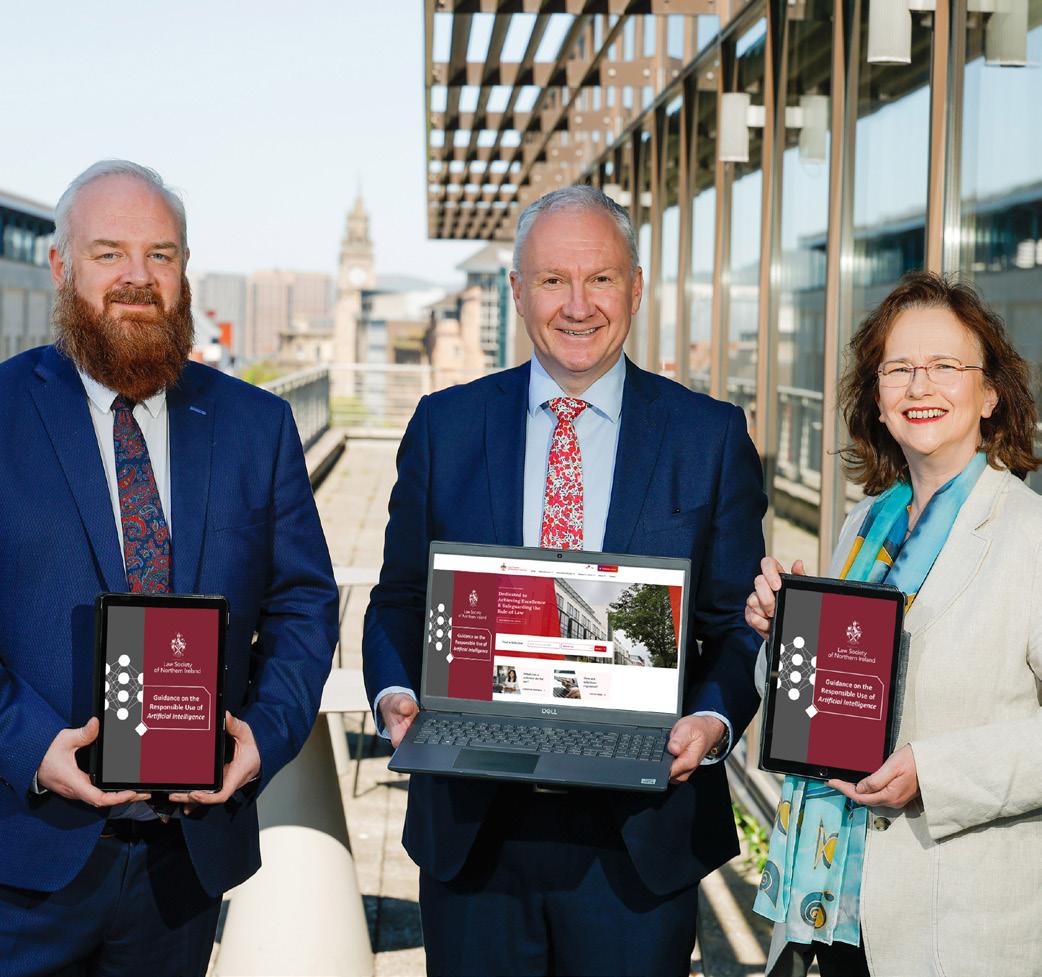
This issue also highlights a number of other important initiatives launched in recent months, including our new Guidance on the Responsible Use of Artificial Intelligence, which will play a vital role in supporting solicitors as technology continues to reshape legal services.
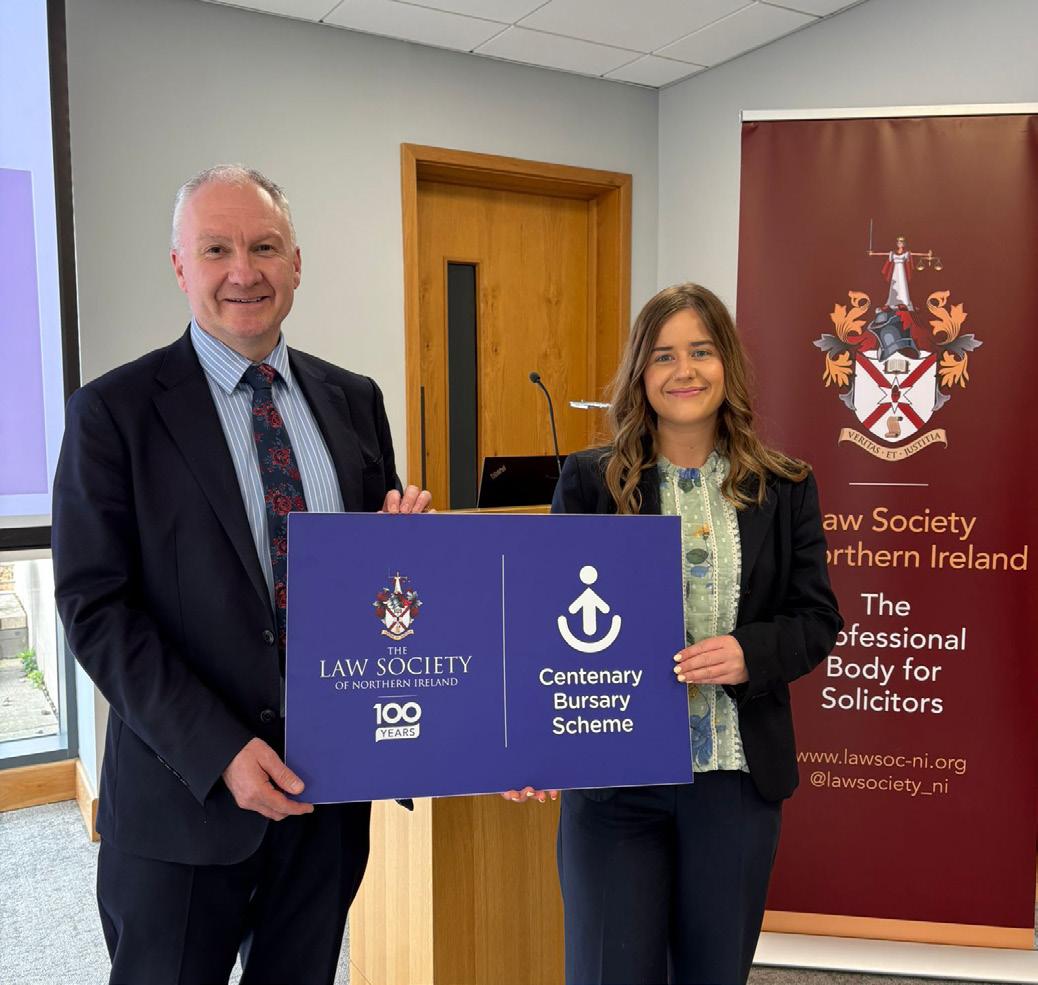
We also mark the launch of the 2026 Centenary Bursary Scheme, now in its third year, which is helping widen access to the profession by supporting aspiring solicitors from disadvantaged backgrounds.
I wish you all a well deserved and restorative summer, and hope you enjoy this issue.
David Lavery CEO Law Society of Northern Ireland
Solicitor Safety: An Update from the Society
Solicitor safety has been a priority issue over the last year and important work has been undertaken by the Society to support our members.
Key Findings
66% of the total respondents said they had been subjected to some form of threat or abuse in the course of their work, ranging from online harassment to physical attacks.
Leading this work has been the Solicitor Safety Group (SSG) which has sought to effect real change with decision-makers and create awareness of the threats affecting solicitors, their staff and clients.
Steps taken to date include:
Gathering data
The Society carried out a short survey of members in February 2026 aimed at gathering insights into the prevalence of personal safety risks and incidents experienced by solicitors whilst carrying out their professional duties in Northern Ireland. The survey received responses from a total of 480 members and revealed that 66% of the total respondents had been subjected to some form of threat or abuse in the course of their work. A more detailed overview of the survey results is presented below.
Stakeholder Engagement
The Society has engaged with key decision-makers including the Justice Minister Naomi Long and other justice stakeholders across the criminal justice system. This led to the establishment of a Lawyer Safety Liaison Group consisting of representatives from the PSNI, PPS, NICTS and others, aimed at supporting a co-ordinated response to threats and attacks.
Delivering practical support for members
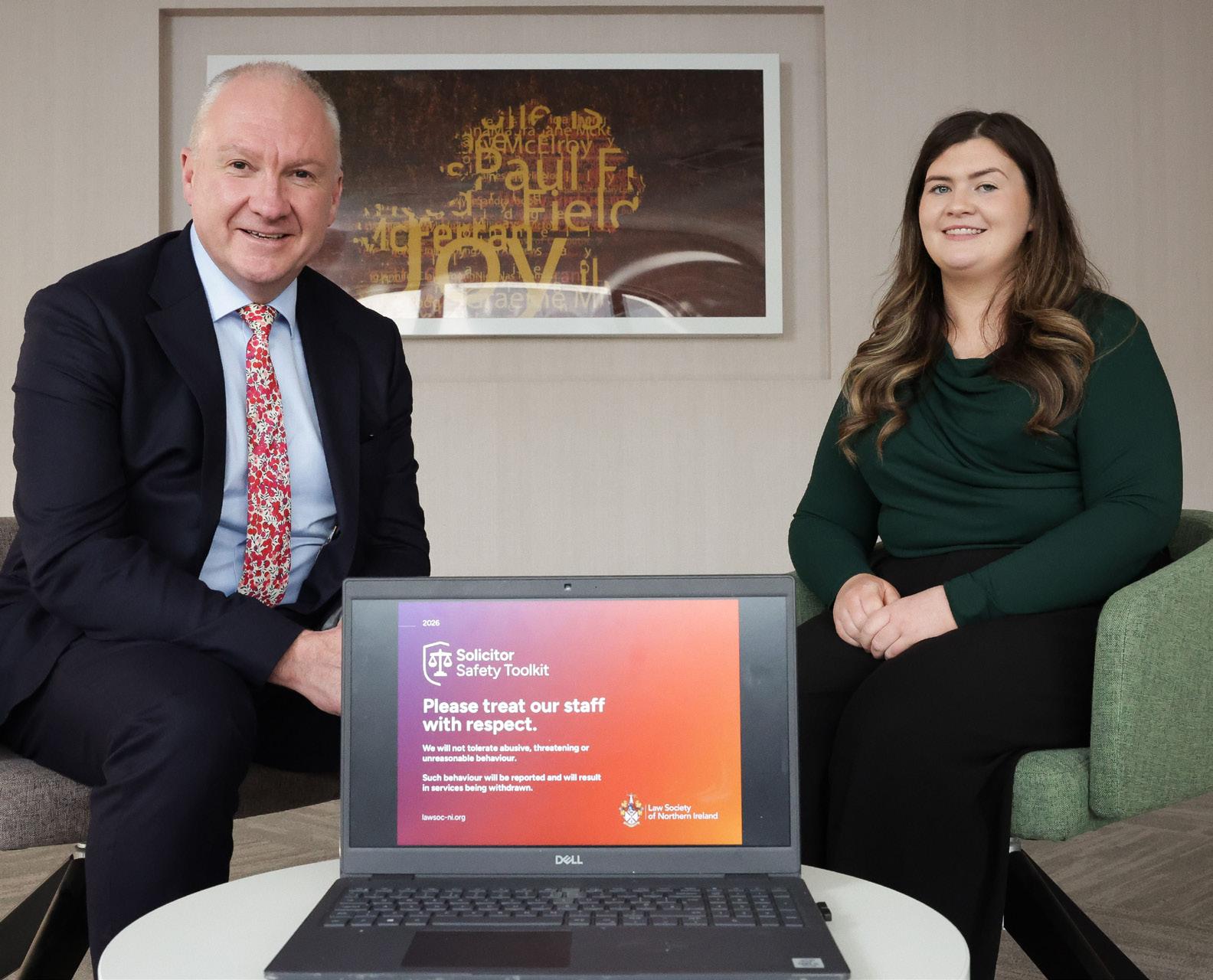
In response to the Society’s survey results and the growing incidents faced by the profession, the Society launched a Solicitor Safety Toolkit in March 2026, which provides practical tips on keeping safe within different settings. A new reporting mechanism has been introduced for members to make the Society aware of incidents. CPD training is also being developed with organisations such as the Suzy Lamplugh Trust.
Pressing for legislative reform
The Society has been pressing for legislative reform to recognise solicitors as frontline workers, making attacks against them a statutory aggravating factor in sentencing. The Society has also pressed for the introduction of a statutory presumption against the use of suspended sentences in cases where an officer of the court is the victim of an attack.
Solicitor Safety Survey results
Survey respondents
Most respondents were female (66%), and were located within Belfast (60%), with the other 40% based relatively evenly across other Local Association areas.
Over one-third of respondents were Principals or Partners. 64% had more than 10 years’ post-qualification experience, highlighting strong senior-level engagement in the survey.
Survey respondents were largely based in private practice (79%) and worked in a broad mix of practice areas, including Family, Conveyancing, Criminal, Litigation and Accidents/Personal Injury.
It is no surprise that these are frontline areas of legal practice involving high levels of direct client contact, and often, adversarial work.
Nature of threats or incidents
Many respondents had experienced multiple types of threats and attacks whilst carrying out their professional duties. Abusive language via email was the most common form of incident reported (71%), followed by direct threats (56%).
Frequency of incidents
52% of respondents said that they had been subject to a threat or incident in the past year.
Of those who had experienced a threat or incident in the past year, 16% reported a single occurrence and 30% reported multiple incidents.
Reporting
70% of respondents said that they did not report the threat/incident, highlighting a significant under-reporting of safety incidents in the profession.
For those who selected ‘other’, a significant majority reported abusive language by phone or in person. Other behaviours included criminal damage, IT hacking, blackmail, threatening letters, and terrorist threats.
The results indicate that threats and incidents occurred across a range of locations, with the office as a major risk area. Digital communications tools and platforms, including email, telephone calls and social media, were also a significant source of threats. 41% of respondents also reported that they had been subjected to threats/incidents within or outside a court building (41%).
Source of threats/incidents
The primary source of threats/incidents came directly from active clients (35%), while 19% was from the opposing client, 9% from a client relative and 18% from a former client. This shows that risks persist even after the professional relationship ends. Many also described incidents which involved litigants in person and members of the public.
A number of respondents highlighted the vulnerabilities of clients that they work with, including the prevalence of those with mental health issues, which has been particularly exacerbated post-Covid.
Of those who did report the threat/incident, the majority reported to their employer, followed by the PSNI. Other reports were made to individuals/organisations such as G4S, the Court Office, Judges and their Professional Body.
Impact
Participants in the survey were asked what the impact of the threat/incident(s) were on them:
Wellbeing
58% of respondents highlighted that threats, incidents or intimidation had had a negative impact on their wellbeing, with many reporting stress, anxiety, hyper-vigilance and cumulative effects over time.
Safety Concerns
Almost half of respondents (48%) felt their personal safety or that of their family was at risk. This resulted in many implementing safety measures, including upgrading home and office security, such as installing security cameras. Two respondents had even moved home.
The Solicitor Safety Toolkit
The Solicitor Safety Group (SSG) considered what practical guidance and support could be provided to local solicitor firms to allow them to manage their personal safety risks at work, home and other locations. The result was the Solicitor Safety Toolkit, which outlines and identifies potential risks and sets out how to respond to threats and access support.
To date the new Solicitor Safety Toolkit has been well received by members as both practical and informative and by key stakeholders as a template for other professional and service providers.
Responding to the launch of the new Solicitor Safety Toolkit the President, Mark Borland said:
'I wish to commend the Solicitor Safety Group (SSG) who have provided an invaluable resource for members and their staff.
As evidenced by our survey data no solicitor or their staff should have to deal with unacceptable behaviour, harassment, or intimidation in carrying out their professional role. Intimidation directed at solicitors and their staff is on the increase, and the impact of this on their health and wellbeing is concerning. The launch of our new Toolkit underscores the Society’s commitment to supporting members on this important issue.'
Next Steps
The launch of the new Toolkit is part one of a much wider and sustained campaign which will be rolled out over the course of the year led by the Solicitor Safety Group (SSG). This will include engagement with members throughout Northern Ireland at every level from bespoke CPD events and lectures, to support materials including short info videos, branded posters, leaflets and flyers for local firms.
The success of the Solicitor Safety Campaign depends on the response and involvement of members and their staff.
We encourage all members to:
1. Download, read and circulate the new Solicitor Safety Toolkit.
2. Report any incidents to the PSNI using the reporting procedure outlined in the Toolkit.
3. Notify the Society of any threats or incidents experienced by completing the online Solicitor Safety Incident Report Form
4. Get behind the campaign – it is only through active participating of members and their staff that this campaign can truly succeed.
Those wishing to download and access the new Solicitor Safety Toolkit can do so by clicking on the following link: Solicitor Safety | The Law Society of Northern Ireland
Posters and graphics are also available for downloading on the above link. We would encourage firms to avail of these resources and display them within your offices to reinforce the message of the importance of solicitor safety.
staff
Strengthening Protections for Solicitors: Stakeholder Engagement and Reform
Alongside the Solicitor Safety Campaign, work has continued to progress stakeholder engagement and advocate for meaningful reform aimed at strengthening protections for solicitors.
The survey results outlined previously have provided an important evidential foundation for this work. The experiences shared by members demonstrated clearly that harassment, threats, intimidation and violence directed towards solicitors are a growing issue affecting practitioners across multiple areas of practice and in a range of settings, including offices, courthouses, and, worryingly, members’ homes. These findings have underlined the need for stronger protections and a more co-ordinated response to issues.
A key strand of the Society’s work has involved a programme of direct engagement with various stakeholders. This has included constructive discussions with several agencies across the criminal justice system, including the Police Service of Northern Ireland (PSNI), the Public Prosecution Service (PPS) and the Northen Ireland Courts and Tribunals Service (NICTS). This engagement has focused on raising awareness of the safety issues being experienced by members, and the need to develop practical measures to mitigate risk and ensure appropriate responses to incidents across the justice system.
As a result of this direct engagement, a dedicated Lawyer Safety Liaison Group has been established, bringing together representatives from the Society, Bar, PSNI, PPS and NICTS. The Liaison Group, chaired by the Assistant Chief Constable (Crime), held its inaugural meeting in March 2026 and will meet on a quarterly basis going forward. The aim of the Liaison Group is to support a co-ordinated response to threats and attacks targeted at solicitors.
The establishment of this forum reflects the growing recognition that solicitor safety is a shared concern which requires collective action and sustained engagement.
In parallel to the engagement with operational justice partners, the Society has continued its programme of political engagement and lobbying for legislative reform. To date, discussions have taken place with the Minister of Justice, Departmental officials and MLAs regarding the need for stronger legal protections for solicitors when carrying out their professional duties.
Building on previous engagement with the All-Party Group on Access to Justice, the Society has submitted a written submission to the Committee for Justice in respect of the new Sentencing Bill. Within this submission, the Society has advanced several proposals aimed at strengthening protections for solicitors and reinforcing the seriousness of offences committed against solicitors in the course of their duties.
These proposals include that solicitors should be recognised as frontline workers within the proposed new protections for public workers under the Bill, and that attacks on solicitors acting in the course of their professional duties should be treated as a statutory aggravating factor in sentencing. The Society is also pressing for the introduction of a statutory presumption against suspended sentences where the victim of an attack is an officer of the court.
The purpose of these proposals is to ensure that the law properly reflects the essential public function performed by solicitors and the wider importance of protecting access to justice and the rule of law. In the coming months, the Society will have an opportunity to provide oral evidence to the Justice Committee in this area as part of its ongoing efforts to secure greater protections for solicitors.
Throughout these engagements, the Society has consistently highlighted that protecting solicitors is about more than just safeguarding individual practitioners. It is about ensuring that solicitors can carry out their duties independently, safely and without fear of intimidation. In turn, this helps to maintain public confidence in the administration of justice, support access to justice, and uphold the rule of law itself. As this work continues, the Society remains committed to ensuring that solicitor safety remains firmly on the political agenda to ensure meaningful reform is achieved.
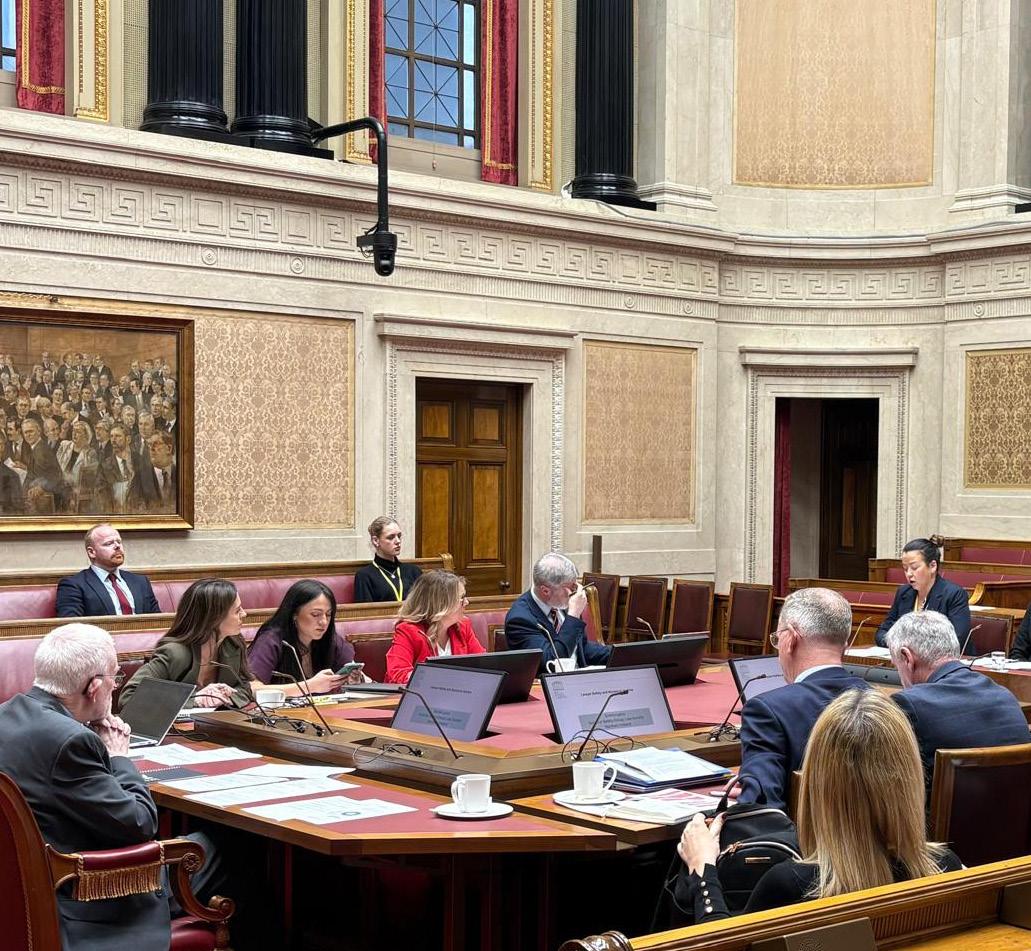
Meeting of the All-Party Group on Solicitor Safety in the Senate Chamber (NI Assembly)
Legal life in a Fermanagh practice
Brian Charity Senior Partner
Gibson Solicitors LLP
Fermanagh, the most Western county in Northern Ireland. In keeping with the theme of this issue of the Society’s Writ magazine, I am tasked with giving an overview of life in practice in the county and issues we practitioners face, one of which may be punctuality, and what we residents and practitioners like to call 'Fermanagh time'.
My practice is based in Lisnaskea. The majority of solicitors’ practices are located in Enniskillen. We are a two-partner practice and offer legal advice in several areas including wills and probate, matrimonial, conveyancing, accidents, and criminal law. Here in Lisnaskea, to paraphrase the theme song from Cheers, almost everybody knows your name. As with most rural practices, this leads to your neighbours calling on you when they are seeking legal advice. Furthermore, in some established practices, many members of the same family remain as clients of the practice. A high level of trust and confidence is apparent when you have up to three generations of a family as your clients!
Rarely are two days the same. The morning could see an unexpected client calling in with an urgent matter to be dealt with, lots of emails to read, meetings via Zoom or Teams, a site visit to a client’s property regarding some boundary matters, or a home visit to a client for instructions.
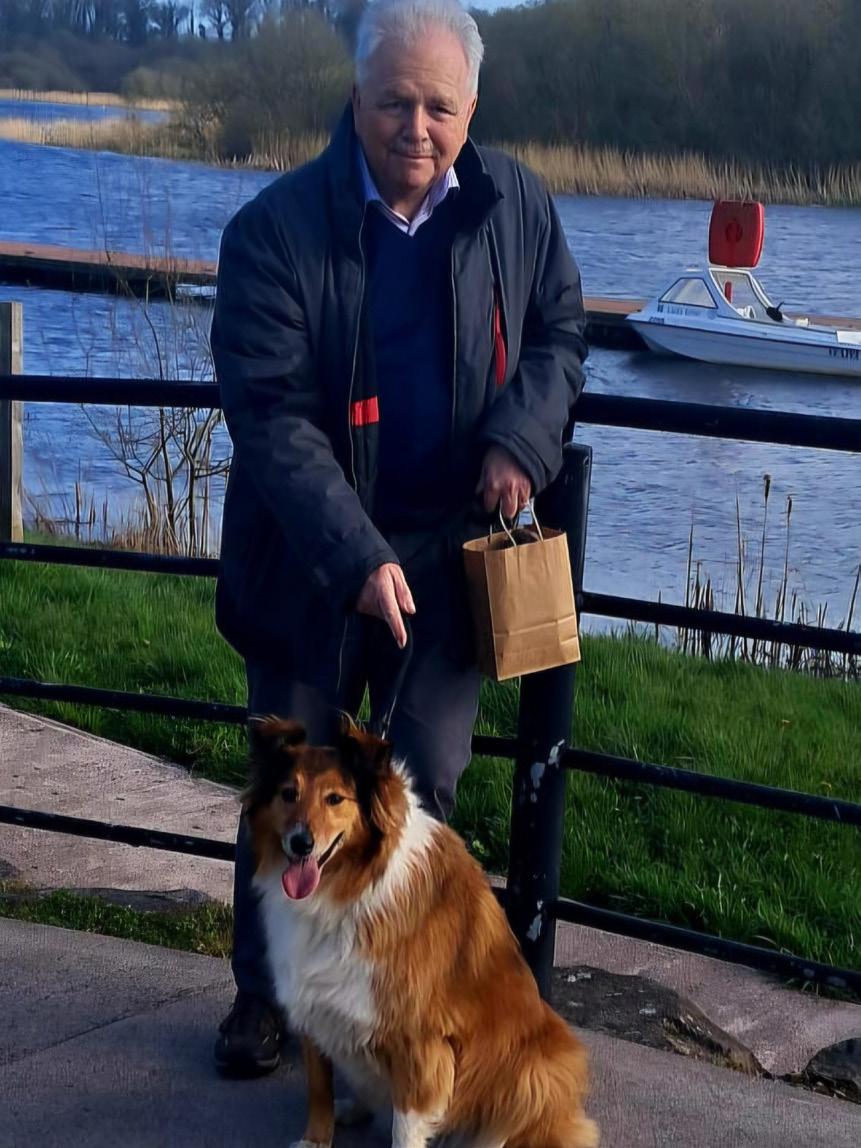
When I have to travel within the county to visit clients, it’s reassuring that I am never far from the office and I can benefit from seeing the beautiful scenery during my travels. Lough Erne is never far away (though it has been said that during the winter, Fermanagh is in Lough Erne). After concluding my business or visit, I may have time to stop for a coffee on the way back to the office, speak to some locals, and then go back to the office to continue the day. It’s never really boring. Sometimes in the office, I get a surprise visitor - our Rough Collie, Millie - who has been out on a walk with my wife.
This is always a very welcome sight. No legal issues, but the wag of a tail is very welcome. (Larger animals in offices are not recommended.)
It is sometimes said that solicitors in regional areas practice in a 'legal desert'. One of the biggest issues we face as practitioners in Fermanagh is that we have limited Access to Justice, which impacts us as solicitors, and ultimately our clients. For example, Enniskillen Courthouse is only open on days when the Court is sitting. Remarkably, we did manage to obtain an extra domestic proceedings day in Enniskillen. This is the first increase in Court time in years. Previously, these proceedings were heard in Omagh Courthouse and the move to Enniskillen for Fermanagh cases is very welcome and eases the pressure on clients residing in Fermanagh. Practitioners, however, are not permitted to correspond with Enniskillen Courthouse via post, it has to be sent to Omagh. The staff in Enniskillen Courthouse (when open) are much appreciated but there is always the shadow of closure looming.
Likewise, our criminal law practitioners are faced with considerable travel issues ever since Enniskillen’s PSNI station custody suite closed for renovation years ago. It has not re-opened, necessitating travel initially to Omagh PSNI suite which was then also closed for refurbishment, diverting us to Strabane, Strand Road or Dungannon if a client is arrested and is due to be interviewed. There are rumours that the suite in Enniskillen will be re-opening but for now it remains closed.
This is an ongoing matter that is also reflected in access to healthcare in the County, as limited services on offer at South West Acute Hospital Enniskillen mean patients having to travel 40 miles further afield to Altnagelvin. Also, the nearest bank for Lisnaskea practitioners is in Enniskillen, 12 miles away.
Travel for clients to Court is difficult. There is no train and the bus system is not ideal, particularly if a client in Lisnaskea has to travel to a Crown Court hearing in Dungannon. There is no direct route from Lisnaskea, necessitating travelling to Enniskillen and then another bus to Dungannon. This is not practicable if there is a Court sitting early, and increases stress levels.
However, we look past these inconveniences and continue to provide essential legal services to our clients in the county. Solicitors in Fermanagh are busy. The Fermanagh Solicitors Association is active and manages to keep our members up-to-date on legal developments. We have social functions which are well attended and hold table quizzes to raise funds for local causes. The camaraderie is obvious. The support between colleagues is very encouraging. For anyone wanting more information, our secretary is Eimear Lunney (email eimear@murnaghanfee.com)
The resilience of the profession in Fermanagh is admirable. We get on with our jobs and provide a valuable service to our clients despite the limitations imposed upon us. We practise the same law in Fermanagh as elsewhere in Northern Ireland and we are constantly aware of the challenges facing us, not solely due to a lack to a lack of Access to Justice but also the deprivation and dilution of other services.
I spoke earlier of 'legal deserts' and it is apparent there is a difference between the lives of 'rural' and 'urban' solicitors, but I would argue that Fermanagh is a 'legal oasis' where, despite challenges, solicitors can enjoy a less pressurised existence to practice law, collegiate atmosphere, and of course benefit from the natural beauty of our surroundings.
Navigating Family Law Across Borders: My Experience as a
Tri-Qualified Solicitor
Karen O’Leary Senior Partner and Head of Family & Child Law, Caldwell & Robinson Solicitors
Family law is, at its core, about people. It is about helping individuals and families navigate some of the most difficult and emotional moments of their lives with clarity, compassion and practical advice. Over the course of my career, I have been fortunate to practise family law across Northern Ireland, the Republic of Ireland, and England and Wales, and that crossborder experience has shaped both my professional outlook and the way I advise clients.
At Caldwell & Robinson Solicitors, I lead our Family & Child Law Practice, which operates across offices in Derry-Londonderry, Belfast and Dublin. Our team advises clients on all aspects of family and child law, including divorce, financial settlements, child arrangements, international relocation cases, Hague Convention child abduction proceedings, surrogacy, mediation and arbitration. A significant proportion of our work involves international family matters, and many of our lawyers are qualified across multiple jurisdictions.
The firm itself has a long history, having served clients since 1910, long before there was a border on the island of Ireland. That heritage naturally lends itself to an all-island and international perspective, particularly in family law where people’s lives increasingly span different legal systems. It also means adapting to a profession that continues to evolve at a remarkable pace.
One of the biggest challenges facing solicitors today is the pace of change. The law is evolving rapidly, particularly in areas such as children’s rights, surrogacy, international relocation, digital communication and alternative dispute resolution. Clients are also far more informed than they once were, often arriving having already researched legal issues online. That can be positive, but it also means solicitors must help clients distinguish between general information and advice that is genuinely tailored to their circumstances.
For family lawyers specifically, there is also the emotional complexity of the work. Unlike many other areas of law, family law often involves highly personal issues - children, relationships, finances and futures. People come to us at a vulnerable points in their lives. As solicitors, we must combine technical legal expertise with empathy, communication skills and practical judgement. The legal process can be daunting for clients, and part of our role is to guide them through it in a calm and constructive way to enable our clients to make informed decisions.
It was this increasingly international and complex nature of family law that ultimately influenced my own professional development. My decision to qualify in multiple jurisdictions came quite naturally from both my interests and my career path. I qualified first in England and Wales. I then worked with Gouldens, now Jones Day, in London and Brussels before moving to Northern Ireland in 1995, where I qualified in both Northern Ireland and the Republic of Ireland.
At the time, I recognised that family law was becoming increasingly international. Even in the 1990s, we were seeing more families living and working globally, with greater international mobility and a growing number of disputes involving interconnected legal systems. Being able to practise in multiple jurisdictions gave me the opportunity to provide continuity and strategic advice for clients whose circumstances did not fit neatly within one legal jurisdiction.
The path to becoming dual or tri-qualified requires commitment and adaptability. Each jurisdiction has its own qualification process, professional requirements and legal culture. While the underlying principles of common law may be familiar, the procedural differences can be significant. Solicitors must invest considerable time in understanding not only legislation and case law, but also the practical operation of courts and professional practice in each jurisdiction.
For younger solicitors considering this route, flexibility and curiosity are essential. It is important to appreciate that qualifying in another jurisdiction is not simply about obtaining an additional certificate; it is about understanding another legal system and learning how to advise clients effectively within it. While the process can be demanding, the professional and client benefits are significant.
Dual qualification is particularly valuable in family law because it allows solicitors to identify jurisdictional issues at an early stage and advise clients strategically about where proceedings should be issued and how cases may interact across borders. In some situations, the choice of jurisdiction can have a considerable impact on matters such as financial provision, child arrangements or the enforcement of court orders.
I have acted in many cases involving families who live and work across Northern Ireland, the Republic of Ireland, England and Wales, as well as internationally. Clients are often understandably anxious about navigating multiple legal systems, particularly when issues relating to children, finances or property span different jurisdictions. Being able to explain those differences clearly and coordinate advice across borders can make a significant difference to their confidence and peace of mind.
At Caldwell & Robinson, I also work closely with colleagues from other departments who are dual-qualified in their own specialist fields, particularly where a divorce or separation impacts trusts, inheritance matters or business assets. Their expertise and insight are invaluable, allowing us to provide clients with a holistic view of their situation and the reassurance that every aspect of their case is being carefully considered.
There are many similarities between the legal professions in the different jurisdictions. Solicitors everywhere are ultimately focused on serving clients effectively and ethically. However, there are cultural and procedural differences too. England and Wales, for example, often has a more specialised and larger-scale legal market, while Northern Ireland’s legal profession remains comparatively close-knit. The Republic of Ireland also has its own distinct court structures and legislative developments, particularly in recent years in relation to family law reform.
My experience of working in London and Brussels reinforced the importance of international collaboration. Family law increasingly requires lawyers to work alongside professionals in other jurisdictions, whether through international organisations, legal networks or specialist conferences. I have been fortunate to become involved with organisations such as Avrio Advocati and the International Academy of Family Lawyers (IAFL), where lawyers from around the world share expertise and best practice. Keeping abreast of legal developments across several jurisdictions is undoubtedly challenging. It requires constant professional development, regular reading of case law and legislative updates, attendance at conferences and maintaining strong professional relationships. I regularly speak at family law conferences and international forums, including discussions on child abduction at The Hague, the role of AI in family law and the implications of Brexit for family law.
Those professional relationships are further strengthened through involvement in specialist organisations and panels. I am involved with the International Academy of Family Lawyers, Resolutions International Committee, Lawyers in Europe on Parental Child Abduction, the Northern Ireland Children’s Panel and Lord Chancellor’s Advisory Committee on Private International Law. These play an important role in developing expertise, sharing knowledge and improving outcomes for families involved in international disputes.
In terms of additional support for the profession, I believe there is scope for greater collaboration between professional bodies across jurisdictions, particularly in relation to training and accreditation. Cross-border legal practice is becoming increasingly important, especially on the island of Ireland, and solicitors would benefit from clearer pathways and more structured support when seeking dual qualification.
Perhaps the most significant recent challenge for cross-border practitioners has been Brexit. Many of the reciprocal arrangements and EU regulations that previously provided clarity around jurisdiction, recognition and enforcement no longer apply in the same way. This has created additional complexity and uncertainty for families whose lives span both the UK and the EU.
As a result, international family lawyers must now navigate a more fragmented legal landscape. Jurisdictional disputes have become more significant, and clients often require specialist advice at a much earlier stage. While the legal profession has adapted remarkably well, Brexit has reinforced the importance of expertise in international family law.
Ultimately, however, the core purpose of family law remains unchanged. Whatever jurisdiction we practise in, our role is to support clients through difficult times with professionalism, empathy and sound legal advice. For me, practising across multiple jurisdictions has not only broadened my legal experience but has also deepened my understanding of the human side of the law. As families become increasingly international, the ability to guide clients confidently across jurisdictions will only become more important - and that continues to be one of the most interesting and rewarding aspects of the profession.
The President's Tour 2026
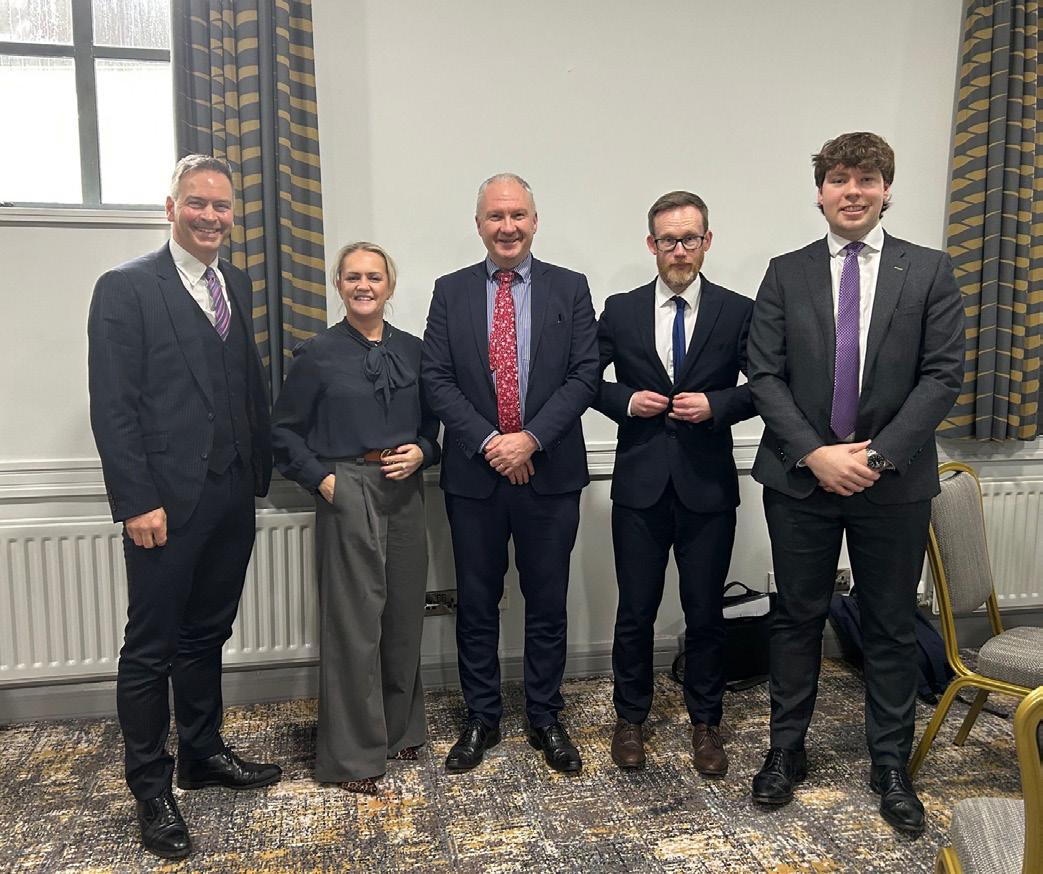
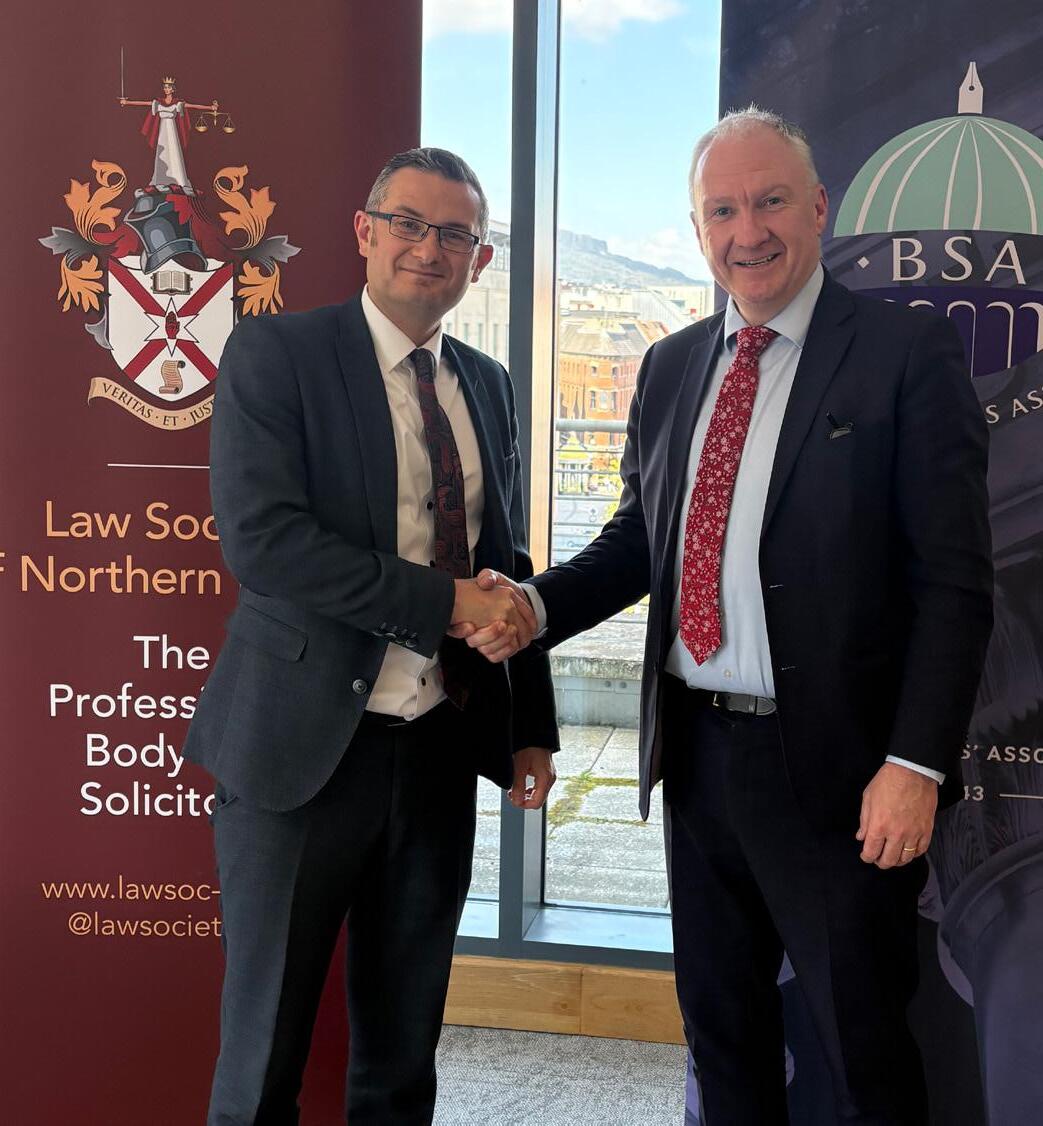
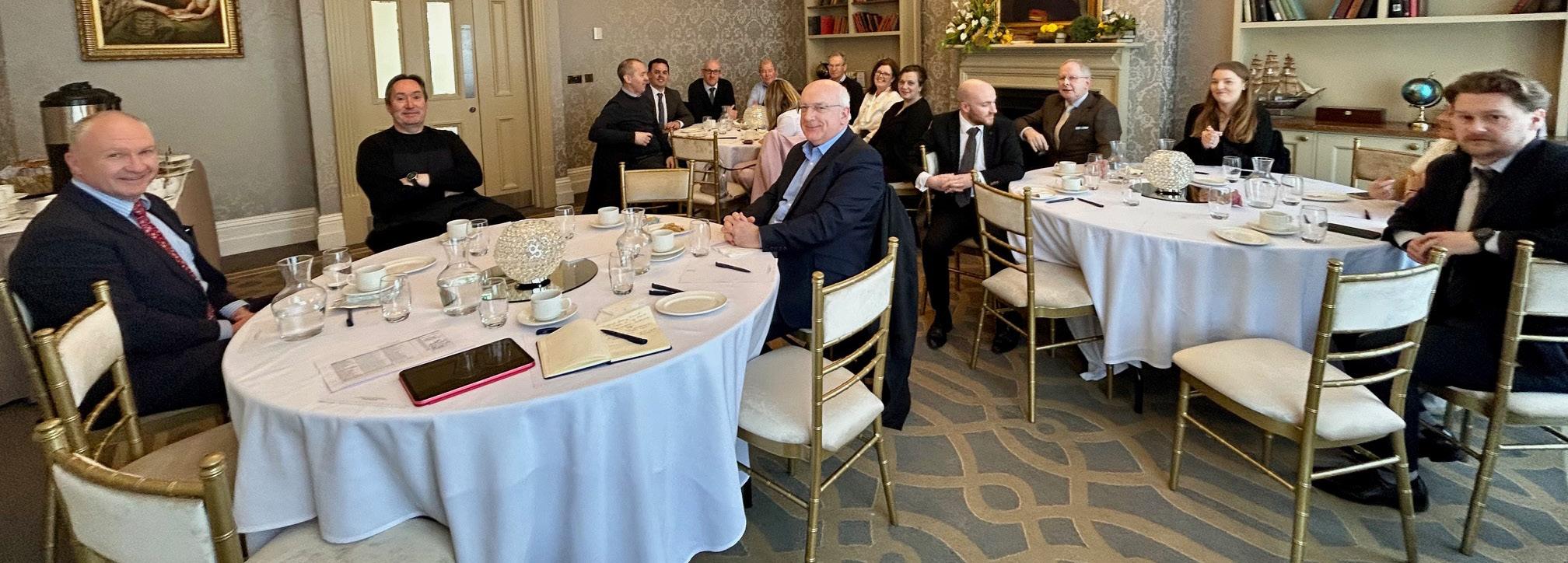
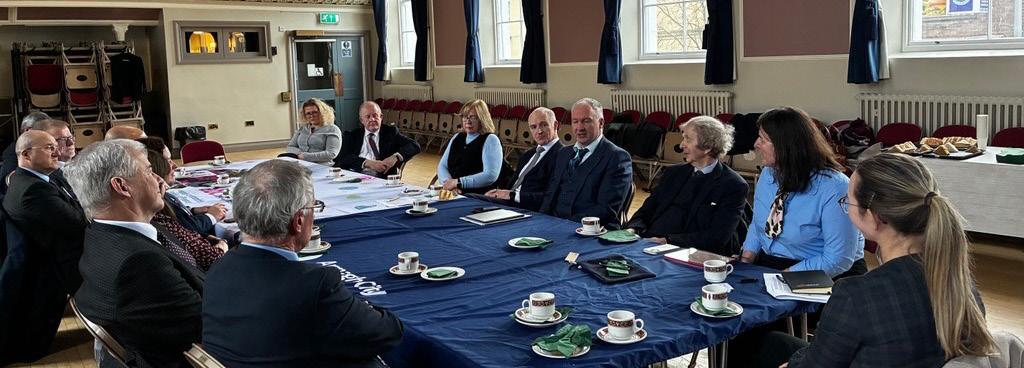
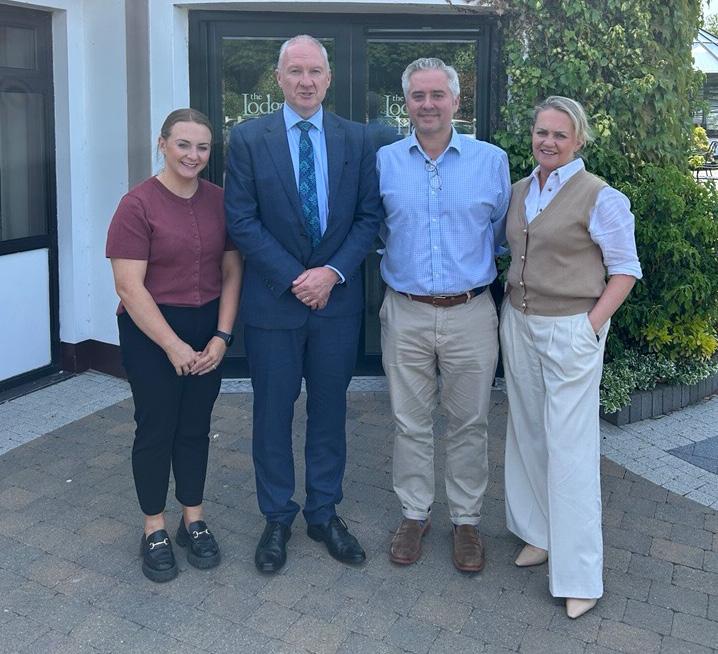
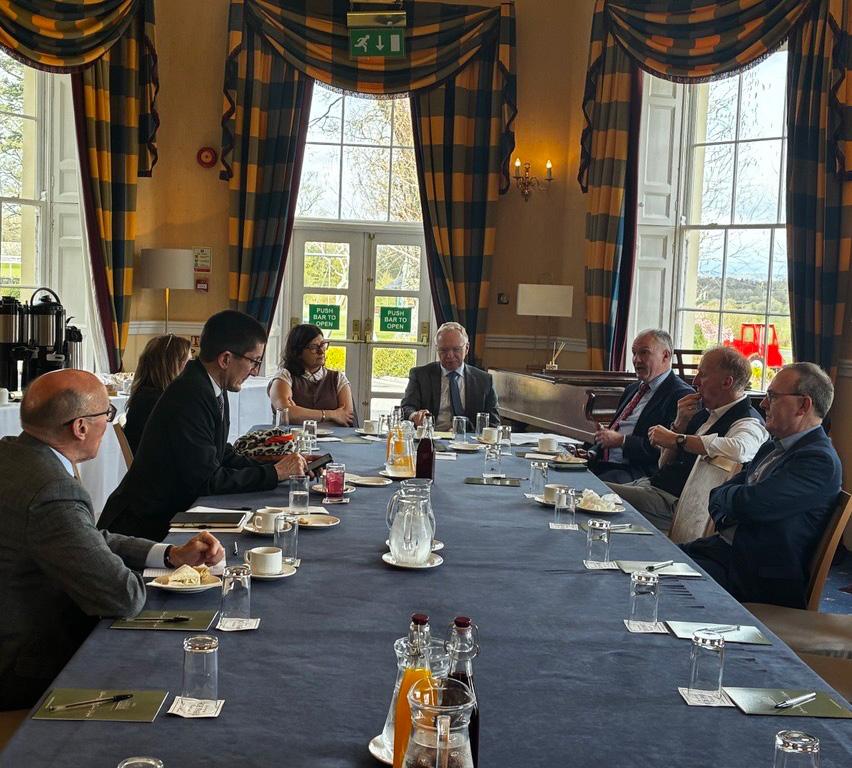
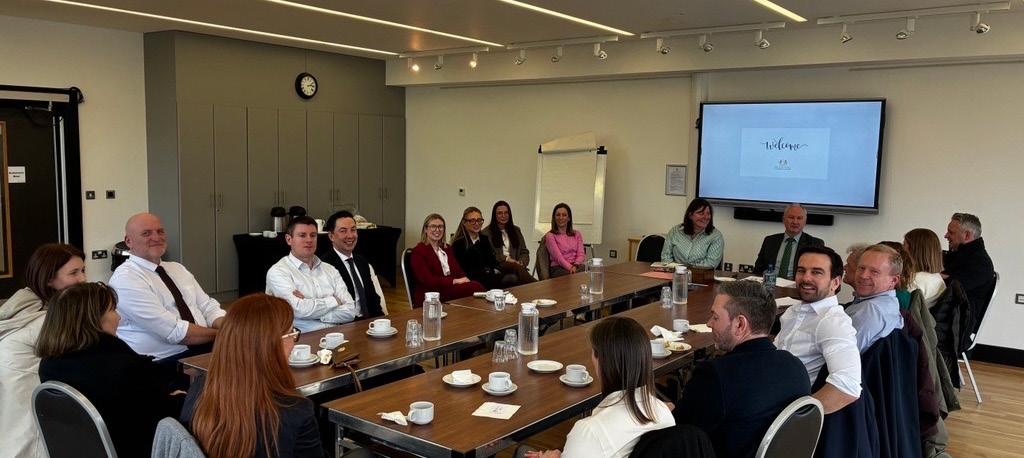
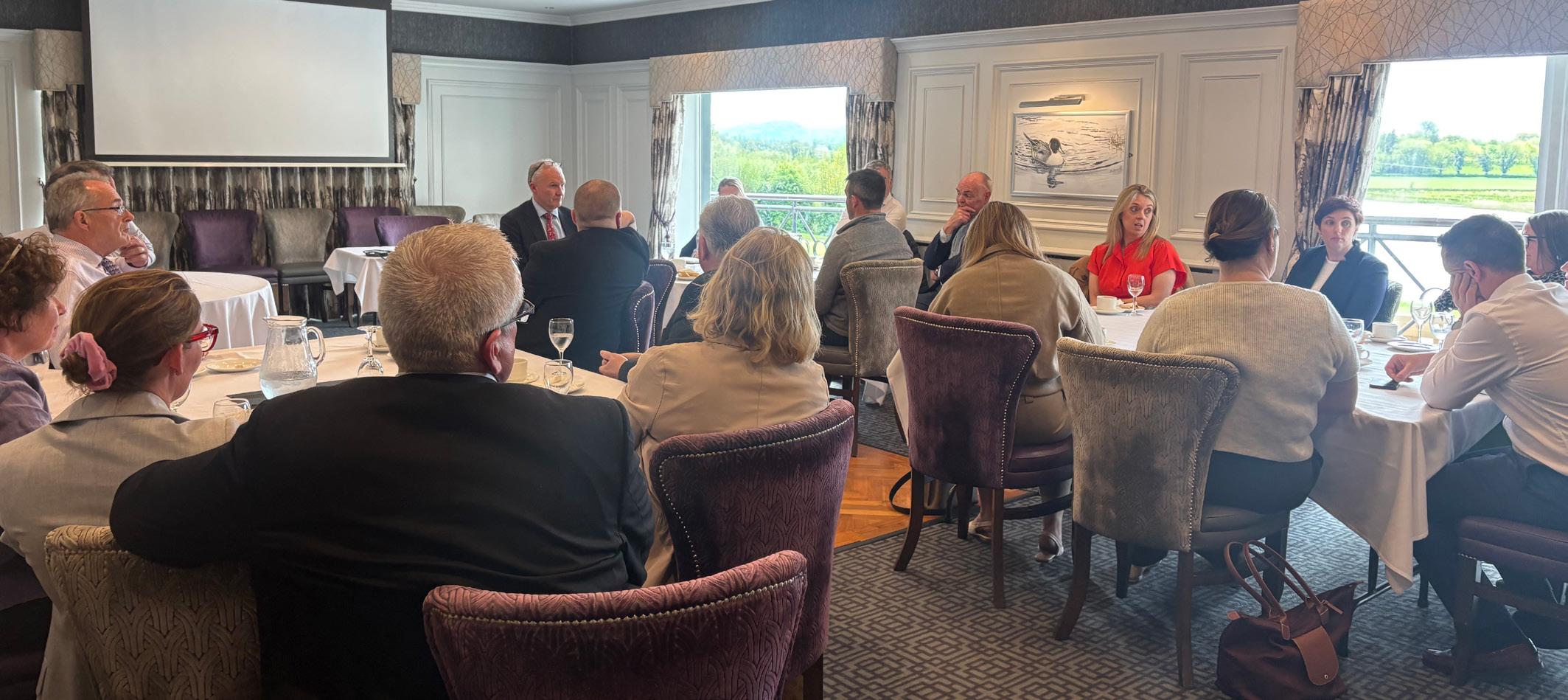
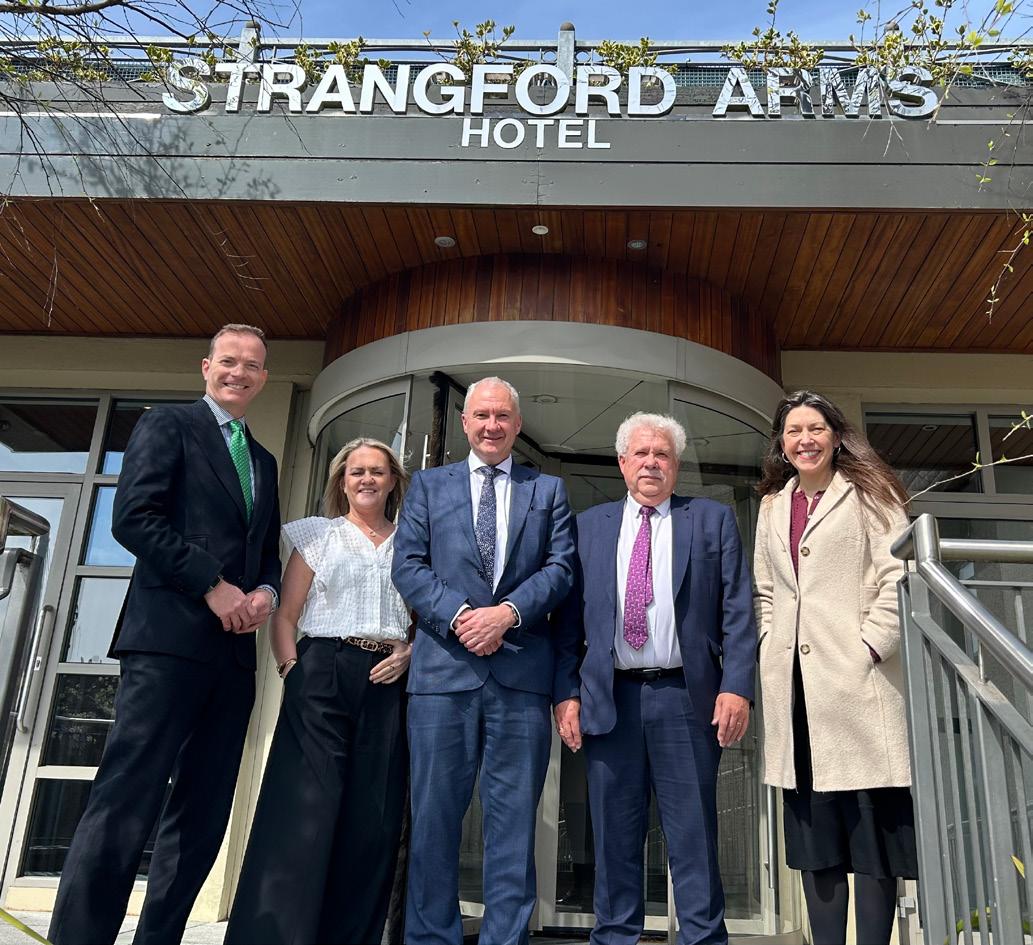
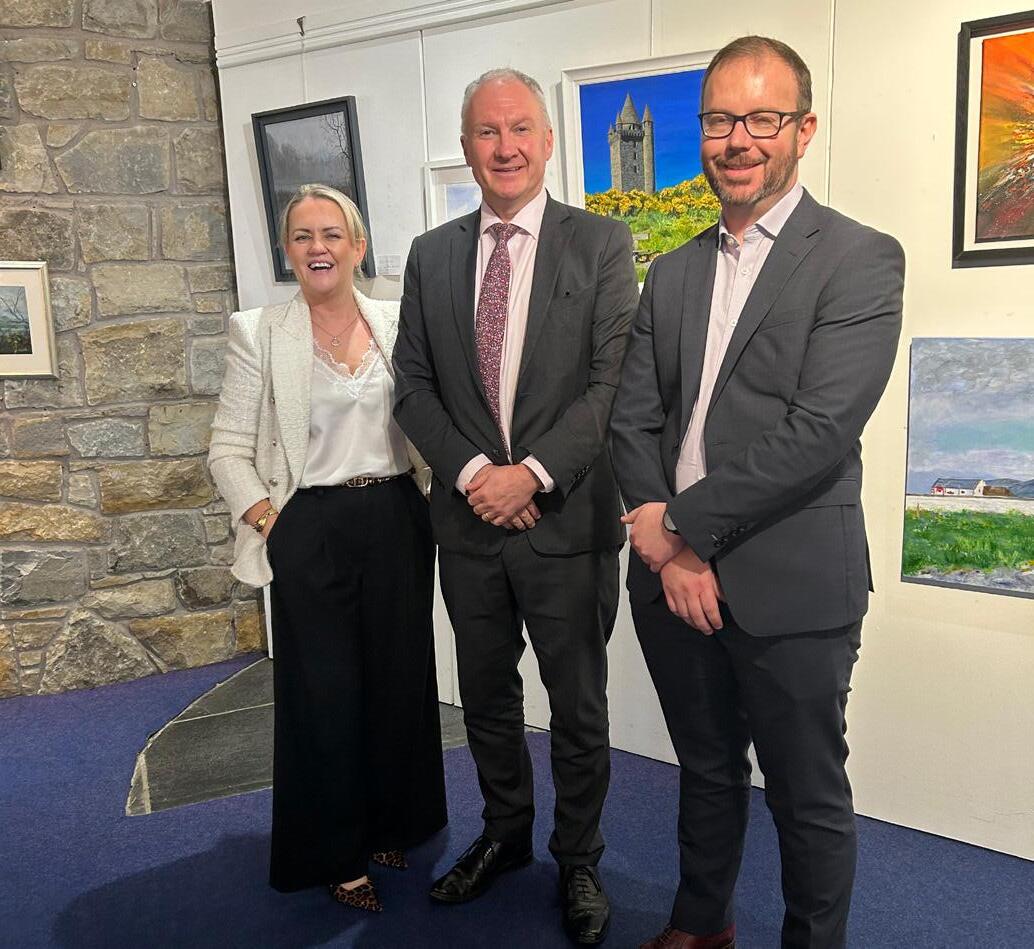
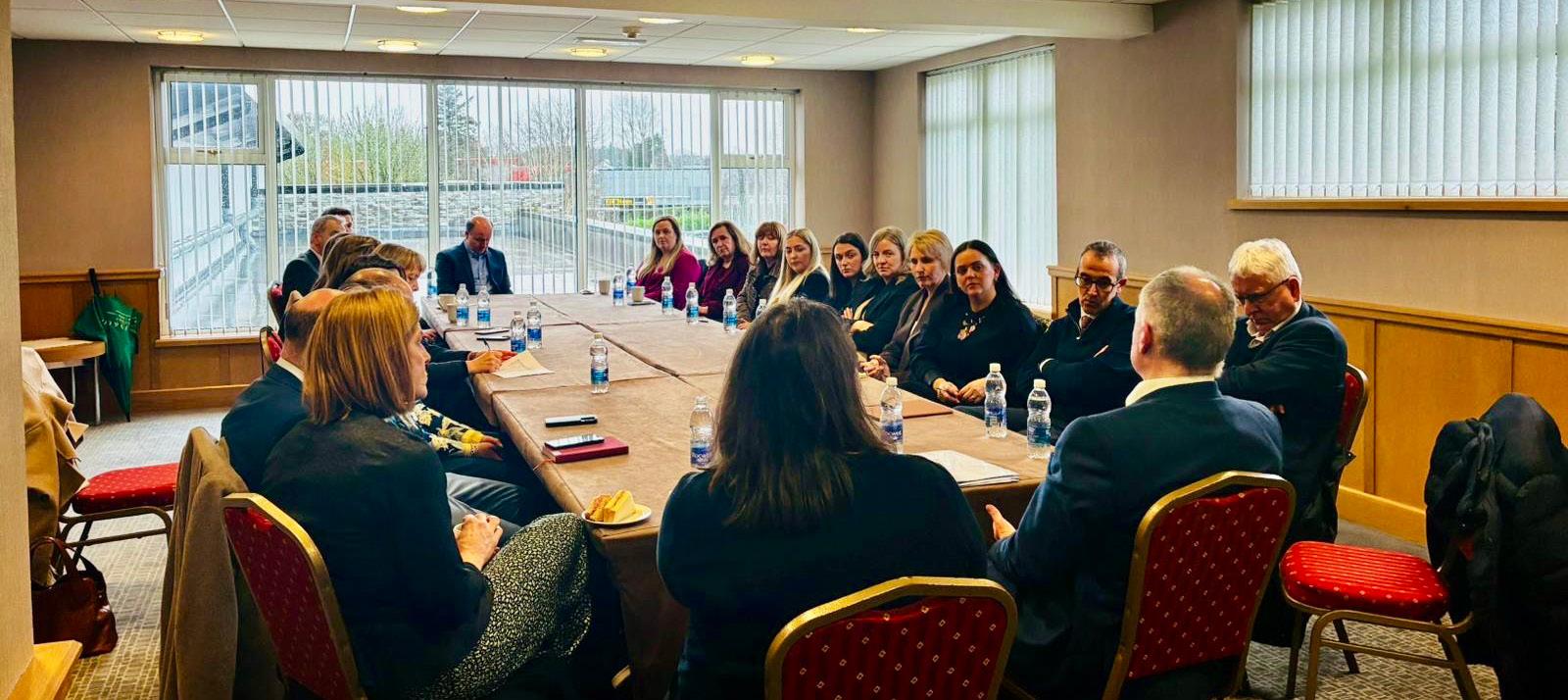
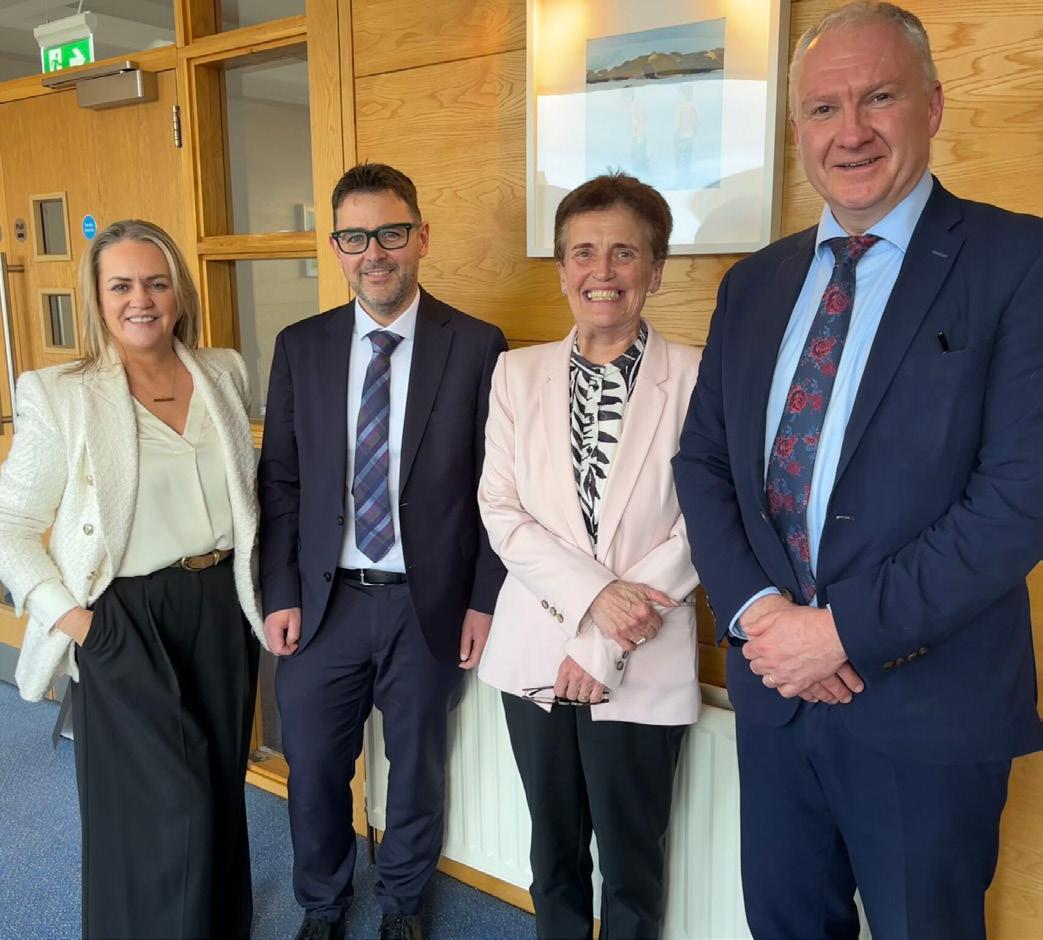
The President recently met with the Local Associations to discuss issues of interest or concern and provide updates on the Society's work.
Belfast Solicitors Association Armagh
Foyle
Portadown & Lurgan
Ballymoney & Coleraine
Dungannon District
Fermanagh
Limavady
Omagh & District
Newry & Banbridge
Antrim & Ballymena
Ards & North Down Down
Rosemary Connolly solicitor retires after more than 40 years in practice
The Society recently spoke with Rosemary Connolly of Rosemary Connolly Solicitors about her retirement after an impressive 40 years in practice. Here, Rosemary talks us through her career and plans for the future, and, in a later article, takes us back to two standout moments of her career.
You have been a solicitor for over 40 years. What positive and negative changes have you noticed over the course of your career?
I was admitted to the Roll of Solicitors in March 1984 and am therefore retiring from private practice after some 42 years.
In terms of positive changes, I believe that the profession and the Judiciary are more reflective of the society in which they operate than would have been the case all those decades ago.
Speaking from my own experience, equality law has now developed to the stage where it is an accepted core component element of our legal system and citizens are aware of their entitlements not to suffer unlawful discrimination. Companies and organisations have taken enormous strides to ensure that, as far as possible, they provide equality of opportunity in a meaningful way.
Over such a lengthy period of time there have been obviously many positive technological changes, moving away from typewriters and word processors and from letters being the main form of communication to the e-mail dominated life that we live today. There are some who would identify this as a negative change!
There will also be many who say that the challenges facing solicitors in private practice today are greater than ever before, but as someone who has spent the past 30 years working in a practice at a 40 mile remove from Belfast.
'I believe that high street solicitors are a resilient breed and that there will always be a need for legal services to be provided where people live and do business. I do not see AI replacing the local family solicitor anytime soon.'
When you established the practice 30 years ago what were the challenges you experienced?
I established my practice in Warrenpoint, County Down over 30 years ago, having previously been employed as Director of Legal Services with the then Fair Employment Commission for Northern Ireland and indeed before that having worked elsewhere in private practice.
I often say that it is probably a good thing that I did not fully comprehend the challenges of setting up a practice from scratch, but I am always thankful that I decided to locate the firm in Warrenpoint, which, in my opinion, is a strong contender for the best place to work in Northern Ireland.
As well as the challenges of putting in place appropriate systems, attracting good quality staff and bringing in legal work, there were the ongoing damages of running a business (albeit a legal practice) which is not something that forms part of a lawyer’s
professional training. There was a lot of learning done 'on the hoof!'.
That having been said, I was confident that demand would exist for legal services in general and specialist advice and assistance in the field of employment and equality law in particular and, happily, that proved to be the case.
What has been the standout moments of your career to date?
I am very proud that our firm initiated three separate equality cases which proceeded to what was then the House of Lords (now the Supreme Court). It certainly was a challenge in a small firm to deal with the considerable demands of preparing for a hearing before the House of Lords.
One of the cases, Shamoon v Chief Constable of the RUC, continues to be quoted (practically on a weekly basis) on the question of comparator in discrimination law.
I was delighted to be part of an all-female team, capably led by Ms Noelle McGrenera KC and Ms Suzanne Bradley BL appearing for the Claimant/Appellant in those proceedings.
As you approach retirement what will you miss most?
Undoubtedly, I will miss the camaraderie firstly of all of my colleagues past and present at Rosemary Connolly Solicitors Limited and the solicitor family here in South Down. My time here has constituted a very significant part of my life, and it will be strange not to be part of the normal routines. I will also miss the interaction with clients because, at its core, the role of a solicitor, certainly in a provincial town, is focused on engagement with clients (many of whom at this stage are the children and indeed grandchildren of clients) and it has been a privilege to navigate important life situations with so many of them over the years.
Do you think there is still a role for solicitors in an AI dominated world?
I am very much of the view that there is still a role for solicitors and am not fully convinced that our world will in fact be ‘AI dominated.’ there is no doubt that there are very many tasks that AI could assist with but, in my view, it will certainly never be able to replace the combination of knowledge of the law, knowledge of the client, and practical application of particular facts to any given situation that are the human skills that solicitors bring to their tasks.
Why have you been so passionate about equality issues and empowering women in the law?
I have been very fortunate to spend a lot of my working career involved in cases promoting individuals’ rights under equality law. It is critically important, in my view, that all members of society have a fair and equal opportunity to engage in employment, avail of services and generally progress unhindered by discriminatory practices.
A fair and just society in which citizens enjoy equality of opportunity is extremely important not least in ensuring acceptance of the system of legal regulation.
As regards empowering women in the law, I hope that I have always encouraged any young women with an interest in becoming a lawyer in either branch of the profession to do so. There is no doubt that women face particular challenges in balancing family life with busy professional commitments but, in my experience, they are also excellent time managers and well up to the task.
In this jurisdiction we have a number of female Counsel, including Senior Counsel who have been trailblazers in their time. However, while it is the case that the solicitor’s profession now sees
greater numbers of females entering the profession, there are still clearly obstacles to women achieving parity with male colleagues in senior roles and that is something that requires constant attention and focus if it is to be addressed.
What advice would you give to the next generation of solicitors?
I would advise any aspiring solicitor that it is a profession to be proud of and an honourable way to make a living. The role of solicitor is very often people-focused and I would particularly recommend to young entrants to the profession that they consider a role as a solicitor in towns and areas outside of Belfast where they will have the privilege of providing legal advice and assistance in an accessible way to local communities. There is a great deal of job satisfaction to be gained from performing a useful and necessary role in your own community.
If you had to do it all over again, would you still want to be a solicitor or something else?
I definitely would still want to be a solicitor.
What has been the best piece of advice you have received in your career?
The best piece of advice I got was to tackle any difficult issue first thing on Monday morning. That way the week got off to a good start. The other piece of important advice was to take every opportunity to do someone a good turn because it will be repaid many times over.
Has there been one person throughout your career who you went to for advice and guidance?
I have had the benefit of experienced colleagues who gave generously of their time if I was faced with a challenging issue. I have found that, for the most part, legal professionals are only too happy to give of their time and knowledge when requested.
'All of us have had situations where we were unsure what to do for the best and it has been my good fortune that in those circumstances, I have always been able to call on more experienced colleagues to shine a light on the path through.'
What are you plans for the future and will it involve law?
My plans for the future will not involve private practice but I will retain my interest in law generally and employment and equality law specifically and hope that I can engage in work other than private practice which draws on the experience I have had in this particular field.
Apart from that, there are books to be read and hills to be walked and I am looking forward to that immensely.
What could the Law Society of Northern Ireland do to support and engage retired solicitors?
I believe that there are many retired solicitors who would be willing and indeed would appreciate the opportunity to engage in a supportive capacity for colleagues who may be experiencing a challenging time.
I know that the Society is actively considering ways in which the knowledge and experience of now retired solicitors could be put to good use in such roles.
The Society could also facilitate opportunities for retired solicitors to meet in a social setting.
From the High Street to the House of Lords: A Northern Irish firm’s experience
Rosemary Connolly Retired Solicitor
Rosemary Connolly Solicitors is widely regarded as one of Northern Ireland’s leading specialist practices in Employment and Equality Law. Based in Warrenpoint, County Down, the practice has built a formidable track record of success over its 30+ year history of providing legal services to the local community.
The firm’s success has in large part been due to former principal Rosemary Connolly and her leadership team, who have been consistently ranked as top-tier practitioners in Northern Ireland.
The practice has been involved in some of the most legally significant equality and discrimination cases in Northern Ireland over the last three decades. A career highlight for Rosemary was a number of cases which were brought to the House of Lords (as it then was).
Perhaps one of the most widely publicised cases was Shamoon v Chief Constable of the RUC [2003] UKHL 11.
Almost a quarter of a century later it remains a landmark decision on crucial aspects of discrimination law and is regularly referenced in Employment Tribunal decisions.
The ruling focused on the definition of the word ‘detriment’ in discrimination law. The Northern Ireland Court of Appeal Decision, which overturned the earlier Tribunal ruling in favour of Chief Inspector Shamoon, had appeared to limit the definition of detriment to treatment which resulted in a physical or economic consequence.
However, the House of Lords made clear that a detriment for the purposes of antisex discrimination legislation exists if a reasonable worker would or might take the view that the treatment accorded to her had been a detriment.
A further keynote aspect of the case concerned how Tribunals should approach the question of less favourable treatment on the grounds of sex and, in particular, what required to be done to show that an actual or hypothetical comparator would have been treated differently.
The House of Lords made clear that in selecting a comparator it is not sufficient to identify an individual, actual or hypothetical, in a similar position but it must be established that the circumstances are the same or not materially different to that of the Claimant.
In a further observation, the House of Lords also looked at the prevailing Tribunal approach which was to first assess whether there had been less favourable treatment and only then to go on to consider if that treatment was on a prohibited ground. In its ruling, the House of Lords stated that it may be more convenient in many instances to treat both questions together.
Another important case took place in 2009 in which the House of Lords ruled on a case involving the practice, namely Boyle v SCA Packaging [2009] UKHL 37 which, in its outworking, provided an interpretation of the word ‘likely’ in the Disability Discrimination Act 1995 definition of disability. The definition expounded by the House of Lords broadened the understanding of the definition.
In this particular case, the Claimant, a senior employee of the Respondent, had a condition, namely vocal nodules, which required that she maintain a regime of vocal hygiene in the workplace. Essentially, this meant that she needed to work in a quiet atmosphere without loud noise being generated. For a significant part of her working life the Claimant had worked in a single office and was therefore able to maintain a regime of vocal hygiene but in the circumstances leading up to her initiating her claim, she was advised by her employer that this could no longer be accommodated and that she would be required to work in an open plan office.
The definition of disability in the relevant legislation includes a disability which was managed by, e.g., taking medication or otherwise taking preventative steps to avoid the condition being exacerbated.
It was held that a voice management regime which the Claimant followed to avoid the recurrence of her particular condition could indeed be determined to constitute ‘measures being taken to treat or correct’ her impairment.
The Court then moved on to consider whether her impairment would be likely to, i.e. could well, have a substantial effect if she were not following the regime and concluded that that was the case.
The House of Lords noted that even if an impairment does not currently have the substantial effect required to constitute a disability, account could be taken of the substantial effect that would be likely to occur were it not for measures being taken to treat or correct or contain the condition.
In essence, the House of Lords ruling meant that going forward Claimants only had to show the required substantial effects could well happen without the measures that the Claimant wished to have put in place and were not required to establish that such effects were 'more probable than not'.
The importance and the successful outcome of these two cases have undoubtedly inspired others and continues to have an impact in the field of discrimination law.
The case of Shamoon remains, to this day, an important authority in relation to the definition of comparator for the purposes of discrimination law.
The case of Boyle has made it easier for some victims of disability discrimination to bring cases even where the condition from which they suffered had either ended or was kept at bay by the use of medication or other modifications.
The outcomes of both cases highlight the invaluable work which solicitor firms provide daily to the community.
Strengthening Small and Rural Practice: The Case for Cluster Events in 2026
Sheelagh Walton Member Services Development Manager, Law Society of Northern Ireland
Supporting the sustainability of small practices
Small practices are the backbone of our solicitor profession, providing trusted local services and supporting access to justice in rural communities. However, many of these firms continue to face increasing pressures, including regulatory demands, recruitment difficulties and commercial challenges associated with Legal Aid work, alongside the broader demands of running a successful small business. It’s against this backdrop that Member Services plans to pilot a programme of regional cluster events during 2026, as a well-timed and practical investment in the sustainability of these practices.
We have developed the pilot initiative to support small and micro practices through a combination of compulsory risk CPD, business support, and professional networking, delivered in partnership with local solicitor associations.
If successful, the pilot will evolve into a more permanent small business support programme in 2027, steered by the Sustainable Practices Group as part of the Future of the Profession Committee. Karen Cherry, Chair of the Working Group, is delighted to get the pilot underway, saying:
‘Our ambition is to build a visible, trusted, and practical workstream that supports small and micro-practices to remain sustainable, connected, and commercially resilient. This pilot is an excellent first step, and I encourage all local associations to support the initiative, promote it to their members, and encourage participation.’
Responding to the needs of local firms
The rationale for the cluster model is grounded in engagement work already undertaken by Member Services, through local visits with the President and the Local Association Forum. By delivering events regionally, the programme reduces the time and cost burden associated with travel to Belfast for training and networking. We recognise this is particularly important for small firms, where time away from fee-earning work for a full day can have a significant operational impact.
The inclusion of compulsory risk CPD training within the programme also provides an alternative to accessing online, something many practitioners have specifically requested.
Practical help to reduce regulatory burden and to run successful small businesses
Importantly, the proposed programme is not focused solely on compliance. Its structure reflects a broader understanding of what smaller firms need to remain sustainable, resilient, and connected.
A core aim of the programme is to develop practical checklists, templates and toolkits that help firms navigate regulatory pressures while supporting the day-to-day realities of running a small business. By sharing resources, experience and good practice, the programme will also help identify future support needs and shape the development of ongoing support for the sector.
The emphasis on connection and collegiality is particularly important. As President Mark Borland highlighted with the launch of the Local Association Affiliation Scheme, strong professional relationships are essential to a healthy solicitor profession. Solicitors benefit from having trusted colleagues they can turn to for advice, support, referrals, and practical guidance. The cluster events provide valuable opportunities for these relationships to develop naturally through face-to-face interaction.
A partnership approach to engagement
This new initiative is designed in partnership with local associations, and their buy-in to our approach is important, as the events need to work for them. Each association has input into clustering groups which is not an exact science and their support is appreciated while we get the pilot off the ground.
Delivering a cost-effective support framework
The pilot event programme offers a relatively low-cost model for delivering high-impact engagement across our jurisdiction. By clustering neighbouring associations together, the Society can maximise participation while keeping operational costs manageable.
Ultimately, the value of the cluster event pilot extends beyond the individual training sessions themselves. The initiative represents a broader commitment to becoming a more member-centric organisation that listens to, engages with, and supports solicitors across all areas. It demonstrates recognition that local firms face distinct pressures, but also that they play a vital role in maintaining access to legal services and supporting local communities.
For more information on the 2026 cluster events pilot and to register for a local event visit Small Practice Cluster Events The Law Society of Northern Ireland
Non-Contentious Business Committee Focus: The Mental Capacity Act (Northern Ireland) 2016
Claire McNamee Non-Contentious Lead, Law Society of Northern Ireland
Background
A decade has passed since the Mental Capacity Act (Northern Ireland) 2016 (the 'MCA') received Royal Assent, yet much of it remains unimplemented. A suspended Assembly for around half of this time and the Covid pandemic seems to suggest that momentum was lost following Assent, but the Society understands that the biggest barrier to implementation is financial, both in a lack of resources to scope out what is required to progress and thereafter to set up and operate the MCA.
The scale of the MCA is enormous, with over 150 consequential amendments required in addition to jurisdictional issues, design and delivery of training, ongoing resources and delivery issues such as awareness raising, IT solutions and establishment of Trust Panels and the Office of Public Guardian. It was acknowledged even at the time of Assent that implementation was going to take years, and this was always dependent on the availability of funding and resources.
This piecemeal introduction is reflected again in the ongoing Adult Protection Bill, which is also intended to be implemented in stages, with the risk that those provisions which deprive liberty or involve intervention of the State are prioritised over key safeguards.
Why is the failure to implement the MCA a problem?
By 2047 more than a quarter of the population will be over 65.
25k+
An estimated 25,000 in Northern Ireland are living with a dementia diagnosis.
The only provisions which are in place are those in relation to Deprivation of Liberty Safeguards and research. None of the empowering provisions which are intended as safeguards, like the Principles, Independent Advocates, Lasting Powers of Attorney or the Office of Public Guardian, are in place, nor is there a timescale for these.
A 2024/25 health survey found 44% of people aged between 65-74 aren't in good health.
1/3
Alzheimer's Society research: one in three born today will develop dementia in their lifetime.
As a result, the Mental Health (Northern Ireland) Order 1986 remains the primary capacity legislation. This forty-yearold legislation doesn’t reflect current understandings of capacity and means not only that there is a human rights infringement aspect, (considering the United Nations Convention on the Rights of Persons with Disabilities), but also that crucial safeguards aren’t in place to support vulnerable people when it comes to their health and their financial affairs. Crucially, this means Northern Ireland doesn’t have a system that supports dignity and autonomy, allowing vulnerable people to fully and effectively participate in society on an equal basis with others.
NCB Committee attendance at Herbert Protocol launch
How does this impact on private client practice?
The Non-Contentious Business Committee, chaired by John O'Prey, has been responding to consultations which relate to the MCA and monitoring any developments, always emphasising the importance of progressing with implementation. These efforts have been scaled in 2026 in relation to its engagement:
A position paper highlighting four key areas from a private client perspective.
Mental Capacity (Northern Ireland) Act 2016
Discussion Paper - Private Client Focus March 2026
This position paper has been shared at recent political party conferences and with the Health Committee.
The key areas are set out below:
Principles
Capacity is decision specific.
Give all practicable help and support to a person to allow them to make a decision.
Benefit: Promotes dignity and self determination.
Independent Advocates
A completely impartial person who can provide support which reflects a person's best interests.
Benefit: The vulnerable person is understood and their wishes fully considered
Lasting Powers of Attorney ('LPA')
For both property and affairs and health and welfare matters.
Benefit:
Includes health and welfare matters. Factors in the Principles, to allow for assisted decision making.
Office of Public Guardian
Contains provisions for establishing a Public Guardian and Deputies
Benefit:
Required to implement LPAs. Public Guardian and Deputies can also make decisions regarding health and welfare.
Carers NI Powers of Attorney awareness day
A joint letter was sent to both the Justice and Health Ministers together with STEP, Dementia NI, Age NI and the Alzheimer’s Society to press for implementation, focusing on starting with Part 1, enacting the Principles regarding capacity. Responses from both Ministers have been received as part of this engagement.
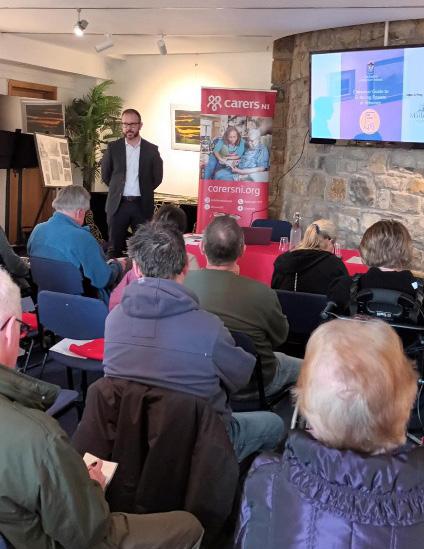
The Chair of the Non-Contentious Business Committee joined the first Power of Attorney Awareness Day as part of Carers Week with Carers NI to highlight a solicitor’s role where Enduring Powers of Attorney and wills are concerned
The Committee is pleased to have the opportunity to meet regularly with local banks where capacity and vulnerable clients are discussed helping to understand how these matters are dealt with from a banking perspective. This aspect is key, particularly for empowering vulnerable clients in considering how access may be managed to support independence. It is clear that these institutions are live to the issue and are proactively working to support their vulnerable clients.
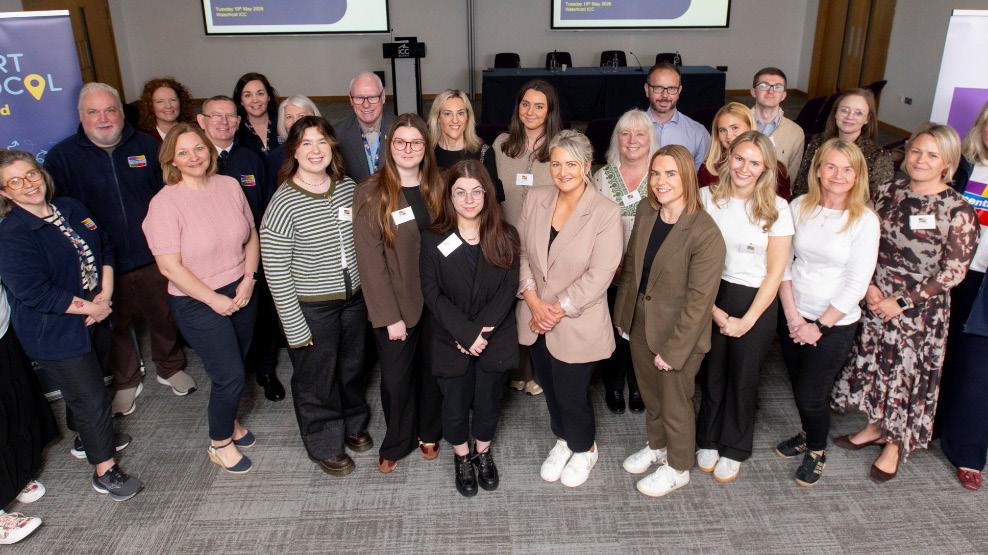
Members of the Committee attended a Dementia NI event during Dementia Week to hear about the new Herbert Protocol, designed to assist the police with information about vulnerable people who may go missing, with key details like descriptions, daily routines, recent photos and frequented locations to speed up search efforts if a person goes missing. The Committee is keen to engage further with Dementia NI and its ongoing efforts to progress implementation of the MCA.
The Committee is pleased that the Commissioner for Older People Northern Ireland (COPNI) is represented within the Committee. This gives a key insight into the issues encountered by vulnerable elderly people.
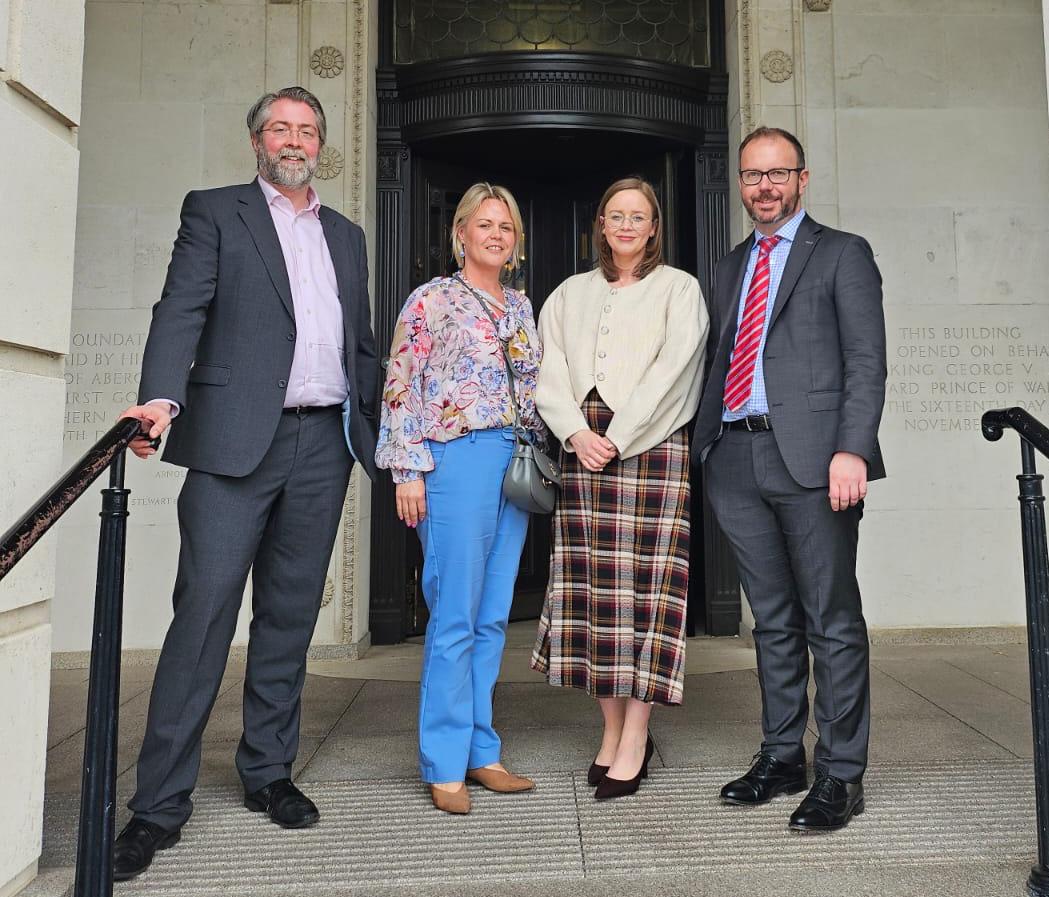
Developing relationships with local stakeholders.
Herbert Protocol launch
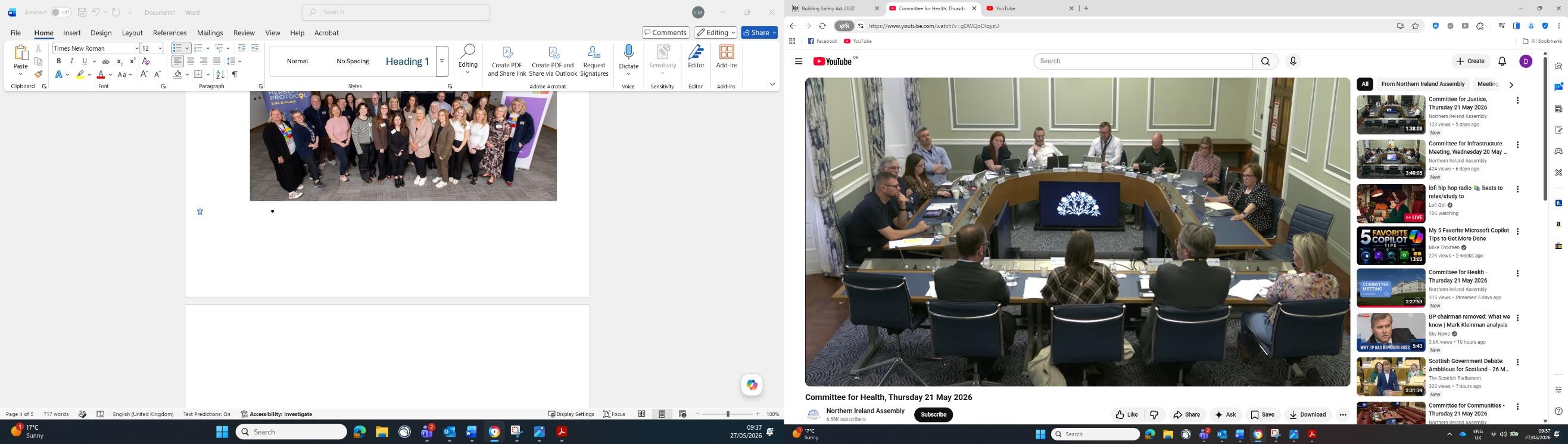
Committee for Health appearance
What’s next?
A recent case In the Matter of JG [2026] NIFam 9 actively considered the issue of capacity to make an Enduring Power of Attorney and demonstrates the importance of considering capacity on a decisionspecific basis and how this can empower a person who might otherwise have been considered, by virtue of a medical condition, to be incapable of making decisions. Whilst the case did not rest on implementation of the Principles under Part 1 of the MCA, it demonstrates how Part 1, if implemented, could allow other legislation to be read in accordance with these principles and support decision-making on an individual basis and with support to empower those decisions.
The Committee will also monitor the impact of the recent Supreme Court judgment UKSC/2025/0042 regarding revision of the Deprivation of Liberty Safeguards Code of Practice regarding persons aged 16 and over who lack capacity to make decisions about their care and treatment giving valid consent to their confinement through the expression of their wishes and feelings and the impact this has on private client practice.
These four areas are the main focus of the NCB Committee and further political and stakeholder engagement continues to emphasise just how important it is to implement the MCA without further delay.
Can you help?
• Case examples from the profession would be extremely helpful for this engagement to show real examples and just how these impact vulnerable people.
• This human aspect is vital to showing how important the MCA is in supporting and empowering vulnerable people.
To get in touch contact: policy@lawsoc-ni.org
Concussion in Personal Injury Claims: Lessons from Professional Sport
Dr Philip McClelland Consultant in Emergency Medicine, Belfast
Introduction
Concussion, or mild traumatic brain injury (mTBI), is a common feature of personal injury litigation. Despite its frequency, it remains a clinically complex diagnosis with no single definitive test, creating challenges in both medical assessment and legal interpretation.
Recent advances in research and international consensus statements have improved understanding of concussion, particularly through the American Congress of Rehabilitation Medicine (ACRM) and the 2022 Amsterdam International Consensus on Concussion in Sport. These developments provide a useful framework for approaching concussion in the medico-legal setting.
What is Concussion?
Concussion is a form of mild traumatic brain injury caused by biomechanical forces transmitted to the brain. It may occur following a direct or indirect impact to the head, neck, or body.
Symptoms and signs may include:
• Headache
• Dizziness
• Cognitive impairment
• Visual disturbance
• Fatigue
• Sleep disruption
Symptoms may develop immediately or evolve over time. Importantly, standard structural imaging is normal. Concussion is best understood as a functional disturbance in brain physiology rather than a structural injury detectable on routine imaging.
Current consensus recognises that the terms ‘concussion’ and ‘mild traumatic brain injury’ may be used interchangeably in clinical practice where imaging is normal or not indicated.
Diagnosis: A Clinical Process
There is no single diagnostic test for concussion. Diagnosis relies on a combination of:
• A plausible mechanism of injury,
• the presence of acute symptoms or clinical signs, and
• the absence of alternative explanations.
Modern diagnostic frameworks emphasise that concussion is:
• A clinical diagnosis.
• Based on multiple domains (symptoms, examination, cognition, balance).
• Not dependent on imaging or biomarkers.
This multidimensional approach reflects evolving consensus and highlights why diagnosis can be challenging in medico-legal cases.
Lessons from Professional Sport
Professional sport has driven many of the advances in concussion recognition and management. Several key principles are directly applicable to personal injury claims.
1. Recognition and Early Assessment
Sport has emphasised the importance of early recognition and removal from risk.
Video review systems can identify subtle mechanisms of injury, and instrumented gumshields can detect forces associated with potential brain injury. Observable clinical signs may be brief, whereas symptoms can evolve over minutes to days, and repeated assessment is often required.
In medico-legal cases, early documentation such as ambulance or Emergency Department records is particularly valuable. Some clinical signs of concussion may only be observed by others at the time of injury.
2. Structured, Multimodal Assessment
Modern concussion assessment is multimodal, incorporating:
• Symptoms.
• Cognitive testing.
• Balance and neurological assessment.
Tools such as SCAT6 and SCOAT6 reflect this structured approach, though they support rather than replace clinical judgement.
It is important to note that in professional sport, these assessments are often interpreted against an individual baseline. Comparison with baseline testing may reveal subtle deficits in cognition or balance, even when the individual reports feeling normal.
This reinforces the assertion that concussion cannot be excluded by the absence of a single sign or symptom, including loss of consciousness.
3. Normal Imaging Does Not Rule Out Injury
Consensus statements emphasise that:
• Standard CT and MRI scans are normal in concussion.
• Other forms of mild traumatic brain injury may demonstrate abnormalities on imaging.
• Advanced imaging, such as functional MRI, may show changes. However, its cost, availability and limited clinical utility means it is largely a research tool.
Therefore, a normal scan does not exclude concussion; by definition, concussion has normal standard structural imaging.
4. Active, Not Passive, Recovery
The traditional advice of prolonged rest has been replaced by:
• Relative rest for 24–48 hours, and
• Early return to light activity as tolerated
Early, symptom-limited physical activity promotes recovery and reduces the risk of persistent symptoms.
Conversely, continuing with sport or other high-level activity can increase risk of secondary injury, symptom burden and prolonged recovery. The IRFU found that even playing on for five minutes with a new concussion can delay future return to play by three days.
5. Functional Recovery is Key
Return-to-play decisions in sport are based on:
• Symptom resolution,
• cognitive recovery, and
• functional performance.
This approach translates directly to personal injury claims, where return-to-play considerations are replaced by return to normal life. For example, a rugby player may struggle with the concentration required to understand team calls, while a teacher may struggle with classroom noise or the cognitive demands of marking.
Return to work, normal daily function, and activity tolerance will therefore vary between individuals depending on their symptoms and functional limitations. Functional recovery is a more meaningful measure of outcome than symptoms alone.
Clinical Presentation is Heterogeneous
Not all concussions present in the same way. In professional sport, concussion is often understood in terms of clinical subtypes, including cognitive, vestibular, ocular, migraine, and mood-related presentations.
Identifying and treating subtypes is the mainstay of accelerating recovery and mitigating loss.
This variability explains why symptoms may differ significantly between individuals and why a standardised approach to assessment is required.
Common Pitfalls in Litigation
1. Over-reliance on Imaging
2. Normal imaging does not exclude concussion.
3. Inconsistent Symptom Reporting
4. Symptoms may evolve, but significant discrepancies between early and later reports require careful consideration.
5. Non-specific Symptoms
6. Symptoms such as headache and fatigue are common and may have multiple causes, including psychological factors.
7. Prolonged Symptoms
8. While most individuals recover within weeks, a minority develop persisting symptoms (>four weeks), which require a more nuanced, multidisciplinary assessment.
Causation
To relate a concussion to a personal injury, there must be a credible mechanism of injury capable of transmitting sufficient force to the brain. Concussion may occur following direct impact to the head, impact to the body with force transmitted to the head, or acceleration–deceleration forces without direct head contact.
In medico-legal assessment, the presence of a plausible mechanism alone is insufficient. Causation also requires a clear temporal relationship between the incident and the onset of symptoms, together with consistency between the reported mechanism, clinical presentation, and early medical records.
In lower-energy mechanisms, such as minor collisions, establishing causation may be more challenging and requires careful clinical judgement.
Prognosis and Post Concussion Syndrome
The majority of individuals recover within four weeks; however, a subset experience prolonged symptoms. Prolonged recovery is influenced by multiple factors including prior history, psychological factors, sleep disorders, initial symptom burden, cognition issues, loss of consciousness and amnesia.
Persistent post-concussive symptoms are typically considered when symptoms continue beyond four weeks without an obvious secondary cause.
Up to one third of concussions may have post-concussion symptoms at three to six months and beyond.
Assessment should therefore focus on both:
• Symptom resolution, and
• Functional recovery
Key Points for Solicitors
• Concussion is a clinical diagnosis.
• Imaging is typically normal.
• Loss of consciousness is not required.
• Early records are critical.
• Symptoms may evolve over time.
• Typical recovery is within four weeks; however, patient factors can increase this significantly.
• Functional impact is central to assessment.
Summary
Concussion is a common but nuanced diagnosis in personal injury litigation. Advances in research and consensus guidance emphasise that it is a clinical, multifactorial diagnosis requiring careful assessment.
Lessons from professional sport, including structured assessment, early recognition, active rehabilitation, and emphasis on functional recovery, provide a practical framework for understanding and evaluating concussion in the medico-legal context.
Author Bio
Dr Philip McClelland is a Consultant in Emergency Medicine in Belfast and Minor Injuries Lead within the Belfast Health and Social Care Trust. He has over 10 years’ experience working in elite sport, including Ulster and Ireland rugby and as a Match Day Doctor with the IRFU. He has a specialist interest in concussion, mild traumatic brain injury, and musculoskeletal injury.
Judicial review in Northern Ireland: lessons from (and for) Aarhus
This article explains the background to a recent Aarhus Convention-related public consultation by the Department of Justice (DoJ), the Law Society of Northern Ireland’s response to that consultation and its outcome, against the backdrop to a long-running enquiry around UK environmental litigation.
Introduction
Judicial review is a vital mode by which public power is scrutinised and, if necessary, checked by the courts. It extends to every sphere in which public law rights and duties are engaged, from immigration to planning matters and everything else in between. In this context, the role of the Aarus Convention is underappreciated and, as some recent developments show, potentially transformative. But at what cost?
Aarhus Convention
Fundamentally, the Convention on Access to Information, Public Participation in Decision-making and Access to Justice in Environmental Matters signed at Aarhus, Denmark in 1998 – colloquially known as the Aarhus Convention – is (as its full title suggests) about greater transparency and accountability in decision-making around environmental matters. The UK acceded to and ratified the Convention – both individually and as part of the EU – and implemented it domestically via the Environmental Information Regulations 2004. Originally, these Regulations were made to implement EU law – specifically Directive 2003/4/EC (on public access to environmental information). Since Brexit, these Regulations are part of the body of EU-law-turned-domestic-law known since 2024 as ‘assimilated law’. I will not be exploring assimilated law in detail, both because its woeful complexity makes hairlines recede alarmingly quickly and because it is unnecessary here. But I will return to one aspect of it which is relevant to the Convention, further below.
The Aarhus Convention Compliance Committee (ACCC) is the Convention’s monitoring body. It is comprised of legal experts who can receive complaints from the public and environmental NGOs but cannot issue binding decisions as to whether a State Party is non-compliant with the Convention. Importantly, of course, the Convention is not generally incorporated in domestic law (including in Northern Ireland). This means, as the Supreme Court has (sometimes tersely) pointed out in respect of other unincorporated international law, the Convention cannot generally be relied on in domestic proceedings for enforceable rights and obligations. Instead, the Convention only speaks through a handful of highly specific laws – the 2004 Regulations being a prime example.
Nevertheless, the Convention and the ACCC have been highly influential in the field of judicial review. Two major developments in Northern Ireland are the amended reciprocal costs cap in environmental cases (the most applicant-friendly in the UK)1 and the change to judicial review timescales.2 Until that time, Northern Ireland followed England and Wales in requiring that applications for leave to apply for judicial review be brought ‘promptly and in any event no later than three months’ of the challenged act or omission. The ACCC found the requirement of promptitude to be insufficiently certain in 2010.3 This, together with a prior judgment of the Court of Justice of the EU also finding the promptitude requirement uncertain in public procurement challenges4 convinced the Rules Committee in Northern Ireland to delete it from our rules of civil procedure.
But the ACCC remains unsatisfied with what it considers to be a lack of certainty in the requirements around bringing judicial reviews before the High Court. Specifically, the ACCC favoured the 3-month timescale for judicial reviews to begin ‘from the date on which a claimant knew, or ought to have known of the act, or omission, at stake’.5 This has not occurred to date, leading the Convention’s Meeting of the Parties (the main decision-making body for the Convention) to reiterate that the UK:
Anurag Deb PhD researcher, School of Law, QUB
‘Further review its rules regarding the time-frame for the bringing of applications for judicial review in Northern Ireland to ensure that the legislative measures involved are fair and equitable and amount to a clear and transparent framework.’ 5
This is the reason why the DoJ embarked on a public consultation exercise in response to this decision.
The DoJ consultation and the Society’s response
The DoJ consultation had a number of strands to it, covering the gamut of issues which interests the ACCC, including the expense of taking environmental claims (public and private), access to information about environmental matters generally and certainty around the public’s ability to bring claims to court. Here I am concerned specifically with the DoJ’s proposal around judicial review.
The DoJ understood the suggestion of time starting from the claimant’s date of knowledge as the public’s date of knowledge.6 There were two alternative suggestions in this regard. First, that the relevant Rule7 be changed so that time starts to run ‘when a decision is made public’ and second, that the question of when a decision is made public (or when a claimant knew or ought to have known about the decision under challenge) be left to judicial discretion.8
There are two main problems with both suggestions. First, an individual’s knowledge is not (and should not be understood as) public knowledge. Not every challengeable decision is published, because there is no general requirement either under statute or at common law to publish decisions. Anchoring the judicial review timescale to publication therefore raises an important question: would unpublished decisions be unchallengeable? Moreover, data protection issues arise in circumstances where certain kinds of decisions made under public law powers (such as in respect of asylum seekers) are predicated on deeply personal (and possibly distressing) details.
Making such decisions publishable may require redacting so much of their content as to make them highly difficult to challenge. The need for making such decisions public is also unclear, in that public authority decisions in respect of individuals in highly specific circumstances have little public interest to require publication.
Second, leaving the start of the judicial review timescale to judicial discretion would compound the uncertainty identified by the ACCC. At the minute, the rules generally fix the start to ‘when grounds for the application first arose’, with a residual discretion to extend time if the court considers that there is good reason to do so. This discretion has been criticised by the ACCC, which has found that judicial discretion by itself cannot be used to make a flexible timescale sufficiently certain under the Convention.9
The Society’s response thus strongly disagreed with the DoJ’s suggestions and instead suggested that the start of the judicial review timescale be fixed (by explicit amendment to the Rules) to ‘when the applicant first knew or ought reasonably to have known the grounds of the application’.10 This provides more certainty than either of the two suggestions put forward by the DoJ. In the event, the Minister of Justice has confirmed to the ACCC that no change to the current judicial review timescale will be carried out following consideration of the consultation responses.11
Lessons for the future
In the interests of space and readability, I restrict myself to setting out three main learning points from this experience: the first for the ACCC, the second for the DoJ and the third for the legal professions.
First, the ACCC needs to revisit its interpretation of the requirement for certainty under the Convention. The Convention itself requires judicial procedures which are ‘fair, equitable, timely and not prohibitively expensive’.12 The ACCC’s current interpretation significantly narrows the possibilities in the text of the Convention. In this regard, the ACCC would perhaps be well-advised to look at the approach of bodies like the Court of Justice of the EU and the European Court of Human Rights towards tensions between international law and domestic law. Generally, both courts expound broad principles (frequently as obligations of result) thus giving domestic authorities the freedom to implement and operationalise those principles in ways which are most responsive and tailored to their needs.
This avoids making conclusive assessments of domestic law in circumstances where the international body may not fully appreciate the details of domestic law. The ACCC has arguably already (and recently) fallen into this trap. In its findings concerning complaints about the (then) ‘Great Repeal Bill’ (subsequently enacted as the European Union (Withdrawal) Act 2018), the ACCC held that the detachment of the UK from the full gamut of EU law invariably risked having a significant effect on the environment.13 This is a puzzling conclusion, given that the 2018 Act converted EU law into domestic law – now known as ‘assimilated law’ – with almost all of the characteristics of EU law fully intact (at least initially), albeit with the link to the EU Treaties severed. What this meant is that by the terms of the 2018 Act, assimilated law which originated as EU law retained its primacy (albeit as a domestic principle and not a principle of EU law) –that is, its overriding effect in any clash with inconsistent domestic law. Put simply, the 2018 Act, at the point of Brexit, replicated all of the effects of EU law14 to give that new body of law the same ‘teeth’ as EU law had in the UK prior to Brexit (notwithstanding the severance of the UK from the general acquis communautaire).
Second, the DoJ (and Northern Ireland Departments in general) need to consider how best to frame and conduct public consultations. The public consultation was commenced almost at the tail end of the intersessional period between the Seventh Meeting of the Parties (2021) and the Eighth Meeting of the Parties (2025). Granted, Stormont had collapsed between 2022 and 2024, generating a large backlog of legislative and policy business (some carried over from previous such collapses).
But the lesson here is that whatever the reason for a late consultation, the lateness of the consultation may leave insufficient time for a considered policy response. The DoJ consultation received 8 responses and announced future intentions to collect data about environmental litigation in the courts of Northern Ireland. The ACCC, meanwhile, expressed its ‘disappointment’ that the consultation was ‘initiated at such a late stage in the intersessional period’.15
The need to consider the framing and conduct of public consultations extends to other Departments, too. Consider the recent consultation on the draft Climate Action Plan, published by the Department of Agriculture, Environment and Rural Affairs. The draft is an impressively lengthy and aesthetically pleasing document, running to over 300 pages of eye-catching graphics.
And then one realises that much of the content is data about the impact of climate change, rather than the ‘policies and proposals’ required under the Climate Change Act.17 If the policy context (which is undoubtedly important) could be condensed and the policy substance expanded, the draft may achieve a more useful balance.
Third, as much as the legal professions may feel overwhelmed with the volume of public consultations, there is a need to engage with them fully. This is for two main reasons. First, it is a major way of influencing the policy of legal development. We should not restrict ourselves simply to operationalise law; our experience working within the legal system should help to shape its future. We all have opinions about the law (that’s at least part of what makes the Council Dinners interesting). We now need to find productive ways to channel those opinions. Second, engaging with public consultations brings the legal professions into contact with other interest groups and individuals who also engage with the substance of these consultations. The resulting networks are vital to the cohesive and coherent development of the legal order. We operate within largely a closed feedback loop of clients, courts and regulators. This risks sclerotising both the professions and public attitudes towards them. We can instead join the wider conversations around legal development, including in an environmental context. It may surprise us to realise how much we can learn about what we do.
2 The Rules of the Court of Judicature (Northern Ireland) (Amendment) 2017.
3 See ACCC, Report of the Compliance Committee on its TwentyNinth meeting (2010), para 138 https://unece.org/fileadmin/ DAM/env/pp/compliance/CC-29/ece_mp.pp_c.1_2010_6_add.3_ as_20submitted.pdf
4 Case C406/08 Uniplex (2010) ECLI:EU:C:2010:45.
5 UNECE ACCC (n 3), para 138.
6 UNECE, Decision VII/8s (2021) para 2(c) https://unece.org/sites/ default/files/2022-01/Decision_VII.8s_eng.pdf
7 Department of Justice, Access to Justice in relation to the Aarhus Convention: A Call for Evidence (2024), para 4.7-4.8 https://www. justice-ni.gov.uk/sites/default/files/2024-12/NI%20Call%20for%20 Evidence%20-%20Access%20to%20Justice%20in%20relation%20 to%20the%20Aarhus%20Convention.PDF
8 Order 53 Rule 4(1) of the Rules of the Court of Judicature 1980 (as amended).
9 DoJ (n 7), para 4.9.
10 UNECE ACCC (n 3), para 139.
11 Law Society of Northern Ireland, Department of Justice Consultation: CALL FOR EVIDENCE – AARHUS CONVENTION (2025), para 19.
12 Office of the Justice Minister to ACCC (30 May 2025) https:// unece.org/sites/default/files/2025-06/frPartyVII.8s_30.05.2025_ update_Redacted.pdf
13 Aarhus Convention, art 9 para 4.
14 UNECE ACCC, Findings and recommendations with regard to communication ACCC/C/2017/150 concerning compliance with the United Kingdom (2025), para 90 https://unece.org/sites/default/ files/2025-11/ECE.MP_.PP_.C.1.2025.11_E.pdf
15 See the European Union (Withdrawal) Act 2018, s 6(3)(a) (as originally enacted).
16 UNECE ACCC, Report of the Compliance Committee on decision VII/8s of the Meeting of the Parties concerning compliance by the United Kingdom (2025), para 217 https://unece.org/sites/default/ files/2025-11/ECE.MP_.PP_.2025.66.E.pdf
17 Climate Change Act (Northern Ireland) 2022, s 29.
Statutory Employment Rights payments increased
The Employment Rights (Increase of Limits) Order (Northern Ireland) 2026 (SR 2026 No.57) increases, from 6 April 2026, the limits applying to certain awards of industrial tribunals, the Fair Employment Tribunal or Labour Relations Agency statutory arbitration, and other amounts payable under employment legislation, as specified in the Schedule to the Order.
Under Article 33(2) of the Employment Relations (Northern Ireland) Order 1999 ('the 1999 Order'), if the retail prices index (RPI) for September of a year is higher (or lower) than the index for the previous September, the Department is required to change, by Order, the sums specified in the provisions mentioned in Article 33(1) by the percentage of the increase or decrease (rounded up or down as specified in Article 33(3) of the 1999 Order). The increases made by this Order reflect the increase in the RPI of 4.5% from September 2024 to September 2025.
The increases apply where the event giving rise to the entitlement to compensation or other payments occurs on or after 6 April 2026. Article 2 of the Order revokes the Employment Rights (Increase of Limits) Order (Northern Ireland) 2025 (S.R. 2025 No. 63) ('the 2025 Order').
Article 4 of the Order preserves the sums previously in operation under the 2025 Order in relation to cases where the relevant event was before 6 April 2026.
Increase of Limits
1. Article 40(6) of the 1995 Order
2. Article 23(1) of the 1996 Order
3. Article 63(1) of the 1996 Order
4. Article 77E(3) of the 1996 Order
Minimum amount of compensation where individual expelled from trade union in contravention of Article 38 of the 1995 Order and not re-admitted to the union by the date of application to the tribunal.
Maximum amount of 'a week’s pay' for the purpose of calculating a redundancy payment or various awards, including the basic or additional award of compensation for unfair dismissal.
Limit on amount of guarantee payment payable to an employee in respect of any day.
Amount of award for unlawful inducement relating to trade union membership or activities, or for unlawful inducement relating to collective bargaining.
5. Article 154(1) of the 1996 Order
6. Article 158(1) of the 1996 Order
7. Article 231(1)(a) and (b) of the 1996 Order
Minimum amount of basic award of compensation where dismissal is unfair by virtue of Article 132(1)(a) and (b), 132A(1)(d)2, 133(1), 134 or 136(1) of the 1996 Order.
Limit on amount of compensatory award for unfair dismissal.
Limit on amount in respect of any one week payable to an employee in respect of a debt to which Part XIV of the 1996 Order applies and which is referable to a period of time.
1 ‘Old Limit’ refers to amounts specified in Column 4 of the Schedule to S.R. 2025 No. 63
2 Article 132A(1)(d) was inserted by regulation 32(6) of the Working Time Regulations (Northern Ireland) 1998 (S.R. 1998 No. 386) and amended by S.I. 2003/3049, Schedule 2, paragraph 4(3).
£9,102 £9,512
£118,455 £123,785
£749 £783
Owen McCloskey Appointment to Social Security Committee
Law Centre NI is delighted to share the news that Owen McCloskey, Head of Social Security at Law Centre NI, has been appointed to the Social Security Advisory Committee (SSAC).
His appointment runs from 1 January 2026 to 31 December 2030, marking an important recognition of his expertise and commitment to ensuring a fairer social security system for all. The Social Security Advisory Committee is an independent statutory body which provides impartial and informed advice on social security and related matters to the Secretary of State for Work and Pensions, the Department for Communities (Northern Ireland) and for the benefit of Parliament.
Owen, a practising solicitor specialising in social security law, leads a dedicated team at Law Centre NI that provides vital legal advice and representation in highly complex cases. Through his expert supervision, the team helps people understand their rights and navigate a system that can often feel overwhelming. Notably, his experience includes taking test case litigation, ensuring that individuals across Northern Ireland (NI) can access justice when they need it most. Owen also leads the Adviser Network Meetings in NI, providing vital regional support to front-line advice organisations providing advice on social security matters.
Beyond his core role, Owen is a Justice First Fellow and a passionate advocate for using legal education to advance access to justice. He teaches in universities across NI, supporting clinical legal education and nurturing the next generation of social justicefocused practitioners. His contributions to professional forums, policy advocacy and publications have helped improve decisionmaking and understanding within the social security and benefits system.
Owen reflects on taking on this new role:
'I was delighted to be appointed to the Social Security Advisory Committee and have the opportunity to positively contribute to the valuable work it undertakes. I look forward to working with this panel of independent experts in scrutinising social security legislation and providing advice which helps to shape the views of Government, Parliament and the public.'
Owen’s appointment is a testament to his extensive experience and unwavering dedication to improving social security policy and practice. As a member of SSAC, he will play a crucial role in providing balanced, informed advice to policymakers, contributing to decisions that directly affect people’s lives.
Confirming the newest appointments to the Committee, DWP Minister of Lords, Baroness Sherlock OBE, said:
'Richard and Owen bring a wealth of expertise and fresh perspectives that will strengthen the Committee’s ability to provide insightful and balanced advice. Their experience will be invaluable as we continue to shape policies that make a real difference to people’s lives.'
Dr Stephen Brien, Chair of SSAC, added:
'I am delighted to welcome Richard and Owen to the Committee. Their impressive skills and diverse viewpoints will enrich our discussions and help us tackle the complex issues that affect so many in society. I look forward to working closely with them as we continue our important work.'
Owen’s appointment continues a long association between Law Centre NI and SSAC. Former Law Centre NI Chair, Professor Grainne McKeever, was previously an SSAC member and former Law Centre NI Director, Les Allamby, is also currently the NI representative on the Committee. Having two current Northern Ireland-based members reflects well on the high standard of expertise in the local advice sector.
At Law Centre NI, we are immensely proud to see Owen’s expertise recognised at such a significant level. His appointment highlights the vital role that legal professionals play in shaping fairer, more effective social security policies. We look forward to the positive impact his insight and dedication will bring to individuals and communities across NI.
The President's year so far:
Mid-year update from Mark Borland
I recently ran into a solicitor friend of mine who told me he had seen a photo of me abseiling down the Europa Hotel in Belfast for PIPS charity. As he walked away, he shouted, ‘Were you pushed or did you agree to do it?’ His comments got me wondering if he was talking about the abseil or my role as Society President?
After six months, I can confidently say that agreeing to become President was one of the best decisions I have ever made, even though, as one of my predecessors told me at the time, the role is much more than a title or chain.
They were right as it requires you to be ‘all in’ at every level from representation with key decision makers, to promotion of the network of solicitors at home and abroad, to engagement with colleagues on issues of importance.
As June marks the halfway point of my Presidency I thought I would take this opportunity to provide colleagues with a snapshot of just some of the important work which I have been engaged in on behalf of the Society.
Colleagues will be aware that in February the All-Party Group on Access to Justice hosted a discussion at Parliament Buildings examining the urgent need to protect legal practitioners and justice sector workers from threats and attacks. The discussion brought together MLAs, leading legal practitioners and stakeholders to hear directly from those working on the frontline of the justice system about the very real and growing problem of intimidation and harassment they face.
In March as part of its ongoing work on this important issue the Society published the findings of its solicitor safety survey and launched its Solicitor Safety Toolkit. The new Toolkit has been well received by members, while the Society’s work has resonated with the media and other professional bodies who have commended the Society on its campaign work.
Work on solicitor safety continues with a further rollout of support materials and engagement over the coming months, ensuring that this important issue continues to be visible.
March also marked International Women’s Day, and I was pleased to open the Society’s Conference at Crumlin Road Gaol.
Two important events took place in April which I was delighted to be part of. The first was the celebration of the achievement of those solicitors who had successfully completed the Vulnerable Person Practitioner Course (VPPC). This course provides local solicitors with the skills to work effectively with vulnerable individuals in all legal settings. Graduates received their certification at a special ceremony at Law Society House attended by the Minister of Justice, Naomi Long, and Sir John Gillen.
The second event was the launch of the Society’s new Bursary scheme for 2026. The scheme, now in its fourth year, covers the payment of fees for the one-year Diploma in Professional Legal Studies course at the Institute of Professional Legal Studies (IPLS).
I am delighted that the first two recipients of the Centenary Bursary have now successfully qualified as solicitors. Their achievement demonstrates the direct impact of the bursary in enabling talented individuals from less advantaged backgrounds to enter and complete their professional training, contributing to a more inclusive and diverse solicitor profession in Northern Ireland.
Continuing the theme of support for members and responding to the growth and use of AI by local solicitors, in May the Society launched new Guidance on the Responsible use of Artificial Intelligence.
I wish to put on record my thanks to the Society’s Law Tech Group, for this definitive AI guidance which offers practical support and comprehensive information to solicitors and support staff. Work on this important and developing issue remains fluid as we all come to terms with the real implications on our practices and businesses moving forward.
One of the key features of my Presidency over the last six months has been my engagement on issues of importance with our members.
Colleagues will be aware of the series of meetings with Local Solicitor Associations which have taken place throughout Northern Ireland. It is clear from these meetings that the profession continues to navigate pressures around access to justice, recruitment, remuneration, regulation, and technological change.
These meetings have been invaluable in providing a platform for colleagues to raise and discuss issues of concern with senior Society staff, while at the same time offering me an opportunity to update them on the work of the Society.
I hope that those who have attended these meetings have found them practical, open, and useful, and that the key message taken away is that the Society values their contribution and insight which continues to help inform its work.
It is clear that local members do not simply need information from the centre; they need a meaningful route back into the centre.
Engagement has also taken the form of regular discussions with key decisionmakers, including the Justice Minister and Lady Chief Justice and with representative bodies at home and abroad.
It is unsurprising that the common theme from all these engagements and discussions was the positive view of our members and the contribution they made to the economy and community.
Over the course of the last number of months, I have been delighted to represent the Society at events including The Law Society of Scotland’s Annual Dinner in Edinburgh in April and at the 9th Annual Bar Leaders’ Conference in Prague, Czech Republic in May. These events remain important in providing an opportunity to promote our members to the widest audiences and to ensure the Society’s voice remains at the heart of the legal community throughout the world.
Finally, it is important as President to be ‘all in,’ particularly in support of the Society’s chosen charity, which this year is PIPS Suicide Prevention Charity. Despite my battered bones and sore feet, I can happily report that I have so far abseiled the Europa Hotel, ran the Belfast Marathon and participated in the Darkness into Light walk.
The above offers a very simple snapshot of some of the work undertaken by me as President. I can assure you that my remaining months as President will be just as busy, not least with the Society’s upcoming conference taking place in November 2026.
I can assure colleagues that I remain committed and dedicated to the work ahead and I encourage members to continue to engage, feedback and participate in the Society’s work moving forward.
PIPS abseil
Mark Borland and members of the Society’s staff took part in PIPS’ charity abseil event at the Europa Belfast. Despite the terrible weather on the day, everyone safely completed the abseil and over £1500 was raised.
Limavady Association Dinner
Limavady Solicitors Association held their Annual Dinner in the storied surroundings of Limavady Workhouse Museum on 17 April. The Association was delighted to be joined by Lord Justice Horner; the Recorder of Londonderry, Rose Ann McCormick KC; the Recorder of Belfast, Philip Gilpin; retired Recorder Philip Babington; District Judge Logue; and retired District Judge Hillary Keegan. Also in attendance were Society Chief Executive David Lavery, President Mark Borland and Head of Member Services Roisin McNamara.
Vulnerable Person Practitioner Course
In April, the Society awarded certificates to the graduates of the Vulnerable Person Practitioner Course (VPPC) at a special ceremony at Law Society House attended by the Justice Minister Naomi Long and Sir John Gillen. Now in its second year, this is a specialist programme designed to equip local solicitors with the necessary skills to work effectively with vulnerable individuals in all legal settings.
Climate Conference
The Society’s Climate Justice Conference took place at the Ulster Museum on 18 June and focused on the ecological crisis at Lough Neagh. Delegates heard from a range of speakers, including Dr Eduardo Salazar-Ortuño, Enda McGarrity, Dr Ciara Brennan and others.
Marathon
The President, Mark Borland, took the lead as part of the Society’s team in the Belfast Marathon on Sunday 3 May 2026. The total amount raised for PIPS, the Society’s charity of the year, was £2387.
Launch of AI Guidance
The Society was pleased to launch its Guidance on the Responsible Use of AI in May. This resource is freely available to members and can be accessed from the Society’s website. Pictured is Mark Borland with Angela Brady, Chair of the Law Tech Group, and Jude Copeland, Chair of the Emerging Technologies Sub-Group.
Local Affiliation Scheme
The Society is delighted to announce that Limavady Solicitors Association was the first to avail of the Society’s Local Affiliation Scheme. The Local Association Affiliation Scheme is designed to recognise and enhance the existing links between the Society and Local Associations, bringing value and benefits to both.
Darkness into Light
PIPS’ Darkness into Light walk in May saw hundreds of participants take to Ormeau Park, Belfast to walk side by side as the sun came up.
Affiliation of Ballymoney & Coleraine
Ballymoney & Coleraine Local Association recently also availed of the Local Affiliation Scheme.
Bursary
The Society recently launched its 2026 Centenary Bursary Scheme for aspiring trainee solicitors at an event at Law Society House.
Law Society of Northern Ireland Welcomes President of Commonwealth Lawyers Association (CLA)
In March, the President of the Commonwealth Lawyers Association (CLA), Steven Thiru, called on local lawyers to defend access to justice and the rule of law.
Mr Thiru made his comments during a one-day visit to Belfast at the invitation of the Law Society of Northern Ireland, during which he discussed the threats facing access to justice in Commonwealth countries with local solicitors and students.
Mr Thiru called upon them to remain vigilant, defend accountability and the rule of law, and to speak up in solidarity with colleagues facing pressure or threats at home and abroad.
As part of his visit, he also took the opportunity to meet with the Lady Chief Justice of Northern Ireland, Dame Siobhan Keegan, and the Attorney General for Northern Ireland, Dame Brenda King.
Brian Speers, a member of the Council of the Law Society of Northern Ireland, and a past President of the CLA, said:
‘‘We are deeply grateful to Steven Thiru for taking time out of his busy schedule to visit Belfast and address the next generation of lawyers on the need to defend access to justice and the rule of law.’’
Dates for your Diary
Everything you wanted to know about AI (but were afraid
to ask)
The Law Society of Northern Ireland’s new guidance
Artificial Intelligence (AI) is reshaping and transforming how solicitors work across every jurisdiction. Recent research found that 89% of solicitors across the UK and Ireland are already using AI tools in some capacity.
Recognising this shift, the Society, through its Law Tech Group has developed new guidance to support members and their teams in navigating the opportunities and challenges of AI in practice.
The Guidance on the Responsible Use of Artificial Intelligence offers practical, accessible insight to help solicitors use AI confidently.
It covers key areas including:
• Regulation of AI
• What solicitors need to know about AI
• Understanding and managing risks
• Responsible use in practice
• AI and the courts
• Data protection considerations
• Legal professional privilege
• Professional ethics
The guidance also provides practical checklists to support principals and practitioners in adopting AI responsibly within their firms. This resource comes at a critical time, with increasing reports of the misuse of AI tools leading to financial loss, reputational damage and regulatory consequences.
The new guidance and checklists will ensure that solicitors and support staff understand both the benefits and risks of AI and how best to protect their practices and clients.
The Society is encouraging all to explore the guidance and make use of the practical tools available on the Society’s website
Work on this important area will remain the focus of both the Law Tech Group and Emerging Technologies Sub-Group moving forward.
Guidance on the Responsible Use of Artificial Intelligence
Your Research, Upgraded:
Exploring the Latest Library Catalogue Feature
Are you looking for Northern Ireland caselaw on a specific topic, or the latest legislation in your practice area? The Library catalogue now offers a curated collection of 18 specialist legal topics, giving members streamlined access to uptodate NI caselaw, legislation, practice directions and key texts from 2025 onwards.
The chosen topics were selected as they represent those areas of law about which the Library receives most queries.
Whether you’re delving into Company & Business Law, interested primarily in Criminal Law, or exploring Private Client or Property, each topic page brings together the essential materials you need in one convenient place.
You’ll find:
• Caselaw
• Primary and secondary legislation
• Practice Directions
• Textbooks held in the Library for reference
Accessing the full list couldn’t be easier. From the Library catalogue homepage, simply select Topics at the top of the page to browse all 18 topics. If it’s only caselaw you need, just refine your search using the option on the screen.
To see the full list of topics and other Library resources, please visit the members’ website.
Women's Network: Benefits of Offering Flexibility in the Workplace
Catherine Sides Campbell and Haughey Solicitors
Research indicates that 90% of job seekers seek flexible working arrangements. However, some (not all) employers do not offer such a benefit when recruiting. We still see job advertisements seeking full-time employees. Full stop. There is no indication that flexibility can be discussed.
In my workplace, flexibility is offered to all. As a mother of two little girls, aged 10 and 7, it is this flexibility that has allowed me to remain in and build my career. Flexible working allows employees to work productively in a way that suits them and the business. Given that a lot of businesses are now offering flexibility as a norm, employers should view flexibility as a means of ensuring that talent is retained. However, flexible working is not a one size that fits all solution to staff retention. Different team members require different forms of flexibility, whether that be a hybrid arrangement, full time remote or adjusting their hours to suit the needs of their families and/or health.
I prefer to work in the office. For me, flexible working means being able to work from home when my children need me to be at home, nipping out for a nativity or sports day or scheduling personal appointments, all without worrying that my professionalism or work ethic are being questioned. My employers have children and are not blind to the reality of being a working parent, and the support that they offer to their team is exceptional.
Flexibility is an invaluable benefit. One of the main benefits of flexible working hours is improved work-life balance. With flexibility, I can manage the everincreasing activities and appointments for my children, without feeling guilty that I am dropping the ball either at home or at work. There are many reasons why an employee may benefit from a flexible working arrangement; they may have caring responsibilities, health issues or commitments in their personal life.
Affording the benefit of flexibility requires mutual trust and respect between employers and employees. Employers must trust their employee to focus on ensuring tasks are complete and deadlines are met. Micromanagement is replaced by confidence in the employee to achieve the goals of the business and remain productive/fee-producing without supervision. For the employee, this translates to a feeling of confidence and respect and reassurance that their efforts are judged by diligence and performance as opposed to visibility in the office. The result is employees who feel valued and motivated, which gives way to loyalty and job satisfaction – and ultimately, higher staff retention for employers. This can only be viewed as a positive result. I often discuss the benefits of flexibility with colleagues when I am out and about at court, training events or even just in social situations. It is positive that these discussions are happening and, for the most part, colleagues agree that flexibility has become an essential part of modern employment.
In this profession, we all have cases which weigh heavy on us. We also all have commitments outside of the office. Being able to structure our diary to ensure that goals are met without our personal commitments unravelling eases the pressure. When an employee has greater control over their own schedule, they are sure to feel more motivated and valued. Concentration, output and overall happiness in the workplace (whether at home or in the office) improve.
Employers can benefit greatly from offering flexible working arrangements. With more businesses offering flexibility, if your business does not offer it, you could risk losing high-performing team members to a business which allows them independence and autonomy over how they work.
Employees who can manage health appointments, childcare or personal matters around their work will be less likely to take unexpected time off.
There may be some employers who worry that work will not be completed if staff are working remotely or on adjusted hours. In my experience, from my workplace, the trust placed in employees to do what they are paid to do is met with respect and diligence. We have good planning, clear communication and accountability across the entire team. We focus on output and performance, as opposed to counting who is in the office. There is always room for open and honest discussion about work and any issues which may arise. When managed effectively, flexible working creates a much better and more productive working environment for all.
Personally, the flexibility afforded by my employers has allowed me to remain in and build my career. There are some occasions where flexibility is not an option, such as in-person court appearances, joint consultations, etc. However, the flexibility surrounding the rest of my working week means that in-person appearances can be managed with ease. Flexible working has enabled me to be more present when I am with my family. I am there for all of the important events, whilst ensuring that my professional responsibilities are also met. I am more organised, less stressed and more successful both personally and professionally. It is evident that when an employer supports and promotes flexibility it is both the employer and the employee who benefit.
Women’s Network: Connecting Legal Women Across Northern Ireland
Nuala McMahon Senior Policy Officer Law Society of Northern Ireland
With women now making up more than half of practising solicitors in Northern Ireland, the importance of creating professional networks has never been greater. The Society’s Women’s Network is a supportive professional community for women solicitors across Northern Ireland.
The Network was established in March 2025 in response to growing evidence of gender-based challenges within the profession, particularly around retention and progression of women. Direct input from members has also played an important role in shaping the Network’s priorities and programme of activity.
The Network aims to ensure that women solicitors across every region of Northern Ireland feel connected, supported and represented, regardless of career stage, practice area or location. At its core, it is about creating spaces where women in the profession can share experiences, learn from one another and feel part of a wider professional community, whilst also aiming to highlight and tackle issues faced by women solicitors.
The work of the Network is overseen by the Women’s Network Group, which includes representatives from a number of Local Solicitor Associations across Northern Ireland, helping to ensure that the voices and experiences of members from different regions are reflected in the Network’s work. Accessibility has been a key consideration in the Network’s development, with an emphasis on combining in-person engagement –both in Belfast and across regional locations – with online participation.
The Women’s Network programme for 2026 has been designed around a mixture of in-person events, webinar learning and locally based networking opportunities. One of the most successful events to date was the International Women’s Day Conference at Crumlin Road Gaol in March 2026, which featured a day of discussion, reflection and connection on a range of important topics.
Building on that momentum, the Network launched its new 'Lunch and Learn' series, consisting of short sessions designed to fit easily into the working day. The first event in the series, Imposter Syndrome Across the Career Ladder: How We All Feel It, Just Differently, was delivered online in April by Sandra Lee (Training & Learning Solutions). Attended by more than 100 participants, the session explored how imposter syndrome affects solicitors at every stage of their careers and offered practical strategies for recognising and overcoming negative self-talk and self-doubt.
A further online session ‘Supporting Women Between Childcare, Elder Care and Other Caring Responsibilities’, in partnership with Carers Northern Ireland will take place in June. This event will examine the realities facing women balancing childcare, elder care and wider caring responsibilities alongside professional life.
Alongside the online offering, regional engagement remains a key priority for the Network. Over the past year, the Women’s Network has hosted a number of in-person events outside of Belfast. While some of these regional events have been smaller in scale, the smaller group settings have often created particularly open and supportive conversations, allowing members to engage openly on the topics being discussed.
The most recent event, Confidence Through Health: Empowering Women at Every Stage, hosted in Fermanagh, reflects the Network’s commitment to bring important conversations directly into local areas. The session, led by Dr Andrea Latimer (a GP, Women’s Health and Menopause Specialist, and Occupational Health Doctor) focused on women’s health and wellbeing in the workplace. Topics included menopause, hormone health, health longevity and practical ways to maintain wellbeing while balancing the demands of professional and personal life.
Future events will continue to explore topics highly relevant to women solicitors across Northern Ireland, including caring responsibilities, leadership, allyship and female health.
Alongside formal events, the Network is currently working on developing a new 'Coffee and Connect' series to provide informal local networking opportunities. These smaller gatherings aim to create spaces for conversation and support professional connections within local communities.
At its core, the Women’s Network is about strengthening the voice, visibility and value of women in law throughout Northern Ireland. Through learning, networking and sharing experiences, the Network hopes to continue building a more connected and supportive profession for solicitors at every career stage.
To get involved with the Women’s Network, members can complete the below membership form: LSNI Women’s Network - Membership Form
Women's Network: International Women's Day 2026
The Law Society of Northern Ireland marked International Women’s Day on Friday 6 March with a special conference. The hugely popular event, the biggest event in the Women’s Network calendar, saw 125 participants attend the conference at Crumlin Road Gaol, Belfast.
The event reflected the international theme of 'Give to Gain', highlighting the need for collective action and investment in women’s rights to build a more inclusive future. Discussions centred on themes such as ‘lived experiences of legal women’ and ‘power in partnership.’
The conference keynote speaker was Judith Gilliespie CBE, former PSNI Assistant Chief Constable, who has had a distinguished career serving the community in a leadership role.
A highlight of the day was the contribution from Eileen Weir, a well-known and respected community development practitioner, who spoke on the theme of ‘Stories of conflict, courage and change.’
Chair of the Society’s Women’s Network, Claire McAleer, said:
‘‘It was fantastic to see such a wellattended event to not only mark International Women’s Day, but also the first anniversary of the LSNI Women’s Network. As well as our speakers, the atmosphere in the room on the day was so uplifting. There is something special and powerful about women coming together to share their lived experiences, and that is a key part of what the LSNI Women’s Network does. I left feeling very motivated and inspired for our work ahead. To quote Eileen Weir, a formidable community activist who spoke at the Conference: ‘If you’re not at the table, you’re on the menu.’’
President Mark Borland said:
‘‘Our conference marks an important milestone – the first anniversary of our Women’s Network. Over the past year, the Network has delivered a significant number of events across Northern Ireland, creating meaningful opportunities for women in our profession to connect, share experiences and access learning opportunities. These events have addressed some very important issues facing women in the profession today: leadership, career progression, confidence, resilience and wellbeing. The Network itself is an example of 'Give to Gain' in action. What started as an idea has grown to almost 400 members in a short space of time.’’
Mapping Law in Northern Ireland for Solicitors
Every solicitor in Northern Ireland works within a legal system whose deceptively compact size tends to disguise its complexity. The practitioner may be fully at home in conveyancing, family law, criminal defence, commercial litigation or public law, while still needing a reliable guide to adjacent fields when a client’s problem crosses into unfamiliar boundaries. The fifth edition of Law in Northern Ireland is intended to meet that practical need. It is a single, accessible reference point for the institutions, procedures and substantive law developments that shape this jurisdiction. It is designed to offer a quick overview of unfamiliar areas before the reader turns, where necessary, to specialist materials.
Recent public law and regulatory developments include the continuing legal significance of EU law under the Windsor Framework (formerly known as ‘the Protocol’). The book explains rights and equality protections under Article 2 of that Framework, the dedicated mechanism involving the Northern Ireland Human Rights Commission and the Equality Commission, the democratic consent process in the Northern Ireland Assembly, the Democratic Scrutiny Committee and the so-called Stormont brake. It also covers updates about the Northern Ireland Public Services Ombudsman, including recent own-initiative investigations into systemic maladministration, and highlights the distinctive county court compensation mechanism which is available following an upheld complaint to that body. The chapter on lawyers has also been updated to reflect the commencement of the Legal Complaints and Regulation Act (NI) 2016 in September 2025, including details about the Solicitors Complaints Committee, the corresponding arrangements for barristers, and the role of the Legal Services Oversight Commissioner.
In private law, the updated material covers consumer protection following the Digital Markets, Competition and Consumers Act 2024, which replaced the Consumer Protection from Unfair Trading Regulations 2008 while preserving much of their substance. The book also notes developments in defamation, including the Defamation Act (NI) 2022 and recent litigation bearing the hallmarks of strategic litigation against public participation (aka ‘SLAPPs’). General practitioners may also find the coverage of recent housing law reforms useful, including deposit limits under the Private Tenancies Act (NI) 2022. Family-related developments include the Domestic Abuse and Civil Proceedings Act (NI) 2021, the Domestic Abuse (Safe Leave) Act (NI) 2022, the Protection from Stalking Act (NI) 2022, the 2025 judicial guidance on domestic abuse in family proceedings, and the 2025 consultation on divorce and civil partnership dissolution reform. The book also explains the legislation on safe access zones for abortion services and the 2023 reference to the UK Supreme Court concerning its compatibility with Convention rights.
The criminal law portions of the book chronicle a wide range of updates too. For instance, they include information about committal reforms, namely the abolition of preliminary investigations in 2022 and the expected use of direct committals to the Crown Court from November 2026. They also explain the increasingly widespread role of registered intermediaries who assist vulnerable victims, witnesses, suspects and defendants with significant communication difficulties during police interviews and criminal proceedings. The Justice Bill currently before the Assembly would extend their role to appeal courts. Other updated material draws on the most recent statistical data now available, such as those on the continuing use of nonjury trials (which accounted for just 11 of 1,498 Crown Court trials in 2024). The youth justice sections also draw together newer material on Children’s Diversion Forums and proposed reforms to bail, remand and custody for children. The chapter on criminal justice bodies further explains the work of the new Independent Commission for Reconciliation and Information Recovery, together with some of the reforms to that body envisaged by the Northern Ireland Troubles Bill currently before Parliament.
Our hope is that this comprehensively updated edition helps practitioners find their bearings quickly when a matter takes them off the beaten track. We would warmly welcome feedback of (almost) any kind.
The 5th edition of Law in Northern Ireland is available from Hart/Bloomsbury at https://www.bloomsbury.com/uk/law-innorthern-ireland-9781509989645/
Use discount code GLR BD8 for 20% off the RRP.
Your practice is not your pension:
Financial planning lessons for small-firm solicitors
Neil Linton Financial Planner, LSNIFA
Many solicitors spend years building successful practices, supporting clients, managing teams and navigating increasing regulatory and commercial pressures. Yet while the business itself grows, personal long-term financial planning can often slip down the priority list.
For owners of small or rural firms in particular, there can be a natural tendency to reinvest back into the practice. New hires, office costs, technology upgrades and professional indemnity premiums all compete for attention. Over time, the firm can begin to feel like the retirement plan itself.
The difficulty is that a practice and a pension are not the same thing.
A profitable practice may provide income today, but that does not automatically translate into personal financial security later in life. Many practitioners assume that when the time comes, the value of the business will fund retirement. In reality, that outcome can depend on factors outside their control, including succession options, market appetite, local demographics and the wider economics of running a legal practice.
In smaller communities especially, firms are often deeply connected to the people and areas they serve. But as senior practitioners begin to think about retirement, finding the right succession route is becoming more complex. The next generation of solicitors may not always want to take on ownership responsibilities in the same way previous generations did.
Professional success and personal financial freedom are connected, but they are not interchangeable.
This is why separating business finances from personal long-term planning matters. A solicitor may operate a healthy and respected firm while still underfunding pensions, holding too much wealth inside the business or relying too heavily on future sale proceeds.
That does not mean business owners should stop investing in their firms. Far from it. But it does mean taking a broader view of personal wealth and asking practical questions along the way:
• How much of your personal wealth is tied up in the practice?
• Are pension contributions being treated as a priority or an afterthought?
• Would your long-term plans still work if the business sold for less than expected?
• Do you have sufficient reserves outside the firm?
• Have you factored in mortgages, caring responsibilities or helping adult children financially?
These are not just retirement questions. They are resilience questions.
One of the most common challenges for owner-managed businesses is the tendency to focus on turnover or profit while paying less attention to personal balance sheets. Income can be strong on paper, but if most available capital continually flows back into the business, long-term personal wealth may not develop at the same pace.
For many solicitors, there is also a psychological dimension. The practice often represents years of hard work, professional identity and personal reputation. That can make it difficult to step back and think objectively about financial independence away from the firm itself.
A considered financial plan can help create that separation. This may involve building retirement savings consistently over time, reviewing tax-efficient structures, maintaining personal investment reserves and understanding how different assets interact within a wider estate planning framework.
Importantly, planning does not need to happen all at once. Often the most effective approach is simply beginning earlier and reviewing matters regularly. Small decisions taken consistently over many years can materially improve long-term flexibility and choice.
That flexibility matters because retirement itself is changing. Many solicitors no longer view retirement as a fixed stop date. Some may wish to reduce hours gradually, continue consultancy work or retain involvement in mentoring and client relationships. Financial planning can help create more options around how and when those decisions are made.
Ultimately, a successful legal practice can absolutely form part of a wider financial future. But relying on the practice alone may place too much pressure on one asset, one market and one future outcome.
Solicitors spend their careers helping clients plan ahead, manage risk and protect what matters most to them. Applying the same discipline to personal long-term finances can help ensure that professional success translates into personal security as well.
How we can help
Law Society (NI) Financial Advice specialises in helping solicitors and their clients navigate complex changes in tax legislation. We can model the impact of 2026 reforms, explore tailored solutions, and work alongside legal advisers to ensure estates are structured in the most tax-efficient way possible.
Important information
This article provides general information only. It is not financial advice and should not be relied upon as such. Individuals should seek regulated advice for their specific circumstances. Law Society (NI) Financial Advice is a trading name of Succession Wealth Management Limited, which is authorised and regulated by the Financial Conduct Authority. Financial Services Register number 588378. For full risks and disclosures see: Succession Key Disclosures
The Financial Conduct Authority does not regulate advice on taxation or estate planning.
Meet the Trainees
Alistair Norton Russell & Co. Solicitors
Can you tell us a little about yourself and your current role as a trainee solicitor?
My name is Alistair Norton and I am a trainee solicitor at Russell & Co. Solicitors in Newtownards. I grew up in East Belfast, although I was born in New Zealand and my father is also a Kiwi. Belfast has been home since I was around two years old, but I have somehow managed to hold onto some of the accent over the years. Before starting my training contract, I completed an LLB at the University of Bristol, graduating in 2023. Around August of 2024, I was put in contact with Simon Chambers of Russell & Co., who was recruiting for a paralegal role at the time. This coincided with me enrolling in an LLM at Ulster University later that summer. With the support and flexibility of the firm, I was able to balance work alongside my studies and graduated with a Distinction in August 2025.
Russell & Co. is an established high street firm, and one of the biggest advantages of training there has been the range of experience available. Since joining the firm as a paralegal and subsequently beginning my traineeship, I have worked across a variety of practice areas under a number of senior solicitors. While my master has a successful conveyancing practice, I have also gained experience in litigation, employment and probate, and I am keen to develop experience in criminal defence in the future.
Outside of work, I spend much of my weekends volunteering as a rugby referee with the Ulster Society of Rugby Football Referees (USRFR). For those unfamiliar with rugby, the game proudly has 'laws' rather than rules, which probably explains part of the appeal for someone working in law. Refereeing has given me the opportunity to improve my fitness while also developing transferable skills that have benefited me academically and professionally. Most importantly, it has allowed me to stay involved in a sport I love, even if I was never particularly good at playing it…
What first got you involved in rugby refereeing, and what has kept you motivated to continue?
I first became interested in refereeing because I always enjoyed the nuance of the laws of rugby. I was also never shy about voicing my opinions to teammates or referees while I played, so refereeing felt like the natural next step. I had stopped playing rugby regularly largely due to Covid-19 at University and didn’t really play when I returned home. Refereeing became a way to stay involved in the sport while also building confidence and developing skills that would help me personally and professionally.
The USRFR has been incredibly supportive of young referees. Early in the season I received regular feedback which was honest, constructive and focused on helping me improve. That support made a significant difference to my confidence and development. Setting achievable goals has also helped keep me motivated. At the beginning of the season, I set myself the goal of being involved in an end-of-season final at the Affidea Stadium, formerly Ravenhill, which hosts Ulster Rugby. I was fortunate enough to achieve that goal by acting as Assistant Referee in two provincial finals at the end of the season.
Referees are often described as mediators on the pitch, do you find yourself applying those conflict management and communication skills in the workplace?
During my LLM at Ulster University, I became an accredited mediator through the Civil Mediation Council as part of the Alternative Dispute Resolution module. ADR is an area of law that has always interested me, particularly given wider discussions around legal costs and delays within the court system. That experience prepared me well for managing conflict during rugby matches, although it can still be challenging at times. Whether mediating at university, managing difficult situations at work or refereeing on a Saturday afternoon, I have found that people generally respond well to honesty and transparency. Sometimes that means acknowledging a mistake.
Other times it means explaining that you understand a concern, that you have noted it and will keep an eye on it, but that you simply did not see the incident the same way in that particular moment. Sometimes that means standing your ground. Those are lessons I continue to carry into my traineeship, both as a student and as a young professional.
How has the positive impact refereeing has had on your physical and mental health fed into your traineeship?
Refereeing has given me a reason to stay active and spend more time outdoors. A large part of that comes from the sense of responsibility you feel toward players who train twice a week and give up their weekends to play. The least I can do is be fit enough to keep up with them! Just as importantly, having something outside of work has been invaluable. Refereeing provides a genuine mental break from the office and allows me to focus entirely on something else for a few hours each week.
Would you encourage other trainees to pursue interests outside the law alongside their training?
I would absolutely encourage other trainees to pursue interests outside of law alongside their training contracts. Refereeing has reinforced for me how important extracurricular activities can be. Having somewhere to go that is separate from work is incredibly valuable, particularly in a profession where it can be difficult to switch off.
It is also a great time to get involved in voluntary organisations and societies as a young professional. Since beginning refereeing in August 2025, I have become involved with the Administration Committee of the USRFR, which has been another excellent opportunity to develop skills and meet new people. There are plenty of opportunities available if you are willing to put yourself forward, be reliable and show genuine interest.
Looking ahead, what are you hoping to achieve next season, both as a referee and as a trainee solicitor?
In rugby, I would like to move up another rank and referee higher-level matches next season. More than anything, I want to continue improving, building confidence and enjoying the experience, which is equally important. Professionally, my focus is on performing well in my upcoming exams and making the most of the opportunities available to me at the office over the coming year. I am particularly looking forward to gaining more client-facing experience and continuing to build confidence and competence as a young solicitor, even if that can feel daunting at times.
Jason Irwin Quigley, Grant & Kyle
Can you tell us a bit about your background and what first drew you to a career in law?
I am the only person in my family to attend university. My family background is mainly in construction and the automotive retail sector. I was labelled the ‘academic’ one in the family and had always been encouraged to pursue higher education for this reason. I really enjoyed both science and history at school (unfortunately music wasn’t an option as too few students chose it at GCSE level). I researched more sciencerelated jobs for a while but no particular profession stood out to me. I was really unsure for a while about what degree to pursue, so I decided to take a gap year. Covid came so unfortunately work experience was off the table. After a lot of researching, one career that really stood out to me was in the legal profession. I applied to Queen’s and got accepted to both single honours Law, and Law with Politics. In the end, I chose Law with Politics. In my second year of university, I got the opportunity to shadow a senior barrister whose caseload was mainly situated in Letterkenny. I met the then State Solicitor of Donegal and he offered me a week’s work experience at his office. This really turned my eye towards becoming a solicitor as I preferred a more client-facing role and the stability of being employed by a firm. I then applied to the IPLS at the end of that year for the first time and got accepted.
You chose to train with a firm based outside Belfast, what influenced that decision?
I was extremely lucky to have been given a traineeship in Derry. Traineeships are quite a rare occurrence in Derry compared to Belfast and it was just a case of good timing. I knew throughout my degree that I had wanted to work in general practice as most of my work experience was in criminal law. The majority of the caseload that my current firm practices is in criminal law so it was a great fit. There’s a great sense of community amongst the legal profession in Derry. You will always get chatting to someone you know at the courthouse or on Clarendon Street!
Do you feel training outside Belfast has given you a broader or more handson experience?
I have certainly run up a lot of miles on my car from the amount of travelling I do to courts outside of Derry! Thankfully, I have gotten a lot of court experience during my traineeship. My day is usually split in two, attending court in the morning, then being in the office in the afternoon to consult or work on files. This has given me a great perspective on how a case actually runs from start to finish, rather than just reading about it. The firm I work in is also extremely busy and has a high volume of cases so there is never a dull moment. I know everyone says practising law is nothing like the TV shows, but I would say working in a regional firm is the closest thing to ‘SUITS’ a solicitor can get, besides the high-rise offices and chauffeurs of course!
Working in a regional firm often means dealing with people you might already know or see regularly, how has that shaped your approach to the job?
My approach to this has always been about reminding myself what my obligations are as part of the job and to always keep professionalism at the forefront of my dealings with clients. Through both my in-office training and training at the Institute, I have learned not to blur the line between my personal life and professional life. Clients who are dealing with the criminal justice system are often extremely vulnerable and can lash out, but I always make sure to look at the situation from their perspective and to not take things to heart.
Alongside law, music is a big part of your life, how did that come about?
I began learning guitar around the age of eight as my family have always been big music lovers. I had always been up for a challenge since a young age and thought I would attempt to learn an instrument. My guitar tutor then encouraged me to sing. Since that point I haven’t stopped singing. I learned theatre and classical singing with a number of vocal coaches across the country, most notably Ashley Fulton MBE from the Ulster School of Music.
How did it feel to receive recognition at the NI Country Music Awards while still training as a solicitor?
After some encouragement, I posted a Tom Jones cover on Facebook last October. To my surprise, it gained over thirty thousand views and a few hundred likes. The organiser of the NI Country Music Awards saw it and asked me to sing at the awards show in February. It was a great experience and I got to meet some notable names in the Irish music scene. Some people were really surprised when they heard I was training to become a solicitor but their response was really encouraging and supportive. Probably my greatest achievement within music was being asked to sing at Newry Cathedral in March.
How supportive have colleagues been of you pursuing music alongside your traineeship?
My colleagues have been extremely supportive of my music, especially my master. He has always encouraged me to pursue music alongside my legal career which I am very thankful for.
Do you see your future firmly rooted in regional practice?
I definitely feel that regional practice is where I belong. I enjoy working closely with colleagues and having that sense of community among the legal profession in Derry. My firm also offers a wide range of practice areas. I have worked on cases across various areas in addition to criminal law, such as divorce, Children’s Order, mental health review, land disputes, judicial review and prison law to name a few.
And do you hope music will continue to run alongside your legal career?
I hope that I will be able to add to my skills that I have already gained in music, such as learning new instruments and vocal technique. I firmly believe that trying to juggle too much all at once takes the enjoyment out of music. I appreciate that having a legal career consumes a lot of time and effort and requires the practitioner’s full attention and I don’t want music to affect that in any way. Performances are a great way to showcase music and are great goalposts to work towards; however, I feel that keeping music as a hobby allows me to enjoy it much more.
Days Gone by: the Limavady Solicitors
Association's 1937 Constitution
Peter Jack Secretary of Limavady Local Association
In 1937...
10 solicitors in Limavady sat round a table just two years before the outbreak of a war which would change everything and decided to form a Solicitors Association.
All were male. Our first female solicitor was not admitted until the 1980s. The first object of the Association was to prescribe minimum fees!
Don’t forget that in 1937, there were probably still more bicycles and horses than cars in Limavady. We had no internet, e-mail, LinkedIn, fax etc. Once you dealt with a letter and posted it you could relax for at least 2 weeks!
There were rules made on membership, deposit, date of AGM (June for some reason – we have slipped subsequently and we now have it in NovemberHeaven forfend!)
The subscription fee was 10 shillings i.e. 50 pence. It’s now 35 quid.
No member was allowed to canvas for business. Presumably they didn’t approve of referral fees either…
No member was allowed to act for both a vendor and a purchaser. There were rules on attending auctions and no member was allowed – without prior leave – to lend money to a client for a mortgage!
There was a separate very detailed section about complaints, not from clients but from solicitor-v-fellow solicitor and Association member!
Affiliation with the Society offers Local Associations a meaningful opportunity to strengthen their voices, expand their impact, and play a more direct role in shaping the future of the solicitor profession in Northern Ireland. As the Society warmly welcomes applications, we take a look back at how a Local Association looked in 1937.
Anyone who was asked to be a member and who refused to join the Association was frowned upon and would be debarred from having any cases moved for them in Court by a member!
The Rules could be altered or amended by a simple democratic majority vote.
The first President was W.A. Ingram and the Honorary Secretary was R.G. Connell.
Mr Ingram was part of Martin King French & Ingram, the oldest firm in Ireland and its partner Keith Leighton is now the President in 2026 and the Secretary is Peter Jack of R.G. Connell’s – some things never change!
Our Treasurer is now Caroline McConnell of W.B.Thompson’s as opposed to S.H. Forsythe, who was our honorary inaugural Treasurer.
There is a memorial plaque in the Great Hall of the Royal Courts of Justice, (a magnificent building built only in the 1930s) and on it is recorded the death of Robert George Connell, son of R.G. Connell of Limavady and it is only due to Robert
George’s untimely death in the war while serving in the RAF, that the writer of these words ended up in R.G. Connell & Son many years later.
The conveyancing fees in 1937 were somewhat modest. For a house which cost up to £200, the solicitor could charge £6.
Drawing up a Will attracted a fee of no less than 15 shillings (that’s 75 pence).
Adjournments in the local Petty Sessions in a building which served and dispensed justice for 100 years before being deemed fit only for closure in the last few years, attracted a fee of 5 shillings (that’s 20p) –no legal aid adjournment fees in those days!
£6 seems to have been a favourite fee because if Probate was taken out in an estate up to £500, then 6 quid was the fee which could be charged.
We live in a country generally bedevilled by its history but sometimes it is good to remember the actions and decisions taken by our forward thinking predecessors.
In Memoriam
It is with deep regret that the Law Society of Northern Ireland notifies members of the passing of:
Jayne Ballentine
7 February 2026
Jayne was admitted to the Roll in 1985 and was a Principal with James Ballentine & Son in Ballymena.
Eugene Daly
4 February 2026
Eugene was admitted to the Roll in 1970 and retired from practice in 2010.
Dervla Morris (Nee McPartland)
23 March 2026
Dervla was admitted to the Roll 15/09/2005 and worked for the PPS until January 2026.
John O’Neill
1 May 2026
John was admitted to the Roll in 1979. He was the sole principal of the former practice John P McCann & Son before his retirement in 2006.
Martin McLoughlin
31 May 2026
Martin was admitted to the Roll in 1977 and was a Principal within the former practice Travers & Co before his retirement.
Your Membership
To support, strengthen and champion the solicitor profession, while ensuring that members have the tools that they need to thrive.
Policy & Engagement The Voice of the Profession
Our Policy and Engagement work represents the interests of members across Government, the justice system, and beyond. We respond to consultations that shape your working environment, advocate for meaningful and proportionate policy change, and ensure your voice is reflected in decision-making.
'In the Policy & Engagement Department we aim to develop strategic relationships with key stakeholders who impact on the lives of our members and their clients.'
Peter O’Brien, Deputy CEO
Professional Conduct Standards & Trust in the Profession
We promote and uphold the highest standards of professional conduct across the profession; protecting the public interest while strengthening trust in solicitors. We support members in understanding and meeting their professional obligations, providing clear guidance and practical resources to help you practise with confidence and integrity.
By maintaining a strong, independent and self-regulating profession, we reinforce the reputation of solicitors and ensure the highest standards of service and client caresupporting both your practice and the wider profession.
'Upholding the highest standards of professional conduct is essential to maintaining public trust and supporting solicitors to practise with confidence and integrity.'
Laura McCullough, Head of Professional Conduct
Professional Development The Future of the Profession
Supporting your journey through the profession is one of our core priorities no matter what stage of your career you are at. We champion accessible entry routes into the profession and provide ongoing opportunities for CPD and lifelong learning. Our programmes are designed to evolve alongside the profession, ensuring members are equipped for the challenges and opportunities ahead.
'Supporting our members through lifelong learning ensures they remain confident, capable and ready for the opportunities ahead.'
Darren Patterson, Head of Professional Development
Your Membership Services, Support & Everyday Value
Membership goes beyond regulation, training and CPD. It is about being part of a vibrant, supportive community of peers who share common values and experiences. Through membership, solicitors gain access to a wide range of practical resources, professional advantages and opportunities to connect - fostering collegiality, collaboration and a genuine sense of belonging.
By engaging with the profession in this way, members strengthen not only their own practice and career but also contribute to a collective voice and shared identity that benefits the profession as a whole.
'Membership is about more than what you access – it’s about belonging to a profession that supports, connects and strengthens you at every stage of your career.'
Roisin McNamara, Head of Member Services
Being a member includes access to a wide range of practical resources, professional advantages and community benefits:
Spaces to Work, Meet & Connect
• Connect with colleagues and clients in the Law Club’s comfortable and professional setting
• Book fully equipped meeting rooms and a lecture hall for client consultations, meetings, mediations or events
• Make use of quiet Library workspaces – ideal for focused work away from the office
Knowledge, Research & Expertise
Access trusted legal knowledge and expert support to strengthen your practice and save valuable time.
• Draw on a comprehensive collection of legal resources, including books, journals and specialist materials
• Get expert support when you need it from qualified librarians for case law and legislation queries
• Enhance your research capability with access to leading databases (Lexis+ and Westlaw) and tailored research support, including precedent supply
• Connect with an Expert Witness quickly through our unique Northern Ireland database
Professional Community
• Build meaningful connections with peers and the wider legal profession through events, conferences and seminars
• Shape the profession and your areas of interest by joining committees and working groups
• Expand your perspective through cross-jurisdiction learning and collaboration opportunities
Career opportunities & Practice Support
Access the tools and support you need to manage your career, run your practice and plan for the future.
• Explore career opportunities across the sector, with roles promoted to keep you connected and informed
• Promote your own roles and opportunities to a targeted professional audience of solicitors
• Navigate every stage of your career with practical resources, including trainee support, locum lists and judicial opportunities
• Strengthen your firm’s resilience with online guidance on day-to-day practice, including AI use and cyber security
• Protect your practice with confidence through Professional Indemnity Insurance (PII), including run-off cover
Stronger Together
Your Society exists to support, represent, and connect you. Whether through advocacy, professional development, or the everyday benefits that make your working life easier, membership is an investment in both your career and the future of the profession.
Wellbeing & Member Care
Access dedicated support designed to protect your wellbeing and help you thrive throughout your career.
• Benefit from confidential wellbeing support services, including LawCare
• Build resilience and maintain balance through initiatives that support your long-term professional wellbeing and sustainability
Stay Informed
• Stay up-to-date with trusted communications including The Writ, E-nformer and social channels
• Understand what matters most with timely, relevant insights on professional and sector developments
Perks & Discounts
Enjoy exclusive savings and practical benefits that support both your professional and personal life.
• Save on travel and accommodation with preferential rates on airport parking, hotels and travel
• Access added business protection and support through cyber insurance and business services
• Take advantage of flexible car leasing options designed with professionals in mind
• Streamline processes with automated ID solutions
• Benefit from technology discounts, including leading providers such as Dell
• Discover even more value, with new offers and partnerships launching regularly
Did You Know?
• Your membership gives you a direct voice in policy and legal reform
• You can access professional spaces, research support and expert resources
• Continuous learning and CPD opportunities are built into your membership
• New member perks and discounts are being added all the time
• You can access a hot desk/quiet workspace in the Library
• We can help you quickly access expert research, knowledge and useful resources through the Library
Watch this space as we continue to grow and enhance the value of your membership.
New Offers this Quarter
Portrush Adelphi
Casenotes
Administration of Justice
In the matter of an application by Bernadette McKearney, Anthony Fox, Linda Hewitt and Raymond McCord for leave to apply for judicial review
Applicants seek mandatory orders requiring the Secretary of State to establish public inquiries into the circumstances of the death of one or more family members who were murdered during the Troubles.deaths were the subject of inquests which involved allegations of state involvement or wrongdoing. - sensitive security materials produced to coroner by one or more of the security forces. - consideration of R v Brown [2025] NICA. - whether the applications should be stayed or adjourned until the outcome of Re Dillon [2024] NICA 59. - article 2 investigations. - HELD THAT the court will adjourn all four applications until after the decision of the Supreme Court is available in Re Dillon.- once decision has been made, the parties will be informed of a date for further review and any case management decisions.
King’s Bench Division
3 March 2026
McLaughlin, J
Civil Litigation
Marc Wilfred Potts v Claire Martina Mills and Colin Mills
Plaintiff was injured when riding his bicycle on Clanabogan Road, Omagh in 2019. - car driven by first defendant and owned by second defendant. - liability admitted. - quantum of damages. - plaintiff was a professional track cyclist. - sustained bony injuries, cuts and abrasions. - fracture of right scapula which healed with no further symptoms. - plaintiff had previously injured his left wrist but after this accident he started to have problems with the wrist which affected his ability to train and take part in events. - plaintiff would have been picked to represent Ireland in Tokyo Olympics in 2020 but missed selection as he could not train at the level required. - no mention of left wrist in the medical notes following the accident. - whether the preexisting wrist injury was exacerbated by the 2019 accident. - HELD THAT plaintiff did not sustain any bony injury to his left wrist in the accident and that subsequent symptoms were developing from a previous fracture of 2017 and that the plaintiff would
not have been selected for the Olympics in 2020. - plaintiff is entitled to £70,647 in damages.
King’s Bench Division 5 February 2026
Simpson, J
Colette Robb v Belfast Health and Social Care Trust
Clinical negligence. - application to amend a statement of claim. - plaintiff underwent various surgeries and treatment on her right hip following a fall down a set of stairs when she sustained a fracture of her right acetabulum. - total hip replacement required. - wound infection. - whilst in hospital plaintiff fell sustaining a femur fracture and required more surgery.deterioration of hip following infection. - no viable surgery available and plaintiff is now wheelchair bound. - whether negligence in the provision of care and treatment. - amended pleading to include fall from hospital bed and use of VAC dressings. - . whether risks of reimplantation of new prothesis was explained to plaintiff and consent- standstill agreement. - limitation. - HELD THAT the plaintiff’s statement of claim can be amended but award costs of the application to the defendant.
King’s Bench Division 1 April 2026
Master Harvey
Company and Business Law
In the matter of G.O.N. Cleaning Services Limited and in the matter of the Insolvency (NI) Order 1989
Application by director of G.O.N. Cleaning Services Ltd that the court make an administration order in relation to the company. - company was wound up on foot of a petition issued by HMRC. - issue with service of petition at the time and winding up order was rescinded and petition was adjourned to permit company to put forward a proposal for a company voluntary arrangement to creditors which was rejected. - petition remains outstanding. - alternative is liquidation.company provided commercial cleaning services to healthcare trusts in Northern Ireland. - payment for services delayed causing financial difficulties for company. - husband of director had died and he had been an integral part in the running of the company. - HELD THAT an administration order should be made.
Chancery Division 3 February 2026
Simpson, J
Contract and Tort
Fisher and Fisher Solicitors Limited, practising under the name of Fisher and Fisher Solicitors v Tughans, practising as a firm Tughans Solicitors and Assetz SME Capital Limited and Edward Page and Mark Reidy and Concept Financial Group LLP
Three defamation actions which arise out of a conveyancing action. - Tughans applies to have the three actions against the firm struck out as they have no realistic prospect of success and that there is no reason why they should be tried.defamation actions are based on the contents of three emails which the three plaintiffs say defamed them. - legal fees.whether plaintiff was unprofessional in the conduct of the conveyancing transaction. - whether there was unnecessary delay to the completion of transaction. - whether there was unnecessary complication Consideration of qualified privilege. - HELD THAT defamation claim is dismissed as there is no realistic prospect of success and there is no reason why it should be tried.
King’s Bench Division 24 March 2026
Master Bell
Criminal Law
R v Barry Maguire
Appeal. - domestic abuse offence.non-fatal strangulation or asphyxiation.sentence of five years split equally between custody and licence. - whether sentence was manifestly excessive and wrong in principle. - complainant and appellant met in a facility for those dealing with alcohol problems and began a relationship. - relationship began to deteriorate when appellant relapsed approximately nine weeks after meeting. - police received a call of an ongoing disturbance at a property.complainant at the scene in a dishevelled and emotional state and claimed appellant had assaulted her. - visible marks to throat and bruising on almost every part of her body. - verbal and domestic abuse. - guilty plea. - dangerousness. - alcohol abuse.consideration of R v Haughey [2025] NICA 10. - HELD THAT a total sentence of five years is an appropriate sentence for this type of offending. - appeal dismissed.reduction for the plea should come at the
end of the sentencing exercise and this methodology should be applied by all sentencing judges going forward.
Court of Appeal
24 March 2026
Keegan, LCJ
The Director of Public Prosecutions for Northern Ireland v Julie McBrien
DPP seeks committal of respondent, Julie McBrien to prison for contempt of court for five breaches of a restraint order.respondent had defrauded her employer of significant amounts of money and was sentenced to prison. - released in March 2024 having served her sentence. - restraint order had indicated that respondent disclose all assets held, as well as all financial institutions and all persons affected by restraint order and any trusts she was a beneficiary of. - respondent had a pension policy in her maiden name which had not been disclosed, and she had made withdrawals from it in 2025 at a time when the authorities remained ignorant of its existence. - value of £100,000. - now valued at £44,000 following withdrawals. - respondent had also opened credit card accounts and a further bank account.whether respondent needed the money for day to day living expenses and repayment of her mortgage and had informed the PPS and court. - HELD THAT respondent is in contempt of court. - sentenced to committal to prison for three months suspended for two years with conditions.
King’s Bench Division
16 April 2026
Scoffield, J
R
v GW
Appellant appeals against a sentence imposed in September 2024 for five historic offences against three child victims, two sons and a stepson. - total sentence was eight years’ imprisonment.whether sentence is manifestly excessive. - wilful assault and child cruelty by ill treatment. - grabbing, pulling and dragging of son. - physical and verbal abuse. - slapping and physical punishment.appellant had been acquitted of the more serious charges and the five counts for which he was convicted are at the lower end of the scale of seriousness for this type of offending. - judge had referred to a probation report, victim statements and a report detailing mental health issues and a difficult family structure. - appellant
had no criminal record of relevance.specimen counts and repeated offences. - disagreement as to the substance of the counts for which the appellant was convicted. - single incident offending. - delay in case. - whether sentence is proportionate. - HELD THAT the sentence imposed was manifestly excessive and that the new sentence should be four and a half years.
Court
of
Appeal
20 February 2026
Keegan, LCJ
Family and Children
ED v A Health and Social Services Trust and AB and In the Matter of Adam, Louise and Anna (Minors)
Appeal by mother. - children have been voluntarily accommodated and not been in the care of mother since March 2021. - children had been exposed to domestic violence and son was subject to inappropriate chastisement by Anna’s father. - mother struggled to cope and had poor mental health. - mother had experienced considerable trauma in her life and did not have a support network.brought up in care system. - mother has made positive changes but not in a position to take care of the children. - objects to adoption and wants to eventually have the children returned to her care. - current carers of children want to adopt them.mother has not had direct contact with the children since July 2022. - freeing children for adoption. - whether adoption is in the best interests of the children. - best interests test. - unreasonably withholding consent test. - sense of grievance. - welfare of children. - HELD THAT appeal dismissed.
Family Division
1 April 2026
Smyth, J
FH v DD
Application to change surname of children GD and LD to surname of mother. - both carry surname of respondent father who has parental responsibility. - parents separated in 2021. - little or no contact with respondent father since 2021 with children. - respondent was convicted of serious sexual offending in 2024 and sentenced to a period in custody. - mother does not believe that children having surname of father is in their best interests. - elder sister has changed her name by deed poll.
- consideration of children’s preference.wishes and feelings of a Gillick competent child. - GD wishes to retain his surname. - LD wishes to change her surname to that of her mother and elder sister. - specific issue order. - HELD THAT GD will retain his father’s surname and LD’s surname will be changed to her mother’s name. - father will execute the requisite documents to allow for the amendments.
Family Division 12 March 2026
Humphreys, J
A Health and Social Care Trust v AB and WP and Northern Ireland Commissioner for Children and Young People
SB, a child aged six years. - mother, AB was a remand prisoner at the time of SB’s birth. - AB is a Nigerian national who came to Northern Ireland in 2018 and travelled using false documentation. - European Arrest Warrant by French authorities for human trafficking. - convicted in absentia by French court in October 2022 and sentenced to nine years’ imprisonment. - child was placed on Child Protection Register. - child lived with mother in a special wing in prison also occupied by two convicted murderers. - care proceedings commenced in 2023 when child was aged three. - approval for care plan and removal of SB from prison into the care of foster couple. - mother’s appeal was dismissed in August 2023. - application in respect of care order and declaring SB free for adoption. - AB extradited to France and in August 2025 released from prison. - video contact with SB on alternate weeks. - whether SB experienced a delay in development whilst living with her mother in prison. - whether at risk of social and developmental harm. - no direct contact with father. - whether adoption by 'culturally appropriate' parents would be viable. - HELD THAT there is a care order in respect of SB, an order declaring SB free for adoption and an order discharging the Guardian.
Family Division
11 March 2026
Humphreys, J
Health & Safety
R v Tobermore Concrete Products Limited
Sentencing of company following death of employee, Mr Colin Thomas. - died at his workplace during his nightshift. - defendant company entered a guilty plea - failure by employer to ensure the health, safety and welfare of employees. - victim impact statements. - Mr Thomas was a production leader in the factory of defendant company. - on the night of his death, he was cleaning the pit area with an industrial vacuum cleaner. - he became trapped between the conveyor and the legs of the machine. - freed by members of staff and CPR administered, before the arrival of emergency services. - Mr Thomas sustained fatal crush injuries and was pronounced dead at the scene. - post mortem cause of death, compression of the chest and associated rib fractures and coronary atheroma-left ventricular hypertrophy was present. - HSENI investigation. - remedial steps by defendant following death of Mr Thomas. - harm. - risk. - company has no previous convictions, but other incidents of concern were identified. - company deeply affected by the death of a popular colleague and reiterated condolences. - full cooperation from company with investigation. - pleaded guilty at first opportunity. - HELD that the company is fined £240K reduced to £160K as it admitted culpability from the outset.
Crown Court
19 February 2026
HHJ McCormick KC
Immigration and Asylum
In the matter of an application by JR337 for judicial review
Applicant is a Nigerian woman who lawfully came to the UK in 2024 as a dependent child, aged 17 years. - applicant was brought up in Nigeria and alleges that her stepfather subjected her to regular beatings and her mother did not intervene. - . mother also beat her. - alleges her stepfather raped her and it was at this stage that she ran away and was forced into prostitution. - returned home and persuaded by mother to move with her to London to pursue education. - abuse continued in London and applicant fled and made her way to Belfast. - came under the protection of Western Health and Social Care Board as a child in need. - when she reached 18, applicant sought to protect her immigration status under Migrant Victims of Domestic Abuse Concession (MVDAC).
- application was refused. - respondent offered her six months’ leave to remain with access to financial support to help resolve the matter, which she refused.whether discriminated as she was a child when she was a victim of the abuse at the hands of a parent. - Appendix VDA to immigration rules allows victims indefinite leave to remain in the UK. - applicant did not apply under VDA, but believes she is a victim of unlawful discrimination as there is no provision for abused children to independently apply under the appendix. -HELD THAT applicant’s challenge in respect of Appendix VDA is dismissed.parties to bear their own costs.
King’s Bench Division
27 March 2026
McAlinden, J
Local Government
In the matter of Jolene Bunting and in the matter of an appeal against a decision of the Northern Ireland Local Government Commissioner for Standards delivered on 6 March 2023
Appeal against a decision of the Commissioner. - appellant was elected councillor on Belfast City Council May 2015 to May 2019. - three-year period of disqualification imposed for failure to comply with the Code of Conduct.payment had been paid to appellant by Paul Golding, leader of Britain First for a fine as a result of a prank whereby the deputy leader of Britain First was filmed sitting on the Lord Mayor’s chair at Belfast City Hall facilitated by the appellant. - no such fine had been issued. - whether there was procedural unfairness. - whether appellant denied a fair hearing. - HELD THAT leave is granted to allow an appeal and decision of Assistant Commissioner is set aside.matter to be remitted for consideration by a different decision-maker. - appellant entitled to costs.
King’s Bench Division
5 February 2026
Simpson, J
Private Client
In the matter of JG and in the matter of an application to register an enduring power of attorney
Appeal of decision whereby Master Wells refused to register an Enduring Power of Attorney (EPA) in respect of JG. - JG is a 30 year old man, who as a result of medical
negligence, has a diagnosis of cerebral palsy and a learning disability. - on March 2009 he was awarded £3,242,690.05 in damages. - sum invested in court.appellant’s parents appointed controllers when he reached the age of 18. - father discharged in October 2017. - Cleaver Fulton Rankin solicitor appointed as co-controller in May 2024. - appellant executed an EPA appointing mother and Cleaver Fulton Rankin as his attorneys for the purposes of the 1987 Order in October 2024. - solicitor had received a report from doctor confirming the applicant had the requisite capacity to create an EPA which was subsequently drawn up. - act on his behalf in relation to all his property and affairs. - Master was unhappy with the approach adopted and appointed Official Solicitor as controller ad interim. - whether conflict of solicitor providing legal advice and as solicitor in the wholly owned trust company acting as attorney. - appellant applied to the court for an order to discharge the controllership and register the EPA in January 2025, but was refused in June 2025. - solicitor raised issue in relation to the funds held in court and their management. - EPA would allow the funds to be managed with a view to maximising tax reliefs and investment strategy.consideration of capacity. - definition of 'mental incapacity' and 'mentally incapable'. - HELD THAT appeal of Master is allowed and the EPA dated 18 October 2024 is registered. - investments to be transferred out of Court Funds.
Family
Division 13 April 2026
Humphreys, J
Property
In the matter of an application by Julian Creighton for leave to apply for judicial review and in the matter of a decision by the Planning Appeals Commission dated 6 February 2025
Application for leave to apply for judicial review of a decision of the Planning Appeals Commission. - planning permission refused for the retention of temporary accommodation for use during construction of a new dwelling as it would be prejudicial to road safety, by reason of the adequacy of the proposed visibility splays at the temporary access onto road. - applicant submitted a supplementary statement containing a revised proposal of access onto the roads which the Commission sent to DfI who were willing to accept the visibility splays. - Commission was
satisfied that following construction the temporary access would be discontinued and land restored to its former condition. - understanding of applicant was that the Council had changed its position and appeal was over. - Commission had in fact dismissed the appeal on road safety grounds and elected not to follow the recommendation of DfI Roads which had been accepted by the Council. - extension of time requested by applicant. - error of law and legitimate expectation. - failure to give appropriate weight to expert evidence. - irrationality. - procedural impropriety.HELD THAT application for judicial review is dismissed.
King’s Bench Division
30 January 2026
McLaughlin, J
UCB Home Loans Corporation Limited v Christopher James Gordon
Plaintiff and defendant entered into a 25 year mortgage in 2007. - plaintiff seeks delivery by the defendant possession of premises and payment of monies secured by the mortgage. - plaintiff had advanced £191,250 to the defendant. - defendant stopped making any payments under the mortgage in 2015. - arrears have amounted to £544,000. - whether plaintiff has the contractual right to charge the defendant the interest which it has charged under the mortgage. - defendant, self-represented litigant. - Order 1 Rule 1A of the Rules of the Court of the Judicature. - Master had previously granted the relief sought by the plaintiff. - defendant at the time asked to be permitted to make his final submissions. - contractual documentation. - mortgage offer, mortgage deed and 2004 terms and conditions. - whether 2004 Conditions form part of contract. - right to vary interest rate. - whether following the signing of the legal charge, defendant was bound by the 2004 Conditions. - defendant, his mortgage adviser and solicitor did not read the 2004 Conditions before he agreed to the mortgage. - HELD THAT the appeal is dismissed.
King’s Bench Division
28 January 2026
Simpson, J
Public Law
In the matter of an inquest touching upon the death of Rory Hughes Deceased, Rory Hughes died in December 2019 in the River Foyle, Derry. - deceased had been diagnosed with schizoaffective disorder. - mental health relapsed in 2018 which required medication and periods of hospitalisation. - detained patient under the Mental Health (NI) Order 1986. - deceased requested unaccompanied leave which was granted and during this period the Absent without Leave policy was initiated by the hospital. - deceased was observed on Foyle Bridge by police and he then threw himself into the river. - consideration of Mr Hughes’ psychiatric treatment and history of suicidal ideation. - history of going AWOL. - status as detained patient.
- evidence of family members. - family believed that if Mr Hughes escaped from hospital he would travel to Foyle Bridge. - evidence of medical and nursing staff. - evidence of police. - suicide prevention on bridge. - pathology evidence. - HELD that the deceased took his own life and his death was due to multiple injuries and drowning. - WHSCT Serious Adverse Incident report acknowledged that there had been systematic failings and individual failings, and the investigation resulted in a number of recommendations.