Financial Resolutions for 2026: Themes that could influence Planning Conversations for Individuals, Families and Business Owners in the coming Year
Life in the Law 2025: Act Now and Lead the Way to a Sustainable Future
The Law Society of Northern Ireland
Law Society House
96 Victoria Street
BELFAST BT1 3GN
Tel: 028 9023 1614
E-mail: writ@lawsoc-ni.org
Website: www.lawsoc-ni.org
Editorial Team
David A Lavery CB, Chief Executive
Peter O’Brien
Katrina Gambold
Elizabeth Dowling Design
Whitenoise Studios
The Law Society of Northern Ireland and its agents accept no responsibility for the accuracy of contributed articles or statements appearing in this magazine and any view or opinions expressed are not necessarily those of the Law Society’s Council, save where otherwise indicated. No responsibility for loss or distress occasioned to any person acting or refraining from acting as a result of the material in this publication can be accepted by the authors, contributors, editor or publisher. The editor reserves the right to make publishing decisions on any advertisement or editorial article submitted to this magazine and to refuse publication or to edit any advertisement or editorial material as seems appropriate to the editor. The Law Society of Northern Ireland and its agents do not endorse any goods or services advertised, nor any claims or representations made in any advertisement in this magazine. No part of this publication may be reproduced without the written permission of the copyholder and publisher, application for which should be made to the publisher.
Foreword David Lavery, CEO of the Law Society of Northern Ireland
Welcome to the December issue of The Writ. As 2025 draws to a close we spend this issue looking back over the year, and reflect on events and achievements.
We thank the outgoing President, Colin Mitchell, for his outstanding leadership throughout this past year. At this point we welcome the Society’s new President, Mark Borland, and hear from Mark as he sets out his goals and priorities for his Presidential year. Member engagement was a strong focus under Colin and will continue to be a priority for Mark and the Society generally.
Mark will chair the newly elected Council and in this work he will be supported by the Presidential team, Society staff, and the various Council Committees and Groups.
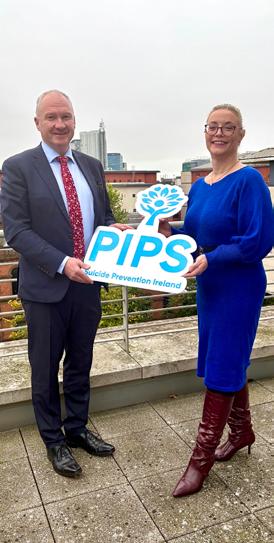
Mark’s chosen charity is the suicide prevention charity PIPS, and we hear from the organisation as it outlines some of the work that it carries out.
I hope you will all support this worthy cause through the various fundraising events that will be organised next year.
I wish you all a happy Christmas and a peaceful New Year, and I look forward to updating you next year with the latest Society news, events and developments.
David Lavery CEO Law Society of Northern Ireland
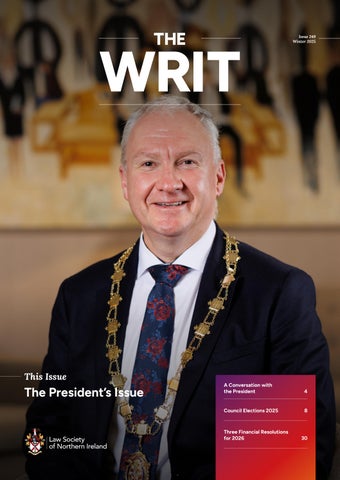
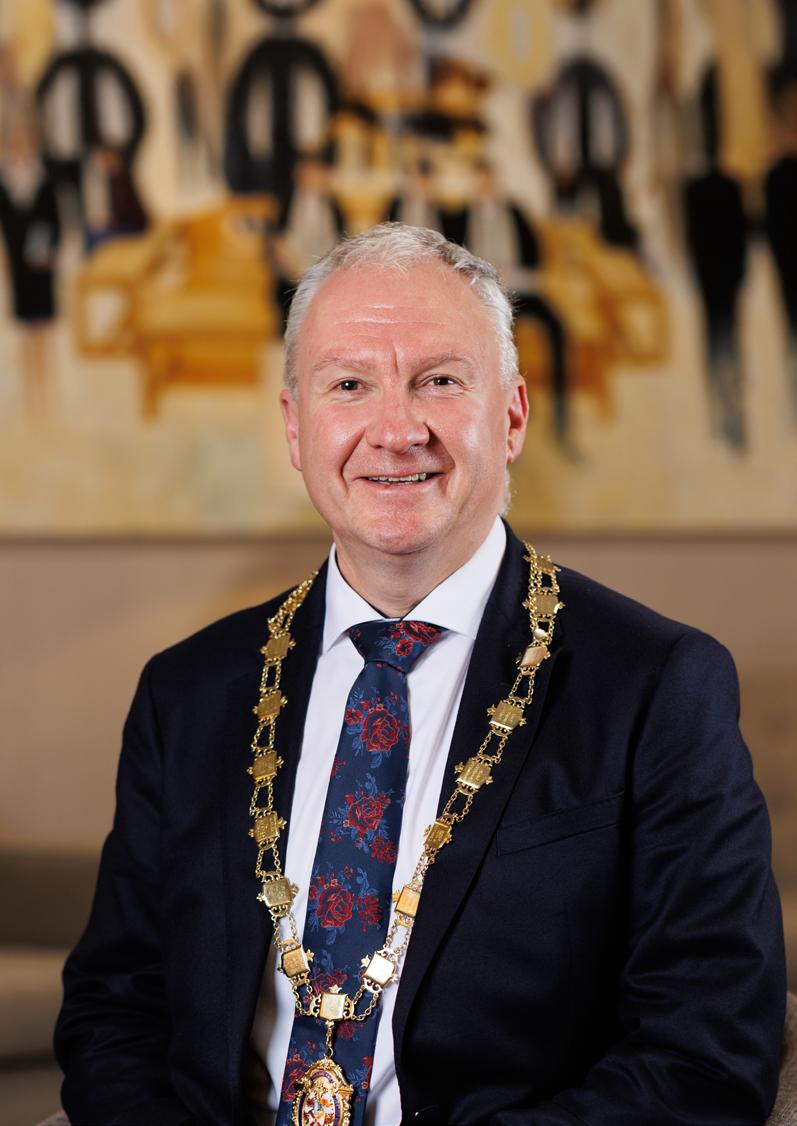
A Conversation with the Law Society of Northern Ireland’s new President, Mark Borland
When you meet the Law Society of Northern Ireland’s new President, Mark Borland, the first things you notice are his candour and his calm. He speaks with the ease of someone who has spent three decades reassuring anxious clients in an Antrim office, yet there’s real urgency behind the themes he wants to champion during his presidential year.
For Mark, two priorities will shape everything ahead: first, the Society working to improve its connection with its members and, second, strengthening the profession through fair remuneration. Both ideas flow from his roots as a small firm solicitor, his belief in the profession’s collegiality, and a determination to shift long-held perceptions of the Society.
Early days, Antrim roots and the seed of a legal career
Mark was born in Derry/Londonderry but grew up in Antrim and Crumlin, raised in a close-knit family far removed from the legal world. The profession entered his life almost by chance.
‘When I was in my early teens, my American uncle asked what I wanted to do with my life,’ he laughs. ‘I told him I had no idea He said, ‘You’re clever, be a lawyer.’ That was it. From that point on, whenever anyone asked, I said I was going to work in the law.’
He studied at the University of Dundee, completing a four-year programme that began with Scots law and finished with the English law degree. After graduating in 1994, he returned home, qualifying in 1996, and has never left the firm he joined as a trainee. Conway, Todd & Co. is still his professional home, now as a senior partner.
Life in a small practice: ‘good people at their worst’
Mark practises non-contentious law, working in conveyancing, property, wills and probate. His description of the work is both affectionate and honest.
‘In criminal law you often see bad people at their best,’ he reflects. “In my line of work, you see good people at their worst - stressed, grieving, or overwhelmed.’
His approach is simple: ‘caring, but business-like.’ Clients need empathy, but they also need quiet confidence that their solicitor will get the job done.
Small-firm life has shaped him: the variety, the pace, the community links, and the need to be nimble. ‘Our size makes us more agile,’ he says. ‘We made a business decision years ago to diversify our practice to the point that if Legal Aid disappeared overnight, we’d feel it but it wouldn’t close us. That flexibility is a strength.’
So too is word of mouth. ‘Antrim isn’t a place where you need a massive marketing budget, you need a good reputation. One conversation in the shop can be as valuable as any advertisement.’
But there are challenges too: client retention, pressure on pricing, and the never-ending work of building and maintaining a client base. ‘We don’t have annual returners like accountants do. People don’t buy houses every year. So you look after them well and you hope they remember and maybe recommend you to a friend or family member.’
Collegiality and local communities
One theme Mark returns to again and again is collegiality. ‘We all need to be able to lift the phone to a colleague. I might be on the other side of a transaction in which I need help next week.’
Strengthening that collegiality across Northern Ireland is part of his vision. During his year as Junior Vice President, he has chaired the newly established Local Association Forum - a monthly meeting with office holders from every local association. As President, he intends to bring it formally to life with a new affiliation scheme, including financial support for local groups.
‘Seeing people face-to-face is how collegiality works,’ he says. ‘Local associations are the backbone of that.’
Nine years on Council: why he serves
Mark joined Council in 2016, encouraged by a colleague who was stepping down. He had already volunteered elsewhere and felt ready for something new.
‘The profession has been good to me. Joining Council was a chance to give something back - to get out, learn something new and help shape the future of the profession,’ he says.
He has seen up close the work of the Society that makes a real impact on the profession but too often goes unseen: increases in hourly rates, changes to County Court scale fees, and the steady development of key property documents such as replies to enquiries and Home Charter forms.
‘These things don’t happen by accident. They take years of work by volunteer Council and Committee members working closely with the Secretariat of the Society. But because they’re incremental and too often we don’t communicate them well, members aren’t aware of the hard work we do representing their interests.’
This insight leads directly to his first presidential theme.
Theme 1: Reconnecting with members
Mark is clear-eyed about the perception challenge facing the Society.
‘There’s been a period of at least 25 years when if a letter arrived from the Society, the first reaction was: ‘Oh no.’ We have to change that.’
The shift he wants is cultural as much as structural.
‘Members should see the Society as their ally - there to provide guidance and assistance and to represent their interests,’ he says.
‘Not an enemy. Not an organisation waiting to catch and punish.’
He sees the new direction as a pivot from compliance-through-fear to compliancethrough-support.
‘We want members to know: we’re here to help you be compliant. We can provide the templates, the checklists, the guidancethe practical tools that save you time and reduce risk.’
Some of this work is already underway. A new template for AML risk assessments is about to be published, with more tools to follow.
Crucially, Mark wants members to hear repeatedly what the Society achieves on their behalf.
‘We’ve had wins, real wins. But we haven’t told people. That has to change. We need consistent messaging where we say: here’s what we’re doing, here’s what we’ve achieved, and here’s where we need your views.’
This aligns with the Society’s wider strategy to reset the relationship with members, modernise communications, show visible value, and rebuild trust.
Theme 2: Strengthening the
profession through fair remuneration
Mark’s second theme touches a nerve across the profession: the connection between fair remuneration, sustainability of practice, and access to justice.
Mark wants to build on the progress made under his predecessor, Colin Mitchell, where evidence-based engagement with Government achieved real tangible results such as a 16% interim uplift in legal aid fees, a 23% increase in County Court Scale Costs, and a 50% increase in the hourly rate for solicitors allowed on taxation of costs.
‘People need to understand the difference between price and value,’ he says. ‘Lowest price doesn’t mean best value, especially in legal work.’
He has seen first-hand the costs of undercutting. He shares one example: a couple who chose the cheapest conveyancing quote only to discover their property was incorrectly registered as a joint tenancy, a mistake that cost money and exposed them to risk.
‘That error could have been avoided entirely if they’d had a proper conversation about what suited them. Cheap isn’t always good.’
The policy landscape matters just as much. Mark wants to see the recommended 16% interim increase in Legal Aid rates finally implemented, alongside a regular review system so funding keeps pace with reality rather than requiring periodic battles. And for him, this isn’t only about solicitors’ incomes; underfunding hits support staff first, from legal secretaries to administrative teams who keep firms running. Fair pay, he says, underpins the stability of practices and access to justice.
‘Secretaries and admin staff are the lifeblood of our firms,’ he says. ‘Fair pay isn’t about enriching solicitors - it’s about keeping offices open and ensuring access to justice.’ Promised increases in remuneration which fail to materialise mean solicitors cannot keep promises on staff pay, exacerbating the existing problems of staff recruitment and retention.
He also wants solicitors themselves to value their own expertise. ‘If you’re known as the cut-price option, it’s very hard to raise your fees later. We’ve always held the line and delivered real value for clients for fair fees and it has worked.’
A stronger voice and a clearer message
Mark believes the Society must talk more openly and more often about its work. A recent communications audit confirmed that members want clearer storytelling, better updates, tailored content, and a more confident public voice.
‘Operationally, the Law Society is excellent and has achieved so much for the profession,’ he says. ‘But members don’t always see that because we’ve been too quiet about our achievements. We need to change that.’
He welcomes steps already underway and in advanced planning:
• Upgrading the E-nformer and website
• Relaunching The Writ with a stronger editorial vision
• Increased member engagement
• More proactive media commentary on justice issues.
‘Members deserve to know what we’re doing for them. And the public deserves to understand the value of what solicitors do every day.’
Who he is outside the office
Away from work, Mark’s life revolves around his teenage children. ‘I spend a lot of time being a taxi,’ he smiles.
He cycles when he can to support ‘mind, body and spirit’, usually 20–30 miles with friends on weekends. He jokes: ‘You don’t get a body like this by accident.’
His cultural tastes are eclectic:
Favourite books: Louis de Bernières’ South American Trilogy
Favourite artist: Bruce Springsteen
Favourite films and TV: Dangerous Liaisons, The Wire, The Good Place, and Normal People
Favourite podcasts: The Rest Is History and The Wolf & Owl
What success would look like
At the end of his presidential year, what would he most like to say he achieved?
His answer is immediate.
‘If a poll of members could say, ‘The Society genuinely works for me,’ that would be success.’
He pauses, then adds with realism:
‘I don’t think I’ll get the whole way there. But I hope we’ll be closer. Much closer.’
Changing perceptions takes timebut Mark believes the shift has begun.
‘We need to get the messaging right, we need to keep showing members the value of the Society, and we need to help them do their best work. If we can make progress on that, the profession will be stronger for it.’
A presidency rooted in service
Mark’s year ahead is shaped by the same mindset that has defined his practice: practical help, steady progress, and respect for people.
He wants members to see a Law Society of Northern Ireland that supports them, stands up for them, and values the work they do for their clients and communities.
‘We’re here to help our members thrive, not just survive,’ he says. ‘That’s how we strengthen the profession and the justice system we serve.’
Teri Kelly Total Reputation
Saving Lives, Building Hope PIPS Suicide Prevention Charity:
In a society where mental health challenges continue to cast long shadows, PIPS Suicide Prevention Charity stands as a beacon of hope. A non-government-funded organisation, PIPS Charity provides life-saving counselling and crisis support to individuals and families affected by suicide and poor mental health across Northern Ireland.
PIPS is also a founding partner of The Royal Foundation’s National Suicide Prevention Network – a four-nations collaboration driving lasting, UK-wide change in suicide prevention. This partnership highlights PIPS Charity’s leadership and commitment to ensuring that no one faces crisis alone.
The need for its work has never been greater. Around one in five adults in Northern Ireland are estimated to have a probable mental illness, and suicide continues to devastate communities. In 2023, the suicide rate reached 13.3 deaths per 100,000, with men accounting for nearly four in five deaths. Those living in deprived areas remain disproportionately affected, revealing a stark and persistent inequality.
Behind these statistics are lives in crisis –and that’s where PIPS steps in. Offering free, confidential counselling and a walk-in crisis service in Belfast, alongside phonebased and out-of-hours support across the region, PIPS ensures help is available quickly and without barriers. Its Friday Night Crisis Helpline (Friday 9 pm – Saturday 10 am) provides vital cover for those in urgent need when other services are closed.
Beyond crisis response, PIPS Charity addresses isolation through its Chat and Chapters befriending service, delivered in partnership with Libraries NI across 13 locations.
The charity’s impact is remarkable. In the past year, PIPS Charity delivered over 8,200 client sessions, 184 crisis interventions, nearly 500 counselling sessions for children, and responded to 6,500 phoneline calls. Its outreach extended to 111 schools, workplaces, and community settings, supported by 87 volunteers contributing more than 1,000 hours each month.
The urgency of this work cannot be overstated. Suicide remains the leading cause of death for under-35s in Northern Ireland, with 221 deaths recorded in 2023 –far exceeding road fatalities. In 2022, over 8,000 people presented to A&E with self-harm and 5,600 with suicidal ideation.
Since the pandemic, referrals and crisis interventions have surged as the long-term effects of isolation, trauma, and financial pressure continue to unfold. With offices in Belfast, Derry/Londonderry, and Enniskillen, PIPS Charity continues to expand its reach but relies entirely on public donations, fundraising, and volunteers to sustain its services.
We look forward to working with the Law Society of Northern Ireland to raise vital funds, awareness, and hope - ensuring that more people across Northern Ireland can access the life-saving support they deserve.
Renee Quinn, CEO of PIPS Suicide Prevention Charity, said:
‘We are deeply honoured to be chosen as the Society’s Charity of the Year for 2026. This partnership shines an important light on the ongoing mental health challenges faced by individuals, families, and communities across Northern Ireland. Every conversation, every act of support, and every donation helps us to save lives and offer hope where it’s needed most. Together, we can make a real difference in preventing suicide and promoting wellbeing for all.’
With your support, PIPS Charity will keep doing what it does best: saving lives, offering hope, and reminding people that no one must face crisis alone.
Council Elections 2025: A Stronger Mandate, Broader Representation, and Renewed Member Engagement
The Law Society of Northern Ireland is pleased to share the results of the 2025 Council election, which marks the beginning of a new three-year term for the governing body of the solicitor profession. This year’s election saw a significant rise in engagement across the profession, with turnout increasing to 28.2%, a notable uplift from 17.8% in 2022.
Council elections are an important moment in the Society’s calendar. They offer every solicitor the opportunity to shape the leadership that guides the strategic direction of the profession, supports practitioners in day-to-day practice, and upholds the highest professional standards.
A transparent and inclusive process
Members elected 21 Ordinary Representatives and three Eastern Constituency Representatives. In the Northern and Southern constituencies, the number of candidates matched the number of available seats; in line with election rules, these nominees were therefore returned unopposed.
Voting took place online, with 1,342 votes cast in the Ordinary Representative ballot and 225 votes in the Eastern Constituency election.
The increase in turnout demonstrates a renewed willingness among members to contribute to shaping the Society’s priorities for the 2025–28 term.
Welcoming new and returning Council members
The Society is delighted to welcome 13 newly elected Council members, alongside 17 returning representatives who bring continuity and institutional experience. In total, 13 members concluded their Council service this year, and the Society extends its sincere thanks to those colleagues for their contribution and dedication to the profession.
A positive year for women’s leadership
One of the most encouraging aspects of this year’s election was the strong performance of women candidates. Women placed highly across the ballot, and one third of all newly elected Council members are women.
The Society acknowledges the sustained efforts of the Women’s Network, which encouraged women to stand for election and supported members throughout the nomination and voting period.
Brigid Napier, Chair of the Women’s Network, reflected on the significance of this year’s outcome, ‘this year’s election shows what is possible when women are encouraged and supported to put themselves forward. The Women’s Network made a sustained effort to promote participation, and we are proud to see so many talented women elected to Council. Representation matters, not only because it brings different perspectives, but because it signals to women at every stage of their career that leadership is open to them. We will continue to champion and support women across the profession in the years ahead.’
The Society remains committed to fostering an inclusive and representative Council that reflects the diversity of the solicitor profession in Northern Ireland.
Looking to the next three years
The new Council begins its term at a time of ongoing evolution for the profession and the Society. As highlighted in recent member consultations, priorities for the coming period include strengthening communication and engagement, amplifying the Society’s voice on justice and law reform, and continuing to support solicitors through operational, regulatory and financial pressures.
The 2025–28 Council will guide the organisation through:
• The implementation of a refreshed communications and engagement strategy
• Continued investment in member services and practice support
• Strengthening LSNI’s public and media profile as a trusted expert voice
• Deepened regional engagement and outreach
• Ongoing work to advance equality, diversity and inclusion
David Lavery, Chief Executive, welcomed the incoming Council, ‘Council plays a central role in guiding the direction of the solicitors’ profession, and I am delighted to welcome both new and returning members for the 2025–2028 term. The strong turnout demonstrates a renewed commitment among solicitors to shaping the future of the Society and the profession. This is an important step in ensuring the voices around our table reflect the profession we serve.’
Teri Kelly
Total Reputation
Council members
President: Mark Borland
Senior Vice-President: Colin Mitchell
Junior Vice-President: Eoghan McKenna
Treasurer: Brian Speers
Council Members
Philip Armstrong
Angela Brady
Joanna Burns
Louise Butler
Simon Chambers
Brian Charity
Karen Cherry
Eimer Coll
Niall Colton
Jude Copeland
John Fox
John Guerin
Catherine Heyes
Helen Madden
Seymour Major
Julie-Ann McCaffrey
Joseph McVeigh
Joseph Napier
Kevin Neary
John O’Prey
Julie Ann Osborne
Seamus Reid
Lenore Rice
Darren Toombs
Brian Walker
Rowan White
In defence of the Human Rights Act 25 years on
The Human Rights Act is again under attack. The UK government has set out its intention in its ‘Asylum and returns policy statement’ to reform asylum and immigration processes, including reforms to Article 8 (right to family and private life) and an intention with international partners to discuss ways of reinterpreting Article 3 (freedom from inhuman and degrading treatment) to restrict its scope in certain immigration circumstances. The Conservative opposition and Reform have gone further, committing to leaving the Council of Europe and the European Convention on Human Rights altogether.
The criticisms of the Human Rights Act and the Convention are the latest in a long line of sideswipes. Among the tropes is that politicians’ hands are tied by unelected judges through their use of the Act. In addition, critics allege that the Act has led to an overreach going far beyond what was ever intended.
However, statistics suggest that criticisms are unwarranted. By way of illustration, there were more breaches of the Convention found by the Strasbourg court in the year before the Human Rights Act was introduced in October 2000 than cases actually proceeding to the Court in the past five years. Moreover, the UK now has the lowest number of applications per population (three per million) than any other Contracting State. In addition, the Strasbourg Court has shown increasing deference to the UK Supreme Court, with the most recent example being Nealon and Hallam v UK (2024), where the Supreme
Court took a different approach to previous Strasbourg court decisions in upholding statutory law that denies automatic compensation for miscarriages of justice by effectively putting the onus on the person wrongly convicted to still show beyond a reasonable doubt, they did not commit the crime. The Grand Chamber agreed and dismissed the applicant’s case, holding that the refusal to award compensation did not amount to attributing criminal liability, and, in any event, Article 6(2) (the right to a fair trial) did not guarantee individuals a right to compensation where criminal convictions had been quashed.
The argument that the overreach into Parliamentary sovereignty has simply shifted to the UK courts through the Human Rights Act also fails to hold water. The higher courts have generally taken a cautious approach in both reading down legislation under Section 3 of the Act and issuing Declarations of Incompatibility under Section 4. It is instructive that the key case law on interpreting the legislation is more than 20 years old, with Ghaidan v Godin- Mendoza (2004) remaining the oft quoted key case and one in which government lawyers argued for using Section 3 to read down the existing legislation which prevented a statutory tenancy being provided on succession to the surviving member of a long term gay relationship. Furthermore, by November 2024, there had only been 52 declarations of incompatibility issued by the High Court and beyond, with 34 dealt with by a change of law, 12 overturned on appeal and six still pending.
The cautious approach taken to the relationship between the Executive and judiciary can be seen from the UK Supreme Court’s judgment in SC v SoS for Work and Pensions (2021) – the challenge to the two-child limit on entitlement to Universal Credit and other means-tested benefits. Lord Reid at paragraph 162 noted that:
‘In practice, challenges to legislation on the ground of discrimination have become increasingly common in the UK. They are usually brought by campaigning organisations which lobbied unsuccessfully against the measure when it was considered in Parliament and then act as solicitor for persons affected by the legislation or otherwise support legal challenges brought in their names, as a means of continuing the campaign….since the principle of proportionality confers on the courts a very broad discretionary power, such cases present an undue risk of interference by the courts in the sphere of political choices. That risk can only be avoided if the courts apply the principle in a manner which respects the boundaries between legality and the political process.’
The Supreme Court went on to unanimously hold that there had been no breach of Article 14 read with Article 8 and that the decision to confine certain social security benefits to two children only was not ‘manifestly without a reasonable foundation’ in terms of the test under freedom from discrimination.
It is also noteworthy that the Independent Human Rights Act review published in December 20211 concluded that the Act was working well and suggested only minor changes.
This is not to say that the Human Rights Act has not had an important impact, including in curbing the Executive on occasion.
The Dillon and others judgment of the Northern Ireland Court of Appeal last year (now before the Supreme Court) served as the death knell for the Northern Ireland Troubles (Legacy and Reconciliation) Act 2023, holding, among other conclusions, that provisions granting immunity from prosecution were contrary to Articles 2 and 3 (right to life and freedom from inhuman and degrading treatment). It also said that preventing civil claims from being pursued was a breach of Article 6 (right to a fair trial). Moreover, JR 295 also found that the provisions of the Illegal Migration Act, which dispensed with the assessment of asylum claims and introduced removal to Rwanda or country of origin, were also contrary to the Convention. Both cases illustrate the role that the Human Rights Act plays in preserving due process and protecting fundamental rights.
The current proposals to curtail asylum seek to limit Article 8 rights in a number of ways:
• First, by resetting the balance between an individual’s right to family life and the wider public interest by placing a much greater emphasis on complying with immigration rules, thereby narrowing the circumstances where the right to family life outweighs the public interest.
• Secondly, by setting out the definition of family life to not go beyond immediate family, save where someone is acting in a parental capacity or where there is an exceptionally close emotional link.
• Thirdly, by preventing people from making claims from abroad to join family members in the UK where they don’t readily meet the family immigration rules and removing late claims under Article 8.
• In addition, while accepting that no one should ever be tortured under Article 3 of the Convention, the UK government is seeking with other international partners reform to the scope of Article 8 by narrowing the interpretation of what constitutes inhuman and degrading treatment, particularly when seeking to deport individuals who will not have their mental and physical health care needs met in the country of origin alongside cases where a serious crime has been committed.
In May 2025, the Home Office published research2 examining the influences on asylum seekers in deciding to come to the UK. The study concluded that there is no single factor nor even set of factors that influences the decision. Instead, decisions are determined by context, time and evolving circumstances. Other research3 published by the Home Office in 2020 found that social networks and shared language often play an important role in shaping migrant movement, while welfare policy and labour market access have little influence on destinations chosen. The report also observed that the majority of refugees and internally displaced people stay within their neighbouring region.
The lesson from this is that calls to repeal or significantly dilute the Human Rights Act are neither evidence-based nor likely to work as the policy panaceas claimed. It is time for both parts of the profession and other interested groups and individuals to begin to make the case for the value of the Act based on reality and not rhetoric.
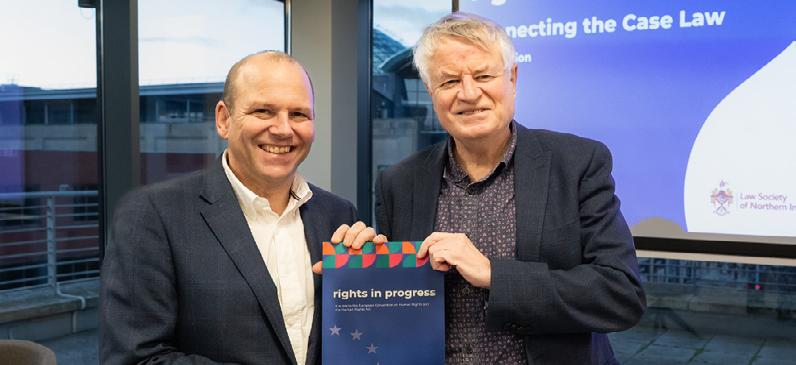
Les Allamby is the author of Rights in Progress – A Guide to the European Convention on Human Rights and Human Rights Act (5th edition) published by Law Centre(NI) and funded by the Law Society of Northern Ireland. 1
Les Allamby Solicitor and Former Director of Law Centre (NI) and Former Chief Commissioner of the NI Human Rights Commission
The Importance of the Master Policy and Cyber Insurance in Managing Cybersecurity Risks
The cybersecurity threat landscape is becoming increasingly complex, and we have witnessed an uptick in cyber notifications/incidents being experienced by law firms in Northern Ireland. In conjunction with the Law Society of Northern Ireland (‘the Society’) we felt it was timely to provide this article setting out the role the Master Policy Scheme (MPS) plays in managing cybersecurity risks and the importance of standalone cyber insurance.
The threats Member Firms face are predominantly from phishing emails, ransomware and data breaches resulting from emails being sent to the incorrect recipient. We anticipate that the severity and frequency of such threats will increase with the rise of artificial intelligence (AI).
The Role of the Law Society’s Master Policy Scheme (‘MPS’)
The Society’s MPS provides some cover for loss of client funds following a cyber event, if the loss is a result of the solicitor’s professional negligence. This is something usually excluded from PII policies in most other professions. However, the excess payable under the MPS of a minimum of £6,500 will likely be higher than a cyber policy excess.
It should be noted that the MPS will not contain first-party coverage for events such as:
• Loss of the Member Firm’s own money;
• The Member Firm’s costs of dealing with a data breach;
• Fines, penalties and notification costs;
• Loss of income or increased costs following a ransomware or denial of service attack;
• Restoration of lost data, documents or programmes; or
• First response data restoration, forensic IT, PR or legal services support.
Cyber insurance
As mentioned above, the MPS does not provide cover for the loss of a Member Firm’s own funds or the cost to the firm managing the incident. We therefore cannot stress enough the importance of Member Firms purchasing separate cyber and crime insurance cover to protect them from such losses.
Cyberattacks and data breaches can severely damage the reputation of a business, and clients increasingly expect their law firms to be cybersecure. Having cyber insurance will protect a Member Firm in the event of a cybersecurity incident and assist with the management of all aspects of the incident.
In broad terms, the following are the key benefits of cyber insurance:
• Risk mitigation;
• Financial safeguard;
• Regulatory compliance;
• Business continuity;
• Reputation management; and
• Competitive advantage
Furthermore, preloss tools help with early detection, monitoring and vulnerability management.
In the event of a claim, you can access 24/7 incident response, including forensic IT analysts, specialist legal counsel and crisis PR, as a swift response is crucial to mitigating the impact.
Cyber insurance, when coupled with PII, provides a complete risk management solution for Member Firms. Comprehensive advice on cyber security awareness, including risk management and cyber insurance, has been curated on the Society’s website. To obtain a quotation from Brown & Brown for a specific cyber policy, please email Alan Boal, Account Director.
During the application process, you may be asked about:
• Turnover, number of staff, core services;
• Current security measures such as encryption, multifactor authentication, firewalls, patching, backups;
• Specific plans addressing incident response, business continuity, and data protection protocols;
• Copies of staff training records and audit reports (e.g., Cyber Essentials certification);
• Details of any recent cyber incidents: type (ransomware, phishing, data breach), financial impact, remedial steps taken and improvements made since the event; and
• Approximate figures for IT security spending in the last financial year (staff, hardware, software, services) and projected spend for the upcoming year.
The process may include a review of your IT environment and cybersecurity configuration, and underwriters may utilise threat intelligence frameworks to evaluate your risk level and seek to align this with suitable coverage and pricing.
Conclusion
It is clear that Member Firms are operating in a complex, volatile and evolving cybersecurity landscape. Due to the complexities, frequencies and severity of these risks, there is no single security solution. Member Firms need to adopt a multi-layered approach to protect themselves.
Operating a cybersecure culture throughout the firm and ensuring everyone receives the necessary training, as well as following the guidance issued by the Society and reinforcing its Call, Check, Confirm procedures1 , will help protect against these vulnerabilities and minimise the risk of cybersecurity incidents from arising.
There have been numerous circumstances where we have been able to reduce the risk exposure following a cybersecurity incident involving loss of monies. We have worked with Member Firms to recover either all, or a significant percentage of the monies lost following those incidents. We cannot stress the importance of early engagement with us as your broker should a cybersecurity incident arise.
Joanne Cracknell Director Willis
Simon Hunter Claims Advocate Brown & Brown
Anti-Money Laundering and Counter Terrorist Financing (together ‘AML’) Update
The Society’s Head of AML Policy, Brian Carson, highlights a few of the main AML developments during 2025 and what the 97% of solicitor firms in Northern Ireland providing services in scope of the Money Laundering Regulations 20171 (‘the MLRs’) can anticipate next.
AML developments during 2025
1. New LSAG AML Guidance (April 2025)
The Legal Sector Affinity Group (LSAG), which comprises all the UK legal sector professional body supervisors including the Society, published the latest update to its main single sector AML Guidance for the Legal Sector 2025 (‘the LSAG Guidance’) in April 2025.
The LSAG Guidance included a ‘Schedule of amendments’ setting out the updates that were made.
The LSAG Guidance was approved by HM Treasury and remains the principal AML/CTF sector guidance to support members in the prevention of money laundering and terrorist financing and compliance with the MLRs.
The LSAG Guidance is available on the Members Dashboard of the Society’s website here. It is essential reading for all members providing services in scope of the MLRs.
2. New UK National Risk Assessment of Money Laundering (ML) and Terrorist Financing (TF) 2025 (‘2025 NRA’) (July 2025)
HM Treasury and the Home Office published the UK’s fourth National Risk Assessment of Money Laundering (ML) and Terrorist Financing (TF) in July 2025. The 2025 NRA found that Legal Service Providers continue to be assessed at High risk of ML and Low risk of TF, and that risk increases where legal professionals are complacent, take a ‘tick box’ approach to compliance, or lack sector-specific knowledge and/or training on the money laundering threat. Conveyancing, trust or company services and misuse and exploitation of client accounts continue to be assessed as the highest risk services.
Solicitor firms should review the 2025 NRA and consider how its findings apply to their practice, the services that they provide and their client base, and update their own firm-wide risk assessments and corresponding policies, controls and procedures as appropriate.
A detailed review of the 2025 NRA and its importance for solicitors and their firms was published in the last (Autumn 2025) edition of The Writ, available here
3. The Proceeds of Crime (Money Laundering) (Threshold Amount) (Amendment) Order 2025 SI 877 (July 2025)
Following the coming into force of the above Amendment Order on 31 July 2025, the threshold amounts in s339A of the Proceeds of Crime Act 2002 (POCA) were increased from £1,000 to £3,000.
The thresholds are the level below which certain businesses in the regulated sector can, in certain circumstances, be exempted from the principal money laundering offences under sections 327-329 of POCA.
For solicitor firms in scope of the MLRs, this increase is relevant to the ‘de minimis’ or ‘paying away exemption’ (introduced under the Economic Crime and Corporate Transparency Act 2023).
Provided that the strict conditions set out in POCA are met, solicitor firms can now return less than the new threshold amount of £3,000 to a client when ending a business relationship without committing a principal money laundering offence.
Further details on the ‘paying away exemption’ and the conditions that must be satisfied are available in the updated LSAG Guidance (Paragraph 16.4) referred to earlier. Those conditions include that the solicitor must have complied with their duty to apply Client Due Diligence measures under the MLRs. They must still submit an information Suspicious Activity Report to the National Crime Agency (NCA) if they know or have reasonable grounds to suspect that the client is involved in money laundering or terrorist financing.
It is also important to highlight that the LSAG Guidance states that:
‘It should be noted that the [de minimis/ paying away] exemption is extremely narrowly defined, and therefore it is LSAG’s opinion that it is likely to apply very rarely.’
The government has also published updated Guidance on the exemptions from the money laundering and reporting obligations in POCA.
4. The Society’s latest AML Supervisor’s Annual Report (October 2025)
The Society has published its fifth AML Supervisor’s Annual Report covering the 2024/25 reporting period. The Report is publicly available on the Society’s website here
The Report is published as part of the Society’s responsibilities as the AML professional body supervisor for solicitors in Northern Ireland. The Society is committed to supporting firms in meeting their obligations under the MLRs and the Report is an important aid in this regard.
The Report provides an overview of the Society’s risk-based approach to its AML supervision, including details of:
• The demographic, risk assessment and risk profile of the Society’s sector,
• The Society’s monitoring activities,
• Supervision and enforcement actions with case studies of real-life examples demonstrating the Society’s increasingly educative approach,
• Key themes identified by the Society including the most common forms of non-compliance, trends that emerged and examples of good practice by firms,
• Actions taken by the Society in response with analysis,
• Information on SAR reporting and financial sanctions,
• Progress on areas of focus in the reporting period and future areas identified, and
• AML resources available to the Society’s members.
The Society was pleased to be able to report that in the 2024/25 reporting period the Society, inter alia:
• Completed more desk-based reviews (DBRs) and Onsite assessments of relevant Firms, 214, than in the prior 2023/24 reporting period, 163. This represents a 31% increase in the total of completed DBR and Onsite assessments of relevant Firms from the previous 2023/24 reporting period.
• Completed more DBRs and Onsite assessments across all High, Medium and Low risk categories of relevant Firms while increasing the proportion of assessments undertaken of firms categorised as High risk at the time of assessment.
• Assessed 76% of DBRs and Onsite assessments with a compliant or generally compliant AML/CTF outcome, with 24% non-compliant and formal actions taken by the Society.
While acknowledging a 6% increase in non-compliant outcomes in the reporting period from 2023/24, taking into account the 31% increase in the total number of completed DBRs and Onsite assessments of relevant firms in the period, the Society considers these findings demonstrate continued high levels of AML/CTF compliance by relevant firms in its sector.
Consideration of the Report will support and equip firms in their own risk-based approach and in maintaining their policies, controls and procedures as required under the MLRs. This is of particular note, when the common themes reported include that non-compliance with AML/CTF obligations was found across all sizes of firms.
Looking ahead
As 2025 comes to an end, AML developments continue apace, and the Society will continue to update members accordingly.
At the time of writing, the NCA’s UK Financial Intelligence Unit (UKFIU), which administers the UK’s SAR regime, is shortly due to publish its new SAR guidance, which will replace existing guidance following an extensive review.
HM Treasury’s response in July 2025 to its consultation on Improving the Effectiveness of the Money Laundering Regulations set out a number of proposed amendments to the MLRs. HM Treasury has since undertaken a technical consultation on a draft Statutory Instrument of these amendments. While the outcome of this technical consultation is awaited, further amendments to the MLRs can be anticipated. In turn, further update(s) to the LSAG Guidance will likely follow.
Finally, the Government has announced its decision on AML supervision reform to create a Single Professional Services Supervisor. Specifically, responsibility for AML supervision of the Solicitor profession and of all UK legal, accountancy and trust or company service providers (TCSPs) will transfer to the Financial Conduct Authority (FCA).
A definitive timeline for implementation of this transfer is awaited, however at this stage HM Treasury acknowledges that ‘implementation will inevitably take several years’. The Society will use this transition period to ensure that the outcome meets the requirements of our member firms.
Further details on AML supervision reform are available on the Members Dashboard of the Society’s website here.
Brian Carson Head of AML Policy Law Society of Northern Ireland
The following are a selection of graphs from the Society’s latest AML Supervisor’s Annual Report:
Annual Dinner
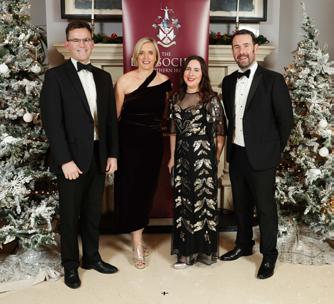
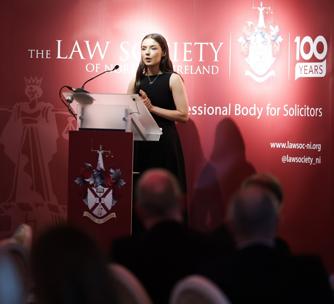
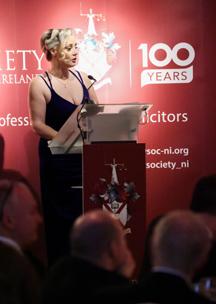
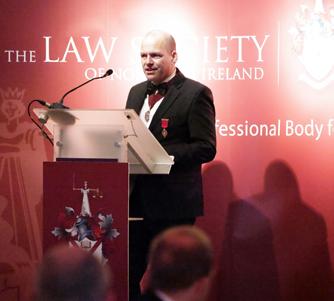
The Society’s Annual Dinner took place at the Culloden Estate and Spa on Thursday 11 December 2025. Just over 180 members attended including 65 newly admitted solicitors.
Speeches were delivered by new Society President Mark Borland, Isabel Bittles on behalf of the newly admitted solicitors, Mr Justice O’Hara Chair of the Council of Legal Education Ireland and Renée Quinn Executive Director of PIPS Suicide Prevention Ireland.
Beyond Belfast Strengthening the Voice of Our Regional Firms
This year, member engagement remained a central priority for the Society as we continued to amplify regional perspectives to help build a more connected, resilient, and representative solicitor profession.
Listening and learning across the regions
Across the country, 2025 President Colin Mitchell was warmly welcomed by local solicitor associations, meeting with practitioners to listen to concerns and frustrations, exchange ideas, and provide greater visibility of the Society’s ongoing work and priorities.
Common themes emerged from these meetings, many of which are enduring and complex. Legal Aid remains one of the most pressing challenges for practitioners. While the 16% interim fee increase in most criminal, civil, and family Legal Aid cases was welcomed, the area remains increasingly commercially unsustainable, with more firms stepping back from this vital work.
The reduction in local court services and remote hearings, coupled with the centralisation of custody suites, continues to restrict access to justice for vulnerable clients and adds pressure on already stretched local firms.
Engagement with key stakeholders across practice areas has also highlighted systemic frustrations: from delays in the Matrimonial Office, to overly bureaucratic processes at the Legal Services Agency, and ongoing service-level issues with Land Registry and related conveyancing bodies.
Collaborating through the Local Association Forum
The President’s in-person visits to local associations complemented the Local Association Forum, an online meeting with representatives, held every six weeks and chaired by 2025 Junior Vice President Mark Borland. This forum has become an invaluable platform for discussion, collaboration, and collective problem-solving.
Two new standing agenda items were introduced this year to further enhance transparency and engagement.
First, Practice Committee Chairs now provide overviews of their committee’s remit and key priorities, raising awareness of the extensive, often unseen, work being done on behalf of members and the wider profession.
Second, members raise issues for peer discussion and potential escalation to the relevant committees or departments. These issues are tracked through a Status Report, updated and published after each meeting to maintain accountability and visibility of progress.
Focusing on safety and conduct
One topic that generated significant discussion this year was how best to handle challenging or inappropriate behaviour between legal professionals. Currently, if such conduct is brought to the Society’s attention, an approach is made on an anonymous basis to a senior member of the relevant body.
This conversation evolved into a wider focus on solicitor safety, following reports of harassment and threats of violence from members of the public towards solicitors. In response, the Society has launched a Solicitor Safety Campaign with two key strands:
Advocacy and representation - engaging with the Department of Justice and PSNI on the protection of solicitors in their professional capacity.
Practical safeguarding support - developing guidelines in partnership with the Suzy Lamplugh Trust, tailored specifically for the legal sector. These will provide actionable advice and resources for members facing threats or intimidation, including guidance on reporting, personal safety, and access to professional support.
Strengthening the network
The Forum has also played a central role in shaping proposals to formally affiliate local associations as part of the Society’s Governance Review. This initiative aims to strengthen relationships between the Society and local associations, offering structural support, regular meetings, and a financial grant scheme to help sustain future activity. Ultimately, this affiliation framework could serve as a stepping stone towards reimagining the Society’s Council constitution, ensuring even stronger regional representation.
Looking ahead
As we look ahead to 2026, Junior Vice President Mark Borland will enter his Presidential year with a well-established network of regional members and a deeper understanding of the issues facing practitioners across Northern Ireland. The Forum has expressed a strong appetite for in-person gatherings to share best practice and foster collaboration. We plan to facilitate this in the coming year and to continue exploring ways of supporting local associations.
The Society remains committed to its ambition of becoming ever more member-centric, connecting with, listening to, and acting on the voices of solicitors across every region. Strengthening these local networks is not only vital to supporting individual practitioners and firms, but also essential to building a more inclusive, resilient, and representative profession for the future.
Sheelagh Walton Member Services Development Manager Law Society of Northern Ireland
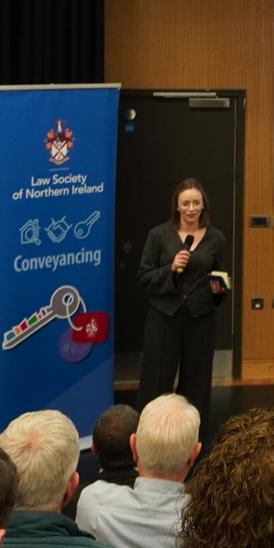
LSNI Conveyancing Week 13-17 October 2025
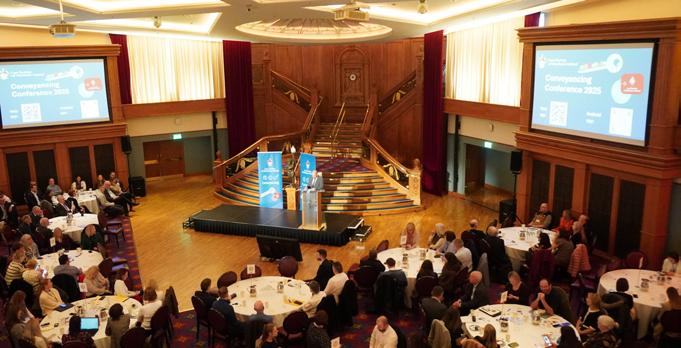
From 13-17 October, the Law Society of Northern Ireland held its third annual Conveyancing Week, emphasising the message: the central role a solicitor plays in helping people move home.
Building on the engagement from 2024, the Society reiterated this message to key stakeholders, including consumers, estate agents and surveyors. It also repeated previous events with law graduates and undergraduates, underlining their critical role in the future of High Street law firms.
This year, the Society was pleased to trial a paperless conference using an app with polling and Question and Answer facilities.
Highlights of Conveyancing Week 2025
The 12th annual Conveyancing Conference, supported by DUAL and a range of exhibitors, took place on Tuesday, 14 October at Titanic Belfast and was attended by over 400 delegates. The agenda was curated based on feedback from attendees at the 2024 Conference. Presentations in the morning session included:
• Mark Borland discussing practical AML for solicitors,
• an update from Christine Farrell, Registrar Land and Property Services on the upcoming digital changes,
• a Conveyancing update from Philip Armstrong, Chair of the Conveyancing and Property Committee,
• an interactive session on the work of the new build sub-group from Claire McNamee, Conveyancing and Non-Contentious Business Lead; and
• a Judicial update from the Honourable Mr Justice Huddleston.
The afternoon session included a presentation on Building Control matters where new builds are concerned; and a panel discussion regarding Article 161 Agreements with members of the Conveyancing and Property Committee Simon Murray and Brian Walker, chaired by Ellen Hartles. Input from engineers Kenny Elliott of Elliott Design and Mark Colvin of Sheehy Consulting and David Magee of Antrim Construction was provided. The presentation provided details on the practical and legal aspects of dealing with Article 161 Agreements. Written submissions on this session were provided by Northern Ireland Water.
The conference closed with a presentation from Catherine Heyes on practical things to consider when there is management company involvement.
A significant proportion of attendees contributed to the interactive conference by participating in live polling and questions on the day. Written responses to the questions will be provided to all attendees.
Feedback for this year’s Conveyancing Conference was extremely positive, and the comments made by members will be used to custom-tailor the Society’s CPD offering for the year ahead. The Society would also like to note its appreciation for all feedback, which is actively considered when planning future events.
Engagement events at the Institute of Professional Legal Studies (IPLS), Queen’s University Belfast and Ulster University Belfast took place on Wednesday 15 October. At these sessions, trainee solicitors and undergraduate law students heard from a panel of solicitors from across the province and with a range of post-qualification experience. They candidly shared their experience of working as conveyancers and highlighted what they enjoyed about the work they do and the professional satisfaction they receive from their career. Whether it was their commute to work or their involvement in the community, they also spoke on the benefits and perks of working in high-street practices. Each of these events was well-attended and received by the students.
The Society would like to thank all the panellists who took the time to speak with students and trainees: Ciaran Rafferty, Ciaran Hampson, Cormac McGirr, Ellen Bates, Nisha Mehan and Jonathan Scullion.
While issues with recruitment and retention persist, the Society is committed to deepening its relationship with the universities to promote a career in High Street practice. The Society would invite any firms that are interested in being involved to get in touch.
On Thursday, 16 October, the Society hosted its Solicitors, Surveyors and Estate Agents Breakfast Morning at the Hill of the O’Neill and Ranfurly House. Networking over breakfast was followed by a panel discussion with representatives from the Society, RICS, and Trading Standards and estate agents. The focus was on fostering collaborative working relationships. The Society was eager to emphasise the solicitor’s role in providing this information and show how early instruction can support the work that they do.
The Society would like to thank the panellists, Ellen Hartles, Brian Reid, Niall Maneely and Damien Doherty for their participation and all those who turned out to support the event.
The Society has also launched a consumer video which emphasises a solicitor’s role in the home-buying process. Aimed at first home buyers, this resource takes a look at the steps involved in purchasing a house and what a solicitor does. The video will be made available to members shortly.
The Society is delighted to have conducted another successful Conveyancing Week and is encouraged by the positive response it has received from the profession and other stakeholders as it continues to promote the important role of conveyancing solicitors.
The Society would like to once again thank all those who assisted with organising, participating and supporting these events.
Claire McNamee
Conveyancing and Non-Contentious Business Lead Law
European Young Bar Association’s Autumn Conference 2025
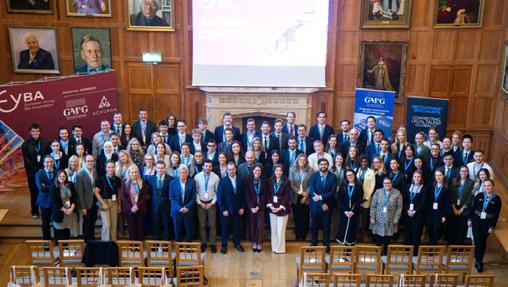
From 2-5 October 2025, the Northern Ireland Young Solicitors’ Association (NIYSA) proudly hosted the European Young Bar Association’s (EYBA) first Autumn Conference, marking a significant moment for the local legal community and showcasing Northern Ireland’s vibrant legal and cultural landscape to a European audience.
The EYBA Autumn Conference is a flagship event that brings together young legal professionals from across Europe to engage in professional development, networking, and cultural exchange. This year’s conference, held in the heart of Belfast, was a resounding success (despite the best efforts of Storm Amy)!
The theme of our conference was Emerging Legal Trends: Looking Back, Moving Forward and topics included:
• Human Rights Law in Practice (Darragh Mackin, Phoenix Law),
• Sports Law (Keith McGarry, Sports Law NI),
• Media Law & Defamation (Paul Tweed, WP Tweed & Co),
• Medical Law (Stephanie Johnston, Carson McDowell LLP),
• Climate Change (Maria O’Loan, Tughans LLP), and
• AI (Donna O’Leary, DOL Consultancy).
The four-day event kicked off on Thursday evening with a welcome reception at the iconic New Orpheus Bar, where delegates were greeted with music, local drinks and a chance to connect with peers from over 20 countries. The atmosphere was one of excitement and camaraderie, setting the tone for the days ahead.
Friday’s programme began in the Great Hall of Queen’s University Belfast. The event was moderated by Shannon Gawley (past president of the EYBA & Solicitor at Carson McDowell LLP) and featured welcome addresses from the Recorder of BelfastHer Honour Judge Smyth -, the President of the Law Society of Northern Ireland, Colin Mitchell, and Dr Michael Griem, President of the FBE. We were also delighted to welcome the Justice Minister for Northern Ireland, Naomi Long MLA, as our keynote speaker.
The conference continued on Saturday with a memorable panel discussion on Legal Innovation, Social Justice, Mental Health and AI, which featured Julie-Ann McCaffrey (DWF), Jude Copeland (CFR Solicitors) Maria McCloskey (Irish Rule of Law International) and Henry Nelson-Case (Lawyer & Content creator). We were delighted to receive such positive feedback and many of the delegates enjoyed hearing about the above topics from a Northern Ireland perspective. Thank you once again to our fabulous speakers!
A highlight of the conference was the gala dinner on Saturday evening held in the Game of Thrones Studios in Banbridge, which included a tour of the Studios, along with a welcome performance from a local Irish Dancing group. Dinner was followed by drinks and socialising at McConnell’s Distillery in Belfast for another taste of Northern Ireland! This was a truly unforgettable evening!
The conference concluded on Sunday with a breakfast at St. George’s Market, where attendees reflected on the insights gained and friendships formed. The NIYSA was widely praised for its seamless organisation, attention to detail, and the warm welcome extended to all participants. The success of the EYBA Autumn Conference 2025 is a testament to the dedication and vision of the NIYSA Committee, who worked tirelessly to deliver an event that was both intellectually enriching and culturally immersive. Our efforts have left a lasting impression on the EYBA and set a high bar for future conferences. As the delegates departed Belfast, many expressed a desire to return, not just for future legal events, but to further explore the warmth, resilience, and charm of Northern Ireland. For the NIYSA, the conference was more than just a professional gathering; it was a celebration of collaboration, growth, and the bright future of young lawyers across Europe.
Morgan Pennie
Solicitor
Pinsent Masons
The Problems of Joint Enterprise
‘Joint enterprise’ type cases have been significant in the most recent batch of referrals by the Criminal Cases Review Commission (CCRC) to the Court of Appeal in London. Joint enterprise, or more properly, secondary liability, is a legal doctrine that applies where persons assist or encourage another, the principal, to commit a crime. The scenario most often associated with this doctrine is where more than one person is prosecuted for murder, even though only one person struck the fatal blow. In this situation, Section 8 of the Accessories and Abettors Act 1861 allows for others who were not the principal offender to nonetheless be prosecuted for the same crime, where there is evidence of assisting or encouraging. It is useful to remind ourselves of the wording in s8 which reads:
‘Whosoever shall aid, abet, counsel or procure the commission of any indictable offence whether the same be an offence at common law or by virtue of any act passed, shall be liable to be tried, indicted and punished as a principal offender.’
There is a similar provision for summary offences.
S8 does not in itself create an offence but specifies how ‘accessories’ are to be dealt with. The term joint enterprise is ‘controversial and much misunderstood.’ 1 Most notorious is the abolition of parasitic accessory liability in the case of R v Jogee [2016] UKSC 8 2 However, it is important to remember that there are other errors that may be made within the scope of secondary liability. Below are two examples.
The ‘Gang Narrative’ referral: The Moss Side Murder
Durrell Goodall, Reano Walters and Trey Wilson were in their late teens when convicted and jailed in August 2017 for the murder of Abdul Hafidah, aged 18, in Moss Side, Manchester during the spring of 2016. There were thirteen youths charged with the murder of Abdul, all convicted, one of whom, Devonte Cantrill, stabbed the victim after a chase through the streets ending in the fatal knifing of the young man. The use of a music video and photographs of the convicted youths were presented as evidence of
gang membership and, therefore, gang involvement in the killing. This narrative would draw in, by virtue of a shared intent, others at the scene of the murder and encompass them as accessories. The ‘gang narrative’ theme has received criticism in comment on this and other cases.
Keir Monteith KC, Garden Chambers, is representing Goodall, Walters and Wilson. He is a member of ‘Art Not Evidence’, a group that seeks to restrict the use of art, including music and rap videos, as evidence in criminal trials. Monteith has praised the CCRC’s referral of his clients’ cases for appeal.
Dame Vera Baird KC, the new interim Chair of the CCRC, said,
‘This referral highlights the need for safeguards to protect defendants against the risk of unfairness from a too readily adopted gang narrative, based on inappropriate labelling. It is possible that there are other cases which would benefit from guidance on this issue, where the fear may be that stereotypes can be wrongly introduced as evidence.’
The ‘Misdirection on Secondary Accessory Liability’ referral
Hugo Nwankwo was 16 when he was outside a club where another youth was fatally stabbed. Although not actually present inside the club at the time of the fatal stabbing he was prosecuted on the basis of joint enterprise, as an accessory. He was convicted of murder and violent affray in December 2012 and sentenced to 16 years imprisonment. Three of his seven co-defendants were also convicted of murder. Mr Nwankwo always denied being involved in any plan to kill the victim, presenting the defence at trial that all his actions had an innocent explanation.
The CCRC received a self-penned application from Mr Nwankwo and recently made a referral to the Court of Appeal on two grounds:
1. New legal argument regarding the misdirection given to the jury at trial in relation to the legal requirements for liability as an accessory in joint enterprise murder; and
2. New psychological evidence which would have assisted the jury in understanding Mr Nwankwo’s behaviour ex post facto the stabbing, which had been relied on by the prosecution as indicative of involvement in a plan.
The CCRC was particularly interested in the way that the Court of Appeal in another case, R v Gardner [2021] EWCA Crim 1112 3 had outlined the proper way to assess the evidence of assisting and encouraging, required for secondary liability in a murder case. This was a prosecution appeal against a ruling of no case to answer by the trial judge. The court found that the trial judge was correct to conclude that there was insufficient evidence to support the prosecution case that there had been a joint enterprise plan.
It is important to be aware that a misdirection in secondary liability cases is not necessarily restricted to a Jogee point but could be a more general error in law.
Following the referral Dame Vera commented,
‘There is an obvious need for carefully crafted directions to be given to the jury in respect of ‘secondary offenders,’ that is, those who did not inflict the fatal blow to the victim particularly where the case has taken place before the decision in R v Jogee. The CCRC has concerns about that issue here but has also identified new psychiatric evidence which could have been of real benefit to the jury to assist them in their assessment of Mr Nwankwo’s actions, if it had been available at trial.’
I hope that this overview of some recent cases has been of assistance. For more information, get in touch at:
Johanna Higgins NI Commissioner for the Criminal Cases Review Commission
Adult Restorative Justice in Northern Ireland
In recent years, we have seen a significant increase in the use of restorative justice in various contexts in Northern Ireland – within communities, schools, sporting organisations, health and social care and criminal justice. This growth has been driven by the desire to better meet the needs of people who have experienced harm, to provide redress for what happened, and to find an effective alternative to
Why do we need restorative justice?
Recently published re-offending statistics show that 52.4% of individuals who receive a short sentence (of 12 months or less) go on to re-offend, most within the first two months of release:
‘Ours is a justice system that harms people who harm people to show that harming people is wrong’
Dr Fania Davis, social justice activist, civil rights attorney.
Furthermore, the victim’s role within criminal proceedings is limited to evidence-bearer, with limited opportunity to directly hold the offender to account or have a say in how the harm is dealt with. This is the power imbalance that restorative justice seeks to redress.
‘Crime is a violation of people and relationships. It creates obligations to make things right. Justice involves the person who has been harmed, the offender and the community in a search for solutions which promote repair, reconciliation, and reassurance.’
Professor Howard Zehr ‘Changing Lenses: A new focus for crime and punishment
punitive responses when incidents occur. The criminal justice system is continually evolving, with restorative justice playing an ever-increasing role in the work of the Victim’s Unit, PBNI and through early intervention disposals in the youth justice system. Developments such as youth conferencing - a restorative justice intervention - have led to calls for a similar mechanism to be
There is strong evidence-based research to support the delivery of adult restorative justice in Northern Ireland. Studies demonstrate that over 85% of victims who engaged in restorative justice were satisfied with the process for various reasons, including:
• Being front and centre of matters that affect them.
• Having the opportunity to have a voice - to be heard and understood and get answers to their questions in real time.
• Being able to witness direct accountability from the person who caused harm.
• Having influence in determining how the harm is repaired.
• Having access to restitution, reparation, vindication, and healing.
• Ensuring justice fair and proportionate to the harm caused.
• In some cases, victims want to prevent re-offending and contribute to a safer society.
Studies also show a similar rate of satisfaction for those who commit crime. Perpetrators:
• Have the opportunity to meet their victim, actively participate in the justice process, express remorse and find ways to make things right.
• Experience a human-emotional response to harm. Perpetrators cannot minimise or neutralise what they have done.
integrated within the adult system. Both locally and internationally, the benefits of restorative justice are clear. The process has been commended by both Judge Gillen and Judge Marrinan in their reviews of Serious Sexual Offending and Hate Crime Legislation, respectively, both of which advocate for this approach.
• Can use the experience to identify what they need to address to avoid further offending. Research shows that those who participate in restorative justice have a more positive attitude towards police and the law afterwards. Given that the re-offending rate for other diversionary disposals currently stands at 16%, it is assumed that restorative justice will demonstrate a similarly low rate of recidivism.
Approaches to restorative justice
It is a fundamental principle of restorative justice that those who engage in this process do so with their full and informed consent. No victim or perpetrator will be unduly pressured or coerced into participating, and they retain the right to withdraw at any stage.
Restorative justice can be delivered directly or indirectly.
Direct restorative justice
• Restorative conference – Many people who have been harmed choose to participate in a restorative conference – a face-to-face encounter. The benefit of this approach is that they can speak directly to the person who has caused harm, see their reaction, ask questions, and get answers in real-time. The conference is a facilitated meeting and may include supporters for one or both parties, if deemed appropriate and safe by the restorative justice practitioner.
• ‘Victim-offender’ dialogue – This is a closed, facilitated meeting between a person who has been harmed and the person who has caused harm, with no other participants. This approach must be facilitated by an advanced restorative justice practitioner.
Indirect restorative justice
Should the person who has been harmed prefer to communicate with the person who has caused harm indirectly, the following mechanisms could be used:
• Shuttle conferencing – the person who has been harmed and the person who has caused harm are in different rooms and the restorative justice practitioner ‘shuttles’ between them, communicating their experiences, needs and concerns and supporting them to reach an agreement, if appropriate.
• Representation – the person who has been harmed nominates an individual who agrees to participate in the restorative conference on their behalf. This representative will ask questions, share the impacts of the offence and propose ways by which the harm can be addressed.
• Statement – the person who has been harmed prepares a statement or video recording outlining what happened, how the offence affected them and what is needed to help repair the harm caused. This is shared at the conference by the restorative justice practitioner.
How will adult restorative justice work in Northern Ireland?
Adult restorative justice arrangements in Northern Ireland will commence on 30 March 2026 and will initially apply to cases that are diverted from prosecution, that is to say, diversionary disposals. Adult restorative justice will initially be concentrated in the council areas of Ards & North Down, and Lisburn & Castlereagh. Antrim & Newtownabbey and Mid & East Antrim will follow within around four months. The Department anticipates full roll-out of diversionary restorative justice within 18 months, during which time the Department will meet with the Judiciary for discussion on access to pre-sentence restorative justice.
Frontline police officers will be trained to recognise that when an admission is made, and an out-of-court disposal is deemed suitable, restorative justice should be the first consideration.
If recommended by the police, the Public Prosecution Service (PPS) will take an independent view of the case. A referral will then be made to an Independent Referral Body, which is facilitated by the Probation Board for Northern Ireland. The Independent Referral Body will allocate the case to an accredited restorative justice practitioner.
Those who deliver restorative justice on behalf of the criminal justice system must be accredited by the Department. A Practice Standards and Accreditation Framework was launched on 17 October 2025, opening a short window for applications for practitioner and organisational accreditation. The Framework criteria and practice standards are robust to ensure that those who engage in this process will be supported by highly trained, competent, and experienced practitioners.
To conclude, restorative justice has the potential to transform the adult criminal justice system. It benefits victims by providing them with a voice, answers to questions, and a path to emotional healing and closure. For perpetrators, it promotes accountability, understanding and reparation. Communities also benefit from a sense of safety and a strengthening of relationships and social bonds that have been broken or severed through crime.
If you require any further information, please contact the DoJ Restorative Justice team at: RJ.Team@justice-ni. gov.uk or access via our website at: www.justice-ni.gov.uk/news/new-adultrestorative-justice-practice-standardsand-accreditation-framework-launched
Martina Jordan DoJ
The Family Tree
An Important Tool in Probate Genealogy for Intestate Estates
Family trees are often shared at the start of an administration of an estate, usually put together by a relative or friend who knew the deceased, whether the prospective personal representative or otherwise.
However, while these ‘home-made’ family trees are a helpful starting point and can offer useful insights, they are not always complete. They may only cover one side of the family or omit relatives who lost touch or moved away. Mistakes, assumptions, and missing information are common, and relying on an unverified tree can risk excluding people who are legally entitled to inherit.
Common limitations of family trees
A common limitation is that the family member compiling the tree is only familiar with one part of the family. For example, if the deceased was a maternal cousin, the compiler may lack knowledge of the paternal lineage, so the full picture may not be complete.
Gaps can also occur when relatives have emigrated, often decades ago, to England, Scotland, Wales, North America or beyond. Over time, contact with relatives remaining in Northern Ireland may have been lost, and those descendants inadvertently omitted from family trees. This issue can be addressed by cross-referencing family surnames, townlands or villages, alongside birthdates and parental details, to accurately identify descendants internationally.
Northern Ireland law, unlike that in England and Wales, treats half-blood relatives equally with full-blood relatives. This can result in half-blood relatives being excluded, resulting in the inadvertent exclusion of lawful beneficiaries.
The impact of relying on family trees in an estate administration
Legal challenges, disputes and breakdown of confidence in the estate solicitor
When a family tree contains gaps or omissions, lawful beneficiaries may be unintentionally excluded. If these individuals come forward to assert their rights at a later stage in the administration, it can lead to complex legal challenges and disputes, even if the estate has not yet been distributed. There will inevitably be a delay in finalising the administration as the entitlement of the putative beneficiaries will have to be checked. The entire family circle is likely to suffer a loss of trust and confidence in the estate solicitor, and the relationship between individual family members will be strained, sometimes escalating into an acrimonious dispute.
Early identification and authentication of all entitled beneficiaries can help prevent these challenges and ensure a smoother, more efficient administration.
Incorrect distribution of assets
Much more seriously, errors in family trees can result in the incorrect distribution of estate assets, with property or funds being paid out to individuals who are not legally entitled, while lawful beneficiaries are excluded.
A misdistribution of this nature is likely to result in complex litigation, as the personal representative seeks to recover monies paid under a mistake of fact or law from any overpaid ‘beneficiaries’, and everyone looks to the estate solicitor to make good their loss.
An accurate, professionally prepared family tree mitigates these risks, preserving the estate’s integrity and providing confidence that due diligence has been carried out.
Financial and reputational risk for executors and solicitors
Executors, administrators, and their legal advisors have a duty to identify all entitled beneficiaries when administering an estate. Failure to do so, especially due to incomplete or inaccurate family trees, can lead to professional liability and negligence claims. Verification with probate genealogy can help to manage these risks, safeguarding those responsible for estate administration and reinforcing their commitment to due diligence and ethical practice.
Recent cases involving family trees
In one recent case from a solicitor firm in County Down, a granduncle had emigrated to British Columbia, Canada, in the 1910s. The eleven descendants of his four sons were additional beneficiaries to the deceased’s estate and had been omitted from the original family tree provided by a family member.
In another case from a solicitor in County Tyrone, the family believed that two aunts had emigrated to Birmingham in the 1950s and that neither had married or had children. It transpired that this was the case; however, there was a third aunt who had also emigrated to Birmingham. She had married and had two children who were additional beneficiaries to the estate of the deceased, their cousin.
A solicitor practice in County Antrim requested research on a case where the deceased had a nephew who was adopted out of the family, but who was subsequently adopted by his grandparents (the deceased’s parents) back into the family. As a result, he was due to inherit a larger share of the deceased’s estate, as he was treated as a sibling to the deceased rather than as a nephew.
Why consider a genealogical due diligence report
Commissioning a professional genealogical due diligence report to verify family trees ensures that all avenues have been explored to identify all beneficiaries. It can also help legal professionals obtain insurance coverage as an additional safeguard. This can safeguard the personal representative’s position.
With thanks to Sheena Grattan BL for her comments on an earlier draft of this article.
Maeve Mullin Finders International
Please Consider Contributing to the SBA
I have been a Director of the Solicitors’ Benevolent Association for almost 10 years and an expression that I often hear is ‘I didn’t think this would ever happen to us.’
None of us can ever foresee what is in front of us, but, unfortunately, every year a few members of our profession (and their families) experience a life-changing event which prevents them from working.
Such an event can have a devastating impact on our members and their families but thanks to the generosity of the members of our profession who make a charitable donation to the SBA every year, we are able to support our colleagues and their families.
Every month in Northern Ireland we assist our colleagues in such cases as:
• Widows of our former colleagues –often with children.
• Solicitors who through ill health are no longer able to work to support their families. Often the spouse is unable to work as well if they are the principal carer.
• Solicitors who, because of martial difficulties, find themselves unable to afford a place to live or support themselves.
• Solicitors whose practice has become unviable.
Each month we pay out over £25,000 to our colleagues, which equates to over £300,000 per annum, and we rely solely on the generosity of our colleagues so I would kindly ask you to ensure that you (or your firm) make a contribution to the SBA.
A contribution when renewing your practising certificate is one option; we would also ask local associations to raise funds at their annual dinners or at CPD events and to contribute these to the Association. Bequests and one-off fee donations are also welcome.
How to help
Practising Certificate renewal is a time when donations to the SBA are at the forefront of practitioners’ minds, but there are other ways to contribute to the work of the SBA that can really make a difference at any time of the year.
Make a donation
Donations can be made to the SBA by cheque or by using the JustGiving page at any time. If you prefer to make a one-off donation on an annual basis during the renewal period, you can do this directly yourself. A direct donation is a great alternative to relying on your workplace to make the payment.
Cheques should be made payable to the Solicitors’ Benevolent Association c/o The Law Society of Northern Ireland, Law Society House, 96 Victoria Street, Belfast BT1 3GN. You can donate online at: https://www.justgiving.com/ solicitorsbenevolentassocire
Organise a function or fundraiser
Many firms partner with charities, and the SBA is no different. Perhaps one of the simplest and most enjoyable ways to make a difference is to organise a social evening or fundraiser from which a donation can be made to the Fund.
Make a bequest in your will
Suitable text is available for anyone wishing to donate in this way. Please see the website for more information: https:// www.solicitorsbenevolentassociation.com/ donations.html
Donate your fee
If you undertake lecture work or are doing a presentation you may wish to consider donating your fee to the fund.
The NI Directors of the SBA are John Guerin, Caroline Boston, Eileen Ewing and Fiona Sterritt.
They can be contacted at:
Caroline Boston (caroline@john-boston.co.uk )
John Guerin (JGuerin@keoghs.co.uk )
Eileen Ewing (eileen@tclegal.co.uk)
Fiona Sterritt (fsterritt@hotmail.co.uk)
John Guerin Keoghs
Three Financial Resolutions for 2026:
Small adjustments to timing, structure and wrapper choice can have disproportionately large long-term effects, especially as reliefs evolve and wealth increasingly passes later in life.
The start of a new year often brings a natural pause for thought before the maelstrom of life speeds up again. For many people, this becomes an opportunity to reflect on their financial outlook and long-term goals and objectives. This is not because January transforms behaviour in its own right, but more because it provides space to consider whether current financial decisions are still aligned to future plans and aspirations.
For solicitors, this reflective moment often shows up in legal work as well. Many significant life or wealth events that drive financial decisions - whether that is a business restructuring, land transfer, divorce, loss of capacity, personal injury or succession within a family business –require input from a solicitor. Solicitors often see the early signs that financial planning may need to be reviewed, even before a financial planner is engaged.
Looking ahead to 2026, there are three areas that look likely to feature more frequently in client conversations about financial planning. These themes are not political or speculative trends, but specifically relate to structural changes, tax sequencing behaviours and the unintended consequences of relying too heavily on certain financial wrappers without thinking about the endpoint.
1. The April 2026 Business Relief and Agricultural Relief shift: Preparing ahead of time
Business Property Relief (BR) and Agricultural Property Relief (AR) have been cornerstones of inheritance tax planning within farming families, family business estates, land-based businesses and holders of qualifying AIM investments for many years. BR and AR have played a meaningful role in enabling continuity across generations where familyowned trading businesses and agricultural enterprises form a significant part of the economic landscape.
The Government has indicated that from April 2026, these reliefs will change in structure, resulting in the first £1 million of qualifying assets continuing to attract 100% relief, with amounts above that moving to a 50% relief model. (Formal HMRC legislation and final technical detail will follow in due course.)
This is a significant and meaningful shift. It does not remove the value of BR or AR, but it alters where liability may now arise for some estates which previously expected to fall entirely outside the IHT catchment.
To put it into perspective, a business or farm worth £4m may, under the expected structure, see £1m protected at full relief, with the remaining £3m charged at 50% relief (20% IHT). This is a potential inheritance tax liability of £600,000 on an asset that previously would have passed on tax-free.
Many families hold personal wealth in business interests, land or trading assets rather than in purely financial instruments. In these situations, changes to BR and AR introduce a planning timeline consideration, rather than a single tax planning event.
Themes that could influence Planning Conversations for Individuals, Families and Business Owners in the coming year
Looking ahead, there may be a period of time before the expected April 2026 change to consider some planning opportunities in an effort to mitigate against some of the impact the legislative changes will have. In that window, some families or businesses may explore options such as:
• Where applicable, reviewing partnership or shareholder agreements to ensure they are structured in a manner that reflects their intentions;
• Reviewing business ownership structures to maximise the use of the available reliefs;
• Putting appropriate life insurance in place to create a liquidity buffer in a tax-efficient manner; and
• Implementing succession planning and intergenerational wealth transfer earlier than previously planned.
Any of these may ultimately require both legal expertise and regulated financial advice, but being aware of the likely timetable creates space for planning rather than reaction.
2. Not rushing to draw the pension: Why sequencing matters more than many people assume
Another financial consideration which is becoming increasingly more relevant as people live longer, retire gradually, inherit later in life, or work beyond traditional retirement ages, is the order in which different asset types are drawn upon.
Pensions often feel intuitively like the first source of retirement spending, yet when individuals move beyond the tax-free element and their withdrawals are taxed at their marginal rate, the impact can be far greater than expected. For some, where allowances taper or incomes combine from multiple sources, the effective marginal rate can be significantly higher than headline percentages suggest.
Most defined contribution pensions do not normally fall within the taxable estate on death; however, the Chancellor announced last year that they will fall into estate for the purposes of IHT from April 2027 onwards. This does not mean that pensions are no longer integral to retirement planning; they still remain the bedrock for the vast majority of people’s comfort in later life.
For some individuals (particularly those with ISAs, taxable investment portfolios, cash savings or other assets), it can sometimes be more efficient to draw income from non-pension assets first, and leave the pension invested for longer as part of the estate planning strategy. Again, this depends on personal circumstances and requires regulated advice.
With New Year intention-setting, people often focus on ‘how do I maximise the use of my available monies over the next year,’ but an emerging behavioural shift is also, ‘how do I preserve optionality for the next generation too?’
Many clients find that this reframing changes the order in which they structure withdrawals. Sequencing is sometimes as important as quantum.
3. ISAs: Excellent vehicles for accumulation, but far less flexible when transitioning wealth
ISAs are often regarded as the most intuitive financial wrapper for simple tax efficiency, and during the wealth accumulation phase, they perform that role well. They can help manage taxable income, simplify record keeping and reduce drag.
However, ISAs can produce constraints later when individuals want flexibility over how wealth is passed on.
ISAs cannot normally be placed inside most trust structures without losing ISA status, and they also do not naturally split across multiple beneficiaries in a way that aligns with future control preferences or different needs within a family. In addition, for the purposes of elderly care assessment, they offer little or no protection, and fundamentally, they are not designed as intergenerational planning tools.
This means ISAs can become, unintentionally, an inflexible pool of capital when someone reaches the point where legacy planning becomes a primary priority rather than accumulation.
This is not a case of “ISAs are bad”. Far from it. They remain extremely useful, but for the right client at the right stage of life. The New Year financial planning reflection for many individuals should include whether the balance between ISA accumulation, pension preservation, and other wrappers is still aligned to long-term objectives.
It can be useful for individuals to periodically review their ISA position with their financial planner to understand:
• Is the ISA acting as a flexible tool?
• Has it become the default, habitual “easy” bucket because the tax treatment during accumulation feels frictionless?
• Is it needlessly exposing assets to means-testing or potential IHT?
The more significant a role legacy planning plays in someone’s personal plan, the more this distinction matters. Resolutions that endure tend to be anchored in long-term clarity, not short-term motivation, and when considering how future generations will be impacted by small financial decisions made now, the age-old Indian proverb rings true:
‘Blessed is he who plants trees under whose shade he will never sit.’
Each of the aforementioned themes intersect with areas where legal processes often become involved:
• BR/AR changes may reshape how future generations inherit land and trading businesses;
• Pension sequencing decisions will influence what wealth ultimately arrives into the estate (and what never needs to); and
• ISA policy design means accumulation efficiency does not always equal longterm flexibility.
Being aware of these themes may help anticipate where clients (and indeed practitioners themselves) may want to open financial conversations earlier in the 2026 planning cycle, rather than waiting for events to force decisions later on.
How we can help
Law Society (NI) Financial Advice specialises in helping solicitors and their clients navigate complex changes in tax legislation. We can model the impact of 2026 reforms, explore tailored solutions, and work alongside legal advisers to ensure estates are structured in the most tax-efficient way possible.
This article provides general information only. It is not financial advice and should not be relied upon as such. Individuals should seek regulated advice for their specific circumstances.
Law Society (NI) Financial Advice is a trading name of Succession Wealth Management Limited, which is authorised and regulated by the Financial Conduct Authority. Financial Services Register number 588378. For full risks and disclosures see: Succession Key Disclosures
Ryan Crozier
Financial Planner
Law Society (NI) Financial Advice
Life in the Law 2025: Act
Now and Lead the Way to
a Sustainable Future
Life in the Law 2025, LawCare’s latest piece of research, shows that if we act now, we can create a sector where people feel supported and can build sustainable and successful careers, and which values mental health and well-being as integral parts of everyday working life culture.
The Report, published on 1 October 2025, draws on data collected from individuals and organisations across the legal sector between January and March 2025. It explores how working in law affects people’s mental health and well-being.
While there has been more activity and growing awareness around mental health since the last study in 2021, the findings show that real improvement remains limited.
What the research tells us
The research shows that there has been progress in some areas:
‘More openness to talking about mental health. More access to counselling, wellbeing coaching and therapy services. More senior people being open about their own mental ill-health.’
Some also shared how changes to working practices have made a real difference. One senior solicitor reflected:
‘Working from home has been a gamechanger in terms of managing childcare and managing my disability. I love it and it has prolonged my career by 10 years.’
Yet the findings show there is still work to do:
• 56% said they could see themselves leaving their current workplace within the next five years, with 32% saying they could leave the sector entirely.
• Nearly 60% reported poor mental well-being.
• Almost 79% said they regularly work beyond their contracted hours.
• Only 31% of people who managed others said that their targets or billable hours were adjusted to take into account the time they need to spend managing others or undertaking appropriate training.
The quotes behind these statistics speak volumes. A conveyancer told us:
‘I would like to leave but couldn’t afford to and don’t know what else to do.’
One senior solicitor simply said:
‘More work, shorter deadlines, fewer lawyers, higher pressure, more greed.’
Others pointed to long hours. One junior solicitor said:
‘Monday to Friday my days are filled with work from getting up to going to bed after midnight, so there is no time for any other activity.’
The need for stronger people management came through strongly in comments. One person said:
‘People management is a special skill… it does not follow that because someone is a good lawyer, they are a good manager.’
Why mental health and well-being matter
When people in the legal sector are healthy and well, the whole profession benefits. Lawyers who feel supported are more focused, better equipped to handle pressure, and able to make sound ethical decisions. They bring clarity of thought, stronger relationships with colleagues and clients, and the energy needed to do their best work.
But when well-being is neglected, the effects ripple out far beyond the individual. High levels of stress and burnout can lead to increased sick leave and people leaving their jobs, or even the profession altogether. Overwork and exhaustion raise the risk of errors, which in turn can compromise judgement and ethical decision-making. Over time, this doesn’t just harm careers; it undermines confidence in the whole sector, damaging both reputation and public trust.
What can help
The good news is that there are clear, practical steps that can make a real difference. The Report highlights five key areas for action:
1. Tackle overwork – manage workloads, rethink targets, and challenge the culture of long hours.
2. Support managers – train and support people to manage effectively and recognise that management is a vital skill.
3. Offer flexibility – embed hybrid and flexible working in ways that support diverse needs.
4. Check what works – regularly review well-being initiatives and adapt as necessary.
5. Properly prepare future lawyers –equip students and trainees with the appropriate skills they need for a sustainable career.
Leadership is key
As LawCare CEO Elizabeth Rimmer says:
‘We have it in our hands to transform the way we work and build a future where people are supported to perform at their best and build sustainable careers. The path to prioritising mental health and wellbeing before us is clear. Now is the time for leaders to act with courage: move away from practices that normalise overwork, which risk driving people out of the sector, and take the path to a better future by valuing people management.’
Leadership makes a vital difference. By valuing people, making space for good management, and moving away from practices that normalise overwork, we can build a legal sector that is healthy and sustainable.
A shared responsibility for the future
Life in the Law 2025 is a wake-up call, but also an opportunity to do better. Many people in law are struggling, but we now know the steps that can help.
Read the full Life in the Law 2025 report here: https://lawcare.org.uk/life-in-the-law/
In 2026 LawCare will start a programme of engagement to develop resources and training to support leaders and organisations to put these recommendations into practice.
Follow LawCare on LinkedIn or visit www.lawcare.org.uk to see what is coming up.
Meet the Trainees
Katie Mercer Trainee at the Children’s Law Centre
What drew you to apply for a training contract at the Children’s Law Centre?
‘I was inspired to apply for a training contract at the Children’s Law Centre as I believed it was an exceptional opportunity to work in an extremely interesting area of law. Throughout my undergraduate degree at Ulster University, I selected modules that were closely tied to human rights law. After I completed my law degree, I commenced a role in the Office of the Attorney General for Northern Ireland, working as a paralegal within the Mental Capacity Act team. I found the job very rewarding and it confirmed that my interests were human rights law and advocating for vulnerable members of society.
During my time at university, I had undertaken a part-time job working with children in a day care setting and I had also volunteered within my local community. With my experience in the legal sphere, part-time work during university and voluntary experience, I believed that the opportunity at the Children’s Law Centre was unique and perfect for me.
What does a typical day look like for you as a trainee solicitor?
My day starts early. I arrive at the office and say a quick hello to everyone. I then check my emails and get back to clients regarding updates. At 11am or so I have a cup of tea and catch up with my master, providing updates with clients to establish how cases are progressing. I am often out in the community meeting children and, in some cases, their parents, in an environment which is safe and where we can communicate effectively. While I am not in court every day, I often attend cases in the High Court of Justice when we are taking a judicial review. I also regularly attend the Review Tribunal for vulnerable children who are detained under the Mental Health (Northern Ireland) Order 1986 and attend the Juvenile Justice Centre to provide advice. Furthermore, I provide advice in relation to health, education, housing and other areas of law through our advice line. Overall, every day is different, and the cases we work on are diverse and wide-ranging. As part of my training,
I also attend the Institute of Professional Legal Studies and sessions with the Legal Education Foundation based in London, which involves meeting other trainees and experts in human rights law to discuss topical legal issues.
Why do you think children’s rights and representation are so important?
I believe that children’s rights are imperative as they protect the most vulnerable children in society. Representation of children is equally important as effective representation enables children to have a voice and a say in their future. In my role as a trainee solicitor in the Children’s Law Centre, it is vital that I strive to implement internationally agreed children’s human rights standards outlined within the United Nations Convention on the Rights of the Child (UNCRC).
What has been the most rewarding part of your training so far?
I would have to say that the most rewarding part of my training has been working with unaccompanied asylum-seeking children within my Justice First Fellowship project. It has been truly motivational witnessing vulnerable children who have faced trauma, cultural and language barriers and who have limited access to private and family life, settle here and build positive relationships with statutory bodies through the promotion of rights and representation.
If you could sum up your training experience at the Children’s Law Centre in three words, what would they be?
Inspiring, challenging and collaborative.
Grainne McKenna McCay Legal
Why did you choose a career in law?
I studied law at university, which gave me a solid foundation in the field. After graduating, I worked as a paralegal for a while, which gave me a real insight into law as a career. My introduction into the legal sector was both challenging and rewarding, and working with solicitors and other legal professionals reaffirmed that law was the right career path for me.
Congratulations on playing in the AllIreland Intermediate Championship Final this August! How was that experience?
Thanks! It was a truly unforgettable experience. When we started training back in October, our one goal was to win the All-Ireland, so actually achieving that goal ten months later was the most incredible feeling. I’m just so happy that all our commitment and hard work paid off, and sharing that moment with my team was so special.
How do you balance the demands of training as a solicitor with playing at such a high level?
Balancing football with work and study can be tough, especially during exam season. I have to be disciplined with my time since both are priorities to me. When the pressure builds, I just remind myself that everyone on my team has their own challenges, but they still show up. I’m grateful to have two big commitments, as they provide a healthy break from each other. I noticed that as my exam season and All-Ireland season fell around the same time, the only time I wasn’t focusing solely on exams was during football training, and the only time I forgot about football was when I was studying!
Do you find that skills from sport translate into your legal career?
Definitely. Teamwork and communication immediately come to mind. Working together with my team on the pitch is no different to collaborating with my tutorial group at the IPLS or my colleagues at work. The discipline and resilience expected at training also helps me stay calm and composed when facing stressful or time-sensitive situations at work.
What advice would you give to future trainees?
My advice is to find a balance. Manage your time well and learn how to prioritise. Allow yourself time when you’re not working or studying for the things that recharge you, whether it’s sport, hobbies, or just downtime. Finally, don’t be afraid to ask questions and reach out to your team, both at work and in life, because having that support makes all the difference.
Casenotes
Administration of Justice
In the matter of an application by Philip Donnelly for leave to apply for judicial review
Application for leave to apply for judicial review - whether applicant was a fit person to be entrusted with a firearm. - prior to his application applicant had his firearm certificate revoked in 2006 as the Chief Constable believed he was associated with a proscribed dissident republican organisation, the Continuity IRA (CIRA).source of information was not disclosed. - applicant re-applied in 2016 and it was refused. - applicant appealed to the Secretary of State regarding information held which informed the decision of the Chief Constable and Secretary of State. - Secretary of State provided the applicant with some reasons. - applicant denied that he had ever been associated with a Paramilitary organisation. - whether unfairness of process. - whether lack of disclosure of information to applicant to allow him to respond adequately. - time limit. - HELD THAT the judicial review is stayed to allow the applicant to make a fresh application for a firearms certificate within six weeks. - that the Chief Constable should give due, proper and timeous consideration to any such application. - if unsuccessful the applicant is at liberty to exercise his right of appeal.
King’s Bench Division
21 October 2025
McAlinden, J
Thomas McWilliams v The Department of Justice
Department of Justice (DoJ) communicated by letter to the appellant, a convicted person then at liberty pursuant to a licence that the terms of his licence would be amended to include a requirement that he be actively monitored by a supervising officer of the Multi-Agency Review Arrangements (MARA). - Appellant unhappy that the supervising officer could question him about his past which was intrusive and vitiated by illegality. - application was dismissed. -appellant challenges the dismissal order of the High Court. - appellant had been convicted of the murder of Norman Truesdale in 1995 and sentenced to life imprisonment. - released on licence in 2000 by virtue of NISA licence but later rearrested for
another offence and sentenced to 12 years divided between custody and licensed release. - NISA licence was revoked in 2015 and remained in sentence custody until 2018 when he was released on licence. - at the time of his release there had been no supervision of released life licence offenders. - MARA arrangements were applied to the appellant in 2020. - appellant seen as a terrorist risk offender. - HELD THAT the court affirms the judgment and dismisses the appeal.
Court of Appeal
11 April 2025
McCloskey, LJ
Civil Litigation
Sonya Gurney v Courtaulds Textiles (Holdings) Limited
Claim for damages for alleged negligence and breach of statutory duty of defendant. - plaintiff alleges hearing loss and tinnitus attributable to exposure to excessive noise in the course of her employment with the defendant. - whether hearing loss fell into the mild category. - whether apportioned equally between noise-induced hearing loss and natural causes. - Coles guidelines. - plaintiff had worked in Daintyfit as a hand operator on the factory floor alongside machinists. - music was played at a loud level to drown out the sound of the machines. - expert evidence. - whether claim outside the time limits. - use of a noise survey report. - HELD THAT plaintiff’s hearing loss is a combination of noiseinduced hearing loss and age-related hearing loss and would benefit from hearing aids.- plaintiff is entitled to compensation of £8250.
County Court
11 June 2025
Logue, DJ
Peter Jackson v Danielle Collins
Libel action. - defendant failed to enter an appearance. - assessment of damages.series of Twitter posts made by defendant under the name @DanielleTVGold between 13 and 16 April 2018. - posts followed the conclusion of a high-profile criminal trial involving the plaintiff’s son which resulted in a not guilty verdict. - 19 posts attributed to the defendant. - defendant deleted the account in May 2018. - oral evidence of plaintiff and his wife considered. - tweets had impacted on their marriage, family life and health of plaintiff. - consideration of the Elliot [2016] NIQB 8 and Foster [2021] NIQB 56 cases. - whether evidence available of the number of Twitter users
who read the tweets. - effect of tweets on plaintiff’s feelings. - defendant obstructive during process. - HELD THAT plaintiff is entitled to the sum of £100,000 and he has been vindicated.
King’s Bench Division
14 October 2025
Master Harvey
Beth Lynas v Ulsterbus Ltd
Plaintiff sustained serious injuries when a bus owned by the defendant passed her on the highway when its rear door opened and struck the plaintiff throwing her to the ground. - seeks compensation for personal injuries. - liability admitted by defendant.plaintiff aged 19 years at time of accident, had obtained her A level results and applied for and received offers to study law in three universities. - fully intended to take a place at university were it not for the accident.plaintiff sustained a significant spinal injury and multiple rib fractures. - after prolonged rehabilitation and stays in hospital she made a recovery but left with ongoing problems requiring medication. - mobility. - ongoing pain. - life changing injuries.psychiatric injury. - unable to proceed with university career. - loss of future earnings.care provided by mother after the accident. - HELD THAT plaintiff is entitled to £240,000 for physical injuries, £75,000 for psychiatric injury, accountants to produce a calculation for loss of earnings, past and future, £1000 for travel costs for family visits while the plaintiff was in hospital and for medical appointments. - continuation of care is to continue.
King’s Bench Division 12 September 2025
Colton, J
Sean Madden v Kieran Madden
Plaintiff is the nephew of the defendant.plaintiff, at defendant’s request attended premises to carry out work to cattle press on defendant’s farm. - plaintiff is a lorry driver by occupation and attended the premises before he began his work to weld a piece of metal that had been bolted on to the cattle press. - welding equipment, a generator and grinder were in place close to the cattle press. - when plaintiff commenced work by starting the generator there was an explosion and plaintiff sustained burning injuries.whether explosion was caused when the spark from the generator ignited fumes which had escaped from a drum of paint thinner which had been used the previous day when defendant was painting the press. - whether drum was visible. - no evidence
from defendant who had attended court who was unwell and did not take up the offer of serving a statement of evidence. - based on expert evidence that the hypothesis put forward on behalf of the plaintiff is simply not viable. -plaintiff has not given any evidence to support the alleged position of drum. - claim dismissed.
King’s Bench Division
11 June 2025
Colton, J
Owen McFerran v Sean O’Connor and the Chief Constable of the Police Service of Northern Ireland and the Northern Ireland Ambulance Service
Appeal with leave from an earlier interlocutory decision refusing the first named defendant’s application for a split trial. - Plaintiff, along with his girlfriend was struck by a vehicle driven by first named defendant while walking home in the early hours of the morning on the Moneynick Road, Toombridge. - plaintiff’s girlfriend died at the scene and plaintiff sustained serious and life changing injuries. - prior to collision an ambulance had been requested by police to attend Magherafelt as plaintiff’s girlfriend was unconscious. - girlfriend regained consciousness and became aggressive in the ambulance. - heavily intoxicated and abusive. - both her and the plaintiff exited the ambulance a short time later at a bus stop and proceeded to walk along the road where the subsequent accident occurred. - liability in negligence. - exercise of discretion. - whether it is just and convenient to order a split trial.avoidance of costs and expense. - HELD THAT the judge had not strayed beyond a reasonable band of decision making and had not left out of account any material factor. - appeal is dismissed. - case should proceed to hearing in 2026.
Court of Appeal
18 June 2025
Keegan, LCJ
Company and Business Law
Piperhill Construction Limited v Northern Ireland Housing Executive
Plaintiff seeks summary judgment to enforce an adjudicator’s award whereby it determined that the defendant should pay to the plaintiff £725,568.35 + VAT . - defendant seeks to resist enforcement on the grounds that the adjudicator lacked jurisdiction to make the subject award.plaintiff and defendant had entered into a contract for the refurbishment of social housing. - monthly payments to contractor.
- failure to pay the notified sum. - whether notices served by defendant were valid or legal and in accordance with the clauses in the contract. - HELD THAT the adjudicator had jurisdiction to make the decision in relation to the validity of the contents of the notices. - award of £888,275.08 inclusive of VAT to be paid.
King’s Bench Division
27 June 2025
Humphreys, J
Criminal Law
R v David John Andrews
Application for leave to appeal against a sentence imposed on applicant. - 27 years’ imprisonment and five-year extended licence. - attempted rape, sexual activity with a person with a mental disorder, sexual activity with a child, indecent image possession, distribution, harassment and blackmail. - catfishing. - aggravating and mitigating factors. - whether judge was correct in raising the 15-year starting point for the four attempted rapes to 20 years taking into account the aggravating features of the case. - consideration of R v Kubik [2016] NICA 3. - additional planning and orchestration of rape offences and lengthy period of abuse over many years. - manipulation of vulnerable young woman and abuse of trust. - whether error of principle in applying consecutive sentences. - totality principle. - HELD THAT whilst the sentence was high it is entirely justified to reflect the severity of the crime. - overall sentence was appropriate and justified. - appeal dismissed.
Court of Appeal
10 October 2025
Keegan, LCJ
R v Elizabeth Bates
Defendant pleaded guilty on arraignment in December 2024 to attempting to pervert the course of justice . - defendant had contacted the police claiming that she had received a series of emails from an ex-partner, Samuel Chan, whom she had dated in 2016. - alleged in a police statement that she had received derogatory emails from Mr Chan and received a video via Snapchat of her back door. - alleged that two men entered her house with their faces covered and physically assaulted her and sexually assaulted her. - further allegations of burglary. - Mr Chan was arrested and later released without charge. - police investigation discovered that emails had been sent from an IP address connected to the defendant. - denial by
defendant. - victim statement of Mr Chan. - defendant’s adult life has been affected by poor physical and mental health and has attempted suicide on several occasions. - high risk of reoffending. - no previous criminal record. - primary carer of three children. - lack of remorse. - HELD THAT defendant is sentenced to an enhanced combination order of 75 hours’ Community Service plus three-year Probation Order.ancillary order and a restraining order for five years in respect of protecting Mr Chan.
Crown Court
29 August 2025
Miller, HHJ
R v Mark Doak
Defendant charged with murder of Ryan McNab who died in October 2022.defendant pleaded guilty to the crime of manslaughter in March 2025. - prosecution indicated that it would accept a plea to the lesser charge. - could not be established that the defendant intended to kill Mr McNab or cause serious harm. - neither men knew each other before 21 October 2022. - both were in each other’s company, drinking heavily. - defendant asserts Mr McNab struck him on the head with a vodka bottle which led to a fight. - defendant held Mr McNab in a chokehold position which resulted in his death. - defendant rang for an ambulance and started CPR as directed by an ambulance operator. - asserted he acted in self-defence. - victim statements. - pre sentence report. - defendant has limited employment history. - drug use and mental health issues. - played no part in raising his two children. - remorseful for his actions. - HELD THAT in recognition of his guilty plea sentence is reduced from four years to three years and he will serve 18 months in custody and serve the remainder on licence. - defendant has already served six months in custody so due for release in 12 months.
Crown Court
26 June 2025
O’Hara, J
R v Damian Duffy and Shea Reynolds
Defendants jointly charged with six counts on the indictment arising from the deployment of a Swann wildlife camera on two occasions in 2016. - camera deployed in Coalisland and also in Magheralin at the home of a retired police officer.cameras deployed with a view to gathering information which could be used by terrorists to carry out acts of terrorism. - camera retrieved from Magheralin and replaced with a dummy replica which was monitored in real time. - defendants subject of a planned surveillance operation which involved undercover officers and a police helicopter tracking the movement of a car. - whether evidence is full, accurate and truthful. - whether abuse of process. - whether fair trial. - HELD THAT both defendants had been correctly identified as the principal participants beyond reasonable doubt. - guilty on all counts of indictment.
Crown Court
4 July 2025
Smyth, HHJ
R v Daryl Patton
Sentencing. - defendant pleaded guilty to drug related offences . - prosecution arises out of Encrochat cases . - Encrochat mobile network was allegedly a secure and highly encrypted platform providing a secure means of communication for individuals and criminal activity. - French police gained access and information captured was provided to law enforcement bodies including the UK National Crime Agency. - each Encrochat user had a username.defendant used Encrochat to supply drugs. - defendant currently on remand having completed a custodial sentence imposed in March 2024 for possession of cocaine with intent to supply. - defendant has undertaken a significant number of rehabilitation courses and is an “enhanced” prisoner. - suffers an ongoing mental issue and wants to change his lifestyle. - defendant had central involvement in organising and supervising large scale cocaine importation/ distribution and pleaded guilty. - aggravating and mitigating features of case. - HELD THAT had the defendant been convicted by a jury his sentence would have been 12 years. - full reduction of one third to reflect his guilty plea. - details of sentences listed in judgment. - sentences to run concurrently.
Crown Court
2 July 2025
Rafferty, HHJ
R v John Scott
Sentencing. - Defendant pleaded guilty to the murder of Natasha Melendez on 1 April 2020, as well assault occasioning actual bodily harm, grievous bodily harm with intent and common assault on Ms Melendez. - life imprisonment. - minimum number of years he will serve in jail before his release to be considered. - Ms Melendez was the partner of the defendant and also the mother of his youngest child. - she had four children who were all in the care of social services due to her longstanding difficulty with a drug addiction. - consideration of victim statements. - pre sentence report.defendant accepts that he was physically violent towards victim throughout their relationship and is remorseful - substance abuse. - defendant had 42 previous convictions including previous convictions for actual bodily harm. - consideration of R v McCandless [2004] NICA 1 and R v Whitla [2024] NICA 65. - HELD THAT a tariff of 22 years reduced to 19 years due to guilty plea is imposed.- defendant was in custody from March 2020 but not charged until January 2022. - consideration to be given to the days in custody due to the crimes against Ms Melendez and oral hearing will be reconvened at a later date.
Crown Court
6 June 2025
O’Hara, J
R v Soldier F ruling on admissibility
Ruling on admissibility. - accused pleaded not guilty to two offences of murder and five attempted murder alleged to have been committed on 30 January 1972 as part of “Bloody Sunday”. - Crown case dependant on hearsay statements of Soldiers, G and H. - admissibility of statements challenged. - do not meet the requirements of admissibility. - whether they should be excluded. - statements were recorded by members of Royal Military Police in 1972Widgery Inquiry - HELD THAT statements should be admitted into evidence - decision subject to review after the conclusion of the prosecution case.
Crown Court
24 September 2025
Lynch, HHJ KC
R v Soldier F Ruling on Direction Application
Ruling on direction application. - submission by defence to direct notional jury to acquit accused of all seven counts. - consideration of R v Galbraith [1981] 73 Cr App R 124. - whether there is no evidence. - whether evidence is unconvincing. - hearsay evidence. - HELD THAT statements are
still to be admitted and what weight to be attached to them is a matter of assessment by the tribunal of fact, the notional jury.decline to direct a verdict of not guilty at this stage.
Crown Court
16 October 2025
Lynch, HHJ KC
R v Soldier F
Soldier F pleaded not guilty to the murder of James (Jim) Wray and William McKinney and the attempted murders of Joseph Friel, Joseph Mahon, Michael Quinn, Patrick O’Donnell and a person unknown on 30 January 1972. - whether guilty beyond reasonable doubt. - Soldier F was a Lance Corporal in the Parachute Regiment and was brought in to deal with anticipated public disorder at a civil rights march on that particular day, known as Bloody Sunday. - events surrounding the area of Glenfada Park North (GPN). - case based on hearsay evidence of two of Soldier F’s colleagues, Soldier G and Soldier H. - both were on the ground with Soldier F and entered GPN and along with him involved in firing upon civilians. - murder/joint enterprise.whether Soldier F killed a person without lawful excuse, with the intent to kill or cause grievous bodily harm. - whether Soldier F is a principal offender or an accessory in each of the offences. - consideration of R v Jogee [2017] AC 387. - evidence from civilians. - whether crowd were armed with nail bombs, petrol bombs or M1 carbines and soldiers acted in self defence. - hearsay evidence. - reliability of the witness statements of G and H. - events occurred 53 years ago. - documents now missing or destroyed due to the passage of time. - Soldier F did not give evidence as he no longer had “any reliable recollection of those events”. - Soldier F has no criminal convictions. - HELD THAT the statements of Soldiers G and H cannot be tested in a way that witnesses giving evidence from a witness box would be. - two witnesses have been serially untruthful about matters central to the events and had committed perjury, G once to the Widgery Inquiry and H twice to the Widgery and Saville Inquiries. - court is constrained and limited by the evidence properly presented before it.defendant is not guilty on all seven counts as the evidence falls well short of the standard and fails to reach the high standard of proof required in a criminal case; that of proof beyond a reasonable doubt.
Crown Court
23 October 2025
Lynch, HHJ KC
Employment
MacNaughton Blair Ltd, Steven Whyte, Andrew McCarron, Ashleigh Morgan v Catherine Edgar
Defendant previously employed by first named plaintiff. - defendant brought a claim for constructive dismissal against the first and second named plaintiffs.defendant raised complaints in relation to wearing a mask and/or a lanyard to indicate the status of exemption under the Coronavirus Regulations during Covid-19 pandemic. - whether discrimination and harassment on grounds of disability.Industrial Tribunal dismissed the claim and claimant appealed to Court of Appeal who also dismissed the case. - defendant sought leave to appeal the matter to the Supreme Court which was refused in 2024. - defendant has used her social media platforms to publish documents and discovery provided by the plaintiff company during the tribunal proceedings alleging dishonesty and mistreatment as she was disabled. - plaintiffs issued proceedings against the defendant alleging breach of confidence and undertaking, defamation and libel, breach of copyright and trademark. - plaintiffs prepared to waive a claim of damages if defendant agreed to desist making publications which she declined. - whether abuse of process of the court. - whether defences relied upon should be struck out. - whether defence of public interest. - credibility of defendant.whether defendant is seeking to re-litigate facts that have already been determined. - summary disposal. - summary relief. - HELD THAT the court strikes out the defence of public interest and truth.defendant should elect to make amends. - if defendant refuses the offer then the court shall consider whether it should make orders for summary relief.
King’s Bench Division
24 October 2025
Colton, J
Family and Children
NHSCT v A (Mother) and B(Father)
Application by NHSCT for a care order in respect of three children. - mother and father are married parents of the three children, twin girls C and D and a third child, E. - sufficient evidence to demonstrate that E had already suffered serious harm and that all three children were likely to suffer serious harm attributable to the care provided by the parents. - whether a statutory threshold had been established.father consented to the care order. -
mother neither consented nor objected to the care order. - E had presented at A&E aged two months, 25 days with a fracture of her left femur and some bruising to other parts of her body. - subsequent investigations found healing from other fractures. - fractures caused by blunt force trauma and consistent with physical abuse. - whether injuries to femur were as a result of the actions of a health visitor or those of the mother. - inconsistency in accounts by parents regarding the discomfort of E in days prior to visit to hospital. - condition of family home. - children in voluntary care of grandparents . - kinship placement. - arrest of parents on suspicion of grievous bodily harm with intent. - capacity assessment of mother. - adjustment disorder and long-term cognitive difficulties. - father suffering from chronic social anxiety and significant levels of distress as well as a physical health condition. - both parents have sought help for their issues. - HELD THAT whether the injuries were caused intentionally or accidentally, the children are at risk of significant harm. - HELD THAT application is allowed. - the children will remain in the care of the grandparents in a kinship placement with supervised contact for parents. - both parents are to continue to receive treatments for their medical and mental health issues.
Family Division
11 June 2025
McLaughlin, J
R v AD
Application for leave to appeal sentence. - appellant charged with five counts on the bill of indictment including two counts of grievous bodily harm, two counts of causing or allowing a child to suffer physical harm and one of wilful ill-treatment and neglect of L. - whether sentence was wrong in principle and excessive. - L was the daughter of the appellant and co-defendant BE. - L sustained multiple fractures and brain injury. - neither appellant or codefendant could provide any explanation for the injuries. -whether child had fallen from a bed. - both appellant and codefendant used cannabis whilst child was in their care. - whether appellant’s culpability was low rather than moderate/medium. - appellant had been sentenced not for causing serious harm but allowing serious physical harm to a child where he ought to have been aware of the risk. - failure to take reasonable steps to protect the child. - delay in seeking medical care for child. - mens rea. - whether exceptional circumstances. - HELD THAT appeal is dismissed. - satisfied that the judge took
the full range of relevant factors into account in arriving at his conclusions and sentence imposed is within the appropriate range.
Court of Appeal
3 October 2025
Kinney, J
Legacy
In the matter of an application by Desmond McCabe for leave to apply for judicial review
Applicant was victim of an attempted murder attack in November 1990 carried out by the Provisional IRA. - issued civil proceedings in November 2017 seeking damages for personal injuries sustained in the attack, alleging negligence, conspiracy, assault, battery, trespass to the person and misfeasance in public office. - challenge a decision made by Chief Constable whereby all available resources in legacy related work were dedicated to the Omagh Bomb Inquiry and no sensitive work would be carried out for a period of up to six months in any other legacy related matters.applicant challenges the failure on the part of the DoJ to provide necessary resources to progress legacy litigation. - PSNI does not have resources to deal with demands of legacy work. - underfunding of organisation. - whether impugned decision is unlawful. - breach of article 6 ECHR rights. - delay.irrationality. - whether applicant is a victim. - no article 6 violation established. - HELD THAT the applicant has not established any arguable case with realistic prospects of success and application is dismissed.
King’s Bench Division
27 June 2025
Humphreys, J
Local Government
R v James Bryson, Thomas O’Hara and Daithi McKay
Defendants charged with a conspiracy with all three to have Mr McKay commit the offence of misconduct in public office. - Mr McKay was solely charged with the substantive offence of misconduct in public office. - Mr Bryson had attended a meeting of the NI Assembly Committee of Finance and Personnel in September 2015 as a witness and during meeting named five persons who he claimed were beneficiaries of the proceeds of an offshore account containing a payment arising from the sale of the Northern Ireland property folio held by NAMA. - at the time Mr Bryson was a blogger, Mr McKay
was a sitting MLA and Chairman of the Committee which was holding an enquiry into matters connected to NAMA and Mr O’Hara was a party worker for Sinn Fein. - evidence of e-mail messages between Mr Bryson and Mr McKay. - messages had been sent by Mr O’Hara on behalf of Mr McKay. - Mr O’Hara was a self-employed plasterer with no formal qualifications and dyslexic. - met Mr McKay in 2006 as they were in Sinn Fein - he was uncomfortable sending the messages but was assured there was nothing criminal about sending them. - never met Mr Bryson. - evidence regarding his educational ability proves that he could not have written the emails and he did not have a level of literacy which could have enabled him to read and understand the content of the messages. - whether Mr Bryson knew that he was communicating with Mr McKay via messages from Mr O’Hara. - consideration of the Assembly Code of Conduct. - HELD THAT Mr O’Hara is acquitted of conspiring with Mr Bryson. - Mr Bryson is not guilty of the charge against him as is Mr McKay.
Crown Court
3 July 2025
Kerr, HHJ
Property
Samuel Forbes Carson and Samuel James McKee and Fiona Mary McKee
Appellant, Mr Samuel Carson appeals against earlier decisions in a long running chancery claim concerning land. - Fiona Mary McKee, the plaintiff sought to set aside a transfer of 19 acres of land to Mr Carson. - following her marriage to Samuel McKee, he placed the lands he owned in joint names with Mrs McKee. - during the marriage the McKees built a house and sold adjoining lands for building sites save the disputed lands. - McKees built a riding school on some of the land.marital difficulties ensued. - Mr Carson, the appellant, a neighbouring farmer purported to transfer payments for the land following a meeting in the McKees’ home in 2015. - following possession of the lands in 2015, Mr Carson deposited stones on the laneway preventing access to the riding school. and has remained on the land ever since. - plaintiff asserts that she never intended to sell the lands and thought Mr Carson was providing a loan to pay a HMRC debt. - whether lands were obtained by forgery, misrepresentation, undue influence. - whether McKees signed the transfer documents of their own free will.credibility of evidence. - whether Mr Carson falsely represented the transaction as a loan
while knowing it was a sale. - whether he took advantage of Mrs McKee’s vulnerable state due to marital difficulties at the time and her significant ill health. - whether judge had failed to make reasonable adjustments for Mr Carson due to his medical issues and the fact he was a litigant in person. - consideration of Bilta [2021] EWCA Civ 221. - HELD THAT the appellant should be heard on the discrete issue of monetary remedy. - whether there has been improvement of the land by virtue of the appellant’s occupation against the expenses incurred by the plaintiff.monetary relief. - however the appellant must provide vacant possession of the land three weeks from 13 October 2025.
Court of Appeal
13 October 2025
Keegan, LCJ
In the matter of an application by Tracey Morris for leave to apply for judicial review Appeal against judgment dismissing claim for judicial review against the Northern Ireland Housing Executive (NIHE).appellant had requested that the NIHE agreed to accommodate her family in a house in Carryduff until a more permanent home was located in a non-sectarian and safe environment. - appellant has reduced mobility and other ailments and resides with her two teenage sons, one of whom has a statement of special educational needs. - appellant lives in a private rented two storey semi-detached house paid out of public funds. - appellant in dispute with NIHE regarding a three bedroom bungalow in Carryduff suitable for her needs. - NIHE would not fund the property and offered an alternative three bedroom ground floor flat which she declined. - NIHE indicated that there were only a very small number of ground floor flats or bungalows available. - Carryduff bungalow was 50% above the NIHE standardised rate. - HELD THAT appeal is dismissed. - grounds of appeal fail to coherently formulate any sustainable challenge to the judgment under appeal.