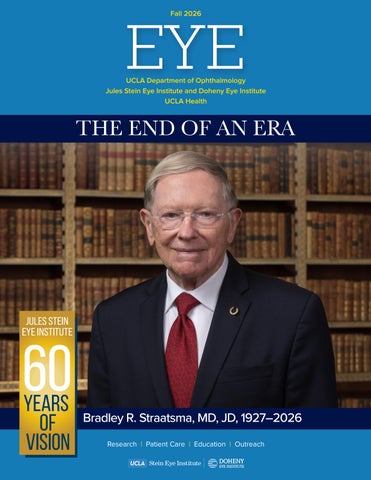
Fall 2026
EYE
UCLA Department of Ophthalmology Jules Stein Eye Institute and Doheny Eye Institute UCLA Health
THE END OF AN ERA
Bradley R. Straatsma, MD, JD, 1927–2026 Research | Patient Care | Education | Outreach
Letter from the Chair Dear Friends,
EYE
M AG A Z I N E
is a publication from the UCLA Department of Ophthalmology. Jules Stein Eye Institute and Doheny Eye Institute are proud affiliates.
EDITOR-IN-CHIEF Anne L. Coleman, MD, PhD MANAGING EDITOR Tina-Marie Gauthier c/o UCLA Stein Eye Institute 100 Stein Plaza, UCLA Los Angeles, California 90095-7000 Tina@EyeCiteEditing.com PUBLICATION COMMITTEE Anthony Arnold, MD Susan Lee DeRemer, CFRE Greg Field, PhD Brian Francis, MD, MS Trashon Fearington Robert Goldberg, MD Roxana Radu, MD CONTRIBUTING WRITER Austin Janda PHOTOGRAPHY Reed Hutchinson Rich Schmitt Robin Weisz DESIGN Robin Weisz Design ©2026 by The Regents of the University of California.
As we celebrate the 60th anniversary of the UCLA Jules Stein Eye Institute, we reflect with gratitude on the extraordinary legacy that has shaped our Institute and advanced the field of ophthalmology over the past six decades. This milestone honors the Institute’s history and the people whose dedication and purpose continue to guide our mission today. This issue of EYE Magazine is also marked by profound loss. In April, we mourned the passing of our founder, Dr. Bradley R. Straatsma. Together with Dr. Jules Stein, Dr. Straatsma established the Jules Stein Eye Institute in 1966. As the Institute’s first director and the first chair of the UCLA Department of Ophthalmology, Dr. Straatsma set our foundational pillars: excellence in patient care, groundbreaking research, and multidisciplinary education, which are each tied to community outreach. Through his leadership, wisdom, and foresight, he brought forth a globally respected vision-science campus and a culture dedicated to discovery, innovation, and the training of future leaders in ophthalmology. Research was central to Dr. Straatsma’s vision and to the Institute’s mission to eradicate blindness. This issue highlights many of the remarkable milestones achieved over the last 60 years. From advances in retinal disease and glaucoma to breakthroughs in imaging, genetics, and vision restoration—these accomplishments reflect decades of curiosity, collaboration, and commitment by our faculty and scientists to improve the lives of patients around the world. Our graduating class of residents and fellows underscores the importance of one of Dr. Straatsma’s premier pillars: educating those who will guide our field forward. As emerging leaders, they embody the promise of continued innovation and compassionate care for generations to come. In honoring our graduates’ achievements, we celebrate the continuity of the values established by Dr. Straatsma and the faculty members who have shaped this institution over six decades. While our 60th anniversary invites reflection, it also calls us toward the future. We remain steadfast in our commitment to advancing discovery, educating future leaders, and delivering exceptional patient care. Guided by the legacy of those who built this institution—upon whose shoulders we stand—and inspired by the excellence of the individuals who work here today, we look ahead with optimism and purpose. With warm regards,
All rights reserved.
Anne L. Coleman, MD, PhD Bradley R. Straatsma, MD, Endowed Chair in Ophthalmology Chair, UCLA Department of Ophthalmology Director, Jules Stein Eye Institute Affiliation Chair, Doheny Eye Institute
EYE FALL 2026
F E AT U R E
A Defining Force in Ophthalmology Dr. Bradley R. Straatsma, visionary founding director of the Jules Stein Eye Institute, founding chair of the UCLA Department of Ophthalmology, and a pioneering leader in modern ophthalmology, is remembered for a remarkable life that transformed vision science, advanced blindness prevention worldwide, and shaped generations of ophthalmologists through his leadership, mentorship, and enduring legacy.
VOLUME 44
NUMBER 2
UCLA DEPARTMENT OF OPHTHALMOLOGY
JULES STEIN EYE INSTITUTE AND DOHENY EYE INSTITUTE
PAG E 2
F E AT U R E
Advancing Sight: Six Decades of Innovation
RESEARCH FOCUS
An Enduring Impact on Vision Science
A look back at six decades of groundbreaking research at the Jules Stein Eye Institute highlights the discoveries and innovations that have advanced vision science, transformed patient care, and shaped modern ophthalmology worldwide.
A profile of Dr. Gordon L. Fain, whose record-setting National Eye Institute grant and five decades of pioneering research have transformed our understanding of photoreceptors, retinal disease, and the fundamental biology of vision.
PAG E 6
PAG E 12
FOCUS
Department of Ophthalmology Named Lectures
14
INSTITUTE NEWS
Driving Discovery Through Research Investment
14
Faculty Transitions Faculty Honors
ARVO 2026: Global Leadership in Vision Research
15
Faculty Retirements: Drs. Anthony Arnold and Suraj Bhat
16
Dr. Peter Quiros Named Chief of Neuro-Ophthalmology
17
EDUCATION
16–18
19–22
Courses February 1–July 31, 2026
PHILANTHROPY
23
Anita May Rosenstein
GRADUATION CEREMONY
Graduation 2026
24–25
A Defining Force in Ophthalmology Dr. Bradley R. Straatsma
2
EYE | JULES STEIN EYE INSTITUTE and DOHENY EYE INSTITUTE | FALL 2026
I
t is with deep sadness that we mark the passing of Bradley R. Straatsma, MD, JD, on April 16 at the age of 98. A global giant in modern ophthalmology and the driving force behind the creation of
the UCLA Jules Stein Eye Institute, Dr. Straatsma leaves behind an extraordinary legacy of innovation, leadership, and worldwide impact. He is survived by his children, Cary, Derek, and Greer; grandchildren, Cavan and Carlin; and four great-grandchildren. He was preceded in death by his beloved wife, Ruth, in 2016. Dr. Straatsma’s career was defined by a rare combination of clinical excellence, visionary leadership, and an unwavering commitment to advancing eye care. Born in Grand Rapids, Michigan, he was a graduate of Yale University School of Medicine, completed his residency at the Harkness Eye Institute of Columbia University, and pursued fellowship training at the Armed Forces Institute of Pathology and the Wilmer Ophthalmology Institute at Johns Hopkins University. His early years also included distinguished service in the U.S. Navy’s Underwater Demolition Team, an elite precursor to today’s Navy SEALs. Dr. Straatsma arrived in Los Angeles in 1959 and began a transformative chapter in academic medicine. Appointed associate professor of surgery and chief of the Division of Ophthalmology at UCLA, he quickly rose to full professor by 1963. With characteristic foresight, he built a coalition that created and grew the Jules Stein Eye Institute, now a vision-science campus at UCLA, assuming its directorship in 1964 and serving as chair of the newly established Department of Ophthalmology in 1968. His tenure was marked by the recruitment of world-class faculty, the advancement of both clinical and basic science research, and a deep investment in training future generations of ophthalmologists. From launching the first mobile eye clinic to hosting influential gatherings that bridged medicine, philanthropy, and the arts, Dr. Straatsma fostered a culture defined by excellence and ambition, always striving to do things “the best way possible.” Under his guidance, the Institute became internationally recognized as a top-tier facility for comprehensive vision science, patient care, and education, consistently ranked among the top ophthalmologic centers in the United States and the best in the Western United States.
EYE | JULES STEIN EYE INSTITUTE and DOHENY EYE INSTITUTE | FALL 2026
3
Dr. Bradley Straatsma (center) with the founding members of the Jules Stein Eye Institute (l to r): Drs. Michael Hall, Thomas Pettit, Leonard Apt, and Robert Christensen.
Central to Dr. Straatsma’s enduring legacy was his profound impact on the prevention of blindness worldwide. Through his own patient care, and his commitment to education, he helped shape generations of ophthalmologists whose reach extended far beyond a single institution. He trained residents, fellows, and international fellows who carried his standards of excellence back to their home countries, where they, in turn, trained others—creating a multiplying effect that has improved vision care, reducing or eradicating blindness on an international scale for countless individuals across the globe. Dr. Straatsma also held the highest leadership roles across nearly every major ophthalmic organization, including serving as president of the American Academy of Ophthalmology and Otolaryngology, the American Ophthalmological Society, the Association of University Professors of Ophthalmology, the Pan-American Association of Ophthalmology, and the Academia Ophthalmologica Internationalis. As chairman of the American Board of Ophthalmology, he helped shape standards of care and professional certification. Widely regarded as a principal architect of the modern American Academy of Ophthalmology, he also authored foundational frameworks that continue to guide ophthalmologic practice today. As editor-in-chief of the American Journal of Ophthalmology from 1993 to 2002, Dr. Straatsma strengthened the rigor and integrity of scientific publishing, reinforcing the importance of peer review in advancing the field. After transitioning to emeritus status in 1994, his intellectual curiosity remained undiminished, and he earned a Juris Doctor degree and provided legal counsel in support of the Institute he helped build. In the later years of his career, Dr. Straatsma further expanded his vision globally. Through his collaboration with the Africa Eye Foundation, he played a central role in the development of the Magrabi ICO Cameroon Eye Institute in Yaoundé, Cameroon, which opened in 2016. The state-of-the-art eye hospital and training center is dedicated to delivering high-quality care and educating the next generation of ophthalmologists in the region. This initiative stands as a powerful extension of Dr. Straatsma’s lifelong belief that sustainable progress in eye care depends on education, mentorship, and the sharing of knowledge across borders.
4
EYE | JULES STEIN EYE INSTITUTE and DOHENY EYE INSTITUTE | FALL 2026
A prolif ic scholar, Dr. Straatsma authored 588 scientific publications, delivered 56 distinguished lectures, and received 90 honors and awards from institutions across the globe. Among these were an honorary Doctor of Science degree from Columbia University, the Laureate Award from the American Academy of Ophthalmology, the Lucien Howe Medal for Distinguished Service, and the Jules François Golden Medal from the International Council of Ophthalmology. Yet, beyond his remarkable achievements, Dr. Straatsma will be remembered most for his humanity and humility. He was deeply respected and warmly regarded by patients and colleagues alike for his surgical mastery, his gift for storytelling, and his generosity as a mentor. Importantly, he shared with others both his knowledge and his sense of purpose. Bradley Straatsma’s life was one of vision in every sense. His contributions have shaped the course of ophthalmology for generations, and his legacy will guide the field and help preserve sight for millions well into the future.
Bradley Straatsma’s life was one of vision in every sense. His contributions have shaped the course of ophthalmology for generations, and his legacy will guide the field and help preserve sight for millions well into the future.
Dr. Straatsma fostered a culture defined by excellence and ambition, always striving to do things “the best way possible.” Under his guidance, the Institute became internationally recognized as a top-tier facility for comprehensive vision science, patient care, and education, consistently ranked among the top ophthalmologic centers in the United States and the best in the Western United States.
EYE | JULES STEIN EYE INSTITUTE and DOHENY EYE INSTITUTE | FALL 2026
5
ADVANCING SIGHT
6
DECADES OF INNOVATION F or six decades, the UCLA Jules Stein Eye Institute has
stood at the forefront of discovery in vision science and
ophthalmic care, shaping the way eye disease is understood,
diagnosed, and treated around the world. From pioneering surgical techniques and sight-saving therapies to fundamental breakthroughs in the biology of vision, the Institute’s research milestones reflect a sustained commitment to innovation with direct impact on patients’ lives.
6
This sampling of the Institute’s research achievements over the past 60 years demonstrates a dedication to preserving vision, advancing science, and improving quality of life for patients worldwide. It also reflects the enduring curiosity, creativity, and perseverance of the faculty, researchers, trainees, and collaborators whose work has helped shape modern ophthalmology.
RESEARCH MILESTONES CATARACT AND REFRACTIVE SURGERY ⊲ Development of a nomogram for peripheral corneal relaxing incisions that is widely used throughout the world. ⊲ Description of a stepladder approach to the management of stigmatism at the time of cataract surgery that has been widely adopted throughout the world. ⊲ Design and participation in the clinical trial of the first capsule tension ring to be approved by the U.S. Food and Drug Administration. ⊲ Participation in the U.S. Food and Drug Administration clinical trial of the world’s most commonly implanted toric intraocular lens. ⊲ Participation in the U.S. Food and Drug Administration clinical trial of the first postoperative power-adjustable intraocular lens. ⊲ Design and participation in the clinical trial of the first artificial iris approved by the U.S. Food and Drug Administration. ⊲ Participation in the design, testing, and commercial launch of numerous phacoemulsification devices. ⊲ Created EyeGuru.com, a leading website for ophthalmic education globally, with over 1.5M+ views a year. ⊲ Developed an artificial intelligence framework that improved the accuracy of multiple generations of intraocular lens calculation formulas.
CORNEA AND UVEITIS ⊲ Discovery of the risk of fungal infections via intravenous lines, catheters, and surgery in patients with Candida. ⊲ Identification of increased risk of corneal infections with extended-wear contact lenses. ⊲ First recognition of ocular complications of AIDS. ⊲ Clarification of role of protein called lipocalin in dry-eye disease. ⊲ Establishment of new imaging technique to diagnose limbal stem cell deficiency and stage the disease severity. ⊲ Discovery of the critical role of Wnt signaling pathway in the regulation of limbal stem cells and wound healing. ⊲ Discovery of microRNAs in exosomes derived from cornea stromal stem cells that could reduce corneal scarring. ⊲ Successful treatment of limbal stem cell deficiency using cultivated autologous limbal stem cells under a novel xenobiotic- and feeder-free condition.
EYE | JULES STEIN EYE INSTITUTE and DOHENY EYE INSTITUTE | FALL 2026
7
Our research offers tremendous opportunities for better understanding of eye disease—better detection, better limitation, and better prevention. This is work that can significantly impact the quality of people’s lives. DR. ANTHONY ARNOLD
GLAUCOMA
NEURO-OPHTHALMOLOGY
⊲ Discovery by Jules Stein Eye Institute faculty and collaborators that marijuana lowers intraocular pressure.
⊲ Analysis by computerized eye movement recordings of the abnormal eye movements of downbeat nystagmus, leading to its classification by brain abnormality.
⊲ Recognition of stress proteins’ role (and their increase) in protecting retinal ganglion-cell death from glaucoma. ⊲ Discovery of clinically measurable optic-nerve changes prior to visual loss in high-risk glaucoma patients. ⊲ Clarification of long-term intraocular pressure fluctuation as risk factor for progressive glaucoma. ⊲ Discovery of induction of endogenous stress protein for prevention of retinal ganglion cell damage from glaucoma. ⊲ Analyses establishing that cataract surgery for patients 65 years and older lowers the risk of falling and related hip fractures. ⊲ Demonstration that trabeculectomy can reverse visual deficits caused by glaucoma. ⊲ Demonstration that use of aqueous suppressants can reduce the incidence and severity of the hypertensive phase following placement of a glaucoma drainage device. ⊲ Demonstration that outcomes of trabeculectomy with adjunctive Mitomycin C are inferior in African American patients and those of Hispanic descent compared to patients of European descent based on largest cohorts reported in the glaucoma literature. ⊲ Development of novel Bayesian hierarchical spatial longitudinal models for establishing structural and functional progression in patients with moderate to severe glaucoma.
⊲ Confirmation by fluorescein angiography of reduced blood flow to the optic nerve in ischemic versus non-ischemic optic disc edema. ⊲ Jules Stein Eye Institute participation as a Clinical Center and Visual Field Expert Center in Optic Neuropathy Decompression Trial. ⊲ Characterized various forms of optic nerve ischemia and identified risk for earlier and more frequent fellow eye involvement in non-arteritic anterior ischemic optic neuropathy patients aged 50 years and younger. ⊲ Identified the risks of ophthalmic complications from the use of immune checkpoint inhibitors for cancer therapy.
OPHTHALMIC EPIDEMIOLOGY ⊲ Reported methods on use of databases for studies of glaucoma outcomes and ophthalmic surgery. Laid foundation for epidemiologic studies of ophthalmic conditions using large databases, a mainstay of 21st century ophthalmic research. ⊲ Identified population-based associations between visual field loss and increased fractures in older women in the Study of Osteoporotic Fractures (SOF). Reported associations between multiple lifestyle factors (eg, fruit and vegetable intake, smoking and alcohol use) and prevalence of age-related eye disease in SOF.
⊲ Discovery of mechanical loading by the optic nerve during eye movements as a cause of optic neuropathy in glaucoma and myopia.
8
EYE | JULES STEIN EYE INSTITUTE and DOHENY EYE INSTITUTE | FALL 2026
GROWTH IN RESEARCH FUNDING CLINICAL RESEARCH FUNDING
1978
$28,449
1998
$589,483 Clinical Research Center Established
2015
$1,846,096
2025
$7,903,415
VISION-SCIENCE RESEARCH FUNDING
1972
$479,748
2015
$6,037,310
2025
$11,430,681
EYE | JULES STEIN EYE INSTITUTE and DOHENY EYE INSTITUTE | FALL 2026
9
The eye is essentially its own galaxy, encapsulating the complexity of all of human biology. It is influenced by every physiological condition that affects the entire individual—whether it is the central nervous system, infectious disease, autoimmune and inflammatory disorders, cancer, hereditary problems, or degenerative illness. DR. MICHAEL GORIN
⊲ Reported population-based prevalence and incidence of multiple types of glaucoma in Thessaloniki, Greece, in the Thessaloniki Eye Study (TES). Identified population-based associations between blood pressure and its related risk factors and glaucoma in TES.
⊲ Identification of increased risk for earlier and more frequent fellow eye involvement in patients under 50 with non-arteritic anterior ischemic optic neuropathy.
⊲ Provided comprehensive vision screenings for children aged four to six years old in all preschools in Los Angeles County through the UCLA Mobile Eye Clinic. Estimated population-based prevalence of and risk factors for refractive error, amblyopia, and strabismus in preschool-aged children.
PEDIATRIC OPHTHALMOLOGY
⊲ Contributed to pivotal white paper on disparities in eye care as part of the American Academy of Ophthalmology Task Force for Disparities in Eye Care. Piloted novel methods to assess racial and ethnic and socioeconomic disparities for multiple glaucomarelated outcomes in the California Medicare population. ⊲ Conducted vision screenings and focus groups for day laborers in Los Angeles and rural farm workers in Kern County through UCLA Mobile Eye Clinic. Identified increased prevalence of glaucoma suspects in the rural farm worker population.
ORBITAL AND OPHTHALMIC PLASTIC SURGERY ⊲ Development of Madame Butterfly technique for reconstructing lower eyelid, now performed worldwide. ⊲ Development of transcaruncular orbitotomy to better treat orbital problems through hidden incision. ⊲ Development of deep lateral-wall orbital decompression surgery for bulging eyes of Graves disease. ⊲ Discovery and blockage of antibody associated with Graves disease.
10
⊲ Classification, mechanism, and new treatments for orbital vascular malformations.
⊲ Invention of coated vicryl sutures for ophthalmic use, a practical innovation replacing catgut sutures that caused frequent allergic reactions. ⊲ Identification and pioneering use of povidone iodine as a low-cost method for preoperative asepsis in ophthalmic surgery and injections, a medical and surgical innovation affecting nearly all ophthalmic surgeries, saving sight, and preventing blinding preoperative infections for countless people worldwide. ⊲ Development of novel muscle transposition surgeries for complex strabismus. ⊲ Development of high-resolution orbital MRI for basic and clinical study of extraocular muscles in strabismus, including more precise diagnosis of strabismus. ⊲ Elucidation of the pulley connective tissue system of the orbit, and its pivotal role in ocular motility and strabismus. ⊲ Creation of new muscletransposition surgical procedures for muscle paralysis from brain injuries, tumors, and congenital strabismus. ⊲ Discovery of the sagging eye syndrome, the most common form of new double vision in adults over age 50, leading to numerous surgical innovations and reducing the need for most neurological investigations.
EYE | JULES STEIN EYE INSTITUTE and DOHENY EYE INSTITUTE | FALL 2026
RETINA ⊲ Characterization of peripheral retinal anatomic variations (enclosed ora bays, lattice degeneration, meridional folds, meridional complexes) and risk of retinal tears, leading to improved treatments for retinal detachment. ⊲ First report of transvitreal chorioretinal biopsy. ⊲ Retinopathy of prematurity evaluation and treatment recommendations with telemedicine strategies. ⊲ Description of new entity: West African crystalline maculopathy. ⊲ First in vivo biopsy of uveal melanoma for prognostication. ⊲ Attenuation of iodine 125 radiation with vitreous substitutes in the treatment of uveal melanoma. ⊲ Intravitreal injection endophthal mitis risk reduction by not talking or wearing face mask. ⊲ Discovery of novel genetic mutation for type of X-linked retinitis pigmentosa. ⊲ First publication detailing human embryonic stem cells transplanted beneath human retinas. ⊲ Report of Viscoat viscoelastic agent improving corneal edema intraoperatively. ⊲ Developed the role of ranibizumab for retinopathy of prematurity. ⊲ Description of new entity: paracentral acute middle maculopathy and elucidation of the structure and arrangement of the retinal capillary plexus in the central macula. ⊲ First description of DDI (dideoxyinosine) and taxanesassociated retinal toxicity. ⊲ First primary autologous stem cell transplantation for treatment of unilateral primary vitreoretinal lymphoma.
⊲ Widely adopted optical coherence tomography-based grading scheme for epiretinal membranes. ⊲ Description of inner choroidal ischemia in acute posterior multifocal placoid pigment epitheliopathy with optical coherence tomography angiography. ⊲ Surgical technique invention: The McCannel Plaque Stitch for in-office brachytherapy plaque removal.
⊲ Discovery of major protein in lens, alpha-crystallin, as protective of aggregation of other proteins, preventing cataract development. ⊲ Identification of mouse model (Stargardt disease) to develop genetic and pharmacologic treatment of degenerative retinal diseases. ⊲ Successful cloning of receptor for vitamin A on retinal pigment epithelium.
⊲ Pioneered the use of neonatal optical coherence tomography, which helped lead to FDA approval of the first arm-mounted device. ⊲ Identifying novel imaging biomarkers for age-related macular degeneration progression. ⊲ Development of the use of robotics for cataract and other intraocular surgeries. ⊲ Identification of new pachychoroid disorders, including peripapillary pachychoroid syndrome and pachyvitelliform maculopathy. ⊲ New vitelliform disorder discovered: multifocal vitelliform paravascular retinopathy.
VISION SCIENCE ⊲ Demonstration of progress of photoreceptor renewal from bottom of rod outer segment to top. ⊲ Discovery that retinal pigment epithelium at top of rod cell chews up and disposes of oldest rods that react to light (key to some inherited retinal diseases). ⊲ Gene causing retinal degeneration in rd mouse model determined to be a miscode, leading to disease-free mouse via transgenic technology.
In medical research there are no complete answers. Good questions generate new insight, and even more questions. Every bit of knowledge we gain reveals just how much more there is to know. DR. SURAJ P. BHAT
⊲ Major advances in way protein structures are studied.
EYE | JULES STEIN EYE INSTITUTE and DOHENY EYE INSTITUTE | FALL 2026
11
RESEARCH FOCUS
An Enduring Impact on Vision Science With the longest continuously funded National Eye Institute grant of any principal investigator, Dr. Gordon Fain remains at the forefront of vision research
L
ooking back nearly 50 years later, Gordon L. Fain, PhD, says he’s surprised his first grant, “The Physiology of Photoreceptors,” was approved by the National Eye Institute (NEI). “It was so bad they delayed the funding and gave me only three years,” Dr. Fain, professor emeritus of ophthalmology at the UCLA Jules Stein Institute, says with a smile. “But by the time I came up for renewal, I had published multiple papers in top journals like Science and Nature. I was red hot and didn’t have any trouble getting another five years. Then I just kept applying for renewals every time they came up.” Today, “Physiology of Photoreceptors” lives on as the longest continuously funded NEI grant with the same principal investigator. And more than 50 years after joining the UCLA Department of Ophthalmology faculty in 1975, Dr. Fain continues to conduct research at the forefront of a field he pioneered with that initial grant award. Since his “retirement” more than a decade ago at age 70, he has been a part of the laboratory of Alapakkam P. Sampath, PhD, Grace and Walter Lantz Endowed Chair in Ophthalmology, and chief of the Vision Science Division. Over the course of his remarkable career, Dr. Fain has made foundational contributions to the understanding of how photoreceptors and the outer retina convert light into vision and how these cells are damaged in disease. “It’s difficult for people entering the field today to conceive of what it was like 50 years ago,” Dr. Fain says. It was a time when the initial electrical recordings were being made from photoreceptors—work Dr. Fain was part of. His first paper, in S cience, documented the substantial difference in sensitivity between single rods and single cones: “Now we just take it for granted that each rod is more sensitive than each of the cones.” 12
cells in the vertebrate eye, proving that rods are more sensitive than cones. Dr. Fain would go on to show the reasons behind the greater sensitivity of the rods, helping to explain differences in night and daylight vision. f During his postdoctoral research in Paris, Dr. Fain discovered the principal voltage-gated membrane conductances in rods, laying the groundwork for a better understanding of visual signal processing and how retinal diseases can disrupt vision. Dr. Fain became interested in photoreceptors as an undergraduate at Stanford University working in the laboratory of Dr. Donald Kennedy, who would later become director of the U.S. Food and Drug Administration and president of Stanford. The epiphany occurred when Dr. Fain attended a seminar on jumping spiders—significant to vision research because of their extraordinary spatial acuity. “I became enamored of the whole process of vision: how light is transformed into an electrical signal and how our photoreceptors and visual system adapt when the background light changes,” he says. Ever since, Dr. Fain has used electrophysiological techniques to study photoceptor responses, both to learn about the basic mechanisms of phototransduction and to understand the etiology of retinal disease and degeneration. Among his many significant contributions: f As a graduate student and postdoctoral fellow in the laboratory of Dr. John Dowling, Dr. Fain provided some of the first measurements of the electrical signals of individual light-sensing
f In collaboration with Drs. Hugh Matthews and Trevor Lamb, Dr. Fain demonstrated that calcium is a key to producing light adaptation in photoreceptors, paving the way to an understanding of sensitivity changes in background light and after bleaches, which continues to guide current research into the nature of photoreceptor adaptation. f With Dr. Carter Cornwall of Boston University, Dr. Fain discovered that bleached photopigment (opsin) produced by bright illumination can activate phototransduction, producing an “equivalent” background adaptation. The background is said to be equivalent because the rod has no actual background light in darkness after the bright light exposure. This equivalent background nevertheless acts like a real background and is the reason our eyes are desensitized after strong illumination. He then found, in a collaboration with Dr. Janis Lem, that this equivalent background excitation can cause photoreceptor degeneration in a form of Leber’s congenital amaurosis and also
EYE | JULES STEIN EYE INSTITUTE and DOHENY EYE INSTITUTE | FALL 2026
explains why rods degenerate in vitamin A deprivation. Dr. Fain further showed, with Drs. Alex Dizhoor and Paul Sieving, that continuous activation of the cascade can produce congenital night blindness. f Dr. Fain’s research demonstrated that jawless, eel-like fish known as lamprey have rods with the same single-photon sensitivity as mouse rods despite having conelike outer segments, showing that rod disks aren’t necessary for highsensitivity vision. Given that lamprey diverged from all other vertebrates some 500 million years ago, this research also indicates that the basic organization of vertebrate retina originated as far back as the Cambrian, probably only a few million years after vertebrates first evolved.
For all of the changes Dr. Fain has seen in how vision research is conducted over the course of the last half-century, he notes that one aspect of the work has remained constant. “The wonderful thing about science that people not in the field may not realize is the excitement when you discover something that no one else in the world knows or has ever known,” he says. “I’ve been fortunate enough to experience that feeling multiple times, and it’s been a huge amount of fun.” Dr. Fain remains active in the laboratory of Dr. Sampath, whom he trained as a graduate student more than 25 years ago. And as he gets closer to answering longstanding questions he’s had about photoreceptor physiology, he has no plans to stop doing the research he started 50 years ago.
One of those unanswered questions is how cones are able to continue to respond even in the brightest light. Dr. Fain is now part of a collaboration with Gabriel H. Travis, MD, Charles Kenneth Feldman Chair in Ophthalmology at the Jules Stein Eye Institute, that he believes can provide answers. “We have the technical ability to solve that problem now,” Dr. Fain says. To help make that happen, he recently submitted a proposal to the NEI to extend “The Physiology of Photoreceptors” for another five years. Of the renewal proposal, Dr. Fain asserts: “I think this is as strong as any grant I’ve ever written.”
Most recently, Dr. Fain has worked with Dr. Sampath and their graduate student Norianne Ingram to devise a new technique to make voltage-clamp recordings from mouse cones. This has led to the first estimates of energy utilization in cones, as well as the first accurate model for the cone photoreceptor light response. Further research by Drs. Fain, Sampath, and their students has also shed light on how the retina compensates by changing its synaptic connections during degeneration. Dr. Fain notes that his work with Dr. Sampath capitalizes on the latest technology to better understand the physiology of normal and degenerating rods and cones. “The methods have become so much more analytical,” he marvels. “The measurements I was making at the start of my career seem primitive by comparison, when we can now use elegant computer programs to record responses and store electrical signals.” EYE | JULES STEIN EYE INSTITUTE and DOHENY EYE INSTITUTE | FALL 2026
13
INSTITUTE NEWS
Department of Ophthalmology Named Lectures The Department hosted its inaugural Caprioli Glaucoma Lecture on April 15, 2026, which honors past chief of the Glaucoma Division, Joseph Caprioli, MD. The lecture was moderated by current division chief, Kouros Nouri-Mahdavi, MD, and featured guest speaker Harry Quigley, MD, professor of ophthalmology and glaucoma specialist from Johns Hopkins School of Medicine, whose lecture was titled, “The (Mis)behavior of the Nerve Head and a Hysteresis Exegesis.” On April 22, 2026, the Department celebrated another first, the Allan E. Kreiger, MD, & Jerome T. Pearlman, MD, Endowed Lectureship, made possible through the generous endowment of Dr. Alan L. Norton, who established the lectureship to honor the enduring legacies of Drs. Kreiger and Pearlman. The inaugural program featured Colin McCannel, MD, speaker, moderator, and current chief of the Retina Division, whose lecture, “The Pursuit of Excellence in Service of Patients’ Quality of Life,” offered an engaging and insightful perspective on excellence in patient care.
Driving Discovery Through Research Investment Researchers at the Jules Stein Eye Institute have secured nearly $12 MILLION in new grant funding, reinforcing the UCLA Department of Ophthalmology’s leadership in eye and vision research. Supporting a wide range of innovative studies, these awards will advance efforts to prevent vision loss, restore sight, and improve patient care. Together, they reflect the Department’s scientific strength and ongoing commitment to shaping the future of vision science through groundbreaking research.
Anthony Aldave, MD, and Anne Coleman, MD, PhD $2,972,780 NIH K12 Grant Clinician-Scientist Eye Training (C-SET) Program Elliot Choi, MD, PhD (EyeSTAR Resident) $100,000 2026 Knights Templar Eye Foundation Career Starter Grant Multiplex Prime Editing Strategies for ABCA4 Mutations in Stargardt Disease Greg Field, PhD, and Alexander Huk, PhD $2,704,861 NIH R01 Grant Elucidating Novel Features of Visual Processing and Physiological Connectivity from Retina to Primary Visual Cortex Michael Gorin, MD, PhD $257,193 NIH R34 Grant Subaward Feasibility Studies for the Future of Mediterranean Glucose Lowering Diet for Vision Extension and AMD
Victoria Tseng, MD, PhD $50,000 AGS Mid-Career Physician Scientist Award Impact of External Stressors on Glaucoma Disease Trajectory: A Population-Based Investigation Edmund Tsui, MD, MS $3,551,025 NIH R01 Grant Researching OCT Biomarkers in Uveitis Clinical Trials David Williams, PhD $1,242,196 NIH R01 Grant Cellular Mechanisms of MYO7A in the Retina Joel Zylberberg, PhD $827,550 Air Force Office of Scientific Research Grant Why Are There So Many Retinal Ganglion Cell Types?: An Information-Theoretic Framework to Understand the Tradeoff Between Computations Performed at the Sensory Periphery vs the Central Nervous System
Declan Rowley, PhD (Laboratory of Alexander Huk, PhD) $264,346 NIH K99 Grant Linking Physiology, Computation, and Circuitry in the Primate Visual Cortex
14
EYE | JULES STEIN EYE INSTITUTE and DOHENY EYE INSTITUTE | FALL 2026
ARVO 2026: Global Leadership in Vision Research The UCLA Jules Stein Eye Institute was honored to have Sophie X. Deng, MD, PhD, leading the May 3–7, 2026, Association for Research in Vision and Ophthalmology (ARVO) annual meeting in Denver, Colorado. ARVO is widely regarded as the most important global conference in vision research, and as ARVO President, Dr. Deng played a pivotal role in shaping the conference’s scientific program and overall success. Together, the Jules Stein Eye Institute and Doheny Eye Institute demonstrated a strong and visible presence, with presentations spanning foundational science, clinical research, and emerging technologies, that reflected the depth and breadth of work across both institutions. Research presented by UCLA Department of Ophthalmology investigators included: f Adaptive optics and molecular imaging f Advances in diabetic retinopathy f Advances in optical coherence tomography f Artificial intelligence in retinal disease research f Biochemistry and molecular biology of the retina f Gene therapy for Leber’s hereditary optic neuropathy (LHON) f Innovative imaging technologies f Neuro-ophthalmology f New findings in dry and wet age-related macular degeneration These presentations highlight the collaborative and multidisciplinary approach that defines the UCLA Jules Stein and Doheny partnership.
ARVO 2026 Honors f Kouros Nouri-Mahdavi, MD, chief of the Glaucoma Division, and Edmund Tsui, MD, MS, associate professor of ophthalmology, were named 2026 ARVO Silver Fellows for their exemplary contributions and dedication to ARVO. f Giulia Corradetti, MD, health sciences clinical instructor of ophthalmology, was selected to be a mentee in the 2026–27 ARVO Women’s Leadership Development Program.
Annual Breakfast Forum at ARVO 2026 The annual UCLA Doheny Breakfast Forum at ARVO on May 3, 2026, featured the discussion, “Eye on Innovation: Cutting-Edge New Approach Methodologies (NAM) in Ophthalmology.” Co-organized and hosted by Deborah A. Ferrington, PhD, and Roxana A. Radu, MD, the Forum explored how emerging technologies are reshaping how we study ocular disease and develop therapies. The program welcomed more than 65 attendees and featured presentations from Jason Meyer, PhD, Valeria Canto-Soler, PhD, and Kapil Bharti, PhD, highlighting three cutting-edge NAM platforms transforming vision research: a microfluidic retinal ganglion cell system, a 3D organoid model of the retina, and an artificial intelligence- enabled “digital twin” of the retinal pigment epithelium.
EYE | JULES STEIN EYE INSTITUTE and DOHENY EYE INSTITUTE | FALL 2026
Alumni Reception at ARVO 2026 Over 170 guests attended the ARVO alumni reception on May 4, 2026, in Denver, Colorado, reflecting the strength and reach of the UCLA Jules Stein– Doheny community. The reception additionally welcomed distinguished leaders from the National Eye Institute and the Foundation Fighting Blindness, underscoring the partnership’s role within the broader vision research ecosystem. As part of the evening, four trainees were recognized for outstanding ARVO presentations, with research grants awarded through the Doheny Professional Alumni Association. This year’s recipients, Mai Alhelaly, Maryam Golmohammadi, Ruixue Lu, and Nathan Vu, were honored for their exceptional research, spanning topics from diabetic macular edema and optic neuropathies to retinal imaging and age-related macular degeneration.
15
INSTITUTE NEWS
FACULTY RETIREMENTS
Anthony C. Arnold, MD Following 40 years of distinguished service to the UCLA Department of Ophthalmology, Dr. Anthony Arnold, Mary Oakley Foundation Chair in Neurodegenerative Diseases and chief of the Neuro-Ophthalmology Division, retired on July 1, 2026. Throughout his career, he has been an exceptional clinician, researcher, educator, and leader in ophthalmology and neuro-ophthalmology. Dr. Arnold completed medical school, residency, and fellowship training at UCLA before serving as a faculty neuro- ophthalmologist in the U.S. Air Force ophthalmology residency program in San Antonio, Texas. He joined the UCLA Department of Ophthalmology in 1986 with appointments at the Jules Stein Eye Institute and Olive View Medical Center, where he served as chief of ophthalmology during its transition to a full-time residency training site in Sylmar. In 1993, he became chief of the Neuro-Ophthalmology Division at the Institute. A dedicated educator, Dr. Arnold served as UCLA’s ophthalmology residency program director from 1994 to 2017 and became a nationally and internationally recognized leader in graduate medical education. He helped develop ophthalmology residency program director
16
training initiatives through the International Council of Ophthalmology and held numerous leadership roles, including president of the Association of University Professors of Ophthalmology Program Directors Council, chair of the Accreditation Council for Graduate Medical Education (ACGME) Residency Review Committee for Ophthalmology, chair of the ACGME Ophthalmology Milestones Development Group, and member of the ACGME Board of Directors. He was appointed to the Institute and Department’s Executive Committee as vice chair for Education in 2017. Dr. Arnold has been an internationally recognized leader in neuro-ophthalmology, with research interests in ischemic and inflammatory optic neuropathies and more than 100 publications. He has made major contributions to the diagnosis and treatment of nonarteritic anterior ischemic optic neuropathy and was inducted into the American Ophthalmological Society in 2012 with his thesis, “The Spectrum of Optic Disc Ischemia in Patients Younger than 50 Years.” He served as an associate examiner and examination developer for the American Board of Ophthalmology and later as a member of its Board of Directors. He also served as president and chairman of the Board of the North American Neuro- Ophthalmology Society and has been a frequent lecturer at national and international ophthalmology conferences. Among his many honors are the Straatsma Award for Excellence in Residency Education from the Association of University Professors of Ophthalmology, the Parker J. Palmer Courage to Teach Award from the ACGME, and the S. Rodman Irvine Prize from the UCLA Department of Ophthalmology.
Suraj J. Bhat, PhD Dr. Suraj Bhat, Oppenheimer Brothers Chair and emeritus professor of ophthalmology in the Basic Science Division, retired on July 1, 2026, following 41 years of distinguished service to the UCLA Department of Ophthalmology. Dr. Bhat joined the Department as assistant professor in 1985. He earned his doctorate in molecular biology and biochemistry from the Indian Institute of Science in Bangalore, India, and completed postdoctoral training in the Department of Biological Sciences at Hunter College in New York City. He also served as a visiting fellow in the Molecular Genetics Laboratory of the National Institute of Child Health and Human Development at the National Institutes of Health. Throughout his career, Dr. Bhat’s research focused on the regulation of gene activity during vertebrate eye development and cellular differentiation. As director of the Vision Molecular Biology Laboratory at the Jules Stein Eye Institute, he led investigations into the molecular mechanisms that maintain transparency in the ocular lens and preserve the physiological health of the retinal pigment epithelium, both essential for normal vision. His work also explored regulation of the small heat-shock protein
EYE | JULES STEIN EYE INSTITUTE and DOHENY EYE INSTITUTE | FALL 2026
gene Alpha B-Crystallin, including its biological function in maintaining emmetropia (normal vision) and its role in the development of myopia. Dr. Bhat’s research was supported by numerous grants from organizations including the National Eye Institute (NEI) and Research to Prevent Blindness (RPB), from which he received the inaugural Lew R. Wasserman Merit Award. He was named a Silver Fellow of the Association for Research in Vision and Ophthalmology in 2010 and served as a member of the National Advisory Eye Council for the NEI. In addition to his scientific contributions, Dr. Bhat played an important role in academic publishing and peer review. He served on the editorial boards of Molecular Vision and Developmental Neuroscience and reviewed manuscripts for leading journals including Science and the American Journal of Ophthalmology. He authored more than 50 peer- reviewed publications in journals such as Investigative Ophthalmology & Visual Science and Gene. A dedicated educator and mentor, Dr. Bhat lectured in several courses at the David Geffen School of Medicine at UCLA, delivered invited lectures nationally, mentored medical students, and served on numerous doctoral committees. He also coordinated the Jules Stein Eye Institute Vision Science Seminar Series for several years, helping foster scientific collaboration and education within the vision research community.
Dr. Peter Quiros Named Chief of Neuro-Ophthalmology The Department of Ophthalmology is pleased to announce the appointment of Peter A. Quiros, MD, as its new chief of Neuro-Ophthalmology, effective July 1, 2026. Dr. Quiros was selected for his exceptional record of leadership, educational excellence, and service to both the Department and the broader ophthalmic community. A professor of clinical ophthalmology, Dr. Quiros joined UCLA in 2014 and has since served as director of the Neuro- Ophthalmology Fellowship Program. Within the David Geffen School of Medicine at UCLA, he serves as director of the Foundations of Practice course for medical students and co-director of the UCLA Educators for Excellence Faculty Professional Development Program, helping shape the next generation of physicians and educators. Dr. Quiros has distinguished himself through numerous leadership roles both nationally and internationally. He currently serves as chair of the American Academy of Ophthalmology’s Minority Ophthalmology Mentoring Committee, is a member of the Board of the Pan- American Association of Ophthalmology, and recently served as president of the North American Neuro-Ophthalmology Society. Throughout his career, Dr. Quiros has been widely recognized for his contributions to ophthalmic education. His honors include the 2015 Mark Tso Golden Apple Award from the International Council of Ophthalmology, the 2018 Senior Achievement Award from the American Academy of Ophthalmology, the 2023 Lifetime Achievement in Education Award from the Colombian Society of Ophthalmology, and the 2024 Melvin L. Rubin Award for Education from the Florida Society of Ophthalmology.
EYE | JULES STEIN EYE INSTITUTE and DOHENY EYE INSTITUTE | FALL 2026
Dr. Quiros has authored or co - authored 42 peer-reviewed original scientific publications and contributed to eight peer-reviewed articles arising from multicenter clinical trials, including studies conducted through the Neuro- Ophthalmology Research Disease Investigator Consortium. Dr. Quiros has longstanding involvement on numerous departmental and institutional committees, including the Resident Selection and Training Committee, Medical Student Education Committee, Inspiring Excellence Committee, and the Quality Improvement and Clinical Care Committees. He also serves on the David Geffen School of Medicine Diversity Oversight Committee, advancing efforts to build educational equity and foster an inclusive academic environment. The Department looks forward to Dr. Quiros’s continued contributions and leadership as chief of Neuro-Ophthalmology and to the ongoing advancement of excellence in patient care, education, and research.
17
INSTITUTE NEWS
FACULTY HONORS Anthony C. Arnold, MD, Mary Oakley Foundation Chair in Neurodegenerative Diseases, presented the Sophia M. Chung, MD, Endowed Lecture in Neuro-Ophthalmology at the St. Louis Ophthalmology Society meeting in St. Louis, Missouri, on April 15, 2026. Anne L. Coleman, MD, PhD, Bradley R. Straatsma, MD, Endowed Chair in Ophthalmology, presented the Goodwin M. Breinin, MD, Lecture, “The Intersection of Glaucoma and Mental Health,” at NYU Department of Ophthalmology on April 22, 2026, in New York. Deborah A. Ferrington, PhD, The Stephen J. Ryan-Arnold and Mabel Beckman Foundation Endowed Presidential Chair, was the featured speaker at the International Society for Pharmacoepidemiology Greater Los Angeles Area Chapter Women in Pharma celebration in honor of International Women’s Day 2026 on March 11, 2026, in Thousand Oaks, California. Dr. Ferrington and Marissa Goldberg, chief executive officer of Doheny Eye Institute, were recognized by the Los Angeles Business Journal as Women of Influence: Healthcare 2026. This honor reflects their outstanding leadership, dedication, and impact in advancing vision research and innovation. Brian A. Francis, MD, MS, The Rupert and Gertrude I. Steiger Vision Research Endowed Chair, was elected as vice president of the American Glaucoma Society for 2027. He will assume presidency of the Society in 2028. 18
Gary N. Holland, MD, Jack H. Skirball Chair in Ocular Inflammatory Diseases, delivered the Robert A. Nozik Lecture, Uveitis Miscellany, at the University of California, San Francisco, on May 28, 2026. Kevin M. Miller, MD, Kolokotrones Chair in Ophthalmology, received the Charles Kelman Medal during the Brazilian Association of Cataract and Refractive Surgery 33rd Congress on May 13, 2026. The award recognizes significant contributions to the advancement of ophthalmology, particularly cataract and refractive surgery, as well as the individual’s scientific, educational, and institutional impact on the specialty. Dr. Miller also assumed the role of president of the American Society of Cataract and Refractive Surgery at their April 10–13, 2026, meeting in Washington, DC.
SriniVas R. Sadda, MD, A. Ray Irvine, Jr., MD, Endowed Chair in Clinical Ophthalmology, received the Asia-Pacific Academy of Ophthalmology (APAO) Senior Achievement Award. The award was presented during the 41st APAO Congress, held February 5–8, 2026, in Hong Kong. Dr. Sadda presented the Eye Foundation Oration Award lecture at the Advances in Retinal Imaging, Surgery and Electrophysiology (ARISE) meeting held February 21–22, 2026, in Bangalore, India, where he also served as international faculty. David Sarraf, MD, health sciences clinical professor of ophthalmology, presented the Paul Henkind Memorial Lecture at the 49th Macula Society Meeting, which was held February 25–28, 2026, in San Diego, California. Dr. Sarraf also served as program committee chair of the meeting.
Federico G. Velez, MD, Leonard Apt Endowed Chair in Pediatric Ophthalmology, was the recipient of the Latin American Council on Strabismus (CLADE) Founders Medal, which was presented during the February 5–7, 2026, Latin American Society of Pediatric Ophthalmology Meeting in Medellin, Colombia. Dr. Velez also presented the Fernando Gomez de Liaño lecture at the annual meeting of the Spanish Society of Strabismus and Pediatric Ophthalmology in Barcelona, Spain, on June 10, 2026. Yuhua Zhang, PhD, professor of ophthalmology, was named the Carolyn and Chuck Miller Endowed Chair for Vision Research at Doheny Eye Institute. The chair helps ensure continued innovation and progress in vision research.
Stacy L. Pineles, MD, Laraine and David Gerber Chair in Ophthalmology, received the American Association for Pediatric Ophthalmology and Strabismus (AAPOS) Senior Honor Award at the AAPOS Meeting in Boston, Massachusetts, on March 18, 2026. Roxana A. Radu, MD, Vernon O. Underwood Family Chair in Ophthalmology, received the 2026 UCLA Undergraduate Research Faculty Mentor Award. The student- nominated award recognizes faculty who have provided outstanding mentorship to undergraduate student researchers.
UCLA Jules Stein Eye Institute Residents Drs. Ken Kitayama (left) and Janet Coleman Belin (right) presented their scientific work at the American Ophthalmological Society’s 162nd annual meeting in Santa Fe, New Mexico, on May 21–23, 2026. Faculty supporting their work included (l to r) Drs. Victoria Tseng, Anne Coleman, and Robert Goldberg.
EYE | JULES STEIN EYE INSTITUTE and DOHENY EYE INSTITUTE | FALL 2026
E DUCATION
UCLA Department of Ophthalmology 2026 Annual Seminar The Department of Ophthalmology held its Annual Seminar on June 12, 2026, at the UCLA Jules Stein Eye Institute’s RPB Auditorium. The educational event covers current clinical and research aspects of selected ophthalmic subspecialties. This year’s invited lecturers included David Huang, MD, PhD, as the 56th Jules Stein Lecturer; Valerie Biousse, MD, as the 56th Doheny Memorial Lecturer; Jacque Duncan, MD, as the 23rd Bradley R. Straatsma Lecturer; and Steven C. Schallhorn, MD, as the 23rd Thomas H. Pettit Lecturer. Joseph L. Demer, MD, PhD, was awarded the 2026 S. Rodman Irvine Prize at the Seminar. The Irvine Prize recognizes excellence in a UCLA Department of Ophthalmology faculty member whose relationships with patients and/or students are exemplary; whose professional actions illustrate the finest traditions of the medical profession and/or the vision-science community; and whose teaching demonstrates a dedication to transmission of knowledge to future generations. The 2026 Excellence in Research Awards were presented to Resident Bradley Gundlach, MD, Clinical Fellow Elise Ma, MD, PhD, International Fellow Veronika Yehezkeli, MD, Postdoctoral Fellow Nan Hultgren, PhD, and PhD Candidate Atharva Shetye for their exceptional research projects. Dr. Elise Ma was also awarded the Best Clinical Poster Award. Also honored at the Seminar were select residents, fellows, and faculty for teaching excellence: Faculty Teaching Award JoAnn A. Giaconi, MD Fellowship Faculty Teaching Award Alfredo A. Sadun, MD, PhD Resident Teaching Award Ken Kitayama, MD, PhD Resident Teaching Award Erin M. NaPier, MD Fellow Teaching Award Alejandro Itzam Marin, MD Prashant Tailor, MD Kelly H. Yom, MD
L to r: Drs. SriniVas Sadda, Richard Spaide, David Sarraf, Carol Shields (Alexander R. Irvine Award Lecturer), J. Michael Jumper, and Frank Brodie
Pacific Retina Club and International Retinal Imaging Society Annual Meetings The International Retinal Imaging Society (IntRIS) joined forces with the Pacific Retina Club for a combined meeting May 14–16, 2026, at the UCLA Luskin Conference Center. The Pacific Retina Club unites retina specialists who share expertise on the evaluation and management of retinal diseases. This year’s program featured innovative topics, including cutting-edge surgical techniques, imaging advances, and emerging therapies for both wet and dry age-related macular degeneration. The meeting also addressed the latest care guidelines for retinal vascular disorders, pediatric and inherited retinal diseases, intraocular tumors, and uveitis. The International Retinal Imaging Symposium brought together global experts with a shared mission to advance science, knowledge, and innovation in retinal imaging. With nearly 185 attendees, the joint meeting provided a dynamic platform for case presentations, scientific lectures, and expert panel discussions led by authorities in retinal disease and imaging. Highlights included Dr. Carol L. Shields, who delivered the 18th Alexander R. Irvine Lecture; Dr. K. Bailey Freund, who gave the 7th Lawrence A. Yannuzzi Award Lecture; and Dr. David Huang, who presented the 2nd James G. Fujimoto Award Lecture. Course organizers were Drs. David Sarraf, Frank L. Brodie, Amani Fawzi, J. Michael Jumper, SriniVas Sadda, and Richard F. Spaide.
Seminar Course Chairs were Drs. Anthony C. Arnold and Peter A. Quiros.
EYE | JULES STEIN EYE INSTITUTE and DOHENY EYE INSTITUTE | FALL 2026
19
E DUCATION
UCLA Jules Stein Eye Institute Distinguished Lecture Series
Doheny Annual CME Conference and Distinguished Alumnus Dinner
The Institute hosted three presentations in 2026 as part of its Distinguished Lecture and Research Seminar Series to advance vision science. Opening the series on February 6 was Goldis Malek, PhD, whose research focuses on the cellular and molecular mechanisms underlying age-related macular degeneration, with particular emphasis on oxidative stress, lipid metabolism, and inflammatory pathways in the retinal pigment epithelium. R oxana Radu, MD, served as faculty host of the event. The series continued on March 24 with a presentation by Olaf Strauß, PhD, who studies ion transport, cellular signaling, and metabolic regulation in the retinal pigment epithelium, with the goal of elucidating mechanisms that sustain visual function and contribute to retinal disease. David Williams, PhD, was faculty host of the event. Closing out the lecture series on May 15 was Phyllis Robinson, PhD, whose research focuses on the problem of phototransduction, specifically how information in the environment in the form of light is transformed into an appropriate biological signal. Alapakkam Sampath, PhD, served as the event’s faculty host.
Participants from across the country joined UCLA Department of Ophthalmology faculty, along with Doheny alumni, and colleagues on March 21, 2026, at the 55th Doheny Annual CME Conference to discuss optimizing the ocular surface, improving surgical planning, and enhancing patient outcomes. Themed, “The Front Line of Vision Care: Cornea, Ocular Surface, and Refractive Advances,” the daylong learning program focused on advancing vision care. Kathryn Colby, MD, PhD, chair of ophthalmology at NYU Grossman School of Medicine and director of NYU Langone’s Eye Center presented the Irvine Memorial Lecture where she discussed innovations in endothelial dysfunction. Course directors were Victoria Yom, MD, Kenneth Lu, MD, and Jonathan Macy, MD. At the Distinguished Alumnus Dinner following the conference, John C. Affeldt, MD, was celebrated as the 2026 Doheny Distinguished Alumnus in recognition of his impactful career and outstanding contributions to the field.
Doheny Distinguished Lecture Series The 2026 Doheny Distinguished Lecture Series underscores the importance of knowledge sharing and collaboration in advancing vision science to improve outcomes for patients affected by blinding disease. The series began on February 27 with a presentation by David Gamm, MD, PhD, professor of ophthalmology and visual sciences at the University of Wisconsin School of Medicine and Public Health, whose work focuses on using human pluri potent stem cells to model retinal disease and develop cell- and gene-based therapies. The series continued on March 25 with Aaron Lee, MD, MSCI, a physician-scientist whose research bridges ophthalmology and artificial intelligence/computational medicine. The series concluded on April 10, with a lecture by Vladimir J. Kefalov, PhD, who investigates how rod and cone photoreceptors function, adapt to light and dark, and degenerate in disease.
20
Vision-Science Training Conference The Department of Ophthalmology held a Vision Science Training Conference on March 21, 2026. The trainee attendees, who included pre- and postdoctoral fellows and undergraduate students working in faculty research laboratories, had the opportunity to present their work and receive feedback. Based on faculty votes, the following lab members were recognized: Menglin Li (postdoc, Peng laboratory), Kyle Kim (graduate student, Sampath laboratory), Declan Rowley (postdoc, Huk laboratory), Roni Hazim (project scientist, Williams laboratory), and Elise Chiu and Alvin Dunn (undergraduates, Travis laboratory). The conference also featured a keynote address presented by Ramkumar Sabesan, PhD, from the University of Washington, on real-time imaging of photoreceptor activity from human subjects.
EYE | JULES STEIN EYE INSTITUTE and DOHENY EYE INSTITUTE | FALL 2026
2026 Ophthalmology Resident Retreat
16th Annual Ryan Initiative for Macular Research Doheny Eye Institute hosted the 16th Annual Ryan Initiative for Macular Research (RIMR) Conference on March 26–28, 2026, bringing together leading scientists, clinicians, and collaborators from around the world to advance research in age-related macular degeneration (AMD). The conference featured the David Hinton Memorial Lecture delivered by Constance Cepko, PhD, Harvard Medical School, along with an interactive format centered on interdisciplinary task groups addressing key areas such as clinical trials, artificial intelligence, imaging, gene therapy, and inflammation. With participation from 13 countries and support from 17 industry partners, RIMR serves as a powerful platform for collaboration—fostering new ideas, partnerships, and research initiatives aimed at accelerating progress toward improved treatments for AMD.
Southern California Neuro-Ophthalmology Society Annual Meeting The Jules Stein Eye Institute was host to the annual meeting of the Southern California Neuro-Ophthalmology Society (SCANOS) on February 13, 2026. The program combines clinical and research updates in key areas of neuro-ophthalmology. The keynote speaker was Ahmara G. Ross, MD, PhD, assistant professor of ophthalmology, University of Pennsylvania. Dual-fellowship trained in glaucoma and neuro-ophthalmology, she shared valuable perspectives on both novel therapeutics and clinical management of optic neuropathies in her discussion, “Neuro Meets Glaucoma with Translational Implications.” The meeting was organized by Drs. Anthony C. Arnold and Michael J. Gilhooley.
EYE | JULES STEIN EYE INSTITUTE and DOHENY EYE INSTITUTE | FALL 2026
The UCLA Department of Ophthalmology Resident Retreat took place on April 25, 2026, in the Luskin Conference Center. The retreat started with a residency program review where residents and leadership discussed clinical and surgical training at UCLA and ancillary sites, residency didactic curriculum, wellness, and formal evaluations. This was followed with presentations by residents on their Area of Focus projects, which encompassed a wide range of scholarly pursuits in research, quality improvement, education, and community outreach/advocacy independently undertaken by residents with faculty mentorship. The guest speaker was Philip Rizzuto, MD, from Brown University. The retreat offered an opportunity for residents and faculty to come together, share insights, and build stronger connections both professionally and personally.
Advanced Cataract Surgery Course Boris E. Malyugin, MD, PhD, Joan and Jerome Snyder Chair in Cornea Diseases, served as course director and featured speaker at the 2026 Southern California Cataract Surgery Advanced Course on May 9, 2026, at the Johnson & Johnson Institute. The educational event is a comprehensive, hands-on program for Southern C alifornia residents and fellows offered in a high-tech skills lab environment. Sessions included an anterior vitrectomy lab, affiliated technologies lab, and a challenging cases video workshop.
2026 OKAP Review Course: Supporting Resident Exam Preparation Designed to evaluate residents’ ophthalmic knowledge relative to their peers at similar stages of training, the Ophthalmic Knowledge Assessment Program (OKAP) is a 260-question multiple-choice exam administered annually to ophthalmology residents across the United States and Canada. A two-day OKAP Review Course was held February 27 and 28, 2026, at the UCLA Jules Stein Eye Institute and USC, providing residents the opportunity to learn from faculty across both institutions. The course was organized by Amanda Lu, MD, and Mitra Nejad, MD, from UCLA, along with Jessica Hsueh, MD, from USC’s Roski Eye Institute.
MedTech Innovation Seminar 2026 The Medical Technology (MedTech) Innovation Seminar is designed to inspire innovation among faculty and students in the UCLA Department of Ophthalmology while fostering a robust pipeline for medical technology development. Through real-world stories of the journey from concept to commercialization, the seminar offers practical insights, inspiration, and opportunities for collaboration and networking. Held in the RPB Auditorium at the UCLA Jules Stein Eye Institute on May 20, 2026, and directed by Drs. Robert Goldberg and Boris Malyugin, the Seminar featured speaker Eugene de Juan, MD, from the University of California, San Francisco. 21
Aesthetic Eyelid and Facial Rejuvenation Masters Course The annual Aesthetic Eyelid and Facial Rejuvenation Masters Course was held July 10–11, 2026, at the Jules Stein Eye Institute. The intensive two-day program featured a dissection workshop, videos, discussions, and lectures. Along with local and international faculty and guests, Tomoyuki Kashima, MD, PhD, an international fellow at the Jules Stein Eye Institute (2015–16), and founder and chief director of the Oculo Facial Clinic in Tokyo, Japan, delivered the Norman Shorr Lecture. Highlights included discussion of epicanthal surgery, complications of fat grafting, ptosis surgery, lower blepharoplasty techniques, and forehead lifting, emphasizing innovative approaches that reduce complications, improve outcomes, and help participants enhance their own practices. This popular teaching course attracts attendees from around the world, sells out every year, and advances our mission of professional education. Course directors were Drs. Robert Alan Goldberg and Justin N. Karlin.
Please join us for a reception and dancing HOSTED BY THE
UCLA Ophthalmology Alumni Association AND THE
Doheny Eye Institute Professional Alumni Association AT THE
2026 American Academy of Ophthalmology Annual Meeting SATURDAY, OCTOBER 10, 2026 RECEPTION 5:30–7:30 p.m. Dr. Tomoyuki Kashima (center) accepts the award for the Norman Shorr MD lecture. L to r: Drs. Ronald Mancini, Deepak Ramesh, Steven Leibowitz, Daniel Rootman, Robert Goldberg, Norman Shorr, Rona Silkiss, Justin Karlin, and Wenjing Liu.
MUSIC AND DANCING 7:30–9:30 p.m.
LE MERIDIAN NEW ORLEANS NEW ORLEANS, LOUISIANA LMNO Restaurant 333 Poydras Street, New Orleans, LA 70130
RSVP by September 30, 2026 Scan the QR code (printed invite) or provide EventBrite RSVP link FOR MORE INFORMATION
email us at alumni@jsei.ucla.edu or call (310) 825-4148 UCLA faculty Sonia Anchouche, MD, Tatiana Rosenblatt, MD, Angela Oh, MD, Robert Goldberg, MD, Kim Firn, MD, Frank Mei, MD, Javier Moreno Aleman, MD, and Sara Emami, MD.
22
EYE | JULES STEIN EYE INSTITUTE and DOHENY EYE INSTITUTE | FALL 2026
PHIL A NTHROPY
A Legacy of Philanthropy, Vision, and Generational Impact Anita May Rosenstein was born into two families whose contributions helped shape both American commerce and the entertainment industry, and she has transformed that legacy into one defined by compassion, service, and an unwavering commitment to improving lives. Ms. Rosenstein is the great-granddaughter of David May, founder of the May Department Stores Company, which merged with Macy’s to become one of the nation’s largest retail organizations. Her grandfather, David May II, served as chairman of the company and continued the family’s tradition of business leadership and philanthropy. And she is the granddaughter of legendary Hollywood producer and director Mervyn LeRoy, whose career included The Wizard of Oz.
Leading through philanthropy Raised to believe success carries a responsibility to give back, Ms. Rosenstein and her husband, Arnold Rosenstein, as well as their son, Brian Rosenstein, have supported countless healthcare, educational, cultural, civic, and community organizations throughout Southern California. Ms. Rosenstein is President of the W ilbur May Foundation and the Anita May Rosenstein Foundation, Board President of The Douglas Foundation, Vice President of the Tom May–David May II Foundation, Director of the Fran & Ray Stark Foundation, and Director of the Beverly Hills Police Foundation. The Anita May Rosenstein Campus at the Los Angeles LGBT Center, is a landmark two-acre expansion made possible through Ms. Rosenstein’s focus on equality, health, and human dignity.
Transforming vision care Ms. Rosenstein’s commitment to advancing vision care has been especially impactful. Through The Douglas Foundation and the Wilbur May Foundation, she has helped support the UCLA Mobile Eye Clinic, bringing comprehensive eye care
to underserved communities throughout Los Angeles. Recognizing that access to screening was only the first step, Ms. Rosenstein says, “Brian asked me what happened when the doctors and technicians on the UCLA Mobile Eye Clinic discovered something more serious than a need for glasses. What happened to patients who couldn’t afford treatment?” That conversation led to establishment of the Wilbur May and The Douglas Foundations Safety Net Program, which ensures that patients diagnosed with serious eye diseases who cannot afford specialized treatment receive the sight-saving care they need. Her family’s partnership with the Institute also includes the David May II Fellowship Fund, the Wilbur D. May Fellowship, the David May II Chair in Ophthalmology, and support of The Fran and Ray Stark Foundation Chair in Ophthalmology.
A life beyond philanthropy Athletics have also been woven into the Rosenstein and May family legacy. Ms. Rosenstein’s sister, Kathy May Fritz, ranked among the world’s top 10 women’s tennis players in 1977, while her nephew, Taylor Fritz, reached the quarterfinals of the 2026 Wimbledon Championships and famously defeated Rafael Nadal in 2022. Ms. Rosenstein also has an impressive athletic record, competing in mixed doubles at the 1971 U.S. Open alongside Charles Manuel Pasarell Jr. She is also an avid surfer who travels the world in pursuit of exceptional waves, and she hopes to earn recognition in the Guinness World Records as the oldest stand-up woman surfer.
of one’s income meant net income after taxes. Her grandmother smiled and replied, “No—gross income.” That exchange became a lifelong reminder that generosity should never be measured by what is left over, but by what one is willing to share. When asked why supporting vision and eye health has become such a personal priority, Ms. Rosenstein reflects on the influence of her father and the friendships that first connected her family to the Institute. “In 1977 my father was asked by Lew Wasserman to join the board of the Jules Stein Eye Institute, to which I remember him saying, ‘I’m not saying no to Lew!’ My father, David May, always had tremendous respect for both Lew and Jules Stein. He became more involved with the Institute, and I remember attending the dedication of the Doris Stein Eye Research Center in 1989.” Another family value Ms. Rosenstein treasures is loyalty, believing philanthropy is measured by generosity and partnerships that endure across generations. As Brian Rosenstein prepares to guide the family’s foundations into the future, she is confident their collaboration with the UCLA Mobile Eye Clinic and the Jules Stein Eye Institute will continue expanding access to care, advancing innovation, and restoring sight to thousands of patients.
A family tradition of giving When Ms. Rosenstein was growing up, one lesson was repeated often: “If you can give, you must give.” She recalls asking her grandmother whether the family’s expectation of donating 10 percent
EYE | JULES STEIN EYE INSTITUTE and DOHENY EYE INSTITUTE | FALL 2026
23
E DUCATION
Resident and Fellow Graduation The UCLA Department of Ophthalmology proudly celebrated our graduating residents and fellows at the Luskin Conference Center on June 13, 2026. We congratulate these graduates on their dedication and growth, and we look forward to supporting them as valued alumni in the next chapter of their careers.
Destinations of 2026 Graduating Residents John Cheng, MD Vitreoretinal Fellowship Jules Stein Eye Institute Los Angeles, CA Leila Chew, MD Comprehensive Ophthalmologist Private Practice Bradley Gundlach, MD Vitreoretinal Fellowship Wills Eye Hospital Philadelphia, PA Ken Kitayama, MD, PhD (EyeSTAR) Glaucoma Fellowship Jules Stein Eye Institute Los Angeles, CA Alan Kong, MD Cornea Fellowship Stanford University Palo Alto, CA David Peprah, MD Surgical Retina Fellowship West Coast Retina San Francisco, CA
Weilin Melissa Song, MD Vitreoretinal Fellowship Wills Eye Hospital Philadelphia, PA Sydney Wendt, MD Cataract and Refractive Surgeon Private Practice
Destinations of 2026 Graduating Clinical Fellows Saghar Bagheri, MD Medical Retina (Stein) Not determined Melanie Daulton, MD Cornea (Stein) Not determined Christina E. Douglas, MD Pediatric Ophthalmology (Stein) Department of Ophthalmology Children’s Mercy Hospital Kansas City, MO
Kim Firn, MD Neuro-Ophthalmology (Stein) Oculofacial and Orbital Surgery Fellowship Duke University Durham, North Carolina Alexander Haueisen, MD Glaucoma (Doheny) Not determined Michael Saheb Kashaf, MD Glaucoma (Stein) Glaucoma Fellowship (2nd Year) Jules Stein Eye Institute Los Angeles, CA Elise Ma, MD, PhD (EyeSTAR) Cornea (Stein) Faculty Jules Stein Eye Institute Los Angeles, CA Alejandro Itzam Marin, MD Vitreoretinal (Stein) University of Colorado Boulder, CO Angela Oh, MD Oculoplastics (Stein) Kaiser Permanente Cherilyn Mae Palochak, MD Vitreoretinal (Stein) Vitreoretinal Surgeon and Major United States Air Force
Ketaki Milind Panse, MD Medical Retina (Stein) Kaiser Permanente Prashant Tailor, MD Vitreoretinal (Stein) Faculty University of North Carolina Chapel Hill, NC Kelly Yom, MD Glaucoma (Stein) Private Practice Hyelin You, MD Cornea (Doheny) Kaiser Permanente
Destinations of 2026 Graduating International Fellows Shinichiro Chujo, MD, Japan Vitreoretinal (Doheny) Not determined Tal Eshkoly Lior, MD, Israel Uveitis and Retinal Genetics (Stein) Jules Stein Eye Institute Los Angeles, CA Shahin Faghihi, MD, Iran Medical Retina (Stein) Surgical Retina Fellowship University of Texas Medical Branch Galveston, TX Alessandro Feo, MD, Italy Uveitis (Stein) Not determined Jianfeng Huang, MD, China Vitreoretinal (Doheny) Not determined Jung Lim Kim, MD, South Korea Glaucoma (Stein) Not determined Javier Moreno-Alemán, MD, Spain Oculoplastics (Stein) Private Practice Anamika Patel, MD, United Kingdom Uveitis (Stein) Private Practice
24
EYE | JULES STEIN EYE INSTITUTE and DOHENY EYE INSTITUTE | FALL 2026
Annisa Permadi, MD, Indonesia Cornea (Stein) Academic Medicine Alberto Quarta, MD, Italy Vitreoretinal (Doheny) Not determined Veronika Yehezkeli, MD, Belarus Pediatric Ophthalmology (Stein) Faculty Meir Medical Center
Incoming Residents
Incoming Fellows
Michael Wolek, MD Vitreoretinal (1st Year)
The UCLA Jules Stein Eye Institute welcomes the 2030 incoming class of residents who began their residency on July 1, 2026.
JULES STEIN EYE INSTITUTE Clinical Fellows
Sean Yuan, MD Vitreoretinal (1st Year)
Shruti Anant, MD, MPH Johns Hopkins University School of Medicine
Diego Arias, MD Cornea
Serina Applebaum, MD, MS Yale University Rachel Cain, MD, PhD Jefferson Medical College Janet Coleman-Belin, MD Icahn School of Medicine at Mount Sinai Jordan Cornwell, MD Kaiser Permanente/ Bernard J. Tyson School of Medicine Karla Murillo, MD, MPH David Geffen School of Medicine at UCLA Ava Niknahad, MD Johns Hopkins University School of Medicine Jennifer Vu, MD David Geffen School of Medicine at UCLA
Sonia Anchouche, MD Oculoplastics (1st Year)
John Cheng, MD Vitreoretinal (1st Year) Duyen (Vivian) Dinh-Dang, MD Cornea Tyler Dowd-Schoeman, MD Medical Retina Meghana Kalavar, MD, MHS Vitreoretinal (2nd Year) Ken Kitayama, MD, PhD, MPH Glaucoma Thaddeus McClatchey, MD Pediatric Ophthalmology Frank Mei, MD Oculoplastics (2nd Year) Saman Nassiri, MD Medical Retina Tatiana Rosenblatt, MD Oculoplastics (2nd Year)
Incoming Fellows
Incoming International Fellows DOHENY EYE International Fellows Paolo Forte, MD Vitreoretinal, Italy
DOHENY EYE Clinical Fellows
Hyesun Kim, MD Vitreoretinal, South Korea
Jingyi (Jenny) Ma, MD Glaucoma
Seungmin Lee, MD Vitreoretinal, South Korea
Saam Mojtahed, MD Cornea
Sepideh Lotfi Sadigh, MD Vitreoretinal, Iran
Incoming International Fellows JULES STEIN EYE INSTITUTE International Fellows
Takahiro Mizukami, MD Vitreoretinal, Japan Federico Sivilotti, MD Vitreoretinal, Italy
Dong An, MD, PhD Medical Retina, Australia Dua Masarwa, MD Vitreoretinal, Israel Maho Sato, MD Glaucoma, Japan Nathapon Treewipanon, MD Uveitis, Thailand
Michael Saheb Kashaf, MD, MSc Glaucoma (2nd Year) Brian Soetikno, MD, PhD Vitreoretinal (2nd Year)
EYE | JULES STEIN EYE INSTITUTE and DOHENY EYE INSTITUTE | FALL 2026
25
Non-Profit Org. U.S. Postage PAID UCLA
405 Hilgard Avenue Box 957000, 100 Stein Plaza Los Angeles, California, 90095-7000 U.S.A. Forwarding Service Requested
Alumni Relations Email: alumni@jsei.ucla.edu
LOS ANGELES COUN
VENTURA COUNTY
100 Stein Plaza, UCLA Los Angeles, CA 90095 Referral Service: (310) 794-9770 Emergency Service: (310) 825-3090 After-Hours Emergency Service: (310) 825-2111 uclahealth.org/eye
TY
UCLA Stein Eye Institute, Westwood Olive View-UCLA Medical Center SYLMAR
Stein Eye Center CALABASAS
Veterans Affairs Healthcare System SEPULVEDA
UCLA STEIN EYE INSTITUTE WESTWOOD
Doheny Eye Center UCLA PASADENA
DOHENY EYE INSTITUTE PASADENA
Stein Eye Center–Calabasas 26585 W. Agoura Rd., Suite 330 Calabasas, CA 91302 (310) 825-5000
Stein Eye Center SANTA MONICA
Philanthropy Jules Stein Eye Institute Development Office 100 Stein Plaza, UCLA, Room 3-138 Los Angeles, CA 90095-7000 Telephone: (310) 206-6035 Email: giving@jsei.ucla.edu
Doheny Eye Center UCLA ARCADIA
Veterans Affairs Healthcare System WEST LOS ANGELES
LOS ANGELES COUNTY
ORANGE COUNTY
Stein Eye Center–Santa Monica 1807 Wilshire Blvd., Suite 203 Santa Monica, CA 90403 (310) 829-0160
Harbor-UCLA Medical Center TORRANCE
Doheny Eye Center UCLA ORANGE COUNTY
Doheny Eye Center UCLA–Arcadia 622 W. Duarte Rd., Suite 101 Arcadia, CA 91007 (626) 254-9010
Doheny Eye Center UCLA– Orange County Orange Coast Memorial Medical Center 18111 Brookhurst St., Suite 6400 Fountain Valley, CA 92708 (714) 963-1444
Doheny Eye Center UCLA–Pasadena Doheny Eye Institute 150 N. Orange Grove Blvd. Suites 1200, 1300, and 1400 Pasadena, CA 91103 (626) 817-4747
UCLA DEPARTMENT OF OPHTHALMOLOGY Los Angeles and Beyond
Volunteer Opportunities Center for Community Outreach & Policy www.uclahealth.org/departments/ eye/mobile-eye Telephone: (310) 825-2195 Email: community@jsei.ucla.edu facebook.com/uclamobileyeclinic instagram.com/uclamobileyeclinic twitter.com/uclaMEC Read past issues of EYE at: www.uclahealth.org/Eye/news Send comments or questions to: Tina-Marie Gauthier Managing Editor Email: Tina@EyeCiteEditing.com