PRESENTS
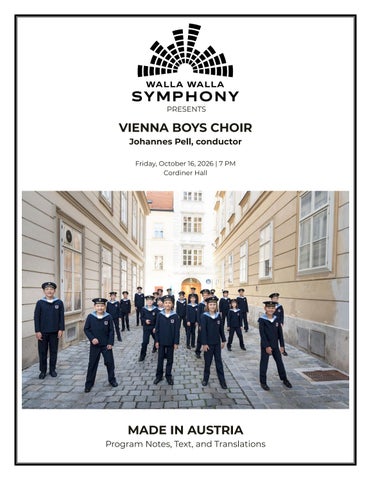
VIENNA BOYS CHOIR Johannes Pell, conductor Friday, October 16, 2026 | 7 PM Cordiner Hall
MADE IN AUSTRIA Program Notes, Text, and Translations
Joseph von Eybler (1765 - 1846) Omnes de Saba venient (They will all come from Saba) Gradual for Epiphany Text: Biblical; Isaiah 60:6, 60:1, and Matthew 2:2 Joseph Eybler was born in Schwechat, Lower Austria; he was educated in a seminary run by the city of Vienna. As a boy, he received lessons in composing from court composer Johann Georg Albrechtsberger. Joseph Haydn and Wolfgang Amadeus Mozart helped his career along; Mozart, who was in fact a close friend, asked Eybler to conduct the rehearsals for the premiere of his opera Così fan tutte. Ironically, as a court employee Eybler was far more influential in his lifetime than either Haydn or Mozart. In 1803, Eybler started to work for the Chapel Imperial (Hofmusikkapelle), of which the Vienna Boys Choir is a part. As part of his duties, Eybler organised the rehearsals and performances of the boys; one of his charges would have been Franz Schubert. In 1824, Eybler succeeded Antonio Salieri as director of the Chapel Imperial. Joseph von Eybler wrote 32 masses, two oratorios, a requiem, several motets, symphonies, and some chamber music. The gradual “Omnes de Saba venient” with its bright soprano solo remains his most popular work. It is used to great effect in Walt Disney's 1961 movie on the Vienna Boys Choir, “Almost Angels” (aka “Born to Sing”), directed by Steve Previn. Choir Omnes de Saba venient, aurum et thus deferentes et laudem Domino annuntiantes. Alleluja.
Translation They will all come from Saba; (they will) bring gold and frankincense and praise the Lord. Hallelujah.
Solo Surge et illuminare Jerusalem quia gloria Domini super te orta est. Alleluja.
Rise and shine, Jerusalem, for the glory of the Lord has risen above you. Hallelujah.
Choir Vidimus stellam ejus in Oriente. Alleluja. Et venimus cum muneribus adorare Dominum. Alleluja.
We have seen his star in the East, Hallelujah. And we have come with presents to worship the Lord. Hallelujah.
Giovanni Pierluigi da Palestrina (1525–1594) Pueri Hebraeorum (The Children of the Hebrew People) Words based on Matthew 21:8-9 and Psalm 24:7–10 Antiphon Palestrina, who took his name from his birthplace, started his musical career as a chorister at Santa Maria Maggiore in Rome. From 1544 to 1551, Palestrina worked in his native town as organist and choirmaster. In 1551, Pope Julius III summoned Palestrina to Rome as choirmaster of the Cappella Giulia, i.e. the choir of St. Peter’s Basilica, from which the Sistine Chapel recruited its singers. Palestrina also sang in the choir of the Sistine Chapel. In 1555, Pope Paul IV dismissed Palestrina and two others from
the Sistine Chapel choir because they were married. Palestrina succeeded Orlando di Lasso as choirmaster of St John Lateran. In 1560, he resigned in protest because the choirboys were not fed enough, and in 1561, he was appointed choirmaster of Santa Maria Maggiore, where he himself had been a chorister. In 1567, papal reforms declared some of his masses ‘unliturgical’, because he had used secular songs or words foreign to the ordinary. Around that time, Palestrina went to work for the Cardinal Ippolito d’Este, who had an excellent private chapel and offered a better salary than the Vatican or indeed the emperor in Vienna, who had been interested in hiring Palestrina. In 1571, the composer returned to his old post of director of the Cappella Giulia, serving under the next Pope, Pius V. Personally, Palestrina had a hard time then: he lost both his sons and his wife to the plague. He considered becoming a priest, but in the end found another solution. He remarried; his new wife was the rich widow of a fur merchant. Palestrina, who clearly had good business sense, made a fortune which enabled him to publish several collections of his music. Palestrina’s music resembles the architecture of the time; it is characterised by soaring lines, a skilful blend of voices, and a rich sound. Contemporaries saw Palestrina as the embodiment of spirituality and modesty; his compositions were admired as perfect. His enormous output includes over 100 masses, 68 offertories, 35 magnificats, 11 litanies, and around 300 motets.
Text Pueri Hebraeorum, portantes ramos olivarum, obviaverunt Domino, clamantes et dicentes: Hosanna in excelsis.
Translation The Hebrew children, bearing olive branches, went to meet the Lord, while calling out and saying: Hosanna in the highest.
Franz Schubert (1797–1828) Der 23. Psalm (The Lord is my shepherd), D 706 Words based on the translation by Moses Mendelssohn (1729–1786) Franz Peter Schubert was born in Lichtenthal (now a district of Vienna) in 1797. His father, a schoolteacher, gave him violin and piano lessons. In 1808, Schubert successfully auditioned for the Imperial Boys’ Choir, he won one of only two free places in the choir. Antonio Salieri became his teacher and mentor. Schubert liked his life, and particularly the music at the choir school, but he disliked the food. A letter to his brother has him begging for some money or an apple, “as it is hard to subsist on gruel and to wait for hours from one measly meal to the next”. Despite his enormous talent Schubert was never able to live off his music; he had to eke out a meagre living from teaching. Initially, he worked as an assistant at his father’s school, then he taught music at the Hungarian estate of Count Esterházy. Later on, he was supported by his friends. Schubert wrote eight symphonies, six masses and chamber music. He is most famous for his lieder; he wrote more than six hundred songs on poems by Goethe, Schiller, Heine, and others. He died at the age of 31, most likely from Typhoid fever.
The 23rd psalm bears the title “The good shepherd”; it is one of the most popular psalms of King David. The good shepherd is an epithet used for gods and kings throughout the Ancient Near East. It was duty of the king or the city deity to provide for the people and keep them from harm, in the same way in which a shepherd looks after his flock. The last two verses describe a festive banquet. It is in fact the ultimate – i.e. funereal – banquet, at which God himself anoints the believer; a gesture of hospitality extended in the Near East. Schubert wrote this piece for Anna Fröhlich and her pupils in the winter of 1820/1821. The poetic translation is by philosopher Moses Mendelssohn, Felix Mendelssohn’s grandfather, a fierce advocate of an interfaith society based on mutual respect. Text Gott ist mein Hirt, mir wird nichts mangeln: Er lagert mich auf grüner Weide, Er leitet mich an stillen Bächen Er labt mein schmachtendes Gemüt Er führt mich auf gerechtem Steige Zu seines Namens Ruhm. Und wall' ich auch im Todesschattentale, so wall’ ich ohne Furcht, denn du beschützest mich. Dein Stab und deine Stütze sind mir immerdar mein Trost.
And though I walk through the valley of the shadow of death, I fear no evil: For you watch over me. Your rod and your staff comfort me always.
Du richtest mir ein Freudenmahl im Angesicht der Feinde zu, Du salbst mein Haupt mit Öle und schenkst mir volle Becher ein.
You prepare a banquet for me before my enemies. You anoint my head with oil and fill my cup to the brim.
Mir folget Heil und Seligkeit in diesem Leben nach,
Goodness and mercy shall follow me all the days of my life.
Einst ruh' ich ew'ge Zeit dort in des Ew'gen Haus.
And I shall dwell forever in the House of the eternal God.
Translation God is my shepherd; I shall not want. He makes me lie down in green pastures, He leads me beside still waters. He restores my aching soul, He leads me on the right path To honour his name.
Erzherzog-Johann-Jodler Words: Anton Schosser (1801–1849) Folk song from Styria; Arr. Jimmy Chiang Alpine folk songs have certain characteristics that are easy to recognise. Many include yodels or a chorus or shout similar to yodelling – which was used by herdsmen and women to communicate in the mountains. The “Archduke Johann Yodel” was written in honour of the eponymous Archduke. Johann (1782–1859), the brother of the Austrian Emperor Franz I., loved Styria and chamois-hunting very much. To the horror and chagrin of his family, he “fraternised” with the locals to the point of marrying Anna Plochl, a
postmaster’s daughter from the town of Aussee in Styria. Unsurprisingly, the Archduke was hugely popular. Anton Schosser, a 19th century official from Upper Austria, wrote the text with Anna Plochl in mind, expressing fierce pride in the homeland and in the archduke. The melody may well be older, it originated in the Tyrol and has all the typical characteristics of a melancholy Alpine yodel. Text Wo i geh und steh, tut ma’s Herz so weh, um mei Steiermark, ja glaubt ma’s g’wiss; wo das Büchserl knallt und da Gamsbock fallt, und mei liaba Herzog Johann ist.
Translation Wherever I go, my heart aches For my beloved Styria, rest assured, Where the gunshot rings and the chamois falls, Where my dear Archduke Johann roams.
Ja, i sich mi scho’ ganz verzückt und froh mit mein’n Herzog auf der Alma gehn; mit an frischem Mut in mei’m Steirahut offen stolz am Kogel obmat stehn.
Yes, I see myself climbing happily Up the alpine meadow beside my Archduke With a happy heart, wearing my Styrian hat Openly and proudly on top of the mountain.
Auf da Felsenwand, in am Steirag’wand, wenn i da mei lieba Herzog sich, wenn sei Büchserl knallt und da Gamsbock fallt, war’s a Wunda, wenn i’s Heimweh krieg’?
There in the mountains, dressed in Styrian garb, When I watch my dear Archduke, When his gun rings out and the chamois falls, It’s no wonder that I am homesick.
Wolfgang Amadeus Mozart (1756–1791) Laudate Dominum (Praise the Lord) Words after Psalm 117 (Vulgate: Ps. 116) from: Vesperae solennes de Confessore K.339 The Laudate Dominum is one of the most famous pieces for soprano soloists, and much loved the world over for its beautiful, soothing melody. It is one of the six movements making up the solemn vespers, written in 1780 for the cathedral in Salzburg. At the time, Mozart was organist and composer at the court of Prince Archbishop Hieronymus Colloredo, the city-state’s ruler. The text is a Latin version of Psalm 117, a psalm of general praise. Mozart's setting has a calmness about it, and at the same time an irresistible draw. It is, to all intents and purposes, an operatic aria for soprano with a humble background chorus surrounding the soloist in the final praise. Text Laudate Dominum omnes gentes, laudate eum, omnes populi.
Translation Praise the Lord, all nations, Praise him, all peoples.
Quoniam confirmata est super nos misericordia eius, et veritas Domini manet in aeternum.
For his mercy is confirmed upon us, And the truth of the Lord remains forever.
Text (cont.) Gloria Patri, et Filio, et Spiritui Sancto.
Translation (cont.) Glory be to the Father, and the Son, and the Holy Ghost.
Sicut erat in principio, et nunc, et semper, et in saecula saeculorum. Amen.
As it was in the beginning, is now and ever shall be, World without end. Amen.
Vytautas Miškinis (*1954) Cantate Domino (Sing to the Lord) Words based on Psalm 96:1–2 and Psalm 98:1,5 (Vulgate: Ps. 95 / Ps. 97) Motet for six-part choir a cappella Miškinis is Lithuania's most famous living choral composer and conductor. He joined the legendary Ąžuoliukas Boys' Choir at the age of seven as a singer and served as its artistic director from 1979; since 1985, he has taught at the Lithuanian Academy of Music and Theatre in a number of different roles. He is a professor of choral conducting, president of the Lithuanian Choral Union, and an internationally sought-after adjudicator at international choir competitions. Miškinis’s output includes over 400 secular songs, 10 settings of the mass ordinary, and around 150 compositions using traditional liturgical texts. He blends Western harmonies and polyphony with sound clusters and abrupt rhythm changes to great effect. Cantate Domino is a case in point; the fast-paced six-part setting is driven by a syncopated rhythm. The repetitions of the imperative “Cantate” (“Sing!”) mimic the joyous shouting of a crowd. The performance demands rhythmic and vocal precision from the singers, and has proved highly popular with audiences. Text Cantate Domino canticum novum, cantate Domino omnis terra. Cantate Domino, et benedicite nomini ejus: annuntiate de die in diem salutare ejus. Cantate Domino in cithara et voce psalmi. Alleluja.
Translation Sing to the Lord a new song, sing to the Lord, all the earth. Sing to the Lord, and bless his name: proclaim his salvation from day to day. Sing to the Lord with the harp and the voice of a psalm. Hallelujah.
Tine Bec (*1993) Jubilate Deo universa terra (Rejoice in God, all the earth, 2019) "Jubilate Deo universa terra" is a vibrant, celebratory motet composed by Slovenian composer and conductor Tine Bec. The text is taken from the Latin Vulgate Bible. Bec opens with a nod to the Middle Ages, utilizing monophonic chant before the music explodes into a highly energetic, contemporary sonic experience, with body percussion to boot: The singers stomp, clap, and thump their chests to
provide a driving, primal rhythmic foundation. Bec weaves complex choral harmonies and joyful syncopation into the percussion, ultimately building into a final, ecstatic "Alleluia”. Text Jubilate Deo, universa terra; psalmum dicite nomini eius. Venite et audite, et narrabo vobis, omnes qui timetis Deum, quanta fecit Dominus animae meae. Alleluia.
Translation Rejoice in God, all the earth, Say a psalm in His name. Come and listen, and I will tell you, All you God-fearing people, How much the Lord has done for my soul. Alleluia.
Ola Gjeilo (*1978) Tundra Words: Charles Anthony Silvestri (*1965) Ola Gjeilo is one of the most popular choral composers around. Born in Norway, Gjeilo was educated at the Conservatory in Oslo, at the Royal College of Music in London, and at The Juilliard School in New York. His music shows influences of Classical music, jazz, folk, and pop, as well as film scores; Gjeilo feels inspired by Keith Jarrett and Pat Metheny as well as architect Frank Gehry among others. The lyrics for Tundra were written by Charles Anthony Silvestri, a frequent collaborator. The words are inspired by the Hardanger Plateau (Hardangervidda) in Norway, the composer’s childhood landscape. Hardangervidda has been occupied since the Neolithic; today, much of it is protected as a National Park. The landscape is barren and beautiful at the same time – Henrik Ibsen’s play When We Dead Awaken is partly set there; and the Hoth sequences in The Empire Strikes Back were shot on the Hardangerjøkulen glacier. Text Wide, worn and weathered, Sacred expanse Of green and white and granite grey; Snowy patches strewn,
Anchored to the craggy earth, Unmoving; While clouds dance Across the vast, eternal sky.
Amazing Grace Folk song from the USA Words: John Newton (1725–1807) Arr. John Coates John Newton’s biography does not immediately suggest a writer of religious texts. He undertook his first sea voyage at age eleven; at eighteen, he was pressed into service on a British man-of-war. He deserted, was caught, flogged and demoted; he finally wound up aboard a slave ship. Life was not pleasant, and Newton started to read and teach himself Latin.
In 1748, Newton’s ship was caught in a violent storm, the outward reason for his conversion. In 1755, Newton left the sea and took up religion. He met methodists and Calvinists. He learnt Greek and Hebrew and finally managed to become a minister. He accepted the curacy of Olney, Buckinghamshire. Newton must have been a captivating preacher; his church had to be enlarged to accommodate the crowds. Amazing Grace was written between 1769 and 1770, probably for a service. Newton published it in 1779 (second edition 1807) with the title Faith’s Review and Expectation, and a reference to First Chronicles 17:16f. The song’s first verse also recalls John 9:25. – The music is supposedly Early American; and it has been speculated that the melody was sung by slaves. Text Amazing Grace, how sweet the sound that saved a wretch like me. I once was lost but now am found was blind but now I see.
How precious did that grace appear the hour I first believed. When we’ve been there ten thousand years Bright shining as the sun, we’ve no less days to sing God’s praise, then when we first begun.
’Twas grace that taught my heart to fear, and grace my fear relieved.
*** Intermission *** Johann Strauss II (1825–1899) Tritsch-Tratsch, fast polka opus 214 Words: Tina Breckwoldt; Arr. Gerald Wirth Johann Strauss was the second Strauss with the first name Johann, but he is undoubtedly the most famous. At least four members of the family were active as composers: his father Johann I (1804-1849), Johann himself and his brothers Joseph (1827-1870) and Eduard (1835-1916). When Johann was ten years old, his father became Hofball-Musikdirektor (Music Director at the Court Balls). A high honour, but father Strauss did not want his sons to become musicians; he felt it was a rather suspect profession and enrolled his son in a trade academy. Johann (aided and abetted by his mother) had music lessons behind his father’s back. At nineteen, he founded his own very successful orchestra. Much of his work is influenced by Romani and Jewish Klezmer music. There is an inherent ambiguity in it: Strauss, who made the entire city of Vienna dance, was a nervous, ill-tempered and lonely man, and he could not dance. Tritschtratsch (meaning chitchat or gossip) is the title of a play by Austrian playwright Johann Nestroy, first performed in 1833. In 1858, Viennese journalists started a funny magazine by the same name. In March 1858, the paper printed a humorous piece about Johann Strauss, the waltz king himself. Strauss took this with good humour and penned the polka as an answer. The premiere in November of 1858 received much attention by contemporary newspapers; the cheerful polka proved a huge success and has been an audience favourite ever since. It features in the James-Bond-movie Moonraker, where it accompanies Bond alias Roger Moore, gliding across St Marc’s Square in a hovercraft. It was used again as a signature tune in the 2022 film “The Gray Man” to accompany Ryan Gosling’s character through Vienna.
The Vienna Boys Choir has performed this popular piece three times at the New Year’s Day Concert of the Vienna Philharmonic Orchestra, in 1988 and in 1998, and again in 2012. The text sung by the Choir deals with gossip mongering and what it can do to people, ending with a tongue-in-cheek bow to Greek philosopher Plato. Text Er ist – man sagt – (Ach, Klatsch - und Tratsch) Man hat sich schon beschwert Er fragt – man klagt (Wir sind - empört) Das ist doch unerhört.
Translation He is – they say (That’s gossip - more gossip) They have already complained He asks – they moan (We are - outraged) This is simply not on!
Er meint – es scheint (Nur Klatsch – und Tratsch) Er stellt sich gern zur Schau Man glaubt – man meint (Wie schön - ist das) Ich weiss es nicht genau.
He says – it seems (Just gossip - more gossip) He likes to show off and pose They believe – they surmise (How nice - that is) I don’t exactly know.
Gerüchte brodeln ganz ungeniert raffiniert, kommentiert auf einmal fühlt man sich exponiert wie es denn das nur passiert?
Rumours fly about shamelessly Tricky, annotated, And all of a sudden you feel utterly exposed How did that happen?
Das hat man noch nie vernommen! Ist das schon mal vorgekommen? Wie sind wir hierher gekommen, hier an diesen Punkt?
This is totally unheard of Has something like this happened before How did we get here, To this point?
Das Gehirn geht im Kreis Der Verstand liegt auf Eis während sie die Mär verbreiten
The mind walks in circles Brain totally numb While they continue to spread tales
Trio Wenn sie kleine Erbsen zählen Um die anderen zu quälen Zwischen Schwert und Worten wählen wollen sie nur zeigen dass sie tüchtig sind.
Trio When they get worked up over peanuts, Just to torture others, Choose between sword and words, They only want to show How efficient they are.
Treiben sie es auf die Spitze, feixen, frotzeln, reissen Witze, reden sich in Dauerhitze, um sich zu beweisen, dass sie wichtig sind.
When they carry on Smirking, taunting, cracking jokes, Blathering on forever, They want to prove to themselves That they are important.
Wir kommen jetzt so richtig erst in Fahrt Inzwischen geht es wirklich hart auf hart Wir streiten um des alten Kaisers Bart Ja, um des Kaisers Bart.
We are just getting started Now we are really talking We fight over nothing, Yes, over nothing.
Coda Es ist ein Gerücht. Was weiss man denn? Man weiss doch nichts. Das weiss ich!
Coda It is merely a rumour. What do you know? We know nothing. That I do know!
Johann Strauss II Kaiserwalzer (Emperor Waltz), opus 437 Word: Victor Gomboz; Arr. Gerald Wirth Strauss composed Kaiserwalzer for the inauguration of a new concert hall - “Königsbau” - in Berlin in 1889. The Austrian Emperor Franz Joseph had visited the German Emperor Wilhelm II that year, toasting him with the phrase “hand in hand”, and Strauss had originally intended to use the quote as the title. His publisher Fritz Simrock suggested the catchier title “Kaiserwalzer”. It sounded far more imperial, and had the added advantage that it could be taken to refer to either monarch. Kaiserwalzer was first performed in Berlin on 21 October 1889, with Strauss himself conducting. Right from the beginning, the majestic waltz proved extremely popular with audiences everywhere: It is one of Strauss’s best-known pieces. There are three feature films that make extensive use of the music; they even use its name as their title. Among them is a 1948 film by Billy Wilder starring Bing Crosby. The Vienna Boys Choir has been singing this particular waltz since the 1920s. In 1953, they recorded it for the soundtrack of Franz Antel’s movie by the same name. In the film, it is sung before Empress Elisabeth (“Sisi”). Text Wenn Wien erwacht in Frühlingspracht Im Wienerwald Vogelsang hallt, dann sei bereit, liebe Maid, denn s’ist jetzt holde Frühlingszeit.
Translation When spring begins in Vienna, You hear birdsong in the woods, Be ready, dear maiden, It is springtime!
Burschen, Mädel, alt und jung vereint, freu’n sich alle, Sonne wieder scheint. Liebe, Küsse, holde Seligkeit, denn so liebt der Wiener Frühlingszeit.
Lads and lasses, old and young together, Everyone is cheerful, the sun shines again. Love and kisses, happiness, That’s how the Viennese like their spring.
Klingen Walzer von ferne Die er tanzt, ach so gerne Nimmt er’s Mädel gleich fest unter’n Arm Das macht den beiden warm.
You hear waltz music from afar: The young man likes to dance And takes his girl by the arm Warming both equally.
Und mit leichten Schritten Fast mit Elfeleins Tritten Dreh’n sich beide im Tanz.
Light-footed, Almost like elves, They both waltz away.
Von dieser Melodei wird man ganz verrückt Eins, zwei, drei, tralalei,
This music can make you quite mad, One, two, three, tralala,
Text (cont.) singt das Herz dabei.
Translation (cont.) The heart sings along.
Seht, das ist unser Wien Dort geboren ich bin, Vater, Mutter sind dort, s’ist ein himmlischer Ort.
Look, this is our city, Where I was born. Father and mother are there, It is an excellent place.
Stephansdom und der Ring, Preislied darauf nun erkling, o Wien, Perle von Schönheit, bleib so in Ewigkeit.
St Stephen’s Cathedral, the Ring Road, Let’s sing to them, Beautiful Vienna, May it remain like this forever.
Wann du durchgehst durchs Tal (When you pass through the valley) Love song from Carinthia; Arr. Gerald Wirth This is a well-known song in three-four time. The pensive, melancholy text deals with the less pleasant aspects of love, the yearning for a love lost. The melody is sung by the middle voice. The yodels at the end of each verse echo the melody; the singers continue without words as it were: emotion keeps the song going. “Granitzen” in the last sentence might refer to a brook called Granitzen, marking the border between Carinthia and Styria, or indeed be a play on the Slovenian word “granica” and the German word “Grenze”, both meaning “border”. To confound matters further, there is also a mountain with a similar name, “Garnitzen”. This mountain sits on the border between Austria and Italy, and a switch of letters is not inconceivable in a folk song. In any event, the boy is literally out of bounds. Text Wann Du durchgehst durchs Tal, Bua, jauchz noch amal, dass i di no mal hör, vielleicht nacha nia mehr, Holla rei . . .
Translation When you pass through the valley, boy, shout for joy once more, So I can hear you once more, maybe afterwards no more. Yodel. . .
Wann i wischpl und schrei, und du hörst mi net gleich, ja, da muaß i verstehn, dass i weita soll gehen. Holla rei . . .
When I whisper and yell, and you don’t hear me immediately, Well, I must understand that I should go on. Yodel. . .
Und i hör nix mehr wischpln, i hör nix mehr schrein, da Bua wird scho längst über d’Granitzn sein. Holla rei . . .
And I hear no more whispering, I hear no more yelling, The boy will have long since crossed the Granitzen (border). Yodel . . .
Richard Rodgers (1902–1979) Do-Re-Mi Edelweiss Words: Oscar Hammerstein II (1895–1960) from The Sound of Music (1959) Richard Rodgers was born and bred in New York. He wrote his first songs as a teenager, and by the time he entered Columbia University in 1919, he already had a Broadway musical to his name. A year later, he was asked to provide the music for the university’s Varsity show, an unusual honour for a freshman. In 1921, Rodgers left Columbia to attend the Institute of Musical Art (now the Juilliard School of Music), where he studied for three years. Rodgers and his partner Lorenz Hart found it difficult initially to interest Broadway producers in their songs. Their luck changed when the Theatre Guild signed them to furnish the music for a revue called The Garrick Gaieties in 1925. From 1931 to 1935, Rodgers and Hart wrote film scores in Hollywood, such as Love Me Tonight (1932), starring Maurice Chevalier and Jeanette MacDonald, and Mississippi (1935), starring Bing Crosby and W.C. Fields. In 1935, they returned to New York. They continued to work together until Hart’s death in 1943. In 1942, Rodgers teamed up with Hammerstein. Their innovative and adventurous style delighted audiences in Europe and the USA. Their first collaboration was Oklahoma!, which achieved a recordbreaking run of 2,212 performances and won a Pulitzer Prize. Carousel was voted best musical of 1945 by the Drama Critics Circle, and in 1949, South Pacific won both the Pulitzer Prize for drama and the Drama Critics Circle award for best musical. The King and I won a Tony Award for best musical in 1951. 1959's The Sound of Music, set in Austria during World War II, was probably their most successful work. It won a Tony and a Grammy. The film, starring Julie Andrews, won an Oscar. Her character, Maria, uses songs to teach the von Trapp children singing and solfège. Do-Re-Mi Let's start at the very beginning A very good place to start When you read you begin with A-B-C When you sing you begin with do-re-mi Do-re-mi-fa-sol-la-ti Let's see if I can make it easy Doe, a deer, a female deer Ray, a drop of golden sun Me, a name I call myself Far, a long, long way to run Sew, a needle pulling thread La, a note to follow Sew Tea, a drink with jam and bread That will bring us back to Do (oh, oh, oh) Doe, a deer, a female deer Ray, a drop of golden sun
Me, a name I call myself Far, a long, long way to run Sew, a needle pulling thread La, a note to follow Sew Tea, a drink with jam and bread That will bring us back to Do Do-re-mi-fa-sol-la-ti-do So-do! When you know the notes to sing You can sing most anything! Edelweiss Edelweiss, Edelweiss, ev’ry morning you greet me, small and white, clean and bright you look happy to meet me.
Edelweiss (cont.) Blossom of snow, may you bloom and grow forever
Edelweiss, Edelweiss, bless my homeland forever.
Billy Joel (*1949) Vienna Billy Joel was born in the Bronx, New York. His father and paternal grandparents had fled Europe to escape the Nazis; his father Howard married a Jewish girl from Brooklyn. His parents split up when he was eight years old; his father, a Classical pianist, returned to Europe and settled in Vienna. Years later, Billy Joel tracked down his estranged father in Vienna. He loved the city and its genteel pace; Vienna was the place where he reconnected with his father, and a place where cultures and generations mixed. Older people were very much part of the city’s cultural life; everyone seemed to have time. Billy Joel coined the phrase “Vienna Waits for You“, used by the Vienna Tourist Board as a slogan. The song was first released on Joel’s 1977 album The Stranger. In 2008, Joel himself named it in a New York Times interview as one of his favourite pieces, a song about celebrating life at any age. Text Slow down, you crazy child You're so ambitious for a juvenile But then if you're so smart, then tell me Why are you still so afraid?
Though you can see when you're wrong, you know You can't always see when you're right, you're right
Where's the fire, what's the hurry about? You'd better cool it off before you burn it out You've got so much to do and Only so many hours in a day
You've got your passion, you've got your pride But don't you know that only fools are satisfied? Dream on, but don't imagine they'll all come true When will you realize, Vienna waits for you?
But you know that when the truth is told That you can get what you want or you get old You're gonna kick off before you even get halfway through When will you realize, Vienna waits for you? Slow down, you're doing fine You can't be everything you want to be before your time Although it's so romantic on the borderline tonight Too bad but it's the life you lead You're so ahead of yourself that you forgot what you need
Slow down, you crazy child And take the phone off the hook and disappear for a while It's all right, you can afford to lose a day or two When will you realize, Vienna waits for you? And you know that when the truth is told That you can get what you want or you can just get old You're gonna kick off before you even get half through Why don't you realize, Vienna waits for you When will you realize, Vienna waits for you?
ABBA Benny Andersson (*1946) / Björn Ulvaeus (*1945) Mamma Mia! Highlights from the Movie Soundtrack Additional words by Stig Anderson; Arr. Mac Huff Few pop groups have shaped the global musical landscape as permanently as the Swedish quartet ABBA. In this fast-paced choral medley, arranger Mac Huff brings the band's unmistakable sound and infectious spirit to life in a brilliant SSA setting, ideally suited for boys’ choir. The eponymous "Mamma Mia" was written in 1975 by Andersson and Ulvaeus. The familiar story of an on-again, off-again relationship was something listeners could identify with, and the bouncy rebound chorus helped make the song a worldwide hit. It later became the title song of the 1999 musical (spelled with an exclamation mark to differentiate it from the song), and in the 2008 film version, lead actress Meryl Streep famously sang it herself. From there, the medley transitions into the driving dramatic tension and unforgettable minor chords of "S.O.S.", followed by a moment of pure gratitude in the beautiful ballad "Thank You for the Music" (1977). The medley culminates in what is widely considered one of the greatest dance anthems of all time: "Dancing Queen". Mamma mia I’ve been cheated by you since I don’t know when So I made up my mind, it must come to an end Look at me now, will I ever learn? I don’t know how but I suddenly lose control There’s a fire within my soul Just one look and I can hear a bell ring One more look and I forget everything, o-o-ooh Chorus: Mamma mia, here I go again My my, how can I resist you? Mamma mia, does it show again? My my, just how much I’ve missed you Yes, I’ve been brokenhearted Blue since the day we parted Why, why did I ever let you go? Mamma mia, now I really know, My my, I could never let you go. S.O.S. Where are those happy days they seem to hard to find? I try to reach for you. but you have closed my mind Whatever happened to our love? I wish I
I’ve been angry and sad about the things that you do I can’t count all the times that I’ve told you we’re through And when you go, when you slam the door I think you know that you won’t be away too long You know that I’m not that strong. Just one look and I can hear a bell ring One more look and I forget everything, o-o-ooh Chorus: Mamma mia, even if I say Bye bye, leave me now or never Mamma mia, it’s a game we play Bye bye doesn’t mean forever Chorus
understood It used to be so nice. It used to be so good So when you're near me, darling, can't you hear me S.O.S.?
S.O.S. (cont.) The love you gave me. nothing else can save me, S.O.S. When you're gone, how can I even try to go on? When you're gone though I try how can I carry on? You seem so far away though you are standing near You made me feel alive but something died I fear I really tried to make it out. I wish I understood
Thank you for the Music I′m nothing special, in fact I'm a bit of a bore If I tell a joke, you′ve probably heard it before But I have a talent, a wonderful thing 'Cause everyone listens when I start to sing I'm so grateful and proud All I want is to sing it out loud
What happened to our love? It used to be so good So when you're near me, darling, can't you hear me S.O.S.? The love you gave me. nothing else can save me, S.O.S. When you're gone, how can I even try to go on? When you're gone though I try how can I carry on? When you're gone, how can I even try to go on? When you're gone though I try how can I carry on?
So I say Thank you for the music, the songs I′m singing Thanks for all the joy they′re bringing Who can live without it? I ask in all honesty What would life be Without a song or a dance, what are we? So I say thank you for the music For giving it to me
Da Summa is aussi (Summer is over) Cattle driving song from Styria Arr. Franz Dorfer The seasonal cattle drive from high mountain pastures back down to the valley is central to life in the European Alps. If the summer went well, the animals are festooned with spectacular flowers, evergreen twigs, and pieces of mirrors assembled in the days before the event, and equipped with loudly clanging bells – the mirrors and bells are designed to keep evil spirits at bay. The traditional songs inspired by this summer farewell are both melancholy and hauntingly beautiful. – Austrian world-musician and pop singer Hubert von Goisern created a cult version of this song that hit the European charts in 2001. Text Da Summa is aussi, i muass obi ins Tal, pfiat enk Gott, es scheni Oima, pfiat enk Gott tausendmal. Schen stad is’s scho worn, ja, koa Vogal singt mehr, ja, und es waht scho da Schneewind vom Wetterstoan her.
Translation Summer is over, and I must descend to the valley; May God keep you, beautiful alpine meadows, may God keep you a thousand times. It has grown quiet; no bird sings anymore, And the snow-wind is already blowing from the Wetterstein peaks.
Text (cont.) Es Felswänd, es Gamsberg, pfiat enk Gott alli dann, es tausend schene Bleamal, so liab und bekannt. Mei Hüttn, mei kloane, wü mir ned aussn Sinn, ja, wo i oftmois so traurig und glücklich gwesd bin.
Translation You rock faces, you chamois mountains, may God keep you all now, You thousand beautiful flowers, so dear and familiar. My little cabin will not leave my thoughts, Where I have so often been both mournful and glad.
So hoat, wia mei heit is, is ma a nu nia gwen, ois miasst i meine Hüttn heit es letzte moi seng Und miasst i goa boid scho zur Erd und zur Ruah, ja, dann deckts mi mit Felsstoa und Almbleamal zua.
My heart has never felt as heavy as it does today, As though I were to see my cabin for the very last time. And should I soon be called to earth and to rest, Then cover me over with mountain rocks and alpine flowers.
Johann Strauss II An der schönen blauen Donau (Blue Danube), waltz opus 314 Words: Franz von Gernerth (1821–1900); Arr. Gerald Wirth Austria’s secret national anthem is dedicated to the Vienna Männergesangsverein (Men’s Chorus); it was first performed in February of 1867 at the chorus’s Carnival Ball. The composer was absent, as he had a court engagement. The original text was slightly silly; it was meant to poke fun at the fact that many carnival balls had been cancelled that year and it ran, ‘Viennese, be joyous! O-ho! Why-o?’ This fitted the occasion but did not survive beyond the carnival. There were several attempts at improving the poetry, until Gernerth, a lawyer, wrote his in 1889. His maudlin, flowery, and somewhat patriotic description of the Danube has remained standard until today. Text Donau so blau, durch Tal und Au Wogst ruhig du hin, Dich grüßt unser Wien, Dein silbernes Band Knüpft Land an Land, Und fröhliche Herzen schlagen An deinem schönen Strand.
Translation Danube, so blue, you meander calmly through vales and meadows, Our Vienna greets you, your silver ribbon links lands and cheerful hearts beat on your beautiful shores.
Weit vom Schwarzwald her eilst du hin zum Meer, spendest Segen allerwegen, ostwärts geht dein Lauf, nimmst viel Brüder auf: Bild der Einigkeit für alle Zeit.
From the Black Forest you rush towards the Black Sea, blessing everything on your way. You flow east, taking in many brothers: An eternal image of harmony.
Alte Burgen seh’n nieder von den Höh’n,
Old fortresses look down from their hills,
Text (cont.) grüßen gerne dich von ferne, und der Berge Kranz, hell vom Morgenglanz spiegelt sich in deiner Wellen Tanz.
Translation (cont.) they like to greet you from afar and the top of the mountains, bright in the morning light, are reflected in the dancing of your waves.
Die Nixen auf dem Grund Die geben flüsternd kund Was alles du erschaut Seitdem über dir der Himmel blaut.
The mermaids in the river bed whisper about everything you have seen since heaven began.
Halt an deine Fluten bei Wien, es liebt dich ja so sehr, du findest wohin du magst ziehen ein zweites Wien nicht mehr.
Stop when you reach Vienna, it really adores you. Wherever you may wander, you will not find a second Vienna.
Du kennst wohl deinen Bruder, den Rhein, an seinen Ufern wächst herrlicher Wein, dort auch steht bei Tag und bei Nacht die feste, treue Wacht.
You probably know your brother, the Rhine, lovely wine grows along its banks, and night and day it is flanked by faithful guardians.
Das Schifflein fährt auf den Wellen so sacht Still ist die Nacht, Liebe nur wacht, der Schiffer flüstert der Liebsten ins Ohr, dass längst schon sein Herz sie erkor.
The little boat rides on the waves, the night is quiet, love is in the air, the skipper tells his beloved his heart had selected her long since.
Nun singt ein fröhliches, seliges Lied, das wie Jauchzen die Lüfte durchzieht. Und zum Schluss bringt noch einen Gruß, unsrer Donau, dem herrlichen Fluss.
Now sing a happy, cheerful song, filling the air with joy, and, finally, give a special cheer for the Danube, our beautiful river.
Notes compiled by Tina Breckwoldt ©2026