ENHANCING OUTCOMES FOR YOUNG PEOPLE WHO ARE NOT IN EMPLOYMENT, EDUCATION OR TRAINING IN COUNTY WEXFORD
First published by: Waterford and Wexford Education and Training Board (WWETB), Wexford Children and Young People’s Services Committee (CYPSC) and Wexford County Council.
Doody, S. (2022). Building Relationships, Supporting Journeys - Enhancing Outcomes for Young People who are Not in Employment, Education or Training in County Wexford, Ireland. WWETB, CYPSC and Wexford County Council.
Designer: Petra Curtis @ The Design Nut.
TABLES, FIGURES & MAPS
Table
Table 5
Table 6
Table 7
Table 8
Table 9
Table 10
Table 11
Table 12
Table 13
Table 14
Table 15
Table 16
Table 17
Population of 16 – 24 year olds in Wexford, 2016 Census and projected in 2021.................................................35
Population of Wexford’s eight largest settlements, 16–24 year olds, 2016 and projected in 2021.....................35
Wexford’s 20 most deprived small areas, by deprivation score, total population and population of 16 –
year olds, 2016 and project in 2021...........................................................................................................................36
Wexford’s 10 most deprived rural small areas, by deprivation score, total population and population of 16
24 year olds, 2016 and project in 2021......................................................................................................................37
rates by gender group and gender...............................................................................................................39 Estimated number of young people in Wexford and Waterford who are in a NEET situation...........................39
Estimated number of young people who are in a NEET situation in Wexford’s 8 largest settlements
Young people starting in full-time FET programmes in Waterford and Wexford in 2020, by age
LIST OF FIGURES
Figure 1
Figure 2
Figure 3
Figure 4
Figure 5
Figure 6
Figure 7
Figure 8 LIST OF
Map
Map
Map
Map
FOREWORD
I am delighted to present ‘Building Relationships Supporting Journeys, Enhancing Outcomes for Young People who are ‘Not in Employment, Education or Training’ in Co. Wexford.
This research which focuses on improving outcomes for young people who are not in employment, education, or training, was named as a priority area in Wexford Children’s and Young People’s Services Committee (CYPSC) Action Plan. The cooperative approach of CYPSC was maintained in the formation of the Advisory Group, that worked together to inform the research from its initial stages through to its completion.
The research was informed by a wide-ranging methodology, which included focus groups, one to one interviews with young people and professionals across formal education, non-formal education and other sectors who work to support them. I would like to thank all who participated in the research process. The contribution of young people in this research is of particular importance and special thanks to them for giving their time and sharing their experience.
This research is timely, coming as it does as we exit the Covid 19 pandemic and bearing in mind the huge impact the pandemic has had on all sectors of society, in particular on young people. It is envisaged that this research and its findings, will further strengthen and enhance interagency collaboration which is a priority action in the Waterford and Wexford Education and Training Board (WWETB) Strategic Statement 2018-2022 and that we continue to work together to improve outcomes for young people who are not in employment, education, or training in Co. Wexford.
I would like to take this opportunity to acknowledge the considerable contribution of all the stakeholders and express my gratitude to those who were involved in bringing this research to completion. Particular thanks to each member of the Advisory Group for their time and contribution. This research was only possible because of their ongoing commitment to interagency work and their shared objective of improving outcomes for young people.
We in WWETB are pleased to have supported this research financially and a word of thanks to our co-funders of this research both Wexford Children’s and Young People’s Services Committee and Wexford Co. Council and to the researcher Sinead Doody.
Kevin Lewis,
Chief
Executive,
Waterford and Wexford Education and Training Board
WHY PRODUCE THIS REPORT?
A 2017 report by Pobal1 showed that Wexford has one of the highest rates of young people in Ireland who are Not in Employment, Education and Training (NEET). While there are a range of risk factors associated with this rate, these young people are not a homogenous group; in fact, there are numerous complex issues and circumstances contributing to young people falling into, and remaining in, the NEET situation.
Organisations and agencies that work to support young people who are in a NEET situation often experience persistent challenges in engaging meaningfully with them. The nature of the NEET experience, combined with service-delivery constraints (relating to areas such as national policy, resource capacity and organisational remit) can impact the ability of the statutory, community and voluntary sectors to identify, reach out to and successfully engage with this particularly vulnerable cohort. As a result, once young people fall into a NEET situation, they often become increasingly distant as time goes by from both the labour market and state services.
In 2021, in recognition of these challenges, the Youth Services Section of Waterford Wexford Education and Training Board (WWETB), Wexford Children Young People’s Services Committee (CYPSC) and Wexford County Council collaborated to commission this research2. They established a working group with several other organisations in Wexford (see page 77) who shared a common concern that current responses often fall short of desired outcomes. These organisations, constantly striving to deliver excellence in service provision, recognised the benefit undertaking research which would capture the realities of young people lives, build a picture of services available to them and identify measures to improve their outcomes.
The research primarily focuses on the role of further education and training provision, including non-formal education (i.e. youth work), in supporting young people who are in a NEET situation. This reflects that the NEET measurement rate (see page 39) inextricably links youth unemployment with participation in education and training. The research aims to reinforce the work of local agencies and organisations in their ongoing efforts to support young people to re-engage in learning, personal development and skills development, towards the long-term objective of achieving employment or other meaningful outcomes.
1 Gardner, C., Dermody, A., O’Donoghue, R., Davis, S., Isard, P. (2017) Kickboxing, kindness and going the extra mile: Good practice for working with NEETs under SICAP. Pobal. Ireland
2 The research is funded by Wexford CYPSC, Wexford County Council and WWETB
METHODOLOGY
This report is underpinned by the findings of primary and secondary research undertaken in 2021. Qualitative data was collected using a number of different methods and from a variety of sources.
PRIMARY RESEARCH
The primary data collection process involved direct engagement with young people and local service providers. The process sought to create a picture of the circumstances and realities faced by young people who are in a NEET situation in Wexford. It also sought to develop an understanding of services available to the young people, and challenges and opportunities in the service environment.
Input was garnered using focus groups, qualitative survey and semi-structured interviews.
a) Focus Groups: Face-to-face and on-line focus groups were held with young people and with serviceproviders. In total, 60 people participated in the focus groups; 19 staff from service-providers, 41 young people
b) Semi-structured interviews: Quotes and mini case studies were developed from interviews with young people in order to facilitate learning on interventions and approaches that make a difference to young people’s lives.
c) Local Service Provider Survey: A targeted survey was undertaken of relevant community and statutory service providers in Wexford to build a picture of the services provided and the challenges of reaching young people who are in a NEET situation. This targeted organisations with a remit of engaging with vulnerable young people and families. The survey was circulated through WWETB and Wexford CYPSC. 12 organisations completed a survey.
SECONDARY RESEARCH
a) Literature Review: A review of relevant local, national and international literature and information sources was undertaken to collect information on the following:
- services available to young people in Wexford who are in a NEET situation
- emerging issues and needs of young people who are in a NEET situation
- existing strategies/plans relevant to the needs of young people in these areas
b) Demographic Analysis: Using Census 2016 and Pobal deprivation data, an analysis of Wexford was undertaken to identify key demographic characteristics of young people aged 16 – 25 years and their families. Seven settlements were included in this analysis, as follows:
SETTLEMENTS
Wexford
New Ross
Enniscorthy
Gorey
Courtown Riverchapel
Rosslare
Castlebridge
Table 1: Settlements included in the research
c) Service Mapping: A service mapping process was undertaken, primarily to capture further education and training (FET) provision and youth work services in Co. Wexford. To a lesser extent, the mapping process also captured community, youth and family services which complement and/or overlap with FET and youth work services at local level.
REPORT
This report aims to provide practical and accessible information for organisations working with young people in Wexford. It offers contextual information on the factors contributing to young people falling into the NEET experience and outlines the different subsets of young people who are NEET. It sets out the wide range of FET, youth work and other services available in Wexford. It builds on the good practice evident in Wexford and offers a suggested model for improving collaboration between service-providers. Crucially, using quotes and mini case studies, it offers the voice of young people themselves, telling their own stories and sharing their experiences
SECTION 1
Understanding Young People who are Not in Employment, Education or Training
NEET TERMINOLOGY
While the term “NEET” is widely used in the national policy and local service context, it can be viewed as pejorative and as reinforcing the negative labelling of young people. In the absence of an alternative term that is extensively recognised across the statutory, community and voluntary sector, this report has adopted the term as shorthand for young people aged 16 – 24 years who are not in employment, education or training for more than six months.
FACT BOX: Defining Young People who are NEETs
• NEET is the term used to describe a young person who is "Not in Education, Employment, or Training”.
• The definition of a “young person” can vary depending on the study or country. The OECD defines a young person as someone between 15 and 29 years of age (oecd3.5).
• A young person is classified as being in a ‘NEET’ situation as long as they were neither enrolled in formal education or training nor in paid employment (for at least one hour per week) during the relevant reference period (OECD3.5)
• In most cases, a young person in a NEET situation is defined as someone between the ages of 15 and 24. Occasionally a broader age cohort is utilized to include young people up to the age of 30 years.
• For the purpose of this study, young people who are in a NEET situation are defined as young people aged 16- 24 years who have been out of employment, education or training for more than 6 months.
WHO ARE YOUNG PEOPLE IN A NEET SITUATION?
The term “NEET” refers to a broad category of young people encompassing a diverse population. In order to better understand their different characteristics and needs, it is necessary to disentangle the subsets within the broad overarching term of “NEET”. In 2016 Eurofund categorised young people who are NEET into seven separate sub-sets, as depicted in table 2:
Re-entrants
Young people who will soon re-enter employment, education or training and will soon begin or resume accumulation of human capital through formal channels. They are people who have already been hired or enrolled in education or training.
Long-term Unemployed
Young people who are unemployed, seeking work and available to start within two weeks, and have been unemployed for more than one year. People in this category are at high risk of disengagement and social exclusion.
Family Responsibilities
Young People who are unavailable for work due to caring responsibilities. These are a mix of the vulnerable and non-vulnerable; some are unable to participate in the labour market due to the cost of care for a child or adult family members. Others voluntarily withdraw from the labour market or education to take up family responsibilities.
Short-term Unemployed
Young people who are unemployed, seeking work and available to start within two weeks, and have been unemployed for less than a year. A short period of unemployment during the transition from school to work can be considered normal, and the level of vulnerability among people in this category is often moderate.
Illness, Disability
Young people who are not seeking employment or are not available to start a job within two weeks due to illness or disability. This group includes those who need social support because illness or disability means they cannot do paid work.
Discouraged
Young people who have stopped looking for work because they believe that there are no job opportunities for them. They are mostly vulnerable young people at high risk of social exclusion. They are very likely to experience poor employment outcomes over the course of their working lives and are at high risk of lifelong disengagement.
Other Neets
This group contains all young people whose reasons for being in a NEET situation do not fall into any of the previous six categories.
Table 2: Sub-sets of young people who are in a NEET situation
Planet Youth (Growing Up in the West)3 describes the risk and protective factors associated with a young person’s life in the following way:
“Risk factors are characteristics at the biological, psychological, family, community, or cultural level that are associated with a higher likelihood of negative outcomes. Protective factors are associated with a lower likelihood of negative outcomes or reduce a risk factor’s impact. Protective factors may be seen as positive countering events. We are all exposed to both risk and protective factors. While they can be complex, they represent conditions found in everyday life………..Risk and protective factors interact continually; while some factors cannot be changed, their impact can be lessened or strengthened.”
Within the Planet Youth approach (see page 76), risk and protective factors are defined within four major domains of intervention: parents and family, leisure time and local community, peer group and school. These domains are encompassed by the overall social environment and further influenced by regional and national context and policies.
NAT I O N AL
COUNTY/ R E GIONAL SOCIAL E
ONMENT
Figure 1: Risk and protective factors associated with a young person’s life
PARENTS AND FAMILY
• Parental support
• Parental monitoring
• Time spent with parents
• Parental social capital - knowing your child’s friends and their parents
• Perceived parental reactions to alcohol and drug use
• Parent’s own alcohol and drug use
LEISURE TIME AND LOCAL COMMUNITY
• Unorganised, unsupervised leisure time
• Access to, and participation in hobbies, recreation & sport
• Staying out late
• Unsupervised parties
• Access and availability of alcohol and drugs
• Location where alcohol and drug use takes place
• Community attachment and cohesion
• Young people’s sense of safety in their community
SCHOOL / EDUCATION
• Supportive adults at school
• Motivation to learn and grow
• Attitude to school and studies
• Absenteeism
• Young people’s sense of safety and attachment to school
• School’s role in organised extracurricular activities
PEERS
• Pro-social and supportive peers
• Peer alcohol and drug use
• Perceived peer respect for alcohol and drug use
Table 3: Planet Youth risk and protective Factors
There are a range of risk factors which contribute to a young person falling into a NEET situation. These include:
- lack of self-esteem/confidence
- mental health issues
- disability
- motivational factors
- disadvantaged social environment
- chaotic family environments
- poor educational experience.
In the past decade, young people constitute one of the groups most deeply affected by the banking crises in 2009 and, currently, the Covid-19 crises. Eurofund sets out seven risk factors for falling into a NEET situation, as depicted in figure 2.
RISK FACTORS
Education
Young people with a low level of education are 3 times more likely to become NEET compared to others.
Immigration
Young people with immigration background are 70% more likely to become NEET compared to nationals.
Unemployment
Having parents who experienced unemployment increases the probability of being NEET by 17%.
Disability
Those declaring of suffering some kind of disability are 40% more likely of becoming NEET compared to others.
Household Income
Young people with a low household income are more likely to become NEET than others.
Location
Divorce
Young people who suffered the divorce of their parents are 30% more likely to become NEET.
Living in remote areas increases probability of becoming a NEET up to 1.5 times.
Figure 2: Risk Factors for falling into a NEET situation (source Eurofund)
The circumstances of young people’s lives mean that the impact of risk factors and the influence of protective factors can vary considerably. Table 4 sets out some of the key circumstances which impact and influence young people’s outcomes.
Young people living in rural areas
Young people with a physical, mental or learning disabilities
Young people who are members of the Traveller or Roma community
Young people with experience of the care system
Young people who are homeless
Young women / young people with caring responsibilities
Young people who had a negative experience of the education system or who had poor school attendance
Young people who have experienced drug or alcohol abuse
Young people who have committed a crime
Young people who have experienced family conflict or unstable home life
Young people who have a lack of ambition or drive
Table 4: Factors which influence young people’s outcomes
FACT BOX: Gender Risk Factors
• Young Women: The NEET risk among young women is associated with early school leaving, childcare responsibilities for children under the age of three, health-related impairments, and preliminary unemployment experiences. Early school leaving has the strongest effect because it has a direct influence on the NEET risk, as well as an indirect effect via care responsibilities and unemployment experiences
• Young Men: The NEET risk factors for young men are early school leaving, health-related impairments, and preliminary unemployment experiences
THE IMPACTS OF BEING IN A NEET SITUATION
Long-term disengagement damages young people’s employability, their human capital and their future employment outcomes; in some cases, the damage will last the rest of their lives (Eurofund 2016 Exploring)
The impacts of being in a NEET situation are significant for both the individual and for society as a whole. Young people who are in a NEET situation have a much higher risk of remaining unemployed, experiencing poverty and being socially excluded in the future4. According to the OECD5, the concept of NEET undermines young people’s ability to achieve self-sufficiency, with the impacts intensifying the longer a young person remains NEET.
4 European Commission: On EU indicators in the field of youth, Commission staff working document, Brussels 2011.
5 OECD: Youth Neither in Employment, Education nor Training (NEETs), in: Society at a Glance 2014: OECD Social Indicators, 2014, OECD Publishing.
A 2017 study by Pobal, Kickboxing, kindness and going the extra mile: Good practice for working with NEETs under SICAP (Garner et. al., 2017) describes the impacts in the following way:
IMPACTS
a) Poorer well-being: Being in a NEET situation correlates with poorer general health, emotional strain, low self-esteem and confidence. As physical and emotional wellbeing are critical for engaging in employment and education, their lack can have significant impacts on families, deepen exclusion, deprivation and limit capacity to progress.
b) Increased risk behaviour: Young people who are in a NEET situation face exclusion and are at risk of increased substance misuse, early or lone parenthood. Also, youth offending has been highly correlated to disengagement from school and employment, which creates a cycle of social exclusion.
c) Earning potential: Unemployment, particularly for young people, has significant long-term effect on lifetime earning potential.
d) Reduced employability: By being outside of education, training or employment, youth are less likely to develop ‘soft skills’, such as resilience, time management, communication, and motivation skills that make them more likely to gain and maintain employment.
e) Public expenditure: Young people in a NEET situation have a significant economic impact on society in terms of additional welfare payments, increased healthcare costs and lost revenue from taxes. In the UK, the estimated cost of NEETs aged 16-18 to public finances is between £12bn and £32bn.
f) Disengaged citizens: There are far reaching societal costs of young people’s lost trust in public institutions, with lack of political engagement and decreased social participation as significant challenges.
By age 21, young people who have been in a NEET situation for six months or more are more likely than their peers to be unemployed, earn less, receive no training, have a criminal record, suffer from poor health and depression.
(UK Social Exclusion Unit, 1999, Gardner et al 2017, Sissons & Jones, 2012). (NDA)
Figure 3: Impacts of being in a NEET situation
FACT BOX: EU and Global Data on Young People in a NEET Situation
• The global youth unemployment rate stands at 13%, which is three times higher than the figure for adults, which is 4.3%.
• In 2018, 16.5 % of the 20 to 34-year-olds in the EU were in a NEET situation (approx. 15 million young people).
• Rural areas have more youth in a NEET situation compared to urban areas. In 2018, the share of young people in the EU who were in a NEET situation was lowest in cities (15.1 %) and highest in rural areas (18.3 %), with towns and suburbs reporting a NEET rate (17.3 %).
• Since 2011, young people aged of 15 - 29 years who are in a NEET situation have been the highest priority in EU youth employment policy.
• Map 1 depicts NEET rates in the EU in 2015, with Ireland one of the countries with a “high rate” of between 14% and 17%.
(<7%)
(7%–10%)
rate (10%–14%)
rate (14%–17%)
rate (>17%)
Map 1: NEET rate, 15–24 years, EU28, 2015 (%)
SECTION 2
Listening to the Voices of Young People
When teachers don’t understand where you’re coming from, they don’t take on your opinions.
Some people can’t learn from listening, we need to be shown one-to-one.
School favours those who do good, not those who are trying to do their best.
The school lets a lot of things slide like homophobia and racism.
When they found out that I was half-Traveller I got bullied. I used to have a fear of going into class. I wrote loads of complaints, and nothing was done.
My learning style did not suit school, but I was really into learning.
Being made to stand up in front of the whole class with your nose against the door. It’s very humiliating. But here it’s different, they ask you discreetly if everything’s OK.
School is so boring, it’s the same thing every day. And then having to do homework for 9 different subjects.
I didn’t get the subjects I wanted. Also, I was bullied at school and didn’t get enough help. I went to school feeling bad and went home feeling worse.
My needs went over their head, it felt like they didn’t care School supports were very inconsistent, it depends on the teacher.
In school it was punishment, whereas here (i.e. Youth Train) they try to fix it – staff here try harder than they do in school.
After I left school (early), I focused on myself, on my mental health and going to the gym. My own motivation to be happy kicked in.
You need to talk to someone who has been through similar things to you.
Music helps a lot of people with their problems.
Being made to stand up in school, in front of the whole class with your nose against the door. It’s very humiliating. But here it’s different, they ask you discreetly if everything’s OK.
It all comes down to wealth, if you don’t have money, you can’t do anything.
I dropped out of school to get clean, my friends helped me, not adults.
My Mam helped me.
We have friendships and a bond here (youth service), there’s a lot more trust, I can’t talk highly enough of this place. people said negative things about it.
The mental health services are so inconsistent, there’s very little followthough and you’re always dealing with different people.
On a bad day, I go to the gym or go boxing.
I woke up one evening at 7pm and thought it was morning – I thought there must be an eclipse or something. Then it just became my normal (i.e. sleeping all day)
The rigid environment of school didn’t work for me.
Funding and resources for mental health and autism is very low. The school didn’t know how to help me.
I was bored and sick of doing nothing, sick of being in the same pattern, sitting in my room playing games and sleeping for most of the day.
I’d like to do an apprenticeship, but I don’t really know how to get there.
Some CE schemes are very full.
I’d love to support him, but I don’t have the links (Front--line worker on the challenges of linking young people to other services)
I don’t have a (DSP) case worker, as far as I know
I don’t know what other services are out there, I never hear about them
I live in the middle of nowhere, there’s no public transport.
Everything in school was about college. But I wasn’t interested in going to college, so I had no clear path.
I do lots of interviews but I’ve no luck in getting a job (young person with a disability).
The jump from Level 4 to 5 is very big. It’s tough for some to make this jump.
(Front--line worker)
People have made their mind up about Roma, racism is an issue.
If you’re not motivated, it’s hard to know what to do next.
THE VOICE OF YOUNG PEOPLE – TRANSITIONS, YOUTH SERVICES AND
EDUCATION AND TRAINING
I didn’t want to come here (i.e. Youthreach) at first. I thought it was just for people who dropped out or were expelled, for scumbags.
We’re treated like equals here (Youthreach). You give respect, you get respect.
I need to learn how to drive.
The adults thought they knew better what I needed. Also, schools don’t want to lose numbers. And the principal didn’t like Youthreach.
The case worker (DSP) really helped me to apply for jobs and courses.
I was afraid to come to Youthreach because people said negative things about it. This place (youth service) is great if you’re looking for something outside the box, like creative stuff or music.
Ever since I’ve been here it’s been easy, I make an effort to come here every day.
We have a friendship and a bond here, there’s a lot more trust. I can’t talk high enough of this place (youth service)
I’m being paid to learn now and that helps.
I finished at 15 and couldn’t do Youthreach until 16. Everyone deserves an education, regardless of their age.
This LTI course includes personal growth and effectiveness, I’m really into that. A lot of the course was conversation, it wasn’t about putting your head in a book or writing lots. The tutors helped me to learn about how I learn, and they take this into account
My first week here I saw that everything was different. I felt safer here than in school. Issues are dealt with fairly and quickly, they’re not allowed to fester
Wexford Local Development is great for training and they follow through, they keep tabs on you.
This youth service gave me somewhere where I could be accepted, safe and carefree.
Tom, 18
Tom is 18 years old and is living with his mum and siblings. He lived abroad when young and moved to Ireland in his mid-teens. His says his mother “wanted a better life” for him. He did the Junior Cycle, but never liked school and left at 15. He is very good at sport and loves soccer and boxing. He has struggled with mental health issues, and has experienced a number of life challenges, including miscarriage, a bad relationship breakup, being beaten up and health issues. He has self-harmed and has felt suicidal at times.
After leaving school, he got a job in a local company. He found the very early mornings and long days a struggle. “I enjoyed working and being busy. I always wanted to do an apprenticeship, so I knew I had to bite the bullet and do my leaving cert”.
He was told about Youthreach by a friend, so his mother checked into it for him. “I wasn’t expecting much, but after two weeks I really liked it here. The teachers show you respect and don’t talk down to you”. He’s doing his Leaving Cert this year and plans to do an apprenticeship. He describes his strengths as being truthful, honest, reliable and determined. If someone needs help, he’s there for them. He feels that his biggest achievement is surviving mental health issues, asking for help and coming out of a dark place.
John, 18
John is 18. His mum and dad are separated. His siblings live between his mum and dad. He spends most of his time at his girlfriend’s house. He has spent time living in temporary accommodation. He left school at the beginning of 6th year. He found school to be a “very toxic environment”. He has had mental health issues, was using drugs for a time and has overdosed a number of times. He wanted to get clean and felt that “something’s got to change. I cut contact with the dealers and isolated myself. The withdrawals were terrible, but I did it myself “.
He tried to get a job but didn’t have any success. He knew someone in Youthreach and decided to give it a go. “You forget they are teachers, there’s a lot of respect and equality, its more encouraging than authoritative”. He’s completing his Leaving Certificate this year.
He describes his strengths as patience, determination, ambitious and stubborn. He loves English and is good with words and lyrics. He used to draw. He wants to be a musician. He likes to express himself through his clothes and lyrics. His greatest achievement is getting clean. “I’ll find my own way”.
Lucy, 19
Lucy is 19 and lives with her dad. Her mum passed away 3 years ago. “I hated school after my mum died. I failed my Junior Cert but got back on track. I wanted to be a nurse, but there was so much study, I wasn’t good at it. My anxiety was very bad and I was on medication. I did well in the Leaving Cert but didn’t get enough points”
After the Leaving Cert. Lucy was at home for almost two years. She suffered from depression and was unemployed. She accessed counselling through a suicide prevention organisation. One of her friends was doing an LTI course and suggested she give it a go. “I was really nervous but my brother came with me and sat in on the interview, he did most of the talking”
Lucy has thrived in the LTI and is completing her L5 course. Her family is very proud of her for doing the course. She loves her phone, walking her dog and listening to music. She is thinking of going on to do a caring course but is going to take the time to experience new things before deciding. Her greatest achievement to date is completing her Leaving Cert, doing all her LTI assignments, not letting anxiety hold her back, not giving up.
Joe, 20
Joe is living in a rural B&B and sharing a bedroom with his mother. They share a kitchen, bathroom and sitting room with other people in the house. His brother and sister live with his grandparents in Romania.
Joe left school at 16. “I just lost all motivation in schoolwork”. He has worked in restaurants and bars and has cleaned cars. “I want to work to earn money, and to buy a car because I live in the country. I’d consider doing a course, but I can’t afford a car to travel to a course, and we don’t have good internet in the B&B”.
He describes the FDYS Roma Training Mentor as being very supportive, helping his mother get a job and to access an adult education course. “She is also looking into a course for me, I want to be a DJ, there is a fulltime course starting in September. I would love to do it. She is supporting me to find a summer job and I hope to get a car on the road. She has organised a barista training course for me in a few weeks’ time”.
Joe has a driving licence and speaks 5 languages. He would love to live independently, and not rely on his mother for everything. He wants his brother and sister to live in Ireland with him in Ireland. “I would love to be a DJ and live a long happy life”.
Mary, 19
Mary was out of education from 13 – 15 years. She returned to school to sit her Junior Cert. She was then out of school for a further year. She struggled with her mental health and sexuality. She wanted to go to Youthreach but “the school wouldn’t release me to go to Youthreach. My mother knew a social worker who came to talk to me …. however I felt all he did was discourage me. He was not interested in what I wanted, which was to go to Youthreach or FAS or anything that was not a “regular” school. He branded Youthreach as somewhere only scumbags go, and thought I shouldn’t be mixing up there, it wasn’t for me and tried to push me to go back to school.
Mary got a lot of support from the local youth service. “They linked me in with counselling, explored options for education, training and employment, gave me opportunities to explore new interests and set up an LGBT group which I was involved with from the start. This let me build my confidence, make friends, have somewhere safe to go where I wasn’t anxious, I was heard and I was accepted.”
Mary started in Youthreach when she was 17. “I felt that Youthreach was the best choice for me, with smaller class sizes I had less anxiety and I felt it was a more accepting atmosphere in comparison to school. I have been doing really well with all my tasks and am due to finish up in Youthreach this year”.
Mary describes her strengths as being headstrong, open minded, articulate, optimistic, patient, facilitation, empathetic, planning, non-judgemental, resilient and adaptable.
SECTION 3
Building a Picture of Young People in County Wexford who are Not in Employment, Education or Training
Context: Overview of County Wexford
• Wexford is the 12th most populated county in Ireland. It has a population of almost 150,000 people, covers a total area of 2,367km2 and is Leinster’s largest county.
• Over a 20-year period from 1996 to 2016, Wexford experienced a 43.4% (+43,351) increase in its population base - the fifth highest rate in the State.
• From 2006 to 2016, Co. Wexford experienced a 13.6% increase in population. This exceeded the State average of 12.3% in the same period.
• The population distribution in this period was noteworthy, with 44% of the population increase occurring in the Gorey Municipal District. This was an increase of 7,766 people or 26.9% as a percentage of the population.
• Wexford’s population of 0- to 24-year-olds is 33.3% of the total population - this figure is in line with the State (33.2%) average.
VISUAL DEPICTIONS OF WEXFORD’S KEY CHARACTERISTICS
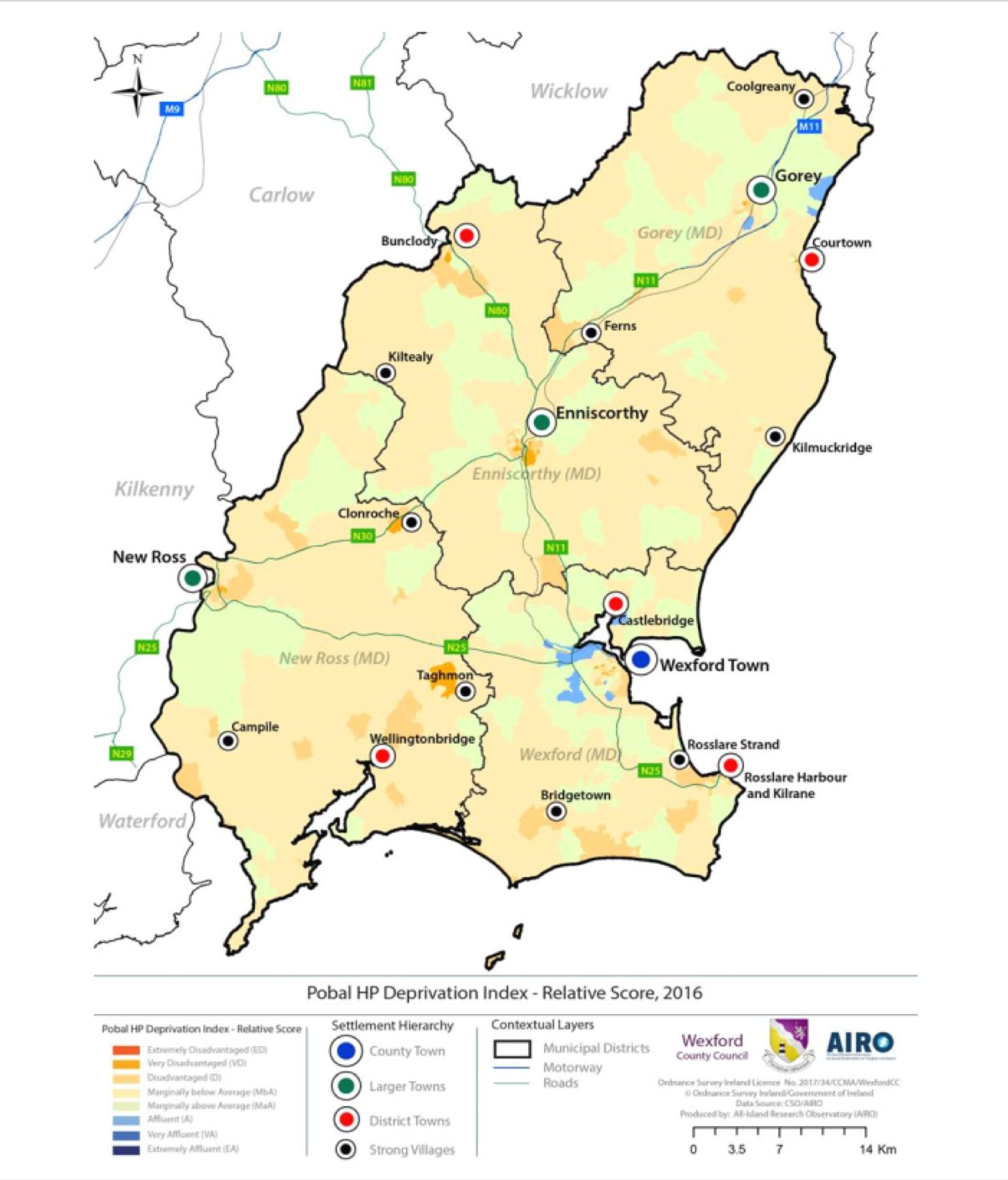
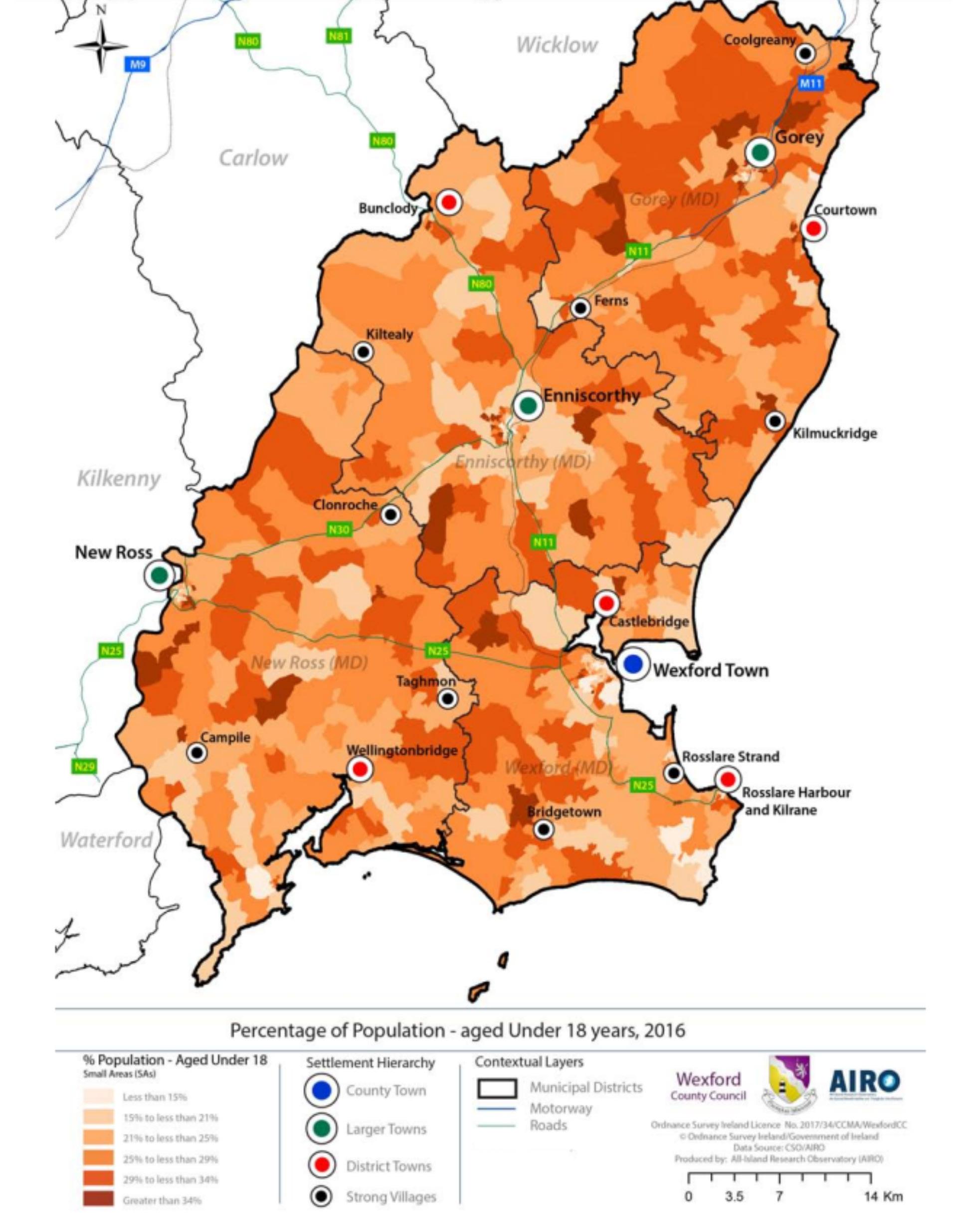
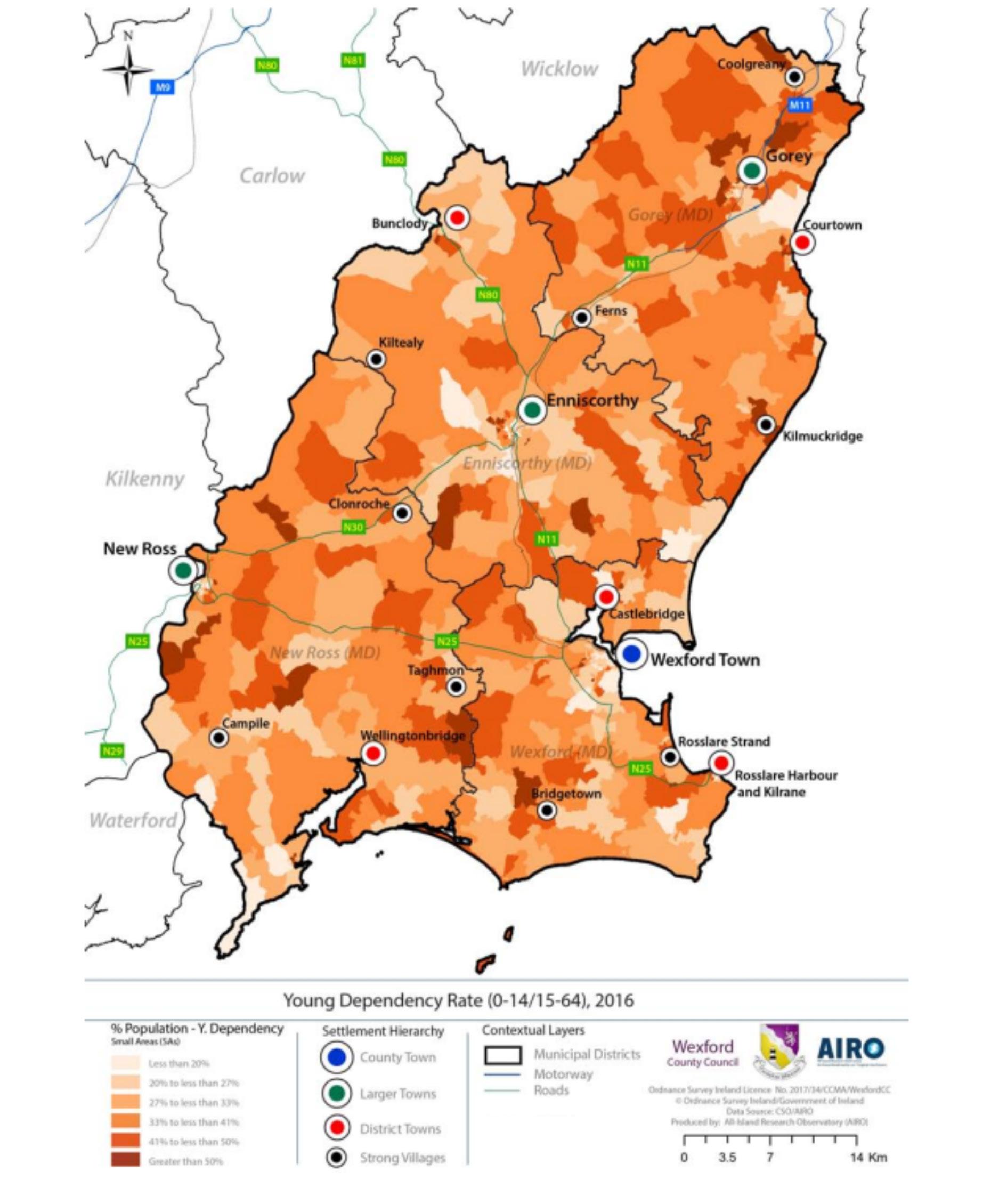
In 2016, Wexford County Council, in partnership with AIRO, produced a series of maps on County Wexford. These help to build a picture of Wexford’s key features and characteristics and, in doing so, provide a demographic context for this report.
Map 2 shows deprivation levels, with areas in blue being relatively affluent and areas in orange having relative high levels of deprivation.
Map 2: Pobal HP deprivation index relative scores for Wexford
Map 3 shows the rates of under-18 age cohort in the Wexford Small Areas (SAs). This map shows the highest rates in concentrations of the main urban settlements and then dispersed across the county.
Map 3: Wexford population aged 0 to 18, 2016
Map 4 provides an illustration of the Youth Dependency Rates6 in Wexford’s Small Areas (SAs). In general, there is a clear spatial pattern of high concentrations visible in the wider hinterland areas of the larger settlements (Wexford Town, Gorey and Enniscorthy). The largest concentration is visible in the north of the county within the Gorey MD.
6 The youth dependency ratio is the number of the youth population (ages 0–14) per 100 people of working age (ages 15–64). A high youth dependency ratio indicates that a greater investment is needed in schooling and other services for children and young people.
Map 4: Wexford youth dependency rate, 2016
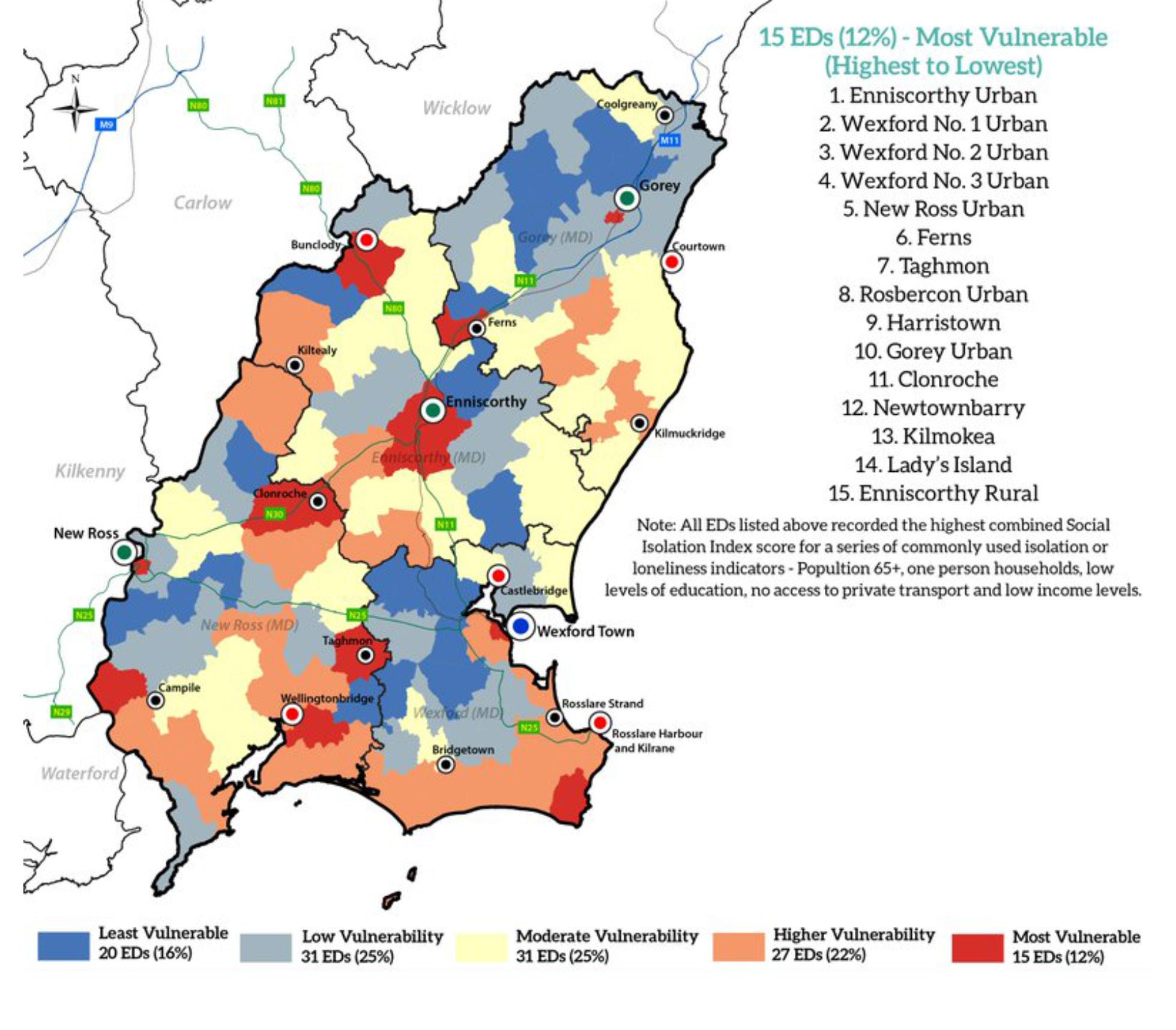
Map 5 shows the Social Isolation Score for each Electoral Division (ED) which was determined by totalling the scores assigned for each “isolation” variable (population aged 65+; one-persons households; low levels of education; no access to private transport; low income levels). The red areas show the highest 20% of EDs that may be vulnerable to social isolation.
Map 5: Social isolation index, 124 EDs in County Wexford
POPULATION OF YOUNG PEOPLE IN WEXFORD
In 2016, the population of 16 -24 years olds in Wexford was almost 15,000, or 9.96% of Wexford’s population. This is lower than the national rate of 10.91%. The projected rate of 16 – 24 years olds in 2021 is 18,512, estimating an increase of 24% in the five years since the last census.
Population 2016 Census (Actual and Projected)
Wexford Total Pop 2016
Population aged 16 - 24 years in 2016
Projected Population 16 -24-year-olds in 2021
Table 5: Population of 16 – 24 year olds, 2016 Census and projected
Table 6 sets out the total population of the eight main settlements in Wexford. It also provides the population of young people aged 16 – 24 years in 2016 and the projected population of this cohort in 2021.
Table 6: Population of the Wexford’s 8 largest settlements, 16-24 year olds, 2016 Census and projected
Table 7 sets out the 20 most deprived small areas in Wexford (urban and rural). Table 8 sets out the 15 most deprived rural areas. Both tables show the number of young people aged 16 – 24 years in 2016 actual and in 2021 (projected). The data is based on the 2016 Pobal HP Deprivation Index which shows the level of overall affluence and deprivation in small areas. Those areas with a score of -20 to -30 are labelled as “very disadvantaged”.
NEWTOWNBARRY
ENNISCORTHY RURAL
Table 8: Wexford’s 10 most deprived rural small areas, by deprivation score, total population and population of 16 – 24 year olds, 2016 and project in 2021
FACT BOX: Measuring Youth Unemployment
Measuring youth unemployment is inherently complex, with different measures used to calculate the number of young people out of employment. One of these measures is the NEET rate which measures those both not employed and not in education or training. As such, the rate inextricably links youth unemployment with participation in education and training. This is considered a broader and better measure of youth unemployment as it measures the following:
- the total number of unemployed youth (i.e. not in employment)
- plus those youth that have not received any formal/non-formal education or training in the 4 weeks prior to data collection (i.e. not in education or training)
- as a proportion of the much broader population of economically active (in the labour force either employed or unemployed)
- and inactive youth (not in the labour force).
The usefulness of the NEET measure is recognised by the United Nations and it is included as one of the key indicators to measure progress towards the achievement of the Sustainable Development Goals (SDGs) under Goal 8 (Promote sustained, inclusive and sustainable economic growth, full and productive employment and decent work for all). This goal describes the measure in the following way:
“The share of youth not in employment, education or training (youth NEET rate) provides a measure of youth who are outside the educational system, not in training and not in employment, and thus serves as a broader measure of potential youth labour market entrants than youth unemployment. [The NEET measure] includes discouraged worker youth as well as those who are outside the labour force due to disability and engagement in household chores, among other reasons”.
NEET RATES IN WEXFORD
In 2020 the OECD published a series of rates relating to young people who are in a NEET situation in Ireland, as follows:
Males 15 – 19 years: 7.1%
Males 20 -24 years: 13.3%
Females 15 – 19 years: 5.6%
Females 20 – 24 year: 12.6 %
Research undertaken by WWETB in 2021 provides an estimate of the number of young people who are in a NEET situation in Waterford and Wexford by applying these OECD rates to projected population rates for 2021. This estimates that there are 3,473 such young people in the two counties, with 1,958 in Wexford and 1,515 in Waterford. Table 10 provides a breakdown of the figures for Wexford.
Table 10: Estimated number of young people in Wexford who are in a NEET situation
Table 9: NEETS rate by age group and gender
The WWETB research sets out the following findings:
• Census projections for 2021 suggest the state, Waterford and Wexford are experiencing continuing growth in 15 - 24-year olds.
• In 2019 the OECD suggested that the rate of NEETS is in decline however, because of the Covid-19 pandemic, a hitherto downward trend in unemployment (Live Register, CSO, 2020) has been reversed and there were currently 125 more young people on the Live Register in October 2020 than there were in October 2019.
• The effect of the pandemic on youth unemployment which cannot have been predicted will mean the declining NEET rate will have slowed.
• The increase in the youth population will mean despite a declining NEET rate the number of actual NEETs may freeze or increase.
Estimated Rates in Wexford Settlements
By applying the OECD rates to the projected population, a broad estimate can be achieved of the number of young people who are in NEET situation in Wexford’s eight main settlements, as set out in table 11. However, these figures are broad indicators only and should be viewed in context of unemployment rates on a settlement basis. For example, the NEET rate in Courtown and Riverchapel is likely to be higher than shown, as youth employment is significantly above the national average in these towns.
Table 11: Estimated number of young people who are in a NEET situation in Wexford’s largest settlements
SECTION 4
Services for Young People who are in a NEET Situation in County Wexford
This section provides an overview of the services and supports available to young people in County Wexford who are in a NEET situation. In the context of the scope of the report, it relates to the following services:
• Further Education and Training Services
• Youth Work Services
• Intreo Services
• Other Related Supports and Services for Young People
7
WWETB FURTHER EDUCATION AND TRAINING PROVISION
https://www.wwetb.ie/
WWETB’s further education and training (FET) provision can be grouped under four headings, as described in the National FET Strategy7:
• Courses focused on foundation or transversal skills, such as Community Education, Adult Literacy, ESOL or ITABE
• Programmes which facilitate pathways to other education or training (ET) and which bridge gap between foundational learning and vocational ET (such as Youthreach, BTEI, Skills for Work)
• Post-Leaving Cert courses which focus on both facilitating progression to Higher Education and employment outcomes
• Programmes focused on work-based learning and which lead directly to jobs (traineeships, apprenticeships, specific skills training)
FET is delivered on a full-time or part-time basis, as set out below.
Full-Time Courses
Post Leaving Certificate (PLC)
Vocational Training Opportunities Scheme
Youthreach
Bridging/Foundation Courses
Specific Skills Training (SST)
Traineeship
Community Training Centres (CTCs)
Specialist Training Providers (STPs)
Local Training Initiatives (LTI)
Apprenticeship
Part-Time Courses
Back To Education Initiative
Adult Literacy
English for Speakers of Other Languages
Skills for Work
Evening Courses
Blended Learning Courses
Community Education
These programmes are delivered across Waterford and Wexford in a range of venues, including:
- Adult Education Centres
- Youthreach Centres
- Community Training Centres
- Training Centres
- Outdoor Education and Training Centres
- Community and Voluntary Sector Venues
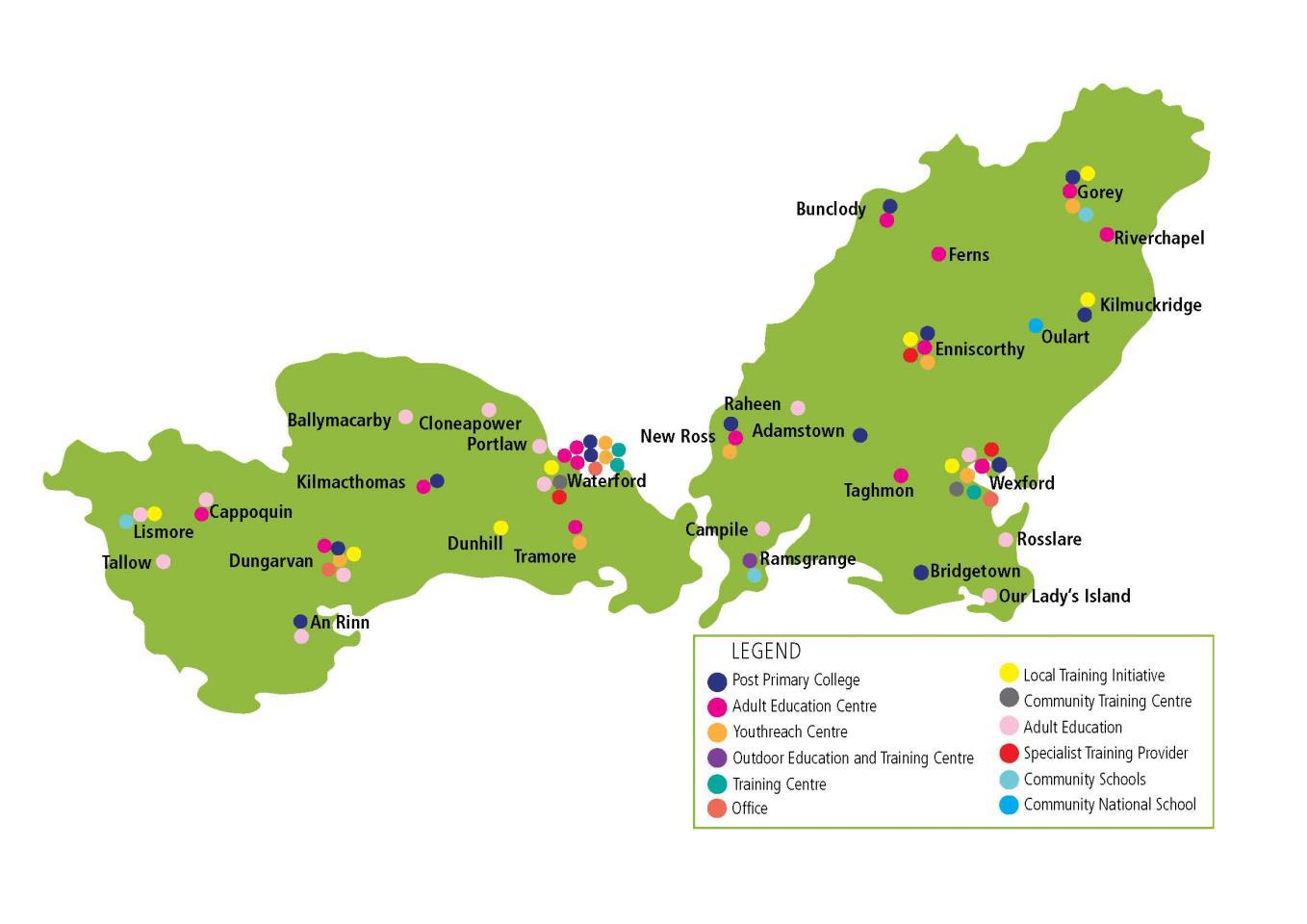
Map 6 provides a visual depiction of WWETBs schools and FET in Wexford and Waterford.
Source: WWETB Annual Report
Map 6: WWETB schools and FET centres in Wexford and Waterford
2019
SUMMARY OF WWETB FET
PROVISION
• Adult Literacy: provided to people inside and outside of the labour force who want to improve their communication skills, i.e. reading, writing, numeracy and information technology. Programmes are typically delivered for 2-4 hours per week during the academic year.
• Back to Education Initiative (BTEI): offers part-time education options for people aged 16 or over, mostly at Levels 3, 4 and 5. It gives individuals the opportunity to combine a return to learning with family, work and other responsibilities. Classes are offered throughout the year in the morning, afternoons, evenings, or weekends.
• Blended Learning Courses: can last up to 6 months and utilise the mix of classroom, lab, practical, on-line training and tutor support to suit the need of individuals requiring a more flexible way to meet their training needs. Courses are delivered all year round and lead to accreditation at NFQ Levels 4-6 or certification from recognised non-statutory accredited body.
• Bridging/Foundation courses: may be of short or long duration and generally lead to accreditation at NFQ Levels 3 and 4. They are aimed at those who have been out of employment for at least a year and who wish to return to employment, education and training
• Community Education: offers a learner-centred approach involving personal supports and tuition leading to positive personal, social, and economic outcomes. Programmes are developed with local community projects including courses leading to accreditation from NFQ Level 3 – 8, informal and non-formal courses which are not accredited.
• Community Training Centres (CTCs): are independent community-based organisations, providing training and education for early school leavers, primarily aged between 16 and 21. All programmes offer personal and social skills development. Courses are generally one year in duration and are full-time and lead to major awards on the NFQ at levels 3 and 4.
• English for Speakers of Other Languages (ESOL): are provided across the country to meet the needs of learners who may be highly educated with professional and skilled backgrounds who are attending classes to learn English or improve their English.
• Evening Courses: provide short up-skilling modules for both unemployed and employed persons, typically 30 hours’ duration over 10 weeks. Courses generally lead to accreditation at NFQ Levels 4-6 NFQ or from recognised non-statutory accredited body.
• Local Training Initiatives (LTI): a full-time project-based training and work experience programme run by community organisations. It is designed for people who are unemployed, primarily those aged 18 – 35 years who are experiencing difficulty gaining entry to the labour market. Some projects are targeted at specific groups in society. Training leads to accreditation at levels on the NFQ at levels 3, 4 and 5.
• Post Leaving Certificate (PLC): provides a combination of general studies, vocational skills and work experience so participants can enter or re-enter immediate skilled jobs in the labour market. Courses are usually full-time, over one academic year and generally lead to major awards at NFQ Levels 5 and 6.
• Skills for Work: provides opportunities to help employees deal with basic skill demands of the workplace. Programmes are 35 hours’ duration and are flexibly designed to meet the needs of employer and employees.
• Specific Skills Training (SST): are designed to provide learners with a range of employability skills and formal vocational qualifications to facilitate first-time entry to the labour market or acquisition of new skills. Courses are typically full-time and lead to QQI Awards at levels 3, 4, 5 and 6 and/or to industry recognised accreditation. Course duration can vary from 6 to 40 weeks
• Specialist Training Providers (STPs): Specialist vocational training are contracted to deliver training programmes to people with disabilities, courses provide additional training durations, adapted equipment; transport arrangements, and enhanced programme content. Courses are generally one to two years in duration and lead to accreditation at levels 1-6 on the NFQ.
• Traineeships: are aimed at new labour market entrants and unemployed people. They are occupational specific and industry endorsed training programmes leading to QQI Major Awards, mostly at Levels 5 and 6, and/or industry recognised certification providing access to specific occupations. They are targeted at occupations which are not designated as apprenticeships but entail significant skill requirements.
• Vocational Training Opportunities Scheme (VTOS): provides a range of courses to meet the education and training needs of people who are unemployed, over the age of 21 and in receipt of a qualifying social welfare payment for 156 days (6 months) or more. A VTOS allowance is paid at a rate equivalent to Jobseekers Benefit/ Allowance payment. Courses are usually full-time and delivered over two academic years. The courses lead to a range of awards across NFQ levels.
• Youthreach: is a full-time programme, usually over two years, for young people aged 16 - 20 years who have left school early and are not in employment. The programme typically leads to major awards at levels 3 and 4 on the NFQ. Learners are facilitated in developing their own individual learning plan aimed at increasing their self-esteem, skills and knowledge and ability to get a job. The programme aims to enable young people to participate fully in society and to progress to further education and training.
Table 12 provides a breakdown of the 1,635 young people under the age of 25 years old who started in fulltime FET programmes in WWETB in 2020. In that year, 242 young people started in Youthreach in Waterford and Wexford.
12: Young people starting in full-time FET programmes in Waterford and Wexford in 2020, by age
The Youth Work function of Education and Training Boards is defined under Section 10 (j) of the Education and Training Boards Act 2013 as being “to support the provision, coordination, administration and assessment of Youth Work services in its functional areas and provide such information as may be requested by the Minister.”
WWETB organises its youth work function through a Youth Work Committee (YWC) which comprises key stakeholders from the statutory and community and voluntary sectors. The YWC’s Youth Work Plan 2017 – 2020 sets out WWETB’s key goals and objectives for the development of youth work in Waterford and Wexford, as follows:
o Provide oversight, quality assurance and best practice in the provision of Youth Work service
o Add value to the work being undertaken by those engaged in Youth Work
o Support voluntary and NGOs to provide Youth Work service
o Assist linkages between ETB services, Youth Work services, statutory agencies and Government Departments
o Develop intellectual and physical resources and infrastructure for the Youth Work sector
Through its Youth Work function, WWETB provides funding of nearly €3 million to 34 staffed youth projects across Waterford and Wexford: 31 UBU projects and 3 Youth Information Centres. In addition, it provides an annual grant to approximately 90 volunteer-run youth clubs/groups including youth clubs, guides, and scouts. It is also responsible for supporting the projects and clubs to implement the National Quality Standards Frameworks. WWETB’s Youth Work Affairs Team play a crucial role in supporting, developing and monitoring youth work organisations across Waterford and Wexford.
UBU Your Place Your Space
UBU is an amalgamation of three funding schemes which was launched in July 2020 by the Department of Children, Equality, Disability, Integration and Youth. It targets young people aged 10 - 24 years old who are:
• experiencing economic, social, and cultural disadvantages
• experiencing marginalisation
• vulnerable or at risk of not flourishing
UBU Your Place Your Space youth projects are primarily delivered by voluntary youth work organisations which are affiliated to a national youth work organisation. WWETB also funds UBU thematic projects which engage targeted young people through the medium of arts, drama or sport.
UBU Your Place Your Space Youth Projects LEGEND
Dungarvan
Waterford
New Ross
Rosslare
Wexford
Enniscorthy
Bunclody
Gorey Riverchapel
Woodstown
Map 7: UBU Your Place Your Space Youth Projects in Waterford and Wexford.
Figure 4 provides a breakdown of UBU projects by location in Waterford and Wexford. Figure 5 shows the UBU projects by affiliated organisation.
Volunteer Led Youth Clubs
WWETB’s Local Youth Club Grant Scheme supports voluntary youth club/group activities for young people, with priority given to clubs/groups catering for young people aged 10–21. The primary focus of the scheme is to assist local, volunteer-led youth clubs/groups that provide a programme of youth work activities for young people. In addition, other clubs/groups that work with young people, but are not specifically providing youth work, are also entitled to apply for funding under the Scheme. In 2021 the scheme supported 84 Youth Clubs/Groups, with the total amount of funding available of €115,974.15. The maximum amount that can be awarded to one club is €3,000.
There is a range of Foróige groups, Scouting Ireland, Youth Work Ireland, Catholic Girl Guides of Ireland, Irish Girl Guides and independent clubs/groups in locations throughout Co Wexford including Davidstown, Enniscorthy Wexford town, Askamore and Gorey.
Figure 4: UBU projects by location in Waterford and Wexford
Figure 5: UBU projects by affiliated organisation in Waterford and Wexford
Defining Youth Work
Youth Work is primarily focused on young people aged 10 to 24 years, although there is also a significant level of activity with under 10-year-olds. It achieves a range of outcomes for young people, including communication skills, confidence and building relationships, through activities combining enjoyment, challenge and learning. In practice, youth work can include organisations which have volunteer-led youth groups and/or professional youth workers.
It is important to note that all work with young people is not Youth Work, which is defined in the Youth Act 2001 and the Education and Training Board Act 2013 as “a planned programme of education designed for the purpose of aiding and enhancing the personal and social development of young people through their voluntary participation, and which (a) is complementary to their formal, academic or vocational education and training, and (b) in Ireland is provided primarily by voluntary youth work organisations”8. The National Youth Strategy 2015 – 2020 describes Youth Work as “a diverse range of activities, topics and measures provided by a range of actors in assorted fields and settings”.9
Youth Work is non-formal education based on a set of core principles.10
Young person-centred, recognising the rights of young people and holding as central their active and voluntary participation
Committed to safety and well-being of young people
Educational and developmental
Committed to equality and inclusiveness
Dedicated to the provision of quality youth work and committed to continuous improvement
A 2014 EU report on youth work found that successful youth work outcomes are reached through a combination of behaviours, attitudes and methods11. The study identifies the following as characteristics of youth work:
Youth work offers young people meaningful activities based on their needs and interests.
Non-formal and formal learning
Participatory and experiential pedagogy
Relationship-based activities (learning as a social activity)
Mentoring and / or peer support
Youth work aims at young persons' personal development, leading to:
Empowerment Emancipation Tolerance Responsibilities In turn, these should result in:
Paticipation in democratic societies Prevention of risk behaviour Social inclusion and cohesion
Youth Work Organisations in Wexford
There are a number of youth work organisations in County Wexford providing a range of programmes and supports to young people.
FERNS DIOCESAN YOUTH SERVICE
(https://fdys.ie)
FDYS’s non-formal education process is delivered through youth work programmes, youth and community support services, childcare and supports for volunteers. It provides programmed activities to support young people through the challenging times of growing up. It uses a developmental approach with the objectives of ensuring the young person has the skills, confidence and information to make informed choices and decisions as they grow. Its youth services are available in various locations around County Wexford including Gorey, New Ross, Bunclody, Enniscorthy and Wexford Town. These services and supports are provided in community youth projects, voluntary youth clubs and specific youth programmes such as Slaney Garda Youth Diversion project, Young Women’s programmes and the LGBTI service. It also offers supports through counselling service.
FDYS services include:
• Bridgetown Community Youth Project
• Bunclody Traveller Project
• Childcare Services
• Counselling Service
• Community Based Drugs Initiative
• Drugs Outreach
• LGBT+ Youth Support
• Local Voluntary Youth Club Network
• Outreach Service
• The Shambles New Ross
• Roma Community Inclusion Programme
• Slaney Garda Youth Diversion Project
• Voluntary Youth Clubs
• Youth Information Service
FDYS runs several UBU Your Place Your Space youth work projects in Wexford. The projects offer a welcoming and respectful drop-in youth space to young people aged 10 – 24. They are delivered in a fun and collaborative way by experienced and qualified youth workers. Thematic programmes include work such as self-esteem, mental health, sexual health, resilience, and relationship building.
FDYS UBU PROJECTS
FDYS BAYS
FDYS Cloisters
FDYS Coolcotts
FDYS Enniscorthy
The Bunclody Area Youth Supports project operates from Bunclody and surrounding rural areas. The youth workers engage with young people from a variety of backgrounds, including young people experiencing rural social isolation and minority young people.
The Cloister Youth Facility runs from the FDYS Youth Centre on Francis Street in Wexford town. It is open evenings and afterschool and is responsive to the needs of young people.
The Coolcotts Community Youth Project operates from the FDYS Coolcotts Youth Centre. Opening times are responsive to the needs of young people and include evening drop-ins and a monthly meeting on Saturday.
The Enniscorthy Community Youth Project operates in the FDYS Youth Centre in Enniscorthy. It is open evenings after school and on Saturday afternoon. Outreach services are offered where there is an identified need.
FDYS Gorey
FDYS WAYS
The Gorey Community Youth Project operates across 4 sites including: Creagh College Youth Cafe, FDYS McCurtain Street Drop In, Cois Doire Community House, FDYS Youth Centre, Courtown. Opening times are responsive young people’s needs.
Wexford Area Youth Support operates across three sites: FDYS Bridgetown, Cois Barry House, Rosslare and FDYS Francis Street, Wexford. Opening times are responsive to young people’s needs, including evening drop-ins and Saturdays 12-3pm.
Table 13: FDYS UBU youth projects
GOREY YOUTH NEEDS
Gorey Youth Needs supports children and young people to reach their full potential by voluntary participation in a range of services, activities, workshops, projects, personal development programmes & pursuits. It has three service strands:
• Little Daisies: community-based childcare centre
• YOLOS: Youth Opportunities Local Outcomes Service is a community-based youth project which aims to support young people, and their families, particularly those who are or who may be at risk of experiencing social exclusion. Programmes include an after-schools club (primary school), after school programme (postprimary school), LGBTI group, parent and toddler group and young women’s group.
• Local Training Initiatives:
Gorey Training Initiative: currently delivers a range of 38-week Level 4 and Level 5 courses including:
eBusiness
Sport, Recreation and Leisure
Community Coaching and Conditioning
ICT
Digital Media Courses vary annually.
Courtown Local Training Initiative: currently delivers a Level 3 Employability Skills Courses are open to people who are unemployed, in receipt of social welfare payment and aged between 17 – 35 years.
YOUTH NEW ROSS (YNR)
YNR employs a team of professional youth and family support staff to deliver services through three projects:
• The Family Project
• The Youth Project
• The Treoin Garda Youth Diversion Project.
The Family Project works with children, young people and their parents for the benefit of the whole family. This includes ParentChild+ which is an evidenced-based programme on learning through play for parents and pre-school programme. It also runs Rainbows which supports children with bereavement and parental separation.
The Treoin Garda Youth Diversion Project works with young people between the ages of 12 – 17 who are high risk of becoming involved in criminal and anti–social behaviour.
YNRs UBU Youth Project provides one-to-one and group work support to young people in New Ross aged 10 – 24. It works with a variety of groups such as LGBT, Travellers, New Communities, Young Parents, NEETs, and Teen Boy/Girl Groups. It provides support for young people and special interest groups such as music, employment skills, driver theory, arts, mental health and GAISCE. YNR provides a safe space to young people to be themselves and to build positive relationship, people develop self-confidence, new skills and interests. Programmes include filmmaking, hairdressing and beauty, cookery, health and fitness and trips to Dunmore East, and PRIDE.
INTREO, THE PUBLIC EMPLOYMENT SERVICE
Intreo, the Public Employment Service, is a single point of contact for all employment and income supports. Designed to provide a streamlined approach, Intreo offers practical, tailored employment services and supports for jobseekers and employers in Intro Centre throughout Ireland.
Intreo services for jobseekers include:
• support to prepare for and find work
• supports and services to help with change career, upskill or retrain
• identify suitable training opportunities
• supports to set up a business
• connect jobseekers with employers who are actively looking to hire people
Intreo is supported in its role by:
- Local Employment Service
- Jobs Club
- Employability
- Job Path
OTHER ORGANISATIONS IN WEXFORD WORKING WITH YOUNG PEOPLE
Wexford Local Development Company (WLD)
WLD delivers a number of programmes which support young people who are in a NEET situation:
• Ability Programme: support people over 18 years of age with an intellectual disability who are not job ready to develop appropriate pathways that move them closer to the labour market and support them to gain employment.
• 3SP, Supporting Skills and Success: is an alternative pathway for young people to get free confidential advice and support with life after school. One-to-one supports are provided through mentoring and life coaching to develop confidence and assertiveness, define goals, learn new skills and participate in training.
• Internal NEETs Group: WLD has an internal NEETS group which plans and coordinates services to young people across WLD programmes and externally, including the Local Employment Service, Cornmarket Programme; Tus programmes, Ability programme, Traveller Primary Healthcare Programme and the Social Prescribing programme.
School Completion Programmes:
Bridgetown SCP, Bunclody / Enniscorthy SCP, Gorey SCP, South West Wexford SCP, Wexford SCP
Family Resource Centres (FRCs):
Gorey FRC, Raheen FRC, Southend FRC, South West Wexford FRC, Taghmon FRC
Barnardos:
Barnardos Enniscorthy and North Wexford. Barnardos Teen Parent Support Programme
Challenges in Responding to the Needs of Young People in a NEET Situation in County Wexford
This section sets out the key challenges experienced by service-providers in meeting the needs of vulnerable young people who are in a NEET situation in Wexford.
These challenges were identified through the secondary research and corroborated in the primary research by service-providers that participated in the stakeholder engagement process.
CHALLENGES RELATING TO FURTHER EDUCATION AND TRAINING
A 2017 EU study12 highlighted three key challenges relating to Further Education and Training that impact on the capacity of ETBs to respond effectively to the needs to NEETs young people:
a) The attractiveness of FET: despite the range of FET options and progression routes available, the number of FET learners in Ireland has been small, which is due in part to the fact that the preference for many learners on leaving compulsory education is for higher education. While major policy documents (e.g. National Skills Strategy 2025 and the Further Education and Training Strategy), outline ambitions to address and increase the standing of FET in Ireland, such changes take time to implement as they often involve shifts in culture and values.
b) Increased Number of Young People: The cohort of those aged 5 - 19 increased from 2012 to 2017 due mainly to an increase in the number of births in recent years. It is likely that the increase in this cohort will impact on the number of young people entering the FET system, with an increased demand for places.
c) Participation in lifelong learning: although improving, the lifelong learning rate in Ireland (at 13%) remains lower than the EU 2020 target of 15%. Particular challenges, which are not unique to Ireland, include encouraging participation among older workers and those with low education attainment. Those with lower secondary education attainment or below, had a lifelong learning participation rate of 4%, compared to 26% for those with postgraduate qualifications (i.e. ISCED level 6/EQF 7-8).
KEY CHALLENGES IDENTIFIED BY WEXFORD STAKEHOLDERS
Service providers in Wexford reported that they face a wide range of challenges in their efforts to adequately support young people who are in a NEET situation. These are summarised in table 14 and discussed in more detail underneath.
WHO AND WHERE SERVICES AND SPACES
• Identifying NEETs young people - who are they and where are they?
• Availability of data and information on the young person's needs, background and circumstances
• Sharing data and information between stakeholders
• Insufficient services and resources to ensure engagement with young people in a timely and effective manner
• Lack of staff knowledge of the service landscape: the services available to meet needs (universal and targeted) - their remit, criteria, referral processes
• Lack of clear and streamlined signposting, referral and coordination between services
TRANSPORT AND ACCESSIBILITY
• Accessibility of services, particularly in rural areas
• Lack of transport to enable young people to reach services
• Lack of online service delivery infrastructures (hardware, broadband, staff training)
TOOLS AND TRAINING WRAPAROUND SUPPORTS
• Lack of dedicated programmes / tools to support staff to motivate, engage, support and retain young people
• Limited opportunities to share best practice between services at a local and national level
• Inadequate wrap-around services to support young people's engagement and retention (childcare services, mental health supports, substance use services, etc)
MONITORING AND OUTCOMES
• Lack of tracking and monitoring systems between services - how are young people monitored and supported when a programme / service ends
Table 14: Key challenges identified by Wexford stakeholders
a) Gap between early school leaving and FET: ETBs, as the providers of FET, recognise that there is a need for alternative learning programmes for young people where primary/post primary education is not an appropriate or effective learning environment. However, fundamental national policy positions and investment is needed to respond to the significant number of early school-leavers. The gap between leaving school early and engaging in FET presents significant challenges for ETBs and other services in their efforts to reengage with this very vulnerable and often isolated cohort. These gaps can have a significant impact on a young person from the perspective of loss of routines, poor habits, loss of confidence, low self-esteem and social isolation.
b) The “Cinderella of FET”: the profile of FET which is targeted at early school leavers – Youthreach and Community Training Centres – is relatively low. It is often referred to as “alternative” or “second-chance” education. In this study, young people themselves identified that these options are often seen as being suitable for young people who were “disruptive” in “mainstream” school (see quotes, page 22). A reimagining and rebranding of these services as a “smart choice” for young people, and as a valuable component of “mainstream education” would enable meaningful and supported pathways for young people where the more structured and academic approach of secondary level education is not suitable.
c) Absence of Referral and Signposting Processes: there is excellent cooperation and coordination between many services that support young people who are in a NEET situation in Wexford. However, these are broadly informal in nature. There is an absence of integrated protocols and signposting between essential services including; post primary schools, ETB FET programmes, youth work services, and Intreo services. Referrals and signposting between these services is often ad-hoc, based generally on professional relationships and individual experience. While these relationships are crucial and beneficial, an integrated system would provide a more streamlined support process for young people and help reduce the number of those “falling through the cracks”.
d) Staff Skills and Capacity: it is clear that staff have huge commitment to their work and are very much focused on optimising outcomes for young people in a NEET situation. However, staff do not always have the requisites skills or knowledge to successfully engage / retain young people who are in a NEET situation, or who are at risk of falling into one. Expertise and multi-disciplinary approaches are essential in order to provide appropriate responses to the complex needs of young people. These issues include mental health issues, drug and alcohol issues, disability needs, lack of motivation and adverse childhood experiences. While many front-line staff do not have a direct role or remit in these domains, a working knowledge of potential issues at play is essential to “make every contact count”. Training for frontline staff helps to ensure that they utilise appropriate principles and approaches in their engagement with young people and, crucially, that they support them to make positive decisions and help them to reach the services they need.
e) Recognising Achievement: “Some young people who are NEETs have had a negative experience or have very low self-esteem. Sometimes they will do short courses/programmes, such as pre-development courses which support the development of soft skills. It would help if these courses were recognised by Dept of Education & Dept of Social Protection. For example, give awards/points for turning up or for staying engaged for the whole course/programme. Gaisce Awards are good but a bit too difficult to attain for some young people. There needs to be a recognition of the difficult experiences the young people have been through and that some of them are not as resilient or as quick to bounce back as others and both the young person and their parents need nurturing, an advocate, lots of encouragement and confidence building to reengage productively in society.13
A lot of resources are needed, both financial and human, to integrate every single young person in a NEET situation back into society.14
Re-engaging and Supporting Young People who are in a NEET Situation in County Wexford
AN INTEGRATED SERVICE RESPONSE IN WEXFORD
As young people who are in a NEET situation are a diverse group with different experiences, circumstances and needs, there is no “one-size-fits-all” approach to meeting their needs. The combination of services and supports that are required varies from person to person and, so, it is essential that bespoke, integrated responses are provided at local level to improve outcomes on an individual basis.
It is recognised that many of the programmes and services outlined in Section 4 operate within the context of constrained resources, and that these constraints often impact their capacity to adequately support vulnerable young people. However, as the terms of reference for the study did not include an organisational resource analysis, this chapter does not draw conclusions on where additional resources are required. Instead, it sets out a collaborative model which can be deployed in Wexford to build on and optimise the resources currently available.
The collaborative model aims to bring front-line services together to identify, engage and support young people in a more integrated way. It focuses on harnessing the considerable resources currently available in County Wexford and, in particular, on harnessing the strengths and assets prevalent within the FET, youth work and community sectors.
Specifically, this chapter proposes an integrated service response through the creation of place-based collaborative task forces. These task forces would provide a mechanism for local organisations to work together in a structured way to put in place supported and seamless pathways for young people in the context of local services, strengths, and resources.
The collaborative model that is set out in this chapter is described under the following headings:
A) What is a Place-Based Approach? (page 67)
B) Essential Elements of an Integrated Service Response (page 67)
C) Learning from a Youth Work Approach (page 70)
D) Establishing Place-Based Task Forces (page 71)
E) Task Force Stakeholders (page 71)
F) Task-Force Programme of Work (page 72)
G) Aligning Task Forces with Other Interagency Structures (page 73)
H) Measuring Outcomes and Impacts (page 73)
A. Taking a Place-Based Approach
Place-based working is defined as a person-centred, bottom-up, long-term approach to meeting the unique needs of people in a defined geographic location by working together to use the best available resources and collaboration to gain local knowledge and insight. Crucially, it brings together local organisations and builds strong community relationships to tackle issues.
The most effective place-based approaches involve a diverse group of stakeholders working towards shared outcomes. It recognises that localised, customised approaches are needed to respond to local circumstances. It means that all organisations and agencies focus on the outcomes of a place rather than on individual projects/services. It enables stakeholders to ensure collective responses which are based on a shared knowledge of local challenges and which draw on local assets and resources.
B. Essential Elements of a Place-Based Integrated Service Response in County Wexford
An integrated service response at local level should be based on the following essential elements which are synopsised in table 15 and described further in table 16:
Agree on shared principles and objectives
Focus on causes not symptoms
Take an asset-based approach
Strengthen coordination between services
Build the skills and capacity of staff
Recognise the importance of "one-good adult"
Meet young people where they are at
Promote FET as a valuable option for young people
Use data wisely and proportionately
Table 15: Essential elements of a place-based integrated service response
1
Agree on shared principles and objectives
• Agree on shared youth-centred principles and approaches across agencies and organisations.
• These must go beyond words on a page and involve understanding stakeholders' differing roles, services, remits and resources.
2
Focus on causes not symptoms
• Focus initially on outcomes which relate to relationship-building with young people and on their personal development, rather than focussing exclusively on employment, education and training outcomes.
• Strategies should be aimed at minimising risk factors and maximising protective factors in young person’s life.
• Distinguish between different NEET situations and use terminology that accurately reflects the sub-sets of young people. This will help to ensure more targeted responses.
Take an asset-based approach 3
• Build on strengths in the area by utilising existing resources, personnel, relationships, local knowledge, partnerships, infrastructure and data.
• Focus on building on young people's strengths and assets, recognising their innate skills and talents.
4
Strengthen coordination between services
• Put systems in place to facilitate structured and systematic interaction and information sharing between organisations, rather than relying on ad-hoc or informal links between personnel.
• Develop agreed ways of referring, signposting and supporting young people between FET, schools, youth services and Intreo services.
• Focus on providing seamless supports, particularly at transition points, by minimising gaps in support and by taking the "one good skilled adult" approach (as outlined in 6 below). In this regard, transitions from school are crucial and should be a key focus.
Build the skills and capacity of staff
• "Make every contact count": through training and support, build the capacity of all front-line staff to use every interaction with young people to support them to make positive decisions and to help them to reach the services they need. (see Hidden Harm model, page 75).
Recognise the importance of "one-good adult"
• "One good adult”: ensure every NEET young person has an identifiable “go-to” person to support their journey (e.g. Parent, Sibling, Youth Worker, Key Worker, Teacher, Drugs Worker, Sports Leader). Make this a key plank of the integrated service approach by always asking “who is in a position to build a long-term relationship with this young person?”
• Build in ample time to facilitate meaningful relationship-building. Successful strategies require time and patience.
Meet young people where they are at 7
• Recognise that NEETS young people have different experiences, needs and hopes. Flexible, individualised approaches are key.
• Identify young people who are in a NEET situation (or at-risk) as early as possible - the longer young people remain in a NEET situation the poorer the outcome.
• Follow the voice of young people and ensure responses are based on meaningful engagement with them.
Promote FET as a valuable option for young people
• Actively promote and showcase FET as a viable and valuable option for young people, with routes and options that are visable and supported. Provide taster courses and shorter programmes to attract young people. Use data wisely and proportionately
• Strengthen data availability and data sharing between services.
• Use NEET data wisely and disaggregate data by vulnerable sub-groups, where possible.
• Do not allow a lack of specific data on NEETs rates to delay the development of strategies. Use local knowledge and relationships to create a picture of local needs.
Table16: Breakdown of essential elements of a place-based service response
C. Learning from the Youth Work Approach
A key tenet of this collaborative model is the application of shared youth-centred principles and approaches by all agencies and organisations involved. These principles and approaches form elements of good youth work practice but can be equally applied in other contexts. A 2015 EU report15 describes the “blurred borders of youth work and other policies” and asks where youth works stops and other type of activity begin. It argues that youth work is both a distinctive practice and a method that can be used in other contexts. It is characterised not so much by the nature of the activity, but rather the focus on the young person and the context, setting or method. Key approaches in youth work that can be applied across other areas include:
o Active outreach to a young person in need of support
o Flexible, accessible and adaptable interventions and supports that are designed around the young person’s needs
o Learning opportunities, goal setting and recognition of achievements
o Safe, supportive environments enable a young person to experience life and to make mistakes
o Autonomy: young people driving their own development
o Partnerships/collaboration with other stakeholders
These approaches should be applied by all stakeholders in a collaborative place-based model, as depicted in figure 6.
FURTHER EDUCATION AND TRAINING
EMPLOYMENT ACTIVATION
YOUTHCENTRED PRINCIPLES AND APPROACHES
6: Applying youth work principles and approaches in other settings
Figure
D. Establishing Place-Based Taskforces
The establishment of placed-based task forces at local level would provide a mechanism to strengthen collaboration between organisations on the ground. It would help to optimise the supports available to young people by strengthening trust, relationships and formal links between service providers on the ground.
The overall objective of the task forces would be to provide a forum for local agencies and organisations to come together in a structured setting to support improved engagement and retention of young people by using an integrated approach to communication, coordination, support, signposting and referrals.
Once established, it is not envisaged that task forces would need to meet more than quarterly. However, in their set-up stage, it would be helpful for them to meet more regularly to put terms of reference in place and to agree a programme of work. In addition, to ensure that task force meetings are efficient and effective, they should be facilitated by an external facilitator who is skilled in collaborative processes. It is also suggested that WWETB take responsibility for convening task force meetings, in recognition of their intersectional role in FET, youth work and post-primary education. To facilitate the development of good practice and the sharing of learning, it may be helpful to establish one task force in a selected town on a pilot basis in the first year, before expanding the model across the county.
E. Taskforce Stakeholders
Task force membership should comprise staff from organisations that engage with vulnerable young people in the area. Membership should be drawn from the services available locally, such as:
• ETB FET Providers (e.g. Youthreach, LTI, BTEI)
• Schools (Principals, School Completion Programme, Home School Community Liaison)
• Local Youth Work Providers
• Intreo Office
• Family Resource Centres
• Youth Justice Programmes
• Local Development Companies (SICAP)
• Other Community-Based Organisations
It is essential that task forces are actively promoted and supported by senior management across stakeholder organisations to ensure that an integrated service response to NEETs is embedded into organisational policies, strategies and practices, rather than remaining largely ad-hoc and informal.
F. Taskforce Programme of Work
Task force programmes of work should be based around the core aim of developing clear, supported and consistent pathways between agencies and organisations, bearing in mind that pathways are not necessarily linear or continuous. Table 17 sets out a suggested programme of work:
IDENTIFY
BUILD
MAP
GAPS
PATHWAYS
Using local knowledge and networks, work to identify young people in a NEET situation in the area
Build a picture of the circumstances and needs of young people who are in a NEET situation in the area (within GDPR parameters)
Develop a map / database of the resources, services, supports and facilities available in the area and easily accessible outside the area
Identify and document gaps in, and limitations to, resources, services, supports and facilities in the area.
Design supported and seamless pathways to ensure that young people are supported to reach the services that meets their needs. These pathways should be based on robust signposting, linkages, communication, referrals and coordination between stakeholders.
SKILLS
DOCUMENT AND LEARN
Organise training for front-line staff to improve their skills and capacity to engage effectively with young people and to "make every contact count" (e.g. trauma-informed practice, motivational interviewing)
Document the process, capture and share good practice between stakeholders.
Table 17: Key elements of task force programme of work
G. Alignment with Existing Structures
Place-based NEET taskforces should operate in the context of existing interagency structures and fora in Wexford. In doing so, they have the potential to act as a vehicle for realising interagency objectives relating to hard-to-reach young people. In particular, Wexford CYPSC and Wexford Local Community Development Committees (LCDC) play a key role to supporting a more joined-up approach to service delivery. At a practical level, CYPSC and LCDC strategies could support an integrated service response to the needs of young people in a NEET situation by including actions to support the work of task forces in their strategies.
Examples of other key structures are set out in figure 7.
WEXFORD CYPSC
LOCAL COMMUNITY DEVELOPMENT COMMITTEE
CONNECTING FOR LIFE
LOCAL NEETS TASK FORCE
WEXFORD SPORTS PARTNERSHIP
DRUG AND ALCOHOL TASK FORCE
LOCAL CREATIVE YOUTH PARTNERSHIP
H. Understanding and Measuring Outcomes
By understanding and measuring outcomes, organisations can demonstrate their achievements, identify challenges, capture learning and improve their services. A shared approach to measuring outcomes can make it easier for organisations to share learning, optimise resources and build an evidence base on what works. The Journey to Employment (JET) Framework16 helps organisations to understand and measure the impact they have on a young person’s journey to employment. It identifies seven groups of factors that contribute to successful job outcomes for young people: personal circumstances; emotional capabilities; attitudes to work; employability skills; qualifications, education and training; experience and involvement; and career management skills. Figure 8 represents theses seven factors and provides a number of indicators under each factor.
The JET Framework places equal importance on outcomes relating to personal circumstances, emotional capabilities and attitudes, as it does to qualifications and employment. This is of critical importance to this place-based collaborative model.
Figure 7: Key interagency structures in Wexford
INTRINSIC FACTORS
JOURNEY TO EMPLOYMENT
EMPLOYABILITY SKILLS
ATTITUDES
QUALIFICATIONS, EDUCATION + TRAINING
EMPLOYMENT + SUSTAINABLE + QUALITY
EMOTIONAL CAPABILITIES
EXPERIENCE + INVOLVEMENT
PERSONAL CIRCUMSTANCES
CAREER MANAGEMENT
EXTERNAL FACTOR: THE LABOUR MARKET
EMOTIONAL CAPABILITIES
• Self-esteem
• Autonomy and control
• Grit and determination
• Empathy
• Creativity ATTITUDES
• Aspirations
• Attitudes to work
EMPLOYABILITY SKILLS
• Teamwork
• Communication
• Problem solving
• Self-management
• Leadership
• Business and customer awareness
PERSONAL CIRCUMSTANCES
• Access to transport
• Access to internet
• Access to childcare
• Access to support for young carers
• Access to support for disabled people
• Reduced substance abuse
• Reduced offending/anti-social behaviour
EXTRINSIC FACTORS
QUALIFICATIONS, EDUCTAION & TRAINING
• Basic skills
• Achieving qualifications
• Attendance and behaviour
EXPERIENCE & INVOLVEMENT
• Work experience
• Perception of value of work experience
• Networks
• Community involvement CAREER MANAGEMENT
• Career direction
• Job search skills
• Presentation to employers
EMPLOYMENT
• Entry into employment
• Sustaining employment
• Quality of employment
• Satisfaction with employment
Figure 8: Journey to Employment Framework
LEARNING FROM OTHER MODELS
The initiatives listed below provide examples of approaches used nationally and in other areas of the country to improve outcomes for vulnerable young people (FOLM, Foundation 4 Life, Planet Youth) or to ensure more joined-up approaches at local level (Hidden Harm). The examples are included in this report in order to prompt discussion between stakeholders in Wexford on how best to support the improved engagement and retention of young people who are in a NEET situation in their area.
FOLM: From Outdoor to Labour Market (Technical University of the Shannon)
The From Outdoors to Labour Market (FOLM) project is focused on an innovative education approach to addressing the needs of young people in a NEET situation. The concept behind the FOLM learning experience is to motivate and encourage young people into taking up studies or the labour market by participating in an outdoor learning programme. The programme is free and open to young people, aged between 18 and 29 years old, who are not in employment or education. After seven days in the wilderness, participants then begin work with a coach who helps them to return to education, training or employment. The outdoor learning model blueprint was designed by the University of Edinburgh, who with the support of the Venture Trust, have implemented the programme there for more than ten years with positive results. https://www. folmweb.com/en/
Foundation 4 Life, Mayo
www.foundation4life.ie
Foundation 4 Life (F4L) is a transformative education, life skills, and job activation programme for young people aged 18-25 who are not engaged in employment, education, or training in Co Mayo. It is run over two days a week for 14 weeks. The programme’s modules impact three domains of development: confidencebuilding, life skills and job readiness. Equal importance is placed on supporting the young people to progress across all three domains. F4L ensures the sustained participation of participants on the programme with one-to-one coaching and significant social supports, including contributions to childcare and travel and the provision of nutritious meals. F4L is grounded in the core conditions of the person-centred approach including genuineness, empathy and unconditional positive regard. This approach creates a safe, inclusive, fun, transformative environment. F4L was designed by South West Mayo Development Company and Western Region Drug and Alcohol Task Force. It is supported by a partnership of local who form the programme’s Steering Committee, including Mayo Local Employment Service, Mayo County Council, Mayo Sports Partnership, Mayo Sligo Leitrim Education Training Board and Irish Association for the Social Integration of Offender / Probation.
Hidden Harm
In 2019, Tusla and the HSE’s published the Hidden Harm Strategic Statement and Practice Guide with the aim of creating a more joined-up approach to supporting families impacted by drug and alcohol issues. The documents provide guidance on strengthening services in a structured, strategic and evidence-based manner. They apply to all voluntary and community groups funded by Tusla and HSE, including Drug and Alcohol Task Forces and their funded projects. They are also relevant to all agencies supporting children and families experiencing problems associated with parental alcohol and other drug use. They provide for improvements across four areas: Policy and Strategy; Procedure and Practice; Workforce Training, Development and
Support. Implementing a local Hidden Harm model requires joint leadership by Tusla and the HSE with the aim of galvanising stakeholders to integrate the model into mainstream local policy, strategy and practice. It requires all agencies to commit to improving partnership working and to recognise their respective roles and responsibilities. https://www.tusla.ie/publications/hidden-harm
Planet Youth
Planet Youth is an international evidence-based programme developed by the Icelandic Centre for Social Research and Analysis (ICSRA) at Reykjavik University. It was developed as a drug and alcohol prevention programme and aims to enhance young people’s relationships, lifestyles, environment and wellbeing. It is based on a primary prevention approach which means preventing problems before they arise by diverting young people away from alcohol and drug use. An evidence base is created by, firstly, understanding the contributors to drug and alcohol use and then, by reducing risk factors and strengthening protective factors in young people’s lives. At its core Planet Youth is about investing in young people’s health and wellbeing, increasing their engagement in structured leisure activities and cultivating healthy relationships between them and the adults in their lives.
Planet Youth is founded on partnership, collaboration and community involvement. It emphasises that all sectors of society play a role in creating an environment where young people are active, healthy, happy and can achieve their potential. Stakeholders include: Parents, Schools, Community and Voluntary Organisations, the Education and Training Board, Health Service Executive, the Local Authority, Local Government, Tusla, Children and Young People’s Services Committees, An Garda Síochána, Drug and Alcohol Task Forces, Local Development Company, Sports Partnership, Sport and Recreation Groups, Third Level Institutions, Government Departments and Agencies. www.planetyouth.ie
Dept of Employment Affairs and Social Protection.
Wexford Children and Young People’s Facilities & Services