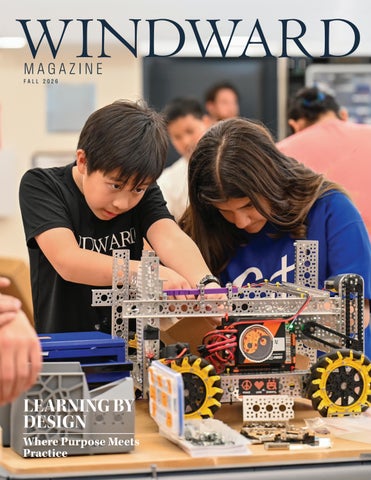
WINDWARD MAGAZINE F A L L 2026
LEARNING BY DESIGN Where Purpose Meets Practice
MAKING IT POSSIBLE Behind every meaningful learning experience is a community that believes in it. The enclosed 2025-26 Donor Impact Report celebrates the alumni, families, grandparents, faculty, staff, and friends whose generosity helps make a Windward education possible.
W I N D W A R D M A G A Z I N E - 01
TABLE OF
CONTENTS
FALL 2026
FROM THE HEAD OF SCHOOL 4 A Letter from Sarah Beck
SENIOR CELEBRATIONS 30 A Commencement Celebration 32 The Journey Continues
STUDENT SPOTLIGHTS 34 Millie Helm '28 36 Adrina Shayestehfar '30 and
Presley Walker '30
VISUAL & MEDIA ARTS 38 Ideas in Motion 41 On Display —
Windward's Spring Visual & Media Arts Exhibitions
18 ACADEMICS
30
6 Better Questions —
Teaching and learning in the Age of AI
10 Looking Closer —
Histories and Cultures of Los Angeles
13 Inspired by Inquiry —
Windward’s Scholars Showcase
16 Finding Common Ground —
8th Grade Model UN
COMMUNITY ENGAGEMENT AND BELONGING 18 Fresh Faces 20 Learning to Lead 23 From Campers to Classmates 26 More Than a Meeting —
Inside the Windward Parent Guild
28 Finding Common Ground —
Grounds for Conversation
41 PERFORMING ARTS 44 Footloose - Windward’s
Spring Production
46 A Wide World of Dance
02 - T A B L E O F C O N T E N T S
ATHLETICS 48 Dream Work Makes the Team Work 52 A Winning Culture 56 Wildcat Award
WINDWARD NETWORK
58
64 Learning Beyond the Clinic 66 Policy in Practice
BOARD OF TRUSTEES 68 Departures and New Members
ALUMNI 70 A Lifelong Connection —
Inside the Windward Alumni Council
72 Alumni Spotlight:
44
Jacob Rubin ’10
64
74 Alumni Spotlight:
Alma Medina '88
SERVICE LEARNING 58 Building Community
2026-27 KEY DATES
Through Service
76 Key Dates and Parent Guild
60 Planning Kindness —
Preview
Clean Beauty Club
62 Sparking Discovery —
Women in STEAM Club
56 ADVANCEMENT OFFICE CONTRIBUTIONS Dawn Barrett
Associate Head of School for Advancement, Finance, and Operations
MaiChi Do
Director of Data Management and Research Analyst
Jeff Gilder ’08
Jamey McElvain-Whitman
Graphic Designer; Brand Strategist
Robin Pickett
Director of Windward Network; Associate Director of Admissions
Jacqueline Varney
Director of Development and Major Gifts
Director of Alumni Development and Engagement; Associate Director of Admissions
La Donna Wertlieb
Ashley Goodman
Photography Akiko Nimura Brian Gove Photography Corey Marquetti Eric Hamilton Photography Randi Roberts Photography Ryan Olson ’27 Ultimate Exposures
Senior Associate Director of Admissions and Service Learning
Molly Hudson
Senior Communications Manager
Lindsay Knaub
Director of Development and Engagement
Jeff Lake
Director of Communications and Public Relations
Director of Development & Donor Services
Design Akiko Nimura
Multimedia Specialist
W I N D W A R D M A G A Z I N E - 03
A LET TER FROM
Sarah Beck Dear Windward Community, One of the ideas I've been returning to this Summer is that healthy schools don't stop asking questions simply because something is working well. In fact, I think the opposite is true. The strongest schools continue asking how they can better serve students and prepare young people for a world that is constantly changing. That kind of reflection isn't about constantly reinventing ourselves. It's about remaining open to learning. Each new school year gives us the opportunity to build on what we've learned, revisit long-held assumptions, and consider what our students need now—and what they'll need next. As I read through these pages, I found myself returning to that idea again and again.
04 - C O M M U N I T Y
COMMUNITY
Reading about our faculty's conversations around artificial intelligence (page 6) reminded me that some of the most important work in education begins long before a lesson is taught. It begins with asking thoughtful questions: about what matters most, how students learn, and how schools can remain true to their mission while preparing young people for a changing world. I see that same commitment in the story of how we're preparing students to lead with greater confidence, purpose, and responsibility (page 20). Together, these stories suggest that meaningful growth rarely starts with having all the answers. It starts with asking the right questions. Beyond the classroom, the creative partnership between faculty member Colleen Hargaden and alumna Madeline Hollander '04 (page 38) is a reminder that some of the most meaningful learning continues long after graduation. And the story of two students helping bring softball back to Windward (page 48) illustrates what can happen when young people bring an idea, adults believe in it, and a community comes together to make something possible.
As different as these stories are, I found myself noticing the same thread running through each of them. It's a shared belief that learning is something we shape together. Students, teachers, coaches, alumni, and families each have a role in building the kind of community we hope Windward will be. That work is never finished, and I believe that's one of our greatest strengths. Perhaps that's one of the reasons I'm especially excited about Windward Wonders, our year-long inquiry that will invite students, faculty, staff, families, alumni, and trustees to explore a shared question together: What does it mean to be human? I love that we're beginning the year not with an answer, but with an invitation to think together. My hope is that this question sparks conversations well beyond our classrooms, reminding us that some of the most meaningful learning happens in dialogue with one another. That same mindset also shapes how we approach our work as a school, as it guided Windward's successful accreditation this past year. While accreditation certainly affirms the strength of a school's program, what I value most is the opportunity it provides to pause, reflect, and ask how we can continue to grow. In many ways, it asks schools to do what we ask of our students every day: remain curious, seek feedback, and continue learning. I hope you'll enjoy the stories that follow. More than anything, I hope they offer a glimpse into a community that cares deeply about learning, not only for our students, but for all of us. As we begin another school year together, I look forward to the questions we'll ask, the conversations we'll share, and what we'll discover along the way. Warmly,
Sarah Beck
HEAD OF SCHOOL
W I N D W A R D M A G A Z I N E - 05
Original illustrations by Jessika Colón
Better Questions TEACHING AND LEARNING IN THE AGE OF AI
06 - A C A D E M I C S
ACADEMICS
Just a few short years ago, conversations about artificial intelligence and generative AI in schools often centered on a simple question: Does AI belong in education? "That's not the right question anymore," says Jenn Zanoria, Director of Educational Technology and Associate Director of the Center for Teaching and Learning. "The reality is that AI is here." Today, the conversation at Windward has shifted. As AI tools have become increasingly integrated into everyday life—from search engines to productivity apps and everything in between—the conversation has evolved beyond whether students will encounter artificial intelligence to how they can use it thoughtfully, ethically, and effectively. More importantly, it has prompted the School to revisit some of the most fundamental questions about teaching and learning. What skills matter most? How should students demonstrate understanding? What role should technology play in the learning process—and what should remain entirely their own? For Windward, responding to that reality has never been about chasing the latest technology. Instead, the School's response has been shaped by something far more enduring: a culture rooted in inquiry, collaboration, and a willingness to reflect thoughtfully on what meaningful learning looks like. "We always come back to our mission and values," explains Marisela Ramos, Associate Director, Prep Division and a member of the Responsive Teaching Team. "Those are the things that ground our decisions, regardless of how quickly the technology changes." For Jenn, AI may be revolutionary, but it isn't an exception. Like every technology Windward has adopted over the years, its value depends on the learning goals driving its use. That mindset shaped the faculty's response from the beginning. When generative AI began reshaping education, faculty entered the conversation with a wide range of perspectives. Some were
eager to explore its possibilities. Others questioned whether it belonged in the classroom at all, concerned about its potential impact on writing, creativity, critical thinking, and academic integrity. Rather than expecting immediate agreement, the School created space for educators to wrestle with those questions together. Through the work of the EdTech Team and the Responsive Teaching Team, as well as ongoing departmental conversations and faculty workshops, teachers shared assignments, examined student work, tested new approaches, and challenged one another's assumptions. Throughout the process, Head of School Sarah Beck encouraged faculty and staff not to treat AI as a problem to solve once and for all, but as an ongoing conversation that would require curiosity and flexibility, while ensuring that learning always led the way. Instead of rushing to embrace or reject a rapidly evolving technology, the School took a measured approach, staying grounded in its mission and values while learning alongside peers, following emerging research, and refining its practices over time. As those conversations continued, the questions themselves began to change. Early discussions often focused on plagiarism, cheating, and detection. While those concerns remain real, Windward's faculty found themselves returning to a different set of questions, shifting from whether students should use AI to why they might use it—and whether that use genuinely supported the learning goals of a particular assignment. "It's not something to police," says Marisela. "It's something we navigate together." As faculty explored those questions, they began developing a shared understanding of how AI could best support learning. "Part of our responsibility is helping students develop the judgment to make thoughtful decisions," Marisela says. "The goal isn't simply following rules. The goal is understanding why those decisions matter." W I N D W A R D M A G A Z I N E - 07
Out of those conversations emerged Windward's AI Guidelines Framework, a shared language that helps faculty clearly communicate the role AI should play in a specific learning experience. Rather than prescribing a single rule for every classroom, the framework gives faculty the flexibility to align AI use with the goals of a particular assignment. Depending on those goals, students may be asked not to use AI at all, use it as a planning partner, incorporate it as a revision tool, or leverage it as an essential component of a larger creative or research project. By providing a common language while leaving room for professional judgment, the framework recognizes that different disciplines and assignments require different approaches. In some classrooms, AI may have no place at all. In others, it can become a valuable planning partner, revision tool, or creative collaborator. "This technology is really pushing teachers," Jenn explains. "It's forcing us to think critically about the importance of what we're teaching. Why are we teaching this? Is this something students need to continue learning themselves, or can technology support that work so we can focus on deeper skills?" For many educators, those conversations have become less about artificial intelligence itself than about the design of meaningful learning experiences. Assignments that may once have emphasized only the finished product increasingly make room for process, reflection, and visible thinking. Rather than simply asking students to arrive at an answer, faculty are designing learning experiences that reveal how students ask questions, conduct research, revise their work, and develop ideas over time. That intentionality can be seen across classrooms and programs. In 8th Grade English, teachers Dawn Robinson, Sam Pack, and Emily Miner built students' culminating The Anthropocene 08 - A C A D E M I C S
Reviewed essay around the habits of mind they hoped students would develop. Inspired by John Green's collection of essays, the assignment challenged students to weave together research, personal experience, and reflection into an original review that explored not only a topic of their choosing, but also a broader truth about human nature. While the assignment itself remained consistent, the writing process continued to evolve alongside the rise of generative AI. Students documented the reliability of their sources, acknowledged the people who contributed to their thinking, completed at least half of the writing during class, and recorded the evolution of their work over multiple drafts. The process itself became part of the learning, making students' thinking visible as ideas developed and changed. "We wanted to be able to witness how their thinking evolved," Dawn explains. The assignment wasn't designed simply to limit AI use. Every stage of the process—from topic selection and research to drafting, revision, and reflection—asked students to make their thinking visible. It reflected a broader shift in instructional design, one that asked students to demonstrate not only what they knew, but how they arrived there. At the same time, faculty are careful not to minimize the challenges AI presents. "One of the most tragic impacts of AI on education is the growing distrust that it fosters in the classroom," says Dawn. Teachers can find themselves reviewing revision histories like detectives. Students sometimes question whether exceptional work by their peers was created independently. Perhaps most concerning, some students begin to doubt their own ability to get started.
ACADEMICS
Those decisions look different from classroom to classroom. While some learning experiences are intentionally designed to minimize AI's role, others invite students to use it in ways that deepen inquiry and expand what's possible. In Science and Technology Teacher Colin Rose's Senior capstone biology course, one of the most exciting applications of the framework comes when AI enables work that simply wouldn't have been possible otherwise. Unlike his AP Biology classes, where students build the foundational knowledge of the discipline entirely without AI, Colin intentionally incorporates the technology into his Senior capstone course, where students pursue original research questions of their own design. This year, one group investigated proteins associated with genetic diseases, using AI-powered modeling tools alongside scientific literature to explore ideas typically encountered only in advanced university research. Colin's approach reflects the same philosophy guiding Windward's broader work around AI. "I've been trying to approach it not from a position of being afraid of this technology, but rather, here's a powerful new tool," he says. "How can we use it appropriately in a way that supports the educational mission? "If you see it not as a replacement for thinking, but as a collaborator in allowing you to explore new, exciting things," Colin continues, "that's where I see the real value of AI in the classroom. AI allows highly motivated students to push their education as far as possible and then use AI to further their education rather than replace critical thinking and hard work." That ownership has become one of the most meaningful outcomes of the course. "What I see is a level of personal investment that I don't often see in a classroom," Colin says. "When students
are able to truly define their own projects—within reason and within the content area—and explore something they're genuinely interested in, these kids are remarkably engaged." The conversations taking place across classrooms continue to evolve as faculty refine assignments, experiment with new approaches, and share what they’re learning with one another. In some classrooms, AI will continue to have little or no role. In others, it will serve as a planning partner, revision tool, or avenue for deeper exploration. The framework continues to provide a common language while giving faculty the flexibility to make thoughtful decisions based on what they hope students will learn. Jenn sees that flexibility as one of the framework's greatest strengths. "I've been referring to it as AI and emerging technologies, because it's not going to just stop here," she explains. "What we're creating is the foundation to then be able to approach anything that comes next with the same kind of critical lens and evaluative spirit." "The skills haven't changed," agrees Marisela. "Students still need to think critically, communicate clearly, work with others, and navigate uncertainty." In many ways, she believes, those capacities become even more important as technology continues to evolve. Whether students are writing an essay, modeling proteins, or tackling a challenge that hasn't yet been imagined, the technology itself is rarely the starting point. Windward faculty continue to ask the same questions: What are students being asked to learn? What experiences will help them get there? The tools may change, but the questions driving teaching and learning remain.
W I N D W A R D M A G A Z I N E - 09
Looking Closer HISTORIES AND CULTURES OF LOS ANGELES
For most Windward students, the city of Los Angeles represents something comfortable and familiar. They know their corners of the city, recognize familiar landmarks, and have grown up navigating the places that shape their daily lives. This past year, Windward's Histories and Cultures of Los Angeles course asked them to do something different: slow down and look again. This inaugural history elective invited students to examine the city not simply as the place they call home, but as a living historical text. Through field experiences, literature, film, original research, digital mapping, and creative projects, students explored how migration, industry, politics, art, and culture have shaped Los Angeles, and how those histories continue to shape the city today. Building on the place-based inquiry students first encountered in 8th Grade, the course encouraged them to revisit their hometown with new historical tools and fresh perspectives. "I was inspired to offer this class from my first day at Windward knowing that LA is an ideal place to study the intersection of global histories, the breadth of the American experience, and one's own neighborhoods," explains course originator and History Teacher JP de Guzman. After teaching Los Angeles history at UCLA for several years, JP arrived at Windward with the hope of bringing that scholarship into the high school classroom. As the His10 - A C A D E M I C S
ACADEMICS
tory and Social Sciences Department expanded its elective offerings, he was able to design a course that combined rigorous historical scholarship with the field experiences, community partnerships, and interdisciplinary opportunities that Windward makes possible. Students were encouraged to study their city the way historians do: across disciplines, through multiple sources, and in the places where history unfolded. "Having been a life-long Angeleno, I never had the opportunity to study LA history until well into my senior year of college," JP says. "I wanted to give our students the opportunity to move past their bubble to see how rich the histories and cultures of LA are, past and present." That shift in perspective quickly became the defining experience of the course. For Jianna Green '27, an article by UCLA historian Kelly Lytle-Hernandez challenged her to reconsider the Los Angeles she thought she knew, revealing how the city's image had been shaped over time—and whose stories had often been left out. "I would tell a friend to take this class because it completely changes the way you see a city you think you know," Jianna says. "Even if you were born and raised in LA, there's so much history that you never really get the chance to learn." The classroom quickly expanded beyond campus. Over the course of the year, students walked through familiar landmarks like Union Station, LA Plaza, and Little Tokyo, explored Los Angeles through novels and films, met with artists and community members, and returned to class with new questions about the city they thought they knew. Rather than treating each experience as a separate lesson, the course invited students to move continually between the city itself and the ideas they were studying. "The opportunities to learn about LA are so abundant that it invites students to explore historical developments through novels, movies, and field trips to see history as living, breathing, and all around us," says JP. "As I often tell students, history is a verb, not a noun." For Senior Holt Kolodny, those connections became especially clear during one of the class's downtown walking tours. After discussing a monument in class, he found himself standing before the site where it had once stood, learning why it had been removed and what that decision revealed about Los Angeles' evolving relationship with its own history. "Seeing the places in person made the history feel more real," Holt shares. "It helped me recognize how the city's past continues to shape its present." Jaia Santo '27 experienced a different kind of revelation studying the monograph Popular Culture in the Age of White Flight while learning about Chavez Ravine. Before the course, she associated Los Angeles’ Dodger Stadium with baseball and Los Angeles pride. Learning that the stadium sits on land where entire communities were displaced challenged her to reconcile two truths at once. "One of the biggest lessons I took from this course was that history isn't linear, and there usually isn't just one right answer," Jaia says. "Things can be true in different ways at the same time, and nothing is ever completely one thing or another." W I N D W A R D M A G A Z I N E - 11
Students carried that same approach into their own work. Rather than relying primarily on traditional tests and essays, they analyzed historical records from travel ads to homicide data, created digital maps tracing conflict and opportunity across Los Angeles, and completed collaborative research projects that asked them to think like historians. One of the course's signature projects challenged students to become both historians and storytellers. Following a unit on the origins of Hollywood, students selected topics that resonated personally before creating researchbased zines that combined historical scholarship with visual design. Their projects explored subjects ranging from child exploitation in Hollywood and the evolution of celebrity culture to Los Angeles architecture and the racial and geopolitical origins of the "Latin Lover" stereotype. For Ryan Olson '27, the project permanently changed the way he viewed his hometown. "Before I stepped foot into JP's class I really only thought of Los Angeles as my home," Ryan shares. "Sure, I knew it was the epicenter of a ton of diverse culture and life, but I never found myself stopping to look around at the history behind the city." For his zine, Ryan traced the influence of Spanish, Chinese, and Native cultures on Los Angeles architecture, revealing connections he had never noticed before. "I created something that I was not only proud of but that helped tell the story of Los Angeles and the people that live here," Ryan says. As JP sees it, projects like the zines represented something larger than an alternative form of assessment. Displayed throughout the School’s Center for Teaching and Learning, they invited classmates, faculty, and visitors into conversations about Los Angeles while reinforcing a central responsibility of historical scholarship. "One goal of projects such as digital maps and zines displayed at the CTL was to imbue in students a sense that the historian has a responsibility to use their research to inform the public and not let it languish in a Google Drive," JP says. "By sharing their new knowledge and analytical connections with friends, families, and the community at large, students were able to take a greater sense of pride and ownership in their intellectual labor as well." Looking back on the course's inaugural year, JP is proud not simply of what students learned, but of how they learned to engage with the city around them. "Having taught LA history on a part-time basis at UCLA for years before establishing the Histories and Cultures of LA course at Windward, I am most proud of what students were able to accomplish and how they grew as thinkers and citizens of the city," he says. "Unlike my previous college students, I was able to see in my Wildcats genuine interest translate into deep motivation." For Jaia, that way of thinking has continued long after the semester ended. "Since taking this class, I've found myself applying what I learned everywhere—in the music I listen to, the way I read the news, and even in my photography," she says. "Even if you've lived in LA your whole life, this class will make you realize there's so much more beneath the surface than you ever noticed before." 12 - A C A D E M I C S
ACADEMICS
Inspired by Inquiry WINDWARD’S SCHOLARS SHOWCASE
What happens when students are given the time, support, and freedom to pursue an idea that genuinely excites them? The answers were on full display this past Spring, as students from Windward's Creative Expression, Global, and STEAM programs presented projects that reflected months—and in some cases years—of curiosity and growth at the Scholars Showcase. From original works of art and creative writing to research, advocacy, and innovation, the Showcase offered a glimpse into what can happen when learning is driven by genuine passion.
That spirit sits at the heart of the Scholars Program itself. Designed to give particularly passionate students the opportunity to dive more deeply into their areas of interest, the program encourages participants to pursue ambitious projects and learning experiences that extend beyond the traditional classroom. Throughout the year, students meet regularly with faculty mentors and peers to share progress, receive feedback, and strengthen skills ranging from project management to public speaking. Many students participate for multiple years, building on their interests and skills over time. W I N D W A R D M A G A Z I N E - 13
For Richard Bailey, Director of Global Programs, that opportunity is central to the program's purpose. "Scholars programs provide students a space to explore their intellectual curiosities beyond what a traditional classroom is designed for," he says. "For many, those curiosities become passions." He sees the program as an opportunity for students to move beyond academic exploration and discover what those interests look like in practice. "One of my favorite things about the Scholars Showcase is the tremendous amount of student ownership on display," shares Emily Miner, English Department Chair and Director of the Creative Expression Program. "Each student is the expert on their project in a way that demonstrates the depth of their learning." Marisela Ramos, Associate Director, Prep Division and a member of Windward's Responsive Teaching Team, believes the Scholars experience begins by shifting who shapes the learning. "In a class, the assignments are generally designed by the teacher," she explains. "Here, it's student design." For Marisela, that distinction changes the entire learning experience. "These really are passion projects that are student-led," she says. "Students get to follow the questions that excite them and see where that curiosity takes them." That freedom often means embracing uncertainty. Ideas evolve, projects change direction, and students discover that meaningful work rarely follows a straight path. Supported by faculty mentors and peers, Scholars participants are encouraged to experiment and revise as their projects develop. Rather than viewing setbacks as failures, they learn to see them as opportunities to step back, adapt, and push their ideas further. That approach was evident throughout this year's Creative Expression cohort, where students pursued projects shaped by their interests, questions, and creative identities. For Alex Mafrice '28, that journey took the form of Cut Open, a series of acrylic paintings inspired by fruit, color theory, and vulnerability. Interested in incorporating food into her artwork while exploring complementary colors, Alex developed three detailed paintings depicting cut-open fruit, accompanied by an original poem displayed alongside the work. What began as an artistic concept quickly evolved into a long-term creative challenge. Completing the series required roughly six months of work, including multiple revisions and repainted sections when certain details did not turn out as she had envisioned. "Through this experience I learned how to connect poetry and art in a style that felt true to me," says Alex. "I didn't present my poem, but it was displayed beside my paintings which felt like a choice I was more comfortable with. This program gave me the chance to create a complex project that I think really challenged me this year." 14 - A C A D E M I C S
Just as meaningful was the opportunity to learn from fellow Scholars. Throughout the year, students regularly shared their progress, offered feedback, and gained insight into one another's creative processes. Alex points to fellow Creative Expression Scholar Emme Rogers '28 as a particular source of inspiration, noting that she was deeply moved by Emme's poetry and artistic voice. Emme's project explored a very different set of questions. Titled Mean Green Alien, her digital zine examined the human impact of immigration enforcement and the language often used to describe immigrant communities. Inspired by the experiences of immigrant communities and informed by extensive research, the project sought to challenge the dehumanizing label of "illegal alien" while encouraging empathy for those affected. "As someone who grew up surrounded by a hard working immigrant community, I felt that the current administration's perception of immigrants as 'Illegal Aliens' was an unjust and (literally!) inhumane label," Emme explains. The project evolved significantly throughout the year. Initially, Emme planned to create a single painting focused on the story of one child detained by immigration authorities. As her research deepened, however, she realized that story
ACADEMICS
represented a much broader reality. "To my horror, I realized that at the peak of ICE activity across the US, there were hundreds of children, including babies and toddlers, being held in detention centers," says Emme. That discovery ultimately reshaped the project, expanding its scope and sharpening its purpose. By the time she presented her work at the Scholars Showcase, Emme had created a project intended to help audiences better understand the experiences it explored. She even chose not to identify herself as the creator when distributing copies of the zine, preferring to keep the focus on the issue itself rather than on her role in creating it. "It felt like an opportunity to express my values to the community while giving attention to a critical issue," she says. Although Alex's and Emme's projects differed dramatically in medium, subject matter, and audience, both reflected a common thread running throughout the Scholars Program: the opportunity to pursue work that feels personally meaningful. For Emily, that freedom is one of the program's defining strengths. Students are encouraged to propose projects that are ambitious, interdisciplinary, and deeply connected to their own interests—work that might not fit neatly within the boundaries of a traditional course. "This is my favorite thing about the Scholars experience," says Emily. "The sky is the limit!"
The Showcase may provide the public culmination of that work, but the learning extends far beyond a single presentation. Because students are responsible for shaping and managing their own projects, they spend the year learning how to set goals, seek and implement feedback, navigate setbacks, and balance long-term commitments alongside the demands of everyday student life. "It's something they learn over time," Marisela says. "How do you hold yourself accountable for something that is additional? How do you manage this additional thing when you have all these other things in your life?" Those questions become part of the learning experience itself. Students are challenged not only to create something meaningful, but also to develop the habits required to bring an idea to life. For Alex, that meant discovering new ways to combine visual art and poetry in a style that felt authentic to her. For Emme, it meant developing the confidence to tackle a complex issue she cared deeply about while refining her skills as a researcher, artist, and communicator. "I've definitely gained time management and independent research skills from my years as a Creative Scholar," Emme reflects. "When a project is influenced by passion and has a significant outcome, the work becomes very simple and especially rewarding."
The projects on display at the Scholars Showcase varied widely in topic, format, and scope. Together, however, they reflected something larger than the finished work itself. They demonstrated what can happen when students are trusted to pursue meaningful questions over time and supported as those questions evolve. Emily sees that same growth reflected in the conversations students have about their work. "In addition to celebrating the product, reflecting on the process is one of the most powerful student outcomes," she explains. "Many students share afterward how meaningful it was to take the time to think about their successes, challenges, and light bulb moments throughout the year. As their teacher, the conversations we have in preparing for the showcase are some of the highest-leverage I have every year; together, we learn so much about their identities as writers, artists, and learners."
W I N D W A R D M A G A Z I N E - 15
Finding Common Ground 8TH GRADE MODEL UN
Late in May, the usual lively chatter in the Recital Hall took on a very different tone. For one afternoon, the Hall was no longer home to a class of 8th Graders. Instead, it became the meeting place for delegates representing countries from around the world. Proposed resolutions were debated, questioned, amended, and ultimately put to a vote. Some earned enough support to pass. Others fell just short after lengthy negotiation.
many current events," Evie explains. "Many sources were biased, and there is not a lot of new information or statistics released from the Chinese government that is not positive."
The annual Model United Nations simulation marks the culmination of the 8th Grade Global Studies curriculum, bringing together a year's worth of research, writing, public speaking, and discussion. Yet the project extends well beyond learning about world affairs.
As students become immersed in their countries, History Teacher Roxana Pianko says something begins to change. "One challenge students often face is 'getting into character.' They struggle with taking on the role of the representative for a nation. When doing a Model UN, the students feel a responsibility when 'they' becomes 'we.' And I love that for the students because you can see that they become more serious and more involved the more they become 'we,' 'our,' and 'all of us'."
The simulation also creates space for students to ask larger questions about international institutions themselves: how they function, whose interests they represent, and where their strengths and limitations lie.
Once students begin thinking like their countries, the project becomes even more complicated. Students who have spent weeks learning to advocate for one country's priorities must now negotiate with dozens of others.
"In many ways, the Model UN is a reflection of the core question which frames the 8th Grade class: What does it mean to be a global citizen?" says History & Debate Teacher Hatim Malek. "Throughout the year, we ask students to grapple with the idea that we will often encounter wicked problems in our lives—concerns that affect everyone around the world, often with no easy or agreed upon solution."
Amira quickly discovered that firsthand. "The hardest part about preparing for Model UN was picking one issue that I wanted to fight for," she says. "I was very passionate about both providing more support for women and mitigating the war but came to the unfortunate conclusion that for the purposes of coalition-building, it was best to pick something that was an issue experienced by multiple countries." She ultimately crafted a resolution focused on nuclear energy, choosing an issue that would resonate across national interests.
The transformation begins long before students step behind a podium. Assigned a single country to represent, students spend weeks researching its priorities, challenges, and place within the global community. For Amira Patwardhan '30, representing Iran meant setting aside assumptions in favor of curiosity. "A lot of common perceptions about Iran are not entirely true," she notes. "Despite the rhetoric that women are given little to no resources or respect, the literacy rate of women was only two percentage points below men. There are institutions in Iran specifically dedicated to helping women achieve in STEM." Penelope Rosales '30 found her own assumptions tested while representing the United Kingdom. "One of the most surprising things I learned was that the UK is one of the five permanent members of the United Nations Security Council," she says. "I didn't realize the UK had such a significant role in global politics, so learning about that gave me a better understanding of its importance in world affairs." Researching China presented a different challenge for Evie Alberstat '30. "It was very difficult to research everything about China because it has such a dense history and the country is involved in 16 - A C A D E M I C S
Hatim sees that transformation every year. "This growth occurs steadily as the project progresses," he says. "When it first begins, students are hesitant to invest fully in the work we're doing. They tend to 'go through the motions' of completing the assignments, rarely utilize language and rhetoric to embody their position as delegates, and often don't want to make compromises with their classmates. However, as the unit progresses, their passion for the project grows. Whether it be because of a personal connection to their country, a budding interest spurred by research, or simply the desire to 'win' and get their policy passed, they realize that these are issues that matter and that the only way we can solve them is by being willing to lean in and cooperate with others." By the time debate begins, it's surprisingly easy to forget you're watching a room full of 8th Graders. "Between the formal dress, the wooden plaques, and the sheer amount of countries and perspectives represented in the room," Amira recalls, "I really felt like we could collectively pass resolutions—albeit fake ones—that could make real change in the world."
ACADEMICS
While weeks of preparation had produced a number of thoughtful proposals, it hadn't made consensus any easier. "I was surprised by how few ideas passed," Evie says. "This experience really made me understand just how difficult it is for world leaders to combat wicked global problems." Hatim believes the setting helped elevate the experience beyond a typical classroom project. "Having the opportunity to combine all of the classes into a single simulation in the Recital Hall was one of my favorite experiences at Windward, period," he says. "The location, the wooden plaques, the use of the stage, and the sheer scope of everything made it feel like something truly intentional and memorable, rather than just another final in the students' academic careers. I also felt like the students were more invested because of it: they voted intentionally, got frustrated when something didn't pass, and celebrated when something did." Amira remembers another moment just as clearly. Hoping to question a proposed resolution, she wasn't called on before another delegate raised the exact same concern. "It was really cool to know that this other person and I were following the same line of thinking," she says. Those moments of discovery are what Roxana remembers most. "The 'aha!' moments are my absolute favorite," she shares. "When students discover something about countries they have never heard of and cannot wait to get to class just to share what they now know, it is honestly the best. The whole goal is to get students curious, excited, concerned about the world they live in and this project really does accomplish those things." For Amira, the lessons extended well beyond the final vote. "War doesn't need to be the end-all solution when there's a problem of international relations," she reflects. "It's possible to negotiate reasonable policy that will achieve the same solution." Inspired by the experience, she attended a Model United Nations program in Washington, D.C., over the Summer and is now working to launch a competitive Model UN team at Windward this Fall. Penelope came away with a different kind of takeaway. "Representing the UK changed the way that I think about international issues because I had to think about them from my country's perspective, rather than just my own," she reflects. "It helped me realize that global problems rarely have simple solutions, and that diplomacy usually means finding a healthy balance between national and global interests." W I N D W A R D M A G A Z I N E - 17
Fresh faces Every new school year brings new colleagues, fresh ideas, and the excitement of getting to know the people who will help bring our campus to life.
We're delighted to welcome the newest members of the Windward community and invite you to meet the educators, mentors, and staff who are joining us this year!
Leah Kessler ’04 - Interim Collegiate Dean of Students Leah is a proud Windward alumna and is excited to return to the community that played such a formative role in her life. After graduating from Windward, she attended Stanford University, where she earned a BA in Psychology, followed by an MA in Education and her California teaching credential. She later served as both a teacher and assistant principal in Menlo Park, Calif., and earned an MA in Educational Administration and Leadership. Leah is currently completing her certification as an Educational Therapist. Leah lives with her husband and two sons. Outside of school, she enjoys spending time in nature, beach days, pickleball, reading, cooking, and, most of all, time with family and friends.
What are you most looking forward to as you begin your work at Windward? Given my role in the Collegiate division, I'm especially excited to get to know our 11th and 12th Graders and partner with my colleagues to help guide them through these important years as they prepare for life beyond Windward. As a Windward alumna, I know firsthand the lasting impact that caring, dedicated educators can have on a student's confidence and sense of belonging. It feels incredibly meaningful to return to the community that helped shape me, and I look forward to supporting this generation of Wildcats with the same care, encouragement, and belief in their potential that I experienced as a student.
Ryan Gilman - Speech and Debate Teacher Ryan brings experience teaching history and social studies across multiple grade levels in both independent and public schools, as well as coaching Speech & Debate and Mock Trial. After beginning his career as a trial attorney, Ryan made the transition from the courtroom to the classroom, bringing a unique perspective to his work with students. At Windward, he will teach Speech & Debate in both the Middle and Upper Schools and join the Prep Seminar team. Ryan holds a BA in History and Government, a J.D., and a teaching credential.
Kalah Brown - English Teacher Kalah Brown is excited to join the Windward community as an English teacher. She received her bachelor’s degree from Claremont McKenna College and is happy to be back in sunny California. Kalah is originally from the East Coast and began her teaching career in the Washington metropolitan area. She taught high school English at Landon School in Bethesda, Maryland and at The Potomac School in McLean, Virginia. As the daughter of two educators, Kalah has always felt at home on school campuses. If she is not in a classroom, she is with friends and family catching a movie, hiking to a waterfall, playing a card game, or deep in a book.
What are you most looking forward to as you begin your work at Windward? Aside from the long list of texts I'm excited to teach, I'm most looking forward to all of the wonderful community events, like Taste of Windward and Buy It on the Bridge, that make Windward so special!
18 - C O M M U N I T Y E N G A G E M E N T A N D B E L O N G I N G
COMMUNITY ENGAGEMENT AND BELONGING
Kelsey Reynolds ’13 - English Teacher Kelsey Reynolds (she/her) is a class of 2013 Graduate from Windward High School. She has taught 12th Grade English—AP Literature, African American Literature, and AP Research—for six years in New Orleans and Los Angeles. Before that, she worked for 826 New Orleans, supporting young people ages 6-18 in discovering their voices through creative writing. She graduated from Tulane University in 2017 with a B.A. in Africana Studies and received her English Teaching Credential from Loyola Marymount University. This Fall, she will also be enrolled part-time at Cal State Long Beach to earn her Librarian Credential. In her free time, she loves spending time outdoors, sewing, reading, doing personal archival work, and playing soccer. She is excited to return home to the Westside of Los Angeles.
What are you most looking forward to as you begin your work at Windward? As an alumna of Windward, I am looking forward to returning to a campus and community that supported me in becoming the educator and person I am today. I can't wait to find a spot in the Center for Teaching and Learning to get some work done. While I’m sure the breakfast menu has changed since 2013, if it hasn’t, I’m looking forward to some delicious breakfast burritos.
Leslie Contreras - Temporary Laboratory Technician Leslie is new to Windward, joining the team in 2026 as a lab technician. Science taught her that mistakes hold knowledge and that even when projects did not have the ideal outcome, new information is still created. While in undergrad, she was taken under the guidance of a great scientist, Dr. Leticia Marquez-Magana. With Dr. Leticia, she began researching telomeres. Leslie's passion pushed her to pursue a master's degree in cell and molecular biology, continuing her work with telomeres. Her master's project consisted of understanding the causes of early onset telomere shortening. Her love of science brought her to the United States Department of Agriculture. There she used her abilities to further research in how to yield higher rubber production in plants. After two years at the USDA, she set her sights on oncology research, working as a clinical research assistant. During her time in oncology she realized she missed doing lab work and decided to start a new career at Windward. While at Windward, Leslie hopes to help students find their scientific spark and help the Science department. When she is not in the lab, she enjoys riding her bike near the beach, going to the movie theatre, and crocheting.
Rebecca Bobadilla - Assistant Athletic Trainer Rebecca Bobadilla joined Windward School as an Assistant Athletic Trainer on the Athletic Medicine Team in July 2026. Before joining Windward, she gained experience working in high-performance, collegiate, and high school athletics. She has served in head athletic training roles and, in the summer of 2024, had the opportunity to serve as the Head Physiotherapist for the USA Women's 27 Touch Rugby Team at the Touch Rugby World Cup in Nottingham, England. Rebecca earned a Master of Science in Athletic Training from the University of La Verne and a Bachelor of Science in Kinesiology, with an emphasis in Therapeutic Exercise and Rehabilitation, from California State University, Los Angeles. In her free time, Rebecca enjoys exploring new coffee shops, watching soccer with her fiancé and spending time with their dog, Bonbon.
What are you most looking forward to as you begin your work at Windward? As I begin my journey at Windward, I look forward to creating a welcoming environment for our student-athletes and building meaningful relationships with students, faculty, and staff.
W I N D W A R D M A G A Z I N E - 19
Every day at Windward, students help shape the life of the School. They lead affinity groups and clubs, mentor younger students, organize events, welcome new families, and create spaces where their peers can connect, contribute, and belong. Student leadership has long been part of the Windward experience. For the 2026–27 school year, the School is building on that tradition with a more intentional approach to how student leaders are developed and supported.
For Kevin, the challenge often revealed itself in surprisingly ordinary ways. "Student leadership rarely failed because the student lacked heart or desire," he explains. "It often failed on the practical and unglamorous things. Student meetings fizzled because there was no agenda, an event never came together because no one worked backward from the date, or a student message to a group of fellow students didn't ask the necessary guiding questions. Those are learnable skills."
The shift grew out of conversations with students and faculty alike. For several years, students had asked for two things: a stronger voice in school life and greater clarity around what leadership roles actually involved. Faculty and staff recognized another challenge. While students were given meaningful opportunities to lead, a club or class initiative could thrive or stall depending on the skills students happened to arrive with. Leadership opportunities existed, but success often depended on experience rather than preparation.
The result is a redesigned leadership model that creates more opportunities for students to lead while connecting those roles more intentionally than before. New Grade-Level Presidents, Vice Presidents, and Representatives ensure every grade has a voice, while Student Body Presidents work alongside grade-level leaders to strengthen student government, mentor younger leaders, and help shape community life across Grades 7–12. Rather than working in isolation, student leaders now collaborate across grades and programs, creating a more connected leadership community built around shared expectations and common purpose.
"We have asked student leaders to model what it means to be a Windwardian," says Kevin Newman, Assistant Head of School and Director of the Collegiate Division, "but we have not, until now, offered direct and actionable leadership training to student leaders well in advance of their assuming the role."
The new structure is only part of the story. This past Summer, student leaders from across campus gathered for Windward's first comprehensive Student Leadership Training, bringing together club leaders, affinity leaders, Peer Mentors, CREATE Stewards,
20 - C O M M U N I T Y E N G A G E M E N T A N D B E L O N G I N G
COMMUNITY ENGAGEMENT AND BELONGING
learningto Admissions Ambassadors, Student Athletic Leadership Team (S.A.L.T.) members, and student government representatives. "As I stepped into my role, I noticed that many of our student leaders were eager to make a positive impact, but there were often mismatched expectations between students and advisors," says Jocelyn Castillo, Associate Director of Student Community Engagement and Belonging and Service Learning. "Students were expected to know how to lead a club, facilitate meetings, navigate challenges, and represent the school community—but those expectations had never been clearly defined, and the tools to succeed had not been intentionally provided." Rather than creating separate training sessions for different leadership roles, faculty and staff chose to begin with the skills every student leader shares, regardless of how they choose to serve the community. Participants explored communication, collaboration, conflict resolution, event planning, ethical decision-making, and other practical leadership skills while developing a common language around what leadership looks like at Windward. The workshop also created space for students to reflect on the values and habits that shape effective leadership, recognizing that those same principles apply across every leadership role on campus.
LEAD
"We hope students experience leadership as something they learn, not something they are simply given," Kevin says. "A title should come last. Before students step into these roles, they will be trained in the fundamentals: how to plan, set an agenda, communicate with a group, and delegate. Those are learnable skills, and we no longer want a student's success to depend on whether they happened to pick them up somewhere else. "Agency only becomes real when it's paired with capacity," Kevin continues. "It's not enough to give students permission to lead and ownership over their spaces." That developmental approach begins as soon as students step foot on campus. Starting in 7th Grade, students explore themes of belonging, responsibility, and community through retreats and advisory experiences. Those ideas continue to build throughout middle and high school, with this year's 9th Grade Retreat intentionally introducing leadership development as students reflect on the values that shape both their own decisions and the communities they help create. As students move into 10th Grade and beyond, the focus expands to agency, encouraging them to consider not only how they contribute to the community, but how they can help shape it. W I N D W A R D M A G A Z I N E - 21
Those skills matter because they shape countless interactions throughout the school year. "Student leaders are the ones who decide whether a nervous 9th Grader feels welcomed in the first five minutes of a meeting or spends it standing awkwardly by the door," Kevin reflects. "Student leaders carry the traditions that give a group its identity, and they make the small culture choices that determine whether students are excited to be part of it—and, by extension, part of the wider Windward community." For Tyrone Powell, Prep Dean of Students, Director of Interdisciplinary Studies & Community Engagement and Belonging, and Senior Advisor for Athletics, those everyday interactions are where leadership is most often found. "We often think of leadership as the big moments—running a meeting, serving as a team captain, or standing at the podium," Tyrone explains. "But leadership is just as often found in the little moments: including someone who feels left out, supporting a teammate who's struggling, treating every member of our community with respect, or choosing to do the right thing when nobody is watching."
That's why, Tyrone believes, leadership should never be defined by a position alone. Formal roles create opportunities to practice leadership, but they are not what make someone a leader. By intentionally building a community around everyday decisions and values-based decision-making, Windward hopes students come to see leadership as influence, responsibility, and service— whether they are leading a club meeting, welcoming a new student, or simply looking out for the people around them. For Jocelyn, the work doesn't end when the training concludes. Leadership development is intended to continue throughout the year as students put those ideas into practice in classrooms, club meetings, athletic teams, affinity spaces, and countless everyday interactions across campus. "I hope students see groups that are thriving because their leaders feel confident and supported," she says. "I hope they experience events that are thoughtful and welcoming, clubs where every student feels they belong, and student
leaders who communicate well, collaborate across groups, and genuinely care about the experience of others." Kevin hopes those changes will be visible not only during major events or assemblies, but in the ordinary rhythms of school life. "I want to walk past a club meeting in March," he says, "and see the meetings running well and different student voices being heard. It's easy to feel energized in August, and my hope is that the training doesn't just inspire students, but genuinely equips them so that when the year gets busy and things are difficult to manage, they have skills to fall back upon." Whether students become grade-level presidents, club leaders, team captains, or simply classmates who help others feel seen, the goal remains the same: to help every Windwardian recognize that leadership is less about the position they hold than the impact they have on the community around them.
22 - C O M M U N I T Y E N G A G E M E N T A N D B E L O N G I N G
COMMUNITY ENGAGEMENT AND BELONGING
from
campers to CLASSMATES
Starting a new school comes with a lot of firsts. The first time finding your classroom. The first time opening your locker. The first time sitting down for lunch. And, for many students, the first time meeting the classmates who will shape their next six years. At Windward, many of those first introductions happen well before the first day of school. Each Summer, Camp Windward welcomes incoming 7th Graders for three weeklong sessions designed to help students begin building the relationships and confidence they'll carry into Middle School. Before they ever receive a class schedule or meet their teachers, students spend the week exploring Los Angeles, tackling team challenges, sharing meals, and getting to know the classmates and teachers they'll soon see every day.
For Camp Windward lead and Athletics and Interdisciplinary Studies Coordinator Zach Bright '08, that's exactly the point. "The goal," he says, "is to have Windward already feeling like home." "Many students' first introduction to Windward isn't really the campus—it's their fellow classmates," agrees Camp Windward lead Tim O'Halloran. "Our hope is that by the end of the week, they've met everyone in their grade. They'll probably leave with 30 or so acquaintances and a good half dozen friends." Rather than relying on traditional icebreakers, Camp Windward creates opportunities for friendships to develop naturally. Students solve escape rooms together, spend a day at the beach, cheer alongside one another during Universal Studios' WaterWorld stunt show, and, almost without realizing it, start getting to know one another. W I N D W A R D M A G A Z I N E - 23
For many campers, those friendships begin with surprisingly ordinary moments. Addie Kelly '32 remembers classmates relying on "teamwork and all of our ideas" to solve an escape room challenge. Trent Hillson '32 recalls another camper inviting him into a game after finding himself standing alone. For Brady Freedman '32, the biggest change came during one of the most familiar parts of any school day. "I love when we talk at lunch together," Brady says. "I feel connected and part of a group." As students reflected on the week, those moments surfaced again and again. They remembered laughing together during trivia, working side by side at the beach, realizing "everyone had a place," and leaving with classmates' phone numbers already saved in their contacts. Somewhere between the bus rides, shared meals, and team challenges, a group of incoming students had quietly started becoming a class. For Zach, the transformation is visible almost immediately. "Monday is usually quiet with some palpable anxiety," he says. "By the time Friday rolls around, everyone wishes it would have lasted longer." Camp counselor and recent Windward graduate Daisy Harkin-Goodrich '26 watched that transformation unfold during the first week's beach day. The week had begun with students sitting almost exclusively beside classmates from their elementary schools. By Friday, those groups had dissolved. A large group of campers worked together to dig a giant hole in the sand, laughing as they buried one of their classmates. Later, as everyone packed up to leave, Daisy overheard two campers making plans to stay connected after camp ended.
24 - C O M M U N I T Y E N G A G E M E N T A N D B E L O N G I N G
COMMUNITY ENGAGEMENT AND BELONGING
"I loved that moment," Daisy says. "I was watching Camp Windward work in full effect—students slowly breaking down elementary school barriers and making connections that will last for years to come."
"Put yourself out there."
For Daisy, the moment carried special meaning. Five years earlier, she had arrived at Camp Windward as the only student from her elementary school. Because of the pandemic, camp took place virtually, yet it still gave her something she desperately needed.
"Don't be afraid to make new friends."
"I was the only person attending Windward from my elementary school and felt so isolated during the Summer before 7th Grade," she recalls. "Camp Windward was a great way to see faces and make connections with people that would end up becoming some of my best friends."
"Be yourself." "Talk to everyone."
"Everyone is welcoming." Nadine Jaffe '32 captured that feeling best. "Everyone here is in the same boat as you: looking for a friend, someone to sit with at lunch or on the bus. Be the person willing to give the first olive branch."
Now, just weeks after graduating, she's back—this time helping the next class begin the same journey. "I feel so excited connecting with this year's incoming 7th Graders and watching them discover the school that will eventually become their home." By the end of the week, campers' advice for next year's incoming 7th Graders sounded remarkably similar.
W I N D W A R D M A G A Z I N E - 25
more than aMEETING Inside the Windward Parent Guild
When students first arrive at Windward, they quickly discover that learning extends well beyond the classroom. Through athletics, the arts, clubs, advisory, and countless everyday interactions, they become part of a community that shapes their experience as much as their coursework. While students are busy learning the ins and outs of what it means to be a Windwardian, parents and guardians embark on a journey of their own. As students transition from elementary school to middle and high school, opportunities for parents to be on campus naturally become less frequent. "The Parent Guild bridges this gap,” explains Parent Guild President Erin Mand, parent to Maple '25 and O.B. '27, “by offering in-person meetings throughout the year and a huge range of volunteer opportunities—from one-hour tasks, like serving lunch or managing the check-out desk in the CTL, to larger undertakings such as chairing a committee for a school event like Spirit Week. The Parent Guild helps you stay informed and connected on campus." Because every Windward parent automatically becomes part of the Parent Guild, every family has an opportunity to engage with the life of the School in whatever way fits them best. Some volunteer their time making alumni care packages or supporting the Center for Teaching and Learning. Others help organize Faculty and Staff Appreciation, Spirit Week, or community events. Many begin by attending a Parent Guild meeting. Others find themselves braving the checkout lines in the Pavilion or simply introducing themselves to another family over coffee.
Former Parent Guild President Sheri Green, parent to Ava '20, Liam '24, and Milo '28, who served in 2019-20 and again in 202425, remembers arriving at her first meeting with fairly ordinary expectations. "I was very surprised when I went to my first Parent Guild meeting," she recalls. "It wasn't just updates about committees and events…it was like pulling the curtain back and getting to see what was happening inside." That experience proved to be a common one among the current and former Parent Guild presidents. Meetings bring together parents and guardians, faculty and staff, administrators, and students, creating opportunities to better understand both the day-to-day life of the School and the thinking behind it. "Parent Guild meetings at Windward are engaging; they bring the School to life for parents and guardians," Erin says. "School leaders share the 'why' behind programming and initiatives (especially if there are iterations or changes), and student panels share their direct experiences on various topics." For Sheri, each meeting comes with its own surprises. "I always leave saying 'wow, I didn't know that' or 'I am so impressed by what they are doing,'" she says. "It's like, you know it's a phenomenal school, but then you are blown away when you hear anecdotes and details about the daily life of a Windward student." For many parents, getting involved also means building relationships—with other families, faculty, and staff—that become an important part of their own Windward journey. For former Parent Guild President Chelsea Patterson (2023-24, parent to Joshua '24), that was the reason she decided to get involved in the first place. "What inspired me was my desire to get to know
26 - C O M M U N I T Y E N G A G E M E N T A N D B E L O N G I N G
COMMUNITY ENGAGEMENT AND BELONGING
and to connect with the community that our son and family had just become a part of once we decided to enroll," she recalls. "I also wanted to figure out how to share my talents and skills with the community to help enrich my family's experience." Those opportunities take many forms throughout the year. Parents volunteer at Night on the Bridge and Windchella, serve coffee during Faculty and Staff Appreciation events, attend community-building events like Grounds for Conversation or Tales at the Table, and lend a hand throughout campus in ways large, small, and chaotic. As Sheri puts it, "You can't get to know a school better than by being in the cafeteria!" The work itself is meaningful, but so are the relationships that grow alongside it. "When attending my very first Parent Guild meeting, the president mentioned how many of her close friendships developed through volunteering at school via the Parent Guild," Erin recalls. "That really inspired me to not only support the School by getting involved but also to gain strong friendships along the way—what a win!" Chelsea offers similar encouragement to new families. "As a new parent you can volunteer a lot or a little," she says. "It is not about the amount of time, but the quality. So do what you can when you can and you will find your space and your people. It will be well worth your time." The strength of those relationships becomes especially clear during moments when a community needs one another most. After the Palisades Fire, the Parent Guild organized opportunities for impacted families to gather, reconnect, and support one another. "Those events—ranging from coffee at a fellow parent's
home to a beach walk to an evening at a wine bar—were filled with so much bonding, support and love," says 2025-26 Parent Guild President Kara Horowitz, parent to Jake '27 and Will '30. "I was very proud to be part of an organization that showed up in such a meaningful way for its members." For Kara, that spirit extends beyond any single event. "I think it's very fulfilling to be active in one's community and I'm proud to model that for my children," she says. "It's so beneficial to spend an hour or two volunteering or going to a Parent Guild meeting or event. There is something for everyone!" Sheri sees that same spirit reflected in the School itself. "Knowing that my kids go to a school where parent involvement is valued makes the whole experience rewarding," she says. "I love giving back to the School through the Parent Guild but I also get so much from it. It is extremely unique to find a school that gives parents such an amazing opportunity to feel as included as our Parent Guild does." Every family's experience with the Parent Guild looks a little different. Some parents become committee chairs or even Parent Guild presidents, while others volunteer when their schedules allow. Some develop lifelong friendships. Others simply leave a meeting with a deeper appreciation for and understanding of the place their students spend each day. Through it all, as students find their place at Windward, parents and guardians often discover one of their own.
W I N D W A R D M A G A Z I N E - 27
Grounds for Conversation Parenting adolescents is deeply rewarding. It can also be challenging, overwhelming, and, at times, surprisingly isolating. While parents and guardians spend countless hours supporting their students as they navigate friendships, identity, and an ever-changing world, they often have fewer opportunities to explore those same questions with one another. Grounds for Conversation was created with that reality in mind. Held twice each year, Grounds for Conversation brings together Windward parents and guardians, faculty and staff, and administrators to explore many of the topics shaping students' lives, from adolescent mental health and belonging to civil discourse and artificial intelligence. More than a speaker series or informational meeting, Grounds was intentionally designed to create space for people to learn together, share perspectives, and build meaningful connections. As Lisa Nishimura, parent to Kai '28 and Parent Guild Executive Committee Vice President for Diversity, Equity, Inclusion, Belonging, and Community Engagement, explains, "Grounds for Conversation offers something a little different. It's an intentional, extended space where connection isn't incidental—it's the goal." Originally developed by members of the Parent/Guardian Diversity, Equity, Inclusion, and Belonging Committee, Grounds reflects Windward's belief that students are best supported when the important adults in their lives are learning alongside one another. "Our approach to parent and guardian programming is designed to build a stronger partnership between home and school," says Garret Tyau, Associate Director of Peak Performance & Athletics and Associate Director of Parent & Guardian Community Engagement and Belonging. "Parent Guild meetings help families understand life at Windward. Grounds for Conversation asks a different question: How can we extend what's being done at school into our homes? The better connected parents and guardians are to one another, the more effectively we can collectively support our students."
28 - C O M M U N I T Y E N G A G E M E N T A N D B E L O N G I N G
COMMUNITY ENGAGEMENT AND BELONGING
Creating that kind of partnership begins with conversation—and with recognizing that no two people experience the world in exactly the same way. For Tyrone Powell, Prep Dean of Students, Director of Interdisciplinary Studies & Community Engagement and Belonging, and Senior Advisor for Athletics, that's where meaningful learning begins. "We all operate from our own stripe of the beach ball," he explains. "Hearing different perspectives within our community is helpful as we work to meet people where they are while also increasing our own capacity for learning and understanding." That philosophy is reflected throughout each session, where presentations give way to paired conversations, small-group dialogue, and opportunities for participants to engage with people they may not otherwise meet. For Lisa, the program speaks to something many parents quietly experience. "We spend so much energy worrying about our children's friendships, connections, and emotional wellness," she reflects, "and in doing so, we sometimes forget that these things don't necessarily get easier with age. Despite having more life experience, walking into a room full of strangers can still feel daunting. Showing up as your authentic self can still feel intimidating." Grounds creates a space where those feelings can be acknowledged rather than hidden. "One of the most surprising and comforting things about Grounds is realizing that the parent who seems to have it all figured out—the one who always looks calm and put-together—is often carrying the same doubts and struggles as the rest of us," Lisa says. "Instead of feeling judged, you're met with knowing nods and a true spirit of generosity. It's deeply reassuring to realize that it's not just you and we're in this thing together." The conversations don't necessarily end when the meeting does. Instead, they become opportunities for parents and guardians to continue the dialogue at home, extending what begins at Grounds into everyday family life. For Tyrone, the invitation is simple. "Come with an open mind, an eagerness to connect, and a willingness to be more curious than certain." For Lisa, that's what keeps Grounds from feeling like just another school event. "If you've ever felt a little intimidated walking into a crowded room, or unsure how to find your people at a larger school event, you're not alone—I've felt that too," she says. "Grounds is intentionally different. It's a smaller, quieter space, designed to give parents real time to invest in themselves and to connect with one another. More often than not, you'll leave having gained a new insight—and perhaps having made the start of a new friendship."
finding common GROUND W I N D W A R D M A G A Z I N E - 29
A Commencement CELEBRATION
On Thursday, May 28, the Windward community gathered on Foley Field to celebrate the Class of 2026. Throughout the morning, Seniors reflected on the friendships they built, the lessons they learned, and the ways they hope to leave Windward better for those who follow. Original writing, musical performances, and remarks from faculty speaker JP deGuzman, selected by the Senior class, made the ceremony distinctly their own. As the final tassels were turned and caps were flung triumphantly skyward, one chapter came to a close and another began. Congratulations, Class of 2026! Thank you for everything you've brought to Windward. We can't wait to see what comes next.
STUDENT REFLECTIONS & PERFORMANCES ORIGINAL POEM: BECOMING Julianna Mary-Alice Samarge
TIME AND WHAT WE MAKE OF IT Ella Nickerson
WHAT'S IN A NAME? Jonah Nathanson
THE JOY WE FOUND Bella Amar Kapoor
PURPLE RAIN Charles Jackson True Cohn, Oskar Muniz, Asher Lucas Rush, Aidan Marley Rutman, and Jack Eldon Turteltaub
LEAVING ON A JET PLANE Noa Joanne Alpern, George Best, Ruthie James Faxon, Daisy Harkin-Goodrich, Kaleomakamaeokealoha Sadie Fumie Knight,
30 - S E N I O R C E L E B R A T I O N S
Sophia Lehmann, Sydney Ava Litt, Oskar Muniz, Madeline Haebin Oh, Sophia Roman
Schuman, and Olivia Meyre Tatiana Stodel FROM THE FACULTY
JP deGuzman
SENIOR CELEBRATIONS
SCHOOL AWARD WINNERS DIRECTOR'S AWARD Daisy Harkin-Goodrich and Aidan Marley Rutman Selected by the faculty and presented to the graduating Seniors who have made a lasting impact on the Windward community through their intellectual curiosity, spirit of collaboration, meaningful relationships, individuality, and strength of character.
VALEDICTORIAN Charles Jackson True Cohn and Kyan Kumar
SHIRLEY WINDWARD AWARD Bella Amar Kapoor and Jack Eldon Turteltaub
Awarded to the graduating Seniors with the highest cumulative academic achievement across Grades 9–12.
Selected by the faculty and presented to the graduating Seniors who best exemplify scholarship and a commitment to knowledge and discovery across the curriculum.
W I N D W A R D M A G A Z I N E - 31
The JOURNEY Continues This Fall, the members of the Class of 2026 will begin the next chapter of their journeys at colleges and universities across the country—and around the world. From large public research universities to small liberal arts colleges, conservatories, and international institutions, their destinations reflect the remarkable range of passions, talents, and aspirations that have defined this class. Of course, once a Wildcat, always a Wildcat! Through the Windward Network, our newest alumni will continue to find support, mentorship, and connection in the years ahead. We can't wait to see where their journeys lead next!
CA california California Polytechnic State University, San Luis Obispo Chapman University Pitzer College Stanford University University of California, Berkeley (6) University of California, Los Angeles (2) University of Southern California (5)
CO colorado Colorado College
TN tennessee
*1
Vanderbilt University (3)
VT vermont
*2
Middlebury College (2)
NH new hampshire
*3
Dartmouth College (2)
International University of St Andrews (3)
32 - S E N I O R C E L E B R A T I O N S
TX texas Southern Methodist University (5) The University of Texas at Austin (2)
SENIOR CELEBRATIONS
WI wisconsin University of Wisconsin– Madison (4)
IA iowa Grinnell College
NY new york
PA
pennsylvania Lehigh University University of Pennsylvania
MI michigan
Barnard College (2) Cornell University (2) Long Island University Post New York University (7) Sarah Lawrence College United States Military Academy West Point
University of Michigan (8)
ME
maine
VT*2
Bowdoin College Colby College
RI
NH*3
rhode island Brown University
MA
massachusetts Boston College Boston University (3) Northeastern University (3) Tufts University (2)
TN*1
CT
connecticut University of Connecticut Stamford Wesleyan University Yale University (4)
Washington
DC IN indiana MO missouri Washington University in St. Louis (2)
IL illinois University of Chicago
Indiana University Bloomington (3) Purdue University (2) University of Notre Dame
GA georgia Emory University (3) Spelman College
LA louisiana Tulane University (3)
OH ohio The Ohio State University
Howard University The George Washington University (2)
VA virginia University of Virginia (2) William & Mary
NC
north carolina Duke University (2) Wake Forest University (3)
W I N D W A R D M A G A Z I N E - 33
EXPANDING HER CANVAS
Millie Helm '28
For Millie Helm '28, becoming a better artist means putting herself in situations where she can continue to learn. That mindset has already taken her well beyond Windward's Visual & Media Arts classrooms. Earlier this year, Millie completed a semester at Ryman Arts, a nationally recognized program for talented high school artists, before earning a scholarship to attend the School of the Art Institute of Chicago's Summer program, one of the country's premier pre-college art and design experiences. Together, the experiences have shown Millie that the best way to grow as an artist is to keep putting herself in new creative environments. An art teacher she works with outside of Windward first encouraged her to apply to Ryman Arts, where she learned alongside other dedicated young artists from across Southern California. The experience introduced her to new materials and techniques while strengthening her observational drawing skills and connecting her with a community of peers who shared her passion for creating. "I had a great time there, and felt like I not only got some great friends and connections out of it, but also learned how to use materials I don't often use and do more observational drawing," Millie says. Working alongside other serious young artists also challenged the way she viewed her own work. Rather than measuring herself against those around her, she came to appreciate that every artist brings something different to the page. "Sometimes it's easy to feel insecure about my
34 - S T U D E N T S P O T L I G H T S
art in relation to others in those sorts of classes because I consider their art 'better' than mine," Millie admits. "But I've also learned that a lot of people wish they had my art style, which makes me feel a bit better. Art isn't something you can truly be better at or worse at than others at this high of a level." Back at Windward, that same spirit of exploration has continued to shape her work. Millie credits her Visual & Media Arts classes with giving her the freedom to experiment and discover new ways of approaching art. She points specifically to Tony de los Reyes' Interdisciplinary Art class, where students are encouraged to pursue their own ideas while embracing unfamiliar challenges. One assignment in particular left a lasting impression. Students selected both their favorite and least favorite paintings from a collection of artworks before creating an original piece that incorporated elements of each. "We picked out our favorite and least favorite paintings from a group of cards and incorporated elements of both into our paintings," Millie explains. "I feel it incited some major growth in my art." That same approach has continued to open new doors. This Summer, Millie will attend the School of the Art Institute of Chicago after receiving a scholarship to its pre-college program. Rather than focusing on what she already knows, she is most excited by the chance to experiment with new materials and techniques while exploring a school she hopes to attend one day.
STUDENT SPOTLIGHTS
"I am super excited to go to a school I have been looking at for a potential college this Summer," she says. "When I got the news that I got a scholarship, I was so happy to be acknowledged for my passion. Art is what I want to pursue in life, so it feels great to be able to attend." Looking ahead, Millie is excited to continue building on those experiences in Windward's advanced Visual & Media Arts courses, including Studio 3 and eventually AP Studio Art. Even as she continues developing the style she has made her own, she remains just as interested in branching out into something new.
W I N D W A R D M A G A Z I N E - 35
CHASING THE NEXT LEVEL
Adrina Shayestehfar '30 and Presley Walker '30
I didn't make the team, I decided to train consistently," she recalls. "After a couple weeks I made the team, and I became a top player in my position." That determination carried her through Cal South's Olympic Development Program and eventually to invitations from U.S. Soccer, including her first Youth National Team camp, still the proudest moment of her soccer career.
By the time many students are wrapping up their days, Adrina Shayestehfar '30 and Presley Walker '30 are just getting started. Club soccer practices stretch into the evening. Weekends are reserved for league matches, national tournaments, and recovery before the cycle begins again. For most 9th Graders, that's a demanding schedule. For Adrina and Presley, it's simply part of pursuing the sport they love. Already, that commitment has earned both scholar-athletes opportunities through the Olympic Development Program and U.S. Soccer's Youth National Team pathway, placing them among the country's top young soccer players. For Adrina, that journey nearly took a different turn. After two years in the American Youth Soccer Organization (AYSO), she tried out for the Los Angeles Breakers Football Club but didn't initially make the team. Rather than walking away, she continued training until she earned a roster spot. "Because at first 36 - S T U D E N T S P O T L I G H T S
Presley's path began differently. As her passion for soccer grew, she sought out stronger competition, making the long drive to train with SoCal Blues twice each week while still in elementary school. "I started to become very passionate about soccer," she recalls. "I decided to attend an ODP summer camp and was fortunate enough to get scouted after winning Camper of the Week." Presley went on to win back-toback ODP championships before helping her ECNL club reach the national playoffs, competing against many of the country's top youth teams. Pursuing soccer at that level requires careful planning. Between afternoon practices, weekend travel, and national competitions, both have learned to organize schedules well beyond their years. Recovery, strength training, and communication with teachers have become just as important as time on the field. "What this looks like is, before school and during lunch, I prioritize meeting with my teachers," Adrina explains. "Sometimes I have to do homework in the car." Presley has developed a similarly disciplined routine, balancing private training sessions, hill workouts, Pilates for injury prevention, recovery, and game film, all while managing the academic demands of high school.
STUDENT SPOTLIGHTS
Although much of their soccer takes place beyond Windward's campus, both credit the School with helping them grow in different ways. Adrina embraced the opportunity to compete alongside older students as a 7th Grader before serving as an 8th Grade captain, helping younger teammates adjust to the same experience she had a year earlier. Middle School Soccer Coach Matthew Greenebaum saw that leadership extend beyond Adrina's role as captain. "Adrina shows a willingness to do whatever is asked of her in order to help the team and never complains," he says. "She shows kindness and patience to all her teammates and is always looking for ways to help other players, whether it be through her decisions and actions on the field, giving advice, or pointing things out that can help her teammates succeed." That steadiness was put to the test during the 2026 PBL Championship. After never trailing in their first 10 matches of the season, the Wildcats found themselves down 2–0 early in the first half. With nerves beginning to set in, Adrina made it clear to her teammates that there was no need to panic and helped lead them back to a championship victory. Presley has experienced that leadership firsthand. "I admire Adrina because she has always been a natural leader on the soccer field," she says. "During team practices, she would kindly help her teammates and would always organize the backline during games." For Presley, Windward offered opportunities to step outside her comfort zone. After primarily playing left back at the club level, she took on roles at striker and midfield while continuing to develop as a leader on and off the field. "Presley is a lead-by-example player, but as a captain this past season was asked to step into a more vocal leadership role and really grew into this throughout the season while still staying true to her quieter and more reserved approach on the field," Matthew says. "She has also found more ways to use her incredible skills and abilities to help elevate her teammates on the field and embrace a true 'we above me' mindset." It's a quality Adrina recognizes in her as well. "Presley is very dynamic," she says. "Whether she is a striker, outside back, or midfielder, she is able to play to her strengths." For two freshmen already competing among the nation's top young players, they’re still chasing the next level. And they'll have plenty more opportunities to do it together as their Windward soccer journeys continue.
W I N D W A R D M A G A Z I N E - 37
IDEAS
inmotion When Visual & Media Arts Teacher Colleen Hargaden and Windward alumna Madeline Hollander '04 first began talking about creating an exhibition together, they weren't looking for a shared artistic medium or aesthetic. What united their work was something less tangible: a fascination with movement. The two artists first met as graduate students in Bard College's Film/Video MFA program. Years later, while catching up at one of Colleen's exhibition openings, they discovered they shared another connection: Windward. They later became studio neighbors in Los Angeles, where conversations that often drifted toward art gradually turned into plans for an exhibition. That opportunity finally arrived this past Spring. Invited by Director of Programming and Special Projects Tony de los Reyes, the pair presented In Finitum, the first Faculty/Alumni exhibition in the newly opened gallery of the DeGeorge Family Innovation & Arts Center. Even though they work in different mediums, the two quickly realized they had been exploring many of the same ideas. "Although our practices are distinct, they share a common interest in movement," Colleen notes. "Madeline's work often grows out of choreography, while mine frequently incorporates animation and mechanical systems." Meeting every other week, the artists filled sketchbooks with references, sharing ideas until an unexpected common thread emerged: centuries-old patent drawings for perpetual motion machines. "These drawings all imagine an invention that can't truly exist," Colleen explains. "Nothing can run forever without meeting grav-
38 - V I S U A L A N D M E D I A A R T
ity, friction, resistance, and entropy. But despite their impossibility, people continue to imagine them." For Madeline, the fascination extended beyond the machines themselves. "We've been searching for the perpetual motion machine since the beginning of time," she says. "Despite the fact that it isn't possible, we continue searching for it. There's something deeply human about that impulse." Those conversations eventually found their way into every corner of In Finitum. Colleen's spinning sculptures invited viewers to imagine endless movement while quietly yielding to gravity and friction. Her animated projections, freed from physical limitations, looped indefinitely. Nearby, Madeline's floating silver forms drifted with subtle shifts in air and temperature, making invisible forces visible. Rather than illustrating a single idea, the works spoke to one another, each approaching movement from a different perspective. Madeline's own fascination with movement grew out of a different creative path. Before she began thinking of herself as an artist, she devoted herself to ballet. Over time, that path expanded to include anthropology, architecture, professional dance, choreography, sculpture, and installation—disciplines she now recognizes as different ways of exploring the same questions. "There was a really important triangulation between photography, science, and art history," she says.
VISUAL AND MEDIA ART
W I N D W A R D M A G A Z I N E - 39
"Learning photography in the darkroom, studying art history with Tony, and taking biology and physics all felt separate at the time, but I was constantly finding connections between them." Colleen hopes students recognize that same freedom to move between disciplines. "I hope students come away with a sense that an artistic life is something you continue to develop over time," she says. "You can blend choreography, drawing, filmmaking, sculpture, science, and engineering within a single artistic practice." For Madeline, returning to campus brought many of those ideas full circle. As a student, Tony had introduced her to many of the artistic concepts she now explores professionally, making the opportunity to exhibit alongside Colleen feel less like revisiting the past than seeing those early influences through a new lens. The exhibition opening also became a celebration of the community that made those connections possible. During the opening reception, current students, alumni, parents, faculty, colleagues, friends from the Los Angeles art world, and family 40 - V I S U A L A N D M E D I A A R T
all gathered in the gallery. "It was a reminder that a school isn't simply a place where people pass through," Colleen says. "It's a community where relationships continue to grow and take on new forms over time." Madeline experienced that continuity while installing the exhibition. She brought her four-year-old son to campus, where Tony introduced him to the robotics spaces before the two shared lunch in the same place she had eaten as a student more than two decades earlier. "It was incredibly moving," she recalls. "Watching him become inspired in the same place that inspired me made me hope he'll someday have teachers and opportunities like the ones I had at Windward." Like the ideas and partnership that inspired it, In Finitum continued moving after the gallery closed. Madeline expanded elements of the installation into a new public artwork for LACMA's Art Parade, giving the project another life beyond Windward. For Madeline, that continued evolution reflects the nature of creative work itself. "Windward planted the seeds for ideas that continue to ripple outward and take on new lives," she says. "That, to me, is what discovery is."
VISUAL AND MEDIA ART
n oDISPLAY
Windward's Spring Visual & Media Arts Exhibitions
Visitors entering the Innovation & Arts Center gallery this Spring encountered two distinct exhibitions, each offering a different perspective on the creative process. SUPERNOVAS '26 showcased work from students in Windward's advanced Visual & Media Arts courses, filling the space with paintings, sculptures, photography, graphic design, film, and mixed-media installations that reflected a year of experimentation and growth. Just beyond, the Advanced Placement Art & Design exhibition invited viewers into the Sustained Investigations of the Class of 2026, where months of curiosity, revision, and exploration culminated in deeply personal bodies of work.
The Spring exhibitions also concluded the first full year of student exhibitions in the new gallery, giving students the opportunity to see their work presented in a professional exhibition space designed to celebrate the visual arts. Although the two exhibitions looked very different, both grew from the same place. "Creating your own work should start with a sense of curiosity about something," explains Katie Thoma, Chair of the Visual & Media Arts Department. "Once students have something they want to explore and have an idea about the process and material they want to use, it comes back to the importance of experimentation and revision to develop that idea or the body of work."
W I N D W A R D M A G A Z I N E - 41
That process took many forms throughout SUPERNOVAS '26. Bringing together work from Studio Art, Photography, Graphic Design, 3D Design, and Interdisciplinary Studio, the exhibition reflected the breadth of Windward's advanced visual arts curriculum while highlighting the many different ways students learn to communicate ideas visually. As visitors moved through the gallery, colorful abstract paintings gave way to carefully observed photographs, graphic compositions, sculptural explorations of color and form, and mixed-media works, each revealing a distinct artistic voice. 42 - V I S U A L A N D M E D I A A R T
Among the exhibition's highlights were the color and form sculptures created by students in 3D Design 2/3. Before constructing their final pieces, students developed three small-scale prototypes, shared them with classmates for feedback, and selected one concept to enlarge into a finished sculpture. What appeared polished and complete in the gallery represented weeks of testing ideas, solving structural challenges, and refining every decision along the way.
VISUAL AND MEDIA ART
"In this process of going from small to large, there is a lot of troubleshooting and problem-solving that has to be done along the way," Katie says. "In these long-term projects, it's easy for students to lose steam, but they stayed focused and invested. I'm really proud of all of their final projects, and I know they were as well." If SUPERNOVAS '26 celebrated the breadth of student work across multiple disciplines, the Advanced Placement Art & Design exhibition invited visitors to spend more time with each artist's evolving body of work. Rather than presenting a collection of unrelated assignments, the exhibition featured selected works from each Senior's yearlong Sustained Investigation, revealing how questions evolve through experimentation, critique, and revision. "The goal is for students to make meaning through a synthesis of material, process, and concept, and to continue to evolve their art through practice, experimentation, and revision," Katie explains. "Much of the AP course is focused on critique, where students hone their ideas guided by feedback given by their peers and instructor. In the AP course, students drive the projects and are responsible for the evolution of their craft, so it's amazing to see their work change over time and what they can do as artists at this highest level." Although the exhibitions represented different stages of artistic development, both reflected the iterative nature of
making art. "This is how you evolve an art practice," says Katie. "You need to be able to work through an idea - to push, hone, discuss, research, learn from taking risks - to ultimately make your work better. Something we try to cultivate in our students is an artistic mindset and coming up with questions, thinking critically about your work and the work of others, and working iteratively is at the root of this practice and mindset." Throughout the year, students have watched the gallery transform with exhibitions by fellow students, alumni, and professional artists. That visibility matters. "Having a gallery allows us to elevate the work students are making in our class," Katie says. "Having students able to see their work in that context—in a professional space where they can also see contemporary art—is incredibly powerful. My hope is that students feel a strong sense of pride in their work and see themselves as artists." For Katie, the exhibitions are just as much about the people viewing the work as the artists who created it. "I hope that any visitor, regardless of the current show that is up, can have the same kind of experience they would have in a museum or gallery, in that they let their own curiosity guide their engagement with the work," she shares. "I hope that the work they see sparks connections and discussions, and that people leave thinking about something that they saw."
W I N D W A R D M A G A Z I N E - 43
Footloose Windward’s Spring Director’s Note by James Patric Moran
Production
Staging a production that radiates the infectious joy and boundless freedom of Footloose was an absolute no-brainer. Because these characters and this iconic score are so deeply beloved, I relished the opportunity to inject that brand of exuberant, unapologetic riot against the status-quo delight into the new Allison and Bennett Rosenthal Theater. For our young artists, the mission is clear: to empower themselves to "cut loose and fly" against the suffocating grip of a world that says "no." This isn't just a musical; it’s a high-octane discovery of personal power designed to leave you singing, shouting, and dancing through the aisles.
The journey toward this "flight" is a gritty, rhythmic struggle against a conservative system designed to stifle the human spirit. In the town of Bomont, the restrictive hold on youth is born out of tragedy, manifesting in a literal ban on public dancing—a desperate attempt to freeze time and feeling. The community bows to this silence until the arrival of Chicago transplant Ren McCormack. Ren’s rebellious spirit is a live wire that refuses to be grounded by Bomont’s heavy atmosphere, and his defiance sparks a revolution. At its core, our production mirrors the timeless battle against the heavy hand of censorship and the futile attempts to harness self-expression. Through unwavering resilience and creative fire, the youth of Bomont reclaim their voices, proving that the human soul cannot be edited, diluted, or contained.
44 - P E R F O R M I N G A R T S
PERFORMING ARTS
While the show is famous for its neon colors and toe-tapping hits, we dug deeper to unearth a layer of authentic teenage angst. To build a revolution that felt real, our 7th-9th Grade cast explored the modern issues that "cuff " their own spirits, channeling that genuine frustration into their performances. Each young artist was challenged to identify the injustices they would rise up and fight against, transforming this "light" musical into a profound act of defiance. The result is a display of utter joy rooted in real power. Ultimately, joy and freedom are the most potent weapons we possess against the shadows of restriction. By finding the strength to dance with abandon, these artists demonstrate that self-expression isn't just a performance—it is a REVOLUTION. As the kids of Bomont dismantle the machinery of control and lead their town toward sweeping unrestraint, they remind us all that the human spirit is meant to be loud, vibrant, and entirely unfiltered. With love, James
W I N D W A R D M A G A Z I N E - 45
A Wide World of
Dance
Last Spring, Richard Bailey, Director of the Global Studies Program, welcomed Jason Ignatius, Executive Liaison for the Schram Foundation and representative of Schram Academy, a Chennai-based school in South India, to Windward. The visit introduced the two communities and explored opportunities for future collaboration.
Among those in attendance was Performing Arts Teacher and Dance Program Advisor Alesia Young. What began as a simple conversation quickly revealed a shared belief in the power of the arts to broaden students' perspectives and help them better understand the world around them. A few months later, that conversation had grown into a months-long artistic exchange connecting dancers separated by nearly 9,000 miles, two continents, and a 13-hour time difference. As Alesia puts it, "I don't think we ever would have imagined that day that just a few months later we would be embarking on this virtual artistic and cultural exchange." With their priorities aligned, faculty members from both schools designed a collaboration that would allow students to learn directly from one another. Through a combination of instructional videos, virtual conversations, and social media exchanges, Schram students introduced Windward dancers to Indian fusion, a style blending the classical South Indian dance form Bharatanatyam with contemporary influences, while Windward students taught Schram dancers Fosse-style jazz. The exchange asked students to do more than learn choreography. It challenged them to step outside of familiar movement patterns, encounter a new artistic tradition, and build relationships with peers whose lives looked very different from their own. For student and dancer Lily Richardson '28, that uncertainty was part of the excitement. "I didn't really know what to expect, and that was thrilling," she says. What followed was both challenging and rewarding. The Bharatanatyam technique demanded significant lower-body strength, intense concentration, and a level of coordination that surprised Lily. "Though it may look easy, the way that the arms and legs move separately in difficult, precise patterns is what makes this style so complex and hard," she explains. As students received choreography in a series of instructional videos, they worked together to break down each movement, decipher rhythms, and master unfamiliar techniques. "It was extremely enjoyable to do as a group," shares Lily. "We connected trying to solve the puzzle of timing, rhythm, and all the other aspects of this intricate style."
46 - P E R F O R M I N G A R T S
PERFORMING ARTS
While the choreography provided a foundation, the relationship between the two schools truly came to life during a series of virtual meetings. In one Zoom session, Schram students introduced an icebreaker that asked the Windward dancers to communicate through movement alone. "At first it was a bit awkward for our group, as this was new and unfamiliar," Lily recalls. "But with the support and guidance of the Schram students we began to get the hang of it and we were all enjoying ourselves and connecting. We were communicating through dance!" Those relationships extended well beyond the Zoom calls themselves. Participating students returned to campus eager to share stories about their new friends in Chennai and even teach classmates the dances they had learned. For Richard, it was confirmation that meaningful global learning does not always require a passport. By giving students the opportunity to teach one another through a shared creative passion, the partnership fostered authentic relationships that proved a virtual connection can be every bit as meaningful as one made in person. Faculty members noticed that same transformation as the exchange unfolded. "The biggest highlight I took from this exchange was listening and watching the students from Schram Academy describe their love and passion for dance," says Dance Instructor and Assistant Choreographer Rebecca Barragan. "Their perspective was refreshing and inspired all of us. They were vibrant, enthusiastic, and their excitement was infectious!" Christina Dempsey, Performing Arts Teacher, came away with a similar impression. "The geographic distance quickly faded when we realized how much our students share in common," she says. "The biggest connection wasn't a specific step—it was the realization that all dancers can truly speak the same language." Lily found that same common ground in conversations about what dance meant to students from both schools. "The students at Schram Academy approached dance as something to be enjoyed and valued, as an art and a passion," she says. "I think that our shared love for dance is what connected us through our explorations of new techniques." One conversation in particular has remained with her. During a discussion about why they dance, a Schram student shared a simple but poignant thought: "When I dance I feel like I am living in a dream." For Lily, that idea proved illuminating. "This shined a light for me on the power that dance has to transport the audience and performer into a whole new world of their creation," she says. Looking ahead, Alesia hopes more Windward students will have the opportunity to participate in future exchanges and continue building relationships with Schram Academy. One day, she hopes those connections can move beyond the virtual world and into an in-person collaboration. For Lily, one of the most meaningful lessons from the experience was the value of embracing new perspectives and experiences. "If we only stick to what we are familiar with," she reflects, "we can never truly experience something for all that it is."
W I N D W A R D M A G A Z I N E - 47
DREAM WORK MAKES THE TEAM WORK WINDWARD SOFTBALL RETURNS
For some teams, seasons are defined by wins and losses. When the 2025-26 Windward Softball team took the field this Spring, simply having a team at all felt like a victory. Returning after a multi-year hiatus thanks to the buy-in and determination of a team full of dedicated scholar-athletes, Windward Softball’s return became more than a feel-good story. In its first season back on the diamond, the Wildcats exceeded even the most optimistic expectations, finishing 10-3 overall and advancing to the second round of the CIF Southern Section 48 - A T H L E T I C S
Division 7 playoffs. Yet for the players and coaches who helped rebuild the program, the season's success was about far more than a record or postseason run. It was about creating a culture and a team that quickly became something its members wanted to be part of both on and off the field. That culture didn't emerge by accident. Much of its foundation was established long before the team's first game.
ATHLETICS
For Lila Owens ’27, the dream of playing softball at Windward stretched back years. Having grown up playing baseball before transitioning to softball, she arrived at Windward eager to continue competing. Instead, she learned the program would not move forward. Though disappointed, she never fully let go of the hope that one day softball would return. "I stayed close to the program, to Tyrone (Powell, then Director of Athletics) and the other leads in hopes of maybe fielding a team one day," Lila recalls. "There would only be a movement if we started one." That hope gained momentum when Ava Parker ’27 arrived at Windward as a Freshman. Ava had grown up around the game, watching her older sister, Mia ’18, play softball at Windward and spending countless hours at fields and tournaments. When she arrived on campus and discovered there was no softball team, she was surprised. The two connected almost immediately. "When I met Ava, I knew I had found my person," says Lila. "As a fellow competitive softball player, she and I were set on building a school softball team once again." Ava felt the same way. "When Lila came up to me on my very first day at Windward and discussed starting a softball team, I was already eager to begin our journey.” What began as casual conversations soon became a coordinated effort. The two spent sports training blocks in the batting cage, breaks between classes talking with Tyrone, and countless hours encouraging classmates to consider joining the program they hoped to build. Along the way, they found support from faculty members who believed in their vision. Among them was Prep Division Counselor Gail Holmes, a former UCLA softball player who became one of the program's earliest champions. "She was there from the very beginning," says Lila. "She was extremely encouraging and truly inspired me, letting me know that this was possible." W I N D W A R D M A G A Z I N E - 49
Even after the program was approved, there was no guarantee what the season would become. Early practices were sparsely attended, and building a roster required patience and persistence from students and coaches alike. "Preseason had us pretty nervous," admits Lila. "After months and months of rallying people and proving to Tyrone we could get the numbers we needed for a team, the first few practices weren't very promising." Softball Program Lead Tim O'Halloran shared that cautious optimism. "When Lila and Ava first approached me, I was excited and respected their enthusiasm and sincerity," he recalls. "Yet I knew the road from people saying they were 'interested' in playing softball to people fully committing to becoming part of a program was a long one." The process paid off. "I think everyone was shocked when we showed up to our first game with 17 people!" says Lila. Simply fielding a roster felt significant, but the challenge was only beginning. For the first time, the focus could shift from building a roster to building a team. The team included experienced softball players, scholar-athletes from other Windward programs, and students who were learning the sport for the first time. Practices quickly became equal parts instruction and team-building as players learned the fundamentals of the game while figuring out what kind of team they wanted to be. One of the season's most impressive developments, according to Tim, was the willingness of players to embrace unfamiliar roles and learn from one another. "Elite athletes from other sports with no softball experience checked their egos at the door and really focused on learning the game," he says. "The girls were also incredibly willing to learn." Ava saw that same commitment early on. "I knew this team would be something truly special when I could see that so many girls who had never played this sport before, or hadn't played in over five years, were so willing and open to learning and to accepting Lila and I's feedback." As players grew more comfortable with both the game and one another, the results began to follow. Behind Ava's strong pitching, contributions from scholar-athletes across the roster—including First Team All-League shortstop Elise Howling ’29—and the support of coaches Tim, Gail, and Dave Corwin, the Wildcats quickly established themselves as one of the stronger teams in the league. The team's confidence grew alongside its record. "I remember when we first played Archer, a team that we supposedly had no chance against, and we won," says Lila. "To me, it was like a literal wakeup call, because in that moment I realized what this program could be and grow into."
50 - A T H L E T I C S
ATHLETICS
The Wildcats continued to exceed expectations throughout the Spring. What began as a team simply hoping to field a roster quickly developed into a legitimate playoff contender. Looking back, Lila sees the team's success as a reflection of countless hours of work that often went unseen. "You could have never told me two years ago that the Windward softball team would go 7-2 in the regular season, and make it to the second round of the playoffs, all with a group of people, some of which had never played the game before," she says. "I am so proud of the hard work that both the girls and the coaches put into this team." Yet even as the wins accumulated, those closest to the team were discovering that the program's greatest strength wasn't showing up on the scoreboard. "The moment I realized that this team had the potential to be something special," recalls Lila, "was when I received a text on the softball group chat saying 'Guys, this is actually a team I would hang out with outside of school.'" Experienced players shared their knowledge with newcomers, while teammates encouraged one another through mistakes and celebrated improvements both big and small. Tim credits much of that environment to the example set by the team's student leaders. "The culture piece was really led by Ava and Lila," he says. "Their love for their teammates was unmatched and their ability to guide them in various ways was integral to any success we had."
I get to play once again one of my favorite sports ever, but I got to watch so many of my friends fall in love with it as well." She is especially proud of the players who took a chance on a sport that was entirely new to them. "I am so proud of the dedication everyone showed, especially those players who had never touched a softball in their life," she says. "They came out on the field, eager to learn and ready to participate. We really couldn't have done it without them and the chance that they took." The success of the inaugural season also left players thinking about what comes next. "I hope the future of the softball team looks similar—people making new friends, learning new skills, constant ice cream runs, and continuing on the success and momentum this team has brought to the game," says Lila. "Looking back, I am incredibly proud of what we accomplished,” says Ava, “and grateful that future Windward students will once again have the opportunity to be part of a softball team.” Tim agrees. "Knowing that we have players that developed a real love of the game and a love of the team gives me a lot of confidence that the program is on the right trajectory."
Watching teammates embrace the sport became one of the most rewarding aspects of the season for Ava. "I am so incredibly grateful that this team came to fruition," she says. "Not only did W I N D W A R D M A G A Z I N E - 51
A WINNING CULTURE
INSIDE WINDWARD'S HISTORIC VOLLEYBALL SEASON
52 - A T H L E T I C S
ATHLETICS
This past Spring, Windward's Boys Varsity Volleyball and Girls Beach Volleyball teams celebrated one of the most successful seasons in school history. The Boys team captured the first CIF Championship in program history before advancing to the CIF State playoffs, while the Girls Beach team reached the CIF Finals and finished as runners-up. While championships are won over the course of a season, the culture behind them is built bit by bit, year by year. For Boys Volleyball Program Lead Alexa Faucette and Associate Director of Athletics and Girls Beach Volleyball Program Lead Kristen "KP" Petrasic, those accomplishments reflected more than one remarkable Spring. Although the two teams compete in different sports and on different playing surfaces, they have never existed as separate stories. Over more than a decade, the coaches have built a connected experience that stretches from one season to the next, with scholar-athletes carrying the same expectations, traditions, and values whether they are stepping onto the court or onto the sand. Many of the players who helped define the 2025-26 season have been part of that shared experience since Middle School, growing up together through years of practices, matches, and friendships that shaped not only how they competed, but how they led. By the time they took the court this Spring, much of what made these teams special had already been years in the making.
W I N D W A R D M A G A Z I N E - 53
Before every Girls Beach match, players gathered for "Grub n' Dub," a tradition adapted from the Boys Varsity program. Team lunches, locker room journaling, and shared routines became opportunities to set intentions, express gratitude, and simply enjoy being together before competition. For KP, those moments embodied the relationships the program had been cultivating for years. "We became connected as more than just teammates on the sand," she says. "We truly became a family this year." As older players modeled the program's values, younger teammates naturally grew into those same roles. Julia Arenson '27 experienced that progression firsthand. Having spent years watching older teammates lead, she eventually found herself helping carry those traditions forward as one of the team's captains. "Winning the games was only part of our determination," she says. "It became apparent that what was mostly motivating us was getting to play one more match together." Every playoff victory meant another week with teammates who had grown together since Middle School. By season's end, the pursuit of a championship had become inseparable from the desire to stay together just a little longer. Serena Stokols ’29 recognized that connection almost immediately. During one team lunch, each player took a turn sharing something they appreciated about every teammate. "I was so grateful to be in the room at that moment because you could truly feel the positivity and love flowing in the space," Serena recalls. Before long, practices became something she eagerly anticipated, not only because she wanted to improve, but because, as she puts it, "playing my favorite game around my best friends made each day better." For Alexa, those moments were exactly what the coaches had been working toward. "Our culture this year was defined by shared values that show up across both programs," she says. "Different words, different formats, different seasons, same foundation." That foundation became most visible when the season stopped going according to plan. During the First Point Foundation Tournament in Austin, Texas, injuries sidelined two Boys Varsity starters during the championship match. Rather than defining the season, the setback became a test of who the team was becoming.
54 - A T H L E T I C S
ATHLETICS
Jonah Nathanson '26 remembers the response feeling almost inevitable. "In our gym, trust is defined as 'I got you, you got me, we got this,'" he explains. "When our starting outside and opposite players both went down with injuries, we trusted our teammates and knew they would rise to the occasion." While in Austin, the team also met Olympic gold medalist and U.S. Men's National Team Head Coach Karch Kiraly. His challenge—to "be the best at getting better"—quickly became part of the program's vocabulary. Before heading home, the players promised they would invite him to the CIF Championship if they earned their way there. Months later, they fulfilled that promise, with Karch watching from the stands as the Wildcats captured the program's first CIF title. For Alexa, the championship represented something even more meaningful than the final result. "The true joy of this year was watching our scholar-athletes take what has been built over time and make it their own," she says. Alumni returned to practices and playoff matches throughout the postseason, former teammates welcomed the next generation into the program, and current players embraced the responsibility of carrying its traditions forward. "What excites me most is that the culture no longer feels coach-dependent," Alexa continues. "The athletes understand the language, the expectations, and the standard. They are beginning to own it, protect it, and pass it on to the next group." Looking back, both Jonah and Julia remember the season in much the same way. Jonah thinks first about the hours spent in the gym and the long bus rides shared with teammates, describing the camaraderie they built as something he will always cherish. Julia hopes others remember something similar. "The final score was secondary to the support we gave each other as partners and teammates," she says. "We truly built a sisterhood." The trophies and banners rightly celebrate what these teams accomplished this Spring. But for these players and their coaches, the culture they inherited, strengthened, and ultimately made their own may prove to be an even greater legacy. W I N D W A R D M A G A Z I N E - 55
SETTING THE STANDARD INTRODUCING THE WILDCAT AWARD To close out each school year, Windward Athletics celebrates scholar-athletes whose performances have distinguished them throughout the year. From accolades on the field to achievements in the classroom, students are recognized for the dedication that defines another year of team success. Yet some of the most meaningful contributions to an athletics program are far more difficult to measure. They can be found in the scholar-athlete who commits to multiple sports, the teammate who embraces whatever role is needed, the leader who quietly strengthens a program behind the scenes, or the student whose encouragement and service make everyone around them better.
Unlike traditional athletics awards, which often recognize accomplishments within a particular season or team, the Wildcat Award celebrates something that takes shape over time. The inaugural recipients demonstrate just how many forms that impact can take. Juju Samarge '26 and Jordan Roth '26 were recognized for their commitment as multi-sport scholar-athletes. George Best '26 was honored for his unwavering leadership and dedication to Boys Tennis despite being unable to compete during his Senior year. Lila Owens '27 and Ava Parker '27 helped revive the Softball program, while Ryan Olson '27 was recognized for documenting athletic events and celebrating Windward Athletics through his photography.
It’s students like that who inspired the Athletics team to come up with an all new honor for 2025-26—the Wildcat Award.
"We want to recognize any contribution that provides a meaningful service to our community and the stakeholders within a program," Ben says. "These contributions can take many forms."
"The inspiration for this initiative came from a desire to recognize scholar-athletes who deeply honor their roles and demonstrate a profound connection to their respective programs," explains Director of Athletics Ben Thomas. "We identified two critical criteria we wanted to recognize: honoring those who commit to three or more sports and celebrating individuals who go above and beyond in their dedication, support, and commitment to a program."
For Associate Director of Athletics and Upper School Athletic Coordinator Kristen "KP" Petrasic, that's exactly what connects them. "What connects each of these recipients is that their impact cannot be measured by statistics, awards, or championships alone," she says. "They strengthened the people around them, elevated the culture of their teams, and left every program better than they found it."
56 -A T H L E T I C S
ATHLETICS
Amanda Mills, Director of the Peak Performance Center, sees the Wildcat Award as a reflection of one of the central goals of athletics. "To me, the Wildcat Award reinforces an important truth about athletics: our greatest purpose isn't simply to produce successful athletes—it's to develop people of character," Amanda says. "Sport has an incredible way of revealing who we are," she continues. "It asks us to lead when no one is watching, to persevere when things don't go our way, to sacrifice for something bigger than ourselves, and to consistently choose the team over the individual. Those are life skills, not just athletic skills." Amanda hopes students see the award as a reminder that the way they compete is only part of the legacy they leave. "I hope students see this award and realize that the legacy they leave isn't determined solely by points scored, games won, or records broken," she says. "It's defined by how they treat people, how they respond to adversity, how they elevate those around them, and whether their presence makes their program stronger long after they've graduated." Looking ahead, Amanda hopes the Wildcat Award becomes more than an annual honor. "When an award begins shaping behavior instead of simply recognizing it, that's when it becomes part of an institution's identity," she says. "I believe the Wildcat Award has the opportunity to do exactly that." W I N D W A R D M A G A Z I N E - 57
BUILDING
COMMUNITY THROUGH SERVICE
Meaningful service often begins with a single act: preparing a meal, organizing donations, or volunteering a few hours of time. The challenge, however, is turning those moments into something more lasting. Over the past several years, Windward's 10th Grade Service Retreat program has evolved with that goal in mind, creating opportunities for students to build deeper relationships with local organizations and the communities they serve through ongoing engagement rather than one-time experiences. The shift was intentional. What began as a single-day service retreat has grown into a model centered on smaller groups, sustained partnerships, and student voice. Rather than asking students to engage with an organization once and move on, the program encourages them to return, reflect, and develop a more meaningful understanding of both community needs and the many ways local nonprofits work to address them. "The hope was that it would generate more organic and meaningful connections to the broader community," explains Ashley Goodman, Senior Associate Director of Admissions and Service Learning. "Choice and voice helped with buy-in. It opens doors for students to rethink long-term relationships with nonprofits."
The program's placement in 10th Grade is intentional as well. Garret Tyau, who served as Prep Division Dean of Students during the 2025-26 school year, sees Sophomore year as a unique developmental moment. As students enter young adulthood, they are developing greater intellectual and emotional maturity while taking on new freedoms and responsibilities both in and out of school. It is also a period before the pressures of the college process begin to dominate many students' attention. "10th Grade is the perfect time to have students think about others and how they can serve people in need," says Garret. Today, students partner with organizations throughout Los Angeles, including People Assisting the Homeless (PATH), St. Joseph Center's Bread & Roses Café, and Miry's List. Some experiences place students in direct contact with the people benefiting from an organization's work, while others offer a broader understanding of how community support systems operate behind the scenes. Together, they encourage students to think more deeply about service and community engagement. For Allison Solomon '28, that understanding developed through her work with PATH. During multiple visits, she helped prepare meals for unhoused veterans, an experience that carried particular meaning because both of her grandfathers served in the military. "At the beginning of the year, I wasn't fully sure what the program was
58 - S E R V I C E L E A R N I N G
SERVICE LEARNING
going to be like," Allison recalls, "but I was enthusiastic about the opportunity because I knew I would be helping people." What stayed with her most, however, was the opportunity to return. "It felt great to cook for the people there and feel the appreciation they had," she says. "Being able to come back and do it again was nice and really showed me how consistent their kindness and appreciation was. It really made me feel needed and helpful." Ashley sees that progression play out year after year. "One of the more common experiences is seeing students' reactions evolve from a place of feeling unsure or intimidated about working with strangers or people in need to developing authentic connections," she says. "There's a humbling effect." That growth is exactly what the program hopes to foster. According to Garret, repeated interactions help students see the impact of their efforts in a more personal way. "Engaging eye-to-eye with people in need broadens students' capacity for empathy and self-efficacy because they can see the fruits of their labor," he says. "Some start to see that they can connect a personal investment of time—not just money—with their own interests and give back to the broader community." Cyrus Kasravi '28 put that idea into practice through Miry's List, an organization that supports refugee families resettling in the Los Angeles area. Hearing how a working mother transformed a desire to help into an organization that has assisted thousands of families left a lasting impression on him. "As an Iranian American, I have been struggling with the fact that I can't meaningfully help the Middle Eastern community because they are halfway across the world," Cyrus says. "However, when I had the unique opportunity to visit Miry's List, suddenly that view changed." Through the organization, he saw that many refugee families from countries including Afghanistan, Syria, and Yemen were rebuilding their lives in Los Angeles. "That realization shifted something in me," he says. "The community I care most about isn't only far away. They're here, and I can actually show up to help them." That perspective stayed with him after the retreat ended. "Every family had a list, and it was our task to find and pack the boxes," Cyrus says. "We were able to pick out clothes and necessities, and really picture the impact it would have on them." Since then, he has returned to Miry's List each week, volunteering as an English tutor and helping create wishlists for newly arrived families. While the Service Retreats fulfill a graduation requirement, their broader purpose extends far beyond a completed obligation. The goal is to help students develop habits of engagement, empathy, and service that continue long after the retreats themselves have ended. Together, Allison's and Cyrus' experiences illustrate exactly what the program hopes students carry forward: a willingness to keep showing up. As Garret puts it, "We hope students leave the program as humble, kind, and empathetic servant leaders in their communities. It doesn't necessarily take a great deal of effort, but it does require intentionality." W I N D W A R D M A G A Z I N E - 59
For Alexis Levine '28, service has always been part of the family. In 2009, her mother, Wendy Marantz Levine, founded Beauty Bus, a nonprofit that provides free in-home beauty services and in-hospital Pop-Up Salons for terminally and chronically ill patients and their caregivers. Growing up around the organization, Alexis saw firsthand how moments as simple as a haircut, manicure, or glitter tattoo could brighten someone's day.
PLANNING
KINDNESS CLEAN BEAUTY CLUB
The inspiration for Beauty Bus came from Alexis' aunt, Melissa, who was diagnosed with a degenerative neuromuscular disease. A lifelong "girly-girl" with a love of beauty and fashion, Melissa's condition made it difficult for her to enjoy many of the things she loved. When Alexis' grandmother arranged for a beauty specialist to visit Melissa at home, the experience left her "feeling human again." That belief—that small acts of care can restore dignity, confidence, and connection—has shaped Beauty Bus ever since. It has also shaped Alexis. "Beauty Bus has always been a part of my life," she says. Some of her earliest memories include doing homework beneath her mother's desk at the Beauty Bus office while listening to conversations with donors, hospitals, and volunteers. "I was so lucky to experience the planning of kindness," Alexis says. "I understood how much it matters when I met some of our clients." As she grew older, Alexis came to appreciate that those moments of kindness didn't happen by accident. Every client visit depended on dedicated work behind the scenes. "Having lived with the Beauty Bus Founder since I was born, I am blessed to understand the countless hours that lead to that one beauty treatment that can transform how someone in need feels," she says. "From the glory-less task of setting up insurance and finding office space, to developing a network of caring donors and hospital relationships—it all matters when we see the magical smiles that our dedicated and compassionate beauticians bring out of our clients." Along the way, Alexis found her own ways to contribute. She introduced Beauty Bus to classmates in elementary school,
60 - S E R V I C E L E A R N I N G
SERVICE LEARNING
spoke at the organization's annual fundraiser ("Who can say no to a 10-year-old?" she laughs), volunteered alongside beauty professionals at hospitals across Los Angeles, and gradually took on a more active role in helping the organization grow. When Alexis arrived at Windward, she wanted other students to experience the same sense of purpose that had shaped her own childhood. During her Freshman year, she partnered with Beauty Bus' Executive Director to develop a Clean Beauty Club model that could be replicated at local high schools. Windward became one of the first campuses to launch the initiative, and similar clubs have since expanded to Archer, Palisades High School, Santa Monica High School, and beyond. For Alexis, the club has never been simply about completing service hours. Before asking classmates to volunteer, she wanted them to understand Beauty Bus' mission—and the people behind it. "We learned from my Aunt Melissa the physical and mental exhaustion our clients face as they are so often poked and prodded for various medical tests," she explains. "I am appreciative that I am able to be a small part of joy in someone's otherwise challenging day, whether it is a seven-year-old picking out colors for hair tinsel or a mom beaming as she watches her child break out of their shell. Knowing that the work Beauty Bus does can extend far beyond those few minutes makes it all worthwhile." That same philosophy has shaped the club's work throughout the year. Students assembled Bags of Beauty filled with donated products for Beauty Bus clients, introduced local families to the organization's mission during a Mar Vista Elementary School STEM Night, and raised enough money to sponsor an entire Pop-Up Salon. Looking ahead, Alexis hopes to continue expanding Clean Beauty Clubs throughout Los Angeles while strengthening connections between student leaders across participating schools. For Alexis, the formula is simple. "More clubs = more treatments = more smiles!"
W I N D W A R D M A G A Z I N E - 61
SPARKING
DISCOVERY WOMEN IN STEAM CLUB
As young students and their families streamed through Mar Vista Elementary's annual STEAM Night this past April, members of Windward's inaugural Women in STEAM Club weren't on hand to simply lead science experiments. They were creating moments of discovery. At one table, students mixed colorful DIY lava lamps while learning about density and chemical reactions. At another, balloons inflated seemingly on their own through a reaction between baking soda and vinegar. The activities were designed to make science approachable, hands-on, and fun. For club members, however, the most memorable moments came from watching curiosity take over. "I was working with a student and had just helped him create a lava lamp," recalls Aria Schorr '29. "Once the lamp was finished he stared at it intensely for a few minutes. He was so fascinated by the separation of oil and water and kept watching the lamp as it bubbled. This student was so intrigued that he asked to make another. After he made another he asked to make one more. He was enjoying himself so much that he wanted to make even more to the point where his parents had to step in and stop him.
Those moments capture the mission that has defined the Women in STEAM Club since its founding. Proposed by Aria as part of her STEAM Scholars project and co-advised by Science teachers Karalyn Ramon and Dorothy Lee, the club was created to bring together girls and allies with a shared interest in science, technology, engineering, arts, and mathematics while creating opportunities to learn, build community, and inspire others.
"This moment resonated with me," Aria says, "as it showed me how just one little science activity can spark a child's interest in exploring STEAM."
"When Aria proposed the Women in STEAM Club for her STEAM Scholars project in the Fall, it started off as just a speaker series," says Director of STEAM Program Simon Huss. Aria quickly organized visits from accomplished women across a variety of STEAM fields, including Netflix Chief Technology Officer Elizabeth Stone, finance professional Fara Bakare, and Amgen scientist Osa Eisele, giving students an opportunity to hear firsthand about their careers and experiences. The speaker series became the foundation for something larger. From the beginning, club members envisioned service as an essential part of the group's mission, but first needed to find the right opportunity. After reaching out to Windward faculty, Aria connected with Mar Vista Elementary's annual STEAM Night, where the club spent weeks designing interactive activities that would introduce younger students to science through play.
62 - S E R V I C E L E A R N I N G
SERVICE LEARNING
"The group has since worked with local elementary schools to promote science and raised money for scientific education in disadvantaged areas," says Simon. Through Buy it on the Bridge, Windward’s twice yearly entrepreneurship event, members raised more than $900 to purchase STEAM equipment for Cura Orphanage. Preparing for STEAM Night became a collaborative effort for the club, but seeing the excitement and curiosity of the elementary students made the experience especially meaningful. For Addison Combs '29, the evening carried an added layer of significance. Having attended Mar Vista Elementary from Kindergarten through 5th Grade, she returned to the campus eager to help inspire the next generation of young scientists. "It's important for younger students to see older students excited about STEAM because it gives them someone to look up to," Addison says. "It shows them that they have the freedom and support to keep exploring and growing their passions." The outreach has also reinforced the club's sense of community within Windward. "When I joined [robotics in 7th Grade] I was scared due to the majority of people in STEAM fields being men," says Sofia Stolz '29. "However, thanks to the support of the people on the team, I fell in love with robotics." She joined the Women in STEAM Club hoping to create that same sense of encouragement for others. "Showing joy in STEAM will help encourage younger kids, especially girls, to join these activities, since you learn so much and they truly are an amazing learning and bonding experience." For club members, STEAM Night also reinforced why outreach had become such an important part of the group's mission. "Through working with younger students, especially younger girls, we learned how important STEAM outreach can be," Aria says. "We saw many students get really excited about STEAM and super curious about what they were doing or creating."
Bella Feldman '29 saw that same sense of discovery firsthand while leading the lava lamp station. "A young girl came in with her mom," Bella recalls. "Even though I could tell she wanted to try the activity, she was too nervous to sit down and participate. After a little encouragement, she decided to give it a try, and she was so happy afterward. Seeing her face light up with joy when she watched her lava lamp work was amazing. It was incredibly rewarding to watch her confidence grow right in front of me.” Moments like these, Aria believes, help younger students envision themselves in spaces where they have not always seen themselves represented. "Representation matters," she says. "With young girls seeing older girls teach and have fun with STEAM, it shows them that STEAM fields are places they belong, making them more likely to explore STEAM confidently from a young age." As the club enters its second year, members hope to continue expanding both its programming and its service. Future plans include welcoming more women working across STEAM professions, exploring tutoring opportunities for children in foster care, teaching technology skills to senior citizens, and developing additional outreach for underserved communities. For Bella, the club's first year feels like only the beginning. "I'm excited to see the club reach even more students and create more opportunities for learning, volunteering, and making an impact," she says. "I hope we can continue working with students of all ages, host more events, meet inspiring guests, and build a supportive community where everyone feels encouraged to explore STEAM and welcomed into the unknown."
W I N D W A R D M A G A Z I N E - 63
LEARNING
BEYOND THE CLINIC Windward Network Internship Profile - Maya Hsu '28
Through the Windward Network Summer Internship Program, Maya Hsu '28 spent the Summer at Blue Dove Rehabilitation, working alongside speech-language pathologist Dr. Lauren Kawasaki-Knight, parent to alumna Kaleo Knight '26, and the clinic's team. From observing therapy sessions to assisting with the day-to-day operations of the practice, Maya gained a firsthand look at the many ways a rehabilitation clinic supports patients and their families.
64 - W I N D W A R D N E T W O R K
WINDWARD NETWORK
Why Blue Dove?
Making Progress
"After researching Blue Dove further, I found that they were originally created to serve migrant workers looking to return to work. I have always been passionate about the intersection of public health and medicine, and I felt that Blue Dove would be the perfect fit to gain hands-on experience and learn from an amazing mentor who is highly experienced in my field of interest."
"It's the best feeling when I'm sitting in on a session and I get to watch the client make progress. There is this one particular session I recall where I was sitting in on Dr. Kawasaki's session with a tiny little girl, and we were trying so hard to get her to say 'I want,' and finally, at the end of the session, she did it! Getting to see all of the work that Dr. Kawasaki put into that session pay off when she recognized new words and added them to her vocabulary was a great feeling."
Inside the Clinic "I clock in every day at 8:30 a.m. and sit in on the team's prep for the day, which includes going over the scheduled appointments and prepping for morning sessions. After we dismiss the morning meeting, I help around the clinic with whatever's needed, and I usually sit in on a couple of sessions with Dr. Kawasaki throughout the day. I'll usually also get to see things that are important to clinic operations, like authorization forms and taking phone calls. "I was assigned the task of taking inventory and reorganizing the entire storage room, which held every single game, toy, stimulant, book, and word practice tool you could ever imagine. It took me a long time, but I finally did it and it looked amazing. I took a very thorough inventory, which I typed up and sent to Cindy, the amazing receptionist, the next day. I felt an amazing sense of accomplishment."
Looking Ahead "Medicine is such a varied field, so working with Dr. Kawasaki exposed me to new possibilities that I had never considered before. After getting to watch her work, I am definitely thinking more about careers pertaining more to direct patient-doctor relationships that are built over time, because getting to know your clients really well makes their progress that much more special."
Would You Recommend It? "Do it! This is the best possible internship I could've done. The clinic is small, which means you get to know everyone really well. It's a small, welcoming team, so it was a fun, supportive environment and everyone was really helpful and willing to take a minute to teach me something new." W I N D W A R D M A G A Z I N E - 65
POLICY IN
PRACTICE
Internship Profile: USC - Price School of Public Policy and the Schaeffer Center for Health Policy and Economics
Most internships introduce students to a profession. This past Summer, Windward alumni Tyler Berman '25 and Zach Blackman '25 contributed to research already underway.
66 - W I N D W A R D N E T W O R K
WINDWARD NETWORK
Through the Windward Network’s Internship Program, they spent the Summer at the University of Southern California's Price School of Public Policy and Schaeffer Center for Health Policy & Economics. Hosted by Julie Zissimopoulos, Co-Director of the Aging and Cognition Program at the USC Schaeffer Center and Windward parent (Elias Irvine '27), the internship immersed them in an ongoing policy analysis of the Washington Cares Fund, a newly implemented long-term care program in Washington State. Working alongside university researchers, they reviewed academic literature, analyzed public policy, and explored whether the program could serve as a model for the rest of the country. The internship was a natural fit for Tyler's academic interests. "I am interested in both psychology and economics, and this internship was the meeting of the two areas," he explains. "Additionally, I wanted to get experience in research to see if I enjoyed it." Rather than simply observing, Tyler and Zach became active contributors to the research process. Each day combined collaborative meetings, conversations with experts across the field, and independent work as they developed their policy analysis. Along the way, Tyler learned to synthesize academic literature, conduct political analysis, and use new research tools, including Google's Gemini Notebook. He also created a personal AI tool using the Washington Cares Fund website to quickly identify relevant information for the team's case study. For Julie, Assistant Director of the Aging and Cognition Program at the USC Schaeffer Center, the interns' curiosity quickly evolved into confidence. "Tyler and Zach immediately stood out as curious, engaged students who were eager to learn," she says. "The interns grew more confident and independent over time. They asked sharper questions, took more ownership of their work, and presented each assignment with more confidence and polish."
That work culminated in a policy analysis and presentation examining whether the Washington Cares Fund could serve as a model on a national scale. "Their final presentation stood out," Julie recalls. "They translated a complex, unfamiliar policy into clear findings and offered a thoughtful take on its national potential." For Tyler, presenting those findings to the very researchers who had guided the project became the Summer's defining moment. "It was a great experience being able to share what we learned with a team of experts," he says. "What we had researched was something they didn't know much about because it happened so recently, so to be able to present to a team of experts that had helped us so much was really impactful." The research also challenged some of Tyler's own assumptions. "I think the most surprising thing about the experience is how many common misconceptions we have about our healthcare system," Tyler reflects. "You don't think about things like quality of life loss in someone with dementia when approximating the cost of dementia, or the forgone income of those who need to take care of someone, but those are real considerations that we don't often think about." The experience also clarified one thing for Tyler. "I am still pretty unsure of what I want to do," he admits, "but I do think it has encouraged me to go into an industry that is team oriented because being able to work with my cohort to create something together was very enjoyable." For Julie, that kind of growth is exactly what the internship is designed to foster. "Students are encouraged to ask questions, take initiative, and take ownership of real research projects," she says. "Over time, the internships help them build the confidence and skills they'll need in any workplace."
W I N D W A R D M A G A Z I N E - 67
Board of Trustees 2025-26
BOARD OF TRUSTEES CHAIR:
Michelle Alvarez Taub
SECRETARY: Alex Kwit
OFFICERS:
Gareth Asten
Sarah Beck Ann Gianopulos Elliot Gordon '74
PARENT GUILD REPRESENTATIVE: Kara Horowitz
MEMBERS:
Amy Eldon Turteltaub Ted Fikre Rose Helm Steve Henning Juliet Oh Rich Pachulski
Chelsea Patterson Viveca Paulin-Ferrell Tyrone Powell Anna Reyna Raj Shourie Steve Trilling Erica Tukiainen '06
DEPARTING:
Gareth Asten Steve Trilling Erica Tukiainen '06
DEPARTING TRUSTEES Erica Tukiainen '06
Committees Served: Committee on Trustees / Advancement Committee Currently: Primary Care Sports Medicine at UCLA Ashe Health & Wellness Center As a Windward alumna, Erica Tukiainen '06 brought a lifelong connection to the School throughout six years of service on Windward's Board of Trustees. Erica attended Windward from 2002 to 2006 before earning a full athletic scholarship to UCLA, where she was a four-year starter and team captain for the women's basketball team. She later earned her medical degree from the David Geffen School of Medicine at UCLA and a master of public health from the Harvard T.H. Chan School of Public Health. Throughout her Board service, Erica served on the Committee on Trustees and the Advancement Committee. She currently practices Primary Care Sports Medicine at the UCLA Ashe Health & Wellness Center. We are grateful to Erica for the perspective, care, and continued commitment she brought to the Windward community.
Gareth Asten
Committees Served: Steering Committee / Advancement Committee
Chair of the Finance and Operations Committee / Chair of the Investment Committee / Executive Committee Children: Claire Asten ‘23 / Gavin Asten Throughout six years of service on Windward's Board of Trustees, Gareth Asten brought deep expertise in investment, finance, and strategic planning to the School. He served on the Executive, Steering, and Advancement Committees while chairing both the Finance and Operations Committee and the Investment Committee, helping guide the School's long-term financial stewardship. As Co-Founder and Managing Partner of Acre Venture Partners, Gareth has built a career focused on investment and entrepreneurship. He holds a B.S. from DePaul University and an M.B.A. from Harvard Business School. Gareth and his wife, Michelle, have been active members of the Windward community through their children, Claire '23 and Gavin. We are grateful to Gareth for his steady leadership, sound judgment, and lasting contributions to Windward.
Steve Trilling
Committees Served: Finance and Operations Committee / Co-Chair of the Audit and Risk Management Committee / Advancement Committee / Windward Fund Co-Chair 2021-22
Children: Joe Trilling / Max Trilling ‘24
Steve Trilling brought extensive experience in technology and cybersecurity to six years of service on Windward's Board of Trustees. During his tenure, he served on the Finance and Operations and Advancement Committees, co-chaired the Audit and Risk Management Committee, and served as Co-Chair of the Windward Fund during the 2021-22 school year, contributing valuable strategic insight to the Board's work. Most recently, Steve served as Chief Technology Officer and General Manager of Security Analytics and Research at Symantec, where his teams developed industry-leading threat protection technologies and advances in machine learning and artificial intelligence. He holds a B.S. from Yale University and an M.S. from the Massachusetts Institute of Technology. Steve and his wife, Wendi, have been active members of the Windward community through their sons, Max '24 and Joe. We are grateful to Steve for his generous leadership, thoughtful guidance, and dedicated service to the School.
68 - B O A R D O F T R U S T E E S
BOARD OF TRUSTEES
We are deeply grateful to all who have served as Trustees since the School was founded in 1971, and we salute the following Trustees, who are leaving the Board this year, for their commitment to Windward. As you join the special group of former Trustees, please know that you are always a member of the Windward community, and we look forward to your continued involvement in the life of the School.
2026-27
BOARD OF TRUSTEES CHAIR:
Michelle Alvarez Taub
SECRETARY: Alex Kwit
OFFICERS:
Sarah Beck Amy Eldon Turteltaub Ted Fikre Ann Gianopulos Elliot Gordon '74
PARENT GUILD REPRESENTATIVE: Erin Mand
MEMBERS:
Rose Helm Steve Henning Kara Horowitz Juliet Oh Rich Pachulski Chelsea Patterson
Viveca Paulin-Ferrell Tyrone Powell Anna Reyna Raj Shourie Ira Yasnogorodsky '01
NEW TRUSTEES Erin Mand Erin Mand joins the Board of Trustees after years of dedicated leadership within Windward's Parent Guild, where she currently serves as President for the 2026-27 school year. Since joining the Windward community, Erin has chaired multiple committees, served as Grade Level Rep and spent two years on the Parent Guild Executive Committee. Through each role, she has helped strengthen connections between parents, faculty, and staff while supporting community-building initiatives across campus. Professionally, Erin formerly led Corporate Communications for Red Bull North America, overseeing external communications, brand reputation, internal communications, and influencer engagement for the globally recognized brand. She holds a B.A. in Advertising & Marketing from Pepperdine University. Growing up a “global nomad,” Erin moved every two years, attending schools in various American states as well as in Venezuela, New Zealand, and South Korea, ultimately graduating high school from the American School in London. Recently, Erin served as a board member for nonprofit PRESENT NOW, providing gifts to youth in domestic violence shelters. Erin and her husband Mike are parents to children, Maple '25 and O.B. '27.
Ira Yasnogorodsky ’01 Ira Yasnogorodsky ’01 joins the Windward Board of Trustees as an alumnus, real estate executive, investor, and attorney. He currently serves as President of IY Advisory Group, where he owns and manages a portfolio of retail and multifamily properties across the country. Previously, Ira served as Vice President and General Counsel at LY Developers & Management, where he oversaw the firm’s legal and regulatory matters and advised on acquisitions, development, asset management and strategic planning. Earlier in his career, he held legal positions with California Home Builders, Koss Real Estate Investments and VSP Vision Care, developing broad experience across real estate, corporate transactions, and business strategy. Ira earned his J.D. and M.B.A. from Pepperdine University and graduated magna cum laude from UCLA with a B.A. in History and minors in Political Science and Public Policy. A member of the Windward Alumni Council since 2023, Ira has maintained a longstanding connection to the School and is proud to continue that involvement as a member of the Board of Trustees.
Legally, the Board is responsible for the institution and selects the Head to be the educational leader and administrator of the School. The Head is a fulltime professional while the members of the Board are part-time and volunteer. The Board sets policy and delegates the administration of the School to the Head, subject to the Board’s review. The Head guides the Board in setting policy, while the Board has primary administrative responsibility for its own management, for managing the School’s assets, and for raising money.
W I N D W A R D M A G A Z I N E - 69
Every Spring, another class of Windward students crosses the stage, diploma in hand, becoming the next generation of Windward alumni. While their years on campus have come to an end, their relationship with the School is just beginning. The Windward Alumni Council helps ensure that relationship continues. Representing nearly every decade of the School's history, its members welcome new graduates into the alumni community, strengthen connections across generations, and create opportunities for alumni to remain engaged long after they leave campus. For Jeff Gilder '08, Director of Alumni Development and Engagement, the Council provides an important connection between generations. "The Alumni Council matters because it serves as a bridge between Windward's past, present, and future," he says. "Council members bring the perspective of former students, but they also care deeply about the School as it exists today. They help welcome new graduates, strengthen connections across generations, and serve as an important voice for the broader alumni community." That relationship took on new meaning for Barry Turbow '89 in the years since leaving the School. Looking back as a parent gave him a different perspective on his own experience at Windward. "When my children reached the Middle/High School years, it made me appreciate Windward and the safe environment it provided," he says. "What I experienced I thought was a given, which is absolutely not the case. Windward made every child feel included and part of something."
Others found their way back after time away. Ira Yasnogorodsky '01 credits a simple invitation for reconnecting him with the School. "Another alum reached out and suggested I join," he says. "I suggest that alums be open minded to reengaging. I am so glad that I did because I had lost connection with Windward and it has now been special to get involved again. It's been very rewarding to see how the School has grown and also how it is impacting current students." Today, he sees the Council as "instrumental in not only putting on events and activities for alums, but also as a conduit between the school and alums." For David Felman '96, joining the Council was an opportunity to give something back. "I feel incredibly grateful for my time at Windward because the values I developed there have stayed with me throughout my life and career," he says. "I wanted to give back and help ensure that Windward sustains its focus on developing good citizens who strive to make the world a better place." Serving on the Council has also given alumni a chance to connect with one another in unexpected ways. "Sitting around a table with alumni representing nearly every decade since the School's founding has been incredibly rewarding,” says David. “Despite graduating years apart, we all recognize the same cul70 -A L U M N I
ture and values. It's a reminder that there's something uniquely Windward that has endured across generations." Lauren Hoffman Lyons '05 has come away with a similar impression. "It's fascinating to hear everyone's stories and exciting to realize how many shared experiences connect us, regardless of when we graduated," she says. "From stories of Windward's first days at Mar Vista Park with room numbers pinned to the trees, to today's state-of-the-art Robotics Lab, I am impressed by the common thread of community, curiosity, and camaraderie that is consistent across generations." For David, those shared experiences reflect something even deeper. "Students are still encouraged to pursue excellence while remaining humble, intellectually curious, kind, and committed to serving something larger than themselves," he says. "To me, that has always been Windward's greatest strength." As each new graduating class joins the alumni community, those values continue to connect generations of Windwardians. Lauren sees the Alumni Council as "a welcoming bridge connecting our current students to our broader Windward community." After all, she says, "While the privilege of attending Windward as a student may only last a few years, being an alumnus lasts a lifetime."
ALUMNI
A Lifelong Connection INSIDE THE WINDWARD ALUMNI COUNCIL
JOIN THE CONVERSATION The Alumni Council exists to strengthen connections across the Windward alumni community—but those connections begin with listening. Whether you have an idea, a question, a favorite memory, or simply want to reconnect, we'd love to hear from you!
2026-27 Alumni Council Naader Banki ’07 Jasmine Blevins ’17 David Felman ’96 Brandon Hakim ’08 Lauren Hoffman Lyons ’05 Farrah Khaleghi Aizenman ’07 Andrea Kahn ’02
Derek Leavitt ’95 Ryan Mirkin ’06 Heather Regnier ’04 Barry Turbow ’89 Matt Wapnick ’02 Ira Yasnogorodsky ’01
W I N D W A R D M A G A Z I N E - 71
Like many young basketball players, Jacob Rubin '10 dreamed of making it to the NBA. Today, he has—just not in the way he expected. As an assistant coach with the Golden State Warriors, Jacob helps prepare game plans, develop players, and make split-second decisions from one of the most recognizable benches in professional sports. Yet when he reflects on the path that brought him there, he doesn't begin with championships, star players, or even coaching. Instead, he returns to a question that confronted him as his own playing career came to an end. "Growing up, everyone wants to be around whatever it is that they love for as much as possible," Jacob says. "Then you realize, okay, this is the end of my playing career. How do I stay around it in other ways?" For Jacob, the answer began to emerge during his Senior year at Windward through the Senior Initiative program. His internship with Wasserman Media Group introduced him to the business of professional sports and, more importantly, gave him the space to imagine a future in basketball beyond playing. "The Windward Senior Initiative probably changed my life," he says. "That's kind of when my life really began." Like many young basketball fans, Jacob initially pictured that future as an agent. "I had my Jerry Maguire moment," he laughs. "I wanted to be the sports agent—'Show me the money' and all that." But the experience also revealed something he hadn't anticipated. "It wasn't the same as being part of a team." That realization changed the direction of his career. Rather than pursuing the business side of professional sports, Jacob decided to try coaching instead. "I didn't play at a high-level college or professionally, and my family didn't have connections in the NBA," h e remembers thinking. "But I'm going to try."
The path forward was anything but certain. Jacob remembers plenty of rejection and admits there were moments when success felt a long way off. Looking back, however, he believes the opportunities that mattered most often came from the smallest acts of reliability. Because his internship took place during the school year, he was frequently the only intern available when something needed to be done. "I just kept saying, 'Yes, I'll drive here. I'll drive there. I'll drop this off. I'll pick this up—whatever it was,'" he recalls. "That led to, once school was over, 'Hey, do you want an actual internship with us?'" That first Summer internship with WMG led to three more, giving Jacob an early foothold in the sports industry. Five years later, he joined the Golden State Warriors organization in an entry-level role with the team's G League affiliate in Santa Cruz. Over the 11 years since, he has moved through roles in video and player development before ultimately joining the Warriors' coaching staff. Yet for Jacob, those responsibilities are only part of the job. "It's just this relationship and this building of trust," he says. "Trying to get to the point of being able to give them the truths about what they might not want to hear but what they do need to hear. It's about supporting the player and trying to get the best out of him." Over time, he has come to realize that coaching is as much about understanding people as understanding basketball. Every player communicates differently, responds differently, and experiences success and adversity differently. Helping them navigate those moments has become one of the most rewarding parts of his work. "I often refer to myself as a basketball therapist," Jacob says with a smile. That perspective reshaped even the biggest moments of his career. While Jacob had been part of previous Warriors championship teams in different roles, the 2022 title carried a different significance because of the relationships he had built with players throughout the season. "We had won before while I was in the video room, but I didn’t really feel a part of it," he says. "In '22... you feel like you're having a role because you're actually working with players and you actually have real responsibilities within the game to try and help your team win." Looking back, Jacob sees those same themes reflected in his years at Windward. The Senior Initiative introduced him to a career he hadn't considered, but it was the people around him who shaped the way he approaches leadership today. "We had a lot of people really committed to trying to help us as student-athletes at Windward," he says. Years later, having built the career he once dreamed about, Jacob finds himself appreciating not only where basketball has taken him, but also the community that first made him love the game. "You get to go to high school at a really cool, fun place," he says. "You get to be with your friends, and you get to be with your family. You don't get those moments back."
72 - A L U M N I
ALUMNI
From Windward to the Warriors JACOB RUBIN '10
W I N D W A R D M A G A Z I N E - 73
Opening the Door ALMA MEDINA ’88
When Alma Medina ’88 joined Windward as a Sophomore, she wasn't just a new student. She was one of the first students the Independent School Alliance had ever placed at the School. Nearly four decades later, that distinction still carries special meaning for Alma. "I know firsthand what happens when someone opens a door for you," Alma says. "That's why I continue to do this work." Growing up in South Central Los Angeles, attending an independent school wasn't something Alma had imagined for herself. Through the newly formed Independent School Alliance, a nonprofit that expands access to independent schools by guiding and supporting talented students and families throughout the admissions process, she was given the opportunity to attend Windward, beginning a journey that would change the course of her life. 74 - A L U M N I
The transition wasn't easy. Her commute stretched nearly an hour and a half each way. The academic expectations were unlike anything she had experienced before. Many of her classmates had known one another for years, and she often questioned whether she truly belonged. One moment early in her Windward experience has stayed with her ever since. During a trip to Catalina Island, she found herself standing quietly on the deck of a boat when Tom Gilder, then Assistant Head of School and Windward’s eventual Head of School, approached her. Sensing her uncertainty, he told her that if she was at Windward, it was because she belonged there—and that the community would help her build everything she needed to succeed.
ALUMNI
"It was just that one moment where somebody saw me," Alma recalls. "He really saw me. He saw not the physical me, but where I was coming from." That feeling of being seen became one of the defining experiences of her time at Windward. Faculty members, including Gail Holmes and then-Head of School Tim Corcoran, quietly made sure she could participate fully in student life. Whether helping her join athletic teams, attend tournaments, or participate in school trips, they found ways to remove financial barriers without making her feel she had asked for help. Their generous and discreet support opened doors to friendships, confidence, and a genuine sense of belonging. Academically, Windward also transformed her future. When Alma arrived at Stanford University after graduating in 1988, she quickly realized just how well Windward had prepared her. While many classmates from under-resourced schools struggled to adjust to college-level expectations, she already knew how to write substantial research papers, engage in rigorous discussions, and think critically. That preparation gave her the confidence, and the time, to immerse herself in student organizations, campus politics, Ballet Folklórico, softball, and activism. She went on to earn her law degree from Stanford Law School, where she met her husband, before building a legal career focused on serving underserved communities. After beginning her career in Washington, D.C., working on class action litigation involving tobacco, asbestos, and lead paint, she returned to California, where she has focused much of her career on pro bono criminal and family law while educating communities to represent themselves. Even after graduating from Windward and building a career in law, Alma never drifted far from the organization that first opened the door for her. She volunteered with the organization as a counselor the Summer after her first year at Windward and, nearly 40 years later, remains deeply involved. After serving more than a decade on the ISA's Board of Directors, she continues to advocate for educational access and opportunity for students whose stories remind her of her own. She has watched the ISA grow from placing a single student at Windward to helping hundreds of students attend independent schools across Los Angeles. She has mentored countless families through the admissions process, reviewing essays, conducting mock interviews, and helping students envision futures they may not have thought possible. The impact has extended into her own family as well. Today, more than 20 of her nieces and nephews have graduated from college and gone on to professional careers. "It's been exponential," Alma says. "The number of students who are now first- or second-generation college students [has been] directly impacted by my experience and the opportunities I got at Windward." Looking back, Alma doesn't think of herself as one of the Alliance's first students. She thinks about everyone who has come after her—and everyone still waiting for that same opportunity. Her advice to today's Windward students reflects the lesson she has carried throughout her life: "Whoever you are, you are enough. As you go out into the world, share that gift with others." W I N D W A R D M A G A Z I N E - 75
KEY DATES 2026-27
Scan the QR code to view key community dates for the 2026-27 school year!
Welcome to the
Parent Guild! 2026-27
Parent Guild Meetings Meeting Dates: Tuesday, Sept. 22 Monday, Nov. 2 Thursday, Jan. 21 Monday, April 19
76 - K E Y D A T E S
with The Milken Family Community Gathering Plaza As we celebrate the opening of the Milken Family Community Gathering Plaza, we extend our deepest gratitude to the Milken Family, whose extraordinary generosity helped bring this exciting new space to life. Thank you to the Gregory and EJ Milken Foundation and the Michael and Lori Milken Family Foundation for your generosity and enduring commitment to the Windward community.
NON-PROFIT ORGANIZATION U.S. POSTAGE PAID LOS
11350 Palms Boulevard Los Angeles, California 90066
ANGELES, CA PERMIT NO.32365
www.windwardschool.org
W