THE EXCEL EDITION
VOL. 19 ISSUE 1 FALL 2026
MAGAZINE
Henderson Hall Advisors Excel Hall Transformation
A Foundation of Excellence
Power from Budgeting
AI-related jobs in Kansas are expected to grow over 19% in the next 10 years.
IT’S TIME TO GET
AI SAVVY Earn an AI Certificate @ Washburn • 3-course, 9-credit certificate • Pair with any major • No math prereqs • No programming
Explore
FROM THE
EDITOR W
elcome to another edition of the Indigo magazine. This issue focuses on how students at Washburn can excel both inside and outside the classroom. I wanted to highlight the importance of developing skills, habits and experiences that allow students to generate success. As a business major myself, I understand the importance of standing out as an exemplary student and organizer. Throughout my journey at Washburn, I have seen the impact of organization on students success in the classroom and in professional careers beyond. My goal for this issue of the magazine was to show students how they can become the person employers are looking for.
I hope readers find features like “The Power of Budgeting” and “Building a Foundation of Excellence” beneficial as they continue their journey at Washburn. The skills and advice shared in these stories offer practical ideas and guidance for students navigating college and beginning preparations for their professional lives. I hope this issue encourages students to take advantage of opportunities before they disappear. Excellence in the classroom carries over to the professional environment and within the many extracurricular opportunities. I hope you enjoy this issue and find some useful knowledge in the pages.
Sincerely, Cheyenne Hittle Editor-in-Chief
Indigo • Fall 2026 • 3
OUR CONTRIBUTORS THE EXCEL EDITION
VOL. 19 ISSUE 1 FALL 2026
MAGAZINE
EDITOR-IN-CHIEF
COPY EDITORS
Cheyenne Hittle
Eden Conrad Anushma Dahal Cheyenne Hittle Stuti Khadka Arohi Rai Bidhya Sapkota
DESIGNERS Brenda Andrade Malik Arafat Eden Conrad Rubina Ghimire Cheyenne Hittle
WRITERS Henderson Hall Advisors Excel Hall Transformation
A Foundation of Excellence
Power from Budgeting
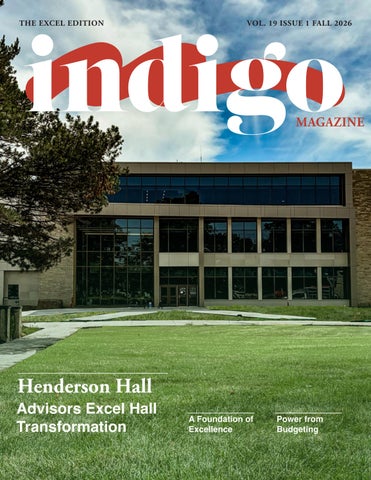
ON THE COVER: COVER BY MALIK ARAFAT The Indigo cover illustration was created by Malik Arafat. It features the new Advisors Excel Hall building recently built on Washburn’s campus to replace Henderson Hall.
Brenda Andrade Malik Arafat Eden Conrad Rubina Ghimire Nora Krehbiel Shreya Mandal Bidhya Sapkota
ILLUSTRATORS Brenda Andrade Malik Arafat Eden Conrad
PHOTOGRAPHERS Malik Arafat Eden Conrad
ADVERTISING Brenda Andrade Lexi Hittle Ojashwi Shrestha
FACULTY ADVISORS Regina Cassell Kristen Grimmer
FOLLOW US:
@WU_STUDENTMEDIA /@WU_STUDENTMEDIA
WASHBURN UNIVERSITY STUDENT MEDIA 4 • Fall 2026 • Indigo
@WASHBURN STUDENT MEDIA
TABLE OF CONTENTS Letter from the Editor............................. 03 Henderson to AE Hall............................. 06 The Power of Budgeting.......................... 10 The Hidden Stress of Student Success..... 13 Life Goals (Bucket List).......................... 14 Progress: A Non-Linear Path................... 16 Building a Foundation of Excellence....... 18 The Story Behind Excel........................... 20 The Wonders of Film............................... 24 HiPace.................................................... 26
Indigo • Fall 2026 • 5
PAVE THE WAY FOR
ADVISORS EXCEL A Campus Landmark Undergoes Change Story and design by: Eden Conrad
O
n any college campus, students have their beloved buildings. At Washburn University, science majors have Stoffer, kinesiology students have Petro, but since October 2024, mass media students have been thrown across campus when their beloved Henderson Learning Resources Center was thrown into a $35 million renovation to become Advisors Excel (AE) Hall. Since its grand opening in 1971, Henderson has been a landmark to pushing through adversity. When former Washburn University President John Henderson had the building constructed, it was built to stand the test of time after the 1966 tornado ripped through campus. “This building was built to withstand a tornado,” Ron Hesse, director of
6 • Fall 2026 • Indigo
campus planning and project management said. “That structure is still in place. What we did was tear out the walls and everything structurally is the same. Actually, it’s better. It will still withstand that tornado that it was designed to withstand.” While it's generally the same building on the outside, AE Hall will be a space for all students on the inside. For study, private phone calls, group meetings, and nursing mothers will change the way students use the space. Students can use the space for studying, making private phone calls, group meetings, and nursing for mothers.
"Everything structurally is the same. ... Actually, it's better." - Rob Hesse
HENDERSON HALL'S BEGINNING After the 1966 tornado, students needed stability and a place to learn for decades to come. So, Henderson decided to begin building a foundation for the future. Although construction was finished in 1971, it didn't have a name until 1976 when the building was dedicated in honor of Henderson after all he did to rebuild Washburn's campus after the tornado. From then on, it was known as Henderson Learning Resources Center.
Photos from Student Media Archives
(Left) Over the years, Henderson has seen many construction phases. (Right top) Henderson Hall sits empty before the new semester. (Right middle) A classroom is filled with students finally learning in a space big enough to accommodate them. (Right bottom) The northwest corner of Henderson Hall prior to the 2024 construction.
Indigo • Fall 2026 • 7
AS WE KNEW IT Henderson Hall was home to multiple areas of study, a place where unlikely friends would cross paths. The School of Business, social sciences, undergraduate nursing classes, media labs and the honors program all existed within this space. Professor Bob Beatty mentioned that Henderson felt like a "battleship." With its close quarters, Henderson often felt less cozy and more cramped, even from behind the rose tinted glasses of those who loved the building. UNDER CONSTRUCTION Construction began halfway through the Fall 2024 Semester, with the gutting of Henderson's classrooms echoing around the campus. Dust and
Photo by Eden Conrad
Advisors Excel Hall begins to take shape with new windows in place. 8 • Fall 2026 • Indigo
debris filled the air as Henderson's neighbor, Benton Hall was demolished, leaving a muddy grave behind. After a year off work, the building was stable enough to allow professors and department heads to tour what would soon be their new on-campus home. While the building may look new and shiny, it will still have the old charm. "The building is totally recyclable, concrete to frame," said Hesse. "This is all energy efficient." MAKE WAY FOR THE FUTURE AE Hall will have a student-centric design, from the new entry to the study spaces. Classrooms will offer the same learning aesthetic of the old building, with more accessibility that
it lacked before. One such improvement for accessibility is the upgrade from the previous elevator that was constantly in disrepair, to multiple, larger elevators. "The new elevator is large enough to accommodate anything," said Hesse. "We can get full size tables for bringing in specimens. Everything is made to work without having to adjust or adapt." AE Hall has been a project many years in the making, but those years are almost over, with the ribbon cutting taking place late 2026. Soon enough, faculty and staff displaced across campus will have somewhere on campus to call home once more.
Render courtesy of Lori Hutchinson
The North Facade of Advisors Excel Hall will have numerous large windows, compared to the enclosed spaces of Henderson.
Indigo • Fall 2026 • 9
THE POWER OF
BUDGETING Budgeting sets people up for success Story, Illustration and Design by Brenda Andrade
M
oney management is a challenging subject to talk about. It is a skill and survival tool that college students learn through trial and error. Many times, saving can feel difficult especially when students are expected to work to pay tuition, cover their expenses, deal with last-minute financial problems and still save for future plans and dreams. BUDGETING LESSONS According to financial educators and professionals at Washburn University, the habits students build during college can determine their financial stability, future opportunities and retirement security. Shane Van Dalsem, associate professor of finance, emphasized the importance of knowing where your money is going and the importance of budgeting so you are able to save and invest more. TRACK EVERY DOLLAR Dmitri Nizovtsev, associate dean of the school of business and professor of economics and international studies coordinator, pointed out that small habits compound over time. “Spending $10 on a coffee per day, if you take the $10 and invest it instead you would probably become 10 • Fall 2026 • Indigo
a millionaire and be able to retire early,” said Alan Frost, lecturer at school of business. Frost encouraged students to think about long-term consequences even for minor purchases, reinforcing that awareness is the foundation of financial responsibility. According to Michael Austin, school of business lecturer, tracking expenses makes saving easier. “Before you spend your money, automatically take a portion of it and put it away,” Austin said. Understanding expenses helps with stress management. Students who feel in control of their money can make informed decisions and hopefully avoid the anxiety of running out of cash unexpectedly. Creating categories for different types of spending can help visualize cash flow.
transportation, food, utilities, education, entertainment and savings. Nizovtsev emphasized that even entertainment, often overlooked by students, can dramatically affect longterm financial outcomes if ignored. “Organize a really good, solid excel file that’s easy to just keep track of,” Frost said. Putting everything in a spreadsheet: rent, utilities, groceries, subscriptions and marking each bill as paid on the sheet is an easy way to monitor expenses. This tracker becomes a visual reminder and helps avoid overspending. Frost also suggested setting realistic limits for each category This allows students to enjoy their social lives without killing their financial goals. The perfect time to experiment with budgeting techniques is as a college student. Now is the time to try a few ORGANIZE A BUDGET different methods and see what sticks. Once spending is tracked, Nizovtsev The key is consistency. Even a simple and Frost encourage building a budget that you maintain for six functional budget. Nizovtsev months can drastically improve your recommended breaking down money habits. expenses into key categories: housing,
“Before you spend your money, automatically take a portion of it and put it away.” - Michael Austin
SAVING AND INVESTING Starting early is critical to financial success. Nizovtsev explained how small, consistent investments can grow over time through compounding interest. “If you start investing at age 20, 23 or 25 you would be way ahead of where I am right now,” Nizovtsev said. Nizovtsev encouraged students to learn about low-cost index funds rather than relying solely on savings accounts, which often fail to outpace inflation. Van Dalsem highlighted the importance of building an emergency fund and mentioned that unexpected things like flat tires or a leaky roof can derail a student’s financial plan if they aren’t prepared. While Nizovtsev admitted that many students may not be able to save that much money immediately, he emphasized that starting with even a small fund is better than nothing. Austin and Van Dalsem added practical tips for saving. Austin suggested automating transfers to a savings or investment account right after receiving income. Van Dalsem recommended looking for inexpensive ways to socialize and enjoy leisure
1
activities, minimizing unnecessary “Buy an index that is several stocks spending without sacrificing the together… buy it and forget about it college experience. and maybe add $100 a month and I promise you, you will be amazed at BEST INVESTMENTS how fast it grows,” Nizovtsev said. Frost expressed that the smartest Van Dalsem notes that “stock investment a student can make is in market diversified investment like an their own education. index fund would be the best option “Data shows that college graduates for [retirement].” end up making a lot more money than To learn how to invest, Van Dalsem people who aren’t college graduates,” recommends the website investopedia Frost said. because it provides unbiased Frost also shared his personal information. journey, describing how he began “If you talk with a financial planner investing through his first 401(k) at you might have conversations about Home Depot and quickly realized the bonds, about putting your money in importance of diversification. Frost S&P index in the stock market or a began self-educating on investment mutual fund of the sort, the point is strategies using trusted resources. not to put all your eggs in one basket,” Nizovtsev also shared his experience Austin said. and mentioned that investing was on his bucket list and he was only waiting AVOID COMMON for the perfect opportunity. FINANCIAL PITFALLS “I started [investing] when the The professors also highlighted areas financial crisis happened in 2007 and where students often make mistakes. the stock market was really down, if Van Dalsem noted that entertainment I didn’t start then it would never,” and discretionary spending are Nizovtsev said. frequently underestimated. Nizovtsev realized the importance Late-night outings, social events and of investing the right way. He also impulse purchases can quietly mentioned some of the best consume significant funds. investments for beginners. Even seemingly small decisions, like
3
SAVE 15%
3% Emergency Fund 5% Investments 7% Retirement
5 FUN 10%
TRANSPORT 12%
BILLS 55% 8% Loans and Credit 35% Housing 12% Food
2
CLOTHES 3%
HEALTH 5%
4
6 Indigo • Fall 2026 • 11
a daily $10 coffee, can impact long-term wealth if those funds are not redirected into investments. Frost warned against purchasing depreciating assets too early, like a car or the latest phone upgrade. Buying an older used car can prevent unnecessary debt and build stronger financial habits. Similarly, Austin argued that “cars are not a good investment.” BUILD FINANCIAL HABITS The overarching advice from all four professors was consistent: college is the ideal time to develop lifelong financial habits. Van Dalsem and Austin said that tracking spending and creating structured budgets is essential. Nizovtsev encouraged early investing and self-education about financial tools. Frost reinforced the importance of education and emergency funds. CONCLUSION College students today face more financial choices and challenges than ever. But by following the guidance of Van Dalsem, Austin, Nizovtsev, and Frost, students can build strong money habits that last a lifetime. Tracking spending, creating a practical budget, saving consistently, investing wisely, and focusing on education are all strategies that compound not just in wealth, but in personal discipline and long-term financial freedom. As Alan Frost concluded, “Investing in your education and getting a college degree is the smartest way they could invest their money in right now.” STEPS FOR SUCCESS 1. Track every expense – know where your money is going. 2. Organize a budget – categorize spending and set limits. 3. Save consistently – even small amounts matter. 4. Invest early – low-cost index funds and employer 401(k) options grow wealth over time. 5. Prioritize education – degrees, skills, and certifications often yield the highest returns. 6. Avoid unnecessary depreciation – focus on smart purchases and long-term growth. 7. Develop habits now – the earlier these practices are adopted, the greater the benefits.
12 • Fall 2026 • Indigo
Washburn University
Social Work
A career with meaning, action, diversity, & multiple options. Bachelor's Degree BSW Real world practicum experience Many online & in-person sections Daytime & evening course options BSW graduates can earn the social work Master's in 3 semesters
SW 100 Introduction to Social Work & Social Welfare General Education course
Minor in Social Work
15 Credit Hours
Scan to learn more
School of Applied Studies Room 309 785-670-1616 social-work@washburn.edu
THE HIDDEN STRESS OF STUDENT SUCCESS
Story by Bidhya Sapkota Illustrations and Design by Malik Arafat
I
n today’s competitive academic environment, students aim for high grades to stay competitive against their peers. However, the persistent pressure has a hidden cost. Mental and emotional energy can drain quickly when students study for long hours and sacrifice sleep. Burnout among students is becoming increasingly common. IDENTIFICATION Anna-Marie Lauppe, adjunct instructor of psychology, describes burnout as a result of taking on too much stress. “It becomes too hard for the brain… the body and the mind to…get on the same page and process…so you start to feel tired and annoyed,” Lauppe said. “Your ability to actually think about those things or just participate in life gets a lot harder.” Students struggle to achieve goals when they lack the motivation to participate in activities they normally enjoy. Cindy Turk, professor and chair of psychology, associates the heavy workload, constant deadlines and pressure with many cases of burnout. Burnout decreases concentration, motivation and performance in the classroom.
WARNING SIGNS Symptoms of burnout are sometimes overlooked in highachieving students. “Burnout feels like everything is closing in on you. The same workload you once managed confidently now feels completely over your head,” Lauppe said. Assignments continue piling up regardless of the students’ stress levels. This can lead to mental exhaustion. “You start forgetting due dates or projects even when they’re written down,” Lauppe said. “It’s not that you don’t care; it’s that your mind feels overloaded.” Sometimes the last straw that can make someone’s burnout stop them in their tracks is comparison According to Lauppe, when people compare their workload to others and feel insufficient or behind, that may be a sign to check in with themselves. If you find yourself thinking, ‘I just want to sleep all day’ or ‘I can’t do this anymore,’ that’s a sign you may be past normal stress,” Lauppe said. PREVENTION Turk emphasized the importance of consistent self-care throughout the semester. Self-care includes maintaining seven to nine hours of sleep each night, regular exercise and balanced nutrition. While balancing mental and physical load is important, another critical factor is seeking guidance and
motivation from others. Guidance can come from professors, classmates or therapists and can help students achieve goals despite symptoms of burnout. Linzi Gibson, associate professor of psychology, highlights the benefits of creating a schedule. “If you can create a schedule, [it] is oftentimes very helpful,” Gibson said. “That schedule needs to include downtime [like] self-care time and social [time].” Gibson emphasized the importance of social connections as part of a healthy mind. Balance is an important part of managing a college schedule. Schedules have to include both productive and relaxed time to prevent and treat burnout. Students experiencing high levels of burnout are encouraged to seek counseling services. HEALTHY MIND, HEALTHY LIFE A healthy mind is maintained through a balance of effort and recovery. Students who recognize burnout early may find it easier to maintain both academic performance and mental well-being.
Indigo • Fall 2026 • 13
L Bucket List I F E G O A L S Personal development
Finance
Read 10 self-help books
Buy your own house
Write your life purpose
Save $500,000 by retirement
Define your core values
Pay off all debts
Learn a new language
Build an emergency fund
Discover your spirituality
Have at least 25% of income coming from investments
Career
Legacy
Get a higher level education
Write your life story
Find or develop your passion
Volunteer
Be a good leader
Donate to causes you care about
Be an expert in something
Mentor or guide someone
Work at your dream job
Leave financial stability for the next generation
Family/Lifestyle
Travel
Get married
Travel to another state
Start a family
Travel to another country
Achieve a fitness goal
Visit one of the seven wonders
Create a family tradition
Go on an island vacation
Create an investment fund for each child
Go on a cruise
14 • Fall 2026 • Indigo
Daily goals Sleep 7 to 9 hours Exercise 30 to 60 minutes Drink 80 ounces of water Eat one fruit Spend 10 minutes outside Read for 10 to 20 minutes Limit social media to 60 minutes Spend 60 minutes learning something new Spend 5 minutes reflecting about your day
5 year plan Work your dream job Buy a house and start payments Finish reading five self-help books Have 5% of income coming from investments Owe less than $10,000 in debt Have $60,000 saved Travel to a foreign country Invest spiritually Be an intermediate level speaker of a foreign language
how to reach
YOUR GOALS Story, illustrations and design by Brenda Andrade
When setting a goal it is important to set a specific, measurable, achievable, relevant and time-bound goal. Break these SMART goals into smaller, manageable steps and creating a consistent action plan. DEFINE A PLAN Define your goals using the SMART framework. Create a written plan that outlines specific, actionable steps rather than vague intentions. BREAK IT DOWN Divide large goals into smaller and separate chunks in a 90-day segment to prevent feeling overwhelmed and to make the process more achievable. BUILD A SYSTEM Focus on creating daily habits and systems rather than just the end goal. KEEP ACCOUNTABILITY Share your goals with somebody to create accountability. ANTICIPATE OBSTACLES Use “challenge planning” to anticipate potential falls and create “if-then” plans to stay on track. TRACK PROGRESS Regularly review your progress to see what is working and make adjustments as needed. REFLECT AND REFINE Use the five R’s (results, reasons, r e fl e c t i o n s , r e s o u r c e s a n d responsibilities) to evaluate your progress and refine your approach. Indigo • Fall 2026 • 15
PROGRESS: A NON-LINEAR PATH
A step backwards can be part of the path forward. Story by Shreya Mandal
P
Design by Malik Arafat
rogress is rarely a straight line. It has its peaks and valleys, and students often adjust their paths along the way. “I almost like to think about it like a spiral,” said Linzi Gibson, associate professor of psychology. “You tend to encounter the same problems, but at a different depth. So we can’t really expect linear progress.” LEARNING THROUGH FAILURE Instead of viewing obstacles as failures, this perspective frames them as signs of growth at a different stage. High-achieving students often develop stronger strategies and support systems, which shape how they respond to setbacks. “High-
16 • Fall 2026 • Indigo
achieving people in any field have way more failures than most people do,” Gibson said. “They just continue to go.” Failure plays an important role in learning, and progress is less about avoiding mistakes and more about recovering from them. “Once you’ve achieved a really hard goal and struggled through it, that makes you more confident in the future and more likely to take on challenges,” Gibson said.
education, setbacks are something you are always going to experience when trying to accomplish a goal,” said Jericho Hockett, professor of psychology. Rather than fearing setbacks, students can view them as part of the learning process. Each challenge offers a chance to adjust and improve.
STRUGGLE CREATES GROWTH “From the research on psychology and motivation, when you’re looking WHY SETBACKS MATTER at your behavior related to your goals, Struggles often become some of the don’t look at it only in terms of most valuable learning experiences. progress,” Hockett said. “If we are not Setbacks are a normal part of achieving our goals when we thought development at every stage. we would, and we view that as lack “Regardless of how old you are, of progress, then we are more likely where you are in your
to give up.” Bird said. “Our wiring Struggle, Hockett added, can allows us to make those signal meaningful engagement. comparisons, even when “If we incorporate a little bit they are not beneficial.” of struggle, that means we’re GROWTH THROUGH being challenged and have an SUPPORT opportunity to engage with Sean Bird Setbacks are a part of the it,” Hockett said. “Struggle is learning journey, not a sign indicative of meaningful move people forward,” he said. of failure. True growth engagement, and that’s where Success rarely happens in a single often emerges from facing challenges learning happens, and long-term gains moment. It often develops through and taking time to reflect. are made.” persistence, patience, and support When students learn to seek from others. support, reflect on setbacks, and REDEFINING SUCCESS continue forward, difficult moments Success looks different for everyone REJECTION AND can become part of long-term growth. and is shaped by background, COMPARISON opportunity, and support systems. “Rejection makes us feel not good,” “I think success is complicated,” said Sean Bird, Dean of University Bird said. “It’s part of human Libraries and Center for Student experience, so an important part is Success. “There are step-by-step reminding ourselves that it’s not a processes that help individuals build personal evaluation.” Rejection can feel personal, but it skills and knowledge so that progress does not define individual worth. is made.” Bird added that progress is not Comparison can also shape how people view their own progress. always immediately visible. “We compare ourselves to other “It may feel like people are not people because we are social beings,” making progress, but opportunities
"Opportunities present themselves when we least expect them."
or support systems can appear that
Indigo • Fall 2026 • 17
BUILDING A FOUNDATION OF
EXCELLENCE
Advice from professors on student success Story and Design by Eden Conrad
T
o excel, students need to build systems, habits and support. In the beginning of their college careers, students often hit barriers such as working, burnout, inconsistent routines and high expectations that tank not only their GPAs for the next four years, but their confidence and motivation. Faculty and staff have seen these barriers in real time as they affect students from falling behind to failing classes. Because of their firsthand experience through years of education, professors’ advice is shaped by the patterns they’ve recognized over the years. Above all, faculty are people who have experienced similar struggles to what today’s students are going through, with a few major differences. In the current state of affairs, students are subjected to technology that is adapting faster than even professors can keep up with. Students also have to navigate constantly changing societal, political, emotional and mental tensions while trying to remember a paper that is due in two hours. “We’ve been through college a time or two, and I think our faculty generally want to help students
18 • Fall 2026 • Indigo
succeed,” said Madeline Lambing, associate director at the Aleshire Center for Leadership & Community Engagement. While their advice doesn’t cover all the issues students face, faculty and staff want students to excel during their time at university, so they give the best advice they can from organization to mental health. GET ORGANIZED Being organized is a skill many students and graduates learn the hard way through lost papers, forgotten keys or one too many skipped meals. However, once they master organizational tools, some issues become easier to manage. Franki Ostrom, instructional librarian who teaches WU101 and information literacy, said that students should look at the class schedules in their syllabuses and put due dates
into their calendars to stay organized. Along with this, some students place their commitments in their calendars to keep their plans easier to navigate. Blocking out time for homework or self care can protect students from stress further along into the semester. Washburn’s guidelines recommend spending two hours outside of the classroom for every credit hour a student is enrolled in. While some find this requirement reasonable, this standard can be hard for students to maintain while keeping up with finances, social lives and self care. “I know that it’s easy for me to say that every student should spend two hours outside of the classroom for every hour they spend in [the classroom],” said Sean Bird, Dean of University Libraries and Center for Student Success. Not all classes require the same
“We’ve been through college a time or two, and I think faculty generally want to help students succeed.” - Madeline Lambing
level of outside commitment. Students have to judge the amount of time needed for studying and homework for each class and plan accordingly when it comes to maintaining their grades. CAMPUS RESOURCES Many universities understand this pressure and offer resources to help their students, but sometimes it isn’t enough without placing at least one commitment on the back burner. Washburn University offers free counseling services, an on-campus food pantry, accommodations, the Center for Student Success and Retention and academic advisors who build a solid foundation for students to rely on. The only issue is that visiting these resources takes time that students don’t always have if they haven’t mastered time management. Students at Washburn University do have one perk that not many students at larger universities can claim. Ichabods have smaller class sizes and the opportunity for oneon-one conversations with professors that can ultimately change a student’s outlook.
1
GET HELP Helene Perriguey-Keene, French and Spanish lecturer, sees her students become overwhelmed when they miss classes, but they don’t ask for help until it’s too late. “They eventually ask for help too late during the semester instead of, ‘Okay, this is not clear, help me.’ Your first exam is not a good grade…In here I can help you. I want you to be efficient at what you do, not waste your time,” said Perriguey-Keene. Ostrom also described student hours as a time where people have a chance they won’t get much after college. A chance to sit down and ask as many questions as possible to the person who knows all the answers. She advised students to “take advantage of it.” Excelling also means not neglecting oneself. Lambing said that students should work to
stay healthy both physically and mentally through having fun while not taking on too many opportunities that they get burnt out. Simple ways to keep healthy can be affirmations in the morning, walking between classes, having a night out with friends, eating filling meals, reading or being creative. Excelling comes in many different forms, from healthy lifestyles to high grades, but most agree that students should keep organized and live healthy lifestyles.
MICROSOFT'S MULTIPLAN TO
EXCEL
Innovation, Competition, and the Rise of a Software Giant Story and design by Malik Arafat
M
icrosoft Excel is a spreadsheet program that has been around for nearly 41 years. Alongside Google Sheets and Apple Numbers, Excel is one of the most used spreadsheet programs. Developed by Microsoft and launched in 1985, Excel revolutionized data organization, analysis and presentation. SPREADSHEET ORIGINS B o b B o n c e l l a , l e c t u re r o f management in the School of Business, started using spreadsheets in 1983, when he was an assistant professor of computer information systems at Washburn. Before he started using spreadsheets, he was into computation programming and used programs such as Fortran, a programming language. “There were accountants prior to electronic spreadsheets who had large sheets of paper,” Boncella said. “They were spread out in rows and columns to keep track of accounts. Every time a variable value changed, like the number of items sold, they’d have to go through and recalculate each cell in that paper spreadsheet.” 20 • Fall 2026 • Indigo
René Pardo developed Language for Programming Arrays at Random (LANPAR) at Harvard University in the late 1960s. According to MaxTrain.com, Pardo established an early version of now-essential spreadsheet features. Excel was the successor to Multiplan, Microsoft's first spreadsheet program. The other spreadsheet pioneers were LANPAR and VisiCalc, according to MaxTrain.com. Spreadsheets replaced manual paper-based methods, which were both prone to error and timeconsuming. MARKET & DEVELOPMENT In 1983, Microsoft started work on a project called “Odyssey,” a spreadsheet program that eventually led to Excel. Odyssey’s development was led by Jabe Blumenthal and Doug Klunder. The goal of the project was to “do what Lotus can do – and do it better.” Odyssey grabbed the attention of Bill Gates, a co-founder of Microsoft. Gates and other Microsoft
1982
A screenshot of Multiplan's UI. It was released for computers running CP/M. Photo by WinWorldpc.com.
1985 1988
A screenshot of Excel v1.5. It was exclusively released for the Macintosh. Photo by WinWorldpc.com.
Logos from Wikimedia Commons.
leaders made the decision to shift development toward the Macintosh. That decision caused Klunder to temporarily leave Microsoft, but he returned to finish the project. In retrospect, he said he thought that launching Excel on Macintosh was not the right decision. “In some ways it worked out well, but it did put us years behind, because we shipped on the Mac and gave Lotus that much longer to consolidate on the PC platform," Klunder said in an interview with GeekWire. “I still think we could have taken them on.”
the feature optimally. However, Klunder was the only developer who fully understood its coding. According to GeekWire, intelligent recalc selectively recalculates cells affected by the change, instead of recalculating all cells when one was changed. It made the program more efficient and improved performance. When Excel became available, Boncella remembers thinking Excel would fit well into the new Windows environment. He taught a computing class at Washburn, where he used Lotus and WordPerfect, a competitor to Microsoft Word. Boncella said
was all bolded text. It was the students looking at their keyboards while typing, and forgetting to enter the shortcut to turn off the bold setting.
A BIG SUCCESS Lotus was not available on Macintosh when Excel launched, giving Microsoft an advantage, as the program quickly gained a following among Macintosh users, according to Britannica. Lotus was also slow to release a Windows version, giving Microsoft another advantage. Exc e l 2 . 0 w a s re l e a s e d i n November 1987 for Windows. According to THE BIG RISK Britannica, it had “Every time a variable value changed, like Blumenthal a graphics-heavy re m i n i s c e d a b o u t the number of items sold, they’d have to interface designed Excel’s development, to run on the latest saying it was about go through and recalculate each cell in Windows ripping off good ideas computers. It also that paper spreadsheet.” from other products. allowed for - Bob Boncella customizable He gave Klunder an exception for his fonts, coloring, original work. and formatting in Intelligent recalc was a key some students felt the class was graphs and in data. feature in Excel created by tedious work, because of the Later versions introduced more Klunder. It gave the program an complexity of operating computers features. Such as tool bars, better advantage over Lotus in how cells at the time. As an instructor, he charting, 3-D charts, automated would recalculate in a spreadsheet. said he admittedly got bored with features, and more. Gates took a special interest in students asking the same question, In the early 1990s, Microsoft it and was keen on implementing such as how to fix a paragraph that Office was released, bundling Excel
1990
1994
1995
Indigo • Fall 2026 • 21
with Word and PowerPoint. Excel would reach greater heights from being included in a package. During that time, Excel found commercial success and Klunder and Blumenthal left Microsoft altogether. In 1995, Excel 95 was released. It was version 7.0, and Microsoft changed the naming system to emphasize the release year. Excel 95 saw an improvement of its modeling speed, stability and integration. Boncella said the program's ability to create data models was a major impact spreadsheets had both in and out of the classroom. A data model allows the user to integrate data from multiple tables, which builds a relational data source inside an Excel workbook, according to Microsoft's website. Whether it was budgeting for a new car, or tracking their monthly expenses and income, data models changed Boncella listed calculator.net as an example where creating new spreadsheets and data models are not needed. The website can calculate various finances such as mortgage and income tax.
1999
22 • Fall 2026 • Indigo
Boncella said when students realized they could make their own models, it was an “aha” moment for learning. “You can start making decisions based on these models you’ve created,” Boncella said. “And for a lot of students … they go, ‘What if I do this?’ What if I do that?’” Businesses began to do the same, whether it was tracking stock prices or a company buying another company. Despite both Lotus and Excel having models on release, Excel had far more features than Lotus, which was still struggling to adapt to Windows, according to Direct IT. THE FUTURE OF EXCEL Microsoft would continue to e x p a n d E x c e l ’s t e c h n i c a l capabilities and features over the years. In 2003, Excel 2002 was released on Windows XP as part of Office XP. It introduced the ability for users to recover data if a crash occurs. In 2007, Excel received an overhaul alongside other improvements. A redesigned interface, introducing the Ribbon
2003
menu system, and sharing features with Word and PowerPoint. The shared features allow a smoother user experience when navigating between programs. Microsoft has continued to develop Excel with new features such as integration with Copilot. "Going forward, we will see more and more model building become automated," Boncella said. "And that's through generative AI and copilot." Today, Excel is used in almost every industry. Its growth reflects the evolution of data management and spreadsheet technology. Its strategic decisions during development helped it become an essential tool in and out of the classroom.
2007
2010
Function
Description
Example
SUM()
Adds together a range of cells.
MIN() / MAX()
Finds the smallest (MIN) or the largest (MAX) value.
=MAX(A1:A5)
AVERAGE()
Calculates the arithmetic mean.
=AVERAGE(A1:A5)
COUNT()
Counts the number of cells that contain numbers.
=COUNT(A1:A5)
POWER()
Raises a number to a specific power.
=POWER(A1, 2)
CEILING() / FLOOR()
Rounds a number up/down to the nearest multiple.
=CEILING(A1, 5)
CONCAT()
Joins two or more text strings together.
=CONCAT(A1, 5)
TRIM()
Removes extra spaces from text.
=TRIM(A1)
REPLACE() / SUBSTITUTE()
Swaps specific text or characters in a cell.
=SUSTITUTE(A1, “Old”, “New”)
LEFT() / RIGHT() / MID()
Extracts characters from a text string.
=LEFT(A1, 3)
UPPER() / LOWER() / PROPER()
Changes capitalization (caps, lower, proper)
=UPPER(A1)
NOW() / TODAY()
Returns current date/time (NOW) or date (TODAY).
=TODAY()
DATEDIF()
Calculates the difference between two dates.
=DATEDIF(A1, B1, “d”)
VLOCKUP() / HLOCKUP()
Searches for a value in a table.
=VLOCKUP(A2, DA:F10, 3, FALSE)
IF()
Checks a condition (True/False)
=IF(A1>10, “High”, “Low”)
2013
2019
=SUM(A1:A5)
2025
Indigo • Fall 2026 • 23
THE WONDERS OF
FILM
Exploring how stories on the silver screen impact us. Story by Nora Krehbiel
A
Design by Eden Conrad
s technology continues to allow more people access to the art of storytelling, the media of film continues to persist. Online sources suggest more than 400 million movie tickets were sold during the first 30 weeks of 2026. Each art form has value. However, what is unique about film is that it “uses so many different disciplines to connect with emotion,” said Matthew Nyquist, a filmmaker and mass media professor at Washburn University. Film invites the audience to immerse themselves in the story effortlessly. It combines everything from how a scene is lit to the actors’ performance and soundtrack. The movie magic really begins behind the scenes during production, where every shot and camera angle is
designed to nudge audiences toward a certain feeling. “ Th e re a re s u b c o n s c i o u s techniques ...that are making people feel on a level that they’re not thinking about,” Nyquist said. CINEMATOGRAPHY Cinematography, is one of those techniques that works in the background to enhance the emotion of the visual story. “The point of it is for you not to notice it,” said Ayva Darmento, a second-year mass media film student at Washburn University. And yet, it’s those subtle choices of lighting and camera angles that makes audiences hold their breath or wipe away a tear without ever quite knowing why. For example, a scene in the movie “Halloween” shows the main character hiding in a closet to escape the killer. Light shines through slats in the
closet door, casting bold lines on the wall. Darmento explained that this scene is visually interesting because this technique makes the viewer feel the tension of the scene. The lighting technique enhances the feeling of the actress being trapped on a subconscious level. PERFORMANCE While cinematography plays a crucial role in shaping the audience’s emotional response to film, another essential element that evokes powerful emotions is actor performance. The emotion in film comes just as much from what audiences see as from what they feel. When an actor fully inhabits a character, suddenly the audience is not just watching a story unfold; they’re living it right alongside them. This ability allows audiences to empathize with the
“The point of it, is for you not to notice it.”
- Ayva Darmento
Photos from Mass Media Archives
characters on screen by stepping into their experiences in a way that feels real and immediate. In Greta Gerwig’s adaptation of “Little Women,” main character Jo March was brought to new light from compared to her characterization in the book by Louisa May Alcott. In the book, Jo can be described as quick-witted, stubborn, and fiercely independent. Actress Saoirse Ronan played Jo in Gerwig’s adaptation. Ronan didn’t just act; she became Jo. The characters that films give create so much emotional depth because audiences can connect with those characters and let them see the world through their eyes, even if only for a couple of hours.
is combining powerful imagery and music. In Richard Abel’s book, “The Oxford History of World Cinema,” he notes that since the early days of silent cinema, music has played a significant role. Even early theaters featured live pianists or orchestras to accompany the films. “Music is sort of our emotional life raft,” Nyquist said. It can give you chills or make your heart race, pulling you deeper into the story. The right combination of instruments and melodies, perfectly timed with what’s happening on screen, gets under the audience’s skin. They might not even notice it happening — but they feel it all the same. One of, and arguably the most famous example is the music in the MUSIC movie ‘Jaws,’ directed by Steven Another element of film that creates Spielberg, with music composed by an unparalleled emotional experience
John Williams. In ‘Jaws,’ the use of a simple, repetitive musical score builds tension even before the audience sees the shark. Audiences squirm in their chairs, knowing the shark is coming. The uncertainty of when it will strike creates a palpable sense of dread. This demonstrates how film can manipulate emotions in a way that feels immediate and unavoidable. No other art form harnesses so many elements — visual, performance and sound — to create an emotional experience quite like film does. That’s the true power of film: its ability to bridge the gap between people, turning emotion into a shared experience that lingers long after the credits roll.
“Music is sort of our emotional life raft.” - Matthew Nyquist Indigo • Fall 2026 • 25
SUPERPOWERED POSSIBILITIES FROM
HiPACE
Academic and Technical Excellence on Campus Story and Design by Rubina Ghimire
D
uring late nights, some students work on their assignments on their desktops or laptops. Other students log into the High Performance Academic Computing Environment (HiPACE). A digital space, where they can simulate molecules, crack encrypted codes and run complex programs in seconds. A NEW CLASSROOM TYPE Over the last 15 years, college classrooms have changed. Learning is no longer limited to lectures and textbooks; it is shifting to hands-on, technical work with industry tools. HiPACE is part of the shift. The system allows students to work with advanced applications used in science, cybersecurity and research. BEYOND THE SYSTEM “HiPACE isn’t just one machine,” said George Frazier, assistant professor of computer information sciences. “It’s a cluster of interconnected Unixbased servers that function as a single environment. Students log in remotely and work in a Linux system without needing to install extra software.” Frazier defines HiPACE as a constellation of Unix servers working together as a powerful, multi-user, multitasking system. Compared to running virtual 26 • Fall 2026 • Indigo
machines on personal computers, the system offers a more efficient and realistic experience. It allows students to focus on learning instead of technology issues. STUDENT BUILT HiPACE was developed through a Washburn University Innovation Grant between 2006 and 2009, with its purpose centered on student learning. “It was meant to be a sandbox where students could learn how to operate and maintain systems,” said Karen Camarda, professor and chairperson of the physics and astronomy department and director of HiPACE at Washburn University. It has become a space where students can experiment, make mistakes, and build technical skills. LEARNING MODULE HiPACE supports multiple academic departments. In computer science and cybersecurity courses, students learn Linux, manage servers and practice encryption techniques that reflect realworld applications. “We worked with our professor to access the server and figure out how to get different files in and out,” said Lauren Frank, senior computer information sciences major.
In chemistry courses, students use HiPACE for quantum-based calculations, for understanding atom and electron behavior. This aids predictions chemical outcomes that would be difficult to process on a standard computer. Physics research has also used the system for projects like climate modeling and simulations, where HiPACE plays a vital role in allowing students and professors to analyze large datasets, test models, and run simulations on powerful computing resources. IMPORTANCE HiPACE provides better computing abilities and education. “They are getting the opportunity to see in real life what they are learning theoretically,” Camarda said. By working in environments like those used in research labs and the tech industry, students gain both confidence and practical experience that prepare them for future careers. At Washburn University, HiPACE continues to evolve as a shared resource across disciplines, supporting both education and research. For students, it represents more than just a tool; it is an opportunity to explore, experiment, and prepare for the future of technology.
N O I T A T I D ACCRE D E D N E T EX We’re proud to announce that the Association to Advance Collegiate Schools of Business (AACSB) has extended our accreditation for another six years, the maximum possible. Thanks to all of our faculty, staff, students, alumni, supporters and friends that have allowed us to maintain this prestigious accreditation.