www.therobotreport.com
A Supplement to Design World • September 2026
W
H
A
T
’
S
I
N
S
I
D
E
:
SURGEONS USE
PLUS: AUTOMATED WAREHOUSE: HOW TO TIE MOBILE ROBOTS INTO EXISTING MATERIAL HANDLING OPERATIONS
DA VINCI SURGICAL ROBOT TO PERFORM COMMON CARDIAC SURGERY
www.therobotreport.com
A Supplement to Design World • September 2026
W
H
A
T
’
S
I
N
S
I
D
E
:
SURGEONS USE
PLUS: AUTOMATED WAREHOUSE: HOW TO TIE MOBILE ROBOTS INTO EXISTING MATERIAL HANDLING OPERATIONS
DA VINCI SURGICAL ROBOT TO PERFORM COMMON CARDIAC SURGERY
Maxon - RR 09-26.indd 1
9/1/26 9:24 AM
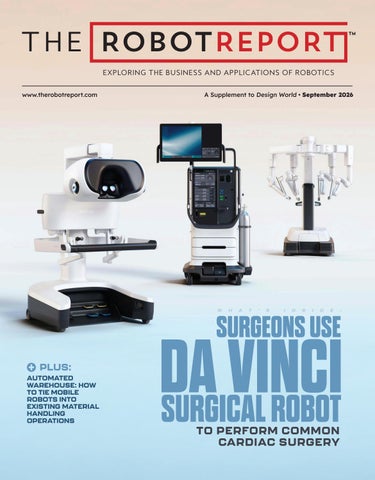
The da Vinci 5 surgical system combines human expertise with robotic motion control for precise procedures. Intuitive Surgical
BRIANNA WESSLING • THE ROBOT REPORT
TO PERFORM COMMON CARDIAC SURGERY
C
oronary artery bypass grafting, or CABG, is the most common type of cardiac surgery in the world. Despite this, and the heavily invasive nature of the surgery, only 1% of these procedures are performed with the help of robots. At the El Camino Health Heart and Vascular Institute (HVI), surgeons are now performing CABG with Intuitive Surgical's da Vinci robotic system. The first procedure was performed by Dr. Nels Carroll, a surgeon with extensive experience in robotic cardiac techniques and one of only a few surgeons in the Bay Area offering this robotic-assisted bypass capability. “Think of the heart as the engine that’s pumping the blood and delivering energy and oxygen to the body. Basically, that engine has its own fuel lines, those are the arteries on the surface of the heart,” Carroll told The Robot Report. 36
THE ROBOT REPORT
The Robot Report DW 09-26 v3 final.indd 36
“They’re providing the fuel to keep that engine pumping, and it’s very common for people to develop disease in those fuel lines. Bypass surgery is just us putting on new fuel lines.” Carroll highlighted that the surgery itself is straightforward. The tricky part is reaching the heart in the first place. “The most challenging thing for the patient is that, historically, we have to cut their chest open,” said Carroll. “We have to divide the sternum and spread it to the side.” “Doing the same thing robotically means that instead of making that big incision and instead of cutting that bone and opening all that space, we just put little incisions between the ribs,” he added. “We don’t cut any bone, and we don’t cut any major muscle groups.” The robotic instruments and cameras can fit inside the small incisions, which allows surgeons to perform the same procedure.
SEPTEMBER 2026
Smaller incisions mean faster recovery for patients The biggest impact robotic surgery has on bypass surgery patients is in the recovery time, Carroll said. “It’s so much easier to recover from small incisions between the ribs than it is from a conventional surgery, where the bone is put back together with stainless steel wires,” he said. “The big difference is how quickly people get back to their daily lives, how much less pain they encounter, and how much less traumatic the experience is for them overall.” One of these patients is Raul Martin, a 64-year-old man who walked three to five miles a day and doing resistance training. One Sunday, he was in the gym exercising when he felt his heart racing. He checked his smartwatch. “It was saying 200. I know that that's obviously not right,” Martin recalled. “And so, there was a security guard going www.therobotreport.com
9/2/26 9:35 AM
Maxon - RR 09-26.indd 1
9/1/26 9:24 AM
The most common approach to a CABG involves the surgeon opening the chest by dividing the breastbone to reach the heart. El Camino Health Heart and Vascular Institute
through the building. I grabbed him and he called the EMTs.” Martin was taken to El Camino Health, where he eventually underwent a robotic bypass procedure. The day after his surgery, Martin was up and walking the halls. He said he felt fine. And a couple of days later, he went home and is now back to his usual routine. Robotics takes the pressure off surgeons Using a surgical robot isn't just better for the patient; it can also take away some of the physical strain of the job for surgeons. “The ergonomics of the robotic platform is dramatically different,” Carroll said. “A busy day of robotic heart surgery versus a busy day of conventional heart surgery, at the end of the day, your back’s not as achy, your neck’s not sore, and you still have a little bit of energy to get to the gym and have some other balance in your life.” And this change isn't just physical. Being able to provide better outcomes with easier recovery for patients takes off some of the mental load for surgeons. This means they could suffer less from burnout. For new surgeons, surgical systems typically offer a virtual simulation environment, which makes an ideal training space. During procedures, a clear view of the patient and the work the surgeon is doing also helps. 38
THE ROBOT REPORT
The Robot Report DW 09-26 v2 ED.indd 38
“Heart surgery is a team sport,” said Carroll. “There’s a whole group of people who are assisting and helping and facilitating that surgery.” “When everybody can see beautifully exactly what’s going on, the communication improves,” he explained. “For a trainee who’s present, that really accelerates their ability to mentally process what they’re going to need to do when they eventually take the reins.” Why aren't more hospitals using robotics for cardiac procedures? With such a dramatic change in outcomes, it seems obvious to deploy more surgical robots. So, why are less than 1% of these procedures performed robotically? Carroll said there are a few reasons for this. “This approach isn’t right for every patient. Some surgeries, we really need that bigger incision,” he said. “We need to have full access to the heart that we wouldn’t have with a less invasive approach.’ In addition, more doctors need to know about this kind of technology. The heart surgeon is certainly not the first doctor a patient would see, so it's important for every doctor to understand robotics is a treatment option, asserted Carroll. Beyond this, he said there is some hesitation from surgeons when it comes to implementing any new practice. “Oftentimes, there is the analogy used of a surgeon going into surgery for a complex problem with a sick patient, it’s
SEPTEMBER 2026
almost like going to battle,” Carroll said. “You don’t want to go to battle with any more question marks than you already have to face.” “Once you have survived a number of battles, once you’ve had success doing things a certain way, it’s very much part of human nature to want to continue to rely on that,” he noted. “The flip side of that is potentially falling into the trap of not being able to deviate from a stepwise approach,” added Carroll. “I think that is a very important part of any surgical practice, to rely on the foundations of experience and knowledge and knowing what works, but also incorporating newer technologies and newer techniques.” How can robotics companies work better with surgeons? Carroll has been working with surgical robots for more than 10 years. He has had extensive experience with the Intuitive team. There were times when the Intuitive team would come into the operating room and observe cases, said Carroll. This gave them the opportunity to talk through the challenges of different clinical scenarios. “The time when the field is the most fertile for ideas for surgeons, at least in my experience and anecdotally from colleagues, is when you are faced with a problem and you see it and you verbalize it.” Carroll said. If there's an engineer or a developer in the room, they can see what the surgeon is trying to do, and where the challenges are. These people, who have a completely different background than a surgeon, might have a new idea about how to approach the problem. “Surgeons never really can succeed in a silo. It’s a community. The heart surgery community is large and complex, but an extremely talented and intelligent group of people,” said Carroll. “The more we interact with each other, the more we learn, the more we push each other to do a better job.” RR www.therobotreport.com
9/1/26 9:23 AM
KHK - RR 09-26.indd 5
9/1/26 2:36 PM
AUTOMATED WAREHOUSE
LOU FARRELL CONTRIBUTING EDITOR
How to tie mobile robots into existing material handling operations I
mplementing autonomous mobile robots, or AMRs, into material handling operations promises unrivaled efficiency gains. However, not all integrations are success stories. To avoid common integration mistakes, professionals must select the right robots, adopt fleet orchestration software, develop maintenance programs, and create accountability frameworks. 50
AUTOMATED WAREHOUSE
Automated Warehouse DW 09-26 v3 final.indd 50
Which AMRs are safe around workers? Not all AMRs are collaborative. To work safely alongside humans, AMRs use advanced orchestration software, lidar, and cameras to map their environments and detect obstacles. Those mobile robots equipped with artificial intelligence, vision systems, and sensor arrays can make split-second decisions based on a wealth of real-time data.
SEPTEMBER 2026
Unlike fixed-path automated guided vehicles (AGVs), experimental humanoids, or heavy-payload AMRs, these mobile cobots typically have built-in mechanisms to ensure safe operation around human workers. Setting a maximum speed and adjusting based on curved paths and load weight is recommended to avoid collisions. Failsafe encoders and communication protocols www.automatedwarehouseonline.com
9/1/26 9:54 AM
A failsafe velocity control in action. Siemens
enable AMRs to adjust their velocity based on their surroundings. During initial implementations, facilities should also avoid interactions between forklifts and mobile robots by using separate aisles or by establishing traffic rules.
Integrating AMRs into material handling systems Integration starts with a thorough www.automatedwarehouseonline.com
Automated Warehouse DW 09-26 v3 final.indd 51
assessment of existing workflows and ends with deployment. Decisionmakers must evaluate their workflow, define key performance indicators, and calculate the business case. Technology stack compatibility and facility layout are essential considerations. One automotive parts supplier recognized the need to automate material handling to meet customer demand. The team lacked workers on the production floor and visibility into product flow. Forklift drivers had to hand-scan material multiple times at key stages. This process relied entirely on manual labor, making it susceptible to errors. Based on the facility’s layout, the AMRs needed to charge 30% of their operational time to keep the cell blockage rate below 2% on average. A low percentage is acceptable, as production areas can manage a small buffer. However, a large bottleneck would increase the number of empty totes, preventing parts from being produced. Cost is another major consideration. Advanced robotics may have a high upfront cost, especially for large-scale, multishift facilities. But it may only take a handful of robots to automate most, if not all, material handling operations, keeping capital investment costs low. Selecting solutions with a twoyear payback period is a good rule of thumb. Companies can quickly recoup costs by running operations with multiple shifts at high velocity.
Who is responsible for maintenance? The service-level agreement (SLA) determines responsibility for maintenance and ongoing support. Typically, the original equipment manufacturer (OEM) handles individual hardware replacements, while the integrator ensures the functionality and compatibility during installation. AUTOMATED WAREHOUSE
51
Low Friction Polymers Custom Wear Strips Masking Tapes Release Fabrics Silicone Rubber • PTFE made with Teflon® Fluoropolymers • Kapton® Polyimide • PEEK • Nylon® 6/6 • ULTEM® PEI • Mylar® • PVDF • UHMW
Additional Services Custom Die Cutting Roll Slitting Rewinding Automated Sheeting Adhesive Lamination
800-461-4161 www.cshyde.com 9/1/26 2:00 PM
AUTOMATED WAREHOUSE
Software integration with warehouse management systems (WMS) and enterprise resource planning (ERP) platforms is key. For instance, facilities can use fleet management software for orchestration, oversight, and organization. Depending on the robot’s age and brand, it may not be compatible with the existing materialhandling system or the intended software. Rather than using in-house teams for software patching and parts repairs, organizations can purchase OEM maintenance support contracts. Alternatively, they can partner with thirdparty providers that deliver vendor-agnostic repair and information technology services. Even with robust post-sale support, facilities should still optimize day-to-day operations. For instance, they can reduce traveling distance to increase robots’ efficiency. This
Automated Warehouse DW 09-26 v3 final.indd 52
The OMRON LD-90 AMRs assisting in stack delivery with precise positioning. OMRON
9/1/26 9:54 AM
AUTOMATED WAREHOUSE
includes proximity to charging bases, not just the route between material storage and destinations. How far the robots travel determines everything from throughput to downtime.
Lessons learned from success stories Examining how real companies have successfully integrated AMRs into material handling operations demonstrates their potential impact. Eliminating manual transport One precision engineering company was struggling with low throughput, physically strained staff, and a high risk of handling errors because employees were spending hours transporting small load carriers by hand. Sometimes, they had to walk over 9 mi. (14.4 km) and make 50 trips per shift just to move crates between the storage and production areas. To address this issue, MPA Technology designed a fully integrated solution featuring OMRON LD-90 AMRs, automated shelving and custom stacking units. Employees now simply order materials from their workstations. The robots dispense small load carriers to a stacker that organizes up to four crates at once, and the robots pick and deliver those The Apex C1500-L, which uses both machine vision and laser SLAM sensors. ForwardX Robotics
stacks. Finished goods are returned through the same process. Just five LD-90 AMRs cover the 53,819.5-sq.-ft. (5,000-sq.-m) facility, transporting 200 crates daily. Connected to a manufacturing execution platform (MEP), it ensures safe, accurate handling and scalability for future growth. Achieving high-precision handling IPLUSMOBOT, an intelligent mobile robotics company, supplied a lithium battery manufacturer with a range of mobile robots to meet its stringent input-to-output ratio requirements. The facility had previously relied on manual labor for loading, unloading, and material transfer, which created bottlenecks and safety concerns. Its unique production environment mixed human and vehicle traffic in narrow aisles, complicating implementation. A fleet management system calls them so that the Standard AMRs can receive materials. They automatically position and place full racks at the dedicated receiving location. Task execution status updates in real time, so every robot remains synchronized. Using vision and laser navigation technology, the Omnidirectional Cantilever Forklift AMRs achieve
±5mm docking accuracy in confined aisles just 4 ft. (1.2 m) wide. For instance, over 10 cartridgehandling robots load, unload, and buffer with ±1mm precision. Due to this precision, the lithium battery manufacturer can meet its high-frequency material turnover requirements. IPLUSMOBOT estimated that the deployment will save almost $295,150 annually. Optimizing heavy load transport The Pentair Water Filtration Equipment Factory deployed Apex 1500 Forklift AMRs from ForwardX Robotics throughout its facility, replacing 75% of its human-driven forklift operation. This strategy significantly reduced its reliance on manual labor for heavy load transportation. The AMRs could safely handle pallets weighing up to 1.5 tons and measuring 5.2 ft. (1.5 m) in length, eliminating the risks of manual handling. Their task completion rate exceeded 98%, demonstrating high reliability. By optimizing heavy-load transport routes, they increased materialhandling throughput by 25%.
Key takeaways for manufacturers Automated material handling integration solves critical labor and safety issues, requires deep analysis of facility layout and workflows, and delivers measurable improvements in precision and throughput when the right technology matches the right task. Decision-makers should consider starting with a small pilot project to ensure success and scalability. AW
ABOUT THE AUTHOR Lou Farrell, a senior editor at Revolutionized, has written on the topics of robotics, computing, and technology for years. He is a contributor to Automated Warehouse and has a great passion for the stories he covers and for writing in general.
www.automatedwarehouseonline.com
Automated Warehouse DW 09-26 v3 final.indd 53
SEPTEMBER 2026
AUTOMATED WAREHOUSE
53
9/1/26 9:54 AM