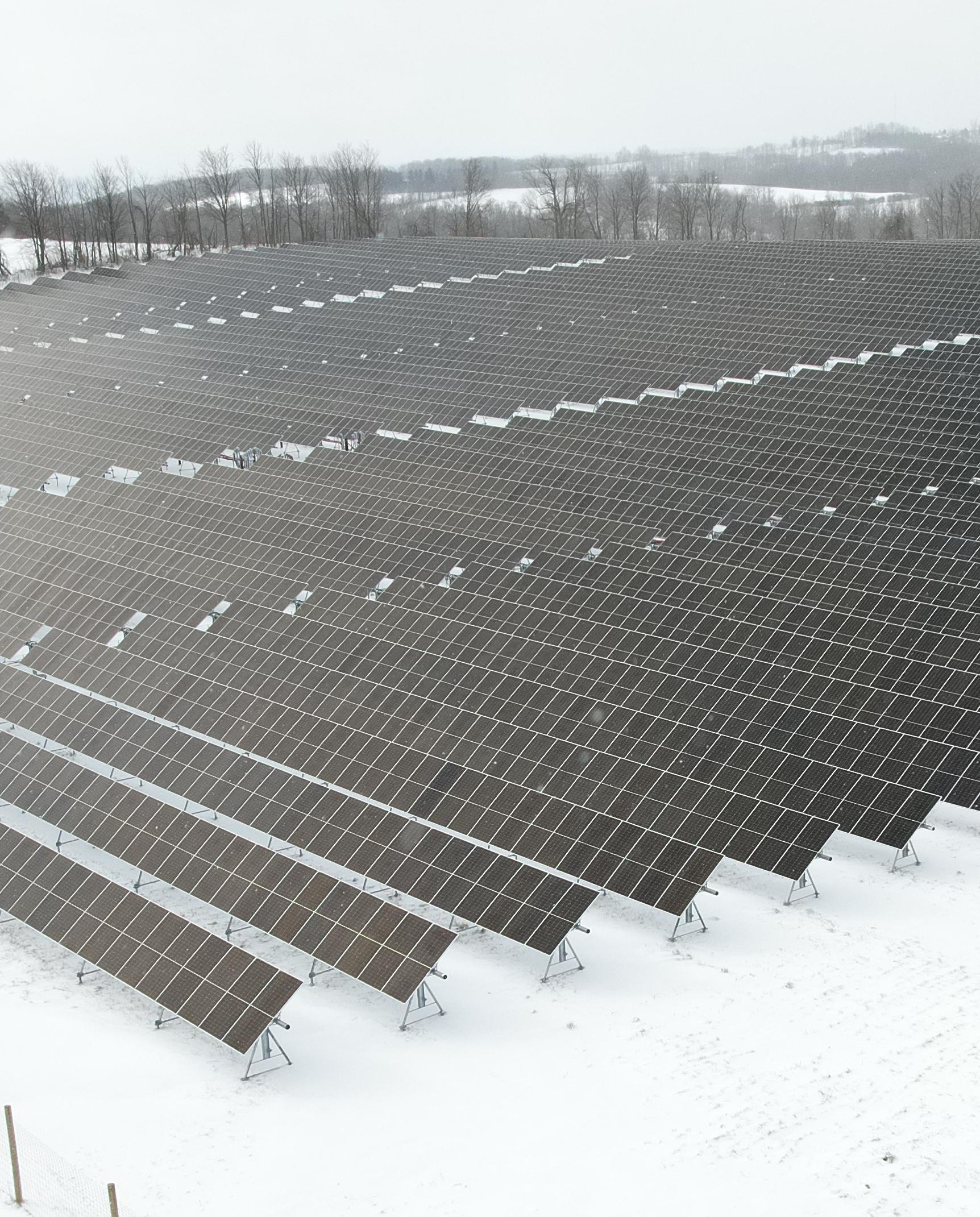
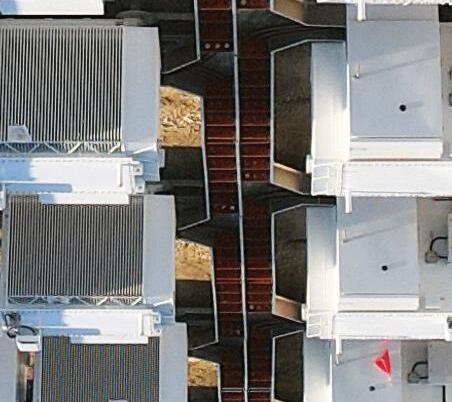
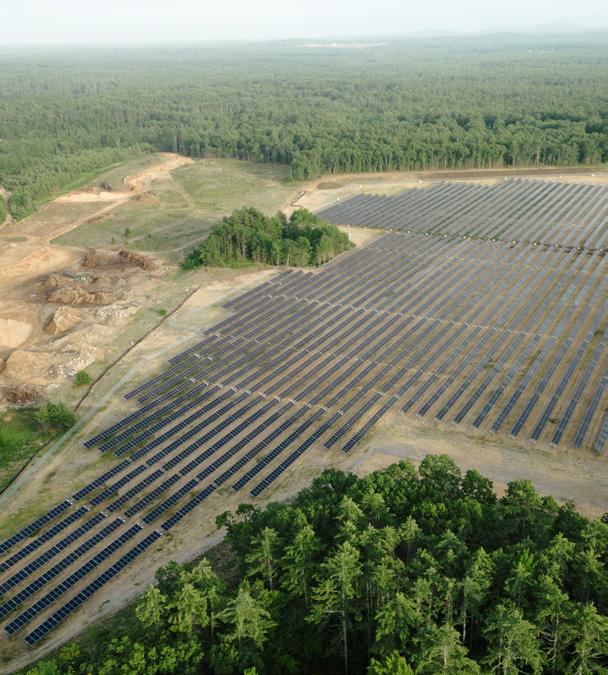
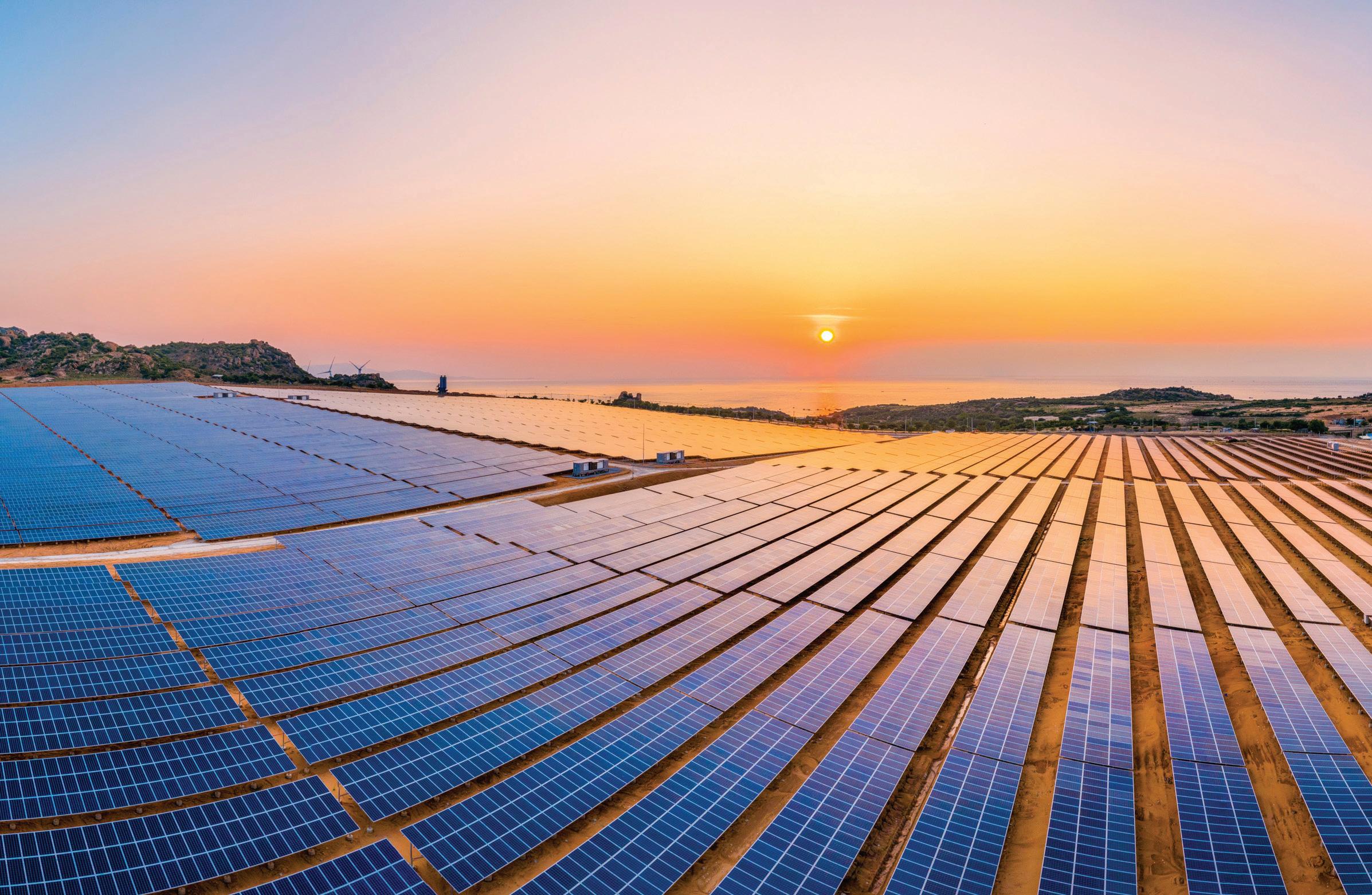
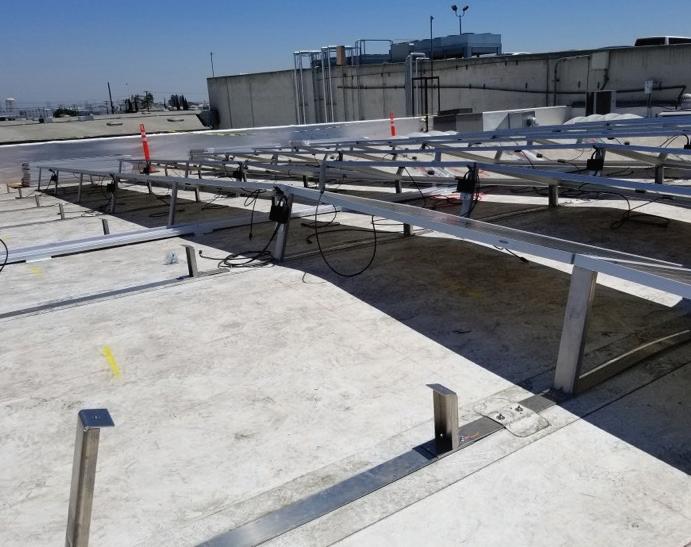
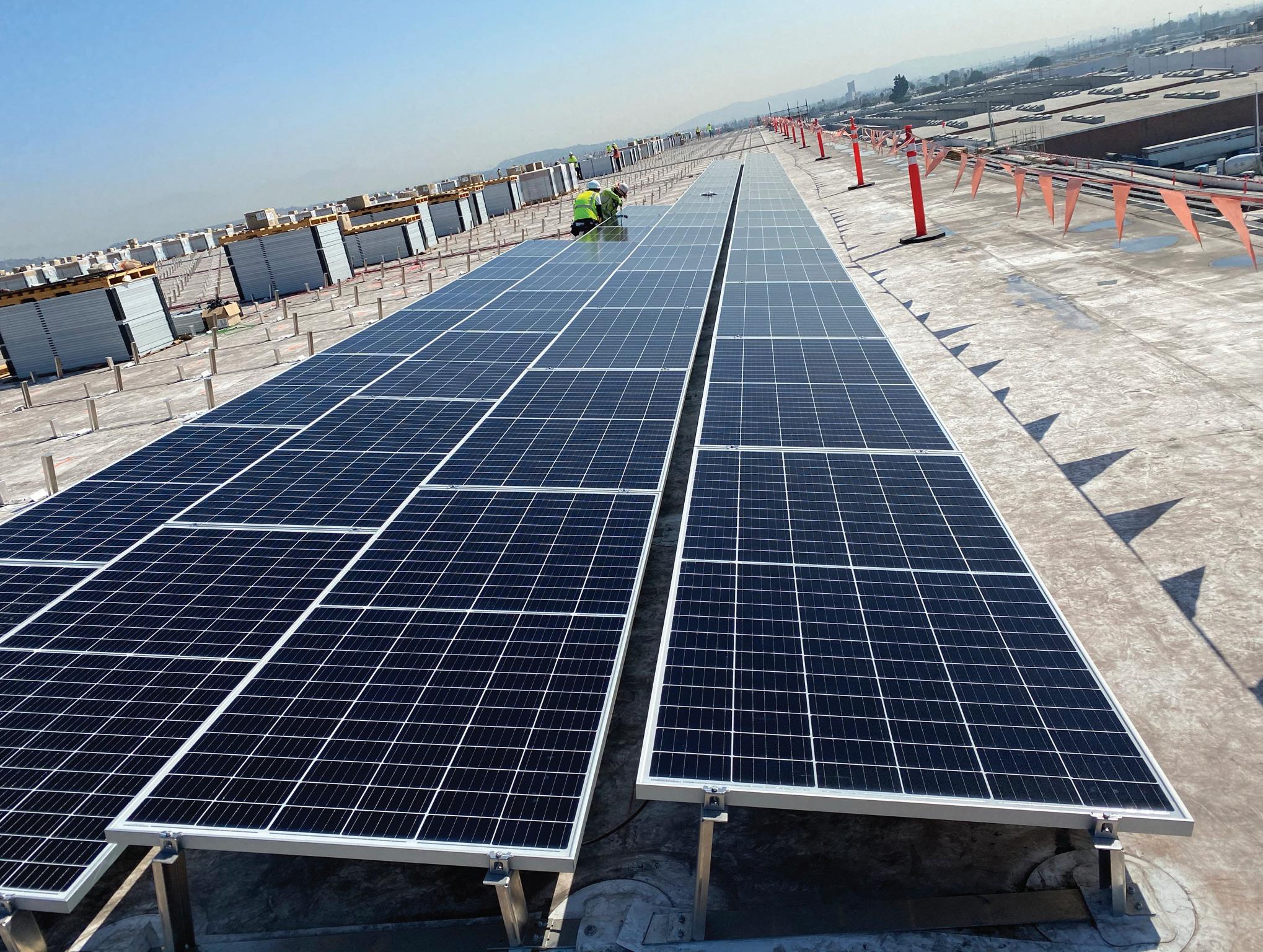
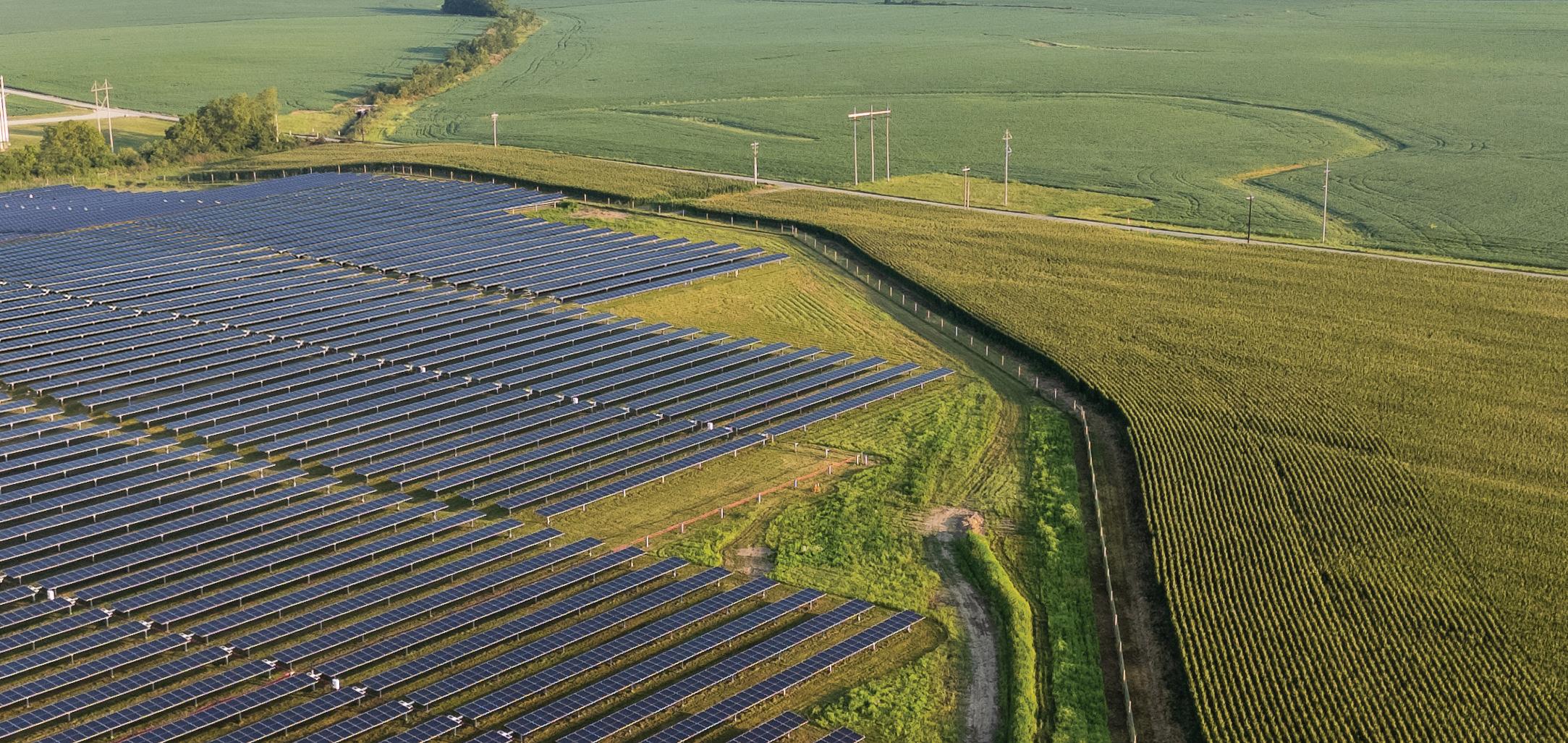
When site conditions push back, you don’t need complexity, you need performance. The A-Frame® Tracker Interface was designed with that reality in mind so teams can focus less on solving foundation challenges and more on moving projects forward. Engineered for the tough soils, uneven terrain, and real-world constraints that define today’s utilityscale solar projects.
APA has spent more than a decade establishing itself as a fixed-tilt foundation leader, solving challenges with engineered solutions suited for a wide variety of site conditions. While the A-Frame® is APA’s debut tracker interface, it’s not a first draft. The design incorporates engineering input, U.S. domestic manufacturing experience, and feedback from the field. The result is a simplified design process through a solution engineered to fit the site from the start.
Designed, built, and manufactured in the United States, the A-Frame® reflects APA’s approach to foundation design: start with the site, identify challenges, then engineer the solution. Its dual-post configuration distributes loads across two posts, which supports use in frost-sensitive soils, rock, and variable ground conditions. Paired with APA’s ground screw or helical pile foundations, the system adapts to various soil conditions from dense glacial till to soft, organic soils—without having to rely on excessive embedment depths or overbuilt steel.
Installation flexibility is at the core of the design. Integrated adjustability for height, plumb, and east-west alignment helps crews handle undulating terrain while reducing grading and rework. A folding, preassembled configuration simplifies logistics and speeds up deployment, and interchangeable components support high volume manufacturing for large tracker projects. For projects with elevated load demands, the A-Frame® is engineered to maintain structural integrity in even the most challenging site conditions. With a foundation solution engineered for real-world conditions, APA handles the complexity behind the scenes for you.
For detailed specifications, refer to the A-Frame® Tracker Interface spec sheet at apasolar.com/products/a-frame-tracker-interface
BRING YOUR A-GAME
Take control of tough sites.
Staff
EDITORIAL
Editor in Chief Kelly Pickerel kpickerel@wtwhmedia.com
Managing Editor Billy Ludt bludt@wtwhmedia.com
CREATIVE SERVICES & PRINT PRODUCTION
Art Director Allison Washko awashko@wtwhmedia.com
AUDIENCE DEVELOPMENT
Director, Audience Growth
Rick Ellis rellis@wtwhmedia.com
Senior Associate, Audience Development
Marie Claussell mclaussell@wtwhmedia.com
MARKETING
VP, Marketing
Annie Wissner awissner@wtwhmedia.com
Webinar Manager
Lindsey Harvey lharvey@wtwhmedia.com
CUSTOMER SERVICE
Customer Service Manager
Stephanie Hulett shulett@wtwhmedia.com
Customer Service Representative
JoAnn Martin jmartin@wtwhmedia.com
Customer Service Representative Tracy Powers tpowers@wtwhmedia.com
Customer Service Representative
Renee Massey-Linston renee@wtwhmedia.com
Customer Service Representative
Trinidy Longgood tlonggood@wtwhmedia.com
LEADERSHIP
CEO Matt Logan mlogan@wtwhmedia.com
SALES
Ashley N. Burk
737.615.8452 aburk@wtwhmedia.com
Jami Brownlee
224.760.1055 jbrownlee@wtwhmedia.com
Daniel Glazier
773.835.0800 dglazier@wtwhmedia.com
Powering a city under the Mediterranean sun
I SPENT A week in Barcelona this April, and I left the Catalonian capital with the understanding that cities can be living things. They cannot breathe or think; they have no arteries carrying oxygen-rich blood or mouths with which to speak or eat. Yet, even without a brain, a city can bear a long memory of itself and evolve while embracing its lineage.
It's difficult to describe what characteristics support this claim. At any hour, on any day in Barcelona, there seems to be a reason for people to gather in the most unexpected places. Many of the people who live there are open about what they support, draping flags from their balconies, hanging fliers in store windows or painting the words of causes onto walls and train cars.
While walking streets older than our country, I saw solar panels peeking over the parapet walls of ornate buildings. Enclosed bus stops throughout the city had brightly illustrated posters of construction workers installing solar panels – and these were issued by the Barcelonian government. The shelves of bookshops carried titles from Spanish publishers focused on environmental and climate issues.
I lived this week as a tourist — sampling the conveniences of a place afforded to those who don't live there. For that reason, I acknowledge that my version of Barcelona is a skewed version of Barcelona. But in my nearly 33 years on this planet, places I've visited and lived have quickly homogenized to the point that you can find the same few things on any block in any major city in the United States.
Barcelona is also grappling with the same kind of commercialization and rising cost of living — as is everywhere else in the world. The difference is Barcelona is clinging tightly to its
identity — a culture with centuries-old roots — while still embracing modern technologies like renewables.
The Barcelonian government itself has spearheaded deploying solar PV on municipal infrastructure. In 2027 alone, the city reportedly plans to install 381 solar projects on municipal buildings.
This maintenance of character feels rare in a contemporary context.
I understand — a city isn't a county, isn't a state, isn't a country. Detractors can choose to handwave forward progress on critical infrastructure like a modernized grid powered by renewable energy, because it hasn’t been done yet. But a precedent isn’t a precedent unless someone sets it. We’re reeling from the whiplash of oil costs from yet another war, when there are still millions of roofs with space for solar.
We’ve already built so much renewable infrastructure here in the United States. There’s still much more that needs to be built to reduce our reliance on finite fuel sources. This issue of Solar Power World is focused on topics of maintenance and how we can ensure our progress isn’t lost in the process. SPW
SOLAR POWER WORLD does not pass judgment on subjects of controversy nor enter into disputes with or between any individuals or organizations.
SOLAR POWER WORLD is also an independent forum for the expression of opinions relevant to industry issues. Letters to the editor and by-lined articles express the views of the author and not necessarily of the publisher or publication. Every effort is made to provide accurate information. However, the publisher assumes no responsibility for accuracy of submitted advertising and editorial information. Non-commissioned articles and news releases cannot be acknowledged. Unsolicited materials cannot be returned nor will this organization assume responsibility for their care.
SUBSCRIPTION RATES: Free and controlled circulation to qualified subscribers. Non-qualified persons may subscribe at the following rates: U.S. and possessions, 1 year: $125; 2 years: $200; 3 years $275; Canadian and foreign, 1 year: $195; only U.S. funds are accepted. Single copies $15. Subscriptions are prepaid by check or money orders only.
SUBSCRIBER SERVICES: To order a subscription or change your address, please visit our web site at www.solarpowerworldonline.com
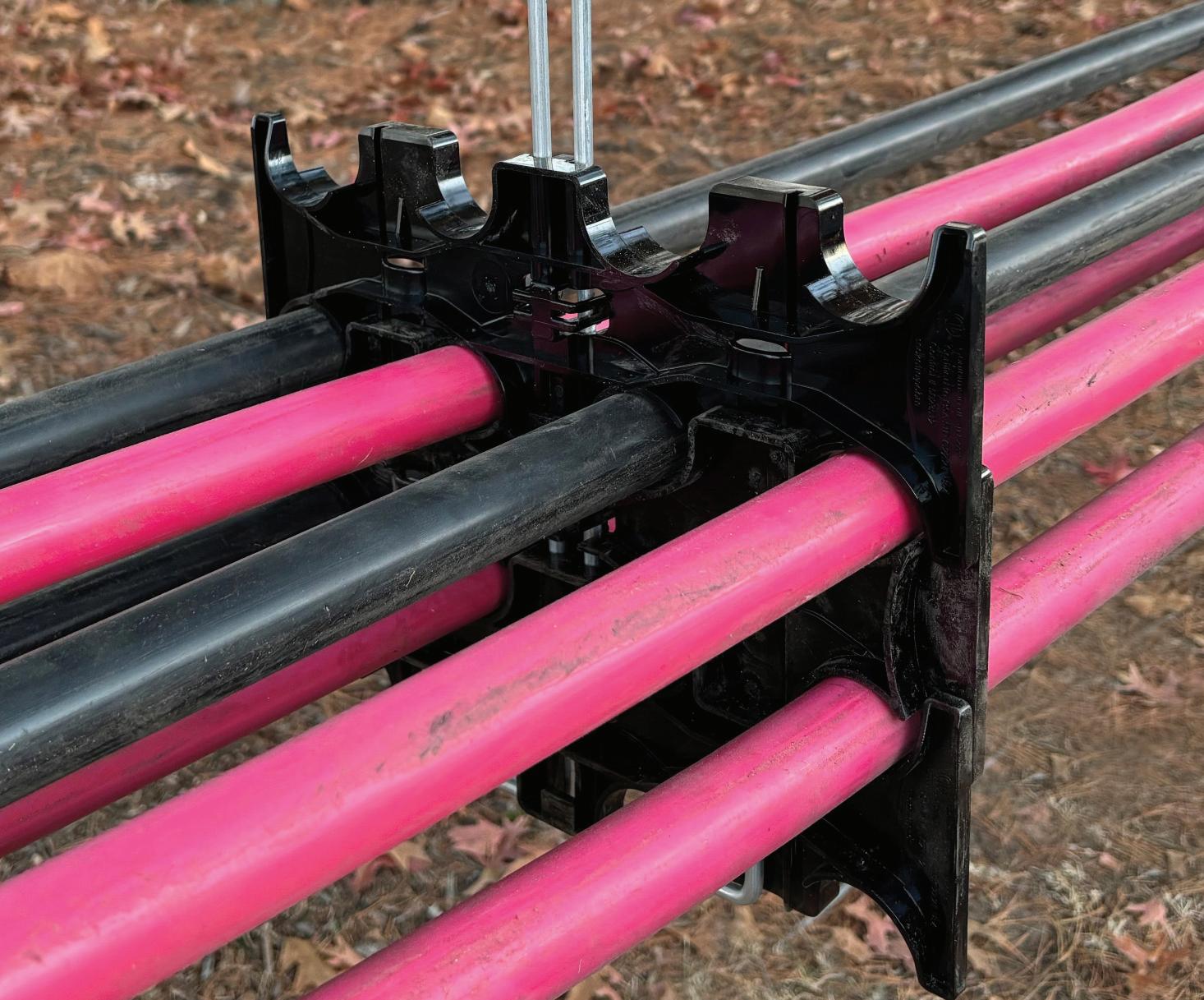
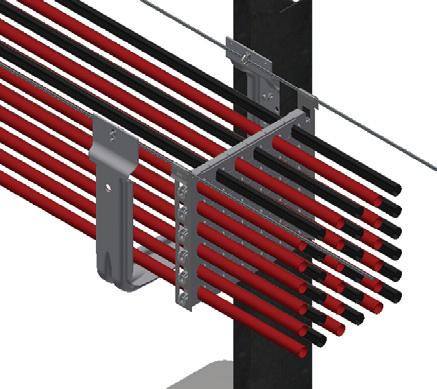
Best-In-Class Free Air separation (1.525” between conductors)
• NEC 310.17 compliant • Fits up to (20) conductors, sized up to 1250 kcmil • Tiers adapt to different cable sizes • Tool-free snap-together install
A Solar United Neighbors solar campaign participant crouches in front of their PV array.
Solar United Neighbors
SOLAR PROJECTS
BILLY LUDT • MANAGING EDITOR
The financing landscape in residential solar has largely become defined by third-party ownership (TPO) as that market segment’s federal investment tax credit (25D) expired at the end of 2025. Leased residential solar projects can still qualify for the commercial investment tax credit (48E), but array ownership is declining from it.
“In the better part of the last decade, that was a more popular way to go solar compared to buying outright,” said Ben Delman, editorial director for Solar United Neighbors, a PV consumer advocate. “I think as more financing options came along and the price of solar came down, you started to see more people that look for different purchasing options.”
According to the “2026 Aurora Solar Snapshot,” nearly two-thirds of surveyed solar sales companies expect most of their projects to be TPO in 2026. Additionally, 55% of installers reported that TPO has become their most-used project financing scenario.
Prepaid leases have risen to prominence as a way for homeowners to buy a solar project after a short-term in their leasing arrangement. These leaseto-own scenarios bridge the gap between TPO and outright project ownership, while
still seeing savings from that once-missing 30% tax credit.
Third-party to private ownership
TPO is a project arrangement where homeowners rent the equipment or lease their roofs for solar arrays. TPO providers will own the project and maintain them over an agreed period. Leases and power purchase agreements are the most common TPO arrangements. At the end of that term there is a chance to buy the array, but most lease agreements are 25year terms.
“With traditional PPAs and leases, you really don’t need to have a lot of up-front money to get into solar,” said Jess Lyons, staff product manager at Aurora Solar, a design and financing platform. “Then you have a consistent monthly payment. Whereas with prepaid leases and PPAs, a lot of the times folks either have that money up front or they’re able to secure it through a loan.”
During the term of a prepaid lease the TPO company would offer the same services as a regular lease without a monthly payment, and the customer has the option to buy out the project after just five or six years. After that, the homeowner is responsible for array upkeep.
“You don’t have to be an expert on the thing on your roof right away,” Lyons said. “You have five to six years to figure it out.”
To finance a prepaid loan, customers must arrange a loan separate from the TPO company, unless they can afford to pay for the prepaid lease outright.
Early days for prepaid leases
Since prepaid leases are an emerging TPO model, some of their finer details are still being determined. They’re available in select states, and they’re still entering new markets. Participate Energy, a solar leasing company, is currently offering prepaid leases in just Arizona, California, Colorado, Hawaii, Idaho, New Jersey, New York, Texas and Utah.
Solar United Neighbors published a consumers’ guide to TPO solar in April, which includes a section on prepaid leases. One disclaimer the group includes is about production guarantees. These are written into contracts for solar leases and require the TPO company to compensate a lessee if the system underperforms. By paying for the lease up front, the guide claims that customers can have less financial leverage over the TPO company if an array underperforms.
“Make sure that you’re reading through your contracts so that you understand what your options would be,” Delman said. “Make sure you understand what responsibilities you do have and make sure you’re aware of any escalators that might be in your contract. What you’re paying in month one may be different than what you’re paying in month 36 or 48.”
Prepaid leases’ nascence also raises questions about how they work with real estate transfers.
WITH TRADITIONAL PPAS AND LEASES, YOU REALLY DON’T NEED TO HAVE A LOT OF UP-FRONT MONEY TO GET INTO SOLAR. THEN YOU HAVE A CONSISTENT MONTHLY PAYMENT. WHEREAS WITH PREPAID LEASES AND PPAS, A LOT OF THE TIMES FOLKS EITHER HAVE THAT MONEY UP FRONT OR THEY’RE ABLE TO SECURE IT THROUGH A LOAN.
“The one thing is they’re really new. I haven’t seen a lot of examples of someone getting a prepaid lease or PPA project on their roof and then selling their home,” Lyons said. “In a standard PPA or lease structure, when you go to put your house on the market, you have a lease transfer process. What does that look like when you’re selling your home one or two years before buyout? I don’t know. It’s very different than 15 years before your buyout terms.”
The residential and commercial markets are approaching a July 4 deadline this year to safe harbor solar projects for the 48E tax credit. Then that credit expires entirely at the end of 2027. Market trends are signaling that TPO will gain more traction while this federal solar subsidy still exists.
The chance of buying a solar project as a residential customer decreased when 25D expired. Prepaid leases are relatively new to the market, so the next few years will determine their viability in increasing solar homeownership.
“But there’s a lot to be discovered as to what that looks like in six years. Which, to be fair, is also true of PPAs and leases, because we’re maybe not even 10 years into that 25-year journey,” Lyons said. SPW
— Jess Lyons, Aurora Solar
A family stands in front of their home solar project. Solar United Neighbors
SOLAR POWER WORLD’S PROJECTS OF IMPACT
Solar array outperforms and saves San Diego church thousands
BILLY LUDT • MANAGING EDITOR
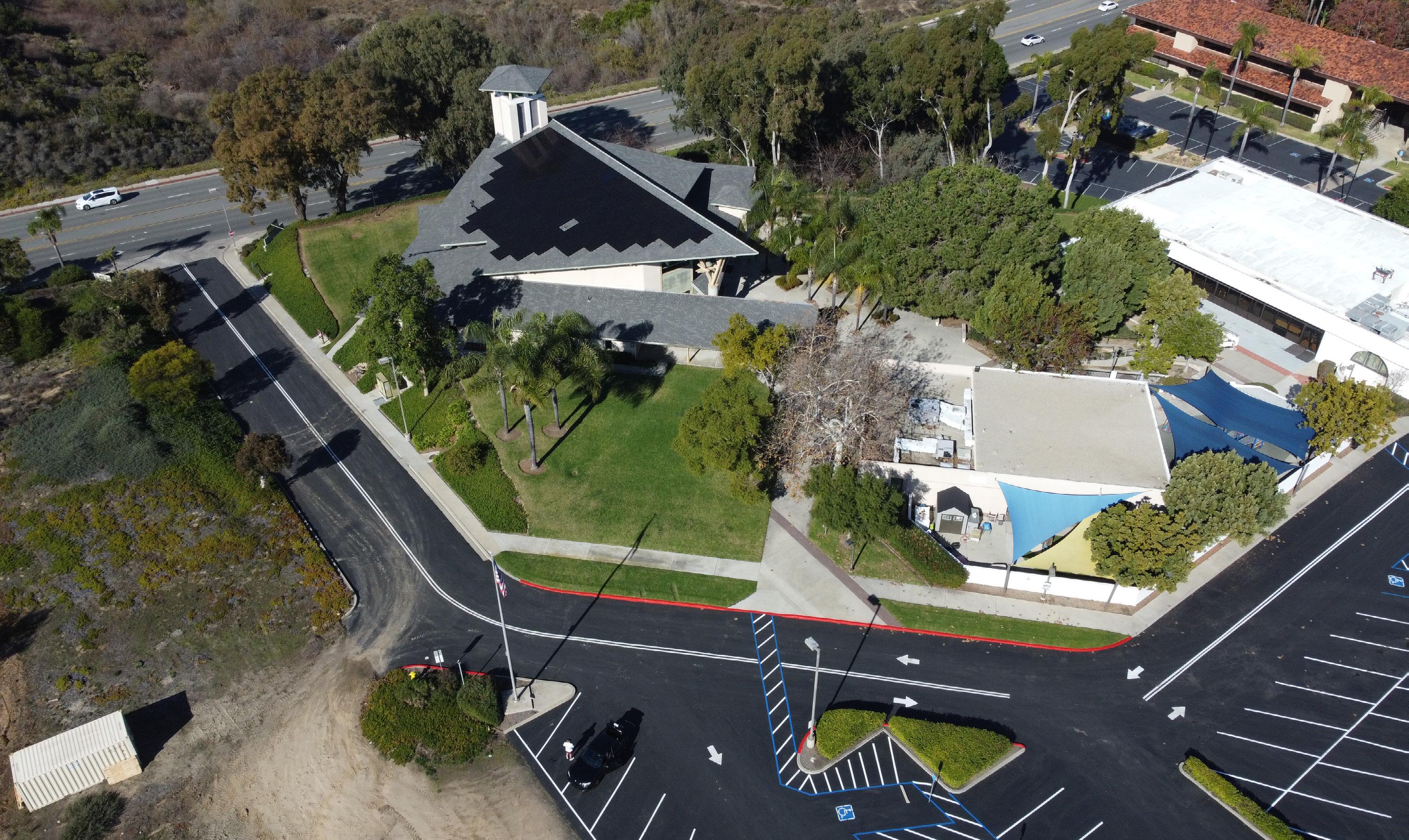
A55-kW solar project on the roof of a California church has saved a congregation of about 150 people tens of thousands of dollars in just two years. With those savings, Canyons Church in San Diego’s University City neighborhood has reinvested back into itself, expanding youth programming, updating its sound system and maintaining the five-acre plot on which it’s located.
This project happened thanks to Watthub, a commercial solar developer from Scottsdale, Arizona, that arranged a power purchase agreement (PPA)
with Canyons Church. The church has a monthly PPA payment, but most of its utility bill is covered by solar production. Local utility SDG&E is steadily increasing its rates, so the savings from solar is stretching further than originally quoted.
Solar Power World spoke to John McDonnell, founder of Watthub, and cofounder and principal of solar contractor SunRenu, and Nancy Loomis, executive assistant for Canyons Church, about how this project came to be and the impacts it’s continuing to have post-installation.
This interview was edited for brevity.
What has this solar project made possible for the church?
McDonnell: We did our initial proposals that said with the net of PPA payments, you’ll save $25,000 a year, but come to see all the rate hikes, and two years later, they’re saving almost $40,000.
CANYONS CHURCH SOLAR PROJECT
LOCATION: San Diego, California
PROJECT TIMELINE: Initiated 2022, completed December 2023, commissioned 2024.
COMPONENTS: Canadian
Solar 370-W modules, CPS 50kW string inverter
A 55-kW solar project installed on Canyons Church in San Diego. Watthub
Loomis: Which is extremely significant for a church that runs on donations. That was part of the other motivation for us. We have about five acres that the church is on, which takes a lot of maintenance. We have the funds available now to do some of the upgrades that we needed to, but we’ve put a lot into the kids’ ministry as well and upgraded some of that area and hired another youth pastor just recently, so we can get our junior high programs and high school programs going. So, all of those savings help us to do other things.
How did Watthub make the PPA happen?
McDonnell: This was unique because it’s a small project. It’s 55 kW, and to do a PPA for 55 kW is usually just not available. Anything under 100 kW isn’t. But we have a network of projects and the tax equity for the small stuff, so we have a track record of that. We’ve been doing this for almost 18 years now, so we’re no stranger to the PPA space, and we’re no stranger to commercial solar.
What is the site like?
Loomis: We’re in an area that’s close to UCSD. We’re close to the “Golden Triangle” area. Our location’s easy to get to. We have the sanctuary and a preschool as well. The sanctuary is where the panels are — up on the very top part of our roof. What was nice about our project is that all of our buildings are connected to one meter. We were able to put the solar on one of our buildings and we didn’t have to do separate things, because there was one meter. That made it a little bit easier.
McDonnell: Multiple interconnections raise cost, and the cost raises PPA rates, but we were able to keep a real low PPA rate.
Loomis: For us, being able to do the PPA made a lot of sense rather than having to do an outright purchase. This was back in ’22 — trying to come out of the COVID era. I had to convince the board, because
it’s a 25-year commitment. But so is our commitment to SDG&E. That’s a lifetime, commitment, right?
Did you encounter any challenges in construction or permitting?
McDonnell: Permitting just takes a long time. They’re backed up, and permitting in California is getting a lot worse. But this was a relatively smooth process where we submitted for it, they came back with some corrections and we made them. One of the challenges was our interconnection point, because it’s on one meter, and the meter was across the building, so we interconnected into a sub-panel in the building that the array was on. We had to design appropriate disconnects within 10 ft and all the utility requirements. That was a little bit trickier.
What makes this project unique?
McDonnell: This is a success story. The parties involved worked really well
together. The nature of the PPA and the outperformance and how much savings it’s producing. I’ve been in the business a long time and there are a lot of nightmare stories out there, and this was the opposite. We want to rebuild confidence in American businesses and real estate investors that solar does work.
How does it impact you being able to bring a project like this to fruition — one that has had such a lasting effect in the short time that it’s been in operation?
McDonnell: I’m proud that we built a really good system and it’s been operating properly. Some systems don’t go right. Rapid shutdown fails, and we have to go out and fix it. Inverters can go and we replace them under warranty, but then you’ve got a month with no inverter power. This is a shining light in our portfolio, that it has operated as expected. We get out there, we service it, we clean it and we do routine maintenance under the
PPA. That’s at no cost to Canyons Church. This is a great reference point.
Loomis: It’s helped us because as we’ve grown, we’re using more of the utility. We now rent to a small school in one of our buildings, so that uses more electricity. We’re using a lot more power than we were at the time we installed this, but it’s allowed us to do that, because it hasn’t increased our bills significantly. We were paying $7,000 in the summertime. That was two or three years ago. That was just minimal building use. But we’ve added a lot of things, and it’s allowed us to continue to grow where I don’t think we could have managed that three years ago. SPW
Have a Project of Impact you’d like to share? Contact Managing Editor Billy Ludt at bludt@wtwhmedia.com
With the savings from solar, Canyons Church has been able to maintain and invest in its facilities. Watthub
POLICY CHANGE VIRTUALLY STOPS NEW COMMUNITY SOLAR DEVELOPMENT IN MAINE
BILLY LUDT • MANAGING EDITOR
Lawmakers are trying to find solutions to the mounting economic weight of energy costs on utility customers. To address this, the Maine Legislature revised its net energy billing (NEB) program for non-residential participants last year, but in the process, it halted the state’s community solar market.
“There’s not a lot the legislature can do to change the price of natural gas, when that is changed by wars overseas,” said Kate Daniel, Northeast regional director for the Coalition for Community Solar Access. “Solar programs are something they can touch, and even through it’s not the driver of the bill, it makes them feel like they’re doing something.”
LD 1777 prohibits Maine utilities from accepting new community solar projects, reduces the utility payments generated from community arrays and, in an industry first, applies retroactive monthly fees on certain existing community solar projects.
The amended NEB began issuing charges to existing community solar projects enrolled in its kWh Credit Program on Jan. 1. Projects with a capacity between 1 and 3 MWAC are being charged $2.80/kWAC monthly; projects between 3 and 5 MWAC are being charged $6/kWAC monthly.
Community solar developers Nautilus Solar and Nexamp have both stated their companies will not be bringing new projects to Maine.
“Every region is going to need additional generation buildout in the next five years. Most of that is going to be clean energy,” said Jake Springer, East Coast policy director for Nexamp. “By imposing retroactive policy measures, at the very least you’re increasing the cost of capital, which will go up in reaction to increased risk. Or you’re dissuading additional development in the state when you need additional generation.”
Maine’s community solar history
In 2019, Maine became the 20th state in the country to enact a community solar program after Gov. Janet Mills mandated 250 MW of new community solar capacity. In the last seven years, community solar developers far exceeded that original goal.
Community solar projects allow customers without the room or funds for their own arrays to engage with renewables in an affordable way. Residents and businesses subscribe to a portion of the project's capacity, and they earn renewable energy credits applied to their utility bills.
These shared arrays are long-term commitments, both for subscribers and the company managing the PV projects. They’re much more involved in terms of customer service, since there isn’t just one customer. Eric Lamora, VP of community solar with Nautilus Solar, said the company manages a community solar customer
base of about 15,000 subscribers in Maine alone.
“It has a significant impact on the overall value of the portfolio. You significantly change the returns [and] the income expected to come from these projects,” he said. “These retroactive changes are very damaging. Not just obviously to us as an investor. The part that isn’t really being addressed this has a huge impact on Maine … In good faith, the investment community invested hundreds of millions of dollars in the market. Fast forward around seven years later when these projects are mostly built and completed, then this legislation comes out and that changes the original proposition put out by the state.”
The state claimed in a press release published by the Maine Office of the Public Advocate, a state body representing electricity customers, that the decision to alter NEB for community solar will save electricity customers $1.2 billion over 16 years.
“Maine’s community solar program needs reform precisely because it has been so successful,” wrote Heather Sanborn, Maine public advocate. “We set out to build 750 MW of solar, and instead we’ve built more than 1,600 MW. Now we need to make sure that solar power is delivered affordably to Mainers going forward.”
The release also claims that LD 1777 was drafted in collaboration with solar
developers. Community solar companies didn’t characterize the process as collaborative.
The costs and pending litigation
This change to NEB has forced project owners to reassess the economics of their subscribed arrays. Brattle, a consulting firm, worked with developers to produce a report on how LD 1777 impacts the Maine community solar market.
Co-authors Robert Mudge and Meten Celebi, principals with Brattle, reported that Maine community solar could see a loss of $525 million in revenue. The policy change could force existing projects into the wholesale energy market. But community solar project loans stipulate that these arrays remain in NEB, otherwise they would breach those agreements and risk funding loss.
Additionally, Brattle estimates that switching to the wholesale market, if even possible, compensates solar projects at a 63% reduction compared to NEB. Despite this, both Nautilus and Nexamp plan to maintain their existing solar projects in Maine.
“As long as there are Nexamp assets in Maine, we’ll continue to operate them,” Springer said. “But we don’t view the Maine market as a safe place for investment anymore. We’re not doing any additional community solar development there.”
Community solar developers have filed two separate lawsuits against the Maine Public Utilities Commission and its leaders. One is representing developers responsible for 111 community solar projects, totaling about 415 MW of capacity in Maine.
Plaintiffs filed a preliminary injunction to prevent these retroactive fees from activating at the start of the year, but that request was overturned. Deliberations in these lawsuits are still ongoing.
“We’re still exercising all of the rights that we can,” Lamora said. “For us, it is to try to mitigate some of the losses that we’re experiencing. Hopefully the state will realize that they’ve made a mistake here.”
The road ahead for Maine Business can continue as usual for other forms of solar in Maine. But from 2022 through 2024, community solar accounted for most of the state’s new PV deployment. By the end of 2025, Maine has installed nearly 1.9 GW of solar across markets. In 2019, Gov. Mills signed legislation establishing state goals to use 80% renewable electricity by 2030, and 100% by 2040. The governor’s office reported that more than half of the state’s energy came from renewables in 2024.
The purpose of LD 1777 is curbing energy costs, which are rising due to inflation, trade tariffs and the strain of new data centers on the grid. The Maine Legislature is considering a bill to limit the development of new data centers in the state, but if passed wouldn’t go into effect until late 2027.
But community solar developers consider its immediate response to cost savings short-sighted — both for the community solar market and for Maine itself.
“The impact from climate change is real there. A huge part of the Maine economy is lobster fishing, and the waters are warming around the Maine coast,” Lamora said. “Mainers are very sensitive to the impact of climate change. They have really aggressive energy goals, but now the question is how they’re going to reach those goals.”
LD 1777 directs the Maine Department of Energy Resources to create a new community solar program for the state. It's undetermined when that will happen. SPW
A 7-MW community solar project covers brownfield land in Maine. Nautilus Solar
SOLAR PANELS ARE TRYING TO USE LESS IS THAT WISE?
KELLY PICKEREL • EDITOR IN CHIEF
For a glass rectangle with a simple appearance, a solar panel has a lot of components. Besides the obvious glass, frame, junction boxes and wiring, there are also many minerals and elements that control how a solar panel functions. The recent price increase of one critical mineral — silver — is influencing solar panel designs in a big way.
The most electrically and thermally conductive metal, silver represents about 14% of a silicon solar panel's manufacturing cost. For advanced n-type designs that are dominating the market, the cost of silver metallization is even higher.
Silver prices have recently been on a steep incline. Costs were steadily below $1/g between 2013 and 2024 before reaching a peak of $3.70/g on Jan. 29, 2026. With between 5 and 15 g of silver needed for each silicon solar panel, those costs can add up.
Major solar brands are experimenting with ways to use less silver in their solar panels, often increasing the percentage of copper instead. In certain cases, copper is a straightforward swap to silver, but researchers note this new process could
lead to future durability issues that aren’t yet understood.
How silver is used in solar
Silver is incorporated into solar panel production when a silicon wafer turns into a solar cell. Silver powder is made into a paste and applied to a silicon wafer to form grid patterns to transport the electrons. It is part of common busbar designs soldered onto cells.
Silver usage has increased in silicon solar panel production due to the industry's move into n-type technologies. Tunnel oxide passivated contact (TOPCon) and heterojunction (HJT) cells require higher amounts of silver per watt compared to traditional passivated emitter and rear contact (PERC) cells.
On a p-type PERC cell, silver is only required for the front n-type contact, while the rear p-type contact is typically formed using aluminum. TOPCon uses silver for the rear n-type contact as well as mixed with aluminum for the front p-type contact to improve efficiency. HJT solar cells use silver paste for both contacts.
Processes are improving, but silver usage is estimated at:
• PERC cells: ~10 mg of silver per watt
• TOPCon cells: ~13 mg/W
• HJT cells: ~22 mg/W
ITRPV estimates that the 703 GW of modules shipped in 2024 contained cells that consumed about 8,616.7 tons of silver. This corresponds to about 27.6% of global silver supply in 2024.
Where silver is produced
In a 2022 review, the U.S. Geological Survey found that Mexico leads global silver production, accounting for 24% of world production. China is the secondhighest silver producer, with 14% of the market. The United States is tied with several other countries and accounts for 4% of the market. Fourteen countries control 92% of global silver production.
ABOVE: With silver prices rising, solar panel companies are experimenting with new manufacturing techniques. Adobe Stock
Panel Technology
Eighty percent of silver production comes as a byproduct of mining lead, zinc, copper and gold, which makes rapid output increases difficult. The Silver Institute estimates that global demand of silver in 2025 reached 35,884 tons while supply only came to 32,206 tons. Global demand has outpaced supply every year since 2021. Prices have shot up as the demand-supply gap becomes more pronounced.
The risk of using less silver in solar Since there isn't a way to get significantly more silver into the market, manufacturers are trying to deal with shortages and high prices by using less. Copper is second only to silver for electric conductivity, and it's already used in solar panel production.
"Copper offers high electrical conductivity at a significantly lower cost than silver, but it introduces technical challenges, such as diffusion into silicon
and increased corrosion risk," said Shivam Kholsa, project engineer with advisory group VDE Americas. "To mitigate these risks, copper metallization typically incorporates diffusion barrier layers (often nickel) and modified plating processes. As a result, the current industry trend is toward progressive silver reduction while copper-based metallization technologies continue to mature."
Copper is more prone to oxidation, and it "corrodes in ways silver does not and gets worse at elevated temperatures," said Cherif Kedir, president and CEO of VDE Group’s Renewable Energy Test Center (RETC). This risk is more pronounced in TOPCon production, as those cells are processed at a very high temperature (700°C) compared to HJT's lower processing temperature (200°C).
"For [TOPCon] cells, oxidation during processing is particularly difficult to control. On top of that, copper ions
can migrate into silicon under electrical bias and moisture exposure, degrading cell performance over time," Kedir said. "Given that TOPCon holds roughly 85% of Chinese cell manufacturing capacity, this is where the silver cost pressure is most acute and where the substitution is most technically constrained."
Back-contact and HJT designs offer easier "long-term paths away from silver," Kedir said, and that could change what types of modules are being installed in the very near future.
"This transition will move at different speeds for each cell type. That timing mismatch could shift market share over the next few years, and it's something manufacturers, developers and lenders should all be watching closely. The silver price isn't going to wait for the engineering to catch up," he said.
What panel manufacturers are doing today
LONGi announced it would begin substituting base metals for silver in its solar cells in Q2 2026. Both LONGi and Jinko Solar have reportedly already used silver-coated copper pastes for rear-side contacts and are testing front-side applications. Their efforts have remained compatible with existing screen-printing lines, Kedir said, which keeps capital expenditures manageable. If manufacturers turn to copper electroplating, which is more common in HJT setups, new process equipment would be needed, so it wouldn't be an easy swap.
"From where we sit as a test lab, the question that matters most isn't whether manufacturers will adopt copper; they will," Kedir said. "The important question is whether the products being shipped today and next year have been validated adequately to support the manufacturers’ performance claims."
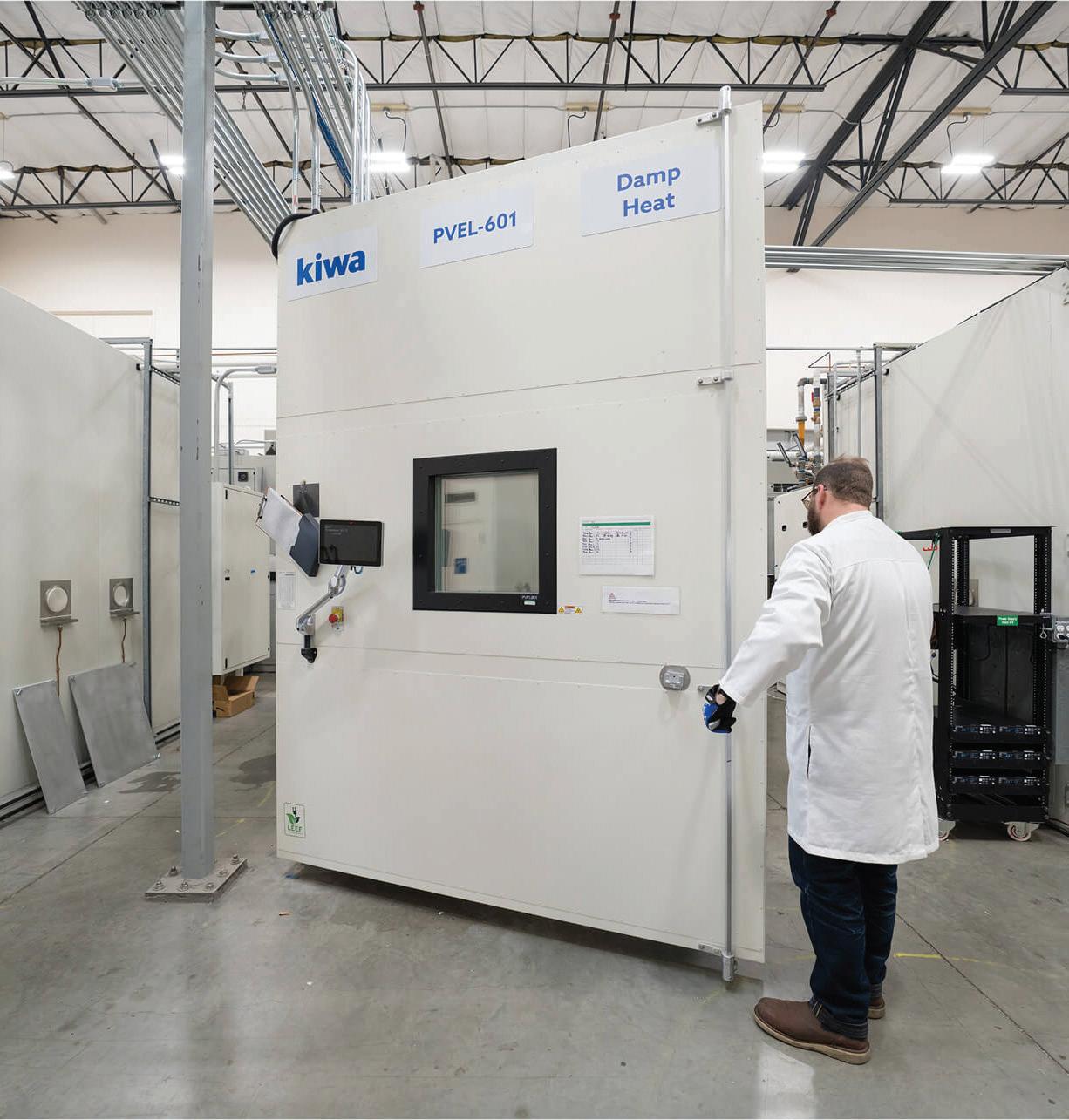
ITRPV expects the amount of silver per solar cell to decrease over time for all technology types, and testing organizations are already determining what to look out for. Jean-Nicolas Jaubert, director of China operations at Kiwa PVEL, said the group will focus on thermal cycling (to find solder bond
Laboratories
Kiwa PVEL
fatigue and oxidation failures) and damp heat testing (for oxidation failures and corrosion).
“Both our own experience and the industry knowledge of copper paste is extremely limited. In short, we should brace for new failures as people start trying these solutions commercially, as it may be challenging to deploy quickly in a realistic way," he said. "Copper could diffuse into the cell and create new defects, or possibly interact with other BOM components, such as encapsulant additives.”
Kedir agrees that failure areas in copper metallization aren't prominent with silver and thus must be closely watched.
"A marginal edge seal or a small encapsulant defect that you wouldn't think twice about in a silver-based module becomes a real problem when the metallization underneath is copper. Moisture gets in, hits the copper and
corrosion starts," he said. "As coppermetallized products start entering the pipeline, that benchmarking data is going to matter a lot more for developers and financial stakeholders trying to evaluate what they're buying. The standards themselves don't change. Emphasis does."
There is existing copper metallization data to reference. Silevo, the HJT manufacturer from the early 2010s that was eventually acquired by SolarCity and then Tesla, produced a silver-free solar cell using a copper electroplating process. RETC ran reliability experiments on Silevo's copper-metallized HJT cells, and that data provides today's industry with a detailed analysis of how copper reacts in real-world conditions.
"Silevo demonstrated 20-21% cell efficiency in pilot production. Their modules passed extended damp heat testing at 2,000 hours with negligible degradation," said Kedir, who was
involved in the original testing. "[Silevo] never scaled the way it might have, but the proof of concept was real. Copper can work in a solar cell."
One silver-free module has already been introduced to certain markets. Chinese manufacturer Aiko has launched its latest all-back-contact module in Australia, China and Europe. The 545-W, 25% efficient module replaces silver-paste soldering with the company's proprietary copper electroplated interconnection. It's still early days, and only extending testing will show if moving away from silver is the right choice.
"Copper metallization at the massproduction scale has maybe two to three years of history. The engineering looks promising, and the cost pressure is real. But two or three years of manufacturing data doesn't tell you what happens over a 25-year warranty period, and the only way to close that gap faster is accelerated lab testing," Kedir said. SPW
What’s your Retorquing Plan?
BILLY LUDT • MANAGING EDITOR
Solar inverters are not required to meet cybersecurity standards. Should they?
THE GROWING CONNECTIVITY of power technologies has granted greater control over how distributed energy resources (DERs) interact with both the grid and energy loads behind the meter. But as these devices connect with more avenues of electrical distribution, there are rising implications for proper cybersecurity measures within them.
The solar industry is trying to establish a standard for cybersecurity in solar inverters. Inverter cybersecurity has become paramount, because as their features expand — such as remote access through web portals — so does the risk for breach.
This concern extends beyond ensuring the device itself isn’t susceptible. Guaranteeing inverters and DERs are cybersecure means ensuring every step along the supply chain is secure.
“While global sourcing in the energy sector has enabled cost-savings and technological advancements, an overreliance on foreign sources could introduce new cybersecurity risks,” wrote the Solar Energy Industries Association (SEIA) in the report “Inverter & Supply Chain Cybersecurity” published in February. In it, SEIA advocates for growing a domestic solar inverter manufacturing presence to mitigate foreign cybersecurity concerns.
SEIA also recommends several existing cybersecurity standards for DERs, including the recently published UL 2941.
In 2023, the National Renewable Energy Laboratory (now the National Laboratory of the Rockies) and UL Solutions debuted UL 2941, a cybersecurity standard for DERs and systems using inverters, such as solar
projects and wind farms. Danish Saleem, senior cybersecurity engineer with the National Laboratory of the Rockies (NLR), and his team developed the concept that would become UL 2941 before engaging UL and industry members to build the standard.
“At NLR, we recognized early on that as more inverter-based resources are integrated with the grid, traditional ‘set it and forget it’ approaches to inverter security were no longer adequate for a modern grid having bidirectional communication and power flow,” he said.
The groups are trying to make UL 2941 mandatory for DERs and inverter systems. Together, they developed a certification for the standard that published in February. UL 2941 establishes methods for testing devices such as PV inverters for cybersecurity defense and recommends measures that can be implemented by manufacturers.
It uses a multi-layered approach to affirming cybersecurity, covering system details such as requiring the proper credentials to digitally access a PV inverter, using cryptography to entrench system data, detecting login attempts and abnormal monitoring incidents, verifying software updates and having measures to stop physical tampering of a device.
Saleem said cybersecurity is an active practice — one that needs involvement from system owners, utilities and aggregators.
“Several years ago, the main concern was protecting individual inverters,” he said. “But today, with increasing aggregation of distributed systems into virtual power plants and other aggregated assets, a single compromised DER can pose new and uncertain risks to grid reliability.”
UL 2941 complements other safety standards, like UL 1741, which
Inverter Technology
was developed in response to grid modernization. With increasing interconnected DERs, such as EV chargers and renewable energy sources, UL 1741 was published to test inverters for proper grid functionality.
“If you think about a Venn diagram between appropriate connection to the grid and safe operation of the inverter, both are coordinated to address that,” said Ken Boyce, VP, principal engineering, industrial, at UL Solutions. “2941 is another circle in the Venn diagram that addresses connecting to the grid safely and in a cybersecure fashion.”
DERs and inverter risks
Someone with unauthorized access to solar inverters could cause grid instability and outages. This risk of impact is higher in larger-scale solar projects, but residential solar inverters are still susceptible. Separate from grid dangers, breached inverters can affect economic
returns, insurance plans and an inverter brand’s reputation.
“The vulnerability with my home rooftop solar not being able to produce isn’t a threat to national security,” Boyce said. “But those inverters appear over and over again. The aggregate effect of those things can be significant, and if you’re the homeowner and you can’t get the benefits of your system, that still matters.”
While the focus of this story is on DERs and inverters, any modern device connected to the power grid, including traditional power infrastructure, is susceptible to cyberattacks.
In 2025, the country of Poland experienced an unprecedented number of cyberattacks, which led to a grid outage affecting nearly 500,000 people, as reported by the Associated Press. These cyberattacks halted operations at a combined power plant, solar projects and wind farms in the country.
The digitalization of DERs and inverter-based power plants has increased their ease of use and capabilities but also makes them at higher-risk for cyberattacks. While standards like UL 2941 are not mandatory for solar inverter deployment, their authors are imploring manufacturers and project developers to implement these safety measures.
“As we see more progress from large-scale, centralized power production facilities to more distributed energy resources now becoming increasingly more important to our energy portfolio, the risks for threats to reliable and safe power production are different. You need to be able to put them into a cybersecure infrastructure environment … Product requirements alone will not make you immune to a cybersecurity attack,” Boyce said. SPW
BILLY LUDT • MANAGING EDITOR
Manufacturers develop non-penetrative alternatives to ballasts on rooftop solar
CONSTRUCTING SOLAR PROJECTS on commercial buildings without penetrating the roof surface is commonly achieved with ballasts, but some mounting companies have developed other methods to securing these arrays without penetrations.
Ballasts are the industry standard for securing solar projects to flat commercial rooftops. Typically, concrete blocks are placed on flat trays attached to racking to hold arrays in place with sheer weight. But sometimes roofs can’t handle the additional weight from thousands of concrete blocks.
These alternative mounting methods from manufacturers SolarStack and SolarStrap use adhesive and heat welding methods to attach racking to the roof without puncturing it. They were also initially invented to fill a regional need and have since found a larger place in solar construction.
Foam for lag bolts
SolarStack is an anomaly in the PV mounting market. Company founder Tim Graboski has been a certified roofing contractor in Florida since the 1990s. This is a state that sees hurricanes annually, so keeping roof coverings in place is both a challenge and important for building safety.
Hurricane Andrew hit Florida in 1992 and ripped countless tiles from residential rooftops — tiles that had been mechanically attached to roofs, leaving many holes for leaks. Not long after, a new attachment method was introduced to the roofing industry: spray polyurethane foam (SPF).
SPF proved effective on both residential tile and commercial rooftops, and it became the basis for SolarStack’s eponymous mounting system. Chemically speaking, SPF has a “closed cell” structure, unlike other spray foams used for purposes like filling in cracks in concrete.
“Once it cures, it’s like a rock,” said Sam Mitchum, CCO of SolarStack. “It’s a construction adhesive. In the Southwest United States, they make actual entire roofs out of this foam.”
SolarStack is a block-style mount with several top channels running lengthwise to attach end- and midclamps for solar panels. SolarStacks are manufactured in flush-mount and 5° and 10° tilted models.
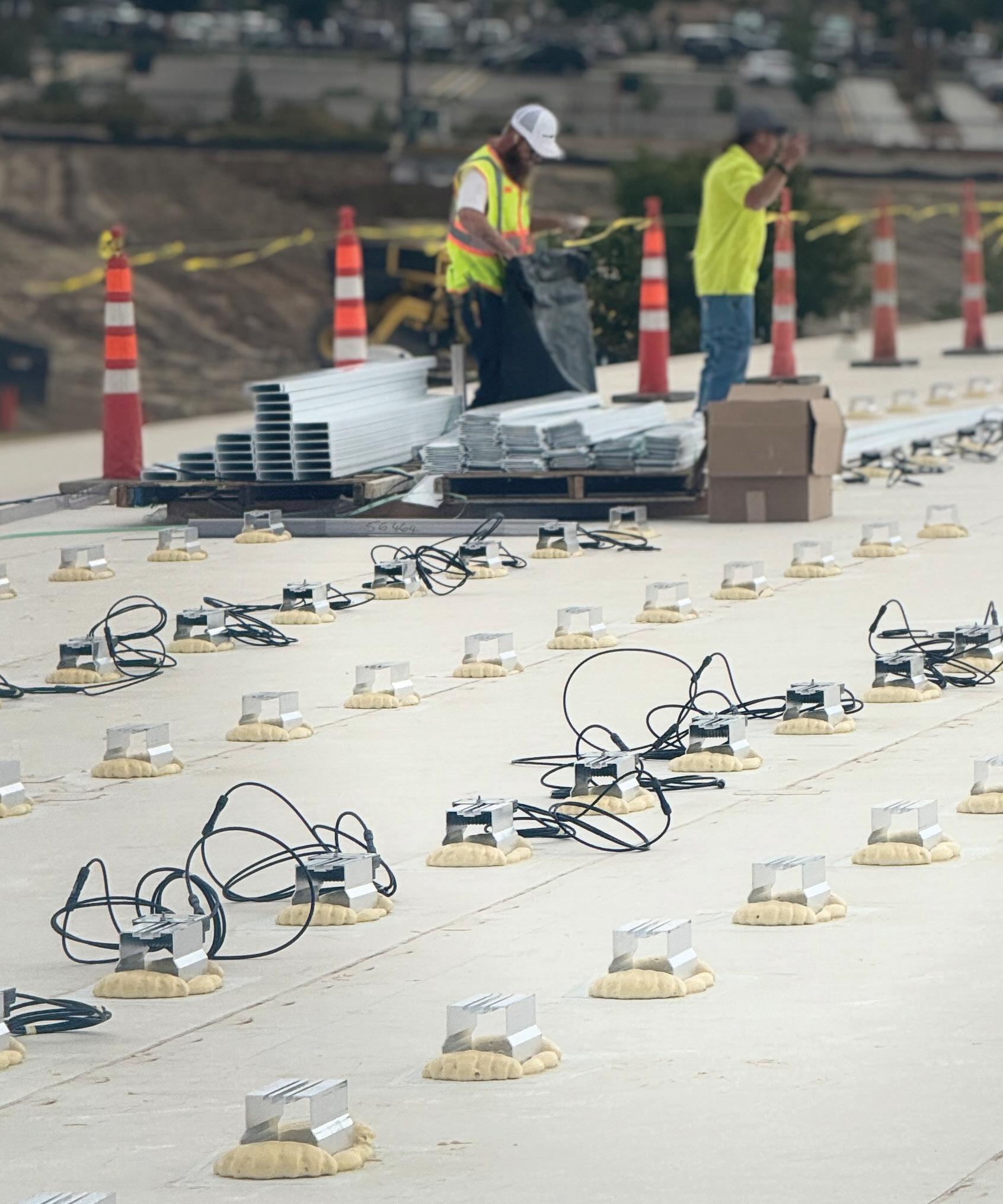
They’re installed by spraying SPF “patties” onto the roof and pressing the mount into the foam until it’s flush with the roof surface. As the foam cures, the mount rises about half-an-inch from the roof. If it’s installed incorrectly, a SolarStack can be removed using something like a masonry trowel.
SolarStack uses spray polyurethane foam to secure mounts. SolarStack
SolarStack
SolarStack received a Florida Product Approval and was the second solar racking company to earn a Notice of Acceptance from Miami-Dade County — one of the most stringent building code authorities in the United States.
“If you can do it here, you can certainly do it anywhere else,” Mitchum said. “But that’s just on paper. We really received confidence in our product when we had these back-to-back hurricanes that slammed Florida. We had systems that were hit by 170-mph winds.”
Compared to driving lag bolts into the roof or placing ballast blocks, SPF does have some quirks. Once the SPF spray canisters are activated, the foam can cure in the nozzle if it isn’t used at least every 60 seconds, and the canisters must be emptied within 30 days. Any SPF exposed outside the mount must be covered in a painted UV-rated protectant.
The foam must also be kept at an internal temperature between 70° and 90°F. But SolarStack has adopted another foam that can be applied in temperatures at least above 32°F.
“Contractors have jobs where they couldn’t do ballast. That’s where SolarStack is a great solution,” Mitchum said. “Now they can go back to those jobs where they couldn’t sell solar — they couldn’t put that dead load of ballast on the roof. It’s a solution — you just have to try it. If you try it, then you’ll see it actually has the strength we’re talking about.”
Mounting by matching the roof
In the mid-to-late 2000s, southern California solar contractor PermaCity
kept encountering roadblocks to getting permits for commercial projects. The permitting authority pushed back against ballasted projects, and taller stanchion mounting products were costly.
To work around this, PermaCity invented a solar racking and mounting system that uses material significantly lighter than ballasts: roofing membrane. SolarStrap is an International Code Council-listed and FM-approved mounting and racking solution that in certain cases can be installed without penetrating a commercial rooftop.
Casey Smith, president and CEO of SolarStrap, said about 80% of these projects do require penetrations but don’t pierce the final roof membrane. Any penetrations with SolarStrap are made by certified roofers.
“Our system is working within the roof warranty,” Smith said. “A lot of what we do with our points that attach to the roof are done with roofing details, working with certified roofers. Our big play is keeping that warranty.”
A certified roofer drives screws into the joist below. They heat weld an 11-in. circle of single-ply roofing over those screws to prevent any leaks. The roofing membrane is reinforced back to
SolarStrap
the original equipment manufacturer's status, and attachments technically don’t penetrate the final layer of roof. In reroof or new-build projects, no penetrations are necessary.
The racking foundation — or the "strap" — is a flat aluminum piece lined with additional roofing material that is also heat bonded to the roof. Then there's another 5-by-8-in. rectangle of roofing membrane that is welded over that original circular cap.
"That acts as a sacrificial piece of membrane,” Smith said. “If something happens, it would happen to our piece of roof, not theirs."
Then two upright standoffs are attached to the strap, and modules and power electronics can be installed from there. The total system weight — being lighter than ballasts — has made it a solution for building rooftop solar on historic buildings, Smith said.
Non-penetrative and non-ballasted mounting products like SolarStack and SolarStrap might use uncommon methods for securing PV to rooftops, but they reduce the risk of leaks and the downward strain of placing concrete blocks. And installers will have an easier time getting them to the roof. SPW
SolarStrap
SolarStrap racking is secured to commercial roofs through heat welding.
KELLY PICKEREL • EDITOR IN CHIEF
American-made FranklinWH Energy Storage keeps manufacturing local
SPW tours FranklinWH residential battery facilities in California.
WHILE ROOFTOP SOLAR panels make a visible statement that a homeowner is an environmental steward and interested in improving utility consumption, residential energy storage systems provide real control. And that's what residential battery brand FranklinWH aims to do — offer a suite of products that give households more control of their energy usage. The "WH" in the company name stands for "whole home," and CEO Gary Lam said helping homes with their energy usage starts with energy storage. The flagship aPower system can store power from multiple sources, has a 15-year warranty and supports the company motto of "Energy Freedom."
"There are a lot of phrases out there about energy — like resiliency and independence," Lam said. "If you guarantee your energy, that's resiliency. Energy independence is generating your own energy. When you get to energy freedom, you have everything. Our systems are not controlling your energy consumption. You can use any source without worrying about how much it costs. We are providing the ultimate energy freedom to people."
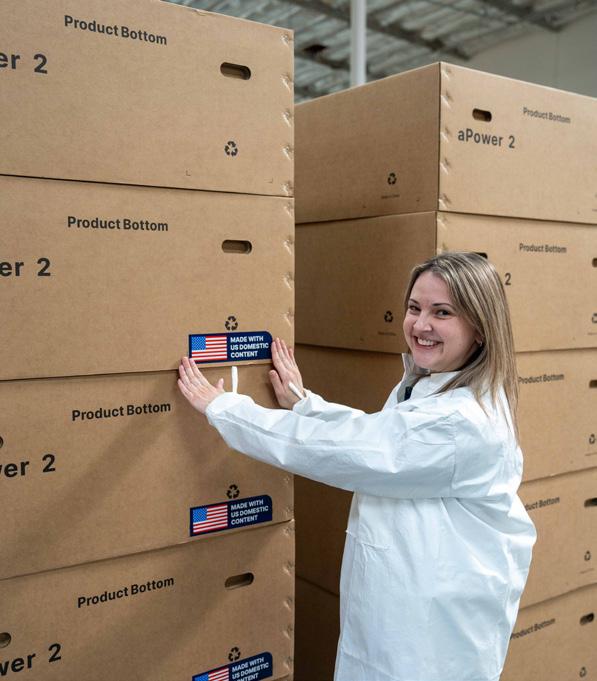
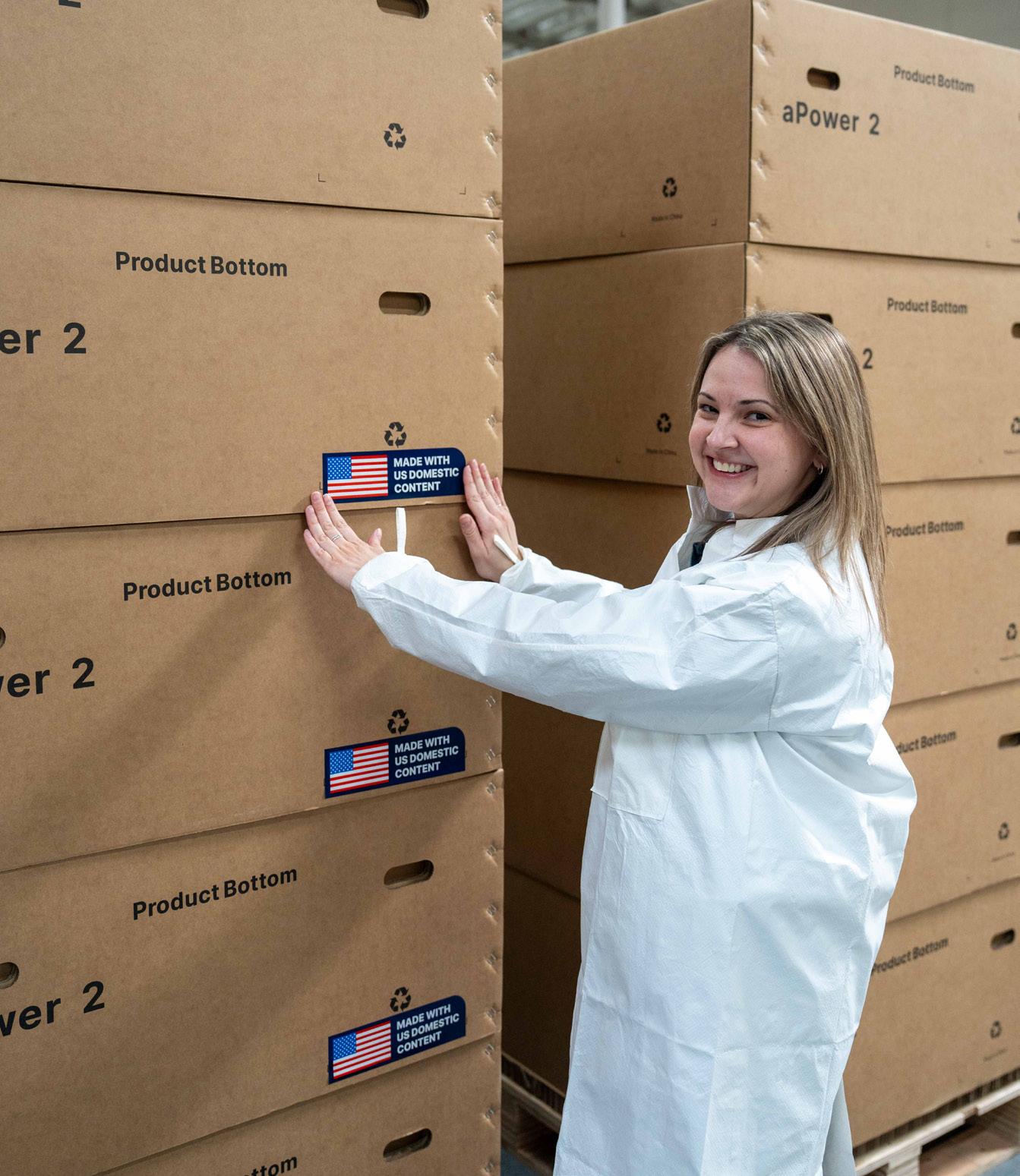
Also important to FranklinWH is the "Made in USA" distinction of its energy storage systems. Solar Power World toured two FranklinWH production
sites in California and saw how local manufacturing also contributes to the energy freedom tagline.
Silicon Valley-designed and -made
It's difficult to remember a time before FranklinWH was a major presence in the U.S. residential energy storage market. It’s the third-most quoted battery brand today on EnergySage — behind only Tesla and Enphase — and a young, pandemicera company, officially forming in 2019 before making its debut at Intersolar North America in January 2022. FranklinWH was quickly added to approved vendor lists
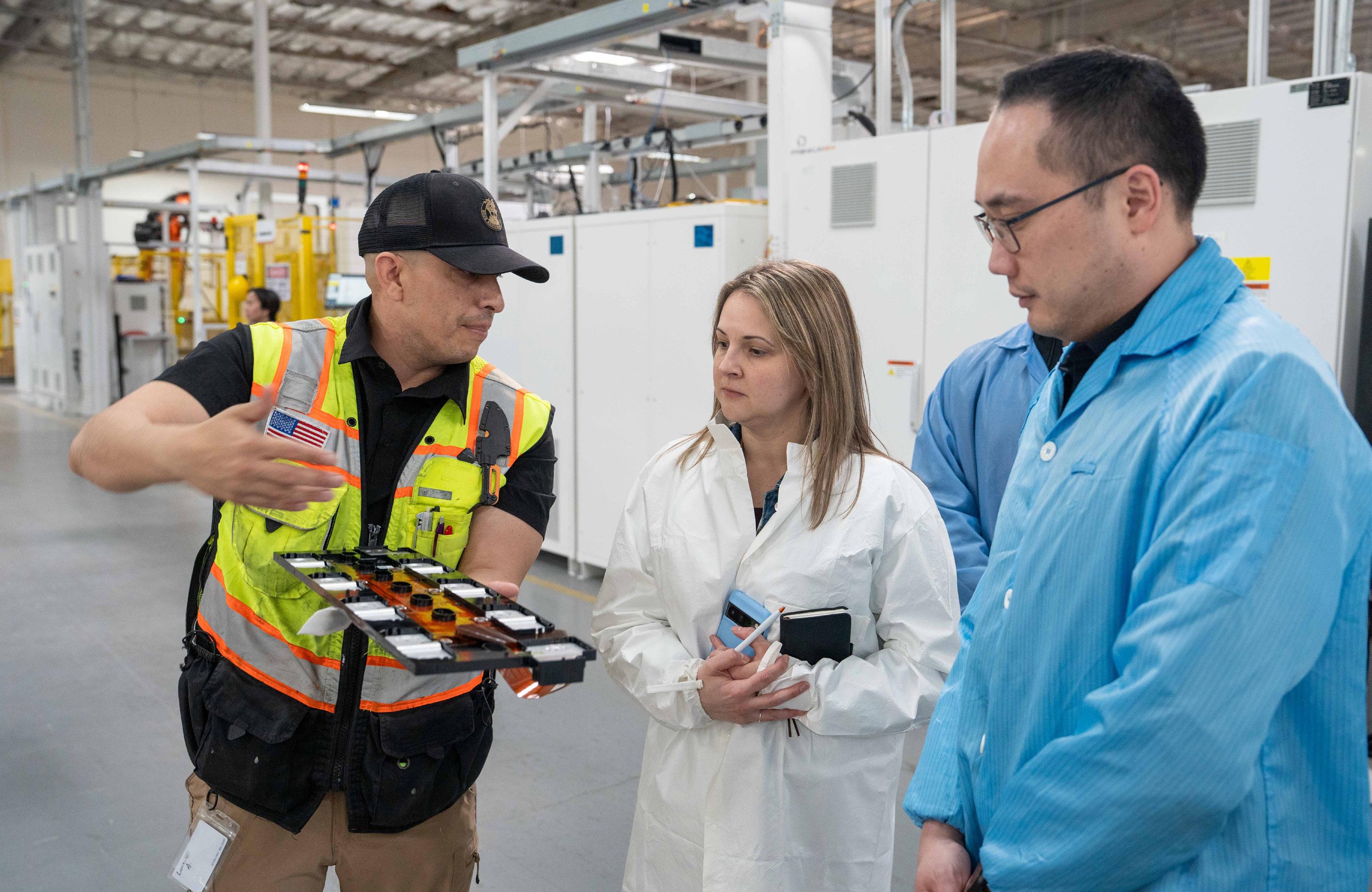
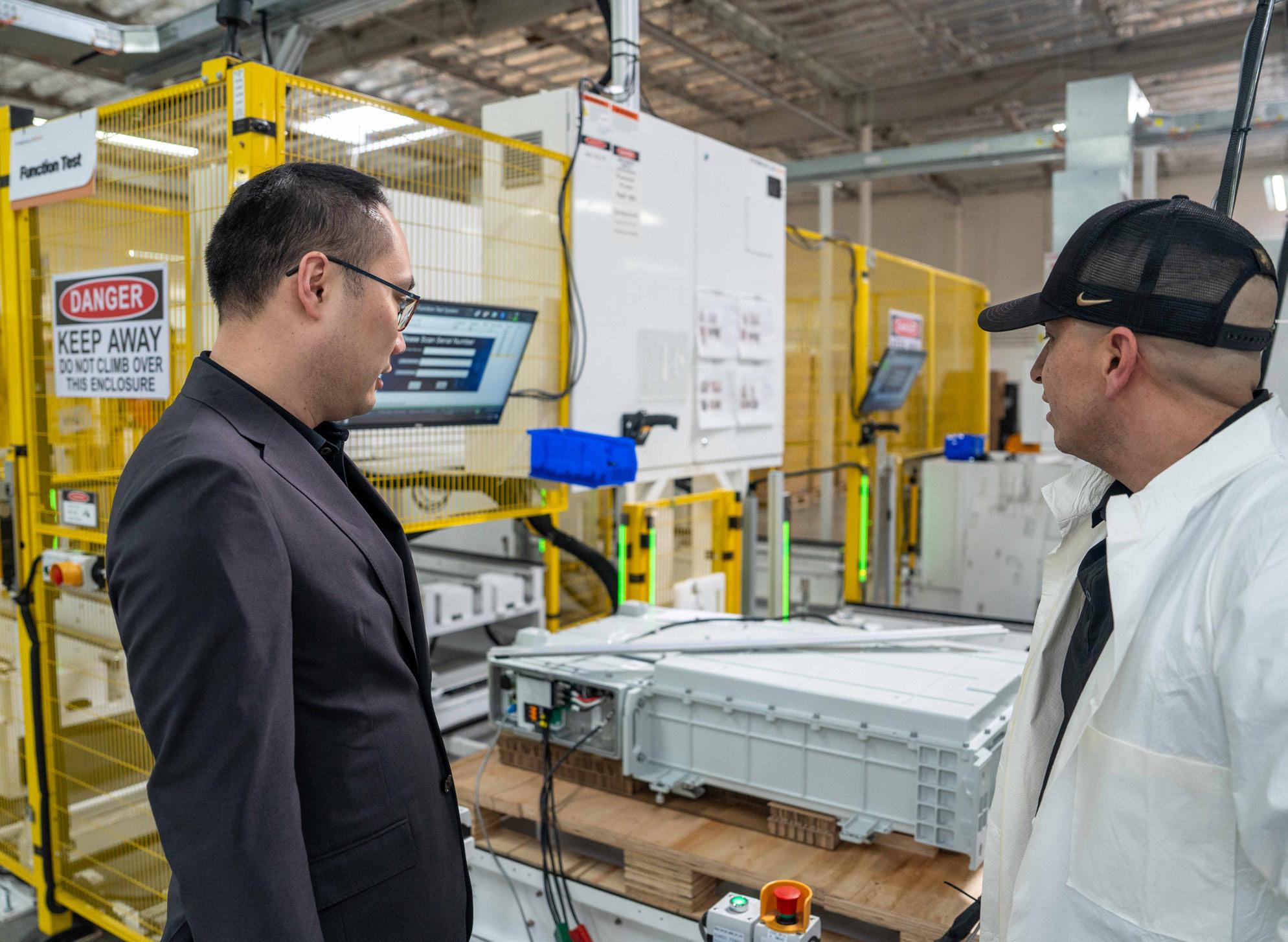
SPW editor Kelly Pickerel examines lithium battery cells with FranklinWH CEO Gary Lam at the company's factory in Santa Clara, California. FranklinWH
and onboarded 1,000 U.S. contractors to its certified installer program within one year. By the end of year two, FranklinWH was eighth in the United States for battery installation count.
"We started the company and then went into a global pandemic," Lam said. "We got locked at home and worked remotely for almost two years, but we still managed to deliver products in the United States."
During the company's startup, Lam and his team engaged with a Silicon Valley-based electronics manufacturer and a power electronics company that made advanced hybrid inverters. FranklinWH wanted to start manufacturing in the United States as soon as possible.
"We got permits [to start manufacturing in California] in late
American-made aPower 2 residential energy storage systems ready for shipping.
FranklinWH
The Santa Clara facility handles cell packaging and full product assembly, circuit boards are made just up the road in Milpitas and the battery enclosure itself is diecast in Oklahoma.
2024 and production started in April 2025 — within five months," Lam said. "Five months is record-breaking on anything, right? Thanks to our strategy of working with an experienced thirdparty contractor — they've been in the industry for over 20 years, focused on semiconductor processes and manufacturing — we did it."
FranklinWH currently can make 30,000 aPower batteries annually at its facility in Santa Clara. This year, the site's annual capacity is expanding to 120,000 FranklinWH units. If they’re running 24/7, 365 days a year, that is around 14 batteries bound for U.S. households coming off the lines every hour.
And nearly every component in aPower S and aPower 2 residential storage systems is made in the United States.
Solar Power World was able to tour both California facilities and view residential battery systems in all stages of development. It was surprising to see the home battery circuit boards being printed alongside products for Intel, Microsoft and Google. What was an even bigger surprise was watching robotic arms package eight sturdy, rectangular battery cells into one unit. Up to this point, I had only seen pouch-based cells on assembly lines at LG Energy Solution's plant in Michigan. FranklinWH uses largescale prismatic LFP cells in its compact residential systems, a product choice that was molded by supply chain interruptions early in the pandemic.
"We were the first in the industry to use utility-grade LFP prismatic cells. It does pose a challenge: the bigger the cell, the harder to design it into the system," Lam said. "When we started the company, no one could source anything. We used utility-grade cells. But then we realized there is an additional benefit. Quality is more consistent because [the
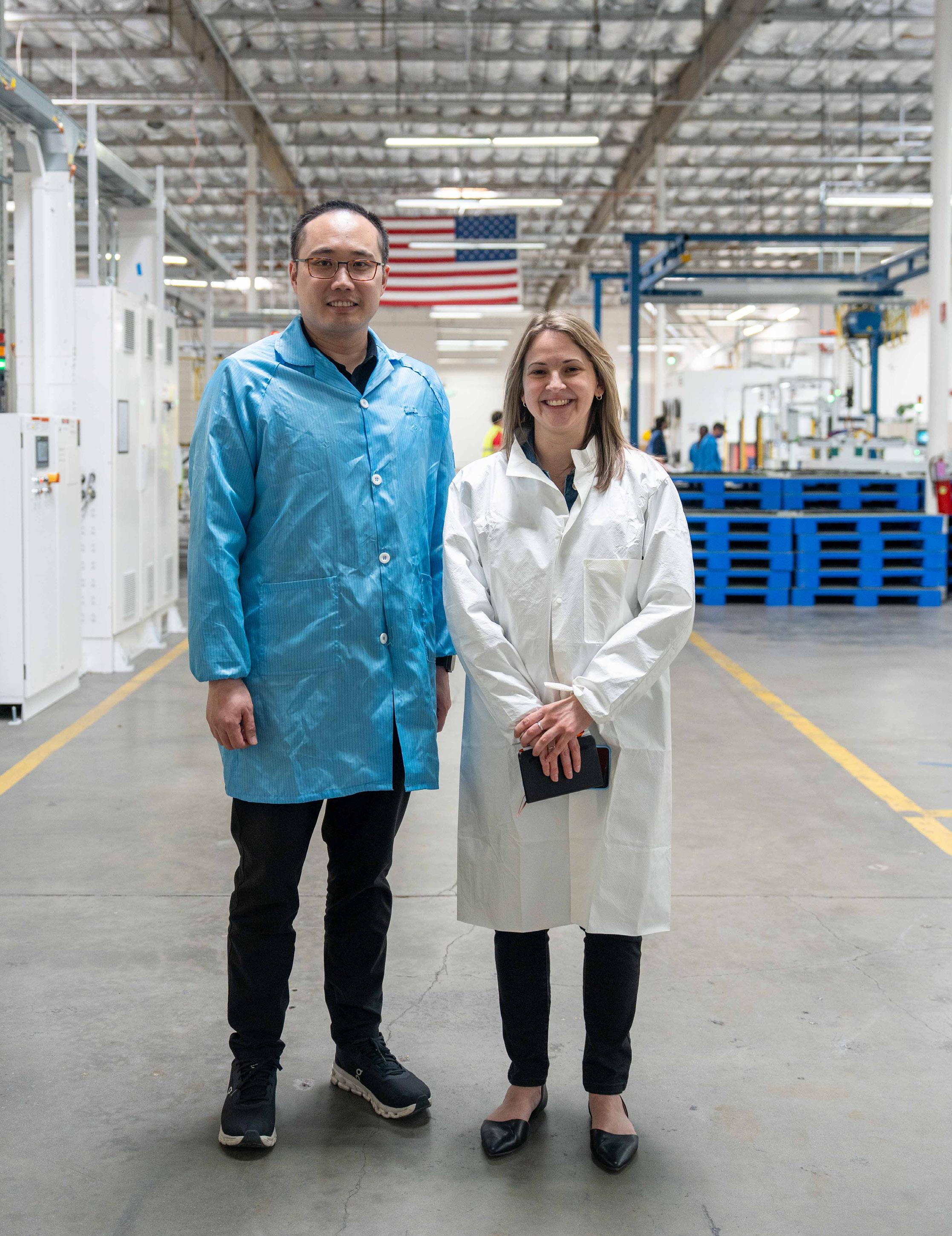
FranklinWH CEO Gary Lam and SPW editor Kelly Pickerel. FranklinWH
cell manufacturers] are running 24/7 and supplying all major car manufacturers and utility projects. These cells have been tested millions of times."
By using more readily available utility-scale cells, FranklinWH was able to leapfrog battery competition in the United States while waiting for residential-focused supply. The company has stuck to using the larger battery cells, packaging them at the start of the line in Santa Clara before they're assembled into the Oklahomamade aluminum enclosures and outfitted with circuit boards.
Customer confidence
While the Santa Clara site is under expansion, personnel are still striving for higher efficiency. R&D is a special focus for FranklinWH, and installer feedback is taken seriously. During Solar Power World's visit, a California installer joined the tour and suggested alternate knockout locations for easier installation, something that FranklinWH is open to updating.
Agrivoltaics
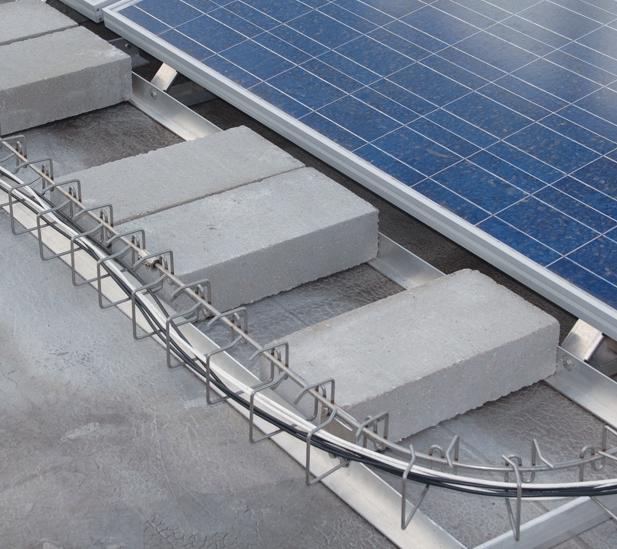
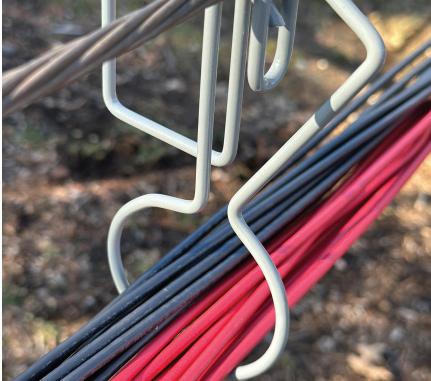
CAB® Solar’s Agrivoltaics 3D locking arms wrap around the messenger wire at three points, securing electrical cables inside the hangers, and allowing livestock herds to move and graze safely within any
FranklinWH CEO Gary Lam checks out assembled battery enclosures at the company's California facility. FranklinWH
Storage Technology
The result is a low failure rate for FranklinWH systems. While most companies aim to keep their return merchandise authorization (RMA) rate below 5%, Lam said FranklinWH's sits at less than 0.15%.
“From day one, we’ve built FranklinWH around listening to our installers in the field. Their feedback directly shapes how we design and refine our systems,” he said. “That close collaboration, combined with our focus on R&D and manufacturing quality, is what allows us to deliver a product with such a low failure rate. It’s something we take a lot of pride in, because it ultimately means a better, more reliable experience for homeowners.”
That success is because the company focuses on real-world installation efforts, understands today’s market demands and forecasts design trends. While a 13.5-kWh system became the unofficial standard earlier this decade, FranklinWH increased its aPower 2 battery to 15 kWh
to better meet household demand with fewer units. The company's expansion module, aHub, lets batteries integrate with multiple energy sources, including EVs and generators. These additions make FranklinWH a popular choice among installers.
“From our perspective, the system has to work the way installers expect it to in the field,” Lam said. “Too often, what should be a simple final step turns into hours on-site dealing with updates or small issues. We’ve put a lot of focus on removing that friction. Our commissioning process takes about 15 minutes, and that comes down to getting the details right up front. Those details are what make the difference day to day.”
FranklinWH's future is the
United States
Lam said that even with this year's expected drop in residential solar sales, he remains bullish on home battery adoption.
"We see the storage attachment rate nationwide increasing. We are forecasting about 40% attachment rate," he said. "That's doubling, if not tripling, last year's number."
That's why the Santa Clara facility is growing — so FranklinWH can meet the demand of its favored market. Despite company plans to expand into new international markets, including Japan and Australia, manufacturing will stay in the United States, Lam said.
"What benefits us is our product access to the market," he said. "Today, the moment our systems roll off our California production line, they can be installed within weeks. And we can immediately incorporate customer and installer feedback. We're able to shorten our development time, ultimately improving the installer and customer experience."
FranklinWH proves there is still value in supporting the U.S. solar and storage market with domestic products, providing homeowners with real energy freedom. SPW
FROM DESIGN TO OPERATION: EXPERTISE THAT DELIVERS MORE
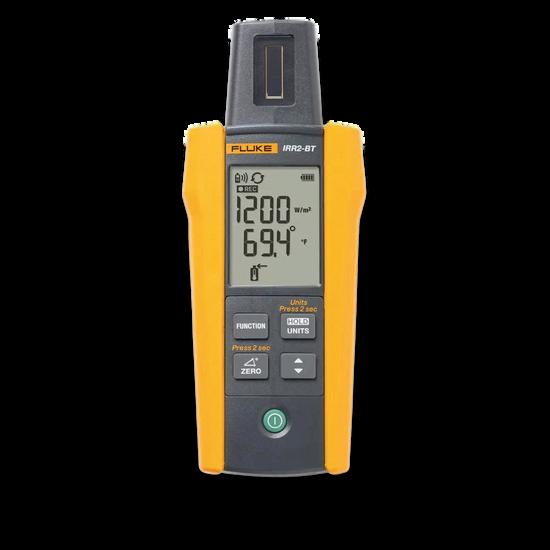
Downtime Costs Thousands. Find Ground Faults in Minutes.
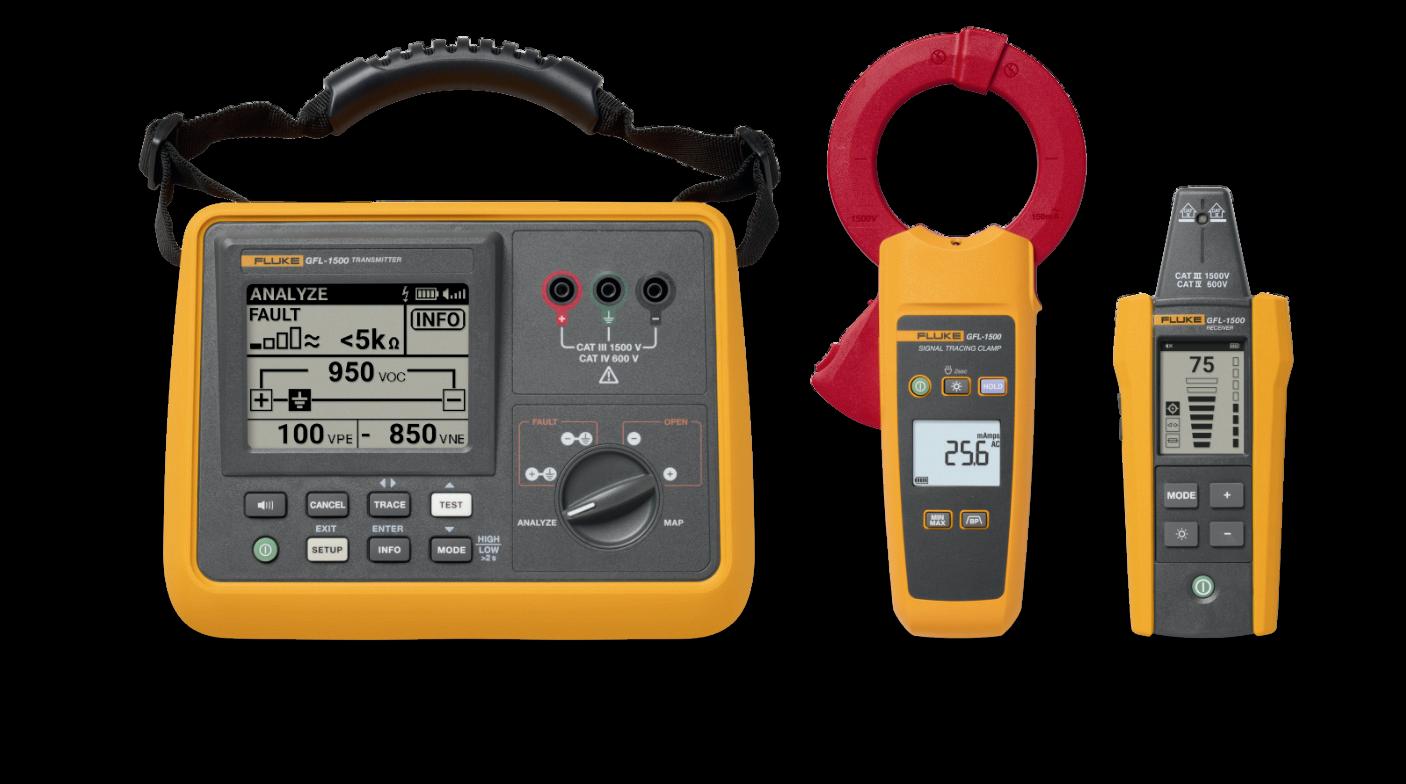
The Fluke GFL-1500 Solar Ground Fault Locator
Meet the Fluke GFL-1500 Ground Fault Locator Fast, Safe, and Built for 1500 V Systems
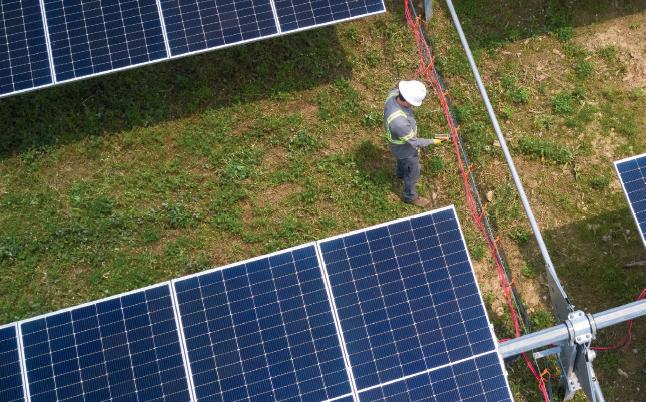
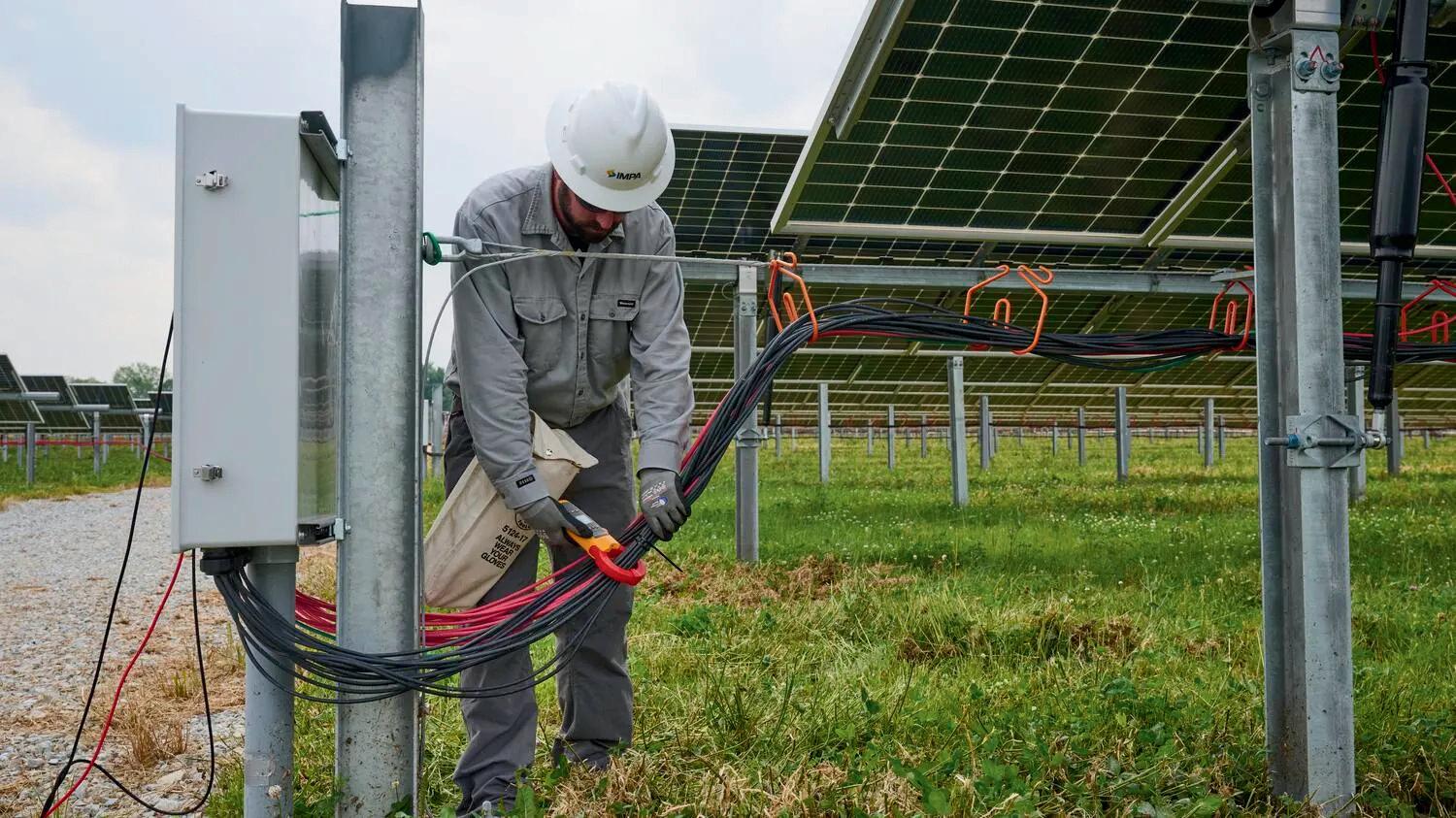
Every minute offline costs you. The Fluke GFL-1500 FaultTrack™ Technology, sends a traceable signal straight to the fault. No guesswork, fewer disconnects, and faster fixes. Don’t Guess. Trace It.
Pinpoint faults fast with non-contact tracing Work safer with fewer disconnects Restore production with confidence Scan
Fluke PV Solar Testing Solutions
The underground threat to solar reliability
Wayne J. Chatterton Services Solutions Sales VP Southwire
BENEATH ALMOST EVERY solar field, out of sight and often out of mind, lies a network of underground cables whose unexpected failures have become one of the industry’s most pressing reliability challenges. Unlike cables in a typical utility that operate at 25% rated load, renewable energy feeder cables typically operate at 90 to 110% load. These “feeder” cables take the energy from the solar field and transmit it to the local utility provider’s grid. The power is then mixed with other power sources and keeps the entire electrical grid operating at peak performance.
The safe and reliable operation of cables feeding the grid from a solar field is critical. No one wants to generate power only to lose it in the cable field. The anticipated life of renewable feeder cables is approximately 40 years, but, realistically, cable lifespans have been failing much sooner. This leaves grid owners wondering what can be done to extend cable life.
Renewable feeders run near their limits
Underground cables spend much of their existence in water due to the natural water in the ground. The temperature of the earth 6 ft down is 54°F with 100% humidity. This natural water bath provides sufficient water for the cable to absorb moisture into the insulation.
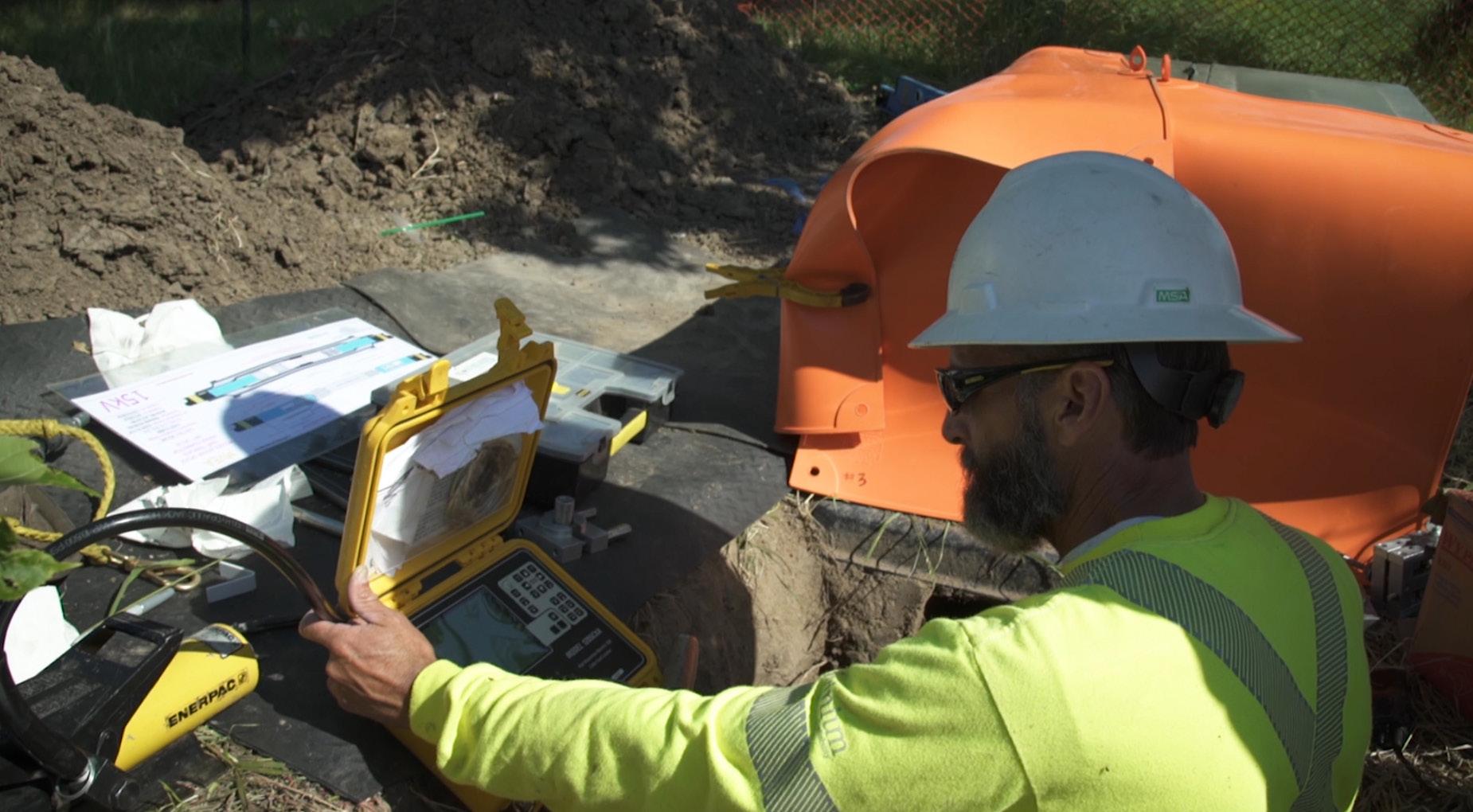
Silicone cable rejuvenation restores the strength of the cable insulation and extends the life by many years.
Southwire
Water diffuses into the cable and slowly degrades the insulation. The insulation of the underground cable prevents electrons from escaping the conductor and being lost to the ground. This water diffusion ages the cable more quickly than if it were in a dry environment. Once electrons are lost to the ground, the cable can catastrophically fail much quicker. The double whammy of a higher load on the cable (making the cable warmer) and the presence of moisture in the insulation causes premature cable failure.
A simple way to restore performance Despite all the potential damage that can happen to these cables, there is something solar project owners can do to protect and extend the life of their cables. Silicone cable rejuvenation restores the strength of the insulation, dries out the cable and extends the life by many years.
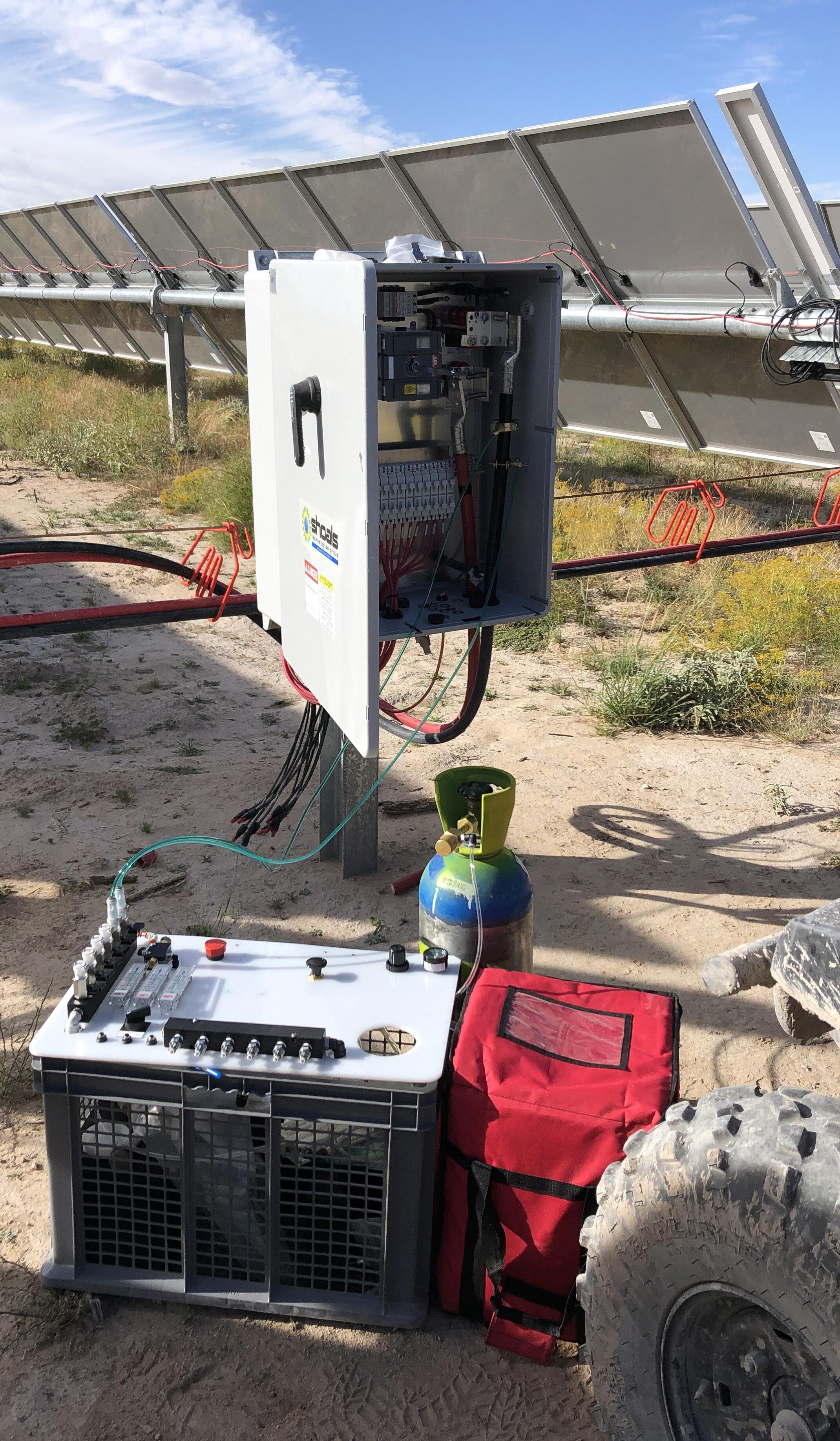
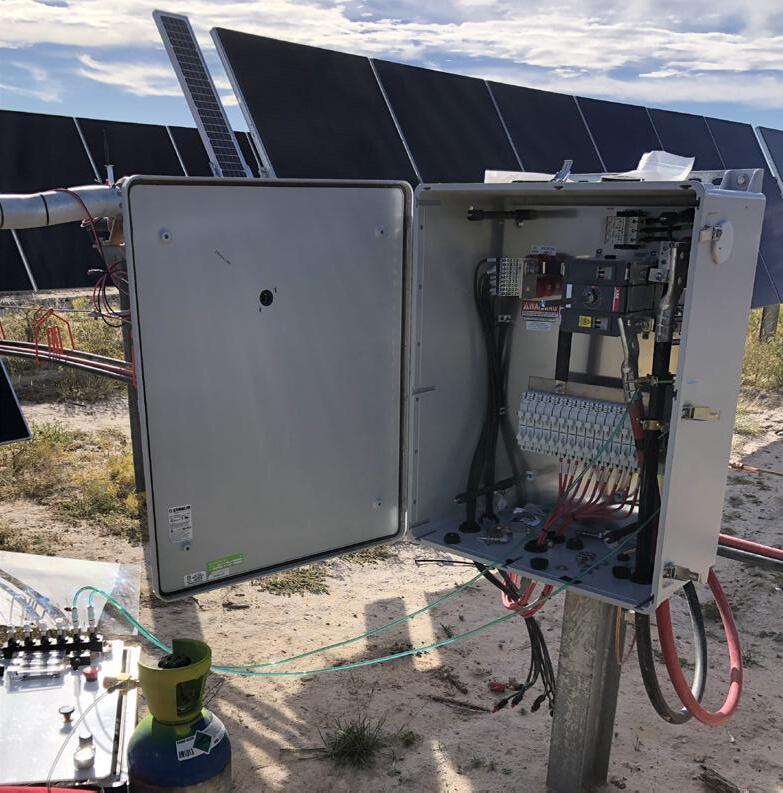
The process is simple — the cable is isolated and de-energized, and special connectors are attached. Silicone fluid is then passed through the conductor. This fluid will diffuse into the insulation and chemically remove the water and patch any voids in the insulation. This restores
the strength of the insulation to like-new or better. Once the process is complete, the cable can easily be expected to last the entire life of the solar field.
A failure on a cable in the field could result in days or weeks of downtime while patching the failure site or waiting for a replacement cable. The entire rejuvenation process can be completed in a few hours, making it between six- and 12-times faster than cable replacement and an optimal choice for cable reliability, Southwire has determined.
Additionally, the process of silicone rejuvenation is economically and environmentally advantageous. Typically, it is significantly less than half the cost to rejuvenate a cable versus replacing the same cable. The impact on the environment is also significant, with rejuvenated cable having a 99.9% better carbon footprint than cable replacement.
Timing matters, evaluate early It is recommended to look at the cables in solar fields as early as five years after installation. This is when the groundwater fills the insulation and starts to weaken the cable’s strength and shorten its life.
Southwire has found that some solar cables that have not been treated to remove water have failed in as little as 10 years.
Early inspection can save a cable before it fails. Early cable failures lead to an unreliable feed system and will eventually need to be replaced or repaired (spliced) with silicone injection to restore its strength. Additionally, it’s imperative that any cable failure be rejuvenated, repaired or replaced as soon as possible. If not fixed right away, the initial failure can lead to other failures on the system due to the similarity of the other surrounding cables and the environment they are in.
The entire purpose of the solar array is to keep feeder cables at peak performance and fully energized. Obviously, it makes sense to keep the cables performing as long as the field is economically viable. For more than 35 years, utilities, industrial complexes and renewable energy fields have been using silicone rejuvenation on electrical cables. With the demand for electricity increasing every year, rejuvenation is a logical and easy solution to extend cable life rather than opting for a full replacement. SPW
It is recommended to look at solar cables as early as five years after installation. Southwire
AI and robotic services enable a new standard for operational efficiency and lower LCOE across the project lifecycle.
Nextpower
Five ways robotic services are changing solar project performance
AS SOLAR PORTFOLIOS scale, improving performance is becoming a more actionable opportunity.
Recent data from Raptor Maps shows that equipment-driven losses across solar assets have increased from roughly 1-2% to more than 5% over the past five years, underscoring how much performance is influenced by distributed, system-level issues across the plant. These are often smaller conditions that can be difficult to detect and even harder to act on quickly.
This points to a clear opportunity: expanding both the physical operating data available across the plant and the ability to translate that data into timely, economically meaningful action.
AI and robotic services are beginning to make that possible. By extending visibility into previously inaccessible parts of the plant and connecting those insights to faster decision-making, these technologies help O&M teams and asset owners establish a new standard for plant performance defined by continuous awareness, proactive intervention and improved risk-adjusted outcomes.
Here are five ways AI and robotic services are enabling a new standard for operational efficiency and helping to lower levelized cost of energy (LCOE) across the project lifecycle.
1. Pre-commissioning component inspection
Many performance gaps originate before a plant is even commissioned. The DC balance of system — connectors, wiring, fuses — is widely recognized as a common point of failure. HelioVolta’s SolarGrade PV health report, based on field inspections across hundreds of solar projects in both construction and operation, finds that wiring and connector issues are present in over 80% of projects inspected. These risks are widespread and often undetected.
Detecting these issues at a gigawattscale is even more difficult. Aerial inspections miss components underneath the array; manual inspections are challenging at scale, and are also literally difficult to perform as components are often obscured.
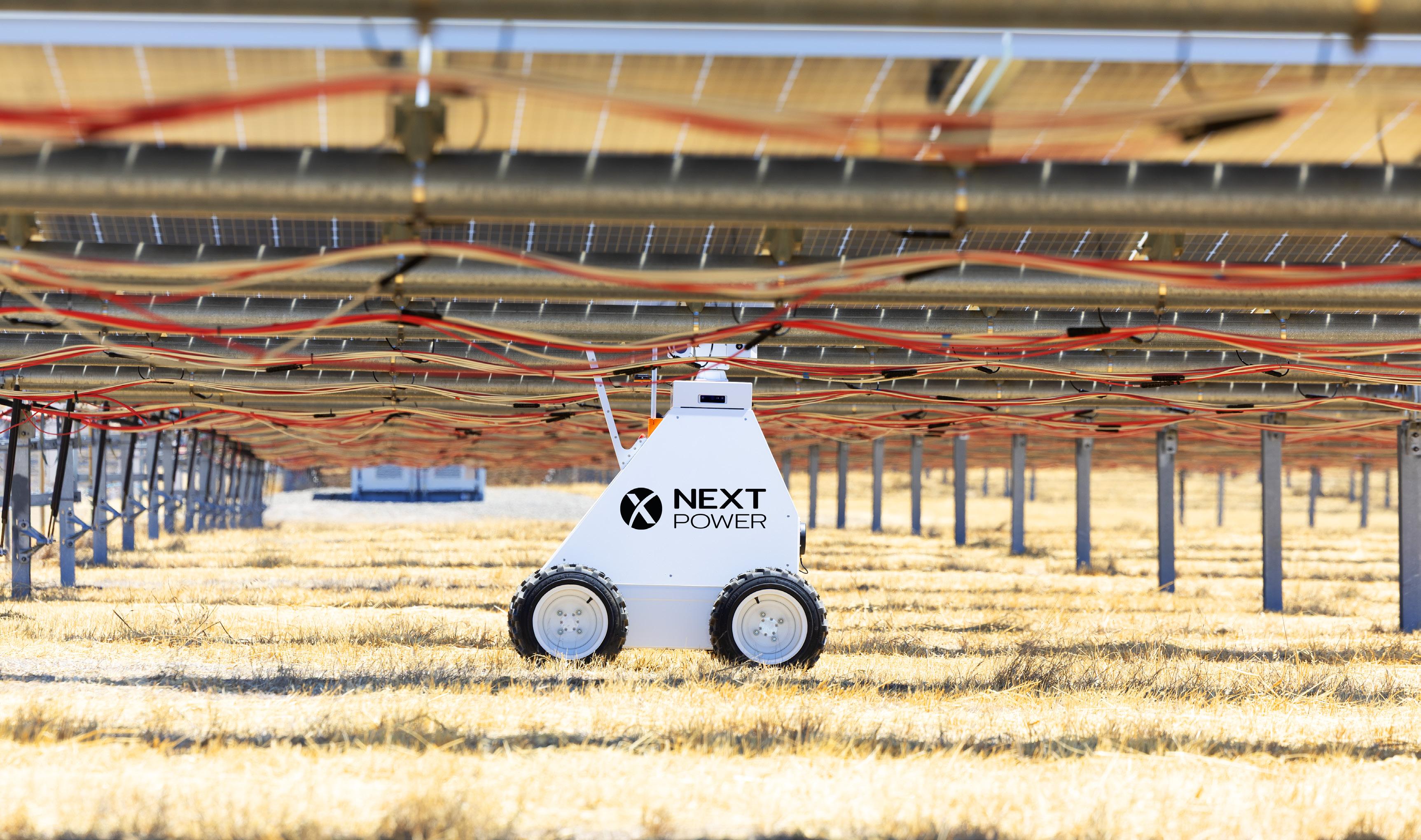
In addition, a recent analysis of more than 2 GW of utility-scale inspections performed by Nextpower’s NX Ranger robot highlights a limitation of traditional thermal inspection. The data showed that 79% of high-risk connector and fuse issues — cracked housings, improper connections, insulation degradation, partial disconnections — exhibited no thermal signature at the time of inspection.
Ground-based robots like the Ranger equipped with thermal and optical cameras address this gap by inspecting beneath the array and capturing highresolution data at the component level — providing precisely geo-tagged visibility where traditional methods fall short. This solution can be deployed at scale prior to commissioning for a thorough QA/QC audit.
2. Early and autonomous fire risk detection
The solar industry has already demonstrated how improved visibility and automation can reduce risk when it comes
Francesco Borrelli • Chief AI and Robotics Officer • Nextpower
to extreme weather. Advances in weather forecasting and automated tracker controls have significantly mitigated hail exposure, with insurers beginning to recognize these improvements.
In 2025 alone, post-event surveys from customers showed that Nextpower tracker systems executed more than 2,000 hail stows worldwide, with less than 0.007% module breakage reported.
The next frontier in risk reduction is fire — the second-largest loss-driver on utility-scale solar projects by gross claims in North America, according to Axis Capital. kWh Analytics says fire accounts for approximately 20% of losses both by dollar amount and by count. Further, kWh Analytics research shows that over 80% of solar fires originate on site, with PV equipment as the primary ignition source. Wiring or connectors have been identified as the cause of the fire in 3% of those cases, but an additional 27% are still attributed to unknown causes, suggesting underlying issues are not being detected early enough.
Regardless of origin, advances in imaging and AI are enabling operators to detect early indicators such as smoke, heat anomalies and even environmental factors like vegetation growth that can contribute to fire risk.
By identifying these conditions earlier, operators can intervene before issues escalate into major events, reducing both operational and financial exposure.
3. Moving quicker from detection to diagnosis
Traditional inspection methods often separate detection from diagnosis.
Aerial inspections are effective at identifying anomalies, but those alerts typically require a second step — sending technicians into the field to investigate further. This delay can leave issues unresolved for extended periods.
Robotic services compress this process. By combining consistent imaging with AI-driven analysis, they move beyond identifying that something is wrong to diagnosing what is wrong and where.
Findings are precisely localized, contextualized and translated into actionable outputs, often including prioritized work orders and repair guidance. This enables operators to move directly from detection to decision to action.
4. Optimizing the economics of panel cleaning
Not all performance losses are tied to discrete failures. Some are gradual, variable and difficult to quantify, none more so than soiling. According to the IEA PVPS, soiling accounts for 4-7% of global energy loss.
Soiling accumulates unevenly, responds inconsistently to weather and varies with local conditions such as dust, pollen, and agricultural activity. For years, soiling has been managed indirectly through fixed cleaning schedules or reactive decisions. That approach worked when portfolios were smaller and margins were more forgiving. It is far less effective today.
Without direct measurement, operators are left interpreting signals that were never designed to quantify loss. Cleaning may occur too early, increasing O&M costs without meaningful gain, or cleaning may happen too late, allowing energy losses to accumulate.
Sensor-based approaches close this gap by directly measuring the impact of soiling under real operating conditions. By comparing clean and soiled reference performance, operators can quantify energy loss in real time and make cleaning decisions based on actual conditions.
This transforms cleaning from a scheduled task into an economic decision: does the value of recovered energy exceed the cost of action? That analysis connects directly to action, with real-time soiling data enabling the deployment of robotic cleaning systems at the optimal moment.
5. Integrating data into a
living digital twin
Beyond improving O&M efficiency, all this real-time data introduces a new level of visibility, verification and assurance.
The next step-change will be integrating these inspection, monitoring and performance data streams into a unified digital twin — a living, highfidelity replica of the entire power plant. Here, every component, from trackers to connectors to autonomous robots, exists as a uniquely tracked digital entity and is visualized in a 3D map-based model of the entire solar site.
This intelligence layer transforms individual data points into a connected, self-aware power plant that enables all stakeholders, including owners and operators, to have unprecedented visibility into plant operations.
Setting new standards
Solar is increasingly defined by riskadjusted LCOE, and the ability to reduce uncertainty is becoming a competitive advantage. By extending visibility into previously inaccessible parts of the plant — and translating that visibility into action with verifiable results — AI and robotic services are establishing a new standard for how solar assets are monitored, verified and optimized over their lifecycle.
This shift reduces uncertainty, improves planning and gives asset managers greater confidence that their plants are operating as expected. SPW
Not all performance losses are tied to major failures. Sensor-based approaches can track issues that gradually impact operations.
America take note: O&M lessons from Australia
Jack Somers SeniorEngineering and Commissioning manager
PCL Construction
As utility-scale solar expands rapidly across the United States, operators are encountering environmental and operational challenges that mirror those faced in Australia’s solar market. From fire risk and extreme heat to vegetation growth and equipment reliability, postconstruction performance has become as critical as the build itself.
In Australia, the utility-scale solar industry has a common post-construction norm: a two-year defects liability period (DLP). During this time, the engineering, procurement and construction (EPC) provider is responsible for the operations and maintenance (O&M) of the solar project, generally at the point of practical completion, more commonly referred to as substantial completion in North America. This standard is market-driven rather than legislatively enforced. Most lenders
and investors expect a 24-month DLP within EPC project contracts. DLPs usually define specific post‑construction responsibilities that the EPC retains after completion. This adds ongoing obligations for EPC contractors to maintain, monitor, study and repair the site.
In practice, the extended DLP model shifts focus from reacting to failures toward actively protecting long-term asset performance. For owners, it reduces early-life performance risk. For EPCs, it creates earlier visibility into design or installation issues that would otherwise surface after warranties expire. The DLP norm in Australia stands in stark contrast to most EPC contracts in the United States, where a one-year correction period after substantial completion typically relies on warranties, correction clauses and statutory law.
Although this may appear to add burden and risk, the approach offers a valuable opportunity to better manage the post-construction stage and ensure a smooth transition from construction to operations.
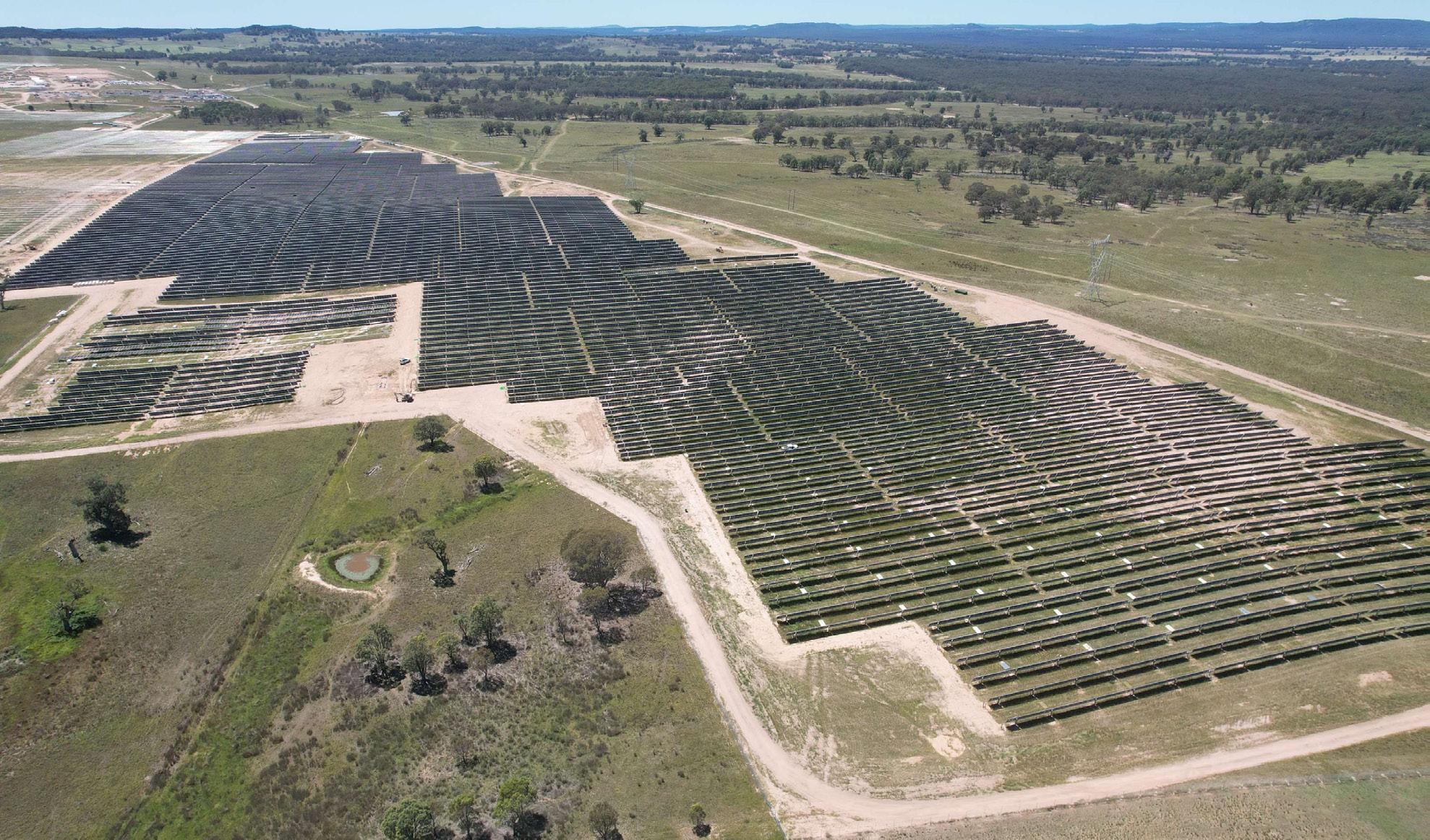
The solar and storage team at PCL Construction has completed three utilityscale projects totaling about 400 MWAC in Australia, and our approaches to O&M could be applied as solar power continues to develop across the United States.
Managing fire risk in high‑heat solar markets
The climate in Australia features long periods of dry heat interrupted by sudden heavy rainfalls, like patterns in southern U.S. states from Arizona to Georgia. Extreme heat presents challenges for solar generation.
Unsurprisingly, one of the greatest operational risks is fire. In our tropical climate, grass can grow up to 100 mm (4 in.) per week, creating a consistently high fuel load on site. Even mowing can pose a fire hazard, so care must be taken to avoid cutting dry grass on hot, windy days.
To mitigate this risk, operators are increasingly deploying AI driven fire and
The Gunnedah Solar Farm constructed by PCL in New South Wales, Australia. PCL
smoke detection systems that monitor entire sites. These systems detect thermal events early, allowing operations teams to act promptly and prevent small issues from becoming major problems.
Lesson for America: AI-driven monitoring and proactive vegetation management can help southern U.S. sites manage fire risk during long dry periods and highfuel-load seasons.
Wildlife management without compromising safety
Animals and wildlife can pose operational challenges. Grazing helps keep grass low and reduces fire risk, but animals can get caught in or chew on exposed cords, which presents its own hazards. Native species such as spiders and snakes remain a factor, though thankfully solar facilities are free from tree hazards — and no drop bears to worry about!
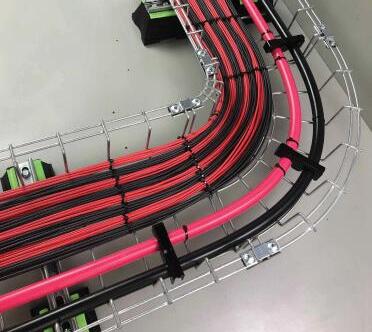
To address these challenges, effective cable management systems can be implemented to keep cords out of reach and protected from grazers. These measures allow operators to maintain healthy vegetation while keeping sites safe and operational.
Lesson for America: Cable protection and proactive wildlife management ensure that grazers and native animals do not disrupt operations, a strategy easily transferable to southern U.S. sites with similar wildlife or grazing programs.
Introducing condition‑based maintenance
When it comes to O&M, there are two main types of maintenance performed:
• Preventive maintenance – Planned and scheduled on a weekly, monthly or annual basis
• Corrective maintenance – Fixing broken or malfunctioning components
Condition‑based maintenance sits between these two approaches. For example, if an inverter runs 15°C (about 27°F) hotter than the others, it may not trigger an alarm. Rather than waiting for a fault condition, operators can study
component behavior and intervene before issues require corrective maintenance.
This approach is enabled by advanced analytics capabilities that go beyond on‑site, event‑ and alarm‑driven troubleshooting. By collecting site historian data at a granular level, operators can perform deeper root cause analysis, study performance trends and proactively develop predictive maintenance schedules for high‑risk components before issues occur.
In several cases, these insights allowed intervention weeks before a component failure would have triggered a forced outage. This approach helps maximize site production and reduce downtime.
In addition, strong supply chain management processes provide operators with more options for long lead time spare parts, helping further shorten site downtime.
Remote operations centers, or off site monitoring facilities, allow operators to act on subtle equipment insights and make more proactive, data driven decisions.
Lesson for America: As solar projects ramp up across hot-climate regions, condition-based maintenance and off-site monitoring can help operators detect emerging issues earlier, prioritize interventions more effectively and protect asset performance beyond the initial construction phase.
What proactive O&M looks like on the ground
The workday starts early with a full site inspection to check for damage, potential fire hazards or misaligned trackers. Managers assign preventative maintenance tasks, monitor the SCADA system and address issues as they arise. After construction, we monitor and manage our client’s facility to prevent problems before they occur. Just as a skilled mechanic keeps a car running smoothly, our operators ensure sites generate power with minimal intervention. While we are always improving, we continue to refine scheduling and operational efficiency.
Translating experience into solar success
Australia’s experience with utility scale solar O&M demonstrates the value of proactive maintenance, robust monitoring and adaptive approaches to environmental challenges. By applying these lessons in the United States, operators can build on existing solar momentum, enhance reliability and maximize energy production. From fire and wildlife management to condition based maintenance and off site monitoring, these practices offer practical insights that help U.S. projects run efficiently, safely and sustainably. We welcome collaboration with U.S. operators to adapt these practices locally and share ideas on best practices. SPW
The Stubbo Solar project completed by PCL in New South Wales, Australia. PCL
Build industry partnerships. Develop deals. Make critical face-to-face connections to move your business forward.