EVOLVING QUICK SERVICE FOR THE FUTURE NOV EMBER 2026 ⁄ NO. 3 4 5
®
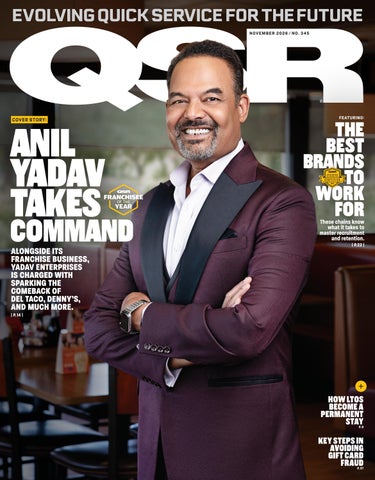
COVER STORY:
ANIL YADAV TAKES
COMMAND ALONGSIDE ITS FRANCHISE BUSINESS, YADAV ENTERPRISES IS CHARGED WITH SPARKING THE COMEBACK OF DEL TACO, DENNY’S, AND MUCH MORE.
FEATURING:
THE BEST BRANDS TO WORK FOR BEST BR AND TO WORK FOR
CERTIFIED 2026
These chains know what it takes to master recruitment and retention. | P. 22 |
| P. 14 |
+ HOW LTOS BECOME A PERMANENT STAY P. 9
KEY STEPS IN AVOIDING GIFT CARD FRAUD
P. 37
NOVEMBER TA BL E OF CON T EN T S / # 3 4 5
/ Best Brands to Work For Issue
2 WHAT’S HAPPENING AT QSR 4 EDITOR’S LETTER
7 BEHIND THE COUNTER 38 ADVERTISER INDEX
NEWS
35
FRANCHISE FORWARD
The Ownership Scoop
A TCBY operator and former employee describes her rise to franchisee leadership. BY BEN COLEY
37 OPER ATIONS
FE AT URE S
14
The Operator Takes the Wheel BYBEN COLEY
How Restaurant Gift Cards Fueled a Record-Breaking Fraud Ring Behind the scenes of a federal investigation into $20 million in stolen balances. BY SAM DANLEY
Anil Yadav, QSR magazine’s 2026 Franchisee of the Year, spent decades building one of the country’s largest restaurant operations. Now he’s bringing a franchisee mindset to the other side of the table.
INSIGHT
22
This California fast casual still believes in the dine-in experience. BY BEN COLEY
Best Brands to Work For 2026 BY QSR STAFF
This year’s group shows how companies are creating opportunities for employees to build lasting careers.
9 FRESH IDEAS
Playing for Keeps
Operators give insight on how some LTOs make their way to the permanent menu. BY SAM DANLEY
11 ONES TO WATCH
The Stand
12 WOMEN IN LEADERSHIP
Going Beyond the Title
Costa Coffee executive Beverley D’Cruz on how to lead by example. BY SATYNE DONER
40 S TART TO FINISH
Peter Busse
The Checkers and Rally’s chief development officer shares his varied experience in the restaurant industry.
ADOBE STOCK / MARA ZEMGALIETE
ON THE COVER
Anil Yadav operates one of the biggest franchisee organizations in the country. PHOTOGR APHY: YADAV ENTERPRISES / JENNIFER GR AHAM IMAGE EXTENDED BY QSR MAGAIZNE
QSR is a registered trademark of Arrowfly. QSR is copyright © 2026 Arrowfly. All rights reserved. The opinions of columnists are their own. Publication of their writing does not imply endorsement by Arrowfly. Subscriptions (919) 945-0704. www.qsrmagazine.com/subscribe. QSR is provided without charge upon request to individuals residing in the U.S. meeting subscription criteria as set forth by the publisher. AAM member. All rights reserved. No part of this magazine may be reproduced in any fashion without the express written consent of Arrowfly. QSR (ISSN 1093-7994), USPS PUBLICATION #20387 is published monthly by Arrowfly, 1111 Superior Avenue Suite 1120, Cleveland, OH 44114. Periodicals postage paid at Cleveland, OH and at additional mailing offices. POSTMASTER: Send address changes to Arrowfly, 1111 Superior Avenue Suite 1120, Cleveland, OH 44114.
www.qsrmagazine.com | QSR | NOVEMBER 2026
1
WHAT’S HAPPENING AT QSR EDITORIAL
V ICE PR ESIDENT EDITOR I A L FOOD, R E TA IL , & HOSPITA LIT Y
ADOBE STOCK / PHUSHUTTER
CONVERSATIONS AT QSR+
Danny Klein
dklein@arrowfly.com
QSR EDITOR
Restaurant leaders are talking about AI, dirty sodas, GLP-1s, and other pressing issues in our first operator community. Request your invite today to join the discussion. No vendors. No hard sells. All collaboration.
Ben Coley
bcoley@arrowfly.com
FSR EDITOR
Callie Evergreen
cevergreen@arrowfly.com
AS SOCI ATE EDITOR
Sam Danley
sdanley@arrowfly.com
SENIOR EDITOR , WIR L
Satyne Doner
sdoner@wthwmedia.com
QSR UNCUT
CONTENT STUDIO
V ICE PR ESIDENT, CONTENT S T UDIO
Peggy Carouthers
pcarouthers@arrowfly.com
Tiki Bagel Joins the Bagel Surge, with Founder PJ Powell All of sudden, bagels are one of the hottest categories in QSR. Let’s meet Tiki Bagel, a St. Pete-based brand that endured early craziness (what else is new in foodservice?) to emerge stronger on the other side. Now, it’s targeting growth via franchising and taking its unique and bold labor model forward into a future rife with potential.
Why Mike’s Red Tacos Could Be the Next Big Thing, with CDO Patrick Cunningham
The ROI of Restaurant Conferences: There Has to Be a Better Way, with Michael Sien
Few restaurant brands have generated as much buzz in recent months as Mike’s Red Tacos, a San Diego-founded concept that has hundreds of units lined up through franchising agreements. CDO Patrick Cunningham joins QSR Uncut this week to discuss the early push and what it’s been like stepping into a role with so much whitespace ahead. Can Mike’s Red Tacos define a category? We’re about to find out.
Industry vet Michael Sien joins QSR Uncut this week to talk about a recent leap—starting faSHOW, a specialist consultancy dedicated to helping organizers, exhibitors, and operators get more out of their industry events. We’ll explore what’s going wrong with the current model and how partners, leaders, and everyone in between can improve ROI while attending in-person experiences (including September’s QSR Evolution Conference).
W R ITER , CONTENT S T UDIO
Drew Filipski
dfilipski@arrowfly.com
W R ITER , CONTENT S T UDIO
Ya’el McLoud
ymcloud@arrowfly.com
W R ITER , CONTENT S T UDIO
Davina van Buren
dvanburen@arrowfly.com ART & PRODUCTION
SENIOR A R T DIR ECTOR
Tory Bartelt
tbartelt@arrowfly.com
V P, CR E ATI V E DIR ECTOR
Matt Claney
mclaney@arrowfly.com SALES & BUSINESS DEVELOPMENT
SV P, FOOD, R E TA IL , HOSPITA LIT Y S A LES A ND ACCOUNT M A N AGEMENT
Matt Waddell
mwaddell@arrowfly.com 312-961-6840
N ATION A L S A LES DIR ECTOR
Amber Dobsovic
adobsovic@arrowfly.com 757-637-8673
N ATION A L S A LES M A N AGER
Guy Norcott
gnorcott@arrowfly.com 854-200-5864
N ATION A L S A LES M A N AGER
Tom Boyles
tboyles@arrowfly.com 662-607-5249
S A LES DIR ECTOR
36 minutes
35 minutes
Tony Bolla
35 minutes
tbolla@arrowfly.com 773-859-1107
S A LES DIR ECTOR
Susan Shepherd
sshepherd@arrowfly.com 404-386-1709
KEYNOTES ANNOUNCED FOR WOMEN IN RESTAURANT LEADERSHIP SUMMIT!
CU S TOMER SERV ICE R EPR ESENTATI V E
Tracy Willingham
twillingham@arrowfly.com 919-945-0704
CU S TOMER SERV ICE R EPR ESENTATI V E
marketing and strategy officer for Taco Bell International, and NIVERA WALLANI , chief development officer for KFC Global, will serve as the headlining keynotes at WiRL 2027.
AMY DURINI
NIVERA WALLANI
The Women in Restaurant Leadership (WiRL) conference returns February 6–9, 2027, at the Grand Hyatt Scottsdale Resort in Scottsdale, Arizona.
Registration is available through January 1, 2027, at $599 for operators of quick-service and full-service restaurants. 2
NOVEMBER 2026 | QSR | www.qsrmagazine.com
TACO BELL INTERNATIONAL, KFC GLOBAL
Brandy Pinion
AMY DURINI , chief
bpinion@arrowfly.com 216-952-0877 FOUNDER
Webb C. Howell ADMINISTRATION 919-945-0704 / www.qsrmagazine.com/subscribe QSR is provided without charge upon request to individuals residing in the U.S. who meet subscription criteria as set forth by the publisher.
One switch. Every advantage. PP Revolution
™
Recycle ready. Risk-free. Ready to run.
Pair with foil, metallized or or recycle ready easy-open lidding options to complete a fully optimized package.
Let’s transform your dip cup packaging.
Want to learn more?
800-544-4672
NorthAmericaFlexibles@amcor.com
EDITOR’S LETTER
Climbing the Ladder R E S TA UR A N T S C A N P R E SE N T P L E N T Y OF C A R E E R OP P OR T UNI T IE S .
A
BCOLEY@WTWHMEDIA.COM QSR MAGAZINE
4
weekend job at a fryer can be the first line of a larger story. For Anil Yadav, it was. He started at Jack in the Box in 1984, a teenager from India learning a new country and earning money on Friday and Saturday nights. Five years later, he owned his first restaurant. Today, QSR’s 2026 Franchisee of the Year owns restaurant brands and is helping chart the future of Del Taco and Denny’s. That distance between a first shift and business ownership is a fitting thread for our November issue. It connects Yadav’s story with our fifth annual Best Brands to Work For feature, which recognizes 20 companies investing in the people who make their restaurants run. Restaurant work has long offered a point of entry. The harder task is making the opportunities that follow visible, accessible, and worth pursuing. A new hire should be able to see the steps between taking orders and running a store, understand how compensation can grow, and know who will help them get there. This year’s honorees offer concrete examples. At Sbarro, every employee in its 25 above-store field positions was promoted internally. At Jason’s Deli, 63 percent of managing partners started as hourly employees. Aroma Joe’s has helped four graduates of its business education program become franchisees. These are recruiting messages because employees can point to someone who has already made the journey. Opportunity becomes easier to trust when a coworker’s career supplies the proof. The investment also has to reach the life an employee brings to work. Tuition assistance, health coverage, hardship funds, paid leave, and scheduling flexibility can determine whether someone has the stability to keep learning and advancing. A career path means little if the demands
NOVEMBER 2026 | QSR | www.qsrmagazine.com
of getting through the week make it impossible to follow. I was struck, too, by the range of companies in this year’s group. StormBurger has two restaurants. Chick-fil-A has more than 3,500. Their resources differ, but meaningful support can start with a mentor, paid training, or a supervisor who listens and acts. Yadav’s story adds another dimension. The experience accumulated inside restaurants can become an asset when an operator takes responsibility for an entire brand. He knows that a decision made in an office eventually reaches a kitchen, a shift schedule, or a franchisee’s cash flow. At Del Taco, that respect for experience included retaining longtime employees whose knowledge stretched across decades. Their tenure gave the new owners something valuable to build upon. As we recognize these companies and our Franchisee of the Year, I hope readers see a practical challenge for their own organizations. Make the promise of opportunity specific. Show employees the route, provide the tools, and measure whether people move forward. The person working a first shift this November may someday own a restaurant, lead a department, or help restore a brand. Others may take their skills into different careers. Each deserves a workplace that takes their potential seriously from the start. Our industry’s future is already on the clock.
Ben Coley EDITOR
MAKE YOUR PORTFOLIO A LITTLE MORE Badass! 44
TOTAL OPERATING UNITS
19%
INCREASE IN AVERAGE NET SALES YOY*
17
NEW FRANCHISE LOCATIONS OPENED IN 2025*
44%
FRANCHISE UNITS THAT EXCEEDED AVERAGE NET SALES*
*SOURCE: 2026 BAD ASS COFFEE OF HAWAII FDD
MEET ALLEN STANCZAK
Multi-Unit, Multi-Brand Franchise Owner SCALING MULTI-UNIT SUCCESS WITH BAD ASS COFFEE OF HAWAII A highly strategic decision for scaling a multi-unit franchise operation. Strong brand identity, proven business model, and growing market presence. Franchisor support reduces operational friction and accelerates growth. Resonates with communities, driving loyalty and long-term revenue stability.
Badass FUTURE! JOIN OUR ‘Ohana! MAKE IT A
"Beyond the numbers, the most compelling aspect of this investment is the strength of the franchisor’s support system. From leadership to operations, they demonstrate a high level of authenticity, industry expertise, and commitment to franchisee success, reducing operational friction and accelerating growth." Allen Stanczak, St. Augustine, FL
FRANCHISE@ROYALALOHA.COM 833.205.2224 BADASSCOFFEE.COM
BEHIND THE COUNTER
Make the Most of Guest Data Paytronix offers insight on how to connect insights with campaign execution.
TAKE AWAY CUSTOMER: ADOBE STOCK / INA, BINARY CODE: ADOBE STOCK / ALEX
THE WEBINAR WAS LED BY NONITA VERMA, SVP AND HEAD OF FOOD AND BEVERAGE AND RETAIL AT PAYTRONIX.
Scan the QR code to watch the webinar.
Restaurant operators collect a wealth of guest information, from transaction histories and visit patterns to loyalty activity, ordering preferences, and survey responses. Turning that information into timely, relevant marketing, however, can prove difficult when teams depend on technical support or repeated data exports. That challenge was the focus of QSR’s October 8 webinar, “Your Guest Data Is Telling You Something. Are You Ready to Act?” Sponsored by Paytronix, an Access Group company, the session featured Nonita Verma, senior vice president and head of food and beverage and retail at Paytronix. The webinar explored how restaurant and convenience store operators can connect guest insights with campaign execution, giving marketing teams tools to understand individual customers, deliver targeted messages, and measure results. One focus was Access Evo Guest Intelligence, which turns loyalty and ordering data into actionable guest profiles. Those profiles can help teams translate information on guest behavior into decisions on whom to contact and how to make that outreach relevant. The session also examined Messaging inside Access Evo, which allows marketers to create targeted campaigns and automated guest journeys without technical support or data exports. Connecting those capabilities gives teams a way to move from analyzing customer behavior to acting on it. Attendees also received a preview of Access Evo’s continued development, including its direction toward helping teams respond to guest insights in real time. The session addressed a practical question for operators with substantial customer information at their disposal.
www.qsrmagazine.com | QSR | NOVEMBER 2026
7
BEHIND THE COUNTER
Paytronix’s Coffee and Cafe: 2027 Loyalty and Industry Insights examines how coffee and café operators can use loyalty, mobile ordering, and guest data to turn occasional visits into a regular habit.
73
%
OF CONSUMERS
DRINK COFFEE OR TEA MULTIPLE TIMES A WEEK
COFFEE’S BUILT-IN FREQUENCY • The report cites research showing that 73 percent of consumers drink coffee or tea multiple times a week, including 54 percent who do so daily.
• Paytronix says a rewards program needs to offer more than points to stand out among the many programs consumers join.
• For coffee brands, the loyalty challenge is capturing purchases guests already make regularly.
• T he report frames the first few visits as the best opportunity to turn a new customer into a regular.
CONNECTING DIGITAL ORDERING AND LOYALTY • The report cites National Coffee Association data showing that 59 percent of U.S. consumers purchased coffee at a drive-thru and 38 percent ordered through an app. • Paytronix argues that rewards should apply automatically to mobile orders while remaining accessible to guests who order at the window. • I n its Beverage and Snack client segment, 96.3 percent use loyalty features, but 44.4 percent use the platform’s ordering and delivery features. • Connecting ordering, payments, and loyalty data can help operators recognize the same guest across channels and tailor future offers.
• P aytronix uses its Beverage and Snack client segment as a proxy because it does not yet have a coffee-only loyalty benchmark.
•O ver the same period, average visits per member fell from 4.2 to 3.0, while the share making at least five visits declined from 20.9 percent to 16.9 percent.
• The segment’s 90-day active rate rose from 66.1 percent in 2024 to 71.6 percent in 2025.
• Paytronix suggests that enrollment may be growing faster than operators can bring new members back.
TURNING A FIRST VISIT INTO A HABIT • I n Paytronix’s Beverage and Snack data, 60.2 percent of guests who made a first visit returned for a second in 2025. • T he likelihood of another visit reached 80.9 percent among guests moving from their fourth visit to a fifth.
8
59
%
OF U.S. CONSUMERS
PURCHASED COFFEE AT A DRIVE-THRU
38
%
ORDERED
THROUGH
AN APP
WHAT GROWING CHAINS ILLUSTRATE
• Among guests who reached nine visits, 87.3 percent went on to make a 10th.
• The report points to 7 Brew’s simple rewards structure as an example of a program designed for frequent, quick visits.
•W ake Up Call Coffee offers another straightforward model: guests earn a stamp for each drink and can redeem 10 stamps for a free one.
• T he report recommends tracking second-visit conversion closely because the early return trips are critical to building frequency.
• It cites Foxtail Coffee’s use of loyalty data and AI tools to learn guest behavior and address lapses in visits.
• P aytronix’s takeaway is that operators should make rewards easy to understand and use before adding more complex features.
NOVEMBER 2026 | QSR | www.qsrmagazine.com
ILLUSTRATION: ADOBE STOCK / CATTLE HOUSE
THE GAP BETWEEN ENROLLMENT AND ENGAGEMENT
fresh ideas N O V E M B E R
2 0 2 6
M E N U
T R E N D S
PLAYING KEEPS BY SAM DANLEY
When does a promotional gamble earn a permanent home on the menu?
FOR
SOME LTOS FALL FLAT, WHILE OTHERS SOAR IN POPULARITY.
YOUR PIE
S
carcity is a reliable play in the quick-service playbook. A tight promotional window creates urgency that an everyday menu item rarely matches. But LTOs are not just about short-term traffic. Increasingly, brands are treating them as a deliberate testing ground—though graduating an item to the everyday menu requires clearing a high bar. An LTO must have a clearly defined objective before it ever enters a kitchen, says Nancy Combs, SVP of growth at Shake Shack. Some are designed as breakthrough moments to generate buzz and spark trial; others encourage trade-ups, lift check averages, or fill an underserved occasion. “We’ve become increasingly intentional about defining the job we want each one to do,” Combs says. Take The Big Shack, a deluxe double-patty twist on the classic ShackBurger that debuted for a limited run late last year and became a permanent menu fixture this spring. Built around a half-pound of
Angus beef with secret sauce, it gave guests a more substantial and indulgent burger option. It drove immediate trial, Combs says, but sales during the promotion were only baseline data. To determine whether The Big Shack deserved an everyday spot, Shake Shack considered incremental occasions, kitchen execution, guest feedback, and whether its secret sauce could be cross-utilized. “One of the strongest signals for The Big Shack was what happened after the LTO ended,” Combs says. “Guests kept asking us to bring it back. In fact, it was one of our most highly requested LTOs ever.” Still, strong sales and sustained guest demand do not automatically mean an LTO belongs on the core menu. Your Pie saw that firsthand with its Cubano pizza—featuring an extra-virgin olive oil base topped with mozzarella, feta, pickled jalapeños, pickles, ham, bacon, Texas Pete Dust, and a Dijonnaise drizzle—which
www.qsrmagazine.com | QSR | NOVEMBER 2026
9
fresh ideas
M E N U
T R E N D S
limited-time Craft Series offerings create reasons to visit and, in some cases, anticipation for recurring favorites such as its annual summer peach promotion. Still, the Cubano left something behind. House-pickled jalapeños, introduced with the original pizza LTO, performed well enough to remain on the menu year-round. “It’s not just the overall concept,” DiStefano says. “It’s what the different ingredients can do for our menu, and how our customers and franchise owners embrace the ingredient and steer how it performs.” That is not a hard-and-fast rule. Your Pie made hot honey pepperoni permanent after guests and franchisees continued ordering it beyond its LTO run. “Whenever we look at an LTO, we want to make sure it earns its place first to be a featured LTO,” DiStefano says. “It takes a lot of effort, a lot of support to get it to that point, and then it takes that much more to earn its place on the menu.” At PJ’s Coffee, former LTOs were recently harnessed to reinforce the brand’s core identity. The New Orleans–born brand made six recurring seasonal offerings permanent as part of its Big Easy initiative: King Cake, Pralines and Cream, Southern Wedding Cake, Southern Pecan, Bananas Foster, and Café au Lait. “If we’re opening up in an expanding market in Texas or the Northeast, and people come to PJ’s for the first time—what makes us different?” says Reid Nolte, EVP of marketing. “That’s where we had the idea to take these LTOs and make them evergreen. It was about owning who we are, being from New Orleans.” Nolte says LTOs must capture incremental sales while also helping grow new occasions without cannibalizing core morning coffee runs. “People need their coffee in the morning, but they also need something indulgent or a pick-me-up in the afternoon,” he says. “It’s two different ways to consume caffeine and energy.” That afternoon “snack time” window has informed PJ’s tests of matcha, energy drinks, and craft sodas. But operations still dictate whether an item can survive. PJ’s iced strawberry matcha initially used a separate strawberry cold SHAKE SHACK AND PJ’S COFFEE USE GUEST FEEDBACK TO DETERMINE HOW TO HANDLE AN LTO’S foam, but franchisee and frontline feedNEXT STEP. back showed that supporting two cold began several years ago as an LTO. The item built a devoted folfoams was too complex. The brand reworked the drink before maklowing, with guests continuing to ask for its return long after the ing it permanent, moving the strawberry flavor into the matcha itself. promotion ended. Now, PJ’s is weighing three summer craft sodas against afterThe chain revived and expanded the idea earlier this year with its noon sales, product-mix expansion, and labor. Cubano Craft Series, which included a pizza, Cubano sandwich, and “We’d love to make it a full-time line,” Nolte says, “but we can’t do Texas Pete Dust wings. It quickly became one of Your Pie’s stronit if it’s going to infringe on ticket times and ease of operation.” gest-ever LTOs. But it hasn’t joined the permanent lineup. “We don’t want to take away the magic of an LTO,” says Leah Sam Danley is the associate editor of QSR. He can be reached at sdanley@ wthwmedia.com. DiStefano, director of brand innovation at Your Pie. For the brand,
10
NOVEMBER 2026 | QSR | www.qsrmagazine.com
YOUR PIE, SHAKE SHACK, PJ’S COFFEE
YOUR PIE IS CAREFUL ABOUT NOT DISRUPTING THE MAGIC OF AN LTO.
O N E S T O WAT C H
The Stand
The California fast casual is expanding its footprint with larger restaurants, full bars, and a renewed focus on the dine-in experience. / BY BEN COLEY FOUNDER: Murray Wishengrad HEADQUARTERS: Irvine, CA YEAR STARTED: 2003 ANNUAL SALES: NA TOTAL UNITS: 23
THE STAND
T
he Stand is getting bigger by going bigger. As many restaurant companies shrink dining rooms and lean on digital ordering, the California fast casual is expanding its restaurant footprints, preserving employee interaction, and adding full bars in select markets. The strategy will be on display at an upcoming location in San Diego’s Mission Valley Mall, the fifth restaurant to feature what The Stand calls its “plus bar” model. Zachary Wishengrad, vice president of The Stand, says the format grew from the hospitality experience the company has prioritized since its founding in 2003. Every location offers a pet-friendly patio, and newer restaurants are giving customers more room to gather over burgers, sandwiches, salads, bowls, and cocktails. “The personal element in dining is very important to us, and we think it creates a lot of value and creates a great experience,” Wishengrad says. The plus bar concept began at restaurants in Santa Clara, Whittier, and Carmel Mountain Ranch in San Diego. The Stand later added the format in San Jose. Wishengrad says the company has seen strong results, though it will assess each market before deciding whether a new restaurant should offer a full bar or stick with beer and wine. The Stand’s standard restaurants range from 2,700 to 3,400 square feet, com-
THE STAND WAS FOUNDED IN IRVINE, CALIFORNIA.
pared with 3,500 to 4,000 square feet for its plus bar locations. The added space gives customers a place to watch sports, order crafted cocktails, and spend more time at the restaurant. “Expanding into this bigger footprint has really, again, given our customers a great experience and a really cool vibe to enjoy our food,” Wishengrad says. The Stand expects the Mission Valley restaurant to be followed by two additional openings by the end of the year or early next year. California still offers substantial development territory, but the company could look to Arizona and Nevada during the coming years. Growth will continue through company-
owned restaurants. The Stand operates a licensed location in Texas, but it is not pursuing traditional franchise agreements. “Right now, our commitment is to stay corporately owned and operated and continue to expand under our own umbrella,” Wishengrad says. Keeping restaurants under corporate control gives The Stand direct oversight of a menu that has expanded considerably since Wishengrad’s father founded the company. Hot dogs initially led the concept, which was created when fast casual had not developed into a major restaurant category. Burgers rose to prominence as Los Angeles’ better-burger segment gained [CONTINUED ON PAGE 38] momentum.
www.qsrmagazine.com | QSR | NOVEMBER 2026
11
WOMEN IN LEADERSHIP
Going Beyond the Title Costa Coffee’s Beverley D’Cruz on leading with smart, heart, and courage—and learning who she is when the title disappears. / BY SATYNE DONER
B
12
NOVEMBER 2026 | QSR | www.qsrmagazine.com
BEVERLEY D’CRUZ (LEFT) OVERSEES BUSINESS ACROSS 11 COUNTRIES AND 500 STORES.
up for them when an opportunity arises. It’s not so bad to sit down and have coffee with someone. One conversation is all it takes. Even if you’re not sure how or when it’ll pay off, it can help somebody.” That belief was hard-won. Leadership,
she’s learned, can be a lonely place. “Someone once described the role as very lonely,” D’Cruz says. “You can’t really ask anyone for affirmation; you have to be that for yourself.” She felt it most acutely in that first general manager posting, stepping into a male-dominated region as the only woman in the room. “I asked myself, how am I going to have an impact? Am I going to be heard?” D’Cruz says. “The world has been designed where if I’m tough, I’m making an impact. If I’m not tough, I’m not getting results. I made it my mission to show that I could get results by still being kind, being brave, and being awesome.” D’Cruz calls the philosophy behind that mission smart, heart, and courage—three pillars she sees as inseparable. Her smarts mean nothing without the heart of a leader, she says, which is what makes people want to follow her in the first place. And courage is what keeps that kindness from curdling [CONTINUED ON PAGE 38] into avoidance.
COSTA COFFEE (2)
everley D’Cruz was walking through her neighborhood park, fresh out of a job, when a woman approached her from the opposite direction. She recognized her instantly. A year earlier, this woman had reached out after hearing D’Cruz speak at an event and asked to connect. D’Cruz meant to say yes right away, but life got in the way, and it took her a year to make the coffee chat happen—by which point the woman had been through a breast cancer diagnosis and treatment that upended her life. Now, on a park path neither of them had planned to be on, D’Cruz was the one who needed someone to talk to. Today, D’Cruz serves as retail franchise director of Costa Coffee in the Middle East, overseeing the business across 11 countries, 500 stores and six franchise partners. She spent nearly two decades at Yum! Brands, holding executive marketing roles for KFC and Pizza Hut across the U.K., Canada, and the Middle East before becoming the company’s first female general manager in the region. Throughout it all, her operating belief has stayed disarmingly simple: One kind deed follows another. Leadership, to her, is less about titles and more about making time for people. What started as a missed connection and a chance meeting in a park turned into a standing biweekly coffee. “[Leadership] is sometimes more than mentorship—it’s sponsorship,” D’Cruz says. “It’s standing up for someone, speaking
QSR FRANCHISEE OF THE YEAR
THE
O P E R A T O R
ANIL YADAV’S FRANCHISE JOURNEY BEGAN AT JACK IN THE BOX AND EXPLODED FROM THERE.
TAKES THE WHEEL 14
NOVEMBER 2026 | QSR | www.qsrmagazine.com
FRANCHISEE OF THE YEAR
Anil Yadav, QSR magazine’s
2026 Franchisee of the Year, spent decades building one of the country’s largest restaurant operations. Now he’s bringing a franchisee mindset to the other side of the table.
YADAV ENTERPRISES / JENNIFER GRAHAM
/
BY BEN COLEY
ANIL YADAV’S RESTAURANT CAREER BEGAN ON FRIDAY AND SATURDAY NIGHTS at a Jack in the Box fryer. He had come to the U.S. from India as a teenager in the early 1980s, knowing little English and adjusting to a new culture. He was studying electronics and drafting when he took a weekend restaurant job in 1984 near the small motel his brother ran. His family wondered why he was working in fast food when he was going to school for something else. Yadav found his answer quickly. He taught himself each station, moved into a team leader role, became a restaurant manager, and eventually applied to become a Jack in the Box franchisee when the chain began refranchising restaurants. In July 1989, at 24 years old, Yadav acquired his first location. The restaurant had an AUV of roughly $850,000. Yadav says he took it to a $2.2 million trailing 12-month sales pace. More Jack in the Box restaurants followed. Then came Denny’s, TGI Fridays, and other investments across the industry. Yadav eventually built one of the country’s largest restaurant operating organizations, spanning QSR, fast casual, family dining, and casual dining. This movement became Yadav Enterprises. His career eventually took a significant turn. Yadav went from operating other companies’ brands to owning restaurant companies himself. Yadav Enterprises purchased Taco Cabana in 2021 and later acquired a majority stake in Nick the Greek. Then came two deals that expanded its influence considerably—Del Taco and Denny’s. The transactions put Yadav in an unusual position. He spent decades sitting on the franchisee side of the table. Now he owns brands with franchisees of their own, including two chains with histories stretching back more than half a century. The experience informs how he views the work. “I’m an operator by nature. That’s the mindset. My investments are designed around long-term ownership. I’ve not done any business like I’m going to come and fix it and flip it. It’s always been a long-haul ownership,” says Yadav, QSR magazine’s 2026 Franchisee of the Year. “The decade of operating experience has given me ground level knowledge of unit economics, either labor, supply chains, franchises relationships, and everything else. So, I know what change looks like on the restaurant line, not just what it looks like on the spreadsheet.”
www.qsrmagazine.com | QSR | NOVEMBER 2026
15
Building the Operator
Yadav learned early that ownership could not be separated from execution. That lesson became particularly clear during Jack in the Box’s E. coli crisis in the early 1990s. With the chain facing a severe sales decline, Yadav turned to grassroots marketing and even experimented with delivery long before it became a standard channel. He says his two restaurants grew sales 5 percent during a year in which the larger system declined 35 percent. Jack in the Box named him Marketer of the Year in 1993. His portfolio grew into dozens of Jack in the Box restaurants. Eventually, Yadav says, his scale prompted the chain to limit further expansion because his holdings had grown too large relative to the system. That pushed him into new categories. He became a Denny’s franchisee in 2008 and grew that business to 82 restaurants at its peak. He became the largest TGI Fridays franchisee, with more than 80 locations, and later took a sizable ownership stake in the franchisor. Other investments include El Pollo Loco, Corner Bakery Cafe, and Sizzler. Each deal gave Yadav another operating model to study. His acquisition criteria became more structured with experience. Unit economics came first. He studied offpremises sales, same-store trends, brand health, and real estate. Franchise relations carried similar weight. Yadav has served on marketing, supply chain, IT , and franchise councils during his years with Jack in the Box. He saw the value of franchisees giving franchisors a view from inside restaurants, but he never considered a large operator’s role to be dictating brand strategy. “There’s a myth that if you get too big, you become too powerful, and you can really change the trajectory of the brand and stuff like this,” Yadav says. “Yes, you do get influencing power because you have a lot more invested, but it all depends on the franchisees. If the franchisee has the wrong thought process, it doesn’t matter if you have one restaurant or 100 restaurants; you’re not going to be a brand ambassador from that.” His own role, he says, is to tell the franchisor what operators are experiencing within the four walls, challenge decisions when necessary, and help improve initiatives before they reach the entire system. Yadav also learned that operating a handful of restaurants requires a different organizational structure than overseeing hundreds. Scale demands legal, human resources, IT, supply chain, and other support capabilities. It did not mean every function should be consolidated into a single corporate apparatus. Yadav prefers to find savings in shared support functions where it makes sense, then preserve dedicated brand expertise in areas where individual concepts need their
16
NOVEMBER 2026 | QSR | www.qsrmagazine.com
own identity. Marketing is one example. A strategy suited for Denny’s cannot simply be transferred to Del Taco or Nick the Greek. Nick the Greek was still a young growth concept when Yadav invested. Its founders had taken the Mediterranean chain to roughly 35 to 40 restaurants before encountering the challenges that come with scaling. Yadav Enterprises acquired a majority stake, with the founders retaining equity, and the chain has since surpassed 120 restaurants. Taco Cabana presented a different opportunity. The Texas-based chain had decades of history and a drivethru model that proved particularly attractive when Yadav acquired it following the pandemic-era surge in off-premises restaurant demand. Those investments also prepared Yadav for considerably larger assignments. For much of his career, he could evaluate a franchisor from the perspective of the person writing royalty checks and operating restaurants. Owning the brand required another calculation. “Being a franchisee, you’re totally responsibility and naturally get focused on individual restaurants. That’s what you do because you’re dealing with it every day and that’s your responsibility,” Yadav says. “But when you move from franchisee mindset to franchisor level, you have to think about the long-term viability of the entire brand and entire system.” He cannot, Yadav says, run a franchisor as if it were simply a very large franchisee. Brand ownership requires building capabilities in marketing, R&D, franchise development, and operations, then creating systems that can improve results across an entire network. Profitability still serves as the foundation. That idea is now being tested at Del Taco and Denny’s.
Rebuilding Del Taco
Yadav knew Del Taco long before he owned it. His brother had been a franchisee roughly two decades earlier. Yadav helped him with the business and became familiar with the food. His knowledge deepened after Jack in the Box acquired Del Taco in 2022. Yadav was also pursuing the chain’s Colorado market as a potential franchisee before his company ultimately acquired the entire brand. That history gave him a view into what Del Taco had been and what he believed had changed. When the opportunity to purchase the chain emerged, Yadav saw a restoration project: preserve the brand equity consumers still valued, correct operational and economic problems, and introduce new capabilities without discarding decades of history. “Improve the quality, improve the digital experience, and bring some tech into the restaurant to make it easier
FRANCHISEE OF THE YEAR
ANIL YADAV BELIEVES DENNY’S HAS ROOM TO GAIN MORE MARKET SHARE IN THE BREAKFAST SPACE.
YADAV ENTERPRISES / JENNIFER GRAHAM
“ As a franchisor, you need to build a profitable model that works for the restaurant level, not at only the brand level.” for customers and for our employees to serve our customers,” Yadav says. He also wanted franchisee economics influencing decisions from the start. “I really wanted to bring the franchisee mindset to the ownership brand’s point of view,” Yadav says. “... As a franchisor, you need to build a profitable model that works for the restaurant level, not at only the brand level.” The acquisition, valued at $115 million, closed in December 2025. Ulyses Camacho, Taco Cabana’s president and COO, had started working on the transaction months earlier. Yadav asked him to stay with Del Taco following the closing and serve as chief transformation officer.
Camacho’s initial assignment was a 100-day plan. That plan became Project Del Sunrise. The first task was assessing people. Del Taco was separating from a public company structure, creating questions over which positions belonged exclusively to the brand, which had previously existed in shared services, and where new gaps would emerge. Camacho discovered something he considered unusually valuable—institutional knowledge. Some Del Taco employees had been with the chain for 30 or 40 years. Turnover among longtime corporate personnel was low. Camacho did not see a company that needed to clear out its existing team. He saw an experienced group
www.qsrmagazine.com | QSR | NOVEMBER 2026
17
UNDER YADAV ENTERPRISES, DEL TACO IS IN THE MIDST OF A TRANSFORMATION PLAN.
that needed new direction and additional expertise in specific positions. “It was the combination of all these folks, of all these VPs, of all these chiefs, working together for decades, some of them for three decades working together,” Camacho says. “We clearly understood, OK, the team is there; they’ve been there for a reason. I think this is just going to be truly leadership repositioning, redirecting the team, so we kept that intact.” Franchisee feedback helped identify the gaps. The company brought back former Del Taco CMO Noah Chillingworth. Ellen Sasada, a longtime Del Taco supply chain veteran who had departed after the Jack in the Box acquisition, also returned. Camacho also appointed new vice president of franchise operations Brandon Drewitz. Project Del Sunrise then expanded across menu planning, operations, innovation, catering, development, and franchise economics. One priority was reconnecting Del Taco with products that historically drove consumer affinity. The team studied old calendars and menu items, looking years into the
18
NOVEMBER 2026 | QSR | www.qsrmagazine.com
chain’s archives to determine what had succeeded and what had failed. Yadav wanted the company to find the brand equity Del Taco had accumulated over decades instead of replacing it. “First thing you really need to understand is what made the brand special in the first place because every brand has an equity that consumers will give you credit for, regardless of if you’re doing good or bad,” Yadav says. The principle applies across his portfolio. Denny’s, Del Taco, and Taco Cabana did not build consumer recognition overnight. Yadav sees danger in purchasing a mature concept and discarding the traits that created that connection. Change still has to occur where the business has fallen behind. “We have to be willing to change things that are hurting the business, not just quality—consistency, execution, discipline, whatever that is,” Yadav says. At Del Taco, that includes menu innovation. Yadav pushed Camacho and the team to create an 18-month innovation pipeline. The company reevaluated
DEL TACO
“ First thing you really need to understand is what made the brand special in the first place because every brand has an equity that consumers will give you credit for, regardless of if you’re doing good or bad.”
FRANCHISEE OF THE YEAR
the calendar it inherited and started repositioning signature products such as the Double Del Cheeseburger alongside new menu news. Catering became another opportunity. Del Taco did not have an independent catering channel. The company launched the first stage August 6, with additional options and new packaging planned in later stages. Franchise economics received early scrutiny, too. Yadav questioned whether every source of sales was producing worthwhile profits for operators, particularly in third-party delivery. The company adjusted its third-party business even knowing the changes could pressure top-line sales. Yadav considered stronger margins the most important outcome. “We may have taken the hit on top line, but the franchises are very happy because they’re marginally improved,” he says. The franchise community appears willing to give the new ownership group room to prove the plan. Some Del Taco operators already knew Yadav through other franchise systems. Camacho says that history gave the acquisition credibility because operators understood the new owner had spent more than three decades in their position. Monthly meetings with major franchisees have given the company another forum for feedback. Operators wanted Del Taco to reclaim core menu items, Camacho says, but they also wanted new reasons for customers to visit. They are also showing interest in expansion. Del Taco has signed new franchisees, started refranchising company restaurants, and given existing operators opportunities to acquire more stores. The company refreshed its remodel program and is working to lower construction costs in an effort to make reinvestment more attractive. Camacho says the company recently opened a South Carolina restaurant with a new franchisee and has more locations in development. Project Del Sunrise also provides a test of Yadav Enterprises’ multi-brand structure. Del Taco and Taco Cabana occupy adjacent menu territory, but Camacho sees clear separation between the concepts. Taco Cabana is a regional Tex-Mex brand rooted primarily in Texas. Del Taco has a Mexican American identity that includes tacos and burritos alongside burgers, fries, and shakes, with restaurants spread across 15 states. There are places to create efficiency. Vendors, suppliers, and packaging can be evaluated across the portfolio. The brands can potentially use the same protein supplier, for example, without using the same flavor profile. Other functions need independence. Technology gets evaluated case by case. Training retains brand-specific needs. Marketing stays separate because Taco Cabana is primarily regional, and Del Taco operates across a much larger geography. Expansion will follow different paths, too. Camacho sees limited whitespace for Taco Cabana inside Texas due to the state’s crowded Mexican and Tex-Mex restaurant field. Its larger development opportunity lies outside its home state.
Del Taco already has the franchise infrastructure needed to support a much larger system. “I think what we’re going to see is the unit economics for Del Taco experiencing growth, and with that unit economics being improved, it is going to attract new franchisees, and that’s what we want. We want to continue growing the brand,” Camacho says.
Denny’s Gets Private-Company Urgency
Denny’s is a different acquisition for Yadav because he spent nearly two decades operating inside its franchise system before becoming one of its owners. He saw the chain’s successes, weaker periods, and the friction that could develop between franchisor and franchisees. Eventually, he became convinced Denny’s could operate more effectively as a private company. Yadav joined TriArtisan Capital Advisors and Treville Capital Group in the $620 million transaction. The investment firms supplied financial resources, and Yadav brought capital, operating expertise, and credibility from his long tenure as a Denny’s franchisee. He had a turnaround framework in mind. Private ownership gave Yadav a chance to alter how quickly the company made decisions. Personnel changes came first. Yadav replaced much of Denny’s senior team during the first several months, including its CEO, CFO, HR chief, and general counsel, and began a search for a new CMO. He also targeted bureaucracy. “I wanted to make sure that I removed all the bureaucracy and red tape that was out there,” Yadav says. “I noticed in that environment that so much bureaucracy takes place that it really doesn’t help the speed of the brand that needs to move and pivot. I don’t need three meetings for one meeting.” One of the most significant appointments came in April, when Denny’s named Christopher Bode CEO and unveiled a two-year comeback plan called Project Grand Slam. Bode was already familiar with the organization. He spent nearly 12 years as Denny’s COO before leaving for CKE Restaurants, parent of Hardee’s and Carl’s Jr., where he eventually became president of Hardee’s USA. He returned to Denny’s in September 2024 as president and COO. Earlier in his career, Bode spent 20 years at Dunkin’. For the months preceding the appointment, Yadav served as interim CEO in addition to his role as chief transformation officer. Project Grand Slam calls for culinary and flavor innovation, digital improvements, a larger beverage platform, catering and bulk-order solutions, restaurant remodels, and an expanded presence in grocery stores. The goal is to increase Denny’s AUV to $2.5 million. The strategy arrived during a difficult stretch for the chain.
www.qsrmagazine.com | QSR | NOVEMBER 2026
19
20
NOVEMBER 2026 | QSR | www.qsrmagazine.com
ANIL YADAV SAYS HIS WIFE, VANDANA, HAS BEEN A CRUCIAL PART OF HIS JOURNEY.
matically drinks can change a company’s sales mix. He recalls bakery representing roughly 70 percent of Dunkin’s mix before beverages eventually took that position. He has advocated for a larger beverage platform at Denny’s and says the company is now moving on it. Denny’s is also developing three variations of a remodel or refurbishment program, allowing restaurant owners to make investments suited to their individual locations and financial circumstances. The pace stands out to McHugh. “We’ve been waiting for this for years, and now we have these things in eight months,” he says. Facilities represent one of the more complicated pieces of the Denny’s work. Some restaurants need capital. Others may no longer warrant it. McHugh oversees a 63-unit portfolio, so those decisions cannot be made through a blanket formula. Each restaurant has its own trade area, staffing conditions, competitive set, rent structure, and physical condition. He starts with the trade area when deciding whether a struggling restaurant can be fixed. A growing market can justify renewed investment. A declining market creates a more difficult case. Occupancy costs can change the equation even in an otherwise attractive location. “If you’re in a great area that’s growing, but you got
YADAV ENTERPRISES / JENNIFER GRAHAM
Prior to going private, Denny’s domestic same-store sales fell 2.9 percent in Q3 2025. It ended the period with 1,459 restaurants worldwide, including 1,397 franchised and licensed locations. The U.S. footprint has contracted in recent years. The brand finished with 1,274 domestic stores after shuttering a net of 171 locations across 2023, 2024, and 2025. Yadav wants employees to think like owners of a private company instead of operators bound to the expectations of public markets. That means fewer layers, more cross-functional work, and less concern over how decisions might affect a single quarter. “We’re not answerable to Wall Street. We need to be answerable to our franchisees and our core business to make an improvement,” Yadav says. “We need to look at long term than just short term.” That operating cadence is already visible to Tom McHugh, vice president of operations for Yadav’s 63 Denny’s restaurants. McHugh has been with Denny’s since 2013. His career also includes 30 years with Dunkin’, giving him a long view of how mature restaurant systems can evolve. He sees Yadav’s restaurant experience influencing the speed of decisions. “When you’re comparing and contrasting Anil versus an executive and general executive, I think you have in Anil someone that lives and breathes operations. It’s a lifestyle. He’s immersed in it seven days, 24 hours,” McHugh says. That familiarity extends to margins, labor deployment, and the guest experience. McHugh sees a major distinction between an owner well-versed in operations and corporate decision-makers whose experience comes mainly through meetings, committees, and occasional field visits. “That gives [Anil], I think, greater insight into the consumer and the experience so that he can evolve to those kinds of needs,” McHugh says. McHugh says the difference has already appeared in personnel decisions, marketing, catering, beverages, and restaurant refurbishments. Projects that had moved slowly are advancing in months. Catering is one example. The chain produced just $1.5 million in catering sales last year, compared with roughly $150 million combined for two of its largest competitors. Denny’s recently relaunched its national catering platform through ezCater, with roughly 1,000 on the platform by the end of September. The goal is $50,000 in annual catering sales per participating restaurant by the end of 2026 and $100,000 in year two. “How is it that a concept like ours didn’t move into catering 20 years ago, but we put together a pretty dynamic catering program in months versus years?” McHugh says. Beverages are another. McHugh’s experience at Dunkin’ showed him how dra-
FRANCHISEE OF THE YEAR
a ridiculous rent, you know you’re going to have cash flow issues,” McHugh says. That evaluation feeds into annual restaurant-level business plans. Systemwide standards such as hospitality and speed of service stay consistent, but local operators account for differences in labor, wages, competition, and customer demographics. People determine whether those plans work. McHugh describes his operating standard through three C’s—character, commitment, and competency. Strong operators, in his view, need all three. The menu is another piece. McHugh believes Denny’s should first extract more vis-
chase transactions for the sake of getting larger. “I’ve never chased the deal. I’ve never grown because I just need more,” Yadav says. His history suggests he will continue evaluating opportunities when they make sense. For now, Del Taco and Denny’s offer enough work. His first 100 days with a brand are not built around changing everything immediately. They are for understanding the business, putting the right people in place, setting priorities, and creating momentum. Long-tenured organizations can fall into familiar patterns. Yadav wants employees willing to question practices that exist simply because they have always existed.
“I’ve never chased the deal. I’ve never grown because I just need more.” its from consumers who already use the brand frequently. Breakfast is its signature occasion, and existing medium and frequent users offer a more immediate source of traffic than trying to solve weaker occasions first. He compares it to fishing where the fish are already feeding. Once the core business creates greater financial capacity, Denny’s can put more resources into dinner and other underdeveloped periods. Yadav’s portfolio also gives Denny’s access to lessons from other restaurant systems. McHugh says he has seen Yadav take tools that work elsewhere—such as recruiting platforms, payroll systems, and third-party practices—and introduce them where another brand has a similar need. The practice fits the structure Yadav has built across his company. Useful capabilities can migrate. Individual brands retain what makes them distinct. For Denny’s, the first year under private ownership is becoming a test of how much faster a mature restaurant chain can act once public-company constraints are removed. McHugh can feel the difference inside the company. “You can feel the energy behind the ownership change like I’ve never felt,” he says. “I started with Denny’s in 2013, and honestly, it’s kind of been a ho-hum experience until now.”
The Long Game
Yadav’s collection of brands may make more acquisitions seem inevitable. He says they are not. His company has Del Taco and Denny’s turnarounds underway, Taco Cabana pursuing expansion, and Nick the Greek continuing to add restaurants. His priority now is taking care of the businesses already in the portfolio. Growth is still part of his mindset. Yadav says it keeps an organization motivated to innovate. He simply does not
The same thinking applies to franchise relations. Yadav has seen restaurant systems lose time and energy when operators and franchisors treat each other as adversaries. He believes successful franchise organizations require candid communication, accountability, and a willingness to challenge decisions without turning every disagreement into a contest over control. “Having a very toxic relationship never helps the brand. I have seen that movie over and over when you fight against each other and no one wins,” Yadav says. Technology has changed franchising, too. So have consumer demographics. Yadav sees younger consumers as critical to the long-term relevance of mature chains, making it necessary for old brands to evolve without discarding their identity. The task is particularly significant with Denny’s and Del Taco. Each has more than half a century of history. Each has thousands of employees and franchisees whose economics depend on the decisions made by the franchisor. Yadav spent decades providing the operator’s perspective to other restaurant companies. Now the responsibility sits with him. His decisions will be judged through sales, traffic, restaurant margins, franchisee investment, development, and the health of the brands his company owns. His own measure of what he has built is different. “I just probably want to be remembered as a good person who cared about people and who took care of my business in the right way,” Yadav says. “I’m very loyalist. I believe in loyalty to people who have stood by me and loyalty to the people who have helped build this business. I have many people that are working still with me in different roles, of course, since I became a franchisee back in 1989. I still have some of those people.” Ben Coley is the editor of QSR. He can be reached at bcoley@arrowfly.com.
www.qsrmagazine.com | QSR | NOVEMBER 2026
21
BEST BRANDS TO WORK FOR
This year’s group shows how companies are creating opportunities for employees to build lasting careers. 22
NOVEMBER 2026 | QSR | www.qsrmagazine.com
BEST BRANDS TO WORK FOR
BEST BRANDS TO WORK FOR 2026
BEST BR A ND TO WOR K FOR
CERTIFIED 2026
LINES: ADOBE STOCK / MYKOLA MAZURYK, CHEF: ADOBE STOCK / FRANCISCOJAVIER. IMAGE EXTENDED BY QSR MAGAZINE.
/
B Y Q S R S TA F F
Five years into QSR’s Best Brands to Work For, the industry continues to prove that a great workplace can offer much more than a paycheck. Across this year’s class, restaurant jobs serve as starting points for careers that can stretch from the front line to the corporate office and even franchise ownership. Career growth is only one piece of the story. The brands featured in this fifth edition are putting resources into education, financial security, wellness, flexibility, recognition, and support outside the restaurant. Some provide tuition assistance and debt-free degrees. Others offer employee hardship funds, paid volunteer time, wellness stipends, predictable schedules, or routes to business ownership. The 20 companies featured this year range from small to giant. Their programs and resources differ, but the goal is similar, and that’s to give employees a reason to see restaurant work as a place to build a career. That means creating opportunities to learn, advance, earn more, contribute ideas, and feel valued along the way. www.qsrmagazine.com | QSR | NOVEMBER 2026
23
BEST BRANDS TO WORK FOR
PLAYA BOWLS U N I T C O U N T: 4 0 7
SBARRO U N I T C O U N T: 8 3 5
Sbarro’s workforce numbers tell a story of longevity and internal advancement. Across its 150 company-operated restaurants, general managers average 7.9 years of tenure, restaurant managers average 5.3 years, and above-store field staff average 14.5 years. Every one of the 25 employees in above-store field roles, from area manager through senior vice president, was promoted from within. At the restaurant level, internal candidates fill 74 percent of open manager positions. Those career paths have been supported by sig24
NOVEMBER 2026 | QSR | www.qsrmagazine.com
■ DONATOS PIZZA
■ SBARRO
nificant expansion. Sbarro has opened more than 400 restaurants over the past four years and expects to surpass 100 openings again in 2026. The family-owned company now operates 835 restaurants across 25 countries. Development starts early. New employees receive training manuals and can create personalized career paths, and new hires are paired with mentors for their first five shifts. High-potential employees can receive assessments, 360-degree feedback sessions, and personal development plans. The annual Sbarro Summit Award recognizes topperforming general managers and gives winners the opportunity to attend the company’s annual operations conference. Benefits include medical, dental, vision, mental health care, life insurance, short- and long-term disability coverage, a 401(k) with a Safe Harbor match, paid time off, sick leave, pet insurance, flexible schedules, early wage access, and quarterly bonuses.
DONATOS PIZZA, SBARRO
Playa Bowls has made internal advancement a central part of its employee proposition as the concept has expanded beyond 400 locations. Over the past year, 53 percent of managers and leaders in its shops were promoted from within, along with 42 percent of managers and leaders on the Support Team. Those pathways can extend from entry-level restaurant positions into corporate roles. Aidan Rourke, for example, joined as a team member in 2020, advanced through shop leadership, supported new store openings, and was promoted to New Shop Openings Manager in August 2026. Director of Brand Marketing and Content Brenna Trumper has been with Playa Bowls even longer, having joined as the brand’s first team member in 2014. The company has also made progress with retention. Rolling 12-month general manager turnover fell from 64.3 percent to 36.2 percent over the past year, a roughly 44 percent reduction, and average shop leadership tenure stands at three years and five months. General managers typically work 40–45 hours per week. On the corporate side, the Support Team has grown about 36 percent since January 2025 while maintaining an approximately 87 percent 12-month retention rate. Eligible employees working at least 30 hours per week have access to medical, dental, and vision insurance, along with HSA and FSA plans. Other offerings include a 401(k) with a 4 percent company match, paid time off and sick leave, performance-based bonuses for managers, free bowls during shifts, employee discounts, leadership development programs, and ongoing training. Playa Bowls also uses recognition programs and team events to reinforce its culture, and in Q3 2026 launched employee-led communications, marketing, and operations committees to give Support Team members a greater voice in the organization.
BEST BRANDS TO WORK FOR
Sbarro also uses its eight-part People Pledge to set expectations around hiring, mentoring, career development, communication, feedback, recognition, and sharing financial success. Employees receive regular company information through the Sbarro Exchange intranet and quarterly Pizza Press newsletter. The results have translated into workforce stability. Through period six of 2026, general manager turnover stood at 15 percent, with above-store field turnover at just 4 percent.
DONATOS PIZZA U N I T C O U N T: 1 7 7
Donatos Pizza has created a workplace where long careers are common, with some employees staying for 20, 30, and even 40 years. Many managers and senior team members started in restaurant or entry-level positions, giving employees examples of where a job with the 63-year-old brand can lead. Employees receive paid time off, life insurance, short- and long-term disability coverage, paid holidays, parental leave, and a 50 percent discount on Donatos products. Tuition reimburse-
Donatos employees receive paid time off, life insurance, short- and long-term disability coverage, paid holidays, parental leave, and a 50 percent discount on Donatos products.
ment covers 80 percent of eligible expenses, up to $2,200 annually for undergraduate courses and $3,300 for graduate courses. Adoption assistance covers 80 percent of eligible expenses up to $2,500 per child. An employee assistance program offers around-the-clock resources for personal challenges. Donatos also recognizes employees for five- and 10-year anniversaries and other milestones, along with honors such as Gold Standard General Manager and Store of the Year. Support extends to employees experiencing financial hardship through the Promise Family Fund. The program provides assistance following medical emergencies, natural disasters, personal crises, and other unexpected events. Community service is another significant part of the employee experience. Donatos hosts three volunteer days annually focused on housing, hunger, and health. Employees and franchise partners also participate in local school programs, charitable events, fundraisers, and other service projects. In 2026, team members raised more than $100,000 for cancer research through Pelotonia. Those efforts trace back to founder Jim Grote’s belief in treating people with care and doing the right thing. More than six decades later, Donatos continues to pair that foundation with training, recognition, career opportunities, and resources that support employees inside and outside the workplace.
JASON’S DELI U N I T C O U N T: 2 4 0
Jason’s Deli has built its employee experience around a family culture and creating paths for hourly workers to build long-term careers. Its structured Career Path provides employees with a roadmap from their first day through the possibility of becoming a managing partner. That internal pipeline has produced tangible results: 63 percent of current managing partners started with Jason’s Deli as hourly team members. Employees can potentially reach $100,000 in earnings within two years through the growth path. Education is another piece of the company’s investment in its workforce. Through a partnership with Sophia Learning, employees have access to more than 60 self-paced, college-level general education courses. The $99 monthly subscription is eligible for reimbursement through Jason’s Deli’s tuition program, and completed courses can transfer as general education or elective credits to nearly 3,000 colleges and universities. Employees also have access to medical, dental, and vision insurance, an HSA, life and disability insurance, a 401(k) with employer match, performance bonuses for eligible positions, paid meals and uniforms, flexible schedules, and vacation or PTO based on tenure. Restaurants close on New Year’s Day, Easter, Thanksgiving, and Christmas. Support can extend to employees’ families through the Jason’s Deli Family Fund, a 501(c)(3) funded entirely by employees. It provides financial assistance following serious illnesses, natural disasters, and other unexpected crises, along with educational scholarships for qualifying employees, spouses, and children. In 2025, the fund www.qsrmagazine.com | QSR | NOVEMBER 2026
25
BEST BRANDS TO WORK FOR
CHICK-FIL-A U N I T C O U N T: 3 , 5 0 0 +
■ AROMA JOE’S
AROMA JOE’S U N I T C O U N T: 1 3 7 ■ CHICK-FIL-A
Aroma Joe’s gives frontline employees a path that can lead all the way to franchise ownership. Its Fueling Up Success program provides baristas and other team members with nine months of education spanning operations, accounting, finance, human resources, site selection, marketing, and other skills needed to operate a business. Four graduates have gone on to become Aroma Joe’s franchisees. That mobility can also be seen at the corporate level, where several former shop employees have moved into franchise support positions. Franchisees Rob and Tracy Hanson offer another example. The New Hampshire operators, who employ more than 100 people across eight locations, partnered with longtime employees Ciara Fay and Breauna Eldredge to help them become franchise owners through coaching, operational guidance, and financial partnership. Corporate employees receive health, dental, and vision insurance, life insurance, a 401(k), short- and long-term disability coverage, tuition assistance, bonuses, employee appreciation incentives, and a hybrid work schedule. The company’s culture stems from its “Positively Impacting People” mission, which dates to Aroma Joe’s founding 26 years ago. Community involvement plays a significant role through AJ’s Cares, the company’s philanthropic initiative supporting health, education, veterans, families in need, and environmental conservation. The company has expanded those efforts through the nonprofit AJ’s Cares Foundation, creating additional opportunities for employees and franchisees to volunteer and fundraise. Aroma Joe’s also connects its workforce to its coffee supply chain. Its Rainforest Alliance Certified proprietary blends are sourced in part through a Coffee Farmers Group consisting of more than 40 family-owned farms in Honduras. 26
NOVEMBER 2026 | QSR | www.qsrmagazine.com
Chick-fil-A’s employment model is centered around locally owned restaurants, education, and internal mobility. Most restaurants are run by individual OwnerOperators who set compensation and benefits based on their local markets. Many offer health coverage, retirement benefits, meal discounts, and other perks. Restaurants also close every Sunday, continuing a tradition established by founder S. Truett Cathy. Education represents one of Chickfil-A’s largest investments in restaurant employees. In 2026, the company awarded more than $29 million in Remarkable Futures Scholarships to more than 16,000 team members across the U.S., Canada, and Puerto Rico, its largest annual commitment in more than 50 years of scholarship giving. Since 1973, Chick-fil-A has invested more than $245 million in higher education for team members. Scholarships range from $1,500 to $25,000 and can be used for any area of study at accredited colleges, universities, or vocationaltechnical schools. There is no employment tenure requirement, and funds are paid up front. Recipients of $25,000 scholarships can also participate in a 12-month program featuring mentoring and professional development. Restaurant employment can also provide a route to business ownership. Over the past two years, 76 percent of newly selected Chick-fil-A Owner-Operators previously worked as Chick-fil-A team members. Most Owner-Operators oversee a single restaurant, allowing them to work closely with their teams and local communities. Team members also have access to Breadbox by Junior Achievement, which provides financial education covering budgeting, financial planning, and money skills. Restaurant employees can gain additional experience through mentorship and opportunities to develop skills in hospitality, teamwork, and service.
DUTCH BROS U N I T C O U N T: 1 , 2 2 5 +
Dutch Bros gives its broistas a substantial role in the culture that has followed the coffee chain through its national expansion. In 2025, the company received more than 780,000 applications for approximately 19,000 shop positions, and Gallup ranks Dutch Bros in the top 15 percent of companies for employee engagement. Internal promotion creates a path from broista to shift lead, shop manager, operator, and other positions. More than 525 operators are currently in the company’s development pipeline, with an average tenure of nearly eight years. Experienced employees also travel to new
AROMA JOE’S, CHICK-FIL-A
distributed $122,685 in relief assistance and awarded 17 scholarships totaling $41,000. Together, those programs give employees resources to advance within Jason’s Deli, pursue an education, and receive support when unexpected challenges arise.
Less Scrolling. More Selling. +900 +500
POINTS
POINTS
The employee gamification app that keeps your frontline team focused on the actions that drive sales, productivity, and retention.
pryzeapp.com
see the demo
BEST BRANDS TO WORK FOR
shop openings to train incoming broistas on service and the brand’s culture. Eligible employees have access to medical, dental, and vision coverage, life insurance, paid parental leave, disability benefits, and applicable paid time off and sick leave. Employees age 18 and older can participate in a 401(k) with up to a 4 percent company match. The Bros Fund provides financial assistance when employees experience unexpected hardships. Education benefits include up to $5,250 per year in tuition reimbursement for eligible employees, select fully covered degrees, and education coaching available to all broistas. Each employee also receives eight hours of paid volunteer time annually. Shop employees get unlimited free drinks and free food during shifts, a free drink at their stand on days off, merchandise perks, and discounts. At Dutch Bros’ Tempe headquarters, amenities include a gym, pickleball court, arcade, massage chairs, employee e-bikes, beverage bars, an innovation kitchen, and a culture library. Dutch Bros The company also brings employemployees get unlimited ees together through events such as free drinks and A Better World, which drew more than free food 2,000 field team members in June 2026 during shifts, a free drink at for development and community-buildtheir stand ing activities. on days off, merchandise perks, and discounts.
PENN STATION SANDWICHES U N I T C O U N T: 3 1 4
Penn Station Sandwiches has a track record of turning restaurant jobs into long-term careers, including franchise ownership. Several franchisees started with the company as teenagers or summer employees before progressing through restaurant roles and eventually becoming business owners. That internal mobility extends to the corporate team. Penn Station’s current president began as a college intern. Its senior vice president of franchise services and director of training each started as restaurant general managers before moving into corporate positions. The Managing Owner Program provides another route to entrepreneurship. The program pairs multi-unit franchisees with managing partners who receive meaningful ownership stakes in the restaurants they oversee, giving experienced operators an opportunity to participate financially in the businesses they run. Employee development is supported through Penn Path, the company’s proprietary digital training platform. The program serves employees from frontline restaurant positions through corporate roles and is maintained in-house, allowing Penn Station to update training based on restaurant and franchisee needs. Benefits include health, dental, and vision insurance, a 401(k) company match, and free sandwiches each month. Employees can also receive tickets to Cincinnati Reds, Cincinnati Bengals, and FC Cincinnati games. Community involvement has become another piece of the employee experience. Through its longstanding Deals for Down Syndrome campaign, Penn Station, its franchisees, employees, and guests have raised more than $2 million for Down Syndrome Associations in communities across its footprint. Career opportunities are expanding as the 314-unit chain grows and evolves its restaurants. In 2026, the company changed its name from Penn Station East Coast Subs to Penn Station Sandwiches and completed a significant menu expansion featuring sandwiches on 9-grain bread, wraps, and bowls.
CHURCH’S TEXAS CHICKEN
■ DUTCH BROS 28
NOVEMBER 2026 | QSR | www.qsrmagazine.com
Church’s Texas Chicken backs its employee experience with strong engagement scores and benefits that extend to part-time restaurant workers. Its latest survey showed 85 percent overall employee engagement, six points above the global benchmark, with restaurant employees scoring 89 percent. Another 85 percent said they plan to stay with the company. Full-time benefits include three medical plan options, employer-paid short-term disability, HSA contributions of up to $1,000 annually, and
DUTCH BROS
U N I T C O U N T: 8 8 5
BEST BRANDS TO WORK FOR
a $200 Lifestyle Spending Account ■ RAISING CANE’S that can cover expenses such as gym equipment, spa services, and financial planning. Its 401(k) provides up to a 4 percent company match with immediate vesting. Part-time employees working fewer than 30 hours can access limited medical coverage, dental insurance, Teladoc, and a free employee assistance program. Church’s also offers up to $2,000 in annual tuition reimbursement and provides employees an opportunity to obtain their GED. Adoption assistance reaches $5,000 per child or $6,000 for a child with special needs. Restaurant employees have access to daily pay and receive a 50 percent food discount. Recognition programs celebrate Raising Cane’s pairs employees through spot bonuses, career quarterly awards, and honors for 15 development and 25 years of service. Employees facing unexwith recognition programs pected hardships can receive $2,000 in assistance for employees through the Church’s Partners Foundation. who deliver Wellness programming includes massage strong performance. days, smoothie bars, biometric screenings, and companywide events. The annual Church’s Olympics adds friendly competition to those efforts. In 2026, CEO Roland Gonzalez, a former professional athlete, challenged corporate employees to a half-mile race with $10,000 available to any employee who beats him. If Gonzalez wins, the money goes to Big Brothers Big Sisters of America.
RAISING CANE’S
RAISING CANE’S
U N I T C O U N T: 1 , 0 3 5
Raising Cane’s gives employees a defined path from their first restaurant shift to running highperforming operations, with internal development playing a key role as the chicken chain surpasses 1,000 locations. The company calls that progression the Crew Journey, which provides opportunities for employees to learn new skills, take on additional responsibilities, and advance into restaurant roles. Raising Cane’s pairs career development with recognition programs for employees who deliver strong performance. For top restaurant operators, the Restaurant Partner Program offers a distinctive financial
incentive. The program allows high-performing operators to accumulate wealth through the restaurants they oversee without requiring them to make a financial buy-in. Raising Cane’s says the program is creating millionaires within the restaurant industry. Employees also have access to an extensive benefits package. Offerings include medical, dental, and vision coverage, a 401(k) with employer match for eligible employees, life insurance, short- and longterm disability coverage, pet insurance, identity theft protection, and access to no-cost financial advisors. A Crewmember Assistance Program provides another source of support. Education benefits include tuition reimbursement and additional assistance programs, including the opportunity to earn a high school diploma at no cost. Employees can also receive paid time off, flexible scheduling, fitness and travel discounts, cell phone discounts, and access to the PerkSpot discount program. Raising Cane’s generally pays restaurant employees weekly, with exceptions in states where different pay schedules apply. Restaurants close for major holidays, depending on location, and close early for three other major holidays or events.
POTBELLY U N I T C O U N T: 4 7 5
Potbelly gives restaurant employees opportunities to turn shop-level positions into careers that can span decades. General managers average more than 6.5 years with the company, including 22 percent who have surpassed 10 years. District managers average 10 years of tenure, and more than 70 percent have spent at least five years with Potbelly. Newly hired and promoted managers complete a five- to six-week training program, followed by ongoing coaching from district manwww.qsrmagazine.com | QSR | NOVEMBER 2026
29
BEST BRANDS TO WORK FOR
agers or regional directors. Internal memberships and massages to advancement can continue into senior personal hobbies. positions. Vice president of company Employees receive their operations Ryan Cesaitis, for example, birthday off, along with a paid started as a Potbelly general manphilanthropy day that can be used ager and has progressed through the to volunteer with a nonprofit or organization during a career spanning charity of their choice. Training, two decades. recognition, and internal career ■ WETZEL’S PRETZELS Eligible salaried and hourly employopportunities provide additional ees have access to three medical plan avenues for development. options, dental and vision insurance, Wetzel’s has seen entry-level short- and long-term disability covercorporate positions become age, life insurance, and paid parental starting points for careers in leave. Potbelly’s 401(k) matches 100 other departments. The last four percent of the first 3 percent of comemployees to work at the compensation contributed and 50 percent pany’s front desk each advanced of the next 2 percent. into full-time positions in areas Hourly employees participate in such as marketing, product ■ CHIPOTLE MEXICAN GRILL pooled tips, and eligible managers development, and information can earn additional compensation technology. through Share the Wealth, Potbelly’s uncapped bonus Opportunities can extend to business ownership through Wetzel’s program. Top-performing general managers are recAccess to Equity Program. The initiative seeks to make franchising ognized with a five-day trip. more accessible to women and people of color through a 25 percent Potbelly Gives, a 501(c)(3) employee relief fund, discount on franchise fees. Partnerships with Operation HOPE and provides financial assistance to team members facing Start Small Think Big provide participants with education, mentorcatastrophic or unexpected emergencies. Employees ship, financial counseling, and access to capital. also have access to around-the-clock assistance covEmployees, franchisees, and other members of the system also ering financial and legal needs. gather at Wetzel’s biennial convention to exchange ideas, develop Community service can happen on company time relationships, and recognize accomplishments across the brand. through Potbelly Serves, a summer-long program that allows employees to volunteer during working hours. Teams have worked with food banks, youth programs, animal shelters, and other local organizations. Shop employees also receive scheduling flexibility, and most corporate employees have remote-work options.
CHIPOTLE MEXICAN GRILL
WETZEL’S PRETZELS U N I T C O U N T: 5 2 4
Wetzel’s Pretzels offers an employee experience suited to workers seeking flexible restaurant jobs as well as those pursuing longer-term careers. Most bakeries avoid very early mornings and late nights, providing more predictable hours than many restaurant concepts. Employees also work without fryers since the brand’s pretzels are oven-baked. For eligible corporate and field employees, benefits include medical, dental, and vision insurance, a 401(k), paid time off, phone benefits, and employee discounts. Wetzel’s provides a monthly wellness stipend that employees can use for expenses ranging from gym 30
NOVEMBER 2026 | QSR | www.qsrmagazine.com
Chipotle gives hourly restaurant employees a clear route into highpaying restaurant careers. In 2025 alone, the company recorded 23,000 internal promotions, with 100 percent of regional vice president and regional director of operations positions filled from within. Internal candidates also accounted for more than 83 percent of field leader positions and more than 85 percent of general manager roles. Crew members can progress to restaurateur in as little as 3.5 years. That position comes with a total potential compensation package of approximately $100,000 and responsibility for a multimillion-dollar restaurant business. Cultivate University supports employees taking another step up, helping new field leaders prepare to oversee businesses producing more than $20 million in annual sales. Education benefits offer another avenue for advancement. Through Guild, eligible employees can pursue debt-free degrees across 100 programs at 10 universities. Employees participating in Cultivate Education have a 66 percent lower average annual turnover rate than nonparticipants and are promoted approximately 1.4 times as often. Chipotle’s benefits package covers physical, mental, and financial
WETZEL’S PRETZELS, CHIPOTLE MEXICAN GRILL
U N I T C O U N T: 4 , 2 0 0 +
BEST BRANDS TO WORK FOR
needs. Restaurant employees can qualify for an all-crew bonus worth up to an additional month of pay each year. Other offerings include mental health care, medical, dental, and vision insurance, tuition reimbursement, a 401(k) with company match, an employee stock purchase plan, paid vacation and sick leave, and flexible schedules. Employees and their family members can also access English as a second language courses.
support team also started their careers inside the company’s stores. Development begins with exposure to different parts of restaurant operations. Daymakers rotate stations every 30 minutes to an hour, helping them develop skills across multiple responsibilities instead of staying in a single position throughout a shift. Swig founder Nicole Robison describes the company as “a leadership company that sells drinks.” Day-to-day perks at many locations include a free drink and cookie during shifts, employee discounts, seasonal Swig merchandise, and flexible scheduling. The fast-paced, social work environment gives employees regular opportunities to interact with guests and coworkers. Daymakers also have a direct role in Swig’s charitable efforts. During an annual fundraiser, employees in each district select a local organization to support. In May 2026, Daymakers helped raise $180,000 for 40 charities across the country through drink and merchandise sales. Swig employees also participate in the annual Save the Cups campaign, which provides financial assistance to women undergoing breast cancer treatment. Since 2020, the initiative has raised nearly $2 million and assisted almost 200 women nationwide.
SWIG U N I T C O U N T: 1 6 7
Swig calls its employees Daymakers, a name tied to the idea that each interaction should make someone’s day better. For many employees, an hourly job has also become an entry point to a career with the growing beverage chain. More than 90 percent of Swig’s 100-plus general managers started as Daymakers, and 20 of its 21 district managers began in hourly positions. Numerous employees on Swig’s corporate
For many Swig employees, an hourly job has also become an entry point to a career with the growing beverage chain.
SWIG ■
SOMEBURROS U N I T C O U N T: 1 9
Nearly 40 years after its founding, Someburros is still owned and operated by the Vasquez family, whose involvement extends into the employee experience across the 19-unit Arizona chain. Team members receive ongoing training and mentorship, with opportunities to take on new responsibilities and earn promotions from within. Benefits include a 401(k) with employer match, health insurance with employer contributions toward premiums, vacation and paid time off, flexible scheduling, maternity leave in addition to FMLA, and employee meals. Someburros also offers scholarship opportunities and college tuition assistance, hiring referral bonuses, and closes its restaurants for most holidays. Employee recognition includes The Golden Burros, an annual appreciation event and awards celebration. The gathering recognizes top-performing restaurants, standout employees, and team members who represent the company’s values. Holiday parties and other team gatherings provide additional opportunities for recognition throughout the year. Community involvement gives employees another way to participate in the company’s work across Arizona. Someburros partners with Junior Achievement of Arizona, local public school districts, and Title I schools. Its support includes classroom grants, teacher appreciation meals, fundraising initiatives, and programs benefiting students and educators. The company also provides free food drop-offs for emergency responders and participates in neighborhood events and charitable programs. Employees have opportunities to take part in those service efforts alongside coworkers. As Someburros expands its footprint in Arizona, its family ownership gives employees direct ties to a restaurant company that has operated in the state for nearly four decades.
SWIG
www.qsrmagazine.com | QSR | NOVEMBER 2026
31
BEST BRANDS TO WORK FOR
NAYA U N I T C O U N T: 4 8
NAYA uses employee feedback to determine how its workplace programs evolve as the Middle Eastern restaurant chain expands. Regular engagement surveys, conversations, and listening sessions give employees opportunities to identify what they need, and the company has committed to introducing a new benefit or perk every quarter based on that feedback. Hourly team members receive paid breaks, and paid time off is available to employees throughout the organization. NAYA also provides defined career paths and internal development programs, with a focus on promoting employees into higher-level positions as the company adds restaurants. The employee experience is guided by six company values—generosity, teamwork, community, consistency, authenticity, and passion. NAYA also identifies six traits it seeks when hiring and developing employees—humble, confident, friendly, positive, curious, and ambitious. Those characteristics are incorporated into hiring, coaching, and employee recognition. Team members at every level are encouraged to contribute ideas for improving the company, including employees working inside restaurants and at NAYA’s support office. Managers are expected to coach and mentor employees, with development treated as a measure of their performance. NAYA is also investing in development outside individual restaurants. In August 2026, the company hosted its first companywide conference for salaried team members. The event brought the group together for professional development, relationship building, and discussions surrounding NAYA’s mission and continued expansion. As new restaurants open, those internal programs give existing employees opportunities to grow with the 48-unit chain and take on additional responsibilities.
STORMBURGER U N I T C O U N T: 2
tied to raises, and programs for employees interested in moving into higher-level positions. Managers also receive paid ServSafe courses and exams. Flexible schedules accommodate students and employees ■ NAYA working second jobs. Employees receive free meals, paid sick leave, health benefits, referral bonuses of $250, and performance incentives tied to competitions and other metrics. Managers receive paid vacation time. Additional perks include new-menu tastings, employee-of-the-month rewards, birthday desserts, team outings, appreciation events, merchandise, and a ■ STORMBURGER team lunch twice per month selected by employees. The two-unit burger concept also connects employee recognition with experiences outside the restaurant. After StormBurger won a local “Best Burger in LA” competition, the company closed early and paid for its entire staff to go bowling. Community involvement often has direct connections to ■ SLIM CHICKENS employees. After hiring a dozen students from Jordan High School, StormBurger provided food for the school’s entire senior class. The company catered a prom celebration for an Inglewood employee and paid for an end-of-year meal for Inglewood High School’s Hispanic Heritage Club, where one employee was an active member. Employees can also provide suggestions directly to supervisors through the company’s open-door policy, giving its small workforce a voice in how the startup develops.
SLIM CHICKENS
StormBurger gives employees room to take on responsibilities that can extend far past their original restaurant roles. One 19-year-old employee started as an order taker working two days per week before receiving oneon-one mentorship from the company’s HR team. She now oversees administrative work in StormBurger’s corporate office. That type of development is supported through paid training, individual mentorship, skill certifications 32
NOVEMBER 2026 | QSR | www.qsrmagazine.com
Slim Chickens pairs traditional benefits with wellness programs, financial resources, and opportunities for employees to contribute to the restaurant brand’s development. Eligible employees receive medical, dental, and vision coverage, company-paid life and AD&D insurance, and access to a Health Savings Account with a $500 annual company contribution. Slim Chickens also offers a 401(k), paid vacation and sick or personal time, nine paid company holidays, two floating holidays, paid parental leave,
NAYA, STORMBURGER, SLIM CHICKENS
U N I T C O U N T: 3 0 2
SAVE UP TO 50% OF YOUR FRYING OIL WITH VITO
The VITO VL and VITO CONNECT software eliminate the guesswork from your oil management—helping you serve better food, and work smarter.
Scan here for more information
Call 407-377-7769 and ask for the VITO VL Carefree Package! vitofryfilter.com | | info@vitofryfilter.com
BEST BRANDS TO WORK FOR
CICIS PIZZA UNIT COUNT 272
Cicis Pizza has employees who have spent more than 30 years with the brand, with internal advancement creating opportunities for restaurant team members to move into corporate positions or become franchise owners. President Jeff Hetsel offers one of the strongest examples. During his 34-year career with Cicis, Hetsel progressed from manager to general manager, became a franchisee, and eventually rose to president, a position he has held for the past seven years. Numerous other Cicis managers have followed paths into franchise ownership or corporate roles. Employee development is supported through training and professional development programs, along with certification opportunities that help team members acquire new skills and prepare for additional responsibilities. Annual merit increases reward individual performance, and eligible operations employees can earn performance-based bonuses, including quarterly 34
NOVEMBER 2026 | QSR | www.qsrmagazine.com
bonus opportunities. Recognition plays a significant role in the employee experience. Cicis distributes Wow! Pins to celebrate individual accomplishments and recognizes entire restaurant teams for reaching major performance milestones. Restaurants that surpass $2 million, $3 million, and other sales benchmarks receive commemorative rings during the company’s annual conference. Team traditions also play a role in connecting employees across the 272-unit system. The Cicis Cheer and Chant are among the longstanding practices used to create camaraderie among restaurant employees. For employees interested in making Cicis a long-term career, the combination of training, certifications, performance incentives, and internal mobility provides multiple routes forward, including the opportunity to transition from operating a restaurant to owning one.
DAVE’S HOT CHICKEN U N I T C O U N T: 4 6 0 +
Dave’s Hot Chicken has grown from a parking lot pop-up into a global chain with more than 460 restaurants, giving employees a chance to work inside one of the restaurant industry’s fastest-growing concepts. The company supports that workforce with benefits covering health, financial security, personal wellness, and time away from work. Dave’s pays 100 percent of employee premiums for its health, vision, and dental plans and 50 percent of premiums for dependents. Employees can choose from PPO and HMO options. Company-sponsored life insurance provides coverage valued at three times an employee’s salary. Financial benefits include a 401(k) with immediate vesting. Employees also receive competitive paid time off, along with auto, cell phone, and internet benefits. Dave’s Wellness Program gives employees flexibility to choose how they support their personal well-being. Team members can receive reimbursement for eligible wellness activities instead of being limited to a single company-selected benefit or program. Maintaining employee connections has also become a priority as Dave’s restaurant footprint has expanded. The company holds multiple team-building events throughout the year, giving employees opportunities to spend time together outside their regular responsibilities, develop relationships across the organization, and recognize company accomplishments. Those programs give employees tangible support as they participate in Dave’s continued expansion, which has taken the chain from its Los Angeles origins to hundreds of restaurants across the U.S. and international markets.
CICIS PIZZA / SEFERINO ALVARADO
and adoption assistance. Employees can access virtual health and mental health visits around the clock, along with a 24/7 Employee Assistance Program covering counseling, financial, legal, and family needs. Earned wage access provides greater flexibility between paydays, and eligible employees can receive ■ CICIS PIZZA gym memberships or fitness discounts. Education and professional development are supported through tuition reimbursement. Slim Chickens also recognizes service anniversaries and other career milestones. Wellness and social events give employees opportunities to connect outside their regular responsibilities. Programming includes an annual company 5K, Lunch & Learn sessions, tournaments, cookoffs, holiday celebrations, volunteer initiatives, and team outings. Employees can even have a voice in what eventually reaches customers. Slim Chickens hosts a monthly Test Kitchen where team members sample potential menu additions and provide feedback directly to the culinary team. The program gives employees firsthand involvement in product development as the chicken chain continues expanding its restaurant footprint. Additional perks include corporate, local, and travel discounts, providing employees with savings outside the workplace.
F R A N C H I S E F O RWA R D
JANA BRODEUR’S EXPERIENCE AS A TCBY EMPLOYEE GAVE HER AN IMMEDIATE ADVANTAGE.
The Ownership Scoop A former high school employee charts her rise to TCBY franchise ownership. / BY BEN COLEY
W
her a college internship. By the time she graduated in 2021 with a degree focused on business and entrepreneurship, she had worked across nearly every part of the operation. “I worked all the time,” Brodeur says. “I learned every aspect of the business.” The dance studio gave way to a differ-
TCBY
hen Jana Brodeur joined TCBY in 2017, she was a high school senior planning to open a dance studio. Her sister helped her get the job at the frozen yogurt shop. Brodeur did not foresee it becoming the foundation of her career. That possibility emerged as she took on more responsibility. The owners offered
ent entrepreneurial opportunity. Brodeur had developed customer relationships, found room to be creative, and discovered the family environment she wanted professionally. She eventually acquired the TCBY where she started as an employee. Her progression gave her an advantage most new franchisees do not have. She understood the products, procedures, customers, catering business, and daily rhythms. Her knowledge impressed the instructor when she traveled to Salt Lake City for franchise training. Brodeur also inherited a team that understood the restaurant. She did not replace any employees, which created continuity during a major personal transition. Also, her daughter was born near the time Brodeur became the franchisee. The circumstances forced her to balance motherhood with first-time ownership. Brodeur could not immediately spend as much time inside the shop as she envisioned, so she relied on employees to run shifts as she handled administrative work. She recalls making business calls from her hospital bed the day after giving birth. Six days later, her daughter joined her for a photo shoot at the restaurant. “I had to make things work, and it’s something that I’m proud of saying that I was able to do this at that time, and I wouldn’t have changed it for anything,” she says. Her experience under the prior owners prepared her for operations, but ownership exposed her to financial responsibilities she had not seen. She needed to monitor food costs, labor, and other expenses that had not fallen within her employee duties. “I definitely think it would have to be on the financial side of things, making sure that all of my costs are where they should be, and all of my labor is where it should be,” says Brodeur, discussing what surprised her the most about franchise ownership. Longtime guests remembered Brodeur from her first shifts and watched her progress into ownership. They knew when she became a mother and regularly asked how her daughter was doing. Those connections influence how she wants employees to interact with customers. “I’m communicat- [CONTINUED ON PAGE 39]
www.qsrmagazine.com | QSR | NOVEMBER 2026
35
KEEP MORE OF EVERY SALE Reduce your credit card processing fees Lightning-fast approvals and no setup fees
SWITCH NOW! get a FREE * TERMINAL
Chip card and contactless payment acceptance (Apple Pay, etc.)
PRICING PROGRAM 1
Seamless integration with your current POS system**
Rates as Low as
0.05%
*
One-time and recurring invoices that you can upload in bulk**
Smart Terminal
Wholesale Pricing
Emailable and textable receipts
Standard Terminal
$295 towards any early termination fees
**
A secure online merchant portal
Accept EMV/NFC (Apple Pay, etc.)
Next Day Funding
ACCEPT EBT & Snap
Access to multiple online payment gateways Free printer paper, and more*
Save Money with a Direct Processor! Go North. Call Today
866.481.4604
OR PRICING PROGRAM 2 Accept Credit Cards Without Paying Processing Fees*
Edge program only from North is a true dual pricing program combining Flat Rate Pricing with Cash Discount.
nynorth.com
©2026 North is a registered DBA of NorthAB, LLC. All rights reserved. NorthAB, LLC is a registered ISO of BMO Harris Bank N.A., Chicago, IL, Citizens Bank N.A., Providence, RI, The Bancorp Bank, Philadelphia, PA, and FFB Bank, Fresno, CA. *Merchant Classification restrictions apply. Dual signage pricing required. Other fees may apply. Contact North for more details. **Some restrictions apply. Merchant agreement required. Hardware is free for use while processing and must be returned upon termination of merchant agreement. Other fees may apply. Contact 866.481.4604 for details.
QSR’s webinar series tackles hot topics in foodservice— and best of all, you can learn from the comfort of your own office.
®
EDUCATE
YOURSELF
Take a deep dive into our collection today! ADOBE STOCK / MAY_CHANIKRAN
WWW.QSRMAGAZINE.COM/WEBINARS 1 36 Webinar_EducateHALFpgNEW.indd NOVEMBER 2026 | QSR | www.qsrmagazine.com
10/14/26 12:43 PM
O P E R AT I O N S
How Restaurant Gift Cards Fueled a Record-Breaking Fraud Ring
ILLUSTRAION BY QSR MAGAZINE. DATA SECURITY CONCEPT: ADOBE STOCK / OLEKSII, GIFT CARDS: ADOBE STOCK / SHEILAF2002
OPERATORS MUST BEWARE, FRAUDSTERS LOOK FOR THE EASIEST SYSTEMS TO BREAK INTO.
Federal agents uncovered over $20 million in stolen balances, exposing the basic security gaps that leave restaurants vulnerable to bot-driven fraud. / BY SAM DANLEY
W
hen federal authorities arrested Richard Varet, they described him as the largest gift card fraudster in the world. Nearly all of the gift cards in his sprawling scheme belonged to restaurants and fast-food brands. And the fraud was enabled, in part, by basic security measures that many companies had failed to use. “At the time of his arrest, he had over
$20 million in value of gift cards that he was going to sell,” says Dariush Vollenweider, a federal agent with the U.S. Department of Homeland Security. “It was 95 percent restaurants. You name the chain, and he had gift cards for them.” The investigation began in Louisiana, where local authorities executing a narcotics warrant found a young man with tools associated with the dark web. He agreed
to cooperate, telling investigators he could lead them to a much larger player in Varet, the driving force behind a massive gift-card fraud scheme the young programmer had been helping execute. Investigators ultimately learned that the operation relied on computer scripts and bots to test gift-card-number combinations against restaurant balance-checking systems. When the software found a card number connected to a valid balance, the criminals could sell that number through dark-web and Telegram storefronts at a fraction of its face value. “They were stealing the balances of the folks that had already purchased the gift cards, and they were reselling those gift card numbers for 25 percent of the value,” Vollenweider says. “So, you could get a $100 gift card to a restaurant for $25.” The automation was central to the scheme, he adds, with the pair running “thousands and thousands of combinations of gift cards a second.” For guests, the loss could be easy to miss. Someone who receives a $100 gift card, leaves it in a drawer, and tries to use it months later may find only a small balance remaining. That customer might wonder whether they used it, forgot about it, or whether the card was loaded improperly. Many never report the issue. That uncertainty can mask losses that become substantial at scale. “You multiply that $100 times thousands and thousands of transactions, and you can see how that adds up over the course of years for a restaurant chain or a fast-food chain,” Vollenweider says. To build the case, investigators assumed control of the Louisiana cooperator’s Telegram account and communicated with the alleged ringleader. They conducted undercover purchases, then contacted legitimate gift-card purchasers to confirm that the cards had not been given away or authorized for resale. Varet, [CONTINUED ON PAGE 39]
www.qsrmagazine.com | QSR | NOVEMBER 2026
37
AD INDEX Amcor Flexibles North America ........................... 3 Ghirardelli Chocolate Company .......................................................Inside Front Cover Golden Chick............................................................... 5 Loomis.......................................................Back Cover NorthAmerican Bancard.......................................36 Pryze...........................................................................27 Randy’s Donuts........................................................13 RF Technologies.......................................................38 Royal Aloha Franchise Company.......................... 6 VITO Fryfilter............................................................33
BIG DOG 4K:
Crystal-Clear QSR Surveillance
Ultra-sharp 4K IP cameras built for high-traffic drive-thrus. 6–32 4K IP Cameras: Ultra-sharp detail built for drive-thrus Full Setup: Includes 16-channel NVR, HD monitor & lifetime remote access System Status Monitoring Available: 100% operational uptime with AI & POS integration Zero Hassle: Pre-configured out of the box + free lifetime support
38
NOVEMBER 2026 | QSR | www.qsrmagazine.com
ONES TO WATCH / CONTINUED FROM PAGE 11
WOMEN IN LEADERSHIP / CONTINUED FROM PAGE 12
The founders resisted limiting the concept to one signature product, creating room to add salads, sandwiches, vegetarian dishes, gluten-free selections, and bowls. That range lets groups with different dining preferences find options under one roof. New items must earn their place. Two restaurants serve as research and development kitchens where The Stand introduces potential specials, tests how they fit into the production line, and gathers customer feedback. Strong sellers can expand across the system and eventually secure a permanent menu position. Adding one permanent item may require removing another or placing it on a secret menu. “We can’t continue to just add items, so we have to be selective in what comes off if something makes it to the permanent menu,” Wishengrad says. The Stand typically introduces new food or drink selections each quarter. Its loyalty program gives more than 330,000 members a direct connection to those launches and distributes special offers nearly every week. Catering has become another growth vehicle. The company expanded its selection over the past few years, adding individually boxed meals during the pandemic and later introducing sandwich and wrap platters. New packages simplify ordering for groups of 10 or 20, removing the need to construct an order item by item. The latest addition is a hot sandwich platter featuring two top-selling products, the short rib grilled cheese and barbecue brisket sandwich. The catering lineup targets backyard parties, game days, office events, and luncheons. Those new revenue channels support a brand still focused on providing an affordable experience during a difficult economic period. Wishengrad credits restaurant employees, from dishwashers to general managers, with maintaining consistency as The Stand adds locations and menu options. “They’re our lifeblood and really deserve praise for what they do and executing on this, especially as we continue to grow,” Wishengrad says.
“At the beginning of your career, smart matters a lot because it’s how you go up the ladder,” D’Cruz says. “But as you start leading people, your heart enters the equation, because we all want to work for empathetic leaders who listen and drive results. And then you must care so deeply about others that you have the courage to make tough decisions and have tough conversations.” That kind of courage was tested hardest not in a boardroom, but in the same loss that sent D’Cruz into that park in the first place. Losing her title forced a question she hadn’t had to answer before: who was she without it? “There is you, and there is your title,” D’Cruz says. “Over time, we give so much of ourselves to our jobs that we interchange the two in our minds—so much so that when one gets taken away, the other doesn’t know who they are or what they stand for.” That question, though, had already been forming for years, long before she lost the title altogether. Looking back at her own career, D’Cruz has come to see title less as the measure of growth and more as a ceiling. “When you hit a ceiling, everybody’s titles become similar. I’m going to be CEO of this company or that one, but where next? What am I going to learn?” She says. “Well, I’m going to learn about a different geography, a different culture, a different consumer. That’s what excites me now.” That shift is why she’s since learned to ask people not what they do, but who they are. It’s also, in hindsight, the question underneath that meeting in the park. Neither woman showed up for the other because of a title. They showed up because of who they’d always been—two people who’d decided to be there for each other and kept choosing it. “I feel that I succeeded in my career because I wasn’t put into a box,” D’Cruz says. “When you ask people what their title is, you’ve boxed them into a role—and your expectations follow from that. What if we were to ask people what excites them instead? What keeps them up at night? They might blow your mind with what that question unlocks.”
Ben Coley is the editor of QSR. He can be reached at bcoley@arrowfly.com.
Satyne Doner is a staff writer for QSR. She can be reached at sdoner@arrowfly.com.
Statement of Ownership, Management, and Circulation (Requester Publications Only) 1. Publication Title
FRANCHISE FORWARD / CONTINUED FROM PAGE 35
OPERATIONS / CONTINUED FROM PAGE 37
2. Publication Number
3. Filing Date
1093 7994
QSR 4. Issue Frequency
Monthly
6. Annual Subscription Price (if any)
N/A
12
7. Complete Mailing Address of Known Office of Publication (Not printer) (Street, city, county, state, and ZIP+4 ®)
ing with these customers like they’re my best friends,” Brodeur says. “I want my employees to see that as well, because I want them to do the same thing.” That service has helped make the shop one of TCBY’s stronger performers. Brodeur wants employees capable of addressing customer concerns without waiting for her intervention. During a recent staff meeting, she asked team members why they chose TCBY and how their goals could connect with the restaurant. The exercise gave employees ownership over their duties and encouraged them to build skills for future jobs. “I want to make them feel like they’re leaders,” she says. “I want them to be able to take their responsibilities at the shop and take them out into the world.” Customers have told Brodeur that her TCBY feels different from competing dessert shops. Its reputation has created opportunities outside the four walls. Schools sell products from the shop in their cafeterias, and catering has expanded through referrals. “Word of mouth is everything,” Brodeur says. “So just knowing that people are talking positively about all of us gives us a big push to continue to be successful.” Brodeur directs community support toward children and families through schools, sports teams, performances, and fundraisers. Those groups can introduce TCBY to people who have never visited. For now, Brodeur is concentrating on her current restaurant. She has considered another location, but she wants more experience before making that commitment. Her age gives her time to evaluate future opportunities, and she has no plans to leave TCBY. Her advice for other young operators begins with certainty and personal involvement. Owners must understand what is happening in their restaurants, stay accessible to employees, and trust team members to handle daily operations. “You have to know that you want it. You have to be present, you have to be involved,” Brodeur says. “If you are not able to be present and involved and know what’s going on in your business, it’s not going to be successful.”
who is Canadian, was arrested after traveling to the U.S. in the spring of 2022. For restaurant operators, the case offers a clear warning that fraudsters look for the easiest systems to exploit. “They were attacking the low-hanging fruit,” Vollenweider says. “They were looking for those companies that had balance checkers that didn’t have the security features and that weren’t using their PINs like they should be.” Among the most important protections are requiring a PIN when a customer checks a balance and when a card is redeemed, as well as adding reCAPTCHA tools to balance-check pages. ReCAPTCHA challenges are intended to distinguish a human user from automated traffic, making rapid, bot-driven attempts more difficult and more costly. “It’s simple. It’s already there, too,” Vollenweider says of PINs. “The PINs are on the cards. They’re just not utilized.” The fraudster told investigators that cards protected by a PIN and reCAPTCHA were not worth the trouble. “He said, ‘If they continue to implement those and other types of security software, we’re just going to move on to the next card and the next company,’” Vollenweider says. Brands should also avoid predictable or sequential card numbers, use IP throttling to slow repeated requests from the same internet address, and examine whether foreign IP addresses should be blocked from balance-check systems. Fraud and risk teams need to actively monitor for anomalies, he says. “When your gift-card balance checks go from 500 a day to 2,000 a day, you know something’s wrong,” Vollenweider says. “The company fraud departments need to recognize there’s a huge issue going on.” Companies can also revisit terms and conditions printed on cards and posted online, including language that prohibits resale and the use of bots. The problem is not confined to a single geography or one technique. Vollenweider says gift-card fraud is becoming increasingly global and organized, with proceeds from these crimes sometimes flowing into other illicit operations.
Ben Coley is the editor of QSR. He can be reached at bcoley@arrowfly.com.
Sam Danley is the associate editor of QSR. He can be reached at sdanley@arrowfly.com.
10 / 01 / 2026
_
5. Number of Issues Published Annually
Contact Person
Rick Ellis
Arrowfly LLC 1111 Superior Ave E, Suite 1120, Cleveland, OH 44114
Telephone (Include area code)
(720) 902-0042
8. Complete Mailing Address of Headquarters or General Business Office of Publisher (Not printer)
Arrowfly LLC 1111 Superior Ave E, Suite 1120, Cleveland, OH 44114 9. Full Names and Complete Mailing Addresses of Publisher, Editor, and Managing Editor (Do not leave blank) Publisher (Name and complete mailing address)
Matt Waddell Arrowfly LLC 1111 Superior Ave E, Suite 1120, Cleveland, OH 44114
Editor (Name and complete mailing address)
Danny Klein Arrowfly LLC 1111 Superior Ave E, Suite 1120, Cleveland, OH 44114
Managing Editor (Name and complete mailing address)
Ben Coley Arrowfly LLC 1111 Superior Ave E, Suite 1120, Cleveland, OH 44114
10. Owner (Do not leave blank. If the publication is owned by a corporation, give the name and address of the corporation immediately followed by the names and addresses of all stockholders owning or holding 1 percent or more of the total amount of stock. If not owned by a corporation, give the names and addresses of the individual owners. If owned by a partnership or other unincorporated firm, give its name and address as well as those of each individual owner. If the publication is published by a nonprofit organization, give its name and address.) Complete Mailing Address Full Name
Arrowfly LLC
1111 Superior Ave E, Suite 1120, Cleveland, OH 44114
Mountaingate Capital
1225 17th Street, Suite 2575, Denver, CO 80202
11. Known Bondholders, Mortgagees, and Other Security Holders Owning or Holding 1 Percent or More of Total Amount of Bonds, Mortgages, or Other Securities. If none, check box. None Full Name
Complete Mailing Address
12. Tax Status (For completion by nonprofit organizations authorized to mail at nonprofit rates) (Check one) The purpose, function, and nonprofit status of this organization and the exempt status for federal income tax purposes: Has Not Changed During Preceding 12 Months Has Changed During Preceding 12 Months (Publisher must submit explanation of change with this statement.) PS Form 3526-R, July 2014 [Page 1 of 4 (See instructions page 4)] PSN: 7530-09-000-8855
13. Publication Title
PRIVACY NOTICE: See our privacy policy on www.usps.com.
14. Issue Date for Circulation Data Below
QSR
September 2026
15. Extent and Nature of Circulation
Average No. Copies No. Copies of Single Each Issue During Issue Published Preceding 12 Months Nearest to Filing Date
a. Total Number of Copies (Net press run) Outside County Paid/Requested Mail Subscriptions stated on PS Form 3541. (Include direct written request from recipient, telemarketing, and Internet (1) requests from recipient, paid subscriptions including nominal rate subscriptions, employer requests, advertiser’s proof copies, and exchange copies.) b. Legitimate Paid and/or In-County Paid/Requested Mail Subscriptions stated on PS Form 3541. Requested (Include direct written request from recipient, telemarketing, and Internet Distribution (2) requests from recipient, paid subscriptions including nominal rate subscriptions, (By mail employer requests, advertiser’s proof copies, and exchange copies.) and outside Sales Through Dealers and Carriers, Street Vendors, Counter the mail) (3) Sales, and Other Paid or Requested Distribution Outside USPS® (4)
Requested Copies Distributed by Other Mail Classes Through the USPS (e.g., First-Class Mail®)
c. Total Paid and/or Requested Circulation (Sum of 15b (1), (2), (3), and (4))
(1)
d. Nonrequested (2) Distribution (By mail and outside the mail) (3)
(4)
Outside County Nonrequested Copies Stated on PS Form 3541 (include sample copies, requests over 3 years old, requests induced by a premium, bulk sales and requests including association requests, names obtained from business directories, lists, and other sources)
20,501
19,650
11,333
10,108
0
0
0
0 0
0
11,333
10,108
8,909
8,892
In-County Nonrequested Copies Stated on PS Form 3541 (include sample copies, requests over 3 years old, requests induced by a premium, bulk sales and requests including association requests, names obtained from business directories, lists, and other sources) Nonrequested Copies Distributed Through the USPS by Other Classes of Mail (e.g., First-Class Mail, nonrequestor copies mailed in excess of 10% limit mailed at Standard Mail ® or Package Services rates) Nonrequested Copies Distributed Outside the Mail (Include pickup stands, trade shows, showrooms, and other sources)
e.
Total Nonrequested Distribution [Sum of 15d (1), (2), (3) and (4)]
8,909
8,892
20,242
19,000
f.
Total Distribution (Sum of 15c and e)
g.
Copies not Distributed (See Instructions to Publishers #4, (page #3))
h. i.
259
650
Total (Sum of 15f and g)
20,501
19,650
Percent Paid and/or Requested Circulation (15c divided by 15f times 100)
55.9%
53.2%
* If you are claiming electronic copies, go to line 16 on page 3. If you are not claiming electronic copies, skip to line 17 on page 3.
PS Form 3526-R, July 2014 (Page 2 of 4)
Statement of Ownership, Management, and Circulation (Requester Publications Only) 16. Electronic Copy Circulation
Average No. Copies Each Issue During Previous 12 Months
4,071
a. Requested and Paid Electronic Copies
No. Copies of Single Issue Published Nearest to Filing Date
3,576
b. Total Requested and Paid Print Copies (Line 15c) + Requested/Paid Electronic Copies (Line 16a)
15,404
13,684
c. Total Requested Copy Distribution (Line 15f) + Requested/Paid Electronic Copies (Line 16a)
24,313
22,576
d. Percent Paid and/or Requested Circulation (Both Print & Electronic Copies) (16b divided by 16c Í 100)
63.3%
60.6%
I certify that 50% of all my distributed copies (electronic and print) are legitimate requests or paid copies.
17. Publication of Statement of Ownership for a Requester Publication is required and will be printed in the issue of this publication. 18. Signature and Title of Editor, Publisher, Business Manager, or Owner
November 2026 Date
September 29, 2026 Ken Gradman, CFO
I certify that all information furnished on this form is true and complete. I understand that anyone who furnishes false or misleading information on this form or who omits material or information requested on the form may be subject to criminal sanctions (including fines and imprisonment) and/or civil sanctions (including civil penalties).
PS Form 3526-R, July 2014 (Page 3 of 4)
PRIVACY NOTICE: See our privacy policy on www.usps.com.
www.qsrmagazine.com | QSR | NOVEMBER 2026
39
S TA R T T O F INISH
What was your first job?
My first job was as an assistant store planner and designer for a boutique supermarket group.
What’s your favorite menu item at Checkers/ Rally’s? The Big Buford.
It’s bold, iconic, and represents so much of what the brand was built on, so it quickly became my goto. That said, I also have a weakness for the Funnel Cake Fries.
Favorite cuisine beyond Checkers/Rally’s?
Indian and Thai—anything with bold flavors and a little heat.
Who inspires your leadership? I don’t draw
inspiration from just one person. I’ve been fortunate to work with many talented leaders and team members throughout my career, and I’ve tried to learn something from each of them.
Peter
What’s one piece of advice restaurant executives need to hear? Spend meaningful
CHIEF DEVELOPMENT OFFICER / CHECKERS & RALLY’S
W
ith more than two decades of restaurant development experience spanning real estate, design, construction, and franchise growth, Peter Busse has built his career around bringing brands to life and creating development strategies designed for long-term success. Now, as Chief Development Officer of Checkers & Rally’s, Busse is bringing that experience to one of the quick-service industry’s most recognizable drive-thru brands at a pivotal point in its evolution. In his role, he oversees development across the system, including new unit growth, acquisitions, remodels, real estate strategy, design and construction, with a focus on strengthening restaurant economics, supporting franchisees and positioning the brand for sustainable expansion.
40
NOVEMBER 2026 | QSR | www.qsrmagazine.com
Prior to joining Checkers & Rally’s, Busse led development for Torchy’s Tacos, overseeing real estate, design, construction and facilities while helping guide the brand’s nationwide expansion. Earlier in his career, he spent more than a decade with Yum! Brands, where his roles included supporting franchise development across Africa and leading corporate construction for Taco Bell. Throughout his career, Busse has developed a leadership philosophy rooted in accountability, collaboration and respect, values he first began learning in his earliest days in the workforce. As he steps into his newest chapter with Checkers & Rally’s, he is focused on building strong teams, partnering closely with franchisees and creating restaurants that stand out in an increasingly competitive marketplace.
time in the restaurants and listen to the people closest to the guest. From a development perspective, it’s important to balance creativity with practicality.
Interests outside of work? Family is very
important to me, so I enjoy spending as much time with them as I can. I also like staying active, whether that means going to the gym, spending time outdoors, or finding something that keeps me moving. And I’m a fanatical Arsenal FC supporter, which over the years has taught me equal measures of loyalty, optimism, and patience!
CHECKERS & RALLY’S. IMAGE EXTENDED BY QSR MAGAZINE.
BUSSE
you’re a quick service restaurateur. move fast. stay sharp. make it simple, then make it better. serve consistency like it matters, because it does. every second counts. every order counts. design for flow. fix the bottlenecks. train for speed, lead with clarity. keep it clean. keep it stocked. keep it moving. master the drive-thru window, it’s the pulse. listen at the counter. learn in the rush. turn first-timers into regulars. win the minute. repeat all day. QSR magazine | Food | Growth | Operations | Events | Media | Resources | qsrmagazine.com
CASH—
The Secret Ingredient. How the biggest names in the industry handle their cash.
Running a busy restaurant, you know that every detail matters—from nailing lunch rush and customer satisfaction to keeping costs in check. Top brands in the industry face the same challenges, and many have found a smart solution with SafePoint® by Loomis.
Save on labor and training costs.
Reduce the risk of internal theft and external threat.
Eliminate the need for daily trips to the bank.
Partner with cash handling experts.
www.loomis.us
sales@us.loomis.com
Gain real-time visibility into your cash flow.
Download the Cash Handling Comparison Guide
2500 CityWest Blvd., Suite 2300. Houston, TX 77042
713-435-6700
© 2026 Loomis Armored US, LLC. | All rights reserved
They rely on SafePoint® for the accuracy, speed, and reliability needed to handle high volumes of cash without the usual headaches. It’s a smart business decision: less time spent on manual counting, fewer discrepancies at the end of the day, and even faster access to funds. It’s a solution that works for those at the top, and it can work for you too.