EVOLVING QUICK SERVICE FOR THE FUTURE OC T OBER 2026 ⁄ NO. 3 4 4
SPECIAL ANNUAL ISSUE
®
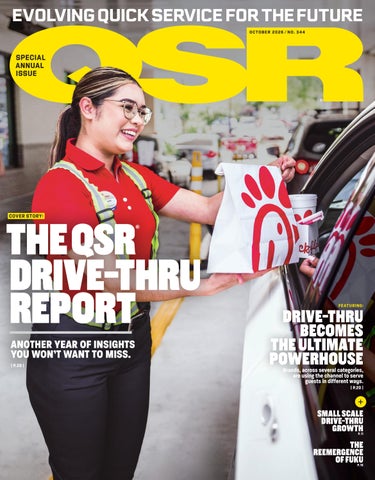
THE QSR DRIVE-THRU REPORT COVER STORY:
©
ANOTHER YEAR OF INSIGHTS YOU WON’T WANT TO MISS. | P. 28 |
FEATURING:
DRIVE-THRU BECOMES THE ULTIMATE POWERHOUSE
Brands, across several categories, are using the channel to serve guests in different ways. | P. 20 |
+ SMALL SCALE DRIVE-THRU GROWTH P. 11
THE REEMERGENCE OF FUKU
P. 16
Get NFL Sunday Ticket and more from the leader in sports for businesses^
Starting at
$74
.99/MO.
+ TAXES & FEES
BUSINESS SELECT PACK ™
Scan the QR code for more information
For more information: 1.800.496.4915 nationalaccounts@directv.com For new approved commercial customers w/ 24-mo. agmt. (Satellite delivery). Add’l fees apply. Early Cancellation Fee of up to $30/mo. for each mo. remaining on agmt. Select premium sports packages sold separately. Programming subject to availability on Satellite and/or Streaming. ^Claim based on offering of exclusive premiums, Nat’l Sports channels and Regional Sports Networks with the DIRECTV XTRA Package. Availability of Regional Sports Networks varies by ZIP code. Premiums are offered at an additional cost. ©2026 DIRECTV. DIRECTV and all other DIRECTV marks are trademarks of DIRECTV, LLC. All other marks are the property of their respective owners.
OCTOBER TA BL E OF CON T EN T S / # 3 4 4
/ Drive-Thru Report Issue
2 BRANDED CONTENT 4 EDITOR’S LETTER
7 BEHIND THE COUNTER 54 ADVERTISER INDEX
FE AT URE S
20
The Race for Speed, Accuracy, and Hospitality BY BEN COLEY
Ziggi’s Coffee, Hawaiian Bros, Tropical Smoothie Cafe, and Freddy’s are reworking technology, kitchens, and service to build a better drive-thru experience.
26
INSIGHT
The 2026 QSR Drive-Thru Report
11 FRESH IDEAS
Small Doesn’t Mean Simple
BY DANNY KLEIN
This year, we went deeper on AI than ever before. But all roads lead back to what consumers have always asked for— hospitalty, accuracy, and an experience that feels like a good value.
Drive-thru concepts continue to ramp up efficency. BY SAM DANLEY
14 ONES TO WATCH
Dizzy Bird NEWS
51 FRANCHISE FORWARD
An Unlikely Path to Ownership
ADOBE STOCK / KANPISUT. IMAGE EXTENDED BY QSR MAGAZINE
Two Taco John’s franchisees share how they’re building a footprint the right way. BY BEN COLEY
This brand has found open demand in the rotisserie chicken space. BY BEN COLEY
16 WOMEN IN LEADERSHIP
The Women Behind Fuku 2.0 The leaders are taking the fried chicken company to new heights. BY SATYNE DONER
56
ON THE COVER
Chick-fil-A is one of the highest-regarded drive-thru brands in the country. PHOTOGR APHY: CHICK-FIL-A
S TART TO FINISH
Craig Haley
The Smokey Mo’s leader believes his brand is ready for the next chapter.
QSR is a registered trademark of Arrowfly. QSR is copyright © 2026 Arrowfly. All rights reserved. The opinions of columnists are their own. Publication of their writing does not imply endorsement by Arrowfly. Subscriptions (919) 945-0704. www.qsrmagazine.com/subscribe. QSR is provided without charge upon request to individuals residing in the U.S. meeting subscription criteria as set forth by the publisher. AAM member. All rights reserved. No part of this magazine may be reproduced in any fashion without the express written consent of Arrowfly. QSR (ISSN 1093-7994), USPS PUBLICATION #20387 is published monthly by Arrowfly, 1111 Superior Avenue Suite 1120, Cleveland, OH 44114. Periodicals postage paid at Cleveland, OH and at additional mailing offices. POSTMASTER: Send address changes to Arrowfly, 1111 Superior Avenue Suite 1120, Cleveland, OH 44114.
www.qsrmagazine.com | QSR | OCTOBER 2026
1
BRANDED CONTENT EDITORIAL
V ICE PR ESIDENT EDITOR I A L FOOD, R E TA IL , & HOSPITA LIT Y
BRAND STORIES FROM QSR
Danny Klein
dklein@arrowfly.com
QSR EDITOR
Ben Coley
IN THIS ISSUE
bcoley@arrowfly.com
FSR EDITOR
Callie Evergreen
cevergreen@arrowfly.com
20
AS SOCI ATE EDITOR
26
Sam Danley
sdanley@arrowfly.com
SENIOR EDITOR , WIR L
Satyne Doner
sdoner@wthwmedia.com CONTENT STUDIO
V ICE PR ESIDENT, CONTENT S T UDIO R.F. TECHNOLOGIES, INC.
Peggy Carouthers
pcarouthers@arrowfly.com WATCHFIRE
W R ITER , CONTENT S T UDIO
The Speed Equation: How High-Volume Drive-Thrus Eliminate Bottleneck Dollars Reliable hardware and real-time
W R ITER , CONTENT S T UDIO
Ya’el McLoud
How Two Dairy Queen® Operators Are Using Digital Signs to Drive Sales
ymcloud@arrowfly.com
W R ITER , CONTENT S T UDIO
Davina van Buren
Simple fixes that drive real-world results. SPONSORED BY WATCHFIRE
data help drive-thrus move faster and earn more. SPONSORED BY R.F. TECHNOLOGIES, INC.
Drew Filipski
dfilipski@arrowfly.com
dvanburen@arrowfly.com ART & PRODUCTION
SENIOR A R T DIR ECTOR
Tory Bartelt
tbartelt@arrowfly.com
V P, CR E ATI V E DIR ECTOR
Matt Claney
mclaney@arrowfly.com
ONLINE S E E T H E S E S T O R I E S A T Q S R M A G A Z I N E . C O M / S P O N S O R E D
SALES & BUSINESS DEVELOPMENT
SV P, FOOD, R E TA IL , HOSPITA LIT Y S A LES A ND ACCOUNT M A N AGEMENT
Matt Waddell
mwaddell@arrowfly.com 312-961-6840
N ATION A L S A LES DIR ECTOR
Amber Dobsovic
adobsovic@arrowfly.com 757-637-8673
N ATION A L S A LES M A N AGER RESTAURANT365
Guy Norcott
LOOMIS
SQUARE
gnorcott@arrowfly.com 854-200-5864
TR AINING
HIRING
SECURIT Y
Why 48 Percent of Operators Stopped Raising Menu Prices
A Mediterranean Brands Path to Scaling Quickly
The Cash Work Eating Into Restaurant Labor
Inventory discipline, smarter sourcing, and AI are creating more room to absorb costs.
The CEO knew expansion had to be supported by the right systems. SPONSORED BY SQUARE
N ATION A L S A LES M A N AGER
Tom Boyles
tboyles@arrowfly.com 662-607-5249
S A LES DIR ECTOR
Tony Bolla
tbolla@arrowfly.com 773-859-1107
Cash recyclers could help quick-service restaurants reduce manual work between transactions.
S A LES DIR ECTOR
Susan Shepherd
sshepherd@arrowfly.com 404-386-1709
SPONSORED BY LOOMIS
CU S TOMER SERV ICE R EPR ESENTATI V E
SPONSORED BY RESTAURANT365
Tracy Willingham
twillingham@arrowfly.com 919-945-0704
CU S TOMER SERV ICE R EPR ESENTATI V E
Brandy Pinion
LOTTERIA
HEARTLAND FOOD PRODUCTS GROUP
bpinion@arrowfly.com 216-952-0877
TRENDING
INNOVATION
The Next K-Franchise Winning for Operators Fusion cuisine and a
The High-Velocity Path to Beverage LTO Innovation How brands can turn
SPONSORED BY LOTTERIA
SPONSORED BY HEARTLAND FOOD PRODUCTS GROUP
proven franchise model make this a lucrative proposition for franchisees.
2
OCTOBER 2026 | QSR | www.qsrmagazine.com
emerging beverage trends into fast, scalable traffic drivers.
FOUNDER
Webb C. Howell ADMINISTRATION 919-945-0704 / www.qsrmagazine.com/subscribe QSR is provided without charge upon request to individuals residing in the U.S. who meet subscription criteria as set forth by the publisher.
Menus.
You crave fresh ideas. And with our culinary support you’ll always have inspiration.
© 2026 Simplot Global Food, LLC.
EDITOR’S LETTER
State of the Drive-Thru T H E C H A N N E L I S S T I L L A P O W E R F U L S O U R C E O F S A L E S A N D I N N O VAT I O N .
T
BCOLEY@WTWHMEDIA.COM QSR MAGAZINE
4
OCTOBER 2026 | QSR | www.qsrmagazine.com
here’s a certain irony to where the drivethru finds itself in 2026. The industry has never had more technology at its disposal, but the qualities separating a great experience from a poor one are remarkably familiar. This year’s QSR Drive-Thru Report goes deeper into artificial intelligence than we ever have. Voice AI is completing more orders, accuracy is improving, and the technology is moving from experiment to practical tool. At restaurants where AI handled orders from start to finish, service was more than a minute faster than the non-AI baseline. That’s meaningful progress. But there’s another side to the story. When AI handled ordering, employees were much less likely to say “thank you” or display a pleasant demeanor at the window. The technology did its job, but in some cases the human interaction became more transactional. It gets at the theme running through this issue. There is no single answer to building a great drive-thru. The brands featured in our drive-thru innovation story illustrate that in different ways. Ziggi’s Coffee cofounder and CEO Brandon Knudsen isn’t obsessed with producing the fastest transaction. He wants employees to know regulars and build relationships. Hawaiian Bros targets 30 seconds at the window and studies performance every week. Tropical Smoothie Cafe is reworking production so food, bowls, and smoothies finish together. Freddy’s has simplified burger production and replaced text-heavy instructions with pictures employees can process quickly. Different brands. Different systems. Same objective. Make the experience work. And that task has become more complicated. The drive-thru isn’t simply one ordering channel anymore. For many
brands, it is the primary dining room, digital pickup counter, and most frequent interaction a customer has with the restaurant. Kitchen layout, menu complexity, mobile orders, staffing, equipment, loyalty, and hospitality all converge in one lane. A weakness anywhere in that chain can surface in the guest experience. Our Drive-Thru Report makes that point in numbers. Chick-fil-A averaged 7 minutes and 5 seconds, nearly three minutes longer than Tim Hortons, but posted 98.2 percent satisfaction. Only 12.1 percent of Chick-fil-A customers considered their experience slower than expected. Speed matters. Customers told us so. But the clock doesn’t tell the entire story. Customers who thought their visit was quicker than expected reported 96.8 percent satisfaction. Those who considered it slower than expected came in at 82.3 percent. And when a drive-thru ran smoothly, it tended to feel faster, showing how closely perception is tied to the total experience. Friendly service produced the largest satisfaction gap of any dimension we measured. Satisfaction reached 98.6 percent when service was friendly and collapsed to 26.8 percent when it wasn’t. Accuracy tells a similar story. Satisfaction hit 96 percent when orders were correct and fell to 73 percent when they weren’t. That may be the most useful lesson from all the innovation filling these pages. AI can take an order. New equipment can shave seconds from production. Better kitchens can process more cars. Digital systems can anticipate demand. But customers still want the basics. Get the food right. Make it fresh. Respect their time. And when they reach the window, make them feel like there’s a person on the other side.
Ben Coley EDITOR
SICK OF THE 16-HOUR DAYS YET?
$2.7 mil ANNUAL AVERAGE GROSS SALES (All stores... not just the top quartile)
8-hour operating day Second-gen sites welcome 2% royalty (vs regular 4.5%) for the first two years
(for area development agreements signed by 3/31/27) *19 of the 38 restaurants operating for a full year 2025 met or exceeded this figure. Your results may vary. See our FDD, item 19 for definitions and other detail.
Arrowfly.com A new name for the company behind the brands and events you trust.
WTWH Media is now
Why Arrowfly?
Over two decades, WTWH Media has grown from its engineering roots into a diversified portfolio of 40+ trusted media brands, 45+ industry events, and marketing solutions serving professionals across Engineering, Healthcare, and Food, Retail & Hospitality. While many know and trust our individual brands, fewer know the company behind them. Arrowfly gives us a stronger corporate identity that reflects the business we’ve become. The name represents forward momentum, direction, and growth, and our role in helping professionals and partners navigate change and move their businesses forward. Arrowfly represents where niche professionals gather for trusted journalism, industry intelligence, and measurable outcomes.
The Strength of Arrowfly Your Trusted Brands: All 40+ media brands and publications remain unchanged Our Events: All 45+ industry events continue with the same teams, content, and quality Editorial Independence: Our commitment to credible, independent journalism remains our foundation Clara Platform: Our proprietary performance platform continues delivering real-time campaign visibility and measurable results
Arrowfly is the preeminent live and digital destination for professionals across Engineering, Healthcare, and Food, Retail & Hospitality sectors. Editorial authority. Engaged communities. Measurable outcomes.
BEHIND THE COUNTER
The Franchising Playbook
QSR magazine’s latest webinar touches on how operators can navigate a complicated field.
ADOBE STOCK / KIRSTEN DAVIS/PEOPLEIMAGES.COM / IMAGE EXTENDED BY QSR MAGAZINE
THE FRANCHISING LANDSCAPE HAS CHANGED OVER RECENT YEARS.
Scan the QR code to watch the webinar.
Choosing the right franchise opportunity requires more than finding a recognizable brand or an appealing concept. During a QSR webinar on September 15, industry experts explored the financial, operational, and relationship factors that prospective franchisees should consider before signing an agreement. The conversation, based on QSR’s annual franchise report, featured Michelle Rowan, president of Franchise Business Review, and Dawn Abbamondi, chief marketing officer of SMB Franchising. Together, they provided a framework for distinguishing strong franchise investments from opportunities that may not offer the same long-term potential. The discussion covered startup costs, unit-level profitability, return on investment, training, marketing assistance, operational resources, and growth opportunities. It also addressed the questions prospective operators should ask when evaluating a brand, including how long it may take to reach profitability, what expenses are required beyond the initial investment, and whether existing franchisees are satisfied with the support they receive. Rowan brought insight from Franchise Business Review’s work measuring franchisee and employee satisfaction across more than 1,300 brands. Abbamondi contributed more than 25 years of experience as a franchisor, franchisee, and supplier. The session gave first-time buyers, experienced multi-unit operators, and franchisors a practical way to assess franchise opportunities. The key takeaway was straightforward: a worthwhile investment depends on sustainable economics, consistent support, and a productive relationship between the brand and its franchisees.
www.qsrmagazine.com | QSR | OCTOBER 2026
7
BEHIND THE COUNTER
CONSUMERS DINING OUT AT LEAST ONCE PER WEEK CLIMBED TO
80.3
%
THE INDUSTRY
MOSTLY THRIVED DURING THE
FIRST HALF OF 2026
A new report from Chicago-based marketing analytics firm BIG CHALK examines U.S. restaurant spending through mid-year 2026, including trends among TRADE-OFF CONSUMERS —a financially constrained group that still dines out frequently but has less discretionary income and must make choices over where to spend—and GLP-1 USERS, whose restaurant and alcohol consumption habits are changing.
• T he percentage of U.S. consumers dining out at least once per week climbed to 80.3 percent in spring 2026, up from 77.3 percent in 2025 and 76.6 percent in 2024.
• A verage restaurant visits rose
to 2.27 per week, compared with 2.19 in spring 2025 and 1.96 in spring 2024.
• B ig Chalk said the restaurant industry mostly thrived during the first half of 2026 and appears positioned for a solid second half of the year.
• E arly second-quarter results cited in
the report included same-store sales gains of 2.2 percent at Chipotle, 5.8 percent at Cheesecake Factory and 7.9 percent at Starbucks.
• T he share of ALCOHOL GLP-1 users who CONSUMPTION never consume IS ALSO FALLING alcohol rose from 16.8 percent in AMONG spring 2025 to GLP-1 USERS 22.9 percent in
TRADE-OFF CONSUMERS PRESENT A CHALL ENGE • T rade-Off Consumers
participation rate increased from 81.7 percent in spring 2025 to 83 percent in spring 2026, though it was still below the 86.6 percent recorded in 2024.
• A verage weekly
restaurant visits among Trade-Off Consumers slipped from 2.25 in 2025 to 2.19 in 2026, compared with 2.11 two years earlier.
• B ig Chalk said brands face
a pricing dilemma because aggressive deals can subsidize customers with greater spending power, but ignoring value-conscious guests risks alienating more than one-third of U.S. households.
GLP-1 USERS ARE CUTTING RESTAURANT VISITS • T he share of GLP-1
users visiting restaurants one to two times per week jumped from 40.5 percent in spring 2025 to 45.4 percent in spring 2026.
• T hose drinking
spring 2026.
8
• T heir dining-out
account for 34.5 percent of the U.S. population and tend to over-index on food consumption, making the group especially important to restaurant brands.
OCTOBER 2026 | QSR | www.qsrmagazine.com
a few times per month fell from 17.5 percent to 13.6 percent, a 3.9-percentagepoint year-overyear decline.
• B ig Chalk views that
increase as a warning sign because some consumers migr ated into the one-to-two-visit category from higherfrequency groups.
• T he percentage
consuming alcohol a few times per week dropped from 31.8 percent to 27.8 percent, a decline of roughly 4 percentage points.
• T he share visiting
restaurants five to seven times per week fell from 12.6 percent to 9.4 percent.
• A mong GLP-1 users who
dine out at least three times per week, the declines were steeper, with monthly and weekly drinking frequency dropping 4.3 and 5.7 percentage points, respectively.
• B udget pressure appears to
be playing a smaller role in those decisions, with the portion of GLP-1 users citing budget concerns for reduced restaurant activity falling from 44.1 percent to 41.3 percent.
THOSE DRINKING
A FEW TIMES PER MONTH
13.6 FELL TO
%
ADOBE STOCK / ONEINCHPUNCH
RESTAURANT TRAFFIC SHOWS STRENGTH
One switch. Every advantage. PP Revolution
™
Recycle ready. Risk-free. Ready to run.
Pair with foil, metallized or or recycle ready easy-open lidding options to complete a fully optimized package.
Let’s transform your dip cup packaging.
Want to learn more?
800-544-4672
NorthAmericaFlexibles@amcor.com
fresh ideas O C T O B E R
2 0 2 6
M E N U
SMALL Compact formats can change the development equation, but they also raise the stakes for operational precision.
T R E N D S
DOESN’T MEAN
SIMPLE
BY SAM DANLEY
SMALLS SLIDERS IS KNOWN FOR ITS ORANGE SHIPPING CONTAINERS.
SMALLS SLIDERS / JORDAN HEFLER
T
he race to smaller restaurant footprints has a limit. Checkers & Rally’s learned that lesson with a 570-square-foot prototype unveiled last spring. “We tested it and found that it was just slightly too small,” says Eileen Himber, senior manager of franchise development. The company adjusted the design to about 700 square feet—still 300 square feet smaller than its prior prototype, but with more room to protect operational flow. That distinction is increasingly important as quick-service brands chase lower development costs, more flexible real estate, and faster, convenience-led service. A small building can widen a franchisee’s options, but leaders behind three drive-thru-centric concepts say it cannot simply be a conventional restaurant with square footage
stripped away. It must be designed around its menu, employees, channels, and guests. Smalls Sliders utilizes a modular real estate and construction strategy built around 750- to 800-square-foot repurposed shipping containers called “cans.” They are prefabricated off-site and dropped onto compact half-acre plots. “We don’t really think about it in the sense of shrinking a restaurant,” says chief development officer Ryan Crumley. “Rather, we built the can around the kitchen and the team so that they can do one thing exceptionally well.” Scooter’s Coffee’s small stores, likewise, are a longstanding part of its business model rather than a response to the latest development cycle. Its roughly 1,000-square-foot end-cap format
www.qsrmagazine.com | QSR | OCTOBER 2026
11
accommodates guests in the store, and the company also operates nontraditional units in airports, hospitals, and sports venues. But its traditional drive-thru kiosk, between 650 and 700 square feet, is the core prototype. “The way this space is designed is intentionally around the business we want to operate,” says Aaron Hoffman, Scooter’s vice president of franchise sales. “We’re not trying to squeeze a traditional coffee house into a smaller box.” That model can support expansion in secondary and tertiary markets, where a large café may not pencil out. “You don’t need a massive population base or large-format building to have a successful coffee business,” Hoffman says. “Those customers still want great brands and experiences, but the economics have to fit the community.” Checkers & Rally’s sees the inverse opportunity. A smaller box can help franchisees enter large metropolitan markets, where space is limited and expensive, Himber says. It can work on a smaller parcel or let an operator use a larger site for co-branding. On a conventional site, it can make room for a longer drive-thru stack. The operational work is where the model either delivers on its promise or breaks down. In a compact kitchen, equipment placement, inventory, and employee movement are intertwined. Smalls works from the kitchen outward, examining the movements required for each role. Crumley says the brand’s model enables it to run with fewer employees and adjust staffing more readily during peak and off-peak dayparts. “You’re not paying people to run across the restaurant,” he says. But tighter quarters can magnify seemingly minor design mistakes. Smalls once tested a tall piece of equipment to move food from its cook line to its expo line, only to learn that it obstructed sightlines and reduced nonverbal communication between employees. “The only way we’re ever able to do that is having a great feedback loop from our franchisees,” Crumley says. At Checkers & Rally’s, eliminating a second drive-thru lane in the 570-square-foot prototype hindered flow, Himber says. The lane also serves digital-order and third-party delivery pickup customers, so the brand brought it back. The company also scrutinized redundant equipment. “We found that there were redundancies that we could eliminate,” she says. “Not only does it make the kitchen more efficient, but it is also less costly to build.” Menu discipline is another guardrail. Smalls has focused on building a highly focused menu centered around cheeseburger sliders, fries, shakes, and drinks. Scooter’s similarly prioritizes a core menu and seasonal offerings rather than a stream of additions that complicate inventory and the work area. The same logic applies to customer choice, since a consistent menu can keep drivers from lingering in the queue while deciding what to order. For Hoffman, that is more than a menu-management issue. In a compact drive-thru, “unnecessary complexity shows up really, really quick,” whether it comes from additional inventory, a poorly placed piece of equipment, or a process that adds steps for the team. The payoff from a smaller box comes not from reducing square
12
OCTOBER 2026 | QSR | www.qsrmagazine.com
DRIVE-THRU CHAINS CONSTANTLY BALANCE GETTING FASTER AND MAINTAINING HOSPITALITY.
footage alone, he says, but from making every square foot advance throughput and guest experience. That’s why a compact format can’t be treated as a shortcut. “The mistake is assuming smaller automatically means simpler,” Hoffman says. “The entire system—development, operations, supply chain, menu, and so on—has to be designed to support that footprint.” Sam Danley is the associate editor of QSR. He can be reached at sdanley@ arrowfly.com.
CHECKERS & RALLY’S / ALEX CROSBY, SMALLS SLIDERS / JORDAN HEFLER, SCOOTER’S COFFEE’S
fresh ideas
O N E S T O WAT C H
Dizzy Bird
DIZZY BIRD WAS FOUNDED IN 2023.
The Southern California fast casual is turning strong early demand for its rotisserie chicken concept into a larger restaurant format and a push into franchising. / BY BEN COLEY FOUNDER: Rashad Moumneh HEADQUARTERS: Costa Mesa, CA UNIT COUNT: 2 (with the third opening soon) YEAR FOUNDED: 2023 ANNUAL SALES: $7.8 Million
14
OCTOBER 2026 | QSR | www.qsrmagazine.com
CAPTION.
grilled chicken and the marinades and flavors that could differentiate it from grocery-store rotisserie products. He spent years developing the recipe, eventually settling on spatchcock chicken and marinades that infused more flavor. Dizzy Bird also made grilled wraps a key part of the menu, with every wrap served hot and grilled over an open flame. The first Dizzy Bird opened in a mall food court in 2023 as a test. It quickly outsold Moumneh’s previous restaurant, which was converted into the second Dizzy Bird in 2024. Moumneh believes the appeal starts with an underserved demand for protein-forward meals that don’t rely on fried chicken.
“I think we fill a need that’s underserved, which is good-for-you, protein-forward meals and specifically chicken, specifically grilled chicken, not fried chicken,” he says. “I think that’s, at a very high level, part of our success. But after that, the product has to be good.” Dizzy Bird doesn’t position itself specifically as a Lebanese or Mediterranean concept. Moumneh learned from his first restaurant that leading with a cuisine classification could narrow how customers perceived the food. Chicken gives Dizzy Bird a more universal entry point, with his heritage providing the culinary perspective behind it. The restaurants themselves put the cooking process on display. Guests can see chickens rotating over open flames, employees basting and chopping them, and wraps cooking on the grill. Moumneh credits that visual component with helping an unknown concept attract attention in a food court surrounded by established national chains. Roughly half of transactions across the two [CONTINUED ON PAGE 52]
DIZZY BIRD (2)
D
izzy Bird founder Rashad Moumneh spent years building his first restaurant concept before the pandemic forced him to ask a difficult question. If he were starting from scratch, would he build the same business again? The answer eventually became Dizzy Bird, a Southern California fast-casual concept built around spatchcock rotisserie chicken, grilled wraps, and an identity Moumneh describes as the “anti-fried chicken restaurant.” After proving the concept across two locations, the brand is preparing to open its first larger-format restaurant and begin franchising. Moumneh’s career began after he left his corporate job in late 2014, early 2015. The former Taco Bell employee launched a food truck serving falafel, eventually attracting an angel investor and opening a brick-and-mortar Mediterranean restaurant in 2017. A second followed in 2018. COVID disrupted that trajectory. Moumneh also saw a competitive problem in that too many concepts occupied similar territory. His search for something more distinctive led him to rotisserie chicken. The product was ubiquitous in supermarkets and widely consumed, but Moumneh couldn’t identify a brand that owned the category nationally. His Lebanese background gave him a natural connection to
BIGGBY COFFEE is growing with purpose. ®
With 460+ locations and a people-first culture that stands out in the QSR category, BIGGBY® COFFEE continues to expand with franchise partners who believe in building something meaningful in their communities. From a proven operating model to strong training and ongoing support, BIGGBY® COFFEE is built for entrepreneurs ready to grow with a brand that values people just as much as performance.
Now expanding in select markets nationwide. Learn more at
BIGGBYFranchising.com
WOMEN IN LEADERSHIP
The Women Behind Fuku 2.0
Claudia Lezcano, Kaitlin Weinman, and Catherine Souders are leading a reemergence.
SO FAR, THE BRAND RESET HAS PAID OFF FOR FUKU.
K A ITLIN WEINM A N
CL AUDIA LEZC A NO
C ATHERINE S OUDERS
I
n the few weeks before she stepped in as Fuku’s CEO in 2022, Claudia Lezcano felt the nerves creeping in. “By day one, of course, the butterflies are still there,” she says. “But everything I have done throughout my career has prepared me for this moment in time.” That confidence has carried into Fuku’s resurgence. The New York-born brand, which began as a secret menu item by chefs at David Chang’s Momofuku Noodle Bar, is ready for its next chapter, and
16
JANUARY 2026 | QSR | www.qsrmagazine.com
over the past 18 months, Lezcano has been building the leadership team to get there. Lezcano joined Fuku after holding executive roles at Burger King, Church’s Chicken, the Miami Dolphins, and more. Kaitlin Weinman, meanwhile, started her career as a butcher before working her way into the weeds of brand and culture, joining Fuku as chief of staff in 2022 and transitioning into the chief operating officer role to better support Lezcano. After helping Lezcano with Fuku’s
rebrand, touching everything from operations to marketing and accounting, Weinman moved back into her own space as chief brand officer in June, following several smart hires, including Catherine Souders as vice president of operations. Souders has a long track record in restaurant operations, including 18 years at Red Lobster and a stint at Shake Shack, working in its international locations. Red Lobster taught her discipline; Shake Shack showed her how to scale with speed. “Fuku has given me the opportunity to build and not just operate what’s been handed down. It’s my time to bring all my ideas and experience and layer them into such a cool, fun brand,” Souders says. “It’s my time to shine and contribute in a way that’s very systemized and strategic under a solid foundation.” Fuku’s original brick-and-mortar restaurants closed as the brand reworked its model, but the reset is already paying off: two new locations have opened in Coral Gables and West Palm Beach, Florida, with a third set to open in Miami in January. The brand has aggressive growth goals, targeting 80 locations by 2030, largely through franchising, alongside expansion across stadiums, college campuses, airports, and international licensing. As Fuku scales, keeping that in-restaurant experience consistent, without losing what makes each location feel like a neighborhood spot, falls to Souders. “I was hired right when Coral Gables was about to open, so I went and moved in for 80 days, evaluating where we currently are with our tools and resources and optimizing,” Souders says. “It’s important to me to find the non-negotiable systems regardless of the vertical we’re operating in, whether that’s recipes or our hospitality. What flexes is the execution to really give guests the best experience in every [CONTINUED ON PAGE 52] environment.”
FUKU (4) CLAUDIA LEZCANO: FRANCISCA NUNEZ
/ BY SATYNE DONER
S P O N S O R E D B Y R . F. T E C H N O L O G I E S , I N C .
THE SPEED EQUATION:
How High-Volume Drive-Thrus Eliminate Bottleneck Dollars Reliable hardware and real-time data help drive-thrus move faster and earn more. without missing a beat. R.F. Technologies, Inc. repairs base stations, beltpacks and headsets fast—ensuring backup equipment stays in rotation, so sudden tech glitches never cap the drive-thru lane’s earning potential.
I
n the modern quick-service restaurant landscape, the drive-thru isn’t just a convenience lane – it’s your primary revenue engine. With up to 70 percent of total sales running through the drive-thru, even a brief five-second delay per vehicle quickly wipes out thousands of dollars in monthly revenue. Maximizing rush-hour capacity demands rock-solid hardware and real-time operational visibility.
Eliminating Audio Friction at the Order Post
Order accuracy, kitchen speed and lane throughput all hinge on pristine audio clarity.
Heavy rain, diesel engines, and street traffic stall orders fast. Every time a crew member asks a guest to repeat themselves, the entire line grinds to a halt and wait times skyrocket. R.F. Technologies noise-canceling headsets eliminate background clutter completely, delivering crystal-clear sound from your employee directly to the car. Staff capture complex orders accurately on the very first attempt, boosting lane speed and eliminating costly remake waste across every shift. Even the best tech takes a beating in fastpaced kitchens. When drops, spills, and hardware failures happen, a rapid-turnaround repair pipeline keeps the drive-thru lane moving
Reliable hardware opens the lane; intelligent speed-of-service software sets the operational pace. Cloud-powered timer platforms expand your operational lens across your entire franchise portfolio, delivering actionable insights, centralized reporting and multi-store benchmarking. R.F. Technologies’ TEMPO timer takes performance tracking further with fully customizable reporting, enabling operators to track the exact metrics that matter most to their specific brand goals and store layouts. Brand’s drive-thru speed-of-service is either driving their business or driving business to a competitor. In the business of fast-food drivethrus, seconds make all the difference. Displaying live speed metrics on intuitive enterprise dashboards and store leaderboards turns passive tracking into active team engagement. Real-time shift performance sparks friendly competition among crew members, driving down handle times organically while preserving order precision, operational flow and food quality. When crystal-clear communication, ruggedized hardware and real-time cloud analytics align, the result is predictable: lower handle times, happier guests and maximum profitability from every foot of the lane. ◗
Discover how to level up the drive-thru with R.F. Technologies, at rfdrivethru.com. 18
OCTOBER 2026 | QSR | www.qsrmagazine.com
R.F. TECHNOLOGIES, INC.
Turning Operational Data into Crew Motivation
Faster Service. Minimize Downtime. Maximize Revenue. Elevate Customer Satisfaction.
THE HARDWARE
Headset Systems & Repairs: Crystal-clear digital audio, 12-hour battery life, and ultra-durable gear paired with robust base stations for rock-solid coverage. Advanced noise cancellation blocks engine roar so every order is right the first time. Rapid-turnaround repairs get your headsets back in action – fast. Drive-Thru Systems: Complete lane infrastructure built for highvolume restaurants. From heavy-duty vehicle detection loops and outdoor speaker posts to reliable digital menu boards, we keep your lanes running continuously without tech bottlenecks.
TEMPO Timer: The next-gen, cloud-powered speed-of-service timer.
THE SECRET WEAPON:
Universal Plugs into any existing drive-thru system. Plug-and-Play Up and running in minutes. Enterprise Ready Manage 1 or 1,000+ stores from the cloud. Leaderboard Incentivize performance with real-time leaderboards. Unmatched Value Premium enterprise features. Fraction of the cost. No Monthly Subscriptions
READY TO ACCELERATE YOUR DRIVE-THRU? 800-598-2370 | Sales@RFDriveThru.com | RFDriveThru.com CHICAGO • LOS ANGELES • NEW ENGLAND • ST. LOUIS • TORONTO
©2026 R.F. Technologies, Inc. All brand and product names are trademarks or registered trademarks of their respective companies. All rights reserved.
DRIVE-THRU INNOVATION
Ziggi’s Coffee, Hawaiian Bros, Tropical Smoothie Cafe and Freddy’s are reworking technology, kitchens, and service to build a better drive-thru experience. /
BY BEN COLEY
ZIGGI’S COFFEE / JASON CARNCROSS. IMAGE EXTENDED BY QSR MAGAZINE
20
OCTOBER 2026 | QSR | www.qsrmagazine.com
DRIVE-THRU INNOVATION
THE RACE FOR
SPEED, ACCURACY AND
HOSPITALITY T
he drive-thru was once a convenience attached to the restaurant. For a growing group of limited-service brands, it now serves as the primary dining room, digital pickup counter, and most frequent point of contact with guests. That shift has made the lane a test of nearly every part of the business. Menu complexity shows up in ticket times. Kitchen design determines how many cars a site can process. Digital orders compete for production capacity. Accuracy can decide whether a family returns. Technology can remove delays, but it can also strip away the human connection that gives a brand its identity. For franchise systems, the challenge carries another layer. Any solution must work consistently across hundreds of kitchens, diverse real estate, varied labor pools and different levels of operator experience. Ziggi’s Coffee, Hawaiian Bros, Tropical Smoothie Cafe, and
Freddy’s occupy different corners of the quick-service market, but each is working through the same equation, which is that guests want speed, convenience, accuracy, and hospitality in a single visit. Winning more drive-thru occasions requires all four, not a trade of one for another. At Ziggi’s, every restaurant has a drive-thru, and many pair it with a walk-up window. The Colorado-based coffee chain built its system around convenience, but cofounder and CEO Brandon Knudsen does not view the fastest possible transaction as the brand’s ultimate goal. “Speed is not number one at all. I’m not saying it’s not important, but I want to have a really, really authentic relationship. I want there to be a daily routine of coming by to say ‘Hi, how are your kids yesterday, how was work,’ like just total relationship building,” Knudsen says. That conviction influences Ziggi’s technology choices. The
www.qsrmagazine.com | QSR | OCTOBER 2026
21
company uses tools that help employees learn an expansive menu and find information quickly, including a mobile learning platform that can function as an ondemand reference. Its point-of-sale system supports the transaction, and data helps the chain control staffing. Knudsen sees practical uses for artificial intelligence in corporate analysis and decision-making, but he is reluctant to hand the guest conversation to a machine. “I want Ziggi’s to be a place where they get away from that and they go and interact with people,” he says. Ziggi’s also accepts that a wide range of choices can add seconds. Its drinks are made individually, giving guests the ability to select cold brew, dairy alternatives, decaf, half-caf, and sugar-free options. That creates a more involved production process than systems built around premixed bases. Knudsen considers that flexibility part of the value proposition, not an operating flaw to remove. “We make every drink handcrafted, and that takes more time, right? And so you could look at us in a drivethru speed report and we’re getting our ass kicked. But at the end of the day, I think that people want what’s important to them. When you go to Ziggi’s, you’re going to have a huge menu. It’s going to take maybe a little bit longer, but you’re going to eat exactly what you want,” Knudsen says. Mobile ordering adds another test. A prepaid drink can turn a visit into a silent handoff, eliminating the exchange Ziggi’s wants to protect. Employees are coached to acknowledge those guests instead of treating the pickup shelf as the end of the service sequence. “Don’t let them pick that drink up without eye contact conversation. ‘Hey, thanks for being here,’” Knudsen says. Hawaiian Bros starts with simplicity. The chain, with roughly 80 restaurants at the time of the interview, has a focused menu and a kitchen built to reproduce a narrow set of plates at volume. SVP of operations Chris Habiger says the operating model gives the company room to pursue speed without putting product execution at risk. “We built an operating system that’s easy to execute and so we’ve got a focused menu, it’s a highly executable THE DRIVE-THRU HAS BECOME A POWERFUL CHANNEL SINCE COVID. kitchen, and the layout really minimizes unnecessary movement,” Habiger says. walk inside, some prototypes place a pickup window on the The company designs its sites to hold as many vehicles other side of the restaurant. The dedicated window protects as possible before the order point. Once an order reaches the main lane from interruptions and makes the handoff the kitchen, the production line can usually keep pace. Durclearer for couriers. Hawaiian Bros uses AI to identify opportunities and give ing busy periods, employees equipped with handheld devices move into the queue and take orders before cars reach the a smaller organization analytical reach that once required a speaker. Timers supply detailed service data, and analyti- large support staff. Habiger calls the technology useful when cal tools help operators locate restaurants, shifts, and steps it turns store data into action. that create unusual delays. “We use AI every day, and it’s really become what we think The target is precise. “Yes, 30 seconds at the window is our is a force multiplier for our brand. It gives us an opportunity target, and we evaluate it every day, every week,” Habiger says. to punch above our weight class,” he says. Digital demand has prompted Hawaiian Bros to separate Automated order taking is not an immediate priority. The traffic streams in newer buildings. Instead of asking app cuschain wants the economics and guest experience to prove tomers and delivery couriers to join the conventional lane or out first. 22
OCTOBER 2026 | QSR | www.qsrmagazine.com
ZIGGI’S COFFEE, HAWAIIAN BROS, TROPICAL SMOOTHIE CAFE / STEVEN BULLOCK
DRIVE-THRU INNOVATION
HANTAREX LUX · DRIVE-THRU DISPLAY 3500 nits
Drop in. Stay open. The 55” outdoor display that replaces your existing screen — with no structural modifications, no lane closures, and no compromise on visibility.
IP66 sealed
ALWAYS readable
3.74” depth
Built for real drive-thru environments. Outdoor conditions are unpredictable. Your display shouldn't be. The Hantarex Lux 55" is fully sealed, impact-resistant, and engineered to perform from desert heat to winter freeze — without a single external housing or enclosure.
Use your existing mount. Replaces what you already have on site. No new metal, no redesign, no delay.
Lanes stay open. Install without shutting down your drive-thru. Revenue keeps flowing.
Designed for franchise scale. Simple remote tools for consistent deployment across multiple locations.
Works with your existing CMS. Standard connectivity — no new media player or software investment needed.
Upgrade your drive-thru experience. HANTAREX Lux: Innovation. Semplicity. Performance.
gdsdisplays.com
DRIVE-THRU INNOVATION
Each week, Hawaiian Bros reviews a scorecard and studies restaurant performance in a companywide “film room.” CEO Scott Ford participates in the call, creating direct accountability for results. Service time is one measure, but accuracy carries greater weight because a wrong order turns a convenient trip into a costly disappointment. The final window exchange also may be the employee’s only chance to give the transaction a personal note. “If you have one opportunity at that present window, you better make the most of it,” Habiger says. Tropical Smoothie Cafe is tackling the same channel collision from inside the kitchen. COO Jonathan Biggs says customers do not separate a brand into drive-thru, counter, app, and delivery experiences. They judge whether the transaction works, regardless of where it begins. The company’s work falls into two major initiatives. Smooth Operator reorganizes food production to improve consistency and speed. Unified Experience seeks to make digital ordering and handoff feel consistent across restaurants and channels. Smooth Operator took Tropical Smoothie back to basic kitchen mechanics. Teams established standard builds, revised oven settings for individual menu items, and removed preparation steps. The production line became shorter, and the chain sought to have smoothies, bowls, and food fin-
24
OCTOBER 2026 | QSR | www.qsrmagazine.com
ish in sync instead of forcing one component of an order to wait for another. “It’s pretty incredible work,” Biggs says. More than 200 cafes had deployed the system as of early August. The gains have reached several parts of the guest experience. “It’s been improving quality. It’s improving speed. It’s improving consistency to our guests,” Biggs says. Drive-thrus account for roughly one-third of Tropical Smoothie’s footprint. Making those units easier to run could influence where franchisees place future capital. The brand is examining equipment, smaller building footprints, and a more linear workflow, with technology wrapped around the production system. “The more franchisees are going to want to invest in drivethru, the more we’ll continue to be able to expand that as part of our overall percentage of our portfolio,” Biggs says. Tropical Smoothie has standardized pickup and checkout procedures for delivery drivers, reducing uncertainty once they arrive. It is also testing kiosks in a small group of cafes. Biggs says early use has been encouraging. “It is showing really good adoption, and we really like where it’s going,” he says. No single installation can fix every service gap. The brand’s menu, labor routines, kitchen layout and [CONTINUED ON PAGE 54]
HTeaO is your perfect blend of simplicity and scalability that fits into your portfolio seamlessly — making ownership refreshingly easier.
“
Owning multiple HTeaO locations provides many competitive advantages, like increased brand awareness and operational efficiency.”
Bryan Benson
HTEAO FRANCHISE OWNER
READY TO TAP INTO SOMETHING BIG? ©2026 TBevCo IP, LLC. All rights reserved. This information is not intended as an offer to sell, or the solicitation of an offer to buy, an HTeaO franchise. It is for informational purposes only. We will not offer you a franchise in states where registration is required unless and until we have complied with applicable pre-sale registration or filing requirements in your state (or have been exempted therefrom) and a Franchise Disclosure Document has been delivered to you before the sale in compliance with applicable law.
S P O N S O R E D B Y W AT C H F I R E
SIMPLE FIXES THAT DRIVE REAL-WORLD RESULTS.
F
rom promoting the latest Blizzard® flavors to celebrating local schools, digital signage is helping two Dairy Queen® operators reach customers in real time. For quick-service restaurant operators, getting the right message in front of customers at the right moment can make the difference between a missed opportunity and a sale. For two Dairy Queen operators in Indiana and Ohio,
digital LED signage has become an important part of making that connection. Jeff Whitaker, a 21-year Dairy Queen operator in Lebanon, Indiana, installed a Watchfire digital display in 2024, replacing a traditional reader board. Changing a message once required retrieving a ladder and manually swapping individual letters, making frequent updates impractical.
To learn more about partnering with Watchfire, visit watchfire.com. 26
OCTOBER 2026 | QSR | www.qsrmagazine.com
WATCHFIRE
HOW TWO DAIRY QUEEN® OPERATORS ARE USING DIGITAL SIGNS TO DRIVE SALES
“I didn’t realize what a positive impact it would have on my business,” Whitaker says. “I was really surprised by how much sales increased just by having fresh messages out there on display every day.” Today, Whitaker promotes national Dairy Queen campaigns alongside local offers, including banana split sales, weekday happy hours and $2 bags of ice. He also recognizes employees, highlights school events and promotes community fundraisers. That flexibility is equally important to Karl Warther, who operates seven Dairy Queen locations near Canton and Akron, Ohio. All seven restaurants have Watchfire signs, which Warther has continued adding since 2013. With Dairy Queen introducing new Blizzard flavors regularly, the signs put those messages directly in front of local audiences. “We hear it often: ‘I saw that meal deal on your sign,’ or ‘I saw that new Blizzard flavor on your sign,’” Warther says. “It absolutely drives sales.” Warther schedules lunch specials from 11 a.m. to1p.m.,beverages from 2–4 p.m., and soft-serve products in the evening. Integrated Dairy Queen content keeps promotions on brand, while Watchfire’s OPx software allows him to manage his signs remotely. Remote access also provides valuable operational flexibility. If a promoted Blizzard flavor sells out, Warther can update the message from his phone, whether he is at home, at a baseball game or on vacation. Whitaker can likewise manage his display from anywhere with his laptop and a Wi-Fi connection. For Warther, simplicity, reliability, and customer service matter. “I have seven stores,” he says. “I chose Watchfire over others because I want to be in the soft serve business, not in the electronic repair business.” Both operators also see their displays as community tools. Warther regularly features school activities, fundraisers and local events, sometimes incorporating school colors. Mixing those messages with promotions keeps the content dynamic, attention-grabbing, and reinforces each restaurant’s community connection. Ultimately, LED signs give operators the ability to communicate immediately. Whether introducing a Blizzard flavor, adjusting a daypart promotion, or responding when a product sells out, the message can change as quickly as the business does. ◗
DIGITAL READER BOARDS.
DRIVE TRAFFIC. INCREASE SALES. Increase your QSR’s foot traffic and boost sales by promoting new menu items, menu specials, and rewards program perks. Display eye-catching, dynamic brand-approved messages that uphold your QSR’s brand standards. Maintain message flexibility with our Ignite OPx content management software. Ignite OPx allows users to program messages months in advance or make last-minute changes and streamline your sign messaging for one location or many. Our reputation is built on your digital reader board looking and performing great, not just for one day but for its lifetime.
SCAN THIS QR CODE TO VISIT OUR WEBSITE AT WATCHFIRE.COM/QSRMAGAZINE OR CALL US AT 844-805-8880 TO LEARN MORE ABOUT HOW DIGITAL READER BOARDS CAN DRIVE TRAFFIC TO YOUR QSR LOCATION.
DRIVE-THRU REPORT
WITH DRIVE-THRU DATA
QSRDTR- 26 IN PARTNERSHIP:
®
28
OCTOBER 2026 | QSR | www.qsrmagazine.com
SCAN TO ACCESS INTOUCH INSIGHT’S ANNUAL DRIVE-THRU STUDY IN FULL.
DRIVE-THRU REPORT
THE 2026
AT RESTAURANTS WHERE AI TECHNOLOGY HANDLED 81 PERCENT OF ORDERS END-TO-END, SATISFACTION WAS 92.6 PERCENT.
ADOBE STOCK / MARIA VITKOVSKA. IMAGE FILTERED BY QSR MAGAZINE. ALL FUTURE TECH GEOMETRIC ELEMENTS: ADOBE STOCK / MAX_776
QSR DRIVETHRU REPORT /
©
BY DANNY KLEIN
This year, we went deeper on AI than ever before. But all roads lead back to what consumers have always asked for—hospitality, accuracy, and an experience that feels like a good value.
www.qsrmagazine.com | QSR | OCTOBER 2026
29
DRIVE-THRU REPORT
For years, “the drive-thru of the future” was a physical asset story, explains Dane Mathews, Taco Bell’s global chief digital and technology officer. More lanes. More screens. More automation. But is that where innovation is leading fast-food’s most enduring channel? It’s not a simple answer, yet the end goal is the consumer thinking it is.
QSRDTR- 26
“The next evolution runs on intelligence, but intelligence isn’t the story,” Mathews says. “Intelligence is table stakes, not the breakthrough. The breakthrough is turning that intelligence into a real brand conversation with our fans.” Over the past few QSR Drive-Thru Reports, our data partner, Intouch Insight, has begun to mystery shop a shifting lexicon of success. To Mathews’ point, it originally meant finding a crop Interactions of fresh prototypes ideated out where AI handled of contactless COVID trends— the full order or including a Taco Bell “Defy” engagement jumped concept with two stories and from 20 to 40 percent, chutes that dropped food down while the share to guests. Chick-fil-A built a fourconsisting only of lane, double-decker model itself. an AI greeting And brands from Burger King to followed by an McDonald’s started tweaking immediate employee sites to include additional lanes handoff fell from as capacity soared, refreshed 70 to 50 percent. ordering technology that centered on accuracy, and sprinkles of AI, either directly facing the consumer, or behind the curtain with employees. That AI dusting, though, steadily became a more prevalent character in drive-thru observations. Taco Bell in July announced it spread the technology (automated voice ordering in this case) to nearly 900 U.S. stores across 38 states through an expanding partnership with provider Omilia. It happened in about three years. As we’ve tested locations since 2021, AI has been a blurry data set. A lot of intrigue alongside an immaterial sample size. Customers weren’t always eager to try it, but they also didn’t know what they were being asked to express excitement or trepidation about. Had they actually seen a QSR with voice AI? More “maybes” than tangible narratives. Naturally, that’s less true now than it was, and this year’s QSR Drive-Thru Report found a clear and emerging pattern from the surging landscape: AI is leaving
30
OCTOBER 2026 | QSR | www.qsrmagazine.com
behind a hospitality gap. “The biggest change over the past year isn’t necessarily a broad expansion in where voice AI is being used,” says Sarah Beckett, VP sales and marketing at Intouch Insight. “It’s an improvement in what the technology can do once it’s engaged.” Along with our typical KPI tests, like speed and accuracy, Intouch Insight sent shoppers to 120 targeted shops at three confirmed AI-equipped brands (95 AI interactions for Burger King, Taco Bell, and Wendy’s). Combined with 79 moments when a shopper found AI deployed without seeking it deliberately (McDonald’s joined in), the total sample was 174 AI engagements. Voice AI was seen in 13 percent of mystery shopped Wendy’s visits in 2026, up from 12 percent in 2025. Taco Bell came in at 21 compared to 27 percent, year-overyear. And Burger King was essentially flat at 3 versus 4 percent. Across all, the combined rate was 12.5 percent over 14.1 percent last year. But, Beckett points out, within the voice AI encounters tallied by shoppers, the technology did more of the work in 2026. The share of interactions where AI handled the full order or engagement jumped from 20 to 40 percent, while the share consisting only of an AI greeting followed by an immediate employee handoff fell from 70 to 50 percent. Order accuracy increased from 84 to 89 percent, and overall service satisfaction rose from 91 to 95 percent. Direct perceptions of AI were mixed. In 2026, 53 percent rated the voice AI experience as easy and smooth or somewhat easy (56 percent in 2025). At the same time, 19 percent described it as “somewhat difficult” or “difficult and frustrating,” up from 7 percent last year. “This suggests that voice AI is becoming more capable of completing transactions, but that greater capability hasn’t yet translated into a uniformly smoother customer experience,” Beckett says. And the referred “hospitality gap” surfaced often. When AI handled the drive-thru order, the technology itself performed adequately. However, human employees at the window disengaged. Instances of workers say-
DRIVE-THRU REPORT
ing “thank you” dropped 23.9 percentage points and “had a pleasant demeanor” fell 15.7. It’s a challenge tugging in different directions. This isn’t an AI problem; it’s a people-management issue amplified by technology. Intouch Insight feels, not unlike the larger theme at hand, the results signal a reaction of something new growing quickly. At dedicated AI restaurants where the technology handled 81 percent of orders end-to-end, satisfaction was 92.6 percent. When AI served as merely a greeting before human handoff (this happened 68 percent of the time in the core study), the experience created friction without clear benefit.
AI-SPECIFIC STUDY PERCENTAGE SATISFIED:
92.6%
PERCENTAGE “FRIENDLY SERVICE:”
74.7%
PERCENTAGE ORDER CORRECT:
91.6%
AVERAGE TOTAL TIME:
5 MINUTES, 20 SECONDS (when shopped discovered AI-enabled locations on regular trips)
93.7 %
PERCENTAGE “FRIENDLY SERVICE:”
73.4 %
PERCENTAGE ORDER CORRECT:
88.6%
AVERAGE TOTAL TIME:
4 MINUTES, 49 SECONDS NON-AI BASELINE (528 instances)
PERCENTAGE SATISFIED:
94.5%
PERCENTAGE “FRIENDLY SERVICE:”
74.4%
SAID “THANK YOU:”
91.3
%
MADE EYE CONTACT:
73.9%
PERCENTAGE ORDER CORRECT:
89.4%
AVERAGE TOTAL TIME:
5 MINUTES, 15 SECONDS And here is a look at the dynamic of employees dropping hospitality in light of technology enablement.
HAD A PLEASANT DEMEANOR:
95.7
%
SAID “PLEASE:”
30.4%
SMILED:
65.2% NONE OF THE ABOVE:
0%
AI VISITS SAID “THANK YOU:”
HAD A PLEASANT DEMEANOR:
(drop of 23.9%)
(–15.8%)
80%
69.5%
MADE EYE CONTACT:
SAID “PLEASE:”
NONE OF THE ABOVE:
67.4% 83.2%
(9.2% higher)
CORE STUDY AI
PERCENTAGE SATISFIED:
NON-AI VISITS
36.8%
(6.4 percent)
SMILED:
(up 4.3%)
5.3%
So, in some respects, employees are improving guest-facing KPIs with AI—just not the baseline ones. Put differently, behaviors that require active verbal engagement decline sharply with an AI presence while passive physical behaviors hold steady or increase slightly. What this illustrates, at least at this juncture, is when AI handles the ordering conversation, employees treat the interaction as more transactional. The “conversation” already happened with AI, so they default to silent fulfillment. But as technology takes more of an ordering burden, there’s a growing need to protect the hospitality DNA of the drivethru’s trigger point: what happens at the window. This is hardly a glossed-over reality for Taco Bell, Mathews says. “I’ve never really viewed hospitality and technology as competing realities,” he notes. “The best technology creates space for better hospitality.” Taco Bell is using tools and technology to strip friction, simplify operations, and create capacity so employees can focus on what matters most. “When technology takes care of repetitive tasks or simplifies complexity, team members have more capacity to focus on customers. That’s where great hospitality lives,” Mathews says. “At the same time, hospitality isn’t just about a smile at the window. It’s about making guests feel understood and
DRIVE-THRU STUDY METHODOLOGY: The 26th Annual Drive-Thru Study is based on 165 mystery shops per brand, conducted across the United States between June and July 2026. Shoppers visited drive-thrus at various times of day and days of the week to capture a balanced view of performance in real-world conditions.
Thirty-five percent of trips occurred during the breakfast daypart; 28 percent during lunch; 8 percent during the afternoon; and 29 percent during dinner.
www.qsrmagazine.com | QSR | OCTOBER 2026
31
DRIVE-THRU REPORT
“ When technology takes care of repetitive tasks or simplifies complexity, team members have more capacity to focus on customers. That’s where great hospitality lives.”
CORE STUDY vs AI-SPECIFIC STUDY
OCTOBER 2026 | QSR | www.qsrmagazine.com
AI GREETING ONLY, THEN TRANSFERRED
AI STARTED, THEN TRANSFERRED MID-ORDER
100% CORE STUDY
90%
81.1
AI-SPECIFIC STUDY
%
80%
68.1 %
70% 60% 50% 40% 30%
24.8% 15.8 %
20% 10% 0%
3.2 %
7.1 %
ADOBE STOCK / NIKO. IMAGE FILTERED BY QSR MAGAZINE
QSRDTR- 26 32
taken care of throughout the experience. When technology helps make that happen, that’s hospitality, too.” “We believe the best experiences are both seamless and personal, and we’re deploying tools that are helping us deliver both,” he adds. Two datasets in QSR’s Drive-Thru Report informed another angle of AI’s drive-thru maturity. At dedicated AI restaurants, the technology handled 81.1 percent of orders from start to finish. In the boarder study, where AI was encountered incidentally, only 24.8 percent of trips comprised full order handling: 68.1 percent prompted a greeting before transferring to a human. Having AI just welcome customers, the Report showed, delivered minimal upside. The average speed of service was 5 minutes and 16 seconds versus 5 minutes and 25 seconds for non-AI drive-thrus. And the experience was disjointed. Many of the “greeting-only” encounters occurred at brands without confirmed AI
AI HANDLED ENTIRE INTERACTION
DRIVE-THRU REPORT
deployments, hinting shoppers were identifying automated hellos or digital prompts as AI. At mature AI stores, however, where the system handled the full interaction, speed of service improved 66 seconds to 4 minutes and 19 seconds. An Achilles heel, unsurprisingly, was customization. Among the 15 drive-thrus shopped in the AI-specific study, where technology began taking the order but pushed to a human mid-interaction, the reasons were: AI COULD NOT UNDERSTAND MY CUSTOMIZATION REQUEST:
53.3
AI COULD NOT ANSWER MY QUESTION:
40
%
OTHER:
6.7%
%
And order accuracy varied significantly by customization type when AI handled the drive-thru order (orders correct percentage): ADDED AN INGREDIENT:
96.9%
REMOVED AN INGREDIENT:
91.8 %
MODIFIED PREPARATION/ AMOUNT:
80%
For comparison, non-AI order accuracy at the same restaurants was 95.7 percent. Additionally, among the 70 AI orders where the system confirmed back to customers (verbally or visually), seven were incorrect. It is worth spotlighting when AI ran smoothly, satisfaction matched non-AI levels. Perhaps this offers a window into a more cohesive future, like Mathews outlined. About 63 percent of AI-specific study interactions rated “easy” or “somewhat easy.”
AI EXPERIENCE RATING EASY AND SMOOTH
SOMEWHAT EASY
QSRDTR- 26
96.6 %
SOMEWHAT DIFFICULT
93.5 %
DIFFICULT AND FRUSTRATING
AI INTERACTIONS
86.7 %
90%
75
70% 60% 50% 40% 30%
SATISFIED
81.2 %
80%
30.5 %
32.6 %
20% 10% 0%
34
NEUTRAL
In sum, when AI was “easy and smooth,” satisfaction ran 96.6 percent, exceeding the study’s non-AI baseline of 94.5 percent. When AI ordering is well executed at the drive-thru, it can, in fact, mirror or exceed human-only performance on satisfaction. There was a paradox with speed perception, too. Across the combined dataset, AI drive-thru interactions were measurably faster. Yet they produced elevated “slower than expected” responses. In the core study, where the effect was most visible, 20.4 percent of AI visits felt “slower” versus 13.8 percent of non. The effect was smaller at AI units (6.3 percent). This suggests it’s not as much as issue at restaurants where the technology is handling full orders smoothly. Those AI-specific restaurants’ lower “slower” rates and high “as expected” performance (72.6 percent) might signal customers have adjusted expectations. Or, smoother end-to-end AI avoids the perception dent created by the greeting-and-transfer problem. And the industry’s “stealth AI” phenomenon remained. Two-hundred visitors in the core Report (9.3 percent) selected “N/A or I am unsure” when asked about their AI interaction. This group—distributed across all brands, including those without AI—reported the highest satisfaction of any (97 percent) and a 77.5 percent “friendly” service mark. So, what does this all say? When AI integrates seamlessly into the drive-thru experience, without drawing attention to itself, it produces better outcomes than AI customers explicitly notice and identify. Might just the ideal AI implementation be one that enhances the experience invisibly?
OCTOBER 2026 | QSR | www.qsrmagazine.com
15.8 %
16.8 % 4.2 %
%
A CHANGING ROAD TO SUCCESS
Despite the frantic pace of technology, Mathews believes an ironic truth awaits QSR brands. The most-advanced drive-thru will feel the simplest, and the most intuitive. “Customers won’t think about the technology at all,” he says. “They’ll just feel like Taco Bell—easier here, tastier there, and most importantly, unmistakably us.” It’s an aim drive-thru restaurants across the category
KEEP YOUR DRIVE-THRU MOVING. KEEP YOUR PROFITS GROWING. Save money. Solve problems fast. Keep your QSR running at full speed.
LOWER COSTS. LESS DOWNTIME. BETTER PERFORMANCE. Join tens of thousands of restaurants nationwide that trust R.F. Technologies, Inc. When your drive-thru slows, we keep you moving with fast repairs, upgrades and installations – minimizing downtime, boosting performance and keeping sales, service and satisfaction on track.
Big Dog Surveillance® Systems Protect people, property and profits with reliable, NDAA-compliant security.
Professional Design Services We handle camera placement.
Big Dog Voice Add drive-thru audio to your video.
SURVEILLANCE
System Status Monitoring Keep your system 100% operational.
DRIVE-THRU Headset Repairs All brands. Expert fixes. Get talking again – fast.
Integrated Technology Solutions Modernize your operation with: • Digital menu boards • Self-service kiosks • Music Solutions – Pandora CloudCover
INTEGRATED TECHNOLOGY
SOLUTIONS
– SiriusXM for Business – ioBusinessMusic
Field Service Support that shows up. Quick troubleshooting and real on-site solutions.
Sales & Installation Single sites to national rollouts. Drive-thru systems built to perform.
Speed-of-Service Timers Master your drive-thru. Real-time tracking, instant metrics and automated daily reports.
PRO ON-SITE SERVICE AND INSTALLATION FOR DRIVE-THRU, SURVEILLANCE AND MUSIC – DONE FAST, DONE SMART. Don’t let equipment issues slow you down. Get fast solutions and real savings today. 800-598-2370 | Sales@RFDriveThru.com | RFDriveThru.com CHICAGO • LOS ANGELES • NEW ENGLAND • ST. LOUIS • TORONTO ©2026 R.F. Technologies, Inc. All brand and product names are trademarks or registered trademarks of their respective companies. All rights reserved.
QSRDTR- 26
are chasing. In a multi-channel universe, how a brand shows up, not just how transactions improve, is vital to stoking conversations. “That’s the differentiator,” Mathews says. “Not that the drive-thru is smarter, but that it feels like Taco Bell.” Over the past year, Taco Bell introduced new service models, coaching routines, and technology designed to help employees focus on delivering memorable moments. That includes tools like order tags that improve visibility and accuracy, recipe videos available on kitchen display screens, and, yes, AI-powered drive-thru ordering that streamlines order taking. Taco Bell is also leveraging AI to help stores operate more effectively, including inventory management, food preparation, and order fulfillment. Lastly, it’s given restaurant Taco Bell is also managers visibility into perleveraging AI to help formance through data and stores operate more technology, helping them make effectively, including faster, more informed decisions. inventory management, “The goal is simple: remove food preparation, and complexity so team members order fulfillment. can spend less time managing the process and more time serving memorable moments to guests,” Mathews says. “When expectations are clear and tools are intuitive, the rest is a better experience for both team members and customers.” Mathews echoes AI has moved from predictive state to practical application. One of the biggest changes, he says, is how quickly it’s improved and how it’s responding to customer needs in real time. How AI handles natural converstions and complex orders, as well as enable employees to focus on hospitality and order accuracy, is an unlock arriving quickly for restaurants if you know how to harness it. But restaurants can’t let automation shade equities. “Looking ahead, I think the biggest opportunity is customer anticipation and brand differentiation,” Mathews says. “The more AI can help restaurants understand needs in the moment, support team members with better information, and create more relevant experiences for customers, the more intuitive and differentiated the entire experience becomes.” Taco Bell has a unique card to play in this journey with Byte by Yum!, its connected platform that links everything from drive-thru ordering and loyalty to labor, inventory, and restaurant operations. Because the systems are connected, Mathews says, AI works across the entire experience instead of in isolated pock-
36
OCTOBER 2026 | QSR | www.qsrmagazine.com
ets. “Few restaurant brands have the advantage of a parent company investing in technology at this scale and building AI into the foundation of how restaurants operate,” he says. Again, it dials back to a shift in expectations. Not all that long ago, drive-thru technology largely focused on removing friction. It was an aftershock of a pandemic where customers were encouraged to disengage. That’s changed thanks to attrition and, simply, time, but also due to inflation rewiring what an experience is “worth.” Mathews says Taco Bell increasingly focused on deepening connections. “The most exciting innovations help restaurants understand and respond to individual customer needs in real time,” he says. “Whether that’s recognizing a loyalty member, simplifying customization, surfacing relevant offers, or helping team members execute more effectively, technology is becoming less visible and more intelligent.” “The real breakthrough isn’t any single tool,” Mathews continues. “It’s the ability to connect systems that historically operated independently. When loyalty, ordering, kitchen operations, and team members all work together, the experience feels less like a drive-thru and more like a conversation with a brand that knows you. Consumers, he feels, don’t want QSR brands to make them choose between speed and accuracy. It’s led to a more holistic view of drive-thru performance, at Taco Bell and around the sector. Consider it a more deliberate examination of measures that tell brands if they’re creating seamless experiences where guests can customize confidently. Is the brand delivering an intuitive loyalty environment? Is it giving diners reasons to make Taco Bell part of their routine? “The drive-thru is no longer just a transactional channel,” Mathews says. “It’s one of the most important relationship channels we have with our customers, and we’re measuring success accordingly.” Intouch Insights released a QSR Technology Perceptions survey earlier in the year that showed while 62.7 percent of consumers felt innovation made dining more convenient, only 38.3 percent agreed technology influenced their decision to return. Both numbers declined, year-over-year. “That suggests technology may be becoming an expectation rather than a differentiator, and that installing a new tool doesn’t necessarily mean customers believe the experience has meaningfully improved,” Beckett says. “The drive-thru of the future will be defined by the technology brands implement, but also by how effectively they measure and improve its per[CONTINUED ON PAGE 40] formance.”
ADOBE STOCK / REFRINA
DRIVE-THRU REPORT
SPONSORS
THE 2026 QSR© DRIVE-THRU REPORT
7% jump in comps. 13% faster speed of service. $15,000 a week reclaimed. That is what oneZaxbys operator saw in under 30 days with Berry AI. Our cameras read every stage of the lane — pre-menu, ordering, window, pull-ahead, curbside — so teams catch bottlenecks and drive-offs as they happen, not in next week’s report. 55 million vehicles processed in 2025. ISO 27001 certified. Better data, smarter decisions, stronger results. berry-ai.com
For over 60 years, Coates has helped the world’s leading QSR brands simplify the complexity of connected restaurant operations to deliver millions of seamless customer experiences every day. As a single point of accountability across the connected restaurant experience, we ensure brands are supported at every step — from pre-deployment to ongoing support — so they can focus on delivering great guest experiences today, tomorrow and into the future.
QSRDTR- 26
Hi Auto is the leading drive-thru voice AI platform automating over 100 million orders yearly across 1,000+ locations worldwide with 93%+ completion and 96% accuracy. We equip operations and IT leaders with the tools needed to scale efficiently: elevated guest hospitality, streamlined franchise management, maximized labor efficiency, and smart upselling for uniform brand execution. Stop taking orders and start generating more revenue.
38
Learn how at www.hi.auto.
OCTOBER 2026 | QSR | www.qsrmagazine.com
ARCHITECTURAL FAST FOOD RESTAURANT FLOOR PLAN: ADOBE STOCK / MUHAMMAD
Learn more at coatesgroup.com.
THE 2026 QSR© DRIVE-THRU REPORT
Every day, restaurants in 140+ countries trust HME to fulfill more than 30 million orders. HME pioneered the wireless drive-thru headset over 40 years ago. Today, our communication and timer platforms put AI-powered tools directly in the crew’s hands, turning clearer audio and smarter alerts into faster service, shift after shift. World-class audio. End-to-end support. This is the standard HME sets for drive-thru and restaurant communications.
SPONSORS
Ready Access is your go-to source for Drive-Thru/Walk Up service windows and air curtains. A trusted market leader for over 40 years, specified by the largest restaurant chains worldwide. The perfect balance of durability, value, and function! All windows feature self-closing operation to meet health code. Please call or browse our website to find the best configuration for your restaurant, including designs for energy efficiency, hurricane impact, California Retail Food Code, and security. 800-621-5045 | ready-access.com
hme.com
For nearly 40 years, R.F. Technologies, Inc. has been driving QSR efficiency as an award-winning partner. Trusted by tens of thousands of businesses worldwide, we deliver complete drive-thru solutions – from the cutting-edge RF APEX headset system and precision timers to surveillance, digital menu displays and in-store music entertainment. Backed by 24-hour headset repair turnaround, free inbound shipping and 24/7/365 nationwide support, we eliminate operational friction so you can boost throughput, maximize profits and keep lanes ationwide support, we eliminate operational friction so you can boost throughput, maximize profits and keep lanes moving. 800-598-2370 | rfdrivethru.com
www.qsrmagazine.com | QSR | OCTOBER 2026
39
DRIVE-THRU REPORT
INTO THE RESULTS, AND A CLEARER PICTURE OF SUCCESS FORMS
CHICK-FIL-A AVERAGE TOTAL TIME:
7 minutes, 5 seconds
If AI emergence is a rising element of the QSR Drive-Thru Report, so is one of its most fundamental enigmas— the reality speed is not the same as speed perception. Brands that won on quality and service in 2026 proved they can overcome significant time gaps.
PERCENTAGE SATISFIED:
98.2%
AVERAGE TOTAL TIME:
5 minutes, 24 seconds
AVERAGE TOTAL TIME:
5 minutes, 23 seconds 93.8
%
ORDER ACCURACY:
89.3
%
PERCENTAGE SATISFIED:
QSRDTR- 26 40
PERCENTAGE “SLOWER THAN EXPECTED:”
98.8%
PERCENTAGE PERCEIVING SPEED AS “SLOWER:”
14.2 %
8.5%
RAISING CANE’S AVERAGE TOTAL TIME:
No brand paints this truth more than Chick-fil-A. Year over year, the brand comes in at the tail of the Report’s average total time results. Yet, customers don’t seem to agree, and it doesn’t weigh down the chain’s performance. The opposite is true. In 2026, Chick-fil-A clocked 7 minutes and 5 seconds, nearly 3 minutes longer than this year’s “fastest” chain in Tim Hortons (4 minutes, 20 seconds). However, its satisfaction scores led the field at 98.2 percent. And, notably, just 12.1 percent of visitors perceived speed as “slower than expected,” which was lower than Burger King’s 21.2 percent despite the brand averaging a minute and 17 seconds less in total time.
TOTAL TIME
12.1%
STARBUCKS
THE BIG PICTURE
OVERALL SATISFACTION:
PERCENTAGE “SLOWER THAN EXPECTED:”
6 minutes, 20 seconds
PERCENTAGE SATISFIED:
PERCENTAGE “SLOWER THAN EXPECTED:”
95.2%
18.2%
TIM HORTONS AVERAGE TOTAL TIME:
4 minutes, 20 seconds
PERCENTAGE SATISFIED:
93.9%
SERVICE TIME
WAIT TIME
9.7%
TOTAL TIME BY CARS IN LINE
TIM HORTONS
260.05 s 265.29 s DUNKIN’ 288.91 s TACO BELL 292.47 s ARBY’S 293.34 s WENDY’S 304.41 s McDONALD’S 311.23 s STARBUCKS 324.90 s POPEYES 332.91 s BURGER KING 348.61 s RAISING CANE’S 380.45 s DUTCH BROS 382.63 s CHICK-FIL-A 425.88 s STUDY 323.93 s
TIM HORTONS
183.44 s 210.22 s KFC 213.41 s WENDY’S 219.99 s TACO BELL 229.70 s McDONALD’S 241.43 s STARBUCKS 244.04 s ARBY’S 245.87 s POPEYES 259.07 s RAISING CANE’S 263.30 s DUTCH BROS 263.57 s BURGER KING 272.87 s CHICK-FIL-A 320.85 s STUDY 243.67 s
ARBY’S
CHICK-FIL-A
KFC
DUNKIN’
KFC
DUTCH BROS
TOTAL TIME is the total amount of time the shopper spent in the drive-thru. Time starts when the shopper enters the drive-thru and ends once they exit with their food.
SERVICE TIME is the amount of time it took the shopper to place their order until they exit the drive-thru with their food.
WAIT TIME is the amount of time from when the shopper entered the drive-thru to when they began placing their order. Calculated by dividing the average total time by the average cars in line. Shoppers are instructed to count the number of vehicles in their lane, in front of their vehicle, up to the speaker. (this is for total time by cars in line)
OCTOBER 2026 | QSR | www.qsrmagazine.com
47.47 s 51.88 s TACO BELL 62.78 s McDONALD’S 69.80 s POPEYES 73.84 s BURGER KING 75.75 s TIM HORTONS 76.61 s DUNKIN’ 78.69 s STARBUCKS 80.87 s WENDY’S 84.42 s CHICK-FIL-A 105.03 s RAISING CANE’S 117.15 s DUTCH BROS 119.06 s STUDY 80.26 s
PERCENTAGE “SLOWER THAN EXPECTED:”
141.39 s 149.61 s TIM HORTONS 184.15 s DUNKIN’ 200.29 s RAISING CANE’S 207.17 s STARBUCKS 209.41 s McDONALD’S 277.58 s WENDY’S 297.21 s TACO BELL 377.02 s POPEYES 419.31 s BURGER KING 463.88 s KFC 527.39 s ARBY’S 654.07 s STUDY 244.40 s
DRIVE-THRU REPORT
KFC AVERAGE TOTAL TIME:
4 minutes, 25 seconds PERCENTAGE SATISFIED:
91.5%
PERCENTAGE “SLOWER THAN EXPECTED:”
12.7 %
There is a lot that goes into this, including order-takers roaming the line and getting inputs in quickly, and the concrete point Chick-fil-A has more cars in line and is busier than the pack, but somewhere within the larger discussion is why the brand keeps raising the drive-thru standard. Chick-fil-A’s freestanding domestic drive-thru restaurants in 2025 generated median annual sales volumes of $9.088 million. One restaurant earned north of $20 million. The brand in 2026’s QSR Drive-Thru Report posted a 70.9 percent personalization rate as 49.7 percent of visits exceeded freshness expectations (highest among brands). And just 0.6 percent of visitors rated the flow as “frustrating and inefficient” (lowest in the Report). Longer times in today’s drive-thru do not equal lower satisfaction. Monique Birkeli, Chick-fil-A’s senior director, hospitality and service experience, says the brand’s drive-thru has never been just about convenience. The chain sees it as an extension of Chick-fil-A’s service commitment. “Our goal,” she says, “is to create memorable moments through small gestures of care—whether it’s a warm welcome, offering a menu recommendation or connecting personally. When these brief moments are delivered by our remarkable team members, they help build a sense of trust and connection.” AVERAGE NUMBER Chick-fil-A evaluates drive-thru OF CARS IN LINE experience based on speed of serARBY’S 0.45 vice, order accuracy, and customer KFC 0.50 feedback. Owner-operators are BURGER KING 0.75 emboldened to customize hospitality to their markets, just as they TACO BELL 0.78 do in-store. POPEYES 0.79 For instance, Birkeli says, a guest WENDY’S 1.02 might experience an employee servMCDONALD’S 1.12 ing as a “host” in the drive-thru at TIM HORTONS 1.41 a Chick-fil-A like they would stepDUNKIN’ 1.44 ping inside, which helps with flow of STARBUCKS 1.55 traffic or checking in when there’s a RAISING CANE’S 1.84 longer wait. They also might notice an employee playing rock, paper, DUTCH BROS 2.56 scissors, or handing out stickers. “It’s CHICK-FIL-A 3.01 important that our local owner-operSTUDY 1.33 ators go above and beyond to ensure AVERAGE NUMBER OF VEHICLES IN LINE ahead of the shopper as they entered the driveguests feel cared for and enjoy each thru. Shoppers count the vehicles in their lane, in front of their vehicle, up to the speaker. Chick-fil-A experience,” she says.
And Chick-fil-A continues to balance traditional principles with innovation. It’s expanding Mobile Thru lanes where customers who order ahead can roll through, as well as enhanced lane management systems designed to address capacity. “In addition, we are investing in tools and operational insights that help local owner-operators better understand traffic patterns and make real-time adjustments throughout the day,” Birkeli says. “A few of our local owner-operators even use live drone footage to study their restaurant’s drive-thru patterns for efficiency and staffing to meet the individual needs of their guests. These enhancements allow restaurants to operate more efficiently while maintaining the accurate and caring experience guests know and expect from Chick-fil-A.” Returning to the idea of “how speed feels,” the single most powerful predictor of satisfaction in this year’s QSR DriveThru Report was not how fast the visit was; it was whether the customer perceived it as so. Visitors who felt speed was “quicker than expected” reported 96.8 percent satisfaction versus 82.3 percent for those who defined it as “slower”—a 14.5 percentage point gap.
SPEED PERCEPTION QUICKER THAN EXPECTED
AS EXPECTED
96.8 %
95.1 %
AVERAGE ACTUAL TIME:
AVERAGE ACTUAL TIME:
SLOWER THAN EXPECTED
100% 90% 80% 70%
82.3 %
60% 50% 40% 30% 20% 10% 0%
3m 53s
5m 9s
AVERAGE ACTUAL TIME:
9m 57s
Just under 35 percent of visits were perceived as “quicker than expected.” Among those, 95 percent rated the flow as “perfectly smooth and efficient.” This tangible overlap indicated perceived speed was closely tied to the smoothness of the experience, not merely the clocked time alone. So, when everything else went well, the drive-thru felt fast. The brands with the highest “quicker than expected” rates—Chick-fil-A (41.8 percent) and Arby’s (41.2 percent)— also touted among the top “perfectly smooth and efficient” flow ratings (83 and 84.8 percent, respectively). Birkeli reiterates a vital detail for Chick-fil-A is its owneroperator approach that puts stores in the care of local-minded leaders. She says many have developed creative ways to show care in the drive-thru, like offering samples while orders are being prepared. “These small moments of interaction, dur-
www.qsrmagazine.com | QSR | OCTOBER 2026
41
DRIVE-THRU REPORT
ing a typically fleeting guest experience,” she says, “is what keeps our signature hospitality at the forefront.” Birkeli adds Chick-fil-A is exploring AI and other emerging technologies but remains keyed in on how tools can reduce operational complexity, improve consistency, and give employes more time to serve customers. “We anticipate that the Drive Thru of the future will be even more intuitive and efficient as guests will continue to expect seamless experiences across every channel—whether Chick-fil-A is they order through the Chick-fil-A App, exploring AI and use a Mobile Thru lane or interact other emerging directly with a team member,” she technologies but says. “For Chick-fil-A, convenience remains keyed in and connection remain of the utmost on how tools can importance. While technology will reduce operational continue to play an important role in complexity, improve improving accuracy and anticipating consistency, and guests’ needs, we believe that human give employes touchpoints will remain essential to more time to serve the Drive Thru experience.” customers. She punctuates the future is not simply about speeding up. “It’s about creating an experience that feels personalized, efficient, and caring, from start to finish,” Birkeli says.
The act of getting pulled forward created a psychological signal of sorts the restaurant was behind, shifting consumers’ speed perception downward. A buzzword pulsing continuously throughout the Report was “personalization.” Indeed, this has become a repeated motif throughout QSR as mobile technology levels the “customization” field. Consumers are used to having the ability to change and adjust orders on their own terms. “Personalization,” however, as Mathews and Birkeli alluded to, is where many brands hope technology will lead them. In the QSR Drive-Thru Report, there was a vivid “personalization premium” existing parallel to opportunity. Only 12.7 percent of drive-thru visits were personalized. Still, the impact was measurable. When customers experienced any form of personalization during their drive-thru visit, being greeted by name, having their name on the bag, or being acknowledged as a loyalty member, satisfaction hiked from 93.2 to 98.2 percent. The rate of personalization varied dramatically by brand:
PERCENTAGE OF DRIVE-THRU VISITS PERSONALIZED: CHICK-FIL-A:
RAISING CANE’S:
DUTCH BROS:
70.9%
20%
18.2 %
STARBUCKS:
A FLOW OF INSIGHTS
QSRDTR- 26
The QSR Drive-Thru report also uncovered a “pullahead perception penalty.” Being asked to bring your car up at the final stop nearly doubled the “slower than expected” perception (12.1 to 21.2 percent) despite the average total time being comparable (5 minutes, 21 seconds not pulled versus 5 minutes, 36 seconds pulled).
OUTCOMES BY PULLED-AHEAD STATUS PERCENTAGE SLOWER THAN EXPECTED 100% NOT PULLED AHEAD
90% 80%
PERCENTAGE SATISFIED
PERCENTAGE ORDER CORRECT
94.6 % 91.2 %
89.9%
P ULLED AHEAD
70% 60% 50% 40% 30% 20% 10%
21.9 % 12.1
%
3.2%
1.8-9.1%
The canyon between the top four and the remaining nine was stark. Even simple gestures, such as greeting or welcoming a guest by name, or, writing their name on the bag, counted as personalization. And low-cost, high-impact efforts at that.
FOLLOWING THE KPIs
Vans Nelson, SVP of operations innovation at multiconcept giant Inspire Brands, says accuracy has always been a core driver of drive-thru satisfaction. But, to the prevailing premise, what the Dunkin’, Jimmy John’s, Sonic Drive-In, Buffalo Wild Wings, Baskin-Robbins, and Arby’s owner has begun to see more of is an intentional balance between speed, accuracy, and overall experience. “It’s no longer about optimizing one at the expense of another. It’s about improving all three together,” he says. “To do that, we’re focused on practical, operational improvements that drive consistency. That includes tools like smart scales and AI vision to verify orders, more advanced kitchen display systems, and a CHICK-FIL-A
0%
97.1 %
12.7%
ALL OTHERS:
42
OCTOBER 2026 | QSR | www.qsrmagazine.com
QSR DRIVE-THRU REPORT · OCTOBER 2026
CASE STUDY · ZAXBYS FRANCHISE
A 10% slide, reversed in 30 days. One operator stopped guessing at the drive-thru and put cameras on every stage of the lane. The vision AI told him exactly where the time was going.
+7%
13%
JUMP IN COMPS
FASTER SPEED OF SERVICE
$15K
WEEKLY REVENUE RECLAIMED
What loop timers can’t see Berry AI reads the whole customer journey with cameras, not induction loops. Teams get bottleneck and drive-off alerts while the car is still in the lane, and leadership gets brand-wide numbers that hold every store to the same standard. Pre-Menu
Ordering
Window
Pull-Ahead
Curbside
“Berry has been very good for our drive-thru. It holds us to a higher standard and keeps us accountable.” ZAXBYS FRANCHISE OPERATOR, GEORGIA
55M VEHICLES PROCESSED IN 2025
·
ISO 27001 CERTIFIED
Run the free Drive-Thru Self-Audit Checklist Find it on our website · berry-ai.com
DRIVE-THRU REPORT
continued focus on operational simplicity and team member deployment. When STARBUCKS 96% you reduce complexity and % DUTCH BROS 94 give teams better visibil% ARBY’S 93 ity, accuracy improves, and KFC 91% that strengthens the entire BURGER KING 91% drive-thru experience.” McDONALD’S 91% Inspire, too, is examCHICK-FIL-A 90% ining AI through an early innings lens. Nelson says TIM HORTONS 90% we’ll likely see some conTACO BELL 88% solidation and clear winners % RAISING CANE’S 87 given the rapidly growing % POPEYES 86 options. And operators are DUNKIN’ 84% still learning how it could WENDY’S 81% reshape guest-facing techSTUDY 89 % nology. “But we’re beginning to see that transition from pilot stages to scaled operational testing, which is really exciting,” he says. “And AI is expanding beyond the order point. We’re starting to see deeper integration into kitchen flow, labor deployment, and even predictive prep and inventory management.” “Looking ahead, the opportunity is to unlock consistent accuracy at scale, improve personalization, and reduce routine tasks,” Nelson notes. “That allows teams to stay focused on execution and guest experience, while the system handles more of the predictive work in the background.” Beckett adds the strongest technology applications reduce ambiguity at key moments. This year, order accuracy reached 93 percent when customers were asked to confirm the order displayed on an order confirmation board compared with 88 percent when they were not asked to confirm it. At locations without a usable order confirmation board, accuracy was 92 percent when the order was repeated back versus 76 percent when it was not. “That distinction is important,” she says. “Technology moves the needle when it supports a reliable process: capturing the order clearly, confirming it with the customer, communicating it accurately to the kitchen, and ensuring the correct items reach the correct vehicle.” ACCURACY
QSRDTR- 26 44
MORE GAPS AND WHITESPACE AHEAD
Nearly four in five drive-thru customers (79.5 percent) said mobile apps and loyalty programs were at least “somewhat influential” in deciding where to eat (32.5 percent said they were “very influential.”) But only 12.4 percent of drive-thru shoppers encountered any mention of a brand’s program.
OCTOBER 2026 | QSR | www.qsrmagazine.com
It lays a 67.1 percent percentage point gap to circle. When loyalty was mentioned during the visit, satisfaction rose from 93.5 to 96.2 percent, and “excellent value” perception hiked from 14.3 to 21.1 percent.
BRAND EXECUTION VARIED DUTCH BROS
53.9% 31.5%
McDONALD’S
27.3%
TACO BELL
12.7 %
POPEYES KFC
0.6%
Like anything, getting there—where loyalty feels a natural annex of the drive-thru—is going to take systems talking to each other, which is a topic with tentacles extending far beyond rewards. Nelson says drive-thru innovation in general has progressed from a set of individual tools into something more connected. Today, the biggest unlock, he says, comes from integration: bringing together point of sale, kitchen systems, AI-enabled ordering, and queue management into one ecosystem. “Dynamic, data-driven menuboards, better multilane orchestration, and increased beverage automation are all becoming table stakes,” he says. “These innovations help operators manage higher volumes while still delivering consistent execution.” He adds AI voice and visitation technology is coming along. Companies that can bring both capabilities together and support a broader set of use cases will raise the bar further. “The goal of our technology strategy is to enable more hospitality,” Nelson says. “When technology is used the right way, it allows us to shift resources and put more focus on meaningful, face-to-face interactions. Our team members want to create a great environment and connect with our guests, and we can make that even easier by taking tasks they perhaps don’t love off of their plates.” Although throughput will always matter because it drives transactions, guest interaction is on par as a KPI. “The balance comes from using technology to improve speed and consistency behind the scenes so teams can be more present with guests where it counts,” he says.
THE “OLD WAYS” STILL MATTER
The 2026 QSR Drive-Thru Report introduced a new question around food freshness perception. Among
We take the order. You win the window. Proven at 1,000+ restaurants worldwide. 100M+ orders processed & counting!
Give Franchisees Flexibility, Without Losing Control
Optimize Performance at Every Drive-Thru
Improve Labor Efficiency and Team Well-Being
Let corporate and franchisees easily adjust menus, LTOs, and regional offers to match local needs, while you stay firmly in charge of brand standards and execution across your entire system.
Continuously fine-tune scripts, voice, and upsells to boost friendliness, optimize drive-thru speed, and grow average ticket sizes, driving superior guest experiences across every single store in your chain.
Free your staff from stressful multitasking and order-taking. This allows your team to focus on high-value hospitality while lowering labor costs, reducing turnover, and driving revenue across every store.
Stop Taking Orders. Start Driving Revenue. Transform your drive-thru with the leading voice AI solution built specifically for enterprise QSRs.
We ♡ Hi Auto It really works!
Or Learn More www.hi.auto © 2026 Hi Auto Inc. All rights reserved.
AS SEEN IN
DRIVE-THRU REPORT
10 food-focused brands (Starbucks, Dutch Bros, and Dunkin’ excluded), there was a sizable satisfaction gap. The split from “exceeded” to “did not meet” was 24.7 percentage points. More than a third (35.2 percent) of visits beat expectations.
mystery shoppers rated the service they received as “friendly,” satisfaction reached 98.6 percent. On the other side, it collapsed to 26.8 percent—more than 71 percentage points of difference. That was the widest gap of any single dimension measured.
FRESHNESS EXCEEDED EXPECTATIONS
98.1 %
100%
FRIENDLY SERVICE PERCEPTION
MET EXPECTATIONS
92
%
DID NOT MEET EXPECTATIONS
FRIENDLY
SATISFIED
100%
FOOD BRAND VISITS
90%
90%
98.6 %
73.4
70%
%
70%
60.9 %
60%
NOT FRIENDLY SATISFIED
83
79 %
80%
80%
NEUTRAL
FOOD BRAND VISITS
%
VALUE PERCEPTION (PERCENTAGE POSITIVE)
58.6 %
60% 50%
50%
35.2
40%
36.2 %
40%
%
30%
30%
18.4 %
20%
20%
3.2%
10%
26.8 %
10%
3.9 %
21.4 % 2.6 %
0%
0%
TOP PERFORMERS CHICK-FIL-A:
49.7
RAISING CANE’S:
%
41.8%
ARBY’S:
As seen, friendly service also lifts value perception. The perceived value of the same food changes based on how it was delivered.
37.6%
BY BRAND (FRIENDLY SERVICE) 92.7 %
DUTCH BROS
LOW PERFORMERS McDONALD’S:
KFC:
25.5%
27.9%
CHICK-FIL-A
89.7 %
STARBUCKS
87.3 %
TACO BELL:
30.9%
Hardly novel this year, friendly service once again provided the base of drive-thru satisfaction. When
MAIN TASTE
QSRDTR- 26
RAISING CANE’S CHICK-FIL-A STARBUCKS DUTCH BROS McDONALD’S TIM HORTONS TACO BELL POPEYES ARBY’S BURGER KING DUNKIN’ WENDY’S KFC STUDY
46
MAIN TEMPERATURE
99% 99% 98% 98% 98% 98% 98% 97 % 96% 96% 96% 96% 95% 97 %
OCTOBER 2026 | QSR | www.qsrmagazine.com
STARBUCKS RAISING CANE’S DUTCH BROS CHICK-FIL-A TACO BELL McDONALD’S DUNKIN’ POPEYES KFC ARBY’S BURGER KING TIM HORTONS WENDY’S STUDY
99% 99% 98% 98% 98% 98% 98% 98% 98% 96% 96% 95% 94% 97 %
RAISING CANE’S
84.2 %
TIM HORTONS
84.2 %
FRIENDLINESS DUTCH BROS CHICK-FIL-A STARBUCKS RAISING CANE’S TIM HORTONS ARBY’S TACO BELL McDONALD’S POPEYES DUNKIN’ BURGER KING WENDY’S KFC STUDY
OVERALL SATISFACTION
93% 90% 87 % 84% 84% 80% 77% 74% 73% 73% 73% 71% 67% 79 %
STARBUCKS CHICK-FIL-A DUTCH BROS RAISING CANE’S TACO BELL ARBY’S TIM HORTONS POPEYES McDONALD’S KFC BURGER KING WENDY’S DUNKIN’ STUDY
99% 98% 97 % 95% 95% 95% 94% 93% 93% 92% 90% 90% 90% 94 %
DRIVE-THRU REPORT
QSRDTR- 26 48
How a restaurant ensures “friendly” service is another recurring topic. It’s a culture aim; an operational, training one; part of the operator and manager selection effort; and countless other layers that run up and down an organization. And it’s why Nelson, Mathews, and Birkeli kept coming back to technology as an enabler rather than a replacer of human-powered service. At Inspire, the compaSUGGESTIVE SELLING ny’s Innovation Center is used to experiment with STARBUCKS 96% % designs. It uses time-andDUTCH BROS 94 motion modeling to optimize ARBY’S 93% kitchen layouts. By building % KFC 91 different boxes and simu% BURGER KING 91 lating tasks under various McDONALD’S 91% configurations, the comCHICK-FIL-A 90% pany can identify, address, TIM HORTONS 90% and reduce points of physical and cognitive friction in TACO BELL 88% the back-of-house. And it all RAISING CANE’S 87% reroutes to people. POPEYES 86% “When you simplify the % DUNKIN’ 84 work,” Nelson says, “teams % WENDY’S 81 can focus more on deliverSTUDY 89 % ing a great guest experience.
OCTOBER 2026 | QSR | www.qsrmagazine.com
We’re doing that by giving automated and AI-powered systems the repetitive tasks. Over the years, we’ve invested in smart kitchen equipment that connects to the systems our teams use to make decisions. Real-time insights help our teams troubleshoot in the moment. The result is more consistent execution, faster training, and stronger performance, all of which directly impact the drive-thru experience.” Like Mathews, Nelson sees this leading to a more connected and predictive drive-thru world. AI vision and timer systems will integrate into kitchens, helping synchronize demand with production to improve speed and accuracy. Digital menu boards will evolve toward more personalized, one-to-one messaging. “At the same time, multi-lane formats will become more segmented to handle higher volumes more efficiently,” he says. “When you pair that with smaller, more flexible building formats, you end up with a system that is faster, more accurate, and more responsive to what guests want in real-time.” Adds Beckett, “Drive-thru technology is evolving from a collection of individual tools into a connected operating system for the experience. Digital menu boards, order confirmation boards, loyalty integrations, AI ordering tools and improved communication systems can all contribute, but their value ultimately
ADOBE STOCK / KOONSIRI. IMAGE FILTERED BY QSR MAGAZINE
“ When AI ordering is well executed at the drive-thru, it can, in fact, mirror or exceed human-only performance on satisfaction.”
Get operations and guest expectations on the same page. Capture real guest insights before you invest, roll out changes, or scale them across your restaurants.
START MYSTERY SHOPPING NOW
See How Shake Shack Leveraged Guest Insights for Smarter Packaging
→
letschat@intouchinsight.com | intouchinsight.com
DRIVE-THRU REPORT
depends on whether they help the restaurant execute more consistently.”
THE POWER OF VALUE
Mystery shoppers were asked in the QSR Drive-Thru Report to rate the value for money specifically of the meal they purchased at the drive-thru.
BRANDS (percentage positive value; excellent plus good) 70%
69.1% 67.9% 60.6% 59.4%
60%
54.5% 53.3%
52.1%
50%
50.3% 49.7 % 39.4%
40%
32.7 % 30%
20%
STARBUCKS
DUNKIN’
DUTCH BROS
TACO BELL
KFC
BURGER KING
TIM HORTONS
McDONALD’S
POPEYES
CHICK-FIL-A
0%
RAISING CANE’S
10%
THE SINGLE-MOST IMPORTANT FACTOR FOR A SUCCESSFUL DRIVE-THRU VISIT
QSRDTR- 26
SPEED OF SERVICE
ORDER ACCURACY
FOOD TEMPERATURE AND FRESHNESS
STAFF FRIENDLINESS & CUSTOMER SERVICE
40% 35%
38.4%
30% 25%
28.4 %
20%
20.6 %
15% 10%
12.6 %
Speed perception influenced figures. Among visits where speed felt “quicker than expected,” 64.3 percent rated the drive-thru meal as a positive value versus 42 percent when it was “slower than expected.” A drive-thru that feels faster leads to it feeling more valuable. Bringing the debate full circle, speed was the No. 1 stated priority for customers when asked what they want in a drive-thru. But this didn’t always align with reality. The largest gap on measured satisfaction came from service (71.8 percentage points), followed by freshness (24.7), and speed perception (14.5). And staff friendliness produced the widest gap, as revealed before. On a psychological level, customers seem to expect friendliness when choosing where to go but react strongly to its absence. “The operational results demonstrate why accuracy needs to be measured alongside speed,” Beckett says. “In the 2026 study, 89 percent of orders were filled correctly and completely. When an order was accurate, 96 percent of customers were satisfied with the service they received. When an order was inaccurate, satisfaction fell to 73 percent. The takeaway isn’t that accuracy has replaced speed, but that saving a few seconds has limited value if the customer leaves with the wrong meal.” Additionally, any sole issue in particular dropped satisfaction by 11 percentage points. For customers who visited a drive-thru with zero issues, satisfaction was 97.8 percent. If one thing went astray, though, from perceived slow speed to an inaccurate order, the number slid to 86.4 percent. Two or more issues and it plunged to 57.9 percent. What this reveals is something QSR operators have long known—nine great trips and one poor one can lead to somebody not returning. The one-strike dynamic means operational consistency matters more than occasional excellence. “Hospitality may not always be the first factor customers name, but they clearly notice when it’s missing,” Beckett says. “The right balance is to use technology to remove repetitive tasks and operational friction while protecting the moments when an employee can acknowledge and reassure the customer. Technology can take the order, process payment or help route vehicles, but employees still influence the final impression through the clarity of the handoff, their attentiveness and how they respond when something goes wrong.”
5% 0%
50
OCTOBER 2026 | QSR | www.qsrmagazine.com
Danny Klein is the editorial director of QSR and FSR. He can be reached at dklein@arrowfly.com.
F R A N C H I S E F O RWA R D
An Unlikely Path to Restaurant Ownership
MOST OF THE GROWTH FROM FRANCHISEES MATTHEW KEISER AND BRAD PAXTON HAVE COME THROUGH M&A.
Two former medical sales professionals turned a side venture into a 22-unit Taco John’s portfolio spanning eight states. / BY BEN COLEY
TACO JOHN’S
M
atthew Keiser and Brad Paxton didn’t come to Taco John’s through the traditional restaurant career path. They came from medical sales, looking for a business that could diversify their income. Nearly a decade later, that side venture has become their full-time business, spanning 22 Taco John’s restaurants across eight states and giving the longtime business partners a platform for further expansion. Keiser grew up in western Nebraska, part of Taco John’s core Upper Midwest territory. Paxton came from Paducah, Kentucky, another longtime market for the brand. Their familiarity with the chain eventually turned into a business idea. “We kind of started talking about it, saying like, ‘Man, we loved it. We miss it.’ And we were like, let’s see if we can add more Taco John’s to the world and bring them out further than where they’ve been,” Keiser says. They began operating two restaurants in central Kentucky and quickly discovered restaurant ownership demanded more attention than a secondary venture could receive. The partners eventually sold their medical sales business and committed full time to restaurants. Their expansion since then has come primarily through acquisitions. Of the 22 Taco John’s restaurants in their portfolio, Keiser and Paxton built two and acquired
the rest. Taco John’s long history has created a pipeline of longtime franchisees reaching retirement or seeking an exit, giving the pair opportunities to acquire established restaurants with proven sales and experienced teams. The partners look for acquisitions where they can preserve what an existing operator built and identify areas for improvement. AUV and the strength of the restaurant’s general manager are two major considerations. New development is evaluated partly on whether another restaurant can fill geographic gaps and make existing operations easier to support. Managing such a scattered footprint required Keiser and Paxton to change how they operated. Early in their restaurant careers, they handled everything from cleaning stores to local marketing. As the portfolio grew, they promoted experienced Taco John’s employees into multi-unit roles and gave general managers additional responsibility. Technology also helps connect restaurants separated by hundreds of miles.
Stores communicate through back-office platforms, participate in speed-of-service competitions, share ideas, and recognize wins across the organization. “Even though you’re hundreds of miles away, it doesn’t really feel that way with our organization because they’re so tight knit,” Paxton says. Their learning curve stretched far past geography. Moving from medical sales into restaurants introduced them to a business where small changes in food and labor costs could carry significant consequences. Paxton says their existing back-office operation helped with the transition, but experienced employees taught them how to monitor controllables, labor, and food costs. Their first opening supplied another lesson. Sales initially struggled, forcing the partners to find unconventional ways to create awareness. Keiser recalls cleaning the restaurant relentlessly and canvassing the community. Paxton was asked to leave a Walmart after handing out coupons. Keiser attached his own sign to a Depart- [CONTINUED ON PAGE 52]
www.qsrmagazine.com www.qsrmagazine.com || QSR QSR || OCTOBER JANUARY 2026
51
ONES TO WATCH / CONTINUED FROM PAGE 14
WOMEN IN LEADERSHIP / CONTINUED FROM PAGE 16
FRANCHISE FORWARD / CONTINUED FROM PAGE 51
restaurants now originate outside the four walls through digital and third-party channels. Customer behavior has also given Moumneh confidence that Dizzy Bird can travel outside its current footprint. Some guests visit with unusual frequency, including customers who eat lunch at the restaurant and then order additional chicken to take home. Others are traveling from Los Angeles and San Diego specifically to visit the brand. That demand has tested the limits of Dizzy Bird’s smaller footprint, particularly at its roughly 1,250-square-foot location, where Moumneh says the restaurant is operating near capacity. The performance has helped validate a concept that, only a few years earlier, was still being tested inside a mall food court. Demand is pushing Dizzy Bird into a much different type of restaurant. Its upcoming Playa Vista location near Los Angeles will occupy roughly 3,000 square feet in a mixed-use development anchored by Whole Foods. That’s considerably larger than the brand’s roughly 1,250-square-foot inline restaurant and its original food-court stall. The added space will accommodate more dine-in demand and give Dizzy Bird a training restaurant as franchising begins. The company recently completed its franchise disclosure document and has already drawn interest without conducting franchise sales outreach. Moumneh says prospective operators have discovered the opportunity by visiting the restaurants and seeing the traffic firsthand. Franchising wasn’t always the plan. Moumneh initially favored companyowned development, informed partly by his experience at Taco Bell. His thinking changed as Dizzy Bird proved itself and he considered the advantages of having restaurant owners directly responsible for day-to-day performance. He also saw an opportunity to avoid mistakes he believes emerging franchisors sometimes make, particularly collecting fees without building sufficient infrastructure for operators. “If I do it correctly, I could build a brand very strongly,” Moumneh says.
That same instinct to protect what’s essential and adapt everything else shows up in the restaurants themselves. The brick-and-mortar locations lean into a gritty, New York feel and are intentionally analog: the menu is posted on old-fashioned felt pegboards, and board games are set out on tables to encourage people to dine in. But Weinman says this isn’t a new innovation; it’s a callback to the original Fuku. “We’re returning to the analog feel of the original Fuku. It’s a tradition that started in 2015, but it feels innovative for 2026,” Weinman says. “We’re at an interesting inflection point where we’re scaling and building a brand at the same time. So, as we go into more neighborhoods, I want to focus on little touch points that make us feel special and small, and we’ll continue to work on how we scale those.” Delivering that local, human feel takes a team that doesn’t look like a typical corporate playbook. Souders says that doesn’t happen by having a script. It happens by hiring great people and letting them shine, because a brand this unique needs people just as distinct. “We all sit at the same table. Whether you are the dishwasher or the CEO, we’re one group of people trying to do something that hasn’t been done before... taking a strong brand and allowing it to reemerge. I don’t care what your title is. We’re all on one team,” Lezcano says. That ethos extends to something Souders has thought about throughout her career: what it means for women, specifically, to lead with both high standards and genuine warmth— without having to choose between them. “Throughout my career, I’ve been surrounded by incredibly powerful women who are strong but kind. Women who can run kitchens and dining room floors, entire companies. Women leaders in hospitality can set clear direction and high expectations, while still leading in a fair and balanced way. I hope that someday it’s not a one-off, a success story, or a headline... It’s just normal for us to lead with excellence and not apologize for it. We’re great people doing great things,” Souders says.
ment of Transportation sign near the restaurant and got in trouble for it. “If you think you’ve done enough, you probably still need to do more,” Keiser says. The restaurant business itself has changed significantly during their tenure. Third-party delivery went from an optional channel to a required part of operating a quick-service restaurant. Keiser says the group recognized the shift early and worked to maximize the channel. For Paxton, technology hasn’t displaced the local connection that initially attracted them to restaurants. Many of their Taco John’s locations serve communities with populations of 10,000 to 12,000 or fewer. During COVID, their restaurants gave away thousands of meals to elderly residents. More recently, the group offered free meals to affected government employees and SNAP recipients during a disruption in pay and benefits. “Being community-centric and being involved in our communities has been, I believe, what has made us the most successful because it shows that we do love the communities that we’re in and we care about the people that are in them,” Paxton says. That local focus has carried through a difficult operating environment. Keiser points to hiring challenges, food inflation, rising menu prices, and other economic pressures that have hit quick-service restaurants in recent years. Their response has been to focus on factors they can control inside each restaurant. The partners are still looking for Taco John’s acquisitions, but they have also become multi-brand operators. In recent months, they opened a Nothing Bundt Cakes location in Owensboro, Kentucky, with two more planned for Indiana. Their priority is improving the Taco John’s portfolio, evaluating acquisition opportunities as they emerge, and building their newest concept without setting rigid expansion targets. “We never like to be too hard and firm that we’re not expanding, or we need to buy more stores. We never want to do it like that,” Keiser says. “We want to just see what’s out there, evaluate everything, and see what makes sense for us.”
Ben Coley is the editor of QSR. He can be reached at bcoley@arrowfly.com.
Satyne Doner is a staff writer for QSR. She can be reached at sdoner@arrowfly.com.
Ben Coley is the editor of QSR. He can be reached at bcoley@arrowfly.com.
52
OCTOBER 2026 | QSR | www.qsrmagazine.com
SAVE UP TO 50% OF YOUR FRYING OIL WITH VITO
The VITO VL and VITO CONNECT software eliminate the guesswork from your oil management—helping you serve better food, and work smarter.
Scan here for more information
Call 407-377-7769 and ask for the VITO VL Carefree Package! vitofryfilter.com | | info@vitofryfilter.com
THE RACE FOR SPEED, ACCURACY AND HOSPITALITY / CONTINUED FROM PAGE 24
ordering interfaces must support one another across all occasions. New products also need to travel well and fit existing preparation demands. Tropical Smoothie’s Toasted Snack Rolls, for example, offer portability, simple execution, and an accessible price point. According to Biggs, those connected details matter more than searching for one transformative device. “There are just no silver bullets in the industry anymore to be successful. And in order to really have success, you have to focus on every single channel across all dayparts,” Biggs says. Freddy’s faces the issue at a much larger drive-thru scale. Ninety-five percent of its restaurants have a lane, CEO Chris Dull says. Before the pandemic, the channel represented roughly one-third of sales. It briefly became the only transaction mode at stores equipped for it, then settled near 46 percent. It is now the chain’s largest individual ordering channel. Freddy’s began its current work with a strong focus on speed, but the company
ESSENTIAL
Digital Menu Boards
Smart Menus, Smart Spend High-visibility LED menus built tough and bright for drive-thru operations. Affordable. Reliable. Simple.
800-598-2370
54
OCTOBER 2026 | QSR | www.qsrmagazine.com
soon elevated accuracy. Its operating standard can be stated in two short instructions: “Get the order right. And then get it right on time,” Dull says. The sequence matters because Freddy’s steakburgers are cooked after the order arrives. To cut production time without changing that promise, the chain installed an innovative griddle press from AccuTemp. The equipment cooks patties consistently and relieves employees of manually pressing each one. From placement on the grill to movement toward the make line, a patty can be ready in roughly a minute. Freddy’s also replaced text-dense make instructions with pictograms. An employee can follow the visual build instead of translating abbreviations and modifiers under pressure, which supports newer workers and reduces language barriers. “They simply have to do what a picture tells them versus read a ticket, decipher what the ticket means, and then take that to the execution of the build,” Dull says. At the bagging station, prompts remind workers to include items such as utensils and napkins. Fry timing is built into the production rhythm, too. Because fries need three and a half minutes, employees are instructed to drop them roughly one minute into the ticket so they finish close to the rest of the meal. Digital orders contribute 12 to 13 percent of Freddy’s sales through first- and third-party platforms. Moving those customers through the site is a more difficult real estate question. Many existing restaurants were not built with exit doors and circulation patterns that support a separate pickup lane. Technology adoption follows a similarly measured cadence. Many restaurants use digital exterior menu boards, and orderconfirmation screens are standard. Some franchise groups are testing voice AI, but the company is watching larger chains establish reliability and value before committing across the system. “Having a great presence in [the drivethru], making sure that the voice is clean and clear and that the orders are right and on time, that’s really what’s important for us,” Dull says. Ben Coley is the editor of QSR. He can be reached at bcoley@arrowfly.com.
AD INDEX Amcor Flexibles North America............................... 9
Berry AI..........................................................................43
Biggby............................................................................15
Broken Yolk Cafe.......................................................... 5
Cheese Merchants.....................................................55
Coates Group...............................................................47
DIRECTV.........................................Inside Front Cover
Ecolab...........................................................Back Cover
GDS Displays................................................................23
Golden Chick................................................................10
Hi-Auto..........................................................................45
HME Hospitality & Specialty Communications .........................................................................................37
HTeaO.............................................................................25
Italian Exhibition Group............................................24
Intouch Insight............................................................49
Loomis.............................................Inside Back Cover
Mike’s Hot Honey........................................................13
NorthAmerican Bancard..........................................55
Ready Access..............................................................33
Simplot............................................................................. 3
RF Technologies.................................... 18, 19, 35, 54
Vito Fryfilter.................................................................51
Watchfire Signs....................................................26, 27
VERSATILE CHEESE CRAFTED FOR EVERY MENU, EVERY CONCEPT, EVERY KITCHEN.
Operators trust us to deliver the highest quality cheese to enhance their most popular recipes. You should too.
o Domestic hard Italian cheeses o Fresh mozzarella o Dairy-free cheddar and mozzarella shreds o Easy-melt pasteurized process cheese o Variety of specialty cheeses
Consistent quality. Reliable fill rates. One vendor, diverse options www.cheesemerchants.com
KEEP MORE OF EVERY SALE Reduce your credit card processing fees Lightning-fast approvals and no setup fees
SWITCH NOW! get a FREE * TERMINAL
Chip card and contactless payment acceptance (Apple Pay, etc.)
PRICING PROGRAM 1
Seamless integration with your current POS system**
Rates as Low as
$295 towards any early termination fees
**
A secure online merchant portal
Next Day Funding
Wholesale Pricing
Emailable and textable receipts
Standard Terminal
Accept EMV/NFC (Apple Pay, etc.)
0.05%
*
One-time and recurring invoices that you can upload in bulk**
Smart Terminal
ACCEPT EBT & Snap
Access to multiple online payment gateways Free printer paper, and more*
Save Money with a Direct Processor! Go North. Call Today
866.481.4604
OR PRICING PROGRAM 2 Accept Credit Cards Without Paying Processing Fees*
Edge program only from North is a true dual pricing program combining Flat Rate Pricing with Cash Discount.
nynorth.com
©2026 North is a registered DBA of NorthAB, LLC. All rights reserved. NorthAB, LLC is a registered ISO of BMO Harris Bank N.A., Chicago, IL, Citizens Bank N.A., Providence, RI, The Bancorp Bank, Philadelphia, PA, and FFB Bank, Fresno, CA. *Merchant Classification restrictions apply. Dual signage pricing required. Other fees may apply. Contact North for more details. **Some restrictions apply. Merchant agreement required. Hardware is free for use while processing and must be returned upon termination of merchant agreement. Other fees may apply. Contact 866.481.4604 for details.
www.qsrmagazine.com | QSR | OCTOBER 2026
55
S TA R T T O F INISH
What was your very first job? When I turned 16, I got a job at Kroger, where I worked as a sacker and a cashier.
What’s your favorite menu item at Smokey Mo’s? I love a simple three-meat plate. To me, it’s the traditional— and best—way to enjoy barbecue: three sliced meats and two sides. My go-to order is pork belly burnt ends, brisket, sausage, potato salad and green beans.
What’s your favorite cuisine aside from Smokey Mo’s menu?
I really do love a ton of different kinds of cuisine. If I must choose one, I’d have to pick Tex-Mex.
Who inspires you as a leader? My biggest
HALEY CEO / SMOKEY MO’S BBQ
C
raig Haley serves as CEO of Smokey Mo’s BBQ, a Texas-born fast-casual barbecue brand with more than 25 years of history serving communities across the state. He brings a long history of leadership in successful Texas barbecue operations, including his time at K&N Management, where he rose from general manager to chief operating officer and oversaw operations for several Rudy’s Bar-B-Q locations. Since stepping into the role at Smokey Mo’s, he has focused on strengthening the brand’s operational foundation while positioning it for long-term, sustainable growth. Throughout his career, Craig has built extensive experience in restaurant operations, team development and multi-unit leadership. His background in Texas barbecue has given him a unique perspective on both the traditions that define the category and the operational discipline required to succeed in an increasingly competitive environment.
56
OCTOBER 2026 | QSR | www.qsrmagazine.com
Under Craig’s leadership, Smokey Mo’s has continued investing in restaurant development, remodels, technology upgrades and operational improvements designed to enhance both the guest and team member experience. His approach centers on the fundamentals that have defined the brand since its founding: quality food, friendly service and strong relationships within the communities Smokey Mo’s serves. Today, Smokey Mo’s operates 22 locations across Texas, with additional restaurants in development. The brand continues to invest in areas like catering, digital ordering and restaurant modernization while remaining committed to its identity as a neighborhood barbecue concept with deep roots in Texas communities. As CEO, Craig continues to guide Smokey Mo’s through its next chapter, balancing operational excellence with strategic growth while staying focused on the neighborhood barbecue experience that has been central to the brand’s success for more than two decades.
inspiration as a leader is my grandfather, Lyndel Haley. He came from a small town and had a very humble upbringing during the Great Depression. He was kind and loving, but he was also fair, unwavering in his values and committed to doing “right by everyone”. He led our family through trying times, and yet we always came out stronger because of it.
What is one piece of advice every restaurant executive should hear?
I remind myself of this often because I need to hear it, too: our culture and ethos—the difference between who we say we are and who we truly are—will ultimately determine our success. Everything else follows from that.
What are some of your interests outside of work? I enjoy
fishing, watching Texas A&M sports, playing golf and, most importantly, spending time with my wife, kids and grandson.
SMOKEY MO’S BBQ
Craig
CASH—
The Secret Ingredient. How the biggest names in the industry handle their cash.
Running a busy restaurant, you know that every detail matters—from nailing lunch rush and customer satisfaction to keeping costs in check. Top brands in the industry face the same challenges, and many have found a smart solution with SafePoint® by Loomis.
Save on labor and training costs.
Reduce the risk of internal theft and external threat.
Eliminate the need for daily trips to the bank.
Partner with cash handling experts.
www.loomis.us
sales@us.loomis.com
Gain real-time visibility into your cash flow.
Download the Cash Handling Comparison Guide
2500 CityWest Blvd., Suite 2300. Houston, TX 77042
713-435-6700
© 2026 Loomis Armored US, LLC. | All rights reserved
They rely on SafePoint® for the accuracy, speed, and reliability needed to handle high volumes of cash without the usual headaches. It’s a smart business decision: less time spent on manual counting, fewer discrepancies at the end of the day, and even faster access to funds. It’s a solution that works for those at the top, and it can work for you too.
Introducing Ecolab® RushReady™ Making Every GM Your Best GM
Helping every GM Increase Profit by 10%+* AI-Powered Insights
+
Performance Coaching
=
Key Unit Level Performance Metrics Customized Insights and Recommendations
Data by Channel and Daypart
Learn how to unlock your team’s potential at Ecolab.com/RushReadyQSRMag * Customer reported increased profit of more than 10% across 40 of their locations. Results will vary for other customers based on factors and circumstances in their operations. ©2026 Ecolab USA Inc. All Rights Reserved
Elevated Results