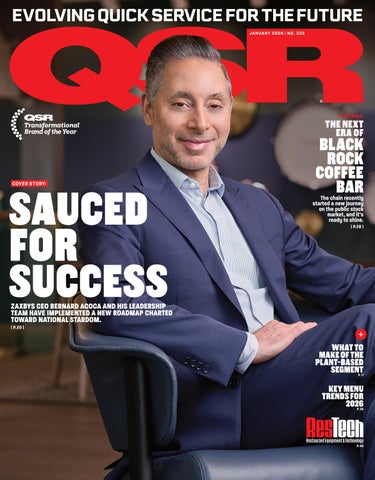
EVOLVING QUICK SERVICE FOR THE FUTURE JA NUA R Y 2026 ⁄ NO. 335
® FEATURING:
Transformational Brand of the Year
COVER STORY:
SAUCED FOR SUCCESS
THE NEXT ERA OF
BLACK ROCK COFFEE BAR
The chain recently started a new journey on the public stock market, and it’s ready to shine. | P. 28 |
ZAXBYS CEO BERNARD ACOCA AND HIS LEADERSHIP TEAM HAVE IMPLEMENTED A NEW ROADMAP CHARTED TOWARD NATIONAL STARDOM. | P. 20 |
+ WHAT TO MAKE OF THE PLANT-BASED SEGMENT P. 11
KEY MENU TRENDS FOR 2026 P. 36
Restaurant Equipment & Technology P. 49
Premium ingredients pay for themselves. When your signature items look better and taste better, they sell better. ghirardelli.com/professional
LEARN MORE
JANUARY TA BL E OF CON T EN T S / # 335
/ QSR Brands of the Year Issue NEWS
2 BRANDED CONTENT
44
4 EDITOR’S LETTER
Community in Action
7 BEHIND THE COUNTER 48 ADVERTISER INDEX
FRANCHISE FORWARD
These Saladworks/Frutta Bowls operators show why outreach is a key part of franchising. BY EMMA SCHMALZ
45 OPER ATIONS
Programming the Perfect Bagel
Learn how Jeff’s Bagel Run’s tech stack is powering its menu design. BY SAM DANLEY INSIGHT
11 FRESH IDEAS
Surviving the Squeeze FE AT URE S
20
When Strategy Meets Southern Flavor BY BEN COLEY
Zaxbys has spent the past four years sharpening operations, branding, digital sales, and franchise growth, and the results are paying off.
28
Barista-First and Breaking Out BY SAM DANLEY
Black Rock Coffee Bar is the newest brand to hit the stock market, and it’s brewing an ambitious path to 1,000 stores.
36
Plant-based foods once had momentum, but trends have shifted. Where does the segment go from here? BY SAM DANLEY
15 ONES TO WATCH
Konala
The health-focused brand has a lot of growth ahead. BY EMMA SCHMALZ
16 WOMEN IN LEADERSHIP
The Future of Fresh Kitchen
The brand is in rebuild mode after losing its flagship restaurant in a fire. BY SATYNE DONER
64 S TART TO FINISH
Mike Burns
&pizza CEO Mike Burns on what’s next for the differentiated fast-casual chain.
P. 49 Restaurant Equipment & Technology
Serve What Matters
ZAXBYS / BLACK HORSE STUDIO
BY MIKE KOSTYO AND MAEVE WEBSTER
Why authenticity— not the latest flavor craze— will define winning menus this year.
ON THE COVER
Zaxbys CEO Bernard Acoca wants to move the brand into the national spotlight. PHOTOGR APHY: ZA XBY’S WREATH: ADOBE STOCK / ROSENDO
QSR is a registered trademark of WTWH Media, LLC. QSR is copyright © 2026 WTWH Media, LLC. All rights reserved. The opinions of columnists are their own. Publication of their writing does not imply endorsement by WTWH Media, LLC. Subscriptions (919) 945-0704. www.qsrmagazine.com/subscribe. QSR is provided without charge upon request to individuals residing in the U.S. meeting subscription criteria as set forth by the publisher. AAM member. All rights reserved. No part of this magazine may be reproduced in any fashion without the express written consent of WTWH Media, LLC. QSR (ISSN 1093-7994), USPS PUBLICATION #20387 is published monthly by WTWH Media, LLC, 1111 Superior Avenue Suite 1120, Cleveland, OH 44114. Periodicals postage paid at Cleveland, OH and at additional mailing offices. POSTMASTER: Send address changes to WTWH Media, LLC, 1111 Superior Avenue Suite 1120, Cleveland, OH 44114.
www.qsrmagazine.com | QSR | JANUARY 2026
1
BRANDED CONTENT EDITORIAL
V ICE PR ESIDENT EDITOR I A L FOOD, R E TA IL , & HOSPITA LIT Y
BRAND STORIES FROM QSR
Danny Klein
dklein@wtwhmedia.com
QSR EDITOR
Ben Coley
IN THIS ISSUE
bcoley@wtwhmedia.com
FSR EDITOR
Callie Evergreen
cevergreen@wtwhmedia.com
49
AS SOCI ATE EDITOR
Sam Danley
sdanley@wtwhmedia.com
R E S TA UR A N T E Q UIP ME N T & T E C HN O L O G Y / J A NU A RY 2 0 2 6
AS SOCI ATE EDITOR
Satyne Doner
sdoner@wthwmedia.com
SENIOR V ICE PR ESIDENT AUDIENCE GROW TH
Greg Sanders
gsanders@wtwhmedia.com
54
58
CONTENT STUDIO
A Cool Recipe for Success in the Quick-Serve Restaurant Industry
V ICE PR ESIDENT, CONTENT S T UDIO
Peggy Carouthers
pcarouthers@wtwhmedia.com
The simple strategy that drives beverage sales and improves guest experience. SPONSORED BY FROZEN BEVERAGE DISPENSERS
COATES GROUP
50
A Complex Brand Ecosystem, Simplified for Seamless Customer Experiences Align
LOOMIS / ISTOCKPHOTO.COM
ECOLAB
A Big Task that Can Be Easily Automated Something
ADOBE STOCK / MICHAEL O’KEENE
52
Drive-Thru Tech Evolution
the full-service sector has been doing for a long time. SPONSORED BY ECOLAB
The Burger King Operator Turning Better Oil Practices into Bigger Profits Unlock major savings, stronger food consistency, and safer kitchens. SPONSORED BY RESTAURANT TECHNOLOGIES INC.
Join the fast lane to higher sales and efficient service. SPONSORED BY GLOBAL PAYMENTS
Is Theft Eating Your Restaurants’ Earnings?
Here’s how restaurants are fighting back against cash loss. SPONSORED BY LOOMIS
W R ITER , CONTENT S T UDIO
Ya’el McLoud
ymcloud@wtwhmedia.com
W R ITER , CONTENT S T UDIO
Abby Winterburn
ART & PRODUCTION
SENIOR A R T DIR ECTOR
Tory Bartelt
tbartelt@wtwhmedia.com
FSR A R T DIR ECTOR
Erica Naftolowitz
enaftolowitz@wtwhmedia.com SALES & BUSINESS DEVELOPMENT
SV P, FOOD, R E TA IL , HOSPITA LIT Y S A LES A ND ACCOUNT M A N AGEMENT
Matt Waddell
mwaddell@wtwhmedia.com 312-961-6840
62
56
Drew Filipski
dfilipski@wtwhmedia.com
awinterburn@wtwhmedia.com
60
technology, operations, and customer experience into a unified strategy. SPONSORED BY COATES GROUP
W R ITER , CONTENT S T UDIO
Palmer Digital Group Raises the Canopy for Dual-Concept Fast Casual Restaurant Chain First dual-lane drive-thru configuration with outdoor digital menuboard. SPONSORED BY PALMER DIGITAL GROUP
V ICE PR ESIDENT, BU SINES S DE V ELOPMENT
Eugene Drezner
edrezner@wtwhmedia.com 919-945-0705
N ATION A L S A LES DIR ECTOR
Edward Richards
erichards@wtwhmedia.com 216-956-6636
N ATION A L S A LES DIR ECTOR
Amber Dobsovic
adobsovic@wtwhmedia.com 757-637-8673
N ATION A L S A LES M A N AGER
ONLINE S E E T H E S E S T O R I E S A T Q S R M A G A Z I N E . C O M / S P O N S O R E D
Guy Norcott
gnorcott@wtwhmedia.com 854-200-5864
CU S TOMER SERV ICE R EPR ESENTATI V E
RESTAURANT TECHNOLOGIES INC.
ROKT
ROSATI’S PIZZA ENTERPRISES, INC.
Tracy Doubts
TECHNOLOGY
LOYALT Y
Stop Overlooking a Revenue Stream Hiding in Plain Sight As digital ordering
How a 60-Year Old Pizza Brand How Denny’s Saved $190,000 Continues to Inspire Franchise and Eliminated Employee Growth Blending old-school Safety Risks Safer kitchens,
surges, the most valuable ecosystem sits at the moment of payment.
authenticity with modern franchise strategy. SPONSORED BY ROSATI’S PIZZA ENTERPRISES, INC.
SPONSORED BY ROKT 2
JANUARY 2026 | QSR | www.qsrmagazine.com
SECURIT Y
better food, bigger savings. SPONSORED BY RESTAURANT TECHNOLOGIES INC.
tdoubts@wtwhmedia.com 919-945-0704
CU S TOMER SERV ICE R EPR ESENTATI V E
Brandy Pinion
bpinion@wtwhmedia.com 662-234-5481, EXT 127 FOUNDER
Webb C. Howell ADMINISTRATION 919-945-0704 / www.qsrmagazine.com/subscribe QSR is provided without charge upon request to individuals residing in the U.S. who meet subscription criteria as set forth by the publisher. WTWH MEDIA LLC RETAIL, HOSPITALITY, AND FOOD GROUP
Imagine Your Brand in Every Bite! Your flavors are unforgettable — your packaging should be too.
Scan Here for FREE Mockup
(973) 345-2000 | SALES@ACCURATEBOX.COM | ACCURATEBOX.COM
EDITOR’S LETTER
It’s Prediction Time W H AT W I L L H A P P E N I N 2 0 2 6 . L E T ’ S F I N D O U T.
I
BCOLEY@WTWHMEDIA.COM QSR MAGAZINE
4
JANUARY 2026 | QSR | www.qsrmagazine.com
t’s the start of a new year, which means I’m going to do what most are doing right now—dust off my crystal ball and give some predictions for 2026. My first thought comes to value, a word that’s taken hold of the restaurant industry over the past couple of years. Lower-income consumers have shied away from visits, and so have middle-income guests in some cases. From what I’ve heard—talking to executives and listening to quarterly earnings calls of public companies—there’s nothing to suggest intense value offers and discounting won’t continue well into the new year. Guests are still having a hard time, with no relief when it comes to rent, groceries, or any other part of their life, let alone spending money on a restaurant visit. The environment is best described by what McDonald’s CEO Chris Kempczinski said in November: “This is an environment where you’ve just got to grind it out.” Technology will also be a big storyline, which I know we say every year. But it still holds true. There are a few brands that you should keep on your radar. First, Wingstop and Shake Shack. Both operate in the fast-casual space and are planning to amplify value by rolling out new loyalty programs. The truth is, in today’s environment, having some sort of rewards platform is table stakes. It’s one of the best ways to engage guests, generate more visits, and reel in higher checks. Personalization is big too. Instead of the old blanket messages of the past, restaurants are getting targeted and granular with how they’re talking to customers. That’s how you build a long-lasting relationship. When it comes to the menu, chicken and beverages have grown significantly, and I expect to see much of the same in
2026. In 2024, Taco Bell debuted drinkforward spinoff Live Más Café in Chula Vista, California. Now there are plans to open 30 more across Texas and Southern California, split between the corporate team and large franchisee Diversified Restaurant Group. McDonald’s has jumped on the beverage bandwagon too. After using prototype CosMc’s to test a lineup of creative drinks, the burger giant shut down that project, and launched a new beverage pilot at more than 500 of its own stores across Colorado and Wisconsin. This includes cold coffees, fruity refreshers, crafted sodas, and energy-based drinks. Will the platform go nationwide? It’s certainly looking that way. McDonald’s said the pilot is exceeding expectations and fueling incremental occasions across multiple dayparts. And let’s not forget about the rise of chicken. Expect more innovation around this protein from the biggest players in the country. One example is KFC’s Saucy concept, which is based around chicken tenders and a variety of unique dipping sauces. Yum! Brands plans to open more of these, hoping to capture the attention of more Gen Z and millennial guests. That’s it. Those are my predictions. Sure, I didn’t really go out on any limbs, but I still think it taps into the pulse of the restaurant industry. I’m excited to see what the future holds.
Ben Coley EDITOR
ADVANCED
Speed-of-Service Timing System
DRIVING MEASURABLE PERFORMANCE
ALL-IN-ONE DRIVE-THRU SYSTEM EQUIPPED WITH
Cloud-Based Speed-of-Service Timer
Timing Data
Enterprise-Level Information
Multi-Restaurant Insights
Customizable Leaderboards
Major Cost Savings
at your fingertips
vs. other systems
INNOVATIVE, VALUE-DRIVEN SOLUTIONS SINCE 1989 rfdrivethru.com I (800) 598-2370 I sales@rfdrivethru.com CHICAGO • LOS ANGELES • NEW ENGLAND • ST. LOUIS • TORONTO D D © 2026 R.F. Technologies, Inc. All rights reserved.
Flavor You Can’t Replicate. America’s Original Cave-Aged Blue Cheese * Treasure Cave® Blue Cheese is America’s original cave-aged blue, delivering bold, tangy flavor that transforms any dish. Perfect for crumbling over salads, melting into sauces, or topping burgers, it’s the ingredient chefs trust to make menus unforgettable. Unearth the bold. Taste the tradition.
Learn more at saputousafoodservice.com
*Born in caves. Today, our cheeses are aged in a state-of-the-art facility in Wisconsin.
BEHIND THE COUNTER
Feeding Women Empowerment
The Women Restaurant Leadership Conference is back again in late February.
WTWH MEDIA / SCOOBIEPHOTO.COM
ATTENDEES CAN EXPECT A WEALTH OF KNOWLEDGE, ADVICE, AND A PATH FORWARD.
The WiRL Summit will be held in Charleston, South Carolina.
The Women in Restaurant Leadership (WiRL) “Together Summit” is a national event designed to support, elevate, and connect women working across every corner of the restaurant and hospitality industry. The Summit is intended to provide a powerful combination of inspiration, education, mentorship, and community — bringing together women at varying stages of their careers, from emerging leaders to senior executives, for a shared experience devoted to growth and leadership. At this year’s Summit, set for February 25–27, 2026 at the Charleston Marriott in Charleston, South Carolina, one of the key draws is the opening keynote by Tabassum Zalotrawala—senior vice president of global restaurant design and U.S. chief development officer at McDonald’s. In her role, Zalotrawala oversees the development and optimization of McDonald’s U.S. restaurants and shapes the company’s long-term growth strategy, while also leading global standards for restaurant design to improve both guest and employee experiences. Her keynote is expected to offer a candid look at her professional journey, the values that have driven her success, and insights into leadership strategies for overcoming challenges and advancing in a large, complex organization. Beyond the keynote, the Summit offers a mix of educational sessions, workshops, and peer-driven forums tailored to the unique needs of restaurant professionals. Participants can expect hands-on workshops about leadership, training and development, communication, operational strategy, and business fundamentals such as financial acumen—all in the context of hospitality. Attendees of the Summit should leave with more than just new contacts: they can expect to walk away with renewed confidence and leadership skills.
www.qsrmagazine.com | QSR | JANUARY 2026
7
BEHIND THE COUNTER
In November, Resy released its annual “Resy Retrospective” report, which shows consumer trends, changes in dining preferences, and shifts in how restaurants are operating behind the scenes.
Rise of the Table Captain The “Table Captain” is the friend who confidently takes charge of ordering, understands restaurant specialties, and manages dietary preferences. According to a survey of 1,000 U.S. diners, 72 percent say they prefer trying new restaurants with a Table Captain present. 60 percent say the Table Captain improves the experience. Over 50 percent of Gen Z say they have invited someone to dinner specifically for their restaurant expertise. The top qualities of a great Table Captain are: • Food knowledge (66 percent) • Decisiveness (48 percent) • Overall “rizz,” or charisma (20 percent)
COMMUNAL TABLES
All Plates Are Share Plates
2026 DINING PREDICTIONS
Sharing has become the default dining mode, with 94 percent of diners (and 97 percent of Gen Z) likely to share depending on the group.
Wine bars evolve into full dining destinations, settling the debate over whether they count as restaurants.
Diners are most likely to share with: • Family (85 percent) • Close friends (81 percent) Diners are surprisingly open to sharing with: • First dates (46 percent) • Coworkers (45 percent) Team Resy’s top national shareables include crispy maitake mushrooms, pancakes at Golden Diner, Lao sausage, lamb wraps, and tahdig.
Communal Tables Make a Comeback Restaurants have become important “IRL” spaces for connection, appealing most to Gen Z diners. 90 percent of Gen Z enjoy dining at communal tables, compared to 60 percent of baby boomers.
BACK OF HOUSE TRENDS
Restaurant Tech Becomes Truly Connected Resy, Tock, and American Express established a multi-year strategic partnership with Toast, plus deeper integrations with Loyalist and Fishbowl. Operators want fewer logins, less manual data transfer, and more seamless systems. Integrating POS with reservations allows staff to see which tables are close to turning without walking the floor. The overall goal is a unified digital ecosystem that reduces friction and frees staff to focus on hospitality.
8
GEN Z
OF ENJOY DINING AT
JANUARY 2026 | QSR | www.qsrmagazine.com
For many, communal tables are social: • 63 percent say they are ideal for meeting new people. • 1 in 3 have made a new friend this way. • 1 in 7 have even gotten a date. Washington, D.C. leads the nation in communal-table seating density. Top communal-table restaurants include Aita (NYC), Galit (Chicago), Dudley Market (LA), Little Hen (Miami), Tapori (D.C.), and Madeira Park (Atlanta).
PIZZA REGIONS DIVERSIFY, with Los Angeles experiencing a major boom. Regional culinary specificity deepens across menus.
Smaller, Smarter Restaurant Spaces The average restaurant joining Resy has gotten smaller every year since 2019. Key drivers include rising rent, labor costs, staffing shortages, and continued demand for delivery and takeout.
Tiny martinis (“tiny ’tinis”) trend nationwide. Philadelphia is named the next major U.S. food city, buoyed by Michelin attention and multiple highprofile honors.
Diners increasingly prefer intimate, experience-driven settings such as chef’s counters and concept bars.
The Sustainability Shift Restaurants are adopting sustainable practices across sourcing, design, and operations—not just in the kitchen. 59 percent of diners say they are more likely to visit a restaurant that uses tech to reduce food waste.
CAMBODIAN AND LAO CUISINES gain mainstream traction.
ADOBE STOCK (6) / COMMUNAL TABLE: MIHAIL, TABLE WITH FOOD: SONYAKAMOZ, SMALL LOCATION: KAY ABRAHAMS/PEOPLEIMAGES.COM, RECYCLING/RUBBUSH: EDNURG, WINE: FORNSTUDIO, MARTINI: LIGHTFIELD STUDIOS, CAMBODIAN SKEWERS: ARSENE MAURICE
FRONT OF HOUSE TRENDS
90%
Touchscreen Timing Evolved: Experience the Future Operate your kitchen with pinpoint precision and boost profits.
The TT-700 Touchscreen Timer transforms kitchen operations with cutting-edge technology and intuitive design.
• Conquer Peak Hour Chaos: Multi-product timing and clear alerts keep your line running smoothly, even at the busiest times. • Ensure Food Quality & Safety: Consistent timing and temperature monitoring mean perfect dishes, every time. • Minimize Waste: Precise control reduces food waste, directly impacting your bottom line. • Maximize Speed: Intuitive 7” touchscreen with visual programming for fast, accurate operation. • Real-Time Intelligence: Wireless tracking and instant “Cook More/Prep More” alerts for peak productivity.
Coming Soon - Q1 2026 www.KitchenBrains.com | 800.243.9271
Scan the QR code to discover how the TT-700 can revolutionize your kitchen.
H A B A N E R O B U F FA L O GLSOAT UMCORE..E.! WNIN DA A
TE. our cashback REBA Buy and SAVE with w. no om e.c vic er oods Go To TexasPeteF Texa s Pete ® is a regi ster
ed trad ema rk of TW Garn
® banero Buffalo Wing New Texas Pete Ha d heat, deep flavor, an Sauce brings bold s, next-level Wings. Plu the perfect cling for e our Hot Buffalo Sauc we’ve reformulated e, nal Buffalo Wing Sauc into the clingier Origi up better results. Heat a thicker recipe for up the sauce that heats your wing game with the your distributor for the wing game. Ask . ® Buffalo Wing Sauces full line of Texas Pete
er Food Com pany. 1090 -02-
0420 25
fresh ideas J A N U A R Y
2 0 2 6
M E N U
T R E N D S
SURVIVING THE The plant-based boom has cooled, and vegan chains are feeling the pressure. Can the category push through a tougher market?
SQUEEZE
BY SAM DANLEY
PLNT BURGER CEO CHRIS TRELOAR ACKNOWLEDGES PLANT-BASED CHAINS HAVE HAD A DIFFICULT TIME.
PLNT BURGER
P
lant-based foods are confronting a slowdown that’s hard to ignore. Alt-meat and dairy alternatives aren’t cycling through shelves the way they once did across the grocery channel. The industry is absorbing declining retail sales and shrinking distribution after expanding aggressively during the boom years. And the strain isn’t confined to supermarkets. In quick service, several vegan concepts have spent the past few years battling closures, downsizing, or insolvency. Kevin Hart’s Hart House shuttered all four Los Angeles units in 2024. Neat Burger, a plant-based chain backed by Lewis Hamilton and Leonardo DiCaprio, shuttered all its remaining stores in the U.K. last spring after U.S. and Dubai closures. Veggie Grill saw heavy footprint reduction and ongoing financial tur-
bulence before landing a savior acquisition by Next Level Burger. Plenty of brands still cater to flexitarians and vegans, but the steady drumbeat of bad news has fed a broader narrative that the plant-based revolution may be losing steam. “It’s certainly been a tough time,” says Chris Treloar, CEO of vegan fast-casual chain PLNT Burger. “Just look at the headlines, and you can see our competitors and even some of our vendors are going out of business.” Industry watchers often describe the shift as a classic hype-cycle correction. A disruptive category breaks out with excitement, sparks a flood of new entrants, and enjoys early hypergrowth. Eventually, supply outpaces demand, differentiation thins, and the market contracts before resetting on steadier footing.
www.qsrmagazine.com | QSR | JANUARY 2026
11
fresh ideas The pattern is familiar. Think dotcoms, e-commerce, and electric vehicles. Plant-based is just working through its own version, Treloar says, now layered with inflation and rising household costs. “Look at businesses that aren’t plant-based, and everybody is still struggling,” he says. “More and more people are just pulling back and deciding that they need to conserve money.” For younger categories without many decades of consumer familiarity, the pressure hits harder. Still, Treloar believes that plant-based brands that hold their ground will be well-positioned when conditions loosen. PLNT Burger aims to be one of them. While some vegan concepts have stalled, the brand has quietly reached 13 locations in five years, including 11 inside Whole Foods and two standalone. That embedded model keeps development costs low and funnels in consistent traffic, allowing the business to stay lean while expanding. Treloar points to tight overhead, competitive pricing, and strategic partnerships with alt-meat makers as key levers that have kept the company stable even as the category contracted. Staying disciplined hasn’t meant staying static, though. Over the past year, PLNT Burger
M E N U
T R E N D S
has upgraded its cheese, chicken, and soft serve, while rolling out new items like TiNDLE Wings to reinforce value and routine craveability. Marketing has taken a more assertive turn, though Treloar notes reaching vegans and vegetarians is easy. The real opportunity is converting meat eaters. He wasn’t vegan when he joined PLNT Burger, and that perspective helped inspire a key move: swapping a $5 new-member discount for a free sandwich of choice. The change drove a roughly 200 percent jump in loyalty sign-ups and opened the door to more non-vegan and non-vegetarian first-timers. “We’ve always known that to build a scalable business, you’re going to have to have omnivores or carnivores wanting the product,” Treloar says. “Pre-vegan me wouldn’t have even tried a vegan product had it not been free. But when you break down every barrier to entry, people are much more likely to try it.” For most brands, the goal isn’t to convert everyone to veganism but to make it easier for everyday diners to
PLNT BURGER (3) RESTAURANT: E.M.PERGANTIS
MOST OF PLNT BURGER’S LOCATIONS ARE BASED INSIDE WHOLE FOODS STORES.
12
JANUARY 2026 | QSR | www.qsrmagazine.com
choose a plant-based option occaTHE PLANT-BASED sionally. Messaging that draws SPACE IS TRYING TO PUSH PAST them in the first place is crucial, ITS REPUTATION because even as products get betAS AN EXPENSIVE AND NICHE ter, old assumptions linger about SEGMENT. taste, price, and who plant-based food is really for. “There’s this stereotype that the whole plant-based movement has been positioned as niche and expensive,” says Adam Wilks, president of Mr. Charlie’s Told Me So, a growing vegan fast-food chain. “It’s an obstacle that we’re trying to break through.” That perception has helped keep the category from reaching mainstream fast-food scale, adds cofounder Taylor McKinnon. He says the challenge isn’t so much a lack of demand as it is building a concept that can grow efficiently in a young, still-shifting market. Scaling requires both tight systems and a clear identity, and those are areas where he believes many early entrants fell short, lacking either operational footing or the storytelling needed to spark curiosity and maintain engagement. Mr. Charlie’s has leaned into a playful, distinctive tone to stand out and reach consumers. The brand riffs on McDonald’s with its red-and-yellow aesthetic and signature “Frowny Meals,” packaged in bright boxes with a sad face graphic and the invitation to “turn that frown upside down.” Its menu tucks plant-based alternatives behind cheeky names like “Not a Hamburger” and “Not Chicken Nuggets.” But beneath the parody is a purpose-driven message. Mr. Charlie’s positions itself as a lifestyle brand with a focus on sustainability, personal wellness, and second chances through its hiring model, employing people who have been unhoused or formerly incarcerated. The tone may be irreverent, but the core idea is that choosing plant-based food shouldn’t feel like a sacrifice or a statement. It should simply feel fun, normal, and accessible. “We’re not waving a flag, we don’t mock anybody, and we’ve never been disrespectful to the meat industry,” McKinnon says. “We’re just here to offer an alternative, but we’ve made it very approachable and very fun and very connecting for you to try it. I think that’s the disconnect that didn’t exist before.” He believes many plant-based brands stumbled because they couldn’t close the gap between curiosity and confidence. The
14
JANUARY 2026 | QSR | www.qsrmagazine.com
M E N U
T R E N D S
humor and approachability help disarm skepticism and give people an easy on-ramp. This approach has fueled strong social media buzz and outsized awareness. By the end of 2025, the chain had four units open—three in California and one in Sydney, Australia—with rapid growth planned in the coming months and a target of 11 stores open by the end of Q1. Last year, the brand also signed a major development deal to bring its plant-based fare to more than a dozen locations in Arizona, and it is currently exploring franchising opportunities to expand across the U.S. and internationally. Mr.Charlie’s spent the past few years laying its foundation: finetuning the menu, building out its team, and proving the model before embarking on this broader growth push. But scaling in this space comes with vulnerabilities. McKinnon points to supply and distribution as one of the biggest challenges. As retail demand cools, some plant-based products are losing shelf presence. When supermarkets reduce assortments or exit the category, it destabilizes the distribution networks that both retail and restaurants rely on. Costs rise, availability becomes uneven, and operators shoulder the fallout. To counter that volatility, Mr. Charlie’s has leaned into longterm supplier relationships and invested in building more unique IP across the menu, like PLNT Burger. That strategy reduces dependence on any single player and protects the brand in the face of broader turbulence. Wilks and McKinnon remain optimistic about plant-based quick service despite the broader category reset. They see room for a culturally fluent, sharply defined concept to scale into the hundreds globally. And like Treloar, they believe the next phase hinges on a simple threshold: convincing more meat eaters to give their food a try. The good news is that the hurdle will keep getting lower as plant-based proteins continue to improve. “It’s only going to be a matter of time before everybody feels comfortable enough to try it at least once,” McKinnon says. “And after you try it once, then we’ve probably got you for good.” Sam Danley is the associate editor of QSR. He can be reached at sdanley@ wthwmedia.com.
ADOBE STOCK (2) VEGAN BURGER: LAVIZZARA, PLANT-BASED CHICKEN: DAVID
fresh ideas
ONES TO WATCH
Konala
TRACE AND JAMMIE MILLER FOUNDED KONALA IN 2023.
Cofounder Trace Miller wants to inspire others to eat and live a healthy lifestyle. / BY EMMA SCHMALZ FOUNDERS: Trace & Jammie Miller HEADQUARTERS: Coeur d’Alene, Idaho YEAR STARTED: 2023 ANNUAL SALES: $2 million AUV TOTAL UNITS: 25; 3 Open – 20+ in development (corporate 25).
KONALA(2)
L
iving a healthy lifestyle has always been at the forefront for Konala cofounder Trace Miller. When he was very young, he was diagnosed with Lennox-Gastaut syndrome, a rare form of childhood-onset epilepsy. It was predicted that he would die before his 13th birthday. But, through a combination of technology and nutrition, Miller says he was cured by the time he turned 7. “I was completely cured. No seizure since, and obviously I’m still alive. So that was the inspiration for it. I grew up living a really healthy lifestyle,” Miller says. After high school, Miller joined the military and taught people how to eat well, lose weight, and be more fit. This translated into his adult life, where he found a passion for showing others how to eat better through meal prep. “It was never a business. It was just for fun. I really enjoyed it because it’s my passion and changed my life. The actual menu items at Konala are inspired by meal prep,” Miller says. Founded in 2023, by Miller and his wife Jammie, Konala has evolved into a health franchise with 25 more stores in development. Franchising was launched at the end of 2024. Miller loves the growth model and working with other ambitious business operators. The Konala franchisees are customers themselves, Miller says, and they want to be a part of the brand because they truly believe in healthy eating and helping oth-
CAPTION.
ers do so. The menu was created to offer customers a quick-serve restaurant that has solely better-for-you options. “Our food philosophy is high protein and well-balanced carbs and fats, so we have our macros calories on the menu for all items, so it’s transparent,” Miller says. Before Konala, Miller owned The Bunker Bar in Post Falls, Idaho. The bar grew from the food truck called “Burger Bunker” he and his wife previously operated. Miller didn’t know anything about the restaurant industry when he first got into it, but instead was fueled by his passion for nutrition and food. The greasy burger and
bar atmosphere didn’t fit with the Miller’s lifestyle, so even though business was booming, the couple decided to move on and create something that aligned more with them. “We won best burger and best bar in Idaho three years in a row,” Miller says. “I started to really like it, but it didn’t really align with our lifestyle. We live a healthy lifestyle, and burgers, fries, alcohol is not that. So it was fun in our 20s, but then we wanted to think bigger.” And bigger they went. Based in Coeur d’Alene, Idaho, there are now Konala corporate stores in Idaho, Washington, and Nevada, with franchise locations opening in California, Montana, Utah, New Jersey, Pennsylvania, and, of course, Idaho. Konala’s values are similar to its mission, which is fostering a work environment and culture that centers on being fit. Miller says the brand wants athletic, competitive people to work for the company. “We hire for person- [CONTINUED ON PAGE 48]
www.qsrmagazine.com | QSR | JANUARY 2026
15
TARA O’NEILL HAS BEEN WITH FRESH KITCHEN SINCE 2016.
The Future of Fresh Kitchen After losing its original Tampa flagship to a fire, the beloved brand is rebuilding with heart—leading with people, purpose, and possibility. / BY SATYNE DONER
J
ust shy of its 10th anniversary, around 4:30 a.m. on South Howard Avenue in Tampa, Florida, the original Fresh Kitchen restaurant went up in flames, making the “Little House on Howard” a total loss. Founded in Tampa in 2014, Fresh Kitchen has grown into a fast-casual favorite with 16 thriving locations across Florida. Its customizable, chef-inspired, madeto-order bowls provide a fast, healthy, feel-good experience, emphasizing a commitment to sustainability and community
16
JANUARY 2026 | QSR | www.qsrmagazine.com
impact as it grows its loyal following— sharing love through fresh experiences. Tara O’Neill has been with Fresh Kitchen since 2016, starting as vice president of training and experience, later serving as brand president, and transitioning to chief people officer in September. She remembers the day of the fire—and the outpouring of community love—vividly. “It was surreal, pulling up and seeing the street closed off. It was clear to us when we saw the building that our SoHo flagship was no more,” O’Neill recounts. “I am
so proud of our team and how we rallied to create space for our team members who were affected, reassuring them that everything was going to be OK.” While no employees were present or physically harmed in the fire, O’Neill and her team knew the instability caused by the blaze would leave hidden wounds— such as financial insecurity from losing a job overnight. Their first step was to partner with Fresh Kitchen’s parent company, Ciccio Restaurant Group, to ensure no employee went without work. The next step was letting the community know about the loss. In those early moments after the fire, O’Neill admits it was hard to find the right words—but they kept their message transparent and heartfelt, and the community returned the favor. “It gives me goosebumps to think about the outpouring of love from our community. The responses of support and the personal impact stories from our guests, sharing their memories with us, blew me away,” O’Neill says. “This community gave us our first shot at success, and it’s like a boomerang—they love us, and we want to love them back.” In the year since the fire, Fresh Kitchen has been intentional in reimagining what the next chapter of the brand will look like. In early 2026, a brand-new flagship location is set to open just 1.5 miles from the original South Howard restaurant—a symbol of resilience, hope, and the future of Fresh Kitchen. Staying in the neighborhood was important to the team. O’Neill calls it a full-circle moment. “When we think about our new flagship, it’s about honoring our roots and who we are at our core, but also dreaming about what’s next—something that feels familiar to the South Tampa community, but at the same time elevated, signaling us to plant the seeds for the next era,” she says. The new flagship will be the largest Fresh Kitchen yet, at 4,000 square feet—double the size of a typical restaurant—paving the way for future innovation and growth. O’Neill points to several behind-the-scenes initiatives, including testing new equipment, expanding the test kitchen, and exper- [CONTINUED ON PAGE 46]
FRESH KITCHEN / MARIA GARCIA
WOMEN IN LEADERSHIP
Your trusted partners in scalable, eye-catching QSR signage CALL FOR DETAILS: 866-261-0317
THE TOGETHER S W O M E N I N R E S TA U R A N T L E A D E R S H I P
Join the movement of women reshaping the future of the restaurant industry at the Women in Restaurant Leadership: Together Summit. This three-day event is all about bold conversations, powerful insights, and purposeful networking that fuels the growth and success of women leaders across the industry. WHAT TO EXPECT
WHY ATTEND?
•Visionary Speakers:
•Innovative Leadership:
•Hands-On Workshops:
•Empowerment in Action:
Hear from trailblazing women who are changing the restaurant world, sharing strategies and stories that inspire action. Gain practical tools to overcome real challenges, enhance your leadership, and drive business success.
•Next-Level Networking:
Connect with driven, like-minded women ready to collaborate and empower each other.
Discover fresh perspectives and actionable ideas to enhance your leadership in this evolving industry. Engage in meaningful discussions that inspire personal and professional growth.
•Collaborative Impact:
Be part of the conversations that tackle today’s challenges— diversity, equity, and work-life balance—and shape tomorrow’s solutions.
Who Should Attend? If you’re a woman in the restaurant industry— whether you’re an owner, chef, manager, or emerging leader— this summit is for you.
MARQUEE SPONSOR:
P L AT INUM S P O N S O RS :
GOLD SPONSORS:
Charleston Awaits Experience the energy of Charleston while connecting with women leaders who are as passionate and driven as you are.
SILV E R SP ONS ORS :
SUPPORTING SPONSORS:
R egis istter today !
WOMENLEADRESTAURANTS.COM
UMMIT
FEBRUARY 25 - 27, 2026 CHARLESTON, SC
FEBRUARY 24, 2026
FEBRUARY 26, 2026
6:00 pm - 8:00 pm
6:30 am - 7:30 am
6:00 pm - 7:00 pm
Pre-Event Happy Hour: Sips With Satyne
WiRL Partners Toast SPONSOR THANK YOU RECEPTION
FEBRUARY 25, 2026 9:00 am - 7:00 pm
Registration & Information Desk
PRE-CONFERENCE WORKSHOP -
10:00 am - 11:00 am
Grow Viciously: Building a Career Inside a Brand on the Rise
DOINITA LEAHU | Vicious Biscuit, KATIE DEPOPPE | Vicious Biscuit, KATE BYRD | Vicious Biscuit, AMANDA PARKER | Vicious Biscuit, AMANDA KAHALEHOE |
Vicious Biscuit
PRE-CONFERENCE WORKSHOP -
11:00 am - 12:00 pm
Leaders as Learning Architects: Rethinking How We Teach, Measure, and Coach LINDSEY HALSON | Bojangles, KATHRYN MURROW | Bojangles
11:30 am - 12:30 pm 1:00 pm - 3:00 pm 3:00 pm - 4:00 pm 4:00 pm - 4:30 pm
Early Arrival Lunch
Mentorship Mixer: WiRL x GLEAM OPENING ADDRESS:
Welcome to WiRL
TONI RONAYNE | The C Society
5:00 pm - 7:00 pm
The Gatsby Gala
6:30 pm - 9:00 pm
Dinner Your Way
PRESENTED BY OLO
Self-Defense with Satyne
Ghost and Graveyard Walking Tour SPONSORED BY SYNERGYSUITE
7:00 pm - 9:30 pm
Registration & Information Desk
7:30 am - 8:45 am
Headshot Studio
7:45 am - 9:00 am
Breakfast
8:00 am - 9:00 am
CHART’s Live Ask My Peers (LAMP): LAMP Returns, Vol.3
9:00 am - 10:00 am
Opening Keynote
10:00 am - 10:30 am
Networking Break
CHARLESTON
MARRIOTT
Pouring Into Yourself: A Morning with Jennifer Dodd JENNIFER DODD
Main Squeeze Juice Co.
KEYNOTE SPEAKERS:
RACHEL RICHAL | Buffalo Wild Wings, MYISHA SMITH | Pacifica Hotels
TABASSUM ZALOTRAWALA | McDonald’s U.S.
Own Your Evolution: Rewriting the Career Playbook TONI CALDERONE | Pastanito Fresh Pasta Fast, KAYLA DILLON | Erik’s DeliCafé, LISA GUTIERREZ | Dos Hermanos, KELLI ALLDREDGE | Chicken N Pickle, JENNIFER LOPER | C3 Brand Marketing, ERIN LEVZOW | Board Member | Strategic Advisor | Advocate, HEATHER McINTYRE Senior Director of Corporate Affairs | Panera Bread
Culture Can’t Wait: Mentorship, Inclusion & Communication That Sticks
Enterprise Value: Unlocking the Financial Acumen That Grows Your Business
JEN JAFFE | BJ’s Restaurants & Brewhouse, REBECCA BROWN | 7 Brew Coffee, JERICHO LOPEZ | J&J Marketing Studio, MARY CAMP | HR Technology, Talent, and Engagement Leader, ALAYNA SULLIVAN | Olo, RHONDA LEVENE | Ziosk, JILL WAITE | Portillo’s Hot Dogs
JASMINE CHIARAMONTE | DIG, ASHLEY ROBINSON | The Seaker Group, KATIE GRISSOM | Nuveen; Board Member | Barcelona Wine Bar,
DANA ZUKOFSKY | Franchise & Hospitality Practice, LILAH TAHA-RIPPETT | First Watch, CAREN PRINCE | Firebirds Wood Fired Grill
11:30 am - 12:15 pm Claiming Your Space: Speaking with Authority, Visibility & Confidence
The Human Side of High Performance: Leadership That Lifts
TENYSE WILLIAMS | Verified Consulting, DEVON CROOM | Chickfil-A Corporate, A’YSHA CALLAHAN | UofL MBA Candidate, OLIVIA ROSS | El Pollo Loco, MARIA RIVERA | RC Hospitality Group, LAUREN SELMAN | IFBTA
KATIE LOVE | Sonny’s BBQ, ALICIA MOWDER | Swensons Drive-In Restaurants,
KYLA HANAWAY-QUINLAN | Feast & Fettle, LIZ DITRAPANO | ICR, SUZIE TSAI | Bonchon, AMY HOM | Barcelona Wine Bar, NICHOLE ROBILLARD | Red
Lobster
12:15 pm - 1:15 pm
Lunch and Learn
1:15 pm - 2:00 pm
Networking Break
Marketing with Meaning: Leading with Brand Values in a Results-Driven World
Tabassum Zalotrawala SVP GLOBAL RESTAURANT DESIGN & US CHIEF DEVELOPMENT OFFICER
McDONALD’S U.S.
MELISSA FRY | Twin Hospitality Group, Inc., KRISTEN CORRAL | Tacotarian, JENIFER KERN | Qu, SRISHTI HANDA | Dave’s Hot Chicken, ANNE PRITZ | Bobby’s Burgers by Bobby Flay, ALICE CROWDER | Krispy Krunchy Chicken, LYNDSEY PATEL | Gastronauts Food Group | On Your Mark (OYM)
2:15 pm - 3:00 pm Leading Like a Mother: Real Talk on Balance, Boundaries & Breaking Barriers
Habits, Boundaries, & Self-Talk: Leading When You’re at Capacity
| Texas Restaurant Association, KRISTEN HOHL | SPB Hospitality, KATHLEEN BUSH | Red Robin, CASEY HALBACH | Intentional Talent Solutions, AVERY MEETRE | LRA PR, BROOKE HLUZA | Dazos
EMILY WILLIAMS KNIGHT
TAWANDA STARMS | Din Tai Fung North America, CATARINA BILL | Southern Smoke Foundation, JENN JOHNSTON | FAT Brands, JENNIFER DODD | Main Squeeze Juice Co., ALEXIS PARRA | Nékter Juice Bar, JULIE ZUCKER | Branded Hospitality
3:00 pm - 3:30 pm
A Seat at the Table: How Datassential Built a High-Growth, Women-Led Leadership Team
3:30 pm - 4:15 pm 6:45 pm - 9:00 pm
The WiRL Innovation Playbook: Turning Vision Into Action LINDA CHADWICK | Rita’s Italian Ice, AMANDA KAHALEHOE | Vicious Biscuit, ALLIE HASKELL | NorthStar, KELLY ESTEN | Toast, LIZ SEELYE | StarryEyed Strategy, BRANDY BLACKWELL | Executive Marketing Advisor
Closing Keynote
JULIE FUSSNER | Culver’s Franchising System, LLC
WiRL Awards Dinner/Closing Reception SPONSORED BY SANDY ALEXANDER
Julie Fussner
CHIEF EXECUTIVE OFFICER
CULVER’S FRANCHISING SYSTEM, LLC
Are You Ready To Lead The Change?
CHARLESTON, SC / FEBRUARY 25 - 27, 2026
Unite. Elevate. Lead.
The Women in Restaurant Leadership event will take place at the
9:00 am - 10:00 am
10:30 am - 11:15 am
OPTIONAL ACTIVITY:
Haunted Jail Walking Tour
BREAKFAST EDUCATIONAL SESSION -
SPONSORED BY ZIOSK
OPTIONAL ACTIVITY:
7:00 pm - 9:00 pm
ELEVATE. EDUCATE. EMPOWER. FEBRUARY 27, 2026
7:30 am - 5:00 pm
PRE-CONFERENCE ACTIVITY:
Historic Daytime Carriage Tour
WOMEN IN RESTAURANT LEADERSHIP
Transformational Brand of the Year
Zaxbys has spent the past four years sharpening operations, branding, digital sales, and franchisee growth, and the results are paying off.
ZAXBYS / IMAGE EXTENDED BY QSR MAGAZINE, WREATH: ADOBE STOCK / ROSENDO
20
JANUARY 2026 | QSR | www.qsrmagazine.com
WHEN STRATEGY SOUTHERN FLAVOR MEETS
/
BY BEN COLEY
www.qsrmagazine.com | QSR | JANUARY 2026
21
TRANSFORMATIONAL BRAND OF THE YEAR
In his head, the executive had a pretty clear idea. Acoca didn’t want to go back to something big because the lion’s share of his career had been marked by large global organizations like Starbucks and Yum! Brands. He preferred a concept of a certain size—one with opportunities to scale rapidly and grow into a coast-to-coast or even international brand. To Acoca, there were only two categories that arguably fit that bill in the QSR segment. One was Mexican, but he knew the cuisine would have challenges beyond the U.S. borders. Then there was boneless fried chicken. “I said, there’s one brand I’ve been on,” Acoca says. “I swear to God this is all while I was living in Newport Beach, California. I said there’s this brand called Zaxbys and they got their core in the Southeast. They’re this beloved brand that has this cult-like status that was eerily reminiscent of the reaction I guess [customers] would have when they’d go to like In-N-Out Burger on the West Coast, but for the life of me I could not figure out why they had not scaled more quickly. So I said BERNARD if there was a brand that I would seize the ACOCA CEO opportunity to join, it would be that one for all these reasons.” A recruiter for the Zaxbys CEO position called a few days later, almost as if Acoca had put something magical out into the universe. He proceeded to interview with Goldman Sachs, which bought the chicken chain in late 2020, and cofounder Zach McLeroy. Months passed by, and Acoca was eventually told he didn’t get the position. The PATRICK news left him distraught. That was the SCHWING CMO golden goose that got away. It was all over—until it wasn’t. After another couple months, the recruiter called back and asked if Acoca was still interested. What led to the change of heart? He was the only candidate to write out a comprehensive growth strategy on a cocktail napkin. “I told them exactly what they needed to do at a high level based on what my observations were, and they said all the other candidates were talking about bringing in a SHARLENE SMITH consultant for this or bringing in a consultant COO for that,” Acoca says. “I loathe consultants. But I had just observed the company. I knew what I knew at the time. I certainly learned a lot more upon joining.” Over the course of a dinner with Goldman Sachs, Acoca laid out—in very rudimentary fashion—what eventually 22
JANUARY 2026 | QSR | www.qsrmagazine.com
became Zaxbys’ Grow to Win plan. The framework began when he walked through the doors as CEO in January 2022—the second chief executive in company history and the first from outside the organization. The leadership team’s efforts over recent years have distinguished Zaxbys as QSR magazine’s 2025 Transformational Brand of the Year.
Plan Activated
Acoca identified a brand that required modernization and acceleration. The Grow to Win strategy responds with five pillars, starting around reducing cost structure without compromising quality. Upon joining Zaxbys, Acoca recognized the fast casual had a COGS problem. Some of it was driven by the chicken pricing marketplace, but a lot of it was self-inflicted wounds based on the way the brand was procuring chicken. The chain wasn’t hedging. It didn’t have many long-term contracts in place. It hadn’t set floors and ceilings. It hadn’t diversified its supplier base enough to secure the best possible pricing. “I said we’ve got to fix this problem first, because at the end of the day, it was such a huge part of improving our unit economics that if we didn’t solve this first, the flow-through impact of our business is going to be a bit more challenging,” Acoca says. Fast forward to today, the chain has lowered overall COGS by 7 percentage points by being more proactive in the marketplace, signing long-term deals, and adding more chicken suppliers than the company has ever had. There are times where Zaxbys pays a little bit higher than market prices, and there are times where it pays less. The key is consistency and predictability, and according to Acoca, “that’s what franchisees want more than anything else. They don’t want to be surprised.” As Zaxbys cut costs, top line sales have kept growing. AUVs were $2.6 million in 2022, but by next year, the brand anticipates reaching $3 million as a two-daypart business. “You can see the flow-through impact you’re having,” Acoca says. The second pillar relates to the brand moving together with speed and purpose. When COVID hit, customers flocked to the drive-thru, and Zaxbys was a beneficiary. But when the pandemic ended, guests were less inclined to be patient if a restaurant had slow service times. And that’s exactly one of the pain points Acoca picked up on when he arrived at the fast casual four years ago. Looking back, he describes the brand as “painfully slow” relative to its competitive set, a critical problem considering drive-thru accounts for 70 percent of sales. “I was looking at chasing the fastest bunny rabbits, like the Taco Bells of the world,” Acoca says. The CEO wanted to get faster by any means necessary, whether that was using order-taking tablets outside during peak hours, creating better drive-thru station ergonomics, or
ZAXBYS (9)
WHEN BERNARD ACOCA WAS CEO OF EL POLLO LOCO, HIS WIFE ASKED HIM WHAT WAS NEXT.
www.qsrmagazine.com | QSR | JANUARY 2026
23
TRANSFORMATIONAL BRAND OF THE YEAR
training people more effectively. COO Sharlene Smith says improving speed of service began with making the back of house as organized as possible. For instance, the operations team knew there would be more Zalads (how Zaxbys refers to its salads) so it changed Zalad-making procedures. This helped restaurants deliver those meals faster. “Every time we work on something together, in our team’s mind, it’s saying we can’t lose speed of service even though we’re going to bring a quesadilla, we’re going to bring a Zalad to the table. So we had procedures to improve and advance,” Smith says. Another specific example is Zaxbys’ use of Berry AI’s camera timers, which help analyze operational metrics such as speed of service and line abandonment. Previously, the chain didn’t have full visibility into the end-to-end drive-thru stack. It could really only focus on window time as a measure of drivethru optimization. Now, with Berry AI, cameras are installed at multiple touchpoints. Zaxbys can see when a customer peels away at the very end or where there are bottlenecks, allowing the brand to apply targeted, corrective action. “With the introduction of camera-based technology, it helps us see exactly where we have some opportunities, and we go at them very methodically quarter after quarter and say these are the things that we’re going to do as a system, and so we train first and then they become brand standards and then we evaluate all those standards,” Smith says. The renewed focus on drive-thru has worked, with speed of service improving 20 percent. However, speed wasn’t the only issue. When Acoca scoured the system and the franchisee landscape, he noticed Zaxbys stores weren’t adhering to operational standards to the extent that he wanted to see. Too many franchisees were doing things on their own. By getting the entire system to use the proper staging tools, applying a new scorecard for evaluation purposes, and having restaurants use KPIs that
A BIG PART OF ZAXBYS’ REBRANDING EFFORTS HAVE BEEN LEANING INTO ITS UNIQUE SAUCES.
24
JANUARY 2026 | QSR | www.qsrmagazine.com
matter most to driving the best possible guest experience, order accuracy jumped by 12 percent. Additionally, Zaxbys is using front-of-house monitors to distinguish between in-restaurant and digital customers and testing self-service kiosks, both of which have played a role in better accuracy. In the back of house, digital screens remind team members to not forget about sauces. Also, Zaxbys switched how it provides sauces to customers. Beforehand, employees would place them in the brand’s black container, and guests wouldn’t know whether they had the right sauces until they opened it. Now, sauces are packaged in a separate, clear bag, so consumers immediately recognize the order as accurate. “Our accuracy scores were not what we needed them to be,” Smith says. “You can’t have 12 sauces and get them wrong.
TRANSFORMATIONAL BRAND OF THE YEAR
That is a deal-breaker for the guests. And so I’m really proud of the progress that we’ve made.” At the drive-thru, Zaxbys is piloting digital menu boards to further increase accuracy and speed, and it’s adding dynamic upselling to help raise average check. The second phase of this plan is layering in an AI component. “What we have today in the stores that have digital menu boards is the ability to reduce the back and forth,” Smith says. “You see the sauces really clearly. I don’t have to talk to you. You see your order confirmation. I don’t have to repeat it back to you. So what that does is that it reduces the time it takes for the guest to take their order and it gives them a lot more confidence that I saw it.” The third tenet of Zaxby’s Grow to Win strategy is around digitizing the business, where it “was woefully behind,” Acoca
and loyalty was going to be that platform, that tool that was going to help us do that,” Acoca says. Loyalty members visit the company three times as much compared to non-members, and they spend 5 percent more. Given this data, Acoca’s goal is to “pour gasoline on that fire” and scale the program to 10 million, 15 million, and even 20 million members. Chief digital officer Chris Kung says Zaxbys is “gratified, but not satisfied” when it comes to digital sales and loyalty membership. He believes growth is fueled by three facets: convenience, personalization, and frequency. If Kung’s digital team can work with the operations, marketing, and technology departments to knock down barriers and create a frictionless experience—making sure that no matter how customers order and how they receive the food, it’s always hot and fast—he’s
ZAXBYS (4)
AARON FARRIER
NEARLY 30 NEW FRANCHISEE GROUPS HAVE JOINED ZAXBYS SINCE BERNARD ACOCA BECAME CEO.
says. It wasn’t until the pandemic in 2020 that the company brought on DoorDash to service third-party delivery. When the CEO joined, digital sales mixed 8 percent. There wasn’t a loyalty program either. It was more of a “glorified email club” with almost 1 million members, and it wasn’t backed by a customer data platform. Zaxbys was sending out the same offer indiscriminately to everyone, whether they wanted it or not. In the present time, the brand has a sophisticated rewards program with 7 million customers, segments its customer database, and fine-tuned its third-party aggregator channel. All of that catapulted digital sales to north of 20 percent. Acoca recalls working on Starbucks’ loyalty program and it being the cornerstone of how the coffee giant went to market. The executive saw the same opportunity for Zaxbys. “I saw loyalty as needing to be the crux of our go-to-market ecosystem because in full transparency, we did not have the media budgets of a McDonald’s or a Chick-fil-A. We weren’t as large, so we needed something to help level the playing field,
confident that Zaxbys can get them to engage. If the chain can take each of those interactions and use data to personalize the next engagement point, whether it’s an email or push notification, he knows the company can earn repeat visits. When Zaxbys accomplishes those first two things, it develops a frequency flywheel. One of the methods to acquire more guests is exclusivity. Earlier this year, Zaxbys partnered with rap artist Quavo, who appeared on the brand’s social channels and gave out codes for free Lemon Pepper Wings to 5,000 rewards members. “I think those types of things give us more than just a discounting route towards acquisition,” Kung says. “It gives us an opportunity for us to create an experience—something people want to be a part of.” The fourth priority was becoming a “desirable island that stands out in the sea of sameness.” The boneless fried chicken category is hotter than ever, but also more competitive than ever. To stand out, Zaxbys www.qsrmagazine.com | QSR | JANUARY 2026
25
refined its brand structure to highlight what ZAXBYS LEVERAGED RAP STAR QUAVO’S makes it different. All of the changes and POPULARITY TO BOOST ITS REWARDS updates were placed in a brand book, which PROGRAM. is essentially the “Zaxbys Bible,” Acoca says. It articulates who the company is, what it stands for, and what it does better than anyone else. It’s become the strategic filter through which the brand makes all decisions—from the products it develops to how it designs buildings. A subtle change? Removing the apostrophe from Zaxbys name. CMO Patrick Schwing says the move came from an idea called “Southern Hospitality 2.0,” which embraces the modern generation and the eventuality of becoming a national brand. “One of the core tenets of Southern Hospitality 2.0 is that our doors are open to everybody. So as we went from that idea into the design exploratory, the apostrophe came up,” Schwing says. “The strategic level of that is that the apostrophe makes it possessive, and we’re not a possessive brand. So Zaxbys is for everybody. It’s one name.” The brand book also deems sauce as Zaxbys’ biggest differentiator. The chain offers 12 proprietary sauces, more than ACTOR OMAR EPPS WAS anyone else in the space. This insight now FEATURED IN ZAXBYS’ ‘WHO’S GOT THE SAUCE’ informs everything from its restaurant sigCAMPAIGN. nage (“Famous Fingers & Sauces”) to its new national campaign, “Who’s Got the Sauce?” featuring actor Omar Epps as the brand’s new “Sauce Boss.” McLeroy is still the only person who knows the full recipe of the fan-favorite Zax Sauce. “We’re actually in the sauce business selling chicken versus being in the chicken business selling sauce,” says Acoca in a tongue-in-cheek tone. “Now this sauce serves really two main purposes. One, on a functional level, naturally it allows you to personalize and customize your eating experience, but more on a motive or emotional level, people really link who they are and their individual personalities to the sauces that they choose and the eating experiences that they themselves believe that they’ve created.” Acoca has long observed the shifting dynamics of the chicken category, particularly the rise of boneless fried chicken. According to him, less space, the CEO adds. bone-in chicken is favored by an aging and shrinking demoBut the menu is still quite diverse. Zalads that appeal to graphic. This trend, he says, is why many legacy bone-in health-conscious consumers, to chicken fingers (which reprebrands are now racing to pivot toward boneless formats. sent 60–65 percent of sales), sandwiches (12–15 percent), and Zaxbys, by contrast, has always been a leader in the boneboth bone-in and boneless wings, the brand delivers something 26
JANUARY 2026 | QSR | www.qsrmagazine.com
ZAXBYS (2)
TRANSFORMATIONAL BRAND OF THE YEAR
TRANSFORMATIONAL BRAND OF THE YEAR
for everyone. This variety, coupled with the brand’s history of LTOs, keeps customers engaged and returning, Acoca says. In fact, Zaxbys launched an LTO called the Giant Chicken Finger Quesadilla that merges two hot categories in QSR— boneless fried chicken and Mexican flavors. It performed well in tests and followed the success of the chain’s Chicken Finger Tacos from the previous year. “Our variety and our history of LTO innovation and relevant, compelling innovation is a big differentiator for us,” Acoca says. The brand book also helped Zaxbys change the architecture of its menu. With the old version, Schwing admits “you got a few things going on. I didn’t quite know where to look, and I read the menu, and there was just a lot going on.” There was nothing inherently wrong with what was being offered, but from a design and layout point of view, the chain saw a major opportunity to take the visual identity from the brand book and make the architecture even easier to navigate at the point of order. From a product standpoint, Zaxbys was light on some key sales layers, like desserts, sides, and shakes—add-on items that can build average check. Additionally, the sauces were buried in the menu and weren’t prioritized. These are all shown in a clear-cut fashion in the newest version of the menu. “So look, a few levels. One, brand, identity, check. You have the architecture piece also represented, you have a more craveable look at the food, more consistent imagery, and then really making sure our sauces were prominent was important to us, and that’s what we did,” Schwing says. The fifth and final pillar is around new unit growth, which Acoca says can only be achieved if Zaxbys fulfills the first four portions of the Grow to Win plan. During its 30-plus year history, Zaxbys mostly had only known growth. But some cracks in the foundation began to appear in the previous five years. Leading up to Acoca’s arrival, new unit growth started to slow at a time when key competitors were really going in the opposite direction and were putting their foot on the gas pedal. To put it in perspective: Zaxbys’ peak in new unit growth came in 2016 when it added nearly 90 restaurants to the system. By the end of 2021, just before Acoca joined, that number had dropped to only nine new units. For Acoca, the mandate from majority owner Goldman Sachs was clear— revitalize the brand and restart growth. “We were going in the wrong direction,” he says. Things have changed since then. In 2025, Zaxbys should end with between 5 to 6 percent annualized new unit growth. By 2027, it may reach between 7 to 8 percent. The holy grail, according to Acoca, is reaching 10 percent annualized unit growth, and he thinks Zaxbys can do it. One way to get there is franchisee profitability, which has improved by 10 percent since 2021. Another is higher AUVs. A third part is giving operators the right assets to build in DMAs across the country. Zaxbys didn’t always have that. Instead, the fast casual offered an expensive, 3,000-squarefoot freestanding building that wasn’t optimized operationally.
Under Acoca’s leadership, the brand expanded into six types—from full-sized units to drive-thru-only formats— and value-engineered them to be 30 to 75 percent less costly. This gives franchisees more flexibility in real estate selection and opens access to markets that were previously out of reach. Case in point: Zaxbys signed its first franchisee in New York, who will use the inline model to enter the five boroughs. With a more attractive portfolio and unit economics, Zaxbys is gaining interest. Nearly 30 new franchisee groups have signed on since Acoca entered the equation. The franchisee profile is changing too. Zaxbys average unit ownership historically has been 4.5 units per franchisee. The chain is now starting to welcome operators that are better capitalized and have the financial wherewithal to quickly help the company scale.
Winning Culture
Acoca is quick to point out that none of the company’s recent momentum would be possible without the people. Much of Zaxbys’ transformation focuses on strategy, operations, and growth, but Acoca says the real engine behind the brand’s resurgence is the team and franchisee network that powers it every day. When he arrived, Zaxbys was headquartered in Athens, Georgia, where it had operated for over 30 years. In February 2024, the company officially moved its corporate headquarters to Atlanta, a strategic shift designed to position the brand closer to a major business hub and talent pool. This move was not without its risks. Leadership feared that relocating could mean losing valued team members who had helped shape the brand’s legacy. But thanks to the team’s deep commitment to Zaxbys’ mission and its belief in the new direction, the transition was remarkably smooth—less than 15 percent attrition, according to Acoca. The CEO says the company benefits from a leadership team that combines legacy commitment with fresh, bluechip experience. He insisted on bringing in talent from equal or larger-scale organizations, people who had already navigated the complexities of bigger operations. Schwing left Arby’s, Smith came from Papa Johns and McDonald’s, and CFO Donny Lau used to be a high-ranking executive at Dollar General, as was Kung. External stakeholders are recognizing Zaxbys’ rise. In 2024, Newsweek honored the chain as one of the top five QSR brands for overall guest experience, alongside giants like Chick-fil-A, In-N-Out, Raising Cane’s, and Culver’s. Acoca says that type of recognition validates its focus. “We are very, very excited about the momentum that we’re building with the brand,” Acoca says. “And the Grow to Win plan has been the foundational program that we have followed ever since I’ve joined, and each and every day we just look to execute it with greater excellence and deepen it in all facets of what we do.” Ben Coley is the editor of QSR. He can be reached at bcoley@wtwhmedia.com. www.qsrmagazine.com | QSR | JANUARY 2026
27
Black Rock Coffee Bar is the newest brand to hit the stock market, and it’s brewing an ambitious path to 1,000 stores.
BARISTAFIRST BREAKING OUT AND
/
BY SAM DANLEY
28
JANUARY 2026 | QSR | www.qsrmagazine.com
Breakout Brand of the Year
BLACK ROCK COFFEE / IMAGE EXTENDED BY QSR MAGAZINE, WREATH: ADOBE STOCK / ROSENDO
www.qsrmagazine.com | QSR | JANUARY 2026
29
BREAKOUT BRAND OF THE YEAR
BLACK ROCK COFFEE BAR WAS FOUNDED IN 2008.
MARK DAVIS WASN’T NEW TO EARLY DAYPARTS WHEN HE BECAME CEO OF BLACK ROCK COFFEE BAR IN SPRING 2023.
His career began at Panera, and he’d spent the past few years overseeing operations at Bagel Brands, the parent company of Einstein Bros. Despite that background in breakfast and coffee-adjacent businesses, he wasn’t much of a coffee drinker and wasn’t familiar with Black Rock when the opportunity arose. “I was in a great place working for a different company, and I wasn’t looking for something else,” he recalls. “I had a friend who said, ‘Hey, they’ve reached out. They’d love to talk to you. Are you willing?’” Having never visited a Black Rock, Davis and his wife stopped by the nearest shop. From the moment they walked in, he says, the atmosphere felt different. The greeting was warm, engagement high, and the staff’s energy immediately stood out. “We walked in and had this unbelievable experience,” he says. “You get this really high engagement, and you quickly come to the conclusion that it’s extremely barista-driven. There’s this genuine connection there that is actually pretty rare.” He learned the store had “extremely high” employee retention, evident in how staff interacted with guests. When the barista found out they were first-timers and not big coffee drinkers, they walked them through the menu, explaining flavors and beverage styles and asking about their preferences. For Davis, the message was clear: the barista wasn’t just guiding a purchase, but signaling, “Here’s what I’m going to do to make sure you want to come back.” That mindset was the differentiator. “I’d never seen anything like it,” says Davis, who has since become a coffee convert (an iced Americano is now his go-to order). “I love the fact that it’s high-end, quality coffee, but then you have this experience that goes with it. I was really drawn to the fact that it was a people-first culture. That’s ultimately what sold me on it.”
Black Rock began in 2008 as a 160-square-foot drive-thru stand in Beaverton, Oregon, founded by Daniel Brand and Jeff Hernandez. Early stores were intentionally small, built for speed and personal interaction at the window. The brand shifted to a more traditional coffee shop model as it expanded over the years, adding lobby spaces while still retaining drive-thrus. By the time the company filed for its IPO last fall, roughly three-quarters of its 158 stores included indoor seating. Key milestones along the way included West Coast expansion into Washington and California, the decision to franchise in 2013 (along with the first lobbies), entry into Arizona and Idaho in 2016, and Texas and Colorado in 2019. In 2021, Black Rock bought back all franchised locations and returned to a 30
JANUARY 2026 | QSR | www.qsrmagazine.com
BLACK ROCK COFFEE BAR (3)
The Flywheel Effect
BREAKOUT BRAND OF THE YEAR
www.qsrmagazine.com | QSR | JANUARY 2026
31
company-owned system. Baristas in the Spotlight When Davis came on board two years Brand positioning and marketing also took later, the company had just surpassed a sharper focus at Black Rock in the run the 100-unit threshold with plans to add up to its IPO. The strategy has evolved around 20 shops that year. But it still had under CMO Jessica Wegener-Beyer, who some growing up to do. joined in the spring of 2024. “It was extremely good at retention The company lacked a formal brand and guest satisfaction—higher than anybook when she arrived, so her first priorwhere I’d ever seen in my career—but it ity was refining the brand’s identity. Her lacked a bit on the processes and systeam conducted surveys, worked with tems,” he says. “If you went back in time, a consultant, and gathered input from you’d hear me say, ‘We’ve got great people, employees, customers, and competitors. great culture, great product, and a super “What came out of that was that we strong brand. It just needs to be profesare a barista-first culture,” she says. “They sionalized.’” make us or break us and they’re why our Black Rock has come a long way in guests are coming back. They want to recent years on that front, thanks in large interact with them.” part to a renewed focus on career paths Those insights shaped marketing, and profit-sharing to create clearer trajecemphasizing barista stories, personal tories and stronger alignment systemwide. drink recommendations, and everyday At the core of those efforts is the brand’s “barista hacks.” All employees, including people-first flywheel, a model that CFO the C-suite, complete five days of handsRodd Booth says is rooted in store-level on in-store training, highlighting the speed, business acumen. complexity, and skill required to create Employees are trained and given tools meaningful customer interactions. to manage and grow stores through defined “It was humbling, but it also gives metrics, with a clear path of advanceeveryone such a great perspective about ment from barista to shift lead, assistant how these baristas do not have an easy store lead, store lead, and multi-store lead. job,” Wegener-Beyer says. “They’re movAbove the store, high performers can move ing a million miles a second while also into roles such as area manager and direcforming these relationships that are drivtor of operations. Team members are ing people back. We have to figure out eligible for profit sharing from the assishow to show that on the marketing side.” tant store lead level onward, connecting In the past, “it was a little more promo personal growth with company success. heavy,” she adds. “Now, it’s really about The flywheel includes a balanced highlighting them and giving them a space scorecard evaluating each store on sales, to shine.” profitability, team support, and consistent Menu strategy evolved alongside guest experience. Top performers are recbrand positioning. Black Rock remains ognized through quarterly rankings and coffee-forward, prioritizing offerings invited to quartile meetings, which helps that complement the coffee rather than reinforce best practices. masking it. LTO launches now occur six times per year rather than monthly. The “When you look at the forecasting, OVER THE YEARS, BLACK ROCK COFFEE BAR HAS ADDED ITEMS TO budgeting, guidance, measurement of brand also focuses more on emotional conCOMPLEMENT ITS COFFEE OFFERINGS. turnover, trends around guest satisfaction, nections through products, such as last and how you adapt to drive that guest satisfaction within the summer’s “Camp Black Rock” s’mores drink, which tapped teams—one of the things that we have implemented is trying into nostalgia and seasonal excitement. to make this a career and not just a job,” Davis says. “There When it comes to food, Black Rock offers breakfast sandis a career path. There is profit sharing. There is a scorecard. wiches, burritos, and pastries alongside regional specialties. In And now because of that, we have this unbelievably great Texas, for example, it has kolaches in San Antonio and Taco acumen at the store level.” Deli breakfast tacos in Austin. A fresh area of focus is new “They understand that frequency matters,” he adds. “They items to fill guest gaps, like savory Egg Bites that launched know that when someone has a great experience, they’re last year and tap into high-protein afternoon snacking. going to come more often. They understand that as they grow Digital and loyalty capabilities have also advanced. The their sales and profitability, there’s more opportunity for pro- revamped loyalty program launched in summer 2024 enables fessional and personal growth. All of that works together.” segmentation by behavior and preference, which is driv32
JANUARY 2026 | QSR | www.qsrmagazine.com
BLACK ROCK COFFEE BAR (3)
BREAKOUT BRAND OF THE YEAR
®
EDUCATE YOURSELF QSR’s webinar series tackles hot topics in foodservice—and best of all, you can learn from the comfort of your own office.
Take a deep dive into our collection today!
WWW.QSRMAGAZINE.COM/WEBINARS
BREAKOUT BRAND OF THE YEAR
ing more frequency and trial than the previous punch-card system. Nearly two-thirds of transactions are now tied to a loyalty account. “For a program that’s only a year and a half old, those are numbers I’ll take all day,” Wegener-Beyer says, noting that disciplined operations are the key to growth, with employees asking about loyalty every transaction. “I think it speaks to that connection that our baristas have with our guests.”
The IPO Playbook
As Black Rock matured, the focus shifted to scaling the brand to the next level. Executives cite progress in loyalty and marketing, along with the strength of the beverage category, as key reasons the company was ready to go public. “The advice I would give anyone is that you’ve got to prepare early, and you’ve got to know what you’re going after,” Booth says. “Once you select banks, once you really dive into the process and say, ‘OK, this is our path’ and you’re on the march towards that IPO, a big part of it is just preparing your team.” He emphasizes the importance of a strong operations team, deep leadership bench, and home office support to ensure new stores open the right way and the business can scale sustainably. Equally critical is equipping employees with the tools, knowledge, and confidence to bring it all to life every day in the stores. “Over the last several years, we’ve rolled out a lot of tools to help them operate their business at a high level,” Booth says. “It’s one thing to help them do it, but for us, it’s also about finding ways to reward them.” He cites profit sharing, introduced three years ago, as a key step that helped drive low turnover. The philosophy is simple: when the team feels supported, they care for guests, which fuels sales and profitability. That approach has delivered consistent results and set the stage for last year’s IPO. When Black Rock filed, it highlighted 10 straight quarters of positive same-store sales, 96 percent customer satisfaction, and strong visit frequency, with half of customers stopping by five times a month and a quarter coming more than 10 times.
Black Rock went public in mid-September, raising $294.1 million and reaching a market value of roughly $1.32 billion. The IPO made it the first coffee brand to debut since 2021, joining Dutch Bros and Starbucks in a competitive beverage segment. Black Rock enters the public arena as a challenger brand: aided brand awareness sits at 47 percent, compared with roughly 83 percent for Dutch Bros and near-total awareness for Starbucks. Going forward, marketing investments will expand paid media, focusing on regionally targeted campaigns to complement organic and in-store engagement. And after launching its first influencer campaign with TikTok creator Avery Woods 34
JANUARY 2026 | QSR | www.qsrmagazine.com
last year, the company plans to deepen that partnership and expand into more influencer collaborations. “Everything will always ladder up to who we are as a brand and what our foundation is, but we’re also going to make sure that we’re always putting creative and content out that resonates with people in specific areas,” Wegener-Beyer says. “It’s about focusing on what our personas are in each market that we’re in, not just doing a shotgun approach.” Black Rock plans to keep pushing forward with its food offerings, too. Davis says early results from the Egg Bites
BLACK ROCK COFFEE BAR
The Road Ahead
BLACK ROCK COFFEE BAR WENT PUBLIC IN SEPTEMBER 2025.
BREAKOUT BRAND OF THE YEAR
have been especially encouraging. He expects the item to lift both food mix and daypart mix in the coming quarters and sees meaningful whitespace for further savory innovation ahead. The brand also sees plenty of opportunity to keep driving traffic outside of the morning rush with its proprietary Fuel energy drink line, which mixes at around 23 percent of beverage sales. Still, Black Rock sees its advantage in staying unmistakably coffee-forward. Its product mix leans more heavily toward coffee than its publicly traded peers, and that’s a distinction it plans to keep emphasizing. Booth highlights the chain’s high-grade coffee, sourced from eight countries including Brazil, Ethiopia, Colombia, and Mexico. That diversified approach gives Black Rock a broad range of flavor profiles and helps maintain quality even when supply shifts in any single origin. He notes that while certain import tariffs have been applied to beans and equipment, the company’s exposure is limited given how fluid trade policy remains. “From the way we source our beans to our partnerships across our entire menu, it has really allowed us to remain flexible in what has otherwise been a pretty unpredictable environment,” he says. Another piece of the quality equation is Black Rock’s roasting operation. It currently runs two roasteries—one in Vancouver, Washington, just over the Oregon border, and another in Tempe, Arizona—each capable of supporting 300 to 400 stores. Executives say the small-batch approach produces a fresher cup with richer, more nuanced flavor. A third roastery is planned, though the company is still evaluating locations and doesn’t expect it to come online until 2027. That added capacity will be essential as Black Rock works toward its target of 1,000 stores over the next nine years. The company is entering 2026 with around 175 units across
seven states. It hasn’t added a new state in several years and remains intentionally conservative about national expansion. “Instead of giving this giant TAM for the entire country, we basically said we’d grow at 20 percent each year, and we’d be at 1,000 units by 2035,” Davis says, noting that the current map of seven states alone could support that goal. He expects new states to come gradually, with a couple of new markets likely over the next year or two. Davis describes the chain’s expansion model as a concentric-circles approach, building dense regional clusters before moving farther out. Growth will radiate from the West first, with the Southeast, Midwest, and East coming into focus later. Operationally, the brand is zeroing in on its 90-second speed-of-service goal. That relies on experienced teams, a dual-bar setup built for efficiency, AUV capacity above $3 million, and line-busting tactics like tablet-equipped baristas and, in some markets, dual-lane drive-thrus. Still, the in-store experience remains just as much of a priority. “We have to be fast, and we have to be accurate,” Davis says. “But ultimately, I want you to have the chance to come in and meet these great baristas. With the furniture, the music, and the lighting, the lobby is a really great place to connect.” Black Rock also recognizes that protecting that experience becomes more challenging as the company grows. One of the main tools for preserving culture is the way it enters new markets. Launches are always led by tenured internal employees who carry the company’s values and set the tone for new teams. By sending experienced culture-bearers into new regions, the brand ensures new hires are trained directly by people steeped in Black Rock’s ethos. It also creates real advancement opportunities, encouraging long-term employees to relocate and take on leadership roles. To support this approach, the company launched a career-roadmap training program last year, aimed at strengthening its leadership pipeline and helping store leads run their shops more effectively. That program is now scaling across growth markets to build a steady bench of future leaders. It also recently introduced an inventory-management module designed to improve COGS performance and elevate business acumen across the team. Still early in rollout, the tool has already seen strong engagement, with employees using early lessons to refine the program. “We realize that no matter how good you want the guest experience to be, it will never be better than the team member experience, so we work really hard and have doubled down on taking care of the team,” Davis says. “We all want to belong. We all want to be part of something. When your voice matters and you get to contribute in a significant way, that’s a point of difference. That’s always going to be our biggest strength.” Sam Danley is the associate editor of QSR. He can be reached at sdanley@ wthwmedia.com. www.qsrmagazine.com | QSR | JANUARY 2026
35
SERVE MENU TRENDS
WHAT
MATTERS /
BY MIKE KOSTYO AND MAEVE WEBSTER
36
JANUARY 2026 | QSR | www.qsrmagazine.com
ADOBE STOCK / FAB.1
WHY AUTHENTICITY— NOT THE LATEST FLAVOR CRAZE— WILL DEFINE WINNING MENUS THIS YEAR.
MENU TRENDS
“PISTACHIO IS TRENDING.” That’s the type of statement you’ve likely been hearing a lot of lately. Heading into a new year means it’s also time for all the trend prediction lists to be released. It’s an avalanche of foods, flavors, dishes, ingredients, and cuisines that are trending, in one way or another. But what do these trends mean for you and your menu? Are these trends relevant to your segment, location, or operation? Is the trend at a stage in its life that makes sense for your customer? Should you even put all these trends on your menu at all? What do these trends really do to support your brand strategy, menu strategy, or customer satisfaction? When these trend lists are released, it’s a chance to think about them—and the food landscape overall—critically. These dishes and flavors are often delicious, but if everyone is showcasing them how do you stand out? What are your goals for the year ahead and do these trends fit those goals? Indeed, a trend is simply another tool in your toolbox. Like any tool, you need to decide if that tool is the best option for the job. And what’s the job? At the end of the day, it’s all about making our customer happy. It’s surprising how often we forget to center the customer in our innovation efforts. We develop a new solution, concept, or menu item based on our own needs—the need to sell a particular option, to cut down on back-of-house effort or skill, to increase the price—and forget to ask ourselves if this is something that our customer even wants. So what do consumers want and need as we head into 2026? What are the deeper needs that the foodservice industry can solve for in the year ahead? Every year, Menu Matters takes the consumer pulse in order to understand those needs. We survey a national representative sample of 1,500 consumers to determine how they’re feeling and what they’re thinking. Are they feeling positive or negative? www.qsrmagazine.com | QSR | JANUARY 2026
37
MENU TRENDS
≥
38
JANUARY 2026 | QSR | www.qsrmagazine.com
KEY CONSUMER NEED ONE
TRENDS & VALUE: CUT THROUGH THE NOISE FOR YOUR CUSTOMER
H
ow many subscriptions do you currently pay for? Four? Five? Six? Today the average consumer has 4.5 streaming video subscriptions, according to subscriptions bundler Bango. One in every 10 consumers has more than 10. In total, the average person spends $924 a year on video streaming service subscriptions. And that’s just video streaming subscriptions. Today a single car may have multiple subscriptions—subscriptions for remote start, music services, security systems, etc. A consumer may have subscriptions to newspapers and magazines, computer software, apps, phone service, shopping sites, direct-to-consumer goods, health clubs, gaming services, the list goes on and on. Modern consumer lives have gotten unimaginably complicated. According to the International Journal of Communication, the average consumer is delivered a whopping 74 GB of information a day. That’s the equivalent of what a highly educated person would have consumed in their entire lives 500 years ago. And so much of that content is not very valuable or interesting. “The internet is rapidly being overtaken by AI slop,” reported The Guardian. SEO firm Graphite analyzed a random sample of 65,000 English-language articles and found that over half of them were generated by AI.
ADOBE STOCK / OLENA
What are the sources of stress? What do they need from the food industry? What’s working and what’s not working? We base the survey on indicators that we see popping up across industries throughout the year—travel, fashion, hospitality, sports, entertainment, fitness, health, tech, the list goes on and on. In other words, we want to get into your customers’ heads. Two years ago, we saw that consumers were feeling anxious—the pandemic was still lingering, economic and political issues were growing, and it was an election year. Knowing all of that, our main consumer need that the food industry had to solve for in 2024 was, “Just take care of the customer.” At the end of the day, our guests just wanted to know that, in a stressful world, the food industry had their backs. Heading into 2025, we saw a change in the overall consumer mindset. While there was some lingering anxiety, for the first time in many years consumers’ top emotion heading into the year was hope—they were feeling more positive. As part of that positivity, they said they were ready for the food industry to give them new ideas. Enough comfort foods and nostalgia, enough of the same old trends, it was time for new and exciting ideas. That’s why 2025’s core consumer need was, “Give the customer something new.” So how are they feeling as we head into 2026? Unfortunately, the world is feeling a little unstable again. In fact, consumers are feeling downright unmoored from reality. That’s partly due to the sudden rise of AI. According to security firm All About Cookies, 77 percent of consumers say they have already been duped by AI-generated content online. Now they have to look at every article, photo, song, and video with skepticism—is this real or AI? It’s a profound change in our society that we still haven’t fully come to terms with. But things have been getting less “real” for a while. Instead of engaging directly with the world, many consumer experiences today are flat, mediated by a world of endless screens. Most research notes that consumers spend seven to eight hours a day in front of a screen, with younger consumers spending even longer. Knowing that, Menu Matters’ 2026 Consumer Need is to give the customer something real. In a world of AI fakery and intangible screen-centric experiences, restaurants can be a respite. They can experience real food made by real people with real stories. They can put down their phones, pick up a piece of food, and connect with another person. They can eat food that is meaningful, connecting to their background, memories, beliefs, heritage, passions, etc. They can become immersed in multi-sensory experiences that take them out of their head and into something more tangible. In the pages ahead, we’ll look at three ways you can cut through the noise and connect with your customers in a real way. As you think about the trends you’ll see heading into 2026, consider how they fit into these deeper consumer needs. How can you use everything in your toolbox to meet these needs, ultimately creating a more memorable, meaningful experience?
MENU TRENDS
A lot of that noise, slop, and conflicting information is about food. Social media is filled with influencers and self-proclaimed experts making a wide range of suspect and ever-changing claims about food and ingredients. It’s no wonder that consumers today are confused about everything from seed oils to ultra-processed foods to artificial colors. In fact, 61 percent of consumers around the world say that business and government makes their life harder overall, according to Edelman. It’s not just that they aren’t providing solutions, but they’re actively making their lives more difficult. Knowing how complicated and full of noise your customer’s life is begs the question—how can you be a respite from this abundance of complications that define their days? How can you remove friction and pain points from the restaurant experience? Think about the reservation experience—are they being snapped up by third-party systems so customers have to jump through hoops to even get into your restaurant? Do they have to download another app in order to unlock a special deal? Are your third-party partners causing issues? Delivery
away that stress for one night of the week? In any new option you introduce, ask yourself if it makes your customers’ lives easier. Is it cutting through the noise that defines modern life? It all comes back to value. At a time when consumers are rethinking everything they pay for, adding more complication and annoyance isn’t adding any value at all. Be the reason your customer can relax.
TURN THE VOLUME DOWN
ADOBE STOCK / JOSHUA RESNICK
Cutting through the noise in your customer’s life can also be literal. The World Health Organization’s research shows that 65 percent of the population across Europe lives with noise levels that are hazardous to their health. For many consumers today, life is a sensory overload. Many operators are looking to meet their unique needs by offering low-sensory experiences, from colleges featuring quieter dining rooms to movie theaters turning down the volume for low-sensory movie showings. You’ve probably already noticed some younger consumers wearing sound-dampening headphones in environments that might be overwhelming. But loud, overwhelming restaurants are a common complaint for many consumers, who find they can’t even hear their dining companions. Sometimes an over-the-top sensory experience is part of the appeal of a brand, but even those operators could offer quiet dining times or low-sensory special events to appeal to a new customer base.
services are filled with new noise—endless fees, new subscriptions, non-existent customer service. Sometimes that customer service and hospitality can be the secret ingredient that cuts through the noise. When an issue arises in any industry, from technology to airlines, consumers feel like the only way to force a solution is to publicly shame a company on social media, otherwise companies don’t care about them. So how do you give your team the agency to proactively solve issues that your customers have? Are there ways you can solve customer issues beyond your restaurant? The vast majority of consumers say they are stressed out trying to decide what to have or make for dinner every night of the week. Can you offer an option that gives them a meal for the next day? Or meal kits that take
ADOBE STOCK / BLISS
≥
www.qsrmagazine.com | QSR | JANUARY 2026
39
MENU TRENDS
TRENDS & EXPERIENCE: GIVE CUSTOMERS EXPERIENCES THAT ARE UNIQUELY THEIRS
mass social media, the entire global population is the limit. That fear has led to a lot of same-ification across nearly every industry, as everyone is afraid to take a chance. Movies are all sequels, prequels, or reboots. Book covers all have the same designs. Company logos are all in the same sans serif fonts. As social psychologist Adam Mastroianni notes in his Substack newsletter article “The Decline of Deviance,” even cars have gotten less colorful—they’re all mostly black, grey, or white today. But, slowly but surely, consumers are pushing back. Everyone wants to be at least somewhat unique and showcase their singular identity, so how do you help them do that? For many consumers, food is how they showcase their identity. In one recent trend, young social media users are opening at-home cafes or restaurants in their homes or apartments for a morning or day. TikTok creator @natebakedthis and his partner create a new theme for the at-home café they run out of their Chicago apartment each month. All of the baked goods are made from scratch, they have a logo and merch, and they’ve even begun to partner with other local operators. For these creators, food is a way of expressing themselves— the flavors they like, their aesthetic, the curation and work, the community they want to be a part of, etc. But how do you create that same opportunity for a consumer who doesn’t want to create an entire café out of their home once a month?
40
JANUARY 2026 | QSR | www.qsrmagazine.com
ADOBE STOCK / FIZKES
ADOBE STOCK / ALESSANDRO BIASCIOLI
I
n 2021, German publishing company Langenscheidt polled 1.2 million young people to find the “word of the year.” Their top pick? “Cringe.” Indeed, “cringe culture” has come to define modern life for many social media users across every generation. Consumers today live in a constant state of surveillance and fear, their lives scrutinized for anything that might be cringe. Will someone take a video of me dancing and post it to TikTok? Will I make a video and call a food by the wrong name? With that fear in the back of their minds, they sand down their edges, afraid to be themselves or be unique. “Experimenting is a natural part of identity formation that did not always feel so high stakes,” Roberta Katz, an anthropologist who specializes in Gen Z, told The New York Times. “Today it does, even for people outside the public eye.” Katz notes that there was always judgment and bullying, but never at the scale seen today. Previously it would have been confined to your immediate friend group or community. Today, with
Can you work with them to curate a personalized menu that they can showcase to friends at a private event? Can you get to know your customers on a deeper level and create options just for them? Are they a “pet parent”? A Disney adult? A gamer? How do you offer them menu items that are uniquely theirs and speak to that unique identity? It goes beyond customization and personalization, which can make the experience more overwhelming for some consumers, and showcases that you understand your customer on a deeper level.
≥
ADOBE STOCK / OLENA
KEY CONSUMER NEED TWO
Introducing Ecolab® RushReady™ AI-Insights and Expert Coaching for Restaurants
Helping every GM operate like your best GM AI-Powered Insights
+
Performance Coaching
=
Key Unit Level Performance Metrics
Customized Insights and Recommendations
Data by Channel and Daypart
Learn how to unlock your team’s potential at Ecolab.com/RushReadyQSRMag
©2025 Ecolab USA Inc. All Rights Reserved
Elevated Results
MENU TRENDS
KEY CONSUMER NEED THREE
TRENDS & CONNECTION: HELP CUSTOMERS CONNECT WITH PEOPLE WHO UNDERSTAND THEM
42
JANUARY 2026 | QSR | www.qsrmagazine.com
ADOBE STOCK / NEONSHOT
ADOBE STOCK / NEONSHOT
bers are considering retirement. And while some boomers are continuing to work, others are enjoying retirement and experiencing a brand new chapter in their lives. But no matter the age group, every consumer just wants to know that someone out there understands them and their unique needs. The women attending Earlybirds Club events were looking for a business that understood what they missed in their lives—letting loose with friends—but wanted to experience it in a way that fit their lifestyle. As consumers discover what makes them unique and authentic, which we noted in the previous section, they want people and businesses to understand and respect that individuality.
Indeed, many consumers today are seeking to bring their social circle closer. Distrustful of large companies, irrelevant content, and faceless recommendations, they’re opting for recommendations from friends and family. They’re looking for micro-influencers that speak to the town they live in or the group they’re a part of. According to Bumble, which offers an app that helps consumers make friends, 55 percent of young people today are looking for more local friends, while one in four wish they had more real-life friends to bring to events. Everyone has enough “followers” online, now it’s about creating more meaningful relationships. Why is creating a greater sense of community important now? The Cambridge Word of the Year for 2025 is “parasocial,” or the connection people feel with a famous person, character in a book or film, or even artificial intelligence. As consumers are increasingly unmoored by the technology they’ve become attached to, bonds with a “tribe” or community of people who support and who get them will become increasingly important. The need to feel a bond with a real person becomes critical. How can your staff and operation create and nurture that sense of community and belonging? What does that look like for a restaurant? It can be as simple as recognizing someone’s unique needs or persona. Earlybirds Club says it’s made for everyone, but “especially women, trans, and non-binary folks who want to feel free, safe, and unstoppable.” Today’s operators offer reading or knitting nights, solo diner-friendly options, dining hours for parents, etc. It means looking beyond customers as “traffic” or “covers” but as unique, exciting individuals with unique needs that you can meet. By creating spaces that welcome them and their “tribes” in meaningful ways, you go beyond the transaction, showing that you understand who they are as a person. Isn’t that what most people want? Mike Kostyo and Maeve Webster are thought leaders for Menu Matters.
ADOBE STOCK / OLENA
“A
round 6:15 p.m. on a Friday earlier this month, women of a certain age began to trickle into Fete Music Hall, a venue in Providence, R.I.” reported the New York Times. “On the speakers, Whitney Houston was goading them to ‘feel the heat with somebody.’” Only a few hours later—at 10 p.m.—with everyone on the dance floor, the night was over. This is the Earlybirds Club, a “dance part for ladies who have sh*t to do in the morning.” Started in Chicago, the organizers now hold events across the country, inviting a generation of women who miss the “bygone nights spent clubbing with your girlfriends,” but need to be up the next day for work and family. A lot has changed for consumer demographic groups in recent years. A younger cohort of consumers went through a pandemic, growing up and learning at home, missing out on much of the socialization that other generations grew up with. Millennials are now well into adulthood, moving up in their careers and raising families. The youngest Gen X consumers are overlapping with many of those same life events that millennials are experiencing, while the more senior mem-
adobe stock / insta_photos
SmartChain
RFO
Special FEATURED SECTIONS
RESTAURANT FRANCHISING OPPORTUNITIES
Restaurant Equipment & Technology
These special reports in the pages of QSR help busy restaurant operators understand current trends and sources in a variety of areas vital to your business.
Next: february:
Digital Signage and Drive Thru
March:
april:
Industry-Wide Issue
AI and Automation trends
Restaurant Franchising Opportunities For advertising opportunities:
Eugene
Edward
Amber
Guy
919-945-0705
216-956-6636
757-637-8673
854-200-5864
Drezner
edrezner@wtwhmedia.com
Richards erichards@wtwhmedia.com
Dobsovic adobsovic@wtwhmedia.com
Norcott
gnorcott@wtwhmedia.com
PAUL AND MARYANNE GOLDSMITH TRY TO STAY AS INVOLVED IN DAY-TO-DAY OPERATIONS AS POSSIBLE.
Community in Action
Franchisees Paul and Maryanne Goldsmith have captured success by fully engaging with customers and employees, inside and outside of their Saladworks/Frutta Bowls store. / BY EMMA SCHMALZ
P
aul and Maryanne Goldsmith put people first at their Saladworks/Frutta Bowls location in Spring Hill, Tennessee. The husband-and-wife team promotes both healthy eating and a healthy work environment. “It is all about the people, and our goal is that we take care of our people, and they’ll take care of the customers,” Paul says. The Goldsmiths are heavily involved in their community, giving back whenever and however they can. Maryanne works
44
JANUARY 2026 | QSR | www.qsrmagazine.com
with her church’s youth group and Paul is on the board of directors for the local food pantry. The whole Goldsmith family has served food at the mobile food pantries. “That is an area that’s really near to our hearts. They serve a lot of families just like ours in the community,” Paul says. When the duo looked at business opportunities, franchising appeared as the best option. Maryanne started as a member at Burn Boot Camp gym, then had the idea of buying one of the locations back in 2022. This opened up the world of health and
wellness to them, and Saladworks/Frutta Bowls fell into their laps. “I said, no food. And then he presented Saladworks because Spring Hill does not have healthy eating. We both love salads. And so I thought, well, as long as there’s no fryers, how hard can it be? Fast forward a couple years, and it is not easy, it is hard, but it is definitely great to see and provide Spring Hill the option to have that healthy eating,” Maryanne says. The gym and Saladworks/Frutta Bowls became available at the same time, so the Goldsmiths decided to take the leap and do both. The restaurant opened two years after the gym due to construction complications, but Paul felt this gave them a good amount of time and experience under their belt as franchise owners. The Goldsmiths realized early on that they cannot be everywhere, and to have both of their business ventures succeed, they need to have a solid team. “We like to be involved. First of all, we can’t be in two places at once. And so it is all about the team,” Paul says. The couple still tries to stay as involved in day-to-day operations as they can. “We know that we are doing hard work, but we also know that they are pouring themselves and their family and their time into our businesses. So we always want to make sure that we’re rewarding them and giving them the wins,” Maryanne says. Who makes up most of the team at the Goldsmiths’ Saladworks/Frutta Bowls? Teenagers. A lot of their employees are first-time workers, and the Goldsmiths want them to leave with a strong work ethic. “We try to make it fun but also teach them what it looks like to work hard and how to hustle and be efficient with their time in the store,” Maryanne says. Paul and Maryanne have three children of their own, two being teenagers, so the couple has experience in relating with young adults. They say if you treat them with respect, they in turn will respect you, which is how they treat their employees as well. Their oldest son actually works at their Saladworks/Frutta Bowls store. “[Asking them] ‘How are you today? How is school?’” Mary- [CONTINUED ON PAGE 46]
PAUL AND MARYANNE GOLDSMITH (2) / SALADWORKS/FRUTTA BOWLS
F R A N C H I S E F O RWA R D
O P E R AT I O N S
Programming the Perfect Bagel Jeff’s Bagel Run is turning custom software into its secret ingredient for success. / BY SAM DANLEY
JEFF’S BAGEL RUN (2)
J
ustin Wetherill, president of Jeff’s Bagel Run, didn’t start his career in foodservice. His early work wasn’t with baked goods. It was with broken cell phones. Before taking on his current role at the Orlando-based bagel franchise, he cofounded the device repair chain uBreakiFix, where he developed proprietary technology to manage a unique set of operational challenges. The company needed to manage inventory across different OEMs, navigate check-out processes with insurance partners, and handle both in-warranty and out-of-warranty customers. To address this, Wetherill and his team created a custom POS system designed to take as much complexity out of employees’ hands as possible, allowing them to focus on customer interactions. “We saw a really big correlation in that business to customer happiness and our employees’ ability to be empathetic,” Wetherill says. “If their head was clouded with all of these different steps or the next 10 things they needed to do, they weren’t able to be empathetic and human in the moment. So, we spent a lot of time and money creating that POS system to help scale the business, to help drive that standardization and the customer experience that we wanted.” This in-house technology became a major driver for uBreakiFix, helping the franchise scale to around 550 stores by the time Wetherill left in 2021. The opportunity to build another custom tech stack didn’t come until a few years later, when he was “completely blown away” by the bagels a friend brought to a meeting one morning. They came from Jeff’s Bagel Run, a small Florida operation started by Jeff and Danielle Perera, who had grown their business from baking at home to selling at farmers markets and eventually opening a pair of shops. Wetherill saw the potential in the prod-
JEFF’S BAGEL RUN PRESIDENT JUSTIN WETHERILL USES HIS TECH BACKGROUND TO INNOVATE THE BRAND.
uct and the brand. Meeting the Pereras, he noticed similarities between their early journey and his experience with uBreakiFix. The bagels were exceptional, the menu focused and manageable—just bagels, spreads, and coffee. That simplicity suggested scaling could be done without sacrificing quality, while also providing a chance to apply the operational and tech know-how he had developed in device repair to foodservice. At first glance, the two business models might seem quite different. A repair shop handles a small number of large transactions, often serving only 10–15 customers on a busy day. A bagel shop, by contrast, manages hundreds of smaller transactions each day. “I thought the opportunity to make an
impact with guests was even larger with this business, if you could remember their names or make them feel special and give them that traditional bagel shop vibe— rather than having the employees focused on what needs to be baked and when and how,” Wetherill says. “What if you pulled them out of the mundane details of the day-to-day operations of the business and tried to standardize that with technology?” Wetherill joined Jeff’s Bagel Run as president last spring with the goal of taking the brand national. He and the Pereras quickly realized that achieving this vision would require building a custom tech stack. Running a bagel shop involves constant coordination between the back and front of the house, and bakers need to produce just the right amount of bagels throughout the day—enough to meet demand without generating excess. To tackle this challenge, Wetherill brought on Aaron LeClair, a former colleague from uBreakiFix, as head of technology. Together, they developed demand forecasting tools to predict dough needs for the next day, using sales [CONTINUED ON PAGE 46]
www.qsrmagazine.com | QSR | JANUARY 2026
45
WOMEN IN LEADERSHIP / CONTINUED FROM PAGE 16
FRANCHISE FORWARD / CONTINUED FROM PAGE 44
OPERATIONS / CONTINUED FROM PAGE 45
imenting with new culinary innovations. The brand is also exploring additional channels, such as grab-and-go. “There’s innovation around the Fresh Kitchen experience in general,” O’Neill adds. “This new location is going to have a whole new vibe and feel that we’re so excited to share. It still feels like the Fresh Kitchen you know and love, but it’s a representation of where we’re headed.” As a dynamic community anchor and center of culinary creativity, Fresh Kitchen looks forward to welcoming longtime fans and future teammates alike to the new flagship. For O’Neill, the project reflects the values that guide the brand—to do business better, cause less harm and do more good, act with care, and remain accountable and transparent. In 2023, the brand achieved a 94 percent retention rate, underscoring its commitment to happiness and satisfaction both inside and outside the restaurant. “We really do pride ourselves on being an incredible place in the community for people to work, learn, and grow. For our guests, we want to make healthy food accessible—but we also want to ensure they leave Fresh Kitchen feeling a bit happier,” O’Neill says. “We’re putting a stake in the ground by creating incredible opportunities for our community.” O’Neill thinks back to her early days at Fresh Kitchen, where she first learned the power of people-centered leadership—that a business can drive profit while staying true to its culture. As the brand sets its sights on opening 100 remarkable restaurants by 2034— rooted in its mission while elevating for the next generation—O’Neill is reminded of one memorable moment from the fire, when a guest commented, “Minor setback for a major comeback.” Those words set the stage for Fresh Kitchen’s future. “It’s a reminder that with so many things in life, things happen and they don’t always go the way we think they should,” O’Neill says. “There are highs, there are lows, there are challenges. But what we turn those moments into is what creates meaningful progress—so this new flagship is both a homecoming and a launching pad for Fresh Kitchen.”
anne continues. “Just making sure that you’re investing in them as much as they’re investing in you. And then, like Paul said, holding them to a high standard. We all know that we function best within boundaries, and as much as we hate [boundaries], that’s what protects us.” Growth at the Spring Hill Saladworks/ Frutta Bowls includes catering, which has so far been an economically savvy move for the Goldsmiths. From Vanderbilt University to the local high schools, they have catered many different events. It is all a learning experience for them. Spring Hill is the fifth state that the couple has lived in together during 20 years of marriage, and they are grateful that the community has been welcoming and supportive of them. “It’s a great place to be known, and it’s a great place to know that our people have our backs and really support us,” Maryanne says. This makes giving back easier, especially since the community has helped their business thrive. “Our community has been so great in supporting us and in encouraging others to come and so that’s been awesome,” Paul says. The couple also mentions how helpful corporate has been, and as operators, they lean on the franchise business coaches a lot. “[They] have been incredibly supportive with their franchise business coaches answering all of our questions, and we fully utilize that. I understand, not all franchisees appreciate hearing from corporate, and we’re like, man, we’re in this together. A win for us is a win for the corporate,” Paul says. There’s lots of foot traffic in and out of Saladworks/Frutta Bowls, but Paul and Maryanne try to get to know their customers as much as they can to provide a personable touch. Making customers feel seen and known, no matter how extravagant the order is, has also been a source of success for their location. “We have one guy who comes in daily, who buys a $23 smoothie every day from us. It would be a whole lot cheaper for him to be home, but he shows up every day for us because we know his name. We know his order,” Maryanne says.
and inventory data to guide production and reduce the risk of sellouts. The system also automates intra-day baking processes, replacing manual tracking tools like dry erase boards that employees previously used to decide what to bake, how much, and when. The timing is critical. “You know the difference between a Krispy Kreme donut at the grocery store and a Krispy Kreme donut off the rack? The hot bagel experience is just as dramatic,” Wetherill says. “And a lot of the time, we’re introducing customers to that fresh bagel for the first time.” Jeff’s proprietary POS system guides staff on what’s fresh and what’s coming out soon, helping them educate customers and influence their choices. A customerfacing app (also developed in-house) is linked to store inventory so that orders can only be placed for items that are currently available and fresh. The chain also offers a Hot Dozen option, allowing customers to order a custom dozen baked to their preferred pickup time. The tech stack integrates these special orders seamlessly into daily production, even during peak hours. The system collects a wealth of data, offering insight into every detail of store-level operations. From tracking every process step to logging system decisions, the platform allows for continuous improvement. Just-in-time inventory management, optimized operations, and adaptability to different locations all stem from the granular data collected. “We looked at off-the-shelf systems and found that yes, there’s data in them, but it’s sort of on you to stitch it together and start making sense of it,” LeClair says. “It’s very costly to have all of these different systems, so most franchises wait until you get big enough to justify that. We didn’t want to do that.” He adds that there are insights the team hasn’t even discovered yet, “because we collect everything, and we’re continuing to learn about what we want to look at and refine.” The team is also exploring additional inputs for forecasting, including weather patterns and promotional activity.
Satyne Doner is a staff writer for QSR. She can be reached at sdoner@wthwmedia.com.
Emma Schmalz is a staff writer for QSR. She can be reached at eschmalz@wtwhmedia.com.
Sam Danley is the associate editor of QSR. He can be reached at sdanley@wthwmedia.com.
46
JANUARY 2026 | QSR | www.qsrmagazine.com
The Intelligent Duo for Clean Oil Management
Pair the power of the VITO VL Oil Filter with VITOconnect for data-driven insights and unmatched oil savings.
SAVE UP TO 50% OF YOUR FRYING OIL Benefit from the highest safety and easy handling
Save time through less workload around the fryer Maintain the optimal quality of your frying oil
Call 847-859-0398 and ask for the VITO VL Carefree Package! vitofryfilter.com | info@vitofryfilter.com | #vitofilter
Heritage Restaurant Brands ........ 6, 37, 77 huckleberrys.com /franchising
HME-Hospitality..............................20, 21 ONES TO WATCH|/hme.com/nexeo CONTINUED FROM PAGE 15 866-577-6721
House Autry ......................................... 19 ality and management skills and people
house-autryfoodservice.com that want to help others grow,” Miller continues. “It’s ............................................9 created for simplicity… With a J&J Snacks simple enough model, we can serve very jjsnackfoodservice.com high-quality products, and we coach up Loomis ................................................ 33 a great team to serve that product to the 713-435-6700 | loomis.us customer.” Merrychef ............................................65 Konala’s stores don’t have fryers, flat merrychef.com tops, or grills—instead everything is either made ............................................. in a rice cooker or oven. The Monin 16,rea17 son for this is not only to create healthier monin.us products, but also to make the work enviNorthAmerican Bancard The thermostat ronment more enjoyable. .....................................Inside Back Cover is866-481-4604 always set|to 70 degrees and music is NYNAB.com always playing. Miller learned this from Palmer Digital ......................................59 his experience of owning the bar. palmerdigitalgroup.com “We keep our people a lot longer, and that’s because we focus on an enjoyable Pancheros ............................................29 319-600-2027 | pancheros.com/franchise work environment for them,” Miller says. “It’s 120 degrees in the summertime, in RF Technologies ...................................47 front of the flat top, in front of the fryers. 800-598-2370 | rfdrivethru.com They’re sweaty, greasy. I was losing a Robot Coupe ........................................36 lot of good people, a lot of people worked robot-coupe.com well together.” Growth for Konala depends heavily on Simplot .................................................3 finding the right people to do so. Miller is simplotfoods.com confident in the talent of his employees, 80 AUGUST 2025 | QSR | www.qsrmagazine.com so in order to grow even more, Konala is hyperfocusing on building the team. Bringing in Fransmart80for franchise, sales, and QSR 330 AUGUST2025_96.indd development has been helpful for Miller, since there are some aspects of the business that aren’t his “strong suit.” Healthy eating can seem daunting, but Miller says Konala wants to help educate customers. If something is healthy, it doesn’t mean that it has to taste bad or take long to get. “No one wants to eat healthy if it tastes like crap or if it’s just another salad or something like that. So getting people to realize, I think there’s a lot of education on how to eat healthy, our nutritional philosophy, prioritizing protein,” Miller says. Miller has had mothers come into stores and thank the staff for fast but nutritious meals for their sons, for example. The culture of helping others become aware, especially those who did not know healthy, fast-food options like Konala exist, is at the top of the list for Miller. “You got to make money, but you also have to have a mission that you believe in,” Miller says. Emma Schmalz is a staff writer for QSR. She can be reached at emmaschmalz@wtwhmedia.com. 48
JANUARY 2026 | QSR | www.qsrmagazine.com
Vulcan ...............................................95 vulcanequipment.com/chefscombi
SmartChain DOWNLOAD OUR FULL RANGE OF SMART CHAIN REPORTS TODAY!
These special reports in the pages of QSR help busy restaurant operators understand current trends and sources in variety of areas vital to your business. www.QSRmagazine.com/smartchain
ADOBE STOCK / BNENIN
617-510-1278 | gipusa.com
carbon myopia, or the tendency to look at reducing carbon dioxide emissions as the most important solution to sustainability. Over time, she’s seen the beef segment focus on several more key areas. “Carbon is still a big focus, but now we’re also thinking about water and ecosystem serAccurate Box...............................................3 vices, and there| accuratebox.com are all of these other things 973-345-2000 that we’re thinking about when we’re manDSA these Signage. ............................................. 17 aging landscapes,” Werth says. “That’s 866-932-1750 | dsasignage.com been a shift that I’ve seen over the past five years or........................................................ so. And I think moving forward, Ecolab. 41 800-529-5458 this is an area of opportunity for us to really ecolab.com/RushReadyQSRMag lean into these things so that we can really capture value for the industry and make sure Ghirardelli....................Inside Front Cover that we’re really doing the best that we can 888-402-6262 | ghirardelli.com/professional for producers and for society.” J&J Foods. .....................................13 ToSnack Werth, the biggest value of the 800-486-9533 USRSB is bringing the industry together jjsnackfoodservice.com/brands/hola-churros and providing a mechanism to have tough Kitchen Brains..to ...........................................9 conversations come to collaborative 800-243-9271 | kitchenbrains.com and productive solutions so that when stakeholders are tasked with significant Mike’s Hot Honey. ....................Back Cover mikeshothoney.com/sample challenges, they’re not just “flailing around and everyone’s doing whatever they want RF Technologies...................................5, 48 to800-598-2370 do.” | rfdrivethru.com The organization is becoming strategic Saputo USA Foodservice. .........................6 and organized on how it approaches obstasaputousafoodservice.com cles and it’s ensuring those methods work for the entire supply chain. Back Cover Smalls Sliders. ..............Inside
AD INDEX
smallssliders.com
Ben Coley is the editor of QSR. He can be reached at bcoley@ wtwhmedia.com.
Texas Pete................................................. 10 TexasPeteFoodservice.com
VITO Fryfilter............................................ 47 847-859-0398 | vitofryfilter.com 7/16/25 2:47 PM
RESTAURANT EQUIPMENT & TECHNOLOGY... 49-63 Coates Group..................................... 50, 51 coatesgroup.com
SEE THE BIG DOG
DIFFERENCE
Ecolab.................................................. 54, 55 800-529-5458 ecolab.com/qsrmachinerewashing.com
Frozen Beverage Dispensers......... 58, 59 210-637-2800 | fbdfrozen.com
Global Payments............................... 52, 52 globalpayments.com/genius
NOW OFFERING
Remote System Status Monitoring and Data Analytics Integration! • Fully Customizable Packages • Professional Design Services -
Leave the camera placement to us
• Big Dog Voice - Integrated drive-thru
audio for enhanced security & training
• Nationwide Installation Services
800-598-2370 I rfdrivethru.com sales@bigdogsurveillance.com
Loomis................................................. 60, 61 713-435-6700 | loomis.us
Palmer Digital Group........................ 62, 63 630-898-0400 | palmerdigitalgroup.com
Restaurant Technologies............... 56, 57 888-779-5314 | rti-inc.com/control-costs
50
COATES GROUP 52
GLOBAL PAYMENTS
Restaurant Equipment & Technology
56
RESTAURANT TECHNOLOGIES INC.
60
LOOMIS 62
PALMER DIGITAL GROUP
ADOBE STOCK (12) BACKGROUND: RAWPIXEL.COM, FOOD DELIVERY MAGES: IIIERLOK_XOLMS, FOOD PROCESSING IMAGES: DIFFERR
J A NUA RY/ 2 0 2 6
54
ECOLAB
58
FROZEN BEVERAGE DISPENSERS
www.qsrmagazine.com | RESTAURANT EQUIPMENT & TECHNOLOGY | JANUARY 2026
49
SPONSORED BY COATES GROUP
A Complex Brand Ecosystem, Simplified for Seamless Customer Experiences
THE QUICK-SERVICE RESTAURANT INDUSTRY IS AT A CRITICAL INFLECTION POINT and is undergoing a significant transformation. As Leo Coates, Coates’ CEO, explains: “Quick-service restaurant operators are facing unprecedented complexity with rapid technology, AI, and data evolution, integration challenges, and rising customer expectations. These forces are reshaping the operating environment.” The scale of the industry is hard to ignore. In the U.S. alone, the quick-service restaurant market is worth nearly $290 billion and is set to grow to nearly $470 billion by 2034, according to Polaris Market Research. That kind of growth brings enormous opportunity—but also layers of operational, technological, and customer-related complexity that must be managed to compete and scale effectively. For quick-service restaurants, complexity is not one, but a network of multiple interconnected challenges shaping and redefining how restaurants operate at every level. Brands manage multiple customer touchpoints simultaneously, and each channel requires consistency and integration both in service and in technology. Meanwhile, technology stacks are
growing faster than they can be streamlined— digital signage, content management, POS systems, kitchen and operational systems, loyalty programs—each often with its own vendor, its own platform, and its own data. When customers want personalization at every step, delivering that experience at scale adds yet another layer of operational nuance. The true impact of managing complexity is felt where it matters most: in the customer experience. Customers want a seamless experience in whichever journey they choose. They expect to customize their meal, see accurate wait times, earn loyalty points, and get exactly what they ordered—all without complications. When brands get this right, the impact is powerful and fosters deeper brand connections. Behind every seamless customer journey is a connected restaurant ecosystem—where marketing, operations, and service all align through the right technology. The most successful quick-service restaurant brands run like high-functioning machines, connecting real-time ordering systems, hardware, and data to consistent menu presentation and system integration—every moving part needs to work together. Coates’ role is to help quick-service restaurant brands take this complexity and simplify it. Whether that is seamlessly integrating content management systems with multiple hardware touchpoints to create a fully connected restaurant environment or acting as a single point of accountability across large-scale technology deployments. As changes unfold more rapidly, achieving success requires a trusted partner who sees the full picture, understands the industry landscape, and can help align technology, operations, and customer experience into a unified strategy. Now more than ever, there’s immeasurable value in being able to anticipate, understand, and manage the mounting complexity. And that is exactly what Coates delivers—complexity, simplified. ◗
Visit coatesgroup.com for more information. 50
JANUARY 2026 | RESTAURANT EQUIPMENT & TECHNOLOGY | www.qsrmagazine.com
COATES GROUP
Align technology, operations, and customer experience into a unified strategy.
For more information: CoatesGroup.com info@coatesgroup.com
Built-for-purpose technology and services that turn complex restaurant ecosystems into seamless customer experiences.
SPONSORED BY GLOBAL PAYMENTS
Drive-Thru Tech Evolution Join the fast lane to higher sales and efficient service that 61 percent of diners would leave or avoid a drive-thru line if five or more cars were waiting. When fewer than five cars are in line, only 29 percent said they would leave. There is a silver lining. Ninety-one percent of diners who say they would skip or leave the line if there were too many cars also say they would be more likely to stay if they previously experienced speedy drive-thru service at the same restaurant. That’s why it’s critical to establish a pattern of quick, positive experiences to keep those potential customers from hitting the road.
THE POWER OF THE RIGHT TECHNOLOGY PARTNER
formation after decades of relatively little change. Innovation has surged, and there is no sign of it slowing down. Shifts in consumer habits during the pandemic pushed drive-thru and off-premises ordering to the forefront of restaurant success, making it more critical than ever to optimize operations.
61%
of diners would leave or avoid a drive-thru line if five or more cars were waiting
THE STATS DON’T LIE—AND REPUTATION MATTERS Research shows that consumer patience wears thin at the 5-car mark. In 2024, proprietary research by Harris Poll found
GENIUS DRIVE THRU: THE SMARTEST CHOICE FOR QUICK-SERVICE RESTAURANTS Genius Drive Thru is more than a management tool—it’s a driver of measurable results. By closely monitoring and managing throughput, Genius Drive Thru’s host of hardware and software products empowers quick-service restaurants to improve speed of service, maximize order volume, and enhance the overall guest experience. Its cloud-based architecture ensures flexibility and future readiness, making it a solution that grows alongside any business. In a world where long lines can turn guests away, the right technology makes all the difference. With Genius, restaurants can redefine the drive-thru experience, turning efficiency into loyalty and speed into higher sales. ◗
For more information visit globalpayments.com/genius. 52
JANUARY 2026 | RESTAURANT EQUIPMENT & TECHNOLOGY | www.qsrmagazine.com
ADOBE STOCK / MICHAEL O’KEENE
THE DRIVE-THRU SERVICE MODEL IS undergoing rapid trans-
Meeting today’s expectations requires more than efficiency at the window. Restaurants need seamless, omnichannel experiences that match the wideranging preferences of their guests. Genius, formerly known as Xenial, delivers that advantage. As a single, enterprise-ready technology platform, Genius provides restaurant solutions that span the drive thru, front of house, and back office. Genius tools help brands boost sales, streamline operations, and elevate customer engagement on a global scale.
SPONSORED BY ECOLAB
A Big Task that Can Be Easily Automated Something the full-service sector has been doing for a long time.
and quick-service restaurants have seen employee turnover soar from 133 percent in 2019 to 173 percent in 2022. Rising wages have also complicated plans for fully staffing restaurants. With staff in short supply, operators can find themselves redeploying revenue generating team members to handle critical but non-customer-facing tasks like washing wares. “Quick service restaurants are feeling the impact of rising wages,” says Gretchen King, Vice President of RD&E— Global QSR at Ecolab. Whereas many full-service brands have long since automated warewashing, the quick-service segment has been slower to make that change, which presents several issues for quick-service brands. First, handwashing wares can be
inefficient, King says—a warewashing machine uses up to 75 percent less water. Second, there can be inconsistencies when handwashing wares. When employees are rushed, wares may not be properly cleaned. In addition to food safety risks, restaurants could disappoint customers if partially cleaned items like lobby trays make it into the rotation. Now is the time to make the switch to automate warewashing, King says, touting Ecolab’s KAY QSR Machine Warewashing Program as the perfect solution for quick-service brands. “Ecolab now offers the XL-RW machine tailor made for quick-service restaurants that delivers a valuable combination of speed, strength, and capacity needed to make machine automation a valuable addition to the quick-service back of house,” King says. With an oversized 10-inch higher door opening, the machine fits wares more common in quick service, like lobby trays and sheet pans. Combine that increased capacity with faster throughput from a speedy 60 second cycle time, and you have the right solution for quick-service restaurants. King and her team leverage Computer Aided Design (cad) programs to identify where a machine would work in any restaurant. “That’s an area where we differentiate ourselves,” King says. “We do all the work for restaurant brands in terms of how to retrofit a back-of-house and identify where everything can fit. We want operators to understand that this is possible.” Ecolab’s full portfolio of machines come with the expertise and support of Ecolab’s national service team, who are experts on the machine itself, as well as the overall warewashing program. The machine, along with the support from Ecolab’s team, help make restaurants more efficient. It is also a morale boost for team members and managers who don’t want to stay late washing wares after an already long day. “Having peace of mind, that we take care of everything with machine design, high performing products, and a robust service team, is hugely impactful to restaurant operators,” King says. “We understand the industry and how hard it is right now; we believe this solution is incredibly valuable for quick-service restaurants.” ◗
For more on the KAY QSR Machine Warewashing Program, visit to ecolab.com/qsrmachinerewashing. 54
JANUARY 2026 | RESTAURANT EQUIPMENT & TECHNOLOGY | www.qsrmagazine.com
ECOLAB
TURNOVER HAS LONG BEEN AN ISSUE FOR QUICK-SERVICE BRANDS. According to Black Box Intelligence, fast casual
The XL Warewash Program FOOD SAFETY
LABOR SAVINGS
WATER SAVINGS
90% MORE SOIL REMOVED*
REPURPOSE 2 HOURS OR MORE
6,400 GALLONS OF WATER SAVED PER YEAR**
compared to manual only process*
labor per day***
Where Performance Meets Value
vs. traditional dump/fill machine
XL Height
Designed specifically for QSR applications, the XL has a higher wash chamber, 50% faster cycle time, faster
Standard Height
dry time, and delivers productivity and food safety at a lower total cost.
Contact your Ecolab Representative or call 800.529.5458 TODAY! *According to Ecolab Man vs. Machine study circa Dec. 2018; **At 50/cycles per day – a typical QSR machine utilization; ***Based on QSR industry field testing results of time saved when vs. a manual only process Ecolab USA Inc. All rights reserved.
SPONSORED BY RESTAURANT TECHNOLOGIES INC.
Burger King Franchisee The Burger King Operator Increases Margins and Turning Better Oil Practices Improves Employee Safety into Bigger Profits with Automated Oil Management Unlock major savings, stronger food consistency, and safer kitchens.
MIKE DOLE, DIRECTOR OF OPERATIONS FOR TRINITY CORP., a Southeastern Kentucky based
Toget learn moretoday, about visit Restaurant Technologies, visit rti-inc.com. To started rti-inc.com or call 888-779-5314. 52 56
TECHNOLOGY JANUARY 2025 2026| |RESTAURANT RESTAURANTEQUIPMENT EQUIPMENT&& TECHNOLOGY | www.qsrmagazine.com
RESTAURANT TECHNOLOGY TECHNOLOGIES INC.
Create a safer workplace while improving the bottom line.
franchisee of seven Burger Kings, started his career in a commercial kitchen. So, he underBurger stands the King risksis ofone traditional of the most cooking iconic oil manrather than the quality or frefast-food agement as chains well as in America. anyone—the Almost hotall oilof burns, quency of usage. the slip these restaurants and fall accidents, are owned and and the operated mess a spill With TOM, Dole can now use by canindependent create in a busy franchisees kitchen. like Trinity Restaurant Technologies’ cloudCorp., When which Dole runs learned seven Burger aboutKing Restaurant locabased software to remotely monitor (tom) tions across southeastern Kentucky. oil usage and filtration activities to Technologies’ Total Oil Management solution Mike Dole, at an director industryof conference, operationsitfor was no determine if employees are followTrinity brainer. Corp., has credited Restaurant ing standard operating procedures. Technologies’ “I still have Total scars Oilon Management my hands (tom) from the These procedures are essential to burns solution that for I got creating from handling a safer workplace, used oil, ” Dole maximizing oil life, minimizing improving says. “But for itsdecades, bottom line, that’s and just consistent been the stanwaste, and vital to delivering food food dard quality. practiceTOM for changing is an automated oil. I didn’t cook-want with the quality that customers that ing oil formanagement my teams. ” system that delivexpect. Having remote visibility opportunities for training. Doleinto has introduced what’s happening incentives in fryers for has ers,TOM filters, is an monitors, end-to-end, collects closedand looprecyautomated cooking oil management cles cooking oilsystem in a closed thatloop delivers, system. stores, and disposes of managers who apply best practices allowed for Dole managing to seeoil when usage employused cooking oil without manual handling which means all and cost. ees are following procedures or EMPLOYEE SAFETY “Getting notifications for issues deviating like oil from usage them. and being but eliminating one of the dirtiest and most dangerous jobs Before for employees TOM, employees so they can hadfocus to drain on used more customer centric able to review how long employees “With filterimproved the oil in the visibility fryers and revenue oil from fryers drivinginto tasks. large buckets and drag those heavy buckets helps better us pinpoint adherence where to thewe filtration can provide schedule, morewe’re training easily and getting to the Trinity waste Corp. oil bins alsooutside. deployed This the meant Totalthe Oilrisk Management of hot oil spill- development,” an extra twoDole dayssays. out of our oil per fryer,” Dole says. (tom) ing and splashing onto employees orthat on the floor,how creating Making Since switching the changetoalso automated helps restaurants oil management, reduceTrinity insur- Corp. portal, a cloud-based software tracks muchslip and oil isfall available hazards. andDole usedempathized and remotely with monitors employees oil usage who and do this ance haspremiums, increased profits thanks8to percent the enhanced and reduced safety its and costreducof goods by filtration activities athimself each restaurant to determine if employtion 6 percent of risk. Trinity by realizing Corp. issavings currently inworking key areas, with including Restaurant optimizwork, having done it in previous jobs. ees“Iare following standard operating ing oil usage. insurance consultant to maximize their savings, still have scars on my hands fromprocedures. the burns that I got han- Technologies’ dling Since used switching oil,” Doleto says. automated “But for decades, oil management, that’s just Trinity been the but the benefits of the automated systems aren’t just financial. Corp. standard has practice increased forprofits changing by 8oil. percent I didn’t bywant realizing that savfor my IMPROVED Dole also views FOOD theQUALITY high level of quality and consistency teams.” ings in key areas, including optimizing oil usage. Adopting of Dole the food alsobeing viewsserved the high as another level ofreason qualityfor and hisconsistency restaurants’of the automation In addition, helped Dolethe claims franchisee that he’s reduces had zero its workers cost of goods compen- success. food being Trinity served Corp.’s as restaurants another reason average for his about restaurants’ 25 percent success by sation 6 percent. claims related to oil management since installing TOM. more as the guests restaurants per day than average theabout typical 25Burger percent King, morea guests statistic per day “With improved visibility and better adherence to the filthat than hasn’t the gone average unnoticed Burger King, at theacorporate statistic that level. hasn’t gone unnotration EFFICIENT schedule, OIL USAGE we’re easily getting an extra two days out Withat sothe much going on in a foodservice operation, having ticed corporate level. Even of ourwhen oil peremployees fryer,” Dole followed says. procedures before TOM, there a trusted Withautomated a solid foundation cookingin oilplace, management Trinity Corp. solution and Restaurant that wasHaving no guarantee remote Trinity visibility Corp.into waswhat’s optimizing happening cookingin oilfryusage helps Technologies continue elevate its brand reputation keep employees safer,to helps to ensure consistent food and, because oil changeouts were dictated using aare schedule together, up for success in feels, the coming ers has also allowed Dole to being see when employees folquality, andare canset lower overall costs as Doleyears. says, like a RET lowing procedures or deviating from them. This provides no brainer. ◗
Control Your Rising Costs with Automated Cooking Oil Management.
Save up to 15% on Insurance Premiums
Lower Your Cooking Oil Costs
Eliminating hazardous oil management lowers risk and accidents.
Web-based monitoring & filtration helps waste less oil and maximize oil life.
Save on Labor Save time by automating the slow, tedious process of hauling oil.
TAKE CONTROL OF RISING COSTS Visit rti-inc.com/control-costs or scan the code.
SPONSORED BY FROZEN BEVERAGE DISPENSERS
A Cool Recipe for Success in the Quick-Serve Restaurant Industry
RUNNING A SUCCESSFUL QUICK-SERVE RESTAURANT involves more than just delicious food and efficient service. In today’s competitive market, creating unique and tailored customer experiences is essential for distinction and customer retention. To thrive, businesses must craft immersive dining experiences that not only satisfy but also delight visitors, encouraging repeat visits and positive word-of-mouth recommendations. Achieving this requires a comprehensive approach that seamlessly blends various elements, starting with a deep understanding of the target audience. Identifying the ideal customers allows for personalized offerings tailored to their preferences. Whether catering to millennials in bustling urban settings or families seeking convenience in suburban areas, crafting the right ambiance is crucial. Staff plays a critical role in creating a welcoming atmosphere and driving customer satisfaction. Additionally, the variety and quality of food and beverages
can significantly impact foot traffic and ticket sales. In the realm of beverages, frozen drinks have emerged as sought-after treats, offering unique and indulgent experiences not easily replicated at home. FBD works with restaurant owners to customize their equipment to serve a wide variety of refreshing frozen drinks, including carbonated, uncarbonated, and nitro-infused, to ensure that product offerings align with customer desires. FBD’s machines allow for frozen beverage flavors to be changed at any time to meet changing consumer demand and market trends. In addition to offering a wide selection of flavors and combinations, FBD’s equipment has self-service capabilities that enhance the in-store experience by allowing customers to craft their unique frozen beverage. The machines are designed for easy cleaning and maintenance, ensuring maximum uptime and reliability without extensive labor. Unlike others requiring frequent disassembly, FBD machines offer hassle-free cleaning, requiring only annual maintenance. With FBD equipment, the sealed interior environment means staff only needs to clean the machine once a year, eliminating costs from daily labor and ensuring consistent product quality. When equipment is easy to operate, business owners don’t spend nearly as much time or money on training and expenses are minimized, making routine maintenance easier and faster. Expect higher customer loyalty and repeat sales when equipment is easy and enjoyable to use by consumers. With a focus on a customizable experience, welcoming ambiance, and innovative beverage offerings, quick-serve restaurants can propel their business to greater success in today’s competitive market. By prioritizing customer satisfaction and continuously seeking ways to improve and innovate, you can create a dining experience that keeps customers coming back for more. ◗
To learn more, visit fbdfrozen.com. 58
JANUARY 2026 | RESTAURANT EQUIPMENT & TECHNOLOGY | www.qsrmagazine.com
FROZEN BEVERAGE DISPENSERS
The simple strategy that drives beverage sales and improves guest experience.
Attract More Customers To Your Business With
FROZEN BEVERAGE PROGRAMS Highly Profitable Frozen beverages are highly profitable up to 80% gross profit, given that they are mostly made up of CO2 & water.
No Daily Hassle The use of a closed sealed system, in conjunction with bag in the box technology (BIB), means no product mixing or daily disassembly to clean.
Increased Beverage Selection Our machines are designed to help your customers create unique and personal experiences, while ensuring excellent product quality and consistency.
Low Operating Costs FBD dispensers are engineered to make a frozen drink quickly and with minimal labor easy to execute and minimal labor- no product mixing or blending.
SPONSORED BY LOOMIS
Is Theft Eating Your Restaurants’ Earnings? Here’s how restaurants are fighting back against cash loss.
SMART TECHNOLOGY CUTS DOWN ON CASH TOUCHPOINTS Think about all the times cash is handled: counting, recounting, preparing deposits, and trips to the bank. Each of these steps is an opportunity for error or vulnerability. A smart safe
PROTECTING YOUR PROFITS A smart safe is a strong start, but a truly comprehensive approach to cash handling goes further. The right partner offers a complete, technology-driven solution. This means everything from smart safe technology to secure cash-intransit services and reliable IT and customer support. Take Papa Johns, for example. They faced the complexity of managing over 400 bank accounts and vast cash flow across many locations. By partnering with Loomis and implementing SafePoint solutions, they were able to consolidate accounts and significantly improve their cash management efficiencies. This real-world success shows how the right partner turns cash handling from a weakness into a strength. When you have a partner who understands the unique demands of the quick-service restaurant world, you’re actively protecting profits and driving business forward. ◗
Experiencing cash handling headaches? Visit Loomis.us to get started. 60
JANUARY 2026 | RESTAURANT EQUIPMENT & TECHNOLOGY | www.qsrmagazine.com
LOOMIS / ISTOCKPHOTO.COM / М И Х А И Л Р УД Е Н К О
RUNNING A QUICK-SERVICE RESTAURANT IS tough work with tight margins. While many payment options are out there, cash is still a major part of daily business. In fact, cash remains a consistently strong choice for U.S. consumers, holding its ground as the third-most-used payment type last year. Its usage has remained stable since 2020, demonstrating its enduring presence in daily transactions, according to the 2025 Diary of Consumer Payment Choice. So, while digital transactions are a popular choice, plenty of consumers still rely on cash. With so much cash flowing through your doors, protecting it requires foresight to prevent what the retail and restaurant industry calls ‘shrink’—unaccounted losses of inventory or cash. Partnering with a cash services provider is your best strategy to safeguard your hard-earned money. Let’s break down the options you have as a customer of these services.
refines these processes, optimizing cash flow and enhancing its security. It’s like having a builtin security guard and accountant across daily operations. Beyond simply securing your cash, smart safes give you high visibility. You’ll know exactly when a deposit was made, by whom, and for what amount. Tracking ensures accuracy and holds employees accountable without needing extra training or time-consuming new processes. More advanced smart safes boost security even further with features like a contact center and remote support, making cash processing quicker and more accurate. Another big benefit is individual employee PINs. This gives you full tracking of every transaction, helping you pinpoint exactly where any shortages might occur. Plus, the best smart safes include built-in tutorials to get your team up to speed fast, so they can focus on customers, not complicated cash procedures.
CASH—
The Secret Ingredient. How the biggest names in the industry handle their cash.
Running a busy restaurant, you know that every detail matters—from nailing lunch rush and customer satisfaction to keeping costs in check. Top brands in the industry face the same challenges, and many have found a smart solution with SafePoint® by Loomis.
Save on labor and training costs.
Reduce the risk of internal theft and external threat.
Eliminate the need for daily trips to the bank.
Partner with cash handling experts.
www.loomis.us
sales@us.loomis.com
Gain real-time visibility into your cash flow.
Download the Cash Handling Comparison Guide
2500 CityWest Blvd., Suite 2300. Houston, TX 77042
713-435-6700
© 2025 Loomis Armored US, LLC. | All rights reserved
They rely on SafePoint® for the accuracy, speed, and reliability needed to handle high volumes of cash without the usual headaches. It’s a smart business decision: less time spent on manual counting, fewer discrepancies at the end of the day, and even faster access to funds. It’s a solution that works for those at the top, and it can work for you too.
SPONSORED BY PALMER DIGITAL GROUP
Palmer Digital Group Raises the Canopy for Dual-Concept Fast Casual Restaurant Chain First dual-lane drive-thru configuration with outdoor digital menuboard.
and outdoor digital kiosks, display enclosures and drive-thru digital menu boards, continues to win quick-service restaurant modernization projects throughout North America, with especially strong momentum in its hometown region. On the heels of a recent wins announcement with Chicago-area barbeque chain The Patio, Palmer Digital Group announces that Chicago-area fast casual chain Bouna Beef will install its turnkey outdoor digital menu board systems at most locations, beginning with two dual-concept locations with Rainbow Cone. Founded in 1981, Bouna Beef brings Chicago flavors including its signature Italian beef sandwich to 26 restaurants in surrounding communities. In late 2022, Bouna Beef joined forces with regional institution Rainbow Cone, which in 1926 opened its original Chicago location and today operates 10 stores, including one in Florida. One of these locations, in Valparaiso, Illinois, represents the first Bouna Beef/ Rainbow Cone dual-concept franchise; a second in Orland Park opens in June. The dual-concept franchise initiative, along with changing consumer habits, inspired Bouna Beef to re-evaluate their drive-thru operations. The marketing team was equally invested in the idea, given the challenge of updating multiple, differently sized static message boards in a timely manner. “It’s not easy to replicate signage for limited time offers when some signs are one to three inches shorter than others, and your signs vary between single, double and triple-panel configurations,” says Mark Kearins, IT director for Bouna Beef. “That leaves the marketing team scrambling to create temporary signage for a variety of dimensions, many of which are unique to one site.” The Bouna Beef team found their answer upon entering Palmer Digital Group’s booth at the 2022 National Restaurant Association Show. The company soon ordered two triplepanel canopy systems for its Valparaiso location—one for each drive-thru lane—and soon after committed to a larger
order for Orland Park, which adds single-panel preview boards. PDG will also customize the Orland Park canopy menu board structure with the brand’s enduring pink and purple colors famous to its customers. Kearins said that while Bouna Beef managed the Valparaiso installation in-house, they are outsourcing the Orland Park installation work to Palmer Digital Group. “They have an installation team with experts that understand the electrical and network infrastructure, so we don’t need to bring in a lift to put the canopy systems in place,” says Kearins. “As we start rolling out menu board systems to other locations, which we intend to do, we won’t really have the bandwidth to carry the load ourselves.” Kearins expects to use PDG’s QSRDSMB346-CANOPY systems at most locations, which have three integrated 46-inch Samsung displays and offer overhead shade and protection from wet weather as customers place their orders. Preview systems will favor single-panel pedestal designs that can be lifted into place and securely mounted by two technicians. They are also in talks to install indoor digital menu board systems at several locations, along with “marketing TVs” for promotional digital signage inside Rainbow Cone locations. ◗
For more information about Palmer Digital Group, please visit www.palmerdigitalgroup.com. 62
JANUARY 2026 | RESTAURANT EQUIPMENT & TECHNOLOGY | www.qsrmagazine.com
PALMER DIGITAL GROUP
PALMER DIGITAL GROUP, A FULL-SERVICE SUPPLIER AND INSTALLER of custom indoor
RAISING the BAR with PDG’s all-in-one, turnkey digital menu board solution
palmerdigitalgroup.com
S TA R T T O F INISH
What was your first job? My first job was working at Burger King at 14 years old. I worked for my father.
What’s your favorite menu item at &pizza?
My favorite menu item at &pizza is the Pineapple Jack’d. The Pineapple Jack’d has the perfect blend of flavors - there’s no better combination in my eyes quite like jalapeno, bacon, and the always controversial pizza topping - Pineapple.
What’s your favorite cuisine aside from &pizza? Growing up in an
Italian family in the northeast, pizza has always been my favorite food. If I’m not eating a slice of pizza, I’m always down for a nice steak dinner. Ribeye, coffee dusted, medium rare, with a loaded baked potato and Caesar salad.
Mike
BURNS
Who inspires you as a leader? I grew up playing
F
rom the moment I stepped into the restaurant world, I’ve been driven by a simple belief: great brands are built through culture, creativity, and a relentless focus on people. That philosophy sits at the heart of &pizza. &pizza was never designed to fit into the traditional fast-casual mold; it was designed to break it. With its oblong pies, rebellious spirit, and a commitment to individuality, &pizza represents more than a restaurant—it’s a point of view. It’s a place where flavor meets purpose, design meets community, and where every shop feels like it belongs to the neighborhood it serves. My own journey mirrors that same spirit of rebellion and reinvention. I didn’t come into food service through the conventional pipeline. I always thought my “career” would be in athletics - and it started off that way writing sports for a local newspaper outside of Boston, and coaching college basketball and college baseball. But life is full of twists and turns - a coaching opportunity at Pfeiffer University brought me to North
64
JANUARY 2026 | QSR | www.qsrmagazine.com
Carolina, where I learned to make chicken and biscuits while breaking down game film for our next opponent. While coaching didn’t quite work out the way I intended, the restaurant industry was the perfect landing spot. Over the years, I’ve worked across multiple concepts, all over the country, and in a variety of organizational structures—everything from operations and brand development to scaling systems and building the teams required to support aggressive growth. Today, that journey has taken a major new step with the creation of Latitude Food Group (L.F.G.), a multi-brand platform built to unlock the full potential of beloved regional concepts. In recent months, we acquired Tijuana Flats, an iconic Florida-based fast-casual brand known for its vibrant energy, craveable flavors, and cultlike guest following. We see in Tijuana Flats the same rebellious spark, the same edge, and the same opportunity to champion individuality that first inspired &pizza.
What’s the best piece of advice that other restaurant executives should hear? Make deci-
sions quickly, evolve and adapt every day, and don’t be afraid to fail fast. Trusting data to make decisions is extremely important - but it’s equally important to trust your gut.
What are some of your interests outside of work? After college—and
before getting back into the restaurant space—I was a college basketball coach. Coaching and competing are something I am passionate about. &PIZZA
CEO / &PIZZA
all sports - but it wasn’t until I went to Emerson College and played basketball under the legendary Hank Smith, did I learn what it took to win - his leadership style was the perfect combination of firm but fair.
JOIN THE HOTTEST BRAND IN THE INDUSTRY.
CURRENTLY GROWING FUTURE EXPANSION
800 SQ. FOOT UNIQUE MODULAR CAN DESIGN
INTENTIONALLYSIMPLE MENU
READY TO #SLIDETHRU? SCAN TO LEARN MORE
STREAMLINED OPERATIONS
MULTIPLE WAYS TO ORDER: DRIVE-THRU, WALK-UP, ORDER AHEAD, AND DELIVERY
BRING MORE ZING TO YOUR WINGS
YOU’LL LOVE IT WITH Request a sample and start drizzling: Request a sample
mikeshothoney.com/sample