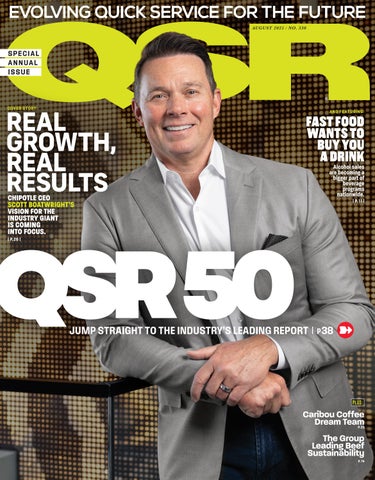
EVOLVING QUICK SERVICE FOR THE FUTURE AUGUST 2025 / NO. 330
SPECIAL ANNUAL ISSUE
®
REAL GROWTH, REAL RESULTS COVER STORY:
CHIPOTLE CEO SCOTT BOATWRIGHT’S VISION FOR THE INDUSTRY GIANT IS COMING INTO FOCUS.
AND FEATURING:
FAST FOOD WANTS TO BUY YOU A DRINK
Alcohol sales are becoming a bigger part of beverage programs nationwide. | P. 1 1 |
| P. 26 |
JUMP STRAIGHT TO THE INDUSTRY’S LEADING REPORT | P 38
PLUS:
Caribou Coffee Dream Team P. 22
The Group Leading Beef Sustainability P. 74
Premium ingredients pay for themselves. When your signature items look better and taste better, they sell better. ghirardelli.com/professional
LEARN MORE
August
TABLE OF CONTENTS AUGUST 2025 #330
QSR / LIMITE D -SE RVICE , U N LIMITE D POSSIBILITIES
F E AT U R E S
26
DEPARTMENTS N E W S
22 WOMEN IN LEADERHSHIP
/
Behind the Caribou Coffee Curtain
CHIPOTLE CEO SCOTT BOATWRIGHT LEADS THE BIGGEST FAST CASUAL IN THE COUNTRY.
Learn about the women-led team pushing the brand forward. BY SATYNE DONER
74 FRANCHISE FORWARD
Closing the Communication Gap
Check out Ellianos Coffee's new franchisee portal keeping operators and corporate connected. BY SAM DANLEY I N S I G H T
11 FRESH IDEAS
Raising A Glass in Quick Service
How some QSR brands are making good use of their alcohol program. BY SAM DANLEY
CHIPOTLE / IMAGE EXPANDED BY QSR MAGAZINE
18
26
Chipotle Sets Course For Growth BY DANNY KLEIN
CEO Scott Boatwright is steering the brand to more expansion, continued operational strength, and all the while keeping sight of what made the fast-casual pioneer a category disruptor in the first place.
2 BRANDED CONTENT
4 EDITOR’S LETTER
ONES TO WATCH
The Gyro Project
A Greek fast-fine concept is on the rise in New York City. BY BEN COLEY
78 OPERATIONS
Sustainability in Action
38
The U.S. Roundtable for Sustainable Beef has a crucial mission, and restaurants are a big part of that journey. BY BEN COLEY
QSR 50 BY QSR STAFF
The QSR 50, an annual ranking of the biggest fast-food brands in the U.S. according to U.S. systemwide sales, is back for another year with several intriguing pieces of data and insights.
7 SHORT ORDER
96 START TO FINISH
Celton Hayden Jr.
CC's Coffee House has built a strong reputation, and it's ready for more growth.
80 ADVERTISER INDEX
QSR is a registered trademark of WTWH Media, LLC. QSR is copyright © 2025 WTWH Media, LLC. All rights reserved. The opinions of columnists are their own. Publication of their writing does not imply endorsement by WTWH Media, LLC. Subscriptions (919) 945-0704. www.qsrmagazine.com/subscribe. QSR is provided without charge upon request to individuals residing in the U.S. meeting subscription criteria as set forth by the publisher. AAM member. All rights reserved. No part of this magazine may be reproduced in any fashion without the express written consent of WTWH Media, LLC. QSR (ISSN 1093-7994), USPS PUBLICATION #20387 is published monthly by WTWH Media, LLC, 1111 Superior Avenue Suite 1120, Cleveland, OH 44114. Periodicals postage paid at Cleveland, OH and at additional mailing offices. POSTMASTER: Send address changes to WTWH Media, LLC, 1111 Superior Avenue Suite 1120, Cleveland, OH 44114.
O N
T H E
C O V E R
Chipotle CEO Scott Boatwright has the brand focused and ready. PHOTOGRAPHY: CHIPOTLE
www.qsrmagazine.com | QSR | AUGUST 2025
1
BRANDED CONTENT EDITORIAL
V ICE PR ESIDENT EDITOR I A L FOOD, R E TA IL , & HOSPITA LIT Y
BRAND STORIES FROM QSR
Danny Klein
dklein@wtwhmedia.com
QSR EDITOR
IN THIS ISSUE
Ben Coley
bcoley@wtwhmedia.com
FSR EDITOR
Callie Evergreen
MONIN
Lean in to growing consumer interest that drives traffic
and profitability. SPONSORED BY MONIN
HME
16 Menu Growth Signals Opportunity for Operators
cevergreen@wtwhmedia.com
20 How to Stay Competitive in an Industry Measured in Seconds
AS SOCI ATE EDITOR
Sam Danley
sdanley@wtwhmedia.com
AS SOCI ATE EDITOR
Satyne Doner
sdoner@wthwmedia.com
SENIOR V ICE PR ESIDENT AUDIENCE GROW TH
Report reveals key to shaving nearly 30 seconds off drive-thru times. SPONSORED BY HME
Greg Sanders
gsanders@wtwhmedia.com
CONTENT STUDIO
V ICE PR ESIDENT, CONTENT S T UDIO
Peggy Carouthers
pcarouthers@wtwhmedia.com
SmartChain
W R ITER , CONTENT S T UDIO
Drew Filipski
dfilipski@wtwhmedia.com
81 Thought Leadership With The Biggest Names in Kitchen Solutions
p.
W R ITER , CONTENT S T UDIO
Ya’el McLoud
ymcloud@wtwhmedia.com
W R ITER , CONTENT S T UDIO
A closer look at how top brands are turning kitchen challenges into smart, scalable solutions.
Abby Winterburn
awinterburn@wtwhmedia.com
KEY PLAYERS:
ART & PRODUCTION
Build a Kitchen That Keeps Up
INSIDE:
P83
SENIOR A R T DIR ECTOR
Tory Bartelt
tbartelt@wtwhmedia.com
Alto-Shaam.................. p. 83
Frymaster.....................p. 88
Ecolab........................... p. 84
Restaurant Technologies.............. p. 90
enaftolowitz@wtwhmedia.com
Vitamix........................... p. 92
SALES & BUSINESS DEVELOPMENT
FSR A R T DIR ECTOR
P84
P84
P86
P88
P90
Food Warming Equipment ................. p. 84
P92
P94
Thought Leadership with the Biggest Names in
Kitchen Solutions
Erica Naftolowitz
V ICE PR ESIDENT, BU SINES S DE V ELOPMENT
Vulcan........................... p. 94
Frontline International ...............p. 86
Eugene Drezner
edrezner@wtwhmedia.com 919-945-0705
N ATION A L S A LES DIR ECTOR
BY DREW FILIPSKI
SPONSORED SECTION | QSR | AUGUST 2025
Edward Richards
81
erichards@wtwhmedia.com 216-956-6636
N ATION A L S A LES DIR ECTOR
Amber Dobsovic
ONLINE
adobsovic@wtwhmedia.com 757-637-8673
SEE T HE SE S T ORIE S AT QSRM AG A ZINE.COM /SP ONSORED
N ATION A L S A LES M A N AGER
Guy Norcott
TECHNOLOGY
INNOVATION
gnorcott@wtwhmedia.com 854-200-5864
FRANCHISING
CU S TOMER SERV ICE R EPR ESENTATI V E
Tracy Doubts
tdoubts@wtwhmedia.com 919-945-0704
CU S TOMER SERV ICE R EPR ESENTATI V E
A Big Task that Can Be Easily Automated Something the full-service sector has been doing for a long time. SPONSORED BY ECOLAB
Waste is a Restaurant The Franchisee Killer, But Often of the Future Is the Last Thing Already Here Owners Fix What makes a franchisee Obsessions with loyalty can backfire if the guest experience isn’t consistent SPONSORED BY QSR AUTOMATIONS
2
INSPIRE BRANDS
ECOLAB
QSR AUTOMATIONS
Brandy Pinion
AUGUST 2025 | QSR | www.qsrmagazine.com
successful in 2025? Just ask Inspire Brands SPONSORED BY INSPIRE BRANDS
bpinion@wtwhmedia.com 662-234-5481, EXT 127 FOUNDER
Webb C. Howell ADMINISTRATION 919-945-0704 / www.qsrmagazine.com/subscribe QSR is provided without charge upon request to individuals residing in the U.S. who meet subscription criteria as set forth by the publisher. WTWH MEDIA LLC RETAIL, HOSPITALITY, AND FOOD GROUP
Chicken & waffles just went mobile, y’all. NEW! Simplot® Maple City™ Waffle Flavored Waffle Fries Unique: The first and only waffle-flavored waffle fry.
Portable: Ideal for QSRs and customers on the go.
©2025 J.R. Simplot Company
All-day appeal: Popular for breakfast, lunch, dinner and late night.
On-trend: Scan to learn more!
Chicken & Waffles’ menu incidence is up 46% over the last 4 years.1
Easy: No additional training or equipment required.
1. Datassential 2023
potatoes | avocados | fruits | vegetables | grains
To learn more, view recipes or request samples, visit simplotfoods.com
EDITOR’S LETTER
Cracking the QSR 50 We have a whole lot of insights to share.
BCOLEY@WTWHMEDIA.COM QSR MAGAZINE
4
AUGUST 2025 | QSR | www.qsrmagazine.com
A
nother year, another QSR 50. We’re back with a chart full of insights and trends, detailing how the country’s top 50 quick-service concepts—according to systemwide sales— are performing against each other. As is often the case, little changed at the very top. You will see that McDonald’s is still top dog, followed by Starbucks, Chick-fil-A, and Taco Bell. The bigger change comes lower in the top 10 with Chipotle rising to No. 7, above Burger King and Subway. The chain’s U.S. systemwide sales reached over $11 billion in 2024. It also added a net of 273 domestic units, which is third-most among fast casuals ( Jersey Mike’s opened 313 and Wingstop opened 278). If Chipotle keeps its pace over the next few years, it appears possible that it may also jump Dunkin’ and Wendy’s and secure a spot in the top five, which would be an incredible accomplishment for a brand that started in the 1990s. I’m sure if you told founder Steve Ells in 1993 that his concept would one day earn more than Burger King and Subway, he would laugh. Or maybe he wouldn’t have, depending on how confident he was at the time. Regardless, Chipotle is one of the most important quick-service chains to watch over the next couple of years. Led by CEO Scott Boatwright—who took over in the fall after Brian Niccol jumped to Starbucks—the fast casual has its hands in a lot of areas. One focus is throughput, which the chain hopes to resolve in the future with a robot that prepares avocados and a robotic make line that handles digital orders. The brand is also increasing convenience and its competi-
tiveness against fast-food chains with the continued rollout of Chipotlanes across the country. Some other big observations from the QSR 50: CAVA joins the list for the first time after surpassing $950 million in systemwide sales. The company will likely reach $1 billion for the first time in fiscal 2025. The fast casual has been one of the hottest chains in America. While other public companies have reported negative sales, CAVA seems to keep moving forward. Same-store sales grew 10.8 percent in Q1, fueled by 7.5 percent growth in traffic. Bottom income strata are outperforming, and restaurants are seeing strength across lunch and dinner. Meanwhile, our annual Contenders list features a lot of well-known names, like Smoothie King, Sweetgreen, Portillo’s, and The Habit Burger & Grill. There’s also 7 Brew, one of the fastestgrowing beverage chains in the U.S., which opened 141 net new shops in 2024. It ended the year with 321 locations. As of this summer, the brand now has over 400 outlets in the U.S. I’m confident 7 Brew will be in the QSR 50 sometime in the near future. These are just a few of the many interesting data pieces you’ll find in the charts. Feel free to pore over them and learn how the quick-service segment is changing. I guarantee that you will find at least one fact or statistic that will surprise you! That’s the beauty of the QSR 50. Ben Coley, Editor
H A B A N E R O B U F FA L O GLSOAT UMCORE..E.! WNIN DA A
TE. our cashback REBA Buy and SAVE with w. no oodser vice.com Go To TexasPeteF Texa s Pete ® is a regi ster
ed trad ema rk of TW Garn
® banero Buffalo Wing New Texas Pete Ha d heat, deep flavor, an Sauce brings bold s, next-level Wings. Plu the perfect cling for e our Hot Buffalo Sauc we’ve reformulated e, nal Buffalo Wing Sauc into the clingier Origi up better results. Heat a thicker recipe for up the sauce that heats your wing game with the your distributor for the wing game. Ask . ® Buffalo Wing Sauces full line of Texas Pete
er Food Com pany. 1090 -02-
0420 25
WHITE CASTLE / SCOTT PAYNE PHOTOGRAPHY
White Castle's new Chicken Slider became a permanent menu item in late June.
A New Slider Enters the Castle White Castle adds to its iconic menu.
SHORT ORDER
WHITE CASTLE INTRODUCED a new permanent menu item, the Crispy Chicken Slider, bringing a bold update to its slider lineup. The new item features tender, all-white meat chicken coated in crispy buttermilk breading and topped with a distinctive honeycomb mustard sauce, all nestled in the brand’s classic soft buns. Customers have the option to upgrade to the Deluxe version, which includes American cheese, lettuce, tomato, and the same signature sauce for just 20 cents more. Jamie Richardson, White Castle’s vice president, emphasized that this was more than a simple update—it represents an upgrade that responded to customer feedback. The culinary team crafted a product designed to heighten White Castle’s “Crave quotient,” while maintaining affordability. Notably, the new Crispy Chicken Slider cost 10 cents less than its predecessor, underscoring the brand’s commitment to value.
www.qsrmagazine.com | QSR | AUGUST 2025
7
SHORT ORDER
69
say they are likely to give up on a restaurant if no one answers the phone
COMMENTARY “As a restaurant owner myself, I know how difficult it can be to balance being on the floor during peak service hours while managing inbound calls, texts and emails from potential guests,” said Randall Hom, cofounder and CEO of Hostie. “I’m sure we’ve lost a ton of business over the years by not being available to answer our guests’ questions.”
GEN Z:
95 percent
BABY BOOMERS:
80 percent
• Diners would use AI for: MAKING A RESERVATION:
47 percent
SEARCHING FOR SPECIAL OFFERS:
TRACKING AN ORDER OR CHECKING WAIT TIMES:
PLACING A PICKUP OR DELIVERY ORDER:
42 percent 8
39 percent
38 percent
AUGUST 2025 | QSR | www.qsrmagazine.com
• 63 percent of U.S. adults say calling is their preferred way to contact a restaurant. • Other popular methods include: SPEAKING WITH STAFF IN PERSON:
34 percent
USING RESERVATION APPS (OPENTABLE, RESY, YELP):
30 percent
MESSAGING VIA THE RESTAURANT’S WEBSITE:
29 percent
UNANSWERED CALLS = LOST CUSTOMERS • 69 percent of Americans say they are likely to give up on a restaurant if no one answers the phone. • 1 in 5 say their calls are always or often ignored. • THE ISSUE IS PARTICULARLY ACUTE AMONG MILLENNIALS: 72 percent would abandon a restaurant if their call went unanswered.
AI OFFERS A PROMISING SOLUTION • 89 percent of Americans are open to interacting with AI agents for restaurant-related tasks.
%
AMERICANS STILL PREFER TO CALL RESTAURANTS
COMMUNICATION BREAKDOWN: A SERVICE GAP • During peak hours, staff prioritize in-person service. • This often leaves calls, texts, and emails unanswered, creating a growing disconnect with potential guests. • Restaurants risk lost reservations, event inquiries, and sales.
ADOBE STOCK (7) PHONE BACKGROUND: MASTER1305, PHONE CALL ICON, COMMENT ICON, HEADSET ICON: OPENDESIGNER, ARTIFICIAL INTELLIGENCE ICON: GRAFICRIVER, COMMUNICATION ICON: SDECORET, COFFEE SHOP EMPLOYEE ON PHONE: GORODENKOFF
According to a recent survey conducted by THE HARRIS POLL on behalf of HOSTIE, poor phone responsiveness is costing restaurants more than just goodwill—it’s hitting their bottom line. The study reveals a significant gap between consumer expectations and current restaurant communication practices, while also highlighting how AI could offer a much-needed solution.
Our Bavarian Pretzel Bites are on track to be one of the most profitable products for menus everywhere. A delightful taste, these bites have the versatility to fit on any menu and be served in every daypart. Oh, and they’re good at making customers smile.
The XL Warewash Program FOOD SAFETY
90% MORE SOIL REMOVED*
compared to manual only process*
LABOR SAVINGS
WATER SAVINGS
REPURPOSE 2 HOURS OR MORE
6,400 GALLONS OF WATER SAVED PER YEAR**
labor per day***
Where Performance Meets Value Designed specifically for QSR
vs. traditional dump/fill machine
XL Height
applications, the XL has a higher wash chamber, 50% faster cycle time, faster dry time, and delivers productivity and
Standard Height
food safety at a lower total cost.
Contact your Ecolab Representative or call 800.529.5458 TODAY!
*According to Ecolab Man vs. Machine study circa Dec. 2018; **At 50/cycles per day – a typical QSR machine utilization; ***Based on QSR industry field testing results of time saved when vs. a manual only process Ecolab USA Inc. All rights reserved.
fresh resh idea ideas | B E V E R A G E
I N N O V A T I O N |
RAISING A
GLASS
IN QUICK SERVICE
From self-pour stations and curated cocktail menus to revamped service styles, quick-service brands are getting creative about how to blend fast food with alcohol. BY SAM DANLEY
A growing number of QSR brands are using alcohol to boost sales.
ADOBE STOCK / SONYAKAMOZ
M
ost Fuzzy’s Taco Shop locations come with a full bar, and it’s not unusual to see guests pairing tacos with a margarita. Alcohol typically makes up about 20 percent of Fuzzy’s sales—a strong base, but the brand sees plenty of opportunity to grow. Patrick Kirk, president and CMO of Fuzzy’s, says many fast casuals are figuring out how to fold alcohol into their models in a way that feels natural and doesn’t undermine operations or service flow. Fuzzy’s is especially focused on “the social aspect that comes with consuming alcohol.” “We’re very cognizant of the transactional nature of what fast casual can be, but we’d rather be more hospitable and welcoming, with guests having conversations and interacting with our team,”
Kirk says. “That’s why we have bartenders in most of our restaurants. But I think from a service model standpoint, we can still improve the way in which you transact for an alcoholic beverage.” Typically, guests order their first drink at the cashier. If they want another, they have to get back in line and pay again. “That’s not always convenient or socially conducive, and it’s adding extra steps for the guests,” Kirk says. “I think fast casual in general has to solve for that and account for that if they truly want to unlock the full potential of their alcohol sales.” Fuzzy’s is on a journey to elevate its game in the bartending space, exploring whether it can offer more custom cocktails in a broader menu that includes not just margaritas and tequila, but also drinks with whiskey, rum, and vodka, and break some of the www.qsrmagazine.com | QSR | AUGUST 2025
11
fresh ideas
ANDREW THOMAS LEE
I N N O V AT I O N |
FUZZY’S TACOS (2) MARGARITAS: EVAN WALLIS
| B E V E R A G E
barriers between fast casual and full service. That vision is already coming to life with Fuzzy’s Tacos and Margs, which debuted in June in Sugar Land, Texas. The new restaurant includes a streamlined menu, new taco creations, and a beverage lineup that puts the bar front and center. Unlike traditional Fuzzy’s locations, where guests order at the counter and collect their food at a pickup window, the Sugar Land restaurant offers tableside service—a move designed At Little Rey, two-thirds of beverage sales come from alcohol. to encourage people to linger and order more drinks. New beverages introduced in Sugar Land feature cocktails like the Paloma ‘Rita, dunked with a bottle of and curated program”—a small selection of margaritas, a couple grapefruit Jarritos, Watermelon ‘Rita, and frozen creations like of draft beers, a dozen or so packaged beers, and, recently, ranch the Fuzz Driver and Double Rum Daiquiri. water options. Beverages account for around 17–20 percent of total Eduardo Porto Carreiro, VP of beverage at Rocket Farm Restausales at Little Rey, and about two-thirds of that comes from alcohol. rants, has learned a lot about the benefits, challenges, and special The drink program was designed from the outset as a core part considerations that come with offering alcohol in a quick-service of the brand’s identity, but it’s a bit different from Rocket Farm’s format. The bar is a staple of Little Rey, the only limited-service conother, full-service concepts. cept in Rocket Farm’s portfolio. The restaurant’s menu is inspired “You need to take a different approach, given that the word by Northern Mexico — grilled chicken, loaded tacos, queso fries ‘quick’ is in the name of this category of dining,” Porto Carreiro — and, of course, margaritas. It has locations in Atlanta as well as says. “You have to make sure that you have speedy execution, Houston, Texas and Raleigh, North Carolina. and you have to make sure that everything is consistent. That’s It doesn’t have a full bar. Porto Carreiro calls it a “very focused where you have to truly dial in your recipes and your execution 12
AUGUST 2025 | QSR | www.qsrmagazine.com
ROCKET FARM RESTAURANTS (3)
Fuzzy's Taco Shop hopes to elevate its bartending prowess.
ALLOW US TO REINTRODUCE OURSELVES AS YOUR COMPLETE BEVERAGE SOLUTION PROVIDER.
Contact Sunny Sky Products to learn more about our Complete Beverage Solutions
Contact Sunny Sky Products to learn more about our complete beverage solutions
info@sunnyskyproducts.com
|
877-235-6466 |
11747 Windfern Road, Suite 100 Houston, TX 77064
|
sunnyskyproducts.com
fresh ideas
for your cocktails.” With beer, it’s a simple pour or a pop of a can—fast and effortless. But making a Margarita taste just as good and fresh as it would at a Mexican restaurant across town? That was a key challenge. Little Rey didn’t compromise on using real lime juice. Instead, it makes a pseudo lime cordial—water, sugar, juice, and husks—to bring a pure, fresh, limey flavor to the cocktail. “We also include salt in the mix so that you have that great balance and that—given that we’re not salting the rims at Little Rey—you have that whiff or echo of saltiness to finish off the cocktail, which is super yummy,” Porto Carreiro says. Keeping the menu small and curated makes service faster and more consistent, he adds. The key for Little Rey has been focusing on a small selection of really good drinks instead of spreading things too thin. “One of the things that we’ve been working on at all of our restaurants is, how do we make this as hospitable as possible? Even at some of our white tablecloth restaurants, we’ve been cutting back our selections because we find that if someone’s spending five or 10 minutes reviewing a wine list, they’re not spending that time with the people that they came to have dinner with,” Porto Carreiro says. “Similarly, if you’re rolling into a restaurant like Little Rey and looking up at the menu, you’re kind of stuck there for a minute if you have more than a handful of options, unless you already know exactly what you want.” Tapster is creating a new way to combine quick-service fare with alcohol. It’s a self-pour tasting room with 40–60 taps offering beer, cider, wine, cocktails, hard seltzer, kombucha, and non-alcoholic drinks. “If a guest wants to try something, they put their card by the screen above the tap, and then they get charged as they pour,” says founder and CEO Roman Maliszewski. “The beauty is that we really promote sampling and trying different things. I always say it’s the Froyo of drinks.” The concept draws on fundamentals of the quick-service model—putting control in the hands of the guest, letting them customize their experience, and using technology to cut back on the number of employees required per shift. But that doesn’t diminish the social side of going out for a drink. “Oftentimes people hear self-pour and they think that nobody is going to talk to each other, that they’re just going to get their drinks themselves and sit around,” says Maliszewski. “We’ve actually seen the opposite, where folks are interacting with a lot of 14
AUGUST 2025 | QSR | www.qsrmagazine.com
I N N O V AT I O N |
different people, especially on the tap wall. You see somebody with a drink that looks interesting, or they’re pouring from a tap you want, and it’s so easy to engage with them.” Tapster adds communal tables and stadium seating to foster interaction. And with less time pouring drinks, its team focuses on hospitality by talking with guests, making recommendations, and adding a human touch. Food plays a role in tying the
Tapster offers 40-60 taps of beer, cider, wine, cocktails, and more.
experience together, whether it’s small items made in a convection oven, fresh popcorn, or food from nearby restaurants. Tapster strategically picks locations close to food spots and partners with them. QR codes on tables let guests order directly from a nearby restaurant, and their food is delivered right to their seats—a convenient way to keep people comfortable and lingering. “My philosophy is that you’re providing food and walking it over, and my guests are staying longer, so I don’t take any royalty from the food partners that we use,” Maliszewski says. Tapster is growing nationally through franchising, making a big push to bring in strong operators and plant flags in new markets across the country. Looking ahead, Maliszewski says that as the company expands, it would be a natural fit to find a quick-service restaurant that can grow alongside it and form a partnership that could help both brands scale together. TAPSTER (3)
| B E V E R A G E
Sam Danley is the associate editor of QSR. He can be reached at sdanley@wthwmedia.com
SPONSORED BY MONIN
Menu Growth Signals Opportunity for Operators LEAN IN TO A GROWING CONSUMER INTEREST THAT DRIVES TRAFFIC AND PROFITABILITY.
A
s consumer preferences evolve, the demand for sugar-free options—particularly in the non-alcoholic beverage space— is gaining notable traction. According to Datassential, at least 20 percent of the U.S. now actively seeks sugar-free offerings, with health-conscious individuals gravitating toward vibrant, fruitforward flavors. This growing interest has translated into measurable momentum: sugar-free items currently appear on 5.5 percent of menus and have experienced a 7 percent increase in menu penetration over the past four years. With an additional 3 percent growth projected through 2028, this trend presents a lucrative opportunity for foodservice operators. Incorporating sugar-free beverages into menus aligns with wellness-driven dining habits and enhances customer satisfaction, encourages repeat visits, and drives incremental profitability. Monin, a leading flavor solutions provider, offers an extensive line of sugar-free syrups designed to help operators meet the rising demand for healthier beverage options without compromising on taste. “At Monin, our goal is to deliver products that taste great without the diet-style aftertaste sugar-free products traditionally have,” says
To elevate your beverage menu and boost profitability with Monin’s craveable, premium, sugar-free syrups, visit monin.us. 16
AUGUST 2025 | QSR | www.qsrmagazine.com
MONIN
“MONIN’S SYRUPS LET EVERYONE ENJOY DELICIOUS, FLAVORFUL DRINKS WITHOUT THE SUGAR AND ADDED CALORIES.”
Kevin Robb, senior product manager at Monin. “We also stay on top of flavor and ingredient trends to keep our offerings fresh and relevant. For example, we recently launched sugar-free lavender and sugar-free blue raspberry because florals and nostalgic flavors are trending.” Designed with both the end customer and the operator in mind, Monin’s sugar-free syrups deliver authentic flavor. For consumers, these syrups offer the rich, full-bodied taste of traditional sweeteners—minus the sugar—making it easier to enjoy delicious, low-calorie beverages that align with health and dietary goals. On the operational side, Monin ensures its syrups are shelf-stable, easy to incorporate, and available in a wide variety of flavors, giving foodservice professionals the flexibility to craft customized drinks with speed and consistency. “The syrups are simple to use—just pump and go—and extremely versatile,” Robb says. “One syrup can be used in multiple drinks or applications, so operators can expand their menu without needing a huge inventory of ingredients.” Operators can offer signature drinks and LTOs by adding a few pumps of sugar-free syrup to bases like tea or lemonade. “We work closely with many operators to create signature LTO beverages, and they often see a positive impact on traffic and sales,” Robb says. “New and unique menu items can drive repeat visits and increase average ticket sizes, especially when the flavor is craveable and only available at a specific chain.” Monin helps operators drive sales and elevate the guest experience—beyond supplying high-quality syrups—by offering marketing support. Branded POS materials are readily available, making it easy to promote new or featured drinks. Additionally, Monin frequently works hand-in-hand with operators to develop signature drinks and custom signage. This personalized approach ensures cohesive branding and maximizes the impact of sugar-free specialty drinks on menus. “Monin’s syrups let everyone enjoy delicious, flavorful drinks without the sugar and added calories,” Robb says. “Whether it’s Gen Z looking for better-for-you choices or someone managing a dietary condition, we’re providing everyone with options they can feel good about.” -By Abby Winterburn
Sugar Free NEW
Paradise Awaits
How to make a
Sugar Free Coconut Iced Latte Glass Size: 16 oz.
¾ oz. Monin Sugar Free Coconut Syrup 2 shots espresso 5 oz. milk Fill serving glass with ice. Pour ingredients into the glass. Stir gently or roll to mix.
Discover more.
monin.com
DEPARTMENT
ONES TO WATCH
The Gyro Project Lifelong friends turn pandemic downtime into a fast-fine Greek concept that mixes tradition with modern appeal.
FRON T T O B AC K:
GEORGE TENEDIOS & SPY ROS KOKKOSIS
FOUNDERS: George Tenedios, Spyros Kokkosis HEADQUARTERS: Manhattan, NY YEAR STARTED: 2023 ANNUAL SALES: $3,400,000 AUV TOTAL UNITS: 3 open, 4 under development FRANCHISED UNITS: 0
THE GYRO PROJECT WAS A COVID BRAINCHILD. George Tenedios and Spyros Kokkosis— who’ve known each other for 30 years and go as far back as Greek school in the early 1990s—had their core restaurant businesses, but both were closed for a short period. During this down cycle, Kokkosis kept mentioning the lack of quality Greek food 18
AUGUST 2025 | QSR | www.qsrmagazine.com
around New York and New Jersey. He felt there was an opportunity for him and Tenedios to go into business together and showcase the cuisine as it was meant to be. Tenedios was reluctant at first and kept rejecting the idea. His mind “was going a million miles a minute” trying to keep his businesses alive. He had lost around a dozen locations because of COVID, so he wasn’t high on opening another full-service restaurant. Then Kokkosis found an answer that finally spoke to Tenedios. “After a month or so of Spyros just chirping in my ear every single day—Greek restaurant, Greek restaurant, Greek restaurant—he changed his tune and he said, ‘You know, why don’t we do a Greek quick-serve? It doesn’t exist. We’ll do something a little
higher end, high quality, gyros, pitas, bowls, super easy, super quick, super tasty.’ And that’s when the bulb went off in my head and I said, ‘Great, let’s do it. Absolutely all in. Let’s move forward.’” The idea was conceived in late 2020. After a meticulous process of greenlighting the idea and putting the marketing, concept, and location together, The Gyro Project officially debuted in Fort Lee, New Jersey, in July 2023. The company has since opened a restaurant in Newark and another in New York City’s Upper West Side neighborhood. From the beginning, the duo didn’t want to become the “Greek Chipotle.” They hired a designer with the directive of customers feeling like they’ve been transported to a Greek Island. “When we decided to do this very early on, it was always, we’re not going to look corporate,” Kokkosis says. “ … Before the space was even available, before we knew where we’re going to go in, we knew what the cues were going to be. All the aesthetics were in all our minds. We knew we’re going to have these beautiful marble counters. We knew the aesthetic was going to be high end. We knew it was going to be fast fine. From the brainchild, coming out into fruition, it’s always been that vision.” One of the menu highlights is pork belly, which is made from a proprietary recipe. The Gyro Project partners with a local meat purveyor from Greece—which also has a plant in New Jersey—to produce the ingredient. The chain also serves gyros with beef/ lamb and chicken. Customers can get a customized bowl if they prefer, as well as salads, a variety of side dishes like lemon potatoes, crispy pita chips, and fries, a selection of baked goods, and creative Greek frozen yogurt, such as Samoa Sundae (shortbread crumble, caramel, toasted coconut, and chocolate sauce) or De-Constructed Baklava (Greek honey, crushed [CONTINUED ON PAGE 76]
THE GYRO PROJECT (3)
BY BE N COLEY
SOUTHERN FLAVOR MADE EASY.
At House Autry we make serving southern flavor easy and quick. With more than 200 years of milling breadings, mixes and batters with southern spice blends, there’s no easier way to offer authentic southern-made fried chicken or seafood, biscuits, hushpuppies, pancakes and more.
Contact Your Souther Flavor Expert Now, Or Download Our 2025 Southern Flavor Guide at house-autryfoodservice.com
S P O N S O R E D B Y H M E H O S P I TA L I T Y & S P E C I A LT Y C O M M U N I C AT I O N S
HOW TO STAY COMPETITIVE IN AN INDUSTRY MEASURED IN SECONDS
Industry standards for speed, accuracy, and customer experience
continue to climb as advancing technology raises consumer expectations. According to the New York Times, drive-thru order volume is up by 30 percent, and the pressure on operators to deliver fast, seamless service is intensifying. When every second counts and translates into thousands of dollars in revenue, flawless communication is critical. According to Intouch Insight’s 2024 Annual Drive-Thru Report, orders were completed 28 seconds faster when the speaker was clear and understandable—a significant difference, especially when competitive drive-thru speeds hover around 4–5 minutes. “The traditional drive-thru is a thing of the past,” says Scott Mullica, senior director of product management and innovation for HME. “Restaurant staff are managing an increasing number of customer touchpoints, making it more challenging to maintain speed and efficiency without compromising service quality.” As customer engagement extends beyond the speaker box, operators need a communication platform that can keep pace. That means supporting advanced integrations, delivering consistently high-quality audio, and evolving quickly alongside new technologies. The demand for fast, frictionless interactions continues to grow—and so does the need for systems that can meet it. 20
AUGUST 2025 | QSR | www.qsrmagazine.com
“As order volumes increase, they need high-definition audio with advanced noise cancellation to reduce miscommunication and improve order accuracy,” Mullica explains. “We've met these needs with our patented HD Audio—whether it’s crew to customers or AI to customers, HME audio delivers a superior experience.” AI-driven voice ordering is also gaining traction, with many operators now considering it a necessary investment. Intouch Insight’s 2025 Emerging Experiences Study found voice-AI drive thrus outperformed 2024 benchmarks in speed of service, with faster wait, service, and total times. To support this evolution, HME’s NEXEO | HDX platform is designed for flawless communication across every touchpoint. It integrates seamlessly with voice AI systems while enhancing in-person interactions through features like our patented HD Audio and advanced noise cancellation. “We use patented HD audio, which includes advanced noise cancellation, to isolate voices from background noise,” Mullica says. These features are essential for ensuring a consistent experience for customers, operators, and employees. Today’s systems also offer remote visibility and control. “Our latest systems are also cloud-connected, allowing remote monitoring and adjustments to ensure optimal performance,” Mullica adds. This level of insight allows operators to maintain accountability and performance, whether on-site or off. Consumers are cognizant of wait times when they are expecting speed. According to Intouch Insight’s 2024 Drive-Thru report, 14 percent of consumers reported speeds being slower than before, even in the face of faster speeds year-over-year since 2022. HME’s advanced, comprehensive communication technology allows for better speed with the accuracy in orders consumers expect. “Superior drive-thru audio is more than just clear sound—it’s about speed, accuracy, and seamless integration with modern technology,” Mullica says. Partnering with the right service ensures a competitive edge and improved customer loyalty. “Optimizing the drive-thru audio experience is crucial for ensuring smooth customer interactions, improving order accuracy, and enhancing overall satisfaction,” Mullica says. “Invest in high-definition audio solutions that will deliver superior audio through all channels— whether it’s traditional order taking or AI-powered order taking.” ◗
For more information on HME’s communication and audio solutions, visit hme.com/qsr.
HME HOSPITALITY & SPECIALTY COMMUNICATIONS
Report reveals key to shaving nearly 30 seconds off drive-thru times.
Better Audio. Faster Service. Greater Profitability.
Take Your Operation to the Next Level
Quality audio is not a luxury — it's a necessity for drive thru success. A 5-second improvement in speed of service could result in a potential gain of over $9,500 per year per store.* The NEXEO | HDX™ Communication Platform delivers unmatched, HME patented high-definition drive thru audio, resulting in 20% better clarity and an 88% reduction in outbound noise, and ultimately, faster service.
HDX Digital Audio
Group Communication
Seamless AI Integration
Remote Management
Text & Connect And More!
Your Bottom Line Never Sounded This Good. 866.848.8534 | www.hme.com/nexeo * Based on the 2024 Intouch Insight Drive-Thru Study. ©2025 HM Electronics, Inc. The HME logo and product names are trademarks or registered trademarks of HM Electronics, Inc. All rights reserved. PA25-03.
DEPARTMENT
WOMEN IN LEADERSHIP
Behind the Caribou Coffee Curtain Meet the team driving the brand’s next chapter— one brew, bite, and breakthrough at a time. BY SAT YNE DONE R
inside. That was 17 years ago—and she’s spent nearly two decades tracking and shaping the evolution of the Caribou consumer across 335 company-owned and 368 franchised locations in 11 countries. “We do a lot of listening beyond what’s trending week to week,” she says. “Some of my favorite research is just sitting in other coffee shops and thinking about how to translate third-place concepts to an over 500-unit chain. It’s a delicate balance between what’s edgy, what’s approachable for the Caribou consumer, and what’s easy to execute at the store level.” No two days inside the Caribou test kitchen look quite the same. One day might involve diving deep into consumer trends to uncover whitespace opportunities; the next could be a cross-functional brainstorm between the food and beverage teams to align on seasonal strategy. There are hands-on sessions with operations to troubleshoot equipment, fine-tune Carrie Sazama (from left), Gretchen Hashemi-Rad, prep procedures, and ensure new products are Lindsey Palmer, and scalable across both heritage and new markets. Kelsey Wasserburger have long From ideation to execution, the Caribou been fans of Caribou Coffee. innovation process takes about 18 months to get into customers’ hands. Some of the best ideas ong before stepping into Caribou Coffee’s test kitchen, Car- come from the store level—when employees make their shift drinks rie Sazama, Gretchen Hashemi-Rad, Kelsey Wasserburger, or customers share suggestions. It’s up to the team to put their heads and Lindsey Palmer were loyal fans of the cozy, cabin-themed together and bring those ideas to life. brand. They were teachers, food scientists, and leaders in the con“Collaboration is key across the entire organization, and we are sumer packaged goods (cpg) and corporate retail spaces. Today, pairing that with data-driven trends to bring these big launches to they’re not just behind the brand—they’re building its future, one life,” says Carrie Sazama, director of product innovation. “There product at a time. is no science to finding the perfect balance [between heritage and Lindsey Palmer, Caribou’s culinary research and development innovation]. It’s important to remember that we’re more than just manager, has been tinkering in kitchens and perfecting family rec- coffee. We’re a gathering place for guests, we’re a part of their daily ipes for as long as she can remember. Before joining the Caribou ritual. And we keep what they want front and center.” crew, she blended food science with culinary artistry to create snack Kelsey Wasserburger, Caribou’s food category manager, paritems in the CPG world. ticularly enjoys collecting feedback through social media as part of “I worked at coffee shops throughout college, so this role feels like her evening routine. In May, when the brand’s collaboration with a homecoming in many ways,” Palmer says. “Caribou has been such Milk Bar launched—adding three new cookies to the menu—Wassa pillar in the Minneapolis community for my entire life. It’s so fulfill- erburger got to scrolling. The reviews were overwhelmingly positive, ing to see an item you pitched and developed hit the menu boards.” teeing up with sales that soared 30 percent above forecast during Gretchen Hashemi-Rad, now senior beverage category man- launch weekend and have quickly become one of the brand’s top ager, began her career in education and biology before accepting a five bakery items. technician role at Caribou Coffee and learning the ropes from the “The partnership [with Milk Bar] was a labor [CONTINUED ON PAGE 76]
22
AUGUST 2025 | QSR | www.qsrmagazine.com
CARIBOU COFFEE / IMAGE EXPANDED BY QSR MAGAZINE
L
DEFY THE
DULL
OWN A CHECKERS & RALLY’S FRANCHISE n
n
n
Smaller restaurant design for lower construction and equipment costs and maximized efficiency Multiple formats that fit your choice of Real Estate: Free-standing, Travel Centers, Inline in high density urban markets Award winning Hamburger QSR known for its iconic Burgers and Famous Seasoned Fries has franchise opportunities available
Visit owncheckersfranchise.com/QSR or Call 888-913-9135 ©2025 Checkers Drive-In Restaurants, Inc. 4300 W. Cypress St., Suite 600, Tampa, FL 33607. 1. Checkers & Rally’s 2024 Franchise Disclosure Document (FDD). Written substantiation will be provided on request. This advertisement is not intended as an offer to sell, or the solicitation of an offer to buy, a franchise. It is for information purposes only. The franchisor, Checkers Drive-In Restaurants, Inc. is located at 4300 West Cypress Street, Suite 600, Tampa, Florida 33607, and is registered as file number F-4351 in the state of Minnesota. In New York, an offering can only be made by a prospectus filed first with the Department of Law, and such filing does not constitute approval by that Department. 20250519
J O I N T HE QU I C K-SE RV I C E E VO LU T I O N
SEPTEMBER 2–4, 2025 AT L A N TA M A R R I O T M A R Q U I S
AGE N DA
TUESDAY, SEPTEMBER 2, 2025 10:00AM - 7:00PM
Registration
12:00PM - 4:15PM
Girly Grit: Real Women, Real Conversations (LEAD Luncheon) Kimberly Dockter Bollinger Olivia Fazzola Amy Hom Sheri Miksa Emily Williams Knight, Ed.D Julie Zucker
2:00PM - 4:00PM
Franchisee Worskhop - Ways of the Wealthy Franchisee: Unlocking the Human Edge Behind Operational Excellence Nadeem Bajwa Scott Greenberg
5:30PM - 6:30PM
Welcome to Atlanta, with Chick-fil-A CEO Andrew Cathy Andrew Cathy | CEO, Chick-fil-A
6:30PM - 7:30PM
Welcome Reception
AT
A
G L A N C E
10:00AM - 10:45AM
AI: The Conversation Continues Jon Asher Tammy K. Billings Matt Forbush Jenifer Kern (Moderator) Carl Orsbourn Marc Wallace
10:00AM - 10:45AM
Chick-fil-A Fireside Chat Brent Fielder
10:00AM - 10:45AM
So You Want a Restaurant Investment? Jim Balis Luke Christian Josh Halpern Kelly Roddy Michael Schatzberg (Moderator) Ryan Weaver
10:45AM - 11:15AM
Networking Coffee Break
11:15AM - 12:00PM
Reduce Employee Turnover at No Additional Cost David McClaskey Bill Schaefer
11:15AM - 12:00PM
The Great Omnichannel Balance Lisa Cheatham Graham Humphreys Amanda Kahalehoe Andrew Maxwell Joshua Sims Sr. Joseph Szala (Moderator) Bob Wright
11:15AM - 12:00PM
GoTo Foods Fireside Chat Kieran Donahue
11:15AM - 12:00PM
Raising Capital: Right Moves and Wrong Turns Graham Chapman (Moderator) Pete DiFilippo Lauren E. Fernandez Filippo Fiori George Tinsley Sr. Paul Tran
12:00PM - 1:00PM
Lunch
1:00PM - 1:45PM
The Secrets to Recuriting Gen Z Jonathan Bowyer (Moderator) Erin Levzow Kacie Radochonski Darren Spicer Mary Pillow Thompson Julianna Blackhurst
1:00PM - 1:45PM
AI Application from a Restaurant CEO Troy Hooper
1:00PM - 1:45PM
Firehouse Subs Fireside Chat Dena vonWerssowetz
1:00PM - 1:45PM
Fast Casual vs. QSR: What’s the Difference Anymore? Chris Artinian Howland Blackiston David Bloom Tricia Houston (Moderator) Daniel Smith Maria Valero
WEDNESDAY, SEPTEMBER 3, 2025 7:30AM - 6:00PM
Registration
8:00AM - 9:00AM
Breakfast
8:45AM - 9:00AM
Welcome Remarks Dustin Portillo (Moderator)
9:00AM - 9:45AM
Future-Proofing QSR: How Brands are Engaging Next-Gen Customers and Team Members Neha DK Sr. Amy Durini Anna Faktorovich Jack Hinchliffe
9:45AM - 10:00AM
Networking Break
10:00AM - 10:45AM
Onboarding to Everboarding, with CHART Ashley Helkenn Lisa Holloway Corban Nichols Matthew Steele Dr. Felicia White Ed.D (Moderator)
SCAN FOR MORE INFORMATION
REGISTER ONLINE
QSREVOLUTIONCONFERENCE.COM
1:45PM - 2:00PM
Networking Break
2:00PM - 2:45PM
How Doing Good is Good for Business, with The Giving Kitchen Jean Bolan Brandon Coleman III Jennifer Dodd Lynn Edwards Jen Hidinger-Kendrick (Moderator) Eric Knott
2:00PM - 2:45PM
Loyalty Metrics That Matter: Round 2 David ‘Rev’ Ciancio (Moderator) Melissa Cummings Zach Goldstein Kim Lewis Preston Nix Julie Wade Jeff Wilshire
2:00PM - 2:45PM
2:00PM - 2:45PM
Women in Restaurant Leadership: State of the Union Maggie Gordon Jane Grote Abell Shannon Iverson Michele Maerz Kelly McCutcheon (Moderator) Tonya McCoy Alexis Parra Jennifer Schuler The Franchise Experts Forum Sam Ballas Graham Chapman (Moderator) Jon Fischer Cheryl Fletcher Van Ingram Kevin King Steve Schulze
2:45PM - 3:15PM
Networking Coffee Break
3:15PM - 3:30PM
Sizzling Insights: The QSR Market Boom Caitlin Root
3:30PM - 4:15PM
Whataburger Keynote Debbie Stroud | CEO, Whataburger
11:15AM - 12:00PM
Staying Fresh After 60 Years, with Subway Chief Operating & Insights Officer Mike Kappitt Mike Kappitt | Chief Operating Officer, Subway
11:15AM - 12:00PM
Stopping the Employee Shift Show: Turning Hourly Teams into High-Performing Brand Ambassadors Scott Greenberg | Author a nd Keynote Speaker
12:00PM - 1:00PM
Lunch
1:00PM - 1:45PM
What Do Restaurant Employees Really Want? Lissa Bowen Meaghan Goedde Cheryl Kish (Moderator) Mariana Marques Chris Smith Amer Wahab
1:00PM - 1:45PM
Balancing Innovation and Human Touch: AI & Robotics in the Future of Restaurant Operations Dr. Rachel J.C. Fu (Moderator) Bob Schalow Scott Taylor Ryan Weaver
1:00PM - 1:45PM
More Than a Moment: How Jack in the Box Creates Cultural Experiences 365 Days a Year Ryan Ostrom
1:00PM - 1:45PM
Trending on the Menu Joel Bulger Daniel Camp Shawn Lalehzarian Marita Swift
Erin Buono Jo Ann Herold (Moderator) Nathan Louer
5:00PM - 6:00PM
Women in Restaurant Leadership Networking Reception: Murder Mystery
6:00PM - 8:00PM
Networking Reception
1:45PM - 2:00PM
Networking Break
8:00PM - 10:00PM
Speakeasy Soiree
2:00PM - 2:45PM
Becoming a Best QSR Brand to Work For Bob Andersen Scott Deviney Melissa Doolin-Koehne (Moderator) Nate Hybl Tiffany Perez TJ Schier
2:00PM - 2:45PM
Catering Cracks Open New Revenue Streams Annica Conrad Maureen DiStefano Kelly Grogan (Moderator) Angela Johnson Lissette Mathus David Ross Mike Smith
2:00PM - 2:45PM
Driving Franchisee Success Through Effective Partnerships, with Freddy’s CEO Chris Dull Chris Dull Paul Rocchio
2:00PM - 2:45PM
The Science of Site Selection Austin Capoferi Carl Comeaux Jennifer Dodd Basil Kazepis Jack Mashini Rowena Neelakantan Chris Newman Erin Snyder
2:45PM - 3:15PM
Networking Coffee Break
3:15PM - 4:00PM
Lessons in Servant Leadership Jason E. Brooks (Moderator) Alice Crowder Charles Miller Dustin Portillo (Moderator) Rohan Shearer Jim Thompson
3:15PM - 4:00PM
Finding the Digital-Native Restaurant Consumer Ashley Mitchell Shanna Prevé Megumi Robinson Devin Schneider Lauren Selman (Moderator) Peter Wiley
3:15PM - 4:00PM
Potbelly Sandwich Works Fireside Chat, with CEO Bob Wright Bob Wright
3:15PM - 4:00PM
Meet the Entrepreneurs Francesco Brachetti Kyle Gordon James Hacon (Moderator)
THURSDAY, SEPTEMBER 4, 2025 7:30AM - 4:00PM
Registration
8:00AM - 9:00AM
Breakfast
8:45AM - 9:00AM
Intouch Insights Drive-Thru Report Reveal Sarah Beckett Laura Livers (Moderator)
9:00AM - 9:45AM
Inspire Brands Keynote Kate Jaspon | Chief Financial Officer, Inspire Brands
9:45AM - 10:00AM
Networking Break
10:00AM - 10:45AM
Post-Election Chaos: Labor Laws to Watch Courtney Leyes Fisher Phillips Emily Litzinger
10:00AM - 10:45AM
Crystal Ball Series: Future of Tech Jim Bitticks Kris Douglas Liz Moskow Aaron Noveshen Chrissy Ouellette Joseph Szala (Moderator)
10:00AM - 10:45AM
Unlocking Growth and Profitability: Wendy’s Strategic Approach to Franchise Development Tatiana Lambert
10:00AM - 10:45AM
Redefining “Value” in Fast Casual Lauren Barash Joe Buonavolanto III Mike Bueno Tom Carr Ha Ly Mary Nguyen Shannon O’Shields (Moderator)
10:45AM - 11:15AM
Networking Coffee Break
11:15AM - 12:00PM
The People-First Playbook Reilly Berk Jason E. Brooks (Moderator) Lauren Cohen Kim DeCarolis Michel Falcon Jacob Karnes
11:15AM - 12:00PM
Drive Thru Report: Insights and Revelations Bill Aseere Allen Beck Luke Irving Laura Livers (Moderator) Beth Stockmoe Doug Willmarth
Ross Franklin Kelly Gray Ike Shehadeh
4:00PM - 4:15PM
Networking Break
4:15PM - 5:00PM
Closing Keynote Jonathan Neman | Chief Executive Officer + Co-Founder, sweetgreen
5:00PM - 7:00PM
After Party
QSR 50 / EXECUTIVE LEADERSHIP
CHIPOTLE SETS COURSE FOR GROWTH BY DANNY KLEIN
CEO Scott Boatwright is steering the brand to more expansion, continued operational strength, and all the while keeping sight of what made the fast-casual pioneer a category disruptor in the first place.
26
AUGUST 2025 | QSR | www.qsrmagazine.com
CHIPOTLE / IMAGE EXPANDED BY QSR MAGAZINE
/
EXECUTIVE LEADERSHIP / QSR 50
SCOTT BOATWRIGHT JOINED CHIPOTLE IN FEBRUARY 2018.
www.qsrmagazine.com | QSR | AUGUST 2025
27
SCOTT BOATWRIGHT RECENTLY DUG OUT AN ARTICLE FROM THE ROCKY MOUNTAIN NEWS. IT WAS OCTOBER 22, 1993.
Chipotle was about three months and a week old. A reporter left the 850-square-foot restaurant, located on East Evans Avenue across from the University of Denver in a former Dolly Madison ice cream shop, with three observations: One, surprise at the quality of ingredients; two, the classic cooking techniques (founder Steve Ells, a Culinary Institute of America grad, was trying to mirror taquerias he visited in San Francisco’s Mission District); and lastly, the price point. When asked about Chipotle’s prospects 32 years later, Boatwright feels the past is a good place to start. The brand could open as many as 345 restaurants in 2025, a year after it brought 304 to market. That gave it 3,726 total. But even as wide-ranging and large as Chipotle has scaled since July 13, 1993, it’s still just about halfway to a North America goal of 7,000 locations. Boatwright adds the international opportunity, while uncharted, is “a pretty big number,” too. And of those 3,726 Chipotles, 1,068 included the order-ahead pickup asset “Chipotlane,” an initiative that began testing in late 2018, making it one of the fastest-scaling projects in restaurant history. Eighty percent of development today, and into the future, will fall under this model. The overall premise, however, is Chipotle has two threads to pull on—guarding those early, core principles, and then opening access as it expands, whether from a unit count perspective or technology, operations, and more. “Growth in our purpose of cultivating a better world and expanding our belief around higher quality, great food GROWTH IN OUR PURPOSE OF doesn’t have to be at the expense CULTIVATING A BETTER WORLD of an elitist pursuit,” Boatwright AND EXPANDING OUR BELIEF says of what hasn’t changed. AROUND HIGHER QUALITY, “Meaning you don’t have to go GREAT FOOD DOESN’T HAVE to a chef-driven restaurant and TO BE AT THE EXPENSE OF spend hundreds of dollars to have AN ELITIST PURSUIT.” a high-quality, great-tasting meal prepared with classic culinary techniques. We do that at a $10 price point. And so, we continue to bring our way of eating and thinking around eating to communities across the country, and that’s what gets me excited.” Anybody who’s followed Boatwright’s career wouldn’t be stunned to hear him paint the future along these strokes. His CEO tenure at Chipotle technically started in November after shedding an August-placed interim tag following the departure of Brian Niccol to Starbucks. Yet you can go back much further. Boatwright is one of the industry’s many disciples of Russ Umphenour, who started his foodservice career in 1967 working an Arby’s counter for $1.50 per hour. He eventually founded RTM Restaurant Group,
“
28
AUGUST 2025 | QSR | www.qsrmagazine.com
a moniker for “Results Through Motivation,” which ended up directing about 800 Arby’s as an independent franchisee (Umphenour would also become CEO of then-called Focus Brands in 2008). Nelson Peltz’s Triarc Companies, Inc. bought Arby’s in 1993 and purchased RTM in 2005 to form Arby’s Restaurant Group. Pelz acquired Wendy’s for $2.3 billion three years later before Arby’s was divested to Roark Capital in July 2011—setting the eventual stage, some seven years later, for the creation of Inspire Brands. It was during these RTM days under Umphenour, though, where Boatwright learned the value of goal setting. Umphenour often asked employees, “are you dreaming big enough?” You’d slide ambitions on the table like chips and see if you could tie hope to smart development. Goal setting, leadership development, and operational discipline, Boatwright says, were the hallmarks of RTM. And at RTM is where, one day, he jotted down the aim of becoming CEO of a publicly traded Fortune 500 company. Boatwright thinks he might have been 25 years old. “And so, the day came, and it was a bit surprising,” he says. “None of us expected Brian to leave.” It took about a week to shake off the shock and start sorting through his nerves. Boatwright as chief operating officer was Niccol’s tag-team partner in turning Chipotle into one of the stock market’s shiniest cases. Niccol arrived at Chipotle from Taco Bell in February 2018 at the trail-end of the brand’s 2015–2016 E. coli outbreak that erased about half of its market cap. Chipotle’s stock popped 40 percent in Niccol’s first year, making it one of the top 10 performers in the S&P 500. Sales nearly doubled during his tenure, profit lifted close to sevenfold, and shares soared 800 percent. To frame how dramatic this was, Chipotle’s stock had dipped below $300 in October 2017 for the first time since March 2013. Before it completed a 50-for-1 split last June—one of the biggest in market history—Chipotle was trading for $3,128.08 per share. Niccol managed the stock and the larger picture; Boatwright’s focus was on running a great company, he says. “Deliver great team member experiences, great guest experiences, and drive the key KPIs for the organization,” Boatwright explains. Suddenly, the aperture changed exponentially. As CEO, Boatwright had to think about macro shadows. What’s going on in the administration? How will it impact Chipotle? How is the consumer tracking and spending? “You start thinking more about gaining market share against competition,” he adds. “You start thinking more about board management. You go from one boss to nine, who are your board of directors. You begin to think about the investment community at large and what’s the messaging. How do you keep them, especially during a period of transition, feeling confident about strategy, confident about the leadership team, and feeling like they can continue to lean into your business as an investment opportunity? It’s critically important.” Or, to phrase this plainly, Boatwright had to find balance between managing external pressures and leading an organization.
CHIPOTLE
QSR 50 / EXECUTIVE LEADERSHIP
Business Opportunity pancheros.com/franchise
JOE GALE
Director of Franchise Development 319.600.2027 | joeg@pancheros.com
*Average sales volume of all 67 restaurants in operation for three full calendar years from 2022 to 2024 as reported in Item 19 of our 2025 Franchise Disclosure Document. There is no guarantee you will make as much. This does not constitute an offer to sell a franchise. The offer of a franchise can only be made through the delivery of a franchise disclosure document. Certain states require that we register the franchise disclosure document in those states. Currently, the following states regulate the offer and sale of franchises: California, Hawaii, Illinois, Indiana, Maryland, Michigan, Minnesota, New York, North Dakota, Oregon, Rhode Island, South Dakota, Virginia, Washington, and Wisconsin. The communications on this web site are not directed by us to the residents of any of those states. If you are a resident of one of these states, we will not offer or sell franchises in those states until we have registered the franchise (or obtained an applicable exemption from registration) and delivered the franchise disclosure document to the prospective franchisee in compliance with applicable law.
QSR 50 / EXECUTIVE LEADERSHIP
A HISTORY IN OPERATIONS
30
AUGUST 2025 | QSR | www.qsrmagazine.com
KELLY LEE
CHIPOTLE IS DIGITALLY FOCUSED, BUT STILL VALUES HOSPITALITY.
PHOTOARCHITECTURAL,LLC
So what did the investors have in Boatwright? Pre-RTM, he was introduced to quick service, as countless are, through a job at McDonald’s at 15. He made it “probably” a year before ending up at a local steakhouse washing dishes after school in his hometown of St. Simons Island, Georgia, a saltmarsh-lined and sandy stretch off the state’s coast, home to a lighthouse destroyed in the Civil War before being rebuilt in 1872. Boatwright wasn’t trying to make a career in hospitality. He wanted a job and some financial freedom for things like buying a car. Boatwright grew up, he says, in a humble family with strong morals, values, and work ethic. His father was ex-Air Force and a welder, while his mother waited tables. “I wouldn’t change anything in the world for it,” he says. Hospitality hung around. Boatwright, in his early 20s, clocked time in hotels and then banquets as he moved over to Sea Island, Georgia, and ultimately became the assistant food and beverage director of a golf and tennis resort. Soon, a call from a recruiter came in asking about RTM. Boatwright’s dedication to operations and discipline were honed under Umphenour’s guidance. The Arby’s world he grew up in would include, at stages, industry mavens from GPS Hospitality CEO Tom Garrett to Shake Shack CEO Rob Lynch to Inspire Brands leader Paul Brown. When Arby’s was divested to Roark Capital, the brand had just emerged from The Great Recession. It was in trouble. Franchisees struggled with solvency, meeting bank debt covenants, and Boatwright and leadership worked quickly to support operators by bringing in third-party lenders to keep the brand afloat. Meanwhile, it was trying to revive Arby’s and bring it forth from an old, stodgy, stale roast beef restaurant into something relevant. That’s where the idea of creating a full-scale deli began, with whole-muscle meats, and an entire facility redesign. Lynch, Brown, and Boatwright were there as the “We Have the Meats” campaign hit TV and it marked, still to this day, the last time Arby’s talked about roast beef as the sole brand definer. The chain went on a rip. EBITDA expanded roughly 6X in a fiveyear timeframe and Arby’s posted 16 consecutive quarters of same-store sales growth as it morphed into a “fast-crafted” brand. Then, Boatwright’s phone buzzed, and it was Ells, CEO of Chipotle. The brand’s culinary sourcing, preparation, and assembly line model disrupted an entire category—spawning, through a handful of characteristics—the segment that would become known as “fast casual.” But it had operational holes, as the E. coli crisis uncovered. Originally, Boatwright says, his conversation with Ells wasn’t a job interview. There was no position. He was simply offering Ells advice on how Chipotle might address some hurdles; how it could tighten its system to support the brand’s ethos at scale. Over the next three months, however, “three or four” conversations culminated in an offer to join the brand. Boatwright says it was a tough decision because he was in great standing at Arby’s and Roark and the company was already talking about buying other chains—Buffalo Wild Wings among them (the deal that ignited Inspire Brands). He had a close relationship with Brown.
PHOTOARCHITECTURAL,LLC
EXECUTIVE LEADERSHIP / QSR 50
Yet Boatwright couldn’t shake a couple of feelings: For starters, he first walked into a Chipotle in 2005 in Dallas, Texas. He was hooked as a customer and Boatwright’s personal affinity grew. The other part was this quick-service darling, already iconic in stature, had operational fissures Boatwright saw clearly. This was 2017. Chipotle closed the fiscal calendar with 2,408 locations. So after 18 years with Arby’s, at that point SVP of operations overseeing more than 1,700 units, he made “one of the toughest decisions of my career” and headed to Chipotle as COO. “What I discovered,” Boatwright says, “was a brand that had grown too quickly.”
CHIPOTLE (3)
FUTURE-PROOFING AND FORWARD THINKING
The culture and people at Chipotle, Boatwright recalls, were “phenomenal.” The organization was trying to grow for the right reasons. McDonald’s took an initial stake in the brand in 1998, five years after its founding. It would help Chipotle lift from 14 to more than 500 locations in seven years. McDonald’s initially invested $50 million and poured in about $340 million total. At one point, The Golden Arches owned some 90 percent of Chipotle. The brand went public on January 26, 2006, at $22 a share, opening at $44, and debuting with a valuation of roughly $700 million. That would grow to $1.85 billion by the end of 2006. McDonald’s sold a portion of its ownership during the IPO and exited completely by October. Boatwright says, when he got there, Chipotle lacked the
sophistication necessary to run a business north of 2,000 locations. It didn’t have systems, standards, and processes solidified throughout the years to create a repeatable, scalable business unit. “And so that coupled with the fact the organization didn’t have leadership development resources necessary to teach emerging leaders how to take on increasing levels of responsibility,” Boatwright says. “We could clean that up in really short order to get the brand back on its front foot.” Chipotle in those days was famously an insular organization. It didn’t hire many folks from the outside. Much of what was being taught was “tribal knowledge,” Boatwright says, offering an example: When he first onboarded, he spent several weeks learning the business store-to-store. He asked a GM at one location how they made the guacamole. His response? “Here’s how I do it.” There was no recipe card or standard operating procedure. “It was quite baffling to me,” Boatwright says. His RTM playbook kicked into gear. Boatwright put forward what he called “the top five accountabilities by position.” This way, everybody understood the critical things they must do. “And there’s a difference between responsibility and accountability,” Boatwright says. “I talked about this often.” Take labor. Field recruiters, district and general managers— they all have a responsibility to ensure a location is properly staffed. But only one person can be accountable, meaning they get paid based on their ability to accomplish a task. “So when three people are accountable, no one is accountable,” Boatwright says. “It was important for me to put accountabilities in place by levels of hierarchy so everybody fully understood what they were being held accountable for. And then, we could incentivize against those five things and base performance on them.” “We truly tightened up how we showed up in every restaurant, every day,” he continues. Chipotle cleaned up operational systems and processes and put in tools and resources. It started “Cultivate University” and began hiring external talent to support future growth. Boatwright then retrained and “left no person behind,” he says. He brought in every above-restaurant leader through “Cultivate University” in Denver for a week. It took Boatwright a full year to do so. “But that was a priority for me,” he says. “So putting a bright light on accountabilities, putting in the systems and standards and processes necessary to have a repeatable process, a teachable process, and then leadership development programming that really taught people how to show up as leaders in the organization,” Boatwright says.
EVOLUTION FINDS A NEW HOME
Chipotle under Niccol moved HQ in 2018 to Newport Beach, California—a move Boatwright says was necessary to support a brand of this scope and reset corporate culture. It also opened the company to a robust SoCal talent pool. Soon, the outward transformation began to take hold. Chipotle started to implement second digital makelines when www.qsrmagazine.com | QSR | AUGUST 2025
31
QSR 50 / EXECUTIVE LEADERSHIP
Boatwright joined. Originally, they were analog. They spit a receipt tape employees had to hang on a board in the back of restaurants. Pacing and sequencing was difficult. Chipotle created a solution to digitize the process in late 2017, early 2018 that fostered a first-of-its-kind system, Boatwright says. And, although, naturally, unknown at the time, it would provide the backbone for Chipotle’s outperformance during COVID-19. Boatwright calls the pandemic “one of the most challenging opportunities or impediments” he’s faced. Chipotle had to meet customers where they were, which, for the first time, wasn’t in dining rooms. The brand grew its digital business from 5 to 10 percent in 2018. It doubled again the following year—to 20 percent. COVID arrived, though, and it rocketed to 80 percent of system sales. Boatwright says it was equally burdensome in 2020 to figure out how to make stores comfortable to work in. How could you maintain 6 feet of distance and wear masks in kitchens that are sub-optimal from a temperature standpoint in the most normal of times? The leadership crisis playbook, he says, boiled down to communicating often and doing so to a level where somebody might accuse you of overcommunicating. There was no such thing. Management also had to be present, Boatwright adds. “So while most people were sitting at home working behind computer screens, my leadership team and I were out at restaurants supporting team members and helping them deliver that experience,” he says. “I think that sends a very clear message to your workforce— hey, I care about you. I’m working shoulder-to-shoulder with you. We’re in this together. We’re going to navigate this challenge together and we’re going to be successful when we come out of the backside.” Alongside the digital makelines, which proved prophetic as much as serendipitous (these are littered across quick service today), Chipotle’s pickup lane was starting to push the accelerator. Boatwright was working out of the Denver office years ago, before Niccol joined the company. Customers were headed to the downtown restaurant and ordering through Chipotle’s digital channels. When they showed up, however, they didn’t know where to go. Should they get in line? Wait? Cut and go to the register? Boatwright and his team had an idea to cut a hole in the wall, put a pickup sign over it, and then pass bags through the entry point. Sales in the channel leapt 50 percent overnight. That store still exists today. What Boatwright noticed had larger implications. “I knew just creating access by removing friction for the consumer would create a step-change in the performance of the business, which it did,” he says. “That’s where the idea of what we call the mobile ordering pickup shelving unit came in.” Chipotle added these shelves throughout stores in a hurry so customers could order ahead and wayfind without disrupting the queue. The next iteration was a straight-lined one—could Chipotle offer the same solution for guests who didn’t want to get out of their cars? As the story goes, during an office brainstorm, somebody 32
AUGUST 2025 | QSR | www.qsrmagazine.com
asked “what about drive-thrus, but not your typical drive-thrus?” The idea of Chipotle opening a drive-thru was like pouring oil into a water bottle. Historically, no quick-service feature in America signaled fast food more than the outside lane. It was everything Chipotle claimed not to be. Yet the landscape had changed. Consumer preference and technology evolved. There were ample brands, from Chick-fil-A to Taco Bell, redefining the experience to cater to a changing generation. Still, Chipotle wasn’t going to take the same bucket to the sandbox. A customer pulling up to a speaker and trying to customize a burrito was the stuff operational nightmares are made of. And so, Chipotle looked at the opportunity through the lens of customers carrying “kiosks” in their pockets. It elected to require guests to order ahead and roll through and use the window as a pickup. The company reconfigured layouts so employees serving the window had to move just a few feet. It was tested in five restaurants and the reaction exploded. Early openings debuted with sales 20 percent higher and operated with 200 basis-points better restaurant-level margins. Additionally, they drove about 15 percent higher overall digital sales mix—a critical lever when you consider the rise of third-party delivery and the preference to surge carryout instead. By summer 2021, there were 250 Chipotlanes. Come November 2022, 500. The 1,000th opened last November, with the company saying it takes, on average, less than 30 seconds for customers to complete the process. While it’s difficult to juxtapose given the difference in formats (speaker box or outside order taker versus pickup window), the average total time of quickservice brands in the most recent QSR Drive-Thru Report was 329.05 seconds. Boatwright says the 80 percent growth figure—how much go-forward development will devote to the Chipotlane—isn’t something that should confuse people. “We’re building 8–10 percent new restaurant growth annually,” he says. “But we know the best returns and the highest, best use of our capital is a Chipotlane restaurant. We have higher volumes, better cash flow. And so, we quickly pivoted to where if we’re going to spend capital, we’re going to go for a Chipotlane first.”
WELCOME TO PROJECT SQUARE ONE
This brings up another point in Boatwright’s career. His nearly two decades at Arby’s were on the franchised side. Outside of some international agreements, Chipotle is a fully corporate-run, company-led operation. As a leader, he says, the significant difference is the buck stops at the top. When you make a decision, you make a decision. There’s no process of putting an idea in front of a franchise board of system-elected officials, where you hope it passes. Or, if you have an investment idea you think will work, you go and convince franchisees to follow. Here at Chipotle, decisions are made, and you live and die by them, Boatwright says. It’s why the company’s well-worn “stagegate process” is so vital to ensure any innovation that reaches restaurants works operationally as well as with consumers and drives a return on investment. Menu tests and pilots tend to be
CASH—
The Secret Ingredient. How the biggest names in the industry handle their cash.
Running a busy restaurant, you know that every detail matters—from nailing lunch rush and customer satisfaction to keeping costs in check. Top brands in the industry face the same challenges, and many have found a smart solution with SafePoint® by Loomis.
Save on labor and training costs.
Reduce the risk of internal theft and external threat.
Eliminate the need for daily trips to the bank.
Partner with cash handling experts.
www.loomis.us
sales@us.loomis.com
Gain real-time visibility into your cash flow.
Download the Cash Handling Comparison Guide
2500 CityWest Blvd., Suite 2300. Houston, TX 77042
713-435-6700
© 2025 Loomis Armored US, LLC. | All rights reserved
They rely on SafePoint® for the accuracy, speed, and reliability needed to handle high volumes of cash without the usual headaches. It’s a smart business decision: less time spent on manual counting, fewer discrepancies at the end of the day, and even faster access to funds. It’s a solution that works for those at the top, and it can work for you too.
more deliberate at Chipotle. And its core holds. But also, being company run enabled the brand to move quicker. Boatwright says COVID created a malaise that lingered 12–18 months. Chipotle wasn’t immune. It had gotten stuck in a “new normal” of operating and thinking consumers wanted a sterile, transactional experience. Boatwright says it plagued the brand for a period “until we finally threw some cold water in our face and said, ‘OK, enough is enough.’” “Let’s give the consumer what they’ve come to expect at Chipotle, full stop,” Boatwright says, “and we’ll let the consumer decide how they want to vote with their wallet.” The result was something Chipotle termed “Project Square One.” Boatwright explains he simply wasn’t proud of how restaurants were delivering. He’d visit stores, and whether it was culinary or food to the line, throughput, or hospitality, the brand didn’t feel like itself. Down in Louisiana, Boatwright gathered all his regional leaders in one room, and asked for feedback. Their response: he asked them to do too much. “Their words, not mine,” he says. “And they weren’t wrong.” In 2022, Chipotle launched two LTOs, tested two, introduced a scheduling tool, new learning management system, and a digital resource—all things, Boatwright says, intended to make the operator and GM’s job easier. What the brand didn’t consider was how doing so would impact stores and clog day34
AUGUST 2025 | QSR | www.qsrmagazine.com
to-day tasks. “I saw fractures in how we were delivering the guest experience,” he says. “Some of it was self-inflicted.” So the next year, Boatwright halted all new initiatives and told the organization it wasn’t going to do anything but “great food, great people.” And at the end of the calendar, if Chipotle accomplished nothing else, it was going to have exceptional culinary and employees. “That was the entire campaign,” he says. “What we needed to do in this organization was get back to square one.” All Chipotle ended up achieving in 2023 was to boost revenue 14.3 percent
to $9.9 billion, drive same-store sales growth of 7.9 percent, and improve operating margin to 15.8 percent from 13.4 percent and restaurant-level operating margin 230 basis points to 26.2 percent. It did this while opening 271 restaurants, including 238 with a Chipotlane. The next year, much of the same. Revenue hiked 14.6 percent ($11.3 billion), same-store sales grew another 7.4 percent on top of 2023, and operating margin climbed to 16.9 percent and store-level 26.7 percent. Notably in these two calendars, traffic was responsible for 5 and 5.3 percent of the comp growth, respectively. Not many restaurant chains, period, stood above the line on transactions.
SETTLING IN, SURGING AHEAD
Boatwright is, give or take, a year into his CEO post at Chipotle. He says it’s been a crash course in time management and understanding that you might need to say “no” once in a while, which felt unnatural based on his open-door style of leadership. It’s taken the better part of that time, Boatwright adds, to get comfortable. “If anyone tells you they’ve stepped into the role and are not nervous, or have some degree of reservation, or nights when they’re sleepless and wringing their hands and trying to figure out if they made the right decision or right call, they’re probably not being honest,” he says. “But I feel like at
CHIPOTLE (3)
CHIPOTLE HOPES TO REACH 7,000 UNITS IN NORTH AMERICA.
DAVID SUNDBERG
QSR 50 / EXECUTIVE LEADERSHIP
Savings on the spot! Save up to $3,000* per unit on high-efficiency equipment
SAVE UP TO
$1,200 per vat on fryers
SAVE UP TO
$3,000 per unit on rotisseries
SAVE UP TO SAVE UP TO
$100
$750
per cavity on convection ovens
per unit on refrigerators & freezers Rebate amounts as of April 1, 2025
*Scan or go to caenergywise.com/instant-rebates for more information and a full list of eligible products.
Contact Energy Solutions: (714) 787-1098 instantrebates@energy-solution.com
The California Foodservice Instant Rebates Program is funded by California utility customers and administered by Southern California Gas Company (SoCalGas®) and supported by the state’s other investor-owned utilities (IOUs), Pacific Gas and Electric Company (PG&E®), Southern California Edison Company (SCE®) and San Diego Gas & Electric Company (SDG&E®), under the auspices of the California Public Utilities commission through a contract awarded to Energy Solutions. Program funds, including any funds utilized for rebates or incentives, will be allocated on a first-come, first-served basis until such funds are no longer available. This program may be modified or terminated without prior notice. Customers who choose to participate in this program are not obligated to purchase any additional goods or services offered by Energy Solutions or any other third party. The selection, purchase, and ownership of goods and/or services are the sole responsibility of customer. None of the above-mentioned IOUs make any warranty, whether express or implied, including the warranty of merchantability or fitness for a particular purpose, of goods or services selected by customer. None of the IOUs endorse, qualify, or guarantee the work of Energy Solutions or any other third party. Eligibility requirements apply; see the program conditions for details. © 2021 – 2025 Energy Solutions. The trademarks used herein are the property of their respective owners. All rights reserved. Some materials used under license, with all rights reserved by licensor.
QSR 50 / EXECUTIVE LEADERSHIP
VEG’ PREP MACHINES
CL50E Ultra with EasyStacker Slice, stack, and sort tomatoes simultaneously
36
AUGUST 2025 | QSR | www.qsrmagazine.com
this point, we’re starting to hit our stride.” Boatwright has his executive team in place. He hired Jason Kidd, formerly global COO at Taco Bell, in May to fill his vacated spot. “We feel good about the changes we’re making,” he says, “how we’re innovating, and what we’re doing and how we’re creating new ways to recharge the customer.” Boatwright still has a rolodex of mentors to lean on as well. He talks to Niccol weekly and Brown from time to time. And he’s met other CEOs through a business council where he can plug into what’s happening in the world and how it’s affecting guest behavior. That latter topic remains an ever-adjusting one in the face of tariffs, inflation, and who knows what else might be coming. Chipotle in Q1 saw its same-store sales turn negative at 0.4 percent—the first red result since 2020 (although worth noting this lapped a 7 percent gain in Q1 2024, giving Chipotle a two-year stack of 6.6 percent). The brand conducted a visitation study where it found concerns around the economy as the “overwhelming reason” guests were cutting visits. Consumer confidence in Q1 overall was as low as early 2020. The chain began to feel that in February, and poor weather in Q1 didn’t help, either. Even so, Chipotle’s survey showed it ranked top three in a record 15 perceptual drivers of consumer visitation and led in areas like “good amount of food for your money” and “quality ingredients.” Chipotle moved into second place around “cares a lot about the customer” and “customer care/ satisfaction”—feedback the brand hasn’t seen before. When it came to employees, turnover held steady at all-time lows, and staffing levels were at all-time highs. Chipotle was recently named the No. 1 company for high school graduates to start a career by The American Opportunity Index. In other terms, Boatwright feels good about where Chipotle is headed as it works through consumer headwinds. He has 130,000 employees he’s now accountable for—a reality he never loses sight of when making decisions for today and into the distance. “How do we lean into the consumer more meaningfully? Meaning high quality, great culinary every day,” Boatwright says. “Speed at which is unmatched in our industry and being more hospitable in our
restaurants, which are already paying dividends for us. Just being nicer to our guests as they come in. Better guest recovery. Cleaner dining rooms at peak. Cleaner restrooms. I think those things have worked for consumers.” Coming full circle, Boatwright isn’t willing to concede anything that makes Chipotle the brand he fell for as a customer. If you walk into stores today, they look like farmer’s markets, he says. There are bags of onions. Boxes of romaine lettuce. Fresh peppers. One fun fact—the brand spends five hours every day washing, rinsing, drying, and cutting lettuce. As long as Boatwright is CEO, that’s never going to change. He is, however, set on modernizing the back of the house to strip operational complexity. But the goal will be to deliver on par or even better culinary. So you see some changes of late like produce slicers to improve speed and culinary by ensuring consistent cut sizes for onions, bell peppers, and jalapeños, and the expansion of an equipment package that includes a dual-sided plancha, three-pan rice cooker, and high-capacity fryer. Chipotle is also testing the headlinedominating Autocado (cobot that cuts, peels, and cores avocados) and automated digital makeline. Both were piloted in restaurants but returned to Chipotle’s innovation center for further enhancements. The Autocado in April was back in restaurants while the automated makeline planned a return to in-store testing this summer. Boatwright says Chipotle can still get better at throughput—a lead focus of Project Square One around labor deployment on the lines—and work on improving prep times. “We can be faster. We’re leaning into being better guest ambassadors. We still have more work to do there,” he says. “We’re better today than we were three months ago. We still have wood to chop.” “As long as I’m at the helm, we’re never going to walk backward on our belief on ingredients, our belief around animal welfare, our belief around what’s right for the environment. Full stop,” Boatwright continues. “I’m sure you fast forward this thing 10, 20 years from now and somebody else is here, they’re going to make different decisions, but I am unwilling to bend on any one ingredient.” Danny Klein is the editorial director of QSR and FSR. He can be reached at dklein@wtwhmedia.com
QSR 50 / THE QSR REPORT
/
B Y Q S R S TA F F
ORDERS FOOD IN THE TOUCH SCREEN TERMINAL: ADOBE STOCK / EDNURG, CLOSE UP HUNDRED DOLLAR: ADOBE STOCK / OLEKSANDR
EACH YEAR, THE QSR 50 PROVIDES A DATA-DRIVEN RANKING OF THE LARGEST QUICK-SERVICE RESTAURANT CHAINS IN THE U.S., OFFERING INSIGHT INTO THE STRATEGIES SHAPING THE FAST-FOOD INDUSTRY. 38
AUGUST 2025 | QSR | www.qsrmagazine.com
THE QSR REPORT / QSR 50
T H E I N D U S T R Y ’ S L E A D I N G R E P O R T:
The latest edition reveals a sector defined by resilience, innovation, and shifting consumer expectations. Brands responded to macroeconomic pressures with renewed focus on value, using meal deals, digital promotions, and loyalty programs to retain price-sensitive guests. At the same time, operators continued expanding footprints domestically and internationally, with some achieving record unit growth. Operational overhauls—ranging from staffing models and AI-driven kitchens to equipment upgrades and revamped layouts—reflected an industry striving to increase speed, consistency, and service quality. Menu innovation played a pivotal role, not just in core categories like chicken and burgers, but also in beverages, sides, and offbeat limited-time offers. Meanwhile, chains continued to target super users, invest in digital tools, and fine-tune customer experiences through personalization and technology. Despite ongoing challenges such as traffic declines, consumer pullback, and rising costs, the QSR segment remained highly competitive. JUMP TO THE CHARTS: P 40
P 54
P 72
QSR 50
QSR 50 BY SEGMENT
THE CONTENDERS
www.qsrmagazine.com | QSR | AUGUST 2025
39
QSR 50/ The QSR 50 is an annual ranking of limited-service restaurant companies by U.S. system-wide sales.
589
27
ZAXBYS
7,500
3,054
55
3,109
145
28
JIMMY JOHN’S
2,130
7,106
498
7,604
199
29
FIVE GUYS
2,098
5,552
381
5,933
-97
30 IN-N-OUT BURGER*
1,300
9,734
34
9,768
188
$
Ø4
TACO BELL
$
16,200
$
Ø5
WENDY’S
$
12,554
$
Ø6
DUNKIN’
$
12,468
$
11
PANDA EXPRESS
12
PANERA
13
POPEYES
14
PIZZA HUT
15
SONIC DRIVE-IN
$
➽
-631
1,354
6,722
292
7,014
160
2,592
175
2,330
2,505
85
$
6,199
$
➽ ➽ ➽
WINGSTOP
1,105
1,101
2,206
35
1,819
3,050
98
3,148
97
839
6,534
23
6,557
-36
1,500
3,144
317
3,461
-60
6,560
22
806
828
101
5,726
$
$
$
$
4,900
$
4,765
JACK IN THE BOX
➽
4,909
ARBY’S
➽
$
➽
19
2,626
$
➽
➽
$
5,819
4,396
$
$
1,165
4,210
2
4,212
-42
$
1,336
3,589
80
3,669
-122
$
2,138
2,154
50
2,204
278
2,007
2,037
150
2,187
3
$
32
HARDEE’S*
$
33
DUTCH BROS
$
34
CARL’S JR.*
35
CRUMBL*
36
TROPICAL SMOOTHIE CAFE
37
SHAKE SHACK*
38
QDOBA
39 FIREHOUSE SUBS
23
PAPA JOHNS*
➽
$
24
JERSEY MIKE’S
➽
25
CULVER'S
* Indicates a number estimated by QSR.
4,257
$
1,079
3,365
-48
4,026
206
879
1,085
88
1,157
2,752
539
3,291
71
1,325
2,970
27
2,997
313
3,731
$
$
3,691
990
7
997
52
5,240
0
2,351
559
1,146
1,393
2,018
312
1,430
1,014
1,355
1,058
1,005
1,514
3,900
44
1,695
613
973
1,191
2,300
173
932
1,117
1,891
524
1,900
515
1,611
461
2,900
0
1,171
532
1,097
602
300
3,168
763
1,210
1,188
630
$
1,819
$
$
1,520
$
$
1,435
$
$
1,420
$
1,351
$
1,200
$
$
$
$
$
$
1,051
$
1,018
$
988
$
1,153
41
MARCO’S PIZZA
42
McALISTER’S
43
FREDDY’S
$
44
DEL TACO
45
CAVA
46
CHECKERS/ RALLY’S
1,096
$
$
$
CHURCH'S CHICKEN
$
KRISPY KRUNCHY CHICKEN
47
875
$
EL POLLO LOCO
48
$
3,680
2,286
1,536
$
1,830
40
3,808 $
$
1,300
2,647
$
$
$
$
$
957
954 853 847
$
$
$
$
800
$
786
$
49
AUNTIE ANNE’S
➽
➽
$
$
977
$
1,881
$
50
TIM HORTONS
➽
22
WHATABURGER
➽
4,325
2,175
BOJANGLES
$
$
31
4,960
KFC
40
19,502
$
18
21
0
5,384
20
19,502
5,500
DAIRY QUEEN
17
495
$
$
$
-77
$
RAISING CANE’S
16
6,701
$
$
1,177
9,500
$
273
5,524
9,653
$
3,644
1,639
➽
$
3,644
2,270
➽
DOMINO’S
10,980
0
$
➽
10
$
3,213
2,599
➽
Ø9
SUBWAY*
11,111
$
$
$
➽
BURGER KING
➽
➽
Ø8
➽
Ø7
CHIPOTLE
➽
22,746
➽
$
825
➽
2,790
$
➽
CHICK-FIL-A*
2,630
➽
Ø3
$
3,705
➽
$
900
$
➽
30,400
2024 TOTAL UNITS
$
$
776
2024 FRANCHISE / LICENSE UNITS
16,935
3,500
(THOUSANDS)
10,158
STARBUCKS*
$
2024 AVERAGE SALES PER UNIT
6,777
Ø2
➽
1,800
$
➽
LITTLE CAESARS*
53,469
➽
26
$
➽
102
(MILLIONS)
➽
RANK
13,559
McDONALD’S
2024 U.S. SYSTEMWIDE SALES
➽
TOTAL CHANGE IN UNITS FROM 2023
672
Ø1
2024 COMPANY UNITS
12,887
COMPANY
(MILLIONS)
2024 FRANCHISE / LICENSE UNITS
4,002
2024 AVERAGE SALES PER UNIT
COMPANY
RANK
2024 U.S. SYSTEMWIDE SALES
(THOUSANDS)
QSR MAGAZINE COLLECTED INFORMATION DIRECTLY FROM RESTAURANT COMPANIES FROM MARCH TO MAY 2025.
$
Chain operators were invited to share unit and systemwide sales figures. Publicly available brand data from securities filings, investor research, and franchise disclosures also informed estimates. Where specific chain information was not available, estimates were made based on growth rates seen in the industry overall and among similar chains.
AUGUST 2025 | QSR | www.qsrmagazine.com
NEW TO QSR 50 2025
580
4,285
69
143
968
26
42
2,689
45
613
1,488
35
415
415
15
266
825
12
204
1,597
-110
670
982
151
49
1,063
-5
1
1,059
87
1
1,515
143
329
373
39
164
777
30
42
1,233
38
325
498
3
45
1,162
46
36
560
21
35
550
35
133
594
2
367
367
58
229
761
-26
159
761
-28
0
3,168
325
11
1,221
23
23
653
22
THE QSR REPORT / QSR 50
Ø1
McDONALD’S Much of McDonald’s 2024 was characterized by value. In June, the burger giant released its $5 Meal Deal, featuring guests’ choice of a McDouble or McChicken, small fries, 4-piece Chicken McNuggets, and a small drink. The offer was only supposed to last a few weeks, but it’s been so successful that McDonald’s has kept it on the menu. It’s become a cornerstone of the chain’s McValue platform, a sophisticated area for customers to find the company’s best value deals, including BOGO for $1, in-app offers, and local promotions. One of the most disruptive moments for McDonald’s in 2024 came in the fourth quarter, when an E. coli outbreak was linked to slivered onions used in Quarter Pounder burgers. This public health issue marked a serious setback for the brand. The outbreak led to a 1.4 percent drop in U.S. same-store sales during Q4, the compa-
ny’s first negative result in the U.S. since 2020. In response, McDonald’s invested $100 million into a recovery initiative aimed at restoring consumer confidence and driving store-level momentum. Now, the chain has faced consumer pullback from lower-income consumers—no different from most QSRs. But it has several levers to pull in response, including innovation around chicken. In May, McDonald’s brought chicken strips to the menu, and later this year, the brand will bring back its beloved Snack Wraps. Beverages are becoming important, too. The chain has used spinoff concept CosMC’s to test crafted drinks so it didn’t disrupt workflow at McDonald’s restaurants. The company has learned enough to feel comfortable testing CosMC’s beverages inside existing McDonald’s stores in partnership with franchisees. To scale innovation faster, McDonald’s formed a new Restaurant Experience Team and category leaders for beef, chicken, and beverages. The organizational structure was created to help the brand compete against specialty chains like KFC and Popeyes for chicken and Dutch Bros and Swig for beverages. Additionally, McDonald’s is expanding in the U.S. at a pace it hasn’t seen in a while. The chain grew by 102 restaurants in 2024 to get to 13,559. That’s the most locations McDonald’s has grown in a year since 2013, when it opened a net 121 restaurants.
McDONALD’S FORMED A NEW RESTAURANT EXPERIENCE TEAM AND CATEGORY LEADERS FOR BEEF, CHICKEN, AND BEVERAGES.
ADOBE STOCK / SHUBBY STUDIO
➽ MOVES DOWN FROM 2024
TOTAL CHANGE IN UNITS FROM 2023
MOVES UP FROM 2024
2024 TOTAL UNITS
2024 COMPANY UNITS
SAME POSITION AS 2024
➽
KEY:
www.qsrmagazine.com | QSR | AUGUST 2025
41
QSR 50 / THE QSR REPORT
Ø3
THE THEME FOR STARBUCKS HAS BEEN TO SHIFT FOCUS FROM BEVERAGE PRODUCTION TO “CRAFT AND CONNECTION.”
Ø2 STARBUCKS Despite all the tumult surrounding Starbucks, it opened an industry-best 589 stores in 2024 (net of 513 on the corporate side; 611 openings, 96 closures, and net 76 licensed). That’s after 473 the year before. In fact, Starbucks has expanded its U.S. footprint by 1,491 locations from the start of 2021 to the end of 2024. Will that pace continue? The brand has hinted it might slow as it focuses on the plethora of in-store fixes underway with CEO Brian Niccol, the former Chipotle head who joined the company in September. Still, at 16,935 units, it’s fast barreling toward challenging Subway as the largest restaurant chain in America (Subway ended 2024 with 19,502 locations). As this tracks, the “Back to Starbucks” plan Niccol rolled out features a host of updates: in-store design refreshes to reclaim the “third place,” baristas writing messages on cups again, and the return of the condiment bar. Starbucks is also focusing on adding labor instead of equipment to bolster hospitality. It’s been a wide-ranging run under Niccol thus far to get Starbucks 42
AUGUST 2025 | QSR | www.qsrmagazine.com
on the front foot after multiple quarters of declining sales and traffic. The brand in Q2 saw its U.S. same-store sales slide 2 percent on a traffic drop of 4 percent (average ticket growth of 3 percent). But there were some green shoots. Starbucks recently expanded a 700-unit staffing and deployment pilot after seeing a sizable improvement in speed of service and transactions as average wait times fell by two minutes. This improvement came from investing in labor rather than Starbucks’ “Siren” package, which has been put on the backburner in favor of employee-driven efforts. Seventy-five percent of those stores attained Niccol’s targeted wait time of four minutes at peak. Whether it’s “right staffing” or working on a new order sequencing algorithm, the theme for Starbucks has been to shift focus from beverage production to “craft and connection.” This includes a new “green apron service model” that combines and unifies service standards, changes to deployment, and streamlined routines. All the while, Starbucks looked to simplify and trim its menu by some 30 percent and open the company’s innovation calendar to feature more relevant launches that drive demand. The larger messaging appears to be resonating—within Q2, internal data showed the percentage of consumers ranking Starbucks as their first choice as the highest it’s been in two years.
Chick-fil-A continued to generate unrivaled volumes at scale in 2024, even if the year wasn’t quite as robust from a percentage growth standpoint as some past ones. However, alongside the larger industry challenges with consumer traffic, the brand had its own bar to compete against, which has seen drive-thru store AUVs rise from $7.096 million in 2020 to $9.227 million in 2024 (it was $9.275 million in 2023). No other brand in the QSR 50 approached these figures, as was the case for Chick-filA’s blended AUV (mall and non-trad spots factored in) of $7.5 million. That led the pack once again. Chick-fil-A also grew by 132 restaurants following expansion of 141 and 100 in the two years prior, respectively. It got to $22.7 billion in systemwide sales, up from $21.6 billion in 2023 and $18.814 billion in 2022. If you go back to 2019, Chick-fil-A sat at $12.2 billion. Alongside the sales lift, Chick-filA made some international moves. The brand in January announced expansion into British Columbia (five to seven new stores by 2030), following news of a $1 billion plan from March 2023 to explore growth in Europe and Asia. Those efforts took shape in September (U.K.) and October (Asia) of 2024 with announcements
CHICK-FIL-A
STARBUCKS
CHICK-FIL-A
to spend $100 million and $75 million, respectively, to fuel expansion in each. Chick-fil-A projects to debut a record eight locations across Ontario and Alberta in 2025, marking the most openings in the country since Chick-fil-A entered Canada in 2019. Chick-fil-A’s Asia development will begin with Singapore in late 2025, the start of a 10-year, $75 million investment.
THE QSR REPORT / QSR 50
Ø5
Ø4
TACO BELL
In 2024, Taco Bell posted strong financial results, achieving record profit and consistent same-store sales growth across all quarters. The chain reached $1 billion in profit for the first time, with over 24 percent restaurant-level margins, and contributed 80 percent of Yum! Brands’ U.S. profit. To begin 2025—while other chains suffered from consumer pullback and weather issues—Taco Bell’s U.S. same-store sales rose 9 percent in the first quarter, the chain’s best performance in two years. International comps were up 3 percent. Looking ahead, Taco Bell introduced an aggressive growth plan, “R.I.N.G. The Bell,” aiming to raise AUV from $2.2 million to $3 million and profit to $2 billion by 2030. The strategy focuses on menu innovation, expanding dining occasions, enhancing digital sales, and elevating guest experience. Menu innovation in 2025 will double compared to 2024, and the brand plans to add eight new dining occasions in the coming years.
Digital sales, which grew from 5 percent in 2019 to 35 percent in 2024, are projected to surpass 60 percent by 2030, contributing $225,000 in incremental AUV. Taco Bell’s loyalty program has also proven successful; consumers who join go from 5.8 visits per year to 10.2, or a 76 percent increase. The chain believes it can reach 10,000 restaurants in the U.S.—up from the 7,604 it ended with last year—fueled by nontraditional asset types. The domestic segment has opened more than 2,300 units in the past 10 years. Taco Bell also launched a new beverage-forward prototype, the Live Más Café, in Chula Vista, California, looking to disrupt the specialty drink market. Created with franchisee Diversified Restaurant Group, the café offers unique drinks like the Caramel Cafe Churro Chiller and Mexican Mocha Iced Coffee alongside Taco Bell’s core food menu. The café features self-order kiosks, digital boards, and indoor seating, operating from 7 a.m. to 3 a.m.
WENDY’S
Wendy’s has launched a series of strategic initiatives to drive growth, enhance customer experience, and strengthen its operational foundation. The chain wants to open 1,000 net new restaurants globally by 2028, with 300 in the U.S. and 700 internationally. This expansion includes the Global Next Gen restaurant design, featuring energy-efficient models and digital-first layouts. Approximately 80 percent of the brand’s largest franchisees are engaged in new development plans. The company has also been actively recruiting new operators. Within the same timeframe, Wendy’s eyes $17.5 billion to $18 billion in global system sales (up from $14.5 billion) and $650 million to $700 million in adjusted EBITDA (up from $544 million). Beyond that, the chain is shooting for a long-term algorithm of 3 to 4 percent net unit growth, 5 to 6 percent system sales growth, and 7 to 8 percent adjusted EBITDA growth. The key for Wendy’s is growing with healthier locations. The chain uses market analysis tools to identify underperforming markets and replace them with high-potential restaurants. In November 2024, Wendy’s told investors it planned to shutter 140 restaurants. Among the 97 net U.S. closures in 2024, 78 came in the fourth quarter. Additionally, the chain is intensifying efforts to capture more visits from QSR super fans—customers who frequent fast food nearly 130 times per year. Currently, Wendy’s secures about 20 of those visits, and wants to grow that share by using a new consumer model designed to better understand motivations and optimize menu and marketing strategies. Target growth audiences include families, multicultural customers (particularly Hispanics), and Gen Z, each contributing significantly to QSR traffic. A key strategy involves expanding the popular Frosty lineup with new Swirls and Fusions, complemented by upgraded packaging. Wendy’s is also investing in its chicken platform with both core and limited-time items driven by cultural trends. Beverage innovation, especially craft lemonades and morning drinks like coffee and energy offerings, is central to boosting breakfast sales. WENDY’S
TACO BELL (2)
TACO BELL REACHED $1 BILLION IN PROFIT FOR THE FIRST TIME.
www.qsrmagazine.com | QSR | AUGUST 2025
43
QSR 50 / THE QSR REPORT
Ø6
DUNKIN’ HAS SPENT THE PAST YEAR RELEASING UNIQUE PROMOTIONS.
DUNKIN’
DUNKIN’
CHIPOTLE
One of the big swings in this year’s QSR 50 was Chipotle leaping Burger King to No. 8—the highest it’s ever ranked on the list. And this isn’t likely to abate. Chipotle, at 3,644 U.S. stores year-end 2024, has plans to roughly double that in North America to 7,000. It plans to open 315–345 stores in 2025, with 80 percent featuring the orderahead “Chipotlane.” As shared in our cover story, the brand is also settling under new leadership with former COO Scott Boatwright. Boatwright officially began his CEO tenure in November after serving as interim since August, following the departure of Brian Niccol to Starbucks. Chipotle carried that continuity into industry-leading performance across 2024. Its same-store sales gained 7.4 percent on top of 2023’s 7.9 percent (15.3 percent two-year view). That broke apart as higher transactions of 5.3 percent and a 2.1 percent rise in average check. Digital sales of $3.9 billion represented 35 percent of mix. Average-unit volumes also closed at $3.2 million—a figure Chipotle wants to push to $4 million. Like many QSRs, Chipotle faced challenging macro conditions to begin 2025, as comps dipped 0.4 percent and traffic 2.3 percent. However, even with headwinds at hand, Boatwright said a survey showed Chipotle was top three in a record 15 perceptual drivers of consumer visitation and led in key areas like “good amount of food for your money” and “quality ingredients.” Its Chipotle Honey 44
AUGUST 2025 | QSR | www.qsrmagazine.com
Chicken had a higher mix than any other LTO and surpassed a twomarket pilot test, driving incremental transactions. The brand said it would follow up with further investment in marketing spend, meaning more menu innovation, increased advertising in digital and social channels, and ensuring its loyalty program targets specific cohorts and group occasions. The next unlock, Boatwright said, was back-of-house equipment. Produce slicers were slated to be in all stores by summer, which should improve speed and cooking by generating consistent cut sizes for onions, bell peppers, and jalapeños. Additionally, Chipotle plans to expand the launch of an equipment package that includes a dual-sided plancha, three-pan rice cooker, and high-capacity fryer. This package will be part of all new restaurants opening in Q4 and later; it will also be introduced at 100 existing locations over the next few months.
CHIPOTLE WAS TOP THREE IN A RECORD 15 PERCEPTUAL DRIVERS OF CONSUMER VISITATION AND LED IN KEY AREAS LIKE “GOOD AMOUNT OF FOOD FOR YOUR MONEY” AND “QUALITY INGREDIENTS.”
CHIPOTLE
Ø7
Dunkin’ had a successful year of growth in 2024. The snack chain earned $12.47 billion in U.S. systemwide sales, making it the sixth-largest restaurant concept in the U.S. It finished the year with 9,768 units, an increase of 188 stores year-over-year. The brand has spent the past year releasing unique promotions as it usually does, like the Brown Sugar Shakin’ Espresso with singer Sabrina Carpenter and branded tracksuits ahead of the Super Bowl.
YOUR FOOD DESERVES
PACKAGING THAT PERFORMS Packaging that Performs Keeps Cravable Meals Tasting Fresh-Made longer from Hot & Crispy to Spicy with Sauce on the Side!
HOT & CRISPY
E S A M PL E
S
RE
F
SAUCE ON THE SIDE
MenuMate™ holds the sauce separate. No misses, just delicious!
GING YOUR KA
TNER PAR
MAKE PAC
Crisp Food Technologies® protects texture for hours under heat and 30 minutes on-the-go
SAVE LABOR, PROTECT QUALITY, INCREASE VISITS. Better-performing packaging delivers for you. Successfully serve more of your menu and keep customers coming back for more! anchorpac.com & panoramicinc.com - ©2025 Anchor Packaging® LLC - St. Louis, Missouri
R E U S A B L E
.
R E C Y C L A B L E
.
M A D E
I N
T H E
U S A
SUBWAY FINISHED THE YEAR WITH 19,502 DOMESTIC UNITS, MARKING THE FIRST TIME THE BRAND HAS BEEN BELOW 20,000 IN ABOUT 20 YEARS.
QSR 50 / THE QSR REPORT
In all, Burger King has spent more than $2 billion toward revamping itself. That breaks out to $400 million from the “Reclaim the Flame” turnaround plan announced in September 2022, the $1 billion acquisition of its largest franchisee Carrols Restaurant Group, a $500 million remodel commitment for those Carrols stores, and an additional $300 million co-investment in remodels to get the chain between 85–90 percent modern by 2028. Burger King will also see billions of dollars of accelerated investments from franchisees. There are signs of improvement. In 2024, Burger King U.S. earned $205,000 in average profitability per store, essentially flat compared to 2023. However, “A” operators achieved average profitability of more than $275,000—35 percent higher than the system average. One major initiative is remodeling restaurants. The burger giant expects to complete 400 remodels this year, including many in the Sizzle image, which has seen average sales lifts in the mid-teens. Chairman Patrick Doyle said renovated locations are approaching $300,000 in average profitability. To help test further remodeling strategies, Burger King opened a new 40,000-square-foot Royal Innovation Center in Miami, near its headquarters. The building features a life-sized Sizzle prototype where employees can simulate operations and test different layouts.
Burger King has also stated repeatedly that it wants to sell its corporate locations to smaller, more capable operators, and that could be existing ones, new entrants into the system, or internal employees looking to step up. The brand’s new preference is for operators to have no more than 50 units; the chain currently has 300 franchisees, but that is expected to move to roughly 400–500 in the next few years. Meanwhile, the chain is also closing dozens of underperforming locations. In 2024, Burger King finished with 6,701 U.S. restaurants, a drop of 77 units compared to 2023. 46
AUGUST 2025 | QSR | www.qsrmagazine.com
BURGER KING
IN 2024, BURGER KING U.S. EARNED $205,000 IN AVERAGE PROFITABILITY PER STORE.
Ø9 SUBWAY Declines in U.S. unit count continue to be the major story around Subway. In 2024, the sandwich chain lost a net of 631 restaurants. The company finished the year with 19,502 domestic units, marking the first time the brand has been below 20,000 in about 20 years. It reached a peak of more than 27,000 stores in 2015. The declines began in 2016 and have persisted. Since then, Subway has lost a net of approximately 7,600 stores, including over 1,000 in 2018, 2020, and 2021. But changes are underway. By the end of 2024, over 20,000 restaurants worldwide—including nearly two-thirds of its U.S. footprint—had been remodeled or built under the brand’s “Fresh Forward” design. In November 2024, the brand announced its Fresh Forward 2.0 design, geared toward amplifying Subway’s brand personality and adding vibrant décor elements, such as bold wall graphics, localized messages and signage, elevated lighting, and warmer wood tones. It also accelerates the company’s digital journey with self-service kiosks, order ready screens, and kitchen display systems, features that were still in the testing phase as of late 2024. Roark Capital announced in April 2024 that it finalized its acquisition of Subway. A few months later, CEO John Chidsey announced his retirement after serving in his role for five years. Carrie Walsh, president of Europe, Middle East, and Africa (emea), is serving as interim chief executive while the sandwich giant searches for a permanent replacement. The brand has looked to boost sales through value deals like the $6.99 Footlong and through unique menu innovation, such as the Oreo Footlong Cookie and the Doritos Footlong Nachos. To help with marketing, Subway brought on PepsiCo veteran Greg Lyons to serve as global CMO. He’s responsible for marketing, culinary, digital platforms, data and insights, and other business transformation teams.
SUBWAY / IMAGE EXPANDED BY QSR MAGAZINE
Ø8 BURGER KING
THE ULTIMATE DRIVE-THRU SOLUTION
SIMPLIFIED.
The AI-capable drive-thru headset system with an integrated speed-of-service timer built right in, for one seamless experience
Significant Cost Savings No monthly fees and a built-in timer to reduce system installation costs
Maximum Comfort Deliver exceptional service with the APEX Plus lightweight headset, engineered for all-day wear
Space-Saving Design Conserve kitchen space with a compact base station that displays real-time speed-of-service metrics
Less Equipment, Greater Value!
AI
capable
BOOK YOUR PERSONALIZED DEMO NOW! (800) 598-2370 INNOVATIVE, VALUE-DRIVEN SOLUTIONS SINCE 1989 rfdrivethru.com I (800) 598-2370 I sales@rfdrivethru.com © 2025 R.F. Technologies, Inc. All rights reserved.
RF TECHNOLOGIES EST. 1989
®
Restaurant Technology Solutions
QSR 50 / THE QSR REPORT
DOMINO’S
11
PANDA EXPRESS
DOMINO’S
10
The macroeconomic environment is tough, but Domino’s—the country’s largest pizza chain—continues to grab market share. One of the biggest reasons is its new commitment around third-party delivery. Domino’s first entered the foray in 2023 with an Uber Eats partnership. In April, the brand announced another partnership with DoorDash, the country’s largest third-party aggregator. Domino’s believes the third-party channel could be a $1 billion sales opportunity. Customers can order off of these third-party platforms, but orders are still fulfilled by uniformed Domino’s delivery drivers. Value has played a big role in the chain’s success as well. Earlier this year, the brand released a deal in which guests could get any crust, with any toppings, for $9.99 when they ordered online. Domino’s also frequently deploys “boost weeks” where all menu-priced items are half off. The chain has also fueled menu innovation. After much anticipation, Domino’s released Parmesan Stuffed Crust in early March. CEO Russell Weiner called it “arguably the biggest new menu item in our history.” The product has been met with favorable customer satisfaction scores, and a high mix of orders has included a stuffed crust pizza. All of the ventures are part of Domino’s overall “Hungry for More” strategy covering food, operational excellence, value, and franchisee profitability. But the chain has experienced some growing pains. It announced during its Q1 earnings call that it laid off corporate staff to create a “faster, more efficient structure.” Domino’s expects some savings from the layoffs, but it’s planning to reinvest most of it back into the business. The brand finished 2024 with 7,014 locations, up 160 year-over-year. It expects to reach 7,700 U.S. restaurants by 2028 and 8,500 in the long term. At the same time, Domino’s wants to put more money in the hands of franchisees. The chain forecasts 8 percent annual operating income growth in the next few years. 48
AUGUST 2025 | QSR | www.qsrmagazine.com
Panda Express has been one of the steadiest growth chains in quick service and appears to be ramping up. The chain added a net 85 stores in 2024 to get to 2,505. Going back to 2007, there were 1,052 restaurants—a figure that doubled at 2,104 at year-end 2018. Since then, Panda Express has grown to 2,263, 2,334, 2,353, and 2,413 restaurants before this latest push. But according to its recent FDD, Panda Express projects 123 new company-owned outlets in fiscal 2025 alongside 14 new franchised stores. That would represent one of its largest growth runs in recent memory. Panda Express’ average-unit volumes of $2.592 million ticked up year-over-year from $2.551 million. As it expands, the 1983-founded and family-owned brand continues to introduce menu innovation, with recent tests including Chili Crisp Chicken and Firecracker Steak and Shrimp.
THE CHAIN IS MOVING FORWARD WITH A REVAMPED MENU— THE LARGEST OVERHAUL IN COMPANY HISTORY. THE CHANGES CENTER AROUND THE CORE OFFERINGS—SOUP, SALADS, SANDWICHES, AND MAC AND CHEESE.
12
PANERA
THE QSR REPORT / QSR 50
PANERA / IMAGE EXPANDED BY QSR MAGAZINE
Panera is looking for stability after a few leadership shakeups in the past several years. In March, the sandwich chain announced that former Panera Brands CFO Paul Carbone was named CEO, replacing Jose Alberto Dueñas. Though not formally announced, Carbone is reportedly working on a multi-year plan to get the brand back on track. He is Panera’s third CEO in two years. Then in May, former RBI CEO Jose Cil was named chairman of Panera Brands, which also comprises Caribou Coffee and Einstein Bros Bagels. He is the fourth board chair in two years. Since the formation of Panera Brands, there have been talks of going public, but there has not been a recent update on what the company plans to do. At one point, Panera Brands reportedly explored selling off its Caribou Coffee and Einstein Bros. divisions, with Bank of America overseeing the process. The chain is moving forward with a revamped menu—the largest overhaul in company history. The changes, which hit stores in April 2024, center around the fast casual’s core offerings—soup, salads, sandwiches, and mac and cheese. The latest menu is not only easier to navigate, but also showcases items with bigger portions of proteins and lower price points. Panera Bread also launched its new brand campaign, “It Just Meals Good,” in collaboration with 72andSunny New York. This initiative marks a strategic shift in the fast casual’s messaging, focusing on how its diverse menu suits every emotional moment—from reconnecting with friends to enjoying solo time. The campaign highlights that Panera’s offerings, such as soups and salads, are ideal for a wide range of everyday occasions.
Popeyes’ primary initiative, the “Easy to Love” strategy, involves increased media investment, a unified restaurant image, simplified processes, better technology, new kitchen equipment, and a new production line. The company revealed in February that 85 percent of restaurants committed to amending their franchise agreement to align with the revitalization strategy. As part of the deal, franchisees agreed to test higher national advertising rates over three years, beginning in April. Advertising rates will start with a step up from 4.5 percent to 5 percent in year one and up to 5.5 percent by year three, subject to certain profitability thresholds being met. The amendment also establishes a remodel schedule that will lead to most of the system featuring a modern image by 2030. In terms of back-of-house operations, Popeyes
POPEYES
PANDA EXPRESS’ AVERAGE-UNIT VOLUMES OF $2.592 MILLION TICKED UP YEAR-OVER-YEAR FROM $2.551 MILLION.
ADOBE STOCK / CHAD ROBERTSON
13
POPEYES
wants all of its U.S. locations to have cloudbased POS systems, digital drop charts, sticky label printers, order-ready boards, kiosks, and upgraded equipment by the end of 2026. The chain has found that remodeled restaurants that receive an A-grade generate 30 percent higher profitability than the system average, proving to the brand what it’s capable of. Also, similar to Burger King, the brand will be more intentional about prioritizing top operators. The company owns nearly 100 restaurants “to make the example for the entire system,” RBI CEO Josh Kobza said in May. Popeyes is the second-largest chicken chain in the U.S. in terms of sales, trailing only Chickfil-A. It earned more than $5.7 billion in domestic systemwide sales in 2024 and finished with 3,148 restaurants, up 97 from a year ago. www.qsrmagazine.com | QSR | AUGUST 2025
49
QSR 50 / THE QSR REPORT
14
PIZZA HUT
PIZZA HUT
Pizza Hut has had a tough time with sales and unit growth. In 2024, U.S. same-store sales dropped 3 percent. Comps then fell 5 percent in Q1 as the entire industry faced consumer pullback and unfavorable weather conditions. Domestic sales were soft in January but improved in February and March, with the final weeks of the quarter showing steady gains in both revenue and transactions. Meanwhile, the brand’s store count fell by a net of 36 in 2024, putting it at 6,557 restaurants systemwide. It still remains the second-largest pizza chain in the U.S.—for unit count and systemwide sales—trailing only Domino’s. One good piece of news is franchisees are showing a willingness to invest. Flynn Group, the world’s largest franchise operator, announced in March that it acquired 45 Pizza Hut restaurants across Alabama, Georgia, and Tennessee. This put the company’s Pizza Hut portfolio at 1,027 U.S. stores, in addition to the nearly 300 it operates in Australia. Flynn Group entered the system in 2021 when it purchased almost 950 stores out of bankruptcy from NPC International. The chain is also benefiting from Yum! Brand’s new proprietary tech stack, Byte by Yum! Pizza Hut U.S. uses the platform’s kitchen system to improve delivery times, reduce wait times in the restaurant, and provide guests with real-time updates of their order location. In terms of marketing, Pizza Hut introduced Pizza Charcuterie for Pi Day, partnering with NFL legend Rob Gronkowski to promote the offer. A month later, the brand released Pizza Caviar for a limited time at a single location in New York City.
SONIC DRIVE-IN
SONIC DRIVE-IN
Sonic retracted by 60 stores in 2024, following a decline of 25 in 2023 and six the prior year. The calendar before, it lifted by 26 and was riding a two-year same-store sales bump of 25.8 percent coming through the pandemic—a time when its car-side experience was an asset fit many brands chased to replicate. Since then, the brand has settled back into more normal conditions. One thing that will always endure? Menu innovation. The brand began 2025 with a host of value deals, from a $1.99 quarter-pound double cheeseburger on Mondays to 99-cent corn dogs on Wednesdays to a $1.99 menu upgrade that added a grilled cheese burger, among other options. Sonic brought back the Strawberry Shortcake Snowball Slush Float in January, launched a loungewear collection for Valentine’s season, and debuted a Unicorn Dreams Slush in May that featured four straws, including two that changed color, a neon green, glow-in-the-dark option, and one in “Frost Blue Glitter.” Sonic also debuted two dipping sauces—Jalapeño Ranch and Asian-Style Sweet Chili. 50
AUGUST 2025 | QSR | www.qsrmagazine.com
16
RAISING CANE’S
Big things are ahead for Raising Cane’s. The chain is expanding its Dallas Restaurant Support Office (drso) in Plano, Texas, reinforcing its long-term growth strategy. Originally launched in 2009 with a 24,000-square-foot office and 53 jobs, the DRSO now spans 120,000 square feet and supports approximately 480 crewmembers. The company, which has grown to over 800 restaurants across more than 40 states and internationally, hopes to reach 1,600 restaurants and $10 billion in sales by 2030. To support this ambition, Raising Cane’s purchased a 400,000-square-foot campus. The brand plans to remodel the campus over the next year and relocate its team by 2026. Raising Cane’s also proved it’s not afraid to get creative with its marketing plans. In April, the company launched a nationwide campaign featuring pop culture icon Flavor Flav, who declared it “Cane’s O’ Clock.” The campaign kicked off on April 23 with Flav starring in ads across TV, billboards, and instore signage. A limited run of custom Raising Cane’s x Flavor Flav clock necklaces, designed by jeweler Rock N Stonez, were made available online, each hand-bedazzled and signed by Flav. Net proceeds supported the Women’s Sports Foundation. In 2024, Raising Cane’s finished with 828 U.S. locations, up 101 stores year-over-year. Approximately 97 percent of those restaurants are companyowned. The chain also posted an AUV of $6.56 million, and its U.S. systemwide sales nearly reached $5 billion, which is the third-highest among chicken chains in the country behind Chick-fil-A and Popeyes. RAISING CANE’S.
15
THE QSR REPORT / QSR 50
18 JOSH GRUBBS
KFC
DAIRY QUEEN (2)
DAIRY QUEEN WANTS FRANCHISEES TO REACH $10 BILLION, OR MORE THAN 4,500 BLIZZARDS SOLD PER MINUTE.
KFC announced some major changes in recent months, including the news that headquarters would be moving out of Louisville this year. The company is moving to Plano, Texas, which already serves as home to Pizza Hut Global and KFC Global. Over the next few months, around 100 corporate roles are set to move to Texas, with an additional 90 remote positions relocating within the next 18 months. Yum! Brands CEO David Gibbs said the move positions the company for sustainable growth and strengthens collaboration by bringing more teams together. Despite the shift, Yum! and the KFC Foundation plan to retain corporate offices in Louisville. Additionally, KFC will maintain a strong presence in the city by opening a flagship restaurant. Also, the chain announced in March that Catherine Tan-Gillespie was appointed president of KFC U.S. She previously served as the brand’s CMO and chief development officer. Tan-Gillespie brings nearly a decade of experience with KFC, having joined in 2015 as CMO for the South Pacific region before becoming Global CMO and later president and general manager of KFC Canada. There, she helped transform the business through restaurant upgrades, digital enhancements, value-driven offerings, and award-winning marketing. KFC also made waves with its new chicken tender spinoff concept, Saucy. Launched in December 2024, it features 11 sauces—paying homage to KFC’s “11 herbs and spices”—available individually or as a flight of four, paired with hand-breaded, made-to-order chicken tenders. The location includes kiosk ordering, a mobile order pickup station, and a drive-thru lane. Sales are more than double the U.S. system average, giving the store a spot among the top 15 locations in KFC’s domestic system. Now, the company is planning a phased expansion to at least 20 more stores, with a focus on targeting sites that create marketing synergies through geographic proximity. KFC finished 2024 with 3,669 U.S. locations, a net loss of 122. That’s the biggest drop among all chicken chains in the QSR 50. The brand also earned $4.9 billion in systemwide sales.
17
DAIRY QUEEN
KFC ANNOUNCED IN MARCH THAT CATHERINE TAN-GILLESPIE WAS APPOINTED PRESIDENT OF KFC U.S.
KFC / IMAGE EXPANDED BY QSR MAGAZINE
The story at Dairy Queen in recent years has been a global one. Its U.S. footprint declined by 42 stores in 2024, year-over-year, as average-unit volumes came in at $1.165 million, an increase from 2023’s $1.123 million. But in May, the company told The Minnesota Star Tribune it collected $6.4 billion in sales around the world (the U.S. total was $4.909 billion). And by 2030, it wants franchisees to reach $10 billion, or more than 4,500 Blizzards sold per minute. According to the article, management shared its “10 by 30” goal internally roughly a year prior. CEO Troy Bader, who became CEO in 2018, hadn’t discussed it publicly until the Berkshire Hathaway annual meeting in May (the company has owned Dairy Queen since 1998). Bader added Dairy Queen had a “positive” first quarter following a year of growth and would lean deeper into value while growing its global reach to hit that $10 billion mark. Additionally, it would become “more unified and much more consistent” as it grew. The brand said about a third of Americans went to Dairy Queen at least once last year. On average, they visited three times throughout the year. It has an 11 percent share of the country’s chicken strip market and food sales mix about half of revenue at DQ Grill & Chill locations.
www.qsrmagazine.com | QSR | AUGUST 2025
51
QSR 50 / THE QSR REPORT
Consumers have been pulling back, but not at Wingstop. In 2024, sales grew to approximately $4.8 billion and same-store sales lifted 20 percent. The fast casual also opened a net of 278 restaurants. However, Wingstop—despite operating over 2,000 restaurants—sees significant brand awareness potential. CEO Michael Skipworth calls it “the biggest brand no one has heard of,” citing a 20 percent awareness gap compared to peers. The chain is taking the next step in its digital evolution by launching a loyalty program, with a pilot planned for Q4 2025 and a full rollout in 2026. Skipworth emphasized the program’s personalized, insight-driven design—built to foster one-to-one engagement rather than traditional transaction-based models. This move leverages years of investment in data infrastructure and digital tools, including a CRM platform and the MyWingstop ordering system, powered by a database of over 50 million users. Earlier in 2025, Wingstop introduced its AI-driven Smart Kitchen platform, already in 400 restaurants and slated for full rollout by year-end. This system has significantly improved speed, accuracy, and product consistency, while enhancing both guest and employee experience. During high-pressure times like the Super Bowl, Smart Kitchen restaurants saw peak waits of just 16 minutes. With a 72 percent digital mix and $2.1 million AUV, Wingstop posted record guest acquisition and unit growth in Q1. Leadership
20
WINGSTOP PLANS TO PILOT A LOYALTY PROGRAM BY Q4 2025 AND PLANS FOR A FULL LAUNCH IN 2026. believes the current economic environment mirrors past temporary downturns, and it remains confident in continued growth for 2025. Additionally, after two years of product development, the chain launched a reimagined tender. The goal was to exceed customer expectations with a tender that performs well across Wingstop’s 12 signature flavors. Hot Honey and dry rubs emerged as early fan favorites. Customers ordering the tenders are behaving in the same way as the Chicken Sandwich, meaning it’s an individual occasion and the guest is returning to explore the rest of the menu.
JACK IN THE BOX
JACK IN THE BOX
Jack in the Box has a new CEO and a sharpened turnaround strategy. Former CFO Lance Tucker took the reins earlier this year, replacing Darin Harris, who led the company through a post-pandemic recovery, the acquisition of Del Taco, and a return to new-unit growth after decades of stagnation. Under Harris, Jack began aggressively franchising—signing its first new operators in more than a decade and expanding with existing franchisees. That momentum continued with efforts to make the opportunity more appealing: closing underperforming units, acquiring challenged markets for redevelopment, focusing on margin improvements, and rolling out a new CRAVED design for future stores. The company had signed 101 development agreements for 464 future restaurants by the end of 2024. With 30 openings and slightly fewer closures, it narrowly achieved positive unit growth last year. Tucker will continue the franchising-led growth strategy, with company stores supporting new market entry. But the brand is also facing pressure, with comps declining across both Jack and Del Taco amid a soft consumer climate. In response, the company announced its “JACK on Track” plan this spring, which includes closing 150–200 units, selling Del Taco, and paying down $300 million in debt over the next 12–18 months. Jack acquired Del Taco for $585 million in 2022, but challenges emerged quickly—particularly rising inflation and California’s fast-food wage law. Tucker said the brand can succeed, just not under Jack’s ownership. The Jack in the Box closures—mostly aging locations—will occur across the system through 2025 and beyond. The company expects to return to positive net unit growth once the program is complete. 52
AUGUST 2025 | QSR | www.qsrmagazine.com
WINGSTOP
19
WINGSTOP
THE QSR REPORT / QSR 50
22
21
ARBY’S Arby’s in 2024 fell by 48 stores, which marked a drop from 2023 (retraction of two) and 2022 (growth of six). Outside of development trends, the brand has enjoyed its hallmark run of offbeat promotions of late, from an outfit made of napkins to an exclusive golf collection launched with college athlete Happy Gilmore. The chain also brought back potato cakes in February and introduced a Surf & Turf deal. Additionally, Arby’s returned its limited-edition game dice and ignited a partnership with Anthony Anderson and Cedric The Entertainer’s AC Barbeque on two new sandwiches. Arby’s began 2024 with a “New Year, Same You” menu that gave iconic items tongue-in-cheek “healthier” names so customers could enjoy their “cheat days” stress-free. The satire on New Year’s Resolutions ran in five Arby’s stores in Cleveland, Las Vegas, Miami, Chicago, and Atlanta.
WHATABURGER
Whataburger is celebrating its 75th anniversary this year with more growth. The legacy chain opened in North Carolina, its 17th state, in May. That marks the seventh state the brand has entered since 2019; the others are Colorado, Nevada, South Carolina, Missouri, Kansas, and Tennessee. The chain opened nearly 100 locations in 2024, most of which were corporately owned. The goal is to open around the same amount in 2025. The chain is now led by CEO Debbie Stroud, who began her tenure at the beginning of 2025. Joining Whataburger in 2023, she brought over 30 years of industry experience, including leadership roles at Starbucks and McDonald’s. Stroud replaced Ed Nelson, who retired at the end of 2024, concluding a 20-year career with the company. Nelson joined in 2004 as controller, became CFO in 2008, president in 2019, and CEO in 2020. During his leadership, Whataburger expanded into 16 new states and opened over 250 new locations.
To celebrate its 75th anniversary, Whataburger launched an immersive art gallery during SXSW in downtown Austin, showcasing fan-made creations like acrylic nails, paintings, crocheted meals, and more. The Whataburger Museum of Art (WMOA) began as an Instagram project in 2021 after the pandemic delayed physical gallery plans. Now, in partnership with agencies and SXSW, the brand debuted a live exhibit to honor fan creativity. Whataburger earned $4.257 billion in U.S. systemwide sales last year. It also ended the year with almost 1,100 locations.
23
PAPA JOHNS
Papa Johns is undergoing a multi-faceted turnaround under CEO Todd Penegor, who joined in August 2024. After mystery shopping 1,000 of its stores and 4,000 competitors, the company found strengths in its carryout and digital experiences but identified delivery as a weak spot. To address this, Papa Johns partnered with Google Cloud, forming an internal innovation team, PJX, to harness AI and machine learning for improvements across operations, marketing, and customer experience. A former Wendy’s CEO, Penegor brings experience with Google Cloud from his previous role, working alongside new chief digital officer Kevin Vasconi. Early efforts are focused on hyper-personalization, AI-powered loyalty enhancements, predictive marketing, voice ordering, and intelligent driver dispatching. Tech stack upgrades include a shift to a cloud-based POS and AI-driven automation. Papa Johns is also emphasizing value, product simplification, and quality, slowing oven speeds to improve pizza texture and enable future innovation. Marketing efforts like the “Meet the Makers” campaign and targeted promotions aim to restore brand equity and boost value perception. Despite a 3 percent Q1 decline in same-store sales, loyalty engagement and order volume are improving. With 6,019 global units and plans for new store openings and refranchising, Papa Johns is striving to reclaim its leadership in pizza through tech, quality, and storytelling. PAPA JOHNS
ARBY’S (3)
WHATABURGER
www.qsrmagazine.com | QSR | AUGUST 2025
53
QSR 50 / THE QSR REPORT
RANK
JERSEY MIKE’S
RANK IN THE QSR 50
COMPANY
2024 AVERAGE SALES PER UNIT
(THOUSANDS)
BURGER Ø1
McDONALD’S
Ø1
$4,002
2,887
Ø2
WENDY’S
Ø5
$2,098
5,552
Ø3
BURGER KING
Ø8
$1,639
5,524
Ø4
SONIC DRIVE-IN
15
$1,500
3,144
Ø5
DAIRY QUEEN
17
$1,165
4,210
Ø6
JACK IN THE BOX
20
$2,007
2,037
Ø7
WHATABURGER
22
$4,026
206
Ø8
CULVER’S
25
$3,691
990
Ø9
FIVE GUYS
29
$1,536
875
10
IN-N-OUT BURGER*
➽
2024 U.S.
30
$5,240
0
11
HARDEE’S*
➽
JERSEY MIKE’S
After yet another stellar growth year, Jersey Mike’s heads into the future with some fresh changes. In April, about five months after the sandwich chain announced plans to sell a majority share to Blackstone for a reported $8 billion, Charlie Morrison was named CEO—the first time there’s been a change at the top for Jersey Mike’s in some five decades. Morrison previously served as Wingstop’s chairman and CEO from 2012–2022, when the brand grew from fewer than 500 locations to more than 2,000. Morrison took the reins from Peter Cancro, who led Jersey Mike’s since 1975, when he bought the shop he worked at with a loan from his youth football coach. Cancro will remain chairman and a significant shareholder. Jersey Mike’s net growth of 313 in 2024 followed expansion of 288 and 296 restaurants, respectively, in the prior two years. Leading up to 2023, Jersey Mike’s scaled by 1,055 units over a five-year period. Going back to 2016, the brand had 1,187 restaurants on average-unit volumes of $825,000. It exited 2024 with 2,989 stores (the number is well over 3,000 today) and AUVs of $1.339 million. Jersey Mike’s is on pace to more than triple in size by the end of 2026 compared to 2016. Cancro shared previously that a 7,500–10,000-unit vision was within sight, and 85 percent of growth was coming from franchisees. “In Charlie, we have found the ideal next CEO for Jersey Mike’s, and I look forward to him propelling our business even further,” Cancro said in April. “Having led Wingstop through a monumental period of growth and a successful IPO, he knows what it takes to lead a first-of-its-kind, category-defining brand, and I am confident he will bring that same energy and vision to Jersey Mike’s.”
32
$1,146
1,393
12
CARL’S JR.*
34
$1,430
1,014
13
SHAKE SHACK*
37
$3,900
44
14
FREDDY’S
43
$1,900
515
15
CHECKERS/ RALLY’S
46
$1,171
532
CHICKEN
54
AUGUST 2025 | QSR | www.qsrmagazine.com
Ø1
CHICK-FIL-A*
Ø3
$7,500
3,054
Ø2
POPEYES
13
$1,819
3,050
Ø3
RAISING CANE’S
➽
Culver’s had a change at the top in April when Julie Fussner became its first female CEO in brand history. She joined the company as VP of marketing in 2017, arriving with nearly two decades of sales and marketing experience in food CPG, including JULIE Kraft Foods. She became the fifth CEO for FUS SNER Culver’s—Enrique “Rick” Silva, who retired in February; Joe Koss, who retired in 2020; Phil Keiser, who passed away in 2016; and Craig Culver, who stepped down as CEO in 2015. As for what she’s taking the reins of, Culver’s simply keeps growing. It opened 50 stores in 2019 and then proceeded to open the exact same figure in pandemic-strapped 2020. The next year? Fifty-five. And it opened 55 the following calendar as well. In 2023, Culver’s grew by a net of 52 locations and estimated it would open 51 in 2024. That number ended up at 52, bringing Culver’s to the doorstep of the 1,000-unit club at 997 restaurants as 2025 arrived. That milestone location ended up opening in New Haven, Indiana, 40 years after the first Culver’s in Sauk City, Wisconsin. Culver’s has lifted by 314 restaurants since 2019.
2024 U.S.
16
$6,560
22
Ø4
KFC
➽
CULVER’S
CULVER’S
25
2024 FRANCHISE / LICENSE UNITS
➽
24
QSR 50 BY SEGMENTS/
18
$1,336
3,589
Ø5
WINGSTOP
19
$2,138
2,154
Ø6
ZAXBYS
27
$2,790
825
Ø7
BOJANGLES
31
$2,351
559
Ø8
EL POLLO LOCO
40
$2,300
173
Ø9
CHURCH’S CHICKEN
47
$1,097
602
10
KRISPY KRUNCHY CHICKEN
48
$300
3,168
* Indicates a number estimated by QSR.
2024 TOTAL UNITS
TOTAL CHANGE IN UNITS FROM 2023
RANK
2024 COMPANY UNITS
COMPANY
SNACK
2024 AVERAGE SALES PER UNIT
(THOUSANDS)
2024 FRANCHISE / LICENSE UNITS
2024 COMPANY UNITS
2024 TOTAL UNITS
MOVES UP FROM 2024
MOVES DOWN FROM 2024
NEW TO QSR 50 2025
TOTAL CHANGE IN UNITS FROM 2023
53,469
Ø1
STARBUCKS*
Ø2
$1,800
6,7 7 7
10,158
16,935
589
$
$
12,554
Ø2
DUNKIN’
Ø6
$1,300
9,734
34
9,768
188
$
$
10,980
Ø3
DUTCH BROS
33
$2,018
312
670
982
151
$
$
5,384
Ø4
CRUMBL*
35
$1,355
1,058
1
1,059
87
$
1,435
-42
$
4,909
Ø5
TROPICAL SMOOTHIE CAFE
➽
36
$1,005
1,514
1
1,515
143
$
1,420
3
$
4,396
Ø6
AUNTIE ANNE’S
➽
49
$763
1,210
11
1,221
23
$
4,257
Ø7
TIM HORTONS
➽
2024 U.S. SYSTEMWIDE SALES (MILLIONS)
50
$1,188
630
23
653
22
$
3,680
GLOBAL
2,270
Ø1
TACO BELL
Ø4
$2,130
7,106
498
7,604
199
2,175
Ø2
CHIPOTLE
Ø7
$3,213
0
3,644
3,644
273
$
Ø3
PANDA EXPRESS
11
$2,592
175
2,330
2,505
85
$
Ø4
QDOBA
38
$1,695
613
164
777
30
$
Ø5
DEL TACO
44
$1,611
461
133
594
2
$
Ø6
CAVA
➽
SYSTEMWIDE SALES (MILLIONS)
RANK IN THE QSR 50
➽
SAME POSITION AS 2024
➽
KEY:
45
$2,900
0
367
367
58
$
672
13,559
102
$
381
5,933
-97
1,17 7
6,701
-7 7
317
3,461
-60
2
4,212
150
2,187
879
1,085
88
$
7
997
52
$
613
1,488
35
$
415
415
15
$
204
1,597
-110
$
1,830
49
1,063
-5
$
1,520
329
373
39
$
35
550
35
$
229
761
-26
$
1,351 988 853
SYSTEMWIDE SALES (MILLIONS) $
22,746
55
3,109
145
98
3,148
97
$
806
828
101
$
80
3,669
-122
$
50
2,204
278
$
$
5,726
4,960 4,900 4,765
2,630
143
968
26
266
825
12
$
325
498
3
$
1,881
1,096
159
761
-28
$
0
3,168
325
$
847
800
30,400 12,468 1,819
786 776
2024 U.S. SYSTEMWIDE SALES (MILLIONS)
SANDWICH
$
16,200 11,111
6,199
1,200 957
954
2024 U.S. SYSTEMWIDE SALES (MILLIONS)
Ø1
SUBWAY*
Ø9
$495
19,502
0
19,502
-631
$
Ø2
PANERA
12
$2,626
1,105
1,101
2,206
35
$
Ø3
ARBY’S
21
$1,300
2,286
1,079
3,365
-48
$
Ø4
JERSEY MIKE’S
24
$1,325
2,970
27
2,997
313
$
Ø5
JIMMY JOHN’S
28
$97 7
2,647
42
2,689
45
$
Ø6
FIREHOUSE SUBS
39
$973
1,191
42
1,233
38
$
Ø7
McALISTER’S
42
$1,891
524
36
560
21
$
PIZZA
9,653 5,819
4,325 3,731
2,599 1,153
1,018
2024 U.S. SYSTEMWIDE SALES (MILLIONS)
Ø1
DOMINO’S
10
$1,354
6,722
292
7,014
160
$
9,500
Ø2
PIZZA HUT
14
$839
6,534
23
6,557
-36
$
5,500
Ø3
PAPA JOHNS*
23
$1,157
2,752
539
3,291
71
$
3,808
Ø4
LITTLE CAESARS*
26
$900
3,705
580
4,285
69
$
3,500
Ø5
MARCO’S PIZZA
41
$932
1,117
45
1,162
46
$
1,051
Chain operators were invited to share unit and systemwide sales figures. Publicly available brand data from securities filings, investor research, and franchise disclosures also informed estimates. Where specific chain information was not available, estimates were made based on growth rates seen in the industry overall and among similar chains.
www.qsrmagazine.com | QSR | AUGUST 2025
55
QSR 50 / THE QSR REPORT
26
LITTLE CAESARS
That momentum carried into 2024, with nearly 70 net new openings and a year-end total of 4,285 locations, most of which are franchised. Alongside those new openings, Little Caesars continued building its growth pipeline by signing multiple multi-unit franchise agreements across the country. The company also continued its yearslong effort to modernize its traditionally carryout-focused model. In 2024, it partnered with Deliverect to streamline and expand third-party delivery operations, aiming to improve efficiency and strengthen its digital infrastructure. Little Caesars also has diversified its asset portfolio by accelerating drive-thru development and rolling out its modular POD units—prefabricated restaurants that can be deployed in about half the time of a standard build. These moves have helped the brand expand in nontraditional settings as well, such as college campuses, casinos, airports, hospitals, amusement parks, and zoos— part of an ongoing effort to meet consumers where they are and offer more flexible dining options. Supporting that strategy, Little Caesars introduced Crazy Puffs last year, a line of bite-sized handheld pizza pockets designed with on-the-go consumers in mind. The company said the new item aligns well with the needs of travelers, students, and guests in high-traffic venues. 56
AUGUST 2025 | QSR | www.qsrmagazine.com
ZAXBYS IS MAKING SURE ITS DRIVE-THRU LANES ARE AS EFFICIENT AS POSSIBLE. THE BRAND PARTNERED WITH BERRY AI TO UPGRADE ITS DRIVE-THRU OPERATIONS USING ADVANCED CAMERA TIMER TECHNOLOGY.
28
JIMMY JOHN’S Inspire’s sandwich brand had an eventful 2024, stateside and overseas. In the U.S., it launched the Picklewich (a sandwich inside two pickle slices), introduced toasted options, brought new cookie flavors to the menu, such as Pumpkin White Chocolate, and brought back Kickin’ Ranch. On the growth side, Jimmy John’s added 45 locations in the U.S. to reach 2,689. And it was busy outside the country as well. To start the year, Jimmy John’s announced its international debut with franchise agreements in Canada and Latin America. Just over a year later, customers were ordering Jimmy John’s in stores across El Salvador, Canada, South Korea, and more recently, the United Arab Emirates. The latter marked the fifth global market for the company, which it landed with four Dubai locations in a single day. These new restaurants are operated by franchisee Galadari Food & Beverage Division, an experienced restaurant operator with more than 1,000 Baskin-Robbins and Dunkin’ locations across the Middle East and Australia. JIMMY JOHN’S
ADOBE STOCK / JHVEPHOTO
Little Caesars marked its 65th anniversary last year by continuing to widen its footprint. The company has been back in expansion mode recently following several years of plotting aggressive franchise growth. After shuddering around 100 locations between 2019 and 2022, it returned to new unit growth in 2023, adding 44 locations.
THE QSR REPORT / QSR 50
27 ZAXBYS
ZAXBYS
Zaxbys, primarily based in the Southeast, is on its way to becoming a national chain. In April, the chicken chain opened its first Las Vegas location. Spanning 2,600 square feet, the new Zaxbys has 50 seats for dine-in guests and a drive-thru. The location’s Modern Farmhouse design features prominent branding with signature colors, logo, and sauce medallions, as well as a cohesive brand story showcased
through vibrant elements and sauceinspired art. According to a news release, the latest market is “part of Zaxbys larger growth ambition on a national and regional level to modernize and elevate the brand with the help of its franchisee partners.” As it grows, Zaxbys is also making sure its drive-thru lanes are as efficient as possible. The brand partnered with Berry AI to upgrade its drive-thru operations using advanced camera timer technology. The AI-powered system replaces traditional loop timers, offering more accurate insights into metrics like speed of service and line abandonment—all while preserving guest privacy by collecting only anonymous operational data. In terms of menu news, Zaxbys announced in May that handcrafted milkshakes would be on the menu permanently. The milkshakes—with vanilla, chocolate, and strawberry— are handspun and topped with real whipped cream, sprinkles, and a maraschino cherry.
30
29
FIVE GUYS
The burger brand has pieced together some solid growth in recent years, lifting by a net of 35 U.S. stores in 2024 after expanding by 67 the year prior. Five Guys recently announced plans to open its first U.K. (and overall European) airport store at Heathrow as well. There are more than 170 Five Guys across the U.K., which it entered in 2013 in London’s Covent Garden.
The classic burger chain remained steady in 2024, expanding by 15 net stores. It made some menu news more recently in May by announcing it removed artificial coloring from its Strawberry Shakes and Signature Pink Lemonade. The company also noted it would transition to an upgraded ketchup made with real sugar instead of high-fructose corn syrup. In-N-Out topped the overall Customer Loyalty Index in Market Force Information’s 2025 Quick-Service Restaurant Industry Study. It’s taking those yearly, consistent figures to California, Colorado, Arizona, and Washington, with 2025 development plans. In-N-Out is also projecting to reach New Mexico by 2027, and, in February, announced it was relocating HQ back to Baldwin Park in Los Angeles County to “bring its West Coast headquarters team back together under one roof.” It had been operating out of Irvine, which is slated to close in 2029. That news arrived as In-N-Out prepares to debut a 100,000-square-foot eastern territory office near Nashville, Tennessee, sometime next year reportedly. The first Tennessee locations were targeted to open in 2026 as well. The map today includes the aforementioned states as well as Utah, Nevada, Oregon, and Idaho. ADOBE STOCK / ERIC AKASHI
ADOBE STOCK / IRATI
IN-N-OUT BURGER
www.qsrmagazine.com | QSR | AUGUST 2025
57
BOJANGLES A few years ago, Bojangles unveiled a refreshed growth strategy that included, among other things, a boneless-focus menu and streamlined store design. In new markets, the company followed a shift in consumer preferences that’s been unfolding for a while and started leaning into its signature chicken sandwich and revamped tenders instead of its traditional bone-in chicken. On the design front, it introduced a new prototype featuring a dual-lane drive-thru with digital menu boards, plus back-of-house enhancements like an ergonomic kitchen layout, daypart-specific holding zones and induction cooktops.
BOJANGLES INTRODUCED A NEW PROTOTYPE FEATURING A DUAL-LANE DRIVE-THRU WITH DIGITAL MENU BOARDS, PLUS BACK-OF-HOUSE ENHANCEMENTS LIKE AN ERGONOMIC KITCHEN LAYOUT, DAYPART-SPECIFIC HOLDING ZONES AND INDUCTION COOKTOPS. 58
AUGUST 2025 | QSR | www.qsrmagazine.com
JOE GUITH
32
HARDEE’S
BOJANGLES
31
The intention wasn’t to reinvent the brand’s Southern roots, but rather to evolve it for growth beyond its North Carolina stronghold. That strategy began unfolding last year. Bojangles shuttered 19 corporate locations and opened 31 franchised stores for a net gain of 12 units, with most of the growth coming from Southern states like Alabama, Georgia, and Tennessee. Now, Bojangles is pushing even further away from the Tar Heel State. The first half of 2025 saw new stores come online in places like Texas, Nevada, Ohio, and New Jersey. Additional openings are slated for the back half of the year in the Southeast and beyond, including more locations in Texas and the brand’s first-ever store in Colorado. Another key storyline at Bojangles is its embrace of consumer-facing technology. Last year, the company ramped up its investment in voice AI at the drive-thru with a system called Bo-Linda, which uses natural language processing and voice recognition to take orders. After a successful pilot with tech provider Hi Auto, the company signed a deal to roll out the technology across hundreds of locations nationwide. A few months later, it named GRUBBRR as its official self-order kiosk provider following another promising pilot.
CKE Restaurants’ largest brand (Carl’s Jr. being the other) has shed 155 restaurants in the past two years. In March, it shifted under the direction of Joe Guith, the former CEO of Church’s Chicken, who assumed the same role. At Church’s, he helped the brand expand to more than 1,500 locations and previously held leadership roles at GoTo Foods, McAlister’s Deli, Cinnabon, and The Coca-Cola Company. Hardee’s will search for stability under Guith—its fourth CEO in five years. The company has also had six CFOs and four CMOs since 2017. Hardee’s average-unit volume of $1.146 million in 2024 was below 2023’s $1.160 million and well under some of its burger competitors (McDonald’s was above $4 million and Wendy’s nearly $2.1 million; Burger King was $1.639 million).
PRNEWSFOTO/CKE RESTAURANTS HOLDINGS, INC. (3)
QSR 50 / THE QSR REPORT
The time to transition into digital menu boards has never been better than now! LOWER COST OF OWNERSHIP FASTEST INSTALL BEST CUSTOMER SERVICE The price for drive thru digital menu boards has been decreasing over the past few years and are now more affordable than ever!
Looking to transition your drive thru with digital menu boards? Choose the BEST by purchasing
PDG Digitial Menu Boards!
PalmerDigitalGroup.com
QSR 50 / THE QSR REPORT
34
DUTCH BROS
CARL’S JR.
Carl’s Jr. dipped by five stores in 2024 as it now charts ahead under Guith’s leadership, like sister brand Hardee’s. Either way, the classic brand continues to push value and in May unveiled a Build Your Own Bag deal intended to boost late-night business. For $5.99, it included a 4-piece Chicken Stars and choice of a Single Cali Classic Burger or Spicy Chicken Sandwich, as well as fries or onion rings on the side. The deal, which ran from May through early July, was available from 8 p.m. to close. Other innovations of late included a Snack Stash Menu platform and “Ghost” Burger made with a third-pound of charbroiled Angus beef, ghost pepper cheese, “soul-scorching” sauce, applewood-smoked bacon, fresh tomato, onion, and lettuce on a toasted bun. Carl’s Jr. also opened its first U.K. restaurant with Boparan Restaurant Group in April. The chain expects to spread nationally in the U.K. and Republic of Ireland. Today, it’s in more than 35 countries and boasts north of 1,100 international locations.
In 2024, Dutch Bros opened 151 new shops. It aims to meet or exceed that pace this year, including debuts in five new states: Louisiana, Georgia, South Carolina, Indiana, and Ohio. That momentum is key to reaching the company’s target of more than 2,000 locations by 2029. It took Dutch Bros over 30 years to reach 1,000 units, but the brand now believes it can double that footprint in just four. Hitting the goal would require an average of more than 200 openings annually from 2025 to 2029. But growth isn’t only about store count. Dutch Bros is also leaning into digital engagement and food to unlock long-term opportunity. The brand introduced mobile ordering for the first time in 2024, scaling the feature to 96 percent of all locations and 99 percent of company-run shops by year’s end. More than 5.4 million rewards members placed mobile orders last year, with the channel mixing at 8 percent—and significantly more in some markets. A few key learnings have emerged from that success, including that mobile orders are most common during the morning rush and in newer regions, with increased usage tied to higher visit frequency. The brand is also experimenting with food. A limited breakfast menu test launched in 2024 and is helping Dutch Bros gauge the right mix, operational fit, and supply chain readiness. The pilot is expected to grow in 2025, with a longer-term view toward expanding morning traffic, which currently accounts for a third of daily sales. The mobile ordering and food initiatives build on the company’s three foundational transactionbuilding strategies: continuous product innovation, stepped-up advertising in new and legacy markets, and a more precise rewards program. On the rewards front, 71 percent of transactions came from loyalty members last year, with Dutch Bros rolling out new segmentation efforts to make offers more targeted and relevant. 60
AUGUST 2025 | QSR | www.qsrmagazine.com
35
CRUMBL
Crumbl, founded in 2017 by cousins Jason McGowan and Sawyer Hemsley, is no longer completely family owned. Bloomberg reported early this spring that TSG Consumer Partners agreed to take a JAS ON McGOWA N minority stake in the 1,100-unit dessert chain. The cookie giant—the largest of its kind in North America—finished 2024 with 1,059 stores after opening a net of 87. This follows net openings of 281, 363, and 184 stores in the prior three years, respectively. Crumbl also shuttered 19 units in the past two years after not closing any S AW Y ER in its first six years of business. In 2024, HEMSLE Y 858 locations reported average sales of $1.35 million. This represents a roughly 17 percent increase from the previous year when 571 units reported $1.16 million. Average net profit was $251,706, or 105 percent growth from $122,955 during the prior year. The company is well-known for its pink boxes and rotating flavors that drop every Sunday. It’s become a social media sensation, with more than 10 million followers on TikTok, 1.4 million on Twitter, and 6.2 million on Instagram.
CRUMBL (3)
DUTCH BROS
ADOBE STOCK / RICOCHET64
33
QSR 50 / THE QSR REPORT
36
TROPICAL SMOOTHIE CAFE
Tropical Smoothie Cafe entered a new chapter in 2024 with a change in ownership and leadership—but not direction. After more than a decade of steady growth, the brand isn’t looking to overhaul its playbook. Instead, it aims to keep building on a long-running upswing. Last summer, the better-for-you chain was acquired by private equity firm Blackstone in a deal reportedly valued at nearly $2 billion. A few months later, former CEO of Hardee’s and Carl’s Jr. Max Wetzel stepped in to lead the company, succeeding longtime chief executive Charles Watson. Wetzel joined as Tropical Smoothie Cafe wrapped another strong year. The brand hit 13 consecutive years of positive same-store sales and crossed 1,500 total units in 2024. It opened 161 new cafes—over 70 percent from existing
franchisees—and signed nearly 250 new franchise agreements. Alongside unit growth, product innovation remained a key focus. While smoothies still account for about 60 percent of its business, the company sees opportunity to expand its food offerings, which already include wraps, flatbreads, and salads. One major push in that direction was the introduction of the Tropic Bowl lineup, launched in early 2024 with national marketing support and the brand’s first-ever celebrity spokesperson, “Saturday Night Live” cast member Chloe Fineman. Since that launch, Tropical Smoothie Cafe has steadily expanded the bowl offerings and views them as a central part of its menu growth strategy, particularly as more guests seek out healthy and convenient meal options.
37 SHAKE SHACK Shake Shack was in transition mode this time a year ago as CEO Randy Garutti retired after taking the fast casual from a hot dog cart to a 500-unit brand. In stepped Rob Lynch, the former CEO of Papa Johns who also previously served as president of Arby’s. Since, many of Lynch’s directives for Shake Shack have come into focus and begun to take root. The company in January unveiled a long-term view to get to 1,500 corporate restaurants over the next several years, starting with a 2025 calendar that promises 45–50 company-run Shake Shacks—the largest class in 21 years of history (alongside 35–40 licensed stores as well). 62
AUGUST 2025 | QSR | www.qsrmagazine.com
SHAKE SHACK SERVED UP UNIT-LEVEL MARGIN EXPANSION OF 120 BASIS POINTS DESPITE A VOLATILE MARKET.
WHILE SMOOTHIES STILL ACCOUNT FOR ABOUT 60 PERCENT OF ITS BUSINESS, TROPICAL SMOOTHIE CAFE SEES OPPORTUNITY TO EXPAND ITS FOOD OFFERINGS, WHICH ALREADY INCLUDE WRAPS, FLATBREADS, AND SALADS.
THE QSR REPORT / QSR 50
QDOBA ENDED FISCAL 2024 BY NOTCHING ITS 14TH CONSECUTIVE QUARTER OF SAME-STORE SALES, CULMINATING IN A 7 PERCENT COMP INCREASE FOR THE YEAR.
SHAKE SHACK
Shake Shack will do so, Lynch told investors in Q1, after spending six months revamping its operations, rethinking menu innovation, and taking a look at drive-thru and how it can lower overall build costs and time to market to fuel expansion. Some of that ops work showed in the quarter as Shake Shack served up unit-level margin expansion of 120 basis points despite a volatile market. Restaurantlevel profit margin was 20.7 percent of sales, the best result since 2019. The brand launched a combo for the first time and saw enough of a case study to go “all-in” on linking the offering with digital menu boards across all 40 of its drivethrus (as of May). Having drive-thrus equipped with both digital and combos resulted in significant improvements in order time, speed of service, accuracy, and guest satisfaction, the company said. Lynch also dialed into value and balancing Shake Shack’s premium and approachable items. He wants to hold price on some of the staples that compare to other quick-service peers (like the Shack Burger) yet lean into loftier offerings only Shake Shack would try, such as a “Dubai Chocolate Pistachio Shake” LTO that arrived at $8.49—the highest ticketed shake its tried—and drew crowds around stores. “There are a lot of guests out there who really value our premium innovation and our premium items,” Lynch said in Q1. “So that’s how we’re going to continue to drive our traffic despite this challenging competitive traffic environment that we’re competing in.”
PRNEWSFOTO/QDOBA
TROPICAL SMOOTHIE CAFE
38 QDOBA QDOBA is pairing sales growth with brand investments aimed at expanding reach and modernizing operations. The fast casual ended fiscal 2024 by notching its 14th consecutive quarter of same-store sales, culminating in a 7 percent comp increase for the year on top of 6.3 percent growth in 2023. It also signed 22 new franchise agreements last year and continued pushing into new markets. The company spent nearly $30 million last year to remodel 80 restaurants and upgrade kitchen capacity and technology across its corporate footprint, and it is continuing those efforts this year. It inked several multi-unit deals to grow in states like North and South Carolina, New York, Pennsylvania, and New Hampshire, along with key markets like Portland, Oregon; Washington, D.C.; Houston, Texas; Reno, Nevada; and Chicago. Internationally, QDOBA continued its partnership with the Army & Air Force Exchange Service, opening its first locations in Asia with restaurants on military bases in Japan and South Korea. On the consumer front, the brand drove traffic with limited-time items like Brisket Birria, Loaded Tortilla Soup, Habanero Lime Steak, and Mexican Street Corn. To further support growth, it also introduced a $100,000 cash incentive for select new-unit openings. That momentum carried into 2025, as QDOBA kicked off the year by signing several new development agreements and pushing its total franchise commitments to over 450 future locations. www.qsrmagazine.com | QSR | AUGUST 2025
63
EL POLLO LOCO DEBUTED ITS FIRST NEW BONE-IN FLAVOR IN YEARS WITH MANGO HABANERO CHICKEN, SIGNALING A RETURN TO MENU INNOVATION.
QSR 50 / THE QSR REPORT
39
FIREHOUSE SUBS After several years of laying important foundational groundwork—including development team investments, moving away from its legacy area developer arrangements, and introducing targeted development incentive programs—Firehouse Subs is seeing the results. The brand opened 80 new restaurants across the U.S. and Canada last year, more than doubling from 3 percent unit growth in 2023 to over 6 percent in 2024. Josh Kobza, CEO of parent company RBI, told investors at the start of the year that the brand’s development pipeline for 2025 is even stronger. Growth is picking up on the international front, too. Australia’s largest multi-brand franchisor plans to open 165 restaurants in 10 years, with the first planned to open later this year. Firehouse also plans to open more than 500 restaurants in Brazil in the next decade. The first will come online this year and will mark the brand’s debut in South America. This spring, the brand inked a deal to significantly grow its footprint in Mexico over the next 10 years, too. Firehouse Subs continues to lean into its digital strengths, with digital sales mixing at around 45 percent in North America—the highest among RBI’s brands. The chain is pushing further in that direction by replacing traditional cashier stations with kiosks and using digital-only offers to drive traffic. Still, Firehouse felt the impact of broader category pressures last year. U.S. same-store sales declined 1.1 percent, and
FIREHOUSE SUBS
EL POLLO LOCO
average four-wall EBITDA dipped to $90,000 from $110,000 in 2023. Kobza pointed to subcategory softness over the summer and fall as a key factor. Some of those headwinds were softened by new menu items and the return of a longtime fan favorite: the Hot Sauce Bar. A Firehouse staple since the early days, it was removed during the pandemic and brought back last fall following sustained guest demand. The refreshed station features 13 sauces, each labeled on a 1-to-10 heat scale for easy customization. 64
AUGUST 2025 | QSR | www.qsrmagazine.com
In March 2024, Liz Williams took the helm as CEO of El Pollo Loco and launched a three-year transformation plan focused on revitalizing every part of the business—from menu and operations to restaurant design and leadership. At the center of the effort is a clear mission: to reignite customer excitement and modernize the brand without losing sight of its fire-grilled roots. Over the past year, El Pollo Loco relaunched its brand standards, rolled out a new labor deployment system in company-run units, and invested in updated cooking equipment and kiosks. It also began remodeling its restaurants, with 52 locations refreshed in 2024 and plans for 60 to 80 more in 2025. These efforts contributed to improved cost control, with contribution margins climbing 190 basis points year-over-year to 17.4 percent. The company ended 2024 with 498 total locations—173 companyowned and 325 franchised. In early 2025, El Pollo Loco debuted its first new bone-in flavor in years with Mango Habanero chicken, signaling a return to menu innovation. That momentum carried into May, when it rolled out a full-scale brand refresh. The updated identity includes a new visual design, an overhauled restaurant prototype, and in-store enhancements such as expanded kiosk use for digital ordering. More than 200 restaurants now offer kiosk options alongside traditional cashier service. The brand also deepened its executive bench with key leadership hires, including a new chief development officer and chief people officer. Together, these moves are part of El Pollo Loco’s effort to modernize the brand, streamline operations, and reconnect with both loyal and lapsed customers. The company is betting that a sharper identity, refreshed leadership, and clearer marketing voice can help it stay competitive in a fast-moving category while setting the stage for long-term growth.
EL POLLO LOCO
40
Hot dishes cooked in seconds! The new talent for your kitchen Fully trained. With delicious recipes pre-programmed by our global
team of chefs.
Ready for action. Simply select your menu, Press & Go! Multi-talented. One flexible appliance to cook, toast, grill and reheat.
30 secs Toasted panini
12”cavity
To book a demo scan code, or to find out more visit merrychef.com
All cook times may vary depending on food, portion size and unit used.
Visit us at The NRA Show booth #4821, South Building Shown Merrychef conneX®12. Also available Merrychef conneX®16 with a 16” cavity.
QSR 50 / THE QSR REPORT
PRNEWSFOTO/MARCO’S PIZZA
41 MARCO’S PIZZA
Marco’s Pizza closed out 2024 with 70 new store openings and 85 franchises awarded, pushing the brand past the 1,200-unit milestone. Roughly 65 percent of those new deals came from existing operators, reflecting confidence in the system and continued traction with multi-unit growth. The brand is now targeting expansion in key U.S. markets—including the Midwest, East Coast, and Sun Belt—as well as internationally, with a 50-unit development agreement underway in Mexico City.
42
The company also continued to lean into menu innovation in 2024. The Fiery Flavors Menu brought a new level of heat to the brand, centered around a proprietary spicy cheese blend. Other highlights included the Triple Pep Magnifico and the Margherita Pizza, both of which reinforced Marco’s push toward bolder, more premium flavor profiles designed to differentiate the brand in a crowded category. On the tech front, Marco’s advanced its proprietary, cloudbased platform designed to streamline franchisee operations and improve the guest experience. More than 770 features and enhancements have been added since launch, with continued upgrades planned for 2025—especially around data analytics and digital engagement. Marco’s also has strengthened its leadership team with key appointments, including Ben Halliwell as SVP of Digital Marketing, Kathleen Kennedy as Director of Culinary Innovation, and John Meyers’ promotion to COO. These moves support 2023 CMO hire Denise Lauer and were accompanied by new leaders elevated in supply chain and legal. Looking ahead, the brand plans to put additional energy behind nontraditional development. That includes ghost kitchens and flexible formats designed for dense urban areas or high-traffic venues. These models are intended to support faster expansion and allow the brand to reach new customer segments.
McALISTER’S CLOSED OUT THE YEAR WITH $1.02 BILLION IN SYSTEMWIDE SALES.
McAlister’s became the first brand in the GoTo Foods portfolio to cross the $1 billion sales mark in 2023—a milestone it repeated in 2024 despite a tougher economic climate. The brand closed out the year with $1.02 billion in systemwide sales and added 21 net new locations, bringing its total footprint to 560 restaurants. Now firmly established as a key growth driver for GoTo Foods, McAlister’s attributes its momentum to several factors: flexible real estate strategies, a disciplined focus on unit-level economics, a strong catering business, and a predominantly franchise-led model— with more than 90 percent of locations being franchise-operated. McAlister’s is also doubling down on guest engagement, particularly through its revamped loyalty strategy. The brand leads GoTo’s portfolio in the share of extremely high-frequency guests—those 66
AUGUST 2025 | QSR | www.qsrmagazine.com
McALISTER’S / GABE FORD
McALISTER’S who visit 20 or more times per year—and this group alone accounts for over a third of loyalty transactions. There’s also a dedicated subset of customers who visit more than 100 times annually. To build on that base, McAlister’s rethought how staff interact with loyalty members in-store. Team members are now trained to recognize loyalty customers immediately and take simple but intentional actions—offering perks, adding personalized notes, or even tossing in a free cookie—to create more meaningful experiences. The system uses visual cues, like different table numbers and color-coded order screens, to distinguish loyalty guests from nonmembers, enabling targeted conversations and offers. Rolled out systemwide in 2024, the program has boosted guest satisfaction and driven noticeable improvements in value perception.
The Packaging Partner Behind Top-Ranked Brands
(973) 345-2000 | SALES@ACCURATEBOX.COM | ACCURATEBOX.COM
QSR 50 / THE QSR REPORT
43
FREDDY’S You can’t have a conversation around consistency in the category without Freddy’s. The brand’s 2024 net expansion of 35 followed 59 additions in 2023. Named QSR magazine’s “Transformational Brand of 2024,” Freddy’s earned the title not for any major revamp of its business or messaging, but rather for how it’s continued to support steady success with ongoing innovation. This includes a host of kitchen technology, from its Accutemp’s XLR8 devices that can press down six patties at a time to customized KDS to the most vivid representation of all—a 23,000-square-foot Training & Innovation Center the brand opened last June, complete with a mock drive-thru, test kitchen, and space to keep the growth story flowing. Freddy’s believes there’s clear sight to 800-plus restaurants by the end of 2026 and 3,000-plus long term. Former VP of brand marketing Erin Walter was named CMO in February.
CAVA
FREDDY’S
45 CAVA
44
DEL TACO
DEL TACO
Jack in the Box is preparing to sell Del Taco as part of its broader “JACK on Track” turnaround strategy. CEO Lance Tucker confirmed significant buyer interest and suggested the sale is likely. Del Taco has faced headwinds, with Q2 samestore sales falling 3.6 percent, largely due to reduced customer traffic. Restaurant margins dropped to 12.8 percent, impacted by sales declines and inflation. Despite this, the chain gained traction from a menu optimization initiative and is investing in digital enhancements like kiosks and mobile ordering, now accounting for over 18 percent of sales. A refreshed marketing approach and new menu items are expected later this year. Since Jack acquired Del Taco in 2022, the brand has shifted toward a more franchise-heavy model, operating 117 corporate stores out of 591 total as of Q2 2025. 68
AUGUST 2025 | QSR | www.qsrmagazine.com
Very few national brands saw the kind of success CAVA achieved in 2024. The chain delivered four consecutive quarters of free cash flow in its first full year as a public company. Revenue was up 35 percent for fiscal 2024, with AUVs jumping to $2.9 million from $2.6 million. Same-store sales grew 2.3 percent in Q1 before accelerating to 14.4 percent, 18 percent, and 21.2 percent in the next three quarters. Traffic gains followed a similar trajectory, bringing the year to a close with 13.4 percent comp growth and an 8.7 percent traffic increase. Value has remained a key factor. While the brand has seen strong loyalty from guests, it has also taken a measured approach to pricing. From the end of 2019 to the end of 2024, CAVA raised prices by about 15 percent in aggregate. The Consumer Price Index rose 23 percent over the same period, meaning the brand underpriced inflation by roughly 8 points. CAVA netted just under 60 new restaurants in 2024 and ended the year with 367 units, a nearly 19 percent increase year-over-year. The brand’s entry into Chicago marked its first move into the Midwest and brought its footprint to 25 states and Washington, D.C. Now, the company is targeting 1,000 units by 2032. CEO Brett Schulman wants to make sure CAVA strengthens its connections with guests in both digital and physical spaces as it scales. Many new locations include elements of the brand’s Project Soul design, such as warmer palettes, softer seating, and more greenery. Schulman told QSR earlier this year that investments in the dining room are helping CAVA capture guests who are trading down from casual dining. At the same time, an ongoing focus on store models that cater to digital channels and off-premises occasions is helping attract those who are trading up from traditional fast food. The brand’s updated loyalty program, launched in October, is another part of the strategy to strengthen guest relationships. Just a few months into 2025, CAVA had already seen a 230-basis-point increase in loyalty sales. Internally, the multi-year Connected Kitchen program is reshaping operations and the employee experience. A new labor and deployment model is driving early productivity gains, and a kitchen display system is improving digital order accuracy and reducing customer complaints. The project also includes generative AI video technology that monitors ingredient depletion and alerts teams in real time. Those initiatives are progressing as the chain continues to outperform the broader quick-service industry. CAVA kicked off fiscal 2025 with 10.8 percent comps growth, 7.5 percent traffic growth, and trailing 12-month revenue surpassing $1 billion for the first time.
Meals to GO No Mess, No Stress
ENVIRO TRAY IS THE SOLUTION Designed For Burgers with
Fries, Chips, Fruits and more.
Meet the EnviroTray — the future of food-to-go packaging. Crafted from plant fiber and fully
compostable, our sustainable trays are stackable, water and oil proof, and built to preserve freshness without mess.
Saves prep time and labor Reduces packaging waste Enhances food presentation Boosts your green brand image
Be kind to your environment
Compostable & plastic free
Join top QSR brands who’ve made the switch.
Smart design. Clean conscience. Big savings.
617-510-1278 / GreenIsPossible@gipusa.com
QSR 50 / THE QSR REPORT
CHECKERS AND RALLY’S
47
46 CHECKERS/
RALLY’S
Checkers and Rally’s is entering a new era of leadership and design as it looks to refresh its growth strategy. Frances Allen stepped down as CEO last spring after four years at the helm, during which she spearheaded initiatives like the Restaurant of the Future remodel, introduced menu innovations, and pushed forward technologies such as voice AI in the drive-thru. Her successor, Chris Tebben, brings experience from brands like Starbucks and P.F. Chang’s. This spring, the brand unveiled a streamlined prototype that cuts its footprint nearly in half—from 1,008 to 570 square feet—by offering a single drive-thru option and reworking kitchen layouts for space and efficiency. The redesign aims to reduce buildout costs, accelerate service, and give franchisees more flexibility in competitive real estate markets. The prototype rollout is being supported by a new creative platform, “This Eats Different,” which includes a refreshed logo, updated branding, and a valuedriven $4 Meal Deal campaign. The company currently is targeting growth in select markets, including Wisconsin, New Jersey, Pennsylvania, California, Las Vegas, Florida, and South Carolina, with a focus on driving unit economics and creating more accessible development opportunities. 70
AUGUST 2025 | QSR | www.qsrmagazine.com
CHURCH’S CHICKEN
Church’s entered 2025 with new leadership at the top, as former COO Roland Gonzalez stepped into the CEO role in February. He succeeded Joe Guith, who led the brand since 2022 and helped lay the groundwork for its current transformation. The brand has sharpened its focus on service enhancements and providing value to guests in recent years—two pillars that remain central under Gonzalez. The chain has long leaned into low prices as a core part of its identity, a positioning that’s gained renewed traction thanks to popular items like the Two-Piece Feast. On the operations front, it has worked to raise in-store standards, streamline procedures, and simplify execution. One example: Church’s redesigned its spicy chicken last year, switching from a batter dip to a glaze. The change cut costs, removed a menu SKU, and improved guest satisfaction scores in one move. The chain’s domestic footprint has contracted for the better part of a decade. Between the start of 2021 and the end of 2024, there were around 140 U.S. closures. But at the same time, Church’s has been reinvesting in existing restaurants through its Blaze remodel initiative, which includes both front- and back-of-house upgrades. Per-
48 KRISPY KRUNCHY CHICKEN ACCELERATED ITS NATIONAL FOOTPRINT IN 2024, OPENING 605 NEW STORES—SURPASSING ITS PREVIOUS RECORD OF NEARLY 500 OPENINGS IN 2023.
KRISPY KRUNCHY CHICKEN
THE QSR REPORT / QSR 50
KRISPY KRUNCHY CHICKEN
Krispy Krunchy Chicken has become one of the fastest-growing hot food concepts in the convenience store space, now operating in more than 3,200 locations nationwide. In 2024, newly appointed CEO Jim Norberg introduced a fresh strategy focused on driving same-store sales, streamlining operations, and improving operator profitability. That approach centers on expanding delivery, tapping into new markets, optimizing the menu, and making it easier for store partners to succeed. With that framework in place, the brand accelerated its national footprint in 2024, opening 605 new stores—surpassing its previous record of nearly 500 openings in 2023. That pace isn’t expected to slow, with Krispy Krunchy Chicken projecting it will break the record again by the end of 2025. To support that momentum, the company has emphasized stronger collaboration across operations, supply chain, sales, and marketing. That includes improved training methods, new menu platforms, and a focus on scalable execution. Thirdparty delivery was a major focus in 2024, with the company consolidating its partnerships under one menu management tool through Olo. By year’s end, nearly 500 stores had signed on, reducing tech complexity and cutting commission fees for many operators. Menu innovation also played a key role last year. Krispy Krunchy introduced a revamped Cajun Chicken Sandwich and leaned into value with the launch of a $4 Meal deal—both aimed at building excitement and meeting rising cost concerns. That consumer energy helped land the brand on Yelp’s “Fastest-Growing Brands” list, reflecting a surge in social media mentions and online search activity.
49
AUNTIE ANNE’S
Auntie Anne’s has been steadily expanding beyond its mallbased roots, most notably through co-branded locations with fellow GoTo Foods concepts. The shift gained momentum in 2021 with the opening of its first drive-thru store alongside Jamba in Wiley, Texas. By mid-2024, that milestone had grown into a broader strategy, with 20 Auntie Anne’s and Jamba co-branded locations opened—roughly half equipped with drive-thrus. The pairing with Jamba has proven strategically sound. Jamba draws in morning traffic, while Auntie Anne’s typically sees stronger performance in the afternoon and evening, creating a complementary all-day offering. The co-branding model also allows franchisees to make more efficient use of labor and real estate, while attracting a wider customer base. GoTo Foods has leaned further into this strategy across its entire portfolio. In 2024, the company signed 353 cobrand deals across 173 locations in 24 states, involving Auntie Anne’s, Cinnabon, Jamba, and Carvel. Notably, nearly half of those locations are in streetside settings—an intentional move to make the brands more accessible and less dependent on traditional mall traffic.
AUNTIE ANNE’S PAIRING WITH JAMBA HAS PROVEN STRATEGICALLY SOUND.
AUNTIE ANNE’S
CHURCH’S CHICKEN / WILL PUGH
formance at these stores has been strong, and newer prototypes are prioritizing speed, flexibility, and development-friendly footprints. Digital has also been a focus. The brand relaunched its app, rolled out its Real Rewards loyalty program, and began testing voice AI at the drive-thru last year. It also brought back its original chicken recipe—an effort to attract new customers while reconnecting with loyal fans. Looking ahead, Gonzalez is aiming to accelerate expansion and reach $2 billion in systemwide sales. While international growth will continue to lead the charge, the gap between U.S. and global development is expected to narrow. With AUVs up nearly $250,000 in recent years and loyalty enrollment nearing one million, Gonzalez told QSR the chain is now building from a stronger foundation.
Auntie Anne’s is also exploring new ways to grow digital engagement. The brand is building up its loyalty program and using machine learning to generate personalized offers tailored to customer behavior—part of a larger push to strengthen convenience and retention. Freed from mall limitations, Auntie Anne’s has also expanded its food lineup. Co-branded stores, especially those with a beverage partner like Jamba, create new opportunities for meal replacement. That has led to more substantial items like Pepperoni Bites and Mini Pretzel Dogs, alongside new sweet innovations such as the Topped Nuggets platform, launched this spring, which layers pretzel nuggets with indulgent toppings. www.qsrmagazine.com | QSR | AUGUST 2025
71
THE CONTENDERS/ From legacy chains to rising upstarts, here’s a look at 50 brands ready to break through in the coming years.
➽
$
1,235
591
5
596
-16
27
CITY BARBEQUE
SANDWICH
28
LEE’S FAMOUS RECIPE CHICKEN
CHICKEN
713
29
LA MADELEINE
SANDWICH
30
YOGURTLAND
$
1,891
61
316
377
11
94
10
SNACK
322
2,245
0
2,245
-16
31
GREAT AMERICAN COOKIES
SNACK
2,924
0
246
246
25
32
JOHNNY ROCKETS
BURGER
33
CLEAN EATZ
34
SALATA SALAD KITCHEN
35
PANCHEROS
GLOBAL
36
BUBBAKOO’S BURRITOS
GLOBAL
37
DOG HAUS
SANDWICH
38
PJ’S COFFEE
SNACK
39
URBAN PLATES
GLOBAL
40
MOOYAH
BURGER
41
THE GREAT GREEK MEDITERRANEAN GRILL
42
POKEWORKS
43
HOT HEAD BURRITOS
44
ANGRY CHICKZ
45
BEANS & BREWS COFFEE HOUSE
46
SURCHEROS
47
ORIGINAL CHOPSHOP
48
TACODELI
➽
94
➽
0
SNACK
$
705
GLOBAL
$
677
$
POTBELLY
➽
8,700
SANDWICH
SANDWICH
$
560
$
1,306
96
346
442
18
Ø8
CAPTAIN D’S
SEAFOOD
$
548
$
1,036
237
293
530
4
Ø9
7 BREW
➽
➽
BURGER
➽
Ø7
FARMER BOYS
➽
SWEETGREEN
26
➽
Ø6
49
➽
BASKIN-ROBBINS
1,201
➽
Ø5
52
➽
PORTILLO’S
1,149
SNACK
10
JAMBA
SNACK
$
$
$
711
502
$
$
$
2,040
297
24
321
141
689
726
1
727
7
484
$
➽
CHICKEN
$
➽
PIZZA
$
PIZZA
$
11
SLIM CHICKENS
12
HUNGRY HOWIE’S
13
ROUND TABLE PIZZA
14
TACO JOHN’S
15
CHICKEN SALAD CHICK
16
SCHLOTZSKY’S
17
POLLO CAMPERO
18
JOLLIBEE
GLOBAL
19
SHIPLEY DO-NUTS
SNACK
461
197
10
207
24
857
476
33
509
-8
1,040
90
1
391
-11
$
416
$
415
$
398
$
CHICKEN
$
➽
$
SANDWICH
$
344
CHICKEN
$
334 333
1,882
333
7
340
-24
1,500
210
79
289
34
1,126
280
28
308
-9
3,200
17
103
120
29
$
$
$
4,441
0
75
75
5
910
355
1
366
17
330
PLAYA BOWLS
SNACK
$
296
$
1,279
261
29
290
74
21
KRYSTAL
BURGER
$
294
$
1,055
156
123
279
0
22
CINNABON
➽
SNACK
$
285
$
23
FAZOLI’S
➽
GLOBAL
$
266
$
24
PENN STATION
SANDWICH
$
262
25
SBARRO
PIZZA
$
256
* Indicates a number estimated by QSR.
72
SANDWICH
SALAD
GLOBAL
682
1,006
28
1,034
53
1,321
139
57
196
-11
$
817
321
1
322
-1
49
ZAZA CUBAN COMFORT
$
719
224
151
375
1
50
SMALLS SLIDERS
➽
20
➽
$
➽
$
3,800
436
GLOBAL
$
$
SEGMENT
➽
Ø4
721
$
660
$
COMPANY
➽
Ø3
$
RANK
➽
HABIT BURGER & GRILL
BURGER
GLOBAL
TOTAL CHANGE IN UNITS FROM 2023
MOE’S SOUTHWEST GRILL
$
2024 TOTAL UNITS
Ø2
766
SNACK
2024 COMPANY UNITS
SMOOTHIE KING
(MILLIONS)
2024 FRANCHISE / LICENSE UNITS
Ø1
SEGMENT
(THOUSANDS)
COMPANY
2024 U.S. SYSTEMWIDE SALES
2024 AVERAGE SALES PER UNIT
RANK
ALL INFORMATION IN THIS CHART, EXCEPT FOR WHERE * IS INDICATED, WAS SUBMITTED DIRECTLY TO QSR MAGAZINE. THE LIST WAS RANKED BY TOTAL SYSTEMWIDE SALES FROM THE POOL OF SUBMISSIONS.
GLOBAL
GLOBAL
CHICKEN
SNACK
GLOBAL
SNACK
GLOBAL
GLOBAL
BURGER
Chain operators were invited to share unit and systemwide sales figures. Publicly available brand data from securities filings, investor research, and franchise disclosures also informed estimates. Where specific chain information was not available, estimates were made based on growth rates seen in the industry overall and among similar chains.
AUGUST 2025 | QSR | www.qsrmagazine.com
$
$
233
$
$
230
➽
TOTAL CHANGE IN UNITS FROM 2023
➽
102
2
2,875
0
75
75
7
1,817
93
33
126
3
2,500
60
29
89
1
875
195
7
202
1
408
397
0
397
-5
1,562
113
2
115
2
1,010
110
0
110
19
1,200
96
6
102
8
$
176
$
$
159
$
$
134
$
$
125
$
117
$
$
2024 COMPANY UNITS
31
196
$
NEW TO QSR 50 2025
71
$
$
MOVES DOWN FROM 2024
2,378
$
$
MOVES UP FROM 2024
116
1,611
50
26
76
2
1,043
118
12
130
14
1,861
59
0
59
2
1,009
174
13
187
15
4,185
0
20
20
1
1,008
71
3
74
-1
1,630
56
8
64
13
1,013
61
6
67
0
721
72
11
83
4
2,102
1
27
28
4
963
54
28
82
9
1,730
18
17
35
9
2,200
0
27
27
4
3,500
1
13
14
2
3,545
5
6
11
2
2,300
19
2
21
10
$
105
$
$
88
$
$
84
$
$
84
$
$
73
$
$
73
$
$
62
$
$
59
$
56
$
52
$
50
$
48
$
$
45
$
$
39
$
$
33
$
$
$
$
$
THE QSR REPORT / QSR 50
50 TIM HORTONS TIM HORTONS ADDED 22 NET NEW LOCATIONS IN THE U.S., BRINGING ITS TOTAL FOOTPRINT TO 653 RESTAURANTS. THAT INCLUDED NEW OPENINGS IN TEXAS, GEORGIA, AND OTHER EMERGING MARKETS. Tim Hortons entered the U.S. 40 years ago, establishing itself in markets where Canadians could make cross-border coffee runs. And while it’s added more than 600 locations since then, the brand hasn’t captured market share at the level it has in Canada, where there’s roughly one store per 10,000 residents. The brand started making a stronger push to grow in international markets after it was acquired by RBI a decade ago. Since then, it’s been implementing some changes to the U.S. business, adding more cold beverages and savory breakfast offerings and introducing new streamlined prototypes that come with lower CapEx and better paybacks for operators. The chain initially focused on border states like Michigan, Ohio, and New York, where it still has the highest concentration of units. It continues to build development pipelines in those legacy markets. But increasingly, it’s shifting focus to high-growth areas—particularly in the South—where Canadians and transplants from the Northeast and Midwest are migrating, bringing brand familiarity with them. Last year, Tim Hortons added 22 net new locations in the U.S., bringing its total footprint to 653 restaurants. That included new openings in Texas, Georgia, and other emerging markets—areas the brand has increasingly prioritized and plans to expand in further. To build density more quickly and effectively, Tim Hortons has shifted from relying on smaller, local franchisees to partnering with larger, more experienced multi-unit operators. TIM HORTONS (2)
241
$
2024 FRANCHISE / LICENSE UNITS
(MILLIONS)
2024 AVERAGE SALES PER UNIT
2024 U.S. SYSTEMWIDE SALES
(THOUSANDS)
SAME POSITION AS 2024
2024 TOTAL UNITS
KEY:
www.qsrmagazine.com | QSR | AUGUST 2025
73
DEPARTMENT
FRANCHISE FORWARD
Closing the Communication Gap With a revamped portal, Ellianos Coffee is making it easier for franchisees and corporate to stay connected. BY
SAM
DANLEY
ing guides and training content, but it wasn’t built to scale with the brand’s rapid growth. Eventually, the team decided it needed a more sophisticated solution. Greg Pruitt, Mallory’s husband and vice president of marketing and strategic communications at Ellianos, was tasked with designing and developing the new platform in-house. Connect now consolidates a wide range of functions under a single login. At the heart of the platform is a real-time activity feed where franchisees can view immediate updates, announcements, and alerts from the corporate team and from each other. This always-on stream ensures that franchisees never miss vital information, and it replaces the more fragmented, email-heavy communication patterns of the past. A newly built calendar system ties in with marketing and operational planning. It tracks limited-time promotions, holiday campaigns, and major industry dates to help stores align their efforts and stay proactive. The portal also introduces an internal messaging platform that allows franchisees to chat directly with corporate team members, share files, and collaborate across locations. A full team directory and department-specific groups, such as real estate or construction, make it easier to get targeted help and keep conversations streamlined. Marketing is another major focus. Through Connect, franchisees have access to templated social media content for the full year, pre-planned posts for holidays and seasonal campaigns, and tools to either manage their own channels or opt in to corporate-managed social media. Training has been reimagined with scalability and consistency in mind, too. A comprehensive onboarding section walks new franchisees through everything from forming a business entity and setting up banking to navigating construction. The platform includes step-by-step guidance, progress tracking, and an interactive checklist—giving both the franchisee and the corporate team visibility into development milestones. Once stores are open, the training resources expand to cover all the major areas of store operations. Video-based modules walk through recipes and prep procedures, while other resources dig into customer service, upselling strategies, and [CONTINUED ON PAGE 76]
I
n franchising, communication can make or break a brand. It’s the thread that ties together dozens—or eventually, hundreds— of operators, ensuring that strategy, standards, and support flow consistently across the system. Ellianos Coffee is aiming to raise the bar with a new centralized portal designed to streamline how its corporate team and franchisees connect. The new system, called Connect, houses everything from training resources and marketing materials to operational updates and real-time communication tools. It replaces an earlier version of the portal that had gradually outgrown its capabilities. When executive director Mallory Pruitt joined Ellianos in late 2021, the company had fewer than 20 stores and no formal system for managing key documents or brand communication. She helped create what became known internally as Portal 1.0—essentially a shared space to house manuals, forms, and reference materials. “It was just a place to house documents at first, but as time progressed, we realized there was much more we could do with it, and it just kept growing from there,” she says. Over time, the system expanded to include things like onboard-
74
AUGUST 2025 | QSR | www.qsrmagazine.com
ELLIANOS COFFEE
Ellianos Coffee's new franchisee portal features training resources, marketing materials, and much more.
VITO FT CONNECT
+ VITOconnect Bridge Combo Package Your Complete Solution for Smart, HACCP-Compliant Frying Oil Management 8 Hour Long Battery USB-C Charging Durable Design
The VITO FT CONNECT allows you to quickly, easily, and accurately monitor the quality of your frying oil. It measures the Total Polar Material (TPM) content and displays the results as a percentage. With its intuitive three-color traffic light system, you can instantly see the condition of your oil.
vitofryfilter.com | info@vitofryfilter.com | #vitofilter
ONES TO WATCH / CONTINUED FROM PAGE 18
WOMEN IN LEADERSHIP / CONTINUED FROM PAGE 22
FRANCHISE FORWARD / CONTINUED FROM PAGE 74
walnuts, cinnamon, and phyllo crisps). It’s a mixture of tradition and modernization. “What’s awesome about The Gyro Project is you get a very modern approach to the whole thing. While still keeping those traditional roots as alive as possible,” Kokkosis says. “Bowls are not something in Greece. That’s something that George, being in his background, his stores are very big on that. The flavors in there—every little thing we throw in there—they’re all based on recipes from home, from our chef. We asked our moms, we asked our grandmas. We’re like, ‘Hey, what do you guys think?’ And that dialed in the traditional f lavor, but it’s really a modern approach.” Tenedios and Kokkosis are both New Jersey residents, but much of their time is spent in New York City, making it the natural next step for growth. However, The Gyro Project isn’t interested in sprinkling in locations in every central business district in Manhattan. Instead, the chain hopes to balance that with residential neighborhoods in places like Brooklyn, Long Island, and other parts of New Jersey. The “Monday through Friday, 9 to 5” office crowd is part of the brand’s demographic, but it’s not everything. The Gyro Project also wants to cater to those that work from home, the college-aged guests, the 18 to 25 year olds, and everyone in between. Tenedios appreciates the simplicity of the brand. He also franchises fresh&co, which comes with more than 800 SKUs and three dayparts whereas The Gyro Project has around 100 SKUs. Because of this model, the two believe the chain is capable of franchising or licensing. Currently, growth is self-funded, but the plan is to look at different avenues in the coming 12 to 24 months, whether that’s partnering with other operators or looking for outside capital. “Spyros and I are actively doing tour visits—daily, weekly—throughout Manhattan and New Jersey, and we’re looking to expand as fast as we can while not jeopardizing the brand, the quality, and everything else that goes with the rapid expansion,” Tenedios says.
of love, and it’s so sweet to see the increase in positive comments alongside the in-store sales,” Wasserburger says. “I focus on what I can offer guests that will make the biggest impact alongside our signature beverages. Offering a premium food item and playing with different flavor profiles has differentiated us from our competition.” Hashemi-Rad has also been playing with new f lavor profiles, introducing a line of nostalgic yet trend-forward beverages as a permanent menu expansion. This includes fruit-forward refreshers, lemonades, and energy drinks—a platform she has rebuilt from the ground up and now accounts for 25 percent of Caribou’s noncoffee beverage sales. “There was misalignment with the original energy platform, and it was challenging to sunset a program that had been around for years,” Hashemi-Rad says. “It was quite a feat to pull that off after restarting from the bottom, and it’s had a stellar first year. This summer, we’re continuing to play around with sugar-free versions and new flavors.” At its core, Caribou’s product innovation team is a tight-knit, talented group of women who don’t hold back. There’s no ego—just honest, positive feedback. It’s a true testament to the power of support and diversity of thought. “We have learned to leverage one another’s strengths. If I’m in the lab and something isn’t working, I can rely on these women to give me support and guidance, and that’s something I haven’t experienced in other roles,” Wasserburger says. “We truly care about this inner community we’ve created. We have worked hard to create a cohesive vision for our four departments, and together we’re making a statement.” As one of the co-leads for Caribou’s women’s employee resource group, Sazama spends time creating an environment where women know it’s okay to take credit for their work and be proud of their accomplishments. The team holds two values near and dear: confidence and bravery, because working in innovation means there will be more failures than successes, and the most important thing is to keep pushing forward.
store presentation—including landscaping and lighting. There’s also material on local marketing, community engagement, staff development, and financial management. Greg says the training offerings are designed to be wide-ranging and accessible for franchisees of all backgrounds. That includes operational insights like how to handle customer feedback and ideas for gamification to boost employee engagement and store performance. Franchisees also have access to a centralized media library that includes everything from operational forms to branded content and recipes. A digital request form makes it easy to order materials or ask for support, without going through time-consuming back-and-forths. A built-in feedback tool gives operators a direct line for suggestions and input, which the brand uses to guide further updates and improvements to the system. One of the first things franchisees raised in their feedback was a wish for more peertested, actionable knowledge—tips from the field that can cut service times or maximize limited-time promotions. The Ellianos team is now developing a tool to capture and distribute these best practices across the network, letting franchisees learn directly from each other. “That’s a really big deal for us, because previously, it was labor intensive on our side and tedious on their side to ask for something simple,” Mallory says. “Now, one thing that one person may know, we can share it with the entire brand, and everyone has access to it right away.” The next phase of Connect includes a major upgrade to employee training management. Soon, franchisees will be able to log in and send training invites directly to their baristas and managers. They’ll be able to assign modules, track completion progress, and manage employee education on an ongoing basis. Future updates will expand training functionality into store-specific admin areas, where franchisees can store employee paperwork and manage documentation tailored to their location. The goal is to give each operator a back-office hub that’s both powerful and intuitive.
Ben Coley is the editor of QSR. He can be reached at bcoley@ wtwhmedia.com.
Satyne Doner is a staff writer for QSR. She can be reached at sdoner@ wthwmedia.com.
Sam Danley is the associate editor of QSR. He can be reached at sdanley@wthwmedia.com
76
AUGUST 2025 | QSR | www.qsrmagazine.com
S P O N S O R E D B Y H E R I TA G E R E S TA U R A N T B R A N D S
HERITAGE RESTAURANT BRANDS
A Taste of the South, A Recipe for Success: Why Huckleberry’s Stands Out A bold brand, a booming brunch segment, and a franchise model built for success. processes. Once the blueprint for success was in place, the brand grew from seven to 36 units, with plans to reach 50 restaurants by 2026. “We spent necessary time, energy, and resources on the very foundation of the brand before pursuing expansion,” says Heritage CEO Greg Graber. “The insights from our existing franchise owners were incredibly helpful. Their willingness to adapt and execute at a high level has positioned us well for accelerated growth.”
H
CURRENT LOCATIONS:
35
uckleberry’s engraved it’s EXPECTED INVESTMENT: own niche in the breakfast and $482,000 lunch category. Walking into $1,647,000 a Huckleberry’s is like stepping into NEEDED LIQUID CAPITAL: the Louisiana “bayou”—at once being 350k per greeted by charming people, diners are location captivated by the weeping willow tree, NEEDED NET WORTH: sparkling of fireflies and Zydeco music. 750k Huckleberry’s calls its menu “Southern AUV: Cookin’ With a California Twist!”®. With 2M + differentiating items such as Mardi Gras Beignets, Fried Green Tomatoes, Huckleberry Stuffed French Toast and N’awlins Sandwiches, each bite further heartens guests with the home-like comfort of the South. Operating hours of 7a.m.–3p.m. are valuable for finding quality team members, talented managers and dedicated multi-unit operators. Having a set schedule and the ability to be home every night helps to establish a work-life balance that can be difficult to find in the full-service restaurant industry. Heritage Restaurant Brands purchased Huckleberry’s in 2016 and strategically put immense thought and refinement into the brand before jumping into expansion mode. The restaurant industry veterans spent the first 18–24 months investing in the brand by streamlining key systems and
Huckleberry’s has a comprehensive site selection process and versatile restaurant footprint options. With flexible sizing from 3,000– 5,000 sq. ft., the brand has accelerated with various building types, including in-line, end caps and free-standing buildings, with notable success in converting previous restaurant concepts over to Huckleberry’s. “The best proof that Huckleberry’s is economically appealing is that our existing franchisees are eager to build more,” Graber says. “By taking existing three-daypart concepts and transforming them to our 7 a.m.–3 p.m. model, we’ve found tremendous value. AUVs went up with less operating hours and those franchisees are very happy— when they’re happy, we’re happy.” With three new Huckleberry’s restaurants opening this year in Texas, the brand is set on continued expansion throughout the U.S. and is seeking existing multi-unit operators who are looking to expand their portfolio and take advantage of this flourishing segment within the restaurant space. Multi-unit franchisee Raman Dhillon says, “Huckleberry’s has a special and compelling niche in the industry. The unit economics, captivating ambiance, uniquely Southern food, ever-increasing brand recognition and family-friendly operating hours—every aspect of the brand inspires us to fuel the momentum by adding more restaurants.
Learn more about franchising with Huckleberry’s at huckleberrys.com/franchising.
DEPARTMENT
OPERATIONS
Sustainability in Action The U.S. Roundtable for Sustainable Beef fosters collaboration, sets industry benchmarks, and drives continuous improvement in environmental, social, and economic sustainability. BEN
The U.S. Roundtable for Sustainable Beef works with several parts of the beef supply chain, including restaurants like McDonald's and Wendy's.
O
n a cloudy but comfortable April day in Blooming Grove, Texas—a little more than an hour south of Fort Worth— dozens of members of the U.S. Roundtable for Sustainable Beef (usrsb), including restaurant representatives, gathered at 77 Ranch to learn more about good environmental practices. Owner Gary Price demonstrated benefits his cattle brought to the land, discussed soil carbon sequestration, explained how he protects water resources, and shared how he partners with others to collect important carbon data. The visit was part of the USRSB’s General Assembly gathering. This year marked the group’s 10th anniversary. The organization is dedicated to advancing, supporting, and communicating improvement and sustainability across the U.S. beef industry. “Lots of people come to meetings and lots of people like to go to the celebration after the meetings. But in between those meetings, there’s work to be done and it’s hard work,” said Wayne Morgan, a former chair of the USRSB, describing the group’s main purpose. “It takes you away from your daily task, or what your real job is, but for a volunteer organization to really thrive, we have to have work. We
78
AUGUST 2025 | QSR | www.qsrmagazine.com
COLEY
have to have people willing to do that work.” The USRSB works collaboratively with several sectors in the beef supply chain, including packers/processors, producers, environmental agencies, and retail/foodservice. Restaurants involved in the group are Wendy’s, McDonald’s, Burger K ing, Taco Bell, Culver’s, Bloomin’ Brands, and Darden. Beef is one of Wendy’s most complex supply chains with the greatest potential for impact, according to Anna Blitz, VP, corporate social responsibility. The burger giant believes shifts in practices to reduce sourcing emissions across the industry require collaboration and implementation deeper in the supply chain. The chain is working alongside the USRSB to encourage adoption of farming practices that improve soil health, water and biodiversity for ingredient and feed production for its protein supply chain, and grazing practices for beef. “Our ability to achieve emissions reductions in agricultural supply chains, particularly in beef supply chains, is contingent on larger industry partnership and progress, constantly evolving technologies and industry standards, and broader alignment on measurement and traceability,” Blitz says. “By joining the Roundtable, restaurants can have an active voice in discussions about the environmental, social and economic sustainability of the beef industry.” In alignment with its mission, the USRSB developed a U.S. Beef Industry Sustainability Framework to guide and support continuous improvement across the beef value chain. It provides tools, metrics, and guidelines to help producers, processors, retailers, and other stakeholders evaluate and enhance their sustainability performance. The framework is built around six high priority indicators of sustainability: greenhouse gas emissions, land resources, water resources, employee safety and well-being, animal health and wellbeing, and efficiency and yield. Each USRSB sector has individual goals to work on underneath each priority indicator. For instance, when it comes to land resources, the overall target is to maintain and improve grazing lands under the care of U.S. beef producers. Retail/foodservice organizations are doing their part by assessing conversion risk in their U.S. supply chain, setting science-based goals, and by 2025, implementing a strategy to [CONTINUED ON PAGE 80]
U.S. ROUNDTABLE FOR SUSTAINABLE BEEF
BY
®
QSR’s webinar series tackles hot topics in foodservice— and best of all, you can learn from the comfort of your own office. Take a deep dive into our collection today!
EDUCATE YOURSELF WWW.QSRMAGAZINE.COM/WEBINARS
OPERATIONS / CONTINUED FROM PAGE 78
AD INDEX Accurate box.........................................67
Stratas.................................................. 15
Anchor Packaging.................................45
Sunny Sky Products.............................. 13
anchorpac.com
877-235-6466 | sunnyskyproducts.com
Checkers and Rally’s.............................23
Texas Pete................................................ 5
888-913-9135 | owncheckersfranchise.com/QSR
TexasPeteFoodservice.com
Culligan Quench.......................Back Cover
Vito Fryfilter......................................... 75
844-328-1213 | Culliganquench.com/QSR
847-859-0398 | vitofryfilter.com
Dallas Group of America........................ 61
SMART CHAIN................................................. 81-95
800-367-4188 | magnesol.com
Ecolab.............................................10, 83 800-529-5458
Energy Solutions................................... 35 714-787-1098 caenergywise.com/instant-rebates
Ghiradelli ..................... Inside Front Cover 888-402-6262 | ghirardelli.com/professional
Global Inflight Products........................69 617-510-1278 | gipusa.com
Heritage Restaurant Brands ......... 6, 37, 77 huckleberrys.com /franchising
HME-Hospitality..............................20, 21 866-577-6721 | hme.com/nexeo
House Autry.......................................... 19
stratasfoods.com
Ecolab.................................................83 ecolab.com/qsrmachinewarewashing.com
Frontline.............................................87 877-776-1100 | frontline.com
Frymaster...........................................89 frymaster.com
Restaurant Technologies..................... 91 rti-inc.com/control-costs
Vulcan ................................................95 vulcanequipment.com/chefscombi
SmartChain
house-autryfoodservice.com
J&J Snacks .............................................9 jjsnackfoodservice.com
Loomis ................................................. 33 713-435-6700 | loomis.us
Merrychef.............................................65 merrychef.com
Monin.............................................. 16, 17 monin.us
DOWNLOAD OUR FULL RANGE OF SMART CHAIN REPORTS TODAY!
NorthAmerican Bancard .....................................Inside Back Cover 866-481-4604 | NYNAB.com
Palmer Digital.......................................59 palmerdigitalgroup.com
Robot Coupe.........................................36
These special reports in the pages of QSR help busy restaurant operators understand current trends and sources in variety of areas vital to your business.
Simplot ..................................................3
www.QSRmagazine.com/smartchain
Pancheros.............................................29 319-600-2027 | pancheros.com/franchise
RF Technologies....................................47 800-598-2370 | rfdrivethru.com robot-coupe.com
simplotfoods.com
80
AUGUST 2025 | QSR | www.qsrmagazine.com
ADOBE STOCK / BNENIN
973-345-2000 | accuratebox.com
reduce conversion (i.e. deforestation, turning wetlands into residential developments, using prairie land to increase solar energy capacity). Also, all USRSB members and retail/foodservice companies are working with organizations to support farmers in developing grazing management plans on 385 million acres by 2050. As a member of the foodservice/retail sector of the USRSB, Wendy’s has aligned with its sector-specific targets, including completing the 2025 target to encourage the adoption of the U.S. Beef Industry Framework metrics, according to Blitz. In 2024, it completed a water risk assessment of its direct beef suppliers, achieving USRSB’s 2025 direct supplier water tracing goal. The targets also have goals to improve land use within the U.S. beef supply chain, which Wendy's is working toward as part of its nodeforestation goal for primary commodities most at risk, including beef. USRSB executive director Sam Werth notes that industry leaders often talk about carbon myopia, or the tendency to look at reducing carbon dioxide emissions as the most important solution to sustainability. Over time, she’s seen the beef segment focus on several more key areas. “Carbon is still a big focus, but now we’re also thinking about water and ecosystem services, and there are all of these other things that we’re thinking about when we’re managing these landscapes,” Werth says. “That’s been a shift that I’ve seen over the past five years or so. And I think moving forward, this is an area of opportunity for us to really lean into these things so that we can really capture value for the industry and make sure that we’re really doing the best that we can for producers and for society.” To Werth, the biggest value of the USRSB is bringing the industry together and providing a mechanism to have tough conversations to come to collaborative and productive solutions so that when stakeholders are tasked with significant challenges, they’re not just “flailing around and everyone’s doing whatever they want to do.” The organization is becoming strategic and organized on how it approaches obstacles and it’s ensuring those methods work for the entire supply chain. Ben Coley is the editor of QSR. He can be reached at bcoley@ wtwhmedia.com.
INSIDE:
P83
P84
P84
P86
P88
P90
P92
P94
Thought Leadership with the Biggest Names in
Kitchen Solutions
BY DREW FILIPSKI
SPONSORED SECTION | QSR | AUGUST 2025
81
How top brands help operators meet demand, reduce waste, and boost speed without burning out staff.
uick-service restaurant kitchens are facing a hard reset. Real estate is shrinking. Labor is scarce. Costs are rising across the board. And yet, the demand for speed, consistency, and transparency has never been higher. In this new environment, the kitchen is where a brand’s promise is either delivered or broken. The most successful operators are rethinking their equipment choices through a more strategic lens. Instead of piecing together tools based on price, they’re investing in modular, intuitive systems that can streamline workflows, cut down on training time, and deliver better results with fewer hands. Whether it’s through ventless ovens that maximize tight spaces or automated oil systems that improve safety and sustainability, operators are prioritizing solutions that reduce friction and boost efficiency. But it’s not just about buying new gear. It’s about choosing tools—and partners—that offer long-term value. The smartest operators are leaning on remote monitoring, self-diagnostics, and programmable controls to stay ahead of downtime and standardize quality across locations. The future of quick-service is built on equipment that works smarter, not harder.
82
AUGUST 2025 | QSR | SPONSORED SECTION
BRIAN NEWLAND
Senior Vice President of National Accounts
What are the biggest challenges for quick-service restaurants with kitchen solutions today? Kitchens today face real constraints—space is tighter, and flexible placement is key. Ventless equipment is no longer a luxury; it’s becoming a necessity. Operators also want multifunctional equipment that consolidates tasks, saves space, and reduces complexity. Multicook ovens and other versatile technologies are an absolute game changer. How are these challenges impacting the industry? Finding skilled workers is tough, and rising costs are pushing operators to simplify. Equipment must be easy to use—features, like visual icons, help new employees get up to speed quickly. When tools are intuitive,
staff can hit the ground running with minimal training. What do you think will be the biggest challenges and opportunities in the next 10–20 years? Automation will transform modern kitchens. Self-cleaning designs and Wi-Fi-enabled controls with built-in recipes ensure consistency, no matter who’s working. These innovations empower staff to focus on food quality and customer service. How are operators addressing these challenges effectively? Operators are investing in programmable equipment with auto-
_
SPONSORED SECTION | QSR | AUGUST 2025
83
mated reporting and remote management. By eliminating unnecessary steps and freeing staff from constant monitoring, they can deliver consistent results and better customer experiences.
slow down service, reduce customer satisfaction, and squeeze margins— creating a need for solutions that remove complexity.
What mistakes do operators make with kitchen solutions? Choosing equipment based solely on price often leads to longterm issues. A strong partner provides postsale support, reliable service, and solutions that keep the kitchen running smoothly.
What do you think will be the biggest challenges and opportunities in the next 10–20 years? Labor volatility and fragmented tech will remain challenges. The opportunity lies in integrated AI tools paired with intuitive UX—tools that simplify forecasting, task prioritization, and decision making for teams on the ground.
Why is partnering with a trusted brand more crucial now than ever? Not every manufacturer provides the same level of support. Operators should research which brands manufacture locally and prioritize service and longterm reliability.
How are operators addressing these challenges effectively? The best brands don’t just buy tech—they integrate it. That means investing in training, change management, feedback loops, and focusing on adoption, not just deployment.
MAARTEN POTJER
EVP Innovation Growth Strategy, Institutional Global Sector What are the biggest challenges for quick-service restaurants with kitchen solutions today? Quick-service restaurants are being asked to do more with less—
Why is partnering with a trusted brand more crucial now than ever? Trusted partners know your systems and ensure reliability. They’ve helped in the past—and can be counted on to support future innovation.
]
STEPHEN PUGH Marketing Supervisor, Food Warming Equipment
What mistakes do operators make with kitchen solutions? Potjer: A big one is assuming tech alone fixes broken operations. About 70 percent of impact comes from people and processes. Overcomplicating systems is another misstep—great kitchen tools are simple, focused, and built for busy environments.
What are the biggest challenges for quick-service restaurants with kitchen solutions today? Space, labor, and consistency. Quick-service kitchens are expected to do more with less, less square footage, fewer staff, and tighter margins. The challenge is finding equipment that supports high-volume output, requires minimal training, and integrates seamlessly into fast-paced workflows.
What misconceptions exist about kitchen solutions today? That tech is only for big brands, automation replaces staff, and more data equals better results. Real value comes from system integration and using data effectively.
How are these challenges impacting the industry? These pressures are accelerating the shift toward modular, multi-functional, and easy-to-use equipment. Brands are rethinking kitchen design entirely, simplifying menus, automating
short staffed, juggling disconnected systems, and trying to deliver fast, safe, consistent food. That pressure builds across every level of the operation. How are these challenges impacting the industry? They drive up operational costs,
84
AUGUST 2025 | QSR | SPONSORED SECTION
Introducing Ecolab® RushReady™ AI-Insights and Expert Coaching for Restaurants
Helping every GM operate like your best GM AI-Powered Insights
+
Performance Coaching
=
Key Unit Level Performance Metrics
Customized Insights and Recommendations
Data by Channel and Daypart
Learn how to unlock your team’s potential at Ecolab.com/RushReadyQSRMag
©2025 Ecolab USA Inc. All Rights Reserved
Elevated Results
repetitive tasks, and prioritizing throughput to maintain speed and quality with fewer hands. What do you think will be the biggest challenges and opportunities for quickservice restaurants in the next 10–20 years? Kitchens will need to run leaner, cleaner, and smarter. Energy efficiency, smart controls, and scalable equipment will define the future. The opportunity lies in embracing solutions that not only solve today’s problems but are flexible enough to evolve with consumer habits, labor availability, and real estate constraints. How are operators addressing these challenges effectively? The smartest operators are collaborating closely with manufacturers, sharing their operational challenges early in the design process. Being able to create a customized piece of equipment that fits the exact needs of an operation is vital to overcoming these obstacles. What key tasks are being enhanced through kitchen solutions? Portion control, staging, holding, and even menu flexibility are being enhanced. Equipment that can hold food longer without sacrificing quality has become a cornerstone for quickservice restaurants looking to optimize
What misconceptions exist about kitchen solutions today? One is that high performance always means high complexity. In reality, many of the best solutions are those that simplify, not complicate, operations. Another is assuming what works in one chain or concept will automatically work in another. Every operation has its own rhythm, and kitchen solutions need to reflect that.
ZACK PALAZZO
Director of Sales and Finance What are the biggest challenges for quick-service restaurants with kitchen solutions today? Staffing remains the top challenge. High turnover makes it hard to maintain consistency—and that’s where automation matters. Manual oil handling, for instance, creates safety risks and inefficiencies. Automating that process makes the job easier and safer, which helps with retention while improving consistency and sustainability.
How are these challenges impacting the industry? A tight labor market is pushing wages up and squeezing margins. Safety upgrades and compliance costs add to the strain. Operators are turning to data-tracking tools—like oil usage monitoring—to identify inefficiencies and unlock new revenue streams, such as selling used cooking oil (UCO). What will be the biggest challenges and opportunities in the next 10–20 years? Pricing volatility and operational uncertainty will persist. Operators that invest in smart automation and AI will stay ahead. Tools that provide traceability, consistency, and datadriven insights will be essential. Data will be the currency of operational success. How are operators addressing these challenges effectively? Many are adopting real-time monitoring systems for oil use and
How should operators communicate to consumers that their needs are being met? Clear packaging, consistent presentation, and fast, accurate service say more than a sign ever could. But where appropriate, showcasing clean, organized kitchens and emphasizing freshness and safety can reinforce customer confidence. 86
AUGUST 2025 | QSR | SPONSORED SECTION
labor and reduce waste, especially during unpredictable rush periods.
Fresh to Waste
FOG management made easy. If food is part your business, you generate FOG – fats, oils, and greases. We’re the one company laser-focused on the design, engineering, and manufacture of equipment to help foodservice operations manage their FOG. frontlineii.com / 877-776-1100 /
Employee Safety | Reduced Turnover | Product Consistency | Cost Savings | Automation
WENDELL HAYS
Vice President, Business Development & Product Management
quality. As labor costs rise, the ROI on automation becomes more appealing. These solutions support safer kitchens, consistent food quality, and better asset management. What mistakes do operators make with kitchen solutions? Too often, operators get locked into turnkey programs that trade convenience for control. Leasing equipment and sourcing oil from one vendor can mean losing out on UCO ownership—and the rebates that come with it. Owning the equipment allows for better oil choices, like trending tallow, and lets operators keep the value of their used oil.
What are the biggest challenges for quick-service restaurants with kitchen solutions today? With rising labor costs and increased competition for talent, quickservice restaurants are seeking kitchen solutions that simplify operations, automate tasks, and reduce total cost of operations. Simplifying processes helps attract and retain workers by making jobs easier and more efficient. Automation can reduce required labor and improve overall productivity. But if the cost of reducing labor exceeds the cost of labor itself, the return on investment disappears. What do you think will be the biggest challenges and opportunities in the next 10–20 years? Connected foodservice equip
ment will unlock new insights into operational performance. Understanding how equipment is used allows operators to identify inefficiencies and adjust accordingly. Investing in connectable equipment now lays the groundwork for future kitchen innovations. How are operators addressing these challenges effectively? Many are turning to practical, cost-effective tech that’s available today. A fully automated fry station— one that syncs with the POS, dispenses food, fries it, and moves it to a holding station—may be the end goal. But cost, reliability, and safety remain challenges. Instead, operators are deploying smart combinations: product
Why is partnering with a trusted brand more crucial now? There are a lot of new players making bold promises. Trusted brands have proven systems, deliver consistent ROI, and know how to navigate safety and compliance challenges. 88
AUGUST 2025 | QSR | SPONSORED SECTION
What misconceptions exist about kitchen solutions today? Smaller chains assume automation is out of reach, but scalable, tiered systems exist for all sizes. With the right setup, any operator can automate smartly, reduce labor demands, and benefit from UCO recycling returns.
SUPERIOR BY DESIGN
RELIABLE Improved uptime and lower cost of ownership resulting from fewer service calls.
SERVICEABLE Most components serviceable from front of fryer in 30 minutes or less.
INNOVATIVE Harness the power of the Cloud and smart software to drive your operations.
INTUITIVE Empower crew members to operate and troubleshoot the fryer for more uptime.
The most RELIABLE, SERVICEABLE, INNOVATIVE, and INTUITIVE fryer ever.
insurance premiums. But with so many advancements happening so fast, it’s tough to know what really fits your business. At trade shows, you’ll see a solution for everything—but not all are smart investments. With limited resources, choosing wrong can set a business back permanently. The key is finding reliable information and partners that truly prioritize your best interests.
dispensers and fryers with automatic basket lifts, which achieve 80 percent of the goal at a fraction of the cost. What mistakes do operators make with kitchen solutions? If a solution doesn’t simplify operations, it’s not a solution. Wellintended upgrades can sometimes add complexity, increasing the burden on staff and hurting efficiency. What key tasks are being enhanced through kitchen solutions? Cognitive automation is a major opportunity. What needs to be cooked, when, how much, and how it should be packaged—these questions overwhelm crew members. Kitchen management systems help by guiding cooks on what to make and when, portioning food accurately, and ensuring consistent cooking. Some even show how to build and package items. Small improvements at each step reduce mental load and streamline the entire process. 90
How are these challenges impacting the industry? Misinformation takes time and resources to navigate—time that could be spent improving operations. It’s up to operators to sort what’s real from what’s hype.
AUGUST 2025 | QSR | SPONSORED SECTION
How have customer expectations changed in recent years? As technology evolves, so do expectations. Operators must keep pace with what’s possible—and what customers now expect from modern, efficient kitchens.
CHRIS HELLMANN Chief Commercial Officer
What are the biggest challenges for quick-service restaurants with kitchen solutions today? Cost will always be a major factor in foodservice. Any kitchen solution must demonstrate a clear return on investment—whether that’s reduced labor, better efficiency, or even lower
What do you think will be the biggest challenges and opportunities in the next 10–20 years? Automation is accelerating, front and back of house. Operators who manage it well—and provide a differentiated guest experience—will win. Labor will remain a major issue. Recruitment, engagement, and retention are essential for quick-service restaurant success. How are operators addressing these challenges effectively? The best operators stay informed, monitor competitors, and test new tools with clear goals. Partnering with vendors who put your busi-
ness first is essential. Don’t just deploy—adopt and track impact. What mistakes do operators make with kitchen solutions? Too many options can be overwhelming. You don’t need every shiny new thing—but ignoring all tech can also hold you back. The key is using your core customer and your crew as the center point for change.
Control Your Rising Costs with Automated Cooking Oil Management.
Save up to 15% on Insurance Premiums
Lower Your Cooking Oil Costs
Eliminating hazardous oil management lowers risk and accidents.
Web-based monitoring & filtration helps waste less oil and maximize oil life.
Save on Labor Save time by automating the slow, tedious process of hauling oil.
TAKE CONTROL OF RISING COSTS Visit rti-inc.com/control-costs or scan the code.
What key tasks are being enhanced through kitchen solutions? Automated cooking oil systems, for example, reduce burn and slip risks—two of the most common foodservice accidents—helping cut insurance costs while improving safety. How have customer expectations changed? Cost and service still matter most. Even if ROI is proven, upfront cost is a hurdle. And if something breaks, support must be fast. The demand for automation has grown with labor challenges. What misconceptions exist today?
That new tech is unaffordable
or only for chains. That’s not always true—do your homework.
Why are trusted partners more crucial now than ever? Transparency and integrity matter. The right partner puts the customer first—always.
What will be the biggest challenges and opportunities in the next 10–20 years? The challenge is embracing automation and AI without losing the human touch. Skilled team members bring creativity and quality—traits automation can’t replicate. The opportunity is investing in adaptable solutions that support staff, enhance consistency, and enable teams to do more with less in an increasingly competitive market.
How are operators addressing these challenges effectively? They’re getting proactive— prioritizing cost savings and longterm value. Durable, versatile tools that are simple to use are top of mind. What mistakes do operators make with kitchen solutions? Focusing on the lowest upfront price often backfires. Downtime, poor performance, and frequent replacements cost more in the long run. A second mistake is investing in rigid tools that can’t adapt to evolving menus or fluctuating service volumes. What key tasks are being enhanced through kitchen solutions? Blending, mixing, portioning, slicing—kitchen tools are streamlining these tasks, reducing training time and freeing up staff to focus on guest experience. How have customer expectations changed? Customers are cost conscious, but they demand speed, consistency, and quality—every time. Kitchen systems must support those standards to earn loyalty and repeat visits.
How should operators communicate that they’re meeting expectations? Consistency speaks louder than
ADAM WILSON Senior Manager Culinary Exploration
How are these challenges impacting the industry? Equipment directly impacts brand reputation. Downtime and inconsistency lead to lost orders and unhappy customers. Operators are demanding equipment that’s durable, versatile, and easy to program to avoid those risks. 92
AUGUST 2025 | QSR | SPONSORED SECTION
¡¢
What are the biggest challenges for quick-service restaurants with kitchen solutions today? The biggest challenge is balancing menu innovation with operational simplicity. As brands evolve to meet consumer preferences—incorporating plantbased foods, global flavors, or functional beverages—they risk overwhelming already stretched kitchens. Without intentional planning and the right equipment, innovation can increase labor demands and slow down execution.
adobe stock / Monkey Business
These special reports in the pages of QSR help busy restaurant operators understand current trends and sources in a variety of areas vital to your business.
SmartChain
RFO
Next/
RESTAURANT FRANCHISING OPPORTUNITIES
september:
Restaurant Franchising Opportunities
SOLUTIONS & EQUIPMENT
October :
Security November :
Packaging Solutions
Restaurant Equipment & Technology
December :
POS
Special FEATURED SECTIONS For advertising opportunities:
Eugene
Edward
Amber
Guy
919-945-0705
216-956-6636
757-637-8673
854-200-5864
Drezner
edrezner@wtwhmedia.com
Richards erichards@wtwhmedia.com
Dobsovic adobsovic@wtwhmedia.com
Norcott
gnorcott@wtwhmedia.com
words. Guests notice—and reward— predictable excellence. Showing off efficient kitchen operations builds transparency and trust. What misconceptions exist today? That speed and quality are mutually exclusive. The right kitchen solutions can deliver both—and elevate the guest experience while supporting staff. Why are trusted partners essential now? Buying equipment means choosing a long-term partner. In an industry defined by speed and change, reliable support is everything.
STACEY TUREK CSFP, National Director of Chain Accounts
compete in the back-of-house.
What are the biggest challenges for quick-service restaurants with kitchen solutions today? Quick-service restaurants are facing a perfect storm: labor shortages, rising costs, and outdated kitchen infrastructure. Operators must do more with less—less space, staff, and time—
What will be the biggest challenges and opportunities in the next 10–20 years? Challenges include integrating AI, meeting sustainability goals, and navigating supply chain uncertainty. Opportunities lie in IoT-enabled kitchens and predictive maintenance—tools that drive efficiency and open new revenue streams.
How are operators addressing these challenges effectively? Leading brands are investing in programmable, versatile equipment and forming long-term partnerships with manufacturers aligned to their goals. They’re also upskilling staff and using data to reduce waste and boost performance.
while still delivering consistent, highquality food. That’s fueling demand for smart, energy-efficient, compact equipment.
What mistakes do operators make with kitchen solutions? Focusing solely on upfront cost instead of total cost of ownership. That often leads to inefficiencies and missed ROI down the line.
How are these challenges impacting the industry? These pressures are accelerating a rethink of kitchen design. Automation, modularity, and data are now central to how brands plan, invest, and
94
£
AUGUST 2025 | QSR | SPONSORED SECTION
What key tasks are being enhanced through kitchen solutions? Automation is improving cooking consistency, speed, and sustainability. Remote diagnostics and inventory
tracking help minimize downtime and optimize daily operations. How have customer expectations changed? Customers now expect fast, sustainable, and transparent food prep. Energy-efficient, connected equipment is no longer optional—it’s essential to meeting those expectations. How should operators communicate that customer needs are being met? Authenticity matters. Use digital signage, social media, and even packaging to showcase your kitchen’s commitment to quality, speed, and sustainability. Customers want to see what’s happening behind the scenes. What misconceptions exist about kitchen solutions today? That automation replaces people. In reality, it empowers teams. Also, not all equipment is created equal— your brand’s success depends on choosing the right long-term partner. Why are trusted partnerships more important than ever? Trusted brands bring more than hardware—they bring insight, service, and support. They help operators stay compliant, adapt to change, and scale with confidence.
EVERY THING YOU NEED, N O T H I N G Y O U D O N ’ T. • Customizable and intuitive interface • Programmable recipes • Automatic cleaning uses affordable chemicals Rely on Chef’sCombi for consistent results across all your locations.
ENERGY STAR® certified on select models.
Scan to learn more about Chef’sCombi vulcanequipment.com/chefscombi
BACK PAGE
START TO FINISH
Celton Hayden Jr. CEO and President CC’S COFFEE HOUSE
What do most people not know about you? I went to a specialized high school with a focused curriculum to learn how to become a lawyer. What’s your favorite menu item at CC’s? Guest experience? Turtle Mochasippi with whip and the works. Quality control? Double Espresso with one raw sugar.
How do you maintain a work-life balance? Balance doesn’t truly exist. Just compromises on what gets your time over the other based on urgencies. I find that having a passion or hobby to release your pent up frustrations and anxieties allows you to reduce the amount that you take work home. What’s the best piece of advice that other restaurant executives should hear? Focus on the highest level of consistent service and quality with an extreme awareness of your customers’ expectations. What are some of your interests outside of work? I am currently diving into the sport of long-range precision rifle shooting. It is one of the most mentally and physically intense challenges I have ever pursued.
96
C
C’s Coffee House, a Louisiana-based coffee brand founded in New Orleans in 1995, is launching a new franchise growth strategy designed to expand its footprint beyond its home state. Known for its warm, community-focused atmosphere and handcrafted beverages, CC’s is transitioning from a successful licensing model to franchising, marking a significant milestone nearly 30 years after its founding. The brand has built a strong reputation across Louisiana for its premium coffee blends, fresh pastries, and signature drinks like the Mochasippi and Espresso No. 22. With more than 40 locations, CC’s has cultivated a loyal guest base and a distinct identity rooted in Louisiana’s rich cultural and coffee traditions. The company’s new strategy aims to bring this unique experience to neighboring Southeast states and select markets in Texas. To support this expansion, CC’s is offering franchise opportunities to qualified entrepreneurs who share the brand’s passion for coffee and community engagement. Ideal candidates
AUGUST 2025 | QSR | www.qsrmagazine.com
are those with business or leadership experience, a net worth of $1 million, and at least $250,000 in liquid assets. CC’s encourages multi-unit development, with a preference for franchisees committed to opening three to five locations. In response to consumer demand for convenience, CC’s is introducing a new drive-thru-only prototype. This streamlined model, averaging 800 square feet, is designed to meet the growing need for on-the-go coffee service and reflects current sales trends, with drive-thru accounting for up to 80% of the brand’s revenue. This new format will join CC’s existing range of store models, including 1,500 to 1,800 square foot end cap and freestanding locations. Franchisees will receive comprehensive support, including training, site selection assistance, and operational resources. As the brand expands, it will continue to emphasize its core values—Be Real, Be Exceptional, and Be Passionate—while providing personalized experiences for guests in every community it enters.
CC’S COFFEE HOUSE
What’s your favorite cuisine aside from CC’s? Texas styled Barbeque.
REDUCE YOUR CREDIT CARD PROCESSING FEES SAVE MONEY TODAY
Rates As Low As 0.05%* Accept EMV/NFC (Apple Pay, etc.) EBT, Snap, Checks and more
Next Day Funding with weekend settlement
SWITCH NOW AND GET YOUR FREE TERMINAL* SMART TERMINAL
STANDARD TERMINAL
Send Digital Receipts Email or SMS a Receipt
Send Invoices* with 4G / Wifi
Bonus Features
Optional Program
FREE Credit Card Terminal Placement* Wireless/Landline/High-Speed/Dial-Up
POINT OF SALE SYSTEMS
Easy Setup Quick Approvals and Setup Support
Recommendations, Solutions & Integrations
Access to Payments Hub Our Secure, Online Merchant Portal $295* Towards Your Early Termination Fee (If You Have One) with Your Current Processor Free Paper *
INTEGRATE WITH YOUR POS
ACCEPT EBT/SNAP
Low Transaction Fee
EDGE: The Best CASH DISCOUNT PROGRAM from North Are you ready to get rid of the impact of payment processing costs on your business? Edge is a true dual pricing program that combines flat rate processing for card transactions and a discount for cash transactions.
• Reduce Processing Expenses
• Increase Cash Flow
GROW YOUR BUSINESS. Partner with North! CALL TODAY
866.481.4604
© 2025 North is a registered DBA of NorthAB, LLC. All rights reserved. NorthAB, LLC is a registered ISO of BMO Harris Bank N.A., Chicago, IL, Citizens Bank N.A., Providence, RI, The Bancorp Bank, Philadelphia, PA, and FFB Bank, Fresno, CA. *some restrictions apply. Merchant agreement required. Hardware is free for use while processing and must be returned upon termination of merchant agreement. Other fees may apply. Contact 866-481-4604 for details.
WWW.NYNAB.COM
Serve Up Some Serious Sparkle! Culligan Quench’s premium water systems deliver ice-cold freshly filtered still and sparkling water on-demand.
565 96 series
From refreshing, effervescent sparkling water on-demand, to popular nugget ice dispensers, Culligan Quench makes it easy to elevate your beverage service. With demand for sparkling water on the rise, our advanced filtration systems deliver a consistently clean, crisp, fresh water experience guests will notice and love. And when it comes to ice, we’ve got you covered – from back-of-house volume needs to popular self-service nugget ice known for it’s soft, chewable crunch. Culligan Quench offers a range of filtered ice dispensers to fit your space.
Serve premium chilled sparkling water without stocking single-use bottles
Available for purchase or rent, with consistent, worry-free performance backed by our nationwide service network. Call us today to learn more about our product line and make sure you ask about our first month free rental promotion.
844.328.1213 Culliganquench.com/QSR © Culligan Quench 2025. All rights reserved.
BOOK A MEETING
Filtered ice machines for fan-favorite nugget ice.