NO. 153 FULL-SERVICE RESTAURANTS : SETTING AMERICA’S TABLE
BEER SPAS
DELIVERY TECH
MULTIPLYING MAPLE & ASH
ELEVATING ASIAN FUSION ®
PLUS INSIDE CHEF
KENNY GILBERT’S BOOT CAMP FOR
CULINARY LEADERS
IT’S TIME FOR
HAWKERS TO START PLAYING OFFENSE
KALEB HARRELL
IS LEADING THE ASIAN STREET FOOD BRAND’S COMEBACK
THE NEXTGEN 10 OUR EXCLUSIVE REPORT SPOTLIGHTS 10 NEXTGEN CASUAL CONCEPTS ON THE RISE
ALSO FLIP
OVER : FOR OUR SPECIAL SEGMENT EDITION : SPONSORED BY HORMEL FOODSERVICE
CONTENTS 32 WITH CAPITAL TO START EXPANDING AGAIN THANKS TO SAVORY FUND’S INVESTMENT LAST YEAR, HAWKERS CEO AND COFOUNDER KALEB HARRELL IS PLOTTING THE 15-UNIT BRAND’S NEXT MOVES.
FSR September 2026 No. 153 32 The NextGen 10 Brands of 2026 BY FSR STAFF
In our newly revamped report, we highlight 10 NextGen Casual dining brands to watch. Leading the pack is Hawkers Asian Street Food, which is back on offense after being stuck in survival mode for a year. C HEF S & IN G R ED IEN T S
11 Kenny Gilbert’s Culinary Boot Camp BY CALLIE EVERGREEN
The “Top Chef” veteran has spent more than three decades proving that great kitchens are built on more than culinary skill alone. Here’s a look inside the “playercoach” mentality that drives success in Kenny Gilbert’s kitchens.
11
16 Flourishing Asian Flavors BY SATYNE DONER
From Rajasthan to Jakarta to a grandmother’s rice fields, three chefs are turning heritage into some of the most celebrated Asian cuisine in the U.S. L I Q U ID IN T EL L I G EN C E
19 Where Booze Meets Wellness Culture GREG PERKINS, BAY HOSPITALITY GROUP
BY SAM DANLEY
Oakwell Beer Spa is using craft beer to anchor a high-margin franchising model that resonates with Gen Z and wellness-minded drinkers alike.
F S R M AG A Z I N E .CO M
S EP T EM B ER 2 0 2 6
1
CONTENTS
®
47 49
EDITORIAL VP, EDITORIAL DIRECTOR: FOOD, RETAIL, & HOSPITALIT Y
Danny Klein
dklein@arrowfly.com FSR EDITOR
Callie Evergreen
cevergreen@arrowfly.com QSR EDITOR
Ben Coley
bcoley@arrowfly.com
ASSOCIATE EDITOR
08 Confidence is Currency Insights from a recent survey of 500+ hospitality workers in the U.S. reveal how many would choose better training over small pay bumps.
B AC K O F H O USE
47 Leadership, Legacy, and Letting Go WOMEN IN LEADERSHIP When Sydney Grims inherited her family’s $80 million restaurant empire, Fearless Restaurants—which has 14+ unique concepts—the hardest part wasn’t the business side. It was learning how to lead it and its 1,500 employees.
NATIONAL SALES MANAGER
Tom Boyles
SALES DIRECTOR
773-859-1107 tbolla@arrowfly.com
49 Multiplying Maple & Ash
VP, CONTENT STUDIO
ON THE RISE The high-gross-
404-386-1709 sshepherd@arrowfly.com
pcarouthers@arrowfly.com
CUSTOMER SERVICE REPRESENTATIVE
ing steakhouse concept from two-Michelin-star chef and restaurateur Danny Grant just made its Boston debut and is headed to Manhattan next.
51 One Kitchen, Multiple Demand Streams TECH CHECK Full-service lead-
CO N T E N T S T U D I O Peggy Carouthers
WRITER, CONTENT STUDIO
Drew Filipski
dfilipski@arrowfly.com WRITER, CONTENT STUDIO
Ya’el McLoud
ymcloud@arrowfly..com
DESIGN SENIOR ART DIRECTOR
Tory Bartelt
tbartelt@arrowfly.com
SALES DIRECTOR
Susan Shepherd
Tracy Willingham
919-945-0704 twillingham@arrowfly.com
A D M I N I S T R AT I O N CEO
Matt Logan
mlogan@arrowfly.com 919-945-0704 www.fsrmagazine.com/subscribe
ers sound off on the evolving intersection of delivery technology, kitchen operations, and the guest relationship.
FSR is provided without charge upon request to individuals residing in the U.S. who meet subscription criteria as set forth by the publisher.
54 A Year After Acquisition
REPRINTS THE YGS GROUP 800-290-5460 fax: 717-825-2150 fsrmagazine@theygsgroup.com
BEHIND THE SCENES A year after being acquired by ARB, we caught up with Tavern in the Square CEO Stephen DeSousa to find out what’s changed and where the brand is headed next.
2026 REGIONAL BRONZE AWARD: FRONT COVER DESIGN
A L S O IN T HI S I S SU E
2016 MAGAZINE OF THE YEAR TOP 10 AWARD
4 Editor’s Welcome 53 Advertising Index
FOLIO: Eddie Awards
2024 REGIONAL GOLD AWARD: PUBLICATION DESIGN 2023 NATIONAL GOLD AWARDS: FRONT COVER (PHOTO), BEST USE OF COLOR NATIONAL SILVER AWARD: BEST USE OF TYPOGRAPHY
Sponsored content in this magazine is provided to the represented company for a fee. Such content is written to be informational and non-promotional. Comments welcomed at sponsoredcontent@ fsrmagazine.com. FOUNDER
Webb C. Howell
2015 MAGAZINE OF THE YEAR
2022 BEST FULL ISSUE HOSPITALITY
FSR is a registered trademark of Arrowfly. FSR is copyright © 2026 Arrowfly. All rights reserved. The opinions of columnists are their own. Publication of their writing does not imply endorsement by Arrowfly. Subscriptions 919-945-0704. www.fsrmagazine. com/subscribe. FSR is provided without charge upon request to individuals residing in the U.S. meeting subscription criteria as set forth by the publisher. All rights reserved. No part of this magazine may be reproduced in any fashion without the express written consent of Arrowfly.
2021 BEST PROFILE FEATURE
FSR (ISSN 2325-2154), USPS PUBLICATION #9690 is published monthly by Arrowfly, 1111 Superior Avenue Suite 1120, Cleveland, OH 44114. Periodicals postage paid at Cleveland, OH and at additional mailing offices. POSTMASTER: Send address changes to FSR, 1111 Superior Avenue Suite 1120, Cleveland, OH 44114.
2013 BEST FULL ISSUE, FOOD SERVICE/HOTEL
S EP T EM B ER 2 0 2 6
757-637-8673 adobsovic@arrowfly.com
Tony Bolla
2022 BEST SPONSORED CONTENT
2
NATIONAL SALES DIRECTOR
Amber Dobsovic
SENIOR EDITOR, WIRL
Satyne Doner
They met and fell in love working at Steak and Ale more than 30 years ago. Now, they’re opening the brand’s first Southern franchise.
Matt Waddell
312-961-6840 mwaddell@arrowfly.com
662-607-5249 tboyles@arrowfly.com
sdoner@arrowfly.com
07 From Employees to Franchisees
SVP SALES & STRATEGY
Sam Danley
sdanley@arrowfly.com
FIR S T CO U R SE
SALES & BUSINESS DEVELOPMENT
2017 BEST FULL ISSUE FOOD & BEVERAGE
LinkedIn.com/company/ FSR-magazine Instagram.com/FSRmagazine Facebook.com/FSRmag
2013 BEST DESIGN, NEW MAGAZINE
F S R M AG A Z I N E .CO M
DU SOLEIL PHOTOGRAPHIE, MAPLE & ASH CHICAGO
FSRmagazine.com September 2026 No. 153
you’re a restaurateur. be intuitive. trust your palate and your people. create a place someone didn’t know they needed. obsess over details no one notices. welcome everyone like they belong. change the menu before it’s perfect. listen more than you speak. fix what’s broken before it’s seen. remember names. remember stories. make ordinary nights feel like occasions. embrace the chaos. FSR magazine | Food | Growth | Operations | Events | Media | Resources | fsrmagazine.com
Welcome
The Power of Perseverance
Callie Evergreen EDITOR
4
S EP T EM B ER 2 0 2 6
cevergreen@arrowfly.com FSRmag @FSRmagazine
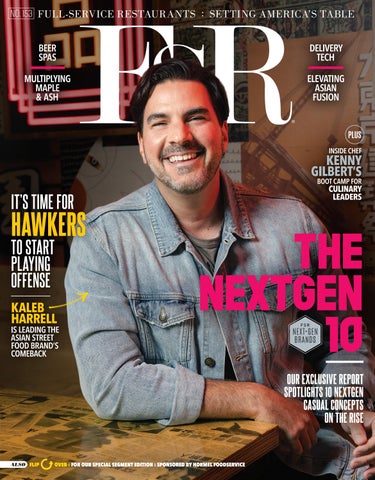
On the Cover Our September cover features Kaleb Harrell, CEO and cofounder of 15-unit Hawkers Asian Street Food. The concept was inspired by the bold, multi-generational flavors of Asian hawker stalls, and born from a craving for authenticity and a friendship-fueled leap of faith. The brand has gradually scaled to 15 company-owned locations across seven states—Florida, Georgia, North Carolina, Tennessee, Maryland, Virginia, and Texas. Add $4.6 million AUVs, a 4.8-star guest satisfaction score, and a fiercely loyal fanbase, and the sum becomes a rising NextGen brand you can’t ignore.
F S R M AG A Z I N E .CO M
GREG PERKINS
IN THE FALL OF 2021, FSR unveiled “NextGen Casual” as a definitive way to categorize what we were seeing across the industry following the pandemic. Full-service chains were innovating and taking best practices from quickservice—like redesigning kitchen layouts to optimize throughput for offpremises—while hyper-focusing on hospitality and high-quality sourcing, taking a page out of the elevated independent restaurant playbook. The following year, we introduced our proprietary editorial report, The NextGen 25, which spotlighted 25 brands we saw prioritizing the guest and team member experiences above all, coupled with measured growth strategies. In its fifth year, we have narrowed this report down to The NextGen 10, not only because it rhymes and has a great ring to it, but also because it allows us to do a bit of a deeper dive on each brand we select. You’ve likely seen many of these concepts covered in FSR before, perhaps in one of our “On the Rise” standing department features throughout the year, or in one of our digital exclusives on fsrmagazine.com. We try our best not to repeat brands that have made the list in previous years, with a few notable exceptions—including our cover star this issue, Hawkers Asian Street Food, which made an appearance on the list in 2023. Hawkers has been through quite the transformative journey since then, from backing out of a Chapter 11 bankruptcy filing to attracting an investment from Andrew K. Smith’s Savory Fund last year. But CEO and cofounder Kaleb Harrell is ready to get out of survival mode and start playing offense again. You can read the rest of the story within The NextGen 10 report on PAGE 32. Elsewhere across our September issue, you’ll find a throughline of brands persevering through hard times and coming back even stronger, like the legendary Steak and Ale which disappeared for 16 years, now celebrating its comeback with the opening of its first Southern franchise location (PAGE 7). There’s also a Q&A with Stephen DeSousa, CEO of Tavern in the Square, who shares how things are going one year after being acquired by Authentic Restaurant Brands (PAGE 54). And then we have the story of Sydney Grims on PAGE 47, who overcame the intimidating experience of being the only woman in her workplace and stepped up to lead 1,500+ employees at Fearless Restaurants (PAGE 47). There’s no shortage of stories this month to leave you feeling thoughtfully inspired, so let’s dig in. Cheers!
First Course
MICHAEL HASKINS
John and Dixie Benca are the husband-wife duo opening the new Steak & Ale in South Carolina.
From Employees to Franchisees STEAK AND ALE (3)
BY CALLIE EVERGREEN
A Steak & Ale love story is coming full circle as former employees open the first Southern franchise. F S R M AG A Z I N E .CO M
MORE THAN 30 YEARS AGO, John and Dixie Benca met and fell in love working together at a Steak and Ale while attending college in Athens, Georgia. Now, the former employees are bringing the concept that brought them together to Anderson, South Carolina,
next year—marking the brand’s first Southern franchise location. “It’s hard to put into words because it truly feels like life has come full circle,” the Bencas told FSR in a joint comment. “We met there, built lifelong friendships there, and learned what genuine
S EP T EM B ER 2 0 2 6
7
8
S EP T EM B ER 2 0 2 6
Confidence is
Currency A recent survey of 500+ U.S. hospitality employees revealed 54% of hospitality workers ages 25–34 said they would choose better workplace training over a 5% pay increase, challenging longheld assumptions about what really motivates employees. Some other key findings from the Attensi study:
77 %
say training that genuinely built their confidence would meaningfully improve their day-to-day experience at work.
2/3
say most workplace training focuses on delivering information rather than helping employees practice for realworld situations. The data suggests younger hospitality workers increasing ly value confidence and skill-building over modest pay bumps:
52 %
said the main reason they want to improve their skills is to feel more confident and capable on the job, not to earn more or get promoted.
F S R M AG A Z I N E .CO M
STEAK AND ALE (2), ADOBE STOCK / NDABCREATIVITY, ADOBE STOCK / DAVIT85
hospitality looked like from leaders who challenged us to pursue excellence every single day,” the couple added. “Those lessons stayed with us long after we left and became the foundation for every restaurant we’ve built together over the past three decades.” Since that fateful meeting, the Bencas have opened and operated multiple restaurants in Anderson throughout the past few decades. But the chance to “introduce a new generation to the restaurant that NORMAN BRINKER OPENED THE FIRST shaped our lives while welcoming STEAK AND ALE IN 1966, WHICH BECAME back longtime fans who have waited KNOWN FOR INTRODUCING THE SALAD BAR TO CASUAL DINING. years for its return” was too good to concepts an upscale makeover and pass up. grow at a sustainable pace. “That’s what makes this opporAfter more than a decades-long tunity so special,” the Bencas said. absence, Steak and Ale returned in “Steak and Ale represents a trusted 2024 with the opening of its first new experience people can depend restaurant in Burnsville, Minnesota. on, and we’re honored to bring that The Anderson location represents Legendary legacy home.” the next step in the brand’s comeFounded in 1966, Steak and Ale back plan. became widely known as one of the “Every iconic American brand early models for casual dining, and has defining moments, and the new one of the first concepts to offer an Anderson location is one of those unlimited salad bar. Quality steaks moments for Steak and Ale,” Manat an affordable price point, plus giamele told FSR. “As we celebrate friendly service and an environment our 60th anniversary, we’re provinspired by the warmth of an English inn, led the brand to take off and ing this isn’t simply a comeback; it’s the beginning of a bold new era of grow to nearly 300 locations at its intentional, sustainable growth.” peak in the 1980s. The Bencas describe the comBut in 2008, a Chapter 7 bankruptcy—which left its sister concept, munity response to the news of the Anderson location—targeted to Bennigan’s, in big trouble, as well— open in the first quarter of 2027—to caused Steak and Ale to shutter its remaining 58 locations at the time of be “overwhelmingly” positive so far. “People are genuinely thankful and the bankruptcy filing. relieved in a way that says, ‘Finally, Hope of the brand making a we can eat there again.’ There’s a return seemed bleak until Paul level of excitement and anticipation Mangiamele and his wife, Gwen, that’s been waiting to be rekindled decided to buy out the entirety of for far too long.” Bennigan’s Franchising Company “That’s what makes Steak and Ale and Steak and Ale from Fortress so special,” they added. “The emoInvestment Group in February 2015. tional connection exists because it The Mangiameles formed Legendwas first a personal one. We’re honary Restaurant Brands LLC, with a ored to continue the promise Normission to revolutionize casual dinman Brinker made and carry that ing by reintroducing beloved, legLegendary legacy forward for a acy restaurant brands that peowhole new generation.” ple are nostalgic for, but give those
MICHAEL HASKINS
First Course
UNRIVALED CHEESE FOR UNFORGETTABLE PIZZAS Become the place to go for must-have pizzas with the superior stretch, extraordinary melt, and rich, creamy taste of Bacio®, the exceptional cheese chosen by premier pizzerias.
REQUEST YOUR TASTING BACIOCHEESE.COM ©2026 Bacio Cheese Company
Exclusively Distributed Through
Sweet CHAbanero Sauce SWICY FLAVOR BU ILT TO PERFORM ACROSS MENUS AN D DAYPARTS. Texa s Pete ® is a regis tered
Texas Pete® Sweet CH
Abanero Sauce is des
igned gs, sandwiches, bowls , and LTOs. Born in a restau rant and trusted by ope rators nationwide, Texas Pet ® e delivers consumer-f avorite flavor in formats built for consistency, speed, and real foodservice operat ions. for crave-worthy win
Buy and SAVE with ou r cashback REBATE. Go To TexasPeteFood service.com now.
trad emar k of TW Garn er Food
Comp any. 1090 -03-0 2202 6
CULINARY INSPIRATION AND STORIES FROM INDUSTRY TRAILBLAZERS MENTIONED IN THIS SECTION GROVE BAY HOSPITALITY LYSÉE • • •
• • •
WAYAN
MA.DÉ
• • •
Chefs & Ingredients
CHEF KENNY GILBERT MEASURES SUCCESS BY THE DEPTH AND BREADTH OF HIS EXPERIENCES, PLUS HIS IMPACT AND LEGACY HE’S LEAVING AS HE COACHES THE NEXT GENERATION OF CULINARY LEADERS.
GROVE BAY HOSPITALITY GROUP
KENNY GILBERT’ S CULINARY BOOT CAMP BY CALLIE EVERGREEN
The “Top Chef” vet builds great kitchens through a coaching culture.
F S R M AG A Z I N E .CO M
KENNY GILBERT HAS SPENT MORE THAN THREE DECADES proving that great kitchens are built on more than culinary skill alone. The “Top Chef” season seven veteran, “Beat Bobby Flay” winner, cookbook author, and vice president of culinary for Grove Bay Hospitality blends the rigor of his Ritz-Carlton training with a hands-on, people-first approach to leadership. But it all started with an early fascination with food and how it connects
S EP T EM B ER 2 0 2 6
11
people across cultures. Gilbert was raised in a household where food was the focal point and part of his family’s identity, so becoming a chef felt like an intuitive, natural progression as he grew up. From a young age, he wanted to explore and experience diverse cuisines. His father, who worked as an insurance salesman, brought home all different kinds of foods to try—from pierogies from the Polish neighborhood to corned beef and rye bread from the Jewish deli around the corner. When he slept over at friends’ houses, Gilbert was unusually observant (for a kid) about the different ingredients he found in their fridges, from homemade Italian dressings to noticing why their cold cuts were different from the ones at his house. “I was very curious, and I realized very early on, I’m developing my palate, trying all these different things,” he reflects. That curiosity continued as he worked his way through a gauntlet of fast-food jobs—from McDonald’s and Burger King to Pizza Hut and Taco Bell—before sylvania Culinary Institute in Pittsburgh. While earning his degree, he worked at a Jewish deli, a mom-and-pop Italian restaurant, and, for his externship, went to work at the Ritz-Carlton on Amelia Island in Florida at 19 years old. He impressed them enough to get hired on permanently and worked his way up from roles in the butcher and pastry shop to banquets. At 23, he landed the chef de cuisine job at The Grill, The Ritz-Carlton’s finedining AAA Five Diamond Restaurant, where his “career really started taking off,” he says. Gilbert made history as the youngest Black chef ever to run a RitzCarlton hotel restaurant. Those formative years sharpening his skills at the Ritz-Carlton built the foundation for Gilbert to thrive no matter where he went or what he sought to accomplish. One noteworthy accomplishment was in 2014, when Gilbert launched his CPG signature spice blends—a nod to his father who made barbecue rubs. “I was always watching him season meat and getting on the smoker or grill,” he recalls. Gilbert gained major acclaim when his Ultimate Spice Blends Gift
12
S EP T EM B ER 2 0 2 6
CHEF YOU’D LOVE TO WORK WITH:
Alain Duccaise
MOST UNDERRATED OR UNDERAPPRECIATED INGREDIENT:
Finishing Salt. Maldon. SECRET COMFORT FOOD:
Ramen
IF YOU COULD ONLY COOK WITH ONE VEGETABLE, WHAT WOULD IT BE?
Maitake Mushrooms
THE DISH YOU’RE MOST PROUD OF CREATING:
Stuffed Pharoah Quail, Porcini Mushroom Grits, Marsala Truffle Emulsion, English Pea Pico. Shaved Truffles IF YOU WEREN’T A CHEF, WHAT PROFESSION WOULD YOU BE IN?
Interior designer
BEAUTY & THE BUTCHER TRUFFLE TART
Set was featured on Oprah’s Favorite Things in 2020. Her favorite was his Fried Chicken Seasoning, which she said “should be declared a national treasure”. Reiterating the importance of the structure and systems he learned from Horst Schulze, co-founder of The Ritz-
Carlton, Gilbert points to many successful restaurants that have “taken the boot-camp training from Ritz-Carlton, like Chick-fi l-A,” he says. The method boils down to “taking care of someone as if they came into your home,” he continues, and “letting the staff be empowered to make decisions and not be micromanaged … You make sure everyone is taken care of, and that’s really all that hospitality is. I’m very fortunate that I was a part of that with Ritz-Carlton when it was coming up.” That ethos is something Gilbert is proud to still stand by today and informs how he coaches his own team members at Miami-based Grove Bay Hospitality. Since joining the group as VP of culinary in fall of 2022, Gilbert has opened and re-developed more than 24 restaurants, helping to take the company from $65M to just shy of $100M in annual sales. Most recently, he has added 11-plus locations in airport restaurants and concessions, with the most notable being Crawford’s Genuine at Raleigh-Durham International Airport—a concept that earned the prestigious Ace Award for Casual Dining. At Grove Bay, Gilbert has built a clear progression system based on the coaching philosophy he learned at RitzCarlton. Cooks move through stations only after training the person who will replace them, which helps them develop their technical range as well as their ability to teach others. The goal is to build an internal bench of leaders who can be promoted, rather than rely on outside hires whenever a role opens. “They can’t move on until they’ve trained their replacement,” Gilbert says. “If you’re on garde manger and you work at that station for two to three months, in order for you to go to hot apps or sauté or whatever other station, you have to train your replacement.” Th at process, he says, turns a cook into a mentor before they become a supervisor. “If you do that for five stations, then you train five people at least. And now you’re ready to be a supervisor.” When kitchen workers are beginning training, the first thing Gilbert asks is, F S R M AG A Z I N E .CO M
AGNES LOPEZ, BAY HOSPITALITY GROUP
CHE F S & ING RE DIE N T S CHE F PROFILE
BAYSHORE CLUB BAR
“Does everyone understand what boot camp is?” He ensures everyone understands that he has a “responsibility of making sure that you are all mentally and physically fit and ready to be able to run this operation,” he shares. “And there are going to be times that we’re going to have to have a stronger voice in the kitchen to be audible and be able to get you motivated to be able to keep that going, because maybe you’re drifting off and you’re not paying attention. And it’s like, ‘hey I needed that chicken in the fryer like two minutes ago. Why are you still messing around and not getting it in?’” Gilbert continues. “So I think that this next generation has to learn how to be coached. I think that leaders need to also continue to learn how to coach and how to lead.” Gilbert describes himself as a “playercoach,” and he still takes pride in being able to work a station, model the standard, and then step back to coach the team. “I’ll jump right in and work the station and crush it and do it better than anybody,” he says. “And then at the same time, I can stand from afar and coach, to be able to teach them how to do it. That’s what I love about this particular job.” For Gilbert, coaching people means making them uncomfortable enough to grow, but supporting them along the way. He compares it to resistance training and gradually increasing the weight in a workout. “It’s kind of like wearing ankle weights,” he says. “You put on
14
S EP T EM B ER 2 0 2 6
BAYSHORE CLUB DUCK SURF & TURF
ankle weights, at first they’re heavy, and then you get used to it. Well, I’m perfect at adding that more weight. Right when you start to get used to it, I’m adding a little bit more weight.” The point is not to add pressure for its own sake, he says, but to help strengthen and prepare people to reach the next level. “There’s not a person that hasn’t worked with me over these decades that can’t say that I haven’t leveled them up, challenged them, but also was there to make sure… I would catch them and then throw them right back in the ring.” In addition to his Grove Bay role, Gilbert is growing the House of Birds & Drop Biscuits, a franchise concept he created that celebrates bold flavors, soulful comfort, and globally inspired Southern cooking. Gilbert describes his favorite part of creating and developing a new restaurant as “the hunt” of the customer. He starts off by analyzing a location’s demographics and studying the community’s cultural makeup, dining habits, and needs before building the menu. The point is
to figure out who the restaurant is actually for; Gilbert argues that a chef’s talent is irrelevant if they are cooking for a demographic that doesn’t exist in their chosen market. “Just because I’m a great chef and I can make this food great and it’s delicious, I wouldn’t open that concept unless I knew that there was a huge [target] demographic in that market to do it, because it just doesn’t make sense,” he says. “Understanding the demographics is the first thing, which a lot of chefs don’t necessarily start off thinking about,” he continues. He describes the mentality of starting with the guest in mind first as true maturity, as opposed to when he was first starting out. “I was one of those chefs, too—like this is my concept, I’m going to cook this food, and I’m going to make everyone love it,” he admits. As Gilbert has matured over the years, his idea of what success looks like has also shifted. As a young chef, his goal was to open a restaurant before he turned 30. Today, he measures success by the depth and breadth of his experiences, plus his impact and legacy he’s leaving as he coaches the next generation of culinary leaders. Further adding to his wide span of talents and impressive resume: In April 2023, Gilbert released his debut cookbook, “Southern Cooking, Global Flavors.” He is also pursuing more television work after reaching the Final Four in “Tournament of Champions” Season 7. His upcoming slate includes “Bobby’s Triple Threat,” “Wildcard Kitchen,” and the “Tournament of Champions AllStars” special. More than any professional achievement, though, Gilbert says he is proud of his resilience. A cancer survivor who has navigated significant personal and professional challenges, he views his career as a platform for connection and mentorship. “Nothing has broken me to the point where it’s like, ‘Okay, I’ve got to stop,’” he says. “There’s no stopping.” He adds, “I’m here for a purpose, and that purpose is fellowship. My purpose is being able to tell my story.” F S R M AG A Z I N E .CO M
BAY HOSPITALITY GROUP (2)
CHE F S & ING RE DIE N T S CHE F PROFILE
DELIVERY is ESSENTIAL. CRISPY is CRITICAL.
When the fries show up crispy, your business shows up strong. See our range of delivery fries at SureCrisp.com. McCain and SureCrisp are trademarks of McCain Foods Limited. © 2025 McCain Foods USA, Inc.
McCain® SureCrisp® fries
GO THE DISTANCE.
CHE F S & ING RE DIE N T S NOW SE RV ING
Flourishing Asian Flavors BY SATYNE DONER
From Rajasthan to Jakarta to a grandmother’s rice fields, three chefs are turning heritage into some of the most celebrated Asian cuisine in the U.S.
WAYAN INDONESIAN OMELET
MUSAAFER’S LAAL MAAS IS A SMOKED GOAT MEAT DISH SMOTHERED IN MATHANIA CHILI, FREEZE-DRIED GARLIC, AND MILLET BRITTLE. IT HAILS FROM THE NORTHWESTERN STATE OF RAJASTHAN, WHERE CHEFS ONCE ACCOMPANIED KINGS ON HUNTS INTO THE JUNGLE.
LYSÉE MUSAAFER MALVANI FISH CURRY
MITHU MALIK’S RESTAURANT Musaafer—Urdu for “traveler”—takes its patrons on an unfiltered journey through India, inspired by executive chef Mayank Istwal’s 100-day journey through India’s states and territories. Along the way, Istwal didn’t just collect recipes—he cooked them in the very homes where they’d been passed down for generations, learning from cooks whose families had made these dishes long before him. When Malik opened this restaurant alongside her husband in Houston, it
16
S EP T EM B ER 2 0 2 6
quickly earned recognition as the first sine and take it away from the general conIndian restaurant with a female owner cept of a big bowl of curry and rice with in Texas to earn a Michelin star. Follow- naan. Istwal’s journey is integral to our ing the success of the Houston location, menu design, which rotates three times a they opened another in New York City. year, because we’re constantly taking from At the heart of Musaafer’s menu, inter the bank of recipes we built and brainwoven with the stories and faces of those storming how to use modern techniques Istwal met on his cultural trek through and artistic presentations,” Malik says. India, are the select ingredients and spice Take the laal maas, for example: a blends, specifically sourced from fami- smoked goat meat dish smothered in lies in India who have been using them mathania chili, freeze-dried garlic, and for generations. millet brittle. It hails from the north“Musaafer seeks to elevate Indian cui- western state of Rajasthan, where chefs F S R M AG A Z I N E .CO M
RAYDON CREATIVE, SUPERBON STUDIO , DAN AHN, RAYDON CREATIVE
MUSAAFER ALAAL MAAS
NOW SE RV ING CHE FS & ING RE DIE N T S MA•DÉ TABLE SPREAD
SUPERBON STUDIO
OCHI LATJUBA VONGERICHTEN’S RESTAURANTS WAYAN AND MA.DÉ ARE AMONG THE ONLY INDONESIAN CONCEPTS TO RECEIVE RECOGNITION IN THE U.S. MICHELIN GUIDE.
once accompanied kings on hunts into the jungle. The dish was traditionally made from game meat, but after hunting was banned in the 1970s, it’s now made from goats. Then there’s the masala papad appetizer, a modern interpretation of matthi, a deep-fried pastry traditionally eaten with pickled mango, also known as achar. Musaafer’s version is slightly thinner and crispier, with spice-cured tuna, avocado, and an achar emulsion. This is just the beginning of elevated Indian cuisine’s representation in the United States. Malik sees a bright future ahead—not just for Musaafer, but for a culture ready to experience the breadth and magic of Indian cuisine. For Eunji Lee, a South Korean pastry chef classically trained in Paris, it was a dream come true to combine her French training with Korean ingredients as executive pastry chef of Jungsik, the F S R M AG A Z I N E .CO M
three-Michelin-star modern Korean restaurant in New York—and the first Korean restaurant in the U.S. to earn that distinction. Today, she owns her own pastry boutique in New York City, Lysée, whose menu combines three cultures—French, Korean, and the city itself. There’s the traditional Korean influence, like the matcha floating island dessert with Uji matcha and Yuja sorbet; the French, with madeleines made from passionfruit cream, passionfruit glaze and a roasted coconut crumble; and the classic New York marble pound cake, with a chocolate caramel glaze. Her favorite dessert reminds her of childhood—a cake made from Korean toasted brown rice mousse, caramel, pralines, and a pecan sable sourced from Georgia. The idea came to her from a childhood memory of her grandma, who lived in the countryside and farmed rice. She can remember the aroma of brown rice being cooked on the stove, and it sticks with her until this day. “I try to tell my story through my dishes, starting with the Korean ingredients and culture I grew up with, the French techniques that I learned, and who I am now, which is a New Yorker,” Lee says. “Dessert is its own language, and I want people to experience it in a deeper and more meaningful way.” Like Lee, Ochi Latjuba Vongerichten represents her dual culture through the New York City restaurants she owns with her husband and chef, Cedric Vongerichten. These include Wayan, a modern French Indonesian restaurant, and Ma.dé, an intimate concept specializing in Padang-style dining—one of Indonesia’s most iconic regional cuisines. Ma.dé, meaning “second born,” is a deeper, more personal exploration of Vongerichten’s roots in Jakarta, where she was born. “Growing up in Jakarta, food was always at the center of everything: family celebrations, everyday life. Those memories inspire me every day,” Vongerichten says. “I want our guests to experience the real flavors of Indonesia while making them feel comfortable trying something new.”
Inspired by West Sumatra and the spirit of communal abundance, dishes are served family-style and all at once, traditionally eaten with the hands. The menu is built around three main components—gulai (curry), lado (chili pepper), and bareh (rice)—and often features coconut milk and spicy chili. Dishes include fried chicken smothered in a sweet chili sambal; butterfish glazed in calamansi and lime, served with coconut salem rice; Asian pear salad; baked razor clams with sambal butter and coconut crumbs; and yellowtail king sashimi paired with coconut, makrut lime, and rhubarb. Padang cuisine is bold, full of spices, and meant to be shared—it’s what Vongerichten loves most. Many specialty ingredients are sourced from Indonesian farmers. What they can’t get from Indonesia, they source from local farmers in New York. But the soul of the dish never changes, and the goal is to inspire guests to learn more about Indonesian culture and hospitality. Wayan, the couple’s fi rst-born concept, presents Indonesian cuisine with a modern French twist. The menu includes bold satays, with options ranging from chickpea to scallop, chicken, lamb, and shrimp. A host of small plates are served, from the tamarind citrus salad to escargot rendang served with toasted brioche, garlic-herb butter, and lime. There’s the roasted duck, a cornerstone of classic French cuisine, but the Wayan way is served with calamansi gulai (often called Indonesian curry), Asian pear, and cashew nuts—perfectly encapsulating the fusion of cultures. With Vongerichten’s restaurants among the only Indonesian concepts to receive recognition in the U.S. Michelin Guide, she shares Malik’s sentiment: The future is bright for Indonesian cuisine. “It is a huge honor, and it is a recognition for Indonesian cuisine as a whole. Indonesia has one of the richest food cultures in the world, but it’s still underrated,” Vongerichten says. “I hope this encourages more people to discover it and inspires more Indonesian chefs to share their stories with the world.”
S EP T EM B ER 2 0 2 6
17
Progressive Casualty Insurance Co. & affiliates.
Small business owners’ to-do lists can add up. So see if you can save money on a commercial auto quote at ProgressiveCommercial.com.
Get a quote online in as little as 8 minutes
TRENDS AND CREATIVE APPROACHES TO SPIRITS, WINE, AND BEER. MENTIONED IN THIS STORY OAKWELL BEER SPA
Liquid Intelligence
OAKWELL, WHICH CALLS ITSELF A “SOCIAL DAY SPA,” COMBINES THE PRIVATE SPA SUITE EXPERIENCE WITH A CRAFT BEER-AND-WINE TAPROOM. THE WATER IN THE HYDROTHERAPY TUB IS INFUSED WITH BEER INGREDIENTS—HOPS, MALT, AND HERBS SELECTED FOR DIFFERENT EFFECTS.
OAKWELL BEER SPA / DUSTIN MOON VISUALS
Where Booze Meets Wellness Culture:
BEER SPAS
BY SAM DANLEY
Oakwell Beer Spa is using craft beer to anchor a high-margin franchising model that resonates with Gen Z and wellness-minded drinkers alike. F S R M AG A Z I N E .CO M
ON A RAINY DAY IN ZAKOPANE, POLAND, Jessica and Damien Zouaoui went looking for something to do indoors. The newly married New Yorkers were in the middle of an indefinite around-the-world trip after quitting their corporate jobs. They were looking for a business idea—something in hospitality, something scalable, and ideally something Amer-
S EP T EM B ER 2 0 2 6
19
OAKWELL GUESTS CHECK IN AND START AT A 10-TAP SELF-POUR WALL. FIVE TAPS ROTATE THROUGH COLORADO BREWERIES, WHILE THE OTHERS INCLUDE CIDER, WINE, SPRITZES, AND OAKWELL’S HOUSE BEER, SPA SIDEKICK, A CUCUMBER-LEMON GOSE MADE WITH SPICE TRADE BREWERY.
icans had not seen a hundred times before. A beer spa popped up on TripAdvisor. Thirty minutes later, they were soaking in a tub infused with hops and barley, with a keg of Polish beer nearby. Th at moment became the starting point for Oakwell Beer Spa, the Denver-based hospitality concept that combines private spa suites with a craft beer-and-wine taproom. It is, at first glance, a pairing built to make people raise an eyebrow. Beer and wellness do not exactly live next door to each other in the American imagination. But Oakwell is not trying to turn a spa visit into a bar crawl. It is built around a different idea: Beer can be part of an experience without being the entire point of it. Th at distinction is becoming more important as restaurants, bars, breweries, and other hospitality businesses look for ways to give consumers a reason to leave the house, and a reason to stay awhile once they arrive. “We both quit our corporate jobs at the same time,” Jessica says. “We sold everything we owned in New York. We packed two backpacks and we headed off on an indefi nite round-the-world trip. And the plan was that we weren’t going to come home until we found the perfect business idea.”
20
S EP T EM B ER 2 0 2 6
Damien had worked in sales and marketing within hospitality and travel, while Jessica’s background was in HR and operations. They knew they wanted to build something together, but not another restaurant or coffee shop. Franchising was part of the plan from the beginning. “We never wanted to be a mom-andpop business owner,” Jessica says. “We were looking for something that was scalable, but also something that we could be passionate about and really excited about.” Their trip through 25 countries became an informal research expedition. After Poland, they began paying closer attention to spa culture elsewhere: onsens in Japan, jjimjilbangs in South Korea, and wine spas in France and Spain. What stood out was not simply the novelty of bathing with beer ingredients. It was the social nature of the experience. In many places, spas were communal, multigenerational, and accessible—not the solitary, expensive, female-skewing luxury service Americans often picture. “Spas are not just for the wealthy,” Jessica says. “Wellness is something that you do as a social experience.” The couple landed in Denver in Jan-
uary 2019 with their backpacks and a business plan. It took more than two years to find space, secure financing, and build the first Oakwell location. The founders did much of the early construction themselves, relying on Home Depot materials and a lean budget. They opened in February 2021, in the middle of a still-unsettled pandemic landscape. “Very quickly, when we launched, we were fully booked seven days a week,” Damien says. “People were really intrigued about the experience.” Today, Oakwell has two Denver-area locations, including a newer Highlands Ranch store designed as a more polished prototype for franchisees. As it pursues operators in markets including Kansas City, the company is looking to replicate the playbook it has refined at its corporate locations: high-touch hospitality, a distinctive beverage program, and a spa experience built for groups rather than solo indulgence. Oakwell calls itself a “social day spa” that pairs private spa suites with a craft beer and wine taproom. Guests check in and start at a 10-tap self-pour wall. Five taps rotate through Colorado breweries, while the others include cider, wine, spritzes, and Oakwell’s house beer, Spa Sidekick, a cucumber-lemon gose made with Spice Trade Brewery. “It’s kind of our version of spa water,” Jessica says, “but instead, it’s spa beer.” The taproom is intentionally unlike the industrial, concrete-and-communaltable look that has defined many breweries. Think boutique-hotel lobby: greenery, plush velvet furniture, swing chairs, Bossa Nova and French pop, and a custom scent drifting through the room. After about 30 minutes, guests move to a private spa suite equipped with an infrared sauna, rain shower, and hydrotherapy tub, which is infused with hops, malt, and herbs selected for different effects. Guests have 90 minutes to meander throughout the sauna, shower, and tub, with room service available via a bell in the suite. Oakwell’s employees are, officially, “beer therapists.” Afterward, guests cool down in a relaxation room or use zero-gravity massage chairs. F S R M AG A Z I N E .CO M
OAKWELL BEER SPA / DUSTIN MOON VISUALS
LI Q U I D I NT E LLI G E N C E
THANK YOU to our Serving Up Hope Sponsors!
HERO OF HOPE
CHAMPION OF HOPE
BEACON OF HOPE AllianceHCM | GooGoo Clusters | Sysco
When food and beverage employees are in crisis, CORE gives.
LI Q U I D I NT E LLI G E N C E
22
S EP T EM B ER 2 0 2 6
OAKWELL EXEMPLIFIES A LARGER SHIFT IN DRINKING CULTURE. THE FOUNDERS EMPHASIZE THAT THE CONCEPT IS NOT A PARTY ENVIRONMENT. GUESTS AVERAGE ABOUT TWO PINTS, BEER IS CAPPED AT 7 PERCENT ABV, AND PLENTY OF VISITORS OPT FOR COFFEE, ELECTROLYTE DRINKS, CBD INFUSIONS, OR OTHER NONALCOHOLIC BEVERAGES INSTEAD.
“There needs to be some sort of experience, and then maybe you have a pint or two or a glass of wine as an ancillary part of the evening.” Damien puts it even more plainly: “The beer is just something you plug to make it fun.” The real product is relaxation and connection—a place where friends or couples can spend time together, with a local beer as one part of the ritual rather than the reason for it. That thinking has implications for beer operators far beyond a spa. Wesler says Oakwell “really crushed the experience side of things,” from the atmosphere and music to the service and treatments, with alcohol serving as “an enhancement point.” “It’s just not as easy as rolling up the garage doors and having beer flowing,” Wesler says. “There’s got to be a reason for people to show up, also a reason to keep hanging out as opposed to having one beer and leaving.” Denver Beer Co. has responded with on-site kitchens, spirits and wine through brewpub licenses, and programming such as run clubs, trivia, music bingo, food pairings, and its “beer, bacon, and coffee” events. The goal is to accommodate mixed groups and create an
occasion, not simply offer a list of beers. Oakwell has also provided lessons about what people want to drink in those new environments. The couple found that one of their weaker-performing partners was a Denver brewery celebrated by enthusiasts for its precise German-style lagers. Spa guests instead gravitated toward lighter, fruitforward, playful beers, including an orange creamsicle offering. Spa Sidekick has become one of Oakwell’s top sellers and will be the only beer carried across every future location, while the remaining taps stay local. But Karl Wolf of Diebolt Brewing says the takeaway is not necessarily that breweries must chase novelty. “At the end of the day, it really just has to do with quality versus anything that’s unique,” he says. “You don’t need to be unique in beer. What you need to be is good.” In a crowded market, that principle applies beyond the liquid. Wolf says he can stand in a store and look at “a wall of beer that’s 300 feet long,” surrounded by products all fighting for attention. What cuts through, he argues, is authenticity and an experience people want to talk about afterward. F S R M AG A Z I N E .CO M
OAKWELL BEER SPA / DUSTIN MOON VISUALS
For prospective franchisees, the appeal is not just that Oakwell has found a novel niche. It has built a relatively streamlined hospitality model around a small number of high-value appointments. Average tickets run about $300, with roughly 27 appointments a day, and staff largely come from bartending and serving rather than specialized spa labor. For Oakwell ’s brewery partners, meanwhile, the value is not simply another tap handle. Brian Wesler, sales operations director for Wilding Brands—a family of craft beverage companies that includes Denver Beer Co., Stem Ciders, Funkwerks, Great Divide Brewing Co., and Station 26 Brewing—has worked with Oakwell for years. He never viewed the spa as a major volume account. Instead, he saw an opportunity to connect local brands with a highly intentional experience and introduce them to visitors exploring Denver’s beer scene. “I just looked at it as, ‘Hey, this is something truly unique,’” Wesler says. “Th is is a local partner startup that we can get in on the ground floor with and partner with and create a relationship here in the local Denver beer scene and be a great brand awareness tool.” That makes Oakwell something of a prestige account: a place where a brewery can be discovered in a setting more memorable than a typical restaurant placement. Jessica says that is part of why breweries have been eager to work with the spa. “Having their beer being enjoyed and discovered in such a premium environment like ours is actually very appealing to them,” she says. “It’s a great opportunity for PR because, let’s be honest, the press find this really interesting.” The partnership also gets at a larger shift in drinking culture. Oakwell’s founders emphasize that the concept is not a party environment. Guests average about two pints, beer is capped at 7 percent ABV, and plenty of visitors opt for coffee, electrolyte drinks, CBD infusions, or other nonalcoholic beverages instead. “Drinking is not the primary focus when you go out anymore,” Jessica says.
Trending on the Menu SEPTEMBER 2026 // Hispanic Flavor Trends
BELGIOIOSO / GINAPROVENZANO
COTIJA TOSTADA
Dominating Hispanic Flavors F S R M AG A Z I N E .CO M
How authentic flavors and ingredients are creating fresh menu opportunities.
S TO RY // 24
Build on Authenticity DATA // 28
By the Numbers
SPONSORED SECTION | S EP T EM B ER 2 0 2 6
23
// Hispanic Flavor Trends
Hispanic Cheeses Help Operators Deliver Big Flavor Across the Menu
QUESADILLACHEESE QUESADILLA
From breakfast to late night menus, Hispanic cheeses create opportunities. 24
S EP T EM B ER 2 0 2 6 | SPONSORED SECTION
C
onsumer demand for Hispanic flavors continues to influence menus across foodservice. From fast casual and pizza to healthcare, colleges and universities, and casual dining, operators are looking for ingredients that deliver distinctive flavor while helping kitchens remain efficient and profitable. Hispanic cheeses have become a versatile solution. Their range of flavors and textures, consistent performance, and ability to work across multiple menu applications allow chefs to respond to consumer demand without adding unnecessary complexity. BelGioioso Cheese’s Hispanic Selection portfolio, including shredded Oaxaca, shredded Quesadilla, and grated Cotija, provides operators with quality Hispanic cheeses in foodservice ready formats designed for consistent execution, portion control, and labor savings. The category continues to gain momentum. Hispanic cheeses are among the fastest growing segments in dairy, with production reaching a record high for the twelfth consecutive year, increasing 4 percent to approximately 435 million pounds, according to Cheese Reporter. Overall, the U.S. cheese market is projected to grow from $54 billion to $87 billion by 2034, according to Fortune Business Insights, while natural cheese generated $46.7 billion in sales in 2025 alone. For BelGioioso Cheese, quality has always been the foundation. For 47 years, the family-owned company has handcrafted premium cheeses using time honored artisan techniques inspired by traditional European cheesemaking. Made in small batches with all natural ingredients and without rBST, wheat, or gluten, the cheeses reflect a commitment to craftsmanship and consistency that has helped establish BelGioioso as a widely recognized name in specialty cheese. Many varieties are also suitable for vegetarians and those who are lactose intolerant. “At BelGioioso Cheese, we know operators depend on ingredients that perform consistently every day,” says Umberto Marconi, vice president of marketing at BelGioioso Cheese. “Our Hispanic SelecF S R M AG A Z I N E .CO M
BELGIOIOSO / GINAPROVENZANO
TRENDING ON THE MENU
QUESADILLA brings the
PULL
HISPANIC
BIG HISPANIC FLAVOR. BELGIOIOSO PERFORMANCE. Authentic Hispanic cheese with consistent quality and reliable results in every application.
DISCOVER OUR HISPANIC CHEESES!
Enjoy a smooth, satisfying melt that adds visual appeal to quesadillas, nachos, sandwiches and more.
// Hispanic Flavor Trends
tion portfolio delivers bold flavor, dependable melt, and consistent performance, giving chefs confidence whether they’re preparing a signature entrée or serving hundreds of guests during peak service.” Consumer interest in Hispanic and other internationally inspired fl avors shows no signs of slowing. The Hispanic community now numbers approximately 68 million people, making it the nation’s second largest ethnic group, while 70 percent of operators report increasing demand for globally inspired menu items. With an estimated 70,000 Hispanic and Latino restaurants across the United States, Hispanic ingredients continue to influence menus well beyond traditional Mexican cuisine. “Hispanic flavors have become part of mainstream dining, extending far beyond traditional Mexican restaurants,” Marconi says. “We’re seeing chefs across pizza, fast casual, colleges and universities, healthcare, and casual dining embrace Hispanic cheeses because they bring distinctive flavor and menu appeal. Consumers want familiar dishes with new flavor combinations, and these cheeses give operators an easy way to create that experience.” One standout trend is birria, which has grown more than 350 percent on menus during the past four years, according to Datassential. Meanwhile, fusion concepts continue gaining popularity as chefs combine Hispanic flavors with other cuisines. Birria ramen, Korean BBQ tacos, sushi burritos, Mexican street corn pizza, salsa macha burgers, and “swicy” fl avor combinations demonstrate how operators are incorporating Hispanic ingredients into familiar favorites. Whether featured in traditional recipes or contemporary menu creations, Hispanic cheeses give chefs considerable culinary flexibility. “Each cheese offers something unique in the kitchen,” Marconi says. “Oaxaca delivers exceptional melt and stretch, Cotija provides a bold fi nishing fl avor, and Quesadilla cheese creates a rich, creamy texture. Together, they give chefs the flexibility to prepare traditional favorites while developing new
OAXACA FUNDIDO
COTIJA CORN
menu items that keep guests interested.” Oaxaca is prized for its melting characteristics and signature cheese pull, making it ideal for quesadillas, chile rellenos, birria tacos, pizzas, stuffed sandwiches, chicken Parmesan, and even potato pierogi. Cotija delivers a bold, salty finish that enhances avocado toast, grain bowls, street corn, soups, roasted vegetables, fries, salads, and tacos. Quesadilla Cheese offers a smooth, creamy melt with a mild buttery flavor that performs beautifully in breakfast burritos, omelets, nachos, queso fundido, casseroles, and baked entrées. One of the key advantages of BelGioioso’s Hispanic Selection is its ability to work across multiple menu categories and dayparts. Breakfast burritos become more fla-
vorful. Lunch wraps and grain bowls gain an additional layer of flavor and texture. Appetizers such as queso fundido, loaded fries, and street corn benefit from premium cheese finishes, while dinner entrées, from enchiladas and empanadas to burgers, pizzas, and specialty menu items, showcase the versatility of the portfolio. Using the same cheeses throughout the day can also help operators streamline purchasing, reduce inventory, minimize waste, and simplify kitchen execution while giving chefs room to be creative. “Today’s operators need ingredients that work harder for their kitchens,” Marconi says. “Hispanic cheeses allow chefs to elevate existing menu favorites without adding operational complexity. That can help create differentiation, increase perceived value, and give guests another reason to come back.” As consumers continue seeking new flavors and familiar dishes with a twist, Hispanic cheeses offer operators a practical way to innovate without sacrificing efficiency. Their versatility across dayparts, consistent kitchen performance, and ability to enhance both traditional and contemporary dishes make them a valuable addition to today’s menus. For operators looking to add bold flavor while maximizing kitchen efficiency and menu versatility, BelGioioso Cheese’s Hispanic Selection provides the quality and performance to help create dishes that stand out.
LEARN MORE ABOUT BELGIOIOSO CHEESE’S HISPANIC SELECTION AT BELGIOIOSO.COM/FOODSERVICE.
26
S EP T EM B ER 2 0 2 6 | SPONSORED SECTION
F S R M AG A Z I N E .CO M
BELGIOISO (2)
TRENDING ON THE MENU
C O T I JA
brings the
FLAVOR
HISPANIC
BIG HISPANIC FLAVOR. BELGIOIOSO PERFORMANCE. Authentic Hispanic cheese with consistent quality and reliable results in every application.
DISCOVER OUR HISPANIC CHEESES!
Salty, savory and perfectly crumbly, Cotija delivers the finishing hit that makes tacos, elote, bowls and more stand out.
TRENDING ON THE MENU
// Hispanic Flavor Trends
CUSTOMER VALUE DATA: A FEW KEY INSIGHTS FROM DATASSENTIAL ON HISPANIC FLAVOR TRENDS • 69% of consumers are aware of Queso Fresco, with greater awareness than 55% of all other items. • 11% of consumers have had Queso Fresco many times, with greater regular consumption than 77% of all other items. • 77% of consumers who have tried Queso Fresco love or like it. • Millennials remain the leading generation of consumer affinity (62% love or like it). • Among visitors of casual dining and midscale restaurants, 58% of customers like or love Queso Fresco.
TOP GROWING HISPANIC INGREDIENTS | MENU PENETRATION Word
(% of restaurants)
Penetration
12-Mo Past Growth
4-Yr Past Growth
Quesabirria
1.5%
+41%
+928%
Carajillo
1.5%
+31%
+554%
Birria Tacos
1.0%
+23%
+500%
Coquito
<1%
+36%
+400%
Birria
3.9%
+25%
+278%
Chamoy
1.8%
+26%
+226%
Salsa Macha
<1%
+36%
+200%
Chicken Taco Salad
3.0%
+32%
+186%
Tepache
<1%
+21%
+183%
Elote Dip
<1%
+27%
+180%
Tajin
7.6%
+31%
+169%
Pitaya
3.7%
+19%
+145%
HISPANIC FLAVOR TRENDS MENU HIGHLIGHTS // COURTESY OF DATASSENTIAL
CHAIN: GRANITE CITY FOOD & BREWERY KEY STAT: Queso Fresco appears on 6.9% of U.S. restau-
rant menus and has a strong future-growth outlook.
CAMPFIRE QUESO Melted Chihuahua cheese with refried beans, seasoned ground beef, queso, pickled jalapeños, and sour cream. CHAIN: ON THE BORDER KEY STAT: Chihuahua cheese appears on 2.1% of U.S.
restaurant menus.
28
S EP T EM B ER 2 0 2 6
F S R M AG A Z I N E .CO M
GRANITE CITY FOOD & BREWERY, ADOBE STOCK / ACKER
HONEY-LIME STREET CORN SHRIMP SALAD Sautéed shrimp, charred Tajín-seasoned corn, avocado, radish, cilantro, and queso fresco over romaine.
OAXACA brings the
MELT
HISPANIC
BIG HISPANIC FLAVOR. BELGIOIOSO PERFORMANCE. Authentic Hispanic cheese with consistent quality and reliable results in every application.
DISCOVER OUR HISPANIC CHEESES!
Smooth, creamy and beautifully stretchy, Oaxaca delivers the signature texture that makes hot dishes irresistible.
TRENDING ON THE MENU
// Hispanic Flavor Trends
GRILLED BURRITO DIPPER A grilled mini burrito with Oaxaca cheese, queso, and a choice of protein.
MEXICAN STREET CORN DIP Fire-roasted corn sautéed with garlic, jalapeños, lime, and red onion, topped with aioli and Cotija cheese. CHAIN: MOE’S SOUTHWEST GRILL KEY STAT: Oaxaca Cheese is projected to grow 25% on
menus over the next four years.
CHAIN: CONDADO KEY STAT: Cotija appears on 7.5% of U.S. restaurant
menus and is projected to grow 19% over the next four years.
MENU ADOPTION CYCLE: CHEESES
ADOPTION
EXAMPLES:
Salsa macha, tepache, carajillo, panela, Chihuahua cheese
30
S EP T EM B ER 2 0 2 6
PROLIFERATION
UBIQUITY
EXAMPLES:
EXAMPLES:
EXAMPLES:
Quesabirria, birria tacos, coquito, Oaxaca cheese, Cotija
Queso fresco, birria, chamoy, elote dip, spicy margarita
Tajín, chicken taco salad, mango habanero, pico de gallo, guacamole
F S R M AG A Z I N E .CO M
MOE’S SOUTHWEST GRILL, ADOBE STOCK (14)
INCEPTION
Arrowfly.com A new name for the company behind the brands and events you trust.
WTWH Media is now
Why Arrowfly?
Over two decades, WTWH Media has grown from its engineering roots into a diversified portfolio of 40+ trusted media brands, 45+ industry events, and marketing solutions serving professionals across Engineering, Healthcare, and Food, Retail & Hospitality. While many know and trust our individual brands, fewer know the company behind them. Arrowfly gives us a stronger corporate identity that reflects the business we’ve become. The name represents forward momentum, direction, and growth, and our role in helping professionals and partners navigate change and move their businesses forward. Arrowfly represents where niche professionals gather for trusted journalism, industry intelligence, and measurable outcomes.
The Strength of Arrowfly Your Trusted Brands: All 40+ media brands and publications remain unchanged Our Events: All 45+ industry events continue with the same teams, content, and quality Editorial Independence: Our commitment to credible, independent journalism remains our foundation Clara Platform: Our proprietary performance platform continues delivering real-time campaign visibility and measurable results
Arrowfly is the preeminent live and digital destination for professionals across Engineering, Healthcare, and Food, Retail & Hospitality sectors. Editorial authority. Engaged communities. Measurable outcomes.
NE X TG E N 10
THE NEXTGEN OUR EXCLUSIVE REPORT SPOTLIGHTS 10 NEXTGEN CASUAL RESTAURANT CONCEPTS THAT ARE ON THE RISE. BY FSR STAFF
In our newly revamped report, we highlight 10 Next-
10
Gen Casual dining brands to watch— from diners and pizza shops to modern breakfast and Mexican restaurants. The concepts vary in cuisine style as well as size, ranging from just two locations to over 60. Some brands on the list have attracted private equity funding to fuel future expansion, while others are scaling via franchising. No matter the growth vehicle, all 10 have a similar ethos and commitment to sustainable growth that centers people over purely profit, and a willingness to invest in the tech that lets hospitality shine front and center. The NextGen 10 brands are designing the future of full-service, from creative menus to innovative approaches to restaurant layout and flow. Each concept is hyperfocused on delivering an extraordinary experience that gives people something to look forward to, and elevating hospitality standards to make each guest feel truly valued. Whether these brands are scaling regionally, internationally, or working to hire the best support team to power future growth, each restaurant in our NextGen 10 list brings something unique to the table. Though their styles and strategies may differ, the end goal is the same: to leave a lasting mark on the full-service restaurant industry for years to come. Without further ado, FSR presents the 2026 NextGen 10 list.
32
S EP T EM B ER 2 0 2 6
F S R M AG A Z I N E .CO M
KALEB HARRELL CO-FOUNDED HAWKERS IN 2011 WITH HIS THREE BEST FRIENDS. SINCE THEN, THE ASIAN STREET FOOD CONCEPT HAS EXPANDED TO 15 COMPANY-OWNED LOCATIONS ACROSS SEVEN STATES, WITH THE NEXT LOCATION COMING SOON TO FRANKLIN, TENNESSEE.
HAWKERS ASIAN STREET FOOD ORLANDO, FLORIDA
UNITS:
15
F S R M AG A Z I N E .CO M
FOUNDED:
2011
After being stuck in survival mode for the past year or so, it’s time for Hawkers to start playing offense again, says CEO Kaleb Harrell. From backing out of a Chapter 11 bankruptcy protection filing to attracting an investment from Andrew K. Smith’s Savory Fund last year, the brand and its leadership team have been through an eventful journey recently. But Harrell is ready to move past the speed bumps and get back onto the highway. “We’ve really pivoted back to an offensive mindset, and that has been quite honestly a bigger undertaking than I thought,” Harrell notes. “We were just in defense, we were just in this ‘protect the business, save the business’ mode for over a year and a half. I don’t think I or any
S EP T EM B ER 2 0 2 6
33
GREG PERKINS
CUISINE TYPE: ASIAN STREET FOOD
body here realized how much it would take to pull out of that and transition back to an offensive growth mindset.” Harrell co-founded the brand in 2011 with his three best friends: Allen Lo, Wayne Yung, and Kin Ho (who tragically died of leukemia in January 2024). The concept was inspired by the bold, multi-generational flavors of Asian hawker stalls, and born from a craving for authenticity and a friendship-fueled leap of faith. Together, they pooled their savings of about $80,000, then crowdfunded from about 60 friends and family to open the first restaurant outside of Orlando in Winter Haven, Florida. Hawkers has gradually scaled to 15 company-owned locations across seven states—Florida, Georgia, North Carolina, Tennessee, Maryland, Virginia, and Texas. Add $4.6 million AUVs, a 4.8-star guest satisfaction score, and a fiercely loyal fanbase, and the sum becomes a rising NextGen brand you can’t ignore. With capital to start growing again thanks to Savory Fund’s investment in June 2025, Hawkers is slated this fall to open its first new restaurant in over two years in Franklin, Tennessee—the second location for the brand in the area. “I’d be totally lying if I said I’m not feeling a little rusty,” Harrell admits. “But I think the fundamentals are there. I think we have a lot of the same team members in play that have opened restaurants before with us, and so there’s a lot of travel knowledge that’s still in the system.” His goal is to have 50 percent of his salaried team members be internal promotes, and, by 2027, he doesn’t want to open another location with an external general manager—something that Harrell has talked extensively about with First Watch CEO Chris Tomasso, who is on Hawkers’ new board of directors. “I’ve seen it personally, so I know that’s the key to scaling well and to growing well,” Harrell says. “But we’ve got to spool up that pipeline of individuals, and so it’s going to take a little time to do that.” Hawkers announced an all-star lineup of restaurant veterans to its board of directors last summer following Savory
34
S EP T EM B ER 2 0 2 6
NICK LEYVA
NE X TG E N 10
Fund’s capital infusion, including Fogo de Chão CEO Barry McGowan, Savory Fund cofounder and managing director Andrew K. Smith, and Savory Fund principal Taylor DeHart. “If I’m being honest, I think every single person on that board has said to me in some way or another, ‘Go get it,’” Harrell says. “I think it’s a little bit of ‘take the training wheels off, you’re in a good place, you’re safe now, go get it.’” “The encouragement and belief in the brand, belief in the team, and honestly, belief in me, has been important,” he adds. “I think anytime you go through something like we went through with our business, it’s nice to hear that people believe in your leadership … The sentiment across the entire board has been, ‘Hey, you don’t need to tinker a lot, you don’t need to change a lot of things, you just need to start finding sites, developing people, and getting after it, because this brand is freaking awesome.’” While the balance sheet and boardroom are back on offense, so is the menu. Harrell says Hawkers is intentionally steering back toward a more adventur-
HAWKERS IS INTENTIONALLY STEERING BACK TOWARD A MORE ADVENTUROUS MENU— THE KIND OF FORWARD-THINKING, RISK-TAKING FOOD THAT ORIGINALLY PUT THE BRAND ON THE MAP AND DEFINED ITS FIRST 13 YEARS.
F S R M AG A Z I N E .CO M
NE X TG E N 10
HAWKERS ASIAN STREET FOOD (6)
NICK LEYVA
NICK LEYVA
ous menu—the kind of forward-thinking, risk-taking food that originally put the brand on the map and defi ned its first 13 years. After a year and a half with only a few LTAs or “limited-time adventures,” the team rolled out a permanent menu update this spring for the first time in a couple of years—and its first full redesign in five. Harrell describes the strategy as a “barbell approach,” with one side anchored by approachable staples like pad thai, lo mein, and egg rolls, and the other by bolder, inventive dishes aimed at the brand’s most adventurous guests. One recent example is Nasi Lemak, considered the national dish of Malaysia, built with coconut rice, anchovies, and sambal made with shrimp paste. “I love it. It’s amazing,” Harrell says. But he also acknowledges it likely won’t be the most popular item. “You know for sure it’s not going to be at the top of
F S R M AG A Z I N E .CO M
the PMIX (product mix). It’s not going to overtake pad thai on our menu, and that’s OK,” he says. That’s not the point: While some items are on the menu to drive financial value, others are there for street credibility, buzz, and brand rele-
vance—proof that Hawkers is willing to take risks again. Hawkers’ core guest isn’t defined by age so much as outlook. Internally, the team thinks in terms of three behaviorbased personas they’ve named—Nora, Ellie, and Jack—who are united less by demographics than by curiosity. They travel, care about brands, and are eager to explore global flavors. “We focus on stage, not age,” Harrell says, noting that if you can point to Malaysia on a map, you’re probably a great Hawkers guest, whether you’re 6 or 60. That lens helps the brand stay laser-focused on the culturally curious diner who comes to Hawkers for a global experience. As far as future growth goes, the leadership team at Hawkers is continually asking themselves: “How do we grow sustainably, but without becoming corporate?” For Harrell, it all comes down to culture. “Honestly, I hate to be the copout answer, but it just is. We are in the people business. We’ve heard it for 100 years, 1,000 years,” he says. “It really comes down to just making sure that everyone on our team, from top to bottom, is aligned in purpose and aligned in beliefs,” he continues. “If we do that well—and we’ve seen it done; it’s just rare, but we’ve seen it done— I think that scale is possible at a very high level, but it’s just got to be constant pulse check, constant intentionality on making sure that the culture is injected throughout the whole organization.” At the end of the day, Harrell says he wants to win, and he wants the people around him to win—but that doesn’t necessarily translate to a specific profit margin or certain number of locations. “It’s about delivering an exceptional guest experience, building teams we are proud of, and challenging the status quo on how people experience restaurants,” he says. “I want to build something lasting—a brand and a legacy that people will look at and know we poured everything we had into it.” He adds, “We’ve been writing this story for a long time, and I can’t wait for people to see it truly unfold.” —CALLIE EVERGREEN
S EP T EM B ER 2 0 2 6
35
NE X TG E N 10 With eight locations currently thriving and two more on the horizon, including a new spot in Midtown Reno and a bold entry into San Antonio, Texas, Squeeze In is prepared for explosive growth. The long-term goal is to reach 100 units nationwide, but the present focus is on hitting the 20-unit mark, which the sisters view as the tipping point for brand scalability. By fi nding franchise partners who were originally guests, many of whom fell in love with the alien and the omelets while on vacation, they are making sure that their culture travels as much as their recipes do. CUISINE TYPE: TEX-MEX
CUISINE TYPE: BRUNCH
SQUEEZE IN RESTAURANTS Since 1974, in Truckee, CaliforFOUNDED: UNITS: nia, Eg gheads 1974 8 everywhere (the moniker lovingly given to regulars at Squeeze In Restaurants) have grown to expect extraordinary experiences, alongside generous portions and eccentric decor, all packaged in tight spaces. Legendary items like the Racy Tracy Omelet (which was featured on Food Network’s “Throwdown with Bobby Flay”), the G Breakfast Sandwich, and the workhorse breakfast burritos remain top favorites. But it wasn’t until 2004, when the Young family took over the store, that the brand began spreading its culture of radical kindness to other areas. Today, Squeeze In operates eight locations throughout California, Nevada, and Texas, with additional locations scheduled to open later this year. Managing a growing brand requires a functional foundation, and for Squeeze RENO, NEVADA
36
S EP T EM B ER 2 0 2 6
SQUEEZE IN RESTAURANTS
In, that foundation is built on a strong sibling bond. Kay Young, co-owner and VP of sales and marketing for Squeeze In Restaurant Group, works alongside her sister, Shila Morris, co-owner of Squeeze In, in what they call a “sister conglomerate,” where they own additional businesses beyond their brunch spaces. This fusion of professional ambition and sisterly rapport has allowed them to scale from a single-unit family cafe to a growing franchise with a vision of reaching 100 units within the next decade. While the corporate headquarters is now based in Reno, Nevada, every location maintains a signature, fiery orange-to-yellow wall gradient, along with a funky collection of knick-knacks on the walls and in surrounding areas, like the first location. It’s a space where guests are encouraged to sign the walls, making them a permanent part of the brand’s atmosphere. Franchisees are also encouraged to explore aesthetics that fit their community’s personality. This freedom has led to some intriguing decor choices, including a full-sized “Jurassic Park” dinosaur prop that guards the patio at the restaurant in Fernley, Nevada.
Ojos Locos was created in Dallas FOUNDED: UNITS: by friends Rich 2010 35 Hicks and Todd I st re i n 2010 after becoming frustrated with finding a local spot to watch the World Cup. The duo identified a void for an authentic Tex-Mex Hispanic environment that celebrated Latino sports. By creating a comfortable, laid-back environment, the RENO, NEVADA
OJOS LOCOS SPORTS CANTINA ▊
F S R M AG A Z I N E .CO M
SQUEEZE IN RESTAURANT GROUP, OJOS LOCOS SPORTS CANTINA / JOEY AMBROSE
▊
OJOS LOCOS SPORTS CANTINA
What Do All These Highly Successful Chefs and Restaurateurs Have in Common?
You should know—you’re one of them. You’re what we at FSR like to call “tablesetters.” You make things happen in the restaurant industry. You’re an innovator on your menu and in all aspects of your operation. You’re watched and emulated by other restaurateurs. You lead the markets you operate in. These are the characteristics that make a tablesetter. And FSR is the trusted source of information for these most influential chefs and restaurateurs in the industry. Request your free subscription today by visiting FSRmagazine.com/subscribe
Full-Service Restaurants : Setting America’s Table
NE X TG E N 10
brand quickly built an organic following. The menu at Ojos Locos offers a variety of culturally rich items, including the Elote Loco, Birria de Res, wings, and roasted pollo. At its launch, Ojos Locos used handpressed tortillas, and everything was made from scratch whenever possible. As the brand opened more locations, it found it difficult to remain consistent and, as a result, strayed from its roots. But the brand has worked tirelessly to get back to the soul of its menu. “As we continue to refine the food and beverage execution, we’re not putting out any shortcuts. It’s about getting back to the roots and the basics to create that authenticity,” says Destinee Rollins, chief marketing officer for Ojos Locos Sports Cantina, which operates 35 locations spread across Texas, New Mexico, Arizona, Nevada, and California. To enhance its offerings and revamp operations, the brand has leveraged its team’s expertise. Leadership has listened to what has worked and not worked at other concepts, and used recommendations and feedback to make impactful improvements. Some of these conversations led to discoveries, such as learning that many of its cocktails were too sweet on the palate. Through experimentation and taste testing, new recipes have been added to the menu. A few guest favorites include a spicy strawberry margarita, espresso martini, Milagro Mexica martini, Horchata Sin Dolor,
38
S EP T EM B ER 2 0 2 6
and creatively flavored paleta shots. Ojos Locos is eyeing new markets in Virginia, New Jersey, Florida, and beyond. The leadership team is actively building the framework for franchising to ensure that, when it’s ready to take that step, partners can easily replicate the authenticity of Ojos Locos’s food and culture that the team has worked so hard to build. CUISINE TYPE: NASHVILLE HOT CHICKEN
PARTY FOWL
Austin Smith and Nick Jacobson FOUNDED: UNITS: launched Party 2014 4 Fowl in 2014 as Na shv i l le hot chicken started to become all the rage. BATON ROUGE, LOUISIANA
OJOS LOCOS SPORTS CANTINA / SEAN STRONG, R&R BRANDS (2)
OJOS LOCOS SPORTS CANTINA ▊
It may not have been the first to do hot chicken, but Scott Taylor—CEO of the restaurant’s parent company, R&R Brands—believes that the brand has a unique edge when compared to its competitors. Taylor, former CEO of Walk-On’s Sports Bistreaux and Cherry Bounce Hospitality, stepped in to lead the brand in October 2024 when his company acquired Party Fowl out of bankruptcy. Now CEO of R&R Brands—which was formed in July 2025—Taylor said he appreciated Party Fowl’s mission and values, and welcomed the partnership into R&R’s group of brands, which also includes Cody’s Original Roadhouse, Santa Fe Cattle Co., multiple franchise locations of Walk-On’s, and more. Since the acquisition, Taylor has focused on expanding Party Fowl’s involvement in its local communities, hoping to partner with fraternities’ philanthropies and cater different Greek life events in the future. Though, reconnecting with guests was only part of Party Fowl’s comeback story. The company’s internal structure had to be rebuilt following its Chapter 11 filing, and Taylor remembers those early conversations as the Party Fowl team began mapping out their path forward. “We might have lost our way for whatever reason, or just got hit the wrong way or hit too hard by the headwinds that were out there, but, I think part of it was just going back internally saying ‘we are
PARTY FOWL ▊
F S R M AG A Z I N E .CO M
WITHOUT THE RIGHT SAUCE,
A BURGER IS JUST A
BURGER.
T H E AVA L A NC H E BU RGER
The right sauce can turn a plain old burger into a word-of-mouth phenomenon. With Sweet Baby Ray’s 24 varieties, you can easily create distinct new dishes with zero operational stress. Want to drive craveability, improve margins, and simplify operations? Think sauce first. Get ideas now sbrfoodservice.com
NE X TG E N 10
CUISINE TYPE: AMERICAN BRUNCH
ELM STREET DINER
John Moshos had a vision for Elm FOUNDED: UNITS: Street Diner— 1987 2 one that would make it stand out not only among locals as a neighborhood favorite, but also as a buzzy brunch conSTAMFORD, CONNECTICUT
ELM STREET DINER ▊
40
S EP T EM B ER 2 0 2 6
cept with viral visuals to drive national attention and potential for expansion. Moshos’ parents—Greek immigrants Angelo and Helen Moshos—opened the casual diner in Stamford, Connecticut, in 1987. Moshos and his sister, Stella, grew up helping out with the family business from the beginning, cleaning tables and assisting servers. Fast forward to 2013, Elm Street Diner had become a popular local restaurant, yet he still saw room for improvement. As his parents contemplated retirement, co-owners Moshos and his sister, Stella—who manages brand, community, and sponsored events—strove to rebrand the diner to add some fun and uniqueness to differentiate itself in the Stamford food scene. “I pushed the rebrand to make us not just an everyday place but a really cool, fun, outgoing place where we can draw a lot of younger people and families, and have brunch and daytime become more mainstream, and turn us into a destination,” Moshos says. “And with our social media over the years, Elm Street has really exploded now,” he notes. The 39-year-old familyowned diner has garnered over 450,000 Instagram followers, over 240,000 on TikTok, and over 140,000 on Facebook. Elm Street Diner has a hulking, constantly changing menu that includes regional cuisine, brunch specialties, and Moshos’ own funky concoctions, but also the Greek classics that the restaurant has been serving since day one. The brand’s second location in Norwalk is located just eight miles away from the original Stamford store. Before opening in Norwalk, Moshos contemplated going by just ‘Elm Street’ since the brand is no longer simply a diner per se, but he wanted to maintain the nostalgia by keeping the original name that his parents chose. Moshos plans to open another location in Connecticut and then continue growing into other states. “The end goal was never to be just a neighborhood place,” he adds. “I’ve made so many interactions and relationships through social media, I’d love to open in another country.”
CUISINE TYPE: SOUTHERN BARBECUE
LUCILLE’S SMOKEHOUSE BAR-B-QUE
LUCILLE’S SMOKEHOUSE BAR-B-QUE ▊
According to Brad Hofman, Lucille’s Smokehouse BarFOUNDED: UNITS: B-Que was born 1999 19 from a road trip and a simple question: What makes truly great barbecue? Hofman’s father, Craig, set out to answer that question in the late ‘90s by traveling around the Southern U.S., having in-depth conversations with pitmasters and studying smoke profi les. In 1999, the first Lucille’s opened in Long Beach, California. Since then, the brand has grown to 19 locations across California, Arizona, and Nevada, thanks to Craig’s barbeque journey. “What he kept seeing was that the best barbecue always came with two things: low and slow cooking and genuine friendliness,” says Hofman, now president of Hofman Hospitality Group. “That is where Lucille’s core philosophy came from, ‘Serving the Best Bar-B-Que with the Finest Southern Hospitality,’” Lucille’s 19 locations have scratch kitchens and a menu made up of smokehouse, Southern, and Cajun-style comfort foods. What makes the regional SIGNAL HILL, CALIFORNIA
F S R M AG A Z I N E .CO M
ELM STREET DINER (2), LUCILLE’S SMOKEHOUSE (2)
freaking awesome,’ and internalizing this desire to win,” Taylor explains. “Our mantra is, ‘we’re going to show Nashville that a rooster can fly.’” With four locations around Nashville, including at BNA Airport, the next steps for the brand include opening up more locations around Louisiana Tech, University of Florida, Fayetteville, Arkansas, and continuing to expand post bankruptcy.
chain unique from competitors is that it’s family-owned, which allows the brand to grow very selectively and prioritize integrity. “Being part of a multigeneration family hospitality group gives us the freedom to be patient and very clear about who we are,” Hofman says. The brand’s culture is based heavily on Southern hospitality, and that means extending warmth and support to both guests and employees. “You feel that in the little things, like pre-shift family meals, shout-outs for great service, and celebrating tenure and growth stories,” Hofman says. Being family-led also ties into the hospitality strategy, since the Hofman’s want people to stay and grow careers at their restaurants, not just clock in for a shift. This translates into Lucille’s menu as well, with something for everyone at the table. In-house smoked meat, roadhouse decor, and generous portions are very intentional, he explains. The sights and smells are meant to create both a “sense of occasion” and family-friendly environment. The homemade biscuits with apple butter are a staple at every Lucille’s location that customers expect and love. Larger barbeque offerings like the Family Feast for parties of six or more and the Lucille’s Super Feast for 15 or more people can feed the whole family.
No matter how much the brand grows, Lucille’s number one priority is “staying true to who we are,” Hofman adds. “We do not grow just for the sake of adding new units. We are very selective about new locations and new concepts, and we are comfortable saying ‘not yet’ if the real estate, labor market or community fit is not right.” CUISINE TYPE: AMERICAN COMFORT
METRO DINER
Metro Diner is the kind of restauFOUNDED: UNITS: rant that created 1992 69 its own unofficial “national holiday” in 2018 to honor one of its cultfavorite menu items; They celebrate National Chicken & Waffle Day on August 8 each year with discounts, prizes, and social media giveaways. “Many guests have never had this sweet-meets-savory southern dish before TAMPA, FLORIDA
▊
42
S EP T EM B ER 2 0 2 6
METRO DINER
coming to Metro Diner, but it often becomes their reason to visit again and again,” says Stanley Goodman, president and COO of the nearly 70-unit concept. With over 718,000 dishes sold annually, the fan-favorite dish has become a defining characteristic of Metro Diner among its guests, with the holiday following suit as a mainstay on the national food calendar receiving industrywide recognition. Guests receive half a fried chicken and a Belgian waffle, topped with powdered sugar and sweet strawberry butter, and served with the brand’s signature sweet and spicy sauce. But at its core, Metro Diner is a simple, All-American diner offering classic, often nostalgic dishes all day, every day, “and that will never change,” Goodman says. It blends the comforting flavors of country cooking with approachable modern touches; Think towering “uber-customizable” breakfast platters, mile-high sandwiches, and hearty dishes like the Charleston Shrimp & Grits. The rising chain’s all-day menu is rooted in tried-and-true comfort food dishes and “will remain there, even as we develop new dishes,” Goodman says— which is notable amid a broader discussion in the casual dining world about the importance of legacy brands knowing their core identities and staying true to what made loyal fans love them. When it comes to any new menu innovation, Goodman says his team looks to their team members and guests for feedback and ideas, “while sticking to the approachable ingredients and delicious offerings that bring a sense of nostalgia to those who grew up on country cooking.” Metro Diner was founded in 1992 by the Davoli family in Jacksonville, Florida, and with the help of Master Chef Mark Davoli and his family, Metro Diner continued to grow and even earned a spot on Guy Fieri’s “Diners, Drive-Ins, and Dives.” The concept has expanded to nearly 70 locations in 12 states including Alabama, Delaware, Florida, Georgia, Indiana, Kentucky, North Carolina, Oklahoma, Pennsylvania, South Carolina, Tennessee, and Virginia. Goodman notes, “We’ll continue to F S R M AG A Z I N E .CO M
METRO DINER (2)
NE X TG E N 10
NE X TG E N 10 grow thoughtfully, prioritizing execution and community connection over sheer unit count. Ultimately, the future of the American diner looks very similar to how it has looked for generations—it’s about dependable quality food at a good value, a welcoming atmosphere and taking care of our people and our guests dayin-and day out.” CUISINE TYPE: DETROIT-STYLE PIZZA
VIA 313
Detroit natives Zane and BranFOUNDED: UNITS: don Hunt were 2011 26 f ue led by t he spir it of their hometown when they founded Via 313 Pizzeria. Raised by a single mother who shared her love for pizza with them several times a week, the brothers turned that childhood comfort into a thriving restaurant chain. Today, Via 313 brings authentic Detroit-style pizza to 26 locations across Texas, Utah, and Colorado. For the Hunts, pizza was not an industry they fell into randomly. Sauce has been in their veins since they were kids. Both brothers took their first jobs delivering pizzas for mom-and-pop shops around the city. Zane remembers those years delivering pizzas and getting as much hands-on learning as he could. “It just made sense, that’s in our DNA... a strong passion for pizza,” he says. Even with their love and roots in Detroit culture, the brothers initially worried this dish would be too heavy for the health-conscious residents of Austin. “For the first five years, people would say, ‘Man, this Chicago style is so good.’ We’d have to correct them,” Brandon says. The brand began in December 2011 with a single trailer. Their marketing strategy, which Brandon calls “guerrilla warfare,” was simple: they made pizzas and gave them away to local bartenders, barbers, and tattoo shops so the community could get a taste of the city. Relying on their roots, they named the brand after Detroit’s area code and placed “Detroit-style pizza” on their signage, even though it felt risky. Zane sees AUSTIN, TEXAS
44
S EP T EM B ER 2 0 2 6
VIA 313 ▊
read about it and jump on it as a trend. It’s who we are, and we’re proud of it.” CUISINE TYPE: TEXAS-STYLE COMFORT
COTTON PATCH CAFE
Founded in 1989 by Larr y MarFOUNDED: UNITS: shall and Mike 1989 46 Pat r a ne l l a i n Nacogdo c hes, Texas, Cotton Patch Cafe has built a loyal following around its “straight-shooting value” and scratch-made Texas comfort SOUTHLATE, TEXAS
VIA 313, COTTON PATCH CAFE (2)
this as a promise to be genuine. “We’re not going to run from who we are. We’re going to call it Detroitstyle pizza... We have to. If we’re going to lose, we’re going to lose being who we are, not trying to be fake or fraudulent,” Zane says. This unapologetic authenticity sparked curiosity in locals. Combined with strict operational guidelines, such as weighing every pizza to the ounce from day one, it laid a foundation for quality that enabled the brand to grow at a steady pace. As Via 313 expanded, it caught the attention of Savory Fund—a private equity firm that invests in emerging restaurant brands like fellow NextGen 10 brand Hawkers Asian Street Food— which resulted in a partnership to help the brand optimize its operations for scale. This shifted the brothers’ daily duties from management to strategy oversight. Now, with 26 locations and about 1,200 employees, Via 313 has an ambitious vision. The goal is to be in every major market and to lead as national stewards of a pizza style they grew up with. For Zane and Brandon, this is anything but a business exit; it’s a source of hometown pride. “What better people to bring it to the masses than the people who lived it?” Zane says. “We didn’t
COTTON PATCH CAFE ▊
F S R M AG A Z I N E .CO M
THE FT CONNECT IS A GAME CHANGER!
Stop Guessing
Implementation in your HACCP software possible
Scan here for more information
START TESTING
Change your oil only when it’s truly needed.
Call (407) 377-7769 and ask about the VITO VL Carefree Package! info@vitofryfilter.com | vitofryfilter.com
NE X TG E N 10 food. Under the leadership of CEO Brandon Coleman since 2024, the brand has delivered six consecutive quarters of positive comps and traffic. The $9.99 Texas Value Meal helps to drive this momentum forward as an everyday value option that satisfies guests’ craving for a full-service experience that doesn’t break the bank. “If I can say that you are getting a full service sit down meal and free rolls as much as you want, refills on iced tea, and you can relax and be in a comfortable environment for $9.99, to me, that rockets our value equation up for those competitive occasions,” says Coleman, who now serves as chief executive of Local Favorite Restaurants following the brand’s recent acquisition in late June. With nearly 50 locations across Texas and New Mexico, the fan-favorite Chicken Fried Steak has become a defining characteristic of the Cotton Patch experience, standing as the number one seller on a menu that prioritizes quality over promotional gimmicks. Guests are served full-size, hand-breaded portions that cover the entire plate—a commitment to quantity and quality that helped the brand recently sweep “Best of DFW” honors for Comfort Food and Best Chain. At its core, the brand is a Texas comfort food cafe offering nostalgic, fromscratch dishes, “and the heart of the Cotton Patch experience is not changing” after the acquisition, Coleman says. That includes maintaining a 70 percent scratch-made kitchen. The rising chain’s strategy is also rooted in doubling down on its existing fans rather than chasing trends. “We looked at who our customer is and said, how do we make this even better for who we already have?” Coleman says. When it comes to innovation, Coleman looks to his team members and guests for feedback, stating that “the guest experience can never exceed the team member’s experience.” Th is people-first culture, combined with a focus on simplicity, has allowed the brand to thrive without the need for constant, complex menu pivots. Cotton Patch Cafe plans to double its
footprint within Texas, focusing on second-generation spaces, with an overarching goal to gain scale and greater operational depth as it expands into new markets, according to Coleman. CUISINE TYPE: AMERICAN COMFORT
FORD’S GARAGE Ford’s Garage is steering into its FOUNDED: UNITS: next era of expan2012 34 sion, transitioning from a beloved Florida-born concept into a dominant national player in the casual dining landscape. Founded in 2012, the brand has successfully leveraged its status as an official licensee of the Ford Motor Company to create a unique, 1920s service station-inspired atmosphere. With 34 locations currently operating across eight states and a pipeline set to hit 40 units by the end of the year, the “garage-themed” burger and brew shop is proving that nostalgia, when paired with premium hospitality, has a tremendous runway. The brand recently appointed Kathleen Bush as its first-ever chief marketing officer. A veteran of the burger and automotive sectors with leadership expeTAMPA, FLORIDA
rience at Red Robin and CKE Restaurants, Bush views the brand’s distinct identity as its greatest competitive edge. In her first few months, she focused on doing a “deep dive into the ‘bones’ of the brand” to understand the unique signature that drives guest loyalty. “The Ford’s Garage founders cultivated a brand with a clear point of view,” Bush notes, highlighting the intentionality behind the immersive décor, from suspended Model A cars to authentic memorabilia. “That vibe, plus an emphasis on truly great hospitality and quality food and beverage, along with a passionate fanbase and experienced team, give it a great foundation to grow,” she adds. “It’s been exciting to see the momentum in our pipeline of new and prospective franchisees, which also includes Ford dealership owners.” Under her leadership, the company is focusing on “bench strength in digital” and a “tailored MotorClub loyalty experience” to fuel the next phase of growth. As the brand enters several new markets, Bush is committed to balancing modern technology with the brand’s core appeal. She believes that even in a digital-first landscape, “the brands that win will be the ones that continue to deliver authentic human connection.”
FORD’S GARAGE ▊ FORD’S GARAGE / BREVEN WALKER
46
S EP T EM B ER 2 0 2 6
F S R M AG A Z I N E .CO M
Women in Leadership BYSATYNE DONER
Leadership, Legacy, and Letting Go
DU SOLEIL PHOTOGRAPHIE
When Sydney Grims inherited her family’s restaurant empire, Fearless Restaurants, the hardest part wasn’t the business. It was learning how to lead it. SYDNEY GRIMS likes to say she stands on the shoulders of giants. Lacking opportunity, her great-grandparents left behind their lives in Poland and Italy and settled in the suburbs of Philadelphia, opening Central Tavern, a bar that both her grandfather and father would spend countless hours working in. Her father would go on to open The Fountain Restaurant at the Four Seasons Hotel, then La Fourchette, Taquet, Passerelle, Bravo, and more. These restaurants became a daycare for Grims; she’d spend every weekend there, baking cookies with pastry chefs and catching lizards in the creek out front. She grew up watching her parents dedicate their lives to their business: early mornings, late nights, odd hours. Except her father never asked her to go into the family business. If anything, he tried to talk her out of it. “My parents never pressured me to follow in their footsteps because they knew that the lifestyle is very challenging. My dad would always tell me I would have to really, genuinely love what I do if I wanted to go into restaurants.” She set out to build her own voice in hospitality, leaving Philadelphia for New York, where she’d spend her early F S R M AG A Z I N E .CO M
AS DIRECTOR OF BUSINESS DEVELOPMENT FOR HER FAMILY’S $80 MILLION HOSPITALITY GROUP, FEARLESS RESTAURANTS, SYDNEY GRIMS HELPS LEAD ROUGHLY 1,500 EMPLOYEES ACROSS BRANDS LIKE MOSHULU, WHITE DOG CAFE, TUCKERS TAVERN, ROSALIE, AUTOGRAPH BRASSERIE, AND LOUIE LOUIE.
career rising through the ranks at Hillstone Restaurant Group’s rigorous hospitality management training program and serving as director of hospitality for MacAndrews & Forbes. Moving back home at age 26 to join as a general partner for her family’s 14-location, $80 million hospitality group, Fearless Restaurants, she didn’t realize how much she had to unlearn. “It’s very intimidating to be in the workplace as the only woman, also being young and feeling like you need to prove yourself, especially when you are constantly just referred to as ‘the boss’s daughter,’” Grims says. “I felt the pres-
sure to have a strong skill set at a young age to be respected.” Helping lead roughly 1,500 employees across brands like Moshulu, White Dog Cafe, Tuckers Tavern, Rosalie, Autograph Brasserie, and Louie Louie, Grims found it difficult to find her footing in those initial months. She had come from an environment where she was taught to be tough, to “grin and bear it,” to discipline rather than manage—and she very quickly found out that wouldn’t work here. “To me, a good leader is someone who isn’t going to use a hammer on their employees; they’ll use a wrench, tools to get the job done rather than just disciplining people. When I first moved back home, I think I was very hard-headed,” Grims says. “I felt like I had to be really tough, stronger than everybody in the room, and I had to really dig deep to
S EP T EM B ER 2 0 2 6
47
across Fearless’s operation and beyond. “I created this initially to be surrounded by women who were entrepreneurial, hard-working, and who love their job and want to make connections,” Grims says. “It has totally transformed into a collaborative effort, providing resources for women, whether it’s through education or career and personal development opportunities within Fearless and in our larger community.” Now at 35, Grims is redefining what success looks like for herself. Every five years, she says, she reevaluates where she is—at 26, she wanted 100 restaurants, having unbridled ambition. At 30, she was happy with 25—and now at 35, she says she feels content with where she is. “What I’ve come to realize is that as you continue to grow, you begin to prioritize what really matters in your organization, and it’s not always rapid growth. If I can open a few more restauGRIMS IS PASSIONATE ABOUT EMPOWERING WOMEN, FOUNDING FEARLESS FEMMES AS A rants, that would be great, but I PLATFORM THAT SUPPORTS WOMEN ACROSS FEARLESS RESTAURANTS, WHICH OPERATES MORE think my next chapter would be THAN 14 UNIQUE CONCEPTS BETWEEN GREATER PHILADELPHIA AND LONG BEACH. to focus on having a healthy and learn where strength and good leader- decisions—like scheduling and sending happy family. I’ve worked hard to have ship come from.” follow-ups— freeing up the kind of time this freedom,” Grims says. It took time, and a fair share of costly the generations of restaurateurs before For the next generation of women in missteps, before Grims found her foot- her rarely got. restaurant leadership, her advice is this: ing. Once she did, her focus shifted from “People in the restaurant business are don’t feel like you have to wear armor proving herself to building something not your average worker. Salespeople are to be successful. The best leaders aren’t lasting. good at sales. But for us, there’s market- hardened or tough; they are compassion“When I came on board, I saw this ing, payroll, training, physically manag- ate, they hear out their teams, and at the as something I’m going to be doing ing people in an operations capacity, all same time, drive standards and hold a for the rest of my life, and at the time, while providing great service and educat- line. Also, there is beauty in freedom and there wasn’t a master plan for growth. I ing yourself and your employees about work-life balance—fight hard to keep it. wanted to build a strategy for long-term food and beverages,” Grims adds. “My “Create efficiencies for yourself so you longevity, and the starting point is mak- brain moves a million miles an hour … can have flexibility with your work-life ing everybody’s lives easier. Efficiency is it’s just not your typical job, and you’ve balance,” Grims says. “Also, the more the name of the game,” Grims says. got to find ways to balance it all.” genuine relationships you can creShe’s currently spearheading a That balancing act looks different for ate for yourself, the more humongous 14-location POS migration, consolidat- women in an industry still largely led power there is in finding people whom ing systems and weighing every finan- by men—a reality Grims has worked to you can connect with and look up to. It’s cial decision against the brand’s future change. She is passionate about empow- so important to challenge yourself and goals. Grims has also leveraged artificial ering women, founding Fearless Femmes surround yourself with people who push intelligence to assist her with day-to-day as a platform that supports women you to grow as a person.”
48
S EP T EM B ER 2 0 2 6
F S R M AG A Z I N E .CO M
DU SOLEIL PHOTOGRAPHIE (3)
Women in Restaurant Leadership
On the Rise BY CALLIE EVERGREEN
Multiplying Maple & Ash
MAPLE & ASH CHICAGO
The high-grossing steakhouse concept from two-Michelin-star chef and restaurateur Danny Grant recently made its Boston debut and is headed to Manhattan next. WHEN DANNY GRANT set out to open a steakhouse concept in Chicago in 2015, he describes the general feeling as, “Chicago has plenty of steakhouses—why do we need another one?” But he saw an invisible gap in the market that others missed. An underlying mission started to take shape as Grant and his team realized they wanted to disrupt the “masculine” steakhouse narrative that was pervasive in the early 2010s with their new concept, Maple & Ash. “We wanted to use our pedigree and our team and our culture to disrupt what that narrative was at the time. If you look back around that time, everything was always very masculine in a steakhouse,” Grant says. “When we initially started this, it was to appeal to foodies and to be a bit more feminine and sexy and less masculine, and we’ve been playing that game for a while now.” The growing steakhouse concept from the two-Michelin-star chef Grant and Maple Hospitality Group has become a standout in Chicago, where it became the city’s highest-grossing independent restaurant in 2024, with sales of more than $35 million and an average check of $160. It has since expanded to other citF S R M AG A Z I N E .CO M
FOR GRANT, THE ABILITY TO CREATE A CONCEPT THAT PUSHES THE BOUNDARIES OF WHAT A STEAKHOUSE CAN BE—WITH AN UNAPOLOGETICALLY INDULGENT EXPERIENCE THAT DINERS FIND WORTH THE HIGHER COST— COMES DOWN TO BUILDING TRUST.
HQ: Chicago
CUISINE: Wood-fired steakhouse UNITS: 4
YEAR FOUNDED: 2015
ies including Miami, Scottsdale, and Boston, and is headed to New York City next. Maple & Ash blends an upscale woodfi red steakhouse and seafood destination with high-energy hospitality and high-end design elements. A moody interior design created by Studio K mixes mid-century modern style with chic textured mirrored glass walls, clad in custom Benheim glass. The dinner menu features dry-aged steaks, wagyu, fire-roasted seafood towers, caviar, wood-fired specialties, and other specialty entrées like Pillows of Love, a signature hand-folded ricotta
agnolotti pasta dish bathed in brown butter and topped with shaved winter truffle. The team leans into more cutesy names, with a section of the menu dubbed “Arm Candy” offering luxury steak toppers and sauces like Alaskan King Crab Oscar, roasted bone marrow, and beefed-up butter. Guests can also opt for the tasting menu option, labeled “I Don’t Give a F*ck”—a signature, multi-course chef’s tasting experience featuring the steakhouse’s most popular and extravagant dishes, with a collection of fire-roasted shellfish, boutique farm steaks, freshly caught seafood, and seasonal delicacies. It’s priced around $225 per person depending on the location, with optional wine pairings available at an extra cost. Then there’s the beverage menu, which follows the same maximalist, luxury-forward approach. Signature cock-
S EP T EM B ER 2 0 2 6
49
On the Rise
50
S EP T EM B ER 2 0 2 6
EACH MAPLE & ASH LOCATION IS DESIGNED TO DELIVER A DYNAMIC AND IMMERSIVE EXPERIENCE, MARRYING ELEVATED CUISINE WITH A SENSE OF THEATER AND MODERN LUXURY.
New Restaurant in South Beach” by the Miami New Times in 2013. He returned to Chicago again in 2015 and joined the predecessor to Maple Hospitality Group as chef and partner. Because Grant had built name recognition and familiarity in Chicago and Miami, opening Maple & Ash locations there felt like a smooth and natural progression. “And that actually plays into our opening strategy when we open in different markets, is that I can be more playful, color outside the lines in an already established market, because I’ve built guests that already we’ve gained their trust,” Grant says. “We’ve celebrated their anniversaries. We’ve embraced their successes together. We’ve been there to help support them when they were going through something tough. They trust us,” he continues. “So, I’ll play a little bit more aggressive and creative on the programming. [But] when we’re going into a new market, we’ll show off a little bit, but it’s really important to be able to get the guest and the team speaking our language, learn-
ing who we are, and understanding us, because every market is different.” Boston was the brand’s first foray into the Northeast in April this year, which will be followed by a fifth location planned for New York City in Midtown Manhattan. Each location is designed to deliver a dynamic and immersive experience, marrying elevated cuisine with a sense of theater and modern luxury. While the idea of scaling Maple & Ash was present in Grant’s mind from the start, he recognizes not every concept is meant to scale. “Th is was one that I always thought had the ability to scale and had the legs to be able to go on the road,” he says. “But anytime I’m looking to scale, if you can’t do the first one right and make the fi rst one amazing, then there’s no sense to even talk about location two, three, four, down the road. We plan to be successful. We don’t plan to fail. But it was always important that we needed to get home base done first, and then we just see how it evolves.” Yet, Grant doesn’t believe in endless expansion. After the New York location of Maple & Ash, he thinks there are about two other U.S. cities he wants to enter— but otherwise, “we’re probably reaching our domestic cap of where Maple should be expanding to,” he says. F S R M AG A Z I N E .CO M
MAPLE & ASH CHICAGO (2)
tails sport names like Reckless Jorge, Good Trouble, Shady Lady, and Unnecessary Attention, alongside elevated takes on classics such as a Maple & Ash Old Fashioned made with the restaurant’s Blanton’s barrel selection, Amaro Montenegro, sherry, Japanese maple sugar, and house bitters. The spirits list is similarly expansive, stretching from rare bourbons, Japanese whiskies, and high-end Scotch to prestige tequila, mezcal, cognac, and caviar-studded martinis, while a “No F*@king Alcohol” section keeps the energy going for sober-curious guests with zero-proof cocktails built around Seedlip, Pathfinder, fruit, botanicals, and spice. For Grant, the ability to create a concept that pushes the boundaries of what a steakhouse can be—with an unapologetically indulgent experience that diners find worth the higher cost—comes down to building trust. “First and foremost, get people to trust you. Gaining the trust of our guests is one of the most important and critical things of opening a new restaurant and running an existing restaurant,” he says. “I go into some markets and I bring a ton of dry-aged steaks. I go into others, I bring hardly any because [it’s] just not what they like, so that’s up for us to understand,” he explains. “But it’s not only about a menu that’s driving that price. That’s when we’re getting into that kind of conversation. We’re talking about [the guest] experience.” A Long Island native, Grant began cooking at a young age with his family in New York before moving to Chicago in his early 20s, when he began cooking for Bruce Sherman at North Pond for five years. His career took off in 2009, when he became executive chef for Ria and Balsan restaurants at the former Elysian Hotel. During his tenure there, his French bistro-inspired menus earned him Food & Wine’s “2012 Best New Chef” award. Grant earned two Michelin stars in 2011 and 2012, making him the youngest U.S. chef (at the time) to be awarded the prestigious accolade. After his tenure at Ria, Grant opened 1826 in Miami, which was named “Best
Tech Check BY SAM DANLEY
One Kitchen, Multiple Demand Streams
FSC FRANCHISE CO
Full-service leaders sound off on the evolving intersection of delivery technology, kitchen operations, and the guest relationship. MORE THAN HALF A DECADE after the pandemic fundamentally changed how consumers interact with restaurants, delivery has moved well beyond the “turn it on” phase for operators. The focus now is less on adding a sales channel than on optimizing one that touches the kitchen, labor model, guest relationship, and broader tech stack. “We look at it a little differently nowadays,” says Jason Saposnik, VP of information technology for FSC Franchise Co., the parent company of Beef ‘O’ Brady’s, The Brass Tap, and Newk’s Eatery. “Early on, the focus was more about just growing delivery sales. Now, we’re a lot more focused on whether those sales are profitable, how the restaurants can handle that increased volume, and whether customers are actually getting the same great experience.” The first major improvement in delivery operations was straightforward: getting orders into the restaurant without forcing employees to act as the integration layer. Saposnik recalls an earlier “tablet hell” environment in which teams monitored separate devices for DoorDash, Uber Eats, and other channels, then manually entered orders into the POS. “That created all sorts of issues for missed orders F S R M AG A Z I N E .CO M
FSC USES ORDER-VOLUME THRESHOLDS TO ADJUST PROMISED DELIVERY TIMES AND CONTROL WHEN TICKETS BEGIN APPEARING IN THE KITCHEN TO PACE ORDERS MORE ACCURATELY AROUND THE RESTAURANT’S ACTUAL CAPACITY.
and mistakes and delays,” he says. “Now, everything just flows into the POS and into the kitchen correctly.” That integration is table stakes. But it does not solve underlying capacity questions. Scott Pavlica, VP of finance at Mecha Noodle Bar, says operators need to think beyond delivery as a percentage of sales and focus on the actual volume a restaurant can absorb at its busiest moments. “You have to think about absolutes and how much volume per 15 minutes, per half hour, per hour—whichever metric you have—that you can really handle,” Pavlica says. The real test comes when digital demand collides with a packed dining room and the same line, expo station, and staff have to serve both. “When the dining room is full, the
guest doesn’t care that we have 20 or 30 or 50 additional orders in that hour coming through the same fi xed amount of real estate,” Pavlica says. “At the same time, the digital guest doesn’t care that the dining room is full. They both just want their food.” That is where delivery throttling and kitchen display system prioritization come into play. FSC uses order-volume thresholds to adjust promised delivery times and control when tickets begin appearing in the kitchen. The point is not simply to slow orders down, Saposnik says, but to pace them more accurately around the restaurant’s actual capacity. Those systems still require operational judgment. Managers must account for how the kitchen is performing in real time rather than relying solely on a
S EP T EM B ER 2 0 2 6
51
OPERATORS NEED TO THINK BEYOND DELIVERY AS A PERCENTAGE OF SALES AND FOCUS ON THE ACTUAL VOLUME A RESTAURANT CAN ABSORB AT ITS BUSIEST MOMENTS, SAYS SCOTT PAVLICA, VP OF FINANCE AT MECHA NOODLE BAR.
threshold established in advance. Saposnik sees an opportunity for AI to eventually weigh fulfillment pace, order flow across channels, table turns, and kitchen performance more quickly than a manager can during a rush. But operators are also fi nding that some of the most consequential delivery improvements have little to do with sophisticated automation. “A lot of the solutions are kind of unsexy,” Pavlica says. “Have you mise en place’d all of your materials to satisfy a to-go order? Just like we want hot plates nearby so we can plate food and get it out, we need our to-go materials to be available in the same manner.” That can mean rethinking storage, giving packaging and labeling supplies a more logical home, or building more space for off-premises production into new units. At Keke’s Breakfast Cafe, the brand has implemented a dedicated to-go expo role and packaging designed to help food travel better.
52
S EP T EM B ER 2 0 2 6
VP of marketing and communications Jenna Law also points to simple qualitycontrol measures like writing the guest’s name on the bag, noting how many bags belong to an order, and flagging whether it includes a drink. Mellow Mushroom has similarly moved from receipts to indexed sticky labels—”item one of five” or “two of five” and so on—so employees can confirm a large order is complete without reopening sealed packaging. Those details are not likely to impress a guest in the way a new app feature might, says Ahsan Jiva, EVP of strategy and transformation at Mellow Mushroom. But that is precisely the point. The best off -premises systems should fade into the background, he explains, allowing the restaurant to deliver an order that is accurate, intact, and consistent with the experience promised inside its four walls. Delivery also presents a broader brand-level calculation: where guests discover a restaurant, who owns the relationship, and how much control the operator retains once the transaction moves outside its own channels. Third-party marketplaces remain an unavoidable part of that equation. The tradeoff is that third-party marketplaces bring customers into an ecosystem the
restaurant does not fully control. Pavlica says the economics of third-party delivery have been relatively favorable for Mecha so far, but he sees a structural risk: As Uber Eats, DoorDash, and Grubhub “firm up their business models,” brands can feel trapped if they lack flexibility in vendor relationships. Th at makes fi rst-party ordering an important counterweight. It does not mean the brand handles every step itself. At Mellow Mushroom, for example, an order placed through the brand’s website may still be delivered by a DoorDash Drive courier through a white-label arrangement. Mellow controls the digital storefront, ordering flow, guest communication, and transaction; DoorDash handles the last mile. “Owning the guest information and transactional data is crucial,” says Jiva, warning that brands living entirely inside other ecosystems are effectively renting their own customers. For Keke’s, first-party channels create a fuller picture of the relationship. “You can see the full experience,” Law says. “You can see what they’re doing in the cafe, what they’re doing online, what they’re doing with catering.” The goal is not to abandon marketplaces. “It’s really imperative to use third party as a guest acquisition tool and have a migration strategy from third party to first party,” Pavlica says. For Law, the point is not to automate the human element out of delivery. It is to use technology to extend the care and responsiveness associated with a fullservice restaurant into a transaction the team may never see unfold. A guest who has visited the cafe once but ordered online six times is still a valuable regular, and she wants Keke’s systems to recognize them that way—to see the full relationship, not just a string of anonymous tickets. In her view, smarter tools and centralized data should make it easier to treat offpremises orders with the same care as a table in the dining room. “Delivery isn’t going anywhere, so hospitality has to extend into the digital world now,” Law says. F S R M AG A Z I N E .CO M
MECHA (2)
Tech Check
Advertising Index Cintas Corporation . . . . . . . . . . . . . . .41
MegaMex Foods LLC . . . . . . . . . . . . 13
CORE . . . . . . . . . . . . . . . . . . . . . . . . 21
Mikes Hot Honey . . . . . . . . . . . . . . . . 5
DIRECTV for Business
North American Bancard . . . . . . . . . 53
Advertising Inquiries Amber Dobsovic
NATIONAL SALES DIRECTOR
adobsovic@arrowfly | (757) 637-8673
Tom Boyles
. . . . . . . . . . . . . INSIDE FRONT COVER
. . . . . . INSIDE BACK COVER, 5, 7, 9, 10
tboyles@arrowfly | (662) 607-5249
Tony Bolla Progressive Commercial . . . . . . . . . 18
Hormel / Special Segment Edition
NATIONAL SALES MANAGER
SALES DIRECTOR
tbolla@arrowfly.com | (773) 859-1107
Susan Shepherd Stratas Foods . . . . . . . . . . . . . . . . . . 43
SALES DIRECTOR
sshepherd@arrowfly.com | (404) 386-1709
Ken’s Foodservice. . . . . . . . . . . . . . . 39 Texas Pete . . . . . . . . . . . . . . . . . . . . . 10 Leprino Foods . . . . . . . . . . . . . . . . . . . 9 VITO Fryfilter, Inc. . . . . . . . . . . . . . . 45 Malaysian Rubber Council . . . . . . . . . 6 TRENDING ON THE MENU McCain Foods USA- SureCrisp . . . . 15
BelGioioso . . . . . . . . . . . . . . .25, 27, 29
KEEP MORE OF EVERY SALE Reduce your credit card processing fees Lightning-fast approvals and no setup fees
SWITCH NOW! get a FREE * TERMINAL
Chip card and contactless payment acceptance (Apple Pay, etc.)
PRICING PROGRAM 1
Seamless integration with your current POS system**
Rates as Low as
$295 towards any early termination fees
**
A secure online merchant portal
Next Day Funding
Wholesale Pricing
Emailable and textable receipts
Standard Terminal
Accept EMV/NFC (Apple Pay, etc.)
0.05%
*
One-time and recurring invoices that you can upload in bulk**
Smart Terminal
ACCEPT EBT & Snap
Access to multiple online payment gateways Free printer paper, and more*
Save Money with a Direct Processor! Go North. Call Today
866.481.4604
OR PRICING PROGRAM 2 Accept Credit Cards Without Paying Processing Fees*
Edge program only from North is a true dual pricing program combining Flat Rate Pricing with Cash Discount.
nynorth.com
©2026 North is a registered DBA of NorthAB, LLC. All rights reserved. NorthAB, LLC is a registered ISO of BMO Harris Bank N.A., Chicago, IL, Citizens Bank N.A., Providence, RI, The Bancorp Bank, Philadelphia, PA, and FFB Bank, Fresno, CA. *Merchant Classification restrictions apply. Dual signage pricing required. Other fees may apply. Contact North for more details. **Some restrictions apply. Merchant agreement required. Hardware is free for use while processing and must be returned upon termination of merchant agreement. Other fees may apply. Contact 866.481.4604 for details.
F S R M AG A Z I N E .CO M
S EP T EM B ER 2 0 2 6
53
Behind the Scenes
STEPHEN DESOUSA ROLE: CEO BRAND:
Tavern in the Square
FOUNDED: 2004 UNITS: 24 HQ: Boston
BY CALLIE EVERGREEN
54
S EP T EM B ER 2 0 2 6
A Year After Acquisition One year after the acquisition, what’s changed most at Tavern since joining ARB? Before ARB came on board, I was doing almost everything myself—HR, IT, operations, fi nance—with a very small support team across our locations. ARB’s first directive was simple: hire experienced people and build real infrastructure. Today, we have a true fi nance department, a dedicated marketing function, and a strong leadership team. That shift allows me to focus on long-term strategy and brand building instead of reactively juggling every part of the business. To what do you attribute your recent sales volume boost from $7.5M to $12.5M? Capital investment in our physical spaces has been a big driver. We have been converting our seasonal patios into four-season spaces, which unlocked capacity and revenue we were simply leaving on the table before. On the menu side, data showed that many of our LTOs were adding complexity without driving incremental sales, so we streamlined and became far more deliberate. Our marketing
also evolved from reactive, grassroots efforts to an organized, planned strategy. When you combine all that, the results compound: same-store sales up 6 percent, total company growth around 20–22 percent year over year, and every location performing well. What is one tool or data insight ARB brought to the table you wish you had earlier? Location and performance analytics completely changed how confident we are in our decision-making, both big and small. Historically, our approach to things like site selection and menu innovation was based on gut feeling. Anything else FSR readers should know? We are proof that a 21-year-old regional brand can grow meaningfully without losing what made it special. ARB let us keep running it the way we always have, just with more support behind us. We believe restaurants are one of the last true social experiences people have. Growth shouldn’t come at the expense of hospitality. F S R M AG A Z I N E .CO M
TAVERN IN THE SQUARE (4)
Stephen DeSousa joined Tavern in the Square as a bar manager in 2004, the year the first location launched in Cambridge, Massachusetts. He worked his way up to general manager, then director of operations, and today serves as CEO and equity partner of the NextGen Casual brand, which has grown to more than 20 locations across New England. In 2025, the rising chain joined Authentic Restaurant Brands through the recapitalization of its parent company, Broadway Hospitality Group. A year later, I caught up with DeSousa to find out how things are going and where the brand is headed next.
NO. 153 SPECIAL SEGMENT EDITION : SPONSORED BY HORMEL FOODSERVICE
SPEED SCRATCH SOLUTIONS
GLOBALLY INSPIRED FORMATS
FLAVORS CONSUMERS DEMAND
OPERATORS EXPERIENCES ®
PERFECTING
PROTEINS
AT SCALE WITH CONSISTENCY.
DIVE INTO FLAVOR, SCALE, AND LABOR INNOVATIONS WORKING IN RESTAURANTS.
+
INNOVATION
WHAT
INNOVATION LOOKS LIKE WHEN IT IS
BUILT ON OPERATOR FEEDBACK.
WORKING for
OPERATORS
CREATED FOR
BACK-OF-HOUSE
EASE CRAVED BY ALL
© 2026 HORMEL FOODS, LLC
Innovative protein solutions that help you do more with your menu while doing less in back-of-house.
EXPLORE THE INNOVATION
SPONSORED BY HORMEL FOODSERVICE CALABRIAN CHILI PEPPERONI AND SAUSAGE CRUMBLES THAT TAP INTO GROWING DEMAND FOR GLOBAL HEAT.
Redefining What Innovation Looks Like for Competitive Operations
HORMEL FOODSERVICE
How operators are serving the best product that works for labor, scale, and flavor.
RESTAURANT OPERATORS ARE navigating an increasingly complex business. Labor shortages continue to pressure kitchens, food costs remain volatile, consumer tastes evolve rapidly and guests expect every meal to taste as good as the last. These challenges are taking a financial toll—in the National Restaurant Association’s 2026 State of the Industry report, 42 percent of operators said their restaurant was not profitable in 2025. Whether introducing an LTO, expanding into new dayparts or growing to multiple locations, operators are being asked to do more with fewer resources. That’s why innovation has become less about novelty and more about solving real operational challenges. “Our deep understanding of operators’ pain points and needs helps us dial in our innovative efforts,” says Blake Flores, director of marketing for the Foodservice division at
Hormel Foods. “Our direct sales team is our biggest advantage out there when it comes to new ideas. They relay boots-on-the-ground data and experiences that a data report can’t replicate.” For Hormel Foodservice, product development starts with understanding what operators need most: premium proteins that reduce labor, bold flavors that keep menus relevant and solutions that can scale across dayparts and locations. Rather than asking operators to compromise between quality and efficiency, the company has focused on delivering products that make both possible. That operator-first mindset has shaped a portfolio designed around today’s realities. Products like FLASH 180® Chicken Breast and Tenders help kitchens execute juicy fried chicken with speed and consistency. HORMEL® FIRE BRAISED™ Chicken Thigh delivers
scratch-quality flavor and appearance without the labor and food safety concerns of handling raw poultry. AUSTIN BLUES® Texas Prime Brisket brings authentic, pit-smoked barbeque to menus without requiring operators to invest 16-plus hours of smoking or years of pitmaster expertise. Innovation also extends beyond back-of-house efficiencies. Hormel Foodservice helps operators capitalize on evolving consumer tastes with products that make trending flavors practical to execute. From HORMEL® BACON 1™ Perfectly Cooked Bacon, developed to solve the gap of a fullycooked bacon that’s truly indistinguishable from raw to Calabrian Chili Pepperoni and Sausage Crumbles that tap into growing demand for global heat, the company’s portfolio enables restaurants to refresh menus while maintaining consistency. As operators continue to expand, consistency becomes just as important as creativity. Consumers may be drawn in by bold, globally inspired flavors, but they return because those flavors meet expectations every visit. Offerings like CAFÈ H® Pork Al Pastor and CAFÈ H® Flat Top Carnitas give operators global proteins that mimic the authentic recipes but require minimal training making it easier to scale menus across locations and dayparts. Across every category, the common thread is practical innovation rooted in operator needs. Whether serving scratch-quality with less labor demands, introducing on-trend flavors, or helping brands grow with confidence, Hormel Foodservice develops solutions that make ambitious menus achievable in today’s demanding restaurant environment. The result is a portfolio that helps operators spend less time overcoming operational hurdles and more time creating memorable dining experiences that keep guests coming back. ❖
For more information on Hormel Foodservice innovative premium proteins, visit hormelfoodservice.com/.
F S R M AG A Z I N E .CO M
H O R M E L F O O D S E R V I C E | S EP T EM B ER 2 0 2 6
1
SPONSORED BY HORMEL FOODSERVICE
Inside How Operators Are Leveraging Product Innovation to Succeed
“I’ve been looking for a chicken that I can serve guests and be proud of for the last 15 years, without overbearing my fryers or overworking my staff. It’s so versatile, and it tastes great.”
Real operators, problems and insights. MANUFACTURERS AND FOODSERVICE PARTNERS CAN TALK ALL DAY ABOUT ACHIEVEMENTS, ACCOLADES AND PRODUCT PERFORMANCE. But the operator experience speaks loudest. Learning what works—and what doesn't—from operators in their day-to-day kitchens is something everyone in the industry can benefit from. Four operators and chefs share their firsthand experiences with innovative products that made a meaningful difference in the back of house while enhancing the guest experience.
CHRIS DECKER
FOUNDING PARTNER OF TRULY PIZZA AND WORLD PIZZA CHAMPION “We don’t want to be the cheapest pizzeria out there; we want to be the best, so we use the best ingredients
we can find and charge accordingly,” Decker says. This mindset is vital in pizza, an incredibly saturated and competitive category. If an operator’s goal isn’t to compete on price, they have to be serving the best. When pepperoni is the second most pop-
“Hormel Foodservice changed the innovation game with the ROSA GRANDE® Brand; it changed the way people eat pizza.”
ular pizza topping, with menu penetration above 78 percent according to 2026 Datassential reporting, getting that protein right is essential. “Hormel Foodservice changed the innovation game with the ROSA GRANDE® Brand; it changed the way people eat pizza.” Decker relies on ROSA GRANDE® Cup and Char Pepperoni and FONTANINI® Cup and Char Sausage for his pizzas. The balance of savory spices, richness, and consistent performance ensures Decker serves the best pizza he can, every time.
TONY BOEN
Grandma’s Saloon had been working to simplify its menu, streamline operations, and serve the best food possible. The team wanted to offer from-scratch quality fried chicken, but the process was too labor intensive. In addition, the battered chicken products they trialed took too long in the fryer, creating time constraints that were unrealistic for the back of house.
2
S EP T EM B ER 2 0 2 6 | H O R M E L F O O D S E R V I C E
F S R M AG A Z I N E .CO M
HORMEL FOODSERVICE (2)
DIRECTOR OF OPERATIONS AT GRANDMA’S SALOON, AND MIKE MELBY, VICE PRESIDENT OF PURCHASING AT GRANDMA’S SALOON
SPONSORED BY HORMEL FOODSERVICE
“FLASH 180 ® Battered Sous Vide Chicken is a game changer for us,” Boen says. “I’ve been looking for a chicken that I can serve guests and be proud of for the last 15 years, without overbearing my fryers or overworking my staff. It’s so versatile, and it tastes great.” With continued consumer demand for fried chicken, operators need innovative solutions that perform consistently while meeting labor, space and time constraints. “We’re saving 4–5 minutes of cook time,” Melby says. “FLASH 180® Battered Sous Vide Chicken pays for any increase it would cause, and there really isn't an increase in cost because we would be paying it in labor or dissatisfied customers.”
CHARLIE ESTRADA
RICHARD FRENCH
DISTRIBUTOR PARTNER CHEF AT BEN E. KEITH
The Work’s Cafe is a 12-unit fastcasual concept that emphasizes clean-label offerings. Bacon is one of its signature menu items—rich, smoky, and craveable—but finding a bacon that performs as well in finished dishes as it does in the back
Charlie Estrada, a.k.a the Meat Whisperer for Ben E. Keith, stands behind AUSTIN BLUES® Smoked Meats, and for good reason. With more than 75 years of experience and a heritage based on authentic Texas smoking of pork and beef, the brand has been able to provide consistency, bold flavor, and
FOUNDER AND CEO OF THE WORK’S CAFE
HORMEL FOODSERVICE
of house is challenging. For growing regional chains like The Work’s Cafe, finding the right bacon is only part of the equation; finding a partner that understands the operation to recommend the right product matters just as much. “Hormel Foodservice took the time to understand what we needed as a mission-driven brand,” French says. The result allowed The Work's Cafe to expand its bacon offerings while increasing profitability. HORMEL® BACON 1™ Perfectly Cooked Bacon arrives fully cooked because it is smoked over premium hardwoods for up to 12 times longer than the leading cooked competitor and finished with a proprietary cooking method that delivers consistent texture for a perfectly crispy bite. That philosophy extends beyond a single operator, guiding the Hormel Foodservice approach to developing products that help kitchens overcome operational barriers without compromising quality. “We’re not charging crazy prices, and our profitability is through the roof,” French says. “That’s partly because we’re not wasting time and product.” Beyond the bottom line, the partnership has streamlined kitchen workflows and ensured consistency across all 12 locations. By eliminating labor-intensive raw prep and unpredictable yield, The Work’s Cafe has been able to shift its focus from back-of-house logistics to the guest experience.
perfect texture for operators. “Consistency is the name of the game, and what I like about the AUSTIN BLUES® products is that it's not over-seasoned so I can take it and put my own little twist on it. For the operator, that’s what they’re looking for. It’s something operators can put on their menu and feel 100 percent good about because it's going to be 100 percent consistent.” The U.S. has a rich history and an undeniable craving for barbeque. Briskets' popularity, in particular, can be seen through countless successful LTOs everywhere from Qdoba’s
“Consistency is the name of the game, and what I like about the AUSTIN BLUES® products is that it’s not over-seasoned so I can take it and put my own little twist on it.
Outlaw Taco to First Watch’s smoked brisket hash. As brisket continues its march from specialized smokehouses to mainstream menus, the challenge for operators remains capturing that traditional Texas soul at scale. AUSTIN BLUES® Smoked Meats bridges this gap, offering a versatile foundation that allows the natural heritage of the meat to shine while giving kitchen teams the consistency they need to keep customers coming back for those bold, smoky flavors. ❖
For more information on Hormel Foodservice innovative premium proteins, visit hormelfoodservice.com/.
F S R M AG A Z I N E .CO M
H O R M E L F O O D S E R V I C E | S EP T EM B ER 2 0 2 6
3
HORMEL® FIRE BRAISED™ CHICKEN DELIVERS SCRATCH-MADE FLAVOR AND TENDER TEXTURE WITHOUT THE TIME, TRAINING OR FOOD SAFETY CONCERNS OF HANDLING RAW CHICKEN.
Perfecting Time-Intensive Proteins with Ease Why operators no longer need to compromise on time and labor demands.
TRUE INNOVATION ISN'T JUST ABOUT INTRODUCING SOMETHING NEW—it's about solving real operational challenges. As quick ticket turn times, product versatility and ease of preparation become increasingly essential, Hormel Foodservice offers products like FLASH 180® Chicken Breast and Tenders, AUSTIN BLUES® Texas Prime Brisket and HORMEL® FIRE BRAISED™ Chicken Thigh that make scratchquality menu items easier to execute. Chicken, a consistently popular protein on menus, remains difficult to manage in a fast-paced kitchen. Finding the labor to prepare it safely and consistently is increasingly challenging as staffing shortages continue across the industry. Fried chicken presents an even
greater hurdle; it can easily become dry, breading quality can vary, and it can cause back-ups at the fryer. In response, Hormel Foodservice developed FLASH 180® Battered Sous Vide Chicken. Ready in two to three minutes, it delivers a juicy breast or tender every time. Because it arrives in a wet batter, operators can simply add their own breading or seasoning or fry as is and serve it in sandwiches, salads or with a signature sauce. “The fact that Hormel Foods wasn’t already in the fried chicken industry helped,” says Blake Flores, director of marketing for the Foodservice division at Hormel Foods. “We didn’t have decades of traditional pre-fried and frozen chicken manufacturing weighing down our decisions—we were free
to solve the current challenges of the fried chicken breast process.” Beyond fried chicken, Hormel Foodservice is also reimagining other labor-intensive poultry applications with HORMEL® FIRE BRAISED™ Chicken Thigh. Flame-seared then slow cooked, it delivers scratch-made flavor and tender texture without the time, training or food safety concerns of handling raw chicken. Fully cooked and ready to heat and serve, it brings consistency to bowls, tacos, sandwiches, salads and entrées. Texas-style barbeque is one of the most sought-after menu items and one of the hardest to master consistently. AUSTIN BLUES® Texas Prime Brisket brings true Texas barbeque within reach for operations of any size. Traditional brisket can require 10 to 20 hours of seasoning, smoking, and resting, while achieving authentic bark and tenderness requires both time and years of pitmaster expertise. Made with USDA Prime brisket, seasoned simply with kosher salt and coarse black pepper, and slowsmoked over 100% hardwood logs for up to 16 hours in Texas by pitmasters, AUSTIN BLUES® Texas Prime Brisket delivers authentic barbeque without asking operators to purchase a smoker or dedicate valuable labor to an allday cook. Whether serving a single location or hundreds, operators can confidently offer premium brisket with the consistency guests expect. Today's operators shouldn't have to choose between premium quality and operational efficiency. By tackling some of the industry's most time-intensive proteins, Hormel Foodservice helps kitchens serve craveable menu items with greater consistency, less labor, and more confidence. As staffing challenges persist, innovations that simplify execution without compromising quality will continue to allow operators to differentiate their operations. ❖
For more information on Hormel Foodservice innovative premium proteins, visit hormelfoodservice.com/.
4
S EP T EM B ER 2 0 2 6 | H O R M E L F O O D S E R V I C E
F S R M AG A Z I N E .CO M
HORMEL FOODSERVICE
SPONSORED BY HORMEL FOODSERVICE
WE INNOVATE SO YOU CAN CREATE Hormel Foodservice is your protein solutions partner, helping you deliver more menu variety and flavor with less training, labor and time.
EXPLORE THE INNOVATION
© 2026 HORMEL FOODS, LLC
The Performance Pepperoni ®
BRAND
®
SPONSORED BY HORMEL FOODSERVICE
Flavors That Drive Consumer Interest and Loyalty From hardwood smoked bacon to trending peppers, consumers are craving bold flavor. HORMEL® BACON 1™ PERFECTLY COOKED BACON HELPS OPERATORS FOCUS LESS ON PREPARATION AND MORE ON CREATING MEMORABLE MENU EXPERIENCES.
Cooked Bacon is made from premium pork bellies and naturally smoked over 100 percent hardwood for up to 12 times longer than other fully-cooked bacon options, delivering rich, smoky flavor and a perfectly crisp bite that rivals bacon cooked from raw. By combining premium taste with dependable execution, it helps operators focus less on preparation and more on creating memorable menu experiences. While bacon remains synonymous with craveability, smoky flavor and menu appeal, another area where Hormel Foodservice is innovating is spice. Consumers are increasingly seeking bold heat, and few ingredients illustrate that trend better than Calabrian chili with the smoky, fruity flavor and approachable heat. Menu mentions have increased 73 percent, according to Datassential, and it now ranks among the top five "interested in trying" flavors for millennials and Gen Z. Turning a trending flavor into an everyday menu item requires solutions that are as practical as they are
craveable. To help operators capitalize on the trend, Hormel Foodservice introduced Hot Calabrian Chili Pepperoni and Sausage Crumbles. These products use real Italian-grown chilis and deliver balanced heat and bold flavor, making it easy to incorporate the ingredient into LTOs, signature pizzas, sandwiches, pastas and other menu favorites without creating extra work in the kitchen. Full-service restaurant operators need more than trend forecasts— they need products that make flavor innovation practical. Whether it's elevating everyday ingredients like bacon or helping operators tap into emerging flavors like Calabrian chili, Hormel Foodservice is focused on delivering solutions that balance creativity with consistency. By partnering with operators and developing products around real kitchen challenges, the company helps restaurants keep menus fresh, meet changing consumer tastes and drive repeat visits without adding unnecessary complexity. ❖
For more information on Hormel Foodservice innovative premium proteins, visit hormelfoodservice.com/.
6
S EP T EM B ER 2 0 2 6 | H O R M E L F O O D S E R V I C E
F S R M AG A Z I N E .CO M
HORMEL FOODSERVICE
IF A DISH DOESN’T TASTE GOOD, IT WON’T SELL. Few truths in the restaurant industry are as simple as that. But flavor preferences are far from static, and what consumers crave continues to evolve. Offering a variety of menu options is essential, and flavor innovation is one of the best ways to drive guest interest. Yet innovation remains a challenge for operators juggling dozens—or even hundreds—of daily priorities. “Inspiration can come from anywhere,” says Blake Flores, director of marketing for the Foodservice division at Hormel Foods. “If we’re not learning from our operators’ experiences, we’re learning from our own.” The extensive Hormel Foodservice portfolio and culture of innovation helps operators deliver the flavors consumers are looking for while maintaining confidence in quality and consistency. Few ingredients demonstrate the power of flavor innovation better than bacon. Many operators, including Richard French, owner and operator of The Works Cafe, a 12-unit fast-casual concept, struggled with bacon preparation and demand, but existing precooked options lacked the flavor and consistency of premium bacon. HORMEL® BACON 1™ Perfectly
WORK WITH A WORK OF ART. PITMASTER CRAFTED | 100% HARDWOOD SMOKED
SIMPLY SEASONED MEATS
© 2026 Hormel Foods, LLC
PRIME UP YOUR MENU.
AUSTIN BLUES® Texas Prime Brisket is the pinnacle of the pit. More natural juices. More tenderness. More succulent flavor. And a simple, classic Texas rub of course ground black pepper and kosher salt. Our pitmasters honor the tradition so you can honor your craft. That’s Your ‘Que.
GLOBAL PROTEIN LIKE CAFÈ H® PORK AL PASTOR CAN ANCHOR A SIGNATURE STREET TACO LTO.
Meeting Global Demand at Scale From LTOs to multi-unit growth, these proteins help operators deliver consistency. SCALING SUCCESSFULLY IS A KEY CONCERN FOR OPERATORS, whether that is scaling an ingredient across the menu or scaling across multiple locations. Consistency is key, especially for central ingredients like protein. Simultaneously, consumers have a mounting interest in global flavors, which operators now need to access and serve at scale. Recognizing that every operation has unique workflow and menu
requirements, Hormel Foodservice offers CAFÈ H® Carnitas in chicken, pork, oven and flattop formats alongside products like CAFÈ H® Pork Al Pastor and AUSTIN BLUES® Smoked Meats, helping operators choose the right preparation method and protein base to execute global flavors without the need for extra prep or labor. Forty percent of Gen Z report being more likely to visit a restaurant offering new or innovative flavors, and 49 percent of Gen Alpha are willing to try new and global flavors, according to Datassential’s 2025 Experience Presentation. But getting Gen Z and Gen Alpha in the door is only the first step. They want a consistent experience every time - a global protein should taste just as good on a sandwich as it does center of plate. This consistency is often difficult to achieve, as operators’ topreported challenge with global foods is training kitchen staff properly (49 percent) according to Datassential’s 2025 Global Flavors report. CAFÈ H®
Pork Al Pastor and CAFÈ H® Flat Top Carnitas provide consistency at scale with global flavors for operators who want authentic preparation without the need for specialized tools, ingredients or labor. Formats and flavors like Al Pastor and carnitas are ones where consumers' expectations are key, which means operators have less space for inconsistencies and need authenticity in flavor and format. Leveraging the skills and resources of a trusted foodservice partner can be a savvy way for operators to scale operations, flavors and formats while having confidence they are serving the best possible version that will resonate with diners. Beyond authenticity, these products offer the versatility required for modern menu engineering. A single global protein like CAFÈ H® Pork Al Pastor can anchor a signature street taco LTO, elevate a breakfast burrito, or add a premium twist to a traditional grain bowl, allowing operators to do more with less inventory. Additionally, CAFÈ H® Pork Al Pastor and CAFÈ H® Flat Top Carnitas are designed to crisp perfectly on a flattop or griddle, so open kitchen concepts can provide an authentic feeling through the smell and sizzle that comes with preparation, further enticing consumers. Scaling a brand in today’s environment requires a delicate balance of culinary ambition and operational discipline. As menu trends move faster and labor remains tight, the ability to outsource complex, time-consuming preparations to a trusted partner becomes a competitive advantage. By integrating highquality, authentic global proteins that require minimal training, operators can focus on what matters most: expanding their footprint and delivering a consistent, world-class experience to every guest, at every location. ❖
For more information on Hormel Foodservice innovative premium proteins, visit hormelfoodservice.com/.
8
S EP T EM B ER 2 0 2 6 | H O R M E L F O O D S E R V I C E
F S R M AG A Z I N E .CO M
HORMEL FOODSERVICE
SPONSORED BY HORMEL FOODSERVICE
NEW!
CALA BRIAN CHILI PIZZA TOPP INGS
R I E H T MAKE E L G N I T S E U TONG nch with new u p y ic p s a e lat -seeking pa t a e bles, made h y m r u e r v C e e g a s Give u a peroni and S p e P i il er of the h n r C o n c ia y r r b e v la e a t C n chilis to le w o r g n a li a It using real he fiery fun. t n o in t e g mouth
© 2026 Hormel Foods, LLC
SAMPLE THE SPICE
A THIRD WAY TO FRY CHICKEN THAT PUTS YOU FIRST
Say no more to frying chicken from raw or frozen. There’s a third way that’s a fried chicken breakthrough in every way. FLASH 180™ Battered Sous Vide Chicken cuts fry times in half. The wet batter coating lets you fry as is, or get wildly creative with custom seasoning, spices and breading options. And the sous vide process locks in juices and delivers standout tenderness that never misses a bite, while eliminating contamination concerns.
SEE IT IN ACTION
© 2026 Hormel Foods, LLC
REQUEST A SAMPLE TODAY