NO. 154
FULL-SERVICE RESTAURANTS : SETTING AMERICA’S TABLE
LEGENDARY LIBATIONS
DATA-DRIVEN HOSPITALITY
BETTING ON LATE NIGHT
TRUE FOOD’S NEW CEO
®
TOP CHEFS:
WHERE ARE THEY IN 2026?
INSIDE CHEF
ANTHONY JONES’ JOURNEY:
FROM CHOPPED CHAMPION AND TOP CHEF CONTENDER TO LEADING MARCUS DC
FIVE FORMER “CHEFTESTANTS” SHARE REALITY TV LESSONS WITH REAL-WORLD STAKES
PLUS
CAITLIN MATEO
TURNED A FASCINATION WITH PEOPLE AND CULTURE INTO A FARM-DRIVEN CULINARY CAREER
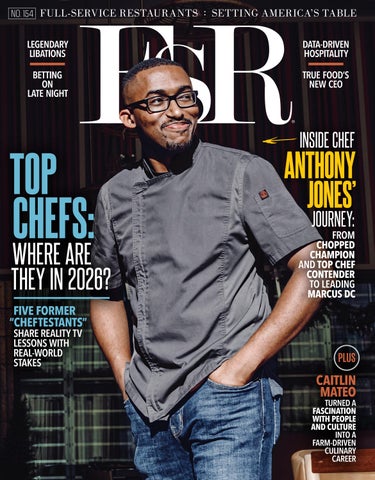
CONTENTS 24 AFTER FILMING SEASON 23 OF “TOP CHEF,” ANTHONY JONES IS BACK LEADING THE KITCHEN AS EXECUTIVE CHEF OF MARCUS DC.
FSR October 2026 No. 154 24 Top Chefs: Where Are They in 2026? BY CALLIE EVERGREEN
Five former “cheftestants” from Bravo’s reality TV show reveal lessons with real-world stakes, plus share the scoop on their current (and future) ventures. Featuring Anthony Jones, Charbel Hayek, Monique Feybesse, Joe Sasto, and Gabriel Pascuzzi. C HEF S & IN G R ED IEN T S
11 The Anthropology of Appetite BY SATYNE DONER
How Caitlin Mateo turned a fascination with people and culture into a culinary career at Founding Farmers, where she oversees all the restaurant kitchens across Washington, D.C.; Maryland; Virginia; and Pennsylvania.
11
16 Look Out for Late-Night Bites BY SATYNE DONER
ANTHONY JONES / JOSHUA FOO, FOUNDING FARMERS RESTAURANT GROUP
Twin Peaks and Bad Daddy’s Burger Bar are betting on affordable, scratch-made shareables to win back the after-hours crowd. L I Q U ID IN T EL L I G EN C E
19 Legendary Libations BY SAM DANLEY
For New Orleans’ storied bars and restaurants such as Tujague’s and the Sazerac Bar, there’s a tension between honoring their legacy “without being trapped by it,” and evolving for the drinkers of today. F S R M AG A Z I N E .CO M
O C TO B ER 2 0 2 6
1
CONTENTS
®
FSRmagazine.com October 2026 No. 154
40
EDITORIAL VP, EDITORIAL DIRECTOR: FOOD, RETAIL, & HOSPITALIT Y
Danny Klein
dklein@arrowfly.com FSR EDITOR
Callie Evergreen
cevergreen@arrowfly.com QSR EDITOR
Ben Coley
bcoley@arrowfly.com
ASSOCIATE EDITOR
35 07 A Nod to Nostalgia Fueled by fan and team member input, Buffalo Wild Wings is bringing back a taste of the 2000s with its Throwback Menu, plus a partnership with Y2K fashion brand Von Dutch for an exclusive capsule collection celebrating the era.
08 Generational Dining Data Recent research reveals which generations spend the most annually on takeout and restaurants.
B AC K O F H O USE
35 Forged in Fire WOMEN IN LEADERSHIP
Lisa Dahl turned grief into a Sedona culinary empire, where her restaurants Mariposa, Cucina Rustica, Dahl & Di Luca, Butterfly Burger, and Pisa Lisa have transformed Arizona’s dining landscape over the past 30 years.
NATIONAL SALES DIRECTOR
Amber Dobsovic
757-637-8673 adobsovic@arrowfly.com NATIONAL SALES MANAGER
Tom Boyles
662-607-5249 tboyles@arrowfly.com
SENIOR EDITOR, WIRL
Tony Bolla
sdanley@arrowfly.com
Satyne Doner
sdoner@arrowfly.com
SALES DIRECTOR
773-859-1107 tbolla@arrowfly.com
37 Getting Personal at Postino
VP, CONTENT STUDIO
TECH CHECK With 30+ loca-
404-386-1709 sshepherd@arrowfly.com
pcarouthers@arrowfly.com
CUSTOMER SERVICE REPRESENTATIVE
tions, wine bar chain Postino wants digital hospitality to feel personal. That starts with a clearer view of the guest.
40 True Food Kitchen’s New CEO BEHIND THE SCENES We sat
down with Jeff Chandler just 10 days after he was appointed new CEO of the wellness-focused brand to find out how the transition is going, his philosophy stepping up to the helm of an established company, and why now is the right time for a concept like True Food Kitchen to flourish.
A L S O IN T HI S I S SU E 4 Editor’s Welcome 38 Advertising Index
CO N T E N T S T U D I O Peggy Carouthers
WRITER, CONTENT STUDIO
Drew Filipski
dfilipski@arrowfly.com WRITER, CONTENT STUDIO
Ya’el McLoud
ymcloud@arrowfly.com WRITER, CONTENT STUDIO
Davina van Buren
dvanburen@arrowfly.com
DESIGN SENIOR ART DIRECTOR
Tory Bartelt
tbartelt@arrowfly.com
SALES DIRECTOR
Susan Shepherd
Tracy Willingham
919-945-0704 twillingham@arrowfly.com
A D M I N I S T R AT I O N CEO
Matt Logan
mlogan@arrowfly.com 919-945-0704 www.fsrmagazine.com/subscribe FSR is provided without charge upon request to individuals residing in the U.S. who meet subscription criteria as set forth by the publisher.
REPRINTS THE YGS GROUP 800-290-5460 fax: 717-825-2150 fsrmagazine@theygsgroup.com
2026 REGIONAL BRONZE AWARD: FRONT COVER DESIGN 2024 REGIONAL GOLD AWARD: PUBLICATION DESIGN 2023 NATIONAL GOLD AWARDS: FRONT COVER (PHOTO), BEST USE OF COLOR NATIONAL SILVER AWARD: BEST USE OF TYPOGRAPHY 2016 MAGAZINE OF THE YEAR TOP 10 AWARD
Sponsored content in this magazine is provided to the represented company for a fee. Such content is written to be informational and non-promotional. Comments welcomed at sponsoredcontent@ fsrmagazine.com. FOUNDER
Webb C. Howell
2015 MAGAZINE OF THE YEAR FOLIO: Eddie Awards 2022 BEST FULL ISSUE HOSPITALITY
FSR is a registered trademark of Arrowfly. FSR is copyright © 2026 Arrowfly. All rights reserved. The opinions of columnists are their own. Publication of their writing does not imply endorsement by Arrowfly. Subscriptions 919-945-0704. www.fsrmagazine. com/subscribe. FSR is provided without charge upon request to individuals residing in the U.S. meeting subscription criteria as set forth by the publisher. All rights reserved. No part of this magazine may be reproduced in any fashion without the express written consent of Arrowfly.
2021 BEST PROFILE FEATURE
FSR (ISSN 2325-2154), USPS PUBLICATION #9690 is published monthly by Arrowfly, 1111 Superior Avenue Suite 1120, Cleveland, OH 44114. Periodicals postage paid at Cleveland, OH and at additional mailing offices. POSTMASTER: Send address changes to FSR, 1111 Superior Avenue Suite 1120, Cleveland, OH 44114.
2013 BEST FULL ISSUE, FOOD SERVICE/HOTEL
O C TO B ER 2 0 2 6
Matt Waddell
312-961-6840 mwaddell@arrowfly.com
Sam Danley
2022 BEST SPONSORED CONTENT
2
SVP SALES & STRATEGY
2017 BEST FULL ISSUE FOOD & BEVERAGE
LinkedIn.com/company/ FSR-magazine Instagram.com/FSRmagazine Facebook.com/FSRmag
2013 BEST DESIGN, NEW MAGAZINE CREDIT
FIR S T CO U R SE
SALES & BUSINESS DEVELOPMENT
F S R M AG A Z I N E .CO M
Welcome
Perks of a Pressure Cooker
Callie Evergreen
cevergreen@arrowfly.com FSRmag @FSRmagazine
On the Cover Our October cover featuring “Top Chef” alum Anthony Jones was taken by photographer Joshua Foo, who captures images with a chef’s palette and plates food with a photographer’s eye, backed by a degree in culinary arts and experience in television and film production. He has previously worked with celebrity chef Bobby Flay, Converse, and on marketing projects for Lipton Ice Tea and Bolthouse Farms. To learn more about Foo, visit joshuafoo.com or follow him in Instagram @joshfoolovesyou.
EDITOR
4
O C TO B ER 2 0 2 6
F S R M AG A Z I N E .CO M
ANTHONY JONES / JOSHUA FOO
PRESSURE CAN OFTEN BE THE LEVERAGE you need to force out-of-the-box thinking in most, if not all, situations. That’s part of the allure of watching reality TV cooking shows like “Top Chef,” where constraints on time and ingredients result in chefs channeling greater creativity—and season 23 “cheftestant” Anthony Jones wants people to know that clock isn’t TV magic. “Those timeframes are very real. If they say 30, they mean 30,” he explains. That means chefs must be brutally honest about what they can actually execute in that set amount of time. Every second the clock ticks, chefs are forced to make a series of tiny, high-stakes calculations. But what happens when they return to reality? The cameras are gone, the clock is more lenient, and they’re not getting judged on their cooking by anyone other than restaurant guests. How do they keep the momentum going and channel the lessons they learned from those challenging experiences into real life? That’s the premise behind our cover story, “Top Chefs: Where Are They Now,” starting on PAGE 24, which highlights five former contestants to find out how they’ve evolved since competing on the show, and where they’re headed next. Charbel Hayek from “Top Chef: Middle East & North Africa” Season 5 and “Top Chef: World All-Stars” reiterates this larger sentiment: “One of the most valuable lessons was learning how to make decisions under pressure,” he says. “Sometimes you rush, and one simple decision can cost you the entire challenge. The restaurant business is very similar. As a chef and a leader, you need that same sense of urgency, but you also need to know when to slow down and make the right decision. Finding that balance between speed and intention has been one of the biggest evolutions in my leadership style.” That concept is a throughline in our Chef Profile this month featuring Caitlin Mateo, an anthropologist turned chef and director of kitchen operators and development for Founding Farmers (PAGE 11). At a recent opening in Alexandria, Virginia, her team underestimated the amount of grilled food that would be ordered on the weekends. While the kitchens are set up to be balanced on the line in theory (how many dishes are coming off, how many dishes can be executed per hour consistently), within three days of opening, they took all the burners out and replaced them with a new grill. “Even with the most educated theoretical product mix, you must be flexible and nimble enough to make those quick calls and observe what we need to invest in. You can’t shy away from it,” Mateo says. It’s all about prioritizing progress over perfection and challenging the mindset that “mistakes” are setbacks. The most successful people are able to turn those situations into learning opportunities by staying curious and not being afraid to try something new—and that’s a lesson we can all stand to put into practice more often.
SAVE UP TO 50% OF YOUR FRYING OIL WITH VITO
The VITO VL and VITO CONNECT software eliminate the guesswork from your oil management—helping you serve better food, and work smarter.
Scan here for more information
Call 407-377-7769 and ask for the VITO VL Carefree Package! vitofryfilter.com | | info@vitofryfilter.com
First Course
A Nod to Nostalgia
Fueled by fan and team member input, the Buffalo Wild Wings Throwback Menu features iconic past menu items like mini corn dogs and Buffalo Chips.
BY CALLIE EVERGREEN
BUFFALO WILD WINGS (4)
Buffalo Wild Wings is bringing back a taste of the 2000s.
F S R M AG A Z I N E .CO M
FROM THE RESURGENCE OF VINYL RECORDS, Y2K fashion trends, and other retro experiences like old-school diners, people are craving nostalgia. More than 50 percent of U.S. adults are likely to make a purchase when it makes them feel nostalgic for the past, according to a report from GWI. Maybe it’s the exhaustion with digital overload and AIeverything, or maybe it’s the tendency to look at the past with rose-colored glasses. But for Scott Nelson, the reason why nostalgia is having such a moment—and why it’s especially relevant for full-service restau-
rants—is because it brings people back to the experiences they loved most. “There’s comfort in revisiting the familiar,” he says. That’s why Buffalo Wild Wings is bringing back a taste of the early 2000s with its Throwback Menu, which launched on August 19 and is available at participating locations until November 9. The menu revived some of the brand’s most iconic menu items, like mini corn dogs and Buffalo Chips, plus involved a partnership with Y2K fashion brand Von Dutch for an exclusive capsule collection celebrating the era.
O C TO B ER 2 0 2 6
7
First Course
8
O C TO B ER 2 0 2 6
Generational
Dining Data
Which generation spends the most annually on takeout and restaurants? Recent research from CashNetUSA revealed that 38.8% of the average U.S. household’s food budget is spent away from home annually , with Gen Z allocating the largest share to eating out, at 41.5%. However, 17% of the average household food budget goes toward fast food, compared with 15% on full-service restaurants.
Gen Z designate 41.5 %
of their Budget to eating out
OTHER KEY FINDINGS:
• The Silent Generation (born before 1946) spends 18.9% of their food budget at full-service restaurants—the most, proportionally, of any generation
• Next up are Baby Boomers , who spend 16.4% at FSRs , followed by Gen X at 14.8% • Millennials spend 13.9% of their food budget annually on food and nonalcoholic beverages , while Gen Zers spend 11.9%
F S R M AG A Z I N E .CO M
ADOBE STOCK (4): FAMILY/FACES OF TRAVEL, TAKING SELFI/VANE NUNES, SENIOR SITTING IN CAFE/HEDGEHOG94, COUPLE ENJOYING DRINKS/ LA FAMIGLIA
“It felt like the perfect time to bring back some fanfavorite menu items and give guests a taste of the Buffalo Wild Wings they remember,” Nelson notes. “The Throwback Menu celebrates the flavors and moments that helped make game days memorable in the first place.” Thankfully, the culinary team didn’t have to guess which particular fan-favorite items would be best for the Throwback Menu—because guests told them. “Fans have been telling us for years exactly what they wanted back. Items like Hot BBQ sauce and Buffalo Chips have never really gone away from the conversation,” Nelson says. “We looked at the menu items that generated the most passion, the most requests, and the strongest memories, then built a lineup that felt authentically B-Dubs.” The enthusiasm from fans showed up everywhere, from social media comments and Reddit threads dedicated to discontinued menu items to conversations with Buffalo Wild Wings team members, many of whom had favorites they were eager to see return. That speaks to the fact that the brand isn’t bringing the items back because nostalgia is popular or as a simple marketing gimmick, but because guests have genuinely been asking for them. “The Throwback Menu is really a thank-you to fans who never stopped asking,” he adds. “When guests have a real emotional connection to something, honoring that relationship feels authentic. That’s very different from simply jumping onto a trend for the sake of it. And today’s consumers are savvy enough to know which brands are chasing a fad, and which brands have genuinely earned a place in the conversation.” The challenge then became how to recreate those menu items while preserving the flavors longtime B-Dubs fans knew and loved—a more difficult task than it seems, since people often give preferential treatment to past experiences. “The goal wasn’t to reinvent these favorites,” Nelson says. “Our culinary team focused on capturing the flavors that made these items so popular in the first place while ensuring they meet the quality and standards guests expect today. We wanted the experience to feel familiar from the very first bite.” While Nelson’s personal favorite on the limited-time menu is the mini corn dogs, he also points out the Throwback Menu is about more than just the food, but how the F&B, “Von Dubs” collection, and celebration of the era work together to create a cohesive guest experience that builds onto the broader cultural movement. “The early 2000s were a defining time for Buffalo Wild Wings, and Von Dutch was one of the most recognizable brands of that period,” he says. “The food brings back the flavors fans remember, while the Von Dubs collection gives them a way to wear and share the nostalgia beyond our restaurant walls.” He adds, “I had a Von Dutch hat back then too, so I’m right there with everyone reliving it.”
UNRIVALED CHEESE FOR UNFORGETTABLE PIZZAS Become the place to go for must-have pizzas with the superior stretch, extraordinary melt, and rich, creamy taste of Bacio®, the exceptional cheese chosen by premier pizzerias.
REQUEST YOUR TASTING BACIOCHEESE.COM ©2026 Bacio Cheese Company
Exclusively Distributed Through
I T A L L S TA R T S W I T H
P OTATO E S IDAHO ® YUKON GOLD POTATOES
IDAHO ® RUSSET POTATOES
SMOKED POTATO SALAD WITH TOASTED YEAST MOUSSE Chef Richie Farina Richie Dish, LLC
CULINARY INSPIRATION AND STORIES FROM INDUSTRY TRAILBLAZERS MENTIONED IN THIS SECTION FOUNDING FARMERS TWIN PEAKS • • •
• • •
BAD DADDY’S BURGER BAR
Chefs & Ingredients
The
FOUNDING FARMERS RESTAURANT GROUP / IMAGE EXTENDED BY FSR MAGAZINE
Anthropology of Appetite FOUNDING FARMERS IS MAJORITY-OWNED BY MORE THAN 70,000 MEMBERS OF THE NORTH DAKOTA FARMERS UNION, AS WELL AS FARMERS ACROSS THE MIDWEST. THE FIRST RESTAURANT OPENED IN 2008, AND HAS SINCE EXPANDED TO THREE LOCATIONS IN WASHINGTON, D.C.; ONE IN MARYLAND; ONE IN PENNSYLVANIA; AND THREE IN VIRGINIA.
BY SATYNE DONER
How Caitlin Mateo turned a fascination with people and culture into a farm-driven culinary career. F S R M AG A Z I N E .CO M
CAITLIN MATEO IS AN ANTHROPOLOGIST turned chef, though for her, the two are inextricably linked. In her teenage years, she was fascinated with world culture and people; she wanted to know what they believed in, how they ate, and how their geographic location influenced their culture. “When you study food, you look at what grows regionally, how it gets cooked, how it gets utilized. But this also tells you about the history of
O C TO B ER 2 0 2 6
11
CHE F S & ING RE DIE N T S CHE F PROFILE
and stews. Today, they form the foundation of regional comfort foods, such as holiday pecan pie, praline candies, and butter pecan flavoring—a small but telling example of how a single regional crop can carry generations of resilience, season, and culture forward. It’s the kind of connection she’d go on to build a career around. Mateo was a natural cook. She catered for friends, parties and weddings, handproducing hundreds of cookies and other naturally sourced goods. In college, she was introduced to a woman who owned a fine-dining French restaurant, and this first mentor taught her everything. “I took a part-time job working in the kitchen, and she showed me everything from running a dish room, to fabricating beef tenderloins and trimming lamb racks, and making the most delicious food,” Mateo says. “It inspired me to turn my studies and my career around.” Mateo enrolled in the restaurant school at Walnut Hill in Philadelphia, blending her curiosity and love for people and food into a career path she could grow into. After running her own culi-
12
O C TO B ER 2 0 2 6
MATEO BELIEVES IN SURROUNDING HERSELF WITH A DEEPLY PASSIONATE TEAM: PEOPLE WHO CAN SPEND DAYS SHAPING BREAD ON A BREAD TABLE, HAND-ROLLING PASTA, OR PLACING CHICKEN IN A 24-HOUR BRINE AND UP TO 25 DREDGES IN A SPECIALTY FLOUR BLEND.
FAVORITE SPICE AT THE MOMENT:
Aleppo pepper
SECRET COMFORT FOOD:
Mole
WHAT’S THE LAST COOKBOOK YOU BOUGHT?
“Pulp” by Abra Berens
IF YOU WEREN’T A CHEF, WHAT PROFESSION WOULD YOU BE IN?
Cultural studies / Anthropology THE ONE FOOD TREND YOU WISH WOULD COME BACK:
Dessert/cheese carts
nary consulting firm for a few years, she found her footing at Founding Farmers, joining as an executive chef and working her way up to director of kitchen operations and development. Founding Farmers is majority-owned by more than 70,000 members of the North Dakota Farmers Union, as well as farmers across the Midwest. The first restaurant opened in 2008, just a few blocks from the White House, and has since expanded to three locations in Washington, D.C.; one in Maryland; one in Pennsylvania; and three in Virginia. Mateo oversees all the brand’s kitchens, which work through more than 200 items on the daily prep list. From bread to booze, everything is prepared from scratch across a multi-unit footprint. Each menu item can be tied back to an American farmer whom the restaurant buys from directly, running its own trucks to suppliers in North Dakota. Founding Farmers has a host of working relationships with independent and locally owned distributors, who help fill in the gaps with nearby family farms and fishermen. Because of this, menus are crafted to be location-specific and vary from season to season. “Our goal is to unbundle the supply chain. Mass-production companies who are turning out products like sixty-secF S R M AG A Z I N E .CO M
FOUNDING FARMERS RESTAURANT GROUP (3)
people, how they act, what their background is, and what motivates them,” Mateo says. “I think [anthropology and culinary] studies come together beautifully, if you are willing to learn and dine with people.” It’s an idea borne out in something as ordinary as a pecan. The only major nut tree native to North America, pecans became a high-density energy source for many Native American tribes in the winter, often traded or pounded into milk
CHE F S & ING RE DIE N T S CHE F PROFILE
ond parsley are very cool, but it takes the art of true farming and agriculture away. It takes away jobs and sustainable, delicious products,” Mateo says. “There is nothing that we buy in a container or ship in and just serve. We take our time to find people who believe in our mission and culture, from our suppliers to who’s working in our kitchens.” It’s very detail-oriented, demanding work, and a lot to balance. But Mateo believes in surrounding herself with a deeply passionate team: people who can spend days shaping bread on a bread table, hand-rolling pasta, or placing chicken in a 24-hour brine and up to 25 dredges in a specialty flour blend. “Everything we do with them as leaders and culinarians has to be side by side. We never leave people with a pamphlet or recipe and let them figure it out on their own,” Mateo adds. “Exceptional leadership is done together, talking about it, using all of your senses, developing and investing time in others.” Running “The Farm,” as Mateo calls it, at its current scale takes a lot of brainpower, including organizing the products to be brought in on a certain schedule, managing the shelf life of prep items, and customizing menus. Half of her time is spent crunching numbers and thinking through processes, and the other half is spent hands-on in the kitchen, curat-
14
O C TO B ER 2 0 2 6
ing ideas and conducting research and development. The trickiest part of her role is taking an idea and refining its execution process in the kitchens; for example, at a recent opening in Alexandria, Virginia, they underestimated the amount of grilled food that would be ordered on the weekends. While the kitchens are set up to be balanced on the line in theory (how many dishes are coming off, how many dishes can be executed per hour consistently), within three days of opening, they took all the burners out and replaced them with a new grill. “Even with the most educated theo-
retical product mix, you must be flexible and nimble enough to make those quick calls and observe what we need to invest in. You can’t shy away from it,” Mateo says. “What Founding Farmers does well is trust each other and listen intensely to what we foresee coming and what the solution is.” As Founding Farmers prepares for the fall and winter harvests, rolling through its seasonal produce and from-the-range items, Mateo can be found traveling between the different restaurants and their commissary barn, where barbecue is smoked, coffee is roasted, chocolate is made, and the e-commerce gift-box program is thoughtfully pieced together. This is the pinnacle of her career: mission-driven, serving others, letting her creativity shine. It reminds her of the journey she has had so far. Today, she effortlessly moves through any challenge, from teaching others new skills to navigating everyday workplace complexities. She learned the most, though, from being a mother and going through three full-term, healthy pregnancies, including one where she went into labor while running a kitchen. It’s the same instinct that first drew her to anthropology—watching closely, adapting constantly, learning to read what people need before they ask for it. Whether she’s raising her own children or leading a kitchen of hundreds, Mateo is still, at heart, studying people. “I always felt like I had something to prove, but when I had more to work for than just myself, I had to learn how to evolve in motherhood and in my career,” Mateo says. “It was the biggest transition for me as a woman in this career field. I’ve got to guide little human beings in life ... nothing scares me anymore. I can do anything.” F S R M AG A Z I N E .CO M
FOUNDING FARMERS RESTAURANT GROUP (4)
MATEO OVERSEES ALL THE BRAND’S KITCHENS, WHICH WORK THROUGH MORE THAN 200 ITEMS ON THE DAILY PREP LIST. FROM BREAD TO BOOZE, EVERYTHING IS PREPARED FROM SCRATCH ACROSS A MULTI-UNIT FOOTPRINT.
HATE THE PREP? NO BACON COMPARES TO THIS.
HORMEL® BACON 1™ Perfectly Cooked Bacon is the only fully cooked bacon that looks, tastes and performs like bacon cooked from raw.
READY IN 1 MINUTE 1
95% LESS GREASE 2
50% FEWER SHEET PANS
TRY A FREE CASE
HORMELBACON1.COM
1 Based on 350°F cook on flattop or 842°F in TurboChef 2 Based on independent tests: raw 18/22 foodservice bacon vs 18/22-style HORMEL® BACON 1™ Perfectly Cooked Bacon © 2026 Hormel Foods, LLC
SMOKY FLAVOR & CRISPY BITE
CHE F S & ING RE DIE N T S NOW SE RV ING
BAD DADDY’S LATE-NIGHT HAPPY HOUR FEATURES HALF-OFF APPETIZERS DURING THE LAST TWO HOURS OF OPERATION, SEVEN DAYS A WEEK, INCLUDING STARTERS SUCH AS THE ELOTE STREET CORN DIP WITH COTIJA CRUMBLES, TAJIN, AND FRESH CILANTRO, SERVED WITH TORTILLA CHIPS.
Look Out for Late-Night Bites BY SATYNE DONER
MELISSA FRY, chief marketing officer of Twin Peaks, didn’t want to steal guests from the dinner daypart, nor did she want the new offering to feel like an extension of the dinner menu when creating a late-night happy hour. The investment, she says, is in a crowd that largely disappeared during the pandemic. “During COVID, a lot of restaurants started to change their operating hours and close earlier,” Fry says. “Coming out of it, we’ve seen changing guest behaviors, and we’re making the late-night crowd a key focus ... the opportunity is in understanding that we’re capturing a new segment of guests who are seeking
16
O C TO B ER 2 0 2 6
value later in the evening.” The result: discounted drinks alongTwin Peaks wanted the late-night side crispy mini beef tacos, fire-roasted menu to give guests another reason to salsa and chips, fried pickles, mozzachoose the brand as a destination, so the rella cheese bites, or fries loaded with team built it around shareable appetiz- cheddar, pepper jack, bacon bits, green ers and handheld favorites—food that onions, and ranch. encourages guests to stay longer, order There’s also the $9 fl atbread, which together, and have a more social dining comes in a variety of styles: OG Pepperexperience. oni, The Italian, Backyard BBQ Brisket, With more than 115 locations and and “The Hottie,” topped with smoked a scratch-made kitchen, execution had chicken, Billionaire’s Bacon, fresh jalato be simple at scale. The culinary team, penos, mozzarella, cheddar, parmesan, led by executive chef Christian Stew- white sauce, parsley, crushed red pepart, developed food and beverage pair- per, and ranch. ings that fold seamlessly into the regu“We roll out our own dough in-house lar menu. daily, pre-making enough for the lateF S R M AG A Z I N E .CO M
BAD DADDY’S BURGER BAR
Twin Peaks and Bad Daddy’s Burger Bar are betting on affordable, scratch-made shareables to win back the after-hours crowd.
TWIN PEAKS RESTAURANTS (2)
NOW SE RV ING CHE FS & ING RE DIE N T S night crew to dress with toppings and The menu has more than 100 items crumbs, thyme, and fresh basil, served toast,” Stewart says. “When presented, prepped in-house, with starters ranging with house-made warm marinara sauce. it cuts into six pieces. It’s the perfect from a street corn dip with cotija crum- In a competitive landscape, Bad Daddy’s amount, whether they’re solo or shar- bles, Tajin, and fresh cilantro, served differentiates itself by never using froing with friends.” with tortilla chips, to fried deviled eggs, zen products. As the late-night menu continues to hand-breaded and topped with a custom Masterson is excited for future offerevolve, Stewart is crafting approachable house filling. ings that put a different spin on classic yet high-quality pairings built for sharThere are also fried mozzarella medal- bar fare. ing—mixing and matching textures like lions, hand-breaded in panko bread“We’re really excited to introduce a crispy and crunchy, smooth and velvety, fresh tuna poke appetizer later this year, such as an array of crispy tacos alongside with house-made poke sauce, served in a frosted Modelo. a unique presentation—a crispy wonFry has noticed that the late-night ton bowl over a Sriracha slaw,” Mastercrowd tends to gather around Twin son says. “Our food is a lot of fun. In Peaks’ communal tables, which reinmost burger restaurants, they can get forces why shareables have become cenaway with frozen food ... but we’re truly tral to the menu. That social, comeunique, truly fresh.” as-you-are energy is exactly what the What ties Twin Peaks and Bad Dadculinary team hopes will keep guests dy’s together is how little disruption coming back. their late-night programs cause behind “What we’re expecting is that the the line. Rather than building separate affordability and quality of the latemenus or bringing in new suppliers, both night menu invites guests to come in brands draw from ingredients and dishes on other occasions because they’ve had already moving through their scratch such a great experience,” Stewart says. kitchens, dressed up or discounted for a “We’re striving to create regulars, and later crowd. That’s what makes the value we want people to come to Twin Peaks TWIN PEAKS BUILT ITS LATE-NIGHT MENU proposition sustainable: guests get an at all hours.” occasion that feels distinct, while operAROUND SHAREABLE APPETIZERS AND HANDHELD FAVORITES—FOOD THAT Like Twin Peaks, Bad Daddy’s Burger ENCOURAGES ators avoid the cost and complexity of GUESTS TO STAY LONGER, Bar is looking to compete for the late- ORDER TOGETHER, AND HAVE A MORE running a second menu after dark. night dining occasions left open by the SOCIAL DINING EXPERIENCE. pandemic. The 37-unit brand extended its hours to 10 p.m. on weekdays and 11 p.m. on weekends to capture guests who are still out and about and looking to trade up and out of the fast-food routine. Bad Daddy’s late-night happy hour features half-off appetizers during the last two hours of operation, seven days a week. For John Masterson, culinary director, the menu had to accomplish three things: invite guests to indulge, ensure each product is scratch-made, and take the confusion out of value. “You don’t have to follow some calendar or cadence. It’s not a select group of products or a separate menu. You show up, and we take care of you,” Masterson says. “Our guests don’t have to think about it ... they just have to pick what they like. A lot of happy hours or latenight programs have a lot of fine print, THE $9 FLATBREAD AT TWIN PEAKS COMES IN A VARIETY OF STYLES, INCLUDING “THE TOPPED WITH SMOKED CHICKEN, BILLIONAIRE’S BACON, FRESH JALAPENOS, and we wanted to strip all of that away HOTTIE,” MOZZARELLA, CHEDDAR, PARMESAN, WHITE SAUCE, PARSLEY, CRUSHED RED PEPPER, AND RANCH. and let people enjoy themselves.” F S R M AG A Z I N E .CO M
O C TO B ER 2 0 2 6
17
Progressive Casualty Insurance Co. & affiliates.
Small business owners’ to-do lists can add up. So see if you can save money on a commercial auto quote at ProgressiveCommercial.com.
Get a quote online in as little as 8 minutes
TRENDS AND CREATIVE APPROACHES TO SPIRITS, WINE, AND BEER. MENTIONED IN THIS STORY SAZERAC BAR AT THE ROOSEVELT NEW ORLEANS
• • •
TUJAGUE’S
Liquid Intelligence
FOR MANY GUESTS, HAVING A SAZERAC AT THE SAZERAC BAR IS “ALMOST LIKE A PILGRIMAGE,” SAYS MATT SCHULTE, ASSISTANT FOOD AND BEVERAGE DIRECTOR AT THE ROOSEVELT NEW ORLEANS.
THE ROOSEVELT NEW ORLEANS, A WALDORF ASTORIA HOTEL
Legendary
Libations
BY SAM DANLEY
New Orleans’ storied bars and restaurants are honoring the past while evolving for the drinkers of today. F S R M AG A Z I N E .CO M
AT THE SAZERAC BAR at The Roosevelt New Orleans, history isn’t
tucked behind glass. It lives in the African walnut bar, the Art Deco murals, the silver pieces behind the bar—and, every night, in the rye, sugar, Peychaud’s bitters, absinthe rinse, and lemon oil that make up its namesake cocktail. The Sazerac isn’t simply a drink that shares the bar’s name. Its roots
O C TO B ER 2 0 2 6
19
reach back to the Sazerac Coffee House, where, in the 1850s, bar owner Aaron Bird began importing Sazerac-deForge et Fils cognac and pairing it with Peychaud’s bitters. The original coffee house eventually closed, but the Sazerac Bar opened at The Roosevelt in 1938, cementing the cocktail’s connection to the hotel and the city’s larger drinking culture. For many guests, having a Sazerac at the Sazerac Bar is “almost like a pilgrimage,” says Matt Schulte, assistant food and beverage director at The Roosevelt New Orleans. “What I love is that after all these years, the drink itself remains remarkably simple,” he says. “There aren’t many places for a bartender to hide. Technique matters.” Th at kind of history can carry a lot of weight, he adds, but the bar isn’t frozen in time. “We’re not a museum,” Schulte says, noting that the philosophy behind the AT THE SAZERAC BAR AT THE program is “to honor our history withROOSEVELT NEW ORLEANS, RYE, out being trapped by it.” SUGAR, PEYCHAUD’S BITTERS, ABSINTHE RINSE, AND LEMON That tension—between honoring a OIL MAKE UP ITS NAMESAKE legacy and steering a business into the COCKTAIL. ITS ROOTS REACH BACK TO THE SAZERAC COFFEE future—is a familiar dynamic for operHOUSE, WHERE, IN THE 1850S, ators across New Orleans, a city with no BAR OWNER AARON BIRD BEGAN IMPORTING SAZERAC-DE-FORGE shortage of long-running bars and resET FILS COGNAC AND PAIRING IT taurants. WITH PEYCHAUD’S BITTERS. Take Tujague’s. Founded in 1856 in the French Quarter, it is New Orleans’ second-oldest restaurant and the country’s third-oldest continuously operating restaurant, according to Mark Latter, founder and CEO of Latter Hospitality. Latter took over Tujague’s in 2013, after his father and uncle had operated the historic restaurant since 1982. The restaurant is home to the Grasshopper, a sweet, mint-and-chocolate afterdinner cocktail made with green crème de menthe, white crème de cacao, and heavy cream. The drink was introduced in 1918 by Philip Guichet, part of the family that owned the restaurant at the time, after a cocktail competition in New York. Grasshoppers for $1.70, giving first tim- nostalgia project. Its broader beverage “It’s still our leading-selling cocktail, ers an easy entry point to the drink and program is built largely around small which is surprising because it has a lot of its history. The team has also explored variations on familiar drinks, with an cream and it’s a little heavier,” Latter says. Grasshopper-inspired desserts, includ- eye toward cocktails that work alongFor Tujague’s 170th anniversary this ing pie, panna cotta, and cheesecake. side dinner. year, the restaurant is offering mini Still, Tujague’s is a restaurant, not a “Whether it’s the food menu or the
20
O C TO B ER 2 0 2 6
F S R M AG A Z I N E .CO M
THE ROOSEVELT NEW ORLEANS, A WALDORF ASTORIA HOTEL (3)
LIQ U ID IN T E LLIG E NCE
Sip-Worthy
Simplicity
TruFlavour by Monin delivers bold, authentic flavor with no added sugar or sweeteners—perfect for elevating a variety of beverages and culinary creations.
How to make a
Coconut Mockrita Glass size: 12 oz.
¼ oz. TruFlavour Coconut by Monin ½ oz. pineapple juice 4 oz. fresh sour mix Pour ingredients into an ice-filled mixing glass in order listed. Cap, shake, and strain into a serving glass filled with fresh ice. Garnish with a lime wheel and serve.
Scan to discover more.
C L E A N L A B E L • N O A D D E D S U G A R S • LOW C A LO R I E • N O N - G M O • KO S H E R • H A L A L • V E G A N • A L L E R G E N , DA I RY & G LU T E N F R E E
BOTH TUJAGUE’S AND THE SAZERAC BAR ARE SEEING FAMILIAR TRENDS ACROSS THE BROADER BEVERAGE LANDSCAPE: LESS EMPHASIS ON WINE, GROWING DEMAND FOR TEQUILA AND AGAVE SPIRITS, AND COCKTAILS DESIGNED FOR A SOCIAL-MEDIA MOMENT OR SOME OTHER EXPERIENTIAL ELEMENT.
“Your menu has to constantly evolve. All the historic restaurants in New Orleans have done this.” —MARK LATTER
cocktail menu, we try to do a riff on classics,” Latter says. Its Iris 75, for instance, builds on the French 75 with purple Empress Gin. It’s a nod to the restaurant’s Krewe of Iris room, which honors the city’s oldest all-female Mardi Gras parade. At the Sazerac Bar, that line is drawn by recognizing which classics are better left alone. The Sazerac and Ramos Gin Fizz do not need an overhaul, Schulte says. Part of their appeal is experiencing them much as previous generations did. “When a classic is already extraordinary, we leave it alone and focus on executing it exceptionally well,” he says. “When we see an opportunity to take the DNA of a classic and tell a new story with it, that’s where our signatures come in.” For those signatures, Schulte says,
22
O C TO B ER 2 0 2 6
TUJAGUE’S IS HOME TO THE GRASSHOPPER, A SWEET, MINTAND-CHOCOLATE AFTER-DINNER COCKTAIL MADE WITH GREEN CRÈME DE MENTHE, WHITE CRÈME DE CACAO, AND HEAVY CREAM THAT WAS INTRODUCED IN 1918.
creativity needs context. A drink might reference a historic recipe, a local ingredient, New Orleans history, or a recognizable thread from classic cocktail culture. “We’re not trying to put something on the menu just because it’s trendy or because nobody has done it before,” he says. “We actually like the idea that
somebody has done it before, and we’re carrying their idea forward in our own way.” That gives the bar room to serve a Ramos Gin Fizz alongside signatures like the Butterfly Effect. The latter combines Mijenta Reposado Tequila, mezcal, Calpico, hibiscus, lemon and rosemary, with an edible Electricdust butterfly that adds a tingling sensation across the palate. Taken together, Schulte says, those drinks reveal the two sides of the program. “One lets our guests experience the history of New Orleans cocktail culture,” he says, “The other gives them a glimpse of where it can go next.” Both operators are seeing familiar trends across the broader beverage landscape: less emphasis on wine, growing demand for tequila and agave spirits, and cocktails designed for a social-media moment or some other experiential element. At the Sazerac Bar, though, Schulte says the most consequential shift is that guests increasingly arrive with knowledge of specific producers, additive-free tequila, single-barrel whiskey, amaros, and other niche categories—and a greater interest in understanding what is in the glass. At the same time, he thinks the industry is moving away from complexity for its own sake, with the pendulum swinging back toward “simplicity, quality, and intentionality.” Latter agrees but is quick to point out that this doesn’t mean historic programs can stand still. “Your menu has to constantly evolve,” he says. “All the historic restaurants in New Orleans have done this.” For Schulte, that starts with knowing the history. From there, he says, protect the things that actually matter—the recipes, rituals, craftsmanship, service standards, and stories—“but don’t confuse tradition with refusing to change.” After all, the people who created the bars and cocktails now treated as untouchable weren’t trying to make history. “They were trying to create something people enjoyed,” Schulte says. “That’s still our job.” F S R M AG A Z I N E .CO M
TUJAGUE’S / SAM HANNA (2)
LIQ U ID IN T E LLIG E NCE
Arrowfly.com A new name for the company behind the brands and events you trust.
WTWH Media is now
Why Arrowfly?
Over two decades, WTWH Media has grown from its engineering roots into a diversified portfolio of 40+ trusted media brands, 45+ industry events, and marketing solutions serving professionals across Engineering, Healthcare, and Food, Retail & Hospitality. While many know and trust our individual brands, fewer know the company behind them. Arrowfly gives us a stronger corporate identity that reflects the business we’ve become. The name represents forward momentum, direction, and growth, and our role in helping professionals and partners navigate change and move their businesses forward. Arrowfly represents where niche professionals gather for trusted journalism, industry intelligence, and measurable outcomes.
The Strength of Arrowfly Your Trusted Brands: All 40+ media brands and publications remain unchanged Our Events: All 45+ industry events continue with the same teams, content, and quality Editorial Independence: Our commitment to credible, independent journalism remains our foundation Clara Platform: Our proprietary performance platform continues delivering real-time campaign visibility and measurable results
Arrowfly is the preeminent live and digital destination for professionals across Engineering, Healthcare, and Food, Retail & Hospitality sectors. Editorial authority. Engaged communities. Measurable outcomes.
OP CHEFS
AFTER FILMING SEASON 23 OF “TOP CHEF,” ANTHONY JONES IS BACK LEADING THE KITCHEN AS EXECUTIVE CHEF OF MARCUS DC. THERE, HE OFFERS A DISTINCT NARRATIVE OF THE BLACK DIASPORA AND HIS UPBRINGING IN NEARBY SUNDERLAND, MARYLAND.
24
O C TO B ER 2 0 2 6
TOP CHE F S
WHERE ARE THEY IN 2026? Five former “cheftestants” reveal reality TV lessons with real-world stakes, plus share the scoop on their current (and future) ventures. BY CALLIE EVERGREEN
JOSHUA FOO
C
ompeting on a show like Top Chef looks a lot like living inside a pressure cooker— and there are pros and cons to that, as one can imagine. The high-pressure environment is stressful, and forces chefs to quickly learn and adapt to survive. But they come out on the other end irrevocably changed in one way or another— whether it’s the practical lesson of knowing exactly what you can execute in 30 minutes, the reality of what national exposure does (and doesn’t) do for reservations, or the emotional shift that comes from turning a cast of competitors into a kind of restaurant-family for life. Charbel Hayek (Top Chef Middle East & North Africa (MENA) Season 5 and Top Chef: World All-Stars) puts it best: “The pressure will push you to move faster and make decisions in seconds, but you still need to trust your instincts, taste your food, and remember why you’re competing.” Across five former “cheftestants,” a few recurring themes emerged: the shift from solo talent to shared leadership and real teamwork, and the way that living under the clock sharpened their instincts, clarified their point of view, and taught them to treat every dish and every decision as intentional. In the stories and interviews that follow, they explain where Top Chef pushed them, what stuck, and how those lessons are shaping their decision-making today. What lingers in the end is a new way of thinking about food, leadership, and what it actually takes to run a restaurant in 2026.
O C TO B ER 2 0 2 6
25
TOP
CHE F S
Anthony Jones SEASON 23
CURRENT ROLE / TITLE: Executive Chef, Marcus DC
A year. Even before competing on the “So I had to pop out of there real quick.
feel a little uncomfortable,” he laughs.
most recent season of Top Chef: Carolinas in Charlotte, which premiered in March 2026, Jones received a national recognition that many chefs only dream of. Back in late January, he remembers exercising in the gym at work when a friend texted him, “Congrats on the nom,” to which Jones replied, “What are you talking about?” His friend told him to go check Instagram—and that’s how Jones found out he was named a 2026 James Beard Award semifinalist for Emerging Chef. He stepped out of the room, feeling emotional. “That was a groundbreaking moment for me,” he says. “I will say, the gym is not the right place to shed tears. It makes everyone in the room with you
But I was beyond happy.” Before filming season 23 of Top Chef, Jones was helping celebrity chef Marcus Samuelsson launch Marcus DC inside The Morrow Hotel, which officially opened in D.C.’s Union Market District on June 3, 2025. Samuelsson tapped Jones to lead the kitchen as executive chef, where he has crafted a menu that reflects his upbringing in nearby Sunderland, Maryland, close to Chesapeake Bay. Mel’s Crab Rice, a mainstay on the Marcus DC menu, is a great example. Jones grew up cracking crabs with his family, and turned that childhood memory into one of DC’s most sought-after dishes: a mix of crunchy shallots, okra, obe, and uni-infused béarnaise. In creating Mel’s Crab Rice, Jones “wanted to bring together my current self and my past self,” he says, but also acknowledges how much the dish has evolved over time. “I think we’re on iteration 12 or 13 of the rice since we opened … I’m always adding something to it, changing up a step, adding in different fl avor enhancers or ingredients, because I feel as though there’s always room for dishes to improve. For me, that’s the goal, especially for one of those dishes that has become iconic at the restaurant.” All his work has clearly paid off. Mel’s Crab Rice was named one of the best dishes in the city by The Washington Post, which also named Marcus DC a top five restaurant in the D.C. area. Jones was also awarded “Rising Chef” of the year by Eater DC last year. At Marcus DC, Jones offers a distinct narrative of the Black diaspora, with a
SCOTT SUCHMAN
nthony Jones is having a breakout
26
O C TO B ER 2 0 2 6
TOP CHE F S
SCOTT SUCHMAN (3)
ond matters, and the last thing you want to do is waste a minute or two minutes peeling garlic,” he adds. The same goes for stock-making and sauce work that normally take hours; on TV he reaches for pressure cookers or multiple pots on high heat to concentrate flavor fast. That realism now helps shape how he writes
SCOTT SUCHMAN
THE MENU AT MARCUS DC BLENDS MODERN AMERICAN COOKING WITH BLACK CULINARY TRADITIONS FROM D.C. TO ETHIOPIA AND BEYOND.
culinary style inspired by African and Latin flavors. He takes pride in leading Marcus DC’s kitchen as a Black, gay chef, and is intentional about emphasizing Black and brown culture in both a global and local perspective. He says, “It’s when we can be comfortable about who we are, and express our creativity through our identity, when the ingredients become bigger than the dish—it becomes joy on the plate.” Growing up, a moment that sparked joy for Jones—and became the inspiration for pursuing a culinary career— came while watching the original Japanese Iron Chef. “That was the ‘eureka moment’ to where it changed my whole viewpoint of food, to see it prepared that way, with that much skill and craft behind it, and tension behind it,” he says. “And then to see the judges—the amount of respect that they had for the food—that changed my whole viewpoint.” It feels serendipitous, then, for Jones to get the call inviting him to be a competitor on a cooking competition TV show years later, stepping into the same kind of high-pressure arena that fi rst made him see food as something worthy of that level of drama and respect. The initial call from Food Network led to Jones becoming a Chopped Champion in 2022, followed by finishing in the top 10 of Top Chef four years later. On Top Chef, Jones says, one thing that may surprise viewers is that the clock isn’t TV magic. “Those timeframes are very real. If they say 30, they mean 30; there’s no extra added bonus,” he explains. That means chefs must be brutally honest about what they can actually execute in that set amount of time. “If you know on your best day it would take you an hour to pull it off 100 percent, and the parameters you have 45 minutes,” he says, “do not try it.” Every second the clock ticks, chefs are forced to make a series of tiny, highstakes calculations: “Some restaurants will buy, for instance, whole heads of garlic, but when you’re competing, every sec-
menus and runs service at Marcus DC. When asked if there was a dish he cooked on Top Chef that inspired a similar dish at Marcus DC, Jones points to the dehydration challenge in episode 5, “Cut and Dry,” where chefs were tasked with elevating a dish featuring at least one self-dehydrated component. Jones presented the judges with a cured salmon with banga broth and dehydrated smoked oyster-infused rice, which they praised as exceptionally wellexecuted—earning him the win and immunity for the following week. “That was one of those rare opportunities where we had so much time; normally in an elimination challenge, you never have that much time, so I was able to really cook how I like to cook at the restaurant,” Jones says. “I made paste and fl avoring agents, and I was able to dehydrate chilies and spices and aromatics, along with the paste, and smoked oyster," he continues. "The end result of the dish was so amazing, was so fl avorful, and had so
O C TO B ER 2 0 2 6
27
CHE F S
much depth to it; I didn’t have to take any shortcuts, I could cook 100 percent how I like to cook, and I ended up translating that dish over into one of the dishes on our tasting menu.” At Marcus DC, Jones describes running a kitchen as a “team sport,” where his own talent doesn’t mean much if his cooks can’t also execute at the highest level. It’s a mindset that also informs how he delegates; he purposefully gives his team tasks they already excel at because “it brings them joy.” Yet he also deliberately challenges them with projects they’re not as comfortable with and stands beside them in a supportive role during the process. “If you mess it up, I’m here. We’ll fi x it together, we’ll figure it out,” he tells them. “I would rather you learn now, be comfortable and be a better cook and a AT MARCUS DC, JONES DESCRIBES RUNNING A KITCHEN AS A “TEAM SPORT,” WHERE HIS OWN TALENT DOESN’T MEAN MUCH IF HIS COOKS CAN’T ALSO EXECUTE AT THE HIGHEST LEVEL. HE DELIBERATELY CHALLENGES THEM WITH PROJECTS THEY’RE NOT AS COMFORTABLE WITH TO HELP SHARPEN THEIR SKILLS— BUT HE ALSO STANDS BY TO OFFER SUPPORT AND GUIDANCE WHEN THEY MAKE MISTAKES.
better chef going forward, versus never getting the opportunity, [then] you land somewhere else in your next job ... and then you’re blindsided.” This mentorship mentality also shows up in the way Jones teaches his crew about the importance of checklists and count sheets by showing them the “why” behind the system. Cooks track how many portions of a dish sell on Monday versus Friday, then see how that data informs ordering decisions, waste, and cash flow. For Jones, that’s part of the job: sending people out of his kitchen more well-rounded than when they arrived. “It doesn’t matter how good I am, it honestly doesn’t, because I’m not cooking every dish. I physically can’t cook every dish, so my team has to be at a certain level where they can execute my vision to at least 80 percent, and if they can’t do that, then it’s up to me to get them there,” he says. “But then also, once they get there, say, ‘OK, how can we progress further?’” When asked what excites him most about where the restaurant industry is heading broadly, Jones says he’s energized by how much more open the dining world feels right now. “There’s less borders and boundaries on food and cuisine, people are a lot more open-minded now,” he says. “You don’t have to be French or Italian or European” to be considered fine dining; chefs can “zero in and focus on a certain region and cuisine of Vietnam or Filipino-style cuisine, or a certain region of Japan, or South America.” He points to Central and South American cuisine as “killing it,” thanks to older preservation techniques and food systems that feel “more natural, more clean.” Some of the best bites he’s had in recent years came on a trip to Mexico, and he’s already eyeing Canada and beyond. The appeal, he says, is that “there’s just so much to explore, and you’ll never learn everything. You’ll never be able to try and taste everything—and that for me is an amazing part of the journey.” ➽
F S R M AG A Z I N E .CO M
JOSHUA FOO, SCOTT SUCHMAN (2)
TOP
HBUAFFABLOAWNINGESRAUOCE U S F L AVOR A DV EN T URO G DABLE CLIN WITH DEPEN T. S U R T OP ER AT OR S Tex
® ors, Texas Pete sted by operat tru d an nt ra Born in a restau anero to the at-forward Hab he m fro , es uc Buffalo Wing Sa rform e, help wings pe ffalo Wing Sauc Bu al in rig O r thicke
shift af ter shift
.
EBATE. r cashback R ou h it w E V A Buy and S ce.com now. eteFoodser vi Go To TexasP
ere d tra dem ark as Pet e® is a reg ist
of TW Gar ner Foo
d Com pan y. 109 0-0
3-0 220 26
TOP
CHE F S
PORTLAND NATIVE AND "TOP CHEF" ALUM GABRIEL PASCUZZI LAUNCHED A MONTHLY DINNER SERIES THIS YEAR IN COLLABORATION WITH PROMINENT CHEFS FROM ACROSS THE COUNTRY.
CURRENT ROLE / TITLE:
Chef and Owner, Hey Luigi Cocktail Bar and Bistecca Wood Fire Steakhouse
Gabriel Pascuzzi SEASON 18 Since appearing on Top Chef, what has been the most meaningful evolution in your cooking, leadership style, or approach to running a restaurant? Refining my approach to mentoring the next generation of cooks by finding new ways to spark their excitement for cooking. What lesson from your time on Top Chef still influences the decisions you make in the kitchen today? Planning execution around your equipment and space and ensuring the menu aligns with the capabilities of the operation. This is huge for off-site catering, as well as when designing new restaurants.
What advice would you give to aspiring Top Chef contestants? Practice. Don’t walk in thinking it’s a normal kitchen. The clock moves fast. Learn to use pressure cookers and faster techniques, and always ask yourself: Can I cut a corner without sacrificing flavor or quality? Speed is your friend. ➽
30
O C TO B ER 2 0 2 6
CARTER HIYAMA, HEY LUIGI (4)
Looking ahead, what project, menu idea, or part of your culinary mission are you most excited for diners to experience next? I am working with Urban Restaurant Group in Oregon to start a classic Brasserie in Portland.
OAXACA brings the
MELT
HISPANIC
BIG HISPANIC FLAVOR. BELGIOIOSO PERFORMANCE. Authentic Hispanic cheese with consistent quality and reliable results in every application.
DISCOVER OUR HISPANIC CHEESES!
Smooth, creamy and beautifully stretchy, Oaxaca delivers the signature texture that makes hot dishes irresistible.
TOP
CHE F S
Monique Feybesse SEASON 19 Since appearing on Top Chef, what has been the most meaningful evolution in your cooking, leadership style, or approach to running a restaurant? I have grown much more confident in my ability and willingness to jump at different opportunities. Being open and interested to various paths in the culinary world is exciting especially not being constrained to certain perimeters. Not only am I interested in growth within my company, it is also the continuing journey of self-discovery which plays a pivotal role in how I lead today. If I am inspired, our team feels that. You lead by example. What lesson from your time on Top Chef still influences the decisions you make in the kitchen today? Teamwork. If you are a great teammate, you can do so much more within any challenge thrown at you. If you have people who actually want to work with you, it is a game changer in confidence and trust within the group. Everything just comes out so much better when you all drink the koolaid together.
A SAN FRANCISCO NATIVE AND FILIPINO AMERICAN CHEF, MONIQUE FEYBESSE IS FOCUSED ON BUILDING TARTS DE FEYBESSE, A TOP PATISSERIE IN THE BAY AREA SHE CO-FOUNDED WITH HER HUSBAND, PAUL FEYBESSE, THAT SHOWCASES THEIR LOVE OF FRENCH CUISINE.
CURRENT ROLE / TITLE:
Chef and Owner, Tarts de Feybesse
What advice would you give to aspiring Top Chef contestants? Come ready. Because everyone else will. Do not underestimate ANYONE. It is anyone’s game. Your connections and relationships will last you a lifetime. ➽
32
O C TO B ER 2 0 2 6
F S R M AG A Z I N E .CO M
TARTS DE FEYBESSE (3)
Looking ahead, what project, menu idea, or part of your culinary mission are you most excited for diners to experience next? I am most excited about showcasing Filipino ingredients and techniques in a more profound way instead of relying on “tradition.” It really does speak to me to show it in a way where people can be excited with not-soknown flavors. Unexpected and welcomed.
TOP CHE F S
WINNER OF “TOP CHEF MIDDLE EAST & NORTH AFRICA” SEASON 5, CHEF CHARBEL HAYEK CALLS HIS CUISINE “NEW AMERICAN” WITH FRENCH AND LEBANESE INFLUENCES.
Charbel Hayek TOP CHEF MIDDLE EAST & NORTH AFRICA (MENA) SEASON 5 AND TOP CHEF: WORLD ALL-STARS
KIMPTON LA PEER, CHARBEL HAYEK, NEETU LADDHA PHOTOGRAPHY
CURRENT ROLE / TITLE:
Executive Chef and Partner, Ladyhawk (West Hollywood), Laya (Hollywood), Ilya (San Clemente), and Yamashiro (Miami)
Since appearing on Top Chef, what has been the most meaningful evolution in your cooking, leadership style, or approach to running a restaurant? Top Chef has shaped me tremendously, not just as a chef, but as a leader. Every
F S R M AG A Z I N E .CO M
Quickfire and every challenge pushed me to think differently, adapt quickly, and trust my instincts. It taught me as much about myself as it did about cooking. One of the most valuable lessons was learning how to make decisions under pressure. Sometimes you rush, and one simple decision can cost you the entire challenge. The restaurant business is very similar. As a chef and a leader, you need that same sense of urgency, but you also need to know when to slow down and make the right decision. Finding that balance between speed and intention has been one of the biggest evolutions in my leadership style. At the end of the day, a great restaurant is about great food and great hospitality. We serve people, and our job is to make them feel special and give them a reason to come back. Maybe the most meaningful lesson I took from Top Chef was learning to accept feedback. As chefs, we take pride in what we create, but sometimes that pride can stop you from listening, and once you stop listening, you stop improving. On Top Chef, your work is evaluated openly and honestly, and that experience teaches humility, resilience, and discipline. It reminds you that no matter how much experience you have, you are always a student of the craft. There is always something new to learn.
What lesson from your time on Top Chef still influences the decisions you make in the kitchen today? One of the biggest lessons I learned from Top Chef is to always ask myself about the intention of my menu. Why am I cooking this dish? Why am I serving it? What is the story behind it? While on Top Chef, I learned that making something delicious isn’t always enough. A dish needs intention and point of view. It needs to make sense— where you are, what you’re trying to say, and why those ingredients belong together. That lesson still influences how I build menus today. Of course, food is about fl avor and presentation, but it’s also a major part of the identity of a restaurant. I think about seasonality, the progression of the menu, how the dishes
work together, and whether every dish has a place that belongs in that concept. I don’t want to put something on a menu just because it’s good. It has to have a purpose to be there. Looking ahead, what project, menu idea, or part of your culinary mission are you most excited for diners to experience next? One of the most beautiful things about cooking to me is that the excitement never fades. Whether I’m creating a new seasonal dish at one of my existing restaurants, like Ladyhawk, or opening an entirely new concept, I still feel that same eagerness and passion to create.
O C TO B ER 2 0 2 6
33
KALLIE JUNG
Every restaurant is special and unique in its own way, and each one tells a different part of my story, my upbringing, my experiences, the places I’ve been, and how I’ve evolved as a chef. This fall, I’m especially excited to open Laya Café in Santa Monica, a Mediterranean café concept that shows a more casual side of my cooking while still being rooted in the flavors, culture, and hospitality that have shaped me. For me, it’s never just about opening another restaurant or putting another dish on a menu. It’s about continuing to tell my story through food, while creating places that guests can create their own memories and special experiences to and want to come back to.
The biggest evolution has been learning that creativity is only one part of success. Early in my career, I was focused almost entirely on the food. Today, I think just as much about building teams, creating opportunities for others, and developing brands that can reach people beyond the walls of a restaurant. Whether it’s through my cookbook, television work, teaching, or launching Tantos, I’ve learned that great hospitality starts with empowering the people around you. My cooking has become more personal as well. Instead of trying to impress, I’m focused on creating experiences that tell a story, spark curiosity, and bring people together. What lesson from your time on Top Chef still influences the decisions you make in the kitchen today? Top Chef taught me to trust my instincts. In the competition, there isn’t time to overthink every decision. You have to rely on your training, your palate, and your point of view. That lesson still guides me today. The dishes that resonate most are often the ones that feel authentic rather than calculated. It also reinforced the importance of adaptability. Things rarely go exactly as planned in a kitchen, and being able to pivot while maintaining quality is one of the most valuable skills a chef can develop. Looking ahead, what project, menu idea, or part of your culinary mission are you most excited for diners to experience next? I’m excited about continuing to challenge expectations around Italian food and ingredients. Through my cookbook, new product development, and upcoming culinary collaborations, I’m
Joe Sasto
SEASON 15 (TOP CHEF: COLORADO) AND SEASON 17 ALL-STARS CURRENT ROLE / TITLE:
Chef, Entrepreneur, Author, and Co-Founder of Tantos
finding ways to make Italian cooking more approachable while still honoring its traditions. I’m especially excited about growing Tantos and introducing people to a completely new way to enjoy pasta. At the same time, I’m continuing to create immersive dining experiences that connect guests more directly to the stories, techniques, and ingredients behind the food. What advice would you give to aspiring Top Chef contestants? Know who you are before you walk into the competition. The chefs who stand out aren’t necessarily the ones making the most complicated food, they’re the ones with the clearest point of view. Trust your instincts, stay adaptable, and don’t try to cook what you think the judges want. Cook the food that represents you. And remember that the relationships you build with fellow chefs can be just as valuable as the competition itself. JOE SASTO
What advice would you give to aspiring Top Chef contestants? I always say go into Top Chef knowing exactly who you are as a chef but also be ready to be a student and learn and adapt every single day. You should never cook what you think appeals to the judges, but cook something that represents you, and have a reason behind every decision you make. At the same time, listen carefully to feedback and don’t let your pride get in the way. Sometimes the hardest feedback is the feedback that makes you a better chef. Most importantly, don’t let the clock make you forget how to cook. The pressure will push you to move faster and make decisions in seconds, but you still need to trust your instincts, taste your food, and remember why you’re competing. And remember one thing: Every Top Chef winner was once standing exactly where you are. They believed they could do it, worked hard, and made it happen. If they could achieve it, so can you. ➽
Since appearing on Top Chef, what has been the most meaningful evolution in your cooking, leadership style, or approach to running a restaurant?
A TOP THREE FINALIST ON “TOP CHEF” SEASON 15 IN 2017, JOE SASTO RETURNED TO COMPETE ON “TOP CHEF: ALL-STARS L.A.” IN 2020.
34
O C TO B ER 2 0 2 6
F S R M AG A Z I N E .CO M
Women in Leadership BY SATYNE DONER
Forged in Fire LISA DAHL SAYS HER RESTAURANTS ARE DESIGNED TO “ELEVATE THE DINING EXPERIENCE TO A SENSORY EXPERIENCE FOR PEOPLE, TO INVITE THEIR IMAGINATIONS TO TAKE ON A LIFE OF THEIR OWN. IT’S MORE THAN JUST THE FOOD ... IT’S SOMETHING MUCH DEEPER THAT ENTERS PEOPLE’S HEARTS WHEN THEY VISIT.”
ERIC WOLFINGER
How Lisa Dahl turned grief into a Sedona culinary empire, one flame at a time. THERE’S SOMETHING ABOUT COOKING WITH FIRE that grounds Lisa Dahl. The soft char of a wood-fired grill transforms a dish, and as she tends to the embers, she is reminded of how she, too, has reemerged from the ashes and allowed herself to be transformed. F S R M AG A Z I N E .CO M
She moves effortlessly between being a self-taught chef, restaurateur, culinary visionary, and philanthropist. Over the past 30 years, her restaurants (Mariposa, Cucina Rustica, Dahl & Di Luca, Butterfly Burger, and Pisa Lisa) have transformed Arizona’s culinary landscape. She’s published multiple cookbooks, appeared on countless television specials, and told the story of her culinary rise time and time again. But it’s the story beneath the accolades—the one about grief, fire, and rebirth—that defines her most. No identity is more sacred to Dahl than that of being a mother. Even after the devastating loss of her son, Justin, in 1994, she never stopped being one. His death lit a flame inside her, one that has never gone out. Everything she did then, and continues to do today, carries Justin’s legacy forward. In 1995, she felt guided to Sedona, a desert town nestled in the northern Verde Valley of Arizona. She didn’t arrive to build a culinary empire; she came to escape her heartbreak. Immersed in the red-rock canyons, turquoise waterfalls, and the fiery glow of the desert sun, she began to heal. Decades later, that same sun would still fi nd her standing over an open flame. “Sedona is indescribable. When I arrived, I started hiking every day. I was healing in nature because I was very raw and fearful, and I’ve never moved to a place where I didn’t know a soul,” Dahl says. “I asked myself, ‘What am I doing here? How am I going to navigate this?’ and I started to see signs in nature that assured me that I would be fine.” At the time, her partner was an Ital-
O C TO B ER 2 0 2 6
35
OVER THE PAST 30 YEARS, LISA DAHL’S RESTAURANTS MARIPOSA, CUCINA RUSTICA, DAHL & DI LUCA, BUTTERFLY BURGER, AND PISA LISA HAVE TRANSFORMED ARIZONA’S CULINARY LANDSCAPE. EACH ONE HOLDS A UNIQUE SPIRIT OF ITS OWN, FROM MARIPOSA’S LATIN-INSPIRED FINE-DINING GRILL TO PISA LISA’S CASUAL, ARTISANAL WOOD-FIRED PIZZAS.
ian chef, and when an opportunity arose to take over a local restaurant that was failing, Dahl felt a tug at her soul. She had always loved cooking; her mother, grandmother, and nanny were all fantastic home cooks, and she would always cook with her son. When the doors of Dahl & Di Luca Ristorante Italiano opened later that year, something unlocked inside Dahl. It became an energizer for the town— Sedona had never seen a fine-dining restaurant of this caliber before. It was warmly welcomed by the community, and in that welcome, she found healing. “I was in the early stages of recovery from the loss of Justin when Dahl & Di Luca was born,” Dahl says. “Through the process of engaging with people, it became a community hub, and it was amazing because we could be charitable and immerse ourselves in this town as givers.” What would become her signature philosophy began to take form: “When you cook with love, you feed the soul.” As she opened more concepts throughout Sedona—from Mariposa’s Latininspired fine-dining grill to Pisa Lisa’s casual, artisanal wood-fired pizzas— her ability to serve others with love and
36
O C TO B ER 2 0 2 6
camaraderie of a local chef who still continuously engages with their guests.” Dahl personally designs every detail of her restaurants—the lighting, the furniture, the music—hand-selecting each piece of decor herself. Even her open kitchens are built to showcase the flame, the beating heart of every space she creates. Her love of design is an homage to her mother, who was bold and unconventional. Each of Dahl’s restaurants holds a unique spirit of its own. Cucina Rustica, for example, is peppered with old wooden doors and vintage iron gates, an authentically rustic experience that transports guests to a Spanish villa. “My restaurants are designed to elevate the dining experience to a sensory experience for people, to invite their imaginations to take on a life of their own,” Dahl says. “It’s more than just the food ... it’s something much deeper that enters people’s hearts when they visit.” Her most recent endeavor, the Lisa “There were times when Dahl Foundation, opened in late 2025 I was the only woman in to provide nourishment to underserved the kitchen, and people communities. Its fi rst initiative, Soup followed me because of Hope, delivers soup to communities in my passion and action. need, particularly the Navajo Nation and other Indigenous areas. Dahl believes You must have both soup is healing—simple, warm, made to be successful.” over fire, and shared. Through the hardest times of her life, when heartbreak threatened to consume her, Dahl opened herself to become a vessel for love and care through food. She has remained open to transformation and has the resilience to keep going. Like the embers she tends over an open intention was magnified. flame, Dahl has learned that even after Even as a teenager developing her being reduced to nothing, something own recipes, she always wanted to bring whole, and often something better, can out the essence of the food in its nat- rise again. ural form, letting fire do what words “I believe we are not alone. My son is could not. with me, and I think everyone will face “If the food doesn’t speak, you have a loss in life at some point, but how we nothing,” Dahl adds. “You can have the go forward is keeping them with us,” most beautiful restaurants, but the food Dahl adds. “Don’t look at these things as must touch the soul. I’m always asked, obstacles. There were times when I was ‘Why aren’t you in Chicago? Why aren’t the only woman in the kitchen, and peoyou in Scottsdale?’ and while there’s a ple followed me because of my passion part of me that wants to expand my and action. You must have both to be concepts, I realized I’m addicted to the successful.” F S R M AG A Z I N E .CO M
ERIC WOLFINGER
Women in Restaurant Leadership
Tech Check BY SAM DANLEY
Getting Personal at Postino
POSTINO
With 30+ locations, wine bar chain Postino wants digital hospitality to feel personal. That starts with a clearer view of the guest. THE MOST MEMORABLE restaurant experiences often are rooted in recognition, in the small signals that tell a guest this place knows them. “The best hospitality is personal,” says Brittany Baldwin, CMO of Upward Projects, a Phoenix-based restaurant group. “It’s a great bartender who remembers what you drink or a great server who knows that you like to sit on the patio.” That idea is central to Upward Projects, which specializes in adapting historically significant or architecturally distinctive buildings for new restaurant lives. Its largest and most prominent flagship, Postino, began in a historic 1940s-era Arizona post office. Twenty-five years later, the neighborhood wine bar chain has more than 30 locations across seven states, built around wine spanning a bevy of varietals, beer and cocktails, and an eclectic menu of snacks, soups, salads, paninis, and a dozen kinds of bruschetta. This summer, Postino marked its 25th anniversary with the Postino Pass, a complimentary, digital-first membership program intended to make that recognition more scalable without making it feel automated. A short, playful “get to know you” quiz informs spontaneous, tailored treats delivered directly to members’ phone wallets. The pass lives F S R M AG A Z I N E .CO M
POSTINO ORGANIZES ITS DIGITAL MEMBERSHIP PROGRAM AROUND OCCASIONS AND LIFESTYLES RATHER THAN RELYING ON THE FAMILIAR “SPEND X, GET Y” EQUATION. THE GOAL IS TO REFLECT THE WAYS PEOPLE ACTUALLY USE THE BRAND, RATHER THAN FORCE THEM INTO A POINTS-DRIVEN TRANSACTION.
in that digital wallet and unlocks surprises throughout the year, from winebottle upgrades to special bites. The distinction is intentional. Rather than relying on the familiar “spend X, get Y” equation, Postino organizes the program around occasions and lifestyles. Th ink date nights, catching up with friends, trying something new, or bringing a dog to the patio. The goal is to reflect the ways people actually use the brand, rather than force them into a points-driven transaction. “It’s not about loyalty,” Baldwin says. “It’s about personalization and hospitality.”
For Baldwin, that framing responds to a wider paradox facing restaurants. Brands have access to an expanding pool of signals—mobile data, credit card data, behavioral information from demographic and data-platform partners. The opportunity is not simply to use those inputs to accelerate a transaction or amplify a promotion, but to make an interaction more considerate. It also arrives as guests show renewed interest in experiences that feel “analog, handcrafted, and one-of-one” rather than algorithmically produced. “There’s a fundamental difference
O C TO B ER 2 0 2 6
37
Advertising Index
Tech Check
BelGioioso . . . . . . . . . . . . . . . . . . . . . . . . . . . . 31 belgioioso.com/foodservice/c/hispanic-cheeses/
THE OPPORTUNITY FOR OPERATORS IS NOT SIMPLY TO USE DATA INPUTS TO ACCELERATE A TRANSACTION OR AMPLIFY A PROMOTION, BUT TO MAKE AN INTERACTION MORE CONSIDERATE. IT ALSO ARRIVES AS GUESTS SHOW RENEWED INTEREST IN EXPERIENCES THAT FEEL “ANALOG, HANDCRAFTED, AND ONE-OF-ONE” RATHER THAN ALGORITHMICALLY PRODUCED.
Cintas Corporation . . . . . . . . . . . . . . . . . . . . . .3 cintas.com/GetChef/Works DIRECTV. . . . . . . . . . . . . . . . . . . . . . . . . . . . . . .5 207-395-6539 • directv.com Ghirardelli Chocolate Company . . . . . . . . . . . . . . . . . . . . INSIDE FRONT COVER ghirardelli.com/coating-wafers Hormel Foods . . . . . . . . . . . . . . . . . . . . . . . . .15 hormelfoods.com Idaho Potato Commission . . . . . . . . . . . . . . .10 idahopotato.com Italian Exhibition Group . . . . . . . . . . . . . . . .39 iegexpo.it/en/ Lactalis . . . . . . . . . . . . . . INSIDE BACK COVER lactalisculinary.com/products/brie/ Leprino Foods . . . . . . . . . . . . . . . . . . . . . . . . . .9 baciocheese.com Megamex Foods LLC . . . . . . . . . BACK COVER megamexfoods.com Monin . . . . . . . . . . . . . . . . . . . . . . . . . . . . . . . .21 monin.us NorthAmerican Bancard . . . . . . . . . . . . . . . .39 866-481-4604 • nynorth.com Progressive Commercial . . . . . . . . . . . . . . . .18 ProgressiveCommercial.com
38
O C TO B ER 2 0 2 6
presents a wallet pass, applicable perks appear directly on the server’s screen, eliminating manual codes. The group had already tested parts of the strategy through its wine club. Baldwin says that for years, the program— then called Wine Cult—was constrained by older technology that made the experience cumbersome for both guests and teams. In its next iteration, it became the Postino Bottle Club, a monthly program with greater flexibility, including in-restaurant bottle redemption and the ability for members to cash in when it best suits them. The redesign also became an early proving ground, requiring guest migration, retraining, and change-management work before the pass reached a broader audience. That experience sharpened a critical lesson: a thoughtful technology stack still fails if it creates friction for the people delivering hospitality. “We can create the shiniest, coolest program,” Baldwin says, “but if it’s not in the service of our teams, if they’re not excited about it and they don’t understand how it works, then it’s a fail.” That’s why Postino started the pass with its field teams. Employees received perks, training, and time to use the experience before it reached guests in a market. Operations leaders monitored downloads, redemptions, and training
Ruggiero Seafood. . . . . . . . . . . . . . . . . . . . . .13 ruggieroseafood.com Texas Pete . . . . . . . . . . . . . . . . . . . . . . . . . . . .29 TexasPeteFoodserive.com Vito Fryfilter . . . . . . . . . . . . . . . . . . . . . . . . . . .6 407-377-7769 • vitofryfilter.com
Advertising Inquiries Amber Dobsovic
NATIONAL SALES DIRECTOR
adobsovic@arrowfly | (757) 637-8673
Tom Boyles
NATIONAL SALES MANAGER
tboyles@arrowfly | (662) 607-5249
Tony Bolla
SALES DIRECTOR
tbolla@arrowfly.com | (773) 859-1107
Susan Shepherd SALES DIRECTOR
sshepherd@arrowfly.com | (404) 386-1709
completion at each restaurant, using internal adoption as a gate for launch. The team deliberately waited for sufficient participation, Baldwin says, with the mindset that a server’s uncertainty about the program would do more damage than a delayed debut. Ultimately, Baldwin’s measure of success is that the technology recedes into the background. Guests should not be thinking about data, a wallet pass, or the system behind an offer. They should simply feel that the restaurant knows them. “The data isn’t the goal,” Baldwin says. “Better hospitality is the goal. Data simply helps us be more thoughtful.” F S R M AG A Z I N E .CO M
POSTINO
between broadcasting mass marketing and a one-to-one interaction where you say, ‘Okay, this person likes Chardonnay. We’re going to talk to them about a new Chenin Blanc they’d really enjoy exploring and tell them the story behind that winery,’” Baldwin says. “That feels hospitable. That makes someone feel seen.” The Postino Pass is the outcome of a broader two-year digital transformation led by director of digital Ellie Ovsenik. Before that work, the company’s view of a guest was fragmented. Different systems held different angles, complicating efforts to create a coherent engagement strategy. “We knew we needed to have a tech stack that was modular and would scale with us,” Baldwin says. “But we also needed to have a central view of the guest, versus different angles of the guest through disparate systems.” Postino rebuilt toward that central view with a more integrated tech stack. A centralized CRM consolidated guest data and enabled more sophisticated lifecycle communications, while an offermanagement platform organized the perks and benefits behind Postino Pass. Guest analytics tools gave the team a clearer read on behavior, visit frequency, and lifetime value, including the traits of its most engaged guests. At the restaurant level, the system connects with handheld POS devices, so when a guest
KEEP MORE OF EVERY SALE Reduce your credit card processing fees Lightning-fast approvals and no setup fees
SWITCH NOW! get a FREE * TERMINAL
Chip card and contactless payment acceptance (Apple Pay, etc.)
PRICING PROGRAM 1
Seamless integration with your current POS system**
Rates as Low as
One-time and recurring invoices that you can upload in bulk**
Smart Terminal
Emailable and textable receipts
Standard Terminal
$295 towards any early termination fees** A secure online merchant portal
Accept EMV/NFC (Apple Pay, etc.)
Next Day Funding
ACCEPT EBT & Snap
Access to multiple online payment gateways Free printer paper, and more*
Save Money with a Direct Processor! Go North. Call Today
866.481.4604
0.05%
*
Wholesale Pricing
OR PRICING PROGRAM 2 Accept Credit Cards Without Paying Processing Fees*
Edge program only from North is a true dual pricing program combining Flat Rate Pricing with Cash Discount.
nynorth.com
©2026 North is a registered DBA of NorthAB, LLC. All rights reserved. NorthAB, LLC is a registered ISO of BMO Harris Bank N.A., Chicago, IL, Citizens Bank N.A., Providence, RI, The Bancorp Bank, Philadelphia, PA, and FFB Bank, Fresno, CA. *Merchant Classification restrictions apply. Dual signage pricing required. Other fees may apply. Contact North for more details. **Some restrictions apply. Merchant agreement required. Hardware is free for use while processing and must be returned upon termination of merchant agreement. Other fees may apply. Contact 866.481.4604 for details.
F S R M AG A Z I N E .CO M
O C TO B ER 2 0 2 6
39
Behind the Scenes
JEFF CHANDLER ROLE: CEO BRAND:
True Food Kitchen FOUNDED: 2008 UNITS: 45 HQ: Phoenix
BY CALLIE EVERGREEN
40
O C TO B ER 2 0 2 6
True Food Kitchen’s New CEO How has the transition into your new role been so far?
You mentioned looking for the “culture warriors.” What does that mean?
It has been fast and furious and very fun. It’s a lot of work. I’ve spent my first days meeting our support team, visiting restaurants, and really trying to understand the people, brand, culture, and facilities. I’m asking questions and trying to know names, roles, and where our challenges are, and trying to discern who the culture warriors are.
Put simply, they’re people who care. They believe in the mission, the purpose, and that they’re part of a bigger movement than just working in a restaurant for a paycheck. Great companies find ways to harness that in a meaningful way. It’s an ethos and a value system that we live every day, every shift, and we make decisions through that same lens.
What’s your philosophy stepping in as CEO of an established brand with 45 locations?
Why is now the right time for a wellnessdriven concept like True Food Kitchen?
I don’t come in with a playbook. Every company, culture, and operating model is different, and I respect that. It’s important for new CEOs not to walk in, turn to page 42 of your personal playbook, and say, “OK, we’re going to execute this.” You’ve got to learn, listen, and be respectful for not only where we have success, but where we’ve made mistakes and why, and not be judgmental and point fingers. This is a fresh start for all of us, so that’s really been my approach.
If you look at the marketplace and society, there’s a gravitational pull for better food— more nutritious, healthier, more sustainable, more earth-friendly. People want to eat healthier and feel better. The challenge has always been doing that in a way that’s affordable. As organic and sustainable options scale, costs come down. That creates a real opportunity. I believe we can lead casual dining in health and wellness with food that’s craveable, attractive, and, relatively speaking, affordable—without sacrificing our core mission. F S R M AG A Z I N E .CO M
TRUE FOOD KITCHEN (4)
Jeff Chandler, who most recently served as CEO and president of HiBar Hospitality Group and Hopdoddy Burger Bar, has been a fan of True Food Kitchen for years. He even visited the first location in Arizona before it opened in 2008 with founder Sam Fox of Fox Restaurant Concepts. Now, he’s leading the wellness-focused chain as its new CEO. We sat down with Chandler just 10 days after he was appointed to find out how the transition is going, his philosophy stepping in to lead an established brand, and why now is the right time for a concept like True Food Kitchen to flourish.
Made for Merry Menus When your holiday menu calls for something special, reach for Président® Brie. Its creamy texture and rich flavor make it an elegant addition to any festive spread, from beautifully arranged cheese boards to crowd-pleasing appetizers and more. Whether you’re serving, sharing, or celebrating, Président Brie helps you create gourmet every day.
Get a free sample of Président Brie—the #1 Brie in France and the U.S.* *NPD SupplyTrack U.S. Brie Report, 2024. IRI France Brie Report, 2024. ©2026 Lactalis American Group, Inc., Buffalo, NY 14220. Président is a ® of B.S.A. All Rights Reserved. MADE IN THE USA.
Get fired up to create. Looking for your next culinary adventure? Customers certainly are. Meet their expectations for excitement with innovative dishes featuring the unique, complex, deep flavors of HERDEZ® Quemada Charred Salsas.
Try all 4 today.
Salsa-Verde Chicken Wood-Fired Pizza
GET YOUR SAMPLE AVAILABLE AT DOT FOODS Salsa Roja #780082 Salsa Verde #780081
Poblano Salsa #780080 Chipotle Salsa #780069
©2026 MegaMex Foods, LLC.