NO. 155
FULL-SERVICE RESTAURANTS : SETTING AMERICA’S TABLE
FRANCHISING THE SPORTS BRA
EVOLVING DINOSAUR BAR-B-QUE
GEN Z DRINKING HABITS
THE NEXT WAVE OF
HOTEL& RESORT
MARKETING TECH
*
®
FEEDING THE FANTASY DELLSHIRE RESORT’S
JUSTIN DRAPER BALANCES ELEVATED DISHES IN A MEDIEVAL SETTING
RESTAURANTS
FIVE F&B LEADERS ON CREATING HIGH-TOUCH HOSPITALITY AND MEMORABLE MOMENTS
PLUS INSIDE CHEF
JOSHUA VAN DEN BERG’S ANALOG DINING EXPERIENCE IN AUSTIN
CONTENTS 22 JUSTIN DRAPER IS FEEDING THE FANTASY FOR GUESTS AT DELLSHIRE RESORT IN WISCONSIN DELLS, WHERE HE BALANCES ELEVATED DISHES IN A FIRST-OF-ITSKIND MEDIEVAL RESORT.
FSR November 2026 No. 155 22 The Next Wave of Hotel & Resort Restaurants BY CALLIE EVERGREEN
Five top F&B leaders are doubling down on high-touch hospitality, community engagement, and creating memorable moments to ensure their hotel and resort restaurants stand on their own as dining destinations. C HEF S & IN G R ED IEN T S
09 The DIY Fine-Dining Playbook BY CALLIE EVERGREEN
Inside APT 118: chef Joshua van den Berg’s analog dining experience in Austin, Texas, which he believes could be a model for the next generation of independent full-service dining.
09
13 Less is More in the Pastry World BY SATYNE DONER
Two chefs, two crafts—milk bread and small-batch chocolate— built on the same belief: quality ingredients don’t need help.
DELLSHIRE RESORT / MEAGAN ELIZABETH PHOTOGRAPHY, JASMIN PORTER
L I Q U ID IN T EL L I G EN C E
17 Is Gen Z Really Drinking Less? BY SAM DANLEY
Younger guests are moving between full-strength cocktails, low-ABV drinks, and nonalcoholic options depending on the occasion, and beverage programs increasingly have to earn every sale.
F S R M AG A Z I N E .CO M
N OV EM B ER 2 0 2 6
1
CONTENTS
®
FSRmagazine.com November 2026 No. 155
37
EDITORIAL VP, EDITORIAL DIRECTOR: FOOD, RETAIL, & HOSPITALIT Y
Danny Klein
dklein@arrowfly.com FSR EDITOR
Callie Evergreen
cevergreen@arrowfly.com QSR EDITOR
Ben Coley
bcoley@arrowfly.com
ASSOCIATE EDITOR
33 07 Inside bartaco's Viral 'CEO Hotline' The brand is making its CEO more accessible than ever.
08 AI-Driven Dining Decisions Data shows consumer behavior for restaurant discovery is rapidly evolving.
33 Evolving Dinosaur Bar-B-Que WOMEN IN LEADERSHIP
COO Lindsay Cullen is bringing modern tools into the five-location brand’s bar program without losing 40 years of roadhouse soul.
35 The Sports Bra Goes Coast-to-Coast
757-637-8673 adobsovic@arrowfly.com NATIONAL SALES MANAGER
Tom Boyles
SENIOR EDITOR, WIRL
Tony Bolla
Satyne Doner
SALES DIRECTOR
773-859-1107 tbolla@arrowfly.com
37 Taming the Marketing Stack
VP, CONTENT STUDIO
TECH CHECK Farrelli’s Pizza
404-386-1709 sshepherd@arrowfly.com
pcarouthers@arrowfly.com
CUSTOMER SERVICE REPRESENTATIVE
CMO Clayton Krueger on turning third-party delivery into an acquisition tool, making better use of guest data, and resisting the pull of “AI everything.”
40 Chi-Chi's Comeback FSR sat down with Michael McDermott to hear how he’s leading Chi-Chi's revival with a focus on honoring the legacy his father built while introducing the beloved brand to a new generation of guests.
A L S O IN T HI S I S SU E 4 Editor’s Welcome 39 Advertising Index
CO N T E N T S T U D I O Peggy Carouthers
WRITER, CONTENT STUDIO
Drew Filipski
dfilipski@arrowfly.com WRITER, CONTENT STUDIO
Ya’el McLoud
ymcloud@arrowfly..com
DESIGN SENIOR ART DIRECTOR
Tory Bartelt
tbartelt@arrowfly.com
SALES DIRECTOR
Susan Shepherd
Tracy Willingham
919-945-0704 twillingham@arrowfly.com
A D M I N I S T R AT I O N CEO
Matt Logan
mlogan@arrowfly.com 919-945-0704 www.fsrmagazine.com/subscribe FSR is provided without charge upon request to individuals residing in the U.S. who meet subscription criteria as set forth by the publisher.
REPRINTS THE YGS GROUP 800-290-5460 fax: 717-825-2150 fsrmagazine@theygsgroup.com
2026 REGIONAL BRONZE AWARD: FRONT COVER DESIGN 2024 REGIONAL GOLD AWARD: PUBLICATION DESIGN 2023 NATIONAL GOLD AWARDS: FRONT COVER (PHOTO), BEST USE OF COLOR NATIONAL SILVER AWARD: BEST USE OF TYPOGRAPHY 2016 MAGAZINE OF THE YEAR TOP 10 AWARD
Sponsored content in this magazine is provided to the represented company for a fee. Such content is written to be informational and non-promotional. Comments welcomed at sponsoredcontent@ fsrmagazine.com. FOUNDER
Webb C. Howell
2015 MAGAZINE OF THE YEAR FOLIO: Eddie Awards 2022 BEST FULL ISSUE HOSPITALITY 2022 BEST SPONSORED CONTENT
FSR is a registered trademark of Arrowfly. FSR is copyright © 2026 Arrowfly. All rights reserved. The opinions of columnists are their own. Publication of their writing does not imply endorsement by Arrowfly. Subscriptions 919-945-0704. www.fsrmagazine. com/subscribe. FSR is provided without charge upon request to individuals residing in the U.S. meeting subscription criteria as set forth by the publisher. All rights reserved. No part of this magazine may be reproduced in any fashion without the express written consent of Arrowfly.
2021 BEST PROFILE FEATURE
FSR (ISSN 2325-2154), USPS PUBLICATION #9690 is published monthly by Arrowfly, 1111 Superior Avenue Suite 1120, Cleveland, OH 44114. Periodicals postage paid at Cleveland, OH and at additional mailing offices. POSTMASTER: Send address changes to FSR, 1111 Superior Avenue Suite 1120, Cleveland, OH 44114.
2013 BEST FULL ISSUE, FOOD SERVICE/HOTEL
N OV EM B ER 2 0 2 6
NATIONAL SALES DIRECTOR
Amber Dobsovic
662-607-5249 tboyles@arrowfly.com
sdoner@arrowfly.com
ON THE RISE The world’s first sports bar fully dedicated to women’s sports is expanding organically across the country via franchising.
2
Matt Waddell
312-961-6840 mwaddell@arrowfly.com
Sam Danley
sdanley@arrowfly.com
BEHIND THE SCENES
B AC K O F H O USE
SVP SALES & STRATEGY
2017 BEST FULL ISSUE FOOD & BEVERAGE
LinkedIn.com/company/ FSR-magazine Instagram.com/FSRmagazine Facebook.com/FSRmag
2013 BEST DESIGN, NEW MAGAZINE CREDIT
FIR S T CO U R SE
SALES & BUSINESS DEVELOPMENT
F S R M AG A Z I N E .CO M
Progressive Casualty Insurance Co. & affiliates.
Small business owners’ to-do lists can add up. So see if you can save money on a commercial auto quote at ProgressiveCommercial.com.
Get a quote online in as little as 8 minutes
Welcome
The Analog and AI Dialogue
Callie Evergreen
SUBSCRIBE TO OUR
EDITOR
FS INSIDER E-LETTER
4
N OV EM B ER 2 0 2 6
cevergreen@arrowfly.com FSRmag @FSRmagazine
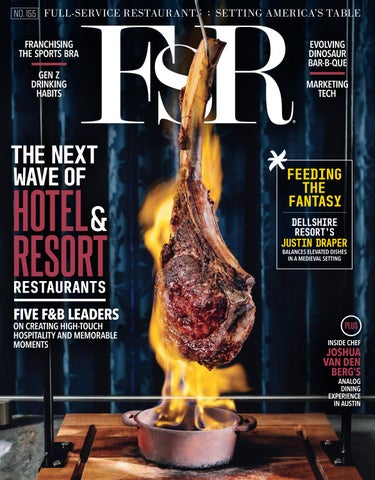
On the Cover Pictured on our cover is the flaming 42-ounce tomahawk ribeye from Blade & Barrel at Wisconsin Dells’ Dellshire Resort. Called The King’s Cleaver for Two, the tomahawk is flame-seared tableside in front of guests, creating an immersive, steakhouseinspired experience. Blade & Barrel is designed to provide comfort while still having enough flair to intrigue the modern “adventurer.” The culinary program at Dellshire is led by Justin Draper, a third-generation Wisconsin Dells chef who oversees all F&B venues on- and off-site.
F S R M AG A Z I N E .CO M
DELLSHIRE RESORT
FOR YEARS NOW, we’ve all been living in two worlds: the real physical one, and the digital one in our screens. While the line between them has increasingly blurred, the recent mass integration of AI is causing something to shift. People are craving in-person connection more than ever, and full-service restaurants are one of the last places to gather and share special experiences together. That’s a throughline in our issue this month, and a theme heavily highlighted in our cover story on PAGE 22 that features five hotel and resort restaurant chefs who are doubling down on high-touch hospitality and community engagement. The goal is to put the pieces in place that create memorable moments for locals and travelers, which supports the overarching mission to create F&B concepts that become dining destinations. The restaurant industry as a whole has generally been slow adopters of new tech, but over the past decade or so, operators have dealt with a steady stream of consequential changes, writes Sam Danley in his Tech Check article on PAGE 37; from social media and online ordering to CRM platforms, third-party delivery, and now AI embedded seemingly everywhere. But Farrelli’s Pizza CMO Clayton Krueger makes the case for resisting the pull of ”AI everything.” His approach is rooted in asking basic but important questions before pulling the trigger on implementing new tech, starting with: what problem are we attempting to solve? A platform may look impressive in a demo, he says, but that does not mean it addresses a pressing need for the business. The second question is just as important: Who will own it, and how will that person communicate results to the broader team? Those questions will become the backbone for building your restaurant’s tech stack in a smart and balanced way that ensures your core identity stays intact. This best practice shows up in how Lindsay Cullen, COO at Dinosaur Bar-B-Que, is bringing AI-driven tools into the bar program without losing the brand’s 40 years of roadhouse soul (PAGE 33). And on PAGE 9, you can read about chef Joshua van den Berg’s analog dining experience at APT 115, which only spins vinyl records (no requests, please). The dialogue about analog and AI will continue to appear in conversations as the industry grapples with the ever-changing dining and tech landscapes, but one thing will hold true: people will always want a space to sit down, break bread, and share in a memorable experience together.
DELIVERY is ESSENTIAL. CRISPY is CRITICAL.
When the fries show up crispy, your business shows up strong. See our range of delivery fries at SureCrisp.com. McCain and SureCrisp are trademarks of McCain Foods Limited. © 2025 McCain Foods USA, Inc.
McCain® SureCrisp® fries
GO THE DISTANCE.
QUESADILLA brings the
PULL
HISPANIC
BIG HISPANIC FLAVOR. BELGIOIOSO PERFORMANCE. Authentic Hispanic cheese with consistent quality and reliable results in every application.
DISCOVER OUR HISPANIC CHEESES!
Enjoy a smooth, satisfying melt that adds visual appeal to quesadillas, nachos, sandwiches and more.
WERKCREATIVE
First Course
bartaco (2) RECIEPT IMAGE EXTENDED BY FSR MAGAZINE.
ANTHONY VALLETTA’S ‘CEO HOTLINE’ HAS HELPED BARTACO RETHINK A HOSPITALITY, STORYTELLING, AND HOW TO CREATE MEMORABLE GUEST EXPERIENCES IN A TECH-HEAVY ERA.
Inside bartaco’s Viral ‘CEO Hotline’ BY CALLIE EVERGREEN
While the industry moves toward AI and less human interaction, bartaco is making its CEO more accessible than ever. F S R M AG A Z I N E .CO M
IN WHAT FEELS LIKE THE ANTITHESIS to an increasingly AI-saturated world, Anthony Valletta decided to listen to guests (literally) through an unconventional initiative: a “CEO Hotline” that routes diners straight to his personal cell phone. He put his cell number and email address on every guest receipt across
all 31 bartaco locations. The receipt says: “If you had a great time, tell a friend. If you didn’t, contact our CEO.” It even adds: “No, this is not a joke.” Since rolling it out, Valletta has been personally taking guest calls, texts, voicemails, and emails every single day, and personally responding to them himself. Some are complaints,
N OV EM B ER 2 0 2 6
7
First Course
8
N OV EM B ER 2 0 2 6
AI-Driven
DINING DECISIONS With the mass integration of AI into phones, search engines, and social media, data shows consumer behavior for restaurant discovery is rapidly evolving. A recent survey by Menufy revealed that 80% of consumers would try an independently owned restaurant they had never heard of if it were recommended by AI. MORE INSIGHTS:
78% say AI makes locally owned restaurants easier to discover compared with national chains
60% already use tools like ChatGPT, Gemini, Google AI Mode, or Perplexity to help decide where to eat
35% say an AI recommendation has already introduced them to a new restaurant they went on to visit or order from
However, word-ofmouth personal recommendations are still paramount, with 59% saying
they trust friends or family more than AI.
F S R M AG A Z I N E .CO M
PHONE RECOMENDATION: ADOBE STOCK / SVETAZI, CUSTOMERS IN RESTAURANT: ADOBE STOCK / MAVOIMAGES
some are compliments, and some turn into personal conversations about guests’ experiences with the brand. After a podcast clip about him printing his contact information on every receipt went viral, Valletta’s CEO hotline exploded. He now spends 45 minutes to two hours a day fielding guest outreach, with weekends bringing as many as 50 to 100 contacts in a single Friday or Saturday. He estimates roughly 80 percent of those messages are compliments or stories guests want to share. “I expected to be dealing mostly with [mostly] guest complaints, and the adverse actually happened,” Valletta adds. “Every piece of feedback to me is so valuable that it doesn’t matter how big or small. It’s been super insightful.” Then, Valletta and his team chose to take it one step further by turning it into a live guest experience on June 2. A blue analog phone was installed at bartaco Port Chester—one of the brand’s oldest and busiest restaurants— where guests could pick up the phone that day and call Valletta live from the restaurant to share feedback, ask questions, talk about their experience, or simply say hello. “We wanted to get that retro nostalgia feeling … The old-school way, where it wasn’t AI enabled, it wasn’t some bot replying,” Valletta says. “Let’s get a retro phone in the restaurant, hooked up to landline, as old school as it goes, and really establish that connectivity, and that’s kind of where the idea came from.” One of the most memorable calls came from a young kid who talked about how much he loves bartaco quesadillas, cheese sticks, and the coloring books. For Valletta, it was validation that bartaco’s intentionally designed kids’ experience is truly resonating with families. But the most eye-opening learning for Valletta, based on a common theme heard across many calls, was that bartaco needed to up its storytelling game. “People were calling, asking questions about things they could actually experience in a restaurant, or things that were coming up from a marketing perspective that hadn’t landed to that guest yet,” he says. Valletta realized that if guests cared enough to pick up the phone and call him, they were clearly passionate about the brand; yet their questions made it clear the company had work to do on clearly communicating existing menu items, returning favorites, and upcoming events. “We’ve spent a lot of time now on that,” he says. “We’re reevaluating our spiel in the restaurant and our storytelling on social media, and we’re making a lot of adjustments to make sure that messaging is getting out to the right people.” “We say we’re a guest-first organization. I think it’s helped me reinforce [that] with my actions. It’s not just a slogan that looks pretty on a wall,” he adds. “We’re putting our name behind it, and I’m putting my personal contact behind it.”
CULINARY INSPIRATION AND STORIES FROM INDUSTRY TRAILBLAZERS MENTIONED IN THIS SECTION APT 118 SHINGO STAND POETA • • •
• • •
The
• • •
• • •
INTERO
Chefs & Ingredients
DIY
Fıne Dining Playbook CHEF JOSHUA VAN DEN BERG IS THE EXECUTIVE CHEF OF MICHELIN GUIDE RECOMMENDED APT 115 IN AUSTIN, WHERE HE PRIORITIZES LOCALLY GROWN, IN-SEASON PRODUCE WHILE CREATING TASTING MENUS AND À LA CARTE DINNERS ROOTED IN FRENCH TECHNIQUE WITH A NOD TO SOUTHEAST ASIA.
JASMIN PORTER
BY CALLIE EVERGREEN
Inside chef Joshua van den Berg’s analog dining experience in Austin, Texas, which he believes could be a model for the next generation of independent, fine-dining restaurants.
F S R M AG A Z I N E .CO M
WHEN YOU STEP INTO APT 115 IN AUSTIN, TEXAS, you’re greeted by the sounds of a vinyl record player spinning Miles Davis or The Stooges (no digital music, no requests). You’ll spot chef Joshua van den Berg through the open kitchen, who—fair warning—may not immediately interact with you, because he’s likely locked in on preparing his duck confit or Hokkaido scallops for the chef’s tasting menu. “And to be honest with you, I think that makes for better viewing,” van den Berg says. “I would rather watch a guy who’s really
N OV EM B ER 2 0 2 6
9
CHE F S & ING RE DIE N T S CHE F PROFILE
10
N OV EM B ER 2 0 2 6
FAVORITE SPICE AT THE MOMENT:
Nutmeg
BEST BAND TO COOK TO: Rancid CHEF YOU’D LOVE TO WORK WITH:
Jeff Miller
YOUR FAVORITE FOOD CITY OR DESTINATION: Bangkok DISH YOU’RE MOST PROUD OF CREATING: Pad Thai Candy Bar ALT PROFESSION: Native Plant Landscape Designer
Unlike at larger, more flexible restaurants, each person working at APT 115 has to be extremely dialed in on what they do. With low overhead and only 18 seats, they can then concentrate their resources, drive solid weekly sales, and
keep the concept approachable. “We’re able to ring in decent amounts of to do it at a really high level with a very small team,” van den Berg says. He believes this small, high-end format could be the next wave of full-service independent dining. Though there are real challenges to operating so lean, the premium experience allows operators to price the menu to account for cost of high-quality ingredients. “I think this is more replicatable than most concepts I’ve been a part of,” he says. “You try to do a high-end food truck—and I went down this path—but you can’t charge a lot of money for a high-end burger or chicken sandwich ... Can you convince people to eat a $24 chicken sandwich and not be pissed about it?” What may work abroad, like a momand-pop ramen shop with six seats in Tokyo, often doesn’t translate to the U.S. market, where dining expectations and public perceptions are much different. “You need to charge money in order to make smaller concepts work,” he adds. “You have to do something high-end if F S R M AG A Z I N E .CO M
JASMIN PORTER (2)
focused on what he’s doing than a guy bullshitting and making my food, because I know if you’re talking, you’re not putting 100 percent of your focus into what you’re doing. Nobody’s that octopus-like.” Housed in a converted apartment, the 18-seat restaurant also serves as a wine bar and wine shop, all in one. The intimate, smaller space, coupled with the vinyl and analog touches, gives guests “that feeling of the old days, and just a sense of warmth,” he says. “On the eve of all this automation and AI, this feels very personal,” he adds. “You can come in and have a very personal experience in a smaller restaurant, whereas a larger one is completely contingent on the efficiency of the staff and the systems in place.” Before moving to Austin, van den Berg cut his teeth at some of the country’s top kitchens, including Momofuku’s Má Pêche, Chef Paul Liebrandt’s The Elm, and MICHELIN-starred Aldea. He later opened his own food truck, Songbird, serving fried chicken sandwiches, and won an episode of (Season 27, Episode 7). APT 118 opened in 2018 by owner Joe Pannenbacker, a self-taught sommelier and longtime Austin musician. The space was remodeled top-to-bottom this summer, which included expanding the kitchen to give van den Berg extra room to create. While preserving the concept’s living room-feel, the reno project brought in upscale equipment and recirculating ventilation to the kitchen, and upgrades to the dining space with a new Carrara marble-topped banquette with leather seating throughout and a custom quartzite bar top with inlaid walnut tiles. For van den Berg, APT 115 is an “amazing example” of what DIY (doit-yourself) fine dining can be. Rent is cheap, he notes, and “it’s a great proving ground for what can be done” on a limited budget. “You don’t need corporate investment; you don’t need a huge group of partners. You can come in and do this thing by yourself, but it’s very much contingent on having the right people, and it’s much less opaque in terms of what roles people have to play.”
Fries. Crowds love them. And with our upsell strategies, your bottom line will love them too.
© 2026 Simplot Global Food, LLC.
HOUSED IN A CONVERTED APARTMENT, THE 18-SEAT RESTAURANT ALSO SERVES AS A WINE BAR AND WINE SHOP, ALL IN ONE. THE INTIMATE, SMALLER SPACE, COUPLED WITH THE VINYL AND ANALOG TOUCHES, GIVES GUESTS “THAT FEELING OF THE OLD DAYS, AND JUST A SENSE OF WARMTH,” SAYS CHEF JOSHUA VAN DEN BERG.
you want to charge money. That’s what I’ve realized ... because chefs want to serve really great food, but you also need to make money and have a successful concept, so you’ve got to fi nd ways to do both.” At APT 115, the chef’s tasting menu experience—priced at $135—takes place over two and a half hours, with options to add a wine pairing for $70, a fancy wine pairing for $140, and a platinum Osetra Caviar course for $45. The menu shows off van den Berg’s French technique with Thai and Southeast Asian influences. One of the signature dishes on the tasting side—and what he’s most proud of creating—is the Pad Thai “candy bar”: a brick of pressed, seared rice noodles topped with sweet, farm-raised French New Caledonian
12
N OV EM B ER 2 0 2 6
blue prawns, a chili–garlic oil made from the shrimp heads, and a glaze of shallot, fish sauce, sugar, and tamarind that hits the classic pad Thai flavor profile. He fi nishes it with roasted peanuts, bean sprouts, chives, and chili. “The pad Thai candy bar is something I was thinking about for a long time; how do I reductively turn this dish into something very small? And I thought a lot about how you would do it,” he says. “A lot of fine-dining stuff is just manipulation of ingredients over long periods
of time ... In a restaurant, because you’re there every day, you have that foresight to be able to look ahead. So it’s like, OK I’ll cook these rice noodles, press them today. Tomorrow I’ll cut them. The day after I’ll sear them, and then I’ll have this crispy noodle brick on which I can build this dish.” “And then how do you take the different components of flavors and incorporate them in? A lot of it is problem solving from a starting point of an idea, and then trying to logistically figure out if you can execute it,” he adds. The perk of having multiple menus— which was introduced within the last year—is the flexibility it gives van den Berg to play and be creative without being boxed in to a certain style or cuisine type. “We’ve kind of struggled with identity in terms of what we want to brand as,” he admits. APT 115 began as a continental/European-leaning wine bar with some Japanese influence from his sushi background, then slowly started incorporating the Thai flavors he’s passionate about. He’s resisted calling it “Thai” or using the word “fusion,” instead embracing “chef-driven” as a label that lets him move between a chili dog, escargot, and crab–spinach gratin on one side and Thai-inspired dishes on the other. Appearing on both the tasting and regular dinner menus, the Thai coffee panna cotta layers caramelized milk chocolate with Thai instant coffee, condensed and evaporated milk, smoked meringue, and cocoa nibs. The inspiration for the dessert draws from van den Berg’s jet-lagged mornings getting off the plane in Bangkok at 6 a.m., walking around the city smoking cigarettes and drinking iced coffee. While storytelling at the table is left to service staff and owner/proprietor Pannenbacker so the chef can focus his full attention on the food, the benefit to guests harkens back to van den Berg’s earlier point. “You’re watching the person make all your stuff. It’s super open, and you get to witness the intensity of what it takes to create,” he says. “People who want that personal touch, this is the best way to do it.” F S R M AG A Z I N E .CO M
JASMIN PORTER (2)
CHE F S & ING RE DIE N T S CHE F PROFILE
NOW SE RV ING CHE FS & ING RE DIE N T S
Why ‘Less is More’ in the Pastry World BY SATYNE DONER
Two chefs, two crafts—milk bread and small-batch chocolate—built on the same belief: quality ingredients don’t need help. AT STAND, ROLLED MILK BREAD IS SERVED IN A VARIETY OF SAVORY AND SWEET FLAVORS: REGULAR, CREAM, CHOCOLATE, CURRY, AND SAUSAGE. THERE ARE TOASTS SMOTHERED IN TOPPINGS SUCH AS CHEESY MISO BÉCHAMEL, KEWPIE MAYONNAISE, JAPANESE SWEET POTATO, BRÛLÉED HONEY BUTTER, AND MELTED MOZZARELLA.
SALAR ABDUAZIZ
THE BREAD-MAKING PROCESS is a les-
And, most of all, it requires an insane the Michelin-starred omakase restauson in humility. A single loaf is repeti- amount of patience. rant Shingo in Miami, she realized how tive by nature: mixing, kneading, rollLania Andrade has spent years per- many cultures share a fundamental love ing, baking. Now try making 70 loaves fecting her craft. Bread was a big part of for bread. “Food is the bridge that cona day, using 100 pounds of dough—a her childhood in Puerto Cortés, a small nects people from different backgrounds million things can go wrong when con- port city on the northern coast of Hondu- and invites us to cherish our similariverting a small batch into a large yield. ras, where she remembers dipping semi- ties. Every time I bake, I relive memoIt requires a morning baker for mixing tas—an enriched bread with a sugared ries and have the opportunity to create and a night baker for baking. It requires crust—into her morning coffee. new ones,” Andrade says. fine-tuning both timing and technique. While serving as a pastry chef at Now, as chef de cuisine at STAND F S R M AG A Z I N E .CO M
N OV EM B ER 2 0 2 6
13
in Coral Gables—the new Japanese café from the team behind Shingo— Andrade has hand-shaped her magnum opus: milk bread, the backbone of nearly everything on the menu, from the rotating shio pans to the stuffed sandos and thick-cut toasts. The bread needed to be light and fluff y, yet able to compress and bounce back when used in a sando. That meant achieving maximum gluten development in a short amount of time, and finding the right percentage of fat to hold the loaf’s shape, toast evenly, and resist drying out. “The toughest battle was fine-tuning the taste and texture without trespassing on the boundaries of ingredients found in Japanese shokupan—flour, milk, sugar, butter, and salt,” Andrade says. “It took a few months of trial and error to understand that sometimes more butter isn’t always the answer.” At STAND, rolled milk bread is served in a variety of savory and sweet flavors: regular, cream, chocolate, curry, and sausage. There are toasts smothered in toppings such as cheesy miso béchamel,
“When it comes to Poeta’s pastries, I like to keep everything at three or four components ... something very simple and rustic.” —KRYSTAL CRAIG
Kewpie mayonnaise, Japanese sweet potato, brûléed honey butter, and melted mozzarella. As a sando, the milk bread holds everything from wagyu to fruit to Japanese-style egg salad. As the restaurant’s bread and pastry program continues to evolve, Andrade is looking forward to rolling out more sweets and finding new ways to showcase the dough’s versatility. “Working as a pastry chef taught me the truth in the phrase ‘less is more,’” Andrade says. “When I first started, my background was mostly highly composed plated desserts. A lot of people are surprised to learn how much bread we produce in our small kitchen ... but it’s a testament to the discipline I’ve developed.”
INTERO SERVES FARM-TO-TABLE CUISINE IN A ZERO-WASTE KITCHEN, INCLUDING IN-HOUSE WHOLE-ANIMAL BUTCHERY. INTERO’S ARTISAN CHOCOLATE PROGRAM IS CRAFTED BY HAND IN SMALL BATCHES EACH WEEK.
14
N OV EM B ER 2 0 2 6
Austin-based chef and chocolatier Krystal Craig shares that same philosophy. She leads two Italian restaurant concepts, Poeta and Intero, alongside partner Ian Thurwachter. Poeta is highly seasonal, with a rotating menu and warm, rustic hospitality. Intero, known as the “sophisticated older sister” concept, serves farm-to-table cuisine in a zero-waste kitchen, including in-house whole-animal butchery. Intero’s artisan chocolate program is crafted by hand in small batches each week. Like Andrade, Craig has a deep appreciation for ingredient quality and authenticity—working with specialty couverture chocolates and organic products to develop elevated classic flavors. At Poeta, she keeps the pastry menu sweet and simple: a choice of strawberry or chocolate sorbet, and a wafflegato made with waffles, maple gelato, and espresso butter. She lets the ingredients speak for themselves. “When it comes to Poeta’s pastries, I like to keep everything at three or four components ... something very simple and rustic,” Craig says. Craig isn’t usually one to chase trends, preferring that same “less is more” mindset—though she still enjoys browsing the chocolate bar aisle at the grocery store. What she’s noticed lately isn’t a wave of new fl avors, but a more intentional focus on sourcing organically and sustainably. “With chocolate, I’m not necessarily seeing new flavors, but I know everyone has their own unique process and flair when making it,” Craig says. “It’s been nice to see the trend of more organically sourced products. The classics are always going to be classics.” For both chefs, that devotion to real ingredients over trend or gimmick goes back further than either of their kitchens. For Craig, it started with a trip to Italy. “I’m such a chocolate girl through and through,” Craig says. “On a trip to Italy when I was younger, I realized everything I had been eating [in the U.S.] was full of fillers and over-sugared. Everything I had [in Italy] tasted real, and it propelled me into everything I do today.” F S R M AG A Z I N E .CO M
INTERO
CHE F S & ING RE DIE N T S NOW SE RV ING
SAVE UP TO 50% OF YOUR FRYING OIL WITH VITO
The VITO VL and VITO CONNECT software eliminate the guesswork from your oil management—helping you serve better food, and work smarter.
Scan here for more information
Call 407-377-7769 and ask for the VITO VL Carefree Package! vitofryfilter.com | | info@vitofryfilter.com
TRENDS AND CREATIVE APPROACHES TO SPIRITS, WINE, AND BEER. MENTIONED IN THIS STORY CHILI’S UNFILTERED HOSPITALITY • • •
• • •
RUBIX FOODS
Liquid Intelligence
UNFILTERED HOSPITALITY, A MIAMI-BASED CONSULTANCY THAT DEVELOPS COCKTAIL PROGRAMS FOR RESTAURANTS AND BARS NATIONALLY, NOW ROUTINELY WORKS WITH CLIENTS THAT REQUIRE MOCKTAILS TO ACCOUNT FOR 10 TO 20 PERCENT OF THEIR COCKTAIL MENUS, SAYS COFOUNDER BEN POTTS.
ADOBE STOCK / LA FAMIGLIA IMAGE EXTENTED BY FSR MAGAZINE.
Is
Gen Z Really
BY SAM DANLEY
And what does the nonalcoholic boom mean for your bar program?
F S R M AG A Z I N E .CO M
Drinking Less? FEW QUESTIONS HANG OVER full-service restaurant operators and beverage leaders more heavily right now than whether the next generation of drinkers is going to show up at all. Earlier this fall, a group of industry experts took that question on during an FSR NextGen panel at QSR Evolution Conference in Atlanta. Their answer is more optimistic—and more
demanding of operators—than the prevailing narrative suggests. Gen Z is not abandoning alcohol so much as abandoning the automatic drink order. Younger guests are moving between full-strength cocktails, lowABV drinks, and nonalcoholic options depending on the occasion, and beverage programs increasingly have to earn every sale.
N OV EM B ER 2 0 2 6
17
LIQ U ID IN T E LLIG E NCE
BEN POTTS WARNS THAT DEVELOPING A STRONG NA MENU CAN REQUIRE MORE RIGOR THAN CREATING A TRADITIONAL COCKTAIL LIST, NOT LESS. THE AVAILABLE PRODUCT UNIVERSE IS THINNER, AND OPERATORS CANNOT ALWAYS RELY ON ESTABLISHED SPIRITS TO PROVIDE COMPLEXITY, TEXTURE, AND STRUCTURE.
pointing to functional beverages as a current example. “I wouldn’t say that one goes up and one has to go down.” That distinction is important at a time when softer alcohol volumes can be mistaken for evidence that consumers have stopped drinking. O’Neil notes that weaker restaurant alcohol sales also could be tied to softer traffic across the industry, driven in large part by infl ationary pressures “that have nothing to do with alcohol.” Economic pressure may also influence how guests build their checks. Consumers who are watching their spending sumption and bar frequency among Gen can be more selective about when they Z rose over the same period. add alcohol to a meal, how many drinks The findings point to an additive con- they order, and which occasions warrant sumer: Young adults are incorporating a premium cocktail. A lower-priced NA NA options alongside alcohol rather than drink can give a cautious guest another necessarily replacing one with the other. way to participate without committing A guest might choose a cocktail during to a more expensive purchase. Nonalcoholic Isn’t a Zero-Sum Game one occasion, a mocktail during another, “There’s a big difference between buyThe explosion of mocktails and other or alternate between the two over the ing a $12 cocktail you didn’t like versus nonalcoholic options isn’t always the course of an evening. a $4 dirty soda,” O’Neil says. substitution story it is often framed as. For operators, moderation and alcoThat lower barrier doesn’t make NA Gen Z’s adoption of low- and no-alco- hol consumption aren’t competing bets. drinks an afterthought. It makes them hol beer climbed from 37.5 percent in The same customer can—and increas- another opportunity to capture a beverlate 2024 to 40.8 percent in mid-2026, ingly does—participate in both. age sale from a guest who might otheraccording to Morning Consult. That tied “Nonalcoholic beverage trends and wise order water or nothing at all. millennials for the highest rate among alcohol beverage trends kind of pass It’s difficult to overstate how quickly any generation. Yet regular alcohol con- things back and forth,” O’Neil says, that opportunity has changed expecta-
18
N OV EM B ER 2 0 2 6
In the U.S., the beverage alcohol participation rate among legal-drinking-age Gen Z consumers reached 71 percent during the first half of 2026, up from 68 percent two years earlier, according to IWSR’s twice yearly Bevtrac survey of consumer behavior.
F S R M AG A Z I N E .CO M
CHILI’S
“We’ve all heard that Gen Z doesn’t drink,” says Ian O’Neil, director of consumer intelligence at Rubix Foods. He notes that people often overlook the generation’s actual age range, which currently spans from roughly 14 to 29. “So, we’re judging an entire generation when half of them can’t legally drink,” he says. “Maybe let’s pump the brakes.” Recent research supports his skepticism. In the U.S., the beverage alcohol participation rate among legal-drinkingage Gen Z consumers reached 71 percent during the first half of 2026, up from 68 percent two years earlier, according to IWSR’s twice yearly Bevtrac survey of consumer behavior. That put the generation roughly in line with the 70 percent participation rate recorded across the overall U.S. population. Morning Consult found a similar trajectory. Between late 2024 and mid-2026, Gen Z adults were the only generation whose consumption increased in all nine categories the fi rm tracks. Weekly-ormore drinking at bars and restaurants made the largest jump, rising from 26.1 percent to 31.8 percent. Some of that growth is a function of more Gen Z consumers reaching legal drinking age and moving into their midto-late 20s, when alcohol consumption has historically peaked. But aging does not tell the whole story. When Morning Consult held age constant, the share of 21- to 29-year-olds who drank at all was essentially fl at, while weekly-or-more bar and restaurant drinking still rose by roughly five percentage points. In other words, more young adults are not necessarily taking up drinking, but those who do drink are doing so more often—particularly on-premises.
CHILI’S (3)
LIQ U ID IN T E LLIG E NCE that require mocktails to account for 10 value—whether it contains alcohol or not. to 20 percent of their cocktail menus, Then comes an honest audit. Are says cofounder Ben Potts. guests ordering the drink? Are they “That was unheard of when I first ordering it again? And is the restaurant started,” he notes. “Now, it’s a firm require- making money from it? ment.” “If those answers are no, then you have Potts warned that developing a to do it all over again. And if you repeat strong NA menu can require more rigor that cycle enough, you’ll get good at it.” than creating a traditional cocktail list, O’Neil’s broader point is that a drink not less. The available product universe never stands alone. It must make sense is thinner, and operators cannot always within the restaurant’s food, brand and rely on established spirits to provide value proposition. complexity, texture, and structure. “Alcohol doesn’t exist in a vacuum on “You have to think harder. You have the menu,” he says, pointing to Chili’s as to look for things that are a little harder an example. The chain does relatively litto fi nd,” Potts says, “or in some cases, tle food innovation but regularly launches depending on your operation, you have new margaritas, allowing it to create novto develop them yourself.” elty in a part of the menu that customers already associate with the brand. “They The Automatic Drink Order Is Gone can get weird with it, because they own In today’s landscape, Potts says, opera- that specific area, and that’s true to their tors can no longer count on a beverage brand.” landing on the check by default. He has Operators may not always need to limited patience for those who attribute create an entirely new product to comevery decline in alcohol sales to chang- municate that kind of value. One of the ing guest behavior. cheapest available upgrades, O’Neil says, “I speak with a lot of restaurant opera- is language. Plenty of restaurants are tors who are like, ‘alcohol sales are down, already executing beverages at a high level, people aren’t drinking,’” he says. “That’s “but you don’t get credit for it, because because people used to walk in, and you you’re not calling it out.” would just expect the alcohol sale, and “If it’s crafted, if it’s handcrafted, call that’s not the case anymore. You have to that out,” he says. “Those types of words give them a reason to order a beverage signify it, and perception is reality a lot on your menu. You can’t just hope that of times.” they already want something.” That language is becoming more valuCreating that reason under current able as consumers encounter more automargin and labor pressure comes down mated and mass-produced content in to a repeatable loop, he adds: “Decide their daily lives. intentionally, operationalize rigorously, “Especially in a day and age with AI and then evaluate continuously.” slop everywhere, things that denote CHILI’S BAR PROGRAM EXEMPLIFIES HOW The middle step is where many pro- handcrafted—that a human touched A DRINK NEVER STANDS ALONE; IT MUST MAKE SENSE WITHIN THE RESTAURANT’S grams fall short. this and did this—that’s going to eleFOOD, BRAND AND VALUE PROPOSITION, “You can’t just put it on a menu [and] vate you, and there’s going to be preSAYS IAN O’NEIL, DIRECTOR OF CONSUMER INTELLIGENCE AT RUBIX FOODS. CHILI’S hope that it sells,” Potts says. “You have mium perceptions around that.” DOES RELATIVELY LITTLE FOOD to train people on how to sell it, what it The same principle extends to the INNOVATION BUT REGULARLY LAUNCHES NEW MARGARITAS, ALLOWING IT TO means, why it’s important to the concept, details guests can see and experience: a CREATE NOVELTY IN A PART OF THE MENU why it was made for them.” foam, a distinctive texture, a garnish, or THAT CUSTOMERS ALREADY ASSOCIATE WITH THE BRAND. The mechanics are not necessarily an unexpected presentation. Those elecomplicated. They include checklists, ments can justify the purchase and give tions for restaurant beverage programs. documentation, and execution train- customers something they cannot easily Unfi ltered Hospitality, a Miami-based ing. But each piece has to be deliberate, recreate at home. consultancy that develops cocktail pro- he notes. That means employees should “Those are the types of things that grams for restaurants and bars nation- understand how a drink tastes, who it make people drive past one restaurant ally, now routinely works with clients is designed for, and how to explain its to go to yours,” O’Neil says. F S R M AG A Z I N E .CO M
N OV EM B ER 2 0 2 6
19
95%
of consumers are familiar with coconut
63% like or love it
HOW A “SWAVORY” FLAVOR TREND IS TAKING OVER MENUS YEAR ROUND
A leading brand’s flavor of the year is transforming LTOs. COCONUT MAY CONJURE IMAGES OF TROPICAL DRINKS AND WARM-WEATHER MENUS, but Monin’s 2026 Flavor of the Year, toasted coconut, has potential beyond summer. Monin Toasted Coconut Syrup combines the creamy familiarity of coconut with roasted, slightly savory notes to provide more room to use the flavor across seasons. The approach is backed by consumer interest. According to Datassential, 95 percent of consumers are familiar with coconut, and 63 percent like or love it. Toasted Coconut Syrup also fits into the “swavory” movement identified in Monin’s 2026 Flavor Trends, as consumers show
20
N OV EM B ER 2 0 2 6
more interest in sweet flavors layered with savory, roasted, and charred notes. “Toasted Coconut Syrup is endlessly versatile throughout the year, as those savory toasted notes add warmth and depth to creamy coconut,” says Carrie Gillespie, director of product marketing at Monin. “From snowball-inspired cocktails to toasted coconut hot chocolate, it’s a sophisticated flavor that goes from beach to bonfire with ease.”
As temperatures drop, those characteristics give operators an opportunity to rethink how coconut shows up on the menu. Instead of pairing it with tropical fruit and other warm-weather flavors, toasted coconut can complement profiles consumers already associate with cooler months: think coffee, caramel, chocolate, and warming spices. That flexibility opens the door to fall LTOs that feel seasonal without relying on the same flavors consumers expect every year. Monin Toasted Coconut Syrup can bring another layer to lattes, mochas, dessert beverages, and cocktails or mocktails while still delivering a flavor consumers recognize. The same approach can carry into the winter holidays, when richer, more indulgent beverages take center stage. Toasted Coconut Syrup works across applications including hot lattes, espresso martinis, affogato, cream pie, and whipped cream, giving operators plenty of ways to adapt the flavor for the season. Changing complementary flavors, formats, and presentation can take it from fall into the holidays without introducing a new flavor. “Indulgent drinks are a staple of fall and winter menus, and toasted coconut offers a fresh way to draw inspiration from the dessert table,” says Brian Loukmas, vice president of innovation at Monin. “Treats like coconut macaroons, German chocolate cake, or coconut tres leches cake can be reimagined as seasonal lattes, cocktails, or dirty sodas. Toasted Coconut Syrup could even be used to craft coquitoinspired mocktails for the holiday season.” For operators, that range can also simplify seasonal menu development. Rather than bringing in an ingredient with a narrow window of use, restaurants can use Toasted Coconut Syrup across multiple LTO cycles, dayparts, and beverage categories. A flavor introduced in a summer drink can take on an entirely different identity in a fall coffee or winter dessert beverage. That gives toasted coconut something many seasonal flavors don’t have: a reason to stay on the shelf after the season changes. ❖
Visit flavorof theyear.com to explore Monin Toasted Coconut Syrup and its potential across dayparts and beverage formats.
F S R M AG A Z I N E .CO M
MONIN GOURMET FLAVORINGS
SPONSORED BY M O N I N G O U R M E T F L AVO R I N G S
Scan here to learn more.
monin.com
OR
EA
R
TO A
T NU
Town
V
A
of the
FL
Toast
ED COCO ST
OF THE
Y
FROM THOUGHTFULLY CRAFTED ENTRÉES TO WISCONSIN STAPLES BUILT ON FARM-FORWARD INGREDIENTS, BLADE & BARREL IS DESIGNED TO PROVIDE COMFORT WHILE STILL HAVING ENOUGH FLAIR TO INTRIGUE THE MODERN “ADVENTURER.”
RE SOR T S & HOT E L S
THE NEXT WAVE OF
HOTEL& RESORT
BY CALLIE EVERGREEN
RESTAURANTS
BACKGROUND: ADOBE STOCK / VECTORART
Five top F&B leaders are doubling down on high-touch hospitality, community engagement, and creating memorable moments to ensure their hotel and resort restaurants stand on their own as dining destinations. 22
N OV E M B E R 2 0 2 6
RE SOR T S & HOT E L S
Justin
DRAPER
CULINARY DIRECTOR
DELLSHIRE RESORT
DELLSHIRE RESORT / MEAGAN ELIZABETH PHOTOGRAPHY
WISCONSIN DELLS
DELLSHIRE RESORT (4)
J
ustin Draper is feeding the fantasy for guests at Dellshire Resort, where he balances elevated dishes in a medieval setting—without being themed to the point of being tacky or garish. Yes, there may be a giant 70-foot fi re-breathing dragon named Golspar at the entrance, but that doesn’t mean the dining experiences inside the six distinct venues aren’t elevated and culinary-driven. The first-of-its-kind resort opened this spring in Wisconsin Dells as one of the region’s most highly anticipated new hospitality destinations, blending medieval fantasy-inspired storytelling with the refined style of an upscale Midwestern retreat. Visitors step inside the twostory entrance framed by cathedral windows to find a castle brought to life, with stone masonry and sculptural corbels transporting them to a different time. A third-generation Wisconsin Dells chef, Draper took up the mantle following his role as executive chef and co-culinary director at Dawn Manor, which is N OV E M B E R 2 0 2 6
23
RE SOR T S & HOT E L S now part of the Dellshire Resort collection. Located just minutes down the road, Dawn Manor is housed in a restored 19th century mansion overlooking Mirror Lake. The classy supper club has five period-themed private dining rooms, plus a downstairs speakeasy offering Prohibition-era cocktails and live entertainment. Draper oversees all food and beverage venues both on- and off-site, working closely with chefs to develop menus, guide kitchen teams, and ensure that each outlet delivers creativity, consistency, and a lasting experience for every guest. “The neat thing is that we have a zone or an experience for any occasion,” Draper says. “Dining is designed to feel like part of the adventure inside of Dellshire. We use imaginative concepts, presenting and storytelling to create that memorable experience.” The culinary program at Dellshire is anchored by the signature restaurant Blade & Barrel, featuring Wisconsin classics, alongside The Thirsty Dragon, a cozy fireside lounge; Scale Cove at Serpent’s Bay, a poolside swim-up bar; Kettle & Keep, a café and marketplace; and Gilded Spouts, located within the resort’s entertainment hub, Hero’s Hall. Each concept, from tavern-style dining to cocktails and hidden speakeasy moments, is designed to deepen the sense of exploration for guests. For Draper, the challenge has been stepping outside of his comfort zone and updating his knowledge of the continually evolving nature of what guests want. Twentyfive years ago, a simple turkey wrap with cheese, lettuce, and a mayo packet was a local hit; today, food trends have shifted, so he leans on younger team members to stay current. At Dellshire Castle, Draper is channeling that evolution into playful, storydriven, interactive dishes. At Blade & Barrel, for example, guests get to choose their own “sword” or blade when ordering a steak; servers present a magnetic board of around eight different steak knives for them to choose from. “I don’t want this too heavily themed because I want it to be approachable by everybody, but it’s hard not to notice it
24
N OV EM B ER 2 0 2 6
DRAPER USES THE KING’S CLEAVER— A 42-OUNCE TOMAHAWK RIBEYE— AS BOTH A FLASHY SHOWPIECE IN THE DINING ROOM AS WELL AS A TRAINING TOOL FOR EMPLOYEES, WHO HE SAYS ARE OFTEN “PRETTY NERVOUS” AT FIRST TO GO TABLESIDE AND FLAMBÉ THE TOMAHAWK WITH LOCAL GOLD BAR RESERVE BOURBON AND CARVE IT IN FRONT OF GUESTS.
RE SOR T S & HOT E L S include options like a Medieval Double Burger, fried Northern walleye, and a seven-finger pork chop. But the shining jewel is the King’s Cleaver for Two ($225): a 42-ounce tomahawk ribeye that’s hung, flame-seared, and presented tableside with horseradish
DELLSHIRE RESORT (5)
“DINING IS DESIGNED TO FEEL LIKE PART OF THE ADVENTURE INSIDE OF DELLSHIRE.”
and then appreciate it while you’re here because it is all very top-end stuff that we’re doing. Your steak knife isn’t going to bend,” Draper says. From thoughtfully crafted entrées to Wisconsin staples built on farmforward ingredients, Blade & Barrel is designed to provide comfort while still having enough flair to intrigue the “adventurer.” There’s fun theming on the menu with sections like “Breakfast of the Realm,” “Knight’s Round Table,” and “Sire’s Sides,” while dinner entrees F S R M AG A Z I N E .CO M
cream, steak sauce, and two bistro salads, plus two enhancements like roasted bone marrow butter or red chimichurri and chef’s seasonal farm accompaniments. Draper uses the King’s Cleaver experience as both a flashy showpiece in the dining room as well as a training tool for employees, who he says are often “pretty nervous” at first to go tableside and flambé the tomahawk with local Gold Bar Reserve bourbon and carve it in front of guests. So, he leads by example. “You just have to go out there and do it in front of them,” he says. “It’s just empowering them, making sure they have the resources.” He drills fundamentals like proper seasoning (“salt and pepper is magic”) and a service mindset that recognizes resort guests are literally “at home” on property, so food, service, and genuine care should provide comfort. While it’s challenging to instill that level of hospitality all the way down to line cooks and stewards, he feels they’re succeeding, noting reviews that praise those extra steps that make guests feel truly looked after. He also advises against “mile-long” menus that try to have something for everybody; he wants Dellshire’s restaurants to focus on fewer but genuinely great dishes. In the lobby, The Th irsty Dragon serves handcrafted cocktails
and select shareable bites like tavern French onion soup, smoked whitefish dip, chicken wings, and cheese curds. Scale Cove, the adults-only swim-up bar, features in-water seating and a onepage menu of cocktails and snacks from handhelds and piña colada dip to nachos and the Walking Taco with Fritos, cheese sauce, sour cream, and fire-roasted salsa. For Draper, dining is no longer just “I’m hungry, let’s eat,” but about creating a memorable experience that justifies what people spend. “Do you want them to come and remember what you did?” he emphasizes. Recognizing that the resort audience differs from a standalone restaurant, Draper is already cooking up plans to pivot the menu at Dawn Manor just a few months in, moving away from items like sea scallops toward more family-friendly, sharable dishes, with ideas like a chicken parmesan that’s presented tableside with sauce and melted cheese. Guest feedback is actively shaping the evolution as Draper and his team refine a menu that works for families across the property, including guests staying at the nearby Treetop Villas at Mirror Lake and resort visitors alike. The goal is to give adults enough good drinks and fun “munchy” food options while delighting children with interactive touches like a dragon-shaped pepperoni pizza package (pizza, cookies, and a “dinosaur egg” toy that hatches in water). “Give them that memory that they can take with them,” he says. The most rewarding part for Draper is walking into the dining room hallway and getting stopped by people who thank him and rave about the dining experience. “That’s kind of what we live off of. There’s a lot of people that do work for months on end, and then they see the final product. For me, I get gratification every 10 minutes,” he says. “Whether it’s good or bad, and if it’s bad, we can fix it. Let me make it right for you. I think that’s been a big push by our management, too. We want to make sure that we get that return; that’s important,” he adds. “We want to make sure that they feel like they’re at home.” ➻ N OV EM B ER 2 0 2 6
25
RE SOR T S & HOT E L S
BROWN
AREA DIRECTOR OF CULINARY OPERATIONS
SAINT JOHN’S RESORT PLYMOUTH, MICHIGAN AND
THE INN AT STONECLIFFE MACKINAC ISLAND
WHEN BROWN TOOK THE HELM, HE BEGAN INTRODUCING NEW, IMMERSIVE, TABLESIDE DINING MOMENTS. IT TOOK HIM A MONTH AND A HALF TO ROLL THE NEW MENU OUT, BUT IT HAS RECEIVED “GREAT REVIEWS SO FAR.”
26
N OV EM B ER 2 0 2 6
W
hen Ernie Brown took the culinary helm of two of Michigan’s leading resorts in April, one of his first priorities was refining each restaurant’s identity and creating distinctive, elevated dining experiences across each culinary concept. The James Beard Award-nominated chef brings more than 30 years of experience to his new role, with past stops at Caesars Palace, House of Blues, Nemacolin, Hotel Maverick, and Grand Hyatt Vail. One key piece of the puzzle for Brown was understanding how Saint John’s Resort and The Inn at Stonecliffe are both Humanitarian Hotels, where 100 percent of profit supports charitable initiatives around the world. It’s part of what attracted Brown to the opportunity, and that framework informs how he leads operations across the six dining concepts, as well as events and banquets, which are cornerstones of both properties’ businesses. “That really drew me to the property—just doing good for the community as well, not just working for another company that’s just putting money back in their pockets and feeding the billionaires,” Brown says. “We’re actually giving everything that we profit at the end of the day back to the community, back to the charitable foundation, and they donate that money to do great things.” At Saint John’s Resort, his impact is already underway, where he is reenvisioning the dining experiences across the resort’s concepts including FIVE Steakhouse, Doyles Irish Pub, and The Wine Grotto. At FIVE Steakhouse, he’s introducing new, immersive dining moments, like “The Cardinal,” an in-house dry-aged porterhouse for two carved tableside and finished with infused tallow butter. “We really wanted to focus on the steakhouse aspect,” Brown notes. Diners today—no matter if it’s at a standalone or hotel restaurant—want a visually striking, memorable experience, so even seemingly “simple” dishes must be presented in an exciting, theatrical way to deliver that “wow” factor and set the concept apart from a stanF S R M AG A Z I N E .CO M
SAINT JOHN’S RESORT AND THE INN AT STONECLIFFE (2)
Ernie
RE SOR T S & HOT E L S
SAINT JOHN’S RESORT AND THE INN AT STONECLIFFE (2)
BROWN ESTIMATES THE RATIO RUNS ABOUT 70 PERCENT BANQUETS AND 30 PERCENT RESTAURANT OUTLETS, BUT NOTES THAT FIVE STEAKHOUSE AND DOYLES ENJOY A STRONG LOCAL FOLLOWING, WITH SOME REGULARS VISITING FOUR OR FIVE TIMES A WEEK.
dard chain steakhouse, he argues. “That’s what people are looking for these days … They want to come somewhere that’s going to create an experience for them and their group.” That philosophy is showcased perfectly with the new Japanese A5 wagyu offering Brown introduced. Servers slice and sear the steak on a hot rock tableside, then place the seared steak into a housemade bao bun and top it with kimchi slaw and ponzu sauce. “It’s cooked right there in front of you, the server does everything for you,” Brown says. “It creates that atmosphere and that really cool feeling of ‘Oh, it’s tableside service and it’s very high-quality beef and it’s just a really cool experience.’ And we try to really drive that in with every course that we’re doing.” Before Brown arrived, none of the F&B concepts at either hotel were doing anything tableside. It took him a month and a half to roll the new menu out, which has received “great reviews so far,” he notes. “We’ve really elevated that service piece moving forward, and we’re going to continue to do that,” he adds. He plans to expand the theatrical, tableside experiences with dishes like beef tartare and made-from-scratch Caesar salad, and to bring similar concepts into other outlets—such as a fresh pizza and pasta program at the Grotto where carbonara is finished inside a flaming wheel of Parmesan right in front of guests. “People are coming here not only because of me, but because of what we’ve F S R M AG A Z I N E .CO M
created and what we’ve done here. Our reviews have gone through the roof; our 64 percent reviews when I got here are now in the 80 to 85 range for food quality and food presentations,” Brown says. “So the product has actually grown tremendously since I’ve been here.” At The Inn at Stonecliffe, he is overseeing the launch of a new kitchen and an expanded garden to increase freshgrown produce and to instill evolving menus centered on small plates and bold flavors. These enhancements are set to improve overall operations, the guest experience, and deepen the garden-toplate connection. In addition to leading the F&B experience, Brown’s role also includes bud-
geting and the execution of the complex nature of the business. Brown estimates the ratio runs about 70 percent banquets and 30 percent restaurant outlets, but notes that FIVE and Doyles enjoy a strong local following, with some regulars visiting four or five times a week. “I have two locals that basically come here every day. They sit at the bar and have breakfast, and then they’ll go back and do their work,” he notes. Brown works closely with marketing to plan weekly specials and execute a quarterly marketing strategy for each outlet, including promotions like happy hour, Martini Mondays, and “Bubbles and Pearls” at FIVE Steakhouse. The marketing team then pushes these campaigns consistently across channels like OpenTable, Facebook, and Instagram to keep the restaurants top of mind. “We’ve got a great community and a great following here, so I would say it’s a pretty high percentage as far as what the outlets get in local business,” he says. Yet, Brown also doesn’t sugarcoat how difficult operating a resort restaurant at a high level is today, with guest expectations higher than ever thanks to social media and competitive cooking shows. “I keep myself very current on everything that’s happening in the business, and I try to make sure that we are continually growing and continually changing things,” he says. “I think we’ve really transitioned FIVE into that steakhouse that everybody wants to come to, that is visually appealing, that people want to take pictures and send out,” he adds. “It’s tough nowadays to really live up to that expectation of the guest. But continually evolving is how we’re going to get there and do that.” Brown also notes how any restaurant’s growth trajectory is determined by the quality of the team members. “If I don’t have a good team behind me, it’s very hard to keep that level of expectation up there, but the team that I have has been growing and they’ve been doing a great job. And I continually push them every day to just do better and better,” he adds. ➻ N OV EM B ER 2 0 2 6
27
RE SOR T S & HOT E L S
MaryCatherine
MOORE
EXECUTIVE DIRECTOR OF FOOD & BEVERAGE AND MANAGING PARTNER
SHINOLA HOTEL DETROIT
I
n February, Mary-Catherine Moore joined Detroit’s Shinola Hotel to lead culinary operations across San Morello, Evening Bar, beer hall The Brakeman, and fried chicken spot Penny Red’s. Additionally, Moore oversees Shinola Hotel’s in-room dining, banquets, programming, and events, collectively shaping a hospitality experience defined by excellence and intention.
What role does a restaurant’s setting and overall guest experience play in shaping its menus, service style, and identity?
Everything starts with a place, and Shinola Hotel is woven into Detroit’s creative fabric. The design pays homage to our city’s industrious history while celebrating the artists and craftspeople who continue to shape it today. San Morello’s setting is refined with a hospitality-forward service style and open kitchen that lets diners see our chefs at work. Evening Bar is ambient and plush, with whimsical touches that mirror the meticulous attention to detail that goes into each cocktail. The Brakeman and Penny
SHINOLA HOTEL (4)
“I’M EXCITED BY THE SHIFT AWAY FROM HOTEL RESTAURANTS AS AN AFTERTHOUGHT AND What opportunities and challenges come TOWARD DESTINATION with leading a restaurant program within a hotel environment? DINING THAT STANDS The biggest opportunity is variety. I get to lead culinary operations across ON ITS OWN. upscale Italian restaurant San Morello, urban speakeasy Evening Bar, in-room dining, banquets and events, all under one roof. No two days look the same, and it’s all about ensuring each concept remains distinct and true to itself. It takes a lot of coordination for each restaurant to stand on its own while keeping operations cohesive property wide. How do you design dining experiences that appeal to a wide range of guests, from overnight visitors and families to local diners and special-event groups?
We think of our restaurants as neighborhood spots that happen to live as a part of the hotel’s overall experience. That means building programming and service styles that feel welcoming whether you’re a Detroit local coming in for date night, an out-of-town traveler grabbing dinner after a day of exploring the city, or a couple hosting their rehearsal dinner. Flexibility is key, in seating, pacing, and dining options, so each of those guests leaves with the same quality experience.
28
N OV EM B ER 2 0 2 6
IN DOWNTOWN DETROIT, SHINOLA HOTEL IS HOME TO SEVERAL UNIQUE DINING VENUES, FROM A SOUTHERN ITALIANINSPIRED RESTAURANT AND A SPEAKEASY TO A FRIED CHICKEN JOINT.
F S R M AG A Z I N E .CO M
RE SOR T S & HOT E L S Red’s leans casual and fun, perfect for game days. How do you balance creativity and innovation with consistency across multiple dining outlets?
LOCATED ON THE AUBURN UNIVERSITY CAMPUS, THE LAUREL IS A FIRST-OFITS-KIND, LUXURY TEACHING HOTEL IN COLLABORATION WITH THE UNIVERSITY’S HORST SCHULZE SCHOOL OF HOSPITALITY MANAGEMENT.
I work closely with our talented chefs who execute their culinary vision, while I focus on the guest experience and staff development side— service standards and making sure the hospitality experience translates consistently across venues. We give each restaurant room to be creative and current, but the standard of service stays the same no matter which of our restaurants you’re in. What strategies help hotel restaurants build strong relationships with their local communities while serving transient guests?
We use our restaurant spaces as a way to genuinely connect with our city, not just serve guests passing through. That means hosting events tied to the city’s culture and community, collaborations with local artists, programming that celebrates Detroit’s creative scene, and experiences that reflect our deep roots in Detroit.
A
How do you incorporate regional ingredients, culinary traditions, and a sense of place into a resort dining program?
Detroit’s food culture is inseparable from what we do at Shinola Hotel. From ingredient sourcing to the concepts themselves, we lean into the city’s history and character rather than importing a generic hotel-restaurant playbook. It’s part of why guests, whether they’re staying with us or just visiting for dinner, leave with a sense of where they actually are.
THE LAUREL HOTEL (2)
What trends or shifts in hotel dining are you most excited about, and how are they influencing your approach?
I’m excited by the shift away from hotel restaurants as an afterthought and toward destination dining that stands on its own. Guests increasingly expect hotel restaurants to hold their own against the best independent spots in a city, and that’s raised the bar for all of us, in a good way. ➻ F S R M AG A Z I N E .CO M
Roy
KHOO
DIRECTOR OF CULINARY INNOVATION AND OPERATIONS
THE LAUREL HOTEL & SPA, OWNED AND OPERATED BY ITHAKA HOSPITALITY PARTNERS AUBURN, ALABAMA
t The Laurel, Roy Khoo oversees all culinary operations, including fine dining, banquets, catering, retail outlets, and special events across the property, including the MICHELIN-recommended restaurant 1856—Culinary Residence, Walt’s On The Roof, and The Library. Located on the Auburn University campus, The Laurel is a first-of-its-kind, luxury teaching hotel in collaboration with the university’s Horst Schulze School of Hospitality Management. Khoo leads the continued evolution of the hotel’s culinary program with a focus on southern hospitality, international influences, sustainability, culinary education, operational excellence, and the development of future hospitality professionals. What opportunities and challenges come with leading a restaurant program within a hotel environment?
Having a restaurant within a hotel can present multiple opportunities and challenges. For instance, there is a natural audience with guests who are staying at the hotel, and the restaurant is an amenity for hotel guests, with concierge and front office teams driving business to the restaurant. Challenges can include balancing prof-
N OV EM B ER 2 0 2 6
29
CRAIG GOODWIN
KATHRYN McCRARY
RE SOR T S & HOT E L S
itability with the expectations of the hotel and its guests. Labor, food costs, utilities, and hotel overhead can significantly impact the restaurant’s bottom line.
authentic to the destination while meeting the needs of visiting guests. How do you incorporate regional ingredients, culinary traditions, and a sense of place into a resort dining program?
What role does a restaurant’s setting and overall guest experience play in shaping its menus, service style and identity?
The setting and guest experience help define the restaurant’s identity and should guide the menu, service style, and overall atmosphere. I want every element to feel connected to the location and guests we serve, including the use of local, unique ingredients. How do you balance creativity and innovation with consistency across multiple dining outlets?
I balance creativity with consistency by establishing clear processes and standards for quality, service, and presen-
30
N OV EM B ER 2 0 2 6
ROY KHOO LEADS THE HOTEL’S CULINARY PROGRAM WITH A FOCUS ON SOUTHERN HOSPITALITY, INTERNATIONAL INFLUENCES, SUSTAINABILITY, OPERATIONAL EXCELLENCE, AND THE DEVELOPMENT OF FUTURE HOSPITALITY PROFESSIONALS.
tation, while giving each outlet room to develop its own identity. The key is to “inspect what you expect;” this guiding philosophy enables the team to innovate while ensuring the overall guest experience remains consistent and reliable. What strategies help hotel and resort restaurants build strong relationships with their local communities while serving transient guests?
I focus on making the restaurant a destination for both hotel guests and the local community by building strong partnerships, hosting local events, and incorporating local products where possible. The goal is to create an experience that feels
I focus on using local and seasonal ingredients and working with regional producers and Auburn University Department of Horticulture and School of Fisheries, Aquaculture & Aquatic Sciences. We incorporate local culinary traditions into the menu, including a mix of Southern/Alabama cooking, farm-totable ingredients, barbecue, and regional agricultural products. This evokes a strong sense of place and brings guests an authentic experience that reflects our destination. What trends or shifts in hotel and resort dining are you most excited about, and how are they influencing your approach?
I’m most excited about the focus on local, seasonal, and sustainable dining, along with more personalized and experiential guest experiences. Wellness without sacrificing indulgence continues to trend, presented as delicious rather than “healthy food alone.” Shareable plates, smaller portions, and more flexible eating occasions influence me to think out of the box for that Memorable Guest Dining Experience. ➻ F S R M AG A Z I N E .CO M
THE LAUREL HOTEL (3)
I focus on creating a flexible dining experience with a menu that offers variety, quality, and value for all types of guests. I also consider the atmosphere, service style, and occasion, making sure the restaurant feels welcoming for local diners and families while maintaining its appeal for hotel guests and special-event groups.
CRAIG GOODWIN
How do you design dining experiences that appeal to a wide range of guests, from overnight visitors and families to local diners and special-event groups?
RE SOR T S & HOT E L S
Keven
KVALSTEN EXECUTIVE CHEF AND BEVERAGE DIRECTOR
SHERATON MINNEAPOLIS DOWNTOWN
E
sther Capp’s legacy of warm hospitality lives on at Esther’s Table Kitchen & Cocktails, where her house rules still apply: Use the fancy dishes, try something new, leave room for one more, find the fun in it, and make life an adventure. Housed inside the Sheraton Minneapolis Downtown, Esther’s Table is led by executive chef and beverage director Keven Kvalsten, whose approach blends French technique, seasonal ingredients, and distinctly Midwestern-inspired hospitality, creating dishes that feel both familiar and thoughtfully unexpected. Kvalsten guides the food and beverage strategy, operations, and team development across the property, which recently completed a renovation that resulted in growing demand at Esther’s Table and expanded F&B programming. He, alongside chef de cuisine Christian Oxley, have helped shape the hotel’s
culinary program, from seasonal menu development to kitchen training and consistency. The focus now is on refining offerings, scaling operations, and continuing to elevate the guest dining experience as demand grows post-renovation. What opportunities and challenges come with leading a restaurant program within a hotel environment?
Leading a restaurant program within a hotel environment offers a unique mix of advantages and complexities. Unlike a standalone restaurant, we’re operating within a larger ecosystem where the guest experience, hotel brand standards, room revenue, banquet events, and food and beverage performance are all interconnected. On the one hand, we have a built-in guest base right over our restaurant. These groups, however, are all different and may have different needs of service, foods, and hours of operation
SHERATON MINNEAPOLIS, MEGAN STEZKA PHOTOGRAPHY
KEVEN KVALSTEN AND HIS TEAM SEEK TO CREATE EXCELLENT GUEST EXPERIENCES THAT ALIGN WITH THEIR NEIGHBORHOOD, REGION, AUDIENCE, AND ESTHER’S ETHOS.
F S R M AG A Z I N E .CO M
N OV EM B ER 2 0 2 6
31
RE SOR T S & HOT E L S that they request. Understanding and expecting diversity and change is important to our F&B operations. How do you design dining experiences that appeal to a wide range of guests, from overnight visitors and families to local diners and special-event groups?
KVALSTEN’S FOCUS IS ON REFINING MENU OFFERINGS, SCALING OPERATIONS, AND CONTINUING TO ELEVATE THE GUEST DINING EXPERIENCE AS DEMAND GROWS POST-RENOVATION.
Creating a hotel restaurant experience that resonates with overnight guests, local diners, families, and event attendees starts with understanding that each group has different needs, but all are looking for convenience, quality, and a memorable experience. We try to create a flexible experience instead of just one. Overnight guests look for convenience, quick grab items, but also appreciate local food and beverage offerings. I think for our local guests, they really appreciate distinctive culinary identity, seasonal menus, and a great happy hour. What role does a restaurant’s setting and overall guest experience play in shaping its menus, service style and identity?
What strategies help hotel and resort restaurants build strong relationships with their local communities while serving transient guests?
In my experience, the hotel restaurants that successfully serve both locals and travelers understand that these audiences are connected, not competing. Our local guests provide year-round loyalty and community credibility, while transient guests often bring volume, exposure, and new opportunities for revenue.
duce—to canning and pickling for preservation when nothing is growing in -10°F conditions. Also, using culinary traditions and techniques have a strong sense of place in our restaurant. I would like our guests to feel like they are experiencing a destination, not just another restaurant. Food and beverage can be one of the most powerful ways to connect guests to the culture, history, and landscape of a region.
“ THE HOTEL RESTAURANTS THAT SUCCESSFULLY SERVE BOTH LOCALS What trends or shifts in hotel and resort AND TRAVELERS dining are you most excited about, and how are they influencing your approach? How do you incorporate regional ingrediWhat excites me most about our hotel UNDERSTAND THAT ents, culinary traditions, and a sense of place into a resort dining program? and restaurant dining today is the indusTHESE AUDIENCES ARE try’s shift from simply relying on servOne of the joys of being a chef is using Midwest and Minnesota Indigenous ing meals to create an experience. I CONNECTED, ingredients. Walleye being one of them. feel guests are increasingly looking for I love to fish for it and cook it; it’s a very authenticity, flexibility, and memorable NOT COMPETING.” versatile ingredient. The seasons play a moments to create an opportunity in our big part of this from early harvest pro-
32
N OV EM B ER 2 0 2 6
community. F S R M AG A Z I N E .CO M
MEGAN STEZKA PHOTOGRAPHY (3)
The restaurant’s ambiance and overall guest experience are foundational to our success. They influence most of our decisions, from menu development and service standards to pricing, atmosphere, and brand identity. We don’t want to just serve delicious foods; we want to create experiences that align with our neighborhood, region, audience, and Esther’s ethos.
Women in Leadership BY SATYNE DONER
Evolving Dinosaur Bar-B-Que into the Age of AI
LINDSAY CULLEN SERVES AS DINOSAUR BAR-B-QUE’S CHIEF OPERATING OFFICER, OVERSEEING FIVE LOCATIONS THROUGHOUT NEW YORK: SYRACUSE, ROCHESTER, TROY, HARLEM, AND HAMBURG.
DINOSAUR BAR-B-QUE (2)
COO Lindsay Cullen is bringing AI-driven tools into the brand’s bar program without losing 40 years of roadhouse soul. IT’S A BALMY WEEKEND in June 1983, and dozens of bikers are heading up to Albany, New York, for the Harley Rendezvous. John Stage, Dean “Dino” Cubic and Mike Rotella are among the crowd, coming to a singular realization: Where’s the food? High-quality options for bikers out on the open road were slim. So, the three improvised, sawing a 55-gallon steel oil drum in half and outfitting it as a makeshift grill that could be towed behind their Harley-Davidson motorcycles. Operating as “Dinosaur Concession,” they rode up and down the East Coast, serving plates of smoked barbecue at F S R M AG A Z I N E .CO M
motorcycle shows, fairs and festivals. After five years, they retired from the open road, breaking ground in downtown Syracuse with the first Dinosaur Bar-B-Que restaurant. By 1990, the restaurant had become a popular destination for both locals and tourists, undergoing a significant expansion to accommodate a full bar, full-service dining, and live music. Lindsay Cullen’s parents joined the brand as partners in 1991. She worked as a server on and off while going through school, but didn’t necessarily see herself joining what she calls the “family business.”
Three weeks before her college graduation, the Rochester location opened. Her parents needed help, and she moved to Rochester to support the expanding barbecue joint. That was 28 years ago. Today, Cullen serves as Dinosaur Bar-B-Que’s chief operating officer, overseeing five locations throughout New York: Syracuse, Rochester, Troy, Harlem, and Hamburg. She has played a pivotal role in the brand’s most recent pivot to an AIdriven system—transforming the beverage management program from manual, store-by-store tracking to a process that gives both frontline managers and finance real-time visibility into costs and variance. Cullen has been thoughtful about the implementation of new technology. For a gritty mini chain with roadhouse flair, keeping hospitality human is criti-
N OV EM B ER 2 0 2 6
33
Women in Restaurant Leadership
cal. This approach to AI forgoes a guestfacing presentation; rather, it provides the team with opportunities to reshape the back-of-house experience. “We have a long history, so we have a harder time [compared to other restaurants] adopting new technology,” Cullen says. “We have a certain level of nostalgia among guests who have grown up coming here, and they like the familiar, comfortable experience we provide. We have been very careful with how we introduce AI.” In August, Dinosaur Bar-B-Que transitioned its beverage operations to BeerBoard’s SmartBar Alcohol Intelligence platform, integrating ordering and inventory, product management, menu operations, yield management, and insights. BeerBoard, headquartered in Syracuse, had been talking with Cullen for years, but the timing had never been quite right. That changed when the brand hit an inflection point with outdated manual systems, and Cullen knew it was time to make a move. Take keg weight, for example: managers used to manually weigh kegs to track inventory; now, flow meters monitor tapped kegs automatically by measuring the fluid ounces as they go through
34
N OV EM B ER 2 0 2 6
each of the beer lines, cutting that process almost entirely. “Some of the old processes were very manual and risky from a physical standpoint; they weren’t perfect. I don’t love that for my team,” Cullen says. “Everything is faster and smoother, and we have the added benefit of being able to drill into the data of specific days, hours and draft lines. We can dig in much quicker than ever before.” One of the hardest problems to solve in a restaurant, Cullen says, is the shortage of time. Managers want more time: time for their daily responsibilities, for guests, and for developing their people. With the new system in place, she hopes to give the team time back so they can focus on growth opportunities for others; that kind of development takes planning, time, and commitment. It’s hard for operators to build connections with guests when they’re constantly reacting to curveballs. “You start your day with a plan, and then the curveballs start coming your
way,” Cullen adds. “Operators are continuously on defense, reacting to guest needs, team needs, and the things that were not anticipated, and they all tend to happen at the same time. Our priority at Dino is the hospitality experience ... and this is the way for our team to release themselves from doing tasks that have high levels of effort for low returns.” Cullen is already seeing an impact through data, underscoring how making small behavioral changes can have a huge benefit. They rolled out fresh training on pouring foreign draft beer, which requires extra care to avoid overpouring—such as not letting the line run before placing the glass underneath. It sounds small, but the data from using the new system shows a significant increase in yield. “Our food quality and hospitality remain at the highest level of importance for us, but we can’t take our company’s financial health for granted,” Cullen says. “That’s really where a solution like this comes into play.” Dinosaur Bar-B-Que started by handing out plates of barbecue from the back of a Harley-Davidson. Then, as a formal restaurant, it spent years doing inventory on pen and paper, calling out food orders and writing handwritten checks. Through every evolution, the brand has succeeded because it never lost its roadhouse soul. Every new system or piece of technology is introduced with as little disruption as possible, so that operators can get back to delivering the magic of Dino. “It feels refreshing to have another layer of reliability and credibility in our internal systems,” Cullen says. “Our founder always told us to never rest on our laurels ... we’re always challenging ourselves to be better, and we’re staying open to that as our systems continue to evolve. It’s all about driving everybody toward a shared goal of fi nding joy in everything you do during the course of your day.” F S R M AG A Z I N E .CO M
DINOSAUR BAR-B-QUE
CULLEN HAS PLAYED A PIVOTAL ROLE IN THE BRAND’S MOST RECENT PIVOT TO AN AI-DRIVEN SYSTEM, WHILE BEING THOUGHTFUL ABOUT THE IMPLEMENTATION OF NEW TECHNOLOGY. FOR A GRITTY MINI CHAIN WITH ROADHOUSE FLAIR, KEEPING HOSPITALITY HUMAN IS CRITICAL.
On the Rise BY CALLIE EVERGREEN
The Sports Bra Goes Coast-to-Coast
JENNY NGUYEN OPENED THE SPORTS BRA ON APRIL 1, 2022, TO ABOUT 1,000 PEOPLE IN A SPACE WITH 40 SEATS. SHE ESTIMATES THEY DID ABOUT $15,000 IN SALES ON DAY ONE, WITH PEOPLE “HAPPILY” WAITING HOURS IN LINE TO GET A SEAT.
JENNY NGUYEN: ROUND21, THE SPORTS BRA: JESSICA VANTERPOOL
The world’s first sports bar fully dedicated to women’s sports is expanding organically across the country via franchising. THE SPORTS BRA was an idea that lived in Jenny Nguyen’s head for years, sparked after an experience at a traditional sports bar in Northeast Portland in 2018. She and a group of about a dozen fellow women basketball players walked in and asked the staff to change one of the TVs to the NCAA women’s championship basketball game. They were led to the smallest screen in the back corner of the bar. The Notre Dame Fighting Irish defeated the Mississippi Bulldogs 61-58, and when Arike F S R M AG A Z I N E .CO M
HQ: Portland, Oregon
CUISINE: Elevated Bar Food
UNITS: 1 (+5 more opening soon) YEAR FOUNDED: 2022
Ogunbowale hit the three-pointer from the corner with 0.1 seconds left, “we all lost our damn minds,” Nguyen says. “I remember we were high fiving and screaming and jumping up and down.” “It stood out—us losing our minds and everyone else being quiet,” she continues. Nguyen recalls telling her friend it was the best game she’d ever seen, and her friend said, “Yeah, can you imagine if the sound was on?” That was the moment when “out of sheer frustration,” she blurted out: “You know the only way we’re ever going to watch women’s sports the way it deserves is if we had our own place.”
She says no one took it seriously, but as the next day rolled around, Nguyen started noodling on what the concept could be called—and The Sports Bra was the first name that came to mind. Laughing to herself, she then came up with the slogan: “We support women.” Clever, funny, and to-the-point. “If I could have patted myself on the back, I would have. I just thought it was so funny,” she recalls. It wasn’t until the pandemic hit that Nguyen, like so many others at the time, decided to make a big change to her life. “I started to think, the only two things I’ve ever really loved is basketball and cooking, and I wasn’t sure where those two things intersected,” Nguyen says. “And it was at that time where I was dating a woman and she was just like, ‘Hey, you know how you always joke about the Sports Bra? Why don’t you do that?’ And I literally laughed in her face.” But the seed was planted, and it grew until it was all Nguyen could think about. Midway through 2021, she decided she either had to let it go or actually try to make it happen. Thankfully, she chose the latter. Nguyen put pen to paper in August of 2021, and began looking at spaces in October 2021. Three weeks later, she
N OV EM B ER 2 0 2 6
35
On the Rise
The Journey to Franchising The Sports Bra was a smashing success, and made approximately $1 million in sales in just eight months. Of course, folks had been asking for a franchise since they first opened, but Nguyen was content with having one location. What changed her mind was the constant stream of guests telling her how
36
N OV EM B ER 2 0 2 6
NGUYEN BUILT THE MENU AROUND SIMPLE, CLASSIC SPORTS-BAR COMFORT FOOD SHE PERSONALLY LOVES—BURGERS, NACHOS, WINGS, FRIED THINGS—AND REWORKED THEM TO BE INCLUSIVE OF A WIDE RANGE OF DIETARY NEEDS AND RESTRICTIONS.
AS A NOD TO HER VIETNAMESE HERITAGE, NGUYEN ADAPTED HER FAVORITE CHILDHOOD DISH INTO A MAINSTAY MENU ITEM: MOM’S BABY BACK RIBS— A HALF RACK OF VIETNAMESE CLAYPOTSTYLE PORK RIBS, CARAMELIZED WITH COCONUT MILK, SERVED OVER HERBED CABBAGE SLAW.
nothing compared to how it actually felt to be inside the space; They feel seen, represented, and safe. By early 2023, she began seriously considering expansion. At first, she believed only she could open new locations because The Sports Bra felt like a “living, breathing” extension of herself. She also had some preconceived notions around franchising and didn’t like the idea of becoming known as a “chain,” she admits. But the more she researched it, the more she realized franchising gave her the opportunity to partner with people who had authentic connections in their own communities. “It seemed so freaking obvious,” she says in retrospect. Alexis Ohanian’s 776 Foundation became an early backer after hearing Nguyen’s plans to franchise, which they announced in April 2024. By June of 2025, they signed their first four franchises, then a fi fth earlier this spring. “When we launched our franchise website in October of 2024, we actually crashed the site in 48 hours. People were just very, very enthusiastic,” she notes. The first franchise location will open in St. Louis, Missouri. As of publica-
tion, owners Heather Hill and Sara Pilsner were in the hiring and training process and gearing up to open by year-end. Other confirmed franchise locations include Indianapolis, Boston, Portland, Maine, and Las Vegas, which will be the first ground-up construction and likely take longer to open. A pipeline of future markets includes New York City, Chicago, Miami, Dallas, and San Francisco. In May, Nguyen launched a crowdfunding effort on Republic, where investors could “own a piece of The Bra” as the concept expands across the U.S. The goal is to open more than 40 locations by 2030 while defining and leading the category as it grows. In just two months, the campaign raised $1,235,000 from about 1,400 donors, further proving the interest and desire for spaces dedicated to women’s sports. This June, Nguyen announced—via a blog post titled “Portland, We Need a Bigger Bra”—that a second location was coming to the city. The flagship Portland location generates roughly $25,000 per seat annually. The new, larger home court location is projected to exceed $2.4 million in annual sales, and will serve as both the corporate headquarters and the training ground for incoming franchisees. “What we’re doing requires a lot of risk taking, and it requires rewriting what’s already kind of the game plan, because it’s very rare in the food and beverage industry to create a brand-new segment,” she adds. F S R M AG A Z I N E .CO M
THE SPORTS BRA, MOM’S BABY BACK RIBS: STARCHEFS/RAEANN SERRA
walked into what would become The Sports Bra’s flagship location in Portland. She could immediately envision where the trophy wall, TVs, and fl ags would go. She signed a lease in November, and picked up the keys on February 1. Finally, on April 1, 2022, Nguyen opened The Sports Bra, timed around Final Four weekend. They opened to about 1,000 people in a space with 40 seats, and Nguyen estimates they did about $15,000 in sales on day one, with people “happily” waiting hours in line to get a seat. Nguyen built The Sports Bra’s menu around simple, classic sports-bar comfort food she personally loves—burgers, nachos, wings, fried things. Then, drawing on her culinary background, she reworked those staples to be inclusive of a wide range of dietary needs (glutenfree, allergies, etc.), because for her, representation and inclusivity have to show up on the plate, not just in décor or bathroom signage. As a nod to her Vietnamese heritage, Nguyen also adapted her favorite childhood dish into a mainstay menu item: Mom’s Baby Back Ribs—a half rack of Vietnamese claypot-style pork ribs, caramelized with coconut milk, served over herbed cabbage slaw. On the beverage side, a rotating draft cocktail complements mainstays like Out of Bounds with Rowan’s Coffee Ferrari, Campari, Fernet, cold brew, simple syrup, and a pinch of salt with an orange-express garnish; and seasonal concoctions like the fall-inspired Yellow Card featuring MJ’s Apple Sour Ketel One Vodka, Disaronno, aquafaba, coconut cream, house-infused apple cider simple syrup, and apple cider, topped with dashes of pumpkin spice.
Tech Check BY SAM DANLEY
Taming the Marketing Tech Stack
FARRELLI’S PIZZA
Farrelli’s Pizza CMO Clayton Krueger on turning third-party delivery into an acquisition tool, making better use of guest data, and resisting the pull of “AI everything.” FOR RESTAURANT MARKETERS, the technology conversation has become impossible to separate from the larger business conversation. Customer data, loyalty, online ordering, delivery marketplaces, AI, streaming platforms— the list of tools and challenges keeps expanding, often faster than operators can determine what is truly useful. Clayton Krueger has watched that evolution from a particularly grounded perspective. A partner and chief marketing officer at Farrelli’s Pizza, a 14-unit full-service regional restaurant group headquartered in DuPont, Washington, Krueger started with the company as a dishwasher in 1997. He has now held the top marketing role for 19 years, giving him a long view of how technology has reshaped both the guest relationship and the marketer’s job. “It’s hard to choose just one,” Krueger says when asked about the biggest change at the intersection of marketing and technology during his career. Restaurants, he notes, were relatively late adopters in the broader technology landscape. But over the past decade-plus, the industry has dealt with a steady stream of consequential changes: social media, loyalty and customer relationship manF S R M AG A Z I N E .CO M
FARRELLI’S PAIRS THIRD-PARTY DELIVERY WITH A STRONG FIRST-PARTY LOYALTY AND ONLINE-ORDERING APP THAT OFFERS A MORE COST-EFFECTIVE DELIVERY OPTION. THE COMPANY’S MARKETING FOCUS, IN TURN, IS ON CONVERTING THIRD-PARTY USERS INTO FIRST-PARTY GUESTS. RATHER THAN TREATING THE MARKETPLACE RELATIONSHIP AS AN ENDPOINT, THE TEAM SEES IT AS AN INTRODUCTION.
agement (CRM) platforms, online ordering, third-party delivery, customer data platforms (CDPs), and, more recently, AI embedded seemingly everywhere. Of those, Krueger sees third-party delivery as the most disruptive marketing technology shift in the business. “Thirdparty delivery gets a bad rap because of the high fees, disconnected guest experience, and non-owned customer data for the restaurant,” he says. “But despite those challenges, never before has there been a marketing technology in our industry that so clearly connects hungry prospects directly with our restaurant solutions.” That framing gets to the heart of how Farrelli’s thinks about delivery. The marketplace isn’t simply a margin issue or
a channel to tolerate because guests expect it. It is also a powerful acquisition engine, one that can put the brand in front of consumers at the precise point they are looking to make a purchase. The harder work comes after that first transaction. “It is up to us as operators then to figure out how to use that technology to our advantage,” Krueger says. At Farrelli’s, that means pairing thirdparty delivery with a strong first-party loyalty and online-ordering app that offers a more cost-effective delivery option. The company’s marketing focus, in turn, is on converting third-party users into first-party guests. Rather than treating the marketplace relationship as an endpoint, the team sees it as an introduction.
N OV EM B ER 2 0 2 6
37
Tech Check
Statement of Ownership, Management, and Circulation (Requester Publications Only) 1. Publication Title
2. Publication Number
FSR 4. Issue Frequency
_
3. Filing Date
9690
5. Number of Issues Published Annually
Monthly
10/ 01 / 2026 6. Annual Subscription Price (if any)
12
N/A
7. Complete Mailing Address of Known Office of Publication (Not printer) (Street, city, county, state, and ZIP+4 ®)
Contact Person
Rick Ellis
Arrowfly LLC 1111 Superior Ave E, Suite 1120, Cleveland, OH 44114
Telephone (Include area code)
(720) 902-0042
8. Complete Mailing Address of Headquarters or General Business Office of Publisher (Not printer)
That emphasis on creating a fuller picture of the guest has also made customer data platforms increasingly valuable. For years, restaurant marketers largely worked from the information available inside their CRM systems, which often meant the customer relationship began when a guest enrolled in loyalty. Th at is useful information, but it is not the entire customer journey. CDPs help close that gap. “We are learning through our tool how to better understand the customer journey and impactful points within it, in ways that we have not previously been able to,” Krueger says. Farrelli’s can now identify the first instance of a visit and track a customer based on payment method, rather than only seeing the moment that customer joins the loyalty database. It gives marketers the ability to examine behavior at both the broad and granular levels— understanding larger guest patterns while also seeing more specific interactions along the way. “These new tools can show you the holistic picture of the customer at both a macro scale and micro details,” Krueger says. Still, having more technology available does not necessarily mean a restaurant should add it to the stack. Krueger’s approach is rooted in questions that can sound basic but are often overlooked amid a crowded vendor landscape. First: “What problem are we attempting to solve with this new technology?” A platform may look impressive in a demo, he says, but that does not mean it addresses a pressing need for the business. The second question is just as important: Who will own it, and how will that person communicate results to the broader team? “Without a dedicated team member who is championing the platform, the new tech will face the likely outcome of becoming another SaaS cost on your P&L as opposed to a revenue generator,” Krueger says. That skepticism extends to the current AI rush, though Krueger is careful not to dismiss the technology outright.
“I want to be clear, I am not suggesting that AI isn’t incredibly powerful,” he says. “It is.” The value, as he sees it, is often in AI’s ability to process data faster and turn it into information that a marketer can use. Many restaurant platforms now have native AI capabilities that can help surface trends and produce more actionable insights. “The most powerful use of AI for restaurant marketing that I am seeing is helping marketers make sense of fragmented data sets and generating outputs in the form of guest segmentation and campaign recommendations,” Krueger says. What he is less ready to embrace is the fully automated execution of those recommendations. The concern is not that automation is inherently flawed, but that it requires validation before marketers turn it loose on their guest base. Farrelli’s plans to move carefully as it evaluates AI-driven campaign strategies, particularly to ensure automation does not lead to over-discounting or redundant outreach to guests who fall into overlapping segments. “The caution that I give is not to fall into the trap of AI everything,” Krueger says. “In most cases, the platforms those sales teams represent are attempting to solve for a problem that we simply do not have.” And for full-service operators, some of the most pressing technology issues may not sit inside the marketing stack at all. Krueger points to the growing fragmentation of televised sports, an especially important concern for concepts with sports-bar environments. As more games move across streaming services, including Netfl ix, Prime Video, and Peacock, restaurants face a more complicated and costly path to showing the programming guests expect. Commercial licensing, logistics, and the prospect of being pushed toward a single provider all pose challenges. “Progress needs to be made on this front soon,” Krueger says, adding that any solution should preserve restaurants’ competitive buying power.
Arrowfly LLC 1111 Superior Ave E, Suite 1120, Cleveland, OH 44114 9. Full Names and Complete Mailing Addresses of Publisher, Editor, and Managing Editor (Do not leave blank) Publisher (Name and complete mailing address)
Matt Waddell Arrowfly LLC 1111 Superior Ave E, Suite 1120, Cleveland, OH 44114
Editor (Name and complete mailing address)
Danny Klein Arrowfly LLC 1111 Superior Ave E, Suite 1120, Cleveland, OH 44114
Managing Editor (Name and complete mailing address)
Callie Evergreen Arrowfly LLC 1111 Superior Ave E, Suite 1120, Cleveland, OH 44114
10. Owner (Do not leave blank. If the publication is owned by a corporation, give the name and address of the corporation immediately followed by the names and addresses of all stockholders owning or holding 1 percent or more of the total amount of stock. If not owned by a corporation, give the names and addresses of the individual owners. If owned by a partnership or other unincorporated firm, give its name and address as well as those of each individual owner. If the publication is published by a nonprofit organization, give its name and address.) Complete Mailing Address Full Name
Arrowfly LLC
1111 Superior Ave E, Suite 1120, Cleveland, OH 44114
Mountaingate Capital
1225 17th Street, Suite 2575, Denver, CO 80202
11. Known Bondholders, Mortgagees, and Other Security Holders Owning or Holding 1 Percent or More of Total Amount of Bonds, Mortgages, or Other Securities. If none, check box. None Full Name
Complete Mailing Address
12. Tax Status (For completion by nonprofit organizations authorized to mail at nonprofit rates) (Check one) The purpose, function, and nonprofit status of this organization and the exempt status for federal income tax purposes: Has Not Changed During Preceding 12 Months Has Changed During Preceding 12 Months (Publisher must submit explanation of change with this statement.) PS Form 3526-R, July 2014 [Page 1 of 4 (See instructions page 4)] PSN: 7530-09-000-8855
13. Publication Title
N OV EM B ER 2 0 2 6
14. Issue Date for Circulation Data Below
FSR
September 2026
15. Extent and Nature of Circulation
Average No. Copies No. Copies of Single Each Issue During Issue Published Preceding 12 Months Nearest to Filing Date
a. Total Number of Copies (Net press run) Outside County Paid/Requested Mail Subscriptions stated on PS Form 3541. (Include direct written request from recipient, telemarketing, and Internet (1) requests from recipient, paid subscriptions including nominal rate subscriptions, employer requests, advertiser’s proof copies, and exchange copies.) b. Legitimate Paid and/or In-County Paid/Requested Mail Subscriptions stated on PS Form 3541. Requested (Include direct written request from recipient, telemarketing, and Internet Distribution (2) requests from recipient, paid subscriptions including nominal rate subscriptions, (By mail employer requests, advertiser’s proof copies, and exchange copies.) and outside Sales Through Dealers and Carriers, Street Vendors, Counter the mail) (3) Sales, and Other Paid or Requested Distribution Outside USPS® (4)
Requested Copies Distributed by Other Mail Classes Through the USPS (e.g., First-Class Mail®)
c. Total Paid and/or Requested Circulation (Sum of 15b (1), (2), (3), and (4))
(1)
d. Nonrequested (2) Distribution (By mail and outside the mail) (3)
(4)
Outside County Nonrequested Copies Stated on PS Form 3541 (include sample copies, requests over 3 years old, requests induced by a premium, bulk sales and requests including association requests, names obtained from business directories, lists, and other sources)
19,660
19,167
10,118
10,609
0
0
0
0 0
0
10,118
10,609
9,334
7,891
In-County Nonrequested Copies Stated on PS Form 3541 (include sample copies, requests over 3 years old, requests induced by a premium, bulk sales and requests including association requests, names obtained from business directories, lists, and other sources) Nonrequested Copies Distributed Through the USPS by Other Classes of Mail (e.g., First-Class Mail, nonrequestor copies mailed in excess of 10% limit mailed at Standard Mail ® or Package Services rates) Nonrequested Copies Distributed Outside the Mail (Include pickup stands, trade shows, showrooms, and other sources)
e.
Total Nonrequested Distribution [Sum of 15d (1), (2), (3) and (4)]
9,334
7,891
19,452
18,500
f.
Total Distribution (Sum of 15c and e)
g.
Copies not Distributed (See Instructions to Publishers #4, (page #3))
h. i.
208
667
Total (Sum of 15f and g)
19,660
19,167
Percent Paid and/or Requested Circulation (15c divided by 15f times 100)
52.0%
57.3%
* If you are claiming electronic copies, go to line 16 on page 3. If you are not claiming electronic copies, skip to line 17 on page 3.
PS Form 3526-R, July 2014 (Page 2 of 4)
Statement of Ownership, Management, and Circulation (Requester Publications Only) 16. Electronic Copy Circulation
Average No. Copies Each Issue During Previous 12 Months
2,002
a. Requested and Paid Electronic Copies
No. Copies of Single Issue Published Nearest to Filing Date
182
b. Total Requested and Paid Print Copies (Line 15c) + Requested/Paid Electronic Copies (Line 16a)
12,119
10,791
c. Total Requested Copy Distribution (Line 15f) + Requested/Paid Electronic Copies (Line 16a)
21,453
18,682
d. Percent Paid and/or Requested Circulation (Both Print & Electronic Copies) (16b divided by 16c Í 100)
56,4%
57.8%
I certify that 50% of all my distributed copies (electronic and print) are legitimate requests or paid copies.
17. Publication of Statement of Ownership for a Requester Publication is required and will be printed in the issue of this publication. 18. Signature and Title of Editor, Publisher, Business Manager, or Owner
November 2026 Date
September 29, 2026 Ken Gradman, CFO I certify that all information furnished on this form is true and complete. I understand that anyone who furnishes false or misleading information on this form or who omits material or information requested on the form may be subject to criminal sanctions (including fines and imprisonment) and/or civil sanctions (including civil penalties).
PS Form 3526-R, July 2014 (Page 3 of 4)
38
PRIVACY NOTICE: See our privacy policy on www.usps.com.
PRIVACY NOTICE: See our privacy policy on www.usps.com.
F S R M AG A Z I N E .CO M
Advertising Index BelGioioso Cheese
Progressive Commercial
McCain Foods USA
Pryze
Meat & Livestock Australia
Simplot
............................... 6
............................... 5
. . . . . . . . . . . . . INSIDE FRONT COVER
...............................3
. . . . . . . . . . . . . . . . . . . . . BACK COVER
. . . . . . . . . . . . . . . . . . . . . . . . . . . . . . .11
Advertising Inquiries Amber Dobsovic
NATIONAL SALES DIRECTOR
adobsovic@arrowfly.com | (757) 637-8673
Monin Gourmet Flavorings
. . . . . . . . . . . . . . . . . . . . . . . . . . . .20, 21
Stratas Foods
. . . . . . . . . . . . . . . . . . . . . . . . . . . . . . 15
Tom Boyles
NATIONAL SALES MANAGER
tboyles@arrowfly.com | (662) 607-5249
Tony Bolla
SALES DIRECTOR
NorthAmerican Bancard
. . . . . . . . . . . . . . . . . . . . . . . . . . . . . . 39
VITO Fryfilter
. . . . . . . . . . . . . . . . . . . . . . . . . . . . . . 16
tbolla@arrowfly.com | (773) 859-1107
Susan Shepherd SALES DIRECTOR
sshepherd@arrowfly.com | (404) 386-1709
KEEP MORE OF EVERY SALE Reduce your credit card processing fees Lightning-fast approvals and no setup fees
SWITCH NOW! get a FREE * TERMINAL
Chip card and contactless payment acceptance (Apple Pay, etc.)
PRICING PROGRAM 1
Seamless integration with your current POS system**
Rates as Low as
One-time and recurring invoices that you can upload in bulk**
Smart Terminal
Emailable and textable receipts
Standard Terminal
$295 towards any early termination fees** A secure online merchant portal
Accept EMV/NFC (Apple Pay, etc.)
Next Day Funding
ACCEPT EBT & Snap
Access to multiple online payment gateways Free printer paper, and more*
Save Money with a Direct Processor! Go North. Call Today
866.481.4604
0.05%
*
Wholesale Pricing
OR PRICING PROGRAM 2 Accept Credit Cards Without Paying Processing Fees*
Edge program only from North is a true dual pricing program combining Flat Rate Pricing with Cash Discount.
nynorth.com
©2026 North is a registered DBA of NorthAB, LLC. All rights reserved. NorthAB, LLC is a registered ISO of BMO Harris Bank N.A., Chicago, IL, Citizens Bank N.A., Providence, RI, The Bancorp Bank, Philadelphia, PA, and FFB Bank, Fresno, CA. *Merchant Classification restrictions apply. Dual signage pricing required. Other fees may apply. Contact North for more details. **Some restrictions apply. Merchant agreement required. Hardware is free for use while processing and must be returned upon termination of merchant agreement. Other fees may apply. Contact 866.481.4604 for details.
F S R M AG A Z I N E .CO M
N OV EM B ER 2 0 2 6
39
Behind the Scenes
MICHAEL McDERMOTT
ROLE: CEO BRAND: Chi-Chi’s JOINED: 1975 HQ: Minneapolis
BY CALLIE EVERGREEN
40
N OV EM B ER 2 0 2 6
Chi-Chi’s Comeback Why was now the right time for Chi-Chi’s to make its comeback? I believe in divine timing. I’ve been creating restaurant concepts for 25+ years, then one morning during meditation, the thought came to me: bring Chi-Chi’s back. I ran the idea by a few people, and they thought it was a great one. I understand the responsibility that comes with continuing what my father started. Bringing Chi-Chi’s back felt like the right opportunity to honor my family while introducing the brand to a new generation. How are you balancing nostalgia with attracting new customers? Our intention was to bring Chi-Chi’s forward, not simply bring it back. We wanted longtime fans to recognize and reconnect with the brand they remember, while also creating a restaurant that feels relevant today. The restaurant incorporates familiar design elements such as hanging plants and Mexican tile, but the overall atmosphere reflects modern design and guest expectations. The menu follows that same philosophy. We’ve brought back several original Chi-
Chi’s favorites, including the Chimichanga, Mexican Pizza, Corn Cake, and Twice-Grilled BBQ Burrito, while also introducing items that reflect today’s Mexican dining trends, such as Birria Tacos and Short Rib Tacos. What inspired the new lunch menu? Gathering feedback from our guests, one of the most common requests was for smaller portions and price points that better fit lunchtime dining. For example, our chicken chimichanga is made with a 10-inch tortilla and can be difficult for some guests to fi nish. For lunch, we introduced a Mini-Chimi made with an 8-inch tortilla. It’s still a generous portion, but it allows us to bring the price down from $17 to $14. What’s next for Chi-Chi’s expansion? We’re focused on securing the financing needed to support our growth plans. I’m excited because I believe Chi-Chi’s still has tremendous potential. My goal is to build on the foundation my father created, honor my family’s legacy, and introduce Chi-Chi’s to communities across the country. F S R M AG A Z I N E .CO M
CHI-CHI’S (4)
For Michael McDermott, the resurgence of Chi-Chi’s is personal as the son of Marno McDermott, who co-founded Chi-Chi’s in 1975. The brand grew to 200+ locations at its peak. But it collapsed in the early 2000s, and all locations closed by 2004. Chi-Chi’s made its triumphant return in October 2025 with the opening of its first new location in Minneapolis suburb St. Louis Park, Minnesota. I sat down with McDermott to hear how he’s leading the company’s revival with a focus on honoring the legacy his father built while introducing the beloved brand to a new generation of guests.
you’re a restaurateur. be intuitive. trust your palate and your people. create a place someone didn’t know they needed. obsess over details no one notices. welcome everyone like they belong. change the menu before it’s perfect. listen more than you speak. fix what’s broken before it’s seen. remember names. remember stories. make ordinary nights feel like occasions. embrace the chaos. FSR magazine | Food | Growth | Operations | Events | Media | Resources | fsrmagazine.com
Less Scrolling. More Selling. +900 +500
POINTS
POINTS
The employee gamification app that keeps your frontline team focused on the actions that drive sales, productivity, and retention.
pryzeapp.com
see the demo