VIA 313’S RISE

WEST COAST BBQ THE BIG SIP SHIFT
VIA 313’S RISE
WEST COAST BBQ THE BIG SIP SHIFT
FOUNDER AND CEO CHRIS SIMMS SPILLS THE SECRETS BEHIND THE 51-UNIT BRAND’S STELLAR WORKPLACE STATUS
JAMES BEARD AWARD-WINNING CHEF ON ENGINEERING A HIGH-FUNCTIONING KITCHEN KATIE BUTTON +
FROM DRINK RUNNER TO ONE OF TOPGOLF’S MOST INFLUENTIAL F&B LEADERS

ghirardelli.com/professional

BY CALLIE EVERGREEN
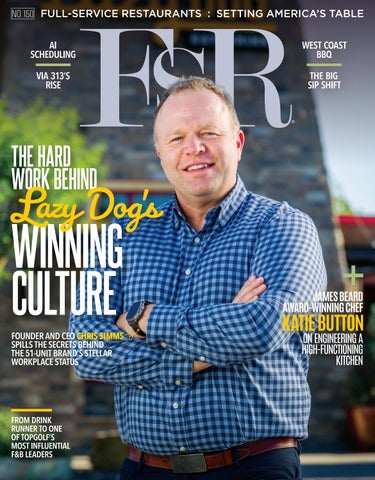
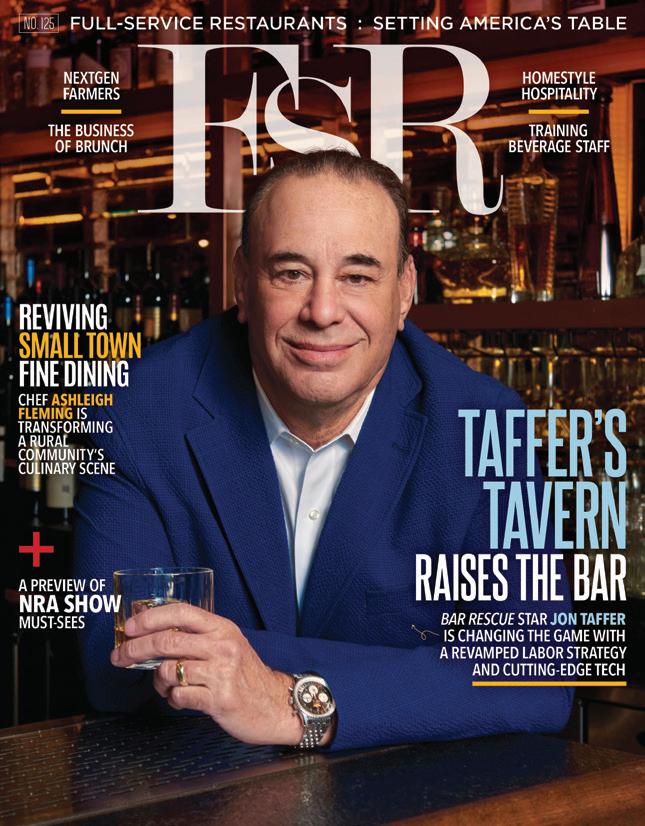
Founder and CEO Chris Simms spills the secrets behind building Lazy Dog’s famously positive culture, and what drives the 51-unit brand’s consistently high employee satisfaction rates and “Great Place to Work” status.
BY CALLIE EVERGREEN
From a PhD dropout to a 5x James Beard Award nominee, chef Katie Button shares her career journey lessons and how she fuels a healthy kitchen culture at her Asheville restaurant, Cúrate Bar de Tapas.
BY SATYNE DONER
From smoked jackfruit to rare ryes, Don Conner is rewriting the barbecue rulebook at his concept Whiskey ‘N Rye in the Santa Ynez Valley of Southern California.
BY SAM DANLEY
Demographics and sticker shock are reshaping drinking culture. Successful operators are crafting leaner, high-velocity programs that prioritize connection over quantity.
FIRST COURSE
7 A Franchisee-Led Turnaround BY CALLIE EVERGREEN
Discover what happened when Kristen Winters stepped in to lead the turnaround of a previously failed Rock N’ Roll Sushi franchise in Clarksville, Tennessee.
8 From Basements to Barstools BY CALLIE EVERGREEN
People are still seeking social interactions and experiences outside of their homes, new data shows.
BACK OF HOUSE
32 From Motor City to Multi-Market Scale
BY BRITT ENGLER
ON THE RISE Here’s how two brothers craving Detroit-style pizza fueled the rapid expansion of Via 313 to nearly 30 restaurants and over 1,000 employees.
BY BRITT ENGLER
TECH CHECK An 18-year-old tech wizard is on a mission to make scheduling easier and faster for managers using artificial intelligence.
37 From Drink Runner to Innovation Leader BY SATYNE DONER
WOMEN IN LEADERSHIP Inside Jennifer Lougee’s journey from the venue floor to one of Topgolf’s most influential emerging leaders.
40 The Road to Ford’s Garage BY CALLIE EVERGREEN
BEHIND THE SCENES Becoming the new chief marketing officer for Ford’s Garage marks Kathleen Bush’s rise to the C-suite for the first time.
ALSO IN THIS ISSUE
4 Editor’s Welcome 39
NC 27517-2380.
EDITORIAL
VP, EDITORIAL DIRECTOR: FOOD, RETAIL, & HOSPITALITY Danny Klein dklein@wtwhmedia.com
FSR EDITOR Callie Evergreen cevergreen@wtwhmedia.com
QSR EDITOR Ben Coley bcoley@wtwhmedia.com
ASSOCIATE EDITOR Sam Danley sdanley@wtwhmedia.com
SENIOR EDITOR, WIRL Satyne Doner sdoner@wtwhmedia.com
SVP, AUDIENCE GROWTH Greg Sanders gsanders@wtwhmedia.com
CONTENT STUDIO
VP, CONTENT STUDIO Peggy Carouthers pcarouthers@wtwhmedia.com
WRITER, CONTENT STUDIO Drew Filipski dfilipski@wtwhmedia.com
WRITER, CONTENT STUDIO Ya’el McLoud ymcloud@wtwhmedia.com
WRITER, CONTENT STUDIO Abby Winterburn awinterburn@wtwhmedia.com
DESIGN
VP, CREATIVE DIRECTOR Matt Claney mclaney@wtwhmedia.com

2026 REGIONAL BRONZE AWARD: FRONT COVER DESIGN
2024 REGIONAL GOLD AWARD: PUBLICATION DESIGN
2023 NATIONAL GOLD AWARDS: FRONT COVER (PHOTO), BEST USE OF COLOR NATIONAL SILVER AWARD: BEST USE OF TYPOGRAPHY
2016 MAGAZINE OF THE YEAR TOP 10 AWARD
2015 MAGAZINE OF THE YEAR
FOLIO: Eddie Awards
2022 BEST FULL ISSUE HOSPITALITY
2022 BEST SPONSORED CONTENT
2021 BEST PROFILE FEATURE
2017 BEST FULL ISSUE
FOOD & BEVERAGE
2013 BEST DESIGN, NEW MAGAZINE
2013 BEST FULL ISSUE, FOOD SERVICE/HOTEL
® SALES & BUSINESS DEVELOPMENT
SVP SALES & STRATEGY Matt Waddell 312-961-6840 mwaddell@wtwhmedia.com
VP, BUSINESS DEVELOPMENT Eugene Drezner 919-945-0705 edrezner@wtwhmedia.com
NATIONAL SALES DIRECTOR Amber Dobsovic 757-637-8673 adobsovic@wtwhmedia.com
NATIONAL SALES MANAGER Tom Boyles 662-607-5249 tboyles@wtwhmedia.com
CUSTOMER SERVICE REPRESENTATIVE Tracy Doubts 919-945-0704 tdoubts@wtwhmedia.com
ADMINISTRATION
CEO Matt Logan mlogan@wtwhmedia.com
919-945-0704 www.fsrmagazine.com/subscribe
FSR is provided without charge upon request to individuals residing in the U.S. who meet subscription criteria as set forth by the publisher.
REPRINTS
THE YGS GROUP 800-290-5460 fax: 717-825-2150 fsrmagazine@theygsgroup.com
Sponsored content in this magazine is provided to the represented company for a fee. Such content is written to be informational and nonpromotional. Comments welcomed at sponsoredcontent@ fsrmagazine.com.
FOUNDER Webb C. Howell
LinkedIn.com/company/ FSR-magazine
Instagram.com/FSRmagazine Facebook.com/FSRmag
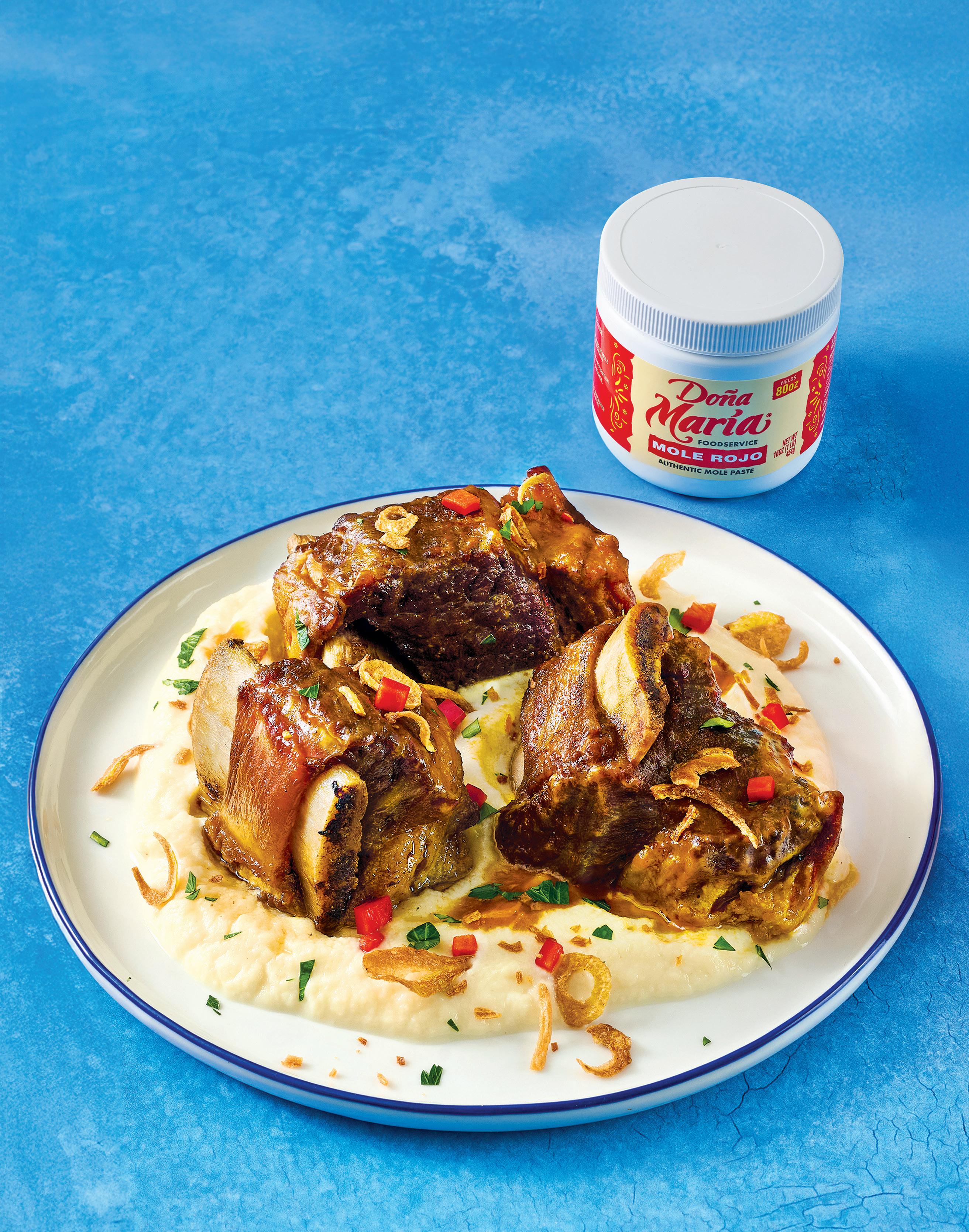
With DONA MARIA® Mole Rojo , a twist of the cap and a stir of the spoon is all it takes to make the rich, authentic, deep flavor of Mexican mole sauce. Add it to traditional dishes, top off new fusions, even put it on dessert. But don’t wait around—this mole goes fast in every way imaginable.
ALSO AVAILABLE AT DOT FOODS ITEM #774328

AS AN INDUSTRY, we talk about culture a lot. While I think that’s a positive sign of growth overall for restaurants, that talk has also become laden with buzzwords, platitudes, and generic core values plaque hung on a wall employees walk by every day. Leaders know that treating their people right is important, but what doesn’t get talked about as often—or in as much detail—is the systems and processes that allow a good culture to flourish.
At Lazy Dog Restaurant & Bar, founder and CEO Chris Simms has figured out how to consistently drive high employee morale and satisfaction rates—proven by eight straight years of being certified as a Great Place to Work, the most trusted workplace award. From gamifying training to building clear paths for upward mobility, Simms is laser focused on treating his people with care so that they feel empowered to take exceptional care of every guest.
He also actively pushes back on the common notion that younger generations are lazy and don’t want to work, and deliberately flips that script at Lazy Dog. Managers are taught from day one to assume positive intent, equip teammates with the tools and training they need, and create an envi ronment of empowerment rather than fear, so employees feel inspired to do their best for guests.
That creates trust, he says, which is rare and more important now than ever. “The world today is probably a little less trusting than it used to be, so it’s nice to have an environment that provides trust to people,” Simms says in our cover story on PAGE 24.
Throughout the rest of our June issue, you can read about an 18-yearold tech wizard who is revolutionizing labor tech and scheduling using AI on PAGE 35, and how a former drink runner at Topgolf rose through the ranks and is now giving back to emerging leaders in the organization through mentorship ( PAGE 38).
You can also discover how James Beard Award-winning chef Katie But ton is engineering a kitchen culture built on systems, open communication, and a commitment to continuous improvement at Cúrate Bar de Tapas in Asheville, North Carolina, which is celebrating its 15th anniversary this year ( PAGE 9).
Looking at broader cultural shifts and trends in the restaurant industry, Button has seen “a large shift in the focus and intention of how we take care of the people who work for us, and foster these cultures [where] the expectations are clear and fair—I think that that is where we are headed.”

Callie Evergreen EDITOR
cevergreen@wtwhmedia.com
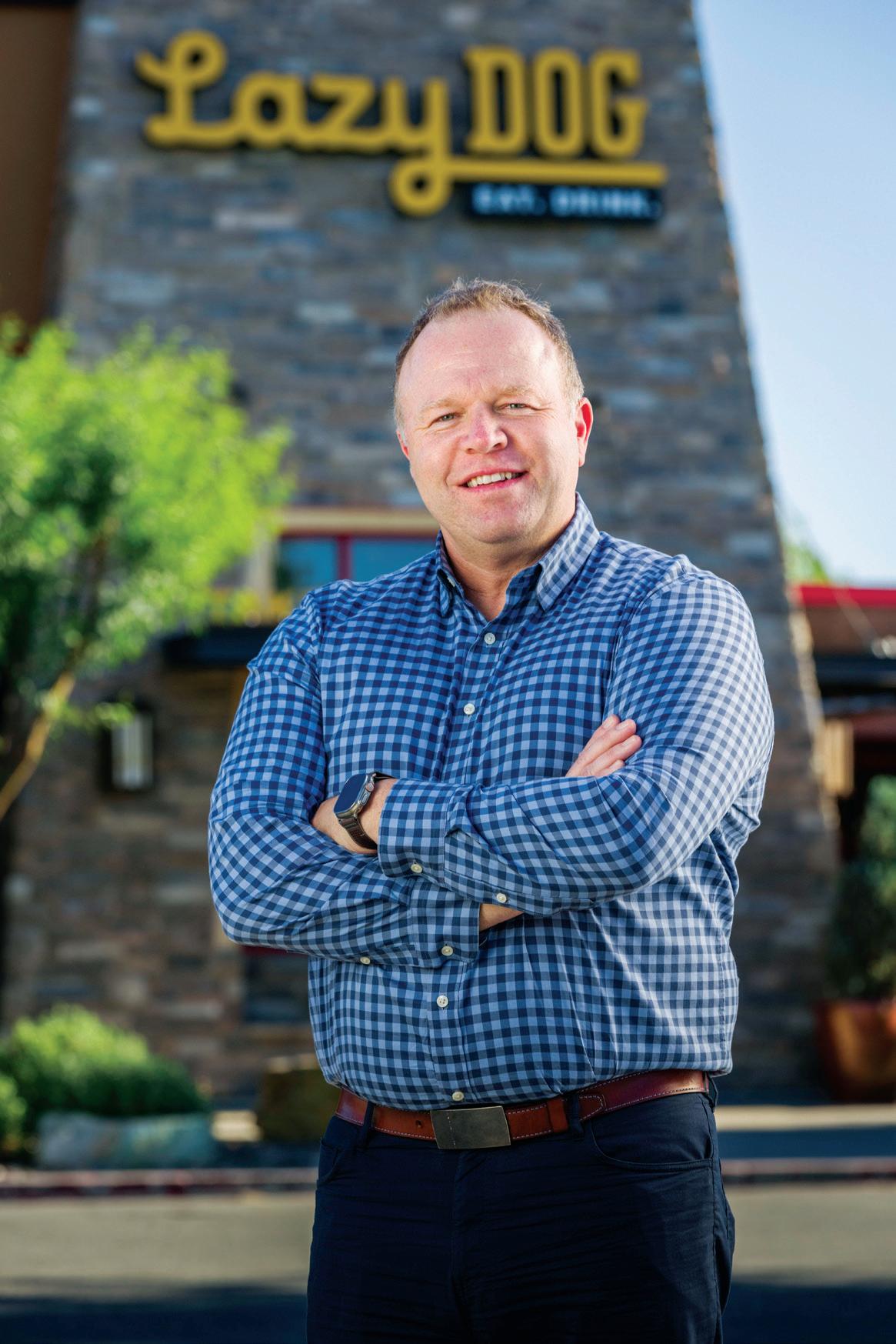
connected. Today, Lazy Dog Restaurants has locations across California, Texas, Illinois, Colorado, Nevada, Florida, Georgia and Virginia. In this issue, Simms shares how investing in people, fostering genuine relationships, and staying rooted in purpose have shaped Lazy Dog’s culture and approach to hospitality.
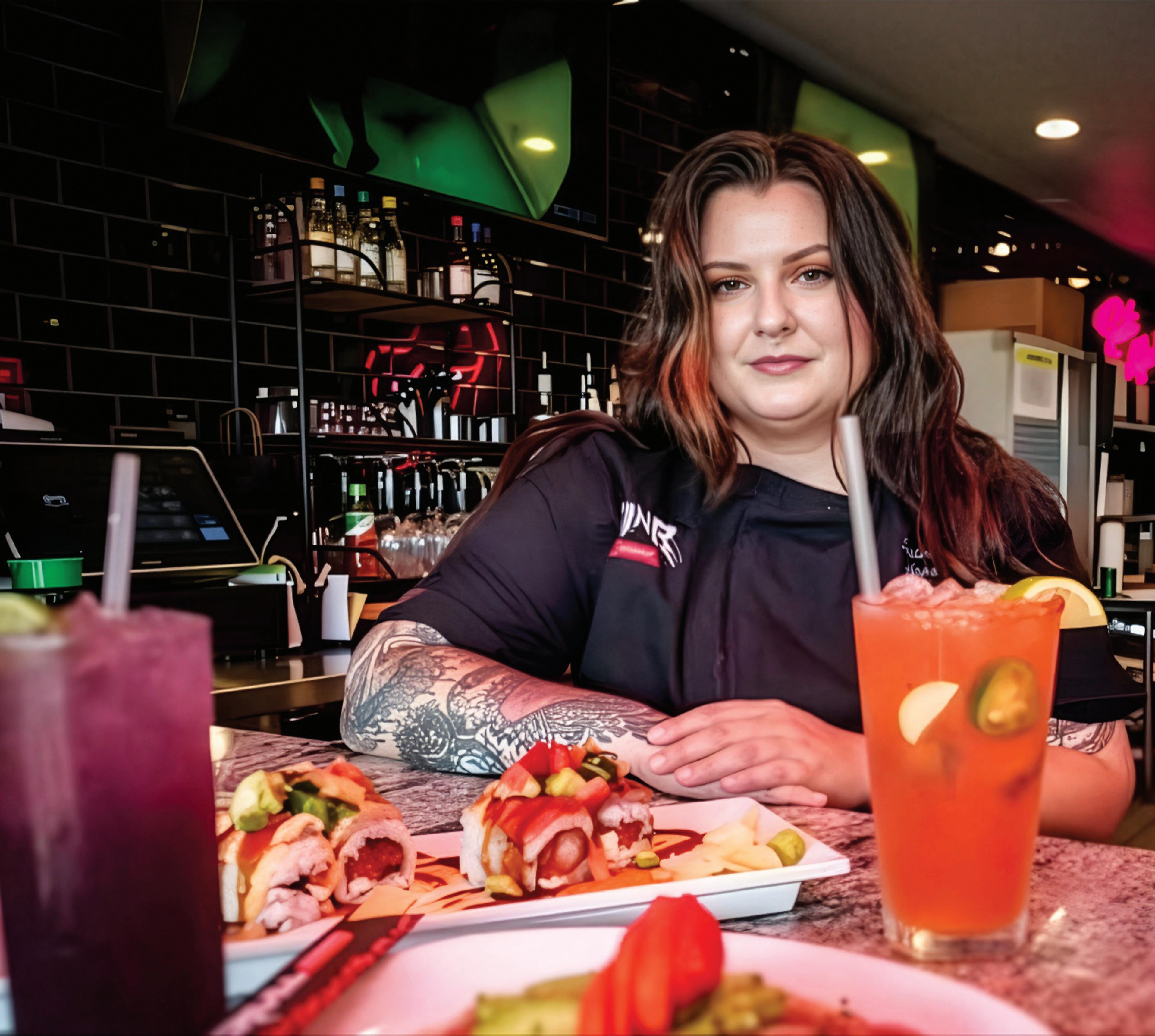
Kristen Winters aims to always be “the mentor
that I needed
growing up
in
the industry,” and show team members they “don't have to change your individuality to reach their goals.”
BY CALLIE EVERGREEN
What happens when a talented operator enters the picture?
WHEN KRISTEN WINTERS stepped in to lead the turnaround of a previously failed Rock N’ Roll Sushi franchise in Clarksville, Tennessee, here’s what she noticed first: undisciplined ordering, a lack of community engagement with local marketing, and a general lack of restaurant upkeep. Those
are the three main areas she set out to improve with structured leadership and intentional culture-building.
When it comes to local marketing engagement, Winters notes the importance of building collaborative relationships, which she credits as a “big part of our
rebrand—especially in a market like ours, where we don't have tourist seasons or main attractions that are bringing people to our community.”
FSR sat down with Winters to find out how she led the restaurant’s successful comeback by prioritizing workplace culture, disciplined operations, and early community engagement—even before profitability was fully restored.
How has your focus on team cohesion improved an operational metric? Since we have taken over, we have raised our Google rating to a 4.4. That is a direct result of our team cohesion, from our back-of-house staff working together to improve the quality to our front-of-house staff, working together to ensure our guests have the experience they deserve. A restaurant has so many working parts, one weak link is all it takes to hinder operations.
Why was it vital for you to engage with your community early in the turnaround process?
I wanted to establish it as part of our rebrand. Being a franchise, I wanted to make sure that our community understands that you can be a part of a corporation and still be a part of the community. At the end of the day, I am a locally owned business. I was born here, I started and grew my career here. My roots are here.
How did you translate the Rock N’ Roll Sushi brand into a specific local workplace culture that your team actually bought into?
Honestly, this is the first company I've worked for where I got to come as I am. I don't have to hide my tattoos, or take out my piercings. I am not overlooked for being a woman, or not fitting the corporate mold. I have made some of my best friends in Rock N' Roll Sushi. I have met some of my biggest supporters—people who have helped shape me as a chef, business owner, and friend.
I try to make sure that I pass that along to my team: letting them be their own individuals and celebrating the things that make them different.
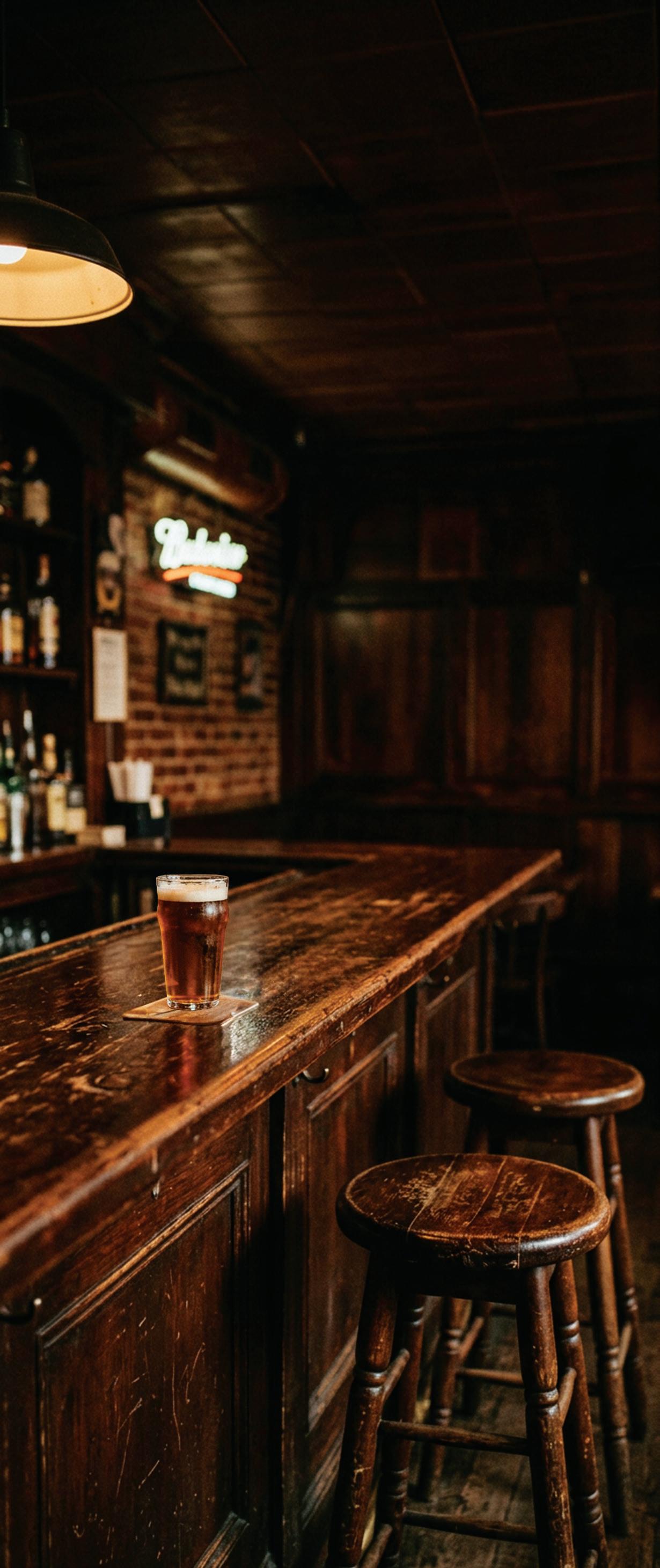
WHILE CONSUMERS ARE CUTTING BACK and spending less overall, people are still seeking social interactions and experiences outside of their homes. Bank of America credit and debit card data shows that spending at liquor, wine, and beer stores fell in January YOY— but spending at bars increased nearly over the same period.
ANOTHER BRIGHT SPOT: Restaurants and bars grew their share of beer purchases by more than $300 million last year, a YOY increase, according to a review of 2025 anonymized beer purchase data from Fintech, covering more than 145,000 restaurants & bars across the U.S.
MENTIONED IN THIS SECTION CÚRATE BAR DE TAPAS • • WHISKEY ‘N RYE • • ‘QUE
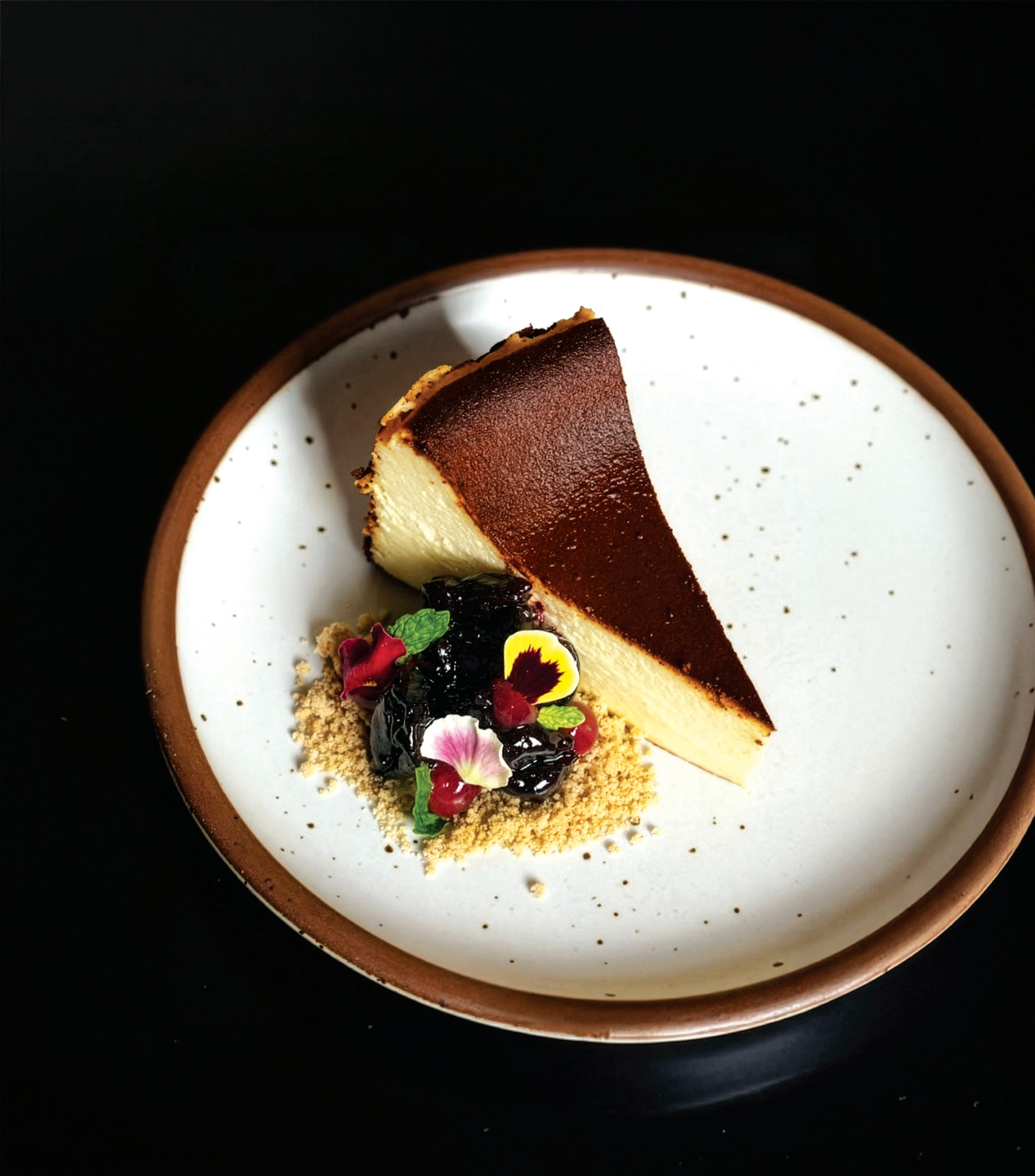
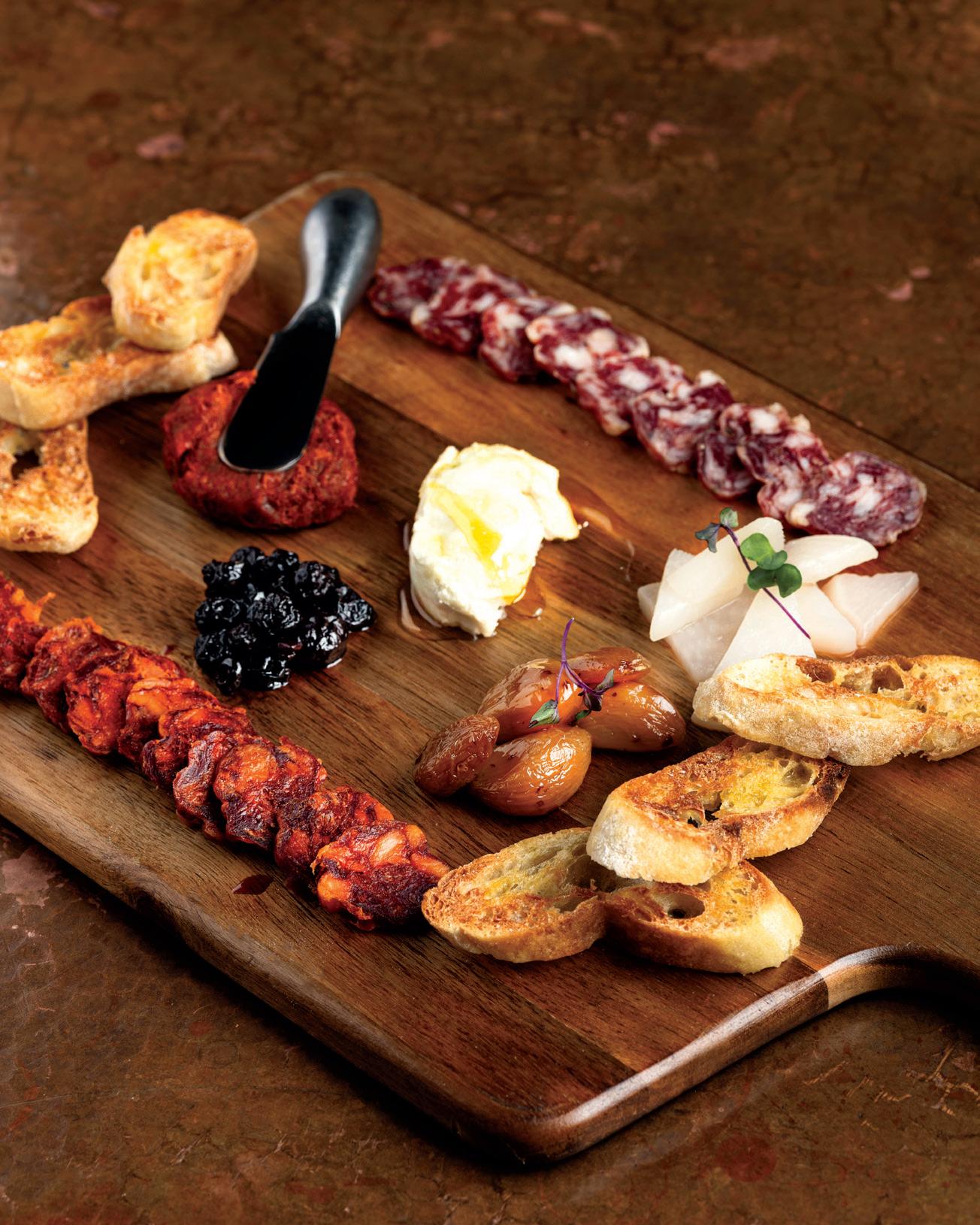
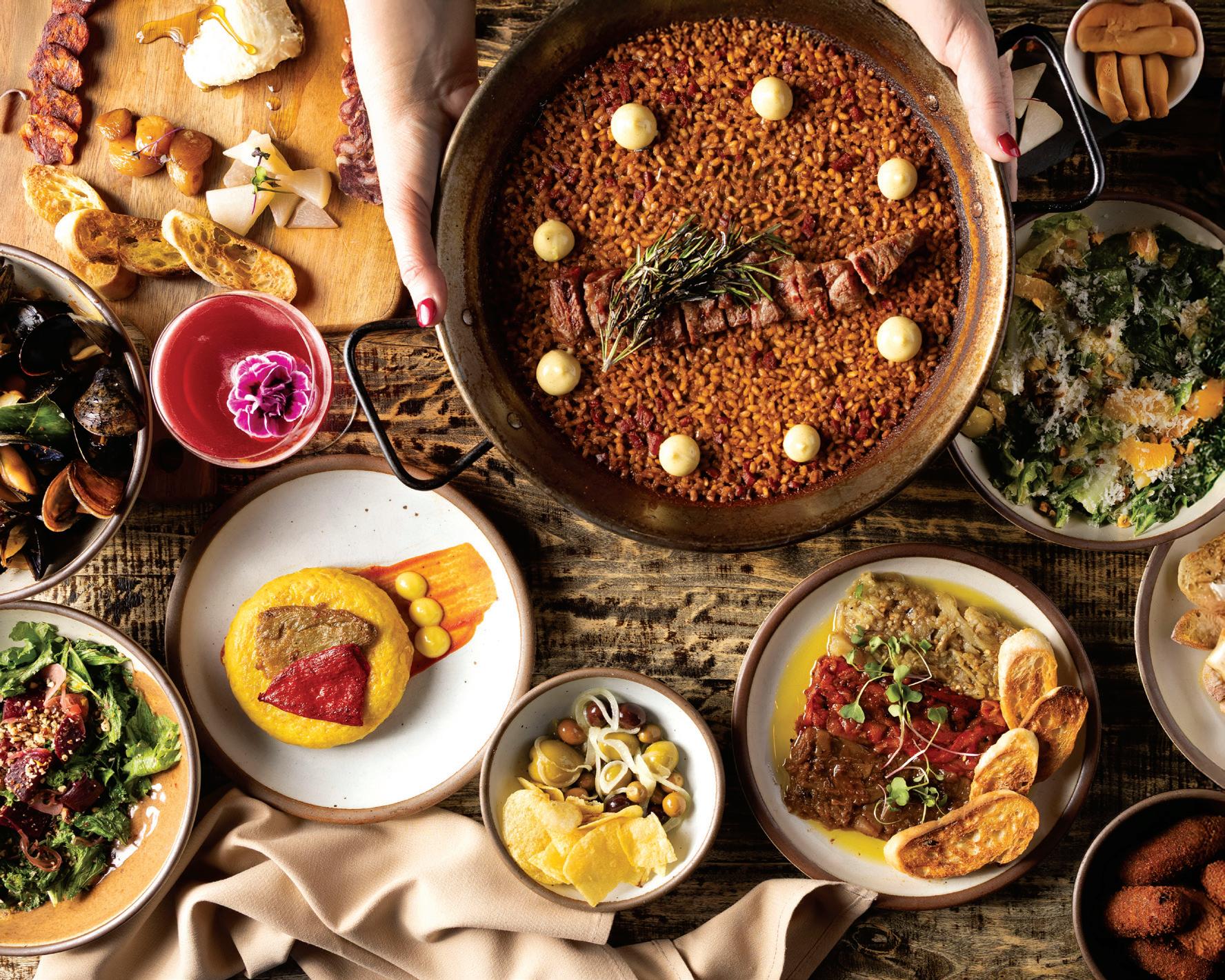
THE MENU AT CÚRATE RANGES FROM CLASSIC SMALL PLATES LIKE PATATAS BRAVAS, GAMBAS AL AJILLO, TORTILLA ESPAÑOLA, AND SEASONAL CROQUETAS TO WOOD-OVEN DISHES, PAELLAS, SPANISH CHARCUTERIE, AND DESSERTS SUCH AS BASQUE CHEESECAKE AND CREMA CATALANA.
BY CALLIE EVERGREEN
Clear systems fuel a healthy kitchen culture at Katie Button’s Cúrate.
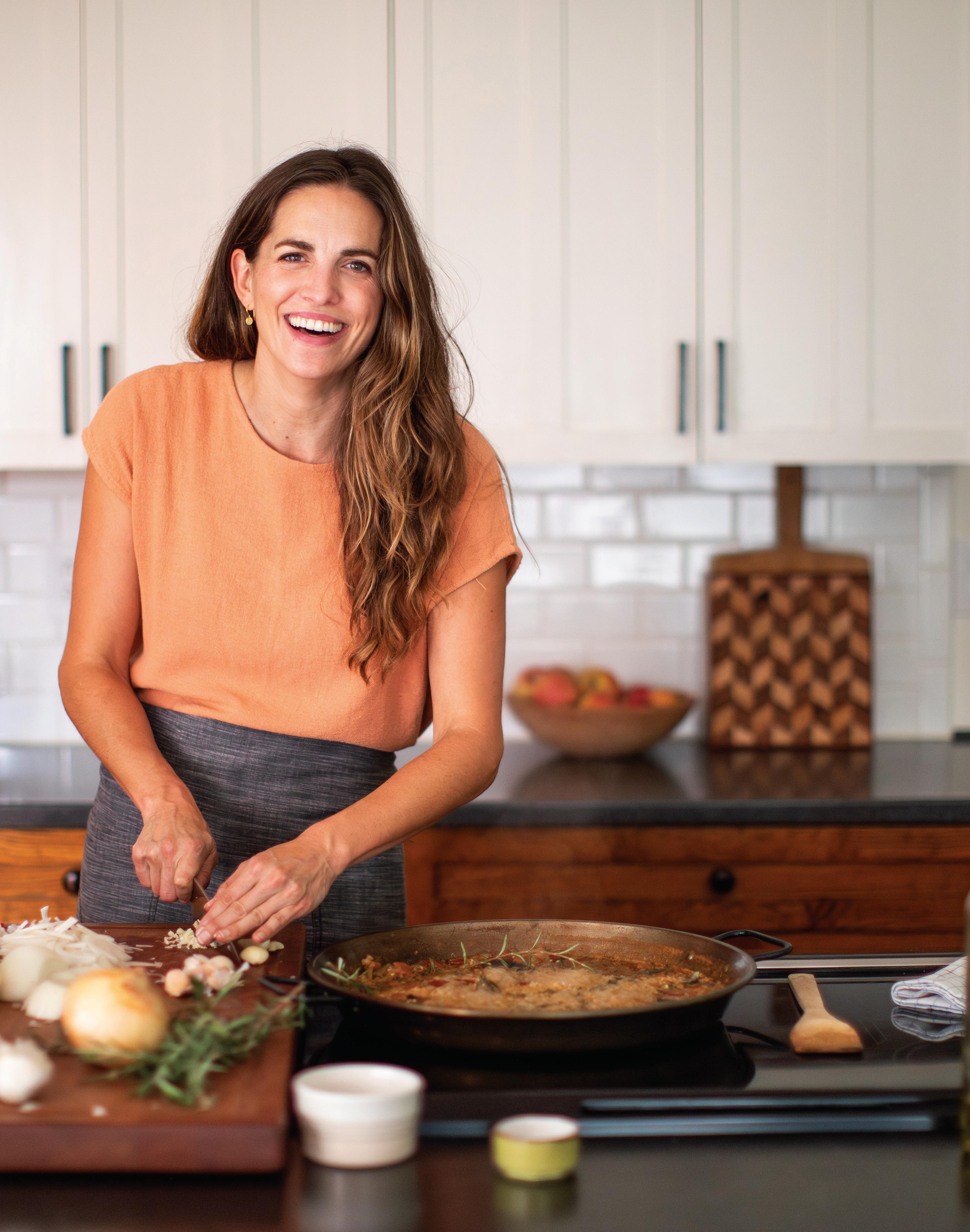
NOT MANY CHEFS or restaurateurs can say they have a master’s degree in biomedical engineering, but Katie Button is one of them. She’s the cofounder and executive chef of the acclaimed restaurant Cúrate Bar de Tapas in Asheville, North Carolina, which is celebrating its 15th anniversary this year. She recently competed on CBS’s newest reality cooking competition show, America’s Culinary Cup, where she was among the final five contestants left. Plus, she’s preparing to release her second cookbook, Spanish Accent, this upcoming fall.
Button began her journey to culinary success as a PhD dropout. “I think it was probably my junior year of college that I should have started paying attention to how I was feeling about the classes I was taking and just not really having a vision for what I wanted to do next,” she recalls, but instead, she “just kept studying.”
lar engineering degrees at Cornell, then receiving her master’s degree from Ecole Centrale, she was about to start a PhD program in neuroscience at the National Institutes of Health in Bethesda, Maryland, when she took a moment to step back and reevaluate. “It felt like, OK, this is now a decision for the rest of your life, and you better be all in on this. And if you’re not, it’s now or never to bail.”
“And so I did—I bailed,” Button admits. Her next step kickstarted what would become a wildly successful career as a chef and entrepreneur. “I knew I loved cooking. I had been cooking a lot in my spare time. My mother ran a catering business out of my childhood home, and food and cooking was such a big part of my life—I just had looked at it more as a hobby and something that kept me going than a career, but it definitely set the tone for me.”
Button needed a job, and decided to apply to be a server at multiple establishments around town. “People were crumpling up my resume with zero restaurant experience, and throwing it in the waste-
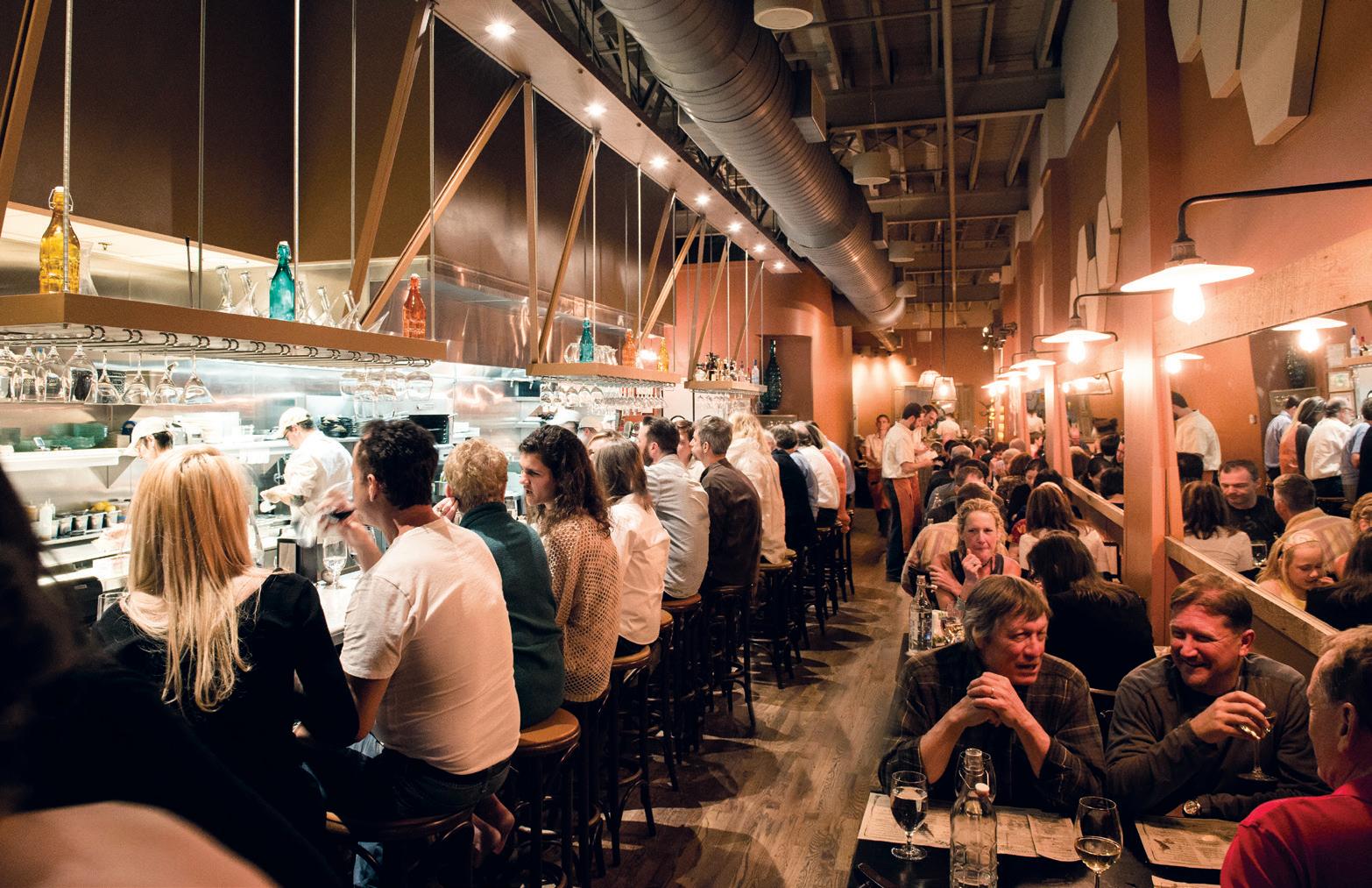
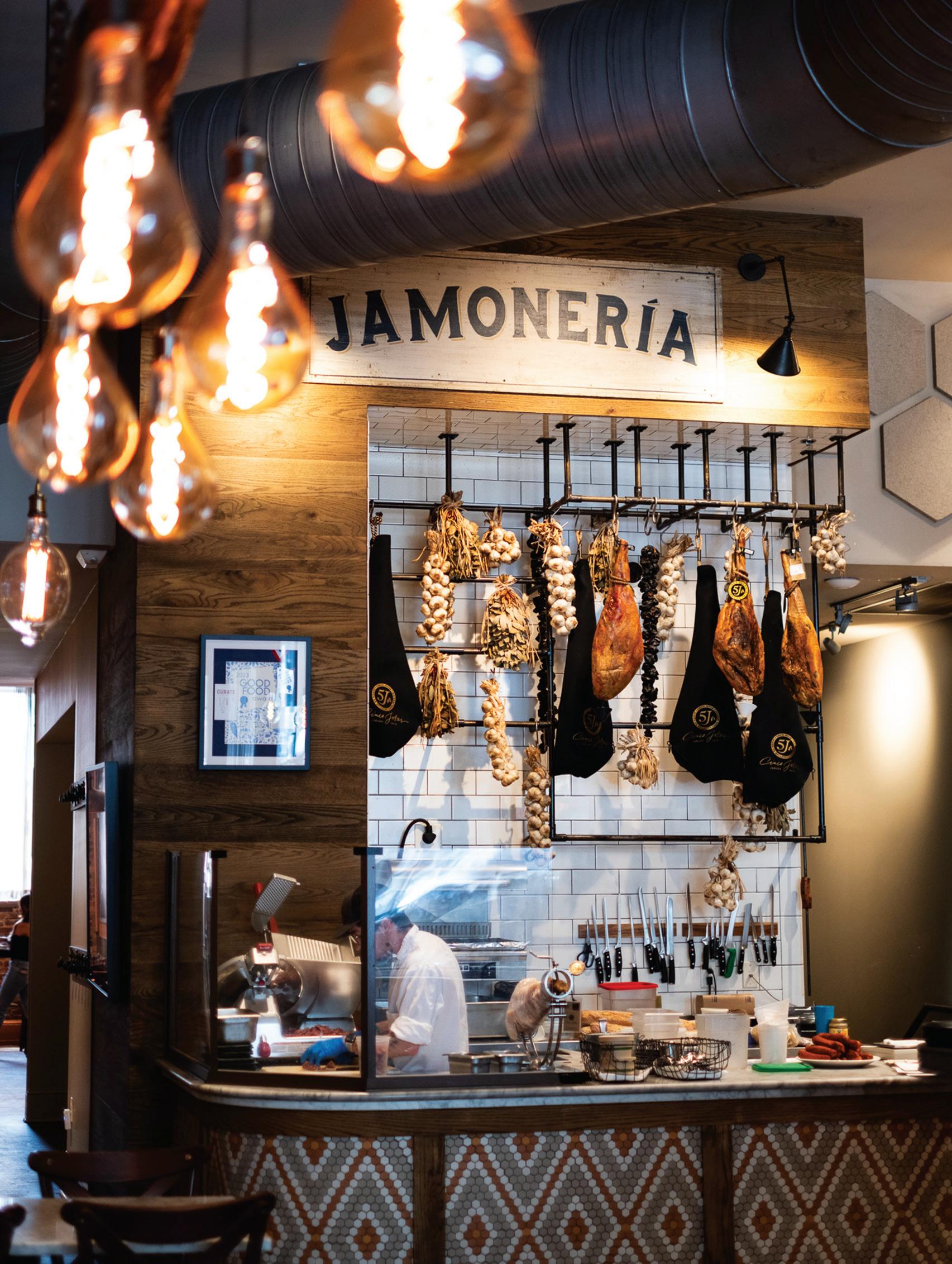
CÚRATE BAR DE TAPAS IN ASHEVILLE, NORTH CAROLINA, REFLECTS CHEF KATIE BUTTON’S COMMITMENT TO GENUINE HOSPITALITY, HIGH-QUALITY INGREDIENTS, AND A COMMUNAL DINING EXPERIENCE MEANT TO BRING PEOPLE TOGETHER.
bin left and right,” she says. Then, she walked into José Andrés’ Café Atlántico in Washington, D.C., where they gave her a quiz that tested not only her food knowledge, but also asked questions about her love and passion for food and hospitality. “They were the only ones who offered me a job, which was amazing,” Button laughs.
As soon as she started working at Café Atlántico, she knew she had “found the thing that really lights me up.” She was immediately thrust into the world of Spanish food and cooking, which would become the building blocks someday for her own Spanish tapas concept. Café Atlántico was also where she met her future business partner, Felix Meana, who became her husband, then ex-husband. “We’re best friends, and we’re still great business partners, and he’s also the father of my kids. So we are intertwined for life,” she explains.
Meana hails from Spain, and had worked at El Bulli—a legendary threeMichelin-star restaurant in Roses, Spain, managed by chef Ferran Adrià and brother Albert “that changed the way the world thought about food,” Button says on her website. “Through Felix, I found my way to Spain, and eventually into El Bulli’s kitchen myself in 2009, cooking alongside Ferran Adrià. It was the kind of experience that rewires you.”
Button found her worlds colliding while working at El Bulli, “which was literally where science and food come together.” Operating until 2011, the restaurant was widely recognized for pioneering techniques like spherification, foams, and liquid nitrogen cooking. That opportunity and learning environment felt serendipitous to Button, given her science background. “That became my way into the kitchen, was through the kind of world of molecular gastronomy where science meets food, which gave me a little bit of a leg up at the time,” she explains.
In 2011, Meana and Button—with the additional help of her parents— opened Cúrate Bar de Tapas in downtown Asheville, North Carolina, inside an old bus depot. The name means “cure
yourself”—fitting for a town that’s always drawn people looking for something restorative, Button notes. They wanted to offer honest, soulful Spanish food that honors the hospitality customs and traditions in Spain while building lasting relationships with the farmers, makers, and Asheville community.
They picked Asheville because it’s a “magical place to live.” Set against the Blue Ridge Mountains and known for its vibrant arts scene and bustling downtown streets, the city’s quirky charm and stunning natural scenery draw nearly 14 million tourists every year. And with a rising restaurant scene, “Asheville was the choice” for their restaurant, Button emphasizes.
The concept also “had to be Spanish, because first of all, it had been the only food I had professionally cooked, which is just wild,” she says. “And also, he’s from Spain, and so he keeps me very honest on authenticity. And my kids are 50 percent Spanish. So Spain is my food love language, for sure.”
The menu at Cúrate is rooted in the lively tapas culture of Spain—inspired by its prized jamón Ibérico, vermuterías, and spirit of sobremesa—and guided by Spanish tradition and local Appalachian ingredients. The offerings range from classic small plates like patatas bravas, gambas al ajillo, tortilla Española, and seasonal croquetas to wood-oven dishes, paellas, Spanish charcuterie, and desserts such as Basque cheesecake and crema catalana. Altogether, the menu
MOST FREQUENT EMOTION ON AMERICA’S CULINARY CUP? STRESS
KITCHEN TOOL YOU CAN’T LIVE WITHOUT?
Microplane
MOST UNDERRATED INGREDIENT? Anchovy paste
SECRET COMFORT FOOD? Cheetos
BEST MUSIC TO COOK TO? ‘90s Hip Hop

reflects Button’s commitment to genuine hospitality, high-quality ingredients, and a communal dining experience meant to bring people together.
In 2022, the James Beard Foundation honored Cúrate with its Outstanding Hospitality Award, and the restaurant was recognized in the 2025 Michelin Guide. Button has now been nominated for a James Beard Award five times, and in 2015, received the honor of being recognized as Food & Wine’s “Best New Chefs.”
Looking back, Button admits there were moments when she “doubted whether or not I could do it, for sure— just the long hours, the demand, the teaching and training of a team,” she says. “In the kitchen, you have to teach and train everyone how to do all of the things and stay on top of it and make sure it’s all being made properly. And when you’re starting up, it’s teaching everyone from nothing … It’s really, really difficult. And I think I would have just told myself to be patient, take some deep breaths, and focus on systems; systems make things easier.”
From writing out all the recipes for her dishes to creating charts and documents for inventory, Button found the more organized and structured she could be, the more efficiently she could run her restaurant and her team. “Our culture is a little bit about knowing exactly what you’re supposed to be doing and how to do it, and being given the tools that you need for that … coupled with this feel-
ing of joy around shared dining experiences and hospitality and how to show up, not only for our guests, but also for each other in our workplaces,” she says.
By figuring out how to straddle these areas of structure, systems, and genuine care, Button has been able to engineer a kitchen culture marked by open communication and a commitment to continuous improvement. When problems arise—whether with service or staff— Button and her team assume a system or process is missing or broken, then focus on fixing it to prevent similar issues in the future. “It’s constantly about solving things so that the problem doesn’t happen again, and listening to people and understanding that we’re constantly striving to improve who we are and what we’re doing, both individually and personally, but also as a group together and a company and what we offer our guests,” she says.
That philosophy shows up tangibly in the restaurant’s all-hourly tip-shar -
ing model, which pays everyone well above minimum wage and distributes tips transparently across front- and back-of-house (supported by tech such as 7shifts) so each role is recognized as equally essential to the guest experience. Over time, Button and her team have also built a robust benefits package including health, dental, and vision insurance, short-term disability, paid sick and vacation time, a 401(k), and a self-insured health plan paired with optional direct primary care memberships to make everyday and preventive care more accessible and affordable for staff.
Looking at broader cultural shifts and trends in the restaurant industry, Button has seen “a large shift in the focus and intention of how we take care of the people who work for us, and foster these cultures [where] the expectations are clear and fair—I think that that is where we are headed,” she adds.
BY SATYNE DONER
From smoked jackfruit to rare ryes, Don Conner is rewriting the barbecue rulebook in Santa Barbara.
DON CONNER FOLLOWS ONE SIMPLE PHILOSOPHY, put forth by the late Anthony Bourdain: “Barbecue may not be the road to world peace, but it’s a start.”
While the central coast of California is known for Santa Maria-style barbecue (tri-trip beef grilled over red oak coals and seasoned with salt, pepper, and garlic, served with traditional sides like salsa, pinquito beans, and garlic bread), Conner noticed a significant gap in the market for a true West Coast style.
He traveled around the U.S. to barbecue hotbeds, studying and observ -
ing: Texas, the Carolinas, Tennessee, and Kansas City. He took inspiration from the low-and-slow smoked traditions of Kansas City and North Carolina’s vinegar-based sauces as he began building out his concept, Whiskey ‘N Rye, which opened in 2023 in Solvang, nestled in the heart of the Santa Ynez Valley of Southern California.
“California is where traditions evolve. We wanted to take the soul of American barbecue and translate it within a lens of California. It wasn’t about importing barbecue as it was reinterpreting it,” Conner
says. “What stood out to me in my travels was how often the focus stopped at the meat, and the sides were an afterthought … I viewed that as an opportunity.”
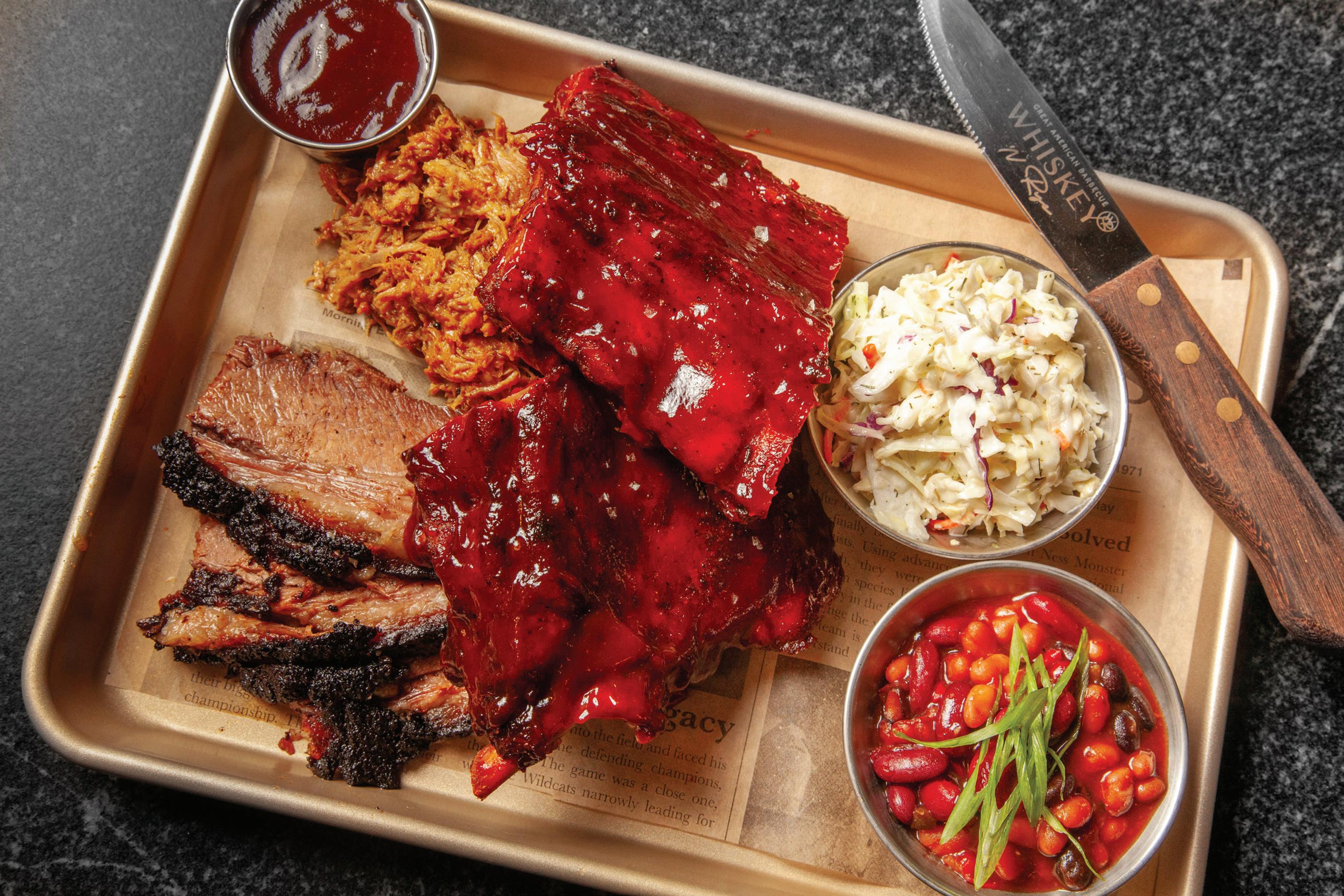
So Conner took the incredible discipline and technique from America’s barbecue meccas and built out a more evolved and full experience, where every element of the plate feels like a main dish. The centerpiece of the concept is an indoor hickory wood-chip smoker, which smokes two times a day, smoking everything from traditional brisket and pulled pork to vegetables and salmon.
THERE
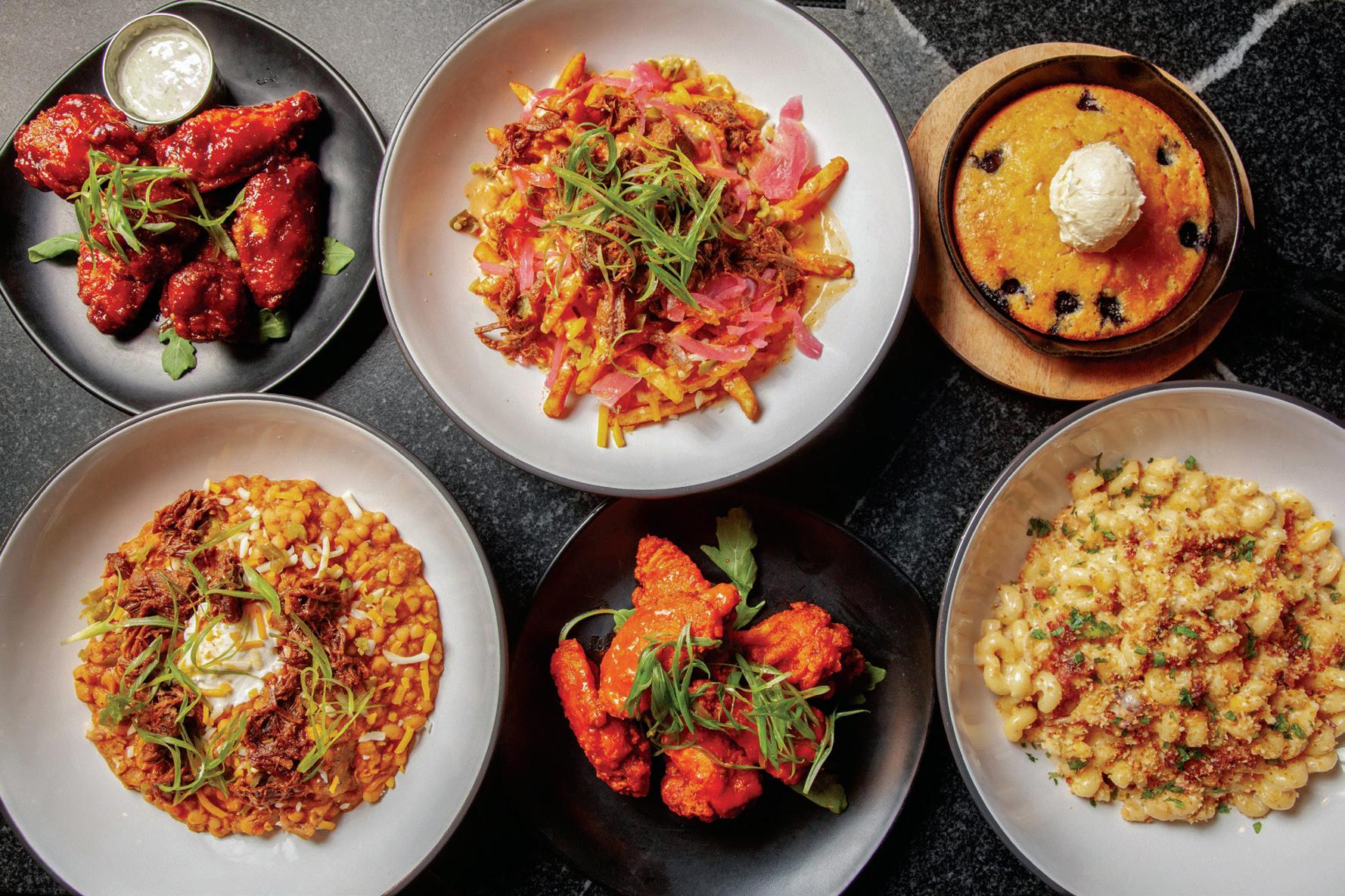
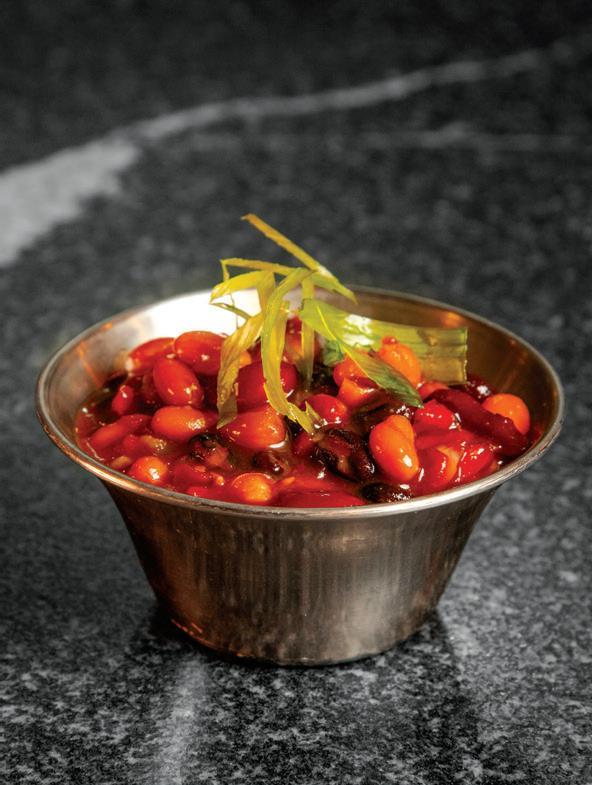
Take the bourbon baked beans, for example. There are more than a dozen different ingredients and three different types of beans in it, with heavy notes of brown sugar and jalapeño. The threecheese macaroni has smoked gouda, cheddar, mozzarella, and a medley of spices on cavatappi pasta. Then there’s the elote corn quarters, tossed in a paprika aioli, topped with feta cheese and cilantro.
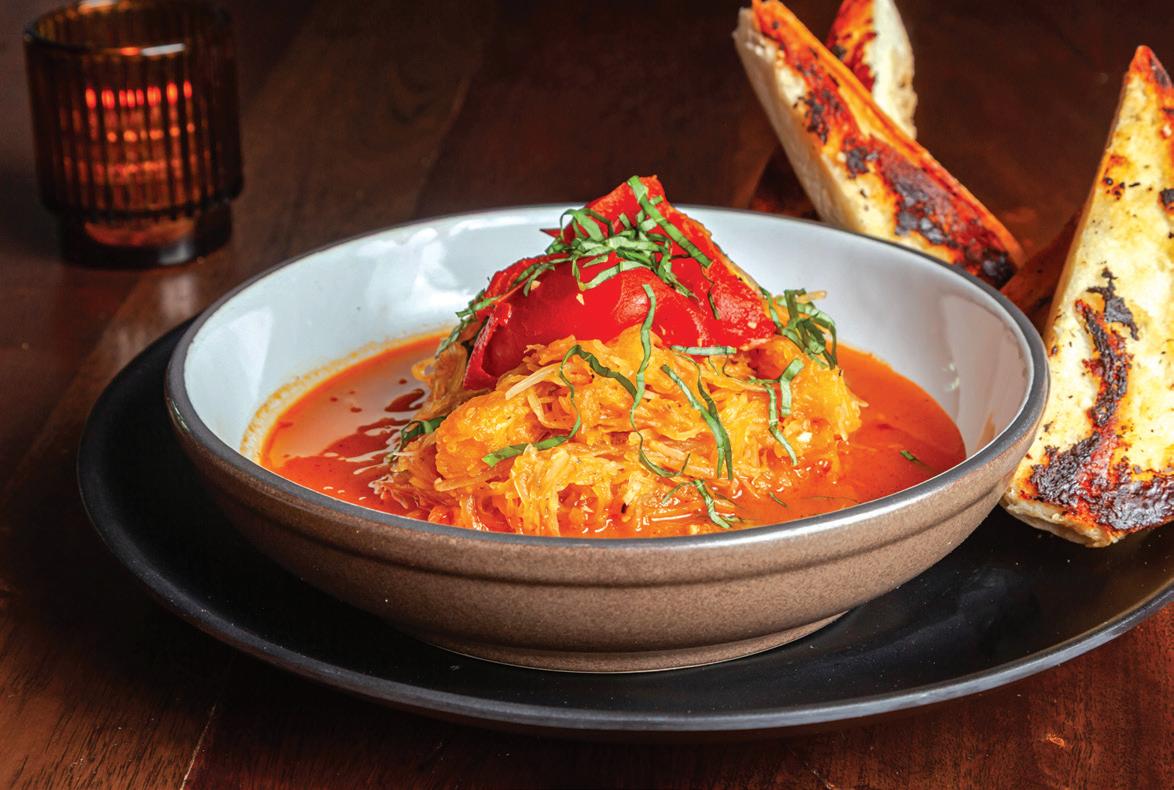
Part of this West Coast barbecue evolution also includes expanding barbecue to encompass things that people wouldn’t traditionally smoke and grill— spaghetti squash noodles with hickorysmoked Roma tomato, smoked jackfruit, and cremini mushrooms with a tamari barbecue sauce, for example.
Moving into the sweeter side of things, there’s also a smoked chocolate s’mores mousse, where the cream is smoked and served with a Graham
cracker crust, Italian meringue, and a warm caramel drizzle.
“You have to earn innovation,” Conner adds. “We always start with the fundamentals. The fire, the smoke, the time, and the technique. Then, you can layer in new ideas without being different just for the sake of it. You have to be willing to innovate to make the whole culinary experience better … and sometimes, the greatest challenge is just getting people to think outside of the box when it comes to barbecue.”
Conner has also leaned into barbecue’s natural pairing with whiskey. For him, whiskey and barbecue both come from fire, time, and wood. His cocktail menu brings in over 200 whiskeys from rare bourbon, rye, scotch, Irish, and Japanese varieties, with pairings built between entrees and beverages with an inherent balance—big and bold, lean and smooth.
“Sometimes, the greatest challenge is just getting people to think outside of the box when it comes to barbecue."
There’s the apple pie old-fashioned, with Rod & Hammer’s Winter Spiced Bourbon, Rock 12 Quince, brown sugar syrup, and walnut bitters; a spicy watermelon old-fashioned with Elijah Craig bourbon, Watermelon Pucker, orange juice, habanero simple, and bitters. The Whiskey ‘N Rye brunch menu also offers a Kentucky iced coffee with peanut butter-flavored whiskey, banana syrup, coffee, and whipped cream served over ice.
After the early success of Whiskey ‘N Rye, Conner expanded to Santa Barbara in December 2025, opening a fast-casual concept called ‘Que, bringing high-quality yet approachable barbecue to the community’s public market. He says elevating and innovating around his brand, not boxing himself in, is his secret sauce.
“In our original location [in Solvang], we saw over 121,000 guests come through our restaurant, and it’s not a big space. A big part of bringing that many people through our concept is staying within our brand yet broadening the attraction of our concept through traditional offerings like ribs and brisket, but also having prime steaks, grilled fish, and smoked vegan dishes,” Conner adds. “If we were ‘traditional barbecue’ only, I would argue we would have only seen 80,000 guests last year.”
Looking ahead, he hopes to continue evolving his barbecue concepts, honoring traditions while showcasing the art of grilling and smoking in a different light. The ultimate goal is to open 12 to 14 ‘Que locations over the next five years and four to five full-service Whiskey ‘N Rye locations in the greater Santa Barbara area and Santa Ynez Valley.
“We’re going to keep pushing the envelope with mixing in other ingredients, techniques, and foods that aren’t traditionally smoked or grilled,” Conner says. “We’re going to continue evolving our business and changing how folks look at this segment of the restaurant industry.”
Rethink how a highdemand ingredient shows up in the kitchen.
IN A WORLD where kitchens are busier and stretched thin—with labor shortages, high turnover, and rising food costs— even the simplest ingredient can either help or hurt. Cheese, for all its rich flavor and universal appeal, can slow down a line if it’s not easy to handle or portioned consistently.
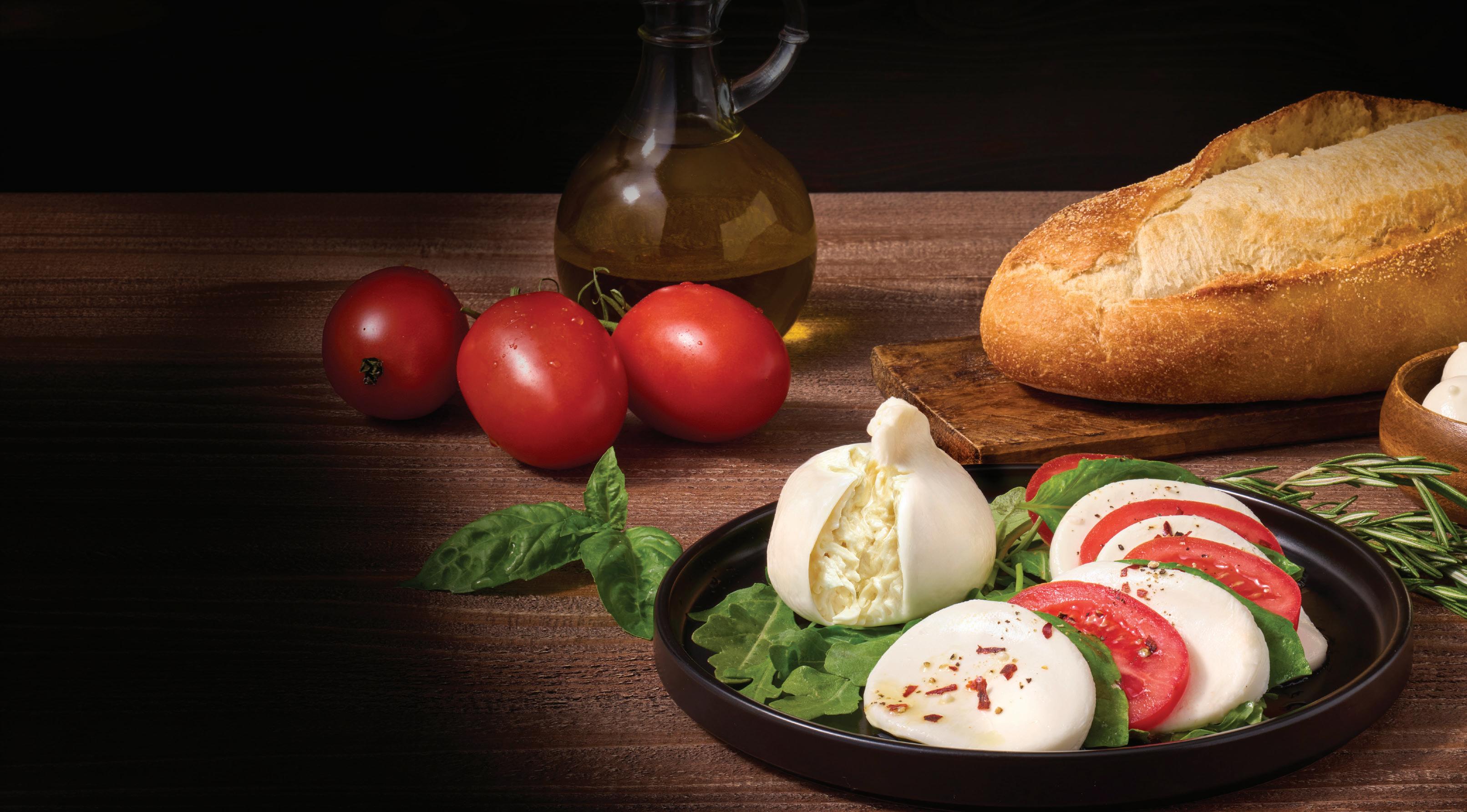
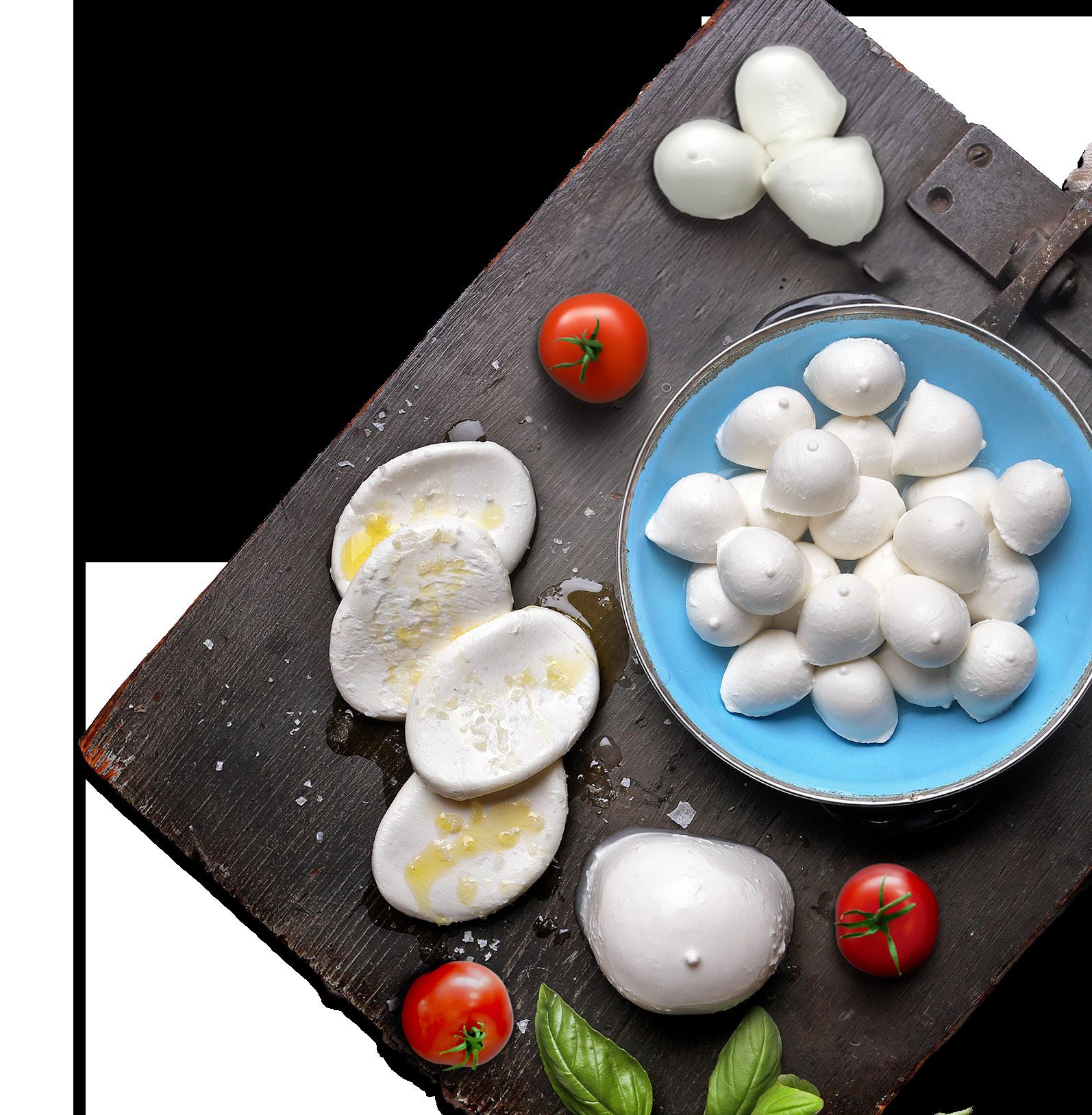
Fresh mozzarella is a good example. The cheese continues to gain traction on pizzas, flatbreads, sandwiches, and other premium items, but it can create challenges in the kitchen when it is not optimized for operations. In many restaurants, staff members are still slicing mozzarella by hand from larger logs, which can slow service, create inconsistent portions, and introduce unnecessary waste.
That challenge created an opportunity for Caputo Cheese when a restaurant chain with more than 2,100 locations needed support for an LTO featuring fresh mozzarella. The brand wanted a product that delivered on taste, melt, nutrition, and portion control, but it also needed a
format that could work efficiently across thousands of kitchens. Caputo Cheese partnered with the chain’s research and development team to create custom mozzarella slices designed for consistent performance from store to store.
The impact went beyond product quality. By helping the chain standardize portioning and reduce labor tied to backof-house prep, the cheese program supported smoother execution at scale. The LTO drove a 50 percent increase in orders within the first year, and the mozzarella slices remained on the menu after the promotion ended.
For restaurant operators, the takeaway is clear: product innovation does not always have to mean a new menu platform or major equipment investment. Sometimes it comes from rethinking how a high-demand ingredient shows up in the kitchen. When suppliers can help restaurants reduce prep time, improve consistency, and control waste, they become strategic partners rather than simple vendors.
That positioning reflects the broader Caputo Cheese story. The company traces its roots to 1978, when Pasquale Caputo opened a small cheese shop built on Italian tradition and a strong commitment
to quality. Over time, that foundation evolved into a national business serving restaurant operators with products that balance craftsmanship and efficiency.
Today, the company offers a wide range of shredded, shaved, and grated hard Italian cheeses, and a full line of Award-Winning Fresh Mozzarella aimed at helping kitchens simplify prep without giving up flavor. It also works with operators on custom solutions, including proprietary blends and cheeses tailored for specific menu applications. The goal is to help restaurants solve operational problems while strengthening the guest experience.
That matters in every segment, from quick service and fast casual to pizza, casual dining, and full service. Operators everywhere are looking for ways to protect margins while still delivering craveable food. Supplier partners that understand both culinary performance and kitchen realities can play an important role in making that happen.
In the end, this is not just a story about cheese. It is a story about how smart product design, strong supplier collaboration, and operational simplicity can help restaurants grow sales and execute more effectively at scale. ✦



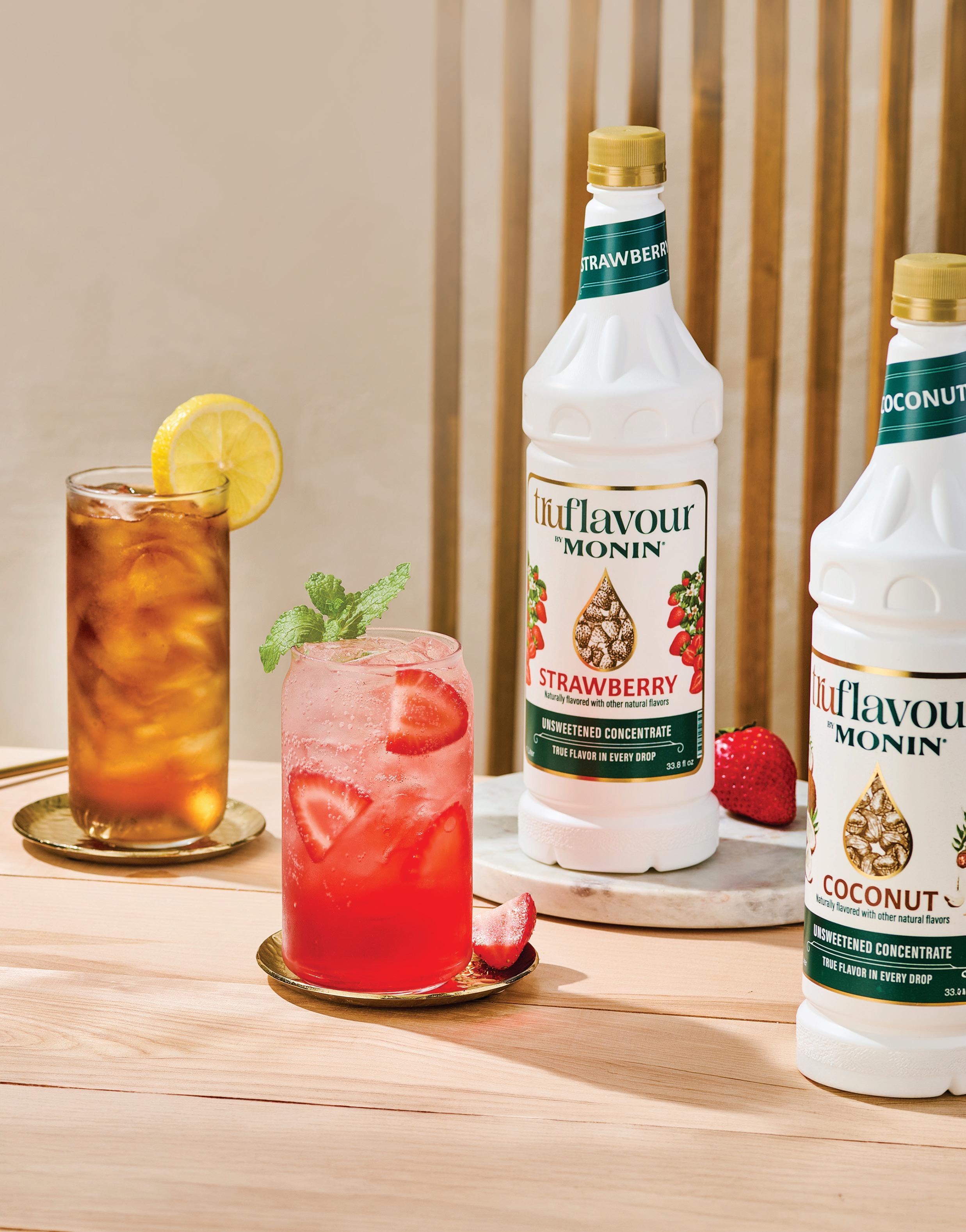
TruFlavour by Monin delivers bold, authentic flavor with no added sugar or sweeteners—perfect for elevating a variety of beverages and culinary creations.
Scan to discover more.
MENTIONED IN THIS STORY
BW166 • • NATIONAL BEER WHOLESALERS ASSOCIATION
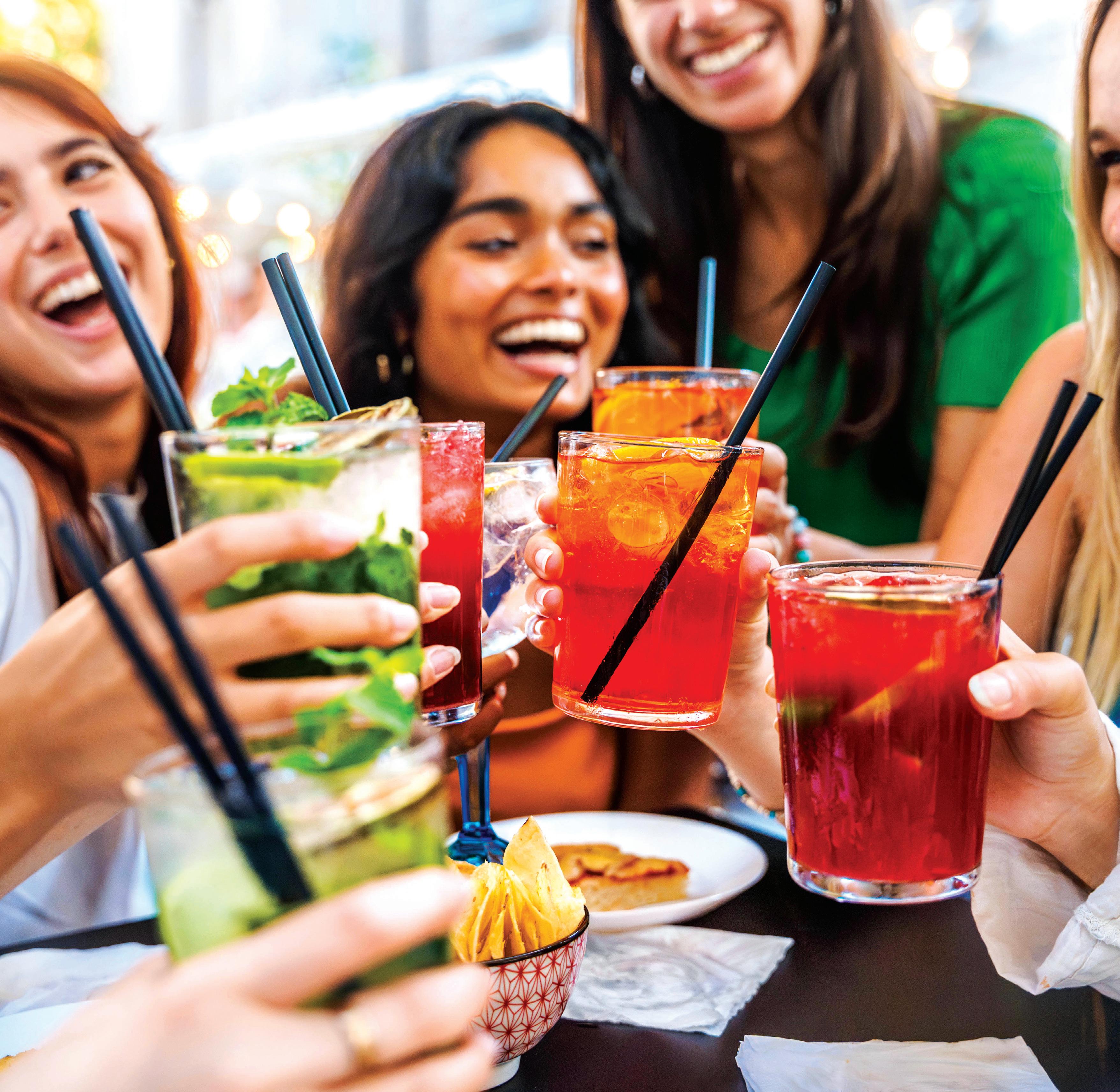
THE UNDERLYING CHALLENGE IS STRAIGHTFORWARD: GUESTS STILL WANT THE EXPERIENCE, BUT THEY ARE LESS WILLING TO PAY FOR MULTIPLE ROUNDS ONCE THEY’RE THERE. THAT PUTS MORE WEIGHT ON THE EXPERIENCE ITSELF. AND THAT’S WHERE THE SOCIAL NATURE OF DRINKING— AND THE ROLE OF RESTAURANTS AS PLACES FOR CONNECTION AND IN-PERSON INTERACTION— BECOMES MORE CENTRAL.
BY SAM DANLEY
Demographics and sticker shock are reshaping drinking culture.
FOR YEARS, THE CONVERSATION around alcohol in the U.S. has been framed in terms of decline: less drinking, more moderation, a generational pullback from booze. There’s no denying that drinking habits have changed, but that head-
line doesn’t fully capture what’s happening inside restaurants and bars right now. In fact, consumers broadly—and younger adults in particular—are shifting spending away from at-home purchases and toward social, on-premises experiences.
“The biggest and most unreported news in the alcohol beverage world is the fact that American consumers are more likely to spend their money away from home than they are at home,” says Lester Jones, vice president of analytics and chief economist at the National Beer Wholesalers Association. “This has never existed in the history of the United States.”
That shift, which he says fully flipped in 2025 after years of convergence, helps explain why industrywide volume data can look soft even as on-premises drinking gains share. It changes the math in ways that aren’t always obvious.
“Drinking at home is kind of a continuous thing,” Jones says. “I buy a 12-pack, I put it in the refrigerator, I consistently drink. Drinking in a bar or a restaurant is very discrete. It’s one or two.”
In other words, a consumer who once bought a six-pack for home consumption might now go out and order a single beer. The drinking occasion still exists, but the volume attached to it is smaller and more expensive.
That distinction is showing up across categories. A bottle of wine consumed at home may translate to multiple glasses over time; in a restaurant, it’s often replaced by a single glass. A bottle of spirits that might yield more than a dozen servings becomes one cocktail ordered with dinner. Layer in the rise of
single-serve formats like ready-to-drink cocktails, and the shift becomes even more pronounced.
If the shift from at-home to on-premises drinking helps explain the missing volume, pricing helps explain what’s happening once guests arrive.
Jon Moramarco, managing partner of alcohol analytics firm bw166, points to a steady rise in prices that has reshaped how guests behave once they sit down. “If you go back to the mid’90s, a lot of the time, a bottle of wine was two times wholesale plus a dollar,” he says. “Today, you’re looking at four or five-times markups. It’s becoming an economic shock to consumers.”
That is just as visible in cocktails. The average price of a cocktail has climbed to $14.20 across major U.S. cities, with prices ranging from $10 to $22, according to an analysis by The Liquor Bros. The cost of making that same drink at home remains a fraction of the price.
“You mix it at home for a buck and a quarter, a buck and a half a serving,” Moramarco says. “You go to a restaurant and all of a sudden you’ve got a cocktail that’s $12.”
That dynamic could be fueling a rise in “predrinking” before going out. Nearly a third of drinkers surveyed by consumer insights platform Zappi this year said they do so to avoid high onpremises prices. Among those who say
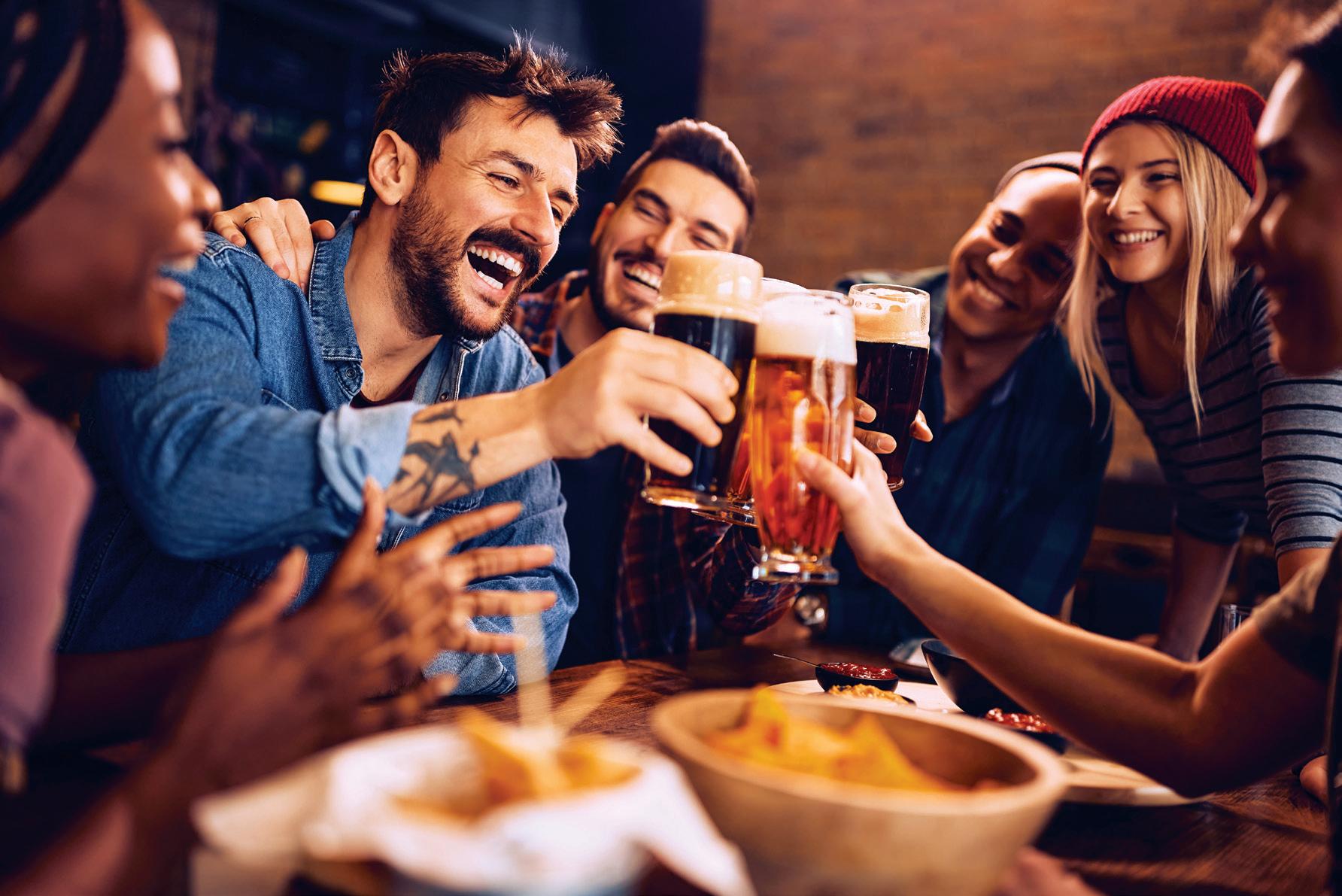
“I think in 2026, we’re going to have a renewed interest in sociable interactions. Operators that know how to get people out and interacting with their friends, their family, their coworkers… it’s going to serve them well.”
prices influence their decision to go out, 37 percent said they predrink, while 41 percent said they opt for water or nonalcoholic options instead.
Even for those who do order alcohol on premises, the number of drinks per visit is often lower than it used to be. “You want to have six beers while you’re out, but you can’t afford a $50 bar tab,” Jones says. “So, you’ll just stick with one or two.”
From his perspective, that behavior doesn’t necessarily—or exclusively— reflect changing attitudes toward alcohol. “Pricing moderates consumption,” he says. “That’s just basic economic theory.”
That pressure is being reinforced by who is doing the drinking. Moramarco points to a long-term demographic squeeze that is reshaping demand. For decades, baby boomers were the primary engine of alcohol consumption. As that group ages, their habits are changing.
“As people age, typically you see over 65, the percent of people drinking drops, and their consumption per week goes down,” Moramarco says. “That’s a negative impact to on-premise and off-premise beverage alcohol.”
At the other end of the spectrum, younger consumers are entering the market with different behaviors. “With Gen Z, we’re seeing much lower consumption per week than we have in the past,” he says.
LARGER, MORE FAMILIAR BEER BRANDS HAVE GAINED GROUND IN ON-PREMISES SETTINGS, WHILE SLOWER-MOVING CRAFT OPTIONS HAVE LOST SOME SHARE. IN SPIRITS, TEQUILA AND READY-TO-DRINK COCKTAILS ARE THE PRIMARY AREAS OF GROWTH, WHILE LEGACY CATEGORIES LIKE VODKA AND WHISKEY HAVE SOFTENED.
The middle of the market—roughly ages 30 to 65—has remained relatively steady over time, but that stability only goes so far in offsetting declines on either end.
Moramarco sees that dynamic playing out differently inside restaurants. “Older people drink a lot less, but they











spend a lot more,” he says. “Younger people spend less, but drink more.”
For operators, that creates a balancing act that is becoming harder to manage. The idea of building a beverage program that appeals to everyone is giving way to more targeted approaches. “You’d like to be everything for everybody,” Jones says. “But that’s a really hard place to operate from. You’ve kind of got to pick and choose.”
In practice, that often means deciding whether to prioritize check average or volume—higher-spending, lowerfrequency guests versus younger, more price-sensitive ones.
At the same time, rising costs across the board are forcing operators to take a more disciplined approach to what they put behind the bar. Before COVID, many restaurants were willing to carry broader assortments—long beer lists, deep wine programs, a wide range of spirits—on the assumption that variety itself was a draw. In today’s environment, that approach is harder to justify.
“Every time you take a dollar and you invest it behind the bar, that dollar had better be working for you,” Jones says.
The result is a shift toward tighter, more focused beverage programs built around products that reliably sell. Instead of dozens of options, operators are leaning into a smaller set of highvelocity choices. “You want three beers that move. You want a couple of wines that move. You want some liquor that moves,” Jones says. “And that’s it.”
That focus on efficiency is showing up across categories. In beer, larger, more familiar brands have gained ground in on-premises settings, while slower-moving craft options have lost some share. In spirits, Moramarco points to tequila and ready-to-drink cocktails as the primary areas of growth, while legacy categories like vodka and whiskey have softened.
Wine presents a different kind of challenge. While certain segments— sparkling, Sauvignon Blanc, Pinot Grigio—have held up better than others, he sees a broader issue in how wine is positioned in restaurants.
“I don’t think we’re doing a good
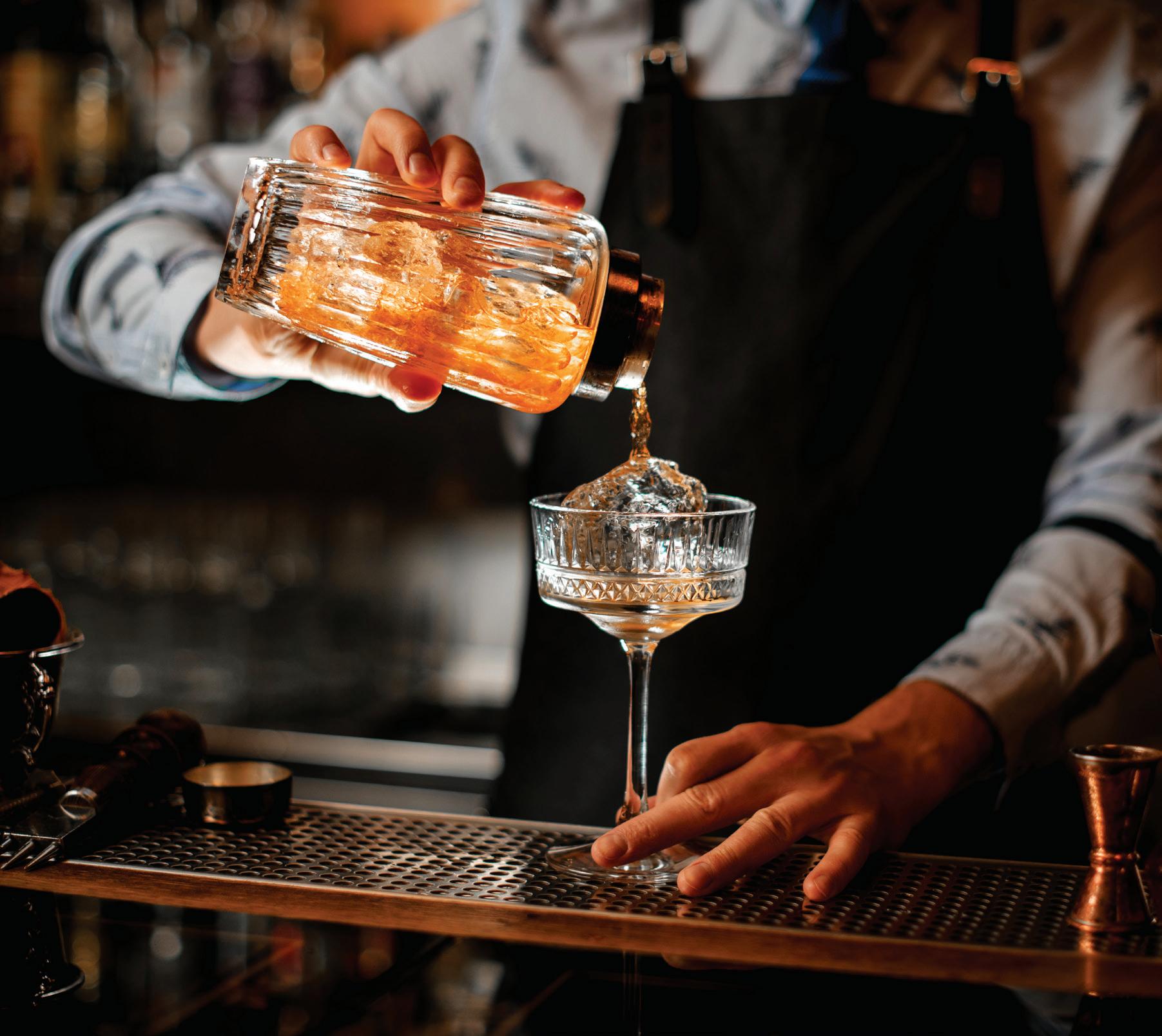
enough job… to really give younger consumers, ‘Here’s what this wine will taste like, and here’s why you want to drink it with this food,’” Moramarco says. “Very few restaurants actually say, ‘You can order this with this menu item, and this is why it’ll go together well.’”
Without that guidance, wine can feel like a riskier choice—especially at higher price points—compared to more straightforward options like beer or cocktails.
All of this is forcing operators to rethink not just what they sell, but how they price and present it.
“I think they have to rethink how they can run a profitable business, not just that they have to mark up beverage alcohol so much,” Moramarco says. He points to strategies like more approachable bottle pricing, promotions on slower nights, and bundling drinks with food as ways to maintain value without relying entirely on higher margins.
The underlying challenge is straightforward: guests still want the experience, but they are less willing to pay for multiple rounds once they’re there. That puts more weight on the experience itself.
THE AVERAGE PRICE OF A COCKTAIL HAS CLIMBED TO $14.20 ACROSS MAJOR U.S. CITIES, WITH PRICES RANGING FROM $10 TO $22, ACCORDING TO AN ANALYSIS BY THE LIQUOR BROS. THAT DYNAMIC COULD BE FUELING A RISE IN “PREDRINKING” BEFORE GOING OUT.
And that’s where the social nature of drinking—and the role of restaurants as places for connection and in-person interaction—becomes more central.
Moramarco frames on-premises drinking as a potential counterweight to rising loneliness, particularly among younger consumers, by creating space for the kind of in-person connection many feel they’re missing.
Jones sees an opportunity in leaning into that role more intentionally, particularly with formats that encourage sharing and longer visits. “Watching someone go up, buy a pitcher of beer and get four glasses and take it back to a table… that is the definition of sociability,” he says. “You don’t get that with a cocktail or a bottle. It’s just a different message.”
If the number of drinks per guest is unlikely to return to previous levels, the focus shifts to how those occasions are structured.
“I think in 2026, we’re going to have a renewed interest in sociable interactions,” Jones says. “Operators that know how to get people out and interacting with their friends, their family, their coworkers… it’s going to serve them well.”
You should know—you’re one of them.
You’re what we at FSR like to call “tablesetters.”
You make things happen in the restaurant industry.
You’re an innovator on your menu and in all aspects of your operation.
You’re watched and emulated by other restaurateurs.
You lead the markets you operate in.
These are the characteristics that make a tablesetter. And FSR is the trusted source of information for these most influential chefs and restaurateurs in the industry. Request your free subscription today by visiting FSRmagazine.com/subscribe Full-Service Restaurants : Setting America’s Table
Founder and CEO Chris Simms spills the secrets behind building Lazy Dog’s famously positive culture, and what drives the 51-unit brand’s consistently high employee satisfaction rates and “Great Place to Work” status.
BY CALLIE EVERGREEN
A LOT OF COMPANIES CHIRP ABOUT HOW GREAT THEIR CULTURE IS, but it remains a metric that often gets measured intangibly— propped up by a generic core values plaque hung on a wall employees walk by every day. It’s a subject best backed up not only by observations, but by fairly and accurately surveying actual team members. It becomes obvious when a brand leader talks the talk, but doesn’t walk the walk. That’s not the case with Lazy Dog.
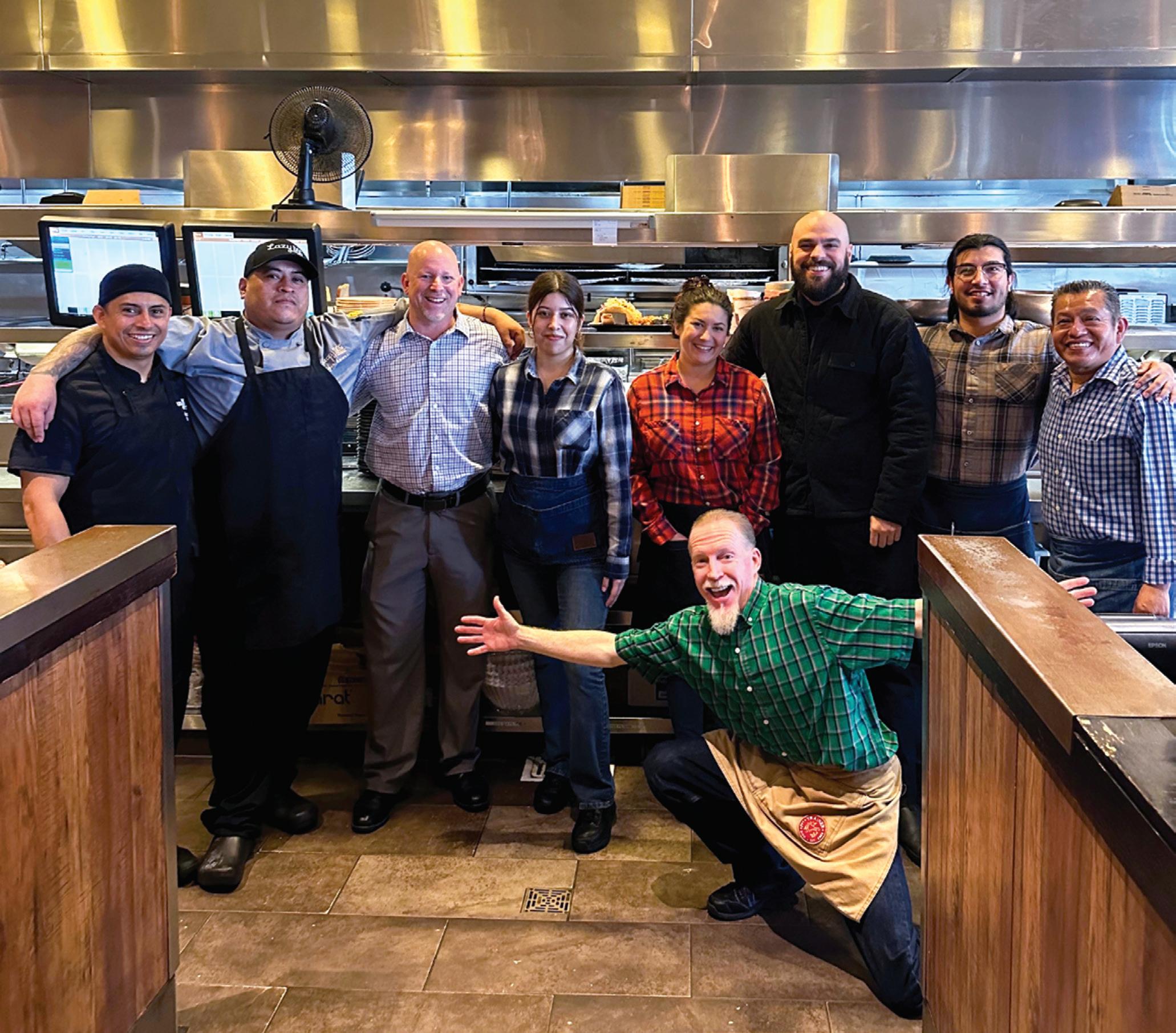
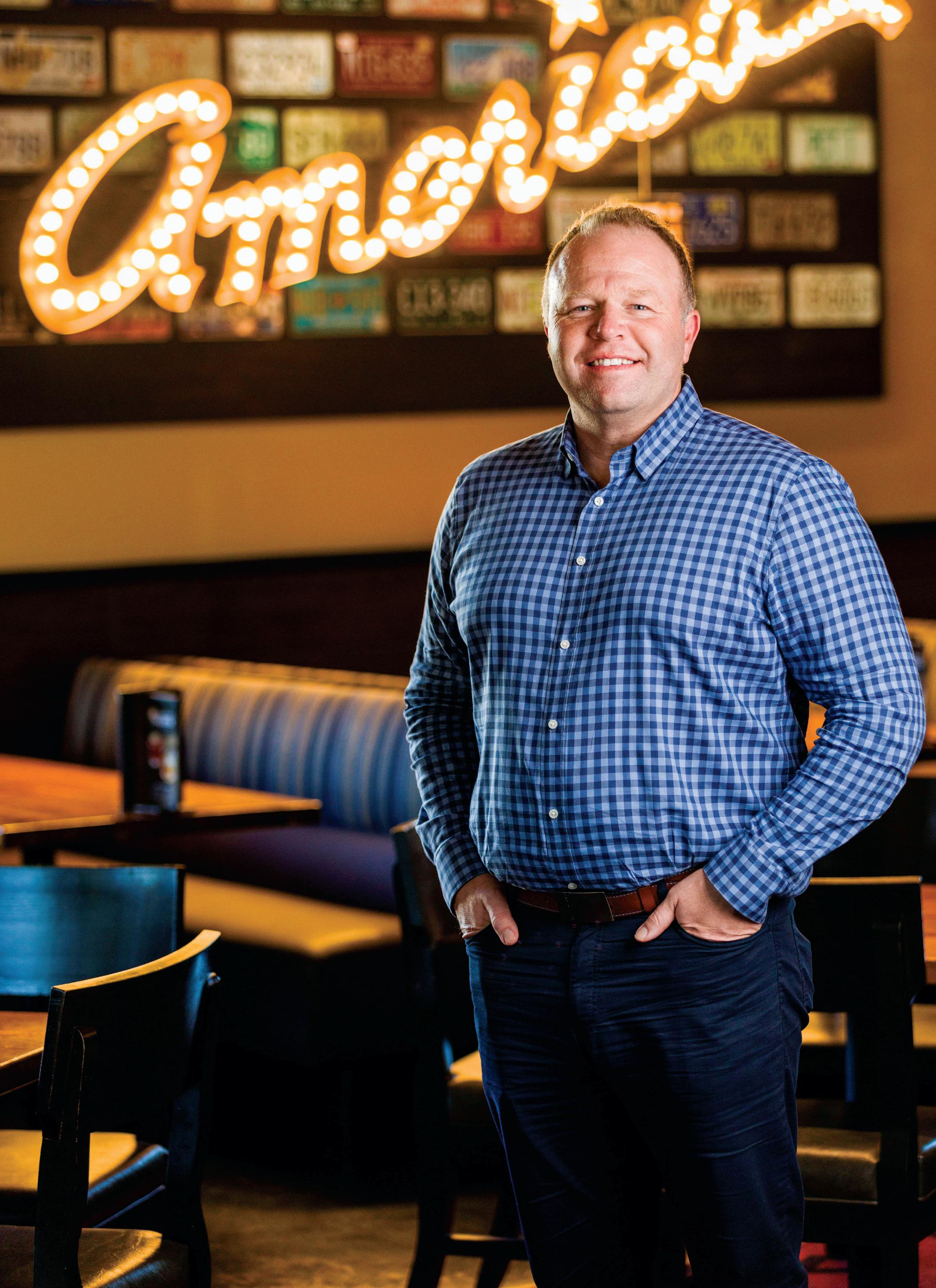
Despite the irony of “lazy” being in the name, there is nothing lax about the way founder and CEO Chris Simms approaches his people at Lazy Dog Restaurant & Bar. Started in 2003 in Jackson Hole, Wyoming, the American casualdining restaurant chain has grown to 51 locations across eight states with more than 6,000 employees. Throughout the brand’s strategic and careful expansion, Simms has never lost sight of what matters most: treating his people with care so that they feel empowered to take exceptional care of every guest.
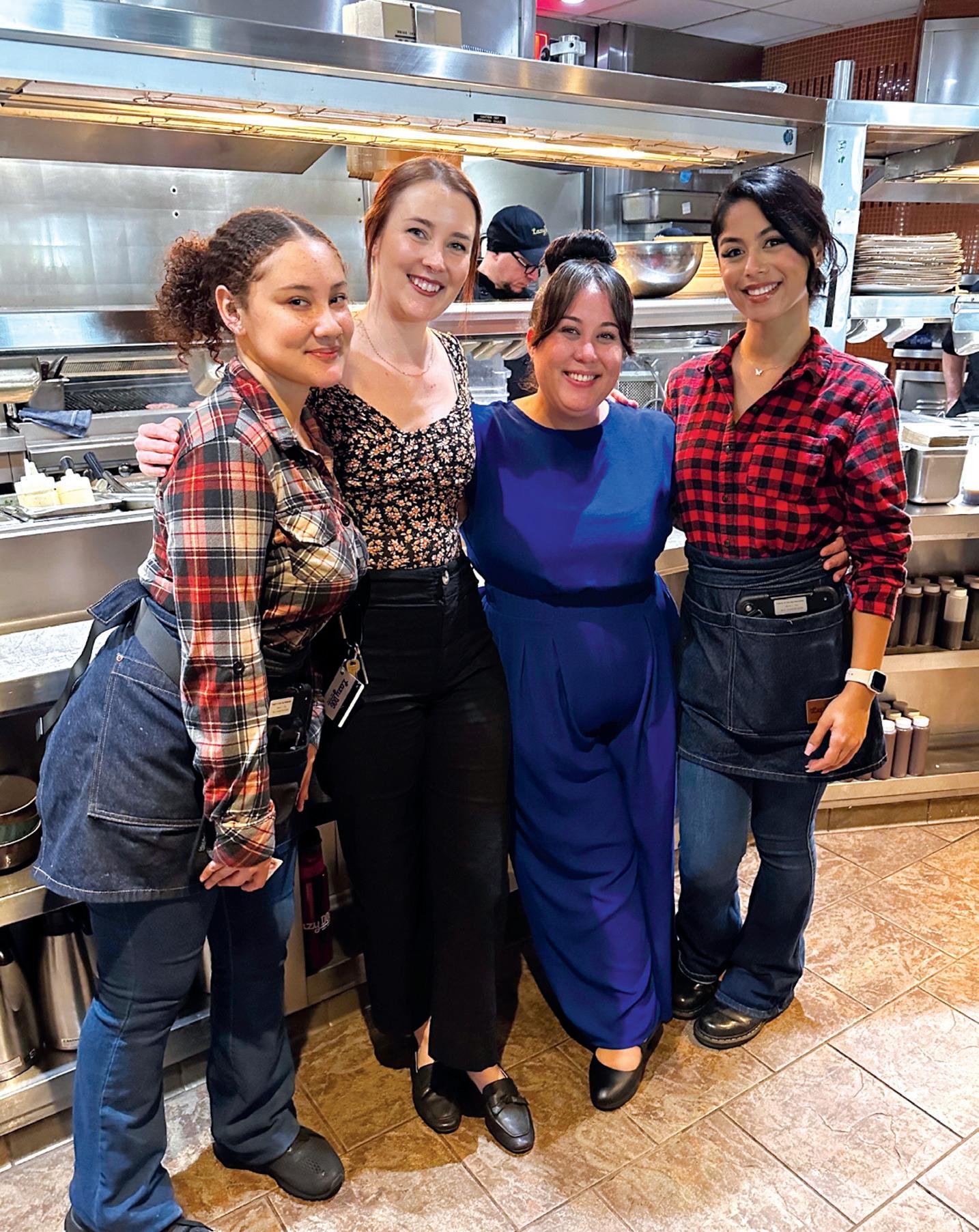
Case in point? The brand has been certified as a Great Place to Work for eight consecutive years as of 2026—the most trusted workplace award. Eightythree percent of Lazy Dog employees consistently report having positive experiences working for the restaurant over a sustained period of time. These stellar survey results are driven by a supportive culture, strong camaraderie, upward mobility and growth opportunities, and good earning potential in a fast-paced environment.
To earn the badge, a company must go through a thorough evaluation process, including:
The Trust Index Survey: This is the most critical part. Employees complete a confidential survey that measures five key dimensions of a high-trust culture: credibility, respect, fairness, pride, and a sense of belonging. According to the Great Place to Work Institute, the survey looks at whether employees
can count on leadership transparency, feel treated fairly, and enjoy working with their colleagues.
The Culture Brief: The company also submits a “Culture Brief” or audit— a required questionnaire which provides details about its programs, practices, and demographic makeup. Typically, seven out of 10 employees must agree it is a great place to work to pass.
At Lazy Dog, more than half of employees have worked for the brand for two to five years, and within that bracket, 4 percent have stayed for six to 10, and 1 percent of employees have been with the brand for 11-15 years. Eightynine percent said they were made to feel welcome when joining the company, and 87 percent said they feel good about the ways Lazy Dog contributes to the community, are given adequate time off work, and are given the resources and equipment to do their jobs.
The external validation, measurable metrics, and team member feedback are all important aspects to build-
ing a strong culture that goes beyond the buzzwords. But for Simms, it’s the behind-the-scenes internal processes that make it all possible.
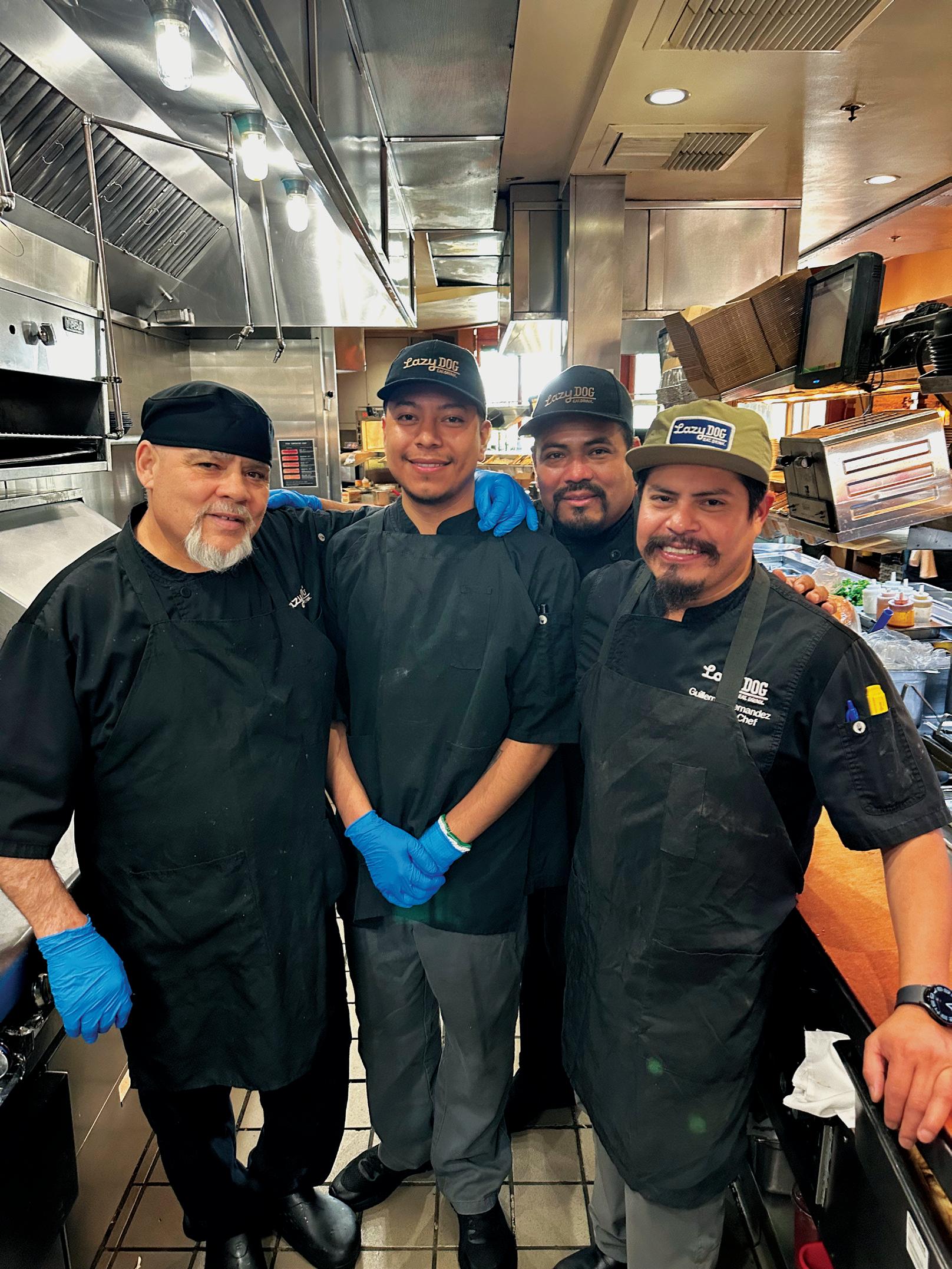
Promoting from within is one of the biggest ways Simms protects Lazy Dog’s culture as it grows. For every open management, chef, or regional role, he and his team look inside the company first. “By doing so, you’re able to ensure that the culture gets carried into that next position or into that next market or restaurant,” he says.
“Of course, it’s great to have people coming from outside the company—you get fresh perspectives,” Simms adds. “But it’s important that our goal is always to be north of 50 percent of promotions come from within. And for our regional leadership, it’s 100 percent, which is incredibly important in making sure that culture doesn’t get diluted; that every restaurant has that same fantastic feel for teammates and guests.”
Another crucial culture test for every brand came with the COVID crisis.
Thankfully, for Simms and Lazy Dog, they had a sizable headstart when it came to caring for employees. “It made a big difference, especially going through COVID, because the way that we treated our people was [the reason why] we were one of the first restaurants to be able to open back up when the regulations were lifted, and at full hours, because we had treated people so well that they were ready to come right back to the restaurant and get back to work, and that was incredible.”
That continuity meant Lazy Dog could reopen quickly and perform at a high level from day one. “We retained all of our management teams—the lifeblood of operating a restaurant. And so it really allowed us to get back on our feet and operate the way we like to operate, right from the beginning,” Simms explains.
And when the rest of the restaurant industry started talking nonstop about culture, he recalls thinking, “Welcome to the party, folks—we’ve been here the whole time.”
This sentiment harkens back to the
beginning, when Simms was initially creating Lazy Dog in the early 2000s. He saw most legacy casual‑dining brands as dated and built for his parents’ gen eration—and he’s an authority on the matter. His father, Tom Simms, and grandfather, Arthur J. Simms, founded Mimi’s Cafe (now Mimi’s Bistro + Bak ery) in 1978, which they eventually sold to Bob Evans Farms in 2004 for $182 million. At its peak, the chain had nearly 150 locations, but now has around 45 cafes open in 12 states.
Growing up inside the restaurant world and seeing the impact his dad had on company culture deeply shaped Simms and how he approaches leadership. “He was a very good role model for how to properly build a restaurant company. He taught me so many of the incredible life lessons that I’ve used now over the last 23 years,” he says.
His dad used to take him to work at Mimi’s Cafe, where he’d wash dishes or bus tables. “The first thing he would do when he walked into a Mimi’s was imme
diately go to the dishwashers and say hello and ask them if they needed anything,” he recalled in a Lazy Dog post in 2022. “From there, he would work his way through the kitchen and then through the front of the house, checking in with every teammate. He always walked away with new insights and ideas. It taught me such an incredi ble lesson about how important each and every person is to running the restaurant.”
He kept those learnings in mind with Lazy Dog, where Simms set out to cre ate the NextGen Casual concept that would be relevant for newer generations, become “every community’s favorite res taurant,” and, most importantly, truly have a people first culture at its core. “I felt like a lot of the companies had kind of lost their way on how they were treat ing people,” says Simms, and he intended to buck that trend.
Starting with that goal in mind, he points to another lesson his dad taught him: “We call it the Simms Family Secret Recipe—if you want your team to treat your guests with care and respect and
love, then you need to treat your team that way, and then it passes down.”
While this is seemingly a “super sim ple” concept, Simms notes “it’s so weird how it doesn’t happen” at many chains. But at Lazy Dog, all the love, care, and respect he poured into his concept can be felt through every design choice and every touchpoint, and this emotional through line became the blueprint for the brand.
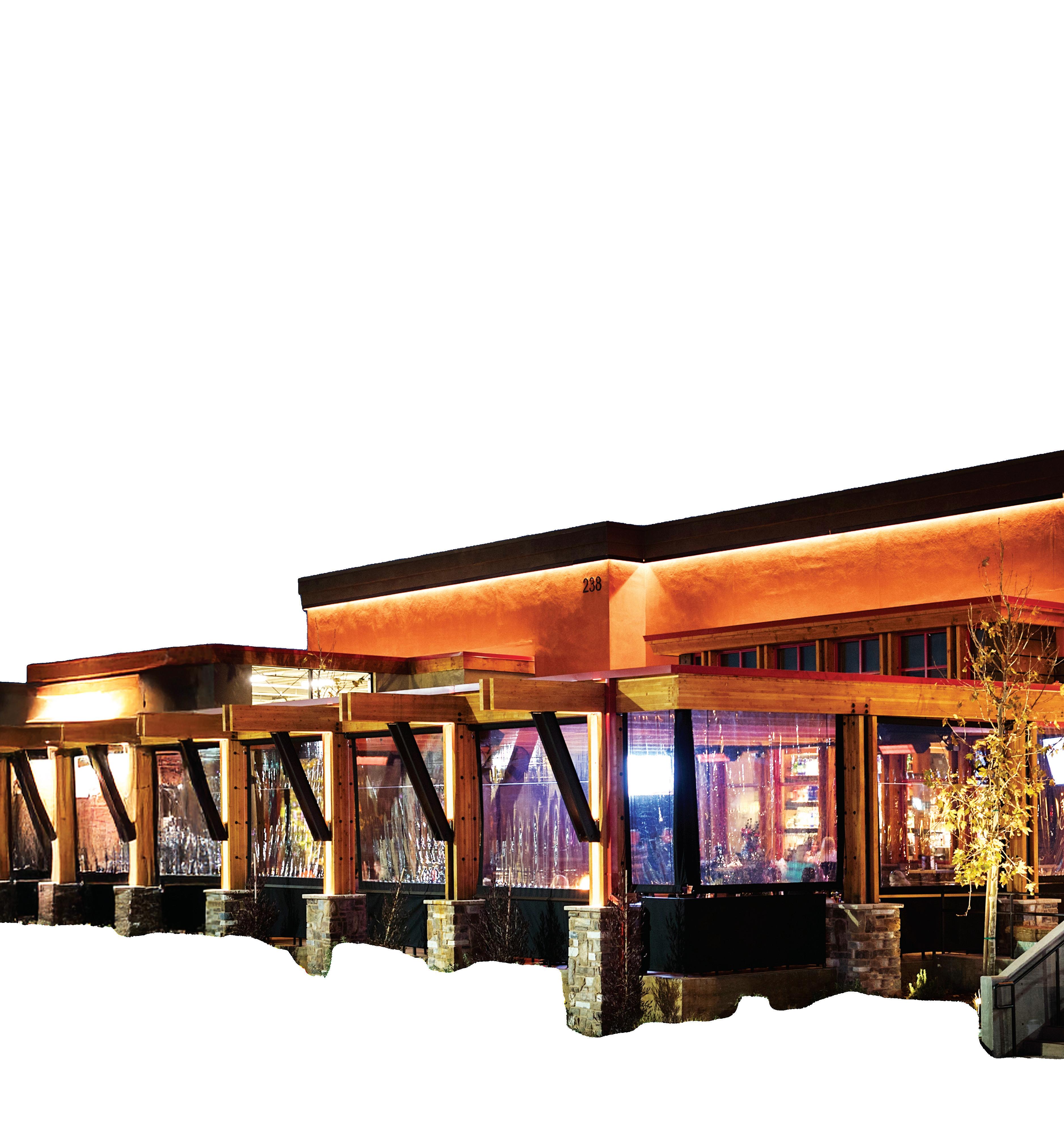
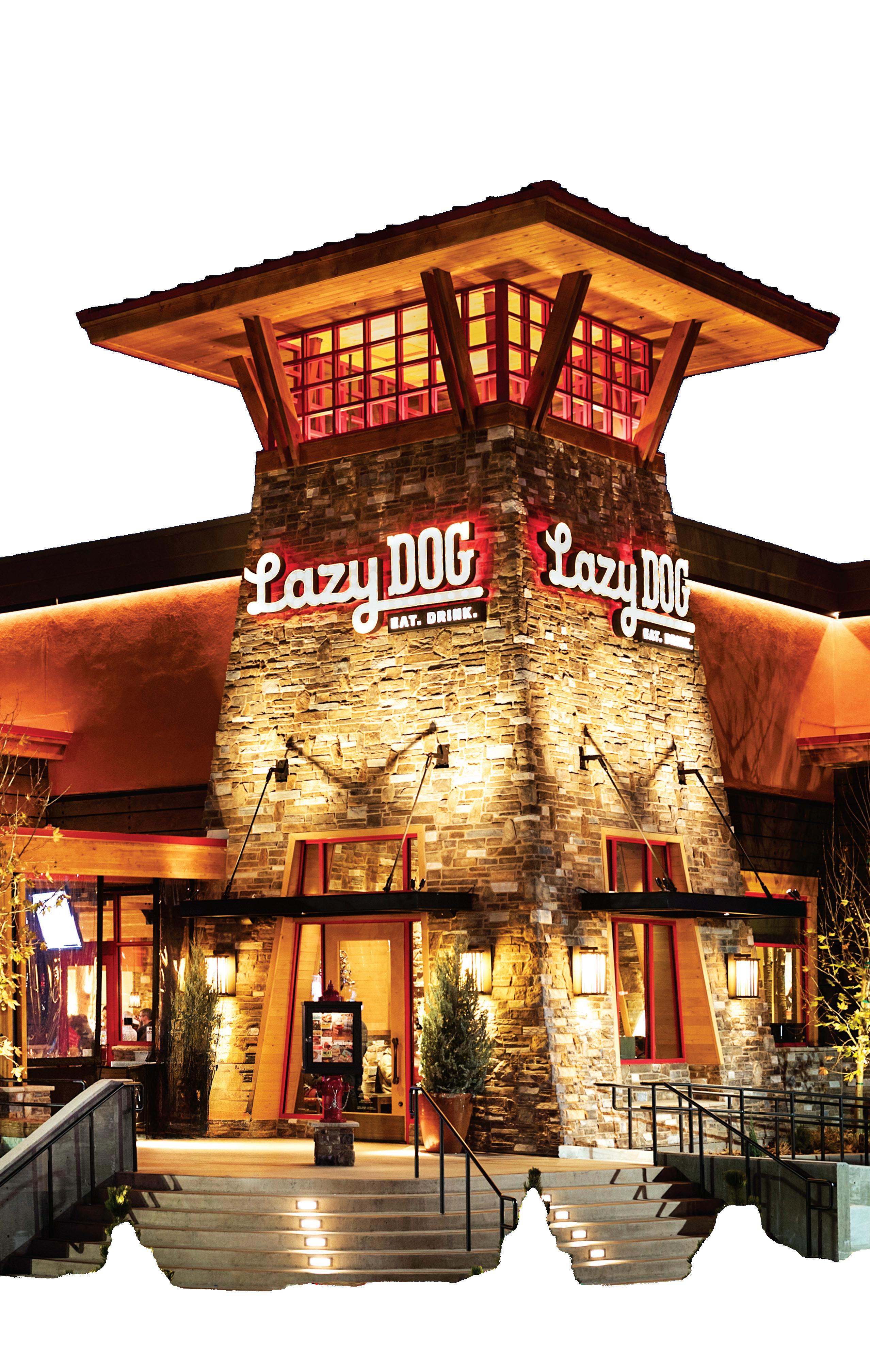
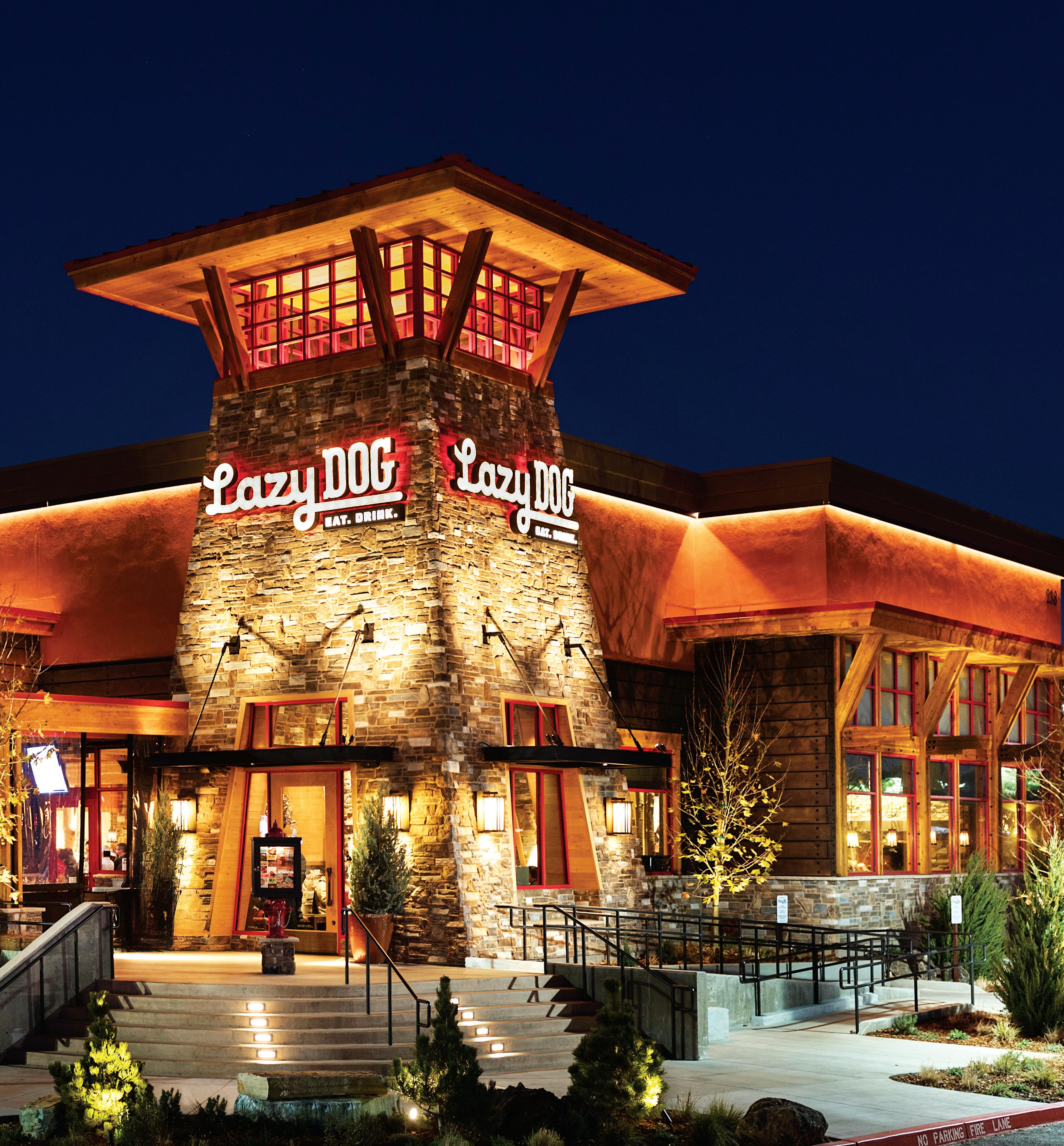
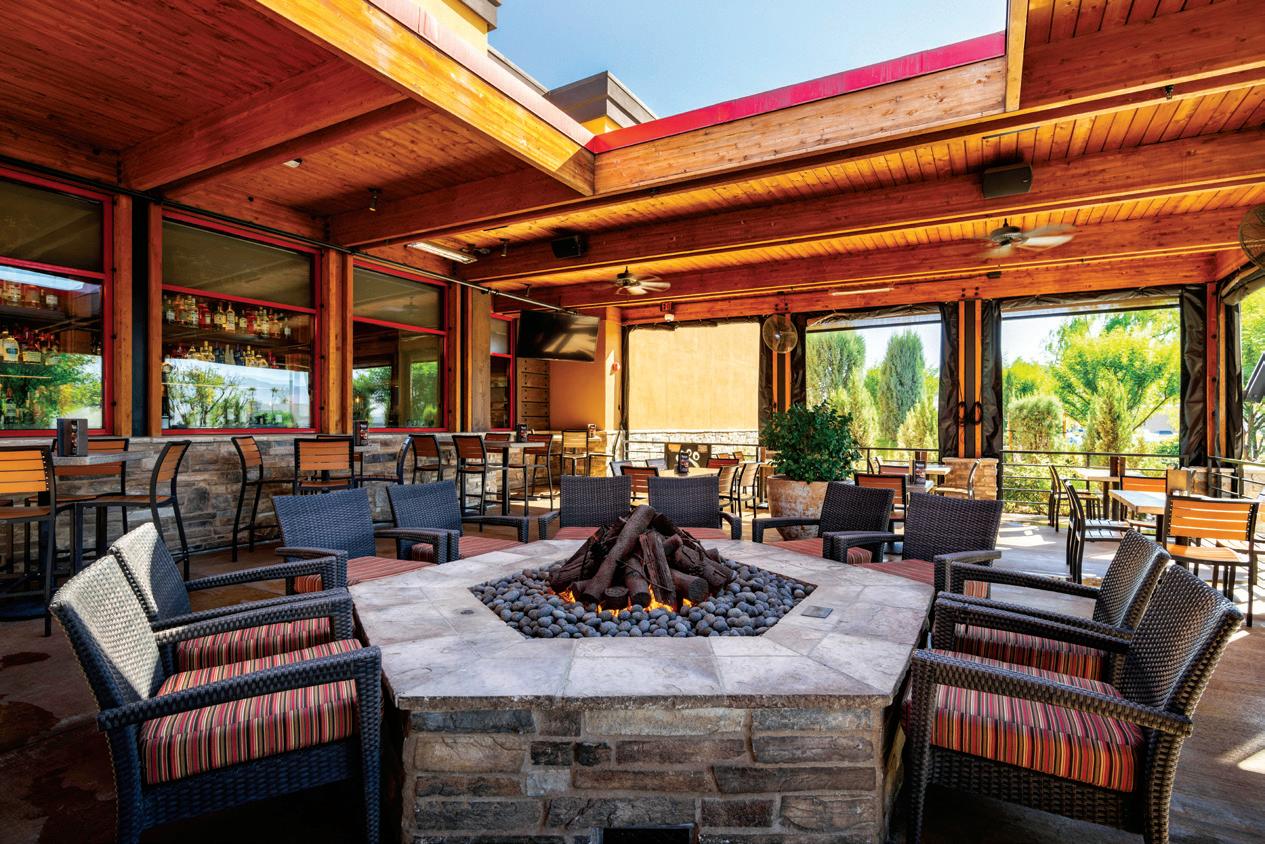
The restaurant is meant to evoke a small town mountain community— think “Rocky Mountain High” by John Denver vibes. It embodies a sense of adventure, and time spent around the campfire with family and friends. The design is based around a contemporary lodge with natural elements like wooden beams, stone pillars and fireplaces, and real tree bark, plus dog friendly patios (of course) with outdoor fire pits.
“We wanted to really create an atmo sphere in which people could come in, leave their worries at the door, and break bread with their family or friends. It’s just so peaceful and simple,” Simms said
in the video trailer for Lazy Dog posted in 2017, where he also talks about drawing inspiration from childhood visits to Jackson Hole. “There’s a certain feeling you get when you’re sitting by the crackling fire, and there’s just this safe warmth that comes over you that I love. I wanted to create that same feeling when [guests] walk through the door.”
Lazy Dog’s loyalty program—called “Campfire Community”—as well as the brand’s beer club are extensions of this warm, people-centric hospitality. The Campfire Community is a free loyalty program available to all guests and includes special surprise perks, exclusive news, a birthday reward, and a free starter or dessert for your next dine-in visit after signing up.
The beer club costs $39 each quarter (or $175 for an annual membership). Lazy Dog Beer Club (LDBC) members get access to priority seating when there’s a wait at the restaurant, a monthly draft beer sampler, draft beer upgrades, 10 percent off takeout and delivery, and, most notably, a quarterly beer kit containing four uniquely brewed beers from top breweries around the country. Each release is built around a unique theme, whether it’s a journey through iconic American landmarks or a nod to the exclusivity of the Speakeasy era. LDBC is a membership subscription “created by beer lovers, for beer lovers.”
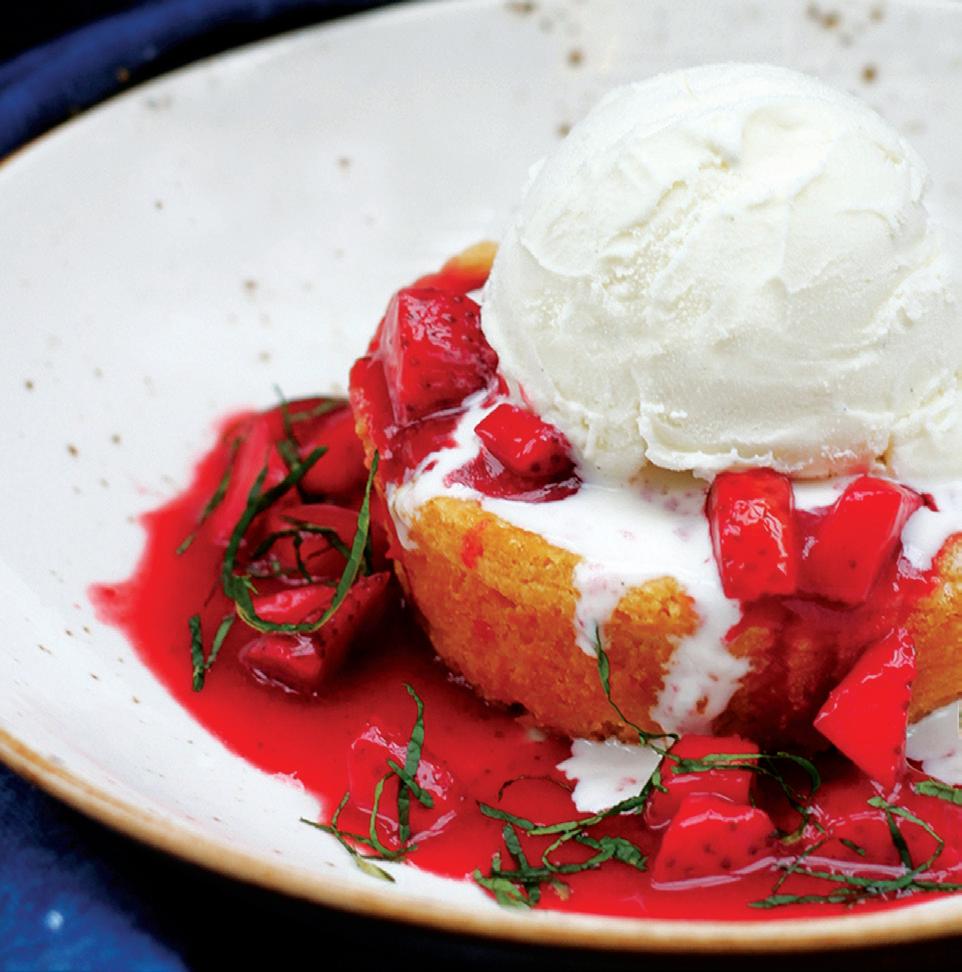
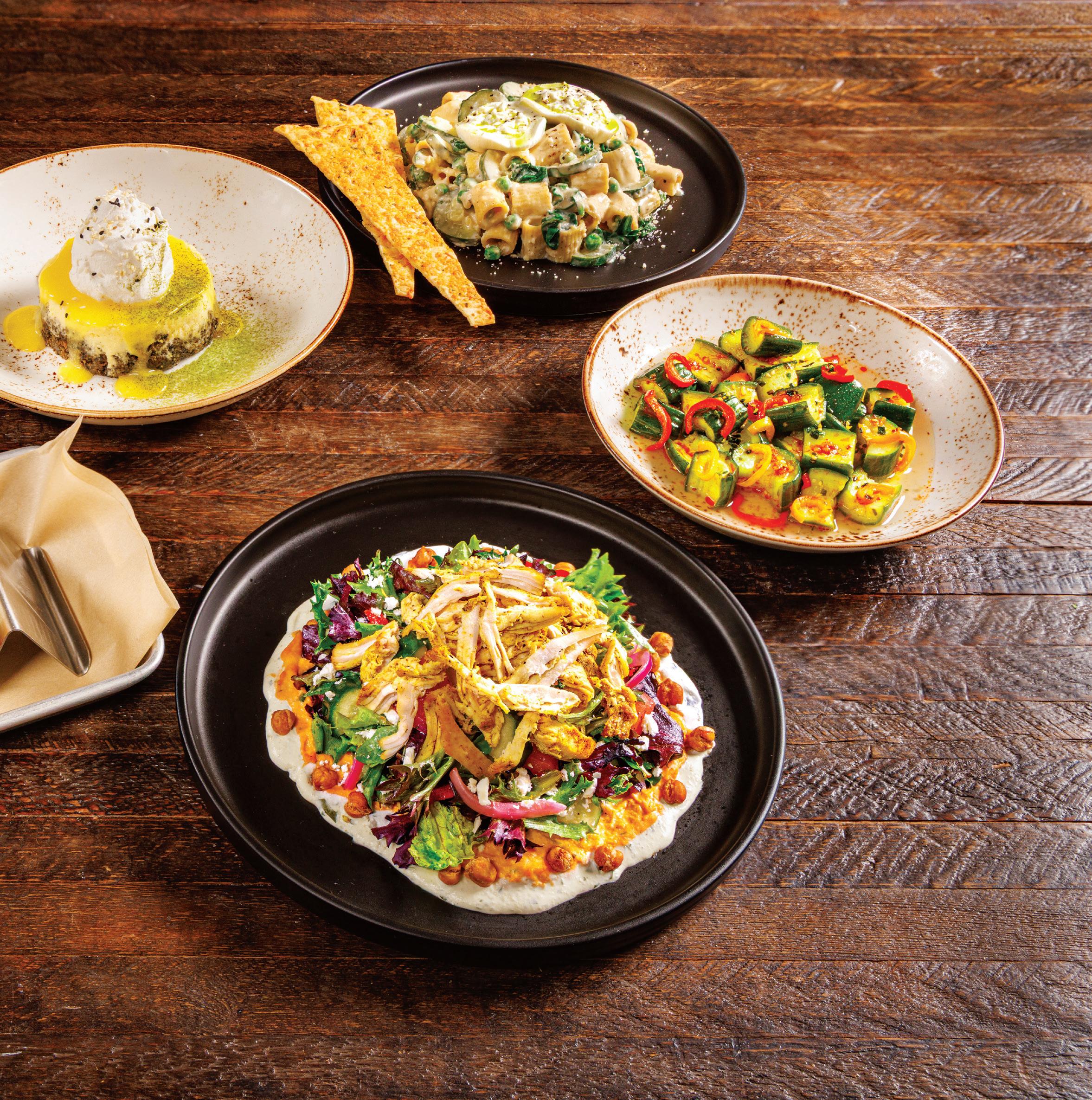
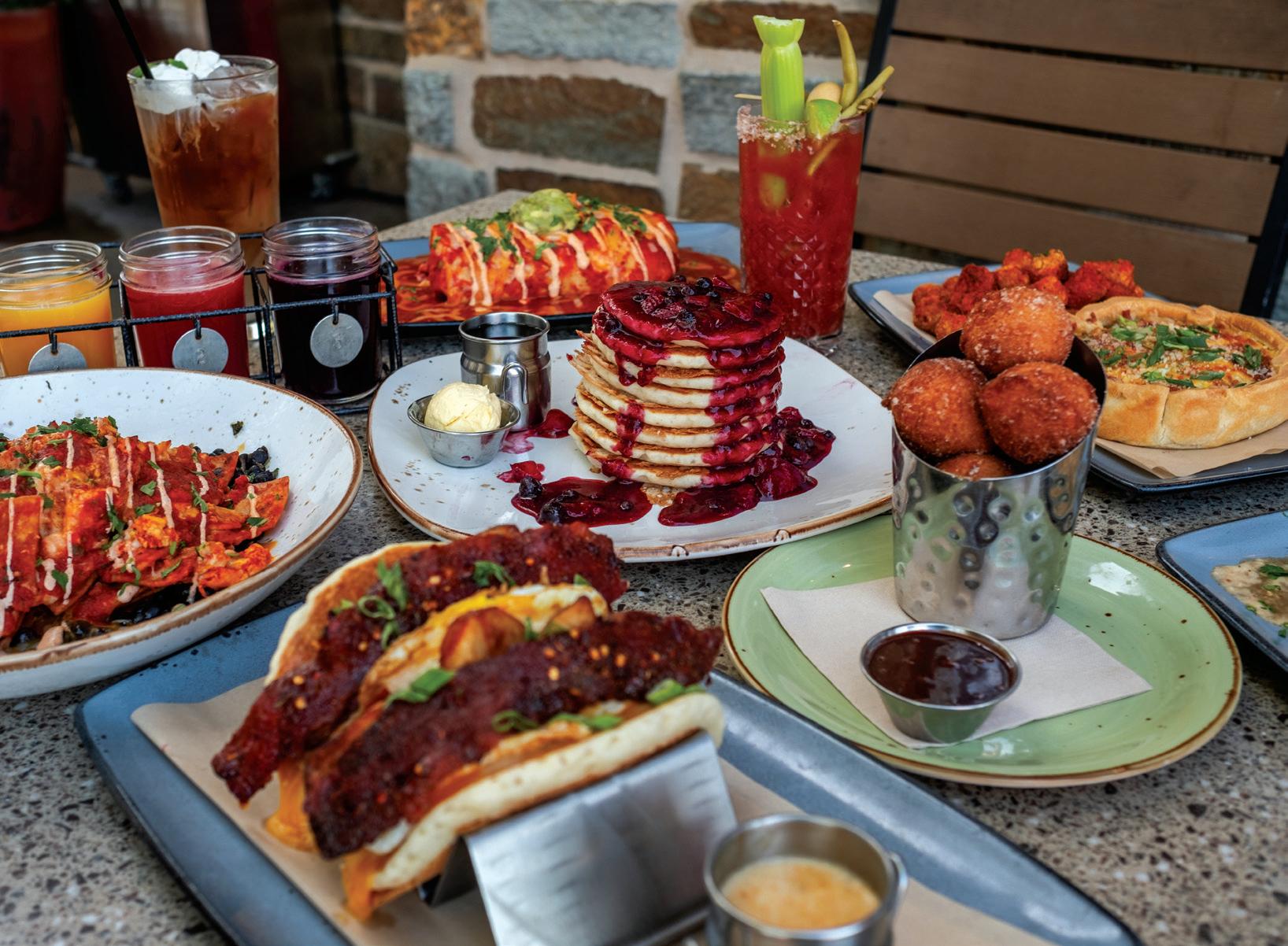
The menu at Lazy Dog is roughly two-thirds ‘craveable classics,’ or scratchmade comfort dishes with subtle, memorable twists—like the BBQ ranch bacon burger (grilled half-pound beef patty, smoked bacon, cheddar, chipotle ranch, lettuce, tomato, pickle, red onion) and brussels sprouts (lemon, garlic, butter, capers, crispy croutons, romano cheese).
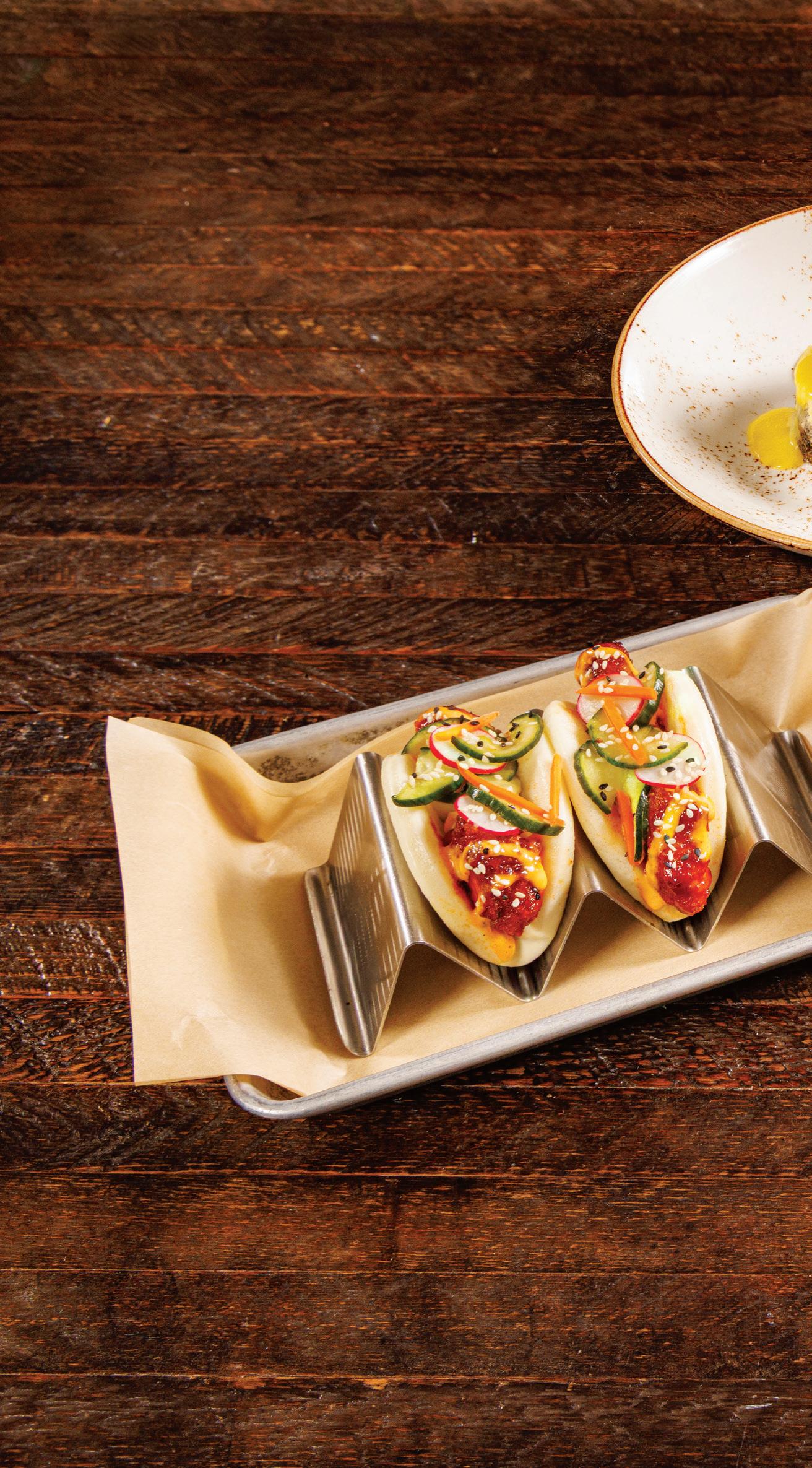
Alongside that foundation is a deliberate streak of playful, chef-driven and globally inspired innovation, from the Korean fried chicken bao buns (gochugaru pepper glaze, kimchi aioli, pickled cucumbers) to the chili crunch ahi tuna (sashimi-grade seared rare tuna, furikake-seasoned rice, edamame, avocado, marinated cucumbers, pickled ginger, spicy garlic crunch, citrus soy dipping sauce). The latter is featured
on Lazy Dog’s recently dubbed “Mindful Meals” category—six lower-calorie options that are packed with protein and capitalize on the “better-for-you” trend.
A recent addition was the protein crunch bowl with crunchy, oven-roasted garbanzo beans, jammy egg, avocado, almonds, tomatoes, and feta cheese on a bed of supergreens with honey apple cider vinegar dressing on the side. Guests have the option to add their favorite protein including chicken, steak, or salmon.
Lazy Dog’s beverage program mirrors the brand’s broader commitment to scratch innovation at scale. On the cocktail side, Simms says the team starts with the familiar—your Tito’s and soda drinker is covered—but then pushes into more adventurous territory with bacon-fat-washed bourbon old fashioneds and milk-washed, clarified cocktails that wouldn’t feel out of place on an independent bar menu.
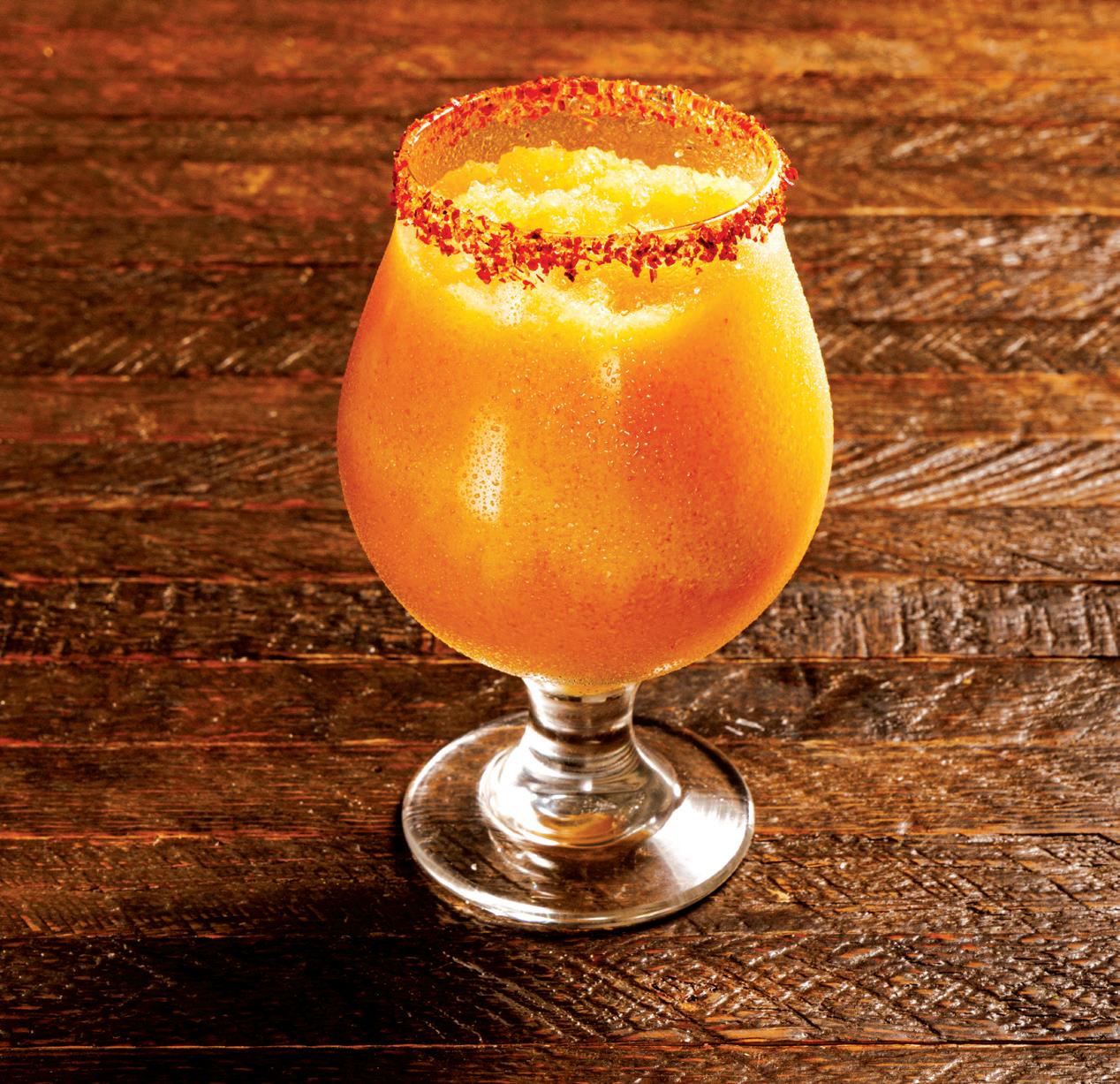
The same mindset extends to zero-proof: instead of buying off-the-shelf mixers, Lazy Dog developed its own in-house elixirs to create three spirit-free cocktails, including nonalcoholic riffs on mezcal, which the team blind-tested against commercial options and found “so much better.” Beer is another pillar of that innovation, with eight proprietary draft selections brewed in partnership with Melvin Brewing in Jackson Hole, Wyoming; the Huckleberry Haze IPA has
emerged as the standout bestseller. It all adds up to a beverage program that gives guests both comfort and discovery with unique flavors and formats. And, the brand’s creativity and desire to please guests doesn’t just apply to humans. Like the name suggests, dogs are always welcome and the brand is proud to offer a “pup-friendly dining experience, complete with a special dog menu and a complimentary bowl of water for your furry companion.” The menu includes a

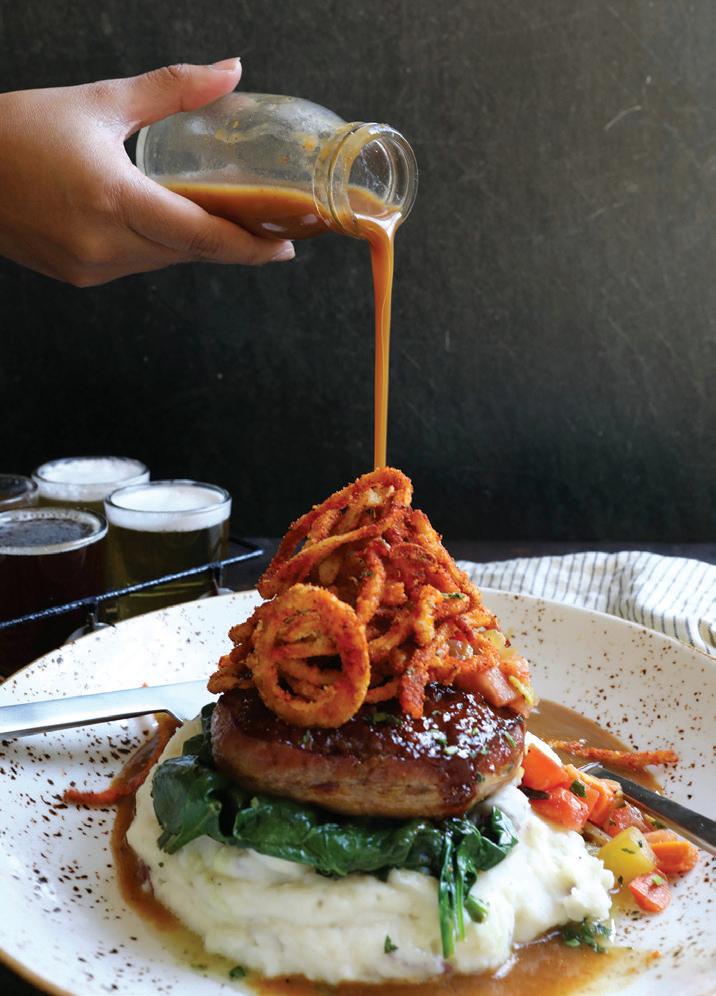
chicken breast bowl—both served with brown rice and veggies and costing $6.
“I think innovation is a strength of ours. We’re doing a lot of things that people aren’t doing in casual dining and across the country,” Simms says. “It’s not easy. Sourcing certain items [like] bao buns across the country, and trying to get just the right ones is not easy. Our head of R&D, Gabe Caliendo, was my original partner in Lazy Dog, and he still runs R&D for us. And he’s always like, ‘It is so hard to be creative these days,’ as you’re trying to get certain products in every market of the country, but they do a fantastic job of doing it, and they enable us to have that innovation everywhere we go.”
To date, the brand has scaled to 51 locations through California, Colorado, Georgia, Illinois, Nevada, Virginia, Florida, and Texas. When it comes to future growth, Simms plans to fill in the 14 markets Lazy Dog is currently in, with locations coming soon in Mira Mesa, California; Castle Rock, Colorado; and Algonquin, Illinois.
However, Lazy Dog’s mantra of wanting to become “every community’s favorite restaurant” also means “we don’t necessarily want to be this global organization or corporation, but instead, we want to be really good at being great community members, and we want to stay very local in each of our restaurants,” Simms clarifies. He has no franchising plans in the foreseeable future, either, since the scratch-kitchen is “pretty intense” and difficult to replicate.
“We’ve chosen to really stay in full control over every restaurant so that we can execute at the level that we like executing at. Not to say we never consider it, but just for now, that’s where we are,” he adds.
Though he plans to expand into new markets in the next couple years—the brand’s first restaurant in Pennsylvania will open in King of Prussia—Simms ensures the concept only grows “as fast as it can continue to improve upon the guest experience,” he says, “which has meant that we’ve always wanted to keep growth measured and very prudent and smart, so that’s what we’ve done.”
Despite many examples of brands losing their DNA and sense of unique culture as they scale, Simms believes—“as crazy as it sounds”—that the culture at Lazy Dog has gotten stronger over its 23 years in business, driven by his focus on hiring people with hospitality at heart, and heavy investment in leadership development and modern training. “We spend a lot of time and a lot of effort really teaching our leaders how to be great leaders— how to treat people, how to motivate people, how to care for people. I think that’s a really big strength of ours. That’s why we’re able to promote a ton of those positions from within, is because we get people ready to be able to take advantage of those opportunities,” he explains.
“The other beautiful part about that is it also creates engagement with our hourly teammates, because the better your manager is, the more engaged you’re going to be as a teammate,” he continues. “I go by the philosophy that people don’t leave companies; they leave bosses. You can be at a great company, but if your boss is a jerk, you’re not going
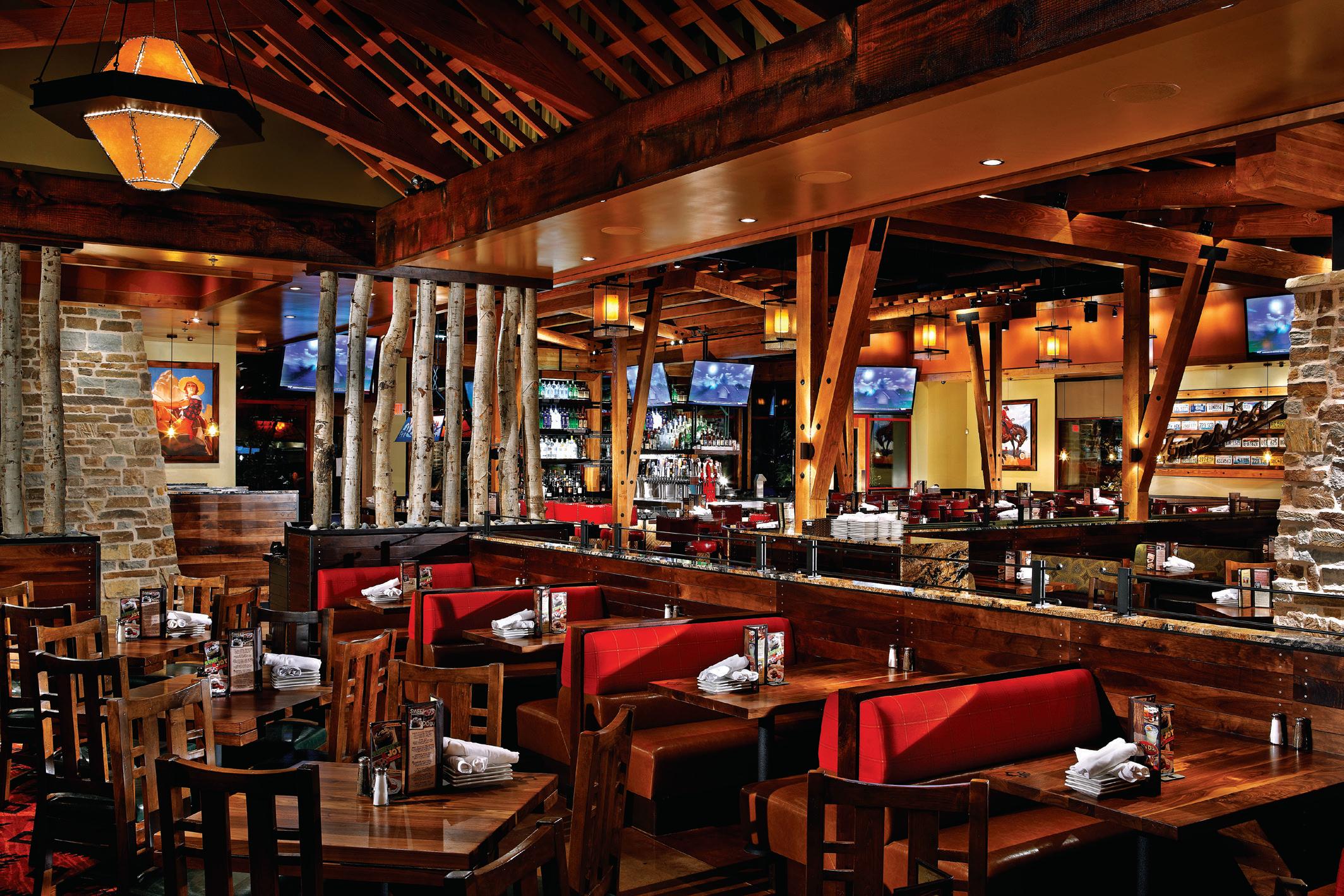
THE CONCEPT IS MEANT TO EVOKE A SMALLTOWN MOUNTAIN COMMUNITY, A SENSE OF ADVENTURE, AND TIME SPENT AROUND THE CAMPFIRE WITH FAMILY AND FRIENDS. LAZY DOG’S DESIGN IS BASED AROUND A CONTEMPORARY LODGE WITH NATURAL ELEMENTS LIKE WOODEN BEAMS, STONE PILLARS AND FIREPLACES, AND REAL TREE BARK.
to want to stay. And so we work on the bosses, making sure that they are the best possible leaders.”
Lazy Dog also uses technology, including AI, to make managers’ jobs easier and take routine tasks off their plates—eliminating clipboards and reports so leaders can spend more time on the floor coaching, training, interviewing, and connecting with guests and teammates. Simms and his team at corporate also utilize AI to deliver real-time insights to operators and the home office, helping them make faster, better decisions that improve both the guest and teammate experience. Longer term, he wants more frequent feedback from employees so AI can help flag cultural issues early—like when a restaurant’s vibe starts to slip—so the team can step in and course-correct.
“I think having that type of information is so important to be able to make great decisions, and we’ve definitely made some really cool advances. It’s all happening so quickly right now with AI,” he notes. “It’s about, how do I spend more time doing the thing that I love? And how do I make better decisions? Those are the two big things that we’re working on.”
Gamifying training and teaching people how they prefer to be taught has been another big factor in boosting team performance, confidence, and retention— initiatives led by Daphne Felicitas, VP of learning and development at Lazy Dog. “That has also been a great booster of our culture,” he says.
Simms actively pushes back on the common notion that younger generations
ing former teammates carry Lazy Dog’s core values into their own businesses— proof, he says, that investing in people’s professional and personal growth can genuinely change lives. “That is the number one thing that gets me up every day—the ability to make a difference in people’s lives.”
are lazier and don’t want to work, and he deliberately flips the script at Lazy Dog. From day one, the message to employees is, “We trust you, we believe in you, we know that you’re here to do a great job.” That’s a lesson he learned from his grandfather, who said most people come to work wanting to be successful and proud of what they do.
Managers are taught from day one to assume positive intent, equip teammates with the tools and training they need, and create an environment of empowerment rather than fear, so employees feel inspired to do their best for guests.
That creates trust, he says, which attracts many younger employees who weren’t sure of their path, but end up seeing Lazy Dog as a place they can build a long -term career, constantly asking “what’s next?” as they move into new roles. “The world today is probably a little less trusting than it used to be, so it’s nice to have an environment that provides trust to people,” he emphasizes.
For Simms, the ultimate payoff is see-
When looking across the broader industry landscape, Simms also points to Lazy Dog as proof that restaurants can be a real career, not just a stopgap job. He notes they have general managers in their 20s earning six figures and running sizable businesses, some with college degrees and some without. “There’s just great growth potential in our industry, and I think if you operate like we operate in the culture that we have, it’s very enjoyable,” he says. Guests often describe an intangible “positive vibe” at Lazy Dog, Simms says, which he traces directly to teammates who genuinely enjoy coming to work, like their coworkers, and feel empowered to take care of guests. That empowerment shows up in moments like when one of his managers ran to a supermarket next door to buy a box of grape popsicles for a guest who’d been requesting one at restaurants for a decade and never gotten it. “The guy was blown away,” he recalls. Lazy Dog calls that responsiveness “the Lazy Dog Way”—giving servers, chefs, and managers permission to say yes and create small “wow” moments whenever possible—an approach that delights guests and reinforces a culture of going above and beyond.
“I truly feel like culture is still one of our strengths and differentiators to this day,” Simms adds. “When we look at our service scores and our guest sentiment scores compared to the industry, we kill it all the way across. And I really do feel it’s because we treat our people really well, and they, in turn, turn around, and they deliver that same care to our guests.”




















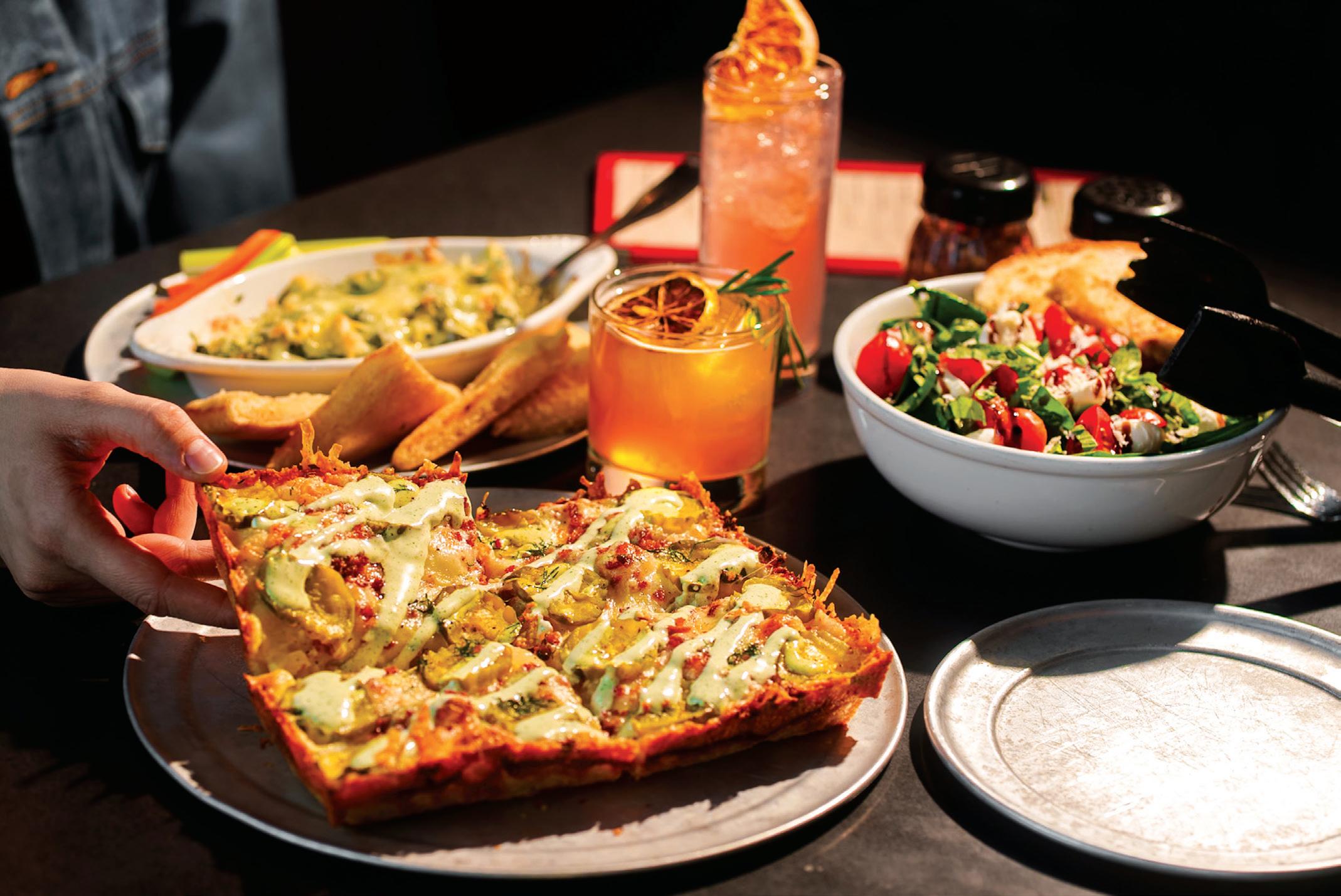
How two brothers craving Detroit-style pizza fueled the rapid expansion of Via 313.
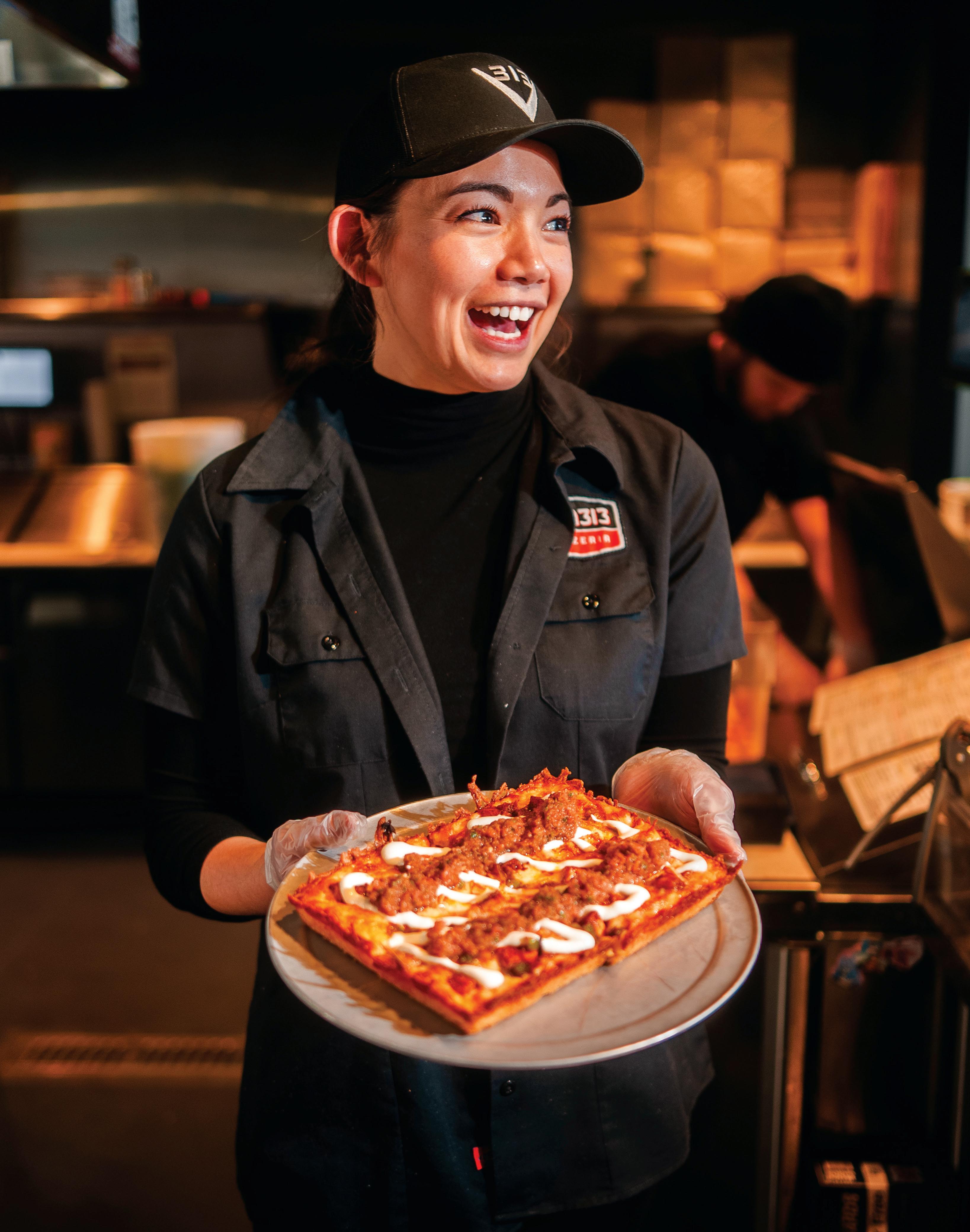
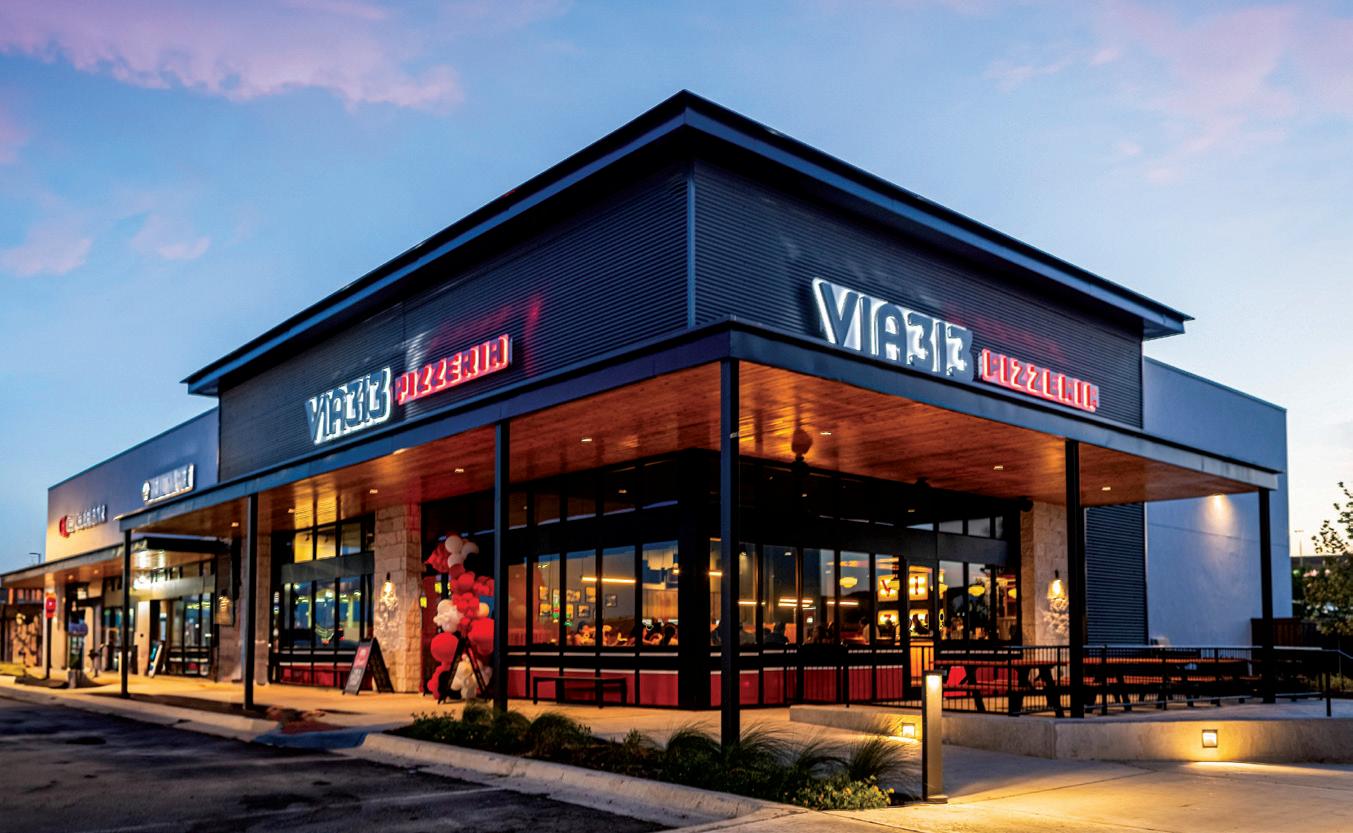
DETROIT NATIVES Zane and Brandon Hunt were fueled by the spirit of their hometown when they founded Via 313 Pizzeria. Raised by a single mother who shared her love for pizza with them sev eral times a week, the brothers turned that childhood comfort into a thriving restaurant chain. Today, Via 313 brings authentic Detroit-style pizza to 26 loca tions across Texas, Utah, and Colorado.
For the Hunts, pizza was not an industry they fell into randomly. Sauce has been in their veins since they were kids. Both brothers took their first jobs delivering pizzas for mom-and-pop shops around the city. Zane remembers those years delivering pizzas and getting as much hands-on learning as he could. “It just made sense, that’s in our DNA... a strong passion for pizza,” he says.
HEADQUARTERS: Austin, TX
UNIT COUNT: 26 YEAR FOUNDED: 2011

The 2009 economic downturn caused a shift for Zane. He saw it as an opportunity to experience something new, and so later that year, he moved his family to Austin, Texas. However, he quickly began to miss his roots. The craving for Detroit’s regional pizza gnawed at him, and he eventually convinced Brandon to join him a year later. This set the stage for the duo to offer the kind of pizza they loved but couldn’t find in Texas.
To define Detroit-style pizza, you need to first understand its connection to the American auto industry. It’s a Sicilian variation brought to Michigan by first-generation Sicilian Italian-Amer-
icans who worked in auto parts assembly plants. The pizza’s square shape comes from blue-steel automotive pans, repurposed as baking trays by the “Big Three” factories, including General Motors, Ford Motor Company, and Chrysler (now known as Stellantis).
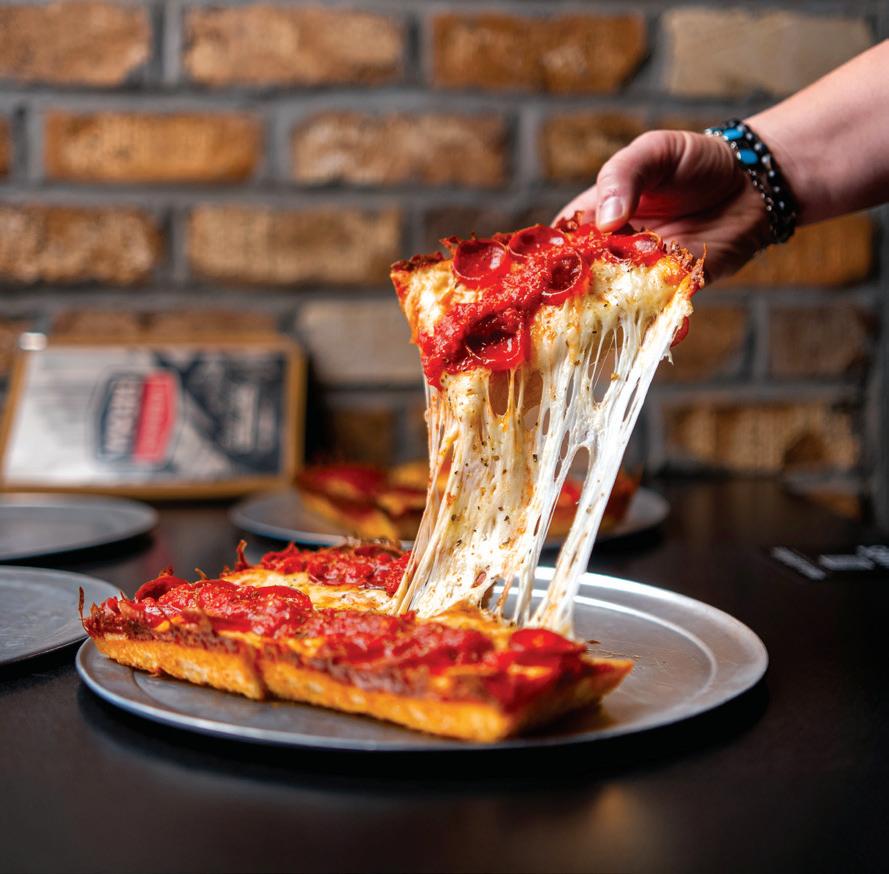
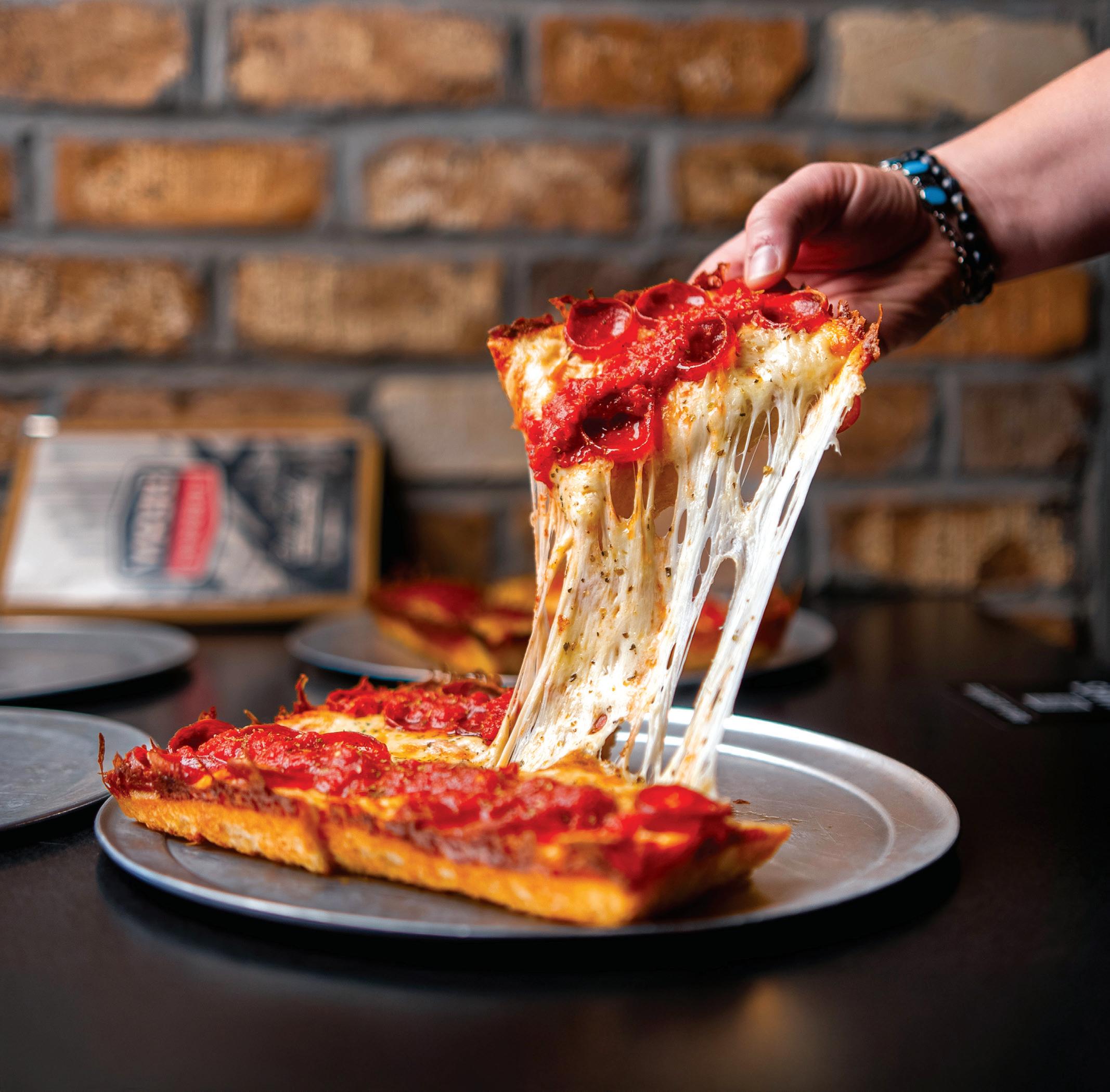
This heritage delivers a light, airy, focaccia-like crust and sauce spread over cheese, with edges caramelized on hot steel. Even with their love and roots in Detroit culture, the brothers initially worried this dish would be too heavy for the health-conscious residents of Austin. “For the first five years, people would say, ‘Man, this Chicago style is so good.’ We’d have to correct them,” Brandon says.
They found their niche by focusing on “cheat days” instead. “Even healthy people have great cheat days, and we just want to be the greatest gluttonous cheat day,” Brandon says.
The brand began in December 2011 with a single trailer. Their marketing strategy, which Brandon calls “guerrilla warfare,” was simple: they made pizzas and gave them away to local bartenders, barbers, and tattoo shops so the community could get a taste of the city. Relying on their roots, they named the brand after Detroit’s area code and placed “Detroit-Style Pizza” on their signage, even though it felt risky. Zane sees this as a promise to be genuine.
NOW, WITH 26 LOCATIONS AND ABOUT 1,200 EMPLOYEES, VIA 313 HAS A GOAL TO BE IN EVERY MAJOR MARKET AND TO LEAD AS NATIONAL STEWARDS OF A PIZZA STYLE THEY GREW UP WITH.

“We’re not going to run from who we are. We’re going to call it Detroit-style pizza... We have to. If we’re going to lose, we’re going to lose being who we are, not trying to be fake or fraudulent,” Zane says. This unapologetic authenticity sparked curiosity in locals. Combined with strict operational guidelines, such as weighing every pizza to the ounce from day one, it laid a foundation for quality that enabled the brand to grow at a steady pace.
As Via 313 expanded, it caught the attention of Savory Fund—a private equity firm that invests in emerging restaurant brands like Hawkers and The Sicilian Butcher—which resulted in a partnership to help the brand optimize its operations for scale. This shifted the brothers’ daily duties from management to strategy oversight. The brothers described this adjustment as a grieving process. “It’s more like your baby went to college and is out there stumbling around trying to figure out life,” Brandon says. “You went from having this routine every day to now the house is empty.” The partnership allows them to hire for their weak -
WHEN VISITING THEIR RESTAURANTS, ZANE HUNT OPTS FOR THE DROIDER, A DOUBLEPEPPERONI DETROIT-STYLE STAPLE, WHILE BRANDON HUNT GOES FOR THE BAR-STYLE WITH NATURAL-CASING PEPPERONI AND RICOTTA. BOTH STILL END THEIR MEAL WITH A SIDE OF CINNAMON STICKS.
nesses and focus on site selection, P&L management, and pizza.
Now, with 26 locations and about 1,200 employees, Via 313 president Kiplan Welsch brings experience managing hundreds of locations for brands like BJ’s Restaurants and Bluestone Hospitality, providing the infrastructure needed for Via 313’s rapid growth. Brandon admits that, at this scale, they “almost kind of shut up and listen when we’re around those guys because they have a different skill set. They know how to scale a brand.”
Scaling also demanded a new approach to real estate and operations. Previously, the brothers sought out dilapidated buildings in up-andcoming neighborhoods for lower rents.
The private equity model now requires prime property on busy corners to ensure future resale value—marking a significant change from their earlier tactics. Rising carryout and third-party delivery now account for nearly half of their revenue, prompting consideration of smaller restaurant spaces and a potential return to food trucks in more modest markets. “It’s an easy way to launch ... and it doesn’t get far from who we are or what we did,” Brandon explains. Integrating thirdparty delivery meets modern guest expectations, though the brothers still value the dine-in experience. Looking to 2028 and beyond, Via 313 has an ambitious vision. The goal is to be
in every major market and to lead as national stewards of a pizza style they grew up with. For Zane and Brandon, this is anything but a business exit; it’s a source of hometown pride. “What better people to bring it to the masses than the people who lived it?” Zane says. “We didn’t read about it and jump on it as a trend. It’s who we are, and we’re proud of it.”
Even as they manage private equity and national growth, the brothers’ personal tastes stay the same. When visiting their restaurants, Zane opts for the Droider, a double-pepperoni Detroitstyle staple, while Brandon goes for the bar-style with natural-casing pepperoni and ricotta. Both still end their meal with a side of cinnamon sticks.

An 18-year-old tech wizard is on a mission to make scheduling easier and faster for managers.
spend several hours each week creating employee schedules, a mundane task often completed by hand. This process is frequently inefficient due to the rapid pace at which employees call out sick or request schedule changes for other rea sons—which is why this area is ripe for tech innovation.


Paychex, a digital HR technology company, recently surveyed 50 indus try leaders on their priorities for the year. According to the survey, 34 per cent of restaurant and food service lead ers reported spending 11-15 hours on administrative tasks each week, with 13 percent of that time spent on sched uling hassles equating to an annual cost of $30,601.





To further contextualize the stakes here: If a manager leaves a restaurant generating $500,000 in sales, the leadership gap can harm service quality and reduce customer retention, costing up to $50,000. Slower service increases wait times and negative reviews. This likely reduces new customer acquisition by 10 percent, and could potentially cause another $50,000 in losses. Overall, manual scheduling and manager turnover may cost up to $100,000 per month. These numbers are examples emphatically given by Noah Marbach, founder of XShift AI, an AI tool with a mission to eliminate scheduling headaches.



Marbach experienced these obsta cles firsthand while working in the res taurant industry. Now an 18-year-old high school senior in Metro Atlanta, he explores this issue with Xshift AI. He saw how outdated scheduling software frustrated workers and created burnout for leaders, and after hunting for existing tools to no avail, he decided to create his own solution.








and have the skills to take the shift? Do we have to budget to pay this employee if it’s like $18 an hour? Is this employee going to go into overtime and all that?” Even with digital tools, operators must still manage these complex constraints themselves to ensure proposed solutions are accurate.




Legacy scheduling platforms operate as static grids that can require complicated configurations, shifting the burden back onto operators rather than solving the underlying problem. “When a manager is building an employee schedule, they can’t just say, ‘Hey, assign this person,’” Marbach says. “They have to say, ‘Okay, is this employee available for this time? Does this employee prefer these shifts? Does this employee meet the roles required
Due to high turnover rates and complex daily operations, the restaurant industry became the primary focus for Marbach’s software. He compares legacy scheduling platforms to dated media, comparing them to Blockbuster, and positions Xshift AI as the Netflix of scheduling. “Netflix did not beat Blockbuster because they built a better store than Blockbuster,” Marbach says. “They beat them because they changed how people watch movies forever. And that’s what we’ve done with employee schedules.”

“[Netflix] beat [Blockbuster] because they changed how people watch movies forever. And that’s what we’ve done with employee schedules.”
detailed insights to getting onboarded to building schedules daily can all be done for the first time just by chatting with an AI,” Marbach says, noting that the system accepts both typed and voice-to-text commands. The software asks users for the restaurant’s name, employee names, roles, and pay rates to accurately track labor costs and overtime. As long as the operator speaks English, the only supported language at this time, the learning curve is minimal. Managers set operational rules, and the AI generates the weekly roster in seconds.
The platform simplifies last-min -
RATHER THAN ADOPTING ALL-IN-ONE SYSTEMS THAT CAN OVERWHELM TEAMS, FOCUSED, PURPOSE-BUILT TOOLS ARE EMERGING AS A BEST PRACTICE.
approve shift swaps, ensuring that less-experienced employees are not assigned to peak shifts. If a solution is needed right away, managers can use auto-assign to quickly alert the next qualified team member.
To further reduce managerial tieups, Marbach and his freelance developers are building a co-manager mode. This feature will automatically send SMS and in-app alerts to qualified staff to secure coverage as needed. Operators can configure the tool to run continuously or activate it when leadership is unavailable, ensuring shifts are filled before the next workday begins.
As he prepares to enroll at the University of Mississippi, Marbach is committed to resisting the temptation to add features that tech companies tend to fall for in their early years. He wants to solve the core scheduling challenge that inspired Xshift AI before expanding the tool’s offerings. “You can’t be everything for everybody. You’ve got to pick a vertical and stay with that,” Marbach says.
As operators look to improve their workflows, they need to rethink how they approach their tech stack. Rather than adopting all-in-one systems that can overwhelm teams, purpose-built tools are emerging as a best practice. By choosing focused tech that solves specific pain points, leadership can reduce the training curve and ensure better team adoption, allowing managers to spend more time on the floor with their staff and guests.
According to Paychex, 81 percent of surveyed restaurants say employees value flexible scheduling most, underscoring the need for efficient tools such as AI to make this benefit possible. Xshift AI uses role-based scheduling rules to prevent overstaffing and protect labor budgets. Operand partnerships with consultants and management groups.
DONER
Jennifer Lougee’s journey from the venue floor to one of Topgolf’s most influential emerging leaders.
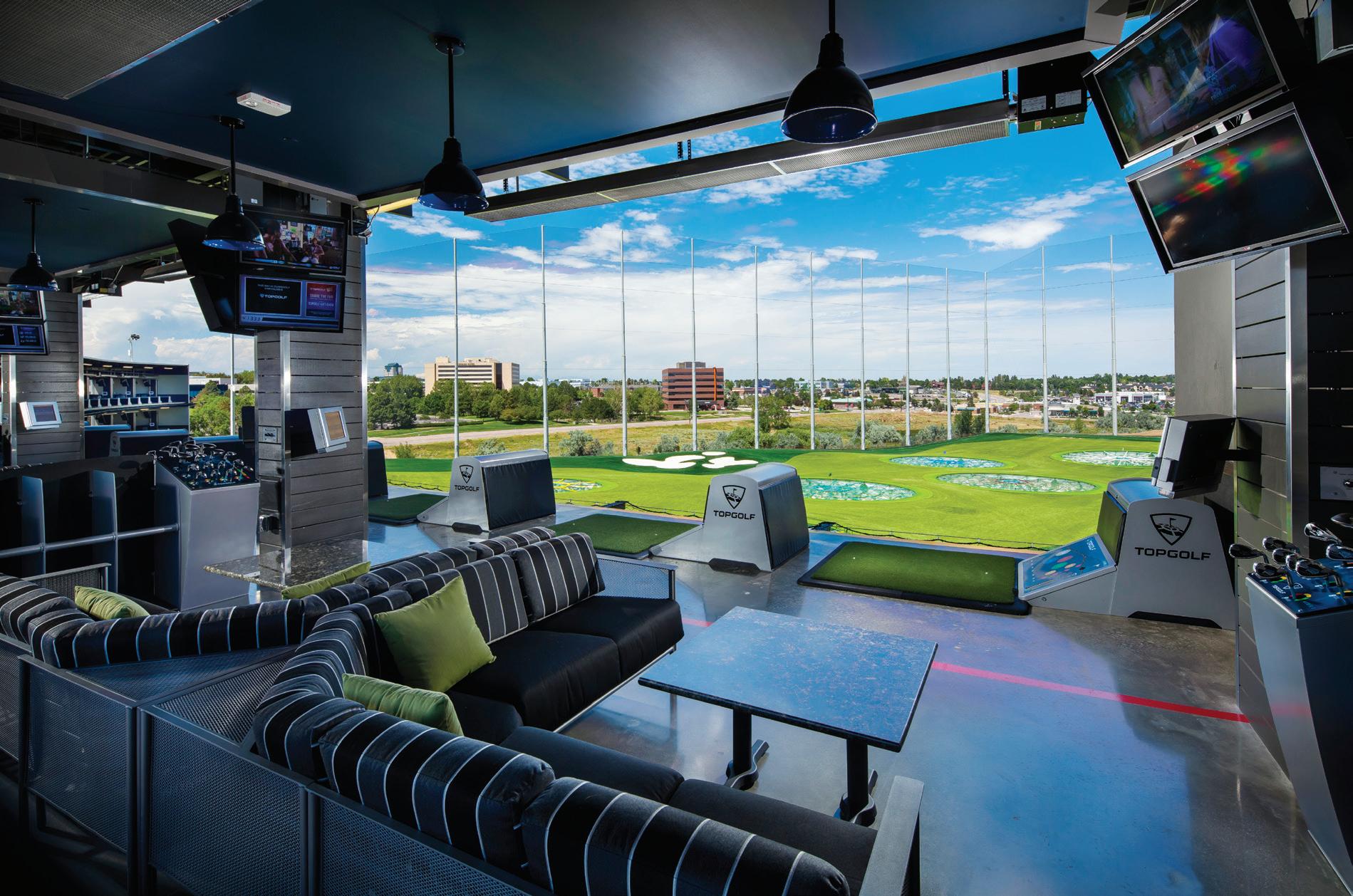
JENNIFER LOUGEE GOT HER START working at Topgolf as a drink runner in the summer of 2011 alongside all of her friends while earning her degree in health administration. After graduation, she continued to juggle both her job at Topgolf and a part-time gig as an office manager at a dental practice. It was at this time—serving both drinks and patients—that she realized she needed to pivot into the restaurant business full-time.
“Happy people don’t really come to a dental office. I needed an outlet to talk to people and have fun, so I kept my job at Topgolf,” Lougee says. “One day, I visited a newer venue. It was a beautiful building, and suddenly, I saw an oppor tunity for future growth. I knew I could grow my career in this industry alongside the Topgolf brand.”
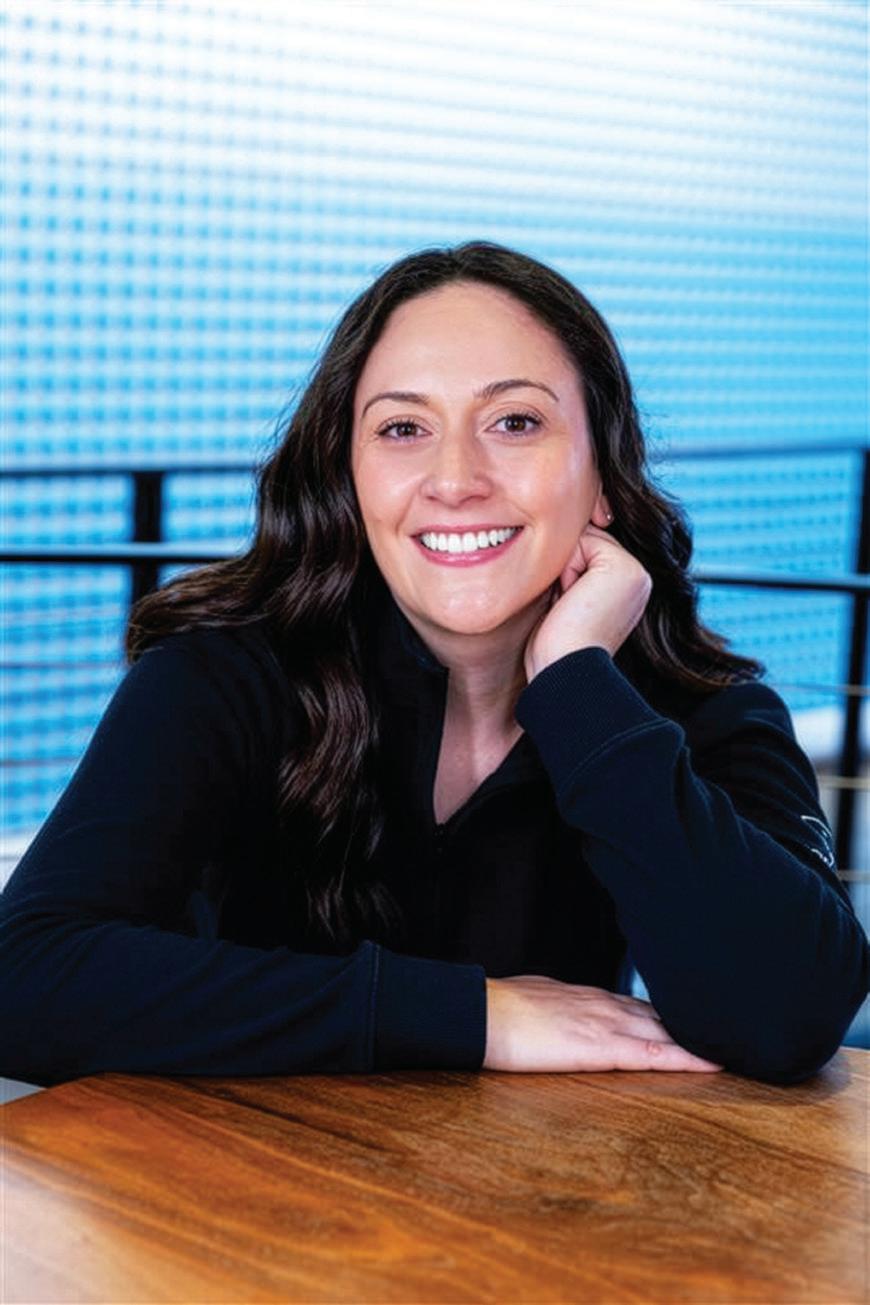
From there, Lougee advanced through nearly every front-of-house and back-ofhouse role—event office manager, procurement coordinator, food and beverage project manager—to her current position as senior manager for food and beverage operations. This comprehensive, 360-degree experience has given her a rare understanding of what it takes to operate at scale, especially for an experiential brand like Topgolf. Today, she over-
sees more than 100 venues nationwide and is recognized as one of the organization’s most influential leaders.
That dual perspective—her experience working the line and now sitting in the corporate office—is her greatest asset. When new initiatives roll out, she understands both the venue operator’s constraints and the corporate strategic vision. She doesn’t see new programs as complexity, but as opportunities to solve real problems.
“Coming up from the venue side and now being on the corporate level, I’ve seen the priorities of both sides and understand the operational complexities that go along with rolling something out,” Lougee shares. “So when we’re launching
new food and beverages, it’s pretty seamless and not seen as another complexity, but rather something that fits right into our program.”
Her drink runner roots shine brightest in her beverage innovation work. She’s passionate about creating experiences for guests and removing friction for her teams—two priorities that directly stem from her time on the floor. Understanding what it’s like to be slammed during service, she approaches every menu decision with the operator’s reality in mind.
One of her first major projects was implementing a digital recipe book for the bar, where bartenders can search by flavor and type of spirit. Before this, it was printed recipe books in a binder—
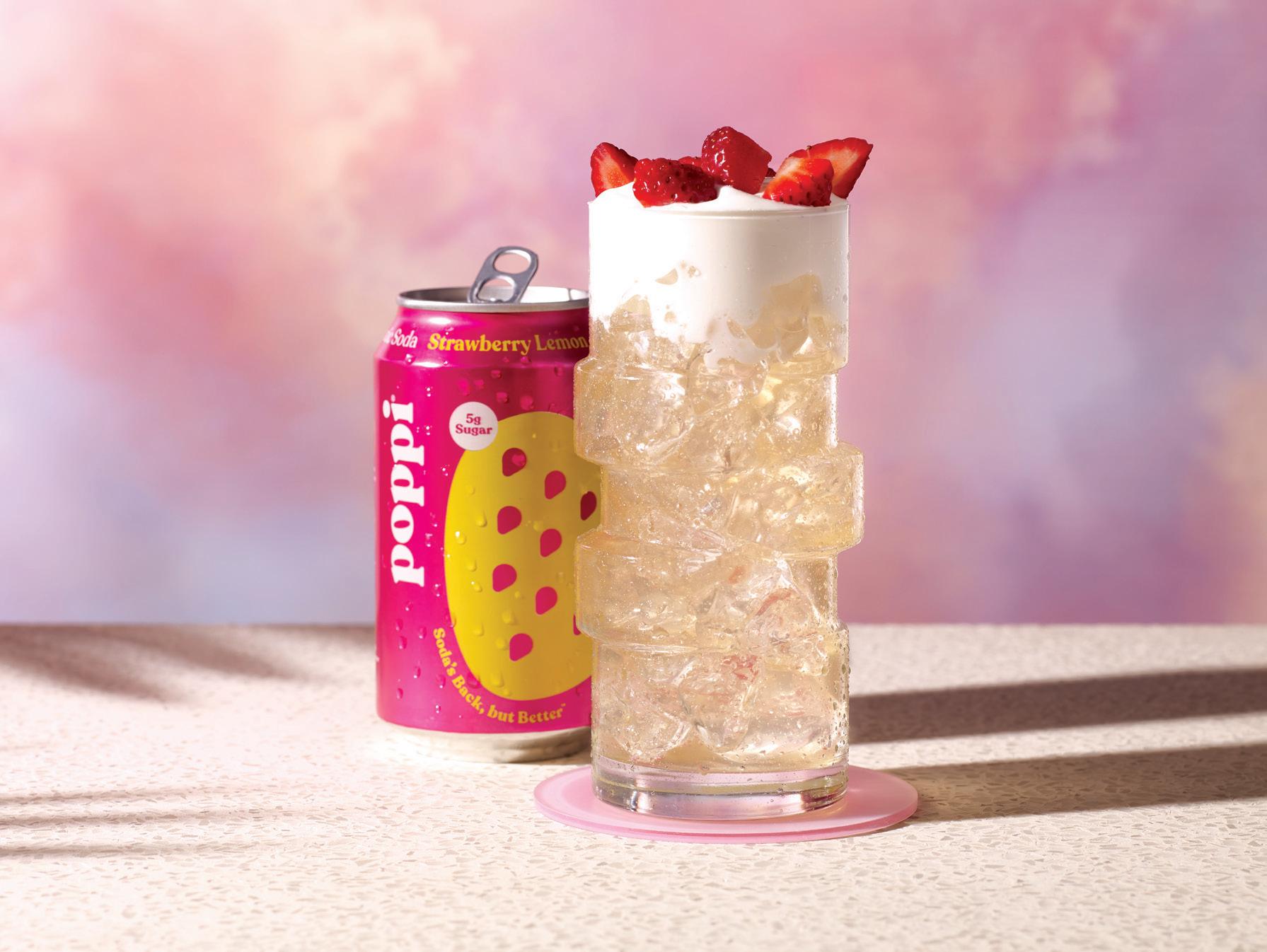
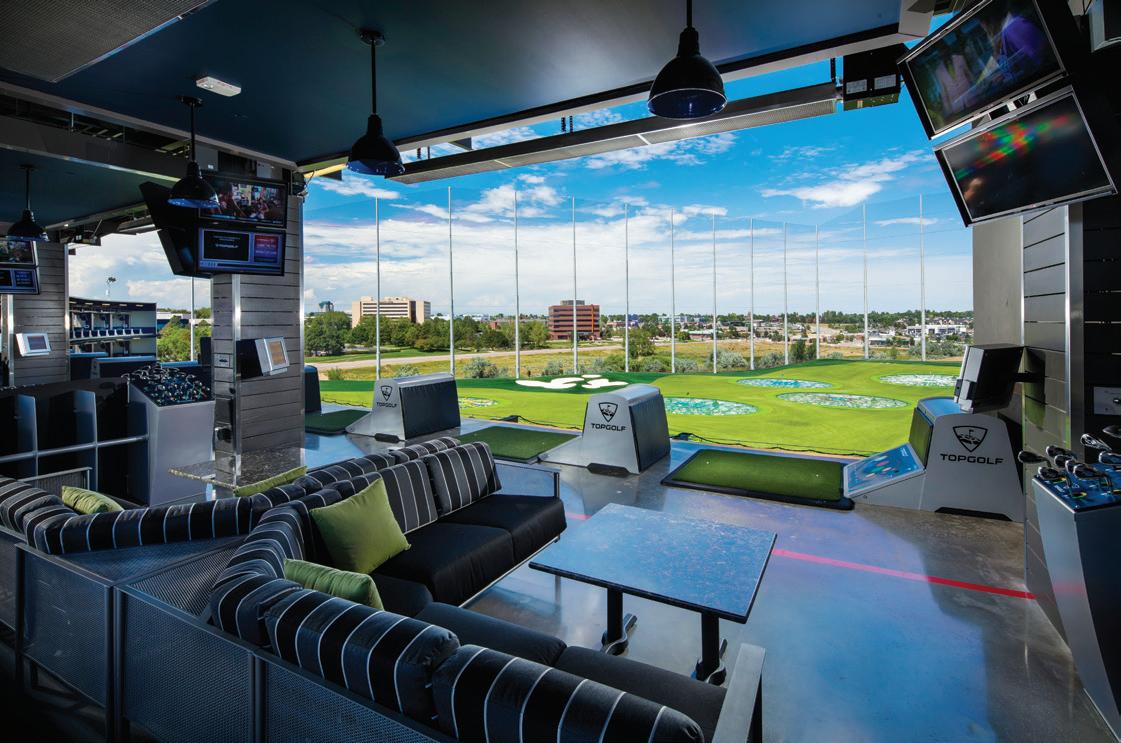
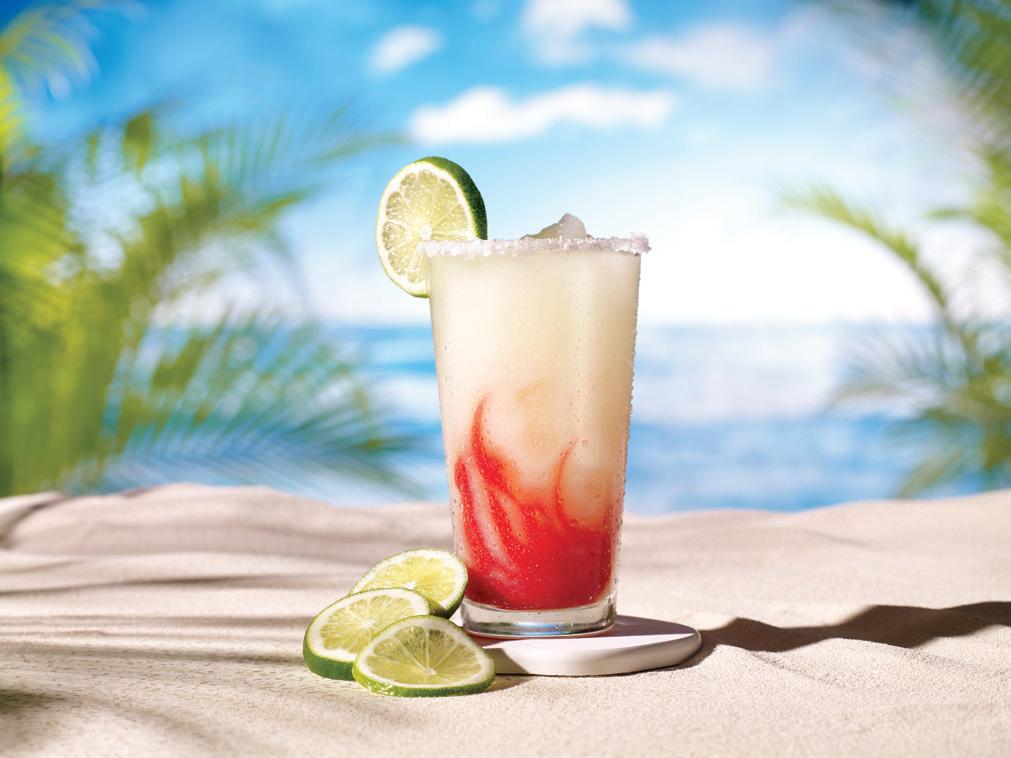
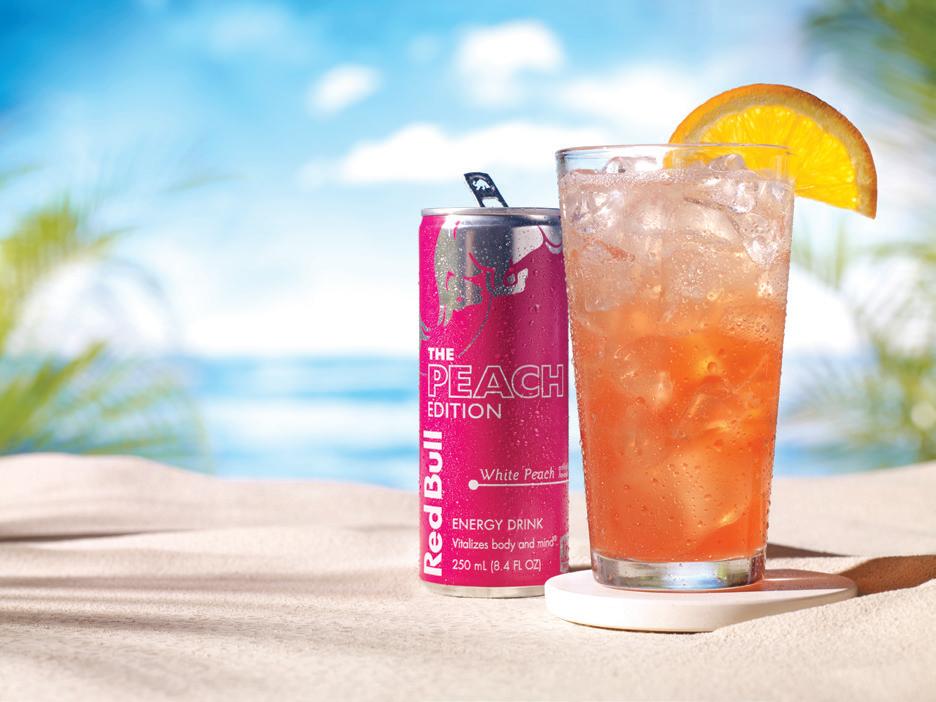
MOST RECENTLY, LOUGEE WORKED ON TOPGOLF'S SUMMER LTO LINEUP, WHICH LAUNCHED ON MAY 27 AND INCLUDED FIVE SIGNATURE BEVERAGES RANGING FROM NONALCOHOLIC OPTIONS TO PREMIUM COCKTAILS.
and as a former bartender herself, she knew how time-consuming it could be to flip through pages during a rush. That firsthand knowledge transformed how she thinks about operational efficiency and innovation across the entire food and beverage program.
“Nonalcoholic beverages are a huge opportunity. People aren’t drinking as much, but they’re still looking for something they can participate in,” Lougee says. “We hopped on the dirty soda trend pretty early, and recently expanded a full ‘build your own dirty soda’ campaign. We gave our players customization options, and this gave us data to look back on and potentially use as a future crafted beverage.”
Most recently, Lougee worked on Topgolf’s summer LTO lineup, which launched on May 27 and included five signature beverages ranging from nonalcoholic options to premium cocktails.
She also helped spearhead the redesign of Topgolf’s menu program, executing three print cycles annually while decreasing costs—a balancing act that requires understanding both the guest experience and the operational realities of over 100 venues.
“We conducted a lot of focus groups, and the feedback was that Topgolf can be an overwhelming experience for
newcomers, so we wanted to make a menu as user-friendly as possible,” Lougee says. “The sweet spot is an eightpage menu with recommendations in the form of thumbs-up icons. We also implemented a soft cover that allows us to mix-and-match, do photoshoots, and highlight new items without changing the whole menu.”
When it comes to rolling out new items across the brand, Lougee emphasizes that it’s a marathon, not a sprint. Her highest-performing initiative to date—a collaboration with Pepsi—took over a year to fully test and implement across locations.
“You have to understand that it’s not an immediate gratification, but if you stick with it, you can get some cool things done well,” Lougee adds. “We have over 100 locations, and a huge plan is hard to execute quickly.”
Her ability to spot marketable concepts and guide them from ideation to execution extends beyond partnerships and guest feedback. In 2025, she launched Topgolf’s Menu Innovation Contest, which has become a powerful tool for surfacing ideas from across the organization—and building culture.
“The innovation contest is one of my favorite things we do. Seeing what our chefs, managers, and hourlies come up
with is incredible, and we know there is so much talent across the brand,” Lougee says. “It’s a great culture builder for Topgolf, and the winners not only get items added to the menu, but have also become leaders at their own venues. It’s a great pipeline for growth.”
Hailed as a leader who champions efficiency, fosters collaboration, and enables mentorship, Lougee is passionate about giving back to emerging leaders in the organization that gave her so many opportunities to grow.”We work hard, but we play hard and have fun with our jobs. The team I work with is so amazing, and we care deeply for each other,” Lougee says.
“Topgolf has given me lots of opportunities that I didn’t necessarily see for myself at first, and given me the courage to raise my hand and ask for more,” she adds. “It’s amazing to see your hard work come to life, whether it be a new menu launch or an LTO, and it makes it all worth it. My biggest advice is to build relationships and find support from leaders who can advocate for you.”




ROLE: CMO
BRAND: Ford’s Garage HQ: Tampa, Florida
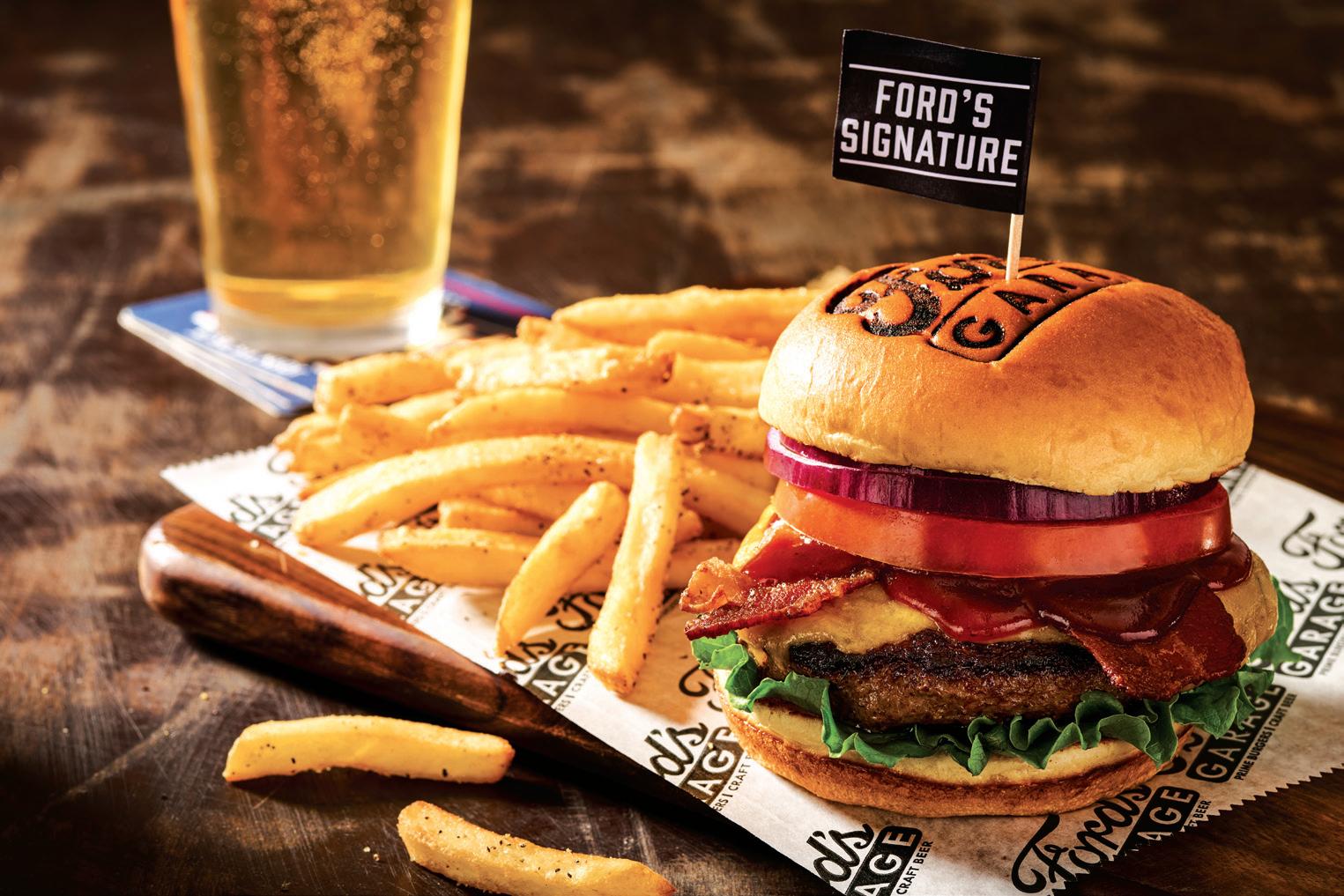
Kathleen Bush’s path to becoming the new CMO of Ford’s Garage is filled with franchisee listening sessions, a knack for finding what makes a concept special, and plenty of burgers. As the former VP of marketing at Red Robin for over three years, Bush is bringing experience boosting nostalgic legacy brands. Her new position marks her ascendence to the C-suite for the first time. As a native of Florida— where Ford’s Garage was founded—Bush’s shift feels less like moving into new territory and more like coming home. She shares how she’s thinking about growth and franchisee alignment, and why authentic human connection remains the most important advantage in a digital-first dining landscape.
BY CALLIE EVERGREEN
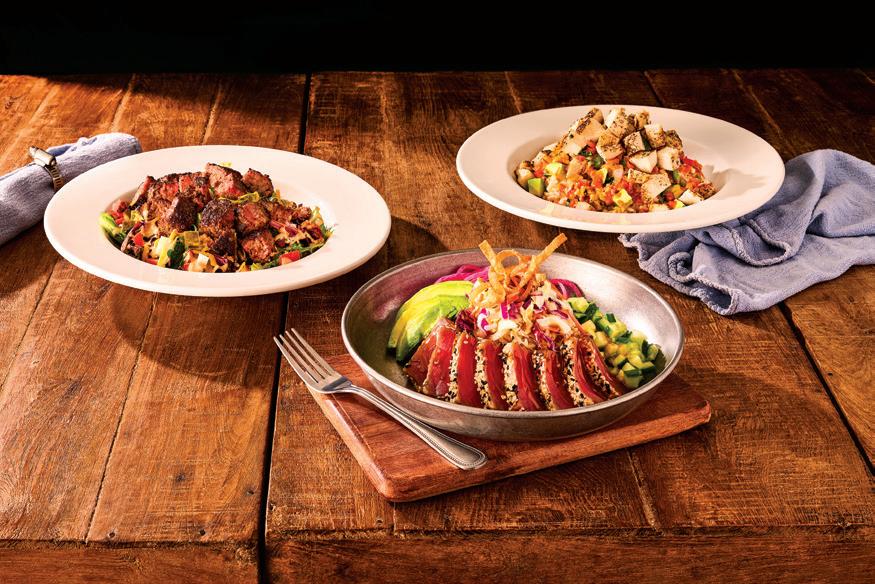
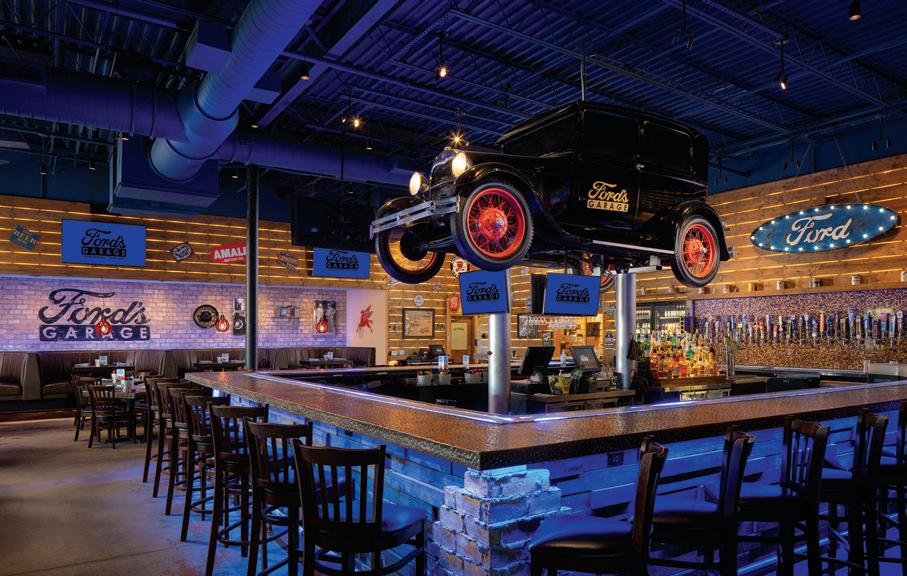
You described Ford’s Garage as having “incredible energy” and a “tremendous runway ahead.” What specifically made this opportunity the right next move for you?
Ford’s Garage is a dream opportunity for a marketer. I’ve been a fan and guest for years. Simply put, it has strong brand DNA: a delicious menu, the heritage of Ford as an official licensee, and a lively atmosphere that’s just fun to be in. In addition to my career in restaurants, I also spent many years in automotive communications, which was so much fun and draws parallels to the hospitality business: people are passionate about what they eat and what they drive. This role is a creative blend of both.
What are you focused on in your first 90 days?
It starts with a deep dive into the “bones” of the brand—certainly the food and hospitality, but importantly, what’s the unique signature guests come for, that only we can deliver. The Ford’s Garage founders cultivated a brand with a clear point of view, with a deeply intentional focus on creating an environment that’s immersive and authentic to the experience of being in a 1920s service station, down to the original Model A cars suspended above the bar to the memorabilia on the walls and so many details in between. It just captures your imagination when you walk in.
How do you align marketing strategy across a franchise system?
In our case, many of our original founders are current franchisees, so there’s great responsibility in honoring the brand they’ve built and moving it forward as we grow. It’s been important to me throughout my career to listen and learn from our franchisees. They’re bold, they have vision, they take action, and in many cases, they have the most skin in the game. At corporate, it’s important we deliver impact with brand-level traffic and brand-building strategy paired with tailored local execution, as well as giving their teams the tools they need to localize the brand and compete in their unique trade areas.
What is the biggest “NextGen” shift you believe the industry must embrace?
The biggest shift may be a bit counterintuitive. In a digital-first world, the brands that win will be the ones that continue to deliver authentic human connection. For Ford’s Garage, that means leading with the great food, experience and hospitality we’ve been known for, then backing it with smarter, more personalized digital that helps us reach our guests in a more tailored, meaningful way.










PITMASTER CRAFTED | 100% HARDWOOD SMOKED
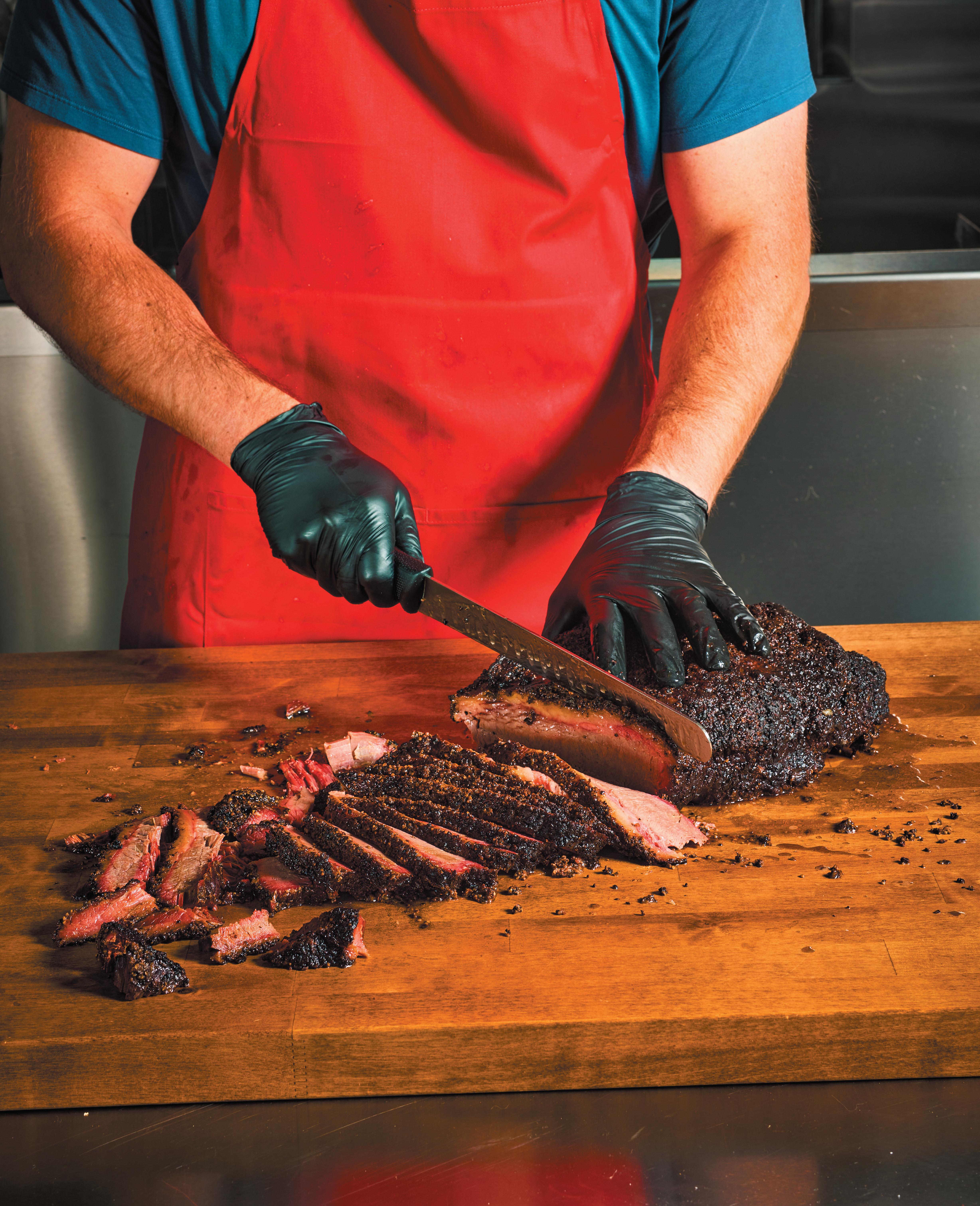
SIMPLY SEASONED MEATS
LEARN ABOUT OUR TRADITION AND GRAB A SAMPLE TODAY.
When you start with AUSTIN BLUES® Smoked Meats, you can create authentic barbeque that makes your operation sing. We provide a full line of smoked meats born in the pit. You create plates of barbeque you can proudly call your own that guests will crave. That’s Your ‘Que.