NO. 156 FULL-SERVICE RESTAURANTS : SETTING AMERICA’S TABLE
SCALING SUNRISE SOCIAL
NEXTGEN COMFORT EATS
BEVERAGE FESTIVALS
2027 TRENDS TO WATCH ®
THE
FSR 30 REPORT REVEALING THE
LARGEST FULL-SERVICE CHAINS IN AMERICA
PAVING THE PATH FOR FUTURE LEADERS AT
BUFFALO WILD WINGS INSIDE
RACHEL RICHAL’s
JOURNEY FROM HOURLY EMPLOYEE TO TRAINING EXECUTIVE
PLUS WHY
bartaco DITCHED
QR CODE ORDERING
CONTENTS 18 RACHEL RICHAL IS THE BRAINCHILD OF THE NOW-FAMOUS BUFFALO WILD WINGS BLAZIN’ GAMES, PLUS SEVERAL OTHER IMPACTFUL BRAND INITIATIVES.
FSR December 2026 No. 156 18 Paving the Path for Future Leaders BY CALLIE EVERGREEN
Inside Rachel Richal’s journey from hourly employee to training executive at Buffalo Wild Wings.
21 The FSR 30 Our annual ranking of the largest full-service restaurant chains in the U.S. by unit count. C HEF S & IN G R ED IEN T S
07 Pop-Ups, Prep Work, and Out-of-the-Box Menus BY CALLIE EVERGREEN
Chef Bobby McFarland shares the secrets behind how he creates immersive dining experiences at Wye Hill Kitchen & Brewing and three other restaurants.
07
12 Comfort Food Reimagined BY SATYNE DONER
From fried mac and cheese burgers to Thai pad kra pao, a new generation of diners is redefining what feels like home. L I Q U ID IN T EL L I G EN C E
INSPIRE BRANDS, WYE HILL KITCHEN & BREWING
15 Where Beverage Enthusiasts Meet BY SAM DANLEY
Online discovery only goes so far. Here’s why in-person trade events still deliver the most actionable takeaways for bar leaders, and five gatherings worth watching heading into 2027.
F S R M AG A Z I N E .CO M
D EC EM B ER 2 0 2 6
1
FSRmagazine.com December 2026 No. 156
32
EDITORIAL
SVP SALES & STRATEGY
VP, EDITORIAL DIRECTOR: FOOD, RETAIL, & HOSPITALIT Y
312-961-6840 mwaddell@arrowfly.com
Danny Klein
dklein@arrowfly.com FSR EDITOR
Callie Evergreen
cevergreen@arrowfly.com QSR EDITOR
Ben Coley
bcoley@arrowfly.com
ASSOCIATE EDITOR
Sam Danley
sdanley@arrowfly.com
25 FIR S T CO U R SE
05 Shifting Priorities
Why iconic restaurateur Sam Fox officially stepped away from Fox Restaurant Concepts, and where he’s turning his attention to next.
06 Overrated Menu Trends to Drop Adopting viral food trends may earn some social media buzz, but it doesn’t guarantee long-term menu success. Recent research reveals insights on the added protein fad, Dubai chocolate, and more.
B AC K O F H O USE
25 How Meg Walker Made Her Dream a Reality WOMEN IN LEADERSHIP The
story of a Michelin-trained chef’s pandemic gamble and the multi-year push to build her own catering empire— and reopen a historic beachfront library as an event venue and café.
SENIOR EDITOR, WIRL
Satyne Doner
sdoner@arrowfly.com
27 Sunrise Social’s Franchisee-First Approach ON THE RISE From franchi-
see to franchisor, Aaron Anderson is building a new brunch brand that spotlights hospitality-forward tech and a signature menu item.
29 Why bartaco Ditched QR Codes TECH CHECK A case study on
why bartaco got rid of QR code ordering and replaced it with a new and improved hospitality experience.
32 Betting Beyond the Traditional Meal BEHIND THE SCENES As CEO
of an eight-concept restaurant group in Florida, Randy Esponda believes the biggest opportunity is bringing dining, entertainment, and wellness together.
A L S O IN T HI S I S SU E 04 Editor’s Welcome 31 Advertising Index
FSR is a registered trademark of Arrowfly. FSR is copyright © 2026 Arrowfly. All rights reserved. The opinions of columnists are their own. Publication of their writing does not imply endorsement by Arrowfly. Subscriptions 919-945-0704. www.fsrmagazine. com/subscribe. FSR is provided without charge upon request to individuals residing in the U.S. meeting subscription criteria as set forth by the publisher. All rights reserved. No part of this magazine may be reproduced in any fashion without the express written consent of Arrowfly. FSR (ISSN 2325-2154), USPS PUBLICATION #9690 is published monthly by Arrowfly, 1111 Superior Avenue Suite 1120, Cleveland, OH 44114. Periodicals postage paid at Cleveland, OH and at additional mailing offices. POSTMASTER: Send address changes to FSR, 1111 Superior Avenue Suite 1120, Cleveland, OH 44114.
2
D EC EM B ER 2 0 2 6
SALES & BUSINESS DEVELOPMENT
CO N T E N T S T U D I O VP, CONTENT STUDIO
Peggy Carouthers
pcarouthers@arrowfly.com WRITER, CONTENT STUDIO
Drew Filipski
dfilipski@arrowfly.com WRITER, CONTENT STUDIO
Ya’el McLoud
ymcloud@arrowfly.com WRITER, CONTENT STUDIO
Davina van Buren
dvanburen@arrowfly.com
DESIGN SENIOR ART DIRECTOR
Tory Bartelt
tbartelt@arrowfly.com
LinkedIn.com/company/ FSR-magazine Instagram.com/FSRmagazine
Matt Waddell
VP, BUSINESS DEVELOPMENT
Amber Dobsovic
757-637-8673 adobsovic@arrowfly.com SALES DIRECTOR
Patrick McIntyre
216-372-8112 pmcintyre@arrowfly.com SALES MANAGER
Guy Norcott
854-200-5864 gnorcott@arrowfly.com KEY ACCOUNT MANAGER
John Petersen
216-346-8790 jpetersen@arrowfly.com NATIONAL SALES MANAGER
Tom Boyles
662-607-5249 tboyles@arrowfly.com
ACCOUNT MANAGER
Tanner Hartwick
571-596-0375 thartwick@arrowfly.com SALES DIRECTOR
Tony Bolla
773-859-1107 tbolla@arrowfly.com SALES DIRECTOR
Susan Shepherd
404-386-1709 sshepherd@arrowfly.com CUSTOMER SERVICE REPRESENTATIVE
Tracy Willingham
919-945-0704 twillingham@arrowfly.com CUSTOMER SERVICE REPRESENTATIVE
Brandy Pinion
216-952-0877 bpinion@arrowfly.com
Facebook.com/FSRmag
A D M I N I S T R AT I O N CEO 2026 REGIONAL BRONZE AWARD: FRONT COVER DESIGN
Matt Logan
mlogan@arrowfly.com
2024 REGIONAL GOLD AWARD: PUBLICATION DESIGN
919-945-0704 www.fsrmagazine.com/subscribe
2023 NATIONAL GOLD AWARDS: FRONT COVER (PHOTO), BEST USE OF COLOR NATIONAL SILVER AWARD: BEST USE OF TYPOGRAPHY
FSR is provided without charge upon request to individuals residing in the U.S. who meet subscription criteria as set forth by the publisher.
2016 MAGAZINE OF THE YEAR TOP 10 AWARD 2015 MAGAZINE OF THE YEAR FOLIO: Eddie Awards 2022 BEST FULL ISSUE HOSPITALITY 2022 BEST SPONSORED CONTENT 2021 BEST PROFILE FEATURE 2017 BEST FULL ISSUE FOOD & BEVERAGE 2013 BEST DESIGN, NEW MAGAZINE 2013 BEST FULL ISSUE, FOOD SERVICE/HOTEL
REPRINTS THE YGS GROUP 800-290-5460 fax: 717-825-2150 fsrmagazine@theygsgroup.com Sponsored content in this magazine is provided to the represented company for a fee. Such content is written to be informational and nonpromotional. Comments welcomed at sponsoredcontent@fsrmagazine.com.
FOUNDER
Webb C. Howell
F S R M AG A Z I N E .CO M
ELAINE CHANG PHOTOGRAPHY, SUNPUBS HOSPITALITY GROUP
CONTENTS
®
Progressive Casualty Insurance Co. & affiliates.
Small business owners’ to-do lists can add up. So see if you can save money on a commercial auto quote at ProgressiveCommercial.com.
Get a quote online in as little as 8 minutes
Welcome
Know Better, Do Better
SCAN THIS CODE TO SUBSCRIBE TO FSR’S E-NEWSLETTERS!
Callie Evergreen EDITOR
4
D EC EM B ER 2 0 2 6
cevergreen@arrowfly.com FSRmag @FSRmagazine
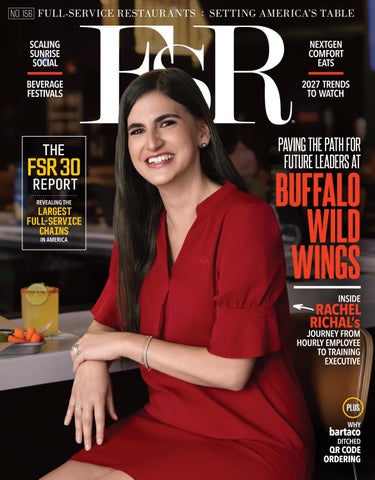
On the Cover Our December cover features Buffalo Wild Wings’ VP of Restaurant Experience and Training, Rachel Richal, who has been the brainchild behind several new brand initiatives since joining B-Dubs in 2019. We dive into her process for launching new programs, how she keeps authenticity at the forefront of training, and the magnitude of mentorship for progressing her own career as well as her own positive influence on the future workforce of hospitality leaders. B-Dubs ranks No. 4 on The FSR 30 Report of the largest chains in the U.S.
F S R M AG A Z I N E .CO M
FRANK GIBSON / IMAGE EXTENDED BY FSR MAGAZINE
AS WE’RE NEARING THE END OF 2026, we’re checking the rearview mirror to keep what we learned in mind as we look forward to what’s next. That doesn’t mean we won’t end up running into the same roadblocks again, but it does mean we can be a bit better prepared and anticipate what we may come up against in the future. The famous quote from Maya Angelou comes to mind: “Do the best you can until you know better. Then when you know better, do better.” It’s a reminder to give ourselves grace for the past, yet hold ourselves accountable to keep learning and putting those lessons into practice. Continuous growth is the goal, and of course, that growth isn’t always linear. It can even be circular, bringing us back to the same tricky spot again and again until we master the solution, then we can finally move forward. There’s no better example of this philosophy in practice than in the training arena. Our cover story this month spotlights an expert in training, Rachel Richal, who leans on her formative years working at her family’s deli and wine store while growing up to inform how she teaches the next generation of hospitality leaders at Buffalo Wild Wings. Over the past seven and a half years with B-Dubs, Richal’s approach to leading and training restaurant teams has evolved as the industry itself has shifted. There was a time that service training across the industry was very scripted. Now, younger generations of restaurant workers expect to be given more agency and the ability to be their authentic selves more freely. “People want autonomy in their roles. Guests want experiences that are not robotic,” she says. “We don’t need team members to memorize a script; we can give them guidelines and share little tricks of the trade, then empower them to deliver a personalized experience that feels natural to them. This has been a major shift,” she adds. Read the rest of the feature on PAGE 18. Another great example in our December magazine: From multi-concept franchisee to franchisor, Aaron Anderson is leveraging his intimate industry knowledge and expertise to improve the operator experience at his rising brand, Sunrise Social (PAGE 27). Know better, do better. On PAGE 29, you’ll find a case study for why bartaco removed QR code ordering, despite knowing it would remove some efficiencies plus necessitate retraining servers. But CEO Anthony Valletta listened to feedback from guests, analyzed the data, and made the decision to change up the service model in support of improving the guest experience. Know better, do better. As this theme echoes across our entire issue, ask yourself: How will you do one thing better as we head into 2027?
First Course
Sam Fox opened his first hotel in Phoenix under Author & Edit Hospitality. With five distinct dining concepts, The Global Ambassador Hotel has earned a MICHELIN Key every year since opening in December 2023.
SAM FOX, AUTHOR & EDIT HOSPITALITY
Sam Fox’s Shifting Priorities BY CALLIE EVERGREEN
Why the iconic restaurateur officially stepped away from Fox Restaurant Concepts, and where he’s turning his attention to next.
F S R M AG A Z I N E .CO M
SAM FOX’S NAME IS SYNONYMOUS with excellence in the restaurant world. The acclaimed entrepreneur went from a college dropout to opening nearly 200 restaurants across the country over the past three decades. Having been nominated for more than a dozen James Beard Awards, Fox built and sold one of the country’s most admired culinary portfolios through Fox Restaurant Concepts (FRC), creating more than
D EC EM B ER 2 0 2 6
5
First Course
where third-party operators worked to operate the various parts from the restaurants to the valet and spa. “I looked around and everyone was working in different silos, and it was really draining and taxing on the guests and really not great for employees either. And I said, ‘This model is broken,’” he recalls. That was the inspiration for Fox to set out to create his own hotel. “I was going to operate it as a truly independent hotel and own and operate everything within the four walls within the business. And I think that the guests can feel that,” he adds. Looking to the future, Fox and Timberlake announced a Twelve Thirty Club coming to Austin, Texas, as well as a Théa Mediterranean Rooftop in Dallas, both slated to open in 2027. He also hinted at replicating the model for The Global Ambassador in other markets around the country, as well as developing a smaller “sibling” hotel brand in Phoenix, all yet to be formally announced.
6
D EC EM B ER 2 0 2 6
OVERRATED MENU TRENDS TO DROP Going after viral trends may get you some social media buzz, but it doesn’t guarantee long-term men u success. One example is Dubai chocolate, which 39% of consumers believe won’t be popular by 2027 ,according to recent research from Rubix Foods . SOME OTHER KEY FINDINGS INCLUDE: • Skip the “added” protein; consumers want better quality. While 69% reject the 41% price markup on added-protein drinks, 88% say they’d willingly pay more for higher-quality center-of-plate meat. • Trade extreme heat for “smart” spice. Here’s the rub: 74% of consumers prefer mild-to-medium spice levels. Burn-warning ghost peppers (-14%) are dropping on menus, while lower heat options are on the rise like ChiliCrisp (+97% projected by 2030) .
F S R M AG A Z I N E .CO M
ADOBE STOCK / MASTER1305
20 brands like True Food Kitchen, The Henry, Flower Child, and North Italia. He sold FRC to The Cheesecake Factory in October 2019, when the group had almost 50 restaurants across eight states. Since then, FRC has grown to 13 concepts with more than 100 locations nationwide, plus 52 North Italia locations. Seven years after selling his company, Fox officially stepped away from FRC at the end of October. “It’s hard to sell your business and be partners with the people you sell your business to for this long,” he admits, adding that his departure was the result of a gradual, year-by-year transition rather than a fi xed timetable set at the sale. Though the transition was planned and agreed upon years in advance, it marked an important milestone for the restaurateur and his career path as he turns his full attention to the luxury lifestyle hotel and independent restaurant realm. Fox created Author & Edit Hospitality in 2021 with the debut opening of The Twelve Th irty Club—a multi-level dining and entertainment destination in Nashville, Tennessee, inspired by the supper clubs of the Prohibition era—in partnership with Justin Timberlake. He then created his fi rst hotel, The Global Ambassador in Poenix, i n December 2023. “Opening The Global Ambassador put me in a world I had never been in before. After spending my entire career in restaurants, suddenly I was a first-time hotelier, earning a MICHELIN Key in our first year and every year since. And I loved it,” Fox says. “It reminded me how much I still have to learn and how much more there is to create. In a lot of ways, I feel like I’m starting all over again, only this time with nearly 30 years of experience behind me.” The Global Ambassador houses five distinct dining options, including Théa Mediterranean Rooftop overlooking Camelback Mountain, Le Âme, a Parisian steakhouse and bistro; Pink Dolphin, a poolside Mexican and Peruvian restaurant and bar; Le Market, a French-inspired bakery and cafe; and Lobby Bar, an intimate cocktail lounge with live weekend jazz. His shift into the hotel side of hospitality stemmed from his past frustrating experience opening a restaurant inside a hotel,
CULINARY INSPIRATION AND STORIES FROM INDUSTRY TRAILBLAZERS MENTIONED IN THIS SECTION WYE HILL GLASSHOUSE KITCHEN MAGGIE McFLY’S QUA CONTEMPORARY CHINESE CUISINE • • •
• • •
• • •
Chefs & Ingredients CHEF BOBBY McFARLAND HELPED OPEN WYE HILL KITCHEN & BREWING IN 2019 AND THEN GLASSHOUSE KITCHEN IN 2022—SISTER RESTAURANTS IN THE RALEIGH-DURHAM AREA CREATED BY CO-FOUNDERS SARA ABERNETHY AND CHRIS BORRESON.
POP-UPS,
PREP WORK, AND OUT-OF-THE-BOX MENUS
WYE HILL KITCHEN & BREWING
BY CALLIE EVERGREEN
The secret to how chef Bobby McFarland creates immersive dining experiences at Wye Hill (and three other restaurants). F S R M AG A Z I N E .CO M
BOBBY McFARLAND ISN’T AFRAID TO GO AGAINST THE GRAIN and think outside the box when it comes to menu innovation. That characteristic is showcased by the pumpkin gnocchi he recently created for Wye Hill Kitchen & Brewing in Raleigh, North Carolina. While most recipes start with potatoes and add pumpkin for flavor, he started with pumpkin itself as the foundation. He and his staff cook the pumpkin purée in a wide rondeau pan until more than half the water has been removed, which allows them to use less flour
D EC EM B ER 2 0 2 6
7
CHE F S & ING RE DIE N T S CHE F PROFILE
GLASSHOUSE KITCHEN
8
D EC EM B ER 2 0 2 6
POST-SHIFT DRINK:
Old fashioned
FAVORITE SPICE AT THE MOMENT:
Black cardamom
CHEF YOU’D LOVE TO WORK WITH:
Alton Brown
TREND YOU’D BRING BACK:
Cheese course after dinner ALT PROFESSION:
TV Writer
FAVORITE LOCAL RESTAURANTS:
Stanbury, Cheeni, Lawrence BBQ
sitting through meetings about whether Bank of America’s stock might move a few points next quarter.” He fed his fascination with experiments, like making bacon from scratch while home for his college spring break because he was curious why bacon tastes so good when it starts as raw pork. “I grew interested not just in how to cook, but why cooking works,” he recalls. While he considered culinary school, he “couldn’t justify the expense.” Instead, through his friend and mentor Lou Palma, he ended up meeting chef Floyd Cardoz—a world-renowned chef F S R M AG A Z I N E .CO M
GLASSHOUSE KITCHEN (2), MARK DEPAUL
and produce a delicate, light, and pillowy gnocchi that holds together with a soft, fluff y interior. “It’s a simple adjustment based on understanding the ingredients rather than following a recipe. And it’s something we can teach our cooks to reproduce consistently,” McFarland says. “That’s how I approach cooking: understand the science, question convention, and make something delicious that we can execute well,” he adds. “I also like to understand the science behind traditional recipes so I can question whether tradition offers the best approach.” McFarland has always been fascinated with food. One of his earliest memories is dragging a stool up to the kitchen counter to microwave string cheese over Cheez-Its (no surprise that the food trend he wishes would come back nowadays is the cheese course after dinner). Though he started off as an economics major and interned in finance, he quickly realized he “wasn’t interested in
is the heart of this specialty from Recco, Italy. Two paper-thin sheets of dough and a creamy, gently tangy center come together in a focaccia that’s crisp, delicate, and incredibly smooth.
Find out more about Crescenza!
3.5 lb. Crescenza Block
and pioneer in Indian cuisine. After McFarland helped him at the Montclair Food & Wine Festival, Cardoz encouraged him to pursue cooking professionally. While he started at another restaurant to get his feet wet, McFarland eventually texted Cardoz and knocked on his restaurant’s door, put on a chef coat, borrowed his knives, and went to work. “I was a fish out of water. But I brushed up on my Spanish, worked my ass off, and became a pretty good cook,” he says. “One thing I remember (Cardoz) saying to someone was, ‘I need you to treat the dishwasher with the same respect that you treat me.’ That stuck with me,” McFarland recalls. “Now that I’m in an executive role myself, I think about that often.” After cutting his teeth in New York City’s cutthroat culinary scene, McFarland ended up relocating to North Carolina in 2016, where he’s held leadership roles at restaurants like Royale and Snap Pea Underground. In 2019, he joined the team at Wye Hill Hospitality to open Wye Hill Kitchen & Brewing and then Glasshouse Kitchen in 2022—sister restaurants in the Raleigh-Durham area created by co-founders Sara Abernethy and Chris Borreson. As company chef, McFarland oversees all culinary operations and menu innovation at both concepts. He also splits his time between Raleigh and Salt Lake City, where he serves as executive chef at Realine Hospitality Group’s concepts including Ivy and Varley and cocktail-forward pizza bar, Studio. Since he works across four kitchens and can’t be on the line in each one every day, McFarland says he designs systems that allow the teams to “execute ambitious food consistently.” That means looking for techniques that can be replicated at scale, minimizing complexity when it comes to prep, and providing straightforward, clear directions and training. For example, McFarland prefers to keep dishes to three to five components, even when each involves a complex recipe. A sauce might contain 20 ingredients, he notes, but they organize them into spice
10
D EC EM B ER 2 0 2 6
blends, aromatics, and other preparations that simplify production. “We put the work into prep so service runs smoothly. That lets us make ambitious food without complicated pickups,” he says. McFarland spent a good chunk of the past year creating a THC beverage called Tree Time THC Seltzers and designing his own proprietary pop-up for the first time—an immersive Halloween experience called Witch, Please—plus preparing for their annual Christmas pop-up, Sippin’ Santa, which is licensed out to multiple restaurants. “That’s demanded more of my attention, and I owe a lot of credit to the team at Glasshouse,” he notes. “They’ve kept things running while I’ve focused on those projects, our award-winning THC beverage brand,
and my work developing menus and systems for restaurants in Salt Lake City.” McFarland began working on Witch, Please in May, and was pretty proud of coming up with the name himself. The pop-up ran from September 18 through November 1, featuring over-the-top decor rooted in North Carolina folklore, witch-themed food specials, botanical elixirs, and active-effect potions. “We knew how much commitment matters to these things, so we knew it would be a big lift because with Sippin’ Santa, we really just deck out the entire restaurant, bringing the whole team in and everybody’s hanging decorations together,” he recalls. The team completely transformed the taproom into a dark apothecary complete F S R M AG A Z I N E .CO M
WYE HILL KITCHEN & BREWING (3)
CHE F S & ING RE DIE N T S CHE F PROFILE
WYE HILL KITCHEN & BREWING
NOW SE RV ING CHE FS & ING RE DIE N T S A signature cocktail menu allowed guests to sip on thematic “potions” infused with active-effect botanicals, rare herbs, house-made tinctures, and seasonal spirits served in custom ceramic keepsake mugs that were available for purchase. Nine Lives, for example, served blanco tequila, Ancho Reyes Chile Liqueur, and house-made horchata in a mug shaped like a black cat holding a red pitchfork. Whispering Woods—a tree trunk mug with a jack-o’-lantern-style face—housed whiskey, Amaro Averna, root beer reduction, lemon, and Angostura Bitters. And Plunder & Lightning came in a skull mug with Goslings Bermuda Black Rum, spiced ginger syrup, lime, and soda water. When considering a restaurant popup, it was helpful for McFarland and his team to narrow down the food menu to around five items, and designate that guests could only order these items in the taproom, not out on the patio, which continued serving the restaurant’s full menu. “Knowing we had that smaller scope to work with was helpful,” he says. “And then obviously spreading things evenly across the stations, and then 86ing some stuff off our regular menu to make room for both the prep time and the mise en place.” In his overarching menu strategy, he works to determine which dishes fit within each restaurant’s overall concept. Being a neighborhood restaurant and brewery, Wye Hill’s food should feel fun and approachable, yet still use serious technique. “We want each menu to refl ect the restaurant and the people who IN HIS OVERARCHING MENU STRATEGY, EXECUTIVE CHEF BOBBY MCFARLAND WORKS TO DETERMINE WHICH DISHES FIT WITHIN EACH RESTAURANT’S OVERALL CONCEPT. BEING A eat there, not just our personal tastes,” NEIGHBORHOOD RESTAURANT AND BREWERY, WYE HILL’S FOOD SHOULD FEEL FUN AND McFarland says. APPROACHABLE, YET STILL USE SERIOUS TECHNIQUE, HE SAYS. Though McFarland’s day-to-day duties have evolved alongside the four restauwith flickering candlelight, dark wooden McFarland says. “It’s fun being able to rants under his culinary charge, he takes tones and moody aesthetics, and a special cook from an angle that you’re not used care to remember how his mentor Floyd pop-up menu to match the spooky vibes. to cooking from.” Cardoz carried himself. “My responsibiliThink polenta-battered frog legs with hot Other examples include Midnight ties have changed, but that doesn’t make honey and charred green tomato remou- Tide featuring seared diver scallops with me any more important than the people lade, and the aforementioned pumpkin squid ink risotto, crispy prosciutto, pre- doing the other jobs. We all have roles gnocchi, named Witch’s Harvest, with served lemon, and rosemary, while Blood to play,” he says. “I think Floyd’s exambeet-whipped ricotta, autumn chili crisp, Moon starred yellowfin tuna carpaccio, ple taught me that leadership doesn’t and sage. spiced pecans, pickled Asian pear, lemon, mean putting yourself above the work. “The food was a ton of fun to build and smoked salt. And that’s just a taste It means recognizing the value of everyout. I got to put frog legs on the menu,” of the food side of “The Witch’s Kitchen.” one doing it.” F S R M AG A Z I N E .CO M
D EC EM B ER 2 0 2 6
11
CHE F S & ING RE DIE N T S NOW SE RV ING
Comfort Food Reimagined BY SATYNE DONER
From fried mac and cheese burgers to Thai pad kra pao, a new generation of diners is redefining what feels like home.
MAGGIE MCFLY’S
MAGGIE McFLY’S—A 10-UNIT CRAFT EATERY AND BAR WITH LOCATIONS IN CONNECTICUT, FLORIDA, NEW YORK, AND VIRGINIA— HAS AN EXTENSIVE MENU OF MORE THAN 150 DISHES RANGING FROM POT ROAST TO RAMEN AND GYROS TO KOREAN CHICKEN BAO BUNS.
WHILE THE TERM “COMFORT FOOD” executive chef of Maggie McFly’s. “Whether it’s a classic comfort dish first appeared in print in the mid-1960s, The craft eatery and bar concept first or something more unique, the ingreeating for coziness, indulgence, and nos- opened in 1993 in Middlebury, Connect- dients make a difference,” Rendon says. talgia dates back centuries. Today, com- icut, with the aim of fostering a sense “We want our guests to enjoy the same fort food has evolved from traditional of community and sourcing local ingre- experience they know and love, while favorites into something more diverse dients. Since then, Maggie McFly’s has also celebrating the communities each and creative. grown to 10 locations across Connect- location calls home.” “Today’s guests still want familiar, sat- icut, Florida, New York, and Virginia. Menu favorites include the short isfying dishes, but they also want variety, Its extensive menu of more than 150 rib poutine, with house-made gravy, fresh ingredients, and flavors inspired by dishes ranges from pot roast to ramen cheese curds, and scallions over a bed different cultures,” says Jamie Rendon, and gyros to Korean chicken bao buns. of crispy tater tots, and the fried mac
12
D EC EM B ER 2 0 2 6
F S R M AG A Z I N E .CO M
NOW SE RV ING CHE FS & ING RE DIE N T S
QUA CONTEMPORARY CHINESE CUISINE (2)
IN FOUNTAIN VALLEY, CALIFORNIA, QUA CONTEMPORARY CHINESE CUISINE’S AFTERNOON TEA SERVICE PAIRS DIM SUM, SAVORY BITES LIKE EGG TARTS, AND FRESH FRUIT WITH HOUSE-MADE SWEETS AND A SHARED POT OF TEA.
F S R M AG A Z I N E .CO M
and cheese burger, topped with bacon, lettuce, tomato, red onion, pickles, sriracha aioli, and a pretzel bun. Part of evolving, Rendon adds, means reimagining dishes and fl avors guests already love in new and unexpected ways. But sometimes the kitchen is the one surprised by what guests connect with. The miso salmon, made with Faroe Island salmon marinated in miso and baked, then served over basmati rice with a creamy miso sauce and a snow pea garnish, started as a seasonal offering but became a guest favorite. “The miso salmon is a great example of how global flavors can become guest favorites, and how much we value listening to our customers,” Rendon says. Dietary needs are part of that evolution. Every Maggie McFly’s kitchen has a dedicated gluten-free fryer, and menus include plant-based chicken, Impossible burgers, and vegan pasta. “We believe everyone should be able to enjoy a great comfort food experience, regardless of their dietary needs,” Rendon says. “We’ve made a conscious effort to offer alternatives that allow guests to enjoy the flavors and indulgence they’re looking for without feeling limited in their choices.” Other operators are finding comfort in cuisines that once sat outside the traditional canon. For a new generation of diners, the dishes they grew up on look different than their parents’ did, and the definition of American comfort food is shifting right along with them. “It’s following the people,” Viet Nguyen, founder of Kei Concepts, says. The Orange County, California-based group is behind numerous Vietnamese, Japanese, Italian, and Chinese restaurants. “Southern California is a good example. Kids here grew up eating pho, ramen, and Korean BBQ the same way other kids grew up on meatloaf. When they’re adults, they want something that feels like home, that’s what they reach for.”
Kei Concepts’ newest brand, Holy Heat, is built around that idea. The Thai ghost kitchen launched in October out of QUA Contemporary Chinese Cuisine’s existing Fountain Valley kitchen, a takeout-and-delivery concept with a single dish at its center: Bangkok-style pad kra pao. Pork, chicken, or tofu and mushrooms hit a hot wok with garlic and chili before basil is added at the end. The dish comes with jasmine rice, a fried egg, and prik nam pla, a spicy fish sauce, on the side. For Nguyen, the appeal is simplicity. “For me, comfort food is the thing you don’t have to think about,” he says. “You’re tired, you’re hungry, you don’t want to read a menu, and you already know what you want. In Thailand, that’s pad kra pao.” Guests choose from five spice levels, from no heat to the ghost-pepper Holy Heat. Nguyen recommends medium, the closest to how the dish arrives in Thailand, but he’s flexible. “I’m not going to tell someone they’re eating it wrong,” he says. “If you get no heat with tofu and you love it, that’s a win.” On QUA’s open-air patio, the pace slows. Afternoon tea, a seasonal experience that debuted in September, was the idea of Kei Concepts co-CEO Ivy Ha, who sees tea as permission to unhurry and linger with the people who matter most. Offered Friday through Sunday for $45 per person, with a two-person minimum, the tiered stand pairs in-house sweets such as egg tarts and mango sago pudding with savory bites like honey walnut shrimp youtiao and BBQ pork puff pastries, plus a pot of tea to share. The inspiration, Chợ Lớn, is tied to Nguyen’s food memories: street food, meals at friends’ homes, and his grandmother Vũ Thi Lan’s recipes. “We aren’t trying to recreate anything exactly,” he says. “We just want people to feel a little of what those meals were like.” Fast or slow, Nguyen says, the goal is the same: “to make something feel familiar and still a little bit ours.” It’s a fitting mantra for a category built on nostalgia, where the best new dishes feel like old favorites from the first bite.
D EC EM B ER 2 0 2 6
13
Fries. Crowds love them. And with our upsell strategies, your bottom line will love them too.
© 2026 Simplot Global Food, LLC.
TRENDS AND CREATIVE APPROACHES TO SPIRITS, WINE, AND BEER. MENTIONED IN THIS STORY TRUE HOSPITALITY CREATIVE FORGE BAR CONVENT BROOKLYN VIBE • • •
• • •
• • •
Liquid Intelligence
Where
Beverage Enthusiasts Meet
IN A BUSINESS INCREASINGLY CONDUCTED THROUGH SCREENS, BEVERAGE CONFERENCES AND FESTIVALS OFFER OPERATORS THE CHANCE TO COMPARE NOTES, DISCOVER NEW RELEASES AND TRENDS, AND WALK AWAY WITH A NEW SERVICE TECHNIQUE OR A NEW DRINK IDEA.
FORGE / VIBE
BY SAM DANLEY
Online discovery only goes so far. Here’s why in-person trade events still deliver the most actionable takeaways—and five gatherings worth watching heading into 2027. F S R M AG A Z I N E .CO M
A NEW BOTTLE might catch a beverage direc-
tor’s attention online. Deciding whether it belongs on the menu takes a little more work. How does it taste? What does it cost? Will guests order it, and what will staff need to know to sell it? Those are the kinds of questions operators can
D EC EM B ER 2 0 2 6
15
LIQ U ID IN T E LLIG E NCE
BAR CONVENT BROOKLYN (3)
work through on the ground at beverage is how to respond in a way that makes conferences, trade shows, and festivals. sense for their guests.” In a business increasingly conducted For Joe Durkin, founder and executhrough screens, these gatherings put tive producer of True Hospitality Crenew releases from emerging brands and ative, the company behind AltBev Expo, established suppliers within tasting dis- helping operators evaluate alternatives tance. They also give operators a chance to alcohol is central to the event. to compare notes and bring home some“Online research can help operathing useful, whether that’s a new spirit, tors discover new brands, but it cannot a service technique, or an idea for grow- replace tasting products, comparing ing sales. them side by side, and speaking directly As organizers prepare for gatherings with the people who make and distribheading into 2027, they’re making room ute them,” Durkin says. for conversations about changing drinkHe wants attendees to leave with ing habits, profitability, and what makes products worth testing, potential supa guest feel good about ordering another plier relationships, and ideas that fit round. their existing menus and service mod“We’re starting with the consumer. els. Conversations with fellow operaWhat makes someone go out, what do tors can help fi ll in the gaps: What are they want to drink, and what makes guests requesting? What’s actually sellthe experience worth the money?” says ing? Where does introducing a new cat- year and seeing more mocktail actiBrandy Rand, vice president of hospital- egory get complicated? vations. The festival, taking place this ity at Forge (formerly Questex), which The interest in low- and no-alcohol month, retains a strong cocktail and produces VIBE Conference and Bar & offerings extends to Palm Beach Food wine focus while responding to demand Restaurant Expo. “There’s plenty of dis- & Wine Festival, where founders David for additional choices. cussion about how drinking habits are Sabin and Lindsay Autry say they’re Elsewhere, organizers are watching changing. The question for operators introducing a nonalcoholic wine this developments within spirits. Jackie Wil-
The following five events offer opportunities to start those conversations as 2026 comes to a close and the calendar flips over to a new year.
Palm Beach Food & Wine Festival
VIBE Conference
AltBev Expo
DALLAS
WEST PALM BEACH, FLORIDA
PALM BEACH COUNTY, FLORIDA
WHO IT’S FOR: Industry professionals and the general public
WHO IT’S FOR: Beverage decisionmakers from restaurant groups, hotels, cruise lines, airlines, and other hospitality businesses
With 24 events across Palm Beach County, the festival brings chefs, beverage professionals, operators, and guests together over food, wine, and cocktails. Its wine programming includes a partnership with Wine Spectator, while this year’s lineup also makes room for nonalcoholic wine and more mocktail activations. For restaurant teams, the setting offers a chance to experience pairings and service firsthand while exchanging ideas with other hospitality professionals.
Produced by Forge, VIBE moves to Dallas for 2027 with an expanded agenda covering consumer preferences, beverage innovation, pricing, profitability, and staff training. New this year is Vibe Connect, which pairs operators with suppliers for prescheduled meetings based on their sourcing needs. Hands-on workshops, hospitality suites, theme parties, and a pickleball tournament round out the gathering. “Every year, attendees leave with a few ideas they’re excited to put to work,” says Forge’s Brandy Rand.
December 10–13, 2026
16
D EC EM B ER 2 0 2 6
February 22–24, 2027
February 24–25, 2027
WHO IT’S FOR: Restaurant operators, beverage directors, bar teams, buyers, and distributors AltBev Expo focuses on helping hospitality businesses find their footing as more guests reduce or avoid alcohol. Attendees can taste products, compare options, meet suppliers, and explore how alternative beverages fit into existing menus and service models. Programming will address presentation, food pairings, and occasions, with wellness and fitness activities also planned. A buyer application offers qualified hospitality professionals the opportunity to receive complimentary or discounted admission, depending on eligibility.
F S R M AG A Z I N E .CO M
LIQ U ID IN T E LLIG E NCE
liams, event vice president of Bar Con- draw. So is hearing from people whose vent Brooklyn, points to continued inter- experiences differ from your own. est in emerging and small-production “At industry gatherings, you might spirits, brands with a clear sense of place, taste something new, hear how others and new approaches to familiar catego- are approaching a challenge, or have an ries. unexpected conversation that changes Finding those products is part of the your perspective,” Williams says. “That
Bar & Restaurant Expo
BCB Brooklyn
LAS VEGAS
BROOKLYN, NEW YORK
WHO IT’S FOR: Independent bar and restaurant owners, operators, and their teams
WHO IT’S FOR: Qualified bar and beverage industry professionals
Forge’s Las Vegas gathering takes a broader view of the business, combining beverage discovery with equipment, technology, and operational education. The 2027 event features keynote speaker Danny Meyer, workshops, and masterclasses addressing the challenges of running an independent operation. Five show-floor pavilions organize offerings ranging from food and beverage to entertainment and technology, giving teams opportunities to taste products, test equipment, and ask suppliers how their offerings might work in a restaurant.
Organized by RX Global, BCB Brooklyn brings bartenders, distributors, brand founders, and educators together for product discovery and education. For 2027, organizers are watching interest in emerging and small-production spirits, brands with a strong sense of place, and fresh approaches to familiar categories. “There’s a real value in being around people who approach the industry from different perspectives,” says event vice president Jackie Williams. “Day-to-day, hospitality professionals are focused on running their businesses and serving their guests, and while you can follow trends and discover new products online, you can’t replicate the conversations that happen in person.”
March 22–24, 2027
F S R M AG A Z I N E .CO M
June 8–9, 2027
AS EVENT ORGANIZERS PREPARE FOR GATHERINGS IN 2027, THEY’RE MAKING ROOM FOR CONVOS ABOUT CHANGING DRINKING HABITS AND PROFITABILITY.
kind of exchange can spark ideas and connections that stay with you long after the event.” Rand sees that exchange at both VIBE and Bar & Restaurant Expo, which serves independent owners, operators, and their teams. An operator can ask a peer how they priced an offering, trained employees, and what they would do differently. Those details, she notes, don’t always make it into an article or social post. For Sabin and Autry, creating space for those interactions is a measure of the festival’s success. “Our greatest accomplishment is being able to encourage the conversations and interactions that allow our industry professionals to exchange ideas, discover new perspectives, and build relationships that continue long after the festival ends,” they say. That leaves operators with something useful after the tastings and sessions wrap up: people who understand the work and are willing to talk through it. “You’ve met someone, spent some time together, and now have a person you can call when the next question comes up,” Rand says.
D EC EM B ER 2 0 2 6
17
THE
FSR 30 REPORT
PAVING THE PATH FOR
FUTURE LEADERS BY CALLIE EVERGREEN
INSPIRE BRANDS
18
D EC EM B ER 2 0 2 6
F S R M AG A Z I N E .CO M
T R A INING AT B - DU BS RACHEL RICHAL JOINED THE TEAM AT BUFFALO WILD WINGS AS DIRECTOR OF LEARNING AND TEAM MEMBER ACTIVATION IN JUNE 2019. THREE PROMOTIONS LATER, SHE NOW SERVES AS VICE PRESIDENT OF RESTAURANT EXPERIENCE AND TRAINING.
Inside Rachel Richal’s journey from hourly employee to training executive at Buffalo Wild Wings. F S R M AG A Z I N E .CO M
The majority of Rachel Richal’s team at Buffalo Wild Wings started as restaurant managers. Now, they’re leading large strategic projects involving more than 60,000 people. It’s a testament to the upward mobility and training infrastructure Richal has created at the organization, and is one of the impacts of her leadership she’s most proud of in her role as the brand’s vice president of restaurant experience and training. But before she arrived at B-Dubs, Richal got her first introduction to the world of hospitality as a kid, greeting guests and coloring pictures while sitting on stacked boxes behind the counter of her family’s wine and liquor store. She helped hand out cheese samples from the store’s deli (her favorite part) while playing with the pricing gun. At 15, she worked at a local deli with her friends, and “loved making people’s
D EC EM B ER 2 0 2 6
19
T R A INING AT B - DU BS day better through food.” These quiet, seemingly small moments and experiences were gradually building the foundational blocks for the leader Richal would grow to be. Though she initially majored in journalism at the University of Central Florida, a Hospitality 101 class changed her mind. “After that one class, I switched my major. I saw the bigger picture of where I could go with hospitality and started asking to take on more responsibility in the restaurant I worked in,” Richal recalls. While earning her Bachelor of Science in Hospitality Management from UCF’s Rosen College, she began working at TooJay’s in West Palm Beach, where she started as a team member in 2003 and became director of train-
ing 10 years later. “I became a trainer, cross-trained in other roles, started working caterings, and learned as much as I could about the business,” she says. “A year before I graduated, I had a job offer to help craft a training team. So, my college serving job turned into an opportunity where I spent the first 16 years of my career.” An inflection point came when she attended a new restaurant opening as a server trainer. Though it was a new experience for her, she wasn’t afraid to raise her hand to boldly tell the company’s COO that she knew how they could improve future openings. Th ankfully, he listened and empowered her to try out her ideas, which led to real-time pivots. She credits that moment for accel-
erating her career. “The opportunity to improve processes and educate team members inspired my love for this industry because of the impact we get to make on people,” Richal says. “I am proud to work in an industry that has so many avenues for people to be successful. My advice that I carry with me is to listen and observe, but speak up when you know how to make things better, even if it is the smallest detail because details matter,” she adds. In June 2019, she joined the team at Buffalo Wild Wings as director of learning and team member activation. Three promotions later, Richal now serves as vice president of restaurant experience and training. She joined after Inspire Brands had been formed following Arby’s $2.9 billion acquisition of Buffalo Wild Wings in 2018, backed by Roark Capital. Since then, Inspire’s portfolio has grown to include Dunkin’, Jimmy John’s, Sonic Drive-In, and Baskin-Robbins, spanning more than 33,400 locations globally with $33.4 billion in system sales as of 2025. On The FSR 30 report, Buffalo Wild Wings ranks No. 4 with 1,397 locations in the U.S. in 2025, a 5.6 percent unit count increase from the year prior. The chain’s systemwide sales hit $4.4 billion last year, a 1 percent bump from 2024, with average unit volumes around $3.2 million—the highest of the top five on the list compared to Waffle House, IHOP, Applebee’s, and Denny’s.
RICHAL’S GOAL IS TO HELP TEAM MEMBERS SPEND LESS TIME ON TRANSACTIONAL ITEMS AND MORE TIME CREATING THE EXPERIENCE FOR (AND WITH) THEIR GUESTS, LIKE SUGGESTING THEIR FAVORITE SEASONING TO ADD TO THEIR SIDES. RICHAL’S GO-TO IS SALT & VINEGAR SEASONING ON BUFFALO CHIPS, WHICH THE BRAND BROUGHT BACK ON ITS LIMITED-TIME THROWBACK MENU.
20
D EC EM B ER 2 0 2 6
FRANK GIBSON
IMPACTFUL INITIATIVES Since joining B-Dubs in 2019, Richal has been the brainchild behind several new brand initiatives, such as launching the Buffalo Wild Wings Blazin’ Games Presented by Pepsi in 2021. Her goal was simple: to drive learning and performance through the spirit of competition, she says. Six years later, Blazin’ Games has turned into a program that not only drives performance, but is foundational to the brand’s culture. Sports F S R M AG A Z I N E .CO M
THE FSR 30
®
BRAND
OPERATOR CATEGORY
UNIT COUNT 2025
UNIT COUNT 2024
UNIT CHANGE
1
Waffle House
MIDSCALE
2,025
2,003
+1.1%
$
1,467,198,652
$
730,648
2
IHOP
MIDSCALE
1,684
1,687
-0.2%
$
3,390,000,000
$
2,013,000
3
Applebee's
AMERICAN
1,475
1,492
-1.1%
$
4,073,551,754
$
2,763,603
4
Buffalo Wild Wings
SPORTS BAR
1,397
1,323
+5.6 %
$
4,413,000,000
$
3,160,000
5
Denny's
MIDSCALE
1,270
1,334
-4.8 %
$
2,480,000,000
$
1,945,000
6
Chili's
AMERICAN
1,206
1,214
-0.7 %
$
6,209,200,000
$
5,162,846
7
Olive Garden
ITALIAN/PIZZA
936
916
+2.2%
$
5,398,600,000
$
5,767,735
8
Texas Roadhouse
SEAFOOD/STEAK
684
671
+1.9 %
$
5,941,908,000
$
8,687,000
9
Outback
SEAFOOD/STEAK
666
675
-1.3 %
$
2,237,333,000
$
4,008,000
10 Cracker Barrel
MIDSCALE
656
658
-0.3 %
$
2,677,139,000
$
4,076,000
11 First Watch
MIDSCALE
633
572
+10.7 %
$
1,375,045,000
$
2,294,000
12 Longhorn Steakhouse
SEAFOOD/STEAK
601
590
+1.9 %
$
3,168,800,000
$
5,272,546
13 Red Lobster
SEAFOOD/STEAK
517
520
-0.6 %
$
2,030,464,084
$
3,927,397
14 Red Robin
AMERICAN
464
487
-4.7 %
$
1,389,893,440
$
2,995,460
15 Bob Evans
MIDSCALE
423
431
-1.9 %
$
823,652,238
$
1,947,168
16 Golden Corral
MIDSCALE
348
351
-0.9 %
$
1,610,671,874
$
4,628,367
17 Braum's
MIDSCALE
323
314
+2.9 %
$
294,179,582
$
922,193
18 Huddle House
MIDSCALE
258
272
-5.1%
$
198,235,248
$
774,871
19 Perkins
MIDSCALE
253
250
+1.2%
$
511,275,000
$
2,005,000
20 BJ's Restaurant & Brewhouse
AMERICAN
219
218
+0.5 %
$
1,399,126,000
$
6,404,000
21 P.F. Chang's
REGIONAL/GLOBAL
212
215
-1.4 %
$
1,016,855,104
$
4,828,830
22 Carrabba's
ITALIAN/PIZZA
204
210
-2.9 %
$
706,565,000
$
3,716,000
23 Ruby Tuesday
AMERICAN
204
213
-4.2%
$
322,553,913
$
1,581,147
24 Cheesecake Factory
AMERICAN
201
210
-4.3 %
$
2,688,797,000
$
12,464,000
25 Hooters
SPORTS BAR
194
245
-20.8 %
$
570,555,235
$
2,858,780
26 Cheddar's Scratch Kitchen
AMERICAN
187
189
-1.1%
$
830,500,000
$
4,440,941
27 Dave & Busters
SPORTS BAR
173
167
+3.6 %
$
612,470,343
$
3,540,291
28 Black Bear Diner
MIDSCALE
169
162
+4.3 %
$
453,692,108
$
2,769,304
29 Mellow Mushroom
ITALIAN/PIZZA
161
165
-2.4 %
$
431,793,467
$
2,681,947
30 Bonefish Grill
SEAFOOD/STEAK
158
166
-4.8 %
$
506,239,000
$
3,145,000
ESTIMATED 2025 SALES
( MILLIONS)
ESTIMATED 2025 AUV
( MILLIONS)
METHODOLOGY: The FSR Top 30 Report was created in partnership with Datassential and its annual Datassential Top 500, which ranks the largest restaurant chains in the U.S. Chain operators were invited to share unit and systemwide sales figures, and Datassential supplemented those numbers with data from its analytics platforms, including and especially the Datassential Operators platform, as well as Concept Testing and Brand Performance. Publicly available brand data from securities filings, investor research, and franchise disclosures also informed Datassential estimates. Where specific chain information was not available, estimates were made based on growth rates seen in the industry overall and among similar chains.
T R A INING AT B - DU BS
22
D EC EM B ER 2 0 2 6
RICHAL HAS BEEN THE BRAINCHILD BEHIND SEVERAL NEW BRAND INITIATIVES, SUCH AS LAUNCHING THE BUFFALO WILD WINGS BLAZIN’ GAMES PRESENTED BY PEPSI IN 2021. HER GOAL WAS SIMPLE: TO DRIVE LEARNING AND PERFORMANCE THROUGH THE SPIRIT OF COMPETITION.
cation plan that thinks through all audiences specifically.” An example of this philosophy in action is when Richal and her team launched a platform called “Show Us Your Wings” after doing some training around improving wing execution. “Heart-of-house team members have the opportunity to make a quick video showing how they execute the perfect wings and upload it to a platform that is sent to our chef. Then once a month, [our] chef highlights a video and gives a shoutout to the team,” Richal explains. Striking that thoughtful balance
between maintaining brand standards and performance while making it an enjoyable work environment for team members is no easy feat. Meeting and exceeding guest expectations of the dining experience at B-Dubs is incredibly important, and Richal notes “It is our job to deliver on those while making it fun for the teams.” Team members want to work in an environment where they can perform at their best and have fun doing it, and “if we can create that atmosphere, they will deliver a positive guest experience,” she says. “It’s also critical not to overlook the F S R M AG A Z I N E .CO M
INSPIRE BRANDS (2)
bars are evaluated on a series of metrics throughout the year, and the best of the best teams are invited to compete in the finals, which are hosted in a new city every year. “The teams are treated like true VIPs through the whole experience and celebrated for their hard work,” Richal says. “It is so incredibly rewarding to see the passion these team members have. I also love this program because every one of the people on my team touches it in one way or another. It’s incredible to watch their individual talents shine as we craft this experience for the teams while driving operational performance.” Richal also came up with the idea to host a livestream called “What’s Hot at B-Dubs,” which started as a way to showcase more information to field leaders and has turned into a full-blown TV show. Each episode is hosted by Richal or another member of the leadership team and gives a behind-the-scenes look at programs coming soon to the field. “I always say that this is not the actual training. It is what gets you excited for the upcoming training,” she says. “It is a great way to connect the brand leadership team with the field.” And last year, Richal helped to relaunch the multi-unit development learning path for franchisees, which provides structure and learning assets for developing field leaders and those looking to grow in their organization to be a field leader. They also began offering a yearlong multi-unit development cohort that franchisees could send their multiunit managers to for added development. Before launching any new initiative, process, or menu item, Richal believes brands should consider three filters: Does it improve the guest experience? Does it improve the team member experience? And finally, is it a brand fit? “My team gets involved early in ideation and innovation processes,” she notes. “It is also important to think through if team members will get excited about an initiative. The more we can get the teams behind it, the smoother it will go at launch. Launching any new product, technology, or initiative takes a thoughtful change management and communi-
T R A INING AT B - DU BS importance of making it easy for team members to do their jobs,” Richal adds. “If the work is efficient, team members will enjoy greater job satisfaction and have more time to deliver outstanding hospitality.”
AUTHENTICITY AT THE FOREFRONT OF TRAINING
Over the past seven and a half years with Buffalo Wild Wings, Richal’s approach to leading and training restaurant teams has evolved as the industry itself has shifted. There was a time that service training across the industry was very scripted. Now, younger generations of restaurant workers expect to be given more agency and the ability to be their authentic selves more freely. “People want autonomy in their roles. Guests want experiences that are not robotic. This starts with the hiring process in identifying people who have the personality to use their own voice not only to sell to the guest but to create the experience the guest wants,” she says. Following that strategic hiring process, Richal’s approach involves showing team members examples that work while encouraging them to bring it to life in their own authentic way. “We don’t need
and professional career goal. Th is also serves as a way to allow trainers and leaders to react, track, help, and celebrate those goals. “If they want to grow with us, great, we have tools to make that happen,” Richal says. “If we are a stopping point along the way, we can create an environment that supports what they are working toward.” Trainers must also meet trainees where they are, which is why Richal is continuously thoughtful about why a certain group needs a certain kind of training, when they will use it, what knowledge they already possess, and what the best format is for accomplishing the training. “ The goal isn’t to dictate every moment,” she adds. “It’s to create consistency in the guest experience while giving team members the confidence and independence to do what’s right for the guest.” Another key piece of the puzzle is setting clear expectations by giving the team an aligned vision of what the B-Dubs experience should look and feel like, which is all about the full sports bar experience. Whether the game is on or not, guests should feel like it’s their comfortable hangout spot where they can enjoy flavorful food and just have a good time. As Richal and her team think
best energy you will see from both the guests and the team members.” The goal is to help team members spend less time on transactional items and more time creating the experience for (and with) their guests, like suggesting their favorite seasoning to add to their sides. Richal’s go-to is salt & vinegar seasoning on Buffalo Chips, for example, which the brand brought back on its limited-time Throwback Menu this fall. At the end of the day, Richal’s favorite part of working in hospitality comes back to the foundation she learned growing up working in a deli: “We can change the trajectory of someone’s day. Reminding team members of that purpose makes their role about more than just cooking wings or serving drinks— it makes it about people and the impact they can make.”
THE MAGNITUDE OF MENTORSHIP
Richal credits a lot to her fi rst mentor in the restaurant industry (the TooJay’s COO mentioned earlier, who she ended up working for directly for many years). He talked to her about how the skills she was developing and already showcasing could grow into a variety of restaurant
“People want autonomy in their roles. Guests want experiences that are not robotic. This starts with the hiring process in identifying people who have the personality to use their own voice not only to sell to the guest but to create the experience the guest wants.” team members to memorize a script; we can give them guidelines and share little tricks of the trade, then empower them to deliver a personalized experience that feels natural to them. Th is has been a major shift,” she says. In their first 90 days, new B-Dubs team members are given the opportunity to express themselves in a creative way: They create their own sauce bottle that helps introduce who they are. On the sauce bottle, they write a personal F S R M AG A Z I N E .CO M
about the service experience, they want team members to help create that environment for their guests. “It’s talking about the score of the game, remembering their kid had a baseball game last week, changing the channel for the requested game,” she says. “And on a busy day, we want the team members cheering for the game right alongside the guests. Some of our sports bars will play a team’s fight song at every touchdown, which is some of the
careers, which opened her eyes to the world of possibilities in hospitality. “Suddenly, restaurants became a career path instead of just a way to make money,” she recalls. Through the years, her mentor would deliberately place Richal on new projects where she had to learn new roles. Th is helped her to build up her confidence that she could learn any new skill thanks to her learner’s mindset and talents. “I was simply applying innate behaviors
D EC EM B ER 2 0 2 6
23
T R A INING AT B - DU BS
24
D EC EM B ER 2 0 2 6
BUFFALO WILD WINGS RANKS NO. 4 ON THE FSR 30 REPORT WITH 1,397 LOCATIONS IN THE U.S. IN 2025, A 5.6 PERCENT UNIT COUNT INCREASE FROM THE YEAR PRIOR. THE CHAIN’S SYSTEMWIDE SALES HIT $4.4 BILLION LAST YEAR, A 1 PERCENT BUMP FROM 2024, WITH AVERAGE UNIT VOLUMES AROUND $3.2 MILLION.
In addition to leading the peer-pow- at Buffalo Wild Wings and beyond— ered conversation on the main stage each reflects her years of hard work, expeyear, Richal became a WiRL Advisory r ience, and her ow n mentorship Board Member in 2024 and now serves opportunities that helped her to realize as a legacy member. “WiRL has really her own potential. “We need to make the heightened my awareness of the impor- next generation of talent aware of the tance of advocacy for female leadership many career paths that exist. Too often, and diverse leadership in our industry,” team members entering the restaurant she says. business see only the linear path within “Being a part of these organizations the four walls they work in,” she says. and learning from women representing “As leaders in the industry, it’s impordifferent backgrounds and companies tant for us to show them the incredible across the industry has taught me to be a number of pathways they can take in better listener and ask deeper questions building a restaurant career,” she continto tap into people’s talent,” Richal adds. ues. “I’ve had conversations with team WOMEN IN Her own talents have spurred members in school who are RESTAURANT LEADERSHIP industry accolades and recognistudying a variety of things— tion; Richal was one of FSR’s 40 art, law, marketing—and tie it WOMEN IN RESTAURANT LEADERSHIP Under 40 Rising Stars in 2024, and back to the work we do at Inspire. named to FSR’s NextGen Council It’s amazing to see them light up of restaurant leaders in 2025. when they realize they can stay in Her path to paving the way the restaurant space and flex diffor future hospitality leaders— ferent talents they have.” F S R M AG A Z I N E .CO M
INSPIRE BRANDS (2)
and skills I already had in new ways. That is how we need to think through mentorship in our industry,” she explains. “What is the small behavior you see in someone, and how do we help them work that muscle to be something great? It does not require a giant leap to grow people. It can be small stretches that give people confidence to take the next step.” Early in her career, Richal realized the importance of external development and building a network of peers and leaders. “It is one of my best pieces of advice to anyone looking to grow in the industry,” she emphasizes. In 2013, prior to her role at B-Dubs, Richal attended her first CHART (Council of Hotel and Restaurant Trainers) event—a professional association for hospitality trainers from restaurants, foodservice, and lodging companies. At the time, Richal was a “training team of one coming from operations, and I knew I needed more formal development to lead training in an organization.” She never would have guessed the impact and large role CHART would play in her life 13 years later. Richal served as an education board member for three years, and was elected CHART President in 2021. “Every conference gives me a takeaway for myself or to bring back to Buffalo Wild Wings,” she says. “CHART is the only national organization that trains the people who train the people in hospitality, and that’s something pretty special. Also, my fi rst conversation to come to BWW started in the back of a CHART conference, so industry relationships really do help grow your career.” Another way Richal gives back to the restaurant community is by her involvement in FSR’s and QSR’s Women in Restaurant Leadership (WiRL) platform, an organic movement designed to elevate, educate, and empower women in the industry with multi-platform content and an annual conference. The next “Together Summit” is coming up February 6-9, 2027, in Scottsdale, Arizona, where Richal will return for the fourth year to co-lead CHART’S Live Ask My Peers session. (Visit womenleadrestaurants.com to learn more.)
Women in Leadership BY SATYNE DONER
How Meg Walker Made Her Dream a Reality
ELAINE CHANG PHOTOGRAPHY (2)
Inside a Michelin-trained chef’s pandemic gamble and the multi-year push to build her own catering empire—and reopen a historic library as an event venue and café. ON A BRIGHT MORNING in August, Meg Walker stood on the front steps of the Redondo Beach Historic Library in a pink embroidered shirtdress and cut the ribbon. Her daughters, Sloane and Eve, were at her side. Blue and white hydrangeas spilled down both sides of the stairs. Behind her, the tall wooden doors were open again. It had been a long wait. The Spanish Colonial Revival library, dedicated in 1930 on a bluff above the Pacific Ocean, served the city for six decades before earthquake-safety concerns closed it in 1991. It spent most of the next quarter century as a rented banquet hall, and when that lease ran out in 2020, the doors stayed shut. Walker called the city WOMEN IN that same year. RESTAURANT To her, the building was never just a LEADERSHIP venue. Her grandfather, a Navy lieutenant in World War II, is remembered on a brick at the Veterans Park memorial, a short walk from the library’s front doors. by night, she attended culinary school She met her husband at the Redondo at Le Cordon Bleu in Pasadena. WOMEN IN Beach dog park. Her first storefront was Her first Michelin-starred meal, a RESTAURANT a few blocks up the road. special dinner LEADERSHIP with her dad, started a But her story begins a few miles tradition: Whenever she traveled, she north, in a Hermosa Beach apartment booked a Michelin-starred restaurant where she cooked for friends and family. and asked to see the kitchen. One night, By day, she worked as a financial advisor inside the kitchen at Ortolan in Los with Merrill Lynch and Smith Barney; Angeles, famed chef/owner Christophe F S R M AG A Z I N E .CO M
THE REDONDO BEACH HISTORIC LIBRARY IS THE NEWEST ADDITION TO MBM (MADE BY MEG) HOSPITALITY, THE UMBRELLA COMPANY MEG WALKER CREATED AS A HOME FOR HER COLLECTION OF BRANDS. TODAY, THE GROUP CATERS MORE THAN 750 EVENTS A YEAR AND EMPLOYS MORE THAN 250 FULL- AND PART-TIME STAFF.
Émé asked her to work for him. She took the job, but she wanted more than a station on someone else’s line. “If I just wanted to be a chef, I could take my knives to any kitchen in the world,” she says. “But I wanted to have my own vision, and I wanted to have my own culinary paintbrush.” Everything changed in 2007, when a friend asked her to cater a corporate dinner at a home in Los Angeles. Walker typed up what she calls “a cute little invoice in Excel,” then realized she couldn’t keep her day job and prepare for the event at the same time. Entrepreneurship was in her blood. She comes from five generations of entrepreneurs, four of them in the food
D EC EM B ER 2 0 2 6
25
Women in Restaurant Leadership
26
D EC EM B ER 2 0 2 6
MEG WALKER’S PORTFOLIO INCLUDES MADE BY MEG CATERING, LA VENTA INN— AN ELEVATED CATERING PROPERTY FOR WEDDINGS, CORPORATE EVENTS, AND MORE; TIPSY PEAR BAR SERVICE, A STAND-ALONE BEVERAGE COMPANY; WALKER’S, A CATERING DELIVERY SERVICE; AND RECENTLY ADDED REDONDA BEACH HISTORIC LIBRARY, A FULL-SERVICE VENUE FOR OCEANFRONT WEDDINGS AND EVENTS.
One of the ideas on her own list was the library. She knew the previous caterer was gone and the building was sitting empty. Getting it open took six years of city council meetings, a request for proposals, and permits. “To open it was a huge personal triumph,” she says, “and it was also like a gift to myself and this community.” Along the way, she acted on a lesson she’d learned years earlier. At a conference, she heard someone ask a caterer with 30 years in the business what he would have done differently. His answer: he would have owned the building that housed his kitchen. “I immediately knew that that’s something I needed to aspire to,” Walker says. In 2022, she bought a building in Torrance for her headquarters and kitchen. After major renovations, her team
moved into the space in January 2024. The first time she stepped into the new kitchen, she says, “I don’t even know if I was walking. I think I was floating.” “The world does not need another caterer,” she adds. “They don’t need another event venue. But I’m going to find my way, and I’m going to make what I’m bringing to the table something that is unique to the market.” Six years after that fi rst call to the city, the wait was over. On the steps that August morning, Sloane and Eve stood beside their mom as the ribbon fell. A short walk away, their great-grandfather’s name is set in brick. Behind them, the doors were open, and this time they would stay that way — for weddings and art shows, and soon, for anyone who wants a cup of coffee by the sea. F S R M AG A Z I N E .CO M
MBM CATERING AND LA VENTA INN (3)
business. As referrals snowballed, the business outgrew the apartment. When her roommate could no longer fit anything in the fridge, Walker moved into a friend’s restaurant in Manhattan Beach, then into another commercial kitchen and finally, in 2013, into her first storefront in Redondo Beach. “I think it’s important to talk about those little baby steps that do happen,” Walker says, “because signing up on a huge lease with a retail storefront and having to build a commercial kitchen is a massive barrier to entry.” For years, Made by Meg Catering was her only business. She took on no partners or outside investors and reinvested everything along the way. Her second brand was a venue: the historic La Venta Inn in Palos Verdes Estates, where Made by Meg became the exclusive caterer. It was her fi rst time revitalizing a historic property, carrying on the inn’s 60-plus-year legacy of hosting events. Then came Tipsy Pear Bar Service, a stand-alone beverage company. “Some of it is perception,” Walker says. “For clients, it’s an easier brand connection than being told their bartender is also a caterer.” The Redondo Beach Historic Library is the newest addition to MBM Hospitality, the umbrella company Walker created as a home for her collection of brands. Today, the group caters more than 750 events a year and employs more than 250 full- and part-time staff. “MBM Hospitality is the core of what we are serving and selling, and each brand is an extension within the hospitality industry,” she says. But when she made that call to the city in 2020, she wasn’t looking to expand. She was trying to survive. That March, every event on her books was canceled. She had to let go of everyone on her team except a few top managers, and then she gave them an assignment. “I said, ‘I want you to come to the next meeting with your 10 best ideas of how we’re going to stay in business,’” Walker says. “I didn’t get this far just to get this far. I’m not giving up.”
On the Rise BY CALLIE EVERGREEN
Sunrise Social Rises with a Franchisee-First Approach
SUNRISE SOCIAL
Southern comfort flavors with a twist, hospitalityforward tech, and a signature menu item set this scaling concept apart in the booming brunch space. AARON ANDERSON is a self-described “builder.” From creating and selling a screen-printing business to investing in real estate and start-ups, his entrepreneurial mindset eventually led him to restaurants—first as a franchisee, then as a franchisor. In 2020, he opened his first Original Hot Dog Factory in Philadelphia and SUNRISE SOCIAL’S SIGNATURE MENU ITEM IS THE S.G.G., SHORT FOR SEAFOOD GUMBO GRITS, grew his unit count to five locations, in WHICH FEATURES CORNMEAL FRIED FISH, LUMP CRAB, AND SHRIMP SERVED OVER CHEESE addition to acquiring two Rita’s Italian GRITS AND SPICY GUMBO GRAVY. Ice & Frozen Custard franchises. Those route would be to change the name, so experiences as an owner/operator would Anderson made the decision to rebrand HQ: Cherry Hill, New Jersey later shape the kind of leader and franin early 2025. CUISINE: Breakfast/Brunch/Lunch chisor he wanted to be. Sunrise Social emerged as the winner UNITS: 2 During the pandemic, he partwith a clear message: “Sunrise” evokes YEAR FOUNDED: 2023 nered with a chef to operate six ghost the morning, while “Social” reflects their kitchens out of two locations in Philaethos of gathering friends and family delphia—including a brunch concept, mojitos, and a hospitality-forward guest over a meal. which opened his eyes to the opportu- experience. The next step forward came when nity, appeal, and economics of the dayAnderson expanded with a second Anderson sold the two existing locatime dining category. Anderson knew location in nearby Cherry Hill, New Jer- tions to Bhavesh Patel as part of a multihe wanted to create a restaurant of his sey, in October 2023, proving out the unit franchise deal. Patel comes from a own, and after selling all the assets in his concept before deciding to put his pre- franchising background, which includes portfolio, he set off to make his dream vious experience and lessons to the test. operating Dunkin’, Dairy Queen, and a reality. About two years later, he began prepar- Teriyaki Madness. This allowed AnderHe opened Brunchaholics in Phila- ing to franchise. son to zoom out and focus on the overdelphia’s Fishtown in April 2022, boastHowever, he hit a speedbump during arching brand and development strategy. ing massive portions of scratch-made the process when he learned “BrunchaThere are many threads that tie Southern-inspired dishes, fun cocktails holics” was already trademarked. His together most NextGen Casual brunch like Cotton Candy Cosmos and blueberry attorney advised him that the easiest brands nowadays, from single-shift F S R M AG A Z I N E .CO M
D EC EM B ER 2 0 2 6
27
operations and the work-life balance perk of daytime dining to a focus on elevated breakfast and lunch favorites and a welcoming guest experience. All of these aspects are true of Sunrise Social. But one thing that truly sets the concept apart is its signature dish: Seafood Gumbo Grits, featuring cornmeal fried fish, lump crab, and shrimp served over cheese grits and spicy gumbo gravy. Staff and regulars began calling the craveable menu item The S.G.G., and the shorthand nickname stuck as the restaurant evolved and rebranded. There’s also the unique tech-meetsmodern-hospitality element at Sunrise Social, where Anderson has implemented robots that bus tables and bring food to tables. Importantly, the goal for any tech additions is to help staff and make their jobs easier—not to replace labor, he emphasizes. The robots allow servers to spend more time talking to guests, and there’s still the personal touchpoint when the robot delivers the food, because the server is the one who places it onto the tables. Plus, guests often find the novelty of the robots running around fun and an experience worth taking pictures and videos of to share on socials. The technology also extends beyond the dining room. Sunrise Social recently launched Sunrise Direct, its own platform for pickup and delivery orders, email and text campaigns, and sales analytics. Anderson says the tools are designed to help franchisees make informed pricing decisions and reduce reliance on thirdparty delivery services and their fees, while still keeping those platforms available as an option. Sunrise Direct will “suggest certain specials, but we literally run your numbers to make sure that you’re not underpricing yourself or overpricing yourself, and to make sure that you’re profitable,” Anderson adds. The idea to create that tool came from Anderson’s personal experience when he first joined the restaurant industry, and “didn’t understand the numbers,” he admits. “I didn’t know what food costs or labor costs should be ... If I could go back, I would tell myself to defi nitely
28
D EC EM B ER 2 0 2 6
ports franchisees through site selection, training, and offers a dedicated consultant after opening who can help with questions about hiring and operations. He says the approach reflects his own experience as a franchisee and his desire to provide the guidance he felt was sometimes missing. “When I was a franchisee for the Original Hot Dog Factory, they were a new brand, and they had a lot of upside, but I felt like they didn’t have the right strucAARON ture to scale,” he says, “So when I built ANDERSON mine, I could have come out and started selling locations and probably could have been at 20 locations by now. But I strategically said, remember patience.” As Anderson reflects on his transition from franchisee to franchisor, he notes the significant shift in perspective. “Being a franchisee was more so day-today operations, labor costs, food costs,” he says. “Now, we focus on all of that, but then ultimately, the systems and scaling is pretty much at the forefront.” Sunrise Social expects some locations to open in 2027 and 2028, while continuing to seek franchise opportunities in New Jersey, Pennsylvania, Ohio, Florida, Texas, and Delaware. Ultimately, Anderson hopes to partner with an experienced franchise development company that can help take the brand to the next level. “If I have the patience, and I build it correctly, when I scale it just becomes that much stronger,” he says. That involves investing in people and preparing for growth before hitting the trigger and signing more deals. “Mentally, that’s how I structure this brand; I reverse engineer it. If I want to have 1,000 locations, the foundation needs to be strong enough to get you to 1,000 locations.” Anderson’s personal leadership style FOUNDER AND FRANCHISOR AARON has also grown over the years as his role ANDERSON HAS IMPLEMENTED ROBOTS THAT BUS TABLES AND BRING FOOD TO has evolved. “I have patience, and I give TABLES AT SUNRISE SOCIAL. IMPORTANTLY, everybody grace, and I’m radically openTHE GOAL FOR ANY TECH ADDITION IS TO HELP STAFF AND MAKE THEIR JOBS EASIER— minded to my team,” he says. NOT TO REPLACE LABOR, HE EMPHASIZES. “I like when my team trusts me,” he learn those things, but then to also be adds, “and I trust my team, and I think patient and give yourself grace.” those are the core foundation things that Anderson says Sunrise Social sup- put me where I am now.” F S R M AG A Z I N E .CO M
SUNRISE SOCIAL (3)
On the Rise
Tech Check BY SAM DANLEY
Taking Tech Off the Table Two years in a row, bartaco found 10 percent of the guests who complained about the technology never came back. The finding pushed the team to reconsider a system that had brought real benefits to the table, especially at first. QR ordering was efficient, supported the bottom line, and appealed to some guests. But those advantages were not enough to offset the loss of people who wanted something different from the experience. “You can’t explain that number away,” Valletta says. “We were asking guests to do more and giving them less.” The technology had arrived at the chain during a moment when hospitality looked different. As bartaco reopened during COVID, guests wanted less contact. Cleanliness and sanitation were important expressions of care, and digital ordering supported both. It also fit reasonably well with the brand’s existing approach. Since its beginning, bartaco had asked guests to mark their own order cards. Moving that process to a phone gave diners more control over familiar frustrations, including waiting to order another margarita or settle the bill. For Does maximum efficiency always equal a better guest a couple of years, Valletta says, the model experience? Here’s a case study on why bartaco worked. ditched QR code ordering. “Then expectations shifted. Guests wanted more from the food and more from our people, and we had taken a lot A RESTAURANT can make ordering They felt like they were doing all the of the people out of the visit,” he says. “It easier and still give guests fewer reasons work and getting less of the interaction was the right call for that moment, but it to come back. That tension became clear they came in for,” says Anthony Valletta, wasn’t giving the guest walking in today at bartaco when the brand looked beyond president and CEO of the full-service what they came for.” the efficiencies of QR ordering to what chain, which spans more than 30 locaRemoving QR ordering as the default happened after an unhappy guest left. tions across over a dozen states. “So, we required bartaco to rethink more than “Guests told us they didn’t enjoy it. tracked what happened next.” the mechanics of placing an order. Val-
bartaco
WHEN bartaco REMOVED QR CODE ORDERING LAST YEAR, THE GOAL WAS NOT SIMPLY TO PUT SOMEONE BETWEEN THE DINER AND THE KITCHEN. A SERVER NEEDED TO CONTRIBUTE SOMETHING THE PREVIOUS MODEL HAD BEEN MISSING.
F S R M AG A Z I N E .CO M
D EC EM B ER 2 0 2 6
29
SERVERS USE HANDHELDS, AND GUESTS WHO PREFER DIGITAL ORDERING OR PAYING AT THE TABLE STILL HAVE THOSE OPTIONS. WHAT CHANGED IS THE ROLE THOSE TOOLS PLAY. THE RESTAURANT NO LONGER ORGANIZES ITS EXPERIENCE AROUND GUESTS ENTERING THEIR OWN ORDERS.
letta says pulling the technology cost the brand 100–150 basis points, along with substantial retraining. Adding servers changed staffing and hiring needs, the way orders reached the kitchen, and responsibility for a table from the first drink through payment. The work occupied all of 2025, as bartaco built its new service model, retrained employees, and advanced people who were already particularly good with guests. The goal was not simply to put someone between the diner and the kitchen. A server needed to contribute something the previous model had been missing. “A server at the table only helps if they make the visit better, so we trained them to read the table and take care of the whole group, with speed coming second,” Valletta says. In 2026, the focus shifted to building on that foundation, spending more time with guests and reinforcing a guest-first mindset on each shift. Valletta describes
30
D EC EM B ER 2 0 2 6
the ultimate ambition as making bartaco their “third place.” Th at direction has not meant abandoning technology. Servers use handhelds, and guests who prefer digital ordering or paying at the table still have those options. What changed is the role those tools play. The restaurant no longer organizes its experience around guests entering their own orders. For Valletta, handhelds preserve an important part of the interaction: the employee remains responsible for interpreting what is happening at the table. “Our servers use handhelds, and that’s the right kind of tool because the server is still the one deciding what the table needs,” he says. That distinction guides his broader view of restaurant technology. Systems should relieve employees of mundane work, creating more room for managers and chefs to spend time with food, guests, and their teams. They should not replace the judgment those employees
bring to service. “Where I draw the line is technology that does the thinking for us,” Valletta says. “Reading a table or catching an allergy before it reaches the kitchen are judgment calls, and I want my people making them, not the tech.” The company’s other technology investments reflect that position. Valletta notes bartaco is building an internal AI data warehouse and using video AI on its cameras. His objection is not to sophisticated tools, but to treating every efficiency as an improvement without examining what employees and guests give up. When evaluating where digital interfaces make sense in restaurant dining rooms, Valletta draws a distinction by segment. He sees a stronger fit for guestoperated ordering in fast-casual environments, where speed and self-direction align with the format. In full service, however, he would not make guest-facing ordering the default. Payment is a different matter. Settling the tab rarely offers the same hospitality value as menu guidance or a tableside check-in, making digital settlement a clear operational win rather than a service compromise. “Pay at the table is the one I’d encourage because nobody misses waiting on a check,” he says. For full-service operators weighing their own ordering models, Valletta recommends stepping back before adopting new tableside tools. He suggests leaders start with two questions: “Does the whole table have a better experience, and does it actually make your team better or just move the work somewhere else?” Those questions also shape how a pilot should be evaluated. “Pilot it in a few restaurants and decide what you’re measuring before you start,” Valletta says. “Then watch whether the guests who complain come back.” And his final piece of advice when it comes to how much tech is the right amount for the front of house? “It shouldn’t take hospitality out of the room.” F S R M AG A Z I N E .CO M
bartaco
Tech Check
Advertising Index BelGioioso Cheese, Inc. . . . . . . . . . . . 9 Ghirardelli Chocolate Company . . . . . . . . . . . . . INSIDE FRONT COVER Idaho Potato Commission . . . . . . . . . . . . . . . . . . . . . . BACK COVER NorthAmerican Bancard. . . . . . . . . . 31
SAVE
YOUR
PRESENTED BY:
SPOT!
Progressive Commercial. . . . . . . . . . . 3 Simplot Company. . . . . . . . . . . . . . . 14
RRM
VITO Fryfilter, Inc. . . . . . . . . . . . . . . INSIDE BACK COVER
Advertising Inquiries AMBER DOBSOVIC
GUY NORCOTT Sales Manager
VP, Business Development adobsovic@arrowfly (757) 637-8673
RESTAURANT & RETAIL MARKETING CONNECT
gnorcott@arrowfly.com (854) 200-5864
PATRICK McINTYRE
Where Foodservice Marketing Meets What’s Next
SUSAN SHEPHERD
Sales Director pmcintyre@arrowfly.com (216) 372-8112
Sales Director sshepherd@arrowfly.com (404) 386-1709
TOM BOYLES
TANNER HARTWICK
National Sales Manager tboyles@arrowfly (662) 607-5249
Account Manager thartwick@arrowfly.com (571) 596-0375
TONY BOLLA
Sales Director tbolla@arrowfly.com (773) 859-1107
27
LAS VEGAS, NV
Registration
Now Open
MARCH 9-10, 2027 / LAS VEGAS, NV
restaurantretailmarketingconnect.com
KEEP MORE OF EVERY SALE Reduce your credit card processing fees Lightning-fast approvals and no setup fees
SWITCH NOW! get a FREE * TERMINAL
Chip card and contactless payment acceptance (Apple Pay, etc.)
PRICING PROGRAM 1
Seamless integration with your current POS system**
Rates as Low as
One-time and recurring invoices that you can upload in bulk**
Smart Terminal
Emailable and textable receipts
Standard Terminal
$295 towards any early termination fees** A secure online merchant portal
Accept EMV/NFC (Apple Pay, etc.)
Next Day Funding
ACCEPT EBT & Snap
Access to multiple online payment gateways Free printer paper, and more*
Save Money with a Direct Processor! Go North. Call Today
866.481.4604
0.05%
*
Wholesale Pricing
OR PRICING PROGRAM 2 Accept Credit Cards Without Paying Processing Fees*
Edge program only from North is a true dual pricing program combining Flat Rate Pricing with Cash Discount.
nynorth.com
©2026 North is a registered DBA of NorthAB, LLC. All rights reserved. NorthAB, LLC is a registered ISO of BMO Harris Bank N.A., Chicago, IL, Citizens Bank N.A., Providence, RI, The Bancorp Bank, Philadelphia, PA, and FFB Bank, Fresno, CA. *Merchant Classification restrictions apply. Dual signage pricing required. Other fees may apply. Contact North for more details. **Some restrictions apply. Merchant agreement required. Hardware is free for use while processing and must be returned upon termination of merchant agreement. Other fees may apply. Contact 866.481.4604 for details.
F S R M AG A Z I N E .CO M
D EC EM B ER 2 0 2 6
31
Behind the Scenes
RANDY ESPONDA ROLE: CEO BRAND:
SunPubs
LOCATIONS: 14 FOUNDED: 2002 HQ:
St. Petersburg, Florida
BY CALLIE EVERGREEN
32
D EC EM B ER 2 0 2 6
Betting Beyond the Traditional Meal What systems have you implemented to ensure ticket times, food quality, and service standards don’t suffer on busy nights? We’ve invested heavily in technology that simplifies training and gives employees immediate access to operational procedures, supported by regularly scheduled retraining. In our kitchens, clearly defined processes and thoughtful menu development are essential to maintaining speed and quality. Just as importantly, we’ve made a significant investment in our people, moving from the traditional two-kitchen-manager model to three or four per location. This ensures we always have leadership focused on food quality, efficiency, and the guest experience, especially during peak volume. It’s a combination of having the right systems, well-trained teams, and enough leadership in place to execute consistently. What’s your approach to real estate selection? When evaluating real estate, we take two approaches: determining which of our existing brands best fits the demographics or iden-
tifying an underserved opportunity where we can introduce something new. We’re confident in our ability to engineer menus, develop concepts, and create atmospheres that connect with different audiences. Looking ahead, what emerging consumer trends are guiding your strategy? We’re seeing tremendous opportunities around healthier lifestyles and social engagement. We’ve introduced wellness events like run clubs, sunset yoga, fitness classes, and cold plunges, generating new traffic and awareness. We’ve also expanded healthier menu options and nonalcoholic beverages, including dirty sodas and nonalcoholic specialty cocktails, with immediate success. Fresh, locally sourced seafood remains central to our culinary philosophy. Looking ahead, I believe the biggest opportunity is bringing dining, entertainment, and wellness together. People increasingly want places where they can connect, socialize, and participate in something beyond a traditional meal. That’s where I see the industry heading. F S R M AG A Z I N E .CO M
SUNPUBS HOSPITALITY GROUP (4)
Since opening his first restaurant in the Tampa Bay area more than two decades ago, Randy Esponda has played a key role in developing the area’s experiential dining movement. As CEO of SunPubs, a Florida-based hospitality group, Esponda oversees eight restaurant concepts ranging from waterfront dining at Caddy’s to fresh seafood at Sculley’s to nightlife at MacDinton’s. We sat down with Esponda to learn why he’s investing in technology that simplifies training, how he set his team up to succeed at high volumes with systems, and where he sees opportunities to generate new traffic.
SAVE UP TO 50% OF YOUR FRYING OIL WITH VITO
The VITO VL and VITO CONNECT software eliminate the guesswork from your oil management—helping you serve better food, and work smarter.
Scan here for more information
Call 407-377-7769 and ask for the VITO VL Carefree Package! vitofryfilter.com | | info@vitofryfilter.com
I T A L L S TA R T S W I T H
P OTATO E S IDAHO ® YUKON GOLD POTATOES
SPIRAL POTATO WELLINGTON Chef Kaden Nguyen Orange County School of the Arts