NOVEMBER 2026
WWW.DESIGNWORLDONLINE.COM
ALSO INSIDE:
WHY ROBOTICS TEAMS NEED VIRTUAL GYMS BEFORE DEPLOYMENT PAGE 15
WHAT BRICKLAYING HAS TAUGHT MONUMENTAL ABOUT ROBOTS IN CONSTRUCTION PAGE 21
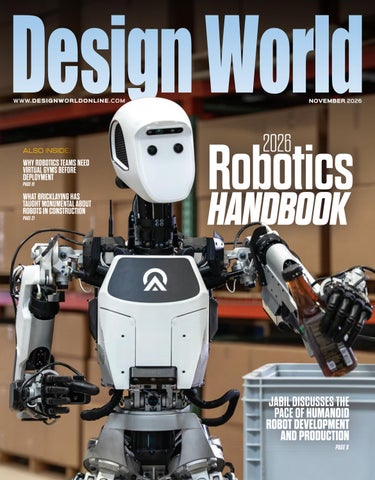
2026
Robotics HANDBOOK
JABIL DISCUSSES THE PACE OF HUMANOID ROBOT DEVELOPMENT AND PRODUCTION PAGE 8
Cover RR HB 11-26 v1.indd 1
10/26/26 11:48 AM
261006_SYS_DW_Robotics_Handbook_US.indd DigiKey - DW 11-26.indd 1 1
10/26/26 10/2/26 10:27 11:49 AM
CONTENTS 11 • 2026
T H E R O B O T R E P O R T. C O M
2026 ROBOTICS HANDBOOK ON THE COVER:
JABIL DISCUSSES THE PACE OF HUMANOID ROBOT DEVELOPMENT AND PRODUCTION PG 8
4
18 www.therobotreport.com
TOC RR HB DW 11-26 v1.indd 3
12
3
Editor’s Note: Robotics helps industry look forward to the future
4
Humanoids won’t scale on factory floors until costs drop
8
Jabil discusses the pace of humanoid robot development and production
12
Boston Dynamics shares insights into its redesigned humanoid hand
15
Why robotics teams need virtual gyms before deployment
18
How Locus Robotics is getting a grasp on one of robotics biggest challenges: manipulation
21
What bricklaying has taught Monumental about robots in construction NOVEMBER 2026
THE ROBOT REPORT
1
10/28/26 9:32 AM
An
NOMINATIONS NOW OPEN The Robot Report is seeking the most interesting and important robotics innovations from around the world. Submit innovations initiated, released, or executed in 2026 for a chance to be recognized among the TRR50. Submit your nomination by January 5, 2027.
Publication
NOVEMBER 2026 • DESIGNWORLDONLINE.COM EDITORIAL
DIGITAL MARKETING
VP, Editorial Director Paul J. Heney pheney@arrowfly.com
VP, Marketing Annie Wissner awissner@arrowfly.com
Editor-in-Chief Rachael Pasini rpasini@arrowfly.com
Portfolio Marketing Manager Engineering & Life Sciences McKenzie Burns mburns@arrowfly.com
Digital Production Specialist Nicole Johnson njohnson@arrowfly.com
PRODUCTION SERVICES
Digital Design Manager Samantha Goodrich sgoodrich@arrowfly.com
Managing Editor Mike Santora msantora@arrowfly.com Executive Editor Lisa Eitel leitel@arrowfly.com Senior Editor Mary Gannon mgannon@arrowfly.com PRINT CREATIVE SERVICES
VP, Creative Director Matthew Claney mclaney@arrowfly.com Art Director Allison Washko awashko@arrowfly.com AUDIENCE DEVELOPMENT
Customer Service Manager Stephanie Hulett shulett@arrowfly.com Customer Service Rep Tracy Powers tpowers@arrowfly.com Customer Service Rep JoAnn Martin jmartin@arrowfly.com Customer Service Rep Renee Massey-Linston renee@arrowfly.com Customer Service Rep Trinidy Longgood tlonggood@arrowfly.com
Digital Production Manager Reggie Hall rhall@arrowfly.com
Marketing Graphic Designer Hannah Bragg hbragg@arrowfly.com Digital Production Specialist Elise Ondak eondak@arrowfly.com WEB DEVELOPMENT
Web Development Manager B. David Miyares dmiyares@arrowfly.com Front End Developer Melissa Annand mannand@arrowfly.com Software Engineering Manager David Bozentka dbozentka@arrowfly.com
Director, Audience Growth Rick Ellis rellis@arrowfly.com
SCAN TO LEARN MORE AND SUBMIT YOUR ENTRY
DIGITAL PRODUCTION
Senior Associate, Audience Development Marie Claussell mclaussell@arrowfly.com
2023
2023
2023
SILVER NATIONAL AWARD
SILVER REGIONAL AWARD
BRONZE REGIONAL AWARD
asbpe.org
asbpe.org
asbpe.org
2020-2024
2011 - 2020
2014 - 2016
2013 - 2017, 2021
EDITORIAL
Executive Editor Steve Crowe scrowe@wtwhmedia.com
BROUGHT TO YOU BY
Senior Editor Mike Oitzman moitzman@wtwhmedia.com
Medical Design & OUTSOURCING
Associate Editor Editorial Director Brianna Wessling Eugene Demaitre edemaitre@wtwhmedia.com bwessling@wtwhmedia.com
2
Staff Page ROBO HB 11-26 v1.indd 2
THE ROBOT REPORT
NOVEMBER 2026
www.therobotreport.com
10/28/26 1:06 PM
E D I T O R ’ S
N O T E
Robotics makes industry look ahead The two biggest themes of 2026 in commercial robotics developments were interest and investment in humanoids and artificial intelligence. However, skeptics have pointed out that both capable humanoid robots and artificial general intelligence may be years away. In this year’s Robotics Handbook, The Robot Report looks at areas where humanoid robots and mobile manipulators are making progress, advancements in collecting data to train AI, and some promising applications. The experts we spoke with acknowledged the hype and challenges but also cited specific areas of improvement. Cost is at least as important as capability if humanoids are ever to scale in factories or elsewhere, according to Shaun Edwards, co-founder and chief technology officer at Plus One Robotics. He examines the role of humans in the loop for training and control, as well as the tension between generalization and specialization. Humanoid developers have solved many problems around bipedal locomotion and basic manipulation in the past few years. Can we expect that rate of change to continue? I spoke with Thomas Brown, senior director for engineering and technology at Jabil, for some perspective on integration, safety, and superhuman ability. Boston Dynamics, one of the leading U.S. humanoid companies, recently revealed a four-fingered robotic hand. The Robot Report’s Brianna Wessling spoke with Alberto Rodriguez, director of robot behavior for Atlas at the company, about its design choices as it works to bring its humanoid to market. Both hardware and software for humanoids needs to improve for them to find industrial use. Mariusz Janiak, principal robotics architect at SoftServe, explains how “virtual gyms” are using simulation to accelerate AI development.
www.therobotreport.com
Editors Column ROBO HB 11-26 v1.indd 3
Other types of robots and applications share challenges and progress with humanoids. For instance, Locus Robotics has used its Nexera acquisition to create the NeuraGrasp system for its Array mobile manipulator. The innovative gripper combines soft end effectors with suction cups to pick and place a wide range of products for warehouse fulfillment. Finally, we look at an emerging space for robotics – construction. Monumental describes how it identified what to automate in an industry suffering from skilled labor shortages. The company also shares its multi-robot approach to bricklaying and what it hopes to learn as it grows. Note that automation such as industrial arms with deterministic programming rather than AI still dominates robot sales and usage. But from humanoid trials in automotive factories and mobile manipulators in warehouses to systems just arriving on building sites, robots are making real progress spreading into the wider world. RR
NOVEMBER 2026
EUGENE DEMAITRE Editorial Director The Robot Report
THE ROBOT REPORT
3
10/28/26 9:35 AM
Following a successful pilot with Figure 02 at its plant in Spartanburg, S.C., BMW said it will deploy the new Figure 03 humanoid. BMW Group
SHAUN EDWARDS PLUS ONE ROBOTICS
HUMANOIDS WON’T SCALE ON FACTORY FLOORS UNTIL COSTS DROP
W
hile the tech industry thinks AI is the main barrier for robots joining the manufacturing workforce, the real issue has less to do with intelligence and more to do with robotic unit economics and financial viability. AI has come a long way, vision systems have matured, foundation models keep getting better and the hardware has significantly improved. But for most manufacturers, the cost of automating using humanoids at today’s prices just isn’t feasible. The technology is mostly ready Physical AI has evolved quickly, and robots now handle manipulation tasks that seemed out of reach only a few years ago. Several vendors have shown machines running real warehouse operations. 4
THE ROBOT REPORT
Humanoid Costs ROBO HB 11-26 v2 final AW.indd 4
The hardware has advanced, with stronger actuators, better mobility, and end effectors that keep improving. Even the hands, which have been a sticking point for years, are close enough that plenty of use cases work without them being perfect. There are some organizations that have had real robotics success. Generalist’s robots can perform precise manipulation tasks. Agility Robotics’ humanoids have achieved proven results in the warehouse. Improvements The robot hands built by in dexterous Alt-Bionics have improved manipulation benefit both humanoid robots’ both robotics and dexterity and broken new prosthetics. ground in prosthetics. All Alt Bionics of these wins are paving the way for further innovation and accessibility in the space.
NOVEMBER 2026
www.therobotreport.com
10/26/26 9:07 AM
HUMANOID COSTS
Many people in robotics will tell you the core technology problems have either been solved or are nearly there. The demos are becoming more impressive and the conversation has moved from “Can they do the work?” to “Can we justify the cost?” People must stay in the loop Despite technological progress, human oversight will be key to filling in what gaps remain, especially when a robot encounters something it didn’t expect. Some developers lean hard on teleoperation, where a person controls the robot’s movements directly. That requires almost all of the operator’s attention, which caps how far it can scale because every robot needs a human tied to it. A better model is to treat people as high-level supervisors who step in only when a robot faces something unusual or needs direction on a task. This way, one person can supervise 50 or more robots at once, and every intervention serves as training data to improve the AI over time. Over time, that involvement may drop, but it never hits zero.
Plus One Robotics uses people as supervisors of robotic picking. Plus One Robotics
Specialized robots can still outperform humans in single functions, such as parcel handling. Plus One Robotics
www.therobotreport.com
Humanoid Costs ROBO HB 11-26 v2 final AW.indd 5
NOVEMBER 2026
THE ROBOT REPORT
5
10/26/26 9:07 AM
Compatible Materials for Robotics and Automation • High Temp. Cable and Wire Wrapping Tapes • Low Friction Polymer Films & Fabrics for Durable Release or Wear Surfaces • Silicone Rubber Sheeting & Strip N’ Stick® Tapes • Custom Die Cutting for part to component application • Polymer Beading, Tie Cord, Bar, & Rod
Custom Converting Custom Roll Slitting High Speed Sheeting Adhesive Lamination Die Cutting
Phone (800) 461-4161
www.cshyde.com
Tesla is bringing its manufacturing expertise to Optimus. Tesla
Specialized robots still outperform humanoids The promise of humanoids is their flexibility. In theory, one machine can do many different jobs without much reconfiguration. But that flexibility comes with a price. A factory automation system built for one workflow is optimized for it from end to end. In high-volume production, that specialization beats general-purpose humanoids. For example, in parcel sorting, the best humanoid demonstrations hit around 1,000 picks per hour in controlled conditions. Specialized parcel-sorting robots run between 1,300 and nearly 3,000 picks per hour depending on the application. That’s a big gap for anyone weighing out the ROI. In a lot of applications, conventional industrial robots give you more productivity for less money. 6
Humanoid Costs ROBO HB 11-26 v2 final AW.indd 6
THE ROBOT REPORT
The economics are the real problem The biggest hurdle facing humanoid robots is robotics unit economics. They cost too much, and only a small number of applications make the cost justifiable. One leading humanoid developer put the cost at several hundred thousand dollars per robot. Spend that, and you’ll need a multi-shift operation running the machine around the clock before the numbers begin to work in your favor. And if you already run that kind of operation, you can put the same amount of money into a specialized automation solution that gives you more throughput and pays off faster. The math changes when the prices of humanoids come down. For instance, lower-cost humanoids coming out of China have fewer capabilities than the premium platform, yet they still show what large-scale production does to cost.
NOVEMBER 2026
www.therobotreport.com
10/26/26 9:11 AM
HUMANOID COSTS
The FCC has restricted imports of new models of certain mobile robots and humanoids. Ubtech
The win happens on the factory floor The race to commercialize humanoids is on. What’s left to prove is that humanoid robots can beat the economics of the automation manufacturers are already running. That takes lower prices, which requires manufacturers at scale, and that relies on companies that can build sophisticated hardware efficiently and repeatedly. RR
Manufacturing scale drives down component costs, tightens supplier relationships, sharpens production and spreads engineering investment across far more units. Every one of those elements improves robotics unit economics. Tesla is bringing its manufacturing expertise to Optimus, its humanoid robot. This will allow it to reach commercially viable prices years ahead of competitors whose real strength is robotics research instead of mass production. Tesla will lead the market because manufacturing capability matters as much or more than AI capability. However, regulatory policy can disrupt that playbook, as seen in the FCC’s recent move to ban Chinese humanoid imports over national security concerns. The key for humanoid developers is to reach the production volumes that bring the price down. Manufacturing scale is the advantage The robotics industry loves to rank companies by their AI models, dexterity and manipulation demos. But the most important advantage is knowing how to manufacture complex hardware and at a massive scale. Take Tesla for example. Building electric vehicles dragged the company through years of manufacturing challenges, supply chain fights and production scaling. Designing a humanoid robot is hard. Building hundreds of thousands of them efficiently is a completely different skill. www.therobotreport.com
Humanoid Costs ROBO HB 11-26 v2 final AW.indd 7
Editor’s note: The opinions expressed in this article are those of the author and do not necessarily reflect the views of The Robot Report, its editors, or its parent company.
ABOUT THE AUTHOR Shaun Edwards is the co-founder and CTO at Plus One Robotics. Since co-founding Plus One in 2016, he has helped scale the company’s core technology platforms, pioneering human-in-theloop systems for parcel handling, and shaping the future of automated warehouse logistics. Today, Edwards focuses on advancing continuous learning and edge-based AI to help global supply chain leaders scale their automation operations. Prior to founding Plus One Robotics, Shaun was a senior research engineer at Southwest Research Institute (SwRI), where he founded and led the ROS-Industrial (Robot Operating System) open-source program, fundamentally changing how industry and academia collaborate on industrial robotics software. He holds a B.S. and M.S. in Mechanical Engineering from Case Western Reserve University.
NOVEMBER 2026
THE ROBOT REPORT
7
10/28/26 10:07 AM
JABIL DISCU
HUMA
The Apollo humanoid robot is designed for a variety of applications. Apptronik
8
THE ROBOT REPORT
Humanoid Pace ROBO HB 11-26 v3 final AW.indd 8
EUGENE DEMAITRE EDITORIAL DIRECTOR THE ROBOT REPORT
NOVEMBER 2026
RO
www.therobotreport.com
10/28/26 10:09 AM
HUMANOID PACE
DISCUSSES THE PACE OF
MANOID
ROBOT DEVELOPMENT & PRODUCTION
W
hile much of the focus on humanoid robots has been on entertaining demonstration videos and massive amounts of funds raised, the work of development and finding a value proposition is quietly continuing. How are humanoids progressing from prototypes to mass production? Jabil Inc., a design, supply chain, and manufacturing services provider, has offered its perspective. Companies preparing to ramp up production of humanoid robots include Tesla, 1X Technologies, XPeng, and UBTECH. Jabil works with robotics developers to bring their products to market at scale. The St. Petersburg, Fla.-based company has worked with Apptronik on bringing its Apollo humanoid to active manufacturing environments. Thomas Brown, senior director for engineering and technology, including digital commerce and robotics, at Jabil, replied to the following questions from The Robot Report. Setting realistic expectations for humanoid volume How are investor and customer expectations for mobile manipulators and humanoids evolving? Brown: In terms of managing expectations, a lot of customers have gotten humanoids out in low volumes, but we are entering a phase of tens of thousands, where it’s no longer something that’s assembled by hand on site. You’re starting to get to where you need a cost structure, manufacturability, and to improve quality. These are areas where Jabil can really add a lot of value. When a robot’s much more expensive, there’s only so many they can produce for gathering AI training data, and they need more customer usecase validation. We provide that ability to cost down their designs to actually hit those scales. How is the current boom in compute enabling more capable physical AI? Brown: Compute is now sufficient for many of the experiences you see on the demo reels, but we do need more computing capacity at the edge. The NVIDIA Jetson series is a popular lineup for our customers developing their aspirations in the robotic space. We’re getting more compute and memory, but prices are an ongoing pain point for scale. The foundation model makers are developing intelligence that’s outside that capacity, but expanding it is key. We’ve seen Hyundai, Tesla, and BMW fund and test humanoids. What advantages do automotive partners bring to design for manufacturing? Brown: Take wiring harnesses for humanoids. It needs a hybrid of automotive-type robustness with an extremely small form factor like high-grade consumer electronics.
www.therobotreport.com
Humanoid Pace ROBO HB 11-26 v3 final AW.indd 9
NOVEMBER 2026
THE ROBOT REPORT
9
10/26/26 9:26 AM
Developers need to work with partners for rapid iteration. In addition to sensing and compute, there’s a wide range of power supplies, allowing for swapping. What are some of the challenges in getting humanoids to market? Brown: Prior to the smartphone, things were much more simplistic — you could just build up capabilities to the cost point and scale. Now, companies are resetting and diversifying their supply chains. My company is working with major humanoid developers in the U.S. and abroad, but I can’t name them at this time. Where humanoids, mobile manipulators make sense What is the commercial outlook for humanoids in factories and warehouses? Brown: In manufacturing, there are a ton of spaces where humanoids make sense. When you look at a production line today, most automation is built for specific tasks, but the applicability of humanoids to a wide range of tasks changes the math from a purpose-built line. A lot of these humanoid companies have done a good job of partnering with end customers to gather clear requirements. That’s a solid approach. In the consumer space, it’s still the science fiction route of “I just want a robot to fold laundry” or whatever the vague use case might be. In terms of iterating, do humanoids need to equal human capabilities, or should developers be aiming for superhuman ability? Brown: I think it’s more about having a super set of capabilities that you can apply in bits and pieces to other markets. You see it already with some of the humanoids, where they have a wheeled base instead of being bipedal. It’s a much easier problem to solve, and I would say that’s the same thing with having the fully embodied humanoid versus, say, one arm with the camera. The company that conquers that can conquer all other challenges, but the company that conquers just one is going to struggle to go up the stack. You see many of these companies going after the larger play. Maybe some of them will completely hit it; maybe some of them won’t. 10
THE ROBOT REPORT
Humanoid Pace ROBO HB 11-26 v3 final AW.indd 10
I would say it’s truly the super-set approach that they can decompose into specific solutions that are more costoptimized, depending on the use case. Do you see mobile manipulators as an interim step toward humanoids, or more of a standalone form factor? Brown: I definitely think there’s a place for mobile arms. Even traditional automation like a machine tender running at 1.5 mps
NOVEMBER 2026
[3.3 mph] is pretty fast. A humanoid going that fast would be tremendously fast, let alone if it’s carrying a load. There’s just different needs, depending on what the facility requires and what the existing line looks like. The humanoid is going to be a supremely flexible device, but it’s not always the right device. Traditional high-speed automation will still have a big play for the foreseeable future. www.therobotreport.com
10/26/26 9:26 AM
HUMANOID PACE
You had mentioned consumer robots; when and if do you think we can expect them? Brown: Maybe in five-ish years. It could be 20 years, but progress is going very rapidly. If the model development continues at the pace it has and if the computing continues at the pace it has, we’re certainly going to be there on the AI and electronics hardware side. There’s going to be a market for multiple humanoid companies because there’s so much diverse need. We’re talking manufacturing, consumer, hospitality, food prep. There’s so many different spaces to attack, and policy development in one area doesn’t mean you win in all the others. There’s so many different levels of performance that you can put in the actuators that it creates a lot of possibilities for people who can finetune the solutions they want to go after. Even in our own factories, we’re going to have specific needs for automation, as we do today.
of infrastructure built around the end applications, so it’s going to take some time for the industry to get their hands around how humanoids operate. What are their failure modes? How do we certify these things in new environments? How do we understand what the model is going to do in certain conditions? Yeah, there’s a tremendous amount of work that’s going to have to go into these systems to get them to a place to where we can truly rely on them like we can current automation solutions. Companies are starting to track legislation and develop safety standards. Existing ones will have to be expanded to govern how these devices operate in commercial spaces, consumer space, and more. I’m pretty optimistic about what the future holds. I see a lot of progress being made, and I think great things are in store for us. And I love working with our customers in this space, helping to bring those price points down and improve functionality. RR
THOMAS BROWN
SENIOR DIRECTOR FOR ENGINEERING & TECHNOLOGY JABIL
Both humanoid robots and the spaces around them will evolve While humanoids are intended to fit into settings designed around humans, how could they affect factory and warehouse designs? Brown: As humanoid robotic fleets become ubiquitous, they’ll change our assumptions on how we do line layout. If you’re able to define layout on the software, send work instructions, hit the “Go” button, execute, and have the humanoids pull out workstations, put on new end effectors for their arms, and pull supplies out of the back, that fundamentally changes how we look at manufacturing. The lines are no longer the key limiting factor. It’s just about kind of your creativity, the robot fleet, almost like this programmable substrate for manufacturing, if you will. Along the way, we’re going to have more hybrid solutions, for sure.
BMW is among the automakers testing humanoid robots. BMW
In addition to developing explainable AI, what about the related concerns around humanoid safety? Brown: For things like insurance, many robotic arms have safety certifications. There are norms for standoff distances, cages, etc. There’s a tremendous amount www.therobotreport.com
Humanoid Pace ROBO HB 11-26 v3 final AW.indd 11
NOVEMBER 2026
THE ROBOT REPORT
11
10/28/26 10:12 AM
Boston Dynamics said it didn’t set out to build a complicated hand, but instead a reliable one capable of using tools. Boston Dynamics
BRIANNA WESSLING ASSOCIATE EDITOR THE ROBOT REPORT
BOSTON DYNAMICS SHARES INSIGHTS INTO ITS
REDESIGNED HUMANOID HAND B
oston Dynamics Inc. recently gave a look at its new humanoid robot hand. The four-fingered hand has 13 degrees of freedom, or DoF, and is directly actuated. The company said it designed it for mass manufacturing. Lots of things immediately stand out about the hand. Notably, Boston Dynamics has dropped the pinky finger and reduced the size of the gripper. Less obviously, the company said it built the new hand for highfidelity simulation to enable sim-to-real reinforcement learning (RL). To learn more about the new hand, The Robot Report spoke with Alberto Rodriguez, the director of robot behavior for Atlas at Boston Dynamics. What did Boston Dynamics learn from its humanoid trials that it applied to the new hand? Rodriguez: Having a product roadmap for Atlas has been a key enabler when it came to making hard decisions like what is the right level of complexity that we should be packing into a hand and navigating 12
THE ROBOT REPORT
Humanoid Hand ROBO HB 11-26 v3 final AW.indd 12
its design tradeoff between dexterity, strength, ruggedness, cost, reparability, and sensing. We have learned things from the design of Atlas’ body. There are things like simplicity, modularity, and actuator maturity that make sense in theory, but over time, you start appreciating the huge impact they have on the velocity you can move. A reliable robot allows you to capture data faster, run more experiments, and take bets at early deployments. Modularity allows you to focus with more energy on a smaller number of things that you need to get right. That also allows you to move faster. We have used the same philosophy with this hand. It is built out of 13 identical actuators, all completely encapsulated, with no fragile cables crossing joints, which is already paying off. We have also learned, for example, that the earlier hands were strong enough to lift 100 lb.-plus heavy objects, so we did not need to increase strength, and we could consider decreasing it a bit to further improve actuation transparency.
NOVEMBER 2026
We also experienced the challenges that earlier hands had with certain more complex tasks, which have influenced the current design. Did you look at any off-the-shelf end effectors, and why did you decide to build a hand in-house? Rodriguez: We always look at what is out there to understand the state of the art. Hands are a key piece of technology that are so integral to the value proposition of humanoids that it would be very difficult for us to approach it in any other way than in-house. As we described in our blog post, all hands come out of a very consequential tradeoff of capabilities, and understanding how it fits into the product roadmap is key. How does Boston Dynamics ensure durability so the gripper can last through many shifts? Rodriguez: This isn’t much different from how we do it for other key technologies in the robot. www.therobotreport.com
10/28/26 10:14 AM
HUMANOID HAND
It all starts from an amazing hardware design team that has done this many times before and has built intuition for what leads to reliable hardware. We also have a strong culture of collaboration between the behavior and hardware teams in those early design phases to lock in key design features, like morphology, sensing, torque distribution, etc., by using techniques like simulation or mockup designs. This allows the hardware team to go into the detailed design with more confidence. We build early prototypes and put them in the hands of the systems, controls, and behavior teams for a while to unearth as many as possible of the unknown unknowns and iterate on the design. Then, we put the hands and various subcomponents through their paces under rigorous validation and verification tests to check that their behavior is at par with expectations. While this is tedious and might initially slow down the deployment of new hardware, it ends up speeding up the process by allowing to refine issues faster than having to painfully discover them in the field. What kinds of tasks have you been testing with the new hand? Rodriguez: All kinds. It is difficult to define requirements on a system as complex as a hand, and one way to do it is to build a suite of representative tasks of what the hand is meant to do in the future. Many of these are common industrial tasks like using handheld power tools, handling cables, and fishing for screws. We have also used these hands on many tasks that are less missionoriented, such as bring-up tasks that we use to compare against earlier hands, and in other tasks that help us explore the limits of what the hands are capable of. As always, we like taking inspiration from feats of human physical achievement — such as parkour or gymnastics — to push ourselves and do it in a way that connects with people. We have been playing with different types of juggling and speed hand games. Can you tell us more about Boston Dynamics process deciding how many fingers to include on the hand? Rodriguez: The process relies on
intuition, periods of large entropy in concept designs, and then a suite of tasks or behaviors that we wanted the hand to be able to do. Our product roadmap gives us concrete manipulation tasks that we know are in scope for Atlas. Tool use is an important example, but there are many more, from how small are the screws that Atlas should be able to pick to how small are the spaces where Atlas should be able to put its hands in. Another useful way to scope hand requirements is as a set of motions that are important for dexterous manipulative behavior, and measure designs against them. Here are some of the key motions that we focused on: • Being able to slide the fingertip of the thumb along the lengths of the other fingers • Being able to slide the fingertip of the thumb across the fingers • Being able to rock the fingertip of the thumb against the index finger in a dexterous pinch grasp • Being able to exert power grasps on triggered tool handles
Humanoid Hand ROBO HB 11-26 v3 final AW.indd 13
New Hands for Atlas This new generation hand is the perfect companion for Atlas. With 13 degrees of freedom, these hands are directly actuated, built for high fidelity simulation to enable sim-to-real RL, and designed from the ground up for dexterous physical work.
z
MEETING SPECS IS
THE BARE MINIMUM
BUILDING TRUST SINCE 1919 S TA M P I N G S , WAS H E R S , S PAC E R S & S H I M S M A D E TO O R D E R
125
0.80
REQUEST YOUR FREE
2027 BROCHURE & CALENDAR (800) -WASH ERS
www.therobotreport.com
WATCH THE VIDEO:
bokers.com
13
10/26/26 9:54 AM
Decisions like the number of fingers or the number of joints per finger are difficult, but we try to keep a pragmatic perspective and a clear line of sight to factors like cost and reliability that are key to be able to scale manufacturing. For example, a design that had a lot of initial support was a hand with two thumbs, one on each side. This design had the added benefit that you do not need to have two separate right and left hands. You can make them on a single assembly line. We finally decided against it because it involves extra actuation complexity that ultimately incurred extra DoFs, cost, and volume.
What about the hand makes it easier to work with in simulation and for reinforcement learning? Rodriguez: We design the actuation and transmission with an eye to backdrivability and transparency. On the controls side, we have developed techniques to compensate for some of the remaining non-idealities on the actuators, like compensating for different types of friction. All of this enables accurate dynamic simulation, key for the design philosophy of the entire robot. This makes reinforcement learning more effective at training policies that can
Boston Dynamics says its new hand is still capable of handling over 100 lb. Boston Dynamics
use proprioception, where the actuators themselves sense that you are pushing back on them and transfer directly to hardware. This is the exact same recipe that has succeeded for agile humanoid behavior in the past few years. Build actuators that simulate well, and then rely on RL at scale. I am convinced that the ability to use RL in simulation is going to be a key enabler for the next generation of manipulation capabilities for complex dexterity, going beyond pick and place. These are tasks that are difficult to teleoperate or demonstrate, because a lot of the relevant information to reproduce them is in the quick changes of the distribution of contacts and pressure. Have you started testing the hand at Robotics Metaplant Application Center (RMAC), and what have the results been so far? Rodriguez: Not yet. We have used the new hands extensively in our headquarters but have not deployed them yet to the whole robot fleet. That is a process that requires coordination and time to make sure that it does not disrupt regular operations like data collection or applications. RR
Atlas and its gripper are being trained in simulation. Boston Dynamics
14
THE ROBOT REPORT
Humanoid Hand ROBO HB 11-26 v3 final AW.indd 14
NOVEMBER 2026
www.therobotreport.com
10/28/26 10:16 AM
VIRTUAL GYMS
WHY ROBOTICS TEAMS NEED
VIRTUAL Virtual commissioning can save deployment time. SoftServe
GYMS BEFORE DEPLOYMENT
MARIUSZ JANIAK SOFTSERVE INC.
T
he challenge for today’s robots is no longer limited to automating a task. It is adapting to ever-changing environments — and that variability remains one of the hardest problems. This distinction matters more and more as the industry moves from programmed automation toward physical AI — systems that perceive, reason, and act in the physical world. The global robotics market is developing rapidly, with an anticipated 19.6% compound annual growth rate (CAGR) from 2026 to 2036, according to Future Market Insights. Autonomy needs experience, but realworld experience is expensive, slow, and sometimes unsafe to collect. That is why “virtual gyms” are becoming an essential part of robotics development. A virtual gym is a high-fidelity simulation environment where robots can train, fail, recover, and be validated before they enter live operations to make physical testing more focused and less risky. It combines digital twins, high-fidelity simulation, synthetic data, reinforcement learning, sensor modeling, and hardware-in-the-loop testing.
www.therobotreport.com
Virtual Gyms ROBO HB 11-26 v3 Final AW.indd 15
The sim-to-real gap is a production issue The simulation-to-reality gap is often discussed as a technical problem. In production robotics, it is also a deployment problem. Modern robots are being sent into places that don’t stay neatly arranged for them. A mobile robot has to move through warehouse traffic that changes by the hour. A robotic arm may need to pick the same product in different packaging, at a different angle, or with a surface that reflects light in a way the vision model has not seen before. These small differences matter enough to turn a successful simulation into a failed deployment. Learning-based robotics helps, but it does not remove the need for experience. Imitation learning is often a practical way to get started, especially for realworld manipulation tasks, but it still depends on good demonstrations, careful evaluation, and enough variation to teach the system what “normal” really looks like. Collecting that experience on real hardware is usually the expensive way to
learn. Physical trials can stop production, wear out equipment, and create safety risks. They also miss many of the cases teams care about most, because jams, dropped objects, near misses, leaks, damaged pallets, and sensor failures may not happen often enough during normal testing to become useful training data. Virtual gym fidelity should follow the failure mode A useful virtual gym is not just a 3D model of a robot. It must also represent the parts of the operating environment that can cause the robot to fail. That means fidelity should be selective, not excessive. A mobile robot route planner does not need the same level of physics as a robotic filling process; a deformable object manipulation task; or an inspection robot searching for fluid, thermal, or structural defects. In a factory, the model may need CAD geometry, fixtures, camera placement, tooling, material properties, safety zones, and automation logic. In a warehouse, it may need aisle geometry, pallet locations, SKU variability, human
NOVEMBER 2026
THE ROBOT REPORT
15
10/28/26 10:18 AM
Humanoids and other robots can benefit from training in ‘virtual gyms.’. SoftServe
movement, traffic patterns, and fleet behavior. The strongest virtual gyms combine several modeling methods: • First-principles physics can represent motion, collision, contact, and dynamics. • Data-driven residual models can correct for effects that are difficult to capture analytically. • Co-simulation can connect specialized solvers when robot motion, fluids, thermal behavior, or material stress interact. • Surrogate models such as reducedorder models, neural ordinary differential equations, and physicsinformed neural networks can approximate complex behavior faster than full-scale simulation while preserving enough physical accuracy for engineering use. The robot is not just visualized but is also exercised across different combinations that would be impractical or dangerous to stage physically. Synthetic data turns missing cases into test cases For perception-driven robotics, the virtual gym is also a data engine. Industrial vision models need to recognize parts, pallets, tools, valves, defects, surfaces, obstacles, and people across many conditions. Real-world data often does not cover enough variation — new products may exist only as CAD files, rare defects may be unavailable, and safetycritical events may be too risky to reproduce. 16
THE ROBOT REPORT
Virtual Gyms ROBO HB 11-26 v3 Final AW.indd 16
Synthetic data is most useful when it is tied to the real deployment environment, not generated as generic simulation output. In a case for Toyota Material Handling Europe, our team used synthetic data to improve forklift perception in warehouse conditions where pallet labels, floor textures, shadows, colors, and lighting can vary significantly. A model trained with NVIDIA Cosmos achieved 89.6% precision and 84.7% recall on real-world datasets, while a simulator-only model reached just 49.4% recall. After post-training adapted the visuals to better match the client’s environment — including labels, colors, flooring, and shadows — performance rose to 99.5% precision and 92.8% recall on real-world data. This does not remove the need for real-world data. It makes real-world data more valuable by using it in calibration, validation, and error correction. A practical workflow is synthetic-first, real-calibrated, and continuously updated. Simulation covers the operational envelope >> targeted physical samples reveal where the model is wrong >> realworld validation confirms performance. Operational errors then feed back into the digital twin for retraining. But simulation has limited value if it remains disconnected from the deployment stack. Robotics teams also need to know whether the system will behave correctly when connected to PLC logic, edge devices, sensors, safety systems, fleet orchestration, and operational workflows.
NOVEMBER 2026
In industrial contexts, we saw that virtual commissioning can reduce commissioning time by 30% to 50%. For robotics teams, faster simulation cycles mean more scenarios can be evaluated before hardware or production time is committed. A virtual gym is part of a practical deployment workflow A production-ready virtual gym should be part of a larger lifecycle. A useful workflow has five stages. Assess the right use case. Not every robotic task needs advanced simulation. The strongest candidates are highvariance, high-value, or high-risk tasks: complex picking, weld-seam tracking, robotic and confined-space inspection, autonomous material movement, or operations where downtime is expensive. Model the environment. The digital twin should include the robot, workcell, sensors, materials, layout, process constraints, and relevant physical effects. Fidelity should be driven by the task. A warehouse navigation model does not need the same physics as a fluid filling process or a subsea inspection scenario. Train policies and perception models in simulation. This may include reinforcement learning, curriculum-based training, synthetic data generation, and stress testing across normal and abnormal scenarios. Safety constraints should be part of training from the beginning, not added at the end. Validate against reality. Hardware-inthe-loop testing, real telemetry, targeted physical trials, and sensor logs should be www.therobotreport.com
10/26/26 10:52 AM
VIRTUAL GYMS
used to compare simulated predictions with actual behavior. The goal is to identify the gap, not pretend it has disappeared. Deploy and improve. Containerized policies and perception models can run on edge devices, while operational data feeds back into the simulation environment. Over time, the virtual gym becomes not just a development tool, but a continuous improvement system for the robot fleet. Many robotics programs get stuck between a working pilot and a production-ready system because the robot may perform the task, while the surrounding stack — perception, localization, safety logic, orchestration, edge deployment, data pipelines, and system integration — remains incomplete. A virtual gym moves more of that complexity upstream, allowing teams to test robot behavior, operational workflows, and hazardous scenarios before hardware or production time is committed. This becomes more important as robotics shifts from individual machines to coordinated physical AI systems that must sense, decide, act, recover, and improve in changing environments. Real-world testing will remain necessary, but robots should not encounter their most important failures for the first time in production. RR
A virtual gym gives teams a controlled way to generate these conditions before they appear in the field. SoftServe
ABOUT THE AUTHOR Mariusz Janiak, Ph.D., is an academic lecturer, engineer, and robotics principal architect at Austin, Texasbased SoftServe Inc. specializing in advanced control, motion planning, and distributed real-time systems. His background spans university research, collaborative EU projects, and industry-driven robotics development, including work on humanoid robots and innovative media-production technologies.
ENCODERS FOR POSITION FEED BACK Position, angle and speed measurement Contactless, no wear and maintenance-free High positioning accuracy and mounting tolerances
Linear and rotary solutions SIKO Products Inc., www.siko-global.com
Virtual Gyms ROBO HB 11-26 v3 Final AW.indd 17
10/26/26 10:52 AM
HOW LOCUS ROBOTICS IS GETTING A GRASP ON ONE OF ROBOTICS BIGGEST CHALLENGES:
MANIPULATION BRIANNA WESSLING ASSOCIATE EDITOR THE ROBOT REPORT
L
ocus Robotics Corp. has successfully tackled many robotic challenges in real working environments. Its autonomous mobile robots, or AMRs, have navigated countless miles in a variety of facilities, and they have aided in more than 8 billion picks. Now, it is targeting manipulation. The company entered the robotic picking space in March 2025 when it unveiled Locus Array, a mobile manipulator equipped with a customdeveloped, vision-guided picking arm. Over a year later, Locus acquired
18
THE ROBOT REPORT
Locus Manipulation ROBO HB 11-26 v2 final AW.indd 18
Nexera Robotics, which is known for its NeuraGrasp gripping technology. According to Roy Belak, the senior vice president of robotic grasping at Locus and former CEO of Nexera, by the time it came in contact with Locus, Nexera had already spent years refining its unique, soft end effectors. It had already gone through at least six different product generations, he said. “Just as we were getting to that point where the technology was showing its compelling capabilities, we were at a fortuitous situation where we met with
NOVEMBER 2026
Locus at MODEX, and I think the history kind of writes itself from there,” Belak told The Robot Report. The timing was ideal for both companies. Locus wanted to be able to handle more SKUs in its facilities, and Vancouver, Canada-based Nexera was ready to scale. “We want to see this technology deployed at scale,” said Belak. “That’s something that excites me as somebody who’s an innovator and building something. You just want to see it out there widely, and that seemed like it was a great opportunity.”
www.therobotreport.com
10/28/26 9:39 AM
MANIPULATION
NeuraGrasp combines a soft gripper with a suction cup. Locus Robotics
things that Nexera’s technology needed. “There was a lot of work that was done prior to the acquisition to make sure the technology could be slipped into the development stream,” recalled Belak. “I think it we had missed that window by another year, it probably would have been really hard to make those changes.” While Belak did not give an exact timeline of when customers could gain access to Nexera’s technology, he said he is optimistic about the process. Belak said he expects that the next time Array is displayed publicly, it will likely have Nexera technology. Right now, Locus is in the early stages of deploying Array with its original gripper to customers, so Nexera hasn’t seen the windfall of data that will be coming soon. “There’s a long line of customers with their hands up that are really excited about Array,” Belak said. It’s in some ways intimidating, because you’re going to take this thing, you’re going to integrate it, and then it’s going to go to many different places. Then we’ll start seeing the data really come back, and we’ll have a chance to just optimize as much as we can during that process.” Suction versus pinch picking When taking a step back and looking at the robotics industry as a whole, Belak said that much of robotic manipulation falls on a spectrum between suctionbased grasping and pinch grasping. “The reality is that suction is very good, particularly in warehouse operations,” he said. “Sixty percent to 70% of the time, it’s all you need. It’s when you get to that 30% to 40% and get
to the really high coverage ratios.” NeuraGrasp’s soft gripping technology can help to bridge this gap because it uses both suction and pinching, according to Belak. “As an industry trend, it’s 100% recognized that pinch grasping is likely going to be very influential in the future of robotic grasping,” he said. “With that said, we are still firm believers that suction gets you a good portion of the way with air. And if it ain’t broke, you don’t throw it away.” Locus is focusing on reliability and quality picks, not speed “In the industrial environment, reliability is everything,” Belak said. “Suction technologies, although they have a performance limitation, the beauty of them is that they’re incredibly reliable. As we go to pinch grasping technologies, depending on the level of complexity that’s there, they can border on marginally reliable to very unreliable, or maybe just questionably reliable.” Belak said it’s important to make robots that can simply do tasks successfully. But after that, the top priority is reliability, because it doesn’t matter how well a robot can pick if it’s
Locus Array with NeuraGrasp can pick soft, porous, and heavy packaging. Locus Robotics
What does NeuraGrasp bring to Locus Array? Nexera met Locus in 2025, when Locus was planning its early market release for Array. At the time, Array had a standard suction-cup gripper. Belak said the companies spent a lot of time figuring out how to fit Nexera’s technology into Array’s development so late in the game. Luckily, even though Locus was already far into its process of developing Array, the robot was already well prepared for Nexera’s technology. Array already had an air supply, a power supply, and other
www.therobotreport.com
Locus Manipulation ROBO HB 11-26 v2 final AW.indd 19
NOVEMBER 2026
THE ROBOT REPORT
19
10/26/26 10:57 AM
Locus Array is part of the LocusONE ecosystem for automated fulfillment. Locus Robotics
constantly breaking down or missing picks. In addition, the quality of the pick is essential, he said. “There’s a big differentiation between being able to do something, and being able to do the same tasks with high quality. Locus Origin bots are already known for being very high-quality,” Belak said. “We want to bring that same ethos to picking.” “Picking has historically been a field where the claims have been more focused on the return on investment, without understanding the underlying quality,” he continued. “We can do many picks per hour, but what people don’t focus on is how good are those picks.” Locus’ team wants to focus on avoiding product damage, double picks, and misspicks, noted Belak. They aren’t often talked about when advertising a robot, but they can eat into a customer’s costs quickly, he added. “Once they have the quality down, then they can worry about increasing speed,” Balak said.
20
THE ROBOT REPORT
Locus Manipulation ROBO HB 11-26 v2 final AW.indd 20
What’s holding back robotic picking? Two roadblocks are still hindering the industry, claimed Belak: the development of AI and giving robots a sense of touch. The industry is good at building fancy hands or electromechanical structures, he said. But, when it comes to pinch grasping, the intelligence is still lagging behind. “[The challenge] is 100% the proprioception and the data metrics and the feedback mechanisms that are there to actually make these hands do things,” Belak said. This shouldn’t come as a surprise. The robotics industry has raked in millions of dollars of funding in recent years to build a robust physical AI system for robots. And the reality is, human brains evolved over millions of years. Some companies are trying to close this gap by generating as much data as possible, but when you do that, you start to notice the lack of tactile sensing.
NOVEMBER 2026
“There is one piece of the physical system which is missing, which is the sense of touch on the robots, and particularly robust, reliable touch that doesn’t degrade after very limited usage. That stuff is really tough to simulate or to have the data generated,” Belak said. “I don’t think that simulated data is going to help with this problem very much.” Nexera does currently use a sense of touch, and it is interested in advancing that in the future. While Locus is still early in its journey with Array, Belak said the company’s manipulation roadmap doesn’t stop with Array. “Robotic manipulation in general — whether it’s Array, whether it’s other versions of the technology, whether it’s on picking benches, whatever it may be — we have identified that as a pillar of innovation that we want to be exceptional at,” he said. RR
www.therobotreport.com
10/26/26 10:57 AM
CONSTRUCTION
Monumental’s Pisa robot, which is in charge of laying bricks and mortar. Monumental
WHAT BRICKLAYING HAS TAUGHT MONUMENTAL ABOUT
IN CONSTRUCTION
C
urrently, 92% of contractors have a difficult time filling roles in construction, according to the Association of General Contractors. At the same time, the U.S. is short 4.5 million homes. Developers like Monumental are betting on robots to help bridge this gap. Construction’s labor issues will only continue to get worse, assuming that current trends continue. More and more people are retiring from the industry, while fewer young people are interested in getting into it. Salar al Khafaji, the founder and CEO of Monumental, believes construction’s labor shortage presents a unique opportunity for robotics. www.therobotreport.com
Monumental Construction ROBO HB 11-26 v2 final.indd 21
“Construction is a really interesting use case for robots and AI, because it’s one of the few industries where the narrative is really not AI and robots coming in to replace labor to make things cheaper or redundant,” he told The Robot Report. “It’s literally there’s not enough people to do the work. We desperately need this technology.” Monumental is developing a fleet of robots that can handle construction tasks. The company decided to start with bricklaying for two main reasons. The first is because bricklaying is difficult work, said al Khafaji. He said he believes if the team can automate this task, it can likely take on a range of other tasks on a construction site.
BRIANNA WESSLING ASSOCIATE EDITOR THE ROBOT REPORT
The second reason goes back to labor. “If you look at Western Europe, bricklayers are literally the No. 1 jobshortage category in multiple countries, like the U.K., the Netherlands, and Germany,” al Khafaji said. The three stages of construction, and where robotics is seeing traction You can break down the construction process of a typical home into three major stages, said al Khafaji. The first is in ground preparation, where you use excavators and ground movers to build the foundation of a building. This is the stage where we have seen the most
NOVEMBER 2026
THE ROBOT REPORT
21
10/28/26 10:21 AM
Salar al Khafaji (CEO) and Sebastiaan Visser (CTO), co-founders of Monumental. Monumental
Robotics is opening new career opportunities in construction. Monumental
momentum for robotics so far. “We’re seeing a lot of autonomous construction robotics companies that are doing excavators, ground movers, Caterpillar-like machines,” he said. “These are heavy machines, they’re not precise.” In this stage, there are companies like Bedrock Robotics, Gravis Robotics, TerraFirma, HIVE, Built Robotics, and more. These companies have seen some large funding rounds recently, including $200 million for Gravis Robotics, $115 million for TerraFirma, and $270 million for Bedrock Robotics. Monumental doesn’t see these companies as competitors, as it works in the second phase of construction, building the shell. “We want to do brickwork, but also block work and other things just to build our shell,” al Khafaji said. “That’s where I actually see not a lot of competition today.” Then there is the finishing phase, where you have to put up drywall, lay flooring, and do all the things that turn a shell of a building into a home. This category, al Khafaji said, has had even less interest from robotics.
22
THE ROBOT REPORT
Monumental Construction ROBO HB 11-26 v2 final.indd 22
There was also Canvas Robotics, which created drywall finishing robots. That company’s core technology was acquired by Oshkosh at the start of this year. Much of construction work boils down to material handling Monumental has built three robots to handle the bricklaying process on construction sites. “The main robot that you can see in our videos is called Pisa. That’s the pick and place and the bricklaying robot. It has two tiny tower cranes, basically with two arms. It’s non-humanoid,” al Khafaji said. Pisa has one arm that picks and places the bricks while the other extrudes mortar to place in between the bricks. The other two robots on the site are in charge of making sure Pisa has enough bricks and mortar to keep working. One, Petra, brings bricks, while the other, Panama, supplies mortar. “A lot of things in construction actually are about material handling,” al Khafaji said. “If you go observe construction workers, you see them with wheelbarrows moving around material all the time. Solving material handling is really
NOVEMBER 2026
important on a construction site.” Monumental’s three robots are built on the same platform, which opens the door to adding more robots to the fleet in the future. al Khafaji estimated that only 10% of the technology the company is building is strictly related to brick-laying. The other 90% is technology that is more generally related to operating a robot in a construction site. Additionally, the team uses Pathion, a mushroom-shaped device, to help the robots communicate. The company puts one or more at a worksite and it provides 4G, 5G, Starlink compute, and Wi-Fi. How do you navigate a fragmented industry? On any one construction site, there could be upwards of a dozen subcontractors working together to make a final product. This makes the industry very fragmented, which can be an advantage and a disadvantage. Monumental navigates this by acting as another subcontractor on the site, it just shows up with a team of robots instead of people. “In other industries, you actually
www.therobotreport.com
10/26/26 11:03 AM
CONSTRUCTION
The Petra system lifts bricks to Pisa. Monumental
might struggle, because you have to deeply integrate into some enterprise customers,” al Khafaji said. For example, if you want to sell to a large automotive company, you’re going to have to integrate into its existing infrastructure. “No one is vertically integrated. It is fragmented,” al Khafaji said. “So, they’re used to, if I need this thing to be done, I need foundations to be poured, or plumbing to be done, I’m just going to call up this company, and they’re going to send a couple of dudes, and they’re just going to do the thing. That’s how they operate. No one expects that subcontractor to follow their playbook.” But there are challenges that come with working on a site with a range of subcontractors. Challenges that any subcontractor, robotic or not, would have to grapple with. “The challenges basically have to do with all the dependencies,” al Khafaji said. “You can do everything right, but if you show up and the bricks were not delivered, you’re not going to lay bricks. It doesn’t really matter how good your robots are.” There are some companies, like
www.therobotreport.com
Monumental Construction ROBO HB 11-26 v2 final.indd 23
Reframe Systems, that are taking a completely different approach. Instead of acting as a contractor, Reframe seeks to build entire homes using its robotic microfactories. Learning from deployments will be key to scaling So far, Monumental has learned its biggest lessons from being out in the field deploying its robots. The company prioritized getting deployments in its first year of operation. “We’ve always said we don’t want to be a robotics lab where we build stuff that doesn’t touch the reality for a year or something like that,” al Khafaji said. On site, the team has come across scenarios it could spend years trying to predict and plan for. For example, al Khafaji said, before its early deployments, the team had spent a lot of time training its computer vision models to recognize bricks, which are similarly shaped but not completely uniform. “We use computer vision models to measure them, to identify them, to look at the corners,” al Khafaji said. “There’s all this stuff happening, and we
only heard a couple weeks before that deployment that the bricks that were going to be used were pitch black bricks, absolutely pitch black. I’d never seen them before.” The model, which had been trained on the typical red bricks and some other lighter colors, was not able to recognize the black ones. The team had to retrain it to be able to handle the job. “We got new data. This is actually why it’s great to do these deployments. You get realworld data,” al Khafaji said. Right now, the robotic construction industry is generally in the small pilots stage, which is really a learning stage, al Khafaji said. “You need more examples of brick colors, weather, construction size, different regions, different countries, different regulations. Then you build a data set rich enough where you can 10x now, we can 100x now, and it’s not going to break apart. We understand the edge cases,” al Khafaji said. al Khafaji asserted that it’s more of a matter of time and getting the work done and said he believes robots will only continue growing in construction. RR
NOVEMBER 2026
THE ROBOT REPORT
23
10/26/26 11:03 AM
AD INDEX 11 • 2026
T H E R O B O T R E P O R T. C O M
2026 ROBOTICS HANDBOOK
All Motion ..........................................................................3 Bokers, Inc. ...................................................................... 13 CS Hyde Company ............................................................6 DigiKey Corporation ..............................................IFC, 24 Electrocraft, Inc. ..............................................................BC SIKO Products ................................................................. 17
SALES
SALES (CONTINUED)
Ryan Ashdown rashdown@arrowfly.com 216.316.6691 Jami Brownlee jbrownlee@arrowfly.com 224.760.1055 Ashley Burke aburke@arrowfly.com 737.615.8452 Tom Duggan tduggan@arrowfly.com 773.724.1638 Mike Francesconi mfrancesconi@arrowfly.com 630.488.9029 Adrian Nash anash@arrowfly.com 416.500.6906 Susan Powers spowers@arrowfly.com 708.341.3370
ROBOTICS
Judy Pinsel jpinsel@arrowfly.com 630.538.2638
DigiKey empowers robotics innovators with one of the industry’s broadest selections of components, development tools, sensors, connectivity solutions, power products, and automation technologies, all available from a single trusted source. Whether customers are designing autonomous mobile robots, industrial robotic systems, or next-generation collaborative applications, DigiKey helps accelerate development with access to leading suppliers, extensive technical resources and ready-to-ship inventory. Our value proposition is simple: reduce sourcing complexity, speed time to market and enable innovation through unmatched product breadth, availability and support. From concept to production, DigiKey is a reliable partner for every stage of the design journey. Explore DigiKey’s robotics solutions at DigiKey.com to help bring your next breakthrough to life faster with confidence, efficiency, scalability and measurable results.
24
THE ROBOT REPORT
Ad Index RR HB 11-26 v1.indd 24
NOVEMBER 2026
Melissa Roberts mroberts@arrowfly.com 440.666.3111 Colton Stefanich cstefanich@arrowfly.com 331.223.2047 Chris Stroh cstroh@arrowfly.com 216-565-9949
LEADERSHIP
Senior VP, Engineering Amanda Buehner abuehner@arrowfly.com CEO Matt Logan mlogan@arrowfly.com CFO Ken Gradman kgradman@arrowfly.com 773.680.5955
DigiKey 701 Brooks Avenue South, Thief River Falls, MN 56701 USA 1-800-344-4539 sales@digikey.com • digikey.com
www.therobotreport.com
10/28/26 10:43 AM
Save the Date JUNE 2-3, 2027 • BOSTON, MA JOHN B. HYNES CONVENTION CENTER
2027 CO-LOCATED EVENT
ro bo t ic ssu mmit .co m
RSE27 Save The Date 8.5x10.875.indd 1
10/28/26 11:42 AM
Electrocraft - ROBO HB 11-26.indd 1
10/28/26 12:55 PM