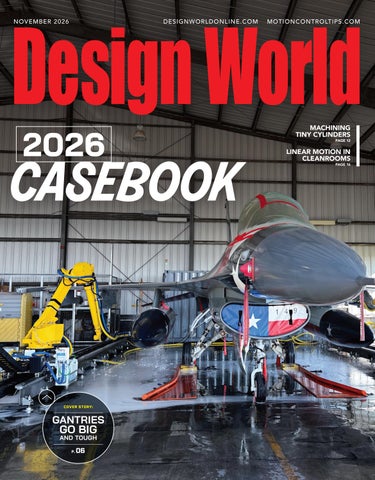
NOVEMBER 2026
DESIGNWORLDONLINE.COM
2026
casebook
COVER STORY:
GANTRIES
GO BIG AND TOUGH P.
06
MOTIONCONTROLTIPS.COM
MACHINING TINY CYLINDERS PAGE 12
LINEAR MOTION IN CLEANROOMS PAGE 16
Motion Control Solutions from Extra Large to Extra Small Configure at:
pbclinear.com/pages/configure-quote
Create Your Tailored Solution!
MUK Series
MTB Series
PLA
Series
UG (SIMO) Series
Compact Series
ML
Series
LSM Series
NEW Miniature Ball Screws Request a
FREE
Sample
bit.ly/BallScrew2026
6402 E. Rockton Road, Roscoe • Illinois 61073 USA +1.800.962.8979 • pbclinear.com
STEP UP YOUR GAME
WITH GREAT VALUE IN STEPPER COMPONENTS. Ever Stepper Drives starting at:
$107.00 (LW4D3070N2I1-00)
SureStep stepper motor linear actuators incorporate a lead screw as the rotor. These actuators translate precise rotational movement into linear motion. They are maintenance-free and are a great cost-saving option for linear motion applications.
Stepper Motors, Drives, and Linear Actuators Starting at $23.00 (STP-MTR-17040)
Stepping systems marry high-performance microstepping drives with hightorque stepper motors (in single- and dual-shaft models) to provide simple and accurate control of position and velocity.
The Ever Motion Solutions® Titanio series micro-stepping drives can monitor back-EMF signals from the motor to detect motor stalling without encoder feedback. Ever drives accept pulse or EtherCAT control signals, and use sinusoidal current control to increase efficiency and smooth the motion.
We make it easy to configure your stepper system! Use our Stepper System Selector to size a stepper motor for your application, then walk through all the options for that motor; including encoders, drives, power supplies, cables, and more.
www.automationdirect.com/selectors/steppers
Research, price, buy at: www.automationdirect.com/stepper-systems
Order Today, Ships Fast! * See our Web site for details and restrictions.
© Copyright 2026 AutomationDirect, Cumming, GA USA. All rights reserved.
1-800-633-0405
the #1 value in automation
PRECISE. ROBUST. AVAILABLE.
SERVO RATED
CD® Couplings • Zero-Backlash & High Torsional Stiffness • Engineered Performance for Reliable 24/7 Operation • Servo-Rated for Reversing, Positioning & Precision • Single-Flex, Double-Flex, Floating-Shaft Solutions • Standard Models / Fully Customizable • Engineering Assistance / Fast Delivery
www.zero-max.com 800.533.1731
applications casebook
CONTENTS v o l u m e n u m b e r
16 4
23
06 05 EDITORIAL
12
06 GANTRIES AND RTUs FOR DIRT Y JOBS 12 LASERING TINY CYLINDERS 16 LINEAR MOTION CHOICES FOR CLEANROOMS
16
22 STAFF & AD INDEX 23 WINDUP
n the cover: O Robotic jet washing exposes equipment to moisture and harsh chemicals. IMAGE: GÜDEL INC. AND WILDER SYSTEMS INC.
4
DESIGN WORLD — MOTION
11 • 2026
motioncontroltips.com
|
designworldonline.com
applications casebook / editorial
WE HAVE TO STOP MEETING LIKE THIS I’ve worked in the B2B publishing industry since 2001, which means I very quietly just passed the 25-year mark in my career. Over that entire span, I’ve only ever covered motion control for discrete automation. Save for a handful of tough times (after 9/11 and the economic downturn of 2008 come to mind) it’s been an extremely fun adventure. That’s why I tell young people deliberating about plans after high school that an engineering degree pairs well with most any line of work. In my case, that took me into a special and enjoyable type of writing — technical writing — and these days, a wide variety of webinar, video, and other forms of editing.
Before joining Design World in 2014, I was the chief editor of a little magazine called Motion System Design … and part of the team that decided to fold MSD into its bigsister brand Machine Design and cease its standalone printing. In the black until the end, the brand was nevertheless quite small in a crowded and fractured space … and directly competed against the much nimbler Design World borne of the digital age. Why am I sharing all this? Well, we’ve come full circle: This will be
11 • 2026
the last standalone Motion issue printed by our publishing group. In 2027, you’ll still get the linearmotion and motion-control updates and tutorials you’ve gotten here, but primarily online and included in the larger print issue of Design World. I welcome this development with a pinch of melancholy along with the pragmatic understanding of someone of my moderately advanced age … and a profound familiarity with how things do, in fact, go in cycles. With that, we hope you enjoy the little luxury that is this printed magazine. May you linger a bit longer with the features we’ve rendered here in paper and ink. We also invite you to look for us come next year when we’ll be found in the pages of the regular Design World issue … and as always, our Engineer’s Edge newsletter, YouTube channel, and designworldonline.com. See you there.
LISA EITEL
LI NKEDI N .COM/I N/E LISAB ETH E ITE L LE ITE L@AR ROWFLY.COM
DESIGN WORLD — MOTION
5
applications casebook
GANTRIES AND RTUs DESIGNED FOR DIRTY JOBS Here we explore the design elements that are necessary for robot track units (RTUs) and gantry robots to successfully operate in different kinds of extreme environments.
BRENDA COURIM MOLLY LYNCH GÜDEL INC.
Factory operating environments are as diverse as the products made in them. Some settings (to produce electronics, pharmaceuticals, and medical devices) are spotless. Cleanrooms for semiconductor manufacturing are nearly sterile — only allowing ten particles of 0.1 µm or greater per cubic meter of air. On the other end of the spectrum are factories housing processes that make for environments hostile to the manufacturing equipment itself, with dirt, metal chips, weld slag, paint overspray, and worse. Yet other factories are relatively clean but extremely hot or cold and inhospitable to automation equipment — as in cold rooms and freezer storage, for example.
6
DESIGN WORLD — MOTION
11 • 2026
Welding line robots are often exposed to weld spatter, smoke, and fume particulates that leave behind soot and oxidation residue.
motioncontroltips.com
|
designworldonline.com
linear motion
Image: WIRE-WIZARD
motioncontroltips.com | designworldonline.com
11 • 2026
DESIGN WORLD — MOTION
7
applications casebook
Let’s explore different extreme environments and the engineering and product requirements to successfully deploy linear motion in the form of RTUs and gantry robots in those places. Here, some engineers might stop and ask: What about the six-axis robotic arms riding on the RTUs? Well, such robots are actually easier to protect than linear systems. The structure of the standard robot (whether traditional industrial or collaborative) allows for the enclosure of drivetrains, bearings, sensors, and lubrication. Their joints’ rotary axes lend themselves to gasketing and seals that keep contaminants out. Major robot companies offer models for high-temperature applications having specialized paint, gaskets, cables, and lubrication. The same holds true for washdown environments (where the robot may be exposed to high-pressure water spray) and paint applications in which overspray requires sealed explosion-proof motors.
PROTECTING RTUs AND GANTRY ROBOTS If six-axis robots are straightforward to protect, RTUs and gantry robots are not. The fundamental design of these
linear-automation systems brings unique challenges. Both the rack-and-pinion drivetrain and the linear bearings and rails are open and exposed to the environment. What’s worse, floor-mounted RTUs are subject to weld slag, machining chips, and paint overspray raining down on them. For these RTUs and gantry robots, the operating environment isn’t a secondary consideration … it’s a core design input.
BEARING TECHNOLOGY IS KEY IN DIRTY ENVIRONMENTS There are two types of bearings deployed in RTUs and gantry robots: Linear bearings with profile guideways and those with cam followers. Linear bearings consist of a series of small recirculating round or cylindrical rollers in a linear housing that continuously cycles through a load-bearing zone and loops back around as the housing travels. The issue with this design in harsh environments is that small particles can easily enter the housing and cause the linear bearing to lock up and freeze. In RTU applications, the mean time to repair or MTTR for a profile-guideway
his is the carriage from a Güdel linear guide T that operates in a stamping plant. Metal shavings and contaminated lubricant cover equipment, but the linear guide’s rail is regularly wiped clean by its bronze scraper.
8
DESIGN WORLD — MOTION
linear bearing failure is considerable. First, the robot must be removed from the carriage, which may need extensive rigging in a crowded work cell. Next, the carriage must be removed from the track, including disconnecting cables and pulling the motor. After the failed bearing is replaced, the RTU is reassembled and all the robot points must be validated and possibly corrected. In contrast, some rugged designs pair cam followers with flat rails for the linear-bearing function. Here, an array of cam followers mount into a precisionmachined cast carriage housing. The bearing elements are inside roller cartridges inserted into the cast housing. Soft-metal scrapers and felt wipers clear debris off the rail, and any small particles that pass through are simply crushed and cleared. Because the bearings are sealed in rollers, they are never exposed to any contaminants. The roller-bearing cartridges inside the cam followers are quick to adjust and replace if needed. In addition, the RTU carriage can be in any position on the track, and there’s no need to remove the robot or carriage during servicing. MTTR is measured in minutes not days or hours as is common with RTUs relying on profile-guideway linear bearings.
üdel’s core bearing technology uses cam followers mounted into a precision machined G cast housing for all RTU and gantry robot models. With their fully enclosed bearings and larger rolling elements, cam followers are much more resilient to harsh industrial environments than linear profile guides. Cam followers’ larger internal cylindrical rollers and large outer race let them simply roll over debris.
11 • 2026
motioncontroltips.com
|
designworldonline.com
linear motion
Image: GÜDEL
TUs in foundries can be exposed to heat sources exceeding 1,500° F along with abrasive sand contaminants, metal scale and oxides, and R dust from carbon, coke, and graphite.
Many RTUs and gantries operate in extremely hot environments — near die casting, investment casting, forging, heat treating, and sintering. Here, aluminum-based RTUs and gantries aren’t recommended … especially if heavy payloads are involved … as permanent deformation and warping can occur. That said, even steel systems can still have challenges. Radiant heat is a major issue in high-temperature applications, whether the heat comes from the process or the parts. So, when handling extremely hot parts, grippers and other components should be shielded from the direct radiant heat. Standard lubricants — gearbox oil and the grease for the rack, rail, and pinion — should be replaced with hightemperature formulations. In addition, seals on gearboxes must be changed out for high-temperature versions. In the same way, standard automatic-lube systems should be replaced with high-temperature models, and plastic tubing to distribute the lubricant must be replaced with hightemperature-rated metal tubing. Standard plastic e-chains should be replaced with
Image: GÜDEL
Image: GÜDEL
ROBOTIC LINEAR MOTION IN HIGH-TEMPERATURE ENVIRONMENTS
his ZP-5 Güdel gantry system has a T gripper design by Mesh Automation for operating in a cold environment. It helps pick cases of frozen food from a pallet and then repalletize them with a separator between each layer.
ome Güdel gantry systems are used to S transfer red-hot railroad wheels weighing upwards of 1,500 lb each.
high-temperature versions or metal components that can withstand the actual working environment. Standard paint won’t survive extreme high temperatures and should be replaced with coatings rated for high-temperature exposure. Lastly, soft-metal scrapers and felt wipers in the roller-block assemblies may need more regular replacement.
motioncontroltips.com | designworldonline.com
11 • 2026
LINEAR MOTION IN COLD ENVIRONMENTS Commonly found in food manufacturing and logistics facilities, extreme-cold applications are commonly classified as 0° F, -20° F, or -40° F. Each level needs different design adjustments. As in hot applications, low temperatures necessitate replacement of standard grease and oil lubricants with products — in this case, rated for low temperatures. Plastic tubing for lubricant distribution may have to be replaced to DESIGN WORLD — MOTION
9
applications casebook
satisfy bending-radius requirements. Seals must be replaced with products that will maintain elasticity in low temperature. It’s also common to add Armoloy coating to racks and rails to protect against condensation. Brakes may need upsizing to compensate for reduced stopping coefficients in cold temperatures. Installation in cold environments is also a challenge due to the thermal contraction of the metal, particularly in larger configurations. One additional consideration: RTUs and gantry robots are manufactured in typical ambient temperatures, so they will need calibration and adjustment after installation and acclimation to the cold environment.
ROBOTIC LINEAR MOTION IN PAINT APPLICATIONS RTUs and gantry robots are common in the large-scale painting of aerospace, automotive, defense, and rail elements as well as off-highway equipment manufacture. But with large-scale painting comes copious overspray and airborne paint particles. Overspray can accumulate over time and cause real problems in linear bearings. Some companies attempt to cover the exposed linear-motion components, but covers are unsuitable at best and can even trap paint that has slipped through. In contrast, cam followers with sealed roller bearing cartridges handle painting applications with ease,
pushing overspray off the rails. Bronze scrapers in the cam-follower bearing housings also remove dried-on buildup. To reduce adhesion of material onto working surfaces, the drive racks and linear-bearing rails are often coated with Armoloy plating. For overhead configurations, to avoid contamination of workpiece surfaces, these linear subcomponents commonly run without lubrication. Of course, overspray of solventbased paints quickly creates an explosive environment. So, all motors in such settings must have a Class I Division 1 explosion-proof rating or must be enclosed in a separate housing with the same level of protection.
ROBOTIC LINEAR MOTION IN WET ENVIRONMENTS
Image: GÜDEL rass scrapers clear debris from rail, making them the first line of defense against B contamination from paint, weld spatter, soot, sand, and grinding dust. Brass is used here because it’s softer than the rails and won’t damage rails over time.
RTUs and gantry robots are also deployed in aerospace, military, and heavyequipment washdown applications. Often, cleanup occurs after a craft or vehicle has operated in a harsh setting … for example, over oceans where salt condensation can occur. In other applications, the cleaning might be immediately prior to a painting process. RTU and gantry linear motion based on cam followers having sealed bearing cartridges is suitable for these wet environments. For pre-paint cleaning routines, the bearings’ linear rails and drive rack (to prevent contaminating the paint surface) run without lubrication.
Image: WILDER SYSTEMS INC.
ROBOTIC LINEAR MOTION IN OUTDOOR AUTOMATION The ultimate challenge? Taking automation out of the factory to the great outdoors. The robotics industry is seeing huge interest in automating building and construction applications suffering from the same labor shortages as manufacturing. Emerging applications include the 3D printing of houses and other structures; field assembly of modular building sections; concrete finishing, cutting, and drilling operations; and recycling and recovery public works. Robotic jet washing exposes equipment to moisture and harsh chemicals.
10
DESIGN WORLD — MOTION
11 • 2026
•
GÜDEL | YOUTUBE.COM/@GUDELGROUP motioncontroltips.com
|
designworldonline.com
Soak Up the Sun
and pump up the volume with our low-voltage DC gearmotors To keep the gas and oil flowing, high volumes of corrosion inhibitors, biocides and de-emulsifiers must be continuously pumped into pipelines, wellheads and gas and oil production systems. And Bodine solar powered gearmotors are up to the task. Not only are our low voltage gearmotors optimized for the higher current needed to power solar and battery powered equipment, they’re also built for rugged environments. From chemical injection pumps to GPS controlled tractors, our gearmotors provide maintenance-free performance in the most challenging applications.
Explore Bodine low voltage products Get the right gearmotor for your battery and solar-powered applications www.bodine-electric.com
| info@bodine-electric.com
| Peosta, IA USA
| 773.478.3515 (USA)
applications casebook
Tube laser processing is key to the manufacture of cylindrical medical devices as found in coronary and neurovascular stents, hypotubes, and instruments for minimally invasive procedures.
12
DESIGN WORLD — MOTION
11 • 2026
motioncontroltips.com
|
designworldonline.com
medical-device manufacture
CYLINDER-LASERING MACHINE SPEEDS MEDICAL-DEVICE PRODUCTION
Laser-cut cylindrical components find copious use in medical devices — in coronary and neurovascular stents, structural heart components, peripheral vascular implants, and instruments for minimally invasive procedures.
motioncontroltips.com | designworldonline.com
11 • 2026
DESIGN WORLD — MOTION
13
applications casebook
The LaserTurn280 is Aerotech’s new motion platform for cylindrical laser machining. Based on the PRO280LM linear table design and available with a choice of three different rotary stage drives, the system can process tube diameters from 0.3 to 30 mm. Shown here is a prototype as exhibited at Medtec Live in Stuttgart.
S H O CK
&V
S LUTION O S N O IBRATI
NEED A DUAL CASTED PRODUCT? We Have A Solution for That!
800.838.3906 | sorbothane.com Sorbothane_DesignWorld_Ad_C_2025.indd 1
MADE IN THE U.S.A. 1/23/25 10:20 AM
The new Aerotech LaserTurn280 is a motion platform for high-volume laser machining of these cylindrical medicaldevice components. Previously displayed in prototype form at medical-technology tradeshows, the LaserTurn280 is based on Aerotech’s PRO280LM linear-stage design. Three versions have different rotary-stage drives — the ASR1400, ASR1100, and ACS150 — to machine tube diameters from 0.3 to 30 mm. Clamping systems abound and include TF20 and W12 collets as well as dead-length and ER16, ER25, and ER40 precision collets. Linear travel is to 300 mm and speed to 1,000 mm/sec. Collet chucks with dead length minimize axial movement of the tube and reduce the risk of stitching errors during feed. This is particularly important when machining longer workpieces such as hypotubes. The clamping mechanism is pneumatically actuated and is designed for operation with dry oil-free nitrogen or compressed air. “The LaserTurn280 is the result of direct feedback from the market,” said Aerotech product manager Brian Fink. “Engineers need platforms that can be quickly integrated into their
14
DESIGN WORLD — MOTION
medical-device manufacture
Shown here is a laser-cut vascular implant only made possible with modern tube-laser platforms able to impart intricate structures with tight tolerances.
existing production lines while enabling higher throughput. The LaserTurn280 was developed precisely to meet these requirements.” According to the manufacturer, the platform’s high rigidity allows calibrated accuracy to ±1 µm (linear) and ±30 µrad (rotary) with bidirectional repeatability of ±0.4 µm and ±15 µrad respectively. The system is driven by ironless linear motors sporting noncontact optical encoders. Seals protect internal components from contamination — especially important for wet-cutting applications. The LaserTurn280 can be supplied in either a dry or wet cutting configuration; the latter features an integrated fluid handling system.
Integrated cable management and an open aperture for tube passage keep integration simple and tidy; optional pneumatic grippers at the front and rear enable automated workpiece handling. Mounting is via eight M8 fixing points. “The platform [makes for] minimal tube scrap, reproducible part quality, and series production,” added Fink. The platform works with Aerotech’s Automation1 motion controller that (among other things) supports a position synchronized output (PSO) function for precise synchronization of the laser pulse and axis movement. Meanwhile, enhanced tracking control (ETC) reduces path errors during the machining of fast and complex contours. Both technologies
motioncontroltips.com | designworldonline.com
11 • 2026
are particularly relevant for stent manufacturing, for which tight geometric tolerances and short cycle times are key. Workpieces range from a few millimeters to lengths of over one meter. With its selection of rotary stage drives and collet options, the LaserTurn280 is designed for a wide range of these applications. “The demands of medical device manufacturing [include] smaller structures, tighter tolerances and higher production volumes,” said Fink. “The LaserTurn280 supports this and enables integration without complex adjustments to individual components.”
•
AEROTECH | AEROTECH.COM
DESIGN WORLD — MOTION
15
applications casebook Although epoxy paint is sometimes suitable for motor and gearbox housings, stainless-steel versions are better options.
LINEAR MOTION CHOICES FOR CLEANROOMS The biggest update to cleanrooms over the last several years is the 2025 14644 update. Numerous motion and robotics suppliers already certify or design products explicitly for cleanrooms ISO Class 5 and better … to Class 1. Cartesian solutions, collaborative robots, complementary IP54 housing geometry minimizing dust traps and joints, and drives with fanless thermal management … these are just a few of this year’s introductions.
The 14644 update reflects advances in science, manufacturing, and technology. Analysis, team engagement, and documentation can help cleanroom operations realize the promises of the standard. When it comes to linear drives in cleanrooms, conventional wisdom is that belts and chains should be avoided as they involve significant contact and wear. Advances in belt materials especially though — and seals for belt drives within actuator bodies — means they’re increasingly common in cleanrooms. Similarly, rack-pinion sets involve high-friction meshing and wear, so conventional wisdom is that they should also be avoided. Real-world exceptions abound though.
16
DESIGN WORLD — MOTION
11 • 2026
motioncontroltips.com
|
designworldonline.com
cleanrooms
Image: ADOBE STOCK
motioncontroltips.com | designworldonline.com
11 • 2026
DESIGN WORLD — MOTION
17
applications casebook
All this said, ballscrews are typically the default choice for linear drives in cleanroom applications. Of course, ballscrews need lubrication and screw rotation can cause lubrication splatter. Here again, low-friction or noncontact seals help keep the lubrication inside the ball nut and protect the cleanroom. In their traditional setup, linear motors operate with the forcer (primary part) moving. This means the cables move as well … and in fact, cables are another source of particle generation. So, sometimes a better configuration for cleanroom applications is to keep the forcer (primary) and cables stationary and allow the magnet track (secondary) to move. Acceptable are rolling contact (rather than sliding contact) guides and drives. Preferred are air-bearing guides and linear motors. Low-friction or noncontact seals and cleanroom lubrication can also support cleanroomready designs.
REDUCE FRICTION FROM CABLES AND CABLE MANAGEMENT
Image: ADOBE STOCK ote the stainless-steel components on this production line outputting syringes prefilled N with a biomedical product.
Another source of friction and particles are cable assemblies. Traditional round cables can generate particles when they rub together or against the cable carrier. So, it’s good practice to (if possible) reduce the overall cabling for a given design — with (for example) integrated motor-drive units instead of separate motors and drives. For the power, feedback, and data cables, those with low-friction coatings minimize particulates and reduce outgassing. Acceptable are round cables with anti-friction coatings as well as cable carriers with abrasion-resistant joints. Preferred are self-supporting flat cables. Any opportunities to reduce cabling should also be pursued.
REDUCE FRICTION FROM ROTATING EQUIPMENT (INCLUDING MOTORS AND GEARBOXES) Rotating elements such as motors and gearboxes uses rotary bearings … and gearboxes involve meshing teeth … and
18
DESIGN WORLD — MOTION
11 • 2026
motioncontroltips.com
|
designworldonline.com
cleanrooms
HEPA and ULPA filters so are difficult to control once released.
MINIMIZE OUTGASSING THROUGH MATERIAL SELECTION Image: © MATEE NUSERM • DREAMSTIME his screw shaft is showing evidence of spalling and flaking — possibly resulting from either T normal wear or insufficient lubricant.
these are friction and particle generators. Fortunately, these components are enclosed, so particles are less likely to escape into the cleanroom environment.
in cleanrooms and specifically refers to airborne molecular contamination as the presence in the atmosphere of a cleanroom or controlled environment
Vacuum purge is an effective way to ensure particulates from closed systems can’t escape into the cleanroom environment. Some pre-engineered wafer aligners have pumps for a vacuum of -0.05 to -0.08 MPa. Plus, a wide range of cleanroomcompatible lubricants can be used in the high-speed high-load conditions found in motors and gearboxes. To improve cleanroom compatibility, it’s also possible to add a slight vacuum to the motor or gearbox housing. Fully enclosed housings are acceptable, though a vacuum purge imparts even more reliability. Cleanroom-ready grease options should also be specified wherever possible.
of molecular (chemical, non-particulate) substances in the gaseous or vapor state that may have a deleterious effect on the product, process, or equipment. These molecular vapors are smaller than particles and pass right through
Automation components for minimizing outgassing feature smooth materials that make it more difficult for airborne molecular contaminants to adhere to their surfaces. Stainless steel and anodized aluminum are preferred materials, although some epoxy paints can sufficiently prevent outgassing-type issues. Thankfully, most components such as linear guides and drives, motors, and gearboxes can be made of stainless steel. On linear motion components, stainless-steel endcaps should replace plastic whenever that’s possible. Likewise, standard steel fasteners should be replaced with stainless-steel hardware. Steel can maintain hardness, durability, or load-carrying capacity, and nickel plating can reduce the steel’s tendency to outgas. One caveat: Some nickel-plating formulas include a polytetrafluoroethylene or PTFE or Teflon topcoat. PTFE is a solid lubricant with low shear strength and low friction coefficient against metal. As a coating, it can be incompatible with cleanroom
OUTGASSING MINIMIZATION So, we’ve covered how to reduce frictionrelated particle generation. Now let’s consider another source of contamination — outgassing — and how to minimize it. Especially in cleanrooms involving the manufacture of LEDs, optics, or glass, or the processing of silicon wafers, outgassing can damage end product. Outgassing is the desorption of vapors or gasses, either from within or from the surface of a material. ISO standard 14644 addresses outgassing motioncontroltips.com | designworldonline.com
Image: ADOBE STOCK
11 • 2026
DESIGN WORLD — MOTION
19
applications casebook
applications. Where PTFE acts within a matrix (for example, in the fiber-reinforced thermoplastic of a motion component) the material may be suitable. Acceptable are nickel-plated steel and epoxy-coated aluminum; better are stainless steel or anodized aluminum as well as minimal use of plastics. Smooth surfaces (with no textured paints) also offer distinct benefits. Some suppliers of engineeredplastic components sell some mechanical components with proprietary solidlubricant chemistry embedded as microscopic units in fiber-reinforced polymer matrices. Safety and performance data sheets imply fluorinated polymers like PTFE that can spread a thin film onto any counterface during motion to permanently lower friction. Other embeddable solid lubricants include graphite and molybdenum disulfide (MoS₂) that have high dryrunning PV performance though these aren’t cleanroom compatible.
all separators (also called ball cages or chains) B can be useful in cleanrooms because they prevent the ball-to-ball contact that can cause particle generation.
IWIN linear guide carriage H showing load-bearing balls.
REDUCE OUTGASSING FROM LUBRICANTS Lubricants are major outgassing offenders, readily spewing molecules of water and oil vapor into the atmosphere. But most motion components need lubrication. When lubrication is required, ensure the lubricant is suitable for cleanroom environments. Cleanroom lubricants have base oils distilled to remove volatile molecules that easily evaporate. Hydrocarbons, esters, silicones, and polyalphaolefins are a few used in cleanrooms. However, PTFEs often deliver the least outgassing with high performance. Cleanroom-rated lubricants are a must wherever engineers can’t minimize or eliminate the need for lubrication through component selection. Consider how screws and motors output shafts have rotary bearings for end support. Here, plain bearings of polymers or composites such as PEEK infused with PTFE have been used — as well as ceramic balls that eliminate the need for lubrication. Solid molybdenum disulfide or tungsten disulfide lubricants are suitable for some vacuum environments but
20
DESIGN WORLD — MOTION
Image: ADOBE STOCK
not for certain semiconductor and LCD manufacturing applications due to particle generation. Another solid lubricant is silver applied in a thin layer — specifically recommended by some ballscrew makers for its suitability in semiconductor manufacturing and UHV environments. Where grease is absolutely required, many vacuum-compatible options are available for linear guides and drives especially. Many cleanroom-approved lubricants are special formulations having no (or less than typical) solid-particle aluminum, silica, and PTFE additives.
11 • 2026
Of course, the primary function of lubrication is to reduce friction and therefore particle generation between moving surfaces. It also traps generated particles and prevents them from scattering into the environment. Seals and covers can prevent rotating components from slinging grease into and onto critical work areas. In addition, particle-count tests confirm that bearingball spacers or cages (that separate the balls to prevent collisions during their recirculation) can reduce particle generation in profile-rail guides and ballscrews.
•
motioncontroltips.com
|
designworldonline.com
AD INDEX
v o l u m e
16
n u m b e r
4
All Motion..........................................................................................5
Altech Corporation.................................................... Back Cover
AutomationDirect............................................................................1
Bodine Electric Company........................................................... 11
CMT.................................................................... Inside Back Cover
DigiKey Corporation...................................................................... 3
KHK USA Inc.................................................................................. 21
PBC Linear...................................................... Inside Front Cover
Sorbothane Inc............................................................................. 14
Zero-Max........................................................................................... 2
EDITORIAL
SALES CONTINUED
VP, Editorial Director Paul J. Heney pheney@arrowfly.com
Melissa Roberts mroberts@arrowfly.com 440.666.3111
ONLINE DEVELOPMENT & PRODUCTION Web Development Manager B. David Miyares dmiyares@arrowfly.com
Colton Stefanich cstefanich@arrowfly.com 331.223.2047
Chief Editor Rachael Pasini rpasini@arrowfly.com
Digital Production Manager Reggie Hall rhall@arrowfly.com
Chris Stroh cstroh@arrowfly.com
Executive Editor Lisa Eitel leitel@arrowfly.com Managing Editor Mike Santora msantora@arrowfly.com
SALES Ryan Ashdown rashdown@arrowfly.com 216.316.6691 Jami Brownlee jbrownlee@arrowfly.com 224.760.1055 Ashley Burke aburke@arrowfly.com 737.615.8452
CREATIVE SERVICES & PRINT PRODUCTION
LEADERSHIP TEAM
VP, Creative Director Matthew Claney mclaney@arrowfly.com
Senior VP, Engineering Amanda Buehner abuehner@arrowfly.com
Senior Art Director Tory Bartelt tbartelt@arrowfly.com
CEO Matt Logan mlogan@arrowfly.com
Director, Audience Growth Rick Ellis rellis@arrowfly.com
CFO Ken Gradman kgradman@arrowfly.com 773.680.5955
PRODUCTION SERVICES
Mike Francesconi mfrancesconi@arrowfly.com 630.488.9029 Jack Gillerlain jgillerlain@arrowfly.com 773.909.2718 Adrian Nash anash@arrowfly.com 416.500.6906 Susan Powers spowers@arrowfly.com 708.341.3370 Judy Pinsel jpinsel@arrowfly.com 630.538.2638
FINANCE
Customer Service Manager Stephanie Hulett shulett@arrowfly.com
Controller Nirmit Shukla nshukla@arrowfly.com
Customer Service Representative Tracy Powers tpowers@arrowfly.com
Accounts Receivable Specialist Jamila Milton jmilton@arrowfly.com
Customer Service Representative JoAnn Martin jmartin@arrowfly.com
MARKETING
Customer Service Representative Renee Massey-Linston renee@arrowfly.com
Digital Design Manager Samantha Goodrich sgoodrich@arrowfly.com
Customer Service Representative Trinidy Longgood tlonggood@arrowfly.com
Digital Marketing Manager Taylor Meade tmeade@arrowfly.com Webinar Manager Chad Shapiro cshapiro@arrowfly.com
Arrowfly 1111 Superior Ave., Suite 1120 Cleveland, OH 44114 Ph: 888.543.2447
DESIGN WORLD does not pass judgment on subjects of controversy nor enter into dispute with or between any individuals or organizations. DESIGN WORLD is also an independent forum for the expression of opinions relevant to industry issues. Letters to the editor and by-lined articles express the views of the author and not necessarily of the publisher or the publication. Every effort is made to provide accurate information; however, publisher assumes no responsibility for accuracy of submitted advertising and editorial information. Non-commissioned articles and news releases cannot be acknowledged. Unsolicited materials cannot be returned nor will this organization assume responsibility for their care. DESIGN WORLD does not endorse any products, programs or services of advertisers or editorial contributors. Copyright© 2026 by Arrowfly. No part of this publication may be reproduced in any form or by any means, electronic or mechanical, or by recording, or by any information storage or retrieval system, without written permission from the publisher.
2011 -2020
2014 Winner
2013-2017, 2021
Subscription Rates: Free and controlled circulation to qualified subscribers. Non-qualified persons may subscribe at the following rates: U.S. and possessions: 1 year: $125; 2 years: $200; 3 years: $275; Canadian and foreign, 1 year: $195; only US funds are accepted. Single copies $15 each. Subscriptions are prepaid, and check or money orders only. Subscriber Services: To order a subscription or change your address, please email: designworld@omeda.com, or visit our web site at www.designworldonline.com
2014 -2016
22
DESIGN WORLD — MOTION
11 • 2026
POSTMASTER: Send address changes to: Design World, 1111 Superior Ave., Suite 1120, Cleveland, OH 44114
motioncontroltips.com
|
designworldonline.com
applications casebook / windup
ADVANCED MONITORING COMING SOON TO A MACHINE NEAR YOU
Soon, a new “motion insights and diagnostics” service from Swiss precision-drive specialist maxon called maxon MIND will help machine
axon MIND is a scalable service that works with standard m components, so implementation is fast. Once running, maxon MIND yields machine condition-based-maintenance and AGV fleet-management capabilities to prevent personnel injuries and unexpected machine downtime.
builders and plant engineers add condition monitoring and diagnostics capabilities to their equipment.
Electric motors are often the best sensor in a machine. After all, the motor signals a controller already reads reflect the condition of the entire drive system and its environment. maxon MIND turns those existing signals into diagnoses by monitoring the motor … and with it all the mechanical components connected downstream. Developed in-house over years by an interdisciplinary team, maxon MIND works like this: 1. T here’s an application already driven by a maxon motor, gearbox, encoder, and controller(s). 2. At the primary controller, a small software package installs and then runs a script to trigger a diagnostic cycle, generate references, record motor signals, and then enrich collected data with context and distillation for analysis. 3. The system then sends the collected and condensed data over a secure internet connection (via MQTT, for example) to the cloud-based maxon MIND platform. Once there, the data is analyzed by a machine-learning model and compared to the drive’s reference state. Deviations and anomalies are flagged. 4. Integrated data, condition analyses, and historical trends are accessed through an interface made possible with an application programming interface (API) from maxon. So,
motioncontroltips.com | designworldonline.com
achine learning is commonly associated with massive data M requirements, high computational demands, and expensive hardware. In contrast, maxon MIND builds models with fewer than 100 reference cycles and runs diagnostics on fewer than 20 cycles. So, a model of a design (such as the AGV shown here) can be created in less than 10 minutes … and condition diagnosis takes less than a minute.
personnel can pull results into plant dashboards and fleetmanagement systems. Diagnoses from the maxon MIND system are traceable, which is necessary in safety-critical design and regulated industries. Via the API, maxon MIND also integrates with the maxon Cloud. Once maxon MIND is officially released to the industry (expected in 2027), machine builders aiming to leverage the service will first consult with maxon on their design
11 • 2026
DESIGN WORLD — MOTION
23
windup / applications casebook
load profiles, usage cycles, and environmental conditions. Then rapid prototyping and early testing (followed by system testing and validation under real operating conditions) will inform changes and the calibration of models. Final implementation will include optimization and fine-tuning of parameters or reference cycles. Cybersecurity is ensured through the way collected machine data is anonymized and secured with maxon privacy measures complementing Cloud and security services. In short, maxon MIND doesn’t need to know who the end user is or what specific application is running. To uniquely identify the corresponding machine learning model, maxon MIND only needs data that’s easily anonymized — for example, a drive’s part and serial number.
configured for different levels of complexity … and sensitivity can be adjusted for challenging situations involving cleanrooms, assemblies subject to vibrations, and extreme temperatures. How exactly does maxon MIND distinguish problems from normal operating conditions? Jaquemet: maxon MIND doesn’t rely
on a universal definition of normal. A machine-learning model is created for the specific motor in its actual application and is trained on an initial reference state. Later measurements are compared with this applicationspecific model to detect deviations and wear trends. Also, various potential fault-modes are considered maxon MIND software embeds into machine in the training of the initial reference builders' existing user interfaces. state, to which the application is continuously compared. For example, to compensate for temperature effects, the applicable payload, For more on how maxon MIND actually works, Design the reference cycle itself, and the drivetrain configuration need to World asked program lead for maxon MIND Claude remain consistent during data acquisition.
Jaquemet a few questions. Here’s what he had to say. Design World: Early literature on maxon MIND details how
the software logs machine data during regular operation (and compares it to mechatronic system models) with a frequency that depends on the application and machine builder. But the maxon MIND system needs relatively small data volumes (not enormous datasets) thanks to the “integration of domain-specific expertise into the models” of how a motor, gearbox, and load physically relate. What does domain-specific expertise mean in this context? Jaquemet: In maxon MIND, domain-specific expertise means
incorporating the known physical relationships and operating context of the mechatronic drive system into the model. This includes knowledge of the motor, controller, mechanical load, motion cycle, configuration, and relevant environmental conditions. It is interdisciplinary application knowledge, based on the long experience of maxon.
Design World: With this offering, a machine learning model is trained on the OEM’s own data about actual system behavior … plus, the models can be tuned so that a condition warning is genuinely a warning. How does maxon MIND differentiate a real problem from slight and acceptable wear over time? Jaquemet: With application-tailored models and high sensitivity.
Therefore, maxon MIND doesn’t apply one universal wear threshold. It tracks the drive system relative to its applicationspecific initial state and visualizes the progression over time. Together with the machine builder, the model sensitivity and the boundary between acceptable condition and action-required condition are validated for the particular application. The result supports condition-based maintenance decisions.
Design World: We understand the architecture can be
24
DESIGN WORLD — MOTION
11 • 2026
Design World: Potential applications include those in laboratory
automation (to protect sample integrity and throughput while holding quality consistent); medical devices (to prevent any situations capable of jeopardizing patient safety); and general industrial automation — for avoiding downtime, minimizing the waste of parts, and boosting overall equipment effectiveness (OEE). In general terms, what are the target applications?
Jaquemet: maxon MIND is designed for critical applications
where an unexpected drive-system failure could affect personal safety, reliability, availability, process quality, or the user experience. Relevant application areas include medical devices, industrial and laboratory automation, and logistics. Technically, the application must allow repeatable diagnostic cycles under controlled and comparable load conditions. maxon MIND generally performs best where high sensitivity of the condition indication is required.
Design World: Can the motor signals reflect the condition of the
whole powertrain, and how can the engineer localize a problem to one component?
Jaquemet: The electrical motor signals contain information
influenced by the motor, gearbox, encoder, coupling, and driven mechanics. maxon MIND therefore assesses the condition of the complete drive system rather than only the motor. Componentlevel detection of faults is generally feasible, but it depends on the particular drivetrain. Beyond general component failure patterns, application-specific validation against known faults, inspections, or service findings help with the interpretation of the condition indication.
•
maxon | MAXONGROUP.COM
motioncontroltips.com
|
designworldonline.com
CAD Models
NOW AVAILAB LE PLEASE VISIT OUR WEBSITE
on ou websiter
Manufacturer of Power Transmission and Motion Control Components
PERFECT TIMING when timing is everything
Custom Machine & Tool Co., Inc. 800-355-5949 sales@cmtco.com www.cmtco.com
Precise. Reliable. Trusted.
American Engineering | American Made © Custom Machine & Tool Co., Inc.