Technical Thinking By Mark Jones
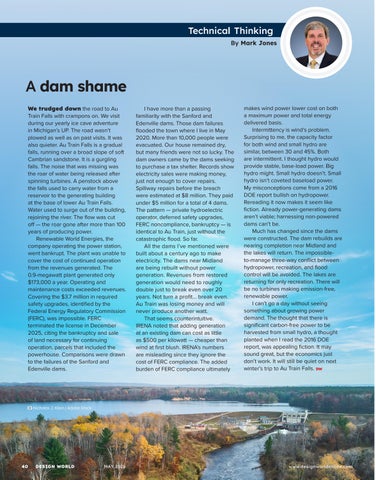
A dam shame We trudged down the road to Au Train Falls with crampons on. We visit during our yearly ice cave adventure in Michigan’s UP. The road wasn’t plowed as well as on past visits. It was also quieter. Au Train Falls is a gradual falls, running over a broad slope of soft Cambrian sandstone. It is a gurgling falls. The noise that was missing was the roar of water being released after spinning turbines. A penstock above the falls used to carry water from a reservoir to the generating building at the base of lower Au Train Falls. Water used to surge out of the building, rejoining the river. The flow was cut off — the roar gone after more than 100 years of producing power. Renewable World Energies, the company operating the power station, went bankrupt. The plant was unable to cover the cost of continued operation from the revenues generated. The 0.9-megawatt plant generated only $173,000 a year. Operating and maintenance costs exceeded revenues. Covering the $3.7 million in required safety upgrades, identified by the Federal Energy Regulatory Commission (FERC), was impossible. FERC terminated the license in December 2025, citing the bankruptcy and sale of land necessary for continuing operation, parcels that included the powerhouse. Comparisons were drawn to the failures of the Sanford and Edenville dams.
I have more than a passing familiarity with the Sanford and Edenville dams. Those dam failures flooded the town where I live in May 2020. More than 10,000 people were evacuated. Our house remained dry, but many friends were not so lucky. The dam owners came by the dams seeking to purchase a tax shelter. Records show electricity sales were making money, just not enough to cover repairs. Spillway repairs before the breach were estimated at $8 million. They paid under $5 million for a total of 4 dams. The pattern — private hydroelectric operator, deferred safety upgrades, FERC noncompliance, bankruptcy — is identical to Au Train, just without the catastrophic flood. So far. All the dams I’ve mentioned were built about a century ago to make electricity. The dams near Midland are being rebuilt without power generation. Revenues from restored generation would need to roughly double just to break even over 20 years. Not turn a profit… break even. Au Train was losing money and will never produce another watt. That seems counterintuitive. IRENA noted that adding generation at an existing dam can cost as little as $500 per kilowatt — cheaper than wind at first blush. IRENA’s numbers are misleading since they ignore the cost of FERC compliance. The added burden of FERC compliance ultimately
makes wind power lower cost on both a maximum power and total energy delivered basis. Intermittency is wind’s problem. Surprising to me, the capacity factor for both wind and small hydro are similar, between 30 and 45%. Both are intermittent. I thought hydro would provide stable, base-load power. Big hydro might. Small hydro doesn’t. Small hydro isn’t coveted baseload power. My misconceptions come from a 2016 DOE report bullish on hydropower. Rereading it now makes it seem like fiction. Already power-generating dams aren’t viable; harnessing non-powered dams can’t be. Much has changed since the dams were constructed. The dam rebuilds are nearing completion near Midland and the lakes will return. The impossibleto-manage three-way conflict between hydropower, recreation, and flood control will be avoided. The lakes are returning for only recreation. There will be no turbines making emission-free, renewable power. I can’t go a day without seeing something about growing power demand. The thought that there is significant carbon-free power to be harvested from small hydro, a thought planted when I read the 2016 DOE report, was appealing fiction. It may sound great, but the economics just don’t work. It will still be quiet on next winter’s trip to Au Train Falls. DW
Nicholas J. Klein | Adobe Stock
40
DESIGN WORLD
Technical Thinking DW 05-26 v2 final.indd 40
MAY 2026
www.designworldonline.com
4/28/26 12:52 PM