WWW.DESIGNWORLDONLINE.COM
OCTOBER 2026
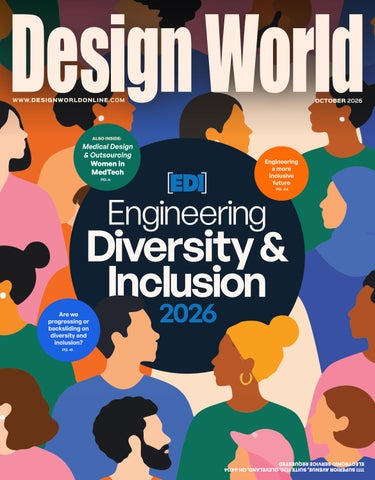
ALSO INSIDE:
Medical Design & Outsourcing Women in MedTech PG. 6
Engineering a more inclusive future PG. 44
Are we progressing or backsliding on diversity and inclusion? PG. 41
1111 SUPERIOR AVENUE, SUITE 1120, CLEVELAND, OH 44114 ELECTRONIC SERVICE REQUESTED Final Cover DW EDI 10-26.indd 1
10/7/26 1:58 PM
Your Full- Service Development & Biocompatibilit y Partner. ISO 9001 | ISO 13485 | ISO/IEC 17025:2017
Located in Erie, PA, our business model enables us to support your product through its entire lifecycle. As sister companies, PSN Labs and PSN Manufacturing work hand-in-hand. PSN Labs leads the discovery and development phases of a project through their end-to-end engineering services, while PSN Manufacturing handles prototyping, tool fabrication, and full-scale production. This seamless partnership eliminates the hassle of managing multiple vendors and reduces the risks often associated with design and knowledge transfer as a project moves from development to manufacturing.
Engineering Services
Product Development
Testing Services
Biocompatibility & Toxicology
Production & Material Processing
Biocompatibility testing is often done late in development, which contrasts with the FDA's recent guidance urging a more stringent approach to biological risk evaluation. To comply with ISO 10993 and other standards, manufacturers shouldintegrate testing earlier in the process through Design for Biocompatibility (DFB) to ensure regulatory compliance. At PSN Labs, our DFB strategy includes early-stage decisions about material selection, manufacturing, and device construction. This ensures patient safety, simplifies regulatory compliance, and helps prevent delays or recalls.
PSNlabs.com 5368 Kuhl Rd, Erie, PA 16510 814-464-0790 | info@psnlabs.com
PSN - MDO EDI 09-26.indd 1
PSNmanufacturing.com 5650 Wattsburg Rd, Erie, PA 16509 814-464-0790 | info@psnmfg.com
10/14/26 11:23 AM
A TRUSTED PARTNER TO AMPLIFY YOUR INNOVATION
From components and finished devices to the next generation of medical technologies, now more than ever, you can count on us.
ELE CT RO PH YSI OL OG Y
ION T A L
DU
O OM
UR
NE
Neuro Leads
Electrophysiology Catheters
Aspiration & Thrombectomy Devices
Medical cal Textiles les
Em Embolization Devices
Delivery Systems
STRUCTURAL HEART
NEUROVASCULAR
Implantable Pulse Generator Systems
Guiding Sheaths
Cardiac Leads
Introducers Guidewires
CO R & V ON A AS RY, CU PE LA RIP R A HE CC RA ESS L
Batteries & Capacitors
HM YT NT H R E IAC GEM D R A CA MAN
Strengthen your innovation with our rapid prototyping and clinical know-how to take you seamlessly from concept to production Get to market faster by utilizing our platform technologies and market-ready products that provide differentiated performance and portfolio expansion Extend your reach through our global R&D and manufacturing capabilities to consistently achieve design requirements, quality standards, and on-time delivery
Integer - MDO EDI 09-26.indd 1
Integer.net | 833.722.3657
Products pictured © 2026 Greatbatch Ltd. and its affiliates.
10/14/26 11:21 AM
PARTNERSHIP THAT POWERS POSSIBILITIES The experts in design, development, and scalable manufacturing of interventional catheter-based devices and implants.
NITINOL COMPONENTS NITINOL TUBING FILMCAST PTFE
Your trusted partner for bringing current and future medical devices to market Learn more about our offerings at www.confluentmedical.com or email sales@confluentmedical.com for a custom quote.
Confluent - MDO EDI 09-26.indd 1
POLYMER TUBING CATHETER COMPONENTS BALLON CATHETERS BIOMEDICAL TEXTILES
10/14/26 11:24 AM
Stay An
INFORMED. SMART. AHEAD.
Publication
OCTOBER 2026 • DESIGNWORLDONLINE.COM EDITORIAL
DIGITAL MARKETING
VP, Editorial Director Paul J. Heney pheney@arrowfly.com
VP, Marketing Annie Wissner awissner@arrowfly.com
Editor-in-Chief Rachael Pasini rpasini@arrowfly.com
Portfolio Marketing Manager Engineering & Life Sciences McKenzie Burns mburns@arrowfly.com
Digital Production Specialist Nicole Johnson njohnson@arrowfly.com
PRODUCTION SERVICES
Digital Design Manager Samantha Goodrich sgoodrich@arrowfly.com
Managing Editor Mike Santora msantora@arrowfly.com
DIGITAL PRODUCTION
Digital Production Manager Reggie Hall rhall@arrowfly.com
Customer Service Manager Stephanie Hulett shulett@arrowfly.com
Executive Editor Lisa Eitel leitel@arrowfly.com
Customer Service Rep Tracy Powers tpowers@arrowfly.com
Senior Editor Mary Gannon mgannon@arrowfly.com
VP, Creative Director Matthew Claney mclaney@arrowfly.com
WEB DEVELOPMENT
Web Development Manager B. David Miyares dmiyares@arrowfly.com
Customer Service Rep Renee Massey-Linston renee@arrowfly.com
Art Director Allison Washko awashko@arrowfly.com
Front End Developer Melissa Annand mannand@arrowfly.com
Customer Service Rep Trinidy Longgood tlonggood@arrowfly.com
AUDIENCE DEVELOPMENT
Marketing Graphic Designer Hannah Bragg hbragg@arrowfly.com Digital Production Specialist Elise Ondak eondak@arrowfly.com
Customer Service Rep JoAnn Martin jmartin@arrowfly.com
PRINT CREATIVE SERVICES
Design World reports on the vast world of design engineering and machine building with technical, indepth content. We cover semiconductor, medical, factory automation, packaging, off-highway, material handling, simulation, rapid prototyping, and more. By signing up for the Engineer’s Edge, you’ll stay on top of the news and trends happening in the engineering space. Scan the QR code to access three weekly newsletters plus new product announcements!
Software Engineering Manager David Bozentka dbozentka@arrowfly.com
Director, Audience Growth Rick Ellis rellis@arrowfly.com
SCAN TO SUBSCRIBE
Senior Associate, Audience Development Marie Claussell mclaussell@arrowfly.com
JOIN THE CONVERSATION
on LinkedIn WWW.LINKEDIN.COM/COMPANY/DESIGN-WORLD-ONLINE
2023
2023
2023
SILVER NATIONAL AWARD
SILVER REGIONAL AWARD
BRONZE REGIONAL AWARD
asbpe.org
asbpe.org
asbpe.org
2020-2024
2011 - 2020
2014 - 2016
2013 - 2017, 2021
Medical Design & OUTSOURCING www.designworldonline.com
Staff Page DW EDI 10-26 v1.indd 3
OCTOBER 2026
DESIGN WORLD
3
10/7/26 2:44 PM
WOMEN IN MEDTECH | ENGINEERING DIVERSITY + INCLUSION | CONTENTS
HERE’S WHAT WE SEE:.........................................6
INSIGHTS:............................................................40
Artificial Intelligence..............................................8
Are we progressing or backsliding on diversity and inclusion? .................................41 Dr. Lois Frankel
Now’s the time to take risks
AI is moving inside the device. Who owns the clinical risk?
Coatings...............................................................10
5 questions to ask when selecting hydrophilic coatings
Imaging ...............................................................13
Researchers experiment with rare-earth element for enhanced medical imaging
DEI may be under attack, but you can still live it
Engineering a more inclusive future ...................44 Kimberly Upton & Amanda Lucas
MIT researchers develop miniaturized breast ultrasound wearable
Commentary: What it takes to attract engineers like Brette Mullenaux ....................56 Brette Mullenaux
Noninvasive sepsis SaMD developed at Johns Hopkins offers early warnings
DigiKey - NW MN Chapter of Women in Electronics .......................................... 39
Miniaturization.....................................................14 Patient Monitoring...............................................16 Pediatrics.............................................................17 Cleared for every child, covered for none, priced for the parents who can pay
ALSO INSIDE: DESIGN WORLD ENGINEERING DIVERSITY + INCLUSION ISSUE www.medicaldesignandoutsourcing.com OCTOBER 2026
Software..............................................................18 Designing SaMD for safety and rethinking risk management through system architecture
WWW.DESIGNWORLDONLINE.COM
DeviceTalks..........................................................20
Dr. Claudia Chavez-Munoz sees opportunities in breast cancer, wound care and GLP-1 patients with saggy skin.
PG. 6
Cretex - Dawn Luehrs............................................. 36 Integer - Jacqueline Cullen..................................... 37 Vantedge - Jessica Schladweiler.............................. 38
TOC_OCTOBER2026_Vs2.indd 4
DESIGN WORLD
2026
HOW ZIMMER BIOMET BROUGHT AN ADVANCED MATERIAL TECH TO REVISION KNEE SURGERIES
1111 SUPERIOR AVE, STE 1120, CLEVELAND, OH 44114 Electronic Service Requested
Zimmer Biomet used its proprietary Tivanium alloy to create an alternative for knee patients with sensitivities to certain metals.
|
PG. 41
ON THE COVER: Dr. Claudia ChavezMunoz, Conexeu Sciences
10/7/26 1:58 PM
ON THE COVER: Design World’s Engineering Diversity & Inclusion 2026
ADVERTISER INDEX
How Zimmer Biomet brought an advanced material tech to revision knee surgeries.........31
Medical Design & Outsourcing
Are we progressing or backsliding on diversity and inclusion?
CAPSTAN MEDICAL CEO MAGGIE NIXON’S CAREER ADVICE, TRAVEL TIPS AND HOW SHE STARTS HER DAY
1111 SUPERIOR AVENUE, SUITE 1120, CLEVELAND, OH 44114 ELECTRONIC SERVICE REQUESTED
“If you don’t ask the right question, you’re never going to get the right answer. ... That can be applicable to business and applicable to life.”
Engineering a more inclusive future PG. 44
Final Cover DW EDI 10-26.indd 1
Capstan Medical CEO Maggie Nixon’s career advice, travel tips and how she starts her day...................................27
4
Medical Design & Outsourcing Women in MedTech
Dr. Claudia Chavez-Munoz sees opportunities in breast cancer, wound care and GLP-1 patients with saggy skin.
The three tests that decide whether a cleared device gets used
This tissue engineering scientist is bioprinting next-gen absorbable implants........................22
OCTOBER 2026
ALSO INSIDE:
This tissue engineering scientist is
All Motion ............................................................................6 Confluent Medical Technologies ..........................................2 Cretex Medical ................................................................. BC DigiKey ................................................................................5 Filmecc USA, a subisary of Asahi Intecc USA ....................25 Integer Holdings ..................................................................1 Interpower Corp. ...............................................................35 John Evans Sons, Inc .........................................................34 MICRO Medical Technologies, Inc. ......................................7 New England Wire Technologies .......................................26 Nitto Kohki ........................................................................29 Phillips Medisize .............................................................. IBC PSN Labs ......................................................................... IFC Vantedge ...........................................................................12
10 • 2026
10/9/26 12:43 AM
260825_SAE_DW_DivInEng_US.indd DigiKey - DW EDI 09-26.indd 1 1
8/24/26 2:41 10/7/26 1:00 PM
DEI may be under attack, but you can still live it the marginalized perspectives of other people, as Design World has had an Ethical Engineering well as understanding how systemic advantages panel for about a year now, and I think its goal is have shaped my own career path. That means a worthy one and an important contribution to the acknowledging my own systemic biases. It means industry. Many engineers I know (myself included) consciously using inclusive language. It means never had to take an ethics class in college. And advocating the business case for DEI, as well as yet, ethical considerations should play a role in the moral one,” he said. our jobs, and sometimes principled conundrums And Alicia Lomas offered her thoughts here, come up in unexpected places. too, the most important being asking the question. A recent question for the panel involved the “Ask the people on your team what their week ethics of DEI programs. For an engineer who was actually like — and believe the answer. When believed in their goals of better including minority it counts, say it where it can be held against you. coworkers, broadening hiring practices, and And when someone calls this politics, argue the creating employee support groups, what was mechanism instead of the label,” she said. “A their role in an environment where some of these young engineer told me that the women at his last considerations have been turned into politically internship were treated fairly. According to him. charged things? I was heartened by our panelists' responses on He never asked. That is not a fight to pick. It is a question to ask.” how to meet these challenges. One suggestion was to focus on what you, as an individual, can do in your small way each day. Laura Miller suggested that this sort of “embodied DEI” can appear in intentional ways during every workday. “It can persist through your email signature and voicemail greeting, in the questions you ask to bring quiet voices into meeting discussions, and in the supportive comments you offer others. I often do this in obvious ways that result Paul J. Heney in little backlash, such as including a tagline VP, Editorial Director that is inclusive in my email signatures, adding pheney@arrowfly.com captioning on video calls, and inviting others to meetings or events that may have been previously excluded,” said Miller. She also noted that engineers can be intentional about mentoring overlooked colleagues and sharing resources with them to better help them succeed. And Ian Wright shared that from his position as a white cisgender straight male who’s ablebodied, it is his responsibility to sometimes, “sit down, shut up, and let other people talk.” But even better, Wright said, is active support. “I can contribute to DEI discussions by making the effort to support and promote CONNECT WITH ME: LINKEDIN.COM/IN/PAULHENEY
40
Editorial DW EDI 10-26 v2 final.indd 40
DESIGN WORLD
OCTOBER 2026
www.designworldonline.com
10/7/26 2:32 PM
Are we progressing or backsliding on diversity and inclusion? Design World sat down with New York Times bestselling author Dr. Lois Frankel, author of “Nice Girls Don’t Get the Corner Office,” to gain perspective on what’s changed, what hasn’t, and how far we still have to go. Rachael Pasini • Editor in Chief
Dr. Lois Frankel
T
wenty years ago, conversations about advancing women in the workplace focused on how to get in the room — how to speak, dress, and behave to be taken seriously. Today, especially in engineering and other technical fields, things look different, yet strangely familiar and perhaps cyclical. Society has undeniably made progress, though support for diversity, equity, and inclusion (DEI) has weakened in response to political directives; biases still exist below the surface across industries; and many organizations are quieter about DEI than they were even a few years ago. So, are we moving forward or backward? That question was at the heart of a recent conversation with Dr. Lois Frankel, author of “Nice Girls
www.designworldonline.com
Frankel DW EDI 10-26 v5 final.indd 41
Don’t Get the Corner Office” (first published in 2006 and now in its third edition). While her work spans many industries, her insights relate directly to technical workplaces where women and other underrepresented individuals still navigate bias, expectations, and opportunity. Twenty years of incremental gains, but no sea change Frankel’s book was groundbreaking when it first came out. It gave a candid look at the childhood “nice girl” behaviors that can hold people back at work. Two decades later, the New York Times bestselling author has been asked repeatedly whether it’s time for a major revision. For a while, she resisted. “I just felt as if I was through saying
what I had to say,” said Frankel. Then came political and cultural shifts in the U.S. that made her change her mind. “I realized, oh no, we’re going backward. Someone needs to teach this next generation how to be advocates for themselves,” she said. However, her verdict on long-term change is cautious: “I’ve been doing this work now for almost 50 years… They told me back then, ‘you have to be patient, change takes time.’ That was 45 years ago. I’ve seen change, but it hasn’t been a sea change.” She points to decades of research on leadership that show more women at the top than in the 1960s, but still nowhere near parity. In engineering and technical environments, where leadership ranks are often dominated
OCTOBER 2026
DESIGN WORLD
41
10/7/26 2:33 PM
by people of similar backgrounds, that gap can feel especially stark. Some things have changed meaningfully. For example, early editions of her book included strict guidance on dress and appearance, but she has since rethought much of it. Today, many technical professionals, especially younger ones, feel more freedom to bring aspects of their personality to work, including how they dress and present themselves. Though that certainly demonstrates progress, Frankel asserts that the deeper structures that define who advances, who is heard, and who is believed have moved more slowly. Bias isn’t gone; it’s underground In technical workplaces two decades ago, overtly biased comments or jokes
were more socially tolerated. Then, policies, lawsuits, and cultural scrutiny changed a lot of that. However, reduced visibility doesn’t necessarily imply reduced bias. “It wasn’t as if those behaviors that are designed to keep people in their place disappeared; it’s that they went underground,” said Frankel. “It wasn’t like bias disappeared… people learned you can’t make certain jokes, you can’t say certain things.” These underground biases can show up in subtle ways, and they influence who gets opportunities and who is considered leadership material. Surviving the corporate Hunger Games One of Frankel’s most provocative points is that success in organizations, including
engineering organizations, is not purely a function of intelligence or output. “Let’s face it. The workplace is a game. And there are rules, boundaries, and strategies for how to win the game,” she said. “The people who figure that out are the people who win.” This can be an uncomfortable notion in technical cultures that value logic and meritocracy. Many engineers, scientists, and developers want to believe that the best idea and most elegant design will naturally rise to the top. However, Frankel sees a recurring pattern that contradicts such thinking. “There’s a lot of brain power there,” she said of technical professionals, “and I think that people who have that brain power over-rely on it. That’s what will get them ahead, and to some extent it does… but it’s the emotional intelligence [EQ] that is the sine qua non for success, not IQ. IQ will get you to where you belong. EQ will keep you there and move you forward.” Walking the “thin pink line” It was Kathleen Kelley Reardon, professor of management and organization at the University of Southern California Marshall School of Business, who coined the phrase “the thin pink line” to describe the narrow band of acceptable behavior for women at work. Frankel uses it to capture an all-too-familiar dynamic that many underrepresented individuals, not just women, experience daily: Raise a concern too softly, and it may be overlooked; but raise it too forcefully, and it risks being dismissed as “emotional,” “abrasive,” or “not a team player.” In this scenario, Frankel’s counsel is candid but liberating: “They’re going to call you something. They’re going to call you inconsequential… or they’re going to say, ‘Wow, she’s aggressive.’ You choose your poison.”
42
DESIGN WORLD
Frankel DW EDI 10-26 v5 final.indd 42
OCTOBER 2026
www.designworldonline.com
10/7/26 2:33 PM
The goal here isn’t to please everyone. Instead, the goal is to be effective and aligned with your values. From work-life balance to self-care and choice One area where Frankel does see meaningful cultural evolution is in how people, especially younger generations, approach work-life balance. Two decades ago, the dominant narrative was that ambitious professionals, particularly women, could “have it all” if they organized their lives carefully enough. That often meant working long hours, deferring personal needs, and hoping that loyalty would lead to security and advancement. Today, the conversation has transitioned from “having it all” to selfcare, mental health, and values-aligned choices. That includes everything from ambitious technical careers to more traditional roles, such as staying home to care for children. “You have that whole trad wife movement,” she said. “I think that’s great if that’s your choice. You have that right to exercise it.” The key word there is choice. In earlier generations, staying home or stepping back from career advancement was often a default or a pressure, not a decision. Now, more individuals are consciously deciding what kind of life they want, and they’re realizing they don’t have to climb a conventional ladder to be successful. When formal DEI shrinks, daily interactions matter most As organizations are becoming more cautious about formal DEI branding, what can they do that is both effective and sustainable? On the organizational side, Frankel highlights several practical areas that matter in technical workplaces: flexible and hybrid work environments;
www.designworldonline.com
Frankel DW EDI 10-26 v5 final.indd 43
employee resource groups (ERGs) and affinity groups; and transparent promotion criteria. On the individual and team level, especially when formal structures are weak, grassroots practices can transform local culture. For example, Frankel encourages underrepresented individuals to form informal support circles and start gathering, even if it’s just a monthly brown-bag lunch. Another way to influence everyday norms is to amplify colleagues in meetings. This not only helps the individual, but also shows the team that their contributions matter. Frankel also teaches a technique she calls “contrasting” for difficult conversations. This technique, which she covers in depth in “Nice Girls Don’t Speak Up or Stand Out,” may help underrepresented individuals raise sensitive issues with confidence. So, are we progressing or backsliding? From the vantage point of engineering and other technical workplaces, the answer is not straightforward. As a society, we demonstrate progress when: • More women and other underrepresented individuals hold visible technical and leadership roles than 20 years ago. • Gender norms and expectations loosen enough that more people can bring their authentic selves to work. • Younger generations insist on self-care, mental health, and values-aligned choices rather than sacrificing everything for uncertain rewards.
•
making it harder to challenge and easier to deny. DEI roles, programs, and statements are treated as expendable when budgets shrink or politics change.
Frankel is clear that patience is no longer a sufficient strategy and that “waiting it out” will not produce the changes underrepresented individuals in technical fields need. “Whenever I hear, ‘maybe we haven’t been patient enough,’ I think: It’s been enough time,” she said. Progress over the past 20 years is tangible, but it is not guaranteed, and the path forward requires shared responsibility: • Systemic action: organizations treating diversity and inclusion as core to performance, innovation, and risk management, not as an optional initiative; and • Everyday advocacy: individuals and teams who develop emotional intelligence alongside technical expertise, and who support one another in being heard. In engineering and technical fields — where problems are complex, stakes are high, and solutions depend on creativity and teamwork — backsliding on inclusion and leaving the full range of human talent and perspective on the table puts an organization at a severe disadvantage.
However, we backslide when: • Organizations quietly distance themselves from public DEI commitments. • Bias shifts from overt to covert,
Scan the QR code to read the full article online
OCTOBER 2026
DESIGN WORLD
43
10/7/26 2:33 PM
Engineering a more inclusive future As engineering continues to evolve, so do the roles of the people shaping it. Kimberly Upton and Amanda Lucas share how curiosity, collaboration, communication, and diverse perspectives are helping make modern manufacturing more accessible — and more inclusive. Mike Santora • Managing Editor
The engineering space has long carried a reputation for being a complex, technical, and challenging field to break into… for anyone. But for the women in the workforce, there are even more barriers to entry. For Kimberly Upton and Amanda Lucas of Tormach, however, the industry is increasingly about making those additional challenges easier to overcome. Upton, an industrial engineer working within Tormach’s supply chain, and Lucas, a technical writer responsible for customer-facing documentation, bring different backgrounds and perspectives to their roles. Their experiences highlight the importance of involving more people in the engineering and manufacturing process and creating workplaces where everyone feels welcome to contribute. We spoke several months ago for a Design World video podcast, and they both had interesting and refreshing perspectives on their own experiences in our industry. Manufacturing is changing, and so are the roles of the people working within it. Both Upton and Lucas have 44
DESIGN WORLD
Tormach DW EDI 10-26 v3 final.indd 44
OCTOBER 2026
found that curiosity, communication, collaboration, and a willingness to learn are essential to navigating the modern manufacturing environment. Upton’s responsibilities span a wide range of activities, including sourcing components and working with companies worldwide. She also works closely with engineering and technical support on assembly instructions, work instructions, bills of materials, and routings. “I get to learn a lot, and I get to do a lot within the company,” Upton said. That willingness to take on different responsibilities has also shaped how Upton approaches process improvement. Over the past several years, she has focused on using the tools available to make the company’s operations more efficient while achieving better results. One example has been fine-tuning the company’s ERP and MRP systems. The goal is to help the supply chain operate more efficiently by ensuring that the company has the products it needs without holding more inventory
Adobe Stock
than necessary. The result, Upton said, is a better flow of materials, helping the company make what it needs when it needs it and maintain on-time delivery. She also highlighted Jira as an important tool for communication, organization, and task management. The system helps different departments coordinate their work and hand off projects, helping move an idea toward becoming a product on the shelf in a timelier manner. For Lucas, the focus is on making complex technical information accessible to the widest possible audience. As a technical writer, she creates and maintains customer-facing documentation ranging from operator manuals and installation instructions to release notes and product safety www.designworldonline.com
10/7/26 2:33 PM
Scan the QR code to read the full article online
labeling. A major part of her role is taking complex or technical procedures and making them clear and accessible. That work has increasingly moved beyond traditional printed manuals and PDFs. Over the past year, Lucas has worked with the company’s technical support team to build a knowledge base integrated into the support pipeline. Rather than requiring customers to search through a manual or PDF when they encounter a problem, the knowledge base puts relevant documentation directly into the support process. Lucas said the team has been pleased to see customers using the resource, along with signs that it is helping reduce the number of support tickets. For both women, improving manufacturing processes isn’t simply www.designworldonline.com
Tormach DW EDI 10-26 v3 final.indd 45
about implementing technology. It is also about understanding how people actually interact with the systems and products being created. Upton sees a longstanding disconnect between how manufacturing systems are designed and how they are ultimately used on the shop floor. Systems are often designed by engineers and other designers with the end-user in mind, but the people who will actually use those systems may not always be involved throughout the process. That involvement, she said, needs to begin early and continue throughout the development process. “It’s that clear communication and involvement from the beginning and throughout,” Upton said.
Their experiences highlight the importance of involving more people in the engineering and manufacturing process and creating workplaces where everyone feels welcome to contribute.
OCTOBER 2026
DESIGN WORLD
45
10/7/26 2:33 PM
Lucas sees a similar issue when assumptions are made about the environment in which a product will be used. If a product or its instructions are designed around an assumed scenario that doesn't match reality, the end-user can quickly become frustrated. She sees that issue in her own documentation work but believes the solution should start earlier in the product development process. Rather than using documentation to compensate for assumptions made during design, Lucas said the company is testing prototypes and looking at how machines actually arrive with customers. That provides an opportunity to gather feedback and communicate potential improvements back to engineering. The goal is to make products more intuitive and less dependent on documentation in the first place. That process requires a willingness to slow down, examine what is really
happening, and address problems before they become larger issues. As CNC technology becomes more advanced, both women believe that willingness to learn is becoming even more important. Upton said people working in modern manufacturing need to stay on their toes, be creative, think outside the box, and remain curious. Technology is changing continuously, and workers need to be willing to incorporate new developments into their skill sets. Lucas’ approach has been to remain curious and continually ask questions about how things work and why they are done a particular way. As technology evolves, she believes that curiosity becomes even more critical because more advanced technology also enables users to accomplish more advanced tasks. The challenge, Lucas said, is not simply making advanced technology
easier. It is making sure that the technology can serve a broader range of people. Collaboration is another important part of that process. Upton works with numerous departments, and she believes effective collaboration requires people to think beyond their individual responsibilities. When working on a project or problem, she considers who else might be affected, including the customer, and what might be missing from the overall process. For both women, communication is where collaboration can most easily break down. Upton pointed to poor communication, lack of communication, and poor handoffs between departments as common problems. Assumptions that someone else already knows
Amanda Lucas Kimberly Upton
46
DESIGN WORLD
Tormach DW EDI 10-26 v3 final.indd 46
OCTOBER 2026
www.designworldonline.com
10/7/26 2:33 PM
You are who you are, and you bring a lot to the table with yourself. — Kimberly Upton
Tormach tormach.com
www.designworldonline.com
Tormach DW EDI 10-26 v3 final.indd 47
something can quickly create confusion. Lucas also noted that seemingly minor changes can have significant downstream effects. Making changes visible so that different people and departments can review them helps ensure that those effects are considered before they create problems for the end-user. That emphasis on communication and inclusion also extends to the broader question of who belongs in manufacturing. For Upton, one of the most encouraging developments has been what she calls the “demystifying” of manufacturing. She remembers entering the industry after graduating from college in 2002 and discovering that manufacturing could feel like a male-dominated environment that was not necessarily perceived as welcoming to women. Today, she believes that exposing people to manufacturing at a younger age can help change that perception. More people are being introduced to manufacturing processes through school and other experiences, and Upton believes that exposure can help remove the mystery surrounding the technology. A CNC router, for example, doesn't have to be viewed as something intimidating. It is simply a machine that can help people make things — and one that can be programmed to do increasingly interesting things. For Upton, that sense of creativity is worth encouraging in every individual. She also believes workplace culture plays a significant role in making manufacturing more inclusive. At Tormach, she said she feels like part of a community rather than someone who stands out because she is a woman. That sense of belonging is important to her. “You are who you are, and you bring a lot to the table with yourself,” Upton said.
Lucas similarly believes that everyone should have a voice in the product-development process. Engineering should not be the only department providing feedback. Her communications background has helped her approach documentation from the end-user’s perspective, and talking with people from different backgrounds can reveal different experiences and scenarios that might otherwise be overlooked. The result, she said, is documentation that is not only accurate but also better suited to the people who ultimately use it. For both Lucas and Upton, expanding traditional roles in manufacturing does not necessarily mean creating entirely new positions. It means recognizing the value that different perspectives and experiences can bring to engineering, manufacturing, product development, and the customer experience. Their experiences also demonstrate that engineering and manufacturing are not limited to one particular background or career path. Whether someone works directly with engineering systems and supply chains or translates complex technical procedures into accessible information, there are many ways to contribute. Perhaps most importantly, both women see curiosity as a common thread. Technology will continue to change, and manufacturing will continue to evolve. For Lucas and Upton, being willing to ask questions, learn new things, communicate with others, and consider the experiences of the people using the technology can help ensure that those changes benefit a broader range of people. And as manufacturing becomes less mysterious and more accessible, the opportunity is there to bring more people into the industry and give them the chance to discover what they can contribute.
OCTOBER 2026
DESIGN WORLD
47
10/7/26 2:33 PM
Commentary: What it takes to attract engineers like Brette Mullenaux Aimee Kalnoskas • Editorial Director of EEWorld
I've interviewed a lot of engineers at trade shows. Most are good. A few are great. Every so often, someone stops you cold. That happened at a booth at Sensors Converge earlier this year. Brette Mullenaux, a hardware security engineer at Microchip Technology, launched into an explanation of post-quantum cryptography that was the clearest I'd heard on the topic, and I'd been chasing it for months. No handwaving. No jargon for its own sake. Just a clean, logical walkthrough of a subject most of the industry is still struggling to wrap its head around. What struck me wasn't just the technical depth. It was how early in her career she was when she'd already built it. Mullenaux's job is technical marketing, not just engineering. She's the person who has to translate what a cryptographic root-of-trust chip actually does for customers, who range from security experts redesigning entire product lines to teams that don't yet grasp what a quantumcapable adversary changes about their threat model. That's a harder skill than either half of the job title suggests. It means holding the math, the hardware constraints, and the plain-English version all at once, and knowing which one a given audience needs in a given minute. Watching her do it live, unscripted, at a trade show booth, was the proof. She didn’t just recite a bunch of talking points someone had her memorize. She actually understands the material well enough to explain it on the fly. That's exactly the kind of thinker every engineering employer swears it wants more of, and from a wider range of backgrounds. 48
DESIGN WORLD
Brette DW EDI 10-26 v4 final.indd 48
Ask how they plan to get there, though, and you'll usually hear some version of the same answer: a diversity statement, a booth at a conference, a scholarship program aimed at kids who haven't declared a major yet. It's a nice story, but the research on who stays in engineering, and why, says most of that effort is aimed at the wrong end of the pipeline. Recruiting pulls people in, but it doesn't keep them, and it doesn't make them visible once they're in the building. The engineers who stay, and who become the kind of technical communicator Mullenaux is, tend to be the ones who got handed real responsibility early, who had someone advocate to put them in front of a customer or a room instead of behind a desk, and who got credit for the unglamorous, high-value skill of making complex things clear. None of that shows up on a career fair banner. It shows up in the individuals who attend trade shows and get asked hard questions in front of an audience. Companies that are serious about a broader engineering bench should look less at their outreach budget and more at who they're putting a microphone in front of right now. Mullenaux didn't need a pipeline program. She needed a company willing to let an early-career engineer own a hard technical narrative in public, and the confidence to do it. That's a retention and visibility problem, not an admissions problem, and it's solvable a lot faster than a decade-long pipeline fix.
Scan the QR code to learn about Mullenaux's deep dive into the postquantum transition — the harvestnow-decrypt-later threat, hardware versus software implementation, and what a realistic migration path looks like for engineers still running RSA.
OCTOBER 2026
10/7/26 2:35 PM
2026 engineering diversity + inclusion
Founded in 2018, the Northwest Minnesota chapter of WE United supports women in the electronics industry through professional development, mentorship, and networking opportunities. At DigiKey, the chapter has grown into a vibrant community that helps team members build confidence, expand their networks, and advance their careers. Located in Thief River Falls, Minnesota, DigiKey’s team members do not always have the same access to industry events and inperson connections found in larger technology hubs. The local WE United chapter helps bridge that gap by bringing learning opportunities, expert speakers and mentorship programs directly to the Thief River Falls campus. The chapter offers regular development programs focused on leadership, communication, and career growth. These experiences encourage participants to share ideas confidently, strengthen professional skills, and build meaningful connections across teams and disciplines. Mentorship remains one of the chapter’s most valuable resources. By connecting women at different stages of their careers, the program fosters collaboration, guidance, and support. Many former mentees have gone on to become mentors themselves, helping create a strong pipeline of future leaders and contributing to a culture of continuous growth. Today, the NW MN chapter of WE United continues to empower women in technology while building a stronger, more connected workforce and community.
www.designworldonline.com
DigiKey Profile EDI 10-26 v3 final.indd 39
NW MN Chapter of WE United Talk about the culture at your company. What makes it inclusive or supportive of diversity in engineering and automation? What efforts does your company (or individuals at your company) make to recruit or support people from backgrounds currently underrepresented in engineering and automation? At DigiKey, we believe innovation thrives when people with different experiences, perspectives, and backgrounds come together to solve problems. Creating an inclusive workplace is not only the right thing to do, but it also helps us better serve our customers, partners, and communities around the world. As one of the largest employers in northwest Minnesota, DigiKey recognizes the important role we play in developing talent and creating opportunities. Through our partnership with WE United, we provide access to leadership development, educational resources, mentorship, and networking opportunities that support professional growth both within DigiKey and throughout the local community. The WE United chapter helps foster connection, visibility, and career development for women across the organization. By creating opportunities for learning, mentoring, and collaboration, the chapter strengthens leadership capabilities and encourages team members to pursue new challenges and opportunities. Like much of the electronics industry, the future workforce will depend on attracting, developing, and retaining diverse talent. DigiKey is committed to supporting programs that help build that pipeline and ensure the next generation of industry leaders reflects a broad range of perspectives and experiences. Through initiatives such as WE United, DigiKey continues to invest in an environment where team members feel supported, empowered, and equipped to reach their full potential.
OCTOBER 2026
DESIGN WORLD
49
10/7/26 2:41 PM
ENGINEERING RELIABLE PFA PERFORMANCE With 60+ years as a global CDMO, Phillips Medisize collaborates with leading medtech firms to design, develop and manufacture custom devices and components. We help resolve PFA engineering challenges to advance programs from prototype to scalable production with lower risk: Modular high-voltage ready connectors and hybrid cable assemblies Automated fine-wire subassemblies for highyield scale up In-house testing, sterilization management and global production
Learn more at phillipsmedisize.com/medtech
© 2026 Phillips Medisize - a Molex company. All Rights Reserved. PM-MT-1724438899-AC
Philip Medisize - MDO EDI 09-26.indd 1
10/14/26 11:27 AM
Cretex - MDO EDI 09-26.indd 1
10/14/26 11:29 AM